RETAIL
REVOLUTION
Gary Trinh
RA6007502
Peter Marozzi
RA6027065
Laura Fan
RA6007798
Nguyen Hai Viet
RA6007463
The new CEO reinvented his last
two companies - but is his latest
vision a pipe dream?
Group 10:
Company Background
• 110-year-old Plano, Texas based clothing
retailer
• Founded on the Golden Rule: “Treat
people as you‟d want to be treated.”
• Mainly targets lower-to-middle-class
families
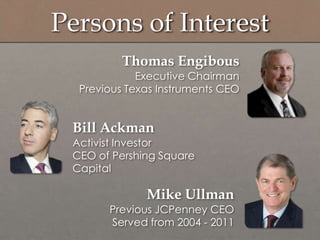
Persons of Interest
Thomas Engibous
Executive Chairman
Previous Texas Instruments CEO
Bill Ackman
Activist Investor
CEO of Pershing Square
Capital
Mike Ullman
Previous JCPenney CEO
Served from 2004 - 2011
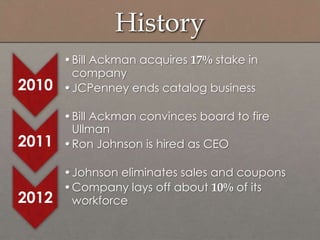
History
2010
•Bill Ackman acquires 17% stake in
company
•JCPenney ends catalog business
2011
•Bill Ackman convinces board to fire
Ullman
•Ron Johnson is hired as CEO
2012
•Johnson eliminates sales and coupons
•Company lays off about 10% of its
workforce
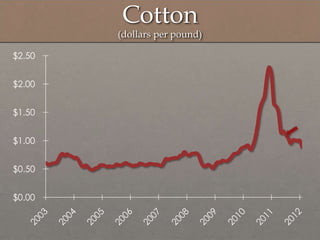
Cotton
(dollars per pound)
$0.00
$0.50
$1.00
$1.50
$2.00
$2.50
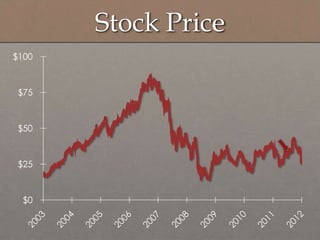
Stock Price
$0
$25
$50
$75
$100
$0
$3
$5
$8
$10
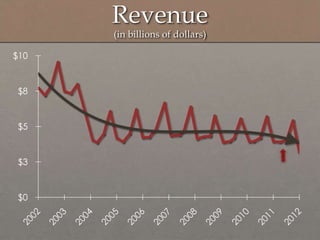
Revenue
(in billions of dollars)
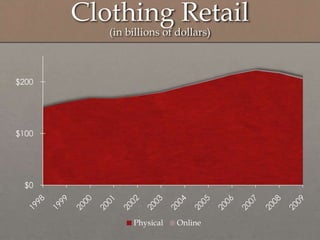
Clothing Retail
(in billions of dollars)
$0
$100
$200
Physical Online
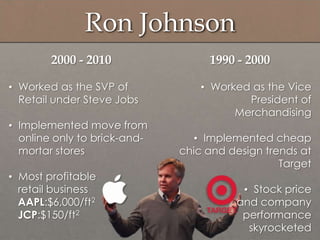
Ron Johnson
2000 - 2010
• Worked as the SVP of
Retail under Steve Jobs
• Implemented move from
online only to brick-and-
mortar stores
• Most profitable
retail business
AAPL:$6,000/ft2
JCP:$150/ft2
1990 - 2000
• Worked as the Vice
President of
Merchandising
• Implemented cheap
chic and design trends at
Target
• Stock price
and company
performance
skyrocketed
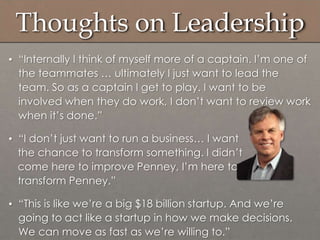
Thoughts on Leadership
• “Internally I think of myself more of a captain. I‟m one of
the teammates … ultimately I just want to lead the
team. So as a captain I get to play. I want to be
involved when they do work, I don‟t want to review work
when it‟s done.”
• “I don‟t just want to run a business… I want
the chance to transform something. I didn‟t
come here to improve Penney, I‟m here to
transform Penney.”
• “This is like we‟re a big $18 billion startup. And we‟re
going to act like a startup in how we make decisions.
We can move as fast as we‟re willing to.”
The Offer
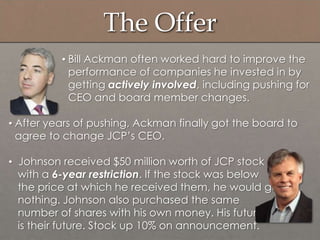
• Bill Ackman often worked hard to improve the
performance of companies he invested in by
getting actively involved, including pushing for
CEO and board member changes.
• After years of pushing, Ackman finally got the board to
agree to change JCP‟s CEO.
• Johnson received $50 million worth of JCP stock
with a 6-year restriction. If the stock was below
the price at which he received them, he would get
nothing. Johnson also purchased the same
number of shares with his own money. His future
is their future. Stock up 10% on announcement.
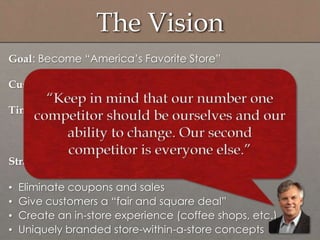
Goal: Become “America‟s Favorite Store”
Customers: Target all classes, instead of just low-income
Timeline: Change all stores immediately and
simultaneously Complete transition within 3
years
Strategy:
• Eliminate coupons and sales
• Give customers a “fair and square deal”
• Create an in-store experience (coffee shops, etc.)
• Uniquely branded store-within-a-store concepts
The Vision
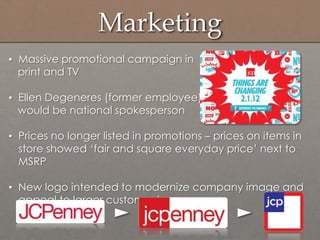
• Massive promotional campaign in
print and TV
• Ellen Degeneres (former employee)
would be national spokesperson
• Prices no longer listed in promotions – prices on items in
store showed „fair and square everyday price‟ next to
MSRP
• New logo intended to modernize company image and
appeal to larger customer base
Marketing
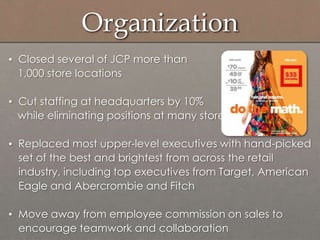
• Closed several of JCP more than
1,000 store locations
• Cut staffing at headquarters by 10%
while eliminating positions at many stores
• Replaced most upper-level executives with hand-picked
set of the best and brightest from across the retail
industry, including top executives from Target, American
Eagle and Abercrombie and Fitch
• Move away from employee commission on sales to
encourage teamwork and collaboration
Organization
Suppliers:
• Eliminated many established brands
• Some suppliers sections unfinished
• Basics (underwear, socks) sales way down
Customers:
• Some prices not relabeled, causing
confusion
• Difficulty finding checkout areas
• Loss of coupons and sales frustrating
Employees:
• Memos and formal communication
eliminated
• Large workforce layoffs
Problems
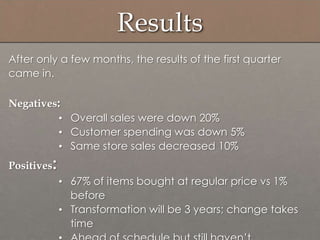
Results
After only a few months, the results of the first quarter
came in.
Negatives:
• Overall sales were down 20%
• Customer spending was down 5%
• Same store sales decreased 10%
Positives:
• 67% of items bought at regular price vs 1%
before
• Transformation will be 3 years; change takes
time
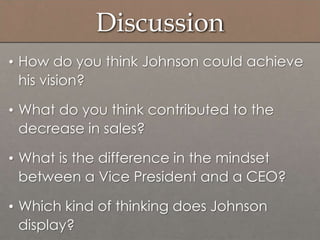
Discussion
• How do you think Johnson could achieve
his vision?
• What do you think contributed to the
decrease in sales?
• What is the difference in the mindset
between a Vice President and a CEO?
• Which kind of thinking does Johnson
display?
Decision
Should the board replace
Johnson or let him follow
through with his vision?
Thank You!

Ld final project edits

  • 1.
    RETAIL REVOLUTION Gary Trinh RA6007502 Peter Marozzi RA6027065 LauraFan RA6007798 Nguyen Hai Viet RA6007463 The new CEO reinvented his last two companies - but is his latest vision a pipe dream? Group 10:
  • 2.
    Company Background • 110-year-oldPlano, Texas based clothing retailer • Founded on the Golden Rule: “Treat people as you‟d want to be treated.” • Mainly targets lower-to-middle-class families
  • 3.
    Persons of Interest ThomasEngibous Executive Chairman Previous Texas Instruments CEO Bill Ackman Activist Investor CEO of Pershing Square Capital Mike Ullman Previous JCPenney CEO Served from 2004 - 2011
  • 4.
    History 2010 •Bill Ackman acquires17% stake in company •JCPenney ends catalog business 2011 •Bill Ackman convinces board to fire Ullman •Ron Johnson is hired as CEO 2012 •Johnson eliminates sales and coupons •Company lays off about 10% of its workforce
  • 5.
  • 6.
  • 7.
  • 8.
    Clothing Retail (in billionsof dollars) $0 $100 $200 Physical Online
  • 9.
    Ron Johnson 2000 -2010 • Worked as the SVP of Retail under Steve Jobs • Implemented move from online only to brick-and- mortar stores • Most profitable retail business AAPL:$6,000/ft2 JCP:$150/ft2 1990 - 2000 • Worked as the Vice President of Merchandising • Implemented cheap chic and design trends at Target • Stock price and company performance skyrocketed
  • 10.
    Thoughts on Leadership •“Internally I think of myself more of a captain. I‟m one of the teammates … ultimately I just want to lead the team. So as a captain I get to play. I want to be involved when they do work, I don‟t want to review work when it‟s done.” • “I don‟t just want to run a business… I want the chance to transform something. I didn‟t come here to improve Penney, I‟m here to transform Penney.” • “This is like we‟re a big $18 billion startup. And we‟re going to act like a startup in how we make decisions. We can move as fast as we‟re willing to.”
  • 11.
    The Offer • BillAckman often worked hard to improve the performance of companies he invested in by getting actively involved, including pushing for CEO and board member changes. • After years of pushing, Ackman finally got the board to agree to change JCP‟s CEO. • Johnson received $50 million worth of JCP stock with a 6-year restriction. If the stock was below the price at which he received them, he would get nothing. Johnson also purchased the same number of shares with his own money. His future is their future. Stock up 10% on announcement.
  • 12.
    Goal: Become “America‟sFavorite Store” Customers: Target all classes, instead of just low-income Timeline: Change all stores immediately and simultaneously Complete transition within 3 years Strategy: • Eliminate coupons and sales • Give customers a “fair and square deal” • Create an in-store experience (coffee shops, etc.) • Uniquely branded store-within-a-store concepts The Vision
  • 13.
    • Massive promotionalcampaign in print and TV • Ellen Degeneres (former employee) would be national spokesperson • Prices no longer listed in promotions – prices on items in store showed „fair and square everyday price‟ next to MSRP • New logo intended to modernize company image and appeal to larger customer base Marketing
  • 14.
    • Closed severalof JCP more than 1,000 store locations • Cut staffing at headquarters by 10% while eliminating positions at many stores • Replaced most upper-level executives with hand-picked set of the best and brightest from across the retail industry, including top executives from Target, American Eagle and Abercrombie and Fitch • Move away from employee commission on sales to encourage teamwork and collaboration Organization
  • 15.
    Suppliers: • Eliminated manyestablished brands • Some suppliers sections unfinished • Basics (underwear, socks) sales way down Customers: • Some prices not relabeled, causing confusion • Difficulty finding checkout areas • Loss of coupons and sales frustrating Employees: • Memos and formal communication eliminated • Large workforce layoffs Problems
  • 16.
    Results After only afew months, the results of the first quarter came in. Negatives: • Overall sales were down 20% • Customer spending was down 5% • Same store sales decreased 10% Positives: • 67% of items bought at regular price vs 1% before • Transformation will be 3 years; change takes time
  • 17.
    Discussion • How doyou think Johnson could achieve his vision? • What do you think contributed to the decrease in sales? • What is the difference in the mindset between a Vice President and a CEO? • Which kind of thinking does Johnson display?
  • 18.
    Decision Should the boardreplace Johnson or let him follow through with his vision?
  • 19.

Editor's Notes

  • #3 Maybe worthwhile to mention other large retails such as K-Mart and Sears have struggled in recent years.
  • #4 We should mention Engibous being an important factor in the transformation of Texas Instruments. And also that Bill Ackman is very active and vocal in his positions (massive $1 billion herbal life short, attempt to change board at P&G, also attempted to change board at Target)
  • #6 Arrow indicates Johnson’s hiring
  • #7 Again, Johnson’s hiring
  • #8 Still, Johnson’s hiring
  • #9 Explain that this is based on US census data and new data isn’t available yet. The main point is to show that while Online sales are growing, they aren’t going to overtake retail anytime soon.
  • #10 Partnered with Michael Graves at Target (huge change in product line-up)