HANDBOOK II
LAWS OF BADMINTON | REGULATIONS
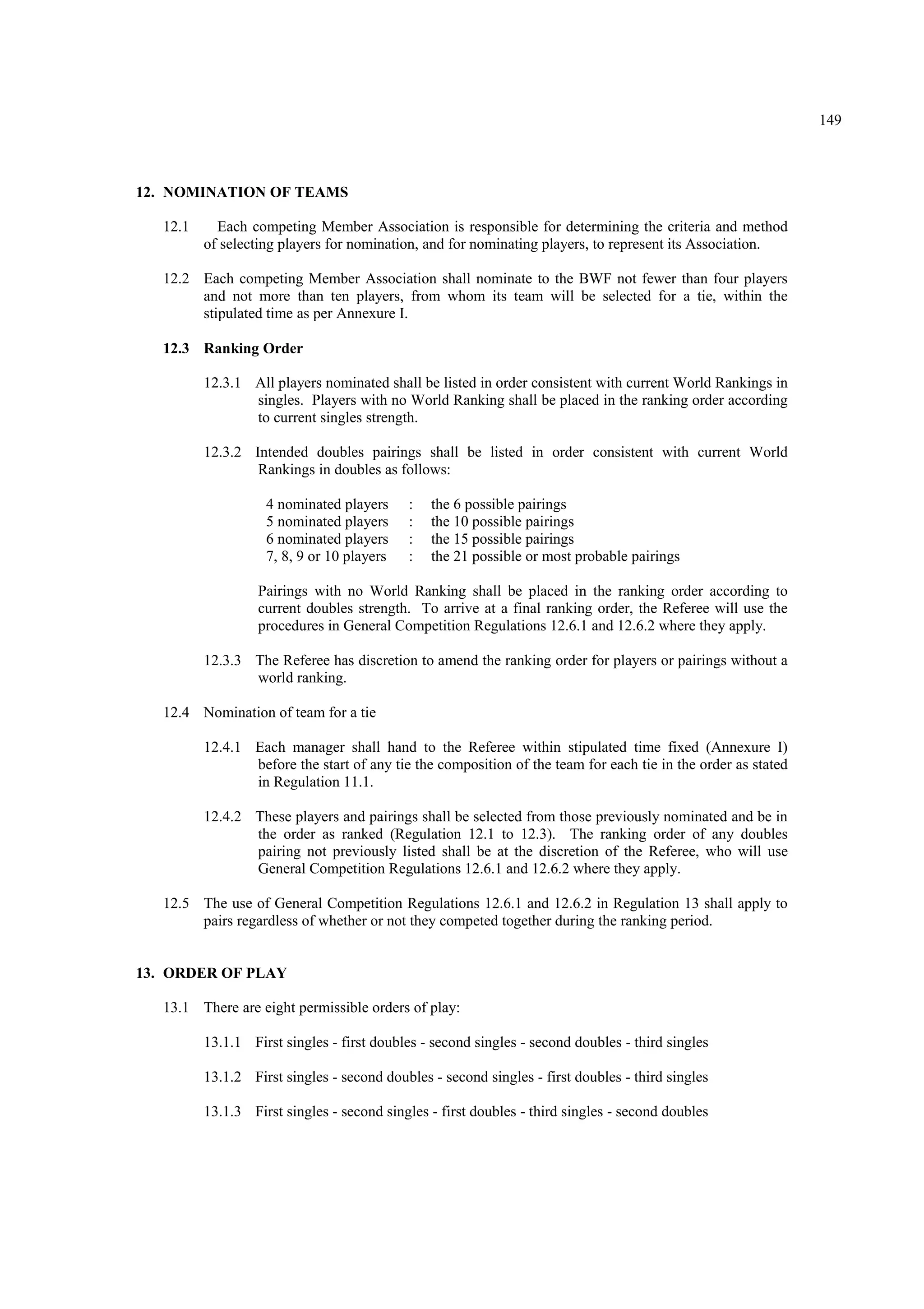
BADMINTON
WORLD
FEDERATION
BWF HANDBOOK II
(Laws of Badminton & Regulations)
2010/2011
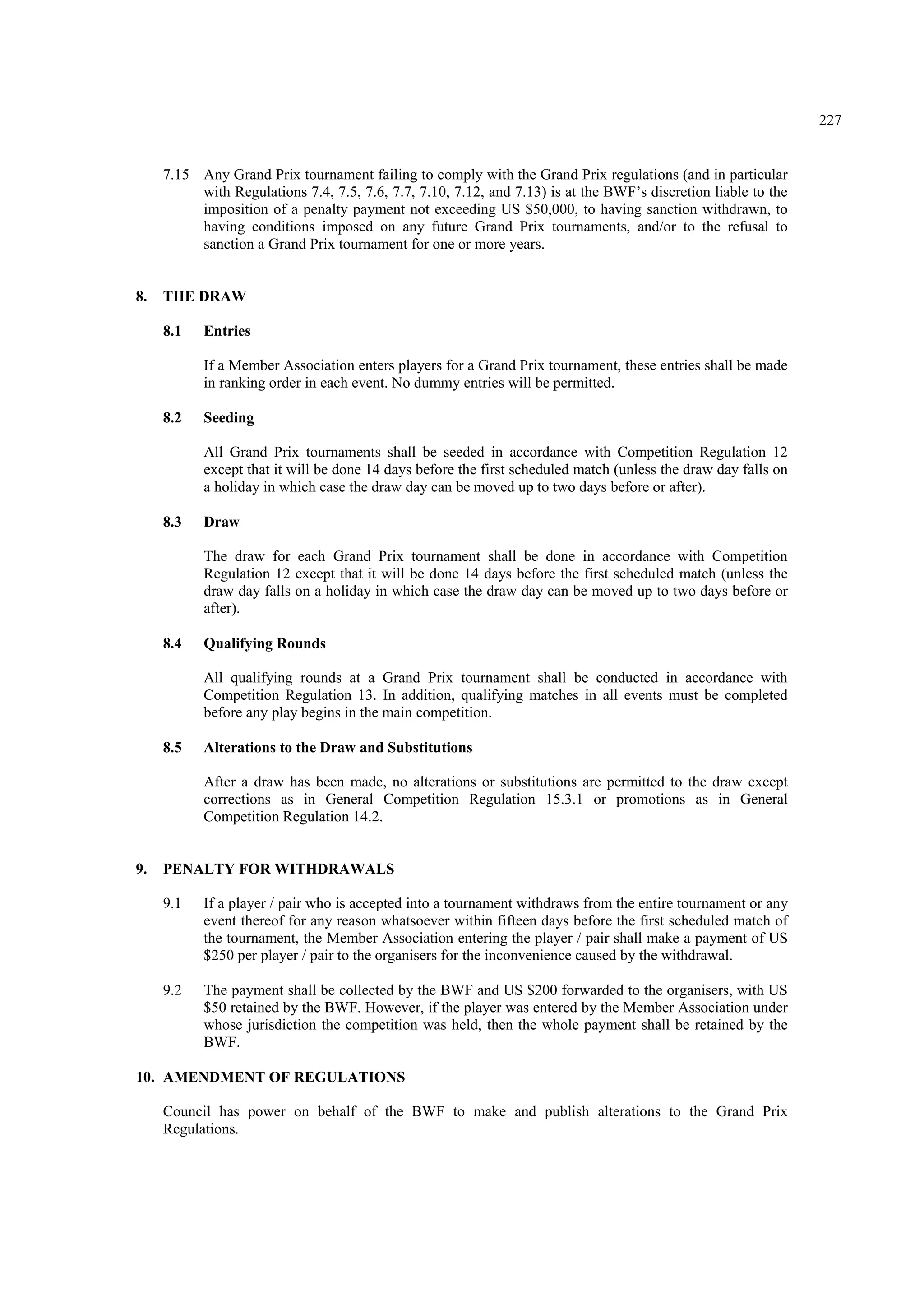
It is the duty of everyone concerned with badminton
to keep themselves informed about the BWF Statutes
COPYRIGHT
ALL RIGHTS RESERVED
Permission to reprint material in this book, either wholly
or in part in any form whatsoever, must be obtained from
the Badminton World Federation
Updated 25 May 2010 by
BADMINTON WORLD FEDERATION
Stadium Badminton Kuala Lumpur
Batu 3 ½ , Jalan Cheras
56000 Kuala Lumpur, Malaysia
Tel: +603-9283 7155 / 6155 / 2155
Fax: +603-9284 7155
E-Mail: bwf@bwfbadminton.org
Web: www.bwfbadminton.org
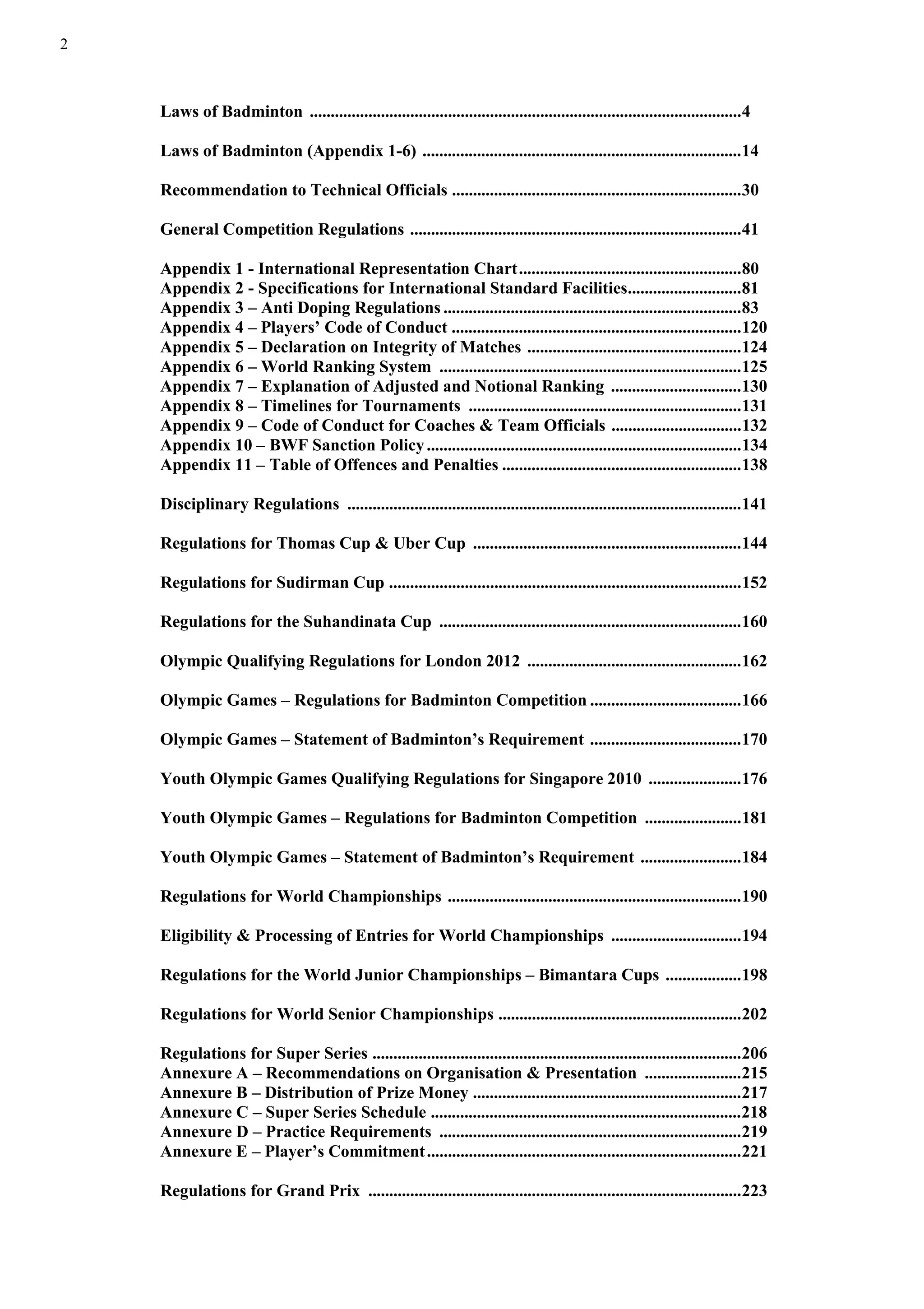
CONTENTS
2
Laws of Badminton .......................................................................................................4
Laws of Badminton (Appendix 1-6) ............................................................................14
Recommendation to Technical Officials .....................................................................30
General Competition Regulations ...............................................................................41
Appendix 1 - International Representation Chart.....................................................80
Appendix 2 - Specifications for International Standard Facilities...........................81
Appendix 3 – Anti Doping Regulations .......................................................................83
Appendix 4 – Players’ Code of Conduct .....................................................................120
Appendix 5 – Declaration on Integrity of Matches ...................................................124
Appendix 6 – World Ranking System ........................................................................125
Appendix 7 – Explanation of Adjusted and Notional Ranking ...............................130
Appendix 8 – Timelines for Tournaments .................................................................131
Appendix 9 – Code of Conduct for Coaches & Team Officials ...............................132
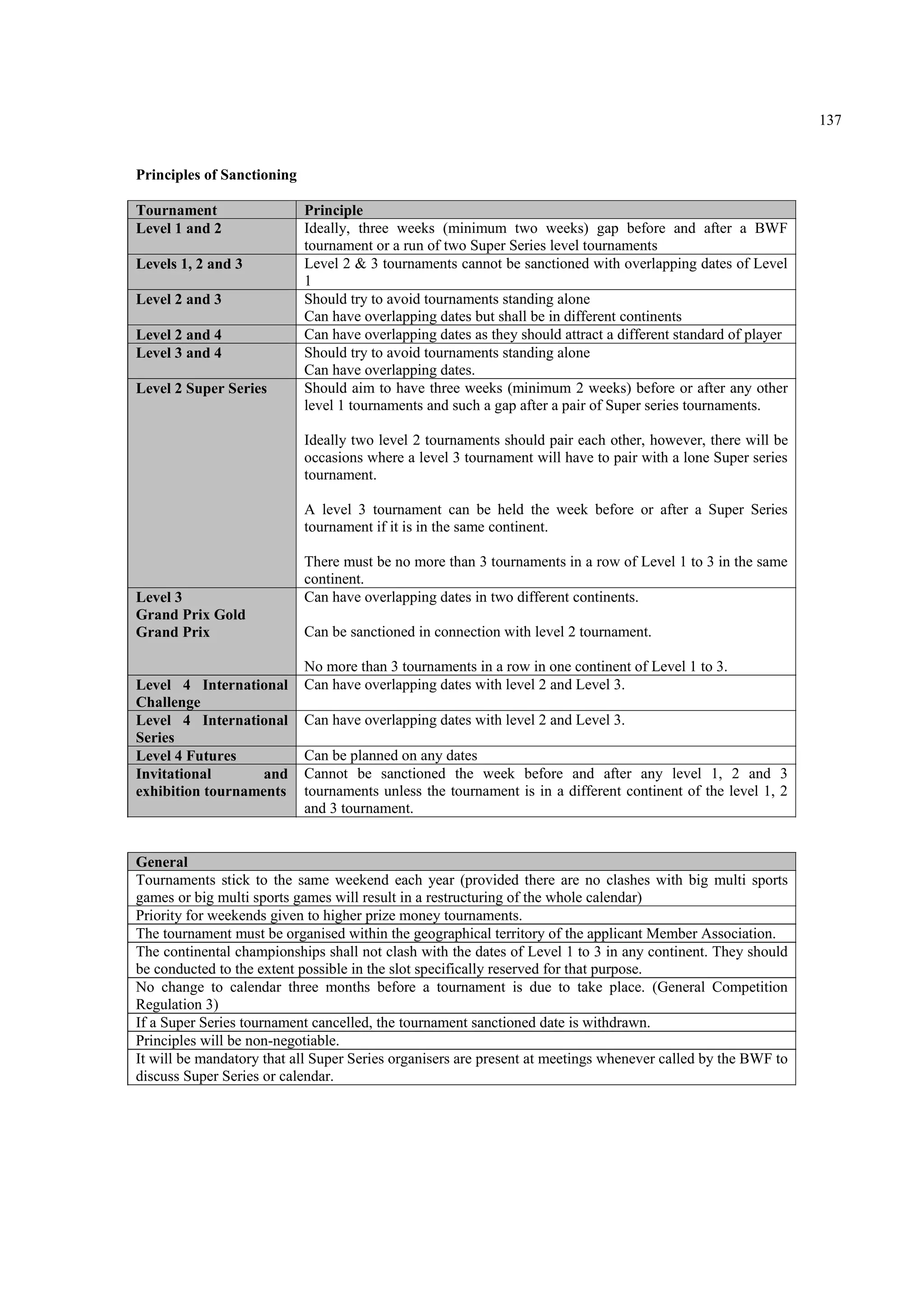
Appendix 10 – BWF Sanction Policy...........................................................................134
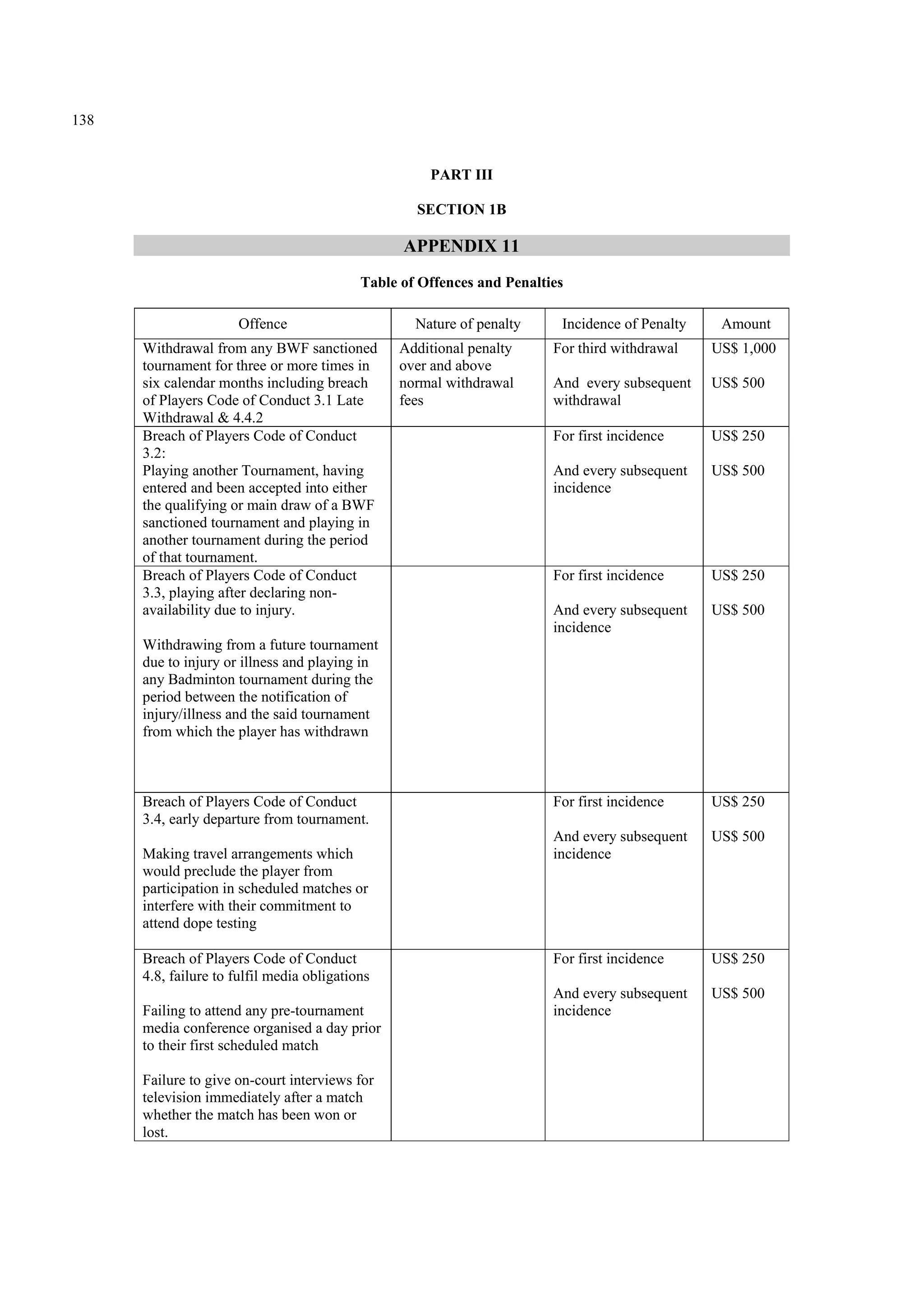
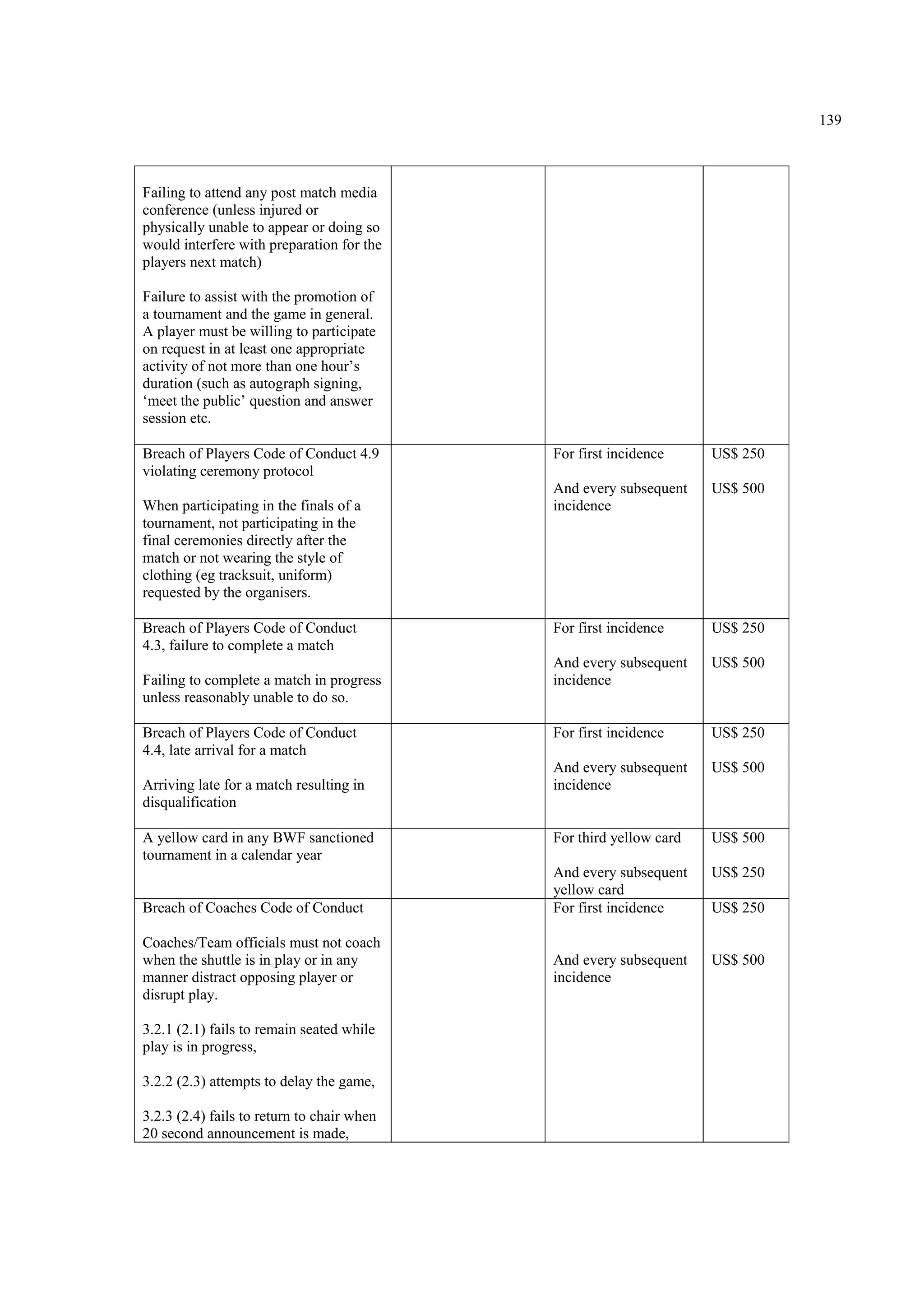
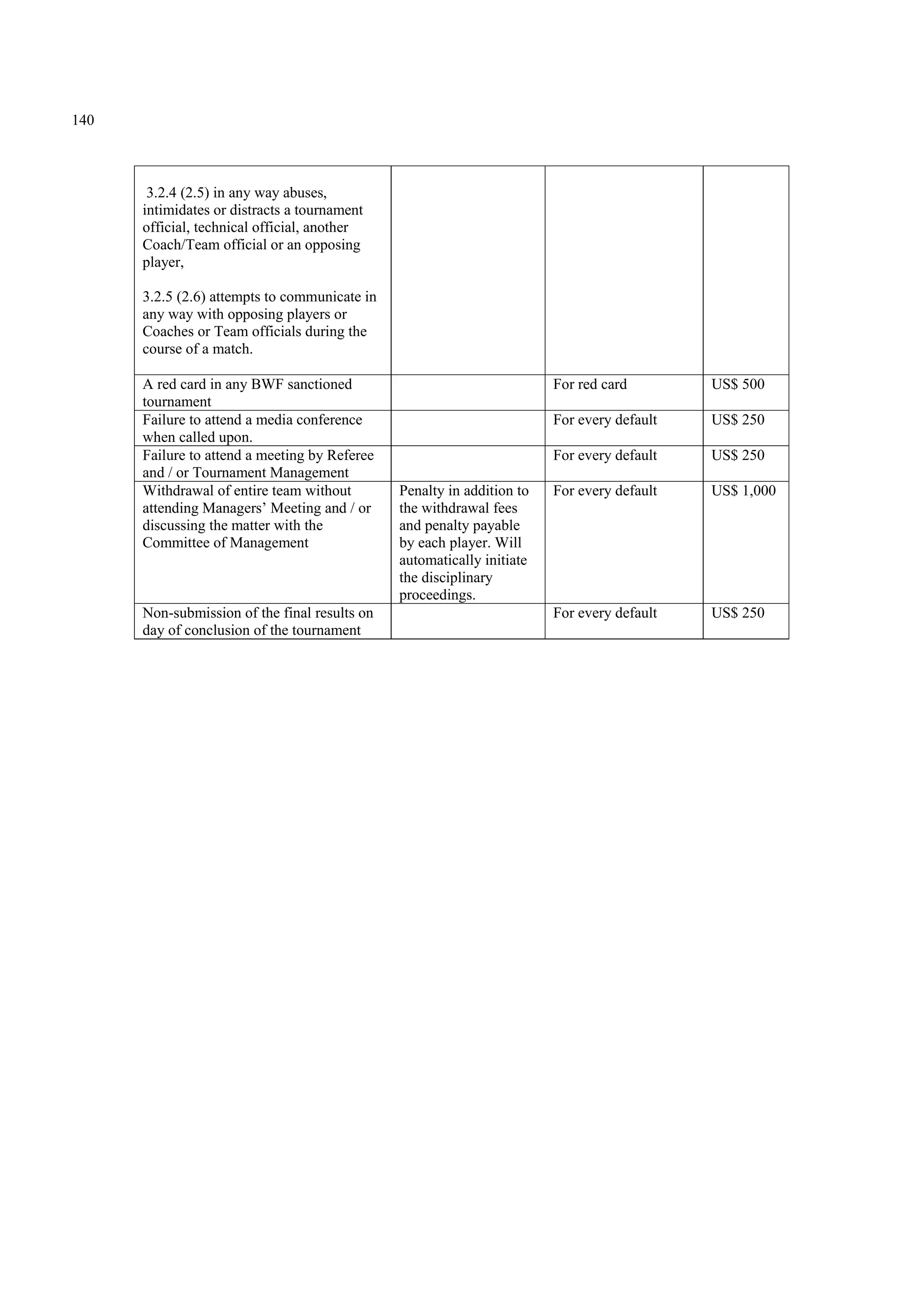
Appendix 11 – Table of Offences and Penalties .........................................................138
Disciplinary Regulations ..............................................................................................141
Regulations for Thomas Cup & Uber Cup ................................................................144
Regulations for Sudirman Cup ....................................................................................152
Regulations for the Suhandinata Cup ........................................................................160
Olympic Qualifying Regulations for London 2012 ...................................................162
Olympic Games – Regulations for Badminton Competition ....................................166
Olympic Games – Statement of Badminton’s Requirement ....................................170
Youth Olympic Games Qualifying Regulations for Singapore 2010 ......................176
Youth Olympic Games – Regulations for Badminton Competition .......................181
Youth Olympic Games – Statement of Badminton’s Requirement ........................184
Regulations for World Championships ......................................................................190
Eligibility & Processing of Entries for World Championships ...............................194
Regulations for the World Junior Championships – Bimantara Cups ..................198
Regulations for World Senior Championships ..........................................................202
Regulations for Super Series ........................................................................................206
Annexure A – Recommendations on Organisation & Presentation .......................215
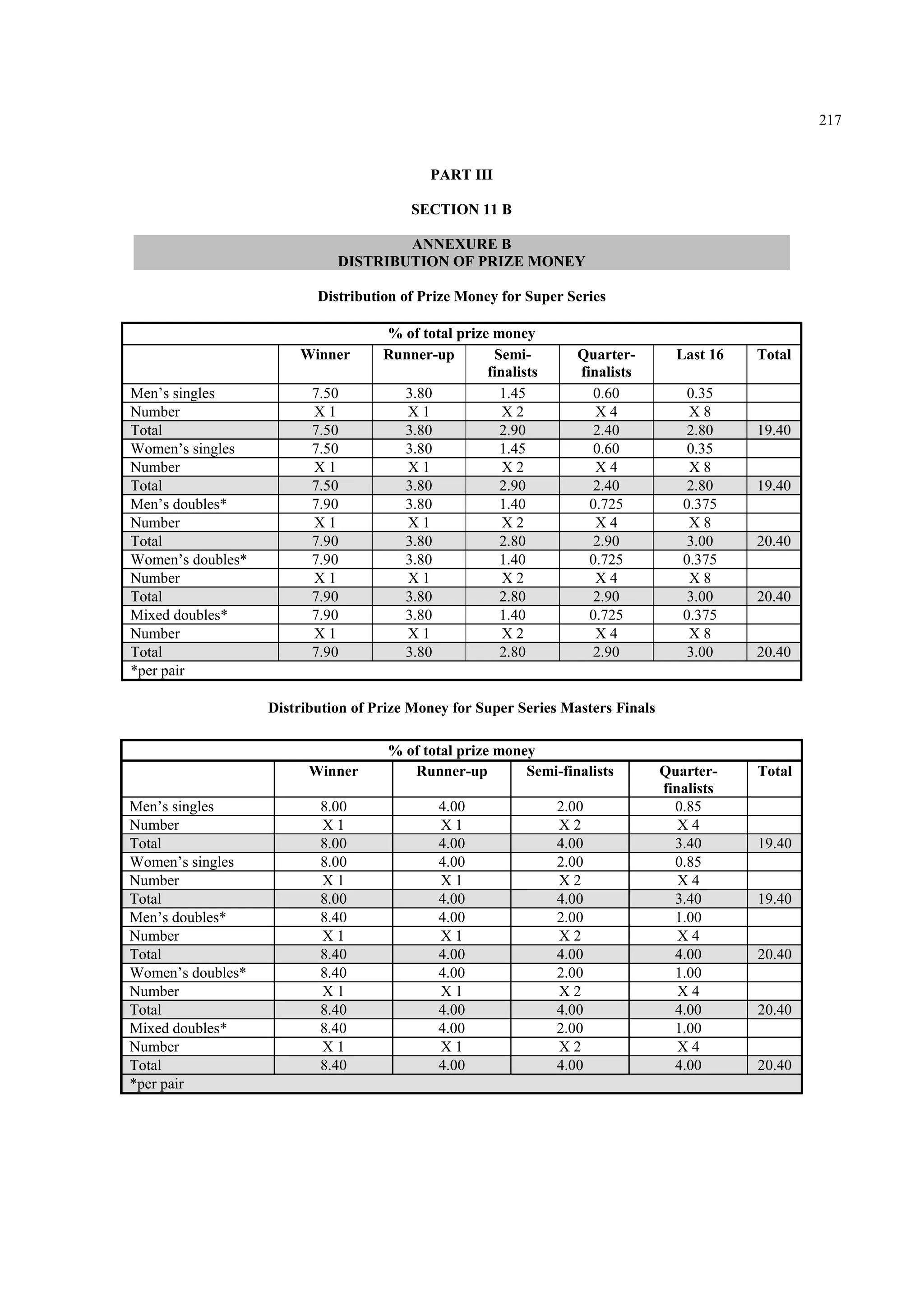
Annexure B – Distribution of Prize Money ................................................................217
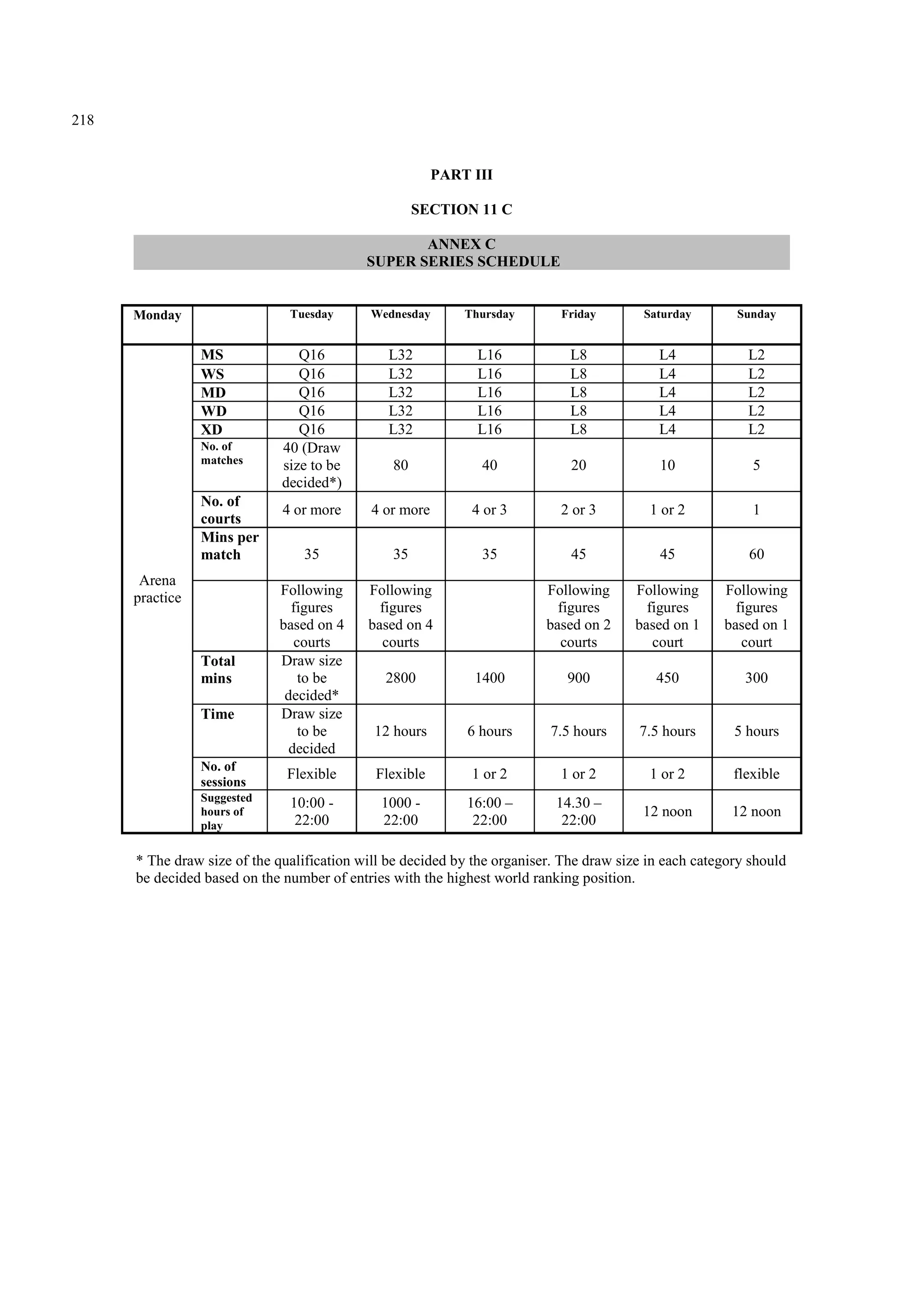
Annexure C – Super Series Schedule ..........................................................................218
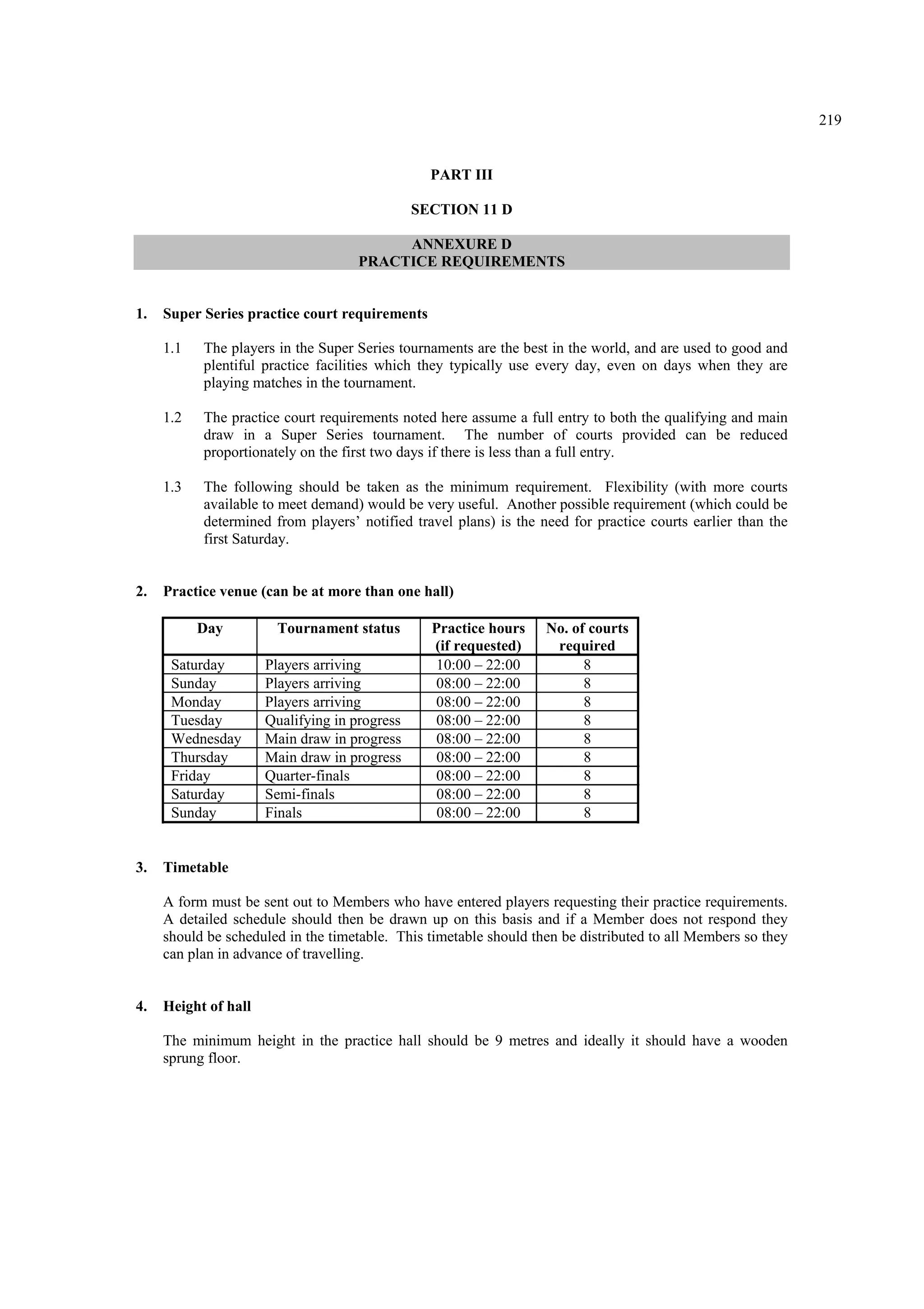
Annexure D – Practice Requirements ........................................................................219
Annexure E – Player’s Commitment...........................................................................221
Regulations for Grand Prix .........................................................................................223
3
Recent Results
Thomas Cup ...................................................................................................................228
Uber Cup ........................................................................................................................230
Sudirman Cup ...............................................................................................................232
Suhandinata Cup ...........................................................................................................235
Olympic Games .............................................................................................................237
World Championships ..................................................................................................240
Bimantara Cups ............................................................................................................243
World Senior Championships .....................................................................................245
Super Series Masters Finals 2009 ................................................................................248
Grand Prix Finals ..........................................................................................................249
Note: Changes are being made constantly to contact details so please check the
BWF website (www.bwfbadminton.org) for updated information. The next
amendment of the Laws is due in 2011.
These Statutes remain current until amended by circular to Members or until
publication of the 2011/2012 Statute Book in 2011.
DATE OF NEXT ANNUAL GENERAL MEETING
The 72nd Annual General Meeting of the Badminton World Federation will be
held in May 2011 in Qingdao, China. A circular will be issued confirming the
exact venue and date.
4
PART II
SECTION 1 A
LAWS OF BADMINTON
DEFINITIONS
Player Any person playing Badminton.
Match The basic contest in Badminton between opposing sides each of one or two players.
Singles A match where there is one player on each of the opposing sides.
Doubles A match where there are two players on each of the opposing sides.
Serving side The side having the right to serve.
Receiving side The side opposing the serving side.
Rally A sequence of one or more strokes starting with the service, until the shuttle ceases to be in
play.
Stroke A movement of the player’s racket with an intention to hit the shuttle.
1. COURT AND COURT EQUIPMENT
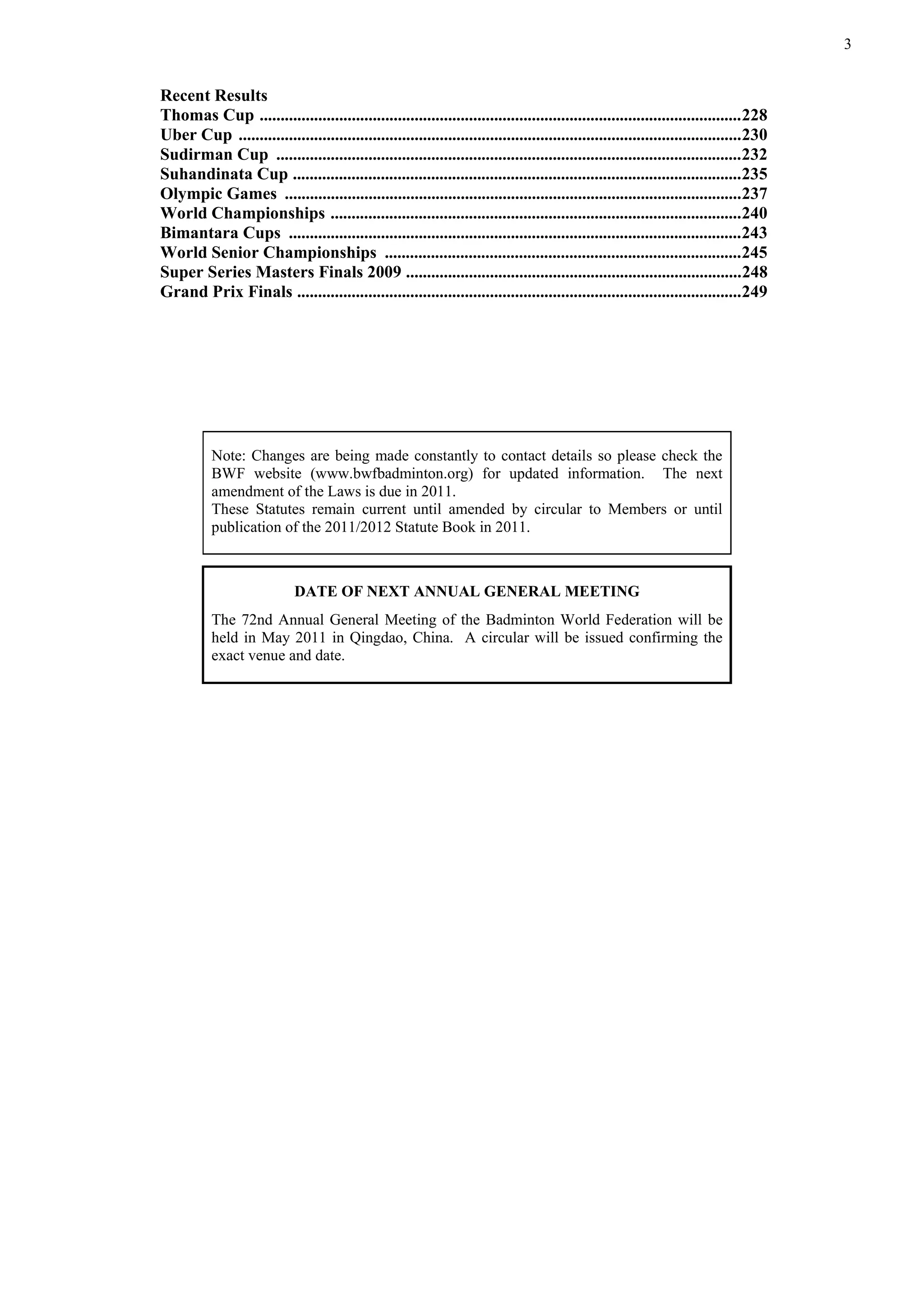
1.1 The court shall be a rectangle marked out with lines 40 mm wide as shown in Diagram A.
1.2 The lines marking out the court shall be easily distinguishable and preferably be coloured white or
yellow.
1.3 All the lines shall form part of the area which they define.
1.4 The posts shall be 1.55 metres in height from the surface of the court and shall remain vertical when the
net is strained as provided in Law 1.10
1.5 The posts shall be placed on the doubles side lines as in Diagram A irrespective of whether singles or
doubles is being played. The posts or its supports shall not extend into the court beyond the side lines.
1.6 The net shall be made of fine cord of dark colour and even thickness with a mesh of not less than l5 mm
and not more than 20 mm.
1.7 The net shall be 760 mm in depth and at least 6.1 metres wide.
1.8 The top of the net shall be edged with a 75 mm white tape doubled over a cord or cable running through
the tape. This tape shall rest upon the cord or cable.
1.9 The cord or cable shall be stretched firmly, flush with the top of the posts.
1.10 The top of the net from the surface of the court shall be 1.524 metres at the centre of the court and 1.55
metres over the side lines for doubles.
1.11 There shall be no gaps between the ends of the net and the posts. If necessary, the full depth of the net at
the ends shall be tied to the posts.
5
DIAGRAM A
2. SHUTTLE
2.1 The shuttle shall be made of natural and / or synthetic materials. From whatever material the shuttle is
made, the flight characteristics generally shall be similar to those produced by a natural feathered shuttle
with a cork base covered by a thin layer of leather.
2.2 Feathered Shuttle
2.2.1 The shuttle shall have 16 feathers fixed in the base.
2.2.2 The feathers shall have a uniform length between 62 mm to 70 mm when measured from the tip
to the top of the base.
2.2.3 The tips of the feathers shall lie on a circle with a diameter from 58 mm to 68 mm.
2.2.4 The feathers shall be fastened firmly with thread or other suitable material.
2.2.5 The base shall be 25 mm to 28 mm in diameter and rounded on the bottom.
2.2.6 The shuttle shall weigh from 4.74 to 5.50 grams.
2.3 Non-Feathered Shuttle
2.3.1 The skirt, or simulation of feathers in synthetic materials, shall replace natural feathers.
2.3.2 The base shall be as described in Law 2.2.5.
2.3.3 Measurements and weight shall be as in Laws 2.2.2, 2.2.3 and 2.2.6. However, because of the
difference in the specific gravity and other properties of synthetic materials in comparison with
feathers, a variation of up to 10 per cent shall be acceptable.
2.4 Subject to there being no variation in the general design, speed and flight of the shuttle, modifications in
the above specifications may be made with the approval of the Member Association concerned, in places
where atmospheric conditions due to either altitude or climate make the standard shuttle unsuitable.
Note: (1) Diagonal length of full court = 14.723m
(2) Court as shown above can be used for both singles and doubles play
(3) ** Optional testing marks as shown in Diagram B.
6
3. TESTING A SHUTTLE FOR SPEED
3.1 To test a shuttle, a player shall use a full underhand stroke which makes contact with the shuttle over the
back boundary line. The shuttle shall be hit at an upward angle and in a direction parallel to the side lines.
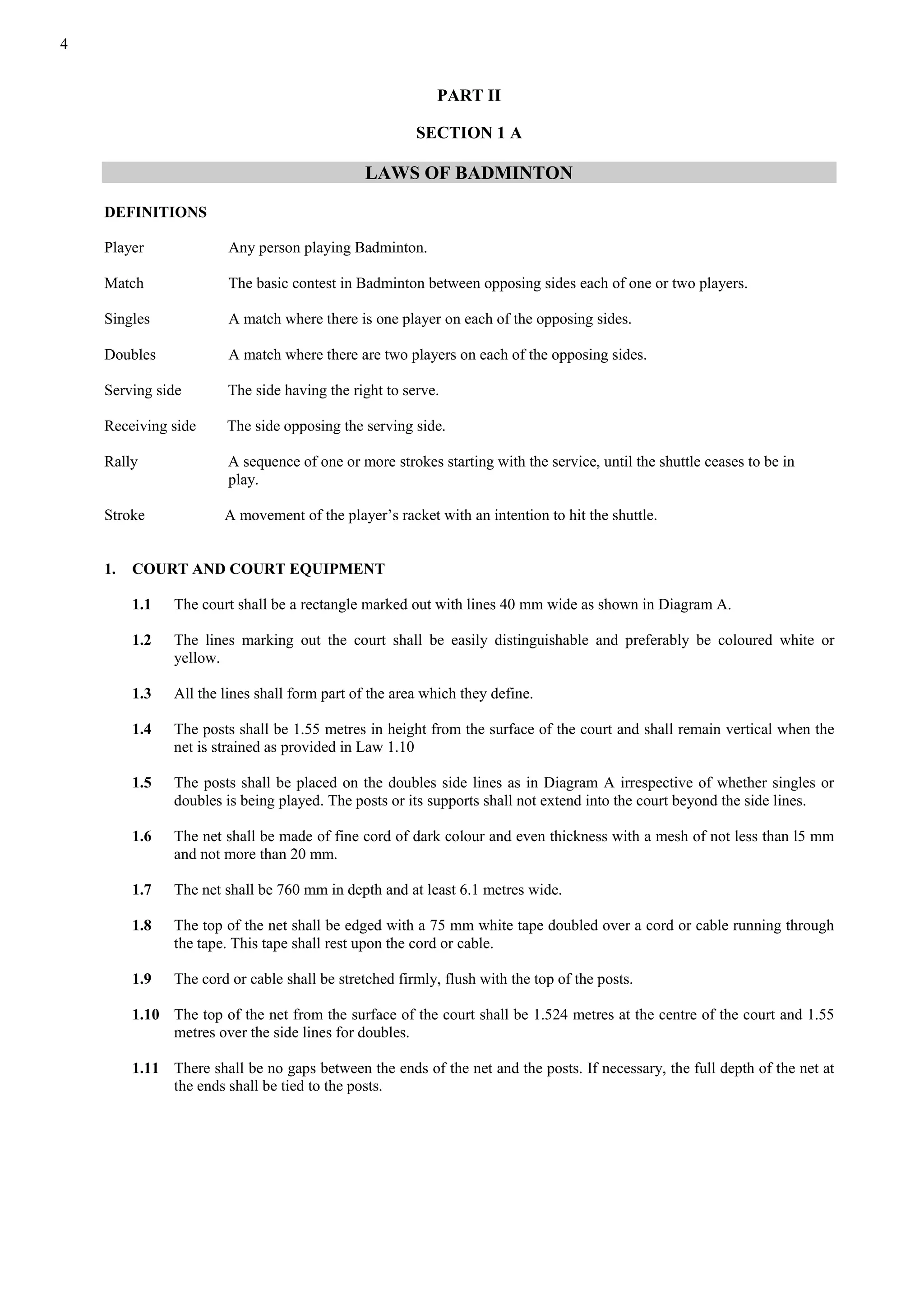
3.2 A shuttle of correct speed will land not less than 530 mm and not more than 990 mm short of the other
back boundary line as in Diagram B.
DIAGRAM B
4. RACKET
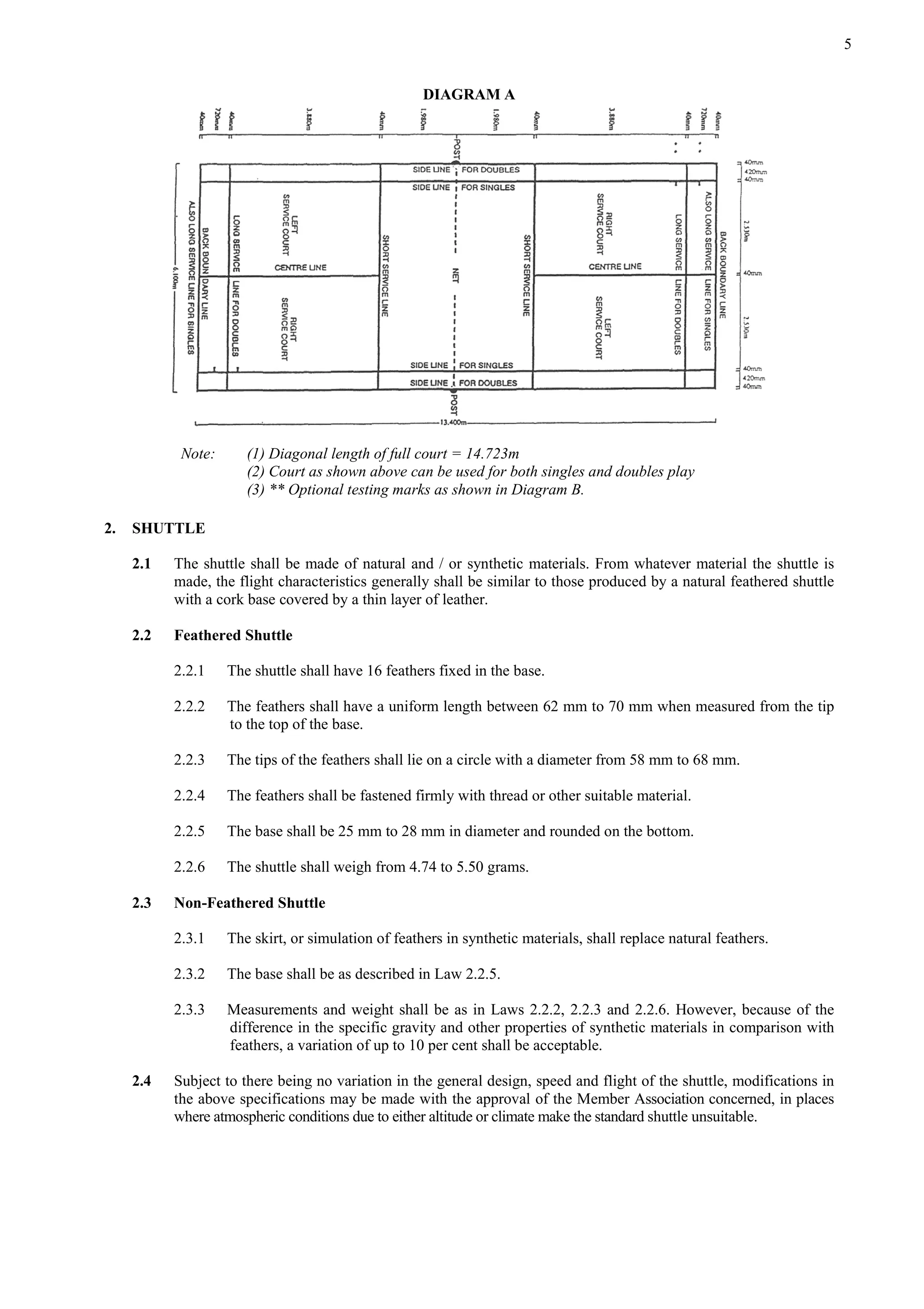
4.1 The racket shall be a frame not exceeding 680 mm in overall length and 230 mm in overall width
consisting of the main parts described in Laws 4.1.1 to 4.1.5 as illustrated in Diagram C.
4.1.1 The handle is the part of the racket intended to be gripped by a player.
4.1.2 The stringed area is the part of the racket with which it is intended that a player hits the shuttle.
4.1.3 The head bounds the stringed area.
4.1.4 The shaft connects the handle to the head (subject to Law 4.1.5).
4.1.5 The throat (if present) connects the shaft to the head.
DIAGRAM C
frame
7
4.2 The stringed area:
4.2.1 shall be flat and consist of a pattern of crossed strings either alternately interlaced or bonded
where they cross. The stringing pattern shall be generally uniform and, in particular, not less
dense in the centre than in any other area; and
4.2.2 shall not exceed 280 mm in overall length and 220 mm in overall width. However, the strings
may extend into an area which otherwise would be the throat, provided that:
4.2.2.1 the width of the extended stringed area does not exceed 35 mm; and
4.2.2.2 the overall length of the stringed area does not then exceed 330 mm.
4.3 The racket:
4.3.1 shall be free of attached objects and protrusions, other than those used solely and specifically to
limit or prevent wear and tear, or vibration, or to distribute weight, or to secure the handle by
cord to the player’s hand, and which are reasonable in size and placement for such purposes; and
4.3.2 shall be free of any device that makes it possible for a player to change materially the shape of
the racket.
5. EQUIPMENT COMPLIANCE
The Badminton World Federation shall rule on any question of whether any racket, shuttle or equipment or any
prototype used in the playing of Badminton complies with the specifications. Such ruling may be undertaken on
the Federation’s initiative or on application by any party with a bona fide interest, including any player,
technical official, equipment manufacturer or Member Association or member thereof.
6. TOSS
6.1 Before play commences, a toss shall be conducted and the side winning the toss shall exercise the choice
in either Law 6.1.1 or 6.1.2:
6.1.1 to serve or receive first;
6.1.2 to start play at one end of the court or the other.
6.2 The side losing the toss shall then exercise the remaining choice.
7. SCORING SYSTEM
7.1 A match shall consist of the best of three games, unless otherwise arranged (Part II Section 1B Appendix
2 and 3).
7.2 A game shall be won by the side which first scores 21 points, except as provided in Law 7.4 and 7.5.
7.3 The side winning a rally shall add a point to its score. A side shall win a rally, if the opposing side
commits a ‘fault’ or the shuttle ceases to be in play because it touches the surface of the court inside the
opponent’s court.
7.4 If the score becomes 20-all, the side which gains a two point lead first, shall win that game.
7.5 If the score becomes 29-all, the side scoring the 30th
point shall win that game.
7.6 The side winning a game shall serve first in the next game.
8
8. CHANGE OF ENDS
8.1 Players shall change ends:
8.1.1 at the end of the first game;
8.1.2 at the end of the second game, if there is to be a third game; and
8.1.3 in the third game when a side first scores 11 points.
8.2 If the ends are not changed as indicated in Law 8.1, it shall be done so as soon as the mistake is
discovered and when the shuttle is not in play. The existing score shall stand.
9. SERVICE
9.1 In a correct service,
9.1.1 neither side shall cause undue delay to the delivery of the service once the server and the receiver
are ready for the service. On completion of the backward movement of server’s racket head, any
delay in the start of the service (Law 9.2), shall be considered to be an undue delay;
9.1.2 the server and the receiver shall stand within diagonally opposite service courts (Diagram A)
without touching the boundary lines of these service courts;
9.1.3 some part of both feet of the server and the receiver shall remain in contact with the surface of
the court in a stationary position from the start of the service (Law 9.2) until the service is
delivered (Law 9.3);
9.1.4 the server’s racket shall initially hit the base of the shuttle;
9.1.5 the whole shuttle shall be below the server’s waist at the instant of being hit by the server’s
racket. The waist shall be considered to be an imaginary line round the body, level with the
lowest part of the server’s bottom rib;
9.1.6 the shaft of the server’s racket at the instant of hitting the shuttle shall be pointing in a downward
direction;
9.1.7 the movement of the server’s racket shall continue forwards from the start of the service (Law
9.2) until the service is delivered (Law 9.3);
9.1.8 the flight of the shuttle shall be upwards from the server’s racket to pass over the net so that, if
not intercepted, it shall land in the receiver’s service court (i. e. on or within the boundary lines);
and
9.1.9 in attempting to serve, the server shall not miss the shuttle.
9.2 Once the players are ready for the service, the first forward movement of the server’s racket head shall be
the start of the service.
9.3 Once started (Law 9.2), the service is delivered when the shuttle is hit by the server’s racket or, in
attempting to serve, the server misses the shuttle.
9.4 The server shall not serve before the receiver is ready. However, the receiver shall be considered to have
been ready if a return of the service is attempted.
9.5 In doubles, during the delivery of service (Law 9.2, 9.3), the partners may take up any positions within
their respective courts, which do not unsight the opposing server or receiver.
9
10. SINGLES
10.1 Serving and receiving courts
10.1.1 The players shall serve from, and receive in, their respective right service courts when the server
has not scored or has scored an even number of points in that game.
10.1.2 The players shall serve from, and receive in, their respective left service courts when the server
has scored an odd number of points in that game.
10.2 Order of play and position on court
In a rally, the shuttle may be hit by the server and the receiver alternately, from any position on that
player’s side of the net, until the shuttle ceases to be in play (Law 15).
10.3 Scoring and serving
10.3.1 If the server wins a rally (Law 7.3), the server shall score a point. The server shall then serve
again from the alternate service court.
10.3.2 If the receiver wins a rally (Law 7.3), the receiver shall score a point. The receiver shall then
become the new server.
11. DOUBLES
11.1 Serving and receiving courts
11.1.1 A player of the serving side shall serve from the right service court when the serving side has not
scored or has scored an even number of points in that game.
11.1.2 A player of the serving side shall serve from the left service court when the serving side has
scored an odd number of points in that game.
11.1.3 The player of the receiving side who served last shall stay in the same service court from where
he served last. The reverse pattern shall apply to the receiver’s partner.
11.1.4 The player of the receiving side standing in the diagonally opposite service court to the server
shall be the receiver.
11.1.5 The players shall not change their respective service courts until they win a point when their side
is serving.
11.1.6 Service in any turn of serving shall be delivered from the service court corresponding to the
serving side’s score, except as provided in Law 12.
11.2 Order of play and position on court
After the service is returned, in a rally, the shuttle may be hit by either player of the serving side and
either player of the receiving side alternately, from any position on that player’s side of the net, until the
shuttle ceases to be in play (Law 15).
11.3 Scoring and serving
11.3.1 If the serving side wins a rally (Law 7.3), the serving side shall score a point. The server shall
then serve again from the alternate service court.
11.3.2 If the receiving side wins a rally (Law 7.3), the receiving side shall score a point. The receiving
side shall then become the new serving side.
11.4 Sequence of serving
In any game, the right to serve shall pass consecutively:
10
11.4.1 from the initial server who started the game from the right service court
11.4.2 to the partner of the initial receiver.
11.4.3 to the partner of the initial server
11.4.4 to the initial receiver,
11.4.5 to the initial server and so on.
11.5 No player shall serve or receive out of turn, or receive two consecutive services in the same game, except
as provided in Law 12.
11.6 Either player of the winning side may serve first in the next game, and either player of the losing side may
receive first in the next game.
12. SERVICE COURT ERRORS
12.1 A service court error has been made when a player:
12.1.1 has served or received out of turn; or
12.1.2 has served or received from the wrong service court;
12.2 If a service court error is discovered, the error shall be corrected and the existing score shall stand.
13. FAULTS
It shall be a ‘fault’:
13.1 if a service is not correct (Law 9.1);
13.2 if, in service, the shuttle:
13.2.1 is caught on the net and remains suspended on its top;
13.2.2 after passing over the net, is caught in the net; or
13.2.3 is hit by the receiver’s partner;
13.3 if in play, the shuttle:
13.3.1 lands outside the boundaries of the court (i. e. not on or within the boundary lines);
13.3.2 passes through or under the net;
13.3.3 fails to pass over the net;
13.3.4 touches the ceiling or side walls;
13.3.5 touches the person or dress of a player;
13.3.6 touches any other object or person outside the court;
(Where necessary on account of the structure of the building, the local badminton authority may,
subject to the right of veto of its Member Association, make bye-laws dealing with cases in which
a shuttle touches an obstruction).
13.3.7 is caught and held on the racket and then slung during the execution of a stroke;
11
13.3.8 is hit twice in succession by the same player. However, a shuttle hitting the head and the stringed
area of the racket in one stroke shall not be a ‘fault’;
13.3.9 is hit by a player and the player’s partner successively; or
13.3.10 touches a player’s racket and does not travel towards the opponent’s court;
13.4 if, in play, a player:
13.4.1 touches the net or its supports with racket, person or dress;
13.4.2 invades an opponent’s court over the net with racket or person except that the striker may follow
the shuttle over the net with the racket in the course of a stroke after the initial point of contact
with the shuttle is on the striker’s side of the net;
13.4.3 invades an opponent’s court under the net with racket or person such that an opponent is
obstructed or distracted; or
13.4.4 obstructs an opponent, i.e. prevents an opponent from making a legal stroke where the shuttle is
followed over the net;
13.4.5 deliberately distracts an opponent by any action such as shouting or making gestures;
13.5 if a player is guilty of flagrant, repeated or persistent offences under Law 16.
14. LETS
14.1 ‘Let’ shall be called by the umpire, or by a player (if there is no umpire), to halt play.
14.2 It shall be a ‘let”, if:
14.2.1 the server serves before the receiver is ready (Law 9.4);
14.2.2 during service, the receiver and the server are both faulted;
14.2.3 after the service is returned, the shuttle is:
14.2.3.1 caught on the net and remains suspended on its top, or
14.2.3.2 after passing over the net is caught in the net;
14.2.4 during play, the shuttle disintegrates and the base completely separates from the rest of the
shuttle;
14.2.5 in the opinion of the umpire, play is disrupted or a player of the opposing side is distracted by a
coach;
14.2.6 a line judge is unsighted and the umpire is unable to make a decision; or
14.2.7 any unforeseen or accidental situation has occurred.
14.3 When a ‘let’ occurs, play since the last service shall not count and the player who served last shall serve
again.
15. SHUTTLE NOT IN PLAY
A shuttle is not in play when:
15.1 it strikes the net or post and starts to fall towards the surface of the court on the striker’s side of the net;
15.2 it hits the surface of the court; or
12
15.3 a ‘fault’ or a ‘let’ has occurred.
16. CONTINUOUS PLAY, MISCONDUCT & PENALTIES
16.1 Play shall be continuous from the first service until the match is concluded, except as allowed in Laws
16.2 and 16.3.
16.2 Intervals:
16.2.1 not exceeding 60 seconds during each game when the leading score reaches 11 points; and
16.2.2 not exceeding 120 seconds between the first and second game, and between the second and third
game shall be allowed in all matches.
(For a televised match, the Referee may decide before the match that intervals as in Law 16.2 are
mandatory and of fixed duration).
16.3 Suspension of play
16.3.1 When necessitated by circumstances not within the control of the players, the umpire may
suspend play for such a period as the umpire may consider necessary.
16.3.2 Under special circumstances the Referee may instruct the umpire to suspend play.
16.3.3 If play is suspended, the existing score shall stand and play shall be resumed from that point.
16.4 Delay in play
16.4.1 Under no circumstances shall play be delayed to enable a player to recover strength or wind or to
receive advice.
16.4.2 The umpire shall be the sole judge of any delay in play.
16.5 Advice and leaving the court
16.5.1 Only when the shuttle is not in play (Law 15), shall a player be permitted to receive advice
during a match.
16.5.2 No player shall leave the court during a match without the umpire’s permission, except during
the intervals as described in Law 16.2.
16.6 A player shall not:
16.6.1 deliberately cause delay in, or suspension of, play;
16.6.2 deliberately modify or damage the shuttle in order to change its speed or its flight;
16.6.3 behave in an offensive manner; or
16.6.4 be guilty of misconduct not otherwise covered by the Laws of Badminton.
16.7 Administration of breach
16.7.1 The umpire shall administer any breach of Law 16.4.1, 16.5.2 or 16.6 by:
16.7.1.1 issuing a warning to the offending side;
16.7.1.2 faulting the offending side, if previously warned. Two such faults by a side shall be
considered to be a persistent offence; or
13
16.7.2 in cases of flagrant offence, persistent offences or breach of Law 16.2 the umpire shall fault the
offending side and report the offending side immediately to the Referee, who shall have the
power to disqualify the offending side from the match.
17. OFFICIALS AND APPEALS
17.1 The Referee shall be in overall charge of the tournament or championship(s) of which a match forms part.
17.2 The umpire, where appointed, shall be in charge of the match, the court and its immediate surrounds. The
umpire shall report to the Referee.
17.3 The service judge shall call service faults made by the server should they occur (Law 9.1.2 to 9.1.8).
17.4 A line judge shall indicate whether a shuttle landed ‘in’ or ‘out’ on the line(s) assigned.
17.5 An official’s decision shall be final on all points of fact for which that official is responsible except that if,
in the opinion of the umpire, it is beyond reasonable doubt that a line judge has clearly made a wrong call,
the umpire shall overrule the decision of the line judge.
17.6 An umpire shall:
17.6.1 uphold and enforce the Laws of Badminton and, especially, call a ‘fault’ or a ‘let’ should either
occur;
17.6.2 give a decision on any appeal regarding a point of dispute, if made before the next service is
delivered;
17.6.3 ensure players and spectators are kept informed of the progress of the match;
17.6.4 appoint or replace line judges or a service judge in consultation with the Referee;
17.6.5 where another technical official is not appointed, arrange for that official’s duties to be carried
out;
17.6.6 where an appointed official is unsighted, carry out that official’s duties or play a ‘let’;
17.6.7 record and report to the Referee all matters relating to Law 16; and
17.6.8 refer to the Referee all unsatisfied appeals on questions of law only. (Such appeals must be made
before the next service is delivered or, if at the end of the match, before the side that appeals has
left the court.)
14
PART II
SECTION 1B
APPENDIX 1
VARIATIONS IN COURT AND EQUIPMENT
1. Where it is not practicable to have posts on the sidelines, some method shall be used to indicate the position of
the sidelines where they pass under the net, e.g. by the use of thin posts or strips of material 40 mm wide, fixed
to the side lines and rising vertically to the net cord.
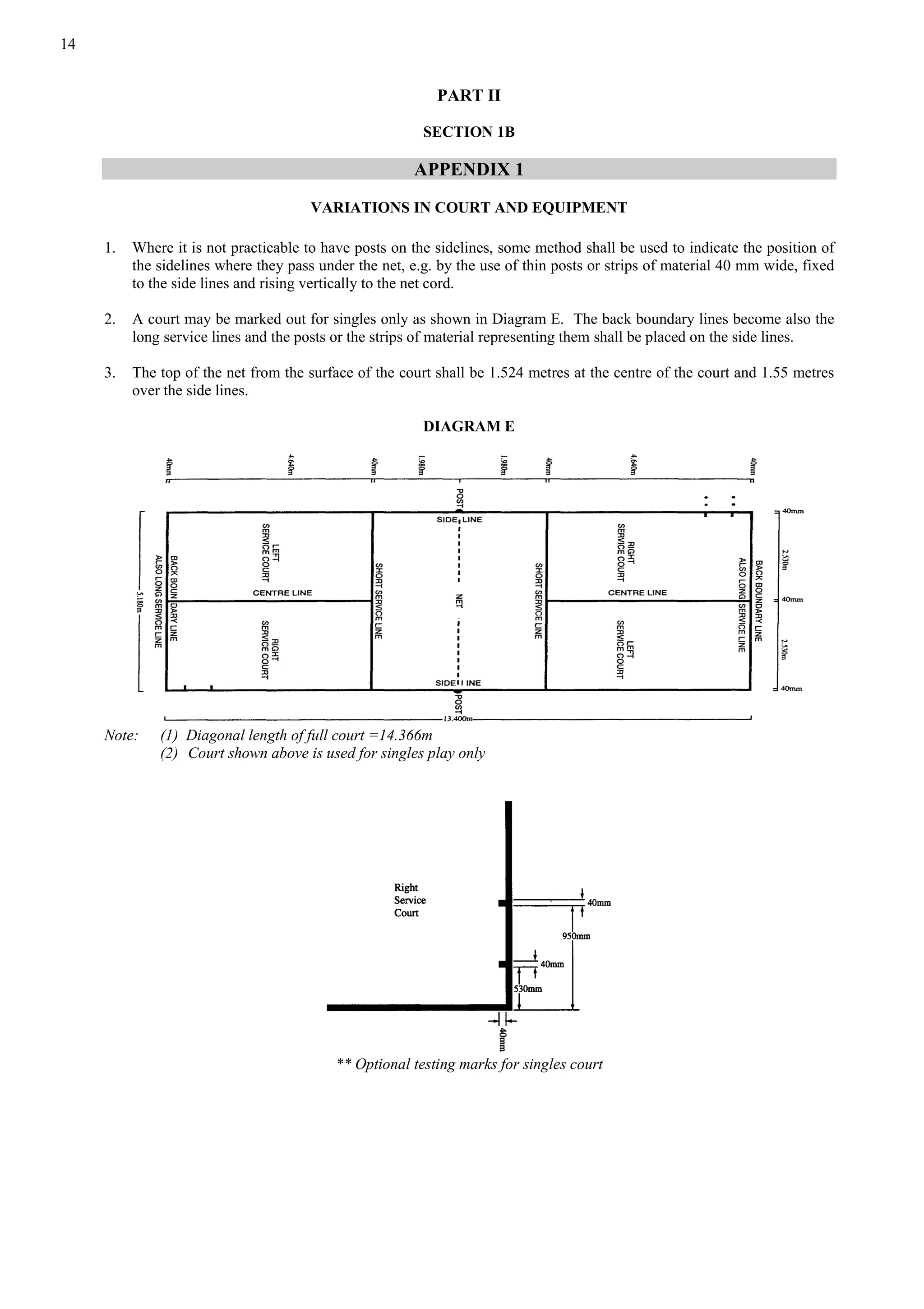
2. A court may be marked out for singles only as shown in Diagram E. The back boundary lines become also the
long service lines and the posts or the strips of material representing them shall be placed on the side lines.
3. The top of the net from the surface of the court shall be 1.524 metres at the centre of the court and 1.55 metres
over the side lines.
DIAGRAM E
Note: (1) Diagonal length of full court =14.366m
(2) Court shown above is used for singles play only
** Optional testing marks for singles court
15
PART II
SECTION 1 B
APPENDIX 2
HANDICAP MATCHES
In handicap matches, the following variations in the Laws apply:
1. The score required to win a game shall not vary from that set out in Law 7.
2. Law 8.1.3 shall be amended to read:
‘in the third game, and in a match of one game, when one side has scored half the total number of points
required to win the game (the next higher number being taken in case of fractions)’.
16
PART II
SECTION 1 B
APPENDIX 3
OTHER SCORING SYSTEMS
It is permissible to play by prior arrangement, either.
1. one game of 21 points, or
2. the best of 3 games of 15 points.
In case of 1 above, the following variation shall apply to the Laws of Badminton:
8. CHANGE OF ENDS
8.1. In a one game match, players shall change ends when a side first scores 11 points.
In case of 2 above, the following variation shall apply to the Laws of Badminton:
7. SCORING SYSTEM
7.1 A match shall consist of the best of three games.
7.2 A game shall be won by the side which first scores 15 points, except as provided in Law 7.4 and 7.5.
7.3 If the score becomes 14-all, the side which gains a two point lead first, shall win that game.
7.4 If the score becomes 20-all, the side scoring the 21st point shall win that game.
8. CHANGE OF ENDS
8.1.3 in the third game when a side first scores 8 points.
16. CONTINUOUS PLAY, MISCONDUCT & PENALTIES
16.2 Intervals:
16.2.1 not exceeding 60 seconds during each game when the leading score reaches 8 points
17
PART II
SECTION 1 B
APPENDIX 4
VOCABULARY
This Appendix lists the standard vocabulary that shall be used by the umpire to control a match.
1. Announcements and Introductions
1.1 ‘Ladies and Gentlemen:
1.1.1 on my right, ...... (player name), ...... (country name), and on my left, ...... (player name), ......
(country name); or
1.1.2 on my right, ...... (player names), ...... (country name), and on my left ….. (player names), ......
(country name)
1.1.3 on my right, ….. (country / team name), represented by ….. (player name), and on my left, …..
(country/team name), represented by ….. (player name); or
1.1.4 on my right, ….. (country / team name), represented by ….. (player names), and on my left, …..
(country / team name), represented by ….. (player names)
1.2.1 ...... (player name) to serve; or
1.2.2 ...... (country/team name) to serve;
1.3.1 ...... (player name) to serve to ...... (player name);
1.3.2 ...... (player name) to ...... (player name);’
To be used in the order shown in the table below, as appropriate:
Event Singles Doubles
Individual 1.1.1, 1.2.1 1.1.2, 1.3.1
Team 1.1.3, 1.2.2 1.1.4, 1.2.2, 1.3.2
2. Start of match and calling the score
2.1 ‘Love all’
2.2 ‘Play’
2.3 ‘Service over’
2.4 ‘Interval’
2.5 ‘Court ... ’ (number) ‘20 seconds’
2.6 ‘... game point ... ’ e.g. ‘20 game point 6’, or ‘29 game point 28’
2.7 ‘... match point ... ’ e.g. ‘20 match point 8’, or ‘29 match point 28’
2.8 ‘... game point all’ e.g. ‘29 game point all’
2.9 ‘… match point all’ e.g. ‘29 match point all’
2.10 ‘Game’
2.11 ‘First game won by ...... ’ (in team championship, use name of country / team) ‘ ... ’ (score)
18
2.12 ‘Second game’
2.13 ‘Second game won by ...... ’ (in team championship, use name of country / team) ‘ ... ’ (score)
2.14 ‘One game all’
2.15 ‘Final Game’
3. General Communication
3.1 ‘Come here for the toss’
3.2 ‘Who will serve?’
3.3 ‘Choose your end’
3.4 Who will receive?’
3.5 ‘Are you ready?’
3.6 ‘Ready to play’
3.7 ‘Place your bag properly in the basket’
3.8 ‘Serve from …’
3.9 ‘Receive in …’
3.10 ‘Right service court’
3.11 ‘Left service court’
3.12 ‘You missed the shuttle during service’
3.13 ‘The receiver is not ready’
3.14 ‘You attempted the return of service’
3.15 ‘You must not influence the line judge’
3.16 ‘You must not influence the service judge’
3.17 ‘Come here’
3.18 ‘Is the shuttle OK?’
3.19 ‘Test the shuttle’
3.20 ‘Change the shuttle’
3.21 ‘Do not change the shuttle’
3.22 ‘Play a let’
3.23 ‘Change ends’
3.24 ‘You did not change ends’
3.25 ‘You served from the wrong service court’
3.26 ‘You received from the wrong service court’
3.27 ‘You served out of turn’
19
3.28 ‘You received out of turn’
3.29 ‘You must not interfere with the shuttle’
3.30 ‘The shuttle passed through the net’
3.31 ‘The shuttle did not pass over the net’
3.32 ‘The shuttle touched you’
3.33 ‘You touched the net’
3.34 ‘A shuttle came on the court’
3.35 ‘You are standing in the wrong service court’
3.36 ‘You distracted your opponent’
3.37 ‘Your coach distracted your opponent’
3.38 ‘You hit the shuttle twice’
3.39 ‘You slung the shuttle’
3.40 ‘You invaded your opponent’s court’
3.41 ‘You obstructed your opponent’
3.42 ‘Are you retiring?’
3.43 ‘Fault – receiver’
3.44 ‘Service fault called’
3.45 ‘Service delayed, play must be continuous’
3.46 ‘You must not delay the game’
3.47 ‘You left the court without permission’
3.48 ‘Play is suspended’
3.49 ‘ ...... ’ (name of player) ‘warning for misconduct’
3.50 ‘ ...... ’ (name of player) ‘fault for misconduct’
3.51 ‘ ...... ’ (name of player) ‘disqualified for misconduct’
3.52 ‘Fault’
3.53 ‘Let’
3.54 ‘Out’
3.55 ‘Line judge – signal’
3.56 ‘Service judge – signal’
3.57 ‘Correction IN’
3.58 ‘Correction OUT’
20
3.59 ‘Wipe the court’
3.60 ‘Coach leave the court’
3.61 ‘Switch off your mobile phone’
4. End of Match
4.1 ‘Match won by ...... ’ (name of player/team) ‘...’ (scores)
4.2 ‘...... ’ (name of player/team) ‘retired’
4.3 ‘...... ’ (name of player/team) ‘disqualified’
5. Scoring
0
1
2
3
4
5
6
7
8
9
10
-
-
-
-
-
-
-
-
-
-
-
Love
One
Two
Three
Four
Five
Six
Seven
Eight
Nine
Ten
11
12
13
14
15
16
17
18
19
20
21
-
-
-
-
-
-
-
-
-
-
-
Eleven
Twelve
Thirteen
Fourteen
Fifteen
Sixteen
Seventeen
Eighteen
Nineteen
Twenty
Twenty one
22
23
24
25
26
27
28
29
30
-
-
-
-
-
-
-
-
-
Twenty two
Twenty three
Twenty four
Twenty five
Twenty six
Twenty seven
Twenty eight
Twenty nine
Thirty
21
PART II
SECTION 1 B
APPENDIX 5
(Approved – BWF AGM 15 May 2010)
PARABADMINTON
The following amended Laws of Badminton are applicable to various categories of disabled people as listed.
PARABADMINTON
*
CLASSIFICATIONS
The system is a functional classification system for all physical disabilities. The minimum disabilities described
hereafter may be increased, but not decreased without the approval of the Parabadminton Annual General Meeting.
Any such changes are not official unless printed as an update to the Parabadminton manual. Further details can be
obtained from Parabadminton (see “Members” section for contact details).
WHEELCHAIR CLASS 1 – BMW 1
Tetraplegic player with lesion above C8 minimal motor losses maybe seen in the playing hand, but these losses are
not significant. Slight changes of trunk position are secured by the free hand holding, pushing or propping the
wheelchair or thigh. Lower part of the trunk keeps in contact with the back of the seat. Backward movements of the
arm are reduced because of missing trunk rotation. Deliberate movements of the wheelchair are mostly
disadvantageous.
CPs:
Severe diplegia.
Minimal limitations in control of upper extremities.
Moderate trunk balance disorders.
Severe Spasticity in lower extremities (Spasticity grade scale for muscle tone: 4).
WHEELCHAIR CLASS 2 – BMW 2
Paraplegic Players with the lesion above T12. Slight changes of trunk position are secured by the free hand holding,
pushing or propping the wheelchair or thigh. Lower part of the trunk keeps in contact with the back of the seat.
Backward movements of the arm are reduced because of missing trunk rotation. Deliberate movements of the
wheelchair are mostly disadvantageous.
CPs:
Moderate diplegia.
Moderate disorders in trunk balance.
Moderate spasticity in lower extremities (Spasticity grade scale for muscle tone: 3).
WHEELCHAIR CLASS 3 – BMW 3
Paraplegic Players with the lesion L1 and below.
Minimal disability is lost of muscular power at least 20 points in one or both lower limbs.
Sitting upright, normal arm and trunk movements can be seen. Trunk movements to increase reach are only possible
by using free arm to prop, hold or push at wheelchair or thigh. Deliberate movements of the wheelchair are possible.
When starting with one hand forward trunk can not lean forward optimally. Lateral movements are not possible
without assistance from the free arm.
CPs:
Slight diplegia.
Minimal trunk balance problems.
Slight spasticity in lower extremities.
Cannot play standing.
*
Parabadminton World Federation
22
STANDING BELOW WAIST CLASS 1 – BMSTL 1
Very severe impairments of legs (poor static and dynamic balance)
1. severe polio of both legs
2. single AK plus single BK (below knee amputation)
3. incomplete spinal cord injury of comparable profile
4. severe diplegia
5. severe hemiplegia with playing arm included
STANDING BELOW WAIST CLASS 2 – BMSTL 2
The player is standing and has a reduction of muscular power of at least 20 points in one or both lower limbs or
equivalent disability.
Profile - Moderate impairments of the legs
1. one non-functional leg
2. polio on one leg
3. single AK
4. stiff hip and stiff knee (together)
5. hip luxation with visible shortening
6. two moderate legs
7. polio
8. double BK
9. incomplete Spinal Cord Injury (SCI), spina bifida level S1
STANDING BELOW WAIST CLASS 3 – BMSTL 3
The player is standing and has a reduction of muscular power of 10 to 19 points in one or both lower limbs or
equivalent disability.
Very mild impairments in legs
1. single stiff ankle
2. amputation of forefoot through all metatarsals (minimal 1/3 of foot)
3. hip subluxation
4. Restriction movement of one hip or knee or ankle
5. Polio: loss of at least 10 points in muscles strength in one or both lower extremity
STANDING ABOVE WAIST CLASS 1 – BMSTU 4
Severe impairments of non-playing arm
Minimal disability: loss of 50 points
or
Single AE (Above or through elbow joint amputation)
Brachial plexus lesion with paralysis of the whole arm
Shortening of the arm through the elbow without a functional hand.
And comparable disabilities
The playing arm has a considerable loss of speed during maximal swing action; caused by loss of muscle strength,
range of movement or co-ordination problems. The loss of speed must be in the hitting direction.
• Muscle strength is not more than grade 4 on the MRC scale in the hitting direction (forehand or backhand) of
one of the participating joints
• The range of movement’s loss of 30-50% for ante-flexion of the shoulder, extension of the elbow, pronation of
the forearm.
• In co-ordination as in spastic monoplegia and athethosis a slight degree.
• And comparable disabilities.
23
STANDING ABOVE WAIST CLASS 2 – BMSTU 5
Minimal disability: loss of 30 points
or Severe to moderate impairment of NON-PLAYING ARM
single BE (below elbow but through or above wrist joint)
brachial plexus lesion with some residual functions
dysmelia or similar disabilities comparable with single BE
THE PLAYING ARM
Very mild impairment of playing arm
finger amputation/dysmelia with functional grip
stiff wrist with functional grip
weakness of the hand or joints of the arm
Comparable impairment profile
LES AUTRES (OTHER LOCOMOTOR DISABILITIES) BASED
The handicap must be permanent (Stationary or Progressive).
BACK AND TORSO
Severely reduced mobility of a permanent nature and / or as in scoliosis measuring over 60 degrees curve as
measured by the Cobb method. X – Ray proof is necessary.
DWARFS
The maximum height for a dwarf to meet minimum disability is 142 centimeters for male and 136 centimeters for
female. The athlete must exhibit other disabilities besides being of small stature therefore excluding a pituitary
dwarf.
NOTES
1. Competitors with progressive locomotive disabilities e.g. Multiple Sclerosis, must be classified at the start of
each sanctioned competition.
2. Example of conditions not eligible: persons with severely reduced mental capacity. Further persons with heart,
chest, abdominal, skin, ear and eye diseases without locomotor disability.
COMPETING IN A CLASS WITH LESSER DISABILITY
When an athlete chooses to compete in a class with less disabled athletes he/she must stay in the same class for that
particular competition.
PARABADMINTON : AMENDMENTS TO LAWS OF BADMINTON
1. COURT AND COURT EQUIPMENT
1.1 The court shall be a rectangle laid out with lines 40mm wide as in Diagram A in the Laws of
Badminton. The following courts shall be used for the disabled:
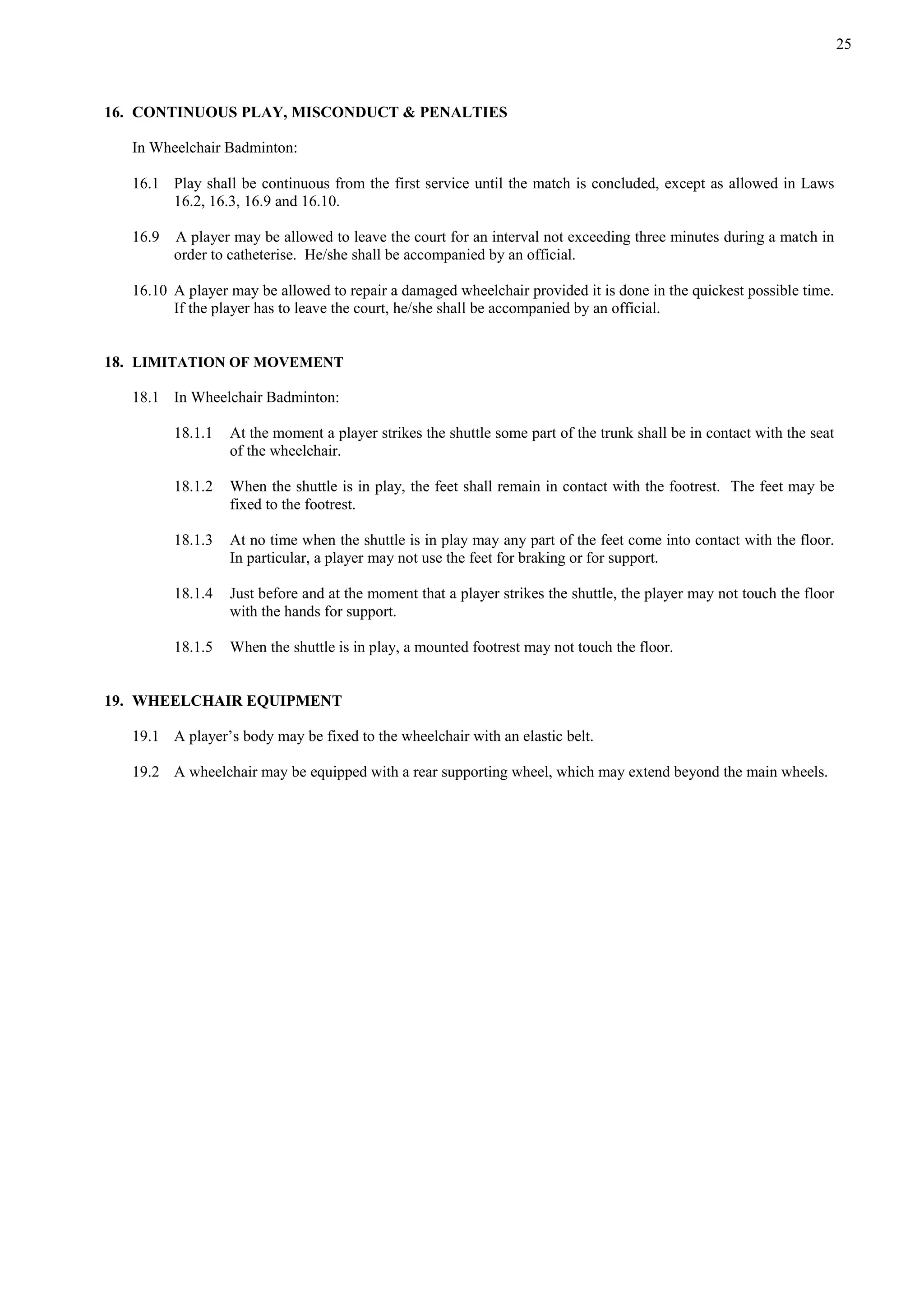
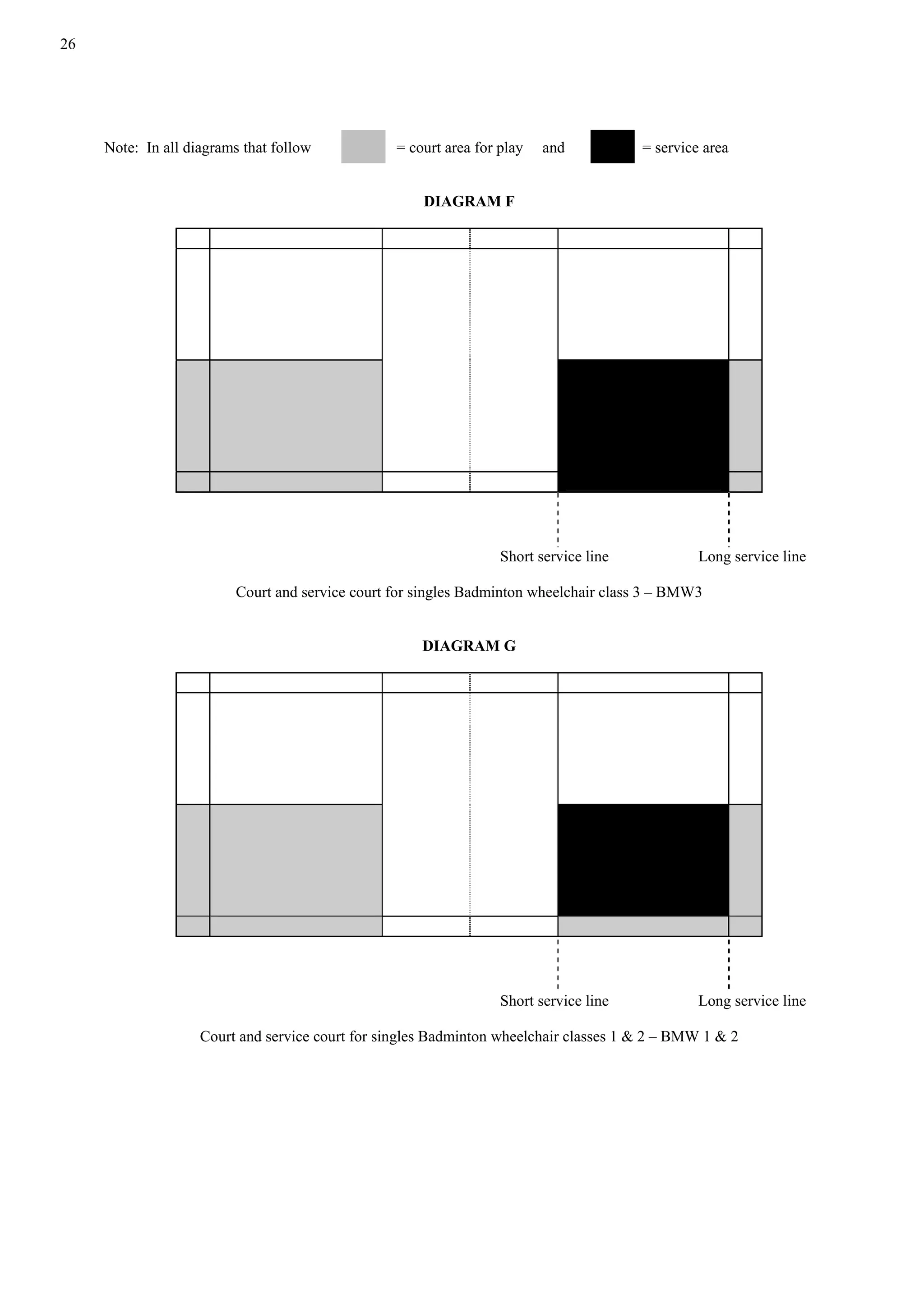
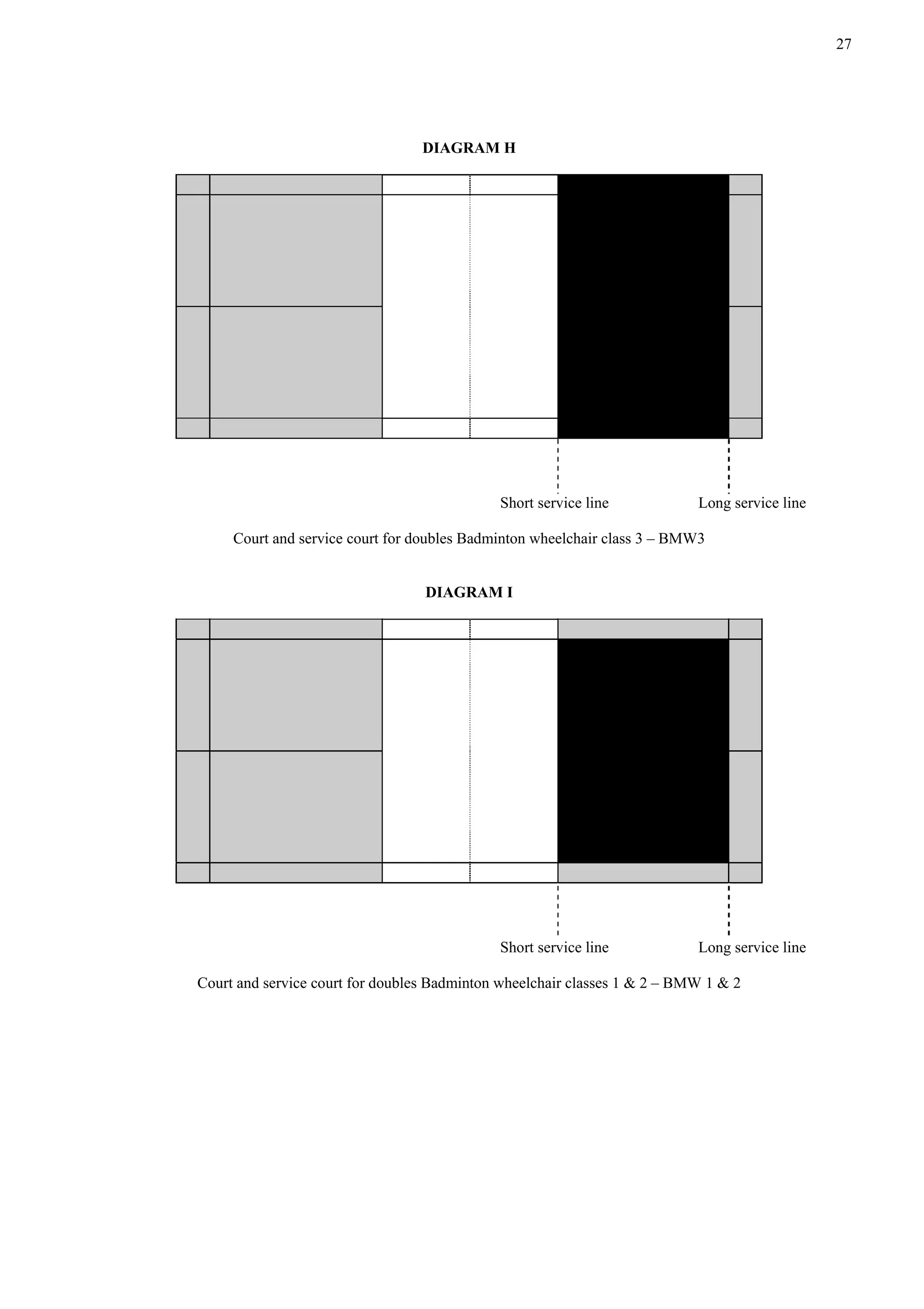
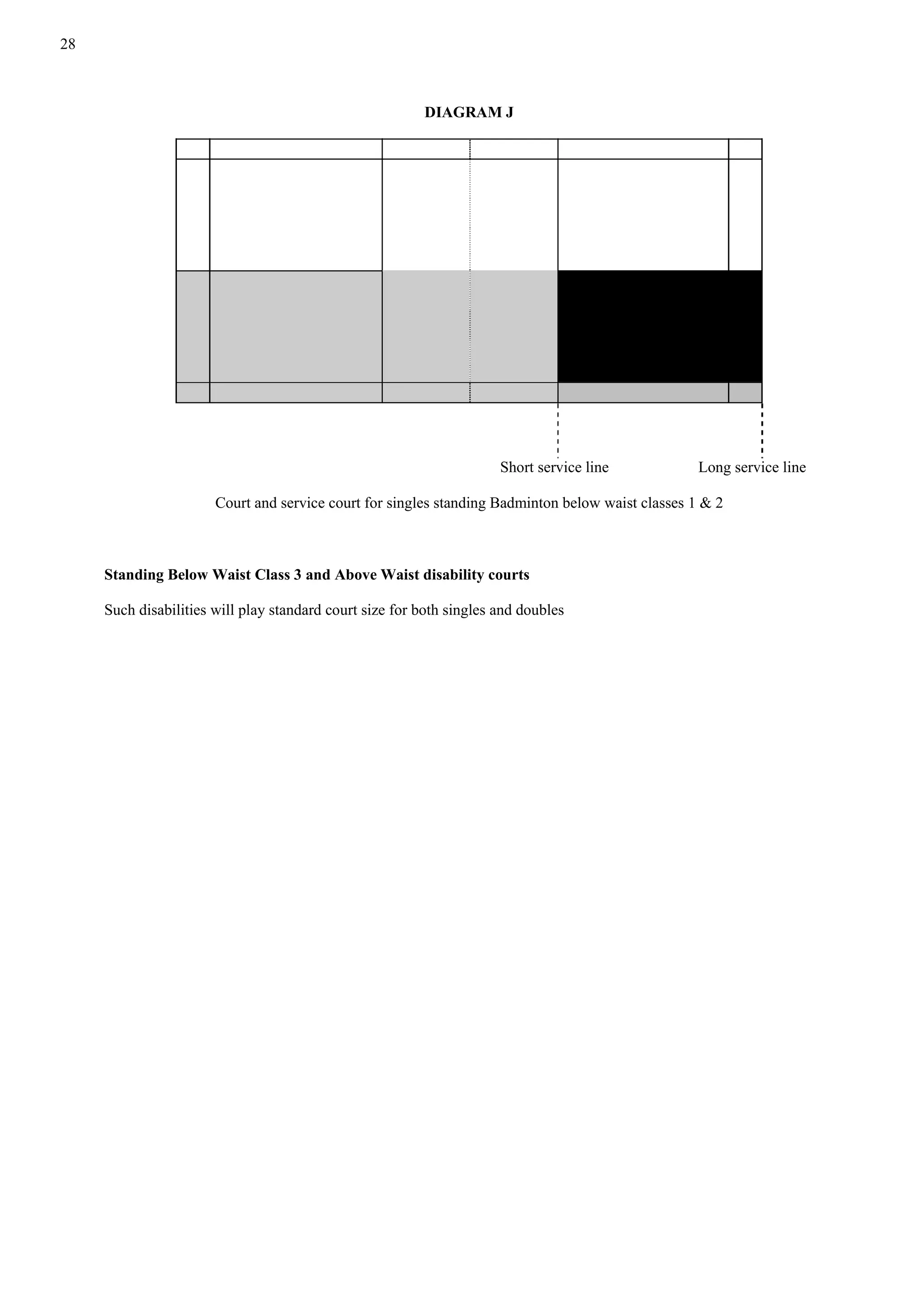
1.1.1 Wheelchair Badminton: the courts for singles and doubles shall be as shown in Diagrams F, G,
H and I, respectively.
24
1.1.2 Standing Badminton (below waist classes 1 and 2): the court for singles shall be as shown in
Diagram J.
1.4 The posts shall be the following heights from the surface of the court and shall remain vertical when the
net is strained as provided in Law 1.10:
1.4.1 Wheelchair Badminton: 1.40 metres.
1.4.2 Standing Badminton: 1.55 metres.
1.10 The top of the net from the surface of the court shall be the following heights at the centre of the court and
over the side lines for doubles, respectively:
1.10.1 Wheelchair Badminton: 1.372 and 1.40 metres.
1.10.2 Standing Badminton: 1.524 and 1.55 metres.
9. SERVICE
9.1 In a correct service:
9.1.2 the server and receiver shall stand within diagonally opposite service courts or be within the
respective service courts without touching the boundary lines of these service courts;
9.1.3 [This Law applies to Standing Badminton, above body disability only.] in Wheelchair
Badminton: at the start of the service the wheels of both the server and the receiver must be
stationary.
9.1.5 in Standing Badminton the whole shuttle shall be below the server’s waist at the instant of being
hit by the server’s racket; in Sitting and Wheelchair Badminton, the whole shuttle shall be below
the server’s armpit at the instant of being hit by the server’s racket;
9.7 In doubles for Standing Badminton the partners may take up any positions their respective courts which
do not unsight the opposing server or receiver and in doubles for Sitting and Wheelchair Badminton, the
partners shall be in the adjoining service court.
10. SINGLES
10.1 Serving and receiving courts
10.1.1 The players shall serve from, and receive in, their respective service courts.
11. DOUBLES
11.1 Serving and receiving courts for Standing Badminton
11.1.1 In Standing Badminton, a player of the serving side shall serve from the right service court at the
start of the game or when the serving side has not scored or has scored an even number of points
in that game.
11.1.2 In Standing Badminton, a player of the serving side shall serve from the left service court when
the serving side has scored an odd number of points in that game.
11.1.3 In standing Badminton, the reverse pattern shall apply to the partners.
13. FAULTS
13.2.5 In Wheelchair Badminton, the whole of the wheelchair is considered part of the player’s person.
25
16. CONTINUOUS PLAY, MISCONDUCT & PENALTIES
In Wheelchair Badminton:
16.1 Play shall be continuous from the first service until the match is concluded, except as allowed in Laws
16.2, 16.3, 16.9 and 16.10.
16.9 A player may be allowed to leave the court for an interval not exceeding three minutes during a match in
order to catheterise. He/she shall be accompanied by an official.
16.10 A player may be allowed to repair a damaged wheelchair provided it is done in the quickest possible time.
If the player has to leave the court, he/she shall be accompanied by an official.
18. LIMITATION OF MOVEMENT
18.1 In Wheelchair Badminton:
18.1.1 At the moment a player strikes the shuttle some part of the trunk shall be in contact with the seat
of the wheelchair.
18.1.2 When the shuttle is in play, the feet shall remain in contact with the footrest. The feet may be
fixed to the footrest.
18.1.3 At no time when the shuttle is in play may any part of the feet come into contact with the floor.
In particular, a player may not use the feet for braking or for support.
18.1.4 Just before and at the moment that a player strikes the shuttle, the player may not touch the floor
with the hands for support.
18.1.5 When the shuttle is in play, a mounted footrest may not touch the floor.
19. WHEELCHAIR EQUIPMENT
19.1 A player’s body may be fixed to the wheelchair with an elastic belt.
19.2 A wheelchair may be equipped with a rear supporting wheel, which may extend beyond the main wheels.
26
Note: In all diagrams that follow = court area for play and = service area
DIAGRAM F
Short service line Long service line
Court and service court for singles Badminton wheelchair class 3 – BMW3
DIAGRAM G
Short service line Long service line
Court and service court for singles Badminton wheelchair classes 1 & 2 – BMW 1 & 2
27
DIAGRAM H
Short service line Long service line
Court and service court for doubles Badminton wheelchair class 3 – BMW3
DIAGRAM I
Short service line Long service line
Court and service court for doubles Badminton wheelchair classes 1 & 2 – BMW 1 & 2
28
DIAGRAM J
Short service line Long service line
Court and service court for singles standing Badminton below waist classes 1 & 2
Standing Below Waist Class 3 and Above Waist disability courts
Such disabilities will play standard court size for both singles and doubles
29
PART II
SECTION 1 B
APPENDIX 6
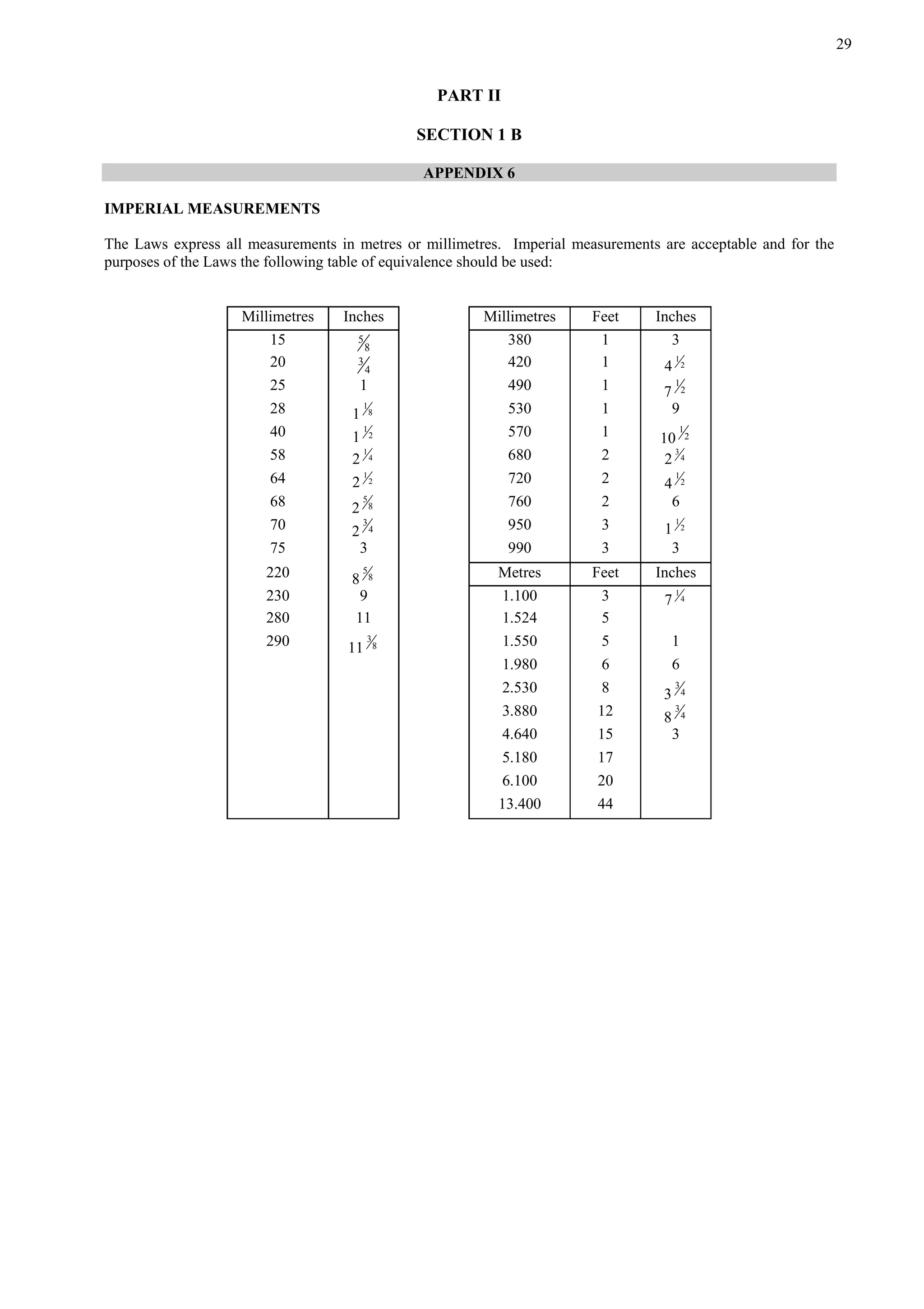
IMPERIAL MEASUREMENTS
The Laws express all measurements in metres or millimetres. Imperial measurements are acceptable and for the
purposes of the Laws the following table of equivalence should be used:
Millimetres Inches Millimetres Feet Inches
15 5
8
380 1 3
20 3
4
420 1 4
1
2
25 1 490 1 7
1
2
28 1
1
8 530 1 9
40 1
1
2 570 1 10
1
2
58 2
1
4 680 2 2
3
4
64 2
1
2 720 2 4
1
2
68 2
5
8 760 2 6
70 2
3
4 950 3 1
1
2
75 3 990 3 3
220 8
5
8 Metres Feet Inches
230 9 1.100 3 7
1
4
280 11 1.524 5
290 11
3
8 1.550 5 1
1.980 6 6
2.530 8 3
3
4
3.880 12 8
3
4
4.640 15 3
5.180 17
6.100 20
13.400 44
30
PART II
SECTION 2
RECOMMENDATIONS TO TECHNICAL OFFICIALS
1. INTRODUCTION
1.1 The Recommendations to technical officials are issued by the BWF in its desire to standardise the control
of the game in all countries and in accordance with its Rules.
1.2 The purpose of these Recommendations is to advise umpires how to control a match firmly and with
fairness, without being officious, while ensuring that the Laws of the game are observed. These
Recommendations also give guidance to service judges and line judges as to how to carry out their duties.
1.3 All technical officials shall remember that the game is for the players.
2. OFFICIALS AND THEIR DECISIONS
2.1 An umpire shall report to and acts under the authority of the Referee (Law 17.2) (or the responsible
official in the absence of a Referee).
2.2 A service judge shall normally be appointed by the Referee but can be replaced by the Referee or by the
umpire in consultation with each other (Law 17.6.4).
2.3 Line judges shall normally be appointed by the Referee, but a line judge can be replaced by the Referee or
by the umpire in consultation with each other (Law 17.6.4).
2.4 An official’s decision shall be final on all points of fact for which that official is responsible except that if,
in the opinion of the umpire, it is beyond reasonable doubt that a line judge has clearly made a wrong call,
the umpire shall overrule the decision of the line judge (Law 17.5). If, in the opinion of the umpire, the
line judge needs to be replaced, the umpire shall call the Referee (Law 17.6.4, Recommendation 2.3).
2.5 When another official is unsighted, the umpire shall make the decision. When no decision can be given, a
‘let’ shall be called (Law 17.6.6).
2.6 The umpire shall be in charge of the court and its immediate surrounds. The umpire’s jurisdiction shall
exist from entering the court before the match until leaving the court after the match (Law 17.2).
3. RECOMMENDATIONS TO UMPIRES
3.1 Before the match, the umpire shall:
3.1.1 obtain the score-sheet from the Referee;
3.1.2 ensure that any scoring device to be used is working;
3.1.3 see that the posts are on the doubles side lines (Law 1.5);
3.1.4 check the net for the height and ensure that there are no gaps between the ends of the net and the
net posts;
3.1.5 ascertain whether there are any bye-laws regarding the shuttle hitting an obstruction;
3.1.6 ensure that the service judge and the line judges know their duties and that they are correctly
placed (Sections 5 and 6);
3.1.7 ensure that a sufficient quantity of tested shuttles (Law 3) is readily available for the match in
order to avoid delays during play;
31
(It is customary for the umpire to delegate the duties specified in Recommendations 3.1.3, 3.1.4
and 3.1.7 to the service judge, where one is appointed);
3.1.8 check that the players’ clothing conforms to the relevant Regulations concerning colour, designs,
lettering and advertising, and ensure that any violations are rectified. Any decision that the
clothing was in violation of the Regulations (or was nearly so) shall be advised to the Referee or
appropriate official before the match or, if this is not possible, immediately after the match;
3.1.9 carry out the toss fairly and ensure that the winning side and the losing side exercise their
choices correctly (Law 6). Note the choices of the ends;
3.1.10 note, in the case of doubles, the names of the players starting in the right service court. Similar
notes shall be made at the start of each game. (This enables a check to be made at any time to see
if the players are in the correct service court);
3.2 To start the match, the umpire shall announce the match using the appropriate announcement from the
following and point to the right or to the left at the appropriate words in the announcement. (W, X, Y, Z
being names of the players and A, B, C, D being names of the countries represented.)
Singles
Tournament
“Ladies and Gentlemen; on my right, ‘X, A’; and on my left, ‘Y, B’. ‘X’ to serve; love all; play.”
Team Championship
“Ladies and Gentlemen; on my right, ‘A’, represented by ‘X’; and on my left, ‘B’, represented by ‘Y’.
‘A’ to serve; love all; play.”
Doubles
Tournament
“Ladies and Gentlemen; on my right, ‘W, A’ and ‘X, B’; and on my left, ‘Y, C’ and ‘Z, D’. ‘X’ to serve
to ‘Y’; love all; play.”
If doubles partners represent the same country, announce the country name after announcing both players’
names. e. g. ‘W and X, A’
Team Championship
“Ladies and Gentlemen; on my right, ‘A’, represented by ‘W’ and ‘X’; and on my left, ‘B’, represented
by ‘Y’ and ‘Z’. ‘A’ to serve; ‘X’ to ‘Y’; love all; play.”
The calling of “Play” constitutes the start of a match.
3.3 During the match
3.3.1 The umpire shall:
3.3.1.1 use the standard vocabulary in Appendix 4 of the Laws of Badminton;
3.3.1.2 record and call the score. Always call the server’s score first;
3.3.1.3 during the service, if a service judge is appointed, especially watch the receiver. The
Umpire may also call service fault, if necessary;
3.3.1.4 if possible, keep aware of the status of any scoring device; and
3.3.1.5 raise the right hand above the umpire’s head, if assistance is needed from the Referee.
3.3.2 When a side loses a rally and thereby the right to continue serving (Law 10.3.2, 11.3.2), call:
32
“Service over”
followed by the score in favour of the new serving side; if necessary, at the same time pointing
the appropriate hand towards the new server and the correct service court.
3.3.3 “Play” shall only be called by the umpire:
3.3.3.1 to indicate that a match or a game is to start or that a game after interval or after
changing the ends is to continue;
3.3.3.2 to indicate that play is to resume after a break; or
3.3.3.3 to indicate that the umpire is instructing players to resume play.
3.3.4 “Fault” shall be called by the umpire when a ‘fault’ occurs, except as follows:
3.3.4.1 a ‘fault’ of the server (Law 9.1) called by the service judge under Laws 13.1 shall be
acknowledged by the umpire by calling “Service fault called”. The umpire shall call a
‘fault’ of the receiver by calling “Fault receiver”;
3.3.4.2 a ‘fault’ occurring under Law 13.3.1, for which the line judge’s call and signal suffices
(Recommendation 6.2); and
3.3.4.3 ‘faults’ occurring under Laws 13.2.1, 13.2.2 or 13.3.3 which shall only be called if
clarification is needed for the players or the spectators.
3.3.5 During each game when the leading score reaches 11 points, call “Service over”, where
appropriate, followed by the score immediately after the rally scoring the 11th point has ended
followed by “Interval”, regardless of applause. This constitutes the start of interval allowed
under Law 16.2.1. During each interval, the service judge, where appointed, shall ensure that the
court is mopped during the interval.
3.3.6 In the interval during the games when the leading score reaches 11 points (Law 16.2.1), after 40
seconds have elapsed, call:
“[Court ...], 20 seconds”. Repeat the call.
In the intervals (Law 16.2.1) during the first and second game, and in the third game after the
players have changed the ends, each side may be joined on the court by not more than two
persons.. These persons shall leave the court when the umpire calls “... 20 seconds”.
To start the game after the interval, repeat the score followed by “Play”.
If the players do not claim the interval under Law 16.2.1, play in that game shall proceed without
an interval.
3.3.7 Extended game:
3.3.7.1 When leading side reaches 20 points, in each game, call “Game point” or “Match
point”, as applicable.
3.3.7.2 If a side reaches 29 points, in each game and for each side, call “Game point” or “Match
point”, as applicable.
3.3.7.3 The calls in Recommendation 3.3.7.1 and 3.3.7.2 shall always immediately follow the
server’s score and precede the receiver’s score.
3.3.8 At the end of each game, “Game” must always be called immediately after the conclusive rally
has ended, regardless of applause. Where appropriate this constitutes the start of any interval
allowed under Law 16.2.2.
After the first game ends, call:
33
“First game won by ….. [name(s) of player(s), or team (in a team championship)] ….. [score]”.
After the second game ends, call:
“Second game won by ….. [name(s) of player(s), or team (in a team championship)] ….. [score];
One game all”.
At the end of each game, the service judge, where appointed, shall ensure that the court is
mopped during the interval and place the interval board, if provided, at the centre below the net.
If a game wins the match, call instead:
“Match won by ….. [name(s) of player(s), or team (in a team championship)] ….. [scores]”.
3.3.9 In the intervals between the first and second game and between the second and third game (Law
16.2.2), after 100 seconds have elapsed, call:
“[Court ...] 20 seconds”. Repeat the call.
In the intervals (Law 16.2.2) between two games each side may be joined on the court by no
more than two persons. These persons shall join the side after the players have changed the ends,
and shall leave the court when the umpire calls “... 20 seconds”.
3.3.10 To start the second game, call:
“Second game; love all; play”.
If there is to be a third game, to start the third game, call:
“Final game; love all; play”.
3.3.11 In the third game, or in a match of one game, call “Service over”, where appropriate, followed by
the score, followed by “Interval; change ends” when the leading score reaches 11 points (Law
8.1.3). To start the game after the interval, repeat the score, followed by “Play”.
3.3.12 After the end of the match immediately take the completed score-sheet to the Referee.
3.4 Line calls
3.4.1 The umpire shall always look to the line judge(s) when the shuttle lands close to a line and
always when the shuttle lands out, however far. The line judge shall be entirely responsible for
the decision except Recommendation 3.4.2 below.
3.4.2 If, in the opinion of the umpire, it is beyond reasonable doubt, a line judge has clearly made a
wrong call, the umpire shall call:
3.4.2.1 “Correction, IN”, if the shuttle has landed “in”; or
3.4.2.2 “Correction, OUT”, if the shuttle has landed “out”.
3.4.3 In the absence of a line judge or if the line judge is unsighted, the umpire shall immediately call:
3.4.3.1 “Out” before calling the score when the shuttle lands outside the line; or
3.4.3.2 the score, when the shuttle lands in; or
3.4.3.3 “Let” when the umpire is also unsighted.
3.5 During the match, the following situations shall be watched for and dealt with as detailed.
3.5.1 A player throwing a racket into the opponent’s court or sliding under the net (and who also
thereby obstructs or distracts an opponent), shall be faulted under Law 13.4.2 or 13.4.3
respectively.
3.5.2 A shuttle invading from an adjacent court shall not automatically be considered a “let”. A “let”
shall not be called if, in the opinion of the umpire, such invasion:
3.5.2.1 has gone unnoticed by the players; or
3.5.2.2 has not obstructed or distracted the players.
34
3.5.3 A player shouting to a partner who is about to hit the shuttle shall not necessarily be regarded as
distracting the opponents. Calling ‘no shot’, ‘fault’, etc. shall be considered as distraction (Law
13.4.5).
3.5.4 Players leaving the court
3.5.4.1 Ensure that the players do not leave the court without the umpire’s permission except
during the intervals as described in Law 16.2. (Law 16.5.2)
3.5.4.2 Any offending side may have to be reminded that leaving the court needs the umpire’s
permission (Law 16.5.2). If necessary, Law 16.7 shall be applied. However, change of a
racket at courtside during a rally is permitted.
3.5.4.3 During the game, if play is not held up, the players may be allowed to have a quick
towel and / or drink at the discretion of the umpire.
3.5.4.4 If the court needs to be mopped, the players shall be within the court before the
mopping is over.
3.5.5 Delays and suspension
Ensure that the players do not deliberately cause any delay in, or suspension of play (Law 16.4).
Any unnecessary walk around the court shall be prevented. If necessary, Law 16.7 shall be
applied.
3.5.6 Coaching from off the court
3.5.6.1 Coaching from off the court (Law 16.5.1) in any form while the shuttle is in play shall
be prevented.
3.5.6.2 Ensure that:
• the coaches are seated in the designated seats and do not stand court-side during the
match except during the permitted intervals (Law 16.2);
• there is no distraction or disruption to play by any coach.
3.5.6.3 If, in the opinion of the umpire, play is disrupted or a player of the opposing side is
distracted by a coach, a “let” shall be called (Law 14.2.5). The Referee shall be called
immediately.;
3.5.6.4 The Referee shall ensure that the Code of Conduct for Coaches and Team Officials
(Part III, Section 1B, Appendix 9) is adhered to.
3.5.7 Change of shuttle
3.5.7.1 Changing the shuttle during the match shall not be unfair. The umpire shall decide if the
shuttle needs to be changed.
3.5.7.2 A shuttle whose speed or flight has been interfered with shall be discarded and Law
16.7 applied, if necessary.
3.5.7.3 The Referee shall be the sole judge for deciding the speed of the shuttles to be used. If
both sides wish to change the speed of shuttle, the Referee shall be called immediately.
The Referee shall get the shuttle tested for speed, if necessary.
3.5.8 Injury or sickness during a match
3.5.8.1 Injury or sickness during a match should be handled carefully and flexibly. The umpire
must determine the severity of the problem as quickly as possible. The Referee shall be
called on the court, if necessary.
35
The Referee shall decide on whether a medical official or any other persons are required
on court. The medical official should examine the player and advise the player about the
severity of the injury or sickness. No treatment causing undue delay shall be
administered on the court.
If there is bleeding, the game should be delayed until the bleeding stops or the wound is
suitably protected
3.5.8.2 The Referee should advise the umpire of the time that may be required for the player to
resume play. The Umpire shall monitor the elapsed time.
3.5.8.3 The Umpire shall ensure that the opposing side is not put at a disadvantage. Laws 16.4,
16.5, 16.6.1, and 16.7 shall be applied appropriately.
3.5.8.4 When appropriate, when there is injury, illness or other unavoidable hindrance, ask the
player:
“Are you retiring?”
and if the answer is affirmative, call
“….. [name of player/team, as appropriate] retired, match won by ….. [name of
player(s) / team, as appropriate]... [score]”.
3.5.9 Mobile Phone
If a player’s mobile phone rings on the court or its immediate surroundings, during a match, it
shall be considered to be an offence under Law 16.6.4 and shall be penalised appropriately as per
Law 16.7.
3.5.10 Player’s conduct on the court
3.5.10.1 The Umpire shall ensure that players conduct on the court is honourable and in a
sportsmanlike manner.
3.5.10.2 Any breach of Players’ Code of Conduct Regulations 4.6, 4.10 to 4.16 (Part III, Section
1B, Appendix 4) shall be considered to be an offence under Law 16.6.4.
3.6 Suspension of play
If play has to be suspended, call:
“Play is suspended”
and record the score, server, receiver, correct service courts and ends. When play resumes, note the
duration of suspension, ensure that the players have taken the correct positions and call:
“Are you ready?”
Call the score and “Play”.
36
3.7 Misconduct
3.7.1 Record and report to the Referee any incident of misconduct
and the action taken.
3.7.2 Misconduct between games is treated as misconduct during a
game. This should be followed with the appropriate call in
either of Recommendations 3.7.3 to 3.7.5 immediately on
occurance of misconduct. At the start of the following game.
Call
“............. game; love all.”
.Only in cases of administration of misconduct under Law
16.7.1.2 or 16.7.2, the Umpire shall call
“…..[name of player], faulted”
Thereafter, call “Service over”, where appropriate followed
by the score.
Call “Play”.
If the player is disqualified by the Referee, call
“…..[name of player], disqualified for misconduct”
Thereafter, call in Recommendation 3.3.8.
3.7.3 When the umpire has to administer a breach of Law 16.4, 16.5 or 16.6 by issuing a warning to
the offending side (Law 16.7.1.1), call “Come here” to the offending player and call:
“… [name of player], warning for misconduct”
at the same time raising the right hand holding a yellow card above the umpire’s head.
3.7.4 When the umpire has to administer a breach of Law 16.4, 16.5 or 16.6 by faulting the offending
side, which has been previously warned (Law 16.7.1.2), call “Come here” to the offending player
and call:
“… [name of player], fault for misconduct”
at the same time raising the right hand holding a red card above the umpire’s head.
3.7.5 When the umpire has to administer a flagrant or persistent breach of Law 16.4, 16.5 or 16.6 or
breach of Law 16.2 by faulting the offending side (Law 16.7.2) and reporting the offending side
immediately to the Referee with a view to disqualification, call “Come here” to the offending
player and call:
“… [name of player], fault for misconduct”
at the same time raising the right hand holding a red card above the umpire’s head, and calling
the Referee.
3.7.6 When the Referee decides to disqualify the offending side, a black card is given to the umpire.
The umpire shall call “Come here” to the offending player and call:
“… [name of side] disqualified for misconduct”.
at the same time raising the right hand holding a black card above the umpire’s head.
Any disqualification for misconduct shall render a player disqualified for the entire tournament or
championship.
37
4. GENERAL ADVICE ON UMPIRING
This section gives general advice which shall be followed by the Umpires.
4.1 Know and understand the Laws of Badminton.
4.2 Call promptly and with authority, but, if a mistake is made, admit it, apologise and correct it.
4.3 Make all announcements and calling of the score distinctly and loudly enough to be heard clearly by
players and the spectators.
4.4 Do not call a ‘fault’ and allow the game to proceed, if a doubt arises in your mind as to whether an
infringement of the Laws has occurred or not.
4.5 Never ask the spectators nor be influenced by them or their remarks.
4.6 Motivate your other technical officials, e.g. by discreetly acknowledging the decisions of line judges and
establishing a working relationship with them.
5. INSTRUCTIONS TO SERVICE JUDGES
5.1 The service judge shall sit on a low chair by the post, preferably opposite the umpire.
5.2 The service judge is responsible for judging that the server delivers a correct service (Law 9.1.2 to Law
9.1.8). If not, call “Fault” loudly and use the approved hand signal to indicate the type of infringement.
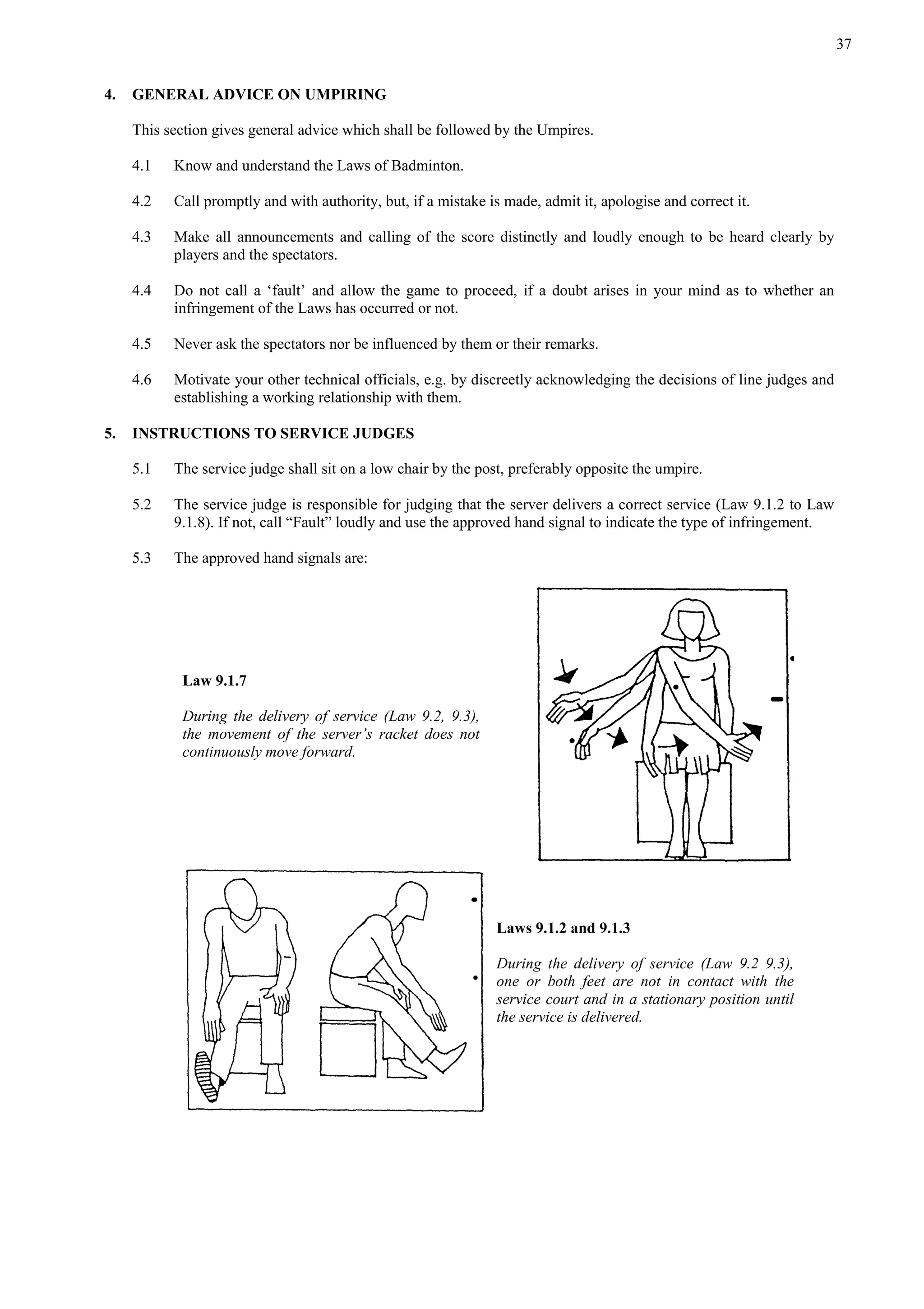
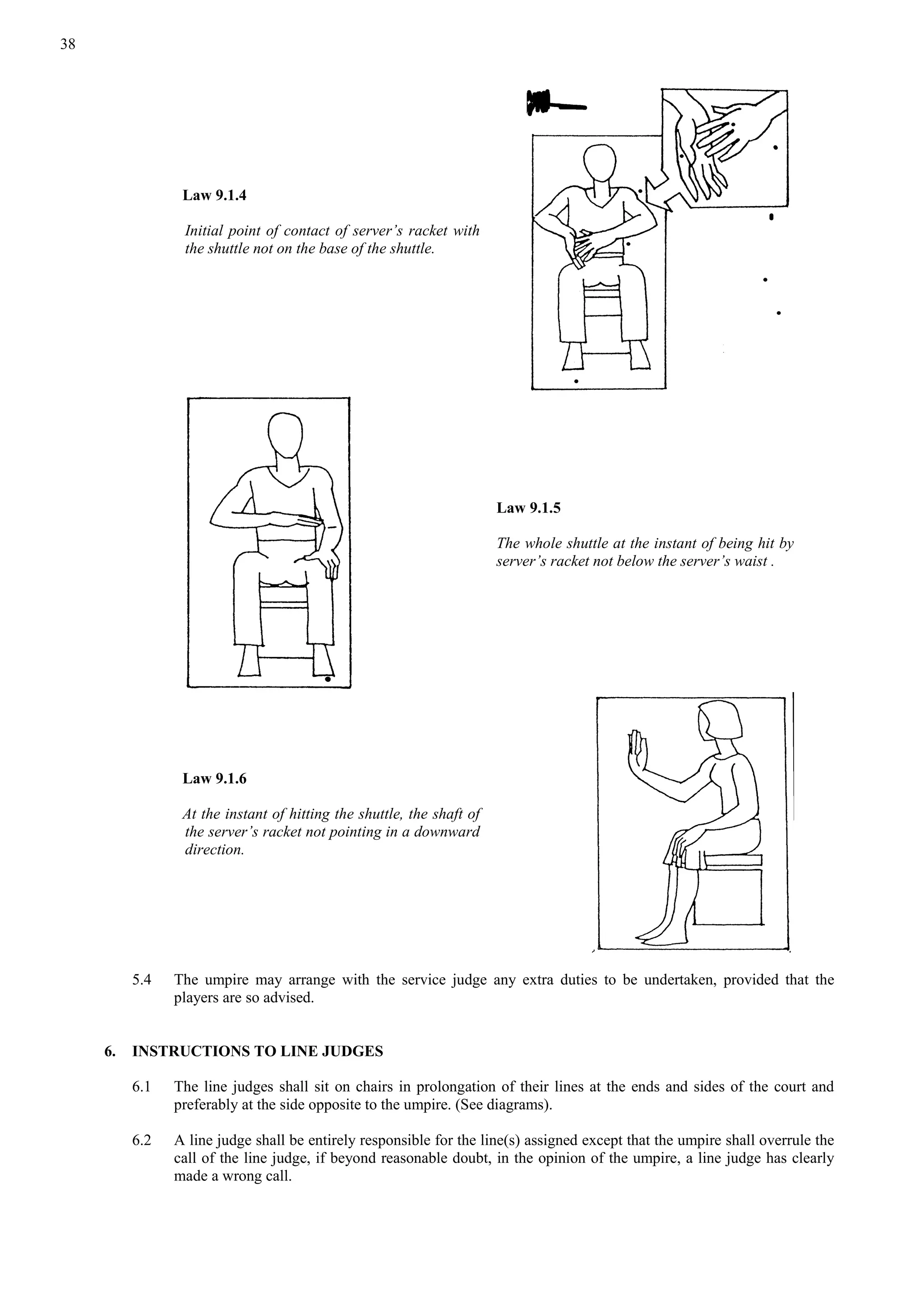
5.3 The approved hand signals are:
Law 9.1.7
During the delivery of service (Law 9.2, 9.3),
the movement of the server’s racket does not
continuously move forward.
Laws 9.1.2 and 9.1.3
During the delivery of service (Law 9.2 9.3),
one or both feet are not in contact with the
service court and in a stationary position until
the service is delivered.
38
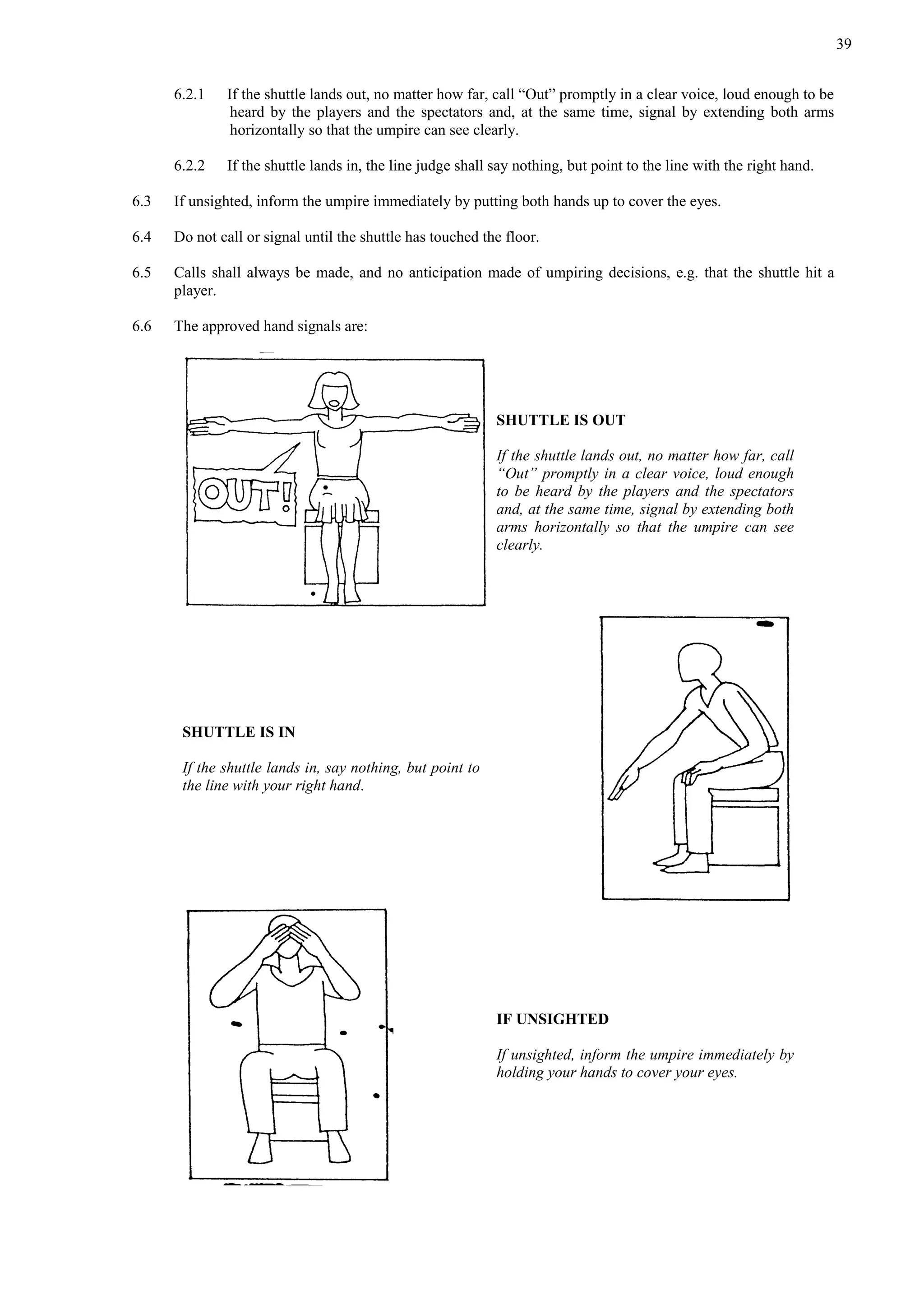
Law 9.1.4
Initial point of contact of server’s racket with
the shuttle not on the base of the shuttle.
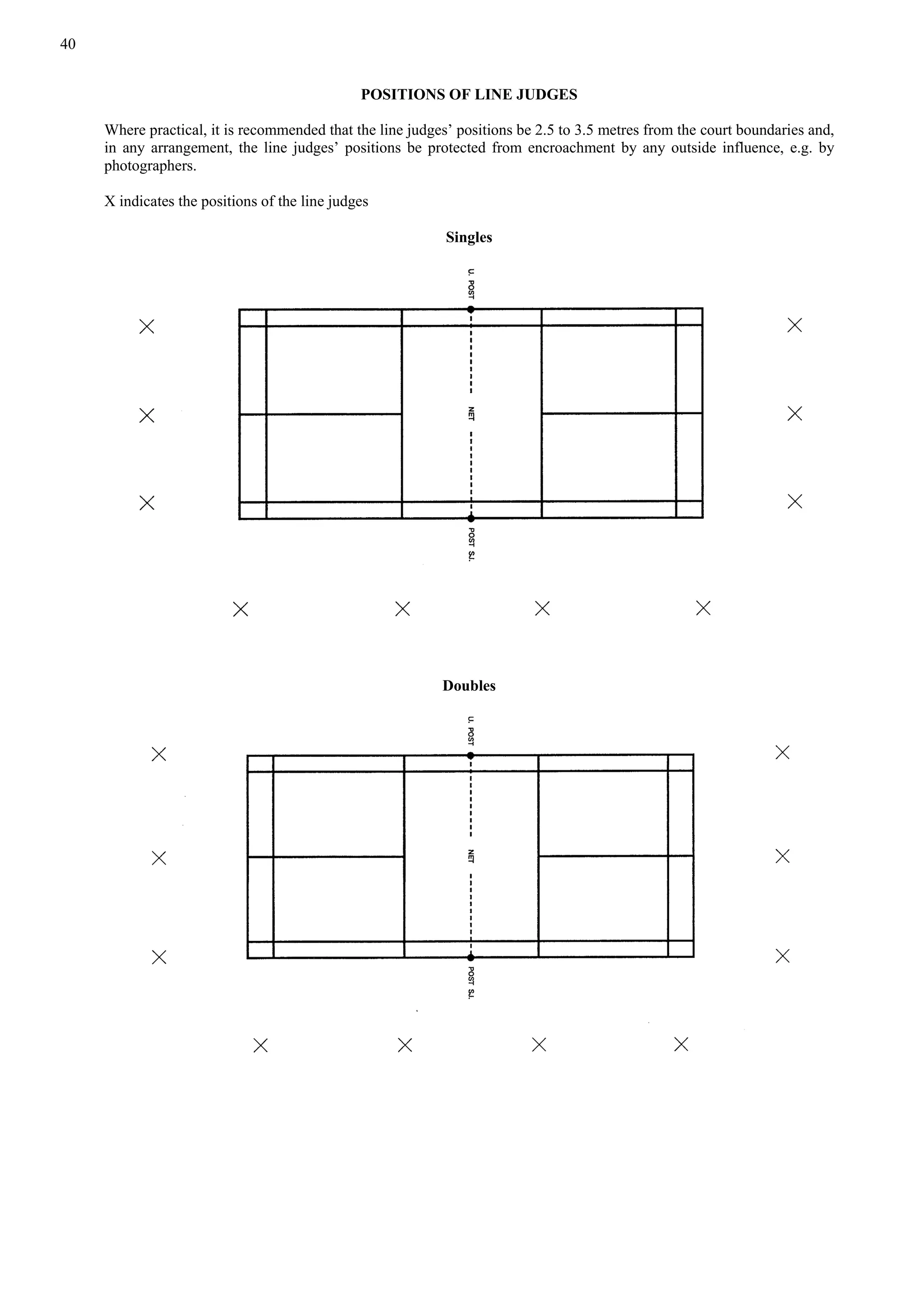
Law 9.1.5
The whole shuttle at the instant of being hit by
server’s racket not below the server’s waist .
Law 9.1.6
At the instant of hitting the shuttle, the shaft of
the server’s racket not pointing in a downward
direction.
5.4 The umpire may arrange with the service judge any extra duties to be undertaken, provided that the
players are so advised.
6. INSTRUCTIONS TO LINE JUDGES
6.1 The line judges shall sit on chairs in prolongation of their lines at the ends and sides of the court and
preferably at the side opposite to the umpire. (See diagrams).
6.2 A line judge shall be entirely responsible for the line(s) assigned except that the umpire shall overrule the
call of the line judge, if beyond reasonable doubt, in the opinion of the umpire, a line judge has clearly
made a wrong call.
39
6.2.1 If the shuttle lands out, no matter how far, call “Out” promptly in a clear voice, loud enough to be
heard by the players and the spectators and, at the same time, signal by extending both arms
horizontally so that the umpire can see clearly.
6.2.2 If the shuttle lands in, the line judge shall say nothing, but point to the line with the right hand.
6.3 If unsighted, inform the umpire immediately by putting both hands up to cover the eyes.
6.4 Do not call or signal until the shuttle has touched the floor.
6.5 Calls shall always be made, and no anticipation made of umpiring decisions, e.g. that the shuttle hit a
player.
6.6 The approved hand signals are:
SHUTTLE IS OUT
If the shuttle lands out, no matter how far, call
“Out” promptly in a clear voice, loud enough
to be heard by the players and the spectators
and, at the same time, signal by extending both
arms horizontally so that the umpire can see
clearly.
SHUTTLE IS IN
If the shuttle lands in, say nothing, but point to
the line with your right hand.
IF UNSIGHTED
If unsighted, inform the umpire immediately by
holding your hands to cover your eyes.
40
POSITIONS OF LINE JUDGES
Where practical, it is recommended that the line judges’ positions be 2.5 to 3.5 metres from the court boundaries and,
in any arrangement, the line judges’ positions be protected from encroachment by any outside influence, e.g. by
photographers.
X indicates the positions of the line judges
Singles
Doubles
41
PART III
SECTION 1 A
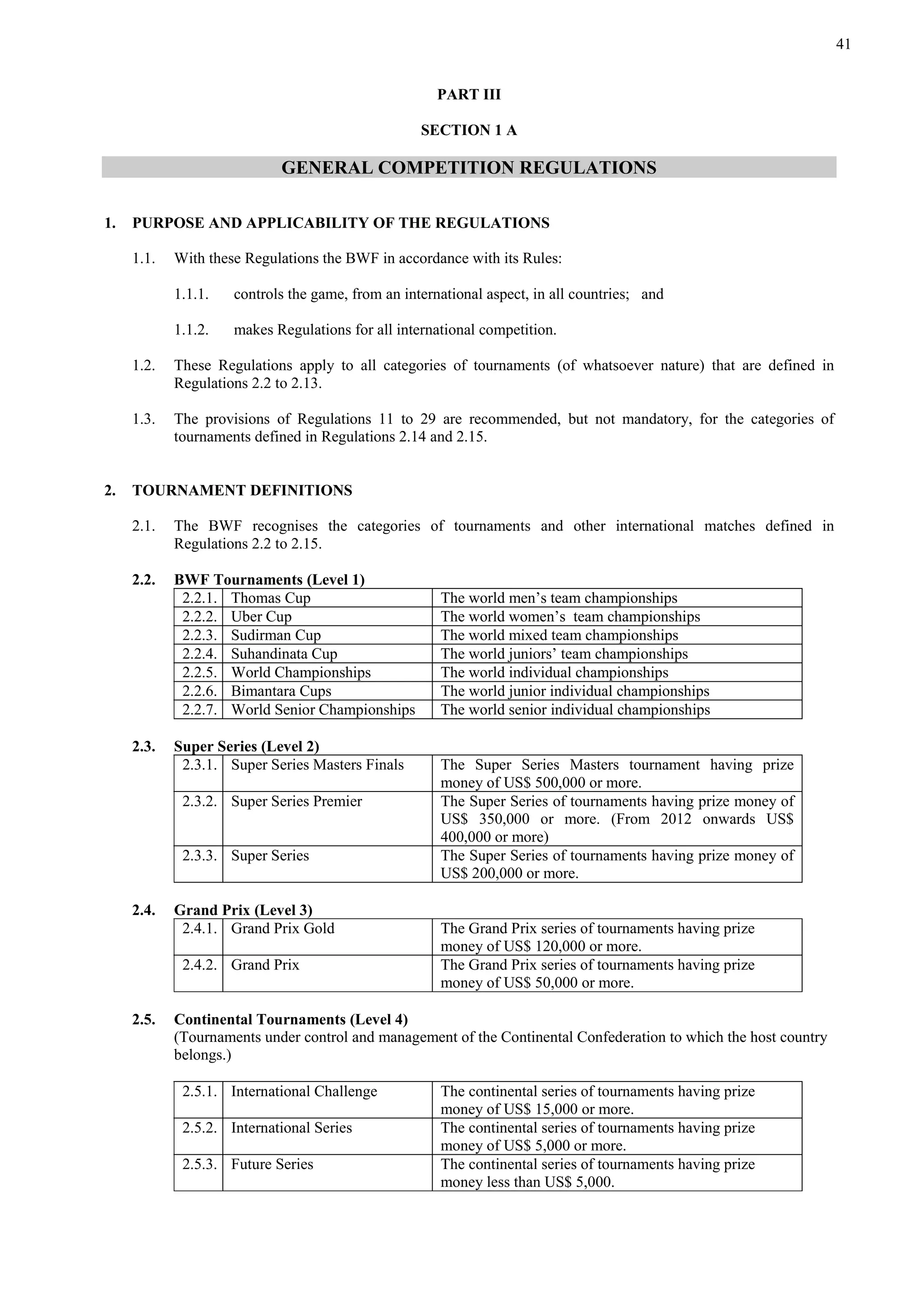
GENERAL COMPETITION REGULATIONS
1. PURPOSE AND APPLICABILITY OF THE REGULATIONS
1.1. With these Regulations the BWF in accordance with its Rules:
1.1.1. controls the game, from an international aspect, in all countries; and
1.1.2. makes Regulations for all international competition.
1.2. These Regulations apply to all categories of tournaments (of whatsoever nature) that are defined in
Regulations 2.2 to 2.13.
1.3. The provisions of Regulations 11 to 29 are recommended, but not mandatory, for the categories of
tournaments defined in Regulations 2.14 and 2.15.
2. TOURNAMENT DEFINITIONS
2.1. The BWF recognises the categories of tournaments and other international matches defined in
Regulations 2.2 to 2.15.
2.2. BWF Tournaments (Level 1)
2.2.1. Thomas Cup The world men’s team championships
2.2.2. Uber Cup The world women’s team championships
2.2.3. Sudirman Cup The world mixed team championships
2.2.4. Suhandinata Cup The world juniors’ team championships
2.2.5. World Championships The world individual championships
2.2.6. Bimantara Cups The world junior individual championships
2.2.7. World Senior Championships The world senior individual championships
2.3. Super Series (Level 2)
2.3.1. Super Series Masters Finals The Super Series Masters tournament having prize
money of US$ 500,000 or more.
2.3.2. Super Series Premier The Super Series of tournaments having prize money of
US$ 350,000 or more. (From 2012 onwards US$
400,000 or more)
2.3.3. Super Series The Super Series of tournaments having prize money of
US$ 200,000 or more.
2.4. Grand Prix (Level 3)
2.4.1. Grand Prix Gold The Grand Prix series of tournaments having prize
money of US$ 120,000 or more.
2.4.2. Grand Prix The Grand Prix series of tournaments having prize
money of US$ 50,000 or more.
2.5. Continental Tournaments (Level 4)
(Tournaments under control and management of the Continental Confederation to which the host country
belongs.)
2.5.1. International Challenge The continental series of tournaments having prize
money of US$ 15,000 or more.
2.5.2. International Series The continental series of tournaments having prize
money of US$ 5,000 or more.
2.5.3. Future Series The continental series of tournaments having prize
money less than US$ 5,000.
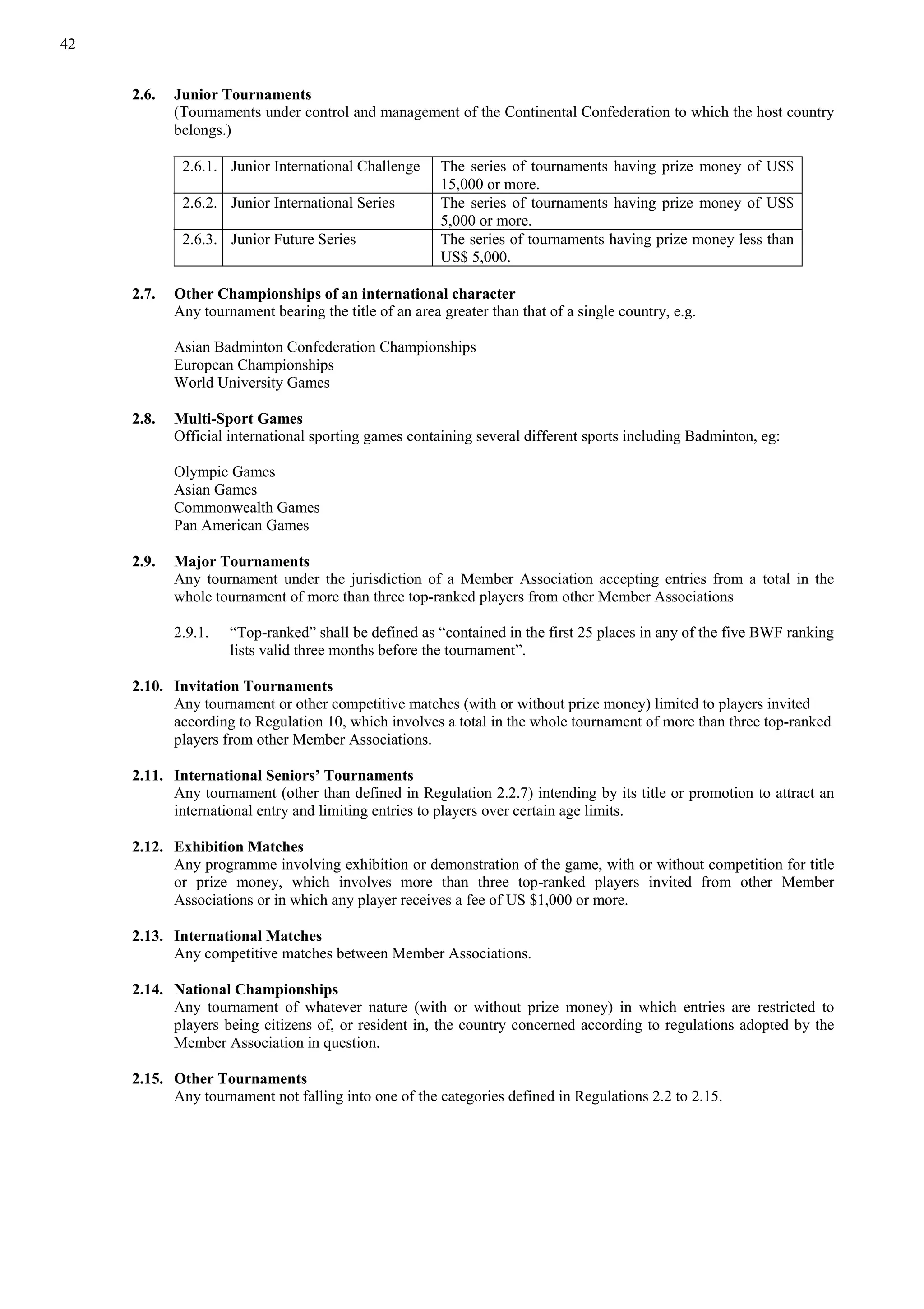
42
2.6. Junior Tournaments
(Tournaments under control and management of the Continental Confederation to which the host country
belongs.)
2.6.1. Junior International Challenge The series of tournaments having prize money of US$
15,000 or more.
2.6.2. Junior International Series The series of tournaments having prize money of US$
5,000 or more.
2.6.3. Junior Future Series The series of tournaments having prize money less than
US$ 5,000.
2.7. Other Championships of an international character
Any tournament bearing the title of an area greater than that of a single country, e.g.
Asian Badminton Confederation Championships
European Championships
World University Games
2.8. Multi-Sport Games
Official international sporting games containing several different sports including Badminton, eg:
Olympic Games
Asian Games
Commonwealth Games
Pan American Games
2.9. Major Tournaments
Any tournament under the jurisdiction of a Member Association accepting entries from a total in the
whole tournament of more than three top-ranked players from other Member Associations
2.9.1. “Top-ranked” shall be defined as “contained in the first 25 places in any of the five BWF ranking
lists valid three months before the tournament”.
2.10. Invitation Tournaments
Any tournament or other competitive matches (with or without prize money) limited to players invited
according to Regulation 10, which involves a total in the whole tournament of more than three top-ranked
players from other Member Associations.
2.11. International Seniors’ Tournaments
Any tournament (other than defined in Regulation 2.2.7) intending by its title or promotion to attract an
international entry and limiting entries to players over certain age limits.
2.12. Exhibition Matches
Any programme involving exhibition or demonstration of the game, with or without competition for title
or prize money, which involves more than three top-ranked players invited from other Member
Associations or in which any player receives a fee of US $1,000 or more.
2.13. International Matches
Any competitive matches between Member Associations.
2.14. National Championships
Any tournament of whatever nature (with or without prize money) in which entries are restricted to
players being citizens of, or resident in, the country concerned according to regulations adopted by the
Member Association in question.
2.15. Other Tournaments
Any tournament not falling into one of the categories defined in Regulations 2.2 to 2.15.
43
3. SANCTION
3.1. For all tournaments and competitive matches defined above in Regulations 2.2 to 2.12, the Member
Association must apply for and receive the sanction of the BWF. The BWF shall grant sanction to the
tournament in line with the BWF Sanction Policy [Part III – Section 1 B, Appendix 10].
3.2. Sanction fees
3.2.1. All level 1 to 3 BWF-sanctioned Tournaments or international tournaments offering prize money
US$ 50,000 or more shall pay a sanction fee to the BWF at the rate of 10 per cent of the total
prize fund.
3.2.2. All level 4 BWF Sanctioned Tournaments or international tournaments offering prize money less
than US$ 50,000 shall pay a sanction fee to the Continental Confederation.
3.2.3. It is recommended sanction fee be at the rate of 10% on prize fund. Such fee shall be a charge on
the tournament and not on the prize fund and shall be paid so that an amount equal to 10 per cent
of the total prize fund is received by the BWF or Continental Confederation, as the case maybe,
within three weeks of the end of the tournament.
3.2.4. The BWF may approach Member Associations and make any additional financial arrangements
as it may from time to time decide.
3.3. Confirmation of prize money, withdrawal of sanction, and penalty fees
3.3.1. For all level 1 to 4 BWF-sanctioned Tournaments or international tournaments offering prize
money US$ 15,000 or more, the BWF shall, at the time of sanction of the tournament, seek
confirmation of the total prize money.
3.3.2. Fewer than 90 days before the date of the tournament, any level 1 to 4 BWF-sanctioned
Tournaments or international tournament offering prize money US$ 15,000 or more, there shall
be no change in the level of the tournament. The organisers shall have liberty to increase the
approved prize money at any time. However, there shall not be any change in the level of
tournament sanctioned earlier.
3.4. Fees for postponement, cancellation or changed prize money
3.4.1. If, fewer than 60 days before the date of the tournament, any level 1 to 3 BWF-sanctioned
Tournament or international tournament offering prize money US$ 50,000 or more is cancelled,
postponed or the prize money as in Regulation 3.3 is reduced, the organiser shall pay the BWF a
fee equivalent to 20% of the total prize money.
3.4.2. If, fewer than 60 days before the date of the tournament, any level 4 BWF-sanctioned
Tournament or international tournament offering prize money less than US$ 50,000 is cancelled,
postponed or the prize money as in Regulation 3.3 is reduced, the organiser shall pay the
Continental Confederation recommending sanction a fee equivalent to 20% of the total prize
money
3.4.3. Fewer than 15 days before the date of the tournament, any level 1 to 4 BWF-sanctioned
Tournament or international tournament offering prize money US$ 15,000 or more, if there is
any change in the approved prize money, the matter will be referred to Disciplinary Committee
of BWF. The BWF shall, in addition to the fees as stated in Regulation 3.4.1 or 3.4.2, impose
sanctions which may include monetary penalty and / or future sanction of tournaments to that
Member Association.
3.4.4. Where, however, the BWF is satisfied that the tournament cancellation or postponement was
outside the control of the organisers due to force majeure (e.g. civil disturbance, natural disaster),
these fees may be waived.
3.5. The BWF can have no jurisdiction in connection with any playing tournament promoted directly or
indirectly by unaffiliated organisations.
44
3.6. Unsanctioned tournaments
3.6.1. Member Associations shall allow players under their jurisdiction to compete only in tournaments
sanctioned by the BWF or one of its members.
3.6.2. The BWF has power to vary the requirement of Regulation 3.6.1, provided an application giving
reasons is made at least two months in advance.
3.6.3. Notwithstanding Regulation 3.6.1, players under the jurisdiction of a Member Association may
promote the game by giving a demonstration under the auspices of an organisation not under the
jurisdiction of another Member Association. This demonstration may be amongst themselves or
with local players, provided the title and form of competition, and the prizes and / or expenses
have been approved by the BWF.
4. RIGHTS
4.1 For any tournament sanctioned under General Competition Regulation 3, the term “BWF-sanctioned
tournament rights” shall mean all commercial, television, internet, webcasting, audio, film and other
rights of like nature at all venues, and other rights associated primarily with the tournament.
4.2 It is a condition of sanction that ownership of BWF-sanctioned tournament rights shall be determined in
accordance with the BWF statutes.
4.3 BWF-sanctioned tournament rights shall automatically belong to the BWF, unless licences or concessions
in respect of such rights are granted by the BWF to the promoting Member Association, either by virtue
of the BWF statutes or in writing.
4.4 The BWF always retains the right to publish results and reports from the BWF-sanctioned tournaments,
on the Internet and elsewhere, and to do so at times determined solely by the BWF.
4.5 Players’ images
4.5.1 When a player is entered in a BWF-sanctioned tournament, the creation of television or audio
signals, and the taking of photographs is permitted at all associated venues (including training /
practice) without further need to seek the consent of the player or Member Association
concerned. Any such television or audio signals can be distributed by the rights owner in any
and all territories, and may be used on live or recorded television, Internet, webcasting, radio,
film and other media of similar nature. The BWF, the promoting Member Association, and any
photographer concerned shall have the right to use photographs or any other image of player(s)
taken during the tournament.
4.5.2 If for legal reasons use of a player’s image requires the consent of the player concerned, the
Member Association must ensure that such consent is obtained before entering the player. The
user of photographs or other such images of player(s) assumes sole legal liability for such use.
4.6 The Ownership of BWF-sanctioned tournament rights shall be shared as in the table below. In
formulating contracts, Member Associations are advised that this concession of rights is subject to change
with reasonable notice.
Tournament
defined in
GCR
Level of
tournament
Ownership of BWF-sanctioned tournament rights owned by and
the extent of ownership
2.2 Level 1 Determined by the BWF regulations / contracts associated with
each tournament.
2.3 Level 2 Retained by BWF as per the BWF Super Series Guidelines issued
under the BWF regulations
2.4 Level 3 All rights granted to the Promoting Member Association
2.5 Level 4 All rights granted to the Continental Confederation who will
share it with Promoting Member Association in accordance with
the regulations for the Continental Circuit as approved by the
BWF.
2.6 Junior All rights granted to the Promoting Member Association.
45
Tournaments
2.7 Continental
Championships
All rights granted to the Continental Confederation
2.8 Multi-sport
Games
All rights granted to the Promoting Member Association.
2.9 to 2.16 Other
international
tournaments
All rights granted to the Promoting Member Association.
5. ENTRIES AND CONTROL OF ENTRIES
5.1 For all tournaments requiring the BWF sanction, an entry of player / pair must be made by the Member
Association of which the player / pair is a member by midnight local time of the BWF Head Quarters on
the closing date in the manner specified by the BWF. It is the responsibility of the organiser to
acknowledge receipt of the entries of player / pair and any subsequent amendment prior to the closing
date for entries. It is the responsibility of the Member Association to ensure that confirmation of
acceptance is received.
5.2 No Member Association shall, for any tournament directly or indirectly promoted by it, accept entries
from any other Member Association on behalf of any players who:
5.2.1 are not under the jurisdiction of a Member Association of the BWF; or
5.2.2 have been declared not in good standing with that Member Association.
5.3 Any member of the BWF wishing to organise any tournament or other competitive matches, which is
intended to include players other than those qualified as in Regulation 5.2, shall apply for the special
permission of the BWF.
5.4 Players must be permitted to enter all BWF sanctioned tournaments for which they are qualified and no
restriction in this respect shall be permitted provided the players comply with the qualification standards
and procedures set by the BWF, Member Associations and / or Continental Confederations. When a
Member Association makes entries on behalf of its players, it shall list such entries in order of playing
strength.
5.5 No player / pair shall enter or be entered in two BWF-sanctioned competitions if the published dates of
the competitions overlap. A player is deemed to have entered, for the purpose of this regulation, if the
entry has been made and not been withdrawn by the Member Association, by midnight local time of the
BWF Headquarters on the closing date. Any subsequent withdrawal by a player / pair accepted in the
main or qualifying draw of the tournament will not allow him to enter in any other tournament with
overlapping dates.
5.6 In making or authorising entries, the Member Association concerned is reconfirming its acceptance, and
acceptance by the players being entered, of the BWF’s Rules, Competition Regulations and Disciplinary
processes.
5.7. For BWF sanctioned tournaments, a player shall not have his / her entry refused for reasons of race,
religion or politics.
5.7.1 Organisers may limit the number of entries from a country, where the BWF, Continental
Confederations and / or Member Associations are allowed to set qualification standards and
procedures for entry of players (Regulation 5.4); and may limit the number of total entries
accepted into a tournament to accommodate the size of the tournament (Regulations 13.1 and
13.7).
5.7.2 Refusal of entries by a tournament organiser for any reason other than that there are too many
entries to be accommodated (Regulations 13.1 and 13.7) requires the specific written
permission of the BWF.
5.8 No alterations, except withdrawal, can be made to the entries after the close of entries until the draw has
been made. Regulations 15.2 to 15.8 shall apply to the substitutions after the draw, for tournaments other
46
than Level 1 to 4 BWF sanctioned tournaments and tournaments with nationally restricted entries e.g.
Continental Championships, Bimantara Cup.
5.9 The BWF, on detection or on receipt of complaint that a player’s entries were made for two or more BWF-
sanctioned competitions in contravention of Regulation 5.5, shall issue a notice to the Member Association
concerned seeking an explanation about such violation.
5.9.1 The Member Association shall furnish an explanation along with copy of any relevant
documentation within two weeks from the issue of notice.
5.9.2 The BWF will forward the complaint including the full documentation to the Disciplinary
Committee.
5.9.3 If the Disciplinary Committee on receipt of a complaint determines whether there was
violation of Regulation 5.5. The penalty will be loss of any world ranking points earned by
the player /pair in those competitions. The Committee may consider mitigating circumstances.
6. TOURNAMENT AGE LIMITS
6.1 It is recommended that for junior tournaments, all players should remain under 19 years of age throughout
the calendar year in which the tournament is held.
6.2 It is recommended that senior age groups should commence at 35 years of age. Further groups should be
considered at five-year intervals. Groups would therefore be 35 and over, 40 and over, 45 and over, etc.
In any seniors’ competitions, players are eligible provided they are 35, 40, 45, etc years of age or more
throughout the calendar year in which the competition is held.
7. MEMBER ASSOCIATIONS’ RESPONSIBILITIES FOR TOURNAMENTS AND PLAYERS
7.1 Each Member Association shall be responsible for the conduct of all tournaments held under its
jurisdiction and in particular for ensuring compliance by the organisers with all the relevant Competition
Regulations in BWF-sanctioned tournaments.
7.2 Each Member Association shall be responsible for the control and management of all players under its
jurisdiction.
7.2.1 To be eligible to enter and compete in tournaments, all players must be in good standing with
their Member Association. A Member Association may declare a player under its jurisdiction to
be ineligible to compete, but the reasons for such declaration and the period of ineligibility must
be reported to the BWF.
7.2.2 Member Associations shall have full responsibility for any support (financial or otherwise)
received by players under their jurisdiction for the purposes of preparation and competition.
7.2.3 Member Associations shall accept and deal with all prizes paid in cash under Regulations 27.1
and 27.2.
7.2.4 Member Associations shall also supervise or administer any sponsorship, contractual or other
arrangements entered into, or involving, players under their jurisdiction.
7.2.5 Member Associations shall ensure that players adhere to the Players’ Code of Conduct [Part III –
Section 1 B, Appendix 4].
7.3 A Member Association shall be responsible for the management and control of all coaches and team
officials under its jurisdiction at any tournament.
7.3.1 For all level 1 to 3 tournaments, every Member Association shall appoint a Team Manager
before the tournament.
47
7.3.2 In default of such appointment, the players present at tournament shall choose their own
Manager.
7.3.3 The Referee of the Tournament shall be notified of the name of the Team Manager as soon as he
is appointed.
7.3.4 From the time of arrival at the venue, the Manager shall assume all administrative and other
responsibilities on behalf of the relevant Member Association and all the players and team
officials in connection with the conduct of the tournament.
7.3.5 The Team Manager must attend any briefing meeting called by the Referee and / or by the
Committee of Management. Where there is a failure to comply, regulation 31 shall be applied.
7.3.6 Member Associations shall ensure that their coaches and team officials adhere to the Code of
Conduct for coaches and team officials [Part III – Section 1 B, Appendix 9].
8. INTERNATIONAL REPRESENTATION*
8.1 Representing a Member Association is defined as accepting a nomination to be a member of that
Association’s team in any Badminton tournament where the competition is between teams. However,
playing as an individual in a tournament does not count as representation, unless the tournament has been
specifically nominated by the BWF (Regulation 8.1.2).
8.1.1 Competition between teams includes, but is not limited to, the Thomas, Uber and Sudirman
Cups, Continental team championships, the Asian Games team championships, the
Commonwealth Games team championships, and other international matches or competitions
involving two or more Member Associations’ teams.
8.1.2 Currently, the BWF has also specified that the World Championships (see World Championships
Regulation 9.2), the World Senior Championships and the individual events at the Olympic
Games, the Asian Games, the Commonwealth Games, and Continental Championships shall
count as international representation. Where players in a doubles pair are from different Member
Associations it shall count as international representation for each player.
8.2 A player shall be qualified to represent a Member Association providing the player is in good standing
with that Member Association and satisfies Regulations 8.2.1 and either 8.2.2 or 8.2.3:
8.2.1 holds a passport of a country whose territory the Member Association has jurisdiction over;
8.2.2 has not represented any other Member Association for three years immediately preceding the
date of the tournament;
8.2.3 last represented that Member Association;
8.3 A player shall be deemed to have represented a Member Association if he or she shall have been officially
nominated to represent that Member Association and shall have accepted such nomination.
8.4 If a player has represented a Member Association and such Member Association is subsequently divided
into two or more Member Associations or is absorbed by another Member Association, either politically
or by recognition of the BWF, such player shall, for the purposes of these Regulations, be deemed from
the date of such alteration not to have represented any Member Association.
Notwithstanding the foregoing Regulations, in the case of any officially-recognised competitive multi-sport games in
which Badminton is included, the qualifications for the representation of a Member Association shall be in full
accordance with the conditions laid down by such a multi-sport international games, provided however that the
above Regulations 8.2 to 8.4 are also not contravened.
*
See Part III Section 1 Appendix 1, page 1, International representation for explanatory chart
48
9. JURISDICTION
9.1 A player comes under the jurisdiction of all Member Associations to which the player is directly or
indirectly affiliated.
9.2 Duration
9.2.1 A player comes under continued jurisdiction of a Member Association for a period of three
months after ceasing to reside in the country of that Member Association, unless the player
explicitly renounces this jurisdiction.
9.2.2 After the three-month period, jurisdiction shall lapse unless the player implicitly (e.g. by
participation in the Member Association’s activities) continues to accept that jurisdiction, or
explicitly declares a wish to accept that jurisdiction.
9.2.3 A player who represents a Member Association (see Regulation 8.3) automatically comes under
the jurisdiction of that Member Association for three months thereafter (as in Regulation 9.2.1).
9.3 Where a sanction is imposed that affects a player’s participation beyond the jurisdiction of the Member
Association concerned, then such sanction shall be notified immediately to the BWF, who shall notify all
Member Associations of such sanction.
9.4 Where sanctions affect a player who comes under the jurisdiction of more than one Member Association,
the BWF shall have power to receive representations and to amend such sanctions, if felt necessary.
10. INVITATIONS
10.1 For the purpose of this Regulation on invitations, a player’s Member Association shall be that under
whose jurisdiction he or she shall have been an active playing member for the three months immediately
preceding the date of the invitation. This will normally be in the country in which he or she is resident.
This definition is quite irrespective of the player’s qualifications for representing a Member Association
(Regulation 8).
10.2 Any tournament or exhibition matches in which it is desired to invite the participation of players from
another Member Association shall be subject to the following regulations.
10.2.1 Any invitation to players of another Member Association shall be sent by the promoting Member
Association (or by another subsidiary body with the approval of the Member Association
concerned) in the first instance to the Member Association of the player to be invited. A copy of
such invitation shall also be sent to any different Member Association for which the player has a
qualification for international play.
10.2.2 No player shall participate in a tournament or exhibition matches which are promoted or
organised by an individual or company (or other organisation) unless it has been sanctioned by
the Member Association concerned or the BWF.
11. PAYMENTS TO PLAYERS
11.1 Under no circumstances may a player be offered or paid money or goods to play matches other than
exhibition matches (as defined in Regulation 2.13). Reasonable travel and subsistence expenses that are
actually incurred are however allowable.
11.2 No promoter shall offer, and no player accept, a fee and / or goods totalling more than US $3,000 in value
for playing in exhibition matches.
12. THE DRAW
12.1 The draw for all knock-out tournaments shall be made in the manner set out below and no dummy entry is
permitted.
49
12.1.1 In all level 1 to 3 BWF-sanctioned tournaments and Multi-sport games requiring sanction by the
BWF, the seeding of the draw shall be done by the BWF. To accomplish this, all entries shall be
forwarded by the organising committee to the BWF.
12.2 In all level 4 BWF-sanctioned tournaments and continental multi-sport games requiring sanction by
the BWF, the seeding of the draw shall be done by the Continental Confederation recommending sanction.
To accomplish this, all entries shall be forwarded by the organising committee to the Continental
Confederation recommending sanction.
12.3 The draw shall be done by the organisation doing the seeding (Regulation 12.2.1, 12.2.2), as per
the timelines specified in Appendix 8. (Refer Part III – Section 1 B, Appendix 8). The tournaments not
covered by Appendix 8 shall use the timeline applicable to Super Series. The draw must be published as
soon as possible after it is done, but in all cases not less than 24 hours before the first scheduled match.
The qualifying rounds, if any, count as part of the tournament for these purposes.
12.4 The draw shall be conducted as follows.
12.4.1 When the number of playing units is 4, 8, 16, 32, 64, 128 or any higher power of 2, they shall
meet in pairs in the order drawn, as in Diagram 1 for eight playing units.
12.4.2 When the number of playing units is not a power of 2, there shall be byes in the first round. The
number of byes shall be equal to the difference between the next higher power of 2 and the
number of playing units, (e. g. with 17 playing units, there are 32-17 = 15 byes).
12.4.3 The byes shall be placed as in Tables 1 to 5 and Diagram 2.
DIAGRAM 1
1st round
2nd round
A
B final
B
D winner
C
D
D
D
E
F
F
F
G
H
H
12.5 The seeding of the draw at all BWF-sanctioned tournaments shall be done using the World Ranking as
published on the reference date. (Refer Part III – Section 1 B, Appendix 8) even if the results are missing.
In each event, the entry which is ranked highest shall be seeded number 1, and the next highest number 2,
and so on until all seeds required by Regulation 12.7 are decided.
12.6 Before implementing Regulation 12.5 in doubles events in which the BWF does the seeding, the World
Ranking of each pair, who did not compete during the ranking period, shall be modified for seeding
purposes when Regulation 12.6.1 or 12.6.2 applies. (For explanation please refer to Part III – Section 1 B,
Appendix 7.)
12.6.1 If a pair has no World Ranking, a notional ranking is calculated for the pair. An average (the
"notional" average) is taken of the best average points scored by each of the two players with
other partners. This notional average is converted into the total notional points for the pair by
multiplying by 10 and taking 80%. The notional points are used to determine a notional ranking.
12.6.2 If the two players have a World Ranking as a pair but have competed in fewer than eight
tournaments in the 52 week period, an adjusted ranking is produced by taking the pair’s World
Ranking points and adjusting as follows:
50
Number of
tournaments
played in
Adjust by
multiplying by:
2 10
/5
3 10
/5
4 10
/5
5 10
/5
6 10
/6
7 10
/7
12.6.3 The resulting notional ranking as in 12.6.1 or adjusted ranking as in 12.6.2 is used to determine
the seeding position.
12.6.4 A pair may have a seeding from one to four on the basis of any World Ranking but a seeding no
higher than five based on any notional ranking and / or adjusted ranking. However, if the number
of players / pairs having world ranking is less than the permissible number of seeding places, all
the seeding can be based on the notional or adjusted world ranking
12.7 To seek even strength throughout the draw and to avoid players from one Member Association meeting in
the early rounds, the draw may be seeded or arranged subject to the following restrictions:
12.7.1 A maximum of 16 seeds if there are 64 or more entries;
a maximum of eight seeds if there are 32 to 63 entries;
a maximum of four seeds if there are 16 to 31 entries; or
two seeds if there are less than 16 entries.
12.7.2 The seeded entries shall be selected as the best in the event at that time.
12.7.3 Seeded entries shall be placed as detailed in the example draw in Diagram 2. Seeded entries in
the top half of the draw are placed at the top half of their sections (eg eighths or sixteenths), and
in the bottom half of the draw at the bottom of their sections.
12.8 The top two seeded entries shall be dealt with as follows:
12.8.1 number 1 placed at the top of the draw; and
12.8.2 number 2 placed at the bottom of the draw.
Placing of byes and seeds in a draw
Table 1 (for 8 to 16 entries) On a draw sheet numbered 1 to 16.
Entries No of
seeds
Seed 1 Seed 2 Seeds
3/4
No of
byes
Placement of byes
9 2 1 16 - 7 2, 4, 6, 8, 11, 13, 15
10 2 1 16 - 6 2, 4, 6, 11, 13, 15
11 2 1 16 - 5 2, 4, 6, 11, 15
12 2 1 16 - 4 2, 6, 11, 15
13 2 1 16 - 3 2, 6, 15
14 2 1 16 - 2 2, 15
15 2 1 16 - 1 2
16 4 1 16 5, 12 0 -
Table 2 (for 17 to 32 entries) On a draw sheet numbered 1 to 32.
Entries No of
seeds
Seed
1
Seed
2
Seeds
3/4
Seeds
5/8
No of
byes
Placement of byes
17 4 1 32 9, 24 - 15 2, 4, 6, 8, 10, 12, 14, 16, 19, 21, 23, 25, 27, 29, 31
18 4 1 32 9, 24 - 14 2, 4, 6, 8, 10, 12, 14, 19, 21, 23, 25, 27, 29, 31
19 4 1 32 9, 24 - 13 2, 4, 6, 8, 10, 12, 14, 19, 21, 23, 27, 29, 31
20 4 1 32 9, 24 - 12 2, 4, 6, 10, 12, 14, 19, 21, 23, 27, 29, 31
21 4 1 32 9, 24 - 11 2, 4, 6, 10, 12, 14, 19, 23, 27, 29, 31
22 4 1 32 9, 24 - 10 2, 4, 6, 10, 14, 19, 23, 27, 29, 31
23 4 1 32 9, 24 - 9 2, 4, 6, 10, 14, 19, 23, 27, 31
24 4 1 32 9, 24 - 8 2, 6, 10, 14, 19, 23, 27, 31
25 4 1 32 9, 24 - 7 2, 6, 10, 14, 23, 27, 31
26 4 1 32 9, 24 - 6 2, 6, 10, 23, 27, 31
27 4 1 32 9, 24 - 5 2, 6, 10, 23, 31
28 4 1 32 9, 24 - 4 2, 10, 23, 31
29 4 1 32 9, 24 - 3 2, 10, 31
30 4 1 32 9, 24 - 2 2, 31
31 4 1 32 9, 24 - 1 2
32 8 1 32 9, 24 5, 13, 20, 28 0 -
Table 3 (for 33 to 64 entries) On a draw sheet numbered 1 to 64.
Entries No of
seeds
Seed
1
Seed
2
Seeds
3/4
Seeds
5/8
No of
byes
Placement of byes
33 8 1 64 17, 48 9, 25, 40, 56 31 2, 4, 6, 8, 10, 12, 14, 16, 18, 20, 22, 24, 26, 28, 30, 32, 35, 37, 39, 41, 43, 45, 47, 49, 51, 53, 55, 57, 59, 61, 63
34 8 1 64 17, 48 9, 25, 40, 56 30 2, 4, 6, 8, 10, 12, 14, 16, 18, 20, 22, 24, 26, 28, 30, 35, 37, 39, 41, 43, 45, 47, 49, 51, 53, 55, 57, 59, 61, 63
35 8 1 64 17, 48 9, 25, 40, 56 29 2, 4, 6, 8, 10, 12, 14, 16, 18, 20, 22, 24, 26, 28, 30, 35, 37, 39, 41, 43, 45, 47, 51, 53, 55, 57, 59, 61, 63
36 8 1 64 17, 48 9, 25, 40, 56 28 2, 4, 6, 8, 10, 12, 14, 18, 20, 22, 24, 26, 28, 30, 35, 37, 39, 41, 43, 45, 47, 51, 53, 55, 57, 59, 61, 63
37 8 1 64 17, 48 9, 25, 40, 56 27 2, 4, 6, 8, 10, 12, 14, 18, 20, 22, 24, 26, 28, 30, 35, 37, 39, 43, 45, 47, 51, 53, 55, 57, 59, 61, 63
38 8 1 64 17, 48 9, 25, 40, 56 26 2, 4, 6, 8, 10, 12, 14, 18, 20, 22, 26, 28, 30, 35, 37, 39, 43, 45, 47, 51, 53, 55, 57, 59, 61, 63
39 8 1 64 17, 48 9, 25, 40, 56 25 2, 4, 6, 8, 10, 12, 14, 18, 20, 22, 26, 28, 30, 35, 37, 39, 43, 45, 47, 51, 53, 55, 59, 61, 63
40 8 1 64 17, 48 9, 25, 40, 56 24 2, 4, 6, 10, 12, 14, 18, 20, 22, 26, 28, 30, 35, 37, 39, 43, 45, 47, 51, 53, 55, 59, 61, 63
41 8 1 64 17, 48 9, 25, 40, 56 23 2, 4, 6, 10, 12, 14, 18, 20, 22, 26, 28, 30, 37, 39, 43, 45, 47, 51, 53, 55, 59, 61, 63
42 8 1 64 17, 48 9, 25, 40, 56 22 2, 4, 6, 10, 12, 14, 18, 20, 22, 26, 28, 37, 39, 43, 45, 47, 51, 53, 55, 59, 61, 63
43 8 1 64 17, 48 9, 25, 40, 56 21 2, 4, 6, 10, 12, 14, 18, 20, 22, 26, 28, 37, 39, 43, 45, 47, 53, 55, 59, 61, 63
44 8 1 64 17, 48 9, 25, 40, 56 20 2, 4, 6, 10, 12, 18, 20, 22, 26, 28, 37, 39, 43, 45, 47, 53, 55, 59, 61, 63
45 8 1 64 17, 48 9, 25, 40, 56 19 2, 4, 6, 10, 12, 18, 20, 22, 26, 28, 37, 39, 45, 47, 53, 55, 59, 61, 63
Table 3 (continued)
Entries No of
seeds
Seed
1
Seed
2
Seeds
3/4
Seeds
5/8
No of
byes
Placement of byes
46 8 1 64 17, 48 9, 25, 40, 56 18 2, 4, 6, 10, 12, 18, 20, 26, 28, 37, 39, 45, 47, 53, 55, 59, 61, 63
47 8 1 64 17, 48 9, 25, 40, 56 17 2, 4, 6, 10, 12, 18, 20, 26, 28, 37, 39, 45, 47, 53, 55, 61, 63
48 8 1 64 17, 48 9, 25, 40, 56 16 2, 4, 10, 12, 18, 20, 26, 28, 37, 39, 45, 47, 53, 55, 61, 63
49 8 1 64 17, 48 9, 25, 40, 56 15 2, 4, 10, 12, 18, 20, 26, 28, 39, 45, 47, 53, 55, 61, 63
50 8 1 64 17, 48 9, 25, 40, 56 14 2, 4, 10, 12, 18, 20, 26, 39, 45, 47, 53, 55, 61, 63
51 8 1 64 17, 48 9, 25, 40, 56 13 2, 4, 10, 12, 18, 20, 26, 39, 45, 47, 55, 61, 63
52 8 1 64 17, 48 9, 25, 40, 56 12 2, 4, 10, 18, 20, 26, 39, 45, 47, 55, 61, 63
53 8 1 64 17, 48 9, 25, 40, 56 11 2, 4, 10, 18, 20, 26, 39, 47, 55, 61, 63
54 8 1 64 17, 48 9, 25, 40, 56 10 2, 4, 10, 18, 26, 39, 47, 55, 61, 63
55 8 1 64 17, 48 9, 25, 40, 56 9 2, 4, 10, 18, 26, 39, 47, 55, 63
56 8 1 64 17, 48 9, 25, 40, 56 8 2, 10, 18, 26, 39, 47, 55, 63
57 8 1 64 17, 48 9, 25, 40, 56 7 2, 10, 18, 26, 47, 55, 63
58 8 1 64 17, 48 9, 25, 40, 56 6 2, 10, 18, 47, 55, 63
59 8 1 64 17, 48 9, 25, 40, 56 5 2, 10, 18, 47, 63
60 8 1 64 17, 48 9, 25, 40, 56 4 2, 18, 47, 63
61 8 1 64 17, 48 9, 25, 40, 56 3 2, 18, 63
62 8 1 64 17, 48 9, 25, 40, 56 2 2, 63
63 8 1 64 17, 48 9, 25, 40, 56 1 2
64 8 1 64 17, 48 9, 25, 40, 56 0 - (seeds 9/16 : 5, 13, 21, 29, 36, 44, 52, 60)
Table 4 ( Seeds for 65 to 128 entries) On a draw sheet numbered 1 to 128.
Entries No of
seeds
Seed
1
Seed
2
Seeds
3/4
Seeds
5/8
Seeds
9/16
65 16 1 128 33, 96 17, 49, 80, 112 9, 25, 41, 57, 72, 88, 104, 120
66 16 1 128 33, 96 17, 49, 80, 112 9, 25, 41, 57, 72, 88, 104, 120
67 16 1 128 33, 96 17, 49, 80, 112 9, 25, 41, 57, 72, 88, 104, 120
68 16 1 128 33, 96 17, 49, 80, 112 9, 25, 41, 57, 72, 88, 104, 120
69 16 1 128 33, 96 17, 49, 80, 112 9. 25, 41. 57, 72, 88, 104, 120
70 16 1 128 33, 96 17, 49, 80, 112 9, 25, 41, 57, 72, 88, 104, 120
71 16 1 128 33, 96 17, 49, 80, 112 9, 25, 41, 57, 72, 88, 104, 120
72 16 1 128 33, 96 17, 49, 80, 112 9, 25, 41, 57, 72, 88, 104, 120
73 16 1 128 33, 96 17, 49, 80, 112 9, 25, 41, 57, 72, 88, 104, 120
74 16 1 128 33, 96 17, 49, 80, 112 9, 25, 41, 57, 72, 88, 104, 120
75 16 1 128 33, 96 17, 49, 80, 112 9, 25, 41, 57, 72, 88, 104, 120
76 16 1 128 33, 96 17, 49, 80, 112 9, 25, 41, 57, 72, 88, 104, 120
77 16 1 128 33, 96 17, 49, 80, 112 9, 25, 41, 57, 72, 88, 104, 120
78 16 1 128 33, 96 17, 49, 80, 112 9, 25, 41, 57, 72, 88, 104, 120
79 16 1 128 33, 96 17, 49, 80, 112 9, 25, 41, 57, 72, 88, 104, 120
80 16 1 128 33, 96 17, 49, 80, 112 9, 25, 41, 57, 72, 88, 104, 120
81 16 1 128 33, 96 17, 49, 80, 112 9, 25, 41, 57, 72, 88, 104, 120
82 16 1 128 33, 96 17, 49, 80, 112 9, 25, 41, 57, 72, 88, 104, 120
83 16 1 128 33, 96 17, 49, 80, 112 9, 25, 41, 57, 72, 88, 104, 120
84 16 1 128 33, 96 17, 49, 80, 112 9, 25, 41, 57, 72, 88, 104, 120
85 16 1 128 33, 96 17, 49, 80, 112 9, 25, 41, 57, 72, 88, 104, 120
86 16 1 128 33, 96 17, 49, 80, 112 9, 25, 41, 57, 72, 88, 104, 120
87 16 1 128 33, 96 17, 49, 80, 112 9, 25, 41, 57, 72, 88, 104, 120
88 16 1 128 33, 96 17, 49, 80, 112 9, 25, 41, 57, 72, 88, 104, 120
89 16 1 128 33, 96 17, 49, 80, 112 9, 25, 41, 57, 72, 88, 104, 120
90 16 1 128 33, 96 17, 49, 80, 112 9, 25, 41, 57, 72, 88, 104, 120
91 16 1 128 33, 96 17, 49, 80, 112 9, 25, 41, 57, 72, 88, 104, 120
92 16 1 128 33, 96 17, 49, 80, 112 9, 25, 41, 57, 72, 88, 104, 120
93 16 1 128 33, 96 17, 49, 80, 112 9, 25, 41, 57, 72, 88, 104, 120
94 16 1 128 33, 96 17, 49, 80, 112 9, 25, 41, 57, 72, 88, 104, 120
95 16 1 128 33, 96 17, 49, 80, 112 9, 25, 41, 57, 72, 88, 104, 120
96 16 1 128 33, 96 17, 49, 80, 112 9, 25, 41, 57, 72, 88, 104, 120
Table 4 (continued)
Entries No of
seeds
Seed
1
Seed
2
Seeds
¾
Seeds
5/8
Seeds
9/16
97 16 1 128 33, 96 17, 49, 80, 112 9, 25, 41, 57, 72, 88, 104, 120
98 16 1 128 33, 96 17, 49, 80, 112 9, 25, 41, 57, 72, 88, 104, 120
99 16 1 128 33, 96 17, 49, 80, 112 9, 25, 41, 57, 72, 88, 104, 120
100 16 1 128 33, 96 17, 49, 80, 112 9, 25, 41, 57, 72, 88, 104, 120
101 16 1 128 33, 96 17, 49, 80, 112 9, 25, 41, 57, 72, 88, 104, 120
102 16 1 128 33, 96 17, 49, 80, 112 9, 25, 41, 57, 72, 88, 104, 120
103 16 1 128 33, 96 17, 49, 80, 112 9, 25, 41, 57, 72, 88, 104, 120
104 16 1 128 33, 96 17, 49, 80, 112 9, 25, 41, 57, 72, 88, 104, 120
105 16 1 128 33, 96 17, 49, 80, 112 9, 25, 41, 57, 72, 88, 104, 120
106 16 1 128 33, 96 17, 49, 80, 112 9, 25, 41, 57, 72, 88, 104, 120
107 16 1 128 33, 96 17, 49, 80, 112 9, 25, 41, 57, 72, 88, 104, 120
108 16 1 128 33, 96 17, 49, 80, 112 9, 25, 41, 57, 72, 88, 104, 120
109 16 1 128 33, 96 17, 49, 80, 112 9, 25, 41, 57, 72, 88, 104, 120
110 16 1 128 33, 96 17, 49, 80, 112 9, 25, 41, 57, 72, 88, 104, 120
111 16 1 128 33, 96 17, 49, 80, 112 9, 25, 41, 57, 72, 88, 104, 120
112 16 1 128 33, 96 17, 49, 80, 112 9, 25, 41, 57, 72, 88, 104, 120
113 16 1 128 33, 96 17, 49, 80, 112 9, 25, 41, 57, 72, 88, 104, 120
114 16 1 128 33, 96 17, 49, 80, 112 9, 25, 41, 57, 72, 88, 104, 120
115 16 1 128 33, 96 17, 49, 80, 112 9, 25, 41, 57, 72, 88, 104, 120
116 16 1 128 33, 96 17, 49, 80, 112 9, 25, 41, 57, 72, 88, 104, 120
117 16 1 128 33, 96 17, 49, 80, 112 9, 25, 41, 57, 72, 88, 104, 120
118 16 1 128 33, 96 17, 49, 80, 112 9, 25, 41, 57, 72, 88, 104, 120
119 16 1 128 33, 96 17, 49, 80, 112 9, 25, 41, 57, 72, 88, 104, 120
120 16 1 128 33, 96 17, 49, 80, 112 9, 25, 41, 57, 72, 88, 104, 120
121 16 1 128 33, 96 17, 49, 80, 112 9, 25, 41, 57, 72, 88, 104, 120
122 16 1 128 33, 96 17, 49, 80, 112 9, 25, 41, 57, 72, 88, 104, 120
123 16 1 128 33, 96 17, 49, 80, 112 9, 25, 41, 57, 72, 88, 104, 120
124 16 1 128 33, 96 17, 49, 80, 112 9, 25, 41, 57, 72, 88, 104, 120
125 16 1 128 33, 96 17, 49, 80, 112 9, 25, 41, 57, 72, 88, 104, 120
126 16 1 128 33, 96 17, 49, 80, 112 9, 25, 41, 57, 72, 88, 104, 120
127 16 1 128 33, 96 17, 49, 80, 112 9, 25, 41, 57, 72, 88, 104, 120
128 16 1 128 33, 96 17, 49, 80, 112 9, 25, 41, 57, 72, 88, 104, 120
Table 5 (Byes for 65 to 128 entries) On a draw sheet numbered 1 to 128.
Entries No of
byes
Placement of byes
65 63 2, 4, 6, 8,
10, 12, 14, 16,
18, 20, 22, 24,
26, 28, 30, 32,
34, 36, 38, 40,
42, 44, 46, 48,
50, 52, 54, 56,
58, 60, 62, 64,
67, 69, 71,
73, 75, 77, 79,
81, 83, 85, 87,
89, 91, 93, 95,
97, 99, 101, 103,
105, 107, 109, 111,
113, 115, 117, 119,
121, 123, 125, 127
66 62 2, 4, 6, 8,
10, 12, 14, 16,
18, 20, 22, 24,
26, 28, 30, 32,
34, 36, 38, 40,
42, 44, 46, 48,
50, 52, 54, 56,
58, 60, 62,
67, 69, 71,
73, 75, 77, 79,
81, 83, 85, 87,
89, 91, 93, 95,
97, 99, 101, 103,
105, 107, 109, 111,
113, 115, 117, 119,
121, 123, 125, 127
67 61 2, 4, 6, 8,
10, 12, 14, 16,
18, 20, 22, 24,
26, 28, 30, 32
34, 36, 38, 40,
42, 44, 46, 48,
50, 52, 54, 56,
58, 60, 62,
67, 69, 71,
73, 75, 77, 79,
81, 83, 85, 87,
89, 91, 93, 95,
99, 101, 103,
105, 107, 109, 111,
113, 115, 117, 119,
121, 123, 125, 127
68 60 2, 4, 6, 8,
10, 12, 14, 16,
18, 20, 22, 24,
26, 28, 30,
34, 36, 38, 40,
42, 44, 46, 48,
50, 52, 54, 56,
58, 60, 62,
67, 69, 71,
73, 75, 77, 79,
81, 83, 85, 87,
89, 91, 93, 95,
99, 101, 103,
105, 107, 109, 111,
113, 115, 117, 119,
121, 123, 125, 127
69 59 2, 4, 6, 8,
10, 12, 14, 16,
18, 20, 22, 24,
26, 28, 30,
34, 36, 38, 40,
42, 44, 46, 48,
50, 52, 54, 56,
58, 60, 62,
67, 69, 71,
73, 75, 77, 79,
83, 85, 87,
89, 91, 93, 95,
99, 101, 103,
105, 107, 109, 111,
113, 115, 117, 119,
121, 123, 125, 127
70 58 2, 4, 6, 8,
10, 12, 14, 16,
18, 20, 22, 24,
26, 28, 30,
34, 36, 38, 40,
42, 44, 46,
50, 52, 54, 56,
58, 60, 62,
67, 69, 71,
73, 75, 77, 79,
83, 85, 87,
89, 91, 93, 95,
99, 101, 103,
105, 107, 109, 111,
113, 115, 117, 119,
121, 123, 125, 127
71 57 2, 4, 6, 8,
10, 12, 14, 16
18, 20, 22, 24,
26, 28, 30,
34, 36, 38, 40,
42, 44, 46,
50, 52, 54, 56,
58, 60, 62,
67, 69, 71,
73, 75, 77, 79,
83, 85, 87,
89, 91, 93, 95,
99, 101, 103,
105, 107, 109, 111,
115, 117, 119,
121, 123, 125, 127
72 56 2, 4, 6, 8,
10, 12, 14,
18, 20, 22, 24,
26, 28, 30,
34, 36, 38, 40,
42, 44, 46,
50, 52, 54, 56,
58, 60, 62,
67, 69, 71,
73, 75, 77, 79,
83, 85, 87,
89, 91, 93, 95,
99, 101, 103,
105, 107, 109, 111,
115, 117, 119,
121, 123, 125, 127
73 55 2, 4, 6, 8,
10, 12, 14,
18, 20, 22, 24,
26, 28, 30,
34, 36, 38, 40,
42, 44, 46,
50, 52, 54, 56,
58, 60, 62,
67, 69, 71,
75, 77, 79,
83, 85, 87,
89, 91, 93, 95,
99, 101, 103,
105, 107, 109, 111,
115, 117, 119,
121, 123, 125, 127
74 54 2, 4, 6, 8,
10, 12, 14,
18, 20, 22, 24,
26, 28, 30,
34, 36, 38, 40,
42, 44, 46,
50, 52, 54,
58, 60, 62,
67, 69, 71,
75, 77, 79,
83, 85, 87,
89, 91, 93, 95,
99, 101, 103,
105, 107, 109, 111,
115, 117, 119,
121, 123, 125, 127
75 53 2, 4, 6, 8,
10, 12, 14,
18, 20, 22, 24,
26, 28, 30,
34, 36, 38, 40,
42, 44, 46,
50, 52, 54,
58, 60, 62,
67, 69, 71,
75, 77, 79,
83, 85, 87,
89, 91, 93, 95,
99, 101, 103,
107, 109, 111,
115, 117, 119,
121, 123, 125, 127
76 52 2, 4, 6, 8,
10, 12, 14,
18, 20, 22,
26, 28, 30,
34, 36, 38, 40,
42, 44, 46,
50, 52, 54,
58, 60, 62,
67, 69, 71,
75, 77, 79,
83, 85, 87,
89, 91, 93, 95,
99, 101, 103,
107, 109, 111,
115, 117, 119,
121, 123, 125, 127
77 51 2, 4, 6, 8,
10, 12, 14,
18, 20, 22,
26, 28, 30,
34, 36, 38, 40,
42, 44, 46,
50, 52, 54,
58, 60, 62,
67, 69, 71,
75, 77, 79,
83, 85, 87,
91, 93, 95,
99, 101, 103,
107, 109, 111,
115, 117, 119,
121, 123, 125, 127
78 50 2, 4, 6, 8,
10, 12, 14,
18, 20, 22,
26, 28, 30,
34, 36, 38,
42, 44, 46,
50, 52, 54,
58, 60, 62,
67, 69, 71,
75, 77, 79,
83, 85, 87,
91, 93, 95,
99, 101, 103,
107, 109, 111,
115, 117, 119,
121, 123, 125, 127
79 49 2, 4, 6, 8,
10, 12, 14,
18, 20, 22,
26, 28, 30,
34, 36, 38,
42, 44, 46,
50, 52, 54,
58, 60, 62,
67, 69, 71,
75, 77, 79,
83, 85, 87,
91, 93, 95,
99, 101, 103,
107, 109, 111,
115, 117, 119,
123, 125, 127
Table 5 (continued)
Entries No of
byes
Placement of byes
80 48 2, 4, 6,
10, 12, 14,
18, 20, 22,
26, 28, 30,
34, 36, 38,
42, 44, 46,
50, 52, 54,
58, 60, 62,
67, 69, 71,
75, 77, 79,
83, 85, 87,
91, 93, 95,
99, 101, 103,
107, 109, 111,
115, 117, 119,
123, 125, 127
81 47 2, 4, 6,
10, 12, 14,
18, 20, 22,
26, 28, 30,
34, 36, 38,
42, 44, 46,
50, 52, 54,
58, 60, 62,
69, 71,
75, 77, 79,
83, 85, 87,
91, 93, 95,
99, 101, 103,
107, 109, 111,
115, 117, 119,
123, 125, 127
82 46 2, 4, 6,
10, 12, 14,
18, 20, 22,
26, 28, 30,
34, 36, 38,
42, 44, 46,
50, 52, 54,
58, 60,
69, 71,
75, 77, 79,
83, 85, 87,
91, 93, 95,
99, 101, 103,
107, 109, 111,
115, 117, 119,
123, 125, 127
83 45 2, 4, 6,
10, 12, 14,
18, 20, 22,
26, 28, 30,
34, 36, 38,
42, 44, 46,
50, 52, 54,
58, 60,
69, 71,
75, 77, 79,
83, 85, 87,
91, 93, 95,
101, 103,
107, 109, 111,
115, 117, 119,
123, 125, 127
84 44 2, 4, 6,
10, 12, 14,
18, 20, 22,
26, 28,
34, 36, 38,
42, 44, 46,
50, 52, 54,
58, 60,
69, 71,
75, 77, 79,
83, 85, 87,
91, 93, 95,
101, 103,
107, 109, 111,
115, 117, 119,
123, 125, 127
85 43 2, 4, 6,
10, 12, 14,
18, 20, 22,
26, 28,
34, 36, 38,
42, 44, 46,
50, 52, 54,
58, 60,
69, 71,
75, 77, 79,
85, 87,
91, 93, 95,
101, 103,
107, 109, 111,
115, 117, 119,
123, 125, 127
86 42 2, 4, 6,
10, 12, 14,
18, 20, 22,
26, 28,
34, 36, 38,
42, 44,
50, 52, 54,
58, 60,
69, 71,
75, 77, 79,
85, 87,
91, 93, 95,
101, 103,
107, 109, 111,
115, 117, 119,
123, 125, 127
87 41 2, 4, 6,
10, 12, 14,
18, 20, 22,
26, 28,
34, 36, 38,
42, 44,
50, 52, 54,
58, 60,
69, 71,
75, 77, 79,
85, 87,
91, 93, 95,
101, 103,
107, 109, 111,
117, 119,
123, 125, 127
88 40 2, 4, 6,
10, 12,
18, 20, 22,
26, 28,
34, 36, 38,
42, 44,
50, 52, 54,
58, 60,
69, 71,
75, 77, 79,
85, 87,
91, 93, 95,
101, 103,
107, 109, 111,
117, 119,
123, 125, 127
89 39 2, 4, 6,
10, 12,
18, 20, 22,
26, 28,
34, 36, 38,
42, 44,
50, 52, 54,
58, 60,
69, 71,
77, 79,
85, 87,
91, 93, 95,
101, 103,
107, 109, 111,
117, 119,
123, 125, 127
90 38 2, 4, 6,
10, 12,
18, 20, 22,
26, 28,
34, 36, 38,
42, 44,
50, 52,
58, 60,
69, 71,
77, 79,
85, 87,
91, 93, 95,
101, 103,
107, 109, 111,
117, 119,
123, 125, 127
91 37 2, 4, 6,
10, 12,
18, 20, 22,
26, 28,
34, 36, 38,
42, 44,
50, 52,
58, 60,
69, 71,
77, 79,
85, 87,
91, 93, 95,
101, 103,
109, 111,
117, 119,
123, 125, 127
92 36 2, 4, 6,
10, 12,
18, 20,
26, 28,
34, 36, 38,
42, 44,
50, 52,
58, 60,
69, 71,
77, 79,
85, 87,
91, 93, 95,
101, 103,
109, 111,
117, 119,
123, 125, 127
93 35 2, 4, 6,
10, 12,
18, 20,
26, 28,
34, 36, 38,
42, 44,
50, 52,
58, 60,
69, 71,
77, 79,
85, 87,
93, 95,
101, 103,
109, 111,
117, 119,
123, 125, 127
94 34 2, 4, 6,
10, 12,
18, 20,
26, 28,
34, 36,
42, 44,
50, 52,
58, 60,
69, 71,
77, 79,
85, 87,
93, 95,
101, 103,
109, 111,
117, 119,
123, 125, 127
95 33 2, 4, 6,
10, 12,
18, 20,
26, 28,
34, 36,
42, 44,
50, 52,
58, 60,
69, 71,
77, 79,
85, 87,
93, 95,
101, 103,
109, 111,
117, 119,
125, 127
96 32 2, 4,
10, 12,
18, 20,
26, 28,
34, 36,
42, 44,
50, 52,
58, 60,
69, 71,
77, 79,
85, 87,
93, 95,
101, 103,
109, 111,
117, 119,
125, 127
Table 5 (continued)
Entries No of
byes
Placement of byes
97 31 2, 4,
10, 12,
18, 20,
26, 28,
34, 36,
42, 44,
50, 52,
58, 60,
71,
77, 79,
85, 87,
93, 95,
101, 103,
109, 111,
117, 119,
125, 127
98 30 2, 4,
10, 12,
18, 20,
26, 28,
34, 36,
42, 44,
50, 52,
58,
71,
77, 79,
85, 87,
93, 95,
101, 103,
109, 111,
117, 119,
125, 127
99 29 2, 4,
10, 12,
18, 20,
26, 28,
34, 36,
42, 44,
50, 52,
58,
71,
77, 79,
85, 87,
93, 95,
103,
109, 111,
117, 119,
125, 127
100 28 2, 4,
10, 12,
18, 20,
26,
34, 36,
42, 44,
50, 52,
58,
71,
77, 79,
85, 87,
93, 95,
103,
109, 111,
117, 119,
125, 127
101 27 2, 4,
10, 12,
18, 20,
26,
34, 36,
42, 44,
50, 52,
58,
71,
77, 79,
87,
93, 95,
103,
109, 111,
117, 119,
125, 127
102 26 2, 4,
10, 12,
18, 20,
26,
34, 36,
42,
50, 52,
58,
71,
77, 79,
87,
93, 95,
103,
109, 111,
117, 119,
125, 127
103 25 2, 4,
10, 12,
18, 20,
26,
34, 36,
42,
50, 52,
58,
71,
77, 79,
87,
93, 95,
103,
109, 111,
119,
125, 127
104 24 2, 4,
10,
18, 20,
26,
34, 36,
42,
50, 52,
58,
71,
77, 79,
87,
93, 95,
103,
109, 111,
119,
125, 127
105 23 2, 4,
10,
18, 20,
26,
34, 36,
42,
50, 52,
58,
71,
79,
87,
93, 95,
103,
109, 111,
119,
125, 127
106 22 2, 4,
10,
18, 20,
26,
34, 36,
42,
50,
58,
71,
79,
87,
93, 95,
103,
109, 111,
119,
125, 127
107 21 2, 4,
10,
18, 20,
26,
34, 36,
42,
50,
58,
71,
79,
87,
93, 95,
103,
111,
119,
125, 127
108 20 2, 4,
10,
18,
26,
34, 36,
42,
50,
58,
71,
79,
87,
93, 95,
103,
111,
119,
125, 127
109 19 2, 4,
10,
18,
26,
34, 36,
42,
50,
58,
71,
79,
87,
95,
103,
111,
119,
125, 127
110 18 2, 4,
10,
18,
26,
34,
42,
50,
58,
71,
79,
87,
95,
103,
111,
119,
125, 127
111 17 2, 4,
10,
18,
26,
34,
42,
50,
58,
71,
79,
87,
95,
103,
111,
119,
127
112 16 2,
10,
18,
26,
34,
42,
50,
58,
71,
79,
87,
95,
103,
111,
119,
127
113 15 2,
10,
18,
26,
34,
42,
50,
58, 79,
87,
95,
103,
111,
119,
127
Table 5 (continued)
Entries No of
byes
Placement of byes
114 14 2,
10,
18,
26,
34,
42,
50,
79,
87,
95,
103,
111,
119,
127
115 13 2,
10,
18,
26,
34,
42,
50,
79,
87,
95, 111,
119,
127
116 12 2,
10,
18, 34,
42,
50,
79,
87,
95, 111,
119,
127
117 11 2,
10,
18, 34,
42,
50,
79, 95, 111,
119,
127
118 10 2,
10,
18, 34, 50,
79, 95, 111,
119,
127
119 9 2,
10,
18, 34, 50,
79, 95, 111, 127
120 8 2, 18, 34, 50,
79, 95, 111, 127
121 7 2, 18, 34, 50, 95, 111, 127
122 6 2, 18, 34, 95, 111, 127
123 5 2, 18, 34, 95, 127
124 4 2, 34, 95, 127
125 3 2, 34, 127
126 2 2, 127
127 1 2,
128 0
59
DIAGRAM 2 (1 of 4) Placing Byes:
Where to place byes:
Round of 128 in case of 1 bye use 1
Round of 64 2 byes use 1, 2
7 byes use 1 to 7
1 1 seed Round of 32 16 byes use 1 to 16 etc
1 1 seed
2 bye 1 Round of 16
1 1 seed
3
2 bye 1
4 bye 17
1 1 seed
5
3
6 bye 33
2 bye 1
7
4 bye 9
8 bye 49
9 9/16 seed
5 9/16 seed
10 bye 9
3
11
6 bye 17
12 bye 25
2 bye 1
13
7
14 bye 41
4 bye 9
15
8 bye 25
16 bye 57
17 5/8 seed
9 5/8 seed
18 bye 5
5 5/8 seed
19
10 bye 5
20 bye 21
3
21
11
22 bye 37
6 bye 5
23
12 bye 13
24 bye 53
25 9/16 seed
13 9/16 seed
26 bye 13
7
27
14 bye 21
28 bye 29
4 bye 5
29
15
30 bye 45
8 bye 13
31
16 bye 29
32 bye 61
60
DIAGRAM 2 (2 of 4)
33 3/4 seed
17 3/4 seed
34 bye 3
9 3/4 seed
35
18 bye 3
36 bye 19
5 3/4 seed
37
19
38 bye 35
10 bye 3
39
20 bye 11
40 bye 51
41 9/16 seed
21 9/16 seed
42 bye 11
11
43
22 bye 19
44 bye 27
6 bye 3
45
23
46 bye 43
12 bye 11
47
24 bye 27
48 bye 59
49 5/8 seed
25 5/8 seed
50 bye 7
13 5/8 seed
51
26 bye 7
52 bye 23
7
53
27
54 bye 39
14 bye 7
55
28 bye 15
56 bye 55
57 9/16 seed
29 9/16 seed
58 bye 15
15
59
30 bye 23
60 bye 31
8 bye 7
61
31
62 bye 47
16 bye 15
63
32 bye 31
64 bye 63
61
DIAGRAM 3 (3 of 4)
65
33
66
17
67 bye 48
34
68
9
69 bye 32
35 bye 24
70
18
71 bye 16
36 9/16 seed
72 9/16 seed
73 bye 56
37 bye 16
74
19 bye 8
75 bye 40
38
76
10
77 bye 24
39 bye 8
78
20 5/8 seed
79 bye 8
40 5/8 seed
80 5/8 seed
81 bye 60
41 bye 28
82
21 bye 12
83 bye 44
42
84
11 bye 4
85 bye 28
43 bye 20
86
22
87 bye 12
44 9/16 seed
88 9/16 seed
89 bye 52
45 bye 12
90
23 bye 4
91 bye 36
46
92
12 3/4 seed
93 bye 20
47 bye 4
94
24 3/4 seed
95 bye 4
48 3/4 seed
96 3/4 seed
62
DIAGRAM 4 (4 of 4)
97 bye 62
49 bye 30
98
25 bye 14
99 bye 46
50
100
13 bye 6
101 bye 30
51 bye 22
102
26
103 bye 14
52 9/16 seed
104 9/16 seed
105 bye 54
53 bye 14
106
27 bye 6
107 bye 38
54
108
14
109 bye 22
55 bye 6
110
28 5/8 seed
111 bye 6
56 5/8 seed
112 5/8 seed
113 bye 58
57 bye 26
114
29 bye 10
115 bye 42
58
116
15 bye 2
117 bye 26
59 bye 18
118
30
119 bye 10
60 9/16 seed
120 9/16 seed
121 bye 50
61 bye 10
122
31 bye 2
123 bye 34
62
124
16 2 seed
125 bye 18
63 bye 2
126
32 2 seed
127 bye 2
64 2 seed
128 2 seed
63
12.9 The other seeds shall be dealt with taking regard of the requirements of Regulation 12.10.
12.9.1 Numbers 3 and 4 drawn by lot to the remaining two quarters of the draw.
12.9.2 Numbers 5 to 8 drawn by lot to the remaining eighths of the draw.
12.9.3 Numbers 9 to 16 drawn by lot to the remaining sixteenths of the draw.
12.10 Separation of Entries
12.10.1 the first and second ranked entries from any one Member Association shall be drawn by lot
in opposite halves of the draw;
12.10.2 the ranking of entries from a Member Association can be amended by the seeding. If this
is done a new ranking order is implicitly established and should be used for the purposes of
Regulation 12.10.
12.10.3 wherever possible, entries from any one Member Association shall not meet in the first
round.
Note: this method of player separation, where it is desired, is recommended for all
tournaments conducted at any level of competition.
12.11 For the purposes of Regulation 12.10, a qualifying entry or a pair from two different Member
Associations shall be regarded as not coming from any particular Member Association.
12.12 The places allocated for any qualifying players / pairs in the main draw shall be drawn by lot, shall
not be placed, and shall not be artificially separated. The main draw shall be made and published
before play begins in the qualifying rounds.
12.13 Where drawing by lot is done under Regulation 12.12, entry separation (as in Regulation 12.10)
shall be ignored.
12.14 The World Rankings on the reference dates shall be utilised for seeding and making the draw even
if some results of completed tournaments have not been incorporated in the rankings.
13. QUALIFYING
Principle of qualifying
13.1 Where entries exceed the required places in the main competition draw, the organisers are
recommended to play qualifying rounds under the supervision of the Referee, as provided for in
Regulations 13.2 to 13.8.
Determination of main or qualifying draw for entries received
13.2. The World Ranking shall be used to determine the players / pairs whose entries can be accepted in
the main draw, with the principles of Regulations 12.6.1 and 12.6.2 used to modify the World
Ranking regardless of whether or not a pair has competed during the ranking period.
13.2.1. If there are more players / pairs that have the same rank than the available places in the
qualifying draw, the selection of entries shall be done by drawing lots.
Qualifying draw
13.3 The players or pairs not directly in the main competition shall play for a limited number of places
fixed by the organisers and there shall be one place for each eight places in the main draw.
13.4 In level 4 tournaments, the players or pairs not directly in the main competition shall play for a
limited number of places fixed by the organisers and there shall be one place for each four places in
the main draw.
64
13.5 The draw for the qualifying competition shall be done in accordance with Regulations 12.1 and
12.4.
13.6 Any seeding in the qualifying draw shall be done in accordance with Regulations 12.5 to 12.9.
13.7 It is recommended that as far as is practicable, entry separation (as in Regulation 12.10) should be
used in each qualifying draw.
13.8 Excess entries in the qualifying
13.8.1 If more players / pairs enter than the organisers can accept even in the qualifying
competition, the World Ranking (as modified using the principles explained in Regulations
12.5 and 12.6) shall be used to determine the players / pairs whose entries can be accepted
into the qualifying draw, and which entries are to fill any subsequent vacancies that may
arise.
13.8.2 If there are more players / pairs that have the same rank than the available places in the
qualifying draw, the selection of entries shall be done by drawing lots.
14. WITHDRAWALS AND PROMOTIOINS
14.1 Where players or pairs withdraw their entry from the main competition, the Referee may fill the
vacancies from the entries in the qualifying rounds, provided these entries have not yet lost a match,
even stopping a match in progress if required.
14.2 If a vacancy arises in the main draw, the highest-ranked entry not accepted in the main draw (as
described in Regulation 13.2.1 and 13.2.2) and which has not yet lost a match in the qualifying draw
can be placed in the vacancy. If a vacancy arises in the qualifying draw, the highest-ranked entry not
accepted in the qualifying draw (as described in Regulation 13.7) can be placed in the vacancy.
Where more than one vacancy arises, the relevant places shall be filled by drawing lots.
14.3 The withdrawals reported until the draw is made shall be considered while preparing the draw by
amending the list of participants of the main and the qualifying draw as well as of any waiting list.
14.4 The withdrawals reported during the period from the draw until the team managers’ meeting shall
be dealt with in the managers’ meeting according to Regulation 14.3. The organizers shall inform
the next eligible players about their inclusion in the main / qualifying draw.
14.5 The withdrawals reported after the managers’ meeting shall be dealt with by the Referee as and
when they arise (as in Regulation 14.2).
14.6 Where vacancies are filled in under Regulation 14.2, entry separation (as in Regulation 12.10) shall
be ignored.
14.7 The Referee may re-draw a particular qualifying draw if it has been rendered significantly
imbalanced and if play in that draw has not begun.
15. ALTERATIONS and SUBSTITUTIONS IN THE DRAW
15.1 In Level 1 to 4 tournaments except Bimantara Cups, no alterations or substitutions are permitted to
the draw after the draw has been made of except under corrections as in Regulation 15.3.1 or
promotions as in Regulation 14.2. In case of Bimantara Cups, substitution under 15.3 to 15.5 shall
be permitted being the tournament with nationally restricted entries.
15.2 In other tournaments, no changes whatsoever may be made to the draw except as provided in
Regulations 15.3 to 15.5: in particular, no player (singles) may be moved from one draw position to
another, and no pair may be moved from one draw position to another except in the situation
described in Regulation 15.5.2.
65
15.3 The Referee shall only permit an alteration to the draw if either Regulation 15.3.1 is met, or both
Regulations 15.3.2 and 15.3.3 are met:
15.3.1 play in that draw has not begun, and an error has been made in accordance with control of
entries (Regulation 5.4) or making the draw (Regulation 12);
15.3.2 prior to the player’s first scheduled match, a player is prevented from competing through
illness, injury, or other unavoidable hindrance;
15.3.3 the substitute player / pair would have been either unseeded, or seeded in no higher a
seeding group than the seeding group of the original player / pair. The seeding groups are
(in order) 1 and 2, 3 and 4, 5 to 8, and 9 to 16.
15.4 Subject to Regulation 15.3, substitution in singles is only permitted in tournaments with nationally
restricted entry. e. g. Continental Championships and Bimantara Cups
15.5 Subject to Regulation 15.3, substitution in doubles is only permitted:
15.5.1 to enable the remaining player to have a substitute partner from any Member Association,
provided the constitution of no other pair is affected;
15.5.2 to enable the remaining players from two original pairs affected by Regulation 15.3.2 to
partner each other.
In this situation, if one of the original pairs has drawn a bye, that place in the draw shall be
filled by the new pair; otherwise the place to be filled shall be drawn by lot;
15.5.3 to have a substitute pair in tournaments with nationally restricted entry, is only permitted
until the draw is made,. e.g. Continental Championships and Bimantara Cup.
15.6 Promotions under Regulation 14 take priority over substitutions except under Regulations 15.4 and
15.5.
15.7 A player (singles), a player as part of a pair (doubles), or a pair losing a match shall not play again
in the same event in the same tournament.
15.8 In tournaments played under the pool system or in groups, the Referee may allow the substitution of
a player / pair if the original player / pair is prevented from playing through illness, injury or other
unavoidable hindrance. Such substitution can only take place until the first match of that player /
pair has started but, once started, no substitution can take place.
16. RANKING IN TOURNAMENTS PLAYED UNDER THE POOL SYSTEM OR IN GROUPS
16.1 The ranking in tournaments played under the pool system or in groups shall be determined in
accordance with the Regulations 16.2 to 16.3.
16.2 In case of Individual Championships:
16.2.1 Ranking in individual championships will be established by the number of matches won.
16.2.2 If two players / pairs have won the same number of matches, the winner of the match
between them will be ranked higher.
16.2.3 If three or more players / pairs have won the same number of matches, ranking will be
established by the difference between total games won and total games lost, with greater
difference ranked higher.
16.2.3.1 If this still leaves two players / pairs equal, the winner of the match between them
will be ranked higher.
66
16.2.4 If three or more players / pairs have won the same number of matches and are equal in the
difference between total games won and total games lost, ranking will be established by the
difference between total points won and total points lost, with greater difference ranked
higher.
16.2.4.1 If this still leaves two players / pairs equal, the winner of the match between them
will be ranked higher.
16.2.4.2 If three or more players / pairs are still equal, then ranking will be established by
drawing lots.
16.2.5 If illness, injury, disqualification or other unavoidable hindrance prevents a player / pair
completing all the pool matches, all the results of that player / pair shall be deleted.
Retiring during a match shall be considered to be not completing all pool matches.
16.2.6 A player / pair is entitled to prizes according to results actually obtained before any
withdrawal due to injury.
16.3 In case of team championships:
16.3.1 Ranking will be established by the number of ties won.
16.3.2 If two teams have won the same number of ties, the winner of the tie between them will be
ranked higher.
16.3.3 If three or more teams have won the same number of ties, ranking will be established by
the difference between total ties won and total ties lost, with greater difference ranked
higher.
16.3.3.1 If this still leaves two teams equal, the winner of the tie between them will be
ranked higher.
16.3.4 If three or more teams have won the same number of ties and are equal in the difference
between total ties won and total ties lost, ranking will be established by the difference
between total matches won and total matches lost, with greater difference ranked higher.
16.3.4.1 If this still leaves two teams equal, the winner of the ties between them will be
ranked higher.
16.3.5 If three or more teams have won the same number of ties and are equal in the difference
between total ties won and total ties lost and are also equal in the difference between total
matches won and total matches lost, ranking will be established by the difference between
total games won and total games lost, with greater difference ranked higher.
16.3.5.1 If this still leaves two teams equal, the winner of the tie between them will be
ranked higher.
16.3.6 If three or more teams have won the same number of ties and are equal in the difference
between total ties won and total ties lost and are equal in the difference between total
matches won and total matches lost and are equal in the difference between total games
won and total games lost, ranking will be established by the difference between total points
won and total points lost, with greater difference ranked higher.
16.3.6.1 If this still leaves two teams equal, the winner of the tie between them will be
ranked higher.
16.3.6.2 If three or more teams are still equal, then ranking will be established by drawing
lots.
16.3.7 A team is entitled to prizes according to results actually obtained before any withdrawal or
disqualification.
67
17. ADVERTISING IN THE PLAYING AREA
17.1 The only allowable display of advertising in words or pictures anywhere within the two-metre clear
space surrounding the court (see Part III – Section 1B, Appendix 2, page 1) or over the court itself
must satisfy Regulations 17.2 to 17.10.
17.2 Any form of advertising in the playing area must not distract players, spectators or TV viewers, or
cause any confusion with the court lines.
The Court
17.3 A maximum of two identical emblems of the court supplier can be situated flush with the court
surface such that there is at most one outside each baseline 30 centimetres or more away. Each
emblem can be 170 centimetres or less by 30 centimetres or less.
17.4 A maximum of two identical emblems of a tournament sponsor can be situated flush with the court
surface such that there is at most one outside each sideline or each baseline 30 centimetres or more
away. Each emblem can be 170 centimetres or less by 30 centimetres or less.
17.5 Two emblems of a tournament sponsor can be situated flush with the court surface in the area under
the net equidistant from each of the two short service lines and from each of the side lines for
singles. Each emblem can be 250 centimetres or less by 100 centimetres or less.
17.6 There is no restriction on the shape of the advertisement(s). No 3D advertising can be made on the
surface of the court. However, non-slip materials with similar properties to the rest of the playing
surface must be used to apply / display advertisements.
The Net
17.7 A single advertisement can be situated on the net at least 100 centimetres from either end of the net
and at least 12.5 centimetres from both the net tape and the bottom of the net. The advertisement
must be applied by paint or dye and no solid advertisement will be permitted.
17.8 A maximum of two net supplier’s emblems can appear on the net. If present, they should be placed
such that there is one on each end of the net on opposite sides of the court. Each emblem must be
placed on the white tape at a distance of 4 centimetres from the post and can be 3.5 centimetres high
or less and 10 centimetres broad or less.
The Posts
17.9 Each post can have a maximum of two identical emblems. Each emblem must face an end of the
court, be flush with the surface of the post and be 30 centimetres high or less, and 3 centimetres
broad or less.
Umpire’s and service judge’s chair
17.10 The umpire’s and service judge’s chairs are always permitted to have advertising. Rackets and
players’ clothing are permitted to have advertising in accordance with Regulations 19 to 23.
18. VIRTUAL IMAGING OR ADVERTISING
Use of any virtual imaging or advertising on the TV signal at BWF-sanctioned tournaments is not
permitted without prior written approval of the BWF except where rights are granted to Continental
Confederations or other promoting organisations
19. CLOTHING (General)
19.1 For the purpose of these Regulations, an article of clothing shall be defined as anything worn or
carried by a player during play, except the racket, and including, but not limited to, pullovers, shirts,
shorts, skirts, socks, shoes, headbands, towels, wristbands, bandages and medical supports.
68
19.2 In order to ensure attractive presentation of Badminton at tournaments organised or sanctioned by
the BWF, all clothing worn by players shall be acceptable Badminton sports clothing. It is not
acceptable to tape over nor to pin on advertising nor in any other way to modify such clothing to
comply with advertising or other regulations.
19.3 Regulations regarding advertising apply only to clothing worn during play.
19.4 The exact regulations regarding advertising must be clearly indicated on the tournament prospectus
or entry form and advised to entrants in all associated communications.
19.5 In applying Regulations 19 to 23 the decision of the Referee at each tournament shall be final.
20. COLOUR OF PLAYERS’ CLOTHING
20.1 In all sanctioned tournaments, including those organised by the BWF itself and multi-sport games,
each article of clothing may be of any colour or combination of colours.
20.2 Team Competitions
In all BWF team championships ie Thomas Cup, Uber Cup, Sudirman Cup, Suhandinata Cup
players must wear team colours. That is, each player must wear the same colour and design of shirts
and shorts (or equivalent articles of clothing) throughout a tie.
20.3 Singles matches
Each player must wear, as far as colour and design is concerned, shirts and shorts (or equivalent
articles of clothing) in accordance with Regulations 20.3.1 to 20.3.10 throughout a match.
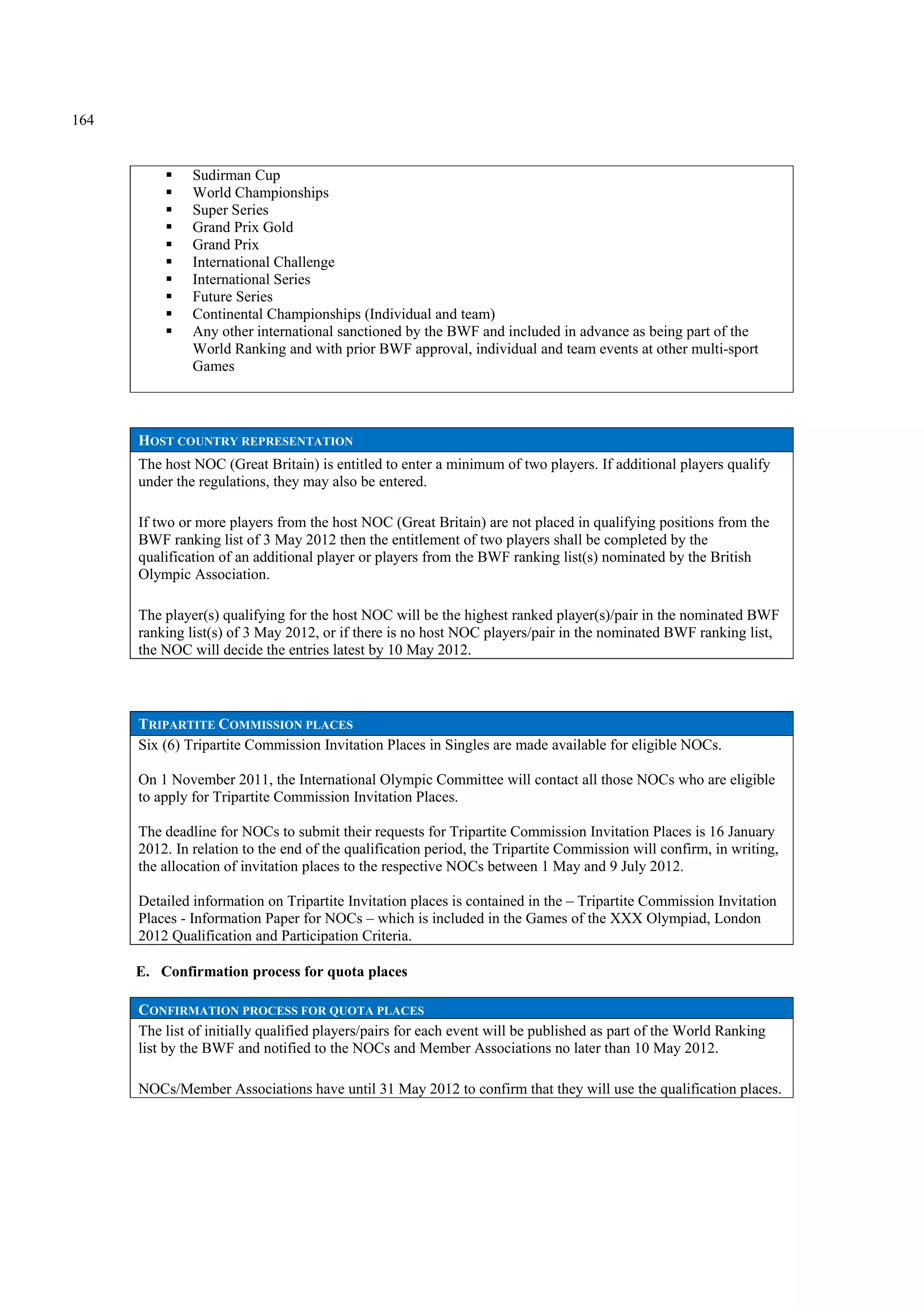
20.3.1 In International tournaments, the colour of clothing is optional.
20.3.2 In Continental Circuit tournaments and World Senior Championships, the colour of
clothing is optional or dependent on the Continental Confederation’s regulations.
20.3.3 In Super Series and Grand Prix tournaments, it is mandatory that, from the quarter finals
onwards, the opposing players in each match wear different colours from each other.
20.3.4 In World Championships, it is mandatory that, from the quarter-finals onwards, the
opposing players in each match wear different colours from each other.
20.3.5 In Bimantara Cups, it is mandatory that, from the quarter-finals onwards, the opposing
players in each match wear different colours from each other.
20.3.6 In Thomas & Uber Cups continental stage, it is recommended that the opposing players
in each match wear different colours from each other. In Thomas & Uber Cups final
stage, it is mandatory that the opposing players in each match wear different colours from
each other.
20.3.7 In Sudirman Cup, it is recommended that the opposing players in each match wear
different colours from each other but mandatory for the knock-out stage.
20.3.8 In Suhandinata Cup, it is recommended that the opposing players in each match wear
different colours from each other but mandatory from quarter-finals onwards.
20.3.9 In Olympic Games, it is mandatory for the opposing players in each match wear different
colours from each other. Preferred colours of shirts need to be registered before the
Games.
20.4 Doubles matches
Each player in a given pair must wear, as far as colour and design is concerned, shirts and shorts (or
equivalent articles of clothing) throughout a match in accordance with Regulations 20.4.1 to
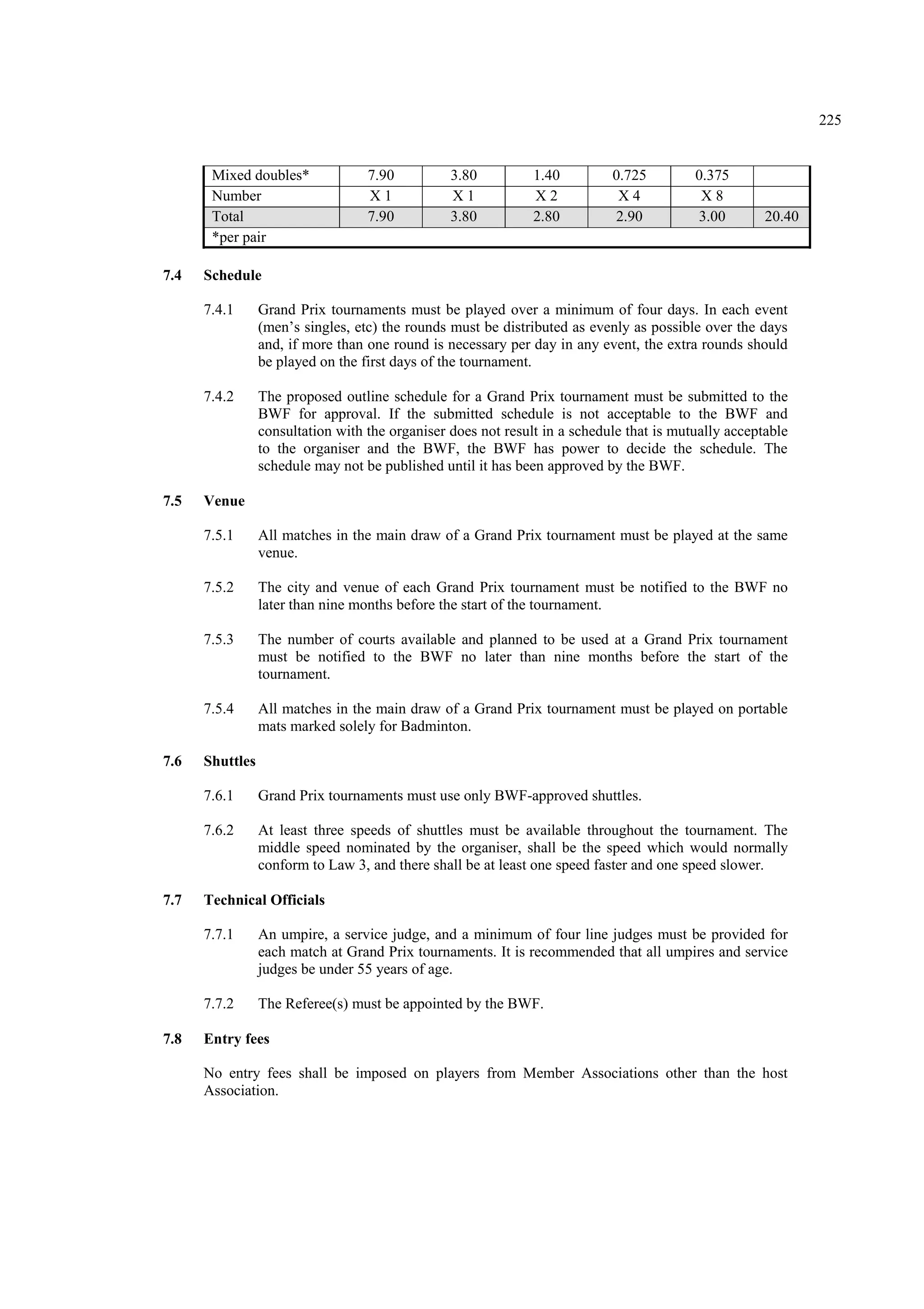
20.4.10.
69
20.4.1 In International tournaments, the colour of clothing is optional.
20.4.2 In Continental Circuit tournaments and World Senior Championships, the colour of
clothing is optional or dependent on the Continental Confederation’s regulations.
20.4.3 In Super Series and Grand Prix tournaments, it is mandatory for doubles partners to wear
the same colour from the quarter finals onwards. In Super Series and Grand Prix
tournaments, it is mandatory that, from the quarter finals onwards, the opposing pairs in
each match wear different colours from each other.
20.4.4 In World Championships, it is mandatory for doubles partners to wear the same colour.
It is mandatory that, from the quarter finals onwards, the opposing pairs in each match
wear different colours from each other.
20.4.5 In Bimantara Cups, it is mandatory for doubles partners to wear the same colours. It is
mandatory that from quarter-finals onwards, the opposing pairs in each match wear
different colours from each other.
20.4.6 In Thomas & Uber Cups continental stage, it is recommended that the opposing pairs in
each match wear different colours from each other. In Thomas & Uber Cups final stage,
it is mandatory that the opposing pairs in each match wear different colours from each
other.
20.4.7 In Sudirman Cup, it is recommended that the opposing pairs in each match wear different
colours from each other but mandatory for the knock-out stage.
20.4.8 In Suhandinata Cup, it is recommended that the opposing pairs in each match wear
different colours from each other but mandatory from quarter finals onwards.
20.4.9 In Olympic Games, it is mandatory for doubles partners to wear the same colour and that
the opposing pairs in each match wear different colours from each other. Preferred colours
of shirts need to be registered before the Games.
20.5 For all team championships, preferred colours of shirts should be registered with the BWF. In
individual and team championships the opposing players / pairs involved in a match are wearing
the same coloured clothing, the player / pair ranked lower will be required to wear clothing of a
different colour.
21. DESIGNS ON PLAYERS’ CLOTHING
21.1 In all sanctioned tournaments, including those organised by the BWF itself and Multi-sport games,
each article of clothing may only bear a design as provided in Regulations 21.2 to 21.4.
21.2 Abstract designs are permitted when devoid of advertising, commercial or promotional content.
21.3 The front of the shirt may carry the flag along with the country name or abbreviation thereof or
national emblem of the association represented not exceeding 20 square centimeters in total. The
country name on its own and / or along with sponsor’s name or logo shall not be permitted.
21.4 A design is allowed when it forms part of an advert permitted by Regulation 23 and falls wholly
within the permitted dimensions.
22. LETTERING ON PLAYERS’ CLOTHING
22.1 In all sanctioned tournaments, including those organised by the BWF itself, and Multi-sport games,
each article of clothing may only have visible lettering as provided in Regulations 22.2 to 22.5.
22.2 Colour, style and height of lettering
22.2.1 Lettering shall be in capital letters in the Roman alphabet (except as in Regulation 22.5.2),
and in one single colour contrasting with that of the shirt.
70
22.2.2 If there is a pattern on the back of the shirt, the lettering should be on a contrasting panel.
22.2.3 In order that lettering be legible from a distance for spectators in the stadium and television
viewers, lettering must be a minimum height of 6 centimetres and a maximum height of 10
centimetres.
22.2.4 Lettering should be horizontal, or as close to horizontal as practically possible, and placed
near the top of the shirt.
22.3 Player names
Any name of a player on the back of the shirt must be in accordance with Regulations 22.3.1 to
22.3.10, and shall meet all requirements of Regulation 22. If used, the player's name shall include
the family name (or an abbreviation thereof) and, if desired, the initials of the given name(s) or
nickname and shall correspond with the name on the entry.
22.3.1 In International tournaments, the name of the player on the back of the shirt is optional.
22.3.2 In Continental Circuit tournaments and World Senior Championships, the name of the
player on the back of the shirt is mandatory in Individual tournaments and optional or
dependent on the Continental Confederation’s regulations in Team Championships.
22.3.3 In Super Series and Grand Prix tournaments, the name of the player on the back of the
shirt is mandatory.
22.3.4 In World Championships, the name of the player on the back of the shirt is mandatory.
22.3.5 In Bimantara Cups, the name of the player on the back of the shirt is mandatory.
22.3.6 In Thomas & Uber Cup continental stage, the name of the player on the back of the shirt
is optional, unless otherwise required by the respective Continental Confederation. In
Thomas & Uber Cups final stage, the name of the player on the back of the shirt is
mandatory.
22.3.7 In Sudirman Cup, the name of the player on the back of the shirt is mandatory for
Division 1 and optional for the other divisions.
22.3.8 In Suhandinata Cup, the name of the player on the back of the shirt is mandatory.
22.3.9 In Olympic Games, the name of the player on the back of the shirt is mandatory. Players’
names need to be registered to ensure consistency with the names on scoreboards.
22.4 Country Name
The name of the player’s country may appear on the back of the shirt and must be in accordance
with Regulations 22.4.1 to 22.4.10 but, if used, shall meet all requirements of Regulation 22. The
country name, if used, shall be either full country name in English or Olympic approved
abbreviation.
22.4.1 In International tournaments, the name of the player’s country on the back of the shirt is
optional.
22.4.2 In Continental Circuit tournaments and World Senior Championships, the name of the
player’s country on the back of the shirt is mandatory in Team Championships and optional
or dependent on the Continental Confederation’s regulations in the Individual tournaments.
22.4.3 In Super Series and Grand Prix tournaments, the name of the player’s country on the
back of the shirt is optional.
22.4.4 In World Championships, the name of the player’s country on the back of the shirt is
optional.
71
22.4.5 In Bimantara Cups, the name of the player’s country on the back of the shirt is optional.
22.4.6 In Thomas & Uber Cups continental stage and Thomas & Uber Cups final stage, the
name of the player’s country on the back of the shirt is mandatory.
22.4.7 In Sudirman Cup, the name of the player’s country on the back of the shirt is mandatory
for all divisions.
22.4.8 In Suhandinata Cup, the name of the player’s country on the back of the shirt is optional
but mandatory from the quarter finals onwards.
22.4.9 In Olympic Games, the name of the player’s NOC on the back of the shirt is mandatory.
22.5 Lettering sequence and use in advertisements
22.5.1 The sequence on the shirt from top to bottom shall be player name (if present), country
name (if present), and advert (if present).
22.5.2 Lettering is also allowed when it forms part of an advert permitted by Regulation 23, and
falls wholly within the permitted dimensions. Such lettering can then be in any alphabet.
The following table summarises the requirements of Regulations 20 & 22.
Summary of General Competition Regulations 20 and 22: Colour of clothing and names
Tournament Colour and design of players’ shirts and shorts
in singles matches (as of 1 January 2010)
Colour and design of pairs’ shirts and shorts in
doubles matches (as of 1 January 2010)
Player name on back of
shirt
Country name on back of
shirt
International
tournaments
Different colours for opposing players
optional
Same colour optional Optional Optional
Continental Circuit
tournaments and
World Senior
Championships
Different colours for opposing players
optional, or dependent on Continental
Confederation regulations
Same colour optional, or dependent on Continental
Confederation regulations
Optional in Team
Championships or
dependent on Continental
Confederation regulations
and Mandatory in
Individual tournaments
Optional in Individual
tournaments or dependent
on Continental
Confederation regulations
and Mandatory in Team
Championships
Super Series and
Grand Prix
tournaments
From ¼ finals onwards, mandatory in Super
Series and Grand Prix that opposing players
wear different colours from each other
Mandatory to wear same colour from ¼ finals
onwards. From ¼ finals onwards, mandatory in
Super Series and Grand Prix that opposing pairs wear
different colours from each other
Mandatory Optional
World
Championships
From ¼ finals onwards, mandatory that
opposing players wear different colours from
each other
Mandatory to wear same colour.
Mandatory that opposing pairs wear different colours
from each other from ¼ finals onwards
Mandatory Optional
Bimantara Cups
(Individual)
From ¼ onwards, mandatory that opposing
players wear different colours from each other
Mandatory to wear same colour. Mandatory that
opposing pairs wear different colours from each other
from ¼ onwards.
Mandatory Optional
Thomas & Uber Cups Team must all wear same colour and design of
shirts and shorts. In continental stage
recommended and in final stage mandatory
that opposing players wear different colours
from each other.
Team must all wear same colour and design of shirts
and shorts. In continental stage Recommended and
in final stage mandatory that opposing pairs wear
different colours from each other.
Continental stage –
optional, unless otherwise
required by the respective
Continental Confederation
Final stage – mandatory
Mandatory
Sudirman Cup Team must all wear same colour and design of
shirts and shorts. Recommended that opposing
players wear different colours from each other
but mandatory for the knock-out stage.
Team must all wear same colour and design of shirts
and shorts. Recommended that opposing pairs wear
different colours from each other but mandatory for
the knock-out stage.
Mandatory for Division 1,
optional for other divisions
Mandatory
Suhandinata Cup Team must all wear same colour and design of
shirts and shorts. Recommended that opposing
players wear different colours from each other
but mandatory from quarter finals onwards.
Team must all wear same colour and design of shirts
and shorts. Recommended that opposing pairs wear
different colours from each other but mandatory from
quarter finals onwards.
Optional, but mandatory
for the quarter finals and
final
Mandatory
Olympic Games Mandatory for opposing players to wear
different colours from each other.
Preferred colour of shirts to be pre-registered.
Mandatory for doubles partners to wear same colour,
and that opposing pairs wear different colours from
each other. Preferred colour of shirts to be pre-
registered.
Mandatory
Names should be
registered for consistency
with scoreboards
NOC name mandatory
73
23. ADVERTISING ON PLAYERS’ CLOTHING
23.1 In all sanctioned tournaments, including those organised by the BWF itself and Multi-sport
games, articles of clothing may only have advertising as provided in Regulations 23.2 to 23.5.
23.2 The shirt may carry advertising as in Regulations 23.2.1 to 23.2.2.
23.2.1 Advertisements may appear on the following locations: left sleeve, right sleeve, left
shoulder, right shoulder, left collar, right collar, front of shirt. Each advertisement
must be 20 square centimetres or less. Other than front of shirt, only one per location;
and there must be no more than three in total; and
23.2.2 Advertising contained in a band of uniform width not exceeding 10 centimetres; such a
band may be at any angle and may be on the front of the shirt, the back of the shirt, or
both.
23.2.3 If, in the Referee’s sole judgment, there is a clash between the content of the
advertising in Regulation 23.2.2 and the tournament sponsors or the TV broadcasters,
or if the content of the advertising would infringe local laws or be considered
offensive, then the Referee may limit advertising on the shirt to Regulation 23.2.1.
23.3 Other Clothing
23.3.1 Each sock and each shoe may carry two advertisements of 20 square centimetres or
less.
23.3.2 Each other article of clothing may carry one advertisement of 20 square centimetres or
less.
23.4 Restrictions on the advertising
23.4.1 The advertisements in Regulations 23.2 and 23.3 may be the clothing manufacturer’s
emblem or that of any sponsor.
23.4.2 Each advertisement shall only be of one organisation or product.
23.4.3 The advertisements shall follow the International Olympic Committee principles and
shall not contain any political, religious and which is not a commercial brand,
registered mark or trade mark. (e.g. I don’t have a sponsor, I am nice, etc.).
23.5 In multi-sports games (e.g. Olympic Games) the organisers may specify more restrictive
advertising limitations on players’ clothing during play than in Regulations 23.2 to 23.4.
23.6 Member Association advertising
23.6.1 Member Associations may use an area not exceeding fifty square centimeters on their
players’ shorts or lower part of dresses or skirts.
23.6.2 The area shall typically be used for a Member Association’s logo or an advertisement
for a Member Association’s sponsor provided it conforms to Regulation 23.4.2.
23.6.3 If the Member Association does not use such area, that area shall not be utilized for any
other advert.
74
23.6.4 If the advertisement is used by any one player during a tournament, it must be used on
the shorts or skirts of all players from any one Member Association during that
tournament.
23.6.5 Any Member Association wishing to use this type of advertising must have written
permission from the BWF for doing so.
24. RESULTS
Results from all BWF-sanctioned tournaments must be faxed to the BWF immediately after each day’s
play in the tournament has been completed. (Refer Regulation 31)
25. WITHDRAWALS
25.1 It is a condition of entry to a BWF-sanctioned tournament that the organisers must be notified of
any withdrawal by a player / pair or team from the tournament or any event thereof.
25.1.1 Where such withdrawal is made no later than the Sunday immediately preceding the
draw no penalty is involved.
25.1.2 Any withdrawal after the Sunday immediately preceding the draw for any reason
whatsoever, renders the Member Association concerned liable to an amount of US$
250 per player / pair to the organisers of level 1 to 3 BWF sanctioned tournaments and
US$ 150 for level 4 BWF sanctioned tournaments, for the inconvenience caused by the
withdrawal.
25.1.3 Where there is a withdrawal of 10 or more players by one Member Association in any
given tournament the BWF disciplinary committee will consider whether any
additional penalty to that listed in Regulation 31 (Penalties) is applicable.
25.1.4 For the purpose of these regulations, retiring from a match shall not be considered to be
a withdrawal. No show for a match in a tournament shall not prevent a player / pair
from competing in another event in the same tournament
25.1.5 Responsibility for the administration of withdrawals and penalties is allocated as
per the following table. All responsible organisations should observe the same
principles as the BWF
Table
Tournament Responsible Other arrangements
BWF CC
Thomas Cup Final Stage V
Thomas Cup Continental Stage V
Uber Cup Final Stage V
Uber Cup Continental Stage V
Sudirman Cup V
Super Series V
Super Series Finals V
Grand Prix and Grand Prix Gold V
International Tournaments V
International Junior Tournaments V
75
World Championships V
Suhandinata and Bimantara Cups V
World Senior Championships V
Continental Championships V
Olympic Games BWF and IOC responsible
Continental Multi-sport games
e.g. Asian Games, Panamerican Games,
African Games, etc
Responsibility assigned
according to the Charter of
the Games
Commonwealth Games Responsibility assigned
according to the Charter of
the Games
International Challenge, International Series
and Future Series
V
25.1.6 The payment of withdrawal fees shall be collected by the BWF and the amount shall be
forwarded to the organisers after US$ 50 per withdrawal is retained by the BWF.
However, if the player was entered by the Member Association under whose
jurisdiction the competition was held, then the whole payment shall be retained by the
BWF.
25.2 The referees of all BWF-sanctioned Tournaments must, immediately after the conclusion of the
tournament, advise the BWF through the Referee’s Report about all players (or teams in the
case of team competitions) who withdrew from the Tournament after the date specified for
withdrawals without fees or who did not appear.
25.3 For each player or team in Regulation 25.2, the organisers must advise the BWF of the
circumstances of the withdrawal, including whether they were notified, and supply a copy of
any relevant documentation.
25.4 Within four weeks of the conclusion of each BWF-sanctioned tournament, the Member
Association concerned will be invoiced with the fees payable.
26. CONDUCT OF TOURNAMENTS OR FIXTURES
26.1 A Referee shall be appointed for all sanctioned tournaments or other fixtures.
26.1.1 The Referee shall be in overall charge of the tournament.
26.1.2 The Referee or a deputy shall always be present in the hall during the playing of
matches.
26.2 The BWF shall appoint the Referee for all tournaments organised by the BWF itself.
26.3 The BWF shall appoint the Technical Delegate(s) and the Referee(s) for Multi-sport games, or
alternatively, at its sole discretion, may approve a nomination from the organiser.
26.4 The duties of the Referee shall include:
26.4.1 ensuring that the conduct of the tournament is in accordance with the Laws of
Badminton, the Rules and Regulations of the BWF and any other regulations pertinent
to the particular competition;
26.4.2 ensure that the players given facilities and playing conditions of adequate standard and
safety.
76
26.4.3 approval of the programme of play and practice schedule; and
26.4.4 overall control of and ensuring that there is an adequate panel of technical officials of
requisite ability and appropriate international representation.
26.5 Any player participating in two matches is entitled to a minimum interval of 30 minutes
between them.
26.6 At all Level 1 and 2 tournaments, BWF may appoint a BWF Tournament Director.
26.7 At a BWF-sanctioned tournament where the BWF has not appointed the Referee, the BWF may
appoint a BWF Representative.
26.8 The duties of the BWF Tournament Director or BWF Representative, wherever appointed, shall
be:
26.8.1 to get all the information regarding the tournament and to take any necessary actions;
26.8.2 to give advice to the organisers, ensuring the general organisation is at desired
standard;
26.8.3 to ensure proper presentation of the game and co-ordination with media and publicity.
26.8.4 to attend the tournament and any associated meetings, such as publicity conferences
and general social functions;
26.8.5 to represent the interests of the BWF in any dispute not the direct responsibility of the
Referee; and
26.8.6 to support the Referee in his general duties.
26.9 Should the BWF be represented at a tournament under the control of a BWF-appointed Referee,
the duties of such Representative(s) shall not conflict with the responsibilities of the Referee.
26.10 Shuttles
26.10.1 One brand of BWF approved shuttle only must be adopted for exclusive use during any
tournament and the name of this brand must be advertised in the prospectus.
26.10.2 No rationing of shuttles per match must be allowed, and all shuttles used must be a
charge against the tournament and not against the players concerned.
26.11 Warm Up and Practice Courts:
26.11.1 For the BWF-sanctioned tournaments the warm up and practice court requirements
shall be as under:
Level of tournament
Level 1 Level 2 Level 3 Level 4
Warm Up courts Mandatory Recommended Recommended Recommended
Minimum Warm up
courts.
2 2 2 2
Practice courts Mandatory Mandatory Mandatory Recommended
Minimum Practice
courts.
4 4 4 2
77
26.11.2 These facilities shall be provided at least one day prior to commencement of
tournament until the conclusion of the tournament.
26.11.3 The practice schedule allocation on practice and main venue courts shall be done on
equitable basis having regard to the number of players in each team.
27. PRIZES
27.1 A prize fund may be awarded to players in all international tournaments sanctioned by the BWF
and, should be made in cash. Any prizes in kind shall be awarded over and above the prize fund
as additional prizes. The entry form or prospectus for the tournament shall set out the total value
of any such prizes.
27.2 In a tournament where all prizes are below the limit of US $5,000 and the total prize fund is less
than US $50,000 and level 4 tournaments, those prizes, may be given directly to the player
concerned, or in accordance with the instructions of the player’s Member Association.
27.3 Prize money from tournaments with larger prize funds
27.3.1 In a tournament where any prize is US $5,000 or more, or the total prize fund is US
$50,000 or more and level 1 to 3 tournaments, all prizes must be paid in accordance
with Regulations 27.3.2 to 27.3.5.
27.3.2 All prizes must be paid to the BWF within three weeks of the end of the tournament.
Upon receipt of these prizes, the BWF shall without delay remit the appropriate
amounts to the Member Associations of the players concerned.
27.3.3 If prize monies are not received by the BWF after three weeks, an interest surcharge of
0.25% per week on any outstanding amount will be added to the total prize money due,
this interest to accrue on the first day of each succeeding week that the payment is
outstanding.
27.3.4 Proof of payment of withholding tax must be supplied to the BWF within nine months
of the tournament or sanction of future tournaments may be withdrawn. Individual
withholding tax certificates in appropriate legal form in each participant’s name shall
be issued along with such proof of payment, so that the participant will be able to take
credit of such withholding tax, if allowable, in his country.
27.3.5 The BWF shall not have any responsibility for paying to Member Associations any
prize monies that have not been paid in accordance with Regulation 27.3.2
27.4 Division of prize money
27.4.1 Prize Money
The following division of prizes is recommended for the BWF sanctioned Tournaments
and all other tournaments with a comparable number of competitors.
% of total prize money
Winner Runner-
up
Semi-
finalists
Quarter-
finalists
Last 16 Total
Men’s singles 7.50 3.80 1.45 0.60 0.35
Number X 1 X 1 X 2 X 4 X 8
78
Total 7.50 3.80 2.90 2.40 2.80 19.40
Women’s singles 7.50 3.80 1.45 0.60 0.35
Number X 1 X 1 X 2 X 4 X 8
Total 7.50 3.80 2.90 2.40 2.80 19.40
Men’s doubles* 7.90 3.80 1.40 0.725 0.375
Number X 1 X 1 X 2 X 4 X 8
Total 7.90 3.80 2.80 2.90 3.00 20.40
Women’s doubles* 7.90 3.80 1.40 0.725 0.375
Number X 1 X 1 X 2 X 4 X 8
Total 7.90 3.80 2.80 2.90 3.00 20.40
Mixed doubles* 7.90 3.80 1.40 0.725 0.375
Number X 1 X 1 X 2 X 4 X 8
Total 7.90 3.80 2.80 2.90 3.00 20.40
*per pair
27.4.2 Member Associations may vary the above divisions for tournaments with fewer than
five events.
27.5 The BWF will retain the undistributed prize money in all BWF level 1 to 3 tournaments, and
Continental Confederations will retain the undistributed prize money in all level 4 tournaments,
where the entry is so low that the prize money is not fully distributed.
28. PLAYER MOVEMENT
28.1 A player may be entered into BWF-sanctioned competitions by any Member Association until
and unless another Member Association objects.
28.2 To object, a Member Association must produce evidence that the player concerned was under
contract to it or one of its regional associations or clubs.
28.3 The BWF will review the contract and consider the player’s observations before deciding if the
contract is enforceable.
28.4 If the contract is accepted as enforceable, the player will be barred from entry to international
competitions for the period specified in the contract (or until the terms of the contract have been
adhered to, if the contract provides for possible player movement). However, the maximum
period of ineligibility to enter international competitions will be six months, regardless of the
contract’s provisions.
29. DOPING AND FEMININITY CONTROL
Doping control is regulated by the provisions of the Anti-Doping Regulations which shall apply to all
tournaments run directly or indirectly under the auspices of the BWF or one of its members, whether or
not the tournament needs sanction by the BWF. The BWF encourages dope-testing at all BWF-
sanctioned tournaments.
30. WORLD RANKING SYSTEM
The BWF is empowered to implement or modify the World Ranking System [Part III Section 1B
Appendix 6].
79
31. PENALTIES
31.1 Any player / pair, coach or team official, tournament organiser who commits an offence as
referred to in Regulation 31.2 shall be levied with a penalty as stated in Regulation 31.2 to be
retained by the BWF.
31.2 For the details of offences covered under this regulation and penalties payable therefore, please
refer to the Table of Offences and Penalties (Part III Section 1 B - Appendix 11)
31.3 The penalty for the offences shall be based on the Referee’s Report for that tournament.
31.4 The Referee shall send a report for any misconduct warranting a disqualification of a player or a
team official, covered by the Players’ Code of Conduct (Part III, Section 1B, Appendix 4) and
Code of Conduct for Coaches and Team Officials (Part III, Section 1B, Appendix 9).
31.5 Any player / pair who is issued a black card in any BWF sanctioned tournament shall be
disqualified from participating in all events (in case of a team championships, subsequent
matches and ties) in the tournament in which such black card was issued. For the purpose of
these regulations, Suhandinata Cup and Bimantara Cups shall be considered to be different
tournaments.
31.6 On receipt of a report of a black card or a report of misbehaviour of a player or a person covered
under Code of Conduct for Coaches and Team Officials (Regulation 31.4), the BWF shall
immediately initiate the disciplinary proceedings as per the Disciplinary Regulations.
31.7 If the Member Association fails to settle withdrawal fee or penalty within 60 days of the original
invoice, the Member Association concerned shall be barred from entering any player in all BWF
sanctioned tournaments.
31.8 The Member Association will be permitted four weeks to appeal against any penalty to the
Disciplinary Committee who would review all available information and make a final
determination. Where the Disciplinary Committee is satisfied that the offence causing the
penalty was outside the control of the player / pair due to force majeure or for any other reason
beyond the control of the player, the penalty may be waived.
32. IMPLEMENTATION, MODIFICATION AND PENALTIES
32.1 The BWF has full authority to implement, interpret or modify these Regulations and to impose
penalties on any Member for infringement of any of the Regulations. The Member
Association(s) of the offending player(s) may also be instructed to take specified disciplinary
action.
32.2 The BWF shall, on proposal from its members, have power to grant a dispensation from any of
the General Competition Regulations, in cases where extraordinary or unforeseen circumstances
apply, provided such a decision is carried by a majority of two-thirds of the votes cast.
80
PART III
SECTION 1B
APPENDIX 1
INTERNATIONAL REPRESENTATION CHART
*Special transitional provisions apply to a few specific players who were in the process of
changing their representation when the Regulations were changed. BWF can provide further
details, upon request.
*Has P represented any Member
Association other than M in the
three years preceding the date of
the proposed representation?
*Does P hold a passport for
country M?
No
No
Has P represented M before?
Yes
Was M the last Member Association
that P represented?
P is not eligible to
represent M on the
proposed date
No
No
Yes
P is eligible to
represent M on
the proposed
date
Yes
Yes
∗Eligibility of player P to
represent Member Association M START
81
PART III
SECTION 1B
APPENDIX 2
SPECIFICATIONS FOR INTERNATIONAL STANDARD FACILITIES
1. Major BWF tournaments
1.1 The minimum height from the floor over the full court for the Olympic Games, the World
Championships, the Bimantara Cups, the World Senior Championships, the Sudirman Cup, the
final stage of the Thomas and Uber Cups, and the Suhandinata Cup shall be 12 meters (39 feet).
1.2 The required height shall be entirely free of girders and other obstructions over the area of the
court.
2. Other BWF and international events
2.1 The desirable height for all other international play is 12 meters (39 feet), but the minimum
height is 9 meters (30 feet).
2.2 The required height shall be entirely free of girders and other obstructions over the area of the
court.
3. Flooring
3.1 It is desirable to have a wooden sprung floor together with approved non-slip court mats.
3.2 It is recommended that there shall be at least two meters (6½ feet) clear space surrounding all
the outer lines of the court, this space also being a minimum requirement between any two
courts marked out side by side.
4. Background and lighting
4.1 To avoid any difficulty in sighting the shuttle, no part of the background behind the ends of the
court should be coloured white. It is desirable that only darker colours are used.
4.2 The minimum recommended lighting level is 1000 Lux to provide even light over the court
area. [Note, TV will advise on their lighting requirements and the optimal conditions for still
photographers are 1800-2000 Lux].
4.3 Lighting should not be directly over or behind the playing area but be positioned along the sides
of the court.
4.4 All sources of daylight or sunlight behind or along the sides of the court, should be eliminated.
5. Air movement
5.1 Any air movement e.g. draughts from air conditioning must be tightly controlled or eliminated.
82
6. Umpire’s chair
6.1 The construction must be stable and safe for the umpire to ascend and descend.
6.2 It should be equipped with a hinged writing platform so that the umpire can rest the score sheet.
6.3 The seat should be at the same height as the net i.e. 1.55 meters (5 feet) and should be
comfortable in terms of size and material used for construction.
6.4 The chair should be centered along the extension of the net approximately one metre from the
net.
7. General
7.1 Subject to the specific exception as set out in Regulation 4.6, these specifications shall be
enforced by the BWF in connection with the organisation of the major BWF tournaments.
7.2 In exceptional circumstances, the sanctioning authority may vary these requirements.
7.3 It is essential that all aspects of health, safety and security for players, officials and spectators
are in accordance with (local) Government Regulations.
Detailed information on the organisation of a Badminton tournament can be found in the BWF’s
‘Tournament Organisation Manual’ which is available from either the BWF Secretariat or the website:
www.internationalbadminton.org
83
PART III
SECTION 1B
APPENDIX 3
ANTI-DOPING REGULATIONS
Effective Date – 1 January 2009
INTRODUCTION
Preface
At the BWF Council Meeting held on 28 February 2008 in Kuala Lumpur, Malaysia, the BWF accepted the
(Revised 2009) World Anti-Doping Code (the "Code1
"). The new updated Code comes into effect from
January 2009. These anti-doping regulations are adopted and implemented in conformance with BWF's
responsibilities under the Code, and are in furtherance of the BWF's continuing efforts to eradicate doping
in the sport of Badminton.
Doping is fundamentally contrary to the spirit of sport. The purposes of the Code and the World Anti-
Doping Program which supports it are to:
• protect the Players’ fundamental right to participate in doping-free sport and thus promote health,
fairness and equality for Players worldwide; and
• ensure harmonised, coordinated and effective anti-doping programs at the international and national
level with regard to detection, deterrence and prevention of doping.
Scope
These anti-doping regulations shall apply to the BWF, each Member Association of the BWF, each
Participant in the activities of the BWF or any of its Member Associations, each member of the BWF’s
Member Associations, any person who or body which is affiliated with the BWF or its Member
Associations and any person who is a member of a body which is a member of or affiliated with the BWF.
It also applies to employees and contractors of the BWF and any other person who has agreed to be bound
by it.
It is the responsibility of each Member Association to ensure that all national-level Testing on the Member
Association's Players complies with these anti-doping regulations. In some countries, the Member
Association itself will be conducting the Doping Control described in these anti-doping regulations. In
other countries, many of the Doping Control responsibilities of the Member Association have been
delegated or assigned by statute or agreement to a National Anti-Doping Organisation. In those countries,
references in these anti-doping regulations to the Member Association shall apply, as appropriate, to the
Member Association's National Anti-Doping Organisation.
These anti-doping regulations shall apply to all Doping Controls over which the BWF and its Member
Associations have jurisdiction.
The BWF Medical Commission has the overall responsibility for implementing doping control at all BWF
Competitions.
1
Throughout WADA’s documentation, the convention of placing defined terms in Italics is used. This convention is
continued in the BWF anti-doping regulations.
84
1. DEFINITION OF DOPING
Doping is defined as the occurrence of one or more of the anti-doping regulation violations in
Regulations 2.1 to 2.8 of these anti-doping regulations.
2. ANTI-DOPING REGULATION VIOLATIONS
Players or other Persons shall be responsible for knowing what constitutes an anti-doping violation
and the substances and methods which have been included on the Prohibited List.
The following constitute anti-doping regulation violations:
2.1 Presence of a Prohibited Substance or its Metabolites or Markers in a Player’s2
Sample
2.1.1 It is each Player’s personal duty to ensure that no Prohibited Substance enters the
Player’s body. Players are responsible for any Prohibited Substance or its Metabolites
or Markers found to be present in their bodily Specimens. Accordingly, it is not
necessary that intent, fault, negligence or knowing Use on the Player’s part be
demonstrated in order to establish an anti-doping violation under Regulation 2.1.
2.1.2 Sufficient proof of an anti-doping regulation violation under Regulation 2.1 is
established by either of the following: presence of a Prohibited Substance or its
Metabolites or Markers in the Player’s A Sample where the Player waives analysis of
the B Sample and the B Sample is not analysed; or, where the Player’s B Sample is
analysed and the analysis of the Player’s B Sample confirms the presence of the
Prohibited Substance or its Metabolites or Markers in the Player’s A Sample.
2.1.3 Excepting those substances for which a quantitative threshold is specifically identified
in the Prohibited List, the presence of any quantity of a Prohibited Substance or its
Metabolites or Markers in a Player’s Sample shall constitute an anti-doping regulation
violation.
2.1.4 As an exception to the general rule of Regulation 2.1, the Prohibited List or
International Standards may establish special criteria for the evaluation of Prohibited
Substances that can also be produced endogenously.
2.2 Use or Attempted Use by a Player of a Prohibited Substance or a Prohibited Method
2.2.1 It is each Player’s personal duty to ensure that no Prohibited Substance enters the
Player’s body. Accordingly, it is not necessary that intent, fault, negligence or knowing
Use on the Player’s part be demonstrated in order to establish an anti-doping violation
for Use of a Prohibited Substance or a Prohibited Method.
2.2.2 The success or failure of the Use or Attempted Use of a Prohibited Substance or
Prohibited Method is not material. It is sufficient that the Prohibited Substance or
Prohibited Method was Used or Attempted to be Used for an anti-doping regulation
violation to be committed.
2
In the WADA Code the term “Athlete” is used. For compatibility with the rest of BWF’s statutes, this
word has been changed in the BWF anti-doping regulations to “Player”. “Player” is synonymous with
“Athlete” wherever “Athlete” appears in other WADA documentation.
85
2.3 Refusing, or failing without compelling justification, to submit to Sample collection after
notification as authorised in these anti-doping regulations or otherwise evading Sample
collection.
2.4 Violation of applicable requirements regarding Player availability for Out-of-Competition
Testing set out in the International Standard for Testing, including failure to file
whereabouts information in accordance with Article 11.3 of the International Standard for
Testing (a “Filing Failure”) and failure to be available for Testing at the declared
whereabouts in accordance with Article 11.4 of the International Standard for Testing (a
“Missed Test”). Any combination of three Missed Tests and/or Filing Failures committed
within an eighteen-month period, as declared by the BWF or any other Anti-Doping
Organisation with jurisdiction over a Player, shall constitute an anti-doping regulation
violation.
2.5 Tampering, or Attempting to Tamper, with any part of Doping Control.
2.6 Possession of Prohibited Substances and Prohibited Methods
2.6.1 Possession by a Player In-Competition of any Prohibited Method or any Prohibited
Substance, or Possession by a Player Out-of-Competition of any Prohibited Method or
any Prohibited Substance which is prohibited Out-of-Competition unless the Player
establishes that the Possession is pursuant to a Therapeutic Use Exemption (“TUE”)
granted in accordance with Regulation 4.4 (Therapeutic Use) or other acceptable
justification.
2.6.2 Possession by a Player Support Personnel In-Competition of any Prohibited Method or
any Prohibited Substance, or Possession by a Player-Support Personnel Out-of-
Competition of any Prohibited Method or any Prohibited Substance which is
prohibited Out-of-Competition in connection with a Player, Event or training, unless
the Player Support Personnel establishes that the Possession is pursuant to a
Therapeutic Use Exemption granted to a Player in accordance with Regulation 4.4
(Therapeutic Use) or other acceptable justification.
2.7 Trafficking or Attempted Trafficking in any Prohibited Substance or Prohibited Method.
2.8 Administration or Attempted administration to any Player In-Competition of any Prohibited
Method or Prohibited Substance, or administration or Attempted administration to any
Player Out-of-Competition of any Prohibited Method or any Prohibited Substance that is
Prohibited Out-of-Competition, or assisting, encouraging, aiding, abetting, covering up or
any other type of complicity involving an anti-doping regulation violation or any Attempted
violation.
3. PROOF OF DOPING
3.1 Burdens and standards of proof
The BWF and its Member Associations shall have the burden of establishing that an anti-doping
regulation violation has occurred. The standard of proof shall be whether the BWF or its
Member Association has established an anti-doping regulation violation to the comfortable
satisfaction of the hearing panel bearing in mind the seriousness of the allegation which is made.
This standard of proof in all cases is greater than a mere balance of probability but less than
proof beyond a reasonable doubt. Where these Regulations place the burden of proof upon the
Player or other Person alleged to have committed an anti-doping regulation violation to rebut a
presumption or establish specified facts or circumstances, the standard of proof shall be by a
86
balance of probability, except as provided in Regulations 10.4 and 10.6 where the Player must
satisfy a higher burden of proof.
3.2 Methods of establishing facts and presumptions
Facts related to anti-doping regulation violations may be established by any reliable means,
including admissions. The following rules of proof shall be applicable in doping cases:
3.2.1 WADA-accredited laboratories are presumed to have conducted Sample analysis and
custodial procedures in accordance with the International Standard for Laboratories3
.
The Player or other Person may rebut this presumption by
3.2.2 establishing that a departure from the International Standard for Laboratories occurred
which could reasonably have caused the Adverse Analytical Finding.
If the Player or other Person rebuts the preceding presumption by showing that a
departure from the International Standard for Laboratories occurred which could
reasonably have caused the Adverse Analytical Finding, then the BWF or its Member
Association shall have the burden to establish that such departure did not cause the
Adverse Analytical Finding.
3.2.2 Departures from any other International Standard or other anti-doping regulation
violation or policy which did not cause an Adverse Analytical Finding or other anti-
doping regulation violation shall not invalidate such results. If the Player or other
Person establishes that a departure from another International Standard or other anti-
doping regulation violation or policy which could reasonably have caused the Adverse
Analytical Finding or other anti-doping regulation violation, then the BWF or its
Member Association shall have the burden to establish that such departure did not
cause the Adverse Analytical Finding or the factual basis for the anti-doping regulation
violation.
3.2.3 The facts established by a decision of a court or professional disciplinary tribunal of
competent jurisdiction which is not the subject of a pending appeal shall be irrebuttable
evidence against the Player or other Person to whom the decision pertained of those
facts unless the Player or other Person establishes that the decision violated principles
of natural justice.
3.2.4 The hearing panel in a hearing on an anti-doping regulation violation may draw an
inference adverse to the Player or other Person who is asserted to have committed an
anti-doping regulation violation based on the Player’s or other Person’s refusal, after a
request made in a reasonable time in advance of the hearing, to appear at the hearing
(either in person or telephonically as directed by the tribunal) and to answer questions
either from the hearing panel or from the Anti-Doping Organisation asserting the anti-
doping regulation violation.
4. THE PROHIBITED LIST
4.1 Incorporation of the Prohibited List
These anti-doping regulations incorporate the Prohibited List which is published and revised by
WADA as described in Article 4.1 of the Code. The BWF will make the current Prohibited List
3
The WADA International Standard for Laboratories is available on WADA’s website at www.wada-
ama.org
87
available to each Member Association, and each Member Association shall ensure that the
current Prohibited List is available to its members and constituents.4
Unless provided otherwise
in the Prohibited List and/or a revision, the Prohibited List and revisions shall go into effect
under these anti-doping regulations three months after publication of the Prohibited List by
WADA without requiring any further action by the BWF.
4.2 Prohibited Substances and Prohibited Methods identified on the Prohibited List
The Prohibited List shall identify those Prohibited Substances and Prohibited Methods which
are prohibited as doping at all times (both In-Competition and Out-of-Competition) because of
their potential to enhance performance in future Competitions or their masking potential and
those substances and methods which are prohibited In-Competition only. As described in Article
4.2 of the Code, the BWF may request that WADA expand the Prohibited List for the sport of
Badminton. The BWF may also request that WADA include additional substances or methods,
which have the potential for abuse in the sport of Badminton, in the monitoring program
described in Article 4.5 of the Code. As provided in the Code, WADA shall make the final
decision on such requests by the BWF.
4.2.1 Specified Substances5
For purposes of the application of Regulation 10 (Sanctions on Individuals), all
Prohibited Substances shall be “Specified Substances” except substances in the classes
of anabolic agents and hormones and those stimulants and hormone antagonists and
modulators so identified on the Prohibited List. Prohibited Methods shall not be
Specified Substances.
4.2.2 New Classes of Prohibited Substances
In the event WADA expands the Prohibited List by adding a new class of Prohibited
Substances in accordance with Article 4.1 of the Code. WADA’s Executive Committee
shall determine whether any or all Prohibited Substances within the new class of
Prohibited Substances shall be considered Specified Substances under Article 4.2.2.
4.3 Criteria for including substances and methods on the Prohibited List
As provided in Article 4.3.3 of the Code, WADA’s determination of the Prohibited Substances
and Prohibited Methods that will be included on the Prohibited List shall be final and shall not
be subject to challenge by a Player or other Person.
4.4 Therapeutic Use6
4.4.1 Players with a documented medical condition requiring the use of a Prohibited
Substance or a Prohibited Method must first obtain a TUE. The presence of a
Prohibited Substance or its Metabolites or Markers (Regulation 2.1), Use or Attempted
Use of a Prohibited Substance or a Prohibited Method (Regulation 2.2), Possession of
Prohibited Substances or Prohibited Methods (Regulation 2.6) or administration of a
Prohibited Substance or Prohibited Method (Regulation 2.8) consistent with the
provisions of an applicable TUE issued pursuant to the International Standard for
TUEs shall not be considered an anti-doping regulation violation.
4.4.2 Subject to Regulation 4.4.3, Players included by the BWF in its Registered Testing
Pool and other Players participating in any International Event must obtain a TUE
4
The Prohibited List in force is available on WADA's website at www.wada-ama.org
5
The list of Specified Substances is available on WADA's website at www.wada-ama.org
6
The WADA International Standard for TUEs is available on WADA’s website at www.wada-ama.org
88
from the BWF (regardless of whether the Player previously has received a TUE at the
national level). The application for a TUE must be made as soon as possible (in the
case of a Player in the Registered Testing Pool, this would be when he/she is first
notified of his/her inclusion in the pool) and in any event (save in emergency
situations) no later than 21 days before the Player’s participation in the Event.
4.4.3 The only exception to Regulation 4.4.2 is that, in accordance with Regulation 7.13 of
the International Standard for TUEs, Players not in the BWF’s Registered Testing
Pool who inhale Glucocorticosteroids and/or formoterol, salbutamol, salmeterol or
terbutaline to treat asthma or one of its clinical variants do not need a TUE in advance
of participating in an International Event unless so specified by the BWF. Instead, if
necessary, any such Player may apply for a Retroactive TUE after the Event in
accordance with Article 7.13 of the International Standard for TUEs and Regulation
7.1.3 of these anti-doping regulations.
4.4.4 TUE’s granted by the BWF shall be reported to the Player’s National Federation and
to WADA. Other Players subject to Testing who need to use a Prohibited Substance or
a Prohibited Method for therapeutic reasons must obtain a TUE from their National
Anti-Doping Organisation or other body designated by their National Federation, as
required under the rules of the National Anti-Doping Organisation/other body.
National Federations shall promptly report any such TUE’s to the BWF and WADA.
4.4.5 The BWF shall appoint a panel of physicians to consider requests for TUE’s (the "TUE
Panel"). Upon the BWF's receipt of a TUE request, the Chair of the TUE Panel shall
appoint one or more members of the TUE Panel (which may include the Chair) to
consider such request. The TUE Panel member(s) so designated shall promptly
evaluate such request in accordance with the International Standard for TUEs and
render a decision on such request, which shall be the final decision of the BWF.
4.4.6 WADA, at the request of a Player or on its own initiation, may review the granting or
denial of any TUE by the BWF. If WADA determines that the granting or denial of a
TUE did not comply with the International Standard for TUEs in force at the time then
WADA may reverse that decision. Decisions on TUE’s are subject to further appeal as
provided in Regulation 13.
5. TESTING 7
5.1 Authority to Test
All Players under the jurisdiction of a Member Association shall be subject to In-Competition
Testing by the BWF, the Player's Member Association, and any other Anti-Doping Organisation
responsible for Testing at a Competition or Event in which they participate. All Players under
the jurisdiction of a Member Association, including Players serving a period of Ineligibility or a
Provisional Suspension shall also be subject to Out-of-Competition Testing at any time or place,
with or without advance notice, by the BWF, WADA, the Player's Member Association, the
National Anti-Doping Organisation of any country where the Player is present, the IOC during
the Olympic Games, and the IPC during Paralympic Games. Target Testing will be made a
priority.
5.2 Responsibility for BWF Testing
The BWF itself shall be responsible for drawing up a test distribution plan for the sport of
Badminton in accordance with Article 4 of the International Standard for Testing and for the
7
The WADA International Standard for Testing is available on WADA’s website at www.wada-ama.org
89
implementation of that plan, including overseeing all Testing conducted by the BWF. Testing
may be conducted by qualified persons so authorised by the BWF.
5.3 Testing standards
Testing conducted by the BWF and its Member Associations shall be in substantial conformity
with the International Standard for Testing in force at the time of Testing.
Blood (or other non-urine) Samples may be used either to detect Prohibited Substances or
Prohibited Methods, for screening procedure purposes, or for longitudinal haematological
profiling (“the passport”).. If the Sample is collected for screening only, it will have no
consequences for the Player other than to identify the Player for a urine test under these anti-
doping regulations. In these circumstances, the BWF may decide at its own discretion which
blood parameters are to be measured in the screening Sample and what levels of those
parameters will be used to indicate that a Player should be selected for a urine test. If however,
the Sample is collected for longitudinal haematological profiling (“the passport”), it may be
used for anti-doping purposes in accordance with Article 2.2 of the Code.
5.4 Coordination of Testing
The BWF and Member Associations shall promptly report completed tests through the WADA
clearing house to avoid unnecessary duplication in Testing.
5.5 Player whereabouts requirements
5.5.1 The BWF shall identify a Registered Testing Pool of those Players who are required to
comply with the whereabouts requirements of the International Standard for Testing,
and shall publish the criteria for Players to be included in this Registered Testing Pool
as well as a list of the Players meeting those criteria for the period in question. The
BWF shall review and update as necessary its criteria for including Players in its
Registered Testing Pool, and shall revise the membership of its Registered Testing
Pool from time to time as appropriate in accordance with the set criteria. Each Player
in the Registered Testing Pool (a) shall advise the BWF of his/her whereabouts on a
quarterly basis, in the manner set out in Article 11.3 of the International Standard for
Testing; (b) shall update that information as necessary, in accordance with Article
11.4.2 of the International Standard for Testing, so that it remains accurate and
complete at all times; and (c) shall make him/herself available for Testing at such
whereabouts, in accordance with Article 11.4 of the International Standard for Testing.
5.5.2 A Player’s failure to advise the BWF of his/her whereabouts shall be deemed a Filing
Failure for the purposes of Regulation 2.4 where the conditions of Article 11.3.5 of the
International Standard for Testing are met.
5.5.3 A Player’s failure to be available for Testing at his/her declared whereabouts shall be
deemed a Missed Test for purposes of Regulation 2.4 where the conditions of Article
11.4.3 of the International Standard for Testing are met.
5.5.4 Each Member Association shall also assist its National Anti-Doping Organisation in
establishing a national level Registered Testing Pool of top-level national Players to
whom the whereabouts requirements of the International Standard for Testing shall
also apply. Where those Players are also in the BWF’s Registered Testing Pool, the
BWF and the National Anti-Doping Organisation will agree (with the assistance of
WADA if required) on which of them will take responsibility for receiving whereabouts
filing from the Player and sharing it with the other (and with other Anti-Doping
Organisations) in accordance with Regulation 5.5.5.
90
5.5.5 Whereabouts information provided pursuant to Regulations 5.5.1 and 5.5.4 shall be
shared with WADA and other Anti-Doping Organisations having jurisdiction to test a
Player in accordance with Articles 11.7.1(d) and 11.7.3(d) of the International
Standard for Testing, including the strict condition that it be used only for Doping
Control purposes.
5.6 Retirement and return to competition
5.6.1 A Player who has been identified by the BWF for inclusion in the BWF’s Registered
Testing Pool shall continue to be subject to these anti-doping regulations, including the
obligation to comply with the whereabouts requirements of the International Standard
for Testing, unless and until the Player (or the Member Association on behalf of the
Player) gives written notice to the BWF that the Player has retired or until the Player
no longer satisfies the criteria for inclusion in the BWF's Registered Testing Pool and
has been so informed by the BWF.
5.6.2 A Player who has given notice of retirement to the BWF may not resume competing
unless the Player notifies the BWF at least six (6) months before the Player expects to
return to competition and is available for unannounced Out-of-Competition Testing
including (if requested) complying with the whereabouts requirements of the
International Standard for Testing, at any time during the six (6) month period before
actual return to competition. The BWF may give notice of a different period than six
months at the time of receipt of notification of retirement.
5.6.3 Member Associations/National Anti-Doping Organisations may establish similar
requirements for retirement and returning to competition for Players in the national
Registered Testing Pool.
5.7 Selection of Players to be tested
5.7.1 At International Events, the BWF shall determine the number of finishing placement
tests, random tests and target tests to be performed.
5.7.2 The BWF shall target a certain number of Players not necessarily linked to final
placements in order to maximise the diversity of Players tested or based on information
provided by the WADA Clearinghouse on previous tests.
5.7.3 At National Events, each Member Association shall determine the number of Players
selected for Testing in each Competition and the procedures for selecting the Players
for Testing.
5.7.4 In addition to the selection procedures in Regulations 5.7.1 and 5.7.2, the BWF at
International Events, and the Member Association at National Events, may also select
Players or teams for Target Testing so long as such Target Testing is not used for any
purpose other than legitimate Doping Control purposes.
5.7.5 Players selected for Testing shall be notified only after completing their last match of
the day. Should a Player be notified before completing the Player’s last match of the
day, the Player may appeal to the Referee. The Referee has discretion to cancel the
Test.
5.7.6 Players shall be selected for Out-of-Competition Testing by the BWF and by Member
Associations through a process that substantially complies with the International
Standard for Testing in force at the time of selection.
91
5.8 Member Associations and the organising committees for Member Association Events shall
provide access to Independent Observers at Events as directed by the BWF.
6. ANALYSIS OF SAMPLES
Doping Control Samples collected under these anti-doping regulations shall be analysed in accordance
with the following principles:
6.1 Use of approved laboratories
The BWF shall send Doping Control Samples for analysis only to WADA-accredited
laboratories or as otherwise approved by WADA. The choice of the WADA-accredited laboratory
(or other method approved by WADA) used for the Sample analysis shall be determined
exclusively by the BWF.
6.2 Purpose of Collection and Analysis of Samples
Samples shall be analysed to detect Prohibited Substances and Prohibited Methods identified on
the Prohibited List and other substances as may be directed by WADA pursuant to Article 4.5 of
the Code (Monitoring Program), or to assist an Anti-Doping Organisation in profiling relevant
parameters in a Player’s urine, blood or other matrix, including DNA or genomic profiling, for
anti-doping purposes.
6.3 Research on Samples
No Sample may be used for any purpose other than as described in Article 6.2 of the Code
without the Player's written consent. Samples used for purposes other than Article 6.2 of the
Code shall have any means of identification removed such that they cannot be traced back to a
particular Player.
6.4 Standards for Sample analysis and reporting
Laboratories shall analyse Doping Control Samples and report results in conformity with the
International Standard for Laboratories.
6.5 Retesting Samples
A Sample may be reanalyzed for the purposes described in Regulation 6.2 at any time
exclusively at the direction of the BWF or WADA. The circumstances and conditions for
retesting Samples shall conform with the requirements of the International Standard for
Laboratories.
7. RESULTS MANAGEMENT
7.1 Results Management for Tests initiated by BWF
Results management for Tests initiated by the BWF (including Tests performed by WADA
pursuant to agreement with the BWF) shall proceed as set out in this Regulation 7.
7.1.1 The results from all analyses must be sent to the BWF in encoded form, in a report
signed by an authorised representative of the laboratory. All communication must be
conducted in confidentiality and in conformity with ADAMS, a database management
tool developed by WADA.
92
7.1.2 Upon receipt of an A Sample Adverse Analytical Finding, the Secretary General, or if
he is from the same country as the player or not available, a member of the Council or
Executive Board shall conduct a review to determine whether:
• an applicable TUE has been granted; or
• there is any apparent departure from the International Standards for Testing or
International Standards for Laboratories that cause the Adverse Analytical
Finding.
7.1.3 In the following circumstances:
(a) the Adverse Analytical Finding is for a Glucocorticosteroid, formoterol,
salbutamol, salmeterol or terbutaline; and
(b) the Sample in question was provided by a Player who is not in the BWF’s
Registered Testing Pool, during his/her participation in an International Event
for which (in accordance with Article 7.13 of the International Standard for
TUEs and these anti-doping regulations) the BWF does not require a TUE for
asthma medication in advance, then, before the matter is referred to the BWF
under Regulation 7.1, the Player shall be given an opportunity to apply to the
TUE Committee for a Retroactive TUE in accordance with Article 7.13 of the
International Standard for TUEs. The result of that application shall be
forwarded to the BWF for consideration in its review of the Adverse Analytical
Finding under Regulation 7.1.2.
7.1.4 If the initial review under Regulation 7.1.2 does not reveal an applicable TUE or
departure from the International Standard for Testing or the International Standard for
Laboratories that caused the Adverse Analytical Finding, the BWF shall promptly
notify the Player of:
• the Adverse Analytical Finding;
• the anti-doping regulation violated;
• the Player's right to promptly request the analysis of the B Sample or, failing such
request, that the B Sample analysis may be deemed waived;
• the scheduled date, time and place for the B Sample analysis (which shall be
within the time period specified in the International Standard for Laboratories) if
the Player or the BWF chooses to request an analysis of the B Sample;
• the right of the Player and/or the Player's representative to attend the B Sample
opening and analysis at the scheduled date, time and place if such analysis is
requested;
and
• the Player's right to request copies of the A and B Sample laboratory
documentation package which includes information as required by the
International Standard for Laboratories.
The BWF shall also notify the Player’s National Anti-Doping Organisation and
WADA. If the BWF decides not to bring forward the Adverse Analytical Finding as an
anti-doping regulation violation, it shall so notify the Player, the Player’s National
Anti-Doping Organisation and WADA.
93
7.1.5 Arrangements shall be made for Testing the B Sample within the time period specified
in the International Standard for Testing. A Player may accept the A Sample analytical
results by waiving the requirement for B Sample analysis. The BWF may nonetheless
elect to proceed with the B Sample analysis.
7.1.6 The Player and/or the Player’s representative shall be allowed to be present at the
analysis of the B Sample. A representative of the Player's Member Association, as well
as a representative of the BWF, shall also be allowed to be present.
7.1.7 If the B Sample proves negative, then (unless the BWF takes the case forward as an
anti-doping regulation violation under Regulation 2.2) the entire test shall be
considered negative and the Player, the Player’s Member Association, and the BWF
shall be so informed.
7.1.8 If a Prohibited Substance or the Use of a Prohibited Method is identified, the findings
shall be reported to the Player, the Player’s Member Association, the BWF, and to
WADA.
7.1.9 For apparent anti-doping regulation violations that do not involve Adverse Analytical
Findings, the BWF shall conduct any necessary follow-up investigation and, at such
time as it is satisfied that an anti-doping regulation violation has occurred, it shall then
promptly notify the Player of the anti-doping regulation which appears to have been
violated, and the basis of the violation.
7.2 Results Management for Atypical Findings
7.2.1 As provided in the International Standards, in certain circumstances laboratories are
directed to report the presence of Prohibited Substances that may also be produced
endogenously as Atypical Findings that should be investigated further.
7.2.2 If a laboratory reports an Atypical Finding in respect of a Sample collected from a
Player by or on behalf of the BWF, the BWF shall conduct a review to determine
whether: (a) the Atypical Finding is consistent with an applicable TUE that has been
granted as provided in the International Standard for TUEs, or (b) there is any
apparent departure from the International Standard for Testing or International
Standard for Laboratories that caused the Atypical Analytical Finding.
7.2.3 If the initial review of an Atypical Finding under Regulation 7.2.2 reveals an
applicable TUE or departure from the International Standard for Testing or the
International Standard for Laboratories that caused the Atypical Finding, the entire
test shall be considered negative.
7.2.4 If the initial review of an Atypical Finding under Regulation 7.2.2 does not reveal an
applicable TUE or departure from the International Standard for Testing or the
International Standard for Laboratories that caused the Atypical Finding, the BWF
shall conduct the follow-up investigation required by the International Standards. If,
once that investigation is completed, it is concluded that the Atypical Finding should
be considered an Adverse Analytical Finding, the BWF shall pursue the matter in
accordance with Regulation 7.1.
7.2.5 The BWF will not provide notice of an Atypical Finding until it has completed its
investigation and has decided whether it will bring the Atypical Finding forward as an
Adverse Analytical Finding unless one of the following circumstances exists:
94
(a) If the BWF determines the B Sample should be analysed prior to the conclusion
of its follow-up investigation, it may conduct the B Sample analysis after
notifying the Player, with such notice to include a description of the Atypical
Finding and the information described in Regulation 7.1.4; or
(b) If the BWF receives a request, either from a Major Event Organisation shortly
before one of its International Events or from a sports organisation responsible
for meeting an imminent deadline for selecting team members for an
International Event, to disclose whether any Player identified on a list provided
but the Major Event Organisation or sports organisation has a pending Atypical
Finding, the BWF shall so identify any such Player after first providing notice of
the Atypical Finding to the Player.
7.3 Results management for Tests initiated during other International Events
Results management and the conduct of hearings from a test by the International Olympic
Committee, the International Paralympic Committee, or a Major Event Organisation, shall be
managed, as far as sanctions beyond Disqualification from the Event or the results of the Event,
by the BWF.
7.4 Results management for Tests initiated by Member Associations
Results management conducted by Member Associations shall be consistent with the general
principles for effective and fair results management which underlie the detailed provisions in
Regulation 7. Results of all Doping Controls shall be reported to the BWF and to WADA within
14 days of the conclusion of the Member Association's results management process. Any
apparent anti-doping regulation violation by a Player who is a member of that Member
Association shall be promptly referred to an appropriate hearing panel established pursuant to
the rules of the Member Association or national law. Apparent anti-doping regulation violations
by Players who are members of another Member Association shall be referred to the BWF for
hearing.
7.5 Results Management for Whereabouts Violations
7.5.1 Results management in respect of an apparent Filing Failure by a Player in the BWF’s
Registered Testing Pool shall be conducted by the BWF in accordance with Article
11.6.2 of the International Standard for Testing (unless it has been agreed in
accordance with Regulation 5.5.4 that the Member Association or National Anti-
Doping Organisation shall take such responsibility).
7.5.2 Results management in respect of an apparent Missed Test by a Player in the BWF’s
Registered Testing Pool as a result of an attempt to test the Player by or on behalf of
the BWF shall be conducted by the BWF in accordance with Article 11.6.3 of the
International Standard for Testing. Results management in respect of an apparent
Missed Test by such Player as a result of an attempt to test the Player by or on behalf of
another Anti-Doping Organisation shall be conducted by that other Anti-Doping
Organisation in accordance with Article 11.7.6(c) of the International Standard for
Testing.
7.5.3 Where, in any eighteen-month period, a Player in the BWF’s Registered Testing Pool is
declared to have three Filing Failures, or three Missed Tests, or any combination of
Filing Failures or Missed Tests adding up to three in total, whether under these anti-
doping regulations or under the rules of any other Anti-Doping Organisation, the BWF
shall bring them forward as an apparent anti-doping regulation violation.
95
7.6 Provisional Suspensions
7.6.1 If analysis of an A Sample has resulted in an Adverse Analytical Finding for a
Prohibited Substance that is not a Specified Substance, and a review in accordance
with Regulation 7.1.2 does not reveal an applicable TUE or departure from the
International Standard for Testing or the International Standard for Laboratories that
caused the Adverse Analytical Finding, the BWF must Provisionally Suspend the
Player pending the hearing panel’s determination of whether the Player has committed
an anti-doping regulation violation.
7.6.2 In any case not covered by Regulation 7.6.1 where the BWF decides to take the matter
forward as an apparent anti-doping regulation violation in accordance with the
foregoing provisions of this Regulation 7, the BWF may Provisionally Suspend the
Player pending the hearing panel’s determination of whether the Player has committed
an anti-doping regulation violation.
7.6.3 Where a Provisional Suspension is imposed, whether pursuant to Regulation 7.6.1 or
Regulation 7.6.2, the Player shall be given either: (a) an opportunity for a Provisional
Hearing before imposition of the Provisional Suspension or on a timely basis after
imposition of the Provisional Suspension; or (b) an opportunity for an expedited
hearing in accordance with Regulation 8 (Right to a Fair Hearing) on a timely basis
after imposition of a Provisional Suspension. Member Associations shall impose
Provisional Suspensions in accordance with the principles set forth in this Regulation
7.6.
7.6.4 If a Provisional Suspension is imposed based on an Adverse Analytical Finding in
respect of an A Sample, and any subsequent analysis of the B Sample analysis does not
confirm the A Sample analysis, then the Player shall not be subject to any further
Provisional Suspension on account of a violation of Article 2.1 of the Code (Presence
of a Prohibited Substance or its Metabolites or Markers). In circumstances where the
Player (or the Player’s team as may be provided in the rules of the BWF) has been
removed from a Competition based on a violation of Regulation 2.1 and the subsequent
B Sample analysis does not confirm the A Sample finding, if, without otherwise
affecting the Competition, it is still possible for the Player or team to be reinserted, the
Player or team may continue to take part in the Competition.
7.7 Retirement from Sport
If a Player or other Person retires while a results management process is underway, the BWF
retains jurisdiction to complete its results management process. If a Player or other Person
retires before any results management process has begun, the BWF (if it had jurisdiction over
the Player or other Person at the time the Player or other Person committed an anti-doping
violation) has jurisdiction to conduct results management.
8. RIGHT TO A FAIR HEARING
8.1 Hearings arising out of BWF Testing or Tests at International Events
8.1.1 The BWF shall appoint a standing panel consisting of a Chair and four other people
with experience in anti-doping ("BWF Doping Hearing Panel"). At least one of the
BWF Doping Hearing Panel shall be a person practicing law in the jurisdiction of a
Member Association. Each Doping Hearing Panel Member shall be independent of the
BWF staff, BWF Council and Continental Confederation staff or Council.
96
8.1.2 When it appears, following the Results Management process described in Regulation 7,
that these anti-doping regulations have been violated in connection with the BWF
Testing or Testing at an International Event then the case shall be assigned to the BWF
Doping Hearing Panel for adjudication.
8.1.3 The Chair of the BWF Doping Hearing Panel shall appoint three members from the
panel (which may include the Chair) to hear each case, and appoint a Chair of the panel
for that case. The Chair will as far as practicable appoint a lawyer to the Doping
Hearing Panel, if that is not practicable, BWF shall ensure that the panel has
independent legal advice available to it. The appointed members shall have had no
prior involvement with the case and shall not have the same nationality as the Player or
other Person alleged to have violated these anti-doping regulations. Where there are
insufficient Panel members due to prior involvement, a nationality constraint, or
unavailability, the BWF President may appoint such additional Panel members as may
be required.
8.1.4 Hearings pursuant to this Regulation shall be completed expeditiously following the
completion of the results management process described in Regulation 7. Hearings
held in connection with Events may be conducted on an expedited basis.
8.1.5 The Member Association of the Player or other Person alleged to have violated these
anti-doping regulations may attend the hearing as an observer.
8.1.6 The BWF shall keep WADA fully apprised as to the status of pending cases and the
results of all hearings.
8.1.7 A Player or other Person may forego a hearing by acknowledging the anti-doping
regulation violation and accepting Consequences consistent with Regulations 9 and 10
as proposed by the BWF. The right to a hearing may be waived either expressly by the
Player’s or Person’s failure to challenge the BWF’s assertion that an anti-doping
regulation violation within 14 days. Where no hearing occurs, the BWF shall submit to
the persons described in Regulation 13.2.3 a reasoned decision explaining the action
taken.
8.1.8 Decisions of the BWF Doping Hearing Panel may be appealed to Court of Arbitration
for Sport (“CAS”) as provided in Regulation 13.
8.2 Hearings arising out of national Testing
8.2.1 When it appears, following the Results Management process described in Regulation 7,
that these anti-doping regulations have been violated in connection with Testing other
than in connection with the BWF Testing or Testing at an International Event, the
Player or other Person involved shall be brought before a disciplinary panel of the
Player’s or other Person's Member Association for a hearing to adjudicate whether a
violation of these anti-doping regulations occurred, and if so, what Consequences
should be imposed.
8.2.2 Hearings pursuant to this Regulation 8.2 shall be completed expeditiously and in all
cases within three months of the completion of the Results Management process
described in Regulation 7. Hearings held in connection with Events may be conducted
by an expedited process. If the completion of the hearing is delayed beyond three
months, the BWF may elect to bring the case directly before the BWF Doping Hearing
Panel at the responsibility and at the expense of the Member Association.
8.2.3 Member Associations shall keep the BWF and WADA fully apprised as to the status of
pending cases and the results of all hearings.
97
8.2.4 The BWF and WADA shall have the right to attend hearings as an observer.
8.2.5 The Player or other Person may forego a hearing by acknowledging the violation of
these anti-doping regulations and accepting Consequences consistent with Regulations
9 and 10 as proposed by the National Federation. The right to a hearing may be waived
either expressly or by the Player’s or other Person’s failure to challenge the National
Federation’s assertion that an anti-doping regulation violation has occurred within
fourteen (14) days. Where no hearing occurs, the National Federation shall submit to
the persons described in Regulation 13.2.3 a reasoned decision explaining the action
taken.
8.2.6 Decisions by Member Associations, whether as the result of a hearing or the Player’s
or other Person's acceptance of Consequences, may be appealed as provided in
Regulation 13.
8.2.7 Hearing decisions by the Member Association shall not be subject to further
administrative review at the national level except as provided in Regulation 13 or
required by applicable national law.
8.3 Principles for a fair hearing
All hearings pursuant to either Regulation 8.1 or 8.2 shall respect the following principles:
• a timely hearing;
• fair and impartial hearing body;
• the right to be represented at the Person's own expense;
• the right to be informed in a fair and timely manner of the asserted anti-doping regulation
violation;
• the right to respond to the asserted anti-doping regulation violation and resulting
Consequences;
• the right of each party to present evidence, including the right to call and question witnesses
(subject to the hearing body's discretion to accept testimony by telephone or written
submission);
• the Person's right to an interpreter at the hearing, with the Doping Panel to determine the
identity, and responsibility for the cost of the interpreter;
and
• a timely, written, reasoned decision, specifically including an explanation of the reason(s)
for any period of Ineligibility.
9. AUTOMATIC DISQUALIFICATION OF INDIVIDUAL RESULTS
A violation of these anti-doping regulations in Individual Sports in connection with an In-Competition
test automatically leads to Disqualification of the result obtained in that Competition with all resulting
Consequences, including forfeiture of any medals, points and prizes.
98
10. SANCTIONS ON INDIVIDUALS
10.1 Disqualification of results in Event during which an anti-doping regulation violation occurs
An anti-doping regulation violation occurring during or in connection with an Event may lead to
Disqualification of all of the Player's individual results obtained in that Event with all
Consequences, including forfeiture of all medals, points and prizes, except as provided in
Regulation 10.1.1.
10.1.1 If the Player establishes that the Player bears No Fault or Negligence for the violation,
the Player's individual results in the other Competitions shall not be Disqualified unless
the Player's results in Competitions other than the Competition in which the anti-
doping regulation violation occurred were likely to have been affected by the Player's
anti-doping regulation violation.
10.2 Ineligibility for presence, Use or Attempted Use, or Possession of Prohibited Substances and
Prohibited Methods
The period of Ineligibility imposed for a violation of Regulation 2.1 (presence of Prohibited
Substance or its Metabolites or Markers), Regulation 2.2 (Use or Attempted Use of Prohibited
Substance or Prohibited Method) and Regulation 2.6 (Possession of Prohibited Substances and
Prohibited Methods) shall be as follows, unless the conditions for eliminating or reducing the
period of Intelligibility, as provided in Regulations 10.4 and 10.5, or the conditions for
increasing the period of Ineligibility, as provided in Regulation 10.6 are met:
First violation: Two (2) years' Ineligibility.
10.3 Ineligibility for other anti-doping regulation violations
The period of Ineligibility for violations of these anti-doping regulations, other than those set out
in Regulation 10.2, shall be:
10.3.1 For violations of Regulation 2.3 (Refusing or failing to submit to Sample collection or
otherwise evading Sample collection) or Regulation 2.5 (Tampering with Doping
Control), the Ineligibility period shall be two (2) years unless the conditions provided
in Regulation 10.5, or the conditions provided in Regulation 10.6, are met.
10.3.2 For violations of Regulation 2.7 (Trafficking or Attempted Trafficking) or Regulation
2.8 (Administration of or Attempted administration of a Prohibited Substance or
Prohibited Method), the period of Ineligibility imposed shall be a minimum of four (4)
years up to lifetime Ineligibility unless the conditions provided in Regulation 10.5 are
met. An anti-doping regulation violation involving a Minor shall be considered a
particularly serious violation, and, if committed by Player Support Personnel for
violations other than Specified Substances referenced in Regulation 4.2.1, shall result
in lifetime Ineligibility for such Player Support Personnel. In addition, significant
violations of Regulations 2.7 or 2.8 which may also violate non-sporting laws and
regulations shall be reported to the competent administrative, professional or judicial
authorities.
10.3.3 For violations of Regulation 2.4 (Whereabouts violations or missed Tests), the period
of Ineligibility shall be at a minimum one (1) year and at a maximum two (2) years
based on the Player’s degree of fault.
99
10.4 Elimination or reduction of the period of Ineligibility for Specified Substances under
specific circumstances
Where a Player or other Person can establish how a Specified Substance entered his or her body
or came into his or her Possession and that such Specified Substance was not intended to
enhance the sport performance or mask the Use of a performance-enhancing substance, the
period of Ineligibility found in Regulation 10.2 shall be replaced with the following:
First violation: At a minimum, a reprimand and no period of Ineligibility from future Events,
and at a maximum, two (2) year's Ineligibility.
To justify any elimination or reduction, the Player or other Person must produce corroborating
evidence in addition to his or her word which establishes to the comfortable satisfaction of the
hearing panel the absence of an intent to enhance sport performance or mask the Use of a
performance-enhancing substance. The Player or other Person’s degree of fault shall be the
criterion considered in assessing any reduction of the period of Ineligibility.
10.5 Elimination or reduction of period of Ineligibility based on exceptional circumstances
10.5.1 No Fault or Negligence
If the Player establishes in an individual case involving an anti-doping regulation
violation that the Player bears No Fault or Negligence the otherwise applicable period
of Ineligibility shall be eliminated. When a Prohibited Substance or its Markers or
Metabolites is detected in a Player's Specimen in violation of Regulation 2.1 (Presence
of Prohibited Substance), the Player must also establish how the Prohibited Substance
entered the Player’s system in order to have the period of Ineligibility eliminated. In
the event this Regulation is applied and the period of Ineligibility otherwise applicable
is eliminated, the anti-doping regulation violation shall not be considered a violation
for the limited purpose of determining the period of Ineligibility for multiple violations
under Regulation 10.7.
10.5.2 No Significant Fault or Negligence
If a Player or other Person establishes in an individual case that the Player bears No
Significant Fault or Negligence, then the otherwise applicable period of Ineligibility
may be reduced, but the reduced period of Ineligibility may not be less than one-half of
the period of Ineligibility otherwise applicable. If the otherwise applicable period of
Ineligibility is a lifetime, the reduced period under this Regulation may be no less than
eight (8) years. When a Prohibited Substance or its Markers or Metabolites is detected
in a Player's Specimen in violation of Regulation 2.1 (Presence of Prohibited
Substance), the Player must also establish how the Prohibited Substance entered the
Player’s system in order to have the period of Ineligibility reduced.
10.5.3 Substantial Assistance
The BWF Doping Hearing Panel may, prior to a final appellate decision under
Regulation 13 or the expiration of the time to appeal, suspend a part of the period of
Ineligibility imposed in an individual case where the Player or other Person has
provided Substantial Assistance to the BWF, criminal authority or professional
disciplinary body which results in the BWF (or other relevant body) discovering or
establishing an anti-doping rule violation by another Person or which results in a
criminal or disciplinary body discovering or establishing a criminal offence or the
breach of professional rules by another Person. After a final appellate decision under
Regulation 13 or the expiration of time to appeal, the BWF may only suspend a part of
the otherwise applicable period of Ineligibility with the approval of WADA. The extent
100
to which the otherwise applicable period of Ineligibility may be suspended shall be
based on the seriousness of the anti-doping regulation violation committed by the
Player or other Person and the significance of the Substantial Assistance provided by
the Player or other Person to the effort to eliminate doping in sport. No more than
three-quarters of the otherwise applicable period of Ineligibility may be suspended. If
the otherwise applicable period of Ineligibility is a lifetime, the non-suspended period
under this Regulation must be no less than eight (8) years. If the BWF suspends any
part of the otherwise applicable period of Ineligibility under this Regulation, the BWF
shall promptly provide a written justification for its decision to each Anti-Doping
Organisation having a right to appeal the decision. If the BWF subsequently reinstates
any part of the suspended period of Ineligibility because the Player or other Person has
failed to provide the Substantial Assistance which was anticipated, the Player or other
Person may appeal the reinstatement pursuant to Regulation 13.2.
10.5.4 Admission of an anti-doping regulation violation in the absence of other evidence
Where a Player or other Person voluntarily admits the commission of an anti-doping
regulation violation before having received notice of a Sample collection which could
establish an anti-doping regulation violation (or, in the case of an anti-doping
regulation violation other than Regulation 2.1, before receiving first notice of the
admitted violation pursuant to Regulation 7) and that admission is the only reliable
evidence of the violation at the time of admission, then the period of Ineligibility may
be reduced, but not below one-half of the period of Ineligibility otherwise applicable.
10.5.5 Where a Player or other Person establishes entitlement to reduction in sanction under
more than one provision of this Regulation
Before applying any reductions under Regulations 10.5.2, 10.5.3 or 10.5.4, the
otherwise applicable period of Ineligibility shall be determined in accordance with
Regulations 10.2, 10.3, 10.4 and 10.6. If the Player or other Person establishes
entitlement to a reduction or suspension of the period of Ineligibility under two or more
of Regulations 10.5.2, 10.5.3 or 10.5.4, then the period of Ineligibility may be reduced
or suspended, but not below one-quarter of the otherwise applicable period of
Ineligibility.
10.6 Aggravating circumstances which may increase the period of Ineligibility
If BWF establishes in an individual case involving an anti-doping regulation violation other than
violations under Regulation 2.7 (Trafficking or Attempted Trafficking) and 2.8 (Administration
or Attempted administration) that aggravating circumstances are present which justify the
imposition of a period of Ineligibility greater than the standard sanction, then the period of
Ineligibility otherwise applicable shall be increased up to a maximum of four (4) years unless
the Player or other Person can prove to the comfortable satisfaction of the hearing panel that he
or she did not knowingly violate the anti-doping regulation.
A Player or other Person can avoid the application of this Regulation by admitting the anti-
doping regulation violation as asserted promptly after being confronted with the anti-doping
regulation violation by the BWF.
10.7 Multiple violations
10.7.1 Second anti-doping regulation violation
For a Player’s or other Person’s first anti-doping regulation violation, the period of
Ineligibility is set forth in Regulations 10.2 and 10.3 (subject to elimination, reduction
or suspension under Regulation 10.4 or 10.5, or to an increase under Regulation 10.6).
101
For a second anti-doping regulation violation the period of Ineligibility shall be within
the range set forth in the table below.
Second Violation
First Violation
RS FFMT NSF St AS TRA
RS 1-4 2-4 2-4 4-6 8-10 10-life
FFMT 1-4 4-8 4-8 6-8 10-life life
NSF 1-4 4-8 4-8 6-8 10-life life
St 2-4 6-8 6-8 8-life life life
AS 4-5 10-life 10-life life life life
TRA 8-life life Life life life life
Definitions for purposes of the second anti-doping regulation violation table:
RS (Reduced sanction for Specified Substance under Regulation 10.4): The anti-
doping regulation violation was or should be sanctioned by a reduced sanction under
Regulation 10.4 because it involved a Specified Substance and the other conditions
under Regulation 10.4 were met.
FFMT (Filing Failures and/or Missed Tests): The anti-doping regulation violation was
or should be sanctioned under Regulation 10.3.3 (Filing Failures and/or Missed Tests).
NSF (Reduced sanction for No Significant Fault or Negligence): The anti-doping
regulation violation was or should be sanctioned by a reduced sanction under
Regulation 10.5.2 because No Significant Fault or Negligence under Regulation 10.5.2
was proved by the Player.
St (Standard sanction under Regulations 10.2 or 10.3.1): The anti-doping regulation
violation was or should be sanctioned by the standard sanction of two years under
Regulation 10.2 or 10.3.1.
AS (Aggravated sanction): The anti-doping regulation violation was or should be
sanctioned by an aggravated sanction under Regulation 10.6 because the Anti-Doping
Organisation established the conditions set forth under Regulation 10.6.
TRA (Trafficking or Attempted Trafficking and administration or Attempted
administration): The anti-doping regulation violation was or should be sanctioned by a
sanction under Regulation 10.3.2.
10.7.2 Application of Regulations 10.5.3 and 10.5.4 to second anti-doping regulation
violation:
Where a Player or other Person who commits a second anti-doping regulation
violation establishes entitlement to suspension or reduction of a portion of the period of
Ineligibility under Regulation 10.5.3 or Regulation 10.5.4, the hearing panel shall first
determine the otherwise applicable period of Ineligibility within the range established
in the table in Regulation 10.7.1, and then apply the appropriate suspension or
reduction of the period of Ineligibility. The remaining period of Ineligibility, after
applying any suspension or reduction under Regulations 10.5.3 and 10.5.4, must be at
least one-fourth of the otherwise applicable period of Ineligibility.
102
10.7.3 Third anti-doping regulation violation
A third anti-doping regulation violation will always result in a lifetime period of
Ineligibility, except if the third violation fulfils the condition for elimination or
reduction of the period of Ineligibility under Regulation 10.4 or involves a violation of
Regulation 2.4 (Filing Failures and/or and Missed Tests). In these particular cases, the
period of Ineligibility shall be from eight (8) years to life ban.
10.7.4 Additional regulations for certain potential multiple violations
● For purposes of imposing sanctions under Regulation 10.7, an anti-doping
regulation violation will only be considered a second violation if the BWF (or its
Member Associations) can establish that the Player or other Person committed the
second anti-doping regulation violation after the Player or other Person received
notice pursuant to Regulation 7 (Results Management), or after the BWF (or its
Member Associations) made reasonable efforts to give notice, of the first anti-
doping regulation violation; if the BWF (or its Member Associations) cannot
establish this, the violations shall be considered together as one single first
violation, and the sanction imposed shall be based on the violation that carries the
more severe sanction; however, the occurrence of multiple violations may be
considered as a factor in determining Aggravating Circumstances (Regulation
10.6).
● If, after the resolution of a first anti-doping regulation violation, the BWF
discovers facts involving an anti-doping regulation violation by the Player or other
Person which occurred prior to notification regarding the first violation, then the
BWF shall impose an additional sanction based on the sanction that could have
been imposed if the two violations would have been adjudicated at the same time.
Results in all Competitions dating back to the earlier anti-doping regulation
violation will be Disqualified as provided in Regulation 10.8. To avoid the
possibility of a finding of Aggravating Circumstances (Regulation 10.6) on
account of the earlier-in-time but later-discovered violation, the Player or other
Person must voluntarily admit the earlier anti-doping regulation violation on a
timely basis after notice of the violation for which he or she is first charged. The
same regulation shall also apply when the BWF discovers facts involving another
prior violation after the resolution of a second anti-doping regulation violation.
10.7.5 Multiple anti-doping regulation violations during an eight (8) year period
For purposes of Regulation 10.7, each anti-doping regulation violation must take place
within the same eight (8) year period in order to be considered multiple violations.
10.8 Disqualification of results in Competitions subsequent to Sample collection or Commission
of an Anti-Doping Rule Violation
In addition to the automatic Disqualification of the results in the Competition which produced
the positive Sample under Regulation 9 (Automatic Disqualification of Individual Results), all
other competitive results obtained from the date a positive Sample was collected (whether In-
Competition or Out-of-Competition), or other doping violation occurred, through the
commencement of any Provisional Suspension or Ineligibility period, shall, unless fairness
requires otherwise, be Disqualified with all of the resulting Consequences including forfeiture of
any medals, points and prizes.
10.8.1 As a condition of regaining eligibility after being found to have committed an anti-
doping regulation violation, the Player must first repay all prize money forfeited under
this Regulation.
103
10.8.2 Allocation of forfeited prize money
Forfeited prize money shall be allocated first to reimburse the collection expenses
incurred by the BWF in order to perform the necessary steps to collect the prize money
back, then to reimburse the expenses incurred by the BWF in order to conduct results
management in the case, with the balance, if any, allocated in accordance with the
BWF’s specific rules.
10.9 Commencement of Ineligibility period
Except as provided below, the period of Ineligibility shall start on the date of the hearing
decision providing for Ineligibility or, if the hearing is waived, on the date Ineligibility is
accepted or otherwise imposed. Any period of Provisional Suspension (whether imposed or
voluntarily accepted) shall be credited against the total period of Ineligibility imposed.
10.9.1 Delays not attributable to the Player or other Person
Where there have been substantial delays in the hearing process or other aspects of
Doping Control not attributable to the Player or other Person, the BWF or Anti-
Doping Organisation imposing the sanction may start the period of Ineligibility at an
earlier date commencing as early as the date of Sample collection or the date on
which another anti-doping regulation violation last occurred.
10.9.2 Timely admission
Where the Player promptly (which, in all events, means before the Player competes
again) admits the anti-doping regulation violation after being confronted with the anti-
doping regulation violation by BWF, the period of Ineligibility may start as early as the
date of Sample collection or the date on which another anti-doping regulation violation
last occurred. In each case, however, where this Regulation is applied, the Player or
other Person shall serve at least one-half of the period of Ineligibility going forward
from the date the Player or other Person accepted the imposition of a sanction, the date
of a hearing decision imposing a sanction, or the date the sanction is otherwise
imposed.
10.9.3 If a Provisional Suspension is imposed and respected by the Player, then the Player
shall receive a credit for such period of Provisional Suspension against any period of
Ineligibility which may ultimately be imposed.
10.9.4 If a Player voluntarily accepts a Provisional Suspension in writing from the BWF and
thereafter refrains from competing, the Player shall receive a credit for such period of
voluntary Provisional Suspension against any period of Ineligibility which may
ultimately be imposed. A copy of the Player’s voluntary acceptance of a Provisional
Suspension shall be provided promptly to each party entitled to receive notice of a
potential anti-doping regulation violation under Article 14.1 of the Code and
Regulation 7.
10.9.5 No credit against a period of Ineligibility shall be given for any time period before the
effective date of the Provisional Suspension or voluntary Provisional Suspension
regardless of whether the Player elected not to compete or was suspended by his or her
team.
104
10.10 Status during Ineligibility
10.10.1 Prohibition against participation during Ineligibility
No Person who has been declared Ineligible may, during the period of Ineligibility,
participate in any capacity in a Competition or activity (other than authorised anti-
doping education or rehabilitation programs) authorised or organised by the BWF or
any Member Association or a club or other member organisation of the BWF or any
Member Association or in Competitions authorised and organised by any professional
league or any international or national level Event organisation. In addition, for any
anti-doping regulation violation not involving Specified Substances described in
Regulation 10.4, some or all sport-related financial support or other sport-related
benefits received by such Person will be withheld by the BWF and its Member
Associations. A Person subject to a period of Ineligibility longer than four years may,
after completing four years of the period of Ineligibility, participate in local sport
events in a sport other than sports subject to the jurisdictions of the BWF and its
Member Associations, but only so long as the local sport event is not at a level that
could otherwise qualify such Person directly or indirectly to compete in (or accumulate
points toward) a national championship or International Event.
A Player or other Person subject to a period of Ineligibility shall remain subject to
Testing.
10.10.2 Violation of the prohibition of participation during Ineligibility
Where a Player or other Person who has been declared Ineligible violates the prohibition
against participation during Ineligibility described in Regulation 10.10.1, the results of
such participation shall be Disqualified and the period of Ineligibility which was originally
imposed shall start over again as of the date of the violation. The new period of
Ineligibility may be reduced under Regulation 10.5.2 if the Person establishes he or she
bears No Significant Fault or Negligence for violating the prohibition against participation.
The determination of whether a Person has violated the prohibition against participation,
and whether a reduction under Regulation 10.5.2 is appropriate, shall be made by the
BWF.
10.10.3 Withholding of financial support during Ineligibility
In addition, for any anti-doping regulation violation not involving a reduced sanction for
Specified Substances as described in Regulation 10.4, some or all sport-related financial
support or other sport-related benefits received by such Person will be withheld by BWF
and its Member Associations.
10.11 Reinstatement Testing
As a condition of regaining eligibility at the end of a specified period of Ineligibility, a Player
must, during any period of Provisional Suspension or Ineligibility, be available for
Out-of-Competition Testing by the BWF, the applicable Member Association, and any other
Anti-Doping Organisation having Testing jurisdiction, and must, if requested, provide current
and accurate whereabouts information. If a Player subject to a period of Ineligibility retires from
sport and is removed from Out-of-Competition Testing pools and later seeks reinstatement, the
Player shall not be eligible for reinstatement until the Player has notified the BWF and the
applicable Member Association and has been subject to Out-of-Competition Testing for a period
of time equal to the period of Ineligibility remaining as of the date the Player had retired.
105
During such remaining period of Ineligibility, a minimum of two tests must be conducted on the
Player with at least three months between each test. The Member Association shall be
responsible for conducting the necessary tests, but tests by any Anti-Doping Organisation may
be used to satisfy the requirement. The results of such tests shall be reported to the BWF. In
addition, immediately prior to the end of the Ineligibility period, a Player must undergo Testing
by the BWF for the Prohibited Substances and Methods for Out-of-Competition Testing. Once
the period of a Player's suspension has expired, and the Player has fulfilled the conditions of
reinstatement, then the Player will become automatically re-eligible and no application by the
Player or by the Player's Member Association will then be necessary.
10.12 Imposition of financial sanctions
The BWF may impose financial sanctions on any person who has breached an anti-doping
regulation. However, no financial sanction may be considered a basis for reducing the period of
Ineligibility or other sanction which would otherwise be applicable under the Code.
11. CONSEQUENCES TO TEAMS
11.1 Where more than one member of a team8
in a Team Sport has been notified of a possible anti-
doping regulation violation under Regulation 7 in connection with an Event, the BWF shall
conduct appropriate Target Testing of the team during the Event Period. If more than two
members of a team in a Team Sport are found to have committed an anti-doping regulation
violation during an Event period, the BWF shall impose an appropriate sanction on the team
(e.g., loss of points, Disqualification from a Competition or Event, or other sanction) in addition
to any Consequences imposed upon the individual Player(s) committing the anti-doping
regulation violation.
11.2 If a member of a team is found to have committed a violation of these anti-doping regulations
during an Event, the team shall be Disqualified from the Event.
11.3 In doubles Competitions, the partner of the Player found guilty of a doping offence under these
anti-doping regulations will incur the same prize money and World Ranking points penalties as
the offender.
12. SANCTIONS AND COSTS ASSESSED AGAINST MEMBER ASSOCIATIONS
12.1 The BWF has the authority to withhold some or all funding or other non-financial support to
Member Associations that are not in compliance with these anti-doping regulations.
12.2 The BWF may elect to take additional disciplinary action against Member Associations with
respect to recognition, the eligibility of its officials and Players to participate in International
Events and fines based on the following:
12.2.1 Four or more violations of these anti-doping regulations (other than violations
involving Regulations 2.4 and 10.4) are committed by Players or other Persons
affiliated with a Member Association within a 12-month period in testing conducted by
the BWF or Anti-Doping Organisations other than the Member Association or its
National Anti-Doping Organisation. In such event the BWF may in its discretion elect
to:
8 “Team” in these Regulations does not mean “pair” in doubles, but rather a team competition consisting of
one or more matches in a tie, where the team winning most matches wins the tie (eg the Thomas, Uber or
Sudirman Cups)
106
• ban all officials from that Member Association for participation in any BWF
activities for a period of up to two years;
and / or
• fine the Member Association up to US $100,000. (For purposes of this Regulation,
any fine paid pursuant to Regulation 12.2.2 shall be credited against any fine
assessed.)
If four or more violations of these anti-doping regulations (other than violations
involving Regulations 2.4 and 10.4) are committed in addition to the violations
described in Regulation 12.2.1 by Players or other Persons affiliated with a Member
Association within a 12-month period in testing conducted by the BWF or Anti-Doping
Organisations other than the Member Association or its National Anti-Doping
Organisation, then the BWF may suspend that Member Association’s membership for
a period of up to four (4) years.
12.2.2 More than one Player or other Person from a Member Association commits an anti-
doping regulation violation during an International Event. In such event the BWF may
fine that Member Association up to US $20,000.
12.2.3 A Member Association has failed to make diligent efforts to keep the BWF informed
about a Player's whereabouts after receiving a request for that information from the
BWF. In such event the BWF may fine the Member Association an amount up to US
$20,000 per Player in addition to requiring payment (by that Member Association) of
all of the BWF’s costs incurred in Testing that Member Association's Players.
13. APPEALS
13.1 Decisions subject to appeal
Decisions made under these anti-doping regulations may be appealed as in this Regulation 13.
Such decisions shall remain in effect while under appeal unless the appellate body orders
otherwise. Before an appeal is commenced, any post-decision review authorised in Regulation
8.2.7 must be exhausted.
13.1.1 Where WADA has a right to appeal under Regulation 13 and no other party has
appealed a final decision within the BWF or its Member Associations process, WADA
may appeal such decision directly to CAS without having to exhaust other remedies in
the BWF or its Member Associations process.
13.2 Appeals from decisions regarding anti-doping regulation violations, Consequences, and
Provisional Suspensions
• A decision that an anti-doping regulation violation was committed;
• a decision imposing Consequences for an anti-doping regulation violation;
• a decision that no anti-doping regulation violation was committed;
• a decision that an anti-doping regulation violation cannot go forward for procedural
reasons;
• a decision under Regulation 10.10.2 (Violation of the prohibition of participation during
Ineligibility);
• a decision the BWF or its Member Association lacks jurisdiction to rule on an alleged anti-
doping regulation violation or its Consequences;
107
• a decision by any Member Association not to bring forward an Adverse Analytical Finding
or an Atypical Finding as an anti-doping regulation violation, or a decision
• not to go forward with an anti-doping regulation violation after an investigation under
Regulation 7;
and
• a decision to impose a Provisional Suspension as a result of a Provisional Hearing or
otherwise in violation of Regulation 7.6 may be appealed exclusively as provided in this
Regulation 13.2.
13.2.1 In cases arising from participation in an International Event or in cases involving
International-Level Players, the decision may be appealed exclusively to the CAS in
accordance with the provisions applicable before such court.
13.2.2 In cases involving Players that do not have a right to appeal under Regulation 13.2.1,
each Member Association shall have in place an appeal procedure that respects the
following principles:
• a timely hearing;
• a fair and impartial hearing body;
• the right to be represented at the Person’s expense;
and
• a timely, written, reasoned decision.
The BWF’s rights of appeal with respect to these cases are in Regulation 13.2.3.
13.2.3 In cases under Regulation 13.2.1, the following parties shall have the right to appeal to
CAS:
• the Player or other Person who is the subject of the decision being appealed;
• the other party to the case in which the decision was rendered;
• the BWF;
• any other Anti-Doping Organization under whose rules a sanction could have been
imposed
• the International Olympic Committee or International Paralympic Committee, as
applicable, where the decision may have an effect in relation to the Olympic
Games or Paralympic Games, including decisions affecting eligibility for the
Olympic Games or Paralympic Games;
and
• WADA.
In cases under Regulation 13.2.2, the parties having the right to appeal to the national-
level reviewing body shall be as provided in the Member Association's rules but, at a
minimum, shall include:
• the Player or other Person who is the subject of the decision being appealed;
108
• the other party to the case in which the decision was rendered;
• the BWF;
• the National Anti-Doping Organisation of the Person’s country of residence;
and
• WADA.
For cases under Regulation 13.2.2, WADA and the BWF shall also have the right to
appeal to CAS with respect to the decision of the national-level reviewing body.
13.3 Failure to render a timely decision by an Anti-Doping Organisation
Where, in a particular case, the BWF or its Member Associations fail to render a decision with
respect to whether an anti-doping regulation violation was committed within a reasonable
deadline set by WADA, WADA may elect to appeal directly to CAS as if the BWF or its
Member Association had rendered a decision finding no anti-doping regulation violation. If the
CAS panel determines that an anti-doping regulation violation was committed and that WADA
acted reasonably in electing to appeal directly to CAS, then WADA’s costs and attorneys fees
in prosecuting the appeal shall be reimbursed to WADA by the BWF or its Member
Associations.
13.4 Appeals from decisions granting or denying a TUE
Decisions by WADA reversing the grant or denial of a TUE exemption may be appealed
exclusively to CAS by the Player, the BWF, or National Anti-Doping Organisation or other
body designated by a Member Association which granted or denied the exemption. Decisions by
Anti-Doping Organisations other than WADA denying TUEs, and which are not reversed by
WADA, may be appealed by International-Level Players to CAS and by other Players to the
national level reviewing body described in Regulation 13.2.2. If the national level reviewing
body reverses the decision to deny a TUE, that decision may be appealed to CAS by WADA.
When the BWF, National Anti-Doping Organizations or other bodies designated by Member
Associations fail to take action on a properly submitted TUE application within a reasonable
time, their failure to decide may be considered a denial for purposes of the appeal rights
provided in this Regulation.
13.5 Appeal from decisions pursuant to Regulation 12
Decisions by the BWF pursuant to Regulation 12 may be appealed exclusively to CAS by the
Member Association.
13.6 Time for filing appeals
The time to file an appeal to CAS shall be twenty-one (21) days from the date of receipt of the
decision by the appealing party. The above notwithstanding, the following shall apply in
connection with appeals filed by a party entitled to appeal but which was not a party to the
proceedings having lead to the decision subject to appeal:
The above notwithstanding, the filing deadline for an appeal or intervention filed by WADA
shall be the later of:
109
(a) Twenty-one (21) days after the last day on which any other party in the case could have
appealed, or
(b) Twenty-one (21) days after WADA’s receipt of the complete file relating to the decision.
If such a request is made within the ten (10) day period, then the party making such request
shall have twenty-one (21) days from receipt of the file to file an appeal to CAS.
The above notwithstanding, the following shall apply in connection with appeals filed by a party
entitled to appeal but which was not a party to the proceedings having lead to the decision
subject to appeal:
(a) Within ten (10) days from notice of the decision, such party/ies shall have the right to
request from the body having issued the decision a copy of the file on which such body
relied;
(b) If such a request is made within the ten (10) day period, then the party making such request
shall have twenty-one (21) days from receipt of the file to file an appeal to CAS.
14. MEMBER ASSOCIATIONS’ INCORPORATION OF THE BWF REGULATIONS,
REPORTING AND RECOGNITION
14.1 Incorporation of the BWF anti-doping regulations
All Member Associations shall comply with these anti-doping regulations. The Rules of each
Member Association shall specifically provide that all Players, Player Support Personnel and
other Persons under the jurisdiction of the Member Association shall be bound by these anti-
doping regulations.
14.2 Statistical Reporting
Member Associations shall report to the BWF at the end of every year results of all Doping
Controls within their jurisdiction sorted by Player and identifying each date on which the
Player was tested, the entity conducting the test, and whether the test was In-Competition or
Out-of-Competition. The BWF may periodically publish Testing data received from Member
Associations as well as comparable data from Testing under the BWF's jurisdiction.
The BWF shall publish annually a general statistical report of its Doping Control activities
during the calendar year with a copy provided to WADA.
14.3 Doping Control information clearing house
When a Member Association has received an Adverse Analytical Finding on one of its Players,
it shall report the following information to the BWF and WADA within fourteen (14) days of the
process described in Regulations 7.1.2 to 7.1.4: the Player’s name, country, sport and discipline
within the sport, whether the test was In-Competition or Out-of-Competition, the date of Sample
collection and the analytical result reported by the laboratory. The Member Association shall
also regularly update the BWF and WADA on the status and findings of any review or
proceedings conducted pursuant to Regulation 7 (Results Management), Regulation 8 (Right to
a Fair Hearing) or Regulation 13 (Appeals), and comparable information shall be provided to
the BWF and WADA within 14 days of the notification described in Regulation 7.1.9, with
respect to other violations of these anti-doping regulations. In any case in which the period of
Ineligibility is eliminated under Regulation 10.5.1 (No Fault or Negligence) or reduced under
Regulation 10.5.2 (No Significant Fault or Negligence), the BWF and WADA shall be provided
with a written reasoned decision explaining the basis for the elimination or reduction. Neither
110
the BWF nor WADA shall disclose this information beyond those persons within their
organisations with a need to know until the Member Association has made public disclosure or
has failed to make public disclosure as required in Regulation 14.4.
14.4 Public disclosure
14.4.1 Neither the BWF nor its Member Association shall publicly identify Players whose Samples
have resulted in Adverse Analytical Findings, or who were alleged to have violated other of
these anti-doping regulations until it has been determined in a hearing in accordance with
Regulation 8 that an anti-doping regulation violation has occurred, or such hearing has been
waived, or the assertion of an anti-doping regulation violation has not been timely
challenged or the Player has been
14.4.2 Provisionally Suspended. Once a violation of these anti-doping regulations has been
established, it shall be Publicly Reported within 20 days. The BWF or its Member
Association must also report within 20 days appeal decisions on an anti-doping rule
violation. The BWF or its Member Association shall also, within the time period for
publication, send all hearing and appeal decisions to WADA.
14.4.3 In any case where it is determined, after a hearing or appeal, that the Player or other Person
did not commit an anti-doping rule violation, the decision may be disclosed publicly only
with the consent of the Player or other Person who is the subject of the decision. The BWF
or its Member Association shall use reasonable efforts to obtain such consent, and if
consent is obtained, shall publicly disclose the decision in its entirety or in such redacted
form as the Player or other Person may approve.
14.4.4 Neither the BWF nor its Member Association or WADA accredited laboratory, or official of
either, shall publicly comment on the specific facts of a pending case (as opposed to general
description of process and science) except in response to public comments attributed to the
Player, other Person or their representatives.
14.5 Recognition of decisions by the BWF and Member Associations
Any decision of the BWF or a Member Association regarding a violation of these anti-doping
regulations shall be recognised by all Member Associations, which shall take all necessary
action to render such decisions effective.
15. RECOGNITION OF DECISIONS BY OTHER ORGANISATIONS
Subject to the right to appeal provided in Regulation 13, the Testing, TUEs and hearing results or other
final adjudications of any Signatory to the Code which are consistent with the Code and are within the
Signatory’s authority, shall be recognised and respected by the BWF and its Member Associations. The
BWF and its Member Associations may recognise the same actions of other bodies which have not
accepted the Code if the rules of those bodies are otherwise consistent with the Code.
16. STATUTE OF LIMITATIONS
No action may be commenced under these anti-doping regulations against a Player or other Person for
a violation of an anti-doping regulation contained in these anti-doping regulations unless such action is
commenced within eight (8) years from the date the violation occurred.
17. BWF COMPLIANCE REPORTS TO WADA
111
The BWF will report to WADA on the BWF's compliance with the Code every second year and shall
explain reasons for any non-compliance.
18. AMENDMENT AND INTERPRETATION OF ANTI-DOPING REGULATIONS
18.1 These anti-doping regulations may be amended from time to time by the BWF Council.
18.2 Except as provided in Regulation 18.5, these anti-doping regulations shall be interpreted as an
independent and autonomous text and not by reference to existing law or statutes.
18.3 The headings used for the various Parts and Regulations of these anti-doping regulations are for
convenience only and shall not be deemed part of the substance of these anti-doping regulations
or to affect in any way the language of the provisions to which they refer.
18.4 The Introduction and the Definitions in these Regulations shall be considered integral parts of
these anti-doping regulations.
18.5 These anti-doping regulations have been adopted pursuant to the applicable provisions of the
Code and shall be interpreted in a manner that is consistent with applicable provisions of the
Code. The comments annotating various provisions of the Code may, where applicable, assist in
the understanding and interpretation of these anti-doping regulations.
18.6 Notice to a Player or other Person who is a member of a Member Association may be
accomplished by delivery of the notice to the Member Association.
18.7 These anti-doping regulations shall come into full force and effect on 1 January 2009
(the “Effective Date”). They shall not apply retrospectively to matters pending before the
Effective Date; provided, however, that:
18.7.1 Any case pending prior to the Effective Date, or brought after the Effective Date based
on an anti-doping regulation violation that occurred prior to the Effective Date, shall be
governed by the predecessor to these anti-doping regulations in force at the time of the
anti-doping regulation violation, subject to any application of the principle of lex mitior
by the hearing panel determining the case.
18.7.2 Any Regulation 2.4 whereabouts violation (whether a Filing Failure or a Missed Test)
declared by the BWF under rules in force prior to the Effective Date that has not
expired prior to the Effective Date and that would qualify as a whereabouts violation
under Article 11 of the International Standard for Testing shall be carried forward and
may be relied upon, prior to expiry, as one of the three Filing Failures and/or Missed
Tests giving rise to an anti-doping regulation violation under Regulation 2.4 of these
anti-doping regulations.
18.7.3 Where a period of Ineligibility imposed by the BWF under regulations in force prior to
the Effective Date has not yet expired as of the Effective Date, the Person who is
Ineligible may apply to the BWF for a reduction in the period of Ineligibility in light of
the amendments made to the Code as from the Effective Date. To be valid, such
application must be made before the period of Ineligibility has expired.
18.7.4 Subject always to Regulation 10.7.5, anti-doping regulation violations committed
under regulations in force prior to the Effective Date shall be taken into account as
prior offences for purposes of determining sanctions under Regulation 10.7. Where
such pre-Effective Date anti-doping regulation violations involved a substance that
would be treated as a Specified Substance under these anti-doping regulations, for
112
which a period of Ineligibility of less than two (2) years was imposed, such violation
shall be considered a Reduced Sanction violation for purposes of Regulation 10.7.1.
19. DOPING CONTROL ORGANISATION / PROCEDURES
19.1 Administrative Arrangements
19.1.1 The BWF and the BWF Medical Commission reserve the right to arrange random
doping tests during all qualifying and final competition matches of the BWF
tournaments. The committees shall decide on the number of tests to be carried out both
in competition and out-of-competition. The committees shall also be responsible for
deciding at which laboratory among those recognised by WADA the analyses of such
tests shall be carried out. In addition, unannounced doping tests can also be out of
competition, e.g. at team training camps and/or at respective clubs of players being
selected.
19.1.2 The BWF Medical Commission shall designate an accredited BWF doping control
officer to carry out doping tests at the tournaments in question as well as unannounced
out-of-competition doping tests. The BWF may procure the services of National Anti-
Doping Organisations to carry out doping controls – out-of-competition testing.
19.1.3 The BWF doping control officer must be a physician*. He shall be responsible for the
entire doping test procedure, including the immediate dispatch of urine samples to the
relevant laboratory and copies of the forms to the BWF. The BWF shall provide him
with the material required to carry out the tests. An assistant may also be appointed if
necessary,
* Should national legislation allow professionals other than physicians to collect
samples of bodily fluids (with all consequences including medical confidentiality
according to medical ethics and the Hippocratic oath), an exception can be made by the
BWF Medical Commission.
19.2 Doping test procedure for urine samples
19.2.1 The players to be tested shall be drawn by lots by the BWF doping control officer in
the doping control room 90 – 30 minutes before the start of the first match of the day of
competition. The tournament referee or his assistant shall witness the random draw
(selection) of players.
19.2.2 The BWF doping control officer shall fill the BWF Doping Control Form and shall
than hand over to the chaperone with advice to serve the summons for doping to the
selected player after completion of his last match of the day. The player has one hour
from the time he had been served the summons to report the doping control station.
The player will be under constant observation of the chaperone till he reports to the
doping station.
19.2.3 The number of dope tests per day and days of testing shall be determined by the BWF
doping control officer.
19.2.4 If there is suspicion of doping, the BWF doping control officer and the BWF
tournament referee of the tournament in question are entitled to summon additional
players to be tested in addition to the players who have been drawn by lots.
113
19.2.5 If the BWF decides to conduct out-of-competition doping tests, the BWF doping
control officer shall identify himself to the head of delegation / coach and discuss the
procedure for doping control with him or the team doctor. The team official shall be
informed of the number of doping tests to be conducted by random draw.
19.3 Doping Control Room
19.3.1 In the case of competition doping tests, only the following people are allowed into the
doping control room:
. the players to be tested (who have been served a summons)
. an official delegate from the participating team, preferably the team doctor
. the BWF doping control officer
. an accredited assistant(s) of the BWF doping control officer
. a local official, if requested
. the BWF tournament referee or his assistant referees
. an interpreter approved by the BWF, if requested
. a WADA independent observer (where applicable).
19.3.2 In the case of out-of-competition doping tests, only the following people are allowed
into the doping control room:
. the players to be tested (who have been served a summons)
. an official delegate from the participating team, preferably the team doctor
. the BWF doping control officer
. an accredited assistant(s) of the BWF doping control officer
. an interpreter approved by the BWF, if requested
. a WADA independent observer (where applicable).
19.3.3 The players drawn to undergo a doping test shall remain in the waiting room of the
doping test area until they are called in to give samples. Non alcoholic drinks that are
free from doping substances shall be made available to the players in the form of
unopened and sealed bottles or cans, some of which are placed in the refrigerator in the
doping control room. No player shall bring food or drinks into the doping control area.
19.4 Sample Collection
19.4.1 The BWF doping control officer is responsible for the doping test procedure. He shall
check the player’s identity against the player’s accreditation card.
19.4.2 First, the player himself shall pick the utensils required for the procedure:
• a sealed and sterilised beaker
• a polystyrene box containing two transparent glass bottles, one marked sample “A”
and the other sample “B”, each packed and sealed in a transparent plastic bag. A code
number is laser engraved on the bottles and bottle caps and also marked on the
polystyrene box.
19.4.3 The player shall urinate into the sterilised beaker under the supervision of the BWF
doping control officer or his assistant. The urine volume shall be at least 90 ml (“A” 60
ml, “B” 30 ml), unless unexpected problems arise, in which case Regulation 19.5
applies.
19.4.4 The player shall pour the urine into bottles “A” and “B”. The BWF doping control
officer shall explain the procedure to him.
114
19.4.5 The BWF doping control officer shall ascertain the pH value and the specific weight,
using the last remaining drops of urine in the beaker. The readings are recorded into the
BWF doping form.
19.4.6 After the urine sample has been poured into bottles “A” and “B”, the player himself
(Regulation: 19.4.4) shall close them tight. Both the player and the BWF doping
control officer will check that the bottles are properly sealed and in good and proper
condition. The player shall ensure that no urine can leak out and compare the code
numbers on both bottles, the bottle caps and the particulars on the BWF doping form.
The player shall then sign the form, followed by the person accompanying him and the
BWF doping control officer.
19.4.7 The BWF doping control officer shall then give the player a copy of the duly
completed doping form – “Player’s Copy”.
19.4.8 The “A” and “B” samples of all the players tested and the laboratory copy (yellow
copy) shall be delivered to the laboratory by the BWF doping control officer or by
courier.
19.5 Procedure if the stipulated urine volume of 90 ml is not obtained
19.5.1 The player shall select a polystyrene box as in Regulation. 19.4.2. without removing
the red security ring he shall open bottle “A” only and select an interim sealing set
(interim sealing device and numbered security tape). The player (Regulation: 19.4.4.)
shall pour the urine into bottle “A” and seal it, using the interim sealing device before
replacing the cap on the bottle. Next, he shall place bottle “A” back in the polystyrene
box, which also contains bottle “B”, and seal it with the security tape, the number of
which is registered on doping form with the player’s signature. The BWF doping
control officer shall check, in full view of the player, that the container ahs been
properly checked. The player shall then return to the waiting room. The box shall
remain under the control of the BWF doping control officer. As soon as the player is
able to give a further urine sample, he shall select a new, sealed and sterilised beaker,
into which he shall then urinate under the supervision of the BWF doping control
officer or his assistant.
The player (Regulation: 19.4.4) shall then pour the urine from bottle “A” into the
beaker containing the freshly produced urine. If the urine volume is still below 90 ml,
the process shall be repeated. Once the urine volume of 90 ml has been obtained, the
procedure shall be continued as from Regulations. 19.4.3 to 19.4.8.
19.6 The International Standard for Testing
19.6.1 In the event of any inconsistency between these Regulations and the International
Standard for Testing, the International Standard for Testing will prevail.
115
APPENDIX 1 – DEFINITIONS
ADAMS. The Anti-Doping Administration and Management System is a Web-based database management
tool for data entry, storage, sharing and reporting designed to assist stakeholders and WADA in their anti-
doping operations in conjunction with data protection legislation.
Adverse Analytical Finding. A report from a laboratory or other WADA-approved entity that, consistent
with the International Standard for Laboratories, identifies in a Specimen the presence of a Prohibited
Substance or its Metabolites or Markers (including elevated quantities of endogenous substances) or
evidence of the Use of a Prohibited Method.
Anti-Doping Organisation. A Signatory that is responsible for adopting rules for initiating, implementing or
enforcing any part of the Doping Control process. This includes, for example, the International Olympic
Committee, the International Paralympic Committee, other Major Event Organisations that conduct Testing
at their Events, WADA, International Federations, and National Anti-Doping Organisations.
Attempt. Purposely engaging in conduct that constitutes a substantial step in a course of conduct planned to
culminate in the commission of an anti-doping regulation violation. Provided, however, there shall be no
anti-doping regulation violation based solely on an Attempt to commit a violation if the Person renounces
the attempt prior to it being discovered by a third party not involved in the Attempt.
Atypical Finding. A report from a laboratory or other WADA approved entity which requires further
investigation as provided by the International Standard for Laboratories or related Technical Documents
prior to the determination of an Adverse Analytical Finding.
Code. The World Anti-Doping Code.
Competition. A single race, match, game or singular athletic contest. For example, a basketball game or the
finals of the Olympic 100-meter race in athletics. For stage races and other athletic contests where prizes
are awarded on a daily or other interim basis the distinction between a Competition and an Event will be as
provided in the rules of the applicable International Federation.
Consequences of anti-doping regulation violations (or Consequences). A Player's or other Person's
violation of an anti-doping regulation may result in one or more of the following: (a) Disqualification
means the Player’s results in a particular Competition or Event are invalidated, with all resulting
Consequences including forfeiture of any medals, points and prizes; (b) Ineligibility means the Player or
other Person is barred for a specified period of time from participating in any Competition or other activity
or funding as provided in Regulation 10.9; and (c) Provisional Suspension means the Player or other
Person is barred temporarily from participating in any Competition prior to the final decision at a hearing
conducted under Regulation 8 (Right to a Fair Hearing).
Disqualification. See Consequences of anti-doping regulation violations above.
Doping Control. All steps and processes from test distribution planning through to ultimate disposition of
any appeal including all steps and processes in between such as provision of whereabouts information,
Sample collection and handling, laboratory analysis, TUE, results management, and hearings.
Event. A series of individual Competitions conducted together under one ruling body (eg, the Olympic
Games, BWF World Championships, or Pan American Games).
Event Period. The time between the beginning and end of an Event, as established by the ruling body of the
Event.
In-Competition. Unless provided otherwise in the rules of an International Federation or other relevant
Anti-Doping Organisation, In-Competition means the period commencing twelve hours before a
116
Competition in which the Player is scheduled to participate through the end of such Competition and the
Sample collection process related to such Competition.
Independent Observer Program. A team of observers, under the supervision of WADA, who observe and
may provide guidance on the Doping Control process at certain Events and report on observations.
Individual Sport. Any sport that is not a Team Sport.
Ineligibility. See Consequences of anti-doping regulation violations above.
International Event. An Event where the International Olympic Committee, the International Paralympic
Committee, an International Federation, a Major Event Organisation, or another international sport
organisation is the ruling body for the Event or appoints the technical officials for the Event.
International-Level Player. Players designated by one or more International Federations as being within
the Registered Testing Pool for an International Federation.
International Standard. A standard adopted by WADA in support of the Code. Compliance with an
International Standard (as opposed to another alternative standard, practice or procedure) shall be
sufficient to conclude that the procedures addressed by the International Standard were performed
properly. International Standards shall include any Technical Documents issued pursuant to the
International Standard.
Major Event Organisations. This term refers to the continental associations of National Olympic
Committees and other international multi-sport organisations that function as the ruling body for any
continental, regional or other International Event.
Marker. A compound, group of compounds or biological parameters that indicates the Use of a Prohibited
Substance or Prohibited Method.
Member Association. A national or regional entity which is a member of or is recognised by the BWF as
the entity governing Badminton in that nation or region.
Metabolite. Any substance produced by a biotransformation process.
Minor. A natural Person who has not reached the age of majority as established by the applicable laws of
the Person’s country of residence.
National Anti-Doping Organisation. The entity(ies) designated by each country as possessing the primary
authority and responsibility to adopt and implement anti-doping regulations, direct the collection of
Samples, the management of test results, and the conduct of hearings, all at the national level. This includes
an entity which may be designated by multiple countries to serve as regional Anti-Doping Organisation for
such countries. If this designation has not been made by the competent public authority(ies), the entity shall
be the country's National Olympic Committee or its designee.
National Event. A sport Event involving international or national-level Players that is not an International
Event.
National Federation. A national or regional entity which is a member of or is recognised by the BWF as
the entity governing badminton in that nation or region.
National Olympic Committee. The organisation recognised by the International Olympic Committee. The
term National Olympic Committee shall also include the National Sport Confederation in those countries
where the National Sport Confederation assumes typical National Olympic Committee responsibilities in
the anti-doping area.
117
No Fault or Negligence. The Player's establishing that the Player did not know or suspect, and could not
reasonably have known or suspected even with the exercise of utmost caution, that the Player had Used or
been administered the Prohibited Substance or Prohibited Method.
No Significant Fault or Negligence. The Player's establishing that the Player’s fault or negligence, when
viewed in the totality of the circumstances and taking into account the criteria for No Fault or Negligence,
was not significant in relationship to the anti-doping regulation violation.
Out-of-Competition. Any Doping Control which is not In-Competition.
Participant. Any Player or Player Support Personnel.
Person. A natural Person or an organisation or other entity.
Player. Any Person who participates in sport at the international level (as defined by each International
Federation), the national level (as defined by each National Anti-Doping Organisation including but not
limited to those Persons in its Registered Testing Pool) and any other competitor in sport who is otherwise
subject to the jurisdiction of any Signatory or other sports organisation accepting the Code. All provisions
of the Code, including, for example, Testing and therapeutic use exemptions, must be applied to
international and national-level competitors. Some National Anti-Doping Organisations may elect to test
and apply anti-doping rules to recreational-level or masters competitors who are not current or potential
national caliber competitors. National Anti-Doping Organisations are not required, however, to apply all
aspects of the Code to such Persons. Specific national rules may be established for Doping Control for
non-international-level or non-national-level competitors without being in conflict with the Code. Thus, a
country could elect to test recreational-level competitors but not require therapeutic use exemptions or
whereabouts information. In the same manner, a Major Event Organisation holding an Event only for
masters-level competitors could elect to test the competitors but not require advance therapeutic use
exemptions or whereabouts information. For purposes of Regulation 2.8 (Administration or Attempted
Administration) and for purposes of anti-doping information and education, any Person who participates in
sport under the authority of any Signatory, government, or other sports organisation accepting the Code is a
Player.
Player Support Personnel. Any coach, trainer, manager, agent, team staff, official, medical, para-medical
personnel, parent or any other Person working with, treating or assisting a Player participating in or
preparing for sports Competition.
Publicity Report. To disseminate or distribute information to the general public or persons beyond those
persons entitled to earlier notification in accordance with Regulation 14.4.
Possession. The actual, physical Possession, or the constructive Possession (which shall be found only if
the Person has exclusive control over the Prohibited Substance/Method or the premises in which a
Prohibited Substance/Method exists); provided, however, that if the Person does not have exclusive control
over the Prohibited Substance/Method or the premises in which a Prohibited Substance/Method exists,
constructive Possession shall only be found if the person knew about the presence of the Prohibited
Substance/Method and intended to exercise control over it. Provided, however, there shall be no anti-
doping regulation violation based solely on Possession if, prior to receiving notification of any kind that the
Person has committed an anti-doping regulation violation, the Person has taken concrete action
demonstrating that the Person never intended to have Possession and has renounced Possession by
explicitly declaring it to an Anti-Doping Organisation. Notwithstanding anything to the contrary in this
definition, the purchase (including by any electronic or other means) of a Prohibited Substance or
Prohibited Method constitutes Possession by the Person who makes the purchase.
Prohibited List. The List identifying the Prohibited Substances and Prohibited Methods.
Prohibited Method. Any method so described on the Prohibited List.
118
Prohibited Substance. Any substance so described on the Prohibited List.
Provisional Hearing. For purposes of Regulation 7, an expedited abbreviated hearing occurring prior to a
hearing under Regulation 8 (Right to a Fair Hearing) that provides the Player with notice and an
opportunity to be heard in either written or oral form.
Provisional Suspension. See Consequences of anti-doping regulation violation above.
Registered Testing Pool. The pool of top level Players established separately by each International
Federation and National Anti-Doping Organisation who are subject to both In-Competition and Out-of-
Competition Testing as part of that International Federation's or National Anti-Doping Organisation's test
distribution plan. Each International Federation shall publish a list which identifies those Players included
in its Registered Testing Pool either by name or by clearly defined, specific criteria.
Referee. The one person in overall charge of the technical delivery of the tournament including the
schedule of matches, application of the rules and the conduct of the players (see Law 17 – BWF Laws of
Badminton).
Retroactive TUE. As defined in the International Standard for TUEs.
Sample/Specimen. Any biological material collected for the purposes of Doping Control.
Signatories. Those entities signing the Code and agreeing to comply with the Code, including the
International Olympic Committee, International Federations, International Paralympic Committee, National
Olympic Committees, National Paralympic Committees, Major Event Organisations, National Anti-Doping
Organisations, and WADA.
Substantial Assistance. For purposes of Regulation 10.5.3, a Person providing Substantial Assistance must:
(1) fully disclose in a signed written statement all information he or she possesses in relation to anti-doping
violations, and (2) fully cooperate with the investigation and adjudication of any case related to that
information, including, for example, presenting testimony at a hearing if requested to do so by an Anti-
Doping Organisation or hearing panel. Further, the information provided must be credible and must
comprise an important part of any case which is initiated or, if no case is initiated, must have provided a
sufficient basis on which a case could have been brought.
Tampering. Altering for an improper purpose or in an improper way; bringing improper influence to bear;
interfering improperly; obstructing, misleading or engaging in any fraudulent conduct to alter results or
prevent normal procedures from occurring; or providing fraudulent information to an Anti-Doping
Organisation.
Target Testing. Selection of Players for Testing where specific Players or groups of Players are selected on
a non-random basis for Testing at a specified time.
Team Sport. A sport in which the substitution of players is permitted during a Competition.
Testing. The parts of the Doping Control process involving test distribution planning, Sample collection,
Sample handling, and Sample transport to the laboratory.
Trafficking. Selling, giving, transporting, sending, delivering or distributing a Prohibited Substance or
Prohibited Method (either physically or by any electronic or other means) by a Player, Player-Support
Personnel or any other Person subject to the jurisdiction of an Anti-Doping Organisation to any third party;
provided, however, this definition shall not include the actions of “bona fide” medical personnel involving
a Prohibited Substance used for genuine and legal therapeutic purpose or other acceptable justification, and
shall not include actions involving Prohibited Substances which are not prohibited in Out-of-Competition
Testing unless the circumstances as a whole demonstrate such Prohibited Substances are not intended for
genuine and legal therapeutic purposes.
119
TUE. As defined in Regulation 2.6.1.
TUE Panel. As defined in regulation 4.4.3.
Use. The utilisation, application, ingestion, injection or consumption by any means whatsoever of any
Prohibited Substance or Prohibited Method.
WADA. The World Anti-Doping Agency.
120
PART III
SECTION 1B
APPENDIX 4
PLAYERS’ CODE OF CONDUCT
1. PURPOSES
The purposes of this Code are:
1.1. to ensure and maintain an orderly and fair administration and conduct for BWF-sanctioned
tournaments, and to protect the players’ rights and the respective rights of the BWF, sponsors,
and the public;
1.2. to uphold the good name of the BWF and the integrity of the sport of Badminton world-wide.
2. APPLICABILITY
2.1. This Code is applicable to all BWF-sanctioned tournaments and the players participating in
them.
2.2. All players, at all times, shall be subject to the Code and the Laws of Badminton. Each player
who is entered or nominated to participate in a BWF-sanctioned tournament shall accept this
Code, the Competition Regulations and the Laws of Badminton and then, in effect, is bound by
them.
2.3. Any player who commits any offence defined in Regulations 3 to 5 shall be deemed to have
breached this Code. Breaches of the Code constitute the basis for disciplinary action against the
player. General Competition Regulations 31 Penalties applies
3. PLAYER’S COMMITMENT AND ENTRY OFFENCES
3.1. Late withdrawal
Withdrawing from either the qualifying or main draw after publication of the draw without
evidence or proof of “bona fide” injury, illness, bereavement or other emergency situation
3.2. Playing another tournament
Having entered and been accepted into either the qualifying or main draw of a BWF-sanctioned
tournament and playing in another Badminton tournament during the period of that tournament.
3.3. Playing after declaring non-availability due to injury
Withdrawing from a future tournament due to injury or illness and playing in any Badminton
tournament during the period between the date of notification of injury/illness and the said
tournament from which the player has withdrawn.
3.4. Early departure from tournament
Making travel arrangements which would preclude the player from participation in scheduled
matches or interfere with their commitment to attend dope-tests.
121
4. PLAYER’S ON-SITE OFFENCES
4.1. Inappropriate conduct
4.1.1 During any match or at any time while within the precincts of the site of an BWF-
sanctioned tournament, not conducting oneself in an honourable and sportsmanlike
manner.
4.1.2 Before, during and after any match does not comply with the goodwill formalities such
as thanking TOs, shaking hand with opposing players, etc.
4.2. Dress violations
4.2.1 Failing to dress and present oneself for play in a suitable smart manner. Clean and
acceptable Badminton sports clothing shall be worn.
4.2.2 Failing to comply with the conditions of entry of each tournament with regard to
clothing and advertising regulations.
4.3. Failure to complete a match
Failing to complete a match in progress unless reasonably unable to do so.
4.4. Late arrival for match/no match
4.4.1 Arriving late for a match, resulting in disqualification.
4.4.2 Withdrawing from any event in a tournament whilst still fit enough to compete on the
same day in another event in that said tournament, i.e. players may not default without
good reason from one event to concentrate their efforts in another during the same
tournament.
4.5. Failure to use best efforts
Not using one’s best efforts to win a match.
4.6. Trying to influence line judges
Trying to influence the decision of line judges by arm, hand, or racket gestures, or orally.
4.7. Seeking coaching
Seeking coaching during play except as permitted under the Laws. Communication of any kind,
audible or visible, between a player and a coach may be construed as coaching.
4.8. Failure to fulfill media obligation
4.8.1. Failing to attend any pre-tournament media conference organized a day prior to their
first scheduled singles or doubles match;
4.8.2. Failure to give on-court interviews for television immediately after a match whether the
match has been won or lost;
4.8.3. Unless injured and physically unable to appear, failing to attend any post-match media
conference organised after conclusion of each match whether the player was the winner
122
or loser, providing that this does not interfere with the preparation for the player’s next
match.
4.8.4. Failure to assist with the promotion of a tournament and the game in general. A player
must be willing to participate on request in at least one appropriate activity of not more
than one hour’s duration (such as autograph-signing, participating in “meet the public”,
question and answer sessions, etc.).
4.9. Violating ceremony protocol
When participating in the finals of a tournament, not participating in the final ceremonies
directly after the match or not wearing the style of clothing (eg tracksuit, uniform) requested by
the organisers
4.10. Audible obscenity
Using words commonly known and understood in any language to be profane or indecent and
uttered clearly and loudly enough to be heard by the umpire or spectators.
4.11. Visible obscenity
Making of gestures or signs with the hands and/or racket or shuttle that commonly have an
obscene or offensive meaning
4.12. Abuse of shuttle
4.12.1 Intentionally hitting a shuttle dangerously or recklessly within or out of the court,
hitting a shuttle with negligent disregard for the consequences, or deliberately
damaging a shuttle.
4.12.2 Deliberately tampering with the shuttle to affect its flight or speed.
4.13. Abuse of racket or equipment
Intentionally and violently destroying or damaging rackets or other equipment, or intentionally
and violently hitting the net, court, umpire’s chair or other fixtures during a match.
4.14. Oral abuse
Making a statement within the precincts of the tournament site, directed at an official, opponent,
spectator or other person that implies dishonesty or is derogatory, insulting or otherwise abusive
4.15. Physical abuse
Physically abusing an official, opponent, spectator or other person. Even the unauthorised
touching of such persons may be regarded as physical abuse.
4.16. Unsportsmanlike conduct
Conducting oneself in a manner that is clearly abusive or detrimental to the sport
123
5. PLAYER’S MAJOR OFFENCES
5.1. Conduct contrary to the integrity of the game
Engaging in conduct contrary to the integrity of the game of Badminton. If a player is convicted
of serious violation of a criminal law of any country, the punishment for which includes
possible imprisonment, that player may be deemed by virtue of such conviction to have engaged
in conduct contrary to the integrity of the game of Badminton. In addition, if a player has at any
time behaved in a manner severely damaging to the reputation of the sport, that player may be
deemed by virtue of such behaviour to have engaged in conduct contrary to the integrity of the
game of Badminton.
5.2. Wagers
Wagering anything of value in connection with an tournament in which one will be, or is,
competing.
5.3. Bribes or other payments
Offering, giving, soliciting, or accepting, or agreeing to offer, give, solicit, or accept, anything
of value to or from any person with the intent to influence any player’s efforts or the result of a
match in any BWF-sanctioned tournament.
124
PART III
SECTION 1B
APPENDIX 5
DECLARATION ON INTEGRITY OF MATCHES
It is a fundamental principle of sport that the outcome of a match is determined by the skill of the players,
and that anything that attacks the integrity of a match brings the whole of a sport into disrepute.
Recently (particularly on gaming companies’ Internet websites) there has been a significant growth in
gambling on the outcome, on the progress of the score, and on other matters in such matches. Other sports
have had their reputation damaged by allegations (some later proved correct) that players and others
associated with the sport have sought to influence the outcome of a match for financial gain, or have acted
in such a way as to raise fears that the match outcome (or indeed any aspect of the match) was in some way
pre-determined.
Recognising that such gambling is outside the control of the BWF, but wishing to retain Badminton’s
reputation for integrity, it is therefore recommended that severe penalties (possibly including exclusion
from the sport for life) be applied to anyone, whether a player, or a court or team official, who influences
(or attempts to influence) the normal outcome or progress of a match as determined by the skills and tactics
of the players involved, typically but not always, for personal financial gain.
Players and team officials are also asked to note the Players’ Code of Conduct (Part III – Section 1B,
Appendix 4) which already lists such offences as failing to use one’s best efforts to win a match, wagering,
and accepting bribes or other payments.
125
PART III
SECTION 1B
APPENDIX 6
WORLD RANKING SYSTEM
[Note: Competition Regulation 30]
1. Definition
1.1. The World Ranking is a list of players/pairs in order of strength. There is one list for each of the
five Badminton tournaments. The system used to rank players/pairs is explained below:
1.2. Players/pairs:
1.2.1. win ranking points by playing in tournaments that are graded
1.2.2. are ranked if they have played in two or more graded tournaments in the last 12 months
1.2.3. win ranking points by playing in and winning matches in tournaments
1.2.4. the higher the level of tournament, the more points are won
1.2.5. the further reached in a competition, the more points are won
1.2.6. can be seeded based on their World Ranking
1.2.7. can qualify for the Olympic Games and the World Championships based on their
World Ranking
2. Tournaments included in the World Rankings
The Rankings are compiled from the results of tournaments that are sanctioned by the BWF (except
Junior and Invitational tournaments) held over the last 52 week period. All tournaments eligible, under
the criteria at the end of this section, are graded and the details of the grade are published in the
International Calendar of Tournaments.
3. World Ranking Lists
The Rankings are published on a Thursday every week. The complete World Ranking lists are
available on the BWF web site: www.internationalbadminton.org.
4. Points system
4.1. Players/pairs win points according to how far they progress in the draw of a particular event.
4.2. If a player/pair:
4.2.1. had a bye in the first round and lost in the second round – they receive first round
loser’s points
126
4.2.2. had a bye in the first round, won in the second round and lost in the third round – they
receive third round loser’s points
4.2.3. had a walkover in the first round and lost in the second round – they receive second
round loser’s points
4.2.4. had a bye in the first round, walkover in the second round and lost in the third round –
they receive third round loser’s points.
5. Ranking
5.1. 10 or fewer tournaments in the last 52 weeks
If a player or pair has competed in the same event at 10 or fewer tournaments then the ranking is
worked out by adding the points won at the tournaments.
5.2. 11 or more tournaments in the last 52 weeks
If a player or pair has competed in the same event at 11 or more tournaments, only the 10
highest points scored in tournaments during the previous 52 week period count towards their
ranking.
6. Points lists
6.1. Players/pairs are ranked using points. The player/pair with the highest calculated points will be
ranked number one and so on.
6.2. If two or more players/pairs have identical points, then the players/pairs who have played in the
most tournaments will be ranked higher. If players/pairs have identical points and have played
in an identical number of tournaments, then these players/pairs are ranked equal.
6.3. So, if say 5 players are ranked 1 to 5, and then there are three players with equal points and
number of tournaments, the ranking would be: 1, 2, 3, 4, 5, 6, 6, 6, 9, 10, etc.
6.4. The tables that follow show the points awarded in BWF-sanctioned tournaments.
BWFTournaments
BWFSuperSeries
MastersFinals
PremierSuperSeries
SuperSeries
GrandPrixGold
GrandPrix
InternationalChallenge
InternationalSeries
FutureSeries
Winner 12000 9700 9200 7000 5000 4000 2500 1700
Runner up 10200 8250 7800 5950 4250 3400 2130 1420
¾ 8400 6800 6420 4900 3500 2800 1750 1170
5/8 6600 5350 5040 3850 2750 2200 1370 920
9/16 4800 3900 3600 2720 1920 1520 920 600
17/32 3000 2450 2220 1670 1170 920 550 350
33/64 1200 950 880 660 460 360 210 130
127
65/128 600 500 430 320 220 170 100 60
129/256 240 130 90 70 40 20
257/512 120 60 40 30 20 10
513/1024 60 30 25 20 10 5
6.5. World Championships & Olympic Games
World Championships & Olympic Games are rated as BWF tournaments.
6.6. Continental Championships
6.6.1. Individual Championships
• Asian Championships are graded as a Grand Prix Gold
• European Championships are graded as a Grand Prix Gold
• Oceania Championships are graded as a Grand Prix
• Panamerican Championships are graded as a Grand Prix
• African Championships are graded as an International Series
6.6.2. Team Championships
See team calculation below.
7. Team Championships point calculation
7.1. Team Championships that are included in the World Ranking are:
• Continental Team Championships
• Sudirman Cup
• Continental stage of the Thomas & Uber Cups
• Thomas & Uber Cups Final stage
7.2. Players/pairs can only win points for their best result in a 52 week period in any of the above
team Championships.
7.2.1. If a player/pair win a match, they get their average (calculation of average is shown
below) plus the sum of the total ranking points of their opponent(s) divided by 100.
7.2.2. If a player/pair lose a match, they get their average (see calculation below).
7.2.3. If a player/pair win a match, but do not have a World Ranking, then they win 1 point
plus the sum of the total ranking points of their opponent(s) divided by 100.
7.2.4. If a player/pair lose a match and do not have a World Ranking, then they win no points
7.2.5. If a player/pair win a match, but they do not have a World Ranking and their
opponent(s) do not have a World Ranking, then they get 2 points.
7.3. Average:
7.3.1. If a player/pair has played in fewer than 11 tournaments in the last 52 weeks
Divide the points won by the number of tournaments played in
128
7.3.2. If a player/pair has played in 11 or more tournaments in the last 52 weeks
Divide the 10 best points won by 10
Example of the logic used to calculate a World Ranking
8. Criteria for World Ranking Tournaments
8.1. Tournaments concluded within 52-week period complying with the following criteria shall be
included in the World Ranking:
8.1.1. Results of the latest tournaments.
8.1.2. Only one BWF World Championship.
8.1.3. Only one Continental Championship from each continent.
8.1.4. Not more than three tournaments within a country in the following way:
Level 2 Level 3 Level 4
Premier Super Series
Super Series
Grand Prix
Gold
Grand Prix International Challenge,
International Series,
Futures Series
Number of
tournaments
included in
WR in a 52
week period
per Member
Association
2
Only in case of China
0 0 1
1 1 0 1
1 0 1 1
1 0 0 2
0 2 0 1
0 1 1 1
0 0 1 2
0 0 0 2
9. Entries
9.1. The main competition must include Men’s Singles, Women’s Singles, Men’s Doubles,
Women’s Doubles and Mixed Doubles. However, the BWF reserves the right to accept
tournaments which do not comply with this requirement.
How many tournaments
has player/pair played in?
No World Ranking
(but results recorded
for future)
Add all points
together for World
Ranking
Discard lowest World
Ranking points so that
10 tournaments are
included in the World
Ranking
1 2-10
More
than 10
129
9.2. The number of participating entries in each event in the main competition must be at least:
Men’s singles
Women’s Singles
Men’s Doubles
Women’s Doubles
Mixed Doubles
8 players
8 players
8 pairs
8 pairs
8 pairs
9.3. If the minimum number of entries is not met in an event, the tournament will not be included in
the World Ranking. Example: if women’s singles had 6 entries only, but the other 4 events had
10, men’s singles, men’s doubles, women’s doubles and mixed doubles would be included, but
not women’s singles. If this happens, the Ranking Committee reserves the right not to accept
the tournament for World Ranking grading in the following year.
10. Organisation
10.1. Separation of players between the qualifying and main draws to be according to the BWF
Competition Regulations.
10.2. Seeding to be according to the BWF Competition Regulations.
10.3. Vacancies in the draw to be filled according to the World Ranking as per timelines specified in
Appendix 8. (Refer Part III – Section 1 B, Appendix 8).
10.4. Draw to be made according to the BWF Competition Regulations.
10.5. Draw to be according to the BWF Competition Regulations.
10.6. Referee for Super Series and World Grand Prix tournaments to be appointed by the BWF.
10.7. For level 4 tournaments, Continental Confederations to be responsible for making the seeding
and draw.
11. Results
11.1. The draw must be faxed or e-mailed to the BWF as soon as it has been made.
11.2. The results must be faxed or emailed to the BWF on a daily basis showing full player names,
Member Association who entered player, and the BWF numbers where players have them.
11.3. Final results must be faxed or e-mailed to the BWF within 24 hours of the conclusion of the
tournament. Those not received will be excluded from the World Ranking.
130
PART III
SECTION 1B
APPENDIX 7
EXPLANATION OF ADJUSTED AND NOTIONAL RANKING
1. Notional ranking for seeding
1.1. Explanation:
1.1.1. When a pair is newly-formed (e.g. because of injury or a change in partnership), the
new pair may be composed of two strong players who would in all likelihood achieve a
high WR once they have played together for some time.
1.1.2. Notional ranking is a method to estimate the strength of such newly-formed pairs, and
to seed them when appropriate.
1.1.3. The pre-requisite for having notional ranking is the player(s) must have played with
different partners during the 52 weeks period prior the seeding date.
1.2. The process of computation of Notional Ranking points as stated in Regulation 12.6.1 is
illustrated as below.
A and X never played before:
A’s highest ranking is with B = 400 points in 4 tournaments = 100 points/tournament
X’s highest ranking is with Y = 300 points in 6 tournaments = 50 points/tournament
400 + 300 = 100 + 50 = 75
4 6 2
2
75 (points, as above) x 10 (tournaments) = 750
750 x 80% = 600
The flow chart explains the process used to calculate the ranking to be used seed players
Have A and B got a World
Ranking as a pair
Did A and B played as a pair
within 52 weeks?
Have they played in 8 or more
tournaments according to that
World Ranking?
Take World Ranking points then rework the
points
If played in
Tournaments
Multiply
points by
Result then
divide by
2 10 5
3 10 5
4 10 5
5 10 5
6 10 6
7 10 7
Take the highest World Ranking
points A has won with another
partner and the highest World
Ranking points B has with
another partner
Divide the number of points won
by the number of tournaments
played in add these sums
together, divide by 2. Multiply
by 10 and calculate 80% of that
The resultant points are used to determine A and
B’s notional ranking. A and B eligible for
seeding, if entries with world ranking are less
than the permissible seeding places.
The resultant points are used to determine A & B’s
adjusted world ranking. A and B eligible for
seeding, if entries with world ranking are less than
the permissible seeding places.
Use World Ranking
no
no
yes
no
yes
yes
131
PART III
SECTION 1B
APPENDIX 8
TIMELINES FOR TOURNAMENTS
Week
Day of
the week Super Series
Grand Prix
Gold Grand Prix Level 4
Week 0 Day tournament starts
Week 1 Tuesday Draw
Week 2 Sunday
Withdrawal
without penalty
Week 2 Friday Seeding
Week 2 Thursday
Ranking for
Main draw
seeding and
draw
Week 2 Tuesday Draw Draw Draw
Week 3 Monday M&Q
Week 3 Sunday
Withdrawal
without penalty
Withdrawal
without penalty
Withdrawal
without penalty
Week 3 Friday Seeding Seeding Seeding
Week 3 Thursday
Ranking for
Main draw
seeding and
draw
Ranking for
Main draw
seeding and
draw
Ranking for
Main draw
seeding and
draw
Ranking for
M&Q,
qualifying draw
seeding,
Promotions
Week 3 Tuesday Entries close
Week 4 Monday M&Q M&Q
Week 4 Thursday
Ranking for
M&Q,
qualifying draw
seeding,
Promotions
Ranking for
M&Q,
qualifying draw
seeding,
Promotions
Week 4 Tuesday Entries close Entries close
Week 5 Monday M&Q
Week 5 Thursday
Ranking for
M&Q,
qualifying draw
seeding,
Promotions
Week 5 Tuesday Entries close
132
PART III
SECTION 1B
APPENDIX 9
CODE OF CONDUCT FOR COACHES AND TEAM OFFICIALS
1. For the purpose of this Code, a coach / team official is any one taking the seat / role of a coach / team
official during a match.
2. Coaches / Team officials, during a match and / or while they are on or off the court,
2.1 shall be dressed appropriately and must remain seated in the designated chairs provided at each
end of the court behind his / her player / players except at the approved intervals;
2.2 must not coach when the shuttle is in play or in any manner distract opposing player or disrupt
play,;
2.3 must not delay the game by coaching in any form;
2.4 in the regulation breaks during a match, must return to their designated chairs as soon as the
Umpire announces that there are twenty seconds remaining;
2.5 must not verbally abuse or intimidate in any form such as shouting making gesture, towards or
in any other way distract any spectator, tournament official, technical official, opposing coach
or opposing team official, or opposing player;
2.6 must not attempt to communicate in any way with opposing players or coaches or team officials;
2.7 must not make or attempt to make any unwelcome, abusive or intimidating physical contact in
any way with any spectator, tournament official, technical official, opposing players, coaches or
team officials.
3. Sanctions for Breach of Code of Conduct for Coaches and Team Officials
3.1 If a Coach / Team Official
3.1.1 attempts to convey information to a player by any means while shuttle is in play (2.2)
the Umpire will call a ‘let’ (Law 14.2.5)..
3.2 If a Coach / Team Official
3.2.1 fails to remain seated while play is in progress (2.1);
3.2.2 Attempts to delay the game (2.3);
3.2.3 fails to return to the designated chair when the twenty second announcement is made
(2.4);
133
3.2.4 in any way abuses, intimidates or distracts a Tournament Official, Technical Official,
another Coach / Team Official or an opposing player (2.5);
3.2.5 attempts to communicate in any way with opposing players or Coaches or Team
Officials during the course of a match (2.6);
the Umpire will give a verbal warning to the offending Coach / Team Official.
3.3 If the same offence as listed in 3.2 is committed again or any offence as listed in 3.1 is
committed, the Umpire will call the Referee to the court. The Referee may remove the Coach /
Team Official from the playing area.
3.4 In the case of flagrant breaches of this Code of Conduct or on physical contact (2.7), the Umpire
will call the Referee to the court. The Referee will remove the offending Coach / Team Official
from the arena floor and may have the Coach / Team Official removed from the arena for the
remainder of the event or part thereof.
3.5 In case of action by the Referee as stated in 3.4 above, the place of such coach / team official
shall not be substituted by any other coach / team official during the match.
4. Persistent or flagrant breaches of this Code of Conduct will be reported to the BWF immediately by
means of the Referee’s Report Sheet or by way of a Incident Report Form depending upon severity of
offence.
5. The BWF may, at its discretion, institute disciplinary proceedings, including fines and suspension,
against Coaches and Team Officials who are reported for breaches of this Code. The disciplinary
process may lead to an offending Coach or Team Official being fined or banned from entering an arena
or an arena floor for a stipulated period or number of events. General Competition Regulations 31
Penalties applies.
134
PART III
SECTION 1B
APPENDIX 10
BWF Sanction Policy
1. The Member Association must apply for and receive the sanction from the BWF for a tournament and
competitive matches as defined in General Competition Regulations 2.2 to 2.12.
2. The applications for the sanction in the prescribed format must reach the BWF within stipulated time
specified below:
Level Application Routing for
sanction and date
modification of a
tournament
Last day on which the
application for sanction to
reach BWF
For tournaments organized during
the Olympic Qualifying period
(OQP)
Level 4 On recommendation
from the Continental
Confederation
4 months prior to the date
of commencement of the
tournament
4 months prior to the date of the
tournament but not later than 30th
April of the year of
commencement of the OQP.
Level 3 Directly to BWF 9 months prior to the date
of commencement of the
tournament
9 months prior to the date of the
tournament but not later than 30th
April of the year of
commencement of the OQP.
Level 2 Directly to BWF Prior to the date notified
by the BWF for that
purpose.
Prior to the date notified by the
BWF for that purpose, but not later
than 30th
April of the year of
commencement of the OQP.
Level 1 Directly to BWF Prior to the date notified
by the BWF for that
purpose.
Prior to the date notified by the
BWF for that purpose, but not later
than 30th
April of the year of
commencement of the OQP.
E.g. In the Olympic Qualifying Period, in case of Level 4 tournaments: For tournaments starting
after 1st
September 2011 onwards till 30th April 2012 tournament sanction must be obtained by
30th April 2011. For tournaments organised from 1st May to 31st August, 2011, the 4 month’s
application period will apply.
3. On commencement of the Olympic Qualifying Period, no additional tournament eligible for world
ranking points can be sanctioned during the Olympic Qualifying Period. There shall be no change in
the status of the sanctioned tournament except cancellation of a tournament during the OQP.
4. The BWF has power to refuse sanction of a proposed tournament or event. If sanction is refused, the
reason shall be notified to the Member Association applying.
5. The use of the title “Premier”, “Super Series” or “Grand Prix” in connection with one or more
tournaments, as well as individual tournament names, shall be subject to the BWF approval. Such
tournaments shall then be organized in accordance with the Regulations for the Super Series or Grand
Prix, as applicable.
6. The use of the titles listed in the hierarchical structure for the BWF sanctioned tournaments shall be
restricted only to one tournament per country with the minimum prize money level listed in the table of
Prize Money Levels.
135
7. The use of the title “World” and “BWF” in connection with a badminton tournament shall be subject to
the BWF approval.
8. A calendar for the next two years shall be published on the BWF Website, and shall contain the names,
dates and level of all BWF-sanctioned tournaments.
9. Where a change of date is requested, the BWF can only exercise this power following full consultation
with each Member Association directly concerned and only in accordance with the principles of
sanction, so there will be no conflict with other sanctioned tournaments.
10. Application for sanction for new tournaments with less than the required notice in Regulation 2 will
not be considered except in special circumstances.
11. The calendar for the Premier and Super Series tournaments has been finalized for calendar years 2011-
13.
12. The following shall be the limit of tournaments conducted in a country during a calendar year.
Level 2 Level 3 Level 4
Premier and Super
Series
Grand Prix Gold Grand Prix International Challenge,
International Series,
Futures Series
Number of
tournaments
included in WR
in a 52 week
period per
Member
Association
2
Only in case of
China
0 0 1
1 1 0 1
1 0 1 1
1 0 0 2
0 2 0 1
0 1 1 1
0 0 1 2
0 0 0 2
However, the BWF reserves the right to accept additional tournaments under special circumstances.
Number of tournaments per continent:
Level 2 Level 3 Level 4
Premier and
Super Series
Grand Prix
Gold
Grand Prix International
Challenge
International
Series
Futures
Series
Total number of
tournaments
included in a
Calendar year
12
worldwide
No limit No limit No limit No limit No limit
Responsible for sanction:
Level Level 2 Level 3 Level 4
Category Premier
and Super
Series
Grand Prix
Gold
Grand Prix International
Challenge
International
Series
Futures Series
Sanction by
BWF BWF BWF
BWF on
Recommendatio
n of CC
BWF on
Recommendatio
n of CC
BWF on
Recommendatio
n of CC
The CC shall have their own principals for recommendation for sanction of Level 4 tournaments.
136
The following principles will be used when sanctioning tournaments:
Basic Hierarchical Structure of Tournaments:
Prize Money Levels
Tournament Prize Money
Level 1 Thomas / Uber Cup, Sudirman Cup, World
Championships, Suhandinata Cup, Bimantara Cup,
World Senior Championships
Determined by BWF
Level 2 Super Series Masters Finals Minimum USD 500,000
Level 2 Super Series Premier Minimum USD 350,000 (in Year 2011)
Minimum USD 400,000 (in Year 2012, 2013 )
Level 2 Super Series Minimum USD 200,000
Level 3 Grand Prix Gold Minimum USD 120,000
Level 3 Grand Prix Minimum USD 50,000
Level 4 International Challenge Minimum USD 15,000
Level 4 International Series Minimum USD 5,000
Level 4 Future Series Less than USD 5,000
Level
1
BWF
Level 2
Premier
and
Super Series
Level 3
World Grand Prix
(Grand Prix Gold, Grand Prix)
Level 4
Continental Tournaments
(International Challenge, International Series, Futures
Series)
Invitational/exhibition
tournaments
To encourage:
• prize money
• creativity
would fit outside the WR
points structure, but
successful event organisers
could apply to hold Premier
and Super Series
tournaments if criteria were
met.
137
Principles of Sanctioning
Tournament Principle
Level 1 and 2 Ideally, three weeks (minimum two weeks) gap before and after a BWF
tournament or a run of two Super Series level tournaments
Levels 1, 2 and 3 Level 2 & 3 tournaments cannot be sanctioned with overlapping dates of Level
1
Level 2 and 3 Should try to avoid tournaments standing alone
Can have overlapping dates but shall be in different continents
Level 2 and 4 Can have overlapping dates as they should attract a different standard of player
Level 3 and 4 Should try to avoid tournaments standing alone
Can have overlapping dates.
Level 2 Super Series Should aim to have three weeks (minimum 2 weeks) before or after any other
level 1 tournaments and such a gap after a pair of Super series tournaments.
Ideally two level 2 tournaments should pair each other, however, there will be
occasions where a level 3 tournament will have to pair with a lone Super series
tournament.
A level 3 tournament can be held the week before or after a Super Series
tournament if it is in the same continent.
There must be no more than 3 tournaments in a row of Level 1 to 3 in the same
continent.
Level 3
Grand Prix Gold
Grand Prix
Can have overlapping dates in two different continents.
Can be sanctioned in connection with level 2 tournament.
No more than 3 tournaments in a row in one continent of Level 1 to 3.
Level 4 International
Challenge
Can have overlapping dates with level 2 and Level 3.
Level 4 International
Series
Can have overlapping dates with level 2 and Level 3.
Level 4 Futures Can be planned on any dates
Invitational and
exhibition tournaments
Cannot be sanctioned the week before and after any level 1, 2 and 3
tournaments unless the tournament is in a different continent of the level 1, 2
and 3 tournament.
General
Tournaments stick to the same weekend each year (provided there are no clashes with big multi sports
games or big multi sports games will result in a restructuring of the whole calendar)
Priority for weekends given to higher prize money tournaments.
The tournament must be organised within the geographical territory of the applicant Member Association.
The continental championships shall not clash with the dates of Level 1 to 3 in any continent. They should
be conducted to the extent possible in the slot specifically reserved for that purpose.
No change to calendar three months before a tournament is due to take place. (General Competition
Regulation 3)
If a Super Series tournament cancelled, the tournament sanctioned date is withdrawn.
Principles will be non-negotiable.
It will be mandatory that all Super Series organisers are present at meetings whenever called by the BWF to
discuss Super Series or calendar.
138
PART III
SECTION 1B
APPENDIX 11
Table of Offences and Penalties
Offence Nature of penalty Incidence of Penalty Amount
Withdrawal from any BWF sanctioned
tournament for three or more times in
six calendar months including breach
of Players Code of Conduct 3.1 Late
Withdrawal & 4.4.2
Additional penalty
over and above
normal withdrawal
fees
For third withdrawal
And every subsequent
withdrawal
US$ 1,000
US$ 500
Breach of Players Code of Conduct
3.2:
Playing another Tournament, having
entered and been accepted into either
the qualifying or main draw of a BWF
sanctioned tournament and playing in
another tournament during the period
of that tournament.
For first incidence
And every subsequent
incidence
US$ 250
US$ 500
Breach of Players Code of Conduct
3.3, playing after declaring non-
availability due to injury.
Withdrawing from a future tournament
due to injury or illness and playing in
any Badminton tournament during the
period between the notification of
injury/illness and the said tournament
from which the player has withdrawn
For first incidence
And every subsequent
incidence
US$ 250
US$ 500
Breach of Players Code of Conduct
3.4, early departure from tournament.
Making travel arrangements which
would preclude the player from
participation in scheduled matches or
interfere with their commitment to
attend dope testing
For first incidence
And every subsequent
incidence
US$ 250
US$ 500
Breach of Players Code of Conduct
4.8, failure to fulfil media obligations
Failing to attend any pre-tournament
media conference organised a day prior
to their first scheduled match
Failure to give on-court interviews for
television immediately after a match
whether the match has been won or
lost.
For first incidence
And every subsequent
incidence
US$ 250
US$ 500
139
Failing to attend any post match media
conference (unless injured or
physically unable to appear or doing so
would interfere with preparation for the
players next match)
Failure to assist with the promotion of
a tournament and the game in general.
A player must be willing to participate
on request in at least one appropriate
activity of not more than one hour’s
duration (such as autograph signing,
‘meet the public’ question and answer
session etc.
Breach of Players Code of Conduct 4.9
violating ceremony protocol
When participating in the finals of a
tournament, not participating in the
final ceremonies directly after the
match or not wearing the style of
clothing (eg tracksuit, uniform)
requested by the organisers.
For first incidence
And every subsequent
incidence
US$ 250
US$ 500
Breach of Players Code of Conduct
4.3, failure to complete a match
Failing to complete a match in progress
unless reasonably unable to do so.
For first incidence
And every subsequent
incidence
US$ 250
US$ 500
Breach of Players Code of Conduct
4.4, late arrival for a match
Arriving late for a match resulting in
disqualification
For first incidence
And every subsequent
incidence
US$ 250
US$ 500
A yellow card in any BWF sanctioned
tournament in a calendar year
For third yellow card
And every subsequent
yellow card
US$ 500
US$ 250
Breach of Coaches Code of Conduct
Coaches/Team officials must not coach
when the shuttle is in play or in any
manner distract opposing player or
disrupt play.
3.2.1 (2.1) fails to remain seated while
play is in progress,
3.2.2 (2.3) attempts to delay the game,
3.2.3 (2.4) fails to return to chair when
20 second announcement is made,
For first incidence
And every subsequent
incidence
US$ 250
US$ 500
140
3.2.4 (2.5) in any way abuses,
intimidates or distracts a tournament
official, technical official, another
Coach/Team official or an opposing
player,
3.2.5 (2.6) attempts to communicate in
any way with opposing players or
Coaches or Team officials during the
course of a match.
A red card in any BWF sanctioned
tournament
For red card US$ 500
Failure to attend a media conference
when called upon.
For every default US$ 250
Failure to attend a meeting by Referee
and / or Tournament Management
For every default US$ 250
Withdrawal of entire team without
attending Managers’ Meeting and / or
discussing the matter with the
Committee of Management
Penalty in addition to
the withdrawal fees
and penalty payable
by each player. Will
automatically initiate
the disciplinary
proceedings.
For every default US$ 1,000
Non-submission of the final results on
day of conclusion of the tournament
For every default US$ 250
141
PART III
SECTION 2
DISCIPLINARY REGULATIONS
1. APPLICABILITY
1.1 These Regulations are created by the BWF to control how disciplinary action can be instituted
in accordance with Rules 16 and 17, and one or more of Law 16 and Competition Regulations
25, 29, 31, and 32.
1.2 The term “respondent” in these Regulations shall refer to the player, competition official, or
other person who is alleged to have committed the offence in question. If a Member
Association is alleged to have committed the offence, “respondent” shall refer to the
representative designated by the Member Association to represent it in the proceedings.
2. DISCIPLINARY COMMITTEE
2.1 Council has power to appoint a standing Disciplinary Committee to deal with disciplinary
matters as they arise or to appoint a specific Disciplinary Committee to deal with a particular
alleged offence.
2.2 A Disciplinary Committee shall comprise the Chair, who will conduct any meeting of the
Committee, and two other members. All members of a Disciplinary Committee must be
members of Council. Two members must be present at a meeting to form a quorum, and the
Chair shall have a casting vote in the case of equality.
2.3 A member of a Disciplinary Committee may not be a witness or give written evidence in a
particular case, and must not have been an official at a tournament where an alleged offence
took place, or a witness to the alleged offence.
3. DISCIPLINARY PROCESS
3.1 It shall be permissible to consider an alleged offence using only written reports and evidence. In
such cases, the Disciplinary Committee must take its decision based only on the written reports
and evidence, and any submission from the respondent or the respondent’s Member
Association. However, alleged offences against the dope-testing regulations must be heard at a
meeting to which the respondent concerned is invited.
3.2 Any respondent who is alleged to have committed an offence must be informed in writing via
their Member Association of the fact that a Disciplinary Committee is considering the alleged
offence, and outlining the nature of the evidence available.
3.3 For all but hearings for offences against the dope-testing regulations, copies of any written
evidence or reports shall be sent with the letter about the alleged offence. This is to allow the
respondent to be aware of the evidence and to permit a written submission to be made stating
any facts and circumstances from the respondent’s viewpoint, and/or the Member Association’s
viewpoint.
3.4 When a respondent attends a Disciplinary Committee meeting, the respondent shall be entitled
to be accompanied by an adviser or representative, together with an interpreter if desired, as
meetings will be conducted in English, the official BWF language.
142
3.5 Timescale and venue
3.5.1 Any disciplinary Committee meeting shall be convened as quickly as is practicable
following receipt of evidence of misconduct.
3.5.2 The venue for a Disciplinary Committee meeting shall be set by the BWF. The venue
shall normally be held in the same continent as the respondent’s main residence, but
this shall be entirely at the BWF’s discretion.
3.6 At a Disciplinary Committee meeting, any expenses of a respondent, any adviser or
representative and interpreter, together with the expenses of any witnesses called by the
respondent must be met by the respondent or the respondent’s Member Association.
Expenses of the meeting room, administration and travel and subsistence of the committee and
any persons requested to attend by the BWF shall be met by the BWF.
3.7 A Disciplinary Committee meeting shall be conducted without formal rules of procedure, but
adhering to the following general principles:
3.7.1 The Chair is in charge of the meeting and any rulings from the Chair are binding.
3.7.2 The only people who may be present at the meeting are the Committee, a Minute
Secretary, the respondent, the respondent’s adviser or representative, an interpreter, a
representative of the respondent’s Member Association, a person introducing the
evidence to substantiate the alleged offence, and a particular witness. Additional
observers without the right of speaking may be present at the discretion of the Chair.
3.7.3 The Chair shall start the meeting by introducing those present and explaining each
person’s role.
3.7.4 A person introducing the evidence (who must not be a member of the Disciplinary
Committee) shall first of all summarise the case against the respondent and shall then
introduce the evidence available. In the case of written evidence, the respondent
through his/her Member Association shall be sent a copy a reasonable time in advance
of the meeting.
3.7.5 For each piece of evidence, the respondent, the respondent’s adviser or representative,
and the representative of the respondent’s Member Association shall have the right to
ask questions.
3.7.6 If a witness or expert is called, questions may be asked of the witness by the
respondent, the respondent’s adviser or representative, and the representative of the
respondent’s Member Association.
3.7.7 After the evidence against the respondent has been presented, the respondent or the
respondent’s adviser or representative may introduce additional evidence or call
witnesses or experts.
3.7.8 Any member of the Disciplinary Committee may ask questions of any witness.
3.7.9 After all evidence and witnesses have been heard, the respondent or the respondent’s
adviser or representative will be given an opportunity to summarise the respondent’s
point of view.
3.7.10 The Committee shall consider their decision with no other person present.
143
3.7.11 If the Committee decision is that the respondent is found guilty of the alleged offence
then, before deciding on any penalty, the respondent or the respondent’s adviser or
representative shall be given the opportunity to make a statement.
3.7.12 With no other person present, the Committee shall consider what penalty, if any, is to
be applied, and shall then announce it.
3.7.13 The decision (guilty or not, and any penalty applied) shall be confirmed in writing as
soon as possible after the meeting to the respondent through the respondent’s Member
Association.
3.7.14 The fact that a Disciplinary Committee meeting is being held, the name of the
respondent and the proceedings themselves shall normally be kept confidential by the
BWF. This shall not preclude the BWF from confirming outline details if it is evident
that the media are aware of the meeting. The decision of the Committee shall be
publicised at the BWF’s discretion.
4. APPEALS
4.1 The respondent (or the respondent’s Member Association) may appeal against a Disciplinary
Committee decision.
4.2 An appeal will only be valid if:
4.2.1 it is made in writing within 14 days of the Disciplinary Committee decision;
4.2.2 it states the grounds for the appeal; and
4.2.3 it is accompanied by a deposit of US $100, which will not be returned if the appeal is
considered trivial or frivolous by the Appeal Committee.
4.3 Council shall appoint an Appeal Committee to deal with each specific appeal. The Appeal
Committee shall consist of three members, none of whom must have been present in any
capacity at any initial Disciplinary Committee that dealt with the particular case.
4.4 The general procedure of the Appeal Committee shall follow that of a Disciplinary Committee.
4.5 An Appeal Committee can reverse a finding of guilt, or can vary the penalty imposed by the
original Disciplinary Committee. Variation of a penalty can be to increase or decrease any
element of the penalty, as the Appeal Committee at its sole discretion sees fit.
144
PART III
SECTION 3
REGULATIONS FOR THE THOMAS AND UBER CUPS
1. DEFINITION
The Competition for the Thomas Cup shall be the ‘Men’s Team World Badminton Championship’,
and the Competition for the Uber Cup shall be the ‘Women’s Team World Badminton Championship’.
Every Member Association (Rule 2.1) shall be entitled to take part subject to the conditions of
Regulation 4.
2. GENERAL ORGANISATION
2.1 The Competitions shall be conducted in accordance with the Laws of Badminton. The General
Competition Regulations will apply except where specific provisions are contained in these
Regulations. Where there is any conflict or apparent conflict, the Regulations for the Thomas
and Uber Cups shall take precedence.
2.2 Each Competition shall be managed by the BWF, who shall appoint a Committee of
Management for the purpose. The Committee of Management shall be of at least three persons,
one member of the BWF Events Committee, one from the host Member Association and the
Referee. The Committee of Management shall have power to co-opt persons and also to
delegate any of the duties to a sub-Committee.
3. METHOD OF COMPETITION
3.1 The two Competitions shall be held together every two years. The Continental Stage shall be
organised within a period from 1 January to 28th
February and the Final Stage from 1 May to 30
June. (Annexure I).
3.2 The Competition shall be held in two stages – a continental stage and the final stage, known as
the “Thomas and Uber Cup Finals”.
3.3 Continental stage format
3.3.1 Each Continental Confederation shall organise a Continental stage tournament to
determine the required number of qualifiers from their continent.
3.3.2 Each Continental Confederation shall communicate to the BWF on the day of
completion of the Continental Stage Competition a list of teams in ranking order. This
list shall include one more team than the number of places at the Thomas and Uber
Cup Finals allocated (see Regulation 3.4.2) to the respective Continental
Confederation.
3.3.3 The seeding and draw process as described in 3.4 shall be implemented for the
Continental Stage tournament in the similar manner.
3.4 Final stage format
3.4.1 The final stage shall be contested by 12 teams which includes
145
No. Of teams Description / Continent
One Trophy holder
One Host Member Association
Three Asia
Three Europe
One Oceania
One Africa
One PanAm
One additional,
if available
Higher ranked team between the next highest ranked teams from Asia
and Europe based on the Ranking method as stated in Regulation
3.4.5
3.4.2 If the trophy holder is the host Member Association, then Badminton Asia and
Badminton Europe each will have four teams in the Competition
.
3.4.3 The final stage shall be played initially in groups, followed by a knockout draw.
3.4.4 Initially, the twelve teams shall play in four groups of three, where all teams in a given
group play each other. A final overall ranking order for each group shall be achieved
(see diagram below).
Group A Group B Group C Group D
1 1 1 1
2 2 2 2
3 3 3 3
3.4.5 Seeding:
3.4.5.1 The participating teams will be seeded based on the overall strength of the
team.
3.4.5.2 The overall strength of the team will be determined based on the World
Ranking list as stated in the date lines in Annexure I.
3.4.5.3 Total ranking points of highest ranked three singles players and two doubles
pairs from each country shall be compared to determine the overall strength of
the team. Where no world ranking is available the ranking points will be taken
as zero.
3.4.5.4 On such determination, all the teams will be ranked in their order of strength.
3.4.6 Draw:
3.4.6.1 The top two ranked teams shall be dealt with as follows:
a)No. 1 placed at the top of Group A
b)No. 2 placed at the top of Group D
3.4.6.2 The other ranked teams shall be dealt with as follows:
a)No. 3 and 4 drawn by lot at the top of Groups B and C.
b)No. 5 to 8 drawn by lot at the second position of the groups.
c)No. 9 to 12 drawn by lot at the third position of the groups.
146
3.4.7 The draw to allocate teams to the groups shall be conducted in a manner determined by
the Committee of Management.
3.5 In all group play, the team ranking order shall be established in accordance with General
Competition Regulation 16:
3.6 A match conceded due to illness, injury, or other unavoidable hindrance shall count as if
completed without the conceding side scoring another point.
3.7 All results of any team that has been disqualified or withdraws before completing the group
matches shall be entirely deleted.
3.8 Draw for the Knock-out stage:
3.8.1 The draw for the knock-out stage of the Competition shall be done immediately after the
last match of the group play off is over.
3.8.2 Two top ranked teams from each group will qualify for this stage.
3.8.3 The top teams of each group will be ranked in order of their strength in the manner
described in Regulation 3.4.6, based on the most recently published World Ranking
immediately preceding the date of the draw. These teams will be considered as Seed No.
1 to 4 for the draw.
3.8.4 The 4 seeded teams will be placed in the draw as per General Competition Regulation 12.
Remaining teams will be placed in the draw by lot.
4. ENTRIES
4.1 Continental entries
4.1.1 Each Continental Confederation may promulgate qualification standards for entry of
teams and nomination of players
4.1.2 For each Continental stage tournament, a closing date for entries shall be published by
the Continental Confederation concerned.
4.1.3 Only entries reaching the Continental Confederations by the closing date shall be
accepted.
4.1.4 Each Member Association is responsible for determining the criteria and method of
selecting players for entry, and for entering players, to represent their Association.
4.1.5 Member Associations shall enter by stating the Competition(s) it is desired to enter (ie
Thomas and/or Uber Cups).
4.2 Rejection of entries
The Committee of Management shall have power to reject the entry of any Member
Association:
4.2.1 which contains a condition unresolved at the time of the draw;
4.2.2 whose entry is considered against the interest of the Competition or the game; or
147
4.2.3 which is in arrears in payment of subscriptions or which has any other debts to the
BWF.
5. FINAL STAGE DRAW
5.1 The final stage draw, at which each competing Member Association may be represented, shall
be made as per the date lines as specified in the Annexure I.
5.2 Full details of the draw shall be notified forthwith to each competing Member Association.
5.3 Any team withdrawing from the Competition or defaulting after the draw has been made shall:
5.3.1 immediately give a written explanation to the Chief Operating Officer; and
5.3.2 render themselves liable to such action as shall be decided by BWF.
6. RIGHTS
All commercial, television, Internet, webcasting, audio, film and other rights of like nature at all
venues, and other rights associated primarily with the Competitions shall belong exclusively to the
BWF. In determining the financial arrangements with the Continental Confederations, and the
Member Association organising the final stage, the BWF may grant licences and concessions in
respect of such rights, including the direct grant of all or part of such rights to the Continental
Confederations, the Member Association organising the final stage and/or commercial organisations.
7. FINANCE
7.1 The BWF shall determine the financial arrangements at the final stage venue.
7.2 The Continental Confederation shall determine the financial arrangements at their respective
continental stage venue.
7.3 The BWF may require the promoting Member Association at the final stage venue to submit a
proper statement of accounts.
7.4 Every Member Association taking part in the Competitions shall be responsible for all expenses
incurred by its players and officials including travel, hotel accommodation and other expenses.
7.5 The BWF shall advise all competing Member Associations of any payments to be made in
accordance with the Competitions or any other financial matters and any conditions pertaining
thereto.
8. APPOINTMENT OF REFEREE
8.1 The BWF shall:
8.1.1 appoint a Referee and deputy Referee(s) for the final stage venue; and
8.1.2 approve the Referee and deputy Referee(s) for each continental stage venue.
8.2 The additional responsibilities of the Referee in this Competition are:
8.2.1 to ensure that the stipulated procedure and order of play is adhered to and that all teams
comply with the Regulations for play at the venue;
148
8.2.2 to make the final decision on any matter upon appeal being made by a Team Manager;
and
8.2.3 to confer with the Team Managers and make it known that the Referee is permitted to
suspend or abandon play if the spirit of competition is not as it should be.
8.3 There shall be no appeal against the decision of the Referee.
9. QUALIFICATION OF PLAYERS
Players shall be qualified to represent a Member Association in accordance with General Competition
Regulation 8.
10. TEAM MANAGER
10.1 Each Member Association concerned shall appoint a manager of its team within the stipulated
time as per Annexure I.
10.2 In default of such appointment, a team shall forthwith choose its own manager.
10.3 As soon as appointed, the name of the manager shall be notified to the Referee.
10.4 From the time of arrival at the venue, the manager shall assume all administrative and other
responsibilities on behalf of the Member Association and team concerned in connection with the
conduct of the Competition.
10.5 The Team Manager shall attend any briefing meeting called by the Referee and / or Committee
of Management. (Refer Part III Section 1B - GCR – Regulation 31.2).
11. CONSTITUTION OF TIES AND TEAMS
11.1 Each tie shall be decided by the results of
First Singles;
Second Singles;
Third Singles;
First Doubles; and
Second Doubles.
11.2
11.2.1 In group play, all five matches of each tie shall be played.
11.2.2 In non-group play, each tie shall be stopped when the tie is decided.
11.3 In singles, each team shall play its three players according to the order as determined by
Regulation 13.2.
11.4 In doubles, each team shall play its two pairs according to the order as determined by
Regulation 13.2.
11.5 No player shall play in more than one singles and one doubles match.
149
12. NOMINATION OF TEAMS
12.1 Each competing Member Association is responsible for determining the criteria and method
of selecting players for nomination, and for nominating players, to represent its Association.
12.2 Each competing Member Association shall nominate to the BWF not fewer than four players
and not more than ten players, from whom its team will be selected for a tie, within the
stipulated time as per Annexure I.
12.3 Ranking Order
12.3.1 All players nominated shall be listed in order consistent with current World Rankings in
singles. Players with no World Ranking shall be placed in the ranking order according
to current singles strength.
12.3.2 Intended doubles pairings shall be listed in order consistent with current World
Rankings in doubles as follows:
4 nominated players
5 nominated players
6 nominated players
7, 8, 9 or 10 players
:
:
:
:
the 6 possible pairings
the 10 possible pairings
the 15 possible pairings
the 21 possible or most probable pairings
Pairings with no World Ranking shall be placed in the ranking order according to
current doubles strength. To arrive at a final ranking order, the Referee will use the
procedures in General Competition Regulations 12.6.1 and 12.6.2 where they apply.
12.3.3 The Referee has discretion to amend the ranking order for players or pairings without a
world ranking.
12.4 Nomination of team for a tie
12.4.1 Each manager shall hand to the Referee within stipulated time fixed (Annexure I)
before the start of any tie the composition of the team for each tie in the order as stated
in Regulation 11.1.
12.4.2 These players and pairings shall be selected from those previously nominated and be in
the order as ranked (Regulation 12.1 to 12.3). The ranking order of any doubles
pairing not previously listed shall be at the discretion of the Referee, who will use
General Competition Regulations 12.6.1 and 12.6.2 where they apply.
12.5 The use of General Competition Regulations 12.6.1 and 12.6.2 in Regulation 13 shall apply to
pairs regardless of whether or not they competed together during the ranking period.
13. ORDER OF PLAY
13.1 There are eight permissible orders of play:
13.1.1 First singles - first doubles - second singles - second doubles - third singles
13.1.2 First singles - second doubles - second singles - first doubles - third singles
13.1.3 First singles - second singles - first doubles - third singles - second doubles
150
13.1.4 First singles - second singles - second doubles - third singles - first doubles
13.1.5 First singles - second singles - third singles - first doubles - second doubles
13.1.6 First singles - second singles - third singles - second doubles - first doubles
13.1.7 First singles - first doubles - second singles - third singles -second doubles
13.1.8 First singles - second doubles - second singles - third singles - first doubles
13.2 Determining order of play
13.2.1 Orders of play 14.1.1 to 14.1.8 will be considered in turn and the first order of play will
be used which has no player playing in two consecutive matches or playing doubles
before singles.
13.2.2 If all eight orders of play, 14.1.1 to 14.1.8 result in a player playing in two consecutive
matches or playing doubles before singles, order of play 14.1.5 will be used.
13.3 Any player participating in two matches is entitled to a minimum interval of 30 minutes
between them.
14. SUBSTITUTIONS
14.1 The Referee may sanction a substitute or substitutes for a player who, in the opinion of the
Referee, is incapacitated by illness, accident or other unavoidable hindrance provided that:
14.1.1 the team that plays after the substitution conforms to the initially-nominated ranking
order for singles and doubles;
14.1.2 any substitute player/pair is lower ranked than the player/pair being replaced (if
necessary re-ordering the remaining player/pairs);
14.1.3 for a substitution after the first match of the tie has started due any illness or injury has
been sustained since the teams were nominated, any pair unaffected by the need for
substitution is left unchanged.
14.2 A substituted player shall not take part in that tie.
15. DISQUALIFICATION
15.1 The Referee may disqualify any team which fails to report its arrival for the Competition within
stipulated time as stated in Annexure I or such other period as may have previously been agreed
with the Referee.
15.2 The Referee has power to disqualify any team which fails to carry out its required programme,
or whose team manager fails to attend any briefing meeting called by the Referee.
15.3 The Referee shall have power to disqualify at any stage of the Competition:
15.3.1 any team which has failed to carry out its obligations or breaches the Rules and
Regulations of the BWF; or
15.3.2 a player, or a team that includes a player, breaching the Anti-Doping Regulations.
151
16. AMENDMENT OF REGULATIONS
BWF has power on behalf of the BWF to make and publish amendments to the Thomas & Uber Cup
Regulations.
Annexure I
Timelines for Thomas & Uber Cups
Date line Action Responsibility Regulation
Reference
1 January Appointment of Committee of
Management.
BWF 2.2
1 January Appointment of Referee and Deputy
Referees for Final Stage
BWF 9.1.1
1 January Approve Referee and Deputy Referees for
Continental Stage
BWF 9.1.2
1 January to 28 February Conduct of Continental Stage Competition Continental
Confederations
3.3
On date of completion of
Continental Stage
Competition
Intimation of Results and names of teams of
teams in Ranking Order to BWF
Continental
Confederations
3.3.2
1st
Thursday of March Seeding Date - World Ranking Date for the
purpose of deciding the Seeding for Group
Play
BWF 5.1
Sunday immediately
following the seeding date
Draw Date BWF 5.1
1 May to 30 June Conduct of Final Stage Competition BWF 3.4
Thursday immediately
preceding the date of Know-
out stage draw
Use World Ranking for the deciding the
strength of the teams qualified for Knock-
out stage
BWF 3.8.3
On completion of Group
Play of the Competitions
Decide the Seeding of the qualified team for
Knock-out stage
BWF 3.4.8
Conduct the Draw for Knock-out stage BWF 3.8.3
Thursday immediately
preceding to 14 days prior to
the start of Finals Stage
Competition
Use World Ranking for the deciding the
ranking order of the singles and doubles
players.
Member
Associations
13
14 days prior to the start of
Finals Stage Competition
Nominate Team players Member
Associations
13.2 and
13.3
14 days prior to the start of
Finals Stage Competition
Appointment of Manger by participating
Teams
Member
Associations
11.1
48 hours prior to first
schedule tie
Arrival of participating Teams Member
Associations
16.1
4 hours prior to the time
fixed for a tie or such other
period as decreed by the
Referee
Hand over the composition of the team for
that time
Team
Mamanger
13.4
152
PART III
SECTION 4
REGULATIONS FOR THE SUDIRMAN CUP
1. DEFINITION
The Competition for the Sudirman Cup shall be the ‘World Mixed Team Championships’ and every
Member Association (Rule 2.1) affiliated to the BWF shall be entitled to take part, subject to the
conditions of General Competition Regulations 5 and 6.
2. GENERAL ORGANISATION
2.1 The Competition shall be conducted in accordance with the Laws of Badminton. The General
competition regulations will apply except where specific provisions are contained in these
Regulations. Where there is any conflict or apparent conflict, the Regulations for the Sudirman
Cup shall take precedence.
2.2 Each Competition shall be managed by the BWF which shall appoint a Committee of
Management for the purpose. The Committee of Management shall be of at least three persons,
one member of the BWF Events Committee, one from the host Member Association and the
Referee. The Committee of Management shall have power to co-opt other persons and also to
delegate any of the duties to a Sub-committee.
3. METHOD OF COMPETITION
3.1 Teams shall play in sub-groups where all teams play each other. A final overall ranking order
shall be achieved.
3.2 The group of the top twelve ranked teams shall play in four sub-groups of three.
3.3 As far as possible the remaining teams shall play in groups of eight, organised in two sub-
groups of four. In each such group of eight, one sub-group shall have the teams ranked first,
fourth, fifth and eighth in the group and the other sub-group shall have the teams ranked second,
third, sixth and seventh in the group. Some variation shall be allowed in the sizes of groups and
sub-groups amongst the lowest-ranked teams to accommodate the number of entries.
3.4 Groups for successive competitions
The Committee of Management shall determine the groups for successive competitions as
follows:
3.4.1 The participating teams will be ranked based on the overall strength of the team.
3.4.2 The overall strength of the team will be determined based on the World Ranking list as
stated in the date lines in Annexure I.
3.4.3 Total ranking points of highest ranked one men’s singles player, one women’s singles
player, one men’s doubles pair, one women’s doubles pair and one mixed doubles pair
from each country shall be compared to determine the overall strength of the team.
Where no world ranking is available the ranking points will be taken as zero.
153
3.4.4 On such determination, all the teams will be ranked in their order of strength.
3.4.5 The top twelve teams play in group one, the next eight in group two, the next eight in
group three and so on.
3.5 Ranking order in the sub-groups
In all group play, the team ranking order shall be established in accordance with General
Competition Regulation 16.
3.6 A match conceded due to illness, injury, or other unavoidable hindrance shall count as if
completed without the conceding side scoring another point.
3.7 All results of any team that has been disqualified or withdraws before completing the group
matches shall be entirely deleted.
3.8 Ranking and play-offs in the top group
3.8.1 The top group shall play in two stages - group play off and knock-out stage.
3.8.2 Two top ranked teams from each sub-group will qualify for knock-out stage.
3.8.3 The result of the knock-out stage shall decide the overall winner and runner-up.
3.8.4 The losing semi-finalist teams of the knock-out stage shall be ranked joint third.
3.8.5 The losing quarter-finalist teams of the knock-out stage shall be ranked joint fifth.
3.8.6 The teams finishing third in each sub-group shall be ranked joint ninth.
3.8.7 There shall be no play-offs in the top group to determine the team rankings.
3.9 Ranking and play-offs in other groups
3.9.1 The winning teams in each sub-group shall play each other to determine the first and
second ranked teams in that group.
3.9.2 The teams finishing second in each sub-group shall play each other to determine the
third and fourth ranked teams in that group.
3.9.3 The teams finishing third in each sub-group shall play each other to determine the fifth
and sixth ranked teams in that group.
3.9.4 The teams finishing bottom in each sub-group shall play each other to determine the
seventh and eighth ranked teams in that group.
4. ENTRIES
4.1 The BWF shall send to all Member Associations an invitation to compete as stated in the
timelines in Annexure I.
4.2 Entries must be received by the Chief Operating Officer not later than the closing date notified
in the invitation to compete (Annexure I).
4.3 Only entries reaching the BWF by the closing date shall be accepted.
154
4.4 Each Member Association may promulgate qualification standards for entry of teams and
nomination of players
4.5 The Committee of Management shall have power to reject the entry of any Member
Association:
4.5.1 which contains a condition unresolved at the time entries close;
4.5.2 whose entry is considered against the interest of the Competition or the game; or
4.5.3 which is in arrears in payment of subscriptions or which has any other debts to the
BWF.
5. DRAW
5.1 The group play off stage draws for all groups, at which each competing Member Association
may be represented, shall be made as per the timelines as specified in the Annexure I.
Group Play off Stage
5.2 Draw for Group One
5.2.1 The top two ranked teams in that group shall be dealt with as follows:
c) No. 1 placed at the top of Sub-group A
d) No. 2 placed at the top of Sub-group D
5.2.2 The other ranked teams shall be dealt with as follows:
e) No. 3 and 4 drawn by lot at the top of Sub-groups B and C.
f) No. 5 to 8 drawn by lot at the second position of the sub-groups.
g) No. 9 to 12 drawn by lot at the third position of the sub-groups.
5.3 Draw for Group Two onwards
5.3.1 The top two ranked teams in that group shall be dealt with as follows:
a) No. 1 placed at the top of Sub-group A
b) No. 2 placed at the top of Sub-group B
5.3.2 The other ranked teams shall be dealt with as follows:
c) No. 3 and 4 drawn by lot at the second position of the sub-groups.
d) No. 5 and 6 drawn by lot at the third position of the sub-group.
e) No. 7 and 8 drawn by lot at the fourth position of the sub-groups.
Knock-out Stage:
5.4 The draw for the knock-out stage of the Competition for shall be done immediately after the last
match of the group play off is over.
5.5 The top teams of each sub-group will be ranked in order of their strength in the manner
described in Regulation 3.4 based on the most recently published World Ranking immediately
preceding the date of the draw. These teams will be considered as Seed No. 1 to 4 for the draw.
155
5.6 The 4 seeded teams will be placed in the draw as per General Competition Regulation 12.
Remaining teams will be placed in the draw by lot.
5.7 Full details of the draw at every stage shall be notified forthwith to each competing Member
Association.
5.8 Any team withdrawing from the Competition or defaulting after the draw has been made shall:
5.8.1 immediately give a written explanation to the Chief Operating Officer; and
5.8.2 render themselves liable to such action as shall be decided by BWF.
6. RIGHTS
All commercial, television, Internet, webcasting, audio, film and other rights of like nature at all
venues, and other rights associated primarily with the event shall belong exclusively to the BWF. In
determining the financial arrangements at each venue with the organising Member Association, the
BWF may grant licences and concessions in respect of such rights, including the direct grant of all or
part of such rights to the organising Member Association and / or commercial organisations.
7. FINANCE
7.1 BWF shall allocate responsibility for hosting the Competition on organisational, financial and
commercial terms and conditions it agrees with the hosting Member Association.
7.2 The BWF may require the promoting Member Association at the final stage venue to submit a
proper statement of accounts.
7.3 The BWF shall be entitled to make grants to Member Associations who enter teams in the
Sudirman Cup Competition on such terms and conditions as the BWF may decide.
7.4 Every Member Association taking part in the Sudirman Cup Competition shall be responsible
for all expenses incurred by its players and officials including travel, hotel accommodation and
other expenses.
7.5 The BWF shall advise all competing Member Associations of any payments to be made in
accordance with the Competitions or any other financial matters and any conditions pertaining
thereto.
8. APPOINTMENT OF REFEREE
8.1 BWF shall appoint a Referee and Deputy Referee(s) for the Competition.
8.2 The additional responsibilities of the Referee in this Competition are:
8.2.1 to ensure that the stipulated procedure and order of play is adhered to and that all teams
comply with the Regulations for play at the venue;
8.2.2 to make the final decision on any matter upon appeal being made by a Team Manager;
and
156
8.2.3 to confer with the Team Managers and make it known that the Referee is permitted to
suspend or abandon play if the spirit of competition is not as it should be.
8.3 There shall be no appeal against the decision of a Referee.
9. QUALIFICATION OF PLAYERS
Players shall be qualified to represent a Member Association in accordance with General Competition
Regulation 8.
10. TEAM MANAGER
10.1 Each Member Association concerned shall appoint a manager of its team within the stipulated
time as per Annexure I.
10.2 In default of such appointment, a team shall forthwith choose its own manager.
10.3 As soon as appointed, the name of the manager shall be notified to the Referee.
10.4 From the time of arrival at the venue, the manager shall assume all administrative and other
responsibilities on behalf of the Member Association and team concerned in connection with the
conduct of the Competition.
10.5 The Team Manager shall attend any briefing meeting called by the Referee and / or Committee
of Management. (Refer Part III Section 1B - GCR – Regulation 31.2).
11. CONSTITUTION OF TIES AND TEAMS
11.1 Each tie shall be decided by the results of
One Men’s Singles;
One Women’s Singles;
One Men’s Doubles;
One Women’s Doubles;
One Mixed Doubles.
11.1.1 In group play, all five matches of each tie shall be played.
11.1.2 In non-group play, each tie shall be stopped when the tie is decided.
11.2 No player shall play in more than two matches.
11.3 The size of the team shall be as per Regulation 12.2.
11.3.1 If, as a result of injury or illness sustained after arrival at the venue, a team has only one
male or one female player, that player may play in only one match, and the remaining
two matches involving that player’s sex shall be conceded to the opposing side.
If, for the above reasons, the team is reduced to two players only, either both of the same sex, or one of
each sex, the whole tie shall be conceded.
157
12. NOMINATION OF TEAMS
12.1 Each competing Member Association is responsible for determining the criteria and method of
selecting players for nomination, and for nominating players, to represent its Association.
12.2 Each competing Member Association shall nominate to the BWF, not fewer than two male and
not fewer than two female players; and not more than total 20 players, from whom its team will
be selected for a tie, within the stipulated time as per Annexure I.
12.3 Nomination of team for a tie
12.3.1 Each manager shall hand to the Referee within stipulated time fixed (Annexure I)
before the start of any tie the composition of the team for each tie in order as stated in
Regulation 11.1.
12.3.2 These players shall be selected from those previously nominated (Regulation 12.2)
13. ORDER OF PLAY
13.1 The following are permissible orders of play:
13.1.1 Men’s Doubles – Women’s Singles – Men’s Singles – Women’s Doubles – Mixed
Doubles
13.1.2 Men’s Singles – Women’s Singles – Men’s Doubles – Women’s Doubles – Mixed
Doubles
13.1.3 Mixed Doubles – Men’s Singles – Men’s Doubles – Women’s Singles – Women’s
Doubles
13.1.4 Mixed Doubles – Men’s Singles – Women’s Singles – Men’s Doubles – Women’s
Doubles
13.1.5 Mixed Doubles – Women’s Singles – Men’s Singles – Women’s Doubles – Men’s
Doubles
13.1.6 Women’s Singles – Men’s Singles – Women’s Doubles – Men’s Doubles – Mixed
Doubles
13.2 Determining order of play
13.2.1 Orders of play 13.1.1 to 13.1.8 will be considered in turn and the first order of play will
be used which has no player playing in two consecutive matches or playing doubles
before singles.
13.2.2 If all eight orders of play, 13.1.1 to 13.1.8 result in a player playing in two consecutive
matches or playing doubles before singles, order of play 13.1.2 will be used.
13.3 Any player participating in two matches is entitled to a minimum interval of 30 minutes
between them.
158
14. SUBSTITUTIONS
14.1 The Referee may sanction a substitute or substitutes for a player who, in the opinion of the
Referee, is incapacitated by illness, accident or other unavoidable hindrance provided that the
substitute player / pair is lower ranked than the player / pair being replaced.
14.2 The ranking of player / pair shall be based on the most recently published World Ranking
immediately preceding the date of the competition.
14.3 for a substitution after the first match of the tie has started due to any illness or injury has been
sustained since the teams were nominated any pair unaffected by the need for substitution is left
unchanged.
14.4 The ranking of the players / pairs not ranked in the World Ranking shall be at the discretion of
the Referee, who will use General Competition Regulations 12.6.1 and 12.6.2 where they apply.
14.5 A substituted player shall not take part in that tie.
15. DISQUALIFICATION
15.1 The Referee may disqualify any team which fails to report its arrival for the Competition within
stipulated time as stated in Annexure I or such other period as may have previously been agreed
with the Referee.
15.2 The Referee has power to disqualify any team which fails to carry out its required programme,
or whose team manager fails to attend any briefing meeting called by the Referee.
15.3 The Referee shall have power to disqualify at any stage of the Competition:
15.3.1 any team which has failed to carry out its obligations or breaches the Rules and
Regulations of the BWF; or
15.3.2 a player, or a team that includes a player, breaching the Anti-Doping Regulations.
16. AMENDMENT OF REGULATIONS
BWF has power to make and publish amendments to the Sudirman Cup Regulations.
159
Annexure I
Timelines for Sudirman Cup
Timeline Action Responsibility Regulation
Reference
1 August of previous
calendar year of the
Competition
Send Letter of Invitation BWF 4.1
1 January Appointment of Committee of
Management.
BWF 2.2
1 January Appointment of Referee and Deputy
Referees
BWF 9.1
15 February Sending the Entry for the Competition Member
Association
4.2
1st
Thursday of March Seeding Date - World Ranking Date for the
purpose of deciding the groups and Seeding
for Group Play
BWF 3.4.2
Tuesday immediately
following the seeding date
Draw Date BWF 5
1 May to 30 June Conduct of Competition BWF 3
Thursday immediately
preceding the date of Know-
out stage draw
Use World Ranking for the deciding the
strength of the teams qualified for Knock-
out stage
BWF 5.5
On completion of Group
Play of the Competitions
Decide the Seeding of the qualified team for
Knock-out stage
BWF 5.4
Conduct the Draw for Knock-out stage BWF 5.4
14 days prior to the start of
Finals Stage Competition
Nominate Team players Member
Associations
13.2
14 days prior to the start of
Finals Stage Competition
Appointment of Manger by participating
Teams
Member
Associations
11.1
48 hours prior to first
schedule tie
Arrival of participating Teams Member
Associations
16.1
4 hours prior to the time
fixed for a tie or such other
period as decided by the
Referee except Semi-Finals
and Finals of Top group
Hand over the composition of the team for
that time
Team Manager 13.4.1
8 hours prior to the time
fixed for a tie or such other
period as decided by the
Referee for Semi-Finals and
Finals of Top group
Hand over the composition of the team for
that time
Team Manager 13.4.1
160
PART III
SECTION 5
REGULATIONS FOR THE SUHANDINATA CUP
The Regulations for the Sudirman Cup shall apply for the Suhandinata cup with the following variations:
1. DEFINITION
The Competition shall be called the Suhandinata Cup for the World Junior Team Championships and
every Member Association affiliated to the BWF shall be entitled to take part, subject to the conditions
of Competition Regulations 5 and 6.
3. FORM OF COMPETITION
The Competition shall be held in conjunction with the World Junior Individual Championships for the
Bimantara Cups and the Committee of Management will publish details at the same time as Member
Associations are invited to compete in those Championships.
5. METHOD OF COMPETITION
5.1 The competition shall be held in two stages – a first stage and a final stage.
5.2 First stage
5.2.1 In the first stage all teams shall play in groups of four or five teams or
groups/subgroups of six to eight teams, where all teams play all other teams in the
same group/subgroup. An overall ranking order in the group shall be achieved.
5.2.2 For 32 or fewer teams entering there shall be four groups in the first stage. For 33 to
64 teams, there shall be eight groups. For more than 64 teams, there shall be 16 groups.
5.3 Final stage
5.3.1 The final stage shall consist of a series of ranking competitions.
5.3.2 Each ranking competition shall be played similar to a knock-out draw (with winning
teams progressing to the next round), but with losing teams going on to play losing
teams from the same round in further sub-competitions until a total ranking for the
teams in that ranking competition has been determined.
5.3.3 Each team shall play in the ranking competition determined by its place in its first stage
group.
5.3.4 The winner from each first stage group shall play in a ranking competition to determine
overall rankings 1 to 4, 1 to 8, or 1 to 16, depending on the number of groups in the
first stage.
5.3.5 The 2nd team from each first stage group shall play in a ranking competition to
determine overall rankings 5 to 8, 9 to 16, or 17 to 32, depending on the number of
groups in the first stage.
161
5.3.6 The 3rd (4th, 5th, etc) team from each first stage group shall play in similar ranking
competitions to those in Regulations 5.3.4 and 5.3.5 to determine further appropriate
overall rankings.
(Previous Sudirman Cup Regulations 5.5, 5.6, 5.7 and 5.9 apply, but 5.8 does not).
162
PART III
SECTION 6 A
OLYMPIC QUALIFYING REGULATIONS FOR LONDON 2012
A. Events (5)
MEN’S EVENTS (2) WOMEN’S EVENTS (2) MIXED EVENTS (1)
Singles
Doubles
Singles
Doubles
Mixed Doubles
B. Quota
QUALIFICATION TRIPARTITE
COMMISSION
PLACES
HOST COUNTRY
PLACES*
TOTAL*
Men 82 3
2
85-87
Women 82 3 85-87
TOTAL 164 6 2 172
* There will be a maximum of 2 host country places quota assured in the draw of all the events together.
More than two players are permitted if all players have qualified in accordance with the eligibility criteria.
QUOTA PER NOC
Men 9
Women 9
TOTAL 18
Total number of players /pairs from any one NOC in that event shall not exceed:
BWF Ranking as of 3 May 2012
Maximum quota
per event
Singles
If all players are ranked 1 - 4 3 places
If all players are ranked 1 - 16 2 places
If one (1) player is included in the BWF ranking as of 3 May 2012 1 place
Doubles
If all pairs are ranked 1 – 8 4 places (2 pairs)
If one (1) player is included in the BWF ranking as of 3 May 2012 2 places (1 pair)
163
C. Athlete Eligibility
ELIGIBILITY
All athletes must comply with the provisions of the Olympic Charter currently in force and only those
athletes who have complied with the Olympic Charter may participate in the Olympic Games.
To be eligible to compete in the London 2012 Olympic Games, the players filling Tripartite Invitation
Places must have played in a minimum of 3 tournaments in singles counting towards the BWF ranking list
during the Olympic Qualifying period registered in the BWF ranking list of 3 May 2012. A player filling
an invitation place will be regarded as satisfying the minimum continental representation in that event.
D. Qualification System
QUALIFICATION PATHWAY
The BWF ranking list of 3 May 2012 will be used to determine qualification for the following number of
places in each event (players will be selected in turn):
Men’s Singles 38 places
Women’s Singles 38 places
Men’s Doubles 32 places (16 pairs)
Women’s Doubles 32 places (16 pairs)
Mixed Doubles 32 places (16 pairs)
Total 172 places
In singles the draw size will be a maximum of 64. In doubles the draw size will be 16.
The BWF ranking list of 3 May 2012 will be used to allocate qualifying places until a total of 38 places in
each singles event and 32 places (16 pairs) in each doubles event are allocated. An NOC which has
qualified more than its authorised number of quota places will need to confirm which of its eligible
player(s)/pair(s) the NOC wishes to enter.
In each singles event there shall be at least one player from each of the five BWF Continental
Confederations. If, for a particular Continental Confederation, there is no singles player qualified in an
event the player selected for the continental representation shall be the appropriate highest ranked player
in the BWF ranking list of 3 May 2012.
If there is no Continental Confederation player in the BWF ranking list of 3 May 2012 in a particular
singles event, then the player selected for continental representation shall be the winner(s) of the
respective Continental Championships most recently concluded prior to 3 May 2012.
In each doubles events there shall be at least one pair from each of the five BWF Continental
Confederations provided the pair is ranked 50 or above in the BWF ranking list of 3 May 2012.
Considering qualification in all events, no more than two players/pairs from any one NOC can qualify
through the Continental representation system.
If any quota places become available because a player qualifies (and is selected) in more than one event
then these extra places will be allocated to the eligible singles events of the same gender.
The BWF ranking list of 3 May 2012 will be based on results during the period 2 May 2011 to 29 April
2012. Participation in any of the following will count towards the BWF ranking list during this period:
Thomas Cup & Uber Cup (all stages)
164
Sudirman Cup
World Championships
Super Series
Grand Prix Gold
Grand Prix
International Challenge
International Series
Future Series
Continental Championships (Individual and team)
Any other international sanctioned by the BWF and included in advance as being part of the
World Ranking and with prior BWF approval, individual and team events at other multi-sport
Games
HOST COUNTRY REPRESENTATION
The host NOC (Great Britain) is entitled to enter a minimum of two players. If additional players qualify
under the regulations, they may also be entered.
If two or more players from the host NOC (Great Britain) are not placed in qualifying positions from the
BWF ranking list of 3 May 2012 then the entitlement of two players shall be completed by the
qualification of an additional player or players from the BWF ranking list(s) nominated by the British
Olympic Association.
The player(s) qualifying for the host NOC will be the highest ranked player(s)/pair in the nominated BWF
ranking list(s) of 3 May 2012, or if there is no host NOC players/pair in the nominated BWF ranking list,
the NOC will decide the entries latest by 10 May 2012.
TRIPARTITE COMMISSION PLACES
Six (6) Tripartite Commission Invitation Places in Singles are made available for eligible NOCs.
On 1 November 2011, the International Olympic Committee will contact all those NOCs who are eligible
to apply for Tripartite Commission Invitation Places.
The deadline for NOCs to submit their requests for Tripartite Commission Invitation Places is 16 January
2012. In relation to the end of the qualification period, the Tripartite Commission will confirm, in writing,
the allocation of invitation places to the respective NOCs between 1 May and 9 July 2012.
Detailed information on Tripartite Invitation places is contained in the – Tripartite Commission Invitation
Places - Information Paper for NOCs – which is included in the Games of the XXX Olympiad, London
2012 Qualification and Participation Criteria.
E. Confirmation process for quota places
CONFIRMATION PROCESS FOR QUOTA PLACES
The list of initially qualified players/pairs for each event will be published as part of the World Ranking
list by the BWF and notified to the NOCs and Member Associations no later than 10 May 2012.
NOCs/Member Associations have until 31 May 2012 to confirm that they will use the qualification places.
165
F. Reallocation of unused quota places
REALLOCATION OF UNUSED IF QUOTA PLACES
If an NOC has not confirmed by 31 May 2012 that it will use a quota place obtained through the BWF
World ranking list of 3 May 2012, the unused IF quota place will be reallocated to the next best ranked
eligible player/pair according to the same BWF Ranking, who has not yet qualified for the Olympic
Games. This process will be repeated until the quota has been filled for each gender.
REALLOCATION OF UNUSED HOST COUNTRY PLACES
As above (reallocation of unused IF quota places).
REALLOCATION OF UNUSED TRIPARTITE COMMISSION PLACES
Any unused places within the reserved quota of places will be reallocated by the Tripartite Commission. If
the places cannot be reallocated by the Tripartite Commission, they will be assigned to the respective
gender, using the process in place to reallocate unused IF quota places as outlined above.
G. Qualification timeline
DATE MILESTONE
2 May 2011 Start of qualifying period for the BWF ranking list
1 November 2011 IOC will contact all NOCs who are eligible to apply for Tripartite Commission
Invitation Places
16 January 2012 Deadline for NOCs to submit their requests for Tripartite Invitation Commission
Places
29 April 2012 End of qualification period for the BWF ranking list of 3 May 2012
1 May – 9 July 2012 The Tripartite Commission will confirm, in writing, the allocation of Invitation
Places to NOCs
3 May 2012 BWF ranking list to be used to determine qualification. BWF will inform the
respective NOCs/IFs accordingly
10 May 2012 Deadline for host country to confirm if they will use their allocated host country
places.
31 May 2012 Deadline for NOC’s to confirm to BWF their selection of qualified players/pairs
9 July 2012 Deadline for London 2012 Organising Committee to receive entry forms
166
PART III
SECTION 6 B
OLYMPIC GAMES
REGULATIONS FOR BADMINTON COMPETITION
(Subject to IOC approval – check BWF website for updates)
BWF is empowered to produce specific regulations for the Olympic Games Badminton competition,
including, if thought fit, variations to the Competition Regulations.
1. The Competitions shall be conducted in accordance with the Laws of Badminton. The General
Competition Regulations will apply except where specific provisions are contained in these
Regulations. Where there is any conflict or apparent conflict, the Regulations for the Olympic Games
Regulations for Badminton shall take precedence.
2. Seeding
2.1. There shall be sixteen seeds in singles and four seeds in doubles of the five events in the
Olympic Games Badminton competition.
2.2. The seeds for the 2012 Olympic Games Badminton competition shall be determined using the
BWF ranking list of 3 May 2012.
3. Method of Competition
3.1. The competition shall be played in two stages – Group Play stage and Knock-out stage
3.2. The draw for the Competition, at which each competing Member Association may be
represented, shall be made as per the date lines set in the General Competition Regulations.
3.3. Group play stage
3.3.1. Initially, the players / pairs will play in groups, as below, where all players / pairs in a
given group play each other. A final overall ranking order for each group shall be
achieved (See diagram below).
Events No. of Groups Maximum players / pairs in
each Group
Singles 16 4
Doubles 4 4
Singles:
Top Half
Group A Group B Group C Group D Group E Group F Group G Group H
1 1 1 1 1 1 1 1
2 2 2 2 2 2 2 2
3 3 3 3 3 3 3 3
4 4 4 4 4 4 4 4
167
Bottom Half:
Group I Group J Group K Group L Group M Group N Group O Group P
1 1 1 1 1 1 1 1
2 2 2 2 2 2 2 2
3 3 3 3 3 3 3 3
4 4 4 4 4 4 4 4
Doubles:
Group A Group B Group C Group D
1 1 1 1
2 2 2 2
3 3 3 3
4 4 4 4
3.3.2. The participating players / pairs will be ranked based on the latest published World
Ranking list prior to the seeding date.
3.3.3. Draw
Singles:
3.3.3.1. The seeded players shall be placed at top of each group as follows:
h)No. 1 placed at the top of Group A
i) No. 2 placed at the top of Group P
j) No. 3 and 4 drawn by lot at the top of Groups E and L.
k)No. 5 to 8 drawn by lot at the top of Group C, G, J and N.
l) No. 9 to 16 drawn by lot at the top of the remaining groups.
3.3.3.2. The remaining players shall be distributed in groups by lot in step by step
manner in the serial order until all players in draw are placed (Step 5 to 8).
No. of
players
No. of
players
placed
Group
A B C D E F G H I J K L M N O P
Step 1
(3.4.3.1)
2 1 2
Step 2
(3.4.3.1)
2 3/
4
3/
4
Step 3
(3.4.3.1)
4 5/
8
5/
8
5/
8
5/
8
Step 4
(3.4.3.1)
8 9/
16
9/
16
9/
16
9/
16
9/
16
9/
16
9/
16
9/
16
Step 5 12 1 12 5 3 10 7 8 9 4 6 11 2
Step 6 10 1 5 3 10 7 8 9 4 6 2
Step 7 4 2 4 3 1
Step 8 4 4 2 1 3
Step 9 2 2 1
Additional
players
16 16 8 12 4 14 6 10 2 1 9 5 13 3 11 7 15
Doubles:
3.3.3.3. The seeded players shall be placed at top of each group as follows:
a)No. 1 placed at the top of Group A
168
b)No. 2 placed at the top of Group D
c)No. 3 and 4 drawn by lot at the top of Groups B and C.
3.3.3.4. The remaining players shall be distributed in groups by lot.
3.3.4. In all group play, the ranking order shall be established in accordance with General
Competition Regulation 16.
3.4. Knock-out stage
Singles:
3.4.1. Top ranked player from each group of the Group Play Stage will qualify for this stage.
3.4.2. The draw for the Knock-out stage will be, as below, and the winners in each group will
be placed at the pre-designated places in the draw:
A
B
C
D
E
F
G
H
I
J
K
L
M
N
O
P
169
Doubles
3.4.3. Two top ranked pairs from each group of the Group Play Stage will qualify for this
stage.
3.4.4. The draw for the Know-out stage will be, as below, and the two top ranked pairs in
each group will be placed at the pre-designated places in the draw:
A1
C2
B1
D2
A2
C1
B2
D1
4. Entries
4.1. Entries from any one NOC shall be drawn as follows:
4.1.1. the first and second ranked entries by lot in opposite halves of the draw;
4.1.2. the third ranked entry by lot in one of the two remaining quarters / groups;
4.1.3. the ranking of entries from an NOC can be amended by the seeding. If this is done a
new ranking order is implicitly established and should be used for the purposes of
Regulation 4.1.
4.2. A player / pair may participate in an event of the Olympic Games Badminton Competition only
if the player's / pair's entry is made by the closing date for entries as established by the relevant
Olympic Games Organising Committee.
5. Substitutions
5.1. No changes or substitutions of any kind can be made to the entries after they have been made.
6. Disqualification
6.1. If, for any reason, a player is disqualified before the Badminton competition finishes, that player
will receive no ranking points for any event entered. Where the disqualified player is part of a
doubles pair, that pair will be disqualified and receive no ranking points for the event entered.
6.2. Any beaten player / pair will remain eliminated from the draw and will receive ranking points as
loser(s).
170
PART III
SECTION 6 C
OLYMPIC GAMES
STATEMENT OF BADMINTON’S REQUIREMENT
(Subject to IOC approval – Check BWF website for updates)
The purpose of this Statement is to act as:
• an aid to bidding cities
• a reference against which the plans of cities hosting the Olympic Games will be measured
The Statement is not exhaustive, in the sense that it does not necessarily include responsibilities and
obligations placed on the Organising Committee for the Games by the International Olympic Committee.
The BWF reserves the right to amend the Statement from time to time.
1. EVENTS IN THE COMPETITION
The competition in Badminton must comprise all the following:
Men’s Singles
Women’s Singles
Men’s Doubles
Women’s Doubles
Mixed Doubles
2. PERIOD OF COMPETITION
This will vary according to the number of competitors, but must always be at least nine days. In 2012
(with 172 players) the competition will be played over nine days. The schedule assumes three sessions
of play each day until the later stages of the competition.
3. NUMBER OF COMPETITORS
The number of competitors for 2012 is 172. The IOC decides the number of competitors.
4. TECHNICAL OFFICIALS
Officials fall into the following categories and numbers:
Technical Delegates 2
Referee 1
Deputy Referees 3
Umpires 24
Medical Officers 2
Match Co-ordinator 1
Umpire Co-ordinator 1
Line Judge Co-ordinator 1 *
Line Judges 80 *
171
* These officials are usually provided by the Member Association in the country in which the Games
are held, but the BWF policy is that at least 25% of positions are made available to experienced Line
Judges from outside that country, provided these Line Judges bear their own travel costs. Appointment
of the Line Judge Co-ordinator and Line Judges does, nonetheless, require the BWF approval. The
BWF must be involved in the training of Line Judges.
5. BWF OFFICIALS
5.1 In addition to the President and Chief Operating Officer, members of the BWF Secretariat play
a variety of roles at all major events, including the Olympic Games. Those expected to be in
attendance are:
Head of Administration
Director of Development
Director of Events
Communications Officer
Senior Events Officer
5.2 In addition to the Communications Officer, the BWF party will include:
BWF official photographer
BWF official journalist
6. ACCREDITATION
It is essential that all BWF staff, including those at 5.2, be given the necessary accreditation to enable
them to access all parts of the Competition venue.
7. BWF COUNCIL
The BWF Council, comprising the President, Deputy President, Vice Presidents (six), Members (17)
and Council Member from Athletes Commission normally attend the Games. The hotel housing the
BWF delegation will require meeting facilities – although not necessarily on the scale required for a
Congress.
8. COMPETITION VENUE
8.1 Field of Play. The floor of the field of play must measure not less than 46 metres by 30 metres.
The uninterrupted height above the floor must be not less than 12 metres. [Note: the field of
play is bounded by the first row of seating for spectators or others not involved in management
of the competition].
8.2 Flooring. The surface on which carpeting and court mats are placed must be a wooden, sprung
floor.
8.3 Court Equipment. Court mats, posts and nets for three competition courts and three warm-up
courts must be procured only from sources authorised by the BWF.
8.4 Shuttlecocks. Shuttlecocks must be procured only from sources authorised by the BWF. A
secure room must be provided for the storage of 700 dozen shuttlecocks, of at least three speeds
(these will vary according to conditions in the Competition Hall).
172
8.5 Lighting. The positioning and lux requirements of lighting over the field of play may vary
according to the nature and structure of the competition hall. Lighting must be situated at least
one metre outside, and at least 12 metres above, the court boundaries. There should be no direct
glare from lighting into the eyes of players on court. A lighting level of at least 1200 lux is
required on the court, when measured holding the light meter in the vertical plane at right angles
to intended TV camera shots. Court lighting must be capable of immediate response to the
on/off switch. There must be no external sources of light through windows etc. Lighting over
spectator areas must be capable of being dimmed during play.
8.6 Background. The walls or any material covering the walls, ‘A’ boards and other interior
surrounds (including seating) to the field of play must be of a dark colour. Light colours – white
or yellow, for example – must not be used. [Note: according to lighting placements and the
height of the ceiling above the lighting, it may also be inappropriate for the ceiling to be of a
light colour]. Backgrounds of any “look and feel” ‘A’ boards must meet with the BWF
approval.
8.7 Air movement. The field of play must have minimal draughts or other air movement. Where
air-conditioning is normally used, special attention must be paid to its effects. Double-door (air-
lock) entry/exit points must be provided.
8.8 Seating. A minimum of 5,000 seats is required. This number includes Olympic Family
requirements. At venues in parts of Asia and Europe a greater seating capacity than 5,000 will
almost certainly be required.
8.9 Warm-up area. This must be close to the competition hall and accessible under cover. Space
for three courts is required. An uninterrupted height above the courts of at least 10 metres must
be provided. The requirements of 8.2, 8.3, 8.6 and 8.7 above will apply.
8.10 Coach videoing. Physical provision must be made for team coaches to video matches involving
their players, as is generally allowed at all BWF events. These videos are for private use and
analysis only, and users can, if desired, be required to sign appropriate commitments as to use of
the tapes.
9. TELEVISION and INTERNET COVERAGE
9.1 Television coverage must be provided for at least the central court throughout all sessions of the
competition.
9.2 “Real-time” scores must be provided to the internet, ie the score point by point in all matches as
the points are scored.
10. PRACTICE HALL
A hall (or halls) with eight or more courts is required for training before and during the period of
competition. Distance from the Athletes’ Village is more important than that from the Competition
Hall. Although it may not be possible to replicate the exact conditions of the Competition Hall, the
uninterrupted height above the courts must be at least 9 metres. The requirements of 8.2, 8.3, 8.6 and
8.7 above will apply.
11. EQUIPMENT
Basic equipment requirements are:
173
11.1 Field of play:
Wooden, sprung flooring
Carpeting around courts and to edge of field of play
Shuttlecocks (500 dozen)
Court mats (3)
Net Posts (6)
Nets (3)
Net/post measuring sticks (3)
Umpires’ chairs (3)
Service Judges’ chairs (3)
Boxes for used shuttles (3)
Mopping brooms and towels (6 of each at any one time)
Vacuum cleaner
Line Judges’ chairs (30)
2-minute interval indicators (3)
Electronic specialised scoreboards (6)
Main fixed electronic display board
Large videoscreen visible to the majority of spectators and showing the TV signal
Players’ kit boxes (12)
Drinking water dispensers (3)
Equipment to measure and record temperature, humidity and air pressure
11.2 Warm-up hall:
Shuttlecocks (included within 500 dozen in 11.1)
Wooden, sprung flooring
Matting/carpeting around courts and to edge of wooden flooring
Court mats (3)
Net posts (6)
Net/post measuring sticks (3)
Nets (3)
Drinking water dispensers (3)
Seats for players and coaches (30)
11.3 Practice hall:
Shuttlecocks (200 dozen)
Court mats (8)
Net posts (16)
Net/post measuring sticks (8)
Nets (8)
Seats for players and coaches (80)
Refreshment facilities and drinking water dispensers
[Note: the above numbers in 11.1, 11.2 and 11.3 are the operational requirements; spares must,
of course, be available].
11.4 Technical (Field of Play):
Work stations with individual phones for:
Referees
Technical Delegates
Match Co-ordinator and assistants
Umpire Co-ordinator
174
Shuttlecock control
Medical Officers
TV liaison staff
Racket stringing
Court-side areas reserved for:
TV cameras
Press photographers
Mobile phones (7) for:
Technical Delegates
Referees
Chief Operating Officer
Wireless headset for:
Match Co-ordinator
Radios and pagers for:
Referees (4)
BWF Staff (12)
Technical Delegates (2)
Medical Officers (2)
Radio or telephone links:
when on court, from each Umpire and Service Judge to the Referee’s desk
12. TECHNICAL CONSULTATION
The BWF will require full consultation with the Organising Committee regarding establishment of
many technical aspects, but including especially:
Computer database
Computer elements of Match Control
Electronic specialised sport scoreboards
Lighting conditions
Air conditioning
13. TOURNAMENT CONDITION
The competition will be conducted under the BWF Regulations. The BWF will determine the
qualification process (subject to IOC approval), the timing and procedure of the draw, and the selection
of seeded players.
14. SEATING BY CATEGORY
Allocation of seating in the Competition Hall must take particular account – in terms both of numbers
and location – of the needs of players and team officials. The number of seats for this purpose should
not be less than the total player quota. Team officials, coaches, medical officers and staff must be
accredited for access to the players’ seating area(s).
175
15. BWF OFFICE REQUIREMENTS
Separate rooms at the competition venue are required for the following Federation personnel:
President
Chief Operating Officer in close proximity
Secretariat
Technical Delegates
Referees adjacent to Field of Play
Communications Officer
16. PLAYERS FACILITIES
The following are the Federation’s basic requirements at the Competition Venue:
Players’ lounge
Changing rooms (men)
Changing rooms (women)
Physiotherapy room(s)
Medical Consultation room
17. FACILITIES FOR TECHNICAL OFFICIALS
The following are the basic requirements at the Competition Venue:
Briefing room (to hold up to 50 people)
Changing room (men)
Changing room (women)
Umpires’ lounge (to hold up to 30 people)
Line Judges’ lounge (to hold up to 50 people)
Secure lockers/cupboards
18. PRESS FACILITIES
The Press and Interview Rooms must be as close as possible to the Competition Hall, and any link
between the Press Facilities and the Competition Hall must be under cover. Professional interpretation
into English is required, with particular requirements in Chinese, Bahasa and Korean.
}
}
176
PART III
SECTION 7A
YOUTH OLYMPIC GAMES QUALIFYING REGULATIONS FOR SINGAPORE 2010
1. EVENTS
Men Women
Singles
(MS)
Singles
(WS)
2. NUMBER OF PLAYERS / NOC QUOTA
2.1. Player quota: 32 Men
32 Women
64 Total players
Maximum per NOC
2.2. The maximum number of players per NOC shall be two entries in each of the two events,
provided each entry is qualified (see Regulations 3.1.1 to 3.1.3).
3. QUALIFICATION SYSTEM
3.1. Age criteria
To qualify for the Badminton competitions in the Youth Olympic Games (YOG), a player must
be born between 1 January 1992 and 31 December 1993
3.2. Qualification System Principles
A player can qualify for the Youth Olympic Games through either of the channels described in
3.2.1 to 3.2.3:
3.2.1. International Federation qualification process (23 places in MS and 23 places in WS) -
Performance in Continental Championships 2010 (CJC) or Continental YOG
Qualification Tournament organised between 1 January and 30 March 2010; and / or
World Junior Badminton Championships 2010 (WJC 2010) – (See Regulation 3.5.1 and
3.5.2)
3.2.2. NOC Universality places (8 places in MS and 8 places in WS) – (See Regulation 3.5.3),
or
3.2.3. Host country representation – the highest ranked player from Singapore in the MS and
WS of the WJC 2010 will qualify. In case no player qualifies in an event, the most
recent National Junior Champion of Singapore qualifies. – (See Regulation 3.5.4)
3.2.4. These channels shall be used to determine qualification for the following number of
places in each event:
177
Men’s singles 32 Places
Women’s singles 32 Places
TOTAL 64 Places
3.3. Draw Sizes
3.3.1. In singles the draw size will be a maximum of 32.
3.4. NOC selection
Any qualified player must also be selected by him / her NOC to represent in the YOG or else the
place shall be passed on to the next eligible player on the list.
3.5. Qualification System In Detail
3.5.1. Continental Qualification
3.5.1.1. The Continental Confederations will have their Youth / Junior Championships
(CJC) or specific YOG qualification event between 1 January and 30 March
2010.
3.5.1.2. If there are no Continental Youth / Junior Championships or specific YOG
qualification event, the most recent Continental Youth ranking on 1 April 2010
shall be used as basis for the qualification.
3.5.1.3. The players satisfying the age criteria can qualify in MS or WS by securing
place in top two in either Africa, Oceania or Pan-America; or top five in either
Asia or Europe, unless a total of two players from any one NOC would thereby
be exceeded in that event.
3.5.1.4. Consequently, a ranking list has to be established in each continent by having
play off in losers in earlier rounds until the desired number of players as stated
in 4.1.3 are identified in the CJC. In other words, losing semifinalists play for 3rd
place, losing quarterfinalists play for the rankings 5 – 8 and, if necessary, losing
eighth-finalists play for rankings 9 – 16 in MS and WS of the CJC.
3.5.1.5. The 16 Men and 16 Women (5 Asia + 5 Europe + 2 Africa + 2 Oceania + 2 Pan-
America) qualified under this regulation will go to the YOG, provided they are
selected by their NOC.
3.5.1.6. Any places becoming available because a qualified player is not selected by
his/her NOC will go to the next eligible player in the same event on the CC
qualifying ranking list.
3.5.2. International Federation Qualification
3.5.2.1. Seven places each in MS and WS will go to the highest ranked players satisfying
the age criteria from the WJC 2010, unless a total of two players from any one
NOC would thereby be exceeded in that event.
3.5.2.2. Two players from a NOC in an event (MS or WS) can qualify only if both are
among the first 7 on the WJC 2010 ranking list.
178
3.5.2.3. Consequently, a ranking list will be established in WJC 2010 by having a play
off for losers in earlier rounds until the desired number of players as stated in
4.2.2 are identified in the WJC. In other words, losing semi-finalists shall play
for 3rd place, losing quarterfinalists play for the rankings 5 – 8, losing eighth-
finalists play for rankings 9 – 16, and if necessary, also play offs will be held for
the rankings 17 – 32 in MS and WS of the WJC 2010.
3.5.2.4. If more than two players from a NOC qualify in an event under Regulation
3.5.2.2, or if two players qualify under Regulation 3.5.2.2 and another player or
players qualify under Regulation 3.5.1, the NOC can select any two of the
qualified players.
3.5.2.5. Any places becoming available, because a host country representation or a NOC
Universality place is not used, will be added to the WJC 2010 qualification
quota.
3.5.2.6. Any places becoming available, because a qualified player is not selected, will
go to the next eligible player on the WJC 2010 Ranking List.
3.5.3. NOC Universality places
3.5.3.1. Players fulfilling the age criteria and coming from a NOC that had less than 9
athletes in average between the Athens and Beijing Games are eligible for the
YOG. Each such NOC will receive four “Universality places” over all sports
included in the YOG. A tripartite group including IOC will select the 8
Universality places.
3.5.4. Host NOC
3.5.4.1. The host NOC shall be entitled to have maximum one player in each of the
events in the Youth Olympic competition (Regulation 3.1.3), but more than one
player in each of the event of YOG are permitted if all the players have qualified
under Regulations 3.5.1 to 3.5.2.
3.5.4.2. Any places becoming available, because the host NOC has not selected any
player for Badminton, will go to the next eligible player on the WJC 2010
Ranking List.
4. QUALIFYING TIMELINE
Qualification Timeline
December 2009 Invitation to NOCs to submit preferences for NOC Universality Places
1 January – 30 April 2010 YOG 2010 IF qualification period
1 January – 31 March 2010 Continental Championships.
1 April – 30 April 2010 2010 World Junior Championships
10 May 2010 Publish the list of initially qualified players
1 June 2010 Confirmation of selection of qualified players from NOC
1 June 2010 Confirmation of selection of players from the Host NOC quota
5 June 2010 Intimation to MAs of any available place due to non confirmation of NOC or
unused Host NOC quota and the players eligible for selection under WJC
2010 qualification quota (Second allocation)
15 June 2010 Confirmation of selection of qualified players from NOC (Second allocation)
179
25 June 2010 Final allocation of NOC Universality Places
26 June 2010 Reallocation of unused NOC universality places and final reallocation period
for unused quota places WJC 2010 qualification quota (Third allocation)
5 July 2010 Final confirmation of selection of qualified players from NOC (Third
allocation)
10 July 2010 Finalisation of selection
15 July 2010 Entries deadline (by name) for all sports
5. DATES / PROCESS OF CONFIRMATION OF PLACES
5.1. The list of initially qualified players for each event will be published by the BWF and notified to
the IOC and Member Associations no later than 10 May 2010. Member Associations are
responsible for forwarding relevant information to their NOC.
5.2. Member Associations / NOCs have until 31 May 2010 to confirm that they will use the
qualification places through the selection of qualified players.
6. REALLOCATION OF UNUSED QUALIFICATION PLACES
Procedure if a qualified player is not entered
6.1. A further player will be taken from the WJC 2010 ranking list if a Member Association or
relevant NOC notifies the BWF either that the NOC is not selecting a qualified player or that a
player is unable to compete through injury or other unavoidable occurrence. This reallocation
of the qualification place shall respect the maximum numbers of places per NOC and the
attribution of qualification noted in Regulations 3.5.2.
6.2. If an NOC has not confirmed by 15 June 2010 that it will be entering a given player listed in
accordance with Regulation 6.1, then the place will be reallocated to another player under
Regulation 6.1 in a supplementary list to be published on 26 June 2010. Similarly, if an NOC
has not confirmed by 5 July 2010 that it will be entering a given player from the 26 June 2010
supplementary list, then the place will be reallocated to another player under Regulation 6.1.
6.3. The procedure to be used in Regulation 6.2 will apply up to 10 July 2010.
6.4. If a player cannot compete for a reason stated in Regulation 6.1, the substitute player will be the
next ranked player as in Regulations 3.5.2.
6.5. In implementing Regulation 6.4, the player who has withdrawn will not count in any total of
players from the relevant NOC (see attribution of qualification noted in Regulations 3.5).
7. SPECIAL CONSIDERATIONS
Participation in other events
7.1. Players may only participate in events for which they have qualified as in Regulations 3.3.1 to
3.3.5.
180
Interpretation
7.2. The BWF Council will decide the interpretation of these Regulations in accordance with the
Olympic Charter, and such decision shall be final.
Amendment of Regulations
7.3. The BWF Council has authority (Rule 20) to amend these Regulations, in agreement with the
IOC.
181
PART III
SECTION 7B
YOUTH OLYMPIC GAMES
REGULATIONS FOR BADMINTON COMPETITION
Council is empowered to produce specific regulations for the Youth Olympic Games Badminton
competition, including, if thought fit, variations to the Competition Regulations.
1. The competition shall be conducted according to the BWF General Competition Regulations except
where provided otherwise in these regulations.
2. Seeding
2.1. There shall be eight seeds in each of the singles events in the Youth Olympic Games Badminton
competition.
2.2. The seeds for the 2010 Youth Olympic Games Badminton competition shall be determined as
under:
2.2.1.First six seeds based on the ranking order derived from the World Junior
Championships 2010.
2.2.2.The seventh seed shall be the next highest ranked player from Asian Junior
Championships 2010.
2.2.3.The eighth seed shall be the next highest ranked player from Europe Junior
Championships 2010 or specific YOG Qualification Championships between 1
January and 30 March 2010.
3. Method of Competition
3.1. The competition shall be played in two stages – Group Play and Knock-out stage
3.2. The draw group play off stage cum the knock-out stage, at which each NOC may be
represented, shall be made as per the date lines set by the Singapore Youth Olympic
Organising Committee.
3.3. Group play stage
3.3.1. Initially, the players in each event shall play in eight groups of four, where all players
in a given group play each other. A final overall ranking order for each group shall be
achieved (See diagram below).
Group A Group B Group C Group D Group E Group F Group G Group H
1 1 1 1 1 1 1 1
2 2 2 2 2 2 2 2
3 3 3 3 3 3 3 3
4 4 4 4 4 4 4 4
3.3.2. Draw
3.3.2.1. The seeded players shall be dealt with as follows:
182
a) No. 1 placed at the top of Group A
b) No. 2 placed at the top of Group H
c) No. 3 and 4 drawn by lot at the top of Groups C and F.
d) No. 5 to 8 drawn by lot at the top positions of the remaining groups.
3.3.2.2. Subject to Regulation 4, the remaining players shall be distributed in groups
by lot.
3.3.3. In all group play, the ranking order shall be established in accordance with General
Competition Regulation 16.
3.3.4. A match conceded due to illness, injury, or other unavoidable hindrance shall count as
if completed without the conceding side scoring another point.
3.3.5. All results of any player that has been disqualified or withdraws before completing the
group matches shall be entirely deleted.
3.4. Knock-out stage
3.4.1. Top ranked player from each group will qualify for this stage.
3.4.2. The draw for the Know-out stage will be as under and the winners in each group will
be placed at the pre-designated places in the draw:
A
B
C
D
E
F
G
H
4. Entries
4.1. Entries from any one NOC shall be drawn as follows:
4.1.1. the first and second ranked entries by lot in opposite halves of the draw i.e Group A to
D and Group E to H;
4.1.2. the ranking of entries from a NOC can be amended by the seeding. If this is done a
new ranking order is implicitly established and should be used for the purposes of
Regulation 4.1.
183
4.2. A player may participate in an event of the Youth Olympic Games Badminton Competition only
if the player's entry is made by the closing date for entries as established by the relevant Youth
Olympic Games Organising Committee.
5. Substitutions
5.1. No changes or substitutions of any kind can be made to the entries after they have been made.
6. Disqualification
6.1. If, for any reason, a player is disqualified before the Badminton competition finishes, that player
will receive no ranking points for any event entered, when junior ranking is established.
6.2. Any beaten player will remain eliminated from the draw and will receive ranking points as
loser, when junior ranking is established.
184
PART III
SECTION 7C
YOUTH OLYMPIC GAMES
STATEMENT OF BADMINTON’S REQUIREMENT
The purpose of this Statement is to act as:
• an aid to bidding cities
• a reference against which the plans of cities hosting the Youth Olympic Games will be measured
The Statement is not exhaustive, in the sense that it does not necessarily include responsibilities and
obligations placed on the Organising Committee for the Games by the International Olympic Committee.
The BWF reserves the right to amend the Statement from time to time.
1. EVENTS IN THE COMPETITION
The competition in Badminton must comprise all the following:
Men’s Singles
Women’s Singles
2. PERIOD OF COMPETITION
This will vary according to the number of competitors, but must always be at least five days. In 2010,
the competition will be played over five days. The schedule assumes three sessions of play each day
until the later stages of the competition.
3. NUMBER OF COMPETITORS
The number of competitors for 2010 is 64. The IOC decides the number of competitors.
4. TECHNICAL OFFICIALS
Officials fall into the following categories and numbers:
Technical Delegate 1
Referee 1
Deputy Referees 1
Umpires 16
Medical Officers 2
Match Co-ordinator 1
Umpire Co-ordinator 1
Line Judge Co-ordinator 1 *
Line Judges 66 *
* These officials are usually provided by the Member Association in the country in which the Games
are held, but the BWF policy is that at least 10% of positions are made available to experienced Line
185
Judges from outside that country. Appointment of the Line Judge Co-ordinator and Line Judges does,
nonetheless, require the BWF approval. The BWF must be involved in the training of Line Judges.
5. BWF OFFICIALS
5.1. In addition to the President and Chief Operating Officer, members of the BWF Secretariat play
a variety of roles at all major events, including the Youth Olympic Games. Those expected to
be in attendance are:
Head of Administration
Director of Development
Director of Events
Communications Officer
5.2. In addition to the Communications Officer, the BWF party will include:
BWF official photographer
BWF official journalist
6. ACCREDITATION
It is essential that all BWF staff, including those at 5.2, be given the necessary accreditation to enable
them to access all parts of the Competition venue.
7. BWF REPRESENTATIVES
The BWF Representatives, comprising the President and COO normally attend the Games.
8. COMPETITION VENUE
8.1. Field of Play. The floor of the field of play must measure not less than 46 metres by 30 metres.
The uninterrupted height above the floor must be not less than 12 metres. [Note: the field of
play is bounded by the first row of seating for spectators or others not involved in management
of the competition].
8.2. Flooring. The surface on which carpeting and court mats are placed must be a wooden, sprung
floor.
8.3. Court Equipment. Court mats, posts and nets for three competition courts and three warm-up
courts must be procured only from sources authorised by the BWF.
8.4. Shuttlecocks. Shuttlecocks must be procured only from sources authorised by the BWF. A
secure room must be provided for the storage of 300 dozen shuttlecocks, of at least three speeds
(these will vary according to conditions in the Competition Hall).
8.5. Lighting. The positioning and lux requirements of lighting over the field of play may vary
according to the nature and structure of the competition hall. Lighting must be situated at least
one metre outside, and at least 12 metres above, the court boundaries. There should be no direct
glare from lighting into the eyes of players on court. A lighting level of at least 1200 lux is
required on the court, when measured holding the light meter in the vertical plane at right angles
to intended TV camera shots. Court lighting must be capable of immediate response to the on /
186
off switch. There must be no external sources of light through windows etc. Lighting over
spectator areas must be capable of being dimmed during play.
8.6. Background. The walls or any material covering the walls, ‘A’ boards and other interior
surrounds (including seating) to the field of play must be of a dark colour. Light colours – white
or yellow, for example – must not be used. [Note: according to lighting placements and the
height of the ceiling above the lighting, it may also be inappropriate for the ceiling to be of a
light colour]. Backgrounds of any “look and feel” ‘A’ boards must meet with the BWF
approval.
8.7. Air movement. The field of play must have minimal draughts or other air movement. Where
air-conditioning is normally used, special attention must be paid to its effects. Double-door (air-
lock) entry / exit points must be provided.
8.8. Seating. A minimum of 3,000 seats is required. This number includes Youth Olympic Family
requirements. At venues in parts of Asia and Europe a greater seating capacity than 5,000 will
almost certainly be required.
8.9. Warm-up area. This must be close to the competition hall and accessible under cover. Space
for two courts is required. An uninterrupted height above the courts of at least 10 metres must
be provided. The requirements of 8.2, 8.3, 8.6 and 8.7 above will apply.
8.10. Coach videoing. Physical provision must be made for team coaches to video matches involving
their players, as is generally allowed at all BWF events. These videos are for private use and
analysis only, and users can, if desired, be required to sign appropriate commitments as to use of
the tapes.
9. TELEVISION and INTERNET COVERAGE
9.1. Television coverage must be provided for at least the central court throughout all sessions of the
competition.
9.2. “Real-time” scores must be provided to the internet, i.e. the score point by point in all matches
as the points are scored.
10. PRACTICE HALL
A hall (or halls) with four or more courts is required for training before and during the period of
competition. Distance from the Athletes’ Village is more important than that from the Competition
Hall. Although it may not be possible to replicate the exact conditions of the Competition Hall, the
uninterrupted height above the courts must be at least 9 metres. The requirements of 8.2, 8.3, 8.6 and
8.7 above will apply.
11. EQUIPMENT
Basic equipment requirements are:
11.1. Field of play:
Wooden, sprung flooring
Carpeting around courts and to edge of field of play
Shuttlecocks (300 dozen)
Court mats (3)
Net Posts (6)
Nets (3)
Net / post measuring sticks (3)
187
Umpires’ chairs (3)
Service Judges’ chairs (3)
Boxes for used shuttles (3)
Mopping brooms and towels (6 of each at any one time)
Vacuum cleaner
Line Judges’ chairs (30)
2-minute interval indicators (3)
Electronic specialised scoreboards (6)
Main fixed electronic display board
Large videoscreen visible to the majority of spectators and showing the TV signal
Players’ kit boxes (12)
Drinking water dispensers (3)
Equipment to measure and record temperature, humidity and air pressure
11.2. Warm-up hall:
Shuttlecocks (included within 200 dozen in 11.1)
Wooden, sprung flooring
Matting / carpeting around courts and to edge of wooden flooring
Court mats (2)
Net posts (4)
Net / post measuring sticks (2)
Nets (2)
Drinking water dispensers (2)
Seats for players and coaches (20)
11.3. Practice hall:
Shuttlecocks (100 dozen)
Court mats (4)
Net posts (8)
Net / post measuring sticks (4)
Nets (4)
Seats for players and coaches (40)
Refreshment facilities and drinking water dispensers
[Note: the above numbers in 11.1, 11.2 and 11.3 are the operational requirements; spares must,
of course, be available].
11.4. Technical (Field of Play):
Work stations with individual phones for:
Referees
Technical Delegates
Match Co-ordinator and assistants
Umpire Co-ordinator
Shuttlecock control
Medical Officers
TV liaison staff
Racket stringing
Court-side areas reserved for:
TV cameras
Press photographers
Mobile phones (7) for:
188
Technical Delegates
Referees
Chief Operating Officer
Wireless headset for:
Match Co-ordinator
Radios and pagers for:
Referees (2)
BWF Delegation (8)
Technical Delegates (1)
Medical Officers (2)
Radio or telephone links:
when on court, from each Umpire and Service Judge to the Referee’s desk
12. TECHNICAL CONSULTATION
The BWF will require full consultation with the Organising Committee regarding establishment of
many technical aspects, but including especially:
Computer database
Computer elements of Match Control
Electronic specialised sport scoreboards
Lighting conditions
Air conditioning
13. TOURNAMENT CONDITION
The competition will be conducted under the BWF Regulations. The BWF will determine the
qualification process (subject to IOC approval), the timing and procedure of the draw, and the selection
of seeded players.
14. SEATING BY CATEGORY
Allocation of seating in the Competition Hall must take particular account – in terms both of numbers
and location – of the needs of players and team officials. The number of seats for this purpose should
not be less than the total player quota. Team officials, coaches, medical officers and staff must be
accredited for access to the players’ seating area(s).
15. BWF OFFICE REQUIREMENTS
Separate rooms at the competition venue are required for the following Federation personnel:
President
Chief Operating Officer in close proximity
Secretariat
Technical Delegates
Referees adjacent to Field of Play
Communications Officer
}
}
189
16. PLAYERS FACILITIES
The following are the Federation’s basic requirements at the Competition Venue:
Players’ lounge
Changing rooms (men)
Changing rooms (women)
Physiotherapy room(s)
Medical Consultation room
17. FACILITIES FOR TECHNICAL OFFICIALS
The following are the basic requirements at the Competition Venue:
Briefing room (to hold up to 50 people)
Changing room (men)
Changing room (women)
Umpires’ lounge (to hold up to 20 people)
Line Judges’ lounge (to hold up to 50 people)
Secure lockers / cupboards
18. PRESS FACILITIES
The Press and Interview Rooms must be as close as possible to the Competition Hall, and any link
between the Press Facilities and the Competition Hall must be under cover. Professional interpretation
into English is required, with particular requirements in Chinese, Bahasa and Korean.
190
PART III
SECTION 8 A
REGULATIONS FOR WORLD CHAMPIONSHIPS
1. DEFINITION
1.1 Individual World Championships shall be promoted annually, except in the calendar year
scheduled for the Summer Olympic Games, and the events shall include men’s singles and
doubles, women’s singles and doubles and mixed doubles.
1.2 The winners of each event shall be regarded as World Champions and they shall be presented by
the BWF with gold medals to commemorate their success. Runners-up in all events shall be
presented with silver medals and losing semi-finalists with bronze medals. All such medals
shall be suitably inscribed.
2. PRELIMINARY ARRANGEMENTS
2.1 Any Member Association may apply to stage the World Championships and such application
shall be sent to the Chief Operating Officer as stated in the date lines in Annexure I.
2.2 The allocation of the Championships shall be made by BWF at a date of its choosing as stated in
the date lines in Annexure I. Member Associations must be given at least six months notice of
this date.
3. RIGHTS
All commercial, television, Internet, webcasting, audio, film and other rights of like nature at all
venues, and other rights associated primarily with the tournament shall belong exclusively to the BWF.
In determining the financial arrangements at each venue with the organising Member Association, the
BWF may grant licences and concessions in respect of such rights, including the direct grant of all or
part of such rights to the organising Member Association and / or commercial organisations.
4. RESPONSIBILITIES & FINANCE
4.1 BWF shall allocate responsibility for hosting the Championships on organisational, financial
and commercial terms and conditions it agrees with the hosting Member Association.
4.2 The BWF shall be entitled to make grants to Member Associations who enter players in the
World Championships on such terms and conditions as the BWF may decide.
4.3 Every Member Association taking part in the World Championships shall be responsible for all
expenses incurred by its players and officials including travel, hotel accommodation and other
expenses.
4.4 The BWF may require the promoting Member Association to submit a proper statement of
accounts.
191
5. GENERAL ORGANISATION
5.1 BWF shall be responsible for the organisation of the World Championships.
5.2 The competition shall be conducted in accordance with the Laws of Badminton. The General
competition regulations will apply except where specific provisions are contained in these
Regulations. Where there is any conflict or apparent conflict, the Regulations for World
Championships shall take precedence.
5.3 The Referee and Deputy Referee(s) of each World Championships shall be appointed by BWF
as per the time line in Annexure I.
5.4 Each Competition shall be managed by the BWF which shall appoint a Committee of
Management for the purpose. The Committee of Management shall be of at least three persons,
one member of the BWF Events Committee, one from the host Member Association and the
Referee. The Committee of Management shall have power to co-opt other persons and also to
delegate any of the duties to a Sub-committee
5.5 BWF shall select one brand of BWF-approved shuttlecock to be used exclusively.
6. FILING OF ENTRIES
6.1 The BWF shall send to all Member Associations an invitation to compete as stated in the date
lines in Annexure I.
6.2 Entries must be submitted only by Member Associations and shall be sent so as to reach the
address quoted in the letter of invitation not later than the closing date notified in the invitation
(Annexure I).
6.3 Entries shall be eligible as described in Regulations for Eligibility and Processing of Entries for
World Championships (Part III, Section 8B).
6.4 BWF shall have the power to reject an entry:
6.4.1 containing a condition unresolved at the time of the draw;
6.4.2 considered against the interest of the competition or the game; or
6.4.3 made by a Member Association which is in arrears in payment of subscriptions or
which has any other indebtedness to the BWF.
7. SEEDING
The World Championships shall be seeded in accordance with Competition Regulation 12 based on the
World Ranking as stated in the date lines in Annexure I, except that the number of seeds shall be 16 in
all events.
8. SUBSTITUTIONS
8.1 A player / pair may participate in an event of the World Championships only if the player's /
pair's entry is made by the closing date for entries as announced by the BWF as stated in the
date lines in Annexure I.
192
8.2 After the closing date for entries but before the draw is made, a player who has entered may be
unable to take part through illness, injury, or other unavoidable cause. That player's place in
singles and / or doubles will be taken by the next eligible player / pair as per Regulations for
Eligibility and Processing of Entries for World Championships (Part III, Section 8B).
8.3 No changes or substitutions of any kind can be made to the draw after it has been made except
corrections as in Regulation 15.3.1 of General Competition Regulations.
9. ELIGIBILITY TO COMPETE
9.1 Participation shall be restricted to players in good standing with their Member Associations and
a player’s eligibility to compete shall be in accordance with General Competition Regulations
8.2 to 8.4.
9.2 Acceptance of nomination for entry to the World Championships shall count as international
representation as described in Competition Regulation 8.3.
10. DRAW & TIMETABLE
10.1 The draw for the World Championships shall be made as stated in the timelines in Annexure I.
10.2 The intended outline timetable for the playing of each event shall be fixed and circulated as
stated in the date lines in Annexure I.
11. PLAYING OBLIGATIONS OF MEMBER ASSOCIATIONS
11.1 Member Associations shall be responsible for ensuring that the players entered by them and
coaches and team officials fulfil their obligations. Member Associations shall also ensure that
they adhere to the Players’ Code of Conduct (Part III Section 1B - GCR - Appendix 4) and Code
Of Conduct For Coaches And Team Officials (Part III Section 1B - GCR - Appendix 9).
11.2 In default, such Member Association will not be entitled to receive any monies due to it.
11.3 BWF shall have the power to declare the offending Member Association ineligible for the next
World Championships.
12. TEAM MANAGER
12.1 Each Member Association concerned shall appoint a Manager of its team as stated in the date
lines in Annexure I.
12.2 In default of such appointment, a team shall forthwith choose its own Manager.
12.3 As soon as appointed, the name of the Manager shall be notified to the BWF.
12.4 From the time of arrival at the venue, the Manager shall assume all administrative and other
responsibilities on behalf of the relevant Member Association and team in connection with the
conduct of the Competition.
12.5 The Team Manager shall attend any briefing meeting called by the Referee and / or Committee
of Management. (Refer Part III Section 1B - GCR – Regulation 31.2).
193
13. AMENDMENT OF REGULATIONS
BWF has power on behalf of the BWF to make and publish amendments to the World Championships
Regulations.
Annexure I
Timelines for World Championships
Timeline Action Responsibility Regulation
Reference
1 January of two calendar
years preceding the calendar
year of World
Championships
The Member Association to make
application for hosting the World
Championship e.g. Applications for hosting
of 2013 World Championships shall reach
BWF by 1 January 2011
Member
Associations
2.1
1 January of the preceding
calendar year
Allocation of the World Championships
e.g. Allocation of hosting of 2013 World
Championships shall be done by BWF by 1
January 2012
BWF 2.2
1 January Appointment of Committee of
Management.
BWF 5.4
1 January Appointment of Referee and Deputy
Referees
BWF 5.3
1 January Letter of Invitation to all Member
Association
BWF 6.1
Thursday immediately
preceding to 14 days prior to
the start of Competition
Use World Ranking to determine the
seeding
BWF 7
14 days prior to the start of
the Competition
Draw BWF 10.1
14 days prior to the start of
the Competition
Circulation of the tentative playing
schedule
BWF 10.1
14 days prior to the start of
the Competition
Appointment of Manager of team Member
Associations
194
PART III
SECTION 8B
REGULATIONS FOR ELIGIBILITY and PROCESSING of ENTRIES for WORLD
CHAMPIONSHIPS
1. EVENTS
Men Women Mixed
Singles
Doubles
Singles
Doubles
Doubles
2. NUMBER OF PLAYERS/ MEMBER ASSOCIATION QUOTA
Maximum per Member Association
2.1 The maximum number of players / pairs per Member Association shall be four entries in each of
the five events, provided each entry is eligible (see Regulations 3.2.1 to 3.2.18).
3. ELIGIBILITY SYSTEM
3.1 Principles
The BWF ranking list of the eligibility date (see Regulation 3.2.1) will be used to determine
eligibility for the following number of places in each event:
Men’s Singles 64 Players
Women’s Singles 48 Players
Men’s Doubles 96 Players (48 pairs)
Women’s Doubles 96 Players (48 pairs)
Mixed Doubles 96 Players (48 pairs)
400 Players
3.2 Operation
BWF ranking list date
3.2.1 The date of the world ranking to be used for deciding eligibility for the Championships
shall be as stated in the date lines in Annexure I. This date for any Championships
shall be called the “eligibility date”.
3.2.2 The BWF ranking list of the eligibility date shall be used to allocate places. While
ensuring that the Regulations 3.2.6, 3.2.7 and 3.2.9 to 3.2.17 are complied with,
Regulations 3.2.3 to 3.2.5 will be considered in turn until a total number of players /
pairs in each event as stated in 3.1 are allocated, or the entries received have been
exhausted.
Process of determining the eligibility until all the places in the draw are filled in
195
3.2.3 Players / pairs ranked in the BWF ranking list for each event will be considered in turn
and are eligible to enter unless a total of players / pairs, as stated in the table below,
from any one Member Association would thereby be exceeded in that event.
Players / pairs
ranked on eligibility
date
Total number of players / pairs from any one Member
Association in that event shall not exceed
1 to 8 4
9 to 24 3
25 to 150 2
3.2.4 A Member Association may have more than four players / pairs ranked one to eight in
the BWF ranking list for a particular event. In such a case, the Member Association
can enter any four (or fewer) of such players / pairs.
3.2.5 After considering all the players as stated in 3.2.3 and 3.2.4 above, if there are still any
vacancies in draw, then the players / pairs ranked nine and lower in the entire BWF
ranking list for each event will be considered in turn and are eligible to enter unless a
total of four players / pairs from any one Member Association would thereby be
exceeded in that event. Players ranked lower than 150 are eligible to enter under this
regulation.
Continental representation
3.2.6 Each of the five BWF Continental Confederations is entitled to be offered
representation by at least one player / pair in each event. The players / pairs eligible
shall be the appropriate highest-ranked players / pairs in the BWF ranking lists at the
eligibility date. Such players / pairs count towards the total entries from the particular
Member Association concerned.
3.2.7 If there is no Continental Confederation player / pair in the BWF ranking list of the
eligibility date in a particular event, then the player / pair eligible for continental
representation shall be the winner(s) of the respective Continental Championships most
recently concluded prior to the eligibility date.
3.2.8 If a mistake is identified in the ranking list as on the eligibility date and a player / pair
is found eligible to compete on rectification of such mistake, BWF will include both
players / pairs (i.e. originally selected and the one found eligible due to rectification of
error) in the draw of that event.
Players in a pair representing two different Member Associations
3.2.9 In the event that players from two different Member Associations compete together as
a pair, each player will be counted as ½ an entry for the respective Member
Association in that event.
Wild cards
3.2.10 In each event the host Member Association shall be entitled to nominate a wild card
entry. This wild card entry may be from a Member Association different from the host
Member Association. The host Member Association shall inform BWF its intention of
nominating wild card entries as stated in the date lines in Annexure I.
3.2.11 Such nominations must be communicated to the BWF as stated in the date lines in
Annexure I.
196
3.2.12 In the event that the host Member Association nominates a wild card entry from a
different Member Association, the nominated player / pair must be on the world
ranking list.
3.2.13 In the event that the host Member Association nominates a wild card entry from its
own membership, the nominated player / pair need not be on the world ranking list.
3.2.14 The host Member Association is not required to exercise its right to nominate a wild
card entry in any or all events.
3.2.15 In each event the BWF shall be entitled to nominate a wild card entry. This wild card
entry will be selected by the Committee of Management. BWF shall publish its
intention of nominating wild card entries as stated in the date lines in Annexure I.
3.2.16 Such a nomination must be made as stated in the timelines in Annexure I.
3.2.17 The BWF is not required to exercise its right to nominate a wild card entry in any or all
events.
3.2.18 Any wild card entry must not cause the maximum of four entries in each event for a
given Member Association to be exceeded, and wild card entries must have the
approval of the Member Association of the player / pair concerned.
Phases in the eligibility process
3.2.19 The process of determining the eligible players / pairs as stated 3.2.2 shall be
implemented in phases.
3.2.20 BWF will release a list of eligible players / pairs (Phase I) based on the World Ranking
List on the eligible date as stated in the date lines in Annexure I.
3.2.21 The Member Associations shall confirm whether or not eligible players / pairs (Phase I)
will enter as stated in the date lines in Annexure I. A player / pair who has not
confirmed participation or has declined in the Phase I cannot be re-entered.
3.2.22 If on receipt of confirmation as stated in 3.2.20, if there are vacancies in any of the
draws then BWF will release a list of eligible players / pairs (Phase II) only for such
events, based on the World Ranking List on the eligible date as stated in the date lines
in Annexure I.
3.2.23 BWF shall also release a list of, not less than 16, Reserve players / pairs for each event
to fill in vacancies in respective events. Such lists shall be published in order of
preference.
3.2.24 The Member Associations shall confirm whether or not eligible players / pairs (Phase
II) will enter as stated in the date lines in Annexure I. At the same time, the Member
Associations shall confirm whether the players in the Reserves List will participate if a
vacancy arises in a draw.
3.2.25 Any vacancy arising thereafter in any draw will be filled in from the Reserves List,
provided the total number of players / pairs from any one Member Association in an
event does not exceed four.
197
Annexure I
Timelines for World Championships
Timeline Action Responsibility Regulation
Reference
Last Thursday of April World Ranking that determines the
eligibility of players to enter
BWF 3.2.1
Last Friday of April Intimation to all Member Associations of
the players / pairs (Phase I) that are eligible
to enter
BWF 3.2.19
First Wednesday of May Host Member Association to decide
whether or not to use the wild cards
Host Member
Association
3.2.9
First Friday of May BWF to decide whether or not to use BWF
wild cards
BWF 3.2.14
Second Thursday of May Host Member Association to inform wild
card(s)
BWF 3.2.10
Second Thursday of May BWF to publish wild card entries, if
applicable
BWF 3.2.15
Second Thursday of May Deadline for Member Associations to
confirm whether or not eligible players /
pairs (Phase I) will enter
Member
Associations
3.2.20
Third Thursday of May Intimation to all Member Associations of
the players / pairs those are eligible to enter
(Phase II).
BWF 3.2.21
Third Thursday of May BWF to publish Reserves list of players /
pairs in order of preference in case of
withdrawals / fill in vacancies in draw(s).
BWF 3.2.22
Fourth Thursday of May Deadline for Member Associations to
confirm whether or not eligible players /
pairs (Phase II) will enter and the players /
pairs in the Reserves List will participate if
a vacancy arises in a draw.
Member
Associations
3.2.23
First Monday of June Confirmation to the players from Reserves
List
BWF 3.2.24
198
PART III
SECTION 9
REGULATIONS FOR THE WORLD JUNIOR CHAMPIONSHIPS FOR BIMANTARA CUPS
1. DEFINITION
1.1 The World Junior Individual Championships for the Bimantara Cups shall be promoted annually
and the events shall include men’s singles and doubles, women’s singles and doubles, and
mixed doubles, and they shall all be conducted in accordance with existing Rules and
Regulations adopted by the BWF.
1.2 The winners of each event shall be regarded as World Junior Champions and they shall be
presented by the BWF with gold medals to commemorate their success. Runners-up in all
events shall be presented with silver medals and losing semi-finalists with bronze medals. All
such medals shall be suitably inscribed.
2. PRELIMINARY ARRANGEMENTS
2.1 Any Member Association may apply to stage the Bimantara Cups Championships and such
application shall be sent to the Chief Operating Officer.
2.2 The allocation of the Championships shall be made by Council at a date of its choosing, but in
any case no later than 31 July in the year of the previous Championships. Member Associations
must be given at least six months notice of this date.
3. RIGHTS
All commercial, television, Internet, webcasting, audio, film and other rights of like nature at all
venues, and other rights associated primarily with the tournament shall belong exclusively to the BWF.
In determining the financial arrangements at each venue with the organising Member Association, the
BWF may grant licences and concessions in respect of such rights, including the direct grant of all or
part of such rights to the organising Member Association and/or commercial organisations.
4. RESPONSIBILITIES & FINANCE
4.1 Council shall allocate responsibility for hosting the Championships on organisational, financial
and commercial terms and conditions it agrees with the hosting Member Association.
4.2 The BWF shall be entitled to make grants to Member Associations who enter players in the
Bimantara Cups or a team in the Suhandinata Cup on such terms and conditions as the BWF
may decide.
4.3 Every Member Association taking part in the Bimantara Cups shall be responsible for all
expenses incurred by its players and officials including travel, hotel accommodation and other
expenses.
199
5. GENERAL ORGANISATION
5.1 Council shall be responsible for the organisation of the Bimantara Cups.
5.2 The competition shall be conducted in accordance with the Laws of Badminton and all
appropriate Competition Regulations as adopted by the BWF.
5.3 The Referee and Deputy Referee(s) of each Bimantara Cups Championships shall be appointed
by Council.
5.4 Council shall appoint a Committee of Management of at least five persons, of whom three shall
be members of the BWF Events Committee, and two shall be nominated by the promoting
association. This Committee shall be responsible for the general organisation and for the
seeding and the draw for each event. In addition, the Referee shall be an ex-officio member of
this Committee.
5.5 Council shall select one brand of BWF-approved shuttlecock to be used exclusively.
6. FILING OF ENTRIES
6.1 Not later than nine months before the date of the Championships, the BWF shall send to all
Member Associations an invitation to compete.
6.2 Entries may be submitted only by Member Associations and shall be sent so as to reach the
address quoted in the letter of invitation not later than the closing date notified in the invitation.
6.3 Council shall have the power to reject an entry:
6.3.1 containing a condition unresolved at the time of the draw;
6.3.2 considered against the interest of the competition or the game; or
6.3.3 made by an Association which is in arrears in payment of subscriptions or which has
any other indebtedness to the BWF.
7. SUBSTITUTIONS
7.1 A player / pair may participate in an event of the Bimantara Cups Championships only if the
player's / pair's entry is made by the closing date for entries as announced by the BWF.
7.2 After the closing date for entries but before the draw is made, a player who has entered may be
unable to take part through illness, injury, or other unavoidable cause. That player's place in
singles or doubles or both can be taken by a player from the same Member Association who has
already entered another Bimantara cup Championships event.
7.3 No changes or substitutions of any kind can be made to the draw after it has been made.
7.4 Number of entries
7.4.1 Each Member Association, including the host Member Association, shall be entitled to
enter a maximum of four players in men’s singles, four players in women’s singles,
four players in men’s doubles, four players in women’s doubles and four men and four
women in mixed doubles.
200
7.4.2 Associate Members and international organisations shall not be entitled to make any
entries.
8. ELIGIBILITY TO COMPETE
8.1 Participation shall be restricted to players in good standing with their Member Associations and
a player’s eligibility to compete shall be in accordance with Competition Regulations 8.2 to 8.4.
Players are eligible provided they remain under 19 years of age throughout the calendar year in
which the Bimantara Cups is held.
8.2 Acceptance of nomination for entry to the Bimantara Cups shall count as international
representation as described in Competition Regulation 8.3.
9. DRAW & TIMETABLE
9.1 The intended outline timetable for the playing of each event shall be fixed and circulated before
the end of the day of the Managers’ Meeting
9.2 Conduct of tournament
9.2.1 The Bimantara Cups may be conducted in two or more stages with entries exempted to
a later stage.
9.2.2 If there is more than one stage, earlier stages must be conducted in the same hall(s) as
later stages and immediately preceding them.
9.2.3 If there is more than one stage, earlier stages are subject to the provisions of
Competition Regulations 13 and 14, treating the final stage as the main draw.
9.3 Seeding:
9.3.1 The process for the seeding shall be initiated by BWF under the supervision of the
Referee on close of the entries.
9.3.2 First draft of the seeding based on world rankings, results of Continental Championships,
past year results and the Continental ranking shall be circulated to the Continental
Confederations for their comments as per the date lines given in Annexure I.
9.3.3 The second draft of the seeding, after considering the comments received from the
Continental Confederations, shall be circulated on the first day of the Suhandinata Cup to
the managers’ of the teams for their comments.
9.3.4 The Managers shall offer comments on the draft as per the date lines given in Annexure I.
9.3.5 The final seeding list will be circulated in Managers’ Meeting called for the purpose of
making the draw for the Bimantara Cups.
9.4 Draw:
9.4.1 The draws for the Bimantara Cups shall be conducted in Managers’ Meeting convened
for that purpose immediately after the conclusion of the Suhandinata Cup matches.
9.4.2 The draw as per General Competition Regulation 12 shall be made under the supervision
of the Referee.
201
10. PLAYING OBLIGATIONS OF MEMBER ASSOCIATIONS
10.1 Member Associations shall be responsible for ensuring that the players entered by them fulfil
their obligations.
10.2 In default, such Association:
10.2.1 not be entitled to receive any monies due to it.
10.3 Council shall have the power to declare the offending Association ineligible for the next
Bimantara Cups Championships.
11. TEAM MANAGER
11.1 Each Member Association concerned shall appoint a Manager of its team at least fourteen days
before the commencement of the Championships.
11.2 In default of such appointment, a team shall forthwith choose its own Manager.
11.3 as soon as appointed, the name of the Manager shall be notified to the BWF.
11.4 From the time of arrival at the venue, the Manager shall assume all administrative and other
responsibilities on behalf of the relevant Member Association and team in connection with the
conduct of the Competition.
11.5 The Team Manager shall attend any briefing meeting called by the Referee.
12. AMENDMENT OF REGULATIONS
Council has power on behalf of the BWF to make and publish amendments to the Bimantara Cups
Regulations.
202
PART III
SECTION 10
REGULATIONS FOR WORLD SENIOR CHAMPIONSHIPS
1. DEFINITION
1.1 Individual World Senior Championships takes place in odd numbered years (e.g. 2009, 2011,
etc.) and the events shall include men’s singles and doubles, women’s singles and doubles, and
mixed doubles in the following age groups: 35+, 40+, 45+, 50+, 55+, 60+, 65+ with the
individuals being eligible if 35, 40, 45, etc. years of age throughout the calendar year
commencing from 1st
January in which the competition is held.
1.2 The winners of each event shall be regarded as World Senior Champions and they shall be
presented by the BWF with medals to commemorate their success. Runners-up and semi-
finalists in all events shall be presented with medals. All such medals shall be suitably
inscribed.
2. PRELIMINARY ARRANGEMENTS
2.1 Any Member Association may apply to stage the World Senior Championships and such
application shall be sent to the Chief Operating Officer.
2.2 The allocation of the Championships shall be made by BWF at a date of its choosing.
3. RIGHTS
All commercial, television, Internet, webcasting, audio, film and other rights of like nature at all
venues, and other rights associated primarily with the tournament shall belong exclusively to the BWF.
In determining the financial arrangements at each venue with the organising Member Association, the
BWF may grant licences and concessions in respect of such rights, including the direct grant of all or
part of such rights to the organising Member Association and/or commercial organisations.
4. RESPONSIBILITIES & FINANCE
4.1 BWF shall allocate responsibility for hosting the World Senior Championships on
organisational, financial and commercial terms and conditions it agrees with the hosting
Member Association.
4.2 Every Member Association taking part in the World Senior Championships shall be responsible
for all expenses incurred by its players and officials including travel, hotel accommodation and
other expenses.
5. GENERAL ORGANISATION
5.1 The organising committee shall be responsible for the organisation of the World Senior
Championships.
5.2 The competition shall be conducted in accordance with the Laws of Badminton. The General
competition regulations will apply except where specific provisions are contained in these
203
Regulations. Where there is any conflict or apparent conflict, the Regulations for World Seniors
Championships shall take precedence.
5.3 The Referee and Deputy Referee(s) of each World Championships shall be appointed by BWF.
5.4 Each Competition shall be managed by the BWF which shall appoint a Committee of
Management for the purpose. The Committee of Management shall be of at least three persons,
one member of the BWF Events Committee, one from the host Member Association and the
Referee. This Committee shall be responsible for the general organisation and for the seeding
and the draw for each event.
5.5 The organising committee in discussion with the BWF shall select one brand of BWF-approved
shuttlecock to be used exclusively.
6. ENTRY FEES
The organising committee, with the agreement of the BWF, shall decide the size of the entry fees,
which shall be notified in the invitation to participate. The entry fees for participation up to one event
shall not exceed US$ 120 and for every additional event participated shall not exceed US$ 30. The fees
shall be for participation, a farewell party, Tournament program, T-shirt and a small welcome party.
The organiser will provide an optional medical insurance for players. They shall be payable to the
organising committee at the time of entries being made by the Member Association.
7. FILING OF ENTRIES
7.1 Not later than six months before the date of the Championships, the BWF, on behalf of the
organising committee, shall send to all Member Associations an invitation to compete.
7.2 Entries may be submitted only by Member Associations and shall be sent so as to reach the
address quoted in the letter of invitation not later than the closing date notified in the invitation
along with a copy of the passport or appropriate ID Card of Government Authority.
7.3 The organising committee, in agreement with the BWF, shall have the power to reject an entry:
7.3.1 containing a condition unresolved at the time of the draw;
7.3.2 considered against the interest of the competition or the game;
7.3.3 made by an Association which is in arrears in payment of subscriptions or which has
any other indebtedness to the BWF; or
7.3.4 ineligible due to incorrect date of birth.
7.4 Number of entries
7.4.1 Each Member Association shall be entitled to enter in each age group, up to 4 men and
4 women in singles events, 8 men and 8 women in level doubles events, and 4 men and
4 women in mixed doubles event .
a. Singles – 4 males + 4 females
b. Doubles – 8 males + 8 females
c. Mixed – 4 males + 4 females
204
7.4.2 A player can compete in not more than one singles, one doubles and one mixed
doubles event in any eligible age group. e.g. a male player eligible in 45+ age category,
enters in 45+ men’s singles, then he will not play in Men’s Singles event in any other
age group.
8. SUBSTITUTIONS
8.1 A player/ pair may participate in an event of the World Senior Championships only if the
player's / pair's entry is made by the closing date for entries as announced by the BWF.
After the closing date for entries, a player who has entered may be unable to take part through illness,
injury, or other unavoidable cause. That player's place in singles or doubles or both may be taken by a
player who has already entered another World Senior Championships event, provided the provisions of
Regulation 7.4 are respected.
9. ELIGIBILITY TO COMPETE
9.1 Participation shall be restricted to players in good standing with their Member Associations and
a player’s eligibility to compete shall be in accordance with Competition Regulations 8.1 to 8.4.
9.2 Acceptance of nomination for entry to the World Senior Championships shall count as
international representation as described in Competition Regulation 8.1.2.
10. DRAW & TIMETABLE
10.1 The Super Series timelines will be used to determine entry cut-off and draw dates etc.
10.2 The Entries from any one Member Association shall be drawn as follows:
10.2.1 the first and second ranked entries from the Member Association by lot in opposite
halves of the draw;
10.2.2 the third and fourth ranked entries by lot in remaining quarters.
11. PLAYING OBLIGATIONS OF MEMBER ASSOCIATIONS
11.1 Member Associations shall be responsible for ensuring that the players entered by them fulfil
their obligations.
11.2 In default, such Association:
11.2.1 shall forfeit all entry fees;
11.2.2 shall not be entitled to receive any monies due to it.
11.3 BWF shall have the power to declare the offending Association ineligible for the next World
Senior Championships.
205
12. TEAM MANAGER
12.1 Each Member Association concerned shall appoint a Manager of its team at least fourteen days
before the commencement of the Championships.
12.2 In default of such appointment, a team shall forthwith choose its own Manager.
12.3 As soon as appointed, the name of the Manager shall be notified to the Referee.
12.4 From the time of arrival at the venue, the Manager shall assume all administrative and other
responsibilities on behalf of the relevant Member Association and team in connection with the
conduct of the Competition.
12.5 The Team Manager shall attend any briefing meeting called by the Referee and / or Committee
of Management. (Refer Part III Section 1B - GCR – Regulation 31.2).
13. AMENDMENT OF REGULATIONS
BWF has power on behalf of the BWF to make and publish amendments to the World Senior
Championships Regulations.
206
PART III
SECTION 11
REGULATIONS FOR SUPER SERIES (Effective 2011)
(For 2010 Super Series Regulations, refer to BWF website)
1. DESCRIPTION
1.1 The Super Series is a singles and doubles competition open to all Badminton players who are
members of Member Associations affiliated to the BWF. Players can earn points towards their
World Ranking according to the special classification of those tournaments which have been
nominated by the BWF to participate in the Super Series. The Super Series includes two levels
of tournament, Premier Super Series and Super Series.
1.2 Title
The Super Series is a series of elite tournaments with a high standard of organisation and
presentation. The tournaments are collectively known as the “Super Series”, or where necessary
the “Badminton Super Series”. The series may be known as the “XYZ Super Series” or the
“XYZ Badminton Super Series” where XYZ is a designation chosen in consultation with the
Super Series sponsor. Five tournaments are designated Premier Super Series which have
increased obligations and benefits for host Member Associations.
1.3 Relationship to the General competition regulations
The General competition regulations will apply except where specific provisions are contained
in these Regulations. Where there is any conflict or apparent conflict, the Super Series
Regulation(s) shall take precedence.
1.4 Number and location of Super Series tournaments
1.4.1 There will be a maximum of 5 Premier Super Series tournaments per calendar year
1.4.2 There will be a maximum of a further 7 Super Series tournaments per calendar year.
1.4.3 The second Super Series cycle will run from January 2011to December 2013.
1.4.4 The BWF Council will decide which countries will host a Super Series tournament
based on recommendations from the Events Committee or other panel delegated by
BWF Council after consideration of written applications made by the relevant Member
Associations.
1.4.5 Applications to host a Super Series tournament will be sent out at least 9 months in
advance of each cycle.
1.4.6 Although evaluations of tournament will be made during a cycle, the Super Series
tournaments will remain the same in that cycle, except when an organiser is unable to
hold a tournament.
2. ORGANISATION AND RESPONSIBILITY
2.1 Although the organisation of a Super Series tournament may be delegated to a particular
group, the Member Association has the ultimate responsibility to ensure that the tournament is
organised in a satisfactory manner.
207
3. RIGHTS
3.1 All International broadcast rights - commercial, television, Internet, webcasting, audio, film and
other rights of like nature at all venues and other rights associated primarily with the tournament
are retained by the BWF. All domestic commercial, television, Internet, webcasting, audio, film
and other rights of like nature at all venues and other rights associated primarily with the
tournament are granted by the BWF to the organising Member Association exclusively.
International broadcast rights will be transferred through a contract between the BWF and each
individual Super Series organiser for the duration of the Super Series Cycle 2011-2013.
3.2 In all circumstances, the BWF shall always retain the right to publish results and reports on the
Internet and elsewhere, and to do so at times determined solely by the BWF.
3.3 The Member Association concerned may grant licences and concessions in respect of the
tournament rights, including the direct grant of all or part of such rights to e.g. a local
Association and/or commercial organisations.
3.4 Member Associations hosting a Super Series tournament should ensure that television contracts
make provision for worldwide news access and that such news programmes are produced and
distributed without charge to broadcasters or webcasters who use them. It is mandatory that at
least 90 seconds of daily news access be permitted without charge to broadcasters who use it,
and at least 30 seconds be permitted without charge to webcasters who use it.
3.5 Commercial rights will be transferred through a contract between the BWF and each individual
Super Series organiser for the title sponsorship of the Super Series.
4. TOURNAMENT CLASSIFICATION
4.1 The minimum total prize money for Premier Super Series tournaments will be US $350,000 in
2011 and US $400,000 in 2012 and 2013. The minimum total prize money for Super Series
tournaments will be US $200,000. All prize money for Super Series tournaments must at all
times be quoted in US dollars and all prize money sent to the BWF Secretariat for payment must
be in US dollars only.
5. POINTS SYSTEM
5.1 Points earned by players in Super Series tournaments for their World Ranking will be according
to the tournament classification of each tournament and the regulations for the World Ranking
system.
5.2 An addition to Regulation 5.1, a separate points system known as the Super Series Standing
points will be maintained and a player/pair will accumulate points after each Super Series
tournament.
5.3 At the end of the Super Series circuit: the top 8 men, 8 women, 8 men’s, women’s and mixed
doubles pairs in the Super Series Standing (subject to Super Series regulation 8.2) will be invited
to compete in the Super Series Masters Finals.
5.4 If two or more players/pairs are tied in Super Series Standing points, the place in the Super
Series Masters Finals will be awarded to the player/pair who has participated in the most Super
Series tournaments during the year. If there is still a tie, the place will be awarded to the
player/pair who has gained the most Super Series Standing points in tournaments from 1 July
onwards.
208
6. CONDITIONS FOR TOURNAMENTS TAKING PART IN THE SUPER SERIES
6.1 Each Super Series tournament must adhere to the organisational and presentational criteria set
out in these regulations and the Super Series Guidelines. Super Series tournaments should make
best efforts to adhere to the organisational and presentational criteria in the Super Series
Guidelines and Annex A attached.
6.1.1 Adherence to the Super Series criteria will be monitored by the BWF before and during
the tournament. The representative at the tournament will specifically seek observations
from the tournament Referee(s).
6.1.2 A written report on adherence to the criteria will be submitted to the Events Working
Group by the BWF representative within three weeks of the end of the tournament. A
copy of the report will also be sent to the organisers.
6.2 Entries
6.2.1 If a Member Association enters players for a Super Series tournament, these entries shall
be made in World Ranking order in each event. If a player or pair has no World Ranking
then the entries shall be made in national ranking order. No dummy entries will be
permitted.
6.3 Entry closing Dates
6.3.1 Entries for a Super Series tournament will close five weeks before the first day of play.
Entries will not be accepted after that date under any circumstances.
6.4 All five events must be played:
Men’s Singles;
Women’s Singles;
Men’s Doubles;
Women’s Doubles; and
Mixed Doubles.
6.5 Draw sizes
6.5.1 The tournament must plan main draw sizes as follows:
32 in Men’s Singles;
32 in Women’s Singles;
32 in Men’s Doubles;
32 in Women’s Doubles; and
32 in Mixed Doubles.
6.5.2 Where there are fewer entries in a particular event than shown in Regulation 6.5.1, all
entries must be accepted into the main draw.
6.6 Draw
6.6.1 The draw shall be conducted as per Competition Regulation 12 and according to the
following:
6.6.1.1.1 The selection of the players for the main and qualifying draws are taken from
the most recent ranking list five weeks before the start of the tournament
209
6.6.1.1.2 The seeding of the players for the main and qualifying draws is taken from the
ranking lists published on the date lines specified in Appendix 7.
6.6.2 The main draw will consist of 28 entries including any wildcard, together with four
qualifiers from the qualifying stage if any.
6.6.3 If the host Association does not have an entry ranked in the 28 highest-ranked entries in
any event, they may elect to have a maximum of two wildcard entries in the whole
tournament. If the host Association has only one entry in the 28 highest-ranked entries,
they can elect to have one wildcard entry in the whole tournament. Host Associations
can chose which event(s) the wild cards will play in. These wildcards will play in the
main draw. Wildcards will not win World Ranking points unless they win a match (a
walkover does not count as winning a match).
6.6.4 The qualifying draws will consist of up to 16 entries. These 16 entries shall play on a
knock-out basis to determine four unbeaten players / pairs to enter the main draw in the
respective event.
6.6.5 Where there are fewer entries with world rankings and / or notional rankings than places
in the main or qualifying draws, the extra places may be given by the organiser to entries
of the organiser’s choice.
6.6.6 The seeding of the draw shall be done by the BWF, and the draw itself shall be made by
the organiser using the BWF draw software on-line 14 days before the first scheduled
match (unless the draw day falls on a holiday in which case the draw day can be moved
up to two days before or after).
6.6.7 Separation of entries shall be used in the main draw or in the qualifying draws so as to
avoid, to the extent possible, the entries from any one Member Association meeting in the
first round
6.6.8 After a draw has been made, no alterations or substitutions are permitted to the draw
except corrections as in General Competition Regulation 15.3.1 or promotions as in
General Competition Regulation 14.2.
6.7 Seeding
6.7.1 There shall be eight seeds in each of the main draws.
6.7.2 There shall be up to four seeds in each of the qualifying draws
6.8 Division of Prize money
6.8.1 Prize money in each Premier Super Series tournament must be at least US$350,000 in
2011 & US$400,000 in 2012 and 2013.
6.8.2 Prize money in all Super Series tournaments must be distributed as per the prize money
distribution chart. Annex B.
6.8.3 The actual prizes planned for a Super Series tournament must be advertised in advance in
all tournament prospectuses, literature, invitations, etc, issued by the organiser.
210
6.9 Tournament schedule
6.9.1 The schedule for each Super Series tournament must comply with the outline as attached
Annex C.
6.9.2 The proposed detailed time schedule for a Super Series tournament must be submitted to
the referee for approval. If the submitted schedule is not acceptable to the referee, and
consultation with the organiser does not result in a schedule that is mutually acceptable,
the referee has power to decide the schedule. The schedule may not be published until
it has been approved by the referee.
6.10 Venue
6.10.1 All matches in the main draw of a Super Series tournament must be played at the same
venue. It is preferable that the qualifying matches are also played at the same venue as
the main draw.
6.10.2 The city and venue of each Super Series tournament must be notified to the BWF no later
than nine months before the start of the tournament.
6.10.3 Each Super Series tournament must be played on a minimum of four courts.
6.10.4 All matches in the main draw of a Super Series tournament must be played on portable
mats marked solely for Badminton. Each Super Series tournament must use BWF-
approved court equipment.
6.10.5 The temperature in the arena should be kept between 18 and 30 º C.
6.11 Shuttles
6.11.1 Only BWF-approved shuttlecocks may be used at the Super Series tournaments, and only
one make and brand must be used exclusively.
6.12 Technical Officials
6.12.1 An umpire, a service judge, and a minimum of four line judges must be provided for each
match at Super Series tournaments. There shall be at least 6 umpires from foreign country
comprising of at least 4 BWF and 2 continental certificated umpires with well spread
nationality. All umpires and service judges shall meet the eligibility criteria set for the
panel of Technical Officials they belong to.
6.12.2 Referees and Deputy Referee(s) for all Super Series tournaments will be appointed by the
BWF. Subject to the BWF’s permission, an organiser may appoint a local deputy
Referee, but all costs must be borne by the organiser.
6.13 Entry fees
No entry fees shall be imposed on players from Member Associations other than the host
Association, provided that these payers have been nominated as entrants by their Member
Associations.
6.14 Advertising, colour of clothing and media obligations
6.14.1 Advertising on clothing and colour of clothing shall be regulated by Competition
Regulations 19 to 23 as in Grand Prix tournaments. However it is mandatory that
211
players wear different coloured clothing to their opponent(s) from quarter finals
onwards. In the event that the opposing players/pairs involved in a match wish to
wear the same coloured clothing, the player/pair ranked lower (using the BWF World
Ranking used to produce the final Main & Qualifying (M & Q) Report will be required
to wear clothing of a different colour.
6.14.2 All players will be required, if requested, to take part in a Pre-Tournament Media
conference. They shall be available (not to exceed 1 hour in total) on the day prior to
their first scheduled singles or doubles match of the tournament.
6.14.3 At Super Series tournaments, it is a condition of entry that each player must be willing
to give on-court interviews for television immediately after a match whether the match
has been won or lost, and to attend a post-match press conference on request.
6.14.4 By entering a Super Series tournament a player grants and assigns to the BWF and all
the Super Series Tournaments, the right in perpetuity to record in tangible form and use
my name, performance, likeness, voice, and biography, in any and all media (including
the right to produce, display and otherwise use motion pictures, still pictures and live,
taped or filmed television and other reproductions of me), solely for purposes of
advertising and promoting the Super Series circuit and the Super Series Tournaments
including the Super Series Final. Any such use of the players name, performance,
likeness, voice or biography shall be without separate compensation to the player or to
the heirs, devisees, executors, administrators, legal representatives or assignees of the
player. Nothing in this section shall permit the BWF, or the Super Series Tournaments
to use the player name, performance, likeness, voice or biography on any product,
service or clothing, or in any manner that constitutes an endorsement of any product,
service or company.
6.14.5 The logo of the tournament sponsors can be put on posters and other marketing
material together with the image of one or more players, but in such a way that the
image of the player is not directly associated with the sponsors. The image of the
player cannot be directly associated with a sponsor without prior consent of the player.
6.14.6 To assist with the promotion of the tournament and the game in general, it is a
condition of entry that each player must be willing to participate on request in at least
one appropriate activity of not more than one hour’s duration (such as autograph-
signing, participating in “meet the public”, question and answer sessions, etc.).
6.15 Practice schedule
6.15.1 Super Series organisers must comply with the outline as attached annex D.
6.16 Playing background
6.16.1 All Super Series tournaments must comply with the standards specified in the Super
Series Guidelines.
6.16.2 If a Super Series sponsor is found all Super Series tournaments must comply with the
standards specified in the Super Series Guidelines. .
6.16.3 The area directly behind each end of each court used at a Super Series tournament shall
be free of white or light-coloured areas. Any A-boards at the ends of the court shall
have less than 20% of their surface area white or light-coloured. It is recommended that
A-boards have no white or light-coloured areas at all.
212
6.17 Medical services
A doctor or qualified paramedic, who is experienced in sports medicine, must be
available at court-side at all times during play to go on court and assist players to
diagnose on-court injuries.
6.18 Dope-testing
6.18.1 Dope-testing is mandatory at Super Series tournaments. The organisation and cost of
such testing is the responsibility of the Super Series organiser unless otherwise advised
by the BWF. At least 6 drug-tests must be done during each Super Series Tournament
at the organiser’s expense.
6.18.2 Dope-testing rooms must be provided and procedures followed as described in the
BWF Super Series Guidelines.
All information regarding dope-testing is specified in the anti-doping regulations.
6.19 Entry forms and taxes
6.19.1 Entry forms/prospectuses should clearly state the prize monies offered. The amount of
any local withholding taxes or entertainment-type taxes should also be clearly stated.
6.19.2 Tax receipts for this tax must be forwarded by the tournament organisers to the BWF
when forwarding prize monies.
6.20 Imposed conditions
6.20.1 During the nine months leading up to a Super Series tournament, the BWF at its sole
discretion, has the right to request a meeting with the organisers in the host city to
review plans for the tournament and to inspect the proposed venue. Apart from those
of the BWF, expenses of such meetings or inspections shall be met by the organisers.
6.20.2 Arising from any meeting or inspection as described in Regulation 6.20.1, or acting on
any other information or lack of it, the BWF has the right to impose conditions on the
organisers that, having been advised in writing, must be complied with, failing which
Regulation 6.20.4 may be applied.
6.20.3 Immediately before or during any Super Series tournament, a formal request from the
Referee and the BWF Tournament Director must be complied with as regards playing
conditions, the playing schedule, transportation, or any other matter directly affecting
the conduct of the tournament, failing which Regulation 6.20.4 may be applied.
6.20.4 Any Super Series tournament failing to comply with the Super Series regulations is at
the BWF’s discretion liable to the imposition of a penalty payment not exceeding US
$50,000, to having sanction withdrawn, to having conditions imposed on any future
Super Series tournaments, and/or to the refusal to sanction a Super Series tournament
for one or more years.
7. WITHDRAWAL FEE
7.1 If a player / pair who is accepted into a tournament withdraws from the entire tournament or any
event thereof for any reason whatsoever within fifteen days before the first scheduled match of
the tournament, the Member Association entering the player shall make a payment of US$250
per player / pair to the organisers for the inconvenience caused by the withdrawal.
213
7.2 The payment shall be collected by the BWF and US$200 forwarded to the organisers, with
US$50 retained by the BWF. However, if the player was entered by the Member Association
under whose jurisdiction the competition was held, then the whole payment shall be retained by
the BWF.
8. PLAYER COMMITTMENT
8.1 Players occupying the top 10 places in the BWF World Ranking list of a specified date (BWF
Super Series Guidelines) in Men’s Singles, Women’s Singles, Men’s Doubles, Women’s
Doubles and Mixed Doubles will be required to play in all BWF Premier Super Series
Tournaments and a minimum of 4 BWF Super Series events occurring in the full Calendar year,
further details and penalties for failing to fulfill this obligation are outlined in Appendix E.
9. SUPER SERIES MASTERS FINAL
Each year after the Super Series tournaments have ended, there will be a final tournament to be known
as the Super Series Masters Finals. This tournament will be held subject to suitable sponsorship
arrangements being made.
9.1 The venue
The BWF will fix a venue for this tournament and notify all players and Member Associations.
9.2 Invitations to the Super Series Masters Final
9.2.1 The highest ranked 8 players/pairs in the Super Series Standing list, will subject to the
following receive invitations to compete in the Super Series Masters Finals.
9.2.2 Players/pairs will qualify unless a total of two players/pairs from any one Member
Association would thereby be exceeded in that event.
10. WORLD RANKING POINTS
10.1 World Ranking points will be awarded to players taking part in the Super Series Masters Finals.
10.2 The points level awarded will be equivalent to those awarded for BWF Premier Super Series
tournaments.
11 TOURNAMENTS PLAYED UNDER THE POOL SYSTEM OR IN GROUPS
11.1 Order of play
11.1.1 If a group contains two players (singles/pairs (doubles) from the same Member
Association, the first match in the group to be scheduled shall be between these two
players/pairs.
11.2 Group ranking will be established in accordance with Competition Regulation 16.2
11.3 Substitutions will be allowed, but only by the next player/pair on the Super Series Ranking list,
subject to 9.2.2 above.
214
11.4 A player/pair is entitled to prizes according to results actually obtained before any withdrawal,
remaining unplayed matches being treated as if won by the opponent(s) 21-0, 21-0.
11.5 Should there be any injury/illness or other unavoidable hindrance preventing player(s) from
competing, participating players must be prepared to play in an exhibition match, if requested to
assist with filling in the programme of play for the sponsors, television and/or paying audience.
12 FINANCING OF THE SUPER SERIES MASTERS FINAL
12.1 Travel
All airfares (economy class) for players qualifying for the Super Series Masters will be arranged
by the BWF.
12.2 Hotel Accommodation
A reasonable standard of hotel accommodation will also be arranged for players. Players shall be
entitled to a daily allowance.
12.3 Players’ other expenses
Players will be responsible for all other expenses incurred by them.
13 GENERAL REGULATIONS
13.1 Draw and seeding of the Super Series Masters Final
The draw for, and seeding of, the Super Series Masters Final will be carried out by the BWF.
13.2 Tournament officials for the Super Series Masters Final
The BWF shall appoint the Referee.
14 AMENDMENT OF REGULATIONS
Council has power on behalf of the BWF to make and publish alterations to the Super Series Masters
Regulations.
215
PART III
SECTION 11 A
ANNEXURE A
Recommendations on Organisation and presentation
The rules in this appendix, not stated in the Super Series regulations, are to be considered as
recommendations on how to conduct the tournament in essential areas and should be used in conjunction
with the BWF Super Series Guidelines:
1. Court announcements and presentation
1.1 The Public Address system used must be of high quality and the announcer must be skilled and
experienced at making public announcements.
1.2 In the main draw at all Super Series Tournaments all players/pairs must be introduced giving a
very brief summary of their career highlights.
1.3 Once play has started for a given session, players/pairs must not be allowed to warm-up or
prepare in view of the audience before being called for their matches.
1.4 Players/pairs must not be allowed to enter or exit the court area except to and from the officially
designated entrance/exit point(s).
1.5 The arena area must be kept clear of non-essential people and equipment. There must be a
clearly-defined secure area in which players must locate their equipment, bags, etc, when not on
court. Appropriate stewarding and if necessary barriers must enforce these provisions as well as
ensuring photographers remain within permitted areas, behaving in accordance with guidelines
issued to them.
1.6 Loud lively music must be used at appropriate points before, during and after matches at least
during the main draw.
1.7 The Tournament Director in discussion with the organisers has authority to require changes to
the presentation if not in accord with general norms.
1.8 Tournament control and results service: Each Super Series tournament must use a computerised
system for controlling the tournament and all published results. With live scoring fed directly to
the internet.
2. Player facilities
Facilities for players must be provided as follows:
2.1 Practice opportunities in accordance with Annex D to these Regulations.
2.2 Weight training and cardiovascular training.
2.3 Free physiotherapy services
2.4 Regular (normally at least every 45 minutes) transport between the venue, the official hotel(s)
and practice facilities.
216
2.5 Designated area out of spectator view where players can warm up physically before their
matches.
2.6 A players’ lounge with a pleasant atmosphere, comfortable chairs, TV (including the
tournament TV signal), internet access and refreshments, etc.
2.7 A cheap or free laundry service.
3. Seating
3.1 Separate seating must be provided for players and coaches, and for officials.
3.2 Seating other than for paying spectators must be kept out of TV camera shot as far as possible.
4. Player responsibilities
See Super Series Regulation 7.14 and Appendix E failure to comply with these regulations, render a
player liable for disciplinary action which could result in a fine, suspension or loss of prize money.
5. Hotels
At least one official hotel served by the tournament transport must be of high standard.
6. Evaluation
6.1 Adherence to the Super Series criteria will be monitored by one or more BWF representatives or
the BWF Tournament Director before and during the tournament. The representative at the
tournament itself will specifically seek observations from the tournament Referee(s).
6.2 A written report on adherence to the criteria will be submitted to the Events Working Group by
the BWF representative within three weeks of the end of the tournament. A copy of the report
will also be sent to the organisers.
6.3 Evaluation of line-judges will also be carried out by either the BWF representative, the BWF
Tournament Director in consultation with the Referee
217
PART III
SECTION 11 B
ANNEXURE B
DISTRIBUTION OF PRIZE MONEY
Distribution of Prize Money for Super Series
% of total prize money
Winner Runner-up Semi-
finalists
Quarter-
finalists
Last 16 Total
Men’s singles 7.50 3.80 1.45 0.60 0.35
Number X 1 X 1 X 2 X 4 X 8
Total 7.50 3.80 2.90 2.40 2.80 19.40
Women’s singles 7.50 3.80 1.45 0.60 0.35
Number X 1 X 1 X 2 X 4 X 8
Total 7.50 3.80 2.90 2.40 2.80 19.40
Men’s doubles* 7.90 3.80 1.40 0.725 0.375
Number X 1 X 1 X 2 X 4 X 8
Total 7.90 3.80 2.80 2.90 3.00 20.40
Women’s doubles* 7.90 3.80 1.40 0.725 0.375
Number X 1 X 1 X 2 X 4 X 8
Total 7.90 3.80 2.80 2.90 3.00 20.40
Mixed doubles* 7.90 3.80 1.40 0.725 0.375
Number X 1 X 1 X 2 X 4 X 8
Total 7.90 3.80 2.80 2.90 3.00 20.40
*per pair
Distribution of Prize Money for Super Series Masters Finals
% of total prize money
Winner Runner-up Semi-finalists Quarter-
finalists
Total
Men’s singles 8.00 4.00 2.00 0.85
Number X 1 X 1 X 2 X 4
Total 8.00 4.00 4.00 3.40 19.40
Women’s singles 8.00 4.00 2.00 0.85
Number X 1 X 1 X 2 X 4
Total 8.00 4.00 4.00 3.40 19.40
Men’s doubles* 8.40 4.00 2.00 1.00
Number X 1 X 1 X 2 X 4
Total 8.40 4.00 4.00 4.00 20.40
Women’s doubles* 8.40 4.00 2.00 1.00
Number X 1 X 1 X 2 X 4
Total 8.40 4.00 4.00 4.00 20.40
Mixed doubles* 8.40 4.00 2.00 1.00
Number X 1 X 1 X 2 X 4
Total 8.40 4.00 4.00 4.00 20.40
*per pair
218
PART III
SECTION 11 C
ANNEX C
SUPER SERIES SCHEDULE
Monday Tuesday Wednesday Thursday Friday Saturday Sunday
Arena
practice
MS Q16 L32 L16 L8 L4 L2
WS Q16 L32 L16 L8 L4 L2
MD Q16 L32 L16 L8 L4 L2
WD Q16 L32 L16 L8 L4 L2
XD Q16 L32 L16 L8 L4 L2
No. of
matches
40 (Draw
size to be
decided*)
80 40 20 10 5
No. of
courts
4 or more 4 or more 4 or 3 2 or 3 1 or 2 1
Mins per
match 35 35 35 45 45 60
Following
figures
based on 4
courts
Following
figures
based on 4
courts
Following
figures
based on 2
courts
Following
figures
based on 1
court
Following
figures
based on 1
court
Total
mins
Draw size
to be
decided*
2800 1400 900 450 300
Time Draw size
to be
decided
12 hours 6 hours 7.5 hours 7.5 hours 5 hours
No. of
sessions
Flexible Flexible 1 or 2 1 or 2 1 or 2 flexible
Suggested
hours of
play
10:00 -
22:00
1000 -
22:00
16:00 –
22:00
14.30 –
22:00
12 noon 12 noon
* The draw size of the qualification will be decided by the organiser. The draw size in each category should
be decided based on the number of entries with the highest world ranking position.
219
PART III
SECTION 11 D
ANNEXURE D
PRACTICE REQUIREMENTS
1. Super Series practice court requirements
1.1 The players in the Super Series tournaments are the best in the world, and are used to good and
plentiful practice facilities which they typically use every day, even on days when they are
playing matches in the tournament.
1.2 The practice court requirements noted here assume a full entry to both the qualifying and main
draw in a Super Series tournament. The number of courts provided can be reduced
proportionately on the first two days if there is less than a full entry.
1.3 The following should be taken as the minimum requirement. Flexibility (with more courts
available to meet demand) would be very useful. Another possible requirement (which could be
determined from players’ notified travel plans) is the need for practice courts earlier than the
first Saturday.
2. Practice venue (can be at more than one hall)
Day Tournament status Practice hours
(if requested)
No. of courts
required
Saturday Players arriving 10:00 – 22:00 8
Sunday Players arriving 08:00 – 22:00 8
Monday Players arriving 08:00 – 22:00 8
Tuesday Qualifying in progress 08:00 – 22:00 8
Wednesday Main draw in progress 08:00 – 22:00 8
Thursday Main draw in progress 08:00 – 22:00 8
Friday Quarter-finals 08:00 – 22:00 8
Saturday Semi-finals 08:00 – 22:00 8
Sunday Finals 08:00 – 22:00 8
3. Timetable
A form must be sent out to Members who have entered players requesting their practice requirements.
A detailed schedule should then be drawn up on this basis and if a Member does not respond they
should be scheduled in the timetable. This timetable should then be distributed to all Members so they
can plan in advance of travelling.
4. Height of hall
The minimum height in the practice hall should be 9 metres and ideally it should have a wooden
sprung floor.
220
5. Travel
Travel to the practice hall should not normally take more than 30 minutes.
6. Shuttles
Practice shuttles of exactly the same make as will be used in the main tournament must be available in
reasonable quantities for players to purchase.
7. Arena practice
7.1 It is very important that all players get to practice at the venue before the tournament starts.
7.2 Once entry known calculate how much time each player can get at the venue. For example you
should try to aim that each player gets a minimum of X minutes at the venue.
7.3 Referee or Tournament Director to oversee practice schedules to ensure it is fair to all players.
221
PART III
SECTION 11 E
ANNEXURE E
Player’s Commitment
1. PLAYER COMMITMENT
1.1 Players occupying the top 10 places in the BWF World Ranking list of a specified date (BWF
Super Series Guidelines) in Men’s Singles, Women’s Singles, Men’s Doubles, Women’s
Doubles and Mixed Doubles will be required to play in all BWF Premier Super Series
Tournaments occurring in the full Calendar year.
1.2 Any players who, in addition to the players above, occupy places in the top 10 of the BWF
World Ranking on an additional specified date in Men’s Singles, Women’s Singles, Men’s
Doubles, Women’s Doubles, and Mixed Doubles will also be required to play in all BWF
Premier Super Series Tournaments occurring in the remaining Calendar year 2011.
1.3 Failure to play in any BWF Premier Super Series, by a player committed to the BWF Premier
Super series via the BWF World ranking (as 1.1 and 1.2 above) will be considered a breach of
Competition regulations and subject to General Competition Regulations 31. Penalties – 31.2
Withdrawal Offence (US$ 5,000 additional penalty over and above normal withdrawal fees).
In addition BWF will have the right to consider further penalties after consideration by the
Disciplinary Committee.
1.4 Exemption from the additional penalty (as in 1.3 above) will be considered by BWF on
receipt of a valid Medical Certificate. The said player will be required to attend the
tournament they have failed to play in for a minimum of 2 days and take part in any media
event arranged by BWF during that time. BWF have the right to waive this obligation if
medical conditions prevent travel.
1.5 Players occupying the top 10 places in the BWF World Ranking list on a specified date
(BWF Super Series Guidelines) in Men’s Singles, Women’s Singles, Men’s Doubles,
Women’s Doubles and Mixed Doubles will be required to play in a minimum of 4 BWF
Super Series Tournaments occurring in the Calendar year.
1.6 Any players who, in addition to the players above, occupy places in the top 10 of the BWF
World Ranking list of on a specified date (BWF Super Series Guidelines) in Men’s Singles,
Women’s Singles, Men’s Doubles, Women’s Doubles and Mixed Doubles will also be
required to play in a minimum of 3 BWF Super Series Tournaments occurring in the Calendar
year.
1.7 Failure to play in the minimum number of BWF Super Series tournaments, by a player
committed to the BWF Super series via the BWF World ranking (as in 1.5 and 1.6 above) will
be considered a breach of Competition regulations and subject to General Competition
Regulations 31. Penalties – 31.2 Withdrawal Offence (US$ 5,000 additional penalty over and
above normal withdrawal fees). In addition BWF will have the right to consider further
penalties after consideration by the Disciplinary Committee.
222
1.8 Exemption from the additional penalty (in 1.7 above) will be considered by BWF on receipt
of a valid Medical Certificate. The said player will be required to attend the tournament they
have failed to play in for a minimum of 2 days and take part in any media event arranged by
BWF during that time. BWF have the right to waive this obligation if medical conditions
prevent travel.
1.9 Players who qualify for the BWF Super Series Masters Finals must play. Failure to play will
be considered a breach of Competition regulations and subject to General Competition
Regulations 31. Penalties – 31.2 Withdrawal Offence (US$ 5,000 additional penalty over and
above normal withdrawal fees). The said player will in addition be expected to attend the
tournament for a minimum of 2 days and take part in any media event arranged by BWF
during that time. In addition BWF will have the right to consider further penalties after
consideration by the Disciplinary Committee. BWF have the right to waive this obligation if
medical conditions prevent travel.
223
PART III
SECTION 12
REGULATIONS FOR GRAND PRIX
1. DESCRIPTION
The Grand Prix series is a singles and doubles competition open to all Badminton players who are
members of Member Associations affiliated to the BWF. Players can earn points towards their World
Ranking according to the special classification of those tournaments which have been nominated by
the BWF to participate in the Grand Prix series.
2. ORGANISATION AND RESPONSIBILITY
Although the organisation of a Grand Prix tournament may be delegated to a particular group, the
Member Association has the ultimate responsibility to ensure that the tournament is organised in a
satisfactory manner.
3. RIGHTS
3.1 All commercial, television, Internet, webcasting, audio, film and other rights of like nature at all
venues and other rights associated primarily with the tournament are granted by the BWF to the
organising Member Association exclusively. Member Associations are advised that this grant of
rights is subject to change with reasonable notice and any contracts entered into should take
account of such possible future change.
3.2 In all circumstances, the BWF shall always retain the right to publish results and reports on the
Internet and elsewhere, and to do so at times determined solely by the BWF.
3.3 The Member Association concerned may grant licences and concessions in respect of the
tournament rights, including the direct grant of all or part of such rights to a subsidiary
Association and/or commercial organisations.
3.4 The BWF recommends that Member Associations hosting a Grand Prix tournament ensure that
television contracts make provision for worldwide news access and that such news programmes
are produced and distributed without charge to broadcasters or webcasters who use them. It is
mandatory that at least 90 seconds of daily news access be permitted without charge to
broadcasters who use it, and at least 30 seconds be permitted without charge to webcasters who
use it.
4. PARTICIPATING TOURNAMENTS
Member Associations will be advised of these tournaments by the BWF.
5. TOURNAMENT CLASSIFICATION
The minimum total prize money will be as follows:
Grand Prix US $50,000 or more
Grand Prix Gold US $120,000 or more
224
All prize money for Grand Prix tournaments must at all times be quoted in US dollars and all prize
money sent to the BWF Secretariat for payment must be in US dollars only.
6. POINTS SYSTEM
6.1 Points earned by players in Grand Prix tournaments for their World Ranking will be according
to the tournament classification of each tournament and the regulations for the World Ranking
system.
7. CONDITIONS FOR TOURNAMENTS TAKING PART IN THE GRAND PRIX
Each tournament must accept the following conditions to be part of the Grand Prix:
7.1 All five events must be played:
Men’s Singles;
Women’s Singles;
Men’s Doubles;
Women’s Doubles; and
Mixed Doubles.
7.2 Draw sizes
7.2.1 The tournament must plan main draw sizes as follows:
64 in Men’s Singles;
32 in Women’s Singles;
32 in Men’s Doubles;
32 in Women’s Doubles; and
32 in Mixed Doubles
7.2.2 Where there are fewer entries in a particular event than shown in the table in
Regulation 7.2.1, all entries must be accepted into the main draw.
7.3 Prize Money
The following prize distribution table must be followed for all Grand Prix tournaments.
% of total prize money
Winner Runner-
up
Semi-
finalists
Quarter-
finalists
Last 16 Total
Men’s singles 7.50 3.80 1.45 0.60 0.35
Number X 1 X 1 X 2 X 4 X8
Total 7.50 3.80 2.90 2.40 2.80 19.40
Women’s singles 7.50 3.80 1.45 0.60 0.35
Number X 1 X 1 X2 X 4 X 8
Total 7.50 3.80 2.90 2.40 2.80 19.40
Men’s doubles* 7.90 3.80 1.40 0.725 0.375
Number X 1 X 1 X 2 X 4 X 8
Total 7.90 3.80 2.80 2.90 3.00 20.40
Women’s doubles* 7.90 3.80 1.40 0.725 0.375
Number X 1 X 1 X 2 X 4 X 8
Total 7.90 3.80 2.80 2.90 3.00 20.40
225
Mixed doubles* 7.90 3.80 1.40 0.725 0.375
Number X 1 X 1 X 2 X 4 X 8
Total 7.90 3.80 2.80 2.90 3.00 20.40
*per pair
7.4 Schedule
7.4.1 Grand Prix tournaments must be played over a minimum of four days. In each event
(men’s singles, etc) the rounds must be distributed as evenly as possible over the days
and, if more than one round is necessary per day in any event, the extra rounds should
be played on the first days of the tournament.
7.4.2 The proposed outline schedule for a Grand Prix tournament must be submitted to the
BWF for approval. If the submitted schedule is not acceptable to the BWF and
consultation with the organiser does not result in a schedule that is mutually acceptable
to the organiser and the BWF, the BWF has power to decide the schedule. The
schedule may not be published until it has been approved by the BWF.
7.5 Venue
7.5.1 All matches in the main draw of a Grand Prix tournament must be played at the same
venue.
7.5.2 The city and venue of each Grand Prix tournament must be notified to the BWF no
later than nine months before the start of the tournament.
7.5.3 The number of courts available and planned to be used at a Grand Prix tournament
must be notified to the BWF no later than nine months before the start of the
tournament.
7.5.4 All matches in the main draw of a Grand Prix tournament must be played on portable
mats marked solely for Badminton.
7.6 Shuttles
7.6.1 Grand Prix tournaments must use only BWF-approved shuttles.
7.6.2 At least three speeds of shuttles must be available throughout the tournament. The
middle speed nominated by the organiser, shall be the speed which would normally
conform to Law 3, and there shall be at least one speed faster and one speed slower.
7.7 Technical Officials
7.7.1 An umpire, a service judge, and a minimum of four line judges must be provided for
each match at Grand Prix tournaments. It is recommended that all umpires and service
judges be under 55 years of age.
7.7.2 The Referee(s) must be appointed by the BWF.
7.8 Entry fees
No entry fees shall be imposed on players from Member Associations other than the host
Association.
226
7.9 Advertising and colour of clothing
Advertising on clothing and colour of clothing shall be regulated by Competition Regulations 19
to 23.
7.10 Playing background
The area directly behind each end of each court used at a Grand Prix tournament shall be free of
white or light-coloured areas. Any A-boards at the ends of the court shall have less than 20% of
their surface area white or light-coloured. It is recommended that A-boards have no white or
light-coloured areas at all.
7.11 Draw
The seeding of the draw shall be done by the BWF, and the draw itself shall be made by the
organiser using the BWF draw software.
7.12 Dope-testing
7.12.1 Dope-testing is mandatory at all Grand Prix tournaments. The organisation and cost of
such testing is the responsibility of the Grand Prix organiser unless otherwise advised
by the BWF. At least 4 drug-tests must be done during each Grand Prix tournament at
the organiser’s expense. Personnel conducting Dope testing must be qualified and
experienced as per anti-doping regulations.
7.12.2 Dope-testing rooms must be provided and sign posted as described in the BWF
Tournament Organisation Manual checklist 14.3, 14.4, 14.6 and 14.10.
All information regarding dope-testing is specified in the anti-doping regulations and this
document should be read and understood by all organisers.
7.13 Entry forms and taxes
7.13.1 Entry forms/prospectuses should clearly state the prize monies offered. The amount of
any local withholding taxes or entertainment-type taxes should also be clearly stated.
7.13.2 Tax receipts for this tax must be forwarded by the tournament organisers to the BWF
when forwarding prize monies.
7.14 Imposed conditions
7.14.1 During the nine months leading up to a Grand Prix tournament, the BWF at its sole
discretion has the right to request a meeting with the organisers in the host city to
review plans for the tournament and to inspect the proposed venue. Apart from those of
the BWF, expenses of such meetings or inspections shall be met by the organisers.
7.14.2 Arising from any meeting or inspection as described in Regulation 7.14.1, or acting on
any other information or lack of it, the BWF has the right to impose conditions on the
organisers that, having been advised in writing, must be complied with, failing which
Regulation 7.15 may be applied.
7.14.3 Immediately before or during any Grand Prix tournament, a formal request from the
Referee or the BWF must be complied with as regards playing conditions, the playing
schedule, transportation, or any other matter directly affecting the conduct of the
tournament, failing which Regulation 7.15 may be applied.
227
7.15 Any Grand Prix tournament failing to comply with the Grand Prix regulations (and in particular
with Regulations 7.4, 7.5, 7.6, 7.7, 7.10, 7.12, and 7.13) is at the BWF’s discretion liable to the
imposition of a penalty payment not exceeding US $50,000, to having sanction withdrawn, to
having conditions imposed on any future Grand Prix tournaments, and/or to the refusal to
sanction a Grand Prix tournament for one or more years.
8. THE DRAW
8.1 Entries
If a Member Association enters players for a Grand Prix tournament, these entries shall be made
in ranking order in each event. No dummy entries will be permitted.
8.2 Seeding
All Grand Prix tournaments shall be seeded in accordance with Competition Regulation 12
except that it will be done 14 days before the first scheduled match (unless the draw day falls on
a holiday in which case the draw day can be moved up to two days before or after).
8.3 Draw
The draw for each Grand Prix tournament shall be done in accordance with Competition
Regulation 12 except that it will be done 14 days before the first scheduled match (unless the
draw day falls on a holiday in which case the draw day can be moved up to two days before or
after).
8.4 Qualifying Rounds
All qualifying rounds at a Grand Prix tournament shall be conducted in accordance with
Competition Regulation 13. In addition, qualifying matches in all events must be completed
before any play begins in the main competition.
8.5 Alterations to the Draw and Substitutions
After a draw has been made, no alterations or substitutions are permitted to the draw except
corrections as in General Competition Regulation 15.3.1 or promotions as in General
Competition Regulation 14.2.
9. PENALTY FOR WITHDRAWALS
9.1 If a player / pair who is accepted into a tournament withdraws from the entire tournament or any
event thereof for any reason whatsoever within fifteen days before the first scheduled match of
the tournament, the Member Association entering the player / pair shall make a payment of US
$250 per player / pair to the organisers for the inconvenience caused by the withdrawal.
9.2 The payment shall be collected by the BWF and US $200 forwarded to the organisers, with US
$50 retained by the BWF. However, if the player was entered by the Member Association under
whose jurisdiction the competition was held, then the whole payment shall be retained by the
BWF.
10. AMENDMENT OF REGULATIONS
Council has power on behalf of the BWF to make and publish alterations to the Grand Prix
Regulations.
228
PART III
SECTION 13 A
THE MEN’S WORLD TEAM BADMINTON CHAMPIONSHIPS
for the THOMAS CUP
Contest Competing
Associations
Champions Contest Competing
Associations
Champions
1948-49 10 Malaya 1986 38 China
1951-52 12 Malaya 1988 35 China
1954-55 21 Malaya 1990 53 China
1957-58 19 Indonesia 1992 54 Malaysia
1960-61 19 Indonesia 1994 51 Indonesia
1963-64 26 Indonesia 1996 56 Indonesia
1966-67 23 Malaysia 1998 49 Indonesia
1969-70 25 Indonesia 2000 48 Indonesia
1972-73 23 Indonesia 2001-02 50 Indonesia
1975-76 26 Indonesia 2004 12 China
1978-79 21 Indonesia 2006 12 China
1981-82 26 China 2008 12 China
1984 34 Indonesia 2010 12 China
TWENTY-SIXTH CONTEST 2010
FINAL STAGE
(Kuala Lumpur, Malaysia – May 2010)
Group A China beat Korea 4-1; beat Peru 5-0
Group B Japan beat Malaysia 3-2; beat Nigeria 5-0
Group C Denmark beat Ger 4-1; beat Poland 5-0
Group D Indonesia beat India 4-1; beat Australia 5-0
229
Knockout Draw THOMAS CUP 2010 (format as per TC/UC Regulation 3.8)
China
China
Korea
3-0
China
Denmark
3-0
Malaysia
Malaysia
3-2
China
3-0
Germany
Japan
Japan
3-1
Indonesia
India
3-1
Indonesia
Indonesia
3-0
Final: CHINA beat INDONESIA 3-0
230
PART III
SECTION 13 B
THE WOMEN’S WORLD TEAM BADMINTON CHAMPIONSHIP
for the UBER CUP
Contest Competing
Associations
Champions Contest Competing
Associations
Champions
1956-57 11 USA 1990 42 China
1959-60 14 USA 1992 44 China
1962-63 11 USA 1994 44 Indonesia
1965-66 17 Japan 1996 47 Indonesia
1968-69 19 Japan 1998 40 China
1971-72 17 Japan 2000 43 China
1974-75 14 Indonesia 2001-02 44 China
1977-78 16 Japan 2004 12 China
1980-81 15 Japan 2006 12 China
1984 23 China 2008 12 China
1986 34 China 2010 12 Korea
1988 31 China
TWENTY THIRD CONTEST 2010
FINAL STAGE
(Kuala Lumpur, Malaysia – May 2010)
Group W China beat Malaysia 5-0; beat USA 5-0
Group X Indonesia beat Denmark 5-0; beat Australia 5-0
Group Y Japan beat Russia 5-0; beat Germany 4-1
Group Z Korea beat India 4-1; beat South Africa 5-0
231
Knockout Draw UBER CUP 2010 (format as per TC/UC Regulation 3.8)
China
China
India
3-0
China
Indonesia
3-0
Indonesia
Malaysia
3-0
Korea
3-1
Russia
Korea
Korea
3-1
Korea
Denmark
3-1
Japan
Japan
3-1
Final: KOREA beat China 3-1
232
PART III
SECTION 13 C
THE MIXED WORLD TEAM BADMINTON CHAMPIONSHIP
for the SUDIRMAN CUP
Contest
Competing
Associations
Champions
1989 28 Indonesia
1991 35 Korea
1993 40 Korea
1995 49 China
1997 59 China
1999 50 China
2001 53 China
2003 50 China
2005 41 Korea
2007 48 China
2009 34 China
SUDIRMAN CUP – 2009 RESULTS
ROUND: Group Play/ First Stage
GROUP 1A RESULTS SUMMARY
MAS vs. KOR 2 - 3
DEN vs. HKG 3 - 2
MAS vs. HKG 4 - 1
DEN vs. KOR 1 - 4
KOR vs. HKG 3 - 2
DEN vs. MAS 2 - 3
GROUP 1B RESULTS SUMMARY
INA vs. JPN 4 – 1
CHN vs. ENG 5 - 0
INA vs. ENG 4 - 1
CHN vs. JPN 5 - 0
ENG vs. JPN 4 - 1
INA vs. CHN 0 - 5
GROUP 2A RESULTS SUMMARY
GER vs. TPE 1 - 4
THA vs FRA 4 - 1
THA vs GER 3 - 2
TPE vs. FRA 4 - 1
THA vs. TPE 4 - 1
GER vs. FRA 5 - 0
GROUP 2B RESULTS SUMMARY
SIN vs. RUS 2 - 3
POL vs. NED 2 - 3
POL vs. RUS 3 - 2
SIN vs. NED 4 - 1
NED vs. RUS 2 - 3
SIN vs. POL 3 - 2
GROUP 3A RESULTS SUMMARY
CZE vs. USA 2 - 3
SWE vs. BUL 3 - 2
USA vs. BUL 2 - 3
SWE vs. CZE 2 - 3
CZE vs. BUL 2 - 3
SWE vs. USA 2 - 3
GROUP 3B RESULTS SUMMARY
IND vs AUS 4 - 1
SCO vs UKR 2 - 3
IND vs UKR 5 - 0
SCO vs AUS 5 - 0
IND vs SCO 5 - 0
UKR vs AUS 3 - 2
233
GROUP 4A RESULTS SUMMARY
RSA vs PHI 1 - 4
LUX vs TUR 0 - 5
SUI vs PHI 4 - 1
RSA vs LUX 4 - 1
SUI vs TUR 4 - 1
LUX vs. PHI 1 – 4
SUI vs LUX 5 - 0
RSA vs TUR 3 - 2
SUI vs RSA 4 - 1
TUR vs. PHI 1 – 4
GROUP 4B RESULTS SUMMARY
POR vs. ISL 2 - 3
SRL vs. MGL 5 - 0
SRL vs. POR 1 - 4
LTU vs. MGL 5 - 0
POR vs. MGL 5 - 0
LTU vs. ISL 3 – 2
SRL vs ISL 1 - 4
LTU vs POR 2 - 3
ISL vs MGL 5 - 0
LTU vs. SRL 4 – 1
ROUND : Play-Off
GROUP 1 RESULTS SUMMARY
DEN vs. ENG 3 - 2
HKG vs. JPN 2 – 3
GROUP 2 RESULTS SUMMARY
THA vs. RUS 3 – 0
TPE vs. SIN 3 – 1
GER vs.NED 3 – 0
FRA vs. POL 3 – 0
GROUP 3 RESULTS SUMMARY
IND vs. BUL 3 - 0
USA vs. UKR 3 - 1
CZE vs. SCO 1 – 3
SWE vs. AUS 3 - 1
GROUP 4 RESULTS SUMMARY
SUI vs. LTU 3 - 1
PHI vs. POR 3 - 2
RSA vs. ISL 3 - 0
TUR vs. SRL 3 - 1
LUX vs MGL 3 - 1
ROUND: SEMI-FINALS
Group 1 RESULTS SUMMARY
INA vs. KOR 1 – 3
MAS vs CHN 0 – 3
ROUND: FINALS (KNOCK OUT)
Group 1 RESULTS SUMMARY
CHN vs. KOR 3 – 0
234
Finals ranking order after 2009 Contest:
1. China
2. Korea
3. Malaysia
4. Indonesia
5. Denmark
6. England
7. Japan
8. Hong Kong China
9. Thailand (Winner G2)
10. Russia
11. Chinese Taipei
12. Singapore
13. Germany
14. Netherlands
15. Poland
16. France
............................................
17. India (Winner G3)
18. Bulgaria
19. Ukraine
20.USA
21. Scotland
22. Czech Republic
23. Sweden
24. Australia
25. Switzerland (Winner G4)
26.Lithuania
27. Philippines
28. Portugal
29. Iceland
30. South Africa
31. Sri Lanka
32.Turkey
33. Luxembourg
34. Mongolia
Note: (a) The ranking order for the next competition in 2011 will be determined from the
above. (Sudirman Cup Regulation 5)
(b) The dotted lines indicate groups in 2009
235
PART III
SECTION 13 D
SUHANDINATA CUP
Contest Competing
Associations
Champions Contest Competing
Associations
Champions
2000 24 China 2007 25 China
2002 23 China 2008 21 China
2004 20 China 2009 21 China
2006 32 Korea 2010 24 China
2010 Results
First Stage
Group W1 China beat France 4-1; beat Mexico 5-0;
France beat Mexico 5-0
Group W2 Japan beat Germany 4-1, beat Austria 5-0
Germany beat Austria 4-1
Group W
Play Off
China beat Japan 3-0
France beat Germany 3-1
Mexico beat Austria 3-0
Group X1 Indonesia beat Canada 5-0; beat South Africa 5-0
Canada beat South Africa 4-1
Group X2 Chinese Taipei beat England 3-2, beat Peru 5-0
England beat Peru 5-0
Group X
Play Off
Indonesia beat Chinese Taipei 3-1
England beat Canada 3-0
Peru beat South Africa 3-2
Group Y Thailand beat Netherlands 4-1; beat Puerto Rico 5-0
Netherlands beat Puerto Rico 5-0 ; beat Russia 4-1
Group Y2 Korea beat Hong Kong 5-0;beat Turkey 5-0
Hong Kong beat Turkey 3-2
Group Y
Play Off
Thailand beat Korea 3-1
Hong Kong beat Netherlands 3-0
Turkey beat Puerto Rico 3-0
Group Z1 Malaysia beat Singapore 5-0, beat Dominican Republic 5-0
Singapore beat Dominican Republic 5-0
Group Z2 Denmark beat India 3-2, beat USA 5-0
India beat USA 5-0
Group Z
Play Off
Malaysia beat Denmark 3-1
India beat Singapore 3-1
USA beat Dominican Republic 3-0
Play-offs to determine final ranking
Rank 1& 2 China beat Korea 3-1
Rank 3 & 4 Malaysia beat Indonesia 3-2
Rank 5 & 6 Japan beat Denmark 3-1
Rank 7 & 8 Chinese Taipei beat Thailand 3-0
Rank 9 & 10 India beat England 3-0
Rank 11 & 12 Hong Kong beat Germany 3-2
236
Rank 13 & 14 France beat Netherlands 3-0
Rank 15 & 16 Singapore beat Canada 3-2
Rank 17 & 18 Turkey beat Peru 3-0
Rank 19 & 20 Austria beat USA 3-0
Rank 21 & 22 Mexico beat Puerto Rico 3-0
Rank 23 &24 South Africa beat Dominican Republic 3-1
Final Ranking Order of the 2009 Contest*
SUHANDINATA CUP
1. China
2. Korea
3. Malaysia
4. Indonesia
5. Japan
6. Denmark
7. Chinese Taipei
8. Thailand
9. India
10. England
11. Hong Kong
12. Germany
13. France
14. Netherlands
15. Singapore
16. Canada
17. Turkey
18. Peru
19. Austria
20. USA
21. Mexico
22. Puerto Rico
23. South Africa
24. Dominican Republic
237
PART III
SECTION 13 E
OLYMPIC GAMES - RESULTS
Year Games Year Games
1992 Barcelona 2004 Athens
1996 Atlanta 2008 Beijing
2000 Sydney
Year Men’s singles Women’s singles
Gold medalist
1992 Allan Budi Kusuma (INA) Susi Susanti (INA)
1996 Poul-Erik Hoyer-Larsen (DEN) Bang Soo Hyun (KOR)
2000 Ji Xinpeng (CHN) Gong Zhichao (CHN)
2004 Taufik Hidayat (INA) Zhang Ning (CHN)
2008 Lin Dan (CHN) Zhang Ning (CHN)
Silver medalist
1992 Ardy B Wiranata (INA) Bang Soo Hyun (KOR)
1996 Dong Jiong (CHN) Mia Audina (INA)
2000 Hendrawan (INA) Camilla Martin (DEN)
2004 Shon Seung Mo (KOR) Mia Audina Tjiptawan (NED)
2008 Lee Chong Wei (MAS) Xie Xinfang (CHN)
Bronze medalists
1992∗ Thomas Stuer-Lauridsen (DEN) Huang Hua (CHN)
Hermawan Susanto (INA) Tang Jiuhong (CHN)
1996 Rashid Sidek (MAS) Susi Susanti (INA)
2000 Xia Xuanze (CHN) Ye Zhaoying (CHN)
2004 Sony Dwi Kuncoro (INA) Zhou Mi (CHN)
2008 Chen Jin (CHN) Maria Kristin Yulianti (INA)
4th place
1996 Heryanto Arbi (INA) Kim Ji Hyun (KOR)
2000 Peter Gade Christensen (DEN) Dai Yun (CHN)
2004 Boonsak Ponsana (THA) Gong Ruina (CHN)
2008 Lee Hyun Il (KOR) Lu Lan (CHN)
∗
In 1992 bronze medals were awarded to both losing semi-finalists.
238
Year Men’s doubles Women’s doubles
Gold medalist
1992 Park Joo Bong/Kim Moon Soo (KOR) Hwang Hye Young/Chung So Young (KOR)
1996 Ricky Subagja/Rexy Mainaky (INA) Ge Fei/Gu Jun (CHN)
2000 Tony Gunawan/Candra Wijaya (INA) Ge Fei/Gu Jun (CHN)
2004 Ha Tae Kwon/Kim Dong Moon (KOR) Zhang Jiewen/Yang Wei (CHN)
2008 Markis Kido/Hendra Setiawan (INA) Du Jing/Yu Yang (CHN)
Silver medalist
1992 Eddy Hartono/Rudy Gunawan (INA) Guan Weizhen/Nong Qunhua (CHN)
1996 Cheah Soon Kit/Yap Kim Hock (MAS) Gil Young Ah/Jang Hye Ock (KOR)
2000 Lee Dong Soo/Yoo Yong Sung (KOR) Huang Nanyan/Yang Wei (CHN)
2004 Lee Dong Soo/Yoo Yong Sung (KOR) Gao Ling/Huang Sui (CHN)
2008 Fu Haifeng / Cai Yun (CHN) Lee Kyung Won/Lee Hyo Jung (KOR)
Bronze medalists
1992∗ Li Yongbo/Tian Bingyi (CHN) Gil Young Ah/Shim Eun Jung (KOR)
Jalani Sidek/Razif Sidek (MAS) Lin Yanfen/Yao Fen (CHN)
1996 Denny Kantono/S Antonius (INA) Qin Yiyuan/Tang Yongshu (CHN)
2000 Ha Tae Kwon/Kim Dong Moon (KOR) Gao Ling/Qin Yiyuan (CHN)
2004 Flandi Limpele/Eng Hian (INA) Ra Kyung Min/Lee Kyung Won (KOR)
2008 Lee Jae Jing/Hwang Ji Man (KOR) Zhang Yawen/Wei Yili (CHN)
4th place
1996 Soo Beng Kiang/Tan Kim Her (MAS) Helene Kirkegaard/Rikke Olsen (DEN)
2000 Choong Tan Fook/Lee Wan Wah (MAS) Ra Kyung Min/Chung Jae Hee (KOR)
2004 Jens Eriksen/Martin Lundgaard Hansen (DEN) Wei Yili/Zhao Tingting (CHN)
2008 Lars Paaske/Jonas Rasmussen (DEN) Miyuki Maeda/Satoko Suetsuna (JPN)
∗
In 1992 bronze medals were awarded to both losing semi-finalists.
239
Year Mixed doubles
Gold medalist
1992 No Event
1996 Kim Dong Moon/Gil Young Ah (KOR)
2000 Zhang Jun/Gao Ling (CHN)
2004 Zhang Jun/Gao Ling (CHN)
2008 Lee Yong Dae/Lee Hyo Jung (KOR)
Silver medalist
1992 No Event
1996 Park Joo Bong/Ra Kyung Min (KOR)
2000 Tri Kusharyanto/Minarti Timur (INA)
2004 Nathan Robertson/Gail Emms (GBR)
2008 Nova Widianto/Liliyana Natsir (INA)
Bronze medalists
1992 No Event
1996 Liu Jianjun/Sun Man (CHN)
2000 Simon Archer/Joanne Goode (GBR)
2004 Jens Eriksen /Mette Schjoldager (DEN)
2008 He Hanbin/Yu Yang (CHN)
4th place
1992 No Event
1996 Chen Xingdong/Peng Xingyong (CHN)
2000 Michael Sogaard/Rikke Olsen (DEN)
2004 Jonas Rasmussen/Rikke Olsen (DEN)
2008 Flandy Limpele/Vita Marissa (INA)
240
PART III
SECTION 13 F
WORLD CHAMPIONSHIPS – RESULTS
LIST OF CHAMPIONS
Year Men’s singles Women’s singles
1977 Flemming Delfs (DEN) Lene Koppen (DEN)
1980 Rudy Hartono (INA) Verawaty Wiharjo (INA)
1983 Icuk Sugiarto (INA) Li Lingwei (CHN)
1985 Han Jian (CHN) Han Aiping (CHN)
1987 Yang Yang (CHN) Han Aiping (CHN)
1989 Yang Yang (CHN) Li Lingwei (CHN)
1991 Zhao Jianhua (CHN) Tang Jiuhong (CHN)
1993 Joko Suprianto (INA) Susi Susanti (INA)
1995 Heryanto Arbi (INA) Ye Zhaoying (CHN)
1997 Peter Rasmussen (DEN) Ye Zhaoying (CHN)
1999 Sun Jun (CHN) Camilla Martin (DEN)
2001 Hendrawan (INA) Gong Ruina (CHN)
2003 Xia Xuanze (CHN) Zhang Ning (CHN)
2005 Taufik Hidayat (INA) Xie Xingfang (CHN)
2006 Lin Dan (CHN) Xie Xingfang (CHN)
2007 Lin Dan (CHN) Zhu Lin (CHN)
2009 Lin Dan (CHN) Lu Lan (CHN)
Contest Venue Contest Venue
1977 Malmö 1997 Glasgow
1980 Jakarta 1999 Copenhagen
1983 Copenhagen 2001 Seville
1985 Calgary 2003 Birmingham
1987 Beijing 2005 Anaheim
1989 Jakarta 2006 Madrid
1991 Copenhagen 2007 Kuala Lumpur
1993 Birmingham 2009 Hyderabad
1995 Lausanne
241
Year Men’s doubles Women’s doubles
1977 Tjun Tjun/Johan Wahjudi (INA) Etsuko Toganoo/Erniko Ueno (JPN)
1980 Ade Chandra/Christian Hadinata (INA) Nora Perry/Jane Webster (ENG)
1983 Steen Fladberg/Jesper Helledie (DEN) Lin Ying/Wu Dixi (CHN)
1985 Park Joo Bong/Kim Moon Soo (KOR) Han Aiping/Li Lingwei (CHN)
1987 Li Yongbo/Tian Bingyi (CHN) Lin Ying/Guan Weizhen (CHN)
1989 Li Yongbo/Tian Bingyi (CHN) Lin Ying/Guan Weizhen (CHN)
1991 Park Joo Bong/Kim Moon Soo (KOR) Guan Weizhen/Nong Qunhua (CHN)
1993 Ricky Subagja/Rudy Gunawan (INA) Nong Qunhua/Zhou Lei (CHN)
1995 Rexy Mainaky/Ricky Subagja (INA) Gil Young Ah/Jang Hye Ock (KOR)
1997 Candra Wijaya/Budiarto Sigit (INA) Ge Fei/Gu Jun (CHN)
1999 Ha Tae Kwon/Kim Dong Moon (KOR) Ge Fei/Gu Jun (CHN)
2001 Tony Gunawan/Halim Haryanto (INA) Gao Ling/Huang Sui (CHN)
2003 Lars Paaske/Jonas Rasmussen(DEN) Gao Ling/Huang Sui (CHN)
2005 Tony Gunawan/Howard Bach (USA) Yang Wei/Zhag Jiewen (CHN)
2006 Fu Haifeng / Cai Yun (CHN) Gao Ling/Huang Sui (CHN)
2007 Markis Kido/Hendra Setiawan (INA) Yang Wei/Zhang Jiewen (CHN)
2009 Cai Yun/Fu Haifeng (CHN) Zhang Yawen /Zhao Tingting (CHN)
Year Mixed doubles
1977 Steen Skovgaard/Lene Koppen (DEN)
1980 Christian Hadinata/Imelda Wiguno (INA)
1983 Thomas Kihlstrom/Nora Perry (SWE/ENG)
1985 Park Joo Bong/Yoo Sang Hee (KOR)
1987 Wang Pengren/Shi Fangjing (CHN)
1989 Park Joo Bong/Chung Myung Hee (KOR)
1991 Park Joo Bong/Chung Myung Hee (KOR)
1993 Thomas Lund/Catrine Bengtsson (DEN/SWE)
1995 Thomas Lund/Marlene Thomsen (DEN)
1997 Liu Yong/Ge Fei (CHN)
1999 Kim Dong Moon/Ra Kyung Min (KOR)
2001 Zhang Jun/Gao Ling (CHN)
2003 Kim Dong Moon/Ra Kyung Min (KOR)
2005 Nova Widianto/Lilyana Natsir (INA)
2006 Nathan Robertson/Gail Emms (ENG)
2007 Nova Widianto/Lilyana Natsir (INA)
2009 Thomas Laybourn/Kamilla Rytter Juhl (DEN)
242
WORLD CHAMPIONSHIPS, HYDERABAD 2009
LIST OF MEDAL WINNERS
Men’s singles Women’s singles
Gold Lin Dan (CHN) Lu Lan (CHN)
Silver Chen Jin (CHN) Xie Xingfang (CHN)
Bronze Taufik Hidayat (INA) Wang Lin (CHN)
Sony Dwi Kuncoro (INA) Pi Hongyan (FRA)
Men’s doubles Women’s doubles
Gold Cai Yun/Fu Haifeng (CHN) Zhang Yawen /Zhao Tingting (CHN)
Silver Jung Jae Sung/Lee Yong Dae (KOR) Cheng Shu/Zhao Yunlei (CHN)
Bronze Mohd Zakry Abdul Latif/
Mohd Fairuzizuan Mohd Tazari (MAS)
Du Jing/Yu Yang (F) (CHN)
Koo Kien Keat/Tan Boon Heong (MAS) Ma Jin/Wang Xiaoli (CHN)
Mixed doubles
Gold Thomas Laybourn/Kamilla Rytter Juhl (DEN)
Silver Nova Widianto/Liliyana Natsir (INA)
Bronze Lee Yong Dae/Lee Hyo Jung (KOR)
Joachim Fischer Nielsen/Christinna Pedersen
(DEN)
243
PART III
SECTION 13 G
WORLD JUNIOR CHAMPIONSHIPS for the BIMANTARA CUPS - RESULTS
Contest Venue Contest Venue
1992 Jakarta 2004 Vancouver
1994 Kuala Lumpur 2006 Incheon
1996 Silkeborg 2007 Auckland
1998 Melbourne 2008 Pune
2000 Guangzhou 2009 Alor Setar
2002 Pretoria 2010 Guadalajara
LIST OF CHAMPIONS
Year Men’s singles Women’s singles
1992 Sun Jun (CHN) Kristin Junita (INA)
1994 Chen Gang (CHN) Wang Chen (CHN)
1996 Zhu Feng (CHN) Yu Hua (CHN)
1998 Zhang Yang (CHN) Gong Ruina (CHN)
2000 Bao Chunlai (CHN) Wei Yan (CHN)
2002 Chen Jin (CHN) Jiang Yanjiao (CHN)
2004 Chen Jin (CHN) Cheng Chao Chieh (TPE)
2006 Hong Ji Hoon (2006) Wang Yohan (CHN)
2007 Chen Long (CHN) Wang Lin (CHN)
2008
2009
Wang Zhengming (CHN)
Hou Wei Than (CHN)
Saina Nehwal (IND)
Ratchanok Intanon (THA)
2010 Viktor Axelsen (DEN) Suo Di (CHN)
Year Men’s doubles Women’s doubles
1992 Santoso/Kusno (INA) Gu Jun/Han Jinga (CHN)
1994 Peter Gade Christensen/Peder Nissen (DEN) Yao Ji/ Liu Lu (CHN)
1996 Gan Wye Teck/Chan Chong Ming (MAS) Gao Ling/Yang Wei (CHN)
1998 Chan Chong Ming/Tao Seng Kok (MAS) Zhang Jiewen/Xie Xinfang (CHN)
2000 Sang Yang/Zheng Bo (CHN) Zhang Yawen/Wei Yili (CHN)
2002 Koh Jack/Tan Bin Shen (MAS) Du Jing/Rong Lu (CHN)
2004 Hoon Thien How/Tan Boon Heong (MAS) Tian Qing/ Yu Yang (CHN)
2006 Lee Yong Dae / Cho Gun Woo (KOR) Ma Jin/ Wang Xiao Li (CHN)
2007 Chung Eui Seok/Shin Baek Cheol (KOR) Xie Jing/Zhong Qianxin (CHN)
2008
2009
2010
Mak Hee Chun/Teo Kok Siang (MAS)
Kah Ming Chooi/Yao Han Ow (MAS)
Yao Han Ow/ Yew Hong Kheng(MAS)
Fu Mingtian/Yao Lei (CHN)
Jian Hua Tang/Huan Xia (CHN)
Bao Yixin/ Ou Pong Ni(CHN)
244
Year Mixed doubles
1992 Jim Laugesen/Rikke Olsen (DEN)
1994 Zhang Wei/Qian Hong (CHN)
1996 Wang Wei/Lu Ying (CHN)
1998 Chan Chong Ming/Joanne Quay (MAS)
2000 Sang Yang/Zhang Yawen (CHN)
2002 Gui Zhendong/Yu Yang (CHN)
2004 He Hanbin / Yu Yang (CHN)
2006 Lee Yong Dae/ Yoo Hyun Joong (KOR)
2007 Lim Khim Wah/Ng Hui Lin (MAS)
2008 Chai Biao/Xie Jing (CHN)
2009
2010
Pei Xuan Liu / Huan Xia (CHN)
Liu Cheng /Bao Yixin (CHN)
Guadalajara 2010
LIST OF MEDAL WINNERS
Men’s singles Women’s singles
Gold
Silver
Viktor Axelsen (DEN)
Kang Ji Wook (KOR)
Ratchanok Intanon (THA)
Misaki Matsutomo (JPN)
Bronze Sai Praneet B (IND) Sou Di (CHN)
Jen Hao Hsu (CHN) Naoto Fukuman (JPN)
Men’s doubles Women’s doubles
Gold Yew Hong Kheng/Yao Han Ow (MAS) Bao Yixin/Ou Dongni (CHN)
Silver Nelson Heg Wei Keat/Teo Ee Yi(MAS) Tang Jinhua/Xia Huan (CHN)
Bronze Astrup Kim/Faldberg Rasmus(DEN)
Lee Chun Hei /Ng Kar Long(HKG)
Choi In Hye/Lee So Hee (KOR)
Jensen Sandra Maria/Kaersfeldt Line (DEN)
Mixed doubles
Gold Liu Cheng/Bao Yixin (CHN)
Silver Kang Ji Wook/Choi Hye In (KOR)
Bronze Ow Yao Han /Lai Pei Jing (MAS)
Schwenger Max/Herttrich Isabel (GER)
245
PART III
SECTION 13 H
WORLD SENIOR CHAMPIONSHIPS - RESULTS
LIST OF CHAMPIONS
Year Men’s singles 35+ Women’s singles 35+
2003 Martin Keat (DEN) Vlada Chernayavskaya (BLR)
2005 Pontus Jantti (FIN) Vlada Chernayavskaya (BLR)
2007 Sanjay Mishra (IND) Marika Werner (GER)
2009 Vladyslav Druzhchenko (UKR) Barbara Kulanty (POL)
Year Men’s doubles 35+ Women’s doubles 35+
2003 Trevor Darlington/Paul Holden (ENG) Vlada Cheranyavskaya/Petya Georgieva (BLR/BUL )
2005 Krishna S Kumar /George Thomas
(IND)
Vlada Cheranyavskaya/Christine Skropke(BLR/GER)
2007
2009
Rudy Wijaya/Herman Laksono (INA)
Stefan Edvardsson/Joacim
Fellenius(SWE)
Sun Tsai Ching/Lee I Shi (TPE)
Helene Kirkegaard/Ann Nielsen( DEN)
Year Mixed doubles 35+
2003 Paul Holden/Betty Blair (ENG)
2004 Holger Wippich/ Christine Skropke (GER)
2007
2009
Lu Cheng Chung/Lin Man Ling (TPE)
Joacim Fellenius/Jeanette Kuhl (SWE)
Year Men’s singles 40+ Women’s singles 40+
2003 Oleg Okounev (RUS) Svetlana Zilberman (ISR)
2004 Ram Lakhan (IND) Juthaip Apiwattanawong (THA)
2007 Sanjay Mishra (IND) Marika Werner (GER)
2009 Peter Espersen (DEN) Dorota Grzejdak (POL)
Year Men’s doubles 40+ Women’s doubles 40+
2003 Darrel Roebuck/Jack Webb (ENG) Svetlana Ziiberman/Diana Koleva (ISR/BLR)
2004 Amod Tilak/Milind Ghate Khanittha Maensamut/Nudee Pongkhan (THA)
2007
2009
Eddy Hartono/Suganyanto Hadi Wahono
(INA)
Chris Hunt/Nick Ponting(ENG)
Kang Chia Yi/Feng Mei Ying (TPE)
Vlada Cherniavskaya/Jeanette Kuhl (BLR/SWE)
Contest Venue
2003 Sofia
2004 Kuala Lumpur
2007 Chinese Taipei
2009 Punta Umbria
246
Year Mixed doubles 40+
2003 Steen Fladberg/Anette Vollertzen ( DEN)
2004 Thomas Herttrick / Uschi Herttrich (GER)
2007
2009
Bernd Schwitzgebel/Petra Teichmann (GER)
Nick Ponting/Julie Bradbury (ENG)
Year Men’s singles 45+ Women’s singles 45+
2003 Tariq Farooq (PAK) Heidi Bender (GER)
2004 Dan Travers (SCO) Heidi Bender (GER)
2007 Chang Wen Sung (TPE) Heidi Bender (GER)
2009 Broddi Kristjansson(DEN) Bettina Villars (SUI)
Year Men’s doubles 45+ Women’s doubles 45+
2003 Steen Fladberg/Claus. B. Andersen (DEN) Andi Stretch/Jackie Hurst (ENG)
2004 Leon Douglas/ Dan Travers (SCO) Christine Black/ Heidi Bende (SCO/GER)
2007
2009
Chang Wen Sung/Huang Cheng Lung (TPE)
Teerachai Jaruwast/Surachai
Heidi Bender/Ellen Aagard (GER/DEN)
Lone Knudsen/Jeanette Koldso(DEN)
Makkassithorn(THA)
Year Mixed doubles 45+
2003 Dan Travers / Christine Black (SCO)
2004 Dan Travers / Christine Black (SCO)
2007 Bernd Schwitzgebel/Petra Teichmann (GER)
2009 Steve Parry / Kay Vickers (ENG)
Year Men’s singles 50+ Women’s singles 50+
2003 Claus. B. Andersen (DEN) Lis Rathsach (DEN)
2004 Claus. B. Andersen (DEN) Lis Rathsach (DEN)
2007 Yuri Smirnov (RUS) Christine Black (SCO)
2009 Dan Travers (SCO) Svetlana Zilberman Beliasov (ISR)
Year Men’s doubles 50+ Women’s doubles 50+
2003 Edgar /Efried Michalowsky (GER) Inge Odum/ Lis Rathsach (DEN)
2004 Peter Emptage/Claus. B. Andersen (ENG/DEN) Inge Odum/ Lis Rathsach (DEN)
2007
2009
2009
Attakorn Maensamut/Taveesup Waranusat
(THA)
Steen Fladberg/ Jesper Helledie (DEN)
Hwang Hsiu Chi/Chi/Lin Soo (TPE)
Sugako Morita/Kimiko Morita (JPN
Year Mixed doubles 50+
2003 John Cocker/Betty Bartlett (ENG)
2004 Jeppe Jepsen/Lis Rathsach (DEN)
2007
2009
Dan Travers/Christine Black (SCO)
Jesper Helledie/Svetlana Zilberman
Beliasov(DEN/ISR)
247
Year Men’s singles 55+ Women’s singles 55+
2003 Dave Eddy (ENG) Lumila Ukk (RUS)
2004 John Kirkebye (ENG) Sumiko Kaneko(JPN)
2007 Terje Dag Osthassel (NOR) Pauline Davies (ENG)
2009 Tomoji Matsui(JPN) Angela Michalowsky (GER)
Year Men’s doubles 55+ Women’s doubles 55+
2003 John Kirkebye/Rene Toft (DEN) Heidi Menacher/Traudl Remmele(GER)
2004 John Kirbebye/Soren Haldager (DEN) Yuriko Okemoto/Sumiko Kaneko (JPN)
2007 Suwat Poonumphai/Chaiwat Hanthanom (THA) Sumiko Kaneko/Yuriko Okemoto (JPN)
2009 Peter Emptage/John Gardner(ENG) Betty Bartlett/Pauline Davis (ENG)
Year Mixed doubles 55+
2003 Soren Nielsen/Inge May (DEN)
2004 Toshihiko Yamamoto/Yuriko Okemoto (JPN)
2007 Brian Wallwork/Betty Bartlett (ENG)
2009 Brian Wallwork/Betty Bartlett (ENG)
Year Men’s singles 60+ Women’s singles 60+
2003 Hans Schumacher (GER) Renate Gabriel(GER)
2004 Kim Swee Leong (MAS) NONE
2007 Chaisak Thongdejsri (THA) Sumiko Kaneko (JPN)
2009 Hubert Miranda (IND) Lieselotte Wengberg (SWE)
Year Men’s doubles 60+ Women’s doubles 60+
2003 Bendt Rose/Leif V.Hansen (DEN) Beryl Goodall/Brenda Andrew(ENG)
2004 Kon Kong Ching /Kim Swee Leong (MAS) NONE
2007 Chaisak Thongdejsri/Seri Cintanaseri (THA) Junko Yoneguchi/Keiko Oda (JPN)
2009 Seri Chintanaseri/Chaisak Thongdejsri(THA) Sumiko Kaneko/Yuriko Okemoto (JPN)
Year Mixed doubles 60+
2003 Harry Shadwick/Brenda Andrew (ENG)
2004 Hans Shcumacher/ Renate Gabriel (GER)
2007 Masaki Furuhashi/Junko Yoneguchi (JPN)
2009 Yoshio Terasaki/ Yasuko Kataito(JPN)
Year Men’s singles 65+ Women’s singles 65+
2009 Harry Shadwick (ENG) Renate Knothzsch (GER)
Year Men’s doubles 65+ Women’s doubles 65+
2009 Michael Coley /Harry Shadwick (ENG) Renate Gabriel/ Renate Knotzsch (GER)
Year Mixed doubles 65+
2009 Harry Shadwick/ Brenda Andrew (ENG)
EVENT NAME COUNTRY RESULTS
MEN'S SINGLES LEE Chong Wei Malaysia CHAMPION
WOMEN'S SINGLES WONG Mew Choo Malaysia CHAMPION
MEN'S DOUBLES LEE Yong Dae/JUNG Jae Sung Korea CHAMPION
WOMEN'S DOUBLES CHIN Eei Hui /WONG Pei Tty Malaysia CHAMPION
MIXED DOUBLES NIELSEN Joachim Fisher/PEDERSEN Christina Denmark CHAMPION
PART III
SECTION 13 I
YONEX -SUNRISE BWF WORLD SUPER SERIES MASTERS FINALS 2009 - RESULTS
YONEX SUNRISE BWF WORLD SUPER SERIES MASTERS FINALS 2009
VENUE: STADIUM BANDARAYA JOHOR BAHRU, JALAN TEBRAU,80050 JOHOR BAHRU,MALAYSIA
PRIZE MONEY: USD500,000
DATE: 2 - 6 DECEMBER 09
249
PART III
SECTION 13 J
WORLD GRAND PRIX FINALS – RESULTS
Contest Venue Contest Venue Contest Venue
1983 Jakarta 1989 Singapore 1995 Singapore
1984 Kuala Lumpur 1990 Bali 1996 Bali
1985 Tokyo 1991 Kuala Lumpur 1997 Jakarta
1986 Kuala Lumpur 1992 Kuala Lumpur 1998 Brunei
1987 Hong Kong 1993 Kuala Lumpur 1999 Brunei
1988 Hong Kong 1994 Bangkok 2000 Brunei (held 2001)
LIST OF CHAMPIONS
Year Men’s singles Women’s singles
1983 Luan Jin (CHN) Li Lingwei (CHN)
1984 Morten Frost (DEN) Han Aiping (CHN)
1985 Han Jian (CHN) Li Lingwei (CHN)
1986 Yang Yang (CHN) Li Lingwei (CHN)
1987 Ziong Guobao (CHN) Li Lingwei (CHN)
1988 Zhang Qingwu (CHN) Han Aiping (CHN)
1989 Xiong Guobao (CHN) Tang Jiuhong (CHN)
1990 Eddy Kurniawan (INA) Susi Susanti (INA)
1991 Zhao Jianhua (CHN) Susi Susanti (INA)
1992 Rashid Sidek (MAS) Susi Susanti (INA)
1993 Joko Suprianto (INA) Susi Susanti (INA)
1994 Ardy Wiranata (INA) Susi Susanti (INA)
1995 Joko Suprianto (INA) Ye Zhaoying (CHN)
1996 Fung Permadi (TPE) Susi Susanti (INA)
1997 Sun Jun (CHN) Ye Zhaoying (CHN)
1998 Sun Jun (CHN) Zhang Ning (CHN)
1999 Peter Gade Christensen (DEN) Ye Zhaoying (CHN)
2000 Xia Xuanze (CHN) Zhou Mi (CHN)
250
Year Men’s doubles∗
Women’s doubles∗
1986 Jalani Sidek/Razif Sidek (MAS) Hwang Hye Young/Chung Myung Hee (KOR)
1987 Li Yongbo/Tian Bingyi (CHN) Guan Weizhen/Lin Ying (CHN)
1988 Jalani Sidek/Razif Sidek (MAS) Guan Weizhen/Liu Ying (CHN)
1989 Jalani Sidek/Razif Sidek (MAS) Rosiana Tendean/Erma Sulustianingsih (INA)
1990 Eddy Hartono/Rudy Gunawan (INA) Rosiana Tendean/Erma Sulustianingsih (INA)
1991 Jalani Sidek/Razif Sidek (MAS) Hwang Hye Young/Chung Myung Hee (KOR)
1992 Ricky Subagja/Rexy Mainaky (INA) Lin Yanfen/Yao Fen (CHN)
1993 Rudy Gunawan/Bambang Suprianto (INA) Finarsih/Lili Tampi (INA)
1994 Ricky Subagja/Rexy Mainaky (INA) Ge Fei/Gu Jun (CHN)
1995 Cheah Soon Kit/Yap Kim Hock (MAS) Ge Fei/Gu Jun (CHN)
1996 Ricky Subagja/Rexy Mainaky (INA) Ge Fei/Gu Jun (CHN)
1997 Candra Wijaya/Sigit Budiarto (INA) Ge Fei/Gu Jun (CHN)
1998 Denny Kantono/Budi Ariantho Antonius (INA) Ge Fei/Gu Jun (CHN)
1999 Tony Gunawan/Candra Wijaya (INA) Ge Fei/Gu Jun (CHN)
2000 Tony Gunawan/Candra Wijaya (INA) Huang Nanyan/Yang Wei (CHN)
Year Mixed doubles∗
1986 Nigel Tier/Gillian Gowers (ENG)
1987 Stefan Karlsson/Maria Bengtsson (SWE)
1988 Wang Pengren/Shi Fangjung (CHN)
1989 Eddy Hartono/Verawaty (INA)
1990 Thomas Lund/Pernille Dupont (DEN)
1991 Thomas Lund/Pernille Dupont (DEN)
1992 Thomas Lund/Pernille Dupont (DEN)
1993 Thomas Lund/Catrine Bengtsson (DEN/SWE)
1994 Thomas Lund/Marlene Thomsen (DEN)
1995 Trikus Heryanto/Minarti Timur (INA)
1996 Michael Sogaard/Rikke Olsen (DEN)
1997 Liu Yong/Ge Fei (CHN)
1998 Kim Dong Moon/Ra Kyung Min (KOR)
1999 Kim Dong Moon/Ra Kyung Min (KOR)
2000 Jens Eriksen/Mette Schjoldager (DEN)
∗
In 1983, 1984 and 1985 there were no doubles events
Stadium Badminton Kuala Lumpur
Batu 3 1/2, Jalan Cheras
56000 Kuala Lumpur
Malaysia
Phone
+603 9283 7155/6155/2155
Fax
+603 9284 7155
Website
www.bwfbadminton.org
BADMINTON WORLD FEDERATION

Laws of badminton bwf handbook2010

  • 1.
    HANDBOOK II LAWS OFBADMINTON | REGULATIONS
  • 2.
    BADMINTON WORLD FEDERATION BWF HANDBOOK II (Lawsof Badminton & Regulations) 2010/2011 It is the duty of everyone concerned with badminton to keep themselves informed about the BWF Statutes COPYRIGHT ALL RIGHTS RESERVED Permission to reprint material in this book, either wholly or in part in any form whatsoever, must be obtained from the Badminton World Federation Updated 25 May 2010 by BADMINTON WORLD FEDERATION Stadium Badminton Kuala Lumpur Batu 3 ½ , Jalan Cheras 56000 Kuala Lumpur, Malaysia Tel: +603-9283 7155 / 6155 / 2155 Fax: +603-9284 7155 E-Mail: bwf@bwfbadminton.org Web: www.bwfbadminton.org CONTENTS
  • 3.
    2 Laws of Badminton.......................................................................................................4 Laws of Badminton (Appendix 1-6) ............................................................................14 Recommendation to Technical Officials .....................................................................30 General Competition Regulations ...............................................................................41 Appendix 1 - International Representation Chart.....................................................80 Appendix 2 - Specifications for International Standard Facilities...........................81 Appendix 3 – Anti Doping Regulations .......................................................................83 Appendix 4 – Players’ Code of Conduct .....................................................................120 Appendix 5 – Declaration on Integrity of Matches ...................................................124 Appendix 6 – World Ranking System ........................................................................125 Appendix 7 – Explanation of Adjusted and Notional Ranking ...............................130 Appendix 8 – Timelines for Tournaments .................................................................131 Appendix 9 – Code of Conduct for Coaches & Team Officials ...............................132 Appendix 10 – BWF Sanction Policy...........................................................................134 Appendix 11 – Table of Offences and Penalties .........................................................138 Disciplinary Regulations ..............................................................................................141 Regulations for Thomas Cup & Uber Cup ................................................................144 Regulations for Sudirman Cup ....................................................................................152 Regulations for the Suhandinata Cup ........................................................................160 Olympic Qualifying Regulations for London 2012 ...................................................162 Olympic Games – Regulations for Badminton Competition ....................................166 Olympic Games – Statement of Badminton’s Requirement ....................................170 Youth Olympic Games Qualifying Regulations for Singapore 2010 ......................176 Youth Olympic Games – Regulations for Badminton Competition .......................181 Youth Olympic Games – Statement of Badminton’s Requirement ........................184 Regulations for World Championships ......................................................................190 Eligibility & Processing of Entries for World Championships ...............................194 Regulations for the World Junior Championships – Bimantara Cups ..................198 Regulations for World Senior Championships ..........................................................202 Regulations for Super Series ........................................................................................206 Annexure A – Recommendations on Organisation & Presentation .......................215 Annexure B – Distribution of Prize Money ................................................................217 Annexure C – Super Series Schedule ..........................................................................218 Annexure D – Practice Requirements ........................................................................219 Annexure E – Player’s Commitment...........................................................................221 Regulations for Grand Prix .........................................................................................223
  • 4.
    3 Recent Results Thomas Cup...................................................................................................................228 Uber Cup ........................................................................................................................230 Sudirman Cup ...............................................................................................................232 Suhandinata Cup ...........................................................................................................235 Olympic Games .............................................................................................................237 World Championships ..................................................................................................240 Bimantara Cups ............................................................................................................243 World Senior Championships .....................................................................................245 Super Series Masters Finals 2009 ................................................................................248 Grand Prix Finals ..........................................................................................................249 Note: Changes are being made constantly to contact details so please check the BWF website (www.bwfbadminton.org) for updated information. The next amendment of the Laws is due in 2011. These Statutes remain current until amended by circular to Members or until publication of the 2011/2012 Statute Book in 2011. DATE OF NEXT ANNUAL GENERAL MEETING The 72nd Annual General Meeting of the Badminton World Federation will be held in May 2011 in Qingdao, China. A circular will be issued confirming the exact venue and date.
  • 5.
    4 PART II SECTION 1A LAWS OF BADMINTON DEFINITIONS Player Any person playing Badminton. Match The basic contest in Badminton between opposing sides each of one or two players. Singles A match where there is one player on each of the opposing sides. Doubles A match where there are two players on each of the opposing sides. Serving side The side having the right to serve. Receiving side The side opposing the serving side. Rally A sequence of one or more strokes starting with the service, until the shuttle ceases to be in play. Stroke A movement of the player’s racket with an intention to hit the shuttle. 1. COURT AND COURT EQUIPMENT 1.1 The court shall be a rectangle marked out with lines 40 mm wide as shown in Diagram A. 1.2 The lines marking out the court shall be easily distinguishable and preferably be coloured white or yellow. 1.3 All the lines shall form part of the area which they define. 1.4 The posts shall be 1.55 metres in height from the surface of the court and shall remain vertical when the net is strained as provided in Law 1.10 1.5 The posts shall be placed on the doubles side lines as in Diagram A irrespective of whether singles or doubles is being played. The posts or its supports shall not extend into the court beyond the side lines. 1.6 The net shall be made of fine cord of dark colour and even thickness with a mesh of not less than l5 mm and not more than 20 mm. 1.7 The net shall be 760 mm in depth and at least 6.1 metres wide. 1.8 The top of the net shall be edged with a 75 mm white tape doubled over a cord or cable running through the tape. This tape shall rest upon the cord or cable. 1.9 The cord or cable shall be stretched firmly, flush with the top of the posts. 1.10 The top of the net from the surface of the court shall be 1.524 metres at the centre of the court and 1.55 metres over the side lines for doubles. 1.11 There shall be no gaps between the ends of the net and the posts. If necessary, the full depth of the net at the ends shall be tied to the posts.
  • 6.
    5 DIAGRAM A 2. SHUTTLE 2.1The shuttle shall be made of natural and / or synthetic materials. From whatever material the shuttle is made, the flight characteristics generally shall be similar to those produced by a natural feathered shuttle with a cork base covered by a thin layer of leather. 2.2 Feathered Shuttle 2.2.1 The shuttle shall have 16 feathers fixed in the base. 2.2.2 The feathers shall have a uniform length between 62 mm to 70 mm when measured from the tip to the top of the base. 2.2.3 The tips of the feathers shall lie on a circle with a diameter from 58 mm to 68 mm. 2.2.4 The feathers shall be fastened firmly with thread or other suitable material. 2.2.5 The base shall be 25 mm to 28 mm in diameter and rounded on the bottom. 2.2.6 The shuttle shall weigh from 4.74 to 5.50 grams. 2.3 Non-Feathered Shuttle 2.3.1 The skirt, or simulation of feathers in synthetic materials, shall replace natural feathers. 2.3.2 The base shall be as described in Law 2.2.5. 2.3.3 Measurements and weight shall be as in Laws 2.2.2, 2.2.3 and 2.2.6. However, because of the difference in the specific gravity and other properties of synthetic materials in comparison with feathers, a variation of up to 10 per cent shall be acceptable. 2.4 Subject to there being no variation in the general design, speed and flight of the shuttle, modifications in the above specifications may be made with the approval of the Member Association concerned, in places where atmospheric conditions due to either altitude or climate make the standard shuttle unsuitable. Note: (1) Diagonal length of full court = 14.723m (2) Court as shown above can be used for both singles and doubles play (3) ** Optional testing marks as shown in Diagram B.
  • 7.
    6 3. TESTING ASHUTTLE FOR SPEED 3.1 To test a shuttle, a player shall use a full underhand stroke which makes contact with the shuttle over the back boundary line. The shuttle shall be hit at an upward angle and in a direction parallel to the side lines. 3.2 A shuttle of correct speed will land not less than 530 mm and not more than 990 mm short of the other back boundary line as in Diagram B. DIAGRAM B 4. RACKET 4.1 The racket shall be a frame not exceeding 680 mm in overall length and 230 mm in overall width consisting of the main parts described in Laws 4.1.1 to 4.1.5 as illustrated in Diagram C. 4.1.1 The handle is the part of the racket intended to be gripped by a player. 4.1.2 The stringed area is the part of the racket with which it is intended that a player hits the shuttle. 4.1.3 The head bounds the stringed area. 4.1.4 The shaft connects the handle to the head (subject to Law 4.1.5). 4.1.5 The throat (if present) connects the shaft to the head. DIAGRAM C frame
  • 8.
    7 4.2 The stringedarea: 4.2.1 shall be flat and consist of a pattern of crossed strings either alternately interlaced or bonded where they cross. The stringing pattern shall be generally uniform and, in particular, not less dense in the centre than in any other area; and 4.2.2 shall not exceed 280 mm in overall length and 220 mm in overall width. However, the strings may extend into an area which otherwise would be the throat, provided that: 4.2.2.1 the width of the extended stringed area does not exceed 35 mm; and 4.2.2.2 the overall length of the stringed area does not then exceed 330 mm. 4.3 The racket: 4.3.1 shall be free of attached objects and protrusions, other than those used solely and specifically to limit or prevent wear and tear, or vibration, or to distribute weight, or to secure the handle by cord to the player’s hand, and which are reasonable in size and placement for such purposes; and 4.3.2 shall be free of any device that makes it possible for a player to change materially the shape of the racket. 5. EQUIPMENT COMPLIANCE The Badminton World Federation shall rule on any question of whether any racket, shuttle or equipment or any prototype used in the playing of Badminton complies with the specifications. Such ruling may be undertaken on the Federation’s initiative or on application by any party with a bona fide interest, including any player, technical official, equipment manufacturer or Member Association or member thereof. 6. TOSS 6.1 Before play commences, a toss shall be conducted and the side winning the toss shall exercise the choice in either Law 6.1.1 or 6.1.2: 6.1.1 to serve or receive first; 6.1.2 to start play at one end of the court or the other. 6.2 The side losing the toss shall then exercise the remaining choice. 7. SCORING SYSTEM 7.1 A match shall consist of the best of three games, unless otherwise arranged (Part II Section 1B Appendix 2 and 3). 7.2 A game shall be won by the side which first scores 21 points, except as provided in Law 7.4 and 7.5. 7.3 The side winning a rally shall add a point to its score. A side shall win a rally, if the opposing side commits a ‘fault’ or the shuttle ceases to be in play because it touches the surface of the court inside the opponent’s court. 7.4 If the score becomes 20-all, the side which gains a two point lead first, shall win that game. 7.5 If the score becomes 29-all, the side scoring the 30th point shall win that game. 7.6 The side winning a game shall serve first in the next game.
  • 9.
    8 8. CHANGE OFENDS 8.1 Players shall change ends: 8.1.1 at the end of the first game; 8.1.2 at the end of the second game, if there is to be a third game; and 8.1.3 in the third game when a side first scores 11 points. 8.2 If the ends are not changed as indicated in Law 8.1, it shall be done so as soon as the mistake is discovered and when the shuttle is not in play. The existing score shall stand. 9. SERVICE 9.1 In a correct service, 9.1.1 neither side shall cause undue delay to the delivery of the service once the server and the receiver are ready for the service. On completion of the backward movement of server’s racket head, any delay in the start of the service (Law 9.2), shall be considered to be an undue delay; 9.1.2 the server and the receiver shall stand within diagonally opposite service courts (Diagram A) without touching the boundary lines of these service courts; 9.1.3 some part of both feet of the server and the receiver shall remain in contact with the surface of the court in a stationary position from the start of the service (Law 9.2) until the service is delivered (Law 9.3); 9.1.4 the server’s racket shall initially hit the base of the shuttle; 9.1.5 the whole shuttle shall be below the server’s waist at the instant of being hit by the server’s racket. The waist shall be considered to be an imaginary line round the body, level with the lowest part of the server’s bottom rib; 9.1.6 the shaft of the server’s racket at the instant of hitting the shuttle shall be pointing in a downward direction; 9.1.7 the movement of the server’s racket shall continue forwards from the start of the service (Law 9.2) until the service is delivered (Law 9.3); 9.1.8 the flight of the shuttle shall be upwards from the server’s racket to pass over the net so that, if not intercepted, it shall land in the receiver’s service court (i. e. on or within the boundary lines); and 9.1.9 in attempting to serve, the server shall not miss the shuttle. 9.2 Once the players are ready for the service, the first forward movement of the server’s racket head shall be the start of the service. 9.3 Once started (Law 9.2), the service is delivered when the shuttle is hit by the server’s racket or, in attempting to serve, the server misses the shuttle. 9.4 The server shall not serve before the receiver is ready. However, the receiver shall be considered to have been ready if a return of the service is attempted. 9.5 In doubles, during the delivery of service (Law 9.2, 9.3), the partners may take up any positions within their respective courts, which do not unsight the opposing server or receiver.
  • 10.
    9 10. SINGLES 10.1 Servingand receiving courts 10.1.1 The players shall serve from, and receive in, their respective right service courts when the server has not scored or has scored an even number of points in that game. 10.1.2 The players shall serve from, and receive in, their respective left service courts when the server has scored an odd number of points in that game. 10.2 Order of play and position on court In a rally, the shuttle may be hit by the server and the receiver alternately, from any position on that player’s side of the net, until the shuttle ceases to be in play (Law 15). 10.3 Scoring and serving 10.3.1 If the server wins a rally (Law 7.3), the server shall score a point. The server shall then serve again from the alternate service court. 10.3.2 If the receiver wins a rally (Law 7.3), the receiver shall score a point. The receiver shall then become the new server. 11. DOUBLES 11.1 Serving and receiving courts 11.1.1 A player of the serving side shall serve from the right service court when the serving side has not scored or has scored an even number of points in that game. 11.1.2 A player of the serving side shall serve from the left service court when the serving side has scored an odd number of points in that game. 11.1.3 The player of the receiving side who served last shall stay in the same service court from where he served last. The reverse pattern shall apply to the receiver’s partner. 11.1.4 The player of the receiving side standing in the diagonally opposite service court to the server shall be the receiver. 11.1.5 The players shall not change their respective service courts until they win a point when their side is serving. 11.1.6 Service in any turn of serving shall be delivered from the service court corresponding to the serving side’s score, except as provided in Law 12. 11.2 Order of play and position on court After the service is returned, in a rally, the shuttle may be hit by either player of the serving side and either player of the receiving side alternately, from any position on that player’s side of the net, until the shuttle ceases to be in play (Law 15). 11.3 Scoring and serving 11.3.1 If the serving side wins a rally (Law 7.3), the serving side shall score a point. The server shall then serve again from the alternate service court. 11.3.2 If the receiving side wins a rally (Law 7.3), the receiving side shall score a point. The receiving side shall then become the new serving side. 11.4 Sequence of serving In any game, the right to serve shall pass consecutively:
  • 11.
    10 11.4.1 from theinitial server who started the game from the right service court 11.4.2 to the partner of the initial receiver. 11.4.3 to the partner of the initial server 11.4.4 to the initial receiver, 11.4.5 to the initial server and so on. 11.5 No player shall serve or receive out of turn, or receive two consecutive services in the same game, except as provided in Law 12. 11.6 Either player of the winning side may serve first in the next game, and either player of the losing side may receive first in the next game. 12. SERVICE COURT ERRORS 12.1 A service court error has been made when a player: 12.1.1 has served or received out of turn; or 12.1.2 has served or received from the wrong service court; 12.2 If a service court error is discovered, the error shall be corrected and the existing score shall stand. 13. FAULTS It shall be a ‘fault’: 13.1 if a service is not correct (Law 9.1); 13.2 if, in service, the shuttle: 13.2.1 is caught on the net and remains suspended on its top; 13.2.2 after passing over the net, is caught in the net; or 13.2.3 is hit by the receiver’s partner; 13.3 if in play, the shuttle: 13.3.1 lands outside the boundaries of the court (i. e. not on or within the boundary lines); 13.3.2 passes through or under the net; 13.3.3 fails to pass over the net; 13.3.4 touches the ceiling or side walls; 13.3.5 touches the person or dress of a player; 13.3.6 touches any other object or person outside the court; (Where necessary on account of the structure of the building, the local badminton authority may, subject to the right of veto of its Member Association, make bye-laws dealing with cases in which a shuttle touches an obstruction). 13.3.7 is caught and held on the racket and then slung during the execution of a stroke;
  • 12.
    11 13.3.8 is hittwice in succession by the same player. However, a shuttle hitting the head and the stringed area of the racket in one stroke shall not be a ‘fault’; 13.3.9 is hit by a player and the player’s partner successively; or 13.3.10 touches a player’s racket and does not travel towards the opponent’s court; 13.4 if, in play, a player: 13.4.1 touches the net or its supports with racket, person or dress; 13.4.2 invades an opponent’s court over the net with racket or person except that the striker may follow the shuttle over the net with the racket in the course of a stroke after the initial point of contact with the shuttle is on the striker’s side of the net; 13.4.3 invades an opponent’s court under the net with racket or person such that an opponent is obstructed or distracted; or 13.4.4 obstructs an opponent, i.e. prevents an opponent from making a legal stroke where the shuttle is followed over the net; 13.4.5 deliberately distracts an opponent by any action such as shouting or making gestures; 13.5 if a player is guilty of flagrant, repeated or persistent offences under Law 16. 14. LETS 14.1 ‘Let’ shall be called by the umpire, or by a player (if there is no umpire), to halt play. 14.2 It shall be a ‘let”, if: 14.2.1 the server serves before the receiver is ready (Law 9.4); 14.2.2 during service, the receiver and the server are both faulted; 14.2.3 after the service is returned, the shuttle is: 14.2.3.1 caught on the net and remains suspended on its top, or 14.2.3.2 after passing over the net is caught in the net; 14.2.4 during play, the shuttle disintegrates and the base completely separates from the rest of the shuttle; 14.2.5 in the opinion of the umpire, play is disrupted or a player of the opposing side is distracted by a coach; 14.2.6 a line judge is unsighted and the umpire is unable to make a decision; or 14.2.7 any unforeseen or accidental situation has occurred. 14.3 When a ‘let’ occurs, play since the last service shall not count and the player who served last shall serve again. 15. SHUTTLE NOT IN PLAY A shuttle is not in play when: 15.1 it strikes the net or post and starts to fall towards the surface of the court on the striker’s side of the net; 15.2 it hits the surface of the court; or
  • 13.
    12 15.3 a ‘fault’or a ‘let’ has occurred. 16. CONTINUOUS PLAY, MISCONDUCT & PENALTIES 16.1 Play shall be continuous from the first service until the match is concluded, except as allowed in Laws 16.2 and 16.3. 16.2 Intervals: 16.2.1 not exceeding 60 seconds during each game when the leading score reaches 11 points; and 16.2.2 not exceeding 120 seconds between the first and second game, and between the second and third game shall be allowed in all matches. (For a televised match, the Referee may decide before the match that intervals as in Law 16.2 are mandatory and of fixed duration). 16.3 Suspension of play 16.3.1 When necessitated by circumstances not within the control of the players, the umpire may suspend play for such a period as the umpire may consider necessary. 16.3.2 Under special circumstances the Referee may instruct the umpire to suspend play. 16.3.3 If play is suspended, the existing score shall stand and play shall be resumed from that point. 16.4 Delay in play 16.4.1 Under no circumstances shall play be delayed to enable a player to recover strength or wind or to receive advice. 16.4.2 The umpire shall be the sole judge of any delay in play. 16.5 Advice and leaving the court 16.5.1 Only when the shuttle is not in play (Law 15), shall a player be permitted to receive advice during a match. 16.5.2 No player shall leave the court during a match without the umpire’s permission, except during the intervals as described in Law 16.2. 16.6 A player shall not: 16.6.1 deliberately cause delay in, or suspension of, play; 16.6.2 deliberately modify or damage the shuttle in order to change its speed or its flight; 16.6.3 behave in an offensive manner; or 16.6.4 be guilty of misconduct not otherwise covered by the Laws of Badminton. 16.7 Administration of breach 16.7.1 The umpire shall administer any breach of Law 16.4.1, 16.5.2 or 16.6 by: 16.7.1.1 issuing a warning to the offending side; 16.7.1.2 faulting the offending side, if previously warned. Two such faults by a side shall be considered to be a persistent offence; or
  • 14.
    13 16.7.2 in casesof flagrant offence, persistent offences or breach of Law 16.2 the umpire shall fault the offending side and report the offending side immediately to the Referee, who shall have the power to disqualify the offending side from the match. 17. OFFICIALS AND APPEALS 17.1 The Referee shall be in overall charge of the tournament or championship(s) of which a match forms part. 17.2 The umpire, where appointed, shall be in charge of the match, the court and its immediate surrounds. The umpire shall report to the Referee. 17.3 The service judge shall call service faults made by the server should they occur (Law 9.1.2 to 9.1.8). 17.4 A line judge shall indicate whether a shuttle landed ‘in’ or ‘out’ on the line(s) assigned. 17.5 An official’s decision shall be final on all points of fact for which that official is responsible except that if, in the opinion of the umpire, it is beyond reasonable doubt that a line judge has clearly made a wrong call, the umpire shall overrule the decision of the line judge. 17.6 An umpire shall: 17.6.1 uphold and enforce the Laws of Badminton and, especially, call a ‘fault’ or a ‘let’ should either occur; 17.6.2 give a decision on any appeal regarding a point of dispute, if made before the next service is delivered; 17.6.3 ensure players and spectators are kept informed of the progress of the match; 17.6.4 appoint or replace line judges or a service judge in consultation with the Referee; 17.6.5 where another technical official is not appointed, arrange for that official’s duties to be carried out; 17.6.6 where an appointed official is unsighted, carry out that official’s duties or play a ‘let’; 17.6.7 record and report to the Referee all matters relating to Law 16; and 17.6.8 refer to the Referee all unsatisfied appeals on questions of law only. (Such appeals must be made before the next service is delivered or, if at the end of the match, before the side that appeals has left the court.)
  • 15.
    14 PART II SECTION 1B APPENDIX1 VARIATIONS IN COURT AND EQUIPMENT 1. Where it is not practicable to have posts on the sidelines, some method shall be used to indicate the position of the sidelines where they pass under the net, e.g. by the use of thin posts or strips of material 40 mm wide, fixed to the side lines and rising vertically to the net cord. 2. A court may be marked out for singles only as shown in Diagram E. The back boundary lines become also the long service lines and the posts or the strips of material representing them shall be placed on the side lines. 3. The top of the net from the surface of the court shall be 1.524 metres at the centre of the court and 1.55 metres over the side lines. DIAGRAM E Note: (1) Diagonal length of full court =14.366m (2) Court shown above is used for singles play only ** Optional testing marks for singles court
  • 16.
    15 PART II SECTION 1B APPENDIX 2 HANDICAP MATCHES In handicap matches, the following variations in the Laws apply: 1. The score required to win a game shall not vary from that set out in Law 7. 2. Law 8.1.3 shall be amended to read: ‘in the third game, and in a match of one game, when one side has scored half the total number of points required to win the game (the next higher number being taken in case of fractions)’.
  • 17.
    16 PART II SECTION 1B APPENDIX 3 OTHER SCORING SYSTEMS It is permissible to play by prior arrangement, either. 1. one game of 21 points, or 2. the best of 3 games of 15 points. In case of 1 above, the following variation shall apply to the Laws of Badminton: 8. CHANGE OF ENDS 8.1. In a one game match, players shall change ends when a side first scores 11 points. In case of 2 above, the following variation shall apply to the Laws of Badminton: 7. SCORING SYSTEM 7.1 A match shall consist of the best of three games. 7.2 A game shall be won by the side which first scores 15 points, except as provided in Law 7.4 and 7.5. 7.3 If the score becomes 14-all, the side which gains a two point lead first, shall win that game. 7.4 If the score becomes 20-all, the side scoring the 21st point shall win that game. 8. CHANGE OF ENDS 8.1.3 in the third game when a side first scores 8 points. 16. CONTINUOUS PLAY, MISCONDUCT & PENALTIES 16.2 Intervals: 16.2.1 not exceeding 60 seconds during each game when the leading score reaches 8 points
  • 18.
    17 PART II SECTION 1B APPENDIX 4 VOCABULARY This Appendix lists the standard vocabulary that shall be used by the umpire to control a match. 1. Announcements and Introductions 1.1 ‘Ladies and Gentlemen: 1.1.1 on my right, ...... (player name), ...... (country name), and on my left, ...... (player name), ...... (country name); or 1.1.2 on my right, ...... (player names), ...... (country name), and on my left ….. (player names), ...... (country name) 1.1.3 on my right, ….. (country / team name), represented by ….. (player name), and on my left, ….. (country/team name), represented by ….. (player name); or 1.1.4 on my right, ….. (country / team name), represented by ….. (player names), and on my left, ….. (country / team name), represented by ….. (player names) 1.2.1 ...... (player name) to serve; or 1.2.2 ...... (country/team name) to serve; 1.3.1 ...... (player name) to serve to ...... (player name); 1.3.2 ...... (player name) to ...... (player name);’ To be used in the order shown in the table below, as appropriate: Event Singles Doubles Individual 1.1.1, 1.2.1 1.1.2, 1.3.1 Team 1.1.3, 1.2.2 1.1.4, 1.2.2, 1.3.2 2. Start of match and calling the score 2.1 ‘Love all’ 2.2 ‘Play’ 2.3 ‘Service over’ 2.4 ‘Interval’ 2.5 ‘Court ... ’ (number) ‘20 seconds’ 2.6 ‘... game point ... ’ e.g. ‘20 game point 6’, or ‘29 game point 28’ 2.7 ‘... match point ... ’ e.g. ‘20 match point 8’, or ‘29 match point 28’ 2.8 ‘... game point all’ e.g. ‘29 game point all’ 2.9 ‘… match point all’ e.g. ‘29 match point all’ 2.10 ‘Game’ 2.11 ‘First game won by ...... ’ (in team championship, use name of country / team) ‘ ... ’ (score)
  • 19.
    18 2.12 ‘Second game’ 2.13‘Second game won by ...... ’ (in team championship, use name of country / team) ‘ ... ’ (score) 2.14 ‘One game all’ 2.15 ‘Final Game’ 3. General Communication 3.1 ‘Come here for the toss’ 3.2 ‘Who will serve?’ 3.3 ‘Choose your end’ 3.4 Who will receive?’ 3.5 ‘Are you ready?’ 3.6 ‘Ready to play’ 3.7 ‘Place your bag properly in the basket’ 3.8 ‘Serve from …’ 3.9 ‘Receive in …’ 3.10 ‘Right service court’ 3.11 ‘Left service court’ 3.12 ‘You missed the shuttle during service’ 3.13 ‘The receiver is not ready’ 3.14 ‘You attempted the return of service’ 3.15 ‘You must not influence the line judge’ 3.16 ‘You must not influence the service judge’ 3.17 ‘Come here’ 3.18 ‘Is the shuttle OK?’ 3.19 ‘Test the shuttle’ 3.20 ‘Change the shuttle’ 3.21 ‘Do not change the shuttle’ 3.22 ‘Play a let’ 3.23 ‘Change ends’ 3.24 ‘You did not change ends’ 3.25 ‘You served from the wrong service court’ 3.26 ‘You received from the wrong service court’ 3.27 ‘You served out of turn’
  • 20.
    19 3.28 ‘You receivedout of turn’ 3.29 ‘You must not interfere with the shuttle’ 3.30 ‘The shuttle passed through the net’ 3.31 ‘The shuttle did not pass over the net’ 3.32 ‘The shuttle touched you’ 3.33 ‘You touched the net’ 3.34 ‘A shuttle came on the court’ 3.35 ‘You are standing in the wrong service court’ 3.36 ‘You distracted your opponent’ 3.37 ‘Your coach distracted your opponent’ 3.38 ‘You hit the shuttle twice’ 3.39 ‘You slung the shuttle’ 3.40 ‘You invaded your opponent’s court’ 3.41 ‘You obstructed your opponent’ 3.42 ‘Are you retiring?’ 3.43 ‘Fault – receiver’ 3.44 ‘Service fault called’ 3.45 ‘Service delayed, play must be continuous’ 3.46 ‘You must not delay the game’ 3.47 ‘You left the court without permission’ 3.48 ‘Play is suspended’ 3.49 ‘ ...... ’ (name of player) ‘warning for misconduct’ 3.50 ‘ ...... ’ (name of player) ‘fault for misconduct’ 3.51 ‘ ...... ’ (name of player) ‘disqualified for misconduct’ 3.52 ‘Fault’ 3.53 ‘Let’ 3.54 ‘Out’ 3.55 ‘Line judge – signal’ 3.56 ‘Service judge – signal’ 3.57 ‘Correction IN’ 3.58 ‘Correction OUT’
  • 21.
    20 3.59 ‘Wipe thecourt’ 3.60 ‘Coach leave the court’ 3.61 ‘Switch off your mobile phone’ 4. End of Match 4.1 ‘Match won by ...... ’ (name of player/team) ‘...’ (scores) 4.2 ‘...... ’ (name of player/team) ‘retired’ 4.3 ‘...... ’ (name of player/team) ‘disqualified’ 5. Scoring 0 1 2 3 4 5 6 7 8 9 10 - - - - - - - - - - - Love One Two Three Four Five Six Seven Eight Nine Ten 11 12 13 14 15 16 17 18 19 20 21 - - - - - - - - - - - Eleven Twelve Thirteen Fourteen Fifteen Sixteen Seventeen Eighteen Nineteen Twenty Twenty one 22 23 24 25 26 27 28 29 30 - - - - - - - - - Twenty two Twenty three Twenty four Twenty five Twenty six Twenty seven Twenty eight Twenty nine Thirty
  • 22.
    21 PART II SECTION 1B APPENDIX 5 (Approved – BWF AGM 15 May 2010) PARABADMINTON The following amended Laws of Badminton are applicable to various categories of disabled people as listed. PARABADMINTON * CLASSIFICATIONS The system is a functional classification system for all physical disabilities. The minimum disabilities described hereafter may be increased, but not decreased without the approval of the Parabadminton Annual General Meeting. Any such changes are not official unless printed as an update to the Parabadminton manual. Further details can be obtained from Parabadminton (see “Members” section for contact details). WHEELCHAIR CLASS 1 – BMW 1 Tetraplegic player with lesion above C8 minimal motor losses maybe seen in the playing hand, but these losses are not significant. Slight changes of trunk position are secured by the free hand holding, pushing or propping the wheelchair or thigh. Lower part of the trunk keeps in contact with the back of the seat. Backward movements of the arm are reduced because of missing trunk rotation. Deliberate movements of the wheelchair are mostly disadvantageous. CPs: Severe diplegia. Minimal limitations in control of upper extremities. Moderate trunk balance disorders. Severe Spasticity in lower extremities (Spasticity grade scale for muscle tone: 4). WHEELCHAIR CLASS 2 – BMW 2 Paraplegic Players with the lesion above T12. Slight changes of trunk position are secured by the free hand holding, pushing or propping the wheelchair or thigh. Lower part of the trunk keeps in contact with the back of the seat. Backward movements of the arm are reduced because of missing trunk rotation. Deliberate movements of the wheelchair are mostly disadvantageous. CPs: Moderate diplegia. Moderate disorders in trunk balance. Moderate spasticity in lower extremities (Spasticity grade scale for muscle tone: 3). WHEELCHAIR CLASS 3 – BMW 3 Paraplegic Players with the lesion L1 and below. Minimal disability is lost of muscular power at least 20 points in one or both lower limbs. Sitting upright, normal arm and trunk movements can be seen. Trunk movements to increase reach are only possible by using free arm to prop, hold or push at wheelchair or thigh. Deliberate movements of the wheelchair are possible. When starting with one hand forward trunk can not lean forward optimally. Lateral movements are not possible without assistance from the free arm. CPs: Slight diplegia. Minimal trunk balance problems. Slight spasticity in lower extremities. Cannot play standing. * Parabadminton World Federation
  • 23.
    22 STANDING BELOW WAISTCLASS 1 – BMSTL 1 Very severe impairments of legs (poor static and dynamic balance) 1. severe polio of both legs 2. single AK plus single BK (below knee amputation) 3. incomplete spinal cord injury of comparable profile 4. severe diplegia 5. severe hemiplegia with playing arm included STANDING BELOW WAIST CLASS 2 – BMSTL 2 The player is standing and has a reduction of muscular power of at least 20 points in one or both lower limbs or equivalent disability. Profile - Moderate impairments of the legs 1. one non-functional leg 2. polio on one leg 3. single AK 4. stiff hip and stiff knee (together) 5. hip luxation with visible shortening 6. two moderate legs 7. polio 8. double BK 9. incomplete Spinal Cord Injury (SCI), spina bifida level S1 STANDING BELOW WAIST CLASS 3 – BMSTL 3 The player is standing and has a reduction of muscular power of 10 to 19 points in one or both lower limbs or equivalent disability. Very mild impairments in legs 1. single stiff ankle 2. amputation of forefoot through all metatarsals (minimal 1/3 of foot) 3. hip subluxation 4. Restriction movement of one hip or knee or ankle 5. Polio: loss of at least 10 points in muscles strength in one or both lower extremity STANDING ABOVE WAIST CLASS 1 – BMSTU 4 Severe impairments of non-playing arm Minimal disability: loss of 50 points or Single AE (Above or through elbow joint amputation) Brachial plexus lesion with paralysis of the whole arm Shortening of the arm through the elbow without a functional hand. And comparable disabilities The playing arm has a considerable loss of speed during maximal swing action; caused by loss of muscle strength, range of movement or co-ordination problems. The loss of speed must be in the hitting direction. • Muscle strength is not more than grade 4 on the MRC scale in the hitting direction (forehand or backhand) of one of the participating joints • The range of movement’s loss of 30-50% for ante-flexion of the shoulder, extension of the elbow, pronation of the forearm. • In co-ordination as in spastic monoplegia and athethosis a slight degree. • And comparable disabilities.
  • 24.
    23 STANDING ABOVE WAISTCLASS 2 – BMSTU 5 Minimal disability: loss of 30 points or Severe to moderate impairment of NON-PLAYING ARM single BE (below elbow but through or above wrist joint) brachial plexus lesion with some residual functions dysmelia or similar disabilities comparable with single BE THE PLAYING ARM Very mild impairment of playing arm finger amputation/dysmelia with functional grip stiff wrist with functional grip weakness of the hand or joints of the arm Comparable impairment profile LES AUTRES (OTHER LOCOMOTOR DISABILITIES) BASED The handicap must be permanent (Stationary or Progressive). BACK AND TORSO Severely reduced mobility of a permanent nature and / or as in scoliosis measuring over 60 degrees curve as measured by the Cobb method. X – Ray proof is necessary. DWARFS The maximum height for a dwarf to meet minimum disability is 142 centimeters for male and 136 centimeters for female. The athlete must exhibit other disabilities besides being of small stature therefore excluding a pituitary dwarf. NOTES 1. Competitors with progressive locomotive disabilities e.g. Multiple Sclerosis, must be classified at the start of each sanctioned competition. 2. Example of conditions not eligible: persons with severely reduced mental capacity. Further persons with heart, chest, abdominal, skin, ear and eye diseases without locomotor disability. COMPETING IN A CLASS WITH LESSER DISABILITY When an athlete chooses to compete in a class with less disabled athletes he/she must stay in the same class for that particular competition. PARABADMINTON : AMENDMENTS TO LAWS OF BADMINTON 1. COURT AND COURT EQUIPMENT 1.1 The court shall be a rectangle laid out with lines 40mm wide as in Diagram A in the Laws of Badminton. The following courts shall be used for the disabled: 1.1.1 Wheelchair Badminton: the courts for singles and doubles shall be as shown in Diagrams F, G, H and I, respectively.
  • 25.
    24 1.1.2 Standing Badminton(below waist classes 1 and 2): the court for singles shall be as shown in Diagram J. 1.4 The posts shall be the following heights from the surface of the court and shall remain vertical when the net is strained as provided in Law 1.10: 1.4.1 Wheelchair Badminton: 1.40 metres. 1.4.2 Standing Badminton: 1.55 metres. 1.10 The top of the net from the surface of the court shall be the following heights at the centre of the court and over the side lines for doubles, respectively: 1.10.1 Wheelchair Badminton: 1.372 and 1.40 metres. 1.10.2 Standing Badminton: 1.524 and 1.55 metres. 9. SERVICE 9.1 In a correct service: 9.1.2 the server and receiver shall stand within diagonally opposite service courts or be within the respective service courts without touching the boundary lines of these service courts; 9.1.3 [This Law applies to Standing Badminton, above body disability only.] in Wheelchair Badminton: at the start of the service the wheels of both the server and the receiver must be stationary. 9.1.5 in Standing Badminton the whole shuttle shall be below the server’s waist at the instant of being hit by the server’s racket; in Sitting and Wheelchair Badminton, the whole shuttle shall be below the server’s armpit at the instant of being hit by the server’s racket; 9.7 In doubles for Standing Badminton the partners may take up any positions their respective courts which do not unsight the opposing server or receiver and in doubles for Sitting and Wheelchair Badminton, the partners shall be in the adjoining service court. 10. SINGLES 10.1 Serving and receiving courts 10.1.1 The players shall serve from, and receive in, their respective service courts. 11. DOUBLES 11.1 Serving and receiving courts for Standing Badminton 11.1.1 In Standing Badminton, a player of the serving side shall serve from the right service court at the start of the game or when the serving side has not scored or has scored an even number of points in that game. 11.1.2 In Standing Badminton, a player of the serving side shall serve from the left service court when the serving side has scored an odd number of points in that game. 11.1.3 In standing Badminton, the reverse pattern shall apply to the partners. 13. FAULTS 13.2.5 In Wheelchair Badminton, the whole of the wheelchair is considered part of the player’s person.
  • 26.
    25 16. CONTINUOUS PLAY,MISCONDUCT & PENALTIES In Wheelchair Badminton: 16.1 Play shall be continuous from the first service until the match is concluded, except as allowed in Laws 16.2, 16.3, 16.9 and 16.10. 16.9 A player may be allowed to leave the court for an interval not exceeding three minutes during a match in order to catheterise. He/she shall be accompanied by an official. 16.10 A player may be allowed to repair a damaged wheelchair provided it is done in the quickest possible time. If the player has to leave the court, he/she shall be accompanied by an official. 18. LIMITATION OF MOVEMENT 18.1 In Wheelchair Badminton: 18.1.1 At the moment a player strikes the shuttle some part of the trunk shall be in contact with the seat of the wheelchair. 18.1.2 When the shuttle is in play, the feet shall remain in contact with the footrest. The feet may be fixed to the footrest. 18.1.3 At no time when the shuttle is in play may any part of the feet come into contact with the floor. In particular, a player may not use the feet for braking or for support. 18.1.4 Just before and at the moment that a player strikes the shuttle, the player may not touch the floor with the hands for support. 18.1.5 When the shuttle is in play, a mounted footrest may not touch the floor. 19. WHEELCHAIR EQUIPMENT 19.1 A player’s body may be fixed to the wheelchair with an elastic belt. 19.2 A wheelchair may be equipped with a rear supporting wheel, which may extend beyond the main wheels.
  • 27.
    26 Note: In alldiagrams that follow = court area for play and = service area DIAGRAM F Short service line Long service line Court and service court for singles Badminton wheelchair class 3 – BMW3 DIAGRAM G Short service line Long service line Court and service court for singles Badminton wheelchair classes 1 & 2 – BMW 1 & 2
  • 28.
    27 DIAGRAM H Short serviceline Long service line Court and service court for doubles Badminton wheelchair class 3 – BMW3 DIAGRAM I Short service line Long service line Court and service court for doubles Badminton wheelchair classes 1 & 2 – BMW 1 & 2
  • 29.
    28 DIAGRAM J Short serviceline Long service line Court and service court for singles standing Badminton below waist classes 1 & 2 Standing Below Waist Class 3 and Above Waist disability courts Such disabilities will play standard court size for both singles and doubles
  • 30.
    29 PART II SECTION 1B APPENDIX 6 IMPERIAL MEASUREMENTS The Laws express all measurements in metres or millimetres. Imperial measurements are acceptable and for the purposes of the Laws the following table of equivalence should be used: Millimetres Inches Millimetres Feet Inches 15 5 8 380 1 3 20 3 4 420 1 4 1 2 25 1 490 1 7 1 2 28 1 1 8 530 1 9 40 1 1 2 570 1 10 1 2 58 2 1 4 680 2 2 3 4 64 2 1 2 720 2 4 1 2 68 2 5 8 760 2 6 70 2 3 4 950 3 1 1 2 75 3 990 3 3 220 8 5 8 Metres Feet Inches 230 9 1.100 3 7 1 4 280 11 1.524 5 290 11 3 8 1.550 5 1 1.980 6 6 2.530 8 3 3 4 3.880 12 8 3 4 4.640 15 3 5.180 17 6.100 20 13.400 44
  • 31.
    30 PART II SECTION 2 RECOMMENDATIONSTO TECHNICAL OFFICIALS 1. INTRODUCTION 1.1 The Recommendations to technical officials are issued by the BWF in its desire to standardise the control of the game in all countries and in accordance with its Rules. 1.2 The purpose of these Recommendations is to advise umpires how to control a match firmly and with fairness, without being officious, while ensuring that the Laws of the game are observed. These Recommendations also give guidance to service judges and line judges as to how to carry out their duties. 1.3 All technical officials shall remember that the game is for the players. 2. OFFICIALS AND THEIR DECISIONS 2.1 An umpire shall report to and acts under the authority of the Referee (Law 17.2) (or the responsible official in the absence of a Referee). 2.2 A service judge shall normally be appointed by the Referee but can be replaced by the Referee or by the umpire in consultation with each other (Law 17.6.4). 2.3 Line judges shall normally be appointed by the Referee, but a line judge can be replaced by the Referee or by the umpire in consultation with each other (Law 17.6.4). 2.4 An official’s decision shall be final on all points of fact for which that official is responsible except that if, in the opinion of the umpire, it is beyond reasonable doubt that a line judge has clearly made a wrong call, the umpire shall overrule the decision of the line judge (Law 17.5). If, in the opinion of the umpire, the line judge needs to be replaced, the umpire shall call the Referee (Law 17.6.4, Recommendation 2.3). 2.5 When another official is unsighted, the umpire shall make the decision. When no decision can be given, a ‘let’ shall be called (Law 17.6.6). 2.6 The umpire shall be in charge of the court and its immediate surrounds. The umpire’s jurisdiction shall exist from entering the court before the match until leaving the court after the match (Law 17.2). 3. RECOMMENDATIONS TO UMPIRES 3.1 Before the match, the umpire shall: 3.1.1 obtain the score-sheet from the Referee; 3.1.2 ensure that any scoring device to be used is working; 3.1.3 see that the posts are on the doubles side lines (Law 1.5); 3.1.4 check the net for the height and ensure that there are no gaps between the ends of the net and the net posts; 3.1.5 ascertain whether there are any bye-laws regarding the shuttle hitting an obstruction; 3.1.6 ensure that the service judge and the line judges know their duties and that they are correctly placed (Sections 5 and 6); 3.1.7 ensure that a sufficient quantity of tested shuttles (Law 3) is readily available for the match in order to avoid delays during play;
  • 32.
    31 (It is customaryfor the umpire to delegate the duties specified in Recommendations 3.1.3, 3.1.4 and 3.1.7 to the service judge, where one is appointed); 3.1.8 check that the players’ clothing conforms to the relevant Regulations concerning colour, designs, lettering and advertising, and ensure that any violations are rectified. Any decision that the clothing was in violation of the Regulations (or was nearly so) shall be advised to the Referee or appropriate official before the match or, if this is not possible, immediately after the match; 3.1.9 carry out the toss fairly and ensure that the winning side and the losing side exercise their choices correctly (Law 6). Note the choices of the ends; 3.1.10 note, in the case of doubles, the names of the players starting in the right service court. Similar notes shall be made at the start of each game. (This enables a check to be made at any time to see if the players are in the correct service court); 3.2 To start the match, the umpire shall announce the match using the appropriate announcement from the following and point to the right or to the left at the appropriate words in the announcement. (W, X, Y, Z being names of the players and A, B, C, D being names of the countries represented.) Singles Tournament “Ladies and Gentlemen; on my right, ‘X, A’; and on my left, ‘Y, B’. ‘X’ to serve; love all; play.” Team Championship “Ladies and Gentlemen; on my right, ‘A’, represented by ‘X’; and on my left, ‘B’, represented by ‘Y’. ‘A’ to serve; love all; play.” Doubles Tournament “Ladies and Gentlemen; on my right, ‘W, A’ and ‘X, B’; and on my left, ‘Y, C’ and ‘Z, D’. ‘X’ to serve to ‘Y’; love all; play.” If doubles partners represent the same country, announce the country name after announcing both players’ names. e. g. ‘W and X, A’ Team Championship “Ladies and Gentlemen; on my right, ‘A’, represented by ‘W’ and ‘X’; and on my left, ‘B’, represented by ‘Y’ and ‘Z’. ‘A’ to serve; ‘X’ to ‘Y’; love all; play.” The calling of “Play” constitutes the start of a match. 3.3 During the match 3.3.1 The umpire shall: 3.3.1.1 use the standard vocabulary in Appendix 4 of the Laws of Badminton; 3.3.1.2 record and call the score. Always call the server’s score first; 3.3.1.3 during the service, if a service judge is appointed, especially watch the receiver. The Umpire may also call service fault, if necessary; 3.3.1.4 if possible, keep aware of the status of any scoring device; and 3.3.1.5 raise the right hand above the umpire’s head, if assistance is needed from the Referee. 3.3.2 When a side loses a rally and thereby the right to continue serving (Law 10.3.2, 11.3.2), call:
  • 33.
    32 “Service over” followed bythe score in favour of the new serving side; if necessary, at the same time pointing the appropriate hand towards the new server and the correct service court. 3.3.3 “Play” shall only be called by the umpire: 3.3.3.1 to indicate that a match or a game is to start or that a game after interval or after changing the ends is to continue; 3.3.3.2 to indicate that play is to resume after a break; or 3.3.3.3 to indicate that the umpire is instructing players to resume play. 3.3.4 “Fault” shall be called by the umpire when a ‘fault’ occurs, except as follows: 3.3.4.1 a ‘fault’ of the server (Law 9.1) called by the service judge under Laws 13.1 shall be acknowledged by the umpire by calling “Service fault called”. The umpire shall call a ‘fault’ of the receiver by calling “Fault receiver”; 3.3.4.2 a ‘fault’ occurring under Law 13.3.1, for which the line judge’s call and signal suffices (Recommendation 6.2); and 3.3.4.3 ‘faults’ occurring under Laws 13.2.1, 13.2.2 or 13.3.3 which shall only be called if clarification is needed for the players or the spectators. 3.3.5 During each game when the leading score reaches 11 points, call “Service over”, where appropriate, followed by the score immediately after the rally scoring the 11th point has ended followed by “Interval”, regardless of applause. This constitutes the start of interval allowed under Law 16.2.1. During each interval, the service judge, where appointed, shall ensure that the court is mopped during the interval. 3.3.6 In the interval during the games when the leading score reaches 11 points (Law 16.2.1), after 40 seconds have elapsed, call: “[Court ...], 20 seconds”. Repeat the call. In the intervals (Law 16.2.1) during the first and second game, and in the third game after the players have changed the ends, each side may be joined on the court by not more than two persons.. These persons shall leave the court when the umpire calls “... 20 seconds”. To start the game after the interval, repeat the score followed by “Play”. If the players do not claim the interval under Law 16.2.1, play in that game shall proceed without an interval. 3.3.7 Extended game: 3.3.7.1 When leading side reaches 20 points, in each game, call “Game point” or “Match point”, as applicable. 3.3.7.2 If a side reaches 29 points, in each game and for each side, call “Game point” or “Match point”, as applicable. 3.3.7.3 The calls in Recommendation 3.3.7.1 and 3.3.7.2 shall always immediately follow the server’s score and precede the receiver’s score. 3.3.8 At the end of each game, “Game” must always be called immediately after the conclusive rally has ended, regardless of applause. Where appropriate this constitutes the start of any interval allowed under Law 16.2.2. After the first game ends, call:
  • 34.
    33 “First game wonby ….. [name(s) of player(s), or team (in a team championship)] ….. [score]”. After the second game ends, call: “Second game won by ….. [name(s) of player(s), or team (in a team championship)] ….. [score]; One game all”. At the end of each game, the service judge, where appointed, shall ensure that the court is mopped during the interval and place the interval board, if provided, at the centre below the net. If a game wins the match, call instead: “Match won by ….. [name(s) of player(s), or team (in a team championship)] ….. [scores]”. 3.3.9 In the intervals between the first and second game and between the second and third game (Law 16.2.2), after 100 seconds have elapsed, call: “[Court ...] 20 seconds”. Repeat the call. In the intervals (Law 16.2.2) between two games each side may be joined on the court by no more than two persons. These persons shall join the side after the players have changed the ends, and shall leave the court when the umpire calls “... 20 seconds”. 3.3.10 To start the second game, call: “Second game; love all; play”. If there is to be a third game, to start the third game, call: “Final game; love all; play”. 3.3.11 In the third game, or in a match of one game, call “Service over”, where appropriate, followed by the score, followed by “Interval; change ends” when the leading score reaches 11 points (Law 8.1.3). To start the game after the interval, repeat the score, followed by “Play”. 3.3.12 After the end of the match immediately take the completed score-sheet to the Referee. 3.4 Line calls 3.4.1 The umpire shall always look to the line judge(s) when the shuttle lands close to a line and always when the shuttle lands out, however far. The line judge shall be entirely responsible for the decision except Recommendation 3.4.2 below. 3.4.2 If, in the opinion of the umpire, it is beyond reasonable doubt, a line judge has clearly made a wrong call, the umpire shall call: 3.4.2.1 “Correction, IN”, if the shuttle has landed “in”; or 3.4.2.2 “Correction, OUT”, if the shuttle has landed “out”. 3.4.3 In the absence of a line judge or if the line judge is unsighted, the umpire shall immediately call: 3.4.3.1 “Out” before calling the score when the shuttle lands outside the line; or 3.4.3.2 the score, when the shuttle lands in; or 3.4.3.3 “Let” when the umpire is also unsighted. 3.5 During the match, the following situations shall be watched for and dealt with as detailed. 3.5.1 A player throwing a racket into the opponent’s court or sliding under the net (and who also thereby obstructs or distracts an opponent), shall be faulted under Law 13.4.2 or 13.4.3 respectively. 3.5.2 A shuttle invading from an adjacent court shall not automatically be considered a “let”. A “let” shall not be called if, in the opinion of the umpire, such invasion: 3.5.2.1 has gone unnoticed by the players; or 3.5.2.2 has not obstructed or distracted the players.
  • 35.
    34 3.5.3 A playershouting to a partner who is about to hit the shuttle shall not necessarily be regarded as distracting the opponents. Calling ‘no shot’, ‘fault’, etc. shall be considered as distraction (Law 13.4.5). 3.5.4 Players leaving the court 3.5.4.1 Ensure that the players do not leave the court without the umpire’s permission except during the intervals as described in Law 16.2. (Law 16.5.2) 3.5.4.2 Any offending side may have to be reminded that leaving the court needs the umpire’s permission (Law 16.5.2). If necessary, Law 16.7 shall be applied. However, change of a racket at courtside during a rally is permitted. 3.5.4.3 During the game, if play is not held up, the players may be allowed to have a quick towel and / or drink at the discretion of the umpire. 3.5.4.4 If the court needs to be mopped, the players shall be within the court before the mopping is over. 3.5.5 Delays and suspension Ensure that the players do not deliberately cause any delay in, or suspension of play (Law 16.4). Any unnecessary walk around the court shall be prevented. If necessary, Law 16.7 shall be applied. 3.5.6 Coaching from off the court 3.5.6.1 Coaching from off the court (Law 16.5.1) in any form while the shuttle is in play shall be prevented. 3.5.6.2 Ensure that: • the coaches are seated in the designated seats and do not stand court-side during the match except during the permitted intervals (Law 16.2); • there is no distraction or disruption to play by any coach. 3.5.6.3 If, in the opinion of the umpire, play is disrupted or a player of the opposing side is distracted by a coach, a “let” shall be called (Law 14.2.5). The Referee shall be called immediately.; 3.5.6.4 The Referee shall ensure that the Code of Conduct for Coaches and Team Officials (Part III, Section 1B, Appendix 9) is adhered to. 3.5.7 Change of shuttle 3.5.7.1 Changing the shuttle during the match shall not be unfair. The umpire shall decide if the shuttle needs to be changed. 3.5.7.2 A shuttle whose speed or flight has been interfered with shall be discarded and Law 16.7 applied, if necessary. 3.5.7.3 The Referee shall be the sole judge for deciding the speed of the shuttles to be used. If both sides wish to change the speed of shuttle, the Referee shall be called immediately. The Referee shall get the shuttle tested for speed, if necessary. 3.5.8 Injury or sickness during a match 3.5.8.1 Injury or sickness during a match should be handled carefully and flexibly. The umpire must determine the severity of the problem as quickly as possible. The Referee shall be called on the court, if necessary.
  • 36.
    35 The Referee shalldecide on whether a medical official or any other persons are required on court. The medical official should examine the player and advise the player about the severity of the injury or sickness. No treatment causing undue delay shall be administered on the court. If there is bleeding, the game should be delayed until the bleeding stops or the wound is suitably protected 3.5.8.2 The Referee should advise the umpire of the time that may be required for the player to resume play. The Umpire shall monitor the elapsed time. 3.5.8.3 The Umpire shall ensure that the opposing side is not put at a disadvantage. Laws 16.4, 16.5, 16.6.1, and 16.7 shall be applied appropriately. 3.5.8.4 When appropriate, when there is injury, illness or other unavoidable hindrance, ask the player: “Are you retiring?” and if the answer is affirmative, call “….. [name of player/team, as appropriate] retired, match won by ….. [name of player(s) / team, as appropriate]... [score]”. 3.5.9 Mobile Phone If a player’s mobile phone rings on the court or its immediate surroundings, during a match, it shall be considered to be an offence under Law 16.6.4 and shall be penalised appropriately as per Law 16.7. 3.5.10 Player’s conduct on the court 3.5.10.1 The Umpire shall ensure that players conduct on the court is honourable and in a sportsmanlike manner. 3.5.10.2 Any breach of Players’ Code of Conduct Regulations 4.6, 4.10 to 4.16 (Part III, Section 1B, Appendix 4) shall be considered to be an offence under Law 16.6.4. 3.6 Suspension of play If play has to be suspended, call: “Play is suspended” and record the score, server, receiver, correct service courts and ends. When play resumes, note the duration of suspension, ensure that the players have taken the correct positions and call: “Are you ready?” Call the score and “Play”.
  • 37.
    36 3.7 Misconduct 3.7.1 Recordand report to the Referee any incident of misconduct and the action taken. 3.7.2 Misconduct between games is treated as misconduct during a game. This should be followed with the appropriate call in either of Recommendations 3.7.3 to 3.7.5 immediately on occurance of misconduct. At the start of the following game. Call “............. game; love all.” .Only in cases of administration of misconduct under Law 16.7.1.2 or 16.7.2, the Umpire shall call “…..[name of player], faulted” Thereafter, call “Service over”, where appropriate followed by the score. Call “Play”. If the player is disqualified by the Referee, call “…..[name of player], disqualified for misconduct” Thereafter, call in Recommendation 3.3.8. 3.7.3 When the umpire has to administer a breach of Law 16.4, 16.5 or 16.6 by issuing a warning to the offending side (Law 16.7.1.1), call “Come here” to the offending player and call: “… [name of player], warning for misconduct” at the same time raising the right hand holding a yellow card above the umpire’s head. 3.7.4 When the umpire has to administer a breach of Law 16.4, 16.5 or 16.6 by faulting the offending side, which has been previously warned (Law 16.7.1.2), call “Come here” to the offending player and call: “… [name of player], fault for misconduct” at the same time raising the right hand holding a red card above the umpire’s head. 3.7.5 When the umpire has to administer a flagrant or persistent breach of Law 16.4, 16.5 or 16.6 or breach of Law 16.2 by faulting the offending side (Law 16.7.2) and reporting the offending side immediately to the Referee with a view to disqualification, call “Come here” to the offending player and call: “… [name of player], fault for misconduct” at the same time raising the right hand holding a red card above the umpire’s head, and calling the Referee. 3.7.6 When the Referee decides to disqualify the offending side, a black card is given to the umpire. The umpire shall call “Come here” to the offending player and call: “… [name of side] disqualified for misconduct”. at the same time raising the right hand holding a black card above the umpire’s head. Any disqualification for misconduct shall render a player disqualified for the entire tournament or championship.
  • 38.
    37 4. GENERAL ADVICEON UMPIRING This section gives general advice which shall be followed by the Umpires. 4.1 Know and understand the Laws of Badminton. 4.2 Call promptly and with authority, but, if a mistake is made, admit it, apologise and correct it. 4.3 Make all announcements and calling of the score distinctly and loudly enough to be heard clearly by players and the spectators. 4.4 Do not call a ‘fault’ and allow the game to proceed, if a doubt arises in your mind as to whether an infringement of the Laws has occurred or not. 4.5 Never ask the spectators nor be influenced by them or their remarks. 4.6 Motivate your other technical officials, e.g. by discreetly acknowledging the decisions of line judges and establishing a working relationship with them. 5. INSTRUCTIONS TO SERVICE JUDGES 5.1 The service judge shall sit on a low chair by the post, preferably opposite the umpire. 5.2 The service judge is responsible for judging that the server delivers a correct service (Law 9.1.2 to Law 9.1.8). If not, call “Fault” loudly and use the approved hand signal to indicate the type of infringement. 5.3 The approved hand signals are: Law 9.1.7 During the delivery of service (Law 9.2, 9.3), the movement of the server’s racket does not continuously move forward. Laws 9.1.2 and 9.1.3 During the delivery of service (Law 9.2 9.3), one or both feet are not in contact with the service court and in a stationary position until the service is delivered.
  • 39.
    38 Law 9.1.4 Initial pointof contact of server’s racket with the shuttle not on the base of the shuttle. Law 9.1.5 The whole shuttle at the instant of being hit by server’s racket not below the server’s waist . Law 9.1.6 At the instant of hitting the shuttle, the shaft of the server’s racket not pointing in a downward direction. 5.4 The umpire may arrange with the service judge any extra duties to be undertaken, provided that the players are so advised. 6. INSTRUCTIONS TO LINE JUDGES 6.1 The line judges shall sit on chairs in prolongation of their lines at the ends and sides of the court and preferably at the side opposite to the umpire. (See diagrams). 6.2 A line judge shall be entirely responsible for the line(s) assigned except that the umpire shall overrule the call of the line judge, if beyond reasonable doubt, in the opinion of the umpire, a line judge has clearly made a wrong call.
  • 40.
    39 6.2.1 If theshuttle lands out, no matter how far, call “Out” promptly in a clear voice, loud enough to be heard by the players and the spectators and, at the same time, signal by extending both arms horizontally so that the umpire can see clearly. 6.2.2 If the shuttle lands in, the line judge shall say nothing, but point to the line with the right hand. 6.3 If unsighted, inform the umpire immediately by putting both hands up to cover the eyes. 6.4 Do not call or signal until the shuttle has touched the floor. 6.5 Calls shall always be made, and no anticipation made of umpiring decisions, e.g. that the shuttle hit a player. 6.6 The approved hand signals are: SHUTTLE IS OUT If the shuttle lands out, no matter how far, call “Out” promptly in a clear voice, loud enough to be heard by the players and the spectators and, at the same time, signal by extending both arms horizontally so that the umpire can see clearly. SHUTTLE IS IN If the shuttle lands in, say nothing, but point to the line with your right hand. IF UNSIGHTED If unsighted, inform the umpire immediately by holding your hands to cover your eyes.
  • 41.
    40 POSITIONS OF LINEJUDGES Where practical, it is recommended that the line judges’ positions be 2.5 to 3.5 metres from the court boundaries and, in any arrangement, the line judges’ positions be protected from encroachment by any outside influence, e.g. by photographers. X indicates the positions of the line judges Singles Doubles
  • 42.
    41 PART III SECTION 1A GENERAL COMPETITION REGULATIONS 1. PURPOSE AND APPLICABILITY OF THE REGULATIONS 1.1. With these Regulations the BWF in accordance with its Rules: 1.1.1. controls the game, from an international aspect, in all countries; and 1.1.2. makes Regulations for all international competition. 1.2. These Regulations apply to all categories of tournaments (of whatsoever nature) that are defined in Regulations 2.2 to 2.13. 1.3. The provisions of Regulations 11 to 29 are recommended, but not mandatory, for the categories of tournaments defined in Regulations 2.14 and 2.15. 2. TOURNAMENT DEFINITIONS 2.1. The BWF recognises the categories of tournaments and other international matches defined in Regulations 2.2 to 2.15. 2.2. BWF Tournaments (Level 1) 2.2.1. Thomas Cup The world men’s team championships 2.2.2. Uber Cup The world women’s team championships 2.2.3. Sudirman Cup The world mixed team championships 2.2.4. Suhandinata Cup The world juniors’ team championships 2.2.5. World Championships The world individual championships 2.2.6. Bimantara Cups The world junior individual championships 2.2.7. World Senior Championships The world senior individual championships 2.3. Super Series (Level 2) 2.3.1. Super Series Masters Finals The Super Series Masters tournament having prize money of US$ 500,000 or more. 2.3.2. Super Series Premier The Super Series of tournaments having prize money of US$ 350,000 or more. (From 2012 onwards US$ 400,000 or more) 2.3.3. Super Series The Super Series of tournaments having prize money of US$ 200,000 or more. 2.4. Grand Prix (Level 3) 2.4.1. Grand Prix Gold The Grand Prix series of tournaments having prize money of US$ 120,000 or more. 2.4.2. Grand Prix The Grand Prix series of tournaments having prize money of US$ 50,000 or more. 2.5. Continental Tournaments (Level 4) (Tournaments under control and management of the Continental Confederation to which the host country belongs.) 2.5.1. International Challenge The continental series of tournaments having prize money of US$ 15,000 or more. 2.5.2. International Series The continental series of tournaments having prize money of US$ 5,000 or more. 2.5.3. Future Series The continental series of tournaments having prize money less than US$ 5,000.
  • 43.
    42 2.6. Junior Tournaments (Tournamentsunder control and management of the Continental Confederation to which the host country belongs.) 2.6.1. Junior International Challenge The series of tournaments having prize money of US$ 15,000 or more. 2.6.2. Junior International Series The series of tournaments having prize money of US$ 5,000 or more. 2.6.3. Junior Future Series The series of tournaments having prize money less than US$ 5,000. 2.7. Other Championships of an international character Any tournament bearing the title of an area greater than that of a single country, e.g. Asian Badminton Confederation Championships European Championships World University Games 2.8. Multi-Sport Games Official international sporting games containing several different sports including Badminton, eg: Olympic Games Asian Games Commonwealth Games Pan American Games 2.9. Major Tournaments Any tournament under the jurisdiction of a Member Association accepting entries from a total in the whole tournament of more than three top-ranked players from other Member Associations 2.9.1. “Top-ranked” shall be defined as “contained in the first 25 places in any of the five BWF ranking lists valid three months before the tournament”. 2.10. Invitation Tournaments Any tournament or other competitive matches (with or without prize money) limited to players invited according to Regulation 10, which involves a total in the whole tournament of more than three top-ranked players from other Member Associations. 2.11. International Seniors’ Tournaments Any tournament (other than defined in Regulation 2.2.7) intending by its title or promotion to attract an international entry and limiting entries to players over certain age limits. 2.12. Exhibition Matches Any programme involving exhibition or demonstration of the game, with or without competition for title or prize money, which involves more than three top-ranked players invited from other Member Associations or in which any player receives a fee of US $1,000 or more. 2.13. International Matches Any competitive matches between Member Associations. 2.14. National Championships Any tournament of whatever nature (with or without prize money) in which entries are restricted to players being citizens of, or resident in, the country concerned according to regulations adopted by the Member Association in question. 2.15. Other Tournaments Any tournament not falling into one of the categories defined in Regulations 2.2 to 2.15.
  • 44.
    43 3. SANCTION 3.1. Forall tournaments and competitive matches defined above in Regulations 2.2 to 2.12, the Member Association must apply for and receive the sanction of the BWF. The BWF shall grant sanction to the tournament in line with the BWF Sanction Policy [Part III – Section 1 B, Appendix 10]. 3.2. Sanction fees 3.2.1. All level 1 to 3 BWF-sanctioned Tournaments or international tournaments offering prize money US$ 50,000 or more shall pay a sanction fee to the BWF at the rate of 10 per cent of the total prize fund. 3.2.2. All level 4 BWF Sanctioned Tournaments or international tournaments offering prize money less than US$ 50,000 shall pay a sanction fee to the Continental Confederation. 3.2.3. It is recommended sanction fee be at the rate of 10% on prize fund. Such fee shall be a charge on the tournament and not on the prize fund and shall be paid so that an amount equal to 10 per cent of the total prize fund is received by the BWF or Continental Confederation, as the case maybe, within three weeks of the end of the tournament. 3.2.4. The BWF may approach Member Associations and make any additional financial arrangements as it may from time to time decide. 3.3. Confirmation of prize money, withdrawal of sanction, and penalty fees 3.3.1. For all level 1 to 4 BWF-sanctioned Tournaments or international tournaments offering prize money US$ 15,000 or more, the BWF shall, at the time of sanction of the tournament, seek confirmation of the total prize money. 3.3.2. Fewer than 90 days before the date of the tournament, any level 1 to 4 BWF-sanctioned Tournaments or international tournament offering prize money US$ 15,000 or more, there shall be no change in the level of the tournament. The organisers shall have liberty to increase the approved prize money at any time. However, there shall not be any change in the level of tournament sanctioned earlier. 3.4. Fees for postponement, cancellation or changed prize money 3.4.1. If, fewer than 60 days before the date of the tournament, any level 1 to 3 BWF-sanctioned Tournament or international tournament offering prize money US$ 50,000 or more is cancelled, postponed or the prize money as in Regulation 3.3 is reduced, the organiser shall pay the BWF a fee equivalent to 20% of the total prize money. 3.4.2. If, fewer than 60 days before the date of the tournament, any level 4 BWF-sanctioned Tournament or international tournament offering prize money less than US$ 50,000 is cancelled, postponed or the prize money as in Regulation 3.3 is reduced, the organiser shall pay the Continental Confederation recommending sanction a fee equivalent to 20% of the total prize money 3.4.3. Fewer than 15 days before the date of the tournament, any level 1 to 4 BWF-sanctioned Tournament or international tournament offering prize money US$ 15,000 or more, if there is any change in the approved prize money, the matter will be referred to Disciplinary Committee of BWF. The BWF shall, in addition to the fees as stated in Regulation 3.4.1 or 3.4.2, impose sanctions which may include monetary penalty and / or future sanction of tournaments to that Member Association. 3.4.4. Where, however, the BWF is satisfied that the tournament cancellation or postponement was outside the control of the organisers due to force majeure (e.g. civil disturbance, natural disaster), these fees may be waived. 3.5. The BWF can have no jurisdiction in connection with any playing tournament promoted directly or indirectly by unaffiliated organisations.
  • 45.
    44 3.6. Unsanctioned tournaments 3.6.1.Member Associations shall allow players under their jurisdiction to compete only in tournaments sanctioned by the BWF or one of its members. 3.6.2. The BWF has power to vary the requirement of Regulation 3.6.1, provided an application giving reasons is made at least two months in advance. 3.6.3. Notwithstanding Regulation 3.6.1, players under the jurisdiction of a Member Association may promote the game by giving a demonstration under the auspices of an organisation not under the jurisdiction of another Member Association. This demonstration may be amongst themselves or with local players, provided the title and form of competition, and the prizes and / or expenses have been approved by the BWF. 4. RIGHTS 4.1 For any tournament sanctioned under General Competition Regulation 3, the term “BWF-sanctioned tournament rights” shall mean all commercial, television, internet, webcasting, audio, film and other rights of like nature at all venues, and other rights associated primarily with the tournament. 4.2 It is a condition of sanction that ownership of BWF-sanctioned tournament rights shall be determined in accordance with the BWF statutes. 4.3 BWF-sanctioned tournament rights shall automatically belong to the BWF, unless licences or concessions in respect of such rights are granted by the BWF to the promoting Member Association, either by virtue of the BWF statutes or in writing. 4.4 The BWF always retains the right to publish results and reports from the BWF-sanctioned tournaments, on the Internet and elsewhere, and to do so at times determined solely by the BWF. 4.5 Players’ images 4.5.1 When a player is entered in a BWF-sanctioned tournament, the creation of television or audio signals, and the taking of photographs is permitted at all associated venues (including training / practice) without further need to seek the consent of the player or Member Association concerned. Any such television or audio signals can be distributed by the rights owner in any and all territories, and may be used on live or recorded television, Internet, webcasting, radio, film and other media of similar nature. The BWF, the promoting Member Association, and any photographer concerned shall have the right to use photographs or any other image of player(s) taken during the tournament. 4.5.2 If for legal reasons use of a player’s image requires the consent of the player concerned, the Member Association must ensure that such consent is obtained before entering the player. The user of photographs or other such images of player(s) assumes sole legal liability for such use. 4.6 The Ownership of BWF-sanctioned tournament rights shall be shared as in the table below. In formulating contracts, Member Associations are advised that this concession of rights is subject to change with reasonable notice. Tournament defined in GCR Level of tournament Ownership of BWF-sanctioned tournament rights owned by and the extent of ownership 2.2 Level 1 Determined by the BWF regulations / contracts associated with each tournament. 2.3 Level 2 Retained by BWF as per the BWF Super Series Guidelines issued under the BWF regulations 2.4 Level 3 All rights granted to the Promoting Member Association 2.5 Level 4 All rights granted to the Continental Confederation who will share it with Promoting Member Association in accordance with the regulations for the Continental Circuit as approved by the BWF. 2.6 Junior All rights granted to the Promoting Member Association.
  • 46.
    45 Tournaments 2.7 Continental Championships All rightsgranted to the Continental Confederation 2.8 Multi-sport Games All rights granted to the Promoting Member Association. 2.9 to 2.16 Other international tournaments All rights granted to the Promoting Member Association. 5. ENTRIES AND CONTROL OF ENTRIES 5.1 For all tournaments requiring the BWF sanction, an entry of player / pair must be made by the Member Association of which the player / pair is a member by midnight local time of the BWF Head Quarters on the closing date in the manner specified by the BWF. It is the responsibility of the organiser to acknowledge receipt of the entries of player / pair and any subsequent amendment prior to the closing date for entries. It is the responsibility of the Member Association to ensure that confirmation of acceptance is received. 5.2 No Member Association shall, for any tournament directly or indirectly promoted by it, accept entries from any other Member Association on behalf of any players who: 5.2.1 are not under the jurisdiction of a Member Association of the BWF; or 5.2.2 have been declared not in good standing with that Member Association. 5.3 Any member of the BWF wishing to organise any tournament or other competitive matches, which is intended to include players other than those qualified as in Regulation 5.2, shall apply for the special permission of the BWF. 5.4 Players must be permitted to enter all BWF sanctioned tournaments for which they are qualified and no restriction in this respect shall be permitted provided the players comply with the qualification standards and procedures set by the BWF, Member Associations and / or Continental Confederations. When a Member Association makes entries on behalf of its players, it shall list such entries in order of playing strength. 5.5 No player / pair shall enter or be entered in two BWF-sanctioned competitions if the published dates of the competitions overlap. A player is deemed to have entered, for the purpose of this regulation, if the entry has been made and not been withdrawn by the Member Association, by midnight local time of the BWF Headquarters on the closing date. Any subsequent withdrawal by a player / pair accepted in the main or qualifying draw of the tournament will not allow him to enter in any other tournament with overlapping dates. 5.6 In making or authorising entries, the Member Association concerned is reconfirming its acceptance, and acceptance by the players being entered, of the BWF’s Rules, Competition Regulations and Disciplinary processes. 5.7. For BWF sanctioned tournaments, a player shall not have his / her entry refused for reasons of race, religion or politics. 5.7.1 Organisers may limit the number of entries from a country, where the BWF, Continental Confederations and / or Member Associations are allowed to set qualification standards and procedures for entry of players (Regulation 5.4); and may limit the number of total entries accepted into a tournament to accommodate the size of the tournament (Regulations 13.1 and 13.7). 5.7.2 Refusal of entries by a tournament organiser for any reason other than that there are too many entries to be accommodated (Regulations 13.1 and 13.7) requires the specific written permission of the BWF. 5.8 No alterations, except withdrawal, can be made to the entries after the close of entries until the draw has been made. Regulations 15.2 to 15.8 shall apply to the substitutions after the draw, for tournaments other
  • 47.
    46 than Level 1to 4 BWF sanctioned tournaments and tournaments with nationally restricted entries e.g. Continental Championships, Bimantara Cup. 5.9 The BWF, on detection or on receipt of complaint that a player’s entries were made for two or more BWF- sanctioned competitions in contravention of Regulation 5.5, shall issue a notice to the Member Association concerned seeking an explanation about such violation. 5.9.1 The Member Association shall furnish an explanation along with copy of any relevant documentation within two weeks from the issue of notice. 5.9.2 The BWF will forward the complaint including the full documentation to the Disciplinary Committee. 5.9.3 If the Disciplinary Committee on receipt of a complaint determines whether there was violation of Regulation 5.5. The penalty will be loss of any world ranking points earned by the player /pair in those competitions. The Committee may consider mitigating circumstances. 6. TOURNAMENT AGE LIMITS 6.1 It is recommended that for junior tournaments, all players should remain under 19 years of age throughout the calendar year in which the tournament is held. 6.2 It is recommended that senior age groups should commence at 35 years of age. Further groups should be considered at five-year intervals. Groups would therefore be 35 and over, 40 and over, 45 and over, etc. In any seniors’ competitions, players are eligible provided they are 35, 40, 45, etc years of age or more throughout the calendar year in which the competition is held. 7. MEMBER ASSOCIATIONS’ RESPONSIBILITIES FOR TOURNAMENTS AND PLAYERS 7.1 Each Member Association shall be responsible for the conduct of all tournaments held under its jurisdiction and in particular for ensuring compliance by the organisers with all the relevant Competition Regulations in BWF-sanctioned tournaments. 7.2 Each Member Association shall be responsible for the control and management of all players under its jurisdiction. 7.2.1 To be eligible to enter and compete in tournaments, all players must be in good standing with their Member Association. A Member Association may declare a player under its jurisdiction to be ineligible to compete, but the reasons for such declaration and the period of ineligibility must be reported to the BWF. 7.2.2 Member Associations shall have full responsibility for any support (financial or otherwise) received by players under their jurisdiction for the purposes of preparation and competition. 7.2.3 Member Associations shall accept and deal with all prizes paid in cash under Regulations 27.1 and 27.2. 7.2.4 Member Associations shall also supervise or administer any sponsorship, contractual or other arrangements entered into, or involving, players under their jurisdiction. 7.2.5 Member Associations shall ensure that players adhere to the Players’ Code of Conduct [Part III – Section 1 B, Appendix 4]. 7.3 A Member Association shall be responsible for the management and control of all coaches and team officials under its jurisdiction at any tournament. 7.3.1 For all level 1 to 3 tournaments, every Member Association shall appoint a Team Manager before the tournament.
  • 48.
    47 7.3.2 In defaultof such appointment, the players present at tournament shall choose their own Manager. 7.3.3 The Referee of the Tournament shall be notified of the name of the Team Manager as soon as he is appointed. 7.3.4 From the time of arrival at the venue, the Manager shall assume all administrative and other responsibilities on behalf of the relevant Member Association and all the players and team officials in connection with the conduct of the tournament. 7.3.5 The Team Manager must attend any briefing meeting called by the Referee and / or by the Committee of Management. Where there is a failure to comply, regulation 31 shall be applied. 7.3.6 Member Associations shall ensure that their coaches and team officials adhere to the Code of Conduct for coaches and team officials [Part III – Section 1 B, Appendix 9]. 8. INTERNATIONAL REPRESENTATION* 8.1 Representing a Member Association is defined as accepting a nomination to be a member of that Association’s team in any Badminton tournament where the competition is between teams. However, playing as an individual in a tournament does not count as representation, unless the tournament has been specifically nominated by the BWF (Regulation 8.1.2). 8.1.1 Competition between teams includes, but is not limited to, the Thomas, Uber and Sudirman Cups, Continental team championships, the Asian Games team championships, the Commonwealth Games team championships, and other international matches or competitions involving two or more Member Associations’ teams. 8.1.2 Currently, the BWF has also specified that the World Championships (see World Championships Regulation 9.2), the World Senior Championships and the individual events at the Olympic Games, the Asian Games, the Commonwealth Games, and Continental Championships shall count as international representation. Where players in a doubles pair are from different Member Associations it shall count as international representation for each player. 8.2 A player shall be qualified to represent a Member Association providing the player is in good standing with that Member Association and satisfies Regulations 8.2.1 and either 8.2.2 or 8.2.3: 8.2.1 holds a passport of a country whose territory the Member Association has jurisdiction over; 8.2.2 has not represented any other Member Association for three years immediately preceding the date of the tournament; 8.2.3 last represented that Member Association; 8.3 A player shall be deemed to have represented a Member Association if he or she shall have been officially nominated to represent that Member Association and shall have accepted such nomination. 8.4 If a player has represented a Member Association and such Member Association is subsequently divided into two or more Member Associations or is absorbed by another Member Association, either politically or by recognition of the BWF, such player shall, for the purposes of these Regulations, be deemed from the date of such alteration not to have represented any Member Association. Notwithstanding the foregoing Regulations, in the case of any officially-recognised competitive multi-sport games in which Badminton is included, the qualifications for the representation of a Member Association shall be in full accordance with the conditions laid down by such a multi-sport international games, provided however that the above Regulations 8.2 to 8.4 are also not contravened. * See Part III Section 1 Appendix 1, page 1, International representation for explanatory chart
  • 49.
    48 9. JURISDICTION 9.1 Aplayer comes under the jurisdiction of all Member Associations to which the player is directly or indirectly affiliated. 9.2 Duration 9.2.1 A player comes under continued jurisdiction of a Member Association for a period of three months after ceasing to reside in the country of that Member Association, unless the player explicitly renounces this jurisdiction. 9.2.2 After the three-month period, jurisdiction shall lapse unless the player implicitly (e.g. by participation in the Member Association’s activities) continues to accept that jurisdiction, or explicitly declares a wish to accept that jurisdiction. 9.2.3 A player who represents a Member Association (see Regulation 8.3) automatically comes under the jurisdiction of that Member Association for three months thereafter (as in Regulation 9.2.1). 9.3 Where a sanction is imposed that affects a player’s participation beyond the jurisdiction of the Member Association concerned, then such sanction shall be notified immediately to the BWF, who shall notify all Member Associations of such sanction. 9.4 Where sanctions affect a player who comes under the jurisdiction of more than one Member Association, the BWF shall have power to receive representations and to amend such sanctions, if felt necessary. 10. INVITATIONS 10.1 For the purpose of this Regulation on invitations, a player’s Member Association shall be that under whose jurisdiction he or she shall have been an active playing member for the three months immediately preceding the date of the invitation. This will normally be in the country in which he or she is resident. This definition is quite irrespective of the player’s qualifications for representing a Member Association (Regulation 8). 10.2 Any tournament or exhibition matches in which it is desired to invite the participation of players from another Member Association shall be subject to the following regulations. 10.2.1 Any invitation to players of another Member Association shall be sent by the promoting Member Association (or by another subsidiary body with the approval of the Member Association concerned) in the first instance to the Member Association of the player to be invited. A copy of such invitation shall also be sent to any different Member Association for which the player has a qualification for international play. 10.2.2 No player shall participate in a tournament or exhibition matches which are promoted or organised by an individual or company (or other organisation) unless it has been sanctioned by the Member Association concerned or the BWF. 11. PAYMENTS TO PLAYERS 11.1 Under no circumstances may a player be offered or paid money or goods to play matches other than exhibition matches (as defined in Regulation 2.13). Reasonable travel and subsistence expenses that are actually incurred are however allowable. 11.2 No promoter shall offer, and no player accept, a fee and / or goods totalling more than US $3,000 in value for playing in exhibition matches. 12. THE DRAW 12.1 The draw for all knock-out tournaments shall be made in the manner set out below and no dummy entry is permitted.
  • 50.
    49 12.1.1 In alllevel 1 to 3 BWF-sanctioned tournaments and Multi-sport games requiring sanction by the BWF, the seeding of the draw shall be done by the BWF. To accomplish this, all entries shall be forwarded by the organising committee to the BWF. 12.2 In all level 4 BWF-sanctioned tournaments and continental multi-sport games requiring sanction by the BWF, the seeding of the draw shall be done by the Continental Confederation recommending sanction. To accomplish this, all entries shall be forwarded by the organising committee to the Continental Confederation recommending sanction. 12.3 The draw shall be done by the organisation doing the seeding (Regulation 12.2.1, 12.2.2), as per the timelines specified in Appendix 8. (Refer Part III – Section 1 B, Appendix 8). The tournaments not covered by Appendix 8 shall use the timeline applicable to Super Series. The draw must be published as soon as possible after it is done, but in all cases not less than 24 hours before the first scheduled match. The qualifying rounds, if any, count as part of the tournament for these purposes. 12.4 The draw shall be conducted as follows. 12.4.1 When the number of playing units is 4, 8, 16, 32, 64, 128 or any higher power of 2, they shall meet in pairs in the order drawn, as in Diagram 1 for eight playing units. 12.4.2 When the number of playing units is not a power of 2, there shall be byes in the first round. The number of byes shall be equal to the difference between the next higher power of 2 and the number of playing units, (e. g. with 17 playing units, there are 32-17 = 15 byes). 12.4.3 The byes shall be placed as in Tables 1 to 5 and Diagram 2. DIAGRAM 1 1st round 2nd round A B final B D winner C D D D E F F F G H H 12.5 The seeding of the draw at all BWF-sanctioned tournaments shall be done using the World Ranking as published on the reference date. (Refer Part III – Section 1 B, Appendix 8) even if the results are missing. In each event, the entry which is ranked highest shall be seeded number 1, and the next highest number 2, and so on until all seeds required by Regulation 12.7 are decided. 12.6 Before implementing Regulation 12.5 in doubles events in which the BWF does the seeding, the World Ranking of each pair, who did not compete during the ranking period, shall be modified for seeding purposes when Regulation 12.6.1 or 12.6.2 applies. (For explanation please refer to Part III – Section 1 B, Appendix 7.) 12.6.1 If a pair has no World Ranking, a notional ranking is calculated for the pair. An average (the "notional" average) is taken of the best average points scored by each of the two players with other partners. This notional average is converted into the total notional points for the pair by multiplying by 10 and taking 80%. The notional points are used to determine a notional ranking. 12.6.2 If the two players have a World Ranking as a pair but have competed in fewer than eight tournaments in the 52 week period, an adjusted ranking is produced by taking the pair’s World Ranking points and adjusting as follows:
  • 51.
    50 Number of tournaments played in Adjustby multiplying by: 2 10 /5 3 10 /5 4 10 /5 5 10 /5 6 10 /6 7 10 /7 12.6.3 The resulting notional ranking as in 12.6.1 or adjusted ranking as in 12.6.2 is used to determine the seeding position. 12.6.4 A pair may have a seeding from one to four on the basis of any World Ranking but a seeding no higher than five based on any notional ranking and / or adjusted ranking. However, if the number of players / pairs having world ranking is less than the permissible number of seeding places, all the seeding can be based on the notional or adjusted world ranking 12.7 To seek even strength throughout the draw and to avoid players from one Member Association meeting in the early rounds, the draw may be seeded or arranged subject to the following restrictions: 12.7.1 A maximum of 16 seeds if there are 64 or more entries; a maximum of eight seeds if there are 32 to 63 entries; a maximum of four seeds if there are 16 to 31 entries; or two seeds if there are less than 16 entries. 12.7.2 The seeded entries shall be selected as the best in the event at that time. 12.7.3 Seeded entries shall be placed as detailed in the example draw in Diagram 2. Seeded entries in the top half of the draw are placed at the top half of their sections (eg eighths or sixteenths), and in the bottom half of the draw at the bottom of their sections. 12.8 The top two seeded entries shall be dealt with as follows: 12.8.1 number 1 placed at the top of the draw; and 12.8.2 number 2 placed at the bottom of the draw. Placing of byes and seeds in a draw Table 1 (for 8 to 16 entries) On a draw sheet numbered 1 to 16. Entries No of seeds Seed 1 Seed 2 Seeds 3/4 No of byes Placement of byes 9 2 1 16 - 7 2, 4, 6, 8, 11, 13, 15 10 2 1 16 - 6 2, 4, 6, 11, 13, 15 11 2 1 16 - 5 2, 4, 6, 11, 15 12 2 1 16 - 4 2, 6, 11, 15 13 2 1 16 - 3 2, 6, 15 14 2 1 16 - 2 2, 15 15 2 1 16 - 1 2 16 4 1 16 5, 12 0 -
  • 52.
    Table 2 (for17 to 32 entries) On a draw sheet numbered 1 to 32. Entries No of seeds Seed 1 Seed 2 Seeds 3/4 Seeds 5/8 No of byes Placement of byes 17 4 1 32 9, 24 - 15 2, 4, 6, 8, 10, 12, 14, 16, 19, 21, 23, 25, 27, 29, 31 18 4 1 32 9, 24 - 14 2, 4, 6, 8, 10, 12, 14, 19, 21, 23, 25, 27, 29, 31 19 4 1 32 9, 24 - 13 2, 4, 6, 8, 10, 12, 14, 19, 21, 23, 27, 29, 31 20 4 1 32 9, 24 - 12 2, 4, 6, 10, 12, 14, 19, 21, 23, 27, 29, 31 21 4 1 32 9, 24 - 11 2, 4, 6, 10, 12, 14, 19, 23, 27, 29, 31 22 4 1 32 9, 24 - 10 2, 4, 6, 10, 14, 19, 23, 27, 29, 31 23 4 1 32 9, 24 - 9 2, 4, 6, 10, 14, 19, 23, 27, 31 24 4 1 32 9, 24 - 8 2, 6, 10, 14, 19, 23, 27, 31 25 4 1 32 9, 24 - 7 2, 6, 10, 14, 23, 27, 31 26 4 1 32 9, 24 - 6 2, 6, 10, 23, 27, 31 27 4 1 32 9, 24 - 5 2, 6, 10, 23, 31 28 4 1 32 9, 24 - 4 2, 10, 23, 31 29 4 1 32 9, 24 - 3 2, 10, 31 30 4 1 32 9, 24 - 2 2, 31 31 4 1 32 9, 24 - 1 2 32 8 1 32 9, 24 5, 13, 20, 28 0 - Table 3 (for 33 to 64 entries) On a draw sheet numbered 1 to 64. Entries No of seeds Seed 1 Seed 2 Seeds 3/4 Seeds 5/8 No of byes Placement of byes 33 8 1 64 17, 48 9, 25, 40, 56 31 2, 4, 6, 8, 10, 12, 14, 16, 18, 20, 22, 24, 26, 28, 30, 32, 35, 37, 39, 41, 43, 45, 47, 49, 51, 53, 55, 57, 59, 61, 63 34 8 1 64 17, 48 9, 25, 40, 56 30 2, 4, 6, 8, 10, 12, 14, 16, 18, 20, 22, 24, 26, 28, 30, 35, 37, 39, 41, 43, 45, 47, 49, 51, 53, 55, 57, 59, 61, 63 35 8 1 64 17, 48 9, 25, 40, 56 29 2, 4, 6, 8, 10, 12, 14, 16, 18, 20, 22, 24, 26, 28, 30, 35, 37, 39, 41, 43, 45, 47, 51, 53, 55, 57, 59, 61, 63 36 8 1 64 17, 48 9, 25, 40, 56 28 2, 4, 6, 8, 10, 12, 14, 18, 20, 22, 24, 26, 28, 30, 35, 37, 39, 41, 43, 45, 47, 51, 53, 55, 57, 59, 61, 63 37 8 1 64 17, 48 9, 25, 40, 56 27 2, 4, 6, 8, 10, 12, 14, 18, 20, 22, 24, 26, 28, 30, 35, 37, 39, 43, 45, 47, 51, 53, 55, 57, 59, 61, 63 38 8 1 64 17, 48 9, 25, 40, 56 26 2, 4, 6, 8, 10, 12, 14, 18, 20, 22, 26, 28, 30, 35, 37, 39, 43, 45, 47, 51, 53, 55, 57, 59, 61, 63 39 8 1 64 17, 48 9, 25, 40, 56 25 2, 4, 6, 8, 10, 12, 14, 18, 20, 22, 26, 28, 30, 35, 37, 39, 43, 45, 47, 51, 53, 55, 59, 61, 63 40 8 1 64 17, 48 9, 25, 40, 56 24 2, 4, 6, 10, 12, 14, 18, 20, 22, 26, 28, 30, 35, 37, 39, 43, 45, 47, 51, 53, 55, 59, 61, 63 41 8 1 64 17, 48 9, 25, 40, 56 23 2, 4, 6, 10, 12, 14, 18, 20, 22, 26, 28, 30, 37, 39, 43, 45, 47, 51, 53, 55, 59, 61, 63 42 8 1 64 17, 48 9, 25, 40, 56 22 2, 4, 6, 10, 12, 14, 18, 20, 22, 26, 28, 37, 39, 43, 45, 47, 51, 53, 55, 59, 61, 63 43 8 1 64 17, 48 9, 25, 40, 56 21 2, 4, 6, 10, 12, 14, 18, 20, 22, 26, 28, 37, 39, 43, 45, 47, 53, 55, 59, 61, 63 44 8 1 64 17, 48 9, 25, 40, 56 20 2, 4, 6, 10, 12, 18, 20, 22, 26, 28, 37, 39, 43, 45, 47, 53, 55, 59, 61, 63 45 8 1 64 17, 48 9, 25, 40, 56 19 2, 4, 6, 10, 12, 18, 20, 22, 26, 28, 37, 39, 45, 47, 53, 55, 59, 61, 63
  • 53.
    Table 3 (continued) EntriesNo of seeds Seed 1 Seed 2 Seeds 3/4 Seeds 5/8 No of byes Placement of byes 46 8 1 64 17, 48 9, 25, 40, 56 18 2, 4, 6, 10, 12, 18, 20, 26, 28, 37, 39, 45, 47, 53, 55, 59, 61, 63 47 8 1 64 17, 48 9, 25, 40, 56 17 2, 4, 6, 10, 12, 18, 20, 26, 28, 37, 39, 45, 47, 53, 55, 61, 63 48 8 1 64 17, 48 9, 25, 40, 56 16 2, 4, 10, 12, 18, 20, 26, 28, 37, 39, 45, 47, 53, 55, 61, 63 49 8 1 64 17, 48 9, 25, 40, 56 15 2, 4, 10, 12, 18, 20, 26, 28, 39, 45, 47, 53, 55, 61, 63 50 8 1 64 17, 48 9, 25, 40, 56 14 2, 4, 10, 12, 18, 20, 26, 39, 45, 47, 53, 55, 61, 63 51 8 1 64 17, 48 9, 25, 40, 56 13 2, 4, 10, 12, 18, 20, 26, 39, 45, 47, 55, 61, 63 52 8 1 64 17, 48 9, 25, 40, 56 12 2, 4, 10, 18, 20, 26, 39, 45, 47, 55, 61, 63 53 8 1 64 17, 48 9, 25, 40, 56 11 2, 4, 10, 18, 20, 26, 39, 47, 55, 61, 63 54 8 1 64 17, 48 9, 25, 40, 56 10 2, 4, 10, 18, 26, 39, 47, 55, 61, 63 55 8 1 64 17, 48 9, 25, 40, 56 9 2, 4, 10, 18, 26, 39, 47, 55, 63 56 8 1 64 17, 48 9, 25, 40, 56 8 2, 10, 18, 26, 39, 47, 55, 63 57 8 1 64 17, 48 9, 25, 40, 56 7 2, 10, 18, 26, 47, 55, 63 58 8 1 64 17, 48 9, 25, 40, 56 6 2, 10, 18, 47, 55, 63 59 8 1 64 17, 48 9, 25, 40, 56 5 2, 10, 18, 47, 63 60 8 1 64 17, 48 9, 25, 40, 56 4 2, 18, 47, 63 61 8 1 64 17, 48 9, 25, 40, 56 3 2, 18, 63 62 8 1 64 17, 48 9, 25, 40, 56 2 2, 63 63 8 1 64 17, 48 9, 25, 40, 56 1 2 64 8 1 64 17, 48 9, 25, 40, 56 0 - (seeds 9/16 : 5, 13, 21, 29, 36, 44, 52, 60)
  • 54.
    Table 4 (Seeds for 65 to 128 entries) On a draw sheet numbered 1 to 128. Entries No of seeds Seed 1 Seed 2 Seeds 3/4 Seeds 5/8 Seeds 9/16 65 16 1 128 33, 96 17, 49, 80, 112 9, 25, 41, 57, 72, 88, 104, 120 66 16 1 128 33, 96 17, 49, 80, 112 9, 25, 41, 57, 72, 88, 104, 120 67 16 1 128 33, 96 17, 49, 80, 112 9, 25, 41, 57, 72, 88, 104, 120 68 16 1 128 33, 96 17, 49, 80, 112 9, 25, 41, 57, 72, 88, 104, 120 69 16 1 128 33, 96 17, 49, 80, 112 9. 25, 41. 57, 72, 88, 104, 120 70 16 1 128 33, 96 17, 49, 80, 112 9, 25, 41, 57, 72, 88, 104, 120 71 16 1 128 33, 96 17, 49, 80, 112 9, 25, 41, 57, 72, 88, 104, 120 72 16 1 128 33, 96 17, 49, 80, 112 9, 25, 41, 57, 72, 88, 104, 120 73 16 1 128 33, 96 17, 49, 80, 112 9, 25, 41, 57, 72, 88, 104, 120 74 16 1 128 33, 96 17, 49, 80, 112 9, 25, 41, 57, 72, 88, 104, 120 75 16 1 128 33, 96 17, 49, 80, 112 9, 25, 41, 57, 72, 88, 104, 120 76 16 1 128 33, 96 17, 49, 80, 112 9, 25, 41, 57, 72, 88, 104, 120 77 16 1 128 33, 96 17, 49, 80, 112 9, 25, 41, 57, 72, 88, 104, 120 78 16 1 128 33, 96 17, 49, 80, 112 9, 25, 41, 57, 72, 88, 104, 120 79 16 1 128 33, 96 17, 49, 80, 112 9, 25, 41, 57, 72, 88, 104, 120 80 16 1 128 33, 96 17, 49, 80, 112 9, 25, 41, 57, 72, 88, 104, 120 81 16 1 128 33, 96 17, 49, 80, 112 9, 25, 41, 57, 72, 88, 104, 120 82 16 1 128 33, 96 17, 49, 80, 112 9, 25, 41, 57, 72, 88, 104, 120 83 16 1 128 33, 96 17, 49, 80, 112 9, 25, 41, 57, 72, 88, 104, 120 84 16 1 128 33, 96 17, 49, 80, 112 9, 25, 41, 57, 72, 88, 104, 120 85 16 1 128 33, 96 17, 49, 80, 112 9, 25, 41, 57, 72, 88, 104, 120 86 16 1 128 33, 96 17, 49, 80, 112 9, 25, 41, 57, 72, 88, 104, 120 87 16 1 128 33, 96 17, 49, 80, 112 9, 25, 41, 57, 72, 88, 104, 120 88 16 1 128 33, 96 17, 49, 80, 112 9, 25, 41, 57, 72, 88, 104, 120 89 16 1 128 33, 96 17, 49, 80, 112 9, 25, 41, 57, 72, 88, 104, 120 90 16 1 128 33, 96 17, 49, 80, 112 9, 25, 41, 57, 72, 88, 104, 120 91 16 1 128 33, 96 17, 49, 80, 112 9, 25, 41, 57, 72, 88, 104, 120 92 16 1 128 33, 96 17, 49, 80, 112 9, 25, 41, 57, 72, 88, 104, 120 93 16 1 128 33, 96 17, 49, 80, 112 9, 25, 41, 57, 72, 88, 104, 120 94 16 1 128 33, 96 17, 49, 80, 112 9, 25, 41, 57, 72, 88, 104, 120 95 16 1 128 33, 96 17, 49, 80, 112 9, 25, 41, 57, 72, 88, 104, 120 96 16 1 128 33, 96 17, 49, 80, 112 9, 25, 41, 57, 72, 88, 104, 120
  • 55.
    Table 4 (continued) EntriesNo of seeds Seed 1 Seed 2 Seeds ¾ Seeds 5/8 Seeds 9/16 97 16 1 128 33, 96 17, 49, 80, 112 9, 25, 41, 57, 72, 88, 104, 120 98 16 1 128 33, 96 17, 49, 80, 112 9, 25, 41, 57, 72, 88, 104, 120 99 16 1 128 33, 96 17, 49, 80, 112 9, 25, 41, 57, 72, 88, 104, 120 100 16 1 128 33, 96 17, 49, 80, 112 9, 25, 41, 57, 72, 88, 104, 120 101 16 1 128 33, 96 17, 49, 80, 112 9, 25, 41, 57, 72, 88, 104, 120 102 16 1 128 33, 96 17, 49, 80, 112 9, 25, 41, 57, 72, 88, 104, 120 103 16 1 128 33, 96 17, 49, 80, 112 9, 25, 41, 57, 72, 88, 104, 120 104 16 1 128 33, 96 17, 49, 80, 112 9, 25, 41, 57, 72, 88, 104, 120 105 16 1 128 33, 96 17, 49, 80, 112 9, 25, 41, 57, 72, 88, 104, 120 106 16 1 128 33, 96 17, 49, 80, 112 9, 25, 41, 57, 72, 88, 104, 120 107 16 1 128 33, 96 17, 49, 80, 112 9, 25, 41, 57, 72, 88, 104, 120 108 16 1 128 33, 96 17, 49, 80, 112 9, 25, 41, 57, 72, 88, 104, 120 109 16 1 128 33, 96 17, 49, 80, 112 9, 25, 41, 57, 72, 88, 104, 120 110 16 1 128 33, 96 17, 49, 80, 112 9, 25, 41, 57, 72, 88, 104, 120 111 16 1 128 33, 96 17, 49, 80, 112 9, 25, 41, 57, 72, 88, 104, 120 112 16 1 128 33, 96 17, 49, 80, 112 9, 25, 41, 57, 72, 88, 104, 120 113 16 1 128 33, 96 17, 49, 80, 112 9, 25, 41, 57, 72, 88, 104, 120 114 16 1 128 33, 96 17, 49, 80, 112 9, 25, 41, 57, 72, 88, 104, 120 115 16 1 128 33, 96 17, 49, 80, 112 9, 25, 41, 57, 72, 88, 104, 120 116 16 1 128 33, 96 17, 49, 80, 112 9, 25, 41, 57, 72, 88, 104, 120 117 16 1 128 33, 96 17, 49, 80, 112 9, 25, 41, 57, 72, 88, 104, 120 118 16 1 128 33, 96 17, 49, 80, 112 9, 25, 41, 57, 72, 88, 104, 120 119 16 1 128 33, 96 17, 49, 80, 112 9, 25, 41, 57, 72, 88, 104, 120 120 16 1 128 33, 96 17, 49, 80, 112 9, 25, 41, 57, 72, 88, 104, 120 121 16 1 128 33, 96 17, 49, 80, 112 9, 25, 41, 57, 72, 88, 104, 120 122 16 1 128 33, 96 17, 49, 80, 112 9, 25, 41, 57, 72, 88, 104, 120 123 16 1 128 33, 96 17, 49, 80, 112 9, 25, 41, 57, 72, 88, 104, 120 124 16 1 128 33, 96 17, 49, 80, 112 9, 25, 41, 57, 72, 88, 104, 120 125 16 1 128 33, 96 17, 49, 80, 112 9, 25, 41, 57, 72, 88, 104, 120 126 16 1 128 33, 96 17, 49, 80, 112 9, 25, 41, 57, 72, 88, 104, 120 127 16 1 128 33, 96 17, 49, 80, 112 9, 25, 41, 57, 72, 88, 104, 120 128 16 1 128 33, 96 17, 49, 80, 112 9, 25, 41, 57, 72, 88, 104, 120
  • 56.
    Table 5 (Byesfor 65 to 128 entries) On a draw sheet numbered 1 to 128. Entries No of byes Placement of byes 65 63 2, 4, 6, 8, 10, 12, 14, 16, 18, 20, 22, 24, 26, 28, 30, 32, 34, 36, 38, 40, 42, 44, 46, 48, 50, 52, 54, 56, 58, 60, 62, 64, 67, 69, 71, 73, 75, 77, 79, 81, 83, 85, 87, 89, 91, 93, 95, 97, 99, 101, 103, 105, 107, 109, 111, 113, 115, 117, 119, 121, 123, 125, 127 66 62 2, 4, 6, 8, 10, 12, 14, 16, 18, 20, 22, 24, 26, 28, 30, 32, 34, 36, 38, 40, 42, 44, 46, 48, 50, 52, 54, 56, 58, 60, 62, 67, 69, 71, 73, 75, 77, 79, 81, 83, 85, 87, 89, 91, 93, 95, 97, 99, 101, 103, 105, 107, 109, 111, 113, 115, 117, 119, 121, 123, 125, 127 67 61 2, 4, 6, 8, 10, 12, 14, 16, 18, 20, 22, 24, 26, 28, 30, 32 34, 36, 38, 40, 42, 44, 46, 48, 50, 52, 54, 56, 58, 60, 62, 67, 69, 71, 73, 75, 77, 79, 81, 83, 85, 87, 89, 91, 93, 95, 99, 101, 103, 105, 107, 109, 111, 113, 115, 117, 119, 121, 123, 125, 127 68 60 2, 4, 6, 8, 10, 12, 14, 16, 18, 20, 22, 24, 26, 28, 30, 34, 36, 38, 40, 42, 44, 46, 48, 50, 52, 54, 56, 58, 60, 62, 67, 69, 71, 73, 75, 77, 79, 81, 83, 85, 87, 89, 91, 93, 95, 99, 101, 103, 105, 107, 109, 111, 113, 115, 117, 119, 121, 123, 125, 127 69 59 2, 4, 6, 8, 10, 12, 14, 16, 18, 20, 22, 24, 26, 28, 30, 34, 36, 38, 40, 42, 44, 46, 48, 50, 52, 54, 56, 58, 60, 62, 67, 69, 71, 73, 75, 77, 79, 83, 85, 87, 89, 91, 93, 95, 99, 101, 103, 105, 107, 109, 111, 113, 115, 117, 119, 121, 123, 125, 127 70 58 2, 4, 6, 8, 10, 12, 14, 16, 18, 20, 22, 24, 26, 28, 30, 34, 36, 38, 40, 42, 44, 46, 50, 52, 54, 56, 58, 60, 62, 67, 69, 71, 73, 75, 77, 79, 83, 85, 87, 89, 91, 93, 95, 99, 101, 103, 105, 107, 109, 111, 113, 115, 117, 119, 121, 123, 125, 127 71 57 2, 4, 6, 8, 10, 12, 14, 16 18, 20, 22, 24, 26, 28, 30, 34, 36, 38, 40, 42, 44, 46, 50, 52, 54, 56, 58, 60, 62, 67, 69, 71, 73, 75, 77, 79, 83, 85, 87, 89, 91, 93, 95, 99, 101, 103, 105, 107, 109, 111, 115, 117, 119, 121, 123, 125, 127 72 56 2, 4, 6, 8, 10, 12, 14, 18, 20, 22, 24, 26, 28, 30, 34, 36, 38, 40, 42, 44, 46, 50, 52, 54, 56, 58, 60, 62, 67, 69, 71, 73, 75, 77, 79, 83, 85, 87, 89, 91, 93, 95, 99, 101, 103, 105, 107, 109, 111, 115, 117, 119, 121, 123, 125, 127 73 55 2, 4, 6, 8, 10, 12, 14, 18, 20, 22, 24, 26, 28, 30, 34, 36, 38, 40, 42, 44, 46, 50, 52, 54, 56, 58, 60, 62, 67, 69, 71, 75, 77, 79, 83, 85, 87, 89, 91, 93, 95, 99, 101, 103, 105, 107, 109, 111, 115, 117, 119, 121, 123, 125, 127 74 54 2, 4, 6, 8, 10, 12, 14, 18, 20, 22, 24, 26, 28, 30, 34, 36, 38, 40, 42, 44, 46, 50, 52, 54, 58, 60, 62, 67, 69, 71, 75, 77, 79, 83, 85, 87, 89, 91, 93, 95, 99, 101, 103, 105, 107, 109, 111, 115, 117, 119, 121, 123, 125, 127 75 53 2, 4, 6, 8, 10, 12, 14, 18, 20, 22, 24, 26, 28, 30, 34, 36, 38, 40, 42, 44, 46, 50, 52, 54, 58, 60, 62, 67, 69, 71, 75, 77, 79, 83, 85, 87, 89, 91, 93, 95, 99, 101, 103, 107, 109, 111, 115, 117, 119, 121, 123, 125, 127 76 52 2, 4, 6, 8, 10, 12, 14, 18, 20, 22, 26, 28, 30, 34, 36, 38, 40, 42, 44, 46, 50, 52, 54, 58, 60, 62, 67, 69, 71, 75, 77, 79, 83, 85, 87, 89, 91, 93, 95, 99, 101, 103, 107, 109, 111, 115, 117, 119, 121, 123, 125, 127 77 51 2, 4, 6, 8, 10, 12, 14, 18, 20, 22, 26, 28, 30, 34, 36, 38, 40, 42, 44, 46, 50, 52, 54, 58, 60, 62, 67, 69, 71, 75, 77, 79, 83, 85, 87, 91, 93, 95, 99, 101, 103, 107, 109, 111, 115, 117, 119, 121, 123, 125, 127 78 50 2, 4, 6, 8, 10, 12, 14, 18, 20, 22, 26, 28, 30, 34, 36, 38, 42, 44, 46, 50, 52, 54, 58, 60, 62, 67, 69, 71, 75, 77, 79, 83, 85, 87, 91, 93, 95, 99, 101, 103, 107, 109, 111, 115, 117, 119, 121, 123, 125, 127 79 49 2, 4, 6, 8, 10, 12, 14, 18, 20, 22, 26, 28, 30, 34, 36, 38, 42, 44, 46, 50, 52, 54, 58, 60, 62, 67, 69, 71, 75, 77, 79, 83, 85, 87, 91, 93, 95, 99, 101, 103, 107, 109, 111, 115, 117, 119, 123, 125, 127
  • 57.
    Table 5 (continued) EntriesNo of byes Placement of byes 80 48 2, 4, 6, 10, 12, 14, 18, 20, 22, 26, 28, 30, 34, 36, 38, 42, 44, 46, 50, 52, 54, 58, 60, 62, 67, 69, 71, 75, 77, 79, 83, 85, 87, 91, 93, 95, 99, 101, 103, 107, 109, 111, 115, 117, 119, 123, 125, 127 81 47 2, 4, 6, 10, 12, 14, 18, 20, 22, 26, 28, 30, 34, 36, 38, 42, 44, 46, 50, 52, 54, 58, 60, 62, 69, 71, 75, 77, 79, 83, 85, 87, 91, 93, 95, 99, 101, 103, 107, 109, 111, 115, 117, 119, 123, 125, 127 82 46 2, 4, 6, 10, 12, 14, 18, 20, 22, 26, 28, 30, 34, 36, 38, 42, 44, 46, 50, 52, 54, 58, 60, 69, 71, 75, 77, 79, 83, 85, 87, 91, 93, 95, 99, 101, 103, 107, 109, 111, 115, 117, 119, 123, 125, 127 83 45 2, 4, 6, 10, 12, 14, 18, 20, 22, 26, 28, 30, 34, 36, 38, 42, 44, 46, 50, 52, 54, 58, 60, 69, 71, 75, 77, 79, 83, 85, 87, 91, 93, 95, 101, 103, 107, 109, 111, 115, 117, 119, 123, 125, 127 84 44 2, 4, 6, 10, 12, 14, 18, 20, 22, 26, 28, 34, 36, 38, 42, 44, 46, 50, 52, 54, 58, 60, 69, 71, 75, 77, 79, 83, 85, 87, 91, 93, 95, 101, 103, 107, 109, 111, 115, 117, 119, 123, 125, 127 85 43 2, 4, 6, 10, 12, 14, 18, 20, 22, 26, 28, 34, 36, 38, 42, 44, 46, 50, 52, 54, 58, 60, 69, 71, 75, 77, 79, 85, 87, 91, 93, 95, 101, 103, 107, 109, 111, 115, 117, 119, 123, 125, 127 86 42 2, 4, 6, 10, 12, 14, 18, 20, 22, 26, 28, 34, 36, 38, 42, 44, 50, 52, 54, 58, 60, 69, 71, 75, 77, 79, 85, 87, 91, 93, 95, 101, 103, 107, 109, 111, 115, 117, 119, 123, 125, 127 87 41 2, 4, 6, 10, 12, 14, 18, 20, 22, 26, 28, 34, 36, 38, 42, 44, 50, 52, 54, 58, 60, 69, 71, 75, 77, 79, 85, 87, 91, 93, 95, 101, 103, 107, 109, 111, 117, 119, 123, 125, 127 88 40 2, 4, 6, 10, 12, 18, 20, 22, 26, 28, 34, 36, 38, 42, 44, 50, 52, 54, 58, 60, 69, 71, 75, 77, 79, 85, 87, 91, 93, 95, 101, 103, 107, 109, 111, 117, 119, 123, 125, 127 89 39 2, 4, 6, 10, 12, 18, 20, 22, 26, 28, 34, 36, 38, 42, 44, 50, 52, 54, 58, 60, 69, 71, 77, 79, 85, 87, 91, 93, 95, 101, 103, 107, 109, 111, 117, 119, 123, 125, 127 90 38 2, 4, 6, 10, 12, 18, 20, 22, 26, 28, 34, 36, 38, 42, 44, 50, 52, 58, 60, 69, 71, 77, 79, 85, 87, 91, 93, 95, 101, 103, 107, 109, 111, 117, 119, 123, 125, 127 91 37 2, 4, 6, 10, 12, 18, 20, 22, 26, 28, 34, 36, 38, 42, 44, 50, 52, 58, 60, 69, 71, 77, 79, 85, 87, 91, 93, 95, 101, 103, 109, 111, 117, 119, 123, 125, 127 92 36 2, 4, 6, 10, 12, 18, 20, 26, 28, 34, 36, 38, 42, 44, 50, 52, 58, 60, 69, 71, 77, 79, 85, 87, 91, 93, 95, 101, 103, 109, 111, 117, 119, 123, 125, 127 93 35 2, 4, 6, 10, 12, 18, 20, 26, 28, 34, 36, 38, 42, 44, 50, 52, 58, 60, 69, 71, 77, 79, 85, 87, 93, 95, 101, 103, 109, 111, 117, 119, 123, 125, 127 94 34 2, 4, 6, 10, 12, 18, 20, 26, 28, 34, 36, 42, 44, 50, 52, 58, 60, 69, 71, 77, 79, 85, 87, 93, 95, 101, 103, 109, 111, 117, 119, 123, 125, 127 95 33 2, 4, 6, 10, 12, 18, 20, 26, 28, 34, 36, 42, 44, 50, 52, 58, 60, 69, 71, 77, 79, 85, 87, 93, 95, 101, 103, 109, 111, 117, 119, 125, 127 96 32 2, 4, 10, 12, 18, 20, 26, 28, 34, 36, 42, 44, 50, 52, 58, 60, 69, 71, 77, 79, 85, 87, 93, 95, 101, 103, 109, 111, 117, 119, 125, 127
  • 58.
    Table 5 (continued) EntriesNo of byes Placement of byes 97 31 2, 4, 10, 12, 18, 20, 26, 28, 34, 36, 42, 44, 50, 52, 58, 60, 71, 77, 79, 85, 87, 93, 95, 101, 103, 109, 111, 117, 119, 125, 127 98 30 2, 4, 10, 12, 18, 20, 26, 28, 34, 36, 42, 44, 50, 52, 58, 71, 77, 79, 85, 87, 93, 95, 101, 103, 109, 111, 117, 119, 125, 127 99 29 2, 4, 10, 12, 18, 20, 26, 28, 34, 36, 42, 44, 50, 52, 58, 71, 77, 79, 85, 87, 93, 95, 103, 109, 111, 117, 119, 125, 127 100 28 2, 4, 10, 12, 18, 20, 26, 34, 36, 42, 44, 50, 52, 58, 71, 77, 79, 85, 87, 93, 95, 103, 109, 111, 117, 119, 125, 127 101 27 2, 4, 10, 12, 18, 20, 26, 34, 36, 42, 44, 50, 52, 58, 71, 77, 79, 87, 93, 95, 103, 109, 111, 117, 119, 125, 127 102 26 2, 4, 10, 12, 18, 20, 26, 34, 36, 42, 50, 52, 58, 71, 77, 79, 87, 93, 95, 103, 109, 111, 117, 119, 125, 127 103 25 2, 4, 10, 12, 18, 20, 26, 34, 36, 42, 50, 52, 58, 71, 77, 79, 87, 93, 95, 103, 109, 111, 119, 125, 127 104 24 2, 4, 10, 18, 20, 26, 34, 36, 42, 50, 52, 58, 71, 77, 79, 87, 93, 95, 103, 109, 111, 119, 125, 127 105 23 2, 4, 10, 18, 20, 26, 34, 36, 42, 50, 52, 58, 71, 79, 87, 93, 95, 103, 109, 111, 119, 125, 127 106 22 2, 4, 10, 18, 20, 26, 34, 36, 42, 50, 58, 71, 79, 87, 93, 95, 103, 109, 111, 119, 125, 127 107 21 2, 4, 10, 18, 20, 26, 34, 36, 42, 50, 58, 71, 79, 87, 93, 95, 103, 111, 119, 125, 127 108 20 2, 4, 10, 18, 26, 34, 36, 42, 50, 58, 71, 79, 87, 93, 95, 103, 111, 119, 125, 127 109 19 2, 4, 10, 18, 26, 34, 36, 42, 50, 58, 71, 79, 87, 95, 103, 111, 119, 125, 127 110 18 2, 4, 10, 18, 26, 34, 42, 50, 58, 71, 79, 87, 95, 103, 111, 119, 125, 127 111 17 2, 4, 10, 18, 26, 34, 42, 50, 58, 71, 79, 87, 95, 103, 111, 119, 127 112 16 2, 10, 18, 26, 34, 42, 50, 58, 71, 79, 87, 95, 103, 111, 119, 127 113 15 2, 10, 18, 26, 34, 42, 50, 58, 79, 87, 95, 103, 111, 119, 127
  • 59.
    Table 5 (continued) EntriesNo of byes Placement of byes 114 14 2, 10, 18, 26, 34, 42, 50, 79, 87, 95, 103, 111, 119, 127 115 13 2, 10, 18, 26, 34, 42, 50, 79, 87, 95, 111, 119, 127 116 12 2, 10, 18, 34, 42, 50, 79, 87, 95, 111, 119, 127 117 11 2, 10, 18, 34, 42, 50, 79, 95, 111, 119, 127 118 10 2, 10, 18, 34, 50, 79, 95, 111, 119, 127 119 9 2, 10, 18, 34, 50, 79, 95, 111, 127 120 8 2, 18, 34, 50, 79, 95, 111, 127 121 7 2, 18, 34, 50, 95, 111, 127 122 6 2, 18, 34, 95, 111, 127 123 5 2, 18, 34, 95, 127 124 4 2, 34, 95, 127 125 3 2, 34, 127 126 2 2, 127 127 1 2, 128 0
  • 60.
    59 DIAGRAM 2 (1of 4) Placing Byes: Where to place byes: Round of 128 in case of 1 bye use 1 Round of 64 2 byes use 1, 2 7 byes use 1 to 7 1 1 seed Round of 32 16 byes use 1 to 16 etc 1 1 seed 2 bye 1 Round of 16 1 1 seed 3 2 bye 1 4 bye 17 1 1 seed 5 3 6 bye 33 2 bye 1 7 4 bye 9 8 bye 49 9 9/16 seed 5 9/16 seed 10 bye 9 3 11 6 bye 17 12 bye 25 2 bye 1 13 7 14 bye 41 4 bye 9 15 8 bye 25 16 bye 57 17 5/8 seed 9 5/8 seed 18 bye 5 5 5/8 seed 19 10 bye 5 20 bye 21 3 21 11 22 bye 37 6 bye 5 23 12 bye 13 24 bye 53 25 9/16 seed 13 9/16 seed 26 bye 13 7 27 14 bye 21 28 bye 29 4 bye 5 29 15 30 bye 45 8 bye 13 31 16 bye 29 32 bye 61
  • 61.
    60 DIAGRAM 2 (2of 4) 33 3/4 seed 17 3/4 seed 34 bye 3 9 3/4 seed 35 18 bye 3 36 bye 19 5 3/4 seed 37 19 38 bye 35 10 bye 3 39 20 bye 11 40 bye 51 41 9/16 seed 21 9/16 seed 42 bye 11 11 43 22 bye 19 44 bye 27 6 bye 3 45 23 46 bye 43 12 bye 11 47 24 bye 27 48 bye 59 49 5/8 seed 25 5/8 seed 50 bye 7 13 5/8 seed 51 26 bye 7 52 bye 23 7 53 27 54 bye 39 14 bye 7 55 28 bye 15 56 bye 55 57 9/16 seed 29 9/16 seed 58 bye 15 15 59 30 bye 23 60 bye 31 8 bye 7 61 31 62 bye 47 16 bye 15 63 32 bye 31 64 bye 63
  • 62.
    61 DIAGRAM 3 (3of 4) 65 33 66 17 67 bye 48 34 68 9 69 bye 32 35 bye 24 70 18 71 bye 16 36 9/16 seed 72 9/16 seed 73 bye 56 37 bye 16 74 19 bye 8 75 bye 40 38 76 10 77 bye 24 39 bye 8 78 20 5/8 seed 79 bye 8 40 5/8 seed 80 5/8 seed 81 bye 60 41 bye 28 82 21 bye 12 83 bye 44 42 84 11 bye 4 85 bye 28 43 bye 20 86 22 87 bye 12 44 9/16 seed 88 9/16 seed 89 bye 52 45 bye 12 90 23 bye 4 91 bye 36 46 92 12 3/4 seed 93 bye 20 47 bye 4 94 24 3/4 seed 95 bye 4 48 3/4 seed 96 3/4 seed
  • 63.
    62 DIAGRAM 4 (4of 4) 97 bye 62 49 bye 30 98 25 bye 14 99 bye 46 50 100 13 bye 6 101 bye 30 51 bye 22 102 26 103 bye 14 52 9/16 seed 104 9/16 seed 105 bye 54 53 bye 14 106 27 bye 6 107 bye 38 54 108 14 109 bye 22 55 bye 6 110 28 5/8 seed 111 bye 6 56 5/8 seed 112 5/8 seed 113 bye 58 57 bye 26 114 29 bye 10 115 bye 42 58 116 15 bye 2 117 bye 26 59 bye 18 118 30 119 bye 10 60 9/16 seed 120 9/16 seed 121 bye 50 61 bye 10 122 31 bye 2 123 bye 34 62 124 16 2 seed 125 bye 18 63 bye 2 126 32 2 seed 127 bye 2 64 2 seed 128 2 seed
  • 64.
    63 12.9 The otherseeds shall be dealt with taking regard of the requirements of Regulation 12.10. 12.9.1 Numbers 3 and 4 drawn by lot to the remaining two quarters of the draw. 12.9.2 Numbers 5 to 8 drawn by lot to the remaining eighths of the draw. 12.9.3 Numbers 9 to 16 drawn by lot to the remaining sixteenths of the draw. 12.10 Separation of Entries 12.10.1 the first and second ranked entries from any one Member Association shall be drawn by lot in opposite halves of the draw; 12.10.2 the ranking of entries from a Member Association can be amended by the seeding. If this is done a new ranking order is implicitly established and should be used for the purposes of Regulation 12.10. 12.10.3 wherever possible, entries from any one Member Association shall not meet in the first round. Note: this method of player separation, where it is desired, is recommended for all tournaments conducted at any level of competition. 12.11 For the purposes of Regulation 12.10, a qualifying entry or a pair from two different Member Associations shall be regarded as not coming from any particular Member Association. 12.12 The places allocated for any qualifying players / pairs in the main draw shall be drawn by lot, shall not be placed, and shall not be artificially separated. The main draw shall be made and published before play begins in the qualifying rounds. 12.13 Where drawing by lot is done under Regulation 12.12, entry separation (as in Regulation 12.10) shall be ignored. 12.14 The World Rankings on the reference dates shall be utilised for seeding and making the draw even if some results of completed tournaments have not been incorporated in the rankings. 13. QUALIFYING Principle of qualifying 13.1 Where entries exceed the required places in the main competition draw, the organisers are recommended to play qualifying rounds under the supervision of the Referee, as provided for in Regulations 13.2 to 13.8. Determination of main or qualifying draw for entries received 13.2. The World Ranking shall be used to determine the players / pairs whose entries can be accepted in the main draw, with the principles of Regulations 12.6.1 and 12.6.2 used to modify the World Ranking regardless of whether or not a pair has competed during the ranking period. 13.2.1. If there are more players / pairs that have the same rank than the available places in the qualifying draw, the selection of entries shall be done by drawing lots. Qualifying draw 13.3 The players or pairs not directly in the main competition shall play for a limited number of places fixed by the organisers and there shall be one place for each eight places in the main draw. 13.4 In level 4 tournaments, the players or pairs not directly in the main competition shall play for a limited number of places fixed by the organisers and there shall be one place for each four places in the main draw.
  • 65.
    64 13.5 The drawfor the qualifying competition shall be done in accordance with Regulations 12.1 and 12.4. 13.6 Any seeding in the qualifying draw shall be done in accordance with Regulations 12.5 to 12.9. 13.7 It is recommended that as far as is practicable, entry separation (as in Regulation 12.10) should be used in each qualifying draw. 13.8 Excess entries in the qualifying 13.8.1 If more players / pairs enter than the organisers can accept even in the qualifying competition, the World Ranking (as modified using the principles explained in Regulations 12.5 and 12.6) shall be used to determine the players / pairs whose entries can be accepted into the qualifying draw, and which entries are to fill any subsequent vacancies that may arise. 13.8.2 If there are more players / pairs that have the same rank than the available places in the qualifying draw, the selection of entries shall be done by drawing lots. 14. WITHDRAWALS AND PROMOTIOINS 14.1 Where players or pairs withdraw their entry from the main competition, the Referee may fill the vacancies from the entries in the qualifying rounds, provided these entries have not yet lost a match, even stopping a match in progress if required. 14.2 If a vacancy arises in the main draw, the highest-ranked entry not accepted in the main draw (as described in Regulation 13.2.1 and 13.2.2) and which has not yet lost a match in the qualifying draw can be placed in the vacancy. If a vacancy arises in the qualifying draw, the highest-ranked entry not accepted in the qualifying draw (as described in Regulation 13.7) can be placed in the vacancy. Where more than one vacancy arises, the relevant places shall be filled by drawing lots. 14.3 The withdrawals reported until the draw is made shall be considered while preparing the draw by amending the list of participants of the main and the qualifying draw as well as of any waiting list. 14.4 The withdrawals reported during the period from the draw until the team managers’ meeting shall be dealt with in the managers’ meeting according to Regulation 14.3. The organizers shall inform the next eligible players about their inclusion in the main / qualifying draw. 14.5 The withdrawals reported after the managers’ meeting shall be dealt with by the Referee as and when they arise (as in Regulation 14.2). 14.6 Where vacancies are filled in under Regulation 14.2, entry separation (as in Regulation 12.10) shall be ignored. 14.7 The Referee may re-draw a particular qualifying draw if it has been rendered significantly imbalanced and if play in that draw has not begun. 15. ALTERATIONS and SUBSTITUTIONS IN THE DRAW 15.1 In Level 1 to 4 tournaments except Bimantara Cups, no alterations or substitutions are permitted to the draw after the draw has been made of except under corrections as in Regulation 15.3.1 or promotions as in Regulation 14.2. In case of Bimantara Cups, substitution under 15.3 to 15.5 shall be permitted being the tournament with nationally restricted entries. 15.2 In other tournaments, no changes whatsoever may be made to the draw except as provided in Regulations 15.3 to 15.5: in particular, no player (singles) may be moved from one draw position to another, and no pair may be moved from one draw position to another except in the situation described in Regulation 15.5.2.
  • 66.
    65 15.3 The Refereeshall only permit an alteration to the draw if either Regulation 15.3.1 is met, or both Regulations 15.3.2 and 15.3.3 are met: 15.3.1 play in that draw has not begun, and an error has been made in accordance with control of entries (Regulation 5.4) or making the draw (Regulation 12); 15.3.2 prior to the player’s first scheduled match, a player is prevented from competing through illness, injury, or other unavoidable hindrance; 15.3.3 the substitute player / pair would have been either unseeded, or seeded in no higher a seeding group than the seeding group of the original player / pair. The seeding groups are (in order) 1 and 2, 3 and 4, 5 to 8, and 9 to 16. 15.4 Subject to Regulation 15.3, substitution in singles is only permitted in tournaments with nationally restricted entry. e. g. Continental Championships and Bimantara Cups 15.5 Subject to Regulation 15.3, substitution in doubles is only permitted: 15.5.1 to enable the remaining player to have a substitute partner from any Member Association, provided the constitution of no other pair is affected; 15.5.2 to enable the remaining players from two original pairs affected by Regulation 15.3.2 to partner each other. In this situation, if one of the original pairs has drawn a bye, that place in the draw shall be filled by the new pair; otherwise the place to be filled shall be drawn by lot; 15.5.3 to have a substitute pair in tournaments with nationally restricted entry, is only permitted until the draw is made,. e.g. Continental Championships and Bimantara Cup. 15.6 Promotions under Regulation 14 take priority over substitutions except under Regulations 15.4 and 15.5. 15.7 A player (singles), a player as part of a pair (doubles), or a pair losing a match shall not play again in the same event in the same tournament. 15.8 In tournaments played under the pool system or in groups, the Referee may allow the substitution of a player / pair if the original player / pair is prevented from playing through illness, injury or other unavoidable hindrance. Such substitution can only take place until the first match of that player / pair has started but, once started, no substitution can take place. 16. RANKING IN TOURNAMENTS PLAYED UNDER THE POOL SYSTEM OR IN GROUPS 16.1 The ranking in tournaments played under the pool system or in groups shall be determined in accordance with the Regulations 16.2 to 16.3. 16.2 In case of Individual Championships: 16.2.1 Ranking in individual championships will be established by the number of matches won. 16.2.2 If two players / pairs have won the same number of matches, the winner of the match between them will be ranked higher. 16.2.3 If three or more players / pairs have won the same number of matches, ranking will be established by the difference between total games won and total games lost, with greater difference ranked higher. 16.2.3.1 If this still leaves two players / pairs equal, the winner of the match between them will be ranked higher.
  • 67.
    66 16.2.4 If threeor more players / pairs have won the same number of matches and are equal in the difference between total games won and total games lost, ranking will be established by the difference between total points won and total points lost, with greater difference ranked higher. 16.2.4.1 If this still leaves two players / pairs equal, the winner of the match between them will be ranked higher. 16.2.4.2 If three or more players / pairs are still equal, then ranking will be established by drawing lots. 16.2.5 If illness, injury, disqualification or other unavoidable hindrance prevents a player / pair completing all the pool matches, all the results of that player / pair shall be deleted. Retiring during a match shall be considered to be not completing all pool matches. 16.2.6 A player / pair is entitled to prizes according to results actually obtained before any withdrawal due to injury. 16.3 In case of team championships: 16.3.1 Ranking will be established by the number of ties won. 16.3.2 If two teams have won the same number of ties, the winner of the tie between them will be ranked higher. 16.3.3 If three or more teams have won the same number of ties, ranking will be established by the difference between total ties won and total ties lost, with greater difference ranked higher. 16.3.3.1 If this still leaves two teams equal, the winner of the tie between them will be ranked higher. 16.3.4 If three or more teams have won the same number of ties and are equal in the difference between total ties won and total ties lost, ranking will be established by the difference between total matches won and total matches lost, with greater difference ranked higher. 16.3.4.1 If this still leaves two teams equal, the winner of the ties between them will be ranked higher. 16.3.5 If three or more teams have won the same number of ties and are equal in the difference between total ties won and total ties lost and are also equal in the difference between total matches won and total matches lost, ranking will be established by the difference between total games won and total games lost, with greater difference ranked higher. 16.3.5.1 If this still leaves two teams equal, the winner of the tie between them will be ranked higher. 16.3.6 If three or more teams have won the same number of ties and are equal in the difference between total ties won and total ties lost and are equal in the difference between total matches won and total matches lost and are equal in the difference between total games won and total games lost, ranking will be established by the difference between total points won and total points lost, with greater difference ranked higher. 16.3.6.1 If this still leaves two teams equal, the winner of the tie between them will be ranked higher. 16.3.6.2 If three or more teams are still equal, then ranking will be established by drawing lots. 16.3.7 A team is entitled to prizes according to results actually obtained before any withdrawal or disqualification.
  • 68.
    67 17. ADVERTISING INTHE PLAYING AREA 17.1 The only allowable display of advertising in words or pictures anywhere within the two-metre clear space surrounding the court (see Part III – Section 1B, Appendix 2, page 1) or over the court itself must satisfy Regulations 17.2 to 17.10. 17.2 Any form of advertising in the playing area must not distract players, spectators or TV viewers, or cause any confusion with the court lines. The Court 17.3 A maximum of two identical emblems of the court supplier can be situated flush with the court surface such that there is at most one outside each baseline 30 centimetres or more away. Each emblem can be 170 centimetres or less by 30 centimetres or less. 17.4 A maximum of two identical emblems of a tournament sponsor can be situated flush with the court surface such that there is at most one outside each sideline or each baseline 30 centimetres or more away. Each emblem can be 170 centimetres or less by 30 centimetres or less. 17.5 Two emblems of a tournament sponsor can be situated flush with the court surface in the area under the net equidistant from each of the two short service lines and from each of the side lines for singles. Each emblem can be 250 centimetres or less by 100 centimetres or less. 17.6 There is no restriction on the shape of the advertisement(s). No 3D advertising can be made on the surface of the court. However, non-slip materials with similar properties to the rest of the playing surface must be used to apply / display advertisements. The Net 17.7 A single advertisement can be situated on the net at least 100 centimetres from either end of the net and at least 12.5 centimetres from both the net tape and the bottom of the net. The advertisement must be applied by paint or dye and no solid advertisement will be permitted. 17.8 A maximum of two net supplier’s emblems can appear on the net. If present, they should be placed such that there is one on each end of the net on opposite sides of the court. Each emblem must be placed on the white tape at a distance of 4 centimetres from the post and can be 3.5 centimetres high or less and 10 centimetres broad or less. The Posts 17.9 Each post can have a maximum of two identical emblems. Each emblem must face an end of the court, be flush with the surface of the post and be 30 centimetres high or less, and 3 centimetres broad or less. Umpire’s and service judge’s chair 17.10 The umpire’s and service judge’s chairs are always permitted to have advertising. Rackets and players’ clothing are permitted to have advertising in accordance with Regulations 19 to 23. 18. VIRTUAL IMAGING OR ADVERTISING Use of any virtual imaging or advertising on the TV signal at BWF-sanctioned tournaments is not permitted without prior written approval of the BWF except where rights are granted to Continental Confederations or other promoting organisations 19. CLOTHING (General) 19.1 For the purpose of these Regulations, an article of clothing shall be defined as anything worn or carried by a player during play, except the racket, and including, but not limited to, pullovers, shirts, shorts, skirts, socks, shoes, headbands, towels, wristbands, bandages and medical supports.
  • 69.
    68 19.2 In orderto ensure attractive presentation of Badminton at tournaments organised or sanctioned by the BWF, all clothing worn by players shall be acceptable Badminton sports clothing. It is not acceptable to tape over nor to pin on advertising nor in any other way to modify such clothing to comply with advertising or other regulations. 19.3 Regulations regarding advertising apply only to clothing worn during play. 19.4 The exact regulations regarding advertising must be clearly indicated on the tournament prospectus or entry form and advised to entrants in all associated communications. 19.5 In applying Regulations 19 to 23 the decision of the Referee at each tournament shall be final. 20. COLOUR OF PLAYERS’ CLOTHING 20.1 In all sanctioned tournaments, including those organised by the BWF itself and multi-sport games, each article of clothing may be of any colour or combination of colours. 20.2 Team Competitions In all BWF team championships ie Thomas Cup, Uber Cup, Sudirman Cup, Suhandinata Cup players must wear team colours. That is, each player must wear the same colour and design of shirts and shorts (or equivalent articles of clothing) throughout a tie. 20.3 Singles matches Each player must wear, as far as colour and design is concerned, shirts and shorts (or equivalent articles of clothing) in accordance with Regulations 20.3.1 to 20.3.10 throughout a match. 20.3.1 In International tournaments, the colour of clothing is optional. 20.3.2 In Continental Circuit tournaments and World Senior Championships, the colour of clothing is optional or dependent on the Continental Confederation’s regulations. 20.3.3 In Super Series and Grand Prix tournaments, it is mandatory that, from the quarter finals onwards, the opposing players in each match wear different colours from each other. 20.3.4 In World Championships, it is mandatory that, from the quarter-finals onwards, the opposing players in each match wear different colours from each other. 20.3.5 In Bimantara Cups, it is mandatory that, from the quarter-finals onwards, the opposing players in each match wear different colours from each other. 20.3.6 In Thomas & Uber Cups continental stage, it is recommended that the opposing players in each match wear different colours from each other. In Thomas & Uber Cups final stage, it is mandatory that the opposing players in each match wear different colours from each other. 20.3.7 In Sudirman Cup, it is recommended that the opposing players in each match wear different colours from each other but mandatory for the knock-out stage. 20.3.8 In Suhandinata Cup, it is recommended that the opposing players in each match wear different colours from each other but mandatory from quarter-finals onwards. 20.3.9 In Olympic Games, it is mandatory for the opposing players in each match wear different colours from each other. Preferred colours of shirts need to be registered before the Games. 20.4 Doubles matches Each player in a given pair must wear, as far as colour and design is concerned, shirts and shorts (or equivalent articles of clothing) throughout a match in accordance with Regulations 20.4.1 to 20.4.10.
  • 70.
    69 20.4.1 In Internationaltournaments, the colour of clothing is optional. 20.4.2 In Continental Circuit tournaments and World Senior Championships, the colour of clothing is optional or dependent on the Continental Confederation’s regulations. 20.4.3 In Super Series and Grand Prix tournaments, it is mandatory for doubles partners to wear the same colour from the quarter finals onwards. In Super Series and Grand Prix tournaments, it is mandatory that, from the quarter finals onwards, the opposing pairs in each match wear different colours from each other. 20.4.4 In World Championships, it is mandatory for doubles partners to wear the same colour. It is mandatory that, from the quarter finals onwards, the opposing pairs in each match wear different colours from each other. 20.4.5 In Bimantara Cups, it is mandatory for doubles partners to wear the same colours. It is mandatory that from quarter-finals onwards, the opposing pairs in each match wear different colours from each other. 20.4.6 In Thomas & Uber Cups continental stage, it is recommended that the opposing pairs in each match wear different colours from each other. In Thomas & Uber Cups final stage, it is mandatory that the opposing pairs in each match wear different colours from each other. 20.4.7 In Sudirman Cup, it is recommended that the opposing pairs in each match wear different colours from each other but mandatory for the knock-out stage. 20.4.8 In Suhandinata Cup, it is recommended that the opposing pairs in each match wear different colours from each other but mandatory from quarter finals onwards. 20.4.9 In Olympic Games, it is mandatory for doubles partners to wear the same colour and that the opposing pairs in each match wear different colours from each other. Preferred colours of shirts need to be registered before the Games. 20.5 For all team championships, preferred colours of shirts should be registered with the BWF. In individual and team championships the opposing players / pairs involved in a match are wearing the same coloured clothing, the player / pair ranked lower will be required to wear clothing of a different colour. 21. DESIGNS ON PLAYERS’ CLOTHING 21.1 In all sanctioned tournaments, including those organised by the BWF itself and Multi-sport games, each article of clothing may only bear a design as provided in Regulations 21.2 to 21.4. 21.2 Abstract designs are permitted when devoid of advertising, commercial or promotional content. 21.3 The front of the shirt may carry the flag along with the country name or abbreviation thereof or national emblem of the association represented not exceeding 20 square centimeters in total. The country name on its own and / or along with sponsor’s name or logo shall not be permitted. 21.4 A design is allowed when it forms part of an advert permitted by Regulation 23 and falls wholly within the permitted dimensions. 22. LETTERING ON PLAYERS’ CLOTHING 22.1 In all sanctioned tournaments, including those organised by the BWF itself, and Multi-sport games, each article of clothing may only have visible lettering as provided in Regulations 22.2 to 22.5. 22.2 Colour, style and height of lettering 22.2.1 Lettering shall be in capital letters in the Roman alphabet (except as in Regulation 22.5.2), and in one single colour contrasting with that of the shirt.
  • 71.
    70 22.2.2 If thereis a pattern on the back of the shirt, the lettering should be on a contrasting panel. 22.2.3 In order that lettering be legible from a distance for spectators in the stadium and television viewers, lettering must be a minimum height of 6 centimetres and a maximum height of 10 centimetres. 22.2.4 Lettering should be horizontal, or as close to horizontal as practically possible, and placed near the top of the shirt. 22.3 Player names Any name of a player on the back of the shirt must be in accordance with Regulations 22.3.1 to 22.3.10, and shall meet all requirements of Regulation 22. If used, the player's name shall include the family name (or an abbreviation thereof) and, if desired, the initials of the given name(s) or nickname and shall correspond with the name on the entry. 22.3.1 In International tournaments, the name of the player on the back of the shirt is optional. 22.3.2 In Continental Circuit tournaments and World Senior Championships, the name of the player on the back of the shirt is mandatory in Individual tournaments and optional or dependent on the Continental Confederation’s regulations in Team Championships. 22.3.3 In Super Series and Grand Prix tournaments, the name of the player on the back of the shirt is mandatory. 22.3.4 In World Championships, the name of the player on the back of the shirt is mandatory. 22.3.5 In Bimantara Cups, the name of the player on the back of the shirt is mandatory. 22.3.6 In Thomas & Uber Cup continental stage, the name of the player on the back of the shirt is optional, unless otherwise required by the respective Continental Confederation. In Thomas & Uber Cups final stage, the name of the player on the back of the shirt is mandatory. 22.3.7 In Sudirman Cup, the name of the player on the back of the shirt is mandatory for Division 1 and optional for the other divisions. 22.3.8 In Suhandinata Cup, the name of the player on the back of the shirt is mandatory. 22.3.9 In Olympic Games, the name of the player on the back of the shirt is mandatory. Players’ names need to be registered to ensure consistency with the names on scoreboards. 22.4 Country Name The name of the player’s country may appear on the back of the shirt and must be in accordance with Regulations 22.4.1 to 22.4.10 but, if used, shall meet all requirements of Regulation 22. The country name, if used, shall be either full country name in English or Olympic approved abbreviation. 22.4.1 In International tournaments, the name of the player’s country on the back of the shirt is optional. 22.4.2 In Continental Circuit tournaments and World Senior Championships, the name of the player’s country on the back of the shirt is mandatory in Team Championships and optional or dependent on the Continental Confederation’s regulations in the Individual tournaments. 22.4.3 In Super Series and Grand Prix tournaments, the name of the player’s country on the back of the shirt is optional. 22.4.4 In World Championships, the name of the player’s country on the back of the shirt is optional.
  • 72.
    71 22.4.5 In BimantaraCups, the name of the player’s country on the back of the shirt is optional. 22.4.6 In Thomas & Uber Cups continental stage and Thomas & Uber Cups final stage, the name of the player’s country on the back of the shirt is mandatory. 22.4.7 In Sudirman Cup, the name of the player’s country on the back of the shirt is mandatory for all divisions. 22.4.8 In Suhandinata Cup, the name of the player’s country on the back of the shirt is optional but mandatory from the quarter finals onwards. 22.4.9 In Olympic Games, the name of the player’s NOC on the back of the shirt is mandatory. 22.5 Lettering sequence and use in advertisements 22.5.1 The sequence on the shirt from top to bottom shall be player name (if present), country name (if present), and advert (if present). 22.5.2 Lettering is also allowed when it forms part of an advert permitted by Regulation 23, and falls wholly within the permitted dimensions. Such lettering can then be in any alphabet. The following table summarises the requirements of Regulations 20 & 22.
  • 73.
    Summary of GeneralCompetition Regulations 20 and 22: Colour of clothing and names Tournament Colour and design of players’ shirts and shorts in singles matches (as of 1 January 2010) Colour and design of pairs’ shirts and shorts in doubles matches (as of 1 January 2010) Player name on back of shirt Country name on back of shirt International tournaments Different colours for opposing players optional Same colour optional Optional Optional Continental Circuit tournaments and World Senior Championships Different colours for opposing players optional, or dependent on Continental Confederation regulations Same colour optional, or dependent on Continental Confederation regulations Optional in Team Championships or dependent on Continental Confederation regulations and Mandatory in Individual tournaments Optional in Individual tournaments or dependent on Continental Confederation regulations and Mandatory in Team Championships Super Series and Grand Prix tournaments From ¼ finals onwards, mandatory in Super Series and Grand Prix that opposing players wear different colours from each other Mandatory to wear same colour from ¼ finals onwards. From ¼ finals onwards, mandatory in Super Series and Grand Prix that opposing pairs wear different colours from each other Mandatory Optional World Championships From ¼ finals onwards, mandatory that opposing players wear different colours from each other Mandatory to wear same colour. Mandatory that opposing pairs wear different colours from each other from ¼ finals onwards Mandatory Optional Bimantara Cups (Individual) From ¼ onwards, mandatory that opposing players wear different colours from each other Mandatory to wear same colour. Mandatory that opposing pairs wear different colours from each other from ¼ onwards. Mandatory Optional Thomas & Uber Cups Team must all wear same colour and design of shirts and shorts. In continental stage recommended and in final stage mandatory that opposing players wear different colours from each other. Team must all wear same colour and design of shirts and shorts. In continental stage Recommended and in final stage mandatory that opposing pairs wear different colours from each other. Continental stage – optional, unless otherwise required by the respective Continental Confederation Final stage – mandatory Mandatory Sudirman Cup Team must all wear same colour and design of shirts and shorts. Recommended that opposing players wear different colours from each other but mandatory for the knock-out stage. Team must all wear same colour and design of shirts and shorts. Recommended that opposing pairs wear different colours from each other but mandatory for the knock-out stage. Mandatory for Division 1, optional for other divisions Mandatory Suhandinata Cup Team must all wear same colour and design of shirts and shorts. Recommended that opposing players wear different colours from each other but mandatory from quarter finals onwards. Team must all wear same colour and design of shirts and shorts. Recommended that opposing pairs wear different colours from each other but mandatory from quarter finals onwards. Optional, but mandatory for the quarter finals and final Mandatory Olympic Games Mandatory for opposing players to wear different colours from each other. Preferred colour of shirts to be pre-registered. Mandatory for doubles partners to wear same colour, and that opposing pairs wear different colours from each other. Preferred colour of shirts to be pre- registered. Mandatory Names should be registered for consistency with scoreboards NOC name mandatory
  • 74.
    73 23. ADVERTISING ONPLAYERS’ CLOTHING 23.1 In all sanctioned tournaments, including those organised by the BWF itself and Multi-sport games, articles of clothing may only have advertising as provided in Regulations 23.2 to 23.5. 23.2 The shirt may carry advertising as in Regulations 23.2.1 to 23.2.2. 23.2.1 Advertisements may appear on the following locations: left sleeve, right sleeve, left shoulder, right shoulder, left collar, right collar, front of shirt. Each advertisement must be 20 square centimetres or less. Other than front of shirt, only one per location; and there must be no more than three in total; and 23.2.2 Advertising contained in a band of uniform width not exceeding 10 centimetres; such a band may be at any angle and may be on the front of the shirt, the back of the shirt, or both. 23.2.3 If, in the Referee’s sole judgment, there is a clash between the content of the advertising in Regulation 23.2.2 and the tournament sponsors or the TV broadcasters, or if the content of the advertising would infringe local laws or be considered offensive, then the Referee may limit advertising on the shirt to Regulation 23.2.1. 23.3 Other Clothing 23.3.1 Each sock and each shoe may carry two advertisements of 20 square centimetres or less. 23.3.2 Each other article of clothing may carry one advertisement of 20 square centimetres or less. 23.4 Restrictions on the advertising 23.4.1 The advertisements in Regulations 23.2 and 23.3 may be the clothing manufacturer’s emblem or that of any sponsor. 23.4.2 Each advertisement shall only be of one organisation or product. 23.4.3 The advertisements shall follow the International Olympic Committee principles and shall not contain any political, religious and which is not a commercial brand, registered mark or trade mark. (e.g. I don’t have a sponsor, I am nice, etc.). 23.5 In multi-sports games (e.g. Olympic Games) the organisers may specify more restrictive advertising limitations on players’ clothing during play than in Regulations 23.2 to 23.4. 23.6 Member Association advertising 23.6.1 Member Associations may use an area not exceeding fifty square centimeters on their players’ shorts or lower part of dresses or skirts. 23.6.2 The area shall typically be used for a Member Association’s logo or an advertisement for a Member Association’s sponsor provided it conforms to Regulation 23.4.2. 23.6.3 If the Member Association does not use such area, that area shall not be utilized for any other advert.
  • 75.
    74 23.6.4 If theadvertisement is used by any one player during a tournament, it must be used on the shorts or skirts of all players from any one Member Association during that tournament. 23.6.5 Any Member Association wishing to use this type of advertising must have written permission from the BWF for doing so. 24. RESULTS Results from all BWF-sanctioned tournaments must be faxed to the BWF immediately after each day’s play in the tournament has been completed. (Refer Regulation 31) 25. WITHDRAWALS 25.1 It is a condition of entry to a BWF-sanctioned tournament that the organisers must be notified of any withdrawal by a player / pair or team from the tournament or any event thereof. 25.1.1 Where such withdrawal is made no later than the Sunday immediately preceding the draw no penalty is involved. 25.1.2 Any withdrawal after the Sunday immediately preceding the draw for any reason whatsoever, renders the Member Association concerned liable to an amount of US$ 250 per player / pair to the organisers of level 1 to 3 BWF sanctioned tournaments and US$ 150 for level 4 BWF sanctioned tournaments, for the inconvenience caused by the withdrawal. 25.1.3 Where there is a withdrawal of 10 or more players by one Member Association in any given tournament the BWF disciplinary committee will consider whether any additional penalty to that listed in Regulation 31 (Penalties) is applicable. 25.1.4 For the purpose of these regulations, retiring from a match shall not be considered to be a withdrawal. No show for a match in a tournament shall not prevent a player / pair from competing in another event in the same tournament 25.1.5 Responsibility for the administration of withdrawals and penalties is allocated as per the following table. All responsible organisations should observe the same principles as the BWF Table Tournament Responsible Other arrangements BWF CC Thomas Cup Final Stage V Thomas Cup Continental Stage V Uber Cup Final Stage V Uber Cup Continental Stage V Sudirman Cup V Super Series V Super Series Finals V Grand Prix and Grand Prix Gold V International Tournaments V International Junior Tournaments V
  • 76.
    75 World Championships V Suhandinataand Bimantara Cups V World Senior Championships V Continental Championships V Olympic Games BWF and IOC responsible Continental Multi-sport games e.g. Asian Games, Panamerican Games, African Games, etc Responsibility assigned according to the Charter of the Games Commonwealth Games Responsibility assigned according to the Charter of the Games International Challenge, International Series and Future Series V 25.1.6 The payment of withdrawal fees shall be collected by the BWF and the amount shall be forwarded to the organisers after US$ 50 per withdrawal is retained by the BWF. However, if the player was entered by the Member Association under whose jurisdiction the competition was held, then the whole payment shall be retained by the BWF. 25.2 The referees of all BWF-sanctioned Tournaments must, immediately after the conclusion of the tournament, advise the BWF through the Referee’s Report about all players (or teams in the case of team competitions) who withdrew from the Tournament after the date specified for withdrawals without fees or who did not appear. 25.3 For each player or team in Regulation 25.2, the organisers must advise the BWF of the circumstances of the withdrawal, including whether they were notified, and supply a copy of any relevant documentation. 25.4 Within four weeks of the conclusion of each BWF-sanctioned tournament, the Member Association concerned will be invoiced with the fees payable. 26. CONDUCT OF TOURNAMENTS OR FIXTURES 26.1 A Referee shall be appointed for all sanctioned tournaments or other fixtures. 26.1.1 The Referee shall be in overall charge of the tournament. 26.1.2 The Referee or a deputy shall always be present in the hall during the playing of matches. 26.2 The BWF shall appoint the Referee for all tournaments organised by the BWF itself. 26.3 The BWF shall appoint the Technical Delegate(s) and the Referee(s) for Multi-sport games, or alternatively, at its sole discretion, may approve a nomination from the organiser. 26.4 The duties of the Referee shall include: 26.4.1 ensuring that the conduct of the tournament is in accordance with the Laws of Badminton, the Rules and Regulations of the BWF and any other regulations pertinent to the particular competition; 26.4.2 ensure that the players given facilities and playing conditions of adequate standard and safety.
  • 77.
    76 26.4.3 approval ofthe programme of play and practice schedule; and 26.4.4 overall control of and ensuring that there is an adequate panel of technical officials of requisite ability and appropriate international representation. 26.5 Any player participating in two matches is entitled to a minimum interval of 30 minutes between them. 26.6 At all Level 1 and 2 tournaments, BWF may appoint a BWF Tournament Director. 26.7 At a BWF-sanctioned tournament where the BWF has not appointed the Referee, the BWF may appoint a BWF Representative. 26.8 The duties of the BWF Tournament Director or BWF Representative, wherever appointed, shall be: 26.8.1 to get all the information regarding the tournament and to take any necessary actions; 26.8.2 to give advice to the organisers, ensuring the general organisation is at desired standard; 26.8.3 to ensure proper presentation of the game and co-ordination with media and publicity. 26.8.4 to attend the tournament and any associated meetings, such as publicity conferences and general social functions; 26.8.5 to represent the interests of the BWF in any dispute not the direct responsibility of the Referee; and 26.8.6 to support the Referee in his general duties. 26.9 Should the BWF be represented at a tournament under the control of a BWF-appointed Referee, the duties of such Representative(s) shall not conflict with the responsibilities of the Referee. 26.10 Shuttles 26.10.1 One brand of BWF approved shuttle only must be adopted for exclusive use during any tournament and the name of this brand must be advertised in the prospectus. 26.10.2 No rationing of shuttles per match must be allowed, and all shuttles used must be a charge against the tournament and not against the players concerned. 26.11 Warm Up and Practice Courts: 26.11.1 For the BWF-sanctioned tournaments the warm up and practice court requirements shall be as under: Level of tournament Level 1 Level 2 Level 3 Level 4 Warm Up courts Mandatory Recommended Recommended Recommended Minimum Warm up courts. 2 2 2 2 Practice courts Mandatory Mandatory Mandatory Recommended Minimum Practice courts. 4 4 4 2
  • 78.
    77 26.11.2 These facilitiesshall be provided at least one day prior to commencement of tournament until the conclusion of the tournament. 26.11.3 The practice schedule allocation on practice and main venue courts shall be done on equitable basis having regard to the number of players in each team. 27. PRIZES 27.1 A prize fund may be awarded to players in all international tournaments sanctioned by the BWF and, should be made in cash. Any prizes in kind shall be awarded over and above the prize fund as additional prizes. The entry form or prospectus for the tournament shall set out the total value of any such prizes. 27.2 In a tournament where all prizes are below the limit of US $5,000 and the total prize fund is less than US $50,000 and level 4 tournaments, those prizes, may be given directly to the player concerned, or in accordance with the instructions of the player’s Member Association. 27.3 Prize money from tournaments with larger prize funds 27.3.1 In a tournament where any prize is US $5,000 or more, or the total prize fund is US $50,000 or more and level 1 to 3 tournaments, all prizes must be paid in accordance with Regulations 27.3.2 to 27.3.5. 27.3.2 All prizes must be paid to the BWF within three weeks of the end of the tournament. Upon receipt of these prizes, the BWF shall without delay remit the appropriate amounts to the Member Associations of the players concerned. 27.3.3 If prize monies are not received by the BWF after three weeks, an interest surcharge of 0.25% per week on any outstanding amount will be added to the total prize money due, this interest to accrue on the first day of each succeeding week that the payment is outstanding. 27.3.4 Proof of payment of withholding tax must be supplied to the BWF within nine months of the tournament or sanction of future tournaments may be withdrawn. Individual withholding tax certificates in appropriate legal form in each participant’s name shall be issued along with such proof of payment, so that the participant will be able to take credit of such withholding tax, if allowable, in his country. 27.3.5 The BWF shall not have any responsibility for paying to Member Associations any prize monies that have not been paid in accordance with Regulation 27.3.2 27.4 Division of prize money 27.4.1 Prize Money The following division of prizes is recommended for the BWF sanctioned Tournaments and all other tournaments with a comparable number of competitors. % of total prize money Winner Runner- up Semi- finalists Quarter- finalists Last 16 Total Men’s singles 7.50 3.80 1.45 0.60 0.35 Number X 1 X 1 X 2 X 4 X 8
  • 79.
    78 Total 7.50 3.802.90 2.40 2.80 19.40 Women’s singles 7.50 3.80 1.45 0.60 0.35 Number X 1 X 1 X 2 X 4 X 8 Total 7.50 3.80 2.90 2.40 2.80 19.40 Men’s doubles* 7.90 3.80 1.40 0.725 0.375 Number X 1 X 1 X 2 X 4 X 8 Total 7.90 3.80 2.80 2.90 3.00 20.40 Women’s doubles* 7.90 3.80 1.40 0.725 0.375 Number X 1 X 1 X 2 X 4 X 8 Total 7.90 3.80 2.80 2.90 3.00 20.40 Mixed doubles* 7.90 3.80 1.40 0.725 0.375 Number X 1 X 1 X 2 X 4 X 8 Total 7.90 3.80 2.80 2.90 3.00 20.40 *per pair 27.4.2 Member Associations may vary the above divisions for tournaments with fewer than five events. 27.5 The BWF will retain the undistributed prize money in all BWF level 1 to 3 tournaments, and Continental Confederations will retain the undistributed prize money in all level 4 tournaments, where the entry is so low that the prize money is not fully distributed. 28. PLAYER MOVEMENT 28.1 A player may be entered into BWF-sanctioned competitions by any Member Association until and unless another Member Association objects. 28.2 To object, a Member Association must produce evidence that the player concerned was under contract to it or one of its regional associations or clubs. 28.3 The BWF will review the contract and consider the player’s observations before deciding if the contract is enforceable. 28.4 If the contract is accepted as enforceable, the player will be barred from entry to international competitions for the period specified in the contract (or until the terms of the contract have been adhered to, if the contract provides for possible player movement). However, the maximum period of ineligibility to enter international competitions will be six months, regardless of the contract’s provisions. 29. DOPING AND FEMININITY CONTROL Doping control is regulated by the provisions of the Anti-Doping Regulations which shall apply to all tournaments run directly or indirectly under the auspices of the BWF or one of its members, whether or not the tournament needs sanction by the BWF. The BWF encourages dope-testing at all BWF- sanctioned tournaments. 30. WORLD RANKING SYSTEM The BWF is empowered to implement or modify the World Ranking System [Part III Section 1B Appendix 6].
  • 80.
    79 31. PENALTIES 31.1 Anyplayer / pair, coach or team official, tournament organiser who commits an offence as referred to in Regulation 31.2 shall be levied with a penalty as stated in Regulation 31.2 to be retained by the BWF. 31.2 For the details of offences covered under this regulation and penalties payable therefore, please refer to the Table of Offences and Penalties (Part III Section 1 B - Appendix 11) 31.3 The penalty for the offences shall be based on the Referee’s Report for that tournament. 31.4 The Referee shall send a report for any misconduct warranting a disqualification of a player or a team official, covered by the Players’ Code of Conduct (Part III, Section 1B, Appendix 4) and Code of Conduct for Coaches and Team Officials (Part III, Section 1B, Appendix 9). 31.5 Any player / pair who is issued a black card in any BWF sanctioned tournament shall be disqualified from participating in all events (in case of a team championships, subsequent matches and ties) in the tournament in which such black card was issued. For the purpose of these regulations, Suhandinata Cup and Bimantara Cups shall be considered to be different tournaments. 31.6 On receipt of a report of a black card or a report of misbehaviour of a player or a person covered under Code of Conduct for Coaches and Team Officials (Regulation 31.4), the BWF shall immediately initiate the disciplinary proceedings as per the Disciplinary Regulations. 31.7 If the Member Association fails to settle withdrawal fee or penalty within 60 days of the original invoice, the Member Association concerned shall be barred from entering any player in all BWF sanctioned tournaments. 31.8 The Member Association will be permitted four weeks to appeal against any penalty to the Disciplinary Committee who would review all available information and make a final determination. Where the Disciplinary Committee is satisfied that the offence causing the penalty was outside the control of the player / pair due to force majeure or for any other reason beyond the control of the player, the penalty may be waived. 32. IMPLEMENTATION, MODIFICATION AND PENALTIES 32.1 The BWF has full authority to implement, interpret or modify these Regulations and to impose penalties on any Member for infringement of any of the Regulations. The Member Association(s) of the offending player(s) may also be instructed to take specified disciplinary action. 32.2 The BWF shall, on proposal from its members, have power to grant a dispensation from any of the General Competition Regulations, in cases where extraordinary or unforeseen circumstances apply, provided such a decision is carried by a majority of two-thirds of the votes cast.
  • 81.
    80 PART III SECTION 1B APPENDIX1 INTERNATIONAL REPRESENTATION CHART *Special transitional provisions apply to a few specific players who were in the process of changing their representation when the Regulations were changed. BWF can provide further details, upon request. *Has P represented any Member Association other than M in the three years preceding the date of the proposed representation? *Does P hold a passport for country M? No No Has P represented M before? Yes Was M the last Member Association that P represented? P is not eligible to represent M on the proposed date No No Yes P is eligible to represent M on the proposed date Yes Yes ∗Eligibility of player P to represent Member Association M START
  • 82.
    81 PART III SECTION 1B APPENDIX2 SPECIFICATIONS FOR INTERNATIONAL STANDARD FACILITIES 1. Major BWF tournaments 1.1 The minimum height from the floor over the full court for the Olympic Games, the World Championships, the Bimantara Cups, the World Senior Championships, the Sudirman Cup, the final stage of the Thomas and Uber Cups, and the Suhandinata Cup shall be 12 meters (39 feet). 1.2 The required height shall be entirely free of girders and other obstructions over the area of the court. 2. Other BWF and international events 2.1 The desirable height for all other international play is 12 meters (39 feet), but the minimum height is 9 meters (30 feet). 2.2 The required height shall be entirely free of girders and other obstructions over the area of the court. 3. Flooring 3.1 It is desirable to have a wooden sprung floor together with approved non-slip court mats. 3.2 It is recommended that there shall be at least two meters (6½ feet) clear space surrounding all the outer lines of the court, this space also being a minimum requirement between any two courts marked out side by side. 4. Background and lighting 4.1 To avoid any difficulty in sighting the shuttle, no part of the background behind the ends of the court should be coloured white. It is desirable that only darker colours are used. 4.2 The minimum recommended lighting level is 1000 Lux to provide even light over the court area. [Note, TV will advise on their lighting requirements and the optimal conditions for still photographers are 1800-2000 Lux]. 4.3 Lighting should not be directly over or behind the playing area but be positioned along the sides of the court. 4.4 All sources of daylight or sunlight behind or along the sides of the court, should be eliminated. 5. Air movement 5.1 Any air movement e.g. draughts from air conditioning must be tightly controlled or eliminated.
  • 83.
    82 6. Umpire’s chair 6.1The construction must be stable and safe for the umpire to ascend and descend. 6.2 It should be equipped with a hinged writing platform so that the umpire can rest the score sheet. 6.3 The seat should be at the same height as the net i.e. 1.55 meters (5 feet) and should be comfortable in terms of size and material used for construction. 6.4 The chair should be centered along the extension of the net approximately one metre from the net. 7. General 7.1 Subject to the specific exception as set out in Regulation 4.6, these specifications shall be enforced by the BWF in connection with the organisation of the major BWF tournaments. 7.2 In exceptional circumstances, the sanctioning authority may vary these requirements. 7.3 It is essential that all aspects of health, safety and security for players, officials and spectators are in accordance with (local) Government Regulations. Detailed information on the organisation of a Badminton tournament can be found in the BWF’s ‘Tournament Organisation Manual’ which is available from either the BWF Secretariat or the website: www.internationalbadminton.org
  • 84.
    83 PART III SECTION 1B APPENDIX3 ANTI-DOPING REGULATIONS Effective Date – 1 January 2009 INTRODUCTION Preface At the BWF Council Meeting held on 28 February 2008 in Kuala Lumpur, Malaysia, the BWF accepted the (Revised 2009) World Anti-Doping Code (the "Code1 "). The new updated Code comes into effect from January 2009. These anti-doping regulations are adopted and implemented in conformance with BWF's responsibilities under the Code, and are in furtherance of the BWF's continuing efforts to eradicate doping in the sport of Badminton. Doping is fundamentally contrary to the spirit of sport. The purposes of the Code and the World Anti- Doping Program which supports it are to: • protect the Players’ fundamental right to participate in doping-free sport and thus promote health, fairness and equality for Players worldwide; and • ensure harmonised, coordinated and effective anti-doping programs at the international and national level with regard to detection, deterrence and prevention of doping. Scope These anti-doping regulations shall apply to the BWF, each Member Association of the BWF, each Participant in the activities of the BWF or any of its Member Associations, each member of the BWF’s Member Associations, any person who or body which is affiliated with the BWF or its Member Associations and any person who is a member of a body which is a member of or affiliated with the BWF. It also applies to employees and contractors of the BWF and any other person who has agreed to be bound by it. It is the responsibility of each Member Association to ensure that all national-level Testing on the Member Association's Players complies with these anti-doping regulations. In some countries, the Member Association itself will be conducting the Doping Control described in these anti-doping regulations. In other countries, many of the Doping Control responsibilities of the Member Association have been delegated or assigned by statute or agreement to a National Anti-Doping Organisation. In those countries, references in these anti-doping regulations to the Member Association shall apply, as appropriate, to the Member Association's National Anti-Doping Organisation. These anti-doping regulations shall apply to all Doping Controls over which the BWF and its Member Associations have jurisdiction. The BWF Medical Commission has the overall responsibility for implementing doping control at all BWF Competitions. 1 Throughout WADA’s documentation, the convention of placing defined terms in Italics is used. This convention is continued in the BWF anti-doping regulations.
  • 85.
    84 1. DEFINITION OFDOPING Doping is defined as the occurrence of one or more of the anti-doping regulation violations in Regulations 2.1 to 2.8 of these anti-doping regulations. 2. ANTI-DOPING REGULATION VIOLATIONS Players or other Persons shall be responsible for knowing what constitutes an anti-doping violation and the substances and methods which have been included on the Prohibited List. The following constitute anti-doping regulation violations: 2.1 Presence of a Prohibited Substance or its Metabolites or Markers in a Player’s2 Sample 2.1.1 It is each Player’s personal duty to ensure that no Prohibited Substance enters the Player’s body. Players are responsible for any Prohibited Substance or its Metabolites or Markers found to be present in their bodily Specimens. Accordingly, it is not necessary that intent, fault, negligence or knowing Use on the Player’s part be demonstrated in order to establish an anti-doping violation under Regulation 2.1. 2.1.2 Sufficient proof of an anti-doping regulation violation under Regulation 2.1 is established by either of the following: presence of a Prohibited Substance or its Metabolites or Markers in the Player’s A Sample where the Player waives analysis of the B Sample and the B Sample is not analysed; or, where the Player’s B Sample is analysed and the analysis of the Player’s B Sample confirms the presence of the Prohibited Substance or its Metabolites or Markers in the Player’s A Sample. 2.1.3 Excepting those substances for which a quantitative threshold is specifically identified in the Prohibited List, the presence of any quantity of a Prohibited Substance or its Metabolites or Markers in a Player’s Sample shall constitute an anti-doping regulation violation. 2.1.4 As an exception to the general rule of Regulation 2.1, the Prohibited List or International Standards may establish special criteria for the evaluation of Prohibited Substances that can also be produced endogenously. 2.2 Use or Attempted Use by a Player of a Prohibited Substance or a Prohibited Method 2.2.1 It is each Player’s personal duty to ensure that no Prohibited Substance enters the Player’s body. Accordingly, it is not necessary that intent, fault, negligence or knowing Use on the Player’s part be demonstrated in order to establish an anti-doping violation for Use of a Prohibited Substance or a Prohibited Method. 2.2.2 The success or failure of the Use or Attempted Use of a Prohibited Substance or Prohibited Method is not material. It is sufficient that the Prohibited Substance or Prohibited Method was Used or Attempted to be Used for an anti-doping regulation violation to be committed. 2 In the WADA Code the term “Athlete” is used. For compatibility with the rest of BWF’s statutes, this word has been changed in the BWF anti-doping regulations to “Player”. “Player” is synonymous with “Athlete” wherever “Athlete” appears in other WADA documentation.
  • 86.
    85 2.3 Refusing, orfailing without compelling justification, to submit to Sample collection after notification as authorised in these anti-doping regulations or otherwise evading Sample collection. 2.4 Violation of applicable requirements regarding Player availability for Out-of-Competition Testing set out in the International Standard for Testing, including failure to file whereabouts information in accordance with Article 11.3 of the International Standard for Testing (a “Filing Failure”) and failure to be available for Testing at the declared whereabouts in accordance with Article 11.4 of the International Standard for Testing (a “Missed Test”). Any combination of three Missed Tests and/or Filing Failures committed within an eighteen-month period, as declared by the BWF or any other Anti-Doping Organisation with jurisdiction over a Player, shall constitute an anti-doping regulation violation. 2.5 Tampering, or Attempting to Tamper, with any part of Doping Control. 2.6 Possession of Prohibited Substances and Prohibited Methods 2.6.1 Possession by a Player In-Competition of any Prohibited Method or any Prohibited Substance, or Possession by a Player Out-of-Competition of any Prohibited Method or any Prohibited Substance which is prohibited Out-of-Competition unless the Player establishes that the Possession is pursuant to a Therapeutic Use Exemption (“TUE”) granted in accordance with Regulation 4.4 (Therapeutic Use) or other acceptable justification. 2.6.2 Possession by a Player Support Personnel In-Competition of any Prohibited Method or any Prohibited Substance, or Possession by a Player-Support Personnel Out-of- Competition of any Prohibited Method or any Prohibited Substance which is prohibited Out-of-Competition in connection with a Player, Event or training, unless the Player Support Personnel establishes that the Possession is pursuant to a Therapeutic Use Exemption granted to a Player in accordance with Regulation 4.4 (Therapeutic Use) or other acceptable justification. 2.7 Trafficking or Attempted Trafficking in any Prohibited Substance or Prohibited Method. 2.8 Administration or Attempted administration to any Player In-Competition of any Prohibited Method or Prohibited Substance, or administration or Attempted administration to any Player Out-of-Competition of any Prohibited Method or any Prohibited Substance that is Prohibited Out-of-Competition, or assisting, encouraging, aiding, abetting, covering up or any other type of complicity involving an anti-doping regulation violation or any Attempted violation. 3. PROOF OF DOPING 3.1 Burdens and standards of proof The BWF and its Member Associations shall have the burden of establishing that an anti-doping regulation violation has occurred. The standard of proof shall be whether the BWF or its Member Association has established an anti-doping regulation violation to the comfortable satisfaction of the hearing panel bearing in mind the seriousness of the allegation which is made. This standard of proof in all cases is greater than a mere balance of probability but less than proof beyond a reasonable doubt. Where these Regulations place the burden of proof upon the Player or other Person alleged to have committed an anti-doping regulation violation to rebut a presumption or establish specified facts or circumstances, the standard of proof shall be by a
  • 87.
    86 balance of probability,except as provided in Regulations 10.4 and 10.6 where the Player must satisfy a higher burden of proof. 3.2 Methods of establishing facts and presumptions Facts related to anti-doping regulation violations may be established by any reliable means, including admissions. The following rules of proof shall be applicable in doping cases: 3.2.1 WADA-accredited laboratories are presumed to have conducted Sample analysis and custodial procedures in accordance with the International Standard for Laboratories3 . The Player or other Person may rebut this presumption by 3.2.2 establishing that a departure from the International Standard for Laboratories occurred which could reasonably have caused the Adverse Analytical Finding. If the Player or other Person rebuts the preceding presumption by showing that a departure from the International Standard for Laboratories occurred which could reasonably have caused the Adverse Analytical Finding, then the BWF or its Member Association shall have the burden to establish that such departure did not cause the Adverse Analytical Finding. 3.2.2 Departures from any other International Standard or other anti-doping regulation violation or policy which did not cause an Adverse Analytical Finding or other anti- doping regulation violation shall not invalidate such results. If the Player or other Person establishes that a departure from another International Standard or other anti- doping regulation violation or policy which could reasonably have caused the Adverse Analytical Finding or other anti-doping regulation violation, then the BWF or its Member Association shall have the burden to establish that such departure did not cause the Adverse Analytical Finding or the factual basis for the anti-doping regulation violation. 3.2.3 The facts established by a decision of a court or professional disciplinary tribunal of competent jurisdiction which is not the subject of a pending appeal shall be irrebuttable evidence against the Player or other Person to whom the decision pertained of those facts unless the Player or other Person establishes that the decision violated principles of natural justice. 3.2.4 The hearing panel in a hearing on an anti-doping regulation violation may draw an inference adverse to the Player or other Person who is asserted to have committed an anti-doping regulation violation based on the Player’s or other Person’s refusal, after a request made in a reasonable time in advance of the hearing, to appear at the hearing (either in person or telephonically as directed by the tribunal) and to answer questions either from the hearing panel or from the Anti-Doping Organisation asserting the anti- doping regulation violation. 4. THE PROHIBITED LIST 4.1 Incorporation of the Prohibited List These anti-doping regulations incorporate the Prohibited List which is published and revised by WADA as described in Article 4.1 of the Code. The BWF will make the current Prohibited List 3 The WADA International Standard for Laboratories is available on WADA’s website at www.wada- ama.org
  • 88.
    87 available to eachMember Association, and each Member Association shall ensure that the current Prohibited List is available to its members and constituents.4 Unless provided otherwise in the Prohibited List and/or a revision, the Prohibited List and revisions shall go into effect under these anti-doping regulations three months after publication of the Prohibited List by WADA without requiring any further action by the BWF. 4.2 Prohibited Substances and Prohibited Methods identified on the Prohibited List The Prohibited List shall identify those Prohibited Substances and Prohibited Methods which are prohibited as doping at all times (both In-Competition and Out-of-Competition) because of their potential to enhance performance in future Competitions or their masking potential and those substances and methods which are prohibited In-Competition only. As described in Article 4.2 of the Code, the BWF may request that WADA expand the Prohibited List for the sport of Badminton. The BWF may also request that WADA include additional substances or methods, which have the potential for abuse in the sport of Badminton, in the monitoring program described in Article 4.5 of the Code. As provided in the Code, WADA shall make the final decision on such requests by the BWF. 4.2.1 Specified Substances5 For purposes of the application of Regulation 10 (Sanctions on Individuals), all Prohibited Substances shall be “Specified Substances” except substances in the classes of anabolic agents and hormones and those stimulants and hormone antagonists and modulators so identified on the Prohibited List. Prohibited Methods shall not be Specified Substances. 4.2.2 New Classes of Prohibited Substances In the event WADA expands the Prohibited List by adding a new class of Prohibited Substances in accordance with Article 4.1 of the Code. WADA’s Executive Committee shall determine whether any or all Prohibited Substances within the new class of Prohibited Substances shall be considered Specified Substances under Article 4.2.2. 4.3 Criteria for including substances and methods on the Prohibited List As provided in Article 4.3.3 of the Code, WADA’s determination of the Prohibited Substances and Prohibited Methods that will be included on the Prohibited List shall be final and shall not be subject to challenge by a Player or other Person. 4.4 Therapeutic Use6 4.4.1 Players with a documented medical condition requiring the use of a Prohibited Substance or a Prohibited Method must first obtain a TUE. The presence of a Prohibited Substance or its Metabolites or Markers (Regulation 2.1), Use or Attempted Use of a Prohibited Substance or a Prohibited Method (Regulation 2.2), Possession of Prohibited Substances or Prohibited Methods (Regulation 2.6) or administration of a Prohibited Substance or Prohibited Method (Regulation 2.8) consistent with the provisions of an applicable TUE issued pursuant to the International Standard for TUEs shall not be considered an anti-doping regulation violation. 4.4.2 Subject to Regulation 4.4.3, Players included by the BWF in its Registered Testing Pool and other Players participating in any International Event must obtain a TUE 4 The Prohibited List in force is available on WADA's website at www.wada-ama.org 5 The list of Specified Substances is available on WADA's website at www.wada-ama.org 6 The WADA International Standard for TUEs is available on WADA’s website at www.wada-ama.org
  • 89.
    88 from the BWF(regardless of whether the Player previously has received a TUE at the national level). The application for a TUE must be made as soon as possible (in the case of a Player in the Registered Testing Pool, this would be when he/she is first notified of his/her inclusion in the pool) and in any event (save in emergency situations) no later than 21 days before the Player’s participation in the Event. 4.4.3 The only exception to Regulation 4.4.2 is that, in accordance with Regulation 7.13 of the International Standard for TUEs, Players not in the BWF’s Registered Testing Pool who inhale Glucocorticosteroids and/or formoterol, salbutamol, salmeterol or terbutaline to treat asthma or one of its clinical variants do not need a TUE in advance of participating in an International Event unless so specified by the BWF. Instead, if necessary, any such Player may apply for a Retroactive TUE after the Event in accordance with Article 7.13 of the International Standard for TUEs and Regulation 7.1.3 of these anti-doping regulations. 4.4.4 TUE’s granted by the BWF shall be reported to the Player’s National Federation and to WADA. Other Players subject to Testing who need to use a Prohibited Substance or a Prohibited Method for therapeutic reasons must obtain a TUE from their National Anti-Doping Organisation or other body designated by their National Federation, as required under the rules of the National Anti-Doping Organisation/other body. National Federations shall promptly report any such TUE’s to the BWF and WADA. 4.4.5 The BWF shall appoint a panel of physicians to consider requests for TUE’s (the "TUE Panel"). Upon the BWF's receipt of a TUE request, the Chair of the TUE Panel shall appoint one or more members of the TUE Panel (which may include the Chair) to consider such request. The TUE Panel member(s) so designated shall promptly evaluate such request in accordance with the International Standard for TUEs and render a decision on such request, which shall be the final decision of the BWF. 4.4.6 WADA, at the request of a Player or on its own initiation, may review the granting or denial of any TUE by the BWF. If WADA determines that the granting or denial of a TUE did not comply with the International Standard for TUEs in force at the time then WADA may reverse that decision. Decisions on TUE’s are subject to further appeal as provided in Regulation 13. 5. TESTING 7 5.1 Authority to Test All Players under the jurisdiction of a Member Association shall be subject to In-Competition Testing by the BWF, the Player's Member Association, and any other Anti-Doping Organisation responsible for Testing at a Competition or Event in which they participate. All Players under the jurisdiction of a Member Association, including Players serving a period of Ineligibility or a Provisional Suspension shall also be subject to Out-of-Competition Testing at any time or place, with or without advance notice, by the BWF, WADA, the Player's Member Association, the National Anti-Doping Organisation of any country where the Player is present, the IOC during the Olympic Games, and the IPC during Paralympic Games. Target Testing will be made a priority. 5.2 Responsibility for BWF Testing The BWF itself shall be responsible for drawing up a test distribution plan for the sport of Badminton in accordance with Article 4 of the International Standard for Testing and for the 7 The WADA International Standard for Testing is available on WADA’s website at www.wada-ama.org
  • 90.
    89 implementation of thatplan, including overseeing all Testing conducted by the BWF. Testing may be conducted by qualified persons so authorised by the BWF. 5.3 Testing standards Testing conducted by the BWF and its Member Associations shall be in substantial conformity with the International Standard for Testing in force at the time of Testing. Blood (or other non-urine) Samples may be used either to detect Prohibited Substances or Prohibited Methods, for screening procedure purposes, or for longitudinal haematological profiling (“the passport”).. If the Sample is collected for screening only, it will have no consequences for the Player other than to identify the Player for a urine test under these anti- doping regulations. In these circumstances, the BWF may decide at its own discretion which blood parameters are to be measured in the screening Sample and what levels of those parameters will be used to indicate that a Player should be selected for a urine test. If however, the Sample is collected for longitudinal haematological profiling (“the passport”), it may be used for anti-doping purposes in accordance with Article 2.2 of the Code. 5.4 Coordination of Testing The BWF and Member Associations shall promptly report completed tests through the WADA clearing house to avoid unnecessary duplication in Testing. 5.5 Player whereabouts requirements 5.5.1 The BWF shall identify a Registered Testing Pool of those Players who are required to comply with the whereabouts requirements of the International Standard for Testing, and shall publish the criteria for Players to be included in this Registered Testing Pool as well as a list of the Players meeting those criteria for the period in question. The BWF shall review and update as necessary its criteria for including Players in its Registered Testing Pool, and shall revise the membership of its Registered Testing Pool from time to time as appropriate in accordance with the set criteria. Each Player in the Registered Testing Pool (a) shall advise the BWF of his/her whereabouts on a quarterly basis, in the manner set out in Article 11.3 of the International Standard for Testing; (b) shall update that information as necessary, in accordance with Article 11.4.2 of the International Standard for Testing, so that it remains accurate and complete at all times; and (c) shall make him/herself available for Testing at such whereabouts, in accordance with Article 11.4 of the International Standard for Testing. 5.5.2 A Player’s failure to advise the BWF of his/her whereabouts shall be deemed a Filing Failure for the purposes of Regulation 2.4 where the conditions of Article 11.3.5 of the International Standard for Testing are met. 5.5.3 A Player’s failure to be available for Testing at his/her declared whereabouts shall be deemed a Missed Test for purposes of Regulation 2.4 where the conditions of Article 11.4.3 of the International Standard for Testing are met. 5.5.4 Each Member Association shall also assist its National Anti-Doping Organisation in establishing a national level Registered Testing Pool of top-level national Players to whom the whereabouts requirements of the International Standard for Testing shall also apply. Where those Players are also in the BWF’s Registered Testing Pool, the BWF and the National Anti-Doping Organisation will agree (with the assistance of WADA if required) on which of them will take responsibility for receiving whereabouts filing from the Player and sharing it with the other (and with other Anti-Doping Organisations) in accordance with Regulation 5.5.5.
  • 91.
    90 5.5.5 Whereabouts informationprovided pursuant to Regulations 5.5.1 and 5.5.4 shall be shared with WADA and other Anti-Doping Organisations having jurisdiction to test a Player in accordance with Articles 11.7.1(d) and 11.7.3(d) of the International Standard for Testing, including the strict condition that it be used only for Doping Control purposes. 5.6 Retirement and return to competition 5.6.1 A Player who has been identified by the BWF for inclusion in the BWF’s Registered Testing Pool shall continue to be subject to these anti-doping regulations, including the obligation to comply with the whereabouts requirements of the International Standard for Testing, unless and until the Player (or the Member Association on behalf of the Player) gives written notice to the BWF that the Player has retired or until the Player no longer satisfies the criteria for inclusion in the BWF's Registered Testing Pool and has been so informed by the BWF. 5.6.2 A Player who has given notice of retirement to the BWF may not resume competing unless the Player notifies the BWF at least six (6) months before the Player expects to return to competition and is available for unannounced Out-of-Competition Testing including (if requested) complying with the whereabouts requirements of the International Standard for Testing, at any time during the six (6) month period before actual return to competition. The BWF may give notice of a different period than six months at the time of receipt of notification of retirement. 5.6.3 Member Associations/National Anti-Doping Organisations may establish similar requirements for retirement and returning to competition for Players in the national Registered Testing Pool. 5.7 Selection of Players to be tested 5.7.1 At International Events, the BWF shall determine the number of finishing placement tests, random tests and target tests to be performed. 5.7.2 The BWF shall target a certain number of Players not necessarily linked to final placements in order to maximise the diversity of Players tested or based on information provided by the WADA Clearinghouse on previous tests. 5.7.3 At National Events, each Member Association shall determine the number of Players selected for Testing in each Competition and the procedures for selecting the Players for Testing. 5.7.4 In addition to the selection procedures in Regulations 5.7.1 and 5.7.2, the BWF at International Events, and the Member Association at National Events, may also select Players or teams for Target Testing so long as such Target Testing is not used for any purpose other than legitimate Doping Control purposes. 5.7.5 Players selected for Testing shall be notified only after completing their last match of the day. Should a Player be notified before completing the Player’s last match of the day, the Player may appeal to the Referee. The Referee has discretion to cancel the Test. 5.7.6 Players shall be selected for Out-of-Competition Testing by the BWF and by Member Associations through a process that substantially complies with the International Standard for Testing in force at the time of selection.
  • 92.
    91 5.8 Member Associationsand the organising committees for Member Association Events shall provide access to Independent Observers at Events as directed by the BWF. 6. ANALYSIS OF SAMPLES Doping Control Samples collected under these anti-doping regulations shall be analysed in accordance with the following principles: 6.1 Use of approved laboratories The BWF shall send Doping Control Samples for analysis only to WADA-accredited laboratories or as otherwise approved by WADA. The choice of the WADA-accredited laboratory (or other method approved by WADA) used for the Sample analysis shall be determined exclusively by the BWF. 6.2 Purpose of Collection and Analysis of Samples Samples shall be analysed to detect Prohibited Substances and Prohibited Methods identified on the Prohibited List and other substances as may be directed by WADA pursuant to Article 4.5 of the Code (Monitoring Program), or to assist an Anti-Doping Organisation in profiling relevant parameters in a Player’s urine, blood or other matrix, including DNA or genomic profiling, for anti-doping purposes. 6.3 Research on Samples No Sample may be used for any purpose other than as described in Article 6.2 of the Code without the Player's written consent. Samples used for purposes other than Article 6.2 of the Code shall have any means of identification removed such that they cannot be traced back to a particular Player. 6.4 Standards for Sample analysis and reporting Laboratories shall analyse Doping Control Samples and report results in conformity with the International Standard for Laboratories. 6.5 Retesting Samples A Sample may be reanalyzed for the purposes described in Regulation 6.2 at any time exclusively at the direction of the BWF or WADA. The circumstances and conditions for retesting Samples shall conform with the requirements of the International Standard for Laboratories. 7. RESULTS MANAGEMENT 7.1 Results Management for Tests initiated by BWF Results management for Tests initiated by the BWF (including Tests performed by WADA pursuant to agreement with the BWF) shall proceed as set out in this Regulation 7. 7.1.1 The results from all analyses must be sent to the BWF in encoded form, in a report signed by an authorised representative of the laboratory. All communication must be conducted in confidentiality and in conformity with ADAMS, a database management tool developed by WADA.
  • 93.
    92 7.1.2 Upon receiptof an A Sample Adverse Analytical Finding, the Secretary General, or if he is from the same country as the player or not available, a member of the Council or Executive Board shall conduct a review to determine whether: • an applicable TUE has been granted; or • there is any apparent departure from the International Standards for Testing or International Standards for Laboratories that cause the Adverse Analytical Finding. 7.1.3 In the following circumstances: (a) the Adverse Analytical Finding is for a Glucocorticosteroid, formoterol, salbutamol, salmeterol or terbutaline; and (b) the Sample in question was provided by a Player who is not in the BWF’s Registered Testing Pool, during his/her participation in an International Event for which (in accordance with Article 7.13 of the International Standard for TUEs and these anti-doping regulations) the BWF does not require a TUE for asthma medication in advance, then, before the matter is referred to the BWF under Regulation 7.1, the Player shall be given an opportunity to apply to the TUE Committee for a Retroactive TUE in accordance with Article 7.13 of the International Standard for TUEs. The result of that application shall be forwarded to the BWF for consideration in its review of the Adverse Analytical Finding under Regulation 7.1.2. 7.1.4 If the initial review under Regulation 7.1.2 does not reveal an applicable TUE or departure from the International Standard for Testing or the International Standard for Laboratories that caused the Adverse Analytical Finding, the BWF shall promptly notify the Player of: • the Adverse Analytical Finding; • the anti-doping regulation violated; • the Player's right to promptly request the analysis of the B Sample or, failing such request, that the B Sample analysis may be deemed waived; • the scheduled date, time and place for the B Sample analysis (which shall be within the time period specified in the International Standard for Laboratories) if the Player or the BWF chooses to request an analysis of the B Sample; • the right of the Player and/or the Player's representative to attend the B Sample opening and analysis at the scheduled date, time and place if such analysis is requested; and • the Player's right to request copies of the A and B Sample laboratory documentation package which includes information as required by the International Standard for Laboratories. The BWF shall also notify the Player’s National Anti-Doping Organisation and WADA. If the BWF decides not to bring forward the Adverse Analytical Finding as an anti-doping regulation violation, it shall so notify the Player, the Player’s National Anti-Doping Organisation and WADA.
  • 94.
    93 7.1.5 Arrangements shallbe made for Testing the B Sample within the time period specified in the International Standard for Testing. A Player may accept the A Sample analytical results by waiving the requirement for B Sample analysis. The BWF may nonetheless elect to proceed with the B Sample analysis. 7.1.6 The Player and/or the Player’s representative shall be allowed to be present at the analysis of the B Sample. A representative of the Player's Member Association, as well as a representative of the BWF, shall also be allowed to be present. 7.1.7 If the B Sample proves negative, then (unless the BWF takes the case forward as an anti-doping regulation violation under Regulation 2.2) the entire test shall be considered negative and the Player, the Player’s Member Association, and the BWF shall be so informed. 7.1.8 If a Prohibited Substance or the Use of a Prohibited Method is identified, the findings shall be reported to the Player, the Player’s Member Association, the BWF, and to WADA. 7.1.9 For apparent anti-doping regulation violations that do not involve Adverse Analytical Findings, the BWF shall conduct any necessary follow-up investigation and, at such time as it is satisfied that an anti-doping regulation violation has occurred, it shall then promptly notify the Player of the anti-doping regulation which appears to have been violated, and the basis of the violation. 7.2 Results Management for Atypical Findings 7.2.1 As provided in the International Standards, in certain circumstances laboratories are directed to report the presence of Prohibited Substances that may also be produced endogenously as Atypical Findings that should be investigated further. 7.2.2 If a laboratory reports an Atypical Finding in respect of a Sample collected from a Player by or on behalf of the BWF, the BWF shall conduct a review to determine whether: (a) the Atypical Finding is consistent with an applicable TUE that has been granted as provided in the International Standard for TUEs, or (b) there is any apparent departure from the International Standard for Testing or International Standard for Laboratories that caused the Atypical Analytical Finding. 7.2.3 If the initial review of an Atypical Finding under Regulation 7.2.2 reveals an applicable TUE or departure from the International Standard for Testing or the International Standard for Laboratories that caused the Atypical Finding, the entire test shall be considered negative. 7.2.4 If the initial review of an Atypical Finding under Regulation 7.2.2 does not reveal an applicable TUE or departure from the International Standard for Testing or the International Standard for Laboratories that caused the Atypical Finding, the BWF shall conduct the follow-up investigation required by the International Standards. If, once that investigation is completed, it is concluded that the Atypical Finding should be considered an Adverse Analytical Finding, the BWF shall pursue the matter in accordance with Regulation 7.1. 7.2.5 The BWF will not provide notice of an Atypical Finding until it has completed its investigation and has decided whether it will bring the Atypical Finding forward as an Adverse Analytical Finding unless one of the following circumstances exists:
  • 95.
    94 (a) If theBWF determines the B Sample should be analysed prior to the conclusion of its follow-up investigation, it may conduct the B Sample analysis after notifying the Player, with such notice to include a description of the Atypical Finding and the information described in Regulation 7.1.4; or (b) If the BWF receives a request, either from a Major Event Organisation shortly before one of its International Events or from a sports organisation responsible for meeting an imminent deadline for selecting team members for an International Event, to disclose whether any Player identified on a list provided but the Major Event Organisation or sports organisation has a pending Atypical Finding, the BWF shall so identify any such Player after first providing notice of the Atypical Finding to the Player. 7.3 Results management for Tests initiated during other International Events Results management and the conduct of hearings from a test by the International Olympic Committee, the International Paralympic Committee, or a Major Event Organisation, shall be managed, as far as sanctions beyond Disqualification from the Event or the results of the Event, by the BWF. 7.4 Results management for Tests initiated by Member Associations Results management conducted by Member Associations shall be consistent with the general principles for effective and fair results management which underlie the detailed provisions in Regulation 7. Results of all Doping Controls shall be reported to the BWF and to WADA within 14 days of the conclusion of the Member Association's results management process. Any apparent anti-doping regulation violation by a Player who is a member of that Member Association shall be promptly referred to an appropriate hearing panel established pursuant to the rules of the Member Association or national law. Apparent anti-doping regulation violations by Players who are members of another Member Association shall be referred to the BWF for hearing. 7.5 Results Management for Whereabouts Violations 7.5.1 Results management in respect of an apparent Filing Failure by a Player in the BWF’s Registered Testing Pool shall be conducted by the BWF in accordance with Article 11.6.2 of the International Standard for Testing (unless it has been agreed in accordance with Regulation 5.5.4 that the Member Association or National Anti- Doping Organisation shall take such responsibility). 7.5.2 Results management in respect of an apparent Missed Test by a Player in the BWF’s Registered Testing Pool as a result of an attempt to test the Player by or on behalf of the BWF shall be conducted by the BWF in accordance with Article 11.6.3 of the International Standard for Testing. Results management in respect of an apparent Missed Test by such Player as a result of an attempt to test the Player by or on behalf of another Anti-Doping Organisation shall be conducted by that other Anti-Doping Organisation in accordance with Article 11.7.6(c) of the International Standard for Testing. 7.5.3 Where, in any eighteen-month period, a Player in the BWF’s Registered Testing Pool is declared to have three Filing Failures, or three Missed Tests, or any combination of Filing Failures or Missed Tests adding up to three in total, whether under these anti- doping regulations or under the rules of any other Anti-Doping Organisation, the BWF shall bring them forward as an apparent anti-doping regulation violation.
  • 96.
    95 7.6 Provisional Suspensions 7.6.1If analysis of an A Sample has resulted in an Adverse Analytical Finding for a Prohibited Substance that is not a Specified Substance, and a review in accordance with Regulation 7.1.2 does not reveal an applicable TUE or departure from the International Standard for Testing or the International Standard for Laboratories that caused the Adverse Analytical Finding, the BWF must Provisionally Suspend the Player pending the hearing panel’s determination of whether the Player has committed an anti-doping regulation violation. 7.6.2 In any case not covered by Regulation 7.6.1 where the BWF decides to take the matter forward as an apparent anti-doping regulation violation in accordance with the foregoing provisions of this Regulation 7, the BWF may Provisionally Suspend the Player pending the hearing panel’s determination of whether the Player has committed an anti-doping regulation violation. 7.6.3 Where a Provisional Suspension is imposed, whether pursuant to Regulation 7.6.1 or Regulation 7.6.2, the Player shall be given either: (a) an opportunity for a Provisional Hearing before imposition of the Provisional Suspension or on a timely basis after imposition of the Provisional Suspension; or (b) an opportunity for an expedited hearing in accordance with Regulation 8 (Right to a Fair Hearing) on a timely basis after imposition of a Provisional Suspension. Member Associations shall impose Provisional Suspensions in accordance with the principles set forth in this Regulation 7.6. 7.6.4 If a Provisional Suspension is imposed based on an Adverse Analytical Finding in respect of an A Sample, and any subsequent analysis of the B Sample analysis does not confirm the A Sample analysis, then the Player shall not be subject to any further Provisional Suspension on account of a violation of Article 2.1 of the Code (Presence of a Prohibited Substance or its Metabolites or Markers). In circumstances where the Player (or the Player’s team as may be provided in the rules of the BWF) has been removed from a Competition based on a violation of Regulation 2.1 and the subsequent B Sample analysis does not confirm the A Sample finding, if, without otherwise affecting the Competition, it is still possible for the Player or team to be reinserted, the Player or team may continue to take part in the Competition. 7.7 Retirement from Sport If a Player or other Person retires while a results management process is underway, the BWF retains jurisdiction to complete its results management process. If a Player or other Person retires before any results management process has begun, the BWF (if it had jurisdiction over the Player or other Person at the time the Player or other Person committed an anti-doping violation) has jurisdiction to conduct results management. 8. RIGHT TO A FAIR HEARING 8.1 Hearings arising out of BWF Testing or Tests at International Events 8.1.1 The BWF shall appoint a standing panel consisting of a Chair and four other people with experience in anti-doping ("BWF Doping Hearing Panel"). At least one of the BWF Doping Hearing Panel shall be a person practicing law in the jurisdiction of a Member Association. Each Doping Hearing Panel Member shall be independent of the BWF staff, BWF Council and Continental Confederation staff or Council.
  • 97.
    96 8.1.2 When itappears, following the Results Management process described in Regulation 7, that these anti-doping regulations have been violated in connection with the BWF Testing or Testing at an International Event then the case shall be assigned to the BWF Doping Hearing Panel for adjudication. 8.1.3 The Chair of the BWF Doping Hearing Panel shall appoint three members from the panel (which may include the Chair) to hear each case, and appoint a Chair of the panel for that case. The Chair will as far as practicable appoint a lawyer to the Doping Hearing Panel, if that is not practicable, BWF shall ensure that the panel has independent legal advice available to it. The appointed members shall have had no prior involvement with the case and shall not have the same nationality as the Player or other Person alleged to have violated these anti-doping regulations. Where there are insufficient Panel members due to prior involvement, a nationality constraint, or unavailability, the BWF President may appoint such additional Panel members as may be required. 8.1.4 Hearings pursuant to this Regulation shall be completed expeditiously following the completion of the results management process described in Regulation 7. Hearings held in connection with Events may be conducted on an expedited basis. 8.1.5 The Member Association of the Player or other Person alleged to have violated these anti-doping regulations may attend the hearing as an observer. 8.1.6 The BWF shall keep WADA fully apprised as to the status of pending cases and the results of all hearings. 8.1.7 A Player or other Person may forego a hearing by acknowledging the anti-doping regulation violation and accepting Consequences consistent with Regulations 9 and 10 as proposed by the BWF. The right to a hearing may be waived either expressly by the Player’s or Person’s failure to challenge the BWF’s assertion that an anti-doping regulation violation within 14 days. Where no hearing occurs, the BWF shall submit to the persons described in Regulation 13.2.3 a reasoned decision explaining the action taken. 8.1.8 Decisions of the BWF Doping Hearing Panel may be appealed to Court of Arbitration for Sport (“CAS”) as provided in Regulation 13. 8.2 Hearings arising out of national Testing 8.2.1 When it appears, following the Results Management process described in Regulation 7, that these anti-doping regulations have been violated in connection with Testing other than in connection with the BWF Testing or Testing at an International Event, the Player or other Person involved shall be brought before a disciplinary panel of the Player’s or other Person's Member Association for a hearing to adjudicate whether a violation of these anti-doping regulations occurred, and if so, what Consequences should be imposed. 8.2.2 Hearings pursuant to this Regulation 8.2 shall be completed expeditiously and in all cases within three months of the completion of the Results Management process described in Regulation 7. Hearings held in connection with Events may be conducted by an expedited process. If the completion of the hearing is delayed beyond three months, the BWF may elect to bring the case directly before the BWF Doping Hearing Panel at the responsibility and at the expense of the Member Association. 8.2.3 Member Associations shall keep the BWF and WADA fully apprised as to the status of pending cases and the results of all hearings.
  • 98.
    97 8.2.4 The BWFand WADA shall have the right to attend hearings as an observer. 8.2.5 The Player or other Person may forego a hearing by acknowledging the violation of these anti-doping regulations and accepting Consequences consistent with Regulations 9 and 10 as proposed by the National Federation. The right to a hearing may be waived either expressly or by the Player’s or other Person’s failure to challenge the National Federation’s assertion that an anti-doping regulation violation has occurred within fourteen (14) days. Where no hearing occurs, the National Federation shall submit to the persons described in Regulation 13.2.3 a reasoned decision explaining the action taken. 8.2.6 Decisions by Member Associations, whether as the result of a hearing or the Player’s or other Person's acceptance of Consequences, may be appealed as provided in Regulation 13. 8.2.7 Hearing decisions by the Member Association shall not be subject to further administrative review at the national level except as provided in Regulation 13 or required by applicable national law. 8.3 Principles for a fair hearing All hearings pursuant to either Regulation 8.1 or 8.2 shall respect the following principles: • a timely hearing; • fair and impartial hearing body; • the right to be represented at the Person's own expense; • the right to be informed in a fair and timely manner of the asserted anti-doping regulation violation; • the right to respond to the asserted anti-doping regulation violation and resulting Consequences; • the right of each party to present evidence, including the right to call and question witnesses (subject to the hearing body's discretion to accept testimony by telephone or written submission); • the Person's right to an interpreter at the hearing, with the Doping Panel to determine the identity, and responsibility for the cost of the interpreter; and • a timely, written, reasoned decision, specifically including an explanation of the reason(s) for any period of Ineligibility. 9. AUTOMATIC DISQUALIFICATION OF INDIVIDUAL RESULTS A violation of these anti-doping regulations in Individual Sports in connection with an In-Competition test automatically leads to Disqualification of the result obtained in that Competition with all resulting Consequences, including forfeiture of any medals, points and prizes.
  • 99.
    98 10. SANCTIONS ONINDIVIDUALS 10.1 Disqualification of results in Event during which an anti-doping regulation violation occurs An anti-doping regulation violation occurring during or in connection with an Event may lead to Disqualification of all of the Player's individual results obtained in that Event with all Consequences, including forfeiture of all medals, points and prizes, except as provided in Regulation 10.1.1. 10.1.1 If the Player establishes that the Player bears No Fault or Negligence for the violation, the Player's individual results in the other Competitions shall not be Disqualified unless the Player's results in Competitions other than the Competition in which the anti- doping regulation violation occurred were likely to have been affected by the Player's anti-doping regulation violation. 10.2 Ineligibility for presence, Use or Attempted Use, or Possession of Prohibited Substances and Prohibited Methods The period of Ineligibility imposed for a violation of Regulation 2.1 (presence of Prohibited Substance or its Metabolites or Markers), Regulation 2.2 (Use or Attempted Use of Prohibited Substance or Prohibited Method) and Regulation 2.6 (Possession of Prohibited Substances and Prohibited Methods) shall be as follows, unless the conditions for eliminating or reducing the period of Intelligibility, as provided in Regulations 10.4 and 10.5, or the conditions for increasing the period of Ineligibility, as provided in Regulation 10.6 are met: First violation: Two (2) years' Ineligibility. 10.3 Ineligibility for other anti-doping regulation violations The period of Ineligibility for violations of these anti-doping regulations, other than those set out in Regulation 10.2, shall be: 10.3.1 For violations of Regulation 2.3 (Refusing or failing to submit to Sample collection or otherwise evading Sample collection) or Regulation 2.5 (Tampering with Doping Control), the Ineligibility period shall be two (2) years unless the conditions provided in Regulation 10.5, or the conditions provided in Regulation 10.6, are met. 10.3.2 For violations of Regulation 2.7 (Trafficking or Attempted Trafficking) or Regulation 2.8 (Administration of or Attempted administration of a Prohibited Substance or Prohibited Method), the period of Ineligibility imposed shall be a minimum of four (4) years up to lifetime Ineligibility unless the conditions provided in Regulation 10.5 are met. An anti-doping regulation violation involving a Minor shall be considered a particularly serious violation, and, if committed by Player Support Personnel for violations other than Specified Substances referenced in Regulation 4.2.1, shall result in lifetime Ineligibility for such Player Support Personnel. In addition, significant violations of Regulations 2.7 or 2.8 which may also violate non-sporting laws and regulations shall be reported to the competent administrative, professional or judicial authorities. 10.3.3 For violations of Regulation 2.4 (Whereabouts violations or missed Tests), the period of Ineligibility shall be at a minimum one (1) year and at a maximum two (2) years based on the Player’s degree of fault.
  • 100.
    99 10.4 Elimination orreduction of the period of Ineligibility for Specified Substances under specific circumstances Where a Player or other Person can establish how a Specified Substance entered his or her body or came into his or her Possession and that such Specified Substance was not intended to enhance the sport performance or mask the Use of a performance-enhancing substance, the period of Ineligibility found in Regulation 10.2 shall be replaced with the following: First violation: At a minimum, a reprimand and no period of Ineligibility from future Events, and at a maximum, two (2) year's Ineligibility. To justify any elimination or reduction, the Player or other Person must produce corroborating evidence in addition to his or her word which establishes to the comfortable satisfaction of the hearing panel the absence of an intent to enhance sport performance or mask the Use of a performance-enhancing substance. The Player or other Person’s degree of fault shall be the criterion considered in assessing any reduction of the period of Ineligibility. 10.5 Elimination or reduction of period of Ineligibility based on exceptional circumstances 10.5.1 No Fault or Negligence If the Player establishes in an individual case involving an anti-doping regulation violation that the Player bears No Fault or Negligence the otherwise applicable period of Ineligibility shall be eliminated. When a Prohibited Substance or its Markers or Metabolites is detected in a Player's Specimen in violation of Regulation 2.1 (Presence of Prohibited Substance), the Player must also establish how the Prohibited Substance entered the Player’s system in order to have the period of Ineligibility eliminated. In the event this Regulation is applied and the period of Ineligibility otherwise applicable is eliminated, the anti-doping regulation violation shall not be considered a violation for the limited purpose of determining the period of Ineligibility for multiple violations under Regulation 10.7. 10.5.2 No Significant Fault or Negligence If a Player or other Person establishes in an individual case that the Player bears No Significant Fault or Negligence, then the otherwise applicable period of Ineligibility may be reduced, but the reduced period of Ineligibility may not be less than one-half of the period of Ineligibility otherwise applicable. If the otherwise applicable period of Ineligibility is a lifetime, the reduced period under this Regulation may be no less than eight (8) years. When a Prohibited Substance or its Markers or Metabolites is detected in a Player's Specimen in violation of Regulation 2.1 (Presence of Prohibited Substance), the Player must also establish how the Prohibited Substance entered the Player’s system in order to have the period of Ineligibility reduced. 10.5.3 Substantial Assistance The BWF Doping Hearing Panel may, prior to a final appellate decision under Regulation 13 or the expiration of the time to appeal, suspend a part of the period of Ineligibility imposed in an individual case where the Player or other Person has provided Substantial Assistance to the BWF, criminal authority or professional disciplinary body which results in the BWF (or other relevant body) discovering or establishing an anti-doping rule violation by another Person or which results in a criminal or disciplinary body discovering or establishing a criminal offence or the breach of professional rules by another Person. After a final appellate decision under Regulation 13 or the expiration of time to appeal, the BWF may only suspend a part of the otherwise applicable period of Ineligibility with the approval of WADA. The extent
  • 101.
    100 to which theotherwise applicable period of Ineligibility may be suspended shall be based on the seriousness of the anti-doping regulation violation committed by the Player or other Person and the significance of the Substantial Assistance provided by the Player or other Person to the effort to eliminate doping in sport. No more than three-quarters of the otherwise applicable period of Ineligibility may be suspended. If the otherwise applicable period of Ineligibility is a lifetime, the non-suspended period under this Regulation must be no less than eight (8) years. If the BWF suspends any part of the otherwise applicable period of Ineligibility under this Regulation, the BWF shall promptly provide a written justification for its decision to each Anti-Doping Organisation having a right to appeal the decision. If the BWF subsequently reinstates any part of the suspended period of Ineligibility because the Player or other Person has failed to provide the Substantial Assistance which was anticipated, the Player or other Person may appeal the reinstatement pursuant to Regulation 13.2. 10.5.4 Admission of an anti-doping regulation violation in the absence of other evidence Where a Player or other Person voluntarily admits the commission of an anti-doping regulation violation before having received notice of a Sample collection which could establish an anti-doping regulation violation (or, in the case of an anti-doping regulation violation other than Regulation 2.1, before receiving first notice of the admitted violation pursuant to Regulation 7) and that admission is the only reliable evidence of the violation at the time of admission, then the period of Ineligibility may be reduced, but not below one-half of the period of Ineligibility otherwise applicable. 10.5.5 Where a Player or other Person establishes entitlement to reduction in sanction under more than one provision of this Regulation Before applying any reductions under Regulations 10.5.2, 10.5.3 or 10.5.4, the otherwise applicable period of Ineligibility shall be determined in accordance with Regulations 10.2, 10.3, 10.4 and 10.6. If the Player or other Person establishes entitlement to a reduction or suspension of the period of Ineligibility under two or more of Regulations 10.5.2, 10.5.3 or 10.5.4, then the period of Ineligibility may be reduced or suspended, but not below one-quarter of the otherwise applicable period of Ineligibility. 10.6 Aggravating circumstances which may increase the period of Ineligibility If BWF establishes in an individual case involving an anti-doping regulation violation other than violations under Regulation 2.7 (Trafficking or Attempted Trafficking) and 2.8 (Administration or Attempted administration) that aggravating circumstances are present which justify the imposition of a period of Ineligibility greater than the standard sanction, then the period of Ineligibility otherwise applicable shall be increased up to a maximum of four (4) years unless the Player or other Person can prove to the comfortable satisfaction of the hearing panel that he or she did not knowingly violate the anti-doping regulation. A Player or other Person can avoid the application of this Regulation by admitting the anti- doping regulation violation as asserted promptly after being confronted with the anti-doping regulation violation by the BWF. 10.7 Multiple violations 10.7.1 Second anti-doping regulation violation For a Player’s or other Person’s first anti-doping regulation violation, the period of Ineligibility is set forth in Regulations 10.2 and 10.3 (subject to elimination, reduction or suspension under Regulation 10.4 or 10.5, or to an increase under Regulation 10.6).
  • 102.
    101 For a secondanti-doping regulation violation the period of Ineligibility shall be within the range set forth in the table below. Second Violation First Violation RS FFMT NSF St AS TRA RS 1-4 2-4 2-4 4-6 8-10 10-life FFMT 1-4 4-8 4-8 6-8 10-life life NSF 1-4 4-8 4-8 6-8 10-life life St 2-4 6-8 6-8 8-life life life AS 4-5 10-life 10-life life life life TRA 8-life life Life life life life Definitions for purposes of the second anti-doping regulation violation table: RS (Reduced sanction for Specified Substance under Regulation 10.4): The anti- doping regulation violation was or should be sanctioned by a reduced sanction under Regulation 10.4 because it involved a Specified Substance and the other conditions under Regulation 10.4 were met. FFMT (Filing Failures and/or Missed Tests): The anti-doping regulation violation was or should be sanctioned under Regulation 10.3.3 (Filing Failures and/or Missed Tests). NSF (Reduced sanction for No Significant Fault or Negligence): The anti-doping regulation violation was or should be sanctioned by a reduced sanction under Regulation 10.5.2 because No Significant Fault or Negligence under Regulation 10.5.2 was proved by the Player. St (Standard sanction under Regulations 10.2 or 10.3.1): The anti-doping regulation violation was or should be sanctioned by the standard sanction of two years under Regulation 10.2 or 10.3.1. AS (Aggravated sanction): The anti-doping regulation violation was or should be sanctioned by an aggravated sanction under Regulation 10.6 because the Anti-Doping Organisation established the conditions set forth under Regulation 10.6. TRA (Trafficking or Attempted Trafficking and administration or Attempted administration): The anti-doping regulation violation was or should be sanctioned by a sanction under Regulation 10.3.2. 10.7.2 Application of Regulations 10.5.3 and 10.5.4 to second anti-doping regulation violation: Where a Player or other Person who commits a second anti-doping regulation violation establishes entitlement to suspension or reduction of a portion of the period of Ineligibility under Regulation 10.5.3 or Regulation 10.5.4, the hearing panel shall first determine the otherwise applicable period of Ineligibility within the range established in the table in Regulation 10.7.1, and then apply the appropriate suspension or reduction of the period of Ineligibility. The remaining period of Ineligibility, after applying any suspension or reduction under Regulations 10.5.3 and 10.5.4, must be at least one-fourth of the otherwise applicable period of Ineligibility.
  • 103.
    102 10.7.3 Third anti-dopingregulation violation A third anti-doping regulation violation will always result in a lifetime period of Ineligibility, except if the third violation fulfils the condition for elimination or reduction of the period of Ineligibility under Regulation 10.4 or involves a violation of Regulation 2.4 (Filing Failures and/or and Missed Tests). In these particular cases, the period of Ineligibility shall be from eight (8) years to life ban. 10.7.4 Additional regulations for certain potential multiple violations ● For purposes of imposing sanctions under Regulation 10.7, an anti-doping regulation violation will only be considered a second violation if the BWF (or its Member Associations) can establish that the Player or other Person committed the second anti-doping regulation violation after the Player or other Person received notice pursuant to Regulation 7 (Results Management), or after the BWF (or its Member Associations) made reasonable efforts to give notice, of the first anti- doping regulation violation; if the BWF (or its Member Associations) cannot establish this, the violations shall be considered together as one single first violation, and the sanction imposed shall be based on the violation that carries the more severe sanction; however, the occurrence of multiple violations may be considered as a factor in determining Aggravating Circumstances (Regulation 10.6). ● If, after the resolution of a first anti-doping regulation violation, the BWF discovers facts involving an anti-doping regulation violation by the Player or other Person which occurred prior to notification regarding the first violation, then the BWF shall impose an additional sanction based on the sanction that could have been imposed if the two violations would have been adjudicated at the same time. Results in all Competitions dating back to the earlier anti-doping regulation violation will be Disqualified as provided in Regulation 10.8. To avoid the possibility of a finding of Aggravating Circumstances (Regulation 10.6) on account of the earlier-in-time but later-discovered violation, the Player or other Person must voluntarily admit the earlier anti-doping regulation violation on a timely basis after notice of the violation for which he or she is first charged. The same regulation shall also apply when the BWF discovers facts involving another prior violation after the resolution of a second anti-doping regulation violation. 10.7.5 Multiple anti-doping regulation violations during an eight (8) year period For purposes of Regulation 10.7, each anti-doping regulation violation must take place within the same eight (8) year period in order to be considered multiple violations. 10.8 Disqualification of results in Competitions subsequent to Sample collection or Commission of an Anti-Doping Rule Violation In addition to the automatic Disqualification of the results in the Competition which produced the positive Sample under Regulation 9 (Automatic Disqualification of Individual Results), all other competitive results obtained from the date a positive Sample was collected (whether In- Competition or Out-of-Competition), or other doping violation occurred, through the commencement of any Provisional Suspension or Ineligibility period, shall, unless fairness requires otherwise, be Disqualified with all of the resulting Consequences including forfeiture of any medals, points and prizes. 10.8.1 As a condition of regaining eligibility after being found to have committed an anti- doping regulation violation, the Player must first repay all prize money forfeited under this Regulation.
  • 104.
    103 10.8.2 Allocation offorfeited prize money Forfeited prize money shall be allocated first to reimburse the collection expenses incurred by the BWF in order to perform the necessary steps to collect the prize money back, then to reimburse the expenses incurred by the BWF in order to conduct results management in the case, with the balance, if any, allocated in accordance with the BWF’s specific rules. 10.9 Commencement of Ineligibility period Except as provided below, the period of Ineligibility shall start on the date of the hearing decision providing for Ineligibility or, if the hearing is waived, on the date Ineligibility is accepted or otherwise imposed. Any period of Provisional Suspension (whether imposed or voluntarily accepted) shall be credited against the total period of Ineligibility imposed. 10.9.1 Delays not attributable to the Player or other Person Where there have been substantial delays in the hearing process or other aspects of Doping Control not attributable to the Player or other Person, the BWF or Anti- Doping Organisation imposing the sanction may start the period of Ineligibility at an earlier date commencing as early as the date of Sample collection or the date on which another anti-doping regulation violation last occurred. 10.9.2 Timely admission Where the Player promptly (which, in all events, means before the Player competes again) admits the anti-doping regulation violation after being confronted with the anti- doping regulation violation by BWF, the period of Ineligibility may start as early as the date of Sample collection or the date on which another anti-doping regulation violation last occurred. In each case, however, where this Regulation is applied, the Player or other Person shall serve at least one-half of the period of Ineligibility going forward from the date the Player or other Person accepted the imposition of a sanction, the date of a hearing decision imposing a sanction, or the date the sanction is otherwise imposed. 10.9.3 If a Provisional Suspension is imposed and respected by the Player, then the Player shall receive a credit for such period of Provisional Suspension against any period of Ineligibility which may ultimately be imposed. 10.9.4 If a Player voluntarily accepts a Provisional Suspension in writing from the BWF and thereafter refrains from competing, the Player shall receive a credit for such period of voluntary Provisional Suspension against any period of Ineligibility which may ultimately be imposed. A copy of the Player’s voluntary acceptance of a Provisional Suspension shall be provided promptly to each party entitled to receive notice of a potential anti-doping regulation violation under Article 14.1 of the Code and Regulation 7. 10.9.5 No credit against a period of Ineligibility shall be given for any time period before the effective date of the Provisional Suspension or voluntary Provisional Suspension regardless of whether the Player elected not to compete or was suspended by his or her team.
  • 105.
    104 10.10 Status duringIneligibility 10.10.1 Prohibition against participation during Ineligibility No Person who has been declared Ineligible may, during the period of Ineligibility, participate in any capacity in a Competition or activity (other than authorised anti- doping education or rehabilitation programs) authorised or organised by the BWF or any Member Association or a club or other member organisation of the BWF or any Member Association or in Competitions authorised and organised by any professional league or any international or national level Event organisation. In addition, for any anti-doping regulation violation not involving Specified Substances described in Regulation 10.4, some or all sport-related financial support or other sport-related benefits received by such Person will be withheld by the BWF and its Member Associations. A Person subject to a period of Ineligibility longer than four years may, after completing four years of the period of Ineligibility, participate in local sport events in a sport other than sports subject to the jurisdictions of the BWF and its Member Associations, but only so long as the local sport event is not at a level that could otherwise qualify such Person directly or indirectly to compete in (or accumulate points toward) a national championship or International Event. A Player or other Person subject to a period of Ineligibility shall remain subject to Testing. 10.10.2 Violation of the prohibition of participation during Ineligibility Where a Player or other Person who has been declared Ineligible violates the prohibition against participation during Ineligibility described in Regulation 10.10.1, the results of such participation shall be Disqualified and the period of Ineligibility which was originally imposed shall start over again as of the date of the violation. The new period of Ineligibility may be reduced under Regulation 10.5.2 if the Person establishes he or she bears No Significant Fault or Negligence for violating the prohibition against participation. The determination of whether a Person has violated the prohibition against participation, and whether a reduction under Regulation 10.5.2 is appropriate, shall be made by the BWF. 10.10.3 Withholding of financial support during Ineligibility In addition, for any anti-doping regulation violation not involving a reduced sanction for Specified Substances as described in Regulation 10.4, some or all sport-related financial support or other sport-related benefits received by such Person will be withheld by BWF and its Member Associations. 10.11 Reinstatement Testing As a condition of regaining eligibility at the end of a specified period of Ineligibility, a Player must, during any period of Provisional Suspension or Ineligibility, be available for Out-of-Competition Testing by the BWF, the applicable Member Association, and any other Anti-Doping Organisation having Testing jurisdiction, and must, if requested, provide current and accurate whereabouts information. If a Player subject to a period of Ineligibility retires from sport and is removed from Out-of-Competition Testing pools and later seeks reinstatement, the Player shall not be eligible for reinstatement until the Player has notified the BWF and the applicable Member Association and has been subject to Out-of-Competition Testing for a period of time equal to the period of Ineligibility remaining as of the date the Player had retired.
  • 106.
    105 During such remainingperiod of Ineligibility, a minimum of two tests must be conducted on the Player with at least three months between each test. The Member Association shall be responsible for conducting the necessary tests, but tests by any Anti-Doping Organisation may be used to satisfy the requirement. The results of such tests shall be reported to the BWF. In addition, immediately prior to the end of the Ineligibility period, a Player must undergo Testing by the BWF for the Prohibited Substances and Methods for Out-of-Competition Testing. Once the period of a Player's suspension has expired, and the Player has fulfilled the conditions of reinstatement, then the Player will become automatically re-eligible and no application by the Player or by the Player's Member Association will then be necessary. 10.12 Imposition of financial sanctions The BWF may impose financial sanctions on any person who has breached an anti-doping regulation. However, no financial sanction may be considered a basis for reducing the period of Ineligibility or other sanction which would otherwise be applicable under the Code. 11. CONSEQUENCES TO TEAMS 11.1 Where more than one member of a team8 in a Team Sport has been notified of a possible anti- doping regulation violation under Regulation 7 in connection with an Event, the BWF shall conduct appropriate Target Testing of the team during the Event Period. If more than two members of a team in a Team Sport are found to have committed an anti-doping regulation violation during an Event period, the BWF shall impose an appropriate sanction on the team (e.g., loss of points, Disqualification from a Competition or Event, or other sanction) in addition to any Consequences imposed upon the individual Player(s) committing the anti-doping regulation violation. 11.2 If a member of a team is found to have committed a violation of these anti-doping regulations during an Event, the team shall be Disqualified from the Event. 11.3 In doubles Competitions, the partner of the Player found guilty of a doping offence under these anti-doping regulations will incur the same prize money and World Ranking points penalties as the offender. 12. SANCTIONS AND COSTS ASSESSED AGAINST MEMBER ASSOCIATIONS 12.1 The BWF has the authority to withhold some or all funding or other non-financial support to Member Associations that are not in compliance with these anti-doping regulations. 12.2 The BWF may elect to take additional disciplinary action against Member Associations with respect to recognition, the eligibility of its officials and Players to participate in International Events and fines based on the following: 12.2.1 Four or more violations of these anti-doping regulations (other than violations involving Regulations 2.4 and 10.4) are committed by Players or other Persons affiliated with a Member Association within a 12-month period in testing conducted by the BWF or Anti-Doping Organisations other than the Member Association or its National Anti-Doping Organisation. In such event the BWF may in its discretion elect to: 8 “Team” in these Regulations does not mean “pair” in doubles, but rather a team competition consisting of one or more matches in a tie, where the team winning most matches wins the tie (eg the Thomas, Uber or Sudirman Cups)
  • 107.
    106 • ban allofficials from that Member Association for participation in any BWF activities for a period of up to two years; and / or • fine the Member Association up to US $100,000. (For purposes of this Regulation, any fine paid pursuant to Regulation 12.2.2 shall be credited against any fine assessed.) If four or more violations of these anti-doping regulations (other than violations involving Regulations 2.4 and 10.4) are committed in addition to the violations described in Regulation 12.2.1 by Players or other Persons affiliated with a Member Association within a 12-month period in testing conducted by the BWF or Anti-Doping Organisations other than the Member Association or its National Anti-Doping Organisation, then the BWF may suspend that Member Association’s membership for a period of up to four (4) years. 12.2.2 More than one Player or other Person from a Member Association commits an anti- doping regulation violation during an International Event. In such event the BWF may fine that Member Association up to US $20,000. 12.2.3 A Member Association has failed to make diligent efforts to keep the BWF informed about a Player's whereabouts after receiving a request for that information from the BWF. In such event the BWF may fine the Member Association an amount up to US $20,000 per Player in addition to requiring payment (by that Member Association) of all of the BWF’s costs incurred in Testing that Member Association's Players. 13. APPEALS 13.1 Decisions subject to appeal Decisions made under these anti-doping regulations may be appealed as in this Regulation 13. Such decisions shall remain in effect while under appeal unless the appellate body orders otherwise. Before an appeal is commenced, any post-decision review authorised in Regulation 8.2.7 must be exhausted. 13.1.1 Where WADA has a right to appeal under Regulation 13 and no other party has appealed a final decision within the BWF or its Member Associations process, WADA may appeal such decision directly to CAS without having to exhaust other remedies in the BWF or its Member Associations process. 13.2 Appeals from decisions regarding anti-doping regulation violations, Consequences, and Provisional Suspensions • A decision that an anti-doping regulation violation was committed; • a decision imposing Consequences for an anti-doping regulation violation; • a decision that no anti-doping regulation violation was committed; • a decision that an anti-doping regulation violation cannot go forward for procedural reasons; • a decision under Regulation 10.10.2 (Violation of the prohibition of participation during Ineligibility); • a decision the BWF or its Member Association lacks jurisdiction to rule on an alleged anti- doping regulation violation or its Consequences;
  • 108.
    107 • a decisionby any Member Association not to bring forward an Adverse Analytical Finding or an Atypical Finding as an anti-doping regulation violation, or a decision • not to go forward with an anti-doping regulation violation after an investigation under Regulation 7; and • a decision to impose a Provisional Suspension as a result of a Provisional Hearing or otherwise in violation of Regulation 7.6 may be appealed exclusively as provided in this Regulation 13.2. 13.2.1 In cases arising from participation in an International Event or in cases involving International-Level Players, the decision may be appealed exclusively to the CAS in accordance with the provisions applicable before such court. 13.2.2 In cases involving Players that do not have a right to appeal under Regulation 13.2.1, each Member Association shall have in place an appeal procedure that respects the following principles: • a timely hearing; • a fair and impartial hearing body; • the right to be represented at the Person’s expense; and • a timely, written, reasoned decision. The BWF’s rights of appeal with respect to these cases are in Regulation 13.2.3. 13.2.3 In cases under Regulation 13.2.1, the following parties shall have the right to appeal to CAS: • the Player or other Person who is the subject of the decision being appealed; • the other party to the case in which the decision was rendered; • the BWF; • any other Anti-Doping Organization under whose rules a sanction could have been imposed • the International Olympic Committee or International Paralympic Committee, as applicable, where the decision may have an effect in relation to the Olympic Games or Paralympic Games, including decisions affecting eligibility for the Olympic Games or Paralympic Games; and • WADA. In cases under Regulation 13.2.2, the parties having the right to appeal to the national- level reviewing body shall be as provided in the Member Association's rules but, at a minimum, shall include: • the Player or other Person who is the subject of the decision being appealed;
  • 109.
    108 • the otherparty to the case in which the decision was rendered; • the BWF; • the National Anti-Doping Organisation of the Person’s country of residence; and • WADA. For cases under Regulation 13.2.2, WADA and the BWF shall also have the right to appeal to CAS with respect to the decision of the national-level reviewing body. 13.3 Failure to render a timely decision by an Anti-Doping Organisation Where, in a particular case, the BWF or its Member Associations fail to render a decision with respect to whether an anti-doping regulation violation was committed within a reasonable deadline set by WADA, WADA may elect to appeal directly to CAS as if the BWF or its Member Association had rendered a decision finding no anti-doping regulation violation. If the CAS panel determines that an anti-doping regulation violation was committed and that WADA acted reasonably in electing to appeal directly to CAS, then WADA’s costs and attorneys fees in prosecuting the appeal shall be reimbursed to WADA by the BWF or its Member Associations. 13.4 Appeals from decisions granting or denying a TUE Decisions by WADA reversing the grant or denial of a TUE exemption may be appealed exclusively to CAS by the Player, the BWF, or National Anti-Doping Organisation or other body designated by a Member Association which granted or denied the exemption. Decisions by Anti-Doping Organisations other than WADA denying TUEs, and which are not reversed by WADA, may be appealed by International-Level Players to CAS and by other Players to the national level reviewing body described in Regulation 13.2.2. If the national level reviewing body reverses the decision to deny a TUE, that decision may be appealed to CAS by WADA. When the BWF, National Anti-Doping Organizations or other bodies designated by Member Associations fail to take action on a properly submitted TUE application within a reasonable time, their failure to decide may be considered a denial for purposes of the appeal rights provided in this Regulation. 13.5 Appeal from decisions pursuant to Regulation 12 Decisions by the BWF pursuant to Regulation 12 may be appealed exclusively to CAS by the Member Association. 13.6 Time for filing appeals The time to file an appeal to CAS shall be twenty-one (21) days from the date of receipt of the decision by the appealing party. The above notwithstanding, the following shall apply in connection with appeals filed by a party entitled to appeal but which was not a party to the proceedings having lead to the decision subject to appeal: The above notwithstanding, the filing deadline for an appeal or intervention filed by WADA shall be the later of:
  • 110.
    109 (a) Twenty-one (21)days after the last day on which any other party in the case could have appealed, or (b) Twenty-one (21) days after WADA’s receipt of the complete file relating to the decision. If such a request is made within the ten (10) day period, then the party making such request shall have twenty-one (21) days from receipt of the file to file an appeal to CAS. The above notwithstanding, the following shall apply in connection with appeals filed by a party entitled to appeal but which was not a party to the proceedings having lead to the decision subject to appeal: (a) Within ten (10) days from notice of the decision, such party/ies shall have the right to request from the body having issued the decision a copy of the file on which such body relied; (b) If such a request is made within the ten (10) day period, then the party making such request shall have twenty-one (21) days from receipt of the file to file an appeal to CAS. 14. MEMBER ASSOCIATIONS’ INCORPORATION OF THE BWF REGULATIONS, REPORTING AND RECOGNITION 14.1 Incorporation of the BWF anti-doping regulations All Member Associations shall comply with these anti-doping regulations. The Rules of each Member Association shall specifically provide that all Players, Player Support Personnel and other Persons under the jurisdiction of the Member Association shall be bound by these anti- doping regulations. 14.2 Statistical Reporting Member Associations shall report to the BWF at the end of every year results of all Doping Controls within their jurisdiction sorted by Player and identifying each date on which the Player was tested, the entity conducting the test, and whether the test was In-Competition or Out-of-Competition. The BWF may periodically publish Testing data received from Member Associations as well as comparable data from Testing under the BWF's jurisdiction. The BWF shall publish annually a general statistical report of its Doping Control activities during the calendar year with a copy provided to WADA. 14.3 Doping Control information clearing house When a Member Association has received an Adverse Analytical Finding on one of its Players, it shall report the following information to the BWF and WADA within fourteen (14) days of the process described in Regulations 7.1.2 to 7.1.4: the Player’s name, country, sport and discipline within the sport, whether the test was In-Competition or Out-of-Competition, the date of Sample collection and the analytical result reported by the laboratory. The Member Association shall also regularly update the BWF and WADA on the status and findings of any review or proceedings conducted pursuant to Regulation 7 (Results Management), Regulation 8 (Right to a Fair Hearing) or Regulation 13 (Appeals), and comparable information shall be provided to the BWF and WADA within 14 days of the notification described in Regulation 7.1.9, with respect to other violations of these anti-doping regulations. In any case in which the period of Ineligibility is eliminated under Regulation 10.5.1 (No Fault or Negligence) or reduced under Regulation 10.5.2 (No Significant Fault or Negligence), the BWF and WADA shall be provided with a written reasoned decision explaining the basis for the elimination or reduction. Neither
  • 111.
    110 the BWF norWADA shall disclose this information beyond those persons within their organisations with a need to know until the Member Association has made public disclosure or has failed to make public disclosure as required in Regulation 14.4. 14.4 Public disclosure 14.4.1 Neither the BWF nor its Member Association shall publicly identify Players whose Samples have resulted in Adverse Analytical Findings, or who were alleged to have violated other of these anti-doping regulations until it has been determined in a hearing in accordance with Regulation 8 that an anti-doping regulation violation has occurred, or such hearing has been waived, or the assertion of an anti-doping regulation violation has not been timely challenged or the Player has been 14.4.2 Provisionally Suspended. Once a violation of these anti-doping regulations has been established, it shall be Publicly Reported within 20 days. The BWF or its Member Association must also report within 20 days appeal decisions on an anti-doping rule violation. The BWF or its Member Association shall also, within the time period for publication, send all hearing and appeal decisions to WADA. 14.4.3 In any case where it is determined, after a hearing or appeal, that the Player or other Person did not commit an anti-doping rule violation, the decision may be disclosed publicly only with the consent of the Player or other Person who is the subject of the decision. The BWF or its Member Association shall use reasonable efforts to obtain such consent, and if consent is obtained, shall publicly disclose the decision in its entirety or in such redacted form as the Player or other Person may approve. 14.4.4 Neither the BWF nor its Member Association or WADA accredited laboratory, or official of either, shall publicly comment on the specific facts of a pending case (as opposed to general description of process and science) except in response to public comments attributed to the Player, other Person or their representatives. 14.5 Recognition of decisions by the BWF and Member Associations Any decision of the BWF or a Member Association regarding a violation of these anti-doping regulations shall be recognised by all Member Associations, which shall take all necessary action to render such decisions effective. 15. RECOGNITION OF DECISIONS BY OTHER ORGANISATIONS Subject to the right to appeal provided in Regulation 13, the Testing, TUEs and hearing results or other final adjudications of any Signatory to the Code which are consistent with the Code and are within the Signatory’s authority, shall be recognised and respected by the BWF and its Member Associations. The BWF and its Member Associations may recognise the same actions of other bodies which have not accepted the Code if the rules of those bodies are otherwise consistent with the Code. 16. STATUTE OF LIMITATIONS No action may be commenced under these anti-doping regulations against a Player or other Person for a violation of an anti-doping regulation contained in these anti-doping regulations unless such action is commenced within eight (8) years from the date the violation occurred. 17. BWF COMPLIANCE REPORTS TO WADA
  • 112.
    111 The BWF willreport to WADA on the BWF's compliance with the Code every second year and shall explain reasons for any non-compliance. 18. AMENDMENT AND INTERPRETATION OF ANTI-DOPING REGULATIONS 18.1 These anti-doping regulations may be amended from time to time by the BWF Council. 18.2 Except as provided in Regulation 18.5, these anti-doping regulations shall be interpreted as an independent and autonomous text and not by reference to existing law or statutes. 18.3 The headings used for the various Parts and Regulations of these anti-doping regulations are for convenience only and shall not be deemed part of the substance of these anti-doping regulations or to affect in any way the language of the provisions to which they refer. 18.4 The Introduction and the Definitions in these Regulations shall be considered integral parts of these anti-doping regulations. 18.5 These anti-doping regulations have been adopted pursuant to the applicable provisions of the Code and shall be interpreted in a manner that is consistent with applicable provisions of the Code. The comments annotating various provisions of the Code may, where applicable, assist in the understanding and interpretation of these anti-doping regulations. 18.6 Notice to a Player or other Person who is a member of a Member Association may be accomplished by delivery of the notice to the Member Association. 18.7 These anti-doping regulations shall come into full force and effect on 1 January 2009 (the “Effective Date”). They shall not apply retrospectively to matters pending before the Effective Date; provided, however, that: 18.7.1 Any case pending prior to the Effective Date, or brought after the Effective Date based on an anti-doping regulation violation that occurred prior to the Effective Date, shall be governed by the predecessor to these anti-doping regulations in force at the time of the anti-doping regulation violation, subject to any application of the principle of lex mitior by the hearing panel determining the case. 18.7.2 Any Regulation 2.4 whereabouts violation (whether a Filing Failure or a Missed Test) declared by the BWF under rules in force prior to the Effective Date that has not expired prior to the Effective Date and that would qualify as a whereabouts violation under Article 11 of the International Standard for Testing shall be carried forward and may be relied upon, prior to expiry, as one of the three Filing Failures and/or Missed Tests giving rise to an anti-doping regulation violation under Regulation 2.4 of these anti-doping regulations. 18.7.3 Where a period of Ineligibility imposed by the BWF under regulations in force prior to the Effective Date has not yet expired as of the Effective Date, the Person who is Ineligible may apply to the BWF for a reduction in the period of Ineligibility in light of the amendments made to the Code as from the Effective Date. To be valid, such application must be made before the period of Ineligibility has expired. 18.7.4 Subject always to Regulation 10.7.5, anti-doping regulation violations committed under regulations in force prior to the Effective Date shall be taken into account as prior offences for purposes of determining sanctions under Regulation 10.7. Where such pre-Effective Date anti-doping regulation violations involved a substance that would be treated as a Specified Substance under these anti-doping regulations, for
  • 113.
    112 which a periodof Ineligibility of less than two (2) years was imposed, such violation shall be considered a Reduced Sanction violation for purposes of Regulation 10.7.1. 19. DOPING CONTROL ORGANISATION / PROCEDURES 19.1 Administrative Arrangements 19.1.1 The BWF and the BWF Medical Commission reserve the right to arrange random doping tests during all qualifying and final competition matches of the BWF tournaments. The committees shall decide on the number of tests to be carried out both in competition and out-of-competition. The committees shall also be responsible for deciding at which laboratory among those recognised by WADA the analyses of such tests shall be carried out. In addition, unannounced doping tests can also be out of competition, e.g. at team training camps and/or at respective clubs of players being selected. 19.1.2 The BWF Medical Commission shall designate an accredited BWF doping control officer to carry out doping tests at the tournaments in question as well as unannounced out-of-competition doping tests. The BWF may procure the services of National Anti- Doping Organisations to carry out doping controls – out-of-competition testing. 19.1.3 The BWF doping control officer must be a physician*. He shall be responsible for the entire doping test procedure, including the immediate dispatch of urine samples to the relevant laboratory and copies of the forms to the BWF. The BWF shall provide him with the material required to carry out the tests. An assistant may also be appointed if necessary, * Should national legislation allow professionals other than physicians to collect samples of bodily fluids (with all consequences including medical confidentiality according to medical ethics and the Hippocratic oath), an exception can be made by the BWF Medical Commission. 19.2 Doping test procedure for urine samples 19.2.1 The players to be tested shall be drawn by lots by the BWF doping control officer in the doping control room 90 – 30 minutes before the start of the first match of the day of competition. The tournament referee or his assistant shall witness the random draw (selection) of players. 19.2.2 The BWF doping control officer shall fill the BWF Doping Control Form and shall than hand over to the chaperone with advice to serve the summons for doping to the selected player after completion of his last match of the day. The player has one hour from the time he had been served the summons to report the doping control station. The player will be under constant observation of the chaperone till he reports to the doping station. 19.2.3 The number of dope tests per day and days of testing shall be determined by the BWF doping control officer. 19.2.4 If there is suspicion of doping, the BWF doping control officer and the BWF tournament referee of the tournament in question are entitled to summon additional players to be tested in addition to the players who have been drawn by lots.
  • 114.
    113 19.2.5 If theBWF decides to conduct out-of-competition doping tests, the BWF doping control officer shall identify himself to the head of delegation / coach and discuss the procedure for doping control with him or the team doctor. The team official shall be informed of the number of doping tests to be conducted by random draw. 19.3 Doping Control Room 19.3.1 In the case of competition doping tests, only the following people are allowed into the doping control room: . the players to be tested (who have been served a summons) . an official delegate from the participating team, preferably the team doctor . the BWF doping control officer . an accredited assistant(s) of the BWF doping control officer . a local official, if requested . the BWF tournament referee or his assistant referees . an interpreter approved by the BWF, if requested . a WADA independent observer (where applicable). 19.3.2 In the case of out-of-competition doping tests, only the following people are allowed into the doping control room: . the players to be tested (who have been served a summons) . an official delegate from the participating team, preferably the team doctor . the BWF doping control officer . an accredited assistant(s) of the BWF doping control officer . an interpreter approved by the BWF, if requested . a WADA independent observer (where applicable). 19.3.3 The players drawn to undergo a doping test shall remain in the waiting room of the doping test area until they are called in to give samples. Non alcoholic drinks that are free from doping substances shall be made available to the players in the form of unopened and sealed bottles or cans, some of which are placed in the refrigerator in the doping control room. No player shall bring food or drinks into the doping control area. 19.4 Sample Collection 19.4.1 The BWF doping control officer is responsible for the doping test procedure. He shall check the player’s identity against the player’s accreditation card. 19.4.2 First, the player himself shall pick the utensils required for the procedure: • a sealed and sterilised beaker • a polystyrene box containing two transparent glass bottles, one marked sample “A” and the other sample “B”, each packed and sealed in a transparent plastic bag. A code number is laser engraved on the bottles and bottle caps and also marked on the polystyrene box. 19.4.3 The player shall urinate into the sterilised beaker under the supervision of the BWF doping control officer or his assistant. The urine volume shall be at least 90 ml (“A” 60 ml, “B” 30 ml), unless unexpected problems arise, in which case Regulation 19.5 applies. 19.4.4 The player shall pour the urine into bottles “A” and “B”. The BWF doping control officer shall explain the procedure to him.
  • 115.
    114 19.4.5 The BWFdoping control officer shall ascertain the pH value and the specific weight, using the last remaining drops of urine in the beaker. The readings are recorded into the BWF doping form. 19.4.6 After the urine sample has been poured into bottles “A” and “B”, the player himself (Regulation: 19.4.4) shall close them tight. Both the player and the BWF doping control officer will check that the bottles are properly sealed and in good and proper condition. The player shall ensure that no urine can leak out and compare the code numbers on both bottles, the bottle caps and the particulars on the BWF doping form. The player shall then sign the form, followed by the person accompanying him and the BWF doping control officer. 19.4.7 The BWF doping control officer shall then give the player a copy of the duly completed doping form – “Player’s Copy”. 19.4.8 The “A” and “B” samples of all the players tested and the laboratory copy (yellow copy) shall be delivered to the laboratory by the BWF doping control officer or by courier. 19.5 Procedure if the stipulated urine volume of 90 ml is not obtained 19.5.1 The player shall select a polystyrene box as in Regulation. 19.4.2. without removing the red security ring he shall open bottle “A” only and select an interim sealing set (interim sealing device and numbered security tape). The player (Regulation: 19.4.4.) shall pour the urine into bottle “A” and seal it, using the interim sealing device before replacing the cap on the bottle. Next, he shall place bottle “A” back in the polystyrene box, which also contains bottle “B”, and seal it with the security tape, the number of which is registered on doping form with the player’s signature. The BWF doping control officer shall check, in full view of the player, that the container ahs been properly checked. The player shall then return to the waiting room. The box shall remain under the control of the BWF doping control officer. As soon as the player is able to give a further urine sample, he shall select a new, sealed and sterilised beaker, into which he shall then urinate under the supervision of the BWF doping control officer or his assistant. The player (Regulation: 19.4.4) shall then pour the urine from bottle “A” into the beaker containing the freshly produced urine. If the urine volume is still below 90 ml, the process shall be repeated. Once the urine volume of 90 ml has been obtained, the procedure shall be continued as from Regulations. 19.4.3 to 19.4.8. 19.6 The International Standard for Testing 19.6.1 In the event of any inconsistency between these Regulations and the International Standard for Testing, the International Standard for Testing will prevail.
  • 116.
    115 APPENDIX 1 –DEFINITIONS ADAMS. The Anti-Doping Administration and Management System is a Web-based database management tool for data entry, storage, sharing and reporting designed to assist stakeholders and WADA in their anti- doping operations in conjunction with data protection legislation. Adverse Analytical Finding. A report from a laboratory or other WADA-approved entity that, consistent with the International Standard for Laboratories, identifies in a Specimen the presence of a Prohibited Substance or its Metabolites or Markers (including elevated quantities of endogenous substances) or evidence of the Use of a Prohibited Method. Anti-Doping Organisation. A Signatory that is responsible for adopting rules for initiating, implementing or enforcing any part of the Doping Control process. This includes, for example, the International Olympic Committee, the International Paralympic Committee, other Major Event Organisations that conduct Testing at their Events, WADA, International Federations, and National Anti-Doping Organisations. Attempt. Purposely engaging in conduct that constitutes a substantial step in a course of conduct planned to culminate in the commission of an anti-doping regulation violation. Provided, however, there shall be no anti-doping regulation violation based solely on an Attempt to commit a violation if the Person renounces the attempt prior to it being discovered by a third party not involved in the Attempt. Atypical Finding. A report from a laboratory or other WADA approved entity which requires further investigation as provided by the International Standard for Laboratories or related Technical Documents prior to the determination of an Adverse Analytical Finding. Code. The World Anti-Doping Code. Competition. A single race, match, game or singular athletic contest. For example, a basketball game or the finals of the Olympic 100-meter race in athletics. For stage races and other athletic contests where prizes are awarded on a daily or other interim basis the distinction between a Competition and an Event will be as provided in the rules of the applicable International Federation. Consequences of anti-doping regulation violations (or Consequences). A Player's or other Person's violation of an anti-doping regulation may result in one or more of the following: (a) Disqualification means the Player’s results in a particular Competition or Event are invalidated, with all resulting Consequences including forfeiture of any medals, points and prizes; (b) Ineligibility means the Player or other Person is barred for a specified period of time from participating in any Competition or other activity or funding as provided in Regulation 10.9; and (c) Provisional Suspension means the Player or other Person is barred temporarily from participating in any Competition prior to the final decision at a hearing conducted under Regulation 8 (Right to a Fair Hearing). Disqualification. See Consequences of anti-doping regulation violations above. Doping Control. All steps and processes from test distribution planning through to ultimate disposition of any appeal including all steps and processes in between such as provision of whereabouts information, Sample collection and handling, laboratory analysis, TUE, results management, and hearings. Event. A series of individual Competitions conducted together under one ruling body (eg, the Olympic Games, BWF World Championships, or Pan American Games). Event Period. The time between the beginning and end of an Event, as established by the ruling body of the Event. In-Competition. Unless provided otherwise in the rules of an International Federation or other relevant Anti-Doping Organisation, In-Competition means the period commencing twelve hours before a
  • 117.
    116 Competition in whichthe Player is scheduled to participate through the end of such Competition and the Sample collection process related to such Competition. Independent Observer Program. A team of observers, under the supervision of WADA, who observe and may provide guidance on the Doping Control process at certain Events and report on observations. Individual Sport. Any sport that is not a Team Sport. Ineligibility. See Consequences of anti-doping regulation violations above. International Event. An Event where the International Olympic Committee, the International Paralympic Committee, an International Federation, a Major Event Organisation, or another international sport organisation is the ruling body for the Event or appoints the technical officials for the Event. International-Level Player. Players designated by one or more International Federations as being within the Registered Testing Pool for an International Federation. International Standard. A standard adopted by WADA in support of the Code. Compliance with an International Standard (as opposed to another alternative standard, practice or procedure) shall be sufficient to conclude that the procedures addressed by the International Standard were performed properly. International Standards shall include any Technical Documents issued pursuant to the International Standard. Major Event Organisations. This term refers to the continental associations of National Olympic Committees and other international multi-sport organisations that function as the ruling body for any continental, regional or other International Event. Marker. A compound, group of compounds or biological parameters that indicates the Use of a Prohibited Substance or Prohibited Method. Member Association. A national or regional entity which is a member of or is recognised by the BWF as the entity governing Badminton in that nation or region. Metabolite. Any substance produced by a biotransformation process. Minor. A natural Person who has not reached the age of majority as established by the applicable laws of the Person’s country of residence. National Anti-Doping Organisation. The entity(ies) designated by each country as possessing the primary authority and responsibility to adopt and implement anti-doping regulations, direct the collection of Samples, the management of test results, and the conduct of hearings, all at the national level. This includes an entity which may be designated by multiple countries to serve as regional Anti-Doping Organisation for such countries. If this designation has not been made by the competent public authority(ies), the entity shall be the country's National Olympic Committee or its designee. National Event. A sport Event involving international or national-level Players that is not an International Event. National Federation. A national or regional entity which is a member of or is recognised by the BWF as the entity governing badminton in that nation or region. National Olympic Committee. The organisation recognised by the International Olympic Committee. The term National Olympic Committee shall also include the National Sport Confederation in those countries where the National Sport Confederation assumes typical National Olympic Committee responsibilities in the anti-doping area.
  • 118.
    117 No Fault orNegligence. The Player's establishing that the Player did not know or suspect, and could not reasonably have known or suspected even with the exercise of utmost caution, that the Player had Used or been administered the Prohibited Substance or Prohibited Method. No Significant Fault or Negligence. The Player's establishing that the Player’s fault or negligence, when viewed in the totality of the circumstances and taking into account the criteria for No Fault or Negligence, was not significant in relationship to the anti-doping regulation violation. Out-of-Competition. Any Doping Control which is not In-Competition. Participant. Any Player or Player Support Personnel. Person. A natural Person or an organisation or other entity. Player. Any Person who participates in sport at the international level (as defined by each International Federation), the national level (as defined by each National Anti-Doping Organisation including but not limited to those Persons in its Registered Testing Pool) and any other competitor in sport who is otherwise subject to the jurisdiction of any Signatory or other sports organisation accepting the Code. All provisions of the Code, including, for example, Testing and therapeutic use exemptions, must be applied to international and national-level competitors. Some National Anti-Doping Organisations may elect to test and apply anti-doping rules to recreational-level or masters competitors who are not current or potential national caliber competitors. National Anti-Doping Organisations are not required, however, to apply all aspects of the Code to such Persons. Specific national rules may be established for Doping Control for non-international-level or non-national-level competitors without being in conflict with the Code. Thus, a country could elect to test recreational-level competitors but not require therapeutic use exemptions or whereabouts information. In the same manner, a Major Event Organisation holding an Event only for masters-level competitors could elect to test the competitors but not require advance therapeutic use exemptions or whereabouts information. For purposes of Regulation 2.8 (Administration or Attempted Administration) and for purposes of anti-doping information and education, any Person who participates in sport under the authority of any Signatory, government, or other sports organisation accepting the Code is a Player. Player Support Personnel. Any coach, trainer, manager, agent, team staff, official, medical, para-medical personnel, parent or any other Person working with, treating or assisting a Player participating in or preparing for sports Competition. Publicity Report. To disseminate or distribute information to the general public or persons beyond those persons entitled to earlier notification in accordance with Regulation 14.4. Possession. The actual, physical Possession, or the constructive Possession (which shall be found only if the Person has exclusive control over the Prohibited Substance/Method or the premises in which a Prohibited Substance/Method exists); provided, however, that if the Person does not have exclusive control over the Prohibited Substance/Method or the premises in which a Prohibited Substance/Method exists, constructive Possession shall only be found if the person knew about the presence of the Prohibited Substance/Method and intended to exercise control over it. Provided, however, there shall be no anti- doping regulation violation based solely on Possession if, prior to receiving notification of any kind that the Person has committed an anti-doping regulation violation, the Person has taken concrete action demonstrating that the Person never intended to have Possession and has renounced Possession by explicitly declaring it to an Anti-Doping Organisation. Notwithstanding anything to the contrary in this definition, the purchase (including by any electronic or other means) of a Prohibited Substance or Prohibited Method constitutes Possession by the Person who makes the purchase. Prohibited List. The List identifying the Prohibited Substances and Prohibited Methods. Prohibited Method. Any method so described on the Prohibited List.
  • 119.
    118 Prohibited Substance. Anysubstance so described on the Prohibited List. Provisional Hearing. For purposes of Regulation 7, an expedited abbreviated hearing occurring prior to a hearing under Regulation 8 (Right to a Fair Hearing) that provides the Player with notice and an opportunity to be heard in either written or oral form. Provisional Suspension. See Consequences of anti-doping regulation violation above. Registered Testing Pool. The pool of top level Players established separately by each International Federation and National Anti-Doping Organisation who are subject to both In-Competition and Out-of- Competition Testing as part of that International Federation's or National Anti-Doping Organisation's test distribution plan. Each International Federation shall publish a list which identifies those Players included in its Registered Testing Pool either by name or by clearly defined, specific criteria. Referee. The one person in overall charge of the technical delivery of the tournament including the schedule of matches, application of the rules and the conduct of the players (see Law 17 – BWF Laws of Badminton). Retroactive TUE. As defined in the International Standard for TUEs. Sample/Specimen. Any biological material collected for the purposes of Doping Control. Signatories. Those entities signing the Code and agreeing to comply with the Code, including the International Olympic Committee, International Federations, International Paralympic Committee, National Olympic Committees, National Paralympic Committees, Major Event Organisations, National Anti-Doping Organisations, and WADA. Substantial Assistance. For purposes of Regulation 10.5.3, a Person providing Substantial Assistance must: (1) fully disclose in a signed written statement all information he or she possesses in relation to anti-doping violations, and (2) fully cooperate with the investigation and adjudication of any case related to that information, including, for example, presenting testimony at a hearing if requested to do so by an Anti- Doping Organisation or hearing panel. Further, the information provided must be credible and must comprise an important part of any case which is initiated or, if no case is initiated, must have provided a sufficient basis on which a case could have been brought. Tampering. Altering for an improper purpose or in an improper way; bringing improper influence to bear; interfering improperly; obstructing, misleading or engaging in any fraudulent conduct to alter results or prevent normal procedures from occurring; or providing fraudulent information to an Anti-Doping Organisation. Target Testing. Selection of Players for Testing where specific Players or groups of Players are selected on a non-random basis for Testing at a specified time. Team Sport. A sport in which the substitution of players is permitted during a Competition. Testing. The parts of the Doping Control process involving test distribution planning, Sample collection, Sample handling, and Sample transport to the laboratory. Trafficking. Selling, giving, transporting, sending, delivering or distributing a Prohibited Substance or Prohibited Method (either physically or by any electronic or other means) by a Player, Player-Support Personnel or any other Person subject to the jurisdiction of an Anti-Doping Organisation to any third party; provided, however, this definition shall not include the actions of “bona fide” medical personnel involving a Prohibited Substance used for genuine and legal therapeutic purpose or other acceptable justification, and shall not include actions involving Prohibited Substances which are not prohibited in Out-of-Competition Testing unless the circumstances as a whole demonstrate such Prohibited Substances are not intended for genuine and legal therapeutic purposes.
  • 120.
    119 TUE. As definedin Regulation 2.6.1. TUE Panel. As defined in regulation 4.4.3. Use. The utilisation, application, ingestion, injection or consumption by any means whatsoever of any Prohibited Substance or Prohibited Method. WADA. The World Anti-Doping Agency.
  • 121.
    120 PART III SECTION 1B APPENDIX4 PLAYERS’ CODE OF CONDUCT 1. PURPOSES The purposes of this Code are: 1.1. to ensure and maintain an orderly and fair administration and conduct for BWF-sanctioned tournaments, and to protect the players’ rights and the respective rights of the BWF, sponsors, and the public; 1.2. to uphold the good name of the BWF and the integrity of the sport of Badminton world-wide. 2. APPLICABILITY 2.1. This Code is applicable to all BWF-sanctioned tournaments and the players participating in them. 2.2. All players, at all times, shall be subject to the Code and the Laws of Badminton. Each player who is entered or nominated to participate in a BWF-sanctioned tournament shall accept this Code, the Competition Regulations and the Laws of Badminton and then, in effect, is bound by them. 2.3. Any player who commits any offence defined in Regulations 3 to 5 shall be deemed to have breached this Code. Breaches of the Code constitute the basis for disciplinary action against the player. General Competition Regulations 31 Penalties applies 3. PLAYER’S COMMITMENT AND ENTRY OFFENCES 3.1. Late withdrawal Withdrawing from either the qualifying or main draw after publication of the draw without evidence or proof of “bona fide” injury, illness, bereavement or other emergency situation 3.2. Playing another tournament Having entered and been accepted into either the qualifying or main draw of a BWF-sanctioned tournament and playing in another Badminton tournament during the period of that tournament. 3.3. Playing after declaring non-availability due to injury Withdrawing from a future tournament due to injury or illness and playing in any Badminton tournament during the period between the date of notification of injury/illness and the said tournament from which the player has withdrawn. 3.4. Early departure from tournament Making travel arrangements which would preclude the player from participation in scheduled matches or interfere with their commitment to attend dope-tests.
  • 122.
    121 4. PLAYER’S ON-SITEOFFENCES 4.1. Inappropriate conduct 4.1.1 During any match or at any time while within the precincts of the site of an BWF- sanctioned tournament, not conducting oneself in an honourable and sportsmanlike manner. 4.1.2 Before, during and after any match does not comply with the goodwill formalities such as thanking TOs, shaking hand with opposing players, etc. 4.2. Dress violations 4.2.1 Failing to dress and present oneself for play in a suitable smart manner. Clean and acceptable Badminton sports clothing shall be worn. 4.2.2 Failing to comply with the conditions of entry of each tournament with regard to clothing and advertising regulations. 4.3. Failure to complete a match Failing to complete a match in progress unless reasonably unable to do so. 4.4. Late arrival for match/no match 4.4.1 Arriving late for a match, resulting in disqualification. 4.4.2 Withdrawing from any event in a tournament whilst still fit enough to compete on the same day in another event in that said tournament, i.e. players may not default without good reason from one event to concentrate their efforts in another during the same tournament. 4.5. Failure to use best efforts Not using one’s best efforts to win a match. 4.6. Trying to influence line judges Trying to influence the decision of line judges by arm, hand, or racket gestures, or orally. 4.7. Seeking coaching Seeking coaching during play except as permitted under the Laws. Communication of any kind, audible or visible, between a player and a coach may be construed as coaching. 4.8. Failure to fulfill media obligation 4.8.1. Failing to attend any pre-tournament media conference organized a day prior to their first scheduled singles or doubles match; 4.8.2. Failure to give on-court interviews for television immediately after a match whether the match has been won or lost; 4.8.3. Unless injured and physically unable to appear, failing to attend any post-match media conference organised after conclusion of each match whether the player was the winner
  • 123.
    122 or loser, providingthat this does not interfere with the preparation for the player’s next match. 4.8.4. Failure to assist with the promotion of a tournament and the game in general. A player must be willing to participate on request in at least one appropriate activity of not more than one hour’s duration (such as autograph-signing, participating in “meet the public”, question and answer sessions, etc.). 4.9. Violating ceremony protocol When participating in the finals of a tournament, not participating in the final ceremonies directly after the match or not wearing the style of clothing (eg tracksuit, uniform) requested by the organisers 4.10. Audible obscenity Using words commonly known and understood in any language to be profane or indecent and uttered clearly and loudly enough to be heard by the umpire or spectators. 4.11. Visible obscenity Making of gestures or signs with the hands and/or racket or shuttle that commonly have an obscene or offensive meaning 4.12. Abuse of shuttle 4.12.1 Intentionally hitting a shuttle dangerously or recklessly within or out of the court, hitting a shuttle with negligent disregard for the consequences, or deliberately damaging a shuttle. 4.12.2 Deliberately tampering with the shuttle to affect its flight or speed. 4.13. Abuse of racket or equipment Intentionally and violently destroying or damaging rackets or other equipment, or intentionally and violently hitting the net, court, umpire’s chair or other fixtures during a match. 4.14. Oral abuse Making a statement within the precincts of the tournament site, directed at an official, opponent, spectator or other person that implies dishonesty or is derogatory, insulting or otherwise abusive 4.15. Physical abuse Physically abusing an official, opponent, spectator or other person. Even the unauthorised touching of such persons may be regarded as physical abuse. 4.16. Unsportsmanlike conduct Conducting oneself in a manner that is clearly abusive or detrimental to the sport
  • 124.
    123 5. PLAYER’S MAJOROFFENCES 5.1. Conduct contrary to the integrity of the game Engaging in conduct contrary to the integrity of the game of Badminton. If a player is convicted of serious violation of a criminal law of any country, the punishment for which includes possible imprisonment, that player may be deemed by virtue of such conviction to have engaged in conduct contrary to the integrity of the game of Badminton. In addition, if a player has at any time behaved in a manner severely damaging to the reputation of the sport, that player may be deemed by virtue of such behaviour to have engaged in conduct contrary to the integrity of the game of Badminton. 5.2. Wagers Wagering anything of value in connection with an tournament in which one will be, or is, competing. 5.3. Bribes or other payments Offering, giving, soliciting, or accepting, or agreeing to offer, give, solicit, or accept, anything of value to or from any person with the intent to influence any player’s efforts or the result of a match in any BWF-sanctioned tournament.
  • 125.
    124 PART III SECTION 1B APPENDIX5 DECLARATION ON INTEGRITY OF MATCHES It is a fundamental principle of sport that the outcome of a match is determined by the skill of the players, and that anything that attacks the integrity of a match brings the whole of a sport into disrepute. Recently (particularly on gaming companies’ Internet websites) there has been a significant growth in gambling on the outcome, on the progress of the score, and on other matters in such matches. Other sports have had their reputation damaged by allegations (some later proved correct) that players and others associated with the sport have sought to influence the outcome of a match for financial gain, or have acted in such a way as to raise fears that the match outcome (or indeed any aspect of the match) was in some way pre-determined. Recognising that such gambling is outside the control of the BWF, but wishing to retain Badminton’s reputation for integrity, it is therefore recommended that severe penalties (possibly including exclusion from the sport for life) be applied to anyone, whether a player, or a court or team official, who influences (or attempts to influence) the normal outcome or progress of a match as determined by the skills and tactics of the players involved, typically but not always, for personal financial gain. Players and team officials are also asked to note the Players’ Code of Conduct (Part III – Section 1B, Appendix 4) which already lists such offences as failing to use one’s best efforts to win a match, wagering, and accepting bribes or other payments.
  • 126.
    125 PART III SECTION 1B APPENDIX6 WORLD RANKING SYSTEM [Note: Competition Regulation 30] 1. Definition 1.1. The World Ranking is a list of players/pairs in order of strength. There is one list for each of the five Badminton tournaments. The system used to rank players/pairs is explained below: 1.2. Players/pairs: 1.2.1. win ranking points by playing in tournaments that are graded 1.2.2. are ranked if they have played in two or more graded tournaments in the last 12 months 1.2.3. win ranking points by playing in and winning matches in tournaments 1.2.4. the higher the level of tournament, the more points are won 1.2.5. the further reached in a competition, the more points are won 1.2.6. can be seeded based on their World Ranking 1.2.7. can qualify for the Olympic Games and the World Championships based on their World Ranking 2. Tournaments included in the World Rankings The Rankings are compiled from the results of tournaments that are sanctioned by the BWF (except Junior and Invitational tournaments) held over the last 52 week period. All tournaments eligible, under the criteria at the end of this section, are graded and the details of the grade are published in the International Calendar of Tournaments. 3. World Ranking Lists The Rankings are published on a Thursday every week. The complete World Ranking lists are available on the BWF web site: www.internationalbadminton.org. 4. Points system 4.1. Players/pairs win points according to how far they progress in the draw of a particular event. 4.2. If a player/pair: 4.2.1. had a bye in the first round and lost in the second round – they receive first round loser’s points
  • 127.
    126 4.2.2. had abye in the first round, won in the second round and lost in the third round – they receive third round loser’s points 4.2.3. had a walkover in the first round and lost in the second round – they receive second round loser’s points 4.2.4. had a bye in the first round, walkover in the second round and lost in the third round – they receive third round loser’s points. 5. Ranking 5.1. 10 or fewer tournaments in the last 52 weeks If a player or pair has competed in the same event at 10 or fewer tournaments then the ranking is worked out by adding the points won at the tournaments. 5.2. 11 or more tournaments in the last 52 weeks If a player or pair has competed in the same event at 11 or more tournaments, only the 10 highest points scored in tournaments during the previous 52 week period count towards their ranking. 6. Points lists 6.1. Players/pairs are ranked using points. The player/pair with the highest calculated points will be ranked number one and so on. 6.2. If two or more players/pairs have identical points, then the players/pairs who have played in the most tournaments will be ranked higher. If players/pairs have identical points and have played in an identical number of tournaments, then these players/pairs are ranked equal. 6.3. So, if say 5 players are ranked 1 to 5, and then there are three players with equal points and number of tournaments, the ranking would be: 1, 2, 3, 4, 5, 6, 6, 6, 9, 10, etc. 6.4. The tables that follow show the points awarded in BWF-sanctioned tournaments. BWFTournaments BWFSuperSeries MastersFinals PremierSuperSeries SuperSeries GrandPrixGold GrandPrix InternationalChallenge InternationalSeries FutureSeries Winner 12000 9700 9200 7000 5000 4000 2500 1700 Runner up 10200 8250 7800 5950 4250 3400 2130 1420 ¾ 8400 6800 6420 4900 3500 2800 1750 1170 5/8 6600 5350 5040 3850 2750 2200 1370 920 9/16 4800 3900 3600 2720 1920 1520 920 600 17/32 3000 2450 2220 1670 1170 920 550 350 33/64 1200 950 880 660 460 360 210 130
  • 128.
    127 65/128 600 500430 320 220 170 100 60 129/256 240 130 90 70 40 20 257/512 120 60 40 30 20 10 513/1024 60 30 25 20 10 5 6.5. World Championships & Olympic Games World Championships & Olympic Games are rated as BWF tournaments. 6.6. Continental Championships 6.6.1. Individual Championships • Asian Championships are graded as a Grand Prix Gold • European Championships are graded as a Grand Prix Gold • Oceania Championships are graded as a Grand Prix • Panamerican Championships are graded as a Grand Prix • African Championships are graded as an International Series 6.6.2. Team Championships See team calculation below. 7. Team Championships point calculation 7.1. Team Championships that are included in the World Ranking are: • Continental Team Championships • Sudirman Cup • Continental stage of the Thomas & Uber Cups • Thomas & Uber Cups Final stage 7.2. Players/pairs can only win points for their best result in a 52 week period in any of the above team Championships. 7.2.1. If a player/pair win a match, they get their average (calculation of average is shown below) plus the sum of the total ranking points of their opponent(s) divided by 100. 7.2.2. If a player/pair lose a match, they get their average (see calculation below). 7.2.3. If a player/pair win a match, but do not have a World Ranking, then they win 1 point plus the sum of the total ranking points of their opponent(s) divided by 100. 7.2.4. If a player/pair lose a match and do not have a World Ranking, then they win no points 7.2.5. If a player/pair win a match, but they do not have a World Ranking and their opponent(s) do not have a World Ranking, then they get 2 points. 7.3. Average: 7.3.1. If a player/pair has played in fewer than 11 tournaments in the last 52 weeks Divide the points won by the number of tournaments played in
  • 129.
    128 7.3.2. If aplayer/pair has played in 11 or more tournaments in the last 52 weeks Divide the 10 best points won by 10 Example of the logic used to calculate a World Ranking 8. Criteria for World Ranking Tournaments 8.1. Tournaments concluded within 52-week period complying with the following criteria shall be included in the World Ranking: 8.1.1. Results of the latest tournaments. 8.1.2. Only one BWF World Championship. 8.1.3. Only one Continental Championship from each continent. 8.1.4. Not more than three tournaments within a country in the following way: Level 2 Level 3 Level 4 Premier Super Series Super Series Grand Prix Gold Grand Prix International Challenge, International Series, Futures Series Number of tournaments included in WR in a 52 week period per Member Association 2 Only in case of China 0 0 1 1 1 0 1 1 0 1 1 1 0 0 2 0 2 0 1 0 1 1 1 0 0 1 2 0 0 0 2 9. Entries 9.1. The main competition must include Men’s Singles, Women’s Singles, Men’s Doubles, Women’s Doubles and Mixed Doubles. However, the BWF reserves the right to accept tournaments which do not comply with this requirement. How many tournaments has player/pair played in? No World Ranking (but results recorded for future) Add all points together for World Ranking Discard lowest World Ranking points so that 10 tournaments are included in the World Ranking 1 2-10 More than 10
  • 130.
    129 9.2. The numberof participating entries in each event in the main competition must be at least: Men’s singles Women’s Singles Men’s Doubles Women’s Doubles Mixed Doubles 8 players 8 players 8 pairs 8 pairs 8 pairs 9.3. If the minimum number of entries is not met in an event, the tournament will not be included in the World Ranking. Example: if women’s singles had 6 entries only, but the other 4 events had 10, men’s singles, men’s doubles, women’s doubles and mixed doubles would be included, but not women’s singles. If this happens, the Ranking Committee reserves the right not to accept the tournament for World Ranking grading in the following year. 10. Organisation 10.1. Separation of players between the qualifying and main draws to be according to the BWF Competition Regulations. 10.2. Seeding to be according to the BWF Competition Regulations. 10.3. Vacancies in the draw to be filled according to the World Ranking as per timelines specified in Appendix 8. (Refer Part III – Section 1 B, Appendix 8). 10.4. Draw to be made according to the BWF Competition Regulations. 10.5. Draw to be according to the BWF Competition Regulations. 10.6. Referee for Super Series and World Grand Prix tournaments to be appointed by the BWF. 10.7. For level 4 tournaments, Continental Confederations to be responsible for making the seeding and draw. 11. Results 11.1. The draw must be faxed or e-mailed to the BWF as soon as it has been made. 11.2. The results must be faxed or emailed to the BWF on a daily basis showing full player names, Member Association who entered player, and the BWF numbers where players have them. 11.3. Final results must be faxed or e-mailed to the BWF within 24 hours of the conclusion of the tournament. Those not received will be excluded from the World Ranking.
  • 131.
    130 PART III SECTION 1B APPENDIX7 EXPLANATION OF ADJUSTED AND NOTIONAL RANKING 1. Notional ranking for seeding 1.1. Explanation: 1.1.1. When a pair is newly-formed (e.g. because of injury or a change in partnership), the new pair may be composed of two strong players who would in all likelihood achieve a high WR once they have played together for some time. 1.1.2. Notional ranking is a method to estimate the strength of such newly-formed pairs, and to seed them when appropriate. 1.1.3. The pre-requisite for having notional ranking is the player(s) must have played with different partners during the 52 weeks period prior the seeding date. 1.2. The process of computation of Notional Ranking points as stated in Regulation 12.6.1 is illustrated as below. A and X never played before: A’s highest ranking is with B = 400 points in 4 tournaments = 100 points/tournament X’s highest ranking is with Y = 300 points in 6 tournaments = 50 points/tournament 400 + 300 = 100 + 50 = 75 4 6 2 2 75 (points, as above) x 10 (tournaments) = 750 750 x 80% = 600 The flow chart explains the process used to calculate the ranking to be used seed players Have A and B got a World Ranking as a pair Did A and B played as a pair within 52 weeks? Have they played in 8 or more tournaments according to that World Ranking? Take World Ranking points then rework the points If played in Tournaments Multiply points by Result then divide by 2 10 5 3 10 5 4 10 5 5 10 5 6 10 6 7 10 7 Take the highest World Ranking points A has won with another partner and the highest World Ranking points B has with another partner Divide the number of points won by the number of tournaments played in add these sums together, divide by 2. Multiply by 10 and calculate 80% of that The resultant points are used to determine A and B’s notional ranking. A and B eligible for seeding, if entries with world ranking are less than the permissible seeding places. The resultant points are used to determine A & B’s adjusted world ranking. A and B eligible for seeding, if entries with world ranking are less than the permissible seeding places. Use World Ranking no no yes no yes yes
  • 132.
    131 PART III SECTION 1B APPENDIX8 TIMELINES FOR TOURNAMENTS Week Day of the week Super Series Grand Prix Gold Grand Prix Level 4 Week 0 Day tournament starts Week 1 Tuesday Draw Week 2 Sunday Withdrawal without penalty Week 2 Friday Seeding Week 2 Thursday Ranking for Main draw seeding and draw Week 2 Tuesday Draw Draw Draw Week 3 Monday M&Q Week 3 Sunday Withdrawal without penalty Withdrawal without penalty Withdrawal without penalty Week 3 Friday Seeding Seeding Seeding Week 3 Thursday Ranking for Main draw seeding and draw Ranking for Main draw seeding and draw Ranking for Main draw seeding and draw Ranking for M&Q, qualifying draw seeding, Promotions Week 3 Tuesday Entries close Week 4 Monday M&Q M&Q Week 4 Thursday Ranking for M&Q, qualifying draw seeding, Promotions Ranking for M&Q, qualifying draw seeding, Promotions Week 4 Tuesday Entries close Entries close Week 5 Monday M&Q Week 5 Thursday Ranking for M&Q, qualifying draw seeding, Promotions Week 5 Tuesday Entries close
  • 133.
    132 PART III SECTION 1B APPENDIX9 CODE OF CONDUCT FOR COACHES AND TEAM OFFICIALS 1. For the purpose of this Code, a coach / team official is any one taking the seat / role of a coach / team official during a match. 2. Coaches / Team officials, during a match and / or while they are on or off the court, 2.1 shall be dressed appropriately and must remain seated in the designated chairs provided at each end of the court behind his / her player / players except at the approved intervals; 2.2 must not coach when the shuttle is in play or in any manner distract opposing player or disrupt play,; 2.3 must not delay the game by coaching in any form; 2.4 in the regulation breaks during a match, must return to their designated chairs as soon as the Umpire announces that there are twenty seconds remaining; 2.5 must not verbally abuse or intimidate in any form such as shouting making gesture, towards or in any other way distract any spectator, tournament official, technical official, opposing coach or opposing team official, or opposing player; 2.6 must not attempt to communicate in any way with opposing players or coaches or team officials; 2.7 must not make or attempt to make any unwelcome, abusive or intimidating physical contact in any way with any spectator, tournament official, technical official, opposing players, coaches or team officials. 3. Sanctions for Breach of Code of Conduct for Coaches and Team Officials 3.1 If a Coach / Team Official 3.1.1 attempts to convey information to a player by any means while shuttle is in play (2.2) the Umpire will call a ‘let’ (Law 14.2.5).. 3.2 If a Coach / Team Official 3.2.1 fails to remain seated while play is in progress (2.1); 3.2.2 Attempts to delay the game (2.3); 3.2.3 fails to return to the designated chair when the twenty second announcement is made (2.4);
  • 134.
    133 3.2.4 in anyway abuses, intimidates or distracts a Tournament Official, Technical Official, another Coach / Team Official or an opposing player (2.5); 3.2.5 attempts to communicate in any way with opposing players or Coaches or Team Officials during the course of a match (2.6); the Umpire will give a verbal warning to the offending Coach / Team Official. 3.3 If the same offence as listed in 3.2 is committed again or any offence as listed in 3.1 is committed, the Umpire will call the Referee to the court. The Referee may remove the Coach / Team Official from the playing area. 3.4 In the case of flagrant breaches of this Code of Conduct or on physical contact (2.7), the Umpire will call the Referee to the court. The Referee will remove the offending Coach / Team Official from the arena floor and may have the Coach / Team Official removed from the arena for the remainder of the event or part thereof. 3.5 In case of action by the Referee as stated in 3.4 above, the place of such coach / team official shall not be substituted by any other coach / team official during the match. 4. Persistent or flagrant breaches of this Code of Conduct will be reported to the BWF immediately by means of the Referee’s Report Sheet or by way of a Incident Report Form depending upon severity of offence. 5. The BWF may, at its discretion, institute disciplinary proceedings, including fines and suspension, against Coaches and Team Officials who are reported for breaches of this Code. The disciplinary process may lead to an offending Coach or Team Official being fined or banned from entering an arena or an arena floor for a stipulated period or number of events. General Competition Regulations 31 Penalties applies.
  • 135.
    134 PART III SECTION 1B APPENDIX10 BWF Sanction Policy 1. The Member Association must apply for and receive the sanction from the BWF for a tournament and competitive matches as defined in General Competition Regulations 2.2 to 2.12. 2. The applications for the sanction in the prescribed format must reach the BWF within stipulated time specified below: Level Application Routing for sanction and date modification of a tournament Last day on which the application for sanction to reach BWF For tournaments organized during the Olympic Qualifying period (OQP) Level 4 On recommendation from the Continental Confederation 4 months prior to the date of commencement of the tournament 4 months prior to the date of the tournament but not later than 30th April of the year of commencement of the OQP. Level 3 Directly to BWF 9 months prior to the date of commencement of the tournament 9 months prior to the date of the tournament but not later than 30th April of the year of commencement of the OQP. Level 2 Directly to BWF Prior to the date notified by the BWF for that purpose. Prior to the date notified by the BWF for that purpose, but not later than 30th April of the year of commencement of the OQP. Level 1 Directly to BWF Prior to the date notified by the BWF for that purpose. Prior to the date notified by the BWF for that purpose, but not later than 30th April of the year of commencement of the OQP. E.g. In the Olympic Qualifying Period, in case of Level 4 tournaments: For tournaments starting after 1st September 2011 onwards till 30th April 2012 tournament sanction must be obtained by 30th April 2011. For tournaments organised from 1st May to 31st August, 2011, the 4 month’s application period will apply. 3. On commencement of the Olympic Qualifying Period, no additional tournament eligible for world ranking points can be sanctioned during the Olympic Qualifying Period. There shall be no change in the status of the sanctioned tournament except cancellation of a tournament during the OQP. 4. The BWF has power to refuse sanction of a proposed tournament or event. If sanction is refused, the reason shall be notified to the Member Association applying. 5. The use of the title “Premier”, “Super Series” or “Grand Prix” in connection with one or more tournaments, as well as individual tournament names, shall be subject to the BWF approval. Such tournaments shall then be organized in accordance with the Regulations for the Super Series or Grand Prix, as applicable. 6. The use of the titles listed in the hierarchical structure for the BWF sanctioned tournaments shall be restricted only to one tournament per country with the minimum prize money level listed in the table of Prize Money Levels.
  • 136.
    135 7. The useof the title “World” and “BWF” in connection with a badminton tournament shall be subject to the BWF approval. 8. A calendar for the next two years shall be published on the BWF Website, and shall contain the names, dates and level of all BWF-sanctioned tournaments. 9. Where a change of date is requested, the BWF can only exercise this power following full consultation with each Member Association directly concerned and only in accordance with the principles of sanction, so there will be no conflict with other sanctioned tournaments. 10. Application for sanction for new tournaments with less than the required notice in Regulation 2 will not be considered except in special circumstances. 11. The calendar for the Premier and Super Series tournaments has been finalized for calendar years 2011- 13. 12. The following shall be the limit of tournaments conducted in a country during a calendar year. Level 2 Level 3 Level 4 Premier and Super Series Grand Prix Gold Grand Prix International Challenge, International Series, Futures Series Number of tournaments included in WR in a 52 week period per Member Association 2 Only in case of China 0 0 1 1 1 0 1 1 0 1 1 1 0 0 2 0 2 0 1 0 1 1 1 0 0 1 2 0 0 0 2 However, the BWF reserves the right to accept additional tournaments under special circumstances. Number of tournaments per continent: Level 2 Level 3 Level 4 Premier and Super Series Grand Prix Gold Grand Prix International Challenge International Series Futures Series Total number of tournaments included in a Calendar year 12 worldwide No limit No limit No limit No limit No limit Responsible for sanction: Level Level 2 Level 3 Level 4 Category Premier and Super Series Grand Prix Gold Grand Prix International Challenge International Series Futures Series Sanction by BWF BWF BWF BWF on Recommendatio n of CC BWF on Recommendatio n of CC BWF on Recommendatio n of CC The CC shall have their own principals for recommendation for sanction of Level 4 tournaments.
  • 137.
    136 The following principleswill be used when sanctioning tournaments: Basic Hierarchical Structure of Tournaments: Prize Money Levels Tournament Prize Money Level 1 Thomas / Uber Cup, Sudirman Cup, World Championships, Suhandinata Cup, Bimantara Cup, World Senior Championships Determined by BWF Level 2 Super Series Masters Finals Minimum USD 500,000 Level 2 Super Series Premier Minimum USD 350,000 (in Year 2011) Minimum USD 400,000 (in Year 2012, 2013 ) Level 2 Super Series Minimum USD 200,000 Level 3 Grand Prix Gold Minimum USD 120,000 Level 3 Grand Prix Minimum USD 50,000 Level 4 International Challenge Minimum USD 15,000 Level 4 International Series Minimum USD 5,000 Level 4 Future Series Less than USD 5,000 Level 1 BWF Level 2 Premier and Super Series Level 3 World Grand Prix (Grand Prix Gold, Grand Prix) Level 4 Continental Tournaments (International Challenge, International Series, Futures Series) Invitational/exhibition tournaments To encourage: • prize money • creativity would fit outside the WR points structure, but successful event organisers could apply to hold Premier and Super Series tournaments if criteria were met.
  • 138.
    137 Principles of Sanctioning TournamentPrinciple Level 1 and 2 Ideally, three weeks (minimum two weeks) gap before and after a BWF tournament or a run of two Super Series level tournaments Levels 1, 2 and 3 Level 2 & 3 tournaments cannot be sanctioned with overlapping dates of Level 1 Level 2 and 3 Should try to avoid tournaments standing alone Can have overlapping dates but shall be in different continents Level 2 and 4 Can have overlapping dates as they should attract a different standard of player Level 3 and 4 Should try to avoid tournaments standing alone Can have overlapping dates. Level 2 Super Series Should aim to have three weeks (minimum 2 weeks) before or after any other level 1 tournaments and such a gap after a pair of Super series tournaments. Ideally two level 2 tournaments should pair each other, however, there will be occasions where a level 3 tournament will have to pair with a lone Super series tournament. A level 3 tournament can be held the week before or after a Super Series tournament if it is in the same continent. There must be no more than 3 tournaments in a row of Level 1 to 3 in the same continent. Level 3 Grand Prix Gold Grand Prix Can have overlapping dates in two different continents. Can be sanctioned in connection with level 2 tournament. No more than 3 tournaments in a row in one continent of Level 1 to 3. Level 4 International Challenge Can have overlapping dates with level 2 and Level 3. Level 4 International Series Can have overlapping dates with level 2 and Level 3. Level 4 Futures Can be planned on any dates Invitational and exhibition tournaments Cannot be sanctioned the week before and after any level 1, 2 and 3 tournaments unless the tournament is in a different continent of the level 1, 2 and 3 tournament. General Tournaments stick to the same weekend each year (provided there are no clashes with big multi sports games or big multi sports games will result in a restructuring of the whole calendar) Priority for weekends given to higher prize money tournaments. The tournament must be organised within the geographical territory of the applicant Member Association. The continental championships shall not clash with the dates of Level 1 to 3 in any continent. They should be conducted to the extent possible in the slot specifically reserved for that purpose. No change to calendar three months before a tournament is due to take place. (General Competition Regulation 3) If a Super Series tournament cancelled, the tournament sanctioned date is withdrawn. Principles will be non-negotiable. It will be mandatory that all Super Series organisers are present at meetings whenever called by the BWF to discuss Super Series or calendar.
  • 139.
    138 PART III SECTION 1B APPENDIX11 Table of Offences and Penalties Offence Nature of penalty Incidence of Penalty Amount Withdrawal from any BWF sanctioned tournament for three or more times in six calendar months including breach of Players Code of Conduct 3.1 Late Withdrawal & 4.4.2 Additional penalty over and above normal withdrawal fees For third withdrawal And every subsequent withdrawal US$ 1,000 US$ 500 Breach of Players Code of Conduct 3.2: Playing another Tournament, having entered and been accepted into either the qualifying or main draw of a BWF sanctioned tournament and playing in another tournament during the period of that tournament. For first incidence And every subsequent incidence US$ 250 US$ 500 Breach of Players Code of Conduct 3.3, playing after declaring non- availability due to injury. Withdrawing from a future tournament due to injury or illness and playing in any Badminton tournament during the period between the notification of injury/illness and the said tournament from which the player has withdrawn For first incidence And every subsequent incidence US$ 250 US$ 500 Breach of Players Code of Conduct 3.4, early departure from tournament. Making travel arrangements which would preclude the player from participation in scheduled matches or interfere with their commitment to attend dope testing For first incidence And every subsequent incidence US$ 250 US$ 500 Breach of Players Code of Conduct 4.8, failure to fulfil media obligations Failing to attend any pre-tournament media conference organised a day prior to their first scheduled match Failure to give on-court interviews for television immediately after a match whether the match has been won or lost. For first incidence And every subsequent incidence US$ 250 US$ 500
  • 140.
    139 Failing to attendany post match media conference (unless injured or physically unable to appear or doing so would interfere with preparation for the players next match) Failure to assist with the promotion of a tournament and the game in general. A player must be willing to participate on request in at least one appropriate activity of not more than one hour’s duration (such as autograph signing, ‘meet the public’ question and answer session etc. Breach of Players Code of Conduct 4.9 violating ceremony protocol When participating in the finals of a tournament, not participating in the final ceremonies directly after the match or not wearing the style of clothing (eg tracksuit, uniform) requested by the organisers. For first incidence And every subsequent incidence US$ 250 US$ 500 Breach of Players Code of Conduct 4.3, failure to complete a match Failing to complete a match in progress unless reasonably unable to do so. For first incidence And every subsequent incidence US$ 250 US$ 500 Breach of Players Code of Conduct 4.4, late arrival for a match Arriving late for a match resulting in disqualification For first incidence And every subsequent incidence US$ 250 US$ 500 A yellow card in any BWF sanctioned tournament in a calendar year For third yellow card And every subsequent yellow card US$ 500 US$ 250 Breach of Coaches Code of Conduct Coaches/Team officials must not coach when the shuttle is in play or in any manner distract opposing player or disrupt play. 3.2.1 (2.1) fails to remain seated while play is in progress, 3.2.2 (2.3) attempts to delay the game, 3.2.3 (2.4) fails to return to chair when 20 second announcement is made, For first incidence And every subsequent incidence US$ 250 US$ 500
  • 141.
    140 3.2.4 (2.5) inany way abuses, intimidates or distracts a tournament official, technical official, another Coach/Team official or an opposing player, 3.2.5 (2.6) attempts to communicate in any way with opposing players or Coaches or Team officials during the course of a match. A red card in any BWF sanctioned tournament For red card US$ 500 Failure to attend a media conference when called upon. For every default US$ 250 Failure to attend a meeting by Referee and / or Tournament Management For every default US$ 250 Withdrawal of entire team without attending Managers’ Meeting and / or discussing the matter with the Committee of Management Penalty in addition to the withdrawal fees and penalty payable by each player. Will automatically initiate the disciplinary proceedings. For every default US$ 1,000 Non-submission of the final results on day of conclusion of the tournament For every default US$ 250
  • 142.
    141 PART III SECTION 2 DISCIPLINARYREGULATIONS 1. APPLICABILITY 1.1 These Regulations are created by the BWF to control how disciplinary action can be instituted in accordance with Rules 16 and 17, and one or more of Law 16 and Competition Regulations 25, 29, 31, and 32. 1.2 The term “respondent” in these Regulations shall refer to the player, competition official, or other person who is alleged to have committed the offence in question. If a Member Association is alleged to have committed the offence, “respondent” shall refer to the representative designated by the Member Association to represent it in the proceedings. 2. DISCIPLINARY COMMITTEE 2.1 Council has power to appoint a standing Disciplinary Committee to deal with disciplinary matters as they arise or to appoint a specific Disciplinary Committee to deal with a particular alleged offence. 2.2 A Disciplinary Committee shall comprise the Chair, who will conduct any meeting of the Committee, and two other members. All members of a Disciplinary Committee must be members of Council. Two members must be present at a meeting to form a quorum, and the Chair shall have a casting vote in the case of equality. 2.3 A member of a Disciplinary Committee may not be a witness or give written evidence in a particular case, and must not have been an official at a tournament where an alleged offence took place, or a witness to the alleged offence. 3. DISCIPLINARY PROCESS 3.1 It shall be permissible to consider an alleged offence using only written reports and evidence. In such cases, the Disciplinary Committee must take its decision based only on the written reports and evidence, and any submission from the respondent or the respondent’s Member Association. However, alleged offences against the dope-testing regulations must be heard at a meeting to which the respondent concerned is invited. 3.2 Any respondent who is alleged to have committed an offence must be informed in writing via their Member Association of the fact that a Disciplinary Committee is considering the alleged offence, and outlining the nature of the evidence available. 3.3 For all but hearings for offences against the dope-testing regulations, copies of any written evidence or reports shall be sent with the letter about the alleged offence. This is to allow the respondent to be aware of the evidence and to permit a written submission to be made stating any facts and circumstances from the respondent’s viewpoint, and/or the Member Association’s viewpoint. 3.4 When a respondent attends a Disciplinary Committee meeting, the respondent shall be entitled to be accompanied by an adviser or representative, together with an interpreter if desired, as meetings will be conducted in English, the official BWF language.
  • 143.
    142 3.5 Timescale andvenue 3.5.1 Any disciplinary Committee meeting shall be convened as quickly as is practicable following receipt of evidence of misconduct. 3.5.2 The venue for a Disciplinary Committee meeting shall be set by the BWF. The venue shall normally be held in the same continent as the respondent’s main residence, but this shall be entirely at the BWF’s discretion. 3.6 At a Disciplinary Committee meeting, any expenses of a respondent, any adviser or representative and interpreter, together with the expenses of any witnesses called by the respondent must be met by the respondent or the respondent’s Member Association. Expenses of the meeting room, administration and travel and subsistence of the committee and any persons requested to attend by the BWF shall be met by the BWF. 3.7 A Disciplinary Committee meeting shall be conducted without formal rules of procedure, but adhering to the following general principles: 3.7.1 The Chair is in charge of the meeting and any rulings from the Chair are binding. 3.7.2 The only people who may be present at the meeting are the Committee, a Minute Secretary, the respondent, the respondent’s adviser or representative, an interpreter, a representative of the respondent’s Member Association, a person introducing the evidence to substantiate the alleged offence, and a particular witness. Additional observers without the right of speaking may be present at the discretion of the Chair. 3.7.3 The Chair shall start the meeting by introducing those present and explaining each person’s role. 3.7.4 A person introducing the evidence (who must not be a member of the Disciplinary Committee) shall first of all summarise the case against the respondent and shall then introduce the evidence available. In the case of written evidence, the respondent through his/her Member Association shall be sent a copy a reasonable time in advance of the meeting. 3.7.5 For each piece of evidence, the respondent, the respondent’s adviser or representative, and the representative of the respondent’s Member Association shall have the right to ask questions. 3.7.6 If a witness or expert is called, questions may be asked of the witness by the respondent, the respondent’s adviser or representative, and the representative of the respondent’s Member Association. 3.7.7 After the evidence against the respondent has been presented, the respondent or the respondent’s adviser or representative may introduce additional evidence or call witnesses or experts. 3.7.8 Any member of the Disciplinary Committee may ask questions of any witness. 3.7.9 After all evidence and witnesses have been heard, the respondent or the respondent’s adviser or representative will be given an opportunity to summarise the respondent’s point of view. 3.7.10 The Committee shall consider their decision with no other person present.
  • 144.
    143 3.7.11 If theCommittee decision is that the respondent is found guilty of the alleged offence then, before deciding on any penalty, the respondent or the respondent’s adviser or representative shall be given the opportunity to make a statement. 3.7.12 With no other person present, the Committee shall consider what penalty, if any, is to be applied, and shall then announce it. 3.7.13 The decision (guilty or not, and any penalty applied) shall be confirmed in writing as soon as possible after the meeting to the respondent through the respondent’s Member Association. 3.7.14 The fact that a Disciplinary Committee meeting is being held, the name of the respondent and the proceedings themselves shall normally be kept confidential by the BWF. This shall not preclude the BWF from confirming outline details if it is evident that the media are aware of the meeting. The decision of the Committee shall be publicised at the BWF’s discretion. 4. APPEALS 4.1 The respondent (or the respondent’s Member Association) may appeal against a Disciplinary Committee decision. 4.2 An appeal will only be valid if: 4.2.1 it is made in writing within 14 days of the Disciplinary Committee decision; 4.2.2 it states the grounds for the appeal; and 4.2.3 it is accompanied by a deposit of US $100, which will not be returned if the appeal is considered trivial or frivolous by the Appeal Committee. 4.3 Council shall appoint an Appeal Committee to deal with each specific appeal. The Appeal Committee shall consist of three members, none of whom must have been present in any capacity at any initial Disciplinary Committee that dealt with the particular case. 4.4 The general procedure of the Appeal Committee shall follow that of a Disciplinary Committee. 4.5 An Appeal Committee can reverse a finding of guilt, or can vary the penalty imposed by the original Disciplinary Committee. Variation of a penalty can be to increase or decrease any element of the penalty, as the Appeal Committee at its sole discretion sees fit.
  • 145.
    144 PART III SECTION 3 REGULATIONSFOR THE THOMAS AND UBER CUPS 1. DEFINITION The Competition for the Thomas Cup shall be the ‘Men’s Team World Badminton Championship’, and the Competition for the Uber Cup shall be the ‘Women’s Team World Badminton Championship’. Every Member Association (Rule 2.1) shall be entitled to take part subject to the conditions of Regulation 4. 2. GENERAL ORGANISATION 2.1 The Competitions shall be conducted in accordance with the Laws of Badminton. The General Competition Regulations will apply except where specific provisions are contained in these Regulations. Where there is any conflict or apparent conflict, the Regulations for the Thomas and Uber Cups shall take precedence. 2.2 Each Competition shall be managed by the BWF, who shall appoint a Committee of Management for the purpose. The Committee of Management shall be of at least three persons, one member of the BWF Events Committee, one from the host Member Association and the Referee. The Committee of Management shall have power to co-opt persons and also to delegate any of the duties to a sub-Committee. 3. METHOD OF COMPETITION 3.1 The two Competitions shall be held together every two years. The Continental Stage shall be organised within a period from 1 January to 28th February and the Final Stage from 1 May to 30 June. (Annexure I). 3.2 The Competition shall be held in two stages – a continental stage and the final stage, known as the “Thomas and Uber Cup Finals”. 3.3 Continental stage format 3.3.1 Each Continental Confederation shall organise a Continental stage tournament to determine the required number of qualifiers from their continent. 3.3.2 Each Continental Confederation shall communicate to the BWF on the day of completion of the Continental Stage Competition a list of teams in ranking order. This list shall include one more team than the number of places at the Thomas and Uber Cup Finals allocated (see Regulation 3.4.2) to the respective Continental Confederation. 3.3.3 The seeding and draw process as described in 3.4 shall be implemented for the Continental Stage tournament in the similar manner. 3.4 Final stage format 3.4.1 The final stage shall be contested by 12 teams which includes
  • 146.
    145 No. Of teamsDescription / Continent One Trophy holder One Host Member Association Three Asia Three Europe One Oceania One Africa One PanAm One additional, if available Higher ranked team between the next highest ranked teams from Asia and Europe based on the Ranking method as stated in Regulation 3.4.5 3.4.2 If the trophy holder is the host Member Association, then Badminton Asia and Badminton Europe each will have four teams in the Competition . 3.4.3 The final stage shall be played initially in groups, followed by a knockout draw. 3.4.4 Initially, the twelve teams shall play in four groups of three, where all teams in a given group play each other. A final overall ranking order for each group shall be achieved (see diagram below). Group A Group B Group C Group D 1 1 1 1 2 2 2 2 3 3 3 3 3.4.5 Seeding: 3.4.5.1 The participating teams will be seeded based on the overall strength of the team. 3.4.5.2 The overall strength of the team will be determined based on the World Ranking list as stated in the date lines in Annexure I. 3.4.5.3 Total ranking points of highest ranked three singles players and two doubles pairs from each country shall be compared to determine the overall strength of the team. Where no world ranking is available the ranking points will be taken as zero. 3.4.5.4 On such determination, all the teams will be ranked in their order of strength. 3.4.6 Draw: 3.4.6.1 The top two ranked teams shall be dealt with as follows: a)No. 1 placed at the top of Group A b)No. 2 placed at the top of Group D 3.4.6.2 The other ranked teams shall be dealt with as follows: a)No. 3 and 4 drawn by lot at the top of Groups B and C. b)No. 5 to 8 drawn by lot at the second position of the groups. c)No. 9 to 12 drawn by lot at the third position of the groups.
  • 147.
    146 3.4.7 The drawto allocate teams to the groups shall be conducted in a manner determined by the Committee of Management. 3.5 In all group play, the team ranking order shall be established in accordance with General Competition Regulation 16: 3.6 A match conceded due to illness, injury, or other unavoidable hindrance shall count as if completed without the conceding side scoring another point. 3.7 All results of any team that has been disqualified or withdraws before completing the group matches shall be entirely deleted. 3.8 Draw for the Knock-out stage: 3.8.1 The draw for the knock-out stage of the Competition shall be done immediately after the last match of the group play off is over. 3.8.2 Two top ranked teams from each group will qualify for this stage. 3.8.3 The top teams of each group will be ranked in order of their strength in the manner described in Regulation 3.4.6, based on the most recently published World Ranking immediately preceding the date of the draw. These teams will be considered as Seed No. 1 to 4 for the draw. 3.8.4 The 4 seeded teams will be placed in the draw as per General Competition Regulation 12. Remaining teams will be placed in the draw by lot. 4. ENTRIES 4.1 Continental entries 4.1.1 Each Continental Confederation may promulgate qualification standards for entry of teams and nomination of players 4.1.2 For each Continental stage tournament, a closing date for entries shall be published by the Continental Confederation concerned. 4.1.3 Only entries reaching the Continental Confederations by the closing date shall be accepted. 4.1.4 Each Member Association is responsible for determining the criteria and method of selecting players for entry, and for entering players, to represent their Association. 4.1.5 Member Associations shall enter by stating the Competition(s) it is desired to enter (ie Thomas and/or Uber Cups). 4.2 Rejection of entries The Committee of Management shall have power to reject the entry of any Member Association: 4.2.1 which contains a condition unresolved at the time of the draw; 4.2.2 whose entry is considered against the interest of the Competition or the game; or
  • 148.
    147 4.2.3 which isin arrears in payment of subscriptions or which has any other debts to the BWF. 5. FINAL STAGE DRAW 5.1 The final stage draw, at which each competing Member Association may be represented, shall be made as per the date lines as specified in the Annexure I. 5.2 Full details of the draw shall be notified forthwith to each competing Member Association. 5.3 Any team withdrawing from the Competition or defaulting after the draw has been made shall: 5.3.1 immediately give a written explanation to the Chief Operating Officer; and 5.3.2 render themselves liable to such action as shall be decided by BWF. 6. RIGHTS All commercial, television, Internet, webcasting, audio, film and other rights of like nature at all venues, and other rights associated primarily with the Competitions shall belong exclusively to the BWF. In determining the financial arrangements with the Continental Confederations, and the Member Association organising the final stage, the BWF may grant licences and concessions in respect of such rights, including the direct grant of all or part of such rights to the Continental Confederations, the Member Association organising the final stage and/or commercial organisations. 7. FINANCE 7.1 The BWF shall determine the financial arrangements at the final stage venue. 7.2 The Continental Confederation shall determine the financial arrangements at their respective continental stage venue. 7.3 The BWF may require the promoting Member Association at the final stage venue to submit a proper statement of accounts. 7.4 Every Member Association taking part in the Competitions shall be responsible for all expenses incurred by its players and officials including travel, hotel accommodation and other expenses. 7.5 The BWF shall advise all competing Member Associations of any payments to be made in accordance with the Competitions or any other financial matters and any conditions pertaining thereto. 8. APPOINTMENT OF REFEREE 8.1 The BWF shall: 8.1.1 appoint a Referee and deputy Referee(s) for the final stage venue; and 8.1.2 approve the Referee and deputy Referee(s) for each continental stage venue. 8.2 The additional responsibilities of the Referee in this Competition are: 8.2.1 to ensure that the stipulated procedure and order of play is adhered to and that all teams comply with the Regulations for play at the venue;
  • 149.
    148 8.2.2 to makethe final decision on any matter upon appeal being made by a Team Manager; and 8.2.3 to confer with the Team Managers and make it known that the Referee is permitted to suspend or abandon play if the spirit of competition is not as it should be. 8.3 There shall be no appeal against the decision of the Referee. 9. QUALIFICATION OF PLAYERS Players shall be qualified to represent a Member Association in accordance with General Competition Regulation 8. 10. TEAM MANAGER 10.1 Each Member Association concerned shall appoint a manager of its team within the stipulated time as per Annexure I. 10.2 In default of such appointment, a team shall forthwith choose its own manager. 10.3 As soon as appointed, the name of the manager shall be notified to the Referee. 10.4 From the time of arrival at the venue, the manager shall assume all administrative and other responsibilities on behalf of the Member Association and team concerned in connection with the conduct of the Competition. 10.5 The Team Manager shall attend any briefing meeting called by the Referee and / or Committee of Management. (Refer Part III Section 1B - GCR – Regulation 31.2). 11. CONSTITUTION OF TIES AND TEAMS 11.1 Each tie shall be decided by the results of First Singles; Second Singles; Third Singles; First Doubles; and Second Doubles. 11.2 11.2.1 In group play, all five matches of each tie shall be played. 11.2.2 In non-group play, each tie shall be stopped when the tie is decided. 11.3 In singles, each team shall play its three players according to the order as determined by Regulation 13.2. 11.4 In doubles, each team shall play its two pairs according to the order as determined by Regulation 13.2. 11.5 No player shall play in more than one singles and one doubles match.
  • 150.
    149 12. NOMINATION OFTEAMS 12.1 Each competing Member Association is responsible for determining the criteria and method of selecting players for nomination, and for nominating players, to represent its Association. 12.2 Each competing Member Association shall nominate to the BWF not fewer than four players and not more than ten players, from whom its team will be selected for a tie, within the stipulated time as per Annexure I. 12.3 Ranking Order 12.3.1 All players nominated shall be listed in order consistent with current World Rankings in singles. Players with no World Ranking shall be placed in the ranking order according to current singles strength. 12.3.2 Intended doubles pairings shall be listed in order consistent with current World Rankings in doubles as follows: 4 nominated players 5 nominated players 6 nominated players 7, 8, 9 or 10 players : : : : the 6 possible pairings the 10 possible pairings the 15 possible pairings the 21 possible or most probable pairings Pairings with no World Ranking shall be placed in the ranking order according to current doubles strength. To arrive at a final ranking order, the Referee will use the procedures in General Competition Regulations 12.6.1 and 12.6.2 where they apply. 12.3.3 The Referee has discretion to amend the ranking order for players or pairings without a world ranking. 12.4 Nomination of team for a tie 12.4.1 Each manager shall hand to the Referee within stipulated time fixed (Annexure I) before the start of any tie the composition of the team for each tie in the order as stated in Regulation 11.1. 12.4.2 These players and pairings shall be selected from those previously nominated and be in the order as ranked (Regulation 12.1 to 12.3). The ranking order of any doubles pairing not previously listed shall be at the discretion of the Referee, who will use General Competition Regulations 12.6.1 and 12.6.2 where they apply. 12.5 The use of General Competition Regulations 12.6.1 and 12.6.2 in Regulation 13 shall apply to pairs regardless of whether or not they competed together during the ranking period. 13. ORDER OF PLAY 13.1 There are eight permissible orders of play: 13.1.1 First singles - first doubles - second singles - second doubles - third singles 13.1.2 First singles - second doubles - second singles - first doubles - third singles 13.1.3 First singles - second singles - first doubles - third singles - second doubles
  • 151.
    150 13.1.4 First singles- second singles - second doubles - third singles - first doubles 13.1.5 First singles - second singles - third singles - first doubles - second doubles 13.1.6 First singles - second singles - third singles - second doubles - first doubles 13.1.7 First singles - first doubles - second singles - third singles -second doubles 13.1.8 First singles - second doubles - second singles - third singles - first doubles 13.2 Determining order of play 13.2.1 Orders of play 14.1.1 to 14.1.8 will be considered in turn and the first order of play will be used which has no player playing in two consecutive matches or playing doubles before singles. 13.2.2 If all eight orders of play, 14.1.1 to 14.1.8 result in a player playing in two consecutive matches or playing doubles before singles, order of play 14.1.5 will be used. 13.3 Any player participating in two matches is entitled to a minimum interval of 30 minutes between them. 14. SUBSTITUTIONS 14.1 The Referee may sanction a substitute or substitutes for a player who, in the opinion of the Referee, is incapacitated by illness, accident or other unavoidable hindrance provided that: 14.1.1 the team that plays after the substitution conforms to the initially-nominated ranking order for singles and doubles; 14.1.2 any substitute player/pair is lower ranked than the player/pair being replaced (if necessary re-ordering the remaining player/pairs); 14.1.3 for a substitution after the first match of the tie has started due any illness or injury has been sustained since the teams were nominated, any pair unaffected by the need for substitution is left unchanged. 14.2 A substituted player shall not take part in that tie. 15. DISQUALIFICATION 15.1 The Referee may disqualify any team which fails to report its arrival for the Competition within stipulated time as stated in Annexure I or such other period as may have previously been agreed with the Referee. 15.2 The Referee has power to disqualify any team which fails to carry out its required programme, or whose team manager fails to attend any briefing meeting called by the Referee. 15.3 The Referee shall have power to disqualify at any stage of the Competition: 15.3.1 any team which has failed to carry out its obligations or breaches the Rules and Regulations of the BWF; or 15.3.2 a player, or a team that includes a player, breaching the Anti-Doping Regulations.
  • 152.
    151 16. AMENDMENT OFREGULATIONS BWF has power on behalf of the BWF to make and publish amendments to the Thomas & Uber Cup Regulations. Annexure I Timelines for Thomas & Uber Cups Date line Action Responsibility Regulation Reference 1 January Appointment of Committee of Management. BWF 2.2 1 January Appointment of Referee and Deputy Referees for Final Stage BWF 9.1.1 1 January Approve Referee and Deputy Referees for Continental Stage BWF 9.1.2 1 January to 28 February Conduct of Continental Stage Competition Continental Confederations 3.3 On date of completion of Continental Stage Competition Intimation of Results and names of teams of teams in Ranking Order to BWF Continental Confederations 3.3.2 1st Thursday of March Seeding Date - World Ranking Date for the purpose of deciding the Seeding for Group Play BWF 5.1 Sunday immediately following the seeding date Draw Date BWF 5.1 1 May to 30 June Conduct of Final Stage Competition BWF 3.4 Thursday immediately preceding the date of Know- out stage draw Use World Ranking for the deciding the strength of the teams qualified for Knock- out stage BWF 3.8.3 On completion of Group Play of the Competitions Decide the Seeding of the qualified team for Knock-out stage BWF 3.4.8 Conduct the Draw for Knock-out stage BWF 3.8.3 Thursday immediately preceding to 14 days prior to the start of Finals Stage Competition Use World Ranking for the deciding the ranking order of the singles and doubles players. Member Associations 13 14 days prior to the start of Finals Stage Competition Nominate Team players Member Associations 13.2 and 13.3 14 days prior to the start of Finals Stage Competition Appointment of Manger by participating Teams Member Associations 11.1 48 hours prior to first schedule tie Arrival of participating Teams Member Associations 16.1 4 hours prior to the time fixed for a tie or such other period as decreed by the Referee Hand over the composition of the team for that time Team Mamanger 13.4
  • 153.
    152 PART III SECTION 4 REGULATIONSFOR THE SUDIRMAN CUP 1. DEFINITION The Competition for the Sudirman Cup shall be the ‘World Mixed Team Championships’ and every Member Association (Rule 2.1) affiliated to the BWF shall be entitled to take part, subject to the conditions of General Competition Regulations 5 and 6. 2. GENERAL ORGANISATION 2.1 The Competition shall be conducted in accordance with the Laws of Badminton. The General competition regulations will apply except where specific provisions are contained in these Regulations. Where there is any conflict or apparent conflict, the Regulations for the Sudirman Cup shall take precedence. 2.2 Each Competition shall be managed by the BWF which shall appoint a Committee of Management for the purpose. The Committee of Management shall be of at least three persons, one member of the BWF Events Committee, one from the host Member Association and the Referee. The Committee of Management shall have power to co-opt other persons and also to delegate any of the duties to a Sub-committee. 3. METHOD OF COMPETITION 3.1 Teams shall play in sub-groups where all teams play each other. A final overall ranking order shall be achieved. 3.2 The group of the top twelve ranked teams shall play in four sub-groups of three. 3.3 As far as possible the remaining teams shall play in groups of eight, organised in two sub- groups of four. In each such group of eight, one sub-group shall have the teams ranked first, fourth, fifth and eighth in the group and the other sub-group shall have the teams ranked second, third, sixth and seventh in the group. Some variation shall be allowed in the sizes of groups and sub-groups amongst the lowest-ranked teams to accommodate the number of entries. 3.4 Groups for successive competitions The Committee of Management shall determine the groups for successive competitions as follows: 3.4.1 The participating teams will be ranked based on the overall strength of the team. 3.4.2 The overall strength of the team will be determined based on the World Ranking list as stated in the date lines in Annexure I. 3.4.3 Total ranking points of highest ranked one men’s singles player, one women’s singles player, one men’s doubles pair, one women’s doubles pair and one mixed doubles pair from each country shall be compared to determine the overall strength of the team. Where no world ranking is available the ranking points will be taken as zero.
  • 154.
    153 3.4.4 On suchdetermination, all the teams will be ranked in their order of strength. 3.4.5 The top twelve teams play in group one, the next eight in group two, the next eight in group three and so on. 3.5 Ranking order in the sub-groups In all group play, the team ranking order shall be established in accordance with General Competition Regulation 16. 3.6 A match conceded due to illness, injury, or other unavoidable hindrance shall count as if completed without the conceding side scoring another point. 3.7 All results of any team that has been disqualified or withdraws before completing the group matches shall be entirely deleted. 3.8 Ranking and play-offs in the top group 3.8.1 The top group shall play in two stages - group play off and knock-out stage. 3.8.2 Two top ranked teams from each sub-group will qualify for knock-out stage. 3.8.3 The result of the knock-out stage shall decide the overall winner and runner-up. 3.8.4 The losing semi-finalist teams of the knock-out stage shall be ranked joint third. 3.8.5 The losing quarter-finalist teams of the knock-out stage shall be ranked joint fifth. 3.8.6 The teams finishing third in each sub-group shall be ranked joint ninth. 3.8.7 There shall be no play-offs in the top group to determine the team rankings. 3.9 Ranking and play-offs in other groups 3.9.1 The winning teams in each sub-group shall play each other to determine the first and second ranked teams in that group. 3.9.2 The teams finishing second in each sub-group shall play each other to determine the third and fourth ranked teams in that group. 3.9.3 The teams finishing third in each sub-group shall play each other to determine the fifth and sixth ranked teams in that group. 3.9.4 The teams finishing bottom in each sub-group shall play each other to determine the seventh and eighth ranked teams in that group. 4. ENTRIES 4.1 The BWF shall send to all Member Associations an invitation to compete as stated in the timelines in Annexure I. 4.2 Entries must be received by the Chief Operating Officer not later than the closing date notified in the invitation to compete (Annexure I). 4.3 Only entries reaching the BWF by the closing date shall be accepted.
  • 155.
    154 4.4 Each MemberAssociation may promulgate qualification standards for entry of teams and nomination of players 4.5 The Committee of Management shall have power to reject the entry of any Member Association: 4.5.1 which contains a condition unresolved at the time entries close; 4.5.2 whose entry is considered against the interest of the Competition or the game; or 4.5.3 which is in arrears in payment of subscriptions or which has any other debts to the BWF. 5. DRAW 5.1 The group play off stage draws for all groups, at which each competing Member Association may be represented, shall be made as per the timelines as specified in the Annexure I. Group Play off Stage 5.2 Draw for Group One 5.2.1 The top two ranked teams in that group shall be dealt with as follows: c) No. 1 placed at the top of Sub-group A d) No. 2 placed at the top of Sub-group D 5.2.2 The other ranked teams shall be dealt with as follows: e) No. 3 and 4 drawn by lot at the top of Sub-groups B and C. f) No. 5 to 8 drawn by lot at the second position of the sub-groups. g) No. 9 to 12 drawn by lot at the third position of the sub-groups. 5.3 Draw for Group Two onwards 5.3.1 The top two ranked teams in that group shall be dealt with as follows: a) No. 1 placed at the top of Sub-group A b) No. 2 placed at the top of Sub-group B 5.3.2 The other ranked teams shall be dealt with as follows: c) No. 3 and 4 drawn by lot at the second position of the sub-groups. d) No. 5 and 6 drawn by lot at the third position of the sub-group. e) No. 7 and 8 drawn by lot at the fourth position of the sub-groups. Knock-out Stage: 5.4 The draw for the knock-out stage of the Competition for shall be done immediately after the last match of the group play off is over. 5.5 The top teams of each sub-group will be ranked in order of their strength in the manner described in Regulation 3.4 based on the most recently published World Ranking immediately preceding the date of the draw. These teams will be considered as Seed No. 1 to 4 for the draw.
  • 156.
    155 5.6 The 4seeded teams will be placed in the draw as per General Competition Regulation 12. Remaining teams will be placed in the draw by lot. 5.7 Full details of the draw at every stage shall be notified forthwith to each competing Member Association. 5.8 Any team withdrawing from the Competition or defaulting after the draw has been made shall: 5.8.1 immediately give a written explanation to the Chief Operating Officer; and 5.8.2 render themselves liable to such action as shall be decided by BWF. 6. RIGHTS All commercial, television, Internet, webcasting, audio, film and other rights of like nature at all venues, and other rights associated primarily with the event shall belong exclusively to the BWF. In determining the financial arrangements at each venue with the organising Member Association, the BWF may grant licences and concessions in respect of such rights, including the direct grant of all or part of such rights to the organising Member Association and / or commercial organisations. 7. FINANCE 7.1 BWF shall allocate responsibility for hosting the Competition on organisational, financial and commercial terms and conditions it agrees with the hosting Member Association. 7.2 The BWF may require the promoting Member Association at the final stage venue to submit a proper statement of accounts. 7.3 The BWF shall be entitled to make grants to Member Associations who enter teams in the Sudirman Cup Competition on such terms and conditions as the BWF may decide. 7.4 Every Member Association taking part in the Sudirman Cup Competition shall be responsible for all expenses incurred by its players and officials including travel, hotel accommodation and other expenses. 7.5 The BWF shall advise all competing Member Associations of any payments to be made in accordance with the Competitions or any other financial matters and any conditions pertaining thereto. 8. APPOINTMENT OF REFEREE 8.1 BWF shall appoint a Referee and Deputy Referee(s) for the Competition. 8.2 The additional responsibilities of the Referee in this Competition are: 8.2.1 to ensure that the stipulated procedure and order of play is adhered to and that all teams comply with the Regulations for play at the venue; 8.2.2 to make the final decision on any matter upon appeal being made by a Team Manager; and
  • 157.
    156 8.2.3 to conferwith the Team Managers and make it known that the Referee is permitted to suspend or abandon play if the spirit of competition is not as it should be. 8.3 There shall be no appeal against the decision of a Referee. 9. QUALIFICATION OF PLAYERS Players shall be qualified to represent a Member Association in accordance with General Competition Regulation 8. 10. TEAM MANAGER 10.1 Each Member Association concerned shall appoint a manager of its team within the stipulated time as per Annexure I. 10.2 In default of such appointment, a team shall forthwith choose its own manager. 10.3 As soon as appointed, the name of the manager shall be notified to the Referee. 10.4 From the time of arrival at the venue, the manager shall assume all administrative and other responsibilities on behalf of the Member Association and team concerned in connection with the conduct of the Competition. 10.5 The Team Manager shall attend any briefing meeting called by the Referee and / or Committee of Management. (Refer Part III Section 1B - GCR – Regulation 31.2). 11. CONSTITUTION OF TIES AND TEAMS 11.1 Each tie shall be decided by the results of One Men’s Singles; One Women’s Singles; One Men’s Doubles; One Women’s Doubles; One Mixed Doubles. 11.1.1 In group play, all five matches of each tie shall be played. 11.1.2 In non-group play, each tie shall be stopped when the tie is decided. 11.2 No player shall play in more than two matches. 11.3 The size of the team shall be as per Regulation 12.2. 11.3.1 If, as a result of injury or illness sustained after arrival at the venue, a team has only one male or one female player, that player may play in only one match, and the remaining two matches involving that player’s sex shall be conceded to the opposing side. If, for the above reasons, the team is reduced to two players only, either both of the same sex, or one of each sex, the whole tie shall be conceded.
  • 158.
    157 12. NOMINATION OFTEAMS 12.1 Each competing Member Association is responsible for determining the criteria and method of selecting players for nomination, and for nominating players, to represent its Association. 12.2 Each competing Member Association shall nominate to the BWF, not fewer than two male and not fewer than two female players; and not more than total 20 players, from whom its team will be selected for a tie, within the stipulated time as per Annexure I. 12.3 Nomination of team for a tie 12.3.1 Each manager shall hand to the Referee within stipulated time fixed (Annexure I) before the start of any tie the composition of the team for each tie in order as stated in Regulation 11.1. 12.3.2 These players shall be selected from those previously nominated (Regulation 12.2) 13. ORDER OF PLAY 13.1 The following are permissible orders of play: 13.1.1 Men’s Doubles – Women’s Singles – Men’s Singles – Women’s Doubles – Mixed Doubles 13.1.2 Men’s Singles – Women’s Singles – Men’s Doubles – Women’s Doubles – Mixed Doubles 13.1.3 Mixed Doubles – Men’s Singles – Men’s Doubles – Women’s Singles – Women’s Doubles 13.1.4 Mixed Doubles – Men’s Singles – Women’s Singles – Men’s Doubles – Women’s Doubles 13.1.5 Mixed Doubles – Women’s Singles – Men’s Singles – Women’s Doubles – Men’s Doubles 13.1.6 Women’s Singles – Men’s Singles – Women’s Doubles – Men’s Doubles – Mixed Doubles 13.2 Determining order of play 13.2.1 Orders of play 13.1.1 to 13.1.8 will be considered in turn and the first order of play will be used which has no player playing in two consecutive matches or playing doubles before singles. 13.2.2 If all eight orders of play, 13.1.1 to 13.1.8 result in a player playing in two consecutive matches or playing doubles before singles, order of play 13.1.2 will be used. 13.3 Any player participating in two matches is entitled to a minimum interval of 30 minutes between them.
  • 159.
    158 14. SUBSTITUTIONS 14.1 TheReferee may sanction a substitute or substitutes for a player who, in the opinion of the Referee, is incapacitated by illness, accident or other unavoidable hindrance provided that the substitute player / pair is lower ranked than the player / pair being replaced. 14.2 The ranking of player / pair shall be based on the most recently published World Ranking immediately preceding the date of the competition. 14.3 for a substitution after the first match of the tie has started due to any illness or injury has been sustained since the teams were nominated any pair unaffected by the need for substitution is left unchanged. 14.4 The ranking of the players / pairs not ranked in the World Ranking shall be at the discretion of the Referee, who will use General Competition Regulations 12.6.1 and 12.6.2 where they apply. 14.5 A substituted player shall not take part in that tie. 15. DISQUALIFICATION 15.1 The Referee may disqualify any team which fails to report its arrival for the Competition within stipulated time as stated in Annexure I or such other period as may have previously been agreed with the Referee. 15.2 The Referee has power to disqualify any team which fails to carry out its required programme, or whose team manager fails to attend any briefing meeting called by the Referee. 15.3 The Referee shall have power to disqualify at any stage of the Competition: 15.3.1 any team which has failed to carry out its obligations or breaches the Rules and Regulations of the BWF; or 15.3.2 a player, or a team that includes a player, breaching the Anti-Doping Regulations. 16. AMENDMENT OF REGULATIONS BWF has power to make and publish amendments to the Sudirman Cup Regulations.
  • 160.
    159 Annexure I Timelines forSudirman Cup Timeline Action Responsibility Regulation Reference 1 August of previous calendar year of the Competition Send Letter of Invitation BWF 4.1 1 January Appointment of Committee of Management. BWF 2.2 1 January Appointment of Referee and Deputy Referees BWF 9.1 15 February Sending the Entry for the Competition Member Association 4.2 1st Thursday of March Seeding Date - World Ranking Date for the purpose of deciding the groups and Seeding for Group Play BWF 3.4.2 Tuesday immediately following the seeding date Draw Date BWF 5 1 May to 30 June Conduct of Competition BWF 3 Thursday immediately preceding the date of Know- out stage draw Use World Ranking for the deciding the strength of the teams qualified for Knock- out stage BWF 5.5 On completion of Group Play of the Competitions Decide the Seeding of the qualified team for Knock-out stage BWF 5.4 Conduct the Draw for Knock-out stage BWF 5.4 14 days prior to the start of Finals Stage Competition Nominate Team players Member Associations 13.2 14 days prior to the start of Finals Stage Competition Appointment of Manger by participating Teams Member Associations 11.1 48 hours prior to first schedule tie Arrival of participating Teams Member Associations 16.1 4 hours prior to the time fixed for a tie or such other period as decided by the Referee except Semi-Finals and Finals of Top group Hand over the composition of the team for that time Team Manager 13.4.1 8 hours prior to the time fixed for a tie or such other period as decided by the Referee for Semi-Finals and Finals of Top group Hand over the composition of the team for that time Team Manager 13.4.1
  • 161.
    160 PART III SECTION 5 REGULATIONSFOR THE SUHANDINATA CUP The Regulations for the Sudirman Cup shall apply for the Suhandinata cup with the following variations: 1. DEFINITION The Competition shall be called the Suhandinata Cup for the World Junior Team Championships and every Member Association affiliated to the BWF shall be entitled to take part, subject to the conditions of Competition Regulations 5 and 6. 3. FORM OF COMPETITION The Competition shall be held in conjunction with the World Junior Individual Championships for the Bimantara Cups and the Committee of Management will publish details at the same time as Member Associations are invited to compete in those Championships. 5. METHOD OF COMPETITION 5.1 The competition shall be held in two stages – a first stage and a final stage. 5.2 First stage 5.2.1 In the first stage all teams shall play in groups of four or five teams or groups/subgroups of six to eight teams, where all teams play all other teams in the same group/subgroup. An overall ranking order in the group shall be achieved. 5.2.2 For 32 or fewer teams entering there shall be four groups in the first stage. For 33 to 64 teams, there shall be eight groups. For more than 64 teams, there shall be 16 groups. 5.3 Final stage 5.3.1 The final stage shall consist of a series of ranking competitions. 5.3.2 Each ranking competition shall be played similar to a knock-out draw (with winning teams progressing to the next round), but with losing teams going on to play losing teams from the same round in further sub-competitions until a total ranking for the teams in that ranking competition has been determined. 5.3.3 Each team shall play in the ranking competition determined by its place in its first stage group. 5.3.4 The winner from each first stage group shall play in a ranking competition to determine overall rankings 1 to 4, 1 to 8, or 1 to 16, depending on the number of groups in the first stage. 5.3.5 The 2nd team from each first stage group shall play in a ranking competition to determine overall rankings 5 to 8, 9 to 16, or 17 to 32, depending on the number of groups in the first stage.
  • 162.
    161 5.3.6 The 3rd(4th, 5th, etc) team from each first stage group shall play in similar ranking competitions to those in Regulations 5.3.4 and 5.3.5 to determine further appropriate overall rankings. (Previous Sudirman Cup Regulations 5.5, 5.6, 5.7 and 5.9 apply, but 5.8 does not).
  • 163.
    162 PART III SECTION 6A OLYMPIC QUALIFYING REGULATIONS FOR LONDON 2012 A. Events (5) MEN’S EVENTS (2) WOMEN’S EVENTS (2) MIXED EVENTS (1) Singles Doubles Singles Doubles Mixed Doubles B. Quota QUALIFICATION TRIPARTITE COMMISSION PLACES HOST COUNTRY PLACES* TOTAL* Men 82 3 2 85-87 Women 82 3 85-87 TOTAL 164 6 2 172 * There will be a maximum of 2 host country places quota assured in the draw of all the events together. More than two players are permitted if all players have qualified in accordance with the eligibility criteria. QUOTA PER NOC Men 9 Women 9 TOTAL 18 Total number of players /pairs from any one NOC in that event shall not exceed: BWF Ranking as of 3 May 2012 Maximum quota per event Singles If all players are ranked 1 - 4 3 places If all players are ranked 1 - 16 2 places If one (1) player is included in the BWF ranking as of 3 May 2012 1 place Doubles If all pairs are ranked 1 – 8 4 places (2 pairs) If one (1) player is included in the BWF ranking as of 3 May 2012 2 places (1 pair)
  • 164.
    163 C. Athlete Eligibility ELIGIBILITY Allathletes must comply with the provisions of the Olympic Charter currently in force and only those athletes who have complied with the Olympic Charter may participate in the Olympic Games. To be eligible to compete in the London 2012 Olympic Games, the players filling Tripartite Invitation Places must have played in a minimum of 3 tournaments in singles counting towards the BWF ranking list during the Olympic Qualifying period registered in the BWF ranking list of 3 May 2012. A player filling an invitation place will be regarded as satisfying the minimum continental representation in that event. D. Qualification System QUALIFICATION PATHWAY The BWF ranking list of 3 May 2012 will be used to determine qualification for the following number of places in each event (players will be selected in turn): Men’s Singles 38 places Women’s Singles 38 places Men’s Doubles 32 places (16 pairs) Women’s Doubles 32 places (16 pairs) Mixed Doubles 32 places (16 pairs) Total 172 places In singles the draw size will be a maximum of 64. In doubles the draw size will be 16. The BWF ranking list of 3 May 2012 will be used to allocate qualifying places until a total of 38 places in each singles event and 32 places (16 pairs) in each doubles event are allocated. An NOC which has qualified more than its authorised number of quota places will need to confirm which of its eligible player(s)/pair(s) the NOC wishes to enter. In each singles event there shall be at least one player from each of the five BWF Continental Confederations. If, for a particular Continental Confederation, there is no singles player qualified in an event the player selected for the continental representation shall be the appropriate highest ranked player in the BWF ranking list of 3 May 2012. If there is no Continental Confederation player in the BWF ranking list of 3 May 2012 in a particular singles event, then the player selected for continental representation shall be the winner(s) of the respective Continental Championships most recently concluded prior to 3 May 2012. In each doubles events there shall be at least one pair from each of the five BWF Continental Confederations provided the pair is ranked 50 or above in the BWF ranking list of 3 May 2012. Considering qualification in all events, no more than two players/pairs from any one NOC can qualify through the Continental representation system. If any quota places become available because a player qualifies (and is selected) in more than one event then these extra places will be allocated to the eligible singles events of the same gender. The BWF ranking list of 3 May 2012 will be based on results during the period 2 May 2011 to 29 April 2012. Participation in any of the following will count towards the BWF ranking list during this period: Thomas Cup & Uber Cup (all stages)
  • 165.
    164 Sudirman Cup World Championships SuperSeries Grand Prix Gold Grand Prix International Challenge International Series Future Series Continental Championships (Individual and team) Any other international sanctioned by the BWF and included in advance as being part of the World Ranking and with prior BWF approval, individual and team events at other multi-sport Games HOST COUNTRY REPRESENTATION The host NOC (Great Britain) is entitled to enter a minimum of two players. If additional players qualify under the regulations, they may also be entered. If two or more players from the host NOC (Great Britain) are not placed in qualifying positions from the BWF ranking list of 3 May 2012 then the entitlement of two players shall be completed by the qualification of an additional player or players from the BWF ranking list(s) nominated by the British Olympic Association. The player(s) qualifying for the host NOC will be the highest ranked player(s)/pair in the nominated BWF ranking list(s) of 3 May 2012, or if there is no host NOC players/pair in the nominated BWF ranking list, the NOC will decide the entries latest by 10 May 2012. TRIPARTITE COMMISSION PLACES Six (6) Tripartite Commission Invitation Places in Singles are made available for eligible NOCs. On 1 November 2011, the International Olympic Committee will contact all those NOCs who are eligible to apply for Tripartite Commission Invitation Places. The deadline for NOCs to submit their requests for Tripartite Commission Invitation Places is 16 January 2012. In relation to the end of the qualification period, the Tripartite Commission will confirm, in writing, the allocation of invitation places to the respective NOCs between 1 May and 9 July 2012. Detailed information on Tripartite Invitation places is contained in the – Tripartite Commission Invitation Places - Information Paper for NOCs – which is included in the Games of the XXX Olympiad, London 2012 Qualification and Participation Criteria. E. Confirmation process for quota places CONFIRMATION PROCESS FOR QUOTA PLACES The list of initially qualified players/pairs for each event will be published as part of the World Ranking list by the BWF and notified to the NOCs and Member Associations no later than 10 May 2012. NOCs/Member Associations have until 31 May 2012 to confirm that they will use the qualification places.
  • 166.
    165 F. Reallocation ofunused quota places REALLOCATION OF UNUSED IF QUOTA PLACES If an NOC has not confirmed by 31 May 2012 that it will use a quota place obtained through the BWF World ranking list of 3 May 2012, the unused IF quota place will be reallocated to the next best ranked eligible player/pair according to the same BWF Ranking, who has not yet qualified for the Olympic Games. This process will be repeated until the quota has been filled for each gender. REALLOCATION OF UNUSED HOST COUNTRY PLACES As above (reallocation of unused IF quota places). REALLOCATION OF UNUSED TRIPARTITE COMMISSION PLACES Any unused places within the reserved quota of places will be reallocated by the Tripartite Commission. If the places cannot be reallocated by the Tripartite Commission, they will be assigned to the respective gender, using the process in place to reallocate unused IF quota places as outlined above. G. Qualification timeline DATE MILESTONE 2 May 2011 Start of qualifying period for the BWF ranking list 1 November 2011 IOC will contact all NOCs who are eligible to apply for Tripartite Commission Invitation Places 16 January 2012 Deadline for NOCs to submit their requests for Tripartite Invitation Commission Places 29 April 2012 End of qualification period for the BWF ranking list of 3 May 2012 1 May – 9 July 2012 The Tripartite Commission will confirm, in writing, the allocation of Invitation Places to NOCs 3 May 2012 BWF ranking list to be used to determine qualification. BWF will inform the respective NOCs/IFs accordingly 10 May 2012 Deadline for host country to confirm if they will use their allocated host country places. 31 May 2012 Deadline for NOC’s to confirm to BWF their selection of qualified players/pairs 9 July 2012 Deadline for London 2012 Organising Committee to receive entry forms
  • 167.
    166 PART III SECTION 6B OLYMPIC GAMES REGULATIONS FOR BADMINTON COMPETITION (Subject to IOC approval – check BWF website for updates) BWF is empowered to produce specific regulations for the Olympic Games Badminton competition, including, if thought fit, variations to the Competition Regulations. 1. The Competitions shall be conducted in accordance with the Laws of Badminton. The General Competition Regulations will apply except where specific provisions are contained in these Regulations. Where there is any conflict or apparent conflict, the Regulations for the Olympic Games Regulations for Badminton shall take precedence. 2. Seeding 2.1. There shall be sixteen seeds in singles and four seeds in doubles of the five events in the Olympic Games Badminton competition. 2.2. The seeds for the 2012 Olympic Games Badminton competition shall be determined using the BWF ranking list of 3 May 2012. 3. Method of Competition 3.1. The competition shall be played in two stages – Group Play stage and Knock-out stage 3.2. The draw for the Competition, at which each competing Member Association may be represented, shall be made as per the date lines set in the General Competition Regulations. 3.3. Group play stage 3.3.1. Initially, the players / pairs will play in groups, as below, where all players / pairs in a given group play each other. A final overall ranking order for each group shall be achieved (See diagram below). Events No. of Groups Maximum players / pairs in each Group Singles 16 4 Doubles 4 4 Singles: Top Half Group A Group B Group C Group D Group E Group F Group G Group H 1 1 1 1 1 1 1 1 2 2 2 2 2 2 2 2 3 3 3 3 3 3 3 3 4 4 4 4 4 4 4 4
  • 168.
    167 Bottom Half: Group IGroup J Group K Group L Group M Group N Group O Group P 1 1 1 1 1 1 1 1 2 2 2 2 2 2 2 2 3 3 3 3 3 3 3 3 4 4 4 4 4 4 4 4 Doubles: Group A Group B Group C Group D 1 1 1 1 2 2 2 2 3 3 3 3 4 4 4 4 3.3.2. The participating players / pairs will be ranked based on the latest published World Ranking list prior to the seeding date. 3.3.3. Draw Singles: 3.3.3.1. The seeded players shall be placed at top of each group as follows: h)No. 1 placed at the top of Group A i) No. 2 placed at the top of Group P j) No. 3 and 4 drawn by lot at the top of Groups E and L. k)No. 5 to 8 drawn by lot at the top of Group C, G, J and N. l) No. 9 to 16 drawn by lot at the top of the remaining groups. 3.3.3.2. The remaining players shall be distributed in groups by lot in step by step manner in the serial order until all players in draw are placed (Step 5 to 8). No. of players No. of players placed Group A B C D E F G H I J K L M N O P Step 1 (3.4.3.1) 2 1 2 Step 2 (3.4.3.1) 2 3/ 4 3/ 4 Step 3 (3.4.3.1) 4 5/ 8 5/ 8 5/ 8 5/ 8 Step 4 (3.4.3.1) 8 9/ 16 9/ 16 9/ 16 9/ 16 9/ 16 9/ 16 9/ 16 9/ 16 Step 5 12 1 12 5 3 10 7 8 9 4 6 11 2 Step 6 10 1 5 3 10 7 8 9 4 6 2 Step 7 4 2 4 3 1 Step 8 4 4 2 1 3 Step 9 2 2 1 Additional players 16 16 8 12 4 14 6 10 2 1 9 5 13 3 11 7 15 Doubles: 3.3.3.3. The seeded players shall be placed at top of each group as follows: a)No. 1 placed at the top of Group A
  • 169.
    168 b)No. 2 placedat the top of Group D c)No. 3 and 4 drawn by lot at the top of Groups B and C. 3.3.3.4. The remaining players shall be distributed in groups by lot. 3.3.4. In all group play, the ranking order shall be established in accordance with General Competition Regulation 16. 3.4. Knock-out stage Singles: 3.4.1. Top ranked player from each group of the Group Play Stage will qualify for this stage. 3.4.2. The draw for the Knock-out stage will be, as below, and the winners in each group will be placed at the pre-designated places in the draw: A B C D E F G H I J K L M N O P
  • 170.
    169 Doubles 3.4.3. Two topranked pairs from each group of the Group Play Stage will qualify for this stage. 3.4.4. The draw for the Know-out stage will be, as below, and the two top ranked pairs in each group will be placed at the pre-designated places in the draw: A1 C2 B1 D2 A2 C1 B2 D1 4. Entries 4.1. Entries from any one NOC shall be drawn as follows: 4.1.1. the first and second ranked entries by lot in opposite halves of the draw; 4.1.2. the third ranked entry by lot in one of the two remaining quarters / groups; 4.1.3. the ranking of entries from an NOC can be amended by the seeding. If this is done a new ranking order is implicitly established and should be used for the purposes of Regulation 4.1. 4.2. A player / pair may participate in an event of the Olympic Games Badminton Competition only if the player's / pair's entry is made by the closing date for entries as established by the relevant Olympic Games Organising Committee. 5. Substitutions 5.1. No changes or substitutions of any kind can be made to the entries after they have been made. 6. Disqualification 6.1. If, for any reason, a player is disqualified before the Badminton competition finishes, that player will receive no ranking points for any event entered. Where the disqualified player is part of a doubles pair, that pair will be disqualified and receive no ranking points for the event entered. 6.2. Any beaten player / pair will remain eliminated from the draw and will receive ranking points as loser(s).
  • 171.
    170 PART III SECTION 6C OLYMPIC GAMES STATEMENT OF BADMINTON’S REQUIREMENT (Subject to IOC approval – Check BWF website for updates) The purpose of this Statement is to act as: • an aid to bidding cities • a reference against which the plans of cities hosting the Olympic Games will be measured The Statement is not exhaustive, in the sense that it does not necessarily include responsibilities and obligations placed on the Organising Committee for the Games by the International Olympic Committee. The BWF reserves the right to amend the Statement from time to time. 1. EVENTS IN THE COMPETITION The competition in Badminton must comprise all the following: Men’s Singles Women’s Singles Men’s Doubles Women’s Doubles Mixed Doubles 2. PERIOD OF COMPETITION This will vary according to the number of competitors, but must always be at least nine days. In 2012 (with 172 players) the competition will be played over nine days. The schedule assumes three sessions of play each day until the later stages of the competition. 3. NUMBER OF COMPETITORS The number of competitors for 2012 is 172. The IOC decides the number of competitors. 4. TECHNICAL OFFICIALS Officials fall into the following categories and numbers: Technical Delegates 2 Referee 1 Deputy Referees 3 Umpires 24 Medical Officers 2 Match Co-ordinator 1 Umpire Co-ordinator 1 Line Judge Co-ordinator 1 * Line Judges 80 *
  • 172.
    171 * These officialsare usually provided by the Member Association in the country in which the Games are held, but the BWF policy is that at least 25% of positions are made available to experienced Line Judges from outside that country, provided these Line Judges bear their own travel costs. Appointment of the Line Judge Co-ordinator and Line Judges does, nonetheless, require the BWF approval. The BWF must be involved in the training of Line Judges. 5. BWF OFFICIALS 5.1 In addition to the President and Chief Operating Officer, members of the BWF Secretariat play a variety of roles at all major events, including the Olympic Games. Those expected to be in attendance are: Head of Administration Director of Development Director of Events Communications Officer Senior Events Officer 5.2 In addition to the Communications Officer, the BWF party will include: BWF official photographer BWF official journalist 6. ACCREDITATION It is essential that all BWF staff, including those at 5.2, be given the necessary accreditation to enable them to access all parts of the Competition venue. 7. BWF COUNCIL The BWF Council, comprising the President, Deputy President, Vice Presidents (six), Members (17) and Council Member from Athletes Commission normally attend the Games. The hotel housing the BWF delegation will require meeting facilities – although not necessarily on the scale required for a Congress. 8. COMPETITION VENUE 8.1 Field of Play. The floor of the field of play must measure not less than 46 metres by 30 metres. The uninterrupted height above the floor must be not less than 12 metres. [Note: the field of play is bounded by the first row of seating for spectators or others not involved in management of the competition]. 8.2 Flooring. The surface on which carpeting and court mats are placed must be a wooden, sprung floor. 8.3 Court Equipment. Court mats, posts and nets for three competition courts and three warm-up courts must be procured only from sources authorised by the BWF. 8.4 Shuttlecocks. Shuttlecocks must be procured only from sources authorised by the BWF. A secure room must be provided for the storage of 700 dozen shuttlecocks, of at least three speeds (these will vary according to conditions in the Competition Hall).
  • 173.
    172 8.5 Lighting. Thepositioning and lux requirements of lighting over the field of play may vary according to the nature and structure of the competition hall. Lighting must be situated at least one metre outside, and at least 12 metres above, the court boundaries. There should be no direct glare from lighting into the eyes of players on court. A lighting level of at least 1200 lux is required on the court, when measured holding the light meter in the vertical plane at right angles to intended TV camera shots. Court lighting must be capable of immediate response to the on/off switch. There must be no external sources of light through windows etc. Lighting over spectator areas must be capable of being dimmed during play. 8.6 Background. The walls or any material covering the walls, ‘A’ boards and other interior surrounds (including seating) to the field of play must be of a dark colour. Light colours – white or yellow, for example – must not be used. [Note: according to lighting placements and the height of the ceiling above the lighting, it may also be inappropriate for the ceiling to be of a light colour]. Backgrounds of any “look and feel” ‘A’ boards must meet with the BWF approval. 8.7 Air movement. The field of play must have minimal draughts or other air movement. Where air-conditioning is normally used, special attention must be paid to its effects. Double-door (air- lock) entry/exit points must be provided. 8.8 Seating. A minimum of 5,000 seats is required. This number includes Olympic Family requirements. At venues in parts of Asia and Europe a greater seating capacity than 5,000 will almost certainly be required. 8.9 Warm-up area. This must be close to the competition hall and accessible under cover. Space for three courts is required. An uninterrupted height above the courts of at least 10 metres must be provided. The requirements of 8.2, 8.3, 8.6 and 8.7 above will apply. 8.10 Coach videoing. Physical provision must be made for team coaches to video matches involving their players, as is generally allowed at all BWF events. These videos are for private use and analysis only, and users can, if desired, be required to sign appropriate commitments as to use of the tapes. 9. TELEVISION and INTERNET COVERAGE 9.1 Television coverage must be provided for at least the central court throughout all sessions of the competition. 9.2 “Real-time” scores must be provided to the internet, ie the score point by point in all matches as the points are scored. 10. PRACTICE HALL A hall (or halls) with eight or more courts is required for training before and during the period of competition. Distance from the Athletes’ Village is more important than that from the Competition Hall. Although it may not be possible to replicate the exact conditions of the Competition Hall, the uninterrupted height above the courts must be at least 9 metres. The requirements of 8.2, 8.3, 8.6 and 8.7 above will apply. 11. EQUIPMENT Basic equipment requirements are:
  • 174.
    173 11.1 Field ofplay: Wooden, sprung flooring Carpeting around courts and to edge of field of play Shuttlecocks (500 dozen) Court mats (3) Net Posts (6) Nets (3) Net/post measuring sticks (3) Umpires’ chairs (3) Service Judges’ chairs (3) Boxes for used shuttles (3) Mopping brooms and towels (6 of each at any one time) Vacuum cleaner Line Judges’ chairs (30) 2-minute interval indicators (3) Electronic specialised scoreboards (6) Main fixed electronic display board Large videoscreen visible to the majority of spectators and showing the TV signal Players’ kit boxes (12) Drinking water dispensers (3) Equipment to measure and record temperature, humidity and air pressure 11.2 Warm-up hall: Shuttlecocks (included within 500 dozen in 11.1) Wooden, sprung flooring Matting/carpeting around courts and to edge of wooden flooring Court mats (3) Net posts (6) Net/post measuring sticks (3) Nets (3) Drinking water dispensers (3) Seats for players and coaches (30) 11.3 Practice hall: Shuttlecocks (200 dozen) Court mats (8) Net posts (16) Net/post measuring sticks (8) Nets (8) Seats for players and coaches (80) Refreshment facilities and drinking water dispensers [Note: the above numbers in 11.1, 11.2 and 11.3 are the operational requirements; spares must, of course, be available]. 11.4 Technical (Field of Play): Work stations with individual phones for: Referees Technical Delegates Match Co-ordinator and assistants Umpire Co-ordinator
  • 175.
    174 Shuttlecock control Medical Officers TVliaison staff Racket stringing Court-side areas reserved for: TV cameras Press photographers Mobile phones (7) for: Technical Delegates Referees Chief Operating Officer Wireless headset for: Match Co-ordinator Radios and pagers for: Referees (4) BWF Staff (12) Technical Delegates (2) Medical Officers (2) Radio or telephone links: when on court, from each Umpire and Service Judge to the Referee’s desk 12. TECHNICAL CONSULTATION The BWF will require full consultation with the Organising Committee regarding establishment of many technical aspects, but including especially: Computer database Computer elements of Match Control Electronic specialised sport scoreboards Lighting conditions Air conditioning 13. TOURNAMENT CONDITION The competition will be conducted under the BWF Regulations. The BWF will determine the qualification process (subject to IOC approval), the timing and procedure of the draw, and the selection of seeded players. 14. SEATING BY CATEGORY Allocation of seating in the Competition Hall must take particular account – in terms both of numbers and location – of the needs of players and team officials. The number of seats for this purpose should not be less than the total player quota. Team officials, coaches, medical officers and staff must be accredited for access to the players’ seating area(s).
  • 176.
    175 15. BWF OFFICEREQUIREMENTS Separate rooms at the competition venue are required for the following Federation personnel: President Chief Operating Officer in close proximity Secretariat Technical Delegates Referees adjacent to Field of Play Communications Officer 16. PLAYERS FACILITIES The following are the Federation’s basic requirements at the Competition Venue: Players’ lounge Changing rooms (men) Changing rooms (women) Physiotherapy room(s) Medical Consultation room 17. FACILITIES FOR TECHNICAL OFFICIALS The following are the basic requirements at the Competition Venue: Briefing room (to hold up to 50 people) Changing room (men) Changing room (women) Umpires’ lounge (to hold up to 30 people) Line Judges’ lounge (to hold up to 50 people) Secure lockers/cupboards 18. PRESS FACILITIES The Press and Interview Rooms must be as close as possible to the Competition Hall, and any link between the Press Facilities and the Competition Hall must be under cover. Professional interpretation into English is required, with particular requirements in Chinese, Bahasa and Korean. } }
  • 177.
    176 PART III SECTION 7A YOUTHOLYMPIC GAMES QUALIFYING REGULATIONS FOR SINGAPORE 2010 1. EVENTS Men Women Singles (MS) Singles (WS) 2. NUMBER OF PLAYERS / NOC QUOTA 2.1. Player quota: 32 Men 32 Women 64 Total players Maximum per NOC 2.2. The maximum number of players per NOC shall be two entries in each of the two events, provided each entry is qualified (see Regulations 3.1.1 to 3.1.3). 3. QUALIFICATION SYSTEM 3.1. Age criteria To qualify for the Badminton competitions in the Youth Olympic Games (YOG), a player must be born between 1 January 1992 and 31 December 1993 3.2. Qualification System Principles A player can qualify for the Youth Olympic Games through either of the channels described in 3.2.1 to 3.2.3: 3.2.1. International Federation qualification process (23 places in MS and 23 places in WS) - Performance in Continental Championships 2010 (CJC) or Continental YOG Qualification Tournament organised between 1 January and 30 March 2010; and / or World Junior Badminton Championships 2010 (WJC 2010) – (See Regulation 3.5.1 and 3.5.2) 3.2.2. NOC Universality places (8 places in MS and 8 places in WS) – (See Regulation 3.5.3), or 3.2.3. Host country representation – the highest ranked player from Singapore in the MS and WS of the WJC 2010 will qualify. In case no player qualifies in an event, the most recent National Junior Champion of Singapore qualifies. – (See Regulation 3.5.4) 3.2.4. These channels shall be used to determine qualification for the following number of places in each event:
  • 178.
    177 Men’s singles 32Places Women’s singles 32 Places TOTAL 64 Places 3.3. Draw Sizes 3.3.1. In singles the draw size will be a maximum of 32. 3.4. NOC selection Any qualified player must also be selected by him / her NOC to represent in the YOG or else the place shall be passed on to the next eligible player on the list. 3.5. Qualification System In Detail 3.5.1. Continental Qualification 3.5.1.1. The Continental Confederations will have their Youth / Junior Championships (CJC) or specific YOG qualification event between 1 January and 30 March 2010. 3.5.1.2. If there are no Continental Youth / Junior Championships or specific YOG qualification event, the most recent Continental Youth ranking on 1 April 2010 shall be used as basis for the qualification. 3.5.1.3. The players satisfying the age criteria can qualify in MS or WS by securing place in top two in either Africa, Oceania or Pan-America; or top five in either Asia or Europe, unless a total of two players from any one NOC would thereby be exceeded in that event. 3.5.1.4. Consequently, a ranking list has to be established in each continent by having play off in losers in earlier rounds until the desired number of players as stated in 4.1.3 are identified in the CJC. In other words, losing semifinalists play for 3rd place, losing quarterfinalists play for the rankings 5 – 8 and, if necessary, losing eighth-finalists play for rankings 9 – 16 in MS and WS of the CJC. 3.5.1.5. The 16 Men and 16 Women (5 Asia + 5 Europe + 2 Africa + 2 Oceania + 2 Pan- America) qualified under this regulation will go to the YOG, provided they are selected by their NOC. 3.5.1.6. Any places becoming available because a qualified player is not selected by his/her NOC will go to the next eligible player in the same event on the CC qualifying ranking list. 3.5.2. International Federation Qualification 3.5.2.1. Seven places each in MS and WS will go to the highest ranked players satisfying the age criteria from the WJC 2010, unless a total of two players from any one NOC would thereby be exceeded in that event. 3.5.2.2. Two players from a NOC in an event (MS or WS) can qualify only if both are among the first 7 on the WJC 2010 ranking list.
  • 179.
    178 3.5.2.3. Consequently, aranking list will be established in WJC 2010 by having a play off for losers in earlier rounds until the desired number of players as stated in 4.2.2 are identified in the WJC. In other words, losing semi-finalists shall play for 3rd place, losing quarterfinalists play for the rankings 5 – 8, losing eighth- finalists play for rankings 9 – 16, and if necessary, also play offs will be held for the rankings 17 – 32 in MS and WS of the WJC 2010. 3.5.2.4. If more than two players from a NOC qualify in an event under Regulation 3.5.2.2, or if two players qualify under Regulation 3.5.2.2 and another player or players qualify under Regulation 3.5.1, the NOC can select any two of the qualified players. 3.5.2.5. Any places becoming available, because a host country representation or a NOC Universality place is not used, will be added to the WJC 2010 qualification quota. 3.5.2.6. Any places becoming available, because a qualified player is not selected, will go to the next eligible player on the WJC 2010 Ranking List. 3.5.3. NOC Universality places 3.5.3.1. Players fulfilling the age criteria and coming from a NOC that had less than 9 athletes in average between the Athens and Beijing Games are eligible for the YOG. Each such NOC will receive four “Universality places” over all sports included in the YOG. A tripartite group including IOC will select the 8 Universality places. 3.5.4. Host NOC 3.5.4.1. The host NOC shall be entitled to have maximum one player in each of the events in the Youth Olympic competition (Regulation 3.1.3), but more than one player in each of the event of YOG are permitted if all the players have qualified under Regulations 3.5.1 to 3.5.2. 3.5.4.2. Any places becoming available, because the host NOC has not selected any player for Badminton, will go to the next eligible player on the WJC 2010 Ranking List. 4. QUALIFYING TIMELINE Qualification Timeline December 2009 Invitation to NOCs to submit preferences for NOC Universality Places 1 January – 30 April 2010 YOG 2010 IF qualification period 1 January – 31 March 2010 Continental Championships. 1 April – 30 April 2010 2010 World Junior Championships 10 May 2010 Publish the list of initially qualified players 1 June 2010 Confirmation of selection of qualified players from NOC 1 June 2010 Confirmation of selection of players from the Host NOC quota 5 June 2010 Intimation to MAs of any available place due to non confirmation of NOC or unused Host NOC quota and the players eligible for selection under WJC 2010 qualification quota (Second allocation) 15 June 2010 Confirmation of selection of qualified players from NOC (Second allocation)
  • 180.
    179 25 June 2010Final allocation of NOC Universality Places 26 June 2010 Reallocation of unused NOC universality places and final reallocation period for unused quota places WJC 2010 qualification quota (Third allocation) 5 July 2010 Final confirmation of selection of qualified players from NOC (Third allocation) 10 July 2010 Finalisation of selection 15 July 2010 Entries deadline (by name) for all sports 5. DATES / PROCESS OF CONFIRMATION OF PLACES 5.1. The list of initially qualified players for each event will be published by the BWF and notified to the IOC and Member Associations no later than 10 May 2010. Member Associations are responsible for forwarding relevant information to their NOC. 5.2. Member Associations / NOCs have until 31 May 2010 to confirm that they will use the qualification places through the selection of qualified players. 6. REALLOCATION OF UNUSED QUALIFICATION PLACES Procedure if a qualified player is not entered 6.1. A further player will be taken from the WJC 2010 ranking list if a Member Association or relevant NOC notifies the BWF either that the NOC is not selecting a qualified player or that a player is unable to compete through injury or other unavoidable occurrence. This reallocation of the qualification place shall respect the maximum numbers of places per NOC and the attribution of qualification noted in Regulations 3.5.2. 6.2. If an NOC has not confirmed by 15 June 2010 that it will be entering a given player listed in accordance with Regulation 6.1, then the place will be reallocated to another player under Regulation 6.1 in a supplementary list to be published on 26 June 2010. Similarly, if an NOC has not confirmed by 5 July 2010 that it will be entering a given player from the 26 June 2010 supplementary list, then the place will be reallocated to another player under Regulation 6.1. 6.3. The procedure to be used in Regulation 6.2 will apply up to 10 July 2010. 6.4. If a player cannot compete for a reason stated in Regulation 6.1, the substitute player will be the next ranked player as in Regulations 3.5.2. 6.5. In implementing Regulation 6.4, the player who has withdrawn will not count in any total of players from the relevant NOC (see attribution of qualification noted in Regulations 3.5). 7. SPECIAL CONSIDERATIONS Participation in other events 7.1. Players may only participate in events for which they have qualified as in Regulations 3.3.1 to 3.3.5.
  • 181.
    180 Interpretation 7.2. The BWFCouncil will decide the interpretation of these Regulations in accordance with the Olympic Charter, and such decision shall be final. Amendment of Regulations 7.3. The BWF Council has authority (Rule 20) to amend these Regulations, in agreement with the IOC.
  • 182.
    181 PART III SECTION 7B YOUTHOLYMPIC GAMES REGULATIONS FOR BADMINTON COMPETITION Council is empowered to produce specific regulations for the Youth Olympic Games Badminton competition, including, if thought fit, variations to the Competition Regulations. 1. The competition shall be conducted according to the BWF General Competition Regulations except where provided otherwise in these regulations. 2. Seeding 2.1. There shall be eight seeds in each of the singles events in the Youth Olympic Games Badminton competition. 2.2. The seeds for the 2010 Youth Olympic Games Badminton competition shall be determined as under: 2.2.1.First six seeds based on the ranking order derived from the World Junior Championships 2010. 2.2.2.The seventh seed shall be the next highest ranked player from Asian Junior Championships 2010. 2.2.3.The eighth seed shall be the next highest ranked player from Europe Junior Championships 2010 or specific YOG Qualification Championships between 1 January and 30 March 2010. 3. Method of Competition 3.1. The competition shall be played in two stages – Group Play and Knock-out stage 3.2. The draw group play off stage cum the knock-out stage, at which each NOC may be represented, shall be made as per the date lines set by the Singapore Youth Olympic Organising Committee. 3.3. Group play stage 3.3.1. Initially, the players in each event shall play in eight groups of four, where all players in a given group play each other. A final overall ranking order for each group shall be achieved (See diagram below). Group A Group B Group C Group D Group E Group F Group G Group H 1 1 1 1 1 1 1 1 2 2 2 2 2 2 2 2 3 3 3 3 3 3 3 3 4 4 4 4 4 4 4 4 3.3.2. Draw 3.3.2.1. The seeded players shall be dealt with as follows:
  • 183.
    182 a) No. 1placed at the top of Group A b) No. 2 placed at the top of Group H c) No. 3 and 4 drawn by lot at the top of Groups C and F. d) No. 5 to 8 drawn by lot at the top positions of the remaining groups. 3.3.2.2. Subject to Regulation 4, the remaining players shall be distributed in groups by lot. 3.3.3. In all group play, the ranking order shall be established in accordance with General Competition Regulation 16. 3.3.4. A match conceded due to illness, injury, or other unavoidable hindrance shall count as if completed without the conceding side scoring another point. 3.3.5. All results of any player that has been disqualified or withdraws before completing the group matches shall be entirely deleted. 3.4. Knock-out stage 3.4.1. Top ranked player from each group will qualify for this stage. 3.4.2. The draw for the Know-out stage will be as under and the winners in each group will be placed at the pre-designated places in the draw: A B C D E F G H 4. Entries 4.1. Entries from any one NOC shall be drawn as follows: 4.1.1. the first and second ranked entries by lot in opposite halves of the draw i.e Group A to D and Group E to H; 4.1.2. the ranking of entries from a NOC can be amended by the seeding. If this is done a new ranking order is implicitly established and should be used for the purposes of Regulation 4.1.
  • 184.
    183 4.2. A playermay participate in an event of the Youth Olympic Games Badminton Competition only if the player's entry is made by the closing date for entries as established by the relevant Youth Olympic Games Organising Committee. 5. Substitutions 5.1. No changes or substitutions of any kind can be made to the entries after they have been made. 6. Disqualification 6.1. If, for any reason, a player is disqualified before the Badminton competition finishes, that player will receive no ranking points for any event entered, when junior ranking is established. 6.2. Any beaten player will remain eliminated from the draw and will receive ranking points as loser, when junior ranking is established.
  • 185.
    184 PART III SECTION 7C YOUTHOLYMPIC GAMES STATEMENT OF BADMINTON’S REQUIREMENT The purpose of this Statement is to act as: • an aid to bidding cities • a reference against which the plans of cities hosting the Youth Olympic Games will be measured The Statement is not exhaustive, in the sense that it does not necessarily include responsibilities and obligations placed on the Organising Committee for the Games by the International Olympic Committee. The BWF reserves the right to amend the Statement from time to time. 1. EVENTS IN THE COMPETITION The competition in Badminton must comprise all the following: Men’s Singles Women’s Singles 2. PERIOD OF COMPETITION This will vary according to the number of competitors, but must always be at least five days. In 2010, the competition will be played over five days. The schedule assumes three sessions of play each day until the later stages of the competition. 3. NUMBER OF COMPETITORS The number of competitors for 2010 is 64. The IOC decides the number of competitors. 4. TECHNICAL OFFICIALS Officials fall into the following categories and numbers: Technical Delegate 1 Referee 1 Deputy Referees 1 Umpires 16 Medical Officers 2 Match Co-ordinator 1 Umpire Co-ordinator 1 Line Judge Co-ordinator 1 * Line Judges 66 * * These officials are usually provided by the Member Association in the country in which the Games are held, but the BWF policy is that at least 10% of positions are made available to experienced Line
  • 186.
    185 Judges from outsidethat country. Appointment of the Line Judge Co-ordinator and Line Judges does, nonetheless, require the BWF approval. The BWF must be involved in the training of Line Judges. 5. BWF OFFICIALS 5.1. In addition to the President and Chief Operating Officer, members of the BWF Secretariat play a variety of roles at all major events, including the Youth Olympic Games. Those expected to be in attendance are: Head of Administration Director of Development Director of Events Communications Officer 5.2. In addition to the Communications Officer, the BWF party will include: BWF official photographer BWF official journalist 6. ACCREDITATION It is essential that all BWF staff, including those at 5.2, be given the necessary accreditation to enable them to access all parts of the Competition venue. 7. BWF REPRESENTATIVES The BWF Representatives, comprising the President and COO normally attend the Games. 8. COMPETITION VENUE 8.1. Field of Play. The floor of the field of play must measure not less than 46 metres by 30 metres. The uninterrupted height above the floor must be not less than 12 metres. [Note: the field of play is bounded by the first row of seating for spectators or others not involved in management of the competition]. 8.2. Flooring. The surface on which carpeting and court mats are placed must be a wooden, sprung floor. 8.3. Court Equipment. Court mats, posts and nets for three competition courts and three warm-up courts must be procured only from sources authorised by the BWF. 8.4. Shuttlecocks. Shuttlecocks must be procured only from sources authorised by the BWF. A secure room must be provided for the storage of 300 dozen shuttlecocks, of at least three speeds (these will vary according to conditions in the Competition Hall). 8.5. Lighting. The positioning and lux requirements of lighting over the field of play may vary according to the nature and structure of the competition hall. Lighting must be situated at least one metre outside, and at least 12 metres above, the court boundaries. There should be no direct glare from lighting into the eyes of players on court. A lighting level of at least 1200 lux is required on the court, when measured holding the light meter in the vertical plane at right angles to intended TV camera shots. Court lighting must be capable of immediate response to the on /
  • 187.
    186 off switch. Theremust be no external sources of light through windows etc. Lighting over spectator areas must be capable of being dimmed during play. 8.6. Background. The walls or any material covering the walls, ‘A’ boards and other interior surrounds (including seating) to the field of play must be of a dark colour. Light colours – white or yellow, for example – must not be used. [Note: according to lighting placements and the height of the ceiling above the lighting, it may also be inappropriate for the ceiling to be of a light colour]. Backgrounds of any “look and feel” ‘A’ boards must meet with the BWF approval. 8.7. Air movement. The field of play must have minimal draughts or other air movement. Where air-conditioning is normally used, special attention must be paid to its effects. Double-door (air- lock) entry / exit points must be provided. 8.8. Seating. A minimum of 3,000 seats is required. This number includes Youth Olympic Family requirements. At venues in parts of Asia and Europe a greater seating capacity than 5,000 will almost certainly be required. 8.9. Warm-up area. This must be close to the competition hall and accessible under cover. Space for two courts is required. An uninterrupted height above the courts of at least 10 metres must be provided. The requirements of 8.2, 8.3, 8.6 and 8.7 above will apply. 8.10. Coach videoing. Physical provision must be made for team coaches to video matches involving their players, as is generally allowed at all BWF events. These videos are for private use and analysis only, and users can, if desired, be required to sign appropriate commitments as to use of the tapes. 9. TELEVISION and INTERNET COVERAGE 9.1. Television coverage must be provided for at least the central court throughout all sessions of the competition. 9.2. “Real-time” scores must be provided to the internet, i.e. the score point by point in all matches as the points are scored. 10. PRACTICE HALL A hall (or halls) with four or more courts is required for training before and during the period of competition. Distance from the Athletes’ Village is more important than that from the Competition Hall. Although it may not be possible to replicate the exact conditions of the Competition Hall, the uninterrupted height above the courts must be at least 9 metres. The requirements of 8.2, 8.3, 8.6 and 8.7 above will apply. 11. EQUIPMENT Basic equipment requirements are: 11.1. Field of play: Wooden, sprung flooring Carpeting around courts and to edge of field of play Shuttlecocks (300 dozen) Court mats (3) Net Posts (6) Nets (3) Net / post measuring sticks (3)
  • 188.
    187 Umpires’ chairs (3) ServiceJudges’ chairs (3) Boxes for used shuttles (3) Mopping brooms and towels (6 of each at any one time) Vacuum cleaner Line Judges’ chairs (30) 2-minute interval indicators (3) Electronic specialised scoreboards (6) Main fixed electronic display board Large videoscreen visible to the majority of spectators and showing the TV signal Players’ kit boxes (12) Drinking water dispensers (3) Equipment to measure and record temperature, humidity and air pressure 11.2. Warm-up hall: Shuttlecocks (included within 200 dozen in 11.1) Wooden, sprung flooring Matting / carpeting around courts and to edge of wooden flooring Court mats (2) Net posts (4) Net / post measuring sticks (2) Nets (2) Drinking water dispensers (2) Seats for players and coaches (20) 11.3. Practice hall: Shuttlecocks (100 dozen) Court mats (4) Net posts (8) Net / post measuring sticks (4) Nets (4) Seats for players and coaches (40) Refreshment facilities and drinking water dispensers [Note: the above numbers in 11.1, 11.2 and 11.3 are the operational requirements; spares must, of course, be available]. 11.4. Technical (Field of Play): Work stations with individual phones for: Referees Technical Delegates Match Co-ordinator and assistants Umpire Co-ordinator Shuttlecock control Medical Officers TV liaison staff Racket stringing Court-side areas reserved for: TV cameras Press photographers Mobile phones (7) for:
  • 189.
    188 Technical Delegates Referees Chief OperatingOfficer Wireless headset for: Match Co-ordinator Radios and pagers for: Referees (2) BWF Delegation (8) Technical Delegates (1) Medical Officers (2) Radio or telephone links: when on court, from each Umpire and Service Judge to the Referee’s desk 12. TECHNICAL CONSULTATION The BWF will require full consultation with the Organising Committee regarding establishment of many technical aspects, but including especially: Computer database Computer elements of Match Control Electronic specialised sport scoreboards Lighting conditions Air conditioning 13. TOURNAMENT CONDITION The competition will be conducted under the BWF Regulations. The BWF will determine the qualification process (subject to IOC approval), the timing and procedure of the draw, and the selection of seeded players. 14. SEATING BY CATEGORY Allocation of seating in the Competition Hall must take particular account – in terms both of numbers and location – of the needs of players and team officials. The number of seats for this purpose should not be less than the total player quota. Team officials, coaches, medical officers and staff must be accredited for access to the players’ seating area(s). 15. BWF OFFICE REQUIREMENTS Separate rooms at the competition venue are required for the following Federation personnel: President Chief Operating Officer in close proximity Secretariat Technical Delegates Referees adjacent to Field of Play Communications Officer } }
  • 190.
    189 16. PLAYERS FACILITIES Thefollowing are the Federation’s basic requirements at the Competition Venue: Players’ lounge Changing rooms (men) Changing rooms (women) Physiotherapy room(s) Medical Consultation room 17. FACILITIES FOR TECHNICAL OFFICIALS The following are the basic requirements at the Competition Venue: Briefing room (to hold up to 50 people) Changing room (men) Changing room (women) Umpires’ lounge (to hold up to 20 people) Line Judges’ lounge (to hold up to 50 people) Secure lockers / cupboards 18. PRESS FACILITIES The Press and Interview Rooms must be as close as possible to the Competition Hall, and any link between the Press Facilities and the Competition Hall must be under cover. Professional interpretation into English is required, with particular requirements in Chinese, Bahasa and Korean.
  • 191.
    190 PART III SECTION 8A REGULATIONS FOR WORLD CHAMPIONSHIPS 1. DEFINITION 1.1 Individual World Championships shall be promoted annually, except in the calendar year scheduled for the Summer Olympic Games, and the events shall include men’s singles and doubles, women’s singles and doubles and mixed doubles. 1.2 The winners of each event shall be regarded as World Champions and they shall be presented by the BWF with gold medals to commemorate their success. Runners-up in all events shall be presented with silver medals and losing semi-finalists with bronze medals. All such medals shall be suitably inscribed. 2. PRELIMINARY ARRANGEMENTS 2.1 Any Member Association may apply to stage the World Championships and such application shall be sent to the Chief Operating Officer as stated in the date lines in Annexure I. 2.2 The allocation of the Championships shall be made by BWF at a date of its choosing as stated in the date lines in Annexure I. Member Associations must be given at least six months notice of this date. 3. RIGHTS All commercial, television, Internet, webcasting, audio, film and other rights of like nature at all venues, and other rights associated primarily with the tournament shall belong exclusively to the BWF. In determining the financial arrangements at each venue with the organising Member Association, the BWF may grant licences and concessions in respect of such rights, including the direct grant of all or part of such rights to the organising Member Association and / or commercial organisations. 4. RESPONSIBILITIES & FINANCE 4.1 BWF shall allocate responsibility for hosting the Championships on organisational, financial and commercial terms and conditions it agrees with the hosting Member Association. 4.2 The BWF shall be entitled to make grants to Member Associations who enter players in the World Championships on such terms and conditions as the BWF may decide. 4.3 Every Member Association taking part in the World Championships shall be responsible for all expenses incurred by its players and officials including travel, hotel accommodation and other expenses. 4.4 The BWF may require the promoting Member Association to submit a proper statement of accounts.
  • 192.
    191 5. GENERAL ORGANISATION 5.1BWF shall be responsible for the organisation of the World Championships. 5.2 The competition shall be conducted in accordance with the Laws of Badminton. The General competition regulations will apply except where specific provisions are contained in these Regulations. Where there is any conflict or apparent conflict, the Regulations for World Championships shall take precedence. 5.3 The Referee and Deputy Referee(s) of each World Championships shall be appointed by BWF as per the time line in Annexure I. 5.4 Each Competition shall be managed by the BWF which shall appoint a Committee of Management for the purpose. The Committee of Management shall be of at least three persons, one member of the BWF Events Committee, one from the host Member Association and the Referee. The Committee of Management shall have power to co-opt other persons and also to delegate any of the duties to a Sub-committee 5.5 BWF shall select one brand of BWF-approved shuttlecock to be used exclusively. 6. FILING OF ENTRIES 6.1 The BWF shall send to all Member Associations an invitation to compete as stated in the date lines in Annexure I. 6.2 Entries must be submitted only by Member Associations and shall be sent so as to reach the address quoted in the letter of invitation not later than the closing date notified in the invitation (Annexure I). 6.3 Entries shall be eligible as described in Regulations for Eligibility and Processing of Entries for World Championships (Part III, Section 8B). 6.4 BWF shall have the power to reject an entry: 6.4.1 containing a condition unresolved at the time of the draw; 6.4.2 considered against the interest of the competition or the game; or 6.4.3 made by a Member Association which is in arrears in payment of subscriptions or which has any other indebtedness to the BWF. 7. SEEDING The World Championships shall be seeded in accordance with Competition Regulation 12 based on the World Ranking as stated in the date lines in Annexure I, except that the number of seeds shall be 16 in all events. 8. SUBSTITUTIONS 8.1 A player / pair may participate in an event of the World Championships only if the player's / pair's entry is made by the closing date for entries as announced by the BWF as stated in the date lines in Annexure I.
  • 193.
    192 8.2 After theclosing date for entries but before the draw is made, a player who has entered may be unable to take part through illness, injury, or other unavoidable cause. That player's place in singles and / or doubles will be taken by the next eligible player / pair as per Regulations for Eligibility and Processing of Entries for World Championships (Part III, Section 8B). 8.3 No changes or substitutions of any kind can be made to the draw after it has been made except corrections as in Regulation 15.3.1 of General Competition Regulations. 9. ELIGIBILITY TO COMPETE 9.1 Participation shall be restricted to players in good standing with their Member Associations and a player’s eligibility to compete shall be in accordance with General Competition Regulations 8.2 to 8.4. 9.2 Acceptance of nomination for entry to the World Championships shall count as international representation as described in Competition Regulation 8.3. 10. DRAW & TIMETABLE 10.1 The draw for the World Championships shall be made as stated in the timelines in Annexure I. 10.2 The intended outline timetable for the playing of each event shall be fixed and circulated as stated in the date lines in Annexure I. 11. PLAYING OBLIGATIONS OF MEMBER ASSOCIATIONS 11.1 Member Associations shall be responsible for ensuring that the players entered by them and coaches and team officials fulfil their obligations. Member Associations shall also ensure that they adhere to the Players’ Code of Conduct (Part III Section 1B - GCR - Appendix 4) and Code Of Conduct For Coaches And Team Officials (Part III Section 1B - GCR - Appendix 9). 11.2 In default, such Member Association will not be entitled to receive any monies due to it. 11.3 BWF shall have the power to declare the offending Member Association ineligible for the next World Championships. 12. TEAM MANAGER 12.1 Each Member Association concerned shall appoint a Manager of its team as stated in the date lines in Annexure I. 12.2 In default of such appointment, a team shall forthwith choose its own Manager. 12.3 As soon as appointed, the name of the Manager shall be notified to the BWF. 12.4 From the time of arrival at the venue, the Manager shall assume all administrative and other responsibilities on behalf of the relevant Member Association and team in connection with the conduct of the Competition. 12.5 The Team Manager shall attend any briefing meeting called by the Referee and / or Committee of Management. (Refer Part III Section 1B - GCR – Regulation 31.2).
  • 194.
    193 13. AMENDMENT OFREGULATIONS BWF has power on behalf of the BWF to make and publish amendments to the World Championships Regulations. Annexure I Timelines for World Championships Timeline Action Responsibility Regulation Reference 1 January of two calendar years preceding the calendar year of World Championships The Member Association to make application for hosting the World Championship e.g. Applications for hosting of 2013 World Championships shall reach BWF by 1 January 2011 Member Associations 2.1 1 January of the preceding calendar year Allocation of the World Championships e.g. Allocation of hosting of 2013 World Championships shall be done by BWF by 1 January 2012 BWF 2.2 1 January Appointment of Committee of Management. BWF 5.4 1 January Appointment of Referee and Deputy Referees BWF 5.3 1 January Letter of Invitation to all Member Association BWF 6.1 Thursday immediately preceding to 14 days prior to the start of Competition Use World Ranking to determine the seeding BWF 7 14 days prior to the start of the Competition Draw BWF 10.1 14 days prior to the start of the Competition Circulation of the tentative playing schedule BWF 10.1 14 days prior to the start of the Competition Appointment of Manager of team Member Associations
  • 195.
    194 PART III SECTION 8B REGULATIONSFOR ELIGIBILITY and PROCESSING of ENTRIES for WORLD CHAMPIONSHIPS 1. EVENTS Men Women Mixed Singles Doubles Singles Doubles Doubles 2. NUMBER OF PLAYERS/ MEMBER ASSOCIATION QUOTA Maximum per Member Association 2.1 The maximum number of players / pairs per Member Association shall be four entries in each of the five events, provided each entry is eligible (see Regulations 3.2.1 to 3.2.18). 3. ELIGIBILITY SYSTEM 3.1 Principles The BWF ranking list of the eligibility date (see Regulation 3.2.1) will be used to determine eligibility for the following number of places in each event: Men’s Singles 64 Players Women’s Singles 48 Players Men’s Doubles 96 Players (48 pairs) Women’s Doubles 96 Players (48 pairs) Mixed Doubles 96 Players (48 pairs) 400 Players 3.2 Operation BWF ranking list date 3.2.1 The date of the world ranking to be used for deciding eligibility for the Championships shall be as stated in the date lines in Annexure I. This date for any Championships shall be called the “eligibility date”. 3.2.2 The BWF ranking list of the eligibility date shall be used to allocate places. While ensuring that the Regulations 3.2.6, 3.2.7 and 3.2.9 to 3.2.17 are complied with, Regulations 3.2.3 to 3.2.5 will be considered in turn until a total number of players / pairs in each event as stated in 3.1 are allocated, or the entries received have been exhausted. Process of determining the eligibility until all the places in the draw are filled in
  • 196.
    195 3.2.3 Players /pairs ranked in the BWF ranking list for each event will be considered in turn and are eligible to enter unless a total of players / pairs, as stated in the table below, from any one Member Association would thereby be exceeded in that event. Players / pairs ranked on eligibility date Total number of players / pairs from any one Member Association in that event shall not exceed 1 to 8 4 9 to 24 3 25 to 150 2 3.2.4 A Member Association may have more than four players / pairs ranked one to eight in the BWF ranking list for a particular event. In such a case, the Member Association can enter any four (or fewer) of such players / pairs. 3.2.5 After considering all the players as stated in 3.2.3 and 3.2.4 above, if there are still any vacancies in draw, then the players / pairs ranked nine and lower in the entire BWF ranking list for each event will be considered in turn and are eligible to enter unless a total of four players / pairs from any one Member Association would thereby be exceeded in that event. Players ranked lower than 150 are eligible to enter under this regulation. Continental representation 3.2.6 Each of the five BWF Continental Confederations is entitled to be offered representation by at least one player / pair in each event. The players / pairs eligible shall be the appropriate highest-ranked players / pairs in the BWF ranking lists at the eligibility date. Such players / pairs count towards the total entries from the particular Member Association concerned. 3.2.7 If there is no Continental Confederation player / pair in the BWF ranking list of the eligibility date in a particular event, then the player / pair eligible for continental representation shall be the winner(s) of the respective Continental Championships most recently concluded prior to the eligibility date. 3.2.8 If a mistake is identified in the ranking list as on the eligibility date and a player / pair is found eligible to compete on rectification of such mistake, BWF will include both players / pairs (i.e. originally selected and the one found eligible due to rectification of error) in the draw of that event. Players in a pair representing two different Member Associations 3.2.9 In the event that players from two different Member Associations compete together as a pair, each player will be counted as ½ an entry for the respective Member Association in that event. Wild cards 3.2.10 In each event the host Member Association shall be entitled to nominate a wild card entry. This wild card entry may be from a Member Association different from the host Member Association. The host Member Association shall inform BWF its intention of nominating wild card entries as stated in the date lines in Annexure I. 3.2.11 Such nominations must be communicated to the BWF as stated in the date lines in Annexure I.
  • 197.
    196 3.2.12 In theevent that the host Member Association nominates a wild card entry from a different Member Association, the nominated player / pair must be on the world ranking list. 3.2.13 In the event that the host Member Association nominates a wild card entry from its own membership, the nominated player / pair need not be on the world ranking list. 3.2.14 The host Member Association is not required to exercise its right to nominate a wild card entry in any or all events. 3.2.15 In each event the BWF shall be entitled to nominate a wild card entry. This wild card entry will be selected by the Committee of Management. BWF shall publish its intention of nominating wild card entries as stated in the date lines in Annexure I. 3.2.16 Such a nomination must be made as stated in the timelines in Annexure I. 3.2.17 The BWF is not required to exercise its right to nominate a wild card entry in any or all events. 3.2.18 Any wild card entry must not cause the maximum of four entries in each event for a given Member Association to be exceeded, and wild card entries must have the approval of the Member Association of the player / pair concerned. Phases in the eligibility process 3.2.19 The process of determining the eligible players / pairs as stated 3.2.2 shall be implemented in phases. 3.2.20 BWF will release a list of eligible players / pairs (Phase I) based on the World Ranking List on the eligible date as stated in the date lines in Annexure I. 3.2.21 The Member Associations shall confirm whether or not eligible players / pairs (Phase I) will enter as stated in the date lines in Annexure I. A player / pair who has not confirmed participation or has declined in the Phase I cannot be re-entered. 3.2.22 If on receipt of confirmation as stated in 3.2.20, if there are vacancies in any of the draws then BWF will release a list of eligible players / pairs (Phase II) only for such events, based on the World Ranking List on the eligible date as stated in the date lines in Annexure I. 3.2.23 BWF shall also release a list of, not less than 16, Reserve players / pairs for each event to fill in vacancies in respective events. Such lists shall be published in order of preference. 3.2.24 The Member Associations shall confirm whether or not eligible players / pairs (Phase II) will enter as stated in the date lines in Annexure I. At the same time, the Member Associations shall confirm whether the players in the Reserves List will participate if a vacancy arises in a draw. 3.2.25 Any vacancy arising thereafter in any draw will be filled in from the Reserves List, provided the total number of players / pairs from any one Member Association in an event does not exceed four.
  • 198.
    197 Annexure I Timelines forWorld Championships Timeline Action Responsibility Regulation Reference Last Thursday of April World Ranking that determines the eligibility of players to enter BWF 3.2.1 Last Friday of April Intimation to all Member Associations of the players / pairs (Phase I) that are eligible to enter BWF 3.2.19 First Wednesday of May Host Member Association to decide whether or not to use the wild cards Host Member Association 3.2.9 First Friday of May BWF to decide whether or not to use BWF wild cards BWF 3.2.14 Second Thursday of May Host Member Association to inform wild card(s) BWF 3.2.10 Second Thursday of May BWF to publish wild card entries, if applicable BWF 3.2.15 Second Thursday of May Deadline for Member Associations to confirm whether or not eligible players / pairs (Phase I) will enter Member Associations 3.2.20 Third Thursday of May Intimation to all Member Associations of the players / pairs those are eligible to enter (Phase II). BWF 3.2.21 Third Thursday of May BWF to publish Reserves list of players / pairs in order of preference in case of withdrawals / fill in vacancies in draw(s). BWF 3.2.22 Fourth Thursday of May Deadline for Member Associations to confirm whether or not eligible players / pairs (Phase II) will enter and the players / pairs in the Reserves List will participate if a vacancy arises in a draw. Member Associations 3.2.23 First Monday of June Confirmation to the players from Reserves List BWF 3.2.24
  • 199.
    198 PART III SECTION 9 REGULATIONSFOR THE WORLD JUNIOR CHAMPIONSHIPS FOR BIMANTARA CUPS 1. DEFINITION 1.1 The World Junior Individual Championships for the Bimantara Cups shall be promoted annually and the events shall include men’s singles and doubles, women’s singles and doubles, and mixed doubles, and they shall all be conducted in accordance with existing Rules and Regulations adopted by the BWF. 1.2 The winners of each event shall be regarded as World Junior Champions and they shall be presented by the BWF with gold medals to commemorate their success. Runners-up in all events shall be presented with silver medals and losing semi-finalists with bronze medals. All such medals shall be suitably inscribed. 2. PRELIMINARY ARRANGEMENTS 2.1 Any Member Association may apply to stage the Bimantara Cups Championships and such application shall be sent to the Chief Operating Officer. 2.2 The allocation of the Championships shall be made by Council at a date of its choosing, but in any case no later than 31 July in the year of the previous Championships. Member Associations must be given at least six months notice of this date. 3. RIGHTS All commercial, television, Internet, webcasting, audio, film and other rights of like nature at all venues, and other rights associated primarily with the tournament shall belong exclusively to the BWF. In determining the financial arrangements at each venue with the organising Member Association, the BWF may grant licences and concessions in respect of such rights, including the direct grant of all or part of such rights to the organising Member Association and/or commercial organisations. 4. RESPONSIBILITIES & FINANCE 4.1 Council shall allocate responsibility for hosting the Championships on organisational, financial and commercial terms and conditions it agrees with the hosting Member Association. 4.2 The BWF shall be entitled to make grants to Member Associations who enter players in the Bimantara Cups or a team in the Suhandinata Cup on such terms and conditions as the BWF may decide. 4.3 Every Member Association taking part in the Bimantara Cups shall be responsible for all expenses incurred by its players and officials including travel, hotel accommodation and other expenses.
  • 200.
    199 5. GENERAL ORGANISATION 5.1Council shall be responsible for the organisation of the Bimantara Cups. 5.2 The competition shall be conducted in accordance with the Laws of Badminton and all appropriate Competition Regulations as adopted by the BWF. 5.3 The Referee and Deputy Referee(s) of each Bimantara Cups Championships shall be appointed by Council. 5.4 Council shall appoint a Committee of Management of at least five persons, of whom three shall be members of the BWF Events Committee, and two shall be nominated by the promoting association. This Committee shall be responsible for the general organisation and for the seeding and the draw for each event. In addition, the Referee shall be an ex-officio member of this Committee. 5.5 Council shall select one brand of BWF-approved shuttlecock to be used exclusively. 6. FILING OF ENTRIES 6.1 Not later than nine months before the date of the Championships, the BWF shall send to all Member Associations an invitation to compete. 6.2 Entries may be submitted only by Member Associations and shall be sent so as to reach the address quoted in the letter of invitation not later than the closing date notified in the invitation. 6.3 Council shall have the power to reject an entry: 6.3.1 containing a condition unresolved at the time of the draw; 6.3.2 considered against the interest of the competition or the game; or 6.3.3 made by an Association which is in arrears in payment of subscriptions or which has any other indebtedness to the BWF. 7. SUBSTITUTIONS 7.1 A player / pair may participate in an event of the Bimantara Cups Championships only if the player's / pair's entry is made by the closing date for entries as announced by the BWF. 7.2 After the closing date for entries but before the draw is made, a player who has entered may be unable to take part through illness, injury, or other unavoidable cause. That player's place in singles or doubles or both can be taken by a player from the same Member Association who has already entered another Bimantara cup Championships event. 7.3 No changes or substitutions of any kind can be made to the draw after it has been made. 7.4 Number of entries 7.4.1 Each Member Association, including the host Member Association, shall be entitled to enter a maximum of four players in men’s singles, four players in women’s singles, four players in men’s doubles, four players in women’s doubles and four men and four women in mixed doubles.
  • 201.
    200 7.4.2 Associate Membersand international organisations shall not be entitled to make any entries. 8. ELIGIBILITY TO COMPETE 8.1 Participation shall be restricted to players in good standing with their Member Associations and a player’s eligibility to compete shall be in accordance with Competition Regulations 8.2 to 8.4. Players are eligible provided they remain under 19 years of age throughout the calendar year in which the Bimantara Cups is held. 8.2 Acceptance of nomination for entry to the Bimantara Cups shall count as international representation as described in Competition Regulation 8.3. 9. DRAW & TIMETABLE 9.1 The intended outline timetable for the playing of each event shall be fixed and circulated before the end of the day of the Managers’ Meeting 9.2 Conduct of tournament 9.2.1 The Bimantara Cups may be conducted in two or more stages with entries exempted to a later stage. 9.2.2 If there is more than one stage, earlier stages must be conducted in the same hall(s) as later stages and immediately preceding them. 9.2.3 If there is more than one stage, earlier stages are subject to the provisions of Competition Regulations 13 and 14, treating the final stage as the main draw. 9.3 Seeding: 9.3.1 The process for the seeding shall be initiated by BWF under the supervision of the Referee on close of the entries. 9.3.2 First draft of the seeding based on world rankings, results of Continental Championships, past year results and the Continental ranking shall be circulated to the Continental Confederations for their comments as per the date lines given in Annexure I. 9.3.3 The second draft of the seeding, after considering the comments received from the Continental Confederations, shall be circulated on the first day of the Suhandinata Cup to the managers’ of the teams for their comments. 9.3.4 The Managers shall offer comments on the draft as per the date lines given in Annexure I. 9.3.5 The final seeding list will be circulated in Managers’ Meeting called for the purpose of making the draw for the Bimantara Cups. 9.4 Draw: 9.4.1 The draws for the Bimantara Cups shall be conducted in Managers’ Meeting convened for that purpose immediately after the conclusion of the Suhandinata Cup matches. 9.4.2 The draw as per General Competition Regulation 12 shall be made under the supervision of the Referee.
  • 202.
    201 10. PLAYING OBLIGATIONSOF MEMBER ASSOCIATIONS 10.1 Member Associations shall be responsible for ensuring that the players entered by them fulfil their obligations. 10.2 In default, such Association: 10.2.1 not be entitled to receive any monies due to it. 10.3 Council shall have the power to declare the offending Association ineligible for the next Bimantara Cups Championships. 11. TEAM MANAGER 11.1 Each Member Association concerned shall appoint a Manager of its team at least fourteen days before the commencement of the Championships. 11.2 In default of such appointment, a team shall forthwith choose its own Manager. 11.3 as soon as appointed, the name of the Manager shall be notified to the BWF. 11.4 From the time of arrival at the venue, the Manager shall assume all administrative and other responsibilities on behalf of the relevant Member Association and team in connection with the conduct of the Competition. 11.5 The Team Manager shall attend any briefing meeting called by the Referee. 12. AMENDMENT OF REGULATIONS Council has power on behalf of the BWF to make and publish amendments to the Bimantara Cups Regulations.
  • 203.
    202 PART III SECTION 10 REGULATIONSFOR WORLD SENIOR CHAMPIONSHIPS 1. DEFINITION 1.1 Individual World Senior Championships takes place in odd numbered years (e.g. 2009, 2011, etc.) and the events shall include men’s singles and doubles, women’s singles and doubles, and mixed doubles in the following age groups: 35+, 40+, 45+, 50+, 55+, 60+, 65+ with the individuals being eligible if 35, 40, 45, etc. years of age throughout the calendar year commencing from 1st January in which the competition is held. 1.2 The winners of each event shall be regarded as World Senior Champions and they shall be presented by the BWF with medals to commemorate their success. Runners-up and semi- finalists in all events shall be presented with medals. All such medals shall be suitably inscribed. 2. PRELIMINARY ARRANGEMENTS 2.1 Any Member Association may apply to stage the World Senior Championships and such application shall be sent to the Chief Operating Officer. 2.2 The allocation of the Championships shall be made by BWF at a date of its choosing. 3. RIGHTS All commercial, television, Internet, webcasting, audio, film and other rights of like nature at all venues, and other rights associated primarily with the tournament shall belong exclusively to the BWF. In determining the financial arrangements at each venue with the organising Member Association, the BWF may grant licences and concessions in respect of such rights, including the direct grant of all or part of such rights to the organising Member Association and/or commercial organisations. 4. RESPONSIBILITIES & FINANCE 4.1 BWF shall allocate responsibility for hosting the World Senior Championships on organisational, financial and commercial terms and conditions it agrees with the hosting Member Association. 4.2 Every Member Association taking part in the World Senior Championships shall be responsible for all expenses incurred by its players and officials including travel, hotel accommodation and other expenses. 5. GENERAL ORGANISATION 5.1 The organising committee shall be responsible for the organisation of the World Senior Championships. 5.2 The competition shall be conducted in accordance with the Laws of Badminton. The General competition regulations will apply except where specific provisions are contained in these
  • 204.
    203 Regulations. Where thereis any conflict or apparent conflict, the Regulations for World Seniors Championships shall take precedence. 5.3 The Referee and Deputy Referee(s) of each World Championships shall be appointed by BWF. 5.4 Each Competition shall be managed by the BWF which shall appoint a Committee of Management for the purpose. The Committee of Management shall be of at least three persons, one member of the BWF Events Committee, one from the host Member Association and the Referee. This Committee shall be responsible for the general organisation and for the seeding and the draw for each event. 5.5 The organising committee in discussion with the BWF shall select one brand of BWF-approved shuttlecock to be used exclusively. 6. ENTRY FEES The organising committee, with the agreement of the BWF, shall decide the size of the entry fees, which shall be notified in the invitation to participate. The entry fees for participation up to one event shall not exceed US$ 120 and for every additional event participated shall not exceed US$ 30. The fees shall be for participation, a farewell party, Tournament program, T-shirt and a small welcome party. The organiser will provide an optional medical insurance for players. They shall be payable to the organising committee at the time of entries being made by the Member Association. 7. FILING OF ENTRIES 7.1 Not later than six months before the date of the Championships, the BWF, on behalf of the organising committee, shall send to all Member Associations an invitation to compete. 7.2 Entries may be submitted only by Member Associations and shall be sent so as to reach the address quoted in the letter of invitation not later than the closing date notified in the invitation along with a copy of the passport or appropriate ID Card of Government Authority. 7.3 The organising committee, in agreement with the BWF, shall have the power to reject an entry: 7.3.1 containing a condition unresolved at the time of the draw; 7.3.2 considered against the interest of the competition or the game; 7.3.3 made by an Association which is in arrears in payment of subscriptions or which has any other indebtedness to the BWF; or 7.3.4 ineligible due to incorrect date of birth. 7.4 Number of entries 7.4.1 Each Member Association shall be entitled to enter in each age group, up to 4 men and 4 women in singles events, 8 men and 8 women in level doubles events, and 4 men and 4 women in mixed doubles event . a. Singles – 4 males + 4 females b. Doubles – 8 males + 8 females c. Mixed – 4 males + 4 females
  • 205.
    204 7.4.2 A playercan compete in not more than one singles, one doubles and one mixed doubles event in any eligible age group. e.g. a male player eligible in 45+ age category, enters in 45+ men’s singles, then he will not play in Men’s Singles event in any other age group. 8. SUBSTITUTIONS 8.1 A player/ pair may participate in an event of the World Senior Championships only if the player's / pair's entry is made by the closing date for entries as announced by the BWF. After the closing date for entries, a player who has entered may be unable to take part through illness, injury, or other unavoidable cause. That player's place in singles or doubles or both may be taken by a player who has already entered another World Senior Championships event, provided the provisions of Regulation 7.4 are respected. 9. ELIGIBILITY TO COMPETE 9.1 Participation shall be restricted to players in good standing with their Member Associations and a player’s eligibility to compete shall be in accordance with Competition Regulations 8.1 to 8.4. 9.2 Acceptance of nomination for entry to the World Senior Championships shall count as international representation as described in Competition Regulation 8.1.2. 10. DRAW & TIMETABLE 10.1 The Super Series timelines will be used to determine entry cut-off and draw dates etc. 10.2 The Entries from any one Member Association shall be drawn as follows: 10.2.1 the first and second ranked entries from the Member Association by lot in opposite halves of the draw; 10.2.2 the third and fourth ranked entries by lot in remaining quarters. 11. PLAYING OBLIGATIONS OF MEMBER ASSOCIATIONS 11.1 Member Associations shall be responsible for ensuring that the players entered by them fulfil their obligations. 11.2 In default, such Association: 11.2.1 shall forfeit all entry fees; 11.2.2 shall not be entitled to receive any monies due to it. 11.3 BWF shall have the power to declare the offending Association ineligible for the next World Senior Championships.
  • 206.
    205 12. TEAM MANAGER 12.1Each Member Association concerned shall appoint a Manager of its team at least fourteen days before the commencement of the Championships. 12.2 In default of such appointment, a team shall forthwith choose its own Manager. 12.3 As soon as appointed, the name of the Manager shall be notified to the Referee. 12.4 From the time of arrival at the venue, the Manager shall assume all administrative and other responsibilities on behalf of the relevant Member Association and team in connection with the conduct of the Competition. 12.5 The Team Manager shall attend any briefing meeting called by the Referee and / or Committee of Management. (Refer Part III Section 1B - GCR – Regulation 31.2). 13. AMENDMENT OF REGULATIONS BWF has power on behalf of the BWF to make and publish amendments to the World Senior Championships Regulations.
  • 207.
    206 PART III SECTION 11 REGULATIONSFOR SUPER SERIES (Effective 2011) (For 2010 Super Series Regulations, refer to BWF website) 1. DESCRIPTION 1.1 The Super Series is a singles and doubles competition open to all Badminton players who are members of Member Associations affiliated to the BWF. Players can earn points towards their World Ranking according to the special classification of those tournaments which have been nominated by the BWF to participate in the Super Series. The Super Series includes two levels of tournament, Premier Super Series and Super Series. 1.2 Title The Super Series is a series of elite tournaments with a high standard of organisation and presentation. The tournaments are collectively known as the “Super Series”, or where necessary the “Badminton Super Series”. The series may be known as the “XYZ Super Series” or the “XYZ Badminton Super Series” where XYZ is a designation chosen in consultation with the Super Series sponsor. Five tournaments are designated Premier Super Series which have increased obligations and benefits for host Member Associations. 1.3 Relationship to the General competition regulations The General competition regulations will apply except where specific provisions are contained in these Regulations. Where there is any conflict or apparent conflict, the Super Series Regulation(s) shall take precedence. 1.4 Number and location of Super Series tournaments 1.4.1 There will be a maximum of 5 Premier Super Series tournaments per calendar year 1.4.2 There will be a maximum of a further 7 Super Series tournaments per calendar year. 1.4.3 The second Super Series cycle will run from January 2011to December 2013. 1.4.4 The BWF Council will decide which countries will host a Super Series tournament based on recommendations from the Events Committee or other panel delegated by BWF Council after consideration of written applications made by the relevant Member Associations. 1.4.5 Applications to host a Super Series tournament will be sent out at least 9 months in advance of each cycle. 1.4.6 Although evaluations of tournament will be made during a cycle, the Super Series tournaments will remain the same in that cycle, except when an organiser is unable to hold a tournament. 2. ORGANISATION AND RESPONSIBILITY 2.1 Although the organisation of a Super Series tournament may be delegated to a particular group, the Member Association has the ultimate responsibility to ensure that the tournament is organised in a satisfactory manner.
  • 208.
    207 3. RIGHTS 3.1 AllInternational broadcast rights - commercial, television, Internet, webcasting, audio, film and other rights of like nature at all venues and other rights associated primarily with the tournament are retained by the BWF. All domestic commercial, television, Internet, webcasting, audio, film and other rights of like nature at all venues and other rights associated primarily with the tournament are granted by the BWF to the organising Member Association exclusively. International broadcast rights will be transferred through a contract between the BWF and each individual Super Series organiser for the duration of the Super Series Cycle 2011-2013. 3.2 In all circumstances, the BWF shall always retain the right to publish results and reports on the Internet and elsewhere, and to do so at times determined solely by the BWF. 3.3 The Member Association concerned may grant licences and concessions in respect of the tournament rights, including the direct grant of all or part of such rights to e.g. a local Association and/or commercial organisations. 3.4 Member Associations hosting a Super Series tournament should ensure that television contracts make provision for worldwide news access and that such news programmes are produced and distributed without charge to broadcasters or webcasters who use them. It is mandatory that at least 90 seconds of daily news access be permitted without charge to broadcasters who use it, and at least 30 seconds be permitted without charge to webcasters who use it. 3.5 Commercial rights will be transferred through a contract between the BWF and each individual Super Series organiser for the title sponsorship of the Super Series. 4. TOURNAMENT CLASSIFICATION 4.1 The minimum total prize money for Premier Super Series tournaments will be US $350,000 in 2011 and US $400,000 in 2012 and 2013. The minimum total prize money for Super Series tournaments will be US $200,000. All prize money for Super Series tournaments must at all times be quoted in US dollars and all prize money sent to the BWF Secretariat for payment must be in US dollars only. 5. POINTS SYSTEM 5.1 Points earned by players in Super Series tournaments for their World Ranking will be according to the tournament classification of each tournament and the regulations for the World Ranking system. 5.2 An addition to Regulation 5.1, a separate points system known as the Super Series Standing points will be maintained and a player/pair will accumulate points after each Super Series tournament. 5.3 At the end of the Super Series circuit: the top 8 men, 8 women, 8 men’s, women’s and mixed doubles pairs in the Super Series Standing (subject to Super Series regulation 8.2) will be invited to compete in the Super Series Masters Finals. 5.4 If two or more players/pairs are tied in Super Series Standing points, the place in the Super Series Masters Finals will be awarded to the player/pair who has participated in the most Super Series tournaments during the year. If there is still a tie, the place will be awarded to the player/pair who has gained the most Super Series Standing points in tournaments from 1 July onwards.
  • 209.
    208 6. CONDITIONS FORTOURNAMENTS TAKING PART IN THE SUPER SERIES 6.1 Each Super Series tournament must adhere to the organisational and presentational criteria set out in these regulations and the Super Series Guidelines. Super Series tournaments should make best efforts to adhere to the organisational and presentational criteria in the Super Series Guidelines and Annex A attached. 6.1.1 Adherence to the Super Series criteria will be monitored by the BWF before and during the tournament. The representative at the tournament will specifically seek observations from the tournament Referee(s). 6.1.2 A written report on adherence to the criteria will be submitted to the Events Working Group by the BWF representative within three weeks of the end of the tournament. A copy of the report will also be sent to the organisers. 6.2 Entries 6.2.1 If a Member Association enters players for a Super Series tournament, these entries shall be made in World Ranking order in each event. If a player or pair has no World Ranking then the entries shall be made in national ranking order. No dummy entries will be permitted. 6.3 Entry closing Dates 6.3.1 Entries for a Super Series tournament will close five weeks before the first day of play. Entries will not be accepted after that date under any circumstances. 6.4 All five events must be played: Men’s Singles; Women’s Singles; Men’s Doubles; Women’s Doubles; and Mixed Doubles. 6.5 Draw sizes 6.5.1 The tournament must plan main draw sizes as follows: 32 in Men’s Singles; 32 in Women’s Singles; 32 in Men’s Doubles; 32 in Women’s Doubles; and 32 in Mixed Doubles. 6.5.2 Where there are fewer entries in a particular event than shown in Regulation 6.5.1, all entries must be accepted into the main draw. 6.6 Draw 6.6.1 The draw shall be conducted as per Competition Regulation 12 and according to the following: 6.6.1.1.1 The selection of the players for the main and qualifying draws are taken from the most recent ranking list five weeks before the start of the tournament
  • 210.
    209 6.6.1.1.2 The seedingof the players for the main and qualifying draws is taken from the ranking lists published on the date lines specified in Appendix 7. 6.6.2 The main draw will consist of 28 entries including any wildcard, together with four qualifiers from the qualifying stage if any. 6.6.3 If the host Association does not have an entry ranked in the 28 highest-ranked entries in any event, they may elect to have a maximum of two wildcard entries in the whole tournament. If the host Association has only one entry in the 28 highest-ranked entries, they can elect to have one wildcard entry in the whole tournament. Host Associations can chose which event(s) the wild cards will play in. These wildcards will play in the main draw. Wildcards will not win World Ranking points unless they win a match (a walkover does not count as winning a match). 6.6.4 The qualifying draws will consist of up to 16 entries. These 16 entries shall play on a knock-out basis to determine four unbeaten players / pairs to enter the main draw in the respective event. 6.6.5 Where there are fewer entries with world rankings and / or notional rankings than places in the main or qualifying draws, the extra places may be given by the organiser to entries of the organiser’s choice. 6.6.6 The seeding of the draw shall be done by the BWF, and the draw itself shall be made by the organiser using the BWF draw software on-line 14 days before the first scheduled match (unless the draw day falls on a holiday in which case the draw day can be moved up to two days before or after). 6.6.7 Separation of entries shall be used in the main draw or in the qualifying draws so as to avoid, to the extent possible, the entries from any one Member Association meeting in the first round 6.6.8 After a draw has been made, no alterations or substitutions are permitted to the draw except corrections as in General Competition Regulation 15.3.1 or promotions as in General Competition Regulation 14.2. 6.7 Seeding 6.7.1 There shall be eight seeds in each of the main draws. 6.7.2 There shall be up to four seeds in each of the qualifying draws 6.8 Division of Prize money 6.8.1 Prize money in each Premier Super Series tournament must be at least US$350,000 in 2011 & US$400,000 in 2012 and 2013. 6.8.2 Prize money in all Super Series tournaments must be distributed as per the prize money distribution chart. Annex B. 6.8.3 The actual prizes planned for a Super Series tournament must be advertised in advance in all tournament prospectuses, literature, invitations, etc, issued by the organiser.
  • 211.
    210 6.9 Tournament schedule 6.9.1The schedule for each Super Series tournament must comply with the outline as attached Annex C. 6.9.2 The proposed detailed time schedule for a Super Series tournament must be submitted to the referee for approval. If the submitted schedule is not acceptable to the referee, and consultation with the organiser does not result in a schedule that is mutually acceptable, the referee has power to decide the schedule. The schedule may not be published until it has been approved by the referee. 6.10 Venue 6.10.1 All matches in the main draw of a Super Series tournament must be played at the same venue. It is preferable that the qualifying matches are also played at the same venue as the main draw. 6.10.2 The city and venue of each Super Series tournament must be notified to the BWF no later than nine months before the start of the tournament. 6.10.3 Each Super Series tournament must be played on a minimum of four courts. 6.10.4 All matches in the main draw of a Super Series tournament must be played on portable mats marked solely for Badminton. Each Super Series tournament must use BWF- approved court equipment. 6.10.5 The temperature in the arena should be kept between 18 and 30 º C. 6.11 Shuttles 6.11.1 Only BWF-approved shuttlecocks may be used at the Super Series tournaments, and only one make and brand must be used exclusively. 6.12 Technical Officials 6.12.1 An umpire, a service judge, and a minimum of four line judges must be provided for each match at Super Series tournaments. There shall be at least 6 umpires from foreign country comprising of at least 4 BWF and 2 continental certificated umpires with well spread nationality. All umpires and service judges shall meet the eligibility criteria set for the panel of Technical Officials they belong to. 6.12.2 Referees and Deputy Referee(s) for all Super Series tournaments will be appointed by the BWF. Subject to the BWF’s permission, an organiser may appoint a local deputy Referee, but all costs must be borne by the organiser. 6.13 Entry fees No entry fees shall be imposed on players from Member Associations other than the host Association, provided that these payers have been nominated as entrants by their Member Associations. 6.14 Advertising, colour of clothing and media obligations 6.14.1 Advertising on clothing and colour of clothing shall be regulated by Competition Regulations 19 to 23 as in Grand Prix tournaments. However it is mandatory that
  • 212.
    211 players wear differentcoloured clothing to their opponent(s) from quarter finals onwards. In the event that the opposing players/pairs involved in a match wish to wear the same coloured clothing, the player/pair ranked lower (using the BWF World Ranking used to produce the final Main & Qualifying (M & Q) Report will be required to wear clothing of a different colour. 6.14.2 All players will be required, if requested, to take part in a Pre-Tournament Media conference. They shall be available (not to exceed 1 hour in total) on the day prior to their first scheduled singles or doubles match of the tournament. 6.14.3 At Super Series tournaments, it is a condition of entry that each player must be willing to give on-court interviews for television immediately after a match whether the match has been won or lost, and to attend a post-match press conference on request. 6.14.4 By entering a Super Series tournament a player grants and assigns to the BWF and all the Super Series Tournaments, the right in perpetuity to record in tangible form and use my name, performance, likeness, voice, and biography, in any and all media (including the right to produce, display and otherwise use motion pictures, still pictures and live, taped or filmed television and other reproductions of me), solely for purposes of advertising and promoting the Super Series circuit and the Super Series Tournaments including the Super Series Final. Any such use of the players name, performance, likeness, voice or biography shall be without separate compensation to the player or to the heirs, devisees, executors, administrators, legal representatives or assignees of the player. Nothing in this section shall permit the BWF, or the Super Series Tournaments to use the player name, performance, likeness, voice or biography on any product, service or clothing, or in any manner that constitutes an endorsement of any product, service or company. 6.14.5 The logo of the tournament sponsors can be put on posters and other marketing material together with the image of one or more players, but in such a way that the image of the player is not directly associated with the sponsors. The image of the player cannot be directly associated with a sponsor without prior consent of the player. 6.14.6 To assist with the promotion of the tournament and the game in general, it is a condition of entry that each player must be willing to participate on request in at least one appropriate activity of not more than one hour’s duration (such as autograph- signing, participating in “meet the public”, question and answer sessions, etc.). 6.15 Practice schedule 6.15.1 Super Series organisers must comply with the outline as attached annex D. 6.16 Playing background 6.16.1 All Super Series tournaments must comply with the standards specified in the Super Series Guidelines. 6.16.2 If a Super Series sponsor is found all Super Series tournaments must comply with the standards specified in the Super Series Guidelines. . 6.16.3 The area directly behind each end of each court used at a Super Series tournament shall be free of white or light-coloured areas. Any A-boards at the ends of the court shall have less than 20% of their surface area white or light-coloured. It is recommended that A-boards have no white or light-coloured areas at all.
  • 213.
    212 6.17 Medical services Adoctor or qualified paramedic, who is experienced in sports medicine, must be available at court-side at all times during play to go on court and assist players to diagnose on-court injuries. 6.18 Dope-testing 6.18.1 Dope-testing is mandatory at Super Series tournaments. The organisation and cost of such testing is the responsibility of the Super Series organiser unless otherwise advised by the BWF. At least 6 drug-tests must be done during each Super Series Tournament at the organiser’s expense. 6.18.2 Dope-testing rooms must be provided and procedures followed as described in the BWF Super Series Guidelines. All information regarding dope-testing is specified in the anti-doping regulations. 6.19 Entry forms and taxes 6.19.1 Entry forms/prospectuses should clearly state the prize monies offered. The amount of any local withholding taxes or entertainment-type taxes should also be clearly stated. 6.19.2 Tax receipts for this tax must be forwarded by the tournament organisers to the BWF when forwarding prize monies. 6.20 Imposed conditions 6.20.1 During the nine months leading up to a Super Series tournament, the BWF at its sole discretion, has the right to request a meeting with the organisers in the host city to review plans for the tournament and to inspect the proposed venue. Apart from those of the BWF, expenses of such meetings or inspections shall be met by the organisers. 6.20.2 Arising from any meeting or inspection as described in Regulation 6.20.1, or acting on any other information or lack of it, the BWF has the right to impose conditions on the organisers that, having been advised in writing, must be complied with, failing which Regulation 6.20.4 may be applied. 6.20.3 Immediately before or during any Super Series tournament, a formal request from the Referee and the BWF Tournament Director must be complied with as regards playing conditions, the playing schedule, transportation, or any other matter directly affecting the conduct of the tournament, failing which Regulation 6.20.4 may be applied. 6.20.4 Any Super Series tournament failing to comply with the Super Series regulations is at the BWF’s discretion liable to the imposition of a penalty payment not exceeding US $50,000, to having sanction withdrawn, to having conditions imposed on any future Super Series tournaments, and/or to the refusal to sanction a Super Series tournament for one or more years. 7. WITHDRAWAL FEE 7.1 If a player / pair who is accepted into a tournament withdraws from the entire tournament or any event thereof for any reason whatsoever within fifteen days before the first scheduled match of the tournament, the Member Association entering the player shall make a payment of US$250 per player / pair to the organisers for the inconvenience caused by the withdrawal.
  • 214.
    213 7.2 The paymentshall be collected by the BWF and US$200 forwarded to the organisers, with US$50 retained by the BWF. However, if the player was entered by the Member Association under whose jurisdiction the competition was held, then the whole payment shall be retained by the BWF. 8. PLAYER COMMITTMENT 8.1 Players occupying the top 10 places in the BWF World Ranking list of a specified date (BWF Super Series Guidelines) in Men’s Singles, Women’s Singles, Men’s Doubles, Women’s Doubles and Mixed Doubles will be required to play in all BWF Premier Super Series Tournaments and a minimum of 4 BWF Super Series events occurring in the full Calendar year, further details and penalties for failing to fulfill this obligation are outlined in Appendix E. 9. SUPER SERIES MASTERS FINAL Each year after the Super Series tournaments have ended, there will be a final tournament to be known as the Super Series Masters Finals. This tournament will be held subject to suitable sponsorship arrangements being made. 9.1 The venue The BWF will fix a venue for this tournament and notify all players and Member Associations. 9.2 Invitations to the Super Series Masters Final 9.2.1 The highest ranked 8 players/pairs in the Super Series Standing list, will subject to the following receive invitations to compete in the Super Series Masters Finals. 9.2.2 Players/pairs will qualify unless a total of two players/pairs from any one Member Association would thereby be exceeded in that event. 10. WORLD RANKING POINTS 10.1 World Ranking points will be awarded to players taking part in the Super Series Masters Finals. 10.2 The points level awarded will be equivalent to those awarded for BWF Premier Super Series tournaments. 11 TOURNAMENTS PLAYED UNDER THE POOL SYSTEM OR IN GROUPS 11.1 Order of play 11.1.1 If a group contains two players (singles/pairs (doubles) from the same Member Association, the first match in the group to be scheduled shall be between these two players/pairs. 11.2 Group ranking will be established in accordance with Competition Regulation 16.2 11.3 Substitutions will be allowed, but only by the next player/pair on the Super Series Ranking list, subject to 9.2.2 above.
  • 215.
    214 11.4 A player/pairis entitled to prizes according to results actually obtained before any withdrawal, remaining unplayed matches being treated as if won by the opponent(s) 21-0, 21-0. 11.5 Should there be any injury/illness or other unavoidable hindrance preventing player(s) from competing, participating players must be prepared to play in an exhibition match, if requested to assist with filling in the programme of play for the sponsors, television and/or paying audience. 12 FINANCING OF THE SUPER SERIES MASTERS FINAL 12.1 Travel All airfares (economy class) for players qualifying for the Super Series Masters will be arranged by the BWF. 12.2 Hotel Accommodation A reasonable standard of hotel accommodation will also be arranged for players. Players shall be entitled to a daily allowance. 12.3 Players’ other expenses Players will be responsible for all other expenses incurred by them. 13 GENERAL REGULATIONS 13.1 Draw and seeding of the Super Series Masters Final The draw for, and seeding of, the Super Series Masters Final will be carried out by the BWF. 13.2 Tournament officials for the Super Series Masters Final The BWF shall appoint the Referee. 14 AMENDMENT OF REGULATIONS Council has power on behalf of the BWF to make and publish alterations to the Super Series Masters Regulations.
  • 216.
    215 PART III SECTION 11A ANNEXURE A Recommendations on Organisation and presentation The rules in this appendix, not stated in the Super Series regulations, are to be considered as recommendations on how to conduct the tournament in essential areas and should be used in conjunction with the BWF Super Series Guidelines: 1. Court announcements and presentation 1.1 The Public Address system used must be of high quality and the announcer must be skilled and experienced at making public announcements. 1.2 In the main draw at all Super Series Tournaments all players/pairs must be introduced giving a very brief summary of their career highlights. 1.3 Once play has started for a given session, players/pairs must not be allowed to warm-up or prepare in view of the audience before being called for their matches. 1.4 Players/pairs must not be allowed to enter or exit the court area except to and from the officially designated entrance/exit point(s). 1.5 The arena area must be kept clear of non-essential people and equipment. There must be a clearly-defined secure area in which players must locate their equipment, bags, etc, when not on court. Appropriate stewarding and if necessary barriers must enforce these provisions as well as ensuring photographers remain within permitted areas, behaving in accordance with guidelines issued to them. 1.6 Loud lively music must be used at appropriate points before, during and after matches at least during the main draw. 1.7 The Tournament Director in discussion with the organisers has authority to require changes to the presentation if not in accord with general norms. 1.8 Tournament control and results service: Each Super Series tournament must use a computerised system for controlling the tournament and all published results. With live scoring fed directly to the internet. 2. Player facilities Facilities for players must be provided as follows: 2.1 Practice opportunities in accordance with Annex D to these Regulations. 2.2 Weight training and cardiovascular training. 2.3 Free physiotherapy services 2.4 Regular (normally at least every 45 minutes) transport between the venue, the official hotel(s) and practice facilities.
  • 217.
    216 2.5 Designated areaout of spectator view where players can warm up physically before their matches. 2.6 A players’ lounge with a pleasant atmosphere, comfortable chairs, TV (including the tournament TV signal), internet access and refreshments, etc. 2.7 A cheap or free laundry service. 3. Seating 3.1 Separate seating must be provided for players and coaches, and for officials. 3.2 Seating other than for paying spectators must be kept out of TV camera shot as far as possible. 4. Player responsibilities See Super Series Regulation 7.14 and Appendix E failure to comply with these regulations, render a player liable for disciplinary action which could result in a fine, suspension or loss of prize money. 5. Hotels At least one official hotel served by the tournament transport must be of high standard. 6. Evaluation 6.1 Adherence to the Super Series criteria will be monitored by one or more BWF representatives or the BWF Tournament Director before and during the tournament. The representative at the tournament itself will specifically seek observations from the tournament Referee(s). 6.2 A written report on adherence to the criteria will be submitted to the Events Working Group by the BWF representative within three weeks of the end of the tournament. A copy of the report will also be sent to the organisers. 6.3 Evaluation of line-judges will also be carried out by either the BWF representative, the BWF Tournament Director in consultation with the Referee
  • 218.
    217 PART III SECTION 11B ANNEXURE B DISTRIBUTION OF PRIZE MONEY Distribution of Prize Money for Super Series % of total prize money Winner Runner-up Semi- finalists Quarter- finalists Last 16 Total Men’s singles 7.50 3.80 1.45 0.60 0.35 Number X 1 X 1 X 2 X 4 X 8 Total 7.50 3.80 2.90 2.40 2.80 19.40 Women’s singles 7.50 3.80 1.45 0.60 0.35 Number X 1 X 1 X 2 X 4 X 8 Total 7.50 3.80 2.90 2.40 2.80 19.40 Men’s doubles* 7.90 3.80 1.40 0.725 0.375 Number X 1 X 1 X 2 X 4 X 8 Total 7.90 3.80 2.80 2.90 3.00 20.40 Women’s doubles* 7.90 3.80 1.40 0.725 0.375 Number X 1 X 1 X 2 X 4 X 8 Total 7.90 3.80 2.80 2.90 3.00 20.40 Mixed doubles* 7.90 3.80 1.40 0.725 0.375 Number X 1 X 1 X 2 X 4 X 8 Total 7.90 3.80 2.80 2.90 3.00 20.40 *per pair Distribution of Prize Money for Super Series Masters Finals % of total prize money Winner Runner-up Semi-finalists Quarter- finalists Total Men’s singles 8.00 4.00 2.00 0.85 Number X 1 X 1 X 2 X 4 Total 8.00 4.00 4.00 3.40 19.40 Women’s singles 8.00 4.00 2.00 0.85 Number X 1 X 1 X 2 X 4 Total 8.00 4.00 4.00 3.40 19.40 Men’s doubles* 8.40 4.00 2.00 1.00 Number X 1 X 1 X 2 X 4 Total 8.40 4.00 4.00 4.00 20.40 Women’s doubles* 8.40 4.00 2.00 1.00 Number X 1 X 1 X 2 X 4 Total 8.40 4.00 4.00 4.00 20.40 Mixed doubles* 8.40 4.00 2.00 1.00 Number X 1 X 1 X 2 X 4 Total 8.40 4.00 4.00 4.00 20.40 *per pair
  • 219.
    218 PART III SECTION 11C ANNEX C SUPER SERIES SCHEDULE Monday Tuesday Wednesday Thursday Friday Saturday Sunday Arena practice MS Q16 L32 L16 L8 L4 L2 WS Q16 L32 L16 L8 L4 L2 MD Q16 L32 L16 L8 L4 L2 WD Q16 L32 L16 L8 L4 L2 XD Q16 L32 L16 L8 L4 L2 No. of matches 40 (Draw size to be decided*) 80 40 20 10 5 No. of courts 4 or more 4 or more 4 or 3 2 or 3 1 or 2 1 Mins per match 35 35 35 45 45 60 Following figures based on 4 courts Following figures based on 4 courts Following figures based on 2 courts Following figures based on 1 court Following figures based on 1 court Total mins Draw size to be decided* 2800 1400 900 450 300 Time Draw size to be decided 12 hours 6 hours 7.5 hours 7.5 hours 5 hours No. of sessions Flexible Flexible 1 or 2 1 or 2 1 or 2 flexible Suggested hours of play 10:00 - 22:00 1000 - 22:00 16:00 – 22:00 14.30 – 22:00 12 noon 12 noon * The draw size of the qualification will be decided by the organiser. The draw size in each category should be decided based on the number of entries with the highest world ranking position.
  • 220.
    219 PART III SECTION 11D ANNEXURE D PRACTICE REQUIREMENTS 1. Super Series practice court requirements 1.1 The players in the Super Series tournaments are the best in the world, and are used to good and plentiful practice facilities which they typically use every day, even on days when they are playing matches in the tournament. 1.2 The practice court requirements noted here assume a full entry to both the qualifying and main draw in a Super Series tournament. The number of courts provided can be reduced proportionately on the first two days if there is less than a full entry. 1.3 The following should be taken as the minimum requirement. Flexibility (with more courts available to meet demand) would be very useful. Another possible requirement (which could be determined from players’ notified travel plans) is the need for practice courts earlier than the first Saturday. 2. Practice venue (can be at more than one hall) Day Tournament status Practice hours (if requested) No. of courts required Saturday Players arriving 10:00 – 22:00 8 Sunday Players arriving 08:00 – 22:00 8 Monday Players arriving 08:00 – 22:00 8 Tuesday Qualifying in progress 08:00 – 22:00 8 Wednesday Main draw in progress 08:00 – 22:00 8 Thursday Main draw in progress 08:00 – 22:00 8 Friday Quarter-finals 08:00 – 22:00 8 Saturday Semi-finals 08:00 – 22:00 8 Sunday Finals 08:00 – 22:00 8 3. Timetable A form must be sent out to Members who have entered players requesting their practice requirements. A detailed schedule should then be drawn up on this basis and if a Member does not respond they should be scheduled in the timetable. This timetable should then be distributed to all Members so they can plan in advance of travelling. 4. Height of hall The minimum height in the practice hall should be 9 metres and ideally it should have a wooden sprung floor.
  • 221.
    220 5. Travel Travel tothe practice hall should not normally take more than 30 minutes. 6. Shuttles Practice shuttles of exactly the same make as will be used in the main tournament must be available in reasonable quantities for players to purchase. 7. Arena practice 7.1 It is very important that all players get to practice at the venue before the tournament starts. 7.2 Once entry known calculate how much time each player can get at the venue. For example you should try to aim that each player gets a minimum of X minutes at the venue. 7.3 Referee or Tournament Director to oversee practice schedules to ensure it is fair to all players.
  • 222.
    221 PART III SECTION 11E ANNEXURE E Player’s Commitment 1. PLAYER COMMITMENT 1.1 Players occupying the top 10 places in the BWF World Ranking list of a specified date (BWF Super Series Guidelines) in Men’s Singles, Women’s Singles, Men’s Doubles, Women’s Doubles and Mixed Doubles will be required to play in all BWF Premier Super Series Tournaments occurring in the full Calendar year. 1.2 Any players who, in addition to the players above, occupy places in the top 10 of the BWF World Ranking on an additional specified date in Men’s Singles, Women’s Singles, Men’s Doubles, Women’s Doubles, and Mixed Doubles will also be required to play in all BWF Premier Super Series Tournaments occurring in the remaining Calendar year 2011. 1.3 Failure to play in any BWF Premier Super Series, by a player committed to the BWF Premier Super series via the BWF World ranking (as 1.1 and 1.2 above) will be considered a breach of Competition regulations and subject to General Competition Regulations 31. Penalties – 31.2 Withdrawal Offence (US$ 5,000 additional penalty over and above normal withdrawal fees). In addition BWF will have the right to consider further penalties after consideration by the Disciplinary Committee. 1.4 Exemption from the additional penalty (as in 1.3 above) will be considered by BWF on receipt of a valid Medical Certificate. The said player will be required to attend the tournament they have failed to play in for a minimum of 2 days and take part in any media event arranged by BWF during that time. BWF have the right to waive this obligation if medical conditions prevent travel. 1.5 Players occupying the top 10 places in the BWF World Ranking list on a specified date (BWF Super Series Guidelines) in Men’s Singles, Women’s Singles, Men’s Doubles, Women’s Doubles and Mixed Doubles will be required to play in a minimum of 4 BWF Super Series Tournaments occurring in the Calendar year. 1.6 Any players who, in addition to the players above, occupy places in the top 10 of the BWF World Ranking list of on a specified date (BWF Super Series Guidelines) in Men’s Singles, Women’s Singles, Men’s Doubles, Women’s Doubles and Mixed Doubles will also be required to play in a minimum of 3 BWF Super Series Tournaments occurring in the Calendar year. 1.7 Failure to play in the minimum number of BWF Super Series tournaments, by a player committed to the BWF Super series via the BWF World ranking (as in 1.5 and 1.6 above) will be considered a breach of Competition regulations and subject to General Competition Regulations 31. Penalties – 31.2 Withdrawal Offence (US$ 5,000 additional penalty over and above normal withdrawal fees). In addition BWF will have the right to consider further penalties after consideration by the Disciplinary Committee.
  • 223.
    222 1.8 Exemption fromthe additional penalty (in 1.7 above) will be considered by BWF on receipt of a valid Medical Certificate. The said player will be required to attend the tournament they have failed to play in for a minimum of 2 days and take part in any media event arranged by BWF during that time. BWF have the right to waive this obligation if medical conditions prevent travel. 1.9 Players who qualify for the BWF Super Series Masters Finals must play. Failure to play will be considered a breach of Competition regulations and subject to General Competition Regulations 31. Penalties – 31.2 Withdrawal Offence (US$ 5,000 additional penalty over and above normal withdrawal fees). The said player will in addition be expected to attend the tournament for a minimum of 2 days and take part in any media event arranged by BWF during that time. In addition BWF will have the right to consider further penalties after consideration by the Disciplinary Committee. BWF have the right to waive this obligation if medical conditions prevent travel.
  • 224.
    223 PART III SECTION 12 REGULATIONSFOR GRAND PRIX 1. DESCRIPTION The Grand Prix series is a singles and doubles competition open to all Badminton players who are members of Member Associations affiliated to the BWF. Players can earn points towards their World Ranking according to the special classification of those tournaments which have been nominated by the BWF to participate in the Grand Prix series. 2. ORGANISATION AND RESPONSIBILITY Although the organisation of a Grand Prix tournament may be delegated to a particular group, the Member Association has the ultimate responsibility to ensure that the tournament is organised in a satisfactory manner. 3. RIGHTS 3.1 All commercial, television, Internet, webcasting, audio, film and other rights of like nature at all venues and other rights associated primarily with the tournament are granted by the BWF to the organising Member Association exclusively. Member Associations are advised that this grant of rights is subject to change with reasonable notice and any contracts entered into should take account of such possible future change. 3.2 In all circumstances, the BWF shall always retain the right to publish results and reports on the Internet and elsewhere, and to do so at times determined solely by the BWF. 3.3 The Member Association concerned may grant licences and concessions in respect of the tournament rights, including the direct grant of all or part of such rights to a subsidiary Association and/or commercial organisations. 3.4 The BWF recommends that Member Associations hosting a Grand Prix tournament ensure that television contracts make provision for worldwide news access and that such news programmes are produced and distributed without charge to broadcasters or webcasters who use them. It is mandatory that at least 90 seconds of daily news access be permitted without charge to broadcasters who use it, and at least 30 seconds be permitted without charge to webcasters who use it. 4. PARTICIPATING TOURNAMENTS Member Associations will be advised of these tournaments by the BWF. 5. TOURNAMENT CLASSIFICATION The minimum total prize money will be as follows: Grand Prix US $50,000 or more Grand Prix Gold US $120,000 or more
  • 225.
    224 All prize moneyfor Grand Prix tournaments must at all times be quoted in US dollars and all prize money sent to the BWF Secretariat for payment must be in US dollars only. 6. POINTS SYSTEM 6.1 Points earned by players in Grand Prix tournaments for their World Ranking will be according to the tournament classification of each tournament and the regulations for the World Ranking system. 7. CONDITIONS FOR TOURNAMENTS TAKING PART IN THE GRAND PRIX Each tournament must accept the following conditions to be part of the Grand Prix: 7.1 All five events must be played: Men’s Singles; Women’s Singles; Men’s Doubles; Women’s Doubles; and Mixed Doubles. 7.2 Draw sizes 7.2.1 The tournament must plan main draw sizes as follows: 64 in Men’s Singles; 32 in Women’s Singles; 32 in Men’s Doubles; 32 in Women’s Doubles; and 32 in Mixed Doubles 7.2.2 Where there are fewer entries in a particular event than shown in the table in Regulation 7.2.1, all entries must be accepted into the main draw. 7.3 Prize Money The following prize distribution table must be followed for all Grand Prix tournaments. % of total prize money Winner Runner- up Semi- finalists Quarter- finalists Last 16 Total Men’s singles 7.50 3.80 1.45 0.60 0.35 Number X 1 X 1 X 2 X 4 X8 Total 7.50 3.80 2.90 2.40 2.80 19.40 Women’s singles 7.50 3.80 1.45 0.60 0.35 Number X 1 X 1 X2 X 4 X 8 Total 7.50 3.80 2.90 2.40 2.80 19.40 Men’s doubles* 7.90 3.80 1.40 0.725 0.375 Number X 1 X 1 X 2 X 4 X 8 Total 7.90 3.80 2.80 2.90 3.00 20.40 Women’s doubles* 7.90 3.80 1.40 0.725 0.375 Number X 1 X 1 X 2 X 4 X 8 Total 7.90 3.80 2.80 2.90 3.00 20.40
  • 226.
    225 Mixed doubles* 7.903.80 1.40 0.725 0.375 Number X 1 X 1 X 2 X 4 X 8 Total 7.90 3.80 2.80 2.90 3.00 20.40 *per pair 7.4 Schedule 7.4.1 Grand Prix tournaments must be played over a minimum of four days. In each event (men’s singles, etc) the rounds must be distributed as evenly as possible over the days and, if more than one round is necessary per day in any event, the extra rounds should be played on the first days of the tournament. 7.4.2 The proposed outline schedule for a Grand Prix tournament must be submitted to the BWF for approval. If the submitted schedule is not acceptable to the BWF and consultation with the organiser does not result in a schedule that is mutually acceptable to the organiser and the BWF, the BWF has power to decide the schedule. The schedule may not be published until it has been approved by the BWF. 7.5 Venue 7.5.1 All matches in the main draw of a Grand Prix tournament must be played at the same venue. 7.5.2 The city and venue of each Grand Prix tournament must be notified to the BWF no later than nine months before the start of the tournament. 7.5.3 The number of courts available and planned to be used at a Grand Prix tournament must be notified to the BWF no later than nine months before the start of the tournament. 7.5.4 All matches in the main draw of a Grand Prix tournament must be played on portable mats marked solely for Badminton. 7.6 Shuttles 7.6.1 Grand Prix tournaments must use only BWF-approved shuttles. 7.6.2 At least three speeds of shuttles must be available throughout the tournament. The middle speed nominated by the organiser, shall be the speed which would normally conform to Law 3, and there shall be at least one speed faster and one speed slower. 7.7 Technical Officials 7.7.1 An umpire, a service judge, and a minimum of four line judges must be provided for each match at Grand Prix tournaments. It is recommended that all umpires and service judges be under 55 years of age. 7.7.2 The Referee(s) must be appointed by the BWF. 7.8 Entry fees No entry fees shall be imposed on players from Member Associations other than the host Association.
  • 227.
    226 7.9 Advertising andcolour of clothing Advertising on clothing and colour of clothing shall be regulated by Competition Regulations 19 to 23. 7.10 Playing background The area directly behind each end of each court used at a Grand Prix tournament shall be free of white or light-coloured areas. Any A-boards at the ends of the court shall have less than 20% of their surface area white or light-coloured. It is recommended that A-boards have no white or light-coloured areas at all. 7.11 Draw The seeding of the draw shall be done by the BWF, and the draw itself shall be made by the organiser using the BWF draw software. 7.12 Dope-testing 7.12.1 Dope-testing is mandatory at all Grand Prix tournaments. The organisation and cost of such testing is the responsibility of the Grand Prix organiser unless otherwise advised by the BWF. At least 4 drug-tests must be done during each Grand Prix tournament at the organiser’s expense. Personnel conducting Dope testing must be qualified and experienced as per anti-doping regulations. 7.12.2 Dope-testing rooms must be provided and sign posted as described in the BWF Tournament Organisation Manual checklist 14.3, 14.4, 14.6 and 14.10. All information regarding dope-testing is specified in the anti-doping regulations and this document should be read and understood by all organisers. 7.13 Entry forms and taxes 7.13.1 Entry forms/prospectuses should clearly state the prize monies offered. The amount of any local withholding taxes or entertainment-type taxes should also be clearly stated. 7.13.2 Tax receipts for this tax must be forwarded by the tournament organisers to the BWF when forwarding prize monies. 7.14 Imposed conditions 7.14.1 During the nine months leading up to a Grand Prix tournament, the BWF at its sole discretion has the right to request a meeting with the organisers in the host city to review plans for the tournament and to inspect the proposed venue. Apart from those of the BWF, expenses of such meetings or inspections shall be met by the organisers. 7.14.2 Arising from any meeting or inspection as described in Regulation 7.14.1, or acting on any other information or lack of it, the BWF has the right to impose conditions on the organisers that, having been advised in writing, must be complied with, failing which Regulation 7.15 may be applied. 7.14.3 Immediately before or during any Grand Prix tournament, a formal request from the Referee or the BWF must be complied with as regards playing conditions, the playing schedule, transportation, or any other matter directly affecting the conduct of the tournament, failing which Regulation 7.15 may be applied.
  • 228.
    227 7.15 Any GrandPrix tournament failing to comply with the Grand Prix regulations (and in particular with Regulations 7.4, 7.5, 7.6, 7.7, 7.10, 7.12, and 7.13) is at the BWF’s discretion liable to the imposition of a penalty payment not exceeding US $50,000, to having sanction withdrawn, to having conditions imposed on any future Grand Prix tournaments, and/or to the refusal to sanction a Grand Prix tournament for one or more years. 8. THE DRAW 8.1 Entries If a Member Association enters players for a Grand Prix tournament, these entries shall be made in ranking order in each event. No dummy entries will be permitted. 8.2 Seeding All Grand Prix tournaments shall be seeded in accordance with Competition Regulation 12 except that it will be done 14 days before the first scheduled match (unless the draw day falls on a holiday in which case the draw day can be moved up to two days before or after). 8.3 Draw The draw for each Grand Prix tournament shall be done in accordance with Competition Regulation 12 except that it will be done 14 days before the first scheduled match (unless the draw day falls on a holiday in which case the draw day can be moved up to two days before or after). 8.4 Qualifying Rounds All qualifying rounds at a Grand Prix tournament shall be conducted in accordance with Competition Regulation 13. In addition, qualifying matches in all events must be completed before any play begins in the main competition. 8.5 Alterations to the Draw and Substitutions After a draw has been made, no alterations or substitutions are permitted to the draw except corrections as in General Competition Regulation 15.3.1 or promotions as in General Competition Regulation 14.2. 9. PENALTY FOR WITHDRAWALS 9.1 If a player / pair who is accepted into a tournament withdraws from the entire tournament or any event thereof for any reason whatsoever within fifteen days before the first scheduled match of the tournament, the Member Association entering the player / pair shall make a payment of US $250 per player / pair to the organisers for the inconvenience caused by the withdrawal. 9.2 The payment shall be collected by the BWF and US $200 forwarded to the organisers, with US $50 retained by the BWF. However, if the player was entered by the Member Association under whose jurisdiction the competition was held, then the whole payment shall be retained by the BWF. 10. AMENDMENT OF REGULATIONS Council has power on behalf of the BWF to make and publish alterations to the Grand Prix Regulations.
  • 229.
    228 PART III SECTION 13A THE MEN’S WORLD TEAM BADMINTON CHAMPIONSHIPS for the THOMAS CUP Contest Competing Associations Champions Contest Competing Associations Champions 1948-49 10 Malaya 1986 38 China 1951-52 12 Malaya 1988 35 China 1954-55 21 Malaya 1990 53 China 1957-58 19 Indonesia 1992 54 Malaysia 1960-61 19 Indonesia 1994 51 Indonesia 1963-64 26 Indonesia 1996 56 Indonesia 1966-67 23 Malaysia 1998 49 Indonesia 1969-70 25 Indonesia 2000 48 Indonesia 1972-73 23 Indonesia 2001-02 50 Indonesia 1975-76 26 Indonesia 2004 12 China 1978-79 21 Indonesia 2006 12 China 1981-82 26 China 2008 12 China 1984 34 Indonesia 2010 12 China TWENTY-SIXTH CONTEST 2010 FINAL STAGE (Kuala Lumpur, Malaysia – May 2010) Group A China beat Korea 4-1; beat Peru 5-0 Group B Japan beat Malaysia 3-2; beat Nigeria 5-0 Group C Denmark beat Ger 4-1; beat Poland 5-0 Group D Indonesia beat India 4-1; beat Australia 5-0
  • 230.
    229 Knockout Draw THOMASCUP 2010 (format as per TC/UC Regulation 3.8) China China Korea 3-0 China Denmark 3-0 Malaysia Malaysia 3-2 China 3-0 Germany Japan Japan 3-1 Indonesia India 3-1 Indonesia Indonesia 3-0 Final: CHINA beat INDONESIA 3-0
  • 231.
    230 PART III SECTION 13B THE WOMEN’S WORLD TEAM BADMINTON CHAMPIONSHIP for the UBER CUP Contest Competing Associations Champions Contest Competing Associations Champions 1956-57 11 USA 1990 42 China 1959-60 14 USA 1992 44 China 1962-63 11 USA 1994 44 Indonesia 1965-66 17 Japan 1996 47 Indonesia 1968-69 19 Japan 1998 40 China 1971-72 17 Japan 2000 43 China 1974-75 14 Indonesia 2001-02 44 China 1977-78 16 Japan 2004 12 China 1980-81 15 Japan 2006 12 China 1984 23 China 2008 12 China 1986 34 China 2010 12 Korea 1988 31 China TWENTY THIRD CONTEST 2010 FINAL STAGE (Kuala Lumpur, Malaysia – May 2010) Group W China beat Malaysia 5-0; beat USA 5-0 Group X Indonesia beat Denmark 5-0; beat Australia 5-0 Group Y Japan beat Russia 5-0; beat Germany 4-1 Group Z Korea beat India 4-1; beat South Africa 5-0
  • 232.
    231 Knockout Draw UBERCUP 2010 (format as per TC/UC Regulation 3.8) China China India 3-0 China Indonesia 3-0 Indonesia Malaysia 3-0 Korea 3-1 Russia Korea Korea 3-1 Korea Denmark 3-1 Japan Japan 3-1 Final: KOREA beat China 3-1
  • 233.
    232 PART III SECTION 13C THE MIXED WORLD TEAM BADMINTON CHAMPIONSHIP for the SUDIRMAN CUP Contest Competing Associations Champions 1989 28 Indonesia 1991 35 Korea 1993 40 Korea 1995 49 China 1997 59 China 1999 50 China 2001 53 China 2003 50 China 2005 41 Korea 2007 48 China 2009 34 China SUDIRMAN CUP – 2009 RESULTS ROUND: Group Play/ First Stage GROUP 1A RESULTS SUMMARY MAS vs. KOR 2 - 3 DEN vs. HKG 3 - 2 MAS vs. HKG 4 - 1 DEN vs. KOR 1 - 4 KOR vs. HKG 3 - 2 DEN vs. MAS 2 - 3 GROUP 1B RESULTS SUMMARY INA vs. JPN 4 – 1 CHN vs. ENG 5 - 0 INA vs. ENG 4 - 1 CHN vs. JPN 5 - 0 ENG vs. JPN 4 - 1 INA vs. CHN 0 - 5 GROUP 2A RESULTS SUMMARY GER vs. TPE 1 - 4 THA vs FRA 4 - 1 THA vs GER 3 - 2 TPE vs. FRA 4 - 1 THA vs. TPE 4 - 1 GER vs. FRA 5 - 0 GROUP 2B RESULTS SUMMARY SIN vs. RUS 2 - 3 POL vs. NED 2 - 3 POL vs. RUS 3 - 2 SIN vs. NED 4 - 1 NED vs. RUS 2 - 3 SIN vs. POL 3 - 2 GROUP 3A RESULTS SUMMARY CZE vs. USA 2 - 3 SWE vs. BUL 3 - 2 USA vs. BUL 2 - 3 SWE vs. CZE 2 - 3 CZE vs. BUL 2 - 3 SWE vs. USA 2 - 3 GROUP 3B RESULTS SUMMARY IND vs AUS 4 - 1 SCO vs UKR 2 - 3 IND vs UKR 5 - 0 SCO vs AUS 5 - 0 IND vs SCO 5 - 0 UKR vs AUS 3 - 2
  • 234.
    233 GROUP 4A RESULTSSUMMARY RSA vs PHI 1 - 4 LUX vs TUR 0 - 5 SUI vs PHI 4 - 1 RSA vs LUX 4 - 1 SUI vs TUR 4 - 1 LUX vs. PHI 1 – 4 SUI vs LUX 5 - 0 RSA vs TUR 3 - 2 SUI vs RSA 4 - 1 TUR vs. PHI 1 – 4 GROUP 4B RESULTS SUMMARY POR vs. ISL 2 - 3 SRL vs. MGL 5 - 0 SRL vs. POR 1 - 4 LTU vs. MGL 5 - 0 POR vs. MGL 5 - 0 LTU vs. ISL 3 – 2 SRL vs ISL 1 - 4 LTU vs POR 2 - 3 ISL vs MGL 5 - 0 LTU vs. SRL 4 – 1 ROUND : Play-Off GROUP 1 RESULTS SUMMARY DEN vs. ENG 3 - 2 HKG vs. JPN 2 – 3 GROUP 2 RESULTS SUMMARY THA vs. RUS 3 – 0 TPE vs. SIN 3 – 1 GER vs.NED 3 – 0 FRA vs. POL 3 – 0 GROUP 3 RESULTS SUMMARY IND vs. BUL 3 - 0 USA vs. UKR 3 - 1 CZE vs. SCO 1 – 3 SWE vs. AUS 3 - 1 GROUP 4 RESULTS SUMMARY SUI vs. LTU 3 - 1 PHI vs. POR 3 - 2 RSA vs. ISL 3 - 0 TUR vs. SRL 3 - 1 LUX vs MGL 3 - 1 ROUND: SEMI-FINALS Group 1 RESULTS SUMMARY INA vs. KOR 1 – 3 MAS vs CHN 0 – 3 ROUND: FINALS (KNOCK OUT) Group 1 RESULTS SUMMARY CHN vs. KOR 3 – 0
  • 235.
    234 Finals ranking orderafter 2009 Contest: 1. China 2. Korea 3. Malaysia 4. Indonesia 5. Denmark 6. England 7. Japan 8. Hong Kong China 9. Thailand (Winner G2) 10. Russia 11. Chinese Taipei 12. Singapore 13. Germany 14. Netherlands 15. Poland 16. France ............................................ 17. India (Winner G3) 18. Bulgaria 19. Ukraine 20.USA 21. Scotland 22. Czech Republic 23. Sweden 24. Australia 25. Switzerland (Winner G4) 26.Lithuania 27. Philippines 28. Portugal 29. Iceland 30. South Africa 31. Sri Lanka 32.Turkey 33. Luxembourg 34. Mongolia Note: (a) The ranking order for the next competition in 2011 will be determined from the above. (Sudirman Cup Regulation 5) (b) The dotted lines indicate groups in 2009
  • 236.
    235 PART III SECTION 13D SUHANDINATA CUP Contest Competing Associations Champions Contest Competing Associations Champions 2000 24 China 2007 25 China 2002 23 China 2008 21 China 2004 20 China 2009 21 China 2006 32 Korea 2010 24 China 2010 Results First Stage Group W1 China beat France 4-1; beat Mexico 5-0; France beat Mexico 5-0 Group W2 Japan beat Germany 4-1, beat Austria 5-0 Germany beat Austria 4-1 Group W Play Off China beat Japan 3-0 France beat Germany 3-1 Mexico beat Austria 3-0 Group X1 Indonesia beat Canada 5-0; beat South Africa 5-0 Canada beat South Africa 4-1 Group X2 Chinese Taipei beat England 3-2, beat Peru 5-0 England beat Peru 5-0 Group X Play Off Indonesia beat Chinese Taipei 3-1 England beat Canada 3-0 Peru beat South Africa 3-2 Group Y Thailand beat Netherlands 4-1; beat Puerto Rico 5-0 Netherlands beat Puerto Rico 5-0 ; beat Russia 4-1 Group Y2 Korea beat Hong Kong 5-0;beat Turkey 5-0 Hong Kong beat Turkey 3-2 Group Y Play Off Thailand beat Korea 3-1 Hong Kong beat Netherlands 3-0 Turkey beat Puerto Rico 3-0 Group Z1 Malaysia beat Singapore 5-0, beat Dominican Republic 5-0 Singapore beat Dominican Republic 5-0 Group Z2 Denmark beat India 3-2, beat USA 5-0 India beat USA 5-0 Group Z Play Off Malaysia beat Denmark 3-1 India beat Singapore 3-1 USA beat Dominican Republic 3-0 Play-offs to determine final ranking Rank 1& 2 China beat Korea 3-1 Rank 3 & 4 Malaysia beat Indonesia 3-2 Rank 5 & 6 Japan beat Denmark 3-1 Rank 7 & 8 Chinese Taipei beat Thailand 3-0 Rank 9 & 10 India beat England 3-0 Rank 11 & 12 Hong Kong beat Germany 3-2
  • 237.
    236 Rank 13 &14 France beat Netherlands 3-0 Rank 15 & 16 Singapore beat Canada 3-2 Rank 17 & 18 Turkey beat Peru 3-0 Rank 19 & 20 Austria beat USA 3-0 Rank 21 & 22 Mexico beat Puerto Rico 3-0 Rank 23 &24 South Africa beat Dominican Republic 3-1 Final Ranking Order of the 2009 Contest* SUHANDINATA CUP 1. China 2. Korea 3. Malaysia 4. Indonesia 5. Japan 6. Denmark 7. Chinese Taipei 8. Thailand 9. India 10. England 11. Hong Kong 12. Germany 13. France 14. Netherlands 15. Singapore 16. Canada 17. Turkey 18. Peru 19. Austria 20. USA 21. Mexico 22. Puerto Rico 23. South Africa 24. Dominican Republic
  • 238.
    237 PART III SECTION 13E OLYMPIC GAMES - RESULTS Year Games Year Games 1992 Barcelona 2004 Athens 1996 Atlanta 2008 Beijing 2000 Sydney Year Men’s singles Women’s singles Gold medalist 1992 Allan Budi Kusuma (INA) Susi Susanti (INA) 1996 Poul-Erik Hoyer-Larsen (DEN) Bang Soo Hyun (KOR) 2000 Ji Xinpeng (CHN) Gong Zhichao (CHN) 2004 Taufik Hidayat (INA) Zhang Ning (CHN) 2008 Lin Dan (CHN) Zhang Ning (CHN) Silver medalist 1992 Ardy B Wiranata (INA) Bang Soo Hyun (KOR) 1996 Dong Jiong (CHN) Mia Audina (INA) 2000 Hendrawan (INA) Camilla Martin (DEN) 2004 Shon Seung Mo (KOR) Mia Audina Tjiptawan (NED) 2008 Lee Chong Wei (MAS) Xie Xinfang (CHN) Bronze medalists 1992∗ Thomas Stuer-Lauridsen (DEN) Huang Hua (CHN) Hermawan Susanto (INA) Tang Jiuhong (CHN) 1996 Rashid Sidek (MAS) Susi Susanti (INA) 2000 Xia Xuanze (CHN) Ye Zhaoying (CHN) 2004 Sony Dwi Kuncoro (INA) Zhou Mi (CHN) 2008 Chen Jin (CHN) Maria Kristin Yulianti (INA) 4th place 1996 Heryanto Arbi (INA) Kim Ji Hyun (KOR) 2000 Peter Gade Christensen (DEN) Dai Yun (CHN) 2004 Boonsak Ponsana (THA) Gong Ruina (CHN) 2008 Lee Hyun Il (KOR) Lu Lan (CHN) ∗ In 1992 bronze medals were awarded to both losing semi-finalists.
  • 239.
    238 Year Men’s doublesWomen’s doubles Gold medalist 1992 Park Joo Bong/Kim Moon Soo (KOR) Hwang Hye Young/Chung So Young (KOR) 1996 Ricky Subagja/Rexy Mainaky (INA) Ge Fei/Gu Jun (CHN) 2000 Tony Gunawan/Candra Wijaya (INA) Ge Fei/Gu Jun (CHN) 2004 Ha Tae Kwon/Kim Dong Moon (KOR) Zhang Jiewen/Yang Wei (CHN) 2008 Markis Kido/Hendra Setiawan (INA) Du Jing/Yu Yang (CHN) Silver medalist 1992 Eddy Hartono/Rudy Gunawan (INA) Guan Weizhen/Nong Qunhua (CHN) 1996 Cheah Soon Kit/Yap Kim Hock (MAS) Gil Young Ah/Jang Hye Ock (KOR) 2000 Lee Dong Soo/Yoo Yong Sung (KOR) Huang Nanyan/Yang Wei (CHN) 2004 Lee Dong Soo/Yoo Yong Sung (KOR) Gao Ling/Huang Sui (CHN) 2008 Fu Haifeng / Cai Yun (CHN) Lee Kyung Won/Lee Hyo Jung (KOR) Bronze medalists 1992∗ Li Yongbo/Tian Bingyi (CHN) Gil Young Ah/Shim Eun Jung (KOR) Jalani Sidek/Razif Sidek (MAS) Lin Yanfen/Yao Fen (CHN) 1996 Denny Kantono/S Antonius (INA) Qin Yiyuan/Tang Yongshu (CHN) 2000 Ha Tae Kwon/Kim Dong Moon (KOR) Gao Ling/Qin Yiyuan (CHN) 2004 Flandi Limpele/Eng Hian (INA) Ra Kyung Min/Lee Kyung Won (KOR) 2008 Lee Jae Jing/Hwang Ji Man (KOR) Zhang Yawen/Wei Yili (CHN) 4th place 1996 Soo Beng Kiang/Tan Kim Her (MAS) Helene Kirkegaard/Rikke Olsen (DEN) 2000 Choong Tan Fook/Lee Wan Wah (MAS) Ra Kyung Min/Chung Jae Hee (KOR) 2004 Jens Eriksen/Martin Lundgaard Hansen (DEN) Wei Yili/Zhao Tingting (CHN) 2008 Lars Paaske/Jonas Rasmussen (DEN) Miyuki Maeda/Satoko Suetsuna (JPN) ∗ In 1992 bronze medals were awarded to both losing semi-finalists.
  • 240.
    239 Year Mixed doubles Goldmedalist 1992 No Event 1996 Kim Dong Moon/Gil Young Ah (KOR) 2000 Zhang Jun/Gao Ling (CHN) 2004 Zhang Jun/Gao Ling (CHN) 2008 Lee Yong Dae/Lee Hyo Jung (KOR) Silver medalist 1992 No Event 1996 Park Joo Bong/Ra Kyung Min (KOR) 2000 Tri Kusharyanto/Minarti Timur (INA) 2004 Nathan Robertson/Gail Emms (GBR) 2008 Nova Widianto/Liliyana Natsir (INA) Bronze medalists 1992 No Event 1996 Liu Jianjun/Sun Man (CHN) 2000 Simon Archer/Joanne Goode (GBR) 2004 Jens Eriksen /Mette Schjoldager (DEN) 2008 He Hanbin/Yu Yang (CHN) 4th place 1992 No Event 1996 Chen Xingdong/Peng Xingyong (CHN) 2000 Michael Sogaard/Rikke Olsen (DEN) 2004 Jonas Rasmussen/Rikke Olsen (DEN) 2008 Flandy Limpele/Vita Marissa (INA)
  • 241.
    240 PART III SECTION 13F WORLD CHAMPIONSHIPS – RESULTS LIST OF CHAMPIONS Year Men’s singles Women’s singles 1977 Flemming Delfs (DEN) Lene Koppen (DEN) 1980 Rudy Hartono (INA) Verawaty Wiharjo (INA) 1983 Icuk Sugiarto (INA) Li Lingwei (CHN) 1985 Han Jian (CHN) Han Aiping (CHN) 1987 Yang Yang (CHN) Han Aiping (CHN) 1989 Yang Yang (CHN) Li Lingwei (CHN) 1991 Zhao Jianhua (CHN) Tang Jiuhong (CHN) 1993 Joko Suprianto (INA) Susi Susanti (INA) 1995 Heryanto Arbi (INA) Ye Zhaoying (CHN) 1997 Peter Rasmussen (DEN) Ye Zhaoying (CHN) 1999 Sun Jun (CHN) Camilla Martin (DEN) 2001 Hendrawan (INA) Gong Ruina (CHN) 2003 Xia Xuanze (CHN) Zhang Ning (CHN) 2005 Taufik Hidayat (INA) Xie Xingfang (CHN) 2006 Lin Dan (CHN) Xie Xingfang (CHN) 2007 Lin Dan (CHN) Zhu Lin (CHN) 2009 Lin Dan (CHN) Lu Lan (CHN) Contest Venue Contest Venue 1977 Malmö 1997 Glasgow 1980 Jakarta 1999 Copenhagen 1983 Copenhagen 2001 Seville 1985 Calgary 2003 Birmingham 1987 Beijing 2005 Anaheim 1989 Jakarta 2006 Madrid 1991 Copenhagen 2007 Kuala Lumpur 1993 Birmingham 2009 Hyderabad 1995 Lausanne
  • 242.
    241 Year Men’s doublesWomen’s doubles 1977 Tjun Tjun/Johan Wahjudi (INA) Etsuko Toganoo/Erniko Ueno (JPN) 1980 Ade Chandra/Christian Hadinata (INA) Nora Perry/Jane Webster (ENG) 1983 Steen Fladberg/Jesper Helledie (DEN) Lin Ying/Wu Dixi (CHN) 1985 Park Joo Bong/Kim Moon Soo (KOR) Han Aiping/Li Lingwei (CHN) 1987 Li Yongbo/Tian Bingyi (CHN) Lin Ying/Guan Weizhen (CHN) 1989 Li Yongbo/Tian Bingyi (CHN) Lin Ying/Guan Weizhen (CHN) 1991 Park Joo Bong/Kim Moon Soo (KOR) Guan Weizhen/Nong Qunhua (CHN) 1993 Ricky Subagja/Rudy Gunawan (INA) Nong Qunhua/Zhou Lei (CHN) 1995 Rexy Mainaky/Ricky Subagja (INA) Gil Young Ah/Jang Hye Ock (KOR) 1997 Candra Wijaya/Budiarto Sigit (INA) Ge Fei/Gu Jun (CHN) 1999 Ha Tae Kwon/Kim Dong Moon (KOR) Ge Fei/Gu Jun (CHN) 2001 Tony Gunawan/Halim Haryanto (INA) Gao Ling/Huang Sui (CHN) 2003 Lars Paaske/Jonas Rasmussen(DEN) Gao Ling/Huang Sui (CHN) 2005 Tony Gunawan/Howard Bach (USA) Yang Wei/Zhag Jiewen (CHN) 2006 Fu Haifeng / Cai Yun (CHN) Gao Ling/Huang Sui (CHN) 2007 Markis Kido/Hendra Setiawan (INA) Yang Wei/Zhang Jiewen (CHN) 2009 Cai Yun/Fu Haifeng (CHN) Zhang Yawen /Zhao Tingting (CHN) Year Mixed doubles 1977 Steen Skovgaard/Lene Koppen (DEN) 1980 Christian Hadinata/Imelda Wiguno (INA) 1983 Thomas Kihlstrom/Nora Perry (SWE/ENG) 1985 Park Joo Bong/Yoo Sang Hee (KOR) 1987 Wang Pengren/Shi Fangjing (CHN) 1989 Park Joo Bong/Chung Myung Hee (KOR) 1991 Park Joo Bong/Chung Myung Hee (KOR) 1993 Thomas Lund/Catrine Bengtsson (DEN/SWE) 1995 Thomas Lund/Marlene Thomsen (DEN) 1997 Liu Yong/Ge Fei (CHN) 1999 Kim Dong Moon/Ra Kyung Min (KOR) 2001 Zhang Jun/Gao Ling (CHN) 2003 Kim Dong Moon/Ra Kyung Min (KOR) 2005 Nova Widianto/Lilyana Natsir (INA) 2006 Nathan Robertson/Gail Emms (ENG) 2007 Nova Widianto/Lilyana Natsir (INA) 2009 Thomas Laybourn/Kamilla Rytter Juhl (DEN)
  • 243.
    242 WORLD CHAMPIONSHIPS, HYDERABAD2009 LIST OF MEDAL WINNERS Men’s singles Women’s singles Gold Lin Dan (CHN) Lu Lan (CHN) Silver Chen Jin (CHN) Xie Xingfang (CHN) Bronze Taufik Hidayat (INA) Wang Lin (CHN) Sony Dwi Kuncoro (INA) Pi Hongyan (FRA) Men’s doubles Women’s doubles Gold Cai Yun/Fu Haifeng (CHN) Zhang Yawen /Zhao Tingting (CHN) Silver Jung Jae Sung/Lee Yong Dae (KOR) Cheng Shu/Zhao Yunlei (CHN) Bronze Mohd Zakry Abdul Latif/ Mohd Fairuzizuan Mohd Tazari (MAS) Du Jing/Yu Yang (F) (CHN) Koo Kien Keat/Tan Boon Heong (MAS) Ma Jin/Wang Xiaoli (CHN) Mixed doubles Gold Thomas Laybourn/Kamilla Rytter Juhl (DEN) Silver Nova Widianto/Liliyana Natsir (INA) Bronze Lee Yong Dae/Lee Hyo Jung (KOR) Joachim Fischer Nielsen/Christinna Pedersen (DEN)
  • 244.
    243 PART III SECTION 13G WORLD JUNIOR CHAMPIONSHIPS for the BIMANTARA CUPS - RESULTS Contest Venue Contest Venue 1992 Jakarta 2004 Vancouver 1994 Kuala Lumpur 2006 Incheon 1996 Silkeborg 2007 Auckland 1998 Melbourne 2008 Pune 2000 Guangzhou 2009 Alor Setar 2002 Pretoria 2010 Guadalajara LIST OF CHAMPIONS Year Men’s singles Women’s singles 1992 Sun Jun (CHN) Kristin Junita (INA) 1994 Chen Gang (CHN) Wang Chen (CHN) 1996 Zhu Feng (CHN) Yu Hua (CHN) 1998 Zhang Yang (CHN) Gong Ruina (CHN) 2000 Bao Chunlai (CHN) Wei Yan (CHN) 2002 Chen Jin (CHN) Jiang Yanjiao (CHN) 2004 Chen Jin (CHN) Cheng Chao Chieh (TPE) 2006 Hong Ji Hoon (2006) Wang Yohan (CHN) 2007 Chen Long (CHN) Wang Lin (CHN) 2008 2009 Wang Zhengming (CHN) Hou Wei Than (CHN) Saina Nehwal (IND) Ratchanok Intanon (THA) 2010 Viktor Axelsen (DEN) Suo Di (CHN) Year Men’s doubles Women’s doubles 1992 Santoso/Kusno (INA) Gu Jun/Han Jinga (CHN) 1994 Peter Gade Christensen/Peder Nissen (DEN) Yao Ji/ Liu Lu (CHN) 1996 Gan Wye Teck/Chan Chong Ming (MAS) Gao Ling/Yang Wei (CHN) 1998 Chan Chong Ming/Tao Seng Kok (MAS) Zhang Jiewen/Xie Xinfang (CHN) 2000 Sang Yang/Zheng Bo (CHN) Zhang Yawen/Wei Yili (CHN) 2002 Koh Jack/Tan Bin Shen (MAS) Du Jing/Rong Lu (CHN) 2004 Hoon Thien How/Tan Boon Heong (MAS) Tian Qing/ Yu Yang (CHN) 2006 Lee Yong Dae / Cho Gun Woo (KOR) Ma Jin/ Wang Xiao Li (CHN) 2007 Chung Eui Seok/Shin Baek Cheol (KOR) Xie Jing/Zhong Qianxin (CHN) 2008 2009 2010 Mak Hee Chun/Teo Kok Siang (MAS) Kah Ming Chooi/Yao Han Ow (MAS) Yao Han Ow/ Yew Hong Kheng(MAS) Fu Mingtian/Yao Lei (CHN) Jian Hua Tang/Huan Xia (CHN) Bao Yixin/ Ou Pong Ni(CHN)
  • 245.
    244 Year Mixed doubles 1992Jim Laugesen/Rikke Olsen (DEN) 1994 Zhang Wei/Qian Hong (CHN) 1996 Wang Wei/Lu Ying (CHN) 1998 Chan Chong Ming/Joanne Quay (MAS) 2000 Sang Yang/Zhang Yawen (CHN) 2002 Gui Zhendong/Yu Yang (CHN) 2004 He Hanbin / Yu Yang (CHN) 2006 Lee Yong Dae/ Yoo Hyun Joong (KOR) 2007 Lim Khim Wah/Ng Hui Lin (MAS) 2008 Chai Biao/Xie Jing (CHN) 2009 2010 Pei Xuan Liu / Huan Xia (CHN) Liu Cheng /Bao Yixin (CHN) Guadalajara 2010 LIST OF MEDAL WINNERS Men’s singles Women’s singles Gold Silver Viktor Axelsen (DEN) Kang Ji Wook (KOR) Ratchanok Intanon (THA) Misaki Matsutomo (JPN) Bronze Sai Praneet B (IND) Sou Di (CHN) Jen Hao Hsu (CHN) Naoto Fukuman (JPN) Men’s doubles Women’s doubles Gold Yew Hong Kheng/Yao Han Ow (MAS) Bao Yixin/Ou Dongni (CHN) Silver Nelson Heg Wei Keat/Teo Ee Yi(MAS) Tang Jinhua/Xia Huan (CHN) Bronze Astrup Kim/Faldberg Rasmus(DEN) Lee Chun Hei /Ng Kar Long(HKG) Choi In Hye/Lee So Hee (KOR) Jensen Sandra Maria/Kaersfeldt Line (DEN) Mixed doubles Gold Liu Cheng/Bao Yixin (CHN) Silver Kang Ji Wook/Choi Hye In (KOR) Bronze Ow Yao Han /Lai Pei Jing (MAS) Schwenger Max/Herttrich Isabel (GER)
  • 246.
    245 PART III SECTION 13H WORLD SENIOR CHAMPIONSHIPS - RESULTS LIST OF CHAMPIONS Year Men’s singles 35+ Women’s singles 35+ 2003 Martin Keat (DEN) Vlada Chernayavskaya (BLR) 2005 Pontus Jantti (FIN) Vlada Chernayavskaya (BLR) 2007 Sanjay Mishra (IND) Marika Werner (GER) 2009 Vladyslav Druzhchenko (UKR) Barbara Kulanty (POL) Year Men’s doubles 35+ Women’s doubles 35+ 2003 Trevor Darlington/Paul Holden (ENG) Vlada Cheranyavskaya/Petya Georgieva (BLR/BUL ) 2005 Krishna S Kumar /George Thomas (IND) Vlada Cheranyavskaya/Christine Skropke(BLR/GER) 2007 2009 Rudy Wijaya/Herman Laksono (INA) Stefan Edvardsson/Joacim Fellenius(SWE) Sun Tsai Ching/Lee I Shi (TPE) Helene Kirkegaard/Ann Nielsen( DEN) Year Mixed doubles 35+ 2003 Paul Holden/Betty Blair (ENG) 2004 Holger Wippich/ Christine Skropke (GER) 2007 2009 Lu Cheng Chung/Lin Man Ling (TPE) Joacim Fellenius/Jeanette Kuhl (SWE) Year Men’s singles 40+ Women’s singles 40+ 2003 Oleg Okounev (RUS) Svetlana Zilberman (ISR) 2004 Ram Lakhan (IND) Juthaip Apiwattanawong (THA) 2007 Sanjay Mishra (IND) Marika Werner (GER) 2009 Peter Espersen (DEN) Dorota Grzejdak (POL) Year Men’s doubles 40+ Women’s doubles 40+ 2003 Darrel Roebuck/Jack Webb (ENG) Svetlana Ziiberman/Diana Koleva (ISR/BLR) 2004 Amod Tilak/Milind Ghate Khanittha Maensamut/Nudee Pongkhan (THA) 2007 2009 Eddy Hartono/Suganyanto Hadi Wahono (INA) Chris Hunt/Nick Ponting(ENG) Kang Chia Yi/Feng Mei Ying (TPE) Vlada Cherniavskaya/Jeanette Kuhl (BLR/SWE) Contest Venue 2003 Sofia 2004 Kuala Lumpur 2007 Chinese Taipei 2009 Punta Umbria
  • 247.
    246 Year Mixed doubles40+ 2003 Steen Fladberg/Anette Vollertzen ( DEN) 2004 Thomas Herttrick / Uschi Herttrich (GER) 2007 2009 Bernd Schwitzgebel/Petra Teichmann (GER) Nick Ponting/Julie Bradbury (ENG) Year Men’s singles 45+ Women’s singles 45+ 2003 Tariq Farooq (PAK) Heidi Bender (GER) 2004 Dan Travers (SCO) Heidi Bender (GER) 2007 Chang Wen Sung (TPE) Heidi Bender (GER) 2009 Broddi Kristjansson(DEN) Bettina Villars (SUI) Year Men’s doubles 45+ Women’s doubles 45+ 2003 Steen Fladberg/Claus. B. Andersen (DEN) Andi Stretch/Jackie Hurst (ENG) 2004 Leon Douglas/ Dan Travers (SCO) Christine Black/ Heidi Bende (SCO/GER) 2007 2009 Chang Wen Sung/Huang Cheng Lung (TPE) Teerachai Jaruwast/Surachai Heidi Bender/Ellen Aagard (GER/DEN) Lone Knudsen/Jeanette Koldso(DEN) Makkassithorn(THA) Year Mixed doubles 45+ 2003 Dan Travers / Christine Black (SCO) 2004 Dan Travers / Christine Black (SCO) 2007 Bernd Schwitzgebel/Petra Teichmann (GER) 2009 Steve Parry / Kay Vickers (ENG) Year Men’s singles 50+ Women’s singles 50+ 2003 Claus. B. Andersen (DEN) Lis Rathsach (DEN) 2004 Claus. B. Andersen (DEN) Lis Rathsach (DEN) 2007 Yuri Smirnov (RUS) Christine Black (SCO) 2009 Dan Travers (SCO) Svetlana Zilberman Beliasov (ISR) Year Men’s doubles 50+ Women’s doubles 50+ 2003 Edgar /Efried Michalowsky (GER) Inge Odum/ Lis Rathsach (DEN) 2004 Peter Emptage/Claus. B. Andersen (ENG/DEN) Inge Odum/ Lis Rathsach (DEN) 2007 2009 2009 Attakorn Maensamut/Taveesup Waranusat (THA) Steen Fladberg/ Jesper Helledie (DEN) Hwang Hsiu Chi/Chi/Lin Soo (TPE) Sugako Morita/Kimiko Morita (JPN Year Mixed doubles 50+ 2003 John Cocker/Betty Bartlett (ENG) 2004 Jeppe Jepsen/Lis Rathsach (DEN) 2007 2009 Dan Travers/Christine Black (SCO) Jesper Helledie/Svetlana Zilberman Beliasov(DEN/ISR)
  • 248.
    247 Year Men’s singles55+ Women’s singles 55+ 2003 Dave Eddy (ENG) Lumila Ukk (RUS) 2004 John Kirkebye (ENG) Sumiko Kaneko(JPN) 2007 Terje Dag Osthassel (NOR) Pauline Davies (ENG) 2009 Tomoji Matsui(JPN) Angela Michalowsky (GER) Year Men’s doubles 55+ Women’s doubles 55+ 2003 John Kirkebye/Rene Toft (DEN) Heidi Menacher/Traudl Remmele(GER) 2004 John Kirbebye/Soren Haldager (DEN) Yuriko Okemoto/Sumiko Kaneko (JPN) 2007 Suwat Poonumphai/Chaiwat Hanthanom (THA) Sumiko Kaneko/Yuriko Okemoto (JPN) 2009 Peter Emptage/John Gardner(ENG) Betty Bartlett/Pauline Davis (ENG) Year Mixed doubles 55+ 2003 Soren Nielsen/Inge May (DEN) 2004 Toshihiko Yamamoto/Yuriko Okemoto (JPN) 2007 Brian Wallwork/Betty Bartlett (ENG) 2009 Brian Wallwork/Betty Bartlett (ENG) Year Men’s singles 60+ Women’s singles 60+ 2003 Hans Schumacher (GER) Renate Gabriel(GER) 2004 Kim Swee Leong (MAS) NONE 2007 Chaisak Thongdejsri (THA) Sumiko Kaneko (JPN) 2009 Hubert Miranda (IND) Lieselotte Wengberg (SWE) Year Men’s doubles 60+ Women’s doubles 60+ 2003 Bendt Rose/Leif V.Hansen (DEN) Beryl Goodall/Brenda Andrew(ENG) 2004 Kon Kong Ching /Kim Swee Leong (MAS) NONE 2007 Chaisak Thongdejsri/Seri Cintanaseri (THA) Junko Yoneguchi/Keiko Oda (JPN) 2009 Seri Chintanaseri/Chaisak Thongdejsri(THA) Sumiko Kaneko/Yuriko Okemoto (JPN) Year Mixed doubles 60+ 2003 Harry Shadwick/Brenda Andrew (ENG) 2004 Hans Shcumacher/ Renate Gabriel (GER) 2007 Masaki Furuhashi/Junko Yoneguchi (JPN) 2009 Yoshio Terasaki/ Yasuko Kataito(JPN) Year Men’s singles 65+ Women’s singles 65+ 2009 Harry Shadwick (ENG) Renate Knothzsch (GER) Year Men’s doubles 65+ Women’s doubles 65+ 2009 Michael Coley /Harry Shadwick (ENG) Renate Gabriel/ Renate Knotzsch (GER) Year Mixed doubles 65+ 2009 Harry Shadwick/ Brenda Andrew (ENG)
  • 249.
    EVENT NAME COUNTRYRESULTS MEN'S SINGLES LEE Chong Wei Malaysia CHAMPION WOMEN'S SINGLES WONG Mew Choo Malaysia CHAMPION MEN'S DOUBLES LEE Yong Dae/JUNG Jae Sung Korea CHAMPION WOMEN'S DOUBLES CHIN Eei Hui /WONG Pei Tty Malaysia CHAMPION MIXED DOUBLES NIELSEN Joachim Fisher/PEDERSEN Christina Denmark CHAMPION PART III SECTION 13 I YONEX -SUNRISE BWF WORLD SUPER SERIES MASTERS FINALS 2009 - RESULTS YONEX SUNRISE BWF WORLD SUPER SERIES MASTERS FINALS 2009 VENUE: STADIUM BANDARAYA JOHOR BAHRU, JALAN TEBRAU,80050 JOHOR BAHRU,MALAYSIA PRIZE MONEY: USD500,000 DATE: 2 - 6 DECEMBER 09
  • 250.
    249 PART III SECTION 13J WORLD GRAND PRIX FINALS – RESULTS Contest Venue Contest Venue Contest Venue 1983 Jakarta 1989 Singapore 1995 Singapore 1984 Kuala Lumpur 1990 Bali 1996 Bali 1985 Tokyo 1991 Kuala Lumpur 1997 Jakarta 1986 Kuala Lumpur 1992 Kuala Lumpur 1998 Brunei 1987 Hong Kong 1993 Kuala Lumpur 1999 Brunei 1988 Hong Kong 1994 Bangkok 2000 Brunei (held 2001) LIST OF CHAMPIONS Year Men’s singles Women’s singles 1983 Luan Jin (CHN) Li Lingwei (CHN) 1984 Morten Frost (DEN) Han Aiping (CHN) 1985 Han Jian (CHN) Li Lingwei (CHN) 1986 Yang Yang (CHN) Li Lingwei (CHN) 1987 Ziong Guobao (CHN) Li Lingwei (CHN) 1988 Zhang Qingwu (CHN) Han Aiping (CHN) 1989 Xiong Guobao (CHN) Tang Jiuhong (CHN) 1990 Eddy Kurniawan (INA) Susi Susanti (INA) 1991 Zhao Jianhua (CHN) Susi Susanti (INA) 1992 Rashid Sidek (MAS) Susi Susanti (INA) 1993 Joko Suprianto (INA) Susi Susanti (INA) 1994 Ardy Wiranata (INA) Susi Susanti (INA) 1995 Joko Suprianto (INA) Ye Zhaoying (CHN) 1996 Fung Permadi (TPE) Susi Susanti (INA) 1997 Sun Jun (CHN) Ye Zhaoying (CHN) 1998 Sun Jun (CHN) Zhang Ning (CHN) 1999 Peter Gade Christensen (DEN) Ye Zhaoying (CHN) 2000 Xia Xuanze (CHN) Zhou Mi (CHN)
  • 251.
    250 Year Men’s doubles∗ Women’sdoubles∗ 1986 Jalani Sidek/Razif Sidek (MAS) Hwang Hye Young/Chung Myung Hee (KOR) 1987 Li Yongbo/Tian Bingyi (CHN) Guan Weizhen/Lin Ying (CHN) 1988 Jalani Sidek/Razif Sidek (MAS) Guan Weizhen/Liu Ying (CHN) 1989 Jalani Sidek/Razif Sidek (MAS) Rosiana Tendean/Erma Sulustianingsih (INA) 1990 Eddy Hartono/Rudy Gunawan (INA) Rosiana Tendean/Erma Sulustianingsih (INA) 1991 Jalani Sidek/Razif Sidek (MAS) Hwang Hye Young/Chung Myung Hee (KOR) 1992 Ricky Subagja/Rexy Mainaky (INA) Lin Yanfen/Yao Fen (CHN) 1993 Rudy Gunawan/Bambang Suprianto (INA) Finarsih/Lili Tampi (INA) 1994 Ricky Subagja/Rexy Mainaky (INA) Ge Fei/Gu Jun (CHN) 1995 Cheah Soon Kit/Yap Kim Hock (MAS) Ge Fei/Gu Jun (CHN) 1996 Ricky Subagja/Rexy Mainaky (INA) Ge Fei/Gu Jun (CHN) 1997 Candra Wijaya/Sigit Budiarto (INA) Ge Fei/Gu Jun (CHN) 1998 Denny Kantono/Budi Ariantho Antonius (INA) Ge Fei/Gu Jun (CHN) 1999 Tony Gunawan/Candra Wijaya (INA) Ge Fei/Gu Jun (CHN) 2000 Tony Gunawan/Candra Wijaya (INA) Huang Nanyan/Yang Wei (CHN) Year Mixed doubles∗ 1986 Nigel Tier/Gillian Gowers (ENG) 1987 Stefan Karlsson/Maria Bengtsson (SWE) 1988 Wang Pengren/Shi Fangjung (CHN) 1989 Eddy Hartono/Verawaty (INA) 1990 Thomas Lund/Pernille Dupont (DEN) 1991 Thomas Lund/Pernille Dupont (DEN) 1992 Thomas Lund/Pernille Dupont (DEN) 1993 Thomas Lund/Catrine Bengtsson (DEN/SWE) 1994 Thomas Lund/Marlene Thomsen (DEN) 1995 Trikus Heryanto/Minarti Timur (INA) 1996 Michael Sogaard/Rikke Olsen (DEN) 1997 Liu Yong/Ge Fei (CHN) 1998 Kim Dong Moon/Ra Kyung Min (KOR) 1999 Kim Dong Moon/Ra Kyung Min (KOR) 2000 Jens Eriksen/Mette Schjoldager (DEN) ∗ In 1983, 1984 and 1985 there were no doubles events
  • 252.
    Stadium Badminton KualaLumpur Batu 3 1/2, Jalan Cheras 56000 Kuala Lumpur Malaysia Phone +603 9283 7155/6155/2155 Fax +603 9284 7155 Website www.bwfbadminton.org BADMINTON WORLD FEDERATION