“Men of combat age are most often the ones
who are conscripted and therefore killed or
injured during battle. Women, however, are
the main victims of war. This is either directly
as fatalities and casualties or indirectly
through the breakdown of family and
community structures (Byrne 1996).”
Many parts of the world continue to experience
armed conflicts. While it is true that in situations
of conflict the entire community, whether they
are directly or indirectly involved in the conflict
are greatly affected, the impact on women is
especially complex.
Defining Arm Conflict …
Armed conflict means a battle between two or
more groups, clans or states etc with the invasion
of arms like swords, pistols, guns to nuclear
weapons.
An armed conflict is a contested incompatibility
which concerns government and/or territory
where the use of armed force between two
parties, of which at least one is the government
of a state, results in at least 25 battle-related
deaths.
Defining Arm Conflict in different
perspective …
“… a political conflict in which armed combat
involves the armed forces of at least one state
(or one or more armed factions seeking to gain
control of all or part of the state), and in which
at least 1,000 people have been killed by the
fighting during the course of the conflict.” –
Project Ploughshare
Reference: http://ploughshares.ca/armed-conflict/defining-armed-
conflict
Defining Arm Conflict in different
perspective …
Armed Conflict is often referred to war. War is a
state of armed conflict between societies. It is
generally characterized by extreme aggression,
destruction, and mortality, using regular
or irregular military forces.
Reference: https://en.wikipedia.org/wiki/War
How is the term "Armed Conflict"
defined in international humanitarian
law?
International humanitarian law distinguishes two types of
armed conflicts, namely:
 international armed conflicts, opposing two or more
States, and
 non-international armed conflicts, between
governmental forces and non-governmental armed
groups, or between such groups only. IHL treaty law
also establishes a distinction between non-
international armed conflicts in the meaning of
common Article 3 of the Geneva Conventions of 1949
and non-international armed conflicts falling within the
definition provided in Art. 1 of Additional Protocol II.
Reference: https://www.icrc.org/eng/resources/documents/article/other/armed-
conflict-article-170308.htm
What are the stages of armed conflict?
The majority of armed conflicts take place in low-
income developing countries. Only a few internal
armed conflicts have been located in industrial
countries. There may be some stages of armed
conflict which to some extent may vary to times and
spheres. As Byrne has stated, conflict may be said to
have the following stages:
1. Run-up to conflict (pre-conflict)
2. The conflict itself
3. Peace process (or conflict resolution)
4. Reconstruction and reintegration (or post-conflict)
What are the cause of armed conflict?
The causes of armed conflict are often linked with
attempts to control economic resources such as oil,
metals, diamonds, drugs or contested territorial
boundaries.
Example:
In countries such as Colombia and the Sudan, for
example, oilfield exploration has caused and intensified
the impoverishment of women and men. Entire
communities have been targeted and killed, displaced
and/or marginalized in the name of oil development.
The liberation of women from the oppressive
Taliban regime, for example, constituted one
of the justifications for the American invasion
of Afghanistan in 2001. But in the five years
prior to the invasion, there was a consistent
lack of regard for the plight of women, despite
attempts by both local and international non-
governmental organizations (NGOs) to draw
attention to the violation of Afghan women‘s
human rights.
What are the
consequences of Armed
Conflicts?
1. The Defeat of Sustainability: Clearly, a country
at peace is more likely to have the political,
economic, and civil stability that fosters
sustainable development. Simmering conflicts
and eruptions of violence slow economic
growth, and reduce the latitude for innovation
and investment.
What are the consequences of Armed
Conflicts?
2. Health sector: Armed conflict between
warring states and groups within states have
been major causes of ill health and mortality for
most of human history. Conflict obviously causes
deaths and injuries on the battlefield, but also
health consequences from the displacement of
populations, the breakdown of health and social
services, and the heightened risk of disease
transmission.
What are the consequences of Armed
Conflicts?
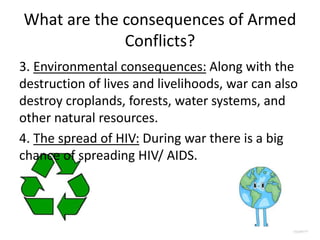
3. Environmental consequences: Along with the
destruction of lives and livelihoods, war can also
destroy croplands, forests, water systems, and
other natural resources.
4. The spread of HIV: During war there is a big
chance of spreading HIV/ AIDS.
What are the consequences of Armed
Conflicts?
5.Economic Factors: Long periods of conflict,
coupled with subsequent structural reforms that
Governments are forced to apply, have
devastating effects on the economy. Some of
these include the destruction of economic and
physical infrastructure, the rapid decline of
industrial production, sharp rise in
unemployment, the drainage of human
resources, a flourishing black market, loss of
savings and often total impoverishment.
What are the consequences of Armed
Conflicts?
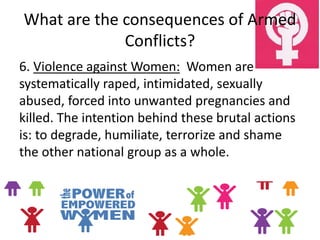
6. Violence against Women: Women are
systematically raped, intimidated, sexually
abused, forced into unwanted pregnancies and
killed. The intention behind these brutal actions
is: to degrade, humiliate, terrorize and shame
the other national group as a whole.
What are the consequences of Armed
Conflicts?
7.Demographic Changes: Conflict and
displacement involve large demographic shifts
that seriously affect communities and families.
Armed conflicts have changed the lives of
millions of men and women, not just in the
nations involved in conflict but also in bordering
countries.
References
 http://www.wikigender.org/wiki/women-and-armed-conflict/
 http://ploughshares.ca/armed-conflict/defining-armed-conflict/
 https://en.wikipedia.org/wiki/War
Prepared By:
Jimbo P. Dumlao

Armedconflict

  • 1.
    “Men of combatage are most often the ones who are conscripted and therefore killed or injured during battle. Women, however, are the main victims of war. This is either directly as fatalities and casualties or indirectly through the breakdown of family and community structures (Byrne 1996).”
  • 2.
    Many parts ofthe world continue to experience armed conflicts. While it is true that in situations of conflict the entire community, whether they are directly or indirectly involved in the conflict are greatly affected, the impact on women is especially complex.
  • 3.
    Defining Arm Conflict… Armed conflict means a battle between two or more groups, clans or states etc with the invasion of arms like swords, pistols, guns to nuclear weapons. An armed conflict is a contested incompatibility which concerns government and/or territory where the use of armed force between two parties, of which at least one is the government of a state, results in at least 25 battle-related deaths.
  • 4.
    Defining Arm Conflictin different perspective … “… a political conflict in which armed combat involves the armed forces of at least one state (or one or more armed factions seeking to gain control of all or part of the state), and in which at least 1,000 people have been killed by the fighting during the course of the conflict.” – Project Ploughshare Reference: http://ploughshares.ca/armed-conflict/defining-armed- conflict
  • 5.
    Defining Arm Conflictin different perspective … Armed Conflict is often referred to war. War is a state of armed conflict between societies. It is generally characterized by extreme aggression, destruction, and mortality, using regular or irregular military forces. Reference: https://en.wikipedia.org/wiki/War
  • 6.
    How is theterm "Armed Conflict" defined in international humanitarian law? International humanitarian law distinguishes two types of armed conflicts, namely:  international armed conflicts, opposing two or more States, and  non-international armed conflicts, between governmental forces and non-governmental armed groups, or between such groups only. IHL treaty law also establishes a distinction between non- international armed conflicts in the meaning of common Article 3 of the Geneva Conventions of 1949 and non-international armed conflicts falling within the definition provided in Art. 1 of Additional Protocol II. Reference: https://www.icrc.org/eng/resources/documents/article/other/armed- conflict-article-170308.htm
  • 7.
    What are thestages of armed conflict? The majority of armed conflicts take place in low- income developing countries. Only a few internal armed conflicts have been located in industrial countries. There may be some stages of armed conflict which to some extent may vary to times and spheres. As Byrne has stated, conflict may be said to have the following stages: 1. Run-up to conflict (pre-conflict) 2. The conflict itself 3. Peace process (or conflict resolution) 4. Reconstruction and reintegration (or post-conflict)
  • 8.
    What are thecause of armed conflict? The causes of armed conflict are often linked with attempts to control economic resources such as oil, metals, diamonds, drugs or contested territorial boundaries. Example: In countries such as Colombia and the Sudan, for example, oilfield exploration has caused and intensified the impoverishment of women and men. Entire communities have been targeted and killed, displaced and/or marginalized in the name of oil development.
  • 9.
    The liberation ofwomen from the oppressive Taliban regime, for example, constituted one of the justifications for the American invasion of Afghanistan in 2001. But in the five years prior to the invasion, there was a consistent lack of regard for the plight of women, despite attempts by both local and international non- governmental organizations (NGOs) to draw attention to the violation of Afghan women‘s human rights.
  • 10.
    What are the consequencesof Armed Conflicts? 1. The Defeat of Sustainability: Clearly, a country at peace is more likely to have the political, economic, and civil stability that fosters sustainable development. Simmering conflicts and eruptions of violence slow economic growth, and reduce the latitude for innovation and investment.
  • 11.
    What are theconsequences of Armed Conflicts? 2. Health sector: Armed conflict between warring states and groups within states have been major causes of ill health and mortality for most of human history. Conflict obviously causes deaths and injuries on the battlefield, but also health consequences from the displacement of populations, the breakdown of health and social services, and the heightened risk of disease transmission.
  • 12.
    What are theconsequences of Armed Conflicts? 3. Environmental consequences: Along with the destruction of lives and livelihoods, war can also destroy croplands, forests, water systems, and other natural resources. 4. The spread of HIV: During war there is a big chance of spreading HIV/ AIDS.
  • 13.
    What are theconsequences of Armed Conflicts? 5.Economic Factors: Long periods of conflict, coupled with subsequent structural reforms that Governments are forced to apply, have devastating effects on the economy. Some of these include the destruction of economic and physical infrastructure, the rapid decline of industrial production, sharp rise in unemployment, the drainage of human resources, a flourishing black market, loss of savings and often total impoverishment.
  • 14.
    What are theconsequences of Armed Conflicts? 6. Violence against Women: Women are systematically raped, intimidated, sexually abused, forced into unwanted pregnancies and killed. The intention behind these brutal actions is: to degrade, humiliate, terrorize and shame the other national group as a whole.
  • 15.
    What are theconsequences of Armed Conflicts? 7.Demographic Changes: Conflict and displacement involve large demographic shifts that seriously affect communities and families. Armed conflicts have changed the lives of millions of men and women, not just in the nations involved in conflict but also in bordering countries.
  • 16.