From Autoencoders to
RAG
How Modern AI Learns, Understands, and Answers
LLM & RAG Session
JITENDRA SRI TALABATTULA
-AIML & GenAI Lead
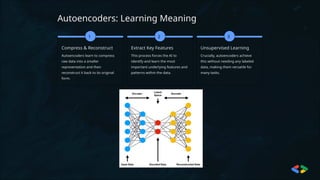
Autoencoders: Learning Meaning
1
Compress & Reconstruct
Autoencoders learn to compress
raw data into a smaller
representation and then
reconstruct it back to its original
form.
2
Extract Key Features
This process forces the AI to
identify and learn the most
important underlying features and
patterns within the data.
3
Unsupervised Learning
Crucially, autoencoders achieve
this without needing any labeled
data, making them versatile for
many tasks.
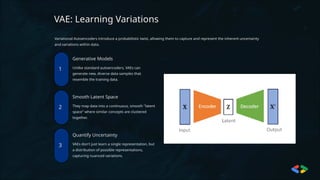
VAE: Learning Variations
Variational Autoencoders introduce a probabilistic twist, allowing them to capture and represent the inherent uncertainty
and variations within data.
1
Generative Models
Unlike standard autoencoders, VAEs can
generate new, diverse data samples that
resemble the training data.
2
Smooth Latent Space
They map data into a continuous, smooth "latent
space" where similar concepts are clustered
together.
3
Quantify Uncertainty
VAEs don't just learn a single representation, but
a distribution of possible representations,
capturing nuanced variations.
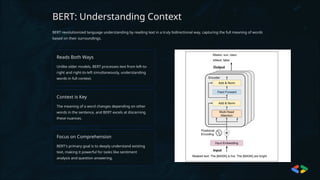
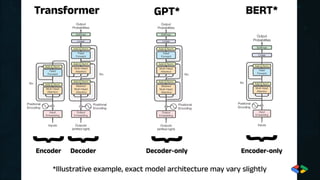
BERT: Understanding Context
BERT revolutionized language understanding by reading text in a truly bidirectional way, capturing the full meaning of words
based on their surroundings.
Reads Both Ways
Unlike older models, BERT processes text from left-to-
right and right-to-left simultaneously, understanding
words in full context.
Context is Key
The meaning of a word changes depending on other
words in the sentence, and BERT excels at discerning
these nuances.
Focus on Comprehension
BERT's primary goal is to deeply understand existing
text, making it powerful for tasks like sentiment
analysis and question answering.
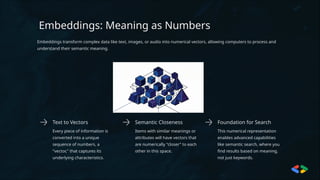
Embeddings: Meaning as Numbers
Embeddings transform complex data like text, images, or audio into numerical vectors, allowing computers to process and
understand their semantic meaning.
Text to Vectors
Every piece of information is
converted into a unique
sequence of numbers, a
"vector," that captures its
underlying characteristics.
Semantic Closeness
Items with similar meanings or
attributes will have vectors that
are numerically "closer" to each
other in this space.
Foundation for Search
This numerical representation
enables advanced capabilities
like semantic search, where you
find results based on meaning,
not just keywords.
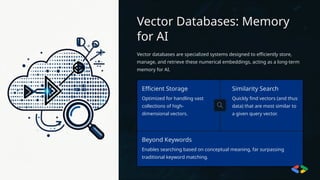
Vector Databases: Memory
for AI
Vector databases are specialized systems designed to efficiently store,
manage, and retrieve these numerical embeddings, acting as a long-term
memory for AI.
Efficient Storage
Optimized for handling vast
collections of high-
dimensional vectors.
Similarity Search
Quickly find vectors (and thus
data) that are most similar to
a given query vector.
Beyond Keywords
Enables searching based on conceptual meaning, far surpassing
traditional keyword matching.
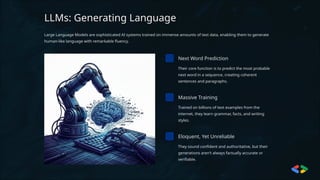
LLMs: Generating Language
Large Language Models are sophisticated AI systems trained on immense amounts of text data, enabling them to generate
human-like language with remarkable fluency.
Next Word Prediction
Their core function is to predict the most probable
next word in a sequence, creating coherent
sentences and paragraphs.
Massive Training
Trained on billions of text examples from the
internet, they learn grammar, facts, and writing
styles.
Eloquent, Yet Unreliable
They sound confident and authoritative, but their
generations aren't always factually accurate or
verifiable.
The Hallucination Problem
A critical challenge with LLMs is their tendency to "hallucinate"—generating plausible-sounding but factually incorrect or
nonsensical information.
"AI hallucination refers to instances where a large language model generates outputs that are factually incorrect or
inconsistent with its training data."
Fabricated Facts
LLMs can confidently present misinformation or
invent details that simply do not exist.
Lack of Verification
They lack a built-in mechanism to check their
generated output against real-world knowledge.
Real-World Risk
In sensitive applications, hallucinations can lead to
serious errors or misjudgments.
RAG: Adding Memory to LLMs
Retrieval-Augmented Generation (RAG) is a powerful technique that enhances LLMs by giving them access to external, up-to-
date information, drastically reducing hallucinations.
Grounded Answer
LLM (with Context)
Retriever
User Query
Retrieve Knowledge
Before generating, the system
retrieves relevant documents or
data from a knowledge base.
Grounded Context
This retrieved information is then
provided to the LLM as additional
context for its response.
Reduced Hallucinations
By grounding responses in
verifiable facts, RAG significantly
improves accuracy and
trustworthiness.
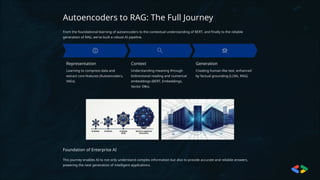
Autoencoders to RAG: The Full Journey
From the foundational learning of autoencoders to the contextual understanding of BERT, and finally to the reliable
generation of RAG, we've built a robust AI pipeline.
Representation
Learning to compress data and
extract core features (Autoencoders,
VAEs).
Context
Understanding meaning through
bidirectional reading and numerical
embeddings (BERT, Embeddings,
Vector DBs).
Generation
Creating human-like text, enhanced
by factual grounding (LLMs, RAG).
Foundation of Enterprise AI
This journey enables AI to not only understand complex information but also to provide accurate and reliable answers,
powering the next generation of intelligent applications.
THANK YOU

Large Language Models – Retrieval Augmented Generation

  • 1.
    From Autoencoders to RAG HowModern AI Learns, Understands, and Answers LLM & RAG Session JITENDRA SRI TALABATTULA -AIML & GenAI Lead
  • 2.
    Autoencoders: Learning Meaning 1 Compress& Reconstruct Autoencoders learn to compress raw data into a smaller representation and then reconstruct it back to its original form. 2 Extract Key Features This process forces the AI to identify and learn the most important underlying features and patterns within the data. 3 Unsupervised Learning Crucially, autoencoders achieve this without needing any labeled data, making them versatile for many tasks.
  • 3.
    VAE: Learning Variations VariationalAutoencoders introduce a probabilistic twist, allowing them to capture and represent the inherent uncertainty and variations within data. 1 Generative Models Unlike standard autoencoders, VAEs can generate new, diverse data samples that resemble the training data. 2 Smooth Latent Space They map data into a continuous, smooth "latent space" where similar concepts are clustered together. 3 Quantify Uncertainty VAEs don't just learn a single representation, but a distribution of possible representations, capturing nuanced variations.
  • 4.
    BERT: Understanding Context BERTrevolutionized language understanding by reading text in a truly bidirectional way, capturing the full meaning of words based on their surroundings. Reads Both Ways Unlike older models, BERT processes text from left-to- right and right-to-left simultaneously, understanding words in full context. Context is Key The meaning of a word changes depending on other words in the sentence, and BERT excels at discerning these nuances. Focus on Comprehension BERT's primary goal is to deeply understand existing text, making it powerful for tasks like sentiment analysis and question answering.
  • 6.
    Embeddings: Meaning asNumbers Embeddings transform complex data like text, images, or audio into numerical vectors, allowing computers to process and understand their semantic meaning. Text to Vectors Every piece of information is converted into a unique sequence of numbers, a "vector," that captures its underlying characteristics. Semantic Closeness Items with similar meanings or attributes will have vectors that are numerically "closer" to each other in this space. Foundation for Search This numerical representation enables advanced capabilities like semantic search, where you find results based on meaning, not just keywords.
  • 7.
    Vector Databases: Memory forAI Vector databases are specialized systems designed to efficiently store, manage, and retrieve these numerical embeddings, acting as a long-term memory for AI. Efficient Storage Optimized for handling vast collections of high- dimensional vectors. Similarity Search Quickly find vectors (and thus data) that are most similar to a given query vector. Beyond Keywords Enables searching based on conceptual meaning, far surpassing traditional keyword matching.
  • 8.
    LLMs: Generating Language LargeLanguage Models are sophisticated AI systems trained on immense amounts of text data, enabling them to generate human-like language with remarkable fluency. Next Word Prediction Their core function is to predict the most probable next word in a sequence, creating coherent sentences and paragraphs. Massive Training Trained on billions of text examples from the internet, they learn grammar, facts, and writing styles. Eloquent, Yet Unreliable They sound confident and authoritative, but their generations aren't always factually accurate or verifiable.
  • 9.
    The Hallucination Problem Acritical challenge with LLMs is their tendency to "hallucinate"—generating plausible-sounding but factually incorrect or nonsensical information. "AI hallucination refers to instances where a large language model generates outputs that are factually incorrect or inconsistent with its training data." Fabricated Facts LLMs can confidently present misinformation or invent details that simply do not exist. Lack of Verification They lack a built-in mechanism to check their generated output against real-world knowledge. Real-World Risk In sensitive applications, hallucinations can lead to serious errors or misjudgments.
  • 10.
    RAG: Adding Memoryto LLMs Retrieval-Augmented Generation (RAG) is a powerful technique that enhances LLMs by giving them access to external, up-to- date information, drastically reducing hallucinations. Grounded Answer LLM (with Context) Retriever User Query Retrieve Knowledge Before generating, the system retrieves relevant documents or data from a knowledge base. Grounded Context This retrieved information is then provided to the LLM as additional context for its response. Reduced Hallucinations By grounding responses in verifiable facts, RAG significantly improves accuracy and trustworthiness.
  • 11.
    Autoencoders to RAG:The Full Journey From the foundational learning of autoencoders to the contextual understanding of BERT, and finally to the reliable generation of RAG, we've built a robust AI pipeline. Representation Learning to compress data and extract core features (Autoencoders, VAEs). Context Understanding meaning through bidirectional reading and numerical embeddings (BERT, Embeddings, Vector DBs). Generation Creating human-like text, enhanced by factual grounding (LLMs, RAG). Foundation of Enterprise AI This journey enables AI to not only understand complex information but also to provide accurate and reliable answers, powering the next generation of intelligent applications.
  • 12.