


zzzzzzz
Fact based
Generative AI
Leverage existing knowledge to generate
specific, up-to-date yet tailored results.
Stefan Weber
Senior Director Software Development
Telelink Business Services
OutSystems MVP – AWS Community Builder
2
Topics 1. Challenge – Why AI does not tell the truth
2. Solution – Retrievable Augmented Generation
and Fine Tuning a Large Language Model
3. Demo – Munich Airport QnA Tailored Answering
4. Flow – Implementing a RAG Pipeline with
OutSystems, OpenAI and Qdrant.
5. Run – Choose where to host your Large Language
Model
6. Forge – Ready made components for your RAG
flow.
Challenge
Large Language Models (LLM) exhibit inconsistency. On occasion, they excel in
providing accurate responses to inquiries, while at other times, they simply parrot
unrelated facts extracted from their training corpus. Their occasional lapses into
inconsistency are due to their systemic limitations.
LLMs possess a statistical understanding of word relationships but lack genuine
comprehension of meaning.
3
3
4
Retrievable Augmented Generation (RAG)
RAG is a technique for improving the quality of
generated responses by an LLM. In this
process, information from external knowledge
sources, along with further instructions, is
provided to generate fact-based results.
Solution
Model Fine-Tuning
LLM fine-tuning is a process of adjusting and adapting
a pre-trained large language model to perform specific
tasks or to cater to a particular domain more
effectively. While fine-tuning proves effective in
emulating behaviors, it's not the best fit for cases that
require extensive domain knowledge, such as legal or
financial sectors.
RAG and Model Fine-Tuning are not mutually exclusive but should be used in combination to ensure high-quality and uniform
results.
Demo – Munich Airport
QnA Tailored
Answering
5
5
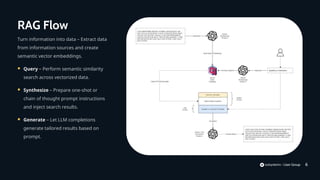
RAG Flow
Turn information into data – Extract data
from information sources and create
semantic vector embeddings.
 Query – Perform semantic similarity
search across vectorized data.
 Synthesize – Prepare one-shot or
chain of thought prompt instructions
and inject search results.
 Generate – Let LLM completions
generate tailored results based on
prompt.
6
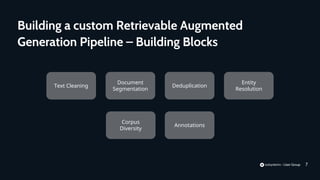
Building a custom Retrievable Augmented
Generation Pipeline – Building Blocks
7
Text Cleaning
Document
Segmentation
Deduplication
Entity
Resolution
Corpus
Diversity
Annotations
8
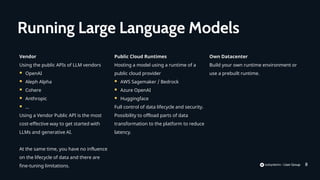
Vendor
Using the public APIs of LLM vendors
 OpenAI
 Aleph Alpha
 Cohere
 Anthropic
 …
Using a Vendor Public API is the most
cost-effective way to get started with
LLMs and generative AI.
At the same time, you have no influence
on the lifecycle of data and there are
fine-tuning limitations.
Running Large Language Models
Public Cloud Runtimes
Hosting a model using a runtime of a
public cloud provider
 AWS Sagemaker / Bedrock
 Azure OpenAI
 Huggingface
Full control of data lifecycle and security.
Possibility to offload parts of data
transformation to the platform to reduce
latency.
Own Datacenter
Build your own runtime environment or
use a prebuilt runtime.
9
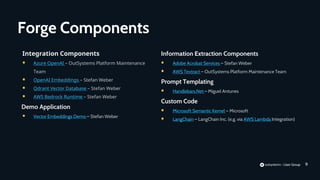
Forge Components
Integration Components
 Azure OpenAI – OutSystems Platform Maintenance
Team
 OpenAI Embeddings – Stefan Weber
 Qdrant Vector Database – Stefan Weber
 AWS Bedrock Runtime – Stefan Weber
Demo Application
 Vector Embeddings Demo – Stefan Weber
Information Extraction Components
 Adobe Acrobat Services – Stefan Weber
 AWS Textract – OutSystems Platform Maintenance Team
Prompt Templating
 Handlebars.Net – Miguel Antunes
Custom Code
 Microsoft Semantic Kernel – Microsoft
 LangChain – LangChain Inc. (e.g. via AWS Lambda Integration)
10
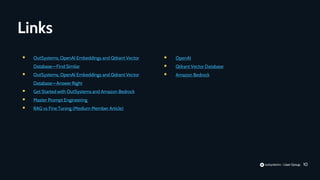
Links
 OutSystems, OpenAI Embeddings and Qdrant Vector
Database—Find Similar
 OutSystems, OpenAI Embeddings and Qdrant Vector
Database—Answer Right
 Get Started with OutSystems and Amazon Bedrock
 Master Prompt Engineering
 RAG vs Fine Tuning (Medium Member Article)
 OpenAI
 Qdrant Vector Database
 Amazon Bedrock
Stefan Weber
Senior Director Software Development
Telelink Business Services
OutSystems MVP – AWS Community Builder
stefan.weber@tbs.tech
+49 1590 1888452
https://www.tbs.tech
https://www.linkedin.com/in/stefanweber1/

Fact based Generative AI

  • 1.
    zzzzzzz Fact based Generative AI Leverageexisting knowledge to generate specific, up-to-date yet tailored results. Stefan Weber Senior Director Software Development Telelink Business Services OutSystems MVP – AWS Community Builder
  • 2.
    2 Topics 1. Challenge– Why AI does not tell the truth 2. Solution – Retrievable Augmented Generation and Fine Tuning a Large Language Model 3. Demo – Munich Airport QnA Tailored Answering 4. Flow – Implementing a RAG Pipeline with OutSystems, OpenAI and Qdrant. 5. Run – Choose where to host your Large Language Model 6. Forge – Ready made components for your RAG flow.
  • 3.
    Challenge Large Language Models(LLM) exhibit inconsistency. On occasion, they excel in providing accurate responses to inquiries, while at other times, they simply parrot unrelated facts extracted from their training corpus. Their occasional lapses into inconsistency are due to their systemic limitations. LLMs possess a statistical understanding of word relationships but lack genuine comprehension of meaning. 3 3
  • 4.
    4 Retrievable Augmented Generation(RAG) RAG is a technique for improving the quality of generated responses by an LLM. In this process, information from external knowledge sources, along with further instructions, is provided to generate fact-based results. Solution Model Fine-Tuning LLM fine-tuning is a process of adjusting and adapting a pre-trained large language model to perform specific tasks or to cater to a particular domain more effectively. While fine-tuning proves effective in emulating behaviors, it's not the best fit for cases that require extensive domain knowledge, such as legal or financial sectors. RAG and Model Fine-Tuning are not mutually exclusive but should be used in combination to ensure high-quality and uniform results.
  • 5.
    Demo – MunichAirport QnA Tailored Answering 5 5
  • 6.
    RAG Flow Turn informationinto data – Extract data from information sources and create semantic vector embeddings.  Query – Perform semantic similarity search across vectorized data.  Synthesize – Prepare one-shot or chain of thought prompt instructions and inject search results.  Generate – Let LLM completions generate tailored results based on prompt. 6
  • 7.
    Building a customRetrievable Augmented Generation Pipeline – Building Blocks 7 Text Cleaning Document Segmentation Deduplication Entity Resolution Corpus Diversity Annotations
  • 8.
    8 Vendor Using the publicAPIs of LLM vendors  OpenAI  Aleph Alpha  Cohere  Anthropic  … Using a Vendor Public API is the most cost-effective way to get started with LLMs and generative AI. At the same time, you have no influence on the lifecycle of data and there are fine-tuning limitations. Running Large Language Models Public Cloud Runtimes Hosting a model using a runtime of a public cloud provider  AWS Sagemaker / Bedrock  Azure OpenAI  Huggingface Full control of data lifecycle and security. Possibility to offload parts of data transformation to the platform to reduce latency. Own Datacenter Build your own runtime environment or use a prebuilt runtime.
  • 9.
    9 Forge Components Integration Components Azure OpenAI – OutSystems Platform Maintenance Team  OpenAI Embeddings – Stefan Weber  Qdrant Vector Database – Stefan Weber  AWS Bedrock Runtime – Stefan Weber Demo Application  Vector Embeddings Demo – Stefan Weber Information Extraction Components  Adobe Acrobat Services – Stefan Weber  AWS Textract – OutSystems Platform Maintenance Team Prompt Templating  Handlebars.Net – Miguel Antunes Custom Code  Microsoft Semantic Kernel – Microsoft  LangChain – LangChain Inc. (e.g. via AWS Lambda Integration)
  • 10.
    10 Links  OutSystems, OpenAIEmbeddings and Qdrant Vector Database—Find Similar  OutSystems, OpenAI Embeddings and Qdrant Vector Database—Answer Right  Get Started with OutSystems and Amazon Bedrock  Master Prompt Engineering  RAG vs Fine Tuning (Medium Member Article)  OpenAI  Qdrant Vector Database  Amazon Bedrock
  • 11.
    Stefan Weber Senior DirectorSoftware Development Telelink Business Services OutSystems MVP – AWS Community Builder stefan.weber@tbs.tech +49 1590 1888452 https://www.tbs.tech https://www.linkedin.com/in/stefanweber1/