Conclusion and recommendations 
References 
Introduction 
Research aim: to evaluate the factors 
that maximise participants visitation to a 
stand. 
Research objectives: 
1. Analyse exhibitors behaviour in relation to 
the effects on participants 
2. Evaluate the design elements that 
contribute to make a stand successful in 
term of participants attractiveness 
3. Examine the stands location and 
participant circulation 
Methodology 
What make a stand attractive to visitors? 
Stands observed: 
• Category 1 “Learning a language” 
• Category 2 “Job seeker” 
Results 
Objective 1, exhibitors behavior: 
• front/back area (Grove and Fisk, 1992) 
• importance of engaging with customers (Pine and 
Gilmore ,1999) 
• exhibitors need to be trained 
Objective 2, stand design 
• colours 
• use of the stand space 
• consistency 
If well managed these factors can change the 
perception of participants in relation to the quality of 
the service delivered (Grove and Fisk, 1992) 
Objective 3, stand location and participant 
circulation 
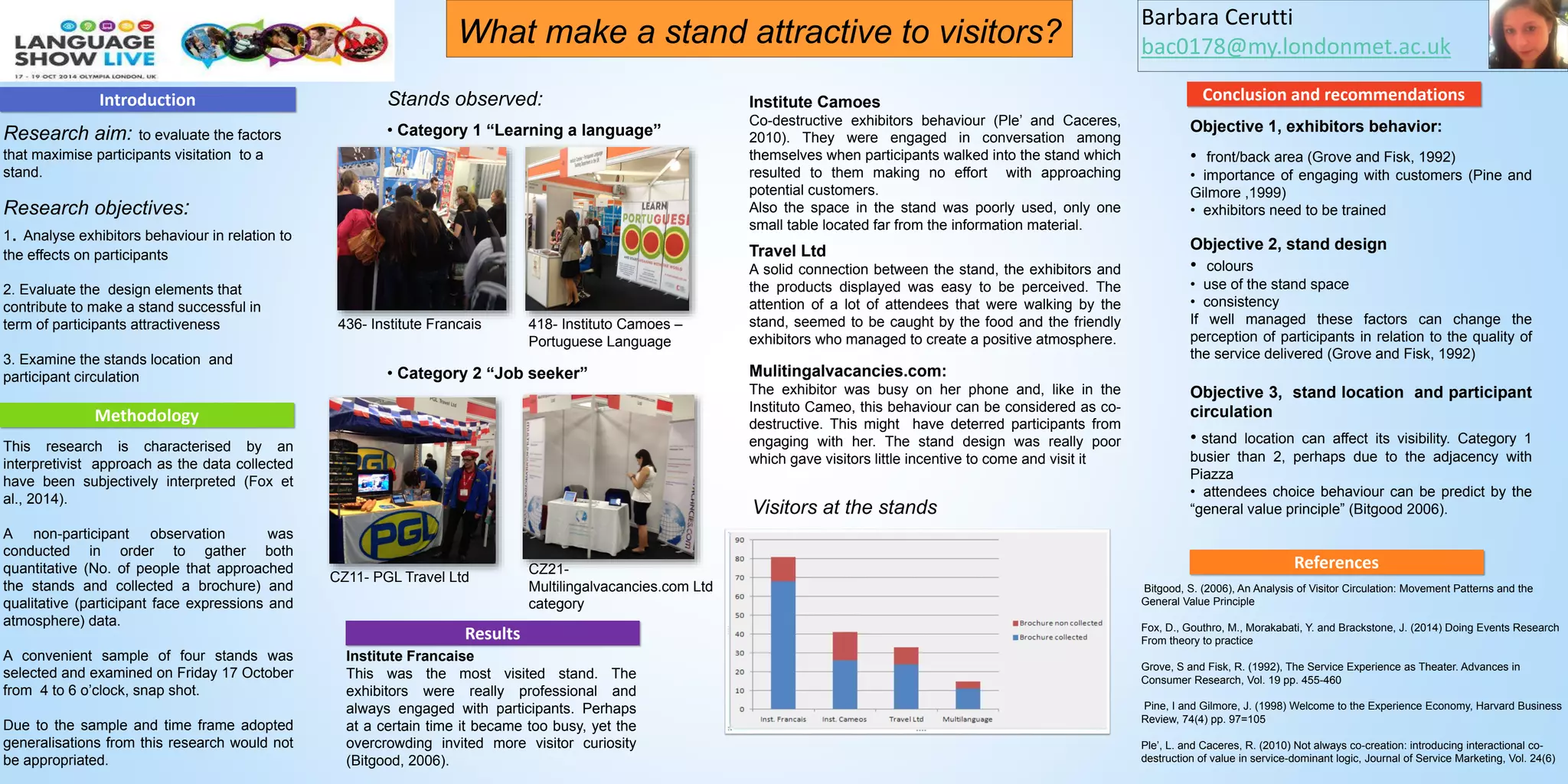
• stand location can affect its visibility. Category 1 
busier than 2, perhaps due to the adjacency with 
Piazza 
• attendees choice behaviour can be predict by the 
Institute Camoes 
Co-destructive exhibitors behaviour (Ple’ and Caceres, 
2010). They were engaged in conversation among 
themselves when participants walked into the stand which 
resulted to them making no effort with approaching 
potential customers. 
Also the space in the stand was poorly used, only one 
small table located far from the information material. 
Travel Ltd 
A solid connection between the stand, the exhibitors and 
the products displayed was easy to be perceived. The 
attention of a lot of attendees that were walking by the 
stand, seemed to be caught by the food and the friendly 
exhibitors who managed to create a positive atmosphere. 
Mulitingalvacancies.com: 
The exhibitor was busy on her phone and, like in the 
Instituto Cameo, this behaviour can be considered as co-destructive. 
This might have deterred participants from 
engaging with her. The stand design was really poor 
which gave visitors little incentive to come and visit it 
Visitors at the stands “general value principle” (Bitgood 2006). 
This research is characterised by an 
interpretivist approach as the data collected 
have been subjectively interpreted (Fox et 
al., 2014). 
A non-participant observation was 
conducted in order to gather both 
quantitative (No. of people that approached 
the stands and collected a brochure) and 
qualitative (participant face expressions and 
atmosphere) data. 
A convenient sample of four stands was 
selected and examined on Friday 17 October 
from 4 to 6 o’clock, snap shot. 
Due to the sample and time frame adopted 
generalisations from this research would not 
be appropriated. 
Barbara Cerutti 
bac0178@my.londonmet.ac.uk 
436- Institute Francais 418- Instituto Camoes – 
Portuguese Language 
CZ11- PGL Travel Ltd 
CZ21- 
Multilingalvacancies.com Ltd 
category 
Institute Francaise 
This was the most visited stand. The 
exhibitors were really professional and 
always engaged with participants. Perhaps 
at a certain time it became too busy, yet the 
overcrowding invited more visitor curiosity 
(Bitgood, 2006). 
Bitgood, S. (2006), An Analysis of Visitor Circulation: Movement Patterns and the 
General Value Principle 
Fox, D., Gouthro, M., Morakabati, Y. and Brackstone, J. (2014) Doing Events Research 
From theory to practice 
Grove, S and Fisk, R. (1992), The Service Experience as Theater. Advances in 
Consumer Research, Vol. 19 pp. 455-460 
Pine, I and Gilmore, J. (1998) Welcome to the Experience Economy, Harvard Business 
Review, 74(4) pp. 97=105 
Ple’, L. and Caceres, R. (2010) Not always co-creation: introducing interactional co-destruction 
of value in service-dominant logic, Journal of Service Marketing, Vol. 24(6)

Language show live poster

  • 1.
    Conclusion and recommendations References Introduction Research aim: to evaluate the factors that maximise participants visitation to a stand. Research objectives: 1. Analyse exhibitors behaviour in relation to the effects on participants 2. Evaluate the design elements that contribute to make a stand successful in term of participants attractiveness 3. Examine the stands location and participant circulation Methodology What make a stand attractive to visitors? Stands observed: • Category 1 “Learning a language” • Category 2 “Job seeker” Results Objective 1, exhibitors behavior: • front/back area (Grove and Fisk, 1992) • importance of engaging with customers (Pine and Gilmore ,1999) • exhibitors need to be trained Objective 2, stand design • colours • use of the stand space • consistency If well managed these factors can change the perception of participants in relation to the quality of the service delivered (Grove and Fisk, 1992) Objective 3, stand location and participant circulation • stand location can affect its visibility. Category 1 busier than 2, perhaps due to the adjacency with Piazza • attendees choice behaviour can be predict by the Institute Camoes Co-destructive exhibitors behaviour (Ple’ and Caceres, 2010). They were engaged in conversation among themselves when participants walked into the stand which resulted to them making no effort with approaching potential customers. Also the space in the stand was poorly used, only one small table located far from the information material. Travel Ltd A solid connection between the stand, the exhibitors and the products displayed was easy to be perceived. The attention of a lot of attendees that were walking by the stand, seemed to be caught by the food and the friendly exhibitors who managed to create a positive atmosphere. Mulitingalvacancies.com: The exhibitor was busy on her phone and, like in the Instituto Cameo, this behaviour can be considered as co-destructive. This might have deterred participants from engaging with her. The stand design was really poor which gave visitors little incentive to come and visit it Visitors at the stands “general value principle” (Bitgood 2006). This research is characterised by an interpretivist approach as the data collected have been subjectively interpreted (Fox et al., 2014). A non-participant observation was conducted in order to gather both quantitative (No. of people that approached the stands and collected a brochure) and qualitative (participant face expressions and atmosphere) data. A convenient sample of four stands was selected and examined on Friday 17 October from 4 to 6 o’clock, snap shot. Due to the sample and time frame adopted generalisations from this research would not be appropriated. Barbara Cerutti bac0178@my.londonmet.ac.uk 436- Institute Francais 418- Instituto Camoes – Portuguese Language CZ11- PGL Travel Ltd CZ21- Multilingalvacancies.com Ltd category Institute Francaise This was the most visited stand. The exhibitors were really professional and always engaged with participants. Perhaps at a certain time it became too busy, yet the overcrowding invited more visitor curiosity (Bitgood, 2006). Bitgood, S. (2006), An Analysis of Visitor Circulation: Movement Patterns and the General Value Principle Fox, D., Gouthro, M., Morakabati, Y. and Brackstone, J. (2014) Doing Events Research From theory to practice Grove, S and Fisk, R. (1992), The Service Experience as Theater. Advances in Consumer Research, Vol. 19 pp. 455-460 Pine, I and Gilmore, J. (1998) Welcome to the Experience Economy, Harvard Business Review, 74(4) pp. 97=105 Ple’, L. and Caceres, R. (2010) Not always co-creation: introducing interactional co-destruction of value in service-dominant logic, Journal of Service Marketing, Vol. 24(6)