LANGUAGE ACROSS THE
CURRICULUM
Preetha George
What is language?
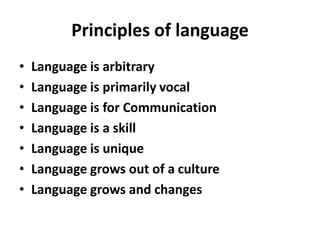
Principles of language
• Language is arbitrary
• Language is primarily vocal
• Language is for Communication
• Language is a skill
• Language is unique
• Language grows out of a culture
• Language grows and changes
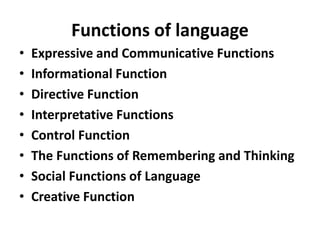
Functions of language
• Expressive and Communicative Functions
• Informational Function
• Directive Function
• Interpretative Functions
• Control Function
• The Functions of Remembering and Thinking
• Social Functions of Language
• Creative Function
Language and Cognition
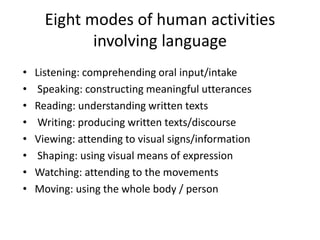
Eight modes of human activities
involving language
• Listening: comprehending oral input/intake
• Speaking: constructing meaningful utterances
• Reading: understanding written texts
• Writing: producing written texts/discourse
• Viewing: attending to visual signs/information
• Shaping: using visual means of expression
• Watching: attending to the movements
• Moving: using the whole body / person
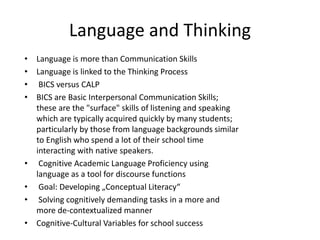
Language and Thinking
• Language is more than Communication Skills
• Language is linked to the Thinking Process
• BICS versus CALP
• BICS are Basic Interpersonal Communication Skills;
these are the "surface" skills of listening and speaking
which are typically acquired quickly by many students;
particularly by those from language backgrounds similar
to English who spend a lot of their school time
interacting with native speakers.
• Cognitive Academic Language Proficiency using
language as a tool for discourse functions
• Goal: Developing „Conceptual Literacy“
• Solving cognitively demanding tasks in a more and
more de-contextualized manner
• Cognitive-Cultural Variables for school success

Language across the curriculum.pptx

  • 1.
  • 2.
  • 3.
    Principles of language •Language is arbitrary • Language is primarily vocal • Language is for Communication • Language is a skill • Language is unique • Language grows out of a culture • Language grows and changes
  • 4.
    Functions of language •Expressive and Communicative Functions • Informational Function • Directive Function • Interpretative Functions • Control Function • The Functions of Remembering and Thinking • Social Functions of Language • Creative Function
  • 5.
  • 6.
    Eight modes ofhuman activities involving language • Listening: comprehending oral input/intake • Speaking: constructing meaningful utterances • Reading: understanding written texts • Writing: producing written texts/discourse • Viewing: attending to visual signs/information • Shaping: using visual means of expression • Watching: attending to the movements • Moving: using the whole body / person
  • 7.
    Language and Thinking •Language is more than Communication Skills • Language is linked to the Thinking Process • BICS versus CALP • BICS are Basic Interpersonal Communication Skills; these are the "surface" skills of listening and speaking which are typically acquired quickly by many students; particularly by those from language backgrounds similar to English who spend a lot of their school time interacting with native speakers. • Cognitive Academic Language Proficiency using language as a tool for discourse functions • Goal: Developing „Conceptual Literacy“ • Solving cognitively demanding tasks in a more and more de-contextualized manner • Cognitive-Cultural Variables for school success