LANDSCAPE ARCHITECTURE
CASE STUDIES
AMEN MICHELE & BIRUK YARED
• MILLER GARDEN BY
DAN KILEY
• DIANA MEMORIAL BY
KATHRYN
GUSTAFSON
• FENGMING
MOUNTAIN PARK BY
MARTHA SCHWARTZ
MILLER GARDEN
Considered to be his residential masterpiece
and an iconic Modernist garden, this 13-acre
property was developed by the Office of Dan
Kiley between 1953 and 1957 as a unified
design through the close teamwork of Dan
Kiley, architects Eero Saarinen and Kevin
Roche, interior designer Alexander Girard,
and clients Irwin and Xenia Miller. The house
interior is arranged around a cruciform grid
of steel columns. Kiley’s plan for the garden,
divided into multiple outdoor rooms,
responds to the orthogonal, geometric
order of the house without being
constrained by a strictly symmetrical
layout.
The entrance drive is
flanked by an allée of horse
chestnut trees, with a
gridded orchard of apple
trees planted just east of
the drive. The landscape’s
most prominent feature is
an allée of honey locusts
that define an axis along
the west side of the house
and extend almost to the
limits of the property.
Finely textured, buff-
colored crushed stone
contrasts with the dark
green of the honey locust
leaves. Edged by a row of
red maples, an open,
managed meadow slopes
toward the river, ultimately
becoming a natural
wooded area.
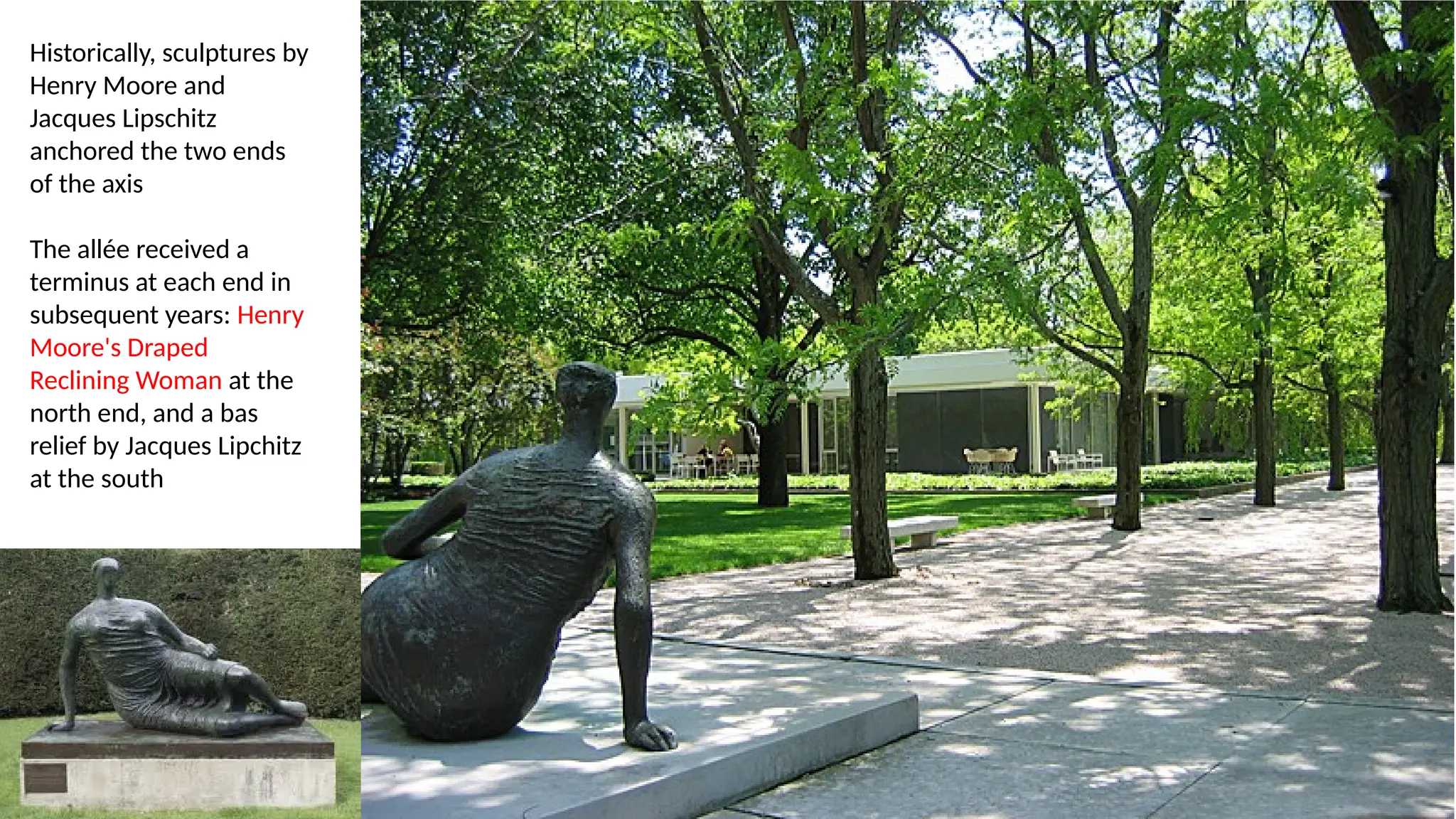
Historically, sculptures by
Henry Moore and
Jacques Lipschitz
anchored the two ends
of the axis
The allée received a
terminus at each end in
subsequent years: Henry
Moore's Draped
Reclining Woman at the
north end, and a bas
relief by Jacques Lipchitz
at the south
Saarinen brought in landscape
architect Dan Kiley, with whom
he had worked on the St. Louis
Gateway Arch. Kiley wanted the
landscape to be an extension of
the home, loosely divided into
three sections extending from
the corresponding sections of
the house, each with its own
identity. The Miller House is an
example of residential landscape
design that puts a modernist
face on formal European
gardens, which rely on symmetry
and geometry.
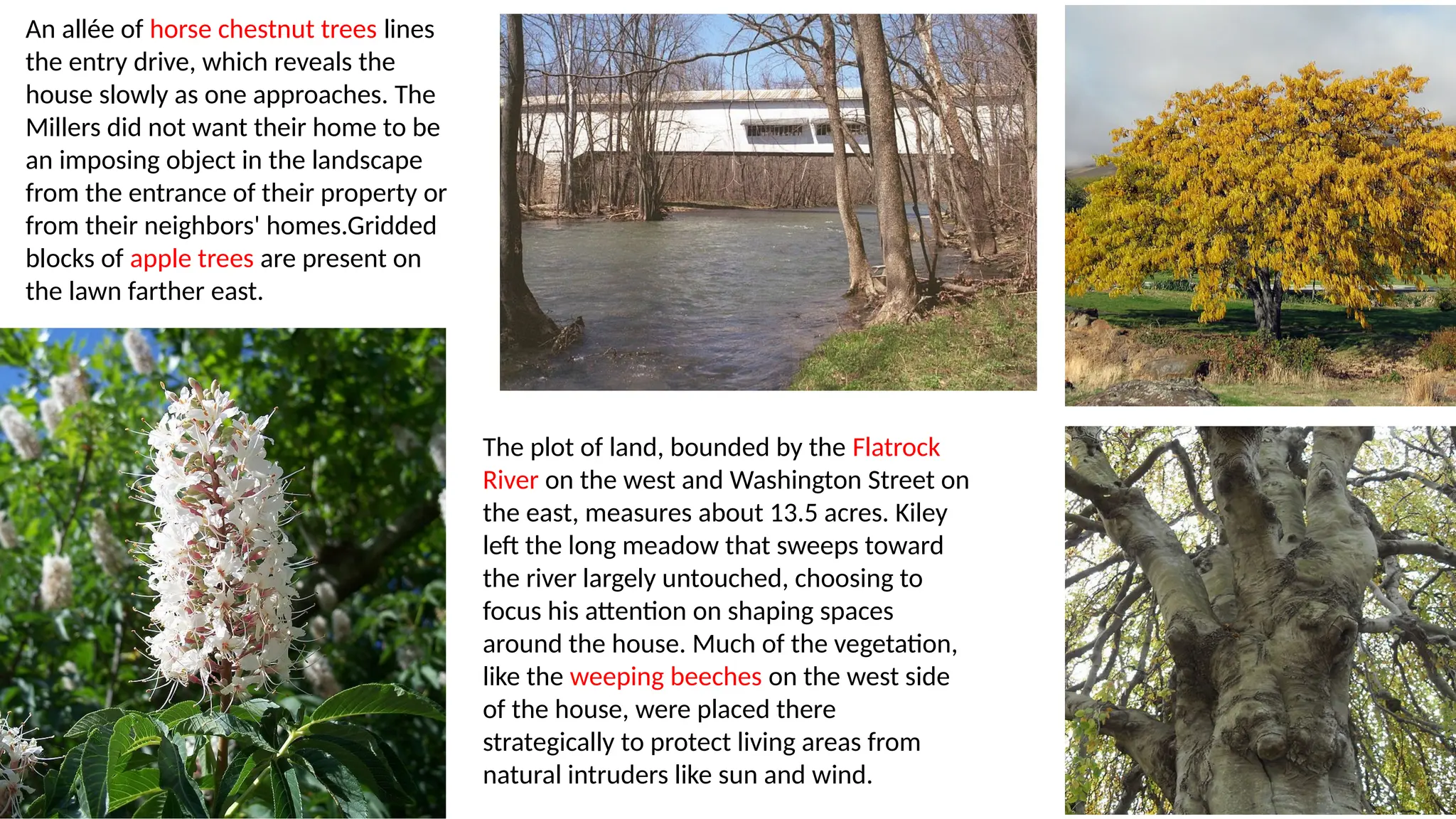
The plot of land, bounded by the Flatrock
River on the west and Washington Street on
the east, measures about 13.5 acres. Kiley
left the long meadow that sweeps toward
the river largely untouched, choosing to
focus his attention on shaping spaces
around the house. Much of the vegetation,
like the weeping beeches on the west side
of the house, were placed there
strategically to protect living areas from
natural intruders like sun and wind.
An allée of horse chestnut trees lines
the entry drive, which reveals the
house slowly as one approaches. The
Millers did not want their home to be
an imposing object in the landscape
from the entrance of their property or
from their neighbors' homes.Gridded
blocks of apple trees are present on
the lawn farther east.
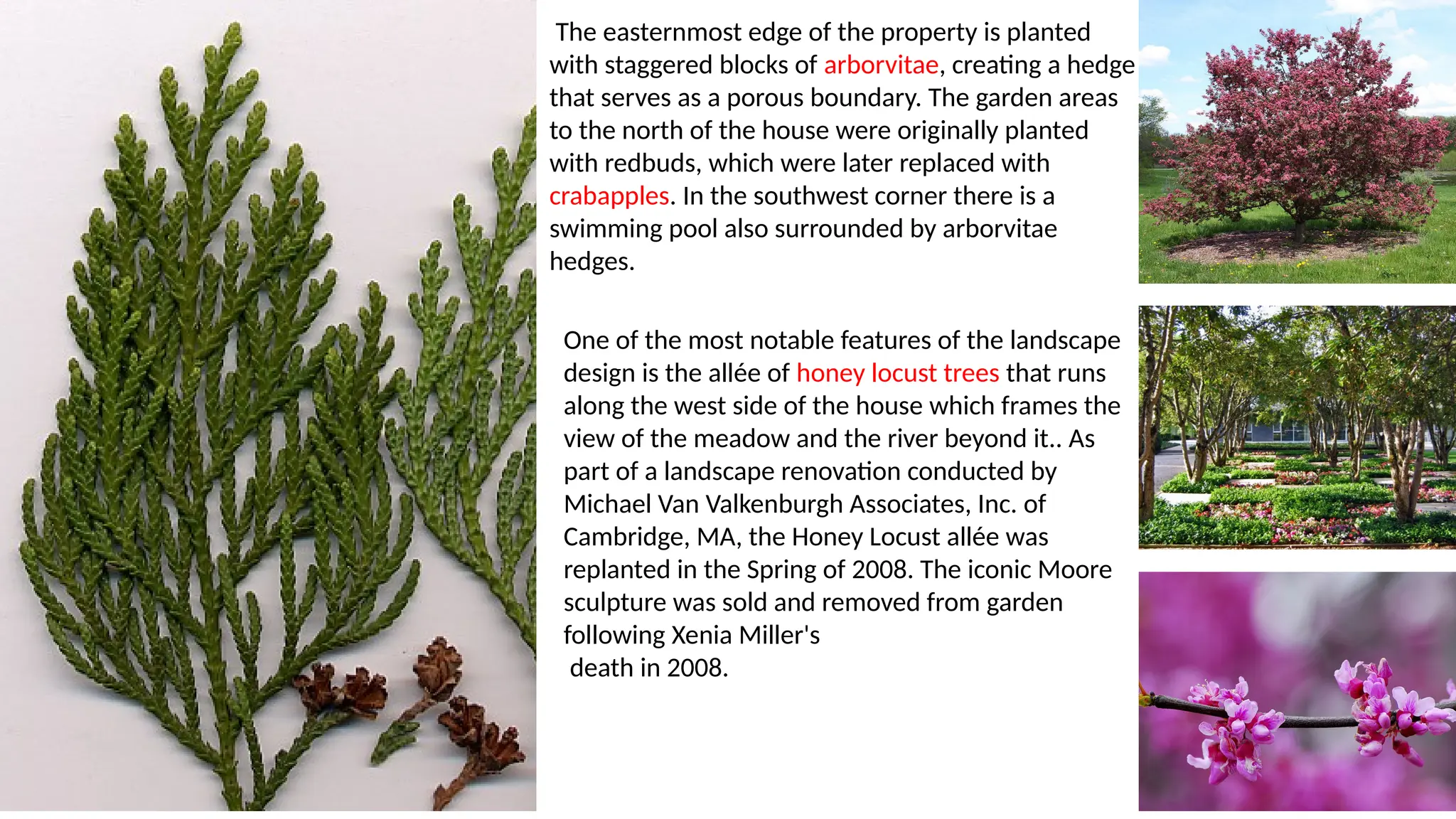
The easternmost edge of the property is planted
with staggered blocks of arborvitae, creating a hedge
that serves as a porous boundary. The garden areas
to the north of the house were originally planted
with redbuds, which were later replaced with
crabapples. In the southwest corner there is a
swimming pool also surrounded by arborvitae
hedges.
One of the most notable features of the landscape
design is the allée of honey locust trees that runs
along the west side of the house which frames the
view of the meadow and the river beyond it.. As
part of a landscape renovation conducted by
Michael Van Valkenburgh Associates, Inc. of
Cambridge, MA, the Honey Locust allée was
replanted in the Spring of 2008. The iconic Moore
sculpture was sold and removed from garden
following Xenia Miller's
death in 2008.
Architects: Gustafson Porter + Bowman Location :
London,United Kingdom
Category: Memorial Center Area 5600.0 m2
Year: 2004
Project Manager: Bucknall Austin
Main Contractor: Geoffrey Osborne Ltd Fountain
Subcontractor : Ocmis
Landscape Contractor: Willerby Landscapes
Stone Layers: Cathedral Works Org.,
Stone Masons: S McConnell and Sons
Stone Texturing: Specialists Barron Gould (Texxus)
Surface Modelling : Surface Development
Engineering Ltd
Soil Scientist Soil and Land Consultants :Hydraulic
Modelling Professor David Hardwick
Water feature: consultant OCMIS Collaborating
Artist: Shelagh Wakely
Hydraulic testing : mperial College London
DIANA -PRINCESS OF WALES MEMORIAL
Working on the
project began in
2001.The fountain was
designed by gustfson
porter and cost 3.6
million dollars.Kathryn
gusatfson an
american landscape
architect said she had
wanted the
fountain,which was
built to the south of
the serpentine, to be
accessible and to
reflect diana's
inclusive
personality.gustafson
said “ Above all I hope
that it provides a
fitting memorial for
the princess and does
credit to the amazing
person that she was”
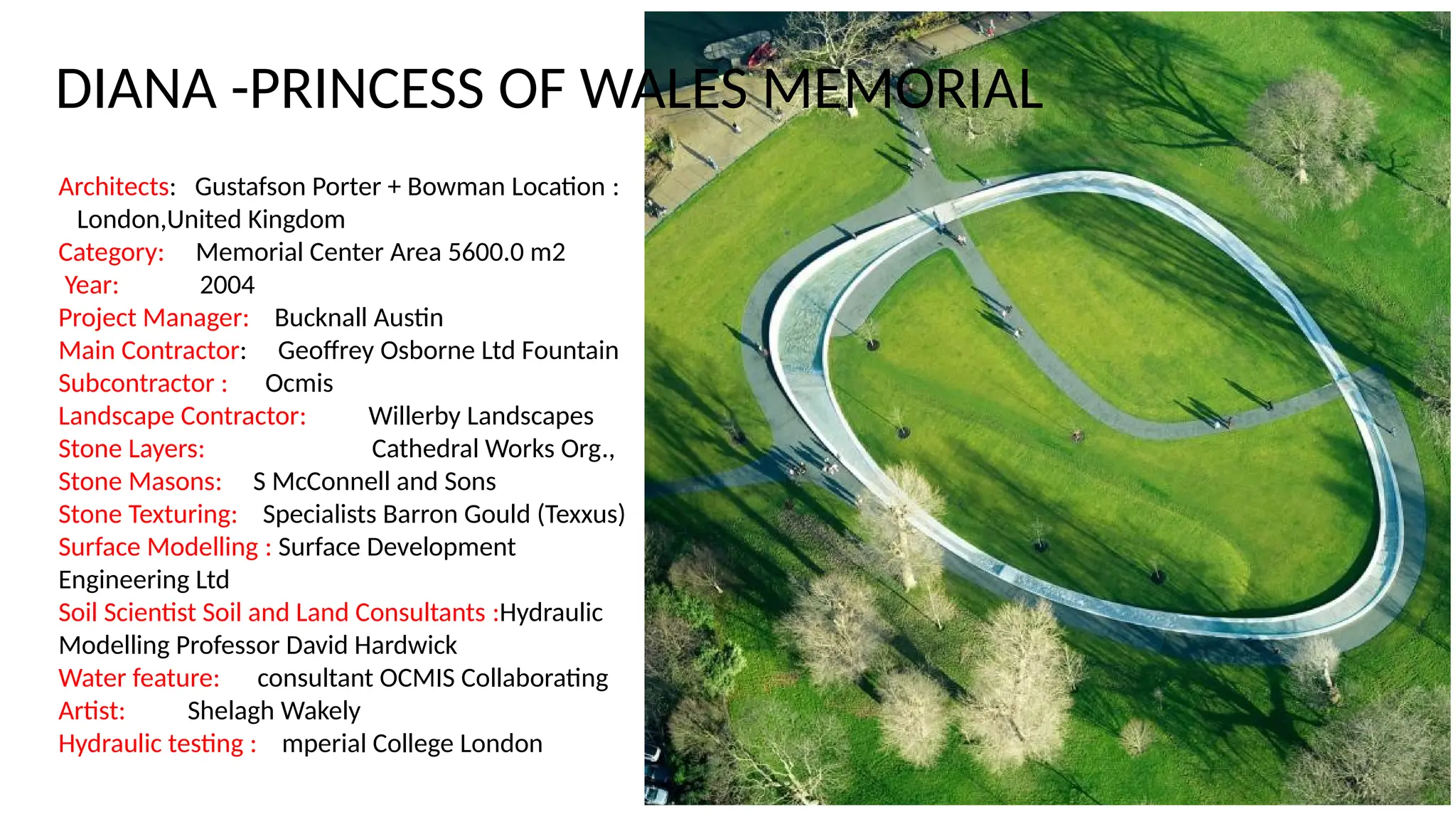
The 545 individual pieces of
Cornish granite were cut
using sophisticated
computer-guided cutting
machines by S. McConnell &
Sons, in Kilkeel, Northern
Ireland. The pieces were
made in Northern Ireland and
transferred to England by sea.
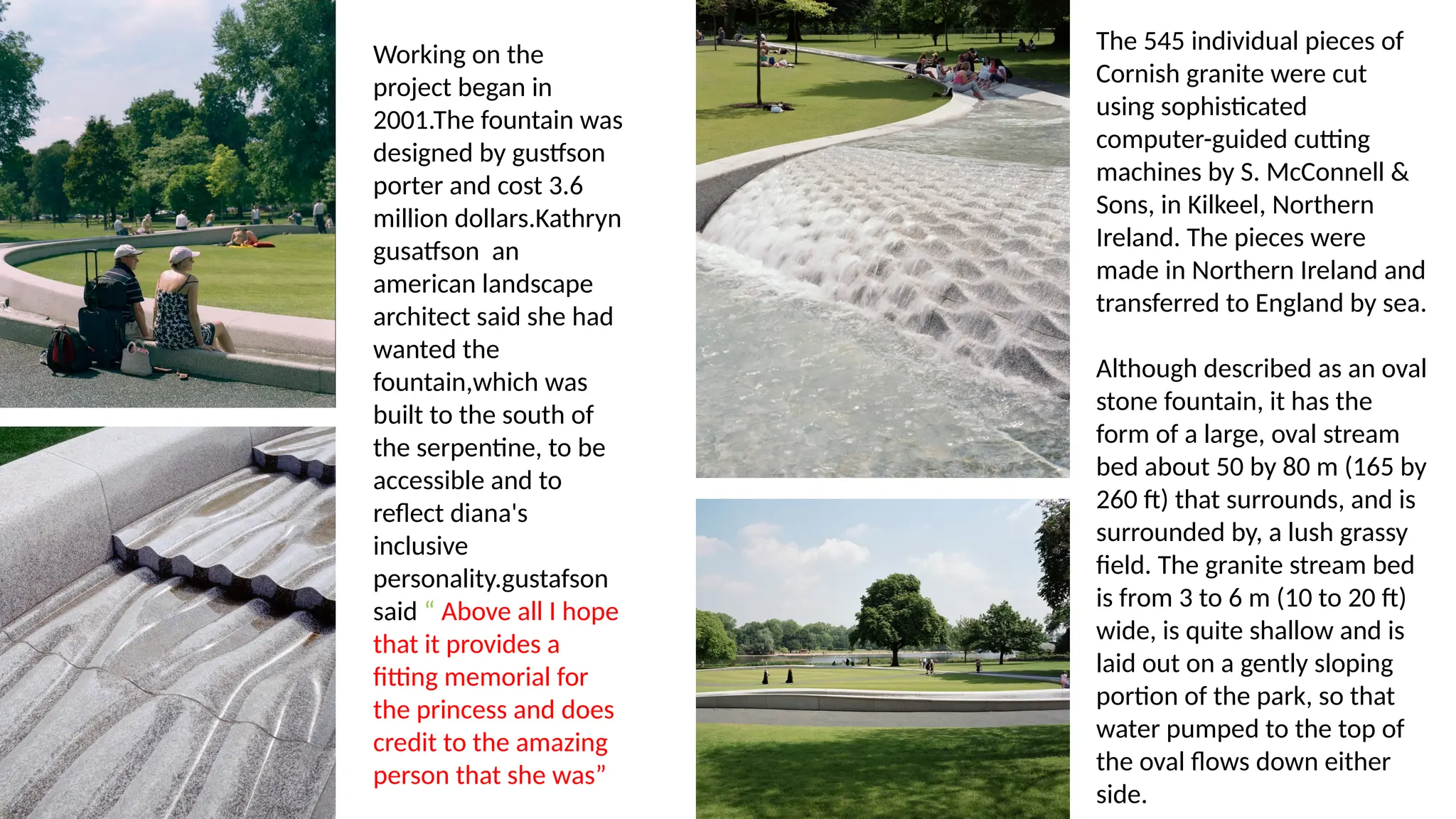
Although described as an oval
stone fountain, it has the
form of a large, oval stream
bed about 50 by 80 m (165 by
260 ft) that surrounds, and is
surrounded by, a lush grassy
field. The granite stream bed
is from 3 to 6 m (10 to 20 ft)
wide, is quite shallow and is
laid out on a gently sloping
portion of the park, so that
water pumped to the top of
the oval flows down either
side.
One side of the stream
bed descends fairly
smoothly to the
downhill end of the oval
with gentle ripples; the
other side consists of a
variety of steps, rills,
curves, and other
shapes so that the
water plays in
interesting ways as it
flows to the tranquil
pool at the bottom. The
two sides were
intended to show two
sides of Diana's life:
happy times, and
turmoil.
Diana was seen as a contemporary
and accessible princess, so the
goal of the memorial fountain was
to allow people to access the
structure and the water for quiet
wading and contemplation.
However, shortly after its opening
and after three hospitalisations
caused by people slipping in the
water, the fountain was closed. It
reopened in August 2004,
surrounded by a new fence, and
people were prevented from
walking or running in the water by
six wardens. Now, however,
entering the water is once again
permitted.
Even though the fountain was only open for a part of the 2004 season, and the weather was not particularly wet,
the grass adjacent to part of the fountain was badly damaged, and it appeared that it would turn to a quagmire if
heavy rain ever fell during the main visiting season. Thus, in December 2004, another alteration project was
started. This involved work on the drainage, together with laying new hard surfaces on some of the most
frequently walked areas of the site and the planting of a special hard wearing rye grass mix in others.
THANK YOU

landscape design case study of landscape architecture

  • 1.
  • 2.
    • MILLER GARDENBY DAN KILEY • DIANA MEMORIAL BY KATHRYN GUSTAFSON • FENGMING MOUNTAIN PARK BY MARTHA SCHWARTZ
  • 3.
    MILLER GARDEN Considered tobe his residential masterpiece and an iconic Modernist garden, this 13-acre property was developed by the Office of Dan Kiley between 1953 and 1957 as a unified design through the close teamwork of Dan Kiley, architects Eero Saarinen and Kevin Roche, interior designer Alexander Girard, and clients Irwin and Xenia Miller. The house interior is arranged around a cruciform grid of steel columns. Kiley’s plan for the garden, divided into multiple outdoor rooms, responds to the orthogonal, geometric order of the house without being constrained by a strictly symmetrical layout.
  • 4.
    The entrance driveis flanked by an allée of horse chestnut trees, with a gridded orchard of apple trees planted just east of the drive. The landscape’s most prominent feature is an allée of honey locusts that define an axis along the west side of the house and extend almost to the limits of the property. Finely textured, buff- colored crushed stone contrasts with the dark green of the honey locust leaves. Edged by a row of red maples, an open, managed meadow slopes toward the river, ultimately becoming a natural wooded area.
  • 5.
    Historically, sculptures by HenryMoore and Jacques Lipschitz anchored the two ends of the axis The allée received a terminus at each end in subsequent years: Henry Moore's Draped Reclining Woman at the north end, and a bas relief by Jacques Lipchitz at the south
  • 6.
    Saarinen brought inlandscape architect Dan Kiley, with whom he had worked on the St. Louis Gateway Arch. Kiley wanted the landscape to be an extension of the home, loosely divided into three sections extending from the corresponding sections of the house, each with its own identity. The Miller House is an example of residential landscape design that puts a modernist face on formal European gardens, which rely on symmetry and geometry.
  • 7.
    The plot ofland, bounded by the Flatrock River on the west and Washington Street on the east, measures about 13.5 acres. Kiley left the long meadow that sweeps toward the river largely untouched, choosing to focus his attention on shaping spaces around the house. Much of the vegetation, like the weeping beeches on the west side of the house, were placed there strategically to protect living areas from natural intruders like sun and wind. An allée of horse chestnut trees lines the entry drive, which reveals the house slowly as one approaches. The Millers did not want their home to be an imposing object in the landscape from the entrance of their property or from their neighbors' homes.Gridded blocks of apple trees are present on the lawn farther east.
  • 8.
    The easternmost edgeof the property is planted with staggered blocks of arborvitae, creating a hedge that serves as a porous boundary. The garden areas to the north of the house were originally planted with redbuds, which were later replaced with crabapples. In the southwest corner there is a swimming pool also surrounded by arborvitae hedges. One of the most notable features of the landscape design is the allée of honey locust trees that runs along the west side of the house which frames the view of the meadow and the river beyond it.. As part of a landscape renovation conducted by Michael Van Valkenburgh Associates, Inc. of Cambridge, MA, the Honey Locust allée was replanted in the Spring of 2008. The iconic Moore sculpture was sold and removed from garden following Xenia Miller's death in 2008.
  • 9.
    Architects: Gustafson Porter+ Bowman Location : London,United Kingdom Category: Memorial Center Area 5600.0 m2 Year: 2004 Project Manager: Bucknall Austin Main Contractor: Geoffrey Osborne Ltd Fountain Subcontractor : Ocmis Landscape Contractor: Willerby Landscapes Stone Layers: Cathedral Works Org., Stone Masons: S McConnell and Sons Stone Texturing: Specialists Barron Gould (Texxus) Surface Modelling : Surface Development Engineering Ltd Soil Scientist Soil and Land Consultants :Hydraulic Modelling Professor David Hardwick Water feature: consultant OCMIS Collaborating Artist: Shelagh Wakely Hydraulic testing : mperial College London DIANA -PRINCESS OF WALES MEMORIAL
  • 10.
    Working on the projectbegan in 2001.The fountain was designed by gustfson porter and cost 3.6 million dollars.Kathryn gusatfson an american landscape architect said she had wanted the fountain,which was built to the south of the serpentine, to be accessible and to reflect diana's inclusive personality.gustafson said “ Above all I hope that it provides a fitting memorial for the princess and does credit to the amazing person that she was” The 545 individual pieces of Cornish granite were cut using sophisticated computer-guided cutting machines by S. McConnell & Sons, in Kilkeel, Northern Ireland. The pieces were made in Northern Ireland and transferred to England by sea. Although described as an oval stone fountain, it has the form of a large, oval stream bed about 50 by 80 m (165 by 260 ft) that surrounds, and is surrounded by, a lush grassy field. The granite stream bed is from 3 to 6 m (10 to 20 ft) wide, is quite shallow and is laid out on a gently sloping portion of the park, so that water pumped to the top of the oval flows down either side.
  • 11.
    One side ofthe stream bed descends fairly smoothly to the downhill end of the oval with gentle ripples; the other side consists of a variety of steps, rills, curves, and other shapes so that the water plays in interesting ways as it flows to the tranquil pool at the bottom. The two sides were intended to show two sides of Diana's life: happy times, and turmoil.
  • 12.
    Diana was seenas a contemporary and accessible princess, so the goal of the memorial fountain was to allow people to access the structure and the water for quiet wading and contemplation. However, shortly after its opening and after three hospitalisations caused by people slipping in the water, the fountain was closed. It reopened in August 2004, surrounded by a new fence, and people were prevented from walking or running in the water by six wardens. Now, however, entering the water is once again permitted.
  • 13.
    Even though thefountain was only open for a part of the 2004 season, and the weather was not particularly wet, the grass adjacent to part of the fountain was badly damaged, and it appeared that it would turn to a quagmire if heavy rain ever fell during the main visiting season. Thus, in December 2004, another alteration project was started. This involved work on the drainage, together with laying new hard surfaces on some of the most frequently walked areas of the site and the planting of a special hard wearing rye grass mix in others.
  • 14.