Lafarge Process Kit
Methods
Version 1
Direction Industrielle
Direction Assistance des
Procédés
GAS ANALYSIS Page : 1/7
Date : March 17, 2006
© Copyright 2006, Lafarge Plâtres
All rights reserved. No part of this document may be reproduced, stored in a retrieval system, translated, or transmitted in any form or by any means, electronic, mechanical,
photocopying, recording, or otherwise, without prior written permission of Lafarge Plâtres. CONFIDENTIAL The information contained herein is confidential and proprietary to
Lafarge Plâtres. It may not be disclosed or transferred, directly or indirectly, to any third party without the explicit written permission of Lafarge Plâtres
SUMMARY
1. PURPOSE............................................................................................................................. 1
2. FIELD OF APPLICATION...................................................................................................... 1
3. PRINCIPLE ........................................................................................................................... 1
4. SAFETY................................................................................................................................. 1
5. EQUIPMENTS....................................................................................................................... 2
6. WORKING INSTRUCTIONS ................................................................................................. 3
6.1. Preparation of sampling equipment ................................................................................ 3
6.2. Sampling of the air / gas................................................................................................. 4
6.3. Analysis of the air / gas composition............................................................................... 7
1. PURPOSE
Sample the gas / air at the defined locations of the calcination workshop and perform an
analysis.
2. FIELD OF APPLICATION
All LAFARGE Gypsum Division production sites.
3. PRINCIPLE
The analysis of the stack emission gas is necessary to evaluate z burner air excess or to
perform a thermal balance of a calcination workshop. For those analysis, we measure the
composition of O2 and CO2 in the air at different locations of the workshop.
Furthermore, the gas analysis might be required from time to time to analyze the gas
composition at the chimney especially when there is a change in the burner process or a new
type/supplier of gas or fuel.
4. SAFETY
For the sampling of the gas, the technician in charge of the test must wear safety gloves.
Lafarge Process Kit
Methods
Version 1
Direction Industrielle
Direction Assistance des
Procédés
GAS ANALYSIS Page : 2/7
Date : March 17, 2006
© Copyright 2006, Lafarge Plâtres
All rights reserved. No part of this document may be reproduced, stored in a retrieval system, translated, or transmitted in any form or by any means, electronic, mechanical,
photocopying, recording, or otherwise, without prior written permission of Lafarge Plâtres. CONFIDENTIAL The information contained herein is confidential and proprietary to
Lafarge Plâtres. It may not be disclosed or transferred, directly or indirectly, to any third party without the explicit written permission of Lafarge Plâtres
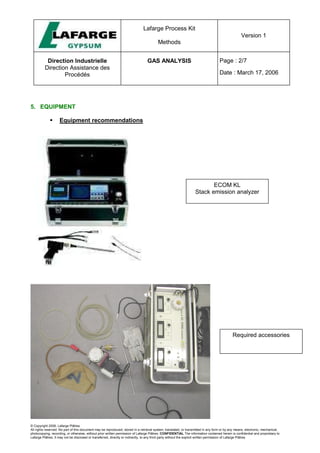
5. EQUIPMENT
 Equipment recommendations
ECOM KL
Stack emission analyzer
Required accessories
Lafarge Process Kit
Methods
Version 1
Direction Industrielle
Direction Assistance des
Procédés
GAS ANALYSIS Page : 3/7
Date : March 17, 2006
© Copyright 2006, Lafarge Plâtres
All rights reserved. No part of this document may be reproduced, stored in a retrieval system, translated, or transmitted in any form or by any means, electronic, mechanical,
photocopying, recording, or otherwise, without prior written permission of Lafarge Plâtres. CONFIDENTIAL The information contained herein is confidential and proprietary to
Lafarge Plâtres. It may not be disclosed or transferred, directly or indirectly, to any third party without the explicit written permission of Lafarge Plâtres
Equipment Supplier Price estimation
ECOM KL CLEANAIR Rental fee
Diaphragm vacuum pump (ref:
N 022 AN18) – 2-3 L/min
KNF Neuberger 450 Euros
Oil filter (used for car)
Plastic balloon
6. WORKING INSTRUCTIONS
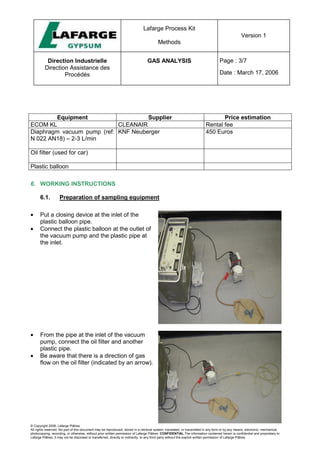
6.1. Preparation of sampling equipment
• Put a closing device at the inlet of the
plastic balloon pipe.
• Connect the plastic balloon at the outlet of
the vacuum pump and the plastic pipe at
the inlet.
• From the pipe at the inlet of the vacuum
pump, connect the oil filter and another
plastic pipe.
• Be aware that there is a direction of gas
flow on the oil filter (indicated by an arrow).
Lafarge Process Kit
Methods
Version 1
Direction Industrielle
Direction Assistance des
Procédés
GAS ANALYSIS Page : 4/7
Date : March 17, 2006
© Copyright 2006, Lafarge Plâtres
All rights reserved. No part of this document may be reproduced, stored in a retrieval system, translated, or transmitted in any form or by any means, electronic, mechanical,
photocopying, recording, or otherwise, without prior written permission of Lafarge Plâtres. CONFIDENTIAL The information contained herein is confidential and proprietary to
Lafarge Plâtres. It may not be disclosed or transferred, directly or indirectly, to any third party without the explicit written permission of Lafarge Plâtres
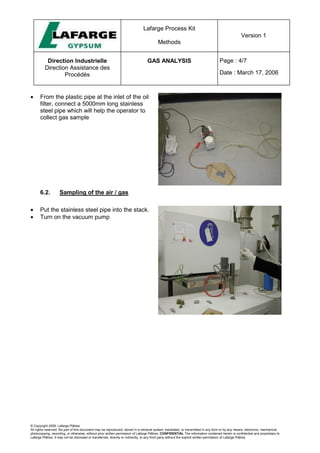
• From the plastic pipe at the inlet of the oil
filter, connect a 5000mm long stainless
steel pipe which will help the operator to
collect gas sample
6.2. Sampling of the air / gas
• Put the stainless steel pipe into the stack.
• Turn on the vacuum pump
Lafarge Process Kit
Methods
Version 1
Direction Industrielle
Direction Assistance des
Procédés
GAS ANALYSIS Page : 5/7
Date : March 17, 2006
© Copyright 2006, Lafarge Plâtres
All rights reserved. No part of this document may be reproduced, stored in a retrieval system, translated, or transmitted in any form or by any means, electronic, mechanical,
photocopying, recording, or otherwise, without prior written permission of Lafarge Plâtres. CONFIDENTIAL The information contained herein is confidential and proprietary to
Lafarge Plâtres. It may not be disclosed or transferred, directly or indirectly, to any third party without the explicit written permission of Lafarge Plâtres
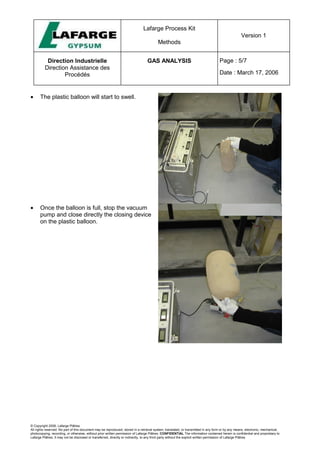
• The plastic balloon will start to swell.
• Once the balloon is full, stop the vacuum
pump and close directly the closing device
on the plastic balloon.
Lafarge Process Kit
Methods
Version 1
Direction Industrielle
Direction Assistance des
Procédés
GAS ANALYSIS Page : 6/7
Date : March 17, 2006
© Copyright 2006, Lafarge Plâtres
All rights reserved. No part of this document may be reproduced, stored in a retrieval system, translated, or transmitted in any form or by any means, electronic, mechanical,
photocopying, recording, or otherwise, without prior written permission of Lafarge Plâtres. CONFIDENTIAL The information contained herein is confidential and proprietary to
Lafarge Plâtres. It may not be disclosed or transferred, directly or indirectly, to any third party without the explicit written permission of Lafarge Plâtres
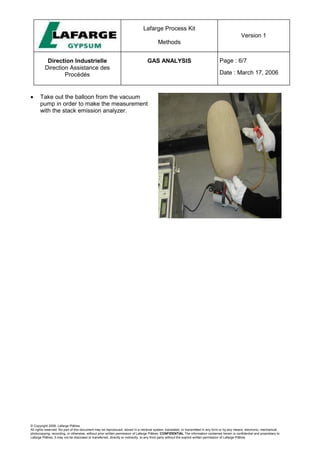
• Take out the balloon from the vacuum
pump in order to make the measurement
with the stack emission analyzer.
Lafarge Process Kit
Methods
Version 1
Direction Industrielle
Direction Assistance des
Procédés
GAS ANALYSIS Page : 7/7
Date : March 17, 2006
© Copyright 2006, Lafarge Plâtres
All rights reserved. No part of this document may be reproduced, stored in a retrieval system, translated, or transmitted in any form or by any means, electronic, mechanical,
photocopying, recording, or otherwise, without prior written permission of Lafarge Plâtres. CONFIDENTIAL The information contained herein is confidential and proprietary to
Lafarge Plâtres. It may not be disclosed or transferred, directly or indirectly, to any third party without the explicit written permission of Lafarge Plâtres
6.3. Analysis of the air / gas composition
• Make sure that the equipment is properly
calibrated. For rental equipment, it is
usually done before sending the analyzer
on site.
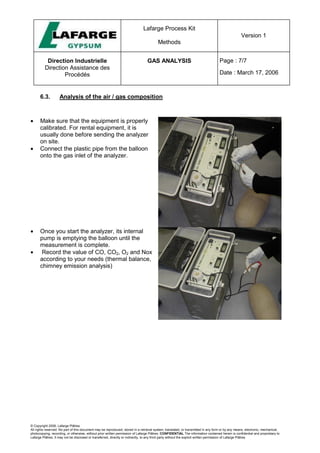
• Connect the plastic pipe from the balloon
onto the gas inlet of the analyzer.
• Once you start the analyzer, its internal
pump is emptying the balloon until the
measurement is complete.
• Record the value of CO, CO2, O2 and Nox
according to your needs (thermal balance,
chimney emission analysis)

Lafarge Process Kit - Gas analysis.pdf

  • 1.
    Lafarge Process Kit Methods Version1 Direction Industrielle Direction Assistance des Procédés GAS ANALYSIS Page : 1/7 Date : March 17, 2006 © Copyright 2006, Lafarge Plâtres All rights reserved. No part of this document may be reproduced, stored in a retrieval system, translated, or transmitted in any form or by any means, electronic, mechanical, photocopying, recording, or otherwise, without prior written permission of Lafarge Plâtres. CONFIDENTIAL The information contained herein is confidential and proprietary to Lafarge Plâtres. It may not be disclosed or transferred, directly or indirectly, to any third party without the explicit written permission of Lafarge Plâtres SUMMARY 1. PURPOSE............................................................................................................................. 1 2. FIELD OF APPLICATION...................................................................................................... 1 3. PRINCIPLE ........................................................................................................................... 1 4. SAFETY................................................................................................................................. 1 5. EQUIPMENTS....................................................................................................................... 2 6. WORKING INSTRUCTIONS ................................................................................................. 3 6.1. Preparation of sampling equipment ................................................................................ 3 6.2. Sampling of the air / gas................................................................................................. 4 6.3. Analysis of the air / gas composition............................................................................... 7 1. PURPOSE Sample the gas / air at the defined locations of the calcination workshop and perform an analysis. 2. FIELD OF APPLICATION All LAFARGE Gypsum Division production sites. 3. PRINCIPLE The analysis of the stack emission gas is necessary to evaluate z burner air excess or to perform a thermal balance of a calcination workshop. For those analysis, we measure the composition of O2 and CO2 in the air at different locations of the workshop. Furthermore, the gas analysis might be required from time to time to analyze the gas composition at the chimney especially when there is a change in the burner process or a new type/supplier of gas or fuel. 4. SAFETY For the sampling of the gas, the technician in charge of the test must wear safety gloves.
  • 2.
    Lafarge Process Kit Methods Version1 Direction Industrielle Direction Assistance des Procédés GAS ANALYSIS Page : 2/7 Date : March 17, 2006 © Copyright 2006, Lafarge Plâtres All rights reserved. No part of this document may be reproduced, stored in a retrieval system, translated, or transmitted in any form or by any means, electronic, mechanical, photocopying, recording, or otherwise, without prior written permission of Lafarge Plâtres. CONFIDENTIAL The information contained herein is confidential and proprietary to Lafarge Plâtres. It may not be disclosed or transferred, directly or indirectly, to any third party without the explicit written permission of Lafarge Plâtres 5. EQUIPMENT Equipment recommendations ECOM KL Stack emission analyzer Required accessories
  • 3.
    Lafarge Process Kit Methods Version1 Direction Industrielle Direction Assistance des Procédés GAS ANALYSIS Page : 3/7 Date : March 17, 2006 © Copyright 2006, Lafarge Plâtres All rights reserved. No part of this document may be reproduced, stored in a retrieval system, translated, or transmitted in any form or by any means, electronic, mechanical, photocopying, recording, or otherwise, without prior written permission of Lafarge Plâtres. CONFIDENTIAL The information contained herein is confidential and proprietary to Lafarge Plâtres. It may not be disclosed or transferred, directly or indirectly, to any third party without the explicit written permission of Lafarge Plâtres Equipment Supplier Price estimation ECOM KL CLEANAIR Rental fee Diaphragm vacuum pump (ref: N 022 AN18) – 2-3 L/min KNF Neuberger 450 Euros Oil filter (used for car) Plastic balloon 6. WORKING INSTRUCTIONS 6.1. Preparation of sampling equipment • Put a closing device at the inlet of the plastic balloon pipe. • Connect the plastic balloon at the outlet of the vacuum pump and the plastic pipe at the inlet. • From the pipe at the inlet of the vacuum pump, connect the oil filter and another plastic pipe. • Be aware that there is a direction of gas flow on the oil filter (indicated by an arrow).
  • 4.
    Lafarge Process Kit Methods Version1 Direction Industrielle Direction Assistance des Procédés GAS ANALYSIS Page : 4/7 Date : March 17, 2006 © Copyright 2006, Lafarge Plâtres All rights reserved. No part of this document may be reproduced, stored in a retrieval system, translated, or transmitted in any form or by any means, electronic, mechanical, photocopying, recording, or otherwise, without prior written permission of Lafarge Plâtres. CONFIDENTIAL The information contained herein is confidential and proprietary to Lafarge Plâtres. It may not be disclosed or transferred, directly or indirectly, to any third party without the explicit written permission of Lafarge Plâtres • From the plastic pipe at the inlet of the oil filter, connect a 5000mm long stainless steel pipe which will help the operator to collect gas sample 6.2. Sampling of the air / gas • Put the stainless steel pipe into the stack. • Turn on the vacuum pump
  • 5.
    Lafarge Process Kit Methods Version1 Direction Industrielle Direction Assistance des Procédés GAS ANALYSIS Page : 5/7 Date : March 17, 2006 © Copyright 2006, Lafarge Plâtres All rights reserved. No part of this document may be reproduced, stored in a retrieval system, translated, or transmitted in any form or by any means, electronic, mechanical, photocopying, recording, or otherwise, without prior written permission of Lafarge Plâtres. CONFIDENTIAL The information contained herein is confidential and proprietary to Lafarge Plâtres. It may not be disclosed or transferred, directly or indirectly, to any third party without the explicit written permission of Lafarge Plâtres • The plastic balloon will start to swell. • Once the balloon is full, stop the vacuum pump and close directly the closing device on the plastic balloon.
  • 6.
    Lafarge Process Kit Methods Version1 Direction Industrielle Direction Assistance des Procédés GAS ANALYSIS Page : 6/7 Date : March 17, 2006 © Copyright 2006, Lafarge Plâtres All rights reserved. No part of this document may be reproduced, stored in a retrieval system, translated, or transmitted in any form or by any means, electronic, mechanical, photocopying, recording, or otherwise, without prior written permission of Lafarge Plâtres. CONFIDENTIAL The information contained herein is confidential and proprietary to Lafarge Plâtres. It may not be disclosed or transferred, directly or indirectly, to any third party without the explicit written permission of Lafarge Plâtres • Take out the balloon from the vacuum pump in order to make the measurement with the stack emission analyzer.
  • 7.
    Lafarge Process Kit Methods Version1 Direction Industrielle Direction Assistance des Procédés GAS ANALYSIS Page : 7/7 Date : March 17, 2006 © Copyright 2006, Lafarge Plâtres All rights reserved. No part of this document may be reproduced, stored in a retrieval system, translated, or transmitted in any form or by any means, electronic, mechanical, photocopying, recording, or otherwise, without prior written permission of Lafarge Plâtres. CONFIDENTIAL The information contained herein is confidential and proprietary to Lafarge Plâtres. It may not be disclosed or transferred, directly or indirectly, to any third party without the explicit written permission of Lafarge Plâtres 6.3. Analysis of the air / gas composition • Make sure that the equipment is properly calibrated. For rental equipment, it is usually done before sending the analyzer on site. • Connect the plastic pipe from the balloon onto the gas inlet of the analyzer. • Once you start the analyzer, its internal pump is emptying the balloon until the measurement is complete. • Record the value of CO, CO2, O2 and Nox according to your needs (thermal balance, chimney emission analysis)