By RUSKIN BOND
TIGERS FOREVER
Ruskin Bond (born 19 May
1934) is an Indian author of
British descent. He lives with
his adopted family
in Landour, Mussoorie, India.
The Indian Council for Child
Education has recognised his
role in the growth of children's
literature in India.
ABOUT THE POET
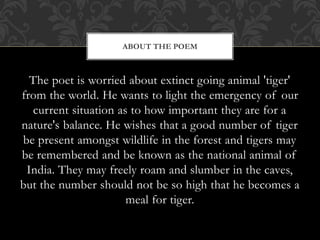
The poet is worried about extinct going animal 'tiger'
from the world. He wants to light the emergency of our
current situation as to how important they are for a
nature's balance. He wishes that a good number of tiger
be present amongst wildlife in the forest and tigers may
be remembered and be known as the national animal of
India. They may freely roam and slumber in the caves,
but the number should not be so high that he becomes a
meal for tiger.
ABOUT THE POEM
WORD MEANINGS
Thunder- (Here) Tiger’s roar
Scent- pleasant smell
Crouch low- bend low
Herdsman- people who look after cattle, goat etc.
Slumber- sleep
Cavern- large and deep caves
Tempt- have an urge to do something
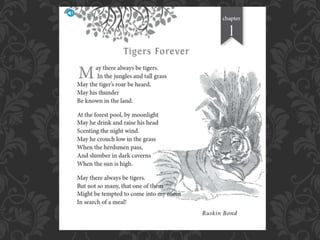
In the first stanza the poet is making a prayer that may
the tigers always be there. He wishes that the tiger's roar
will be heard not just the forest land but also to a wider
area where the human beings live; so that listening to the
roaring sound, the human beings will be scared to come
anywhere near the jungle.
STANZA ONE
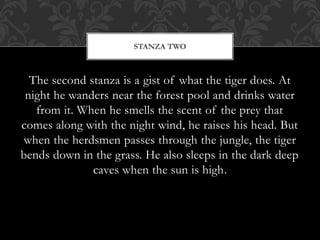
The second stanza is a gist of what the tiger does. At
night he wanders near the forest pool and drinks water
from it. When he smells the scent of the prey that
comes along with the night wind, he raises his head. But
when the herdsmen passes through the jungle, the tiger
bends down in the grass. He also sleeps in the dark deep
caves when the sun is high.
STANZA TWO
The tone of the third stanza is a bit different from the
first two stanzas. In the third stanza the poet tries to
bring out humour element when he says, may there be
so many tigers but not so many that he becomes a meal
for the tiger.
STANZA THREE
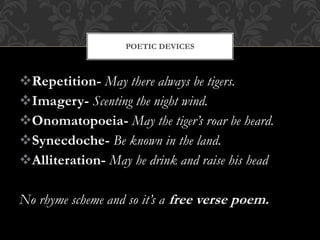
Repetition- May there always be tigers.
Imagery- Scenting the night wind.
Onomatopoeia- May the tiger’s roar be heard.
Synecdoche- Be known in the land.
Alliteration- May he drink and raise his head
No rhyme scheme and so it’s a free verse poem.
POETIC DEVICES

L1 tigers forever

  • 1.
  • 2.
    Ruskin Bond (born19 May 1934) is an Indian author of British descent. He lives with his adopted family in Landour, Mussoorie, India. The Indian Council for Child Education has recognised his role in the growth of children's literature in India. ABOUT THE POET
  • 3.
    The poet isworried about extinct going animal 'tiger' from the world. He wants to light the emergency of our current situation as to how important they are for a nature's balance. He wishes that a good number of tiger be present amongst wildlife in the forest and tigers may be remembered and be known as the national animal of India. They may freely roam and slumber in the caves, but the number should not be so high that he becomes a meal for tiger. ABOUT THE POEM
  • 5.
    WORD MEANINGS Thunder- (Here)Tiger’s roar Scent- pleasant smell Crouch low- bend low Herdsman- people who look after cattle, goat etc. Slumber- sleep Cavern- large and deep caves Tempt- have an urge to do something
  • 7.
    In the firststanza the poet is making a prayer that may the tigers always be there. He wishes that the tiger's roar will be heard not just the forest land but also to a wider area where the human beings live; so that listening to the roaring sound, the human beings will be scared to come anywhere near the jungle. STANZA ONE
  • 8.
    The second stanzais a gist of what the tiger does. At night he wanders near the forest pool and drinks water from it. When he smells the scent of the prey that comes along with the night wind, he raises his head. But when the herdsmen passes through the jungle, the tiger bends down in the grass. He also sleeps in the dark deep caves when the sun is high. STANZA TWO
  • 9.
    The tone ofthe third stanza is a bit different from the first two stanzas. In the third stanza the poet tries to bring out humour element when he says, may there be so many tigers but not so many that he becomes a meal for the tiger. STANZA THREE
  • 10.
    Repetition- May therealways be tigers. Imagery- Scenting the night wind. Onomatopoeia- May the tiger’s roar be heard. Synecdoche- Be known in the land. Alliteration- May he drink and raise his head No rhyme scheme and so it’s a free verse poem. POETIC DEVICES