Principles of Marketing
Eighteenth Edition, Global Edition
Chapter 7
Customer Value-Driven Marketing
Strategy: Creating Value for Target
Customers
Copyright © 2021 Pearson Education Ltd.
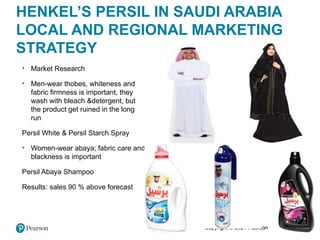
HENKEL’S PERSIL IN SAUDI ARABIA
LOCAL AND REGIONAL MARKETING
STRATEGY
• Market Research
• Men-wear thobes, whiteness and
fabric firmness is important, they
wash with bleach &detergent, but
the product get ruined in the long
run
Persil White & Persil Starch Spray
• Women-wear abaya; fabric care and
blackness is important
Persil Abaya Shampoo
Results: sales 90 % above forecast
Copyright © 2021 Pearson Education Ltd.
UNILEVER RINSO IN TURKEY
• Market Research
• 444mEuro market (detergents), 92% market penetration when compared to 45% deodorant market
• Flagship brand Omo fights with Ariel for market leadership
• Low brand loyalty, sensitivity to price promotions
• What are the customer expectations?
Good fragnance (42%), stain removal (41%, down from 80%), easy& fast wash (36%), fabric care (16.4%), low cost per wash (21%), whiteness (13.25%)
• What do consumers wash?
Dark colors (44%), White (9%), colors (25%), light colors (17%)
Overall, people expect
Nice fragnance
Stain removal
Low prices
Color protection& Fabric Care
Whiteness is no longer a need, consumption society and low prices makes it easy to buy 3 T-shirts at once
In the market,
Whiteness &stain removal – OMO
Fragnance- RINSO
Copyright © 2021 Pearson Education Ltd.
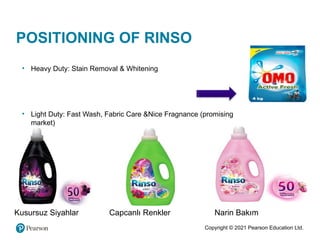
POSITIONING OF RINSO
• Heavy Duty: Stain Removal & Whitening
• Light Duty: Fast Wash, Fabric Care &Nice Fragnance (promising
market)
Kusursuz Siyahlar Capcanlı Renkler Narin Bakım
Copyright © 2021 Pearson Education Ltd.
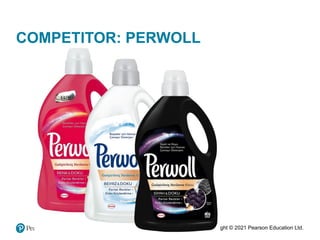
COMPETITOR: PERWOLL
Copyright © 2021 Pearson Education Ltd.
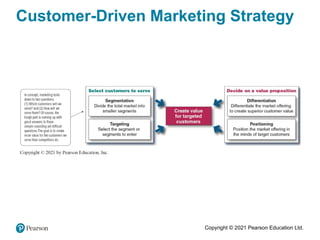
Customer-Driven Marketing Strategy
Copyright © 2021 Pearson Education Ltd.
Market Segmentation (1 of 14)
Market segmentation requires dividing a market into smaller
segments with distinct needs, characteristics, or behaviors
that might require separate marketing strategies or mixes.
Copyright © 2021 Pearson Education Ltd.
Market Segmentation (2 of 14)
• Segmenting consumer markets
• Segmenting business markets
• Segmenting international markets
• Requirements for effective segmentation
Copyright © 2021 Pearson Education Ltd.
Market Segmentation (3 of 14)
Segmenting Consumer Markets
• Geographic segmentation
• Demographic segmentation
• Psychographic segmentation
• Behavioral segmentation
Copyright © 2021 Pearson Education Ltd.
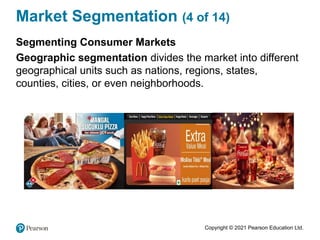
Market Segmentation (4 of 14)
Segmenting Consumer Markets
Geographic segmentation divides the market into different
geographical units such as nations, regions, states,
counties, cities, or even neighborhoods.
Copyright © 2021 Pearson Education Ltd.
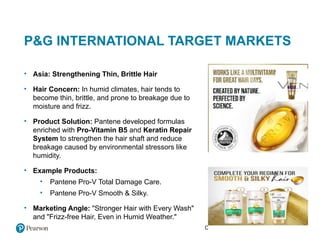
P&G INTERNATIONAL TARGET MARKETS
• Asia: Strengthening Thin, Brittle Hair
• Hair Concern: In humid climates, hair tends to
become thin, brittle, and prone to breakage due to
moisture and frizz.
• Product Solution: Pantene developed formulas
enriched with Pro-Vitamin B5 and Keratin Repair
System to strengthen the hair shaft and reduce
breakage caused by environmental stressors like
humidity.
• Example Products:
• Pantene Pro-V Total Damage Care.
• Pantene Pro-V Smooth & Silky.
• Marketing Angle: "Stronger Hair with Every Wash"
and "Frizz-free Hair, Even in Humid Weather."
Copyright © 2021 Pearson Education Ltd.
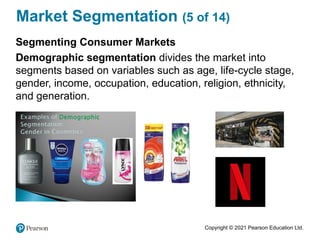
Market Segmentation (5 of 14)
Segmenting Consumer Markets
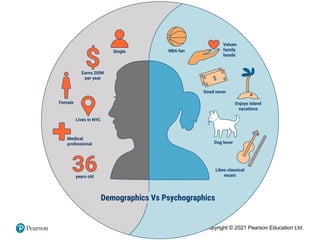
Demographic segmentation divides the market into
segments based on variables such as age, life-cycle stage,
gender, income, occupation, education, religion, ethnicity,
and generation.
Copyright © 2021 Pearson Education Ltd.
Market Segmentation (6 of 14)
Segmenting Consumer Markets
Age and life-cycle stage segmentation divides a market
into different age and life-cycle groups.
Gender segmentation divides a market into different
segments based on gender.
Income segmentation divides a market into different
income segments.
Copyright © 2021 Pearson Education Ltd.
AGE & LIFE-CYCLE STAGE
SEGMENTATION
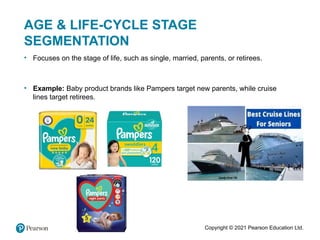
• Focuses on the stage of life, such as single, married, parents, or retirees.
• Example: Baby product brands like Pampers target new parents, while cruise
lines target retirees.
Copyright © 2021 Pearson Education Ltd.
GENDER SEGMENTATION
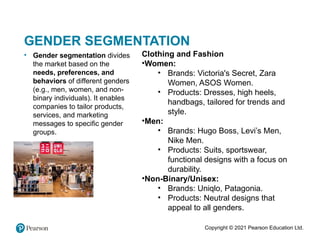
• Gender segmentation divides
the market based on the
needs, preferences, and
behaviors of different genders
(e.g., men, women, and non-
binary individuals). It enables
companies to tailor products,
services, and marketing
messages to specific gender
groups.
Clothing and Fashion
•Women:
• Brands: Victoria's Secret, Zara
Women, ASOS Women.
• Products: Dresses, high heels,
handbags, tailored for trends and
style.
•Men:
• Brands: Hugo Boss, Levi’s Men,
Nike Men.
• Products: Suits, sportswear,
functional designs with a focus on
durability.
•Non-Binary/Unisex:
• Brands: Uniqlo, Patagonia.
• Products: Neutral designs that
appeal to all genders.
Copyright © 2021 Pearson Education Ltd.
INCOME SEGMENTATION
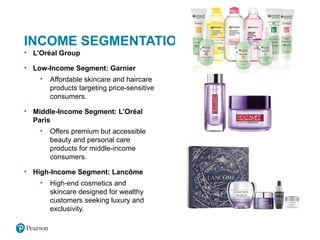
• L’Oréal Group
• Low-Income Segment: Garnier
• Affordable skincare and haircare
products targeting price-sensitive
consumers.
• Middle-Income Segment: L’Oréal
Paris
• Offers premium but accessible
beauty and personal care
products for middle-income
consumers.
• High-Income Segment: Lancôme
• High-end cosmetics and
skincare designed for wealthy
customers seeking luxury and
exclusivity.
Copyright © 2021 Pearson Education Ltd.
Market Segmentation (7 of 14)
Segmenting Consumer Markets
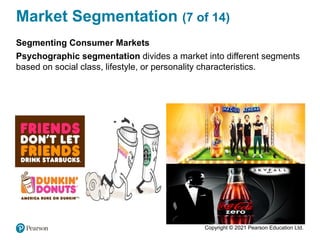
Psychographic segmentation divides a market into different segments
based on social class, lifestyle, or personality characteristics.
Copyright © 2021 Pearson Education Ltd.
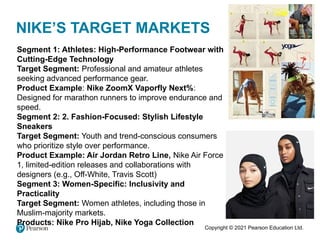
NIKE’S TARGET MARKETS
Segment 1: Athletes: High-Performance Footwear with
Cutting-Edge Technology
Target Segment: Professional and amateur athletes
seeking advanced performance gear.
Product Example: Nike ZoomX Vaporfly Next%:
Designed for marathon runners to improve endurance and
speed.
Segment 2: 2. Fashion-Focused: Stylish Lifestyle
Sneakers
Target Segment: Youth and trend-conscious consumers
who prioritize style over performance.
Product Example: Air Jordan Retro Line, Nike Air Force
1, limited-edition releases and collaborations with
designers (e.g., Off-White, Travis Scott)
Segment 3: Women-Specific: Inclusivity and
Practicality
Target Segment: Women athletes, including those in
Muslim-majority markets.
Products: Nike Pro Hijab, Nike Yoga Collection
Copyright © 2021 Pearson Education Ltd.
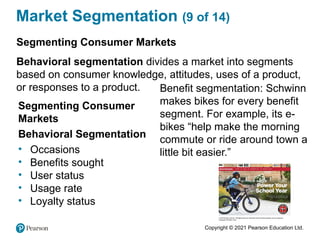
Market Segmentation (9 of 14)
Segmenting Consumer
Markets
Behavioral Segmentation
• Occasions
• Benefits sought
• User status
• Usage rate
• Loyalty status
Benefit segmentation: Schwinn
makes bikes for every benefit
segment. For example, its e-
bikes “help make the morning
commute or ride around town a
little bit easier.”
Segmenting Consumer Markets
Behavioral segmentation divides a market into segments
based on consumer knowledge, attitudes, uses of a product,
or responses to a product.
Copyright © 2021 Pearson Education Ltd.
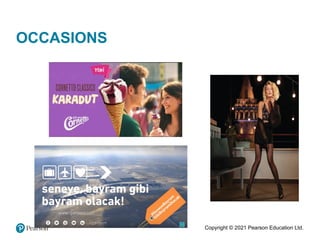
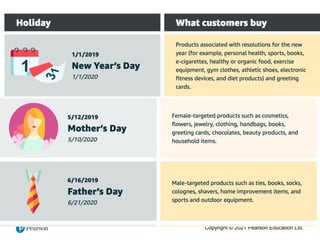
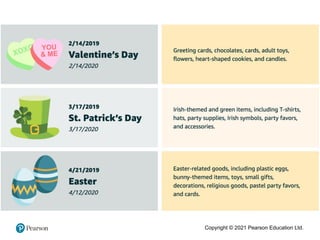
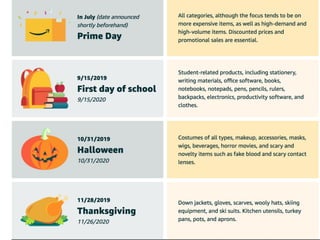
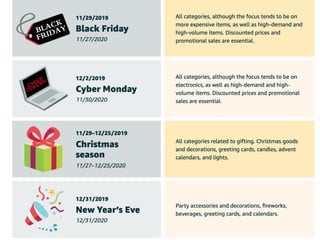
OCCASIONS
Copyright © 2021 Pearson Education Ltd.
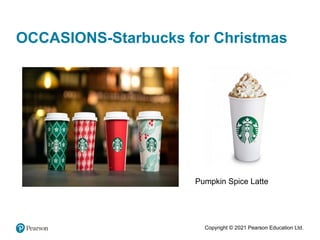
OCCASIONS-Starbucks for Christmas
Pumpkin Spice Latte
Copyright © 2021 Pearson Education Ltd.
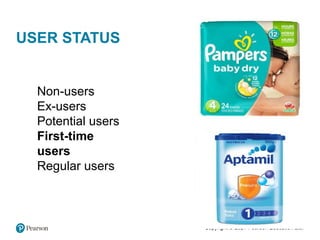
USER STATUS
Non-users
Ex-users
Potential users
First-time
users
Regular users
Copyright © 2021 Pearson Education Ltd.
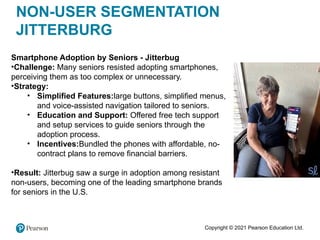
NON-USER SEGMENTATION
JITTERBURG
Smartphone Adoption by Seniors - Jitterbug
•Challenge: Many seniors resisted adopting smartphones,
perceiving them as too complex or unnecessary.
•Strategy:
• Simplified Features:large buttons, simplified menus,
and voice-assisted navigation tailored to seniors.
• Education and Support: Offered free tech support
and setup services to guide seniors through the
adoption process.
• Incentives:Bundled the phones with affordable, no-
contract plans to remove financial barriers.
•Result: Jitterbug saw a surge in adoption among resistant
non-users, becoming one of the leading smartphone brands
for seniors in the U.S.
Copyright © 2021 Pearson Education Ltd.
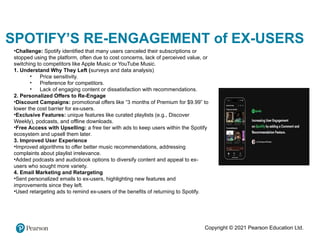
SPOTIFY’S RE-ENGAGEMENT of EX-USERS
•Challenge: Spotify identified that many users canceled their subscriptions or
stopped using the platform, often due to cost concerns, lack of perceived value, or
switching to competitors like Apple Music or YouTube Music.
1. Understand Why They Left (surveys and data analysis)
• Price sensitivity.
• Preference for competitors.
• Lack of engaging content or dissatisfaction with recommendations.
2. Personalized Offers to Re-Engage
•Discount Campaigns: promotional offers like “3 months of Premium for $9.99” to
lower the cost barrier for ex-users.
•Exclusive Features: unique features like curated playlists (e.g., Discover
Weekly), podcasts, and offline downloads.
•Free Access with Upselling: a free tier with ads to keep users within the Spotify
ecosystem and upsell them later.
3. Improved User Experience
•Improved algorithms to offer better music recommendations, addressing
complaints about playlist irrelevance.
•Added podcasts and audiobook options to diversify content and appeal to ex-
users who sought more variety.
4. Email Marketing and Retargeting
•Sent personalized emails to ex-users, highlighting new features and
improvements since they left.
•Used retargeting ads to remind ex-users of the benefits of returning to Spotify.
Copyright © 2021 Pearson Education Ltd.
Airbnb’s TARGETING OF POTENTIAL
CUSTOMERS
•
Target Group: Travelers who have never used Airbnb, often loyal to
hotels.
•
Strategy:
•
Education on Benefits:
•
Highlighted advantages of staying in local homes for authentic travel
experiences through advertising campaigns like "Live There."
•
Incentives:
•
Offered first-time user discounts to encourage trial.
•
Partnerships:
•
Partnered with airlines and travel agencies to reach traditional hotel
users.
•
Social Proof:
•
Showcased reviews and testimonials from satisfied customers to build
trust.
•
Result: Airbnb attracted millions of new users and grew its market
share significantly in both urban and rural travel sectors.
Copyright © 2021 Pearson Education Ltd.
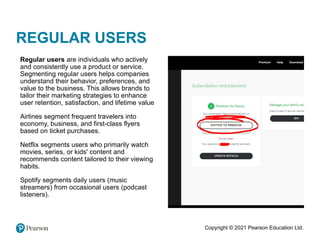
REGULAR USERS
•
Regular users are individuals who actively
and consistently use a product or service.
Segmenting regular users helps companies
understand their behavior, preferences, and
value to the business. This allows brands to
tailor their marketing strategies to enhance
user retention, satisfaction, and lifetime value
•
Airlines segment frequent travelers into
economy, business, and first-class flyers
based on ticket purchases.
•
Netflix segments users who primarily watch
movies, series, or kids' content and
recommends content tailored to their viewing
habits.
•
Spotify segments daily users (music
streamers) from occasional users (podcast
listeners).
Copyright © 2021 Pearson Education Ltd.
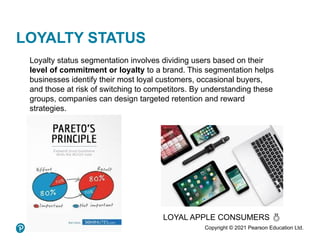
LOYALTY STATUS
LOYAL APPLE CONSUMERS 
Loyalty status segmentation involves dividing users based on their
level of commitment or loyalty to a brand. This segmentation helps
businesses identify their most loyal customers, occasional buyers,
and those at risk of switching to competitors. By understanding these
groups, companies can design targeted retention and reward
strategies.
Copyright © 2021 Pearson Education Ltd.
THY LOYALTY PROGRAM
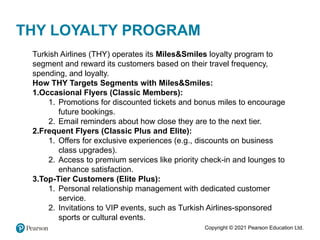
Turkish Airlines (THY) operates its Miles&Smiles loyalty program to
segment and reward its customers based on their travel frequency,
spending, and loyalty.
How THY Targets Segments with Miles&Smiles:
1.Occasional Flyers (Classic Members):
1. Promotions for discounted tickets and bonus miles to encourage
future bookings.
2. Email reminders about how close they are to the next tier.
2.Frequent Flyers (Classic Plus and Elite):
1. Offers for exclusive experiences (e.g., discounts on business
class upgrades).
2. Access to premium services like priority check-in and lounges to
enhance satisfaction.
3.Top-Tier Customers (Elite Plus):
1. Personal relationship management with dedicated customer
service.
2. Invitations to VIP events, such as Turkish Airlines-sponsored
sports or cultural events.
Copyright © 2021 Pearson Education Ltd.
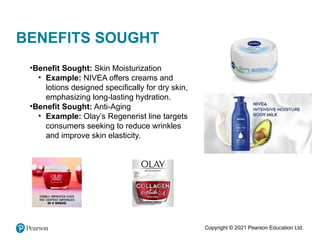
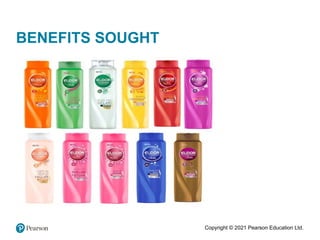
BENEFITS SOUGHT
•Benefit Sought: Skin Moisturization
• Example: NIVEA offers creams and
lotions designed specifically for dry skin,
emphasizing long-lasting hydration.
•Benefit Sought: Anti-Aging
• Example: Olay’s Regenerist line targets
consumers seeking to reduce wrinkles
and improve skin elasticity.
Copyright © 2021 Pearson Education Ltd.
BENEFITS SOUGHT
Copyright © 2021 Pearson Education Ltd.
Market Segmentation (12 of 14)
Segmenting International Markets
• Geographic location
• Economic factors
• Political and legal factors
• Cultural factors
Copyright © 2021 Pearson Education Ltd.
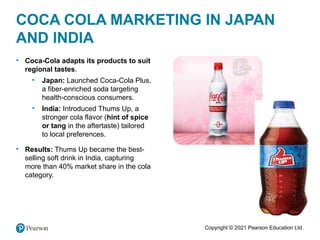
• Coca-Cola adapts its products to suit
regional tastes.
• Japan: Launched Coca-Cola Plus,
a fiber-enriched soda targeting
health-conscious consumers.
• India: Introduced Thums Up, a
stronger cola flavor (hint of spice
or tang in the aftertaste) tailored
to local preferences.
• Results: Thums Up became the best-
selling soft drink in India, capturing
more than 40% market share in the cola
category.
COCA COLA MARKETING IN JAPAN
AND INDIA
Copyright © 2021 Pearson Education Ltd.
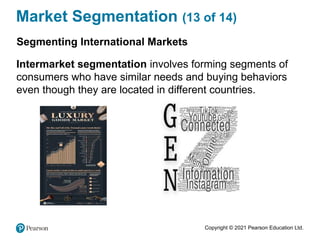
Market Segmentation (13 of 14)
Segmenting International Markets
Intermarket segmentation involves forming segments of
consumers who have similar needs and buying behaviors
even though they are located in different countries.
Copyright © 2021 Pearson Education Ltd.
Market Segmentation (14 of 14)
Requirements for Effective Segmentation
Measurable:
• The size, purchasing power, and characteristics of the segment can be quantified
and assessed.
Accessible:
• The segment can be effectively reached and served through communication and
distribution channels.
Substantial:
• The segment is large and profitable enough to justify targeted marketing efforts.
Differentiable:
• The segments are distinct in terms of needs, preferences, or behavior, and
respond differently to marketing strategies.
Actionable:
• The organization can design practical and effective marketing programs to attract
and serve the segment.
Copyright © 2021 Pearson Education Ltd.
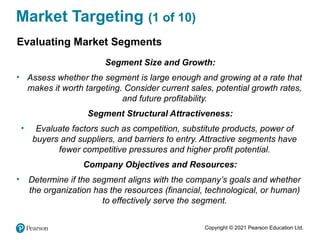
Market Targeting (1 of 10)
Evaluating Market Segments
Segment Size and Growth:
• Assess whether the segment is large enough and growing at a rate that
makes it worth targeting. Consider current sales, potential growth rates,
and future profitability.
Segment Structural Attractiveness:
• Evaluate factors such as competition, substitute products, power of
buyers and suppliers, and barriers to entry. Attractive segments have
fewer competitive pressures and higher profit potential.
Company Objectives and Resources:
• Determine if the segment aligns with the company’s goals and whether
the organization has the resources (financial, technological, or human)
to effectively serve the segment.
Copyright © 2021 Pearson Education Ltd.
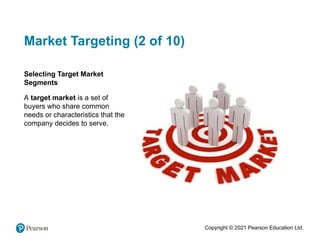
Market Targeting (2 of 10)
Selecting Target Market
Segments
A target market is a set of
buyers who share common
needs or characteristics that the
company decides to serve.
Copyright © 2021 Pearson Education Ltd.
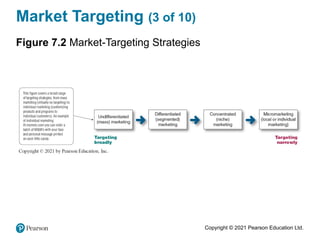
Market Targeting (3 of 10)
Figure 7.2 Market-Targeting Strategies
Copyright © 2021 Pearson Education Ltd.
Market Targeting (4 of 10)
Selecting Target Market Segments
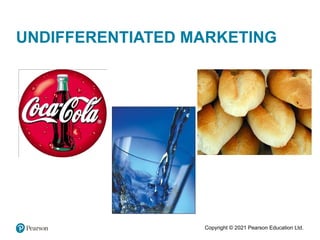
Undifferentiated marketing targets the whole market with
one offer.
• Mass marketing
• Focuses on common needs rather than what’s different
Copyright © 2021 Pearson Education Ltd.
UNDIFFERENTIATED MARKETING
Copyright © 2021 Pearson Education Ltd.
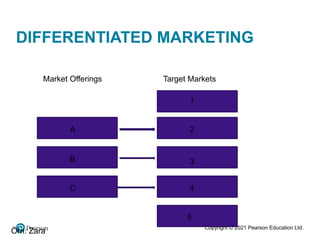
Target Markets
Market Offerings
A
B
C
1
2
3
4
5
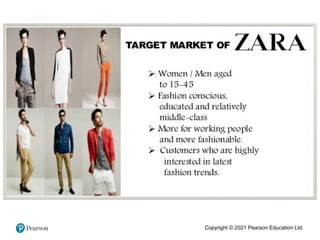
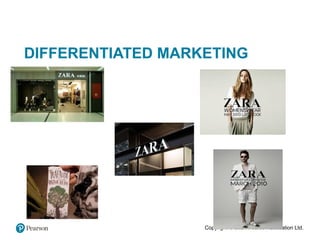
Örn: Zara
DIFFERENTIATED MARKETING
Copyright © 2021 Pearson Education Ltd.
Market Targeting (5 of 10)
Selecting Target Market Segments
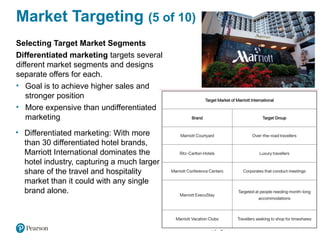
Differentiated marketing targets several
different market segments and designs
separate offers for each.
• Goal is to achieve higher sales and
stronger position
• More expensive than undifferentiated
marketing
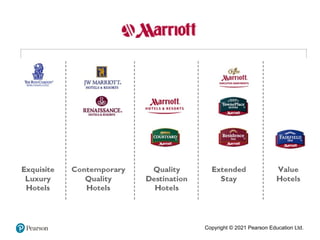
• Differentiated marketing: With more
than 30 differentiated hotel brands,
Marriott International dominates the
hotel industry, capturing a much larger
share of the travel and hospitality
market than it could with any single
brand alone.
Copyright © 2021 Pearson Education Ltd.
DIFFERENTIATED MARKETING
Copyright © 2021 Pearson Education Ltd.
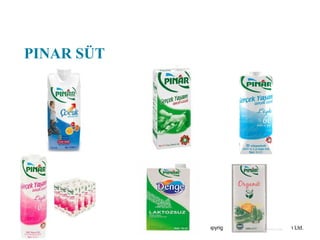
PINAR SÜT
Copyright © 2021 Pearson Education Ltd.
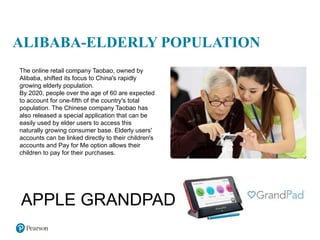
ALIBABA-ELDERLY POPULATION
The online retail company Taobao, owned by
Alibaba, shifted its focus to China's rapidly
growing elderly population.
By 2020, people over the age of 60 are expected
to account for one-fifth of the country's total
population. The Chinese company Taobao has
also released a special application that can be
easily used by elder users to access this
naturally growing consumer base. Elderly users'
accounts can be linked directly to their children's
accounts and Pay for Me option allows their
children to pay for their purchases.
APPLE GRANDPAD
Copyright © 2021 Pearson Education Ltd.
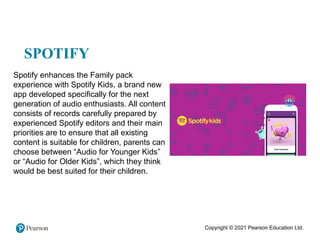
SPOTIFY
Spotify enhances the Family pack
experience with Spotify Kids, a brand new
app developed specifically for the next
generation of audio enthusiasts. All content
consists of records carefully prepared by
experienced Spotify editors and their main
priorities are to ensure that all existing
content is suitable for children, parents can
choose between “Audio for Younger Kids”
or “Audio for Older Kids”, which they think
would be best suited for their children.
Copyright © 2021 Pearson Education Ltd.
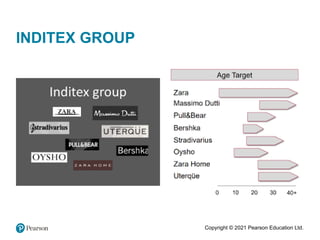
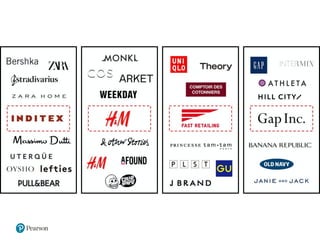
INDITEX GROUP
Copyright © 2021 Pearson Education Ltd.
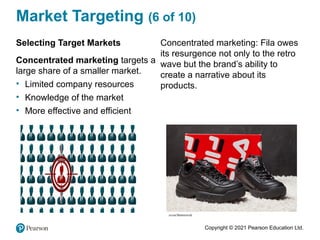
Market Targeting (6 of 10)
Selecting Target Markets
Concentrated marketing targets a
large share of a smaller market.
• Limited company resources
• Knowledge of the market
• More effective and efficient
Concentrated marketing: Fila owes
its resurgence not only to the retro
wave but the brand’s ability to
create a narrative about its
products.
Copyright © 2021 Pearson Education Ltd.
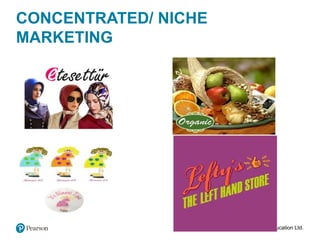
CONCENTRATED/ NICHE
MARKETING
Copyright © 2021 Pearson Education Ltd.
Market Targeting (7 of 10)
Selecting Target Market Segments
Micromarketing is the practice of tailoring products and
marketing programs to suit the tastes of specific individuals
and locations.
• Local marketing
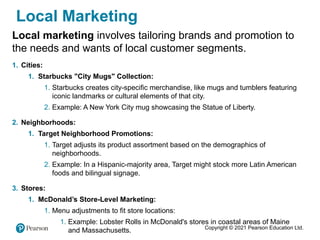
• Individual marketing
Copyright © 2021 Pearson Education Ltd.
Local Marketing
Local marketing involves tailoring brands and promotion to
the needs and wants of local customer segments.
1. Cities:
1. Starbucks "City Mugs" Collection:
1. Starbucks creates city-specific merchandise, like mugs and tumblers featuring
iconic landmarks or cultural elements of that city.
2. Example: A New York City mug showcasing the Statue of Liberty.
2. Neighborhoods:
1. Target Neighborhood Promotions:
1. Target adjusts its product assortment based on the demographics of
neighborhoods.
2. Example: In a Hispanic-majority area, Target might stock more Latin American
foods and bilingual signage.
3. Stores:
1. McDonald’s Store-Level Marketing:
1. Menu adjustments to fit store locations:
1. Example: Lobster Rolls in McDonald's stores in coastal areas of Maine
and Massachusetts.
Copyright © 2021 Pearson Education Ltd.
Market Targeting (9 of 10)
Selecting Target Markets
Individual marketing
involves tailoring products
and marketing programs to
the needs and preferences of
individual customers.
Also known as:
• One-to-one marketing
• Mass customization
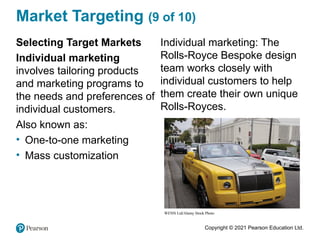
Individual marketing: The
Rolls-Royce Bespoke design
team works closely with
individual customers to help
them create their own unique
Rolls-Royces.
Copyright © 2021 Pearson Education Ltd.
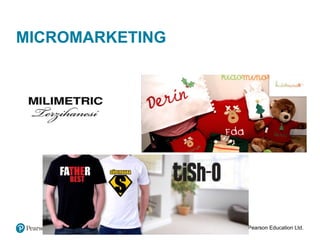
MICROMARKETING
Copyright © 2021 Pearson Education Ltd.
Selecting Target Market Segments
Choosing a targeting strategy depends on
• Company resources: Limited resources may lead a company to focus on a single
market segment (concentrated marketing) rather than multiple segments. Companies with
abundant resources can pursue differentiated or mass marketing strategies.
• Product variability: Products with little variability (e.g., salt or basic commodities) are
better suited for mass marketing. Highly variable products, such as fashion items or
customizable technology, may require differentiated or concentrated targeting.
• Product life-cycle stage:
Introduction Stage: Target early adopters or niche markets.
Growth Stage: Expand targeting to broader segments.
Maturity Stage: Focus on differentiation and retaining loyal customers.Decline Stage:
Concentrate on the most profitable segments.
• Market variability: If consumer needs and preferences are diverse, a
differentiated marketing strategy may be more effective.
• Competitor’s marketing strategies: If competitors are targeting broadly, a
company might differentiate itself by focusing on a niche (concentrated marketing).If
competitors are targeting specific segments, a company may compete head-to-head
or choose underserved segments.
Copyright © 2021 Pearson Education Ltd.
Differentiation and Positioning (2 of 9)
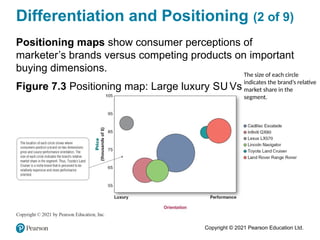
Positioning maps show consumer perceptions of
marketer’s brands versus competing products on important
buying dimensions.
Figure 7.3 Positioning map: Large luxury SU Vs
The size of each circle
indicates the brand’s relative
market share in the
segment.
Copyright © 2021 Pearson Education Ltd.
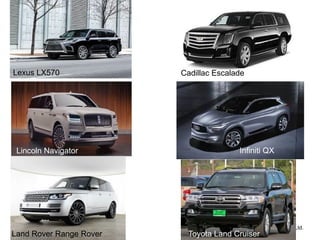
Cadillac Escalade
Infiniti QX
Lexus LX570
Lincoln Navigator
Toyota Land Cruiser
Land Rover Range Rover
Copyright © 2021 Pearson Education Ltd.
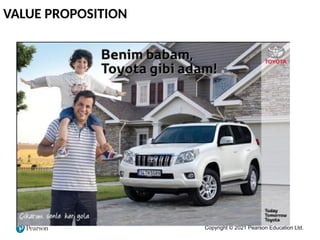
Destek-Kanıt
Fiziksel Fayda Duygusal Fayda Kişisel Fayda
VALUE PROPOSITION
Copyright © 2021 Pearson Education Ltd.
Differentiation and Positioning (3 of 9)
Choosing a Differentiation and Positioning Strategy
• Identifying a set of possible competitive advantages to
build a position
• Choosing the right competitive advantages
• Selecting an overall positioning strategy
• Communicating and delivering the chosen position to the
market
Copyright © 2021 Pearson Education Ltd.
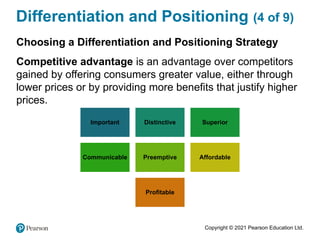
Differentiation and Positioning (4 of 9)
Choosing a Differentiation and Positioning Strategy
Competitive advantage is an advantage over competitors
gained by offering consumers greater value, either through
lower prices or by providing more benefits that justify higher
prices.
Important Distinctive Superior
Communicable Preemptive Affordable
Profitable
Copyright © 2021 Pearson Education Ltd.
Differentiation and Positioning (5 of 9)
Choosing a Differentiation
and Positioning Strategy
Identifying a set of possible
competitive advantages to
differentiate along the lines of:
• Product
• Services
• Channels
• People
• Image
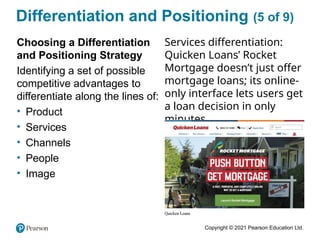
Services differentiation:
Quicken Loans’ Rocket
Mortgage doesn’t just offer
mortgage loans; its online-
only interface lets users get
a loan decision in only
minutes.
Copyright © 2021 Pearson Education Ltd.
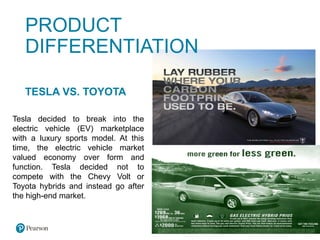
TESLA VS. TOYOTA
Tesla decided to break into the
electric vehicle (EV) marketplace
with a luxury sports model. At this
time, the electric vehicle market
valued economy over form and
function. Tesla decided not to
compete with the Chevy Volt or
Toyota hybrids and instead go after
the high-end market.
PRODUCT
DIFFERENTIATION
Copyright © 2021 Pearson Education Ltd.
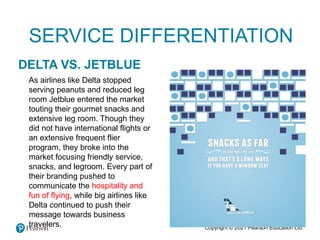
DELTA VS. JETBLUE
As airlines like Delta stopped
serving peanuts and reduced leg
room Jetblue entered the market
touting their gourmet snacks and
extensive leg room. Though they
did not have international flights or
an extensive frequent flier
program, they broke into the
market focusing friendly service,
snacks, and legroom. Every part of
their branding pushed to
communicate the hospitality and
fun of flying, while big airlines like
Delta continued to push their
message towards business
travelers.
SERVICE DIFFERENTIATION
Copyright © 2021 Pearson Education Ltd.
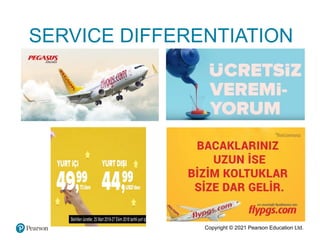
SERVICE DIFFERENTIATION
Copyright © 2021 Pearson Education Ltd.
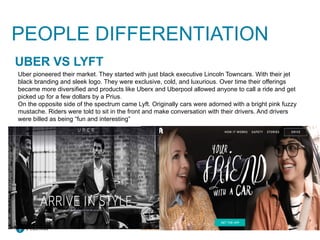
UBER VS LYFT
Uber pioneered their market. They started with just black executive Lincoln Towncars. With their jet
black branding and sleek logo. They were exclusive, cold, and luxurious. Over time their offerings
became more diversified and products like Uberx and Uberpool allowed anyone to call a ride and get
picked up for a few dollars by a Prius.
On the opposite side of the spectrum came Lyft. Originally cars were adorned with a bright pink fuzzy
mustache. Riders were told to sit in the front and make conversation with their drivers. And drivers
were billed as being “fun and interesting”
PEOPLE DIFFERENTIATION
Copyright © 2021 Pearson Education Ltd.
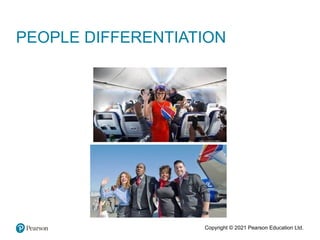
PEOPLE DIFFERENTIATION
Copyright © 2021 Pearson Education Ltd.
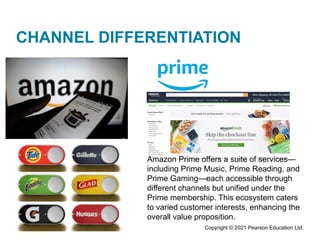
CHANNEL DIFFERENTIATION
Amazon Prime offers a suite of services—
including Prime Music, Prime Reading, and
Prime Gaming—each accessible through
different channels but unified under the
Prime membership. This ecosystem caters
to varied customer interests, enhancing the
overall value proposition.
Copyright © 2021 Pearson Education Ltd.
AIRBNB- Belong Anywhere
Why stay in a hotel when you can stay somewhere, with someone, that makes
you feel like you truly belong to the area? Unlike hotels, Airbnb gives you a true
taste of place, creating an experience all the more exciting and enriching.
Airbnb completely changed the game by legitimizing couchsurfing, providing
an authentic alternative to traditional lodging options.
CHANNEL
DIFFERENTIATION
Copyright © 2021 Pearson Education Ltd.
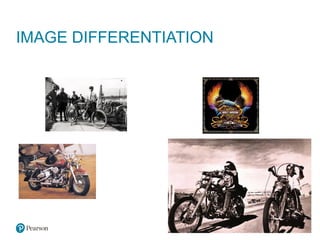
IMAGE DIFFERENTIATION
Copyright © 2021 Pearson Education Ltd.
Differentiation and Positioning (6 of 9)
Choosing a Differentiation and Positioning Strategy
A competitive advantage should be:
• Important
• Distinctive
• Superior
• Communicable
• Preemptive
• Affordable
• Profitable
Copyright © 2021 Pearson Education Ltd.
Differentiation and Positioning (7 of 9)
Choosing a Differentiation and Positioning Strategy
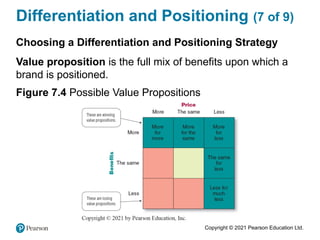
Value proposition is the full mix of benefits upon which a
brand is positioned.
Figure 7.4 Possible Value Propositions
Copyright © 2021 Pearson Education Ltd.
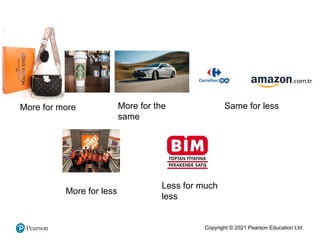
More for more More for the
same
Same for less
More for less
Less for much
less
Copyright © 2021 Pearson Education Ltd.
Differentiation and Positioning (8 of 9)
Choosing a Differentiation and Positioning Strategy
Why should I buy from you?
Positioning statement summarizes company or brand
positioning using this form: To (target segment and need)
our (brand) is (concept) that (point of difference)
• To athletes and fitness enthusiasts who seek high-performance and
stylish sportswear, Nike is a leading athletic brand that inspires and
empowers people to push their limits.
• To creative individuals and tech-savvy consumers who value
simplicity, design, and innovation, Appleis a premium technology
companythat provides seamless, user-friendly, and safe technology
into everyday life.
Copyright © 2021 Pearson Education Ltd.
Differentiation and Positioning (1 of 9)
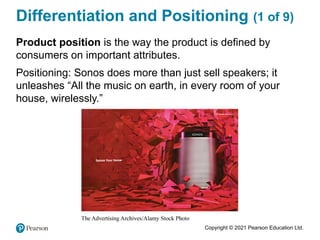
Product position is the way the product is defined by
consumers on important attributes.
Positioning: Sonos does more than just sell speakers; it
unleashes “All the music on earth, in every room of your
house, wirelessly.”
Copyright © 2021 Pearson Education Ltd.
Differentiation and Positioning (9 of 9)
Communicating and Delivering the Chosen Position
Choosing the positioning is often easier than implementing
the position.
Establishing a position or changing one usually takes a long
time.
Maintaining the position requires consistent performance
and communication.

Kotlerchapter7-2025 2.pptx marketing ppt

  • 1.
    Principles of Marketing EighteenthEdition, Global Edition Chapter 7 Customer Value-Driven Marketing Strategy: Creating Value for Target Customers Copyright © 2021 Pearson Education Ltd.
  • 2.
    Copyright © 2021Pearson Education Ltd. HENKEL’S PERSIL IN SAUDI ARABIA LOCAL AND REGIONAL MARKETING STRATEGY • Market Research • Men-wear thobes, whiteness and fabric firmness is important, they wash with bleach &detergent, but the product get ruined in the long run Persil White & Persil Starch Spray • Women-wear abaya; fabric care and blackness is important Persil Abaya Shampoo Results: sales 90 % above forecast
  • 3.
    Copyright © 2021Pearson Education Ltd. UNILEVER RINSO IN TURKEY • Market Research • 444mEuro market (detergents), 92% market penetration when compared to 45% deodorant market • Flagship brand Omo fights with Ariel for market leadership • Low brand loyalty, sensitivity to price promotions • What are the customer expectations? Good fragnance (42%), stain removal (41%, down from 80%), easy& fast wash (36%), fabric care (16.4%), low cost per wash (21%), whiteness (13.25%) • What do consumers wash? Dark colors (44%), White (9%), colors (25%), light colors (17%) Overall, people expect Nice fragnance Stain removal Low prices Color protection& Fabric Care Whiteness is no longer a need, consumption society and low prices makes it easy to buy 3 T-shirts at once In the market, Whiteness &stain removal – OMO Fragnance- RINSO
  • 4.
    Copyright © 2021Pearson Education Ltd. POSITIONING OF RINSO • Heavy Duty: Stain Removal & Whitening • Light Duty: Fast Wash, Fabric Care &Nice Fragnance (promising market) Kusursuz Siyahlar Capcanlı Renkler Narin Bakım
  • 5.
    Copyright © 2021Pearson Education Ltd. COMPETITOR: PERWOLL
  • 6.
    Copyright © 2021Pearson Education Ltd. Customer-Driven Marketing Strategy
  • 7.
    Copyright © 2021Pearson Education Ltd. Market Segmentation (1 of 14) Market segmentation requires dividing a market into smaller segments with distinct needs, characteristics, or behaviors that might require separate marketing strategies or mixes.
  • 8.
    Copyright © 2021Pearson Education Ltd. Market Segmentation (2 of 14) • Segmenting consumer markets • Segmenting business markets • Segmenting international markets • Requirements for effective segmentation
  • 9.
    Copyright © 2021Pearson Education Ltd. Market Segmentation (3 of 14) Segmenting Consumer Markets • Geographic segmentation • Demographic segmentation • Psychographic segmentation • Behavioral segmentation
  • 10.
    Copyright © 2021Pearson Education Ltd. Market Segmentation (4 of 14) Segmenting Consumer Markets Geographic segmentation divides the market into different geographical units such as nations, regions, states, counties, cities, or even neighborhoods.
  • 11.
    Copyright © 2021Pearson Education Ltd. P&G INTERNATIONAL TARGET MARKETS • Asia: Strengthening Thin, Brittle Hair • Hair Concern: In humid climates, hair tends to become thin, brittle, and prone to breakage due to moisture and frizz. • Product Solution: Pantene developed formulas enriched with Pro-Vitamin B5 and Keratin Repair System to strengthen the hair shaft and reduce breakage caused by environmental stressors like humidity. • Example Products: • Pantene Pro-V Total Damage Care. • Pantene Pro-V Smooth & Silky. • Marketing Angle: "Stronger Hair with Every Wash" and "Frizz-free Hair, Even in Humid Weather."
  • 12.
    Copyright © 2021Pearson Education Ltd. Market Segmentation (5 of 14) Segmenting Consumer Markets Demographic segmentation divides the market into segments based on variables such as age, life-cycle stage, gender, income, occupation, education, religion, ethnicity, and generation.
  • 13.
    Copyright © 2021Pearson Education Ltd. Market Segmentation (6 of 14) Segmenting Consumer Markets Age and life-cycle stage segmentation divides a market into different age and life-cycle groups. Gender segmentation divides a market into different segments based on gender. Income segmentation divides a market into different income segments.
  • 14.
    Copyright © 2021Pearson Education Ltd. AGE & LIFE-CYCLE STAGE SEGMENTATION • Focuses on the stage of life, such as single, married, parents, or retirees. • Example: Baby product brands like Pampers target new parents, while cruise lines target retirees.
  • 15.
    Copyright © 2021Pearson Education Ltd. GENDER SEGMENTATION • Gender segmentation divides the market based on the needs, preferences, and behaviors of different genders (e.g., men, women, and non- binary individuals). It enables companies to tailor products, services, and marketing messages to specific gender groups. Clothing and Fashion •Women: • Brands: Victoria's Secret, Zara Women, ASOS Women. • Products: Dresses, high heels, handbags, tailored for trends and style. •Men: • Brands: Hugo Boss, Levi’s Men, Nike Men. • Products: Suits, sportswear, functional designs with a focus on durability. •Non-Binary/Unisex: • Brands: Uniqlo, Patagonia. • Products: Neutral designs that appeal to all genders.
  • 16.
    Copyright © 2021Pearson Education Ltd. INCOME SEGMENTATION • L’Oréal Group • Low-Income Segment: Garnier • Affordable skincare and haircare products targeting price-sensitive consumers. • Middle-Income Segment: L’Oréal Paris • Offers premium but accessible beauty and personal care products for middle-income consumers. • High-Income Segment: Lancôme • High-end cosmetics and skincare designed for wealthy customers seeking luxury and exclusivity.
  • 17.
    Copyright © 2021Pearson Education Ltd.
  • 18.
    Copyright © 2021Pearson Education Ltd. Market Segmentation (7 of 14) Segmenting Consumer Markets Psychographic segmentation divides a market into different segments based on social class, lifestyle, or personality characteristics.
  • 19.
    Copyright © 2021Pearson Education Ltd. NIKE’S TARGET MARKETS Segment 1: Athletes: High-Performance Footwear with Cutting-Edge Technology Target Segment: Professional and amateur athletes seeking advanced performance gear. Product Example: Nike ZoomX Vaporfly Next%: Designed for marathon runners to improve endurance and speed. Segment 2: 2. Fashion-Focused: Stylish Lifestyle Sneakers Target Segment: Youth and trend-conscious consumers who prioritize style over performance. Product Example: Air Jordan Retro Line, Nike Air Force 1, limited-edition releases and collaborations with designers (e.g., Off-White, Travis Scott) Segment 3: Women-Specific: Inclusivity and Practicality Target Segment: Women athletes, including those in Muslim-majority markets. Products: Nike Pro Hijab, Nike Yoga Collection
  • 20.
    Copyright © 2021Pearson Education Ltd.
  • 21.
    Copyright © 2021Pearson Education Ltd.
  • 22.
    Copyright © 2021Pearson Education Ltd. Market Segmentation (9 of 14) Segmenting Consumer Markets Behavioral Segmentation • Occasions • Benefits sought • User status • Usage rate • Loyalty status Benefit segmentation: Schwinn makes bikes for every benefit segment. For example, its e- bikes “help make the morning commute or ride around town a little bit easier.” Segmenting Consumer Markets Behavioral segmentation divides a market into segments based on consumer knowledge, attitudes, uses of a product, or responses to a product.
  • 23.
    Copyright © 2021Pearson Education Ltd. OCCASIONS
  • 24.
    Copyright © 2021Pearson Education Ltd.
  • 25.
    Copyright © 2021Pearson Education Ltd.
  • 26.
    Copyright © 2021Pearson Education Ltd.
  • 27.
    Copyright © 2021Pearson Education Ltd.
  • 28.
    Copyright © 2021Pearson Education Ltd. OCCASIONS-Starbucks for Christmas Pumpkin Spice Latte
  • 29.
    Copyright © 2021Pearson Education Ltd. USER STATUS Non-users Ex-users Potential users First-time users Regular users
  • 30.
    Copyright © 2021Pearson Education Ltd. NON-USER SEGMENTATION JITTERBURG Smartphone Adoption by Seniors - Jitterbug •Challenge: Many seniors resisted adopting smartphones, perceiving them as too complex or unnecessary. •Strategy: • Simplified Features:large buttons, simplified menus, and voice-assisted navigation tailored to seniors. • Education and Support: Offered free tech support and setup services to guide seniors through the adoption process. • Incentives:Bundled the phones with affordable, no- contract plans to remove financial barriers. •Result: Jitterbug saw a surge in adoption among resistant non-users, becoming one of the leading smartphone brands for seniors in the U.S.
  • 31.
    Copyright © 2021Pearson Education Ltd. SPOTIFY’S RE-ENGAGEMENT of EX-USERS •Challenge: Spotify identified that many users canceled their subscriptions or stopped using the platform, often due to cost concerns, lack of perceived value, or switching to competitors like Apple Music or YouTube Music. 1. Understand Why They Left (surveys and data analysis) • Price sensitivity. • Preference for competitors. • Lack of engaging content or dissatisfaction with recommendations. 2. Personalized Offers to Re-Engage •Discount Campaigns: promotional offers like “3 months of Premium for $9.99” to lower the cost barrier for ex-users. •Exclusive Features: unique features like curated playlists (e.g., Discover Weekly), podcasts, and offline downloads. •Free Access with Upselling: a free tier with ads to keep users within the Spotify ecosystem and upsell them later. 3. Improved User Experience •Improved algorithms to offer better music recommendations, addressing complaints about playlist irrelevance. •Added podcasts and audiobook options to diversify content and appeal to ex- users who sought more variety. 4. Email Marketing and Retargeting •Sent personalized emails to ex-users, highlighting new features and improvements since they left. •Used retargeting ads to remind ex-users of the benefits of returning to Spotify.
  • 32.
    Copyright © 2021Pearson Education Ltd. Airbnb’s TARGETING OF POTENTIAL CUSTOMERS • Target Group: Travelers who have never used Airbnb, often loyal to hotels. • Strategy: • Education on Benefits: • Highlighted advantages of staying in local homes for authentic travel experiences through advertising campaigns like "Live There." • Incentives: • Offered first-time user discounts to encourage trial. • Partnerships: • Partnered with airlines and travel agencies to reach traditional hotel users. • Social Proof: • Showcased reviews and testimonials from satisfied customers to build trust. • Result: Airbnb attracted millions of new users and grew its market share significantly in both urban and rural travel sectors.
  • 33.
    Copyright © 2021Pearson Education Ltd. REGULAR USERS • Regular users are individuals who actively and consistently use a product or service. Segmenting regular users helps companies understand their behavior, preferences, and value to the business. This allows brands to tailor their marketing strategies to enhance user retention, satisfaction, and lifetime value • Airlines segment frequent travelers into economy, business, and first-class flyers based on ticket purchases. • Netflix segments users who primarily watch movies, series, or kids' content and recommends content tailored to their viewing habits. • Spotify segments daily users (music streamers) from occasional users (podcast listeners).
  • 34.
    Copyright © 2021Pearson Education Ltd. LOYALTY STATUS LOYAL APPLE CONSUMERS  Loyalty status segmentation involves dividing users based on their level of commitment or loyalty to a brand. This segmentation helps businesses identify their most loyal customers, occasional buyers, and those at risk of switching to competitors. By understanding these groups, companies can design targeted retention and reward strategies.
  • 35.
    Copyright © 2021Pearson Education Ltd. THY LOYALTY PROGRAM Turkish Airlines (THY) operates its Miles&Smiles loyalty program to segment and reward its customers based on their travel frequency, spending, and loyalty. How THY Targets Segments with Miles&Smiles: 1.Occasional Flyers (Classic Members): 1. Promotions for discounted tickets and bonus miles to encourage future bookings. 2. Email reminders about how close they are to the next tier. 2.Frequent Flyers (Classic Plus and Elite): 1. Offers for exclusive experiences (e.g., discounts on business class upgrades). 2. Access to premium services like priority check-in and lounges to enhance satisfaction. 3.Top-Tier Customers (Elite Plus): 1. Personal relationship management with dedicated customer service. 2. Invitations to VIP events, such as Turkish Airlines-sponsored sports or cultural events.
  • 36.
    Copyright © 2021Pearson Education Ltd. BENEFITS SOUGHT •Benefit Sought: Skin Moisturization • Example: NIVEA offers creams and lotions designed specifically for dry skin, emphasizing long-lasting hydration. •Benefit Sought: Anti-Aging • Example: Olay’s Regenerist line targets consumers seeking to reduce wrinkles and improve skin elasticity.
  • 37.
    Copyright © 2021Pearson Education Ltd. BENEFITS SOUGHT
  • 38.
    Copyright © 2021Pearson Education Ltd. Market Segmentation (12 of 14) Segmenting International Markets • Geographic location • Economic factors • Political and legal factors • Cultural factors
  • 39.
    Copyright © 2021Pearson Education Ltd. • Coca-Cola adapts its products to suit regional tastes. • Japan: Launched Coca-Cola Plus, a fiber-enriched soda targeting health-conscious consumers. • India: Introduced Thums Up, a stronger cola flavor (hint of spice or tang in the aftertaste) tailored to local preferences. • Results: Thums Up became the best- selling soft drink in India, capturing more than 40% market share in the cola category. COCA COLA MARKETING IN JAPAN AND INDIA
  • 40.
    Copyright © 2021Pearson Education Ltd. Market Segmentation (13 of 14) Segmenting International Markets Intermarket segmentation involves forming segments of consumers who have similar needs and buying behaviors even though they are located in different countries.
  • 41.
    Copyright © 2021Pearson Education Ltd. Market Segmentation (14 of 14) Requirements for Effective Segmentation Measurable: • The size, purchasing power, and characteristics of the segment can be quantified and assessed. Accessible: • The segment can be effectively reached and served through communication and distribution channels. Substantial: • The segment is large and profitable enough to justify targeted marketing efforts. Differentiable: • The segments are distinct in terms of needs, preferences, or behavior, and respond differently to marketing strategies. Actionable: • The organization can design practical and effective marketing programs to attract and serve the segment.
  • 42.
    Copyright © 2021Pearson Education Ltd. Market Targeting (1 of 10) Evaluating Market Segments Segment Size and Growth: • Assess whether the segment is large enough and growing at a rate that makes it worth targeting. Consider current sales, potential growth rates, and future profitability. Segment Structural Attractiveness: • Evaluate factors such as competition, substitute products, power of buyers and suppliers, and barriers to entry. Attractive segments have fewer competitive pressures and higher profit potential. Company Objectives and Resources: • Determine if the segment aligns with the company’s goals and whether the organization has the resources (financial, technological, or human) to effectively serve the segment.
  • 43.
    Copyright © 2021Pearson Education Ltd. Market Targeting (2 of 10) Selecting Target Market Segments A target market is a set of buyers who share common needs or characteristics that the company decides to serve.
  • 44.
    Copyright © 2021Pearson Education Ltd. Market Targeting (3 of 10) Figure 7.2 Market-Targeting Strategies
  • 45.
    Copyright © 2021Pearson Education Ltd. Market Targeting (4 of 10) Selecting Target Market Segments Undifferentiated marketing targets the whole market with one offer. • Mass marketing • Focuses on common needs rather than what’s different
  • 46.
    Copyright © 2021Pearson Education Ltd. UNDIFFERENTIATED MARKETING
  • 47.
    Copyright © 2021Pearson Education Ltd. Target Markets Market Offerings A B C 1 2 3 4 5 Örn: Zara DIFFERENTIATED MARKETING
  • 48.
    Copyright © 2021Pearson Education Ltd. Market Targeting (5 of 10) Selecting Target Market Segments Differentiated marketing targets several different market segments and designs separate offers for each. • Goal is to achieve higher sales and stronger position • More expensive than undifferentiated marketing • Differentiated marketing: With more than 30 differentiated hotel brands, Marriott International dominates the hotel industry, capturing a much larger share of the travel and hospitality market than it could with any single brand alone.
  • 49.
    Copyright © 2021Pearson Education Ltd.
  • 50.
    Copyright © 2021Pearson Education Ltd. DIFFERENTIATED MARKETING
  • 51.
    Copyright © 2021Pearson Education Ltd. PINAR SÜT
  • 52.
    Copyright © 2021Pearson Education Ltd. ALIBABA-ELDERLY POPULATION The online retail company Taobao, owned by Alibaba, shifted its focus to China's rapidly growing elderly population. By 2020, people over the age of 60 are expected to account for one-fifth of the country's total population. The Chinese company Taobao has also released a special application that can be easily used by elder users to access this naturally growing consumer base. Elderly users' accounts can be linked directly to their children's accounts and Pay for Me option allows their children to pay for their purchases. APPLE GRANDPAD
  • 53.
    Copyright © 2021Pearson Education Ltd. SPOTIFY Spotify enhances the Family pack experience with Spotify Kids, a brand new app developed specifically for the next generation of audio enthusiasts. All content consists of records carefully prepared by experienced Spotify editors and their main priorities are to ensure that all existing content is suitable for children, parents can choose between “Audio for Younger Kids” or “Audio for Older Kids”, which they think would be best suited for their children.
  • 54.
    Copyright © 2021Pearson Education Ltd. INDITEX GROUP
  • 56.
    Copyright © 2021Pearson Education Ltd. Market Targeting (6 of 10) Selecting Target Markets Concentrated marketing targets a large share of a smaller market. • Limited company resources • Knowledge of the market • More effective and efficient Concentrated marketing: Fila owes its resurgence not only to the retro wave but the brand’s ability to create a narrative about its products.
  • 57.
    Copyright © 2021Pearson Education Ltd. CONCENTRATED/ NICHE MARKETING
  • 58.
    Copyright © 2021Pearson Education Ltd. Market Targeting (7 of 10) Selecting Target Market Segments Micromarketing is the practice of tailoring products and marketing programs to suit the tastes of specific individuals and locations. • Local marketing • Individual marketing
  • 59.
    Copyright © 2021Pearson Education Ltd. Local Marketing Local marketing involves tailoring brands and promotion to the needs and wants of local customer segments. 1. Cities: 1. Starbucks "City Mugs" Collection: 1. Starbucks creates city-specific merchandise, like mugs and tumblers featuring iconic landmarks or cultural elements of that city. 2. Example: A New York City mug showcasing the Statue of Liberty. 2. Neighborhoods: 1. Target Neighborhood Promotions: 1. Target adjusts its product assortment based on the demographics of neighborhoods. 2. Example: In a Hispanic-majority area, Target might stock more Latin American foods and bilingual signage. 3. Stores: 1. McDonald’s Store-Level Marketing: 1. Menu adjustments to fit store locations: 1. Example: Lobster Rolls in McDonald's stores in coastal areas of Maine and Massachusetts.
  • 60.
    Copyright © 2021Pearson Education Ltd. Market Targeting (9 of 10) Selecting Target Markets Individual marketing involves tailoring products and marketing programs to the needs and preferences of individual customers. Also known as: • One-to-one marketing • Mass customization Individual marketing: The Rolls-Royce Bespoke design team works closely with individual customers to help them create their own unique Rolls-Royces.
  • 61.
    Copyright © 2021Pearson Education Ltd. MICROMARKETING
  • 62.
    Copyright © 2021Pearson Education Ltd. Selecting Target Market Segments Choosing a targeting strategy depends on • Company resources: Limited resources may lead a company to focus on a single market segment (concentrated marketing) rather than multiple segments. Companies with abundant resources can pursue differentiated or mass marketing strategies. • Product variability: Products with little variability (e.g., salt or basic commodities) are better suited for mass marketing. Highly variable products, such as fashion items or customizable technology, may require differentiated or concentrated targeting. • Product life-cycle stage: Introduction Stage: Target early adopters or niche markets. Growth Stage: Expand targeting to broader segments. Maturity Stage: Focus on differentiation and retaining loyal customers.Decline Stage: Concentrate on the most profitable segments. • Market variability: If consumer needs and preferences are diverse, a differentiated marketing strategy may be more effective. • Competitor’s marketing strategies: If competitors are targeting broadly, a company might differentiate itself by focusing on a niche (concentrated marketing).If competitors are targeting specific segments, a company may compete head-to-head or choose underserved segments.
  • 63.
    Copyright © 2021Pearson Education Ltd. Differentiation and Positioning (2 of 9) Positioning maps show consumer perceptions of marketer’s brands versus competing products on important buying dimensions. Figure 7.3 Positioning map: Large luxury SU Vs The size of each circle indicates the brand’s relative market share in the segment.
  • 64.
    Copyright © 2021Pearson Education Ltd. Cadillac Escalade Infiniti QX Lexus LX570 Lincoln Navigator Toyota Land Cruiser Land Rover Range Rover
  • 65.
    Copyright © 2021Pearson Education Ltd. Destek-Kanıt Fiziksel Fayda Duygusal Fayda Kişisel Fayda VALUE PROPOSITION
  • 66.
    Copyright © 2021Pearson Education Ltd. Differentiation and Positioning (3 of 9) Choosing a Differentiation and Positioning Strategy • Identifying a set of possible competitive advantages to build a position • Choosing the right competitive advantages • Selecting an overall positioning strategy • Communicating and delivering the chosen position to the market
  • 67.
    Copyright © 2021Pearson Education Ltd. Differentiation and Positioning (4 of 9) Choosing a Differentiation and Positioning Strategy Competitive advantage is an advantage over competitors gained by offering consumers greater value, either through lower prices or by providing more benefits that justify higher prices. Important Distinctive Superior Communicable Preemptive Affordable Profitable
  • 68.
    Copyright © 2021Pearson Education Ltd. Differentiation and Positioning (5 of 9) Choosing a Differentiation and Positioning Strategy Identifying a set of possible competitive advantages to differentiate along the lines of: • Product • Services • Channels • People • Image Services differentiation: Quicken Loans’ Rocket Mortgage doesn’t just offer mortgage loans; its online- only interface lets users get a loan decision in only minutes.
  • 69.
    Copyright © 2021Pearson Education Ltd. TESLA VS. TOYOTA Tesla decided to break into the electric vehicle (EV) marketplace with a luxury sports model. At this time, the electric vehicle market valued economy over form and function. Tesla decided not to compete with the Chevy Volt or Toyota hybrids and instead go after the high-end market. PRODUCT DIFFERENTIATION
  • 70.
    Copyright © 2021Pearson Education Ltd. DELTA VS. JETBLUE As airlines like Delta stopped serving peanuts and reduced leg room Jetblue entered the market touting their gourmet snacks and extensive leg room. Though they did not have international flights or an extensive frequent flier program, they broke into the market focusing friendly service, snacks, and legroom. Every part of their branding pushed to communicate the hospitality and fun of flying, while big airlines like Delta continued to push their message towards business travelers. SERVICE DIFFERENTIATION
  • 71.
    Copyright © 2021Pearson Education Ltd. SERVICE DIFFERENTIATION
  • 72.
    Copyright © 2021Pearson Education Ltd. UBER VS LYFT Uber pioneered their market. They started with just black executive Lincoln Towncars. With their jet black branding and sleek logo. They were exclusive, cold, and luxurious. Over time their offerings became more diversified and products like Uberx and Uberpool allowed anyone to call a ride and get picked up for a few dollars by a Prius. On the opposite side of the spectrum came Lyft. Originally cars were adorned with a bright pink fuzzy mustache. Riders were told to sit in the front and make conversation with their drivers. And drivers were billed as being “fun and interesting” PEOPLE DIFFERENTIATION
  • 73.
    Copyright © 2021Pearson Education Ltd. PEOPLE DIFFERENTIATION
  • 74.
    Copyright © 2021Pearson Education Ltd. CHANNEL DIFFERENTIATION Amazon Prime offers a suite of services— including Prime Music, Prime Reading, and Prime Gaming—each accessible through different channels but unified under the Prime membership. This ecosystem caters to varied customer interests, enhancing the overall value proposition.
  • 75.
    Copyright © 2021Pearson Education Ltd. AIRBNB- Belong Anywhere Why stay in a hotel when you can stay somewhere, with someone, that makes you feel like you truly belong to the area? Unlike hotels, Airbnb gives you a true taste of place, creating an experience all the more exciting and enriching. Airbnb completely changed the game by legitimizing couchsurfing, providing an authentic alternative to traditional lodging options. CHANNEL DIFFERENTIATION
  • 76.
    Copyright © 2021Pearson Education Ltd. IMAGE DIFFERENTIATION
  • 77.
    Copyright © 2021Pearson Education Ltd. Differentiation and Positioning (6 of 9) Choosing a Differentiation and Positioning Strategy A competitive advantage should be: • Important • Distinctive • Superior • Communicable • Preemptive • Affordable • Profitable
  • 78.
    Copyright © 2021Pearson Education Ltd. Differentiation and Positioning (7 of 9) Choosing a Differentiation and Positioning Strategy Value proposition is the full mix of benefits upon which a brand is positioned. Figure 7.4 Possible Value Propositions
  • 79.
    Copyright © 2021Pearson Education Ltd. More for more More for the same Same for less More for less Less for much less
  • 80.
    Copyright © 2021Pearson Education Ltd. Differentiation and Positioning (8 of 9) Choosing a Differentiation and Positioning Strategy Why should I buy from you? Positioning statement summarizes company or brand positioning using this form: To (target segment and need) our (brand) is (concept) that (point of difference) • To athletes and fitness enthusiasts who seek high-performance and stylish sportswear, Nike is a leading athletic brand that inspires and empowers people to push their limits. • To creative individuals and tech-savvy consumers who value simplicity, design, and innovation, Appleis a premium technology companythat provides seamless, user-friendly, and safe technology into everyday life.
  • 81.
    Copyright © 2021Pearson Education Ltd. Differentiation and Positioning (1 of 9) Product position is the way the product is defined by consumers on important attributes. Positioning: Sonos does more than just sell speakers; it unleashes “All the music on earth, in every room of your house, wirelessly.”
  • 82.
    Copyright © 2021Pearson Education Ltd. Differentiation and Positioning (9 of 9) Communicating and Delivering the Chosen Position Choosing the positioning is often easier than implementing the position. Establishing a position or changing one usually takes a long time. Maintaining the position requires consistent performance and communication.

Editor's Notes

  • #1 If this PowerPoint presentation contains mathematical equations, you may need to check that your computer has the following installed: 1) Math Type Plugin 2) Math Player (free versions available) 3) NVDA Reader (free versions available)
  • #6 Companies today recognize that they cannot appeal to all buyers in the marketplace—or at least not to all buyers in the same way. They must design customer-driven marketing strategies that build the right relationships with the right customers. Thus, most companies have moved away from mass marketing and toward target marketing: identifying market segments, selecting one or more of them, and developing products and marketing programs tailored to each. Figure 7.1 shows the four major steps in designing a customer-driven marketing strategy: Segmentation Targeting Differentiation Positioning We will discuss each of these steps in turn. Long Description: The details depicted in the figure are as follows: The text "Create value for targeted customers" is depicted in the center of the figure. The four steps listed around it are as follows: Select customers to serve: Segmentation: Divide the total market into smaller segments Targeting: Select the segment or segments to enter Decide on a value proposition Differentiation: Differentiate the market offering to create superior customer value Positioning: Position the market offering in the minds of target customers A note reads "In concept, marketing boils down to two questions: 1. Which customers will we serve? and 2. How will we serve them? Of course, the tough part is coming up with good answers to these simple-sounding yet difficult questions. The goal is to create more value for the customers we serve than competitors do.
  • #7 Buyers in any market differ in their wants, resources, locations, buying attitudes, and buying practices. Through market segmentation, companies divide large, heterogeneous markets into smaller segments that can be reached more efficiently and effectively with products and services that match their unique needs.
  • #8 In Learning Objective 2, we will discuss four important segmentation topics: segmenting consumer markets, segmenting business markets, segmenting international markets, and the requirements for effective segmentation.
  • #9 There is no single way to segment a market. A marketer has to try different segmentation variables, alone and in combination, to find the best way to view market structure. This visual outlines variables shown in Table 7.1 that might be used in segmenting consumer markets.
  • #10 A company may decide to operate in one or a few geographical areas or operate in all areas but pay attention to geographical differences in needs and wants. Many companies today are localizing their products, advertising, promotion, and sales efforts to fit the needs of individual regions, cities, and neighborhoods. For example, Domino’s Pizza, the nation’s largest pizza delivery chain, keeps its marketing and customer focus decidedly local. Customers anywhere in the nation can use the online platform or smartphone app to track down local coupon offers, locate the nearest store with a GPS store locator, and quickly receive a freshly-made pizza. They can even use Domino’s Pizza Tracker to follow their pies locally from store to door.
  • #12 Demographic factors are the most popular bases for segmenting customer groups. One reason is that consumer needs, wants, and usage rates often vary closely with demographic variables. Demographic variables are easier to measure than most other types of variables. Even when marketers first define segments using other bases, such as benefits sought or behavior, they must know a segment’s demographic characteristics to assess the size of the target market and reach it efficiently. Pepsi ad targeting young people and their problems: https://www.adsoftheworld.com/media/film/pepsi_unmute_your_voice
  • #13 Consumer needs and wants change with age. Some companies offer different products or use different marketing approaches for different age and life-cycle groups. Other companies offer brands that target specific age or life-stage groups. For example, Amazon targeted a younger tablet market for using the Kindle Fire tablet, introducing FreeTime Unlimited, a multimedia subscription service targeted toward 3- to 8-year-olds. Marketers must be careful to guard against stereotypes when using age and life-cycle segmentation. Gender segmentation has long been used in clothing, cosmetics, toiletries, and magazines. For example, P&G was among the first to use gender segmentation with Secret, a brand specially formulated for a woman’s chemistry, and packaged and advertised to reinforce the female image. More recently, the men’s personal care industry has exploded, and many cosmetics brands that previously catered mostly to women—like L’Oréal and Nivea—now successfully market men’s lines. The marketers of products and services such as automobiles, clothing, cosmetics, financial services, and travel have long used income segmentation. Many companies target affluent consumers with luxury goods and convenience services. Other marketers use high-touch marketing programs to court the well-to-do. Not all companies that use income segmentation target the affluent. For example, many retailers—such as the Dollar General, Family Dollar, and Dollar Tree store chains—successfully target low- and middle-income groups. The core market for such stores is represented by families with incomes under $30,000.
  • #18 Psychographic segmentation: Dunkin’ Donuts successfully targets the “Dunkin’ tribe”—not the Starbucks coffee snob but the average Joe. Dunkin’ Donuts isn’t like Starbucks—it doesn’t want to be.” People in the same demographic group can have very different psychographic characteristics. In Chapter 5, we discussed how the products people buy reflect their lifestyles. Marketers also use personality variables to segment markets. For example, different soft drinks target different personalities. Mountain Dew projects a youthful, rebellious, adventurous personality whereas Coca-Cola Zero appeals to target personality types which are more mature, practical, and cerebral but good-humored. Its subtly humorous ads promise “Real Coca-Cola taste and zero calories.”
  • #22 Benefit segmentation: Schwinn makes bikes for every benefit segment. For example, Schwinn’s urban bikes are “for riders who want a functional, durable, and stylish bike to commute or ride casually in urban areas.” Occasions refer to when consumers get the idea to buy, actually make their purchase, or use the purchased item. Occasion segmentation can help firms build up product usage. Campbell’s advertises its soups more heavily in the cold winter months, and Home Depot runs special springtime promotions for lawn and gardens products. Other marketers prepare special offers and ads for holiday occasions or nontraditional occasions. Benefits sought refers to finding the major benefits people look for in a product class, the kinds of people who look for each benefit, and the major brands that deliver each benefit. Markets can be segmented by user status: nonusers, ex-users, potential users, first-time users, and regular users of a product. Marketers want to reinforce and retain regular users, attract targeted nonusers, and reinvigorate relationships with ex-users. Markets can also be segmented by usage rate: light, medium, and heavy product users. Heavy users are often a small percentage of the market but account for a high percentage of total consumption. For instance, a recent study showed that heavy seafood consumers in the United States are a small but hungry bunch. Less than 5 percent of all shoppers buy nearly 64 percent of unbreaded seafood consumed in the United States. Consumers can be loyal to brands, and buyers can be divided into groups according to their degree of loyalty. Some consumers are completely loyal—they buy one brand all the time and can’t wait to tell others about it. Other consumers are somewhat loyal—they are loyal to two or three brands of a given product or favor one brand while sometimes buying others. Still other buyers show no loyalty to any brand—they either want something different each time they buy, or they buy whatever’s on sale. A company can learn a lot by analyzing loyalty patterns in its market, starting with its own loyal customers.
  • #38 Few companies have either the resources or the will to operate in all, or even most, of the countries that dot the globe. Operating in many countries presents new challenges. Different countries, even those that are close together, can vary greatly in their economic, cultural, and political makeup. International firms need to group their world markets into segments with distinct buying needs and behaviors. Companies can segment international markets using one or a combination of several variables: Geographic location involves grouping countries by regions such as Western Europe, the Pacific Rim, the Middle East, or Africa. Geographic segmentation assumes that nations close to one another will have many common traits and behaviors, however there are many exceptions. For example, the Dominican Republic is no more like Brazil than Italy is like Sweden. Many Central and South Americans don’t even speak Spanish. Economic factors involve grouping countries by population income levels or by their overall level of economic development. A country’s economic structure shapes its population’s product and service needs and, therefore, the marketing opportunities it offers. Political and legal factors involve segmenting by the type and stability of the government, government receptivity to foreign firms, monetary regulations, and the amount of bureaucracy. Cultural factors involve grouping markets according to common languages, religions, values and attitudes, customs, and behavioral patterns.
  • #40 Segmenting international markets based on geographic, economic, political, cultural, and other factors presumes that segments should consist of clusters of countries. However, as new communications technologies, such as satellite TV and the internet, connect consumers around the world, marketers can define and reach segments of like-minded consumers no matter where in the world they are using intermarket segmentation (also called cross-market segmentation.)
  • #41 Measurable: The size, purchasing power, and profiles of the segments can be measured. Accessible: The market segments can be effectively reached and served. Substantial: The market segments are large or profitable enough to serve. Differentiable: The segments are conceptually distinguishable and respond differently to different marketing mix elements and programs. Actionable: Effective programs can be designed for attracting and serving the segments.
  • #42 Selecting segments that have the right size and growth characteristics is a relative matter. The largest, fastest-growing segments are not always the most attractive ones for every company. Smaller companies may target segments that are smaller and less attractive, in an absolute sense, but that are potentially more profitable for them. Structural factors that affect long-run segment attractiveness include strong and aggressive competitors, new entrants, substitute products, power of buyers relative to sellers, and powerful suppliers who can control prices, quality, or quantity of ordered goods and services. Some attractive segments can be dismissed quickly because they do not mesh with the company’s long-run objectives. Or the company may lack the skills and resources needed to succeed in an attractive segment. A company should only enter segments in which it can create superior customer value and gain advantages over its competitors.
  • #43 After evaluating different segments, the company must decide which and how many segments it will target. Market targeting can be carried out at several different levels as shown in the next slide.
  • #44 Figure 7.2 shows that companies can target very broadly (undifferentiated marketing), very narrowly (micromarketing), or somewhere in between (differentiated or concentrated marketing). This figure covers a broad range of targeting strategies, from mass marketing (virtually no targeting) to individual marketing (customizing products and programs to individual customers). An example of individual marketing is candy lovers can buy M&M’s embossed with images of their kids or pets. Long Description: The details depicted in the flowchart are as follows: The strategies that follow move from Targeting broadly to targeting narrowly. Undifferentiated (mass) marketing Differentiated (segmented) marketing Concentrated (niche) marketing Micromarketing (local or individual marketing) Note: This figure covers a broad range of targeting strategies, from mass marketing (virtually no targeting) to individual marketing (customizing products and programs to individual customers).
  • #45 With undifferentiated marketing (or mass marketing), the company designs a product and a marketing program that will appeal to the largest number of buyers. As noted in the chapter, most modern marketers have strong doubts about this strategy. Difficulties arise in developing a product or brand that will satisfy all consumers. Moreover, mass marketers often have trouble competing with more-focused firms that do a better job of satisfying the needs of specific segments and niches.
  • #48 Ritz-Carlton, St. Regis, and W Hotels serve the luxury segment. The Marriott, Sheraton, and Westin brands serve more mainstream but still upscale travelers. Courtyard by Marriott focuses on more affordable rooms for business travelers, and Residence Inn by Marriott targets extended-stay business and leisure travelers. Aloft offers “an affordable alternative for the tech-savvy and confidently social—travelers who love open spaces, open thinking, and open expression.” The Marriott Vacation Club gives travelers a timeshare option. In all, the Marriott portfolio of brands offers something for every travel segment. Differentiated marketing increases the costs of doing business. The company must weigh increased sales against increased costs when deciding on a differentiated marketing strategy.
  • #56 Concentrated marketing: When using a concentrated marketing (or niche marketing) strategy, a firm goes after a large share of one or a few smaller segments or niches. For example, Stance Socks thrives with high-quality, colorful socks sold through high-end department stores. Today, the low cost of setting up shop on the internet makes it even more profitable to serve seemingly miniscule niches. Small businesses, in particular, are realizing riches from serving small niches on the eb. Concentrated marketing can be highly profitable. At the same time, it involves higher-than-normal risks. Companies that rely on one or a few segments for all of their business will suffer greatly if the segment turns sour. Or larger competitors may decide to enter the same segment with greater resources. For these reasons, many companies prefer to diversify in several market segments. In fact, many large companies develop or acquire niche brands of their own.
  • #58 Rather than seeing a customer in every individual, micromarketers see the individual in every customer. Micromarketing includes local marketing and individual marketing described on the next slides.
  • #59 Local marketing involves tailoring brands and promotions to the needs and wants of local customer groups—cities, neighborhoods, and even specific stores. For example, department store chain Macy’s has rolled out a localization program called My Macy’s in which merchandise is customized under 69 different geographical districts. Advances in communications technology have given rise to new high-tech versions of location-based marketing. Thanks to the explosion in net-connected smartphones with GPS capabilities and location-based social networks, companies can now track consumers’ whereabouts closely and gear their offers accordingly. Increasingly, location-based marketing is going mobile, reaching on-the-go consumers as they come and go in key local market areas. Discussion Question What are the drawbacks of local marketing? Local marketing has some drawbacks. It can drive up manufacturing and marketing costs by reducing the economies of scale. It can also create logistics problems as companies try to meet the varied requirements of different regional and local markets. Still, as companies face increasingly fragmented markets, and as new supporting technologies develop, the advantages of local marketing often outweigh the drawbacks. In addition, a brand’s overall image might be diluted if the product and message vary too much in different localities.
  • #60 In the extreme, micromarketing becomes individual marketing—one-to-one or markets-of-one marketing. More detailed databases, robotic production and flexible manufacturing, and interactive media such as mobile phones and the internet have combined to foster mass customization. Mass customization is the process by which firms interact one-to-one with masses of customers to design products and services tailor-made to individual needs. Individual marketing has made relationships with customers more important than ever. The world appears to be coming full circle—from the good old days when customers were treated as individuals to mass marketing when nobody knew your name and then back again.  
  • #62 As shown in the slide, companies need to consider many factors when choosing a market-targeting strategy. When the firm’s resources are limited, concentrated marketing makes the most sense. Undifferentiated marketing is more suited for uniform products, such as grapefruit or steel. When a firm introduces a new product, it may be practical to launch one version only, as undifferentiated marketing or concentrated marketing may make the most sense. In the mature stage of the product life cycle, however, differentiated marketing often makes more sense. Undifferentiated marketing is appropriate where there is little market variability – most buyers have the same tastes, buy the same amounts, and react the same way to marketing efforts. When competitors use undifferentiated marketing, a firm can gain an advantage by using differentiated or concentrated marketing, focusing on the needs of buyers in specific segments.
  • #63 In planning their differentiation and positioning strategies, marketers often prepare perceptual positioning maps. The position of each circle on the map indicates the brand’s perceived positioning on two dimensions: price and orientation (luxury versus performance). The size of each circle indicates the brand’s relative market share. Long Description: The horizontal axis shows the orientation from luxury on the left to performance on the right. The vertical axis shows the price in thousands of dollars, marked from 45 to 105 in increments of 10. The details of the different brands represented as circles denoting their share of the market, from the largest to the smallest, are as follows: Cadillac Escalade Orientation: midway on the horizontal axis Price: 73,395 Land Rover Range Rover Orientation: At right extreme, at performance Price: 85,650 Infiniti Q X (has approximately the same market share as the Land Rover Range Rover) Orientation: One-quarter away from luxury on the horizontal axis Price: 63,850 Lincoln Navigator Orientation: Between Infiniti Q X and Cadillac Navigator Price: 63,515 Lexus L X 570 Orientation: Extreme left, at Luxury Price: 89,880 Toyota Land Cruiser Orientation: Toward the extreme right, just before the Land Rover Range Rover Price: 84,775 Note: The location of each circle shows where consumers position a brand on two dimensions: price and luxury-performance orientation. The size of each circle indicates the brand’s relative market share in the segment. Thus, Toyota’s Land Cruiser is a niche brand that is perceived to be relatively expensive and more performance oriented.
  • #65 https://www.youtube.com/watch?v=dEk8syS2ELU
  • #66 Firms must differentiate their offers by building a unique bundle of benefits that appeals to a substantial group within the segment. Above all else, a brand’s positioning must serve the needs and preferences of well-defined target markets. For example, although both Dunkin’ Donuts and Starbucks are coffee and snack shops, they target very different customers, who want very different things from their favorite coffee seller. Starbucks targets more upscale professionals with more high-brow positioning. In contrast, Dunkin’ Donuts targets the “average Joe” with a decidedly more low-brow, “everyman” kind of positioning. Yet each brand succeeds because it creates just the right value proposition for its unique mix of customers.
  • #67 To build profitable relationships with target customers, marketers must understand customer needs and deliver more customer value better than competitors do. To the extent that a company can differentiate and position itself as providing superior customer value, it gains competitive advantage. But solid positions cannot be built on empty promises. If a company positions its product as offering the best quality and service, it must actually differentiate the product so that it delivers the promised quality and service. Companies must do much more than simply shout out their positions with slogans and taglines. They must first live the slogan. preemptive refers to actions taken proactively to gain an advantage, often by addressing a situation or threat before it occurs.
  • #68 To find points of differentiation, marketers must think through the customer’s entire experience with the company’s product or service. An alert company can find ways to differentiate itself at every customer contact point. Through product differentiation, brands can be differentiated on features, performance, or style and design. Thus, Bose positions its speakers on their striking design and sound characteristics. By gaining the approval of the American Heart Association as an approach to a healthy lifestyle, Subway differentiates itself as the healthy fast-food choice. Some companies gain services differentiation through speedy, convenient, or careful delivery. For example, Jimmy John’s doesn’t just offer fast food; its gourmet sandwiches are “Freaky Fast.” Firms that practice channel differentiation gain competitive advantage through the way they design their channel’s coverage, expertise, and performance. Amazon.com and GEICO, for example, set themselves apart with their smooth-functioning direct channels. Companies can also gain a strong competitive advantage through people differentiation—hiring and training better people than their competitors do. Even when competing offers look the same, buyers may perceive a difference based on company or brand image differentiation. The chosen symbols, characters, and other image elements a brand chooses must be communicated through advertising that conveys the company’s or brand’s personality.
  • #77 Discussion Question Are you familiar with GEICO advertisements? If so, what is their positioning? Not all brand differences are meaningful or worthwhile, and each difference has the potential to create company costs as well as customer benefits. A difference is worth establishing to the extent that it satisfies the following criteria: Important: The difference delivers a highly valued benefit to target buyers. Distinctive: Competitors do not offer the difference, or the company can offer it in a more distinctive way. Superior: The difference is superior to other ways that customers might obtain the same benefit. Communicable: The difference is communicable and visible to buyers. Preemptive: Competitors cannot easily copy the difference. Affordable: Buyers can afford to pay for the difference. Profitable: The company can introduce the difference profitably. Many companies have introduced differentiations that failed one or more of these tests. Choosing competitive advantages on which to position a product or service can be difficult, yet such choices may be crucial to success. Choosing the right differentiators can help a brand stand out from the pack of competitors. For example, when Nokia introduced its Lumia 1020 smartphone, it didn’t position the phone only on attributes shared with competing models, such as user interface and speed. It positioned it as a smartphone with a 41 megapixel camera with a “reinvented zoom” and “full HD video” that fits today’s digital lifestyles.
  • #78 The full positioning of a brand is called the brand’s value proposition—the full mix of benefits on which a brand is differentiated and positioned. It is the answer to the customer’s question “Why should I buy your brand?” BMW’s “ultimate driving machine” value proposition hinges on performance but also includes luxury and styling, all for a price that is higher than average but seems fair for this mix of benefits. Figure 7.4 shows possible value propositions on which a company might position its products. In the figure, the five green cells represent winning value propositions— differentiation and positioning that gives the company a competitive advantage. More for more: This positioning involves providing the most upscale product or service and charging a higher price to cover the higher costs. Although more for more can be profitable, this strategy can also be vulnerable. It often invites imitators who claim the same quality but at a lower price. More for the same: Companies can attack a competitor’s more for more positioning by introducing a brand offering comparable quality at a lower price. For example, Toyota introduced its Lexus line with a more for the same value proposition versus Mercedes and BMW. The same for less: Offering the same for less can be a powerful value proposition—everyone likes a good deal. Discount stores such as Walmart and “category killers” such as Best Buy, PetSmart, David’s Bridal, and DSW Shoes use this positioning. Less for much less: A market almost always exists for products that offer less and therefore cost less. Few people need, want, or can afford “the very best” in everything they buy. In many cases, consumers will gladly settle for less than optimal performance or give up some of the bells and whistles in exchange for a lower price. For example, Family Dollar and Dollar General stores offer more affordable goods at very low prices. More for less: Of course, the winning value proposition would be to offer more for less. Many companies claim to do this. And, in the short run, some companies can actually achieve such lofty positions. For example, when it first opened for business, Home Depot had arguably the best product selection, the best service, and the lowest prices compared to local hardware stores and other home improvement chains. Offering more usually costs more, making it difficult to deliver on the “for less” promise in the long run. All said, each brand must adopt a positioning strategy designed to serve the needs and wants of its target markets. More for more will draw one target market, less for much less will draw another, and so on. Thus, in any market, there is usually room for many different companies, each successfully occupying different positions. The important thing is that each company must develop its own winning positioning strategy, one that makes the company special to its target consumers. Long Description: The grid figure has nine cells placed in a 3 by 3 formation. Horizontally the three columns show the price, from the left to the right, as more; the same; and less. Vertically the three rows show benefits, from bottom to the top, as less; the same; and more. The three cells on the top row are colored green and labeled, from the left, as: more for more; more for the same; and more for less. The three cells in the middle row are colored, from the left, pink, yellow, and green, with the green cell labeled, the same for less. The three cells in the bottom row are colored, from the left, pink, pink, and green, with the green cell labeled, less for much less. All the green cells are marked: These are winning propositions. All the pink cells are marked: These are losing value propositions.
  • #79 Toyota lexus
  • #80 The company and brand positioning should be summed up in a positioning statement. An example using the above form is shown on the next slide. The case for the brand’s superiority is made on its points of difference. For example, the U.S. Postal Service ships packages just like UPS and FedEx, but it differentiates its priority mail from competitors with convenient, low-price, flat-rate shipping boxes and envelopes. “If it fits, it ships,” promises USPS.
  • #81 Positioning: Sonos does more than just sell speakers; it unleashes “All the music on earth, in every room of your house, wirelessly.” The company must decide on a value proposition—how it will create differentiated value for targeted segments and what positions it wants to occupy in those segments. The place the product occupies in consumers’ minds relative to competing products is the position. Products are made in factories, but brands happen in the minds of consumers. Dreft is positioned as the gentle detergent for baby clothes; at IHOP, you “Come hungry. Leave happy.”; at Olive Garden, “When You’re Here, You’re Family.” In the automobile market, the Nissan Versa and Honda Fit are positioned on economy, Mercedes and Cadillac on luxury, and Porsche and BMW on performance. To simplify the buying process, consumers organize products, services, and companies into categories and “position” them in their minds. A product’s position is the complex set of perceptions, impressions, and feelings that consumers have for the product compared with competing products. Consumers position products with or without the help of marketers. But marketers do not want to leave their products’ positions to chance. They must plan positions that will give their products the greatest advantage in selected target markets, and they must design marketing mixes to create these planned positions.
  • #82 Once it has chosen a position, the company must take strong steps to deliver and communicate the desired position to its target consumers. All the company’s marketing mix efforts must support the positioning strategy. Positioning the company calls for concrete action, not just talk. If the company decides to build a position on better quality and service, it must first deliver that position. Companies must closely monitor and adapt the position over time to match changes in consumer needs and competitors’ strategies. However, the company should avoid abrupt changes that might confuse consumers, and should evolve gradually as it adapts to the ever-changing marketing environment.