4
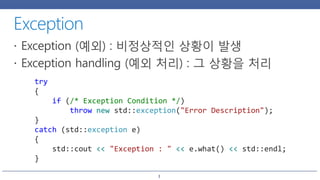
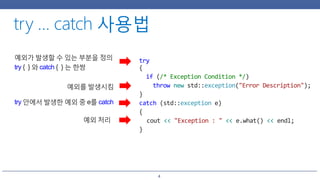
try
{
if (/* ExceptionCondition */)
throw new std::exception("Error Description");
}
catch (std::exception e)
{
cout << "Exception : " << e.what() << endl;
}
예외가 발생할 수 있는 부분을 정의
try { } 와 catch { } 는 한쌍
예외를 발생시킴
try 안에서 발생한 예외 중 e를 catch
예외 처리
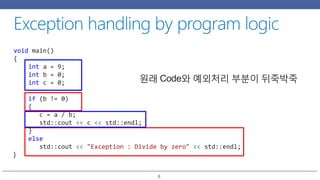
void main()
{
int a= 9;
int b = 0;
int c = 0;
if (b != 0)
{
c = a / b;
std::cout << c << std::endl;
}
else
std::cout << "Exception : Divide by zero" << std::endl;
}
6
원래 Code와 예외처리 부분이 뒤죽박죽
7.
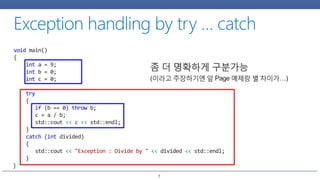
void main()
{
int a= 9;
int b = 0;
int c = 0;
try
{
if (b == 0) throw b;
c = a / b;
std::cout << c << std::endl;
}
catch (int divided)
{
std::cout << "Exception : Divide by " << divided << std::endl;
}
}
7
좀 더 명확하게 구분가능
(이라고 주장하기엔 앞 Page 예제랑 별 차이가…)
8.
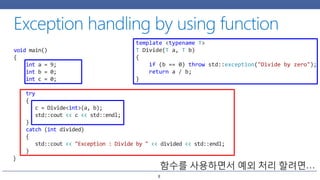
void main()
{
int a= 9;
int b = 0;
int c = 0;
try
{
c = Divide<int>(a, b);
std::cout << c << std::endl;
}
catch (int divided)
{
std::cout << "Exception : Divide by " << divided << std::endl;
}
}
8
함수를 사용하면서 예외 처리 할려면…
template <typename T>
T Divide(T a, T b)
{
if (b == 0) throw std::exception("Divide by zero");
return a / b;
}
9.
9
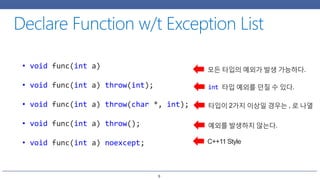
• void func(inta)
• void func(int a) throw(int);
• void func(int a) throw(char *, int);
• void func(int a) throw();
• void func(int a) noexcept;
모든 타입의 예외가 발생 가능하다.
int 타입 예외를 던질 수 있다.
타입이 2가지 이상일 경우는 , 로 나열
예외를 발생하지 않는다.
C++11 Style
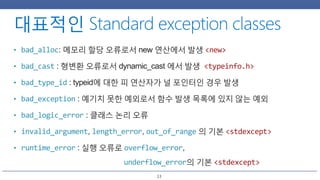
• bad_alloc: 메모리할당 오류로서 new 연산에서 발생 <new>
• bad_cast : 형변환 오류로서 dynamic_cast 에서 발생 <typeinfo.h>
• bad_type_id : typeid에 대한 피 연산자가 널 포인터인 경우 발생
• bad_exception : 예기치 못한 예외로서 함수 발생 목록에 있지 않는 예외
• bad_logic_error : 클래스 논리 오류
• invalid_argument, length_error, out_of_range 의 기본 <stdexcept>
• runtime_error : 실행 오류로 overflow_error,
underflow_error의 기본 <stdexcept>
13



![12
#include <iostream>
#include <new>
void main()
{
char* ptr;
try
{
ptr = new char[(~unsigned int((int)0) / 2) - 1];
delete[] ptr;
}
catch (std::bad_alloc &ba)
{
std::cout << ba.what() << std::endl;
}
}](https://image.slidesharecdn.com/kossacprogramming-13thstudy-exceptionhandling-150531132420-lva1-app6892/85/KOSSA-C-Programming-13th-Study-exception-handling-12-320.jpg)


![[TechDays Korea 2015] 녹슨 C++ 코드에 모던 C++로 기름칠하기](https://cdn.slidesharecdn.com/ss_thumbnails/techdayskorea2015cc-151029112639-lva1-app6891-thumbnail.jpg?width=640&height=640&fit=bounds)


![[C++ Korea] Effective Modern C++ MVA item 8 Prefer nullptr to 0 and null +윤석준](https://cdn.slidesharecdn.com/ss_thumbnails/ckoreaeffectivemoderncmvaitem8prefernullptrro0andnull-150425235944-conversion-gate01-thumbnail.jpg?width=640&height=640&fit=bounds)

![[C++ Korea] Effective Modern C++ MVA item 9 Prefer alias declarations to type...](https://cdn.slidesharecdn.com/ss_thumbnails/ckoreaeffectivemoderncmvaitem9preferaliasdeclarationstotypedefs-150508005758-lva1-app6891-thumbnail.jpg?width=640&height=640&fit=bounds)

![[C++ korea] effective modern c++ study item 7 distinguish between () and {} w...](https://cdn.slidesharecdn.com/ss_thumbnails/ckoreaeffectivemoderncstudyitem7distinguishbetweenandwhencreatingobjects-150208064740-conversion-gate02-thumbnail.jpg?width=640&height=640&fit=bounds)


![[C++ Korea] Effective Modern C++ mva item 7 distinguish between and {} when c...](https://cdn.slidesharecdn.com/ss_thumbnails/ckoreaeffectivemoderncmvaitem7distinguishbetweenandwhencreatingobjects-150424205331-conversion-gate01-thumbnail.jpg?width=640&height=640&fit=bounds)
![[C++ korea] effective modern c++ study item8~10 정은식](https://cdn.slidesharecdn.com/ss_thumbnails/ckoreaeffectivemoderncstudyitem810-150212011135-conversion-gate01-thumbnail.jpg?width=640&height=640&fit=bounds)


![[C++ Korea 2nd Seminar] C++17 Key Features Summary](https://cdn.slidesharecdn.com/ss_thumbnails/ckorea2ndseminarc17keyfeaturessummary-publish-160529025757-thumbnail.jpg?width=640&height=640&fit=bounds)


![[C++ korea] effective modern c++ study item 14 declare functions noexcept if ...](https://cdn.slidesharecdn.com/ss_thumbnails/ckoreaeffectivemoderncstudyitem14declarefunctionsnoexceptiftheywontemitexceptions-150211183552-conversion-gate02-thumbnail.jpg?width=640&height=640&fit=bounds)

![[Td 2015]녹슨 c++ 코드에 모던 c++로 기름칠하기(옥찬호)](https://cdn.slidesharecdn.com/ss_thumbnails/td2015cc-151104051810-lva1-app6891-thumbnail.jpg?width=640&height=640&fit=bounds)


![[2015-07-20-윤석준] Oracle 성능 관리 2](https://cdn.slidesharecdn.com/ss_thumbnails/2015-07-20-oracle2-150727235547-lva1-app6892-thumbnail.jpg?width=640&height=640&fit=bounds)
![[2015-07-10-윤석준] Oracle 성능 관리 & v$sysstat](https://cdn.slidesharecdn.com/ss_thumbnails/2015-07-10-oraclevsysstat-150709064246-lva1-app6891-thumbnail.jpg?width=640&height=640&fit=bounds)
![[2015 07-06-윤석준] Oracle 성능 최적화 및 품질 고도화 4](https://cdn.slidesharecdn.com/ss_thumbnails/2015-07-06-oracle4-150702090606-lva1-app6891-thumbnail.jpg?width=640&height=640&fit=bounds)
