Knowledge
Management Needs
in Prescription-
Medication Process
Allahyari Nooshin, Das Aby.
March 30, 2011 1
Agenda
•The Current Process
•Knowledge Identification
•Portfolio of Systems
•Selected Portfolio
•Modeling and Analysis of KM Information Technologies
•Role of Ontologies
2
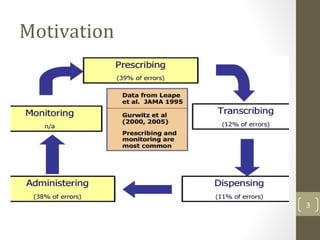
Motivation
3
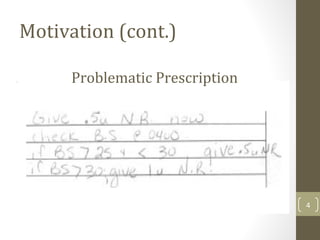
Motivation (cont.)
4
Problematic Prescription
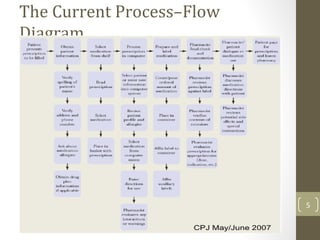
The Current Process–Flow
Diagram
5
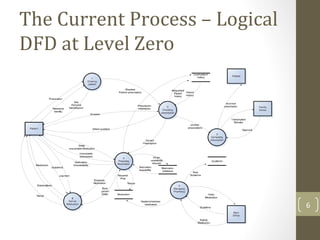
The Current Process – Logical
DFD at Level Zero
6
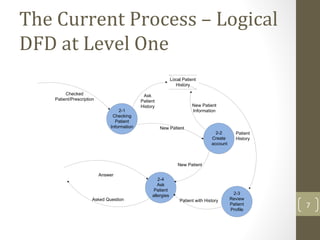
The Current Process – Logical
DFD at Level One
Checked
Patient/Prescription
2-1
Checking
Patient
Information
2-2
Create
account
Local Patient
History
Ask
Patient
History
New Patient
New Patient
Information
Patient
History
2-3
Review
Patient
Profile
2-4
Ask
Patient
allergies
New Patient
Asked Question
Answer
Patient with History
7
4-1
Process
Prescription
In Computer
4-4
Labling
4-5
Counting
4-3
Generating
Lable
4-6
Final
Checklist
Documentation
4-2
Checking
Availability
Medication
Database
Medication
Local
Patient history
Request
Required
Medication
Prescription
Information
New
prescription
Information
Prescription
Information
Lable
Counted
Medication
Labelled
Bottle
Correct
prescription
Replenished/new
Medication
Dispense
medication
Order
Unavailable
Medication
Unavailable
prescription
Medication
Availability
Request
Medication
Availibility
Book
Patient
Order
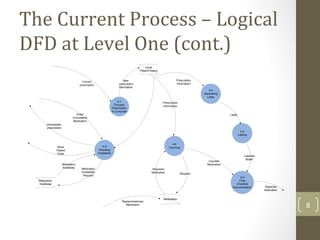
The Current Process – Logical
DFD at Level One (cont.)
8
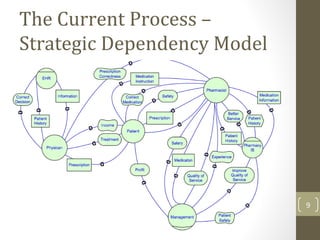
The Current Process –
Strategic Dependency Model
9
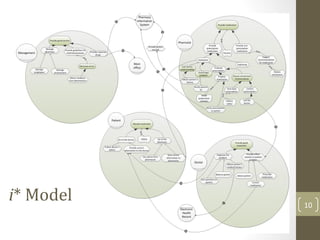
i* Model 10
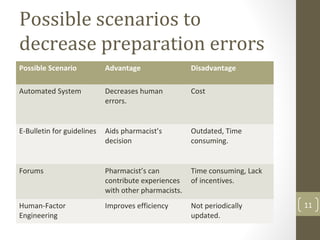
Possible scenarios to
decrease preparation errors
Possible Scenario Advantage Disadvantage
Automated System Decreases human
errors.
Cost
E-Bulletin for guidelines Aids pharmacist’s
decision
Outdated, Time
consuming.
Forums Pharmacist’s can
contribute experiences
with other pharmacists.
Time consuming, Lack
of incentives.
Human-Factor
Engineering
Improves efficiency Not periodically
updated.
11
But preparation depends on
the pharmacist …
12
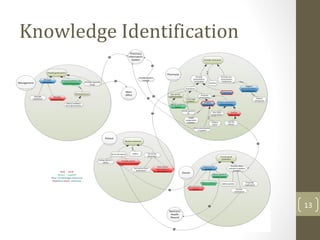
Knowledge Identification
13
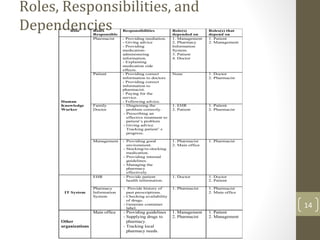
Roles, Responsibilities, and
DependenciesRole Roles
Responsible
Responsibilities Role(s)
depended on
Roles(s) that
depend on
Human
Knowledge
Worker
Pharmacist - Providing mediation.
- Giving advice
- Providing
medication-
administering
information.
- Explaining
medication side
effects.
1. Management
2. Pharmacy
Information
System.
3. Patient
4. Doctor
1. Patient
2. Management
Patient - Providing correct
information to doctors
- Providing correct
information to
pharmacist.
- Paying for the
service.
- Following advice.
None 1. Doctor
2. Pharmacist
Family
Doctor
- Diagnosing the
problem correctly.
- Prescribing an
effective treatment to
patient’s problem
- Giving advice
- Tracking patient’ s
progress.
1. EHR
2. Patient
1. Patient
2. Pharmacist
Management - Providing good
environment.
- Stocking/re-stocking
medication.
- Providing internal
guidelines.
- Managing the
pharmacy
effectively.
1. Pharmacist
2. Main office
1. Pharmacist
IT System
EHR - Provide patient
health information.
1. Doctor 1. Doctor
2. Patient
Pharmacy
Information
System
- Provide history of
past prescriptions.
- Checking availability
of drugs.
- Generate container
label.
1. Pharmacist 1. Pharmacist
2. Main office
Other
organizations
Main office - Providing guidelines
- Supplying drugs to
pharmacy.
- Tracking local
pharmacy needs.
1. Management
2. Pharmacist
1. Patient
2. Management
14
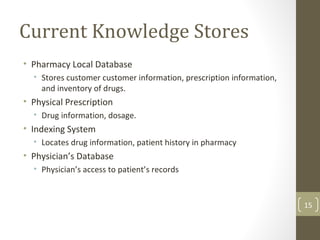
Current Knowledge Stores
• Pharmacy Local Database
• Stores customer customer information, prescription information,
and inventory of drugs.
• Physical Prescription
• Drug information, dosage.
• Indexing System
• Locates drug information, patient history in pharmacy
• Physician’s Database
• Physician’s access to patient’s records
15
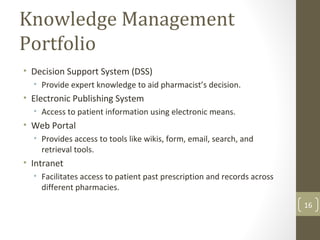
Knowledge Management
Portfolio
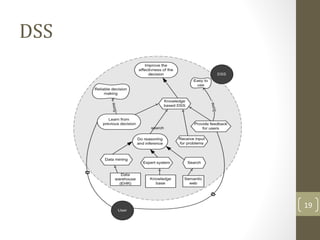
• Decision Support System (DSS)
• Provide expert knowledge to aid pharmacist’s decision.
• Electronic Publishing System
• Access to patient information using electronic means.
• Web Portal
• Provides access to tools like wikis, form, email, search, and
retrieval tools.
• Intranet
• Facilitates access to patient past prescription and records across
different pharmacies.
16
Selected Portfolio
• Decision Support System (DSS)
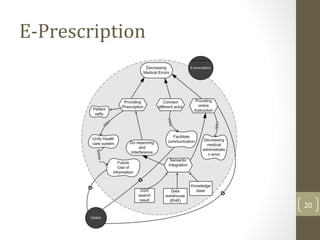
• Electronic-Prescription (EP or E-Prescription)
(combines with Electronic Publishing System)
17
Modeling and Analysis of
Selected KM Technologies
18
DSS
19
E-Prescription
20
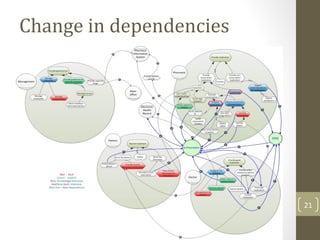
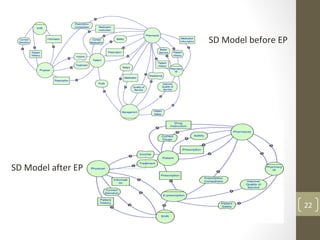
Change in dependencies
21
SD Model before EP
SD Model after EP
22
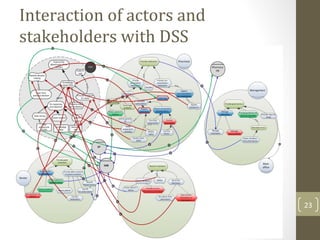
Interaction of actors and
stakeholders with DSS
23
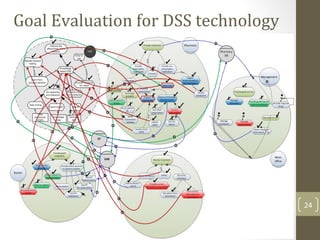
Goal Evaluation for DSS technology
24
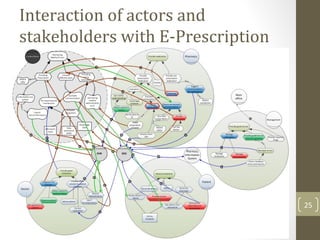
Interaction of actors and
stakeholders with E-Prescription
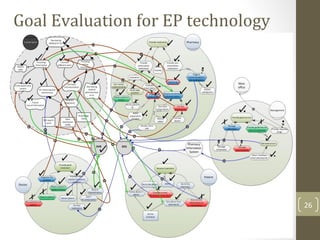
25
Goal Evaluation for EP technology
26
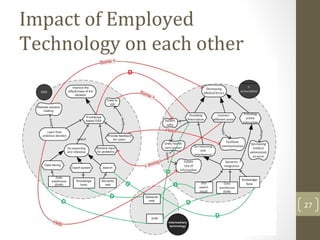
Impact of Employed
Technology on each other
27
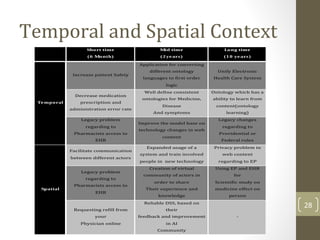
Temporal and Spatial Context
Short time
(6 Month)
Mid time
(2years)
Long time
(10 years)
Temporal
Increase patient Safety
Application for converting
different ontology
languages to first order
logic
Unify Electronic
Health Care System
Decrease medication
prescription and
administration error rate
Well define consistent
ontologies for Medicine,
Disease
And symptoms
Ontology which has a
ability to learn from
content(ontology
learning)
Legacy problem
regarding to
Pharmacists access to
EHR
Improve the model base on
technology changes in web
content
Legacy changes
regarding to
Providential or
Federal rules
Spatial
Facilitate communication
between different actors
Expanded usage of a
system and train involved
people in new technology
Privacy problem in
web content
regarding to EP
Legacy problem
regarding to
Pharmacists access to
EHR
Creation of virtual
community of actors in
order to share
Their experience and
knowledge
Using EP and EHR
for
Scientific study on
medicine effect on
person
Requesting refill from
your
Physician online
Reliable DSS, based on
their
feedback and improvement
in AI
Community
-
28
Role of ontologies
29
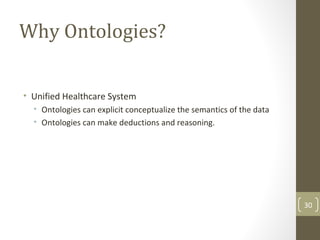
Why Ontologies?
• Unified Healthcare System
• Ontologies can explicit conceptualize the semantics of the data
• Ontologies can make deductions and reasoning.
30
What do ontologies do?
• Ontology application are classified into:
• Semantic integration
• Search
• Decision Support System(DSS).
31
32
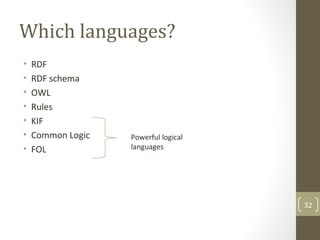
Which languages?
• RDF
• RDF schema
• OWL
• Rules
• KIF
• Common Logic
• FOL
Powerful logical
languages
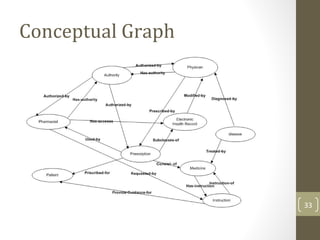
Conceptual Graph
33
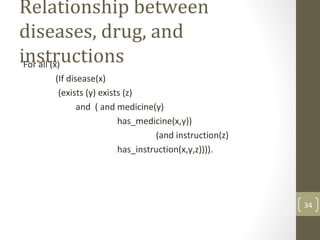
Relationship between
diseases, drug, and
instructionsFor all (x)
(If disease(x)
(exists (y) exists (z)
and ( and medicine(y)
has_medicine(x,y))
(and instruction(z)
has_instruction(x,y,z)))).
34
35
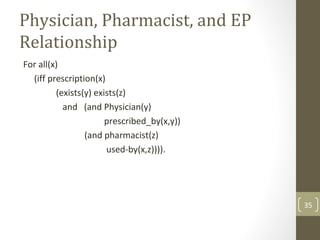
Physician, Pharmacist, and EP
Relationship
For all(x)
(iff prescription(x)
(exists(y) exists(z)
and (and Physician(y)
prescribed_by(x,y))
(and pharmacist(z)
used-by(x,z)))).
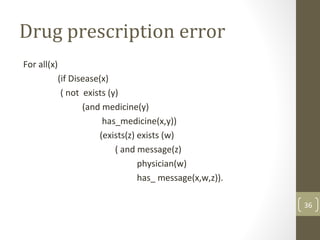
36
Drug prescription error
For all(x)
(if Disease(x)
( not exists (y)
(and medicine(y)
has_medicine(x,y))
(exists(z) exists (w)
( and message(z)
physician(w)
has_ message(x,w,z)).
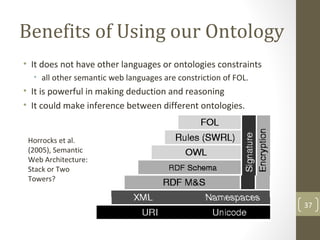
37
Benefits of Using our Ontology
• It does not have other languages or ontologies constraints
• all other semantic web languages are constriction of FOL.
• It is powerful in making deduction and reasoning
• It could make inference between different ontologies.
Horrocks et al.
(2005), Semantic
Web Architecture:
Stack or Two
Towers?
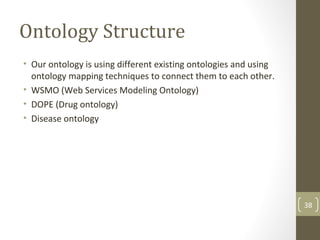
38
Ontology Structure
• Our ontology is using different existing ontologies and using
ontology mapping techniques to connect them to each other.
• WSMO (Web Services Modeling Ontology)
• DOPE (Drug ontology)
• Disease ontology
39
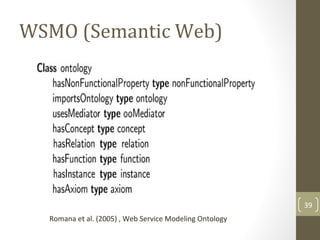
WSMO (Semantic Web)
Romana et al. (2005) , Web Service Modeling Ontology
Questions?
40
Thank You!
41

Knowledge managementneedsinprescriptionmedicationprocess

Editor's Notes

  • #7 Little connection between doctor and pharmacist. Patient and doctors are external entities and thus we can’t show the relationship.
  • #8 Local database, Patient has to request a transfer of record between pharmacies.
  • #9 We can bring in human-factor engineering like e-bulletin etc, to decrease the errors.
  • #10 Physican – patient – pharmacist – and management are related to each other- within a system Point: We
  • #11 List of Roles, responsibilities and dependencies
  • #12 Pharmacist’s don’t have a way to track errors (bug-tracking).
  • #14 Management and Pharmacist are connected together. – So management is out of the system. Most tacit/knowledge intensive part is between pharmacist-doctor –patient. Prescrption errors occur during communication between these three actors.
  • #18 EP – combination of a Web Portal and Electronic Publishing System.