KNOWLEDGE MANAGEMENT
Knowledge and information have become the medium that defines the success
or failure of business in government and private sector. Effective management of
knowledge and information represents the primary opportunity for achieving
substantial savings, significant improvements in human performance, and
competitive advantage.
It is not just a business problem for the biggest companies or governments. Small
companies also need formal approaches to knowledge management even more,
because they don't have the market leverage, inertia, and resources that these
big companies do. Small companies need to be much more flexible, more
responsive, and more "right" (make better decisions) - because even small
mistakes can be fatal to them.
Implementing knowledge solutions in a modern world where everybody is
bombarded by constant change is a challenge in itself. If managed properly with
the least amount of change and by accepting current work methods and tools,
new solutions can be implemented successfully.
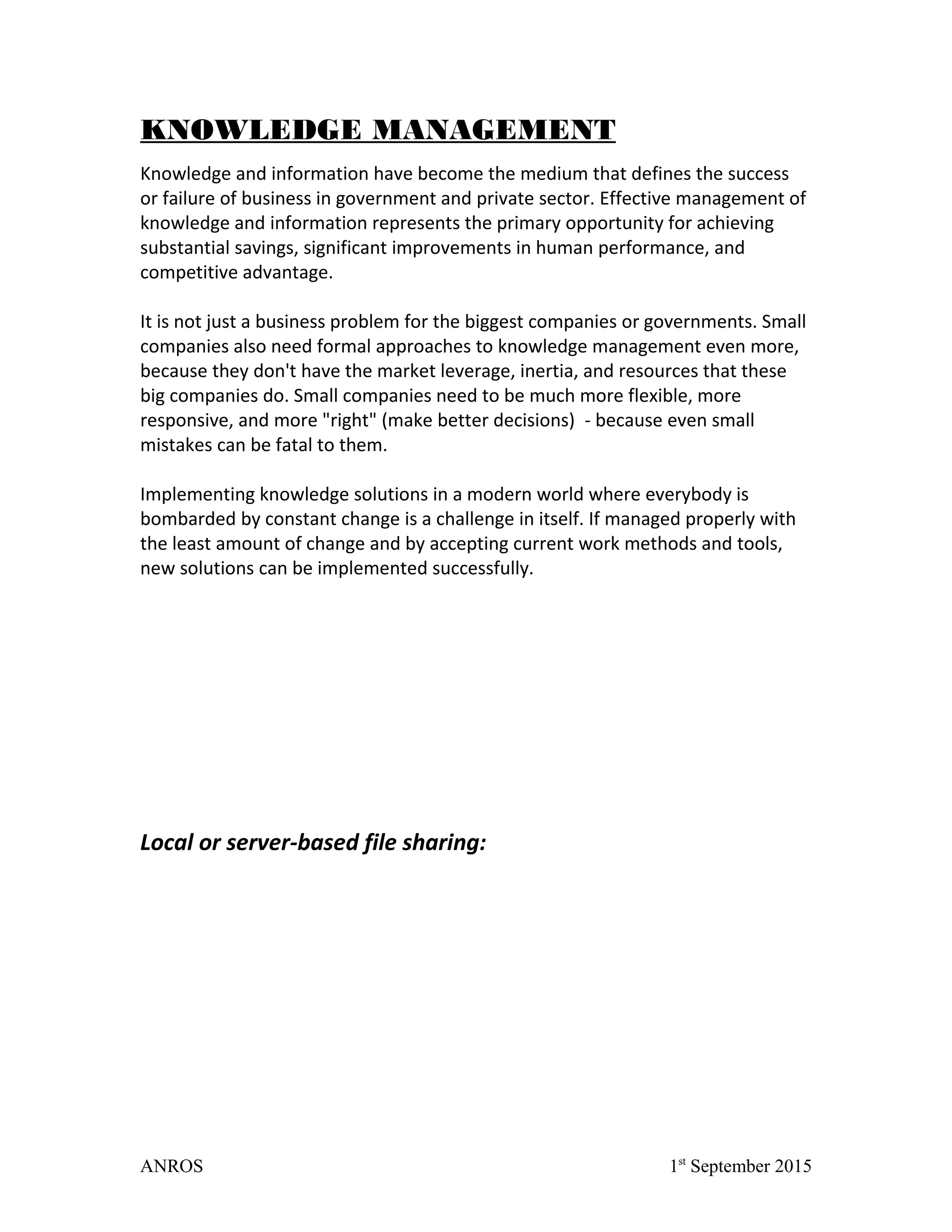
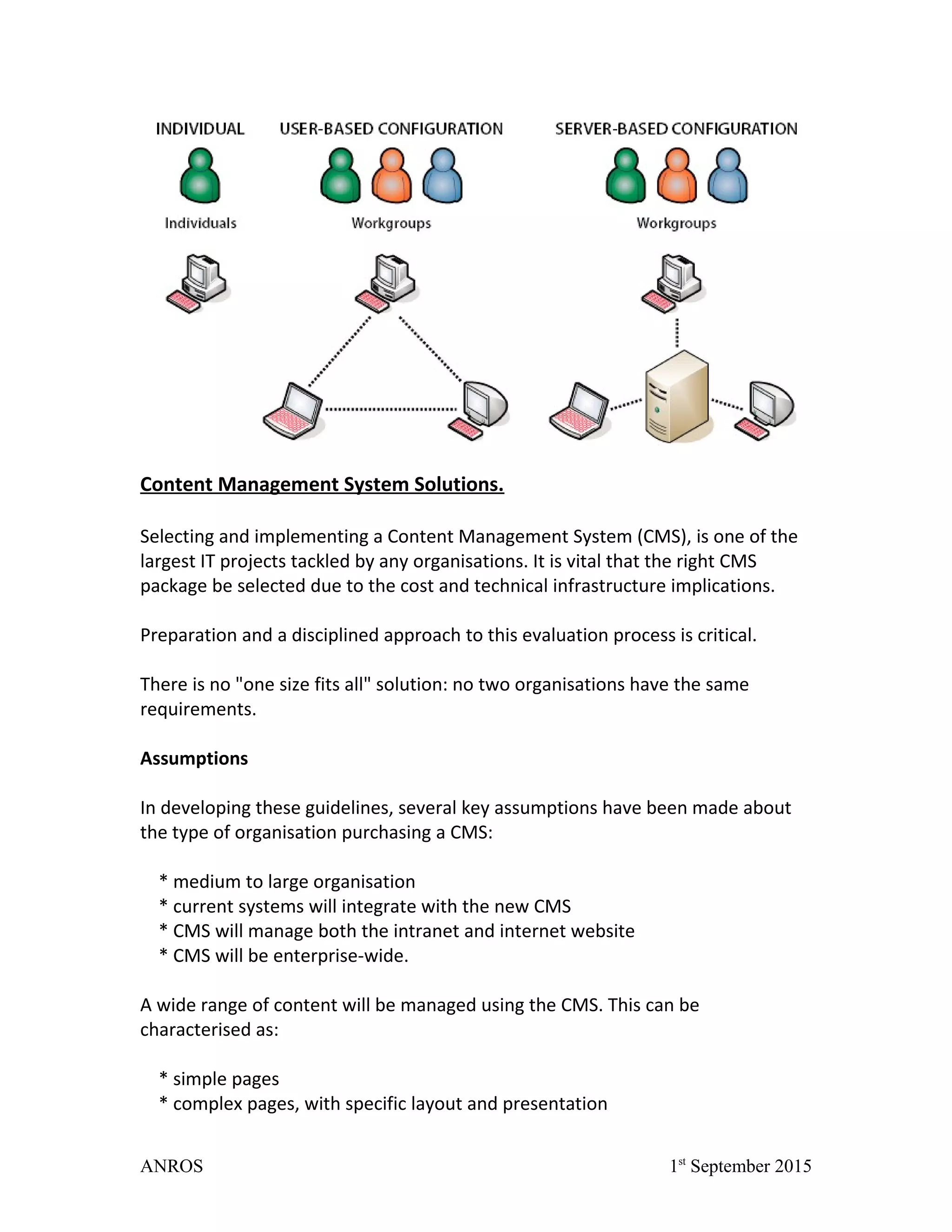
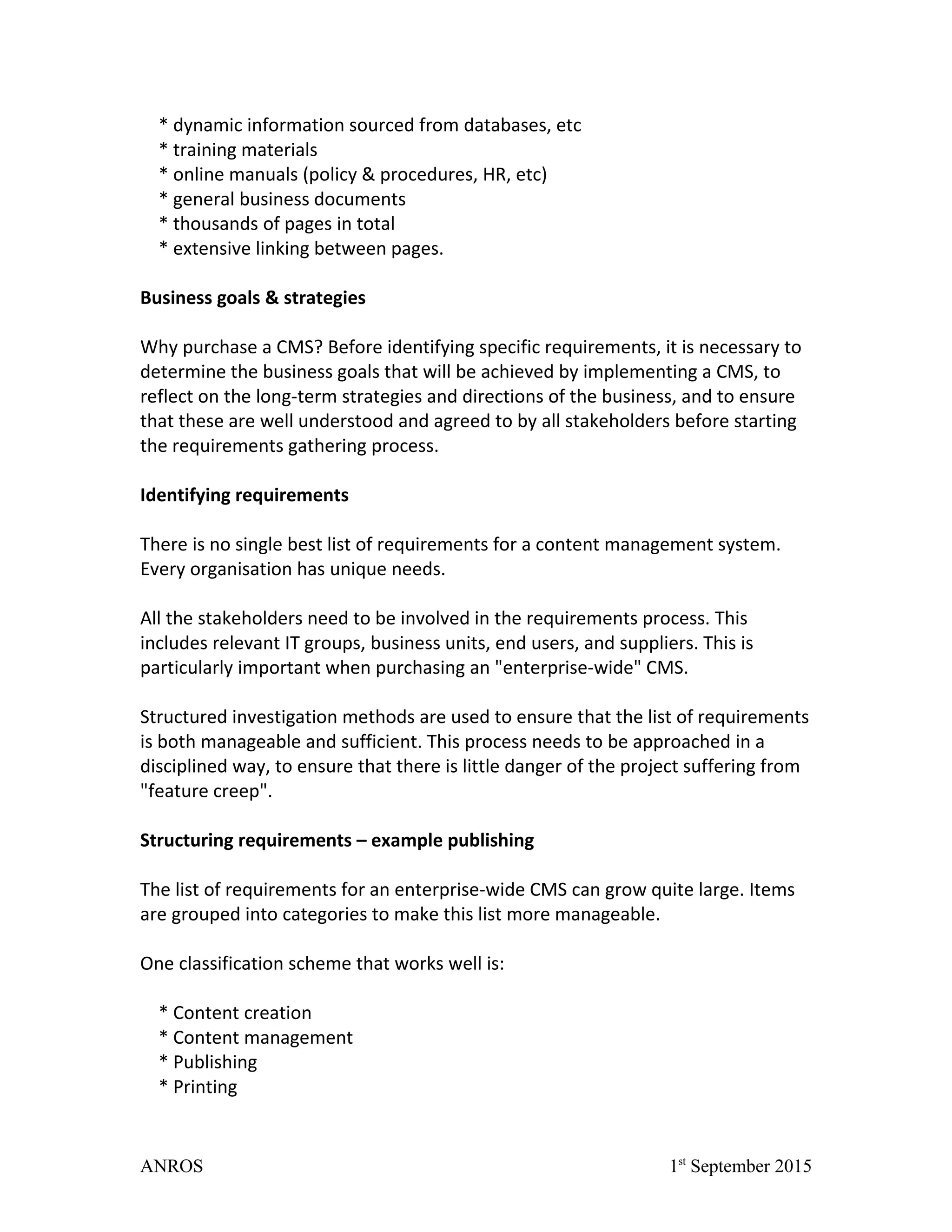
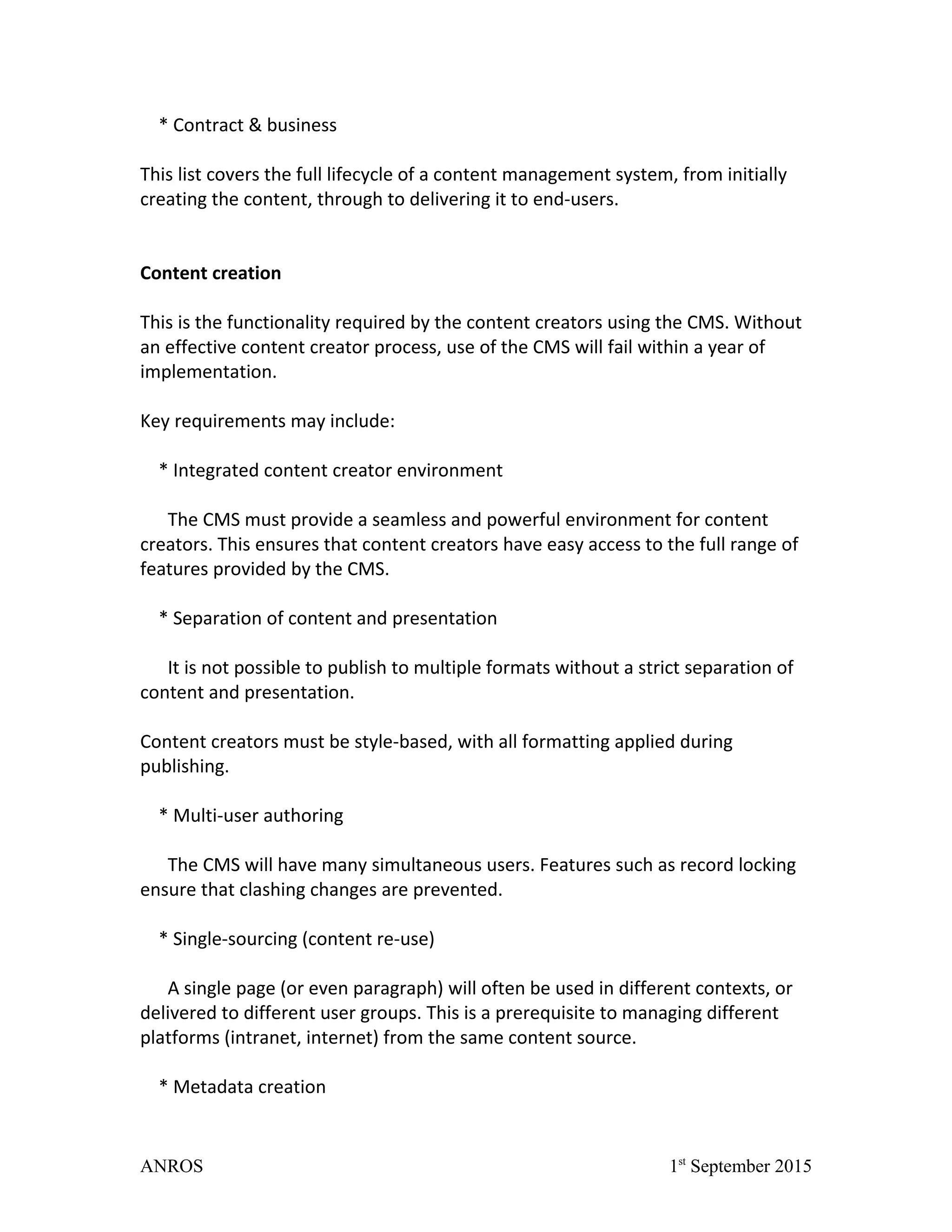
Local or server-based file sharing:
ANROS 1st
September 2015
Content Management System Solutions.
Selecting and implementing a Content Management System (CMS), is one of the
largest IT projects tackled by any organisations. It is vital that the right CMS
package be selected due to the cost and technical infrastructure implications.
Preparation and a disciplined approach to this evaluation process is critical.
There is no "one size fits all" solution: no two organisations have the same
requirements.
Assumptions
In developing these guidelines, several key assumptions have been made about
the type of organisation purchasing a CMS:
* medium to large organisation
* current systems will integrate with the new CMS
* CMS will manage both the intranet and internet website
* CMS will be enterprise-wide.
A wide range of content will be managed using the CMS. This can be
characterised as:
* simple pages
* complex pages, with specific layout and presentation
ANROS 1st
September 2015
* dynamic information sourced from databases, etc
* training materials
* online manuals (policy & procedures, HR, etc)
* general business documents
* thousands of pages in total
* extensive linking between pages.
Business goals & strategies
Why purchase a CMS? Before identifying specific requirements, it is necessary to
determine the business goals that will be achieved by implementing a CMS, to
reflect on the long-term strategies and directions of the business, and to ensure
that these are well understood and agreed to by all stakeholders before starting
the requirements gathering process.
Identifying requirements
There is no single best list of requirements for a content management system.
Every organisation has unique needs.
All the stakeholders need to be involved in the requirements process. This
includes relevant IT groups, business units, end users, and suppliers. This is
particularly important when purchasing an "enterprise-wide" CMS.
Structured investigation methods are used to ensure that the list of requirements
is both manageable and sufficient. This process needs to be approached in a
disciplined way, to ensure that there is little danger of the project suffering from
"feature creep".
Structuring requirements – example publishing
The list of requirements for an enterprise-wide CMS can grow quite large. Items
are grouped into categories to make this list more manageable.
One classification scheme that works well is:
* Content creation
* Content management
* Publishing
* Printing
ANROS 1st
September 2015
* Contract & business
This list covers the full lifecycle of a content management system, from initially
creating the content, through to delivering it to end-users.
Content creation
This is the functionality required by the content creators using the CMS. Without
an effective content creator process, use of the CMS will fail within a year of
implementation.
Key requirements may include:
* Integrated content creator environment
The CMS must provide a seamless and powerful environment for content
creators. This ensures that content creators have easy access to the full range of
features provided by the CMS.
* Separation of content and presentation
It is not possible to publish to multiple formats without a strict separation of
content and presentation.
Content creators must be style-based, with all formatting applied during
publishing.
* Multi-user authoring
The CMS will have many simultaneous users. Features such as record locking
ensure that clashing changes are prevented.
* Single-sourcing (content re-use)
A single page (or even paragraph) will often be used in different contexts, or
delivered to different user groups. This is a prerequisite to managing different
platforms (intranet, internet) from the same content source.
* Metadata creation
ANROS 1st
September 2015
Capturing metadata (creator, subject, keywords, keyword indexes, subject
taxonomies and topic maps) is critical when managing a large content repository.
* Powerful linking
Content creators will create many cross-links between pages, and these must be
stable against restructuring.
* Non-technical authoring
Content creators should not be required to use HTML (or other technical
knowledge) when creating pages.
* Ease of use & efficiency
For a CMS to be successful, it must be easy to create and maintain content.
Content management
The core of most CMS solutions is a central repository, supported by a range of
tools for manipulating and managing the content.
Key requirements may include:
* Version control & archiving
Strict version control is necessary for legal accountability, backup and disaster
recovery. A simple but powerful interface must be provided for these features.
* Workflow
Decentralised content creation relies heavily on a powerful workflow model
that can be easily customised, and is resilient against organisational change.
Understand the needs of content creators (they will be doing all the hard work):
* Security
Adequate security levels and audit trails must be in place to protect the
ANROS 1st
September 2015
integrity of the content.
* Integration with external systems
A CMS is typically only one of a number of systems used to present
information on the intranet or website.
An enterprise-wide CMS will only be successful if it can be cleanly integrated
with existing business systems.
The mechanisms for achieving this must be fully documented, and based on
open or industry standards.
* Reporting
The CMS must provide an extensive range of reports, for both users and
administrators. Ideally, the system should pro- actively report on any issues that
arise.
Support for customised reporting is also desirable.
An enterprise-wide CMS will fail unless all stakeholders are involved from the
outset
Publishing
The publishing engine takes the content stored in the repository, and generates
the final pages. While this may be a dynamic or batch process, the same basic
requirements apply. Key requirements may include:
* Style-sheets
Final appearance is controlled through the use of style-sheets. This provides
flexibility and expandability.
* Page templates
Overall page layout is specified via page templates. Ideally, a non-technical
interface should be provided for managing this.
ANROS 1st
September 2015
* Extensibility
It must be simple to integrate code "snippets" (or equivalent) to provide
additional publishing functionality. The CMS must support a process of "continual
improvement" in interface design.
* Support for multiple formats
The CMS must publish to multiple formats, such as: HTML (web), printed, PDF,
hand-held (WAP), and more.
It should be possible to add support for additional formats, which will be
necessary as new standards evolve.
In order to achieve high quality in every format, it is critical that the content
be separated from presentation at the time of authoring. This allows distinct
style-sheets to be used for each output.
The most important part of a CMS is the content itself
* Personalisation
Different information is presented based on either user profiles, or metadata
in the source content. This is typically required for large "portal" websites.
* Usage statistics
The CMS must allow comprehensive usage statistics to be gathered, including:
most popular pages, daily usage, and search engine usage.
This information allows the success of the site to be tracked, and any usability
issues identified.
Presentation
The published pages must meet certain standards if they are to be of value to
your users. It is important to specify these requirements if you are asking the
vendor to design the appearance and layout of the web pages.
Key requirements may include:
ANROS 1st
September 2015
* Usability
This covers aspects such as ease of use, learn-ability and efficiency. Usability
can be assured by conducting tests on the prototype designs with real users.
* Usability heuristics (guidelines) must also be followed.
* Accessibility
The CMS must conform to standards such as the W3C Web Accessibility
Initiative (WAI).
* Cross browser support
The pages must be viewable in all major web browsers (Internet Explorer,
Firefox, etc). Specify which browser versions are to be supported.
* Limited client-side functionality
You may wish to limit which client-side technologies (Java, JavaScript, Flash,
etc) are required to view the site. This is more important for a website than an
intranet.
* Speed
Page size must be limited to ensure that load times are acceptable for users.
Specify the typical user access methods (LAN, modem, cable, etc).
* Valid HTML
All pages must conform to the current HTML specification. This ensures
maximum compatibility across browsers and platforms.
* Effective navigation
Users must be provided with consistent, comprehensive and usable
navigation aids.
* Metadata
ANROS 1st
September 2015
All pages must provide sufficient metadata to allow effective indexing and
searching. This should conform to a standard.
The total cost of running a CMS includes the skills and resources needed
within your business, not just the monetary values
Contract & business
Project management and business requirements must also be satisfied in a CMS
project.
Key requirements may include:
* Training
The vendor must list the training materials that exist for the CMS, and the
training services that they can provide.
* Documentation
The CMS must be supported by adequate documentation: for users,
administrators and developers.
* Warranty
The warranty period provided, once the software has been purchased.
* Maintenance agreements
The vendor must outline their preferred support arrangements, including
service level agreements and upgrade processes.
* Resources required
The hardware, software and operating systems required by the CMS.
* Skills required
What skills and knowledge will be required within your organisation to
ANROS 1st
September 2015
customise and maintain the CMS?
* Cost
Both the fixed costs for the CMS, and the per-user ("per-seat") costs. The
latter is generally more significant for a large organisation.
* Scalability
The load levels that the CMS supports, and the additional resources
(hardware & software) required for increased usage.
* IT constraints
Specify any pre-existing hardware or software that the CMS must interface
with, or run on. This includes specific operating systems, databases or
webservers.
* Reference sites
The vendor must supply a number of sites where the software has been
successfully implemented. These should match the characteristics of your
organisation.
Avoid jargon, as there is little common understanding of content
management terms
Some tips
When developing your list of requirements, keep these guidelines in mind:
* Understand your content
Conduct a thorough survey of the information that is to be published via the
CMS. The nature of this content will influence the functionality required.
It is important not to lose sight of the content when selecting the content
management system requirements.
* Relate to business needs
ANROS 1st
September 2015
Every requirement must be associated with one or more business needs. This
allows you to identify the reasons for the requirements, and to prioritise them.
* Avoid technical details
Ensure you specify business needs, not implementation details. A vendor
should be free to propose any methods or technologies that are able to meet
your goals.
Again avoid jargon, as there is little common understanding of content
management terms
* Provide descriptions
Your challenge is to make your needs understood, despite differences in a
vendor background and understanding. Avoid using jargon terms, and spell out
your requirements in as much detail as possible.
* Use examples
Examples provide concrete situations and business needs, and are an effective
way of supporting your requirements. Use wherever possible.
* More not less
It is better to have too many requirements than too few. The CMS must work
for your entire business for several years at least: do not be surprised if the final
list of requirements is long.
Evaluating the product need
Once your requirements have been identified, these must be used to select the
preferred solution from the vendor.
Conclusion
Selecting an enterprise-wide CMS is often a multi-million-Rand exercise. It is
therefore critical that the new system meets your current and projected needs.
ANROS 1st
September 2015
The single most important activity is to identify your business goals and
requirements. This process must involve all relevant stakeholders.
Only once you have a full list of requirements are you in a position to compare
vendor products.
Spending time on these initial phases reduces the business risks inherent in
purchasing a CMS. The project is also likely to be more successful (it will do what
the users need), and development efforts will be reduced (goals are clear).
In terms of the Pearson Global Content Management initiative, this project is
massive, it will take many more years to resolve and will cost millions of dollars.
The reality is that every government and every business needs to recognise the
urgent need to engage in a similar process to find a content management
solution no matter how small or big or how costly.
One only has to research the American governments attempt 10 years ago to
establish the enormity of the challenge. In short they established that to
electronically archive only 5% of the most critical historical American
documentation would take about 50 years and would cost billions of dollars.
The challenge is two-fold: old documents and old electronic data + current and
future documents and electronic data. This is a parallel process of information
gathering and capturing into a content management system.
The current and future data is more easily manageable. However, the historical
documents and data is where the main challenge lies.
In the very near future the only way to access, engage with, and react to
government or business critical information will be predominately restricted to
electronic communication methods –Internet, Intranet, mobile, Wi-Fi, LAN, WAN,
Web2, and so forth.
About the content:
Anthony Dew worked for Maskew Miller Longman, a subsidiary of Pearson
Plc, the largest publishing group in the world. One of his mandates was to lead
the Content Management Project in Southern Africa in conjunction with the
Pearson Global Content Management Initiative.
ANROS 1st
September 2015
He spent 5 years working closely with global peers from the Pearson group
in the USA, UK, Europe, Asia, Africa, and Australia. He also spent time travelling
to other countries that are leaders in IT solutions with the main focus being India.
He has a good understanding of the technology of computer hardware,
software programs, and the wider technology that is being used, but more
critically is that he has accumulated 5 years of content management solutions
based knowledge while working with some of the best IT professionals in the
global content management arena.
He is passionate about informing governments and business alike of the
pending dangers of not acknowledging the critical need for securing their
intellectual property in a content management solution.
He is contactable at:
Email: anthonydew@outlook.com
ANROS 1st
September 2015

Knowledge Management and Intellectual Property

  • 1.
    KNOWLEDGE MANAGEMENT Knowledge andinformation have become the medium that defines the success or failure of business in government and private sector. Effective management of knowledge and information represents the primary opportunity for achieving substantial savings, significant improvements in human performance, and competitive advantage. It is not just a business problem for the biggest companies or governments. Small companies also need formal approaches to knowledge management even more, because they don't have the market leverage, inertia, and resources that these big companies do. Small companies need to be much more flexible, more responsive, and more "right" (make better decisions) - because even small mistakes can be fatal to them. Implementing knowledge solutions in a modern world where everybody is bombarded by constant change is a challenge in itself. If managed properly with the least amount of change and by accepting current work methods and tools, new solutions can be implemented successfully. Local or server-based file sharing: ANROS 1st September 2015
  • 2.
    Content Management SystemSolutions. Selecting and implementing a Content Management System (CMS), is one of the largest IT projects tackled by any organisations. It is vital that the right CMS package be selected due to the cost and technical infrastructure implications. Preparation and a disciplined approach to this evaluation process is critical. There is no "one size fits all" solution: no two organisations have the same requirements. Assumptions In developing these guidelines, several key assumptions have been made about the type of organisation purchasing a CMS: * medium to large organisation * current systems will integrate with the new CMS * CMS will manage both the intranet and internet website * CMS will be enterprise-wide. A wide range of content will be managed using the CMS. This can be characterised as: * simple pages * complex pages, with specific layout and presentation ANROS 1st September 2015
  • 3.
    * dynamic informationsourced from databases, etc * training materials * online manuals (policy & procedures, HR, etc) * general business documents * thousands of pages in total * extensive linking between pages. Business goals & strategies Why purchase a CMS? Before identifying specific requirements, it is necessary to determine the business goals that will be achieved by implementing a CMS, to reflect on the long-term strategies and directions of the business, and to ensure that these are well understood and agreed to by all stakeholders before starting the requirements gathering process. Identifying requirements There is no single best list of requirements for a content management system. Every organisation has unique needs. All the stakeholders need to be involved in the requirements process. This includes relevant IT groups, business units, end users, and suppliers. This is particularly important when purchasing an "enterprise-wide" CMS. Structured investigation methods are used to ensure that the list of requirements is both manageable and sufficient. This process needs to be approached in a disciplined way, to ensure that there is little danger of the project suffering from "feature creep". Structuring requirements – example publishing The list of requirements for an enterprise-wide CMS can grow quite large. Items are grouped into categories to make this list more manageable. One classification scheme that works well is: * Content creation * Content management * Publishing * Printing ANROS 1st September 2015
  • 4.
    * Contract &business This list covers the full lifecycle of a content management system, from initially creating the content, through to delivering it to end-users. Content creation This is the functionality required by the content creators using the CMS. Without an effective content creator process, use of the CMS will fail within a year of implementation. Key requirements may include: * Integrated content creator environment The CMS must provide a seamless and powerful environment for content creators. This ensures that content creators have easy access to the full range of features provided by the CMS. * Separation of content and presentation It is not possible to publish to multiple formats without a strict separation of content and presentation. Content creators must be style-based, with all formatting applied during publishing. * Multi-user authoring The CMS will have many simultaneous users. Features such as record locking ensure that clashing changes are prevented. * Single-sourcing (content re-use) A single page (or even paragraph) will often be used in different contexts, or delivered to different user groups. This is a prerequisite to managing different platforms (intranet, internet) from the same content source. * Metadata creation ANROS 1st September 2015
  • 5.
    Capturing metadata (creator,subject, keywords, keyword indexes, subject taxonomies and topic maps) is critical when managing a large content repository. * Powerful linking Content creators will create many cross-links between pages, and these must be stable against restructuring. * Non-technical authoring Content creators should not be required to use HTML (or other technical knowledge) when creating pages. * Ease of use & efficiency For a CMS to be successful, it must be easy to create and maintain content. Content management The core of most CMS solutions is a central repository, supported by a range of tools for manipulating and managing the content. Key requirements may include: * Version control & archiving Strict version control is necessary for legal accountability, backup and disaster recovery. A simple but powerful interface must be provided for these features. * Workflow Decentralised content creation relies heavily on a powerful workflow model that can be easily customised, and is resilient against organisational change. Understand the needs of content creators (they will be doing all the hard work): * Security Adequate security levels and audit trails must be in place to protect the ANROS 1st September 2015
  • 6.
    integrity of thecontent. * Integration with external systems A CMS is typically only one of a number of systems used to present information on the intranet or website. An enterprise-wide CMS will only be successful if it can be cleanly integrated with existing business systems. The mechanisms for achieving this must be fully documented, and based on open or industry standards. * Reporting The CMS must provide an extensive range of reports, for both users and administrators. Ideally, the system should pro- actively report on any issues that arise. Support for customised reporting is also desirable. An enterprise-wide CMS will fail unless all stakeholders are involved from the outset Publishing The publishing engine takes the content stored in the repository, and generates the final pages. While this may be a dynamic or batch process, the same basic requirements apply. Key requirements may include: * Style-sheets Final appearance is controlled through the use of style-sheets. This provides flexibility and expandability. * Page templates Overall page layout is specified via page templates. Ideally, a non-technical interface should be provided for managing this. ANROS 1st September 2015
  • 7.
    * Extensibility It mustbe simple to integrate code "snippets" (or equivalent) to provide additional publishing functionality. The CMS must support a process of "continual improvement" in interface design. * Support for multiple formats The CMS must publish to multiple formats, such as: HTML (web), printed, PDF, hand-held (WAP), and more. It should be possible to add support for additional formats, which will be necessary as new standards evolve. In order to achieve high quality in every format, it is critical that the content be separated from presentation at the time of authoring. This allows distinct style-sheets to be used for each output. The most important part of a CMS is the content itself * Personalisation Different information is presented based on either user profiles, or metadata in the source content. This is typically required for large "portal" websites. * Usage statistics The CMS must allow comprehensive usage statistics to be gathered, including: most popular pages, daily usage, and search engine usage. This information allows the success of the site to be tracked, and any usability issues identified. Presentation The published pages must meet certain standards if they are to be of value to your users. It is important to specify these requirements if you are asking the vendor to design the appearance and layout of the web pages. Key requirements may include: ANROS 1st September 2015
  • 8.
    * Usability This coversaspects such as ease of use, learn-ability and efficiency. Usability can be assured by conducting tests on the prototype designs with real users. * Usability heuristics (guidelines) must also be followed. * Accessibility The CMS must conform to standards such as the W3C Web Accessibility Initiative (WAI). * Cross browser support The pages must be viewable in all major web browsers (Internet Explorer, Firefox, etc). Specify which browser versions are to be supported. * Limited client-side functionality You may wish to limit which client-side technologies (Java, JavaScript, Flash, etc) are required to view the site. This is more important for a website than an intranet. * Speed Page size must be limited to ensure that load times are acceptable for users. Specify the typical user access methods (LAN, modem, cable, etc). * Valid HTML All pages must conform to the current HTML specification. This ensures maximum compatibility across browsers and platforms. * Effective navigation Users must be provided with consistent, comprehensive and usable navigation aids. * Metadata ANROS 1st September 2015
  • 9.
    All pages mustprovide sufficient metadata to allow effective indexing and searching. This should conform to a standard. The total cost of running a CMS includes the skills and resources needed within your business, not just the monetary values Contract & business Project management and business requirements must also be satisfied in a CMS project. Key requirements may include: * Training The vendor must list the training materials that exist for the CMS, and the training services that they can provide. * Documentation The CMS must be supported by adequate documentation: for users, administrators and developers. * Warranty The warranty period provided, once the software has been purchased. * Maintenance agreements The vendor must outline their preferred support arrangements, including service level agreements and upgrade processes. * Resources required The hardware, software and operating systems required by the CMS. * Skills required What skills and knowledge will be required within your organisation to ANROS 1st September 2015
  • 10.
    customise and maintainthe CMS? * Cost Both the fixed costs for the CMS, and the per-user ("per-seat") costs. The latter is generally more significant for a large organisation. * Scalability The load levels that the CMS supports, and the additional resources (hardware & software) required for increased usage. * IT constraints Specify any pre-existing hardware or software that the CMS must interface with, or run on. This includes specific operating systems, databases or webservers. * Reference sites The vendor must supply a number of sites where the software has been successfully implemented. These should match the characteristics of your organisation. Avoid jargon, as there is little common understanding of content management terms Some tips When developing your list of requirements, keep these guidelines in mind: * Understand your content Conduct a thorough survey of the information that is to be published via the CMS. The nature of this content will influence the functionality required. It is important not to lose sight of the content when selecting the content management system requirements. * Relate to business needs ANROS 1st September 2015
  • 11.
    Every requirement mustbe associated with one or more business needs. This allows you to identify the reasons for the requirements, and to prioritise them. * Avoid technical details Ensure you specify business needs, not implementation details. A vendor should be free to propose any methods or technologies that are able to meet your goals. Again avoid jargon, as there is little common understanding of content management terms * Provide descriptions Your challenge is to make your needs understood, despite differences in a vendor background and understanding. Avoid using jargon terms, and spell out your requirements in as much detail as possible. * Use examples Examples provide concrete situations and business needs, and are an effective way of supporting your requirements. Use wherever possible. * More not less It is better to have too many requirements than too few. The CMS must work for your entire business for several years at least: do not be surprised if the final list of requirements is long. Evaluating the product need Once your requirements have been identified, these must be used to select the preferred solution from the vendor. Conclusion Selecting an enterprise-wide CMS is often a multi-million-Rand exercise. It is therefore critical that the new system meets your current and projected needs. ANROS 1st September 2015
  • 12.
    The single mostimportant activity is to identify your business goals and requirements. This process must involve all relevant stakeholders. Only once you have a full list of requirements are you in a position to compare vendor products. Spending time on these initial phases reduces the business risks inherent in purchasing a CMS. The project is also likely to be more successful (it will do what the users need), and development efforts will be reduced (goals are clear). In terms of the Pearson Global Content Management initiative, this project is massive, it will take many more years to resolve and will cost millions of dollars. The reality is that every government and every business needs to recognise the urgent need to engage in a similar process to find a content management solution no matter how small or big or how costly. One only has to research the American governments attempt 10 years ago to establish the enormity of the challenge. In short they established that to electronically archive only 5% of the most critical historical American documentation would take about 50 years and would cost billions of dollars. The challenge is two-fold: old documents and old electronic data + current and future documents and electronic data. This is a parallel process of information gathering and capturing into a content management system. The current and future data is more easily manageable. However, the historical documents and data is where the main challenge lies. In the very near future the only way to access, engage with, and react to government or business critical information will be predominately restricted to electronic communication methods –Internet, Intranet, mobile, Wi-Fi, LAN, WAN, Web2, and so forth. About the content: Anthony Dew worked for Maskew Miller Longman, a subsidiary of Pearson Plc, the largest publishing group in the world. One of his mandates was to lead the Content Management Project in Southern Africa in conjunction with the Pearson Global Content Management Initiative. ANROS 1st September 2015
  • 13.
    He spent 5years working closely with global peers from the Pearson group in the USA, UK, Europe, Asia, Africa, and Australia. He also spent time travelling to other countries that are leaders in IT solutions with the main focus being India. He has a good understanding of the technology of computer hardware, software programs, and the wider technology that is being used, but more critically is that he has accumulated 5 years of content management solutions based knowledge while working with some of the best IT professionals in the global content management arena. He is passionate about informing governments and business alike of the pending dangers of not acknowledging the critical need for securing their intellectual property in a content management solution. He is contactable at: Email: anthonydew@outlook.com ANROS 1st September 2015