Furthering
 Curacao Knowledge Export
Lunch hosted by Maduro & Curiel’s Bank N.V.
                   Host: Ronald Gomes Casseres


                            Prepared by:
                         Tamira La Cruz, MBA
 (with input from Clark Russel, Jacques Heide, Tom de Windt, Ronald
           Lieuw Sjong, Jeroen Kibbelaar, David Blankhart)


                     31 October 2008
Background
► A group of Curacao-based knowledge exporters has met
    on and off to exchange experiences since 2006
►   The idea for the lunch came about after a conversation
    between Ronald Gomes Casseres and Tamira La Cruz.
►   The lunch was also attended by
      Chamber of Commerce (John Jacobs)
      VBC (Johan Lieuw)
      Secretary of State Alex Rosaria
      Representative of the Commissioner of Economic Affairs, Ramon
      Chong
►   The next steps have not yet materialized
“Globality:
(everyone) competing with everyone
  from everywhere for everything”

                       Hal Sirkin
Quote (1)
“The wealth of a firm, and of each nation in
  which it operates, largely depends on its
  role in creating tomorrow’s markets and
  its ability to capture a disproportionate
  share of associated revenues and profits.”

Which can be used for the development of its
 people.
                  Competing for the Future, Hamel & Prahalad, 1994
Quote (2)
“Each of these opportunities is inherently
  global. No single nation or region is likely to
  control ALL the technologies and skills
  required to turn these opportunities into
  reality.”

Every nation has a chance. We do too! We
  must choose where we can succeed.
                    Competing for the Future, Hamel & Prahalad, 1994
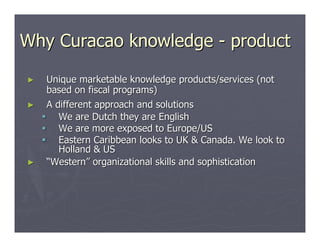
Why Curacao knowledge - product

►   Unique marketable knowledge products/services (not
    based on fiscal programs)
►   A different approach and solutions
       We are Dutch they are English
       We are more exposed to Europe/US
       Eastern Caribbean looks to UK & Canada. We look to
       Holland & US
►   “Western” organizational skills and sophistication
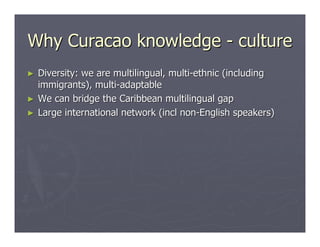
Why Curacao knowledge - culture
►   Diversity: we are multilingual, multi-ethnic (including
    immigrants), multi-adaptable
►   We can bridge the Caribbean multilingual gap
►   Large international network (incl non-English speakers)
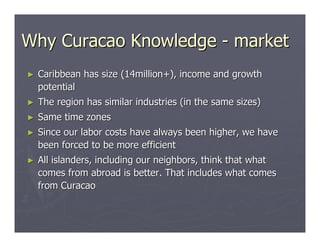
Why Curacao Knowledge - market
►   Caribbean has size (14million+), income and growth
    potential
►   The region has similar industries (in the same sizes)
►   Same time zones
►   Since our labor costs have always been higher, we have
    been forced to be more efficient
►   All islanders, including our neighbors, think that what
    comes from abroad is better. That includes what comes
    from Curacao
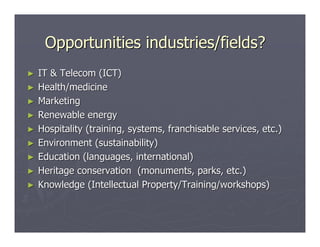
Opportunities industries/fields?
►   IT & Telecom (ICT)
►   Health/medicine
►   Marketing
►   Renewable energy
►   Hospitality (training, systems, franchisable services, etc.)
►   Environment (sustainability)
►   Education (languages, international)
►   Heritage conservation (monuments, parks, etc.)
►   Knowledge (Intellectual Property/Training/workshops)
What is needed?
► FiscalActions
► Economic Actions
► Business support
► Financial Actions
► Everybody else
Fiscal Actions
1.   Fair taxation to acquire knowledge abroad
       ►   at least 100% deductibility (not 80% for travelling, lodging, etc.) or fixed
                                                                         etc.)
           deductibility
2.   Tax credit for investment in human capital and R&D
       ►   comparable to credit on capital goods
3.   Tax incentives for knowledge export promotion
       ►   T&T gives 150% deductibility
4.   Simple E-zone type export profit tax incentives
       ►    automatically claimed on tax return
5.   Eliminate OB between knowledge workers
       ►   Encourages bigger and better quality execution through cooperation
                                                                  cooperation
6.   Expand sectors which qualify for expat status
       ►   Include knowledge other than finance, oil, etc., especially growth areas
                                                                       growth
7.   Faster expat-status approval
8.   Cheaper air-connectivity to selected markets
       ►   through 150-200% tax deductibility
                   150-
9.   Better air connectivity to potential markets
       ►   Offset long travel time by taxation on days worked in Curacao only- Belgian expat
                                                                         only-
           model
Economic Policy Actions
1.   Incentives to groom local talent to work in international services
     environment
2.   Facilitate import of foreign talent to reach a good mix of
     local/international talent
3.   Expand sectors which qualify for expat status
       ►   Include knowledge other than finance, oil, etc., especially growth areas
4.   Support to
       ► register/patent innovations
       ► acquire international certifications
       ► register with international consulting databases
       ► speak and publish internationally
       ► develop franchisable (hospitality) services
5.   Make it easy to know what one needs to start a company
6.   Brainport (knowledge exchange center) – determine which aspects are
     “des overheids” and if/how “overheid” can finance this long-term
Business support
1.   Product development support
       ► To register/patent innovations
       ► To acquire international certifications


2.   On-the-go support
       ► To find international knowledge alliances
       ► To find temporary offices/meeting places abroad


3.   Marketing support
      ► To register with international consulting databases
      ► To speak and publish internationally
      ► To develop franchisable (hospitality) services
Financial Actions
►   Loans or credit for regional knowledge assignments
    abroad
►   No hassle insurance for regional knowledge
    assignments abroad (exportverzekering)
►   Factoring of regional assignment invoices
►   Affordable liability insurances
Everybody else
1.   Confidence in “Made in Curacao”, not just subsidies and
     incentives, but buy from us, invite us to tender. This enables
     specialization/experience, a key to exporting knowledge
2.   Local representatives of multinational firms/organizations can
     propose local knowledge providers for regional engagements
     (projects, presentations, publications) of their firm/organization
3.   Suppliers (banks, accountants, etc.) that understand the needs
     of a knowledge exporting business and can help us think
Tamira La Cruz, MBA
  MarkStra Caribbean
  www.markstra.com
tlacruz@markstra.com
  t (599-9) 767-3085

Knowledge Export Lunch Oct08 Tlc

  • 1.
    Furthering Curacao KnowledgeExport Lunch hosted by Maduro & Curiel’s Bank N.V. Host: Ronald Gomes Casseres Prepared by: Tamira La Cruz, MBA (with input from Clark Russel, Jacques Heide, Tom de Windt, Ronald Lieuw Sjong, Jeroen Kibbelaar, David Blankhart) 31 October 2008
  • 2.
    Background ► A groupof Curacao-based knowledge exporters has met on and off to exchange experiences since 2006 ► The idea for the lunch came about after a conversation between Ronald Gomes Casseres and Tamira La Cruz. ► The lunch was also attended by Chamber of Commerce (John Jacobs) VBC (Johan Lieuw) Secretary of State Alex Rosaria Representative of the Commissioner of Economic Affairs, Ramon Chong ► The next steps have not yet materialized
  • 3.
    “Globality: (everyone) competing witheveryone from everywhere for everything” Hal Sirkin
  • 4.
    Quote (1) “The wealthof a firm, and of each nation in which it operates, largely depends on its role in creating tomorrow’s markets and its ability to capture a disproportionate share of associated revenues and profits.” Which can be used for the development of its people. Competing for the Future, Hamel & Prahalad, 1994
  • 5.
    Quote (2) “Each ofthese opportunities is inherently global. No single nation or region is likely to control ALL the technologies and skills required to turn these opportunities into reality.” Every nation has a chance. We do too! We must choose where we can succeed. Competing for the Future, Hamel & Prahalad, 1994
  • 6.
    Why Curacao knowledge- product ► Unique marketable knowledge products/services (not based on fiscal programs) ► A different approach and solutions We are Dutch they are English We are more exposed to Europe/US Eastern Caribbean looks to UK & Canada. We look to Holland & US ► “Western” organizational skills and sophistication
  • 7.
    Why Curacao knowledge- culture ► Diversity: we are multilingual, multi-ethnic (including immigrants), multi-adaptable ► We can bridge the Caribbean multilingual gap ► Large international network (incl non-English speakers)
  • 8.
    Why Curacao Knowledge- market ► Caribbean has size (14million+), income and growth potential ► The region has similar industries (in the same sizes) ► Same time zones ► Since our labor costs have always been higher, we have been forced to be more efficient ► All islanders, including our neighbors, think that what comes from abroad is better. That includes what comes from Curacao
  • 9.
    Opportunities industries/fields? ► IT & Telecom (ICT) ► Health/medicine ► Marketing ► Renewable energy ► Hospitality (training, systems, franchisable services, etc.) ► Environment (sustainability) ► Education (languages, international) ► Heritage conservation (monuments, parks, etc.) ► Knowledge (Intellectual Property/Training/workshops)
  • 10.
    What is needed? ►FiscalActions ► Economic Actions ► Business support ► Financial Actions ► Everybody else
  • 11.
    Fiscal Actions 1. Fair taxation to acquire knowledge abroad ► at least 100% deductibility (not 80% for travelling, lodging, etc.) or fixed etc.) deductibility 2. Tax credit for investment in human capital and R&D ► comparable to credit on capital goods 3. Tax incentives for knowledge export promotion ► T&T gives 150% deductibility 4. Simple E-zone type export profit tax incentives ► automatically claimed on tax return 5. Eliminate OB between knowledge workers ► Encourages bigger and better quality execution through cooperation cooperation 6. Expand sectors which qualify for expat status ► Include knowledge other than finance, oil, etc., especially growth areas growth 7. Faster expat-status approval 8. Cheaper air-connectivity to selected markets ► through 150-200% tax deductibility 150- 9. Better air connectivity to potential markets ► Offset long travel time by taxation on days worked in Curacao only- Belgian expat only- model
  • 12.
    Economic Policy Actions 1. Incentives to groom local talent to work in international services environment 2. Facilitate import of foreign talent to reach a good mix of local/international talent 3. Expand sectors which qualify for expat status ► Include knowledge other than finance, oil, etc., especially growth areas 4. Support to ► register/patent innovations ► acquire international certifications ► register with international consulting databases ► speak and publish internationally ► develop franchisable (hospitality) services 5. Make it easy to know what one needs to start a company 6. Brainport (knowledge exchange center) – determine which aspects are “des overheids” and if/how “overheid” can finance this long-term
  • 13.
    Business support 1. Product development support ► To register/patent innovations ► To acquire international certifications 2. On-the-go support ► To find international knowledge alliances ► To find temporary offices/meeting places abroad 3. Marketing support ► To register with international consulting databases ► To speak and publish internationally ► To develop franchisable (hospitality) services
  • 14.
    Financial Actions ► Loans or credit for regional knowledge assignments abroad ► No hassle insurance for regional knowledge assignments abroad (exportverzekering) ► Factoring of regional assignment invoices ► Affordable liability insurances
  • 15.
    Everybody else 1. Confidence in “Made in Curacao”, not just subsidies and incentives, but buy from us, invite us to tender. This enables specialization/experience, a key to exporting knowledge 2. Local representatives of multinational firms/organizations can propose local knowledge providers for regional engagements (projects, presentations, publications) of their firm/organization 3. Suppliers (banks, accountants, etc.) that understand the needs of a knowledge exporting business and can help us think
  • 16.
    Tamira La Cruz,MBA MarkStra Caribbean www.markstra.com tlacruz@markstra.com t (599-9) 767-3085