Keyword-based Search and Exploration on DatabasesYi ChenWei WangZiyang LiuArizona State University, USAUniversity of New South Wales, AustraliaArizona State University, USA
Traditional Access Methods for DatabasesRelational/XML Databases are structured or semi-structured, with rich meta-data
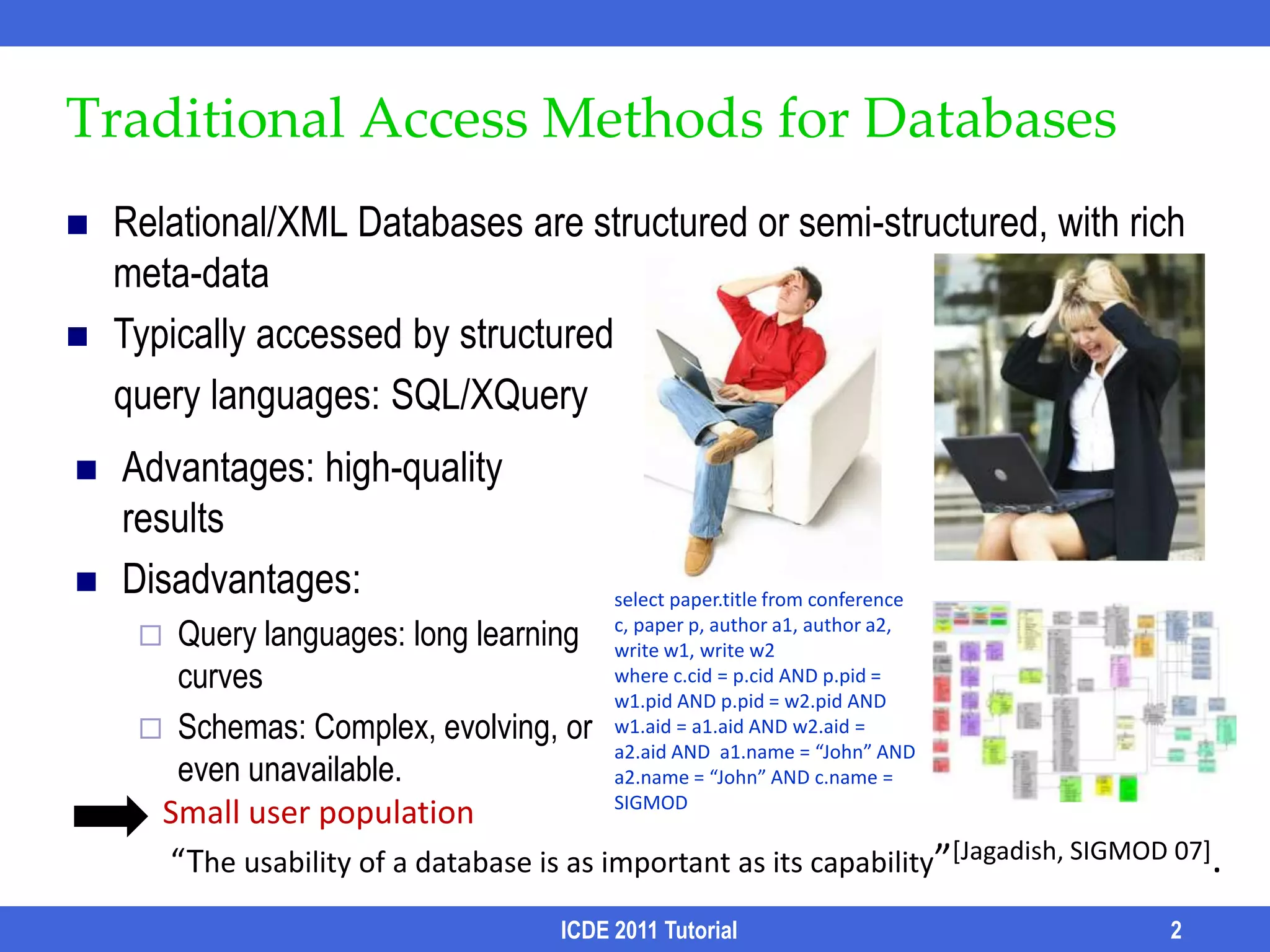
Typically accessed by structured      query languages: SQL/XQueryAdvantages: high-quality resultsDisadvantages:Query languages: long learning curvesSchemas: Complex, evolving, or    even unavailable.select paper.title from conference c, paper p, author a1, author a2, write w1, write w2                    where c.cid = p.cid AND p.pid = w1.pid AND p.pid = w2.pid AND w1.aid = a1.aid AND w2.aid = a2.aid AND  a1.name = “John” AND a2.name = “John” AND c.name = SIGMODSmall user population “The usability of a database is as important as its capability”[Jagadish, SIGMOD 07].2ICDE 2011 Tutorial
Popular Access Methods for TextText documents have little structureThey are typically accessed by keyword-based unstructured queriesAdvantages:  Large user populationDisadvantages: Limited search qualityDue to the lack of structure of both data and queries3ICDE 2011 Tutorial
Grand Challenge: Supporting Keyword Search on DatabasesCan we support keyword based search and exploration on databases and achieve the best of both worlds?Opportunities ChallengesState of the artFuture directionsICDE 2011 Tutorial4
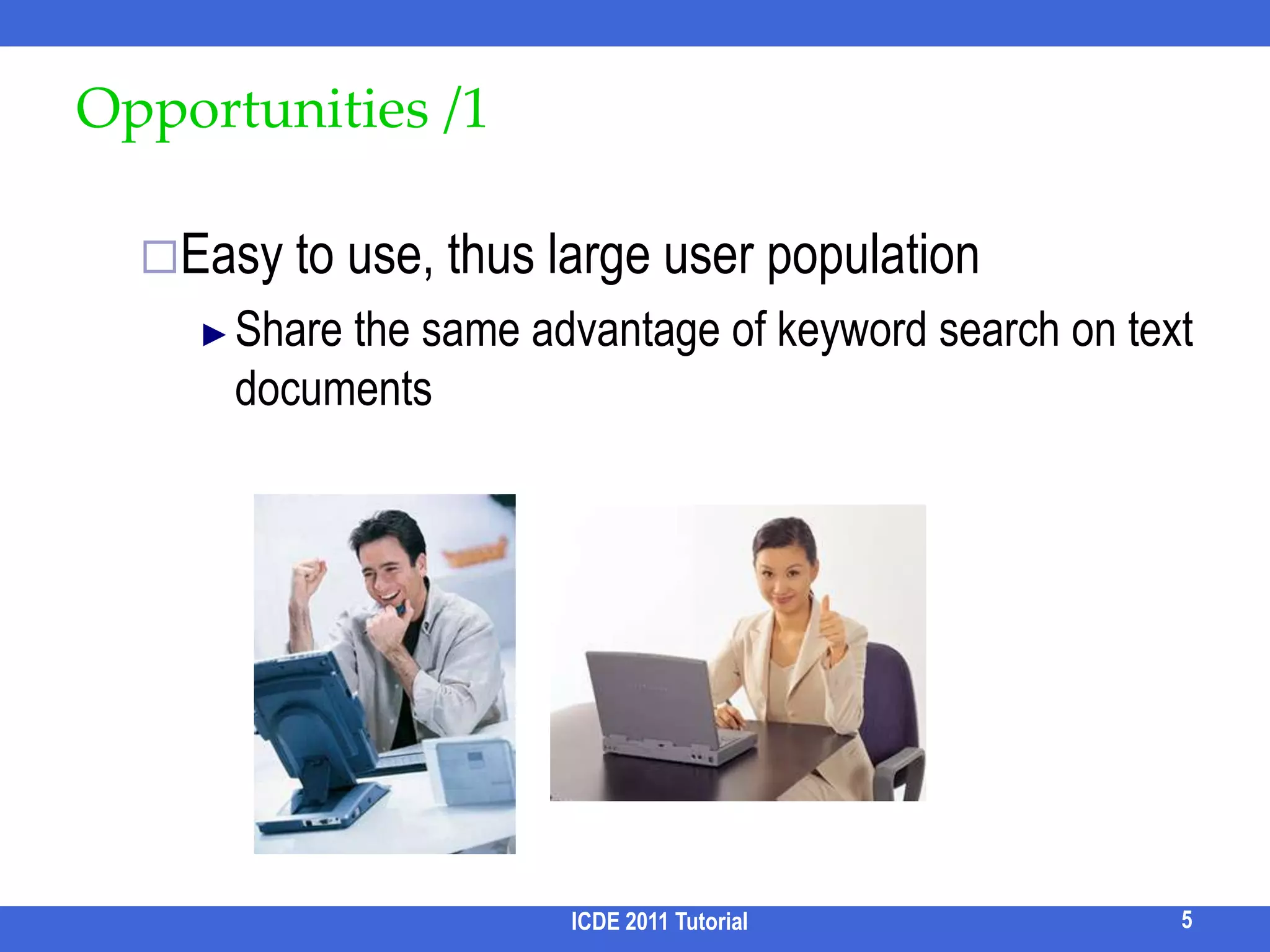
Opportunities /1Easy to use, thus large user populationShare the same advantage of keyword search on text documentsICDE 2011 Tutorial5
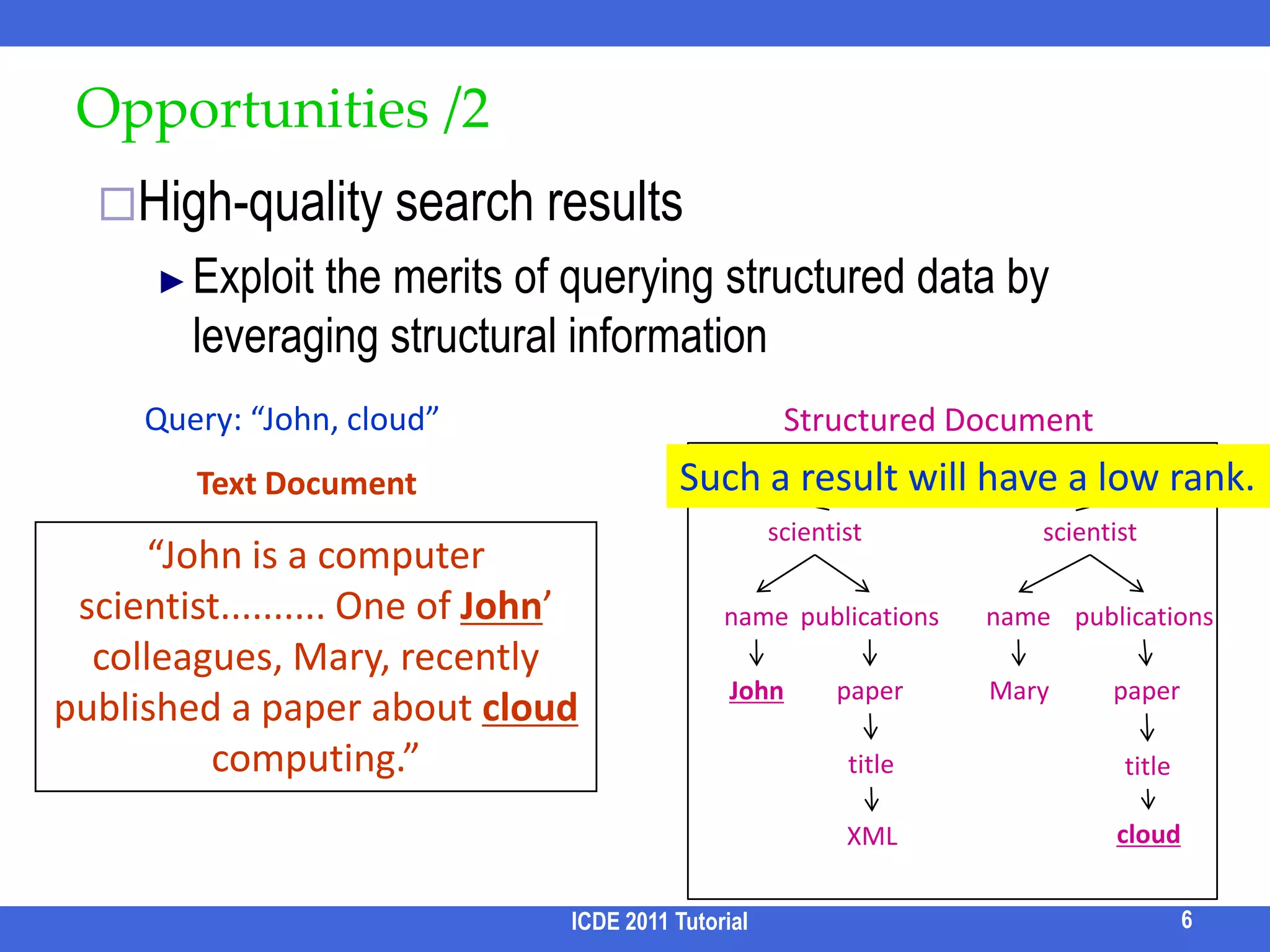
High-quality search resultsExploit the merits of querying structured data by leveraging structural informationICDE 2011 Tutorial6Opportunities /2Query: “John, cloud”Structured DocumentSuch a result will have a low rank.Text Documentscientistscientist“John is a computer scientist.......... One of John’ colleagues, Mary, recently published a paper about cloud computing.”publicationsnamepublicationsnamepaperJohnpaperMarytitletitlecloudXML
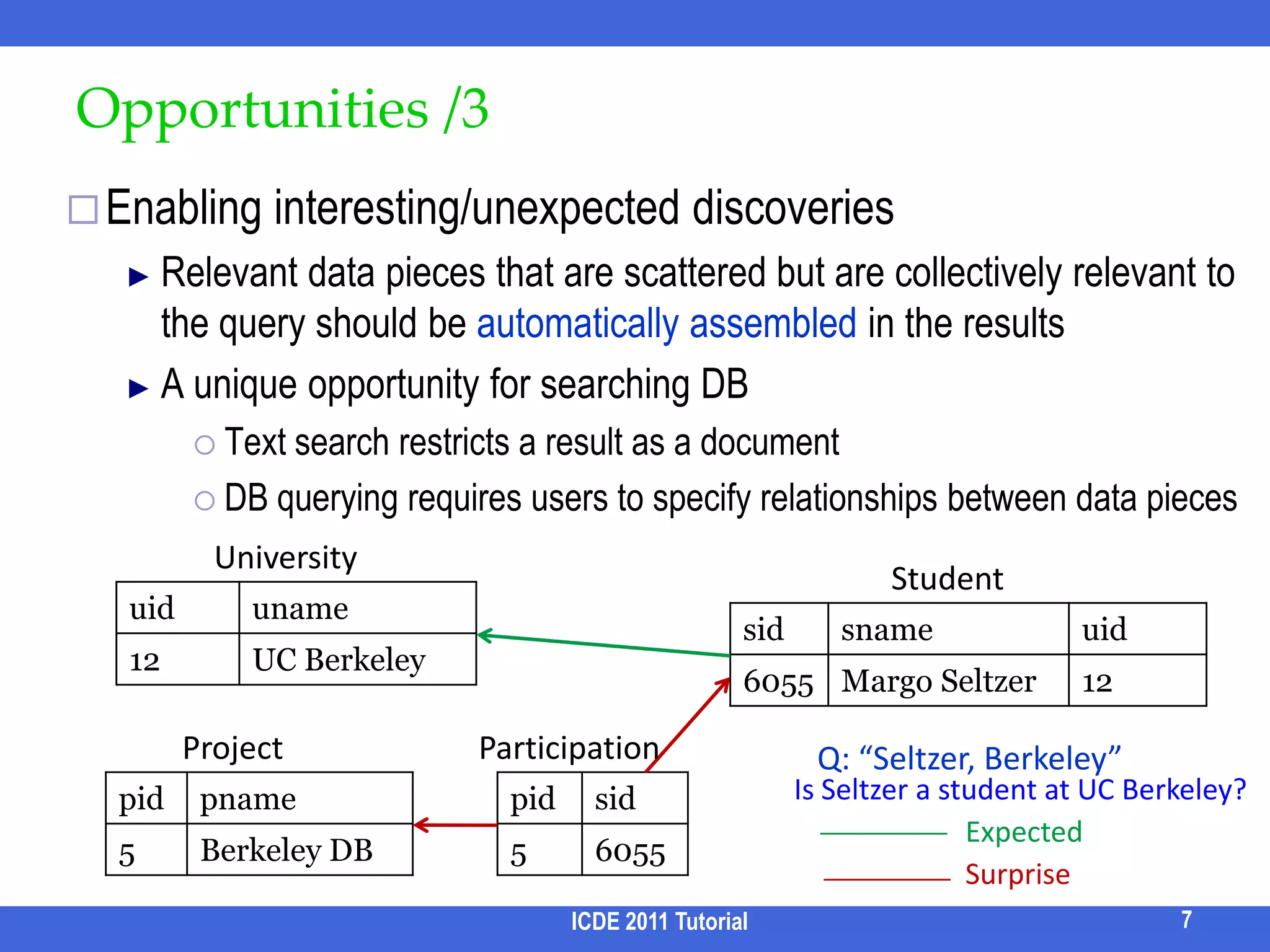
Enabling interesting/unexpected discoveriesRelevant data pieces that are scattered but are collectively relevant to the query should be automatically assembled in the results A unique opportunity for searching DB Text search restricts a result as a documentDB querying requires users to specify relationships between data piecesICDE 2011 Tutorial7Opportunities /3UniversityStudentProjectParticipationQ: “Seltzer, Berkeley”Is Seltzer a student at UC Berkeley?ExpectedSurprise
Keyword Search on DB – Summary of OpportunitiesIncreasing the DB usability and hence user populationIncreasing the coverage and quality of keyword search8ICDE 2011 Tutorial
Keyword Search on DB- ChallengesKeyword queries are ambiguous or exploratoryStructural ambiguityKeyword ambiguityResult analysis difficultyEvaluation difficultyEfficiencyICDE 2011 Tutorial9
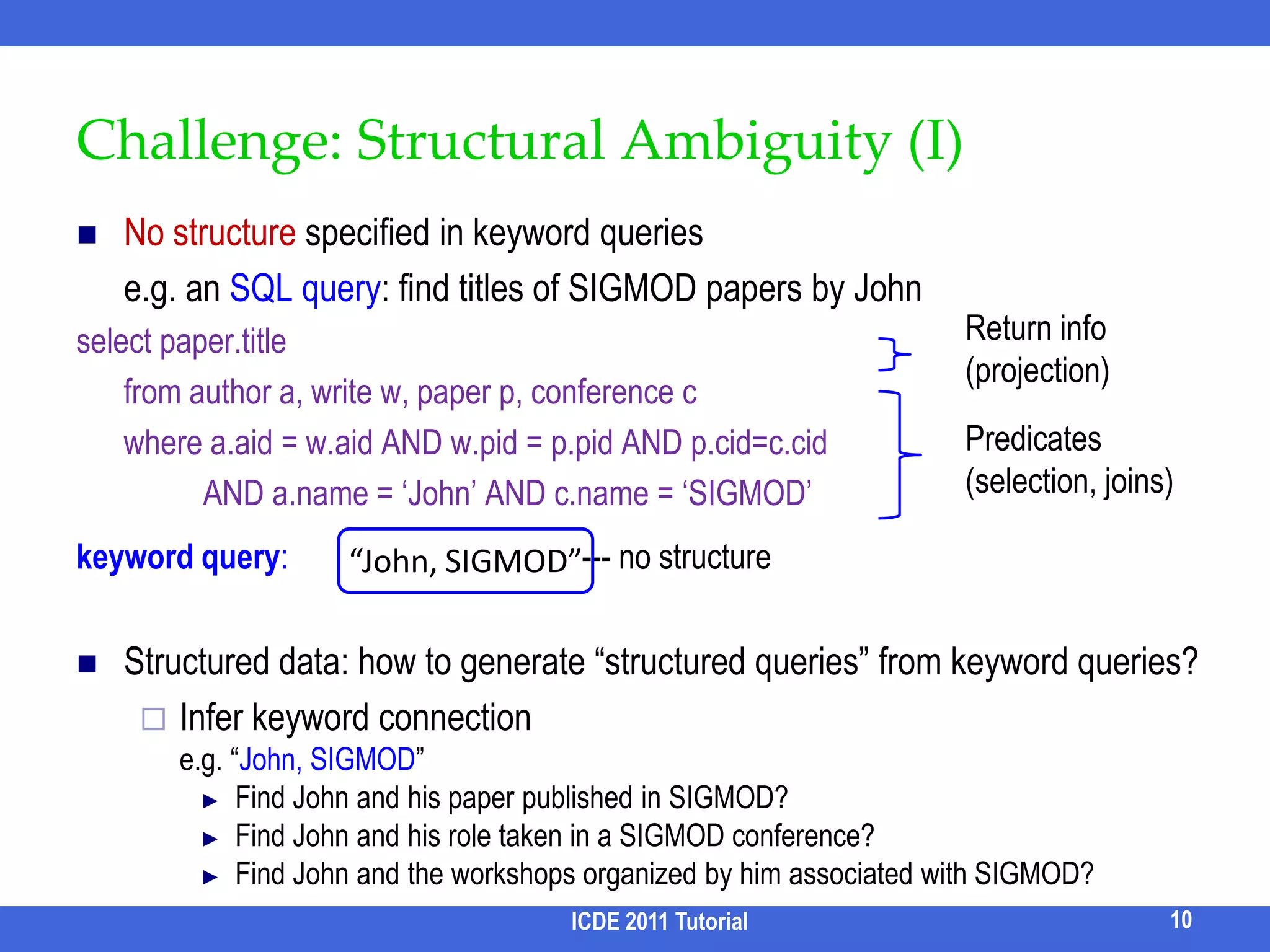
No structure specified in keyword queries 	e.g. an SQL query: find titles of SIGMOD papers by Johnselect paper.title      from author a, write w, paper p, conference c      where a.aid = w.aid AND w.pid = p.pid AND p.cid=c.cid                AND a.name = ‘John’ AND c.name = ‘SIGMOD’keyword query:                                     --- no structureStructured data: how to generate “structured queries” from keyword queries? Infer keyword connection	e.g. “John, SIGMOD” Find John and his paper published in SIGMOD?Find John and his role taken in a SIGMOD conference?Find John and the workshops organized by him associated with SIGMOD?Challenge: Structural Ambiguity (I)ICDE 2011 Tutorial10Return info (projection)Predicates(selection, joins)“John, SIGMOD”
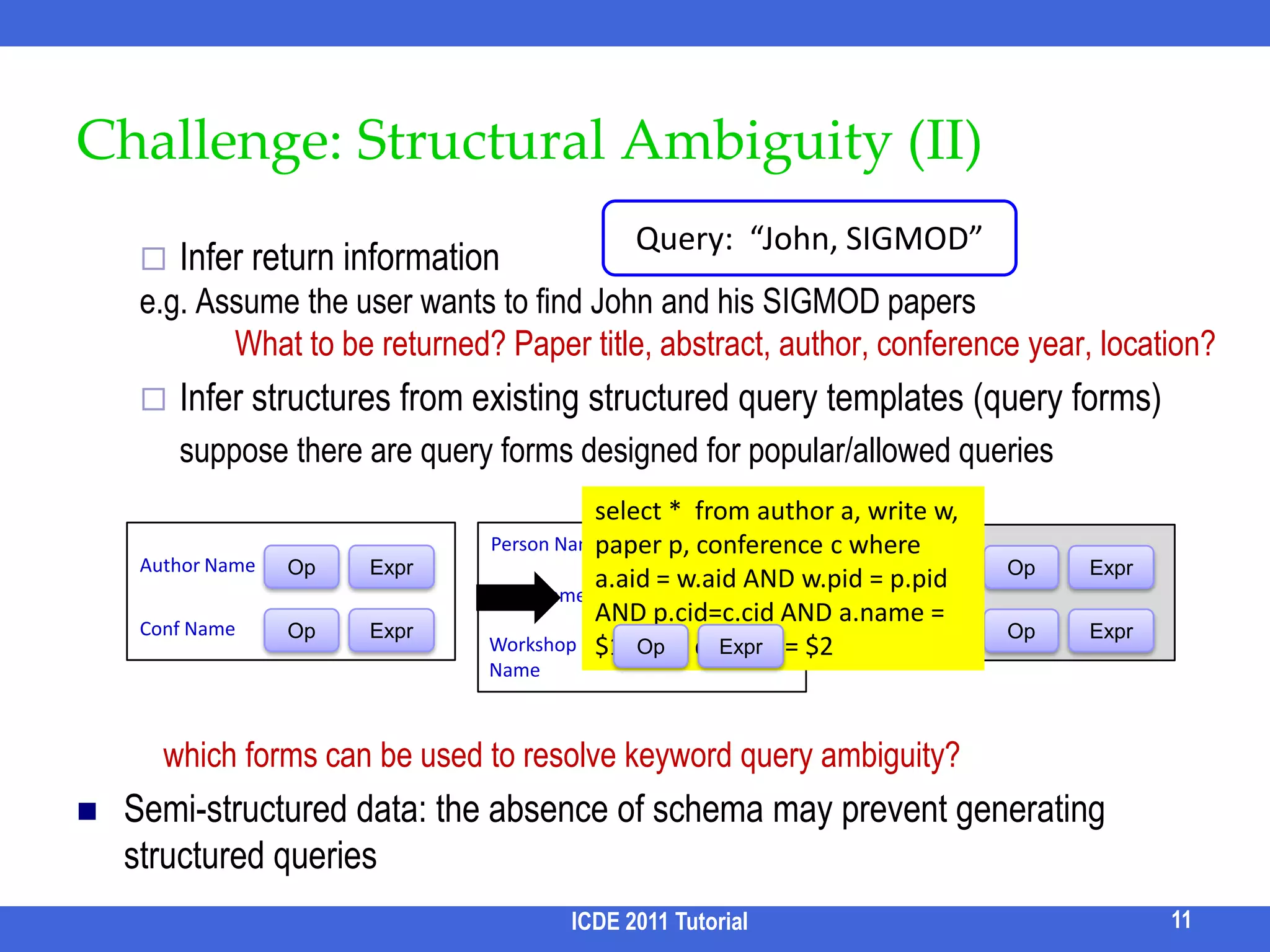
Challenge: Structural Ambiguity (II)Infer return information e.g. Assume the user wants to find John and his SIGMOD papers    What to be returned? Paper title, abstract, author, conference year, location?Infer structures from existing structured query templates (query forms) 	suppose there are query forms designed for popular/allowed queries   which forms can be used to resolve keyword query ambiguity?Semi-structured data: the absence of schema may prevent generating structured queriesICDE 2011 Tutorial11Query:  “John, SIGMOD”select *  from author a, write w, paper p, conference c where a.aid = w.aid AND w.pid = p.pid AND p.cid=c.cid AND a.name =  $1  AND c.name = $2Person NameOpExprJournal NameAuthor NameOpExprOpExprConf NameOpExprConf NameOpExprJournal YearOpExprWorkshopNameOpExpr
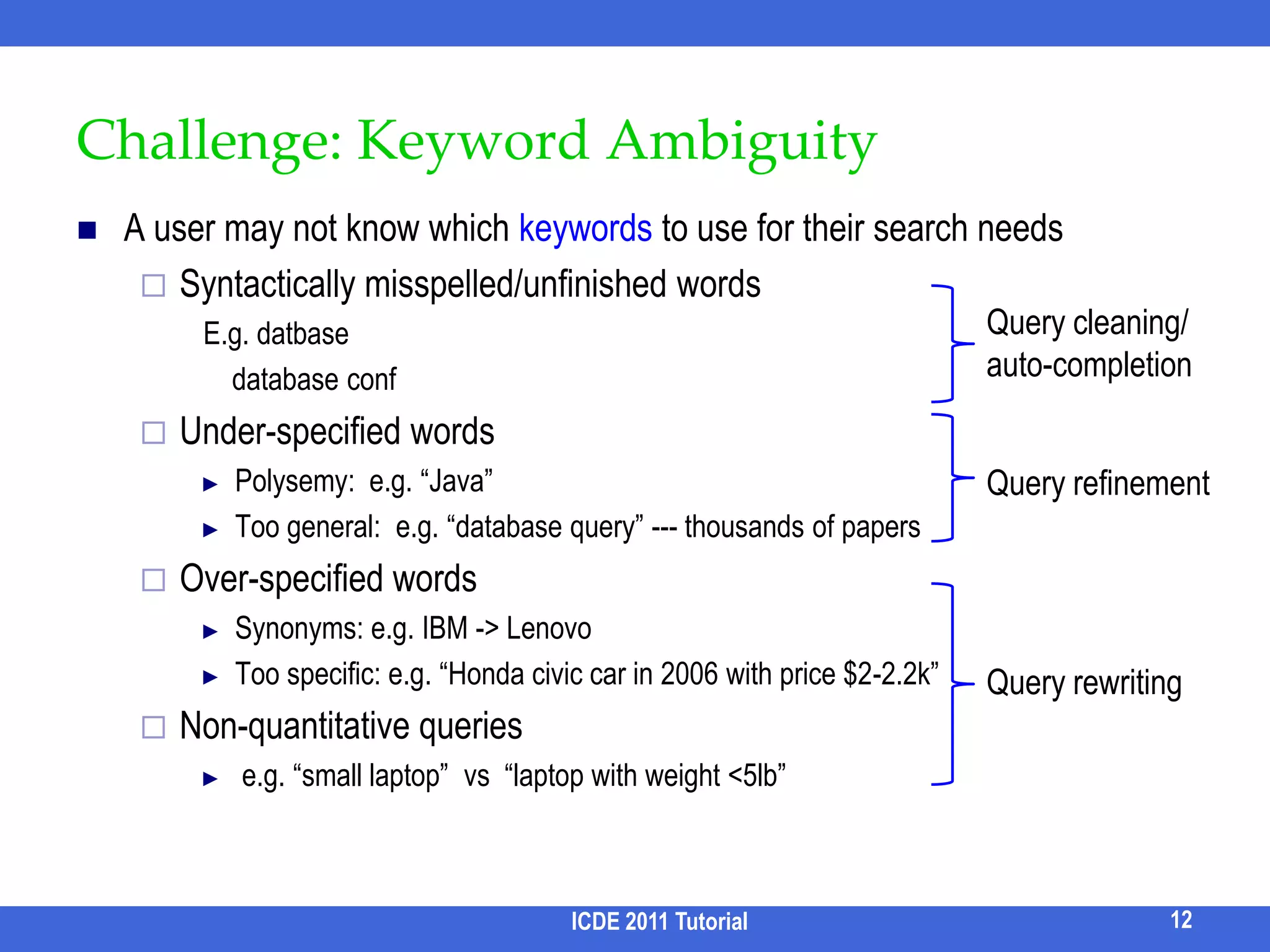
Challenge: Keyword AmbiguityA user may not know which keywords to use for their search needsSyntactically misspelled/unfinished words		E.g. datbase		    database confUnder-specified words Polysemy:  e.g. “Java”Too general:  e.g. “database query” --- thousands of papersOver-specified wordsSynonyms: e.g. IBM -> LenovoToo specific: e.g. “Honda civic car in 2006 with price $2-2.2k”Non-quantitative queries  e.g. “small laptop”  vs  “laptop with weight <5lb”ICDE 2011 Tutorial12Query cleaning/auto-completionQuery refinementQuery rewriting
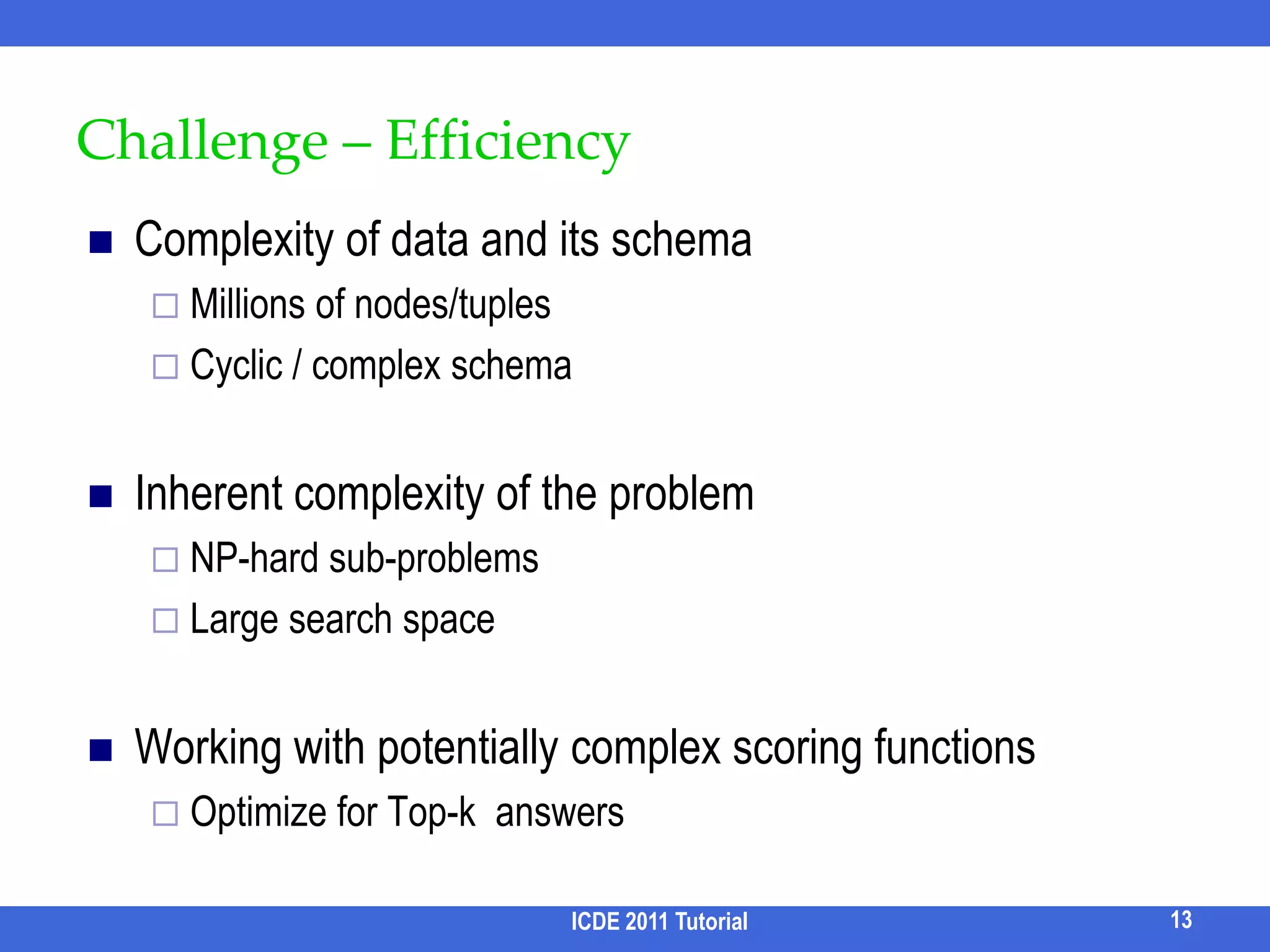
Challenge – EfficiencyComplexity of data and its schemaMillions of nodes/tuplesCyclic / complex schemaInherent complexity of the problemNP-hard sub-problemsLarge search spaceWorking with potentially complex scoring functionsOptimize for Top-k  answersICDE 2011 Tutorial13
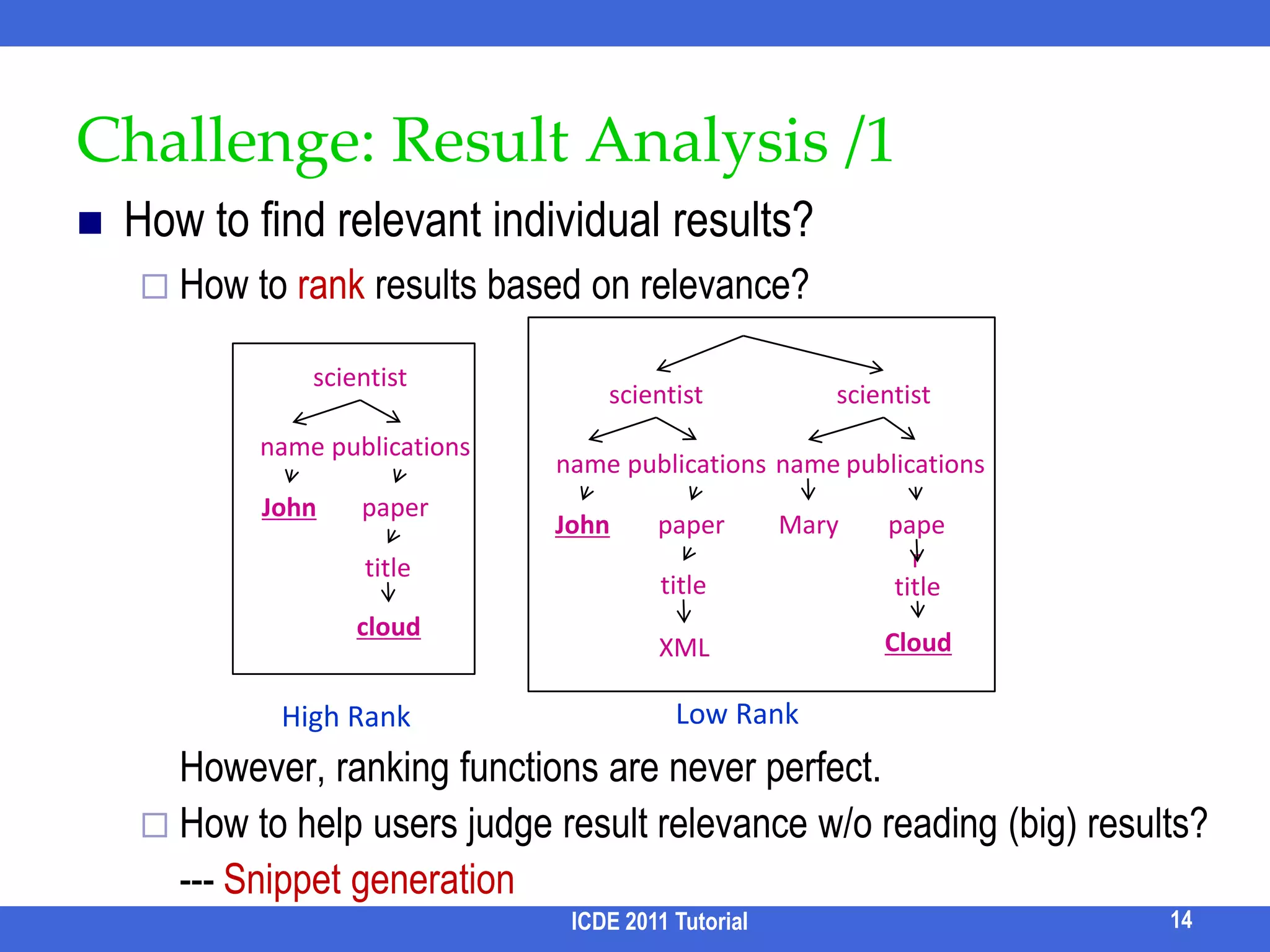
Challenge: Result Analysis /1How to find relevant individual results?How to rank results based on relevance?	However, ranking functions are never perfect.How to help users judge result relevance w/o reading (big) results?	--- Snippet generationICDE 2011 Tutorial14scientistscientistscientistpublicationsnamepublicationsnamepublicationsnamepaperJohnpaperJohnpaperMarytitletitletitlecloudCloudXMLLow RankHigh Rank
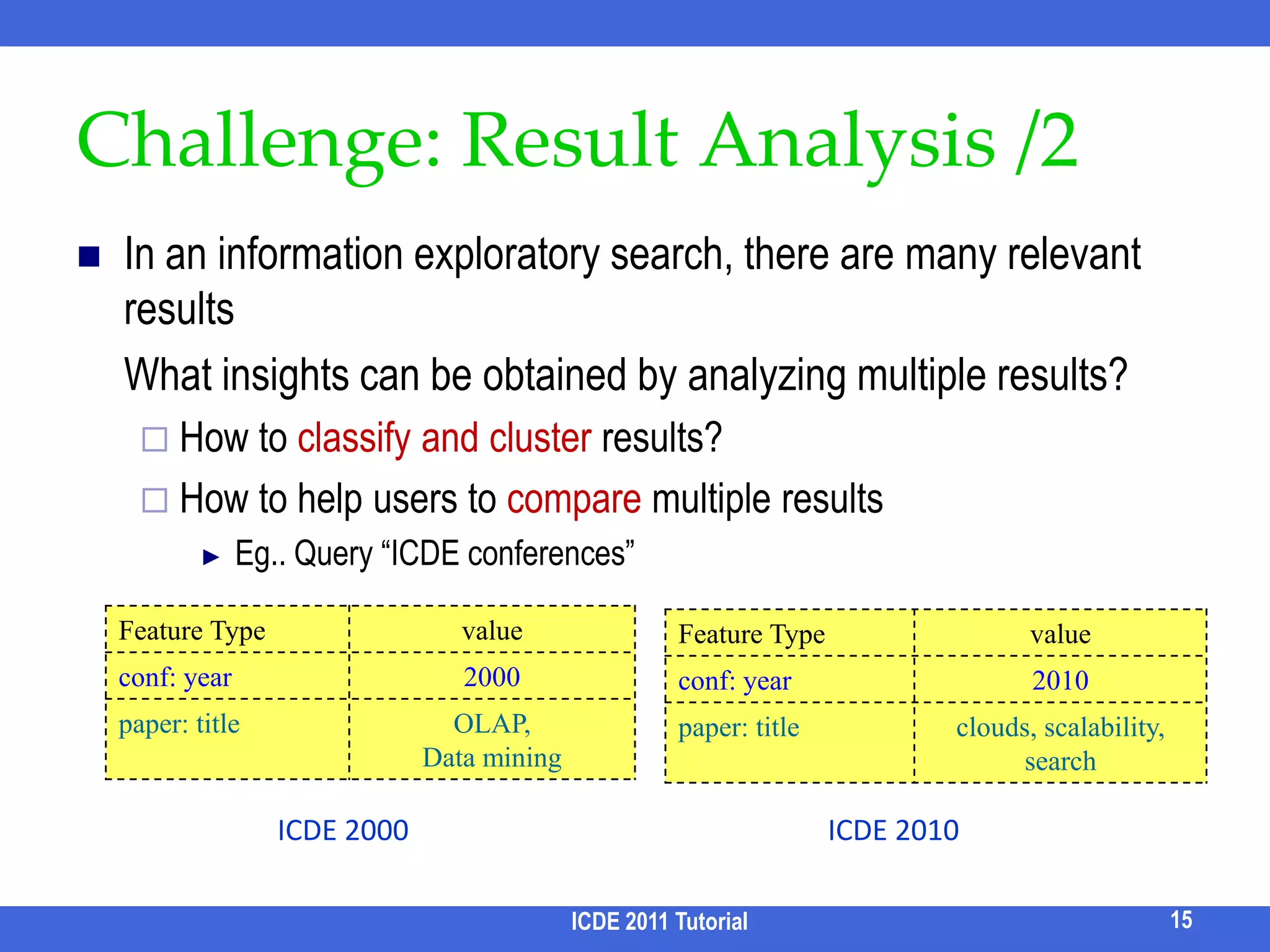
Challenge: Result Analysis /2In an information exploratory search, there are many relevant results	What insights can be obtained by analyzing multiple results?How to classify and cluster results?How to help users to compare multiple resultsEg.. Query “ICDE conferences”ICDE 2011 Tutorial15ICDE 2000ICDE 2010
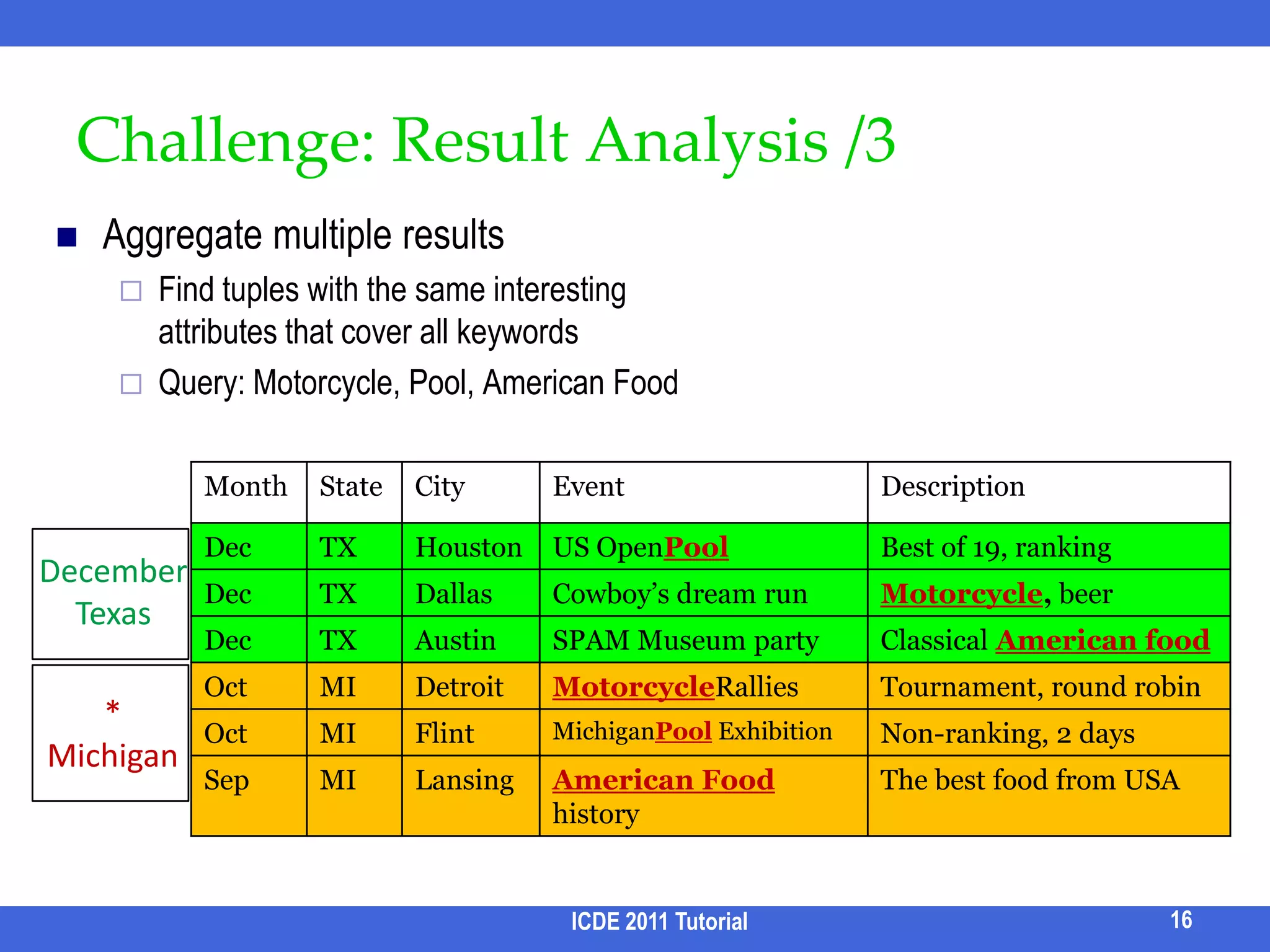
Challenge: Result Analysis /3Aggregate multiple resultsFind tuples with the same interesting attributes that cover all keywordsQuery: Motorcycle, Pool, American FoodICDE 2011 Tutorial16December Texas*Michigan
XSeek /1ICDE 2011 Tutorial17
XSeek /2ICDE 2011 Tutorial18
SPARK Demo /1ICDE 2011 Tutorial19http://www.cse.unsw.edu.au/~weiw/project/SPARKdemo.htmlAfter seeing the query results, the user identifies that ‘david’ should be ‘david J. Dewitt’.
SPARK Demo /2ICDE 2011 Tutorial20The user is only interested in finding all join papers written by David J. Dewitt (i.e., not the 4th result)
SPARK Demo /3ICDE 2011 Tutorial21
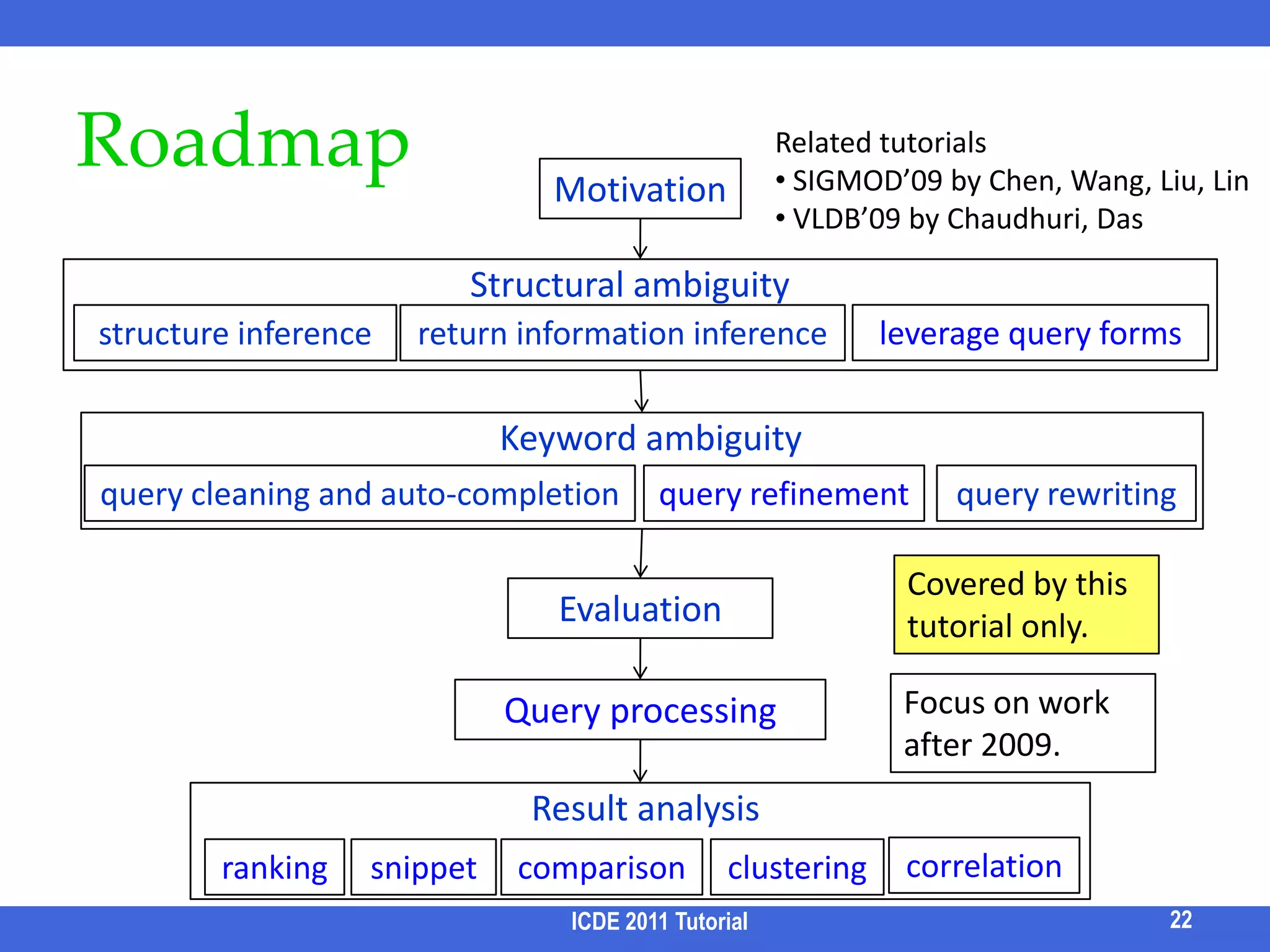
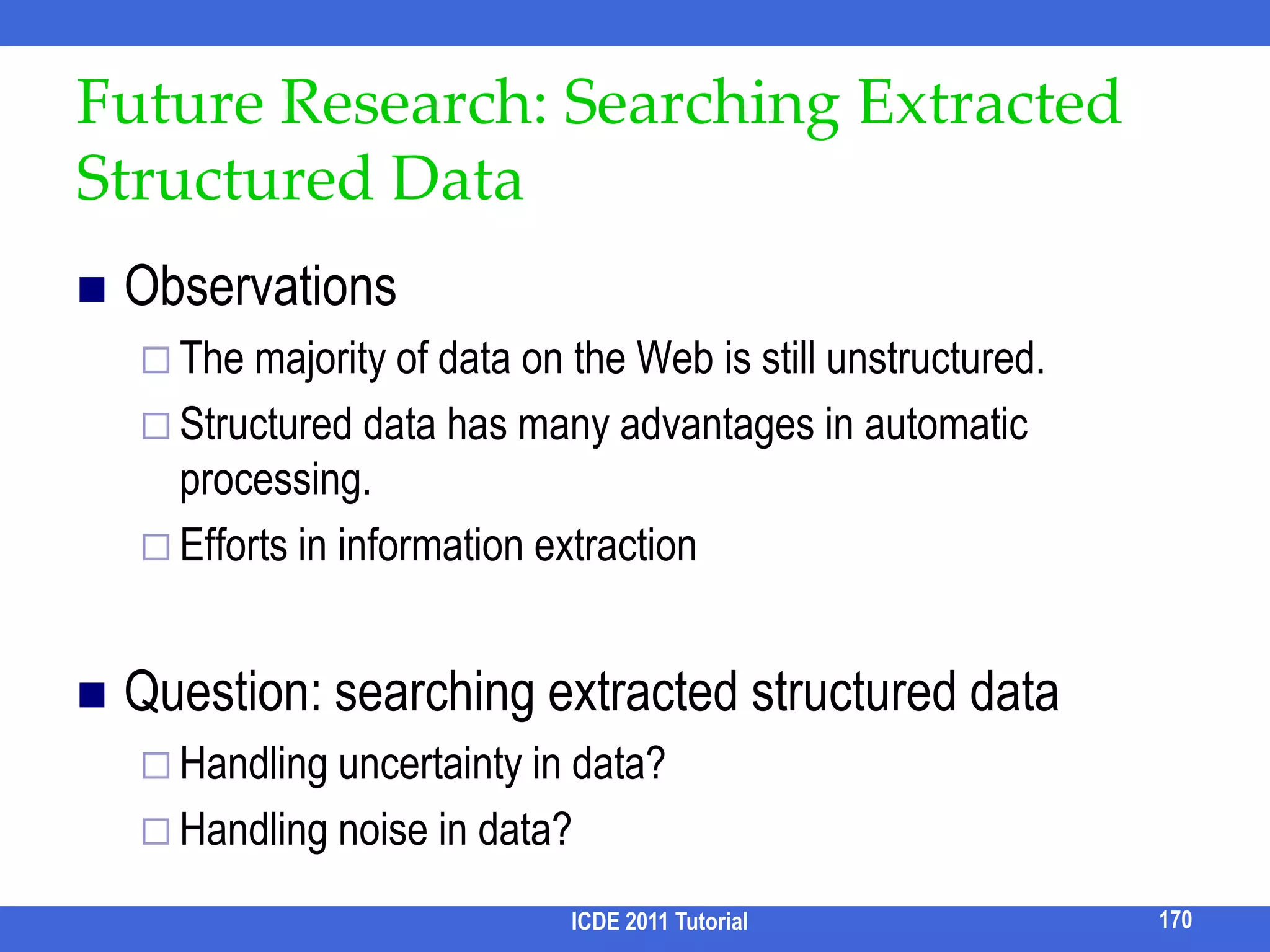
RoadmapICDE 2011 Tutorial22Related tutorials SIGMOD’09 by Chen, Wang, Liu, Lin
 VLDB’09 by Chaudhuri, DasMotivationStructural ambiguityleverage query formsstructure inferencereturn information inferenceKeyword ambiguityquery cleaning and auto-completionquery refinementquery rewritingCovered by this tutorial only.EvaluationFocus on work after 2009.Query processingResult analysiscorrelationrankingclusteringsnippetcomparison
RoadmapMotivationStructural ambiguityNode Connection InferenceReturn information inferenceLeverage query formsKeyword ambiguityEvaluationQuery processingResult analysisFuture directionsICDE 2011 Tutorial23
Problem DescriptionDataRelational Databases (graph), or XML Databases (tree)InputQuery Q = <k1, k2, ..., kl>OutputA collection of nodes collectively relevant to QICDE 2011 Tutorial24PredefinedSearched based on schema graphSearched based on data graph
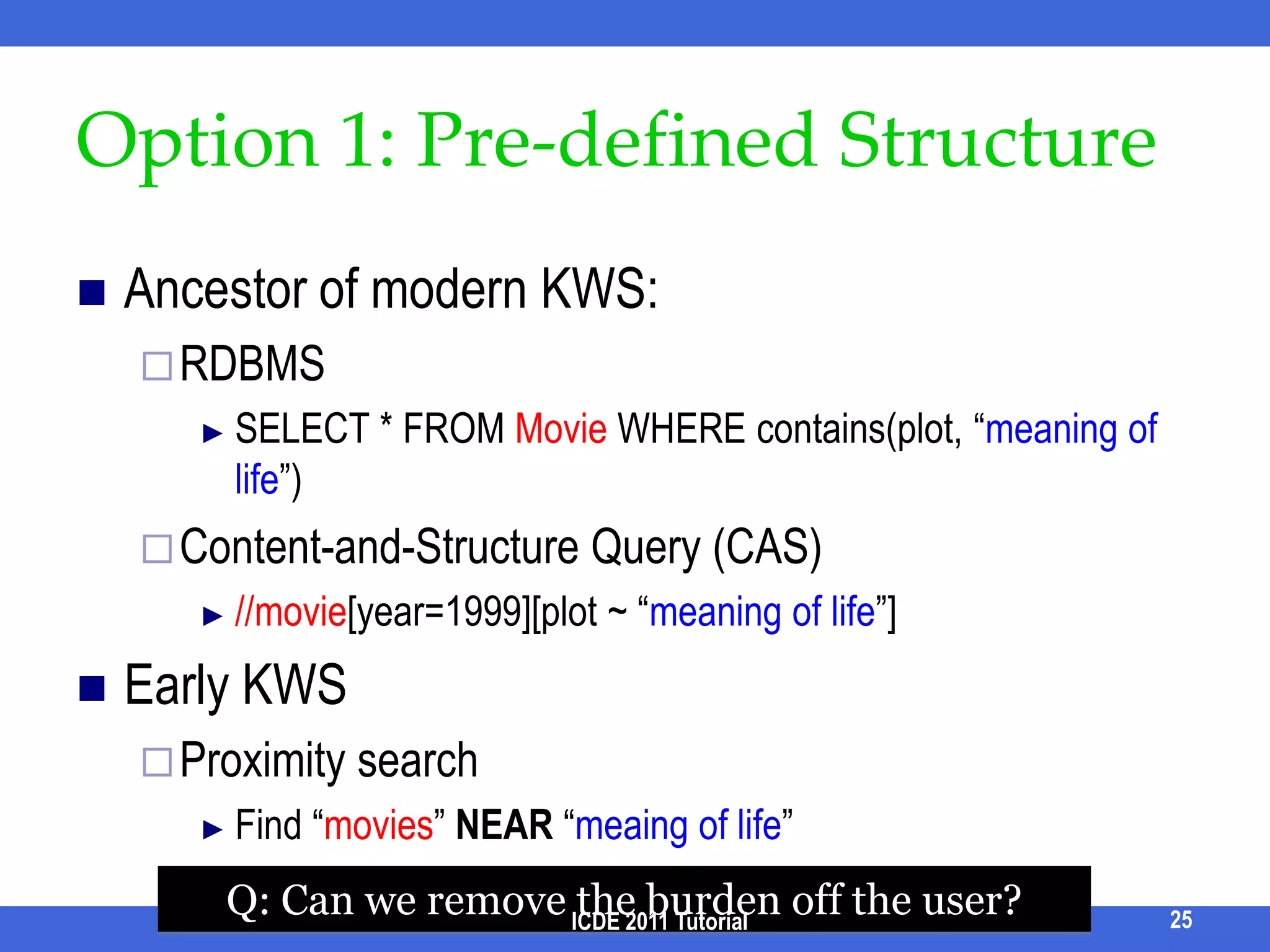
Option 1: Pre-defined StructureAncestor of modern KWS:RDBMS SELECT * FROM Movie WHERE contains(plot, “meaning of life”)Content-and-Structure Query (CAS) //movie[year=1999][plot ~ “meaning of life”]Early KWS Proximity searchFind “movies” NEAR “meaing of life”25Q: Can we remove the burden off the user? ICDE 2011 Tutorial
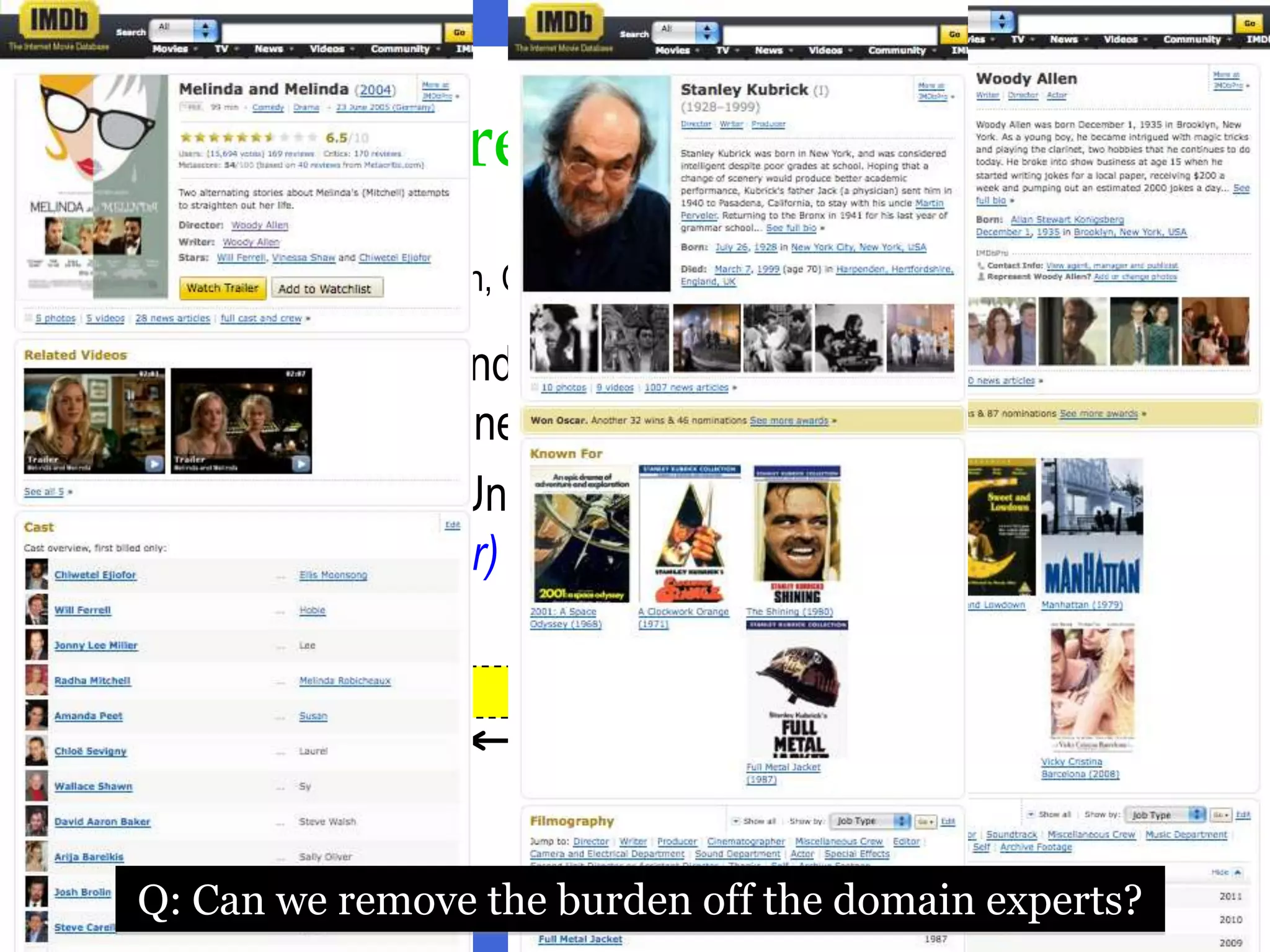
Option 1: Pre-defined StructureQUnit[Nandi & Jagadish, CIDR 09]“A basic, independent semantic unit of information in the DB”, usually defined by domain experts. e.g., define a QUnit as “director(name, DOB)+ all movies(title, year) he/she directed” ICDE 2011 Tutorial26Woody AllennametitleD_1011935-12-01DirectorMovieDOBMatch PointyearMelinda and MelindaB_LocAnything ElseQ: Can we remove the burden off the domain experts? … … …
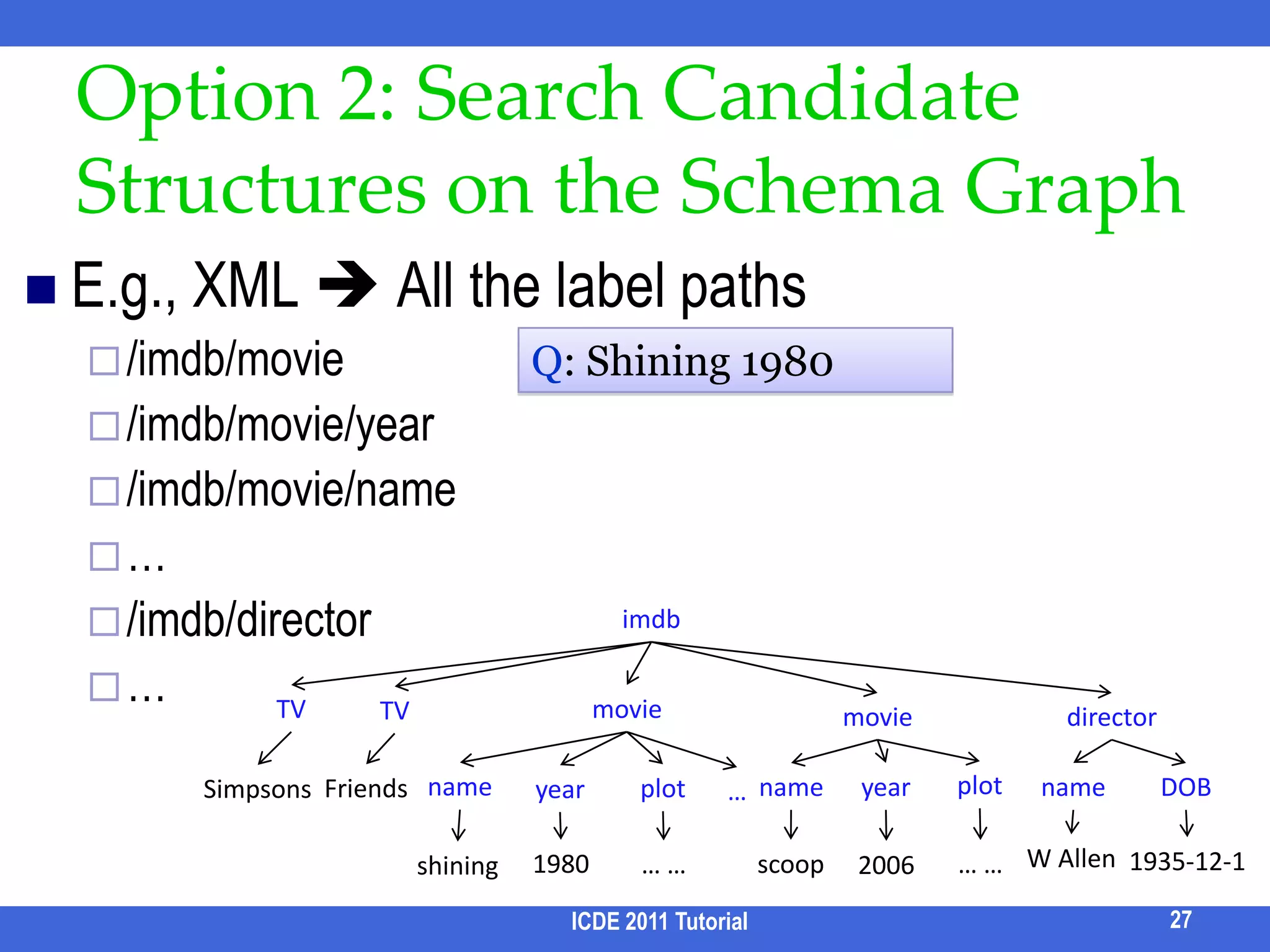
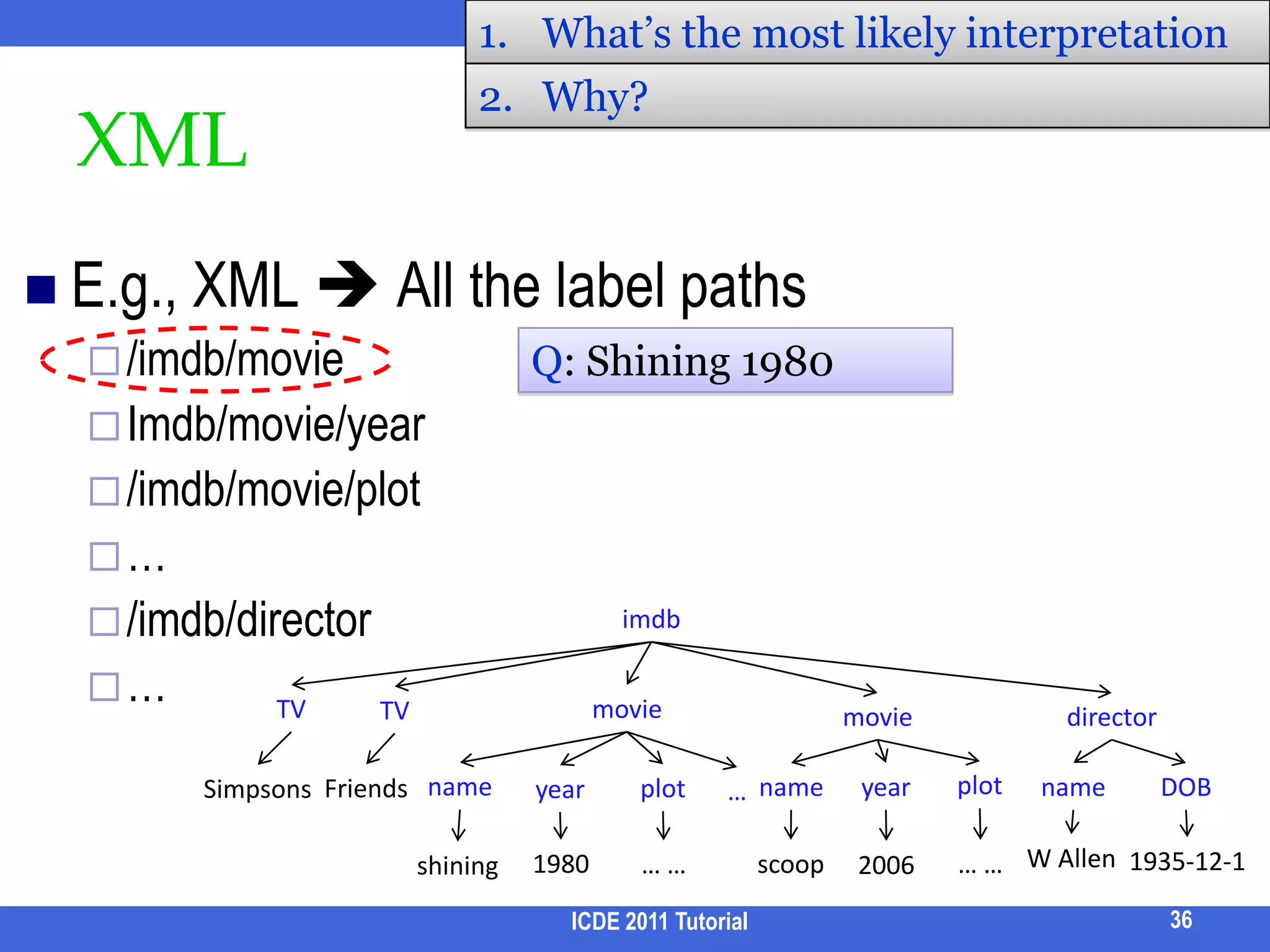
Option 2: Search Candidate Structures on the Schema GraphE.g., XML  All the label paths/imdb/movie/imdb/movie/year/imdb/movie/name…/imdb/director…27Q: Shining 1980imdbTVmovieTVmoviedirectorplotnamenameyearnameDOBplotFriendsSimpsonsyear…W Allen1935-12-11980scoop… …… …2006shiningICDE 2011 Tutorial
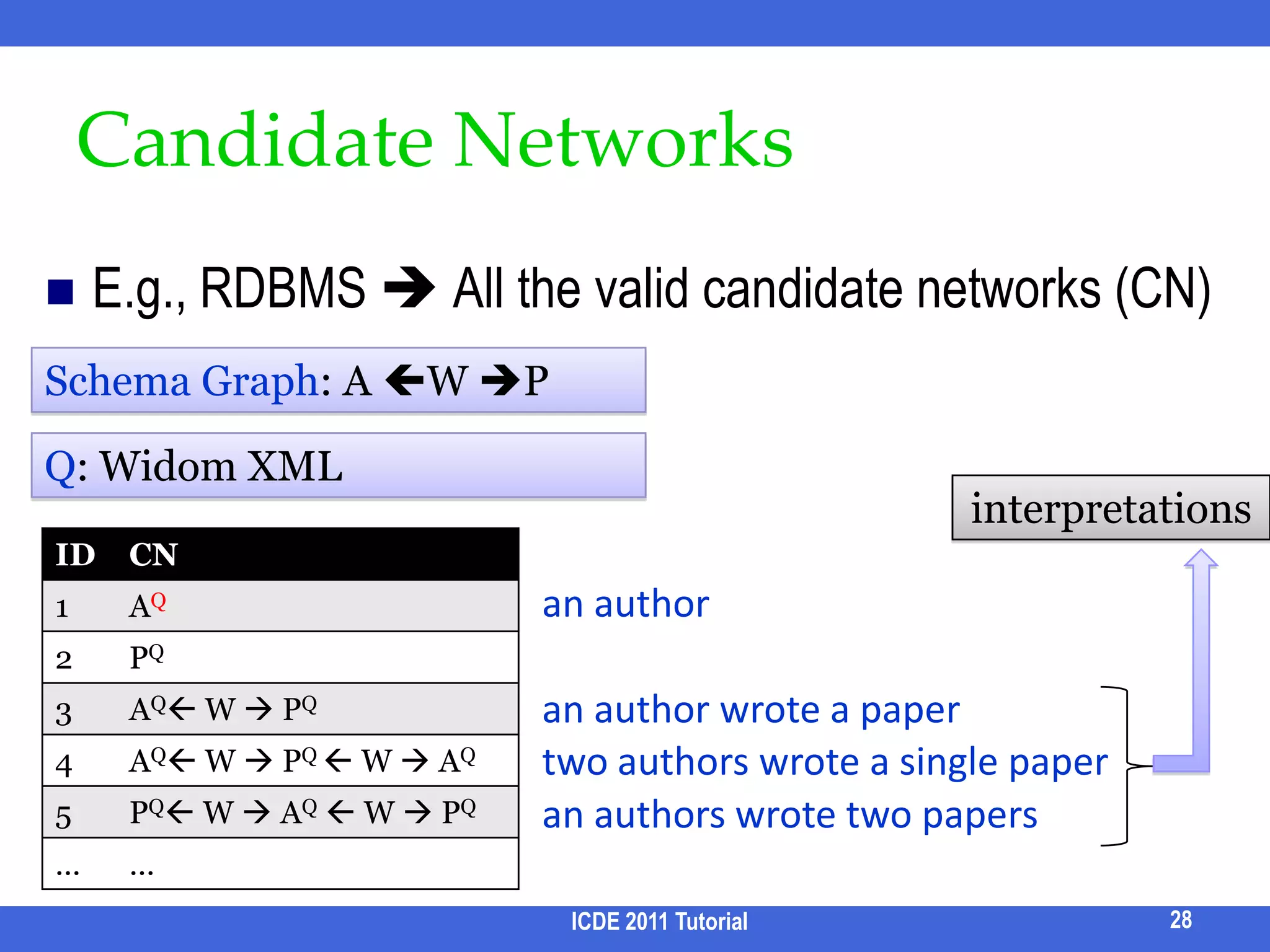
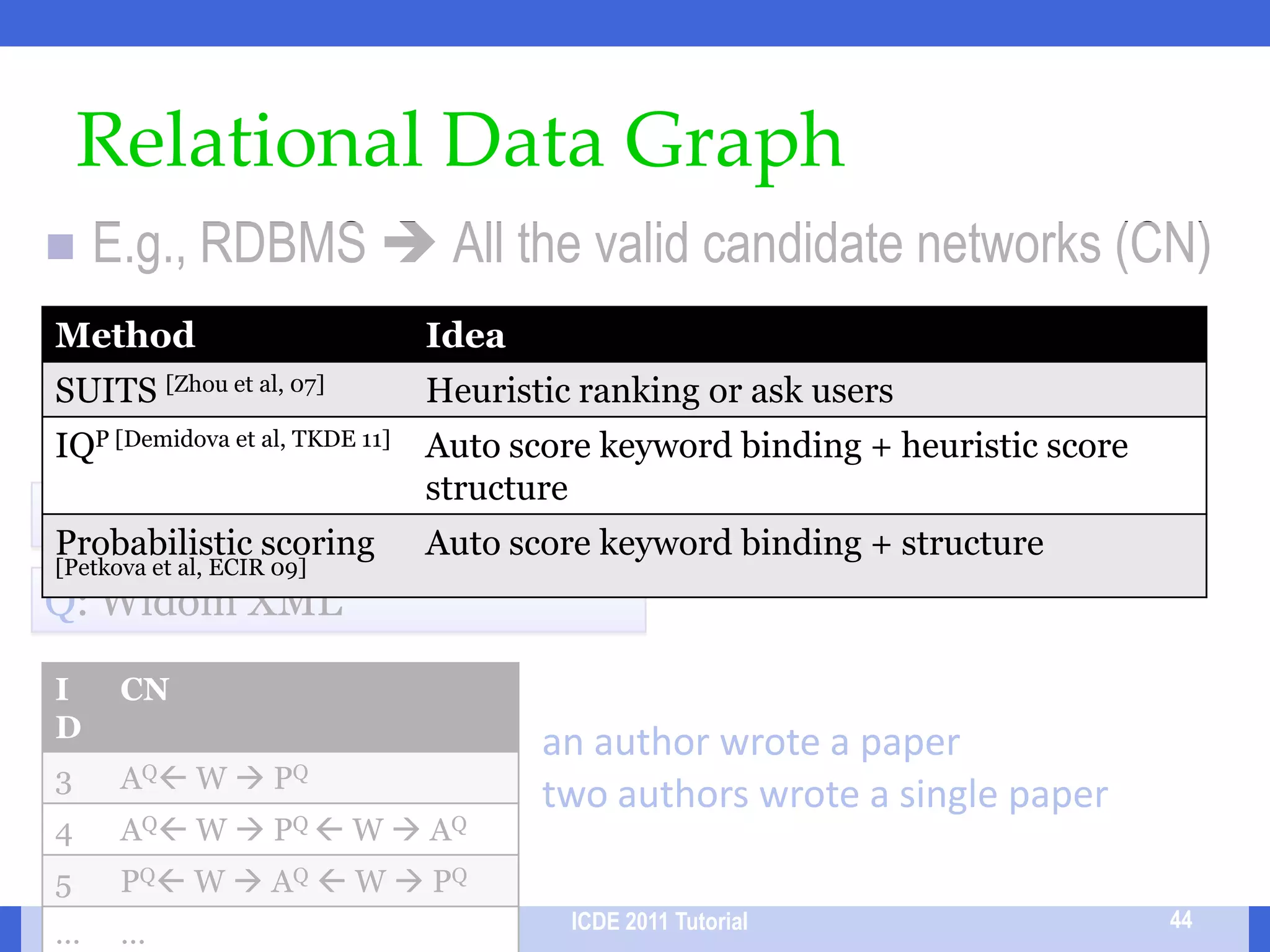
Candidate NetworksE.g., RDBMS  All the valid candidate networks (CN) ICDE 2011 Tutorial28Schema Graph: A W PQ: Widom XMLinterpretationsan authoran author wrote a papertwo authors wrote a single paperan authors wrote two papers
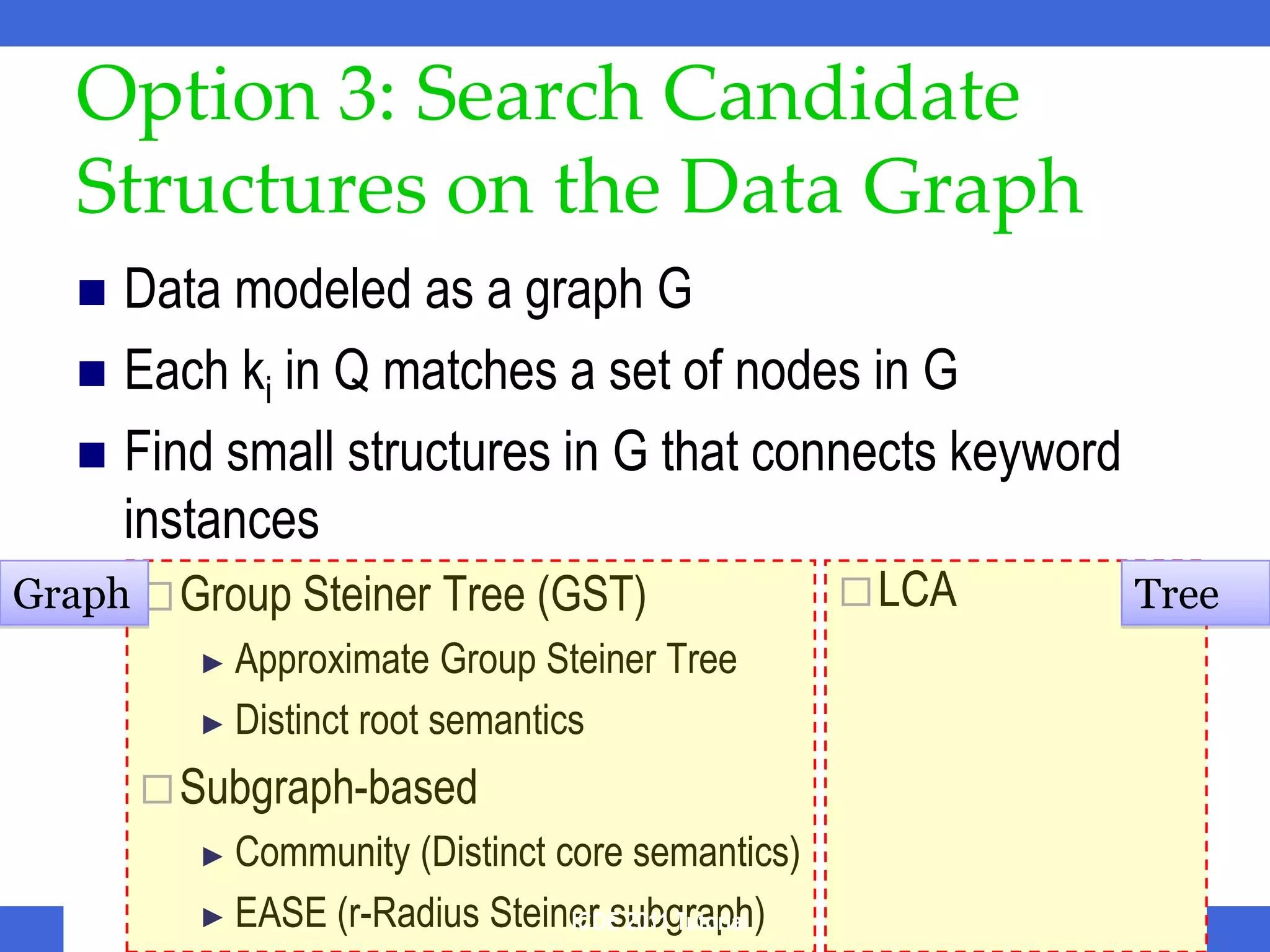
Option 3: Search Candidate Structures on the Data GraphData modeled as a graph GEach ki in Q matches a set of nodes in GFind small structures in G that connects keyword instancesGroup Steiner Tree (GST)Approximate Group Steiner TreeDistinct root semanticsSubgraph-basedCommunity (Distinct core semantics)EASE (r-Radius Steiner subgraph)29LCAGraphTreeICDE 2011 Tutorial
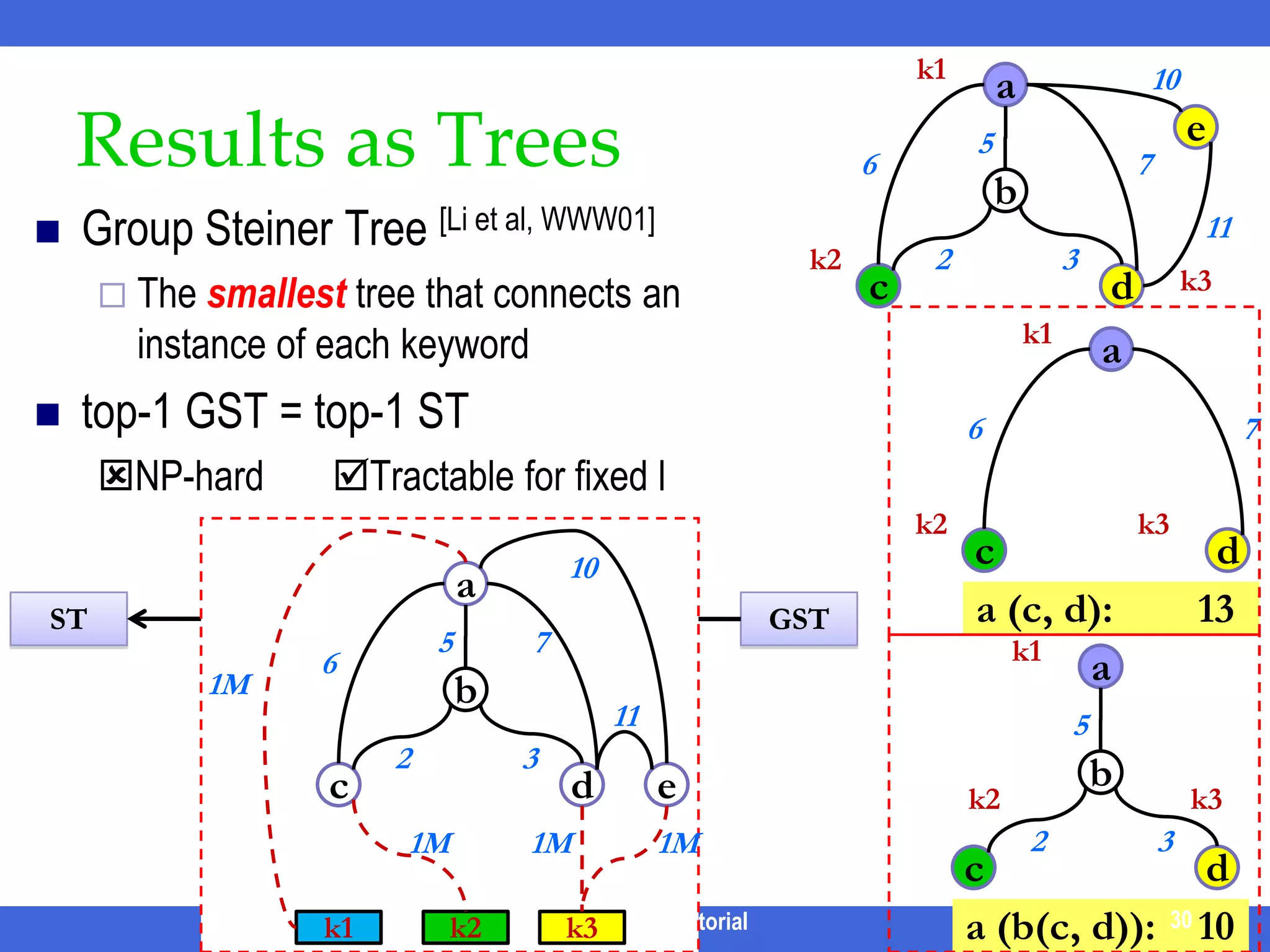
Results as Treesk1a567bGroup Steiner Tree [Li et al, WWW01]The smallest tree that connects an instance of each keywordtop-1 GST = top-1 STNP-hard       Tractable for fixed l23k2cdk3ICDE 2011 Tutorial10e1110a576b1M1123cde1M1M1MGSTSTk1k2k3k1k1aa30567bk2k3k2k323cdcda (c, d):        13a (b(c, d)):    1030
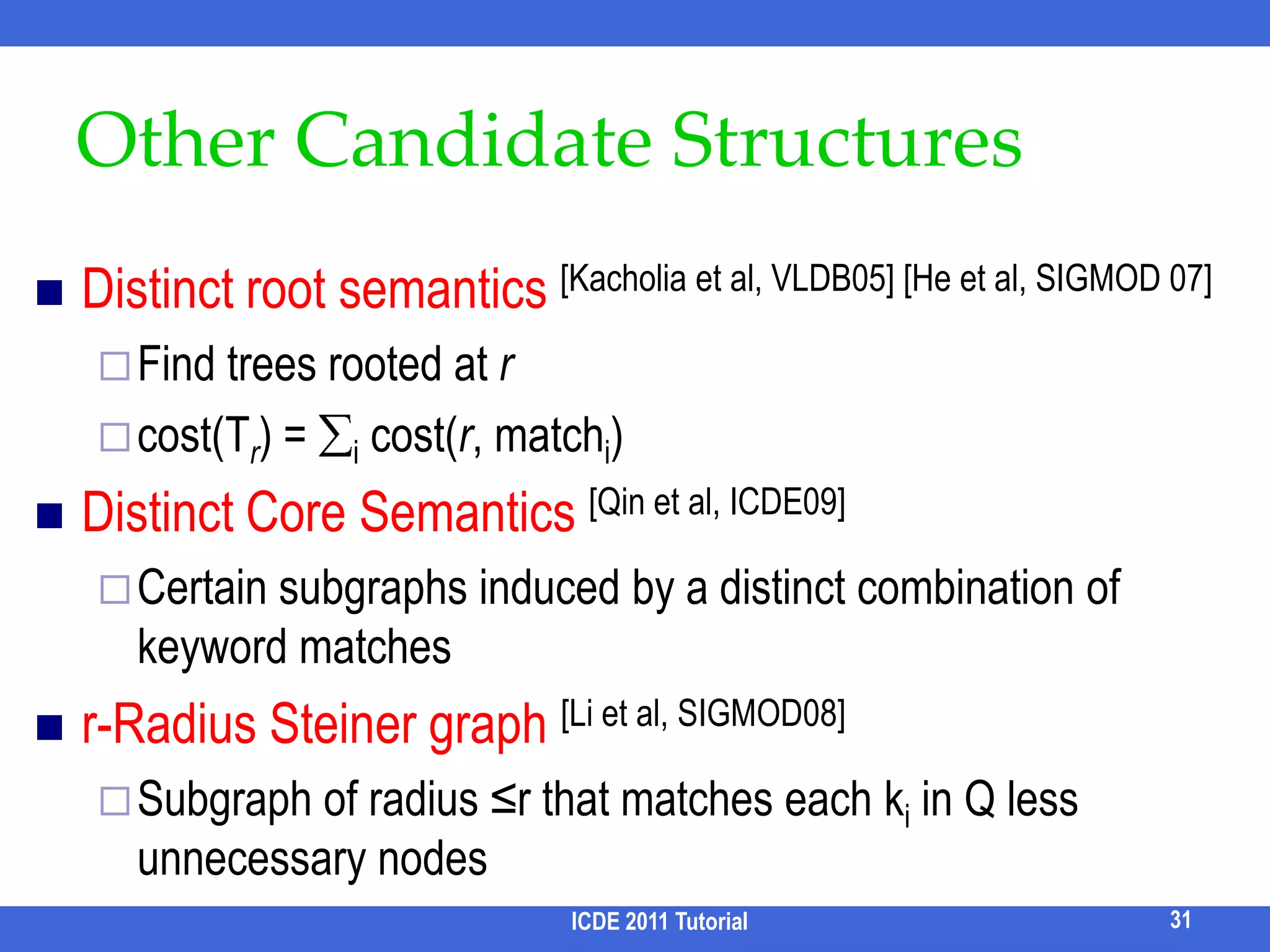
Other Candidate StructuresDistinct root semantics [Kacholia et al, VLDB05] [He et al, SIGMOD 07]Find trees rooted at rcost(Tr) = i cost(r, matchi)Distinct Core Semantics [Qin et al, ICDE09]Certain subgraphs induced by a distinct combination of keyword matches r-Radius Steiner graph [Li et al, SIGMOD08]Subgraph of radius ≤r that matches each ki in Q less unnecessary nodesICDE 2011 Tutorial31
Candidate Structures for XMLAny subtree that contains all keywords   subtrees rooted at LCA (Lowest common ancestor) nodes|LCA(S1, S2, …, Sn)| = min(N, ∏I |Si|)Many are still irrelevant or redundant  needs further pruning32confQ = {Keyword, Mark}namepaper…yeartitleauthorSIGMODauthor2007…MarkChenkeywordICDE 2011 Tutorial
SLCA [Xu et al, SIGMOD 05]ICDE 2011 Tutorial33SLCA [Xu et al. SIGMOD 05]Min redundancy: do not allow Ancestor-Descendant relationship among SLCA results Q = {Keyword, Mark}confnamepaper…yearpaper…titleauthorSIGMODauthortitle2007author…author…MarkChenkeywordRDFMarkZhang
Other ?LCAsELCA [Guo et al, SIGMOD 03]Interconnection Semantics [Cohen et al. VLDB 03]Many more ?LCAs34ICDE 2011 Tutorial
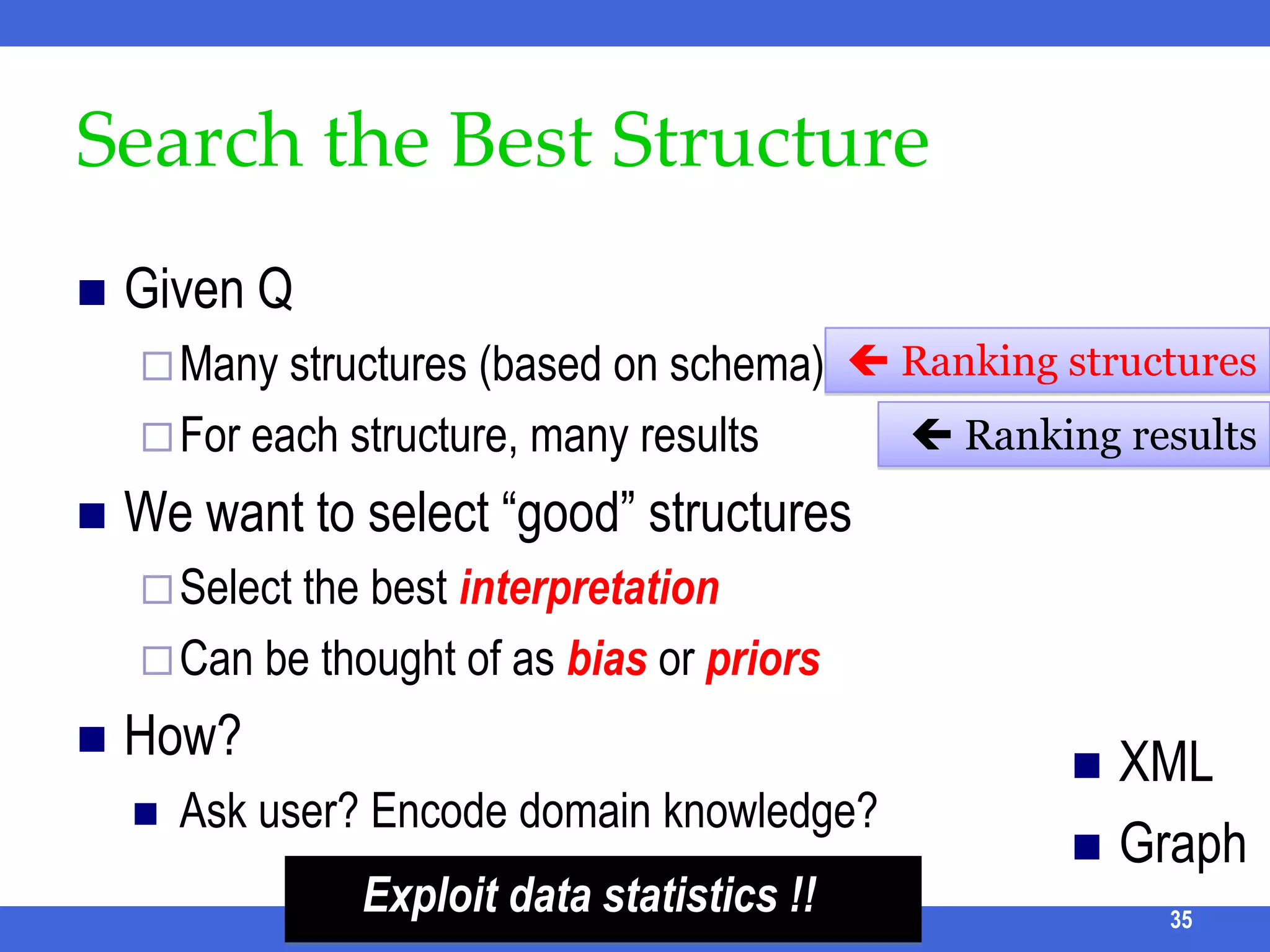
Search the Best StructureGiven QMany structures (based on schema)For each structure, many resultsWe want to select “good” structuresSelect the best interpretationCan be thought of as bias or priorsHow? Ask user? Encode domain knowledge? ICDE 2011 Tutorial35 Ranking structures Ranking resultsXML
GraphExploit data statistics !!
XML36What’s the most likely interpretationWhy?E.g., XML  All the label paths/imdb/movieImdb/movie/year/imdb/movie/plot…/imdb/director…Q: Shining 1980imdbTVmovieTVmoviedirectorplotnamenameyearnameDOBplotFriendsSimpsonsyear…W Allen1935-12-11980scoop… …… …2006shiningICDE 2011 Tutorial
XReal [Bao et al, ICDE 09] /1Infer the best structured query ⋍ information needQ = “Widom XML”/conf/paper[author ~ “Widom”][title ~ “XML”]Find the best return node type (search-for node type) with the highest score/conf/paper      1.9/journal/paper  1.2/phdthesis/paper  0ICDE 2011 Tutorial37Ensures T has the potential to match all query keywords
XReal [Bao et al, ICDE 09] /2Score each instance of type T  score each nodeLeaf node: based on the contentInternal node: aggregates the score of child nodesXBridge [Li et al, EDBT 10] builds a structure + value sketch to estimate the most promising return typeSee later part of the tutorialICDE 2011 Tutorial38
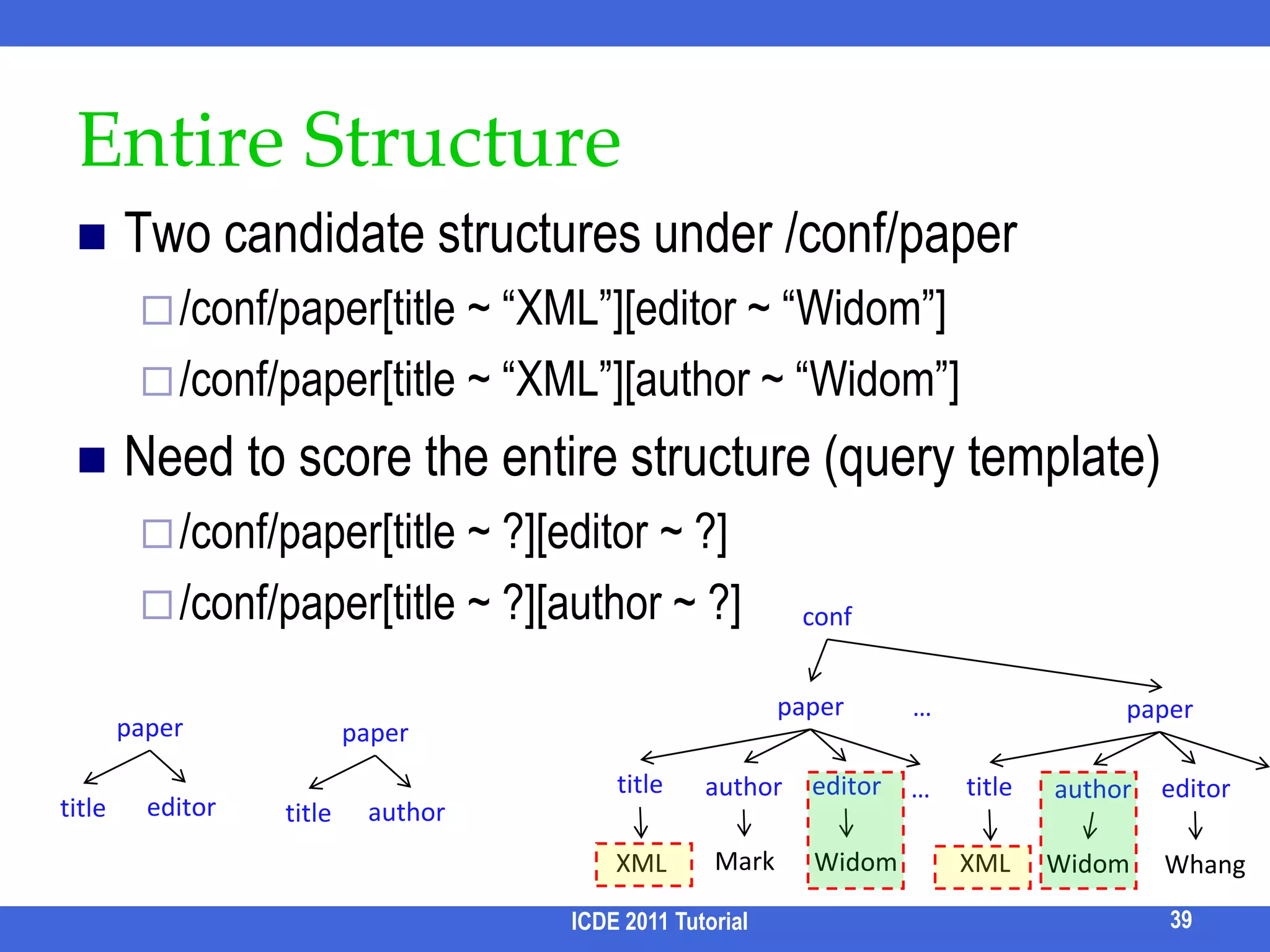
Entire StructureTwo candidate structures under /conf/paper/conf/paper[title ~ “XML”][editor ~ “Widom”]/conf/paper[title ~ “XML”][author ~ “Widom”]Need to score the entire structure (query template)/conf/paper[title ~ ?][editor ~ ?]/conf/paper[title ~ ?][author ~ ?]ICDE 2011 Tutorial39confpaper…paperpaperpapertitleeditorauthortitleeditor…authoreditorauthortitletitleMarkWidomXMLXMLWidomWhang
Related Entity Types [Jayapandian & Jagadish, VLDB08]ICDE 2011 Tutorial40BackgroundAutomatically design forms for a Relational/XML database instanceRelatedness of E1 – ☁ – E2 = [ P(E1  E2) + P(E2  E1) ] / 2P(E1  E2) = generalized participation ratio of E1 into E2i.e., fraction of E1 instances that are connected to some instance in E2What about (E1, E2, E3)?  PaperAuthorEditorP(A  P) = 5/6P(P  A) = 1P(E  P) = 1P(P  E) = 0.5P(A  P  E)≅ P(A  P) * P(P  E)(1/3!) * P(E  P  A)≅ P(E  P) * P(P  A)4/6     !=    1 * 0.5
NTC [Termehchy & Winslett, CIKM 09]Specifically designed to capture correlation, i.e., how close “they” are relatedUnweighted schema graph is only a crude approximationManual assigning weights is viable but costly (e.g., Précis [Koutrika et al, ICDE06])Ideas1 / degree(v) [Bhalotia et al, ICDE 02] ? 1-1, 1-n, total participation [Jayapandian & Jagadish, VLDB08]?ICDE 2011 Tutorial41
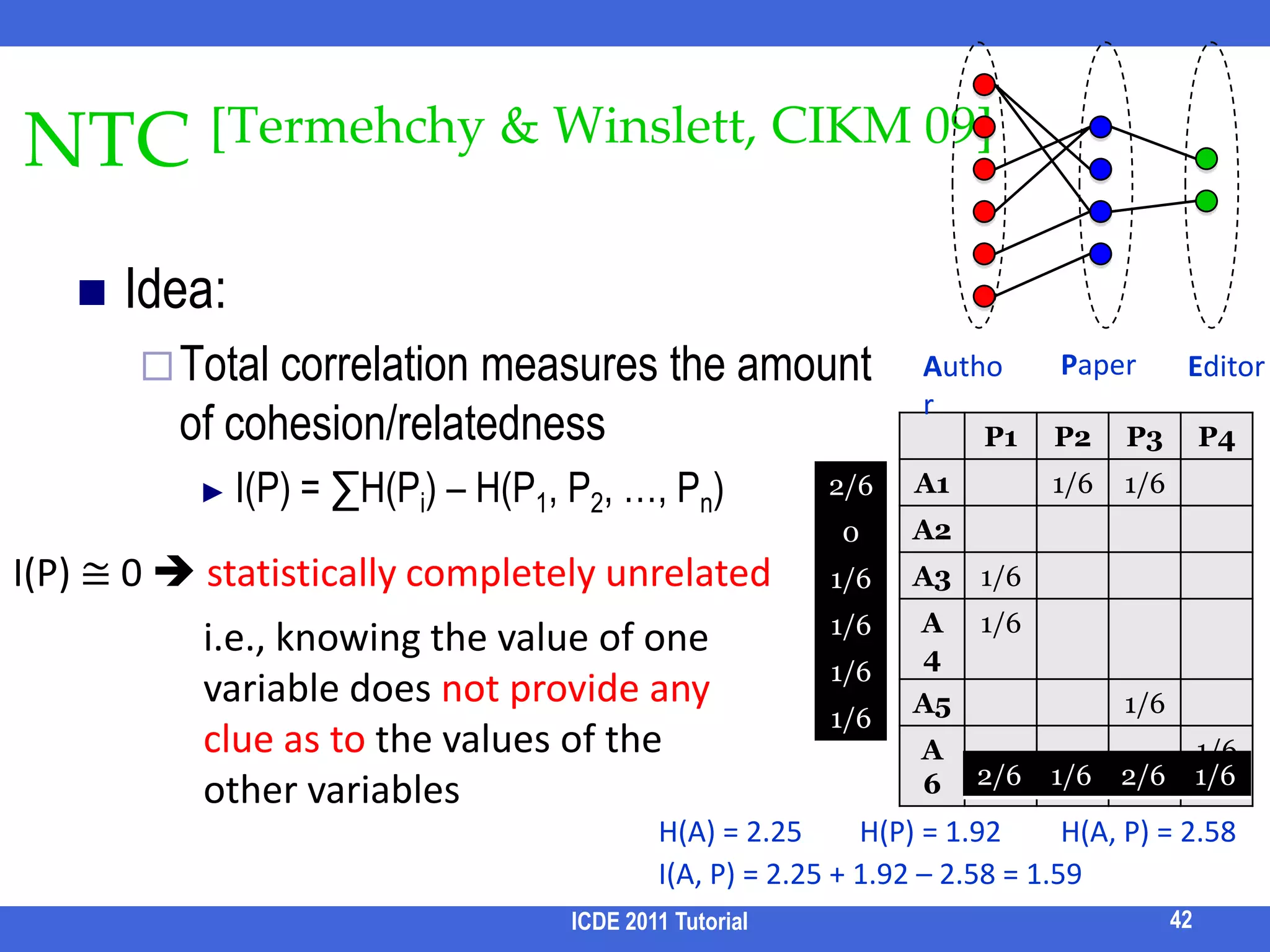
NTC [Termehchy & Winslett, CIKM 09]ICDE 2011 Tutorial42Idea:Total correlation measures the amount of cohesion/relatednessI(P) = ∑H(Pi) – H(P1, P2, …, Pn)PaperAuthorEditorI(P) ≅ 0  statistically completely unrelated i.e., knowing the value of one variable does not provide any clue as to the values of the other variables H(A) = 2.25H(P) = 1.92H(A, P) = 2.58I(A, P) = 2.25 + 1.92 – 2.58 = 1.59
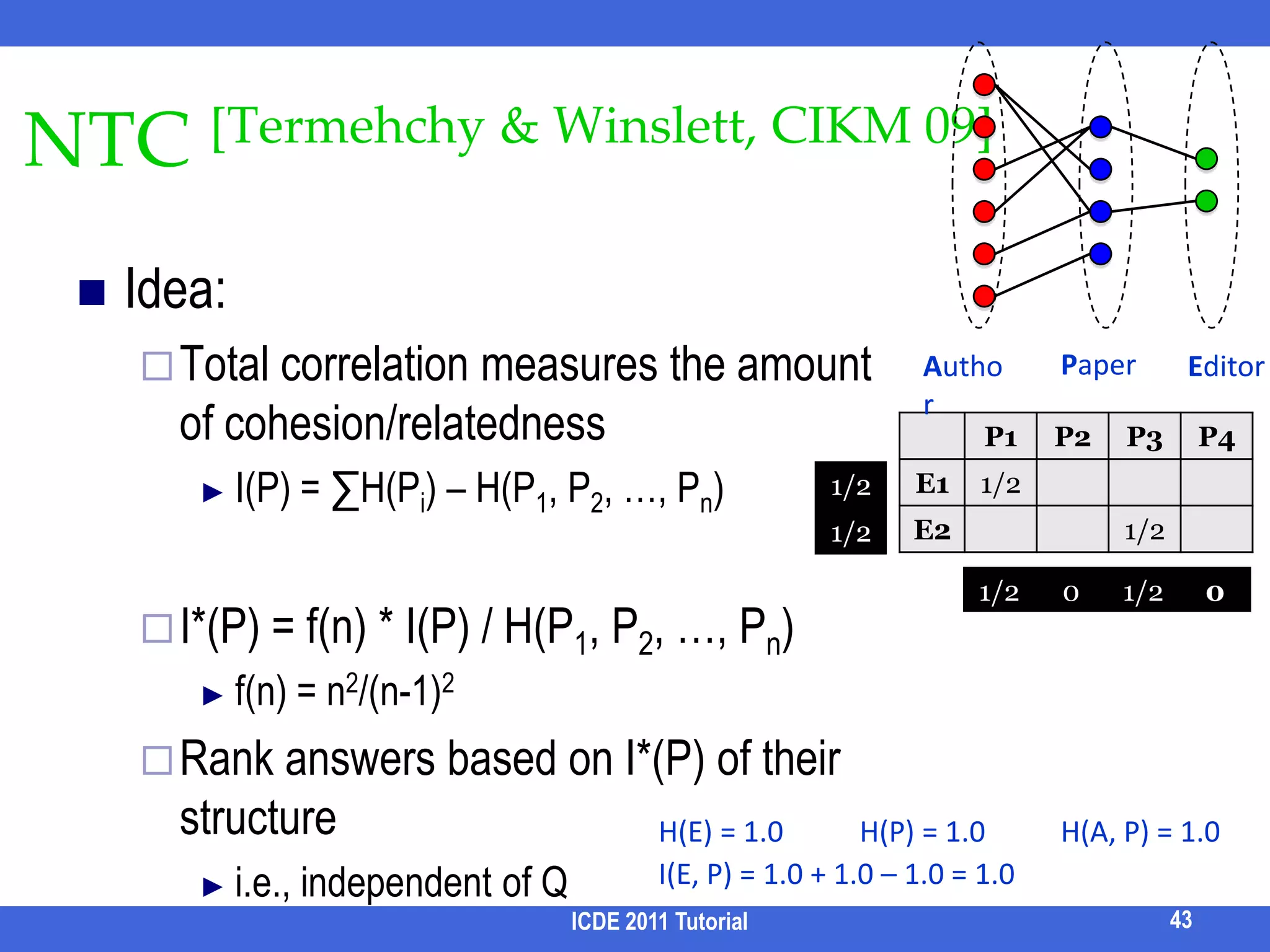
NTC [Termehchy & Winslett, CIKM 09]ICDE 2011 Tutorial43Idea:Total correlation measures the amount of cohesion/relatednessI(P) = ∑H(Pi) – H(P1, P2, …, Pn)I*(P) = f(n) * I(P) / H(P1, P2, …, Pn)f(n) = n2/(n-1)2Rank answers based on I*(P) of their structurei.e., independent of QPaperAuthorEditorH(E) = 1.0H(P) = 1.0H(A, P) = 1.0I(E, P) = 1.0 + 1.0 – 1.0 = 1.0
Relational Data GraphICDE 2011 Tutorial44E.g., RDBMS  All the valid candidate networks (CN) Schema Graph: A W PQ: Widom XMLan author wrote a papertwo authors wrote a single paper
SUITS [Zhou et al, 2007]Rank candidate structured queries by heuristics The (normalized) (expected) results should be smallKeywords should cover a majority part of value of a binding attributeMost query keywords should be matchedGUI to help user interactively select the right structural queryAlso c.f., ExQueX [Kimelfeld et al, SIGMOD 09]Interactively formulate query via reduced trees and filtersICDE 2011 Tutorial45
IQP[Demidova et al, TKDE11]Structural query = keyword bindings + query templatePr[A, T | Q] ∝ Pr[A | T] * Pr[T] = ∏IPr[Ai | T] * Pr[T]ICDE 2011 Tutorial46Query templateAuthor  Write  PaperKeyword Binding 1 (A1)Keyword Binding 2 (A2)“Widom”“XML”Probability of keyword bindingsEstimated from Query LogQ: What if no query log?
Probabilistic Scoring [Petkova et al, ECIR 09] /1List and score all possible bindings of (content/structural) keywordsPr(path[~“w”]) = Pr[~“w” | path] = pLM[“w” | doc(path)] Generate high-probability combinations from themReduce each combination into a valid XPath Query by applying operators and updating the probabilitiesAggregationSpecializationICDE 2011 Tutorial47//a[~“x”] + //a[~“y”]  //a[~ “x y”]Pr = Pr(A) * Pr(B) //a[~“x”]  //b//a[~ “x”]Pr = Pr[//a is a descendant of //b] * Pr(A)
Probabilistic Scoring [Petkova et al, ECIR 09] /2Reduce each combination into a valid XPath Query by applying operators and updating the probabilitiesNestingKeep the top-k valid queries (via A* search)ICDE 2011 Tutorial48//a + //b[~“y”]  //a//b[~ “y”], //a[//b[~“y”]]Pr’s = IG(A) * Pr[A] * Pr(B), IG(B) * Pr[A] * Pr[B]
SummaryTraditional methods: list and explore all possibilitiesNew trend: focus on the most promising oneExploit data statistics!AlternativesMethod based on ranking/scoring data subgraph (i.e., result instances)ICDE 2011 Tutorial49
RoadmapMotivationStructural ambiguityNode connection inferenceReturn information inferenceLeverage query formsKeyword ambiguityEvaluationQuery processingResult analysisFuture directionsICDE 2011 Tutorial50
Identifying Return Nodes [Liu and Chen  SIGMOD 07]Similar as SQL/XQuery, query keywords can specify predicates (e.g. selections and joins)return nodes  (e.g. projections)    Q1: “John, institution”Return nodes may also be implicitQ2: “John, Univ of Toronto” return node = “author”Implicit return nodes: Entities involved in resultsXSeek infers return nodes by analyzing Patterns of query keyword matches: predicates, explicit return nodesData semantics: entity, attributesICDE 2011 Tutorial51
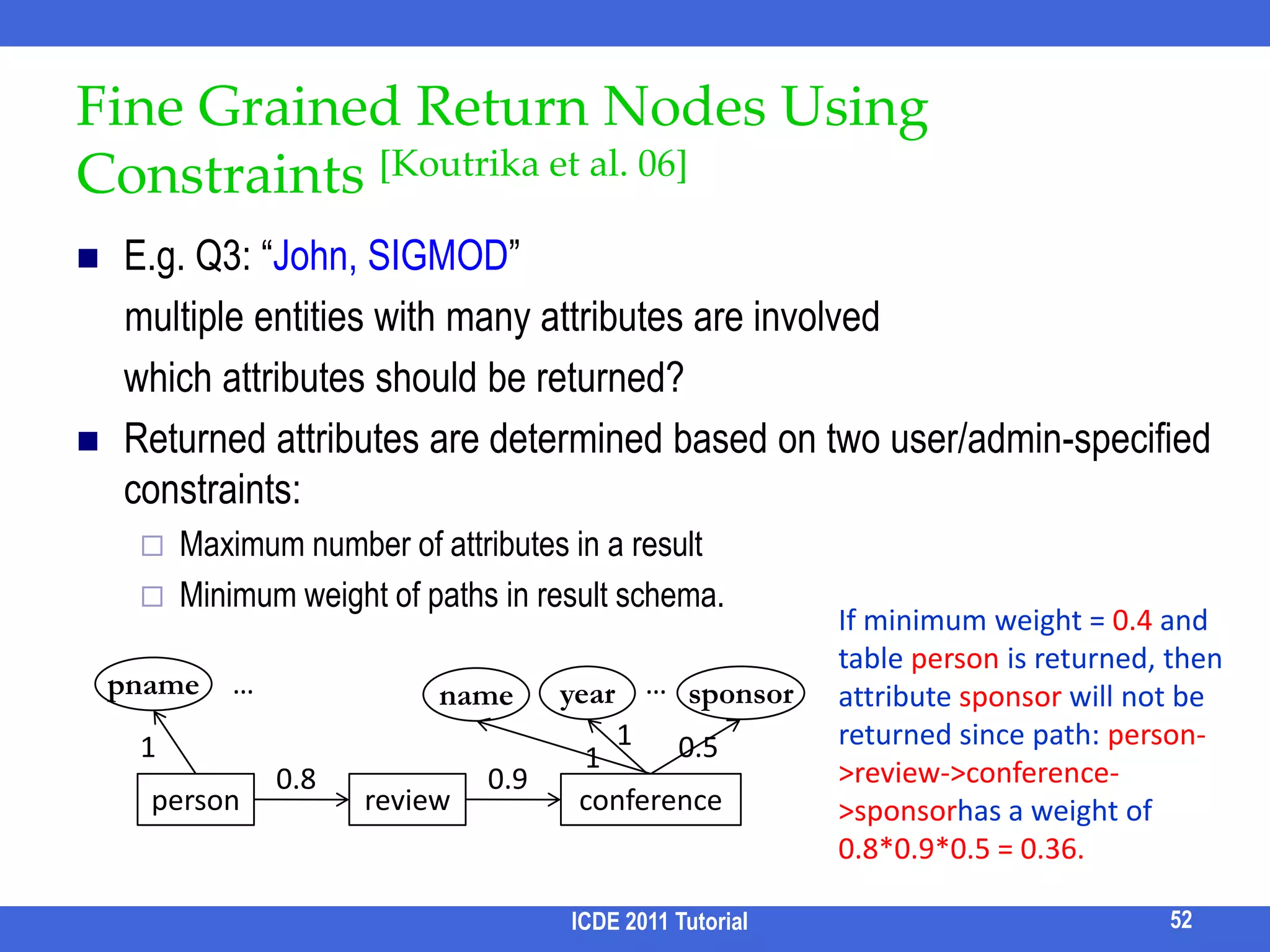
Fine Grained Return Nodes Using Constraints [Koutrika et al. 06]E.g. Q3: “John, SIGMOD”     multiple entities with many attributes are involved	which attributes should be returned?Returned attributes are determined based on two user/admin-specified constraints:Maximum number of attributes in a resultMinimum weight of paths in result schema.ICDE 2011 Tutorial52If minimum weight = 0.4 and table person is returned, then attribute sponsor will not be returned since path: person->review->conference->sponsorhas a weight of 0.8*0.9*0.5 = 0.36.pname……sponsoryearname110.510.80.9personreviewconference
RoadmapMotivationStructural ambiguityNode connection inferenceReturn information inferenceLeverage query formsKeyword ambiguityEvaluationQuery processingResult analysisFuture directionsICDE 2011 Tutorial53
Combining Query Forms and Keyword Search [Chu et al. SIGMOD 09]Inferring structures for keyword queries are challenging Suppose we have a set of Query Forms, can we leverage them to obtain the structure of a keyword query accurately? What is a Query Form?An incomplete SQL query (with joins)selections to be completed by usersSELECT *FROM author A, paper P, write W WHERE W.aid = A.id AND W.pid = P.id  AND A.name op expr AND P.titleop exprwhich author publishes which paperAuthor NameOpExprPaper TitleOpExpr54ICDE 2011 Tutorial
Challenges and Problem DefinitionChallengesHow to obtain query forms?How many query forms to be generated? Fewer Forms - Only a limited set of queries can be posed. More Forms – Which one is relevant?Problem definitionICDE 2011 Tutorial55OFFLINEInput: Database Schema
Output: A set of Forms
Goal: cover a majority of potential queriesONLINEInput: Keyword Query
Output: a ranked List of Relevant Forms, to be filled by the userOffline: Generating FormsStep 1: Select a subset of “skeleton templates”, i.e., SQL with only table names and join conditions. Step 2: Add predicate attributes to each skeleton template to get query forms; leave operator and expression unfilled.ICDE 2011 Tutorial56SELECT * FROM author A, paper P, write W WHERE W.aid = A.id AND W.pid = P.idAND A.nameop expr AND P.titleop exprsemantics: which person writes which paper
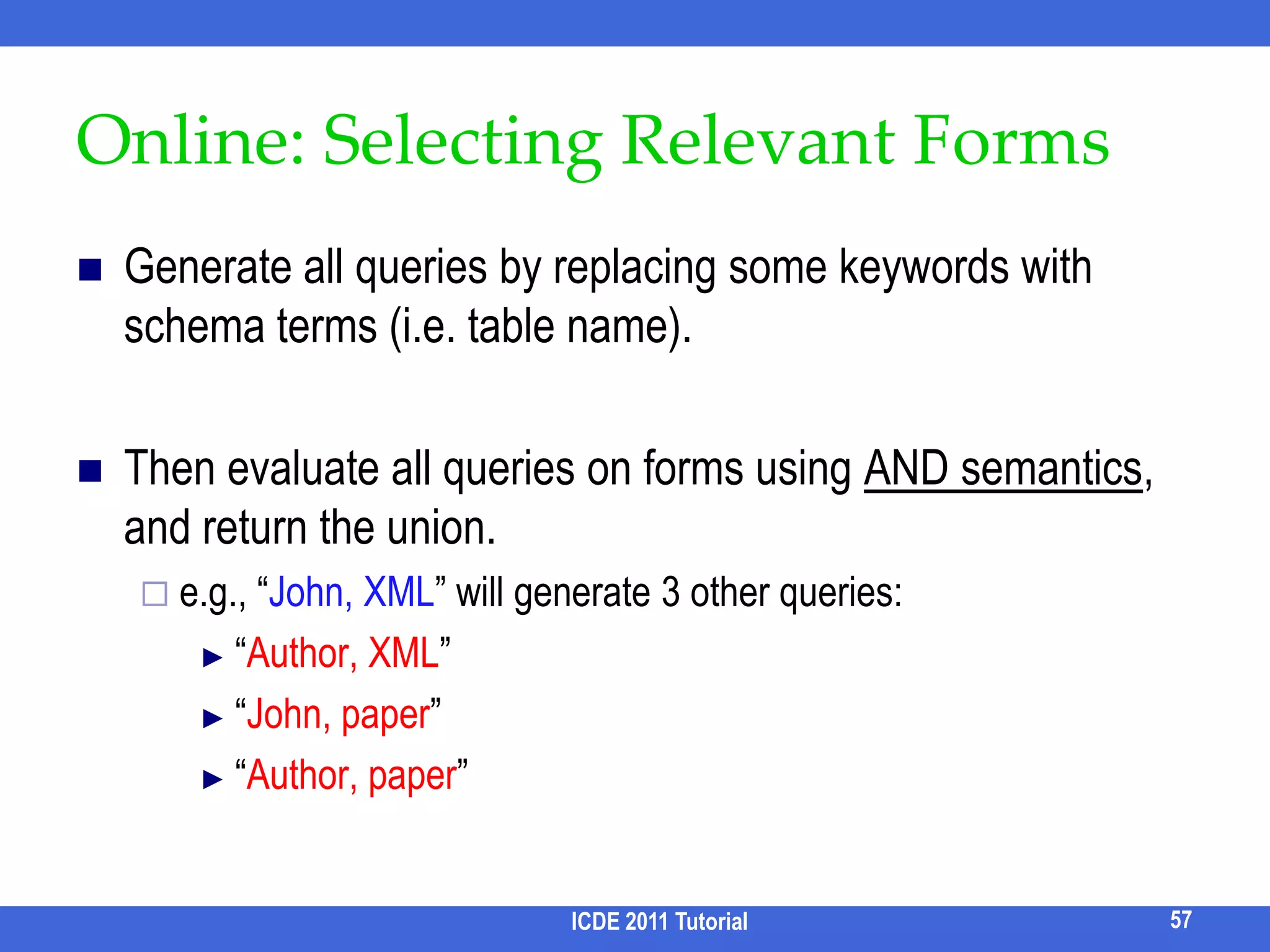
Online: Selecting Relevant FormsGenerate all queries by replacing some keywords with schema terms (i.e. table name). Then evaluate all queries on forms using AND semantics, and return the union.e.g., “John, XML” will generate 3 other queries:“Author, XML”“John, paper”“Author, paper”ICDE 2011 Tutorial57
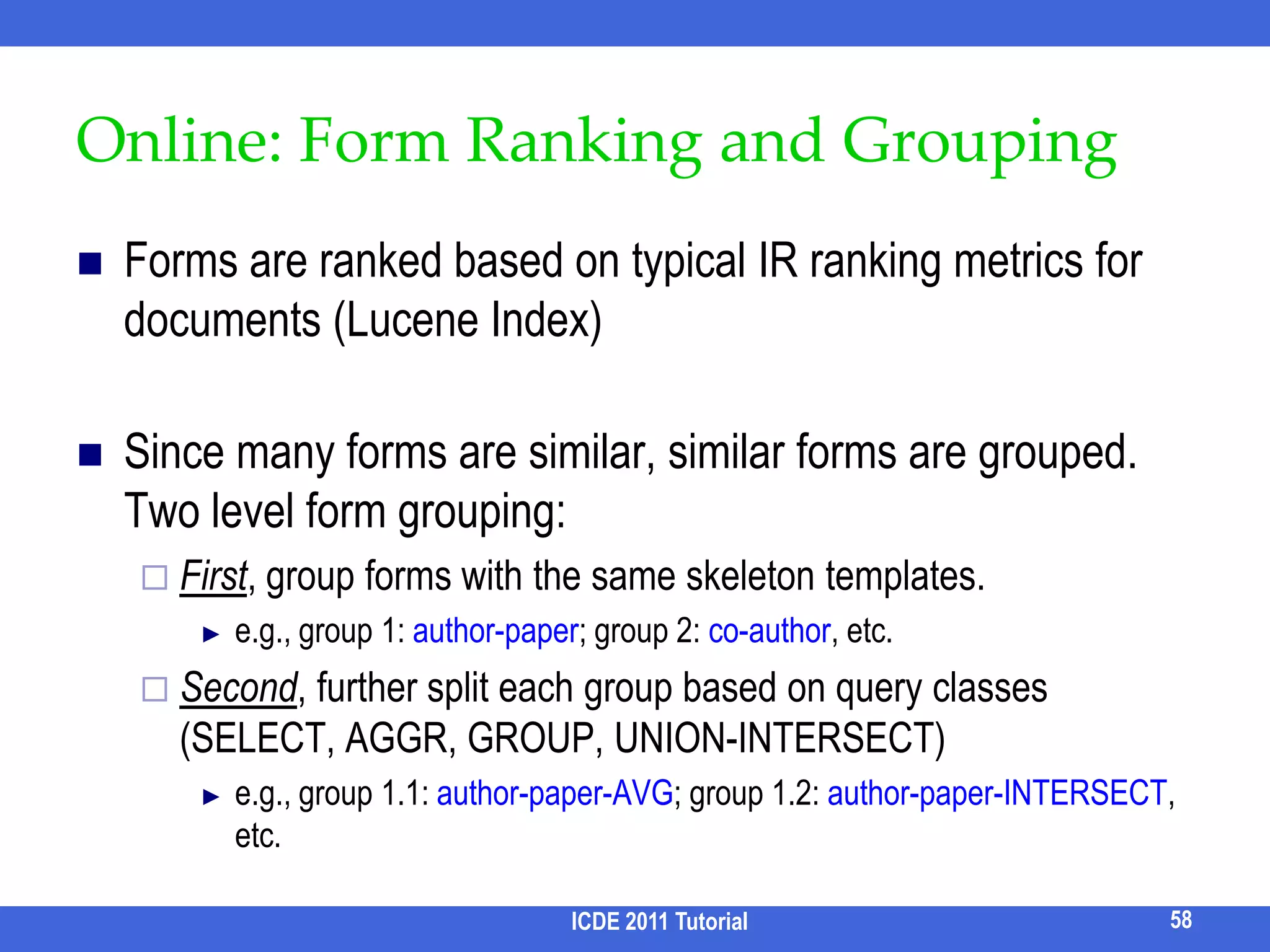
Online: Form Ranking and GroupingForms are ranked based on typical IR ranking metrics for documents (Lucene Index)Since many forms are similar, similar forms are grouped. Two level form grouping:First, group forms with the same skeleton templates.e.g., group 1: author-paper; group 2: co-author, etc.Second, further split each group based on query classes (SELECT, AGGR, GROUP, UNION-INTERSECT)e.g., group 1.1: author-paper-AVG; group 1.2: author-paper-INTERSECT, etc.ICDE 2011 Tutorial58
Generating Query Forms [Jayapandian and Jagadish PVLDB08]Motivation:How to generate “good” forms?	i.e. forms that cover many queriesWhat if query log is unavailable?How to generate “expressive” forms?	i.e. beyond joins and selectionsProblem definitionInput: database, schema/ER diagramOutput: query forms that maximally cover queries with size constraintsChallenge:How to select entities in the schema to compose a query form?How to select attributes?How to determine input (predicates) and output (return nodes)?ICDE 2011 Tutorial59
Queriability of an Entity TypeIntuitionIf an entity node is likely to be visited through data browsing/navigation, then it’s likely to appear in a query	Queriability estimated by accessibility in navigationAdapt the PageRank model for data navigationPageRank measures the “accessibility” of a data node (i.e. a page)A node spreads its score to its outlinks equally Here we need to measure the score of an entity typeSpread weight from n to its outlinksm isdefined as:				normalized by weights of all outlinks of ne.g. suppose: inproceedings , articles authors	if in average an author writes more conference papers than articles	then inproceedings has a higher weight for score spread to author  (than artilcle)ICDE 2011 Tutorial60
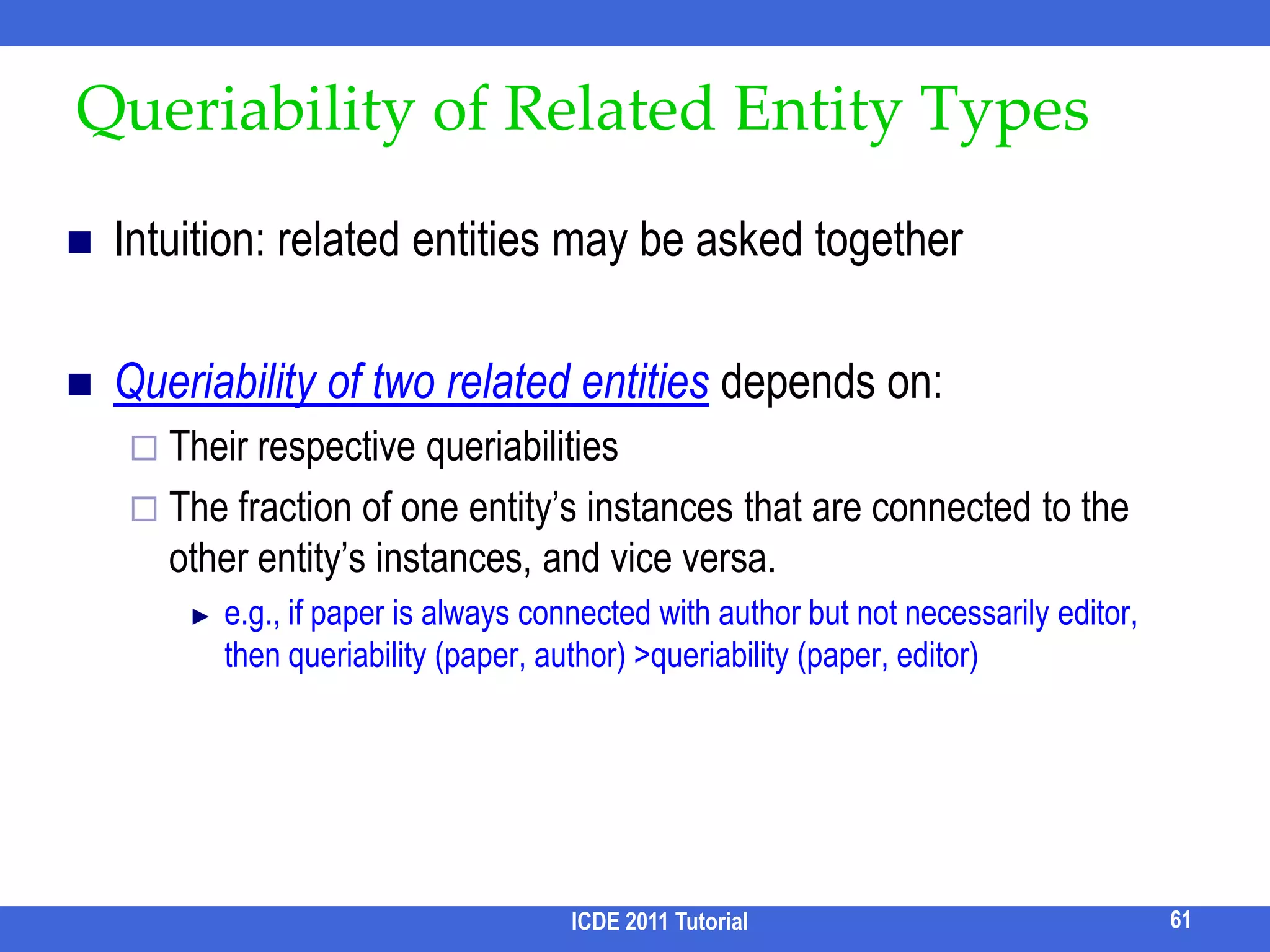
Queriability of Related Entity TypesIntuition: related entities may be asked togetherQueriability of two related entities depends on:Their respective queriabilitiesThe fraction of one entity’s instances that are connected to the other entity’s instances, and vice versa.e.g., if paper is always connected with author but not necessarily editor, then queriability (paper, author) > queriability (paper, editor)ICDE 2011 Tutorial61
Queriability of AttributesIntuition: frequently appeared attributes of an entity are importantQueriability of an attribute depends on its number of (non-null) occurrences in the data with respect to its parent entity instances.e.g., if every paper has a title, but not all papers have indexterm, then queriability(title) > queriability (indexterm).ICDE 2011 Tutorial62
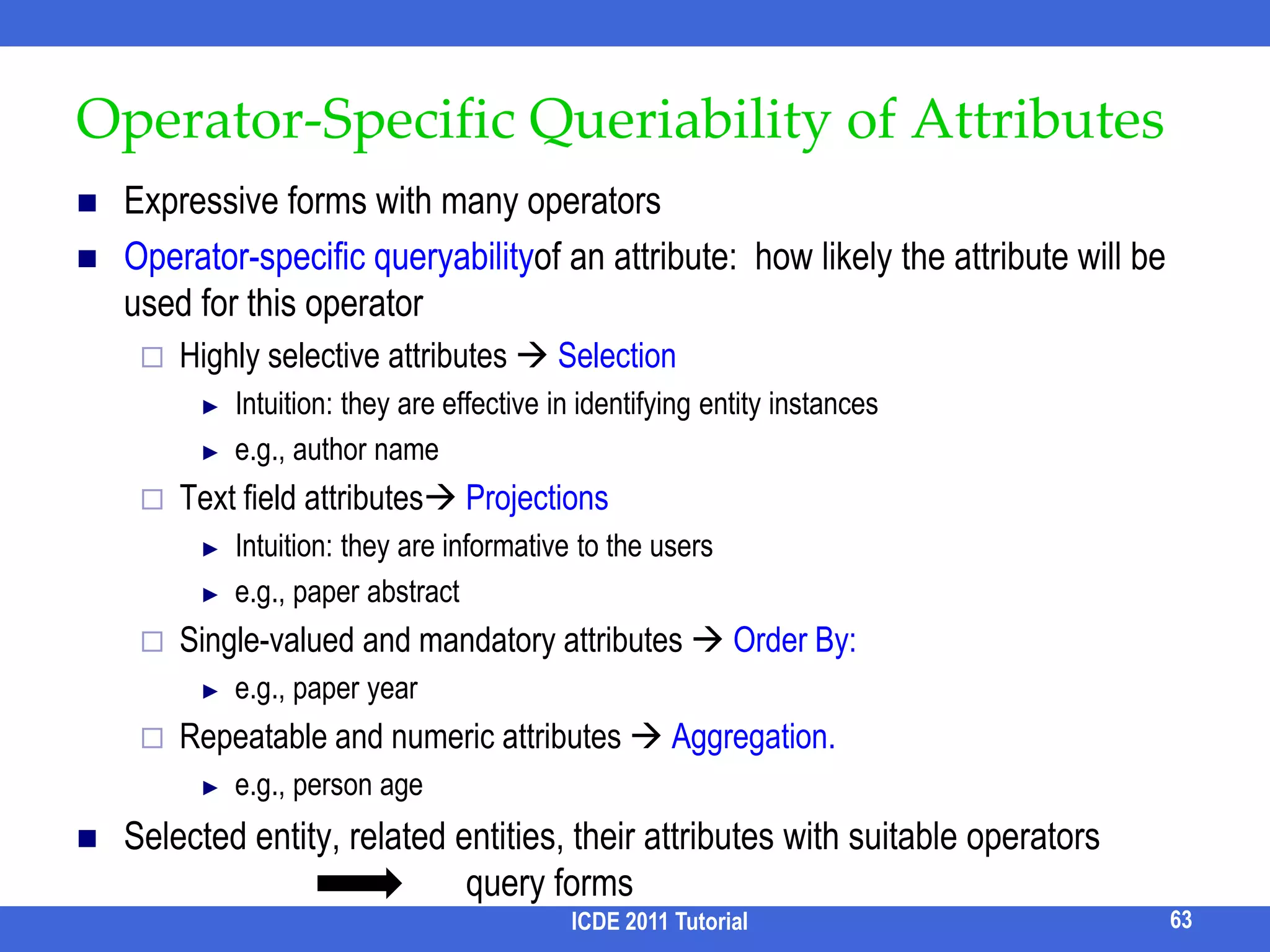
Operator-Specific Queriability of AttributesExpressive forms with many operatorsOperator-specific queryabilityof an attribute:  how likely the attribute will be used for this operatorHighly selective attributes  SelectionIntuition: they are effective in identifying entity instancese.g., author nameText field attributes ProjectionsIntuition: they are informative to the userse.g., paper abstractSingle-valued and mandatory attributes  Order By:e.g., paper yearRepeatable and numeric attributes  Aggregation.e.g., person ageSelected entity, related entities, their attributes with suitable operators   			 query formsICDE 2011 Tutorial63
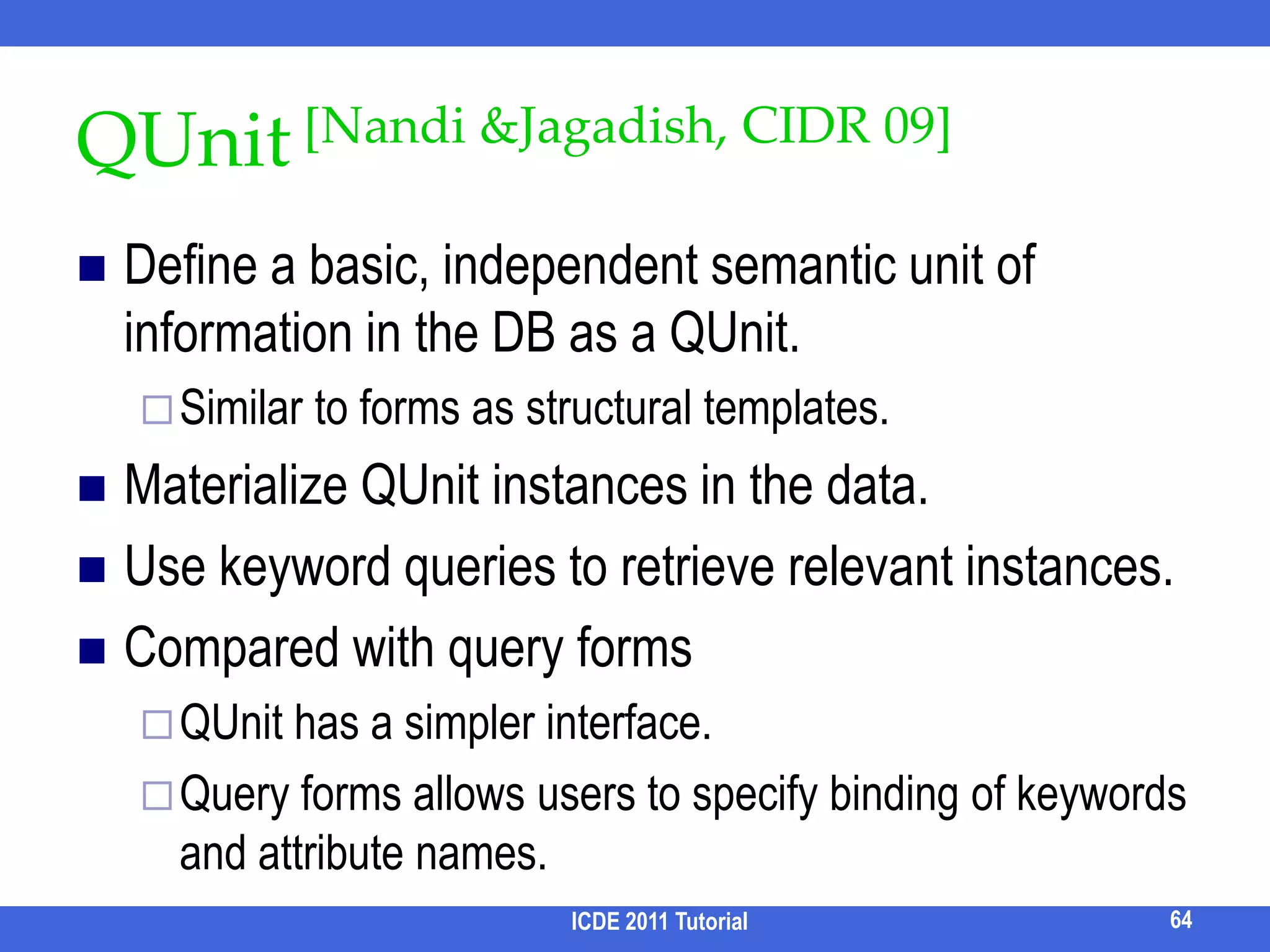
QUnit [Nandi & Jagadish, CIDR 09]Define a basic, independent semantic unit of information in the DB as a QUnit.Similar to forms as structural templates.Materialize QUnit instances in the data.Use keyword queries to retrieve relevant instances.Compared with query formsQUnit has a simpler interface.Query forms allows users to specify binding of keywords and attribute names.ICDE 2011 Tutorial64
RoadmapMotivationStructural ambiguityKeyword ambiguityQuery cleaning and auto-completionQuery refinementQuery rewritingEvaluationQuery processingResult analysisFuture directionsICDE 2011 Tutorial65
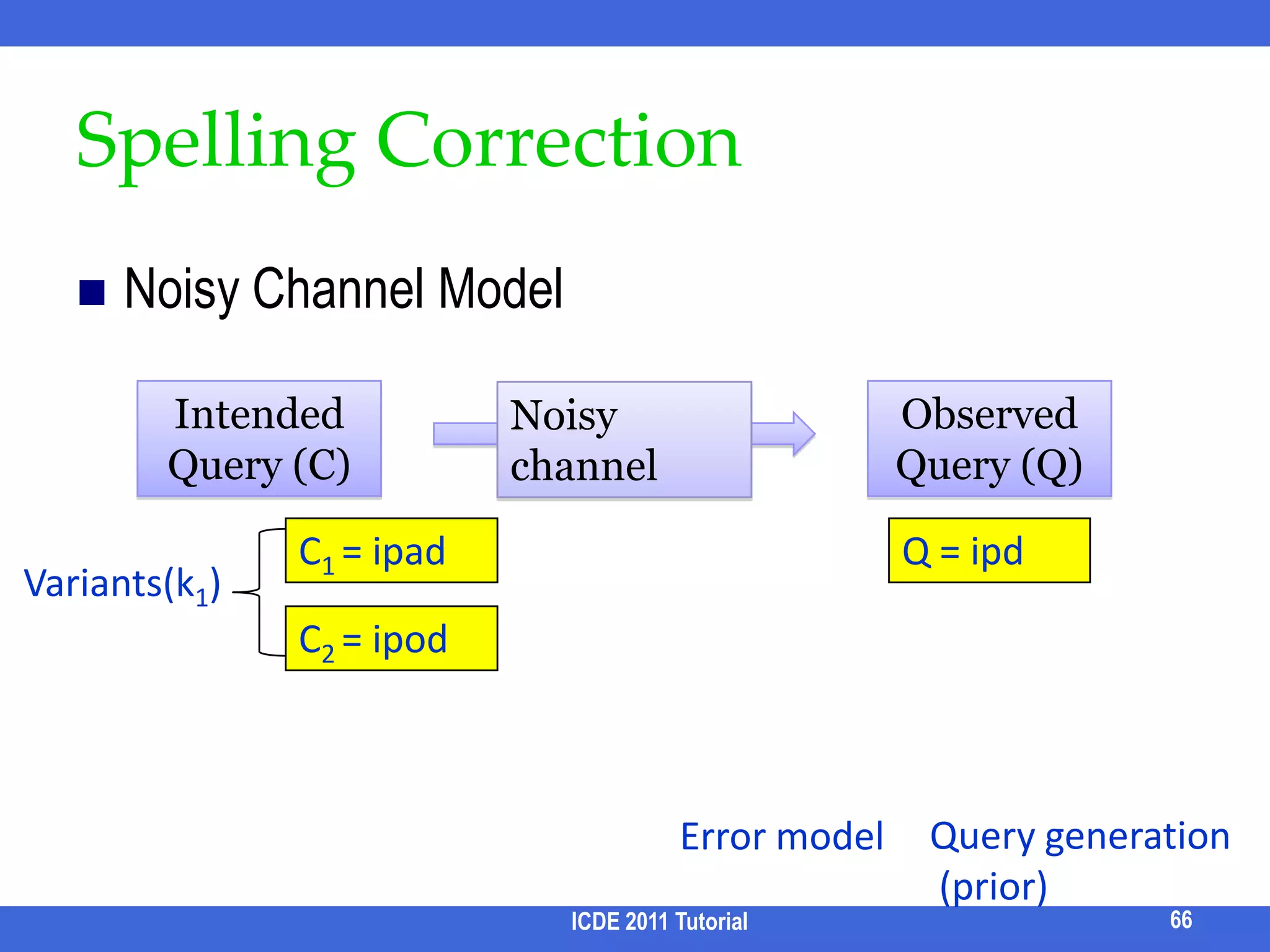
Spelling CorrectionNoisy Channel ModelICDE 2011 Tutorial66Intended Query (C) Observed Query (Q) Noisy channelC1 = ipadQ = ipdVariants(k1)C2 = ipodQuery generation (prior)Error model
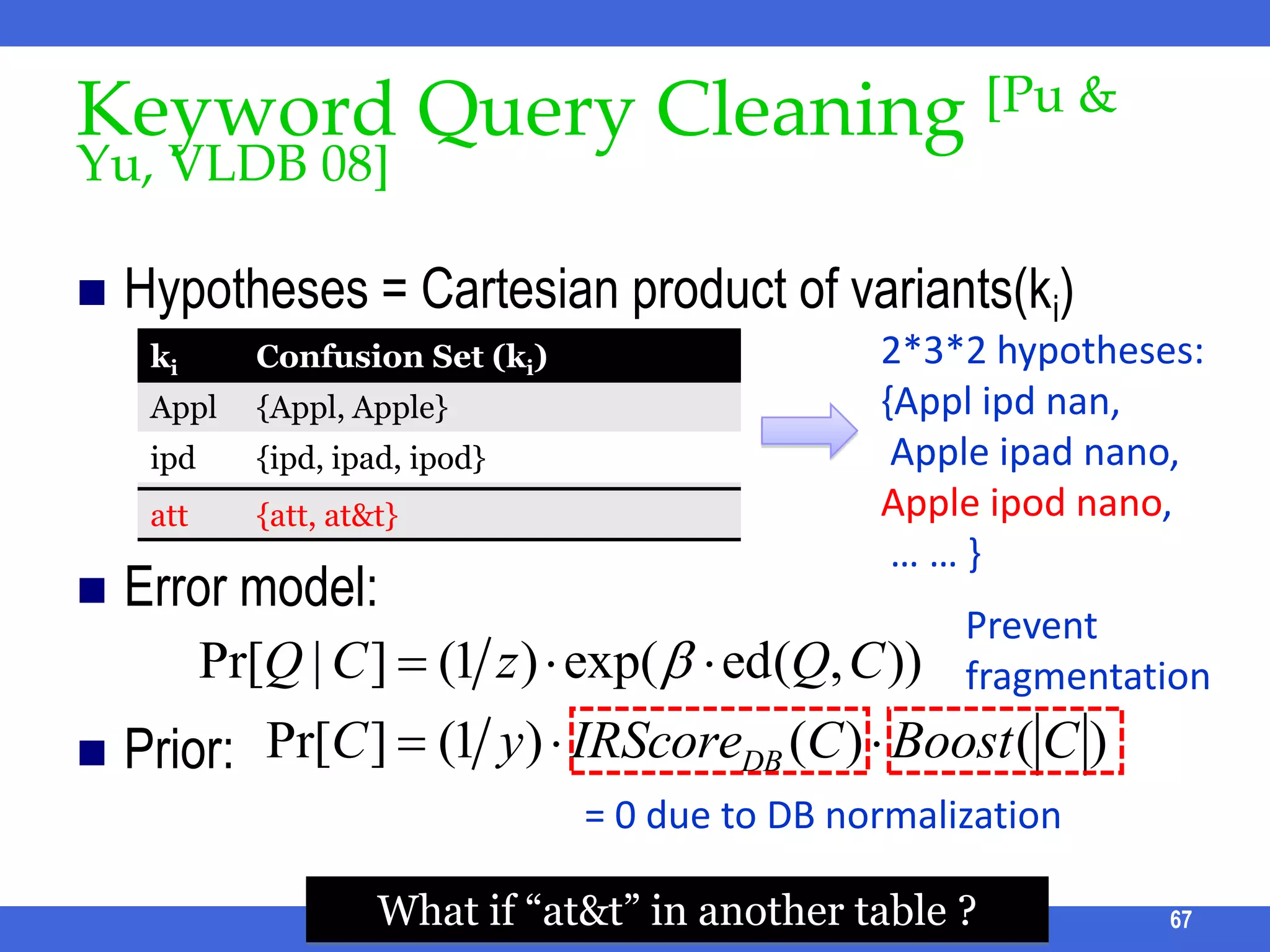
Keyword Query Cleaning [Pu & Yu, VLDB 08]Hypotheses = Cartesian product of variants(ki)Error model: Prior:ICDE 2011 Tutorial672*3*2 hypotheses:{Appl ipd nan, Apple ipad nano, Apple ipod nano,  … … }Prevent fragmentation= 0 due to DB normalizationWhat if “at&t” in another table ?
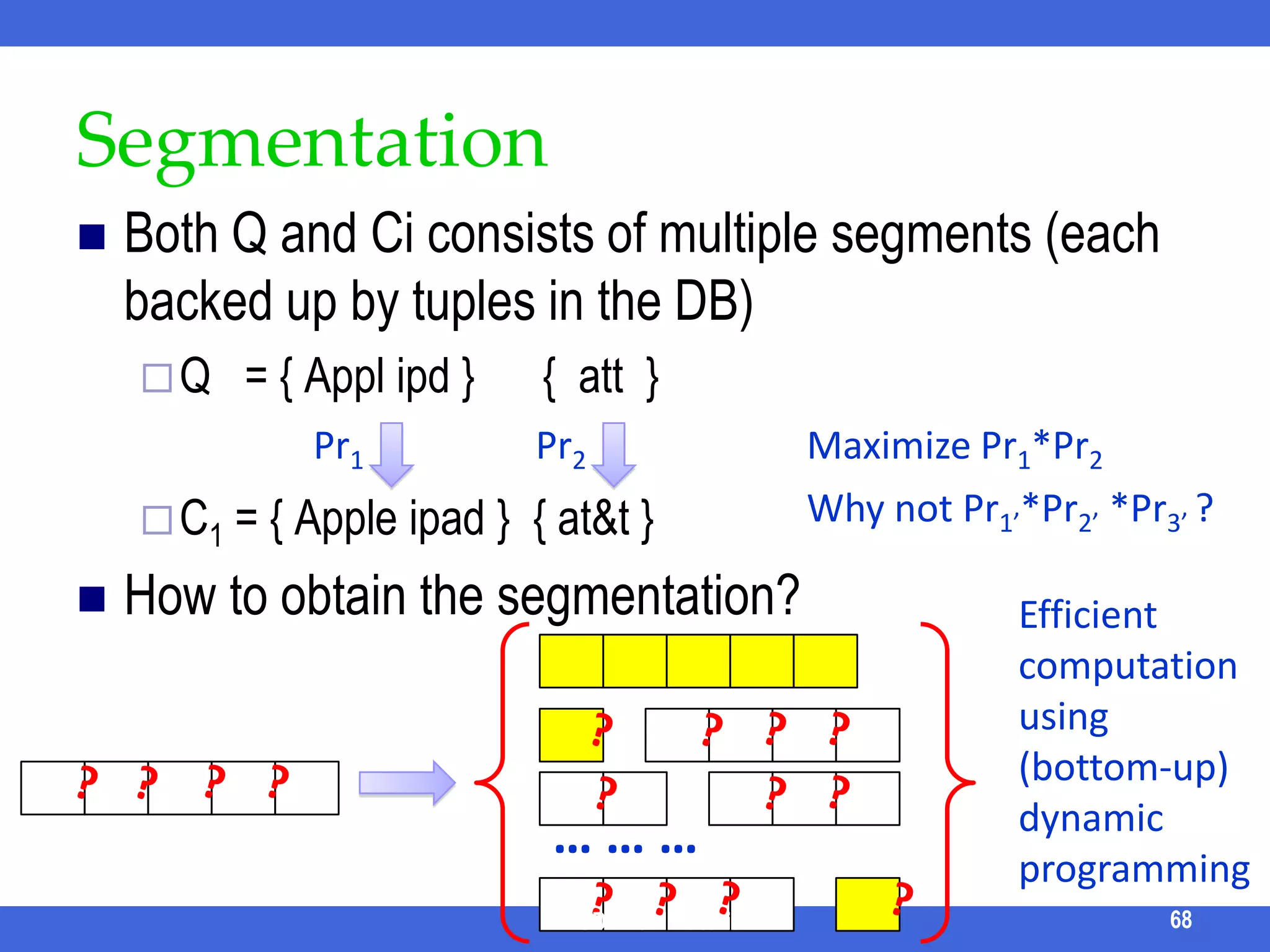
SegmentationBoth Q and Ci consists of multiple segments (each backed up by tuples in the DB)Q   = { Appl ipd }      {  att  }C1 = { Apple ipad }  { at&t }How to obtain the segmentation?68Pr1Pr2Maximize Pr1*Pr2Why not Pr1’*Pr2’ *Pr3’ ?Efficient computation using (bottom-up) dynamic programming???????????… … …????ICDE 2011 Tutorial
XClean[Lu et al, ICDE 11] /1Noisy Channel Model for XML data TError model:Query generation model:   ICDE 2011 Tutorial69Error modelQuery generation modelLang. modelPrior
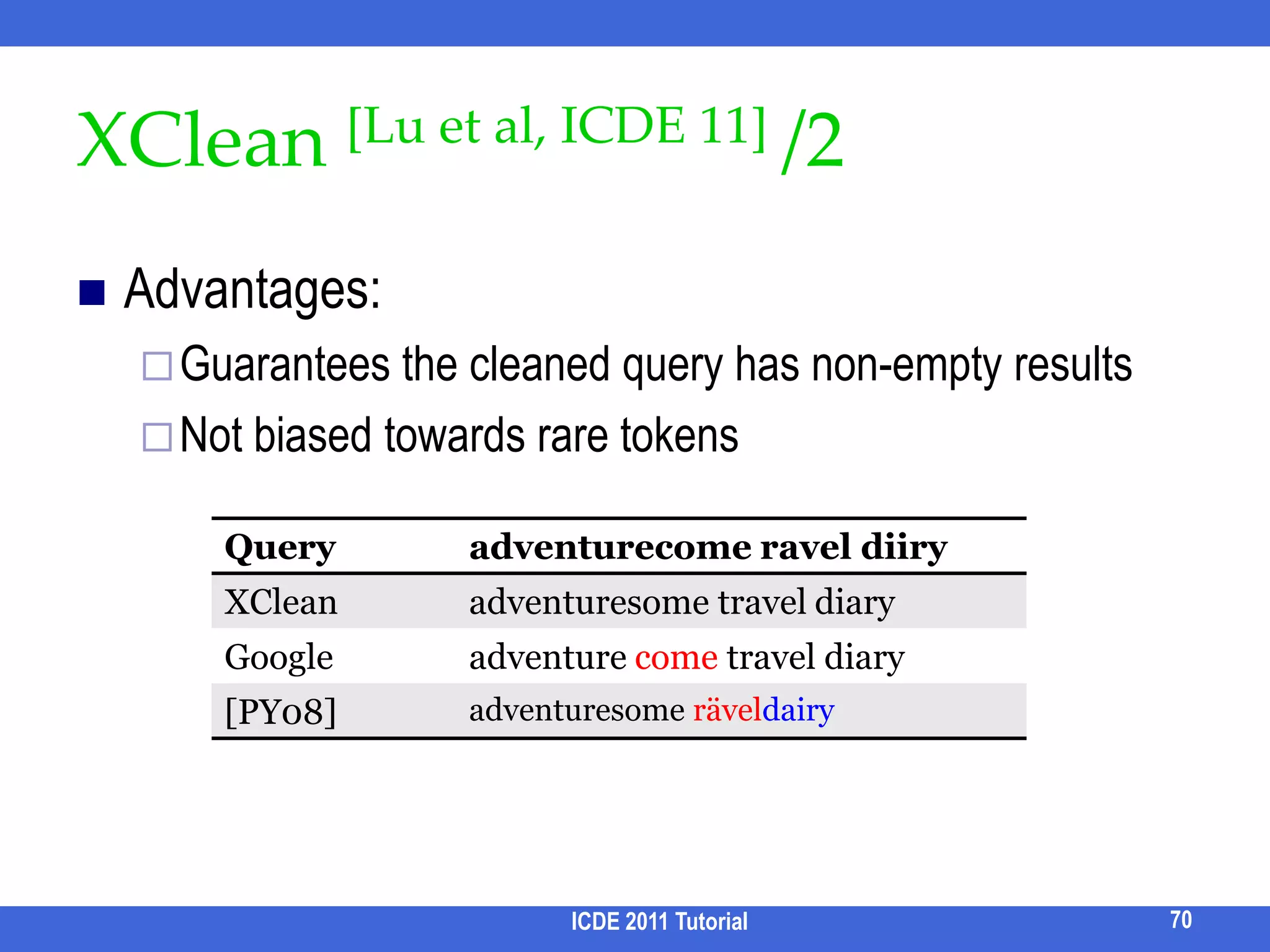
XClean [Lu et al, ICDE 11] /2Advantages:Guarantees the cleaned query has non-empty resultsNot biased towards rare tokensICDE 2011 Tutorial70
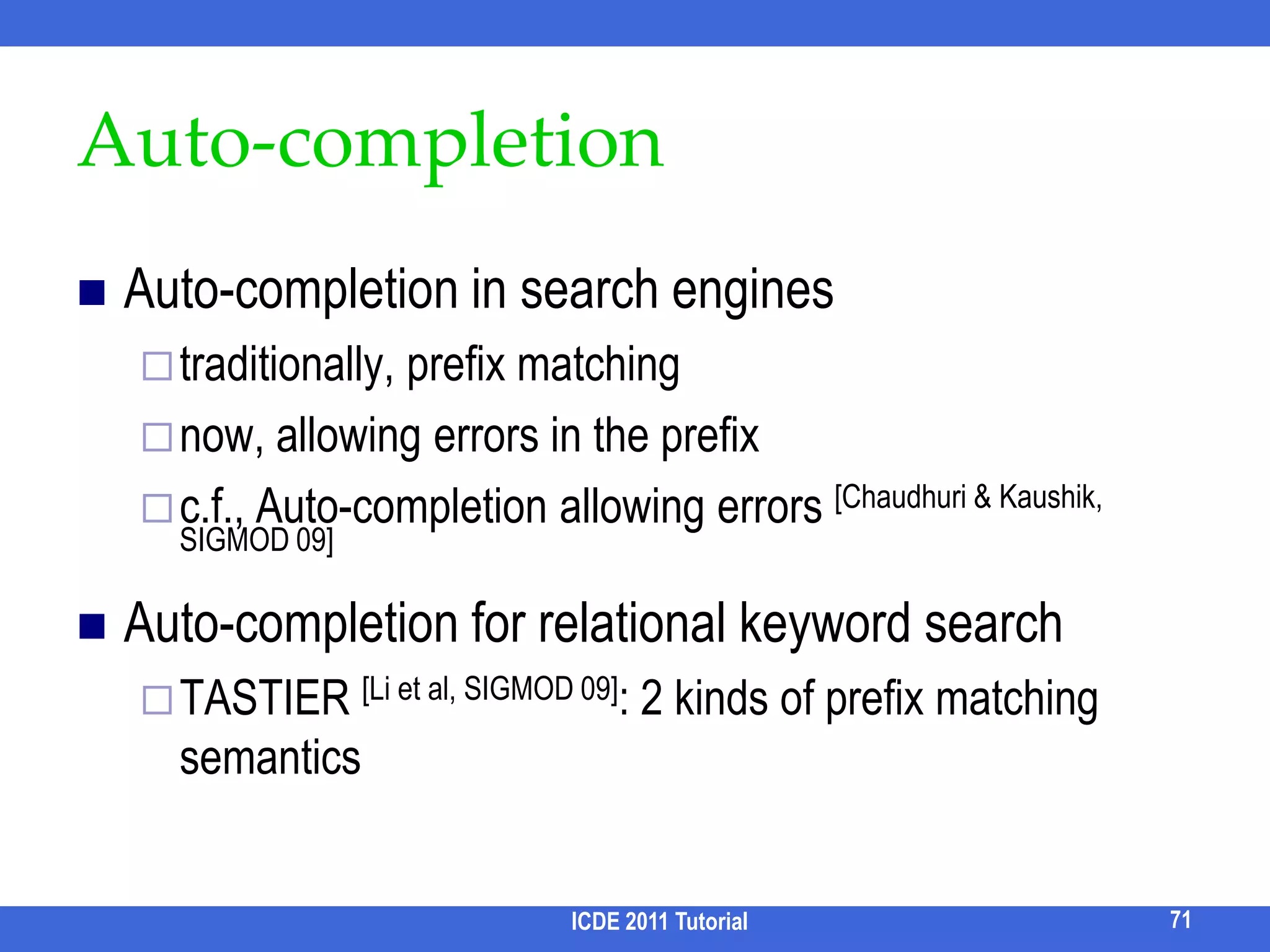
Auto-completionAuto-completion in search enginestraditionally, prefix matchingnow, allowing errors in the prefixc.f., Auto-completion allowing errors [Chaudhuri & Kaushik, SIGMOD 09]Auto-completion for relational keyword search TASTIER [Li et al, SIGMOD 09]: 2 kinds of prefix matching semanticsICDE 2011 Tutorial71
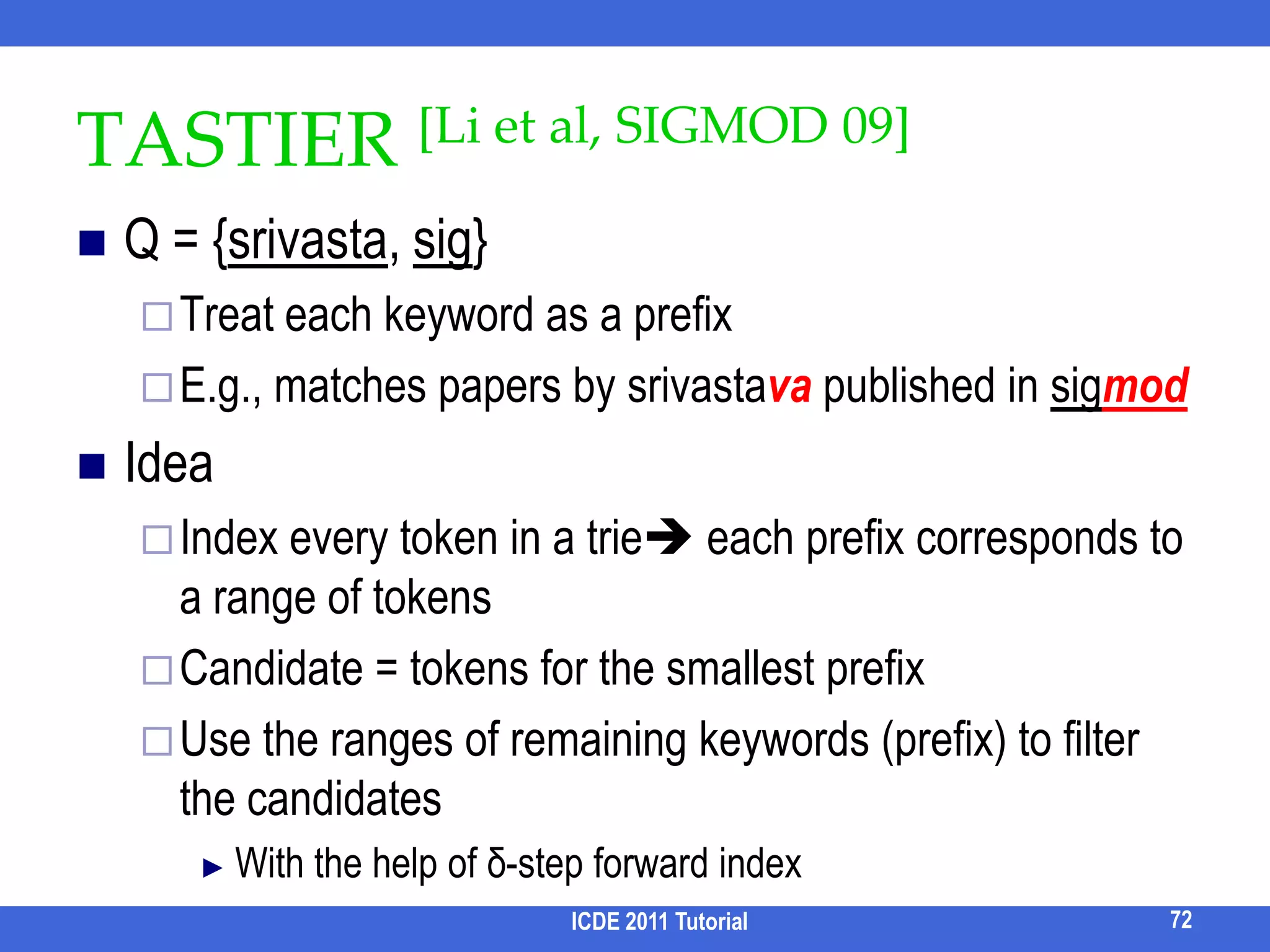
TASTIER [Li et al, SIGMOD 09]Q = {srivasta, sig}Treat each keyword as a prefixE.g., matches papers by srivastava published in sigmodIdeaIndex every token in a trie each prefix corresponds to a range of tokens Candidate = tokens for the smallest prefixUse the ranges of remaining keywords (prefix) to filter the candidatesWith the help of δ-step forward indexICDE 2011 Tutorial72
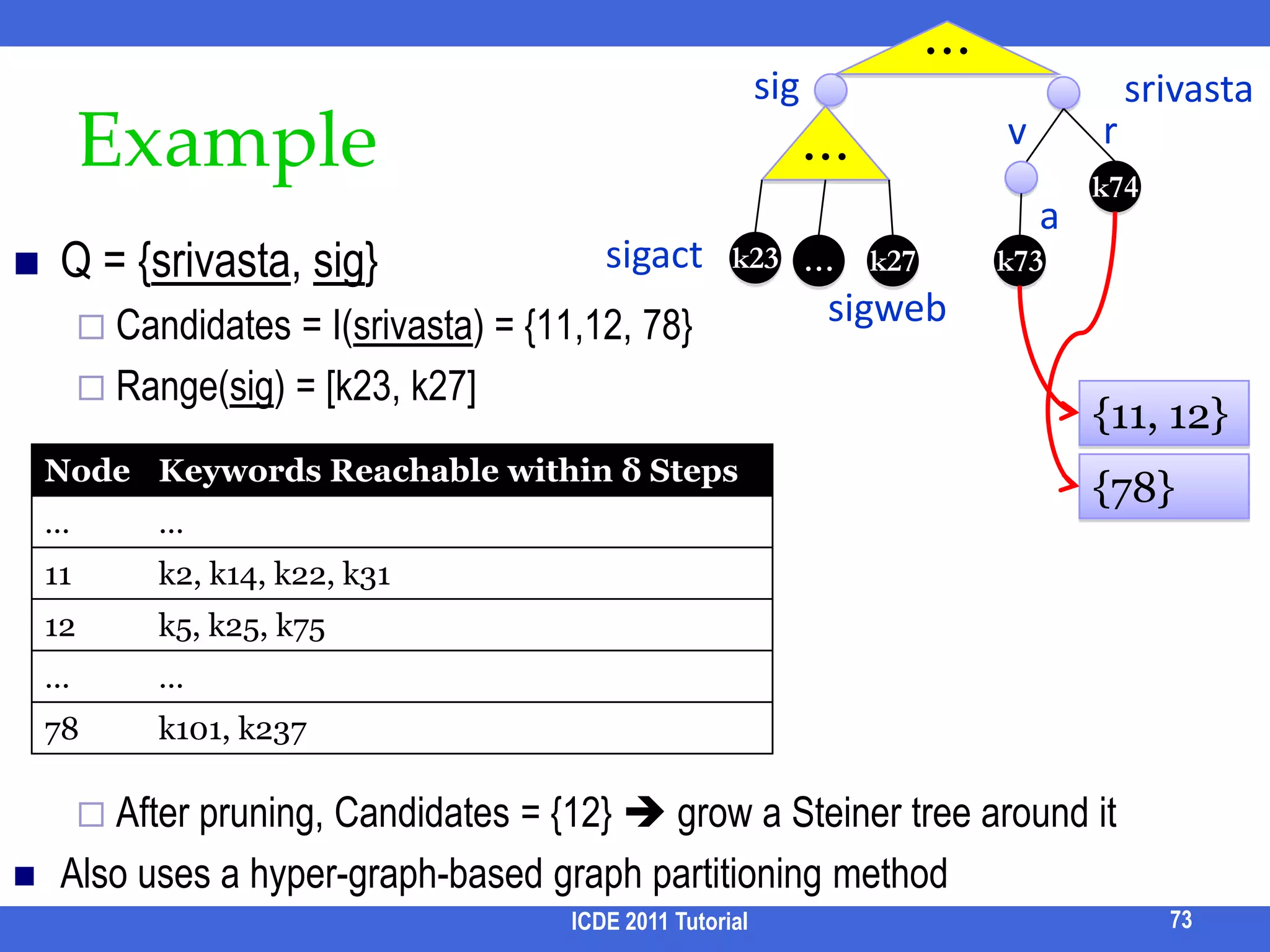
ExampleICDE 2011 Tutorial73…sigsrivastarv…k74asigactQ = {srivasta, sig}Candidates = I(srivasta) = {11,12, 78}Range(sig) = [k23, k27]After pruning, Candidates = {12}  grow a Steiner tree around it Also uses a hyper-graph-based graph partitioning methodk23k73…k27sigweb{11, 12}{78}
RoadmapMotivationStructural ambiguityKeyword ambiguityQuery cleaning and auto-completionQuery refinementQuery rewritingEvaluationQuery processingResult analysisFuture directionsICDE 2011 Tutorial74
Query Refinement: Motivation and SolutionsMotivation: Sometimes lots of results may be returnedWith the imperfection of ranking function, finding relevant results is overwhelming to usersQuestion: How to refine a query by summarizing the results of the original query?Current approaches Identify important terms in resultsCluster results Classify results by categories – Faceted SearchICDE 2011 Tutorial75
Data Clouds [Koutrika et al. EDBT 09]Goal: Find and suggest important terms from query results as expanded queries.Input: Database, admin-specified entities and attributes, queryAttributes of an entity may appear in different tables	E.g., the attributes of a paper may include the information of its authors.Output: Top-K ranked terms in the results, each of which is an entity and its attributes.E.g., query = “XML”		Each result is a paper with attributes title, abstract, year, author name, etc.		Top terms returned: “keyword”, “XPath”, “IBM”, etc.Gives users insight about papers about XML.76ICDE 2011 Tutorial
Ranking Terms in ResultsPopularity based:                             in all results.However, it may select very general terms, e.g., “data”Relevance based:                                            for all results EResult weighted                                                              for all results EHow to rank results Score(E)?Traditional TF*IDF does not take into account the attribute weights.e.g., course title is more important than course description.Improved TF: weighted sum of TF of attribute.77ICDE 2011 Tutorial
Frequent Co-occurring Terms[Tao et al. EDBT 09]Can we avoid generating all results first?Input: QueryOutput: Top-k ranked non-keyword terms in the results.Capable of computing top-k terms efficiently without even generating results.Terms in results are ranked by frequency.Tradeoff of quality and efficiency.78ICDE 2011 Tutorial
Query Refinement: Motivation and SolutionsMotivation: Sometimes lots of results may be returnedWith the imperfection of ranking function, finding relevant results is overwhelming to usersQuestion: How to refine a query by summarizing the results of the original query?Current approaches Identify important terms in resultsCluster results Classify results by categories – Faceted SearchICDE 2011 Tutorial79
Summarizing Results for Ambiguous QueriesQuery words may be polysemyIt is desirable to refine an ambiguous query by its distinct meaningsAll suggested queries are about “Java” programming language80ICDE 2011 Tutorial
Motivation Contd. Goal: the set of expanded queries should provide a categorization of the original query results.Java band“Java”Ideally: Result(Qi) = CiJava islandJava languagec3c2c1Java band formed in Paris.…..….is an island of Indonesia…..….OO Language...….Java software platform…..….there are three languages…...…active from 1972 to 1983…..….developed at Sun…….has four provinces….….Java applet…..Result (Q1)Q1 does not retrieve all results in C1, and retrieves results in C2.How to measure the quality of expanded queries?81ICDE 2011 Tutorial
Query Expansion Using ClustersInput: Clustered query resultsOutput: One expanded query for each cluster, such that each expanded queryMaximally retrieve the results in its cluster (recall)Minimally retrieve the results not in its cluster (precision)Hence each query should aim at maximizing F-measure.This problem is APX-hardEfficient heuristics algorithms have been developed.ICDE 2011 Tutorial82
Query Refinement: Motivation and SolutionsMotivation: Sometimes lots of results may be returnedWith the imperfection of ranking function, finding relevant results is overwhelming to usersQuestion: How to refine a query by summarizing the results of the original query?Current approaches Identify important terms in resultsCluster results Classify results by categories – Faceted SearchICDE 2011 Tutorial83
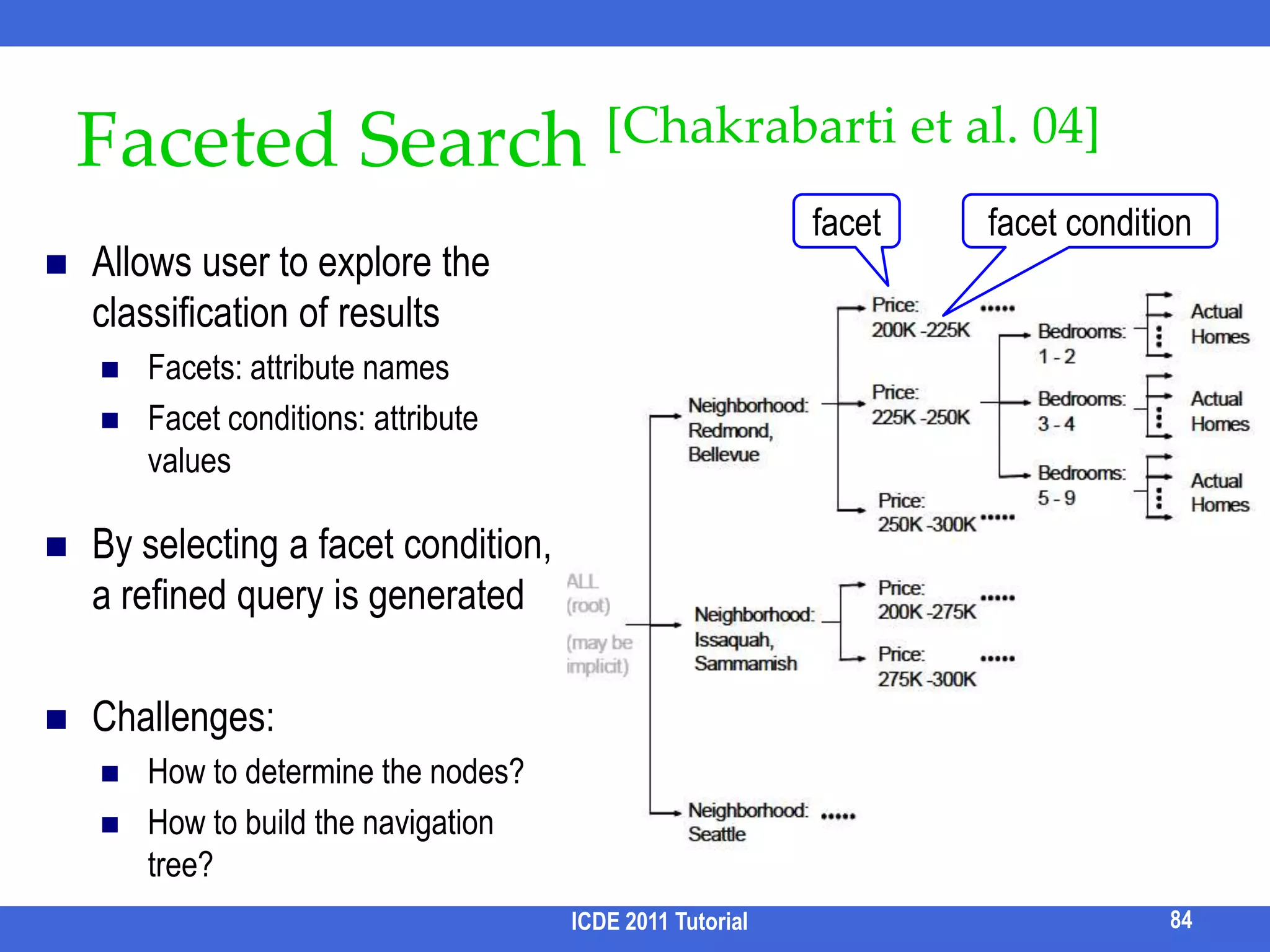
Faceted Search [Chakrabarti et al. 04] Allows user to explore the classification of results
Facets: attribute names
Facet conditions: attribute values
By selecting a facet condition, a refined query is generated
Challenges:
How to determine the nodes?
How to build the navigation tree?ICDE 2011 Tutorial84facetfacet condition
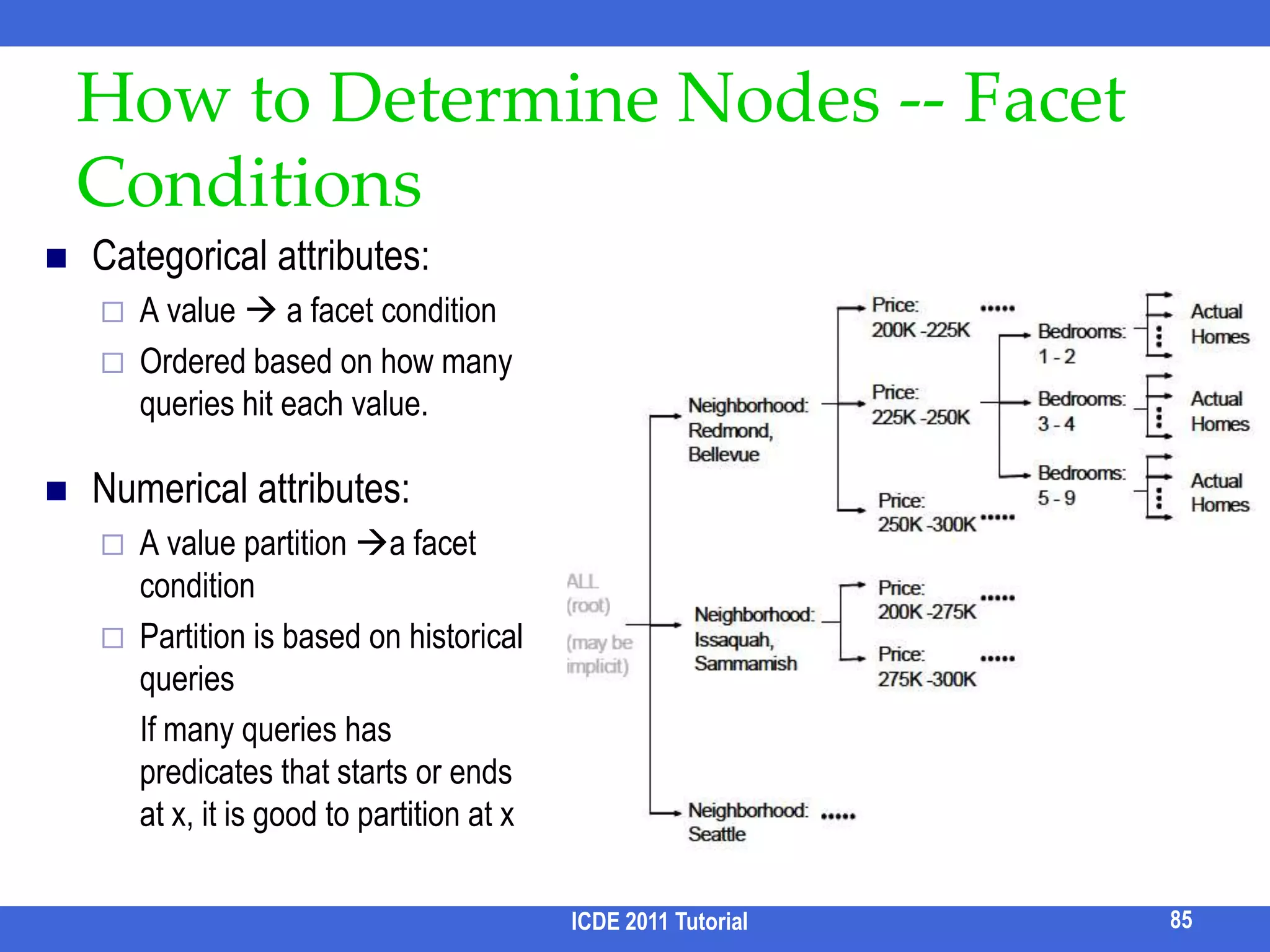
How to Determine Nodes -- Facet ConditionsCategorical attributes:A value  a facet condition Ordered based on how many queries hit each value.Numerical attributes: A value partition a facet conditionPartition is based on historical queries	If many queries has predicates that starts or ends at x, it is good to partition at x ICDE 2011 Tutorial85
How to Construct Navigation TreeInput: Query results, query log.Output: a navigational tree, one facet at each level, Minimizing user’s expected navigation cost for finding the relevant results.Challenge: How to define cost model?How to estimate the likelihood of user actions?86ICDE 2011 Tutorial
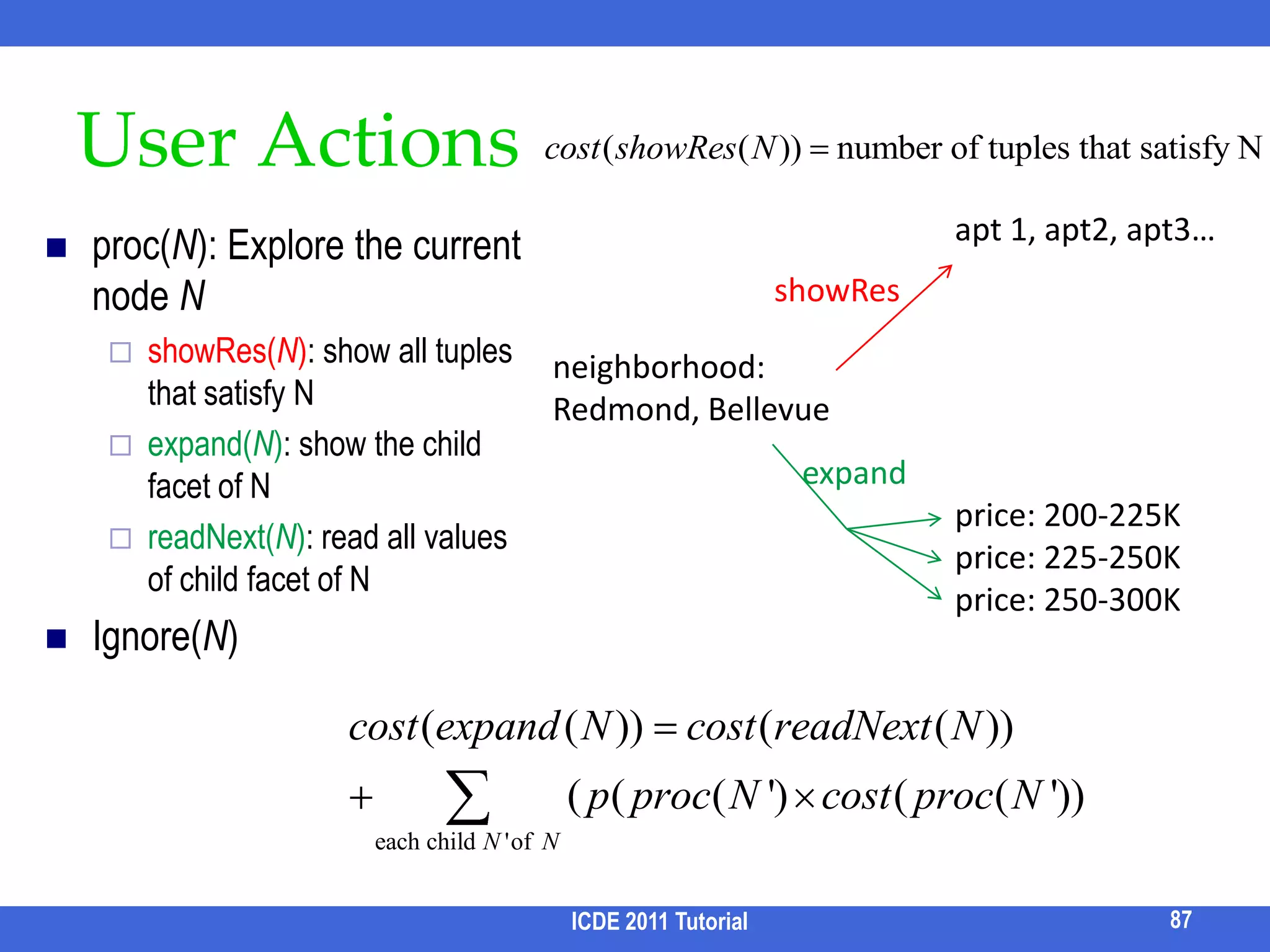
User Actionsproc(N): Explore the current node NshowRes(N): show all tuples that satisfy Nexpand(N): show the child facet of NreadNext(N): read all values of child facet of NIgnore(N)ICDE 2011 Tutorial87apt 1, apt2, apt3…showResneighborhood: Redmond, Bellevueexpandprice: 200-225Kprice: 225-250Kprice: 250-300K
Navigation Cost ModelHow to estimate the involved probabilities?88ICDE 2011Tutorial88ICDE 2011 Tutorial
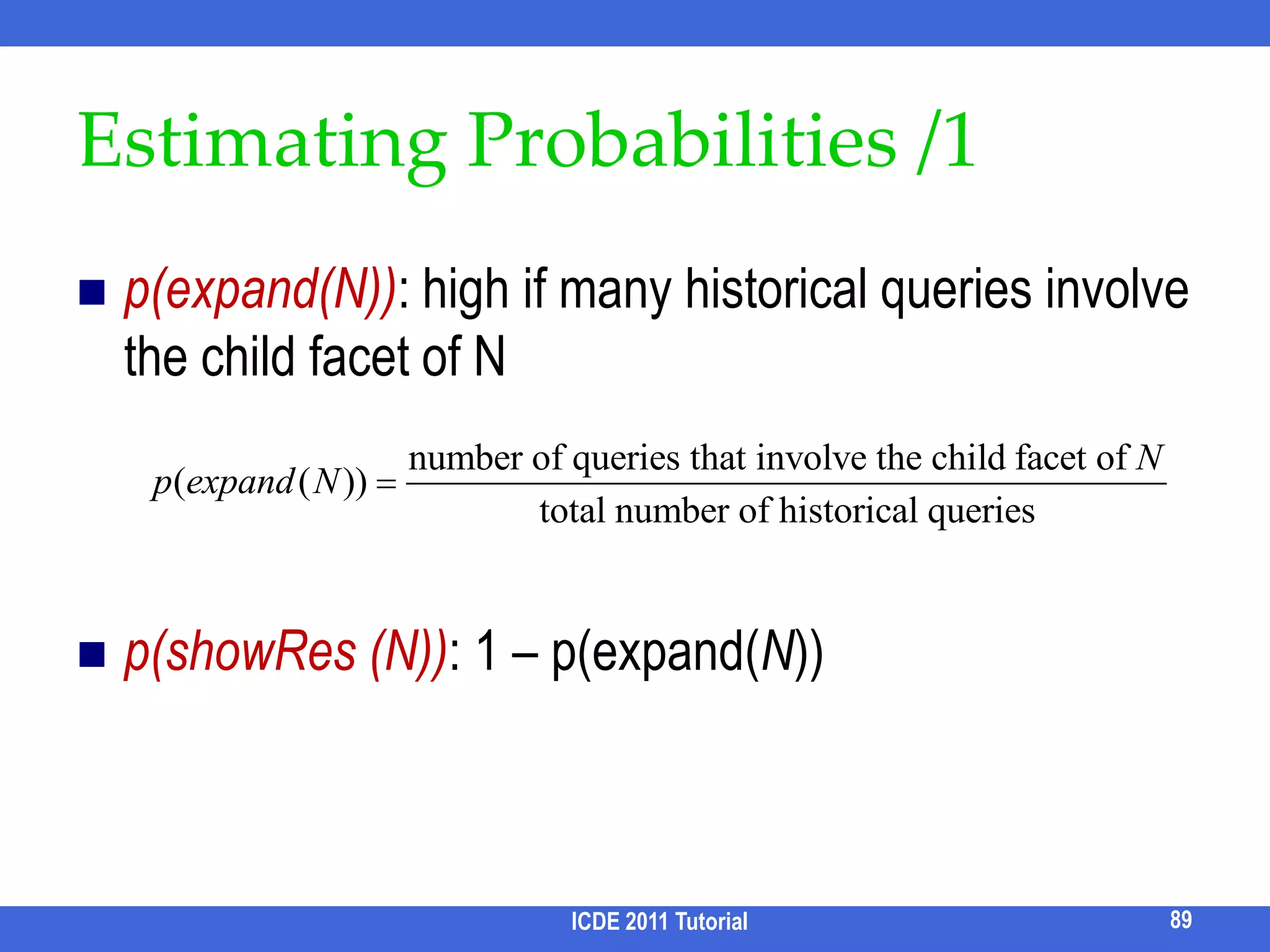
Estimating Probabilities /1p(expand(N)): high if many historical queries involve the child facet of Np(showRes (N)): 1 – p(expand(N))89ICDE 2011 Tutorial
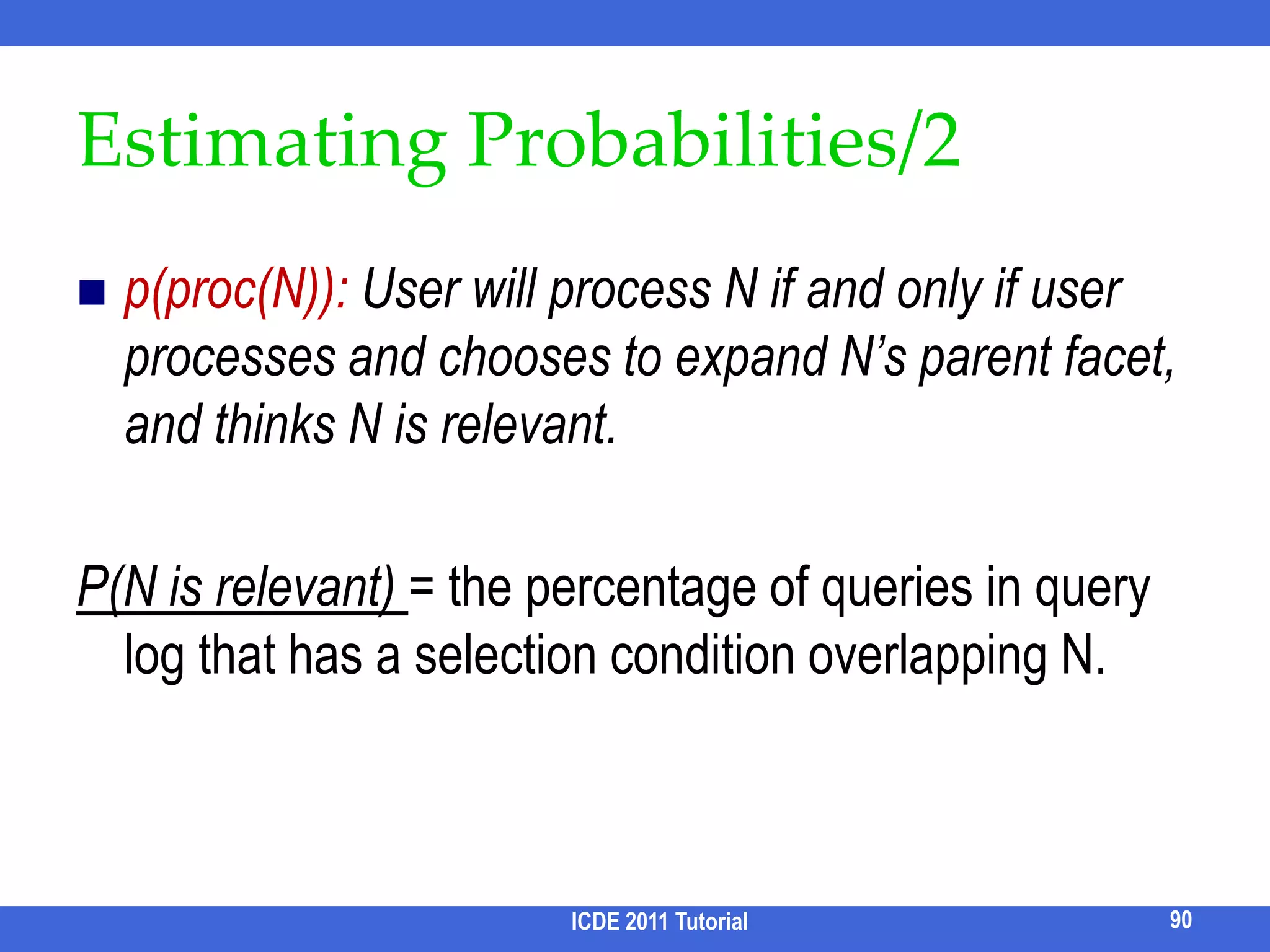
Estimating Probabilities/2p(proc(N)): User will process N if and only if user processes and chooses to expand N’s parent facet, and thinks N is relevant.P(N is relevant) = the percentage of queries in query log that has a selection condition overlapping N.90ICDE 2011 Tutorial
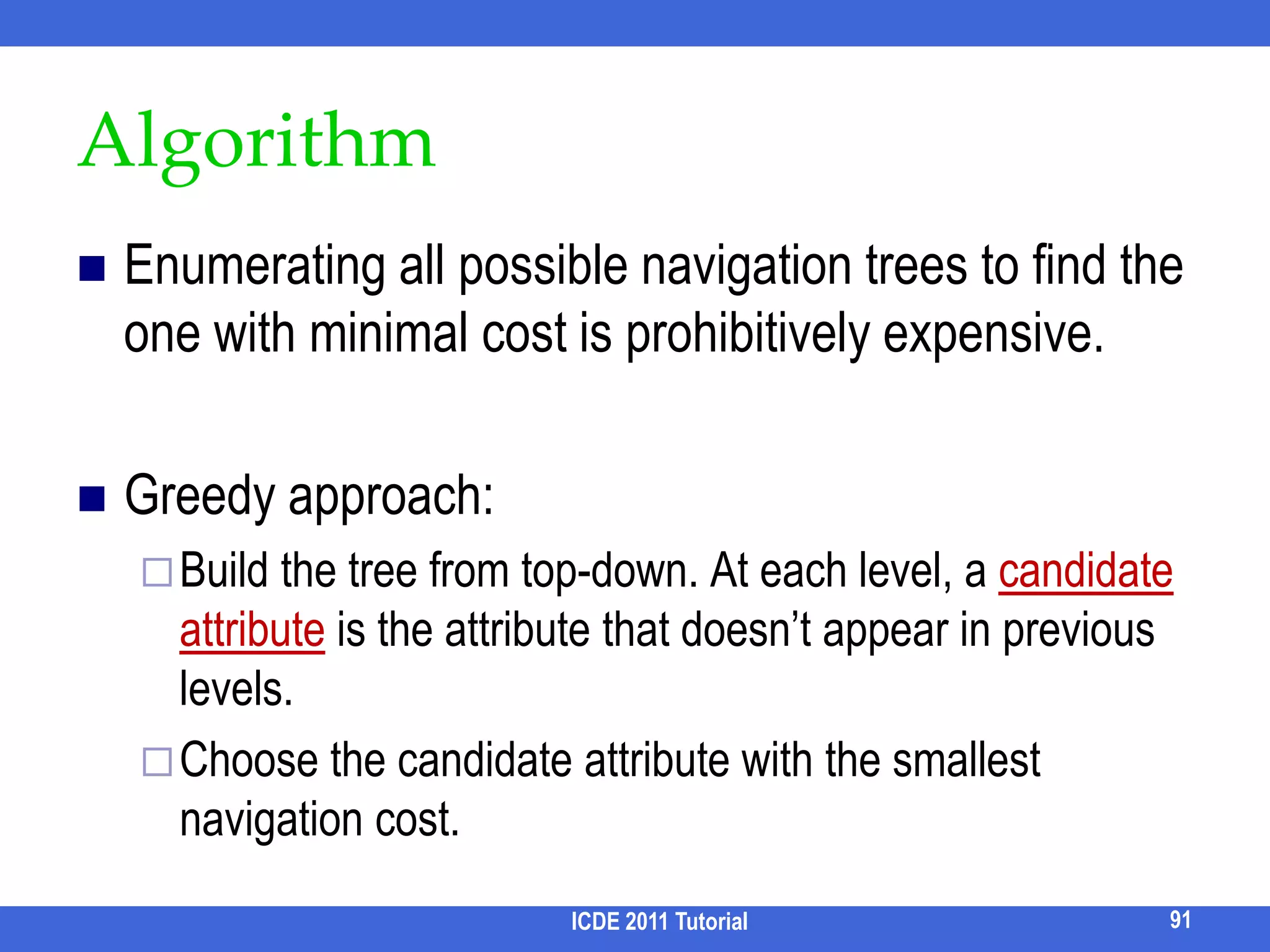
AlgorithmEnumerating all possible navigation trees to find the one with minimal cost is prohibitively expensive.Greedy approach:Build the tree from top-down. At each level, a candidate attribute is the attribute that doesn’t appear in previous levels.Choose the candidate attribute with the smallest navigation cost.91ICDE 2011 Tutorial
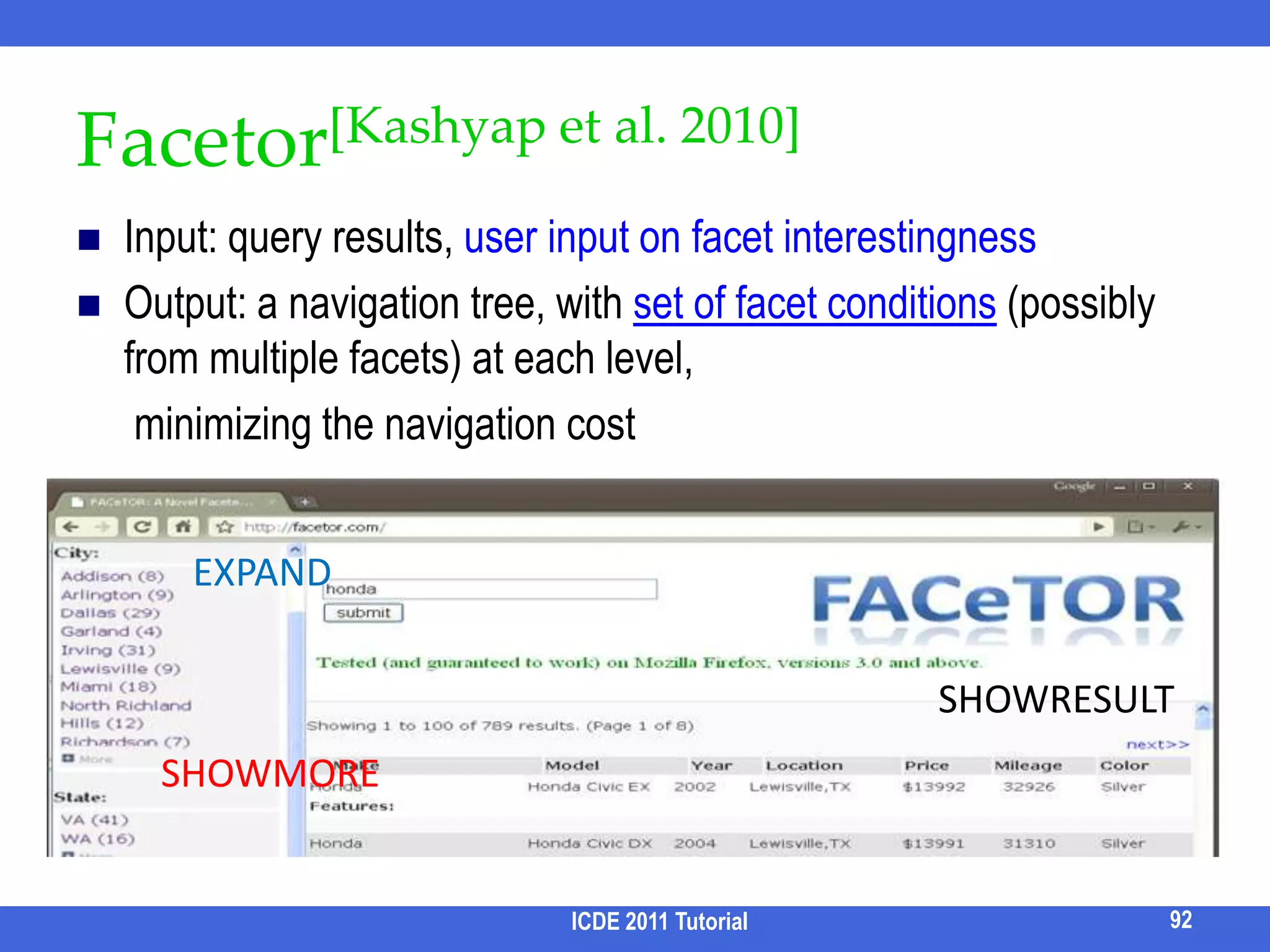
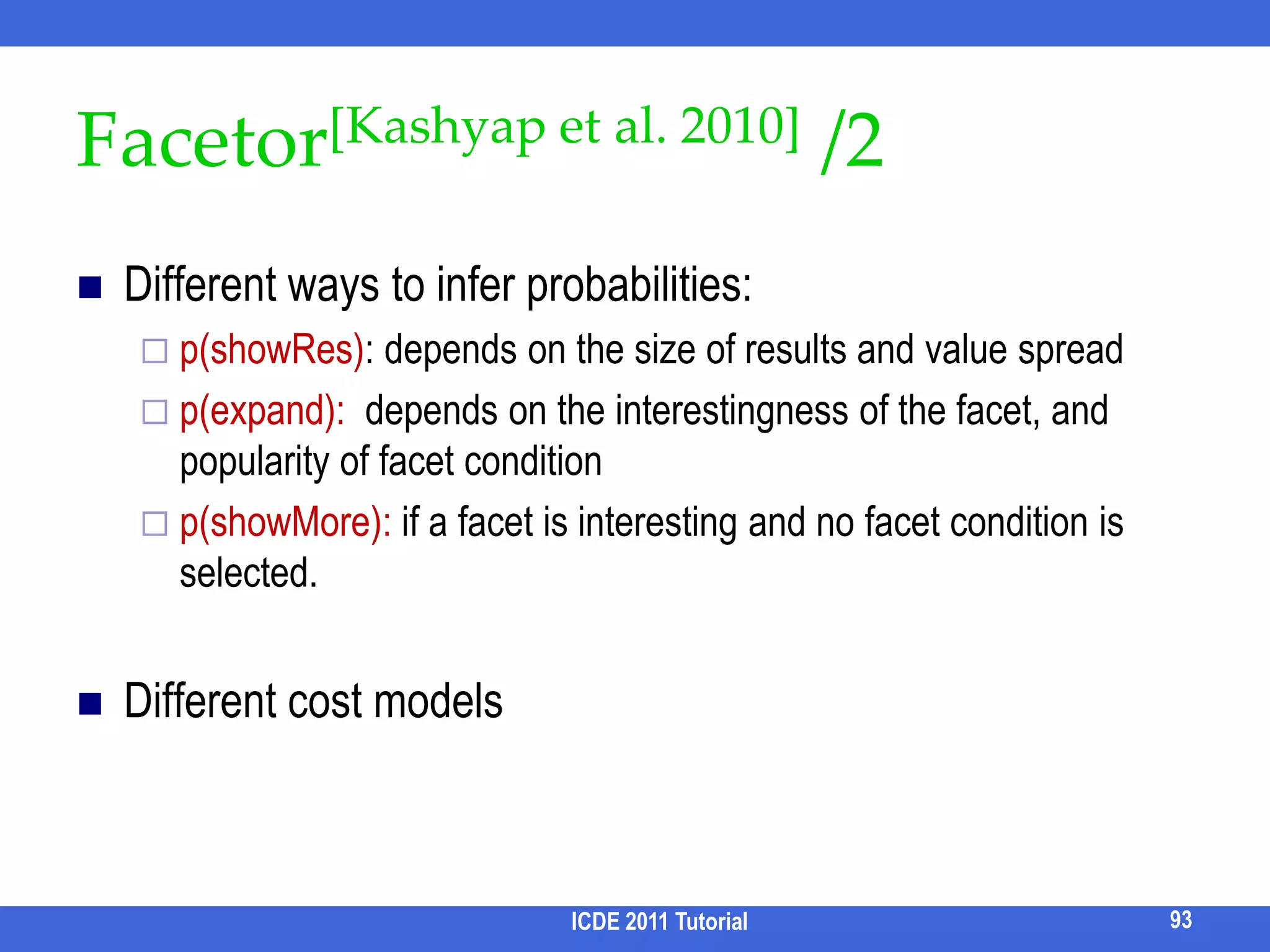
Facetor[Kashyap et al. 2010]Input: query results, user input on facet interestingnessOutput: a navigation tree, with set of facet conditions (possibly from multiple facets) at each level,	 minimizing the navigation cost ICDE 2011 Tutorial92EXPANDSHOWRESULTSHOWMORE
Facetor[Kashyap et al. 2010] /2Different ways to infer probabilities:p(showRes): depends on the size of results and value spreadp(expand):  depends on the interestingness of the facet, and popularity of facet conditionp(showMore): if a facet is interesting and no facet condition is selected.Different cost modelsICDE 2011 Tutorial93
RoadmapMotivationStructural ambiguityKeyword ambiguityQuery cleaning and auto-completionQuery refinementQuery rewritingEvaluationQuery processingResult analysisFuture directionsICDE 2011 Tutorial94
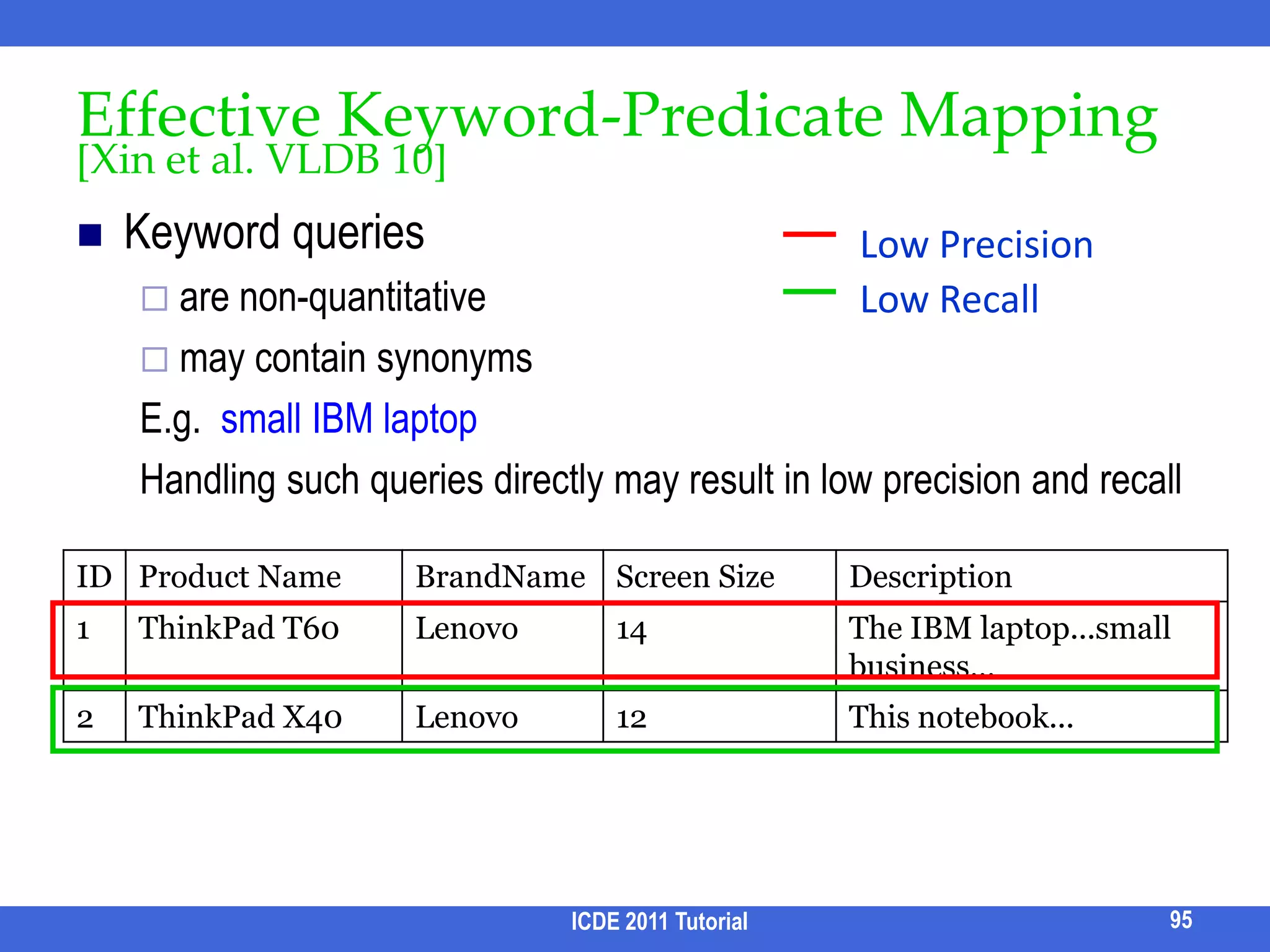
Effective Keyword-Predicate Mapping[Xin et al. VLDB 10]Keyword queries are non-quantitativemay contain synonymsE.g.  small IBM laptopHandling such queries directly may result in low precision and recallICDE 2011 Tutorial95Low PrecisionLow Recall
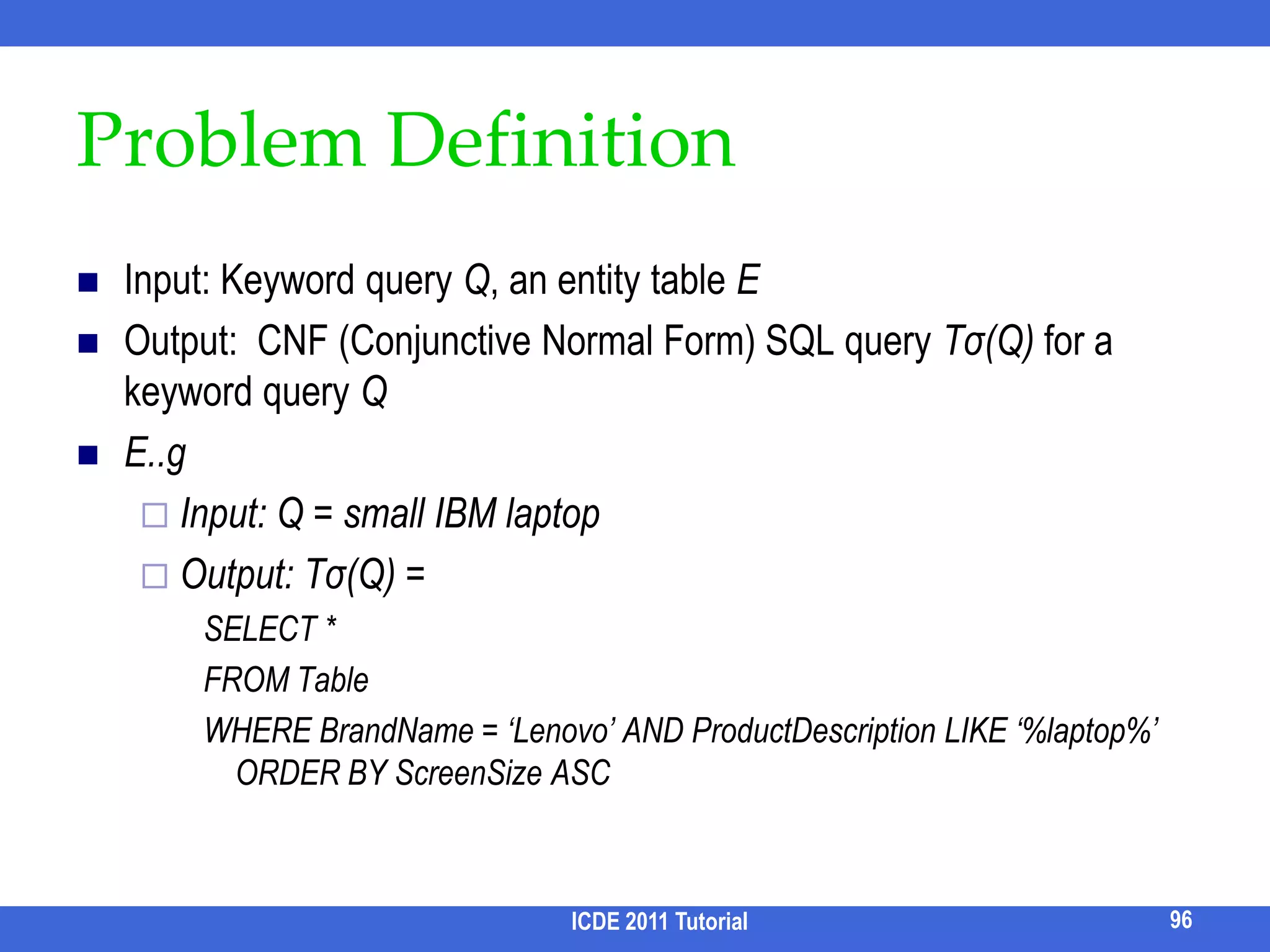
Problem DefinitionInput: Keyword query Q, an entity table EOutput:  CNF (Conjunctive Normal Form) SQL query Tσ(Q) for a keyword query QE..g Input: Q = small IBM laptopOutput: Tσ(Q) = SELECT * FROM Table WHERE BrandName = ‘Lenovo’ AND ProductDescription LIKE ‘%laptop%’ ORDER BY ScreenSize ASC96ICDE 2011 Tutorial
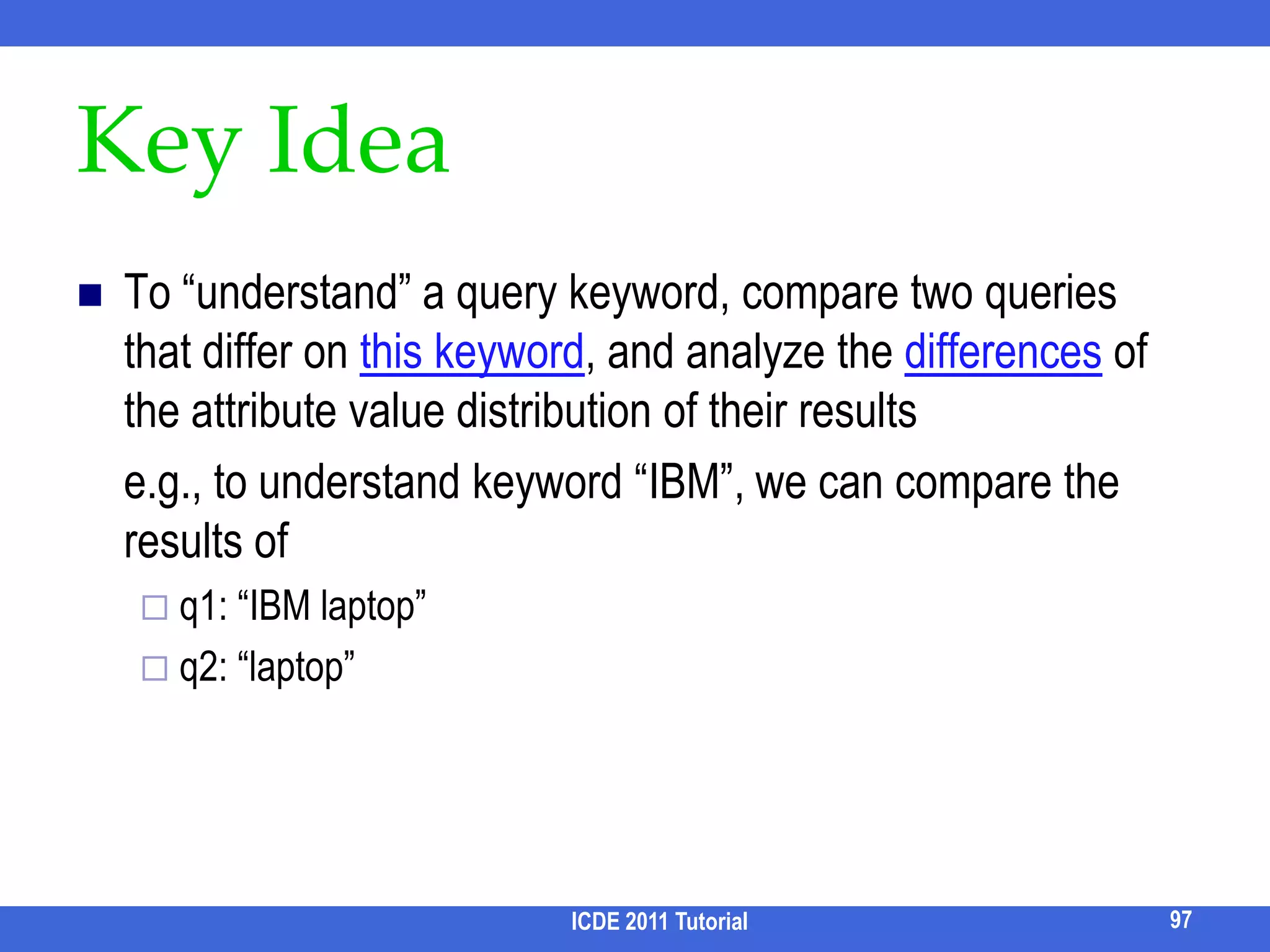
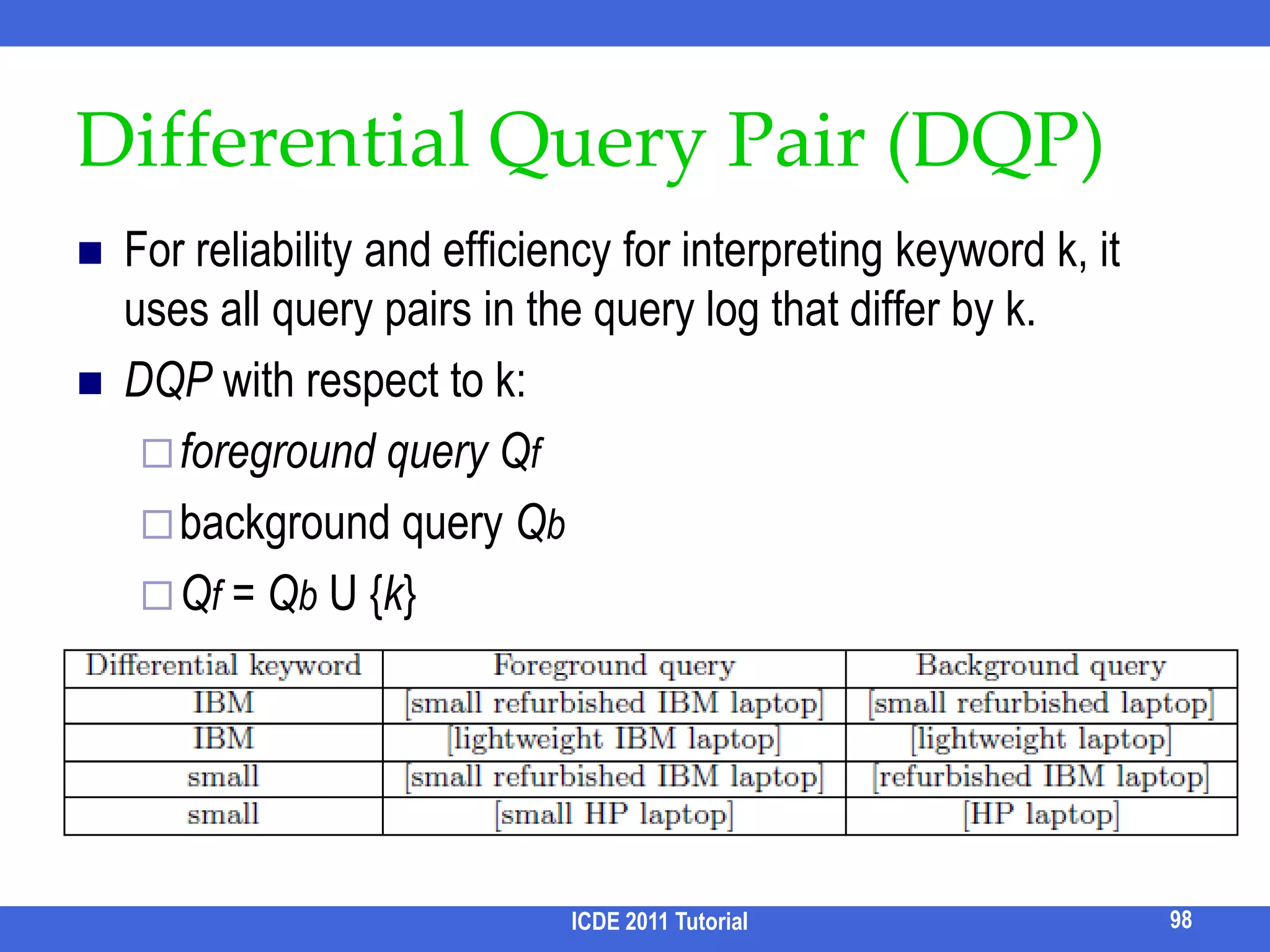
Key IdeaTo “understand” a query keyword, compare two queries that differ on this keyword, and analyze the differences of the attribute value distribution of their results 	e.g., to understand keyword “IBM”, we can compare the results of q1: “IBM laptop”q2: “laptop”ICDE 2011 Tutorial97
Differential Query Pair (DQP)For reliability and efficiency for interpreting keyword k, it uses all query pairs in the query log that differ by k.DQP with respect to k: foreground query Qfbackground query QbQf = Qb U {k}ICDE 2011 Tutorial98
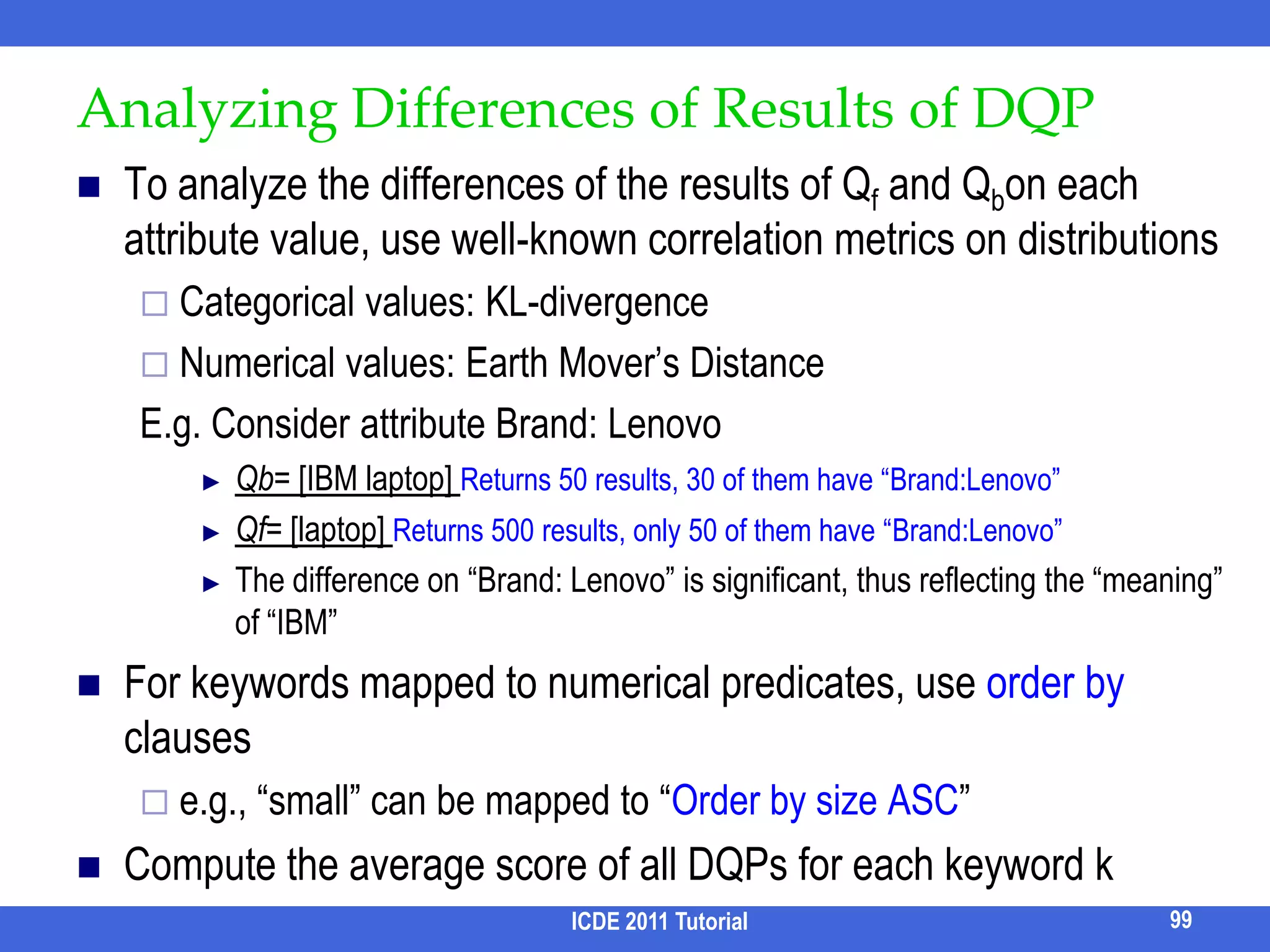
Analyzing Differences of Results of DQPTo analyze the differences of the results of Qf and Qbon each attribute value, use well-known correlation metrics on distributionsCategorical values: KL-divergenceNumerical values: Earth Mover’s Distance E.g. Consider attribute Brand: LenovoQb= [IBM laptop] Returns 50 results, 30 of them have “Brand:Lenovo”Qf= [laptop] Returns 500 results, only 50 of them have “Brand:Lenovo”The difference on “Brand: Lenovo” is significant, thus reflecting the “meaning” of “IBM”For keywords mapped to numerical predicates, use order by clausese.g., “small” can be mapped to “Order by size ASC”Compute the average score of all DQPs for each keyword kICDE 2011 Tutorial99
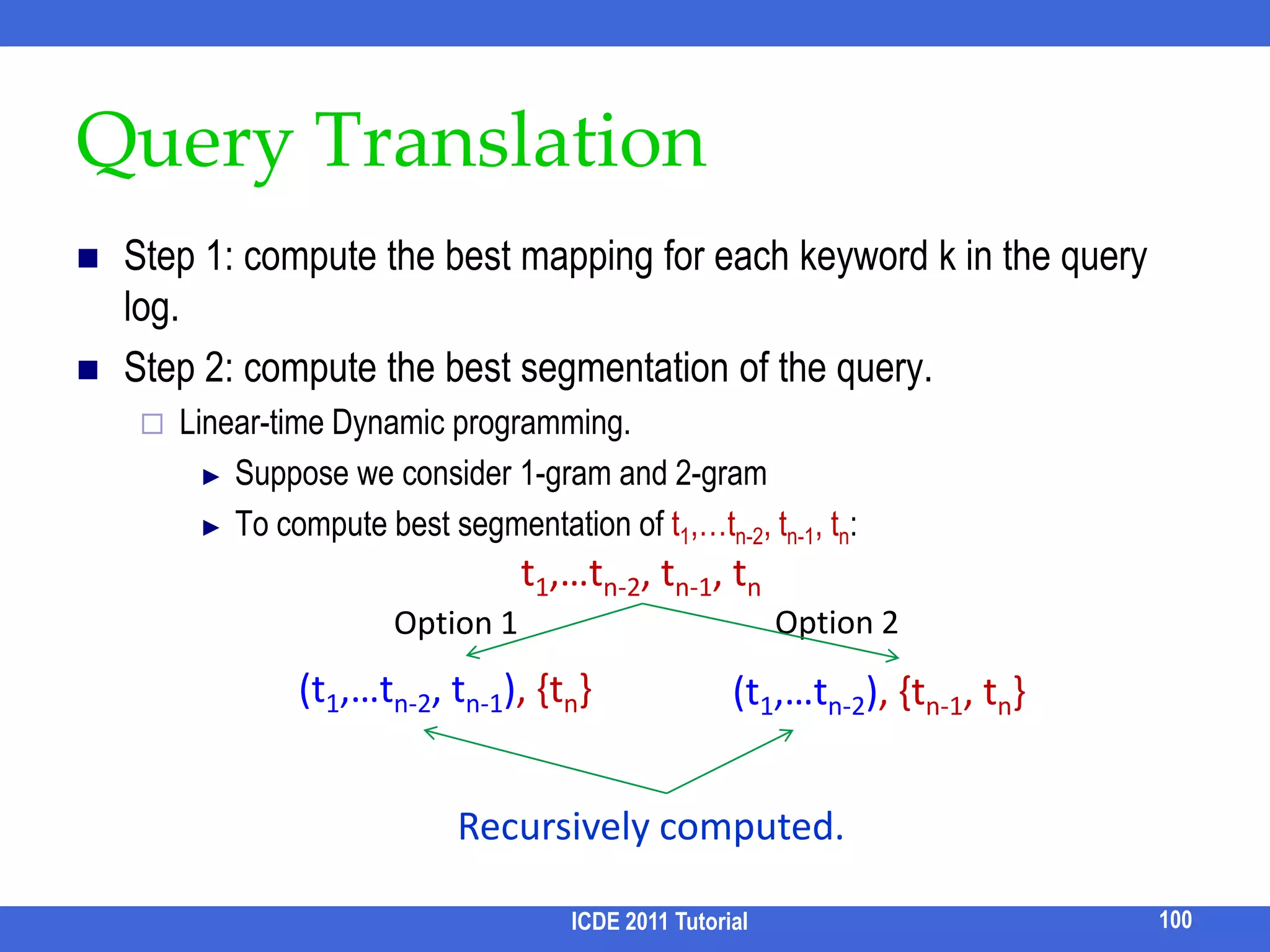
Query TranslationStep 1: compute the best mapping for each keyword k in the query log.Step 2: compute the best segmentation of the query.Linear-time Dynamic programming.Suppose we consider 1-gram and 2-gramTo compute best segmentation of t1,…tn-2, tn-1, tn:ICDE 2011 Tutorial100t1,…tn-2, tn-1, tnOption 2Option 1(t1,…tn-2, tn-1), {tn}(t1,…tn-2), {tn-1, tn}Recursively computed.
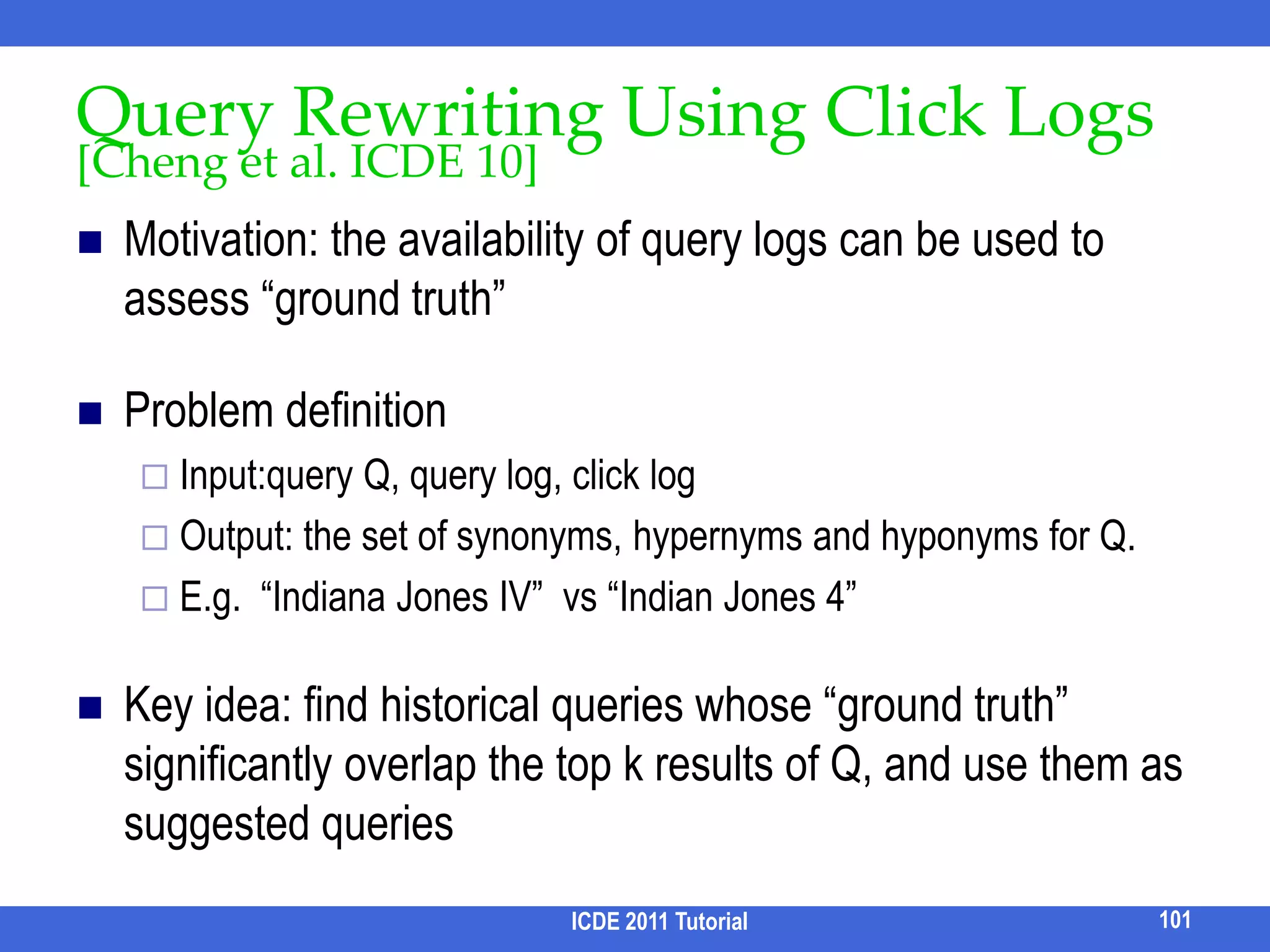
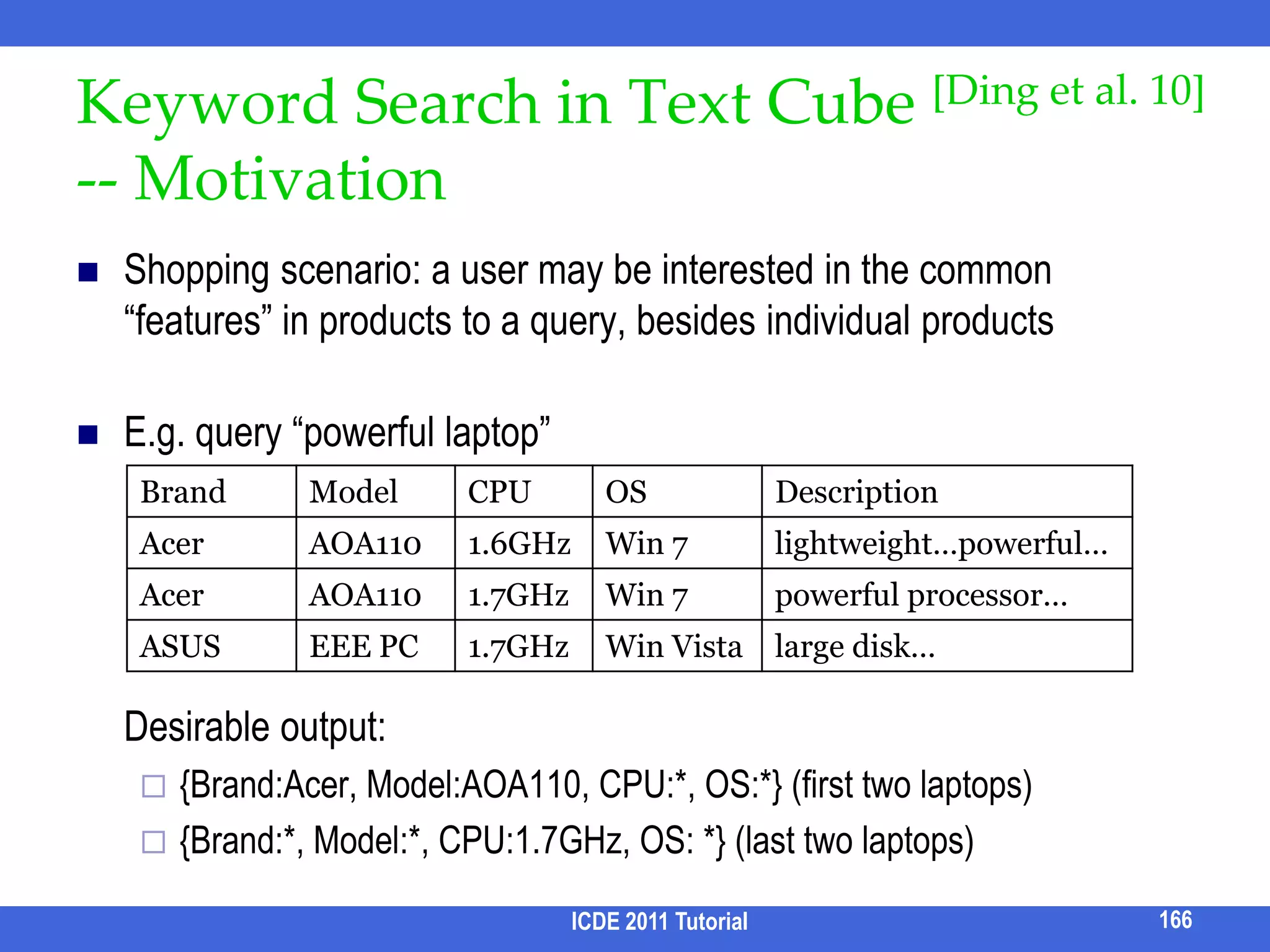
Query Rewriting Using Click Logs [Cheng et al. ICDE 10]Motivation: the availability of query logs can be used to assess “ground truth”Problem definitionInput:query Q, query log, click logOutput: the set of synonyms, hypernyms and hyponyms for Q.E.g.  “Indiana Jones IV”  vs “Indian Jones 4”Key idea: find historical queries whose “ground truth” significantly overlap the top k results of Q, and use them as suggested queriesICDE 2011 Tutorial101
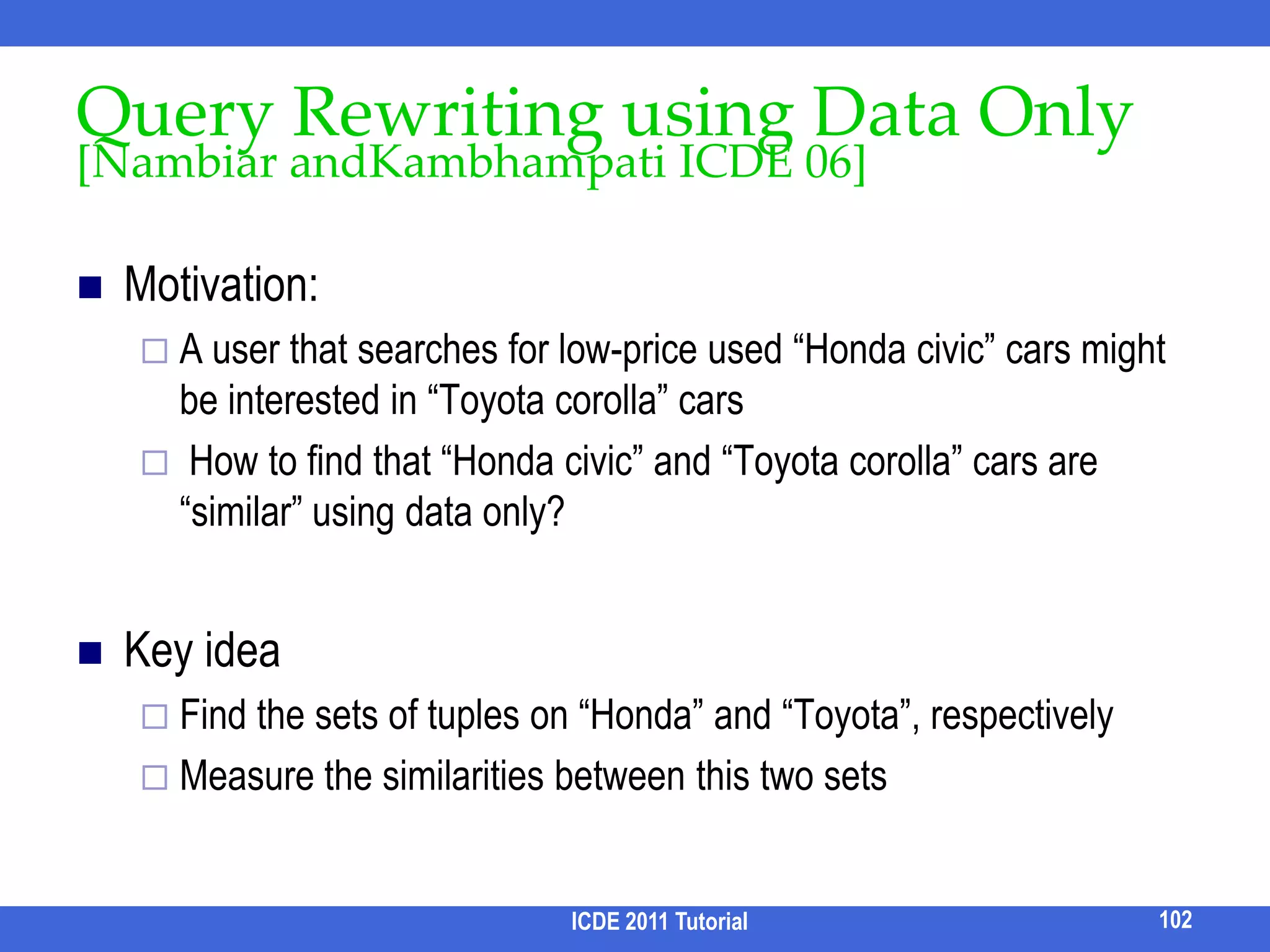
Query Rewriting using Data Only [Nambiar andKambhampati ICDE 06]Motivation:A user that searches for low-price used “Honda civic” cars might be interested in “Toyota corolla” cars How to find that “Honda civic” and “Toyota corolla” cars are “similar” using data only?Key ideaFind the sets of tuples on “Honda” and “Toyota”, respectivelyMeasure the similarities between this two setsICDE 2011 Tutorial102
RoadmapMotivationStructural ambiguityKeyword ambiguityEvaluationQuery processingResult analysisFuture directionsICDE 2011 Tutorial103
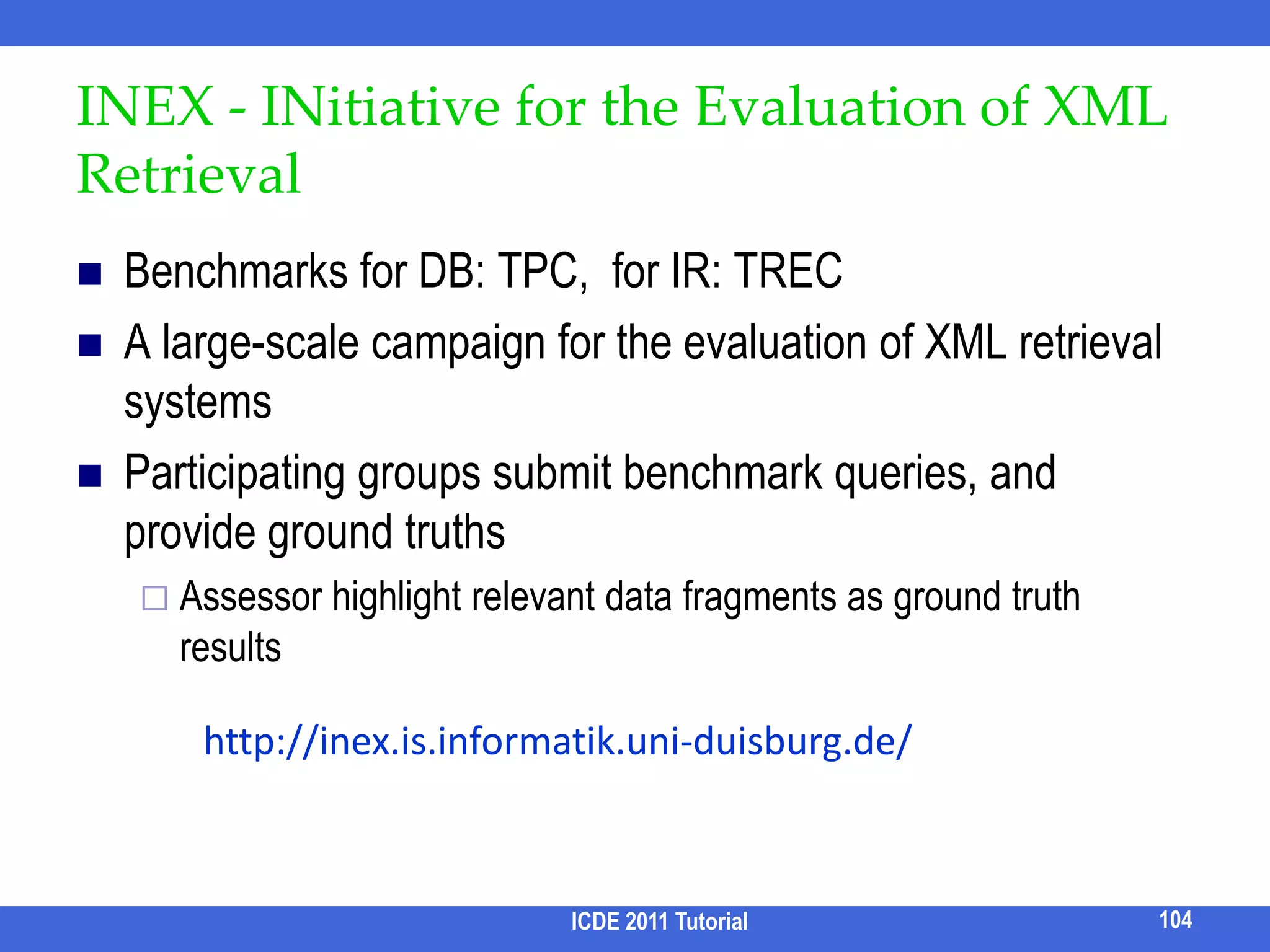
INEX - INitiative for the Evaluation of XML RetrievalBenchmarks for DB: TPC,  for IR: TRECA large-scale campaign for the evaluation of XML retrieval systemsParticipating groups submit benchmark queries, and provide ground truthsAssessor highlight relevant data fragments as ground truth resultshttp://inex.is.informatik.uni-duisburg.de/104ICDE 2011 Tutorial
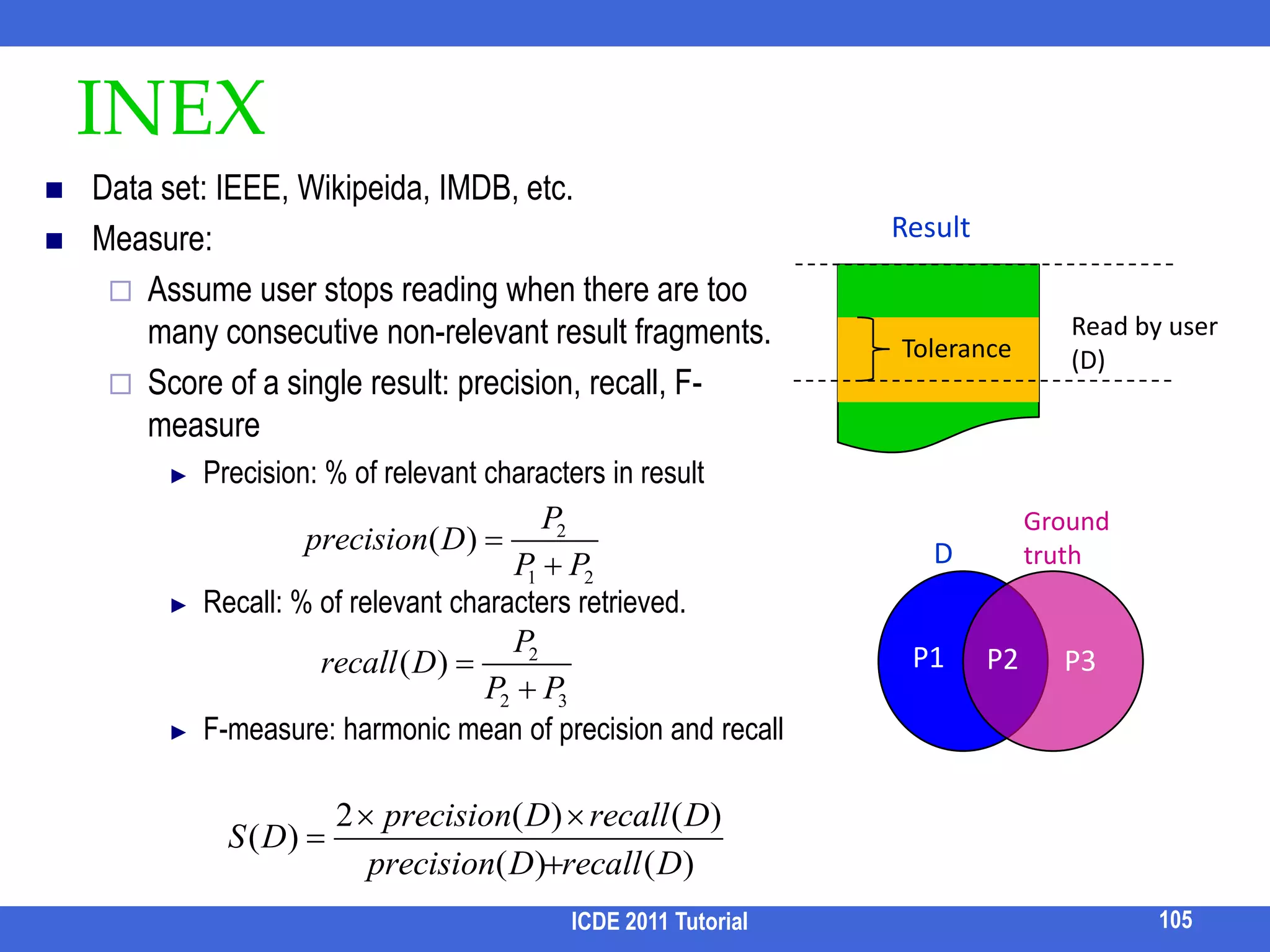
INEXData set: IEEE, Wikipeida, IMDB, etc.Measure: 	Assume user stops reading when there are too many consecutive non-relevant result fragments.Score of a single result: precision, recall, F-measurePrecision: % of relevant characters in resultRecall: % of relevant characters retrieved.F-measure: harmonic mean of precision and recallICDE 2011 Tutorial105ResultRead by user (D)ToleranceGround truthDP1P2P3
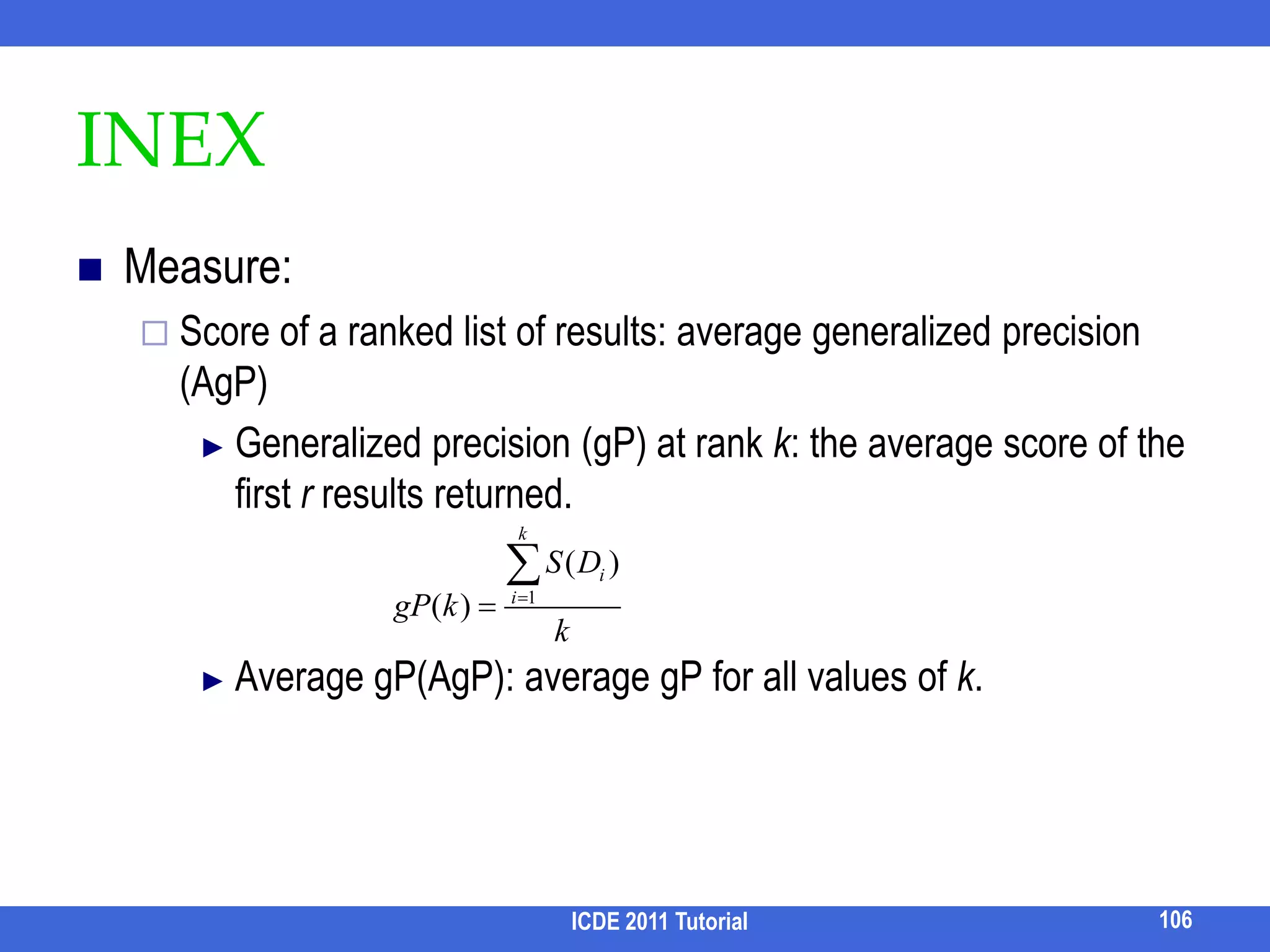
INEXMeasure: 	Score of a ranked list of results: average generalized precision (AgP)Generalized precision (gP) at rank k: the average score of the first r results returned.Average gP(AgP): average gP for all values of k.ICDE 2011 Tutorial106
Axiomatic Framework for EvaluationFormalize broad intuitions as a collection of simple axioms and evaluate strategies based on the axioms.It has been successful in many areas, e.g. mathematical economics, clustering, location theory, collaborative filtering, etcCompared with benchmark evaluationCost-effectiveGeneral, independent of any query, data set107ICDE 2011 Tutorial
Axioms [Liu et al. VLDB 08]	Axioms for XML keyword search have been proposed for identifying relevant keyword matchesChallenge: It is hard or impossible to “describe” desirable results for any query on any dataProposal: Some abnormal behaviors can be identified when examining results of two similar queries or one query on two similar documents produced by the same search engine.Assuming “AND” semanticsFour axiomsData MonotonicityQuery MonotonicityData ConsistencyQuery Consistency108ICDE 2011 Tutorial
Violation of Query ConsistencyQ1: paper, MarkQ2: SIGMOD, paper, MarkconfnamepaperyearpaperdemoauthortitletitleauthortitleauthorauthorSIGMODauthor2007…Top-knamenameXMLnamenamenamekeywordChenLiuSolimanMarkYangAn XML keyword search engine that considers this subtreeas irrelevant for Q1, but relevant for Q2  violates query consistency .Query Consistency:the new result subtree contains the new query keyword.109ICDE 2011 Tutorial
RoadmapMotivationStructural ambiguityKeyword ambiguityEvaluationQuery processingResult analysisFuture directionsICDE 2011 Tutorial110
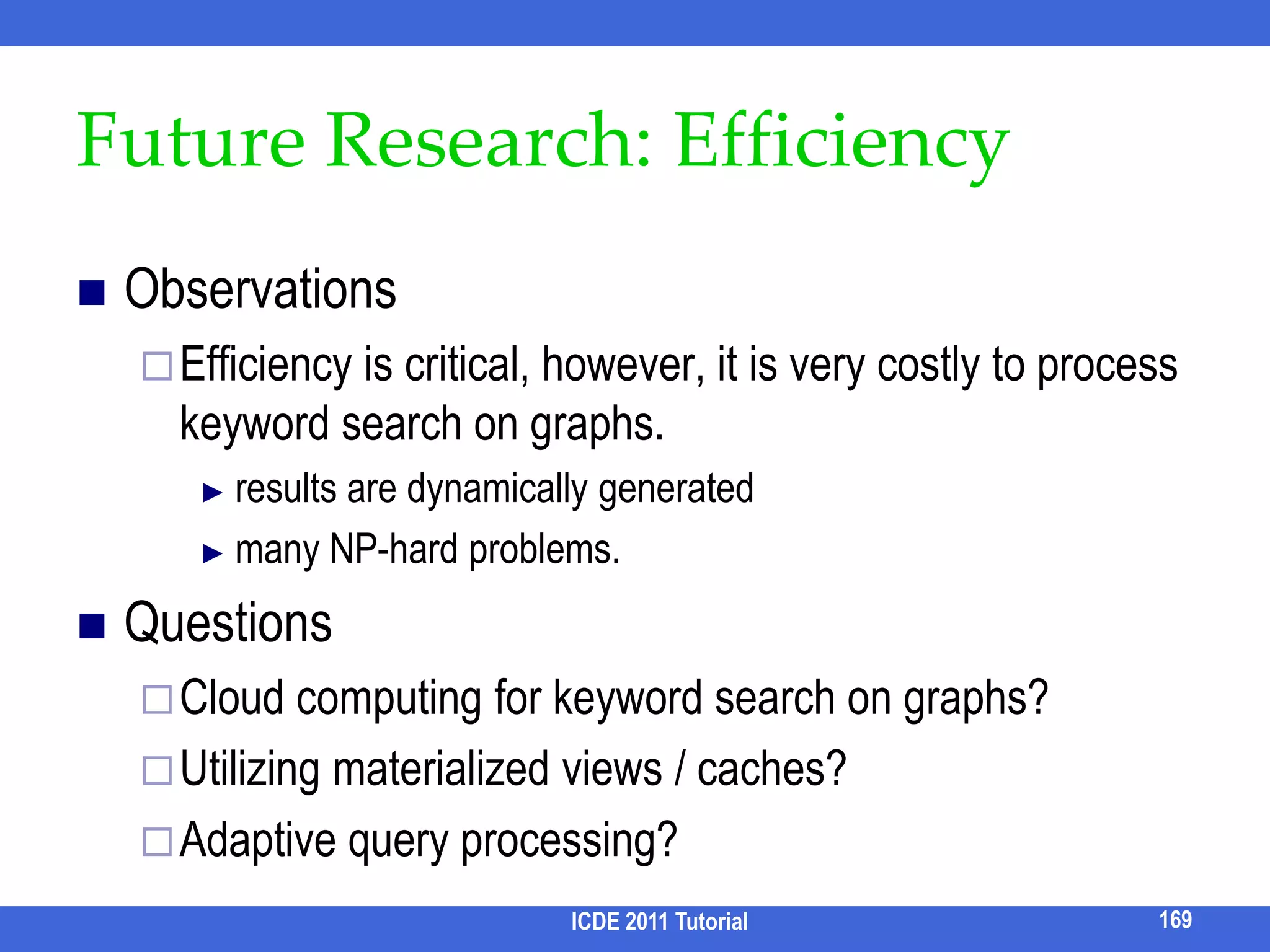
Efficiency in Query ProcessingQuery processing is another challenging issue for keyword search systemsInherent complexityLarge search spaceWork with scoring functionsPerformance improving ideasQuery processing methods for XML KWSICDE 2011 Tutorial111
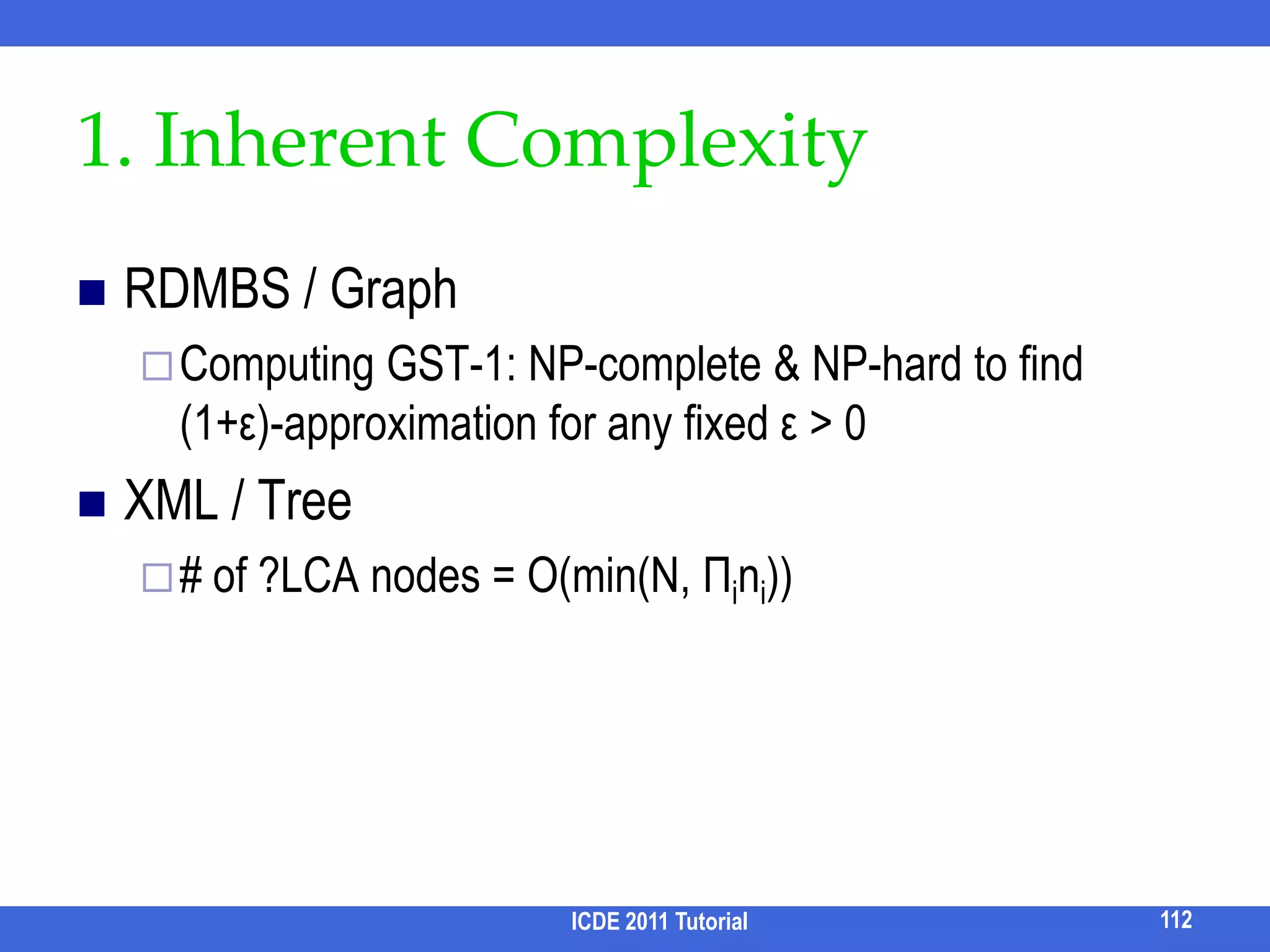
1. Inherent ComplexityRDMBS / GraphComputing GST-1: NP-complete & NP-hard to find (1+ε)-approximation for any fixed ε > 0XML / Tree# of ?LCA nodes = O(min(N, Πini)) ICDE 2011 Tutorial112
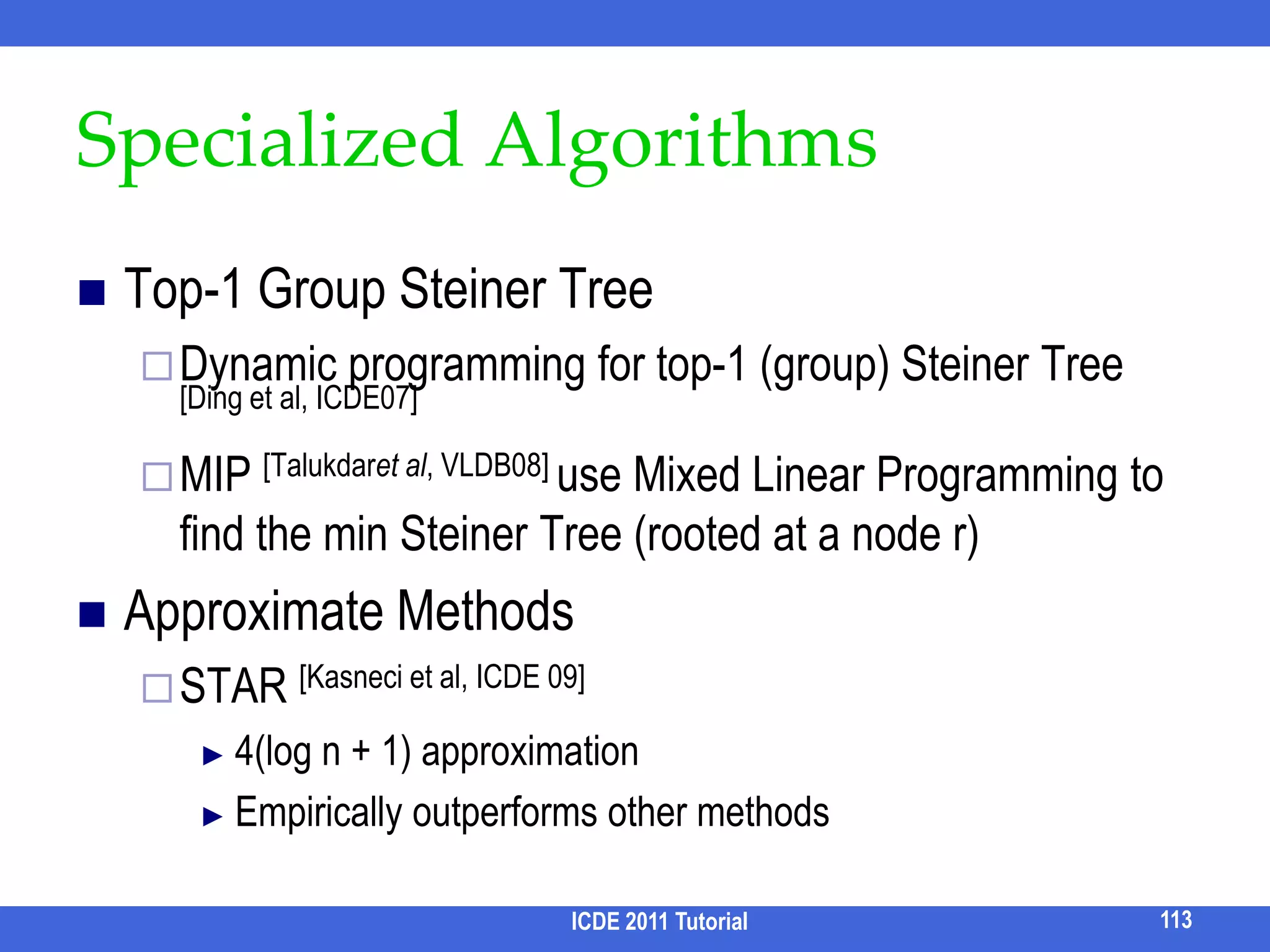
Specialized AlgorithmsTop-1 Group Steiner TreeDynamic programming for top-1 (group) Steiner Tree [Ding et al, ICDE07]MIP [Talukdaret al, VLDB08] use Mixed Linear Programming to find the min Steiner Tree (rooted at a node r)Approximate MethodsSTAR [Kasneci et al, ICDE 09]4(log n + 1) approximationEmpirically outperforms other methodsICDE 2011 Tutorial113
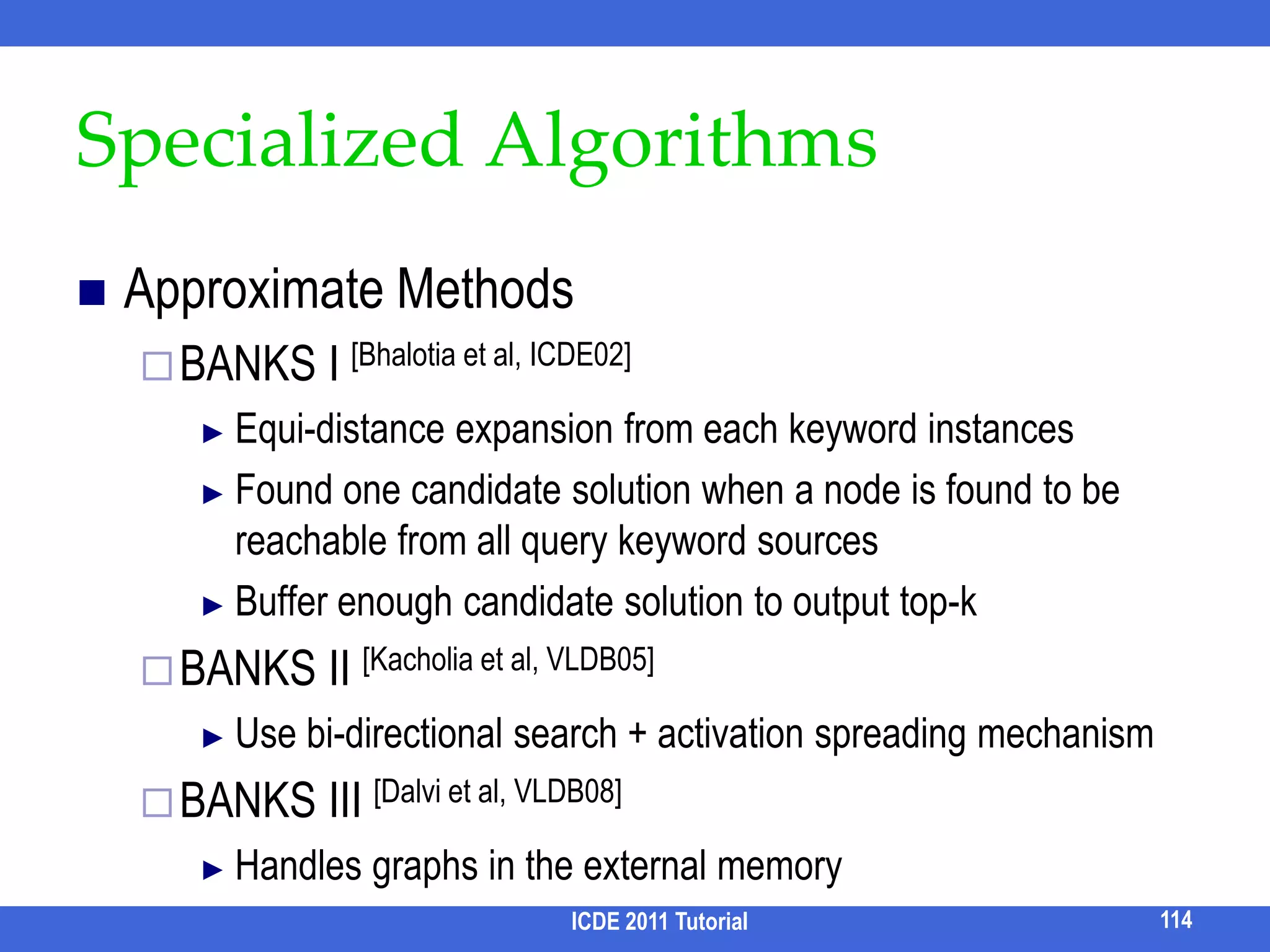
Specialized AlgorithmsApproximate MethodsBANKS I [Bhalotia et al, ICDE02]Equi-distance expansion from each keyword instancesFound one candidate solution when a node is found to be reachable from all query keyword sourcesBuffer enough candidate solution to output top-kBANKS II [Kacholia et al, VLDB05]Use bi-directional search + activation spreading mechanism BANKS III [Dalvi et al, VLDB08]Handles graphs in the external memoryICDE 2011 Tutorial114
2. Large Search SpaceTypically thousands of CNsSG: Author, Write, Paper, Cite ≅0.2M CNs, >0.5M JoinsSolutionsEfficient generation of CNsBreadth-first enumeration on the schema graph [Hristidis et al, VLDB 02] [Hristidis et al, VLDB 03]Duplicate-free CN generation [Markowetz et al, SIGMOD 07] [Luo 2009]Other means (e.g., combined with forms, pruning CNs with indexes, top-k processing)Will be discussed later115ICDE 2011 Tutorial
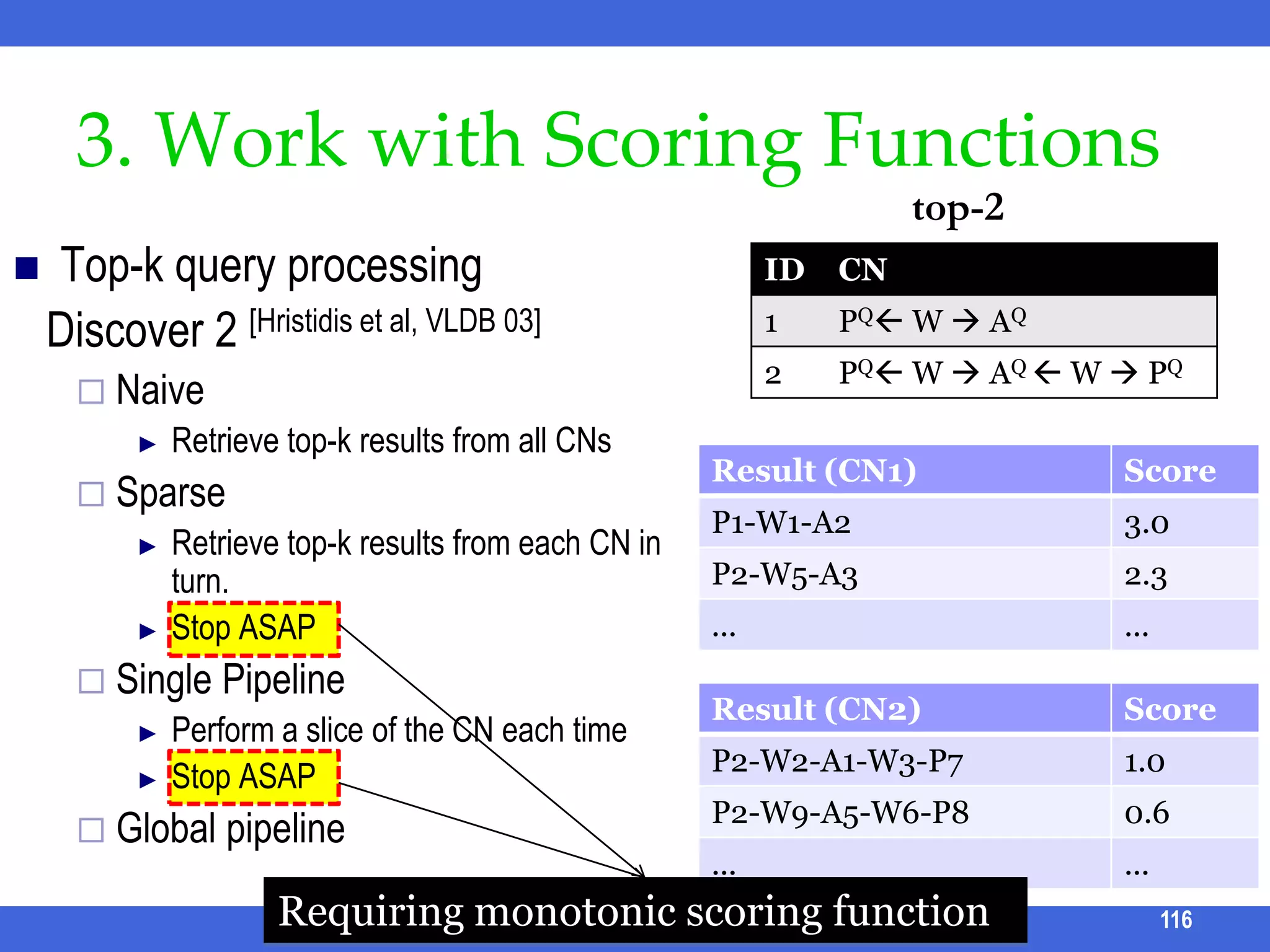
3. Work with Scoring Functionstop-2Top-k query processing   Discover 2 [Hristidis et al, VLDB 03]Naive Retrieve top-k results from all CNsSparseRetrieve top-k results from each CN in turn. Stop ASAPSingle PipelinePerform a slice of the CN each timeStop ASAPGlobal pipelineICDE 2011 Tutorial116Requiring monotonic scoring function
Working with Non-monotonic Scoring FunctionSPARK [Luo et al, SIGMOD 07]Why non-monotonic functionP1k1– W – A1k1P2k1– W – A3k2Solutionsort Pi and Aj in a salient orderwatf(tuple) works for SPARK’s scoring functionSkyline sweeping algorithmBlock pipeline algorithm ICDE 2011 Tutorial117?10.0Score(P1) > Score(P2) > …
Efficiency in Query ProcessingQuery processing is another challenging issue for keyword search systemsInherent complexityLarge search spaceWork with scoring functionsPerformance improving ideasQuery processing methods for XML KWSICDE 2011 Tutorial118
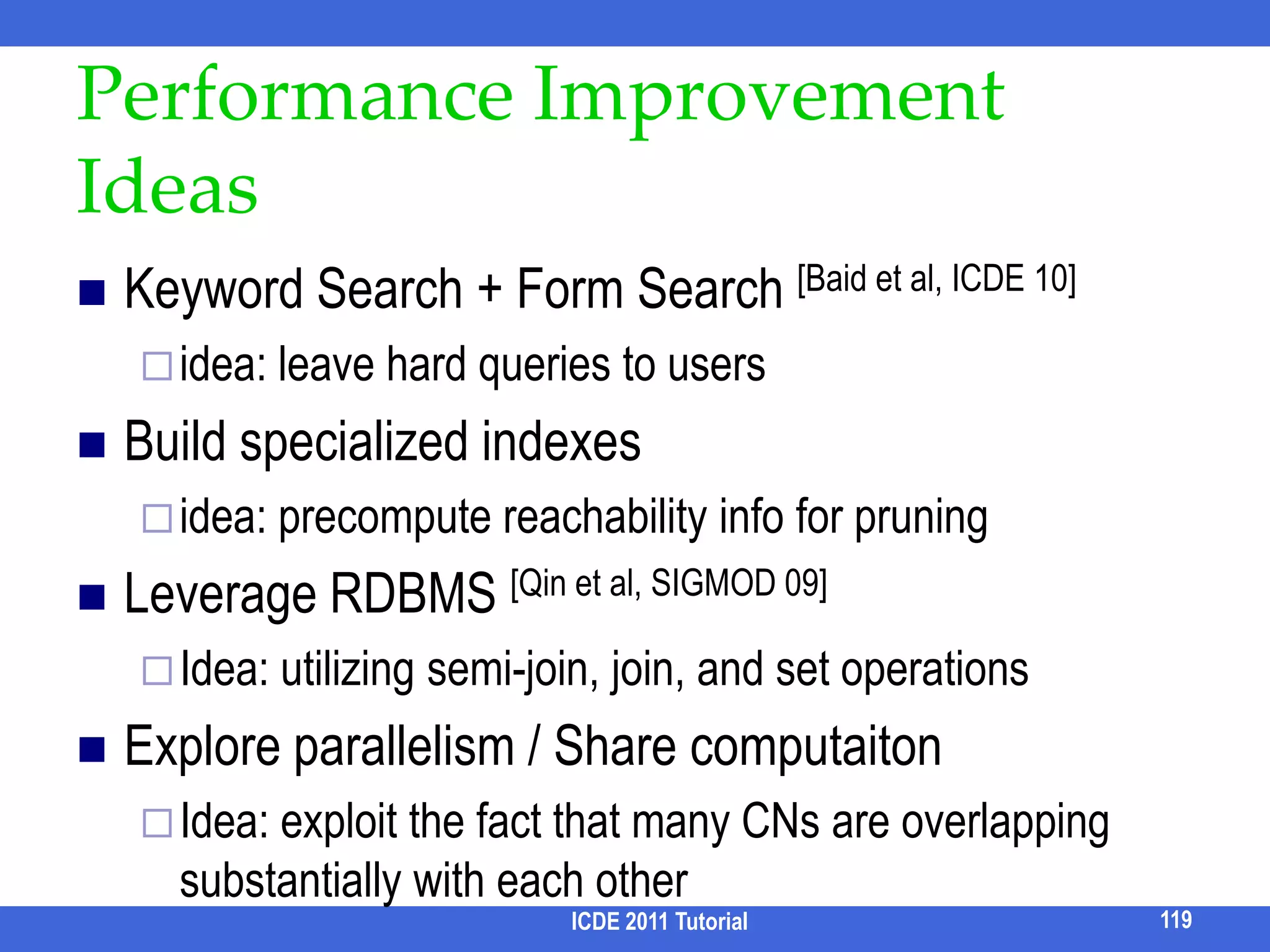
Performance Improvement IdeasKeyword Search + Form Search [Baid et al, ICDE 10]idea: leave hard queries to usersBuild specialized indexesidea: precompute reachability info for pruningLeverage RDBMS [Qin et al, SIGMOD 09]Idea: utilizing semi-join, join, and set operationsExplore parallelism / Share computaiton Idea: exploit the fact that many CNs are overlapping substantially with each other119ICDE 2011 Tutorial
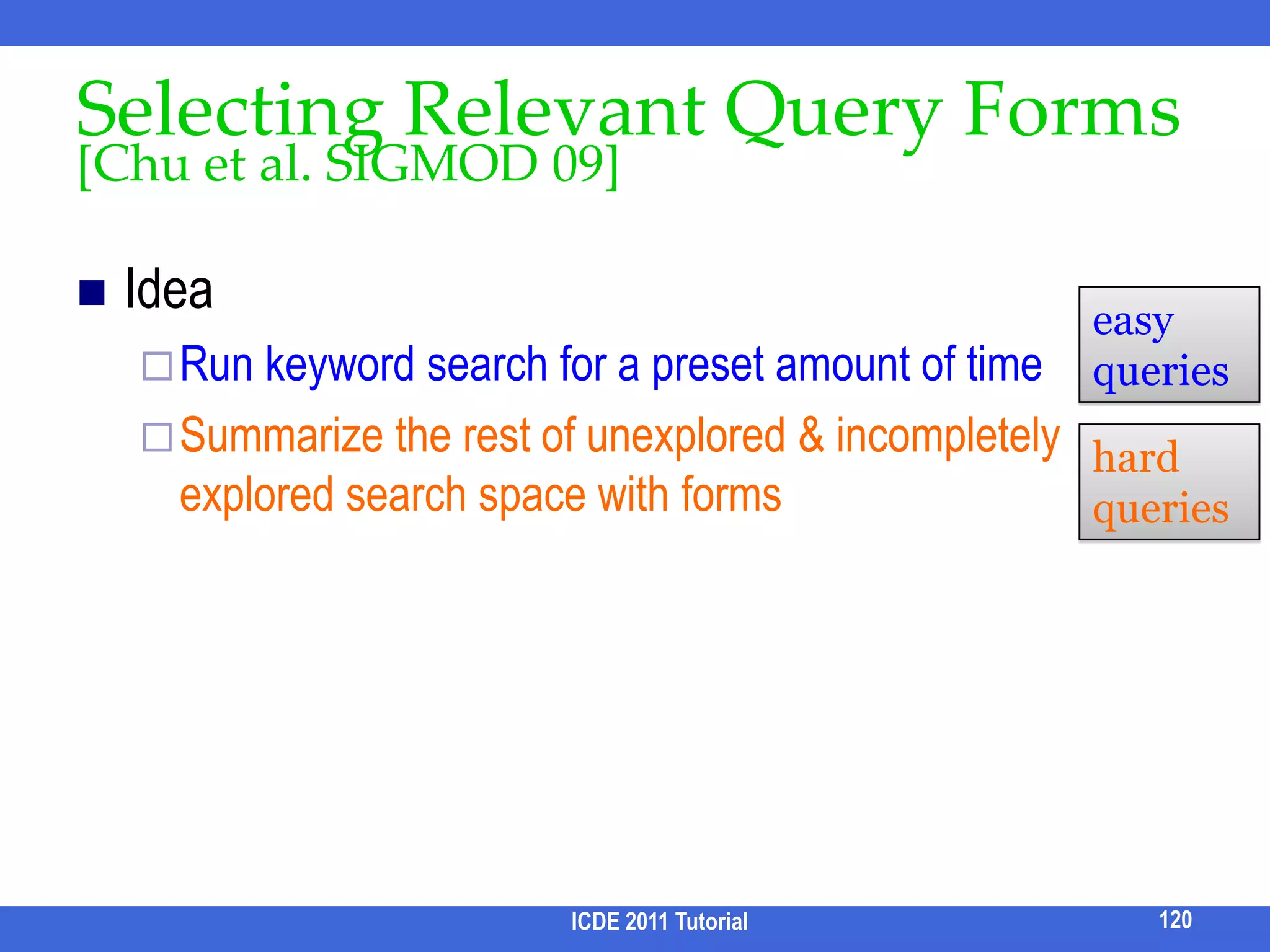
Selecting Relevant Query Forms [Chu et al. SIGMOD 09]IdeaRun keyword search for a preset amount of timeSummarize the rest of unexplored & incompletely explored search space with formsICDE 2011 Tutorial120easy querieshard queries
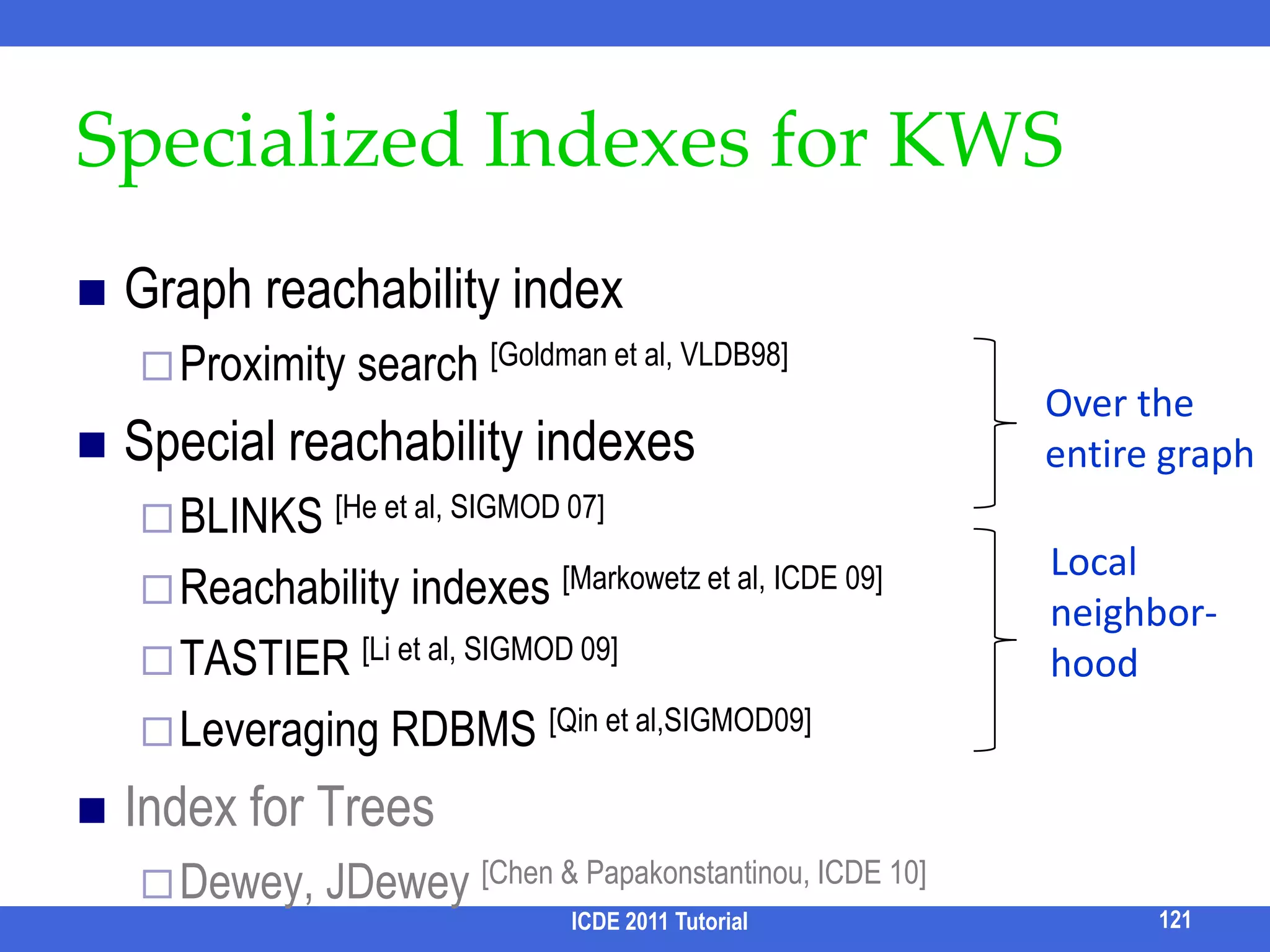
Specialized Indexes for KWSGraph reachability indexProximity search [Goldman et al, VLDB98]Special reachability indexesBLINKS [He et al, SIGMOD 07]Reachability indexes [Markowetz et al, ICDE 09]TASTIER [Li et al, SIGMOD 09]Leveraging RDBMS [Qin et al,SIGMOD09]Index for TreesDewey, JDewey [Chen & Papakonstantinou, ICDE 10]Over the entire graphLocal neighbor-hood121ICDE 2011 Tutorial
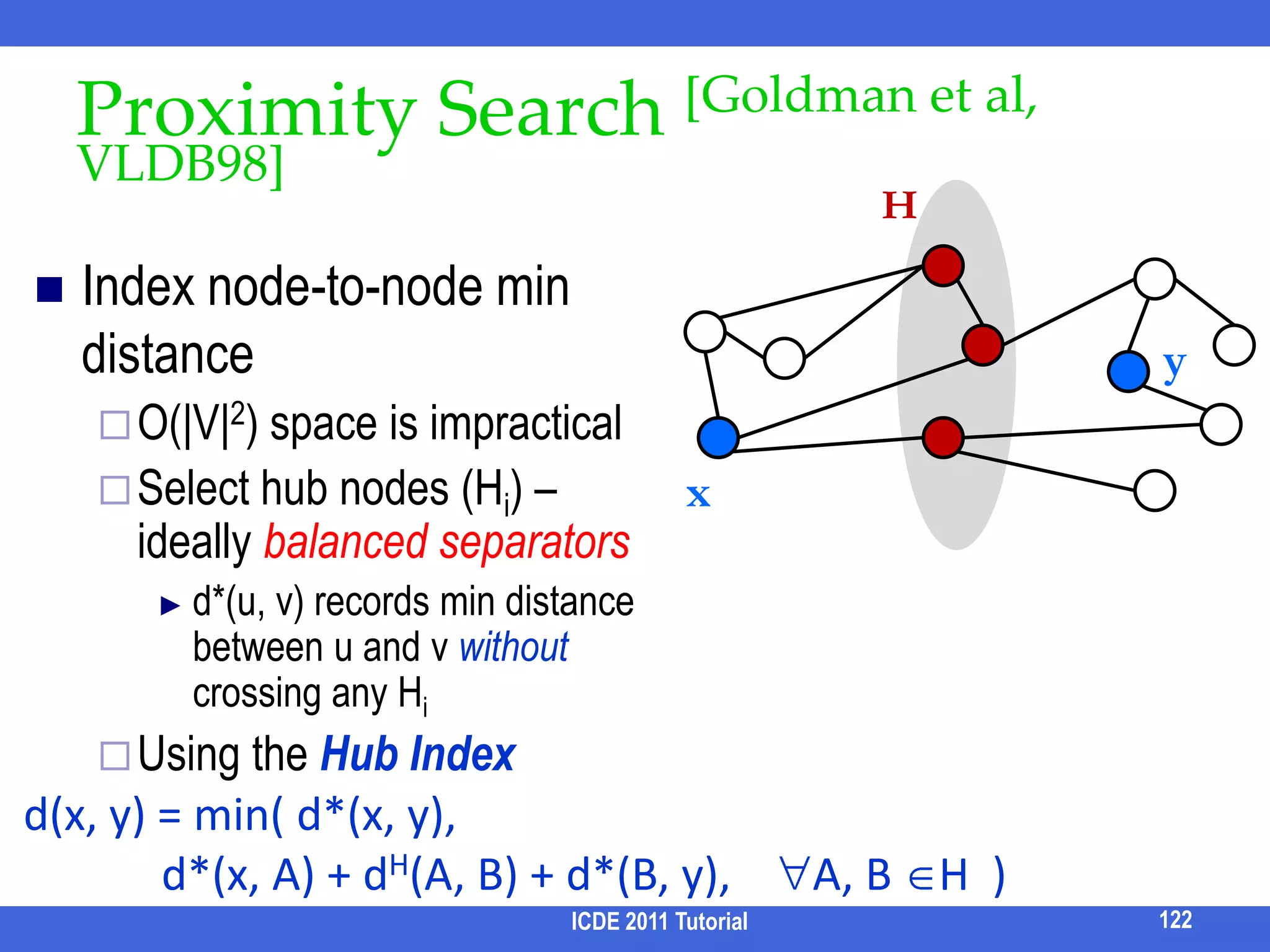
Proximity Search [Goldman et al, VLDB98]HIndex node-to-node min distanceO(|V|2) space is impracticalSelect hub nodes (Hi) – ideally balanced separatorsd*(u, v) records min distance between u and v without crossing any HiUsing the Hub Indexyxd(x, y) = min( d*(x, y), 					           	 d*(x, A) + dH(A, B) + d*(B, y),   A, B H  )122ICDE 2011 Tutorial
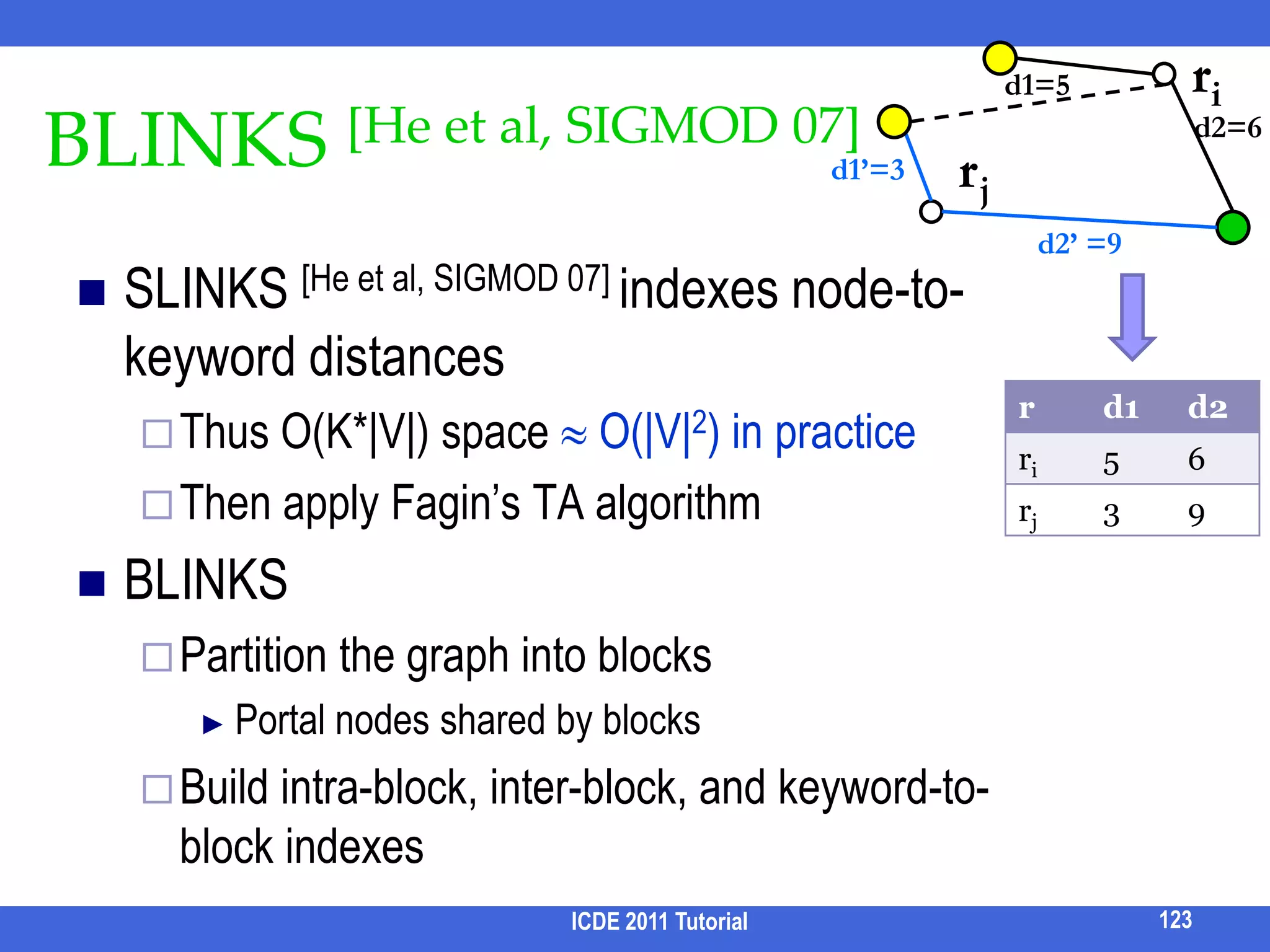
riBLINKS [He et al, SIGMOD 07]d1=5d2=6d1’=3rjd2’ =9SLINKS [He et al, SIGMOD 07] indexes node-to-keyword distancesThus O(K*|V|) space  O(|V|2) in practiceThen apply Fagin’s TA algorithmBLINKS Partition the graph into blocksPortal nodes shared by blocksBuild intra-block, inter-block, and keyword-to-block indexes123ICDE 2011 Tutorial
D-Reachability Indexes [Markowetz et al, ICDE 09]Precompute various reachability informationwith a size/range threshold (D) to cap their index sizesNode  Set(Term)				      (N2T)(Node, Relation)  Set(Term) 		                 (N2R)(Node, Relation)  Set(Node) 		                 (N2N)(Relation1, Term, Relation2)  Set(Term)            (R2R)Prune partial solutionsPrune CNs124ICDE 2011 Tutorial
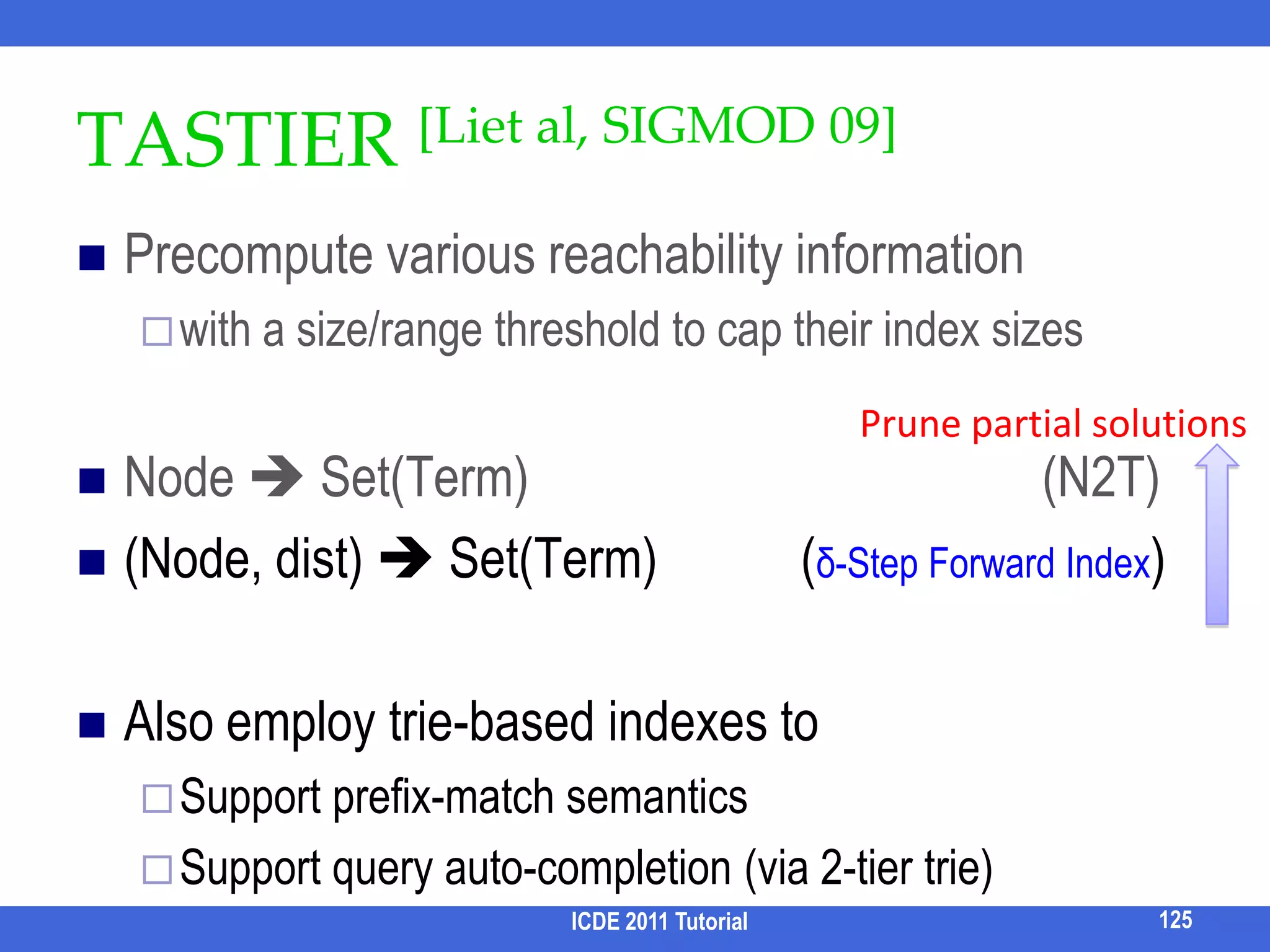
TASTIER [Liet al, SIGMOD 09]Precompute various reachability informationwith a size/range threshold to cap their index sizesNode  Set(Term)				      (N2T)(Node, dist)  Set(Term)	       (δ-Step Forward Index) Also employ trie-based indexes toSupport prefix-match semanticsSupport query auto-completion (via 2-tier trie)Prune partial solutions125ICDE 2011 Tutorial
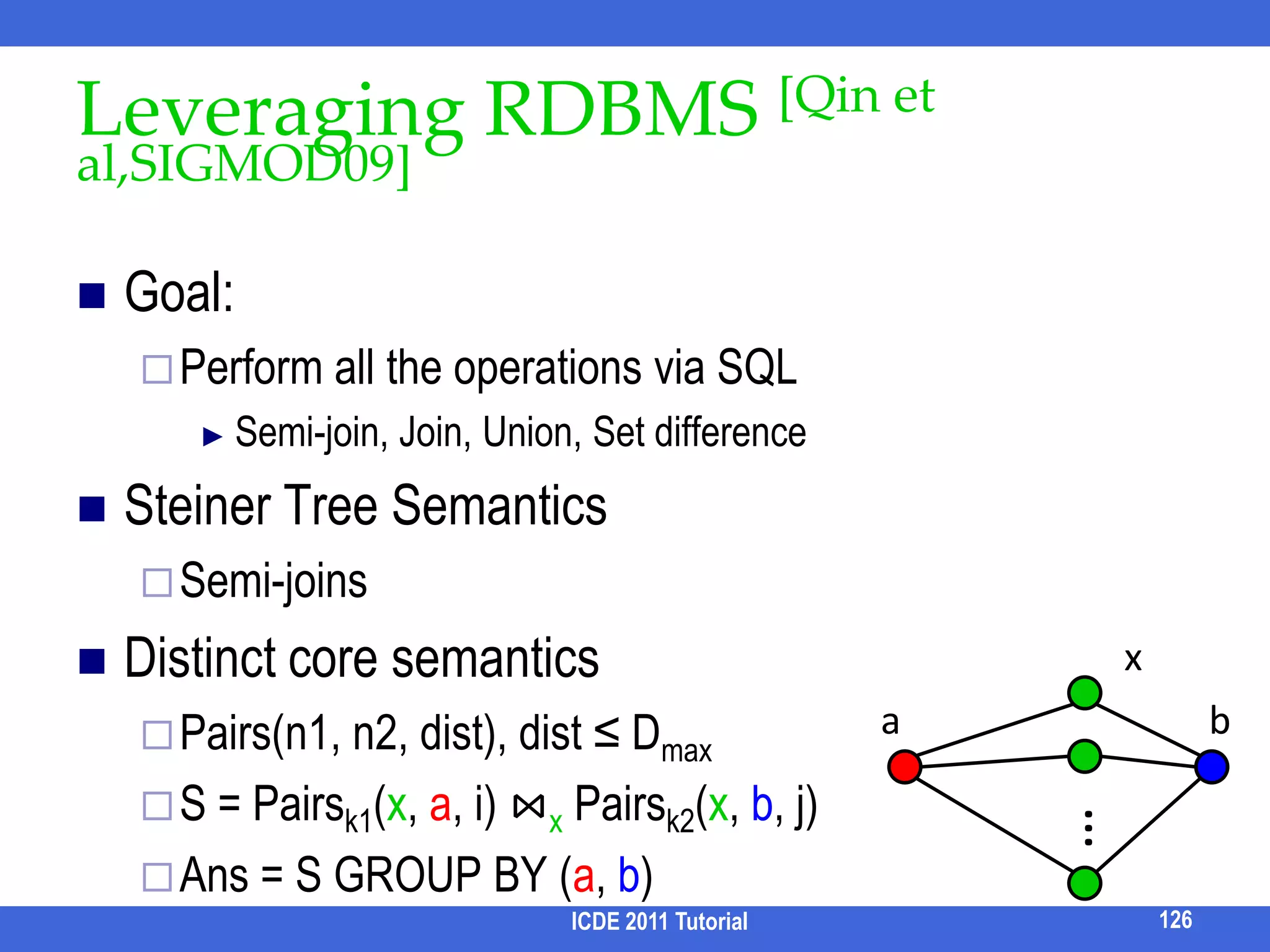
Leveraging RDBMS [Qin et al,SIGMOD09]Goal: Perform all the operations via SQLSemi-join, Join, Union, Set differenceSteiner Tree SemanticsSemi-joinsDistinct core semanticsPairs(n1, n2, dist), dist ≤ DmaxS = Pairsk1(x, a, i) ⋈x Pairsk2(x, b, j)Ans = S GROUP BY (a, b) xab…126ICDE 2011 Tutorial
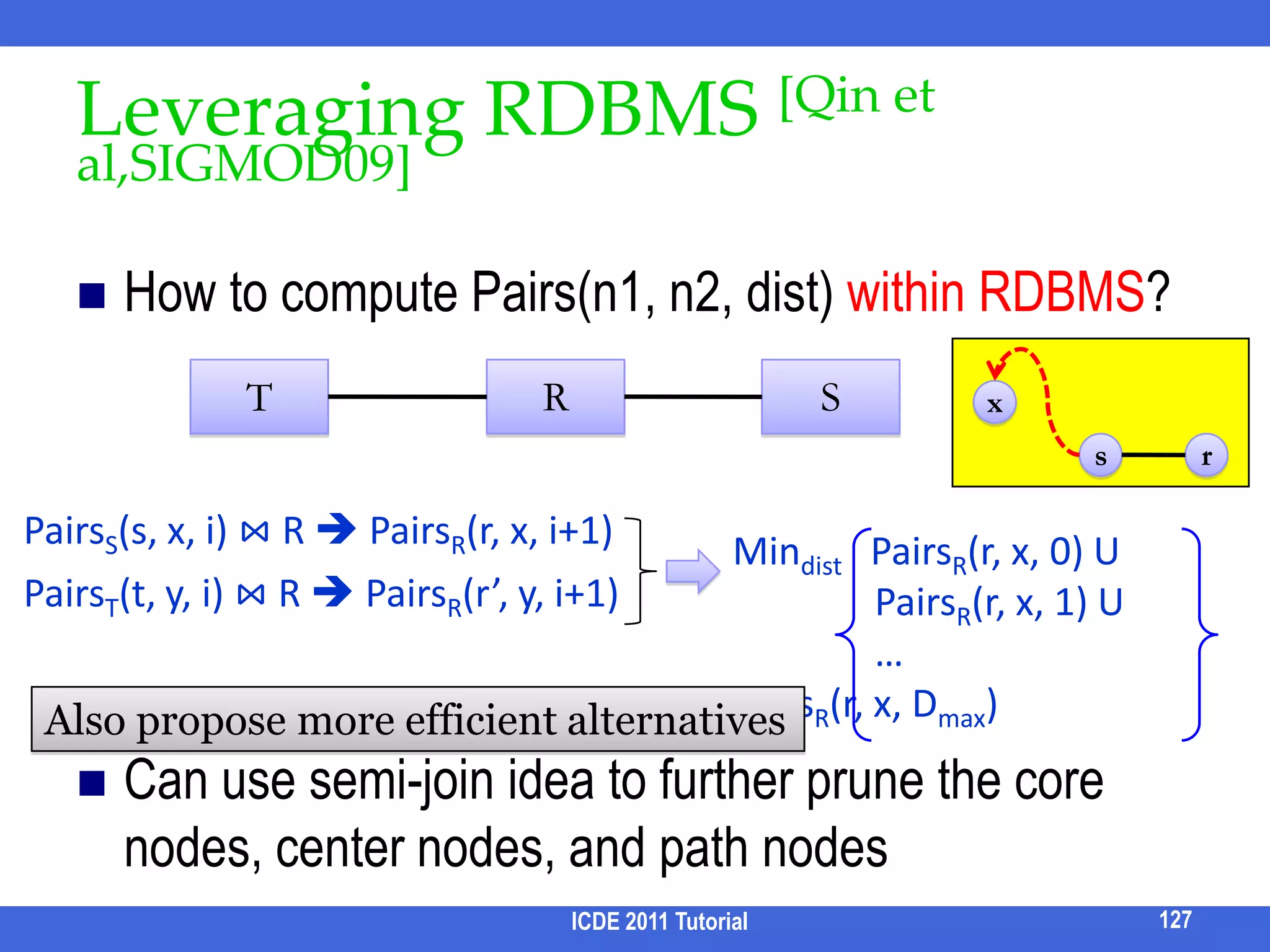
Leveraging RDBMS [Qin et al,SIGMOD09]How to compute Pairs(n1, n2, dist) within RDBMS?Can use semi-join idea to further prune the core nodes, center nodes, and path nodesRSTxsrPairsS(s, x, i) ⋈ R  PairsR(r, x, i+1)Mindist   PairsR(r, x, 0) U                           PairsR(r, x, 1) U               …PairsR(r, x, Dmax)              PairsT(t, y, i) ⋈ R  PairsR(r’, y, i+1)Also propose more efficient alternatives127ICDE 2011 Tutorial
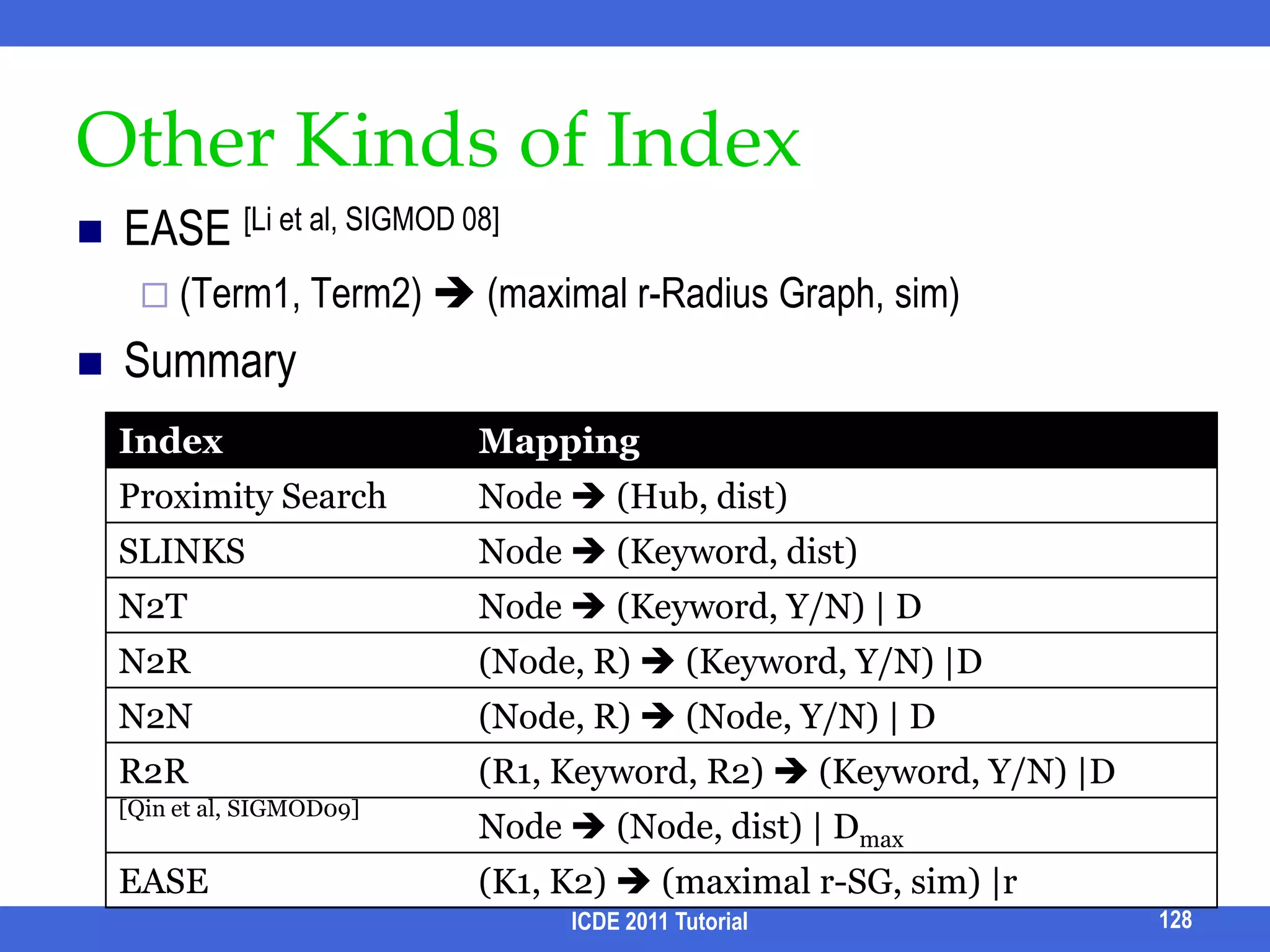
Other Kinds of IndexEASE [Li et al, SIGMOD 08](Term1, Term2)  (maximal r-Radius Graph, sim)Summary128ICDE 2011 Tutorial
Multi-query OptimizationIssues: A keyword query generates too many SQL queriesSolution 1: Guess the most likely SQL/CNSolution 2: Parallelize the computation[Qin et al, VLDB 10]Solution 3: Share computationOperator Mesh [[Markowetz et al, SIGMOD 07]]SPARK2 [Luo et al, TKDE]129ICDE 2011 Tutorial
Parallel Query Processing [Qin et al, VLDB 10]Many CNs share common sub-expressionsCapture such sharing in a shared execution graphEach node annotated with its estimated cost7⋈456⋈⋈⋈3⋈⋈⋈21CQPQUPCQPQ130ICDE 2011 Tutorial
Parallel Query Processing [Qin et al, VLDB 10]CN PartitioningAssign the largest job to the core with the lightest load7⋈456⋈⋈⋈3⋈⋈⋈21CQPQUPCQPQ131ICDE 2011 Tutorial
Parallel Query Processing [Qin et al, VLDB 10]Sharing-aware CN PartitioningAssign the largest job to the core that has the lightest resulting loadUpdate the cost of the rest of the jobs7⋈456⋈⋈⋈3⋈⋈⋈21CQPQUPCQPQ132ICDE 2011 Tutorial
Parallel Query Processing [Qin et al, VLDB 10]⋈Operator-level PartitioningConsider each levelPerform cost (re-)estimationAllocate operators to coresAlso has Data level parallelism for extremely skewed scenarios⋈⋈⋈⋈⋈⋈CQPQUPCQPQ133ICDE 2011 Tutorial
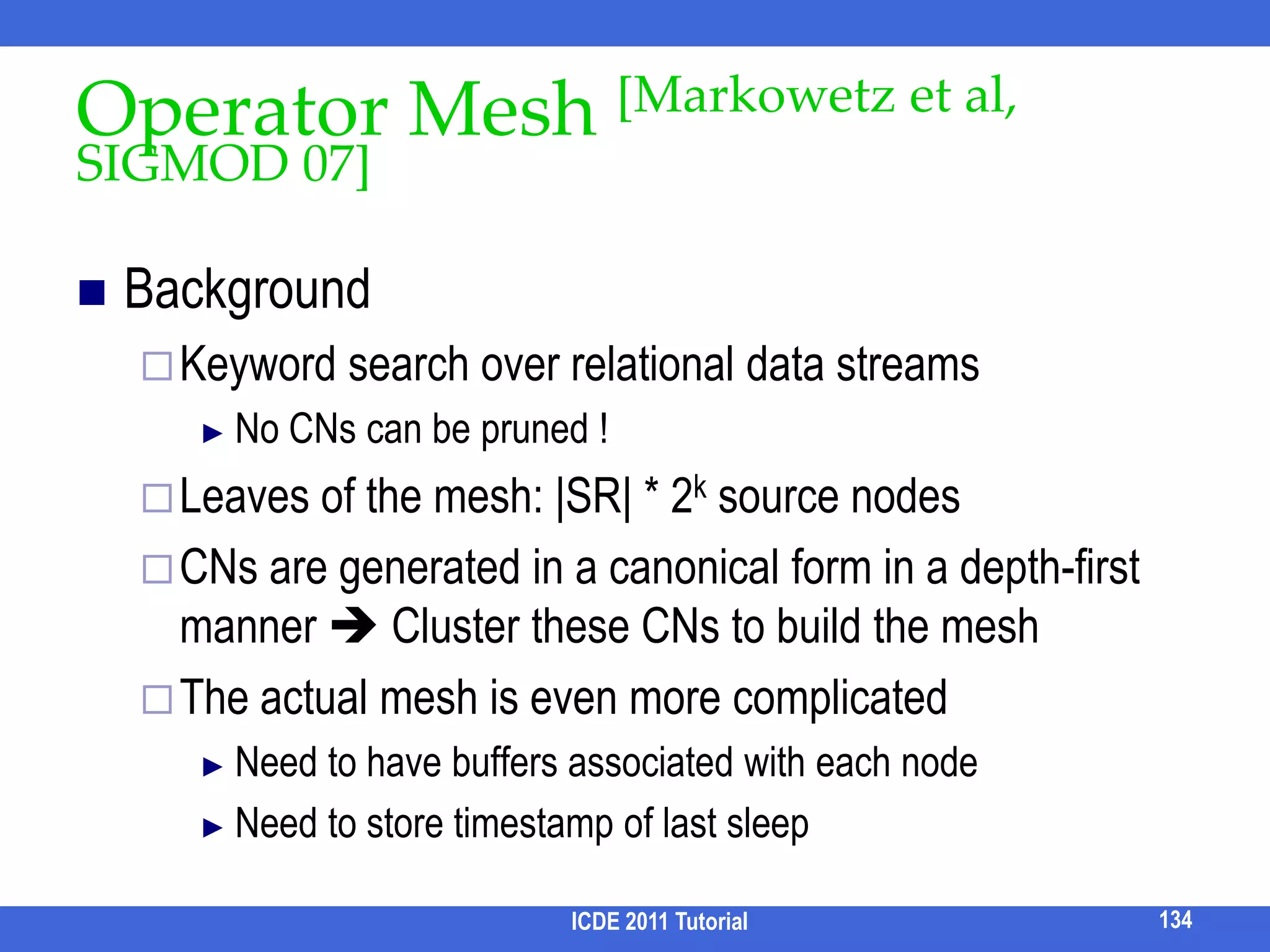
Operator Mesh [Markowetz et al, SIGMOD 07]BackgroundKeyword search over relational data streamsNo CNs can be pruned !Leaves of the mesh: |SR| * 2k source nodesCNs are generated in a canonical form in a depth-first manner  Cluster these CNs to build the meshThe actual mesh is even more complicatedNeed to have buffers associated with each nodeNeed to store timestamp of last sleep134ICDE 2011 Tutorial
SPARK2 [Luo et al, TKDE]47⋈⋈⋈Capture CN dependency (& sharing) via the partition graphFeaturesOnly CNs are allowed as nodes  no open-ended joinsModels all the ways a CN can be obtained by joining two other CNs (and possibly some free tuplesets)  allow pruning if one sub-CN produce empty result356⋈⋈⋈PU21135ICDE 2011 Tutorial
Efficiency in Query ProcessingQuery processing is another challenging issue for keyword search systemsInherent complexityLarge search spaceWork with scoring functionsPerformance improving ideasQuery processing methods for XML KWSICDE 2011 Tutorial136
XML KWS Query ProcessingSLCAIndex Stack [Xu & Papakonstantinou, SIGMOD 05]Multiway SLCA [Sun et al, WWW 07]ELCAXRank [Guo et al, SIGMOD 03]JDewey Join [Chen & Papakonstantinou, ICDE 10]Also supports SLCA & top-k keyword searchICDE 2011 Tutorial137[Xu & Papakonstantinou, EDBT 08]
XKSearch[Xu & Papakonstantinou, SIGMOD 05]Indexed-Lookup-Eager (ILE) when ki is selectiveO( k * d * |Smin| * log(|Smax|) )ICDE 2011 Tutorial138zyQ: x ∈ SLCA ?xA: No. But we can decide if the previous candidate SLCA node (w) ∈ SLCA or not wvrmS(v)lmS(v)Document order
Multiway SLCA [Sun et al, WWW 07]Basic & Incremental Multiway SLCAO( k * d * |Smin| * log(|Smax|) )ICDE 2011 Tutorial139Q: Who will be the anchor node next?zy1) skip_after(Si, anchor)x2) skip_out_of(z)w… …anchor
Index Stack [Xu & Papakonstantinou, EDBT 08]Idea:ELCA(S1, S2, … Sk) ⊆ ELCA_candidates(S1, S2, … Sk) ELCA_candidates(S1, S2, … Sk) =∪v ∈S1 SLCA({v}, S2, … Sk)       O(k * d * log(|Smax|)), d is the depth of the XML data treeSophisticated stack-based algorithm to find true ELCA nodes from ELCA_candidatesOverall complexity: O(k * d * |Smin| * log(|Smax|))DIL [Guo et al, SIGMOD 03]:    O(k * d * |Smax|)RDIL[Guo et al, SIGMOD 03]: O(k2* d * p * |Smax| log(|Smax|) + k2 * d + |Smax|2)ICDE 2011 Tutorial140
Computing ELCAJDewey Join [Chen & Papakonstantinou, ICDE 10]Compute ELCA bottom-upICDE 2011 Tutorial141111111113111232312123⋈21121.1.2.2
SummaryQuery processing for KWS is a challenging taskAvenues explored:Alternative result definitionsBetter exact & approximate algorithmsTop-k optimizationIndexing (pre-computation, skipping)Sharing/parallelize computationICDE 2011 Tutorial142
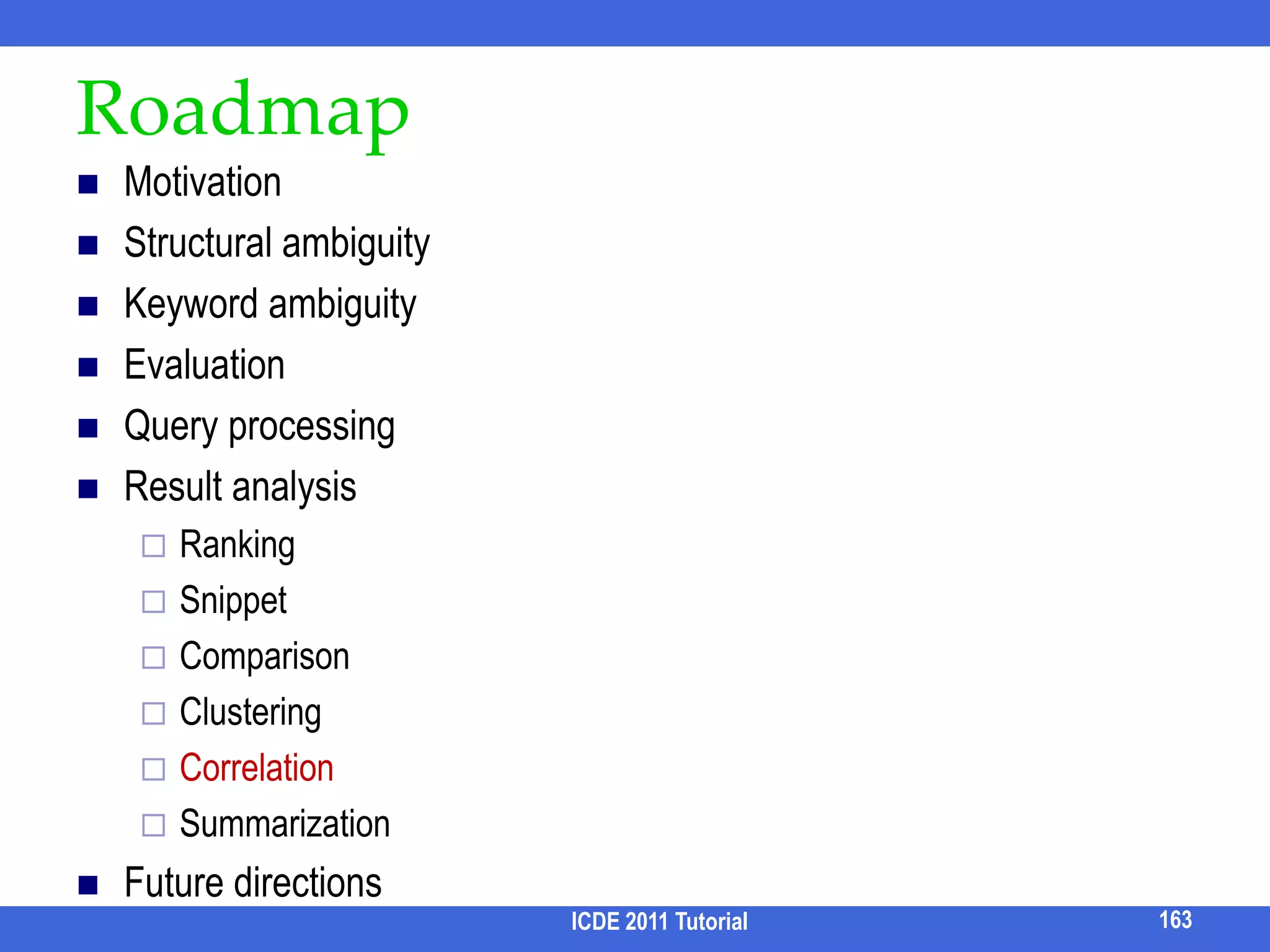
RoadmapMotivationStructural ambiguityKeyword ambiguityEvaluationQuery processingResult analysisRankingSnippetComparisonClusteringCorrelationSummarizationFuture directionsICDE 2011 Tutorial143
Result Ranking /1Types of ranking factorsTerm Frequency (TF), Inverse Document Frequency (IDF)TF: the importance of a term in a documentIDF: the general importance of a termAdaptation: a document  a node (in a graph or tree) or a result.Vector Space ModelRepresents queries and results using vectors.Each component is a term, the value is its weight (e.g., TFIDF)Score of a result: the similarity between query vector and result vector.ICDE 2011 Tutorial144
Result Ranking /2Proximity based rankingProximity of keyword matches in a document can boost its ranking.Adaptation: weighted tree/graph size, total distance from root to each leaf, etc. Authority based rankingPageRank: Nodes linked by many other important nodes are important.Adaptation: Authority may flow in both directions of an edgeDifferent types of edges in the data (e.g., entity-entity edge, entity-attribute edge) may be treated differently.ICDE 2011 Tutorial145
RoadmapMotivationStructural ambiguityKeyword ambiguityEvaluationQuery processingResult analysisRankingSnippetComparisonClusteringCorrelationSummarizationFuture directionsICDE 2011 Tutorial146
Result SnippetsAlthough ranking is developed, no ranking scheme can be perfect in all cases. Web search engines provide snippets.Structured search results have tree/graph structure and traditional techniques do not apply.ICDE 2011 Tutorial147
Result Snippets on XML [Huang et al. SIGMOD 08]Input: keyword query, a query resultOutput: self-contained, informative and concise snippet.Snippet components:KeywordsKey of resultEntities in resultDominant featuresThe problem is proved NP-hardHeuristic algorithms were proposedQ:  “ICDE”confnamepaperpaperyearICDE2010authortitletitlecountrydataqueryUSA148ICDE 2011 Tutorial
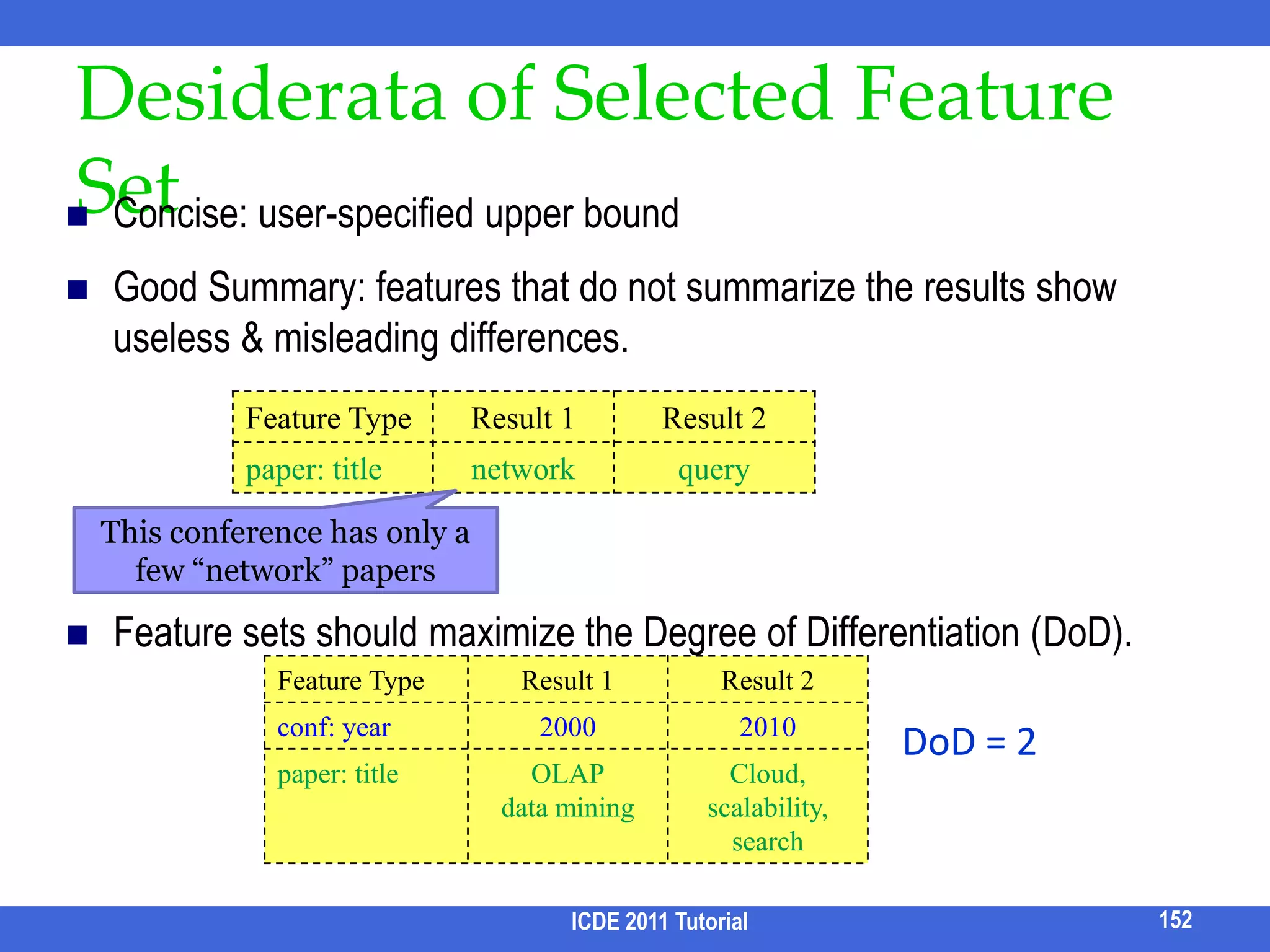
Result Differentiation [Liu et al. VLDB 09]ICDE 2011 Tutorial149Techniques like snippet and ranking helps user find relevant results.50% of keyword searches are information exploration queries, which inherently have multiple relevant resultsUsers intend to investigate and compare multiple relevant results.How to help user comparerelevant results?Web Search50% Navigation50% Information ExplorationBroder, SIGIR 02
Result DifferentiationICDE 2011 Tutorial150Query: “ICDE”confSnippets are not designed to compare results: both results have many papers about “data” and “query”.- both results have many papers from authors from USAnamepaperpaperyearpaperICDE2000authortitletitletitlecountrydataqueryinformationUSAconfnamepaperpaperyearICDE2010authorauthortitletitlecountryaff.dataqueryWaterlooUSA
Result DifferentiationICDE 2011 Tutorial151Query: “ICDE”confnamepaperpaperyearpaperICDE2000authortitletitletitlecountrydataqueryinformationUSAconfnamepaperpaperyearBank websites usually allow users to compare selected credit cards.however, only with a pre-defined feature set.ICDE2010authorauthortitletitlecountryaff.dataqueryWaterlooUSAHow to automatically generate good comparison tables efficiently?
Desiderata of Selected Feature SetConcise: user-specified upper boundGood Summary: features that do not summarize the results show useless & misleading differences.Feature sets should maximize the Degree of Differentiation (DoD).This conference has only a few “network” papersDoD = 2152ICDE 2011 Tutorial
Result Differentiation ProblemInput: set of resultsOutput: selected features of results, maximizing the differences.The problem of generating the optimal comparison table is NP-hard.Weak local optimality: can’t improve by replacing one feature in one resultStrong local optimality: can’t improve by replacing any number of features in one result.Efficient algorithms were developed to achieve theseICDE 2011 Tutorial153
RoadmapMotivationStructural ambiguityKeyword ambiguityEvaluationQuery processingResult analysisRankingSnippetComparisonClusteringCorrelationSummarizationFuture directionsICDE 2011 Tutorial154
Result Clustering Results of a query may have several “types”.Clustering these results helps the user quickly see all result types.Related to Group By in SQL, however, in keyword search, the user may not be able to specify the Group By attributes. different results may have completely different attributes.ICDE 2011 Tutorial155
XBridge [Li et al. EDBT 10]To help user see result types, XBridge groups results based on context of result rootsE.g., for query “keyword query processing”, different types of papers can be distinguished by the path from data root to result root.Input: query resultsOutput: Ranked result clustersICDE 2011 Tutorial156bibbibbibconferencejournalworkshoppaperpaperpaper
Ranking of ClustersRanking score of a cluster:Score (G, Q) = total score of top-R results in G, whereR = min(avg, |G|)ICDE 2011 Tutorial157This formula avoids too much benefit to large clustersavg number ofresults in allclusters
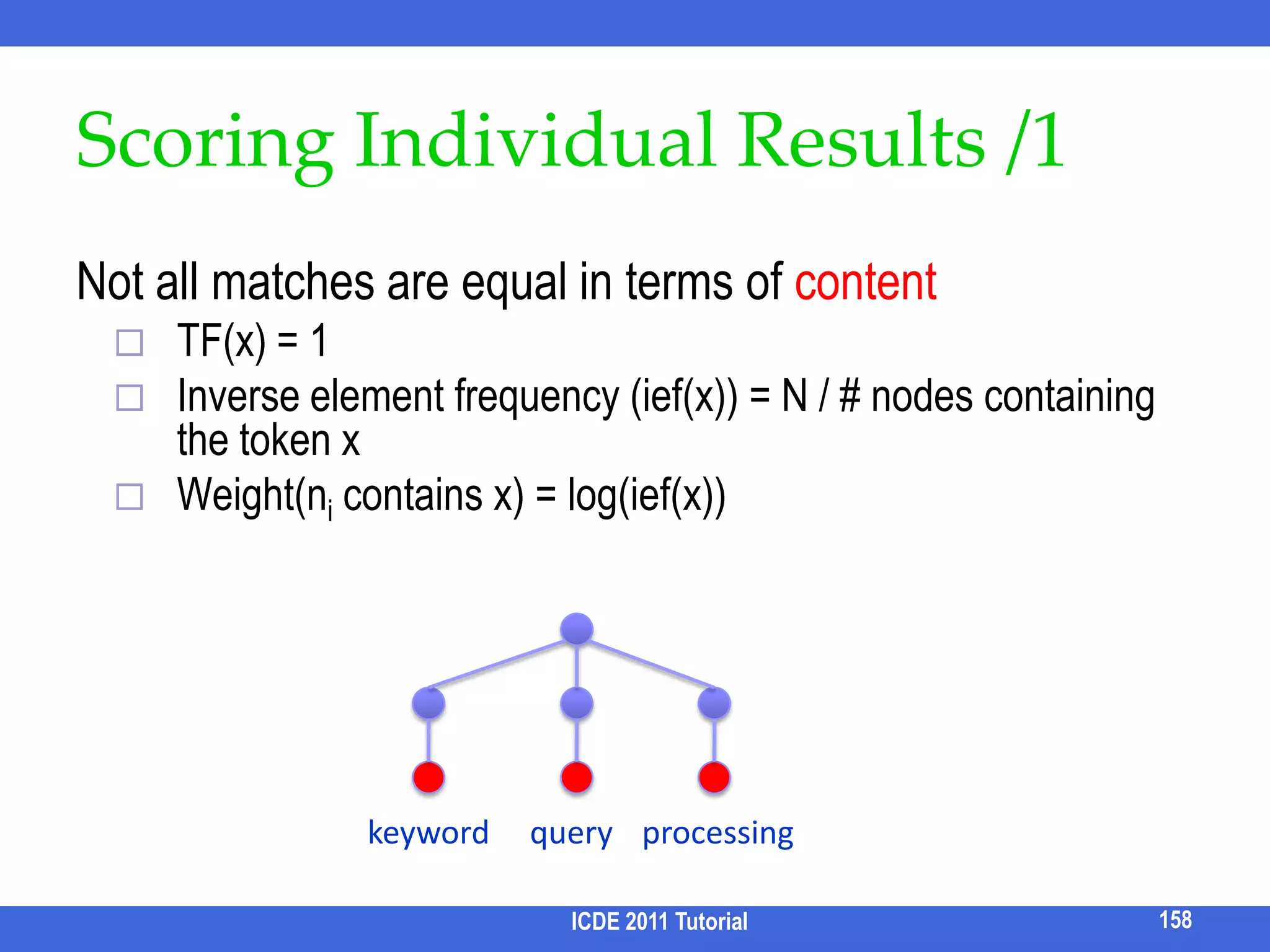
Scoring Individual Results /1Not all matches are equal in terms of contentTF(x) = 1Inverse element frequency (ief(x)) = N / # nodes containing the token xWeight(ni contains x) = log(ief(x))keywordqueryprocessing158ICDE 2011 Tutorial
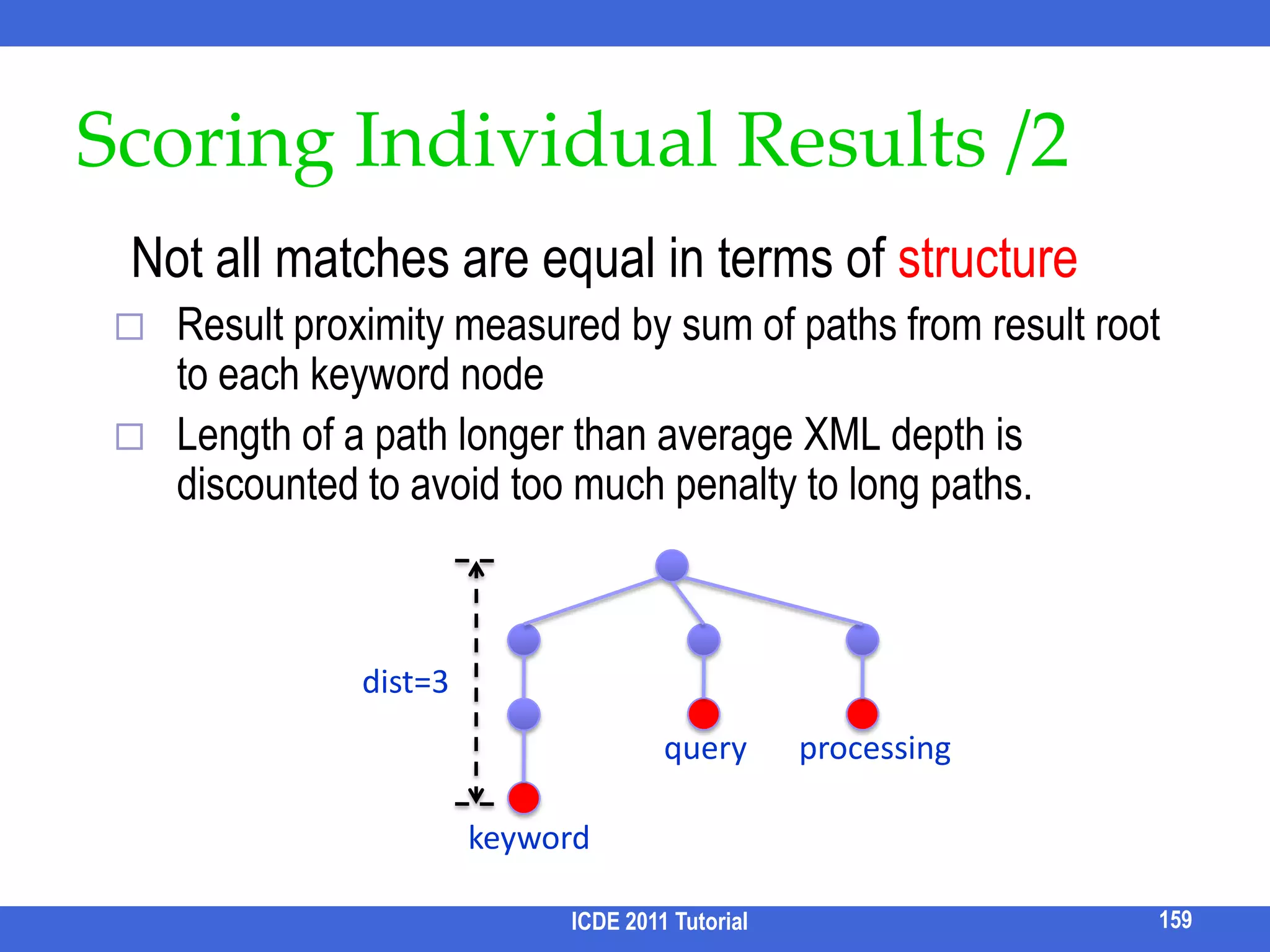
Scoring Individual Results /2Not all matches are equal in terms of structureResult proximity measured by sum of paths from result root to each keyword nodeLength of a path longer than average XML depth is discounted to avoid too much penalty to long paths.dist=3queryprocessingkeyword159ICDE 2011 Tutorial
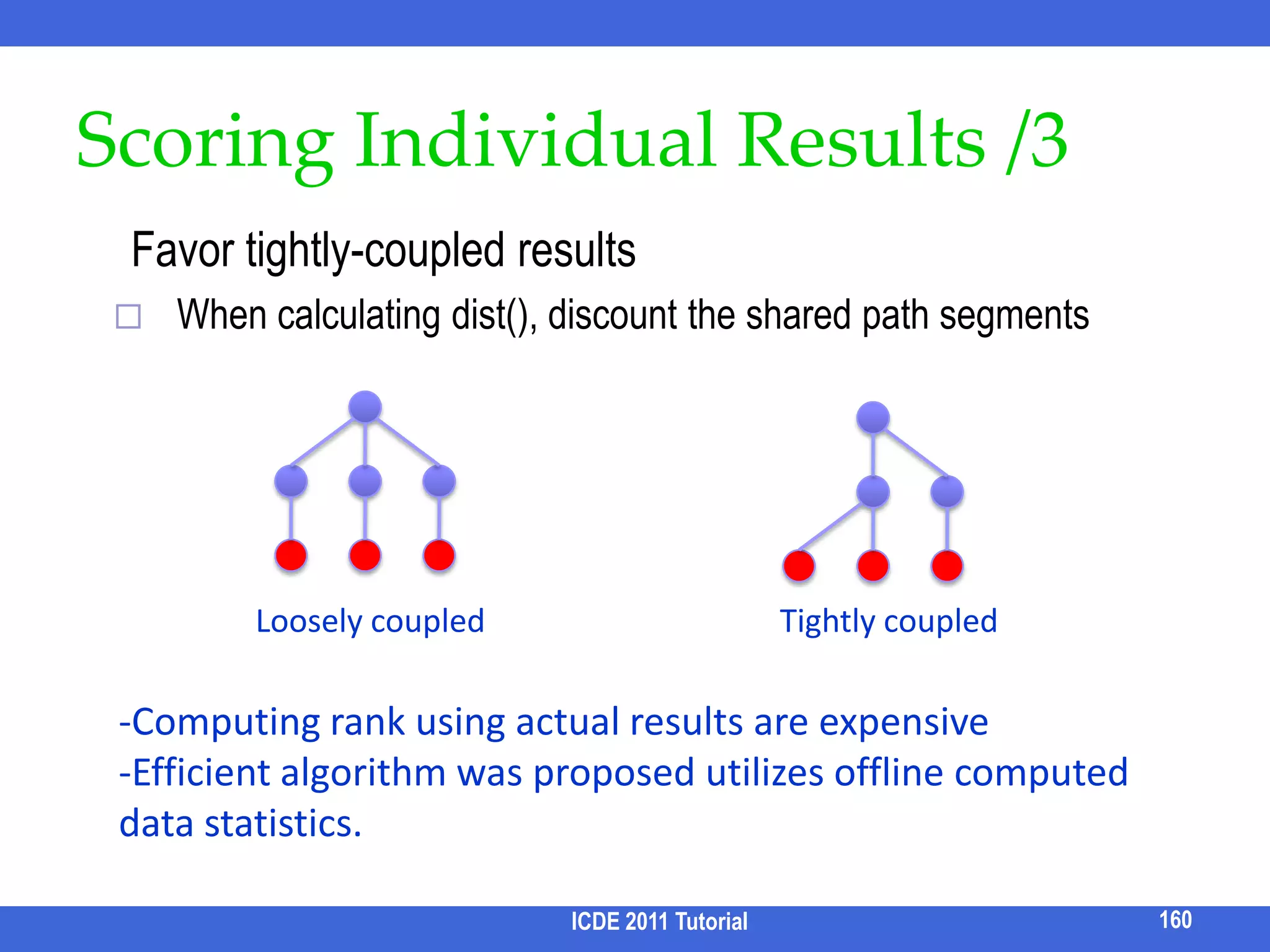
Scoring Individual Results /3Favor tightly-coupled resultsWhen calculating dist(), discount the shared path segmentsLoosely coupledTightly coupledComputing rank using actual results are expensive
Efficient algorithm was proposed utilizes offline computed data statistics.160ICDE 2011 Tutorial
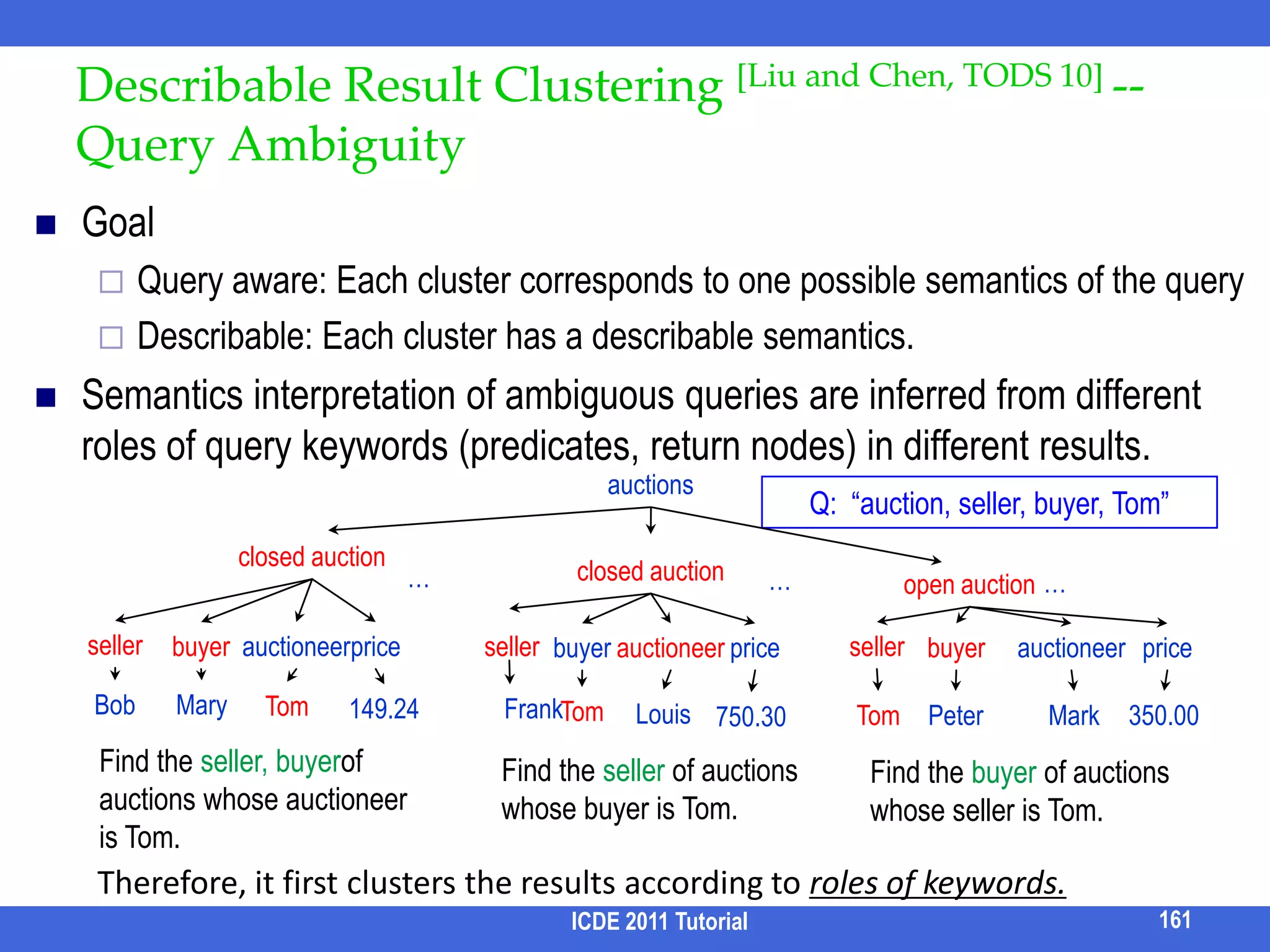
Describable Result Clustering [Liu and Chen, TODS 10] -- Query AmbiguityICDE 2011 Tutorial161GoalQuery aware: Each cluster corresponds to one possible semantics of the queryDescribable: Each cluster has a describable semantics.Semantics interpretation of ambiguous queries are inferred from different roles of query keywords (predicates, return nodes) in different results.auctionsQ:  “auction, seller, buyer, Tom”closed auctionclosed auction………open auctionsellerbuyerauctioneerpricesellersellerbuyerauctioneerpricebuyerauctioneerpriceBobMaryTom149.24FrankTomLouisTomPeterMark350.00750.30Find the seller, buyerof auctions whose auctioneer is Tom.Find the seller of auctions whose buyer is Tom.Find the buyer of auctions whose seller is Tom.Therefore, it first clusters the results according to roles of keywords.
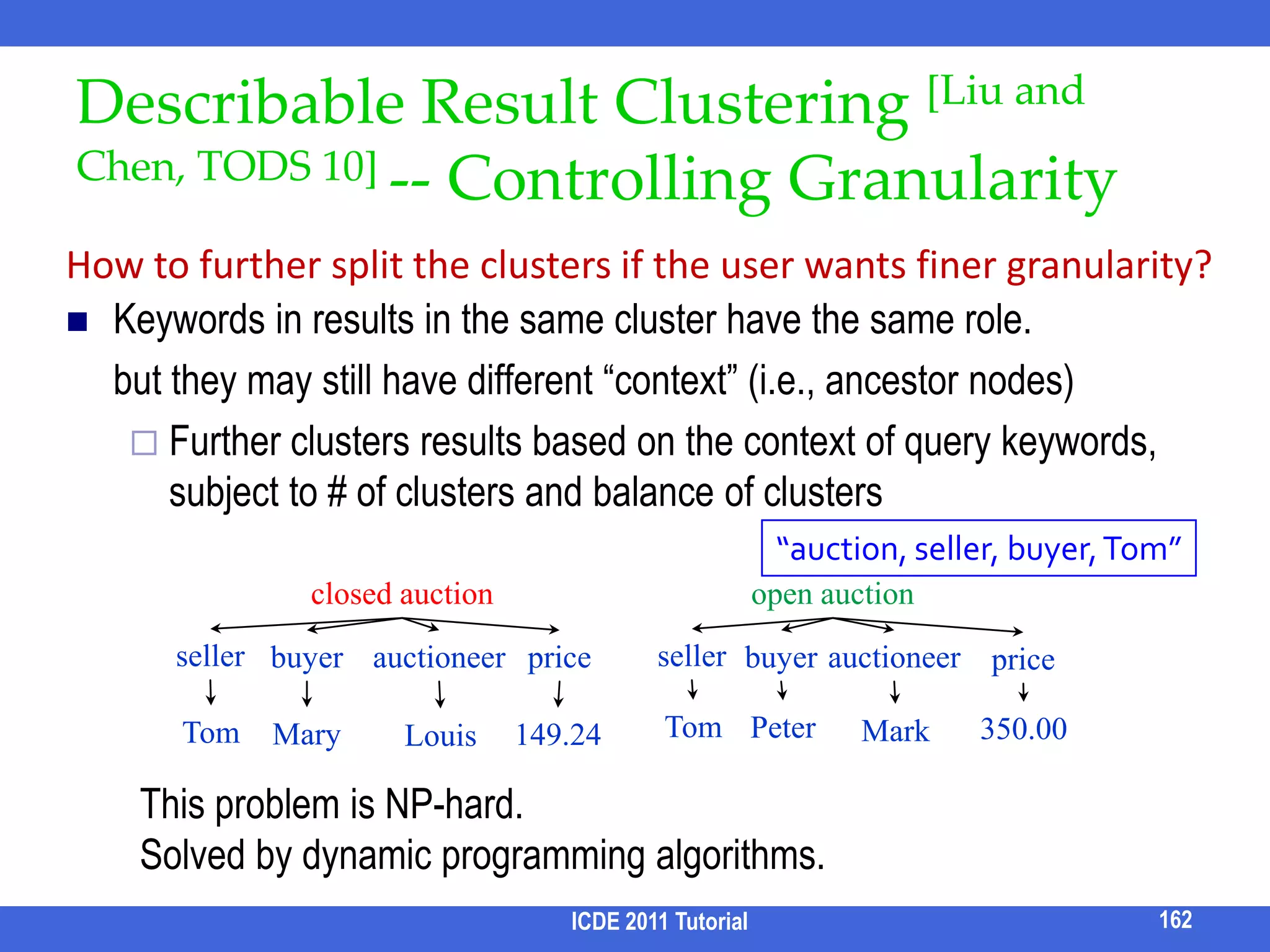
Describable Result Clustering [Liu and Chen, TODS 10] -- Controlling GranularityICDE 2011 Tutorial162How to further split the clusters if the user wants finer granularity?Keywords in results in the same cluster have the same role. 	but they may still have different “context” (i.e., ancestor nodes)Further clusters results based on the context of query keywords, subject to # of clusters and balance of clusters“auction, seller, buyer, Tom”closed auctionopen auctionsellersellerbuyerauctioneerpricebuyerauctioneerpriceTomPeter350.00MarkTomMary149.24LouisThis problem is NP-hard. Solved by dynamic programming algorithms.
RoadmapMotivationStructural ambiguityKeyword ambiguityEvaluationQuery processingResult analysisRankingSnippetComparisonClusteringCorrelationSummarizationFuture directionsICDE 2011 Tutorial163
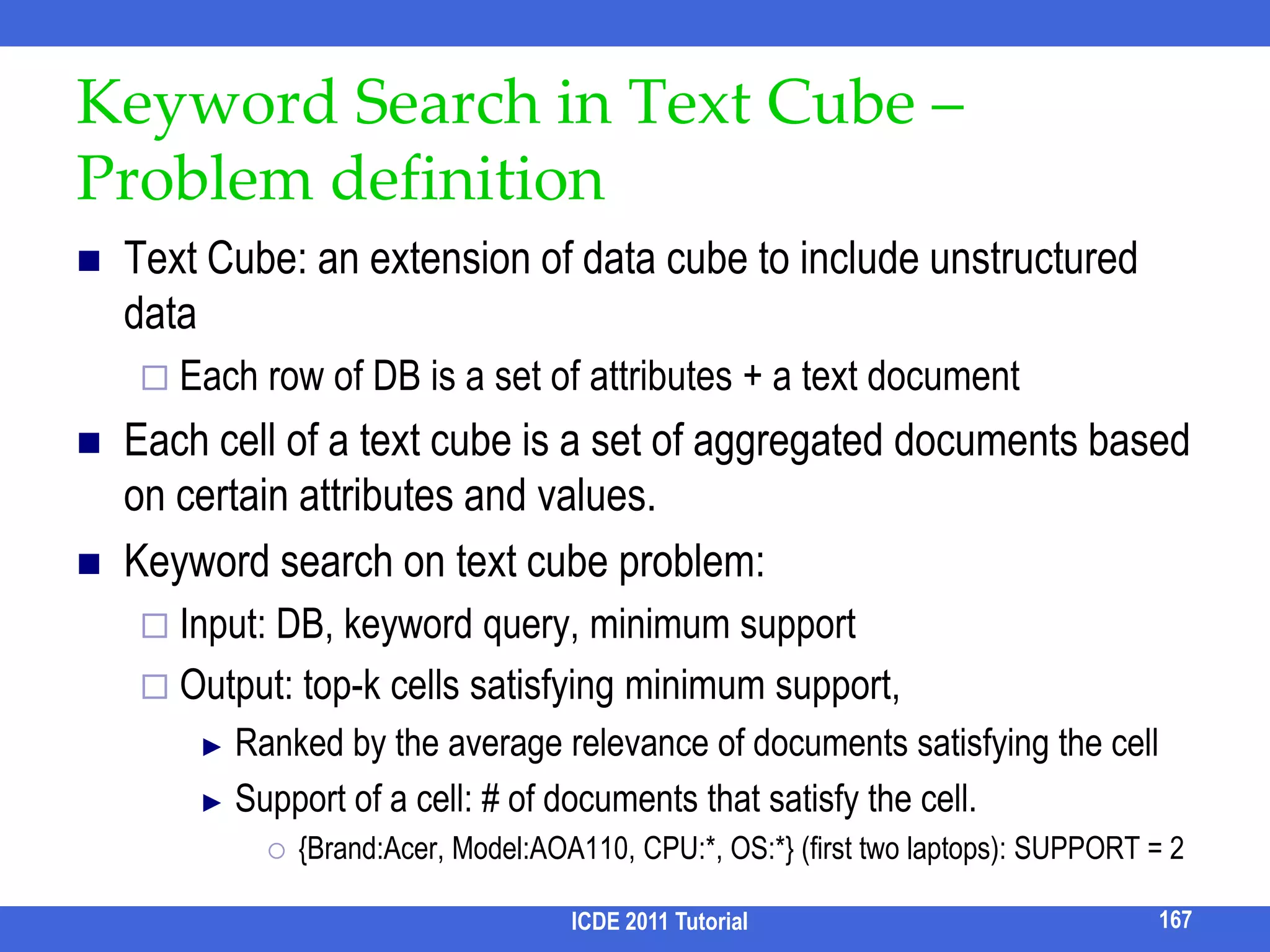
Table Analysis[Zhou et al. EDBT 09]In some application scenarios, a user may be interested in a group of tuples jointly matching a set of query keywords.E.g., which conferences have both keyword search, cloud computing and data privacy papers?When and where can I go to experience pool, motor cycle and American food together?Given a keyword query with a set of specified attributes,Cluster tuples based on (subsets) of specified attributes so that each cluster has all keywords coveredOutput results by clusters,  along with the shared specified attribute values164ICDE 2011 Tutorial

Keyword-based Search and Exploration on Databases (SIGMOD 2011)

  • 1.
    Keyword-based Search andExploration on DatabasesYi ChenWei WangZiyang LiuArizona State University, USAUniversity of New South Wales, AustraliaArizona State University, USA
  • 2.
    Traditional Access Methodsfor DatabasesRelational/XML Databases are structured or semi-structured, with rich meta-data
  • 3.
    Typically accessed bystructured query languages: SQL/XQueryAdvantages: high-quality resultsDisadvantages:Query languages: long learning curvesSchemas: Complex, evolving, or even unavailable.select paper.title from conference c, paper p, author a1, author a2, write w1, write w2 where c.cid = p.cid AND p.pid = w1.pid AND p.pid = w2.pid AND w1.aid = a1.aid AND w2.aid = a2.aid AND a1.name = “John” AND a2.name = “John” AND c.name = SIGMODSmall user population “The usability of a database is as important as its capability”[Jagadish, SIGMOD 07].2ICDE 2011 Tutorial
  • 4.
    Popular Access Methodsfor TextText documents have little structureThey are typically accessed by keyword-based unstructured queriesAdvantages: Large user populationDisadvantages: Limited search qualityDue to the lack of structure of both data and queries3ICDE 2011 Tutorial
  • 5.
    Grand Challenge: SupportingKeyword Search on DatabasesCan we support keyword based search and exploration on databases and achieve the best of both worlds?Opportunities ChallengesState of the artFuture directionsICDE 2011 Tutorial4
  • 6.
    Opportunities /1Easy touse, thus large user populationShare the same advantage of keyword search on text documentsICDE 2011 Tutorial5
  • 7.
    High-quality search resultsExploitthe merits of querying structured data by leveraging structural informationICDE 2011 Tutorial6Opportunities /2Query: “John, cloud”Structured DocumentSuch a result will have a low rank.Text Documentscientistscientist“John is a computer scientist.......... One of John’ colleagues, Mary, recently published a paper about cloud computing.”publicationsnamepublicationsnamepaperJohnpaperMarytitletitlecloudXML
  • 8.
    Enabling interesting/unexpected discoveriesRelevantdata pieces that are scattered but are collectively relevant to the query should be automatically assembled in the results A unique opportunity for searching DB Text search restricts a result as a documentDB querying requires users to specify relationships between data piecesICDE 2011 Tutorial7Opportunities /3UniversityStudentProjectParticipationQ: “Seltzer, Berkeley”Is Seltzer a student at UC Berkeley?ExpectedSurprise
  • 9.
    Keyword Search onDB – Summary of OpportunitiesIncreasing the DB usability and hence user populationIncreasing the coverage and quality of keyword search8ICDE 2011 Tutorial
  • 10.
    Keyword Search onDB- ChallengesKeyword queries are ambiguous or exploratoryStructural ambiguityKeyword ambiguityResult analysis difficultyEvaluation difficultyEfficiencyICDE 2011 Tutorial9
  • 11.
    No structure specifiedin keyword queries e.g. an SQL query: find titles of SIGMOD papers by Johnselect paper.title from author a, write w, paper p, conference c where a.aid = w.aid AND w.pid = p.pid AND p.cid=c.cid AND a.name = ‘John’ AND c.name = ‘SIGMOD’keyword query: --- no structureStructured data: how to generate “structured queries” from keyword queries? Infer keyword connection e.g. “John, SIGMOD” Find John and his paper published in SIGMOD?Find John and his role taken in a SIGMOD conference?Find John and the workshops organized by him associated with SIGMOD?Challenge: Structural Ambiguity (I)ICDE 2011 Tutorial10Return info (projection)Predicates(selection, joins)“John, SIGMOD”
  • 12.
    Challenge: Structural Ambiguity(II)Infer return information e.g. Assume the user wants to find John and his SIGMOD papers What to be returned? Paper title, abstract, author, conference year, location?Infer structures from existing structured query templates (query forms) suppose there are query forms designed for popular/allowed queries which forms can be used to resolve keyword query ambiguity?Semi-structured data: the absence of schema may prevent generating structured queriesICDE 2011 Tutorial11Query: “John, SIGMOD”select * from author a, write w, paper p, conference c where a.aid = w.aid AND w.pid = p.pid AND p.cid=c.cid AND a.name = $1 AND c.name = $2Person NameOpExprJournal NameAuthor NameOpExprOpExprConf NameOpExprConf NameOpExprJournal YearOpExprWorkshopNameOpExpr
  • 13.
    Challenge: Keyword AmbiguityAuser may not know which keywords to use for their search needsSyntactically misspelled/unfinished words E.g. datbase database confUnder-specified words Polysemy: e.g. “Java”Too general: e.g. “database query” --- thousands of papersOver-specified wordsSynonyms: e.g. IBM -> LenovoToo specific: e.g. “Honda civic car in 2006 with price $2-2.2k”Non-quantitative queries e.g. “small laptop” vs “laptop with weight <5lb”ICDE 2011 Tutorial12Query cleaning/auto-completionQuery refinementQuery rewriting
  • 14.
    Challenge – EfficiencyComplexityof data and its schemaMillions of nodes/tuplesCyclic / complex schemaInherent complexity of the problemNP-hard sub-problemsLarge search spaceWorking with potentially complex scoring functionsOptimize for Top-k answersICDE 2011 Tutorial13
  • 15.
    Challenge: Result Analysis/1How to find relevant individual results?How to rank results based on relevance? However, ranking functions are never perfect.How to help users judge result relevance w/o reading (big) results? --- Snippet generationICDE 2011 Tutorial14scientistscientistscientistpublicationsnamepublicationsnamepublicationsnamepaperJohnpaperJohnpaperMarytitletitletitlecloudCloudXMLLow RankHigh Rank
  • 16.
    Challenge: Result Analysis/2In an information exploratory search, there are many relevant results What insights can be obtained by analyzing multiple results?How to classify and cluster results?How to help users to compare multiple resultsEg.. Query “ICDE conferences”ICDE 2011 Tutorial15ICDE 2000ICDE 2010
  • 17.
    Challenge: Result Analysis/3Aggregate multiple resultsFind tuples with the same interesting attributes that cover all keywordsQuery: Motorcycle, Pool, American FoodICDE 2011 Tutorial16December Texas*Michigan
  • 18.
  • 19.
  • 20.
    SPARK Demo /1ICDE2011 Tutorial19http://www.cse.unsw.edu.au/~weiw/project/SPARKdemo.htmlAfter seeing the query results, the user identifies that ‘david’ should be ‘david J. Dewitt’.
  • 21.
    SPARK Demo /2ICDE2011 Tutorial20The user is only interested in finding all join papers written by David J. Dewitt (i.e., not the 4th result)
  • 22.
    SPARK Demo /3ICDE2011 Tutorial21
  • 23.
    RoadmapICDE 2011 Tutorial22Relatedtutorials SIGMOD’09 by Chen, Wang, Liu, Lin
  • 24.
    VLDB’09 byChaudhuri, DasMotivationStructural ambiguityleverage query formsstructure inferencereturn information inferenceKeyword ambiguityquery cleaning and auto-completionquery refinementquery rewritingCovered by this tutorial only.EvaluationFocus on work after 2009.Query processingResult analysiscorrelationrankingclusteringsnippetcomparison
  • 25.
    RoadmapMotivationStructural ambiguityNode ConnectionInferenceReturn information inferenceLeverage query formsKeyword ambiguityEvaluationQuery processingResult analysisFuture directionsICDE 2011 Tutorial23
  • 26.
    Problem DescriptionDataRelational Databases(graph), or XML Databases (tree)InputQuery Q = <k1, k2, ..., kl>OutputA collection of nodes collectively relevant to QICDE 2011 Tutorial24PredefinedSearched based on schema graphSearched based on data graph
  • 27.
    Option 1: Pre-definedStructureAncestor of modern KWS:RDBMS SELECT * FROM Movie WHERE contains(plot, “meaning of life”)Content-and-Structure Query (CAS) //movie[year=1999][plot ~ “meaning of life”]Early KWS Proximity searchFind “movies” NEAR “meaing of life”25Q: Can we remove the burden off the user? ICDE 2011 Tutorial
  • 28.
    Option 1: Pre-definedStructureQUnit[Nandi & Jagadish, CIDR 09]“A basic, independent semantic unit of information in the DB”, usually defined by domain experts. e.g., define a QUnit as “director(name, DOB)+ all movies(title, year) he/she directed” ICDE 2011 Tutorial26Woody AllennametitleD_1011935-12-01DirectorMovieDOBMatch PointyearMelinda and MelindaB_LocAnything ElseQ: Can we remove the burden off the domain experts? … … …
  • 29.
    Option 2: SearchCandidate Structures on the Schema GraphE.g., XML  All the label paths/imdb/movie/imdb/movie/year/imdb/movie/name…/imdb/director…27Q: Shining 1980imdbTVmovieTVmoviedirectorplotnamenameyearnameDOBplotFriendsSimpsonsyear…W Allen1935-12-11980scoop… …… …2006shiningICDE 2011 Tutorial
  • 30.
    Candidate NetworksE.g., RDBMS All the valid candidate networks (CN) ICDE 2011 Tutorial28Schema Graph: A W PQ: Widom XMLinterpretationsan authoran author wrote a papertwo authors wrote a single paperan authors wrote two papers
  • 31.
    Option 3: SearchCandidate Structures on the Data GraphData modeled as a graph GEach ki in Q matches a set of nodes in GFind small structures in G that connects keyword instancesGroup Steiner Tree (GST)Approximate Group Steiner TreeDistinct root semanticsSubgraph-basedCommunity (Distinct core semantics)EASE (r-Radius Steiner subgraph)29LCAGraphTreeICDE 2011 Tutorial
  • 32.
    Results as Treesk1a567bGroupSteiner Tree [Li et al, WWW01]The smallest tree that connects an instance of each keywordtop-1 GST = top-1 STNP-hard Tractable for fixed l23k2cdk3ICDE 2011 Tutorial10e1110a576b1M1123cde1M1M1MGSTSTk1k2k3k1k1aa30567bk2k3k2k323cdcda (c, d): 13a (b(c, d)): 1030
  • 33.
    Other Candidate StructuresDistinctroot semantics [Kacholia et al, VLDB05] [He et al, SIGMOD 07]Find trees rooted at rcost(Tr) = i cost(r, matchi)Distinct Core Semantics [Qin et al, ICDE09]Certain subgraphs induced by a distinct combination of keyword matches r-Radius Steiner graph [Li et al, SIGMOD08]Subgraph of radius ≤r that matches each ki in Q less unnecessary nodesICDE 2011 Tutorial31
  • 34.
    Candidate Structures forXMLAny subtree that contains all keywords  subtrees rooted at LCA (Lowest common ancestor) nodes|LCA(S1, S2, …, Sn)| = min(N, ∏I |Si|)Many are still irrelevant or redundant  needs further pruning32confQ = {Keyword, Mark}namepaper…yeartitleauthorSIGMODauthor2007…MarkChenkeywordICDE 2011 Tutorial
  • 35.
    SLCA [Xu etal, SIGMOD 05]ICDE 2011 Tutorial33SLCA [Xu et al. SIGMOD 05]Min redundancy: do not allow Ancestor-Descendant relationship among SLCA results Q = {Keyword, Mark}confnamepaper…yearpaper…titleauthorSIGMODauthortitle2007author…author…MarkChenkeywordRDFMarkZhang
  • 36.
    Other ?LCAsELCA [Guoet al, SIGMOD 03]Interconnection Semantics [Cohen et al. VLDB 03]Many more ?LCAs34ICDE 2011 Tutorial
  • 37.
    Search the BestStructureGiven QMany structures (based on schema)For each structure, many resultsWe want to select “good” structuresSelect the best interpretationCan be thought of as bias or priorsHow? Ask user? Encode domain knowledge? ICDE 2011 Tutorial35 Ranking structures Ranking resultsXML
  • 38.
  • 39.
    XML36What’s the mostlikely interpretationWhy?E.g., XML  All the label paths/imdb/movieImdb/movie/year/imdb/movie/plot…/imdb/director…Q: Shining 1980imdbTVmovieTVmoviedirectorplotnamenameyearnameDOBplotFriendsSimpsonsyear…W Allen1935-12-11980scoop… …… …2006shiningICDE 2011 Tutorial
  • 40.
    XReal [Bao etal, ICDE 09] /1Infer the best structured query ⋍ information needQ = “Widom XML”/conf/paper[author ~ “Widom”][title ~ “XML”]Find the best return node type (search-for node type) with the highest score/conf/paper  1.9/journal/paper  1.2/phdthesis/paper  0ICDE 2011 Tutorial37Ensures T has the potential to match all query keywords
  • 41.
    XReal [Bao etal, ICDE 09] /2Score each instance of type T  score each nodeLeaf node: based on the contentInternal node: aggregates the score of child nodesXBridge [Li et al, EDBT 10] builds a structure + value sketch to estimate the most promising return typeSee later part of the tutorialICDE 2011 Tutorial38
  • 42.
    Entire StructureTwo candidatestructures under /conf/paper/conf/paper[title ~ “XML”][editor ~ “Widom”]/conf/paper[title ~ “XML”][author ~ “Widom”]Need to score the entire structure (query template)/conf/paper[title ~ ?][editor ~ ?]/conf/paper[title ~ ?][author ~ ?]ICDE 2011 Tutorial39confpaper…paperpaperpapertitleeditorauthortitleeditor…authoreditorauthortitletitleMarkWidomXMLXMLWidomWhang
  • 43.
    Related Entity Types[Jayapandian & Jagadish, VLDB08]ICDE 2011 Tutorial40BackgroundAutomatically design forms for a Relational/XML database instanceRelatedness of E1 – ☁ – E2 = [ P(E1  E2) + P(E2  E1) ] / 2P(E1  E2) = generalized participation ratio of E1 into E2i.e., fraction of E1 instances that are connected to some instance in E2What about (E1, E2, E3)? PaperAuthorEditorP(A  P) = 5/6P(P  A) = 1P(E  P) = 1P(P  E) = 0.5P(A  P  E)≅ P(A  P) * P(P  E)(1/3!) * P(E  P  A)≅ P(E  P) * P(P  A)4/6 != 1 * 0.5
  • 44.
    NTC [Termehchy &Winslett, CIKM 09]Specifically designed to capture correlation, i.e., how close “they” are relatedUnweighted schema graph is only a crude approximationManual assigning weights is viable but costly (e.g., Précis [Koutrika et al, ICDE06])Ideas1 / degree(v) [Bhalotia et al, ICDE 02] ? 1-1, 1-n, total participation [Jayapandian & Jagadish, VLDB08]?ICDE 2011 Tutorial41
  • 45.
    NTC [Termehchy &Winslett, CIKM 09]ICDE 2011 Tutorial42Idea:Total correlation measures the amount of cohesion/relatednessI(P) = ∑H(Pi) – H(P1, P2, …, Pn)PaperAuthorEditorI(P) ≅ 0  statistically completely unrelated i.e., knowing the value of one variable does not provide any clue as to the values of the other variables H(A) = 2.25H(P) = 1.92H(A, P) = 2.58I(A, P) = 2.25 + 1.92 – 2.58 = 1.59
  • 46.
    NTC [Termehchy &Winslett, CIKM 09]ICDE 2011 Tutorial43Idea:Total correlation measures the amount of cohesion/relatednessI(P) = ∑H(Pi) – H(P1, P2, …, Pn)I*(P) = f(n) * I(P) / H(P1, P2, …, Pn)f(n) = n2/(n-1)2Rank answers based on I*(P) of their structurei.e., independent of QPaperAuthorEditorH(E) = 1.0H(P) = 1.0H(A, P) = 1.0I(E, P) = 1.0 + 1.0 – 1.0 = 1.0
  • 47.
    Relational Data GraphICDE2011 Tutorial44E.g., RDBMS  All the valid candidate networks (CN) Schema Graph: A W PQ: Widom XMLan author wrote a papertwo authors wrote a single paper
  • 48.
    SUITS [Zhou etal, 2007]Rank candidate structured queries by heuristics The (normalized) (expected) results should be smallKeywords should cover a majority part of value of a binding attributeMost query keywords should be matchedGUI to help user interactively select the right structural queryAlso c.f., ExQueX [Kimelfeld et al, SIGMOD 09]Interactively formulate query via reduced trees and filtersICDE 2011 Tutorial45
  • 49.
    IQP[Demidova et al,TKDE11]Structural query = keyword bindings + query templatePr[A, T | Q] ∝ Pr[A | T] * Pr[T] = ∏IPr[Ai | T] * Pr[T]ICDE 2011 Tutorial46Query templateAuthor  Write  PaperKeyword Binding 1 (A1)Keyword Binding 2 (A2)“Widom”“XML”Probability of keyword bindingsEstimated from Query LogQ: What if no query log?
  • 50.
    Probabilistic Scoring [Petkovaet al, ECIR 09] /1List and score all possible bindings of (content/structural) keywordsPr(path[~“w”]) = Pr[~“w” | path] = pLM[“w” | doc(path)] Generate high-probability combinations from themReduce each combination into a valid XPath Query by applying operators and updating the probabilitiesAggregationSpecializationICDE 2011 Tutorial47//a[~“x”] + //a[~“y”]  //a[~ “x y”]Pr = Pr(A) * Pr(B) //a[~“x”]  //b//a[~ “x”]Pr = Pr[//a is a descendant of //b] * Pr(A)
  • 51.
    Probabilistic Scoring [Petkovaet al, ECIR 09] /2Reduce each combination into a valid XPath Query by applying operators and updating the probabilitiesNestingKeep the top-k valid queries (via A* search)ICDE 2011 Tutorial48//a + //b[~“y”]  //a//b[~ “y”], //a[//b[~“y”]]Pr’s = IG(A) * Pr[A] * Pr(B), IG(B) * Pr[A] * Pr[B]
  • 52.
    SummaryTraditional methods: listand explore all possibilitiesNew trend: focus on the most promising oneExploit data statistics!AlternativesMethod based on ranking/scoring data subgraph (i.e., result instances)ICDE 2011 Tutorial49
  • 53.
    RoadmapMotivationStructural ambiguityNode connectioninferenceReturn information inferenceLeverage query formsKeyword ambiguityEvaluationQuery processingResult analysisFuture directionsICDE 2011 Tutorial50
  • 54.
    Identifying Return Nodes[Liu and Chen SIGMOD 07]Similar as SQL/XQuery, query keywords can specify predicates (e.g. selections and joins)return nodes (e.g. projections) Q1: “John, institution”Return nodes may also be implicitQ2: “John, Univ of Toronto” return node = “author”Implicit return nodes: Entities involved in resultsXSeek infers return nodes by analyzing Patterns of query keyword matches: predicates, explicit return nodesData semantics: entity, attributesICDE 2011 Tutorial51
  • 55.
    Fine Grained ReturnNodes Using Constraints [Koutrika et al. 06]E.g. Q3: “John, SIGMOD” multiple entities with many attributes are involved which attributes should be returned?Returned attributes are determined based on two user/admin-specified constraints:Maximum number of attributes in a resultMinimum weight of paths in result schema.ICDE 2011 Tutorial52If minimum weight = 0.4 and table person is returned, then attribute sponsor will not be returned since path: person->review->conference->sponsorhas a weight of 0.8*0.9*0.5 = 0.36.pname……sponsoryearname110.510.80.9personreviewconference
  • 56.
    RoadmapMotivationStructural ambiguityNode connectioninferenceReturn information inferenceLeverage query formsKeyword ambiguityEvaluationQuery processingResult analysisFuture directionsICDE 2011 Tutorial53
  • 57.
    Combining Query Formsand Keyword Search [Chu et al. SIGMOD 09]Inferring structures for keyword queries are challenging Suppose we have a set of Query Forms, can we leverage them to obtain the structure of a keyword query accurately? What is a Query Form?An incomplete SQL query (with joins)selections to be completed by usersSELECT *FROM author A, paper P, write W WHERE W.aid = A.id AND W.pid = P.id AND A.name op expr AND P.titleop exprwhich author publishes which paperAuthor NameOpExprPaper TitleOpExpr54ICDE 2011 Tutorial
  • 58.
    Challenges and ProblemDefinitionChallengesHow to obtain query forms?How many query forms to be generated? Fewer Forms - Only a limited set of queries can be posed. More Forms – Which one is relevant?Problem definitionICDE 2011 Tutorial55OFFLINEInput: Database Schema
  • 59.
  • 60.
    Goal: cover amajority of potential queriesONLINEInput: Keyword Query
  • 61.
    Output: a rankedList of Relevant Forms, to be filled by the userOffline: Generating FormsStep 1: Select a subset of “skeleton templates”, i.e., SQL with only table names and join conditions. Step 2: Add predicate attributes to each skeleton template to get query forms; leave operator and expression unfilled.ICDE 2011 Tutorial56SELECT * FROM author A, paper P, write W WHERE W.aid = A.id AND W.pid = P.idAND A.nameop expr AND P.titleop exprsemantics: which person writes which paper
  • 62.
    Online: Selecting RelevantFormsGenerate all queries by replacing some keywords with schema terms (i.e. table name). Then evaluate all queries on forms using AND semantics, and return the union.e.g., “John, XML” will generate 3 other queries:“Author, XML”“John, paper”“Author, paper”ICDE 2011 Tutorial57
  • 63.
    Online: Form Rankingand GroupingForms are ranked based on typical IR ranking metrics for documents (Lucene Index)Since many forms are similar, similar forms are grouped. Two level form grouping:First, group forms with the same skeleton templates.e.g., group 1: author-paper; group 2: co-author, etc.Second, further split each group based on query classes (SELECT, AGGR, GROUP, UNION-INTERSECT)e.g., group 1.1: author-paper-AVG; group 1.2: author-paper-INTERSECT, etc.ICDE 2011 Tutorial58
  • 64.
    Generating Query Forms[Jayapandian and Jagadish PVLDB08]Motivation:How to generate “good” forms? i.e. forms that cover many queriesWhat if query log is unavailable?How to generate “expressive” forms? i.e. beyond joins and selectionsProblem definitionInput: database, schema/ER diagramOutput: query forms that maximally cover queries with size constraintsChallenge:How to select entities in the schema to compose a query form?How to select attributes?How to determine input (predicates) and output (return nodes)?ICDE 2011 Tutorial59
  • 65.
    Queriability of anEntity TypeIntuitionIf an entity node is likely to be visited through data browsing/navigation, then it’s likely to appear in a query Queriability estimated by accessibility in navigationAdapt the PageRank model for data navigationPageRank measures the “accessibility” of a data node (i.e. a page)A node spreads its score to its outlinks equally Here we need to measure the score of an entity typeSpread weight from n to its outlinksm isdefined as: normalized by weights of all outlinks of ne.g. suppose: inproceedings , articles authors if in average an author writes more conference papers than articles then inproceedings has a higher weight for score spread to author (than artilcle)ICDE 2011 Tutorial60
  • 66.
    Queriability of RelatedEntity TypesIntuition: related entities may be asked togetherQueriability of two related entities depends on:Their respective queriabilitiesThe fraction of one entity’s instances that are connected to the other entity’s instances, and vice versa.e.g., if paper is always connected with author but not necessarily editor, then queriability (paper, author) > queriability (paper, editor)ICDE 2011 Tutorial61
  • 67.
    Queriability of AttributesIntuition:frequently appeared attributes of an entity are importantQueriability of an attribute depends on its number of (non-null) occurrences in the data with respect to its parent entity instances.e.g., if every paper has a title, but not all papers have indexterm, then queriability(title) > queriability (indexterm).ICDE 2011 Tutorial62
  • 68.
    Operator-Specific Queriability ofAttributesExpressive forms with many operatorsOperator-specific queryabilityof an attribute: how likely the attribute will be used for this operatorHighly selective attributes  SelectionIntuition: they are effective in identifying entity instancese.g., author nameText field attributes ProjectionsIntuition: they are informative to the userse.g., paper abstractSingle-valued and mandatory attributes  Order By:e.g., paper yearRepeatable and numeric attributes  Aggregation.e.g., person ageSelected entity, related entities, their attributes with suitable operators query formsICDE 2011 Tutorial63
  • 69.
    QUnit [Nandi &Jagadish, CIDR 09]Define a basic, independent semantic unit of information in the DB as a QUnit.Similar to forms as structural templates.Materialize QUnit instances in the data.Use keyword queries to retrieve relevant instances.Compared with query formsQUnit has a simpler interface.Query forms allows users to specify binding of keywords and attribute names.ICDE 2011 Tutorial64
  • 70.
    RoadmapMotivationStructural ambiguityKeyword ambiguityQuerycleaning and auto-completionQuery refinementQuery rewritingEvaluationQuery processingResult analysisFuture directionsICDE 2011 Tutorial65
  • 71.
    Spelling CorrectionNoisy ChannelModelICDE 2011 Tutorial66Intended Query (C) Observed Query (Q) Noisy channelC1 = ipadQ = ipdVariants(k1)C2 = ipodQuery generation (prior)Error model
  • 72.
    Keyword Query Cleaning[Pu & Yu, VLDB 08]Hypotheses = Cartesian product of variants(ki)Error model: Prior:ICDE 2011 Tutorial672*3*2 hypotheses:{Appl ipd nan, Apple ipad nano, Apple ipod nano, … … }Prevent fragmentation= 0 due to DB normalizationWhat if “at&t” in another table ?
  • 73.
    SegmentationBoth Q andCi consists of multiple segments (each backed up by tuples in the DB)Q = { Appl ipd } { att }C1 = { Apple ipad } { at&t }How to obtain the segmentation?68Pr1Pr2Maximize Pr1*Pr2Why not Pr1’*Pr2’ *Pr3’ ?Efficient computation using (bottom-up) dynamic programming???????????… … …????ICDE 2011 Tutorial
  • 74.
    XClean[Lu et al,ICDE 11] /1Noisy Channel Model for XML data TError model:Query generation model: ICDE 2011 Tutorial69Error modelQuery generation modelLang. modelPrior
  • 75.
    XClean [Lu etal, ICDE 11] /2Advantages:Guarantees the cleaned query has non-empty resultsNot biased towards rare tokensICDE 2011 Tutorial70
  • 76.
    Auto-completionAuto-completion in searchenginestraditionally, prefix matchingnow, allowing errors in the prefixc.f., Auto-completion allowing errors [Chaudhuri & Kaushik, SIGMOD 09]Auto-completion for relational keyword search TASTIER [Li et al, SIGMOD 09]: 2 kinds of prefix matching semanticsICDE 2011 Tutorial71
  • 77.
    TASTIER [Li etal, SIGMOD 09]Q = {srivasta, sig}Treat each keyword as a prefixE.g., matches papers by srivastava published in sigmodIdeaIndex every token in a trie each prefix corresponds to a range of tokens Candidate = tokens for the smallest prefixUse the ranges of remaining keywords (prefix) to filter the candidatesWith the help of δ-step forward indexICDE 2011 Tutorial72
  • 78.
    ExampleICDE 2011 Tutorial73…sigsrivastarv…k74asigactQ= {srivasta, sig}Candidates = I(srivasta) = {11,12, 78}Range(sig) = [k23, k27]After pruning, Candidates = {12}  grow a Steiner tree around it Also uses a hyper-graph-based graph partitioning methodk23k73…k27sigweb{11, 12}{78}
  • 79.
    RoadmapMotivationStructural ambiguityKeyword ambiguityQuerycleaning and auto-completionQuery refinementQuery rewritingEvaluationQuery processingResult analysisFuture directionsICDE 2011 Tutorial74
  • 80.
    Query Refinement: Motivationand SolutionsMotivation: Sometimes lots of results may be returnedWith the imperfection of ranking function, finding relevant results is overwhelming to usersQuestion: How to refine a query by summarizing the results of the original query?Current approaches Identify important terms in resultsCluster results Classify results by categories – Faceted SearchICDE 2011 Tutorial75
  • 81.
    Data Clouds [Koutrikaet al. EDBT 09]Goal: Find and suggest important terms from query results as expanded queries.Input: Database, admin-specified entities and attributes, queryAttributes of an entity may appear in different tables E.g., the attributes of a paper may include the information of its authors.Output: Top-K ranked terms in the results, each of which is an entity and its attributes.E.g., query = “XML” Each result is a paper with attributes title, abstract, year, author name, etc. Top terms returned: “keyword”, “XPath”, “IBM”, etc.Gives users insight about papers about XML.76ICDE 2011 Tutorial
  • 82.
    Ranking Terms inResultsPopularity based: in all results.However, it may select very general terms, e.g., “data”Relevance based: for all results EResult weighted for all results EHow to rank results Score(E)?Traditional TF*IDF does not take into account the attribute weights.e.g., course title is more important than course description.Improved TF: weighted sum of TF of attribute.77ICDE 2011 Tutorial
  • 83.
    Frequent Co-occurring Terms[Taoet al. EDBT 09]Can we avoid generating all results first?Input: QueryOutput: Top-k ranked non-keyword terms in the results.Capable of computing top-k terms efficiently without even generating results.Terms in results are ranked by frequency.Tradeoff of quality and efficiency.78ICDE 2011 Tutorial
  • 84.
    Query Refinement: Motivationand SolutionsMotivation: Sometimes lots of results may be returnedWith the imperfection of ranking function, finding relevant results is overwhelming to usersQuestion: How to refine a query by summarizing the results of the original query?Current approaches Identify important terms in resultsCluster results Classify results by categories – Faceted SearchICDE 2011 Tutorial79
  • 85.
    Summarizing Results forAmbiguous QueriesQuery words may be polysemyIt is desirable to refine an ambiguous query by its distinct meaningsAll suggested queries are about “Java” programming language80ICDE 2011 Tutorial
  • 86.
    Motivation Contd. Goal:the set of expanded queries should provide a categorization of the original query results.Java band“Java”Ideally: Result(Qi) = CiJava islandJava languagec3c2c1Java band formed in Paris.…..….is an island of Indonesia…..….OO Language...….Java software platform…..….there are three languages…...…active from 1972 to 1983…..….developed at Sun…….has four provinces….….Java applet…..Result (Q1)Q1 does not retrieve all results in C1, and retrieves results in C2.How to measure the quality of expanded queries?81ICDE 2011 Tutorial
  • 87.
    Query Expansion UsingClustersInput: Clustered query resultsOutput: One expanded query for each cluster, such that each expanded queryMaximally retrieve the results in its cluster (recall)Minimally retrieve the results not in its cluster (precision)Hence each query should aim at maximizing F-measure.This problem is APX-hardEfficient heuristics algorithms have been developed.ICDE 2011 Tutorial82
  • 88.
    Query Refinement: Motivationand SolutionsMotivation: Sometimes lots of results may be returnedWith the imperfection of ranking function, finding relevant results is overwhelming to usersQuestion: How to refine a query by summarizing the results of the original query?Current approaches Identify important terms in resultsCluster results Classify results by categories – Faceted SearchICDE 2011 Tutorial83
  • 89.
    Faceted Search [Chakrabartiet al. 04] Allows user to explore the classification of results
  • 90.
  • 91.
  • 92.
    By selecting afacet condition, a refined query is generated
  • 93.
  • 94.
  • 95.
    How to buildthe navigation tree?ICDE 2011 Tutorial84facetfacet condition
  • 96.
    How to DetermineNodes -- Facet ConditionsCategorical attributes:A value  a facet condition Ordered based on how many queries hit each value.Numerical attributes: A value partition a facet conditionPartition is based on historical queries If many queries has predicates that starts or ends at x, it is good to partition at x ICDE 2011 Tutorial85
  • 97.
    How to ConstructNavigation TreeInput: Query results, query log.Output: a navigational tree, one facet at each level, Minimizing user’s expected navigation cost for finding the relevant results.Challenge: How to define cost model?How to estimate the likelihood of user actions?86ICDE 2011 Tutorial
  • 98.
    User Actionsproc(N): Explorethe current node NshowRes(N): show all tuples that satisfy Nexpand(N): show the child facet of NreadNext(N): read all values of child facet of NIgnore(N)ICDE 2011 Tutorial87apt 1, apt2, apt3…showResneighborhood: Redmond, Bellevueexpandprice: 200-225Kprice: 225-250Kprice: 250-300K
  • 99.
    Navigation Cost ModelHowto estimate the involved probabilities?88ICDE 2011Tutorial88ICDE 2011 Tutorial
  • 100.
    Estimating Probabilities /1p(expand(N)):high if many historical queries involve the child facet of Np(showRes (N)): 1 – p(expand(N))89ICDE 2011 Tutorial
  • 101.
    Estimating Probabilities/2p(proc(N)): Userwill process N if and only if user processes and chooses to expand N’s parent facet, and thinks N is relevant.P(N is relevant) = the percentage of queries in query log that has a selection condition overlapping N.90ICDE 2011 Tutorial
  • 102.
    AlgorithmEnumerating all possiblenavigation trees to find the one with minimal cost is prohibitively expensive.Greedy approach:Build the tree from top-down. At each level, a candidate attribute is the attribute that doesn’t appear in previous levels.Choose the candidate attribute with the smallest navigation cost.91ICDE 2011 Tutorial
  • 103.
    Facetor[Kashyap et al.2010]Input: query results, user input on facet interestingnessOutput: a navigation tree, with set of facet conditions (possibly from multiple facets) at each level, minimizing the navigation cost ICDE 2011 Tutorial92EXPANDSHOWRESULTSHOWMORE
  • 104.
    Facetor[Kashyap et al.2010] /2Different ways to infer probabilities:p(showRes): depends on the size of results and value spreadp(expand): depends on the interestingness of the facet, and popularity of facet conditionp(showMore): if a facet is interesting and no facet condition is selected.Different cost modelsICDE 2011 Tutorial93
  • 105.
    RoadmapMotivationStructural ambiguityKeyword ambiguityQuerycleaning and auto-completionQuery refinementQuery rewritingEvaluationQuery processingResult analysisFuture directionsICDE 2011 Tutorial94
  • 106.
    Effective Keyword-Predicate Mapping[Xinet al. VLDB 10]Keyword queries are non-quantitativemay contain synonymsE.g. small IBM laptopHandling such queries directly may result in low precision and recallICDE 2011 Tutorial95Low PrecisionLow Recall
  • 107.
    Problem DefinitionInput: Keywordquery Q, an entity table EOutput: CNF (Conjunctive Normal Form) SQL query Tσ(Q) for a keyword query QE..g Input: Q = small IBM laptopOutput: Tσ(Q) = SELECT * FROM Table WHERE BrandName = ‘Lenovo’ AND ProductDescription LIKE ‘%laptop%’ ORDER BY ScreenSize ASC96ICDE 2011 Tutorial
  • 108.
    Key IdeaTo “understand”a query keyword, compare two queries that differ on this keyword, and analyze the differences of the attribute value distribution of their results e.g., to understand keyword “IBM”, we can compare the results of q1: “IBM laptop”q2: “laptop”ICDE 2011 Tutorial97
  • 109.
    Differential Query Pair(DQP)For reliability and efficiency for interpreting keyword k, it uses all query pairs in the query log that differ by k.DQP with respect to k: foreground query Qfbackground query QbQf = Qb U {k}ICDE 2011 Tutorial98
  • 110.
    Analyzing Differences ofResults of DQPTo analyze the differences of the results of Qf and Qbon each attribute value, use well-known correlation metrics on distributionsCategorical values: KL-divergenceNumerical values: Earth Mover’s Distance E.g. Consider attribute Brand: LenovoQb= [IBM laptop] Returns 50 results, 30 of them have “Brand:Lenovo”Qf= [laptop] Returns 500 results, only 50 of them have “Brand:Lenovo”The difference on “Brand: Lenovo” is significant, thus reflecting the “meaning” of “IBM”For keywords mapped to numerical predicates, use order by clausese.g., “small” can be mapped to “Order by size ASC”Compute the average score of all DQPs for each keyword kICDE 2011 Tutorial99
  • 111.
    Query TranslationStep 1:compute the best mapping for each keyword k in the query log.Step 2: compute the best segmentation of the query.Linear-time Dynamic programming.Suppose we consider 1-gram and 2-gramTo compute best segmentation of t1,…tn-2, tn-1, tn:ICDE 2011 Tutorial100t1,…tn-2, tn-1, tnOption 2Option 1(t1,…tn-2, tn-1), {tn}(t1,…tn-2), {tn-1, tn}Recursively computed.
  • 112.
    Query Rewriting UsingClick Logs [Cheng et al. ICDE 10]Motivation: the availability of query logs can be used to assess “ground truth”Problem definitionInput:query Q, query log, click logOutput: the set of synonyms, hypernyms and hyponyms for Q.E.g. “Indiana Jones IV” vs “Indian Jones 4”Key idea: find historical queries whose “ground truth” significantly overlap the top k results of Q, and use them as suggested queriesICDE 2011 Tutorial101
  • 113.
    Query Rewriting usingData Only [Nambiar andKambhampati ICDE 06]Motivation:A user that searches for low-price used “Honda civic” cars might be interested in “Toyota corolla” cars How to find that “Honda civic” and “Toyota corolla” cars are “similar” using data only?Key ideaFind the sets of tuples on “Honda” and “Toyota”, respectivelyMeasure the similarities between this two setsICDE 2011 Tutorial102
  • 114.
    RoadmapMotivationStructural ambiguityKeyword ambiguityEvaluationQueryprocessingResult analysisFuture directionsICDE 2011 Tutorial103
  • 115.
    INEX - INitiativefor the Evaluation of XML RetrievalBenchmarks for DB: TPC, for IR: TRECA large-scale campaign for the evaluation of XML retrieval systemsParticipating groups submit benchmark queries, and provide ground truthsAssessor highlight relevant data fragments as ground truth resultshttp://inex.is.informatik.uni-duisburg.de/104ICDE 2011 Tutorial
  • 116.
    INEXData set: IEEE,Wikipeida, IMDB, etc.Measure: Assume user stops reading when there are too many consecutive non-relevant result fragments.Score of a single result: precision, recall, F-measurePrecision: % of relevant characters in resultRecall: % of relevant characters retrieved.F-measure: harmonic mean of precision and recallICDE 2011 Tutorial105ResultRead by user (D)ToleranceGround truthDP1P2P3
  • 117.
    INEXMeasure: Score ofa ranked list of results: average generalized precision (AgP)Generalized precision (gP) at rank k: the average score of the first r results returned.Average gP(AgP): average gP for all values of k.ICDE 2011 Tutorial106
  • 118.
    Axiomatic Framework forEvaluationFormalize broad intuitions as a collection of simple axioms and evaluate strategies based on the axioms.It has been successful in many areas, e.g. mathematical economics, clustering, location theory, collaborative filtering, etcCompared with benchmark evaluationCost-effectiveGeneral, independent of any query, data set107ICDE 2011 Tutorial
  • 119.
    Axioms [Liu etal. VLDB 08] Axioms for XML keyword search have been proposed for identifying relevant keyword matchesChallenge: It is hard or impossible to “describe” desirable results for any query on any dataProposal: Some abnormal behaviors can be identified when examining results of two similar queries or one query on two similar documents produced by the same search engine.Assuming “AND” semanticsFour axiomsData MonotonicityQuery MonotonicityData ConsistencyQuery Consistency108ICDE 2011 Tutorial
  • 120.
    Violation of QueryConsistencyQ1: paper, MarkQ2: SIGMOD, paper, MarkconfnamepaperyearpaperdemoauthortitletitleauthortitleauthorauthorSIGMODauthor2007…Top-knamenameXMLnamenamenamekeywordChenLiuSolimanMarkYangAn XML keyword search engine that considers this subtreeas irrelevant for Q1, but relevant for Q2 violates query consistency .Query Consistency:the new result subtree contains the new query keyword.109ICDE 2011 Tutorial
  • 121.
    RoadmapMotivationStructural ambiguityKeyword ambiguityEvaluationQueryprocessingResult analysisFuture directionsICDE 2011 Tutorial110
  • 122.
    Efficiency in QueryProcessingQuery processing is another challenging issue for keyword search systemsInherent complexityLarge search spaceWork with scoring functionsPerformance improving ideasQuery processing methods for XML KWSICDE 2011 Tutorial111
  • 123.
    1. Inherent ComplexityRDMBS/ GraphComputing GST-1: NP-complete & NP-hard to find (1+ε)-approximation for any fixed ε > 0XML / Tree# of ?LCA nodes = O(min(N, Πini)) ICDE 2011 Tutorial112
  • 124.
    Specialized AlgorithmsTop-1 GroupSteiner TreeDynamic programming for top-1 (group) Steiner Tree [Ding et al, ICDE07]MIP [Talukdaret al, VLDB08] use Mixed Linear Programming to find the min Steiner Tree (rooted at a node r)Approximate MethodsSTAR [Kasneci et al, ICDE 09]4(log n + 1) approximationEmpirically outperforms other methodsICDE 2011 Tutorial113
  • 125.
    Specialized AlgorithmsApproximate MethodsBANKSI [Bhalotia et al, ICDE02]Equi-distance expansion from each keyword instancesFound one candidate solution when a node is found to be reachable from all query keyword sourcesBuffer enough candidate solution to output top-kBANKS II [Kacholia et al, VLDB05]Use bi-directional search + activation spreading mechanism BANKS III [Dalvi et al, VLDB08]Handles graphs in the external memoryICDE 2011 Tutorial114
  • 126.
    2. Large SearchSpaceTypically thousands of CNsSG: Author, Write, Paper, Cite ≅0.2M CNs, >0.5M JoinsSolutionsEfficient generation of CNsBreadth-first enumeration on the schema graph [Hristidis et al, VLDB 02] [Hristidis et al, VLDB 03]Duplicate-free CN generation [Markowetz et al, SIGMOD 07] [Luo 2009]Other means (e.g., combined with forms, pruning CNs with indexes, top-k processing)Will be discussed later115ICDE 2011 Tutorial
  • 127.
    3. Work withScoring Functionstop-2Top-k query processing Discover 2 [Hristidis et al, VLDB 03]Naive Retrieve top-k results from all CNsSparseRetrieve top-k results from each CN in turn. Stop ASAPSingle PipelinePerform a slice of the CN each timeStop ASAPGlobal pipelineICDE 2011 Tutorial116Requiring monotonic scoring function
  • 128.
    Working with Non-monotonicScoring FunctionSPARK [Luo et al, SIGMOD 07]Why non-monotonic functionP1k1– W – A1k1P2k1– W – A3k2Solutionsort Pi and Aj in a salient orderwatf(tuple) works for SPARK’s scoring functionSkyline sweeping algorithmBlock pipeline algorithm ICDE 2011 Tutorial117?10.0Score(P1) > Score(P2) > …
  • 129.
    Efficiency in QueryProcessingQuery processing is another challenging issue for keyword search systemsInherent complexityLarge search spaceWork with scoring functionsPerformance improving ideasQuery processing methods for XML KWSICDE 2011 Tutorial118
  • 130.
    Performance Improvement IdeasKeywordSearch + Form Search [Baid et al, ICDE 10]idea: leave hard queries to usersBuild specialized indexesidea: precompute reachability info for pruningLeverage RDBMS [Qin et al, SIGMOD 09]Idea: utilizing semi-join, join, and set operationsExplore parallelism / Share computaiton Idea: exploit the fact that many CNs are overlapping substantially with each other119ICDE 2011 Tutorial
  • 131.
    Selecting Relevant QueryForms [Chu et al. SIGMOD 09]IdeaRun keyword search for a preset amount of timeSummarize the rest of unexplored & incompletely explored search space with formsICDE 2011 Tutorial120easy querieshard queries
  • 132.
    Specialized Indexes forKWSGraph reachability indexProximity search [Goldman et al, VLDB98]Special reachability indexesBLINKS [He et al, SIGMOD 07]Reachability indexes [Markowetz et al, ICDE 09]TASTIER [Li et al, SIGMOD 09]Leveraging RDBMS [Qin et al,SIGMOD09]Index for TreesDewey, JDewey [Chen & Papakonstantinou, ICDE 10]Over the entire graphLocal neighbor-hood121ICDE 2011 Tutorial
  • 133.
    Proximity Search [Goldmanet al, VLDB98]HIndex node-to-node min distanceO(|V|2) space is impracticalSelect hub nodes (Hi) – ideally balanced separatorsd*(u, v) records min distance between u and v without crossing any HiUsing the Hub Indexyxd(x, y) = min( d*(x, y), d*(x, A) + dH(A, B) + d*(B, y), A, B H )122ICDE 2011 Tutorial
  • 134.
    riBLINKS [He etal, SIGMOD 07]d1=5d2=6d1’=3rjd2’ =9SLINKS [He et al, SIGMOD 07] indexes node-to-keyword distancesThus O(K*|V|) space  O(|V|2) in practiceThen apply Fagin’s TA algorithmBLINKS Partition the graph into blocksPortal nodes shared by blocksBuild intra-block, inter-block, and keyword-to-block indexes123ICDE 2011 Tutorial
  • 135.
    D-Reachability Indexes [Markowetzet al, ICDE 09]Precompute various reachability informationwith a size/range threshold (D) to cap their index sizesNode  Set(Term) (N2T)(Node, Relation)  Set(Term) (N2R)(Node, Relation)  Set(Node) (N2N)(Relation1, Term, Relation2)  Set(Term) (R2R)Prune partial solutionsPrune CNs124ICDE 2011 Tutorial
  • 136.
    TASTIER [Liet al,SIGMOD 09]Precompute various reachability informationwith a size/range threshold to cap their index sizesNode  Set(Term) (N2T)(Node, dist)  Set(Term) (δ-Step Forward Index) Also employ trie-based indexes toSupport prefix-match semanticsSupport query auto-completion (via 2-tier trie)Prune partial solutions125ICDE 2011 Tutorial
  • 137.
    Leveraging RDBMS [Qinet al,SIGMOD09]Goal: Perform all the operations via SQLSemi-join, Join, Union, Set differenceSteiner Tree SemanticsSemi-joinsDistinct core semanticsPairs(n1, n2, dist), dist ≤ DmaxS = Pairsk1(x, a, i) ⋈x Pairsk2(x, b, j)Ans = S GROUP BY (a, b) xab…126ICDE 2011 Tutorial
  • 138.
    Leveraging RDBMS [Qinet al,SIGMOD09]How to compute Pairs(n1, n2, dist) within RDBMS?Can use semi-join idea to further prune the core nodes, center nodes, and path nodesRSTxsrPairsS(s, x, i) ⋈ R  PairsR(r, x, i+1)Mindist PairsR(r, x, 0) U PairsR(r, x, 1) U …PairsR(r, x, Dmax) PairsT(t, y, i) ⋈ R  PairsR(r’, y, i+1)Also propose more efficient alternatives127ICDE 2011 Tutorial
  • 139.
    Other Kinds ofIndexEASE [Li et al, SIGMOD 08](Term1, Term2)  (maximal r-Radius Graph, sim)Summary128ICDE 2011 Tutorial
  • 140.
    Multi-query OptimizationIssues: Akeyword query generates too many SQL queriesSolution 1: Guess the most likely SQL/CNSolution 2: Parallelize the computation[Qin et al, VLDB 10]Solution 3: Share computationOperator Mesh [[Markowetz et al, SIGMOD 07]]SPARK2 [Luo et al, TKDE]129ICDE 2011 Tutorial
  • 141.
    Parallel Query Processing[Qin et al, VLDB 10]Many CNs share common sub-expressionsCapture such sharing in a shared execution graphEach node annotated with its estimated cost7⋈456⋈⋈⋈3⋈⋈⋈21CQPQUPCQPQ130ICDE 2011 Tutorial
  • 142.
    Parallel Query Processing[Qin et al, VLDB 10]CN PartitioningAssign the largest job to the core with the lightest load7⋈456⋈⋈⋈3⋈⋈⋈21CQPQUPCQPQ131ICDE 2011 Tutorial
  • 143.
    Parallel Query Processing[Qin et al, VLDB 10]Sharing-aware CN PartitioningAssign the largest job to the core that has the lightest resulting loadUpdate the cost of the rest of the jobs7⋈456⋈⋈⋈3⋈⋈⋈21CQPQUPCQPQ132ICDE 2011 Tutorial
  • 144.
    Parallel Query Processing[Qin et al, VLDB 10]⋈Operator-level PartitioningConsider each levelPerform cost (re-)estimationAllocate operators to coresAlso has Data level parallelism for extremely skewed scenarios⋈⋈⋈⋈⋈⋈CQPQUPCQPQ133ICDE 2011 Tutorial
  • 145.
    Operator Mesh [Markowetzet al, SIGMOD 07]BackgroundKeyword search over relational data streamsNo CNs can be pruned !Leaves of the mesh: |SR| * 2k source nodesCNs are generated in a canonical form in a depth-first manner  Cluster these CNs to build the meshThe actual mesh is even more complicatedNeed to have buffers associated with each nodeNeed to store timestamp of last sleep134ICDE 2011 Tutorial
  • 146.
    SPARK2 [Luo etal, TKDE]47⋈⋈⋈Capture CN dependency (& sharing) via the partition graphFeaturesOnly CNs are allowed as nodes  no open-ended joinsModels all the ways a CN can be obtained by joining two other CNs (and possibly some free tuplesets)  allow pruning if one sub-CN produce empty result356⋈⋈⋈PU21135ICDE 2011 Tutorial
  • 147.
    Efficiency in QueryProcessingQuery processing is another challenging issue for keyword search systemsInherent complexityLarge search spaceWork with scoring functionsPerformance improving ideasQuery processing methods for XML KWSICDE 2011 Tutorial136
  • 148.
    XML KWS QueryProcessingSLCAIndex Stack [Xu & Papakonstantinou, SIGMOD 05]Multiway SLCA [Sun et al, WWW 07]ELCAXRank [Guo et al, SIGMOD 03]JDewey Join [Chen & Papakonstantinou, ICDE 10]Also supports SLCA & top-k keyword searchICDE 2011 Tutorial137[Xu & Papakonstantinou, EDBT 08]
  • 149.
    XKSearch[Xu & Papakonstantinou,SIGMOD 05]Indexed-Lookup-Eager (ILE) when ki is selectiveO( k * d * |Smin| * log(|Smax|) )ICDE 2011 Tutorial138zyQ: x ∈ SLCA ?xA: No. But we can decide if the previous candidate SLCA node (w) ∈ SLCA or not wvrmS(v)lmS(v)Document order
  • 150.
    Multiway SLCA [Sunet al, WWW 07]Basic & Incremental Multiway SLCAO( k * d * |Smin| * log(|Smax|) )ICDE 2011 Tutorial139Q: Who will be the anchor node next?zy1) skip_after(Si, anchor)x2) skip_out_of(z)w… …anchor
  • 151.
    Index Stack [Xu& Papakonstantinou, EDBT 08]Idea:ELCA(S1, S2, … Sk) ⊆ ELCA_candidates(S1, S2, … Sk) ELCA_candidates(S1, S2, … Sk) =∪v ∈S1 SLCA({v}, S2, … Sk) O(k * d * log(|Smax|)), d is the depth of the XML data treeSophisticated stack-based algorithm to find true ELCA nodes from ELCA_candidatesOverall complexity: O(k * d * |Smin| * log(|Smax|))DIL [Guo et al, SIGMOD 03]: O(k * d * |Smax|)RDIL[Guo et al, SIGMOD 03]: O(k2* d * p * |Smax| log(|Smax|) + k2 * d + |Smax|2)ICDE 2011 Tutorial140
  • 152.
    Computing ELCAJDewey Join[Chen & Papakonstantinou, ICDE 10]Compute ELCA bottom-upICDE 2011 Tutorial141111111113111232312123⋈21121.1.2.2
  • 153.
    SummaryQuery processing forKWS is a challenging taskAvenues explored:Alternative result definitionsBetter exact & approximate algorithmsTop-k optimizationIndexing (pre-computation, skipping)Sharing/parallelize computationICDE 2011 Tutorial142
  • 154.
    RoadmapMotivationStructural ambiguityKeyword ambiguityEvaluationQueryprocessingResult analysisRankingSnippetComparisonClusteringCorrelationSummarizationFuture directionsICDE 2011 Tutorial143
  • 155.
    Result Ranking /1Typesof ranking factorsTerm Frequency (TF), Inverse Document Frequency (IDF)TF: the importance of a term in a documentIDF: the general importance of a termAdaptation: a document  a node (in a graph or tree) or a result.Vector Space ModelRepresents queries and results using vectors.Each component is a term, the value is its weight (e.g., TFIDF)Score of a result: the similarity between query vector and result vector.ICDE 2011 Tutorial144
  • 156.
    Result Ranking /2Proximitybased rankingProximity of keyword matches in a document can boost its ranking.Adaptation: weighted tree/graph size, total distance from root to each leaf, etc. Authority based rankingPageRank: Nodes linked by many other important nodes are important.Adaptation: Authority may flow in both directions of an edgeDifferent types of edges in the data (e.g., entity-entity edge, entity-attribute edge) may be treated differently.ICDE 2011 Tutorial145
  • 157.
    RoadmapMotivationStructural ambiguityKeyword ambiguityEvaluationQueryprocessingResult analysisRankingSnippetComparisonClusteringCorrelationSummarizationFuture directionsICDE 2011 Tutorial146
  • 158.
    Result SnippetsAlthough rankingis developed, no ranking scheme can be perfect in all cases. Web search engines provide snippets.Structured search results have tree/graph structure and traditional techniques do not apply.ICDE 2011 Tutorial147
  • 159.
    Result Snippets onXML [Huang et al. SIGMOD 08]Input: keyword query, a query resultOutput: self-contained, informative and concise snippet.Snippet components:KeywordsKey of resultEntities in resultDominant featuresThe problem is proved NP-hardHeuristic algorithms were proposedQ: “ICDE”confnamepaperpaperyearICDE2010authortitletitlecountrydataqueryUSA148ICDE 2011 Tutorial
  • 160.
    Result Differentiation [Liuet al. VLDB 09]ICDE 2011 Tutorial149Techniques like snippet and ranking helps user find relevant results.50% of keyword searches are information exploration queries, which inherently have multiple relevant resultsUsers intend to investigate and compare multiple relevant results.How to help user comparerelevant results?Web Search50% Navigation50% Information ExplorationBroder, SIGIR 02
  • 161.
    Result DifferentiationICDE 2011Tutorial150Query: “ICDE”confSnippets are not designed to compare results: both results have many papers about “data” and “query”.- both results have many papers from authors from USAnamepaperpaperyearpaperICDE2000authortitletitletitlecountrydataqueryinformationUSAconfnamepaperpaperyearICDE2010authorauthortitletitlecountryaff.dataqueryWaterlooUSA
  • 162.
    Result DifferentiationICDE 2011Tutorial151Query: “ICDE”confnamepaperpaperyearpaperICDE2000authortitletitletitlecountrydataqueryinformationUSAconfnamepaperpaperyearBank websites usually allow users to compare selected credit cards.however, only with a pre-defined feature set.ICDE2010authorauthortitletitlecountryaff.dataqueryWaterlooUSAHow to automatically generate good comparison tables efficiently?
  • 163.
    Desiderata of SelectedFeature SetConcise: user-specified upper boundGood Summary: features that do not summarize the results show useless & misleading differences.Feature sets should maximize the Degree of Differentiation (DoD).This conference has only a few “network” papersDoD = 2152ICDE 2011 Tutorial
  • 164.
    Result Differentiation ProblemInput:set of resultsOutput: selected features of results, maximizing the differences.The problem of generating the optimal comparison table is NP-hard.Weak local optimality: can’t improve by replacing one feature in one resultStrong local optimality: can’t improve by replacing any number of features in one result.Efficient algorithms were developed to achieve theseICDE 2011 Tutorial153
  • 165.
    RoadmapMotivationStructural ambiguityKeyword ambiguityEvaluationQueryprocessingResult analysisRankingSnippetComparisonClusteringCorrelationSummarizationFuture directionsICDE 2011 Tutorial154
  • 166.
    Result Clustering Resultsof a query may have several “types”.Clustering these results helps the user quickly see all result types.Related to Group By in SQL, however, in keyword search, the user may not be able to specify the Group By attributes. different results may have completely different attributes.ICDE 2011 Tutorial155
  • 167.
    XBridge [Li etal. EDBT 10]To help user see result types, XBridge groups results based on context of result rootsE.g., for query “keyword query processing”, different types of papers can be distinguished by the path from data root to result root.Input: query resultsOutput: Ranked result clustersICDE 2011 Tutorial156bibbibbibconferencejournalworkshoppaperpaperpaper
  • 168.
    Ranking of ClustersRankingscore of a cluster:Score (G, Q) = total score of top-R results in G, whereR = min(avg, |G|)ICDE 2011 Tutorial157This formula avoids too much benefit to large clustersavg number ofresults in allclusters
  • 169.
    Scoring Individual Results/1Not all matches are equal in terms of contentTF(x) = 1Inverse element frequency (ief(x)) = N / # nodes containing the token xWeight(ni contains x) = log(ief(x))keywordqueryprocessing158ICDE 2011 Tutorial
  • 170.
    Scoring Individual Results/2Not all matches are equal in terms of structureResult proximity measured by sum of paths from result root to each keyword nodeLength of a path longer than average XML depth is discounted to avoid too much penalty to long paths.dist=3queryprocessingkeyword159ICDE 2011 Tutorial
  • 171.
    Scoring Individual Results/3Favor tightly-coupled resultsWhen calculating dist(), discount the shared path segmentsLoosely coupledTightly coupledComputing rank using actual results are expensive
  • 172.
    Efficient algorithm wasproposed utilizes offline computed data statistics.160ICDE 2011 Tutorial
  • 173.
    Describable Result Clustering[Liu and Chen, TODS 10] -- Query AmbiguityICDE 2011 Tutorial161GoalQuery aware: Each cluster corresponds to one possible semantics of the queryDescribable: Each cluster has a describable semantics.Semantics interpretation of ambiguous queries are inferred from different roles of query keywords (predicates, return nodes) in different results.auctionsQ: “auction, seller, buyer, Tom”closed auctionclosed auction………open auctionsellerbuyerauctioneerpricesellersellerbuyerauctioneerpricebuyerauctioneerpriceBobMaryTom149.24FrankTomLouisTomPeterMark350.00750.30Find the seller, buyerof auctions whose auctioneer is Tom.Find the seller of auctions whose buyer is Tom.Find the buyer of auctions whose seller is Tom.Therefore, it first clusters the results according to roles of keywords.
  • 174.
    Describable Result Clustering[Liu and Chen, TODS 10] -- Controlling GranularityICDE 2011 Tutorial162How to further split the clusters if the user wants finer granularity?Keywords in results in the same cluster have the same role. but they may still have different “context” (i.e., ancestor nodes)Further clusters results based on the context of query keywords, subject to # of clusters and balance of clusters“auction, seller, buyer, Tom”closed auctionopen auctionsellersellerbuyerauctioneerpricebuyerauctioneerpriceTomPeter350.00MarkTomMary149.24LouisThis problem is NP-hard. Solved by dynamic programming algorithms.
  • 175.
    RoadmapMotivationStructural ambiguityKeyword ambiguityEvaluationQueryprocessingResult analysisRankingSnippetComparisonClusteringCorrelationSummarizationFuture directionsICDE 2011 Tutorial163
  • 176.
    Table Analysis[Zhou etal. EDBT 09]In some application scenarios, a user may be interested in a group of tuples jointly matching a set of query keywords.E.g., which conferences have both keyword search, cloud computing and data privacy papers?When and where can I go to experience pool, motor cycle and American food together?Given a keyword query with a set of specified attributes,Cluster tuples based on (subsets) of specified attributes so that each cluster has all keywords coveredOutput results by clusters, along with the shared specified attribute values164ICDE 2011 Tutorial
  • 177.
    Table Analysis [Zhouet al. EDBT 09]Input: Keywords: “pool, motorcycle, American food”Interesting attributes specified by the user: month stateGoal: cluster tuples so that each cluster has the same value of month and/or state and contains query keywordsOutputDecember Texas*Michigan165ICDE 2011 Tutorial
  • 178.
    Keyword Search inText Cube [Ding et al. 10] -- MotivationShopping scenario: a user may be interested in the common “features” in products to a query, besides individual productsE.g. query “powerful laptop” Desirable output: {Brand:Acer, Model:AOA110, CPU:*, OS:*} (first two laptops){Brand:*, Model:*, CPU:1.7GHz, OS: *} (last two laptops)ICDE 2011 Tutorial166
  • 179.
    Keyword Search inText Cube – Problem definitionText Cube: an extension of data cube to include unstructured dataEach row of DB is a set of attributes + a text document Each cell of a text cube is a set of aggregated documents based on certain attributes and values.Keyword search on text cube problem:Input: DB, keyword query, minimum supportOutput: top-k cells satisfying minimum support, Ranked by the average relevance of documents satisfying the cellSupport of a cell: # of documents that satisfy the cell.{Brand:Acer, Model:AOA110, CPU:*, OS:*} (first two laptops): SUPPORT = 2ICDE 2011 Tutorial167
  • 180.
    Other Types ofKWS SystemsDistributed database, e.g., Kite [Sayyadian et al, ICDE 07], Database selection [Yu et al. SIGMOD 07] [Vu et al, SIGMOD 08]Cloud: e.g., Key-value Stores [Termehchy & Winslett, WWW 10]Data streams, e.g., [Markowetz et al, SIGMOD 07]Spatial DB, e.g., [Zhang et al, ICDE 09]Workflow, e.g., [Liu et al. PVLDB 10]Probabilistic DB, e.g., [Li et al, ICDE 11]RDF, e.g., [Tran et al. ICDE 09]Personalized keyword query, e.g., [Stefanidis et al, EDBT 10]ICDE 2011 Tutorial168
  • 181.
    Future Research: EfficiencyObservationsEfficiencyis critical, however, it is very costly to process keyword search on graphs.results are dynamically generatedmany NP-hard problems.QuestionsCloud computing for keyword search on graphs?Utilizing materialized views / caches?Adaptive query processing?ICDE 2011 Tutorial169
  • 182.
    Future Research: SearchingExtracted Structured DataObservationsThe majority of data on the Web is still unstructured.Structured data has many advantages in automatic processing.Efforts in information extractionQuestion: searching extracted structured dataHandling uncertainty in data?Handling noise in data?ICDE 2011 Tutorial170
  • 183.
    Future Research: CombiningWeb and Structured SearchObservationsWeb search engines have a lot of data and user logs, which provide opportunities for good search quality.Question: leverage Web search engines for improving search quality?Resolving keyword ambiguityInferring search intentionsRanking resultsICDE 2011 Tutorial171
  • 184.
    Future Research: SearchingHeterogeneous DataObservationsVast amount of structured, semi-structured and unstructured data co-exist.Question: searching heterogeneous dataIdentify potential relationships across different types of data?Build an effective and efficient system?ICDE 2011 Tutorial172
  • 185.
    Thank You !ICDE2011 Tutorial173
  • 186.
    References /1Baid, A.,Rae, I., Doan, A., and Naughton, J. F. (2010). Toward industrial-strength keyword search systems over relational data. In ICDE 2010, pages 717-720.Bao, Z., Ling, T. W., Chen, B., and Lu, J. (2009). Effective xml keyword search with relevance oriented ranking. In ICDE, pages 517-528.Bhalotia, G., Nakhe, C., Hulgeri, A., Chakrabarti, S., and Sudarshan, S. (2002). Keyword Searching and Browsing in Databases using BANKS. In ICDE, pages 431-440.Chakrabarti, K., Chaudhuri, S., and Hwang, S.-W. (2004). Automatic Categorization of Query Results. In SIGMOD, pages 755-766Chaudhuri, S. and Das, G. (2009). Keyword querying and Ranking in Databases. PVLDB 2(2): 1658-1659.Chaudhuri, S. and Kaushik, R. (2009). Extending autocompletion to tolerate errors. In SIGMOD, pages 707-718.Chen, L. J. and Papakonstantinou, Y. (2010). Supporting top-K keyword search in XML databases. In ICDE, pages 689-700.ICDE 2011 Tutorial174
  • 187.
    References /2Chen, Y.,Wang, W., Liu, Z., and Lin, X. (2009). Keyword search on structured and semi-structured data. In SIGMOD, pages 1005-1010.Cheng, T., Lauw, H. W., and Paparizos, S. (2010). Fuzzy matching of Web queries to structured data. In ICDE, pages 713-716.Chu, E., Baid, A., Chai, X., Doan, A., and Naughton, J. F. (2009). Combining keyword search and forms for ad hoc querying of databases. In SIGMOD, pages 349-360.Cohen, S., Mamou, J., Kanza, Y., and Sagiv, Y. (2003). XSEarch: A semantic search engine for XML. In VLDB, pages 45-56.Dalvi, B. B., Kshirsagar, M., and Sudarshan, S. (2008). Keyword search on external memory data graphs. PVLDB, 1(1):1189-1204.Demidova, E., Zhou, X., and Nejdl, W. (2011).  A Probabilistic Scheme for Keyword-Based Incremental Query Construction. TKDE, 2011.Ding, B., Yu, J. X., Wang, S., Qin, L., Zhang, X., and Lin, X. (2007). Finding top-k min-cost connected trees in databases. In ICDE, pages 836-845.Ding, B., Zhao, B., Lin, C. X., Han, J., and Zhai, C. (2010). TopCells: Keyword-based search of top-k aggregated documents in text cube. In ICDE, pages 381-384. ICDE 2011 Tutorial175
  • 188.
    References /3Goldman, R.,Shivakumar, N., Venkatasubramanian, S., and Garcia-Molina, H. (1998). Proximity search in databases. In VLDB, pages 26-37.Guo, L., Shao, F., Botev, C., and Shanmugasundaram, J. (2003). XRANK: Ranked keyword search over XML documents. In SIGMOD.Guo, L., Shao, F., Botev, C., and Shanmugasundaram, J. (2003). XRANK: Ranked keyword search over XML documents. In SIGMOD.He, H., Wang, H., Yang, J., and Yu, P. S. (2007). BLINKS: Ranked keyword searches on graphs. In SIGMOD, pages 305-316.Hristidis, V. and Papakonstantinou, Y. (2002). Discover: Keyword search in relational databases. In VLDB.Hristidis, V., Papakonstantinou, Y., and Balmin, A. (2003). Keyword proximity search on xml graphs. In ICDE, pages 367-378.Huang, Yu., Liu, Z. and Chen, Y. (2008). Query Biased Snippet Generation in XML Search. In SIGMOD. Jayapandian, M. and Jagadish, H. V. (2008). Automated creation of a forms-based database query interface. PVLDB, 1(1):695-709.Kacholia, V., Pandit, S., Chakrabarti, S., Sudarshan, S., Desai, R., and Karambelkar, H. (2005). Bidirectional expansion for keyword search on graph databases. In VLDB, pages 505-516. ICDE 2011 Tutorial176
  • 189.
    References /4Kashyap, A.,Hristidis, V., and Petropoulos, M. (2010). FACeTOR: cost-driven exploration of faceted query results. In CIKM, pages 719-728.Kasneci, G., Ramanath, M., Sozio, M., Suchanek, F. M., and Weikum, G. (2009). STAR: Steiner-Tree Approximation in Relationship Graphs. In ICDE, pages 868-879.Kimelfeld, B., Sagiv, Y., and Weber, G. (2009). ExQueX: exploring and querying XML documents. In SIGMOD, pages 1103-1106.Koutrika, G., Simitsis, A., and Ioannidis, Y. E. (2006). Précis: The Essence of a Query Answer. In ICDE, pages 69-78.Koutrika, G., Zadeh, Z.M., and Garcia-Molina, H. (2009). Data Clouds: Summarizing Keyword Search Results over Structured Data. In EDBT.Li, G., Ji, S., Li, C., and Feng, J. (2009). Efficient type-ahead search on relational data: a TASTIER approach. In SIGMOD, pages 695-706.Li, G., Ooi, B. C., Feng, J., Wang, J., and Zhou, L. (2008). EASE: an effective 3-in-1 keyword search method for unstructured, semi-structured and structured data. In SIGMOD.Li, J., Liu, C., Zhou, R., and Wang, W. (2010) Suggestion of promising result types for XML keyword search. In EDBT, pages 561-572. ICDE 2011 Tutorial177
  • 190.
    References /5Li, J.,Liu, C., Zhou, R., and Wang, W. (2011). Top-k Keyword Search over Probabilistic XML Data. In ICDE.Li, W.-S., Candan, K. S., Vu, Q., and Agrawal, D. (2001). Retrieving and organizing web pages by "information unit". In WWW, pages 230-244.Liu, Z. and Chen, Y. (2007). Identifying meaningful return information for XML keyword search. In SIGMOD, pages 329-340.Liu, Z. and Chen, Y. (2008). Reasoning and identifying relevant matches for xml keyword search. PVLDB, 1(1):921-932.Liu, Z. and Chen, Y. (2010). Return specification inference and result clustering for keyword search on XML. TODS 35(2).Liu, Z., Shao, Q., and Chen, Y. (2010). Searching Workflows with Hierarchical Views. PVLDB 3(1): 918-927.Liu, Z., Sun, P., and Chen, Y. (2009). Structured Search Result Differentiation. PVLDB 2(1): 313-324.Lu, Y., Wang, W., Li, J., and Liu, C. (2011). XClean: Providing Valid Spelling Suggestions for XML Keyword Queries. In ICDE. Luo, Y., Lin, X., Wang, W., and Zhou, X. (2007). SPARK: Top-k keyword query in relational databases. In SIGMOD, pages 115-126. ICDE 2011 Tutorial178
  • 191.
    References /6Luo, Y.,Wang, W., Lin, X., Zhou, X., Wang, J., and Li, K. (2011). SPARK2: Top-k Keyword Query in Relational Databases. TKDE.Markowetz, A., Yang, Y., and Papadias, D. (2007). Keyword search on relational data streams. In SIGMOD, pages 605-616.Markowetz, A., Yang, Y., and Papadias, D. (2009). Reachability Indexes for Relational Keyword Search. In ICDE, pages 1163-1166.Nambiar, U. and Kambhampati, S. (2006). Answering Imprecise Queries over Autonomous Web Databases. In ICDE, pages 45.Nandi, A. and Jagadish, H. V. (2009). Qunits: queried units in database search. In CIDR.Petkova, D., Croft, W. B., and Diao, Y. (2009). Refining Keyword Queries for XML Retrieval by Combining Content and Structure. In ECIR, pages 662-669.Pu, K. Q. and Yu, X. (2008). Keyword query cleaning. PVLDB, 1(1):909-920.Qin, L., Yu, J. X., and Chang, L. (2009). Keyword search in databases: the power of RDBMS. In SIGMOD, pages 681-694.Qin, L., Yu, J. X., and Chang, L. (2010). Ten Thousand SQLs: Parallel Keyword Queries Computing. PVLDB 3(1):58-69. ICDE 2011 Tutorial179
  • 192.
    References /7Qin, L.,Yu, J. X., Chang, L., and Tao, Y. (2009). Querying Communities in Relational Databases. In ICDE, pages 724-735.Sayyadian, M., LeKhac, H., Doan, A., and Gravano, L. (2007). Efficient keyword search across heterogeneous relational databases. In ICDE, pages 346-355.Stefanidis, K., Drosou, M., and Pitoura, E. (2010). PerK: personalized keyword search in relational databases through preferences. In EDBT, pages 585-596.Sun, C., Chan, C.-Y., and Goenka, A. (2007). Multiway SLCA-based keyword search in XML data. In WWW.Talukdar, P. P., Jacob, M., Mehmood, M. S., Crammer, K., Ives, Z. G., Pereira, F., and Guha, S. (2008). Learning to create data-integrating queries. PVLDB, 1(1):785-796.Tao, Y., and Yu, J.X. (2009). Finding Frequent Co-occurring Terms in Relational Keyword Search. In EDBT.Termehchy, A. and Winslett, M. (2009). Effective, design-independent XML keyword search. In CIKM, pages 107-116.Termehchy, A. and Winslett, M. (2010). Keyword search over key-value stores. In WWW, pages 1193-1194. ICDE 2011 Tutorial180
  • 193.
    References /8Tran, T.,Wang, H., Rudolph, S., and Cimiano, P. (2009). Top-k Exploration of Query Candidates for Efficient Keyword Search on Graph-Shaped (RDF) Data. In ICDE, pages 405-416.Xin, D., He, Y., and Ganti, V. (2010). Keyword++: A Framework to Improve Keyword Search Over Entity Databases. PVLDB, 3(1): 711-722.Xu, Y. and Papakonstantinou, Y. (2005). Efficient keyword search for smallest LCAs in XML databases. In SIGMOD.Xu, Y. and Papakonstantinou, Y. (2008). Efficient lca based keyword search in xml data. In EDBT '08: Proceedings of the 11th international conference on Extending database technology, pages 535-546, New York, NY, USA. ACM.Yu, B., Li, G., Sollins, K., Tung, A.T.K. (2007). Effective Keyword-based Selection of Relational Databases. In SIGMOD.Zhang, D., Chee, Y. M., Mondal, A., Tung, A. K. H., and Kitsuregawa, M. (2009). Keyword Search in Spatial Databases: Towards Searching by Document. In ICDE, pages 688-699.Zhou, B. and Pei, J. (2009). Answering aggregate keyword queries on relational databases using minimal group-bys. In EDBT, pages 108-119. Zhou, X., Zenz, G., Demidova, E., and Nejdl, W. (2007). SUITS: Constructing structured data from keywords. Technical report, L3S Research Center.ICDE 2011 Tutorial181

Editor's Notes