Study of Interoperability between 
Meta-Modeling Tools 
Heiko Kern 
University of Leipzig 
Third Workshop on Model Driven Approaches in System Development 
Warsaw, Poland, 08.09.2014
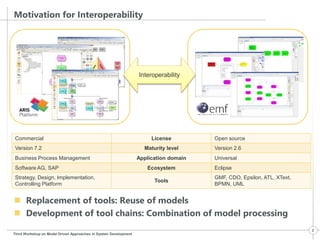
Motivation for Interoperability 
 Replacement of tools: Reuse of models 
 Development of tool chains: Combination of model processing 
Third Workshop on Model Driven Approaches in System Development 
2 
Interoperability 
Commercial License Open source 
Version 7.2 Maturity level Version 2.6 
Business Process Management Application domain Universal 
Software AG, SAP Ecosystem Eclipse 
Strategy, Design, Implementation, 
Tools 
Controlling Platform 
GMF, CDO, Epsilon, ATL, XText, 
BPMN, UML
Objective of the Study 
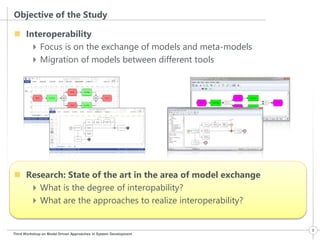
 Interoperability 
 Focus is on the exchange of models and meta-models 
Migration of models between different tools 
 Research: State of the art in the area of model exchange 
What is the degree of interopability? 
What are the approaches to realize interoperability? 
Third Workshop on Model Driven Approaches in System Development 
3
Design of the Study
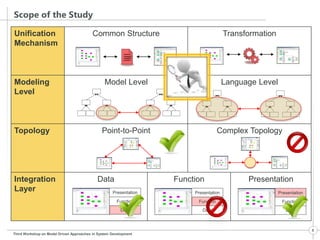
Scope of the Study 
Unification 
Mechanism 
Common Structure Transformation 
Modeling 
Level 
Model Level Language Level 
Topology Point-to-Point Complex Topology 
Integration 
Layer 
Data Function Presentation 
Presentation 
Function 
Third Workshop on Model Driven Approaches in System Development 
5 
Data 
Presentation 
Function 
Data 
Presentation 
Function 
Data
Tool Selection 
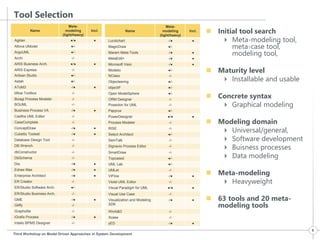
 Initial tool search 
 Meta-modeling tool, 
meta-case tool, 
modeling tool, 
 Maturity level 
 Installable and usable 
 Concrete syntax 
 Graphical modeling 
 Modeling domain 
 Universal/general, 
 Software development 
 Buisness processes 
 Data modeling 
 Meta-modeling 
 Heavyweight 
 63 tools and 20 meta-modeling 
tools 
Third Workshop on Model Driven Approaches in System Development 
6 
Name 
Meta-modeling 
(light/heavy) 
Incl. 
Agilian ●/● ● 
Altova UModel ●/- 
ArgoUML ●/- 
Archi -/- 
ARIS Business Arch. ●/● ● 
ARIS Express -/- 
Artisan Studio ●/- 
Astah ●/- 
AToM3 -/● ● 
bflow Toolbox -/- 
Bizagi Process Modeler -/- 
BOUML -/- 
Business Process VA -/● ● 
Cadifra UML Editor -/- 
CaseComplete -/- 
ConceptDraw -/● ● 
Cubetto Toolset -/● ● 
Database Design Tool -/- 
DB Wrench -/- 
dbConstructor -/- 
DbSchema -/- 
Dia -/● ● 
Edraw Max -/● ● 
Enterprise Architect -/● ● 
ER Creator -/- 
ER/Studio Software Arch. ●/- 
ER/Studio Business Arch. -/- 
GME -/● ● 
Gliffy -/- 
Grapholite -/- 
iGrafix Process -/● ● 
Intalio BPMS Designer -/- 
Name 
Meta-modeling 
(light/heavy) 
Incl. 
Lucidchart -/● ● 
MagicDraw ●/- 
Maram Meta-Tools -/● ● 
MetaEdit+ -/● ● 
Microsoft Visio -/● ● 
Modelio ●/- 
NClass -/- 
Objecteering ●/- 
objectiF ●/- 
Open ModelSphere ●/- 
ORM Designer -/- 
Poseidon for UML -/- 
Papyrus ●/- 
PowerDesigner ●/● ● 
Process Modeler -/- 
RISE -/- 
Select Architect ●/- 
SemTalk -/- 
Signavio Process Editor -/- 
SmartDraw -/- 
Topcased ●/- 
UML Lab ●/- 
UMLet -/- 
ViFlow -/● ● 
Violet UML Editor -/- 
Visual Paradigm for UML ●/● ● 
Visual Use Case -/- 
Visualization and Modeling 
-/● ● 
SDK 
WinA&D -/- 
Xcase -/- 
yED -/● ●
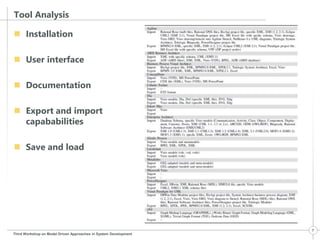
Tool Analysis 
 Installation 
 User interface 
 Documentation 
 Export and import 
capababilities 
 Save and load 
Third Workshop on Model Driven Approaches in System Development 
7
Results of the Study
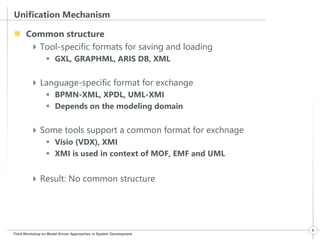
Unification Mechanism 
 Common structure 
Tool-specific formats for saving and loading 
 GXL, GRAPHML, ARIS DB, XML 
Language-specific format for exchange 
 BPMN-XML, XPDL, UML-XMI 
 Depends on the modeling domain 
Some tools support a common format for exchnage 
 Visio (VDX), XMI 
 XMI is used in context of MOF, EMF and UML 
 Result: No common structure 
Third Workshop on Model Driven Approaches in System Development 
9
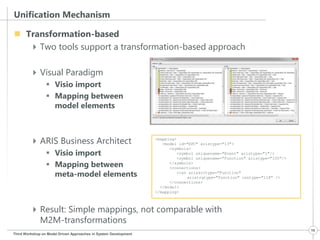
Unification Mechanism 
 Transformation-based 
Two tools support a transformation-based approach 
 Visual Paradigm 
 Visio import 
 Mapping between 
model elements 
 ARIS Business Architect 
 Visio import 
 Mapping between 
meta-model elements 
 Result: Simple mappings, not comparable with 
M2M-transformations 
Third Workshop on Model Driven Approaches in System Development 
10 
<mapping> 
<model id="EPC" aristype="13"> 
<symbols> 
<symbol uniquename="Event" aristype="1"/> 
<symbol uniquename="Function" aristype="335"/> 
</symbols> 
<connections> 
<cxn arissrctype="Function" 
aristrgtype="Function" cxntype="118" /> 
</connections> 
</model> 
</mapping>
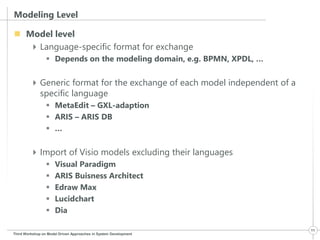
Modeling Level 
 Model level 
Language-specific format for exchange 
 Depends on the modeling domain, e.g. BPMN, XPDL, … 
Generic format for the exchange of each model independent of a 
specific language 
 MetaEdit – GXL-adaption 
 ARIS – ARIS DB 
 … 
 Import of Visio models excluding their languages 
 Visual Paradigm 
 ARIS Buisness Architect 
 Edraw Max 
 Lucidchart 
 Dia 
Third Workshop on Model Driven Approaches in System Development 
11
Modeling Level 
 Language level 
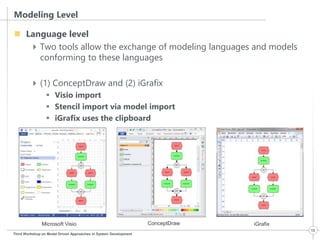
Two tools allow the exchange of modeling languages and models 
conforming to these languages 
 (1) ConceptDraw and (2) iGrafix 
 Visio import 
 Stencil import via model import 
 iGrafix uses the clipboard 
Third Workshop on Model Driven Approaches in System Development 
12 
Microsoft Visio ConceptDraw iGrafix
Degree of Interoperability 
Third Workshop on Model Driven Approaches in System Development 
13 
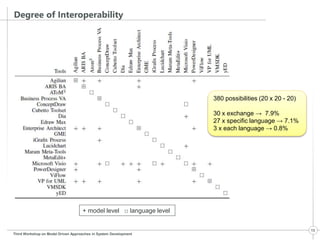
+ model level □ language level 
380 possibilities (20 x 20 - 20) 
30 x exchange → 7.9% 
27 x specific language → 7.1% 
3 x each language → 0.8%
Summary 
 Investigation of 20 meta-modeling tools 
 Unification mechanism 
Common structure 
 No common structure/format for exchange 
 Maybe Microsoft Visio 
Transformation-based: Simple mappings 
 Modeling level 
Model level: Import of Visio models without their stencils 
Language level: Import of Visio models and their stencils 
 Low degree of interopability between tools 
 Future work 
Mapping-Based exchange of models between meta-modeling tools 
Third Workshop on Model Driven Approaches in System Development 
14
Thank You. 
Questions?

Interoperability of Meta-Modeling Tools

  • 1.
    Study of Interoperabilitybetween Meta-Modeling Tools Heiko Kern University of Leipzig Third Workshop on Model Driven Approaches in System Development Warsaw, Poland, 08.09.2014
  • 2.
    Motivation for Interoperability  Replacement of tools: Reuse of models  Development of tool chains: Combination of model processing Third Workshop on Model Driven Approaches in System Development 2 Interoperability Commercial License Open source Version 7.2 Maturity level Version 2.6 Business Process Management Application domain Universal Software AG, SAP Ecosystem Eclipse Strategy, Design, Implementation, Tools Controlling Platform GMF, CDO, Epsilon, ATL, XText, BPMN, UML
  • 3.
    Objective of theStudy  Interoperability  Focus is on the exchange of models and meta-models Migration of models between different tools  Research: State of the art in the area of model exchange What is the degree of interopability? What are the approaches to realize interoperability? Third Workshop on Model Driven Approaches in System Development 3
  • 4.
  • 5.
    Scope of theStudy Unification Mechanism Common Structure Transformation Modeling Level Model Level Language Level Topology Point-to-Point Complex Topology Integration Layer Data Function Presentation Presentation Function Third Workshop on Model Driven Approaches in System Development 5 Data Presentation Function Data Presentation Function Data
  • 6.
    Tool Selection Initial tool search  Meta-modeling tool, meta-case tool, modeling tool,  Maturity level  Installable and usable  Concrete syntax  Graphical modeling  Modeling domain  Universal/general,  Software development  Buisness processes  Data modeling  Meta-modeling  Heavyweight  63 tools and 20 meta-modeling tools Third Workshop on Model Driven Approaches in System Development 6 Name Meta-modeling (light/heavy) Incl. Agilian ●/● ● Altova UModel ●/- ArgoUML ●/- Archi -/- ARIS Business Arch. ●/● ● ARIS Express -/- Artisan Studio ●/- Astah ●/- AToM3 -/● ● bflow Toolbox -/- Bizagi Process Modeler -/- BOUML -/- Business Process VA -/● ● Cadifra UML Editor -/- CaseComplete -/- ConceptDraw -/● ● Cubetto Toolset -/● ● Database Design Tool -/- DB Wrench -/- dbConstructor -/- DbSchema -/- Dia -/● ● Edraw Max -/● ● Enterprise Architect -/● ● ER Creator -/- ER/Studio Software Arch. ●/- ER/Studio Business Arch. -/- GME -/● ● Gliffy -/- Grapholite -/- iGrafix Process -/● ● Intalio BPMS Designer -/- Name Meta-modeling (light/heavy) Incl. Lucidchart -/● ● MagicDraw ●/- Maram Meta-Tools -/● ● MetaEdit+ -/● ● Microsoft Visio -/● ● Modelio ●/- NClass -/- Objecteering ●/- objectiF ●/- Open ModelSphere ●/- ORM Designer -/- Poseidon for UML -/- Papyrus ●/- PowerDesigner ●/● ● Process Modeler -/- RISE -/- Select Architect ●/- SemTalk -/- Signavio Process Editor -/- SmartDraw -/- Topcased ●/- UML Lab ●/- UMLet -/- ViFlow -/● ● Violet UML Editor -/- Visual Paradigm for UML ●/● ● Visual Use Case -/- Visualization and Modeling -/● ● SDK WinA&D -/- Xcase -/- yED -/● ●
  • 7.
    Tool Analysis Installation  User interface  Documentation  Export and import capababilities  Save and load Third Workshop on Model Driven Approaches in System Development 7
  • 8.
  • 9.
    Unification Mechanism Common structure Tool-specific formats for saving and loading  GXL, GRAPHML, ARIS DB, XML Language-specific format for exchange  BPMN-XML, XPDL, UML-XMI  Depends on the modeling domain Some tools support a common format for exchnage  Visio (VDX), XMI  XMI is used in context of MOF, EMF and UML  Result: No common structure Third Workshop on Model Driven Approaches in System Development 9
  • 10.
    Unification Mechanism Transformation-based Two tools support a transformation-based approach  Visual Paradigm  Visio import  Mapping between model elements  ARIS Business Architect  Visio import  Mapping between meta-model elements  Result: Simple mappings, not comparable with M2M-transformations Third Workshop on Model Driven Approaches in System Development 10 <mapping> <model id="EPC" aristype="13"> <symbols> <symbol uniquename="Event" aristype="1"/> <symbol uniquename="Function" aristype="335"/> </symbols> <connections> <cxn arissrctype="Function" aristrgtype="Function" cxntype="118" /> </connections> </model> </mapping>
  • 11.
    Modeling Level Model level Language-specific format for exchange  Depends on the modeling domain, e.g. BPMN, XPDL, … Generic format for the exchange of each model independent of a specific language  MetaEdit – GXL-adaption  ARIS – ARIS DB  …  Import of Visio models excluding their languages  Visual Paradigm  ARIS Buisness Architect  Edraw Max  Lucidchart  Dia Third Workshop on Model Driven Approaches in System Development 11
  • 12.
    Modeling Level Language level Two tools allow the exchange of modeling languages and models conforming to these languages  (1) ConceptDraw and (2) iGrafix  Visio import  Stencil import via model import  iGrafix uses the clipboard Third Workshop on Model Driven Approaches in System Development 12 Microsoft Visio ConceptDraw iGrafix
  • 13.
    Degree of Interoperability Third Workshop on Model Driven Approaches in System Development 13 + model level □ language level 380 possibilities (20 x 20 - 20) 30 x exchange → 7.9% 27 x specific language → 7.1% 3 x each language → 0.8%
  • 14.
    Summary  Investigationof 20 meta-modeling tools  Unification mechanism Common structure  No common structure/format for exchange  Maybe Microsoft Visio Transformation-based: Simple mappings  Modeling level Model level: Import of Visio models without their stencils Language level: Import of Visio models and their stencils  Low degree of interopability between tools  Future work Mapping-Based exchange of models between meta-modeling tools Third Workshop on Model Driven Approaches in System Development 14
  • 15.

Editor's Notes

  • #3  Development of a tool chain that covers a software development process Model Warehouse
  • #6 Morphologic box
  • #11  Two tools support a transformation-based approach
  • #14 Import is higher than export Stratetic reason