Kerala Health Model: Challenges FacedAn Outsider Perspective,   From Within..Discussion By:V R Raman, Public Health Practitioner
Kerala: did the impossibleRemarkable health, population and human development indices- compared with advanced country settings achieved the model status without much ado, within the hugest limitations of an Indian stateSource of inspiration for many Indian states and third world settings, astonishment for researchers across the world..Known for holistic, systematic and equity based approach Studied and presented well to the world, by leading experts, hence the strengths are well knownHence the effort here is to bring in the challenges of the model, notwithstanding the greater impact of it..May appear like a little negative impression, though the intention is to strengthening and taking this model further forward…Observations are based on the current situation, not exactly in a historical context
One of the rarest piece of land in the world with richest bio-diversityGeographical diversity too: ocean, backwaters, rivers, forests, high rangesHuge population density, best literacy, numeracy and education levelsStronger presence of social movements Rich political spirit, instability too..Very strong spirit of local and decentralised administrationMost of the health determinants are taken care very well: affordable public distribution system, nutrition measures, basic education, etcLargely agriculture based life-setting, but the monetary incomes has made the shift to market based culture- except in forest areasExcellent rural infrastructure and connectivityGreater media and technology outreachLand distribution, plus almost all urban amenities available in rural areas: the divide is lessGender disparities are very much there, but in a different wayLess visible, but high social disparities too, especially for the indigenous, underprivileged groups- despite many of the progressive measures to address themKerala: A Bird’s View
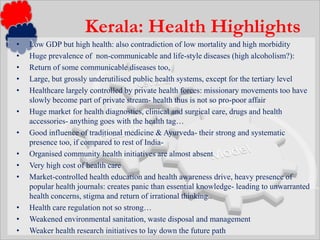
Low GDP but high health: also contradiction of low mortality and high morbidityHuge prevalence of  non-communicable and life-style diseases (high alcoholism?):Return of some communicable diseases too, Large, but grossly underutilised public health systems, except for the tertiary level Healthcare largely controlled by private health forces: missionary movements too have slowly become part of private stream- health thus is not so pro-poor affairHuge market for health diagnostics, clinical and surgical care, drugs and health accessories- anything goes with the health tag…Good influence of traditional medicine & Ayurveda- their strong and systematic presence too, if compared to rest of India- Organised community health initiatives are almost absentVery high cost of health careMarket-controlled health education and health awareness drive, heavy presence of popular health journals: creates panic than essential knowledge- leading to unwarranted health concerns, stigma and return of irrational thinking..Health care regulation not so strong…Weakened environmental sanitation, waste disposal and management Weaker health research initiatives to lay down the future pathKerala: Health Highlights
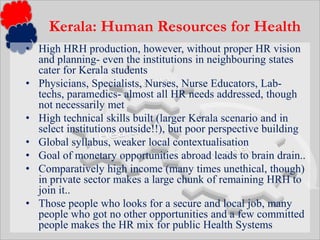
High HRH production, however, without proper HR vision and planning- even the institutions in neighbouring states cater for Kerala studentsPhysicians, Specialists, Nurses, Nurse Educators, Lab-techs, paramedics- almost all HR needs addressed, though not necessarily metHigh technical skills built (larger Kerala scenario and in select institutions outside!!), but poor perspective buildingGlobal syllabus, weaker local contextualisationGoal of monetary opportunities abroad leads to brain drain..Comparatively high income (many times unethical, though) in private sector makes a large chunk of remaining HRH to join it..Those people who looks for a secure and local job, many people who got no other opportunities and a few committed people makes the HR mix for public Health SystemsKerala: Human Resources for Health
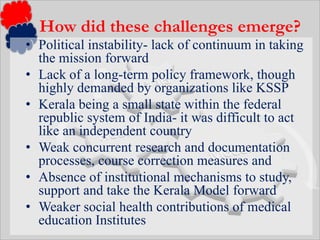
Political instability- lack of continuum in taking the mission forwardLack of a long-term policy framework, though highly demanded by organizations like KSSPKerala being a small state within the federal republic system of India- it was difficult to act like an independent countryWeak concurrent research and documentation processes, course correction measures and Absence of institutional mechanisms to study, support and take the Kerala Model forwardWeaker social health contributions of medical education InstitutesHow did these challenges emerge?
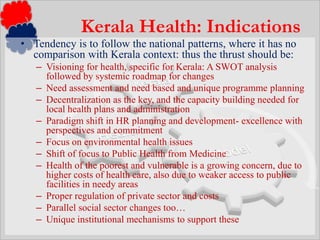
Tendency is to follow the national patterns, where it has no comparison with Kerala context: thus the thrust should be:Visioning for health, specific for Kerala: A SWOT analysis followed by systemic roadmap for changesNeed assessment and need based and unique programme planningDecentralization as the key, and the capacity building needed for local health plans and administrationParadigm shift in HR planning and development- excellence with perspectives and commitmentFocus on environmental health issuesShift of focus to Public Health from Medicine Health of the poorest and vulnerable is a growing concern, due to higher costs of health care, also due to weaker access to public facilities in needy areasProper regulation of private sector and costsParallel social sector changes too…Unique institutional mechanisms to support these Kerala Health: Indications
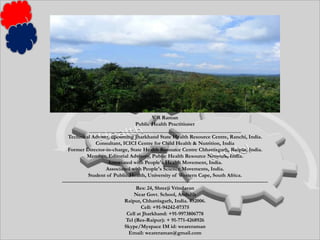
V R RamanPublic Health Practitioner_________________________________________________________Technical Adviser, upcoming Jharkhand State Health Resource Centre, Ranchi, India.Consultant, ICICI Centre for Child Health & Nutrition, IndiaFormer Director-in-charge, State Health Resource Centre Chhattisgarh, Raipur, India.Member, Editorial Advisory, Public Health Resource Network, India.Associated with People's Health Movement, India.Associated with People's Science Movements, India.Student of Public Health, University of Western Cape, South Africa.--------------------------------------------------------------------------------------------------------------------Res: 24, ShreejiVrindavanNear Govt. School, AmlidihRaipur, Chhattisgarh, India. 492006.Cell: +91-94242-07375Cell at Jharkhand: +91-9973806778Tel (Res-Raipur): + 91-771-4268926Skype/Myspace IM id: weareramanEmail: weareraman@gmail.com

Kerala health model

  • 1.
    Kerala Health Model:Challenges FacedAn Outsider Perspective, From Within..Discussion By:V R Raman, Public Health Practitioner
  • 2.
    Kerala: did theimpossibleRemarkable health, population and human development indices- compared with advanced country settings achieved the model status without much ado, within the hugest limitations of an Indian stateSource of inspiration for many Indian states and third world settings, astonishment for researchers across the world..Known for holistic, systematic and equity based approach Studied and presented well to the world, by leading experts, hence the strengths are well knownHence the effort here is to bring in the challenges of the model, notwithstanding the greater impact of it..May appear like a little negative impression, though the intention is to strengthening and taking this model further forward…Observations are based on the current situation, not exactly in a historical context
  • 3.
    One of therarest piece of land in the world with richest bio-diversityGeographical diversity too: ocean, backwaters, rivers, forests, high rangesHuge population density, best literacy, numeracy and education levelsStronger presence of social movements Rich political spirit, instability too..Very strong spirit of local and decentralised administrationMost of the health determinants are taken care very well: affordable public distribution system, nutrition measures, basic education, etcLargely agriculture based life-setting, but the monetary incomes has made the shift to market based culture- except in forest areasExcellent rural infrastructure and connectivityGreater media and technology outreachLand distribution, plus almost all urban amenities available in rural areas: the divide is lessGender disparities are very much there, but in a different wayLess visible, but high social disparities too, especially for the indigenous, underprivileged groups- despite many of the progressive measures to address themKerala: A Bird’s View
  • 4.
    Low GDP buthigh health: also contradiction of low mortality and high morbidityHuge prevalence of non-communicable and life-style diseases (high alcoholism?):Return of some communicable diseases too, Large, but grossly underutilised public health systems, except for the tertiary level Healthcare largely controlled by private health forces: missionary movements too have slowly become part of private stream- health thus is not so pro-poor affairHuge market for health diagnostics, clinical and surgical care, drugs and health accessories- anything goes with the health tag…Good influence of traditional medicine & Ayurveda- their strong and systematic presence too, if compared to rest of India- Organised community health initiatives are almost absentVery high cost of health careMarket-controlled health education and health awareness drive, heavy presence of popular health journals: creates panic than essential knowledge- leading to unwarranted health concerns, stigma and return of irrational thinking..Health care regulation not so strong…Weakened environmental sanitation, waste disposal and management Weaker health research initiatives to lay down the future pathKerala: Health Highlights
  • 5.
    High HRH production,however, without proper HR vision and planning- even the institutions in neighbouring states cater for Kerala studentsPhysicians, Specialists, Nurses, Nurse Educators, Lab-techs, paramedics- almost all HR needs addressed, though not necessarily metHigh technical skills built (larger Kerala scenario and in select institutions outside!!), but poor perspective buildingGlobal syllabus, weaker local contextualisationGoal of monetary opportunities abroad leads to brain drain..Comparatively high income (many times unethical, though) in private sector makes a large chunk of remaining HRH to join it..Those people who looks for a secure and local job, many people who got no other opportunities and a few committed people makes the HR mix for public Health SystemsKerala: Human Resources for Health
  • 6.
    Political instability- lackof continuum in taking the mission forwardLack of a long-term policy framework, though highly demanded by organizations like KSSPKerala being a small state within the federal republic system of India- it was difficult to act like an independent countryWeak concurrent research and documentation processes, course correction measures and Absence of institutional mechanisms to study, support and take the Kerala Model forwardWeaker social health contributions of medical education InstitutesHow did these challenges emerge?
  • 7.
    Tendency is tofollow the national patterns, where it has no comparison with Kerala context: thus the thrust should be:Visioning for health, specific for Kerala: A SWOT analysis followed by systemic roadmap for changesNeed assessment and need based and unique programme planningDecentralization as the key, and the capacity building needed for local health plans and administrationParadigm shift in HR planning and development- excellence with perspectives and commitmentFocus on environmental health issuesShift of focus to Public Health from Medicine Health of the poorest and vulnerable is a growing concern, due to higher costs of health care, also due to weaker access to public facilities in needy areasProper regulation of private sector and costsParallel social sector changes too…Unique institutional mechanisms to support these Kerala Health: Indications
  • 8.
    V R RamanPublicHealth Practitioner_________________________________________________________Technical Adviser, upcoming Jharkhand State Health Resource Centre, Ranchi, India.Consultant, ICICI Centre for Child Health & Nutrition, IndiaFormer Director-in-charge, State Health Resource Centre Chhattisgarh, Raipur, India.Member, Editorial Advisory, Public Health Resource Network, India.Associated with People's Health Movement, India.Associated with People's Science Movements, India.Student of Public Health, University of Western Cape, South Africa.--------------------------------------------------------------------------------------------------------------------Res: 24, ShreejiVrindavanNear Govt. School, AmlidihRaipur, Chhattisgarh, India. 492006.Cell: +91-94242-07375Cell at Jharkhand: +91-9973806778Tel (Res-Raipur): + 91-771-4268926Skype/Myspace IM id: weareramanEmail: weareraman@gmail.com