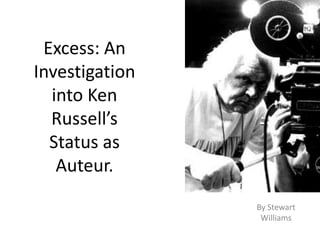
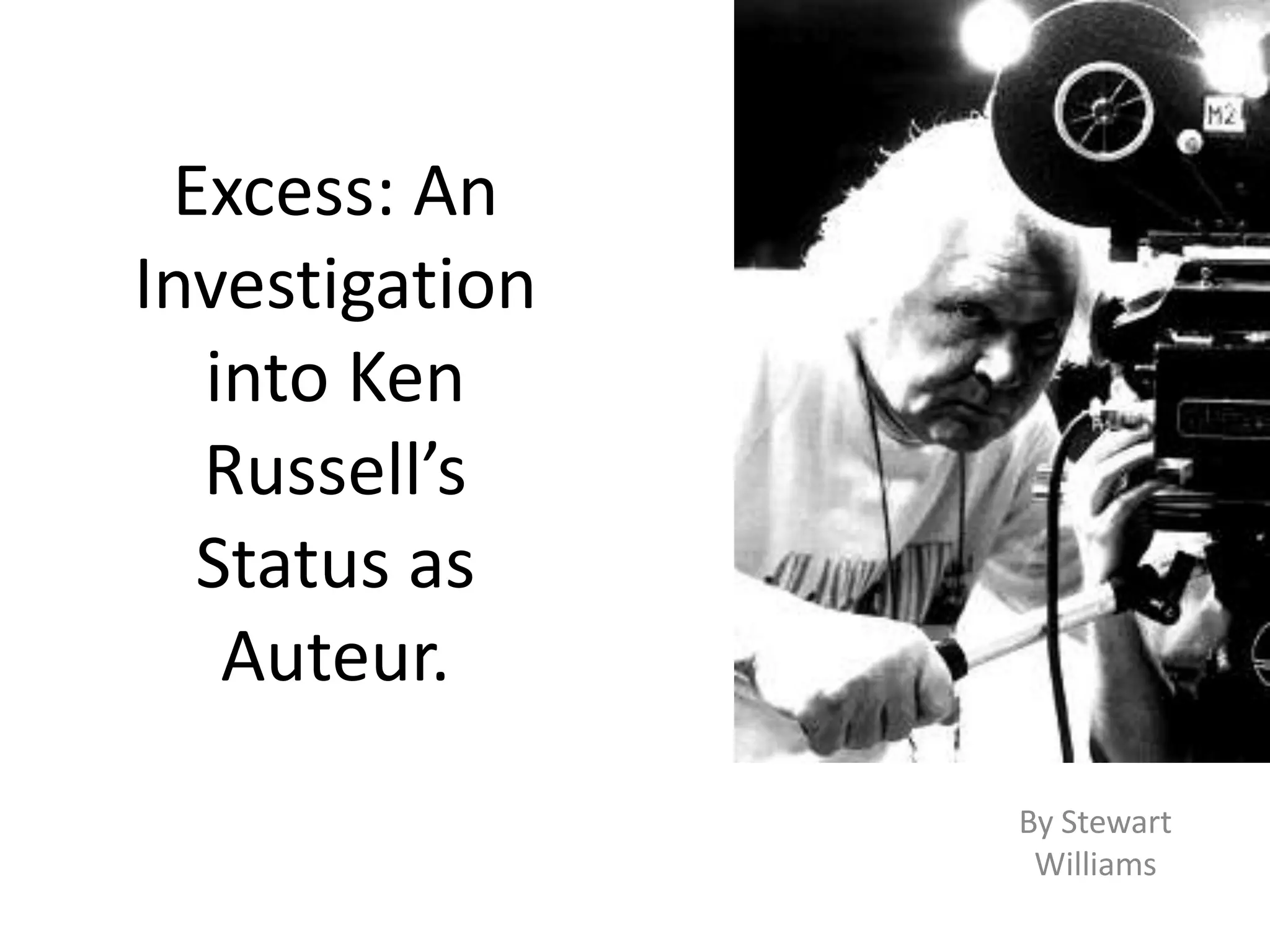
1Excess: An Investigation into Ken Russell’s Status as Auteur.By Stewart Williams
Does Russell’s wide variety of films allow for an audience member to identify recurring themes, issues and cinematic style offering him the status of Auteur?
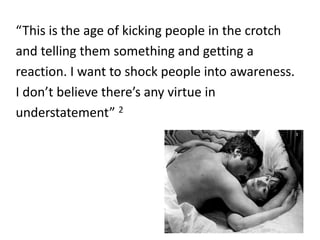
“This is the age of kicking people in the crotchand telling them something and getting areaction. I want to shock people into awareness.I don’t believe there’s any virtue inunderstatement” 23
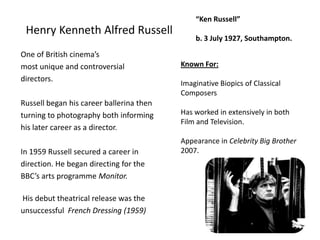
Henry Kenneth Alfred Russell“Ken Russell”b. 3 July 1927, Southampton.One of British cinema’smost unique and controversialdirectors.Russell began his career ballerina thenturning to photography both informinghis later career as a director.In 1959 Russell secured a career indirection. He began directing for theBBC’s arts programme Monitor. His debut theatrical release was theunsuccessful  French Dressing (1959)Known For:Imaginative Biopics of Classical ComposersHas worked in extensively in both Film and Television. Appearance in Celebrity Big Brother 2007.4
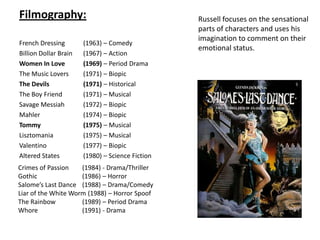
Filmography:French Dressing 	(1963) – Comedy Billion Dollar Brain	(1967) – ActionWomen In Love 	(1969) – Period DramaThe Music Lovers 	(1971) – Biopic The Devils 		(1971) – Historical The Boy Friend 	(1971) – Musical Savage Messiah 	(1972) – Biopic Mahler 		(1974) – Biopic Tommy 		(1975) – Musical Lisztomania	(1975) – Musical Valentino		(1977) – Biopic Altered States	(1980) – Science FictionRussell focuses on the sensational parts of characters and uses his imagination to comment on their emotional status. 5Crimes of Passion	(1984) - Drama/Thriller  Gothic 		(1986) – Horror Salome’s Last Dance	(1988) – Drama/ComedyLiar of the White Worm (1988) – Horror SpoofThe Rainbow 	(1989) – Period DramaWhore		(1991) - Drama4
Russell’s Cinematic Style6.... Is EXCESS! Background in Ballet has resulted in Russell being predominately occupied with the choreography of cinema: (actor/camera movement through the cinematic space)
 Background in Photography tends for Russell to focus on Visual Image rather than the spoken word or the narrative structure.The merging of images/music advance the narrative and comment on the nuances on characters.Music is an integral part to Russell’s Vision as the aural rhythm provided complements the dominant visual rhythm (created through editing and camera movement)Tripartite Structure:1. Protagonists own romantic self image. (character)2. Objective view revealed by perspective of time. (spectator)3.  Russell’s personal view of the subject.  (Director). Which is demonstrated via intertextuality. The score not only defines the mood butunderlines the emotional and psychological state ofthe protagonist.  Music is used as a catalyst for the Character’simaginations.Combines the score with the visual image to createmeaning (usually as juxtaposition).These viewpoints are played against each another. Which results in distancing the spectator.Diegetic/Non-diegetic often supplies ironic commentary on the image  or is used to disorientate the audience. Although the majority of Russell’s work is adapted from other sources. He combines his own vision with fact and speculation implied by the original source.
Russell does not shy away from  controversial or taboo subject matter .If a historical character; Russell focuses on salacious aspects of their lives.87Issues !He broke the cinematic taboo of frontal male nudity. (Women in Love)In The Music Lovers he focuses on the largely ignored aspect of Tchaikovsky personal life: homosexuality.Russell regards the sexual and spiritual aspects of people’s lives are interconnected. A few Examples:Nymphomania(The Music Lovers, 1971)Prostitution(Crimes of Passion, 1984; Whore, 1991)Cross Dressing/ Identity (The Devils, 1971; Crimes of Passion, 1984)Sexual Fantasies (The Music Lovers, 1971; The Devils, 1971; Salome, 1988)Capitalism (Billion Dollar Brain 1967; Tommy, 1974)Fame(The Boy Friend , 1971; Valentino, 1977)... And Valentino in Valentino 9Russell tackled difficult issues at times when they were not represented in mainstream cinema.Accused of misogyny by critics due to his approach to female sexuality.Repeated imagery throughout his films include: Nuns; Nazi’s; the Disabled; Fire.The most significant is phallic imagery used continually, even one of one his biographies is entitled: Phallic Frenzy (by Joseph Lanza) Not only does his subject matter distance the spectator but also his choice of: Outré Camera angles (including the extreme facial close-up); theatrical performances; characters that are difficult to align to.
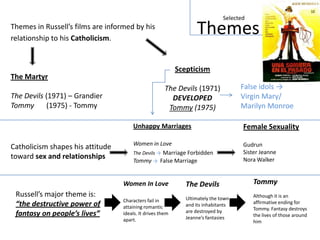
Themes10SelectedThemes in Russell’s films are informed by hisrelationship to his Catholicism. ScepticismThe Devils (1971)DEVELOPEDTommy (1975)The MartyrThe Devils (1971) – GrandierTommy 	  (1975) - TommyFalse idols ->  Virgin Mary/ Marilyn MonroeUnhappy MarriagesWomen in Love The Devils->Marriage ForbiddenTommy ->  False MarriageFemale SexualityGudrunSister JeanneNora WalkerCatholicism shapes his attitude toward sex and relationshipsTommyAlthough it is an affirmative ending for Tommy. Fantasy destroys the lives of those around himWomen In LoveCharacters fail in attaining romantic ideals. It drives them apart.The DevilsUltimately the town and its inhabitants are destroyed by Jeanne’s fantasiesRussell’s major theme is: “the destructive power of fantasy on people’s lives”
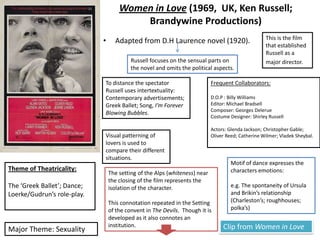
11Women in Love (1969,  UK, Ken Russell; Brandywine Productions)This is the film that established Russell as a major director.Adapted from D.H Laurence novel (1920).Russell focuses on the sensual parts on the novel and omits the political aspects.Frequent Collaborators:D.O.P : Billy WilliamsEditor: Michael BradsellComposer: Georges DelerueCostume Designer: Shirley RussellActors: Glenda Jackson; Christopher Gable; Oliver Reed; Catherine Wilmer; VladekSheybal.To distance the spectator Russell uses intertextuality:Contemporary advertisements; Greek Ballet; Song, I’m Forever Blowing Bubbles.Visual patterning of lovers is used to compare their different situations.  Motif of dance expresses the characters emotions:e.g. The spontaneity of Ursula and Brikin’s relationship (Charleston’s; roughhouses; polka’s)Theme of Theatricality:The ‘Greek Ballet’; Dance;Loerke/Gudrun’s role-play.The setting of the Alps (whiteness) near the closing of the film represents the isolation of the character. This connotation repeated in the Setting of the convent in The Devils.  Though it is developed as it also connotes an institution. Clip from Women in LoveMajor Theme: Sexuality
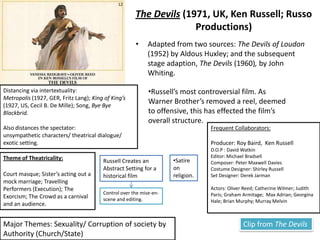
The Devils (1971, UK, Ken Russell; Russo Productions)12Adapted from two sources: The Devils of Loudon (1952) by Aldous Huxley; and the subsequent stage adaption, The Devils (1960), by John Whiting.Distancing via intertextuality:Metropolis (1927, GER, Fritz Lang); King of King’s (1927, US, Cecil B. De Mille); Song, Bye Bye Blackbrid.Also distances the spectator:unsympathetic characters/ theatrical dialogue/ exotic setting.Russell’s most controversial film. As Warner Brother’s removed a reel, deemed to offensive, this has effected the film’s overall structure.Frequent Collaborators:Producer: Roy Baird,  Ken RussellD.O.P : David WatkinEditor: Michael BradsellComposer: Peter Maxwell DaviesCostume Designer: Shirley RussellSet Designer: Derek JarmanActors: Oliver Reed; Catherine Wilmer; Judith Paris; Graham Armitage;  Max Adrian; Georgina Hale; Brian Murphy; Murray MelvinTheme of Theatricality:Court masque; Sister’s acting out a mock marriage; Travelling Performers (Execution); The Exorcism; The Crowd as a carnival and an audience.Satire on religion.Russell Creates an Abstract Setting for a historical filmControl over the mise-en-scene and editing.Major Themes: Sexuality/ Corruption of society by Authority (Church/State)Clip from The Devils
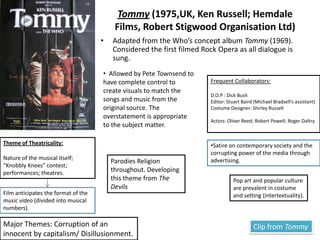
Tommy (1975,UK, Ken Russell; Hemdale Films, Robert Stigwood Organisation Ltd)13Adapted from the Who’s concept album Tommy (1969). Considered the first filmed Rock Opera as all dialogue is sung.  Allowed by Pete Townsend to have complete control to create visuals to match the songs and music from the original source. The overstatement is appropriate to the subject matter. Frequent Collaborators:D.O.P : Dick BushEditor: Stuart Baird (Michael Bradsell’s assistant)Costume Designer: Shirley RussellActors: Oliver Reed; Robert Powell; Roger Daltry.Theme of Theatricality:Nature of the musical itself; “Knobbly Knees” contest; performances; theatres.Satire on contemporary society and the corrupting power of the media through advertising.Parodies Religion throughout. Developing this theme from The DevilsPop art and popular culture are prevalent in costume and setting (intertextuality). Film anticipates the format of the music video (divided into musical numbers).Major Themes: Corruption of an innocent by capitalism/ Disillusionment.Clip from Tommy
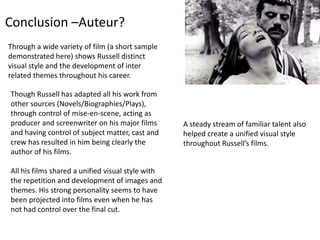
Conclusion –Auteur?14Through a wide variety of film (a short sample  demonstrated here) shows Russell distinct visual style and the development of inter related themes throughout his career.Though Russell has adapted all his work from other sources (Novels/Biographies/Plays), through control of mise-en-scene, acting as producer and screenwriter on his major films and having control of subject matter, cast and crew has resulted in him being clearly the author of his films. All his films shared a unified visual style with the repetition and development of images and themes. His strong personality seems to have been projected into films even when he has not had control over the final cut. A steady stream of familiar talent also helped create a unified visual style throughout Russell’s films.

Ken russell as an auteur

  • 1.
    1Excess: An Investigationinto Ken Russell’s Status as Auteur.By Stewart Williams
  • 2.
    Does Russell’s widevariety of films allow for an audience member to identify recurring themes, issues and cinematic style offering him the status of Auteur?
  • 3.
    “This is theage of kicking people in the crotchand telling them something and getting areaction. I want to shock people into awareness.I don’t believe there’s any virtue inunderstatement” 23
  • 4.
    Henry Kenneth AlfredRussell“Ken Russell”b. 3 July 1927, Southampton.One of British cinema’smost unique and controversialdirectors.Russell began his career ballerina thenturning to photography both informinghis later career as a director.In 1959 Russell secured a career indirection. He began directing for theBBC’s arts programme Monitor. His debut theatrical release was theunsuccessful French Dressing (1959)Known For:Imaginative Biopics of Classical ComposersHas worked in extensively in both Film and Television. Appearance in Celebrity Big Brother 2007.4
  • 5.
    Filmography:French Dressing (1963)– Comedy Billion Dollar Brain (1967) – ActionWomen In Love (1969) – Period DramaThe Music Lovers (1971) – Biopic The Devils (1971) – Historical The Boy Friend (1971) – Musical Savage Messiah (1972) – Biopic Mahler (1974) – Biopic Tommy (1975) – Musical Lisztomania (1975) – Musical Valentino (1977) – Biopic Altered States (1980) – Science FictionRussell focuses on the sensational parts of characters and uses his imagination to comment on their emotional status. 5Crimes of Passion (1984) - Drama/Thriller Gothic (1986) – Horror Salome’s Last Dance (1988) – Drama/ComedyLiar of the White Worm (1988) – Horror SpoofThe Rainbow (1989) – Period DramaWhore (1991) - Drama4
  • 6.
    Russell’s Cinematic Style6....Is EXCESS! Background in Ballet has resulted in Russell being predominately occupied with the choreography of cinema: (actor/camera movement through the cinematic space)
  • 7.
    Background inPhotography tends for Russell to focus on Visual Image rather than the spoken word or the narrative structure.The merging of images/music advance the narrative and comment on the nuances on characters.Music is an integral part to Russell’s Vision as the aural rhythm provided complements the dominant visual rhythm (created through editing and camera movement)Tripartite Structure:1. Protagonists own romantic self image. (character)2. Objective view revealed by perspective of time. (spectator)3. Russell’s personal view of the subject. (Director). Which is demonstrated via intertextuality. The score not only defines the mood butunderlines the emotional and psychological state ofthe protagonist. Music is used as a catalyst for the Character’simaginations.Combines the score with the visual image to createmeaning (usually as juxtaposition).These viewpoints are played against each another. Which results in distancing the spectator.Diegetic/Non-diegetic often supplies ironic commentary on the image or is used to disorientate the audience. Although the majority of Russell’s work is adapted from other sources. He combines his own vision with fact and speculation implied by the original source.
  • 8.
    Russell does notshy away from controversial or taboo subject matter .If a historical character; Russell focuses on salacious aspects of their lives.87Issues !He broke the cinematic taboo of frontal male nudity. (Women in Love)In The Music Lovers he focuses on the largely ignored aspect of Tchaikovsky personal life: homosexuality.Russell regards the sexual and spiritual aspects of people’s lives are interconnected. A few Examples:Nymphomania(The Music Lovers, 1971)Prostitution(Crimes of Passion, 1984; Whore, 1991)Cross Dressing/ Identity (The Devils, 1971; Crimes of Passion, 1984)Sexual Fantasies (The Music Lovers, 1971; The Devils, 1971; Salome, 1988)Capitalism (Billion Dollar Brain 1967; Tommy, 1974)Fame(The Boy Friend , 1971; Valentino, 1977)... And Valentino in Valentino 9Russell tackled difficult issues at times when they were not represented in mainstream cinema.Accused of misogyny by critics due to his approach to female sexuality.Repeated imagery throughout his films include: Nuns; Nazi’s; the Disabled; Fire.The most significant is phallic imagery used continually, even one of one his biographies is entitled: Phallic Frenzy (by Joseph Lanza) Not only does his subject matter distance the spectator but also his choice of: Outré Camera angles (including the extreme facial close-up); theatrical performances; characters that are difficult to align to.
  • 9.
    Themes10SelectedThemes in Russell’sfilms are informed by hisrelationship to his Catholicism. ScepticismThe Devils (1971)DEVELOPEDTommy (1975)The MartyrThe Devils (1971) – GrandierTommy (1975) - TommyFalse idols -> Virgin Mary/ Marilyn MonroeUnhappy MarriagesWomen in Love The Devils->Marriage ForbiddenTommy -> False MarriageFemale SexualityGudrunSister JeanneNora WalkerCatholicism shapes his attitude toward sex and relationshipsTommyAlthough it is an affirmative ending for Tommy. Fantasy destroys the lives of those around himWomen In LoveCharacters fail in attaining romantic ideals. It drives them apart.The DevilsUltimately the town and its inhabitants are destroyed by Jeanne’s fantasiesRussell’s major theme is: “the destructive power of fantasy on people’s lives”
  • 10.
    11Women in Love(1969, UK, Ken Russell; Brandywine Productions)This is the film that established Russell as a major director.Adapted from D.H Laurence novel (1920).Russell focuses on the sensual parts on the novel and omits the political aspects.Frequent Collaborators:D.O.P : Billy WilliamsEditor: Michael BradsellComposer: Georges DelerueCostume Designer: Shirley RussellActors: Glenda Jackson; Christopher Gable; Oliver Reed; Catherine Wilmer; VladekSheybal.To distance the spectator Russell uses intertextuality:Contemporary advertisements; Greek Ballet; Song, I’m Forever Blowing Bubbles.Visual patterning of lovers is used to compare their different situations. Motif of dance expresses the characters emotions:e.g. The spontaneity of Ursula and Brikin’s relationship (Charleston’s; roughhouses; polka’s)Theme of Theatricality:The ‘Greek Ballet’; Dance;Loerke/Gudrun’s role-play.The setting of the Alps (whiteness) near the closing of the film represents the isolation of the character. This connotation repeated in the Setting of the convent in The Devils. Though it is developed as it also connotes an institution. Clip from Women in LoveMajor Theme: Sexuality
  • 11.
    The Devils (1971,UK, Ken Russell; Russo Productions)12Adapted from two sources: The Devils of Loudon (1952) by Aldous Huxley; and the subsequent stage adaption, The Devils (1960), by John Whiting.Distancing via intertextuality:Metropolis (1927, GER, Fritz Lang); King of King’s (1927, US, Cecil B. De Mille); Song, Bye Bye Blackbrid.Also distances the spectator:unsympathetic characters/ theatrical dialogue/ exotic setting.Russell’s most controversial film. As Warner Brother’s removed a reel, deemed to offensive, this has effected the film’s overall structure.Frequent Collaborators:Producer: Roy Baird, Ken RussellD.O.P : David WatkinEditor: Michael BradsellComposer: Peter Maxwell DaviesCostume Designer: Shirley RussellSet Designer: Derek JarmanActors: Oliver Reed; Catherine Wilmer; Judith Paris; Graham Armitage; Max Adrian; Georgina Hale; Brian Murphy; Murray MelvinTheme of Theatricality:Court masque; Sister’s acting out a mock marriage; Travelling Performers (Execution); The Exorcism; The Crowd as a carnival and an audience.Satire on religion.Russell Creates an Abstract Setting for a historical filmControl over the mise-en-scene and editing.Major Themes: Sexuality/ Corruption of society by Authority (Church/State)Clip from The Devils
  • 12.
    Tommy (1975,UK, KenRussell; Hemdale Films, Robert Stigwood Organisation Ltd)13Adapted from the Who’s concept album Tommy (1969). Considered the first filmed Rock Opera as all dialogue is sung. Allowed by Pete Townsend to have complete control to create visuals to match the songs and music from the original source. The overstatement is appropriate to the subject matter. Frequent Collaborators:D.O.P : Dick BushEditor: Stuart Baird (Michael Bradsell’s assistant)Costume Designer: Shirley RussellActors: Oliver Reed; Robert Powell; Roger Daltry.Theme of Theatricality:Nature of the musical itself; “Knobbly Knees” contest; performances; theatres.Satire on contemporary society and the corrupting power of the media through advertising.Parodies Religion throughout. Developing this theme from The DevilsPop art and popular culture are prevalent in costume and setting (intertextuality). Film anticipates the format of the music video (divided into musical numbers).Major Themes: Corruption of an innocent by capitalism/ Disillusionment.Clip from Tommy
  • 13.
    Conclusion –Auteur?14Through awide variety of film (a short sample demonstrated here) shows Russell distinct visual style and the development of inter related themes throughout his career.Though Russell has adapted all his work from other sources (Novels/Biographies/Plays), through control of mise-en-scene, acting as producer and screenwriter on his major films and having control of subject matter, cast and crew has resulted in him being clearly the author of his films. All his films shared a unified visual style with the repetition and development of images and themes. His strong personality seems to have been projected into films even when he has not had control over the final cut. A steady stream of familiar talent also helped create a unified visual style throughout Russell’s films.

Editor's Notes

  • #9 Bootom theme, needs to go into script
  • #13 From wallflower book, director control mise-en-scene