Marketing strategy of
CavinKare Pvt. Ltd towards Rural
                   Presented By:-
                      Ashish Mishra
                      Mahesh Mohanan
                      Mayank Daga
                      Reejo Samuel
Rural Marketing-An Overview
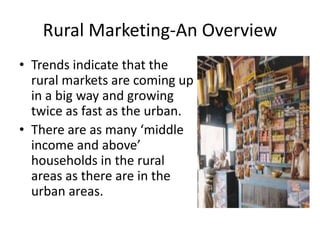
• Trends indicate that the
  rural markets are coming up
  in a big way and growing
  twice as fast as the urban.
• There are as many ‘middle
  income and above’
  households in the rural
  areas as there are in the
  urban areas.
“A world of opportunity”
• The Indian rural market
  with its with its vast size
  and demand base offers
  great opportunities to
  marketers.

• Two –third of countries
  consumers lives in rural
  areas and almost half of
  the national income is
  generated here.
Features of Rural Marketing
• Large and scattered market:-
         It consist of over 63cr
  consumers from 5,70,000
  villages spread through out the
  country.
• Major income from agriculture:-
         Nearly 60 % of the rural
  income is from agriculture .
• Traditional outlook:-
        The rural consumer values
  old customs and traditions. They
  do not prefer changes.
Challenges
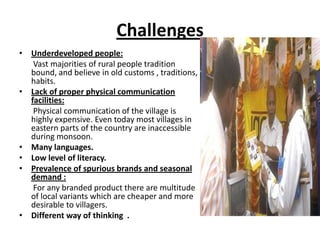
• Underdeveloped people:
   Vast majorities of rural people tradition
  bound, and believe in old customs , traditions,
  habits.
• Lack of proper physical communication
  facilities:
   Physical communication of the village is
  highly expensive. Even today most villages in
  eastern parts of the country are inaccessible
  during monsoon.
• Many languages.
• Low level of literacy.
• Prevalence of spurious brands and seasonal
  demand :
   For any branded product there are multitude
  of local variants which are cheaper and more
  desirable to villagers.
• Different way of thinking .
Company’s Profile
• In 1983 with a single product, Cavinkare
  started out as a small partnership firm chik
  india by Mr. C.K. Ranganathan.
• Chik India, which was renamed as Beauty
  Cosmetics in 1990.
• In 1998 the company was renamed as
  CavinKare Pvt. Ltd(CKPL).
• The reason behind the name is, Cavin means
  beauty in Tamil and “care’ is spelt as kare.
• The name is also a special one as it denotes
  the initials C and K of Mr.Ranganathan.
• The company offers quality personal care (hair
  care, skin care, home care ) and Food
  Products.
• The company, Which primarily relied on contract
  manufacturing for many year has now set up its own
  world class plant at Haridwar to cater to the demand
  of both domestic and international market.
• The Company has employee strength of 576, an all
  india network of 1300 stockists catering to about 25
  lakh outlets nationally.
• CavinKare has touched a turnover of over 5000
  million INR in 2006-2007.
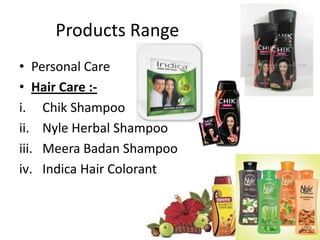
Products Range
• Personal Care
• Hair Care :-
i. Chik Shampoo
ii. Nyle Herbal Shampoo
iii. Meera Badan Shampoo
iv. Indica Hair Colorant
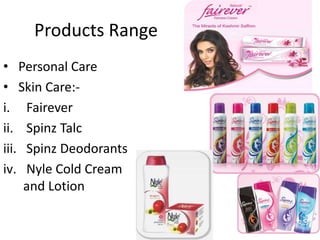
Products Range
• Personal Care
• Skin Care:-
i. Fairever
ii. Spinz Talc
iii. Spinz Deodorants
iv. Nyle Cold Cream
     and Lotion
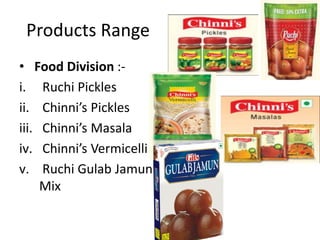
Products Range
• Food Division :-
i. Ruchi Pickles
ii. Chinni’s Pickles
iii. Chinni’s Masala
iv. Chinni’s Vermicelli
v. Ruchi Gulab Jamun
     Mix
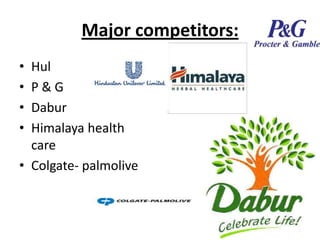
Major competitors:
• Hul
• P&G
• Dabur
• Himalaya health
  care
• Colgate- palmolive
Marketing Strategy
• They have strong system of quality control.
• Contract Manufacturing by outsourcing it to
  Third Party Manufacturing Units.
• They lay down all the ground rules for the
  manufacturer in maintaining their standard.
• Direct media promotion have helped build
  knowledge of product categories and change
  long entrenched living habits.
• By the help of effective communication they
  tried to understand the fear, aspiration and
  hopes of rural consumer.
• Calvin care always focuses on research and
  development, brand building and distribution
  management.
Promotional Strategy
• Company is taking some tips from its chik
  shampoo experience.
• The chinni pickle sachet is available in single
  use sachet that cost Rs1 to Rs3.
• Single serve packaging will also serve in the
  institutional sales.
• Hotels and restaurants will be bulk customer.
• CavinKare is also running mobile beauty
  parlours.
Communication Strategy
• Cavinkare discover that soap usage is the
  biggest barrier and people did not see the
  need of shampoo.
• Company tried to convey the message to the
  consumer that use of soap is harmful for the
  hair and when a product is exists specifically
  for hair than it should be used.
Distribution Strategy
• Instead of using conventional distribution
  route, they have created sachet sales force
  that sells only sachet packs to small retailer
  including paan shops.
Retailer promotion
• Apart from the service charges cavinkare also
  gave retailers a chik sachets free for every 15
  empty sachets they get from the consumer.
• They give special gift if dealer sale more
  products in a particular season
• They also give discount on bulk purchasing .
Step Towards Rural Marketing
• CavinKare have shown that communication is
  key when it comes to building brands in rural
  markets.
• CavinKare, which enabled its products brands
  to compete directly with market leaders such
  as HLL, P & G, Godrej and Henkel Successfully.
• CavinKare’s successful brands such as Chik,
  Nyle, Meera, Fairever and Spinz are good
  example.
• When CavinKare entered the rural areas in South
  India, people used to wash their hair with soap.
• When it Launched the ‘Chik’ Brand of shampoo
  they educated the people on how to use it
  through live ‘touch and feel’ demonstrations and
  also distributed free sachets at fairs.
• This strategy worked wonders in the rural areas
  of Tamil-Nadu and Andhra Pradesh.
Conclusion
• The fact remains that the rural market in India
  has great potential, which is just waiting to be
  tapped.
• It’s all about how they approaches the market,
  takes up the challenge of selling products and
  concepts through innovative media design.
Thank You…!!

Kelvinkare

  • 1.
    Marketing strategy of CavinKarePvt. Ltd towards Rural Presented By:- Ashish Mishra Mahesh Mohanan Mayank Daga Reejo Samuel
  • 2.
    Rural Marketing-An Overview •Trends indicate that the rural markets are coming up in a big way and growing twice as fast as the urban. • There are as many ‘middle income and above’ households in the rural areas as there are in the urban areas.
  • 3.
    “A world ofopportunity” • The Indian rural market with its with its vast size and demand base offers great opportunities to marketers. • Two –third of countries consumers lives in rural areas and almost half of the national income is generated here.
  • 4.
    Features of RuralMarketing • Large and scattered market:- It consist of over 63cr consumers from 5,70,000 villages spread through out the country. • Major income from agriculture:- Nearly 60 % of the rural income is from agriculture . • Traditional outlook:- The rural consumer values old customs and traditions. They do not prefer changes.
  • 5.
    Challenges • Underdeveloped people: Vast majorities of rural people tradition bound, and believe in old customs , traditions, habits. • Lack of proper physical communication facilities: Physical communication of the village is highly expensive. Even today most villages in eastern parts of the country are inaccessible during monsoon. • Many languages. • Low level of literacy. • Prevalence of spurious brands and seasonal demand : For any branded product there are multitude of local variants which are cheaper and more desirable to villagers. • Different way of thinking .
  • 6.
    Company’s Profile • In1983 with a single product, Cavinkare started out as a small partnership firm chik india by Mr. C.K. Ranganathan. • Chik India, which was renamed as Beauty Cosmetics in 1990. • In 1998 the company was renamed as CavinKare Pvt. Ltd(CKPL).
  • 7.
    • The reasonbehind the name is, Cavin means beauty in Tamil and “care’ is spelt as kare. • The name is also a special one as it denotes the initials C and K of Mr.Ranganathan. • The company offers quality personal care (hair care, skin care, home care ) and Food Products.
  • 8.
    • The company,Which primarily relied on contract manufacturing for many year has now set up its own world class plant at Haridwar to cater to the demand of both domestic and international market. • The Company has employee strength of 576, an all india network of 1300 stockists catering to about 25 lakh outlets nationally. • CavinKare has touched a turnover of over 5000 million INR in 2006-2007.
  • 9.
    Products Range • PersonalCare • Hair Care :- i. Chik Shampoo ii. Nyle Herbal Shampoo iii. Meera Badan Shampoo iv. Indica Hair Colorant
  • 10.
    Products Range • PersonalCare • Skin Care:- i. Fairever ii. Spinz Talc iii. Spinz Deodorants iv. Nyle Cold Cream and Lotion
  • 11.
    Products Range • FoodDivision :- i. Ruchi Pickles ii. Chinni’s Pickles iii. Chinni’s Masala iv. Chinni’s Vermicelli v. Ruchi Gulab Jamun Mix
  • 12.
    Major competitors: • Hul •P&G • Dabur • Himalaya health care • Colgate- palmolive
  • 13.
    Marketing Strategy • Theyhave strong system of quality control. • Contract Manufacturing by outsourcing it to Third Party Manufacturing Units. • They lay down all the ground rules for the manufacturer in maintaining their standard. • Direct media promotion have helped build knowledge of product categories and change long entrenched living habits.
  • 14.
    • By thehelp of effective communication they tried to understand the fear, aspiration and hopes of rural consumer. • Calvin care always focuses on research and development, brand building and distribution management.
  • 15.
    Promotional Strategy • Companyis taking some tips from its chik shampoo experience. • The chinni pickle sachet is available in single use sachet that cost Rs1 to Rs3. • Single serve packaging will also serve in the institutional sales. • Hotels and restaurants will be bulk customer. • CavinKare is also running mobile beauty parlours.
  • 16.
    Communication Strategy • Cavinkarediscover that soap usage is the biggest barrier and people did not see the need of shampoo. • Company tried to convey the message to the consumer that use of soap is harmful for the hair and when a product is exists specifically for hair than it should be used.
  • 17.
    Distribution Strategy • Insteadof using conventional distribution route, they have created sachet sales force that sells only sachet packs to small retailer including paan shops.
  • 18.
    Retailer promotion • Apartfrom the service charges cavinkare also gave retailers a chik sachets free for every 15 empty sachets they get from the consumer. • They give special gift if dealer sale more products in a particular season • They also give discount on bulk purchasing .
  • 19.
    Step Towards RuralMarketing • CavinKare have shown that communication is key when it comes to building brands in rural markets. • CavinKare, which enabled its products brands to compete directly with market leaders such as HLL, P & G, Godrej and Henkel Successfully. • CavinKare’s successful brands such as Chik, Nyle, Meera, Fairever and Spinz are good example.
  • 20.
    • When CavinKareentered the rural areas in South India, people used to wash their hair with soap. • When it Launched the ‘Chik’ Brand of shampoo they educated the people on how to use it through live ‘touch and feel’ demonstrations and also distributed free sachets at fairs. • This strategy worked wonders in the rural areas of Tamil-Nadu and Andhra Pradesh.
  • 21.
    Conclusion • The factremains that the rural market in India has great potential, which is just waiting to be tapped. • It’s all about how they approaches the market, takes up the challenge of selling products and concepts through innovative media design.
  • 22.