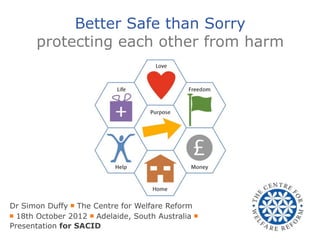
Better Safe than Sorry
      protecting each other from harm


Dr Simon Duffy ■ The Centre for Welfare Reform
■ 18th October 2012 ■ Adelaide, South Australia ■
Presentation for SACID
Protection from harm

Exploring our options
We like to take our anger out on those who are
weaker, those who cannot answer. It is a human
trait. And somehow the arguments to prove we
are right appear out of nowhere.

Alexander Solzhenitsyn


“Better to be safe than to be sorry” is a remark of
value only when these are the actual alternatives.

Idries Shah
We still have much still to learn
Institutions are very unsafe
1. Devalued lives - self-expression and personal
   development threaten institutional thinking
2. No freedom or control - it is very hard to be
   heard when you have no authority
3. Impoverishment - economic power is nullified
4. Sheltered, but homeless - a home is more than
   a roof - vital to control privacy and security
5. ‘Care’ not support - ‘care’ already assumes the
   passivity and lower value of the person ‘in care’.
6. Disconnected- it is other citizens who report
   abuse and it is structures of power within
   institutions that make that harder
7. Loveless - the shift to focusing on abuse not
   crime is a symptom of institutional thinking
Citizenship is vital to safety
 1. Direction - Its risky if my life lacks meaning and
    value
 2. Freedom - Its risky if I cannot direct my life,
    communicate or be listened to.
 3. Money - Its risky if I lack money or if I cannot
    control my own money.
 4. Home - Its risky if I cannot control who I live with,
    my home and my privacy.
 5. Help - Its risky if I’ve no one to help me and if I
    cannot control who helps me.
 6. Life - Its risky if I am not a valued member of my
    community.
 7. Love - Its risky to have no friends or family.
Citizenship is the right goal
Being in control makes people safer
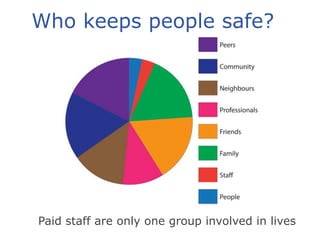
Who keeps people safe?


Paid staff are only one group involved in lives
Inspection regimes fail
Service Area                            % failing
User focused services                     22%
Personal care                             26%
Protection                                29%
Managers and staff                        33%
Organisation and running of the           23%
business
Standard                                                                 % failing
The needs, wishes, preferences and personal goals for each user are         48%
recorded in a personal service user plan
Staff are supervised and appraised                                          43%
Safe procedures for medication, with users keeping                          42%
control where possible
Rigorous recruitment and selection procedures                               39%
The risk of accidents for users and staff is minimised                      37%
             CSCI Report - State of Social Care - 2005-2006 - Failure to meet minimal
                                              standards in domiciliary care agencies
Risk grows as we


                                                                 se
                                                                  A bu
                                                             e of
                                                                         O ld


                                                         rienc
                                                                                er P
                                                                                    eop


                                                           pe
                                                                                          le’s


                                                     ’s Ex
                                                                                                 Exp                    Hid
                                                                                                               erie den Vo


                                                       ple
                                                 r Peo
                                                                                          An a
                                                                                                                          nce               ic
                                                                                                                                       of A es:


institutionalise
                                                                                              nalys


                                               Olde
                                                                                                    is of
                                                                                      Writ                calls
                                                                                           ten b
                                                                                                y Acti
                                                                                                                 to th
                                                                                                                       e Ac                buse


                                           ices:
                                                                                                       on o                 tion
                                                                                                            n Eld                on E
                                                                                                                  er A                lder


                                         en Vo
                                                                                                             buse
                                                                                                                    and p          Abus
                                                                                                                         ublish           e help
                                                                                                                               ed by                  line.


                                        Hidd
                                                                                                                                       Help
                                                                                                                                              the A
                                                                                                                                                   ged


                                   se
                               Abu
                          lder
                        on E
                          on
                     Acti
                 ged
               the A
              Help
                Action on Elder Abuse Data (2004)
Schools can lead the way...
Jonathan’s story
For the 3 years before 150 days in hospital -
responding to problems with breathing.
In the 3 years after leaving hospital he has spent
only 2 nights in hospital - for elective dental
treatments.
Personalised learning - on the job - 2 City & Guilds
Qualifications.
Saving NHS, LA & Education
•Over £100,000 in hospital stays
•Over £300,000 in residential care costs
•Over £100,000 of funding contributed by the LSC
Community
solutions can work
When is a crime not a crime? When it’s abuse of
someone with diminished rights.


The service system is riskier than real life - so the
solution to risk cannot be a service solution.


Begin at the beginning - if we are weak,
disconnected and unable to articulate our rights
can we expect the system to take our rights
seriously?
Questions
1. Research - Do we know what is working and not working?
2. Supported Decision-making - Do people have good
   decision-making systems around them as a matter of right?
3. Control - Are people in control of their life and support?
4. Leadership - Do services understand how to raise
   standards and tackle abuse?
5. A citizen’s duty - Do all citizens - including staff - have a
   legal obligation to report crimes against those who can’t
   themselves?
6. Policing - Do the police take these crimes seriously?
7. Justice - Do people get a good chance of justice from
   criminal justice system?
8. Voice - How do we strengthen the voice of advocacy?
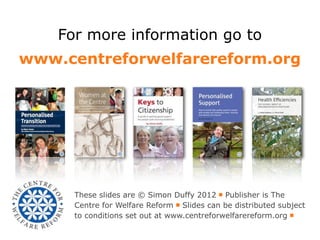
For more information go to
www.centreforwelfarereform.org


      These slides are © Simon Duffy 2012 ■ Publisher is The
      Centre for Welfare Reform ■ Slides can be distributed subject
      to conditions set out at www.centreforwelfarereform.org ■

Better Safe than Sorry

  • 1.
    Better Safe thanSorry protecting each other from harm Dr Simon Duffy ■ The Centre for Welfare Reform ■ 18th October 2012 ■ Adelaide, South Australia ■ Presentation for SACID
  • 2.
  • 3.
    We like totake our anger out on those who are weaker, those who cannot answer. It is a human trait. And somehow the arguments to prove we are right appear out of nowhere. Alexander Solzhenitsyn “Better to be safe than to be sorry” is a remark of value only when these are the actual alternatives. Idries Shah
  • 5.
    We still havemuch still to learn
  • 6.
    Institutions are veryunsafe 1. Devalued lives - self-expression and personal development threaten institutional thinking 2. No freedom or control - it is very hard to be heard when you have no authority 3. Impoverishment - economic power is nullified 4. Sheltered, but homeless - a home is more than a roof - vital to control privacy and security 5. ‘Care’ not support - ‘care’ already assumes the passivity and lower value of the person ‘in care’. 6. Disconnected- it is other citizens who report abuse and it is structures of power within institutions that make that harder 7. Loveless - the shift to focusing on abuse not crime is a symptom of institutional thinking
  • 7.
    Citizenship is vitalto safety 1. Direction - Its risky if my life lacks meaning and value 2. Freedom - Its risky if I cannot direct my life, communicate or be listened to. 3. Money - Its risky if I lack money or if I cannot control my own money. 4. Home - Its risky if I cannot control who I live with, my home and my privacy. 5. Help - Its risky if I’ve no one to help me and if I cannot control who helps me. 6. Life - Its risky if I am not a valued member of my community. 7. Love - Its risky to have no friends or family.
  • 8.
  • 9.
    Being in controlmakes people safer
  • 12.
    Who keeps peoplesafe? Paid staff are only one group involved in lives
  • 13.
    Inspection regimes fail ServiceArea % failing User focused services 22% Personal care 26% Protection 29% Managers and staff 33% Organisation and running of the 23% business Standard % failing The needs, wishes, preferences and personal goals for each user are 48% recorded in a personal service user plan Staff are supervised and appraised 43% Safe procedures for medication, with users keeping 42% control where possible Rigorous recruitment and selection procedures 39% The risk of accidents for users and staff is minimised 37% CSCI Report - State of Social Care - 2005-2006 - Failure to meet minimal standards in domiciliary care agencies
  • 14.
    Risk grows aswe se A bu e of O ld rienc er P eop pe le’s ’s Ex Exp Hid erie den Vo ple r Peo An a nce ic of A es: institutionalise nalys Olde is of Writ calls ten b y Acti to th e Ac buse ices: on o tion n Eld on E er A lder en Vo buse and p Abus ublish e help ed by line. Hidd Help the A ged se Abu lder on E on Acti ged the A Help Action on Elder Abuse Data (2004)
  • 15.
    Schools can leadthe way...
  • 16.
    Jonathan’s story For the3 years before 150 days in hospital - responding to problems with breathing. In the 3 years after leaving hospital he has spent only 2 nights in hospital - for elective dental treatments. Personalised learning - on the job - 2 City & Guilds Qualifications. Saving NHS, LA & Education •Over £100,000 in hospital stays •Over £300,000 in residential care costs •Over £100,000 of funding contributed by the LSC
  • 17.
  • 19.
    When is acrime not a crime? When it’s abuse of someone with diminished rights. The service system is riskier than real life - so the solution to risk cannot be a service solution. Begin at the beginning - if we are weak, disconnected and unable to articulate our rights can we expect the system to take our rights seriously?
  • 20.
    Questions 1. Research -Do we know what is working and not working? 2. Supported Decision-making - Do people have good decision-making systems around them as a matter of right? 3. Control - Are people in control of their life and support? 4. Leadership - Do services understand how to raise standards and tackle abuse? 5. A citizen’s duty - Do all citizens - including staff - have a legal obligation to report crimes against those who can’t themselves? 6. Policing - Do the police take these crimes seriously? 7. Justice - Do people get a good chance of justice from criminal justice system? 8. Voice - How do we strengthen the voice of advocacy?
  • 21.
    For more informationgo to www.centreforwelfarereform.org These slides are © Simon Duffy 2012 ■ Publisher is The Centre for Welfare Reform ■ Slides can be distributed subject to conditions set out at www.centreforwelfarereform.org ■