KDIGO Guidelines on AKI
Professor Alan Cass
Director Menzies School of Health Research
President-Elect ANZ Society of Nephrology
alan.cass@menzies.edu.au
KDIGO
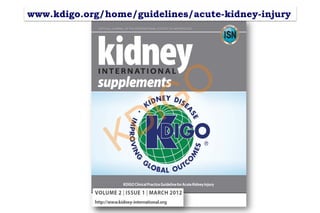
www.kdigo.org/home/guidelines/acute-kidney-injury
KDIGO
KDIGO – AKI Guidelines
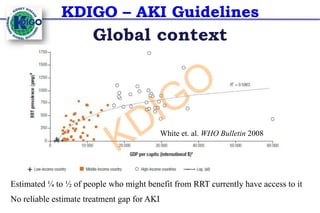
Global context
White et. al. WHO Bulletin 2008
Estimated ¼ to ½ of people who might benefit from RRT currently have access to it
No reliable estimate treatment gap for AKI
KDIGO
KDIGO – AKI Guidelines
§ KDIGO Co-Chairs appointed 2 Co-Chairs of the Work
Group
§ Assembled experts in nephrology, critical care medicine,
internal medicine, pediatrics, cardiology, radiology,
infectious diseases and epidemiology
§ Every effort made to avoid actual or reasonably perceived
conflicts of interest of a member of the Work Group
§ The Work Group was supported by
§ Evidence Review Team at Tufts Medical Center, Boston
§ KDIGO staff (infrastructure)
Introduction
KDIGO
KDIGO – AKI Guidelines
§ Work Group worked for two years
§ Divided in sub-groups
§ Over 18,000 citations were screened
§ Four face to face meetings and teleconferences
§ Finalized by the Co-Chairs of the Work Group
§ Work-Group agreement on the final document
§ Publication in KI in March 2012
Introduction
The final Clinical Practice Guideline document was based
upon the best information available as of February 2011
KDIGO
KDIGO – AKI Guidelines
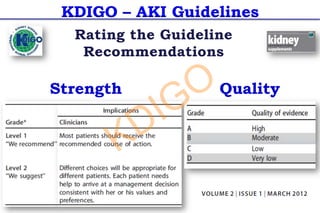
Rating the Guideline
Recommendations
Strength Quality
KDIGO
KDIGO – AKI Guidelines
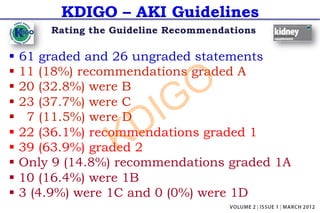
Rating the Guideline Recommendations
§ 61 graded and 26 ungraded statements
§ 11 (18%) recommendations graded A
§ 20 (32.8%) were B
§ 23 (37.7%) were C
§ 7 (11.5%) were D
§ 22 (36.1%) recommendations graded 1
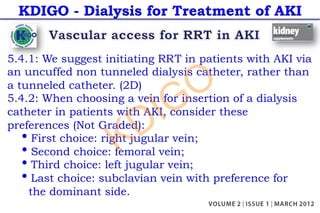
§ 39 (63.9%) graded 2
§ Only 9 (14.8%) recommendations graded 1A
§ 10 (16.4%) were 1B
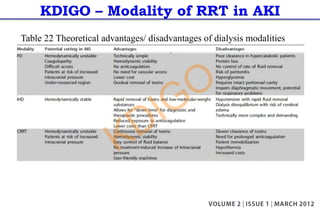
§ 3 (4.9%) were 1C and 0 (0%) were 1D
KDIGO
KDIGO – AKI Guidelines
Document structure
§ Summary of recommendation statements
§ Section 1 – Introduction and methodology
§ Section 2 – AKI definition
§ Section 3 – Prevention and treatment of AKI
§ Section 4 – Contrast-induced AKI
§ Section 5 – Dialysis interventions for treatment of AKI
KDIGO
KDIGO – AKI Definition
2.1.1: AKI is defined as any of the following:
§ Increase in SCr by ≥ 0.3 mg/dl (≥ 26.5 µmol/l) within 48
hours; or
§ Increase in SCr to ≥ 1.5 times baseline, which is known
or presumed to have occurred within the prior 7 days; or
§ Urine volume <0.5 ml/kg/h for 6 hours
KDIGO
KDIGO – AKI Definition
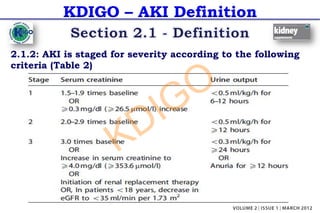
2.1.2: AKI is staged for severity according to the following
criteria (Table 2)
KDIGO
KDIGO – AKI Definition
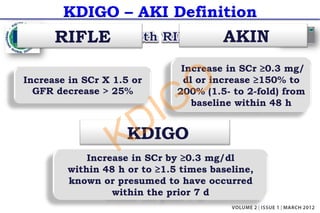
RIFLE
Increase in SCr ≥0.3 mg/
dl or increase ≥150% to
200% (1.5- to 2-fold) from
baseline within 48 h
KDIGO
Increase in SCr X 1.5 or
GFR decrease > 25%
Increase in SCr by ≥0.3 mg/dl
within 48 h or to ≥1.5 times baseline,
known or presumed to have occurred
within the prior 7 d
AKIN
KDIGO
KDIGO – AKI Definition Validation
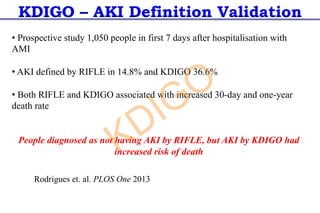
Rodrigues et. al. PLOS One 2013
• Prospective study 1,050 people in first 7 days after hospitalisation with
AMI
• AKI defined by RIFLE in 14.8% and KDIGO 36.6%
• Both RIFLE and KDIGO associated with increased 30-day and one-year
death rate
People diagnosed as not having AKI by RIFLE, but AKI by KDIGO had
increased risk of death
KDIGO
KDIGO – AKI Definition
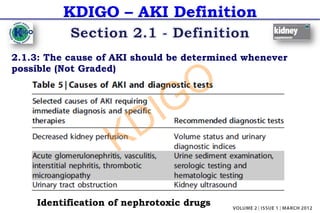
2.1.3: The cause of AKI should be determined whenever
possible (Not Graded)
Identification of nephrotoxic drugs
KDIGO
KDIGO AKI – Risk Assessment
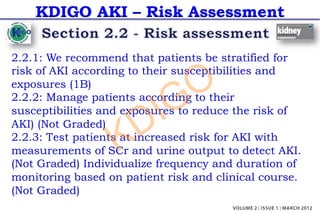
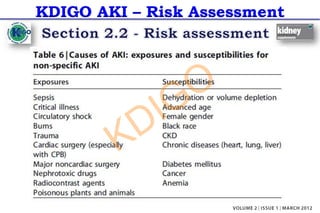
2.2.1: We recommend that patients be stratified for
risk of AKI according to their susceptibilities and
exposures (1B)
2.2.2: Manage patients according to their
susceptibilities and exposures to reduce the risk of
AKI) (Not Graded)
2.2.3: Test patients at increased risk for AKI with
measurements of SCr and urine output to detect AKI.
(Not Graded) Individualize frequency and duration of
monitoring based on patient risk and clinical course.
(Not Graded)
KDIGO
KDIGO AKI – Risk Assessment
KDIGO
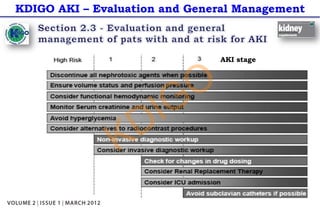
KDIGO AKI – Evaluation and General Management
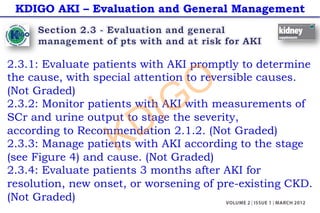
2.3.1: Evaluate patients with AKI promptly to determine
the cause, with special attention to reversible causes.
(Not Graded)
2.3.2: Monitor patients with AKI with measurements of
SCr and urine output to stage the severity,
according to Recommendation 2.1.2. (Not Graded)
2.3.3: Manage patients with AKI according to the stage
(see Figure 4) and cause. (Not Graded)
2.3.4: Evaluate patients 3 months after AKI for
resolution, new onset, or worsening of pre-existing CKD.
(Not Graded)
KDIGO
AKI stage
KDIGO AKI – Evaluation and General Management
KDIGO
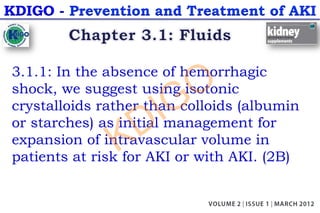
KDIGO - Prevention and Treatment of AKI
3.1.1: In the absence of hemorrhagic
shock, we suggest using isotonic
crystalloids rather than colloids (albumin
or starches) as initial management for
expansion of intravascular volume in
patients at risk for AKI or with AKI. (2B)
KDIGO
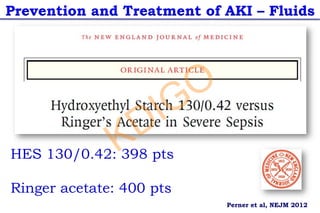
Perner et al, NEJM 2012
HES 130/0.42: 398 pts
Ringer acetate: 400 pts
Prevention and Treatment of AKI – Fluids
KDIGO
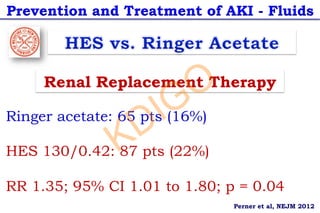
Perner et al, NEJM 2012
Ringer acetate: 65 pts (16%)
HES 130/0.42: 87 pts (22%)
RR 1.35; 95% CI 1.01 to 1.80; p = 0.04
Renal Replacement Therapy
Prevention and Treatment of AKI - Fluids
KDIGO
Myburgh et al, NEJM 2012
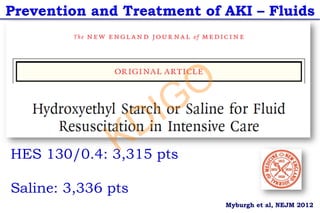
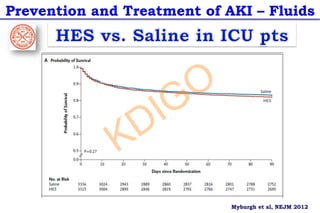
HES 130/0.4: 3,315 pts
Saline: 3,336 pts
Prevention and Treatment of AKI – Fluids
KDIGO
Myburgh et al, NEJM 2012
Prevention and Treatment of AKI – Fluids
KDIGO
Prevention and Treatment of AKI – Fluids
Myburgh et al, NEJM 2012
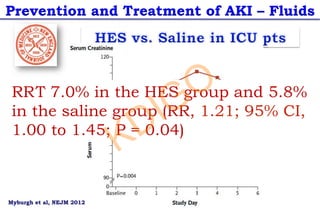
RRT 7.0% in the HES group and 5.8%
in the saline group (RR, 1.21; 95% CI,
1.00 to 1.45; P = 0.04)
KDIGO
KDIGO - Prevention and Treatment of AKI
3.1.2: We recommend the use of
vasopressors in conjunction with
fluids in patients with vasomotor
shock with, or at risk for, AKI (1C)
KDIGO
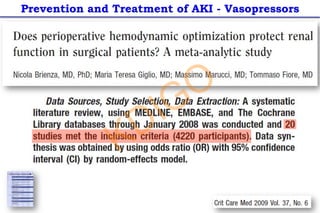
Prevention and Treatment of AKI - Vasopressors
KDIGO
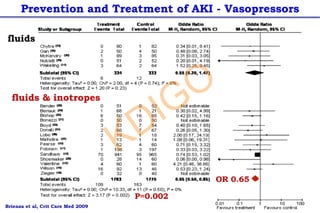
OR 0.65
P=0.002
fluids & inotropes
fluids
Brienza et al, Crit Care Med 2009
Prevention and Treatment of AKI - Vasopressors
KDIGO
Prevention and Treatment of AKI - Vasopressors
KDIGO
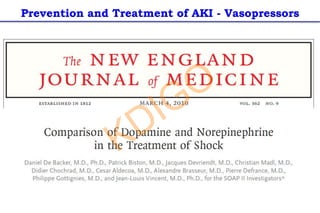
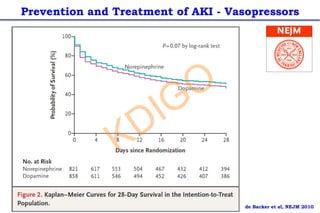
de Backer et al, NEJM 2010
Prevention and Treatment of AKI - Vasopressors
KDIGO
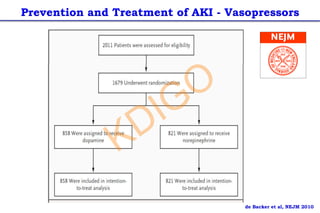
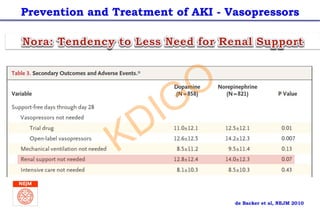
de Backer et al, NEJM 2010
Prevention and Treatment of AKI - Vasopressors
KDIGO
de Backer et al, NEJM 2010
Prevention and Treatment of AKI - Vasopressors
KDIGO
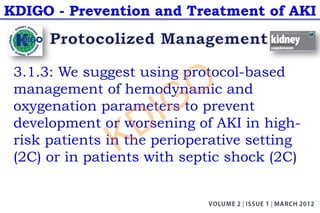
KDIGO - Prevention and Treatment of AKI
3.1.3: We suggest using protocol-based
management of hemodynamic and
oxygenation parameters to prevent
development or worsening of AKI in high-
risk patients in the perioperative setting
(2C) or in patients with septic shock (2C)
KDIGO
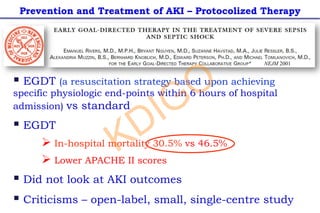
§ EGDT (a resuscitation strategy based upon achieving
specific physiologic end-points within 6 hours of hospital
admission) vs standard
§ EGDT
Ø In-hospital mortality 30.5% vs 46.5%
Ø Lower APACHE II scores
§ Did not look at AKI outcomes
§ Criticisms – open-label, small, single-centre study
Prevention and Treatment of AKI – Protocolized Therapy
NEJM 2001
KDIGO
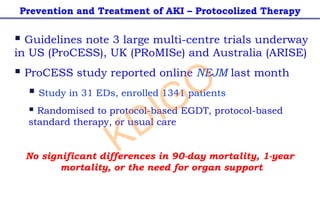
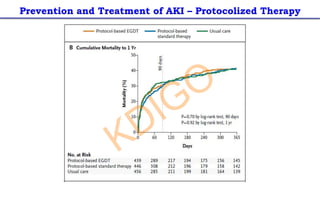
§ Guidelines note 3 large multi-centre trials underway
in US (ProCESS), UK (PRoMISe) and Australia (ARISE)
§ ProCESS study reported online NEJM last month
§ Study in 31 EDs, enrolled 1341 patients
§ Randomised to protocol-based EGDT, protocol-based
standard therapy, or usual care
No significant differences in 90-day mortality, 1-year
mortality, or the need for organ support
Prevention and Treatment of AKI – Protocolized Therapy
KDIGO
Prevention and Treatment of AKI – Protocolized Therapy
KDIGO
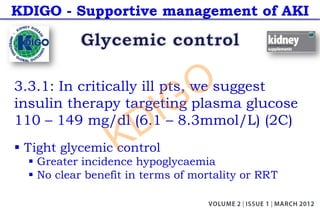
KDIGO - Supportive management of AKI
3.3.1: In critically ill pts, we suggest
insulin therapy targeting plasma glucose
110 – 149 mg/dl (6.1 – 8.3mmol/L) (2C)
§ Tight glycemic control
§ Greater incidence hypoglycaemia
§ No clear benefit in terms of mortality or RRT
KDIGO
KDIGO - Supportive management of AKI
3.3.2: We suggest achieving a total energy
intake of 20–30 kcal/kg/d in patients with any
stage of AKI. (2C)
3.3.3: We suggest to avoid restriction of protein
intake with the aim of preventing or delaying
initiation of RRT. (2D)
KDIGO
KDIGO - Supportive management of AKI
3.3.4: We suggest administering 0.8–1.0 g/kg/d of
protein in non catabolic AKI patients without need for
dialysis (2D), 1.0–1.5 g/kg/d in patients with AKI on
RRT (2D), and up to a maximum of 1.7 g/kg/d in
patients on CRRT and in hypercatabolic patients. (2D)
3.3.5: We suggest providing nutrition preferentially via
the enteral route in patients with AKI. (2C)
KDIGO
KDIGO - Supportive management of AKI
3.4.1: We recommend not using diuretics
to prevent AKI. (1B)
3.4.2: We suggest not using diuretics to
treat AKI, except in the management of
volume overload. (2C)
KDIGO
Prevention and Treatment of AKI – Diuretics
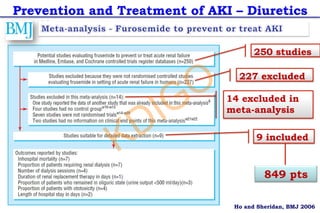
250 studies
227 excluded
14 excluded in
meta-analysis
9 included
849 pts
Ho and Sheridan, BMJ 2006
KDIGO
Prevention and Treatment of AKI – Diuretics
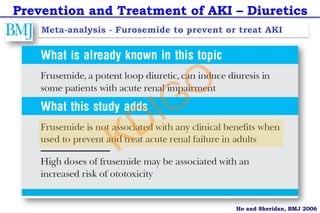
Ho and Sheridan, BMJ 2006
KDIGO
KDIGO - Supportive management of AKI
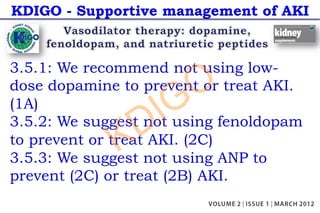
3.5.1: We recommend not using low-
dose dopamine to prevent or treat AKI.
(1A)
3.5.2: We suggest not using fenoldopam
to prevent or treat AKI. (2C)
3.5.3: We suggest not using ANP to
prevent (2C) or treat (2B) AKI.
KDIGO
Prevention and Treatment of AKI – Dopamine
Ø 61 trials – 3,359 pts
Ø no effect of low-dose dopamine
Ø Mortality: RR 0.96 [95% CI, 0.78 - 1.19]
Ø Need for RRT: RR 0.93 [CI, 0.76 - 1.15]
Ø Adverse events: RR 1.13 [CI, 0.90 - 1.41]
KDIGO
KDIGO – Contrast-induced AKI
4.2.1: Assess the risk for CI-AKI and, in particular,
screen for pre-existing impaired kidney function in
patients who are considered for a procedure that
requires intravascular administration of iodinated
contrast medium. (Not Graded)
4.2.2: Consider alternative imaging methods in patients
at increased risk for CI-AKI. (Not Graded)
4.3.1: Use the lowest possible dose of contrast medium
in patients at risk for CI-AKI. (Not Graded)
KDIGO
KDIGO – Contrast-induced AKI
4.3.2: We recommend using either iso-osmolar or low-
osmolar iodinated contrast media, rather than high-
osmolar iodinated contrast media in patients at
increased risk of CI-AKI. (1B)
4.4.1: We recommend i.v. volume expansion with either
isotonic NaCl or NaBiC solutions, rather than no i.v.
volume expansion, in patients at increased risk for CI-
AKI. (1A)
4.4.2: We recommend not using oral fluids alone in
patients at increased risk of CI-AKI. (1C)
KDIGO
KDIGO – Contrast-induced AKI
4.4.3: We suggest using oral NAC with i.v. isotonic
crystalloids, in patients at increased risk of CI-AKI. (2D)
4.4.4: We suggest not using theophylline and
fenoldopam to prevent CI-AKI. (2C)
4.4.5: We recommend not using fenoldopam to prevent
CI-AKI. (1B)
4.5.1: We suggest not using prophylactic intermittent
hemodialysis (IHD) or hemofiltration (HF) for contrast-
media removal in patients at increased risk for CI-AKI.
(2C)
KDIGO
KDIGO - Dialysis for Treatment of AKI
5.1.1: Initiate RRT emergently when life-
threatening changes in fluid, electrolyte and
acid-base balance exist. (Not Graded)
5.1.2: Consider the broader clinical context, the
presence of conditions that can be modified with
RRT, and trends of laboratory tests, rather than
single BUN and creatinine thresholds alone,
when making the decision to start RRT. (Not
Graded)
KDIGO
Dialysis for Treatment of AKI
Timing of RRT in AKI
Whether or not to provide RRT, and when to start, are two
of the fundamental questions facing nephrologists and
intensive-care practitioners in most cases of severe AKI.
The timing of initiation of RRT has not been included as a
factor in any of the large RCTs in this area. The optimal
timing of dialysis for AKI is not defined.
KDIGO
Dialysis for Treatment of AKI
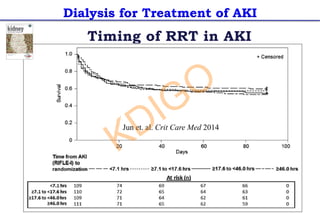
Timing of RRT in AKI
Jun et. al. Crit Care Med 2014
KDIGO
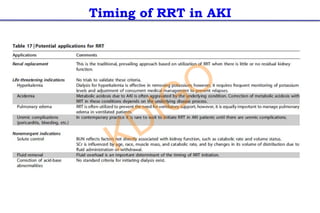
Timing of RRT in AKI
KDIGO
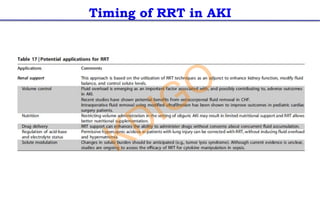
Timing of RRT in AKI
KDIGO
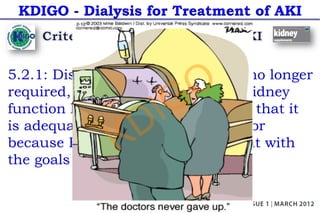
KDIGO - Dialysis for Treatment of AKI
5.2.1: Discontinue RRT when it is no longer
required, either because intrinsic kidney
function has recovered to the point that it
is adequate to meet patient needs, or
because RRT is no longer consistent with
the goals of care. (Not Graded)
KDIGO
KDIGO - Dialysis for Treatment of AKI
5.4.1: We suggest initiating RRT in patients with AKI via
an uncuffed non tunneled dialysis catheter, rather than
a tunneled catheter. (2D)
5.4.2: When choosing a vein for insertion of a dialysis
catheter in patients with AKI, consider these
preferences (Not Graded):
• First choice: right jugular vein;
• Second choice: femoral vein;
• Third choice: left jugular vein;
• Last choice: subclavian vein with preference for
the dominant side.
KDIGO
KDIGO - Dialysis for Treatment of AKI
5.4.3: We recommend using ultrasound
guidance for dialysis catheter insertion.
(1A)
KDIGO
KDIGO - Dialysis for Treatment of AKI
5.6.1: Use continuous and intermittent RRT as
complementary therapies in AKI patients. (Not Graded)
5.6.2: We suggest using CRRT, rather than standard
intermittent RRT, for hemodynamically unstable
patients. (2B)
5.6.3: We suggest using CRRT, rather than intermittent
RRT, for AKI patients with acute brain injury or other
causes of increased intracranial pressure or generalized
brain edema. (2B)
KDIGO
KDIGO – Modality of RRT in AKI
Table 22 Theoretical advantages/ disadvantages of dialysis modalities
KDIGO
Dialysis for AKI – Peritoneal
Discuss in presentation on Saturday
KDIGO
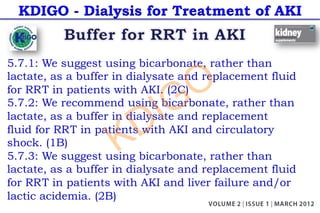
KDIGO - Dialysis for Treatment of AKI
5.7.1: We suggest using bicarbonate, rather than
lactate, as a buffer in dialysate and replacement fluid
for RRT in patients with AKI. (2C)
5.7.2: We recommend using bicarbonate, rather than
lactate, as a buffer in dialysate and replacement
fluid for RRT in patients with AKI and circulatory
shock. (1B)
5.7.3: We suggest using bicarbonate, rather than
lactate, as a buffer in dialysate and replacement fluid
for RRT in patients with AKI and liver failure and/or
lactic acidemia. (2B)
KDIGO
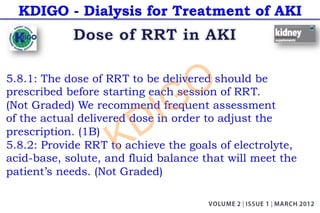
KDIGO - Dialysis for Treatment of AKI
5.8.1: The dose of RRT to be delivered should be
prescribed before starting each session of RRT.
(Not Graded) We recommend frequent assessment
of the actual delivered dose in order to adjust the
prescription. (1B)
5.8.2: Provide RRT to achieve the goals of electrolyte,
acid-base, solute, and fluid balance that will meet the
patient’s needs. (Not Graded)
KDIGO
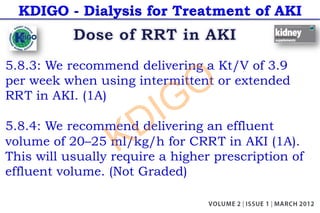
KDIGO - Dialysis for Treatment of AKI
5.8.3: We recommend delivering a Kt/V of 3.9
per week when using intermittent or extended
RRT in AKI. (1A)
5.8.4: We recommend delivering an effluent
volume of 20–25 ml/kg/h for CRRT in AKI (1A).
This will usually require a higher prescription of
effluent volume. (Not Graded)
KDIGO
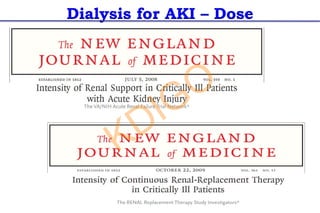
Dialysis for AKI – Dose
KDIGO
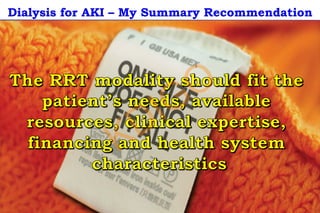
Dialysis for AKI – My Summary Recommendation
KDIGO

KDIGO-AKI-Guideline_Cass-2014.pdf

  • 1.
    KDIGO Guidelines onAKI Professor Alan Cass Director Menzies School of Health Research President-Elect ANZ Society of Nephrology alan.cass@menzies.edu.au KDIGO
  • 2.
  • 3.
    KDIGO – AKIGuidelines Global context White et. al. WHO Bulletin 2008 Estimated ¼ to ½ of people who might benefit from RRT currently have access to it No reliable estimate treatment gap for AKI KDIGO
  • 4.
    KDIGO – AKIGuidelines § KDIGO Co-Chairs appointed 2 Co-Chairs of the Work Group § Assembled experts in nephrology, critical care medicine, internal medicine, pediatrics, cardiology, radiology, infectious diseases and epidemiology § Every effort made to avoid actual or reasonably perceived conflicts of interest of a member of the Work Group § The Work Group was supported by § Evidence Review Team at Tufts Medical Center, Boston § KDIGO staff (infrastructure) Introduction KDIGO
  • 5.
    KDIGO – AKIGuidelines § Work Group worked for two years § Divided in sub-groups § Over 18,000 citations were screened § Four face to face meetings and teleconferences § Finalized by the Co-Chairs of the Work Group § Work-Group agreement on the final document § Publication in KI in March 2012 Introduction The final Clinical Practice Guideline document was based upon the best information available as of February 2011 KDIGO
  • 6.
    KDIGO – AKIGuidelines Rating the Guideline Recommendations Strength Quality KDIGO
  • 7.
    KDIGO – AKIGuidelines Rating the Guideline Recommendations § 61 graded and 26 ungraded statements § 11 (18%) recommendations graded A § 20 (32.8%) were B § 23 (37.7%) were C § 7 (11.5%) were D § 22 (36.1%) recommendations graded 1 § 39 (63.9%) graded 2 § Only 9 (14.8%) recommendations graded 1A § 10 (16.4%) were 1B § 3 (4.9%) were 1C and 0 (0%) were 1D KDIGO
  • 8.
    KDIGO – AKIGuidelines Document structure § Summary of recommendation statements § Section 1 – Introduction and methodology § Section 2 – AKI definition § Section 3 – Prevention and treatment of AKI § Section 4 – Contrast-induced AKI § Section 5 – Dialysis interventions for treatment of AKI KDIGO
  • 9.
    KDIGO – AKIDefinition 2.1.1: AKI is defined as any of the following: § Increase in SCr by ≥ 0.3 mg/dl (≥ 26.5 µmol/l) within 48 hours; or § Increase in SCr to ≥ 1.5 times baseline, which is known or presumed to have occurred within the prior 7 days; or § Urine volume <0.5 ml/kg/h for 6 hours KDIGO
  • 10.
    KDIGO – AKIDefinition 2.1.2: AKI is staged for severity according to the following criteria (Table 2) KDIGO
  • 11.
    KDIGO – AKIDefinition RIFLE Increase in SCr ≥0.3 mg/ dl or increase ≥150% to 200% (1.5- to 2-fold) from baseline within 48 h KDIGO Increase in SCr X 1.5 or GFR decrease > 25% Increase in SCr by ≥0.3 mg/dl within 48 h or to ≥1.5 times baseline, known or presumed to have occurred within the prior 7 d AKIN KDIGO
  • 12.
    KDIGO – AKIDefinition Validation Rodrigues et. al. PLOS One 2013 • Prospective study 1,050 people in first 7 days after hospitalisation with AMI • AKI defined by RIFLE in 14.8% and KDIGO 36.6% • Both RIFLE and KDIGO associated with increased 30-day and one-year death rate People diagnosed as not having AKI by RIFLE, but AKI by KDIGO had increased risk of death KDIGO
  • 13.
    KDIGO – AKIDefinition 2.1.3: The cause of AKI should be determined whenever possible (Not Graded) Identification of nephrotoxic drugs KDIGO
  • 14.
    KDIGO AKI –Risk Assessment 2.2.1: We recommend that patients be stratified for risk of AKI according to their susceptibilities and exposures (1B) 2.2.2: Manage patients according to their susceptibilities and exposures to reduce the risk of AKI) (Not Graded) 2.2.3: Test patients at increased risk for AKI with measurements of SCr and urine output to detect AKI. (Not Graded) Individualize frequency and duration of monitoring based on patient risk and clinical course. (Not Graded) KDIGO
  • 15.
    KDIGO AKI –Risk Assessment KDIGO
  • 16.
    KDIGO AKI –Evaluation and General Management 2.3.1: Evaluate patients with AKI promptly to determine the cause, with special attention to reversible causes. (Not Graded) 2.3.2: Monitor patients with AKI with measurements of SCr and urine output to stage the severity, according to Recommendation 2.1.2. (Not Graded) 2.3.3: Manage patients with AKI according to the stage (see Figure 4) and cause. (Not Graded) 2.3.4: Evaluate patients 3 months after AKI for resolution, new onset, or worsening of pre-existing CKD. (Not Graded) KDIGO
  • 17.
    AKI stage KDIGO AKI– Evaluation and General Management KDIGO
  • 18.
    KDIGO - Preventionand Treatment of AKI 3.1.1: In the absence of hemorrhagic shock, we suggest using isotonic crystalloids rather than colloids (albumin or starches) as initial management for expansion of intravascular volume in patients at risk for AKI or with AKI. (2B) KDIGO
  • 19.
    Perner et al,NEJM 2012 HES 130/0.42: 398 pts Ringer acetate: 400 pts Prevention and Treatment of AKI – Fluids KDIGO
  • 20.
    Perner et al,NEJM 2012 Ringer acetate: 65 pts (16%) HES 130/0.42: 87 pts (22%) RR 1.35; 95% CI 1.01 to 1.80; p = 0.04 Renal Replacement Therapy Prevention and Treatment of AKI - Fluids KDIGO
  • 21.
    Myburgh et al,NEJM 2012 HES 130/0.4: 3,315 pts Saline: 3,336 pts Prevention and Treatment of AKI – Fluids KDIGO
  • 22.
    Myburgh et al,NEJM 2012 Prevention and Treatment of AKI – Fluids KDIGO
  • 23.
    Prevention and Treatmentof AKI – Fluids Myburgh et al, NEJM 2012 RRT 7.0% in the HES group and 5.8% in the saline group (RR, 1.21; 95% CI, 1.00 to 1.45; P = 0.04) KDIGO
  • 24.
    KDIGO - Preventionand Treatment of AKI 3.1.2: We recommend the use of vasopressors in conjunction with fluids in patients with vasomotor shock with, or at risk for, AKI (1C) KDIGO
  • 25.
    Prevention and Treatmentof AKI - Vasopressors KDIGO
  • 26.
    OR 0.65 P=0.002 fluids &inotropes fluids Brienza et al, Crit Care Med 2009 Prevention and Treatment of AKI - Vasopressors KDIGO
  • 27.
    Prevention and Treatmentof AKI - Vasopressors KDIGO
  • 28.
    de Backer etal, NEJM 2010 Prevention and Treatment of AKI - Vasopressors KDIGO
  • 29.
    de Backer etal, NEJM 2010 Prevention and Treatment of AKI - Vasopressors KDIGO
  • 30.
    de Backer etal, NEJM 2010 Prevention and Treatment of AKI - Vasopressors KDIGO
  • 31.
    KDIGO - Preventionand Treatment of AKI 3.1.3: We suggest using protocol-based management of hemodynamic and oxygenation parameters to prevent development or worsening of AKI in high- risk patients in the perioperative setting (2C) or in patients with septic shock (2C) KDIGO
  • 32.
    § EGDT (aresuscitation strategy based upon achieving specific physiologic end-points within 6 hours of hospital admission) vs standard § EGDT Ø In-hospital mortality 30.5% vs 46.5% Ø Lower APACHE II scores § Did not look at AKI outcomes § Criticisms – open-label, small, single-centre study Prevention and Treatment of AKI – Protocolized Therapy NEJM 2001 KDIGO
  • 33.
    § Guidelines note3 large multi-centre trials underway in US (ProCESS), UK (PRoMISe) and Australia (ARISE) § ProCESS study reported online NEJM last month § Study in 31 EDs, enrolled 1341 patients § Randomised to protocol-based EGDT, protocol-based standard therapy, or usual care No significant differences in 90-day mortality, 1-year mortality, or the need for organ support Prevention and Treatment of AKI – Protocolized Therapy KDIGO
  • 34.
    Prevention and Treatmentof AKI – Protocolized Therapy KDIGO
  • 35.
    KDIGO - Supportivemanagement of AKI 3.3.1: In critically ill pts, we suggest insulin therapy targeting plasma glucose 110 – 149 mg/dl (6.1 – 8.3mmol/L) (2C) § Tight glycemic control § Greater incidence hypoglycaemia § No clear benefit in terms of mortality or RRT KDIGO
  • 36.
    KDIGO - Supportivemanagement of AKI 3.3.2: We suggest achieving a total energy intake of 20–30 kcal/kg/d in patients with any stage of AKI. (2C) 3.3.3: We suggest to avoid restriction of protein intake with the aim of preventing or delaying initiation of RRT. (2D) KDIGO
  • 37.
    KDIGO - Supportivemanagement of AKI 3.3.4: We suggest administering 0.8–1.0 g/kg/d of protein in non catabolic AKI patients without need for dialysis (2D), 1.0–1.5 g/kg/d in patients with AKI on RRT (2D), and up to a maximum of 1.7 g/kg/d in patients on CRRT and in hypercatabolic patients. (2D) 3.3.5: We suggest providing nutrition preferentially via the enteral route in patients with AKI. (2C) KDIGO
  • 38.
    KDIGO - Supportivemanagement of AKI 3.4.1: We recommend not using diuretics to prevent AKI. (1B) 3.4.2: We suggest not using diuretics to treat AKI, except in the management of volume overload. (2C) KDIGO
  • 39.
    Prevention and Treatmentof AKI – Diuretics 250 studies 227 excluded 14 excluded in meta-analysis 9 included 849 pts Ho and Sheridan, BMJ 2006 KDIGO
  • 40.
    Prevention and Treatmentof AKI – Diuretics Ho and Sheridan, BMJ 2006 KDIGO
  • 41.
    KDIGO - Supportivemanagement of AKI 3.5.1: We recommend not using low- dose dopamine to prevent or treat AKI. (1A) 3.5.2: We suggest not using fenoldopam to prevent or treat AKI. (2C) 3.5.3: We suggest not using ANP to prevent (2C) or treat (2B) AKI. KDIGO
  • 42.
    Prevention and Treatmentof AKI – Dopamine Ø 61 trials – 3,359 pts Ø no effect of low-dose dopamine Ø Mortality: RR 0.96 [95% CI, 0.78 - 1.19] Ø Need for RRT: RR 0.93 [CI, 0.76 - 1.15] Ø Adverse events: RR 1.13 [CI, 0.90 - 1.41] KDIGO
  • 43.
    KDIGO – Contrast-inducedAKI 4.2.1: Assess the risk for CI-AKI and, in particular, screen for pre-existing impaired kidney function in patients who are considered for a procedure that requires intravascular administration of iodinated contrast medium. (Not Graded) 4.2.2: Consider alternative imaging methods in patients at increased risk for CI-AKI. (Not Graded) 4.3.1: Use the lowest possible dose of contrast medium in patients at risk for CI-AKI. (Not Graded) KDIGO
  • 44.
    KDIGO – Contrast-inducedAKI 4.3.2: We recommend using either iso-osmolar or low- osmolar iodinated contrast media, rather than high- osmolar iodinated contrast media in patients at increased risk of CI-AKI. (1B) 4.4.1: We recommend i.v. volume expansion with either isotonic NaCl or NaBiC solutions, rather than no i.v. volume expansion, in patients at increased risk for CI- AKI. (1A) 4.4.2: We recommend not using oral fluids alone in patients at increased risk of CI-AKI. (1C) KDIGO
  • 45.
    KDIGO – Contrast-inducedAKI 4.4.3: We suggest using oral NAC with i.v. isotonic crystalloids, in patients at increased risk of CI-AKI. (2D) 4.4.4: We suggest not using theophylline and fenoldopam to prevent CI-AKI. (2C) 4.4.5: We recommend not using fenoldopam to prevent CI-AKI. (1B) 4.5.1: We suggest not using prophylactic intermittent hemodialysis (IHD) or hemofiltration (HF) for contrast- media removal in patients at increased risk for CI-AKI. (2C) KDIGO
  • 46.
    KDIGO - Dialysisfor Treatment of AKI 5.1.1: Initiate RRT emergently when life- threatening changes in fluid, electrolyte and acid-base balance exist. (Not Graded) 5.1.2: Consider the broader clinical context, the presence of conditions that can be modified with RRT, and trends of laboratory tests, rather than single BUN and creatinine thresholds alone, when making the decision to start RRT. (Not Graded) KDIGO
  • 47.
    Dialysis for Treatmentof AKI Timing of RRT in AKI Whether or not to provide RRT, and when to start, are two of the fundamental questions facing nephrologists and intensive-care practitioners in most cases of severe AKI. The timing of initiation of RRT has not been included as a factor in any of the large RCTs in this area. The optimal timing of dialysis for AKI is not defined. KDIGO
  • 48.
    Dialysis for Treatmentof AKI Timing of RRT in AKI Jun et. al. Crit Care Med 2014 KDIGO
  • 49.
    Timing of RRTin AKI KDIGO
  • 50.
    Timing of RRTin AKI KDIGO
  • 51.
    KDIGO - Dialysisfor Treatment of AKI 5.2.1: Discontinue RRT when it is no longer required, either because intrinsic kidney function has recovered to the point that it is adequate to meet patient needs, or because RRT is no longer consistent with the goals of care. (Not Graded) KDIGO
  • 52.
    KDIGO - Dialysisfor Treatment of AKI 5.4.1: We suggest initiating RRT in patients with AKI via an uncuffed non tunneled dialysis catheter, rather than a tunneled catheter. (2D) 5.4.2: When choosing a vein for insertion of a dialysis catheter in patients with AKI, consider these preferences (Not Graded): • First choice: right jugular vein; • Second choice: femoral vein; • Third choice: left jugular vein; • Last choice: subclavian vein with preference for the dominant side. KDIGO
  • 53.
    KDIGO - Dialysisfor Treatment of AKI 5.4.3: We recommend using ultrasound guidance for dialysis catheter insertion. (1A) KDIGO
  • 54.
    KDIGO - Dialysisfor Treatment of AKI 5.6.1: Use continuous and intermittent RRT as complementary therapies in AKI patients. (Not Graded) 5.6.2: We suggest using CRRT, rather than standard intermittent RRT, for hemodynamically unstable patients. (2B) 5.6.3: We suggest using CRRT, rather than intermittent RRT, for AKI patients with acute brain injury or other causes of increased intracranial pressure or generalized brain edema. (2B) KDIGO
  • 55.
    KDIGO – Modalityof RRT in AKI Table 22 Theoretical advantages/ disadvantages of dialysis modalities KDIGO
  • 56.
    Dialysis for AKI– Peritoneal Discuss in presentation on Saturday KDIGO
  • 57.
    KDIGO - Dialysisfor Treatment of AKI 5.7.1: We suggest using bicarbonate, rather than lactate, as a buffer in dialysate and replacement fluid for RRT in patients with AKI. (2C) 5.7.2: We recommend using bicarbonate, rather than lactate, as a buffer in dialysate and replacement fluid for RRT in patients with AKI and circulatory shock. (1B) 5.7.3: We suggest using bicarbonate, rather than lactate, as a buffer in dialysate and replacement fluid for RRT in patients with AKI and liver failure and/or lactic acidemia. (2B) KDIGO
  • 58.
    KDIGO - Dialysisfor Treatment of AKI 5.8.1: The dose of RRT to be delivered should be prescribed before starting each session of RRT. (Not Graded) We recommend frequent assessment of the actual delivered dose in order to adjust the prescription. (1B) 5.8.2: Provide RRT to achieve the goals of electrolyte, acid-base, solute, and fluid balance that will meet the patient’s needs. (Not Graded) KDIGO
  • 59.
    KDIGO - Dialysisfor Treatment of AKI 5.8.3: We recommend delivering a Kt/V of 3.9 per week when using intermittent or extended RRT in AKI. (1A) 5.8.4: We recommend delivering an effluent volume of 20–25 ml/kg/h for CRRT in AKI (1A). This will usually require a higher prescription of effluent volume. (Not Graded) KDIGO
  • 60.
    Dialysis for AKI– Dose KDIGO
  • 61.
    Dialysis for AKI– My Summary Recommendation KDIGO