1
ECS455: Chapter 4
Multiple Access
4.5 m-sequence
Dr.Prapun Suksompong
prapun.com/ecs455
Office Hours:
BKD 3601-7
Tuesday 9:30-10:30
Tuesday 13:30-14:30
Thursday 13:30-14:30
Binary Random Sequences
2
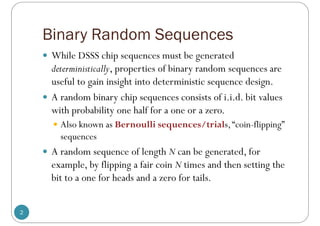
 While DSSS chip sequences must be generated
deterministically, properties of binary random sequences are
useful to gain insight into deterministic sequence design.
 A random binary chip sequences consists of i.i.d. bit values
with probability one half for a one or a zero.
 Also known as Bernoulli sequences/trials,“coin-flipping”
sequences
 A random sequence of length N can be generated, for
example, by flipping a fair coin N times and then setting the
bit to a one for heads and a zero for tails.
Binary Random Sequence
3
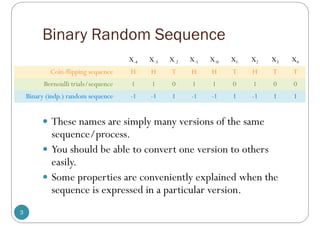
X-4 X-3 X-2 X-1 X-0 X1 X2 X3 X4
Coin-flipping sequence H H T H H T H T T
Bernoulli trials/sequence 1 1 0 1 1 0 1 0 0
Binary (indp.) random sequence -1 -1 1 -1 -1 1 -1 1 1
 These names are simply many versions of the same
sequence/process.
 You should be able to convert one version to others
easily.
 Some properties are conveniently explained when the
sequence is expressed in a particular version.
Properties of Binary Random
Sequences
4
Key randomness properties
5
[Golomb, 1967][Viterbi, 1995, p. 12] Binary random sequences with
length N asymptotically large have a number of the properties
desired in spreading codes
 Balanced property: Equal number of ones and zeros.
 Should have no DC component to avoid a spectral spike at DC or
biasing the noise in despreading
 Run length property:The run length is generally short.
 half of all runs are of length 1
 a fraction 1/2n of all runs are of length n
 Long runs reduce the BW spreading and its advantages
 Shift property: If they are shifted by any nonzero number of
elements, the resulting sequence will have half its elements the
same as in the original sequence, and half its elements different
from the original sequence.
(Geometric)
Note:A run is a subsequence of identical symbols within the sequence.
[Goldsmith,2005, p. 387 &Viterbi, p. 12]
Pseudorandom Sequence
6
 A deterministic sequence that has the balanced, run length,
and shift properties as it grows asymptotically large is referred
to as a pseudorandom sequence (noiselike or
pseudonoise (PN) signal).
 Ideally, one would prefer a random binary sequence as the
spreading sequence.
 However, practical synchronization requirements in the
receiver force one to use periodic Pseudorandom binary
sequences.
 m-sequences
 Gold codes
 Kasami sequences
 Quaternary sequences
 Walsh functions
m-Sequences
7
 Maximal-length sequences
 A type of cyclic code
 Generated and characterized by a generator polynomial
 Properties can be derived using algebraic coding theory
 Simple to generate with linear feedback shift-register
(LFSR) circuits
 Automated
 Approximate a random binary sequence.
 Disadvantage: Relatively easy to intercept and regenerate by
an unintended receiver [Ziemer, 2007, p 11]
[Goldsmith, 2005, p 387]
Longer name: Maximal length
linear shift register sequence.
m-sequence generator (1)
8
 Start with a “primitive polynomial”
 The feedback taps in the feedback shift register are selected
to correspond to the coefficients of the primitive polynomial.
CLK
The gi’s are coefficients of a primitive polynomial.
1 signifies closed or a connection and
0 signifies open or no connection.
(Degree: r = 3  use 3 flip-flops)
(See Section 13.4.1 in [Lathi, 1998])
2 3
1 0 1 1
x x x
   
GF(2)
9
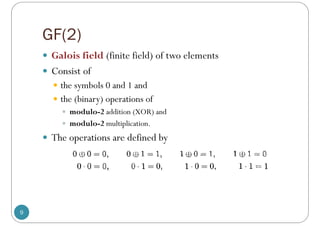
 Galois field (finite field) of two elements
 Consist of
 the symbols 0 and 1 and
 the (binary) operations of
 modulo-2 addition (XOR) and
 modulo-2 multiplication.
 The operations are defined by
m-sequence generator (2)
10
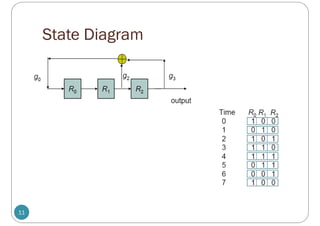
 Binary sequences drawn from the alphabet {0,1} are shifted through the
shift register in response to clock pulses.
 Each clock time, the register shifts all its contents to the right.
 The particular 1s and 0s occupying the shift register stages after a clock
pulse are called states.
CLK
The gi’s are coefficients of a primitive polynomial.
1 signifies closed or a connection and
0 signifies open or no connection.
(Degree: r = 3)
(See Section 13.4.1 in [Lathi, 1998])
2 3
1 0 1 1
x x x
   
State Diagram
11
Primitive Polynomial
12
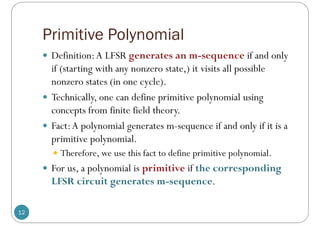
 Definition:A LFSR generates an m-sequence if and only
if (starting with any nonzero state,) it visits all possible
nonzero states (in one cycle).
 Technically, one can define primitive polynomial using
concepts from finite field theory.
 Fact:A polynomial generates m-sequence if and only if it is a
primitive polynomial.
 Therefore, we use this fact to define primitive polynomial.
 For us, a polynomial is primitive if the corresponding
LFSR circuit generates m-sequence.
Sample Exam Question
13
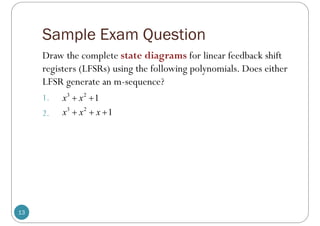
Draw the complete state diagrams for linear feedback shift
registers (LFSRs) using the following polynomials. Does either
LFSR generate an m-sequence?
1.
2.
3 2
1
x x
 
3 2
1
x x x
  
Nonmaximal linear feedback shift
register
14
[Torrieri , 2005, Fig 2.8]
3 2
1
x x x
  
m-Sequences: More properties
15
1. The contents of the shift register will cycle over all possible 2r-1 nonzero states
before repeating.
2. Contain one more 1 than 0 (Slightly unbalanced)
3. Shift-and-add property: Sum of two (cyclic-)shifted m-sequences is
another (cyclic-)shift of the same m-sequence
4. If a window of width r is slid along an m-sequence for N = 2r-1 shifts, each r-
tuple except the all-zeros r-tuple will appear exactly once
5. For any m-sequence, there are
 One run of ones of length r
 One run of zeros of length r-1
 One run of ones and one run of zeroes of length r-2
 Two runs of ones and two runs of zeros of length r-3
 Four runs of ones and four runs of zeros of length r-4
 …
 2r-3 runs of ones and 2r-3 runs of zeros of length 1
[S.W. Golomb, Shift Register Sequences,Holden-Day, San Francisco, 1967.]
Ex: Properties of m-sequence
16
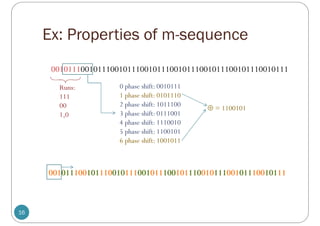
00101110010111001011100101110010111001011100101110010111
00101110010111001011100101110010111001011100101110010111
0 phase shift: 0010111
1 phase shift: 0101110
2 phase shift: 1011100
3 phase shift: 0111001
4 phase shift: 1110010
5 phase shift: 1100101
6 phase shift: 1001011
Runs:
111
00
1,0
 = 1100101
Ex: Properties of m-sequence (con’t)
17
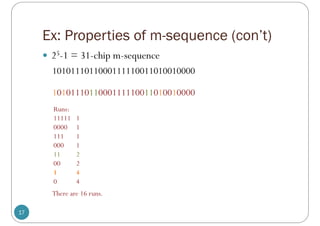
 25-1 = 31-chip m-sequence
1010111011000111110011010010000
Runs:
11111 1
0000 1
111 1
000 1
11 2
00 2
1 4
0 4
There are 16 runs.
1010111011000111110011010010000
m-Sequences (con’t)
18
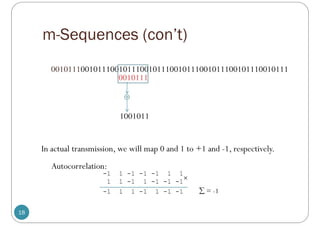
00101110010111001011100101110010111001011100101110010111
0010111

1001011
In actual transmission, we will map 0 and 1 to +1 and -1, respectively.
-1 1 -1 -1 -1 1 1
1 1 -1 1 -1 -1 -1
-1 1 1 -1 1 -1 -1

 = -1
Autocorrelation:
Autocorrelation and PSD
19
 (Normalized) autocorrelations of maximal sequence and
random binary sequence.
 Power spectral density of maximal sequence.
[Torrieri , 2005, Fig 2.9]
[Torrieri , 2005, Fig 2.10]
References: m-sequences
20
 Karim and Sarraf, W-CDMA and
cdma2000 for 3G Mobile Networks,
2002.
 Page 84-90
 Viterbi, CDMA:Principles of Spread
Spectrum Communication, 1995
 Chapter 1 and 2
 Goldsmith, Wireless Communications,
2005
 Chapter 13
 Tse andViswanath, Fundamentals of
Wireless Communication, 2005
 Section 3.4.3
[TK5103.452 K37 2002]
[TK5103.45V57 1995]

kasami spreading code example with explanation.pdf

  • 1.
    1 ECS455: Chapter 4 MultipleAccess 4.5 m-sequence Dr.Prapun Suksompong prapun.com/ecs455 Office Hours: BKD 3601-7 Tuesday 9:30-10:30 Tuesday 13:30-14:30 Thursday 13:30-14:30
  • 2.
    Binary Random Sequences 2 While DSSS chip sequences must be generated deterministically, properties of binary random sequences are useful to gain insight into deterministic sequence design.  A random binary chip sequences consists of i.i.d. bit values with probability one half for a one or a zero.  Also known as Bernoulli sequences/trials,“coin-flipping” sequences  A random sequence of length N can be generated, for example, by flipping a fair coin N times and then setting the bit to a one for heads and a zero for tails.
  • 3.
    Binary Random Sequence 3 X-4X-3 X-2 X-1 X-0 X1 X2 X3 X4 Coin-flipping sequence H H T H H T H T T Bernoulli trials/sequence 1 1 0 1 1 0 1 0 0 Binary (indp.) random sequence -1 -1 1 -1 -1 1 -1 1 1  These names are simply many versions of the same sequence/process.  You should be able to convert one version to others easily.  Some properties are conveniently explained when the sequence is expressed in a particular version.
  • 4.
    Properties of BinaryRandom Sequences 4
  • 5.
    Key randomness properties 5 [Golomb,1967][Viterbi, 1995, p. 12] Binary random sequences with length N asymptotically large have a number of the properties desired in spreading codes  Balanced property: Equal number of ones and zeros.  Should have no DC component to avoid a spectral spike at DC or biasing the noise in despreading  Run length property:The run length is generally short.  half of all runs are of length 1  a fraction 1/2n of all runs are of length n  Long runs reduce the BW spreading and its advantages  Shift property: If they are shifted by any nonzero number of elements, the resulting sequence will have half its elements the same as in the original sequence, and half its elements different from the original sequence. (Geometric) Note:A run is a subsequence of identical symbols within the sequence. [Goldsmith,2005, p. 387 &Viterbi, p. 12]
  • 6.
    Pseudorandom Sequence 6  Adeterministic sequence that has the balanced, run length, and shift properties as it grows asymptotically large is referred to as a pseudorandom sequence (noiselike or pseudonoise (PN) signal).  Ideally, one would prefer a random binary sequence as the spreading sequence.  However, practical synchronization requirements in the receiver force one to use periodic Pseudorandom binary sequences.  m-sequences  Gold codes  Kasami sequences  Quaternary sequences  Walsh functions
  • 7.
    m-Sequences 7  Maximal-length sequences A type of cyclic code  Generated and characterized by a generator polynomial  Properties can be derived using algebraic coding theory  Simple to generate with linear feedback shift-register (LFSR) circuits  Automated  Approximate a random binary sequence.  Disadvantage: Relatively easy to intercept and regenerate by an unintended receiver [Ziemer, 2007, p 11] [Goldsmith, 2005, p 387] Longer name: Maximal length linear shift register sequence.
  • 8.
    m-sequence generator (1) 8 Start with a “primitive polynomial”  The feedback taps in the feedback shift register are selected to correspond to the coefficients of the primitive polynomial. CLK The gi’s are coefficients of a primitive polynomial. 1 signifies closed or a connection and 0 signifies open or no connection. (Degree: r = 3  use 3 flip-flops) (See Section 13.4.1 in [Lathi, 1998]) 2 3 1 0 1 1 x x x    
  • 9.
    GF(2) 9  Galois field(finite field) of two elements  Consist of  the symbols 0 and 1 and  the (binary) operations of  modulo-2 addition (XOR) and  modulo-2 multiplication.  The operations are defined by
  • 10.
    m-sequence generator (2) 10 Binary sequences drawn from the alphabet {0,1} are shifted through the shift register in response to clock pulses.  Each clock time, the register shifts all its contents to the right.  The particular 1s and 0s occupying the shift register stages after a clock pulse are called states. CLK The gi’s are coefficients of a primitive polynomial. 1 signifies closed or a connection and 0 signifies open or no connection. (Degree: r = 3) (See Section 13.4.1 in [Lathi, 1998]) 2 3 1 0 1 1 x x x    
  • 11.
  • 12.
    Primitive Polynomial 12  Definition:ALFSR generates an m-sequence if and only if (starting with any nonzero state,) it visits all possible nonzero states (in one cycle).  Technically, one can define primitive polynomial using concepts from finite field theory.  Fact:A polynomial generates m-sequence if and only if it is a primitive polynomial.  Therefore, we use this fact to define primitive polynomial.  For us, a polynomial is primitive if the corresponding LFSR circuit generates m-sequence.
  • 13.
    Sample Exam Question 13 Drawthe complete state diagrams for linear feedback shift registers (LFSRs) using the following polynomials. Does either LFSR generate an m-sequence? 1. 2. 3 2 1 x x   3 2 1 x x x   
  • 14.
    Nonmaximal linear feedbackshift register 14 [Torrieri , 2005, Fig 2.8] 3 2 1 x x x   
  • 15.
    m-Sequences: More properties 15 1.The contents of the shift register will cycle over all possible 2r-1 nonzero states before repeating. 2. Contain one more 1 than 0 (Slightly unbalanced) 3. Shift-and-add property: Sum of two (cyclic-)shifted m-sequences is another (cyclic-)shift of the same m-sequence 4. If a window of width r is slid along an m-sequence for N = 2r-1 shifts, each r- tuple except the all-zeros r-tuple will appear exactly once 5. For any m-sequence, there are  One run of ones of length r  One run of zeros of length r-1  One run of ones and one run of zeroes of length r-2  Two runs of ones and two runs of zeros of length r-3  Four runs of ones and four runs of zeros of length r-4  …  2r-3 runs of ones and 2r-3 runs of zeros of length 1 [S.W. Golomb, Shift Register Sequences,Holden-Day, San Francisco, 1967.]
  • 16.
    Ex: Properties ofm-sequence 16 00101110010111001011100101110010111001011100101110010111 00101110010111001011100101110010111001011100101110010111 0 phase shift: 0010111 1 phase shift: 0101110 2 phase shift: 1011100 3 phase shift: 0111001 4 phase shift: 1110010 5 phase shift: 1100101 6 phase shift: 1001011 Runs: 111 00 1,0  = 1100101
  • 17.
    Ex: Properties ofm-sequence (con’t) 17  25-1 = 31-chip m-sequence 1010111011000111110011010010000 Runs: 11111 1 0000 1 111 1 000 1 11 2 00 2 1 4 0 4 There are 16 runs. 1010111011000111110011010010000
  • 18.
    m-Sequences (con’t) 18 00101110010111001011100101110010111001011100101110010111 0010111  1001011 In actualtransmission, we will map 0 and 1 to +1 and -1, respectively. -1 1 -1 -1 -1 1 1 1 1 -1 1 -1 -1 -1 -1 1 1 -1 1 -1 -1   = -1 Autocorrelation:
  • 19.
    Autocorrelation and PSD 19 (Normalized) autocorrelations of maximal sequence and random binary sequence.  Power spectral density of maximal sequence. [Torrieri , 2005, Fig 2.9] [Torrieri , 2005, Fig 2.10]
  • 20.
    References: m-sequences 20  Karimand Sarraf, W-CDMA and cdma2000 for 3G Mobile Networks, 2002.  Page 84-90  Viterbi, CDMA:Principles of Spread Spectrum Communication, 1995  Chapter 1 and 2  Goldsmith, Wireless Communications, 2005  Chapter 13  Tse andViswanath, Fundamentals of Wireless Communication, 2005  Section 3.4.3 [TK5103.452 K37 2002] [TK5103.45V57 1995]