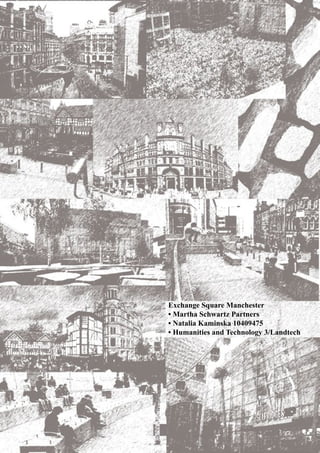
Exchange Square Manchester
• Martha Schwartz Partners
• Natalia Kaminska 10409475
• Humanities and Technology 3/Landtech
Site history, background and planning context
Exchange Square is situated in
Manchester city centre. It is near to
Victoria Station, Printworks and Arndale
shopping centre. The square is
surrounded by the Corn Exchange,
Marks & Spencer and Cathedral.
In the past there was no
Exchange Square. It was built after the
IRA bomb explosion in 1996, which
devastated big part of city centre.1
As a result of a huge range of breakage
caused, many buildings were damaged.
In this case many of them had to be
demolished. Fortunately, some of them
were restored or partly reconstructed.
The bomb was placed in a truck near
Arndale centre. It was Saturday so many
people were shopping in there.
Approximately 80,000 lives were
in danger. The successful police action,
preceded by phone call informed about
the threat, caused that there was no
people killed.2
Many citizens were
injured by falling glass from crashed
windows and glass buildings elements.
1 http://manchesterhistory.net/manchester/squares/ex-
changesquare.html
2 http://www.manchester.com/features/bombboom/
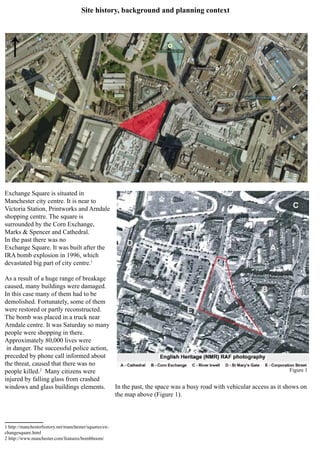
In the past, the space was a busy road with vehicular access as it shows on
the map above (Figure 1).
Figure 1
Site history, background and planning context
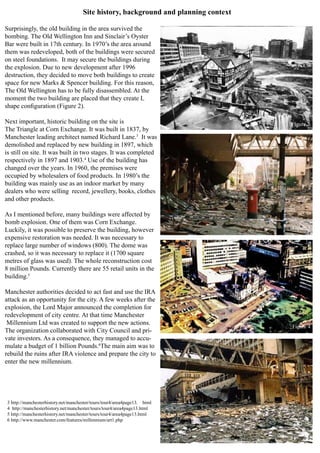
Surprisingly, the old building in the area survived the
bombing. The Old Wellington Inn and Sinclair’s Oyster
Bar were built in 17th century. In 1970’s the area around
them was redeveloped, both of the buildings were secured
on steel foundations. It may secure the buildings during
the explosion. Due to new development after 1996
destruction, they decided to move both buildings to create
space for new Marks & Spencer building. For this reason,
The Old Wellington has to be fully disassembled. At the
moment the two building are placed that they create L
shape configuration (Figure 2).
Next important, historic building on the site is
The Triangle at Corn Exchange. It was built in 1837, by
Manchester leading architect named Richard Lane.3
It was
demolished and replaced by new building in 1897, which
is still on site. It was built in two stages. It was completed
respectively in 1897 and 1903.4
Use of the building has
changed over the years. In 1960, the premises were
occupied by wholesalers of food products. In 1980’s the
building was mainly use as an indoor market by many
dealers who were selling record, jewellery, books, clothes
and other products.
As I mentioned before, many buildings were affected by
bomb explosion. One of them was Corn Exchange.
Luckily, it was possible to preserve the building, however
expensive restoration was needed. It was necessary to
replace large number of windows (800). The dome was
crashed, so it was necessary to replace it (1700 square
metres of glass was used). The whole reconstruction cost
8 million Pounds. Currently there are 55 retail units in the
building.5
Manchester authorities decided to act fast and use the IRA
attack as an opportunity for the city. A few weeks after the
explosion, the Lord Major announced the completion for
redevelopment of city centre. At that time Manchester
Millennium Ltd was created to support the new actions.
The organization collaborated with City Council and pri-
vate investors. As a consequence, they managed to accu-
mulate a budget of 1 billion Pounds.6
The main aim was to
rebuild the ruins after IRA violence and prepare the city to
enter the new millennium.
3 http://manchesterhistory.net/manchester/tours/tour4/area4page13. html
4 http://manchesterhistory.net/manchester/tours/tour4/area4page13.html
5 http://manchesterhistory.net/manchester/tours/tour4/area4page13.html
6 http://www.manchester.com/features/millennium/art1.php
Figure 2
Figure 3
Figure 4
Figure 5
Ownership, interests, stakeholders and procurement process
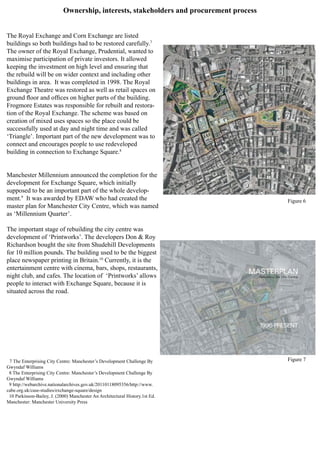
The Royal Exchange and Corn Exchange are listed
buildings so both buildings had to be restored carefully.7
The owner of the Royal Exchange, Prudential, wanted to
maximise participation of private investors. It allowed
keeping the investment on high level and ensuring that
the rebuild will be on wider context and including other
buildings in area. It was completed in 1998. The Royal
Exchange Theatre was restored as well as retail spaces on
ground floor and offices on higher parts of the building.
Frogmore Estates was responsible for rebuilt and restora-
tion of the Royal Exchange. The scheme was based on
creation of mixed uses spaces so the place could be
successfully used at day and night time and was called
‘Triangle’. Important part of the new development was to
connect and encourages people to use redeveloped
building in connection to Exchange Square.8
Manchester Millennium announced the completion for the
development for Exchange Square, which initially
supposed to be an important part of the whole develop-
ment.9
It was awarded by EDAW who had created the
master plan for Manchester City Centre, which was named
as ‘Millennium Quarter’.
The important stage of rebuilding the city centre was
development of ‘Printworks’. The developers Don & Roy
Richardson bought the site from Shudehill Developments
for 10 million pounds. The building used to be the biggest
place newspaper printing in Britain.10
Currently, it is the
entertainment centre with cinema, bars, shops, restaurants,
night club, and cafes. The location of ‘Printworks’ allows
people to interact with Exchange Square, because it is
situated across the road.
7 The Enterprising City Centre: Manchester’s Development Challenge By
Gwyndaf Williams
8 The Enterprising City Centre: Manchester’s Development Challenge By
Gwyndaf Williams
9 http://webarchive.nationalarchives.gov.uk/20110118095356/http://www.
cabe.org.uk/case-studies/exchange-square/design
10 Parkinson-Bailey, J. (2000) Manchester An Architectural History.1st Ed.
Manchester: Manchester University Press
Figure 6
Figure 7
Design team (Landscape Architects and other related professions)
Four schemes were submitted in 1997. All of them were
rejected my Manchester Millennium Ltd. These schemes
were based on water features, level changes and hard
surfaces. Unfortunately, none of it fit into the overall
concept of the site generated by Manchester Millennium.
Under those circumstances, the organization decided to
announce the competition again. Martha Schwartz Partners
was chosen and asked for collaboration. The team was led
by her and the design was based on level changes between
Corn Exchange and the new Selfridges building. The plaza
created by laying out changing levels was interesting
proposal which was approved.
The design team included:
Tricia Bales- Landscape Architect
Evelyn Bergalia- Landscape Architect
Scott Carmen- Landscape Architect
Lital Fabian- Landscape Architect
Shauna Gillies-Smith- Landscape Architect
Raphael Justewicz- Landscape Architect
Paula Meijerink- Landscape Architect
Wes Michaels- Landscape Architect
Martha Schwartz-Principal
Don Sharp- Landscape Architect
Michael Blier-responsible for perspevtive renderings11
James Chapman- Architect.
The bridge connecting Arndale and Marks & Spencer had
to be demolished, because it was affected by explosion.
The new bridge was built in 1999 by Hodder Associates
and Ove Arup. It is made of glass and shaped as a big
tube.12
The area of the project covers 1 hectare of land.
11 http://kiyokoo.exblog.jp/2332950/
12 Parkinson-Bailey, J. (2000) Manchester An Architectural History.1st Ed.
Manchester: Manchester University Press.
Figure 8
Figure 9
Figure 10
Figure 11
Figure 12
Figure 13
Figure 14
Overall concept, aims and design development process
The design of Exchange Square is based on several
objectives.
Main point was to create a public space in the central
part of the city, which would be able to accommodate big
events.
Moreover, it was important to design contemporary and
unforgettable space by using various elements like light-
ing, street furniture, vegetation, water features, etc.
Also to improve pedestrian movement on site and
create communal space where people can meet, chat and
rest.
Another important aspect was to create a new space with
respect to historic buildings around. Finally, it was
a huge focus on dealing with level changes (3m) between
New Cathedral Street and spaces on the north part
(entrance to Marks & Spencer).13
Above all, the designers put big emphasis on connect-
ing historic parts with modern one so city centre could be
represented as a one structure.14
The curves were applied in the whole scheme, which
allowed use the space to the maximum. Ramps in line
with walls on one level organise the site and designate the
movement. At first, there was the idea that walls will be
implemented with boxes filled with industrial elements.
The reason for that idea was to connect the space with
Manchester’s industrial history. The idea was rejected
by City Council, because it was the possibility that vandals
will demolish it.
The design process does not run smoothly and were dis-
puted in some disputes. One of them was Schwartz’s idea
of erection palm trees on the site. It was diminish from the
scheme in 1999. Palm trees were replaced by steel
windmills which were designed by artist called
John Hyatt. He is the Director of Manchester Institute for
Research In Art and Design and Professor at Manchester
School of Art.15
Martha Schwartz and Partners did not take
part into this change, because they were not involved into
the final stages of the project.
13 Williams, G. (2003) The Enterprising City Centre: Manchester’s Develop-
ment Challenge. 1st Ed. New York: Spoon Press.
14 Waugh, E. Recycling Spaces Curating Urban Evolution: The Landscape
Design of Martha Schwartz Partners.
15http://www.art.mmu.ac.uk/profile/jhyatt
Figure 15
Figure 16
Figure 17
MOUNT ST
Manchester
Victoria
Deansgate
Manchester
Oxford Road
statues
River Irwell
Rochdale
Canal
RiverMedlock
Parsonage
Gardens
Piccadilly
Gardens
Opera House
PalaceTheatre
Great Northern
Manchester
Central
Midland
Hotel
Town Hall
St Ann’s
Church
Royal
Exchange
Manchester
Arndale
The
Printworks
Shudehill
Interchange
Co-op
Building
Corn
Exchange
Manchester
Arena
Manchester
Cathedral
Chetham’s
School of Music
M&S
National
Football
MuseumSelfridges
Friends’
Meeting
House
Central
Library
Bridgewater
Hall
Beetham
Tower
Deansgate-
Castlefield
St Peter’s
Square
Piccadilly
Gardens
Market
Street
Shudehill
Victoria
Spinningfields
Chinatown
Northern
Quarter
Exchange
Square
SOUTHKINGST
CHEETHAM HILL RD
CHEETHAM
HILLRD
TRINITY
WAY
DEANSGATE
DEANSGATE
DEANSGATE
VICTORIA ST
GREAT
DUCIE
ST
CHAPEL
STREET
CHURCHSTREET
HIGH
STREET SHUDEHILL
ROCHDALE RD
SWANSTREET
VICTORIABRST
CROSS
STREET
CORPORATION STREET
PRINCESS
STREET
PRINCESS
STREET
BRIDGE
STREET
JOHNDALTONST
PORTLAND STREET
PORTLAND
STREET
NEWTON STREET
LEVER
STREET
DALE
STREET
QUAYSTREET
PETER
STREET
PETERST
OXFORD
STREET
WHITWORTHSTREETWEST
WHITWORTH
STREET
WEST
ALBION
STREET
LOWER MOSLEY
STREET
LIVERPOOLRD
BLACKFRIARSSTREET
GREENGATE
PICCADILLY
OLDHAM
STREET
GREAT
BRIDGEWATER
WINDMILLSTREET
MUSEUM ST
BOOTLE
STREET
CENTRALST
LLOY
D ST
LLOYD
STREET
BRAZENNOSE
STREET
SOUTHMILL
ST
LIBRARYWALK
TASLEALLEY
CHEPSTOW
ST
GREATBRID
GEW
ATE
R
ST
KING
ST
KINGST
MARKETST
BOWLA
BOOTHSTTIB
LA
FOUR
MARSDENST
CHEAPSIDE
ESSEX ST
STANNST
YARDS
NEWMARKET
CHAPEL
WALKS
BANKSTOLD
MOONHALF
ST
STMARY’S
GATE
MARKETST
NEW CATHEDRAL ST
FENNELST
LONG MILLG
ATETODD
S
T
STATIONAPPROACH
HUNT’S BANK
WITHYGROVE
BALLOONST
MILLGATE
LONG
HANOVERSTREET
WHITWORTH
STREET
BARBIROLLI
SQUARE
ST ANN’S
SQUARE
ALBERT SQUARE
VICTORIA
AYTOUNST
STREET
B’WATER VIADUCT
DEANSGATE
EXCHANGE
SQ
THEAVENUE
ANGEL
STREET
MILLERSTREET
Second City Crossing
Second City Crossing & proposed new stop location
Existing Metrolink & stop
© Crown copyright and database rights 2011 Ordnance Survey 0100022610.
Use of this data is subject to terms and conditions. You are granted a
non-exclusive, royalty free, revocable licence solely to view the Licensed Data
for non-commercial purposes for the period during which Transport for Greater
Manchester makes it available; you are not permitted to copy, sub-license,
distribute, sell or otherwise make available the Licensed Data to third parties
in any form; and third party rights to enforce the terms of this licence shall be
reserved to Ordnance Survey
© Transport for Greater Manchester 2013 11-0331-131415
N
Transport
forGreater
Manchester
Transport
forGreater
Manchester
Transport
forGreater
Manchester
Transport
forGreater
Manchester
Overall concept, aims and design development process
In 2003 the big screen was added to the site (is hanging
on the Triangle’s wall, facing the ramps). For this reason
more people visit the site. They usually gather in a big
number when want to watch important sport event like
Olympics or national events. It increases the use of the
space as well as community life and social interactions.
On the other hand, many people treat the space as an out-
door cinema, rather than space to sit and relax. Before the
screen was installed, users were sitting in both directions
and observe what is happening around. At the moment
they are directed to the screen only.16
The original design had to be changed slightly, because
of the practical reasons. Sloping ramps would be the ideal
space for skaters. The Council wanted to prevent that so
steel arms was installed on seats.
The overall layout and functions of the site may change in
the future, because the new development was planned.
The Metrolink connection started to be developed between
Exchange Square and Arndale entrance. It supposed to be
done and open in 2015.17
Undoubtedly, it will change the site usage. More people
will visit it, because of the Metrolink location. Moreover,
it will facilitate access to shops for people living away
from city centre.
16 http://webarchive.nationalarchives.gov.uk/20110118095356/http://www.
cabe.org.uk/case-studies/exchange-square/evaluation
17 http://www.tfgm.com/Corporate/Consultations/Metrolink2cc/
Documents/11-0593-Metrolink-2CC-Easy-Read.pdf
Figure 18
Photograph taken by author
Figure 19
Visualisation of Metrolink
Figure 20
Map showing new Metrolink connection
Figure 18
Figure 19
Figure 20
Design analysis
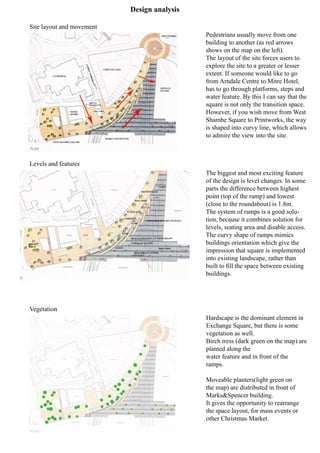
Pedestrians usually move from one
building to another (as red arrows
shows on the map on the left).
The layout of the site forces users to
explore the site to a greater or lesser
extent. If someone would like to go
from Arndale Centre to Mitre Hotel,
has to go through platforms, steps and
water feature. By this I can say that the
square is not only the transition space.
However, if you wish move from West
Shambe Square to Printworks, the way
is shaped into curvy line, which allows
to admire the view into the site.
The biggest and most exciting feature
of the design is level changes. In some
parts the difference between highest
point (top of the ramp) and lowest
(close to the roundabout) is 1.8m.
The system of ramps is a good solu-
tion, because it combines solution for
levels, seating area and disable access.
The curvy shape of ramps mimics
buildings orientation which give the
impression that square is implemented
into existing landscape, rather than
built to fill the space between existing
buildings.
Hardscape is the dominant element in
Exchange Square, but there is some
vegetation as well.
Birch tress (dark green on the map) are
planted along the
water feature and in front of the
ramps.
Moveable planters(light green on
the map) are distributed in front of
Marks&Spencer building.
It gives the opportunity to rearrange
the space layout, for mass events or
other Christmas Market.
Site layout and movement
Levels and features
Vegetation
Location of design features
Stairs with seats, looking towards
historic pubs.
Movable planters.
Water feature.
River Birch trees.
Movable seats.
Ramp with glass railings
and seats.
Sandstone.
System of benches build on railings.
Figure 21
Figure 22
Figure 23
Figure 24
Figure 25
Figure 26
Figure 27
Figure 28
Design analysis: materials and techniques
Paving.
Sandstone paving, convex stone
(warns the blond people) and stones
with water.
Water jets surrounded by stones.
Trench drain.
Sandstone seats with steel railings.
Sandstone.
Three different materials meet.
Figure 29
Figure 30
Figure 31
Figure 32
Figure 33
Figure 34
Figure 35
Design analysis, including: functions of elements
Stairs connecting New Cathedral Street and pub
area. Also contains seats.
Water feature separated from ramp by stone wall.
The favourite feature of children.
Steel windmills. Element reffeing to
Manchester’s industrial history.
Moveable planters.Provide green aspect on the
site. Allows to plant new vegetation without dam-
ages to site layout.
Moveable benches on rails. Allows to rearrange
space.
Main ramp. Leads from stairs (Figure 36) through
whole site.
Figure 36
Figure 37
Figure 38
Figure 39
Figure 40
Figure 41
Sketches
Site layout
Water feature Corn Exchange-Triangle
Management and condition
Figure 42
Figure 43
Figure 44
Figure 45
Despite the fact that the majority of the site is cov-
ered by hardscape, it require constant
management. Usually, spaces with lots of greenery
has to be maintained every day.
Due to high usage, it is necessary to remove dirt
and chewing gums from seats. The stone is in light
colour so stains and dirt are easily visible.
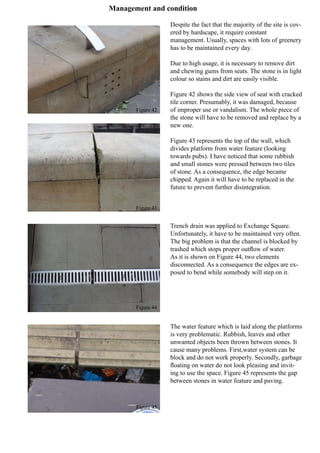
Figure 42 shows the side view of seat with cracked
tile corner. Presumably, it was damaged, because
of improper use or vandalism. The whole piece of
the stone will have to be removed and replace by a
new one.
Figure 43 represents the top of the wall, which
divides platform from water feature (looking
towards pubs). I have noticed that some rubbish
and small stones were pressed between two tiles
of stone. As a consequence, the edge became
chipped. Again it will have to be replaced in the
future to prevent further disintegration.
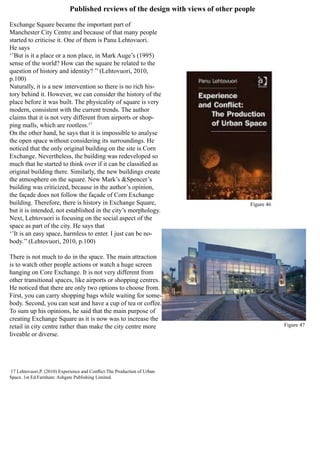
Trench drain was applied to Exchange Square.
Unfortunately, it have to be maintained very often.
The big problem is that the channel is blocked by
trashed which stops proper outflow of water.
As it is shown on Figure 44, two elements
disconnected. As a consequence the edges are ex-
posed to bend while somebody will step on it.
The water feature which is laid along the platforms
is very problematic. Rubbish, leaves and other
unwanted objects been thrown between stones. It
cause many problems. First,water system can be
block and do not work properly. Secondly, garbage
floating on water do not look pleasing and invit-
ing to use the space. Figure 45 represents the gap
between stones in water feature and paving.
Published reviews of the design with views of other people
Exchange Square became the important part of
Manchester City Centre and because of that many people
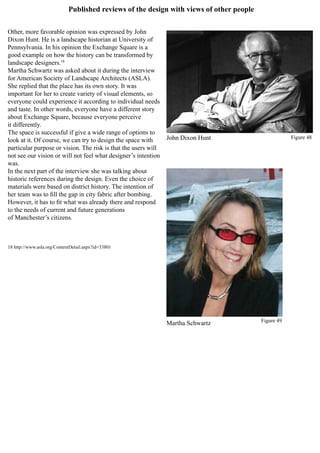
started to criticise it. One of them is Panu Lehtovuori.
He says
‘’But is it a place or a non place, in Mark Auge’s (1995)
sense of the world? How can the square be related to the
question of history and identity? ’’ (Lehtovuori, 2010,
p.100)
Naturally, it is a new intervention so there is no rich his-
tory behind it. However, we can consider the history of the
place before it was built. The physicality of square is very
modern, consistent with the current trends. The author
claims that it is not very different from airports or shop-
ping malls, which are rootless.17
On the other hand, he says that it is impossible to analyse
the open space without considering its surroundings. He
noticed that the only original building on the site is Corn
Exchange. Nevertheless, the building was redeveloped so
much that he started to think over if it can be classified as
original building there. Similarly, the new buildings create
the atmosphere on the square. New Mark’s &Spencer’s
building was criticized, because in the author’s opinion,
the façade does not follow the façade of Corn Exchange
building. Therefore, there is history in Exchange Square,
but it is intended, not established in the city’s morphology.
Next, Lehtovuori is focusing on the social aspect of the
space as part of the city. He says that
‘’It is an easy space, harmless to enter. I just can be no-
body.’’ (Lehtovuori, 2010, p.100)
There is not much to do in the space. The main attraction
is to watch other people actions or watch a huge screen
hanging on Core Exchange. It is not very different from
other transitional spaces, like airports or shopping centres.
He noticed that there are only two options to choose from.
First, you can carry shopping bags while waiting for some-
body. Second, you can seat and have a cup of tea or coffee.
To sum up his opinions, he said that the main purpose of
creating Exchange Square as it is now was to increase the
retail in city centre rather than make the city centre more
liveable or diverse.
17 Lehtovuori,P. (2010) Experience and Conflict:The Production of Urban
Space. 1st Ed.Farnham: Ashgate Publishing Limited.
Figure 46
Figure 47
Published reviews of the design with views of other people
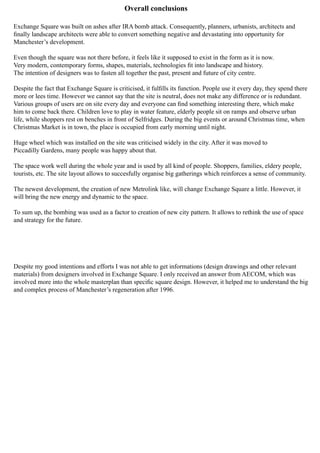
Other, more favorable opinion was expressed by John
Dixon Hunt. He is a landscape historian at University of
Pennsylvania. In his opinion the Exchange Square is a
good example on how the history can be transformed by
landscape designers.18
Martha Schwartz was asked about it during the interview
for American Society of Landscape Architects (ASLA).
She replied that the place has its own story. It was
important for her to create variety of visual elements, so
everyone could experience it according to individual needs
and taste. In other words, everyone have a different story
about Exchange Square, because everyone perceive
it differently.
The space is successful if give a wide range of options to
look at it. Of course, we can try to design the space with
particular purpose or vision. The risk is that the users will
not see our vision or will not feel what designer’s intention
was.
In the next part of the interview she was talking about
historic references during the design. Even the choice of
materials were based on district history. The intention of
her team was to fill the gap in city fabric after bombing.
However, it has to fit what was already there and respond
to the needs of current and future generations
of Manchester’s citizens.
18 http://www.asla.org/ContentDetail.aspx?id=33801
John Dixon Hunt
Martha Schwartz
Figure 48
Figure 49
Overall conclusions
Exchange Square was built on ashes after IRA bomb attack. Consequently, planners, urbanists, architects and
finally landscape architects were able to convert something negative and devastating into opportunity for
Manchester’s development.
Even though the square was not there before, it feels like it supposed to exist in the form as it is now.
Very modern, contemporary forms, shapes, materials, technologies fit into landscape and history.
The intention of designers was to fasten all together the past, present and future of city centre.
Despite the fact that Exchange Square is criticised, it fulfills its function. People use it every day, they spend there
more or lees time. However we cannot say that the site is neutral, does not make any difference or is redundant.
Various groups of users are on site every day and everyone can find something interesting there, which make
him to come back there. Children love to play in water feature, elderly people sit on ramps and observe urban
life, while shoppers rest on benches in front of Selfridges. During the big events or around Christmas time, when
Christmas Market is in town, the place is occupied from early morning until night.
Huge wheel which was installed on the site was criticised widely in the city. After it was moved to
Piccadilly Gardens, many people was happy about that.
The space work well during the whole year and is used by all kind of people. Shoppers, families, eldery people,
tourists, etc. The site layout allows to succesfully organise big gatherings which reinforces a sense of community.
The newest development, the creation of new Metrolink like, will change Exchange Square a little. However, it
will bring the new energy and dynamic to the space.
To sum up, the bombing was used as a factor to creation of new city pattern. It allows to rethink the use of space
and strategy for the future.
Despite my good intentions and efforts I was not able to get informations (design drawings and other relevant
materials) from designers involved in Exchange Square. I only received an answer from AECOM, which was
involved more into the whole masterplan than specific square design. However, it helped me to understand the big
and complex process of Manchester’s regeneration after 1996.
Bibliography
Lehtovuori,P. (2010) Experience and Conflict: The Production of Urban Space. 1st Ed.Farnham: Ashgate Publish-
ing Limited.
Parkinson-Bailey, J. (2000) Manchester An Architectural History.1st Ed. Manchester: Manchester University
Press.
Williams, G.(2003) The Enterprising City Centre: Manchester’s Development Challenge. 1st Ed. New York:
Spoon Press.
Waugh, E. Recycling Spaces Curating Urban Evolution: The Landscape Design of Martha Schwartz Partners.
http://www.rudi.net/books/10600
Figure 1 http://manchesterhistory.net/manchester/squares/exchangesquare.html
Figure 2 http://www.urban75.net/forums/threads/mundane-pictures-of-the-north.311170/page-109
Figure 3 http://www.manchestereveningnews.co.uk/business/business-news/bomb-to-boom---manchest
Figure 4 http://hyde1841.blogspot.co.uk/2013/01/manchester-early-1970s.html
Figure 5 http://citiesmcr.wordpress.com/2011/06/15/explosive-urbanism-fifteen-years-after-156/
Figure 6 Manchester’s masterplan, the courtesy of Holly Atkinson from AECOM
Figure 7 http://asla.org/awards/2006/06winners/224.html
Figure 8 http://www.manchester.gov.uk/
Figure 9 http://www.chapmantaylor.com/en/
Figure 10 http://www.aecom.com/
Figure 11 http://www.marthaschwartz.com/home/index.php
Figure 12 http://www.hodderandpartners.com/
Figure 13 http://www.hodderandpartners.com/people/tom-goldthorpe
Figure 14 http://www.hodderandpartners.com/people/tom-goldthorpe
Figure 15 http://www.bdonline.co.uk/high-spirits/5051267.article
Figure 16 http://kiyokoo.exblog.jp/2332950/
Figure 17 http://kiyokoo.exblog.jp/iv/detail/index.asp?s=2332950&i=200605/29/97/f0105797_8445252.jpg
Figure 18 Photography taken by author
Figure 19 stop http://www.tfgm.com/Corporate/Consultations/Metrolink2cc/Documents/11-0593-Metrolink-2CC-Easy-Read.pdf
Figure 20 http://www.railtechnologymagazine.com/Rail-News/manchester-metrolink-to-get-new-route-across-city-centre
Figure 21 Photography taken by author
Figure 22 Photography taken by author
Figure 23 Photography taken by author
Figure 24 Photography taken by author
Figure 25 http://emilywoodason.blogspot.co.uk/2007/03/exchange-square-martha-schwartz.html
Figure 26 Photography taken by author
Figure 27 Photography taken by author
Figure 28 http://webarchive.nationalarchives.gov.uk/20110118095356/http:/www.cabe.org.uk/case-studies/exchange-square
Figure 29 Photography taken by author
Figure 30 Photography taken by author
Figure 31 Photography taken by author
Figure 32 Photography taken by author
Figure 33 Photography taken by author
Figure 34 Photography taken by author
Figure 35 Photography taken by author
Figure 36 Photography taken by author
Figure 37 Photography taken by author
Figure 38 http://www.skyscrapercity.com/showthread.php?t=215799
Figure 39 Photography taken by author
Figure 40 http://brisbaneparkingday.blogspot.co.uk/2008_02_01_archive.html
Figure 41 Photography taken by author
Figure 42 Photography taken by author
Figure 43 Photography taken by author
Figure 44 Photography taken by author
Figure 45 Photography taken by author
Figure 46 http://www.bookdepository.co.uk/Experience-Conflict-Production-Urban-Space-Panu-Lehtovuori/9780754676027
Figure 47 http://www.stantonwilliams.com/projects/selfridges-manchester-central/
Figure 48 https://www.sas.upenn.edu/italians/people/hunt
Figure 49 http://www.gsd.harvard.edu/#/news/marthschwartz-nominated-for-fellowship-by-boston-society-of.html
Image reference

Kaminska 10409475 Exchange Square

  • 1.
    Exchange Square Manchester •Martha Schwartz Partners • Natalia Kaminska 10409475 • Humanities and Technology 3/Landtech
  • 2.
    Site history, backgroundand planning context Exchange Square is situated in Manchester city centre. It is near to Victoria Station, Printworks and Arndale shopping centre. The square is surrounded by the Corn Exchange, Marks & Spencer and Cathedral. In the past there was no Exchange Square. It was built after the IRA bomb explosion in 1996, which devastated big part of city centre.1 As a result of a huge range of breakage caused, many buildings were damaged. In this case many of them had to be demolished. Fortunately, some of them were restored or partly reconstructed. The bomb was placed in a truck near Arndale centre. It was Saturday so many people were shopping in there. Approximately 80,000 lives were in danger. The successful police action, preceded by phone call informed about the threat, caused that there was no people killed.2 Many citizens were injured by falling glass from crashed windows and glass buildings elements. 1 http://manchesterhistory.net/manchester/squares/ex- changesquare.html 2 http://www.manchester.com/features/bombboom/ In the past, the space was a busy road with vehicular access as it shows on the map above (Figure 1). Figure 1
  • 3.
    Site history, backgroundand planning context Surprisingly, the old building in the area survived the bombing. The Old Wellington Inn and Sinclair’s Oyster Bar were built in 17th century. In 1970’s the area around them was redeveloped, both of the buildings were secured on steel foundations. It may secure the buildings during the explosion. Due to new development after 1996 destruction, they decided to move both buildings to create space for new Marks & Spencer building. For this reason, The Old Wellington has to be fully disassembled. At the moment the two building are placed that they create L shape configuration (Figure 2). Next important, historic building on the site is The Triangle at Corn Exchange. It was built in 1837, by Manchester leading architect named Richard Lane.3 It was demolished and replaced by new building in 1897, which is still on site. It was built in two stages. It was completed respectively in 1897 and 1903.4 Use of the building has changed over the years. In 1960, the premises were occupied by wholesalers of food products. In 1980’s the building was mainly use as an indoor market by many dealers who were selling record, jewellery, books, clothes and other products. As I mentioned before, many buildings were affected by bomb explosion. One of them was Corn Exchange. Luckily, it was possible to preserve the building, however expensive restoration was needed. It was necessary to replace large number of windows (800). The dome was crashed, so it was necessary to replace it (1700 square metres of glass was used). The whole reconstruction cost 8 million Pounds. Currently there are 55 retail units in the building.5 Manchester authorities decided to act fast and use the IRA attack as an opportunity for the city. A few weeks after the explosion, the Lord Major announced the completion for redevelopment of city centre. At that time Manchester Millennium Ltd was created to support the new actions. The organization collaborated with City Council and pri- vate investors. As a consequence, they managed to accu- mulate a budget of 1 billion Pounds.6 The main aim was to rebuild the ruins after IRA violence and prepare the city to enter the new millennium. 3 http://manchesterhistory.net/manchester/tours/tour4/area4page13. html 4 http://manchesterhistory.net/manchester/tours/tour4/area4page13.html 5 http://manchesterhistory.net/manchester/tours/tour4/area4page13.html 6 http://www.manchester.com/features/millennium/art1.php Figure 2 Figure 3 Figure 4 Figure 5
  • 4.
    Ownership, interests, stakeholdersand procurement process The Royal Exchange and Corn Exchange are listed buildings so both buildings had to be restored carefully.7 The owner of the Royal Exchange, Prudential, wanted to maximise participation of private investors. It allowed keeping the investment on high level and ensuring that the rebuild will be on wider context and including other buildings in area. It was completed in 1998. The Royal Exchange Theatre was restored as well as retail spaces on ground floor and offices on higher parts of the building. Frogmore Estates was responsible for rebuilt and restora- tion of the Royal Exchange. The scheme was based on creation of mixed uses spaces so the place could be successfully used at day and night time and was called ‘Triangle’. Important part of the new development was to connect and encourages people to use redeveloped building in connection to Exchange Square.8 Manchester Millennium announced the completion for the development for Exchange Square, which initially supposed to be an important part of the whole develop- ment.9 It was awarded by EDAW who had created the master plan for Manchester City Centre, which was named as ‘Millennium Quarter’. The important stage of rebuilding the city centre was development of ‘Printworks’. The developers Don & Roy Richardson bought the site from Shudehill Developments for 10 million pounds. The building used to be the biggest place newspaper printing in Britain.10 Currently, it is the entertainment centre with cinema, bars, shops, restaurants, night club, and cafes. The location of ‘Printworks’ allows people to interact with Exchange Square, because it is situated across the road. 7 The Enterprising City Centre: Manchester’s Development Challenge By Gwyndaf Williams 8 The Enterprising City Centre: Manchester’s Development Challenge By Gwyndaf Williams 9 http://webarchive.nationalarchives.gov.uk/20110118095356/http://www. cabe.org.uk/case-studies/exchange-square/design 10 Parkinson-Bailey, J. (2000) Manchester An Architectural History.1st Ed. Manchester: Manchester University Press Figure 6 Figure 7
  • 5.
    Design team (LandscapeArchitects and other related professions) Four schemes were submitted in 1997. All of them were rejected my Manchester Millennium Ltd. These schemes were based on water features, level changes and hard surfaces. Unfortunately, none of it fit into the overall concept of the site generated by Manchester Millennium. Under those circumstances, the organization decided to announce the competition again. Martha Schwartz Partners was chosen and asked for collaboration. The team was led by her and the design was based on level changes between Corn Exchange and the new Selfridges building. The plaza created by laying out changing levels was interesting proposal which was approved. The design team included: Tricia Bales- Landscape Architect Evelyn Bergalia- Landscape Architect Scott Carmen- Landscape Architect Lital Fabian- Landscape Architect Shauna Gillies-Smith- Landscape Architect Raphael Justewicz- Landscape Architect Paula Meijerink- Landscape Architect Wes Michaels- Landscape Architect Martha Schwartz-Principal Don Sharp- Landscape Architect Michael Blier-responsible for perspevtive renderings11 James Chapman- Architect. The bridge connecting Arndale and Marks & Spencer had to be demolished, because it was affected by explosion. The new bridge was built in 1999 by Hodder Associates and Ove Arup. It is made of glass and shaped as a big tube.12 The area of the project covers 1 hectare of land. 11 http://kiyokoo.exblog.jp/2332950/ 12 Parkinson-Bailey, J. (2000) Manchester An Architectural History.1st Ed. Manchester: Manchester University Press. Figure 8 Figure 9 Figure 10 Figure 11 Figure 12 Figure 13 Figure 14
  • 6.
    Overall concept, aimsand design development process The design of Exchange Square is based on several objectives. Main point was to create a public space in the central part of the city, which would be able to accommodate big events. Moreover, it was important to design contemporary and unforgettable space by using various elements like light- ing, street furniture, vegetation, water features, etc. Also to improve pedestrian movement on site and create communal space where people can meet, chat and rest. Another important aspect was to create a new space with respect to historic buildings around. Finally, it was a huge focus on dealing with level changes (3m) between New Cathedral Street and spaces on the north part (entrance to Marks & Spencer).13 Above all, the designers put big emphasis on connect- ing historic parts with modern one so city centre could be represented as a one structure.14 The curves were applied in the whole scheme, which allowed use the space to the maximum. Ramps in line with walls on one level organise the site and designate the movement. At first, there was the idea that walls will be implemented with boxes filled with industrial elements. The reason for that idea was to connect the space with Manchester’s industrial history. The idea was rejected by City Council, because it was the possibility that vandals will demolish it. The design process does not run smoothly and were dis- puted in some disputes. One of them was Schwartz’s idea of erection palm trees on the site. It was diminish from the scheme in 1999. Palm trees were replaced by steel windmills which were designed by artist called John Hyatt. He is the Director of Manchester Institute for Research In Art and Design and Professor at Manchester School of Art.15 Martha Schwartz and Partners did not take part into this change, because they were not involved into the final stages of the project. 13 Williams, G. (2003) The Enterprising City Centre: Manchester’s Develop- ment Challenge. 1st Ed. New York: Spoon Press. 14 Waugh, E. Recycling Spaces Curating Urban Evolution: The Landscape Design of Martha Schwartz Partners. 15http://www.art.mmu.ac.uk/profile/jhyatt Figure 15 Figure 16 Figure 17
  • 7.
    MOUNT ST Manchester Victoria Deansgate Manchester Oxford Road statues RiverIrwell Rochdale Canal RiverMedlock Parsonage Gardens Piccadilly Gardens Opera House PalaceTheatre Great Northern Manchester Central Midland Hotel Town Hall St Ann’s Church Royal Exchange Manchester Arndale The Printworks Shudehill Interchange Co-op Building Corn Exchange Manchester Arena Manchester Cathedral Chetham’s School of Music M&S National Football MuseumSelfridges Friends’ Meeting House Central Library Bridgewater Hall Beetham Tower Deansgate- Castlefield St Peter’s Square Piccadilly Gardens Market Street Shudehill Victoria Spinningfields Chinatown Northern Quarter Exchange Square SOUTHKINGST CHEETHAM HILL RD CHEETHAM HILLRD TRINITY WAY DEANSGATE DEANSGATE DEANSGATE VICTORIA ST GREAT DUCIE ST CHAPEL STREET CHURCHSTREET HIGH STREET SHUDEHILL ROCHDALE RD SWANSTREET VICTORIABRST CROSS STREET CORPORATION STREET PRINCESS STREET PRINCESS STREET BRIDGE STREET JOHNDALTONST PORTLAND STREET PORTLAND STREET NEWTON STREET LEVER STREET DALE STREET QUAYSTREET PETER STREET PETERST OXFORD STREET WHITWORTHSTREETWEST WHITWORTH STREET WEST ALBION STREET LOWER MOSLEY STREET LIVERPOOLRD BLACKFRIARSSTREET GREENGATE PICCADILLY OLDHAM STREET GREAT BRIDGEWATER WINDMILLSTREET MUSEUM ST BOOTLE STREET CENTRALST LLOY D ST LLOYD STREET BRAZENNOSE STREET SOUTHMILL ST LIBRARYWALK TASLEALLEY CHEPSTOW ST GREATBRID GEW ATE R ST KING ST KINGST MARKETST BOWLA BOOTHSTTIB LA FOUR MARSDENST CHEAPSIDE ESSEX ST STANNST YARDS NEWMARKET CHAPEL WALKS BANKSTOLD MOONHALF ST STMARY’S GATE MARKETST NEW CATHEDRAL ST FENNELST LONG MILLG ATETODD S T STATIONAPPROACH HUNT’S BANK WITHYGROVE BALLOONST MILLGATE LONG HANOVERSTREET WHITWORTH STREET BARBIROLLI SQUARE ST ANN’S SQUARE ALBERT SQUARE VICTORIA AYTOUNST STREET B’WATER VIADUCT DEANSGATE EXCHANGE SQ THEAVENUE ANGEL STREET MILLERSTREET Second City Crossing Second City Crossing & proposed new stop location Existing Metrolink & stop © Crown copyright and database rights 2011 Ordnance Survey 0100022610. Use of this data is subject to terms and conditions. You are granted a non-exclusive, royalty free, revocable licence solely to view the Licensed Data for non-commercial purposes for the period during which Transport for Greater Manchester makes it available; you are not permitted to copy, sub-license, distribute, sell or otherwise make available the Licensed Data to third parties in any form; and third party rights to enforce the terms of this licence shall be reserved to Ordnance Survey © Transport for Greater Manchester 2013 11-0331-131415 N Transport forGreater Manchester Transport forGreater Manchester Transport forGreater Manchester Transport forGreater Manchester Overall concept, aims and design development process In 2003 the big screen was added to the site (is hanging on the Triangle’s wall, facing the ramps). For this reason more people visit the site. They usually gather in a big number when want to watch important sport event like Olympics or national events. It increases the use of the space as well as community life and social interactions. On the other hand, many people treat the space as an out- door cinema, rather than space to sit and relax. Before the screen was installed, users were sitting in both directions and observe what is happening around. At the moment they are directed to the screen only.16 The original design had to be changed slightly, because of the practical reasons. Sloping ramps would be the ideal space for skaters. The Council wanted to prevent that so steel arms was installed on seats. The overall layout and functions of the site may change in the future, because the new development was planned. The Metrolink connection started to be developed between Exchange Square and Arndale entrance. It supposed to be done and open in 2015.17 Undoubtedly, it will change the site usage. More people will visit it, because of the Metrolink location. Moreover, it will facilitate access to shops for people living away from city centre. 16 http://webarchive.nationalarchives.gov.uk/20110118095356/http://www. cabe.org.uk/case-studies/exchange-square/evaluation 17 http://www.tfgm.com/Corporate/Consultations/Metrolink2cc/ Documents/11-0593-Metrolink-2CC-Easy-Read.pdf Figure 18 Photograph taken by author Figure 19 Visualisation of Metrolink Figure 20 Map showing new Metrolink connection Figure 18 Figure 19 Figure 20
  • 8.
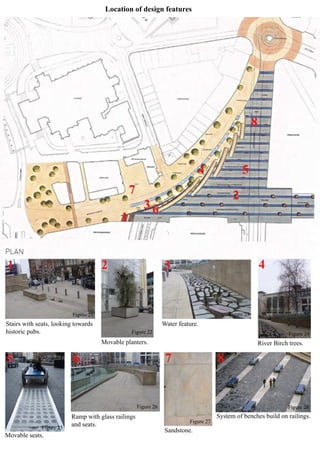
    Design analysis Pedestrians usuallymove from one building to another (as red arrows shows on the map on the left). The layout of the site forces users to explore the site to a greater or lesser extent. If someone would like to go from Arndale Centre to Mitre Hotel, has to go through platforms, steps and water feature. By this I can say that the square is not only the transition space. However, if you wish move from West Shambe Square to Printworks, the way is shaped into curvy line, which allows to admire the view into the site. The biggest and most exciting feature of the design is level changes. In some parts the difference between highest point (top of the ramp) and lowest (close to the roundabout) is 1.8m. The system of ramps is a good solu- tion, because it combines solution for levels, seating area and disable access. The curvy shape of ramps mimics buildings orientation which give the impression that square is implemented into existing landscape, rather than built to fill the space between existing buildings. Hardscape is the dominant element in Exchange Square, but there is some vegetation as well. Birch tress (dark green on the map) are planted along the water feature and in front of the ramps. Moveable planters(light green on the map) are distributed in front of Marks&Spencer building. It gives the opportunity to rearrange the space layout, for mass events or other Christmas Market. Site layout and movement Levels and features Vegetation
  • 9.
    Location of designfeatures Stairs with seats, looking towards historic pubs. Movable planters. Water feature. River Birch trees. Movable seats. Ramp with glass railings and seats. Sandstone. System of benches build on railings. Figure 21 Figure 22 Figure 23 Figure 24 Figure 25 Figure 26 Figure 27 Figure 28
  • 10.
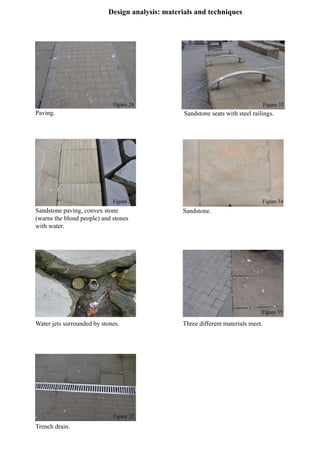
    Design analysis: materialsand techniques Paving. Sandstone paving, convex stone (warns the blond people) and stones with water. Water jets surrounded by stones. Trench drain. Sandstone seats with steel railings. Sandstone. Three different materials meet. Figure 29 Figure 30 Figure 31 Figure 32 Figure 33 Figure 34 Figure 35
  • 11.
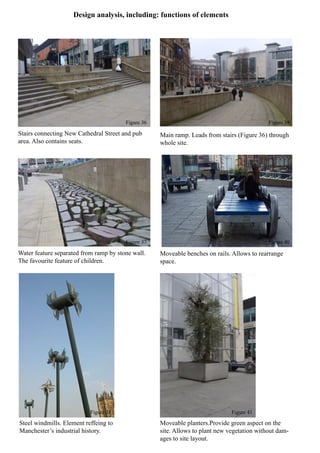
    Design analysis, including:functions of elements Stairs connecting New Cathedral Street and pub area. Also contains seats. Water feature separated from ramp by stone wall. The favourite feature of children. Steel windmills. Element reffeing to Manchester’s industrial history. Moveable planters.Provide green aspect on the site. Allows to plant new vegetation without dam- ages to site layout. Moveable benches on rails. Allows to rearrange space. Main ramp. Leads from stairs (Figure 36) through whole site. Figure 36 Figure 37 Figure 38 Figure 39 Figure 40 Figure 41
  • 12.
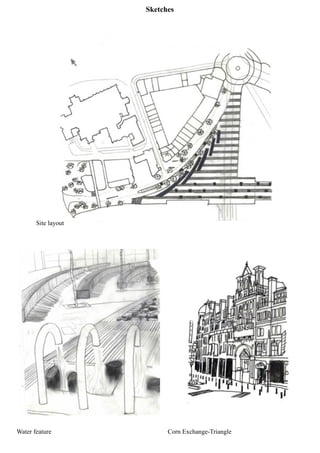
    Sketches Site layout Water featureCorn Exchange-Triangle
  • 13.
    Management and condition Figure42 Figure 43 Figure 44 Figure 45 Despite the fact that the majority of the site is cov- ered by hardscape, it require constant management. Usually, spaces with lots of greenery has to be maintained every day. Due to high usage, it is necessary to remove dirt and chewing gums from seats. The stone is in light colour so stains and dirt are easily visible. Figure 42 shows the side view of seat with cracked tile corner. Presumably, it was damaged, because of improper use or vandalism. The whole piece of the stone will have to be removed and replace by a new one. Figure 43 represents the top of the wall, which divides platform from water feature (looking towards pubs). I have noticed that some rubbish and small stones were pressed between two tiles of stone. As a consequence, the edge became chipped. Again it will have to be replaced in the future to prevent further disintegration. Trench drain was applied to Exchange Square. Unfortunately, it have to be maintained very often. The big problem is that the channel is blocked by trashed which stops proper outflow of water. As it is shown on Figure 44, two elements disconnected. As a consequence the edges are ex- posed to bend while somebody will step on it. The water feature which is laid along the platforms is very problematic. Rubbish, leaves and other unwanted objects been thrown between stones. It cause many problems. First,water system can be block and do not work properly. Secondly, garbage floating on water do not look pleasing and invit- ing to use the space. Figure 45 represents the gap between stones in water feature and paving.
  • 14.
    Published reviews ofthe design with views of other people Exchange Square became the important part of Manchester City Centre and because of that many people started to criticise it. One of them is Panu Lehtovuori. He says ‘’But is it a place or a non place, in Mark Auge’s (1995) sense of the world? How can the square be related to the question of history and identity? ’’ (Lehtovuori, 2010, p.100) Naturally, it is a new intervention so there is no rich his- tory behind it. However, we can consider the history of the place before it was built. The physicality of square is very modern, consistent with the current trends. The author claims that it is not very different from airports or shop- ping malls, which are rootless.17 On the other hand, he says that it is impossible to analyse the open space without considering its surroundings. He noticed that the only original building on the site is Corn Exchange. Nevertheless, the building was redeveloped so much that he started to think over if it can be classified as original building there. Similarly, the new buildings create the atmosphere on the square. New Mark’s &Spencer’s building was criticized, because in the author’s opinion, the façade does not follow the façade of Corn Exchange building. Therefore, there is history in Exchange Square, but it is intended, not established in the city’s morphology. Next, Lehtovuori is focusing on the social aspect of the space as part of the city. He says that ‘’It is an easy space, harmless to enter. I just can be no- body.’’ (Lehtovuori, 2010, p.100) There is not much to do in the space. The main attraction is to watch other people actions or watch a huge screen hanging on Core Exchange. It is not very different from other transitional spaces, like airports or shopping centres. He noticed that there are only two options to choose from. First, you can carry shopping bags while waiting for some- body. Second, you can seat and have a cup of tea or coffee. To sum up his opinions, he said that the main purpose of creating Exchange Square as it is now was to increase the retail in city centre rather than make the city centre more liveable or diverse. 17 Lehtovuori,P. (2010) Experience and Conflict:The Production of Urban Space. 1st Ed.Farnham: Ashgate Publishing Limited. Figure 46 Figure 47
  • 15.
    Published reviews ofthe design with views of other people Other, more favorable opinion was expressed by John Dixon Hunt. He is a landscape historian at University of Pennsylvania. In his opinion the Exchange Square is a good example on how the history can be transformed by landscape designers.18 Martha Schwartz was asked about it during the interview for American Society of Landscape Architects (ASLA). She replied that the place has its own story. It was important for her to create variety of visual elements, so everyone could experience it according to individual needs and taste. In other words, everyone have a different story about Exchange Square, because everyone perceive it differently. The space is successful if give a wide range of options to look at it. Of course, we can try to design the space with particular purpose or vision. The risk is that the users will not see our vision or will not feel what designer’s intention was. In the next part of the interview she was talking about historic references during the design. Even the choice of materials were based on district history. The intention of her team was to fill the gap in city fabric after bombing. However, it has to fit what was already there and respond to the needs of current and future generations of Manchester’s citizens. 18 http://www.asla.org/ContentDetail.aspx?id=33801 John Dixon Hunt Martha Schwartz Figure 48 Figure 49
  • 16.
    Overall conclusions Exchange Squarewas built on ashes after IRA bomb attack. Consequently, planners, urbanists, architects and finally landscape architects were able to convert something negative and devastating into opportunity for Manchester’s development. Even though the square was not there before, it feels like it supposed to exist in the form as it is now. Very modern, contemporary forms, shapes, materials, technologies fit into landscape and history. The intention of designers was to fasten all together the past, present and future of city centre. Despite the fact that Exchange Square is criticised, it fulfills its function. People use it every day, they spend there more or lees time. However we cannot say that the site is neutral, does not make any difference or is redundant. Various groups of users are on site every day and everyone can find something interesting there, which make him to come back there. Children love to play in water feature, elderly people sit on ramps and observe urban life, while shoppers rest on benches in front of Selfridges. During the big events or around Christmas time, when Christmas Market is in town, the place is occupied from early morning until night. Huge wheel which was installed on the site was criticised widely in the city. After it was moved to Piccadilly Gardens, many people was happy about that. The space work well during the whole year and is used by all kind of people. Shoppers, families, eldery people, tourists, etc. The site layout allows to succesfully organise big gatherings which reinforces a sense of community. The newest development, the creation of new Metrolink like, will change Exchange Square a little. However, it will bring the new energy and dynamic to the space. To sum up, the bombing was used as a factor to creation of new city pattern. It allows to rethink the use of space and strategy for the future. Despite my good intentions and efforts I was not able to get informations (design drawings and other relevant materials) from designers involved in Exchange Square. I only received an answer from AECOM, which was involved more into the whole masterplan than specific square design. However, it helped me to understand the big and complex process of Manchester’s regeneration after 1996.
  • 17.
    Bibliography Lehtovuori,P. (2010) Experienceand Conflict: The Production of Urban Space. 1st Ed.Farnham: Ashgate Publish- ing Limited. Parkinson-Bailey, J. (2000) Manchester An Architectural History.1st Ed. Manchester: Manchester University Press. Williams, G.(2003) The Enterprising City Centre: Manchester’s Development Challenge. 1st Ed. New York: Spoon Press. Waugh, E. Recycling Spaces Curating Urban Evolution: The Landscape Design of Martha Schwartz Partners. http://www.rudi.net/books/10600
  • 18.
    Figure 1 http://manchesterhistory.net/manchester/squares/exchangesquare.html Figure2 http://www.urban75.net/forums/threads/mundane-pictures-of-the-north.311170/page-109 Figure 3 http://www.manchestereveningnews.co.uk/business/business-news/bomb-to-boom---manchest Figure 4 http://hyde1841.blogspot.co.uk/2013/01/manchester-early-1970s.html Figure 5 http://citiesmcr.wordpress.com/2011/06/15/explosive-urbanism-fifteen-years-after-156/ Figure 6 Manchester’s masterplan, the courtesy of Holly Atkinson from AECOM Figure 7 http://asla.org/awards/2006/06winners/224.html Figure 8 http://www.manchester.gov.uk/ Figure 9 http://www.chapmantaylor.com/en/ Figure 10 http://www.aecom.com/ Figure 11 http://www.marthaschwartz.com/home/index.php Figure 12 http://www.hodderandpartners.com/ Figure 13 http://www.hodderandpartners.com/people/tom-goldthorpe Figure 14 http://www.hodderandpartners.com/people/tom-goldthorpe Figure 15 http://www.bdonline.co.uk/high-spirits/5051267.article Figure 16 http://kiyokoo.exblog.jp/2332950/ Figure 17 http://kiyokoo.exblog.jp/iv/detail/index.asp?s=2332950&i=200605/29/97/f0105797_8445252.jpg Figure 18 Photography taken by author Figure 19 stop http://www.tfgm.com/Corporate/Consultations/Metrolink2cc/Documents/11-0593-Metrolink-2CC-Easy-Read.pdf Figure 20 http://www.railtechnologymagazine.com/Rail-News/manchester-metrolink-to-get-new-route-across-city-centre Figure 21 Photography taken by author Figure 22 Photography taken by author Figure 23 Photography taken by author Figure 24 Photography taken by author Figure 25 http://emilywoodason.blogspot.co.uk/2007/03/exchange-square-martha-schwartz.html Figure 26 Photography taken by author Figure 27 Photography taken by author Figure 28 http://webarchive.nationalarchives.gov.uk/20110118095356/http:/www.cabe.org.uk/case-studies/exchange-square Figure 29 Photography taken by author Figure 30 Photography taken by author Figure 31 Photography taken by author Figure 32 Photography taken by author Figure 33 Photography taken by author Figure 34 Photography taken by author Figure 35 Photography taken by author Figure 36 Photography taken by author Figure 37 Photography taken by author Figure 38 http://www.skyscrapercity.com/showthread.php?t=215799 Figure 39 Photography taken by author Figure 40 http://brisbaneparkingday.blogspot.co.uk/2008_02_01_archive.html Figure 41 Photography taken by author Figure 42 Photography taken by author Figure 43 Photography taken by author Figure 44 Photography taken by author Figure 45 Photography taken by author Figure 46 http://www.bookdepository.co.uk/Experience-Conflict-Production-Urban-Space-Panu-Lehtovuori/9780754676027 Figure 47 http://www.stantonwilliams.com/projects/selfridges-manchester-central/ Figure 48 https://www.sas.upenn.edu/italians/people/hunt Figure 49 http://www.gsd.harvard.edu/#/news/marthschwartz-nominated-for-fellowship-by-boston-society-of.html Image reference