Manchester is a city in Greater Manchester, England, with a 2009 population estimate of 483,800, making it the seventh-most populous district in England. It has a rich industrial history and has transitioned to a service-based economy, being recognized as one of the fastest-growing cities in the UK. The city is known for its cultural contributions, including a vibrant music scene, numerous sporting events, and various educational institutions.
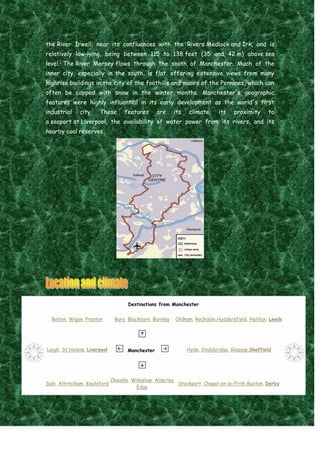
![is a city and metropolitan borough of Greater Manchester, England. In 2009, its population was estimated to be 483,800, making it the seventh-most populous local authority district in England. Manchester lies within one of the UK's largest metropolitan areas; the metropolitan county of Greater Manchester had an estimated population of 2,600,100, the Greater Manchester Urban Area a population of 2,240,230, and the Larger Urban Zone around Manchester, the second-most-populous in the UK, had an estimated population in the 2004 Urban Auditof 2,539,100.The demonym of Manchester is Mancunian.<br />At 53°28′0″N 2°14′0″W, 160 miles (257 km) northwest of London, Manchester lies in a bowl-shaped land area bordered to the north and east by the Pennines, a mountain chain that runs the length of northern England, and to the south by the Cheshire Plain. The city centre is on the east bank of the River Irwell, near its confluences with the Rivers Medlock and Irk, and is relatively low-lying, being between 115 to 138 feet (35 and 42 m) above sea level.] The River Mersey flows through the south of Manchester. Much of the inner city, especially in the south, is flat, offering extensive views from many highrise buildings in the city of the foothills and moors of the Pennines, which can often be capped with snow in the winter months. Manchester's geographic features were highly influential in its early development as the world's first industrial city. These features are its climate, its proximity to a seaport at Liverpool, the availability of water power from its rivers, and its nearby coal reserves.<br />Destinations from ManchesterBolton, Wigan, PrestonBury, Blackburn, BurnleyOldham, Rochdale,Huddersfield, Halifax, LeedsLeigh, HYPERLINK \"
http://en.wikipedia.org/wiki/St_Helens,_Merseyside\"
\o \"
St Helens, Merseyside\"
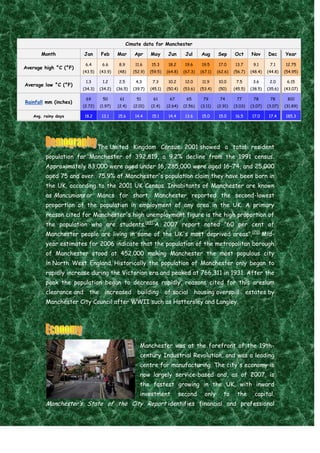
St Helens, LiverpoolHyde, Stalybridge, Glossop,Sheffield Manchester Sale, Altrincham, KnutsfordCheadle, Wilmslow, Alderley EdgeStockport, Chapel-en-le-Frith,Buxton, Derby<br />Cimate data for ManchesterMonthJanFebMarAprMayJunJulAugSepOctNovDecYearAverage high °C (°F)6.4(43.5)6.6(43.9)8.9(48)11.6(52.9)15.3(59.5)18.2(64.8)19.6(67.3)19.5(67.1)17.0(62.6)13.7(56.7)9.1(48.4)7.1(44.8)12.75(54.95)Average low °C (°F)1.3(34.3)1.2(34.2)2.5(36.5)4.3(39.7)7.3(45.1)10.2(50.4)12.0(53.6)11.9(53.4)10.0(50)7.5(45.5)3.6(38.5)2.0(35.6)6.15(43.07)Rainfall mm (inches)69(2.72)50(1.97)61(2.4)51(2.01)61(2.4)67(2.64)65(2.56)79(3.11)74(2.91)77(3.03)78(3.07)78(3.07)810(31.89)Avg. rainy days18.213.115.614.415.114.413.615.015.016.517.017.4185.3<br />The United Kingdom Census 2001 showed a total resident population for Manchester of 392,819, a 9.2% decline from the 1991 census. Approximately 83,000 were aged under 16, 285,000 were aged 16–74, and 25,000 aged 75 and over. 75.9% of Manchester's population claim they have been born in the UK, according to the 2001 UK Census. Inhabitants of Manchester are known as Mancunians or Mancs for short. Manchester reported the second-lowest proportion of the population in employment of any area in the UK. A primary reason cited for Manchester's high unemployment figure is the high proportion of the population who are students.[69] A 2007 report noted \"
60 per cent of Manchester people are living in some of the UK's most deprived areas\"
.[70] Mid-year estimates for 2006 indicate that the population of the metropolitan borough of Manchester stood at 452,000 making Manchester the most populous city in North West England. Historically the population of Manchester only began to rapidly increase during the Victorian era and peaked at 766,311 in 1931. After the peak the population began to decrease rapidly, reasons cited for this areslum clearance and the increased building of social housing overspill estates by Manchester City Council after WWII such as Hattersley and Langley.<br />15240-1905Manchester was at the forefront of the 19th-century Industrial Revolution, and was a leading centre for manufacturing. The city's economy is now largely service-based and, as of 2007, is the fastest growing in the UK, with inward investment second only to the capital. Manchester’s State of the City Report identifies financial and professional services, life science industries, creative, cultural and media, manufacturing and communications as major activities. The city was ranked in 2010 as the second-best place to do business in the UK and the twelfth best in Europe.<br />Manchester's buildings display a variety of architectural styles, ranging from Victorian tocontemporary architecture. The widespread use of red brick characterises the city. Much of the architecture in the city harks back to its days as a global centre for the cotton trade. Just outside the immediate city centre is a large number of former cotton mills, some of which have been left virtually untouched since their closure while many have been redeveloped into apartment buildings and office space. Manchester Town Hall, in Albert Square, was built in the Gothic revival style and is considered to be one of the most important Victorian buildings in England. It has been used in film as a replacement location for the Palace of Westminster, in which filming is not permitted.<br />15240-2540Manchester and North West England are served by Manchester Airport. The airport is the busiest airport in the country outside the London region making it the 4th busiest airport in the United Kingdom in terms of passenger numbers, 3rd in terms of total aircraft movementsand overall the 17th busiest airport in Europe as of 2009. Airline service exists to many destinations in Europe, North America, the Caribbean, Africa, the Middle East and Asia (with more destinations from Manchester than from London Heathrow). A second runway was opened in 2001 and there have been continued terminal improvements. Despite being aregional airport, the airport currently has the highest rating available, \"
Category 10\"
encompassing an elite group of airports which are able to handle \"
Code F\"
aircraft including the Airbus A380 and Boeing 747-8. From September 2010 the airport became one of only seventeen airports in the world and the only airport other than Heathrow Airport to operate the Airbus A380 in the United Kingdom <br />Bands that have emerged from the Manchester music scene include The Smiths, theBuzzcocks, The Fall, Joy Division and its successor group New Order, Oasis, Doves and Ten. Manchester was credited as the main regional driving force behind indie bands of the 1980s including Happy Mondays, Inspiral Carpets, James, and The Stone Roses. These groups came from what became known as the \"
Madchester\"
scene that also centred around the The Haçienda nightclub developed by founder of Factory Records Tony Wilson. Although from southern England, The Chemical Brothers subsequently formed in Manchester. Ex-Stone Roses' frontman Ian Brown and ex-Smiths Morrissey continue successful solo careers. Notable Manchester acts of the 1960s include The Hollies, Herman's Hermits and the Bee Gees, who grew up in Chorlton.<br />15240-3175Manchester has a thriving theatre, opera and dance scene, and is home to a number of large performance venues, including the Manchester Opera House, which feature large-scale touring shows and West End productions; the Palace Theatre; the Royal Exchange Theatre in Manchester’s former cotton exchange; and the Lowry Centre, a touring venue in Salford which often hosts performances by Opera North.<br />Manchester has a wide selection of public museums and art galleries. Manchester's museums celebrate Manchester's Roman history, rich industrial heritage and its role in the Industrial Revolution, the textile industry, the Trade Union movement, women's suffrage and football. In the Castlefield district, a reconstructed part of the Roman fort of Mamucium is open to the public in Castlefield. The Museum of Science and Industry, housed in the former Liverpool Road railway station, has a large collection of steam locomotives, industrial machinery and aircraft. The Museum of Transport displays a collection of historic buses and trams. Salford Quays, a short distance from the city centre in the adjoining borough of Trafford, is home to the Imperial War Museum North. TheManchester Museum opened to the public in the 1880s, has notable Egyptology and natural history collections.<br />15240-2540The night-time economy of Manchester has expanded significantly since about 1993, with investment from breweries in bars, public houses and clubs, along with active support from the local authorities. The more than 500 licensed premises in the city centre have a capacity to deal with over 250,000 visitors, with 110–130,000 people visiting on a typical weekend night. The night-time economy has a value of about £100 million pa and supports 12,000 jobs.<br />There are two universities in the City of Manchester. The University of Manchester is the largest full-time non-collegiate university in the United Kingdom and was created in 2004 by the merger of Victoria University of Manchester and UMIST. It includes the Manchester Business School, which offered the first MBA course in the UK in 1965. Manchester Metropolitan University was formed as Manchester Polytechnic on the merger of three colleges in 1970. It gained university status in 1992, and in the same year absorbed Crewe and Alsager College of Higher Education in South Cheshire.<br />3225165280416015240-1270Manchester is well-known for being a city of sport. Two Premiership football clubs bear the city's name, Manchester United and Manchester City. Manchester City's ground is at theCity of Manchester Stadium (near 48,000 capacity); Manchester United's Old Trafford ground, the largest club football ground in the United Kingdom, with a capacity of 76,000, is just outside the city, in the borough of Trafford. It is the only club football ground in England to have hosted the UEFA Champions League Final, in 2003. It is also the venue of the Super League Grand Final in rugby league. Lancashire County Cricket Club's ground is also in Trafford. Manchester United have the widest football club fanbase in the world, while Manchester City is the richest football club in the world, thanks to its wealthy owners.<br /> <br /> ADRIEL ZUBIRIA<br />](https://image.slidesharecdn.com/manchester-110328174258-phpapp01/85/Manchester-1-320.jpg)