Youth homelessness in Finland - a preventative perspective 
Kaisa Tuuteri 
The Finnish Youth Housing Association 
Youth Homelessness Prevention Project (2012-2015) in Finland 
Investing in young people to prevent a lost generation in Europe: key policy and practice in addressing youth homelessness 
8th November 2013, Prague, Czech Republic
Youth Housing Association – NAL in short 
The Finnish Youth Housing Association (Nuorisoasuntoliitto), in short NAL, provides nationwide services for and oversees the interests of young people in need of housing. 
NAL was established in 1971 as a national interest organisation for the youth housing policy. 
We are a non-governmental, non-profit organisation independent of any political and denominational affiliation.
NAL – umbrella organization for 27 regional associations 
Espoo 
Helsinki 
Heinola 
Hyvinkää 
Hämeenlinna 
Joensuu 
Jyväskylä 
Kankaanpää 
Keski-Uusimaa 
Kiiminki 
Kirkkonummi 
Kuopio 
Lahti 
Lempäälä 
Lohja 
Nokia&Pirkkala 
Oulu 
Pattijoki 
Porvoo 
Riihimäki 
Rovaniemi 
Savonlinna 
Tampere 
Turku 
Valkeakoski 
Vantaa 
Ylöjärvi
What do we do? 
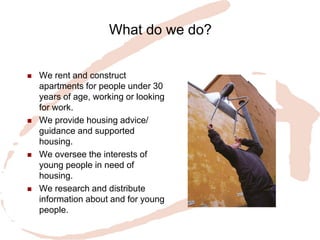
We rent and construct apartments for people under 30 years of age, working or looking for work. 
We provide housing advice/ guidance and supported housing. 
We oversee the interests of young people in need of housing. 
We research and distribute information about and for young people.
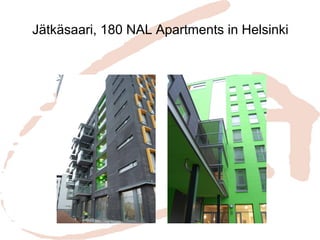
Jätkäsaari, 180 NAL Apartments in Helsinki
NAL apartments 
NAL has over 3700 apartments in 31 localities. About 600 in Helsinki. 
We have over 4000 residents 
We receive over 12 000 housing applications a year.
The Finnish National Programme to Reduce Long- term Homelessness 
In Finland, the Government has approved a national programme to reduce homelessness and eliminate long-term homelessness by 2015. 
First part of the programme was carried out 2008-2011, then focus was on reducing the long-term homelessness and for example change all traditional short-term shelters into supported housing units that facilitate independent living. 
The new Government decided to continue the programme and second part started in 2012 (-2015). Now the focus is more on preventing homelessness, scattered independent housing and floating support as an option to congregate housing complexes.
Youth Homelessness Prevention Project (2012- 2015) in Finland 
Housing First: 
Appropriate accommodation is a precondition for solving other social and health problems; option to traditional staircase approach 
The goal of Housing First is to provide a permanent housing solution for homeless people as quickly as possible, combined with flexible social support based on their needs 
The programme is based on a partnership between central government and the country’s ten largest municipalities affected by homelessness. It is carried out in Helsinki, Espoo, Vantaa, Lahti, Oulu, Joensuu, Kuopio, Tampere, Turku and Jyväskylä. 
Youth Homelessness Prevention Project is coordinated by the Finnish Youth Housing Association (NAL) and is funded by Finland’s Slot Machine Association (RAY). The project aims to prevent and reduce youth homelessness in Finland
Youth Homelessness Prevention Project (2012- 2015) in Finland 
Main goals: 
To increase the amount of apartments with 600 
To increase the amount, availability and quality of services for being able to lead an independent life (housing guidance, advice and supported housing) 
How to do this: 
1.We work in a multi-professional groups of expertise, take initiatives and carry out statements to achieve more apartments and services to young people (structural goal) 
2.We assist employees to support the skills of young adults to become independent 
3.We advance the multidisciplinary work in municipalities 
4.We offer the information about youth housing and homelessness
Background 
In Finland, the average age for moving out from the childhood home and become independent is lower than in many other European countries. 
In Finland the median age to become independent is 21 years. 
Only 16 % of Finnish young adults (ages between 25−29) are living with their parents 
Compare  minimum 50% in many EU-countries live with their parents!
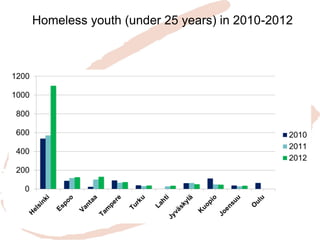
Increase in youth homelessness 45 % (2011-2012) (increase among all homeless people +4 %) 
Source: The Housing Finance and Development Centre of Finland (ARA) 
2002 
2003 
2004 
2005 
2006 
2007 
2008 
2009 
2010 
2011 
2012 
All homeless in Finland 
9561 
8186 
7651 
7430 
7399 
7533 
7955 
8153 
7877 
7 572 
7 852 
Homeless youth 
(under 25 years) 
1644 
1558 
1424 
1368 
1399 
1328 
1319 
1498 
1375 
1 409 
2 049
Homeless youth (under 25 years) in 2010-2012
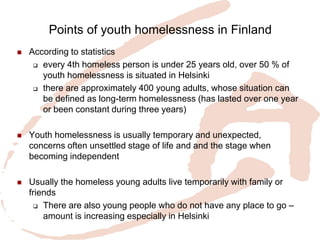
Points of youth homelessness in Finland 
According to statistics 
every 4th homeless person is under 25 years old, over 50 % of youth homelessness is situated in Helsinki 
there are approximately 400 young adults, whose situation can be defined as long-term homelessness (has lasted over one year or been constant during three years) 
Youth homelessness is usually temporary and unexpected, concerns often unsettled stage of life and and the stage when becoming independent 
Usually the homeless young adults live temporarily with family or friends 
There are also young people who do not have any place to go – amount is increasing especially in Helsinki
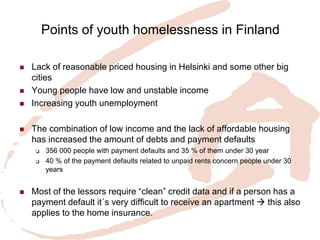
Points of youth homelessness in Finland 
Lack of reasonable priced housing in Helsinki and some other big cities 
Young people have low and unstable income 
Increasing youth unemployment 
The combination of low income and the lack of affordable housing has increased the amount of debts and payment defaults 
356 000 people with payment defaults and 35 % of them under 30 year 
40 % of the payment defaults related to unpaid rents concern people under 30 years 
Most of the lessors require “clean” credit data and if a person has a payment default it´s very difficult to receive an apartment  this also applies to the home insurance.
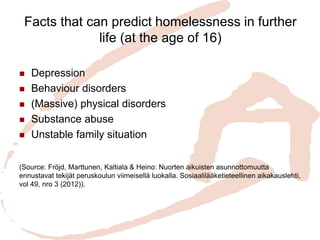
Facts that can predict homelessness in further life (at the age of 16) 
Depression 
Behaviour disorders 
(Massive) physical disorders 
Substance abuse 
Unstable family situation 
(Source: Fröjd, Marttunen, Kaltiala & Heino: Nuorten aikuisten asunnottomuutta ennustavat tekijät peruskoulun viimeisellä luokalla. Sosiaalilääketieteellinen aikakauslehti, vol 49, nro 3 (2012)).
Prevention is a key to solve youth homelessness 
1.More reasonable priced housing, especially in the metropolitan area 
2.Range of individual services and support to young people who need help – consequence of coordination 
1.Information about housing 
2.Housing advice 
3.Supported housing (floating support)
1. Information about housing 
Producing information to all young people about housing and becoming independent – for example about the rights and duties as a resident, what do you have to think about before moving out from your childhood home, how to balance your budget, and how to find help if the need arises 
web-pages (www.asumisenabc.com), other materials and guides 
Distributing the information in cooperation with schools, Finnish defence forces, parents – “lessons of housing” and housing infos 
Educating employees working with young adults 
“Courses of housing” for the homeless young adults to receive and to keep an apartment.
2. Housing advice 
Appropriate and prompt method to support young adults housing 
Housing advisors: 
assist residents to solve their problems with their living, usually financial problems and unpaid rents  make payment plans  focus is on housing 
encourage to find further help if needed 
can work in the field of the Social services, in housing companies or in associations (for example in the regional associations of NAL) 
There is evidence that housing advice prevents evictions 
over 100 evictions/year less in 2012 than in 2008 in Helsinki 
more effective the earlier the intervention is done 
cost-effective in every operator´s point of view
3. Supported housing - floating support 
Support for independent living, for example those 
who have been homeless, child welfare youth, are underaged, have young families, are rehabilitating from mental illness or substance abuse (but don´t have an acute problem), are young immigrants 
The support consists of periods 
from heavy to light (heavier in the beginning and lighter when a client is becoming more independent) 
It´s more extensive than housing advice: the main focus is on housing but it also concentrates on other parts of client´s life (education, work)
3. Supported housing - floating support 
There is a 'case manager‘ whose function is to provide practical and social support to clients and help them to become independent. 
Manager assists young adults comprehensively (for example to find proper services in the field of Social Services and Health Care, if needed). 
The support is floating and it´s provided at the environment that is the most suitable for the young adult, the support is flexible and based on the special needs of a client. 
The supported housing is based on the idea of normal living and integration – young adults are residents like everyone else. 
The main idea is that after the support the young adult can stay and continue the living in the same apartment 
Scattered housing: 15 % of residents in one youth housing complex can be supported at the time
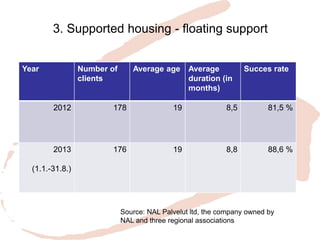
3. Supported housing - floating support 
Year 
Number of clients 
Average age 
Average duration (in months) 
Succes rate 
2012 
178 
19 
8,5 
81,5 % 
2013 
(1.1.-31.8.) 
176 
19 
8,8 
88,6 % 
Source: NAL Palvelut ltd, the company owned by NAL and three regional associations
Conclusion: What is still needed? 
More small and affordable housing! 
Crisis accommodation for young adults  the need of some temporary options for those who do not have any place to go (young working people shouldn’t stay in a place for heavy drug and alcohol abusers) 
Focus on prevention: more floating support, housing advice, supported housing, outreach work, economic and debt counselling 
Better co-ordination of structure for support services 
More multi-professional, multidisciplinary work – we have a lot of services and assistance for young adults, but the structure of services should be better organized and co-ordinated
Thank you! 
Contact Information: 
Kaisa Tuuteri 
kaisa.tuuteri@nal.fi 
+35840 726 1982

A Housing-led approach to youth homelessness

  • 1.
    Youth homelessness inFinland - a preventative perspective Kaisa Tuuteri The Finnish Youth Housing Association Youth Homelessness Prevention Project (2012-2015) in Finland Investing in young people to prevent a lost generation in Europe: key policy and practice in addressing youth homelessness 8th November 2013, Prague, Czech Republic
  • 2.
    Youth Housing Association– NAL in short The Finnish Youth Housing Association (Nuorisoasuntoliitto), in short NAL, provides nationwide services for and oversees the interests of young people in need of housing. NAL was established in 1971 as a national interest organisation for the youth housing policy. We are a non-governmental, non-profit organisation independent of any political and denominational affiliation.
  • 3.
    NAL – umbrellaorganization for 27 regional associations Espoo Helsinki Heinola Hyvinkää Hämeenlinna Joensuu Jyväskylä Kankaanpää Keski-Uusimaa Kiiminki Kirkkonummi Kuopio Lahti Lempäälä Lohja Nokia&Pirkkala Oulu Pattijoki Porvoo Riihimäki Rovaniemi Savonlinna Tampere Turku Valkeakoski Vantaa Ylöjärvi
  • 4.
    What do wedo? We rent and construct apartments for people under 30 years of age, working or looking for work. We provide housing advice/ guidance and supported housing. We oversee the interests of young people in need of housing. We research and distribute information about and for young people.
  • 5.
    Jätkäsaari, 180 NALApartments in Helsinki
  • 6.
    NAL apartments NALhas over 3700 apartments in 31 localities. About 600 in Helsinki. We have over 4000 residents We receive over 12 000 housing applications a year.
  • 7.
    The Finnish NationalProgramme to Reduce Long- term Homelessness In Finland, the Government has approved a national programme to reduce homelessness and eliminate long-term homelessness by 2015. First part of the programme was carried out 2008-2011, then focus was on reducing the long-term homelessness and for example change all traditional short-term shelters into supported housing units that facilitate independent living. The new Government decided to continue the programme and second part started in 2012 (-2015). Now the focus is more on preventing homelessness, scattered independent housing and floating support as an option to congregate housing complexes.
  • 8.
    Youth Homelessness PreventionProject (2012- 2015) in Finland Housing First: Appropriate accommodation is a precondition for solving other social and health problems; option to traditional staircase approach The goal of Housing First is to provide a permanent housing solution for homeless people as quickly as possible, combined with flexible social support based on their needs The programme is based on a partnership between central government and the country’s ten largest municipalities affected by homelessness. It is carried out in Helsinki, Espoo, Vantaa, Lahti, Oulu, Joensuu, Kuopio, Tampere, Turku and Jyväskylä. Youth Homelessness Prevention Project is coordinated by the Finnish Youth Housing Association (NAL) and is funded by Finland’s Slot Machine Association (RAY). The project aims to prevent and reduce youth homelessness in Finland
  • 9.
    Youth Homelessness PreventionProject (2012- 2015) in Finland Main goals: To increase the amount of apartments with 600 To increase the amount, availability and quality of services for being able to lead an independent life (housing guidance, advice and supported housing) How to do this: 1.We work in a multi-professional groups of expertise, take initiatives and carry out statements to achieve more apartments and services to young people (structural goal) 2.We assist employees to support the skills of young adults to become independent 3.We advance the multidisciplinary work in municipalities 4.We offer the information about youth housing and homelessness
  • 10.
    Background In Finland,the average age for moving out from the childhood home and become independent is lower than in many other European countries. In Finland the median age to become independent is 21 years. Only 16 % of Finnish young adults (ages between 25−29) are living with their parents Compare  minimum 50% in many EU-countries live with their parents!
  • 11.
    Increase in youthhomelessness 45 % (2011-2012) (increase among all homeless people +4 %) Source: The Housing Finance and Development Centre of Finland (ARA) 2002 2003 2004 2005 2006 2007 2008 2009 2010 2011 2012 All homeless in Finland 9561 8186 7651 7430 7399 7533 7955 8153 7877 7 572 7 852 Homeless youth (under 25 years) 1644 1558 1424 1368 1399 1328 1319 1498 1375 1 409 2 049
  • 12.
    Homeless youth (under25 years) in 2010-2012
  • 13.
    Points of youthhomelessness in Finland According to statistics every 4th homeless person is under 25 years old, over 50 % of youth homelessness is situated in Helsinki there are approximately 400 young adults, whose situation can be defined as long-term homelessness (has lasted over one year or been constant during three years) Youth homelessness is usually temporary and unexpected, concerns often unsettled stage of life and and the stage when becoming independent Usually the homeless young adults live temporarily with family or friends There are also young people who do not have any place to go – amount is increasing especially in Helsinki
  • 14.
    Points of youthhomelessness in Finland Lack of reasonable priced housing in Helsinki and some other big cities Young people have low and unstable income Increasing youth unemployment The combination of low income and the lack of affordable housing has increased the amount of debts and payment defaults 356 000 people with payment defaults and 35 % of them under 30 year 40 % of the payment defaults related to unpaid rents concern people under 30 years Most of the lessors require “clean” credit data and if a person has a payment default it´s very difficult to receive an apartment  this also applies to the home insurance.
  • 15.
    Facts that canpredict homelessness in further life (at the age of 16) Depression Behaviour disorders (Massive) physical disorders Substance abuse Unstable family situation (Source: Fröjd, Marttunen, Kaltiala & Heino: Nuorten aikuisten asunnottomuutta ennustavat tekijät peruskoulun viimeisellä luokalla. Sosiaalilääketieteellinen aikakauslehti, vol 49, nro 3 (2012)).
  • 16.
    Prevention is akey to solve youth homelessness 1.More reasonable priced housing, especially in the metropolitan area 2.Range of individual services and support to young people who need help – consequence of coordination 1.Information about housing 2.Housing advice 3.Supported housing (floating support)
  • 17.
    1. Information abouthousing Producing information to all young people about housing and becoming independent – for example about the rights and duties as a resident, what do you have to think about before moving out from your childhood home, how to balance your budget, and how to find help if the need arises web-pages (www.asumisenabc.com), other materials and guides Distributing the information in cooperation with schools, Finnish defence forces, parents – “lessons of housing” and housing infos Educating employees working with young adults “Courses of housing” for the homeless young adults to receive and to keep an apartment.
  • 18.
    2. Housing advice Appropriate and prompt method to support young adults housing Housing advisors: assist residents to solve their problems with their living, usually financial problems and unpaid rents  make payment plans  focus is on housing encourage to find further help if needed can work in the field of the Social services, in housing companies or in associations (for example in the regional associations of NAL) There is evidence that housing advice prevents evictions over 100 evictions/year less in 2012 than in 2008 in Helsinki more effective the earlier the intervention is done cost-effective in every operator´s point of view
  • 19.
    3. Supported housing- floating support Support for independent living, for example those who have been homeless, child welfare youth, are underaged, have young families, are rehabilitating from mental illness or substance abuse (but don´t have an acute problem), are young immigrants The support consists of periods from heavy to light (heavier in the beginning and lighter when a client is becoming more independent) It´s more extensive than housing advice: the main focus is on housing but it also concentrates on other parts of client´s life (education, work)
  • 20.
    3. Supported housing- floating support There is a 'case manager‘ whose function is to provide practical and social support to clients and help them to become independent. Manager assists young adults comprehensively (for example to find proper services in the field of Social Services and Health Care, if needed). The support is floating and it´s provided at the environment that is the most suitable for the young adult, the support is flexible and based on the special needs of a client. The supported housing is based on the idea of normal living and integration – young adults are residents like everyone else. The main idea is that after the support the young adult can stay and continue the living in the same apartment Scattered housing: 15 % of residents in one youth housing complex can be supported at the time
  • 21.
    3. Supported housing- floating support Year Number of clients Average age Average duration (in months) Succes rate 2012 178 19 8,5 81,5 % 2013 (1.1.-31.8.) 176 19 8,8 88,6 % Source: NAL Palvelut ltd, the company owned by NAL and three regional associations
  • 22.
    Conclusion: What isstill needed? More small and affordable housing! Crisis accommodation for young adults  the need of some temporary options for those who do not have any place to go (young working people shouldn’t stay in a place for heavy drug and alcohol abusers) Focus on prevention: more floating support, housing advice, supported housing, outreach work, economic and debt counselling Better co-ordination of structure for support services More multi-professional, multidisciplinary work – we have a lot of services and assistance for young adults, but the structure of services should be better organized and co-ordinated
  • 23.
    Thank you! ContactInformation: Kaisa Tuuteri kaisa.tuuteri@nal.fi +35840 726 1982