Astronomy & Astrophysics manuscript no. aanda ©ESO 2024
August 16, 2024
JWST MIRI and NIRCam observations of NGC 891 and its
circumgalactic medium
Jérémy Chastenet1 ⋆, Ilse De Looze1 ⋆⋆, Monica Relaño2, 3 , Daniel A. Dale4 , Thomas G. Williams5 ,
Simone Bianchi6 , Emmanuel M. Xilouris7 , Maarten Baes1 , Alberto D. Bolatto8 , Martha L. Boyer9 ,
Viviana Casasola10 , Christopher J. R. Clark11 , Filippo Fraternali12 , Jacopo Fritz13 , Frédéric Galliano14 ,
Simon C. O. Glover15 , Karl D. Gordon9, 1 , Hiroyuki Hirashita16, 17 , Robert Kennicutt19 ,
Kentaro Nagamine17, 18, 20, 21 , Florian Kirchschlager1 , Ralf S. Klessen15, 22 , Eric W. Koch23 ,
Rebecca C. Levy19⋆⋆⋆ , Lewis McCallum24, Suzanne C. Madden14 , Anna F. McLeod25 , Sharon E. Meidt1 ,
Aleksandr V. Mosenkov26 , Helena M. Richie27 , Amélie Saintonge28 , Karin M. Sandstrom29 ,
Evan E. Schneider27, Evgenia E. Sivkova1, J. D. T. Smith30 , Matthew W. L. Smith31 , Arjen van der Wel1 ,
Stefanie Walch32, Fabian Walter33 , and Kenneth Wood24
(Affiliations can be found after the references)
Received X; X
ABSTRACT
We present new JWST observations of the nearby, prototypical edge-on, spiral galaxy NGC 891. The northern half of the disk was observed with
NIRCam in its F150W and F277W filters. Absorption is clearly visible in the mid-plane of the F150W image, along with vertical dusty plumes
that closely resemble the ones seen in the optical. A ∼10×3 kpc2
area of the lower circumgalactic medium (CGM) was mapped with MIRI F770W
at 12 pc scales. Thanks to the sensitivity and resolution of JWST, we detect dust emission out to ∼ 4 kpc from the disk, in the form of filaments,
arcs, and super-bubbles. Some of these filaments can be traced back to regions with recent star formation activity, suggesting that feedback-driven
galactic winds play an important role in regulating baryonic cycling. The presence of dust at these altitudes raises questions about the transport
mechanisms at play and suggests that small dust grains are able to survive for several tens of million years after having been ejected by galactic
winds in the disk-halo interface. We lay out several scenarios that could explain this emission: dust grains may be shielded in the outer layers
of cool dense clouds expelled from the galaxy disk, and/or the emission comes from the mixing layers around these cool clumps where material
from the hot gas is able to cool down and mix with these cool cloudlets. This first set of data and upcoming spectroscopy will be very helpful to
understand the survival of dust grains in energetic environments, and their contribution to recycling baryonic material in the mid-plane of galaxies.
Key words. Galaxies: individual: NGC 891 – ISM: kinematics and dynamics – (ISM:) dust, extinction
1. Introduction
The disk-halo interface of galaxies is an active region, where
inflow and outflow processes occur. These mechanisms are fun-
damental to galaxy formation and evolution scenarios, as they
strongly affect the star formation rate and metallicity of a galaxy,
by the recycling of galactic material and inflows of pristine
(“zero-metallicity”) gas. Understanding the interaction between
the disk and the circumgalactic medium (CGM; see a review by
Faucher-Giguère & Oh 2023) is therefore important to constrain
galaxy evolution, which is instrumental in comprehending the
diversity of galaxies we observe today.
Gas in the disk-halo interface can come from gas accretion or
cooling of the CGM, or ejected material from the mid-plane of
galaxies (Marinacci et al. 2010; Lehner & Howk 2011; Marasco
et al. 2022). In some cases, these processes can be tied to a single
event, and take the form of galactic fountains (Bregman 1980;
Melioli et al. 2008; Fraternali & Binney 2006; Armillotta et al.
2016; Li et al. 2023): after being expelled from the disk, material
can cool down in the disk-halo interface and fall back down in
the mid-plane of the galaxy. The multitude of recent detections
⋆
jeremy.chastenet@ugent.be
⋆⋆
PI: ilse.delooze@ugent.be
⋆⋆⋆
NSF Astronomy & Astrophysics Postdoctoral Fellow
of massive galactic outflows in particular (Veilleux et al. 2005,
2020) has reinforced their importance in regulating galaxy evo-
lution, but their main driving forces (supernovae, stellar winds,
ionising radiation, supermassive black holes, cosmic rays) have
yet to be identified. Characterising the efficiency of these various
feedback mechanisms in regulating a galaxy’s vertical disk scale
heights and in driving feedback-driven outflows are among the
major challenges that current galaxy evolution models face (e.g.,
Sancisi et al. 2008; Fraternali & Binney 2008; Marinacci et al.
2011; Gentile et al. 2013; Naab & Ostriker 2017; Li et al. 2021;
Otsuki & Hirashita 2024).
Simulations can be a powerful tool to understand these ex-
change mechanisms, and sort them with respect to their rela-
tive importance in driving gas in and out of the disk. However,
large-scale cosmological simulations typically do not resolve the
extra-planar layers. Some discrepancies have been found be-
tween the mass outflow rates predicted by these simulations and
the current observed rates. On the other hand, high-resolution
simulations can help focus on a direct comparison with disk-
halo interface observations. Many works have focused on the
gas distributions surrounding individual galaxies, through cos-
mological zoom-in simulations (Kim et al. 2016; Marinacci et al.
2017; Hopkins et al. 2018; Ramesh & Nelson 2024) and iso-
lated galaxy simulations that self-consistently drive their out-
Article number, page 1 of 16
arXiv:2408.08026v1
[astro-ph.GA]
15
Aug
2024
A&A proofs: manuscript no. aanda
flows (Fielding et al. 2017; Emerick et al. 2019; Martizzi 2020;
Schneider et al. 2020; Steinwandel et al. 2022). Additionally,
tall-box simulations can capture the disk-halo connection in de-
tail by simulating a small patch of the disk and a few kpc away
from the mid-plane at particularly high resolution (Walch et al.
2015; Girichidis et al. 2016b; Gatto et al. 2017; Kim & Ostriker
2018; Suresh et al. 2019; Vijayan et al. 2020; Rathjen et al. 2021;
Oku et al. 2022; McCallum et al. 2024; Tan & Fielding 2024).
These high resolution models tend to favor lower mass outflow
rates more consistent with the observed values.
A more empirical approach is also often used. With kine-
matic measurements, several canonical works have studied the
CGM of the Milky Way and external galaxies (Wakker & van
Woerden 1997; Fraternali et al. 2002; Marasco & Fraternali
2011; Marasco et al. 2019), with minimal impact from line-
of-sight confusion. However, this effect becomes crucial when
dealing with dust continuum emission. This is what makes ob-
servations of the CGM instinctively better in edge-on galaxies,
offering the possibility to investigate the vertical extent of their
different components and to draw a detailed picture of the ver-
tical profiles of the stars, gas, and dust. Several observations of
the atomic gas have reported the presence of structures above
the disk of galaxies (Matthews & Wood 2003; Boomsma et al.
2005; Zschaechner & Rand 2015), similar to ionised gas mea-
surements (Rossa & Dettmar 2003; Heald et al. 2007; Kamphuis
2008), and X-rays (Strickland et al. 2002, 2004; Hodges-Kluck
& Bregman 2013). In this paper, we focus on the distribution of
dust and stars in the disk-halo interface of the prototypical edge-
on galaxy NGC 891 probed by the MIRI and NIRCam instru-
ments on-board JWST. The unprecedented resolution and sen-
sitivity of JWST let us resolve and study substructures in the
CGM, which was never possible at these wavelengths.
A number of studies have focused on measuring the extent
of the dust halo in other edge-on galaxies. Using the extinction
of background quasars, Ménard et al. (2010) found dust in the
haloes of galaxies up to Mpc distances from their disks, reveal-
ing the presence of intergalactic dust (although Smith et al. 2016,
nuance this result with Herschel observations). Several studies
also use dust infrared (IR) emission, from mid- to the far-IR
wavelengths, including the broad emission features at 3.3, 6.2,
7.7, 8.6, 11.3, 12.6, and 17 µm. These features are produced by
vibrational and bending modes of bonds in carbonaceous dust
(e.g., C=C, C–H). The population of grains responsible for these
features is often referred to as Polycyclic Aromatic Hydrocar-
bons (PAHs), which are large aromatic molecules and a subclass
of the more generic family of hydrogenated amorphous carbons
(e.g., Allamandola et al. 1985; Jones et al. 2013; Li 2020). In
NGC 5907, Irwin & Madden (2006) found that most of the mid-
IR emission comes from the PAHs, rather than the very small
grains, and that their emission extends further out than that of
molecular gas, as far as 6.5 kpc, with a typical scale height of
3.5 kpc. This scale height is close to the one found in NGC 5529
by Irwin et al. (2007), using ISO data. These authors also found
that the PAH spatial distribution (namely in the vertical direc-
tion) in that galaxy correlates with Hα emission. In NGC 5775,
Lee et al. (2001) found a similar spatial correlation between
ionised gas emission and the radio continuum.
Close-by and nearly perfectly edge-on (d ∼ 9.6 Mpc, i >
89°), NGC 891 is an ideal target to study the extent of a galaxy’s
extra-planar components outside of the main disk, and has been
scrutinised as such. NGC 891 is classified as a normal star-
forming spiral galaxy with similarities to the Milky Way (Swa-
ters et al. 1997) but having a slightly higher global SFR. The
atomic hydrogen (H i) in NGC 891 has been studied in several
works (Swaters et al. 1997; Sancisi et al. 2008, and references
therein). By analysing very deep interferometric observations,
Oosterloo et al. (2007) have found that 30% of the H i is lo-
cated in the extra-planar layer with features that are extending
more than 20 kpc from the disk. The H i extra-planar gas shows a
slower rotation with respect to the gas in the disk, similar to other
galaxies (Fraternali et al. 2002; Marasco et al. 2019), a feature
that is considered crucial to understand its origin (e.g., Frater-
nali 2017). The ionised gas content of the CGM of NGC 891
has also been the centre of numerous works. Besides the various
structures visible in Hα emission (e.g., Rossa et al. 2004), the
works of, e.g., van der Kruit & Searle (1981), Dettmar (1990),
and Rand et al. (1990) have heavily investigated the asymme-
try of the ionised gas distribution, which was quickly attributed
to the spiral arms of NGC 891. The velocity and structure of
the ionised component were studied by Heald et al. (2006), who
found that the halo gas rotates more slowly than the disk gas,
similarly to the atomic gas component (see also Levy et al. 2019,
for velocity lag measurements in a sample of edge-on galaxies).
Later on, Kamphuis et al. (2007) used the attenuation in Hα ob-
servations to infer the presence of dust out to ∼ 2 kpc. Similarly,
Howk & Savage (1997) studied the dust component seen in ex-
tinction, with work focused on conspicuous dust-rich structures
expanding from the mid-plane out to the CGM (see also work
by, e.g., Alton et al. 2000).
Understanding the layered structure of spiral galaxies can
be done in great detail in targets like NGC 891. Studying the
infrared emission of NGC 891 has thus taken a larger impor-
tance, from ground-based observations to the advent of infrared
space-based facilities, observing the dust signature from mid-
to far-IR and sub-millimetre wavelengths. The work of Alton
et al. (1998) provided the first deep imaging at 450 and 850 µm
with the SCUBA instrument on the JCMT. Later, Popescu et al.
(2004) used 170 and 200 µm photometry combined with opti-
cal, near- and mid-IR, and submm data to support a radiative
transfer model of the galaxy (Popescu et al. 2000, and follow-
ing work). Using multi-wavelength spectral energy distributions,
Whaley et al. (2009) modelled the full IR emission of NGC 891.
They found that PAHs extend further out than cold dust traced by
sub-millimetre emission. Similar works have focused on repro-
ducing empirical data with radiative transfer. Namely, Bianchi
& Xilouris (2011), modelling the Herschel/SPIRE bands, found
that the presence of dust vertically extends up to 12 kpc. The
emission from large grains was further studied by Bocchio et al.
(2016) using Herschel measurements. They found that the far-IR
radial profiles in the PACS/SPIRE bands were better fitted using
a two-layer disk. This was confirmed by Mosenkov et al. (2022)
who used similar wavelengths, and additionally studied the cor-
relation of stellar content with the dust distribution, in a sample
of edge-on galaxies. Note that the work of Schechtman-Rook &
Bershady (2013) even suggested the existence of a “super-thin
disk” of roughly ∼ 60−80 pc in height to best reproduce near-IR
data. Complementary to these observations, the SOFIA aircraft
surveyed the polarised emission of NGC 891 using the HAWC+
instrument. Studies by Jones et al. (2020) and Kim et al. (2023)
focused on the orientation of the magnetic fields in the disk and
found it was very closely aligned with and parallel to the mid-
plane. The low polarisation fraction detected was suggested to
be due to a highly turbulent medium, attributed to morpholog-
ical components like spiral arms and bars (and possible instru-
mental uncertainties). Its extremely low value in the centre was
hypothesised to be the signature of a bar, aligned with the line-
of-sight (see also Garcia-Burillo & Guelin 1995). Using near-
IR polarimetry, Montgomery & Clemens (2014) revealed again
Article number, page 2 of 16
Jérémy Chastenet et al.: JWST MIRI and NIRCam observations of NGC 891 and its circumgalactic medium
a certain asymmetry, and used the deep polarisation data to com-
pare with radio synchrotron emission. A similar analysis was
done recently by Katsioli et al. (2023), who focused on a wide
multi-wavelength analysis to distinguish between dust, free-free,
and synchrotron emission in and around NGC 891. The advent
of JWST can now probe the same layers seen in optical at com-
parable spatial resolution, without relying on larger beams like
Herschel instruments. With higher resolution, we will be able to
eclipse beam smearing data and focus on detailed comparisons.
In this paper, we present the JWST Cycle 1 GO #2180 (PI:
De Looze), focused on studying the cycle of baryonic material
in NGC 891. In Sect. 2, we outline the details of the acquisi-
tion of new JWST NIRCam (Rieke et al. 2005) and MIRI (Rieke
et al. 2015) observations and the data reduction pipeline we used.
Section 3 focuses on a qualitative description of the NIRCam im-
ages, with a brief look at the vertical stratification of the stellar
emission. Focusing on MIRI, we then analyse the distribution
of the extraplanar grains in dusty plumes and clumpy structures,
and report several newly identified superbubbles at several kpcs
above the disk in Sect. 4. The same section focuses on the impli-
cation of detecting 7.7 µm emission at high altitudes. We discuss
the survival scenarios of small carbonaceous grains emitting at
7.7 µm above the disk, and how the detected extraplanar dust fea-
tures connect back to the disk1
. Section 5 summarises the con-
clusions of this paper.
2. Data
In the following, we adopt a distance of 9.6 Mpc to NGC 891
(Strickland et al. 2004), an inclination of 89.7°(Xilouris et al.
1998, 1999) and a position angle of 22.9°(Bianchi 2007; Hughes
et al. 2014).
2.1. Observations
The JWST data used in this paper were taken as part of the
Cycle 1 GO #2180 (PI: Ilse De Looze). NIRCam data using
the short-wavelength F150W and long-wavelength F277W fil-
ters were taken on 15 August 2022. We targeted three fields in
the northern half of the disk (selected as a compromise between
overlap with ancillary data and time-feasibility), and obtained
a mosaic from a 2-row–3-column pattern (10% overlap). The
observations were done in subarray sub640 mode to reduce the
risk of saturation in the disk, with a intramodulebox dither strat-
egy and 3 primary dithers, and 2 sub-pixel small-grid-dither.
The MIRI F770W observations were taken on December, 23rd
2022. The source pointing was centred on (02h22m43.5952s,
+42°20′
05.55′′
), and oriented to be perpendicular to the disk of
the galaxy. The mosaic consists of two tiles (2-row–1-column,
10% overlap), with a 4-point dither strategy. It covers vertical
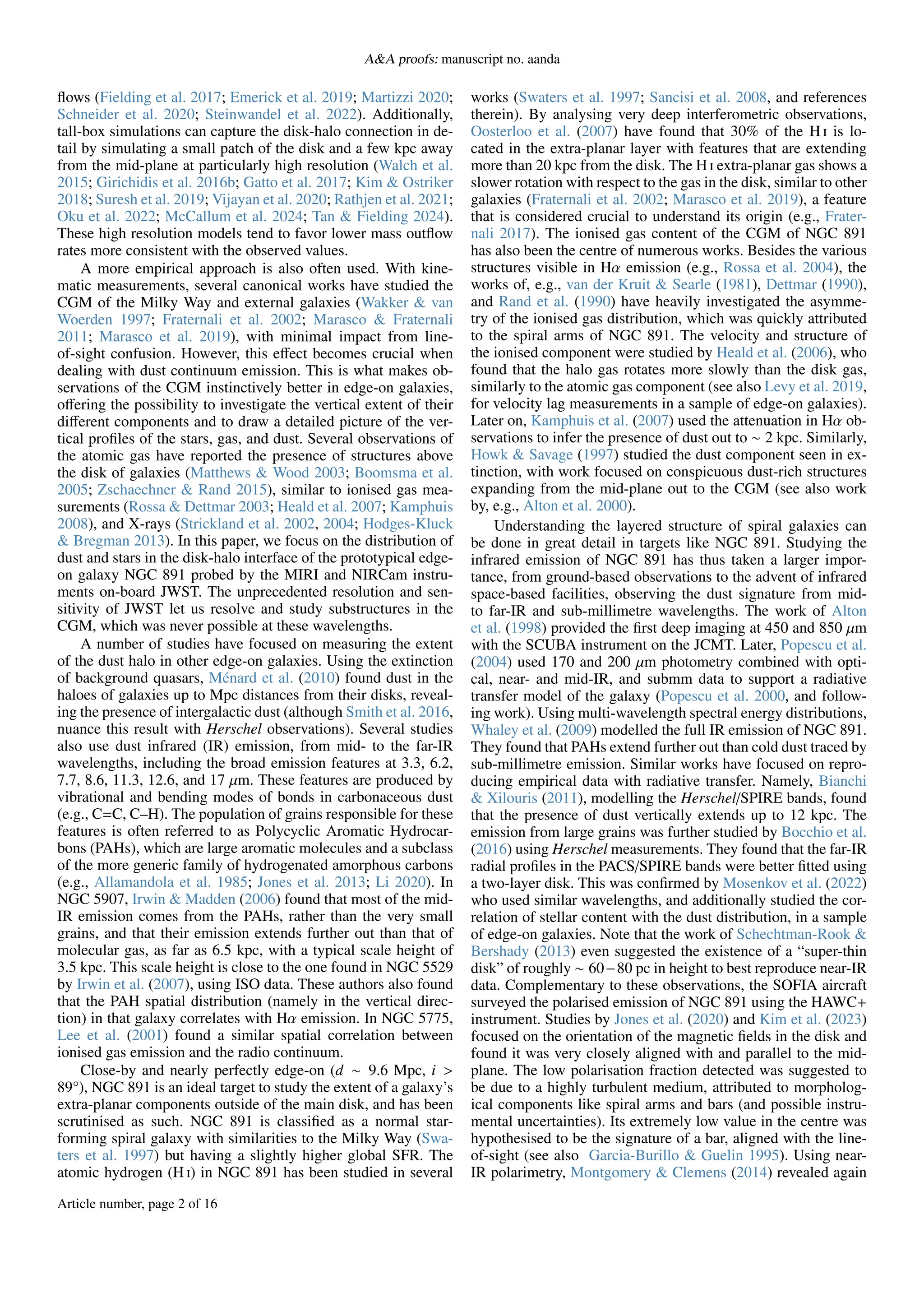
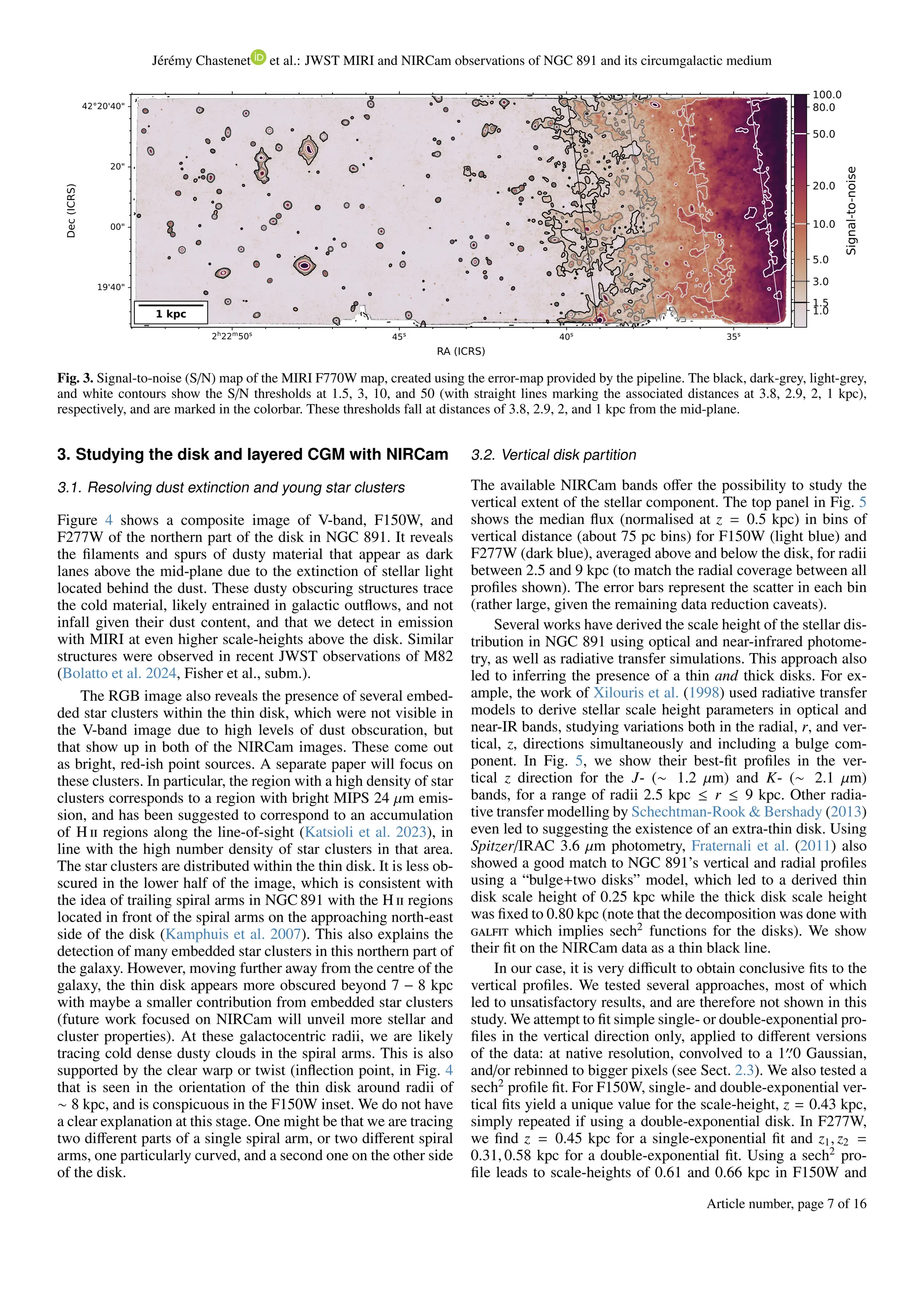
distance above the disk from ∼ 0.5 kpc to ∼ 10 kpc. In Fig. 1,
we show the regions targeted by the NIRCam filters, in blue, fo-
cused on the northern half of the disk. The MIRI region is shown
in red, covering mainly the CGM with limited emission from the
disk.
For both NIRCam and MIRI, we obtained a background
pointing centred on (02h24m39.1970s, +42°11′
38.07′′
). This
1
In an upcoming paper, we will present MIRI MRS spectroscopic ob-
servations of 4 positions at 0.5 and 1 kpc above the disk (each for two
galactocentric radius positions), which will enable us to study the con-
tribution of PAH emission to the MIRI broadband filters in more de-
tail. Future work will also focus on characterising the clumpiness of the
CGM material in NGC 891, and will present parallel multi-band MIRI
imaging of several disk locations.
single-tile (not a mosaic) observation is located far away from
the galaxy in an “empty” region of the sky, and is used to remove
the astronomical background from the observations near/on the
disk. The inset in Fig. 1 shows the separation between the
source pointings and the background. The large distance be-
tween source and background pointings was motivated by the
goal to detected faint CGM emission. Note the light-blue pattern
shows the parallel NIRCam F070W and F277W observations for
reference, but the results of these parallel observations are not
presented in this paper.
2.2. Data reduction
The level 3 MAST products suffer from significant artefacts that
the default pipeline (Bushouse et al. 2024) does not adequately
handle, such as 1/ f noise. Instead, we run PJPipe, developed by
the PHANGS-JWST team (Lee et al. 2023), and presented in
Williams et al. (2024)2
. Further details of this pipeline can be
found in Williams et al. (2024), describing all the steps with
more information, as well as quality assurance figures for the
PHANGS-JWST sample of galaxies.
Briefly, PJPipe runs as follows, and unless mentioned other-
wise, these steps apply to both MIRI and NIRCam:
– stage 1: this step (calwebb_detector1) is kept to that of
the default pipeline, described on the JWST pipeline web-
site3
. Minor changes regarding the saturation flags are meant
to attempt to recover more pixels than the default settings
allow;
– first NIRCam destriping: this step removes the small-scale
1/ f noise, well known to be present in the JWST NIRCam
photometry. The large-scale structures are first filtered out,
and the 1/ f noise is removed using a row median in the ver-
tical direction (first), then a median filter in the row direction;
– stage 2: this step (calwebb_image2) is also kept mostly to
default settings as in the official pipeline. In this step, back-
grounds get associated to the main source pointings and their
effect can be adjusted by specific keywords;
– flux matching: the several dithers of our NIRCam data suffer
from severe flux offsets. To alleviate these large offsets be-
tween dithers, the flux levels are matched between overlap-
ping pixels and correction factors are found through matrix
minimisation. This follows the approach of Montage (Jacob
et al. 2010), but is done in two-steps: a “dither-matching”,
followed by a “tile-matching” on a stacked image, to increase
the number statistics, due to the low overlap between dithers
only;
– second NIRCam destriping: the large structure noise (ini-
tially filtered out) is still conspicuous in the NIRCam bands,
especially in F150W. Using again medians across overlap-
ping image, the large-structure stripes are removed, without
affecting the galaxy emission;
– stage 3: the final step (calwebb_image3) combines the cal-
ibrated, de-noised exposure into a single mosaic, and per-
forms the final adjustment of the background level.
In our case, the most outstanding remaining issues concern
only F150W and the large-scale variations as well as offsets be-
tween some dither tiles. After several iterations of the pipeline
2
The main difference in technical set-up between their sample and
these observations is the that of NIRCam in sub-array mode. However,
iterative improvements made PJPipe effective for this set-up as well.
3
https://jwst-pipeline.readthedocs.io/en/latest/
jwst/pipeline/.
Article number, page 3 of 16
A&A proofs: manuscript no. aanda
2h23m00s 22m50s 40s 30s
42°26'
24'
22'
20'
RA (J2000)
Dec
(J2000)
MIRI F770W
NIRCam F150W/F277W
1 kpc
21.4'
MIRI F770W
NIRCam F150W/F277W
NIRCam F070W/F277W
Fig. 1. Large cutout of the 2MASS H-band image, showing the imaging patterns of the NIRCam F150W/F277W in blue, covering the north-half
of NGC 891, and of the MIRI F770W in red, covering ∼ 10 kpc in length. The inset shows the positions of the dedicated background pointings, as
well as the MIRI-parallel NIRCam F070W/F277W imaging (light blue), in the southern part of the galaxy, just outside of the disk.
and fine-tuning of several parameters, we find that it is impos-
sible at this stage to perfectly correct for both. The image pre-
sented here represents the best compromise. Increasing the data
quality would likely be done by increasing the number of dithers,
to better average out the 1/ f noise. It is possible that the sub-
array mode carries more subtleties (smaller array, quicker read-
out, etc). For MIRI, only minimal artefacts remain. Some areas
show negative values due to the offset-pointing obtained for the
background subtraction. The background tile itself has bright
sources that lead to over-subtraction in the main source point-
ings. We have tested several values for the parameters linked to
that step, and found the best compromise, still showing a slight
over-subtraction, which do not affect the conclusions of this pa-
per.
Article number, page 4 of 16
Jérémy Chastenet et al.: JWST MIRI and NIRCam observations of NGC 891 and its circumgalactic medium
2.3. Extra-processing for NIRCam
To limit the impact of the artefacts in the NIRCam images (un-
even background, residual striping and dither offsets; Fig. 2) on
the preliminary results of this paper, we degrade our NIRCam
images to a larger point spread function (PSF), and increase the
pixel size.
We generate kernels for each NIRCam band to smooth to
a 0′′
.2 2D-Gaussian using the WebbPSF package, following the
Aniano et al. (2011) procedure. The native PSFs are 0′′
.049 and
0′′
.088 for F150W and F277W, respectively. After convolution,
we rebin the F277W data to 2× bigger pixels, i.e. 0′′
.12 on a side,
larger than the astrometric offset. The F150W image is projected
to that same pixel grid after convolution as well.
Because of the evident gradient in the images, removing a
single background value is not satisfactory. Similarly, sigma-
clipping the images and fitting a 2D plane to the remaining pix-
els proved unsuccessful, as the large artefacts strongly affect the
outcome of this approach. Instead, we select, by eye, a hand-
ful of small circular regions, where the flux distribution seems
rather flat in F150W. These regions are about 9′′
in radius so that
they are much larger than the resolution element. We fit a 2D
plane to these regions only, so that the biggest (dither-related)
variations are not taken into account, and only the broader gradi-
ent is fit. We then subtract this plane from the main image. The
same “background” removal is done to the F277W image. We
note that this approach still provides limited-quality results, and
more elaborate improvements are necessary in the future to cor-
rect the stripes and dither offsets within the pipeline. These will
be shared along with any post-processing (background removal)
once more science-ready images have been produced.
2.4. Final images
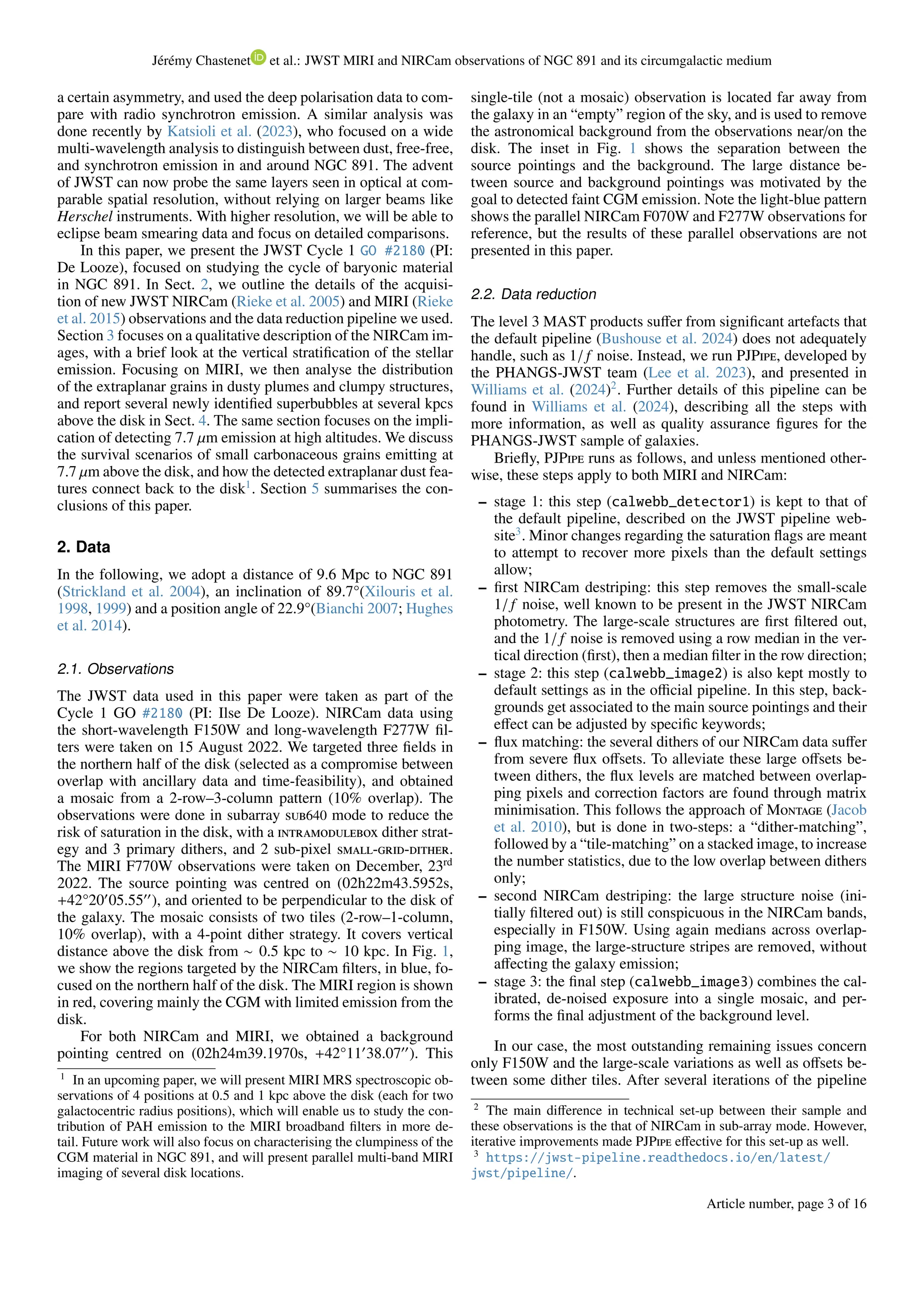
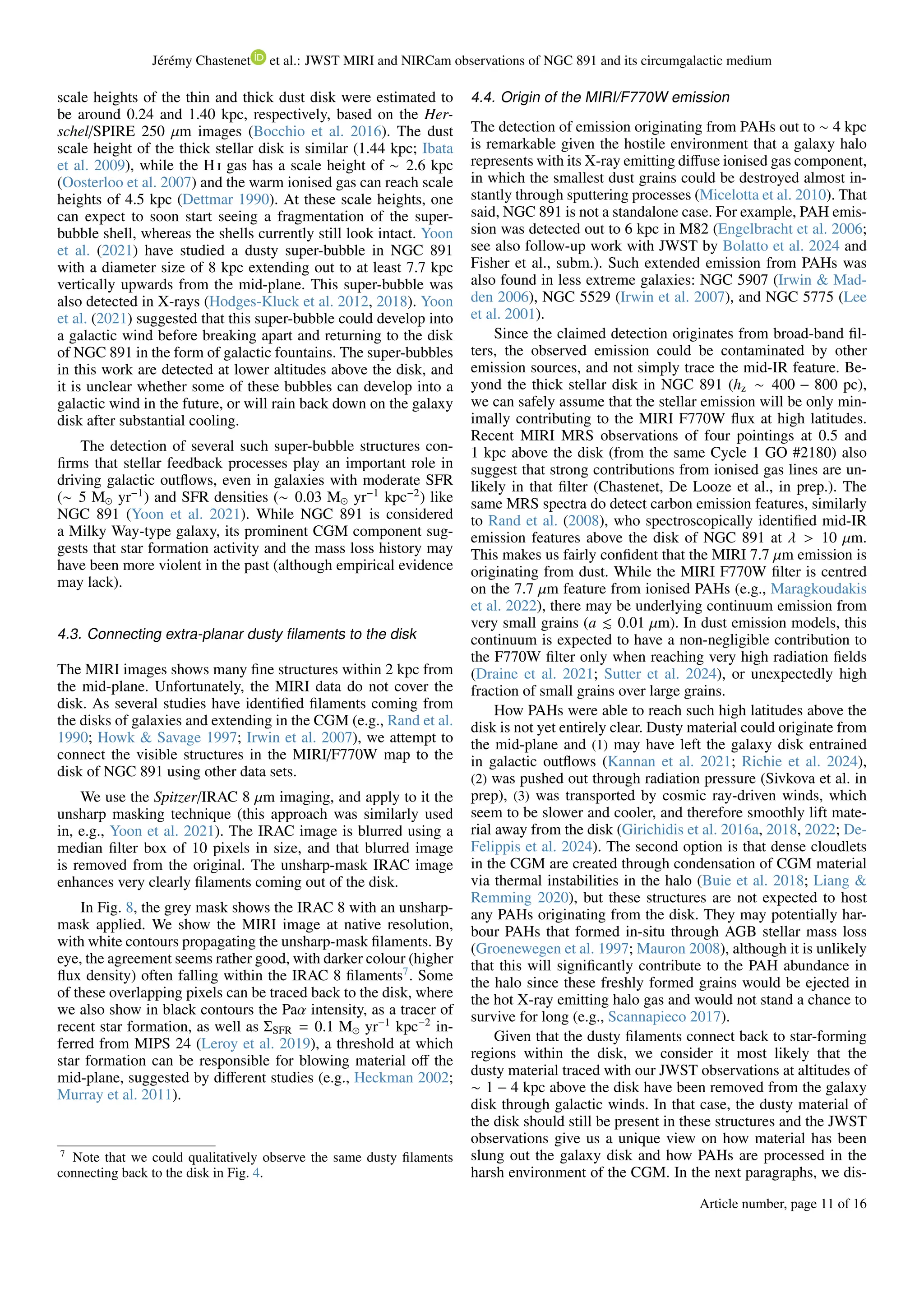
In Fig. 2, we show the NIRCam F150W and F277W, and the
MIRI F770W final images at their native resolution ∼ 0.05′′
,
∼ 0.092′′
, and ∼ 0.25′′
, respectively. We briefly and qualitatively
describe these images.
NIRCam — The northern half of the stellar disk is well re-
solved in both the F150W and F277W images. In the NIR-
Cam F227W image, the background is smooth, and we detect
several foreground stars and background galaxies. Dust extinc-
tion effects are most prominently visible in the NIRCam F150W
image, whereas highly obscured regions also remain opaque to
stellar radiation in the F277W image. We will discuss the NIR-
Cam images in more detail in Sect. 3. The small square gaps in
the F150W image result from the dither pattern of the observa-
tions.
MIRI F770W — The MIRI F770W image mosaic shows several
high-resolution filaments close to the disk. In Fig. 2, we over-
lay vertical distance indicators at 1, 2, 5, and 10 kpc. There are
also several bright sources far out from the disk, which can be
either identified known sources (based on a query of the Sim-
bad4
database), or potentially high-redshift galaxies (not the fo-
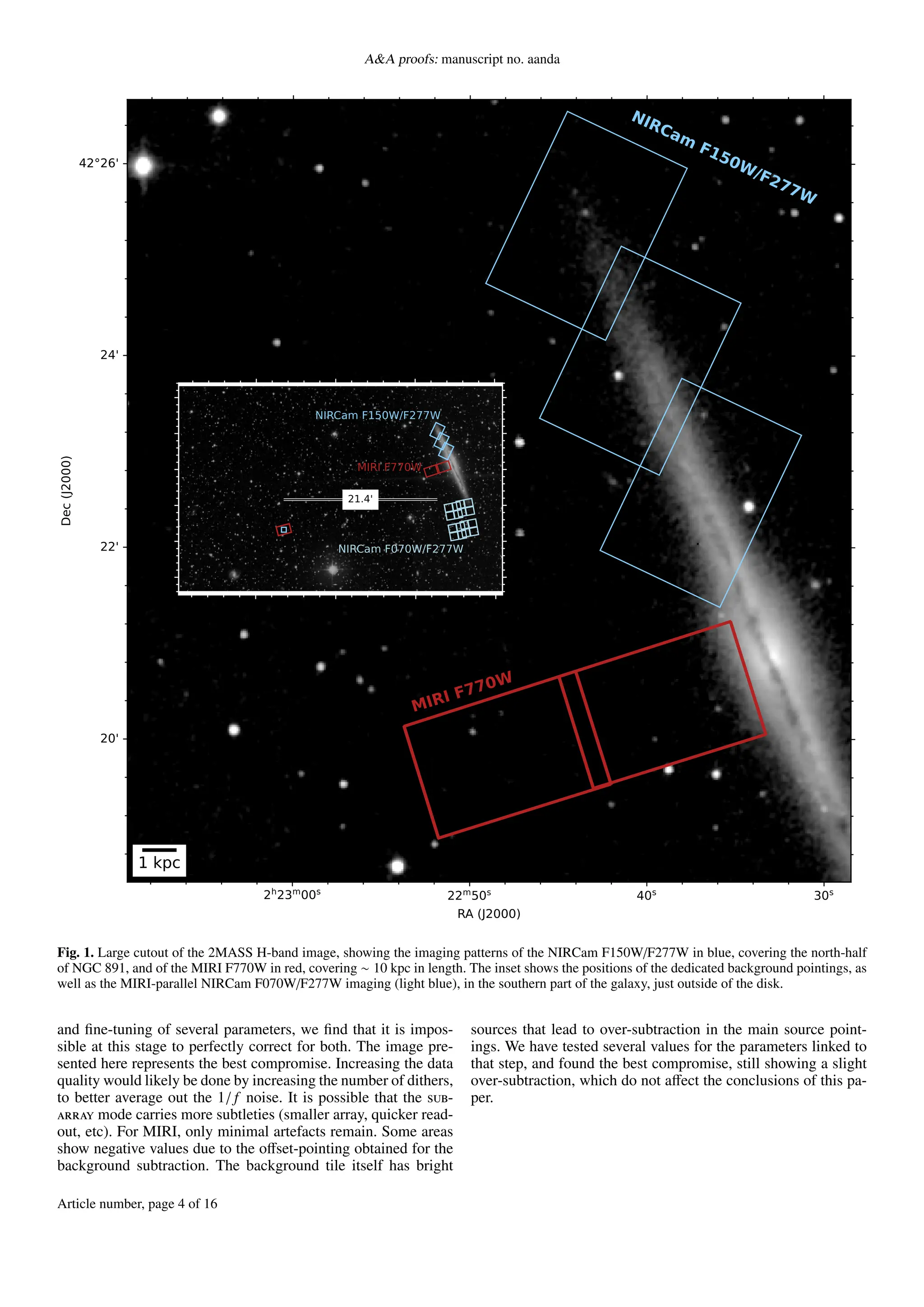
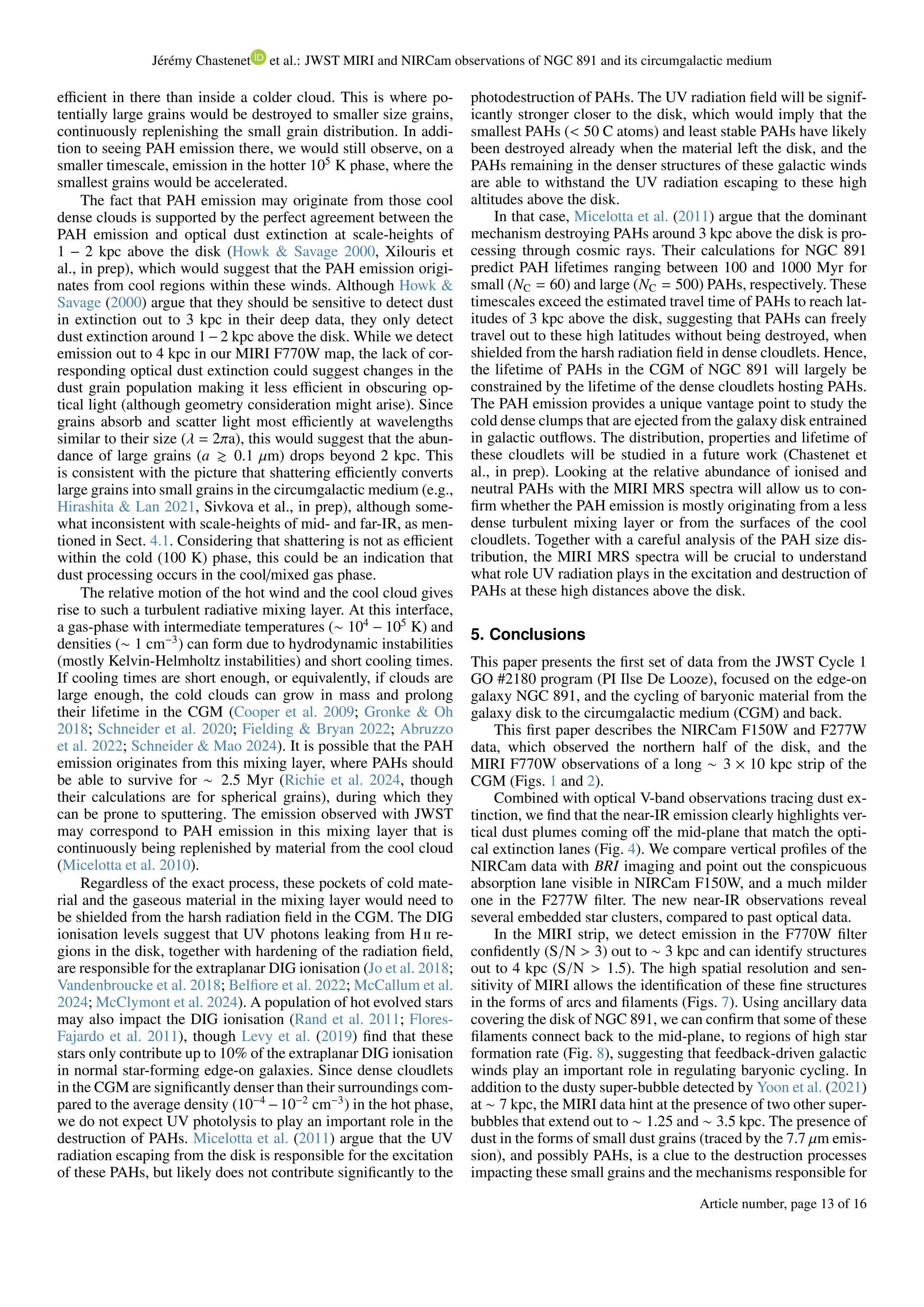
cus of this paper). Fig. 3 shows a signal-to-noise (S/N) map
for the MIRI strip. We added contours at S/N = 1.5, 3, 10, 50,
which land roughly at 3.8, 2.9, 2, and 1 kpc, respectively. This
map is created using the error-map provided by the pipeline (see
Williams et al. 2024 for additional tests on error propagation).
4
http://simbad.cds.unistra.fr/simbad/
Note that these S/N threshold positions will evolve as the MIRI
image gets refined with pipeline improvements, and do not affect
the qualitative analyses in this paper. Using an iterative 3σ clip-
ping on the whole map, after masking over-subtracted sources,
we find a noise median of ∼ 0.0036 MJy sr−1
and a large stan-
dard deviation of ∼ 0.017 MJy sr−1
. After comparing with the
pipeline-produced error map, we can confirm that the large stan-
dard deviation is due to instrumental noise rather than related to
astronomical variations in the background.
Saturated sources — Some sources appear severely saturated
in these images: in the NIRCam images, one is located in the
bottom-right and two very close stars towards the mosaic centre,
and in the MIRI image, there is one just at the lower-edge of the
tile. In the rest of the analysis, we mask these bright, saturated
sources. We use the WebbPSF package (Perrin et al. 2014) to
create PSF masks and manually align them with these sources.
Other bright sources do not show notable saturation spikes, and
a more elaborate PSF masking will be developed in upcoming
papers.
2.5. Ancillary Data
Other mid-IR data — We use the IRAC 8 µm and MIPS 24 µm
bands. We download the data created by the DustPedia consor-
tium (Davies et al. 2017; Clark et al. 2018)5
. The IRAC map is
used in Sect. 4.1. That image shows a bright artefact covering
most of the area around the disk. To reduce its impact, we re-
move a background after cutting out pixels with radial distance
larger than ±7 kpc from the centre (see Sect. 4.1). Unfortunately,
this does not completely remove the artefact. The MIPS map was
converted from surface brightness to star-formation-rate surface
density using the prescription in Leroy et al. (2019).
Optical data — We use V-band data from Howk & Savage
(1999), taken at Kitt Peak National Observatory using the WIYN
telescope, along with NIRCam data, to create a three-colour im-
age (Fig. 4). We also downloaded from the Isaac Newton Group
Archive observations taken in the BRI filters with the Wide Field
Camera at the Isaac Newton Telescope (program i07bn001, PI:
Trager); we processed them using standard data reduction meth-
ods and used them to build emission vertical profiles (Sect. 3).
These maps are in “photometric densities” units and we do not
attempt a conversion. Instead, we will normalise them all in a
similar fashion, and investigate changes in the shapes of the pro-
files. We also use Hubble Space Telescope/NICMOS Pa-α imag-
ing to identify regions in the disk with high star formation rate.
We use data from proposal ID 7919 (PI: Sparks) described in
Böker et al. (1999).
X-Ray data — We briefly compare X-Ray emission with the
location of bubble-like structures. To do so, we download XMM-
Newton observations of NGC 891 from the archive. We use the
EPIC S002 data from the program ID 0670950101 (PI: Bregman
Hodges-Kluck & Bregman 2013).
5
http://dustpedia.astro.noa.gr/
Article number, page 5 of 16
A&A proofs: manuscript no. aanda
2h22m48s 44s 40s 36s 32s
42°26'
25'
24'
23'
22'
RA (ICRS)
Dec
(ICRS)
F150W
1 kpc
0
2
4
6
8
10
12
14
Surface
brightness
[MJy/sr]
2h22m48s 44s 40s 36s 32s
42°26'
25'
24'
23'
22'
RA (ICRS)
Dec
(ICRS)
F277W
1 kpc
0
2
4
6
8
10
12
14
Surface
brightness
[MJy/sr]
2h22m50s 45s 40s 35s
42°21'00"
20'30"
00"
19'30"
00"
RA (ICRS)
Dec
(ICRS)
1
k
p
c
2
k
p
c
5
k
p
c
1
0
k
p
c
F770W
1 kpc
0.0
0.5
1.0
1.5
2.0
2.5
3.0
3.5
4.0
Surface
brightness
[MJy/sr]
Fig. 2. Top left: NIRCam F150W data, at native ∼ 0.05′′
resolution. The mid-plane shows conspicuous absorption. The background in that band
shows large discrepancies, due to the difficulty to correct for both large structure stripes and offsets between the individual dithers. The small
squares are gaps in the dither-pattern coverage. Top right: NIRCam F277W data, at native ∼ 0.092′′
resolution. Some absorption is visible in
the mid-plane, and the image shows a much smoother background than for the F150W mosaic. Bottom: MIRI F770W data, at native ∼ 0.25′′
resolution, with radial distance indicators at 1, 2, 5, and 10 kpc from the mid-plane. The mid-IR image shows many filamentary structures as far
out as ∼ 4 kpc.
Article number, page 6 of 16
Jérémy Chastenet et al.: JWST MIRI and NIRCam observations of NGC 891 and its circumgalactic medium
2h22m50s 45s 40s 35s
42°20'40"
20"
00"
19'40"
RA (ICRS)
Dec
(ICRS)
1 kpc 1.0
1.5
3.0
5.0
10.0
20.0
50.0
80.0
100.0
Signal-to-noise
Fig. 3. Signal-to-noise (S/N) map of the MIRI F770W map, created using the error-map provided by the pipeline. The black, dark-grey, light-grey,
and white contours show the S/N thresholds at 1.5, 3, 10, and 50 (with straight lines marking the associated distances at 3.8, 2.9, 2, 1 kpc),
respectively, and are marked in the colorbar. These thresholds fall at distances of 3.8, 2.9, 2, and 1 kpc from the mid-plane.
3. Studying the disk and layered CGM with NIRCam
3.1. Resolving dust extinction and young star clusters
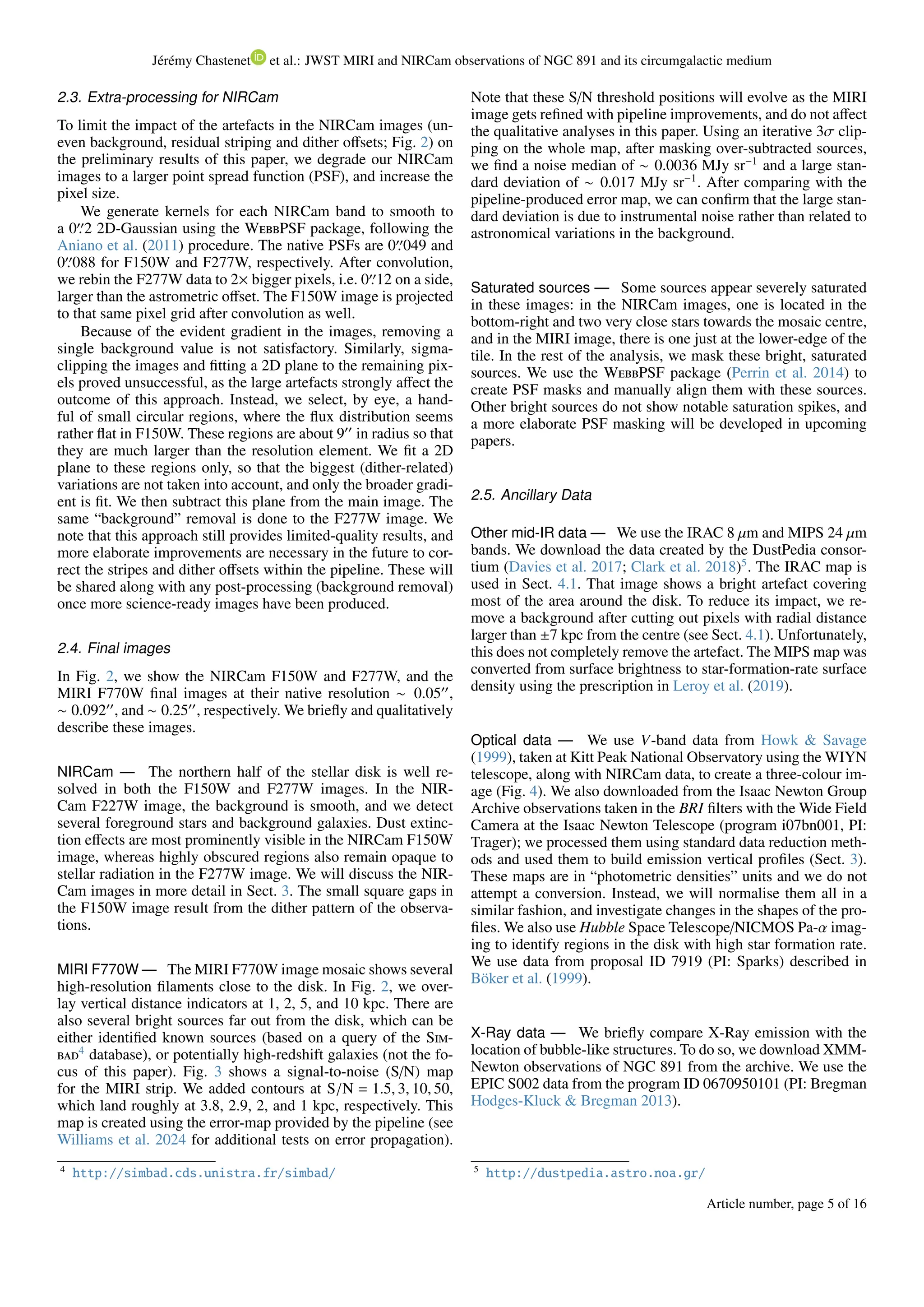
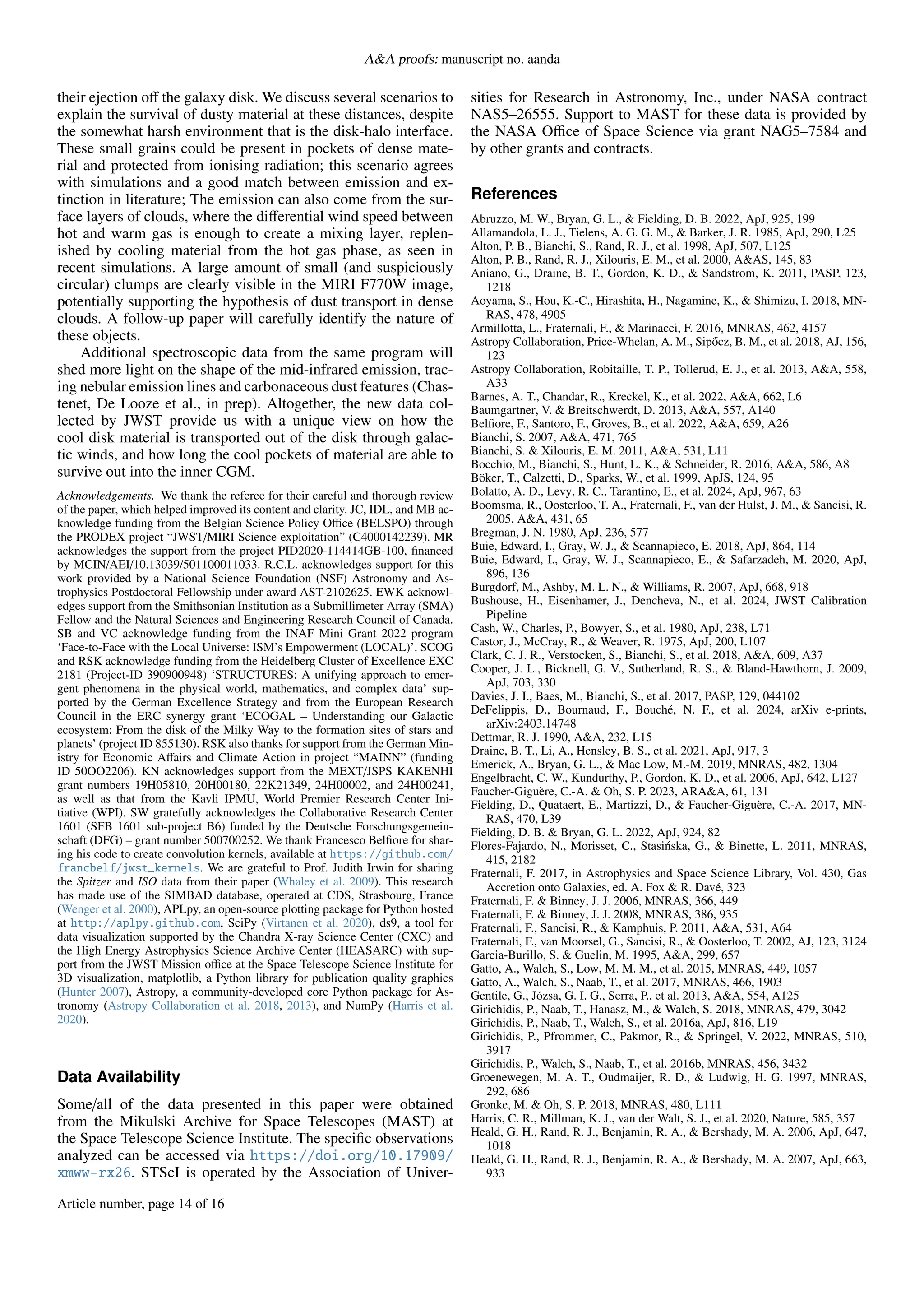
Figure 4 shows a composite image of V-band, F150W, and
F277W of the northern part of the disk in NGC 891. It reveals
the filaments and spurs of dusty material that appear as dark
lanes above the mid-plane due to the extinction of stellar light
located behind the dust. These dusty obscuring structures trace
the cold material, likely entrained in galactic outflows, and not
infall given their dust content, and that we detect in emission
with MIRI at even higher scale-heights above the disk. Similar
structures were observed in recent JWST observations of M82
(Bolatto et al. 2024, Fisher et al., subm.).
The RGB image also reveals the presence of several embed-
ded star clusters within the thin disk, which were not visible in
the V-band image due to high levels of dust obscuration, but
that show up in both of the NIRCam images. These come out
as bright, red-ish point sources. A separate paper will focus on
these clusters. In particular, the region with a high density of star
clusters corresponds to a region with bright MIPS 24 µm emis-
sion, and has been suggested to correspond to an accumulation
of H ii regions along the line-of-sight (Katsioli et al. 2023), in
line with the high number density of star clusters in that area.
The star clusters are distributed within the thin disk. It is less ob-
scured in the lower half of the image, which is consistent with
the idea of trailing spiral arms in NGC 891 with the H ii regions
located in front of the spiral arms on the approaching north-east
side of the disk (Kamphuis et al. 2007). This also explains the
detection of many embedded star clusters in this northern part of
the galaxy. However, moving further away from the centre of the
galaxy, the thin disk appears more obscured beyond 7 − 8 kpc
with maybe a smaller contribution from embedded star clusters
(future work focused on NIRCam will unveil more stellar and
cluster properties). At these galactocentric radii, we are likely
tracing cold dense dusty clouds in the spiral arms. This is also
supported by the clear warp or twist (inflection point, in Fig. 4
that is seen in the orientation of the thin disk around radii of
∼ 8 kpc, and is conspicuous in the F150W inset. We do not have
a clear explanation at this stage. One might be that we are tracing
two different parts of a single spiral arm, or two different spiral
arms, one particularly curved, and a second one on the other side
of the disk.
3.2. Vertical disk partition
The available NIRCam bands offer the possibility to study the
vertical extent of the stellar component. The top panel in Fig. 5
shows the median flux (normalised at z = 0.5 kpc) in bins of
vertical distance (about 75 pc bins) for F150W (light blue) and
F277W (dark blue), averaged above and below the disk, for radii
between 2.5 and 9 kpc (to match the radial coverage between all
profiles shown). The error bars represent the scatter in each bin
(rather large, given the remaining data reduction caveats).
Several works have derived the scale height of the stellar dis-
tribution in NGC 891 using optical and near-infrared photome-
try, as well as radiative transfer simulations. This approach also
led to inferring the presence of a thin and thick disks. For ex-
ample, the work of Xilouris et al. (1998) used radiative transfer
models to derive stellar scale height parameters in optical and
near-IR bands, studying variations both in the radial, r, and ver-
tical, z, directions simultaneously and including a bulge com-
ponent. In Fig. 5, we show their best-fit profiles in the ver-
tical z direction for the J- (∼ 1.2 µm) and K- (∼ 2.1 µm)
bands, for a range of radii 2.5 kpc ≤ r ≤ 9 kpc. Other radia-
tive transfer modelling by Schechtman-Rook & Bershady (2013)
even led to suggesting the existence of an extra-thin disk. Using
Spitzer/IRAC 3.6 µm photometry, Fraternali et al. (2011) also
showed a good match to NGC 891’s vertical and radial profiles
using a “bulge+two disks” model, which led to a derived thin
disk scale height of 0.25 kpc while the thick disk scale height
was fixed to 0.80 kpc (note that the decomposition was done with
galfit which implies sech2
functions for the disks). We show
their fit on the NIRCam data as a thin black line.
In our case, it is very difficult to obtain conclusive fits to the
vertical profiles. We tested several approaches, most of which
led to unsatisfactory results, and are therefore not shown in this
study. We attempt to fit simple single- or double-exponential pro-
files in the vertical direction only, applied to different versions
of the data: at native resolution, convolved to a 1′′
.0 Gaussian,
and/or rebinned to bigger pixels (see Sect. 2.3). We also tested a
sech2
profile fit. For F150W, single- and double-exponential ver-
tical fits yield a unique value for the scale-height, z = 0.43 kpc,
simply repeated if using a double-exponential disk. In F277W,
we find z = 0.45 kpc for a single-exponential fit and z1, z2 =
0.31, 0.58 kpc for a double-exponential fit. Using a sech2
pro-
file leads to scale-heights of 0.61 and 0.66 kpc in F150W and
Article number, page 7 of 16
A&A proofs: manuscript no. aanda
2h22m42s 40s 38s 36s
42°24'00"
23'30"
00"
22'30"
00"
21'30"
RA [J2000]
Declination
[J2000]
r 7 kpc
r 3 kpc
Inflection point
Higher density
of clusters?
V-band
F150W
F277W
Fig. 4. Multi-colour image with red: F277W, green: F150W, and blue: V-band, showing the coverage where all data overlap (the V-band and
F277W images were adjusted to show the same spatial coverage, including dither gaps), and individual images shown in insets on the right. The
NIRCam data was convolved to a 0.2′′
Gaussian PSF. We indicate galactocentric radii r at 3 and 7 kpc. Conspicuous dark features show dusty
filaments seen in extinction perpendicular to the disk. We can also notice the presence of star clusters, some obscured by dust, and some are not.
F277W, respectively. However, both these fits can easily be bet-
ter adjusted by eye, meaning they are not quite “best fits.” We
found that the large scatter (used as error) in the plane of the disk
due to the visible point sources, and/or background irregularities
on each side of the plane, leads to a poor fit, forcing the flux val-
ues at high altitudes to be (wrongly) more constraining. In none
of the cases we tried are the associated errors reasonable to make
them trustworthy results, and we therefore do not show them6
.
A separate paper focused on NIRCam and other optical/near-IR
bands will tackle this issue in better details. Differences with val-
ues of scale-heights reported in the literature may be related to
modelling assumptions that are not addressed here, e.g., the use
6
We used the Python package scipy and its curve_fit function.
Article number, page 8 of 16
Jérémy Chastenet et al.: JWST MIRI and NIRCam observations of NGC 891 and its circumgalactic medium
0.0 0.2 0.4 0.6 0.8 1.0 1.2 1.4
Distance above disk, z [kpc]
-1.0
0.0
1.0
2.0
3.0
4.0
5.0
6.0
arbitrary
units
Fraternali et al. (2011), IRAC 1
Xilouris et al. (1998), J-band
Xilouris et al. (1998), K-band
F150W
F277W
30 20 10 0 10 20 30
Distance above disk, z ['']
1.5 1.0 0.5 0.0 0.5 1.0 1.5
Distance above disk, z [kpc]
100
101
norm.
units
F150W
F277W
B
R
I
Fig. 5. Top: NIRCam vertical profiles shown with symbols, in light blue
for F150W and dark blue for F277W. We also show the fit from Frater-
nali et al. (2011) using IRAC data (black line) and two fits from the
radiative transfer models of Xilouris et al. (1998). In all cases, we aver-
age the vertical profiles over galactocentric radii 2.5 kpc ≤ r ≤ 9 kpc,
so that the radial coverage is the same. Bottom: Emission profiles across
the disk at r ∼ 8 kpc showing the NIRCam data, and three optical bands.
The images have all been normalised to the average values at z = 1 kpc,
due to different units, for an easier comparison. The upturn at 1.2 kpc in
F150W is an artefact due to one of the dither offsets mentioned in the
text.
of a bulge component and the simultaneous variations in both
radial and vertical directions, or taking into account absorption
lanes, which has been shown to affect the estimation of scale-
heights (Xilouris et al. 1998; Savchenko et al. 2023). Given the
current quality of the NIRCam data, we do not investigate these
avenues further in this paper. A separate study focused on re-
solving NIRCam data reduction issues and subsequent analysis
will tackle the vertical stratification of this edge-on galaxy in the
near-IR.
To allow for a better visualisation of the vertical structure
without averaging in the radial direction, the bottom panel of
Fig. 5 shows the vertical profiles of the NIRCam data at an arbi-
trary galactocentric radius (r ∼ 8 kpc), normalised to the mean
value at z ∼ 1 kpc. The dust extinction is clearly visible in the dip
of the F150W emission (around −0.1 kpc; light blue line), while
the F277W data shows only a mild feature. We compare these
profiles to optical emission in the B, R, and I bands, in grey.
4. Resolving the inner circumgalactic medium with
MIRI F770W
4.1. Distribution of circumgalactic dust
While the presence of circumgalactic dust in NGC 891 has been
known for a while (e.g., Howk & Savage 1997; Burgdorf et al.
2007; Whaley et al. 2009), the resolution of prior instrumenta-
tion (e.g., ISO, Spitzer, Herschel) did not allow a study of its
intricate structure on scales smaller than 100 pc. With JWST, we
are able to map out the resolved circumgalactic dust emission in
a 3.3 kpc-wide strip of extra-planar material around a galacto-
centric radius of r = 0 kpc extending from z ∼ 0.5 to ∼ 10 kpc
above the disk, down to scales of 12 pc (i.e., 0′′
.25 FWHM of
MIRI F770W, see Fig. 2). The high spatial resolution of JWST
shows that the inner CGM material is not homogeneously dis-
tributed, but is rather dominated by small-scale structures (e.g.,
arcs and filaments tens of pc wide and hundreds of pc long)
where densities are locally enhanced (see Fig. 2). On the small-
est scales, we observe several clumpy structures that resemble
those seen in the CGM of the starburst galaxy M82, with JWST
(Fisher et al., subm.). They also somewhat mirror cool clumps
have been inferred through observations of Mg ii absorbers (e.g.,
Ménard et al. 2010; Lan & Fukugita 2017), but these were found
on larger scales. These cool clumps have average hydrogen num-
ber densities of 0.1 cm−3
and gas temperatures of Tgas ∼ 104
K,
and were postulated to have formed through thermal instabili-
ties and/or shock compression (Buie et al. 2018, 2020; Liang &
Remming 2020). They are also the perfect sites for grain pro-
cessing to take place (Hirashita & Lan 2021). A possible mech-
anism to explain the presence of dust in these clumps would
involve (1) large grains (a > 0.01 − 0.03 µm) being expelled
from the disk through galactic winds (Zu et al. 2011; Aoyama
et al. 2018; Schneider et al. 2020; Richie et al. 2024) and ra-
diative feedback processes (Sivkova et al. 2021), and (2) sub-
sequently undergoing shattering, transferring the predominantly
large grain population to the smaller grain sizes that are detected
in the JWST/MIRI F770W filter. That said, if radiation pressure
dominates, it should not be dependent on size distribution and
small grains could directly be pushed out of the disk, too. We
will discuss the statistical properties of these small-scale clump
structures in an upcoming paper (Chastenet et al., in prep).
Figure 6 shows the vertical profiles of mid-infrared observa-
tions. We compute the median fluxes in the MIRI F770W map
in bins of distances and fit a double-exponential profile to this
distribution, following
S λ(z) = S d,1 × exp −
z
z1
!
+ S d,2 × exp −
z
z2
!
, (1)
where S λ is the measured surface brightness in MJy sr−1
, z1, z2
are the dust scale-heights, and z is the distance from the disk. In
Fig. 6, the filled symbols are those used for these fits that pass a
3σ S/N cut, and only for z ≤ 2 kpc. The red lines show the fit
to the MIRI F770W data, with the dashed one being a fit with
a single-exponential, and the solid-line with two; the latter leads
to scale-heights of (0.29±0.65, 0.75±0.78) kpc, where the large
uncertainties are due to lack of coverage all the way to the disk.
For reference, we show IRAC and ISO data. In diamond sym-
bols, we show the binned medians of the IRAC 8 image cutting
out pixels further away than ±7 kpc in radius, similarly to what
Article number, page 9 of 16
A&A proofs: manuscript no. aanda
was done in Bocchio et al. (2016). The square symbols show the
binned medians in the ISO 7.7 µm map used by Whaley et al.
(2009). There is an apparent offset between these ancillary data
and the MIRI profile: we point out that there is a clear, bright
artefact in the IRAC 8 image, covering the area we are inter-
ested in. Our efforts have not managed to bring it down to a rea-
sonable, background-like level. Additionally, both the IRAC and
ISO data are at a (much) coarser resolution, with very different
transmission curves, which will inevitably affect the measured
fluxes. Finally, the spatial coverage of these three (MIRI, IRAC,
ISO) datasets is quite different, and sample a large range of (non-
overlapping) radii and altitudes. However, the IRAC profile does
show a very similar shape to that of the MIRI data.
The scale-height of the thick dust disk measured from the
MIRI 7.7 µm map is consistent with values from the literature
around those wavelengths (Whaley et al. 2009; Bocchio et al.
2016, ∼ 0.3 − 0.6 kpc), and suggest a steep decline in the abun-
dance of the smallest dust grains going away from the galaxy
mid-plane further out into the inner CGM. Given the higher
scale-heights inferred for large grains from far-IR and sub-mm
imaging (thick disk: z2 ∼ 1 kpc at 250 µm, Bocchio et al. 2016),
this suggests that the abundance of small grains decreases more
steeply than the mass fraction of large grains with altitude above
the mid-plane (although note that small and large grains will be
sensitive to different illuminating radiation fields). This result
is at odds with results in the literature, including for NGC 891
(Katsioli et al. 2023) and will require further analysis to under-
stand how the small-to-large grain ratio is altered in the disk-halo
connection region of NGC 891 and other galaxies. Note that the
distance threshold at which to stop considering data for expo-
nential fit (here, 2 kpc) has a significant impact on the fit. This is
most likely due to the lack of data all the way to the galaxy mid-
plane, in the case of the MIRI data. Considering that the largest
scale-height is smaller than 1 kpc, the lack of coverage below
that vertical height becomes critical.
4.2. Super-bubbles in NGC 891
On scales of a few tens of parsecs, we are able to discern sev-
eral prominent outflow features above the disk including dusty
chimneys, arcs, and parabolic structures that resemble large-
scale bubbles. Some of these structures are shown in the MIRI
strip, and in zoomed insets in Fig. 7. The first panel (1) reveals
an arc-like structure that resembles the walls of a former super-
bubble after breaking out of the thin disk. The shells in pan-
els (2) and (3) might correspond to similar super-bubbles where
multiple SNe in a star cluster were needed to create a struc-
ture of this size (see, e.g., Barnes et al. 2022, for a discussion
of pre-supernova feedback mechanisms with H ii region sizes).
These bubbles are formed through the continuous energy input
from SNe and stellar feedback processes, and expand into the
surrounding ISM creating a shell of swept up interstellar ma-
terial. While the swept-up material collapses into a cool dense
shell (Castor et al. 1975), the interior of the bubble contains ten-
uous, hot (> 106
K) gas that should be visible in low-energy
X-ray emission. Matching the location of these dusty super-
bubbles with XMM-Newton soft X-ray (0.3–2.0 keV) observa-
tions (Temple et al. 2005), we can see that the shell structure in
panel (3) is filled with low-energy X-ray radiation. This con-
firms our hypothesis that these dense shell correspond to the
walls of super-bubbles. Due to sensitivity limitations, we are un-
able to verify whether the other bubbles further out are similarly
filled with a hot tenuous gas. Examples of such super-bubbles
have been observed in our own Milky Way in the Cygnus super-
0 10 20 30 40 60 80
Distance from disk [00
]
0.0 0.5 1.0 1.5 2.0 2.5 3.0 3.5 4.0
Distance from disk [kpc]
0.01
0.10
1.00
10.0
100.
Surface
brightness
[MJy
sr
1
]
MIRI F770W; double-exp fit
MIRI; single-exp fit
IRAC 8 m
ISO 7.7 m (Whaley et al. 2009)
Fig. 6. Vertical profiles of the MIRI F770W image at native resolu-
tion (red; the MIRI measurements do not extend inward of 0.5 kpc,
Fig. 2), Spitzer/IRAC 8 µm (shades of orange), and ISO 7.7 µm (dark-
orange), with error bars showing one standard deviation in each bin. The
filled symbols mark the ones used for fitting a double-exponential (un-
less mentioned otherwise) profile to the running medians, which must
have S/N ≥ 3. See text for details on the fits.
bubble and Aquila super-shell with diameter sizes of 0.5 − 1 kpc
(Cash et al. 1980; Maciejewski et al. 1996). Similar shells were
already detected through dust extinction in the optical and Hα
emission in NGC 891 with similar super-bubble sizes up to 1 kpc
(e.g., Rossa et al. 2004). The sizes observed here are larger than
those found in a recent study by Watkins et al. (2023). However,
these bubbles are found in a sample of low-inclination galaxies,
and at different radii, which leads to finding different morpholo-
gies and sizes due to the varying galaxy properties.
Within the dense ISM of the thin disk, the shell expansion
will decelerate until the super-bubble breaks out of the thin disk
and can accelerate again in the direction of the pressure gradi-
ent due to the exponential fall off in density—creating a negative
density gradient—above the disk. When the super-bubble accel-
erates into the halo, the interface between the hot bubble inte-
rior and the dense cold shell becomes prone to instabilities such
as Rayleigh-Taylor instabilities creating finger-like structures.
Eventually, turbulent mixing of the two layers will cause the
shell to break up (Baumgartner & Breitschwerdt 2013), which
often leaves structures that resemble dusty chimneys as observed
in NGC 891 (e.g., Howk & Savage 2000). Numerical simulations
of the breakout of super-bubbles (Mac Low & McCray 1988;
Mac Low et al. 1989; Gatto et al. 2015) suggest that the super-
bubble could survive out to 1 to 2 vertical scale heights before
the cold dense shell starts accelerating and will start fragment-
ing.
The top of the super-bubble structure in Panel (3) of Fig. 7
is located about z = 1.3 kpc above the mid plane, while the
super-bubble in Panel (2) extends out to z = 3.2 kpc above
the disk. These bubble have similar sizes compared to the scale
heights of the thin and thick disks in NGC 891. Specifically, the
Article number, page 10 of 16
Jérémy Chastenet et al.: JWST MIRI and NIRCam observations of NGC 891 and its circumgalactic medium
scale heights of the thin and thick dust disk were estimated to
be around 0.24 and 1.40 kpc, respectively, based on the Her-
schel/SPIRE 250 µm images (Bocchio et al. 2016). The dust
scale height of the thick stellar disk is similar (1.44 kpc; Ibata
et al. 2009), while the H i gas has a scale height of ∼ 2.6 kpc
(Oosterloo et al. 2007) and the warm ionised gas can reach scale
heights of 4.5 kpc (Dettmar 1990). At these scale heights, one
can expect to soon start seeing a fragmentation of the super-
bubble shell, whereas the shells currently still look intact. Yoon
et al. (2021) have studied a dusty super-bubble in NGC 891
with a diameter size of 8 kpc extending out to at least 7.7 kpc
vertically upwards from the mid-plane. This super-bubble was
also detected in X-rays (Hodges-Kluck et al. 2012, 2018). Yoon
et al. (2021) suggested that this super-bubble could develop into
a galactic wind before breaking apart and returning to the disk
of NGC 891 in the form of galactic fountains. The super-bubbles
in this work are detected at lower altitudes above the disk, and
it is unclear whether some of these bubbles can develop into a
galactic wind in the future, or will rain back down on the galaxy
disk after substantial cooling.
The detection of several such super-bubble structures con-
firms that stellar feedback processes play an important role in
driving galactic outflows, even in galaxies with moderate SFR
(∼ 5 M⊙ yr−1
) and SFR densities (∼ 0.03 M⊙ yr−1
kpc−2
) like
NGC 891 (Yoon et al. 2021). While NGC 891 is considered
a Milky Way-type galaxy, its prominent CGM component sug-
gests that star formation activity and the mass loss history may
have been more violent in the past (although empirical evidence
may lack).
4.3. Connecting extra-planar dusty filaments to the disk
The MIRI images shows many fine structures within 2 kpc from
the mid-plane. Unfortunately, the MIRI data do not cover the
disk. As several studies have identified filaments coming from
the disks of galaxies and extending in the CGM (e.g., Rand et al.
1990; Howk & Savage 1997; Irwin et al. 2007), we attempt to
connect the visible structures in the MIRI/F770W map to the
disk of NGC 891 using other data sets.
We use the Spitzer/IRAC 8 µm imaging, and apply to it the
unsharp masking technique (this approach was similarly used
in, e.g., Yoon et al. 2021). The IRAC image is blurred using a
median filter box of 10 pixels in size, and that blurred image
is removed from the original. The unsharp-mask IRAC image
enhances very clearly filaments coming out of the disk.
In Fig. 8, the grey mask shows the IRAC 8 with an unsharp-
mask applied. We show the MIRI image at native resolution,
with white contours propagating the unsharp-mask filaments. By
eye, the agreement seems rather good, with darker colour (higher
flux density) often falling within the IRAC 8 filaments7
. Some
of these overlapping pixels can be traced back to the disk, where
we also show in black contours the Paα intensity, as a tracer of
recent star formation, as well as ΣSFR = 0.1 M⊙ yr−1
kpc−2
in-
ferred from MIPS 24 (Leroy et al. 2019), a threshold at which
star formation can be responsible for blowing material off the
mid-plane, suggested by different studies (e.g., Heckman 2002;
Murray et al. 2011).
7
Note that we could qualitatively observe the same dusty filaments
connecting back to the disk in Fig. 4.
4.4. Origin of the MIRI/F770W emission
The detection of emission originating from PAHs out to ∼ 4 kpc
is remarkable given the hostile environment that a galaxy halo
represents with its X-ray emitting diffuse ionised gas component,
in which the smallest dust grains could be destroyed almost in-
stantly through sputtering processes (Micelotta et al. 2010). That
said, NGC 891 is not a standalone case. For example, PAH emis-
sion was detected out to 6 kpc in M82 (Engelbracht et al. 2006;
see also follow-up work with JWST by Bolatto et al. 2024 and
Fisher et al., subm.). Such extended emission from PAHs was
also found in less extreme galaxies: NGC 5907 (Irwin & Mad-
den 2006), NGC 5529 (Irwin et al. 2007), and NGC 5775 (Lee
et al. 2001).
Since the claimed detection originates from broad-band fil-
ters, the observed emission could be contaminated by other
emission sources, and not simply trace the mid-IR feature. Be-
yond the thick stellar disk in NGC 891 (hz ∼ 400 − 800 pc),
we can safely assume that the stellar emission will be only min-
imally contributing to the MIRI F770W flux at high latitudes.
Recent MIRI MRS observations of four pointings at 0.5 and
1 kpc above the disk (from the same Cycle 1 GO #2180) also
suggest that strong contributions from ionised gas lines are un-
likely in that filter (Chastenet, De Looze et al., in prep.). The
same MRS spectra do detect carbon emission features, similarly
to Rand et al. (2008), who spectroscopically identified mid-IR
emission features above the disk of NGC 891 at λ > 10 µm.
This makes us fairly confident that the MIRI 7.7 µm emission is
originating from dust. While the MIRI F770W filter is centred
on the 7.7 µm feature from ionised PAHs (e.g., Maragkoudakis
et al. 2022), there may be underlying continuum emission from
very small grains (a ≲ 0.01 µm). In dust emission models, this
continuum is expected to have a non-negligible contribution to
the F770W filter only when reaching very high radiation fields
(Draine et al. 2021; Sutter et al. 2024), or unexpectedly high
fraction of small grains over large grains.
How PAHs were able to reach such high latitudes above the
disk is not yet entirely clear. Dusty material could originate from
the mid-plane and (1) may have left the galaxy disk entrained
in galactic outflows (Kannan et al. 2021; Richie et al. 2024),
(2) was pushed out through radiation pressure (Sivkova et al. in
prep), (3) was transported by cosmic ray-driven winds, which
seem to be slower and cooler, and therefore smoothly lift mate-
rial away from the disk (Girichidis et al. 2016a, 2018, 2022; De-
Felippis et al. 2024). The second option is that dense cloudlets
in the CGM are created through condensation of CGM material
via thermal instabilities in the halo (Buie et al. 2018; Liang &
Remming 2020), but these structures are not expected to host
any PAHs originating from the disk. They may potentially har-
bour PAHs that formed in-situ through AGB stellar mass loss
(Groenewegen et al. 1997; Mauron 2008), although it is unlikely
that this will significantly contribute to the PAH abundance in
the halo since these freshly formed grains would be ejected in
the hot X-ray emitting halo gas and would not stand a chance to
survive for long (e.g., Scannapieco 2017).
Given that the dusty filaments connect back to star-forming
regions within the disk, we consider it most likely that the
dusty material traced with our JWST observations at altitudes of
∼ 1 − 4 kpc above the disk have been removed from the galaxy
disk through galactic winds. In that case, the dusty material of
the disk should still be present in these structures and the JWST
observations give us a unique view on how material has been
slung out the galaxy disk and how PAHs are processed in the
harsh environment of the CGM. In the next paragraphs, we dis-
Article number, page 11 of 16
A&A proofs: manuscript no. aanda
2h22m40s 38s 36s 34s
42°20'40"
20"
00"
19'40"
RA (ICRS)
Dec
(ICRS)
2
3
1
1 kpc
500 pc 250 pc
500 pc
Fig. 7. Cut-out of the MIRI strip closest to the disk in the left panel, with soft X-ray 95th
percentile contours in grey. We bring out three locations
showing visible extended structures in boxes 1 through 3. These are shown on the right hand side, marked with arc-likes structures (by hand).
2h22m38s 36s 34s 32s
42°21'00"
20'40"
20"
00"
RA [J2000]
Dec
[J2000]
SN 1986J
SFR =0.1 M yr 1 kpc 2
IPa =0.2 counts s 1 0.0
0.1
0.5
1.0
1.5
2.0
3.0
4.0
5.0
Surface
brightness
[MJy
sr
1
]
Fig. 8. IRAC 8 µm unsharp-mask, shown in grey, with the MIRI image
overlayed. The white contours show the continuation of the structures in
the IRAC unsharp-mask, nicely following some of the structure visible
in high-resolution in the MIRI map. We show contours of star formation
rate surface density of 0.1 M⊙ yr−1
kpc−2
derived from the MIPS-24 µm
image, and intensity of Pa-α, another tracer of recent star formation.
The cross at the bottom-right shows the location of SN1986J.
cuss what physical conditions are needed for PAHs to survive
out to these large extraplanar distances.
4.5. Survival of PAHs out to 4 kpc
Assuming that the extra-planar emission originates from small
carbonaceous dust, we can ask ourselves how the smallest dust
particles can survive out to 4 kpc above the disk. Typical outflow
velocities of 50 − 75 km s−1
for cold material leaving the disk
have been inferred based on H i data of NGC 891 (Fraternali
& Binney 2006, 2008), and are consistent with velocities esti-
mated from the combined effects of radiation pressure on dust
grains, gravity, and gas drag (Sivkova et al. 2018, and in prep).
This would imply that it takes 50 − 80 Myr for the material to
reach these altitudes above the disk. We note that higher veloci-
ties are plausible, and the currently measured outflow velocities
may furthermore not resemble those that pushed out material out
of the disk in the past. For example, the turbulent mixing of hot
gas with cool clouds can boost the velocities of the cool material
entrained in hot galactic winds. Also, if NGC 891 experienced a
starburst episode before, the star formation feedback may have
been more violent resulting in higher outflow velocities. This im-
plies that our estimated lifetimes (50−80 Myr) for PAHs detected
at 4 kpc above the disk are likely to be considered as strict upper
limits. These dynamical timescales are several orders of magni-
tude longer than the average lifetime of PAHs in a tenuous hot
gas (of the order of 1000 years; Micelotta et al. 2010). This re-
quires that the PAHs must be shielded from harsh environments
in pockets of cool dense regions—manifested as clumpy struc-
tures and cool dense shells around the super-bubbles. PAHs may
also be found in a mixing layer of cool, diffuse ionised gas that
connects the warm gas and the cold dense cloudlets, providing
an additional source of emission. Past works have already shown
the existence of PAHs on the surfaces of cold clouds in hot gas
for long periods (Micelotta et al. 2010).
Simulations (Schneider & Robertson 2017; Tan & Fielding
2024) demonstrate that cold (100 − 1000 K), dense, presumably
dust-rich clouds can be accelerated out of the disk via a variety
of mechanisms, including, e.g., ram pressure from super bubbles.
As these clouds experience hydrodynamic instabilities from the
wind, they are mixed with the hot phase and accelerated, leading
to a multiphase structure, including cold dense clumps closer to
the disk, a cool (104
K) ionised phase that is being accelerated,
and a transient mixed phase (105
K) that either gets incorporated
into the hot phase of the wind or cools back onto the clouds. In
this scenario, the cool, 104
K layer would still be able to shield
small dust grains, but we would expect shattering to be more
Article number, page 12 of 16
Jérémy Chastenet et al.: JWST MIRI and NIRCam observations of NGC 891 and its circumgalactic medium
efficient in there than inside a colder cloud. This is where po-
tentially large grains would be destroyed to smaller size grains,
continuously replenishing the small grain distribution. In addi-
tion to seeing PAH emission there, we would still observe, on a
smaller timescale, emission in the hotter 105
K phase, where the
smallest grains would be accelerated.
The fact that PAH emission may originate from those cool
dense clouds is supported by the perfect agreement between the
PAH emission and optical dust extinction at scale-heights of
1 − 2 kpc above the disk (Howk & Savage 2000, Xilouris et
al., in prep), which would suggest that the PAH emission origi-
nates from cool regions within these winds. Although Howk &
Savage (2000) argue that they should be sensitive to detect dust
in extinction out to 3 kpc in their deep data, they only detect
dust extinction around 1−2 kpc above the disk. While we detect
emission out to 4 kpc in our MIRI F770W map, the lack of cor-
responding optical dust extinction could suggest changes in the
dust grain population making it less efficient in obscuring op-
tical light (although geometry consideration might arise). Since
grains absorb and scatter light most efficiently at wavelengths
similar to their size (λ = 2πa), this would suggest that the abun-
dance of large grains (a ≳ 0.1 µm) drops beyond 2 kpc. This
is consistent with the picture that shattering efficiently converts
large grains into small grains in the circumgalactic medium (e.g.,
Hirashita & Lan 2021, Sivkova et al., in prep), although some-
what inconsistent with scale-heights of mid- and far-IR, as men-
tioned in Sect. 4.1. Considering that shattering is not as efficient
within the cold (100 K) phase, this could be an indication that
dust processing occurs in the cool/mixed gas phase.
The relative motion of the hot wind and the cool cloud gives
rise to such a turbulent radiative mixing layer. At this interface,
a gas-phase with intermediate temperatures (∼ 104
− 105
K) and
densities (∼ 1 cm−3
) can form due to hydrodynamic instabilities
(mostly Kelvin-Helmholtz instabilities) and short cooling times.
If cooling times are short enough, or equivalently, if clouds are
large enough, the cold clouds can grow in mass and prolong
their lifetime in the CGM (Cooper et al. 2009; Gronke & Oh
2018; Schneider et al. 2020; Fielding & Bryan 2022; Abruzzo
et al. 2022; Schneider & Mao 2024). It is possible that the PAH
emission originates from this mixing layer, where PAHs should
be able to survive for ∼ 2.5 Myr (Richie et al. 2024, though
their calculations are for spherical grains), during which they
can be prone to sputtering. The emission observed with JWST
may correspond to PAH emission in this mixing layer that is
continuously being replenished by material from the cool cloud
(Micelotta et al. 2010).
Regardless of the exact process, these pockets of cold mate-
rial and the gaseous material in the mixing layer would need to
be shielded from the harsh radiation field in the CGM. The DIG
ionisation levels suggest that UV photons leaking from H ii re-
gions in the disk, together with hardening of the radiation field,
are responsible for the extraplanar DIG ionisation (Jo et al. 2018;
Vandenbroucke et al. 2018; Belfiore et al. 2022; McCallum et al.
2024; McClymont et al. 2024). A population of hot evolved stars
may also impact the DIG ionisation (Rand et al. 2011; Flores-
Fajardo et al. 2011), though Levy et al. (2019) find that these
stars only contribute up to 10% of the extraplanar DIG ionisation
in normal star-forming edge-on galaxies. Since dense cloudlets
in the CGM are significantly denser than their surroundings com-
pared to the average density (10−4
−10−2
cm−3
) in the hot phase,
we do not expect UV photolysis to play an important role in the
destruction of PAHs. Micelotta et al. (2011) argue that the UV
radiation escaping from the disk is responsible for the excitation
of these PAHs, but likely does not contribute significantly to the
photodestruction of PAHs. The UV radiation field will be signif-
icantly stronger closer to the disk, which would imply that the
smallest PAHs (< 50 C atoms) and least stable PAHs have likely
been destroyed already when the material left the disk, and the
PAHs remaining in the denser structures of these galactic winds
are able to withstand the UV radiation escaping to these high
altitudes above the disk.
In that case, Micelotta et al. (2011) argue that the dominant
mechanism destroying PAHs around 3 kpc above the disk is pro-
cessing through cosmic rays. Their calculations for NGC 891
predict PAH lifetimes ranging between 100 and 1000 Myr for
small (NC = 60) and large (NC = 500) PAHs, respectively. These
timescales exceed the estimated travel time of PAHs to reach lat-
itudes of 3 kpc above the disk, suggesting that PAHs can freely
travel out to these high latitudes without being destroyed, when
shielded from the harsh radiation field in dense cloudlets. Hence,
the lifetime of PAHs in the CGM of NGC 891 will largely be
constrained by the lifetime of the dense cloudlets hosting PAHs.
The PAH emission provides a unique vantage point to study the
cold dense clumps that are ejected from the galaxy disk entrained
in galactic outflows. The distribution, properties and lifetime of
these cloudlets will be studied in a future work (Chastenet et
al., in prep). Looking at the relative abundance of ionised and
neutral PAHs with the MIRI MRS spectra will allow us to con-
firm whether the PAH emission is mostly originating from a less
dense turbulent mixing layer or from the surfaces of the cool
cloudlets. Together with a careful analysis of the PAH size dis-
tribution, the MIRI MRS spectra will be crucial to understand
what role UV radiation plays in the excitation and destruction of
PAHs at these high distances above the disk.
5. Conclusions
This paper presents the first set of data from the JWST Cycle 1
GO #2180 program (PI Ilse De Looze), focused on the edge-on
galaxy NGC 891, and the cycling of baryonic material from the
galaxy disk to the circumgalactic medium (CGM) and back.
This first paper describes the NIRCam F150W and F277W
data, which observed the northern half of the disk, and the
MIRI F770W observations of a long ∼ 3 × 10 kpc strip of the
CGM (Figs. 1 and 2).
Combined with optical V-band observations tracing dust ex-
tinction, we find that the near-IR emission clearly highlights ver-
tical dust plumes coming off the mid-plane that match the opti-
cal extinction lanes (Fig. 4). We compare vertical profiles of the
NIRCam data with BRI imaging and point out the conspicuous
absorption lane visible in NIRCam F150W, and a much milder
one in the F277W filter. The new near-IR observations reveal
several embedded star clusters, compared to past optical data.
In the MIRI strip, we detect emission in the F770W filter
confidently (S/N > 3) out to ∼ 3 kpc and can identify structures
out to 4 kpc (S/N > 1.5). The high spatial resolution and sen-
sitivity of MIRI allows the identification of these fine structures
in the forms of arcs and filaments (Figs. 7). Using ancillary data
covering the disk of NGC 891, we can confirm that some of these
filaments connect back to the mid-plane, to regions of high star
formation rate (Fig. 8), suggesting that feedback-driven galactic
winds play an important role in regulating baryonic cycling. In
addition to the dusty super-bubble detected by Yoon et al. (2021)
at ∼ 7 kpc, the MIRI data hint at the presence of two other super-
bubbles that extend out to ∼ 1.25 and ∼ 3.5 kpc. The presence of
dust in the forms of small dust grains (traced by the 7.7 µm emis-
sion), and possibly PAHs, is a clue to the destruction processes
impacting these small grains and the mechanisms responsible for
Article number, page 13 of 16
A&A proofs: manuscript no. aanda
their ejection off the galaxy disk. We discuss several scenarios to
explain the survival of dusty material at these distances, despite
the somewhat harsh environment that is the disk-halo interface.
These small grains could be present in pockets of dense mate-
rial and protected from ionising radiation; this scenario agrees
with simulations and a good match between emission and ex-
tinction in literature; The emission can also come from the sur-
face layers of clouds, where the differential wind speed between
hot and warm gas is enough to create a mixing layer, replen-
ished by cooling material from the hot gas phase, as seen in
recent simulations. A large amount of small (and suspiciously
circular) clumps are clearly visible in the MIRI F770W image,
potentially supporting the hypothesis of dust transport in dense
clouds. A follow-up paper will carefully identify the nature of
these objects.
Additional spectroscopic data from the same program will
shed more light on the shape of the mid-infrared emission, trac-
ing nebular emission lines and carbonaceous dust features (Chas-
tenet, De Looze et al., in prep). Altogether, the new data col-
lected by JWST provide us with a unique view on how the
cool disk material is transported out of the disk through galac-
tic winds, and how long the cool pockets of material are able to
survive out into the inner CGM.
Acknowledgements. We thank the referee for their careful and thorough review
of the paper, which helped improved its content and clarity. JC, IDL, and MB ac-
knowledge funding from the Belgian Science Policy Office (BELSPO) through
the PRODEX project “JWST/MIRI Science exploitation” (C4000142239). MR
acknowledges the support from the project PID2020-114414GB-100, financed
by MCIN/AEI/10.13039/501100011033. R.C.L. acknowledges support for this
work provided by a National Science Foundation (NSF) Astronomy and As-
trophysics Postdoctoral Fellowship under award AST-2102625. EWK acknowl-
edges support from the Smithsonian Institution as a Submillimeter Array (SMA)
Fellow and the Natural Sciences and Engineering Research Council of Canada.
SB and VC acknowledge funding from the INAF Mini Grant 2022 program
‘Face-to-Face with the Local Universe: ISM’s Empowerment (LOCAL)’. SCOG
and RSK acknowledge funding from the Heidelberg Cluster of Excellence EXC
2181 (Project-ID 390900948) ‘STRUCTURES: A unifying approach to emer-
gent phenomena in the physical world, mathematics, and complex data’ sup-
ported by the German Excellence Strategy and from the European Research
Council in the ERC synergy grant ‘ECOGAL – Understanding our Galactic
ecosystem: From the disk of the Milky Way to the formation sites of stars and
planets’ (project ID 855130). RSK also thanks for support from the German Min-
istry for Economic Affairs and Climate Action in project “MAINN” (funding
ID 50OO2206). KN acknowledges support from the MEXT/JSPS KAKENHI
grant numbers 19H05810, 20H00180, 22K21349, 24H00002, and 24H00241,
as well as that from the Kavli IPMU, World Premier Research Center Ini-
tiative (WPI). SW gratefully acknowledges the Collaborative Research Center
1601 (SFB 1601 sub-project B6) funded by the Deutsche Forschungsgemein-
schaft (DFG) – grant number 500700252. We thank Francesco Belfiore for shar-
ing his code to create convolution kernels, available at https://github.com/
francbelf/jwst_kernels. We are grateful to Prof. Judith Irwin for sharing
the Spitzer and ISO data from their paper (Whaley et al. 2009). This research
has made use of the SIMBAD database, operated at CDS, Strasbourg, France
(Wenger et al. 2000), APLpy, an open-source plotting package for Python hosted
at http://aplpy.github.com, SciPy (Virtanen et al. 2020), ds9, a tool for
data visualization supported by the Chandra X-ray Science Center (CXC) and
the High Energy Astrophysics Science Archive Center (HEASARC) with sup-
port from the JWST Mission office at the Space Telescope Science Institute for
3D visualization, matplotlib, a Python library for publication quality graphics
(Hunter 2007), Astropy, a community-developed core Python package for As-
tronomy (Astropy Collaboration et al. 2018, 2013), and NumPy (Harris et al.
2020).
Data Availability
Some/all of the data presented in this paper were obtained
from the Mikulski Archive for Space Telescopes (MAST) at
the Space Telescope Science Institute. The specific observations
analyzed can be accessed via https://doi.org/10.17909/
xmww-rx26. STScI is operated by the Association of Univer-
sities for Research in Astronomy, Inc., under NASA contract
NAS5–26555. Support to MAST for these data is provided by
the NASA Office of Space Science via grant NAG5–7584 and
by other grants and contracts.
References
Abruzzo, M. W., Bryan, G. L., & Fielding, D. B. 2022, ApJ, 925, 199
Allamandola, L. J., Tielens, A. G. G. M., & Barker, J. R. 1985, ApJ, 290, L25
Alton, P. B., Bianchi, S., Rand, R. J., et al. 1998, ApJ, 507, L125
Alton, P. B., Rand, R. J., Xilouris, E. M., et al. 2000, A&AS, 145, 83
Aniano, G., Draine, B. T., Gordon, K. D., & Sandstrom, K. 2011, PASP, 123,
1218
Aoyama, S., Hou, K.-C., Hirashita, H., Nagamine, K., & Shimizu, I. 2018, MN-
RAS, 478, 4905
Armillotta, L., Fraternali, F., & Marinacci, F. 2016, MNRAS, 462, 4157
Astropy Collaboration, Price-Whelan, A. M., Sipőcz, B. M., et al. 2018, AJ, 156,
123
Astropy Collaboration, Robitaille, T. P., Tollerud, E. J., et al. 2013, A&A, 558,
A33
Barnes, A. T., Chandar, R., Kreckel, K., et al. 2022, A&A, 662, L6
Baumgartner, V. & Breitschwerdt, D. 2013, A&A, 557, A140
Belfiore, F., Santoro, F., Groves, B., et al. 2022, A&A, 659, A26
Bianchi, S. 2007, A&A, 471, 765
Bianchi, S. & Xilouris, E. M. 2011, A&A, 531, L11
Bocchio, M., Bianchi, S., Hunt, L. K., & Schneider, R. 2016, A&A, 586, A8
Böker, T., Calzetti, D., Sparks, W., et al. 1999, ApJS, 124, 95
Bolatto, A. D., Levy, R. C., Tarantino, E., et al. 2024, ApJ, 967, 63
Boomsma, R., Oosterloo, T. A., Fraternali, F., van der Hulst, J. M., & Sancisi, R.
2005, A&A, 431, 65
Bregman, J. N. 1980, ApJ, 236, 577
Buie, Edward, I., Gray, W. J., & Scannapieco, E. 2018, ApJ, 864, 114
Buie, Edward, I., Gray, W. J., Scannapieco, E., & Safarzadeh, M. 2020, ApJ,
896, 136
Burgdorf, M., Ashby, M. L. N., & Williams, R. 2007, ApJ, 668, 918
Bushouse, H., Eisenhamer, J., Dencheva, N., et al. 2024, JWST Calibration
Pipeline
Cash, W., Charles, P., Bowyer, S., et al. 1980, ApJ, 238, L71
Castor, J., McCray, R., & Weaver, R. 1975, ApJ, 200, L107
Clark, C. J. R., Verstocken, S., Bianchi, S., et al. 2018, A&A, 609, A37
Cooper, J. L., Bicknell, G. V., Sutherland, R. S., & Bland-Hawthorn, J. 2009,
ApJ, 703, 330
Davies, J. I., Baes, M., Bianchi, S., et al. 2017, PASP, 129, 044102
DeFelippis, D., Bournaud, F., Bouché, N. F., et al. 2024, arXiv e-prints,
arXiv:2403.14748
Dettmar, R. J. 1990, A&A, 232, L15
Draine, B. T., Li, A., Hensley, B. S., et al. 2021, ApJ, 917, 3
Emerick, A., Bryan, G. L., & Mac Low, M.-M. 2019, MNRAS, 482, 1304
Engelbracht, C. W., Kundurthy, P., Gordon, K. D., et al. 2006, ApJ, 642, L127
Faucher-Giguère, C.-A. & Oh, S. P. 2023, ARA&A, 61, 131
Fielding, D., Quataert, E., Martizzi, D., & Faucher-Giguère, C.-A. 2017, MN-
RAS, 470, L39
Fielding, D. B. & Bryan, G. L. 2022, ApJ, 924, 82
Flores-Fajardo, N., Morisset, C., Stasińska, G., & Binette, L. 2011, MNRAS,
415, 2182
Fraternali, F. 2017, in Astrophysics and Space Science Library, Vol. 430, Gas
Accretion onto Galaxies, ed. A. Fox & R. Davé, 323
Fraternali, F. & Binney, J. J. 2006, MNRAS, 366, 449
Fraternali, F. & Binney, J. J. 2008, MNRAS, 386, 935
Fraternali, F., Sancisi, R., & Kamphuis, P. 2011, A&A, 531, A64
Fraternali, F., van Moorsel, G., Sancisi, R., & Oosterloo, T. 2002, AJ, 123, 3124
Garcia-Burillo, S. & Guelin, M. 1995, A&A, 299, 657
Gatto, A., Walch, S., Low, M. M. M., et al. 2015, MNRAS, 449, 1057
Gatto, A., Walch, S., Naab, T., et al. 2017, MNRAS, 466, 1903
Gentile, G., Józsa, G. I. G., Serra, P., et al. 2013, A&A, 554, A125
Girichidis, P., Naab, T., Hanasz, M., & Walch, S. 2018, MNRAS, 479, 3042
Girichidis, P., Naab, T., Walch, S., et al. 2016a, ApJ, 816, L19
Girichidis, P., Pfrommer, C., Pakmor, R., & Springel, V. 2022, MNRAS, 510,
3917
Girichidis, P., Walch, S., Naab, T., et al. 2016b, MNRAS, 456, 3432
Groenewegen, M. A. T., Oudmaijer, R. D., & Ludwig, H. G. 1997, MNRAS,
292, 686
Gronke, M. & Oh, S. P. 2018, MNRAS, 480, L111
Harris, C. R., Millman, K. J., van der Walt, S. J., et al. 2020, Nature, 585, 357
Heald, G. H., Rand, R. J., Benjamin, R. A., & Bershady, M. A. 2006, ApJ, 647,
1018
Heald, G. H., Rand, R. J., Benjamin, R. A., & Bershady, M. A. 2007, ApJ, 663,
933
Article number, page 14 of 16
Jérémy Chastenet et al.: JWST MIRI and NIRCam observations of NGC 891 and its circumgalactic medium
Heckman, T. M. 2002, in Astronomical Society of the Pacific Conference Se-
ries, Vol. 254, Extragalactic Gas at Low Redshift, ed. J. S. Mulchaey & J. T.
Stocke, 292
Hirashita, H. & Lan, T.-W. 2021, MNRAS, 505, 1794
Hodges-Kluck, E. J. & Bregman, J. N. 2013, ApJ, 762, 12
Hodges-Kluck, E. J., Bregman, J. N., & Li, J.-t. 2018, ApJ, 866, 126
Hodges-Kluck, E. J., Bregman, J. N., Miller, J. M., & Pellegrini, E. 2012, ApJ,
747, L39
Hopkins, P. F., Wetzel, A., Kereš, D., et al. 2018, MNRAS, 480, 800
Howk, J. C. & Savage, B. D. 1997, AJ, 114, 2463
Howk, J. C. & Savage, B. D. 1999, AJ, 117, 2077
Howk, J. C. & Savage, B. D. 2000, AJ, 119, 644
Hughes, T. M., Baes, M., Fritz, J., et al. 2014, A&A, 565, A4
Hunter, J. D. 2007, Computing In Science & Engineering, 9, 90
Ibata, R., Mouhcine, M., & Rejkuba, M. 2009, MNRAS, 395, 126
Irwin, J. A., Kennedy, H., Parkin, T., & Madden, S. 2007, A&A, 474, 461
Irwin, J. A. & Madden, S. C. 2006, A&A, 445, 123
Jacob, J. C., Katz, D. S., Berriman, G. B., et al. 2010, arXiv e-prints,
arXiv:1005.4454
Jo, Y.-S., Seon, K.-i., Shinn, J.-H., et al. 2018, ApJ, 862, 25
Jones, A. P., Fanciullo, L., Köhler, M., et al. 2013, A&A, 558, A62
Jones, T. J., Kim, J.-A., Dowell, C. D., et al. 2020, AJ, 160, 167
Kamphuis, P. 2008, PhD thesis, University of Groningen, Netherlands
Kamphuis, P., Holwerda, B. W., Allen, R. J., Peletier, R. F., & van der Kruit,
P. C. 2007, A&A, 471, L1
Kannan, R., Vogelsberger, M., Marinacci, F., et al. 2021, MNRAS, 503, 336
Katsioli, S., Xilouris, E. M., Kramer, C., et al. 2023, arXiv e-prints,
arXiv:2309.08403
Kim, C.-G. & Ostriker, E. C. 2018, ApJ, 853, 173
Kim, J.-A., Jones, T. J., & Dowell, C. D. 2023, AJ, 165, 223
Kim, J.-h., Agertz, O., Teyssier, R., et al. 2016, ApJ, 833, 202
Lan, T.-W. & Fukugita, M. 2017, ApJ, 850, 156
Lee, J. C., Sandstrom, K. M., Leroy, A. K., et al. 2023, ApJ, 944, L17
Lee, S. W., Irwin, J. A., Dettmar, R. J., et al. 2001, A&A, 377, 759
Lehner, N. & Howk, J. C. 2011, Science, 334, 955
Leroy, A. K., Sandstrom, K. M., Lang, D., et al. 2019, ApJS, 244, 24
Levy, R. C., Bolatto, A. D., Sánchez, S. F., et al. 2019, ApJ, 882, 84
Li, A. 2020, Nature Astronomy, 4, 339
Li, A., Fraternali, F., Marasco, A., et al. 2023, MNRAS, 520, 147
Li, A., Marasco, A., Fraternali, F., Trager, S., & Verheijen, M. A. W. 2021, MN-
RAS, 504, 3013
Liang, C. J. & Remming, I. 2020, MNRAS, 491, 5056
Mac Low, M.-M. & McCray, R. 1988, ApJ, 324, 776
Mac Low, M.-M., McCray, R., & Norman, M. L. 1989, ApJ, 337, 141
Maciejewski, W., Murphy, E. M., Lockman, F. J., & Savage, B. D. 1996, ApJ,
469, 238
Maragkoudakis, A., Boersma, C., Temi, P., Bregman, J. D., & Allamandola, L. J.
2022, ApJ, 931, 38
Marasco, A. & Fraternali, F. 2011, A&A, 525, A134
Marasco, A., Fraternali, F., Heald, G., et al. 2019, A&A, 631, A50
Marasco, A., Fraternali, F., Lehner, N., & Howk, J. C. 2022, MNRAS, 515, 4176
Marinacci, F., Binney, J., Fraternali, F., et al. 2010, MNRAS, 404, 1464
Marinacci, F., Fraternali, F., Nipoti, C., et al. 2011, MNRAS, 415, 1534
Marinacci, F., Grand, R. J. J., Pakmor, R., et al. 2017, MNRAS, 466, 3859
Martizzi, D. 2020, MNRAS, 492, 79
Matthews, L. D. & Wood, K. 2003, ApJ, 593, 721
Mauron, N. 2008, A&A, 482, 151
McCallum, L., Wood, K., Benjamin, R., et al. 2024, MNRAS, 530, 2548
McClymont, W., Tacchella, S., Smith, A., et al. 2024, arXiv e-prints,
arXiv:2403.03243
Melioli, C., Brighenti, F., D’Ercole, A., & de Gouveia Dal Pino, E. M. 2008,
MNRAS, 388, 573
Ménard, B., Scranton, R., Fukugita, M., & Richards, G. 2010, MNRAS, 405,
1025
Micelotta, E. R., Jones, A. P., & Tielens, A. G. G. M. 2010, A&A, 510, A37
Micelotta, E. R., Jones, A. P., & Tielens, A. G. G. M. 2011, A&A, 526, A52
Montgomery, J. D. & Clemens, D. P. 2014, ApJ, 786, 41
Mosenkov, A. V., Usachev, P. A., Shakespear, Z., et al. 2022, MNRAS, 515,
5698
Murray, N., Ménard, B., & Thompson, T. A. 2011, ApJ, 735, 66
Naab, T. & Ostriker, J. P. 2017, ARA&A, 55, 59
Oku, Y., Tomida, K., Nagamine, K., Shimizu, I., & Cen, R. 2022, ApJS, 262, 9
Oosterloo, T., Fraternali, F., & Sancisi, R. 2007, AJ, 134, 1019
Otsuki, M. & Hirashita, H. 2024, MNRAS, 528, 5008
Perrin, M. D., Sivaramakrishnan, A., Lajoie, C.-P., et al. 2014, in Society
of Photo-Optical Instrumentation Engineers (SPIE) Conference Series, Vol.
9143, Space Telescopes and Instrumentation 2014: Optical, Infrared, and Mil-
limeter Wave, ed. J. Oschmann, Jacobus M., M. Clampin, G. G. Fazio, &
H. A. MacEwen, 91433X
Popescu, C. C., Misiriotis, A., Kylafis, N. D., Tuffs, R. J., & Fischera, J. 2000,
A&A, 362, 138
Popescu, C. C., Tuffs, R. J., Kylafis, N. D., & Madore, B. F. 2004, A&A, 414, 45
Ramesh, R. & Nelson, D. 2024, MNRAS, 528, 3320
Rand, R. J., Kulkarni, S. R., & Hester, J. J. 1990, ApJ, 352, L1
Rand, R. J., Wood, K., & Benjamin, R. A. 2008, ApJ, 680, 263
Rand, R. J., Wood, K., Benjamin, R. A., & Meidt, S. E. 2011, ApJ, 728, 163
Rathjen, T.-E., Naab, T., Girichidis, P., et al. 2021, MNRAS, 504, 1039
Richie, H. M., Schneider, E. E., Abruzzo, M. W., & Torrey, P. 2024, arXiv e-
prints, arXiv:2403.03711
Rieke, G. H., Wright, G. S., Böker, T., et al. 2015, PASP, 127, 584
Rieke, M. J., Kelly, D., & Horner, S. 2005, in Society of Photo-Optical Instru-
mentation Engineers (SPIE) Conference Series, Vol. 5904, Cryogenic Optical
Systems and Instruments XI, ed. J. B. Heaney & L. G. Burriesci, 1–8
Rossa, J. & Dettmar, R. J. 2003, A&A, 406, 505
Rossa, J., Dettmar, R.-J., Walterbos, R. A. M., & Norman, C. A. 2004, AJ, 128,
674
Sancisi, R., Fraternali, F., Oosterloo, T., & van der Hulst, T. 2008, A&A Rev.,
15, 189
Savchenko, S. S., Poliakov, D. M., Mosenkov, A. V., et al. 2023, MNRAS, 524,
4729
Scannapieco, E. 2017, ApJ, 837, 28
Schechtman-Rook, A. & Bershady, M. A. 2013, ApJ, 773, 45
Schneider, E. E. & Mao, S. A. 2024, arXiv e-prints, arXiv:2402.12474
Schneider, E. E., Ostriker, E. C., Robertson, B. E., & Thompson, T. A. 2020,
ApJ, 895, 43
Schneider, E. E. & Robertson, B. E. 2017, ApJ, 834, 144
Sivkova, E. E., Wiebe, D. S., & Murga, M. S. 2018, in A.A. Boyarchuk Memorial
Conference, ed. D. V. Bisikalo & D. S. Wiebe, 307–311
Sivkova, E. E., Wiebe, D. S., & Shustov, B. M. 2021, Astronomy Reports, 65,
370
Smith, M. W. L., Eales, S. A., De Looze, I., et al. 2016, MNRAS, 462, 331
Steinwandel, U. P., Dolag, K., Lesch, H., & Burkert, A. 2022, ApJ, 924, 26
Strickland, D. K., Heckman, T. M., Colbert, E. J. M., Hoopes, C. G., & Weaver,
K. A. 2004, ApJ, 606, 829
Strickland, D. K., Heckman, T. M., Weaver, K. A., Hoopes, C. G., & Dahlem,
M. 2002, ApJ, 568, 689
Suresh, J., Nelson, D., Genel, S., Rubin, K. H. R., & Hernquist, L. 2019, MN-
RAS, 483, 4040
Sutter, J., Sandstrom, K., Chastenet, J., et al. 2024, arXiv e-prints,
arXiv:2405.15102
Swaters, R. A., Sancisi, R., & van der Hulst, J. M. 1997, ApJ, 491, 140
Tan, B. & Fielding, D. B. 2024, MNRAS, 527, 9683
Temple, R. F., Raychaudhury, S., & Stevens, I. R. 2005, MNRAS, 362, 581
van der Kruit, P. C. & Searle, L. 1981, A&A, 95, 116
Vandenbroucke, B., Wood, K., Girichidis, P., Hill, A. S., & Peters, T. 2018, MN-
RAS, 476, 4032
Veilleux, S., Cecil, G., & Bland-Hawthorn, J. 2005, ARA&A, 43, 769
Veilleux, S., Maiolino, R., Bolatto, A. D., & Aalto, S. 2020, A&A Rev., 28, 2
Vijayan, A., Kim, C.-G., Armillotta, L., Ostriker, E. C., & Li, M. 2020, ApJ, 894,
12
Virtanen, P., Gommers, R., Oliphant, T. E., et al. 2020, Nature Methods, 17, 261
Wakker, B. P. & van Woerden, H. 1997, ARA&A, 35, 217
Walch, S., Girichidis, P., Naab, T., et al. 2015, MNRAS, 454, 238
Watkins, E. J., Barnes, A. T., Henny, K., et al. 2023, ApJ, 944, L24
Wenger, M., Ochsenbein, F., Egret, D., et al. 2000, A&AS, 143, 9
Whaley, C. H., Irwin, J. A., Madden, S. C., Galliano, F., & Bendo, G. J. 2009,
MNRAS, 395, 97
Williams, T. G., Lee, J. C., Larson, K. L., et al. 2024, arXiv e-prints,
arXiv:2401.15142
Xilouris, E. M., Alton, P. B., Davies, J. I., et al. 1998, A&A, 331, 894
Xilouris, E. M., Byun, Y. I., Kylafis, N. D., Paleologou, E. V., & Papamastorakis,
J. 1999, A&A, 344, 868
Yoon, J. H., Martin, C. L., Veilleux, S., et al. 2021, MNRAS, 502, 969
Zschaechner, L. K. & Rand, R. J. 2015, ApJ, 808, 153
Zu, Y., Weinberg, D. H., Davé, R., et al. 2011, MNRAS, 412, 1059
1
Sterrenkundig Observatorium, Universiteit Gent, Krijgslaan 281-S9,
9000 Gent, Belgium
2
Dept. Fisica Teorica y del Cosmos, E-18071 Granada, Spain
3
Instituto Universitario Carlos I de Fisica Teorica y Computacional,
Universidad de Granada, E-18071 Granada, Spain
4
Department of Physics and Astronomy, University of Wyoming,
Laramie, WY 82071, USA
5
Sub-department of Astrophysics, Department of Physics, University
of Oxford, Keble Road, Oxford OX1 3RH, UK
Article number, page 15 of 16
A&A proofs: manuscript no. aanda
6
INAF – Osservatorio Astrofisico di Arcetri, Largo E. Fermi 5, 50125
Firenze, Italy
7
Institute for Astronomy, Astrophysics, Space Applications & Re-
mote Sensing, National Observatory of Athens, P. Penteli, 15236
Athens, Greece
8
Department of Astronomy and Joint Space-Science Institute, Uni-
versity of Maryland, College Park, MD 20742, USA
9
Space Telescope Science Institute, 3700 San Martin Drive, Balti-
more, MD 21218, USA
10
INAF - Istituto di Radioastronomia, Via Piero Gobetti 101, 40129
Bologna, Italy
11
AURA for the European Space Agency, STScI, 3700 San Martin
Drive, Baltimore, MD 21218, USA
12
Kapteyn Astronomical Institute, University of Groningen, P.O. Box
800, 9700AV Groningen, The Netherlands
13
Instituto de Radioastronomía y Astrofísica, Universidad Nacional
Autónoma de México, Morelia, Michoacán 58089, Mexico
14
Université Paris-Saclay, Université Paris Cité, CEA, CNRS, AIM,
91191, Gif-sur-Yvette, France
15
Universität Heidelberg, Zentrum für Astronomie, Institut für The-
oretische Astrophysik, Albert-Ueberle-Straße 2, D-69120 Heidel-
berg, Germany
16
Institute of Astronomy and Astrophysics, Academia Sinica,
Astronomy-Mathematics Building, No. 1, Section 4, Roosevelt
Road, Taipei 10617, Taiwan
17
Theoretical Astrophysics, Department of Earth and Space Science,
Osaka University, 1-1 Machikaneyama, Toyonaka, Osaka 560-0043,
Japan
18
Theoretical Joint Research (TJR), Graduate School of Science, Os-
aka University, 1-1 Machikaneyama, Toyonaka, Osaka 560-0043,
Japan
19
Steward Observatory, University of Arizona, Tucson, AZ 85721,
USA
20
Kavli-IPMU (WPI), University of Tokyo, 5-1-5 Kashiwanoha,
Kashiwa, Chiba, 277-8583, Japan
21
Department of Physics & Astronomy, University of Nevada, Las Ve-
gas, 4505 S. Maryland Pkwy, Las Vegas, NV 89154-4002, USA
22
Universität Heidelberg, Interdisziplinäres Zentrum für Wis-
senschaftliches Rechnen, Im Neuenheimer Feld 205, D-69120
Heidelberg, Germany
23
Center for Astrophysics | Harvard & Smithsonian, 60 Garden Street,
Cambridge, MA, 02138, USA
24
School of Physics and Astronomy, University of St Andrews, North
Haugh, St Andrews, KY16 9SS, UK
25
Centre for Extragalactic Astronomy, Department of Physics,
Durham University, South Road, Durham DH1 3LE, UK
26
Department of Physics and Astronomy, N283 ESC, Brigham Young
University, Provo, UT 84602, USA
27
Physics and Astronomy Department, University of Pittsburgh, 3941
O’Hara St, Pittsburgh, PA 15260
28
Department of Physics & Astronomy, University College London,
London, UK, WC1E 6BT
29
Department of Astronomy & Astrophysics, University of California,
San Diego, 9500 Gilman Drive, La Jolla, CA 92093, USA
30
Ritter Astrophysical Research Center, University of Toledo, Toledo,
OH 43606, USA
31
School of Physics & Astronomy, Cardiff University, The Parade,
Cardiff CF24 3AA, UK
32
I. Physikalisches Institut, Universiät zu Köln, Zülpicher Str. 77, D-
50937 Köln, Germany
33
Max Planck Institute for Astronomy, Königstuhl 17, D-69117 Hei-
delberg, Germany
Article number, page 16 of 16

JWST MIRI and NIRCam observations of NGC 891 and its circumgalactic medium

  • 1.
    Astronomy & Astrophysicsmanuscript no. aanda ©ESO 2024 August 16, 2024 JWST MIRI and NIRCam observations of NGC 891 and its circumgalactic medium Jérémy Chastenet1 ⋆, Ilse De Looze1 ⋆⋆, Monica Relaño2, 3 , Daniel A. Dale4 , Thomas G. Williams5 , Simone Bianchi6 , Emmanuel M. Xilouris7 , Maarten Baes1 , Alberto D. Bolatto8 , Martha L. Boyer9 , Viviana Casasola10 , Christopher J. R. Clark11 , Filippo Fraternali12 , Jacopo Fritz13 , Frédéric Galliano14 , Simon C. O. Glover15 , Karl D. Gordon9, 1 , Hiroyuki Hirashita16, 17 , Robert Kennicutt19 , Kentaro Nagamine17, 18, 20, 21 , Florian Kirchschlager1 , Ralf S. Klessen15, 22 , Eric W. Koch23 , Rebecca C. Levy19⋆⋆⋆ , Lewis McCallum24, Suzanne C. Madden14 , Anna F. McLeod25 , Sharon E. Meidt1 , Aleksandr V. Mosenkov26 , Helena M. Richie27 , Amélie Saintonge28 , Karin M. Sandstrom29 , Evan E. Schneider27, Evgenia E. Sivkova1, J. D. T. Smith30 , Matthew W. L. Smith31 , Arjen van der Wel1 , Stefanie Walch32, Fabian Walter33 , and Kenneth Wood24 (Affiliations can be found after the references) Received X; X ABSTRACT We present new JWST observations of the nearby, prototypical edge-on, spiral galaxy NGC 891. The northern half of the disk was observed with NIRCam in its F150W and F277W filters. Absorption is clearly visible in the mid-plane of the F150W image, along with vertical dusty plumes that closely resemble the ones seen in the optical. A ∼10×3 kpc2 area of the lower circumgalactic medium (CGM) was mapped with MIRI F770W at 12 pc scales. Thanks to the sensitivity and resolution of JWST, we detect dust emission out to ∼ 4 kpc from the disk, in the form of filaments, arcs, and super-bubbles. Some of these filaments can be traced back to regions with recent star formation activity, suggesting that feedback-driven galactic winds play an important role in regulating baryonic cycling. The presence of dust at these altitudes raises questions about the transport mechanisms at play and suggests that small dust grains are able to survive for several tens of million years after having been ejected by galactic winds in the disk-halo interface. We lay out several scenarios that could explain this emission: dust grains may be shielded in the outer layers of cool dense clouds expelled from the galaxy disk, and/or the emission comes from the mixing layers around these cool clumps where material from the hot gas is able to cool down and mix with these cool cloudlets. This first set of data and upcoming spectroscopy will be very helpful to understand the survival of dust grains in energetic environments, and their contribution to recycling baryonic material in the mid-plane of galaxies. Key words. Galaxies: individual: NGC 891 – ISM: kinematics and dynamics – (ISM:) dust, extinction 1. Introduction The disk-halo interface of galaxies is an active region, where inflow and outflow processes occur. These mechanisms are fun- damental to galaxy formation and evolution scenarios, as they strongly affect the star formation rate and metallicity of a galaxy, by the recycling of galactic material and inflows of pristine (“zero-metallicity”) gas. Understanding the interaction between the disk and the circumgalactic medium (CGM; see a review by Faucher-Giguère & Oh 2023) is therefore important to constrain galaxy evolution, which is instrumental in comprehending the diversity of galaxies we observe today. Gas in the disk-halo interface can come from gas accretion or cooling of the CGM, or ejected material from the mid-plane of galaxies (Marinacci et al. 2010; Lehner & Howk 2011; Marasco et al. 2022). In some cases, these processes can be tied to a single event, and take the form of galactic fountains (Bregman 1980; Melioli et al. 2008; Fraternali & Binney 2006; Armillotta et al. 2016; Li et al. 2023): after being expelled from the disk, material can cool down in the disk-halo interface and fall back down in the mid-plane of the galaxy. The multitude of recent detections ⋆ jeremy.chastenet@ugent.be ⋆⋆ PI: ilse.delooze@ugent.be ⋆⋆⋆ NSF Astronomy & Astrophysics Postdoctoral Fellow of massive galactic outflows in particular (Veilleux et al. 2005, 2020) has reinforced their importance in regulating galaxy evo- lution, but their main driving forces (supernovae, stellar winds, ionising radiation, supermassive black holes, cosmic rays) have yet to be identified. Characterising the efficiency of these various feedback mechanisms in regulating a galaxy’s vertical disk scale heights and in driving feedback-driven outflows are among the major challenges that current galaxy evolution models face (e.g., Sancisi et al. 2008; Fraternali & Binney 2008; Marinacci et al. 2011; Gentile et al. 2013; Naab & Ostriker 2017; Li et al. 2021; Otsuki & Hirashita 2024). Simulations can be a powerful tool to understand these ex- change mechanisms, and sort them with respect to their rela- tive importance in driving gas in and out of the disk. However, large-scale cosmological simulations typically do not resolve the extra-planar layers. Some discrepancies have been found be- tween the mass outflow rates predicted by these simulations and the current observed rates. On the other hand, high-resolution simulations can help focus on a direct comparison with disk- halo interface observations. Many works have focused on the gas distributions surrounding individual galaxies, through cos- mological zoom-in simulations (Kim et al. 2016; Marinacci et al. 2017; Hopkins et al. 2018; Ramesh & Nelson 2024) and iso- lated galaxy simulations that self-consistently drive their out- Article number, page 1 of 16 arXiv:2408.08026v1 [astro-ph.GA] 15 Aug 2024
  • 2.
    A&A proofs: manuscriptno. aanda flows (Fielding et al. 2017; Emerick et al. 2019; Martizzi 2020; Schneider et al. 2020; Steinwandel et al. 2022). Additionally, tall-box simulations can capture the disk-halo connection in de- tail by simulating a small patch of the disk and a few kpc away from the mid-plane at particularly high resolution (Walch et al. 2015; Girichidis et al. 2016b; Gatto et al. 2017; Kim & Ostriker 2018; Suresh et al. 2019; Vijayan et al. 2020; Rathjen et al. 2021; Oku et al. 2022; McCallum et al. 2024; Tan & Fielding 2024). These high resolution models tend to favor lower mass outflow rates more consistent with the observed values. A more empirical approach is also often used. With kine- matic measurements, several canonical works have studied the CGM of the Milky Way and external galaxies (Wakker & van Woerden 1997; Fraternali et al. 2002; Marasco & Fraternali 2011; Marasco et al. 2019), with minimal impact from line- of-sight confusion. However, this effect becomes crucial when dealing with dust continuum emission. This is what makes ob- servations of the CGM instinctively better in edge-on galaxies, offering the possibility to investigate the vertical extent of their different components and to draw a detailed picture of the ver- tical profiles of the stars, gas, and dust. Several observations of the atomic gas have reported the presence of structures above the disk of galaxies (Matthews & Wood 2003; Boomsma et al. 2005; Zschaechner & Rand 2015), similar to ionised gas mea- surements (Rossa & Dettmar 2003; Heald et al. 2007; Kamphuis 2008), and X-rays (Strickland et al. 2002, 2004; Hodges-Kluck & Bregman 2013). In this paper, we focus on the distribution of dust and stars in the disk-halo interface of the prototypical edge- on galaxy NGC 891 probed by the MIRI and NIRCam instru- ments on-board JWST. The unprecedented resolution and sen- sitivity of JWST let us resolve and study substructures in the CGM, which was never possible at these wavelengths. A number of studies have focused on measuring the extent of the dust halo in other edge-on galaxies. Using the extinction of background quasars, Ménard et al. (2010) found dust in the haloes of galaxies up to Mpc distances from their disks, reveal- ing the presence of intergalactic dust (although Smith et al. 2016, nuance this result with Herschel observations). Several studies also use dust infrared (IR) emission, from mid- to the far-IR wavelengths, including the broad emission features at 3.3, 6.2, 7.7, 8.6, 11.3, 12.6, and 17 µm. These features are produced by vibrational and bending modes of bonds in carbonaceous dust (e.g., C=C, C–H). The population of grains responsible for these features is often referred to as Polycyclic Aromatic Hydrocar- bons (PAHs), which are large aromatic molecules and a subclass of the more generic family of hydrogenated amorphous carbons (e.g., Allamandola et al. 1985; Jones et al. 2013; Li 2020). In NGC 5907, Irwin & Madden (2006) found that most of the mid- IR emission comes from the PAHs, rather than the very small grains, and that their emission extends further out than that of molecular gas, as far as 6.5 kpc, with a typical scale height of 3.5 kpc. This scale height is close to the one found in NGC 5529 by Irwin et al. (2007), using ISO data. These authors also found that the PAH spatial distribution (namely in the vertical direc- tion) in that galaxy correlates with Hα emission. In NGC 5775, Lee et al. (2001) found a similar spatial correlation between ionised gas emission and the radio continuum. Close-by and nearly perfectly edge-on (d ∼ 9.6 Mpc, i > 89°), NGC 891 is an ideal target to study the extent of a galaxy’s extra-planar components outside of the main disk, and has been scrutinised as such. NGC 891 is classified as a normal star- forming spiral galaxy with similarities to the Milky Way (Swa- ters et al. 1997) but having a slightly higher global SFR. The atomic hydrogen (H i) in NGC 891 has been studied in several works (Swaters et al. 1997; Sancisi et al. 2008, and references therein). By analysing very deep interferometric observations, Oosterloo et al. (2007) have found that 30% of the H i is lo- cated in the extra-planar layer with features that are extending more than 20 kpc from the disk. The H i extra-planar gas shows a slower rotation with respect to the gas in the disk, similar to other galaxies (Fraternali et al. 2002; Marasco et al. 2019), a feature that is considered crucial to understand its origin (e.g., Frater- nali 2017). The ionised gas content of the CGM of NGC 891 has also been the centre of numerous works. Besides the various structures visible in Hα emission (e.g., Rossa et al. 2004), the works of, e.g., van der Kruit & Searle (1981), Dettmar (1990), and Rand et al. (1990) have heavily investigated the asymme- try of the ionised gas distribution, which was quickly attributed to the spiral arms of NGC 891. The velocity and structure of the ionised component were studied by Heald et al. (2006), who found that the halo gas rotates more slowly than the disk gas, similarly to the atomic gas component (see also Levy et al. 2019, for velocity lag measurements in a sample of edge-on galaxies). Later on, Kamphuis et al. (2007) used the attenuation in Hα ob- servations to infer the presence of dust out to ∼ 2 kpc. Similarly, Howk & Savage (1997) studied the dust component seen in ex- tinction, with work focused on conspicuous dust-rich structures expanding from the mid-plane out to the CGM (see also work by, e.g., Alton et al. 2000). Understanding the layered structure of spiral galaxies can be done in great detail in targets like NGC 891. Studying the infrared emission of NGC 891 has thus taken a larger impor- tance, from ground-based observations to the advent of infrared space-based facilities, observing the dust signature from mid- to far-IR and sub-millimetre wavelengths. The work of Alton et al. (1998) provided the first deep imaging at 450 and 850 µm with the SCUBA instrument on the JCMT. Later, Popescu et al. (2004) used 170 and 200 µm photometry combined with opti- cal, near- and mid-IR, and submm data to support a radiative transfer model of the galaxy (Popescu et al. 2000, and follow- ing work). Using multi-wavelength spectral energy distributions, Whaley et al. (2009) modelled the full IR emission of NGC 891. They found that PAHs extend further out than cold dust traced by sub-millimetre emission. Similar works have focused on repro- ducing empirical data with radiative transfer. Namely, Bianchi & Xilouris (2011), modelling the Herschel/SPIRE bands, found that the presence of dust vertically extends up to 12 kpc. The emission from large grains was further studied by Bocchio et al. (2016) using Herschel measurements. They found that the far-IR radial profiles in the PACS/SPIRE bands were better fitted using a two-layer disk. This was confirmed by Mosenkov et al. (2022) who used similar wavelengths, and additionally studied the cor- relation of stellar content with the dust distribution, in a sample of edge-on galaxies. Note that the work of Schechtman-Rook & Bershady (2013) even suggested the existence of a “super-thin disk” of roughly ∼ 60−80 pc in height to best reproduce near-IR data. Complementary to these observations, the SOFIA aircraft surveyed the polarised emission of NGC 891 using the HAWC+ instrument. Studies by Jones et al. (2020) and Kim et al. (2023) focused on the orientation of the magnetic fields in the disk and found it was very closely aligned with and parallel to the mid- plane. The low polarisation fraction detected was suggested to be due to a highly turbulent medium, attributed to morpholog- ical components like spiral arms and bars (and possible instru- mental uncertainties). Its extremely low value in the centre was hypothesised to be the signature of a bar, aligned with the line- of-sight (see also Garcia-Burillo & Guelin 1995). Using near- IR polarimetry, Montgomery & Clemens (2014) revealed again Article number, page 2 of 16
  • 3.
    Jérémy Chastenet etal.: JWST MIRI and NIRCam observations of NGC 891 and its circumgalactic medium a certain asymmetry, and used the deep polarisation data to com- pare with radio synchrotron emission. A similar analysis was done recently by Katsioli et al. (2023), who focused on a wide multi-wavelength analysis to distinguish between dust, free-free, and synchrotron emission in and around NGC 891. The advent of JWST can now probe the same layers seen in optical at com- parable spatial resolution, without relying on larger beams like Herschel instruments. With higher resolution, we will be able to eclipse beam smearing data and focus on detailed comparisons. In this paper, we present the JWST Cycle 1 GO #2180 (PI: De Looze), focused on studying the cycle of baryonic material in NGC 891. In Sect. 2, we outline the details of the acquisi- tion of new JWST NIRCam (Rieke et al. 2005) and MIRI (Rieke et al. 2015) observations and the data reduction pipeline we used. Section 3 focuses on a qualitative description of the NIRCam im- ages, with a brief look at the vertical stratification of the stellar emission. Focusing on MIRI, we then analyse the distribution of the extraplanar grains in dusty plumes and clumpy structures, and report several newly identified superbubbles at several kpcs above the disk in Sect. 4. The same section focuses on the impli- cation of detecting 7.7 µm emission at high altitudes. We discuss the survival scenarios of small carbonaceous grains emitting at 7.7 µm above the disk, and how the detected extraplanar dust fea- tures connect back to the disk1 . Section 5 summarises the con- clusions of this paper. 2. Data In the following, we adopt a distance of 9.6 Mpc to NGC 891 (Strickland et al. 2004), an inclination of 89.7°(Xilouris et al. 1998, 1999) and a position angle of 22.9°(Bianchi 2007; Hughes et al. 2014). 2.1. Observations The JWST data used in this paper were taken as part of the Cycle 1 GO #2180 (PI: Ilse De Looze). NIRCam data using the short-wavelength F150W and long-wavelength F277W fil- ters were taken on 15 August 2022. We targeted three fields in the northern half of the disk (selected as a compromise between overlap with ancillary data and time-feasibility), and obtained a mosaic from a 2-row–3-column pattern (10% overlap). The observations were done in subarray sub640 mode to reduce the risk of saturation in the disk, with a intramodulebox dither strat- egy and 3 primary dithers, and 2 sub-pixel small-grid-dither. The MIRI F770W observations were taken on December, 23rd 2022. The source pointing was centred on (02h22m43.5952s, +42°20′ 05.55′′ ), and oriented to be perpendicular to the disk of the galaxy. The mosaic consists of two tiles (2-row–1-column, 10% overlap), with a 4-point dither strategy. It covers vertical distance above the disk from ∼ 0.5 kpc to ∼ 10 kpc. In Fig. 1, we show the regions targeted by the NIRCam filters, in blue, fo- cused on the northern half of the disk. The MIRI region is shown in red, covering mainly the CGM with limited emission from the disk. For both NIRCam and MIRI, we obtained a background pointing centred on (02h24m39.1970s, +42°11′ 38.07′′ ). This 1 In an upcoming paper, we will present MIRI MRS spectroscopic ob- servations of 4 positions at 0.5 and 1 kpc above the disk (each for two galactocentric radius positions), which will enable us to study the con- tribution of PAH emission to the MIRI broadband filters in more de- tail. Future work will also focus on characterising the clumpiness of the CGM material in NGC 891, and will present parallel multi-band MIRI imaging of several disk locations. single-tile (not a mosaic) observation is located far away from the galaxy in an “empty” region of the sky, and is used to remove the astronomical background from the observations near/on the disk. The inset in Fig. 1 shows the separation between the source pointings and the background. The large distance be- tween source and background pointings was motivated by the goal to detected faint CGM emission. Note the light-blue pattern shows the parallel NIRCam F070W and F277W observations for reference, but the results of these parallel observations are not presented in this paper. 2.2. Data reduction The level 3 MAST products suffer from significant artefacts that the default pipeline (Bushouse et al. 2024) does not adequately handle, such as 1/ f noise. Instead, we run PJPipe, developed by the PHANGS-JWST team (Lee et al. 2023), and presented in Williams et al. (2024)2 . Further details of this pipeline can be found in Williams et al. (2024), describing all the steps with more information, as well as quality assurance figures for the PHANGS-JWST sample of galaxies. Briefly, PJPipe runs as follows, and unless mentioned other- wise, these steps apply to both MIRI and NIRCam: – stage 1: this step (calwebb_detector1) is kept to that of the default pipeline, described on the JWST pipeline web- site3 . Minor changes regarding the saturation flags are meant to attempt to recover more pixels than the default settings allow; – first NIRCam destriping: this step removes the small-scale 1/ f noise, well known to be present in the JWST NIRCam photometry. The large-scale structures are first filtered out, and the 1/ f noise is removed using a row median in the ver- tical direction (first), then a median filter in the row direction; – stage 2: this step (calwebb_image2) is also kept mostly to default settings as in the official pipeline. In this step, back- grounds get associated to the main source pointings and their effect can be adjusted by specific keywords; – flux matching: the several dithers of our NIRCam data suffer from severe flux offsets. To alleviate these large offsets be- tween dithers, the flux levels are matched between overlap- ping pixels and correction factors are found through matrix minimisation. This follows the approach of Montage (Jacob et al. 2010), but is done in two-steps: a “dither-matching”, followed by a “tile-matching” on a stacked image, to increase the number statistics, due to the low overlap between dithers only; – second NIRCam destriping: the large structure noise (ini- tially filtered out) is still conspicuous in the NIRCam bands, especially in F150W. Using again medians across overlap- ping image, the large-structure stripes are removed, without affecting the galaxy emission; – stage 3: the final step (calwebb_image3) combines the cal- ibrated, de-noised exposure into a single mosaic, and per- forms the final adjustment of the background level. In our case, the most outstanding remaining issues concern only F150W and the large-scale variations as well as offsets be- tween some dither tiles. After several iterations of the pipeline 2 The main difference in technical set-up between their sample and these observations is the that of NIRCam in sub-array mode. However, iterative improvements made PJPipe effective for this set-up as well. 3 https://jwst-pipeline.readthedocs.io/en/latest/ jwst/pipeline/. Article number, page 3 of 16
  • 4.
    A&A proofs: manuscriptno. aanda 2h23m00s 22m50s 40s 30s 42°26' 24' 22' 20' RA (J2000) Dec (J2000) MIRI F770W NIRCam F150W/F277W 1 kpc 21.4' MIRI F770W NIRCam F150W/F277W NIRCam F070W/F277W Fig. 1. Large cutout of the 2MASS H-band image, showing the imaging patterns of the NIRCam F150W/F277W in blue, covering the north-half of NGC 891, and of the MIRI F770W in red, covering ∼ 10 kpc in length. The inset shows the positions of the dedicated background pointings, as well as the MIRI-parallel NIRCam F070W/F277W imaging (light blue), in the southern part of the galaxy, just outside of the disk. and fine-tuning of several parameters, we find that it is impos- sible at this stage to perfectly correct for both. The image pre- sented here represents the best compromise. Increasing the data quality would likely be done by increasing the number of dithers, to better average out the 1/ f noise. It is possible that the sub- array mode carries more subtleties (smaller array, quicker read- out, etc). For MIRI, only minimal artefacts remain. Some areas show negative values due to the offset-pointing obtained for the background subtraction. The background tile itself has bright sources that lead to over-subtraction in the main source point- ings. We have tested several values for the parameters linked to that step, and found the best compromise, still showing a slight over-subtraction, which do not affect the conclusions of this pa- per. Article number, page 4 of 16
  • 5.
    Jérémy Chastenet etal.: JWST MIRI and NIRCam observations of NGC 891 and its circumgalactic medium 2.3. Extra-processing for NIRCam To limit the impact of the artefacts in the NIRCam images (un- even background, residual striping and dither offsets; Fig. 2) on the preliminary results of this paper, we degrade our NIRCam images to a larger point spread function (PSF), and increase the pixel size. We generate kernels for each NIRCam band to smooth to a 0′′ .2 2D-Gaussian using the WebbPSF package, following the Aniano et al. (2011) procedure. The native PSFs are 0′′ .049 and 0′′ .088 for F150W and F277W, respectively. After convolution, we rebin the F277W data to 2× bigger pixels, i.e. 0′′ .12 on a side, larger than the astrometric offset. The F150W image is projected to that same pixel grid after convolution as well. Because of the evident gradient in the images, removing a single background value is not satisfactory. Similarly, sigma- clipping the images and fitting a 2D plane to the remaining pix- els proved unsuccessful, as the large artefacts strongly affect the outcome of this approach. Instead, we select, by eye, a hand- ful of small circular regions, where the flux distribution seems rather flat in F150W. These regions are about 9′′ in radius so that they are much larger than the resolution element. We fit a 2D plane to these regions only, so that the biggest (dither-related) variations are not taken into account, and only the broader gradi- ent is fit. We then subtract this plane from the main image. The same “background” removal is done to the F277W image. We note that this approach still provides limited-quality results, and more elaborate improvements are necessary in the future to cor- rect the stripes and dither offsets within the pipeline. These will be shared along with any post-processing (background removal) once more science-ready images have been produced. 2.4. Final images In Fig. 2, we show the NIRCam F150W and F277W, and the MIRI F770W final images at their native resolution ∼ 0.05′′ , ∼ 0.092′′ , and ∼ 0.25′′ , respectively. We briefly and qualitatively describe these images. NIRCam — The northern half of the stellar disk is well re- solved in both the F150W and F277W images. In the NIR- Cam F227W image, the background is smooth, and we detect several foreground stars and background galaxies. Dust extinc- tion effects are most prominently visible in the NIRCam F150W image, whereas highly obscured regions also remain opaque to stellar radiation in the F277W image. We will discuss the NIR- Cam images in more detail in Sect. 3. The small square gaps in the F150W image result from the dither pattern of the observa- tions. MIRI F770W — The MIRI F770W image mosaic shows several high-resolution filaments close to the disk. In Fig. 2, we over- lay vertical distance indicators at 1, 2, 5, and 10 kpc. There are also several bright sources far out from the disk, which can be either identified known sources (based on a query of the Sim- bad4 database), or potentially high-redshift galaxies (not the fo- cus of this paper). Fig. 3 shows a signal-to-noise (S/N) map for the MIRI strip. We added contours at S/N = 1.5, 3, 10, 50, which land roughly at 3.8, 2.9, 2, and 1 kpc, respectively. This map is created using the error-map provided by the pipeline (see Williams et al. 2024 for additional tests on error propagation). 4 http://simbad.cds.unistra.fr/simbad/ Note that these S/N threshold positions will evolve as the MIRI image gets refined with pipeline improvements, and do not affect the qualitative analyses in this paper. Using an iterative 3σ clip- ping on the whole map, after masking over-subtracted sources, we find a noise median of ∼ 0.0036 MJy sr−1 and a large stan- dard deviation of ∼ 0.017 MJy sr−1 . After comparing with the pipeline-produced error map, we can confirm that the large stan- dard deviation is due to instrumental noise rather than related to astronomical variations in the background. Saturated sources — Some sources appear severely saturated in these images: in the NIRCam images, one is located in the bottom-right and two very close stars towards the mosaic centre, and in the MIRI image, there is one just at the lower-edge of the tile. In the rest of the analysis, we mask these bright, saturated sources. We use the WebbPSF package (Perrin et al. 2014) to create PSF masks and manually align them with these sources. Other bright sources do not show notable saturation spikes, and a more elaborate PSF masking will be developed in upcoming papers. 2.5. Ancillary Data Other mid-IR data — We use the IRAC 8 µm and MIPS 24 µm bands. We download the data created by the DustPedia consor- tium (Davies et al. 2017; Clark et al. 2018)5 . The IRAC map is used in Sect. 4.1. That image shows a bright artefact covering most of the area around the disk. To reduce its impact, we re- move a background after cutting out pixels with radial distance larger than ±7 kpc from the centre (see Sect. 4.1). Unfortunately, this does not completely remove the artefact. The MIPS map was converted from surface brightness to star-formation-rate surface density using the prescription in Leroy et al. (2019). Optical data — We use V-band data from Howk & Savage (1999), taken at Kitt Peak National Observatory using the WIYN telescope, along with NIRCam data, to create a three-colour im- age (Fig. 4). We also downloaded from the Isaac Newton Group Archive observations taken in the BRI filters with the Wide Field Camera at the Isaac Newton Telescope (program i07bn001, PI: Trager); we processed them using standard data reduction meth- ods and used them to build emission vertical profiles (Sect. 3). These maps are in “photometric densities” units and we do not attempt a conversion. Instead, we will normalise them all in a similar fashion, and investigate changes in the shapes of the pro- files. We also use Hubble Space Telescope/NICMOS Pa-α imag- ing to identify regions in the disk with high star formation rate. We use data from proposal ID 7919 (PI: Sparks) described in Böker et al. (1999). X-Ray data — We briefly compare X-Ray emission with the location of bubble-like structures. To do so, we download XMM- Newton observations of NGC 891 from the archive. We use the EPIC S002 data from the program ID 0670950101 (PI: Bregman Hodges-Kluck & Bregman 2013). 5 http://dustpedia.astro.noa.gr/ Article number, page 5 of 16
  • 6.
    A&A proofs: manuscriptno. aanda 2h22m48s 44s 40s 36s 32s 42°26' 25' 24' 23' 22' RA (ICRS) Dec (ICRS) F150W 1 kpc 0 2 4 6 8 10 12 14 Surface brightness [MJy/sr] 2h22m48s 44s 40s 36s 32s 42°26' 25' 24' 23' 22' RA (ICRS) Dec (ICRS) F277W 1 kpc 0 2 4 6 8 10 12 14 Surface brightness [MJy/sr] 2h22m50s 45s 40s 35s 42°21'00" 20'30" 00" 19'30" 00" RA (ICRS) Dec (ICRS) 1 k p c 2 k p c 5 k p c 1 0 k p c F770W 1 kpc 0.0 0.5 1.0 1.5 2.0 2.5 3.0 3.5 4.0 Surface brightness [MJy/sr] Fig. 2. Top left: NIRCam F150W data, at native ∼ 0.05′′ resolution. The mid-plane shows conspicuous absorption. The background in that band shows large discrepancies, due to the difficulty to correct for both large structure stripes and offsets between the individual dithers. The small squares are gaps in the dither-pattern coverage. Top right: NIRCam F277W data, at native ∼ 0.092′′ resolution. Some absorption is visible in the mid-plane, and the image shows a much smoother background than for the F150W mosaic. Bottom: MIRI F770W data, at native ∼ 0.25′′ resolution, with radial distance indicators at 1, 2, 5, and 10 kpc from the mid-plane. The mid-IR image shows many filamentary structures as far out as ∼ 4 kpc. Article number, page 6 of 16
  • 7.
    Jérémy Chastenet etal.: JWST MIRI and NIRCam observations of NGC 891 and its circumgalactic medium 2h22m50s 45s 40s 35s 42°20'40" 20" 00" 19'40" RA (ICRS) Dec (ICRS) 1 kpc 1.0 1.5 3.0 5.0 10.0 20.0 50.0 80.0 100.0 Signal-to-noise Fig. 3. Signal-to-noise (S/N) map of the MIRI F770W map, created using the error-map provided by the pipeline. The black, dark-grey, light-grey, and white contours show the S/N thresholds at 1.5, 3, 10, and 50 (with straight lines marking the associated distances at 3.8, 2.9, 2, 1 kpc), respectively, and are marked in the colorbar. These thresholds fall at distances of 3.8, 2.9, 2, and 1 kpc from the mid-plane. 3. Studying the disk and layered CGM with NIRCam 3.1. Resolving dust extinction and young star clusters Figure 4 shows a composite image of V-band, F150W, and F277W of the northern part of the disk in NGC 891. It reveals the filaments and spurs of dusty material that appear as dark lanes above the mid-plane due to the extinction of stellar light located behind the dust. These dusty obscuring structures trace the cold material, likely entrained in galactic outflows, and not infall given their dust content, and that we detect in emission with MIRI at even higher scale-heights above the disk. Similar structures were observed in recent JWST observations of M82 (Bolatto et al. 2024, Fisher et al., subm.). The RGB image also reveals the presence of several embed- ded star clusters within the thin disk, which were not visible in the V-band image due to high levels of dust obscuration, but that show up in both of the NIRCam images. These come out as bright, red-ish point sources. A separate paper will focus on these clusters. In particular, the region with a high density of star clusters corresponds to a region with bright MIPS 24 µm emis- sion, and has been suggested to correspond to an accumulation of H ii regions along the line-of-sight (Katsioli et al. 2023), in line with the high number density of star clusters in that area. The star clusters are distributed within the thin disk. It is less ob- scured in the lower half of the image, which is consistent with the idea of trailing spiral arms in NGC 891 with the H ii regions located in front of the spiral arms on the approaching north-east side of the disk (Kamphuis et al. 2007). This also explains the detection of many embedded star clusters in this northern part of the galaxy. However, moving further away from the centre of the galaxy, the thin disk appears more obscured beyond 7 − 8 kpc with maybe a smaller contribution from embedded star clusters (future work focused on NIRCam will unveil more stellar and cluster properties). At these galactocentric radii, we are likely tracing cold dense dusty clouds in the spiral arms. This is also supported by the clear warp or twist (inflection point, in Fig. 4 that is seen in the orientation of the thin disk around radii of ∼ 8 kpc, and is conspicuous in the F150W inset. We do not have a clear explanation at this stage. One might be that we are tracing two different parts of a single spiral arm, or two different spiral arms, one particularly curved, and a second one on the other side of the disk. 3.2. Vertical disk partition The available NIRCam bands offer the possibility to study the vertical extent of the stellar component. The top panel in Fig. 5 shows the median flux (normalised at z = 0.5 kpc) in bins of vertical distance (about 75 pc bins) for F150W (light blue) and F277W (dark blue), averaged above and below the disk, for radii between 2.5 and 9 kpc (to match the radial coverage between all profiles shown). The error bars represent the scatter in each bin (rather large, given the remaining data reduction caveats). Several works have derived the scale height of the stellar dis- tribution in NGC 891 using optical and near-infrared photome- try, as well as radiative transfer simulations. This approach also led to inferring the presence of a thin and thick disks. For ex- ample, the work of Xilouris et al. (1998) used radiative transfer models to derive stellar scale height parameters in optical and near-IR bands, studying variations both in the radial, r, and ver- tical, z, directions simultaneously and including a bulge com- ponent. In Fig. 5, we show their best-fit profiles in the ver- tical z direction for the J- (∼ 1.2 µm) and K- (∼ 2.1 µm) bands, for a range of radii 2.5 kpc ≤ r ≤ 9 kpc. Other radia- tive transfer modelling by Schechtman-Rook & Bershady (2013) even led to suggesting the existence of an extra-thin disk. Using Spitzer/IRAC 3.6 µm photometry, Fraternali et al. (2011) also showed a good match to NGC 891’s vertical and radial profiles using a “bulge+two disks” model, which led to a derived thin disk scale height of 0.25 kpc while the thick disk scale height was fixed to 0.80 kpc (note that the decomposition was done with galfit which implies sech2 functions for the disks). We show their fit on the NIRCam data as a thin black line. In our case, it is very difficult to obtain conclusive fits to the vertical profiles. We tested several approaches, most of which led to unsatisfactory results, and are therefore not shown in this study. We attempt to fit simple single- or double-exponential pro- files in the vertical direction only, applied to different versions of the data: at native resolution, convolved to a 1′′ .0 Gaussian, and/or rebinned to bigger pixels (see Sect. 2.3). We also tested a sech2 profile fit. For F150W, single- and double-exponential ver- tical fits yield a unique value for the scale-height, z = 0.43 kpc, simply repeated if using a double-exponential disk. In F277W, we find z = 0.45 kpc for a single-exponential fit and z1, z2 = 0.31, 0.58 kpc for a double-exponential fit. Using a sech2 pro- file leads to scale-heights of 0.61 and 0.66 kpc in F150W and Article number, page 7 of 16
  • 8.
    A&A proofs: manuscriptno. aanda 2h22m42s 40s 38s 36s 42°24'00" 23'30" 00" 22'30" 00" 21'30" RA [J2000] Declination [J2000] r 7 kpc r 3 kpc Inflection point Higher density of clusters? V-band F150W F277W Fig. 4. Multi-colour image with red: F277W, green: F150W, and blue: V-band, showing the coverage where all data overlap (the V-band and F277W images were adjusted to show the same spatial coverage, including dither gaps), and individual images shown in insets on the right. The NIRCam data was convolved to a 0.2′′ Gaussian PSF. We indicate galactocentric radii r at 3 and 7 kpc. Conspicuous dark features show dusty filaments seen in extinction perpendicular to the disk. We can also notice the presence of star clusters, some obscured by dust, and some are not. F277W, respectively. However, both these fits can easily be bet- ter adjusted by eye, meaning they are not quite “best fits.” We found that the large scatter (used as error) in the plane of the disk due to the visible point sources, and/or background irregularities on each side of the plane, leads to a poor fit, forcing the flux val- ues at high altitudes to be (wrongly) more constraining. In none of the cases we tried are the associated errors reasonable to make them trustworthy results, and we therefore do not show them6 . A separate paper focused on NIRCam and other optical/near-IR bands will tackle this issue in better details. Differences with val- ues of scale-heights reported in the literature may be related to modelling assumptions that are not addressed here, e.g., the use 6 We used the Python package scipy and its curve_fit function. Article number, page 8 of 16
  • 9.
    Jérémy Chastenet etal.: JWST MIRI and NIRCam observations of NGC 891 and its circumgalactic medium 0.0 0.2 0.4 0.6 0.8 1.0 1.2 1.4 Distance above disk, z [kpc] -1.0 0.0 1.0 2.0 3.0 4.0 5.0 6.0 arbitrary units Fraternali et al. (2011), IRAC 1 Xilouris et al. (1998), J-band Xilouris et al. (1998), K-band F150W F277W 30 20 10 0 10 20 30 Distance above disk, z [''] 1.5 1.0 0.5 0.0 0.5 1.0 1.5 Distance above disk, z [kpc] 100 101 norm. units F150W F277W B R I Fig. 5. Top: NIRCam vertical profiles shown with symbols, in light blue for F150W and dark blue for F277W. We also show the fit from Frater- nali et al. (2011) using IRAC data (black line) and two fits from the radiative transfer models of Xilouris et al. (1998). In all cases, we aver- age the vertical profiles over galactocentric radii 2.5 kpc ≤ r ≤ 9 kpc, so that the radial coverage is the same. Bottom: Emission profiles across the disk at r ∼ 8 kpc showing the NIRCam data, and three optical bands. The images have all been normalised to the average values at z = 1 kpc, due to different units, for an easier comparison. The upturn at 1.2 kpc in F150W is an artefact due to one of the dither offsets mentioned in the text. of a bulge component and the simultaneous variations in both radial and vertical directions, or taking into account absorption lanes, which has been shown to affect the estimation of scale- heights (Xilouris et al. 1998; Savchenko et al. 2023). Given the current quality of the NIRCam data, we do not investigate these avenues further in this paper. A separate study focused on re- solving NIRCam data reduction issues and subsequent analysis will tackle the vertical stratification of this edge-on galaxy in the near-IR. To allow for a better visualisation of the vertical structure without averaging in the radial direction, the bottom panel of Fig. 5 shows the vertical profiles of the NIRCam data at an arbi- trary galactocentric radius (r ∼ 8 kpc), normalised to the mean value at z ∼ 1 kpc. The dust extinction is clearly visible in the dip of the F150W emission (around −0.1 kpc; light blue line), while the F277W data shows only a mild feature. We compare these profiles to optical emission in the B, R, and I bands, in grey. 4. Resolving the inner circumgalactic medium with MIRI F770W 4.1. Distribution of circumgalactic dust While the presence of circumgalactic dust in NGC 891 has been known for a while (e.g., Howk & Savage 1997; Burgdorf et al. 2007; Whaley et al. 2009), the resolution of prior instrumenta- tion (e.g., ISO, Spitzer, Herschel) did not allow a study of its intricate structure on scales smaller than 100 pc. With JWST, we are able to map out the resolved circumgalactic dust emission in a 3.3 kpc-wide strip of extra-planar material around a galacto- centric radius of r = 0 kpc extending from z ∼ 0.5 to ∼ 10 kpc above the disk, down to scales of 12 pc (i.e., 0′′ .25 FWHM of MIRI F770W, see Fig. 2). The high spatial resolution of JWST shows that the inner CGM material is not homogeneously dis- tributed, but is rather dominated by small-scale structures (e.g., arcs and filaments tens of pc wide and hundreds of pc long) where densities are locally enhanced (see Fig. 2). On the small- est scales, we observe several clumpy structures that resemble those seen in the CGM of the starburst galaxy M82, with JWST (Fisher et al., subm.). They also somewhat mirror cool clumps have been inferred through observations of Mg ii absorbers (e.g., Ménard et al. 2010; Lan & Fukugita 2017), but these were found on larger scales. These cool clumps have average hydrogen num- ber densities of 0.1 cm−3 and gas temperatures of Tgas ∼ 104 K, and were postulated to have formed through thermal instabili- ties and/or shock compression (Buie et al. 2018, 2020; Liang & Remming 2020). They are also the perfect sites for grain pro- cessing to take place (Hirashita & Lan 2021). A possible mech- anism to explain the presence of dust in these clumps would involve (1) large grains (a > 0.01 − 0.03 µm) being expelled from the disk through galactic winds (Zu et al. 2011; Aoyama et al. 2018; Schneider et al. 2020; Richie et al. 2024) and ra- diative feedback processes (Sivkova et al. 2021), and (2) sub- sequently undergoing shattering, transferring the predominantly large grain population to the smaller grain sizes that are detected in the JWST/MIRI F770W filter. That said, if radiation pressure dominates, it should not be dependent on size distribution and small grains could directly be pushed out of the disk, too. We will discuss the statistical properties of these small-scale clump structures in an upcoming paper (Chastenet et al., in prep). Figure 6 shows the vertical profiles of mid-infrared observa- tions. We compute the median fluxes in the MIRI F770W map in bins of distances and fit a double-exponential profile to this distribution, following S λ(z) = S d,1 × exp − z z1 ! + S d,2 × exp − z z2 ! , (1) where S λ is the measured surface brightness in MJy sr−1 , z1, z2 are the dust scale-heights, and z is the distance from the disk. In Fig. 6, the filled symbols are those used for these fits that pass a 3σ S/N cut, and only for z ≤ 2 kpc. The red lines show the fit to the MIRI F770W data, with the dashed one being a fit with a single-exponential, and the solid-line with two; the latter leads to scale-heights of (0.29±0.65, 0.75±0.78) kpc, where the large uncertainties are due to lack of coverage all the way to the disk. For reference, we show IRAC and ISO data. In diamond sym- bols, we show the binned medians of the IRAC 8 image cutting out pixels further away than ±7 kpc in radius, similarly to what Article number, page 9 of 16
  • 10.
    A&A proofs: manuscriptno. aanda was done in Bocchio et al. (2016). The square symbols show the binned medians in the ISO 7.7 µm map used by Whaley et al. (2009). There is an apparent offset between these ancillary data and the MIRI profile: we point out that there is a clear, bright artefact in the IRAC 8 image, covering the area we are inter- ested in. Our efforts have not managed to bring it down to a rea- sonable, background-like level. Additionally, both the IRAC and ISO data are at a (much) coarser resolution, with very different transmission curves, which will inevitably affect the measured fluxes. Finally, the spatial coverage of these three (MIRI, IRAC, ISO) datasets is quite different, and sample a large range of (non- overlapping) radii and altitudes. However, the IRAC profile does show a very similar shape to that of the MIRI data. The scale-height of the thick dust disk measured from the MIRI 7.7 µm map is consistent with values from the literature around those wavelengths (Whaley et al. 2009; Bocchio et al. 2016, ∼ 0.3 − 0.6 kpc), and suggest a steep decline in the abun- dance of the smallest dust grains going away from the galaxy mid-plane further out into the inner CGM. Given the higher scale-heights inferred for large grains from far-IR and sub-mm imaging (thick disk: z2 ∼ 1 kpc at 250 µm, Bocchio et al. 2016), this suggests that the abundance of small grains decreases more steeply than the mass fraction of large grains with altitude above the mid-plane (although note that small and large grains will be sensitive to different illuminating radiation fields). This result is at odds with results in the literature, including for NGC 891 (Katsioli et al. 2023) and will require further analysis to under- stand how the small-to-large grain ratio is altered in the disk-halo connection region of NGC 891 and other galaxies. Note that the distance threshold at which to stop considering data for expo- nential fit (here, 2 kpc) has a significant impact on the fit. This is most likely due to the lack of data all the way to the galaxy mid- plane, in the case of the MIRI data. Considering that the largest scale-height is smaller than 1 kpc, the lack of coverage below that vertical height becomes critical. 4.2. Super-bubbles in NGC 891 On scales of a few tens of parsecs, we are able to discern sev- eral prominent outflow features above the disk including dusty chimneys, arcs, and parabolic structures that resemble large- scale bubbles. Some of these structures are shown in the MIRI strip, and in zoomed insets in Fig. 7. The first panel (1) reveals an arc-like structure that resembles the walls of a former super- bubble after breaking out of the thin disk. The shells in pan- els (2) and (3) might correspond to similar super-bubbles where multiple SNe in a star cluster were needed to create a struc- ture of this size (see, e.g., Barnes et al. 2022, for a discussion of pre-supernova feedback mechanisms with H ii region sizes). These bubbles are formed through the continuous energy input from SNe and stellar feedback processes, and expand into the surrounding ISM creating a shell of swept up interstellar ma- terial. While the swept-up material collapses into a cool dense shell (Castor et al. 1975), the interior of the bubble contains ten- uous, hot (> 106 K) gas that should be visible in low-energy X-ray emission. Matching the location of these dusty super- bubbles with XMM-Newton soft X-ray (0.3–2.0 keV) observa- tions (Temple et al. 2005), we can see that the shell structure in panel (3) is filled with low-energy X-ray radiation. This con- firms our hypothesis that these dense shell correspond to the walls of super-bubbles. Due to sensitivity limitations, we are un- able to verify whether the other bubbles further out are similarly filled with a hot tenuous gas. Examples of such super-bubbles have been observed in our own Milky Way in the Cygnus super- 0 10 20 30 40 60 80 Distance from disk [00 ] 0.0 0.5 1.0 1.5 2.0 2.5 3.0 3.5 4.0 Distance from disk [kpc] 0.01 0.10 1.00 10.0 100. Surface brightness [MJy sr 1 ] MIRI F770W; double-exp fit MIRI; single-exp fit IRAC 8 m ISO 7.7 m (Whaley et al. 2009) Fig. 6. Vertical profiles of the MIRI F770W image at native resolu- tion (red; the MIRI measurements do not extend inward of 0.5 kpc, Fig. 2), Spitzer/IRAC 8 µm (shades of orange), and ISO 7.7 µm (dark- orange), with error bars showing one standard deviation in each bin. The filled symbols mark the ones used for fitting a double-exponential (un- less mentioned otherwise) profile to the running medians, which must have S/N ≥ 3. See text for details on the fits. bubble and Aquila super-shell with diameter sizes of 0.5 − 1 kpc (Cash et al. 1980; Maciejewski et al. 1996). Similar shells were already detected through dust extinction in the optical and Hα emission in NGC 891 with similar super-bubble sizes up to 1 kpc (e.g., Rossa et al. 2004). The sizes observed here are larger than those found in a recent study by Watkins et al. (2023). However, these bubbles are found in a sample of low-inclination galaxies, and at different radii, which leads to finding different morpholo- gies and sizes due to the varying galaxy properties. Within the dense ISM of the thin disk, the shell expansion will decelerate until the super-bubble breaks out of the thin disk and can accelerate again in the direction of the pressure gradi- ent due to the exponential fall off in density—creating a negative density gradient—above the disk. When the super-bubble accel- erates into the halo, the interface between the hot bubble inte- rior and the dense cold shell becomes prone to instabilities such as Rayleigh-Taylor instabilities creating finger-like structures. Eventually, turbulent mixing of the two layers will cause the shell to break up (Baumgartner & Breitschwerdt 2013), which often leaves structures that resemble dusty chimneys as observed in NGC 891 (e.g., Howk & Savage 2000). Numerical simulations of the breakout of super-bubbles (Mac Low & McCray 1988; Mac Low et al. 1989; Gatto et al. 2015) suggest that the super- bubble could survive out to 1 to 2 vertical scale heights before the cold dense shell starts accelerating and will start fragment- ing. The top of the super-bubble structure in Panel (3) of Fig. 7 is located about z = 1.3 kpc above the mid plane, while the super-bubble in Panel (2) extends out to z = 3.2 kpc above the disk. These bubble have similar sizes compared to the scale heights of the thin and thick disks in NGC 891. Specifically, the Article number, page 10 of 16
  • 11.
    Jérémy Chastenet etal.: JWST MIRI and NIRCam observations of NGC 891 and its circumgalactic medium scale heights of the thin and thick dust disk were estimated to be around 0.24 and 1.40 kpc, respectively, based on the Her- schel/SPIRE 250 µm images (Bocchio et al. 2016). The dust scale height of the thick stellar disk is similar (1.44 kpc; Ibata et al. 2009), while the H i gas has a scale height of ∼ 2.6 kpc (Oosterloo et al. 2007) and the warm ionised gas can reach scale heights of 4.5 kpc (Dettmar 1990). At these scale heights, one can expect to soon start seeing a fragmentation of the super- bubble shell, whereas the shells currently still look intact. Yoon et al. (2021) have studied a dusty super-bubble in NGC 891 with a diameter size of 8 kpc extending out to at least 7.7 kpc vertically upwards from the mid-plane. This super-bubble was also detected in X-rays (Hodges-Kluck et al. 2012, 2018). Yoon et al. (2021) suggested that this super-bubble could develop into a galactic wind before breaking apart and returning to the disk of NGC 891 in the form of galactic fountains. The super-bubbles in this work are detected at lower altitudes above the disk, and it is unclear whether some of these bubbles can develop into a galactic wind in the future, or will rain back down on the galaxy disk after substantial cooling. The detection of several such super-bubble structures con- firms that stellar feedback processes play an important role in driving galactic outflows, even in galaxies with moderate SFR (∼ 5 M⊙ yr−1 ) and SFR densities (∼ 0.03 M⊙ yr−1 kpc−2 ) like NGC 891 (Yoon et al. 2021). While NGC 891 is considered a Milky Way-type galaxy, its prominent CGM component sug- gests that star formation activity and the mass loss history may have been more violent in the past (although empirical evidence may lack). 4.3. Connecting extra-planar dusty filaments to the disk The MIRI images shows many fine structures within 2 kpc from the mid-plane. Unfortunately, the MIRI data do not cover the disk. As several studies have identified filaments coming from the disks of galaxies and extending in the CGM (e.g., Rand et al. 1990; Howk & Savage 1997; Irwin et al. 2007), we attempt to connect the visible structures in the MIRI/F770W map to the disk of NGC 891 using other data sets. We use the Spitzer/IRAC 8 µm imaging, and apply to it the unsharp masking technique (this approach was similarly used in, e.g., Yoon et al. 2021). The IRAC image is blurred using a median filter box of 10 pixels in size, and that blurred image is removed from the original. The unsharp-mask IRAC image enhances very clearly filaments coming out of the disk. In Fig. 8, the grey mask shows the IRAC 8 with an unsharp- mask applied. We show the MIRI image at native resolution, with white contours propagating the unsharp-mask filaments. By eye, the agreement seems rather good, with darker colour (higher flux density) often falling within the IRAC 8 filaments7 . Some of these overlapping pixels can be traced back to the disk, where we also show in black contours the Paα intensity, as a tracer of recent star formation, as well as ΣSFR = 0.1 M⊙ yr−1 kpc−2 in- ferred from MIPS 24 (Leroy et al. 2019), a threshold at which star formation can be responsible for blowing material off the mid-plane, suggested by different studies (e.g., Heckman 2002; Murray et al. 2011). 7 Note that we could qualitatively observe the same dusty filaments connecting back to the disk in Fig. 4. 4.4. Origin of the MIRI/F770W emission The detection of emission originating from PAHs out to ∼ 4 kpc is remarkable given the hostile environment that a galaxy halo represents with its X-ray emitting diffuse ionised gas component, in which the smallest dust grains could be destroyed almost in- stantly through sputtering processes (Micelotta et al. 2010). That said, NGC 891 is not a standalone case. For example, PAH emis- sion was detected out to 6 kpc in M82 (Engelbracht et al. 2006; see also follow-up work with JWST by Bolatto et al. 2024 and Fisher et al., subm.). Such extended emission from PAHs was also found in less extreme galaxies: NGC 5907 (Irwin & Mad- den 2006), NGC 5529 (Irwin et al. 2007), and NGC 5775 (Lee et al. 2001). Since the claimed detection originates from broad-band fil- ters, the observed emission could be contaminated by other emission sources, and not simply trace the mid-IR feature. Be- yond the thick stellar disk in NGC 891 (hz ∼ 400 − 800 pc), we can safely assume that the stellar emission will be only min- imally contributing to the MIRI F770W flux at high latitudes. Recent MIRI MRS observations of four pointings at 0.5 and 1 kpc above the disk (from the same Cycle 1 GO #2180) also suggest that strong contributions from ionised gas lines are un- likely in that filter (Chastenet, De Looze et al., in prep.). The same MRS spectra do detect carbon emission features, similarly to Rand et al. (2008), who spectroscopically identified mid-IR emission features above the disk of NGC 891 at λ > 10 µm. This makes us fairly confident that the MIRI 7.7 µm emission is originating from dust. While the MIRI F770W filter is centred on the 7.7 µm feature from ionised PAHs (e.g., Maragkoudakis et al. 2022), there may be underlying continuum emission from very small grains (a ≲ 0.01 µm). In dust emission models, this continuum is expected to have a non-negligible contribution to the F770W filter only when reaching very high radiation fields (Draine et al. 2021; Sutter et al. 2024), or unexpectedly high fraction of small grains over large grains. How PAHs were able to reach such high latitudes above the disk is not yet entirely clear. Dusty material could originate from the mid-plane and (1) may have left the galaxy disk entrained in galactic outflows (Kannan et al. 2021; Richie et al. 2024), (2) was pushed out through radiation pressure (Sivkova et al. in prep), (3) was transported by cosmic ray-driven winds, which seem to be slower and cooler, and therefore smoothly lift mate- rial away from the disk (Girichidis et al. 2016a, 2018, 2022; De- Felippis et al. 2024). The second option is that dense cloudlets in the CGM are created through condensation of CGM material via thermal instabilities in the halo (Buie et al. 2018; Liang & Remming 2020), but these structures are not expected to host any PAHs originating from the disk. They may potentially har- bour PAHs that formed in-situ through AGB stellar mass loss (Groenewegen et al. 1997; Mauron 2008), although it is unlikely that this will significantly contribute to the PAH abundance in the halo since these freshly formed grains would be ejected in the hot X-ray emitting halo gas and would not stand a chance to survive for long (e.g., Scannapieco 2017). Given that the dusty filaments connect back to star-forming regions within the disk, we consider it most likely that the dusty material traced with our JWST observations at altitudes of ∼ 1 − 4 kpc above the disk have been removed from the galaxy disk through galactic winds. In that case, the dusty material of the disk should still be present in these structures and the JWST observations give us a unique view on how material has been slung out the galaxy disk and how PAHs are processed in the harsh environment of the CGM. In the next paragraphs, we dis- Article number, page 11 of 16
  • 12.
    A&A proofs: manuscriptno. aanda 2h22m40s 38s 36s 34s 42°20'40" 20" 00" 19'40" RA (ICRS) Dec (ICRS) 2 3 1 1 kpc 500 pc 250 pc 500 pc Fig. 7. Cut-out of the MIRI strip closest to the disk in the left panel, with soft X-ray 95th percentile contours in grey. We bring out three locations showing visible extended structures in boxes 1 through 3. These are shown on the right hand side, marked with arc-likes structures (by hand). 2h22m38s 36s 34s 32s 42°21'00" 20'40" 20" 00" RA [J2000] Dec [J2000] SN 1986J SFR =0.1 M yr 1 kpc 2 IPa =0.2 counts s 1 0.0 0.1 0.5 1.0 1.5 2.0 3.0 4.0 5.0 Surface brightness [MJy sr 1 ] Fig. 8. IRAC 8 µm unsharp-mask, shown in grey, with the MIRI image overlayed. The white contours show the continuation of the structures in the IRAC unsharp-mask, nicely following some of the structure visible in high-resolution in the MIRI map. We show contours of star formation rate surface density of 0.1 M⊙ yr−1 kpc−2 derived from the MIPS-24 µm image, and intensity of Pa-α, another tracer of recent star formation. The cross at the bottom-right shows the location of SN1986J. cuss what physical conditions are needed for PAHs to survive out to these large extraplanar distances. 4.5. Survival of PAHs out to 4 kpc Assuming that the extra-planar emission originates from small carbonaceous dust, we can ask ourselves how the smallest dust particles can survive out to 4 kpc above the disk. Typical outflow velocities of 50 − 75 km s−1 for cold material leaving the disk have been inferred based on H i data of NGC 891 (Fraternali & Binney 2006, 2008), and are consistent with velocities esti- mated from the combined effects of radiation pressure on dust grains, gravity, and gas drag (Sivkova et al. 2018, and in prep). This would imply that it takes 50 − 80 Myr for the material to reach these altitudes above the disk. We note that higher veloci- ties are plausible, and the currently measured outflow velocities may furthermore not resemble those that pushed out material out of the disk in the past. For example, the turbulent mixing of hot gas with cool clouds can boost the velocities of the cool material entrained in hot galactic winds. Also, if NGC 891 experienced a starburst episode before, the star formation feedback may have been more violent resulting in higher outflow velocities. This im- plies that our estimated lifetimes (50−80 Myr) for PAHs detected at 4 kpc above the disk are likely to be considered as strict upper limits. These dynamical timescales are several orders of magni- tude longer than the average lifetime of PAHs in a tenuous hot gas (of the order of 1000 years; Micelotta et al. 2010). This re- quires that the PAHs must be shielded from harsh environments in pockets of cool dense regions—manifested as clumpy struc- tures and cool dense shells around the super-bubbles. PAHs may also be found in a mixing layer of cool, diffuse ionised gas that connects the warm gas and the cold dense cloudlets, providing an additional source of emission. Past works have already shown the existence of PAHs on the surfaces of cold clouds in hot gas for long periods (Micelotta et al. 2010). Simulations (Schneider & Robertson 2017; Tan & Fielding 2024) demonstrate that cold (100 − 1000 K), dense, presumably dust-rich clouds can be accelerated out of the disk via a variety of mechanisms, including, e.g., ram pressure from super bubbles. As these clouds experience hydrodynamic instabilities from the wind, they are mixed with the hot phase and accelerated, leading to a multiphase structure, including cold dense clumps closer to the disk, a cool (104 K) ionised phase that is being accelerated, and a transient mixed phase (105 K) that either gets incorporated into the hot phase of the wind or cools back onto the clouds. In this scenario, the cool, 104 K layer would still be able to shield small dust grains, but we would expect shattering to be more Article number, page 12 of 16
  • 13.
    Jérémy Chastenet etal.: JWST MIRI and NIRCam observations of NGC 891 and its circumgalactic medium efficient in there than inside a colder cloud. This is where po- tentially large grains would be destroyed to smaller size grains, continuously replenishing the small grain distribution. In addi- tion to seeing PAH emission there, we would still observe, on a smaller timescale, emission in the hotter 105 K phase, where the smallest grains would be accelerated. The fact that PAH emission may originate from those cool dense clouds is supported by the perfect agreement between the PAH emission and optical dust extinction at scale-heights of 1 − 2 kpc above the disk (Howk & Savage 2000, Xilouris et al., in prep), which would suggest that the PAH emission origi- nates from cool regions within these winds. Although Howk & Savage (2000) argue that they should be sensitive to detect dust in extinction out to 3 kpc in their deep data, they only detect dust extinction around 1−2 kpc above the disk. While we detect emission out to 4 kpc in our MIRI F770W map, the lack of cor- responding optical dust extinction could suggest changes in the dust grain population making it less efficient in obscuring op- tical light (although geometry consideration might arise). Since grains absorb and scatter light most efficiently at wavelengths similar to their size (λ = 2πa), this would suggest that the abun- dance of large grains (a ≳ 0.1 µm) drops beyond 2 kpc. This is consistent with the picture that shattering efficiently converts large grains into small grains in the circumgalactic medium (e.g., Hirashita & Lan 2021, Sivkova et al., in prep), although some- what inconsistent with scale-heights of mid- and far-IR, as men- tioned in Sect. 4.1. Considering that shattering is not as efficient within the cold (100 K) phase, this could be an indication that dust processing occurs in the cool/mixed gas phase. The relative motion of the hot wind and the cool cloud gives rise to such a turbulent radiative mixing layer. At this interface, a gas-phase with intermediate temperatures (∼ 104 − 105 K) and densities (∼ 1 cm−3 ) can form due to hydrodynamic instabilities (mostly Kelvin-Helmholtz instabilities) and short cooling times. If cooling times are short enough, or equivalently, if clouds are large enough, the cold clouds can grow in mass and prolong their lifetime in the CGM (Cooper et al. 2009; Gronke & Oh 2018; Schneider et al. 2020; Fielding & Bryan 2022; Abruzzo et al. 2022; Schneider & Mao 2024). It is possible that the PAH emission originates from this mixing layer, where PAHs should be able to survive for ∼ 2.5 Myr (Richie et al. 2024, though their calculations are for spherical grains), during which they can be prone to sputtering. The emission observed with JWST may correspond to PAH emission in this mixing layer that is continuously being replenished by material from the cool cloud (Micelotta et al. 2010). Regardless of the exact process, these pockets of cold mate- rial and the gaseous material in the mixing layer would need to be shielded from the harsh radiation field in the CGM. The DIG ionisation levels suggest that UV photons leaking from H ii re- gions in the disk, together with hardening of the radiation field, are responsible for the extraplanar DIG ionisation (Jo et al. 2018; Vandenbroucke et al. 2018; Belfiore et al. 2022; McCallum et al. 2024; McClymont et al. 2024). A population of hot evolved stars may also impact the DIG ionisation (Rand et al. 2011; Flores- Fajardo et al. 2011), though Levy et al. (2019) find that these stars only contribute up to 10% of the extraplanar DIG ionisation in normal star-forming edge-on galaxies. Since dense cloudlets in the CGM are significantly denser than their surroundings com- pared to the average density (10−4 −10−2 cm−3 ) in the hot phase, we do not expect UV photolysis to play an important role in the destruction of PAHs. Micelotta et al. (2011) argue that the UV radiation escaping from the disk is responsible for the excitation of these PAHs, but likely does not contribute significantly to the photodestruction of PAHs. The UV radiation field will be signif- icantly stronger closer to the disk, which would imply that the smallest PAHs (< 50 C atoms) and least stable PAHs have likely been destroyed already when the material left the disk, and the PAHs remaining in the denser structures of these galactic winds are able to withstand the UV radiation escaping to these high altitudes above the disk. In that case, Micelotta et al. (2011) argue that the dominant mechanism destroying PAHs around 3 kpc above the disk is pro- cessing through cosmic rays. Their calculations for NGC 891 predict PAH lifetimes ranging between 100 and 1000 Myr for small (NC = 60) and large (NC = 500) PAHs, respectively. These timescales exceed the estimated travel time of PAHs to reach lat- itudes of 3 kpc above the disk, suggesting that PAHs can freely travel out to these high latitudes without being destroyed, when shielded from the harsh radiation field in dense cloudlets. Hence, the lifetime of PAHs in the CGM of NGC 891 will largely be constrained by the lifetime of the dense cloudlets hosting PAHs. The PAH emission provides a unique vantage point to study the cold dense clumps that are ejected from the galaxy disk entrained in galactic outflows. The distribution, properties and lifetime of these cloudlets will be studied in a future work (Chastenet et al., in prep). Looking at the relative abundance of ionised and neutral PAHs with the MIRI MRS spectra will allow us to con- firm whether the PAH emission is mostly originating from a less dense turbulent mixing layer or from the surfaces of the cool cloudlets. Together with a careful analysis of the PAH size dis- tribution, the MIRI MRS spectra will be crucial to understand what role UV radiation plays in the excitation and destruction of PAHs at these high distances above the disk. 5. Conclusions This paper presents the first set of data from the JWST Cycle 1 GO #2180 program (PI Ilse De Looze), focused on the edge-on galaxy NGC 891, and the cycling of baryonic material from the galaxy disk to the circumgalactic medium (CGM) and back. This first paper describes the NIRCam F150W and F277W data, which observed the northern half of the disk, and the MIRI F770W observations of a long ∼ 3 × 10 kpc strip of the CGM (Figs. 1 and 2). Combined with optical V-band observations tracing dust ex- tinction, we find that the near-IR emission clearly highlights ver- tical dust plumes coming off the mid-plane that match the opti- cal extinction lanes (Fig. 4). We compare vertical profiles of the NIRCam data with BRI imaging and point out the conspicuous absorption lane visible in NIRCam F150W, and a much milder one in the F277W filter. The new near-IR observations reveal several embedded star clusters, compared to past optical data. In the MIRI strip, we detect emission in the F770W filter confidently (S/N > 3) out to ∼ 3 kpc and can identify structures out to 4 kpc (S/N > 1.5). The high spatial resolution and sen- sitivity of MIRI allows the identification of these fine structures in the forms of arcs and filaments (Figs. 7). Using ancillary data covering the disk of NGC 891, we can confirm that some of these filaments connect back to the mid-plane, to regions of high star formation rate (Fig. 8), suggesting that feedback-driven galactic winds play an important role in regulating baryonic cycling. In addition to the dusty super-bubble detected by Yoon et al. (2021) at ∼ 7 kpc, the MIRI data hint at the presence of two other super- bubbles that extend out to ∼ 1.25 and ∼ 3.5 kpc. The presence of dust in the forms of small dust grains (traced by the 7.7 µm emis- sion), and possibly PAHs, is a clue to the destruction processes impacting these small grains and the mechanisms responsible for Article number, page 13 of 16
  • 14.
    A&A proofs: manuscriptno. aanda their ejection off the galaxy disk. We discuss several scenarios to explain the survival of dusty material at these distances, despite the somewhat harsh environment that is the disk-halo interface. These small grains could be present in pockets of dense mate- rial and protected from ionising radiation; this scenario agrees with simulations and a good match between emission and ex- tinction in literature; The emission can also come from the sur- face layers of clouds, where the differential wind speed between hot and warm gas is enough to create a mixing layer, replen- ished by cooling material from the hot gas phase, as seen in recent simulations. A large amount of small (and suspiciously circular) clumps are clearly visible in the MIRI F770W image, potentially supporting the hypothesis of dust transport in dense clouds. A follow-up paper will carefully identify the nature of these objects. Additional spectroscopic data from the same program will shed more light on the shape of the mid-infrared emission, trac- ing nebular emission lines and carbonaceous dust features (Chas- tenet, De Looze et al., in prep). Altogether, the new data col- lected by JWST provide us with a unique view on how the cool disk material is transported out of the disk through galac- tic winds, and how long the cool pockets of material are able to survive out into the inner CGM. Acknowledgements. We thank the referee for their careful and thorough review of the paper, which helped improved its content and clarity. JC, IDL, and MB ac- knowledge funding from the Belgian Science Policy Office (BELSPO) through the PRODEX project “JWST/MIRI Science exploitation” (C4000142239). MR acknowledges the support from the project PID2020-114414GB-100, financed by MCIN/AEI/10.13039/501100011033. R.C.L. acknowledges support for this work provided by a National Science Foundation (NSF) Astronomy and As- trophysics Postdoctoral Fellowship under award AST-2102625. EWK acknowl- edges support from the Smithsonian Institution as a Submillimeter Array (SMA) Fellow and the Natural Sciences and Engineering Research Council of Canada. SB and VC acknowledge funding from the INAF Mini Grant 2022 program ‘Face-to-Face with the Local Universe: ISM’s Empowerment (LOCAL)’. SCOG and RSK acknowledge funding from the Heidelberg Cluster of Excellence EXC 2181 (Project-ID 390900948) ‘STRUCTURES: A unifying approach to emer- gent phenomena in the physical world, mathematics, and complex data’ sup- ported by the German Excellence Strategy and from the European Research Council in the ERC synergy grant ‘ECOGAL – Understanding our Galactic ecosystem: From the disk of the Milky Way to the formation sites of stars and planets’ (project ID 855130). RSK also thanks for support from the German Min- istry for Economic Affairs and Climate Action in project “MAINN” (funding ID 50OO2206). KN acknowledges support from the MEXT/JSPS KAKENHI grant numbers 19H05810, 20H00180, 22K21349, 24H00002, and 24H00241, as well as that from the Kavli IPMU, World Premier Research Center Ini- tiative (WPI). SW gratefully acknowledges the Collaborative Research Center 1601 (SFB 1601 sub-project B6) funded by the Deutsche Forschungsgemein- schaft (DFG) – grant number 500700252. We thank Francesco Belfiore for shar- ing his code to create convolution kernels, available at https://github.com/ francbelf/jwst_kernels. We are grateful to Prof. Judith Irwin for sharing the Spitzer and ISO data from their paper (Whaley et al. 2009). This research has made use of the SIMBAD database, operated at CDS, Strasbourg, France (Wenger et al. 2000), APLpy, an open-source plotting package for Python hosted at http://aplpy.github.com, SciPy (Virtanen et al. 2020), ds9, a tool for data visualization supported by the Chandra X-ray Science Center (CXC) and the High Energy Astrophysics Science Archive Center (HEASARC) with sup- port from the JWST Mission office at the Space Telescope Science Institute for 3D visualization, matplotlib, a Python library for publication quality graphics (Hunter 2007), Astropy, a community-developed core Python package for As- tronomy (Astropy Collaboration et al. 2018, 2013), and NumPy (Harris et al. 2020). Data Availability Some/all of the data presented in this paper were obtained from the Mikulski Archive for Space Telescopes (MAST) at the Space Telescope Science Institute. The specific observations analyzed can be accessed via https://doi.org/10.17909/ xmww-rx26. STScI is operated by the Association of Univer- sities for Research in Astronomy, Inc., under NASA contract NAS5–26555. Support to MAST for these data is provided by the NASA Office of Space Science via grant NAG5–7584 and by other grants and contracts. References Abruzzo, M. W., Bryan, G. L., & Fielding, D. B. 2022, ApJ, 925, 199 Allamandola, L. J., Tielens, A. G. G. M., & Barker, J. R. 1985, ApJ, 290, L25 Alton, P. B., Bianchi, S., Rand, R. J., et al. 1998, ApJ, 507, L125 Alton, P. B., Rand, R. J., Xilouris, E. M., et al. 2000, A&AS, 145, 83 Aniano, G., Draine, B. T., Gordon, K. D., & Sandstrom, K. 2011, PASP, 123, 1218 Aoyama, S., Hou, K.-C., Hirashita, H., Nagamine, K., & Shimizu, I. 2018, MN- RAS, 478, 4905 Armillotta, L., Fraternali, F., & Marinacci, F. 2016, MNRAS, 462, 4157 Astropy Collaboration, Price-Whelan, A. M., Sipőcz, B. M., et al. 2018, AJ, 156, 123 Astropy Collaboration, Robitaille, T. P., Tollerud, E. J., et al. 2013, A&A, 558, A33 Barnes, A. T., Chandar, R., Kreckel, K., et al. 2022, A&A, 662, L6 Baumgartner, V. & Breitschwerdt, D. 2013, A&A, 557, A140 Belfiore, F., Santoro, F., Groves, B., et al. 2022, A&A, 659, A26 Bianchi, S. 2007, A&A, 471, 765 Bianchi, S. & Xilouris, E. M. 2011, A&A, 531, L11 Bocchio, M., Bianchi, S., Hunt, L. K., & Schneider, R. 2016, A&A, 586, A8 Böker, T., Calzetti, D., Sparks, W., et al. 1999, ApJS, 124, 95 Bolatto, A. D., Levy, R. C., Tarantino, E., et al. 2024, ApJ, 967, 63 Boomsma, R., Oosterloo, T. A., Fraternali, F., van der Hulst, J. M., & Sancisi, R. 2005, A&A, 431, 65 Bregman, J. N. 1980, ApJ, 236, 577 Buie, Edward, I., Gray, W. J., & Scannapieco, E. 2018, ApJ, 864, 114 Buie, Edward, I., Gray, W. J., Scannapieco, E., & Safarzadeh, M. 2020, ApJ, 896, 136 Burgdorf, M., Ashby, M. L. N., & Williams, R. 2007, ApJ, 668, 918 Bushouse, H., Eisenhamer, J., Dencheva, N., et al. 2024, JWST Calibration Pipeline Cash, W., Charles, P., Bowyer, S., et al. 1980, ApJ, 238, L71 Castor, J., McCray, R., & Weaver, R. 1975, ApJ, 200, L107 Clark, C. J. R., Verstocken, S., Bianchi, S., et al. 2018, A&A, 609, A37 Cooper, J. L., Bicknell, G. V., Sutherland, R. S., & Bland-Hawthorn, J. 2009, ApJ, 703, 330 Davies, J. I., Baes, M., Bianchi, S., et al. 2017, PASP, 129, 044102 DeFelippis, D., Bournaud, F., Bouché, N. F., et al. 2024, arXiv e-prints, arXiv:2403.14748 Dettmar, R. J. 1990, A&A, 232, L15 Draine, B. T., Li, A., Hensley, B. S., et al. 2021, ApJ, 917, 3 Emerick, A., Bryan, G. L., & Mac Low, M.-M. 2019, MNRAS, 482, 1304 Engelbracht, C. W., Kundurthy, P., Gordon, K. D., et al. 2006, ApJ, 642, L127 Faucher-Giguère, C.-A. & Oh, S. P. 2023, ARA&A, 61, 131 Fielding, D., Quataert, E., Martizzi, D., & Faucher-Giguère, C.-A. 2017, MN- RAS, 470, L39 Fielding, D. B. & Bryan, G. L. 2022, ApJ, 924, 82 Flores-Fajardo, N., Morisset, C., Stasińska, G., & Binette, L. 2011, MNRAS, 415, 2182 Fraternali, F. 2017, in Astrophysics and Space Science Library, Vol. 430, Gas Accretion onto Galaxies, ed. A. Fox & R. Davé, 323 Fraternali, F. & Binney, J. J. 2006, MNRAS, 366, 449 Fraternali, F. & Binney, J. J. 2008, MNRAS, 386, 935 Fraternali, F., Sancisi, R., & Kamphuis, P. 2011, A&A, 531, A64 Fraternali, F., van Moorsel, G., Sancisi, R., & Oosterloo, T. 2002, AJ, 123, 3124 Garcia-Burillo, S. & Guelin, M. 1995, A&A, 299, 657 Gatto, A., Walch, S., Low, M. M. M., et al. 2015, MNRAS, 449, 1057 Gatto, A., Walch, S., Naab, T., et al. 2017, MNRAS, 466, 1903 Gentile, G., Józsa, G. I. G., Serra, P., et al. 2013, A&A, 554, A125 Girichidis, P., Naab, T., Hanasz, M., & Walch, S. 2018, MNRAS, 479, 3042 Girichidis, P., Naab, T., Walch, S., et al. 2016a, ApJ, 816, L19 Girichidis, P., Pfrommer, C., Pakmor, R., & Springel, V. 2022, MNRAS, 510, 3917 Girichidis, P., Walch, S., Naab, T., et al. 2016b, MNRAS, 456, 3432 Groenewegen, M. A. T., Oudmaijer, R. D., & Ludwig, H. G. 1997, MNRAS, 292, 686 Gronke, M. & Oh, S. P. 2018, MNRAS, 480, L111 Harris, C. R., Millman, K. J., van der Walt, S. J., et al. 2020, Nature, 585, 357 Heald, G. H., Rand, R. J., Benjamin, R. A., & Bershady, M. A. 2006, ApJ, 647, 1018 Heald, G. H., Rand, R. J., Benjamin, R. A., & Bershady, M. A. 2007, ApJ, 663, 933 Article number, page 14 of 16
  • 15.
    Jérémy Chastenet etal.: JWST MIRI and NIRCam observations of NGC 891 and its circumgalactic medium Heckman, T. M. 2002, in Astronomical Society of the Pacific Conference Se- ries, Vol. 254, Extragalactic Gas at Low Redshift, ed. J. S. Mulchaey & J. T. Stocke, 292 Hirashita, H. & Lan, T.-W. 2021, MNRAS, 505, 1794 Hodges-Kluck, E. J. & Bregman, J. N. 2013, ApJ, 762, 12 Hodges-Kluck, E. J., Bregman, J. N., & Li, J.-t. 2018, ApJ, 866, 126 Hodges-Kluck, E. J., Bregman, J. N., Miller, J. M., & Pellegrini, E. 2012, ApJ, 747, L39 Hopkins, P. F., Wetzel, A., Kereš, D., et al. 2018, MNRAS, 480, 800 Howk, J. C. & Savage, B. D. 1997, AJ, 114, 2463 Howk, J. C. & Savage, B. D. 1999, AJ, 117, 2077 Howk, J. C. & Savage, B. D. 2000, AJ, 119, 644 Hughes, T. M., Baes, M., Fritz, J., et al. 2014, A&A, 565, A4 Hunter, J. D. 2007, Computing In Science & Engineering, 9, 90 Ibata, R., Mouhcine, M., & Rejkuba, M. 2009, MNRAS, 395, 126 Irwin, J. A., Kennedy, H., Parkin, T., & Madden, S. 2007, A&A, 474, 461 Irwin, J. A. & Madden, S. C. 2006, A&A, 445, 123 Jacob, J. C., Katz, D. S., Berriman, G. B., et al. 2010, arXiv e-prints, arXiv:1005.4454 Jo, Y.-S., Seon, K.-i., Shinn, J.-H., et al. 2018, ApJ, 862, 25 Jones, A. P., Fanciullo, L., Köhler, M., et al. 2013, A&A, 558, A62 Jones, T. J., Kim, J.-A., Dowell, C. D., et al. 2020, AJ, 160, 167 Kamphuis, P. 2008, PhD thesis, University of Groningen, Netherlands Kamphuis, P., Holwerda, B. W., Allen, R. J., Peletier, R. F., & van der Kruit, P. C. 2007, A&A, 471, L1 Kannan, R., Vogelsberger, M., Marinacci, F., et al. 2021, MNRAS, 503, 336 Katsioli, S., Xilouris, E. M., Kramer, C., et al. 2023, arXiv e-prints, arXiv:2309.08403 Kim, C.-G. & Ostriker, E. C. 2018, ApJ, 853, 173 Kim, J.-A., Jones, T. J., & Dowell, C. D. 2023, AJ, 165, 223 Kim, J.-h., Agertz, O., Teyssier, R., et al. 2016, ApJ, 833, 202 Lan, T.-W. & Fukugita, M. 2017, ApJ, 850, 156 Lee, J. C., Sandstrom, K. M., Leroy, A. K., et al. 2023, ApJ, 944, L17 Lee, S. W., Irwin, J. A., Dettmar, R. J., et al. 2001, A&A, 377, 759 Lehner, N. & Howk, J. C. 2011, Science, 334, 955 Leroy, A. K., Sandstrom, K. M., Lang, D., et al. 2019, ApJS, 244, 24 Levy, R. C., Bolatto, A. D., Sánchez, S. F., et al. 2019, ApJ, 882, 84 Li, A. 2020, Nature Astronomy, 4, 339 Li, A., Fraternali, F., Marasco, A., et al. 2023, MNRAS, 520, 147 Li, A., Marasco, A., Fraternali, F., Trager, S., & Verheijen, M. A. W. 2021, MN- RAS, 504, 3013 Liang, C. J. & Remming, I. 2020, MNRAS, 491, 5056 Mac Low, M.-M. & McCray, R. 1988, ApJ, 324, 776 Mac Low, M.-M., McCray, R., & Norman, M. L. 1989, ApJ, 337, 141 Maciejewski, W., Murphy, E. M., Lockman, F. J., & Savage, B. D. 1996, ApJ, 469, 238 Maragkoudakis, A., Boersma, C., Temi, P., Bregman, J. D., & Allamandola, L. J. 2022, ApJ, 931, 38 Marasco, A. & Fraternali, F. 2011, A&A, 525, A134 Marasco, A., Fraternali, F., Heald, G., et al. 2019, A&A, 631, A50 Marasco, A., Fraternali, F., Lehner, N., & Howk, J. C. 2022, MNRAS, 515, 4176 Marinacci, F., Binney, J., Fraternali, F., et al. 2010, MNRAS, 404, 1464 Marinacci, F., Fraternali, F., Nipoti, C., et al. 2011, MNRAS, 415, 1534 Marinacci, F., Grand, R. J. J., Pakmor, R., et al. 2017, MNRAS, 466, 3859 Martizzi, D. 2020, MNRAS, 492, 79 Matthews, L. D. & Wood, K. 2003, ApJ, 593, 721 Mauron, N. 2008, A&A, 482, 151 McCallum, L., Wood, K., Benjamin, R., et al. 2024, MNRAS, 530, 2548 McClymont, W., Tacchella, S., Smith, A., et al. 2024, arXiv e-prints, arXiv:2403.03243 Melioli, C., Brighenti, F., D’Ercole, A., & de Gouveia Dal Pino, E. M. 2008, MNRAS, 388, 573 Ménard, B., Scranton, R., Fukugita, M., & Richards, G. 2010, MNRAS, 405, 1025 Micelotta, E. R., Jones, A. P., & Tielens, A. G. G. M. 2010, A&A, 510, A37 Micelotta, E. R., Jones, A. P., & Tielens, A. G. G. M. 2011, A&A, 526, A52 Montgomery, J. D. & Clemens, D. P. 2014, ApJ, 786, 41 Mosenkov, A. V., Usachev, P. A., Shakespear, Z., et al. 2022, MNRAS, 515, 5698 Murray, N., Ménard, B., & Thompson, T. A. 2011, ApJ, 735, 66 Naab, T. & Ostriker, J. P. 2017, ARA&A, 55, 59 Oku, Y., Tomida, K., Nagamine, K., Shimizu, I., & Cen, R. 2022, ApJS, 262, 9 Oosterloo, T., Fraternali, F., & Sancisi, R. 2007, AJ, 134, 1019 Otsuki, M. & Hirashita, H. 2024, MNRAS, 528, 5008 Perrin, M. D., Sivaramakrishnan, A., Lajoie, C.-P., et al. 2014, in Society of Photo-Optical Instrumentation Engineers (SPIE) Conference Series, Vol. 9143, Space Telescopes and Instrumentation 2014: Optical, Infrared, and Mil- limeter Wave, ed. J. Oschmann, Jacobus M., M. Clampin, G. G. Fazio, & H. A. MacEwen, 91433X Popescu, C. C., Misiriotis, A., Kylafis, N. D., Tuffs, R. J., & Fischera, J. 2000, A&A, 362, 138 Popescu, C. C., Tuffs, R. J., Kylafis, N. D., & Madore, B. F. 2004, A&A, 414, 45 Ramesh, R. & Nelson, D. 2024, MNRAS, 528, 3320 Rand, R. J., Kulkarni, S. R., & Hester, J. J. 1990, ApJ, 352, L1 Rand, R. J., Wood, K., & Benjamin, R. A. 2008, ApJ, 680, 263 Rand, R. J., Wood, K., Benjamin, R. A., & Meidt, S. E. 2011, ApJ, 728, 163 Rathjen, T.-E., Naab, T., Girichidis, P., et al. 2021, MNRAS, 504, 1039 Richie, H. M., Schneider, E. E., Abruzzo, M. W., & Torrey, P. 2024, arXiv e- prints, arXiv:2403.03711 Rieke, G. H., Wright, G. S., Böker, T., et al. 2015, PASP, 127, 584 Rieke, M. J., Kelly, D., & Horner, S. 2005, in Society of Photo-Optical Instru- mentation Engineers (SPIE) Conference Series, Vol. 5904, Cryogenic Optical Systems and Instruments XI, ed. J. B. Heaney & L. G. Burriesci, 1–8 Rossa, J. & Dettmar, R. J. 2003, A&A, 406, 505 Rossa, J., Dettmar, R.-J., Walterbos, R. A. M., & Norman, C. A. 2004, AJ, 128, 674 Sancisi, R., Fraternali, F., Oosterloo, T., & van der Hulst, T. 2008, A&A Rev., 15, 189 Savchenko, S. S., Poliakov, D. M., Mosenkov, A. V., et al. 2023, MNRAS, 524, 4729 Scannapieco, E. 2017, ApJ, 837, 28 Schechtman-Rook, A. & Bershady, M. A. 2013, ApJ, 773, 45 Schneider, E. E. & Mao, S. A. 2024, arXiv e-prints, arXiv:2402.12474 Schneider, E. E., Ostriker, E. C., Robertson, B. E., & Thompson, T. A. 2020, ApJ, 895, 43 Schneider, E. E. & Robertson, B. E. 2017, ApJ, 834, 144 Sivkova, E. E., Wiebe, D. S., & Murga, M. S. 2018, in A.A. Boyarchuk Memorial Conference, ed. D. V. Bisikalo & D. S. Wiebe, 307–311 Sivkova, E. E., Wiebe, D. S., & Shustov, B. M. 2021, Astronomy Reports, 65, 370 Smith, M. W. L., Eales, S. A., De Looze, I., et al. 2016, MNRAS, 462, 331 Steinwandel, U. P., Dolag, K., Lesch, H., & Burkert, A. 2022, ApJ, 924, 26 Strickland, D. K., Heckman, T. M., Colbert, E. J. M., Hoopes, C. G., & Weaver, K. A. 2004, ApJ, 606, 829 Strickland, D. K., Heckman, T. M., Weaver, K. A., Hoopes, C. G., & Dahlem, M. 2002, ApJ, 568, 689 Suresh, J., Nelson, D., Genel, S., Rubin, K. H. R., & Hernquist, L. 2019, MN- RAS, 483, 4040 Sutter, J., Sandstrom, K., Chastenet, J., et al. 2024, arXiv e-prints, arXiv:2405.15102 Swaters, R. A., Sancisi, R., & van der Hulst, J. M. 1997, ApJ, 491, 140 Tan, B. & Fielding, D. B. 2024, MNRAS, 527, 9683 Temple, R. F., Raychaudhury, S., & Stevens, I. R. 2005, MNRAS, 362, 581 van der Kruit, P. C. & Searle, L. 1981, A&A, 95, 116 Vandenbroucke, B., Wood, K., Girichidis, P., Hill, A. S., & Peters, T. 2018, MN- RAS, 476, 4032 Veilleux, S., Cecil, G., & Bland-Hawthorn, J. 2005, ARA&A, 43, 769 Veilleux, S., Maiolino, R., Bolatto, A. D., & Aalto, S. 2020, A&A Rev., 28, 2 Vijayan, A., Kim, C.-G., Armillotta, L., Ostriker, E. C., & Li, M. 2020, ApJ, 894, 12 Virtanen, P., Gommers, R., Oliphant, T. E., et al. 2020, Nature Methods, 17, 261 Wakker, B. P. & van Woerden, H. 1997, ARA&A, 35, 217 Walch, S., Girichidis, P., Naab, T., et al. 2015, MNRAS, 454, 238 Watkins, E. J., Barnes, A. T., Henny, K., et al. 2023, ApJ, 944, L24 Wenger, M., Ochsenbein, F., Egret, D., et al. 2000, A&AS, 143, 9 Whaley, C. H., Irwin, J. A., Madden, S. C., Galliano, F., & Bendo, G. J. 2009, MNRAS, 395, 97 Williams, T. G., Lee, J. C., Larson, K. L., et al. 2024, arXiv e-prints, arXiv:2401.15142 Xilouris, E. M., Alton, P. B., Davies, J. I., et al. 1998, A&A, 331, 894 Xilouris, E. M., Byun, Y. I., Kylafis, N. D., Paleologou, E. V., & Papamastorakis, J. 1999, A&A, 344, 868 Yoon, J. H., Martin, C. L., Veilleux, S., et al. 2021, MNRAS, 502, 969 Zschaechner, L. K. & Rand, R. J. 2015, ApJ, 808, 153 Zu, Y., Weinberg, D. H., Davé, R., et al. 2011, MNRAS, 412, 1059 1 Sterrenkundig Observatorium, Universiteit Gent, Krijgslaan 281-S9, 9000 Gent, Belgium 2 Dept. Fisica Teorica y del Cosmos, E-18071 Granada, Spain 3 Instituto Universitario Carlos I de Fisica Teorica y Computacional, Universidad de Granada, E-18071 Granada, Spain 4 Department of Physics and Astronomy, University of Wyoming, Laramie, WY 82071, USA 5 Sub-department of Astrophysics, Department of Physics, University of Oxford, Keble Road, Oxford OX1 3RH, UK Article number, page 15 of 16
  • 16.
    A&A proofs: manuscriptno. aanda 6 INAF – Osservatorio Astrofisico di Arcetri, Largo E. Fermi 5, 50125 Firenze, Italy 7 Institute for Astronomy, Astrophysics, Space Applications & Re- mote Sensing, National Observatory of Athens, P. Penteli, 15236 Athens, Greece 8 Department of Astronomy and Joint Space-Science Institute, Uni- versity of Maryland, College Park, MD 20742, USA 9 Space Telescope Science Institute, 3700 San Martin Drive, Balti- more, MD 21218, USA 10 INAF - Istituto di Radioastronomia, Via Piero Gobetti 101, 40129 Bologna, Italy 11 AURA for the European Space Agency, STScI, 3700 San Martin Drive, Baltimore, MD 21218, USA 12 Kapteyn Astronomical Institute, University of Groningen, P.O. Box 800, 9700AV Groningen, The Netherlands 13 Instituto de Radioastronomía y Astrofísica, Universidad Nacional Autónoma de México, Morelia, Michoacán 58089, Mexico 14 Université Paris-Saclay, Université Paris Cité, CEA, CNRS, AIM, 91191, Gif-sur-Yvette, France 15 Universität Heidelberg, Zentrum für Astronomie, Institut für The- oretische Astrophysik, Albert-Ueberle-Straße 2, D-69120 Heidel- berg, Germany 16 Institute of Astronomy and Astrophysics, Academia Sinica, Astronomy-Mathematics Building, No. 1, Section 4, Roosevelt Road, Taipei 10617, Taiwan 17 Theoretical Astrophysics, Department of Earth and Space Science, Osaka University, 1-1 Machikaneyama, Toyonaka, Osaka 560-0043, Japan 18 Theoretical Joint Research (TJR), Graduate School of Science, Os- aka University, 1-1 Machikaneyama, Toyonaka, Osaka 560-0043, Japan 19 Steward Observatory, University of Arizona, Tucson, AZ 85721, USA 20 Kavli-IPMU (WPI), University of Tokyo, 5-1-5 Kashiwanoha, Kashiwa, Chiba, 277-8583, Japan 21 Department of Physics & Astronomy, University of Nevada, Las Ve- gas, 4505 S. Maryland Pkwy, Las Vegas, NV 89154-4002, USA 22 Universität Heidelberg, Interdisziplinäres Zentrum für Wis- senschaftliches Rechnen, Im Neuenheimer Feld 205, D-69120 Heidelberg, Germany 23 Center for Astrophysics | Harvard & Smithsonian, 60 Garden Street, Cambridge, MA, 02138, USA 24 School of Physics and Astronomy, University of St Andrews, North Haugh, St Andrews, KY16 9SS, UK 25 Centre for Extragalactic Astronomy, Department of Physics, Durham University, South Road, Durham DH1 3LE, UK 26 Department of Physics and Astronomy, N283 ESC, Brigham Young University, Provo, UT 84602, USA 27 Physics and Astronomy Department, University of Pittsburgh, 3941 O’Hara St, Pittsburgh, PA 15260 28 Department of Physics & Astronomy, University College London, London, UK, WC1E 6BT 29 Department of Astronomy & Astrophysics, University of California, San Diego, 9500 Gilman Drive, La Jolla, CA 92093, USA 30 Ritter Astrophysical Research Center, University of Toledo, Toledo, OH 43606, USA 31 School of Physics & Astronomy, Cardiff University, The Parade, Cardiff CF24 3AA, UK 32 I. Physikalisches Institut, Universiät zu Köln, Zülpicher Str. 77, D- 50937 Köln, Germany 33 Max Planck Institute for Astronomy, Königstuhl 17, D-69117 Hei- delberg, Germany Article number, page 16 of 16