
HotSpot
● The brain in which our Java and Scala juices
flow.
● Its execution speed and efficiency is
nearing that of native compiled code.
● At its core: The JIT compiler.
So... The JIT compiler?
● Information is gathered at runtime.
○ Which paths in the code are traveled often?
○ Which methods are called the most, or, where are
the hot spots?
So... The JIT compiler?
● Once enough information about a hot
method is collected...
○ The compiler kicks in.
○ Compiles the bytecode into a lean and efficient
native version of itself.
○ May re-compile later due to over-optimism.
Some standard optimizations
● Simple method inlining.
● Dead code removal.
● Native math ops instead of library calls.
● Invariant hoisting.
Some are extra awesome!
Divide and conquer
How many times have you used the following
pattern?
StringBuilder sb = new StringBuilder("Ingredients: ");
for (int i = 0; i < ingredients.length; i++) {
if (i > 0) {
sb.append(", ");
}
sb.append(ingredients[i]);
}
return sb.toString();
Divide and conquer
...or perhaps this one?
boolean nemoFound = false;
for (int i = 0; i < fish.length; i++) {
String curFish = fish[i];
if (!nemoFound) {
if (curFish.equals("Nemo")) {
System.out.println("Nemo! There you are!");
nemoFound = true;
continue;
}
}
if (nemoFound) {
System.out.println("We already found Nemo!");
} else {
System.out.println("We still haven't found Nemo :(");
}
}
Divide and conquer
● Both loops do one thing for a while,
● Then another thing from a certain point on.
● The compiler can spot these patterns.
○ Split the loops into cases.
○ “Peel” several iterations.
Divide and conquer
● The condition: if (i > 0)
○ false once,
○ true thereafter.
○ Peel one iteration!
StringBuilder sb = new StringBuilder("Ingredients: ");
for (int i = 0; i < ingredients.length; i++) {
if (i > 0) {
sb.append(", ");
}
sb.append(ingredients[i]);
}
return sb.toString();
Divide and conquer
...will compile as if it were written like so:
StringBuilder sb = new StringBuilder("Ingredients: ");
if (ingredients.length > 0) {
sb.append(ingredients[0]);
for (int i = 1; i < ingredients.length; i++) {
sb.append(", ");
sb.append(ingredients[i]);
}
}
return sb.toString();
First iteration
All other iterations
Living on the edge
● Null checks are bread-and-butter.
● Sometimes null is a valid value:
○ Missing values
○ Error indication
● Sometimes we check just to be on the safe
side.
Living on the edge
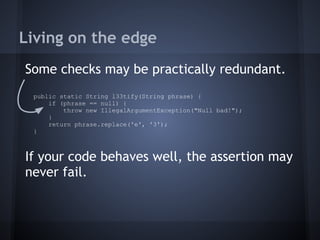
Some checks may be practically redundant.
If your code behaves well, the assertion may
never fail.
public static String l33tify(String phrase) {
if (phrase == null) {
throw new IllegalArgumentException("Null bad!");
}
return phrase.replace('e', '3');
}
Living on the edge
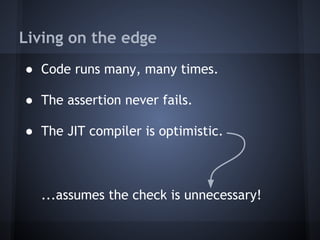
● Code runs many, many times.
● The assertion never fails.
● The JIT compiler is optimistic.
...assumes the check is unnecessary!
Living on the edge
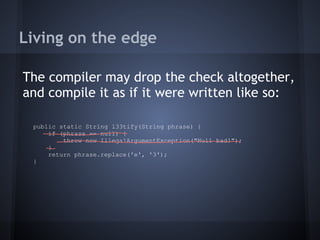
The compiler may drop the check altogether,
and compile it as if it were written like so:
public static String l33tify(String phrase) {
if (phrase == null) {
throw new IllegalArgumentException("Null bad!");
}
return phrase.replace('e', '3');
}
Living on the edge
Wait...
What if that happy-path assumption
eventually proves to be wrong?
Living on the edge
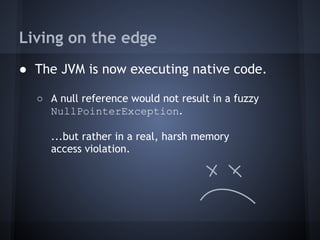
● The JVM is now executing native code.
○ A null reference would not result in a fuzzy
NullPointerException.
...but rather in a real, harsh memory
access violation.
Living on the edge
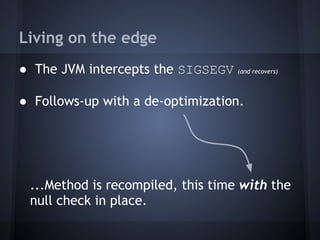
● The JVM intercepts the SIGSEGV (and recovers)
● Follows-up with a de-optimization.
...Method is recompiled, this time with the
null check in place.
Virtual insanity
The JIT compiler has dynamic runtime data on
which it can rely when making decisions.
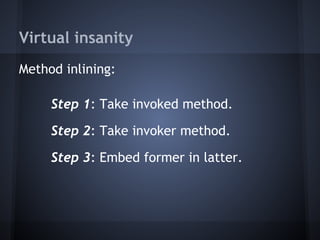
Virtual insanity
Method inlining:
Step 1: Take invoked method.
Step 2: Take invoker method.
Step 3: Embed former in latter.
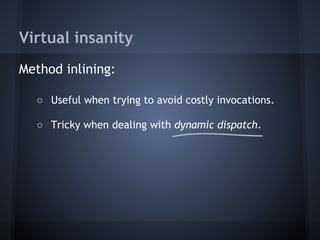
Virtual insanity
Method inlining:
○ Useful when trying to avoid costly invocations.
○ Tricky when dealing with dynamic dispatch.
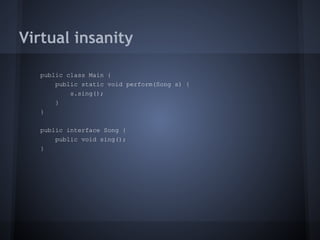
Virtual insanity
public class Main {
public static void perform(Song s) {
s.sing();
}
}
public interface Song {
public void sing();
}
Virtual insanity
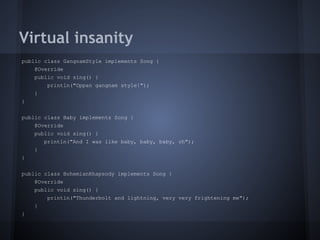
public class GangnamStyle implements Song {
@Override
public void sing() {
println("Oppan gangnam style!");
}
}
public class Baby implements Song {
@Override
public void sing() {
println("And I was like baby, baby, baby, oh");
}
}
public class BohemianRhapsody implements Song {
@Override
public void sing() {
println("Thunderbolt and lightning, very very frightening me");
}
}
Virtual insanity
● perform might run millions of times.
● Each time, sing is invoked.
This is a co$tly dynamic dispatch!
Virtual insanity
Inlining polymorphic calls is not so simple...
...in a static compiler.
Virtual insanity
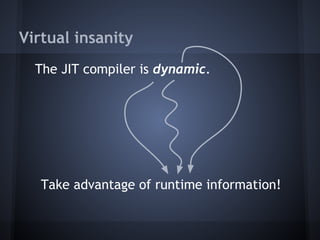
The JIT compiler is dynamic.
Take advantage of runtime information!
Virtual insanity
The JVM might decide, according to the
statistics it gathered, that 95% of the
invocations target an instance of
GangnamStyle.
Virtual insanity
The compiler can perform an optimistic
optimization:
Eliminate the virtual calls to sing.
...or most of them anyway.
Virtual insanity
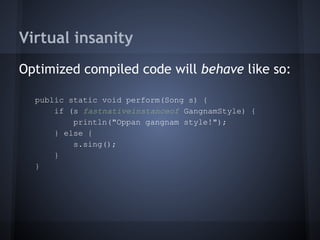
Optimized compiled code will behave like so:
public static void perform(Song s) {
if (s fastnativeinstanceof GangnamStyle) {
println("Oppan gangnam style!");
} else {
s.sing();
}
}
Can I help?
● The JIT compiler is built to optimize:
○ Straightforward, simple code.
○ Common patterns.
○ No nonsense.
Can I help?
The best way to help your compiler is to not
try so hard to help it.
Just write your code as you otherwise would!
JVM Performance Magic Tricks

JVM Performance Magic Tricks

  • 2.
    HotSpot ● The brainin which our Java and Scala juices flow. ● Its execution speed and efficiency is nearing that of native compiled code. ● At its core: The JIT compiler.
  • 3.
    So... The JITcompiler? ● Information is gathered at runtime. ○ Which paths in the code are traveled often? ○ Which methods are called the most, or, where are the hot spots?
  • 4.
    So... The JITcompiler? ● Once enough information about a hot method is collected... ○ The compiler kicks in. ○ Compiles the bytecode into a lean and efficient native version of itself. ○ May re-compile later due to over-optimism.
  • 5.
    Some standard optimizations ●Simple method inlining. ● Dead code removal. ● Native math ops instead of library calls. ● Invariant hoisting.
  • 6.
  • 7.
    Divide and conquer Howmany times have you used the following pattern? StringBuilder sb = new StringBuilder("Ingredients: "); for (int i = 0; i < ingredients.length; i++) { if (i > 0) { sb.append(", "); } sb.append(ingredients[i]); } return sb.toString();
  • 8.
    Divide and conquer ...orperhaps this one? boolean nemoFound = false; for (int i = 0; i < fish.length; i++) { String curFish = fish[i]; if (!nemoFound) { if (curFish.equals("Nemo")) { System.out.println("Nemo! There you are!"); nemoFound = true; continue; } } if (nemoFound) { System.out.println("We already found Nemo!"); } else { System.out.println("We still haven't found Nemo :("); } }
  • 9.
    Divide and conquer ●Both loops do one thing for a while, ● Then another thing from a certain point on. ● The compiler can spot these patterns. ○ Split the loops into cases. ○ “Peel” several iterations.
  • 10.
    Divide and conquer ●The condition: if (i > 0) ○ false once, ○ true thereafter. ○ Peel one iteration! StringBuilder sb = new StringBuilder("Ingredients: "); for (int i = 0; i < ingredients.length; i++) { if (i > 0) { sb.append(", "); } sb.append(ingredients[i]); } return sb.toString();
  • 11.
    Divide and conquer ...willcompile as if it were written like so: StringBuilder sb = new StringBuilder("Ingredients: "); if (ingredients.length > 0) { sb.append(ingredients[0]); for (int i = 1; i < ingredients.length; i++) { sb.append(", "); sb.append(ingredients[i]); } } return sb.toString(); First iteration All other iterations
  • 12.
    Living on theedge ● Null checks are bread-and-butter. ● Sometimes null is a valid value: ○ Missing values ○ Error indication ● Sometimes we check just to be on the safe side.
  • 13.
    Living on theedge Some checks may be practically redundant. If your code behaves well, the assertion may never fail. public static String l33tify(String phrase) { if (phrase == null) { throw new IllegalArgumentException("Null bad!"); } return phrase.replace('e', '3'); }
  • 14.
    Living on theedge ● Code runs many, many times. ● The assertion never fails. ● The JIT compiler is optimistic. ...assumes the check is unnecessary!
  • 15.
    Living on theedge The compiler may drop the check altogether, and compile it as if it were written like so: public static String l33tify(String phrase) { if (phrase == null) { throw new IllegalArgumentException("Null bad!"); } return phrase.replace('e', '3'); }
  • 16.
    Living on theedge Wait... What if that happy-path assumption eventually proves to be wrong?
  • 17.
    Living on theedge ● The JVM is now executing native code. ○ A null reference would not result in a fuzzy NullPointerException. ...but rather in a real, harsh memory access violation.
  • 18.
    Living on theedge ● The JVM intercepts the SIGSEGV (and recovers) ● Follows-up with a de-optimization. ...Method is recompiled, this time with the null check in place.
  • 19.
    Virtual insanity The JITcompiler has dynamic runtime data on which it can rely when making decisions.
  • 20.
    Virtual insanity Method inlining: Step1: Take invoked method. Step 2: Take invoker method. Step 3: Embed former in latter.
  • 21.
    Virtual insanity Method inlining: ○Useful when trying to avoid costly invocations. ○ Tricky when dealing with dynamic dispatch.
  • 22.
    Virtual insanity public classMain { public static void perform(Song s) { s.sing(); } } public interface Song { public void sing(); }
  • 23.
    Virtual insanity public classGangnamStyle implements Song { @Override public void sing() { println("Oppan gangnam style!"); } } public class Baby implements Song { @Override public void sing() { println("And I was like baby, baby, baby, oh"); } } public class BohemianRhapsody implements Song { @Override public void sing() { println("Thunderbolt and lightning, very very frightening me"); } }
  • 24.
    Virtual insanity ● performmight run millions of times. ● Each time, sing is invoked. This is a co$tly dynamic dispatch!
  • 25.
    Virtual insanity Inlining polymorphiccalls is not so simple... ...in a static compiler.
  • 26.
    Virtual insanity The JITcompiler is dynamic. Take advantage of runtime information!
  • 27.
    Virtual insanity The JVMmight decide, according to the statistics it gathered, that 95% of the invocations target an instance of GangnamStyle.
  • 28.
    Virtual insanity The compilercan perform an optimistic optimization: Eliminate the virtual calls to sing. ...or most of them anyway.
  • 29.
    Virtual insanity Optimized compiledcode will behave like so: public static void perform(Song s) { if (s fastnativeinstanceof GangnamStyle) { println("Oppan gangnam style!"); } else { s.sing(); } }
  • 30.
    Can I help? ●The JIT compiler is built to optimize: ○ Straightforward, simple code. ○ Common patterns. ○ No nonsense.
  • 31.
    Can I help? Thebest way to help your compiler is to not try so hard to help it. Just write your code as you otherwise would!