Presented to The Chicago Community Trust
Wednesday, November 30, 2016 at 12:00 PM
Juvenile Expungement Informational Meeting
Thank you for joining us!
Why are we here today?
Smart Chicago has been involved with juvenile
expungement since 2013 through the
#CivicSummer program.
Expunge.io is a website created to determine
whether or not individuals are eligible for
expungement and then connect them to free legal
aid.
As with most tech projects, tech cannot be the
only solution and we have to rely on networks of
people and organizations to make impact.
Agenda
Introductions Sonja Marziano
Mikva Challenge JJC & youth involvement Emma Kornfeld & Charlie Beltran
What is the juvenile expungement process? Regina Hernandez & Kathryn Huber
Q&A
Discussion
Cook County Juvenile Justice Council
Emma Kornfeld, Mikva Challenge
Charlie Beltran, Mikva JJC alumni
Summer2013
What tools, policies and
practices do youth need to
effectively transition from
corrections to community?
EDUCATION
EMPLOYMENT
HOUSING
Juvenile Expungement Presentation
JUVENILE
EXPUNGEMENT
LAWRegina J. Hernandez & Kathryn Huber, LAF
Attorneys
Context & Background
■  There is overbroad access to juvenile
records, and the unlawful sharing of
juvenile records is common practice in
Illinois
■  The practice of unlawful sharing creates
additional barriers to employment,
housing and education
■  No statutory penalties for unlawful
sharing or legal remedies
■  For every 1,000 juvenile arrests in
Illinois, only 3 are expunged
■  Restrictive eligibility requirements and
fees create additional barriers
■  The statutorily required duty to inform
individuals of right to expungement is
often neglected
Common Misconceptions
■  “I don’t have a record because I
was not found guilty”
■  “I thought juvenile records were
automatically expunged when I
turn 18”
■  “Juvenile records are sealed and
no one can see them”
■  “Serious offenses can’t be
expunged”
■  “I can’t afford to pay any court
fees or to hire an attorney, so I
can’t get my records expunged”
■  “I was arrested when I was 17, so
it has to be on my juvenile
record”
Did You Know...?
■  A juvenile record can show up on a
background check – even arrests that
didn’t result in a court case
■  Some professions might not allow you to
get a license or sit for the state exam if
you have an offense on your record
■  A LOT of people have a juvenile record
(in Chicago, nearly 50% of young people
have been arrested before they turn 23!)
■  Many employers don’t know the law on
juvenile records, and might refuse to
hire you, even if you’re a perfect fit for
the job, if an offense shows up on a
background check
■  A juvenile record doesn’t automatically
go away, even when you turn 18
A Juvenile Record Includes…
■  All arrests under 17
■  All arrests under 18 (Since January 1,
2014)
■  Arrests for misdemeanors under age 18
(January 2010-December 2013)
■  ALL others considered ADULT records
NOT Juvenile Arrests:
■  Traffic violations
■  Ordinance violations (unless a petty
offense)
Who Can See Juvenile
Records?
■  Juvenile records are automatically “sealed”… BUT there is
no clear definition of sealed in the Juvenile Court Act
■  There are many exceptions, including:
–  Schools
–  The park district
–  The public (limited offenses)
–  Plus other employers as stipulated by law
■  Once something has been expunged, there are still
entities that will always be able to see you record
–  Military employers
–  Law enforcement employers
–  Immigration officials
Juvenile Expungement
Eligibility
!  §915(1): age 18, no pending cases, petty offenses,
misdemeanors (B or C)
!  *NOTE: On January 1, 2017, there will no longer
be a waiting period for this type of petition (HB
5017)
!  §915(2): age 21, 5 year waiting period, no adult
convictions, qualifying felony or misdemeanor A
offenses
!  §622: age 18, misdemeanor offense
!  Never Eligible: Findings of Guilt for First-degree
Murder and Felony Sex Offenses
!  Please note: sex offender registry, gang
affiliations
Adult Records
!  An adult record CAN affect the eligibility to expunge certain types of
juvenile records (called “Subsection 2” arrests/charges)
!  It is important to look into adult records as well as juvenile records,
and to expunge any adult records that you can
!  To expunge an adult record:
!  Cannot have any current pending cases
!  Cannot have a single conviction on your adult record, which
includes:
!  Probation
!  Conditional Discharge
!  Jail or prison time
!  Time considered Served
!  Fines or Ex-Parte Judgments
!  ANY conviction in ANY jurisdiction on an adult record makes that
person ineligible for adult expungements
!  Please note: Supervision completed satisfactorily is NOT
considered a conviction, but is subject to a 2-5 year waiting
period depending on the offense
Juvenile Expungement
Eligibility:
*Ineligibility	under	Subsec2on	2	
does	NOT	affect	eligibility	for	
Subsec2on	1	Pe22ons	
Juvenile	Expungement	Help	Desk	
1100	S.	Hamilton,	Ground	Floor	
Chicago,	IL	60612	
Hours:	M-F,	9am-4pm;	hours	subject	to	
change	based	on	staffing	availability.	For	
updated	hours	and	addiJonal	informaJon	
about	expungement,	please	call	
312.229.6359	or	visit	us	at	
hOps://www.facebook.com/
JuvenileExpungementHelpDesk/.	Walk-ins	
only.
The Juvenile Expungement
Process
100-Day Timeline
Day 1:
Client Intake
Days 2-30:
Administrative
Tasks
Day 30:
Hearing
Days 31-99:
Client Follow-
Up & Case
Closings
Day 100:
Confirmation of
Expungements
from Police
Departments
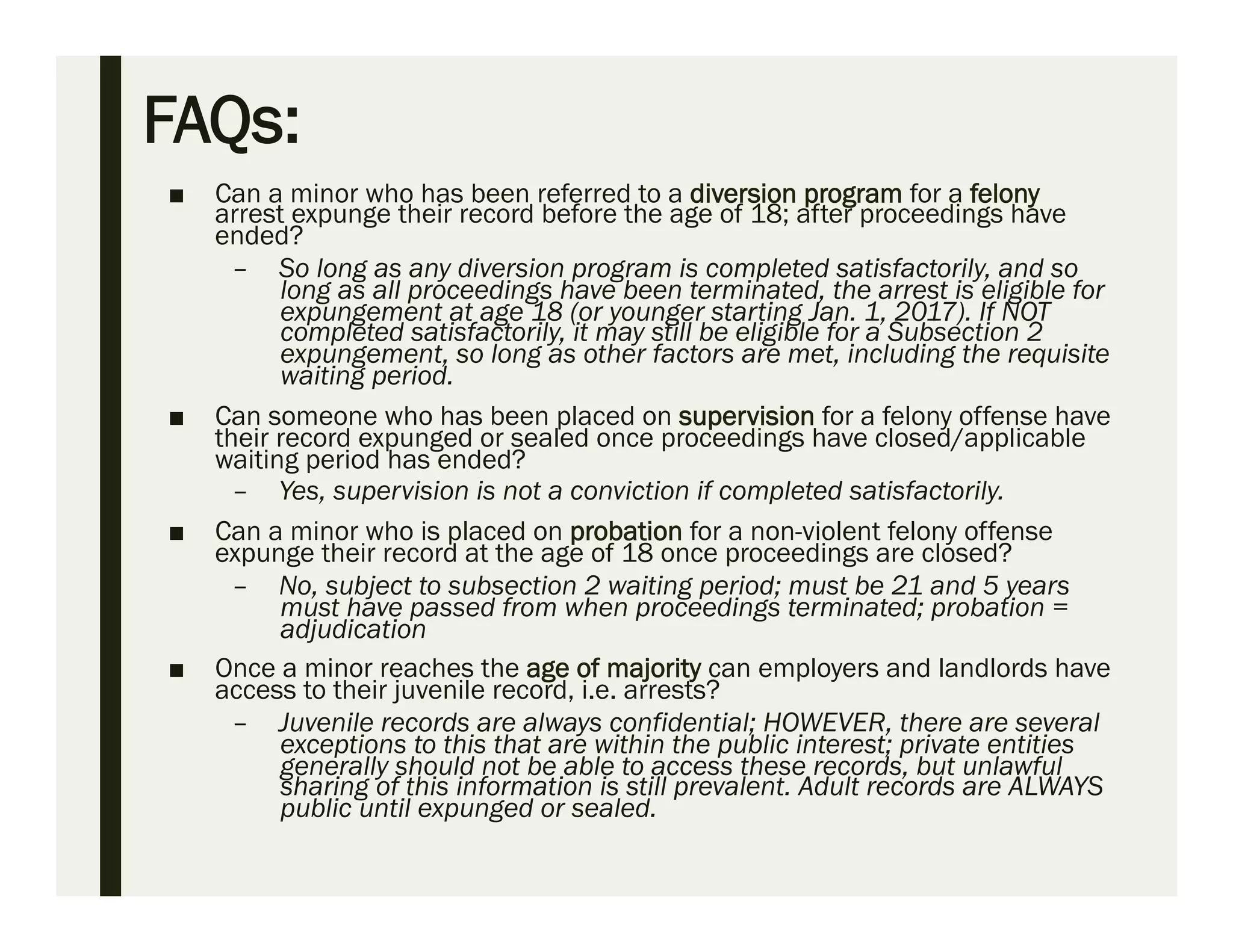
FAQs:
■  Can a minor who has been referred to a diversion program for a felony
arrest expunge their record before the age of 18; after proceedings have
ended?
–  So long as any diversion program is completed satisfactorily, and so
long as all proceedings have been terminated, the arrest is eligible for
expungement at age 18 (or younger starting Jan. 1, 2017). If NOT
completed satisfactorily, it may still be eligible for a Subsection 2
expungement, so long as other factors are met, including the requisite
waiting period.
■  Can someone who has been placed on supervision for a felony offense have
their record expunged or sealed once proceedings have closed/applicable
waiting period has ended?
–  Yes, supervision is not a conviction if completed satisfactorily.
■  Can a minor who is placed on probation for a non-violent felony offense
expunge their record at the age of 18 once proceedings are closed?
–  No, subject to subsection 2 waiting period; must be 21 and 5 years
must have passed from when proceedings terminated; probation =
adjudication
■  Once a minor reaches the age of majority can employers and landlords have
access to their juvenile record, i.e. arrests?
–  Juvenile records are always confidential; HOWEVER, there are several
exceptions to this that are within the public interest; private entities
generally should not be able to access these records, but unlawful
sharing of this information is still prevalent. Adult records are ALWAYS
public until expunged or sealed.
FAQs (Continued):
■  Which arrests qualify for automatic expungement and who completes this
process?
–  ISP conducts an annual review and expunges those records that have
become eligible in the past year.
–  This “automatic expungement” provision only applies to the limited
number of juvenile arrests that were both reported by the arresting
agency to ISP and did not result in court proceedings.
–  If done correctly, this will only eliminate ISP records, not local authority
records, and nothing requires ISP to notify individual
■  Does undocumented status affect your ability to expunge your juvenile
record?
–  Technically it does not affect your ability, but you should ALWAYS
speak to an immigration attorney prior to seeking expungement;
USCIS can see your record even after expungement and require you to
disclose
■  What is the length of time it takes to expunge a record?
–  Approx. 100 days, depending on any complications
How Can You Help?
Host a Clinic!
•  Two of the significant barriers to young people expunging their juvenile
records are access and time – LAF works to make the process more
accessible for all Cook County residents by organizing on-site clinics.
•  At a clinic, young people can meet with a volunteer attorney and
complete expungement paperwork at a school, agency, or community
setting they are already familiar with in their neighborhood.
•  Once the paperwork is complete, LAF attorneys file the petitions on
clients’ behalf and attend court hearings for them, so they don’t need
to make a second trip or come to court.
•  After a hearing, clients receive a copy of their court order in the mail.
How it Works
Typically, a clinic is a two-part process:
Part 1: Info Session and Informed Consent
•  LAF attorneys will come out to the site and give a presentation on expungement services, why
expungement is an important step for a young person’s future, and how the process works.
•  For clients interested in pursuing expungement, attorneys will obtain their written consent to get
their RAP sheet, which is the document attorneys will need to file expungement petitions. For
Chicago cases, we can obtain the RAP sheet without the client being present. For cases outside
of Chicago, we will make arrangements with the client to obtain a fingerprint-based background
check.
Part 2: On-site Clinic
•  A few weeks later, LAF attorneys and volunteers will come out to the site, meet with individual
clients, review their eligibility and paperwork with them, and obtain their signatures on court
documents.
•  Once all paperwork is complete, staff will file petitions on clients’ behalf, and in most cases, can
represent them at their expungement hearing so they don’t need to come to court. After the
hearing, we’ll mail clients certified copies of their orders… It’s that easy!
Logistics
If this sounds like a good opportunity for a population you work with, these
are the things LAF will need from you for a successful clinic:
Space: preferably a private space for attorneys to confer and be trained prior to the
event, a waiting area for clients, and a larger space that can be partitioned or a
series of smaller spaces, such as classrooms or offices, where attorneys can meet
with clients. The space would need to be available for the clinic itself as well as
one or more info sessions.
Clients: Prior to each clinic, we will need your help to publicize the event, obtain
signed consent forms, recruit participants, etc. Clients are typically young adults
age 17-30, but clients of any age can participate and may be eligible for juvenile
expungement. Clients do not have to have been formally adjudicated and gone to
court – even a minor arrest can show up on a background check, even if the
person was never charged or brought to court.
Time: Each clinic lasts approximately four hours.
Other: Resources to help the event run smoothly – pens, access to a copier or
scanner, staff to help direct participants, internet access, etc.
Interested?
(Or know an Group who Might Be?)
Contact Regina (rhernandez@lafchicago.org) or Kathryn
(khuber@lafchicago.org) for more information!
• Clinic structures are flexible, and we are happy to work with any agency to tailor
a program that best meets the needs of their clients.
• We can work with groups of any size, come to a variety of locations, schedule
evening or weekend events, and otherwise modify structure and programming in
a way that makes sense for the agency, client population, location, setup, or
other factors.
• We know that there is significant need in the community – (a recent Chicago
Tribune investigation revealed that less than 1% of juvenile arrests in Cook
County are ever expunged), so we want to bring this much needed resource to
those individuals who need it most.
• If you’re interested or know a group who might be, get in touch with us! We’d
love to work with you toward this important goal.
How to get
help… ■  Additional Resources:
–  JEHD Facebook
–  Expunge.io
–  Office of State
Appellate Defender
–  Illinois Juvenile
Justice Commission
Report
"  Juvenile Expungement Help Desk
M-F, 9am-4pm (hours subject to change
based on staffing availability)
"  For additional information and questions,
please call 312.229.6359
"  CGLA Adult Expungement Help Desk
(Chicago)
Daley Center, 10th Fl.
M-W, 9am-12pm
Th., 9am-12pm & 1pm-4pm
MUST BRING OWN RAP SHEET
"  CGLA Adult Expungement Help Desk
(Markham)
16501 S. Kedzie Parkway, Room 102J
Wednesdays, 10am-2pm
MUST BRING OWN RAP SHEET
Question & Answer
Discussion
We would like to take some time to identify people or groups in your networks
that would benefit from understanding more about the juvenile expungement
process or resources.
What barriers, if any, do you see in your communities to access justice
resources or expungement assistance?
What do you see helping your communities overcome those barriers?
Who should we talk to? Tell us here! bit.ly/expungeinfo
Connect with us!
Smart Chicago Collaborative
Sonja Marziano, Project Coordinator smarziano@cct.org
(PS: I’m in the Garage, just come on over!)
LAF
Kathryn Huber, Juvenile Expungement Staff Attorney khuber@lafchicago.org
Regina Hernandez, VISTA Attorney rhernandez@lafchicago.org
Rich Cozzola, Director, Children & Families Practice rcozzola@lafchicago.org
Mikva Challenge
Emma Kornfeld, Senior Program Director emma@mikvachallenge.org
Thank you!

Juvenile Expungement Presentation to The Chicago Community Trust

  • 1.
    Presented to TheChicago Community Trust Wednesday, November 30, 2016 at 12:00 PM Juvenile Expungement Informational Meeting
  • 2.
    Thank you forjoining us!
  • 4.
    Why are wehere today? Smart Chicago has been involved with juvenile expungement since 2013 through the #CivicSummer program. Expunge.io is a website created to determine whether or not individuals are eligible for expungement and then connect them to free legal aid. As with most tech projects, tech cannot be the only solution and we have to rely on networks of people and organizations to make impact.
  • 5.
    Agenda Introductions Sonja Marziano MikvaChallenge JJC & youth involvement Emma Kornfeld & Charlie Beltran What is the juvenile expungement process? Regina Hernandez & Kathryn Huber Q&A Discussion
  • 6.
    Cook County JuvenileJustice Council Emma Kornfeld, Mikva Challenge Charlie Beltran, Mikva JJC alumni
  • 7.
    Summer2013 What tools, policiesand practices do youth need to effectively transition from corrections to community? EDUCATION EMPLOYMENT HOUSING
  • 11.
  • 12.
    JUVENILE EXPUNGEMENT LAWRegina J. Hernandez& Kathryn Huber, LAF Attorneys
  • 13.
    Context & Background ■ There is overbroad access to juvenile records, and the unlawful sharing of juvenile records is common practice in Illinois ■  The practice of unlawful sharing creates additional barriers to employment, housing and education ■  No statutory penalties for unlawful sharing or legal remedies ■  For every 1,000 juvenile arrests in Illinois, only 3 are expunged ■  Restrictive eligibility requirements and fees create additional barriers ■  The statutorily required duty to inform individuals of right to expungement is often neglected
  • 14.
    Common Misconceptions ■  “Idon’t have a record because I was not found guilty” ■  “I thought juvenile records were automatically expunged when I turn 18” ■  “Juvenile records are sealed and no one can see them” ■  “Serious offenses can’t be expunged” ■  “I can’t afford to pay any court fees or to hire an attorney, so I can’t get my records expunged” ■  “I was arrested when I was 17, so it has to be on my juvenile record”
  • 15.
    Did You Know...? ■ A juvenile record can show up on a background check – even arrests that didn’t result in a court case ■  Some professions might not allow you to get a license or sit for the state exam if you have an offense on your record ■  A LOT of people have a juvenile record (in Chicago, nearly 50% of young people have been arrested before they turn 23!) ■  Many employers don’t know the law on juvenile records, and might refuse to hire you, even if you’re a perfect fit for the job, if an offense shows up on a background check ■  A juvenile record doesn’t automatically go away, even when you turn 18
  • 16.
    A Juvenile RecordIncludes… ■  All arrests under 17 ■  All arrests under 18 (Since January 1, 2014) ■  Arrests for misdemeanors under age 18 (January 2010-December 2013) ■  ALL others considered ADULT records NOT Juvenile Arrests: ■  Traffic violations ■  Ordinance violations (unless a petty offense)
  • 17.
    Who Can SeeJuvenile Records? ■  Juvenile records are automatically “sealed”… BUT there is no clear definition of sealed in the Juvenile Court Act ■  There are many exceptions, including: –  Schools –  The park district –  The public (limited offenses) –  Plus other employers as stipulated by law ■  Once something has been expunged, there are still entities that will always be able to see you record –  Military employers –  Law enforcement employers –  Immigration officials
  • 18.
    Juvenile Expungement Eligibility !  §915(1):age 18, no pending cases, petty offenses, misdemeanors (B or C) !  *NOTE: On January 1, 2017, there will no longer be a waiting period for this type of petition (HB 5017) !  §915(2): age 21, 5 year waiting period, no adult convictions, qualifying felony or misdemeanor A offenses !  §622: age 18, misdemeanor offense !  Never Eligible: Findings of Guilt for First-degree Murder and Felony Sex Offenses !  Please note: sex offender registry, gang affiliations
  • 19.
    Adult Records !  Anadult record CAN affect the eligibility to expunge certain types of juvenile records (called “Subsection 2” arrests/charges) !  It is important to look into adult records as well as juvenile records, and to expunge any adult records that you can !  To expunge an adult record: !  Cannot have any current pending cases !  Cannot have a single conviction on your adult record, which includes: !  Probation !  Conditional Discharge !  Jail or prison time !  Time considered Served !  Fines or Ex-Parte Judgments !  ANY conviction in ANY jurisdiction on an adult record makes that person ineligible for adult expungements !  Please note: Supervision completed satisfactorily is NOT considered a conviction, but is subject to a 2-5 year waiting period depending on the offense
  • 20.
  • 21.
    The Juvenile Expungement Process 100-DayTimeline Day 1: Client Intake Days 2-30: Administrative Tasks Day 30: Hearing Days 31-99: Client Follow- Up & Case Closings Day 100: Confirmation of Expungements from Police Departments
  • 22.
    FAQs: ■  Can aminor who has been referred to a diversion program for a felony arrest expunge their record before the age of 18; after proceedings have ended? –  So long as any diversion program is completed satisfactorily, and so long as all proceedings have been terminated, the arrest is eligible for expungement at age 18 (or younger starting Jan. 1, 2017). If NOT completed satisfactorily, it may still be eligible for a Subsection 2 expungement, so long as other factors are met, including the requisite waiting period. ■  Can someone who has been placed on supervision for a felony offense have their record expunged or sealed once proceedings have closed/applicable waiting period has ended? –  Yes, supervision is not a conviction if completed satisfactorily. ■  Can a minor who is placed on probation for a non-violent felony offense expunge their record at the age of 18 once proceedings are closed? –  No, subject to subsection 2 waiting period; must be 21 and 5 years must have passed from when proceedings terminated; probation = adjudication ■  Once a minor reaches the age of majority can employers and landlords have access to their juvenile record, i.e. arrests? –  Juvenile records are always confidential; HOWEVER, there are several exceptions to this that are within the public interest; private entities generally should not be able to access these records, but unlawful sharing of this information is still prevalent. Adult records are ALWAYS public until expunged or sealed.
  • 23.
    FAQs (Continued): ■  Whicharrests qualify for automatic expungement and who completes this process? –  ISP conducts an annual review and expunges those records that have become eligible in the past year. –  This “automatic expungement” provision only applies to the limited number of juvenile arrests that were both reported by the arresting agency to ISP and did not result in court proceedings. –  If done correctly, this will only eliminate ISP records, not local authority records, and nothing requires ISP to notify individual ■  Does undocumented status affect your ability to expunge your juvenile record? –  Technically it does not affect your ability, but you should ALWAYS speak to an immigration attorney prior to seeking expungement; USCIS can see your record even after expungement and require you to disclose ■  What is the length of time it takes to expunge a record? –  Approx. 100 days, depending on any complications
  • 24.
    How Can YouHelp? Host a Clinic! •  Two of the significant barriers to young people expunging their juvenile records are access and time – LAF works to make the process more accessible for all Cook County residents by organizing on-site clinics. •  At a clinic, young people can meet with a volunteer attorney and complete expungement paperwork at a school, agency, or community setting they are already familiar with in their neighborhood. •  Once the paperwork is complete, LAF attorneys file the petitions on clients’ behalf and attend court hearings for them, so they don’t need to make a second trip or come to court. •  After a hearing, clients receive a copy of their court order in the mail.
  • 25.
    How it Works Typically,a clinic is a two-part process: Part 1: Info Session and Informed Consent •  LAF attorneys will come out to the site and give a presentation on expungement services, why expungement is an important step for a young person’s future, and how the process works. •  For clients interested in pursuing expungement, attorneys will obtain their written consent to get their RAP sheet, which is the document attorneys will need to file expungement petitions. For Chicago cases, we can obtain the RAP sheet without the client being present. For cases outside of Chicago, we will make arrangements with the client to obtain a fingerprint-based background check. Part 2: On-site Clinic •  A few weeks later, LAF attorneys and volunteers will come out to the site, meet with individual clients, review their eligibility and paperwork with them, and obtain their signatures on court documents. •  Once all paperwork is complete, staff will file petitions on clients’ behalf, and in most cases, can represent them at their expungement hearing so they don’t need to come to court. After the hearing, we’ll mail clients certified copies of their orders… It’s that easy!
  • 26.
    Logistics If this soundslike a good opportunity for a population you work with, these are the things LAF will need from you for a successful clinic: Space: preferably a private space for attorneys to confer and be trained prior to the event, a waiting area for clients, and a larger space that can be partitioned or a series of smaller spaces, such as classrooms or offices, where attorneys can meet with clients. The space would need to be available for the clinic itself as well as one or more info sessions. Clients: Prior to each clinic, we will need your help to publicize the event, obtain signed consent forms, recruit participants, etc. Clients are typically young adults age 17-30, but clients of any age can participate and may be eligible for juvenile expungement. Clients do not have to have been formally adjudicated and gone to court – even a minor arrest can show up on a background check, even if the person was never charged or brought to court. Time: Each clinic lasts approximately four hours. Other: Resources to help the event run smoothly – pens, access to a copier or scanner, staff to help direct participants, internet access, etc.
  • 27.
    Interested? (Or know anGroup who Might Be?) Contact Regina (rhernandez@lafchicago.org) or Kathryn (khuber@lafchicago.org) for more information! • Clinic structures are flexible, and we are happy to work with any agency to tailor a program that best meets the needs of their clients. • We can work with groups of any size, come to a variety of locations, schedule evening or weekend events, and otherwise modify structure and programming in a way that makes sense for the agency, client population, location, setup, or other factors. • We know that there is significant need in the community – (a recent Chicago Tribune investigation revealed that less than 1% of juvenile arrests in Cook County are ever expunged), so we want to bring this much needed resource to those individuals who need it most. • If you’re interested or know a group who might be, get in touch with us! We’d love to work with you toward this important goal.
  • 28.
    How to get help…■  Additional Resources: –  JEHD Facebook –  Expunge.io –  Office of State Appellate Defender –  Illinois Juvenile Justice Commission Report "  Juvenile Expungement Help Desk M-F, 9am-4pm (hours subject to change based on staffing availability) "  For additional information and questions, please call 312.229.6359 "  CGLA Adult Expungement Help Desk (Chicago) Daley Center, 10th Fl. M-W, 9am-12pm Th., 9am-12pm & 1pm-4pm MUST BRING OWN RAP SHEET "  CGLA Adult Expungement Help Desk (Markham) 16501 S. Kedzie Parkway, Room 102J Wednesdays, 10am-2pm MUST BRING OWN RAP SHEET
  • 29.
  • 30.
    Discussion We would liketo take some time to identify people or groups in your networks that would benefit from understanding more about the juvenile expungement process or resources. What barriers, if any, do you see in your communities to access justice resources or expungement assistance? What do you see helping your communities overcome those barriers? Who should we talk to? Tell us here! bit.ly/expungeinfo
  • 31.
    Connect with us! SmartChicago Collaborative Sonja Marziano, Project Coordinator smarziano@cct.org (PS: I’m in the Garage, just come on over!) LAF Kathryn Huber, Juvenile Expungement Staff Attorney khuber@lafchicago.org Regina Hernandez, VISTA Attorney rhernandez@lafchicago.org Rich Cozzola, Director, Children & Families Practice rcozzola@lafchicago.org Mikva Challenge Emma Kornfeld, Senior Program Director emma@mikvachallenge.org
  • 32.