JUNGLES OF THE
DEFINITION
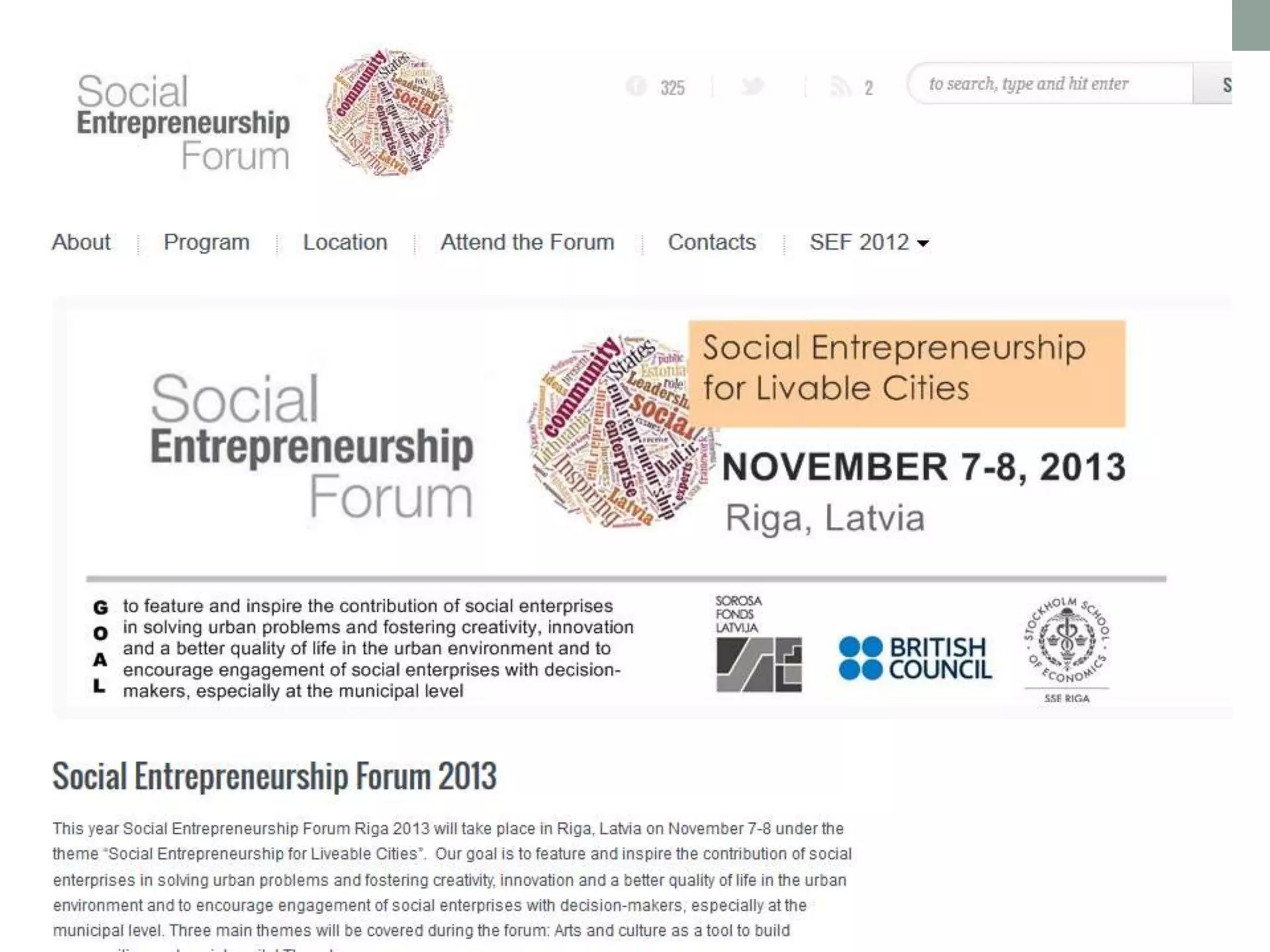
SEF Riga 2013
Mindaugas Danys
Ministry of Economy, Lithuania
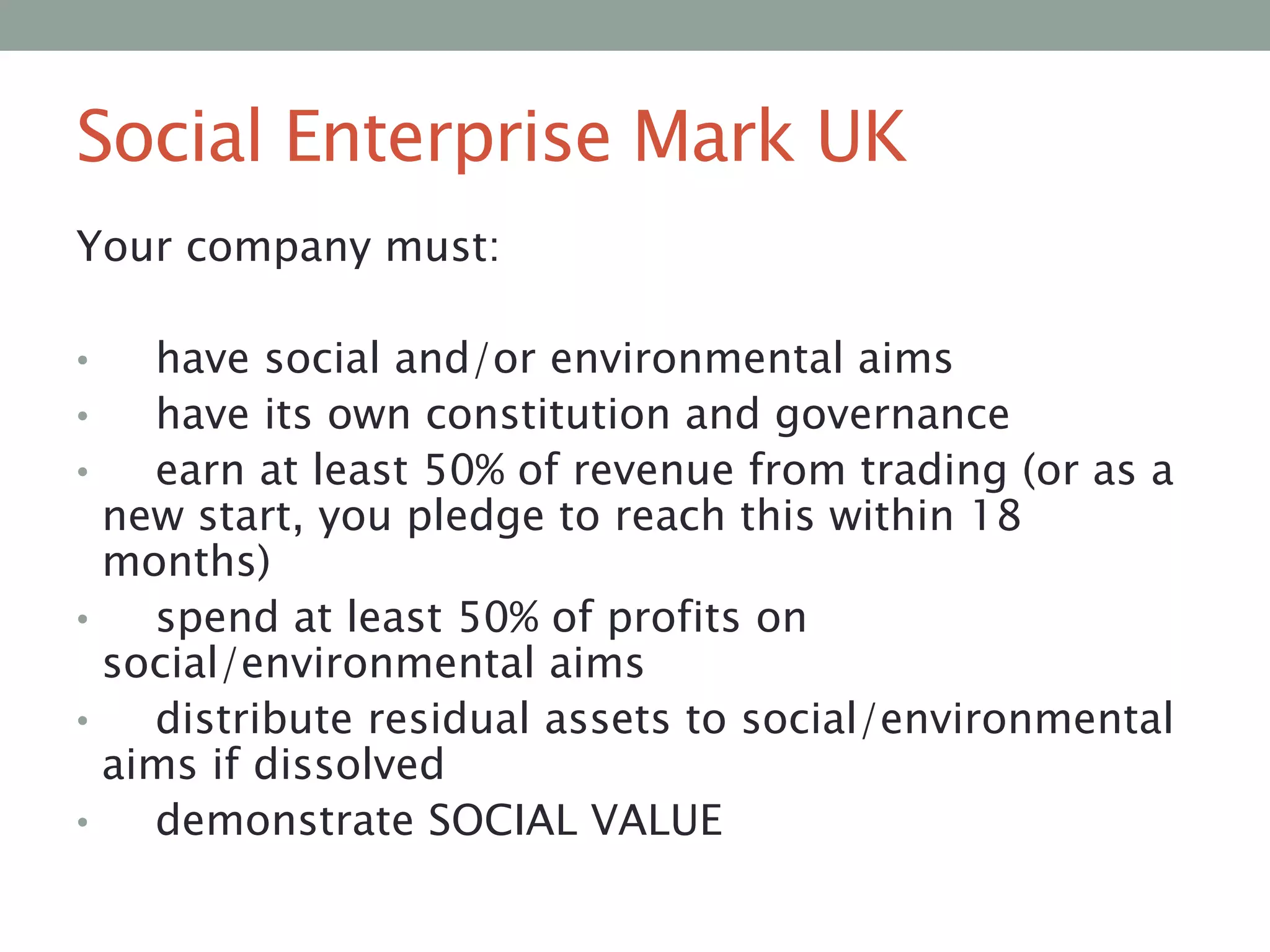
Social Enterprise Mark UK
Your company must:
•
•
•

•
•
•

have social and/or environmental aims
have its own constitution and governance
earn at least 50% of revenue from trading (or as a
new start, you pledge to reach this within 18
months)
spend at least 50% of profits on
social/environmental aims
distribute residual assets to social/environmental
aims if dissolved
demonstrate SOCIAL VALUE
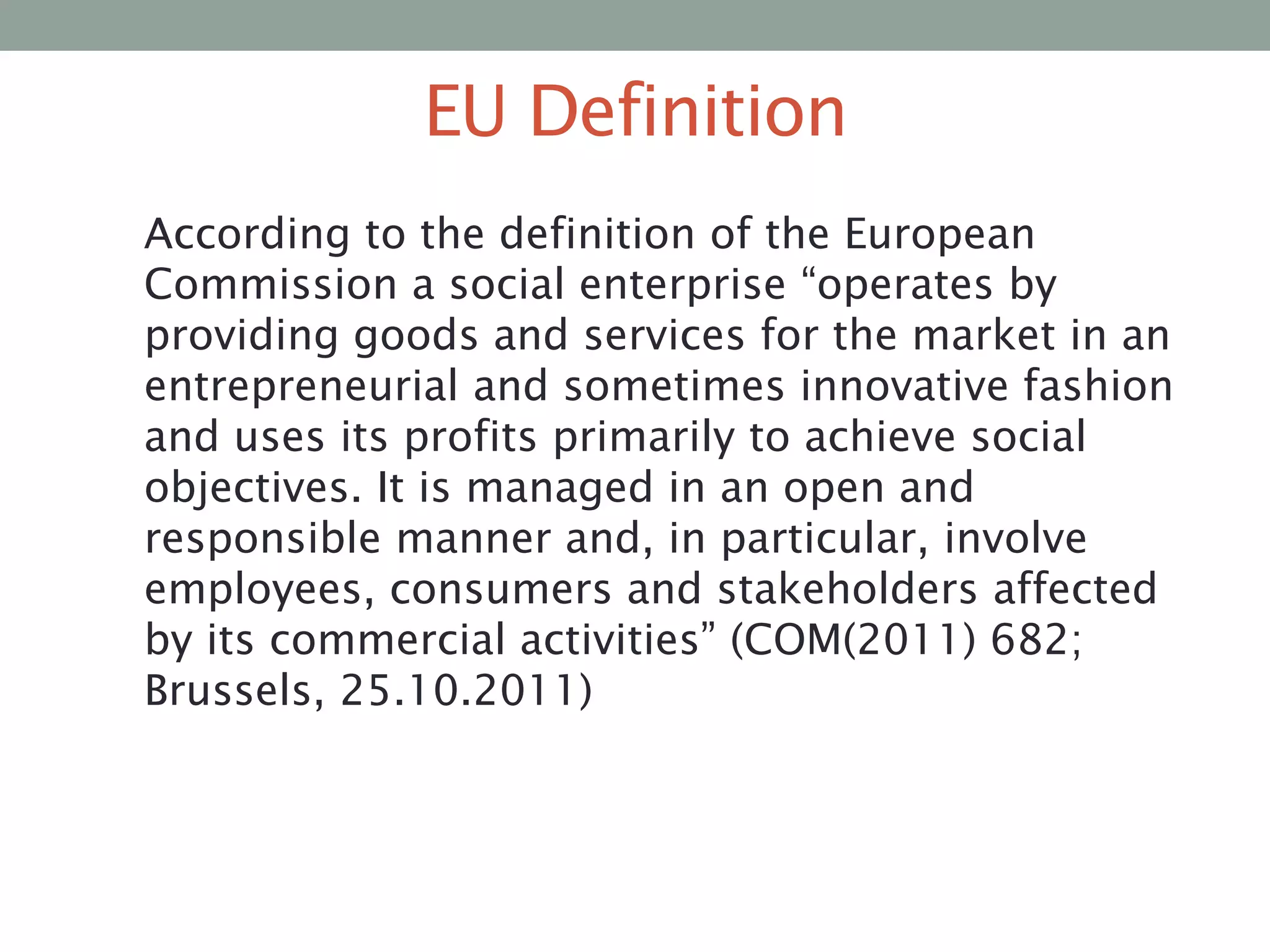
EU Definition
According to the definition of the European
Commission a social enterprise “operates by
providing goods and services for the market in an
entrepreneurial and sometimes innovative fashion
and uses its profits primarily to achieve social
objectives. It is managed in an open and
responsible manner and, in particular, involve
employees, consumers and stakeholders affected
by its commercial activities” (COM(2011) 682;
Brussels, 25.10.2011)
How are social enterprises
regulated across Europe?
•

•

Social enterprises can be regulated in one or more
of the following ways:
o Existing legal forms
o Adaptation of existing legal forms
o Introduction of social enterprise legal brands
o Introduction of specific types of non-profit
organizations (e.g. non-profit institute in
Slovenia)
A few countries have introduced a general
legislation on Social Economy
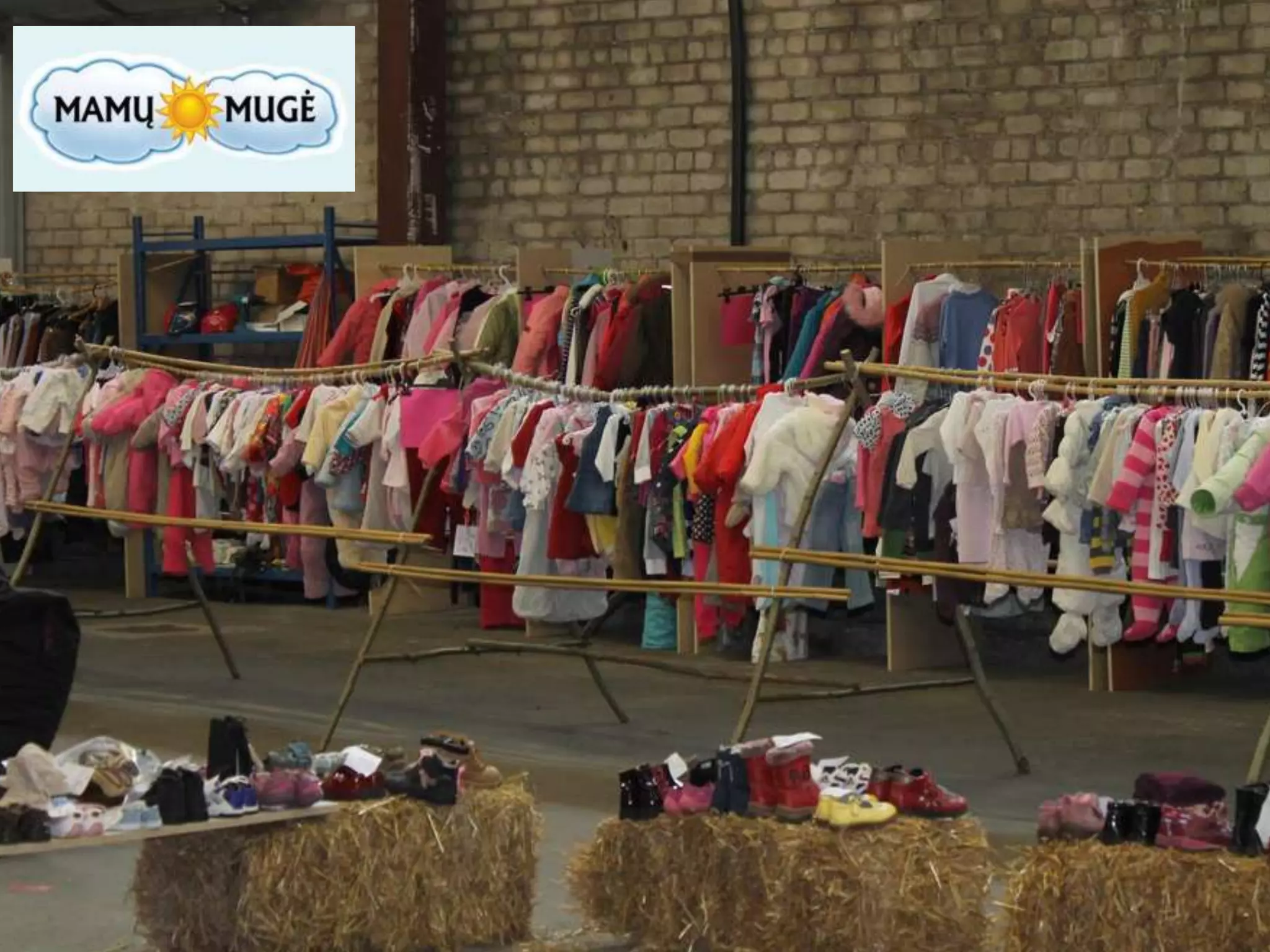
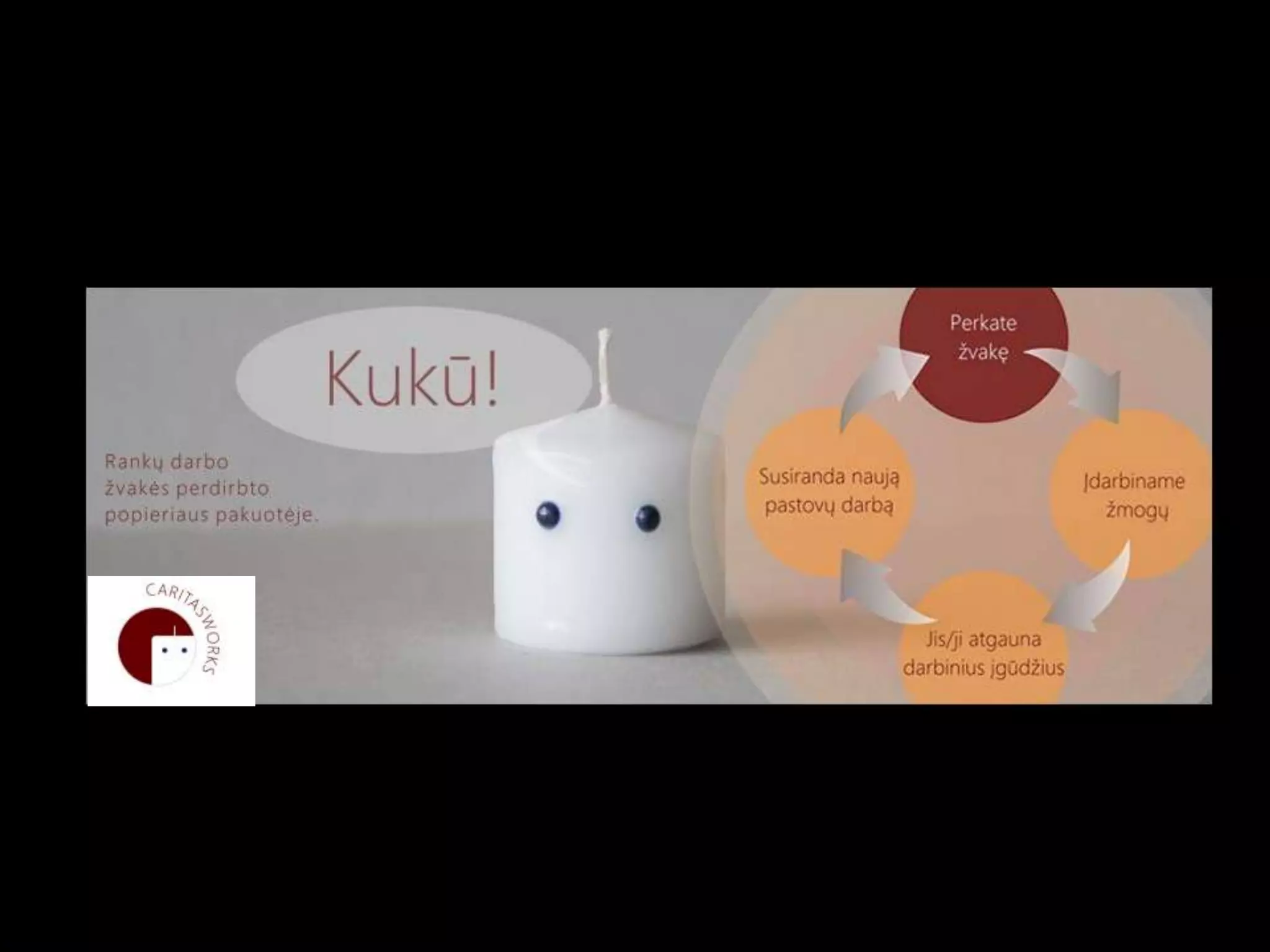
Lithuania and soc ents
•
•
•
•

Experience with Social firms
Few social enterprises
Lots of NGO social business initiatives
Legal status – private non profit
Other examples
17
18
19

www.SocialinisVerslas.lt
20
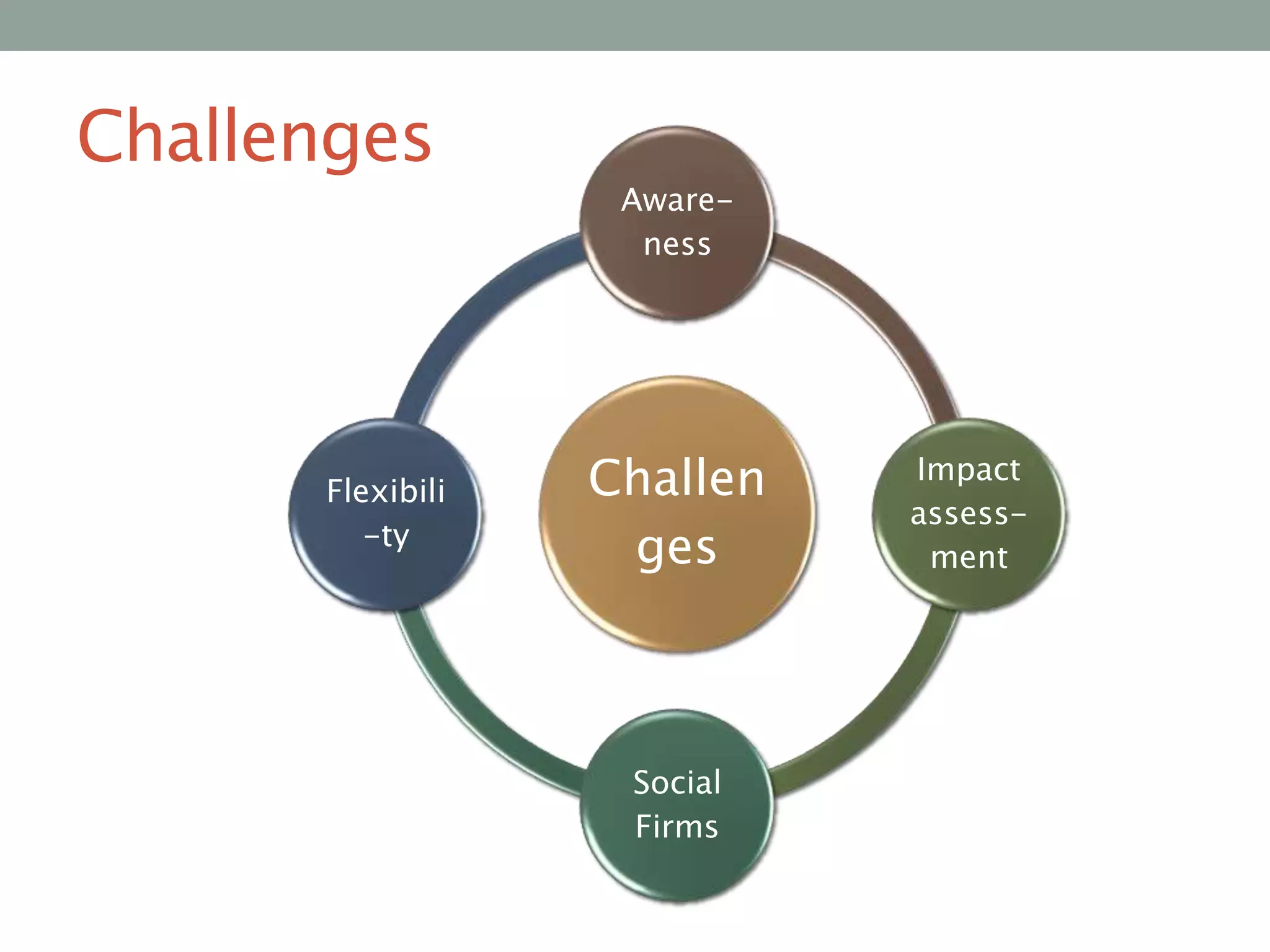
Challenges
Awareness

Flexibili
-ty

Challen
ges

Social
Firms

Impact
assessment
Why & when do you need a definition?
• For promotion?
• % of procurement?
•
•
•
•
•

•

public and corporate
More volunteers?
Access to markets? –
service monopoly
Access to capital?
Set a new legal form?
Boost social
innovations?
Use public/EU
subsidies?
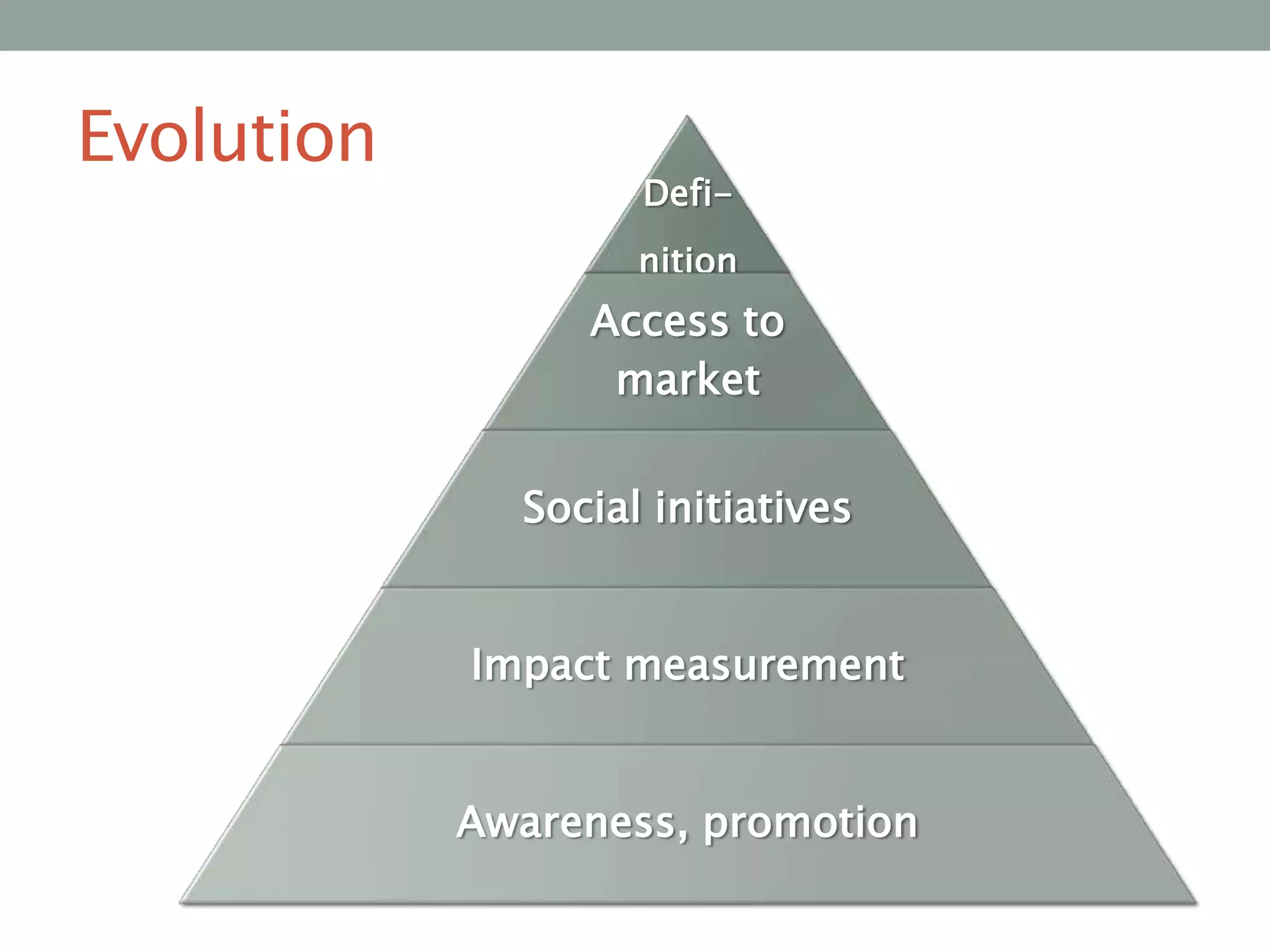
Evolution

Definition

Access to
market
Social initiatives
Impact measurement
Awareness, promotion
24

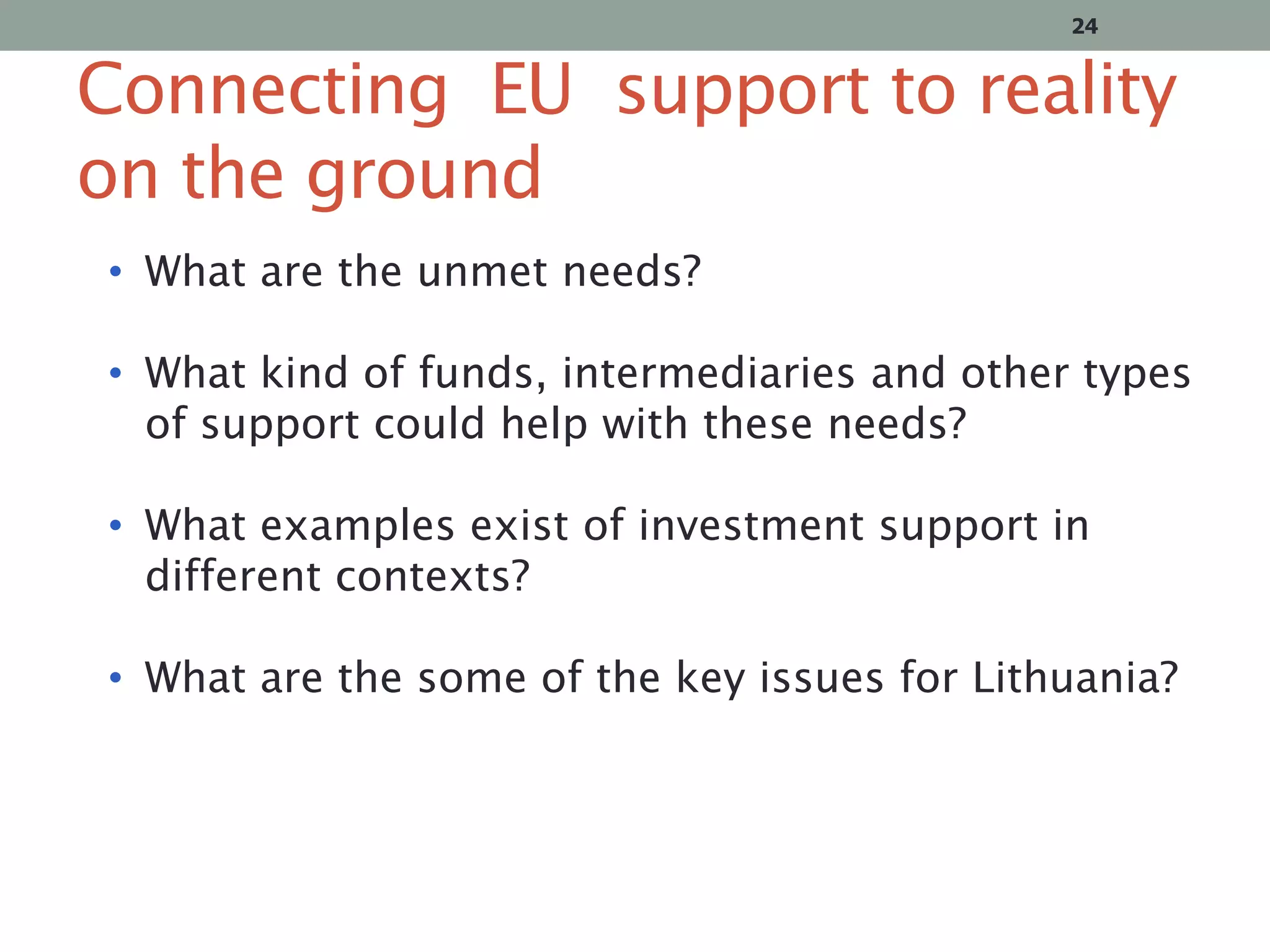
Connecting EU support to reality
on the ground
• What are the unmet needs?
• What kind of funds, intermediaries and other types
of support could help with these needs?

• What examples exist of investment support in
different contexts?
• What are the some of the key issues for Lithuania?
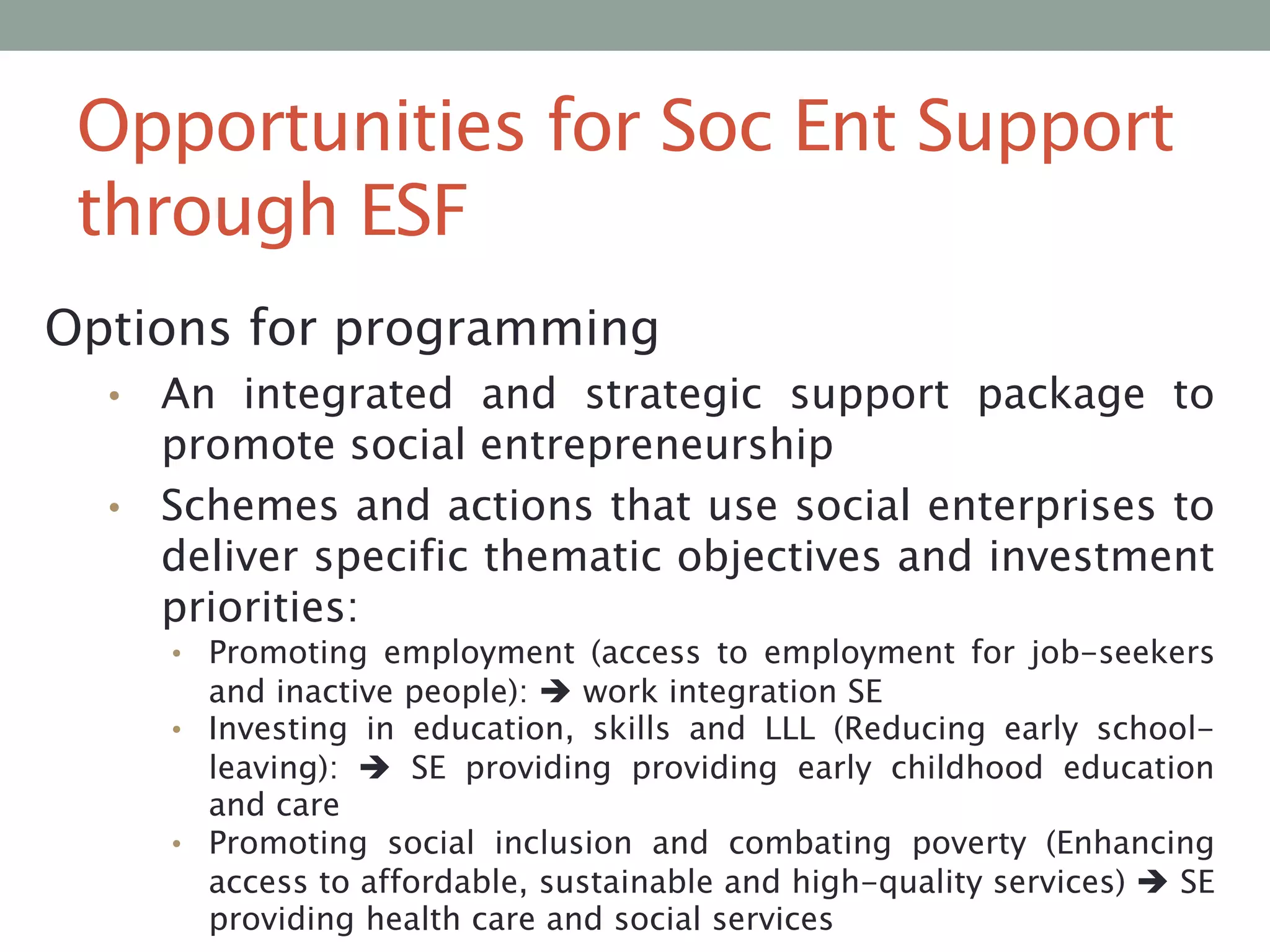
Opportunities for Soc Ent Support
through ESF
Options for programming
An integrated and strategic support package to
promote social entrepreneurship
• Schemes and actions that use social enterprises to
deliver specific thematic objectives and investment
priorities:
•

• Promoting employment (access to employment for job-seekers

and inactive people):  work integration SE
• Investing in education, skills and LLL (Reducing early schoolleaving):  SE providing providing early childhood education
and care
• Promoting social inclusion and combating poverty (Enhancing
access to affordable, sustainable and high-quality services)  SE
providing health care and social services
Thanks

Mindaugas Danys
mindaugas.danys@gmail.com
27

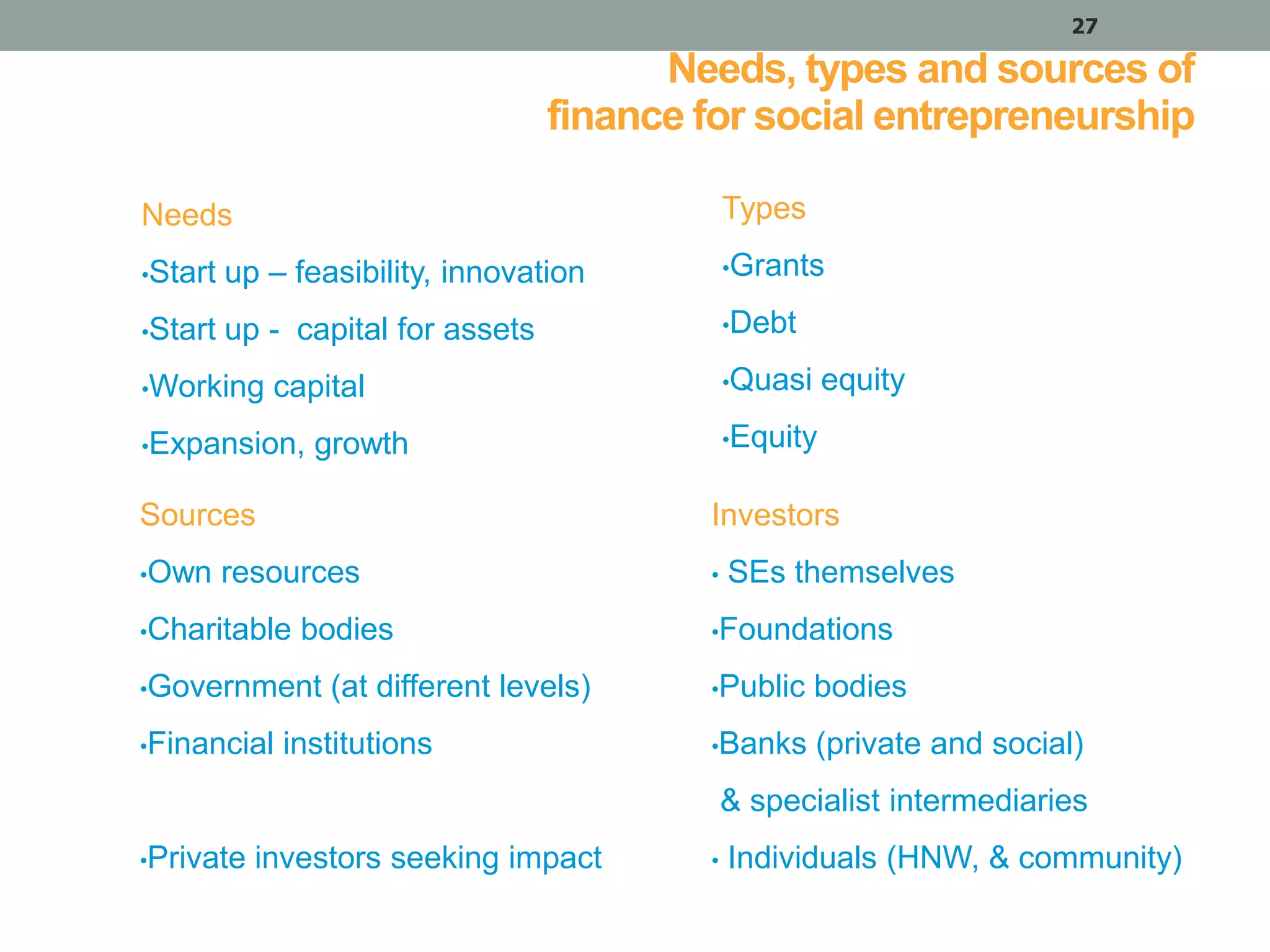
Needs, types and sources of
finance for social entrepreneurship
Types

Needs
•Start

up – feasibility, innovation

•Grants

•Start

up - capital for assets

•Debt

•Working

•Quasi

capital

•Expansion,

equity

•Equity

growth

Sources

Investors

•Own

•

resources

•Charitable

bodies

•Government
•Financial

(at different levels)

institutions

SEs themselves

•Foundations
•Public

bodies

•Banks

(private and social)

& specialist intermediaries
•Private

investors seeking impact

•

Individuals (HNW, & community)
28

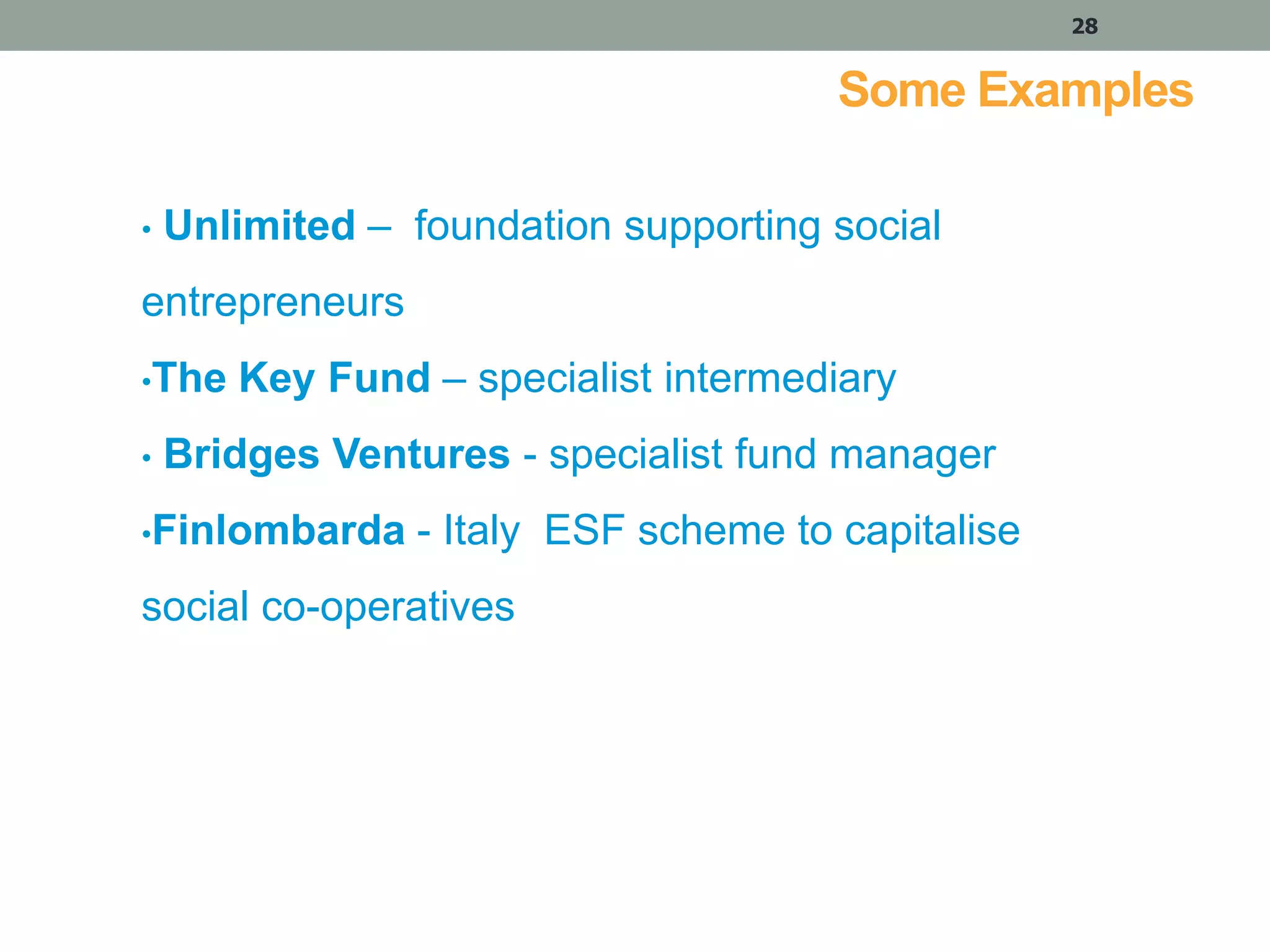
Some Examples
•

Unlimited – foundation supporting social

entrepreneurs
•The

•

Key Fund – specialist intermediary

Bridges Ventures - specialist fund manager

•Finlombarda

- Italy ESF scheme to capitalise

social co-operatives
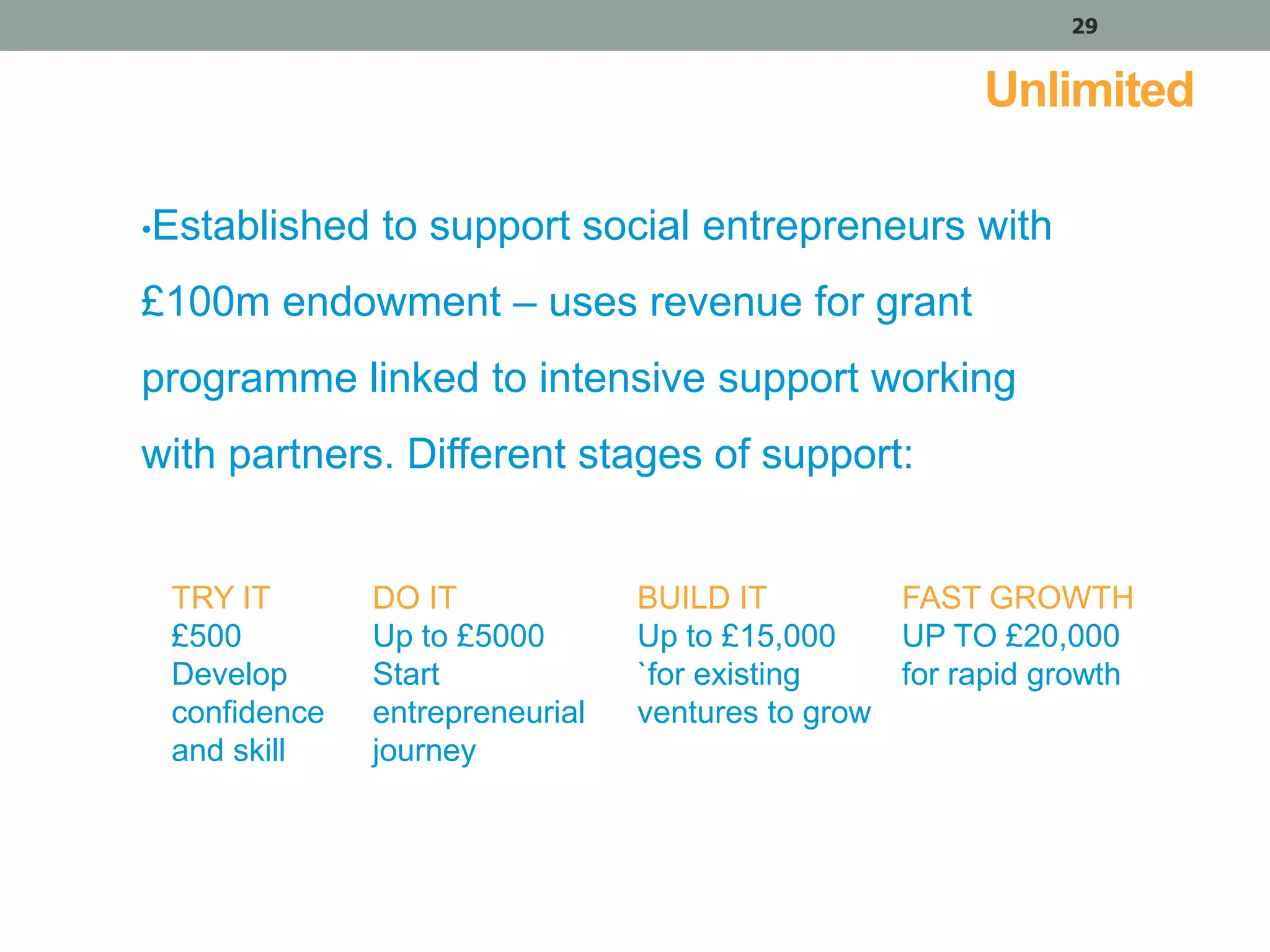
29

Unlimited
•Established

to support social entrepreneurs with

£100m endowment – uses revenue for grant
programme linked to intensive support working

with partners. Different stages of support:

TRY IT
£500
Develop
confidence
and skill

DO IT
Up to £5000
Start
entrepreneurial
journey

BUILD IT
FAST GROWTH
Up to £15,000
UP TO £20,000
`for existing
for rapid growth
ventures to grow
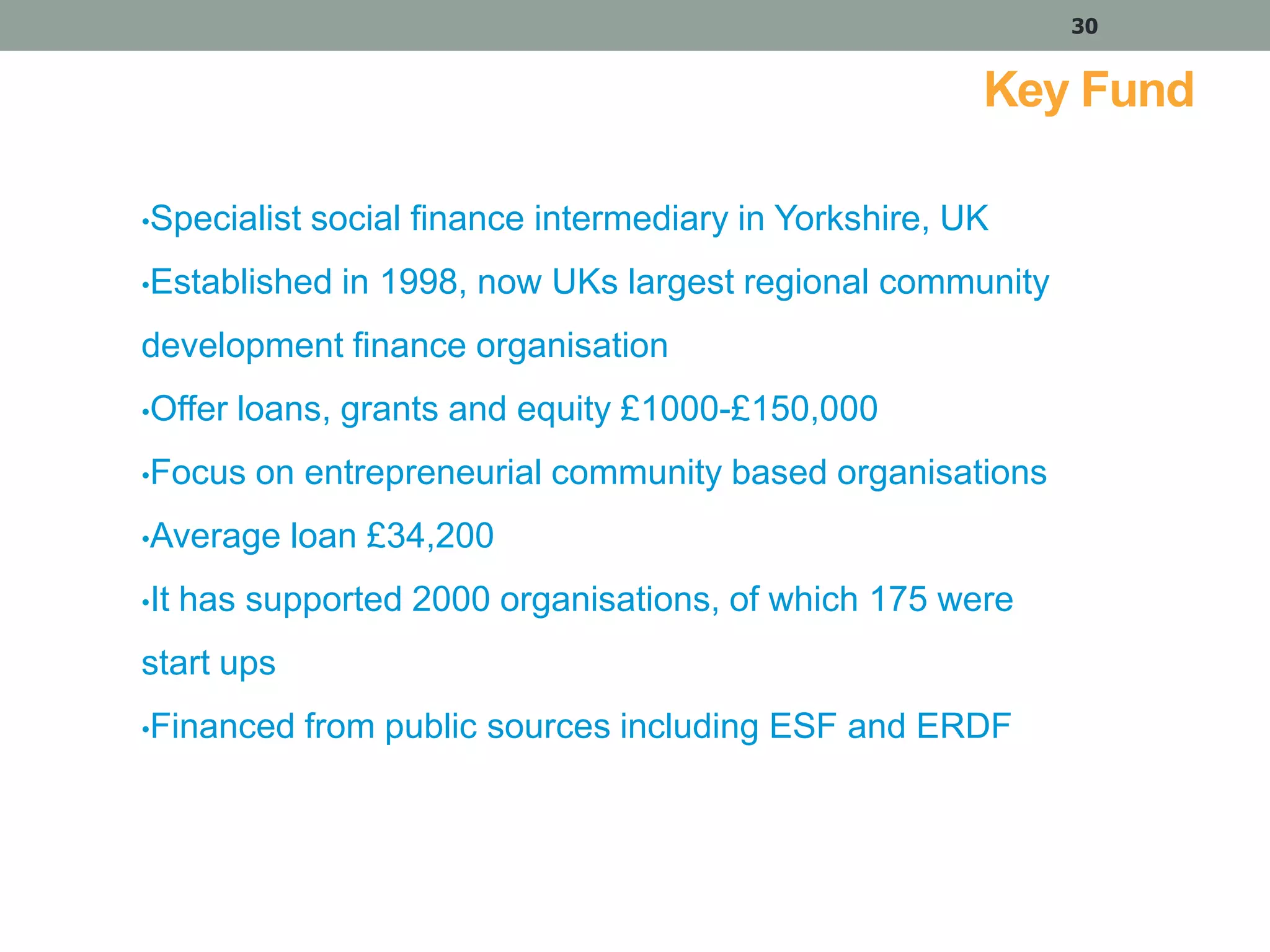
30

Key Fund
•Specialist

social finance intermediary in Yorkshire, UK

•Established

in 1998, now UKs largest regional community

development finance organisation
•Offer

loans, grants and equity £1000-£150,000

•Focus

on entrepreneurial community based organisations

•Average
•It

loan £34,200

has supported 2000 organisations, of which 175 were

start ups
•Financed

from public sources including ESF and ERDF
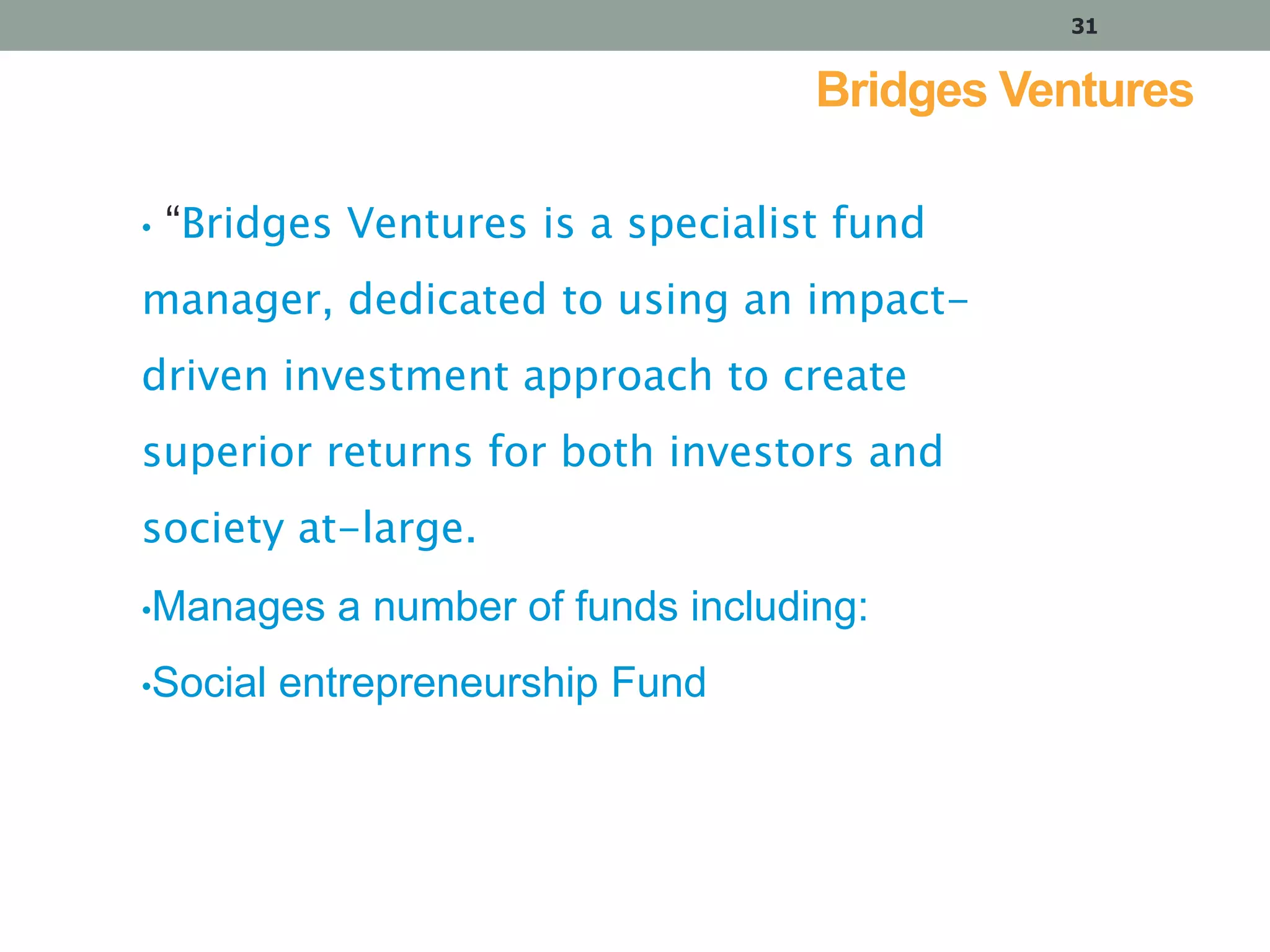
31

Bridges Ventures
•

“Bridges Ventures is a specialist fund

manager, dedicated to using an impactdriven investment approach to create

superior returns for both investors and
society at-large.
•Manages

•Social

a number of funds including:

entrepreneurship Fund
32

The Bridges SE Fund
•Addresses

the funding gap often faced by

fast growing social enterprises looking to
scale.
•Launched
•£12m

in August 2009

- from UK Government, Foundations,

private donations and innovation

endowment
•investments

in scalable social enterprises

delivering high social impacts and operating
sustainable business models.
33

Bridges Criteria

• based in England
• a clear social mission (protected in their legal
structure)
• a robust business model
• the ability to grow to scale and increase their social
impact
• a financially sustainable model
• the ability to generate surpluses to repay financing
• a strong management team
• Each investment made by the fund will be:
• up to £1.5m structured as a flexible and tailored
investment, usually in the form of quasi-equity
repayable, with an appropriate return, through the
social enterprise's trading activities
• Made 10 investments
34

Finlombarda ESF Jeremie Scheme
•

Intermediary owned buy regional government

•€20m

of ESF matched with private bank finance (Banca

Etica,, Banca Populare de Bergamo & Banco Populare di
Sondrio)
•Loans

made to individuals to buy shares in the co-

operatives in which they work
•4000

loans of €4000 made to workers in about 400 co-

operatives
•Significant

enterprises

boost to capitalisation of the cooperative
35

Good practice in promoting social
economy and social entrepreneurship
Guiding principles
An integrated strategic framework
 combining support to social entrepreneurs, provision of
business development support, access to financial instruments
with awareness raising and recognition of the sector
 Ensuring synergies between actions of different governmental
departments and levels involved

Seamless support along the whole process of social
enterprise creation, development and scaling-up
Support not restricted to specific legal forms of
enterprises, nor selected sectors
Support requires linkages with civil society and community
organisations
36

Some questions
•What

is the current situation/plans for the use of the

European Structural funds in Lithuania? €10m + How
to achieve best impact
•What

scope is there for creating new kinds of funds

and using EU funds along side other public and
private sources of finance?
•How

to use public support to engage private

investment?
•How

does this fit with development of a wider eco-

system?

Jungles of the definition - Social Enterprise

  • 1.
    JUNGLES OF THE DEFINITION SEFRiga 2013 Mindaugas Danys Ministry of Economy, Lithuania
  • 2.
    Social Enterprise MarkUK Your company must: • • • • • • have social and/or environmental aims have its own constitution and governance earn at least 50% of revenue from trading (or as a new start, you pledge to reach this within 18 months) spend at least 50% of profits on social/environmental aims distribute residual assets to social/environmental aims if dissolved demonstrate SOCIAL VALUE
  • 4.
    EU Definition According tothe definition of the European Commission a social enterprise “operates by providing goods and services for the market in an entrepreneurial and sometimes innovative fashion and uses its profits primarily to achieve social objectives. It is managed in an open and responsible manner and, in particular, involve employees, consumers and stakeholders affected by its commercial activities” (COM(2011) 682; Brussels, 25.10.2011)
  • 5.
    How are socialenterprises regulated across Europe? • • Social enterprises can be regulated in one or more of the following ways: o Existing legal forms o Adaptation of existing legal forms o Introduction of social enterprise legal brands o Introduction of specific types of non-profit organizations (e.g. non-profit institute in Slovenia) A few countries have introduced a general legislation on Social Economy
  • 6.
    Lithuania and socents • • • • Experience with Social firms Few social enterprises Lots of NGO social business initiatives Legal status – private non profit
  • 16.
  • 17.
  • 18.
  • 19.
  • 20.
  • 21.
  • 22.
    Why & whendo you need a definition? • For promotion? • % of procurement? • • • • • • public and corporate More volunteers? Access to markets? – service monopoly Access to capital? Set a new legal form? Boost social innovations? Use public/EU subsidies?
  • 23.
  • 24.
    24 Connecting EU supportto reality on the ground • What are the unmet needs? • What kind of funds, intermediaries and other types of support could help with these needs? • What examples exist of investment support in different contexts? • What are the some of the key issues for Lithuania?
  • 25.
    Opportunities for SocEnt Support through ESF Options for programming An integrated and strategic support package to promote social entrepreneurship • Schemes and actions that use social enterprises to deliver specific thematic objectives and investment priorities: • • Promoting employment (access to employment for job-seekers and inactive people):  work integration SE • Investing in education, skills and LLL (Reducing early schoolleaving):  SE providing providing early childhood education and care • Promoting social inclusion and combating poverty (Enhancing access to affordable, sustainable and high-quality services)  SE providing health care and social services
  • 26.
  • 27.
    27 Needs, types andsources of finance for social entrepreneurship Types Needs •Start up – feasibility, innovation •Grants •Start up - capital for assets •Debt •Working •Quasi capital •Expansion, equity •Equity growth Sources Investors •Own • resources •Charitable bodies •Government •Financial (at different levels) institutions SEs themselves •Foundations •Public bodies •Banks (private and social) & specialist intermediaries •Private investors seeking impact • Individuals (HNW, & community)
  • 28.
    28 Some Examples • Unlimited –foundation supporting social entrepreneurs •The • Key Fund – specialist intermediary Bridges Ventures - specialist fund manager •Finlombarda - Italy ESF scheme to capitalise social co-operatives
  • 29.
    29 Unlimited •Established to support socialentrepreneurs with £100m endowment – uses revenue for grant programme linked to intensive support working with partners. Different stages of support: TRY IT £500 Develop confidence and skill DO IT Up to £5000 Start entrepreneurial journey BUILD IT FAST GROWTH Up to £15,000 UP TO £20,000 `for existing for rapid growth ventures to grow
  • 30.
    30 Key Fund •Specialist social financeintermediary in Yorkshire, UK •Established in 1998, now UKs largest regional community development finance organisation •Offer loans, grants and equity £1000-£150,000 •Focus on entrepreneurial community based organisations •Average •It loan £34,200 has supported 2000 organisations, of which 175 were start ups •Financed from public sources including ESF and ERDF
  • 31.
    31 Bridges Ventures • “Bridges Venturesis a specialist fund manager, dedicated to using an impactdriven investment approach to create superior returns for both investors and society at-large. •Manages •Social a number of funds including: entrepreneurship Fund
  • 32.
    32 The Bridges SEFund •Addresses the funding gap often faced by fast growing social enterprises looking to scale. •Launched •£12m in August 2009 - from UK Government, Foundations, private donations and innovation endowment •investments in scalable social enterprises delivering high social impacts and operating sustainable business models.
  • 33.
    33 Bridges Criteria • basedin England • a clear social mission (protected in their legal structure) • a robust business model • the ability to grow to scale and increase their social impact • a financially sustainable model • the ability to generate surpluses to repay financing • a strong management team • Each investment made by the fund will be: • up to £1.5m structured as a flexible and tailored investment, usually in the form of quasi-equity repayable, with an appropriate return, through the social enterprise's trading activities • Made 10 investments
  • 34.
    34 Finlombarda ESF JeremieScheme • Intermediary owned buy regional government •€20m of ESF matched with private bank finance (Banca Etica,, Banca Populare de Bergamo & Banco Populare di Sondrio) •Loans made to individuals to buy shares in the co- operatives in which they work •4000 loans of €4000 made to workers in about 400 co- operatives •Significant enterprises boost to capitalisation of the cooperative
  • 35.
    35 Good practice inpromoting social economy and social entrepreneurship Guiding principles An integrated strategic framework  combining support to social entrepreneurs, provision of business development support, access to financial instruments with awareness raising and recognition of the sector  Ensuring synergies between actions of different governmental departments and levels involved Seamless support along the whole process of social enterprise creation, development and scaling-up Support not restricted to specific legal forms of enterprises, nor selected sectors Support requires linkages with civil society and community organisations
  • 36.
    36 Some questions •What is thecurrent situation/plans for the use of the European Structural funds in Lithuania? €10m + How to achieve best impact •What scope is there for creating new kinds of funds and using EU funds along side other public and private sources of finance? •How to use public support to engage private investment? •How does this fit with development of a wider eco- system?

Editor's Notes

  • #24 We need promotion, awareness raising, skills development, procurement changes, impact measurement tools, Target social service providers, NGOs, studentsDemonopolize social servicesSoft measures for social business and social innovation initiativesFinally we need definition
  • #26 Proposed investment priority: EL, ES, HU, IT, PT – 5 MSs.Proposed specific objective: AT, DE, LT, MT, PL, SK – 6 MSs.