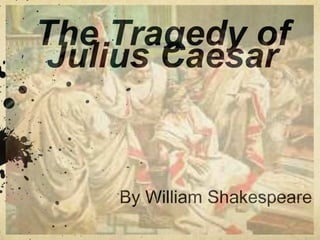
The Tragedy of 
Julius Caesar 
By William Shakespeare
Ethos, Pathos, and 
Logos: 
Modes of persuasion 
that speakers or writers 
use to convince their 
audience.
Ethos (Character): 
 An author would use 
ethos to show his 
audience that he is a 
credible source and 
worth listening to. 
 AU. Speech sounds 
fair and unbiased
Pathos (Emotional) 
 An emotional 
appeal 
 AU.’s use pathos 
to solicit 
sympathy, anger, 
or pity from the 
audience 
 Uses meaningful 
language, 
emotional tone, 
emotional evoking 
ex’s., stories of 
emotional events, 
and implied
Logos (Logic) 
 Convinces 
audience by use 
of logic or 
reasoning 
 Facts, statistics, 
historical, or literal 
words 
 Theoretical or 
abstract language 
 Logical arguments
Ethos, Pathos, and Logos: 
Rhetorical devices that 
speakers/writers use to 
convince their audience.
1. Why does Cassius think it is a 
bad idea to let Antony speak 
at Caesar’s funeral? Do you 
agree with him? Explain. 
2. Why is it so important that the 
conspirators tell the people it’s 
only by their permission that 
Antony can speak?
Dramatic Irony: 
Occurs when the 
audience knows 
something a character 
does not. 
What did we know about Caesar 
that he didn’t know himself 
throughout the play?
Do Now 
1. What is Brutus’s relationship to 
Caesar? 
2. What are Brutus’s mixed feelings 
toward Caesar?
Indirect Characterization* 
Indirect characterization is when the 
author SHOWS things that reveal the 
personality of the character. 
(S.T.E.A.L.) 
Speech, Thoughts, Effect on others, 
Actions, Looks
Elements of Shakespeare’s 
Tragedies* 
1. Tragic Flaw: A weakness in personality 
that eventually leads to the 
protagonist’s downfall. 
2. Fall of the nobleman: Men in 
Shakespeare’s tragedies have extreme 
wealth and power, making their downfall 
more tragic.
Elements of 
Shakespeare’s Tragedies* 
3. External Pressure: Shakespeare’s tragic 
heroes often fall victim to outside 
pressure from others, such as evil spirits 
or manipulative characters. 
4. Hero: The hero has opportunities for 
their situation to improve, but never takes 
advantage of these in time, which leads to 
their death.
Alert! 
NEW NOTES COMING!
Dramatic Terms* 
Aside: A character speaks their 
thoughts to the audience while 
other characters are on stage.
Dramatic Terms* 
Soliloquy: A character speaks 
their thoughts while alone on 
stage.
Questions 
1. What is Cassius’s opinion of Caesar? Cite 
supporting details. 
2. List two things that Cassius desires by this 
point in the play. Why does he desire them? Cite 
supporting details. 
3. What does Brutus think about Cassius? Does 
he know Cassius is trying to manipulate him? 
Cite evidence for the last question.
Questions 
4. Why does Caesar wish Cassius were 
“fatter?” What is Cassius “hungry” for? 
5. How does Caesar characterize Cassius? 
List three supporting details other than what 
was listed in question 4. 
6. How do you know if someone is powerful? 
Which character in the play thus far has the 
most power?
Agenda: 
1. Collect yesterday’s homework 
2. Indirect Characterization 
3. Tragedy as a genre in Shakespeare’s work 
4. Read some of the play 
5. Complete Charts 
6. Homework
New Notes
Do Now: 
1. What are some of the ways that we judge a 
person? List them! 
- 
- 
- 
1. What are some of our reasons for judging a 
person?
Speech and Effect on 
Others Ex. 
Speech example: 
We learn a lot about the way Dee feels towards her family when she 
says: 
“You ought to try to make something of yourself…It’s really a new day 
for us. But from the way you and Mama still live you’d never know it.” 
Though example: 
We learn a lot about Dee’s character through Mama’s thoughts of 
her: 
“She used to read to us without pity; forcing words, lies, other folks’ 
habits, whole lives upon us two, sitting trapped and ignorant
Indirect Characterization 
Instructions: Copy down the following indirect characterization 
chart, so you can draw a conclusion about your assigned 
character after reading: 
Character name:___Cassius_____________ 
Speech Thought 
s 
Effect on 
others 
Actions Looks 
1. 
2. 
3.
Typical features of 
Shakespeare’s Tragedies 
 Begin in an ordered society but end with chaos 
 Change is often reflected by changes in the environment, 
such as storms or peculiar sightings (“When Kings die the 
ground shakes”) 
 Sympathetic hero 
 The protagonist is usually a person of good character who 
is destroyed by his own ego or desire for self-advancement
Homework: 
Directions: Write a letter to your character using at least two 
adjectives to describe what you think about him. Your thoughts 
should reflect things about his personality or character that you 
like or dislike. Afterwards give your character your best piece 
of advice. 
Example: 
Dear Caesar, 
I feel like you’re arrogant, because you didn’t want to listen to 
the Soothsayers advice. I also feel like you’re oblivious to the 
people who are plotting against your life. You should stop 
parading around acting like you’re king, and start paying 
attention to the people around you. If you don’t you may lose 
your life…
Homework: 
Headline for Act 1 Scene 2 
Draw a conclusion about your character
Do Now 
1. Copy the chart below within your notebooks for Act I 
Scene 1 of Julius Caesar: 
1. Who is in the scene? 
2. What are they doing? 
3. Where does the scene 
take place? 
4. When does the scene 
take place (and why is it 
important)? 
5. Why are the people 
celebrating? 
6. How do Marullus and 
Flavius feel?
Do Now 
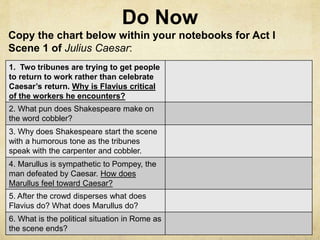
Copy the chart below within your notebooks for Act I 
Scene 1 of Julius Caesar: 
1. Two tribunes are trying to get people 
to return to work rather than celebrate 
Caesar’s return. Why is Flavius critical 
of the workers he encounters? 
2. What pun does Shakespeare make on 
the word cobbler? 
3. Why does Shakespeare start the scene 
with a humorous tone as the tribunes 
speak with the carpenter and cobbler. 
4. Marullus is sympathetic to Pompey, the 
man defeated by Caesar. How does 
Marullus feel toward Caesar? 
5. After the crowd disperses what does 
Flavius do? What does Marullus do? 
6. What is the political situation in Rome as 
the scene ends?
William Shakespeare 
William Shakespeare lived from 1564 to 
1616 
Julius Caesar is Shakespeare’s story of the 
emperor who lived 1500 years before 
Shakespeare’s time when Rome was the 
dominant world power. Shakespeare had 
read Julius Caesar’s story in Plutarch’s Lives.
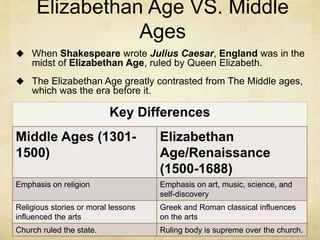
Elizabethan Age VS. Middle 
Ages 
 When Shakespeare wrote Julius Caesar, England was in the 
midst of Elizabethan Age, ruled by Queen Elizabeth. 
 The Elizabethan Age greatly contrasted from The Middle ages, 
which was the era before it. 
Key Differences 
Middle Ages (1301- 
1500) 
Elizabethan 
Age/Renaissance 
(1500-1688) 
Emphasis on religion Emphasis on art, music, science, and 
self-discovery 
Religious stories or moral lessons 
influenced the arts 
Greek and Roman classical influences 
on the arts 
Church ruled the state. Ruling body is supreme over the church.
Julius Caesar 
 Julius Caesar was a Roman dictator that reigned in 
49 BC; he died a violent death many many moons 
ago. 
 He gained most of his power by being a successful 
general at war, and was appointed consul (our 
version of a senator or house of rep.) of Rome, by his 
friend Pompey the Great. 
 Caesar gained more power when he formed an 
alliance with two fellow consuls, despite Rome being 
a Republic at the time. 
 Caesar, Crassus, and Pompey were the first “ruling
Julius Caesar continued… 
 Caesar continued to make successful military 
conquests around the world, thereby increasing his 
power and popularity, but also his haters. 
 Pompey soon became jealous and convinced the 
Roman Senate to remove Caesar from office. This 
action started a battle between the two men. 
 Caesar ended up killing Pompey at war and poisoning 
Crassus. Afterwards, he became the sole leading ruler 
of Rome.
Julius Caesar continued… 
 He was loved by the lower class (plebeians) of 
Rome, mostly because he wooed them with gifts and 
money; the senate started to get really pissed off by 
his growing powers. 
 The senate started to really get pissed off about his 
growing power with the people and his increasing 
political powers, so they took matters into their own 
hands.
Homework: 
Instructions: 
1. Write a headline for the scene you just 
read. Your headline should convey the 
most important events of the scene. 
-Feel free to be creative and funny, just as 
long as you show that you know what 
happened in this scene. 
Headline Example for Scene 1: 
“Two Government Officials Sip on 
Haterade and Try to Destroy Caesar’s 
Parade” 
2. Can a modern day audience still 
appreciate the following themes from 
Shakespeare’s play: honor, friendship, 
loyalty, patriotism, deceit, and revenge? 
3. Do differing cultural groups value 
concepts such as honor, friendship, 
loyalty, patriotism, deceit, or revenge 
“Modern Shakespeare”

Julius caesar

  • 1.
    The Tragedy of Julius Caesar By William Shakespeare
  • 2.
    Ethos, Pathos, and Logos: Modes of persuasion that speakers or writers use to convince their audience.
  • 3.
    Ethos (Character): An author would use ethos to show his audience that he is a credible source and worth listening to.  AU. Speech sounds fair and unbiased
  • 4.
    Pathos (Emotional) An emotional appeal  AU.’s use pathos to solicit sympathy, anger, or pity from the audience  Uses meaningful language, emotional tone, emotional evoking ex’s., stories of emotional events, and implied
  • 5.
    Logos (Logic) Convinces audience by use of logic or reasoning  Facts, statistics, historical, or literal words  Theoretical or abstract language  Logical arguments
  • 6.
    Ethos, Pathos, andLogos: Rhetorical devices that speakers/writers use to convince their audience.
  • 7.
    1. Why doesCassius think it is a bad idea to let Antony speak at Caesar’s funeral? Do you agree with him? Explain. 2. Why is it so important that the conspirators tell the people it’s only by their permission that Antony can speak?
  • 8.
    Dramatic Irony: Occurswhen the audience knows something a character does not. What did we know about Caesar that he didn’t know himself throughout the play?
  • 9.
    Do Now 1.What is Brutus’s relationship to Caesar? 2. What are Brutus’s mixed feelings toward Caesar?
  • 10.
    Indirect Characterization* Indirectcharacterization is when the author SHOWS things that reveal the personality of the character. (S.T.E.A.L.) Speech, Thoughts, Effect on others, Actions, Looks
  • 11.
    Elements of Shakespeare’s Tragedies* 1. Tragic Flaw: A weakness in personality that eventually leads to the protagonist’s downfall. 2. Fall of the nobleman: Men in Shakespeare’s tragedies have extreme wealth and power, making their downfall more tragic.
  • 12.
    Elements of Shakespeare’sTragedies* 3. External Pressure: Shakespeare’s tragic heroes often fall victim to outside pressure from others, such as evil spirits or manipulative characters. 4. Hero: The hero has opportunities for their situation to improve, but never takes advantage of these in time, which leads to their death.
  • 13.
  • 14.
    Dramatic Terms* Aside:A character speaks their thoughts to the audience while other characters are on stage.
  • 15.
    Dramatic Terms* Soliloquy:A character speaks their thoughts while alone on stage.
  • 16.
    Questions 1. Whatis Cassius’s opinion of Caesar? Cite supporting details. 2. List two things that Cassius desires by this point in the play. Why does he desire them? Cite supporting details. 3. What does Brutus think about Cassius? Does he know Cassius is trying to manipulate him? Cite evidence for the last question.
  • 17.
    Questions 4. Whydoes Caesar wish Cassius were “fatter?” What is Cassius “hungry” for? 5. How does Caesar characterize Cassius? List three supporting details other than what was listed in question 4. 6. How do you know if someone is powerful? Which character in the play thus far has the most power?
  • 18.
    Agenda: 1. Collectyesterday’s homework 2. Indirect Characterization 3. Tragedy as a genre in Shakespeare’s work 4. Read some of the play 5. Complete Charts 6. Homework
  • 19.
  • 20.
    Do Now: 1.What are some of the ways that we judge a person? List them! - - - 1. What are some of our reasons for judging a person?
  • 21.
    Speech and Effecton Others Ex. Speech example: We learn a lot about the way Dee feels towards her family when she says: “You ought to try to make something of yourself…It’s really a new day for us. But from the way you and Mama still live you’d never know it.” Though example: We learn a lot about Dee’s character through Mama’s thoughts of her: “She used to read to us without pity; forcing words, lies, other folks’ habits, whole lives upon us two, sitting trapped and ignorant
  • 22.
    Indirect Characterization Instructions:Copy down the following indirect characterization chart, so you can draw a conclusion about your assigned character after reading: Character name:___Cassius_____________ Speech Thought s Effect on others Actions Looks 1. 2. 3.
  • 23.
    Typical features of Shakespeare’s Tragedies  Begin in an ordered society but end with chaos  Change is often reflected by changes in the environment, such as storms or peculiar sightings (“When Kings die the ground shakes”)  Sympathetic hero  The protagonist is usually a person of good character who is destroyed by his own ego or desire for self-advancement
  • 24.
    Homework: Directions: Writea letter to your character using at least two adjectives to describe what you think about him. Your thoughts should reflect things about his personality or character that you like or dislike. Afterwards give your character your best piece of advice. Example: Dear Caesar, I feel like you’re arrogant, because you didn’t want to listen to the Soothsayers advice. I also feel like you’re oblivious to the people who are plotting against your life. You should stop parading around acting like you’re king, and start paying attention to the people around you. If you don’t you may lose your life…
  • 25.
    Homework: Headline forAct 1 Scene 2 Draw a conclusion about your character
  • 26.
    Do Now 1.Copy the chart below within your notebooks for Act I Scene 1 of Julius Caesar: 1. Who is in the scene? 2. What are they doing? 3. Where does the scene take place? 4. When does the scene take place (and why is it important)? 5. Why are the people celebrating? 6. How do Marullus and Flavius feel?
  • 27.
    Do Now Copythe chart below within your notebooks for Act I Scene 1 of Julius Caesar: 1. Two tribunes are trying to get people to return to work rather than celebrate Caesar’s return. Why is Flavius critical of the workers he encounters? 2. What pun does Shakespeare make on the word cobbler? 3. Why does Shakespeare start the scene with a humorous tone as the tribunes speak with the carpenter and cobbler. 4. Marullus is sympathetic to Pompey, the man defeated by Caesar. How does Marullus feel toward Caesar? 5. After the crowd disperses what does Flavius do? What does Marullus do? 6. What is the political situation in Rome as the scene ends?
  • 28.
    William Shakespeare WilliamShakespeare lived from 1564 to 1616 Julius Caesar is Shakespeare’s story of the emperor who lived 1500 years before Shakespeare’s time when Rome was the dominant world power. Shakespeare had read Julius Caesar’s story in Plutarch’s Lives.
  • 29.
    Elizabethan Age VS.Middle Ages  When Shakespeare wrote Julius Caesar, England was in the midst of Elizabethan Age, ruled by Queen Elizabeth.  The Elizabethan Age greatly contrasted from The Middle ages, which was the era before it. Key Differences Middle Ages (1301- 1500) Elizabethan Age/Renaissance (1500-1688) Emphasis on religion Emphasis on art, music, science, and self-discovery Religious stories or moral lessons influenced the arts Greek and Roman classical influences on the arts Church ruled the state. Ruling body is supreme over the church.
  • 30.
    Julius Caesar Julius Caesar was a Roman dictator that reigned in 49 BC; he died a violent death many many moons ago.  He gained most of his power by being a successful general at war, and was appointed consul (our version of a senator or house of rep.) of Rome, by his friend Pompey the Great.  Caesar gained more power when he formed an alliance with two fellow consuls, despite Rome being a Republic at the time.  Caesar, Crassus, and Pompey were the first “ruling
  • 31.
    Julius Caesar continued…  Caesar continued to make successful military conquests around the world, thereby increasing his power and popularity, but also his haters.  Pompey soon became jealous and convinced the Roman Senate to remove Caesar from office. This action started a battle between the two men.  Caesar ended up killing Pompey at war and poisoning Crassus. Afterwards, he became the sole leading ruler of Rome.
  • 32.
    Julius Caesar continued…  He was loved by the lower class (plebeians) of Rome, mostly because he wooed them with gifts and money; the senate started to get really pissed off by his growing powers.  The senate started to really get pissed off about his growing power with the people and his increasing political powers, so they took matters into their own hands.
  • 33.
    Homework: Instructions: 1.Write a headline for the scene you just read. Your headline should convey the most important events of the scene. -Feel free to be creative and funny, just as long as you show that you know what happened in this scene. Headline Example for Scene 1: “Two Government Officials Sip on Haterade and Try to Destroy Caesar’s Parade” 2. Can a modern day audience still appreciate the following themes from Shakespeare’s play: honor, friendship, loyalty, patriotism, deceit, and revenge? 3. Do differing cultural groups value concepts such as honor, friendship, loyalty, patriotism, deceit, or revenge “Modern Shakespeare”

Editor's Notes

  • #2 Collect yesterday’s homework!
  • #5 Words that aren’t literal, or that have more than one meaning (implied)
  • #8 Who is Brutus loyal to?
  • #11 Review: Speech: What the characters say Thoughts: What the characters think or feels Effect on other characters: How other characters think, feel, or react to one character Actions: What the characters does Looks: How the character looks or dresses
  • #12 Review
  • #15 1. Pun A pun is a play on words in which a word or phrase has a double meaning. 2. Comic relief A release from tension through humor.
  • #16 Reveals to us a meaty part of their character
  • #21 Why do we judge a person (positive and negative
  • #24 Review
  • #27 Period 2
  • #29 The fatal flaw - all of the heroes in Shakespeare's tragedies have a weakness in personality that eventually leads to their downfall. Fall of the nobleman - many of the men in Shakespeare's tragedies have extreme wealth and power, making their downfall more tragic. External pressure - Shakespeare's tragic heroes often fall victim to external pressure from others, such as evil spirits and manipulative characters who play a role in their downfall. Hero - The hero has opportunities for redemption but never takes advantage of these in time, which leads to death. Shakespeare's tragedies usually share several features, including the following: Shakespeare's tragedies begin in an ordered society but end with chaos. Change is often reflected by changes in the environment, with storms or other happenings in the natural world. The audience often develops sympathy for the hero. The protagonist is usually a person of good character who is destroyed by his own ego or desire for self-advancement.
  • #30 Very restricted 2. Contrasted
  • #31 Republic: people had more rights, voted for their elected officials…slowly became empire during Caesar’s rule, both senate and people started having less say about the choice of their elected officials and the laws.
  • #32 Did power change him?