Beyond Tooth Decay:
The Implications of
Poor Oral Health
By Jude Fabiano
Alzheimerโ€™s
Back in 2010, researchers from NYU concluded
that thereโ€™s a link between gum in๏ฌ‚ammation
and Alzheimerโ€™s disease after they reviewed 20
years of data. The researchers analyzed data
from 152 subjects enrolled in the Glostrop Aging
Study, which looks at psychological, medical
and oral health in Danish men and women over
a 20-year period that ended in 1984. Through
comparing cognitive function at ages 50 and 70,
the NYU researchers found that gum disease at
70 was strongly associated with low scores for
cognitive function. According to researchers,
study participants were nine times more likely to
have a score in the lower range of the cognitive
test if they had gum in๏ฌ‚ammations. Even
though this study took into account such
potentially confounding factors as obesity,
cigarette smoking and tooth loss unrelated to
gum in๏ฌ‚ammation, there remained a strong
association between lower cognitive test scores
and gum in๏ฌ‚ammation.!
Three years later, researchers from
the University of Central Lancashire
(UCLAN) built on the ๏ฌndings of this
study by comparing brain samples
from 10 living patients with
Alzheimerโ€™s with 10 brain samples
from people who didnโ€™t have the
disease. Analysis revealed that a
bacterium typically associated with
chronic gum disease was present in
the Alzheimerโ€™s brain samples but not
in other samples. The team followed
this research up in 2014 with a new
mouse study, the results of which
were published in the Journal of
Alzheimerโ€™s Disease.
Pancreatic Cancer
A research team from Harvard School of
Public Health in Boston were the ๏ฌrst to
report on evidence of a link between gum
disease and pancreatic cancer back in
2007. The type of gum in๏ฌ‚ammation
associated with pancreatic cancer in the
study was periodontitis, which affects the
tissue that support the teeth and can
cause loss of bone around the teethโ€™s
base. The other main type of gum
disease, gingivitis, was not linked to
increased cancer risk, although it can lead
to periodontitis if persistent.!
After examining data on gum disease from a
follow-up study involving a cohort of over 51,000
men beginning in 1986, the Harvard researchers
found that men with a history of gum disease had
a 64% increased risk of pancreatic cancer when
compared with men who never had gum disease.
The greatest risk for pancreatic cancer among
this group was in men with recent tooth loss,
although the study was unable to ๏ฌnd links
between other types of oral health problems, such
as tooth decay and pancreatic cancer. The
researchers have suggested that there may be a
link between high levels of carcinogenic
compounds found in the mouth of people with
gum disease and pancreatic cancer risk, and that
these compounds could react to the gutโ€™s
digestive chemicals in a way that creates an
environment favorable to the development of
pancreatic cancer. However, in a 2012 follow-up
study, they couldnโ€™t prove that periodontitis was a
cause or result of pancreatic cancer, but they
were able to prove that the two were linked.
Heart Disease
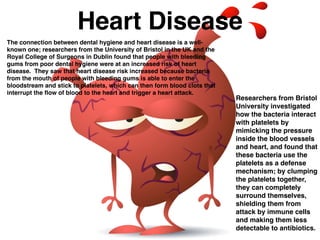
The connection between dental hygiene and heart disease is a well-
known one; researchers from the University of Bristol in the UK and the
Royal College of Surgeons in Dublin found that people with bleeding
gums from poor dental hygiene were at an increased risk of heart
disease. They saw that heart disease risk increased because bacteria
from the mouth of people with bleeding gums is able to enter the
bloodstream and stick to platelets, which can then form blood clots that
interrupt the ๏ฌ‚ow of blood to the heart and trigger a heart attack.
Researchers from Bristol
University investigated
how the bacteria interact
with platelets by
mimicking the pressure
inside the blood vessels
and heart, and found that
these bacteria use the
platelets as a defense
mechanism; by clumping
the platelets together,
they can completely
surround themselves,
shielding them from
attack by immune cells
and making them less
detectable to antibiotics.

Jude Fabiano - Beyond Tooth Decay

  • 1.
    Beyond Tooth Decay: TheImplications of Poor Oral Health By Jude Fabiano
  • 2.
    Alzheimerโ€™s Back in 2010,researchers from NYU concluded that thereโ€™s a link between gum in๏ฌ‚ammation and Alzheimerโ€™s disease after they reviewed 20 years of data. The researchers analyzed data from 152 subjects enrolled in the Glostrop Aging Study, which looks at psychological, medical and oral health in Danish men and women over a 20-year period that ended in 1984. Through comparing cognitive function at ages 50 and 70, the NYU researchers found that gum disease at 70 was strongly associated with low scores for cognitive function. According to researchers, study participants were nine times more likely to have a score in the lower range of the cognitive test if they had gum in๏ฌ‚ammations. Even though this study took into account such potentially confounding factors as obesity, cigarette smoking and tooth loss unrelated to gum in๏ฌ‚ammation, there remained a strong association between lower cognitive test scores and gum in๏ฌ‚ammation.! Three years later, researchers from the University of Central Lancashire (UCLAN) built on the ๏ฌndings of this study by comparing brain samples from 10 living patients with Alzheimerโ€™s with 10 brain samples from people who didnโ€™t have the disease. Analysis revealed that a bacterium typically associated with chronic gum disease was present in the Alzheimerโ€™s brain samples but not in other samples. The team followed this research up in 2014 with a new mouse study, the results of which were published in the Journal of Alzheimerโ€™s Disease.
  • 3.
    Pancreatic Cancer A researchteam from Harvard School of Public Health in Boston were the ๏ฌrst to report on evidence of a link between gum disease and pancreatic cancer back in 2007. The type of gum in๏ฌ‚ammation associated with pancreatic cancer in the study was periodontitis, which affects the tissue that support the teeth and can cause loss of bone around the teethโ€™s base. The other main type of gum disease, gingivitis, was not linked to increased cancer risk, although it can lead to periodontitis if persistent.! After examining data on gum disease from a follow-up study involving a cohort of over 51,000 men beginning in 1986, the Harvard researchers found that men with a history of gum disease had a 64% increased risk of pancreatic cancer when compared with men who never had gum disease. The greatest risk for pancreatic cancer among this group was in men with recent tooth loss, although the study was unable to ๏ฌnd links between other types of oral health problems, such as tooth decay and pancreatic cancer. The researchers have suggested that there may be a link between high levels of carcinogenic compounds found in the mouth of people with gum disease and pancreatic cancer risk, and that these compounds could react to the gutโ€™s digestive chemicals in a way that creates an environment favorable to the development of pancreatic cancer. However, in a 2012 follow-up study, they couldnโ€™t prove that periodontitis was a cause or result of pancreatic cancer, but they were able to prove that the two were linked.
  • 4.
    Heart Disease The connectionbetween dental hygiene and heart disease is a well- known one; researchers from the University of Bristol in the UK and the Royal College of Surgeons in Dublin found that people with bleeding gums from poor dental hygiene were at an increased risk of heart disease. They saw that heart disease risk increased because bacteria from the mouth of people with bleeding gums is able to enter the bloodstream and stick to platelets, which can then form blood clots that interrupt the ๏ฌ‚ow of blood to the heart and trigger a heart attack. Researchers from Bristol University investigated how the bacteria interact with platelets by mimicking the pressure inside the blood vessels and heart, and found that these bacteria use the platelets as a defense mechanism; by clumping the platelets together, they can completely surround themselves, shielding them from attack by immune cells and making them less detectable to antibiotics.