JUDAISM
BY
A . VINCENT
PROFESSOR IN THE FACULTY OF CATHOLIC THEOLOGY
AT THE UNIVERSITY OF STRASBOURG
TRANSLATED BY
JAMES DONALD SCANLAN, D.C.L.
THE B. HERDER BOOK COMPANY
15 & 17 SOUTH BROADWAY
ST. LOUIS MO.
1 934
Ribil Obstat:
JOANNES GRAY
Censor Librorwn
Imprimatur :
JOSEPH ANDREAS O.S.B.
Archiep. S. Andr. ci Ed.
Edimburgi,
die qa Aprilis, x934
MADE AND PRINTED IN GREAT BRITAIN
TO THE VENERATED MEMORY
OF
THE REVEREND FATHER LEONCE DR GRANDMAISON, S.J.
WHO WAS FOR ME
A GUIDE AND A FRIEND
A. V.
CONTENTS
PAGE
INTRODUCTION 9
I THE END OF JEWISH INDEPENDENCE I I
II RABBINIC LITERATURE . . 4.2
III THE TORAH 70
IV DOGMAS IN JUDAISM
	
. . 86
V MONOTHEISM
	
. . 105
VI THE VOCATION OF ISRAEL AND MESSIANISM 130
VII MAN AND HIS DESTINY
	
. . 157
VIII JEWISH MORALITY . . 180
IX THE MYSTICAL LIFE IN ISRAEL 202
X PRIVATE AND PUBLIC WORSHIP 227
INTRODUCTION
What is Judaism?
How did the Jews, after the capture of Jerusalem,
organize themselves to lead their own life, that life
which protects their faith while safeguarding their
nationality? How were these sacred books formed, the
Michnah and the Talmuds, a jurisprudence which
appears to us arid and which has made them forget the
interior religion, so comprehensive and so intense of the
Prophets and the Psalms? To what dogmas is the faith
of Israel attached nowadays, and, after centuries of
waiting, what has become of that immense Messianic
hope which permeates the whole of the Old Testament?
What system of morality is professed by the Jew who
lives side by side with us, and what is the cult practised
by him in the privacy of his home or in the Synagogue?
These are the questions which this little book is
attempting to answer as objectively as possible .
This work is not polemical : its purpose is only to give
information. We have studied Judaism with the greatest
sympathy. In it are to be found some admirable virtues,
a piety which touches us, spiritual treasures which do
not surprise us, because it is based on the Revelation of
Sinai, and above all, it is, in the words of Saint Paul,
"the good olive tree" and "the root which bearest us."
We have had now and again to stress the disagreement
which reveals itself between Jewish and Christian
thought. There is no hostility in that, but the statement
of a historic fact which appears to us undeniable, to wit
9
10
	
INTRODUCTION
that Christianity constitutes the normal florison of the
revelation of the Old Testament, which is common to
both religions, whereas Judaism is merely a national
deviation therefrom, which, as it proceeds, is becoming
less and less .'
Feast of the Purification of Our Blessed Lady
February 1932
'I must here express all the gratitude which I owe to the Reverend
Father Bonsirven, S.J., one of the masters in France of Jewish
studies who has been good enough to allow me to draw largely upon
his admirable book, Sur les ruins du Temple, and his Chroniques
sur le Judaisme, which are always so well informed .
CHAPTER I
THE END OF JEWISH INDEPENDENCE
The taking of Jerusalem by Titus . Destruction of Jerusalem
and of the Temple.-The Diaspora. Foundation of the
School of Jamnia and organization of a Jewish auto-
nomy.-Revolt of Bar Koziba and persecution by Hadrian.
Re-establishment of the Jews and organization of the
Galilean schools. The Nasi of Galilee; the period of the
Tannaites; the Michnah and the Talmud of Jerusalem .-
Abolition of the Jewish patriarchate of Galilee by Theo-
dosius II.-Babylonian Judaism .-The Rosch Galoutha.-
The great schools of Mesopotamia and the Talmud of
Babylonia.-The Gaonat.-With the coming of Islam
the Jews lose the last remnants of autonomy .
THE TAKING OF JERUSALEM BY TITUS
Titus had been besieging Jerusalem for four months.
A period of violent assaults had been succeeded by siege
warfare, and a wall of thirty-nine stades encircled the
city on the side of Bezetha and the Mount of Olives . I
On the I2th of July A.D. 70, the perpetual sacrifice had
ceased in the Temple, for want of men, writes Josephus, 2
more probably it was for want of victims . A similar
interruption had occurred only in the darkest days during
the Babylonian captivity and in the persecution of
Antiochus.
Great was the emotion among the Jews, together with
IJos. Bell. ,dud., xii, 2.
	
21b., VI, ii, I .
II
12
	
JUDAISM
a vague apprehension that this time, their cult had
ceased for ever .
This foreboding did not deceive them ; Israel was no
more to sacrifice upon the Holy Mount and at this very
day lamentation is made for it by a solemn fast on the
occasion of this mournful anniversary .' Some days
afterwards, on the 8th of August, the lower part of the
temple was burned, and two days after, the assault des-
troyed all the sanctuary properly so-called . Josephus
narrates that a soldier, without any order, but as if
inspired by God, 2 seized a beam which was still alight
in the porches set on fire two evenings before, and with
the help of one of his comrades, hurled it into one of the
chambers which encircled the Holy Place. In a few
minutes, these panelled rooms caught fire and the
Temple was burned . For an instant Titus made an
effort to arrest the flames. The soldiery, carried away by
the heat of battle and the prospect of loot, did not even
hear his voice. Accompanied by several officers, he
arrived at the Holy of Holies, gazed for a moment at its
marvels, and would have saved them, but while he was
engaged in driving back the attackers, a soldier who had
remained behind him set fire to the inside . Titus saw
that the Temple was doomed and withdrew .3 When the
fire subsided, all that remained on Moriah were two
charred gates, and the ruin of the enclosure reserved for
women.
The fast of the 19th Ab 4 recalls this sorrowful anni-
versary to the Jews . (loth August, 70.) Some days
afterwards, the Roman legions assembled their eagles
in the Temple, on the side of the Eastern gate, and
offered sacrifice to these idolatrous emblems. 5 At this
'Taanith IV, 5.
	
'Taanith, IV, 5 .
'Jos . Bell . ,jud. VI, 5 .
	
6,76s. Bell. Jud. VI, i . Matt ., xxiv, t5 .
'JJos. Bell. ,dud. VI, iv, 6 and 7 .
END OF JEWISH INDEPENDENCE
	
13
last blow the Jews could no longer have any misgiving,
"the abomination of desolation" begun by the excesses
of the Zelotes was reaching its term under their very
eyes.
THE DESTRUCTION OF JERUSALEM AND OF THE TEMPLE
For one who was ignorant of the energy with which
Israel was attached to life, it would have appeared that
the Jewish people were finished . Palestine was devas-
tated. The population before the war might have been
as high as four or five millions.' It is admitted that the
famine, the massacres, forced emigration and slavery
reduced this number by a good third . Josephus relates
that 97,000 prisoners remained in the hands of the con-
querors, and at Jerusalem alone, I,100,ooo Jews,
according to him, met their death. Tacitus, with more
reason, reduces this figure to 6oo,ooo . The outskirts of
the city, formerly a mass of verdure, had nothing more to
show than a desert of stones . Whole districts like
Bezetha, Acre and Ophel had disappeared : the Xth
legion was encamped upon the ruins of the Temple, and
the three towers, Hippicus, Phasael, and Marianne
bore witness, on the testimony of Titus, as to what
obstacles he had to surmount. 2
The conditions imposed by Vespasian were hard. The
country became the personal and private property of the
Emperor, subject in consequence to his good pleasure
not a single town was rebuilt; but not far from Jerusalem
8oo veterans split up the territory of Emmaus as a pre-
caution against an impossible rising . To guard against
'Cf. Juster, Les Juifs dans 1'Empire Romain, t. i, p. 21o; Felten,
Neutestament liche .Zeitgeschichte, t. i, p . 32. The estimate of Harnack,
Die Mission and Ausbreitung des Christentums, t. i, p . 7, and of Meyer,
Die Bevolkerung des Altertums in the Handworterbuch der Staatswissen-
schaften, 2,687, which reduce this figure to 700,000, seems to us much
too low.
'Bell. ,yud. VI, ix, 3.
14
	
JUDAISM
any pretension to a possible kingdom, likely to provide a
leader for the vanquished, Vespasian had a census
made of those who were considered to belong to the race
of David.' And something more serious ; the Temple,
which hitherto was still considered as the centre of
national life, had disappeared in the storm .
The sacrifices were impossible from now on, the priest-
hood scattered, and the last high-priest, Phannias, son
of Samuel, had died during the siege . 2
Titus carried off, as his share of the booty, the veil of
the Holy of Holies, the book of the Law, the table of
the shew-bread, and the seven-branched candlestick .
The di-drachma tax, due from every Jew for the up-
keep of the Temple, had no longer any raison d'etre
but Rome continued to levy it on her own account,
and devoted it to the temple of Jupiter Capitolinus . 3
Josephus undoubtedly relates that Jerusalem had been
completely razed to the ground to such an extent that
one could not say whether it had ever been inhabited,
but he himself assumes the contrary in the discourse of
Eleazar at Masada. 4 It therefore seems that the town
soon revived. Access to its ruins had not been forbidden,
even in the early time, and the humble and prudent
elements of a population which ordinary intercourse
around the camps of the legionaries, or devotion to the
memories of the past, collected on the site of the ruined
city, s must speedily have gathered there ; but it was
merely a city without any glamour, and the Jews were
less attached to it than one would have imagined at first
sight.
'Eusebius,Eccles . Hist. III, 12 .
'Jos. Bell. jud. IV, iii, 8 ; Ana. XX x, 23 .
'Bell jud. VII, vi, 6 .
	
',Jos. Bell. jud. VII, viii, 7.
'Schlatter, "Die Tage Trajans and Hadrians" in the Beitrage Zur
Forderung christlicher Theologie, 1897, p . 68-87.
END OF JEWISH INDEPENDENCE
	
15
THE DIASPORA
It was in fact a long time since Israel had confined her-
self within the narrow limits of Palestine . Even before
the deportations of 582, 587, 589, and 6o6 had resulted
in the formation of a more or less considerable Jewish
community "upon the rivers of Babylon," the Jews had
already emigrated .
Under Achab, the Ephraimites had their quarter in
Damascus . In 72 I, Sargon deported 30,000 Israelites to
Assyria. The Jewish colony of Elephantis is known, and
the heading of the last prophecy of Jeremias on the Jews
in Egypt allows us to suppose that there was a fairly
large Diaspora in that country . The capture of Jeru-
salem by Nabuchodonosor in 587, the exile of Juda with
the elite of the nation-but an elite which had under-
gone the influence of the great prophets, of Josias and
the book of Deuteronomy-strengthened the position of
Israel abroad, and also her religious ideals . Away
beyond the circle of the Babylonian Gola, Ezechiel
addresses himself to "all the remnant of his people" and
to "all the house of Israel," and it may be argued that
dispersion and misery forced the Israelites to take
cognisance anew of their ethnical and religious unity .
They are from now on "the Holy People" who are
living in the midst of pagans, and the scribes of the
exile, the writers of Esdras, by codifying the ancient
customs and systematising the religious tradition of the
ancient sanctuaries, were to prepare the solid foundation
of monotheism and the bond which was to link the
scattered members of the Diaspora .
The Jewish restoration of 537, and the reconstruction
of the Temple under Cyrus and Darius were the work
of the "children of the captivity" who had returned from
16
	
JUDAISM
Babylonia and were supported by the Persian authority,
but the latter, at the same time, were reforming the
customs and religion and purifying the body of the chil-
dren of Israel. Under the domination of the Ache-
menides, under the successors of Alexander, at the
beginning of the Hellenistic period, the Jews learned to
live among the nations . Their chief colonies were
situated at the cross-roads of the highways between the
nations, in countries of mixed races and civilizations, in
Mesopotomia, Chaldea and in Egypt in the territory of
the Delta.
The ancestral language, Hebrew, ceased to be spoken ;
it was replaced by Aramaic, the official and commercial
language, and subsequently by Greek . The national
political institution having disappeared, the handing
down of tradition and the teaching of the Law naturally
took place within the family circle; it was the fathers who,
in accordance with the exhortation of Deuteronomy,
inculcated in their children the fear of Yahweh and
taught them the commandments . At the head of each
group, the elders carried on the administration, and pre-
sumably judged in cases of dispute; priests, descendants
of the priestly families, scribes and doctors interpreted
the tradition.
For this purpose the dispersed had their meeting-
places and their regular assemblies . The synagogues
were the creation of the Diaspora, and it was in imita-
tion of the Diaspora that they were established in Judea .
Thus there was developed a new piety, more spiritual,
and more detached from the material practices which
were reserved for the sanctuary of Jerusalem alone .
Adoration is no longer expressed solely in the ceremonies
of the sacrificial cult, but the true prayer is in "the
approach to God, and conversation with Him ."
Yahweh is near to those who invoke him and He hears
END OF JEWISH INDEPENDENCE
	
17
their cry. This mystical piety in which post-exilic
Judaism reached its highest point was by no means
incompatible with the maintenance of ritual institutions
and a certain organization of the community. For those
who were not able to take part in the worship of the
Temple, "to search for the face of Jahweh" on Mount
Moriah, there was the cult of the Torah, i the cult of
the Law.
Thanks to it, the faithful soul felt itself attached to God
by a whole system of acts of piety and observances for
every hour.
For the pious Jew of Damascus or Alexandria, devo-
tion from now on consisted in "keeping the command-
ments, the statutes and ordinances," and in "putting
them into practice ." It was a rule by means of which the
faithful soul was confirmed in justice and in the will of
God. It was only at a later date that the Torah was to
become, in the piety of the Pharisees of later times, the
heavy fetter from which Christ was to free His disciples .
But if the Law was the food of piety, and a light on the
way, it was at the same time, the link in the community .
The conventicles of the Diaspora tended to be grouped
round the common practice, and zeal for the Torah was
the ground upon which the feeling of a brotherhood
which was at the same time ethnical and spiritual was
going to develop . Unfortunately, under the influence of
the persecutions, and all manner of trials which the
Jewish nation had to endure, the universalist spirit of the
prophets, the practical outlook of a Jeremias (xxlx, 7),
"Seek the peace of the city to which I have caused you
'The word Torah, in a general sense, means teaching law, and
more precisely the body of the Mosaic Law, written and oral, which
is now the content of the Old Testament, the Michnah, and the
Talmud . In a stricter sense, the Torah of Moses means the Penta-
teuch, and in a still stricter sense, the Torah means the legislative
parts of the Pentateuch.
P
18
	
JUDAISM
to be carried away captives, for in the peace thereof
shall be your peace," had to yield to feelings of quite a
different nature. The solidarity of the faithful became a
link that was too slender, absolute devotion to the com-
munity finished by allowing that all means were good,
and a ferocious hatred for the rest of the human race,
"adversus omnes alios hostile odium," as Tacitus1 was to say
at a later date, was added to the exaltation of the faithful
minority.
At the time of the capture of Jerusalem by Titus and
the disappearance of the Jewish state, the Diaspora
extended over all the ancient world . The Sibyl says
that the Jews filled all countries and were spread over
all the seas. 2 Strabo, quoted by Josephus, informs us
that the Jews had penetrated into all countries, and
that it was not easy to find a single spot in the whole
world which had not received this race and where they
had not become masters . 3 As a matter of fact, this is
everywhere attested by ancient monuments . They were
to be found in Italy, Sicily, Sardinia, Spain, Gaul,
Germany, Great Britain, Pannonia, Dalmatia, Scythia,
Thrace, Macedonia, and in Greece . They were numer-
ous in Asia Minor, and Syria, Transjordania, Armenia,
all Mesopotamia, Media, Elamitidis, and as far as
the Arabia. Egypt became their second fatherland, and
the Falachas of Abyssinia go back possibly to this epoch .
There were some of them in Ethiopia and over all the
African coast of the Mediterranean, from Cyrenaica to
Mauritania. 4
In the first century of our era, these communities
'For the origins of the Diaspora and its part in the formation of
Judaism, cf. A . Causse, Les Disperses d'Israel, Paris, 1929 .
'Orac . Sybil. III, 271 .
	
'Antt. Jud. XIV, vii, 2 .
4Cf. Duster, Les Juifs dans l'Empire Romain, 1, p. 179 sq. Harnack,
Die Mission and Ausbreitung, des Christentums in den drei ersten Jahrhun .
derten . II, p. 3 ss.
END OF JEWISH INDEPENDENCE
	
19
scattered about the world were not merely disorderly
handfuls of men, but frequently cities without territory,
very strong in numbers . In Egypt, at this date, the
Jews were almost a million strong, and formed one-
eighth of the population. There was the same propor-
tion in Cyrenaica. In Rome, under Tiberius, they
numbered 50 to 6o thousand out of 8oo,ooo inhabitants,
and we learn from Josephus that in the year 70, 10,000
were massacred at Damascus' and I3,ooo at Scytho-
polis. 2 Historians reckon that the number of Jews in
the world might have been as much as six or seven
million.
Powerful and strongly linked with each other, as well
as being united with Jerusalem, the Metropolis, the
Jewish communities of the Diaspora constituted a force
which could, if necessary, rise against the Empire. They
did not revolt at the time of the Jewish-Roman war in
A.D. 7o and, if their sympathies perfectly naturally
went out to the members of their race, they did not sup-
port their compatriots by revolts which might have
caused formidable diversions. Were the capture of Jeru-
salem and the destruction of the Temple going to
destroy this unity of Judaism? This might have been
apprehended. But Rome herself maintained this
cohesion, and gave a head and chiefs to its members who
would perhaps have separated.
FOUNDING OF THE SCHOOL OF JAMNIA AND
ORGANIZATION OF INDEPENDENCE
The excesses of the assassins at the time of the rebellion
of 69-70, and their continual quarrels had alienated the
most prudent elements in the nation. The great aris-
tocracy of the priestly families had disappeared, and by
'Bell. ,dud. II, xx, 2.
	
'Bell. ,dud. II, xviii, z .
20
	
JUDAISM
that very fact the influence of the Sadducees 1 in national
affairs. The Zelotes had made themselves impossible ;
the Pharisee party remained . 2 For the most part the
Scribes, who were its moving spirit, had kept themselves
aloof, and many among them, following the example of
Josephus, the historian, had taken refuge with the
Romans. Vespasian, like the skilful politician he was,
did not refuse them, and fixed Ludd and Jamnia or
Jabnes as their residence . Ludd became the centre of a
flourishing school of scribes to which lustre was given
at the end of the first century and beginning of the
second by Tannaites like Rabbi Eliezer and Rabbi
Aqiba.
The former member of the Sanhedrin, Jokhanan ben
Zakkai, whom, it is said, the famous Hillel 4 had pro-
'The Sadducees were chiefly drawn from among the high digni-
taries of the nation, high-priests, priestly families and wealthy Jews .
They were in fact realistic aristocrats, and from the religious stand-
point reactionary conservatives. They rejected the oral tradition
admitted by the Pharisees and accepted only the written law (the
Pentateuch) . We know from Josephus and the New Testament that
they denied the resurrection of the dead, immortality of the soul, the
existence of pure spirits, and the providence of God .
2The Pharisees, strictly speaking, formed neither a political party
nor a religious sect. They were simply those who wished to achieve,
in the most perfect way, the sanctity prescribed by the law, and were
the uncompromising representatives of legalism . They were charac-
terised by a deep hatred of paganism and a passionate attachment
to the law . The Scribes, the masters and doctors of the law, were all
Pharisees . In politics, they were in theory indifferent, because politics
interested them only in so far as it affected religion. The Pharisees
admitted an oral tradition which interpreted and, if necessary, com-
pleted the written law . Being more "croyants," they professed all
the relatively new doctrines of later Judaism, and in particular, the
immortality of the soul, the resurrection of the just, and free will .
$Bell. ,dud. IV, viii, i .
4Hillel, called the Ancient or the Great, one of the most famous
doctors of Judaism at the period immediately preceding that of the
Tannaites was the head of a celebrated school at Jerusalem between
4o n .c. and A .D. so . He was famous, as against Chammai, for his
mildness and his tendency to attenuate the rigour of the laws.
END OF JEWISH INDEPENDENCE
	
21
phetically designated as "the father of generations
to come," set up at Jamnia and, surrounded by his dis-
ciples, continued his teaching there . It is said that at the
time when the news of the destruction of the Temple was
brought to the refugees, one of the disciples named
Josue cried out "Woe to us, our place of expiation is
destroyed." And Rabbi Jokhanan answered him : "Have
no fear. We have still an expiation which is worth that
of the sacrifices-which is the exercise of works of
charity, for it is written : "I desired mercy and not
sacrifice." (Osee, vi, 6) 1. This answer was sympto-
matic and showed how the ruling Judaism had, above
all, faith in the superiority of its doctrine and its customs .
The temple, with its religious organization, had dis-
appeared, the exercise of the priesthood had become
impossible, and the chief pre-occupation of Jokhanan
ben Zakkai and the masters who surrounded him was
to safeguard those parts of the law which could still be
practised, the sabbath, circumcision, the prescriptions
relating to cleanness and uncleanness, etc ., while care-
fully preserving the prescriptions relating to worship
against the day when it might be restored.
The effort of Rome had been directed to preventing
the Jews from re-establishing themselves as a kingdom,
and from setting up in Palestine a supreme head . Ves-
pasian, Domitian and Trajan had those who might
have become their head put to death . 2 On the con-
trary the entire life of Jokhanan showed a tendency to
1Aboth de R. Nathan, c . 4, cited by P . Lagrange, Le Messianisme
ehez les Juifs, p . 302 .
'Chron. Pasch. ad an 5, 579 (1, 464 . Bonn) ; ad ann 5, bog (s,
471 . Bonn) . Michel le Syrein 6 .3 (Ed . Chabot, i, 16ga) . Euseb.,
Hut. Eccl., III, 2o . The fact that Vespasian wished to destroy any
desire among the Jews for centralization is proved anew by the des-
truction of the Temple of Leontopolis which was ordered by him .
Bell . Jud. VII, x, i j.
22
	
JUDAISM
reconstitute a national organism which would allow
the unity ofJudaism to be maintained. The Sanhedrin, a
political, legislative, and judicial body, which, side by
side with the Jewish monarchy, had disappeared in the
storm, and indeed it represented the Sadducean spirit
which was hateful to the Pharisees, and there could
therefore be no question of re-establishing it .
One of the first tasks of Jokhanan ben Zakkai was to
set up a "Beth-din," a Tribunal which was, in fact, to
take the place of the Sanhedrin, and which was animated
by the undiluted Pharisaic spirit. I There would no
longer be question, at least at the very beginning, of
legislative power, but the special privileges of Jerusalem
and of the Temple would be transferred to the Beth-din
of Jamnia. It would be its task to determine the date of
the appearance of the new moon and the fixing of the
feasts which followed thereon . And it was before this
tribunal that the Jews had to bring the differences which
arose among them.2 Undoubtedly in Palestine as in all
the rest of the Empire, the Roman jurisdiction was
exercised concurrently with the local jurisdiction, but
the Rabbinic sources show that the Jewish tribunal
possessed thenceforward competence in civil matters
when the two parties were Jews . s In dependence on
this new sanhedrin, there was re-constituted a Beth-
hamidrash, a rabbinic school which, under the active
influence of Jokhanan, endeavoured to bring together
the two schools of Hillel and Chammai . a Rabbi Jok-
'Nevertheless there are to be found in it, at least at the beginning,
the opposing tendencies of the two rival schools of Hillel and Cham-
mai. Cf. Dubnow, Weltgeschichte des 7udischen Volkes, III, p. 26.
'Midrasch Mekhilta ad Exod., 21. Talmud. B. Sanhedrin 32b. Cf.
also Derenbourg, Palestine, p . 3o6,-.4; 310, n. z ; 320.
$Cf. ,duster, op. cit., II. p. 95 sq.
'Chammai, doctor of the law in the course of the ist century
before Christ . The harshness and severity of the opinions professed
END OF JEWISH INDEPENDENCE
	
23
hanan ben Zakkai died between 8o and 85. His suc-
cessor was Gamaliel II who, following in the footsteps
of his predecessor, was to bring all his efforts to bear on
the expansion of this independent life.
Gamaliel the Younger of Jamnia was the grandson of
Gamaliel ben Simon, St . Paul's master, and he had
among his ancestors Hillel the Great . It seems clear
that he was accepted by Rome as the spiritual head of
the nation, and recognized by the authorities as the
supreme instance of jurisdiction in religious matters .
It is evidently on this title that he was the head of the
delegation which, in 95, went to Rome in the attempt
to make Domitian repeal the edict which forbade the
Jews to proselytize. His authority however, was not
exercised without challenge ; he was more than once
compelled to impose it by force, and on one occasion,
his colleagues went so far as to depose him. Continuing
the work of Jokhanan ben Zakkai, Gamaliel organized
worship and gave to it the form which, in many cases,
has survived up to our own day. To him is due the
institution of the Pasch replacing the ancient immolation
of the lamb which had become impossible, as well as
the definitive edition of the prayer par excellence, the
Schemone Esre, preceded by the Schema, the profession
of faith. The religious service of the Synagogue with its
reading of the Torah and the Prophets, the sermons, the
official prayers, the date of the great feasts of the nation,
the community council with its charitable organization,
came to be fixed by him. A synod held at Jamnia in
go determined the canon of the Scriptures . Eccle-
siastes, the Canticle of Canticles, the book of Proverbs
and Esther were recognized as belonging to the Bible,
but a narrow particularistic spirit caused a part of the
in his school were in contrast with the more indulgent doctrines of
Hillel which in the end prevailed generally.
24
	
JUDAISM
lawful inheritance of their ancestors to be cast aside,
and the assembly rejected Wisdom, Ecclesiasticus,
Macchabees, Judith and Tobias .'
THE REVOLT OF BAR KOZIBA AND THE
PERSECUTION OF HADRIAN
When Gamaliel II died under Trajan, probably
before the first revolts of the Diaspora, it may be said
that, taking everything into consideration, Israel had
re-fashioned for itself a national life .
The Jews had an officially recognized head, the
patriarch or nasi. Despite the turning to the profit of the
Roman treasury of the didrachma tax the majority
supported the expenses of the patriarch by a special tax,
the aurum coronarium . 2 The Torah had become the link
and the symbol of Jewish unity, and Israel could be at
peace in the midst of the nations. The intellectual life
was intense, $ but it is precisely from this intensity of
life that the gravest danger was going to spring . Father
Lagrange has well shown that the revolt which came to a
head on the destruction of the Temple had been pro-
voked by Messianic delusions. * Despite the hard
lessons of the year 70, these delusions survived and per-
'The decision was in conformity with the opinions of the School of
Hillel . It seems, moreover, that it was at this period that a general
decision intervened in favour of the doctrines of Hillel . A legend
has it that one day at Jamnia a voice from heaven was heard saying :
"The teachings of the two schools are the words of the living God,
but, in practice, the Halakah of the School of Hillel must be fol-
lowed." (Jer. Berakoth 3 b; 'Erubi n, 13b).
'This is the name given to it by the Theodosian Code which
recognized its legality .
'The two greatest masters of this generation, at the time imme-
diately preceding the revolt against Hadrian, were Rabbi Aqiba ben
Joseph and Rabbi Ismael ben Elicha . To Aqiba is due the systema-
tization of the Halakah which the Michnah has rendered familiar
to us, and which has given to the oral law the form of a code.
4Le Messianisme che,t les juifs, Paris, 1909, p . 300 sq .
END OF JEWISH INDEPENDENCE
	
25
sisted: a temporal and national Messianism announced
the political restoration, the independence of the race
and vengeance upon their enemies.' Writings like the
IVth book of Esdras, the Apocalypses of Baruch Abra-
ham, Elias and Sophonias, the IVth book of Maccha-
bees, the Testament of the Twelve Patriarchs, by excit-
ing exaggerated hopes of a restoration of Israel which
would open an era of happiness by the domination of
the world, the very exaggeration of a piety which exalted
itself into a far-fetched nationalism, made Israel lose
sight of what it could accomplish . 2
Already, towards the end of Trajan's reign, the peace
of the Jewish world had been profoundly disturbed . It
appears that the disturbances began in Alexandria, but
the conflagration soon spread over the whole of Egypt,
to Cyrenaica and Mesopotamia. (A.D. 116) . Even
Palestine was the scene of a disturbance which Lusius
Quietus was called upon to crush . The Jewish rising
under Hadrian was even more alarming and lasted
three and a half years, from 132 to 1 35.
Whatever were the circumstances which occasioned
these outbreaks, Jewish sources do not stress any serious
causes. Father Lagrange has the right point of view in
writing: "The true cause in both cases (the revolts
under Trajan, and Hadrian's war) was undoubtedly
the extreme exaltation (of the Jews)-and why not say
it out-their Messianic hopes raised to boiling point by
their miseries, the end of which seemed to be deter-
'The prayers instituted by Gamaliel insisted upon the restoration
of the Temple, the rebuilding of Jerusalem, and the re-establish-
ment of the kingdom of David by the sending of the Messias . It is
near this period (the beginning of the 2nd century), that Aquila
the Jew, a proselyte and disciple of Rabbi Aqiba, composed the more
literal version of the Old Testament which bears his name, in order
to replace the Septuagint version used by the Christians .
'The fact is admitted in obscure terms by Moore, Judaism, p. 83.
26
	
JUDAISM
mined when sixty years had elapsed since the destruc-
tion of the Temple ." 1
The moving spirit in the revolt was Aqiba ben
Joseph, the father of rabbinic lore . Of profound erudi-
tion and with a penetrating intellect, he was, never-
theless, narrow-minded and blinded by an exclusivistic
nationalism. Rejecting all interpretation, whether
allegorical or spiritual, he was the first to superimpose
on every letter of the Torah the thousands of legal
observances which fetter Jewish life, and to codify this
complete work which took the name of Michnah (repe-
tition). When the leader who was to fight against the
Romans appeared in the person of Simon of Koziba,
Aqiba greeted him with the name of Messias. 2 Simon
was in reality an adventurer, like so many of his pre-
decessors, but the sign of the star, recognized by the
exegesis of the greatest of masters, made him the libe-
rator of a people in bondage.
A series of Jewish successes attended the beginning of
the revolt. Jerusalem, occupied by a legion, was cap-
tured, and for a time it became a real Jewish state with
its prince, its high-priest, and capital . s Hadrian sent
Julius Severus, one of his best generals, to pacify Judea,
and was himself present for a time to direct operations.
In the month of Ab, in the year 134, Jerusalem was
'Op. cit. P. 315.
2Aqiba relied on the text of the oracle of Balaam (Num. xxiv, 17) .
Instead of reading : "A star (kokab) shall rise out of Jacob," he pro-
posed to read "Koziba shall rise out of Jacob ." Koziba was thus
identified with the star of Jacob. Bar Koziba was thus transformed
into Bar Kobebas "the son of the star." This is the name which he
bears in all the Christian sources, and undoubtedly the one given
to him when he played the role of Messias . This is evidently alluded
to in the star which shines above the Temple on one of his coins .
(Lagrange, op . cit, p. 316.)
sThe regaining of their sovereignty and independence was
marked by the striking of new coins bearing the date, the year I or
II of "the liberation of Israel ."
END OF JEWISH INDEPENDENCE
	
27
recaptured by the Romans, and a year after, Bether,
the last refuge of the Jews, was carried by assault . It was
there that Bar Koziba met his death. The Talmudic
tradition asserted that Bether fell on the 9th of the
month of Ab, on the anniversary of the capture of
Jerusalem by Nabuchodonosor, and the burning of the
Temple by Titus. On the same day the Romans drove
the harrow over the ruins of Jerusalem and laid the
foundations of a new city, Aelia Capitolina. 1 The
rising had resulted only in more hopeless and complete
ruin.
There was pitiless repression on the part of the Romans .
Half a million Jews were slain. A large number of them
were sold as slaves at Hebron "under the terebinth of
Abraham." Fifty strongholds and a thousand villages
were destroyed in Judea. On the site ofJerusalem a new
and completely pagan city arose, and the temple of
Jupiter Capitolinus covered the hill on which had stood
the Holy of Holies. The Jews were forbidden, under
pain of death, to enter or even approach the Holy City
and it was apparently not until the first Christian Em-
peror that they were allowed to come and pray, once a
year, at the rock which is covered by the Mosque of
Omar, the old base of the altar of holocausts .
Many of the Rabbis became martyrs and met their
death because of their attachment to the faith, among
them the most famous of all, Aqiba ben Joseph . Hadrian
wanted to be done with this rebellious race. He sup-
pressed their privileges and forbade every act of Jewish
worship. 2 Not only was circumcision prohibited but
'Taanith, IV, 6 .
'Hadrian's anti-Jewish edicts relating to worship are attested
only by Rabbinic sources, and are found collected together in
Hamburger, Real-Encyclopadie fur Bibel and Talmud, 2nd Edition .
Streliz, s .v. Hadrianische Verfolgungsedikte ; Derenbourg, Histoire
de la Palestine. . . . P. 430 : Graetz, 4', p . 462 ss .
28
	
JUDAISM
also sabbath observance, the teaching of the Torah, and
the maintenance of their religious organization by ordi-
nation. I The study centre at Jamnia was broken up.
It was forbidden to teach the Law and even to possess
copies of the Torah. A certain number of Aqiba's
disciples took refuge at Nehardea in Babylonia, where
Khanania, nephew of the famous Josue ben Khanania,
had founded a school, But Babylonia's time was not
yet. As soon as the schools in Palestine were re-organized
they again affirmed their superiority.
REVIVAL OF THE JEWS AND ORGANIZATION OF
THE SCHOOLS IN GALILEE .
Antoninus Pius (1 38-161 ), Hadrian's successor,
realized that he had to choose between concessions to
Jewish particularism and the extermination of the race .
Rather than see the outbbreak of new wars, he chose the
first alternative . The Jews were authorized to circum-
cise their children, they were allowed to study their
sacred books in peace, and they were even permitted to
have once more their spiritual leaders who became more
than ever their leaders in civil matters; it may be said
that it was from this moment that Judaism by abandon-
ing its illusory visions of a national Messias, concentrated
its efforts on the preservation of the race and of the law .
Hence the disciples of Aqiba returned and undertook
the duty of re-organizing the religious life. At the first
opportunity, they met at Uscha in Galilee, and simul-
taneously restored the tribunals and the patriarchate .
Simon, the son of Gamaliel, who had fled during
Hadrian's persecution, succeeded his father and became
'This ordination has no connection with the exercise of the priest-
hood. It was a promotion to the title of rabbi with the transmission
of doctrinal authority and jurisdiction.
END OF JEWISH INDEPENDENCE
	
29
noted for his toleration and spirit of opportunism . His
attitude with regard to Rome was a submissiveness which
had, above all things, to avoid unpleasant incidents .
He understood that it was the best means of obtaining
for his race what the Jews have always striven for,
namely to become citizens of a country in order to
enjoy the privileges thereof without having to bear its
burdens.'
This epoch was rich in great doctors. Side by side
with Rabbi Meir, who founded the famous school of
Tiberias, Judah Ben Illai, Jose ben Halaphta and Simon
ben Jokhai all shared at Sepphoris and Uscha the
favour of the students. 2 As a whole, Aqiba's system was
adopted, the Master's compilation was revised and put
into order; this was the third stage in the codification
of the Michnah. On one occasion, under Marcus
Aurelius (16 I-I8o) and his fellow-Emperor, Verus,
(161-163), the Parthian, Vologesus the Illrd invaded
Cappadocia and Syria. It appears that certain Jewish
elements in Palestine attempted to derive profit from
these difficulties . But the Parthians were defeated, and
Verus punished the Jews by depriving them of their
judicial autonomy and inflicting other restrictions.
These rigorous measures were repealed after his death
(163)
'This observation comes from Theodore Reinach, art. "Judaei" in
the Dictionnaire des Antigitls of Daremberg and Saglio, p. 626, who
notices this surprising contradiction : "Not that, according to the
ideas of the ancients, one could not belong to two countries at the
same time, but because the Jews wished to accumulate the rights of
citizenship with the maintenance of their peculiar privileges, with
their financial and judicial autonomy, with exemption from military
service, etc ."
'Within the scope of the Halakah (traditional law), each school
had, in fact, its Michnah (repetition) . It was the Michnah of Rabbi
Meir which, after adaptation and revision by the patriarch, Judah,
has become the official Michnah.
30
	
JUDAISM
THE "NASI" OF GALILEE; THE PERIOD OF THE
TANNAITES; THE MICHNAH AND THE TALMUD OF
JERUSALEM
A year afterwards, Judah I became patriarch and
settled at first at Beth-Schearim and then at Sepphoris.
He enjoyed the favour of the Antonines and his position
was that of a veritable king over all the Jews of the
Diaspora. The Empire gave him legal recognition, and
this was, on the part of Rome, political adroitness . Since
the Jews were set on having a leader, it was just as well
to give them one.
Recognized by the Romans, instead of being a mal-
content and promoter of disaffection, he became under
obligation to them and remained subject to the Empire,
with legally determined rights freely and overtly
exercised, but consequently under control.' When the
Lex Antoniana de civitate, promulgated by Caracalla in 212,
granted the title of Roman citizen to all the inhabitants
of the Empire who were at that time privileged "pere-
grini," the Jews became privileged citizens because they
shared in the burdens of the state only to the very
restricted extent left by the racial privileges which
they always tenaciously claimed. Rome secured peace,
Judaism did not lose thereby and on the part of its
religious authorities it was a real success and the result
of a policy as supple as it was skilful . In contrast with
his father and grandfather, Judah was one of the
greatest literary men of his time . His labours completed
the codification of the Michnah and with him the period
of the Tannaites came to an end.
Judah died in 217 and was succeeded by his eldest
son, Gamaliel III (2 17-255)He removed the patriarchal residence to Tiberias on
"Cf. Juster, Los Juifs dare ''empire romain, Vol. I, p. 391 sq.
END OF JEWISH INDEPENDENCE
	
31
the shores of the lake of Genesareth, and the unclean
city built by Herod Antipas became for a time the
spiritual centre of Rabbinic Judaism .
This was the most brilliant period of the patriarchate,
and Origen informs us that the nasi differed in nothing
from a king.' He was clothed in purple, held important
rank among the functionaries of the Empire, was given
the titles of clarissimus and spectabilis, and we find him
in possession of the praefectura honoraria . Unfortunately,
the frequent abuses of power indulged in by some of the
patriarchs-exaction, unjust collection of taxes, en-
croachments on authority, scandalous luxury 2-very
soon compelled the authorities to reduce these privileges,
and to make the patriarch submit to the common legis-
lation concerning the Jews . In these circumstances, the
direction of the great schools, and by that very fact of the
nation which lived by its Torah, was lost by the patri-
archs who became mere intermediaries between the
Jewish people and the Roman governor of Cesarea .
Judah II, 225-255, Gamaliel IV, 255-275, and Judah
III, 275-320 had thenceforward an insignificant part .
On the other hand, the new spiritual guides were to
imprint an indelible mark upon the Jewish people.
Their teaching had no longer to be connected to the
same extent with the collecting of the materials of tradi-
tion-they were brought together in the Michnah . It
was now a question of discussing them in order to extract
from them new deductions and to formulate laws . This
commentary on the Michnah was the Gemara" addi-
tion," and the combination of the Michnah and the
Gemara took the name of Talmud-the dialectic expo-
'Ep ad Africanum, para 14, P.G . Vol . XI, 82, ss.
'These excesses are admitted by the Rabbinic sources themselves,
b. Baba Bathra g8a ; b . Sota 22b ; b. Sanhedrin 7 b; Midrasch
Ecclesiast. rabba ad Eccles 42. Cf. also Bacher, Agada der palast
Amoraer, 2 .149, n .3.
32
	
JUDAISM
sition. Johhanan bar Nappaha (d. 2'79) was to lay the
foundations of the Palestine Talmud called that of
Jerusalem, and was to be helped in his task above all by
Simon bar Lakisch and Eleazar bar Pedath who came
from Babylonia . This work was to last more than a
century and a half. The final edition was completed
apparently towards 45 0. 1
ABOLITION OF THE JEWISH PATRIARCHATE IN
JERUSALEM BY THEODOSIUS II
The acquisition of power by the Christian Emperors
made at first no alteration in the legal conditions under
which the Jews were living. The edict of toleration
announced at Milan in 313 had given to all the subjects
of the Empire, and therefore to the Jews, the right to
profess the religion of their choice. Hence Judaism con-
tinued to be a lawful religion which had to be protected
against any unjust oppression. But in the nature of
things its situation in the Empire had perforce to evolve .
The Christian emperors had no reason for maintaining,
in the case of the Jews, the advantages which made them
privileged citizens ; they had, on the contrary, more
reasons than one for removing them, namely the abuse
'After the completion of the Talmud, at the time of the greatest
prosperity of the Babylonian schools, those of Palestine and more
particularly the doctors of Tiberias devoted their efforts to the literal
preservation of the sacred text. It was they who executed almost the
whole of the Massoretic work, but the names of the editors who suc-
ceeded them have not been preserved . They are known only under
the general name of Ba`ali masordh, "masters of the massorah," the
Massorites . Their object was to fix the pronunciation of the sacred
text . Their work consisted in the determination of the accents and
the addition to the consonants of a certain number of points and
signs destined to play the part of vowels . Later on the doctors of the
Massorah finished their labours with a collection of notes and com-
ments at the bottom or in the margin of the sacred text and which
surround it like a "protecting hedge ." The work was only completed
in the ninth century A.D.
END OF JEWISH INDEPENDENCE
	
33
of these privileges, persecutions and calumnies against
the Christians, treason with regard to the Empire, etc .
This return to the common law could, however, take
place but slowly and under pressure of circumstances.
The Theodosian Code 1 maintained the Jewish privileges
by insisting on the idea of justice and toleration, the
respect due to the Mosaic religion, its old established
privileges, or even the prescription already acquired . 2
The Church herself defended them as being "testes
veritatis," the living proof of Christianity, and she
insisted on the Emperors allowing the privileges which
were indispensable to Jewish worship to remain .
From that time on, one can distinguish in legislation
measures aimed at protecting the Jewish religion, laws
relating to the civil and political situation of the Jews,
and finally measures of religious attack or defence .
Judaism was a lawful religion . It celebrated without
hindrance its feasts, its sabbaths, its assemblies ; the
synagogues had to be respected, and their dignitaries
were assimilated to the Catholic clergy . But the idea
that the Jews could legally be in command of Christians
appeared intolerable : public office was forbidden to
them and they lost their judicial autonomy. In every-
thing which did not belong to the purely religious order,
they were subjected to the Roman Law. No attempt
was made against their civil rights except as far as
regards slaves and marriage, in which matters they had
thenceforward to conform to the Roman laws.3 Jewish
propaganda was checked ; Jews were forbidden to marry
'The Theodosian Code is an official collection comprising all the
laws passed from Constantine to 438, at which date it was promul-
gated by Theodosius II in the East and Valentinian III in the West .
2Theod. Code, XVI, 8,13 (397) ; XVI, 8, 20 (412 and 420) ; XVI,
8, 17 (404)
'This is admitted by Juster himself in his Les Jnifs dons l'empire
remain, Vol. I, p. 227, and note 6.
C
34
	
JUDAISM
Christian women, to proselytize Christian freedmen and
slaves. The danger of seduction or even forced circum-
cision was to be apprehended with regard to slaves, and
finally they were forbidden to have non-Jewish slaves .
These laws, however, were not applied for long over
the whole Empire which, was in process of crumbling.
There were waves of almost complete liberty and of
rigorous repression according to circumstances and the
temperament of their rulers . Under Constantius II
(337-361), at the time of the expedition against the
Persian Schabour II, collisions between the Palestinian
Jews and the army of Ursicinus led to local revolts which
were sternly repressed . Tiberias, Sepphoris and Ludd
were almost destroyed (351), and the seats of Jewish
learning thus received their first death blow. The
patriarch Hillel II was the last striking personality of
the long line founded by Hillel the Elder, but he him-
self hastened the decay of his task by divesting himself
of the most important of his prerogatives. He fixed, in
accordance with the calculations of Byzantine astro-
nomers, a perpetual calendar which, on being brought
to the knowledge of all, dispensed distant communities
from recourse to the nasi to ascertain the exact date of the
feasts (358) . Julian the Apostate (361-363), by his
opposition to Christianity, showed himself favourable to
the Jews, and promised them that he would rebuild the
Temple. The enterprise was entrusted to personages
of high rank, but was not completed . When the founda-
tions of the old edifice were shaken, flames which
burned several labourers terrified Julian's men and put
an end to the attempt.' Moreover Galilee which had
remained almost entirely Jewish up to the beginning
of the fourth century 2, saw itself invaded more and more
'Ammien, XXIII, z .
2Saint Epiphanius, Adv haeres., Vol. XLI, col. 426, narrates
END OF JEWISH INDEPENDENCE
	
35
by Christians, and the economic life of the Jews became
precarious. The schools were closed for lack of funds .
Hillel II was succeeded by Gamaliel Vth (365-385) and
subsequently by Judah VI (385-400) . But when
Gamaliel VI (400-425) died without male descendants,
Theodosius II abolished the patriarchate which, in his
view, had no longer any raison d'etre . Thus disappeared
the last vestige of national organization in Palestine,
and the centre of Jewish intellectual and religious life
passed over to other countries.
BABYLONIAN JUDAISM
It was Babylonia which secured this heritage of
Jewish lore. When Scheschbassar in 538, then Nehe-
mias in 445 and 428, and Esdras in 398, returned to
Palestine, the great majority of the captives remained in
Mesopotamia. There they had their families and their
interests; hence their good wishes accompanied the
sacred Gala, abundant subsidies were supplied by them,
and they accepted as something quite natural spiritual
direction from Palestine, but stayed where they were.
Hence there is nothing to be surprised at if until the
time of Judah I, at the beginning of the third century,
the Babylonian Jews were in the background . Moreover,
under the Parthian Arsacides (247 B .c- to A.D . 224), life
in that country was easy . The support which the Jews
had afforded the Parthians against the Romans had
gained for them the favour of authority, the adminis-
tration was tolerant, the country fertile, trade was
easy; and according to the expression of the Talmud,
that in the Jewish villages in Galilee, until the time of Constantius,
no "Greek, Samaritan or Christian was tolerated among them,
especially at Tiberias, Diocesarea, Sepphoris, Nazareth and Caphar-
naum where the Jews exercised great care that no one belonging to
another race should live among them."
36
	
JUDAISM
"seven years of famine are not enough for it to penetrate
the artisan's home."
THE RoscH GALOUTHA
The whole of their public life was organized as in
Palestine. The exilarch, the "Rosch Galoutha," their
head in captivity, was considered by the court as the
official representative of the race and responsible for the
tax levied on all the Jews in the Empire . He claimed
descent from David through King Joachin, who had
died in captivity; his authority was unhindered by any
sanhedrin; and the Jews of Persia at first, and then the
whole Diaspora, regarded him for long as a real national
sovereign. His chief mission was to render justice, and
his decision made law in matters of internal adminis-
tration. l In contrast to Palestine where the patriarch
was most often a man of culture, the exilarch of Baby-
lonia restricted his activity to civil matters, while
famous schools with their celebrated masters occupied
themselves with religious questions.
THE GREAT Scuoors OF MESOPOTAMIA AND THE
TALMUD OF BABYLONIA
The man who laid the foundations on which the whole
Jewish life of Babylonia rested was Abba Areka, sur-
named Rab, "the master ." He was of Babylonian origin
and had studied in Palestine at Sepphoris under the
direction of Judah I . In 2I g he returned to Mesopo-
tamia, and his arrival is considered by Jewish historians
as the beginning of the Talmudic era in that country.
After having taught for some time at Nehardea, 2 where
'The first Rosch Galoutha mentioned by this title was Nahum or
Nahania towards A .D. I4o. Ezekiah was, in io4o, the last Gaon and
the last exilarch .
2At the junction of the Euphrates with the Malka, not far from
Ancient Babylonia in the South. Nehardea was the official resi-
END OF JEWISH INDEPENDENCE
	
37
an already famous academy was flourishing, Rab
installed himself at Soura and there founded his school .
Basing himself on the Michnah of the patriarch Judah II,
which he had brought back from Palestine, he deve-
loped that corpus of tradition already codified, and thus
began the work which was destined to become the
Babylonian Talmud. He had as colleague and friend,
Samuel Yarhina'ah (165-257), better known by the
name of Mar Samuel. After Rab's death in 247, Samuel
became the recognized spiritual guide of all the Jews in
Babylonia. These two men of culture modified the
terminology of many ancient prayers in such a way as to
express more clearly the intimate aspirations of the
race, and they enriched the Book of Prayers with new
formulas. Thus it was that the shortened form of the
Eighteen Blessings was composed by Samuel, while
Rab wrote the Adoration ('Aleinou) for New Year's day.
The Arsacides had, in general, shown themselves
favourable to the Jews . The coming of Sassanides in 224
marked a revival of Persian nationalism. Undoubtedly
the Jews hated the Romans, the destroyers of their
Temple, and lent, against them, the support of their
money and their men, but the ancient Mazdeism,
renewed by Zoroaster, afforded considerable moral
support to the new dynasty . In exchange it became the
state religion, and on this account, let loose a series of
persecutions against the Jews and the Christians . Sapor
I (24.1-272) needed financial subsidies to fight against
Rome, and therefore spared the Jews. The Emperor
Valerian was beaten and made prisoner (260) but this
victory was nullified by Odenath of Palmyra, who,
on two occasions, drove the Persians as far back as
Ctesiphon (263-265) . The Jews had fought against the
dente of the Exilarch . Soura is one or two days march more to
the south in the neighbourhood of the ancient town of Koufa.
38
	
JUDAISM
Palmyrenians with particular determination . The
invaders took their revenge by razing the town of
Nehardea to the ground. This was a terrible blow
for the Rabbinic school which was situated there, and,
later on, when it finished by finding asylum at Mahouza,
Judah ben Ezechiel had already founded a new centre
of learning at Poumbedita. This university soon became
an important rival to the one founded by Rab at Soura.
They both existed side by side for several centuries,
passing through alternating periods of brilliance and
obscurity, according as the presiding master had more
or less favour with the students . Houna, the successor
of Rab, died in 297 . He was succeeded by Rabbah ben
Nahman (309-330) and his brother Abbai (d . 368) who
came from Poumbedita . Raba ben Joseph ben Hama
(280-352) taught especially at Mahouza . They were
eclipsed by Aschi (352-427) the most famous represen-
tative of the Amoraites . It was he who arranged all
the explanations of which the Michnah had been the
object in the Babylonian academies, classified the
materials, established the interdependence of the ques-
tions and answers, the arguments pro and con, and
thus immediately prepared the work which was destined
to become the Babylonian Talmud . The scholars who
were to follow him merely completed it by adding the
opinions of Aschi himself and of his successors .
But a series of persecutions was to bring this activity
of the Amoraites to an abrupt conclusion . Yezdeguerd
II (438-457) forbade the observance of the sabbath and
even the recitation of the Chema ; Peroz (457-484) had
many of the Jews put to death, and closed their schools.
Fearing that, in these circumstances, there would be
an interruption of the oral tradition, Rabina II ben
Huna (d. 500), who taught at Soura, made a grave
decision. Hitherto the masters had abstained from
END OF JEWISH INDEPENDENCE
	
39
writing and their teaching was purely oral. Under the
supreme direction of Rabina II, a college of scholars
fixed in writing, following the order and rules laid down
by Aschi, the complete teaching and the Babylonian
commentaries on the Michnah. It is this monumental
work which bears the name of the Talmud of Babylon.
THE GAONAT. THE END OF JEWISH INDEPENDENCE
The immediate successors of the Amoraites called
themselves the "meditators or deliberators" (Saboraim) .
They were content with improving the edition of the
Talmud, merely introducing some additions and com-
pleting the arrangement by treatises and chapters .
During this period of transition, 500-540, the Jews
suffered fresh persecutions, in particular under Kavadh I
(488-531), and then under Hormadz IV (5'79-59o) . On
the other hand, at the time of the revolt of Bahram, the
Jews who had supported him again secured authority to
open their schools . (583). The masters who directed
the schools of Soura and Poumbedita called themselves
Gaons (Geonim. Excellence) .
Their function essentially was to explain the Talmud,
and to give religious-legal decisions relating to their
teaching.' The first years of the eighth century wit-
nessed conflicts between Byzantium and Persia : they
brought about the destruction of the school of Mahouza .
Moreover the support given by the Jews to Chosroes II
at the time of the campaign which resulted in the cap-
'The Gaonat began with Hanan of Hiskiya in 589 at Poumbedita
and in 658 with Mar ben Mar at Soura . Samuel ben Hophni
(d. 1034) was the last Gaon of Soura. Hezekiah who died in 1040
was the last Gaon as well as the last exilarch . The Gaons were, at the
same time, the heads of the school and the supreme judges. They
were independent of the exilarchs but were obliged to go every
year to render homage to them . The list of the Gaons is to be found
in The Jewish Encyclopedia, Vol. V, p. 571.
40
	
JUDAISM
ture of Jerusalem in 614, excited the wrath of Heraclius,
and resulted in a serious restriction of their rights for
the Jews spread all over the empire. Yesdeguerd III,
the last Persian king, ascended the throne in 632, but
the Arabian armies were already on the march for the
conquest of the East. I In the commotion which ensued,
the Jews were to lose the last remnants of their independ-
ence, and see the extinction of their schools in Palestine
or Babylonia. The era of the Talmud had definitely
come to a close .
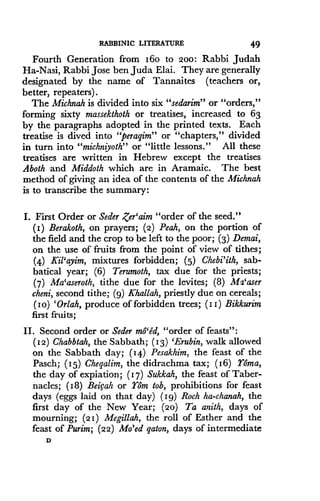
BIBLIOGRAPHY 2
Abrahams, Jewish Life in the Middle Ages, Philadelphia,
191 1.
Graetz, Geschichte der Juden non der altesten Zeiten bis auf
die Gegenwart, Leipzig, 13 Vol. in 8vo. (English
Translation, 5 Vols ., London, IgoI .)
Dubnow, Weltgeschichte des Judischen Volkes non semen
Uranfangen bis zur Gegenwart, Berlin, Io Vol.,
1 927-1 930-
Th. Reinach, Histoire des Israelites depuis la ruine de leur
inddpendance jusqu'd nos jours, Paris, IgoI .
Bonsirven, Sur les ruines du Temple, Paris, 1928 (English
translation, On the Ruins of the Temple, Burns, Oates
& Co., London, I93I ).
Max S. Margolis and A. Marx, A History of the Jewish
People. From the Creation to 1925.
1The capture of Damascus by the Arabs occurred in 635, the
battle of Yarmouk, which gave them Syria and Palestine in 636, and
the whole of Iran was to fall into their hands after the victory of
Nehavend in 642 .
'The Bibliography appended to every chapter is in no way
intended to furnish an exhaustive list of the literature on the subject
dealt with in the preceding pages . Its object is merely to serve as a
guide for readers who wish to make their studies on such questions
more complete .
END OF JEWISH INDEPENDENCE
	
41
Jewish Encyclopedia, Vol. I-XII, New York, Igo1-Igo6 .
Encyclopaedia Judaica, Das Judentum in Geschichte and
Gegenwart, in course of publication; 6 volumes
already published, Berlin, 1927-1930 .
M. Schwab, Le Talmud de Jerusalem, French translation,
Vol. I-XI, Paris, 1878-1890 .
A. Cohen, Everyman's Talmud, Dent, London, 1932 .
L. Goldschmidt, Der Babylonische Talmud, Vol . I-VIII,
1897-1912. A new edition is in course of publica-
tion, 5 volumes of which have already appeared,
1929-1931. Berlin, Judischer Verlag.
Josephus, The Worki of, Loeb Classical Library, Heine-
mann, London, 1926 .
Schurer, Geschichte des Judischen Volkes im Zeitalter Jesu
Christi, Leipzig, 1go1-Igo6 . (English translation,
A History of the Jewish People in the Time of Jesus
Christ, 5 vols.) .
Harnack, Mission and Ausbreitung der Christentums, 2nd
Edition, Leipzig, 1915.
Duster, Les Juifs dans l'Empire Romain . Leur condition
juridique, economique et sociale, 2 Volumes in 8vo,
Paris, 1 9 14.
Lagrange, Le Messianisme chez les Juifs (150 B .C.-A.D.
200) Paris, 1gog .
Derenbourg, Essai sur l'histoire de la Palestine d'apres les
Talmuds, Paris, 1867 .
J. F. Moore, Judaism In the First Centuries of the Christian
Era. The Age of the Tannaim, Cambridge, 1927 .
Schatter, Die Tage Trajans and Hadrians (Beitrage zur
Forderung Christi. Theologie, 1897).
Buchler, The Political Leaders of The Jewish Community at
Sepphoris in the Second and Third Centuries, London, I gog.
Funk, Die Juden in Babylonien, Berlin, I got-I gob .
CHAPTER II
RABBINIC LITERATURE
The role of tradition and the explanation of the Law .-The
Midrach.-The Michnah.-The Michnah of Judah the
Holy One.-Its contents and influence .-The Tosephta .
-The Gemara.-The Talmud of Jerusalem .-The
Talmud of Babylon.-The Haggadah .-The Midrachim.
-The Targums. Historical works .-Writings of un-
orthodox Jews.
THE ROLE OF TRADITION AND THE EXPLANATION OF
THE LAW
ON their return from captivity, when the Jews wished
to make their nation a real theocracy, they soon saw
that the Torah, though codified in the books of the
Pentateuch, was far from sufficient for all the needs of
daily life; obscurities existed; there were above all
lacunae, and it was necessary to complete it . Moreover,
since the Sacred Books represented the word of God
itself, it was fitting that, in proportion as the events
which had made Israel the people of Jahweh became
distant, the facts, names and explanations capable of
elucidation should be collected, and for that reason to
collect all the oral tradition which was still alive .
The Rabbis taught that this tradition was as sacred
in its origin as the written law itself. Like the Torah,
Moses had received it from God on Mount Sinai, and
it was transmitted successively to Josuah, the judges,
42
RABBINIC LITERATURE
	
43
the Prophets, the wise men of the Great Synagogue at
the time of Esdrasl and finally to the doctors of the law
and to their heirs the rabbis .
This exegetical and legislative work had begun long
before the taking of Jerusalem and the destruction of the
Temple by Titus. From the time of Esdras, and above
all at the time of the Macchabees, during the first
century B.C., the scribes (soferim) who were later to be
known by the name of rabbi, devoted themselves with
admirable zeal to this exegetical work which, in their
intention, was simply to be the completion of the Torah .
It is the whole of this production which is assembled
under the name of Rabbinic literature.
But the work of the scribes and the Rabbis on the
sacred text bore little resemblance to exegesis in the
modern sense of the term . It was not a question of
determining the literal sense of the text, but what
doctrinal or legal conclusions could possibly be extracted
from it by means of logical reasoning, combinations with
other passages or allegorical explanations. 2 This com-
mentary which related equally to the legislative,
historical, and moral portions of the sacred books was
called the Midrach3 (research, whence study, exegesis) .
'The men of the Great Synagogue existed only in the imagina-
tion of the rabbis, but this term sufficiently explains the origin and
role of the scribes, who, after the exile, had attached the tradition to
the Prophets. Simeon the just, towards 320, was one of the last wise
men of this so-called Great Synagogue . After him, the oral law was
transmitted to the Zekenim Ha-Richonim (the first ancients), of
whom the greatest were Hillel and Chammai . About A .D. io came
the Tannaim (teachers) who perpetuated and developed the law
until it was committed to writing in the Michnah (about A.D. 220.)
'Cf. on this point, Bacher in the appendix to the 2nd Edition of
the 1st Volume of the Agada der Tannaiten, and in French the Revue
des Etudes Juives, Vol . XXXVIII, p . 211-21g ; Les trois branches de la
science de la veille tradition juive, le Midrasch, les Halachot et les Haggadoth .
See also Lagrange, Le Messianisme chez les Juifs, p . 141, note 1 .
$From the Hebrew darach, to investigate, explain, deepen.
44
	
JUDAISM
It started from Scripture to end with the Halakah and
the Haggadah .
THE MIDRASCH
The Midrachim or Rabbinic commentaries referred,
some to the legal texts of the Sacred Books, others to the
historical or moral texts. The first bore the name of
Halakah I way, rule to be followed, and in the religious
sense, law, rule of conduct which was not contained in
Scripture, but which, nevertheless, was considered the
word of God ; the others were termed Haggadah, 2 nar-
rative, teaching .
THE HALAKAH
The Halakah or the Halakistic Midrach had therefore,
as its object, in its study of Holy Scripture, the making
known of the laws, the determination of their true sense,
the indication of the cases in which they were to be
applied, the modification of their practical bearing
when circumstances so demanded, the resolution of
conflicts which arose from incompatible obligations, the
supplying of analogy for the silence of the legislative
texts in a very great number of other cases, in a word,
to put before everyone without fear of error and with the
certainty of carrying out the Torah, the will of God,
the exact commandment which it was proper to fulfil in
any particular given case. In order to meet these needs
of practical morality, the doctors drew not merely on
the written law, the Torah contained in the Pentateuch,
but also on the sense of justice which had to inspire them
and on customary law. Hence Jewish legislation was
nourished from two sources, the Torah, a written docu-
ment, and the Halakah, which was for a long time oral
and published only after the Christian era. The Halakah
'In Hebrew, halak, to go .
'In Hebrew, higgid, to narrate.
RABBINIC LITERATURE
	
45
comprised traditional decisions whose origin was traced
back to Moses, commandments of ancient Halakists
which, moreover, formed the greater part of the Halakah,
and finally the prescriptions of the scribes . The latter
were considered in theory as being of less importance,
but in fact this customary law created no less a number
of obligations as strict as those of the Law itself.
The Halakah, at the time of Jesus Christ, did not
therefore constitute a completed and codified whole,
but was, on the contrary, a code in process of formation,
and Halakistic exegesis was working unceasingly to
draw from it new conclusions capable of being applied
to new circumstances. Undoubtedly a number of
these decisions already represented an obligatory juris-
diction which had the force of law, but in the course of
succeeding periods, new decisions were taken by the
Rabbis which were termed judgments (din) . It was
only when the majority of the scholars had confirmed
these decisions that the judgments were incorporated
into the Halakah and became a point of law obligatory
upon all .' Hence the reason why, after the capture of
Jerusalem in A .D . 70 the first patriarchs of Jamnia and
Tiberias directed their efforts at first to preserving the
juridical treasure amassed by preceding generations,
and also to conciliate the opposing schools of Hillel
and Chammai.
The law was obviously always held as the basis of
customary law, no matter how far the Halakah had
'As a matter of fact "every commentary developed especially
when it was a question of living laws. The tribunals which judged
very precisely according to the law, created, although they possessed
one, a jurisprudence . Little by little it took its place by the side of
the law, not merely to interpret it, but still more to complete it .
Such was the position of the doctors of the law ; their influence was
all the wider because no authorised legislator existed capable of
answering new needs by completing or modifying the legislation .
Lagrange, Lc Messianisme che; les Juifs, p. 1 39.
46
	
JUDAISM
departed from it . The decisions of the doctors were
connected with it by means of the logical rules which
inspired the seven rules of Hillel: (I) from the less to
the greater, and from the simple to the difficult ; (2)
from like to like by analogy ; (3) according to one
passage in the law ; (4) according to two passages in the
Law; (5) from the general to the particular ; and from
the particular to the general ; (6) explanation of one
text by another ; (7) explanation of a text by the con-
text. Rabbi Ismael increased these rules or Middoth
to thirteen. The Halakah concentrated above all on laws
of a religious nature, sacrifices, feasts, the Temple and
its ministers, and legal cleanness and uncleanness . The
civil and criminal laws were the object of much fewer
studies. Marriage legislation alone underwent very
considerable development .
THE MICHNAH
On the destruction of Jerusalem, the Halakah became
the principal teaching matter in the schools which
were opened at Jamnia, Ludd, and after Hadrian's
war at Sepphoris and Tiberias. The Jewish doctors had
realised that the political role of the race was finished .
Henceforward they sought to consolidate their religious
unity by devoting their efforts to the study of their law
and their traditions . The Michnah was the result of this
activity. I The Halakah was taught in two ways-either
MMichnah comes from the Hebrew verb chdndh, to double, change
(cf. chenayim, two) whence the meaning doubling. The Fathers
translated this word by Seurepwair and called the authors of the
Michnah by the name of SeurepW rat. The Michnah is therefore, in
contrast with the written law of the sacred books, the oral "lesson"
in traditional law, such as the doctors taught their pupils . The
Aramaic thana has the same meaning as the Hebrew chanah hence
the name Tannaim, literally repeaters (Tannaites) given to the doctors
who compiled the Michnah .
RABBINIC LITERATURE
	
47
under the form of connected commentaries closely
related to the text, or else in a systematic way by grouping
the different kinds of laws . It was the latter method
which prevailed, and which is the only one employed in
Rabbinic literature . We know of the existence of the
first method, but not a scrap of evidence remains since
the Halakah was transmitted solely by tradition . ) A
certain scruple was felt in committing it to writing, and
a Rabbi went so far as to say : "Whoever puts a Halakah
in writing is like to a man who burns the Torah."
However, in the long run, the needs of practice and
teaching overcome this repugnance . Many doctors, in
order to simplify the study of the Halakoth which had
become more and more numerous, undertook to arrange
them methodically under different rubrics distributed
according to matter .
The Sanhedrin, in order to end the incessant discus-
sions of the disciples of Hillel and Chammai, instituted
a sort of enquiry by witnesses which allowed the defini-
tive decision of certain controverted points of doctrine .
Presumably some written record of this enquiry was
drawn up . Aqiba, Meir and Rabbi Jose made more
extensive collections of the same kind, which received
the name of Michnah.
'At the time of Jesus Christ, the Pharisee party recognized a
legislative value in the traditions transmitted in the schools, which
completed the law and adapted it to new needs. But the same party
showed extreme repugnance to putting these traditions into writing,
and above all to making them public. It was evidently feared
that the contradictions between the masters made prominent by the
controversy between Hillel and Chammai and perpetuated in their
schools, would prejudice the authority of tradition . Another motive
was also alleged ; the fear that the Gentiles who had in a certain
measure taken possession of the Scripture by means of the Greek
translation would also lay hands on the treasure of the traditions ."
Lagrange, Le Judaisme avant Jesus Christ, p. xv.
48 JUDAISM
THE MICHNAH OF JUDAH THE HOLY :
ITS CONTENTS AND INFLUENCE
But the Michnah par excellence, the one which eclipsed
all the others and became, as it were, the definitive
code of the oral law, was that of Rabbi Judah Ha-Nasi
(164-217) surnamed the Holy One, the leader of the
school of Tiberias . For the composition of this, Rabbi
Judah must have had at his disposal something other
than purely oral sources. There is all the more inclina-
tion to the belief that collections dating from the second
(100-130) and the third (130-I6o) generation of Tan-
naites, already existed when it is seen that Saint Epi-
phanias (3I5-403) 1 distinguished four 8ev-repoSvess of the
Jews, that of Moses, namely Deuteronomy, that of
Rabbi Aqiba, that of Judah, and that of the Asmoneens,
probably the codification undertaken by John Hyrcan
in order to settle the doctrine of the Pharisees. There is
also question of this in Megillah Ta`anith. 2 Comparison
between the texts, and the manner in which are grouped
the interlocutors whose opinions are reported, allow
us to distinguish four successive generations of doctors
who must have worked at the elaboration of the Michnah :
First Generation from 70 to loo : Rabbi Jokhanan ben
Zakkai, Rabbi Khanania, leader of the priests, and
Rabbi Eliezer ben Jacob .
Second Generation from 10o to 130: Rabbi Gamaliel,
Rabbi Josua ben Khanania, Rabbi Ismael, Rabbi
Aquiba ben Joseph, Rabbi Tarphon .
Third Generation from 130 to 16o: Rabbi Juda ben
Elai, Rabbi Meir, Rabbi Simon ben Jokhai, Rabbi
Simon ben Gamaliel .
'Haer XXXIII, 9, Vol. x1i, col . 563.
ICE Derenbourg, "Essai de restitution de 1'ancienne rddaction de
Massechet Kippourim" in Revue des Etudes ,7tdves, Paris, 1883,
Vol. VI, p. 43.
RABBINIC LITERATURE
	
49
Fourth Generation from I6o to Zoo : Rabbi Judah
Ha-Nasi, Rabbi Jose ben Juda Elai. They are generally
designated by the name of Tannaites (teachers or,
better, repeaters) .
The Michnah is divided into six "sedarim" or "orders,"
forming sixty massekthoth or treatises, increased to 63
by the paragraphs adopted in the printed texts . Each
treatise is dived into "peraqim" or "chapters," divided
in turn into "michniyoth" or "little lessons." All these
treatises are written in Hebrew except the treatises
Aboth and Middoth which are in Aramaic. The best
method of giving an idea of the contents of the Michnah
is to transcribe the summary :
I. First Order or Seder Zer'aim "order of the seed."
(I) Berakoth, on prayers; (2) Peah, on the portion of
the field and the crop to be left to the poor; (3) Demai,
on the use of fruits from the point of view of tithes ;
(q.) Kil`ayim, mixtures forbidden ; (5) Chebi'ith, sab-
batical year ; (6) Terumoth, tax due for the priests ;
(7) Ma'aseroth, tithe due for the levites ; (8) Mz'aser
cheni, second tithe; (9) Khallah, priestly due on cereals;
(I o) `Orlah, produce of forbidden trees ; (I I) Bikkurim
first fruits ;
II. Second order or Seder mo`ed, "order of feasts" :
(12) Chabbtah, the Sabbath ; (I3) 'Erubin, walk allowed
on the Sabbath day ; (14) Pesakhim, the feast of the
Pasch; (I5) Cheqalim, the didrachma tax; (I6) Toma,
the day of expiation; (I7) Sukkah, the feast of Taber-
nacles; (I8) Beigah or Tom tob, prohibitions for feast
days (eggs laid on that day) (I9) Roch ha-chanah, the
first day of the New Year ; (20) Ta anith, days of
mourning ; (21) Megillah, the roll of Esther and the
feast of Purim; (22) Wed qaton, days of intermediate
D
50
	
JUDAISM
feasts; (23) Khaggigah, obligatory pilgrimages to
Jerusalem ;
III . Third order or Seder nachim, "order of women":
(24) Tebamoth, levirate ; (25) Kethubboth, marriage con-
tracts; (26), Nedarim, vows; (27) Nazir, the nazirate ;
(28) Gittin, divorce and letters of repudiation; (29)
Satah, woman suspected of adultery ; (30) Qidduchin,
bethrothals ;
IV. Fourth order, or Seder neziquin, "order of damages"
(3I) Baba gdmmd, "first door," damages in general
and their reparation; (32) Babd meci'a, "middle
door," damages to moveables, immoveables, usury,
leases; (33) Babd bathrd, "last door," purchases, sales,
successions; (34) Sanhedrin, tribunals and criminal
justice; (35) Makkoth, flagellation ; (36) Chebu loth,
oaths; (37) 'Eduyoth, evidence; (38) 'Abodah Zarah,
idolatry ; (39) Aboth or Pirkd Aboth, decisions of the
Fathers ; (40) Horayoth, on the erroneous decisions
of the Sanhedrin, mistakes of the high priest or of
the princes ;
V. Fifth Order or Seder godachim, "order of holy things" :
(41) Zebakhim, bloody sacrifices ; (42) Menakhoth,
offerings; (43) Khullin, profane things which can
neither be offered nor eaten ; (44) Bekoroth, the first-
born; (45) 'Arakin, redemption of persons or things
consecrated to the use of the sanctuary ; (46) Themurah,
substitution for offerings; (47) Kerithoth, penalty of
extermination ; (48) Me`ilah, profanations ; (49)
Thamid, daily sacrifice and service of the Temple ;
(50) Niddoth, measurements and descriptions of the
Temple; (5I) Qinnim, sacrifices of birds ;
VI. Sixth Order orSeder teharoth, "order ofpurifications" :
(52) Kelim, vessels, conditions for purity; (53) `0haloth,
purification of a house, especially after a death ;
RABBINIC LITERATURE
	
51
(54) Neg`aim, on lepers; (55) Parah, on the red cow;
(56) Teharoth, different impurities; (57) Miqvaoth, ritual
baths; (58), Niddah, uncleannesses of women ; (59)
Makchirin, liquids which defile ; (6o) Zabim, unclean-
nesses of men ; (6 I) Tebul Yom, defilements by contact
(62) ; Tadaim, washing of the hands ; (63) 'Uqin,
uncleanness in fruits .
The Michnah finished up by becoming, for the Jews,
a second law whose importance surpassed that of the
first law, and already, in the gospels, Our Lord re-
proached them vigorously for it.' This false point of
view only increased as time went on . The Michnah,
in fact, restricted itself to giving the opinions of the
famous doctors relating to the practice of the Law .
The latter was unable to enter into all the details, and
it was therefore good that wise men should intervene
in order to settle details which had to be decided .
Unfortunately they descended to minutiae and arbitrary
distinctions; their innumerable prescriptions ended by
occupying a predominant place in Jewish life, and the
law, which had been brief and luminous, disappeared
as though it had been choked by the weeds of the hedge
whereby they claimed to protect it . It was a veritable
misfortune, since the veneration which surrounded the
Michnah in many instances reduced the Jewish religion
to the level of being no longer a worship in spirit and
truth, but a vain formalism as burdensome to practise
as it was incapable of sanctifying . Nevertheless for
Christians, the Michnah is a valuable source of informa-
tion. Intended to settle practice and doctrine at the
end of the second century, it can serve as a basis for the
history of Hebrew law before that date, for it contains
rules formed at different epochs . It also supplies
'Cf. Matt. xv, z-3 ; Mark vii, 5-8 .
52
	
JUDAISM
interesting details of Jewish life at the time of Jesus
Christ and throws light on the manner in which many
legal prescriptions were understood and practised, on
which point Holy Scripture merely gives indications
which are all too brief.
It is, however, prudent to use it with discernment, for
the prescriptions of the Michnah have undergone succes-
sive modifications, and certain alleged historical details
are merely a reflexion of Jewish life in Galilee after
Hadrian's war." An edition with a complete Latin
translation has been made by G . Surenhusius, viz:
Mischna sive totius hebraeorum juris . . . systema clarissimorum
Rabbinorum Maimonidis et Bartenorae commentariis integris
. . . . latinitate donavit ae notis illustravit, 6 Vol . in folio,
Amsterdam, 1698-1703. s
THE TOSEPHTA
It is certain that the Tannaite doctors were not content
with collecting purely and simply the oral traditions, the
halakoth. 3 In many cases they were commented on and
expanded by explanatory notes . These notes preserved
'This suffices for those who appeal indiscriminately to the
Michnah and Talmud in discussions on questions relating to Jewish
law or daily life in the time of Our Lord .
'An edition exists of the text with vowel points and a German
translation by J. M. Vost, 6 vol ., Berlin, 1832-1834.. A new edition is
in course of publication with a German translation and commentary,
Die Mischna, Text, Uebersetzung and ausfurliche Erklaru»g hrsg . von G.
Beer and O. Holtzmann, 1912 ss., Giessen.
'A portion of the rules and opinions of doctors who lived before
the compilation of the Michnah and which were not collected therein
is called Baraithoth, externae (sing . Baraitha from Bar or Bara, outside.
The word Mathnaitha, tradition, must be understood.) They are
united in the Tosephta. Some of them were preserved under this
name in the two Talmuds of Jerusalem and Babylonia, as well as in
the three commentaries of the Pentateuch contemporary, or almost
so with the Michnah: Mekilta, on Exodus, Sifra on Leviticus, and
Sifre on Numbers and Deuteronomy.
RABBINIC LITERATURE
	
53
in this way which were not inserted in the Michnah of
Rabbi Juda Ha-Nasi, are called Tosephta (addition,
supplement) . The Tosephta, as now edited and arranged,
recalls the plan of the Michnah and is presented as its
completion. As a matter of fact, it is a totally different
work, for the Tosephta represents the Halakah at a stage
before its codification in the Michnah and consequently
more primitive. As we have already seen, Rabbi Aqiba
wrote a Michnah which has not been preserved. His
two chief pupils, Rabbi Meir and Rabbi Nehemiah,
both based their own teaching on this Michnah, but
whereas Rabbi Meir composed for his pupils a simple
manual of legal traditions and an aide-memoire, Rabbi
Nehemiah, not content with collecting the baraithoth of
previous Tannaites, added notes and explanations drawn
from the tradition of the ancients.
The Tosephta therefore constitutes a work independent
of the Michnah, composed, it is true, with a similar
object, but differently conceived . Juda Ha-Nasi
followed the method of Rabbi Meir, while the last
editors of the Tosephta, according to tradition, Rabbi
Higya bar Abba and Rabbi Hoschaia, adopted the
method of Rabbi Nehemiah, Like the Michnah, the
Tosephta is divided into six orders or sedarim: (I) ,Zer` aim,
seeds; (2) Mo'ed, sacred times ; (3) Nachim, women;
(4) Nezigin, damages ; (5) Qpdachim, sacred things ;
(6) Teharoth, cleanness or purifications. However, the
number of treatises is only fifty-nine, for those dealing
with Aboth, Thamid, Middoth and Qinnim are wanting .
Zukermandel published a complete edition of the
Tosephta, Pasewald and Trier, I88o-1883. A latin
translation of the first three parts is to be found in
Ugolino, Thesaurus antiquitatum sacrarum.
54
	
JUDAISM
THE GEMARA
The Michnah became, in its turn, the book on which
the doctors of the third and fourth centuries, the
Amoraim, 1 were to be formed . Their teaching, Gemara, 2
departing more and more from the letter of the Penta-
teuch, took for its basic text the Michnah of Rabbi Judah
Ha-Nasi. Moreover, they were not content to pass on
from generation to generation the rules laid down by
the Tannaites, but made an effort to develop and
harmonize them, to make note of their internal reasons,
and finally to apply the general principles to real or
imaginary cases which the ancient doctors had not
foreseen.
Analyses, deductions, comparisons with analogous
cases, illustrations with the help of parables and anec-
dotes, this was above all the work of the Amoraites .
Numbers of Baraithoth, propositions of doctors of
preceding ages and which had found no place in the
Michnah, were carefully collected in the Gemara. They
were quoted in Hebrew, whereas the rest of the new
compilation was in Aramaic . The Michnah combined
with its commentary took the name of Talmud, 3 the
Talmud of Jerusalem or rather of Palestine or the
Talmud of Babylonia, according to the place of
origin of the Gemara.
THE TALMUD OF JERUSALEM
The Talmud of Jerusalem dates from the third and
fourth centuries. The beginnings of the edition may go
'Amoraim, interpreters, word for word "the speakers" from the
Hebrew amar, to say, to explain .
$Gemara from the Aramaic gemar, to finish, complete, to assimilate
completely the matter of a lesson, from which, in the Babylonian
Talmud, the special sense of teaching .
From the Hebrew lamad, to teach .
RABBINIC LITERATURE
	
55
back to the beginning of the third century, since
Diocletian (284-305) and the Emperor Julian (361-
363) are cited in it, and it seems to be the case that we
cannot go beyond 450, for no Jewish authority later
than the middle of the fourth century is referred to
therein. Jokhanan bar Nappaha (d . 279) and Rabbi
Simlai who laid its foundations, and after them Rabbi
Mani, Rabbi Abun and his son Jose ben Abun were
the chief editors of the collection. The Halakah occupies
the chief place in the Talmud of Jerusalem, but there are
also to be found fairly extensive passages which go back
to the Haggadah. It is not known whether the Talmud
of Palestine commented on the whole of the Michnah.
In any case we possess only the commentaries on the
four first Sedarim (orders), at least the treatises 37,
'Edwyoth, 39, Aboth, and the commentary on the treatise
58, Niddah.
The leading edition of the Talmud of Jerusalem is
Bomberg's which appeared at Venice with no indica-
tion as to its date, but probably in 1523 or 1524.
There is a French translation of this : Le Talmud de
Jerusalem traduit pour la premiere fois par Moise Schwab,
2 Vols. in 8vo, with a volume of tables . Volume I,
1871, and 2nd Ed. 18go, the other volumes, 1878-1889.
The style of the Talmud of Jerusalem is sometimes
obscure, the thought involved and elliptical, objections
and answers follow each other often without anything
to distinguish them . These particularly striking defects
were probably the reason which decided the Babylonian
doctors to make a new commentary on the Michnah.
THE TALMUD OF BABYLONIA
We have observed how the schools of Babylonia
flourished longer and more brilliantly than those of
56
	
JUDAISM
Galilee. Abba Areka, surnamed the Rab, educated in
Galilee in the school of Rabbi Judah Ha-Nasi, brought
to his fellow countrymen the Michnah of his master. It
was on this very Michnah that the different schools of
Nehardea, Poumbedita, Soura, Mahouza constructed
their Gemara. They endeavoured, above all, to restore
to unity opinions which were far too divergent, to
remove certain contradictions, to give a solution of
doubtful cases in conformity with the general teaching
of the Tannaites and the Amoraites, to record the
decisions and rules adopted by the most outstanding
rabbis since the closing of the Michnah, and finally to
preserve the allegorical and mystical explanations of
the Bible, the parables and legends which seemed to
them worthy of memory.
Rabbi Aschi (352-427) and Rabina II ben Huna
(d. 499) may be considered the authors of the Talmud
of Babylonia, for their disciples, the Saboraim, 1 were
content merely to improve the editing ; they introduced
only some additions, but completed its arrangement into
treatises and chapters.
The Talmud of Babylonia is compiled in Aramaic,
with quotations in Hebrew from the most ancient
doctors. In it the Haggadah is more developed than in
the Talmud of Jerusalem, and the Michnah is no longer
commented on in its entirety. The first seder (order),
except the treatise (I) Berakoth, is wanting. Similarly
the treatises (I5) Chegalim, (37) 'Eduyoth, (39) Aboth,
(50) Qinnim, the half of 49 Thamid, and all the sixth
seder, with the exception of treatise (58) Niddah, are
missing. Although the Talmud of Jerusalem refers to
thirty-nine treatises and that of Babylonia to only thirty-
six and a half, the latter is four times more developed
'Saboraim, singular sabora, one who gives an opinion, from cram,
to think, from which sebara, result of thought, mind, opinion .
RABBINIC LITERATURE
	
57
than the former; it is the latter which is more frequently
cited, and it is also the latter which has had most
influence on Jewish thought.'
The leading edition of the Talmud of Babylonia was
published by Bomberg at Venice, 1520-1523 . There is
a French translation of a great part of the Talmud of
Babylonia in Rabbinowicz: Legislation criminelle du
Talmud. Organisation de la magistrature rabbinique . . . ou
traduction critique des traites Sanhedrin et Mahhoth et des deux
passages du traiti Edjath, Paris, 1876. Legislation civile du
Thammud. Nouveau commentaire et traduction critique ; 5 Vols.,
Paris, 1877-I88o. The text with an English translation .
M. L. Rodkinson, New Edition of the Babylonian Talmud .
Original text edited, corrected, formulated and translated into
English, 2o Vols, 1896-1903 . Text with German trans-
lation in course of publication, L . Goldschmidt, Der
babylonische Talmud herausg nach der ersten Zensurfreien,
Talmudhandschrift . . . nebst Parianten . . . der Munchener
Talmudhandschri moglischst sinn and wortgetreu ubersetz,
Berlin, 1897 ss.
The two Talmuds constitute an imposing juridical
work in which discussions which are often closely argued,
subtle and well conducted but sometimes with an excess
of brevity leading to obscurity, are submerged in a mass
of legends, mystical or edifying stories, anecdotes,
historical narratives, scientific data on all manner of
subjects, including even sorcery . They form the funda-
mental book which contributed to give to Judaism its
characteristic quality, by endowing it with respect,
tradition, the cult of learning, although at the same
I The citations of the Michnah are made according to chapters
and verses : Berakoth, IV, 3 . Those from the Talmud of Jerusalem
in the following manner : jer . Berahoth, IV, 3 . Those from the Baby-
lonian Talmud by pages with indication of the front a or the back b;
Bab . Bcrakoth, 28b or simply 28b .
58
	
JUDAISM
time leading it into subtilities and ratiocinations of the
most minute and confusing types .'
THE HAGGADAH
In contrast to the Halakah which is, properly speaking,
a system of jurisprudence, the Haggadah (narration) is, in
the Talmudic literature, the collection of non juridical
interpretations and traditions, which legally have not
the force of law. In it imagination has full play in all
the domains of religious, moral, and philosophical
knowledge and speculation . In a certain measure it
represents the imaginative element in Judaism . 2 We
have already seen how the Halakistic Midrach in applying
itself to the legislative texts deduces the juridical con-
sequences therefrom ; the Haggadistic Midrach, on the
contrary, is concerned with constructing on the sacred
'In the course of the eighth century, this immense effort of
Rabbinic literature produced an important reaction. Under the
influence of the Sunnite schism which then divided Islam, the
Karaites (from mikra, reading, a word which meant the books of the
Bible in opposition to the Talmud), rejected tradition and refused all
authority to the Talmud even in its strictly legal parts, and recog-
nized the Bible alone as the source of legislative and religious know-
ledge and practices. Their founder, Anan ben David, nephew of
Salomon the Babylonian, exilarch under the Arab domination,
claimed connection with the ancient Sadducees . Karaism had a
brilliant period between the ninth and twelfth centuries in Jerusalem,
Constantinople, Arabia, Egypt and even in Spain . At the present
time there are only some thousands of adherents in Turkey, the
Crimea, Galicia and Poland . It may be said that with Karaism the
Talmudic period, properly so-called, came to an end, because, in
order to triumph over that sect, the Jewish doctors with Saadia at
their head, had recourse to new forms of exposition. Nevertheless
Talmudic thought is not dead. In the same way as oral tradition,
by developing the biblical texts, had created the Michnah, and by
developing the Michnah produced in turn the Talmuds, so also did
the latter, the deep study of which became a religious duty, give rise,
in their turn, to fresh controversies, out of which came a great portion
of medixval Jewish literature .
$The expression is that of Theodore Reinach in his Histoire des
Israelites, 2nd edition, p. 30.
RABBINIC LITERATURE
	
59
text an immense literature which is historical, folklor-
istic and homilectic in character . Moreover, the term
Midrach is more particularly attached to the Haggadistic
midrachim of which the different collections count
amongst the most original documents of the Jewish
genius .
The Haggadah often attempts to complete history by
adding facts which have been preserved in memory
and handed down by tradition to the generations con-
temporary with Christ . These facts are often clearly of a
legendary character. Of this nature are those which
are added to the account of the Creation, Aboth, V, 6,
to the history of Adam, of Enoch and the patriarchs,
and which have served as the theme of a certain number
of apocryphal books .
On other occasions, the historical additions assume a
more positive character. Many traces of them are
found in Josephus, Philo, the Talmuds, etc. It is scarcely
possible to check the value of this information. Never-
theless some of them figure in the New Testament . It
is from Jewish tradition and in consequence through the
Haggadah that we know that Moses was brought up in
all the wisdom of the Egyptians, Acts vii, 22 ; that the
magicians who opposed him were called Jannes and
Jmbres or Mambres, II Tim . iii, 8; that the law was given
to Moses by means of angels, Acts vii, 53 ; Gal. iii, Ig ;
Heb. ii, 2 ; that the Archangel Michael fought with
Satan for the body of Moses, Jude ix ; etc. The Hag-
gadists also occupied themselves with studying and
commenting upon the moral and religious teaching of
the Bible. Unfortunately and only too often they
attacked this work with merely narrow and systematic
views which too often departed from the true religious
spirit. Instead of fixing on the very basis of the religious
teaching, they lost themselves in speculations or inter-
6o
	
JUDAISM
minable digressions on a hundred and one things which
have nothing to do with worship or the rule of morals .
The rules of exegesis which these doctors claimed to
follow were formulated in the Hebrew word pardes,
"paradise"; pechat, "stripped," recalls the simple and
literal sense ; renieez, "signification," the allegorical
sense; deruch, "research," the sense which is deduced
from the research; sod, "secret," the theosophical or
esoteric sense. With the march of time, the imagination
of the Rabbis attached itself especially to this last
sense, and their extravagances ended in the Qabbala .
The speculative moral or edifying texts of the Hag-
gadah are not matter of faith, but are accepted un-
animously by Jewish theologians . Nevertheless for
many people they have contributed much to the forma-
tion of piety and belief. I
The Haggadah is found scattered among the Talmudic
works, but it is especially preserved in two kinds of
Rabbinic compilations, the Midraschim (researches and
in the present case, commentaries) and the Targums
(interpretations) .
THE MIDRASCHIM
The Midraschim or commentaries which compose the
Haggadistic Midrach are all written in Hebrew. The
first and most important among them is the Little
Genesis or Book of jubilees, but as it was compiled prob-
ably at the time of John Hyrcan (135-104 13-C .), it is
prior to the period which we are studying . After the
capture of Jerusalem and the destruction of the Temple
Rabbi Aqiba, Rabbi Ismael and Simon ben Jokhai were
""We accept only what the intelligence admits" declared Samuel
Hannigid (d. at Granada in io55), according to Strack, Eintelung
in Talmud and Midrasch, 2nd edition, Munich, ig2i . Maimonides,
in the last chapters of his Michne Torah, also rejects the value of the
Haggadah.
RABBINIC LITERATURE
	
6i
occupied especially in commenting on the Torah . Their
works side by side with haggadistic elements therefore
included a certain number of halakistic elements.
Their basic date was the second century, but with many
interpolations subsequent to that date. These are
Mekiltha (the standard, the custom) on Exodus xii-
xxiii, z g, which is attributed to Rabbi Ismael . Sifra
(the book) on Leviticus, Sifre or Sifri (the books par
excellence) on Numbers and Deuteronomy. Hiyya,
the pupil of the Rabbi, was the author . These first
three books were translated into Latin in Ugolini,
Thesaurus antiquit. sacr., vol. XIV, pp. 2-586. These
are often quoted in the Talmud .
Other more recent books in which the Haggadistic
materials are predominant were composed at different
dates with ancient elements preserved at first by oral
tradition and subsequently in writings which are now
lost, and even frequently with data taken from the
Talmud. These are the Midrachim which form the group
called Rabboth or Midrach Rabboth, a combination of
commentaries composed at different times on the
Pentateuch and the five Megilloth. 1 Canticles, Ruth,
Lamentations, Ecclesiastes and Esther . These com-
mentaries are the following : (z) Bereschith rabba, or
Genesis rabba (Gn. R.), on Genesis, composed in Palestine
about the sixth century, with the exception of the last
five chapters which are more recent. (2) Chemoth rabba
or Exodus rabba (Ex. R.) on Exodus, which is dated
from the eleventh to the twelfth century . (3) Vayyikra
rabba or Leviticus rabba (Lev. R.), on Leviticus, com-
posed in Palestine about the seventh century ; (4)
Bamidbar rabba or Numeri rabba (Num. R.), on Numbers,
'Megilloth (rolls.) Thus were designated the five books of the
Bible which were short enough to be written on a roll of small size
which was read in its entirety on the occasion of certain solemnities .
62
	
JUDAISM
due probably to two authors the latter of whom was
living in the twelfth century ; (5) Debarim rabba or
Deuteronomium rabba (Dt. R.), on Deuteronomy, at the
beginning of the tenth century ; (6) Chir hechirim rabba
or midrach cant. rabba, on Canticles, probably prior to
the middle of the ninth century ; (7) Midrach Ruth,
probably of the same period as the above ; (8) Midrach
Throni or 'Eika rabbati, on Lamentations, composed in
Palestine in the second half of the seventh century ;
(g) Midrach Koheleth or Eccles rabba, on Ecclesiastes,
probably before the middle of the ninth century ; (I o)
Midrach Esther or Haggadath Megillah, before the tenth
century. All these Rabboth were translated into Latin
in Ugolini. Thesaurus antiquit. sacra., vol. XIV, pp .
586-1630; vol. XV, pp. 2-969.
The Midrach Pesiqtha or Pesiqtha of Rab Kahana is a
collection of thirty-two homilies on passages taken from
the Pentateuch and the Prophets ; they were read on
feast days and on the chief sabbaths of the year. Its
composition would seem to date from the beginning of
the eighth century. This midrach must not be confused
with the two which follow and bear the same name .
These are Pesiqtha rabbathi, from the second half of the
ninth century, and Pesiqha Sutarta or Lekach tob from the
twelfth century, composed by Tobias ben Eliezer of
Mainz. Pirkd or Baraitha of Rabbi Eliezer is a com-
mentary in fifty-four chapters which dates, at the
earliest, from the eighth century and which goes back
to the history of the first man, the patriarchs and to the
time of Moses .
Thanhouma or Ielamdenou1 is a commentary on the
entire Pentateuch . It was written in the ninth century
in Greece or South Italy, and appears to be the develop-
'It takes this name from the formula frequently met with therein
ielamdenu rabbenu"may our master teach it to us."
RABBINIC LITERATURE
	
63
ment of a Midrach composed in the fifth century by a
rabbi named Thanhouma .
lalqut Chimeonii is a commentary on the whole Bible,
compiled in accordance with the ancient commentaries
in the same way as the biblical catenae of the Christian
middle ages. It is attributed to Rabbi Simeon who
probably lived at Frankfort on the Main at the beginning
of the thirteenth century .
THE TARGUMS
Targum (in the plural Targumim, translation, interpre-
tation) . After the return from the Babylonian captivity
(539 B .c.), Hebrew ceased to be the spoken tongue of
Palestine and was replaced by Aramaic . The custom
was then established, in the synagogue service, of
following up the reading in Hebrew of sections of the
Law and the Prophets with a translation in the vulgar
tongue-Aramaic-which everyone understood. The
Aramaic version was also used in the schools for teaching
the Bible (Mikra) . For a long time this translation was
purely oral and handed down by tradition . It has
long been disputed at what date it ended by being
committed to writing. However, it now seems to be
admitted that the primitive basis of these versions goes
back to the first century of the Christian era, and that
their definitive edition belongs to the fourth century.
The most ancient Targums are, in the main, almost
literal versions in which interpretation has introduced
but few additions . On the other hand, the most recent
are veritable paraphrases, full, as they are, of Jewish
legends and commentaries, in which are reflected the
religious conceptions of different epochs, Sadduceism,
Hellenism, etc., The use of the Targums ceased, with
'lalqut, from ldgat to collect .
64
	
JUDAISM
the Jews, as soon as the latter ceased to speak Aramaic,
but from the critical and exegetical point of view they
are of great utility .
The Babylonian Targum of the Pentateuch, called
the Targum of Onkelos, was for a long time attributed to
Onkelos, the disciple of Gamaliel; as a matter of fact,
its author is unknown. It appears to have been com-
posed in Palestine in the second century, for it reproduces
the Halakah and the Haggadah of the school of Aqiba.
Revised in Palestine in the fourth or fifth century, it was
recognised there as the authorised version of the Penta-
teuch. This Targum renders the Hebrew text in an
almost literal fashion. The version was made on a text
which differed a little from the massoretic edition, but
the Tannaite ideas on the Memra (the word of God)
and the Chekina (the glory of God) are found again
therein.
Targum of the Prophets of Jonathan ben Uzziel. The
author of this Targum is unknown, but he bears the
name of a disciple of Hillel, who must have lived in the
first half of the first century of our era . According to a
certain number of Jewish scholars, this was a Babylonian
work begun by the Rabbis of that country in the third
century, and finally edited in the fifth . This Targum
contains the translation of the whole of the Nebiim1
(prophets), that is to say, according to the Jews, the
whole of the historical books from Josue to the prophets
properly so called. It is less literal and more para-
phrased than that of Onkelos, particularly in the
prophetic books, where there are many Haggadistic
legends. Although the influence of contemporary
'The Jews distinguished in the Bible the Law (Torah) in the
Pentateuch ; the Prophets (nebiim), i .e . Josue, Judges, Kings and the
prophets properly so-called; the Hagiographical books (ketubim)
comprising the Psalms, Proverbs, job, the five megilloth with the
addition of Daniel, Esdras, Nehemias and Chronicles .
RABBINIC LITERATURE
	
65
ideas is less noticeable than in the Targum of Onkelos,
they nevertheless direct attention to themselves, and in
it the name of Yahweh is often replaced by the term
Chekina (the glory of God) .
Targums of Jerusalem on the Pentateuch. A Targum on
the Pentateuch is falsely attributed to Jonathan ben
Uzziel . This Targum is not a translation but a con-
tinuous paraphrase . It is, moreover, valuable in that
it informs us of the religious and national traditions of
the Jews which it faithfully reproduces . Its author
used the Targum of Onkelos and wrote in Palestine
towards the middle of the seventh century.
The second Targum of Jerusalem on the Pentateuch does
not form a complete whole. It is simply a collection of
fragments dating probably from the seventh century and
originating in Palestine . Recent critics regard it as an
effort to adapt the Targum of Onkelos to Palestine
with additions taken from different sources, both Tal-
mudic and post-Talmudic. Fragments exist of a third
Targum of Jerusalem on the Prophets.
The Targums on the Hagiographa formed a single group
whichis usually subdivided into three : the Targums ofJob,
of the Psalms and of Proverbs, the Targums of the five megilloth,
Canticle of Canticles, Ruth, Lamentations, Ecclesiastes
and Esther. Lastly the Targum of Chronicles or Parali-
pomenon. They are all of a later date, towards the
eighth or ninth century .
HISTORICAL WORKS
By the side of this immense religious production,
historical works occupy in Rabbinic literature merely a
very modest place which consists solely in chronicles
which are very dry when they are not legendary . The
chief ones are :
Megillah Ta'anith or the Roll of Fasts enumerates the
a
66
	
JUDAISM
thirty-five days of the Jewish year when it is forbidden
to fast and which consequently recall most often happy
memories for Israel with an indication of the month
and day, but never of the year. This Aramaic chronicle,
possibly composed in part before 7o and completed
after the death of Trajan (A.D. 117), is provided with
Hebrew glosses which are posterior in date .
Seder Olam or Seder Olam Rabba, "Chronicle" or "Great
Chronicle of the World," runs from Adam to Alexander
the Great. Composed towards the second century, it is
called "Great" to distinguish it from-
Seder Olam Zoutta or "Little Chronicle of the World."
It is a genealogy of Biblical personages and of the
Exilarchs .
lossipon or Joseph ben Gorion is the name of an
author to whom is attributed a chronicle in Hebrew
mingled with legendary accounts which run from Adam
to the destruction of Jerusalem by Titus . Composed
probably in Italy towards the ninth century according
to Biblical books, apocryphal and pseudo-epigraphical
works, it uses for more recent times the Books of the
Macchabees and the work of Flavius Josephus .
WRITINGS OF THE DISSIDENTS
It would be a mistake to think that despite the triumph
of the Pharisees, whose ideas were imposed on the
Jewish people after the capture of Jerusalem, the
Sadducees wrote nothing . Of them there remains the
mention of the Book of Decisions, I which must have been
a collection of Jewish laws according to the doctrine of
the Sadducees . This work constituted the fundamental
book of the Sadducees, but the latter had, in addition,
composed a whole series of works, which although
'Megillath Taanith, c . IV, i, io .
RABBINIC LITERATURE
	
67
preserved up to the tenth century, have not come down
to us. However, a little work discovered in the Gueniza
of Cairo, and published for the first time in I g I o,1
informs us that at the very time of Jesus Christ, a Jew
of Jerusalem founded a sect which he called the "New
Alliance" approaching in certain of his doctrines those
of the Sadducees, and emigrated with his partisans into
the country of Damascus where the community appears
to have subsisted for several centuries . Written in a
Hebrew which is tolerably pure, the work contains in
its first part a sermon which is, as it were, the exposition
of its motives, the introduction to a second part which
forms a collection of the laws and statutes of a dissident
Jewish community.
As for the collection of the laws, it is more conserva-
tive than official Judaism and claims to contain the exact
and correct interpretations of the Bible on religious
questions, civil and penal law, and the rules of life . This
discovery makes it possible for us to penetrate, with
these statutes in our hands, the internal organization of
one of the many sectarian clans, which, separated from
official Judaism by questions of dogma or the interests
of castes, are nevertheless not estranged from the law
of Moses, a possibility which is denied to us, in the case
of the official Jewish communities, by the large volumes
of the Targum and the Midraschim . Therein we can
note a religious life of exceptional austerity . s
'S. Schechter, Documents of Jewish Sectaries . Vol. I. Fragments
of a Zadokite Work. Cambridge, igio .
2To all the above works, which constitute, properly speaking,
Rabbinic literature, there may be added, although very much later
in date : (i) The Mischne Torah or Tad Hazaka (the strong hand) of
Maimonides . This work, completed about i i8o, after, as it were,
sifting the Talmud and the connected collections of tradition,
classifies and expounds methodically in a clear Hebrew, all the
68
	
JUDAISM
BIBLIOGRAPHY
For Jewish literature as a whole, the chief work is E .
Schiirer, Geschichte des judischen Volkes im ,Z'eitalter
,Jesu Christi, 3rd edition, Leipzig, Vol. I, 1901,
p. 3I-16I, §3 Quellen; Vol. II, 4th edition, 1907 .
§ 25, Die Schriftgelehrsamkeit, p . 363-4.47. (Trans-
lated into English, A History of the Jewish People in
the time of, Jesus Christ, 5 Vols.) See also W . Bousset,
Die Religion des ,Judentums im neutestamentlichen Zeit
alter, 3rd edition, Tubingen, 1926. On Rabbinic
literature H. Strack, Einleitung in Talmud and Midras,
5th edition, Munich, 1921, may be profitably con-
sulted. See also, M. Bacher, Die Agada der baby-
lonischen Amoraer, 1878. Die Agada der Tannaiten, I
Band : Von Hillel bis Akiba, Strasbourg, 1884; 2
Band: Von Akibas Tod bis zum Abschluss der Mischna,
Strasbourg, 1890. Die Agada der palastinensischen
Amoraer, 4 Vols., 1892, 1896, 1899, 1902 . Lesetre,
Mischna in Dictionnaire de la Bible, Vol. III, col . 1127-
II30. Mangenot, Targums, ibid., Vol. IV, col.
1595-2008. Konigsberger, Die Quellen der Halacha,
Leipzig, 1890. Guttman, .Zur Enleitung in die
Halacha, Budapesth, 1 gog, in 32 Iahresh. des Landes-
Rabbinerschule in Budapest. Zukermandel, Tosephta,
Mischna and Boraitha in ihren Verhaltnis zu einander, 2
matter of the Torah written and oral, from theology and ethic to the
political laws and the rules of the Jewish calendar .
(')The Schoulhan Aroukh (Table drawn up), compiled by J. Caro
from 1522-1554, is a codification of the Talmud which for almost
four hundred years was obligatory on the Israelite world and settled
traditional jurisprudence. The first part, Orah Haym (Way of Life)
deals with liturgy and feasts . The second, Yore Dea (Teaches know-
ledge), proclaims what is permitted and forbidden (Food laws) . The
third Eben Haezer (Stone of succour) contains the family laws .
Lastly, the fourth, Hoschenha-Mischpat (Breastplate of judgment)
contains civil and penal law (obligations, contracts, wills, etc .) .
RABBINIC LITERATURE
	
69
Vols., Frankfort, Igo8-Igog. M. Steinschneider,
Die Geschichtsliteratur der Juden in Driickwerken and
Handschrflen zussammengestellt, I . Abteilung (the only
one that has appeared) . Bibliographie der Hebraischen
Schriften. Frankfort, 1905. Lagrange, Le Messianisme
chez les Juifs, Paris, 1905. Lagrange, La secte juive
de la Nouvelle Alliance au pays de Damas, Revue Biblique,
Paris, 1912, p. 213-240, 321-360. L. Dennefeld, Le
Judaisme Biblique, Paris, 1925. Jewish Encyclopedia,
passim. Lagrange, Le Judaisme avant Jesus Christ,
Paris, 1931.
CHAPTER III
THE TORAH
The Torah.-The revealed Datum of Judaism.-The written
Torah and the oral Torah .-The Torah constitutes the
Divine Gift par excellence ; it is immutable and sacrosanct .
-The Torah and Reason .-Tendency of Liberal Jews
to empty the Torah of its Divine Content in order to allow
solely a purely natural Religion . Evolution of the Torah .
-The Dispute between Literalists and Allegorists .-The
Torah and Biblical Criticism.-Incompatibility of
authentic and conservative Judaism with the Conclusions
of Evolutionary Criticism.
THE TORAH : THE REVEALED DATUM OF JUDAISM
I BELIEVE with a perfect faith that the words of the
prophets are true . . . that the prophecy of Moses, our
master (peace be to him) was true, and that he is the
father of the prophets and of those who preceded him
and of those who have followed him. . . . That the Torah,
whole and entire, which is now within our hands, was
given to Moses, our master (peace be to him) . . . . That
this Torah will not be changed, and that another Torah
will not come from the hand of the Creator, blessed be
his name. (Maimonides, Profession of faith, articles 6-9.)
Judaism is essentially a revealed religion and this
revelation is found included in the Torah, or better,
the Torah is itself the revelation of God . In the strictest
sense of the word, the Torah is the five books of the
70
THE TORAH
	
71
Pentateuch attributed to Moses, for which the Israelites,
even those affected with radical criticism, retain venera-
tion and faith .
The other portions of Scripture, prophets, and hagio-
graphy are considered as being contained in the Torah
properly so called . They are considered to add nothing
to it, since the hagiographical books merely explain the
law of Moses and determine certain details thereof .
As for the prophets, their function consisted precisely in
supervising the maintenance of the Mosaic law and the
covenant with God which was its consequence. Their
writings being only a confirmation of the Torah, share
its authority, and can be invoked in the same way as
divine testimony .
WRITTEN TORAH AND ORAL TORAH
The divine Torah is not, however, entirely contained
in the sacred books . According to the Rabbinic tradi-
tions, God, on Sinai, gave to Moses not only the Torah,
but also the Prophets and the Hagiographical books as
well as the Michnah and the Talmuds (Berakoth 5a), and
at the same time revealed to him the commandments,
their interpretations, and the rules that flow therefrom
(Siphra, 112 c) . In addition to this, Moses communicated
the Torah to Josue, Josue to the judges, then to the
prophets and the latter to the men of the Great Syna-
gogue, thereby ensuring an uninterrupted tradition
(Aboth i, I) . Under the guise of legends, all these
accounts suggest the principle which is necessary and
admitted by all: Side by side with the written law there
exists and is transmitted a tradition or oral law which
shares in its inspiration and enjoys equal authority .
Juda Halevi (Khozari, iii, 36) bases the origin and
lawfulness of this tradition on the passage of Deuter-
onomy xvii, 8-12, which institutes official interpreters of
72
	
JUDAISM
the Law, and confers divine and uncontested authority
on their decisions . The priests were originally invested
with this function of explaining the Law and of pre-
serving its character of a living authority . They were
subsequently replaced by the scribes and Pharisee
doctors. This legislative work was governed by a two-
fold principle that it appeared to be based upon an
admissible exegesis of the sacred texts and on good
reasons. The prescriptions which emanated from this
living authority were considered to have equal, if not
superior, legal value to that of a sacred text . This
tradition, in its preceptive part, the Halakah, and in its
edifying part, the Haggadah, constitutes the oral law,
the Torah which is transmitted from mouth to mouth .
The Sadducees and the Karaites rejected this oral
law as being a human invention and an arbitrary
excrescence, but the Pharisees always accepted and
defended it. The equality and unity of the double
Torah, written and oral, is, in their religious conception,
a fundamental and characteristic principle of which they
secured the adoption by later Judaism . Hence it is
permitted to identify this Judaism with Pharisaism. 1
The Torah is therefore, first and foremost, the Mosaic
legislation, the "613" mitzvot, positive as well as negative,
which the Rabbis of the Talmud counted in the Penta-
teuch, but it is also the doctrine transmitted and taught,
the oral teaching which sprang up around the venerated
Scriptural texts, and which were accumulated for
'This is the thesis which is commonly admitted . It is sustained
especially by Travers Herford, The Pharisees, new edition, London,
1924, and by Abrahams, Studies in Pharisaism and the Gospels, 2nd
series, Cambridge, 1924 and 1927 . (Cited by Bonsirven, Sur les
ruines du Temple, p . 127, n .1) . It is also defended by G. Foot Moore,
,Judaism in the First Centuries of the Christian Era, the Age of the Tannaim,
Cambridge, 1927, and has just been taken up again with special
vigour by Joseph Klausner, ,Jesus of Nazareth, His Life, Times and
Teaching.
THE TORAH
	
73
centuries until they formed the compilation of the
Midrachim and the Talmuds. It is at the same time
letter and spirit, a fixed and living thing, it bears the
sacred texts which carry the revelation made to Moses
then by their side the interpretation, the lesson which
is living and diverse, wherein, under the tendencies of
each epoch, is manifested the will of God in regard to
Israel and His law given to the world . Materially it is
enclosed within the Mosaic revelation ; it finds its expres-
sion in the Torah which is transmitted as the living
Israel.
THE TORAH CONSTITUTES THE GIFT PAR EXCELLENCE :
IT Is IMMUTABLE AND INVIOLABLE
The Torah is thus not merely a law, but a religious
teaching which communicates the will of God . Con-
sidered in itself, in its most elevated aspect, it appears
as an almost divine being . God created it two thousand
years before the world (Pesiqtha Rabbi Kahana, Ioga), it
stays close to the Creator, like a counsellor whom He
consults before undertaking His work, it occupies the
place and plays the part attributed by certain books of
the Old Testament to the Divine Wisdom personified.'
This gift of the Torah to men is, moreover, a more
important event than the Creation itself. It is the
divine benefaction par excellence, whereby God is
present in the world. It is God's substitute, and by
adhering to it, one shares in the sanctity of its Author .
In addition it is definitive and immutable and as the
modifications introduced by the prophets and Rabbis
'This figure is not to be taken absolutely literally. It merely
means that the faithful soul must serve God with all his members
and at every moment of his life . As early as the third century, efforts
were made to render its observance easy by reducing all these com-
mandments to this single principle of the prophet Habacuc (ii, 4)
"The just shall live in his faith ." Cf. Makkoth, 23b, 24a (quoted by
Bonsirven, op . cit., p. 128 .
74 JUDAISM
cannot be mistaken, this principle is limited to the
Torah of Moses, the Pentateuch : "The prophets and the
other writings will pass away but the five books of the
Torah will not be abrogated." (Jer. Megillah, 7od). No
prophet, were he a worker of miracles, could contradict
Moses, or set himself against him as a new divine legate ;
it would therefore be allowable to permit temporary
or non-essential changes, but the foundation remains
inviolable (Maimonides, Foundations, ix, 2-5, Iqqarim, iii,
13-20) .'
THE TORAH AND REASON. TENDENCY OF LIBERAL JEWS
TO EMPTY THE TORAH OF ITS DIVINE CONTENT AND TO
ADMIT ONLY A PURELY NATURAL RELIGION
The conception of the Torah which has just been
expounded is that of the Tannaites and of the first
centuries of Judaism which survived the establishment
of Christianity. To this formula of the Torah as a
religious revelation were added other ideas which,
'The Torah is often identified by the ancient Jewish writers with
the Divine Wisdom (Hokmah) which the books of the Old Testament
so clearly personified, Moore (Judaism) considers this identification to
be admitted in the Ecclesiasticus ofJesus ben Sirach (200 B.C.), I, 5, and
in Baruch IV, i, and shows how it became the common opinion
among the Tannaites. But at the point where the Gospel revelation
was destined to result, for Christians, in Wisdom, the Word of God,
Judaism by abandoning the priceless indications of Old Testament
revelation allowed the doctrines of the Spirit and Wisdom to dis-
appear and even the doctrine of the Word to be distorted. Thus it is
that in the Testament of Levi, the Aramaic fragments where, it is
believed, a more ancient source is to be recognized, give the first
place to Wisdom, whereas the Greek text gives it to the Law. At
the beginning of the Berechith Rabba, Rabbi Hosaia the Great inter-
prets the first verse of Genesis by the text of Proverbs (xiii, 3 0)
where the role of Wisdom in regard to Yahweh in the creation is
described, but it explains it by substituting the Law for Wisdom .
It was the Torah which was then the instrument of God and also
the ideal model according to which God conceived the world . The
Jewish theologians start from this point to affirm that it is perfect and
immutable. Traces of this conception are found in the Gospel, but
THE TORAH
	
75
moreover, are merely the development of principles
proposed from the very beginning. We have already
stressed the manner in which reason must intervene in
the establishing of the oral law which is a necessary
complement of the written and revealed law . In the
course of centuries, the part played by reason was more
considerably developed, and many Rabbis arrived at
the stage of considering the use of human reason as
having the religious value of a divine revelation .
The most ancient Jewish theologians of the middle
ages did not forget to indicate reason as a valid authority
parallel to and on the same title as the written Torah
and tradition . This was done in particular by Gaon
Saadia (882-942), who was the first to expound syste-
matically the "beliefs and opinions belonging to the
faith of Israel ." In his Arabic work, Kitab al Amanat
wal-I `tikadat, better known under its Hebrew name Sefer
Emounot ve De'ot, "book of faith and knowledge," he
lays down the principle that human reason is a means
of knowing the divine revelation, that faith in revela-
tion does not exclude independent research, and that
reason must direct theology by basing itself upon con-
temporary philosophical investigations .'
But in point of fact, this role assigned to reason in the
examination and even the control of the revealed
teaching and of tradition does not date from him .
Long before Saadia, Jewish thinkers of the Hellenistic
epoch and in particular, Philo, to cite only the most
with a quite different force. Cf., for example, Luke xvi, 17 ; Matt. v,
18 . It is to be noted that in Matt . xxiv, 35; Mark xiii, 31 ; Luke xxi,
33, Jesus Christ identifies His teaching with the Law which does not
pass away. Cf. Moore, Judaism, Ch . IV, Perpetuity of the Law, p . 263 ss.
Lebreton, Histoire du dogme de la Triniti, Vol . I, Les Origins, p . i6o ss .
'In this we can observe the strict connection between the ideas
of Saadia and the contemporary doctrines of the Motazilites the
"rationalists of Islam."
76
	
JUDAISM
distinguished of them, made it their business to demon-
strate the harmony between Biblical revelation and
reason, the inspirer of the great philosophies on which
humanity relies, between the divine Torah and human
wisdom which is constantly kept on the watch . In the
third century the exegesis of Rabbi Jokhanan showed
itself to be fairly rationalistic, and in contact with
Arabian philosophy, the great Rabbis of the Spanish
middle ages, Alfasi, Ibn Gabirol, and Maimonides, l
stressed still more the importance of reason in Jewish
theology and the conception of the Torah .
It is with them that Spinoza and especially M.
Mendelssohn are directly connected. Of the latter
(1729-1786) it may truly be said that he is the father
of liberal Judaism . His work, Jerusalem or the Religious
Power and Judaism, gives an exposition of Judaism which
is frankly liberal, philosophical and anti-dogmatic, but
in tone sincerely religious and entirely Jewish . For
him the essence of religion is constituted simultaneously
by the general truths which every man can attain by
means of his reason and by the moral law, the Torah,
which reason is capable of discovering and justifying by
means of its own powers . Consequently, in conformity
with minds which are evidently broad and elevated,
the best in doctrines manifested outside the circle of
Israel, whatever is noblest, most reasonable, and most
elevated therein, the Aristotelianism of yesterday with
the Bergsonian philosophy of to-morrow, can be incor-
porated in the Torah and become an integral part
thereof. 2
'Cf. Guide of the Lost, I, Chapter 50, p . 179 . The controversies
raised by the bold views of Maimonides gave rise, after his death, to
bitter disputes, and in 1234, the Jews went so far as to bring their
case before the ecclesiastical authorities .
2Moritz Lazarus in his Ethik des Judentums (Frankfort 1898-1911)
has systematized the moral teaching of the Bible and the Talmud,
THE TORAH
	
77
The Emouna, the Jewish faith, is nothing more than a
confidence which comes from a union of the heart and
the Torah, and apart from certain positive or negative
commandments entails only adhesion to some funda-
mental truths, God, Providence, the spirituality of the
soul, free will, the future life, which are obligatory on
universal reason. The liberal Jews, in fact, base their
religion with its dogmatic and preceptive content
entirely on reason . I But this position is radically
opposed, it must be admitted, to the essential spirit of
traditional Judaism, which does not regard its religion
as the conclusion of a process of reasoning, but accepts
the Torah as essentially revealed by God .
In his book, The Faith of Israel, An Essay on the Teaching
of Judaism, 2 M. J. Weill endeavours to harmonize
everything. The Jewish teaching, he says, comes from
God, it comes from Israel, it comes from thinking
humanity. It is at the same time divine, Jewish and
human. It is the religion of the Torah, which has laid
down her way for Israel, but by speaking to her heart
and reason by the eloquence of the Neboua, of prophecy,
and the arguments of the Hokhma, of universal wisdom"
(p. 39)- Moreover, he concludes by a pragmatism
tending to make the Jewish life a model for humanity
which nothing justifies : "The Torah is the Jewish life
itself in its most characteristic form" (p . 39).
His thought becomes still more explicit in his last
by showing the affinities of this system of Ethics with Kantian
morality. In the same order of ideas, H. Cohen has left behind him
a Religion of the Reason according to the Sources of Judaism, in which he
takes account only of the rational value of Judaism . (Die Religion der
Vernunft each der Quellen des Judentums.) Connected with this current
of ideas is the noteworthy Essence of Judaism (Das Wesen des Juden-
tums) of Leo Baeck (Frankfort, 1928) .
1 Khozari, 1, 13 .
2
Paris, 1926.
78
	
JUDAISM
work, Judaism 1: "The great plan of the Torah is to form
a type-people which shall organize a society of justice,
purity and equality, the seed of future humanity which
will know or recognize God through Israel" (p. 84) .
It is doubtful whether this manner of elevating to the
dignity of a divine revelation Jewish life with all it
contains of undoubted permanent religious value, but
also with elements which are effete or insufficient, can
be admitted by a mind which is religious or even merely
philosophical .
THE DEVELOPMENT OF THE TORAH:
THE DISPUTE BETWEEN THE LITERALISTS AND THE
ALLEGORISTS
This dispute in the interpretation of the Torah is in
reality connected with the quarrel between the literalists
and the allegorists . Must everything that the Torah
narrates and imposes be taken literally? How are its
contents to be harmonized with the data of science?
The ancient Judaism of the Diaspora was already divided
on this point . Such Jews as were instructed in the Greek
language were preoccupied with extending to paganism
the benefits of the religious truths contained in the
Bible; they wished to harmonize the teachings of Plato
and Aristotle with those of Moses, and they arrived at
this object by means of allegory which, for example,
allowed Philo to extract an ethical system from the life
of the Patriarchs and a complete humanitarian philos-
ophy from the Mosaic legislation . But this symbolism
by influencing minds to search for the thought hidden
beneath the letter, led frequently to neglect of the letter,
and at the time of Philo there existed at Alexandria a
party of antinomians, inclined to detach themselves
1 Collection, Les Religions, Paris, Alcan, 1931 .
THE TORAH
	
79
from the ritual or ceremonial observances, the Sabbath,
circumcision, and food prohibitions, which they
interpreted figuratively. 1 Later on, under the domin-
ation of the Spanish Moors, in this Sephardic Judaism
which drew its instruction from the school of Arabian
philosophers and theologians, the problem of the con-
ciliation of pagan wisdom with the Torah again
appeared, and was resolved by methods fairly similar to
those of the first century of our era .
The quarrel between the partisans and opponents of
philosophical culture was a lively one, and this time it
was conservative Judaism which again secured the
victory. It is perhaps this blind attachment to the most
ancient traditions of Israel which maintained the
cohesion ofJudaism during the evil days of the fourteenth
and fifteenth centuries .
Six centuries later, this same quarrel again brought
into conflict, under Mendelssohn and his successors, the
partisans of an exclusively Jewish culture and the
supporters of a general culture. Education has spread
among the masses, there is merely a question of social
fusion and assimilation between citizens of the same
country. The Torah, taken literally, with the peculi-
arity of its rites and observances, stands in the way .
Hence modern Judaism also proceeds to employ
symbolism and rationalistic explanations, but not
without detaching a number of the faithful from the
practices of their ancestors . By way of reaction, con-
servatism, especially in Germany and in the East,
insists on simple filial obedience to the observances of
the Torah, although one of the most brilliant apostles of
this Jewish neo-orthodoxy in Germany in the nineteenth
century, Samson Raphael Hirsch, is nevertheless obliged
to use this symbolic method, so urgent has become the
' Philo. De migr. Abr, 1, 450 (Ed. Mangey.)
8o
	
JUDAISM
need of adapting the ancient Torah to the exigencies of
the modern mind."
THE TORAH AND BIBLICAL CRITICISM
This antagonism which thus opposes the ancient rigid
conception of a Torah which descended as a living and
perfect thing from the heights of Sinai, imposing itself
unchangeably on all Jews till the end of time, to the
idea of a Mosaic law which develops throughout the
world according to times and circumstances, is still more
violently affirmed by the fact of Biblical criticism.
Without wishing to enter into the details of modern
theories, we must simply observe that, according to it,
the Pentateuch is merely a compilation from sources
which differ in origin, date, and tendency, the most
ancient of which goes back only to a date which is much
later than that of Moses and Exodus . In opposition to
the traditional belief, the Torah came into being after
prophecy; Deuteronomy was compiled only in 622
under Josias, and numerous laws and prescriptions date
only from the reforms of Esdras .
For long, Jewish scholars, whether liberal or con-
servative, remained implicitly in agreement not to deal
with these questions. To touch the Pentateuch would
be to touch the Sacred Ark, to shake the foundations of
the Temple, and apparently to destroy the Torah .
Abraham Geiger ( 1810-1874) was the first to introduce
criticism into Jewish scholarship. The most out-
standing representative of liberal Judaism, he published
in 1857 his chief work, Urschrift and Ubersetzungen der
Heiligen Schrift in ihrer Abhangigkeit von der inneren Eut-
wicklung des ,Judentunu. 2 His fundamental idea is that to
the primitive documents of Scripture were added, little
' J . Weill, Le Judaisme, P . 74.
' Second Edition, 1928.
THE TORAH
	
81
by little, in the course of centuries many additions the
result of the religious experience of contemporaries.
From this he drew the conclusion that the Torah was
not given entirely at one and the same time, that it was,
on the contrary, an essentially living and developing
thing, and that, in consequence, Judaism itself, which
is based on the Torah, can and must transform itself.
From that time other scholars appeared in order to
widen the gulf between conservative and liberal
Judaism . Without involving itself with metaphysic or
religious psychology, the ancient Jewish faith held by
the conservatives admitted that Moses and the prophets
were inspired and that their teaching represents a
divine revelation.' The moderns, on the other hand,
profess a purely immanentistic conception ; revelation
is nothing more than God manifesting Himself to men
in their religious experience, or the manifestation of a
religious genius which is more developed in the case of
certain powerful minds. 2 Men like James Darmesteter,
Theodore and Salomon Reinach in France became the
protagonists of these ideas, and deduced extreme
consequences therefrom.
Rejecting all the ritual observances, ceremonies,
feasts and food prohibitions in which they see nothing
more than "a family symbol" destined to disappear,
they conceive Judaism only as "Divine Unity and Messi-
anism, that is to say, unity of law in the world, and the
earthly triumph of justice in humanity ." a It would
seem that this cannot still be termed religion .
1 Formulary of Maimonides, Article VI, specially maintained by
Joseph Albo who reduced the thirteen articles to three, among which
is Revelation (Ikkarim, 1, 4, III, 8 .)
'Cf. Julien Weill, Lafoi d'Israel, p. 97-99, K. Kohler, Thdologie
systEmatique du Judaisme, 28 ss.
$Salomon Reinach, Preface to the new edition of Prophdtes d'
Israel by James Darmesteter, Paris, 1931, p. 10 . S . Reinach had
F
82
	
JUDAISM
Some, like Rabbi J. Weill, seek a middle path capable
of harmonizing "the search for scientific truth with
fidelity to the great preconceived notions which are
scientifically not demonstrable, but without which the
edifice of religious faith is in ruins."' He therefore refuses
to admit that the opposition in principle, however
acute it may appear, between the two types of Judaism,
can constitute an insoluble antinomy. He accepts the
great fact of revelation, which consists in the com-
munication made to an entire people of a law of life, of
which the Decalogue is the culminating point . He sets
himself the question of ascertaining whether all the
Pentateuch comes from Moses, and whether successive
additions have not been included under this venerable
name. He recognizes that the Torah, if it has pro-
scribed a number of pagan rites, has retained others
which possess an educational or spiritual value, but
also that it has maintained the bloody sacrifices of
animals and the perpetuity of taboos, the legacy of a
remote primitive past . Moreover, it has promulgated
the One and Only, the God whose image cannot be
represented, before whom all polytheism and multi-
plicity is annihilated, the God of Israel who is also the
Master of all the nations . Finally he concludes that
there is in the monotheism proposed by the Pentateuch
with unparalleled splendour, as well as in the moral,
social and even ritual precepts which it proposes to
Israel and to all her succeeding generations, something
out of which to fashion the relative union of all Jewish
previously proclaimed in Orpheus, p . 303, that : "the Jewish religion
is by no means burdensome except for those who claim to be adher-
ents without practising it," and on p . 310 : "Among educated Jews,
almost universally, rationalism is predominant, along with a certain
respect for their ancestors which in their case, takes the place of
faith."
2 Idem, p . 81 .
THE TORAH
	
83
hearts which have not opted for sceptism or agnosticism.'
Many would refuse to admit that this evolutionism,
moderate though it be, is compatible with the true
Judaism as it has been believed and practised since
Esdras.
If it is recalled that, in point of fact, the dogma of a
Torah revealed by God to Moses, which is immutable
and sacrosanct, whose every part is truth, constitutes
for Israel the revealed data upon which her belief in
God is built, as well as her faith in her mission in the
world and her rule of life, it will be deduced therefrom
that the claims of liberal Judaism as well as the con-
clusions of the higher criticism cannot be squared with
authentic Judaism . If, moreover, the specific observances
of the Jewish law have no longer any raison d'etre,
inasmuch as they are merely the legacy of a primitive
past which has definitely been abolished ; if it is only a
question of a moral monotheism explained by reason,
what remains of Judaism to constitute it . a distinct
religion?
INCOMPATIBILITY OF AUTHENTIC AND CONSERVATIVE
JUDAISM WITH THE CONCLUSIONS OF EVOLUTIONARY
CRITICISM
If the matter is probed still deeper, the question may
be asked, which is right, conservative Judaism or liberal
Judaism? If we take our stand from the point of view
of ancient and authentic Judaism, if we admit that
Judaism is a revealed religion, and that its corpus of
doctrine is derived from the clearly expressed will of a
personal God, if we do not see that an abrogation has
come therefrom to interrupt its course, conservative
Judaism alone is in the line which goes back directly
'Idem, PP. 82-85 passim .
84
	
JUDAISM
to Moses through Esdras, and none of the dispositions
of the law can fall away.
If, on the other hand, revelation does not go back to
God, if the Torah is merely the summary of the religious
experience of the ancient Israelites, an experience
adapted to time and place, if we profess that everything
is reduced to a moral monotheism the law of which is
interpreted progressively,' then liberal Judaism is right,
but as has been observed above, apart from its con-
nection with certain ethnical links, it can no longer be
understood how a true and distinct religion can be
constituted out of a vague natural deism.
But there is a third solution which Judaism will not
face even although it may be forced to admit it at least
implicitly, namely that there has been an abrogation of
all that constitutes specific Judaism and gives it an
essentially transitory character . This is what Christianity
teaches: Jesus Christ has abrogated the law. Father
Lagrange has observed this with great force! If we go
to the bottom of things it is a question not merely of
knowing whether the yoke of the Talmud is to be
shaken off or not . It is the law of Moses itself which is at
stake. If the Jews were authorized to rebuild the Temple,
they were in consequence bound by the law to resume
the bloody sacrifices, mention of which they will not
tolerate, and rightly so. On this point again, the
rabbinical subtilities come to the aid of the law . For,
say some modern masters, the law admits sacrifices only
if the priests are in the state of legal purity. This is no
longer the case, since the red cow is no longer sacrificed
in order to purify them . But in order to sacrifice the
red cow one must be in a state of legal purity, etc ., etc. 2
And it is thanks to this subterfuge that they conceal
' Claude Montefiore, Le,Judaisme liberal, p . 107.
2 Lagrange, L'Evangile de Jesus Christ, p . 468, note i .
THE TORAH
	
85
the evidence of the fact that they hold the law of bloody
sacrifices-such an important part of the Pentateuch-
as abrogated. What can be more characteristic?
More than one Israelite theologian recognizes it
implicitly: "Prayer represents an immediate effort,
sacrifice, a mediate drawing near, we should say a
crutch by means of which to approach God . This
crutch is not merely rejected in such a way that we
cannot take it up again, but broken beyond repair .
Is it not more than folly, is it not a crime, to pray God
to restore the sacrifice in these days when the mountain
of the Lord shall be raised above all mountains, and
when God shall give to all peoples a pure language in
order to serve him with a single heart? Must there be
again upon this hill of God a priest with arms extended,
the knife in his blood-stained hand, to slit the throat of a
wretched lamb in order to please this God, of whom he
says, the Lord is filled with bounty for all, and his
mercy extends over all his works?" (Stein, Die Weisheit
der Rabbinen, p. 62).
BIBLIOGRAPHY
Bonsirven, On the Ruins of the Temple . J. Weill, La foi
d'Israel, Paris, 1926 . Le Judaisme, Paris, 1931 .
J. Albo, Buch Ikkarim, Grund- and Glaubenslehren der
Mosaischen Religion, Berlin, 1922. Friedlander, Die
,Jiidische Religion, Frankfort, 1927. L. Stern, Die
Vorschriften der Thora, Frankfort, 1929. L. Baeck,
Das Wesen des Judentums, Frankfort, 1926.
CHAPTER IV
DOGMAS IN JUDAISM
Absence of an official creed and dogmatic formulary obligatory on
all Judaism.-The creed of post-exilic Judaism.-
Import-ance of the faith element in Judaism in the first centuries .-
Lex orandi, lex credendi; the creed according to the most
ancient prayers, the Chema, the Chemone Esre, the Deca-
logue, the first Tannaite doctors . The biblical Emouna .-
The formulary of Maimonides; of Crescas; of Joseph
Albo; of Max L . Margolis.-M. Mendelssohn and
modernistic Judaism. Incredulity of James Darmesteter
and Salomon Reinach. Declaration of the principles of
liberal Judaism .-The via media of Julien Weill .
ABSENCE OF AN OFFICIAL CREED AND DOGMATIC
FORMULARY OBLIGATORY ON ALL JUDAISM
THE German Jewish theologians say of the Torah that
it is not a teaching (Belehrung) but a conversion, a law of
life (Bekehrung) . This expression is correct in the sense
that the Torah first of all imposes itself on man in order
to direct his whole life in accordance with the will of
God. But if the Torah directs the will and actions of the
pious Jew, it consequently informs the intelligence as well
which illuminates the will and indicates to it the object
of its faith. As Julien Weill notes : "The mere idea of
revealed legislation implies above all the notion of an
all-powerful and revered legislator with all the dogmatic
86
DOGMAS OF JUDAISM
	
87
consequences of such an affirmation ." 1 Conservative
Judaism has understood this, which, while entirely
abstaining from publishing an explicit and detailed
dogmatic formulary, has nevertheless always admitted a
certain number of belief-principles on which the whole
of the Jewish religion reposes .
The reason for this absence of an official creed impera-
tively binding on the adhesion of the faithful has been
excellently noted by Father Bonsirven : s "The Jewish
religious spirit which has little of the dogmatic realizes
the principles of its faith above all in their effects . Pre-
occupations of order and clarity have conduced to the
successive treatment of more speculative doctrines,
religious usages, and moral precepts. Many of the
modern authors of Jewish theologies have observed that
it is fantastic and impossible to wish to construct a com-
plete and ordered system of Jewish and Rabbinic
theology: Judaism has never worried much about
theology: its literature gives merely fragmentary
materials which are at times contradictory ."
It has, however, been possible to write Jewish theo-
logies from the Old Testament and to assemble in a
body of doctrine the beliefs which are observed as
having been generally admitted from Esdras till the
time of the destruction of the second Temple. 3
THE CREED OF POST-EXILIC JUDAISM
The chief points of this Jewish faith in the second and
first centuries before Jesus Christ can be summarized
as follows, even if it is only to determine and thus to mark
' Le Judaisme, p. 91 .
' Sur les ruins du Temple, p . 49.
'Reference may be made to the most noteworthy works on this
subject: Bertholet, Die judische Religion von der Zeit Esras bis zum
Zeitalter Christi ; Bousset, Die Religion des Judentums im neutestament
lichen Zeitalter; E. Koenig, Theologie des Alten Testaments, etc .
88
	
JUDAISM
the progress or decline of the dogmas in the course of the
life ofJudaism : Yahweh is the only God, the Creator and
Master of the world . He is a Holy and Transcendent
God. Without going so far as to admit the existence in
God of distinct hypostases, post-exilic Judaism appears
to accept that there are in God personifications like
Wisdom, the Logos, the Memra, whose nature is suffi-
ciently ill-defined . Between God and man are situated
the angels. The good angels are the servants of God and
the benefactors of men, the bad angels incline men to
evil. Man, the creature of God, answers personally for
his offences, nevertheless value is still attributed to the
birth from and the social link with the people of Israel.
But an obvious antinomy will be noticed ; whereas the
belief in a universal God Who has created the entire
world ends in the salvation of all men, the Pharisees
profess, on the other hand, a harsh particularism which
tends to reserve salvation to Jews alone . Man is com-
posed of a body and soul . Even when separated from
the body, the soul retains its proper life, a fact which
allows for retribution . Later Judaism would associate the
body with the eternal destiny of the soul through the
resurrection . Man is free, but by reason of his fall in
Adam, fallen humanity has a tendency to evil . Every-
one has, however, the possibility of working out his
salvation, and, with God's help, of living in conformity
with the law. The sinner can always become converted,
and divine grace will never fail him for this purpose . A
Messias will come, descended from the race of David,
who is to found a kingdom of justice and holiness but
upon the earth and within the bosom of Israel. More-
over it is through Israel that justice and peace are to
reign. All this sum of beliefs reposes on the revelation
which was made by God to Moses first of all, and then
to the prophets .
DOGMAS OF JUDAISM
	
89
THE IMPORTANCE OF THE FAITH ELEMENT IN THE
JUDAISM OF THE FIRST CENTURIES
Exaggeration of the part played by observance of the
Law in the daily life of the post-exilic Israelite has too
often led historians to conceive of faith as being a
secondary element therein. This is an error, because
the very fact that a whole people thus accept this
intolerable yoke, presupposes a very lively faith in the
soul. Moreover it was faith which kept Israel from sink-
ing into despair at the time of Nabuchodonozor's
deportations, it was faith which was to give to those
who were restored to their country from the very first,
the courage to break with the easy life of the Chaldean
plains and reach again the rugged mountains of Judea,
and faith it was which was to inspire the missionaries of
proselytism in the ancient world, the heroes of the time
of the Macchabees, and the martyrs under Hadrian's
persecution.
The Judaism of the Tannaites which was destined to
result in the formation of the Michnah and the Talmud
in the first centuries of our era, did not go further and
elaborate a theological system . It received from the
Torah fundamental principles which dominate belief
and life, and these it carefully guarded . At the very most
it may be noted that by a reaction against Christianity,
its canon of sacred books became narrower and the
doctrine on the hypostases was attenuated . The Logos,
Wisdom, the Memra and the Chekina were no longer
personal except to the extent that they represented God.
Messianism was transferred to the end of the world, to
the days when the universal religion was to triumph
under the domination of the King-Messias around
Jerusalem and by means of the holy nation.
90 JUDAISM
LEX ORANDI, LEX CREDENDI.
THE CREED ACCORDING TO THE MOST ANCIENT
PRAYERS
But if there is an absence of dogmatic formularies, the
principle lex orandi. lex credendi, on the other hand, applies
to Judaism as well as to other religions . According to the
Michnah, Thamid IV, at the end, v, I, every male
adult Israelite had to recite daily the prayer Chema
Israel, "Hear, 0 Israel." This custom was certainly
already in vogue before A .D . 70. In reality the Chema is a
profession of faith rather than a prayer.
It is composed of three passages from the Pentateuch,
Deut. vi, 4-9; xi, 13-21 ; Numbers xv, 37-41, preceded
and followed by some benedictions. Another prayer,
Emet veyafir, the primitive text of which was recited at
the time of the second Temple (Michnah, Thamid V, i),
is a confirmation of this profession of monotheistic faith .
Without, however, reflecting any metaphysical teach-
ing, it attests by the repetition of words, by the vigour
and emotion of expression, the importance attached to
the Chema. The Chemone-Esre (eighteen), the prayer of
the eighteen benedictions, forms with the Chema the
essential element in private daily worship . It dates
from the end of the first century, perhaps round about
8o, and no one has any doubt about its Pharisaic
origin. Every Israelite had to recite it three times a
day. I
I. Blessed be thou, I.H.V.H., our God and the God of
1 There are two versions of this prayer, the Babylonian, which is
still in use to-day and which is composed of nineteen requests, the
fourteenth, on the Messianic era, being divided into two, and the
Palestinian version which is more ancient and is distinguished from
the other by a malediction against Christians, introduced by a
decision of a synod of Jamnia (Jer. Berakoth, 5a, 8a) . We give this
last according to Lagrange, Le Messianisme avant Jesus Christ, p. 466.
DOGMAS OF JUDAISM
	
91
our fathers, God of Abraham, God of Isaac and God
of Jacob ; God great, heroic and fearful, God most
high, Creator of heaven and earth, our shield and
the shield of our fathers, our hope for ever and ever .
Blessed be thou, I.H.V.H., shield of Abraham.
II. Thou art a Hero, casting down those who are
raised up, strong, and judging oppressors, living for
ages, raising up the dead, bringing the wind and
making the dew descend, maintaining life, vivifying
the dead; with a glance thou makest salvation spring
forth for us .
Blessed be thou, I.H.V.H., vivifying the dead .
III . Thou art holy and thy name is fearful, there is no
God apart from thee. Blessed art thou, Holy God.
IV. Grant us, Our Father, knowledge from thee, and
intelligence and comprehension of thy Law.
Blessed be thou, I.H.V.H., who givest knowledge.
V. Bring us back to thee, I.H.V.H., and we will come;
restore our days as of yore.
Blessed be thou, I.H.V.H., who art pleased with
repentance.
VI. Forgive us, Our Father, for against thee have we
sinned; wash away our iniquities ; banish them from
thy sight, for thy mercies are many .
Blessed be thou, I.H.V.H., always ready to pardon.
VII. See our affliction and support our cause, and
deliver us for Thy Name's sake .
Blessed be thou, I.H.V.H., liberator of Israel .
VIII. Heal us, I.H.V.H., from the wound in our heart
and banish from us sorrow and sighing; extend thy
healing over all our wounds .
Blessed be thou who healest the malady of thy people
Israel.
IX. Bless for us, I .H.V.H., this year, that it may be
good in all the kinds of its fruits ; and grant a speedy
92
	
JUDAISM
approach of the final year of our deliverance, and
give dew and rain on the face of the earth, and fill
the world with the treasures of thy bounty and bless
the work of our hands.
Blessed be thou, I.H.V.H., who blesseth the years .
X. Sound a great trumpet for our liberty, and place a
standard to gather together our dispersed brethren .
Blessed be thou, I.H.V.H., who gatherest together
the remnants of thy people Israel .
XI. Bring back our judges as in the beginning, and
our counsellors likewise, and reign over us thou
alone.
Blessed be thou, I.H.V.H., who loveth judgment.
XII . That there may be no longer hope for apostates,
hasten to root out the kingdom of pride of our days,
and may Christians and heretics perish in an instant ;
may they be expunged from the book of life, neither
may they be written with the just .
Blessed be thou, I.H.V.H., thou who bendest the
proud.
XIII. May thy mercies spread over the proselytes of
justice, and give us a good reward with those who do
thy good pleasure .
Blessed be thou, I .H.V.H., the hope of the just .
XIV. Be merciful, I.H.V.H., our God, according to
thy many mercies, on Israel, thy people, and on
Jerusalem, thy city, and on Sion, the dwelling-place
of thy glory, and on thy temple and on thy dwelling
and on the kingdom of the house of David, the
anointed one of thy justice . Blessed be thou,
I .H.V.H., God of David, founder of Jerusalem .
XV. Hear, I.H.V.H., our God, the voice of our prayer,
and show unto us mercy, for thou art a God of
clemency and mercy.
Blessed be thou, I.H.V.H., who heareth our prayer.
DOGMAS OF JUDAISM
	
93
XVI. Be pleased, I.H.V.H., our God, and dwell in
Sion and may thy servants serve thee in Jerusalem .
Blessed be thou, I.H.V.H., for we serve thee with
fear.
XVII. We render thanks to thee ; (thou art) I.H.V.H.,
our God and the God of our fathers, for all thy
bounties, the favour and the mercies which thou
hast accomplished and exercised towards us and
towards our fathers before us ; and if we say : "our
foot is wavering" ; thy favour, I.H.V.H., strengthens
us.
Blessed be thou, I .H.V.H., to whom it is good to
render thanks.
XVIII. Establish thy peace upon Israel, thy people,
and upon thy city, and upon its heritage and bless
us all like one man.
Blessed be thou, I.H.V.H., who maketh peace.
This prayer with its praises, its supplications, its peti-
tions as well as its maledictions, constitutes a veritable
credo. It shows us a faith in activity which has no need
of being otherwise codified, but which becomes exces-
sively national, and instead of widening its horizon,
turns back upon itself.
For all that, this faith exists, and the proof will be
found in this passage of Philo who thus summarizes the
dogmatic teaching of Judaism on the subject of God . i
"Moses in this treatise on the Creation of the World
teaches you many things ; among which are some more
beautiful and better than others : first, that there is a God
who presides over this world . . . . Secondly, that there
is only one God, against those who say that there is a
multitude of Gods . . . . Thirdly, that this world had a
' De mundi opificio . Quoted by J. Weill, La foi d'Israel, according
to P . Bellier'stranslation, p . 51 ss .
94
	
JUDAISM
beginning, against those who think that it is uncreated
and eternal. . . . Fourthly, that this world is alone and
unique, God, who is unique, having made it as his work,
like to him according to its unity . . . . Fifthly, that
God has the provision of the world. . . . He, therefore,
who has derived his knowledge not so much from hearing
as from understanding, and has imprinted within his
soul the admirable and so desirable kinds of these things :
that there is a God who governs the world; that he is
unique, that he has created the world and made it
unique (as has been said) making it like unto himself in
this that it is alone and unique, and that he always has
care of his creation, that man will have a happy life and
one full of fortune, being fashioned out of the teachings
and ordinances of Piety and Divinity." i
Moreover the Jewish religion being not merely an
adhesion to some fundamental religious principles, but
above all a rule of life, the doctors owed it to themselves
to stress the importance of the Decalogue. The circum-
stances in which the revelation occurred, the setting of
Sinai, the tables of stone graven by God, all that was
made to give to the commandments and especially the
two first, an unequalled importance. Verse iv, 13, of
Deuteronomy stresses it by saying : "He showed you his
covenant, which he commanded you to do (namely)
the ten words."
Also, from the time of the second Temple, the daily
recitation of the Decalogue was obligatory in the same
way as the Chema. Exodus xx, 2-17. Many of the doctors
of the Michnah or of the Talmud observed more than
once that some particular verse of the Torah, some sen-
1 Out of respect for the divine name, the Jews replaced the name
of Yahweh by this other word, the Eternal. Cf. J. Weill, Le Judaisme,
p. 97 ss for the persistence of this sentiment and the reasons given
by the author for this .
DOGMAS OF JUDAISM
	
95
tence that they had long pondered over, expressed the
essential foundation of Judaism: "Thou shalt love thy
neighbour as thyself" was for Rabbi Aqiba a primary
rule, whereas another would condense the Scripture into
the words of Habacuc ii, 4, "the just shall live in his
faith," or in this last verse of the Kohelet: "Fear God and
keep his commandments, for that is the whole man." It
will be noticed that in all these efforts to express the
essence of Judaism, nothing is to be found which
resembles theology properly so-called and still less
resembles metaphysic . The biblical Emouna (faith)
recalls the faith of certain Protestants, and there is in it
more assent of the will, directing of the heart and con-
fidence, than adhesion of the intellect .
THE FORMULARY OF MAIMONIDES, OF CRESCAS, OF
J. ALBO, AND OF MAx L. MARGOLIS
It was only at a later date, in the course of the middle
ages, starting with the appearance of the Karaite doc-
trines, the arrival of Arabian philosophy, controversies
with the Mussulmans and Christians, that Judaism felt
the need to render more explicit the theological content
of its faith and to affirm it in face of opposing confessions,
in which, at this particular time, theology was playing a
very important part . The great theologian, Moses
Maimonides the first (II35-1204), formulated the thir-
teen articles of faith to which the immense majority of
practising Jews have adhered . They form the conclusion
of his introduction to Chapter XI of the Talmudic
treatise Sanhedrin.
I . I believe with perfect faith that the Creator,
blessed be His name, is He who creates and
directs all creatures, that it is He alone who has
made, who makes and will make all things .
96
	
JUDAISM
2. I believe with perfect faith that the Creator,
blessed be His name, is unique and that there is no
unity like His in any respect ; that He is alone our
God, who has been, who is, and who will be for
ever.
3. I believe with perfect faith that the Creator,
blessed be His name, is not a body, and that no
properties of bodies concern him ; and that
absolutely nothing resembles Him .
4. I believe with perfect faith that the Creator,
blessed be His name, is the first and last .
5. I believe with perfect faith that the Creator,
blessed be His name, is alone worthy of being
prayed to and that no one is worthy of being
prayed to apart from Him.
6. I believe with perfect faith that the words of the
Prophets are truth .
7. I believe with perfect faith that the prophecy of
Moses, our Master-peace be on him-was true
and that he is the father of the prophets and of
those who preceded him and those who have
followed him .
8. I believe with a perfect faith that the entire Law
which is now within our hands, was given to
Moses, our Master, upon whom be peace .
9. I believe with perfect faith that this Law will not
be changed and that no other Law will come from
the Creator, blessed be His name .
i o. I believe with perfect faith that the Creator, blessed
be His name, knows all the actions of men and all
their thoughts, for it is said : "He who hath made
the hearts of every one of them : who understan-
deth all their works ." Ps. xxxii, 15-
i i . I believe with perfect faith that the Creator,
blessed be His name, rewards those who keep His
DOGMAS OF JUDAISM
	
97
commandments and punishes those who trans-
gress His commandments .
12 . I believe with perfect faith in the coming of the
Messias, and although it may be deferred, I hope
each day that He will come .
13- I believe with perfect faith that the vivification
(Resurrection) of the dead will take place at the
time which shall please the Creator, blessed be
His name, and may His memory be exalted for
ever and ever .
Although these articles were received with marked
favour, and became, as it were, the rule of faith of
conservative Judaism, it must nevertheless be admitted
that the exposition lacks logic. Propositions of primary
importance and others which are more secondary are
seen to be placed on the same level ; for example in
article 5 Maimonides takes special account of attributes
which are of a metaphysical character (unity, infinity,
spirituality), without insisting upon the divine goodness
and justice. He combines in a single paragraph, not
perhaps without a certain equivocation, the resurrec-
tion and immortality, and he is silent about free will
and the election of Israel.
This is perhaps the reason why the majority of the
theologians who succeeded Maimonides did not hesi-
tate to modify this formulary, but one of them, Yedaya
Pinini, finding this creed too bald, proclaimed as many
as thirty-five articles of faith ; the immense majority,
however, reduced the number of essential propositions
of faith .' Hasdai Crescas (fourteenth century) counted
only eight doctrines as obligatory under pain of renounc-
ing Judaism . The Jew must believe that the world was
created out of nothing by the will of God at a given
'J . Weill, Lafoi d'Israel, p. 58.
G
98
	
JUDAISM
moment and that the soul is immortal ; he must believe
in the retribution of the other world, the resurrection of
the dead, the immutability of the Torah, the perpetual
maintenance of its obligatory character which cannot
be abrogated, in the supremacy of Moses over the
prophets who preceded or succeeded him, in the inspira-
tion residing within the Urim and Thummim of the
priests and in the Messianic redemption .
Such as it was, this formulary seemed still too narrow .
Joseph Albo (d . 1444), possibly as a result of the con-
ference of Tortosa (February 14 1 3-November I4I4),
wrote his book on the "Dogmas" which rapidly became
popular. He distinguishes the fundamental dogmas
(Iqqarim, roots) without which, moreover, all revealed
religion is inconceivable : a single God, creator, a Reve-
lation. A Retribution-theological categories suffi-
ciently pliable to include therein many distinct opinions .
He also admitted derived beliefs (secondary roots),
which flow from the fundamental dogmas and cannot
be denied without at the same time denying the latter,
and finally beliefs which, although obligatory for the
Jew, are merely "subsidiary" (branches) . Thus one
may be recognized as a Jew, while at the same time
admitting the pre-existence of matter to creation . The
belief in the Messias does not constitute for Albo a
fundamental doctrine in Judaism . He also accepted the
mutability of the Torah, but added that, while admit-
ting that a future prophet should appear and declare
the law abrogated, with the exception of the funda-
mental dogmas, this message must be authenticated, as
it was for Moses, by the assent of all the people of Israel .
Metaphysical and moral monotheism, revelation to
which the Torah is necessarily connected, retribution
which includes immortality and messianism, the combi-
nation of these conceptions constitutes Jewish dogma,
DOGMAS OF JUDAISM
	
99
and it is this which has been perfectly understood and
expressed by Max L . Margolis, one of the most out-
standing Jewish professors in the United States,' in his
formulary of 1 904-
I believe in God, the Unique and Holy One, the
Creator and maintainer of the world .
I believe that man possesses a divine power whereby
he can subdue his evil impulses and passions, and
force himself to approach nearer and nearer to the
perfection of God .
I believe that chosen individuals are from time to
time called by God as prophets and charged with the
mission of proclaiming His will among men .
I believe that man is subject to the divine law and
responsible to the scrutineer of the human heart and
the just judge for all his thoughts and actions.
I believe that he who confesses his sins and turns
away from his evil ways and sincerely repents is
pardoned with love by a Father in heaven .
I believe that the pious persons who obey the law
of God and accomplish his will with a perfect heart
and who truly repent, participate as immortal souls
in the eternal life of God.
I believe that Israel has been chosen by God as his
anointed servant to proclaim his truth among the
families of humanity, and although scorned and set
at naught among men, to continue as his witness
until the advent through Israel of the Kingdom of
peace and moral perfection and the plenitude of the
knowledge of God, the true community of the chil-
dren of the living God .
'Professor of Hebraic Philology at Dropsie College for Hebrew
and Cognate Learning at Philadelphia, author of a new translation
of the Bible in English and of a History ofthe Jewish people .
I00
	
JUDAISM
M. M$NDtLSSOHN AND MODE' RNIST JUDAISM
Up to the eighteenth century, rabbinic Judaism had
produced in particular only undigested casuistical com-
mentaries . Apart from some names like Raschi, Mai-
monides, and David Kimhi, Judaism was plunged in
ignorance, and obstinately closed the windows of the
Ghetto . It was the task of Moses Mendelssohn (1729-
1786) to throw them wide open and to resume the
tradition of the great Jews in the Arabic language . In
his work, Jerusalem or The Religious power of Judaism
(1713), he affirmed that Judaism is a revealed legisla-
tion and not a revealed theology or philosophy . In the
prescriptions of the Mosaic Law, said he, it is nowhere
said : Believe or Believe not, but do such and such a
thing or refrain therefrom . The Torah orders the will
and disciplines conduct, without constraining thought or
sentiment from which it demands only that it listen and
understand . The Emouna, biblical faith, does not signify
intellectual adhesion, but trust, obedience and fidelity .'
Mendelssohn did not wish to maintain that it was an
indifferent or accessory thing to believe, he simply
wished to stress thereby how foreign it is to the spirit of
Judaism to enclose within rigid and immobile formulas
the living and practical faith of the religion of the
Torah. But while showing how the law and tradition
of Israel could adapt itself to the general civilization in
order to enrich it, and insisting upon the universalist
message of Israel, many of his disciples entered upon
the way of modernist Judaism which is a "dejudaization ."
In 1799, David Freidlander addressed a letter to Pastor
Teller, superior counsellor of the Berlin Consistory, in
which "Some fathers of Jewish families" declared that
they desired to renounce Israelite rites and asked to be
' J. Weill, Lafoi d'Israel, p . 43.
DOGMAS OF JUDAISM
	
I0I
admitted into the Christian community, on condition
that they were dispensed from belief in the divinity of
Christ, and exempted from the observance of ceremonial
practices . Following the example of Protestantism,
Judaism tended to empty itself of its dogmatic and
historic content in order to become pure subjectivism.
In France, J. Salvador (1796-1873) in his works, La
Loi de Moise ou Systeme religieux et politique des Hebreux,
Paris, Rome et ,Jerusalem, attempted to sketch a universal
religion based upon a transformed Judaism . Abraham
Geiger ( 181 0- 1874) by his books Urschrift and Ueberset-
zungen der Bibel (1857) and especially by Das judentum
and seine Geschichte (1864) made himself the apostle of a
reforming Judaism which was to strip itself of its par-
ticularistic ritualism and even of its Palestinian and
Davidic messianism, in order the more to exalt and
promote this broad human messianism which emanates
from the prophets of Israel .
UNBELIEF OF J. DARMESTETER AND S . REINACH
The extreme consequences of these principles were
drawn by J . Darmesteter, Coup d'Oeil sur l'histoire du
Peuple Juif, i881, Les Prophetes d'Israel, 1881, and S .
Reinach, Orpheus, who no longer admitted anything but
"Divine unity and messianism, that is to say, unity of law
in the world, and earthly triumph ofjustice in humanity." 1
DECLARATION OF THE PRINCIPLES OF LIBERAL JUDAISM
Despite this, many liberal Jews have refused to go so
far as this absolute denial of the supernatural . If their
theology, elaborated in the course of the nineteenth
century, is necessarily vaguer in outline and with
wider boundaries than those of conservative Judaism, it
is nevertheless easy enough to perceive its main ideas
I Cf. Les Prophetes d'Israel par James Darmesteter . Preface by
Salomon Reinach, p . 1o .
102
	
JUDAISM
and thus to note what it retains or preserves as well as
what it adds and suppresses .
The liberal Rabbis of Germany published in 1912 a
declaration of principles, the essential points of which
are given below. 1
I . Liberal Judaism is connected with the essence of
the Jewish religion in its eternal truths and its
fundamental prescriptions in the moral order,
whose historic destiny is to become one day the
universal religion .
2. The eternal truths and the fundamental moral
prescriptions of the Jewish religion, in so far as
they are common to all the epochs and to all the
tendencies manifested in the bosom of Judaism,
are:
(a) The doctrine of a sole and unique God, pure
spirit, holy, God of justice and love;
(b) The doctrine of man made to the image of God,
of the immortality of the soul, of its aptitude
for moral liberty and of its capacity to attain
its destiny which consists in progress without
ceasing towards a higher perfection, a per-
fection which is moral and spiritual ;
(c) The doctrine of men, all children of God and
of the end of humanity, which is to approach
nearer and nearer to the messianic ideal by
means of truth, justice and love .
3. The task prescribed by Providence for Israel con-
sists in preserving her religion in its purity, as well
as to announce it by the living force of example,
and to give testimony thereof by the sacrifice and
1 This document was published, at the time, in the Israelite
press. A development of it, which is moreover independent, is to
be found in the work of the most noteworthy German rabbi of our
day, Leo Baeck, Das Wesen des Judentums, 5th Edition,Frankfort, 1926.
DOGMAS OF JUDAISM
	
103
gift of one's self, working in this fashion for the
coming of the Kingdom of God .
4. The historic basis of the Jewish religion is con-
stituted by Scripture, developed in the post-
Biblical writings and in theological literature up
to our own days .
5. In so far as it is a historical religion, Judaism has
translated its eternal verities and moral precepts
into religious forms and ideas conditioned by
historical circumstances . Each generation has
made its own the religion of its fathers through
the religious forms and ideas proper to itself.
This is why Liberal Judaism takes its stand from
the point of view of a successive development,
subsisting in the bosom of Judaism, by virtue of
which each epoch has the right and the duty,
while preserving the essential truths, of develop-
ing or creating new religious forms conditioned
by historical circumstances .
6. This duty becomes one of the most urgent in our
time. By the entry of Jews into the civilization
and social life of an age which has widened its
intellectual horizon by newly acquired knowledge,
and which has, in this way, arrived at a trans-
formation in all the departments of life, many
forms, institutions and customs have disappeared
from life and consciousness, having lost their
spiritual meaning and content.'
THE VIA MEDIA OF JULIEN WEILL
Weill2 endeavours to strike a happy medium between
these two extremes . In addition to the dogmatic affir-
i Cf. Maurice Liber, "O>7 en est le Judaisme" in the Revue de
Paris, 1st JulY, 1930, P . 87, ss .
2 J . Weill, Lafoi d'Israel and Le Judaisme.
104
	
JUDAISM
mations of the old formularies on God, man, his liberty,
and the special vocation of Israel, he admits a certain
mutability in the Torah, and, in practice, the abrogation
of that portion of the Mosaic which concerns sacrifices,
the laws of purity, tithes, etc.l
BIBLIOGRAPHY
Lagrange, Le Judaisme avant Jesus-Christ . Dennefeld,
Le Judaisme biblique . Bertholet, Die Judische Religion
von der Zeit Esras bis zum ,Zeitalter. Bousset, Die
Religion des Judentums im neutestamentlichen Zeitalter .
Bonsirven, On the Ruins of the Temple. J. Weill,
La foi d'Israel; Le Judaisme. M. Liber, Oh on est le
Judaisme, in the Revue de Paris, Ist July, 1930, p . 71,
ss. Rituel des prieres journaliires, rite Aschkenazi. J.
Albo, Buch Ikkarim, Grund- and Glaubenslehren der
mosaichen Religion. Friedlaender, Die Judisch Reli-
gion. L. Baeck, Das Wesen des Judentums. M. Men-
delssohn, Jerusalem, oder Religiose Macht and Juden-
thum. Salvador, La Loi de Moise ou Systeme religieux et
politique des Hebreux; Paris, Rome et Jerusalem . Geiger,
Urschrift and Uebersetzungen der Bibel; Das Judentum
and seine Geschichte . (Judaism and its History, English
version by Newburgh, Bloch Publishing Co ., 191I) .
1 Le Judaism, p . 129.
CHAPTER V
MONOTHEISM
Monotheism the Fundamental Dogma of Judaism .-The Parts
played by Revelation and Reason in the Knowledge of
God.-The Unity of God. God the Creator and Almighty .
-Miracles.-The Spirituality of God.-The Eternity of
God.-The Omnipresence of God.-The Omniscience of
God.-The Moral Attributes of God; His Sanctity,
Justice and Goodness.-An Objection : Do the Old Testa-
ment and Judaism which continues it represent only the
Law of Fear?- The Fear of God in the Old Testament.-
The Ineffable Name of God.-The Evolution of the Con-
ception of the Fear of God.-The Veneration and Love of
God.-The Narrowing and Impoverishment of the Jewish
Religion. God, The Father of Israel and Just Jews .-
The Place of non-Jews in the Revealed Religion .-The
Intermediaries between God and Men, the Angels .
MONOTHEISM, THE FUNDAMENTAL DOGMA
OF JUDAISM
Hear, 0 Israel: the Lord our God is one Lord.
(Deut. vi, 4) .
THE fundamental dogma of Judaism, for which many
of the faithful did not hesitate to give their lives, is
obviously monotheism : "There is but one God, Creator
of Heaven and Earth, who governs everything . This
God is one and He alone is our God ." For the fervent
105
Io6
	
JUDAISM
Jew, this God is not the pure act of philosophy, he is not
the first mover of Aristotle, but the God whom the
patriarchs obeyed, the Master to be feared and good,
who made himself known to Moses and who led Israel
out of Egypt : "I am the Lord thy God, who brought
thee out of the land of Egypt, out of the house of bond-
age." (Exodus xx, 2.)
His moral attributes constitute him a personality
worthy of adoration and love : "0 the Lord, the Lord
God, merciful and gracious, patient and of much com-
passion, and true, who keepest mercy unto thousands :
who takest away iniquity, and wickedness and sin, and
no man of himself is innocent before thee ." (Exodus
xxxiv, 6 ss.)
THE PARTS PLAYED BY REVELATION AND REASON
IN THE KNOWLEDGE OF GOD
Whatever the pious Jew knows of God, he has not
acquired from philosophic arguments, nor has his reason
demonstrated it to him . He holds it simply from his
parents and ancestors, from the belief of all his people,
and is at once satisfied to vivify this datum by his reli-
gious experience and his own meditation, and if he has
this boon, by such direct illuminations as the Eternal
Spirit may deign to grant to him .'
God's attributes are not for him the result of any
philosophic reflection. From the day when he learned to
read, the faithful Jew has seen in his Bible that God is a
living being who governs the world, occupies himself
with men, chooses Israel as his servant, rewards the
just and punishes the wicked, who indeed lives in an
inaccessible sanctity, surrounded by a court of angels,
but who, despite this, does not disdain to interest him-
1J. Weill, Le Judaism, p. 93 ; Khozari, I, 25.
MONOTHEISM
	
107
self in the humble efforts of the sinner who is seeking to
raise himself. In thus establishing his belief, the Jew
remains in the true traditional line of the prophets who
were more concerned with what God might be in him-
self, than with what he is for men and with what men
must be for him.
Nevertheless the Jewish theologians and philosophers
never omitted to stress the part played by reason in the
knowledge of God .
Maimonides even maintained that the knowledge of
God acquired by the exercise of our reason is superior
to that given by Biblical revelation : "The knowledge
of God obtained by tradition is inferior to that which
comes through reason, the only knowledge which can
make a man virtuous. . . . Those who meditate upon
God, attaching themselves only to a belief received by
tradition, do not really think of God and do not medi-
tate upon him . God must be conceived by the intellect ;
the highest worship follows perception . (Guide III, 23,
51). 1 It is probably owing to the influence of the
mediaeval Arabian theologians that Maimonides in-
sisted in his formulary upon the metaphysical attributes
of God, and that, having thus become an integral part of
the Jewish religion, they were immediately studied in
greater detail .
Conservative Judaism continued, however, to look
askance on these speculations, and in his most recent
work, Rabbi J. Weill still stresses its danger. 2 On the
other hand, one of the most sympathetic representatives
of Liberal Judaism, M. H. Cohen, in his admirable
book Religion der Vernunft aus den Quellen des ,Judentums, 3
begins by establishing the great religious ideas according
'Quoted by Bonsirven, op. cit., p. 62.
'J. Weill, Le Judaism, p. 95.
32nd Edition Frankfort-on-Main, 1930.
Io8
	
JUDAISM
to reason; it is only after this that he demonstrates how
they are contained in the sacred text .
THE UNITY OF GOD
"I believe with a perfect faith that the Creator,
blessed be his name, is one only, that there is no unity
like to his in any respect, and that he alone is our God
who has been, who is, and who will be for ever ." (Art 2)
The question of the existence of God is one that is not
asked in Judaism. God has revealed himself in the whole
of Scripture, he spoke to Moses and the prophets ; that
alone suffices, and it is useless to go and search for
philosophic proofs of his existence since his faithful
people are certain of it for other reasons.
God exists and Judaism at a single bound goes much
further and asserts : This God is the only God . He is
unique and there is no other God but him . In this way
are excluded all polytheism, all adoration of several
powers, all paganism, all apotheosis of a finite being or
thing. In this way Judaism rejects dualism, so seductive
for certain minds, witnesses of the perpetual struggle
between the forces of good and evil, the monotheistic
Trinity of the Christians and pantheistic monism . This
belief in a single God was considered by the Jews as the
foundation stone of their religion, and in its defence
innumerable martyrs have given the testimony of their
blood. Under the stress of persecution, some might
have abandoned the sabbath or violated the laws with
regard to food, but when it was a question of confessing
the unity of God, never did they hesitate to give their
lives.'
When Aqiba was brought out to be led to death, it
was the hour of the Chema prayer. His flesh was brushed
'Friedlander, Die Judische Religion, p. 34.
MONOTHEISM
	
109
with brushes of iron and he prayed, taking upon him-
self the yoke of the kingdom of heaven with love . And
his disciples said to him: "Enough, Rabbi, enough."
To whom he replied : "Every day have I afflicted my
soul over the passage : Thou shalt love the Eternal, thy
God, with all thy soul, and I said to myself: When shall
this moment come? And now that it is at hand, shall I
not accomplish that for which I have yearned!" And
as he was saying: "The Eternal is one," he prolonged
the word "One" until his soul left his body . Then was a
voice heard from Heaven saying : "Blessed art thou,
Rabbi Aqiba, whose soul has departed proclaiming my
unity, for thou art destined to the life of the eternal
world." (Berakoth -61 b.)
UNICITY OF GOD
God is not only unique, there is only one God, but He
is one in Himself. God, the Jewish theologians explain,
has created everything in pairs, but His glory is unique
(Deuteronomy vi, 4), and they demonstrate, against
Christianity, that the dogma of the Trinity is without
foundation in revelation, contradictory and absurd in
itself.' In their opposition to the Gospel revelation,
some of them go so far as to refuse every particular
attribute to God, for fear that this attribute may be one
day personified and the divine unity be thus broken . 2
It is perhaps for this reason that they now explain the
Chekina and the Memra as simple names given to God, 3
which explain nothing personal except in the measure
'Without entering into a discussion, which is out of place here,
it may be noted that the Jewish theologians do not appear to suspect
the importance of the treatise De Deo Uno in Christian theology.
'Friedlander, op. cit ., p . 33.
$On the Chekina, the Memra, the Holy Ghost, the Logos, cf.
Lebreton, Histoire du dogme de la Trinitd, Vol . I .
110
	
JUDAISM
that they represent God, respectful metonomical
expressions to signify God .
Thence arises also the modern tendency to unite all
the divine attributes in the single fact that God possesses
being, that He is simply He who exists : "The Unique
and the Living par excellence who, by creation, an
attribute which is inherent to His essence, gives life
and spontaneity to the created, a simple movement at
the bottom of the scale of beings, more and more
complex according as one ascends, becoming in the
human kingdom, consciousness, thought, choice between
good and evil, morality.'
GOD, THE CREATOR AND ALMIGHTY
I believe with perfect faith that the Creator, blessed
be his name, is he who creates and directs all his crea-
tures, that it is he alone who has made, who makes and
will make all things. (Art I .) "In the beginning God
created heaven and earth ." (Gen. i, I .) Hence God is
Creator and his providence governs everything. This,
moreover, is not, in the prophets, a special attribute,
but the firm assurance that nothing is to be found out-
side the domain of the Eternal . Conservative Judaism
draws from this the conclusion that the eternity of
matter is a hypothesis to be rejected. 2 Heaven and
earth are, on the contrary, the witnesses of God, the
work of creation shows a finality which forces us to go
back to a first cause, sovereign in its intelligence, and
therefore Psalm cxlvi makes the whole of nature intone
a glorious alleluia in honour of its Creator.
To this title of Creator and master who governs the
world is attached naturally the attribute of omnipotence .
God is the almighty father who reigns in heaven . A
'Friedlander, op . cit., p. 26 .
MONOTHEISM
	
III
fact which the Scribes explain by saying that God is the
centre of that which is his wisdom, his power and his
might. It is in this thought that one must undoubtedly
look for the reason why Jewish orthodoxy has always
been particularly opposed to that magic which claims
to exercise some restraint with regard to God .
This omnipotence of God has nothing on earth to
which it is comparable, no single human concept being
able to give any idea thereof.
MIRACLES
The ordinary course of things, the extraordinary
order of prodigies, all come from God, and Jewish
traditionalism is outraged that miracles can be doubted,
or that it is sought to explain them in a natural way . I
The idea that the Tannaites and Amoraites formed of
miracles differs but little from the notion of the miracu-
lous given by Catholic theology . 2 Moreover Scripture
abounds in miracles of all sorts, and for many a long
year pious Jews gave complete belief to these accounts .
God is the absolute master, he does what he pleases, and
his omnipotence has no limits other than his wisdom and
justice.
Modern Jews are more reserved in this acceptance of
the traditional conception : "We, Israelites, writes the
great Rabbi H. Meir, who cannot admit as an article of
faith what is absurd or contrary to reason, must en-
deavour, if possible, to explain in a natural way what at
first sight may appear to us miraculous . (Considerations
sur le, JudaIsme, Paris, 1926, p. 45.) 3
As always, Weill makes every effort to steer a middle
'Friedlander, op . cit., p. 27.
2Moore, Judaism I, p. 376.
'Quoted by Bonsirven, op . Cit., p . 73 .
112
	
JUDAISM
course, equally distant from blind credulity and abso-
lute scepticism. He recognizes in Judaism different
currents, successive or simultaneous, side by side with a
fixed tradition which, at certain times, has become too
rigid.
One finds there, it goes without saying, complete
literal belief in the Scripture, from the walking of God
in the garden of Eden, to the hand which traced Mane,
Thecel, Phares, at Balthazar's feast . . . . and on the
other hand, all the shades of rationalism which was
later to explain some accounts as being visions, others as
allegories or moral tales, and finally the interpretations
derived from the science of religious folk-lore . . . .
Judaism in this way does not shrink from interpreta-
tions, which at times seem bold ; but "whatever may be
the real significance of any particular text, Judaism
teaches that human history in general, and the history
of Israel in particular, attests the activity of God, even
if it is awkward to make an exact line of demarcation
between what is of God and what of man .'
THE SPIRITUALITY OF GOD
"I believe with a perfect faith that the Creator,
blessed be his name, is not a body, and that none of the
qualities of a body are applicable to him, and that
absolutely nothing is like to him." (Art. 3.)
The unity of God necessarily entails his spirituality .
A body, in point of fact, presupposes matter and exten-
sion, things which are incompatible with the One-God.
This article would, at first sight, seem useless, and one
might ask why Maimonides wanted to introduce it into
his formulary, were it not remembered that many
rabbis, taking literally the anthropomorphism of the
'J. Weill, La Foi D'Israel, p. 88 ss.
MONOTHEISM
	
11 3
Bible, ascribed to God our manner of seeing and feeling,
or in other words, applied in a strict sense to God the
imperfections of human language, against which the
old philosophy of analogy never ceased to protest .
In order to understand to what a degree this anthro-
pomorphism must have appeared abominable to such a
deeply pious theologian as Moses ben Maimon, it will
be sufficient to recollect the rigid prohibition proclaimed
in the Bible, of any image or representation of the
Divinity: "Keep therefore your souls carefully . You
saw not any similitude in the day that the Lord God
spoke to you in Horeb from the midst of the fire ; lest
perhaps being deceived you might make you a graven
similitude, or image of male or female, the similitude
of any beasts, that are upon the earth, or of birds that
fly under heaven, or of creeping things, that move on
the earth, or of fishes, that abide in the waters under the
earth" (Deut. iv, 1 5-19)-
It is in fact certain that if one took many of the
Talmudic expressions literally, God comported him-
self like an ordinary pious mortal . Respectful of all
the observances, the King of heaven had his times for
prayer, for which he assumed special phylacteries . He
was attentive to the invocations of his children, and in
order to receive them more effectively, he made a little
opening in the firmament . At certain times, God
groans, sheds tears, roars like a lion over the destruction
of the Temple, which he has willed and his roaring
shakes the world. (Berakoth, 3 a. 59 a.)
Almost endless chatter of a similar nature could be
transcribed; they are still to be found in the medizvval
doctors who are opposed to the philosophers ; many
echoes of this sort of thing are to be seen in not a few
portions, especially poetical, of the books containing
the official prayers . Bonsirven asks whether this means
H
114
	
JUDAISM
to say that Jewish thought sank into gross anthropo-
morphism . Was it necessary to await the philosophers,
pupils of the Greeks and Arabs, to recall the absolute
spirituality of God? It is clear that the ancient masters
did not show the same zeal and the same precision as
Juda Halevi and Maimonides in removing from the
Divinity all corporeity and all human feeling. . . .
Nevertheless they conceived the Creator as having
nothing in common with His creatures. This is mani-
fested in the periphrases employed by the Aramaic
interpreters of Scripture in order not to invest God with
a human attitude . . . . In short instead of accusing
the Rabbis of blasphemous irreverence, would it not be
fairer to look upon them as popular preachers with a
realistic imagination and truculent in their language,
who, addressing themselves to believers, all bowed down
before the heavenly Majesty, but trusting in the love
of God, the Father of Israel, judged it expedient to
excite at times terrific fear and at times filial abandon-
ment? 1
Whether they were Babylonian doctors or mediaeval
Spanish rabbis, they knew without doubt the text of
Isaias, xi, 18 ss : "To whom then have you likened
God? Or what image will you make for him?" . . .
"And to whom have you likened me or made me equal,
saith the Holy One? . . . Knowest thou not or hast
thou not heard? The Lord is the everlasting God, who
hath created the ends of the earth. He shall not faint
nor labour, neither is there any searching out of his
wisdom." Hence from the spirituality of God, Jewish
theology rightly concludes his immutability .2
'Bonsirven, op . cit . p . 6g ss.
'Friedlander, op . cit . p . 38 .
MONOTHEISM
	
11 5
THE ETERNITY OF GOD
"I believe with a perfect faith, that the Creator,
blessed be his name, is the first and the last" (Art. 4) .
From the moment that God is the first principle of all
beings, that for his own being he has need of no other
principle, and that the idea of existence is inseparable
from the idea of God, it follows that God has always
existed and that his existence has had no beginning and
will have no end. This is the reasoning of the modern
theology according to Maimonides, but the Tannaite or
Amoraite rabbis did not carry their researches so far .
They recalled Psalm ci, 26-28 : "In the beginning, 0 Lord,
thou foundest the earth : and the heavens are the works
of thy hands. They shall perish, but thou remainest :
and all of them shall grow old like a garment : And as a
vesture thou shalt change them, and they shall be
changed. But thou art always the selfsame : and thy
years shall not fail ." Or again these other words of
Isaias xliv, 6: "Thus saith the Lord, the king of Israel
and his redeemer, the Lord of hosts: I am the First, and
I am the Last : and besides me there is no God ." More-
over the Eternal is one of the most frequently used
names for God in Jewish literature and by the masters
of the first centuries . It marks a particular opposition
to the pagan gods who are born, who change and who
sometimes die.
THE OMNIPRESENCE OF GOD
The Israelites always believed in a special presence of
God among them. Already in the desert, the Taber-
nacle symbolized the dwelling-place of God, and the All-
Highest manifested his presence therein by a cloud .
(Exodus xl, 15.) The temple of Solomon was the object
of a similar favour (III Kings, viii, Io-I I), but it does
116
	
JUDAISM
not appear that the temple of Zorobabel nor that of
Herod was the scene of any such divine manifestation .
In any event they represented, for the Jews, the house of
God and a place which was especially sacred . However,
even after the destruction of the Temple, Eleazar ben
Pedat affirmed the presence of God on the ruins of
Moriah, in the accomplishment of the promise: "I
have sanctified this house, which thou hast built, to
put my name there forever : and my eyes and my heart
shall be there always" (III Kings, ix, 3) and the Tan-
naites admitted a particular presence of God in Pales-
tine. 1
But the Rabbis insisted on the fact that if this presence
of God was manifested in this way, it was not because
God had need of a dwelling upon earth, but because of
the chosen people, of the pious Israelite whose frailty
had to be supported by this mark of favour . They loved
to recall that God is present everywhere, that the universe
is his temple, and they were quick to quote the words of
Baruch, iii, 24-25 : "0 Israel, how great is the house of
God, and how vast is the place of his possession . It is
great and hath no end : it is high and immense ." While
thus affirming the omnipresence of God, the Jews in no
way thought of a philosophic attribute of God. For
them it was the realization of the text of Jeremias
(xxiii, 23 ss) : "Am I, think ye, a God at hand, saith the
Lord, and not a God afar off? Shall a man be hid in
secret places and I not see him, saith the Lord? Do not
I fill heaven and earth, saith the Lord?" Since God is
'One of the most distinguished rabbis in Paris, in a conversation
about the question of the Wailing Wall, said : "We know quite well
that God is everywhere, but the Wailing Wall formed part of the
second Temple, its stones were as if impregnated with the prayers
of our race, and we therefore believe that God is more particularly
present in that place, just as you Catholics believe it of your more
venerated sanctuaries."
MONOTHEISM
	
117
everywhere, everything is subject to his providential
activity, and nothing can be hidden from him .
To this presence of God here below, the Jews gave a
special name. They called it the Chekinah (dwelling-
place). It was the Chekinah which appeared in the
Temple in the Holy of Holies, which, in the days of its
independence, covered Palestine with its protecting
effulgence and which still floats over the faithful of
Israel. It resides in the synagogues, in the meetings
for prayer and study, it descends into every devout man
(Khozari, V, 23), and the Rabbi Gamaliel used to say :
"that there is no place on earth from which the Chekinah
is absent (Pesiqtha Rabbi Kahana, 2b.) I
THE OMNISCIENCE OF GOD
The omnipresence of God is closely connected with
another attribute which is strictly attached thereto,
viz., omniscience . Since God is everywhere, nothing can
escape him and he knows everything. And whereas his
omnipresence is no more limited in time than in space,
his knowledge is no less limited . But since God knows
all things, it follows at once that everything he reveals
to the prophets is true. It does not appear that the
Jewish theologians experienced the difficulty there was
in harmonizing the omnipotence and prescience of God
with the freedom of man . Some of them noticed it,
but they have not carried the discussion of that question
as far as Christian theologians .
THE MORAL ATTRIBUTES OF GOD :
SANCTITY, JUSTICE, GOODNESS
The Rabbis placed beside the attributes which are, so
to speak, metaphysical, and which, by separating God
'Cf. Lebreton. Histoire du dogme de la Trinitd.
118
	
JUDAISM
completely from his creatures, constitute monotheism
in absolute opposition to paganism, the moral attributes,
sanctity, justice, and goodness.
The Eternal is the thrice holy God, and Chapter vi
of Isaias, in a magnificent picture, insists upon this
character of the divinity . But the sanctity which the
prophet glorifies in this manner, and which demands the
purification of his lips, is above all composed of inacces-
sible majesty, inviolability, and of separation from
everything which might indicate any imperfection or
impurity whatsoever .
Other scriptural writings present sanctity as the sum
of all the moral perfections . Moses had asked of the
All-Highest to be able to contemplate his glory . Yahweh
answers him that no man can see the face of God with-
out dying, but nevertheless allows him to catch a
glimpse of his "goodness," that is to say that he will
allow him to comprehend the moral nature of the Divine
Being, which constitutes the basis of God's relations
with man: "And when he passed before him, he said :
O the Lord, the Lord God, merciful and gracious,
patient and of much compassion and true, Who keepest
mercy unto thousands : who takest away iniquity, and
wickedness, and sin, and no man of himself is innocent
before thee" (Exodus, xxxiv, 6) . For the rabbis, the
concept of this moral sanctity is connected with the idea
of purity, of aloofness from any sexual idea, and thus
the God of Judaism is opposed to the impure divinities
of paganism. And because God regards impurity with
horror, previous purification is imposed also upon the
priests who approach the Temple or even on the indi-
vidual member of the faithftxl who desires to pray . It
should be noted that the sanctity of God is always given
in the Torah as the reason why the chosen race must be
holy : (Lev . xi, 44) Sancti estote quia ego sanctus sum .
MONOTHEISM
	
119
Justice and goodness are therefore, according to
Exodus, the two elements of God's moral sanctity, and
the Tannaite exegesis bases thereon the alternative use
in the Bible of the names of Yahweh and Elohim,
Yahweh signifying God in his goodness, and Elohim the
severity of the judge.' This justice of God is, first of all,
the assurance which men have that God will never
exercise the fullness of his might without previously
taking into account the right of the least among them .
The scene in which Abraham begs of God to spare
Sodom and Gomorrha if there be found fifty just men
in the city (Genesis xviii, 23 ss) must be recalled . But
it is also the assurance that, in view of the respect for
the infinitely wise sovereignty of God, the violation of
the law demands a punishment which, moreover, will be
for the greater good of man. Hence the names of Judge,
Master of judgment, which Judaism gives to God and
which place him as the foundation of all order, the
revealer of moral duty, the master of reward and
punishment.
Even when sentence has been pronounced, there is
always room for pardon because God is good . Not
merely is he good when he inflicts a punishment, but
the very moment of punishment is precisely when he
shows pity. s The rabbis affirm that in the judgment,
God always inclines in favour of man, and they show
how his warnings and chastisements are directed to
bring the sinner to repentance . How can this goodness
be squared with justice? That is the mystery . In an
explanation of Psalm xxv, 8, "The Lord is sweet and
righteous, therefore he will give a law to sinners in the
'Pesiqta, Edition of Buber, f., 164, quoted by Moore, Judaism,
Vol. I, p. 387.
2Philo, Quod Deus sit immutabilis . Ed. Mangey, I, 284 . Kai ov ,aovov
StKdoas ' eXeel, axXa Kat 'eXe9]oaS &KdE,et,
120
	
JUDAISM
way," the commentator asks : "Why is God good?"
And he answers: "Because he is just. And why is he
just? Because he is good. And how does he show the
way to the sinner? By showing him the path of repent-
ance." 1 Nevertheless it must not be forgotten that
Maimonides excluded these moral attributes from the
true and real knowledge of God . They teach us nothing
of God, and simply mark the impression which God's
conduct in regard to us makes upon our souls . It
appears to be the case that modern Judaism makes its
own this conception of Judao-Spanish philosophy, 2
and J. Weill gives very special approval to Maimonides
because he has carefully refrained from affirming posi-
tively any other attribute of God than that of Being
itself.
AN OBJECTION: DO THE OLD TESTAMENT AND
JUDAISM WHICH Is ITS CONTINUATION, PRESENT
SOLELY A LAW OF FEAR?
This short exposition of Jewish theodicy would not be
complete if we ignored an objection to Judaism which is
frequently made. Bonsirven in his book Sur les ruines
du Temple 3 has set it out with all its force . "The revela-
tion granted to Israel is not merely monotheistic,
entirely metaphysical and morally indifferent, but,
according to an expression which is dear to moderns,
the revelation of an ethical monotheism . God manifests
himself to men, above all, in order to invite them to
imitate his own sanctity and provides them with the
means of so doing . These means are his law, a law o1
sanctity which comes from a God which is thrice holy
and is destined to constitute men in a like state of
'Quoted by Moore, Judaism, Vol. I, p. 393.
'Friedlander, op. cit., p. 38.
3Lafoi d'Israel, p. 66.
MONOTHEISM
	
121
sanctity. But will the creature not be crushed under the
super-human weight of the divine will and its precepts?
The fear of failing in innumerable obligations and of
incurring the wrath of one's judge, will they not obli-
terate filial confidence? Is not the religion of the Old
Testament above all a religion of fear, love remaining
completely reserved to the New? 1
The Jewish theologians themselves saw in this objec-
tion an appearance of reason and the way in which they
defended themselves against it constitutes an admission:
Schechter (Some Aspects of Rabbinic Theology, p. 23)
writes : "According to the reproach made against us by
many theologians, God is too distant, the king of the
Universe is too cosmopolitan and the Father of heaven
too high for the Jewish mind, and is therefore an impos-
sible object of adoration ." 2
It is certainly true that there exists in fact in Rabbinic
literature a very strong current which tends to make God
aloof from the world and men, and this current has its
source in the canonical books themselves . Yahweh is a
god terrible and awe-inspiring; and no man can see his
face without dying. He wreaks vengeance on his chil-
dren unto the fourth generation for the sins of their
fathers, and his wrath when he is offended in person is
terrible: "When one man sins against another, God is
the arbiter between them, but if it is against Yahweh
that a man sins, who can come between them as arbiter?"
(I Sam. ii, 15-16) .
THE INEFFABLE NAME OF GOD
It is dangerous to touch the ark, and a certain religious
fear forbids the writing and still more the uttering of the
sacred name whereby God has revealed himself to
'Op. cit ., p. 81 ss.
2Cf. a similar admission in Moore, Judaism . Vol. I, p. 423.
122
	
JUDAISM
Moses. This name is entirely absent in Ecclesiastes and
almost completely in Daniel . In the second and third
book of Psalms, an editor has entirely replaced it by
that of Elohim . Was there at a given moment any
absolute prohibition to pronounce the tetragrammaton?
Moore (Judaism, I, 425) asserts that if the name of
Yahweh thus fell into desuetude, it comes not from
any prohibition, but from the religious sentiment which
insisted upon the avoidance of any abuse and any
profane usage, and also from the fact that consequent
on the triumph of monotheism, it was no longer neces-
sary to say Yahweh-God, but simply to say God. Be
that as it may, it may simply be noted that the text of
Leviticus xxiv, 16, "And he that blasphemeth the name
of the Lord, dying let him die," is translated in the Sep-
tuagint by: "He that shall pronounce the name of the
Lord, shall be punished with death ."'. Hence, at that
date the prohibition was already in force . Josephus
says explicitly (Antiq. Jud., II, 276) : God taught Moses
the pronunciation of his name, which men do not now
know. I have not the right to say it."
As a matter of fact, at the time of Our Saviour, the use
of the name Yahweh was restricted to the official wor-
ship of the Temple ; in the service of the synagogue,
public reading or study-discussions, this name is re-
placed by the magnificent titles which express the
inaccessible grandeur and the incomparable sublimity
of God. He is called the All-Highest, the Lord of Spirits,
the King of Kings, the Lord of Heaven, the Holy One,
the Blessed, the Eternal . Often indeed the divine name
is replaced by abstractions, Glory, Power, the Name, the
Word, Heaven, etc., which tend still more to widen the
distance between God and earthly things. Tannaite
Judaism was shocked by the anthropomorphic
"Ovoµatwv 8e rD 6voµa ,cvptov, Bavanp Bavarovo8w.
MONOTHEISM
	
123
characteristics given to God, and made an effort to do
away with them, and because it is read in Genesis vi,
6, that God repented him, Philo wrote a whole treatise
entitled QuodDeus sit immutabilis.
Modern Judaism has inherited this negative tradition
and out of respect for the ancestral custom, it refuses to
give utterance to the unpronounceable . I
EVOLUTION OF THE CONCEPTION OF THE FEAR OF
GOD
It is therefore not to be wondered at that this inacces-
sible and unnameable God was at first surrounded by fear
to such a pitch that this sentiment appears to sum up the
entire religion . Fear, as the result of Genesis, iii, Io,
Judges xiii, 22, and because it turns a man away from
evil, became the rule of relations with God (Proverbs 1, 7 ;
Ps. cxi, I o) and Ecclesiastes sums up his commandment
as follows : "Fear God, and keep his commandments :
for this is all man." The Jewish proselytes or even
simply the partisans of Judaism are "those who fear
God." 2 Even among the most perfect of the just, this
exaggerated fear of God is again found.
Modern Judaism has a better understanding of what
this fear of God should be . Moore translates the Biblical
term by "respect" 3 because he says that in this word
there is something of fear, but a something which, at the
same time, is not incompatible with love . L. Stern4 uses
the word "veneration" (Ehefurcht) and gives this expla-
1J . Weill, Le Judaism, p. 99. This exaggerated scruple has, in
more than once instance, developed superstition and substituted for
the cult of a God from that moment inaccessible, the cult of inter-
mediary powers . It has been a factor in changing the mysterious
name of Yahweh into a magical formula, the mere pronouncing of
which worked wonders . Cf. Lebreton, Histoire du dogme de la Trinitd,
Vol . I, p . 549ss.
'Cf. 01 popouµevot Tou Be6v .
	
sOp. cit ., Vol. II, p . g6.
'Die Vorschriften der Thora, 6th Edition, 1929, p . 4! .
124
	
JUDAISM
nation: "It is not the servile fear which trembles before
punishment, but rather the filial fear of offending God,
which comes from knowledge of the sublimity of God
and the feeling of our own wretchedness ." This fear is
obviously nothing more than perfect submission to God .
It is necessarily accompanied by joy according to Psalm
ii, I I : "Serve ye the Lord with fear ; and rejoice unto
him with trembling." The last words teach that joy
conducts the service of God to its completion .
VENERATION AND LOVE OF GOD
How is this impossible union of fear and love to be
made real? By love, which is based upon attachment to
God and which must embrace all the spiritual faculties of
man and all his activity as well, according to the precept
which every Israelite recites twice a day: "Thou shalt
love the Lord thy God with thy whole heart, and with
thy whole soul, and with thy whole strength" (Deutero-
nomy vi, 5) : "This love manifests itself in the joyful
acceptance of the law : "Whosoever accepts the com-
mandments through love is greater than he who accepts
them through fear" (Sota 31 a), and he proves himself by
his filial faithfulness and abandonment in the hour of
trial : For ill as well as for good, he will bless the good
and beneficent God : for a piece of bad news, he will
bless the judge of truth . . . . all the while with joy ;
man must always sing of God . . . . and count
every thing he does well done (Berakoth 6o b) .
Finally, the height of love is for the truly faithful soul,
not only to bless God in all things, but : "Before Him he
will make use neither of his hand nor his foot except for
the glory of his master, according as it is written : The
Lord hath made all things for himself" (Proverbs xvi, 4) .
Tos. Beraket. IV, i. This sentiment finds its classical
MONOTHEISM
	
125
expression in the consecrated formula : Everything must
be done in order to "sanctify the name and to prevent
its profanation." "Profane not my holy name, that I
may be sanctified in the midst of the children of Israel"
(Leviticus xxiii, 32) . Israel is therefore charged with
safeguarding the honour of its God . In order to
fulfil this obligation, the faithful Israelite will bind him-
self to keep all the prescriptions, even the most unimpor-
tant. For this reason he will go as far as martyrdom :
in times of persecution, he is allowed to transgress all
the laws, apart from committing idolatry, incest and
murder; but if a trifling violation is demanded with a
view to the profanation of the name, it is better to die
(Common Doctrine, Maimonides, Foundations II) : "If
you are bidden to give your life for the sanctification
of the name, answer : I give it" (PesigthaR . Kahana, 87 b). 1
DECAY AND IMPOVERISHMENT OF THE JEWISH
RELIGION
This doctrine is obviously very elevated, but it seems
to be the case that it must remain the apanage of the
chosen people, to which the rest of humanity will not be
called. The doctrine of the love of God is in fact based
upon the strict bonds which unite Yahweh to his people
of Israel . In many passages of Holy Writ, Israel is as a
son to God: "Thus saith the Lord : Israel is my son, my
firstborn" (Exodus iv, 22), and no other expression is
better able to render the love which God has conceived
for his people, or persuade the latter to answer with
entire confidence and affectionate submission to these
advances on the part of God : "And now, 0 Lord, thou
art our Father, and we are clay : and thou art our maker,
'Cf. Bonsirven, op. cit ., 85 ss ., summarizing the doctrine ex-
pounded by Albo, Ikkarim, III, 31-37 .
126
	
JUDAISM
and we are all the works of thy hands . Be not very
angry, 0 Lord, and remember no longer our iniquity :
Behold, see we are all thy people" (Isaias lxiv, 8 ss) .
God is thus the father of the entire people ; but he is also
in particular the father of all Israelites : this is the title
on which he demands their filial veneration, and which
he recalls to them when they have sinned . On their
side, they address themselves to him as sons, and make
appeal to his paternal mercy.
At a later date, the faithlessness of many Israelites led
to a distinction in the very heart of the people who were
the sons of God, between the impious who no longer
belonged to God, and the just who could call him their
father. This conception is chiefly obvious in Wisdom
(II, 16-I8), but it is only in the Gospel that the dogma
of the divine paternity towards all the just, no matter
what their race, was to reveal itself completely .'
In point of fact this doctrine of the divine paternity
was not to impose itself without a struggle, nor at a later
date without some deviation . More often the seers of the
apocalypses neglect it and the translators of the Targums
omit it in the Biblical texts. Nevertheless, starting from
the end of the first century, the Rabbis became attached
to it and drew inspiration therefrom, but there is to be
found in their expressions, as well as in their prayers, a
barbarous exclusivism and at times an intolerable pride :
"God belongs to Israel, as much as Israel belongs to
God." Eleazar ben Azaria interpreted in this sense the
text of Deuteronomy xxvi, I7-I8 ("Thou hast chosen the
Lord this day to be thy God, . . . and the Lord hath
chosen thee") : In the same way, he made God say, "as
you recognized me as the one God in the world, so also
do I recognize you as the one people upon earth ."
Aqiba made the same commentary on Exodus xv, 2 : "I
'Lebreton, Histoire du dogme de la Trinitd, Vol . I, p . i to .
MONOTHEISM
	
127
wish to speak of the beauties and attractions of the Holy
One, blessed be his name, before all the peoples of the
world. For behold, the peoples of the world ask of the
Israelites (Canticle of Canticles v, 9) : "What manner of
one is thy beloved of the beloved, that thou hast so
adjured us?" that thou shouldest set thyheartondying for
him, according as it is written (ib . I, 3) : "That is why
the young girls love thee," that is to say they love thee
unto death;' and again (Ps. xliii, 22), "Because for thy
sake, we are killed all the day long ." See, you are
beautiful : see, you are heroes; come and mix with us!
But the Israelites answer them : "Do you know him?
We wish to tell you some of his graces . My beloved is
white and ruddy" (Cant . v, Io) . When they hear these
praises, they say to the Israelites : "We would go with
you, according as it is written (ib. vi, I) . "Whither is
thy beloved gone, 0 thou most beautiful among women?
Whither is thy beloved turned aside, and we will seek
him with thee?" But the Israelites answer them : "You
have no part with him, but (ib. ii, 16) : "My beloved to
me, and I to him" : and again (ib . vi, 3) : "I to my
beloved, and my beloved to me ."
The ardour of this religious faith cannot be mistaken,
and the death of Aqiba says enough for its sincerity, but
it is a waste of time to wish to conceal its exclusivism .
This page which is so eloquent despite its subtleties, so
impassioned and savage, is worthy of him who was the
master and martyr of Judaism, but one is no less sur-
prised that its author was the chief support of the false
Messias, the unhappy and cruel Bar-Kokebas. 3
lAgiba is here making a play on the words : 'almoth, the young
girls, and 'al moth, unto death.
2Mekilta, on Exodus xv, 2 (Translation of Winter-Wuensche,
p. I22
3Many proofs of this exclusivism are to be found in : Strack-
Billerbeck, Kommentar zum Neuen Testament aus Talmud and Midrasch,
III Band., p. 139, ss.
1128
	
JUDAISM
Still less can it be denied that this narrow and jealous
idea of God impoverished the religion of Israel . I
THE PLACE OF NONJEWS IN THE REVEALED
RELIGION
This religion whose prophets had opened to humanity
such vast perspectives was indeed impoverished . When
M. Aime Pallicres wished to embrace Judaism, and
sought advice from the famous Rabbi, Benamozegh,
the latter frankly dissuaded him, and simply induced
him to practise Noachism, saying : "That is the religion
preserved by Israel for transmission to the Gentiles." 2
Accordingly for those who do not belong to the Jewish
race, centuries of revelation of a splendid dogmatic and
moral wealth will remain a closed treasure . Israel
alone, the priestly race, can enjoy it . For the others it
remains to be proselytes at the door with that natural
religion which consists in a strict minimum of moral
obligations and the adoration of the one God, known by
reason alone.
THE ANGELS
In addition to God, Jewish theology admits the exist-
ence of angels.
They are, like men, creatures of God, but creatures
who possess no body. The good angels are the messengers
of the All-Highest, they constitute his court and are the
benefactors of mankind . There are wicked angels, and
it was one of these, who, owing to jealousy, seduced
Adam and Eve. Nevertheless in no passage of Scripture
is the devil conceived of as being an evil principle,
independent of God . The Apocryphal Books, the
Michnah and the Talmud, enlarged upon the very
'Cf., Lebreton, Histoire du dogme de la Trinitd, Vol. I, p . 1¢¢ ss.
'Aime Pallieres, Le sanctuaire inconnu, p. 133 .
MONOTHEISM
	
129
sober data of the Bible in an amazing fashion, and up
to the Middle Ages, the most fantastic legends on the
subject of good and bad angels found credence in the
Jewish world. They occupy a considerable place in the
cabbalistic speculations, and they are again to be found
even in the official prayers.
However, especially since Maimonides, the worship of
spirits and speculation about them have suffered an
eclipse. Official conservative Judaism is content to say,
on this topic, that the angels are messengers of God, that
all worship of latria in their regard is forbidden, and
that it is forbidden to pray to them . As for the wicked
angels, they are not to be feared .' In his books on
modern Judaism, J . Weill does not speak of angels, and
the Israelite Catechism which is most commonly used
in Paris, 2 does not mention them at all .
BIBLIOGRAPHY
Lagrange, Le Judaisine avant Jesus-Christ. Bousset, Die
Religion des Judentums im neutestamentlichen Zeitalter .
Bonsirven, On the Ruins of the Temple . J. Weill,
Lafoi d'Israel; Le Judaisme. J. Albo, Buch Ikkarim,
Grand- and Glaubenslehren der mosaichen Religion . Das
Buch Kusari des Jehuda ha-Levi, - von David Cassel,
5th edition, Berlin, 1922. A. Marmorstein, The Old
Rabbinic Doctrine of God, I ; The Names and Attributes
of God. Friedlaender, Die Judische Religion . K.
Kohler, Grundriss einer systematischen Theologie des
Judentums. G. Foote Moore, Judaism in the First
Centuries of the Christian Era . Judaism in the New
Testament Period, R. Travers Herford .
'Friedlaender, Die Judische Religion, p. 195.
'Catdchisme oz., Elements d'instruction religeuse et morale a 1'usage de
la jeunesse israelite, par S. Debrb, Grand Rabbin, Paris, Durlacher,
1931 .
I
CHAPTER VI
THE VOCATION OF ISRAEL AND MESSIANISM
The Election of Israel.-Her special Alliance with God.-
Her Vocation : Israel, the Priestly People. Her Claims
to be the Light and Salt of the World.- The Redemption
and Restoration of Israel by the Messias .-The Personal
Messias, the Saviour of Israel. Evolution of the Jewish
Faith on this Subject .-What the Jews think of Jesus.
I BELIEVE with a perfect faith in the coming of the
Messias, although it may be deferred, and I hope
every day that he will come . (Art. 12 .)
I believe that Israel has been chosen by God as his
anointed servant, to proclaim his truth among the
families of humanity, and although despised and
depreciated among men, to continue as his witness,
until through him shall come the kingdom of peace,
of moral perfection and of the fulness of the knowledge
of God, the true community of the children of the
living God. (Formulary of Margolis.)
Maimonides, who above all takes his stand on the
metaphysical point of view, has not rendered explicit,
at least in his credo, his belief in the special mission of
Israel, but it is to be noted that, whether formulated or
not, this belief is again found everywhere at the basis
of the Jewish religion, whether it is a question of con-
servatives or liberals . These latter, even those who no
130
ISRAEL AND MESSIANISM
	
131
longer believe in a personal God and who have entirely
rejected the burden of the Torah, profess the special
vocation of the Jewish people.' For some it is a question
of the mission of the Jewish people to make known to
the world, the One God: for the others to realise in
humanity a new religion which is reduced to the reign
of truth, of justice and of peace .
THE ELECTION OF ISRAEL
It was with Abraham that God began to realize this
alliance. To this end God made Abraham leave his
country and his family in order to lead him into a
country which would be possessed by his descendants :
"And I will make of thee a great nation, and I will
bless thee and magnify thy name, and thou shalt be
blessed" (Genesis xii, 2). And in proportion as the
events occur, the promises become more precise.
Palestine was to be the land of the children of Abraham
and his posterity was to be numbered like the dust of
the earth. A solemn sacrifice similar to that which
consecrated an important contract, sanctified this
alliance between the patriarch and God : "That day
Yahweh made a covenant with Abram" (Genesis xv,
18, ss) . This is why a son is given to Abraham (Genesis
xvii, Ig ss) : "Thy wife shall bear thee a son and thou
shalt call his name Isaac. And I will establish my
covenant with him for a perpetual covenant, and with
his seed after him ." Of this covenant, circumcision-a
seal applied to the flesh and the Sabbath, a seal applied
to life-were the signs (Genesis xvii, 10-13; Exodus,
xxxiv, 27-28) . The notion of a special vocation is
affirmed in Jacob . Second by birth, he became the
'P. Paraf. Israel, 1931, Ch. III; Il namozegh, Israel et l'HumanitB,
p. 281 SS.
132
	
JUDAISM
first by a providential choice, Israel, "the first-born of
nations."
It was, however, especially on Sinai during this
period of forty years of a nomadic life in the desert,
which was to be for Israel as it were the noviciate of her
national and religious life, that this alliance became
accentuated and took its definite form . Exodus vi, 6 :
"And I will take you to myself for my people ; I will be
your God"; Leviticus xxvi, I I-12 : "I will set my taber-
nacle in the midst of you, and my soul shall not cast
you off. I will walk among you and will be your God, and
you shall be my people ." God attached himself to
Israel by particularly close relations from which the
other nations were excluded, and declared that Israel
was his property. Deuteronomy vii, 6 ss . : "Because
thou art a holy people to the Lord thy God . The Lord
thy God hath chosen thee to be his peculiar people of
all peoples that are upon the earth ."
Moreover, this covenant was renewed, and as in the
first instance, consecrated by a solemn sacrifice (Exodus
xxvi, 1-8) . By virtue of this pact, Israel had faithfully
to observe the precepts of her God, give him the worship
which he himself had fixed, and which the nations
refused him (Deuteronomy xxvi, 16-1g) . In return,
God undertook to exercise a special providence in
regard to Israel . He was their father, for it was he who
created, fed and brought them up (Deuteronomy xxxii,
6; Isaias i, 2) . He took them out of Egypt and brought
them into a fertile land which He gave them as their
possession (Exodus ii, 7-8; Leviticus xxvi, 3-13 ; Deuter-
onomy xxxii, g-14) . Many a time during the course
of centuries was this covenant renewed (Deuteronomy
xxix, 1, 12-14; Josue xxiv, 1-27 ; II Paralipomenon xv,
2; xxiii, 16; xxix, 10; xxxiv, 31 ; I Esdras x, 3-4 ; II
Esdras ix, 38 ; x, 29; Isaias xliii, 6 ; xlix, 8) . This intimacy
ISRAEL AND MESSIANISM
	
1133
is like the tenderness of a shepherd for his sheep
(Zacharias xi, 4) ; of a father for his child (Isaias i, 2 ss.) .
It is a veritable marriage between Israel and Yahweh
(Osee i-iii; Jeremais ii, 2 ; iii, I) .1
ISRAEL'S SPECIAL COVENANT WITH GOD
The almost unanimous teaching of orthodox Jewish
tradition saw this covenant between Israel and God
described and symbolized in the Canticle of Canticles
(cf. Albo, Ikkarim, p. 403). If some teachers stress and
insist upon the virtues of Israel, her spiritual qualities
and interior dispositions which predestined the nation
to this choice, 2 if others, especially in the past, emphasize
the merit of the fathers (Jeremias, Sanhedrin, 27 d .), and
also that of the mothers (Siphra, 112 c.), most Jewish
theologians attribute this choice to a gratuitous act of
love on the part of God : "The word Kheched is used
when one gives one's love to another without any reason,
'If this book were a controversial work, which it has no intention
of being, this would obviously be the place to note the texts which
mark the abrogation of the ancient Covenant, while still maintain-
ing the special mercy of God in regard to Israel . The chosen people
have violated the Covenant (Osee, vi, 7 ss ; Jeremias xi, 10 ; xxxi, 32) .
The ancient Covenant shall be abolished (Isaias Ivi, 1-8 ; lix, i-2o) .
There will be a new Covenant, the fruit of repentance, and another
Testament (Isaias lxvi, 7-14 ; 18-24), and Yahweh will even choose
priests and Levites among the nations, jeremias viii, 8 ss; xxxi, 34 .
The ancient Covenant was merely transitory, the new will be
eternal (Aggeus ii, 6 ss) . St . Paul has well stressed what belongs to
Israel : Romans ix, 3-5 : "For I wished myself to be an anathema from
Christ, for my brethren : who are my kinsmen according to the flesh :
Who are Israelites : to whom belongeth the adoption as of children
and the glory and the testament and the giving of the law and the
service of God and the promises. Whose are the fathers and of whom
is Christ, according to the flesh," but in Hebrews, he shows the con-
trast between the two covenants, the abrogation of the ancient and
the superiority of the new . (Hebrews iii, x, i8) .
'K. Kohler, Grundriss einer systematischen Theologie des Judentums,
P. 247 .
134
	
JUDAISM
for example, when one loves a particular woman more
than another even though the former is more beautiful
. . . so it is with the love of God for Israel, a pure love
of complacence, without any motive" (Ikkarim, p. 402) .
His love is therefore gratuitous. In memory of the
words of Deuteronomy vii, 6 ss .: "If Yahweh is joined
unto you and hath chosen you . . . it is because Yahweh
hath loved you," the official prayers of the Synagogue
never cease to repeat ; "0 Eternal, 0 God, Thou halt
loved us with a great tenderness . . . . Be praised, 0
Eternal, who in Thy love, hath made choice of Thy
people of Israel."'
This covenant was also to be perpetual, according to
the promise which God made thereanent to Abraham
when announcing to him the birth of Isaac: "And I will
establish my covenant between thee and me and between
thy seed after thee in their generations, by a perpetual
covenant." The Jewish theologians also recall the text
of Deuteronomy v, 3 : "He made not the covenant
with our fathers, but with us who are now present and
living." And again, Deuteronomy xxix, 13-14 : "Neither
with you only do I make this covenant and confirm
these oaths, but with all that are present and that are
absent." Thenceforward, whatever might be the sins
of his people God was to maintain his covenant. "He
forgets the faults and retains only the merits" (Pesiqtha
Rabbati, 146 a.) . Without doubt, Israel has sinned and
will sin again, and if her sins go beyond the limit, she
will be severely punished by God, but "in the prophetical
portion of Deuteronomy and throughout all the dis-
courses of the prophets this thought is once more found :
no matter how guilty, misguided or faithless the 'stiff-
necked' people may be, often rebellious and ungrateful,
God will not, after the bitter punishments they have in-
'Rituel des prieres journahires, Edition Durlacher, p. 46.
ISRAEL AND MESSIANISM
	
135
curred and suffered, complete their ruin and extinction ." I
Always there will remain a "residue," for the presence
of this residue in the world will be the proof that God
continues to support his people, and the dispersion of
Israel over the earth will have for its purpose the
santification of the Gentiles and the expansion of the
One-God.
ISRAEL'S VOCATION :
ISRAEL, THE PRIESTLY PEOPLE
The fact is that Israel-the vine of the Eternal,
capable of again bearing choice grapes-has a vocation
which is not limited to its own destiny. It was chosen,
according to the words of Isaias, in order to become "a
covenant of the people, for a light of the Gentiles"
(Isaias xlii, 5-9 ; cf. also xlix, 1-7) . By bringing together
these texts and many others which it would be too long
to quote, on the one hand from the famous words of
the introduction to the Decalogue : "And you shall be
to me a priestly kingdom, and a holy nation," and on
the other hand, the no less famous text of Isaias liii, on
the servant of God, the man of sorrows, bearing the sins
of others (in which the rabbinic exegesis in general has
seen the personification of Israel), Jewish theology has
formulated the dogma of the special vocation and the
universal mission of the Jewish people. 2
With this object, Israel is also by vocation the people-
prophet, and the prophetic inspiration which governed
the ancient nabis, is found once more among the
qualified master interpreters of the Torah . They "are
conscious of doing nothing more than bringing to light
the inexhaustible richness of the revelation, and they
1J. Weill, Le Judaism, p . 121 .
2J . Weill, Le judaisme, p . 121 SS .
136
	
JUDAISM
feel profoundly that the spirit which formerly spoke to
the prophets, assists and supports them in their task .l
As a consequence of her mission, Israel is raised to a
special dignity . Israel is the priestly people : "If therefore
you will hear my voice and keep my covenant you shall
be my peculiar possession above all people, for all the
earth is mine. And you shall be to me a priestly king-
dom and a holy nation" (Exodus xix . 5-6) . Indeed in
Judaism the rabbi is not a priest, he is a doctor, a
master who is charged with interpreting the law, with
resolving certain moral and religious questions, but he
does not enjoy sacerdotal powers, properly so called,
like the sacrificing Aaronides of former days . It is, in
fact, every Jewish father of a family who is a priest,
for "every pious household in Israel is like a temple
where the father, by means of the Kiddouch, the con-
secration of the eve of the sabbath and feasts, by the
benediction of children, by the example which lie is
bound to give, plays a quasi-sacerdotal role. 2
The people as a whole assume this priestly vocation,
and it is sufficient to see the liturgical office of the
synagogue to become aware of the fact .
"It is part of our duty to praise the Master of the
Universe, to exalt the Creator of the world . He has not
treated us like other people ; he has not confused us with
all the tribes of the earth . Our portion is not theirs, and
our fate is not that of the nations, for we genuflect and
we prostrate ourselves before the King of kings, the
Holy One, blessed be his name .'13
1J. Weill, Lafoi d'Israel, p . 132-
2J. Weill, op. cit., p. 135.
3Rituel des Prieres journaliares, Edition Durlacher, p. i 8o.
ISRAEL AND MESSIANISM 137
ISRAEL'S CLAIMS TO BE THE LIGHT ANT) THE SALT OF
THE WORLD
Israel is a priest and by that very fact is bound to a
more saintly life . She constitutes "a saintly com-
munity" (Mekilta, 35 a.) ; she is charged to sanctify the
name, to bear witness to the eternal justice by martyr-
dom if need be; she is, as it were, the sanctuary and the
bearer of the divine sanctity, a sanctity which is to
prove her fidelity, and which is to result in her separa-
tion from other peoples, in order that she may preserve,
in all its integrity, the deposit which has been entrusted
to her. With this object God beings her not merely to
the natural law but in addition to a complete legislation
which fixes her more entirely under the divine good
pleasure and which also isolates her in a jealous exclusiv-
ism, in order to preserve her from all contamination . I
The Rabbi Benemozegh in his letter to Aime Palliere
has particularly insisted upon this point : "I will not
cease repeating to you that the noachid is firmly set
in the heart of the sole church which is truly universal,
the faithful member alone of that religion, like the Jew,
is the priest thereof, charged, do not forget it, with
teaching humanity the religion of her laity, as he is
bound, in what concerns him personally, to practise the
religion of the priests. . . . (p. 144) . You will be in
error, on your part, you will be taking a step backwards,
if you become a convert to Judaism with the idea of
embracing the only true religion which is destined for
the whole of humanity. Such a conversion would be
possible-I do not say desirable-for you only if you
take Judaism for what it is, that is to say, by con-
sidering it as a priesthood, which quite naturally pre-
supposes another aspect of the same religion, another
'Bonsirven, op. cit., p. 99 ss.
138
	
JUDAISM
law, if you prefer, call it christianity or noachism, as
you wish, on condition, be it understood, that it be
revised and corrected by the Israelite priesthood . . . .
(p. 146). I should not like to abandon the exposition of
this point which is so important, of this vital doctrine
of true Judaism : the possible and harmonious co-
existence, let us say, the necessary interdependence of
these two aspects, of these two elements of the Church
of God, the Israelite priesthood and the lay organization
or noachid which is that of the non Jews" (p. 14.6 ss.) . 1
THE REDEMPTION AND RESTORATION OF ISRAEL BY THE
MESSIAS
But if Israel has really been chosen for a universal
mission of truth and justice, when and how is she to
arrive at the fulfilment of her vocation and the establish-
ment of the kingdom of God? When and how are the
people and individuals to receive the just reward of their
merits and demerits, when is the era of justice proclaimed
by the prophets to come to pass? 2 Here is the answer
which Judaism gives to this question : "All that will
come to pass, by a redemption and restoration of Israel,
which will be the work of a messias ."
'Aime Palliere, Le sanctuaire inconnu. Hyacinthe Loyson replied
on this point to Palli6re . "The point on which, I, for my part, am
not convinced, is the perpetuity of the priesthood of Israel and the
ethnic law of which she has the custody . It seems to me that there
is in this a sort of Jewish ultramontanism which jealously isolates
itself from the rest of men with the claim to render them subject
thereto. I should willingly say, with St. Paul: "There is neither Jew
nor Greek," adding instead of "in Christ Jesus" in God and in
humanity. Israel always retains the glory of having kept for hu-
manity and transmitted thereto the treasure which she did not
appreciate : God, the moral law, and the future kingdom of justice.
I would indeed be a proselyte of the Gate, but not the gate of a
national temple, but of a universal temple into which the King of
glory is to enter" (13th January, igo8) . Op. cit., p. z8 z.
'Bonsirven, op. cit., p. 175.
ISRAEL AND MESSIANISM
	
139
In days of mourning and tribulation the Jews have
always had for their consolation and hope the promises
of the Old Testament. "In that day I will raise up the
tabernacle of David that is fallen : and I will close up
the breaches of the walls thereof and repair what has
fallen : and I will rebuild it as in the days of old . . . .
I will bring back the captivity of my people Israel: and
they shall build the abandoned cities and inhabit them ;
and they shall plant vineyards and drink the wine of
them: and shall make gardens and eat the fruits of them .
And I will plant them upon their own land : and I will
no more pluck them out of their land which I have
given them saith the Lord thy God" (Amos ix, I I) .
Similar texts are to be found again at every turn in the
later prophets, especially Zacharias, chapters i-viii . For
the rabbis of the period which followed the taking of
Jerusalem and the destruction of the Temple, these
texts could signify only the re-establishment of the
dynasty of David, the restoration of the holy city and of
the sanctuary. The Chemone Esre gives substance to these
hopes and every day the devout Jew repeats : "Sound
a great trumpet for our liberty and set up a standard
to gather our dispersed brethren. Bring back our
judges as in the beginning and our counsellors as of
yore and reign over us, thou alone ."
An episode in the life of Aqiba emphasizes the intensity
of this faith and hope . Aqiba and some other rabbis
were going up together to Jerusalem . They saw a
jackal emerge from the ruins of the Holy of Holies, and
they began to weep . But Aqiba laughed and when they
inquired the reason he answered : "Urias the priest said,
'Sion shall be ploughed up as a field . Jerusalem shall
become a heap of ruins and the mount of the Temple
a wooded height.' And Zacharias the son of Barachias
hath said, `Old men and old women shall yet dwell
140
	
JUDAISM
in the streets of Jerusalem and every man with his
staff in his hand through multitude of days. And the
streets of the city shall be full of boys and girls playing
in the streets thereof.' As long as the prophecy of
Urias remained unfilled I could fear that the prophecy
of Zacharias might not be fulfilled, but now that the
prophecy of Urias is fulfilled, I hold it for certain that
the prophecy of Zacharias shall be fulfilled to the
letter. 'Aqiba, Aqiba,' cried the others, 'thou hast
consoled us, thou halt consoled us .' " (Makkoth, 24 . a.b .) 1
The Temple was thus to be rebuilt, and it may even
be said that the solicitude of the Talmudists to preserve
intact all the ritual tradition, presupposes the complete
reconstitution of the worship which could not exist
without the national sanctuary.
The prophet Isaias had said (ii, 3) : "For the law
shall come forth from Sion, and the word of the Lord
from Jerusalem. And he shall judge the Gentiles and
rebuke many people; and they shall turn their swords
into ploughshares and their spears into sickles ." Rab-
binic Judaism deduced from this that since arms were
to be changed into instruments of peace it was because
Israel, living in peace, was to reign over the subject
nations.
Lagrange has dealt severely with these flights of
fancy: 2 "Are these images to be taken in the symbolic
sense, as if temporal happiness were there merely to
mark a religious and moral transformation of mind?
This was done by the Apostles, enlightened by the
evidence of the spiritual realities of which they were
witnesses and partakers . . . . In the hypothesis that the
transfiguration of nature must be taken literally, it was,
in the prophets, merely a consequence of regained
'Fleg, Anthologie juive, Vol . I, p . 206 ss.
2Lagrange, Le Messianisme che; les Juifs, p. 195 ss.
ISRAEL AND MESSIANISM
	
141
innocence and an embellished renewal of the category
into which the first man had been placed. The inspired
books had therefore stressed the religious renovation ;
the knowledge and service of God, his reign, with which
nature would be associated . It is not obvious that the
Rabbis grasped this point of view . Apart from one or
two very remarkable exceptions . . . they gave free rein
to their imagination, expanding at will such extra-
ordinary descriptions that their very exaggeration is a
warning not to take them literally . They are mental
extravagances without any charm of style. They are
meanderings on the island of pleasures, annoying
because they are serious, painful to the alien reader
because this seriousness came from that immense pride
which rendered plausible to Israel any extravagance
directed to her glorification ."
The moderns, following Maimonides, believe in the
advent of a period of prosperity, of abundance, of
luxury, but within less marvellous limits ; they no
longer admit any modification in the natural order, a
sort of new creation, and they understand the oracle of
Isaias in a symbolic manner : "The wolf shall dwell
with the lamb, and the leopard shall lie down with the
kid." (Isaias xi. 6.) They keep to the opinion of the wise
men: "The sole difference between the days of the
Messias and the present time consists in the independence
of Israel" (Berakoth, 34 b.) . 1 This is why the prayers of
Israel repeat without ceasing this same hope : "May our
eyes see thy return to Sion by means of thy mercy.
Praise be to thee, 0 Eternal, who shalt establish the
sojourn of thy glory in Sion ." 2
The religious community will also, itself, be restored.
God, dwelling in the midst of his people, will sanctify
'Bonsirven, op . cit ., p. 183.
'Rituel des prieres journalieres. Edition Durlacher, p. 230 .
142
	
JUDAISM
them and contract with them a new and eternal cove-
nant which will never be violated . Moreover, this
reign of God will also be that of the Law, and the Lord
himself shall instruct his people. In the temple, splen-
didly rebuilt, the sacrifices and liturgy will be resumed
under the direction of a new Aaron . The thought that
nauseating shambles of holocausts should ever be seen
again is repugnant to many of the moderns, but on the
whole the doctors rather rejoice in the thought that the
worship of the Temple shall flourish again, augmented
by the practices of the synagogue .' No doubt, certain
theologians reject this hope of such a restoration of
Israel, but Friedlander, one of the most prominent
representatives of conservative Judaism, reproaches
them with thus charging the teaching of the Bible and
the promises of the men of God with being false, or
with absolute ignorance of them. He does not, however,
dare claim the reconstitution of the kingdom of Israel
in Palestine: "Even were it to happen that a band of
adventurers should succeed by force of arms in recon-
quering Palestine for the Jews, or in purchasing the
Holy Land from its actual possessors, it is not in such
results that we must see the realization of our hope ." 2
He sees it, on the contrary, in the fact of promoting the
progress and the happiness of the nations in the midst
of which Israel is called upon to live .
J. Weill does not speak in a different strain : "The
redemption of Israel is, like the redemption of all human
families, a prolonged work, in which everyone must
collaborate on every day that God gives . Liberation
through social justice of all the oppressed, and an ener-
getic will for peace, such is the object of the culture which
is proper to Israel. The kingdom of God in this world,
'Bonsirven, op. cit., p. 185 ss.
'Die Judische Religion, p. 129 .
ISRAEL AND MESSIANISM
	
143
if Israel fulfils its role, that is to say, if she maintains
herself by her own discipline and if she is on the watch
to assist it by all means in her power and with all which
occurs in the world in the direction of the plan sketched
out by the prophets.
"The social legislation of democracies, weekly rest,
social insurance, protection of the weak, are certainly
and increasingly in accordance with the spirit of these
precursors of ancient Judea . . . ."
We have, however, travelled far from the Pharisees
who had nothing but contempt for "the people of the
earth," and from Tannaite and Amoraite rabbinism,
the authentic representative of true Judaism .
EVOLUTION OF THE BELIEF IN THE MESSIAS
How is this restoration of Israel to be accomplished?
In the primitive faith of Israel, in the faith of conserva-
tive Judaism, by a personal Messias : "I believe with a
perfect faith in the coming of the Messias, and although
it may always be deferred, I count every day upon his
coming (Maimonides, Art I2) . The Old Testament, in
fact, in various forms, leaves no doubt on this point .
Israel and the world will owe their salvation and their
redemption, after God and through him, to a chosen
person, a divine messenger, a great prophet consecrated
for this office by an anointing similar to that which the
kings and priests used, in a word, to a Messias (Mdchidh,
Aramaic, Mechiah, Greek Xptorrog, Latin, unctus, anointed
consecrated) . It is to him that the eyes and hopes of
Israel were raised in the hour of national trial, and in
the days when the courage of individuals flinched under
the burden of misery. This hope so widespread in the
first century, that pagan authors, like Tacitus and
Suetonius, in speaking of the Jews treat it as an accepted
144
	
JUDAISM
belief, assumed very different forms . In the writings in
which the categories of Greek thought have crystallized
the Jewish religion, like those of Philo and Josephus,
where the necessity of humouring the Roman conqueror
is felt, the image of the Messias is vague and nebulous .
On the other hand, in the literature which is really
national and popular, as in the heart of every faithful
Israelite, the Messias occupies a considerable place,
sometimes even preponderating, and the idea which is
made thereof dominates and even colours that of the
Kingdom of God. He is the great one who is awaited
and desired, who is to restore all things : in the books
written at the height of the Macchabean epoch, he is
seen in the prolongation of the priestly and royal race
"through whom salvation is arrived in Israel ." He comes,
to tell the truth, to complete the work of Judas Mac-
chabeus, of his brother Simon, and of John Hyrcanus .
While completing it, at the same time he brings it to its
ultimate consequences, goes beyond and surpasses it in
certain characteristics . These characteristics have con-
tinued and become more emphatic in later writings, at
the same time as the human solution was waning .' He is
a judge in the writings in which preoccupation with last
ends plays a dominating part, a warrior-king in those
wherein the character of the temporal triumph is more
marked, he is always one or other, and as such, liberator,
saviour, redresser of wrongs and restorer. As a matter of
fact, whether it be judge of men, liberator king of
Israel, prophet who teaches the sacred laws of Yahweh,
apart from these characteristics which are fairly con-
stant, the image which is made of the Messias is varying
and different, pushed most frequently to what is fan-
'Cf. in particular in the xviith Psalm of Solomon, a very noble
expression of this awaiting, which is a faithful echo of the ancient
prophecies .
ISRAEL AND MESSIANISM
	
145
tastic or to what is material. Everyone in the ancient
prophecies chooses and interprets in accordance with his
desires and the fulness of his heart . It should, however,
be observed that in the second part of the book of the
prophecies of Isaias and in other prophets there is a clear
and well defined treatise which neither the most famous
rabbis, nor the seers of the apocalypses nor the psalmists
were able or willing to discern. The austere figure of the
"Servant of Yahweh," of the suffering Messias and
redeemer, remained under a shadow, an enigma to
imperfectly opened eyes, and a scandal to minds that
were still fleshly . The sources of Jewish theology prior to
Christianity appear to know nothing of a suffering
Messias. 1
It appears to be the case that rabbinic Judaism pre-
ferred especially to consider the human and national
side, and that after having explored all the avenues,
Jewish thought came to a halt at the hope of a great
king, a descendant of David, devout and wise, endowed
with supernatural gifts and invested with extraordinary
power. The average opinion of Judaism, such as it
became crystallized towards the beginning of the third
century of our era, is perfectly reproduced in the
Philosophmena: "they say that he (the Messias) will
spring from the race of David, not from a virgin and the
Holy Ghost, but from a woman and a man, according to
the manner of all men, saying that he will be their king,
a warlike man and a powerful : after having reunited all
the nation of the Jews, after having fought all nations,
he will raise up once more Jerusalem, their capital,
where he will assemble all the nation, and according
to the ancient customs, he will restore it once more,
reigning and exercising the priesthood and living in
security for a long time : afterwards there will be an
'Cf., L. De Grandmaison, Jesus-Christ, Vol . I, p. 275 ss.
x
146
	
JUDAISM
alliance for the purpose of making war against them:
then the Messias will perish by the sword, then will take
place the consummation and conflagration of all things,
and there shall be accomplished what is held concerning
the resurrection, and the resurrection will be settled for
everyone according to his works." 1
THE PERSONAL MESSIAS, THE SAVIOUR OF ISRAEL
On this point as on many others, the faith of Israel
has undergone some diminution. Maimonides still said
(Kings xi, I) : "He who does not believe and hopeth not
in him (the Messias), is an apostate," and in the twelfth
article of his credo, he inserted the belief in the Messias .
Three centuries later, Albo refused to constitute this
article as one of the foundations of the Jewish faith,
although, at the same time, recognising therein an addi-
tional belief which everyone who is faithful to the law of
Moses, must admit as one of the consequences of the law
of retribution . Conservative Judaism still attempts, at
the present day, to maintain this faith in a personal
Messias. 2 Stern proclaims a Messias who will rebuild
Jerusalem and the Temple, by whom the Torah will
become obligatory on the world, and through whom all
humanity will confess the One God. s Friedlander speaks
especially of the restoration of Israel through the means
of a Messias, without however, insisting on this Messias .
He concludes by saying that it is useless to search for
knowledge of when the Messias will come and that the
duty of every devout Israelite is to have confidence in
God, in his goodness and omnipotence . 4 The prayers of
'Philos. IX, 30.
2J. Bauer, Foi et Reveil, V, p. 203.
3Die Vorschriften der Thora, p. 34.
'Op. cit., p. 125-130.
ISRAEL AND MESSIANISM
	
147
the synagogue are more explicit and in the Chemone
Esre the following is repeated every day: "Gladden us,
0 Lord, our God, by the prophet Elias, thy servant, and
by the reign of the house of David, thy Messias . May he
come soon, that our hearts may rejoice . That no stranger
may be seated upon thy throne, and that no other may
possess thy glory. For, by thy holy name, thou hast
sworn that thy torch shall never be extinguished, no,
never. Blessed be thou, 0 Lord, the shield of David ."1
The continuation of such invocations and of a hundred
similar ones presupposes in the hearts of the Jews, the
preservation of faith in a personal Messias . It is taught
in the works of orthodox Judaism and every genuine
believer professes that "as long as Israel shall live her
faith, God will raise up the Messias, a pure man who
will draw his strength from the divine life ." 2
What are the traditional data which are still retained
on this point? It is affirmed that the Messias will have
precursors and in particular Elias. He is called in the
prayers: horn of salvation, Messias of the justice of God,
King-Messias, son of David ; all of which appellations
summarize definite conceptions on the lineage, quality
and activity of the hero who is awaited . If certain
rabbis like to recall his pre-existence and his intimate
relations with God, the generality of doctors, on the
contrary, stress his care to affirm and prove that he will
have nothing of the superhuman, and Maimonides
refuses even to the Messias the power to draw atten-
tion to himself by miracles. All his activity will be
restricted to gather together the dispersed of Israel, to
restore the national life, Jerusalem, the Temple and its
'According to the Babylonian rescension, the text of which is
still used in the modern prayers .
'J. Bauer, Foi et Resell, p . 203, quoted by Bonsirven, op . cit .,
p . 191 .
148
	
JUDAISM
liturgy, to lead the world to the worship of God, and to
restore all its importance to the Torah . It is obvious
that these exact statements are directed against Christian
doctrine and in particular against the doctrine of Jesus
the Messias, the Son of God and man of sorrows, who
redeems the world by his death .'
EVOLUTION OF THE JEWISH FAITH ON THIS POINT
The reason for the diminution in modern Judaism of
the belief in a personal messias must obviously be sought
in this deep-set opposition which has become almost
instinctive. In his Catechism 2 the chief rabbi, S . Debre,
does not mention the Messias and he explains in this way
Article 12 of the formulary of Maimonides : "When the
messianic times come about, we shall recognize them,
according to our prophets, by this sign : truth, justice and
goodness will reign throughout the whole universe, war
and disputes will have disappeared . In a word, men
will recognize only one God, and will form only one
single family." Like many of the moderns, he reduces
all Messianism to the idea of the Kingdom of God, and
dropping even the national point of view, he retains
only the universal manifestation in justice and in peace
of the divine sovereignty . In his Esquisse d'une doctrine
juice, 3 Rabbi D. Berman does not even mention messia-
nism. The opinion of J . Weill gives a fair account of the
average thought of many Jews : "The modern epoch,
from the emancipation up to our own day, has added
to, or substituted for, the traditional conceptions of
messianism, aspects which are new . The religious
equality proclaimed by the nations which have adopted
1Bonsirven, op . cit., p. 192.
'Catechisme ou Elements d'instruction religieuse et morale a l'usage de
la jeunesse israelite, 6th Edition, 1931 .
'Paris, 1924.
ISRAEL AND MESSIANISM
	
149
the principles of the Revolution, has had a great
influence upon the eschatological beliefs of the Jewish
faith. . . . The traditionalists have retained the ancient
prayers with their messianic formulas, but interpret
them with a certain breadth, stressing especially the
universalistic sentiments which are expressed with such
amplitude in some of the pages of the prophets and in
some of the essential New Year prayers ." 1
Hence it would appear that, for an authentic Jewish
mind, either the Messias can be only a triumphant king,
who by his conquests and the brilliance of his reign will
exalt Israel by bringing her universal hegemony, or else
the chosen people, Israel, will herself be her Messias,
justice and peace will reign through her in the world,
and she will have the benefit thereof. But if, after so
many centuries, the prophecies are not realized, despite
such formal promises, since God is incapable of deceiv-
ing his people, it is because the people are deceiving
themselves in still awaiting the apparition of a Messias
who has already come .
WHAT THE JEWS THINK OF JESUS
Judaism has witnessed the emergence from its bosom
of a new religion which was to paralyze its own pro-
paganda. It was called upon to make a pronouncement
on the messianism of Jesus of Nazareth. What has been
its attitude to him who was to win souls under the name
of Christ, and to his disciples? How does it now con-
sider him after the lapse of nineteen centuries?
Strange as it may seem, Judaism as such has no official
opinion on the Prophet of Nazareth, because it has no
living centre from which a common doctrine emanates,
'La Foi d'Israel, p . 170 . In his last work, Le Judaisme, this eminent
rabbi supports still more and seeks increasingly to justify this wide
messianism which is independent of a Davidic restoration.
150
	
JUDAISM
and in addition because no sufficiently powerful Israelite
personality has been found to impose what he thinks .
Every Jew, therefore, professes with regard to Jesus the
opinion, if he has one, which he considers the result of
his studies or personal meditations, when it does not
arise from his prejudices, whether conscious or other-
wise. It should also be noted, extraordinary as it may
seem to us, that many Jews have never heard of Jesus .'
It is certain that in the first centuries, the general
feeling of most Jews towards Our Saviour was one of
bitter hatred, and the evidence preserved in the Talmud
is a collection of odious fables which do not possess even
the excuse of verisimilitude . Moreover the life of Jesus is
sometimes brought back to the time of Alexander
Janneus (104-78 B.C.) sometimes to the time of Rabbi
Aqiba (d. A.D. 132) or even more recently. The sub-
stance of this odious caricature, insulting to the Blessed
Virgin, which treats Our Saviour as a magician, an
idolator and a blasphemer, condemned to be hung on
the eve of the Pasch, were at first edited in Aramaic,
possibly in the sixth century . At the beginning of the
middle ages, a pamphlet with the title Toledoth Jesuu
'David Baron, a converted Jew, who became a missionary among
his former fellow Jews, relates a curious anecdote on this point .
He was on the banks of the Vistula, meeting merchants who were
Galician hassidim, when he took from his pocket a copy of the New
Testament in Hebrew, and asked them if they had already had any
occasion to see such a book, and if they knew what it dealt with .
One of them, having read the name, Jeschua (Jesus), interpreted it as
if it was a question of Josue, while another, after turning over the
pages and seeing familiar and venerable Biblical names like Abra-
ham, Moses, David, etc ., raised the book to his lips and respectfully
kissed it . Another day, Baron had a long discussion with a Jew from
the same country where Israelite piety has survived . The latter was
rich and well educated . Having read the New Testament, he was
charmed by it : "But, said he, I do not see what relation it has to the
Christians who surround me. .
Quoted by P. Vulliaud, "Ce que les Juifs pensent de Jesus," in the
Mercure de France, 1st December, 1927, p . 313 ss .
ISRAEL AND MESSIANISM
	
151
(Generations (life) of Jesus) was in circulation . It goes
without saying that no Israelite critic would still think of
using these fabrications, but the Toledoth are still pub-
lished in the ghettos of Poland and the Ukraine, and it
can be said that, up to the middle of the nineteenth
century, this book has poisoned and dominated the
Jewish mind, steeling it in a hateful hostility .
To mark out the route which leads from the ancient
legends to modern Judaism, it is sufficient to recall the
opinion of the two greatest and most independent
thinkers that Israel has produced in the course of ten or
twelve centuries. Maimonides, towards 1175, in his
great work, Mischneh Torah, the second Law, expresses
himself on Jesus Christ in terms which are clear but
moderate. If the Judaizing philosophy sees in him a
dupe who is gravely culpable, he recognizes that the
movement of ideas provoked by Christianity must be
interpreted as a providential preparation for the real
Messias.' These views presage those of Baruch Spinoza .
The latter, in his Theological-Political Treatises (1670) and
in his letters, speaks of Jesus with honour, not indeed as a
God, but as a very great prophet, and even as one of the
greatest prophets. According to him, God has com-
municated himself to men through the spirit of Jesus:
"The voice of Christ can be called the voice of God, just
as that which was formerly heard by Moses . And it can
also be said in this sense that the Wisdom of God, that is
to say a superhuman wisdom, has assumed in Christ, a
human nature. And that Christ is the way of salvation ."
In a word, Jesus perceived so profoundly the things of
God and expressed them so excellently, that he can be
called "not so much a prophet as the very mouth of
God." We must not, however, be deceived in this .
'Mischneh Torah, xiv, 6, translated by E . Fleg in Anthologie
juice, II, p. 6s ss.
152
	
JUDAISM
Spinoza was not a Christian. He saw in Jesus the
greatest of men, but still a man, and he admits the
resurrection only in a spiritual sense. It still remains
that the author of "the Ethic," officially excommunicated
by the Synagogue, but having continued to exercise a
very profound influence on the elite among his former
co-religionists, opened in a striking fashion the way
which has been taken by liberal Judaism .
In his History of the Yews (1856) Graetz presents Jesus
as an Essene, completely occupied with moral reform,
and very far from wishing to change anything in the
contemporary Jewish religion, but at the same time, he
does justice to the loftiness of his character and the
purity of his life. With more science, the contemporary
authors who have traced the figure of the Saviour in the
Jewish Encyclopedia, exhibit more critical penetration
and a like respect . The cause of his violent and unjust
death was not a messianic claim, which he did not make
public, but the authority which he arrogated in the
teeth of the representatives of the legalism of his time :
"Jesus of Nazareth had a mission from God ; he must
have had the spiritual power and qualities compatible
with this choice."
The most important effort made hitherto by an
orthodox Israelite to appreciate the person and work of
Jesus is that of Rabbi J. Klausner in the work, written
in Hebrew, Jesus of Nazareth, His life, times and teaching. 1
According to this writer, "Jesus was like a Pharisee or a
Scribe, a Galilean Rabbi, a wandering preacher, but
different in certain characteristics : the preaching of the
Kingdom as at hand, the emphasis laid upon the moral
1Jeshu ha-Notzri, translated under the title : Jesus of Nazareth, his
life, times and teaching, by Joseph Klausner, Ph.D. (Heidelberg),
Jerusalem . Translated from the original Hebrew by Herbert
Danby, D .D . (Oxford), Residentiary Canon St . George's Cathedral
Church, Jerusalem, 1925 .
ISRAEL AND MESSIANISM
	
153
precepts to the exclusion of formalism, the original and
direct character of his teaching . . . . As an exponent
of morality and spirituality no one in Israel ever equalled
him. His mistake was to neglect the earth, the social and
national categories, the letter which is necessary to the
spirit: this exclusivism was bound to bring about the
rupture with his own people . From the point of view of
humanity in general, Jesus has nevertheless been,
Klausner concludes, a light to the Gentiles . But regarded
from the Jewish point of view, Jesus could not be the
Messias. He cannot even be regarded as a prophet, at
least in the national and political sense of the term . He
remains, however, for the Israelites an unrivalled
moralist, and the moral teaching of the Gospel remains
"one of the most magnificent jewels of the literature of
Israel throughout all ages." Klausner's opinion cor-
responds in fact to that which might have been formed
by a Pharisee contemporary of Christ .
The broad Judaism of C . G. Montefiore, to which
corresponds, but with a more radical colour, that of
Rabbi Germain Levy in France, goes still further in the
way of respect and veneration for the person of Christ .
For Montefiore, Jesus was a prophet, "an authentic
successor of the ancient prophets, especially the great
pre-exilic prophets, Amos, Osee, and Isaias ." I
In the first of his commentaries, The Synoptic Gospels
(London i gog), the author insists on the necessity for his
co-religionists of becoming familiar with this literature
which they have hitherto hated or ignored . The Jews
need to read the Gospels for their religious development ;
the religion of the Old Testament is there, developed
and enriched at least on many points, and rabbinic
literature cannot make up for this ; many characteristics
'Cf. L. De Grandmaison, ,Jesus Christ, Vol. I, p. 7 ss; Vol. II,
p. 144ss.
154,
	
JUDAISM
are lacking which are found in the Gospel, and above
all the impression as a whole which is produced by the
life and doctrine of Jesus . I
In 1921, Brunner devoted a work to Our Christ, and
on 22nd December 1925, Dr . S. Wise delivered a stirring
sermon in his Free Synagogue in New York, in the
course of which he declared: "Jews must accept the
teaching of Jesus, they must recognize it as Jewish, they
must study his life . . . . The teaching of Jesus, the Jew,
is a phase of the spirit which leads the Jew to God ."
C. J. Montefiore and the Jews who follow him are,
moreover, opposed by orthodox and conservative
Judaism. In the first number of the Jewish Review,
London, 1910, Friedlander declared that he was sur-
prised and pained by the affectionate respect displayed
by Montefiore for the person of Jesus, since the founder
of Christianity is one of the worst enemies of Judaism.
In general the conservative rabbis wish to have
nothing in common with Jesus, they erect an impassable
barrier between his doctrine and Judaism, and many of
them share the opinion of D. Goldstein, who replied to
Wise's sermon by expressing the fear that these opinions
favourable to Jesus would lead many Jews to baptism . 2
The thought of J. Weill in his most recent work, Le
Judaisme, is more definite and one feels that "despite
such generous and beautiful expressions of charity and
humility which are so close to the spirit of the Ancient
Hillel," he keeps himself on the defensive against Chris-
tianity and the person of Jesus . He tends to make
Sadduceism, that is to say the High Priesthood and not
the Pharisees, responsible for the condemnation of
Christ, but, at the same time, makes the most explicit
reservations on the veracity of the Passion by rejecting
1J. Lebreton in Recherches de science religieuse, Vol . I, 1910; cf., also
Vol. XI, 1921, p. 247, n.3. 'Bonsirven, Sur les ruins du Temple, p . 1o8.
ISRAEL AND MESSIANISM
	
155
all responsibility for the Crucifixion which was a purely
Roman torture . Personally he adheres to "the opinion
which makes Jesus a historical personage who, perhaps,
believed himself prophet or messias, but would have
considered his divinization as a sacrilege, and who pro-
fessed no other theology than that of his people, and
believed in the very near realization of the kingdom of
God upon earth" (p . 212) . He sees in the moral and
spiritual teaching of the Gospels merely "the very flower
of ethical monotheism of the religion of Israel" (p . 215),
and he protests that "what prevents a completely
peaceful reading of writings like the Gospels" . . . . "is
the whole theological system of which the crucifixion
has become the pivot, and all the tragedy of Israel's
destiny of which the drama of Calvary was the starting
point and the cause. For the Christian, the cross is the
highest symbol of sacrifice and redemption ; we respect
his conviction. But for the Israelite, the cross is the
mournful recollection of bloody persecutions : an apos-
tate Jew who would kneel before it, could inspire only
aversion or grief to his co-religionists, however free from
all fanaticism" (p. 215) . 1
How much more in the tradition of the true Judaism
of the Hillels and the Gamaliels is the appreciation of
the American Rabbi H. G. Enelow, an expert Talmudist,
'It must not, however, be forgotten that the destruction of the
Temple and the ruin of the state of Palestine were the work of Titus
and the Roman emperors and not of the Christians . As for the per-
secutions of which the Jews have been the object, they are undoub-
tedly regrettable from every point of view. but the martyrdom of S .
Stephen is the proof that they were not begun by the Christians.
B. Lazare, an Israelite writer, in his work, L'AntisEmitisme, son
histoire et ses causes, admits that all the wrong has not been on the
Christian side, and that in many cases, such persecutions are due
infinitely more to racial and economic causes than to religious causes .
In view of the regrettable and incomprehensible expressions of
Weill, we may be allowed simply to quote the passage in which S .
Paul gives proof of a totally different spirit : "I speak the truth in
156
	
JUDAISM
who, without abandoning anything of his ancestral faith,
renders magnificent homage to Christ : "Nothing in
human history equals the love which he (Jesus) inspires,
the consolation which he brought, the good which he
produced, the hope and joy which he enkindled. In
him was concentrated what is best, most mysterious and
captivating in Israel, in that eternal people whose
child he was. The Jew can only glorify himself that
Jesus did this for the world, and nothing will keep him
from hoping that when the teaching of the Master is
better known, when incomprehension shall cease to veil
his words and his ideal, Jesus will serve, some day, as a
link between Jews and Christians ." 1
BIBLIOGRAPHY
Lagrange, Le Messianisme chez les Juifs (150 B .C .-A .D . 200) .
Le Judaisme avant Jesus-Christ. Paraf, Israel, 1931 .
Benamozegh, Israel et l'Humanite. A. Kohler,
Grundriss einer systematischen Theologie des Judentums.
J. Weill, La Foi d'Israel; Le Judaisme. Bonsirven,
On the Ruins of the Temple. A. Palliere, Le Sanctuaire
inconnu (English version, The Unknown Sanctuary,
Bloch Publishing Co., New York, 1928) . Fried-
laender, Die jitdische Religion. L. De Grandmaison,
Jesus Christ (English version, Jesus Christ, Sheed and
Ward, London, 1930) . P. Vulliaud, Ce que les
Juifs pensent de Jesus, in Mercure de France, 1st
December, 1927, p . 313 ss.
Christ : I lie not, my conscience bearing me witness in the Holy
Ghost : That I have great sadness and continual sorrow in my heart .
For I wished myself to be an anathema from Christ, for my brethren :
who are my kinsmen according to the flesh : Who are Israelites : to
whom belongeth the adoption as of children and the glory and the
testament and the giving of the law and the service of God and the
promises : Whose are the fathers and of whom is Christ, according to
the flesh, who is over all things, God blessed for ever ." Romans ix, t ss .
'A Jewish View of Jesus, New York, 1920 .
CHAPTER VII
MAN AND HIS DESTINY
The principle of individual retribution in Judaism opposed to the
solidary conception of the Old Testament.-The immor-
tality of the soul in the Old Testament .-Original weak-
ness but not original sin .-The freedom of man .--.Neces-
sity of divine Grace.-Means of sanctification .-Sin .-
The remission of sin and penance.-Merit.-Retribution
of merits .-The disinterested service of God.-The belief
in future retribution in the Old Testament . Beatitude
in the presence of God.-The resurrection.-The belief of
rabbinic Judaism on this point.-The beliefs of modern
Judaism.-The tendency no longer to see an immortality
of soul except one based merely on philosophy .
I BELIEVE with a perfect faith that the Creator, blessed
be his name, rewards those who keep his command-
ments and punishes those who transgress his com-
mandments (Art. II) .
I believe with a perfect faith that the vivification
(resurrection) of the dead will take place at the time
when it shall please the Creator (Art. I3) .
THE PRINCIPLE OF INDIVIDUAL RETRIBUTION IN
JUDAISM OPPOSED TO THE SOLIDARY CONCEPTION
OF THE OLD TESTAMENT
It is certain that, in the ancient Israelite religion, the
individual was to disappear behind the tribe and that
157
158
	
JUDAISM
relations were much more established between God and
his people than between God and any individual man in
particular. The personal and religious interests of each
individual, at least in so far as they appear to us through-
out the Sacred Books, are kept in the background. The
Hebrews had a tendency to consider their salvation as
depending principally on that of the nation, and to
reckon for the participation of the messianic benefits
less on individual sanctity than on their belonging to the
chosen people (Amos v, I8). This state of mind, more-
over, has not entirely disappeared, and it is with this
that the conception of Israel as the salt and light of the
earth, by means of which humanity is to be saved, is in
part connected.
The great pre-exilic prophets began to fight against
this solidary concept (Isaias iv, 3 ; x, 20-22), but it is
especially to the prophets of the captivity, Jeremias and
Ezechiel, that the establishment of individualism as a
principle of religion is due. In opposition to the threats
made of old by Yahweh on Sinai to punish the sins of
the fathers in their children (Exodus xx, 5 ; xxxiv, 7),
they taught that henceforward the children would no
longer expiate the iniquities of their parents. No longer
would it be said: "The fathers have eaten a sour grape,
and the teeth of the children are set on edge, but every-
one shall die for his own iniquity" (Jeremias XXXi, 29-30) .
Ezechiel especially (Ch. xviii) inculcated systematically
and with detailed casuistry this doctrine of individual
retribution, as springing from the strict justice of God .
In this way, therefore, the experience of exile and the
teaching of the great prophets gave Judaism the con-
viction that the religious value of the Israelite did not
depend so much on birth, which associated him with
the people of God, as on individual perfection which he
secured by faithful attachment to Yahweh . Moreover,
MAN AND HIS DESTINY
	
159
this individualism was still something merely relative .
As long as it was believed that in Cheol all distinction
ceased among the dead, and that all, whether just or
sinners, shared the same fate, the value of the individual
would be considered too transitory to evince entirely
what flowed from the privilege of belonging to the chosen
race. This is why, in the Gospels, we see the Pharisees
still presuming on their quality of children of Abraham .
(Matt. iii, 9; John viii, 33.) 1
THE IMMORTALITY OF THE SOUL IN THE
OLD TESTAMENT
On the subject of the human being himself, Judaism
long held to the conceptions of the ancient Israelite
religion. In the epoch which precedes the Christian
era, Judaism made a distinction in man simply between
the soul and body, but whereas the latest books of
Israelite literature still saw souls leading a miserable
existence in Cheol, more asleep than awake and with no
difference between the just and the wicked (Eccle-
siastes ix, 5, 6, Io; Ecclesiasticus xvii, 27-28), the
Alexandrian schools stress the spiritual character of the
soul. The latter, after separation from the body, not
merely retained its entire life, but continued to develop
it: "For the corruptible body is a load upon the soul :
and the earthly habitation presseth down the mind that
museth upon many things" (Wisdom ix, 15) . This
development is closely connected with that of eschato-
logical ideas upon individual retribution in the other
world.
Lastly late Judaism associated the body with the
eternal fate of the soul through the doctrine of the
resurrection.
'Dennefield, Le Judaism bibilique, p . 90 ss; p. 94 ss.
I6o
	
JUDAISM
ORIGINAL WEAKNESS BUT NOT ORIGINAL SIN
In different places in the Old Testament, allusions
more or less clear are found to a fall of human nature, a
general corruption of humanity. In man there is an
evil tendency (Yeser ha ra) which urges him to what is
bad. This evil tendency resides chiefly in the body,
although the body is not essentially evil. It comes from
the sin of Adam and Eve : "From the woman came the
beginning of sin, and by her we all die" (Ecclesiasticus,
xxv, 33) ; and again Wisdom ii, 24: "But by the envy of
the devil, death came into the world ." But Judaism
does not know original sin in the proper sense of the
term, and the Jewish writings at the time of Our Lord
furnish no evidence of this belief. If they agree most
often that the first sin had an unhappy effect upon the
physical world, that thereby death entered the world,
and even, on the evidence of the later apocalypses, that
a diminution of moral energies resulted therefrom, they
do not let it be understood that man is constituted a
sinner by the sole fact that he is a son of Adam, or in
other words that spiritual death is transmitted from
Adam to his posterity . The essential element in original
sin is not found in these writings. Hence it can be ex-
plained, to a certain extent, why the rabbis never saw
in the Messias spiritual redemption, the new Adam
who was, by his sufferings and expiatory death, to
repair the moral wounds which the disobedience of the
first Adam had inflicted on humanity .' Modern
Judaism has still more emphasized this opposition to the
'In the morning prayer, the Jew declares : "My God, the soul
which thou hast put into me is pure ." Rituel des prihres journalidres,
Ed., Durlacher, p. 5. Cf., also Frey, "L'€tat original et la chute de 1'
homme d'apr8s les conceptions juives au temps de J€sus-Christ,"
dans Revue des Sciences Philosophiques et ThEologiques, 191 1, p. 507 ss.
MAN AND HIS DESTINY
	
161
original fall . Weill simply says : "It is weakness and not
sin which is original."'
THE FREEDOM OF MAN
But this weakness of man in no way affects his liberty,
and all the theologians insist on the idea, that at the
base of its moral system Judaism places above all
liberty. They demonstrate its existence, attempt to
harmonize it with the divine omnipotence and omni-
science, and explain how man remains free despite the
solicitation of his passions. In thus professing liberty,
Judaism keeps in the line of scriptural teaching . If the
most ancient Sacred Books have no terms in which to
express free will, that is to say the faculty possessed by
man to choose between good and evil, they everywhere
assume its existence, since they attribute to man res-
ponsibility for his acts: Deut. xxx, 15-20 : "Consider that
I have set before thee this day life and good, and on the
other hand death and evil. . . . Choose therefore life,
that . . . . thou may live ."
Moreover, at the very beginning of Genesis, the pro-
hibition made to Adam to taste of the fruit of the tree of
knowledge postulates freedom to obey and disobey, and
if the Mosaic commandments direct man's conscience,
they reserve to him the right of answering yes or no in
accordance with his free will . The theologians repeat
the text of Ecclesiasticus xv, 14 : "God made man from
the beginning, and left him in the hand of his own
counsel. If thou wilt keep the commandments and per-
form acceptable fidelity for ever, they shall preserve
thee."
'Le Judaisme, p . 104, but what he adds on the pessimistic con-
ception which the Church must have of a body to be despised, shows
that he has understood nothing of the doctrine of original sin in
Christianity.
L
162
	
JUDAISM
The Pharisees therefore in this matter represent
authentic Judaism, and Josephus, the historian, was
right when he attributed to them an opinion which har-
monizes belief in providence with human liberty, Ant .
XVIII, i, 3: "They (the Pharisees) think that God has
tempered the decisions of his fatality to the will of man,
in order that the latter may direct himself to virtue or
vice. They believed in the immortality of the soul and in
rewards and punishments given under the earth to those
who, during life, practised virtue or vice, the latter
being destined to an eternal prison, while the former
had the power of rising again ."' Rabbi Aqiba, in the
second century, is the author of a shorter but analogous
formula: "Everything is determined, but freedom is
given" (Aboth iii, 1g) . Or again: "At man's birth, God
decides whether he will be weak or strong, wise or
foolish, rich or poor, but not whether he will be just or
wicked." (Nidda 16b) . 2 Maimonides (Guide iii, 17)
put liberty at the basis of the Torah, and orthodox
Judaism sees therein one of the chief blessings which man
has received from the hands of his creator .
J. Weill adds : "It happens that God helps him (man)
by his grace, to acquire them (the virtues which con-
stitute the fear of God), to fight against the instinct of evil
and its dangerous seductions, but nothing takes the
place of personal effort . The son of Adam is capable
thereof, but especially he who is endowed with the
Torah." s
THE NECESSITY OF DIVINE GRACE
If Judaism thus recognizes freedom, it also proclaims
the necessity of divine grace . The evidences of this in the
'Cf. also Bell. Jud II, viii, 14 .
$Cf., in J . F . Moore, Judaism, p . 454 ss, the many rabbinic
texts which establish this doctrine.
	
9Op . cit., p . i o8.
MAN AND HIS DESTINY
	
163
Old Testament are innumerable. A large number of
prayers implore the mercy of God : Ps. cxxiv; Esdras ix, 6;
Daniel ix, 18 ss; Tobias iii, I ss; Job xxii, I4. ; Psalm of
Solomon v, 13 ss, etc ., and in these, expressions which
solicit the goodness of God are abundant . The formula
of Exodus xxxiv, 6 : "0 the Lord, the Lord God, merciful
and gracious, patient and of much compassion and
true . . . . " occurs again and again . Nehemiah ix, 17 ;
Joel ii, 13 ; Jonas iv, z ; Ps. cxliv, 8, etc. And the motive
of God's mercy is given, on the one hand, as his omni-
potence and sublimity, and on the other, the wretched
condition of man, Ps. cxxix, 3; Si iniquitates observaveris,
Domine, Domine, quis sustinebit?
THE MEANS OF SANCTIFICATION
The Synagogue could not neglect such indications in
the Sacred Books, and many prayers beg of God the
assistance of grace . Admirable examples of this are to
be found in the official prayer-books. God has estab-
lished other means in addition to prayer, above all the
study of the Torah and good works : "Blessed are the
Israelites. When they are engaged in the study of the
Torah and in works of charity, instinct is subject to
them and not they to instinct" (Aboda ,Zara, 5 b) .
Some of them finally, among the moderns,' recom-
mend asceticism and the exercise of penitential prac-
tices. But the divine assistance is assured to him who
tries to be just: "He who endeavours to walk in the way
of righteousness, secures the aid of heaven" (Sabbath,
Io4 a) .
'Cf., Jean De Menasce, Quand Israel aime Dieu, p. 8 ss., and the
tractate : Purgation de la Religion, translated by the same author,
p. 182ss.
164
	
JUDAISM
SIN
As a consequence of man's being free and his capacity
to choose between good and evil, and granted that he is
weak and that his evil propensities can drag him down, it
also follows that sooner or later, he will allow himself
to fall into sin. But from the fact of his liberty, man is
fully responsible.
Judaism on this point registers an advance on the
ancient conceptions . Every infraction of the divine law,
whether voluntary or not, which is the result of invincible
ignorance or inadvertence, constituted a sin . By stressing
moral dispositions in opposition to the purely ceremonial
aspect, the prophets did much to correct ideas which
were too rigid. Henceforward justice and the disposi-
tions of the heart were alone to count. Something of
those old conceptions remained in rabbinic Judaism
from the first centuries of the Christian era . 1 The rabbis,
however, insisted upon the necessity of intention
(Y'awana) : "Every inadvertence removes or lessens cul-
pability" (Sanhedrin ix, 2) . Proportionately therefore,
religious acts were valuable or were valid fulfilment of
the law, only in the measure that they contained an
actual intention (Cheqalim, iii, 7), principles formulated
in a phrase frequently repeated: "The Merciful One
seeks the heart ." 2
Sin consequently is conceived as a fully conscious and
voluntary violation of the divine laws ; as such, it is
essentially a revolt against God. It is spoken of as chasing
the Chekinah from the world, it corrupts creation, and
represents a fall for man. All Judaism, following the
later books of the Old Testament, admits similarly the
reality and culpability of purely internal sins; the inten-
tion to commit a sin is an injustice (Baba mefia, iii, 12),
ICE, Moore, Judaism, I, p. 462 SS. 'Bonsirven, op. cit ., p. 159 .
MAN AND HIS DESTINY
	
165
impure desires, even an erroneous conviction that the
act posited is evil (Kelim xxv, g), the very thought is
sufficient to sully the soul (Kelim xxvi, 8, 9) : but on the
other hand, to resist an evil desire is meritorious (Q;ddu-
chim, 39 b, 4o a) .
In opposition to sin and as a complement thereto, the
Migwah signifies not only the accomplishment of a
divine precept, but a good action which entails merit; to
give alms, to assist at a circumcision, to accompany the
dead, to console those who mourn, all that is to do a
mifwah. 1
Is this an effect of the fundamental optimism of
Judaism? Be that as it may, it is to be noted that modern
Jewish theologians refrain from stressing the subject of
sin. It is not mentioned, or, if referred to, it is merely to
affirm its pardon or the possibility of release by merit .
THE REMISSION OF SIN AND PENANCE
Jewish theology does not in fact admit that there can
be such a thing as an unpardonable sin . Even the
gravest offences, apostasy, heretical interpretation of the
Torah and non-circumcision can, according to the
rabbi, be pardoned. Before the destruction of the
Temple, sacrifice for sin and the solemnity of expiation
washed away sins. From that time on, the rabbis taught
that the merit of good actions (Yoma 23 a), prayer, the
study of the law and works of mercy were just as effica-
cious as the offerings in the Temple (Baba batra 9 a).
Repentance remained, however, the chief means,
especially at Yom Kippour and at the hour of death, the
teschouva, that is to say, the passage from iniquity to
justice, in a word, conversion .
Confession consists in the recognition of one's offence
'Bonsirven, op . cit., p. i6o.
166
	
JUDAISM
and the admission thereof before one's heavenly judge
and before men. This is why the liturgy of the synagogue
multiplies general confessions of the sins which can be
committed. It goes without saying that this accusation
must be made in complete sincerity and with the firm
purpose of avoiding sin and its occasions, a sincerity
which is evidenced by one's conduct, otherwise repent-
ance is vain (Taanith 16 a) .
Prayer to obtain the divine pardon must be added to
confession, and it is also fitting that it should be followed
up by alms-giving . To produce all its effects, repentance
must be inspired by love and not by fear .
But all these acts would be useless were they not pre-
ceded by reparation of offences committed against our
neighbour. God pardons offences offered to him ; he
does not dispense from repairing the wrong done to one's
brother, and from appeasing him by begging his pardon
(Toma viii, 9, 87 a) . The benefit of repentance was
granted especially to the chosen race : "Blessed are you,
O Israelites, who shall be purified by your Father who is
in heaven (Toma viii, 9) . But this grace is not denied to
the Gentiles, and the reading of the Book of Jonas on the
day of Expiation, shows that, if guilt is admitted, the
divine grace of pardon is granted even to the most
abandoned men.
The modern, and to some extent modernist, theorists
of Judaism insist no less on repentance, but in a quite
human sense: it is not to await the divine pardon, but to
change one's conscience ; it is not God who must modify
his conduct or plans in our regard, but man who
becomes reconciled to himself; to appease the wrath of
God means to come closer to him, by a return to com-
plete righteousness in sentiment and act .'
'Cf. Bonsirven, op . cit., p. 165 ss ., summarizing all the received
doctrine according to Maimonides, Penitence, and Albo, Iggarim,
IV, ch. 25-28 .
MAN AND HIS DESTINY
	
167
MERIT
The best means of redeeming one's sins is also to
acquire merit. God reigns in justice. By reason of the
good done by man, of the merit acquired by him, God
pardons and rewards. The Torah and the prophets are
full of promises and threats . Prosperity or woe are
dependent upon the fidelity of the people to the law,
and the historical Books explain national calamities and
misfortunes on this principle . Jeremias and Ezechiel
insist more on the individual side of reward, and the
post-exilic Books, Wisdom and Ecclesiastes teach in many
instances (Wisdom i, 6-11 ; iii, 1-12 ; v, 15-23; Ecclesiastes
xiv, 19; xvi, 1-23 ; xvii, 14-23) that man receives from
God exactly what he merits by his deeds . The opinions
of the rabbis collected in the Pirke Aboth contain the
same doctrine. They show how the scribes meticulously
developed the theory of retribution, measured and cal-
culated exactly the merits and demerits corresponding
to the different deeds of man (ii, 6 ; iii, I ; v, 8 ss) : "For
every fulfilment of a commandment, we secure an advo-
cate, for every transgression, an accuser" (iv, I I). "Each
one, according to his measure, receives his measure
(Sota i, 5) or still more briefly, the rule of the Middah :
Measure for measure .
Every good action produces a zekout, a word whose
primitive meaning is purity, but which has taken on the
sense of merit. By it man acquires the right to a certain
recompense, a right which is put to the credit of the
interested party, either to secure him a recompense
later on, or to offset a demerit and remove the penalty
incurred (Sota iii, 4) . As Moore expresses it, recalling the
words of the Gospel, the just man thus builds up a
treasure in heaven.' Besides this, Judaism thereby
'Judaism, II, p. go.
168
	
JUDAISM
approaches the Christian doctrine of the communion of
saints, this treasure not being strictly personal . It may
be applied to brethren, whether by blood or by faith,
and draw down upon them either the favour of heaven
or a discharge of punishment. It may even in this way
share in the salvation of the world, in accelerating by its
initiative the advent of the messianic era ." But because
this truth must not lead to relaxation in moral activity,
the necessity of acquiring merit for oneself is recalled .
Conversely every sin produces, according to the term
used by Maimonides (Repentance iii, I), Awonot, a cul-
pability, a demerit, the imputation of a chastisement
proportioned to the gravity of the offence, "measure for
measure."
Pressing the logic of the system to its conclusion, one
imagines a book in which are inscribed all the actions of
men as well as their intentions, their debit and credit in
the chapter of recompenses . Moreover this idea has
passed into the official liturgy. It is especially recalled at
the New Year and on the Day of Expiation, on which
day the book of remembrance is sealed for a whole year,
for life and for death (Haggigah, 15 a; Rosch hachana, 16 b) .
THE RETRIBUTION OF MERITS
In what concerns retribution of merits, Judaism admits
that it sometimes occurs here below under the form of
material blessings, but most often in the future life :
"There are certain good actions whose interest is
received here below, and whose capital is reserved for
the world to come" (Pea I, i) : and Albo harmonizes all
points of view: "There are three times, for the recom-
pense of the just man ; here below, the world to come,
and the days of the Messias after the resurrection ." 2
'Le Judaism, p . 110 . 2Bonsirven, op . cit ., p . I6o (Iggarim IV, 3i) .
MAN AND HIS DESTINY
	
1 69
THE DISINTERESTED SERVICE OF GOD
If, however, the doctrine of retribution occupies an
important place in Jewish thought, it would be unjust
not to mention another view which comes as a corrective
and completion of the preceding . Antigone de Socco,
who was considered a disciple of Simeon the just, said :
"Be not like unto servants who serve their master with
the intention of drawing a salary, but be like servants
who do not serve a master with the intention of receiving
a reward, and the fear of heaven will be upon you"
(Aboth i, 3) . After him, rabbinic Judaism made a per-
fect distinction between service from love and service
from fear, and decided that: "Greater is he who acts
from love than he who acts from fear" (Simeon ben
Eleazar in Sotah 3 1 a) .
This admirable principle is moreover carried to
absurdity: "The fear of the Lord is the beginning of
wisdom, a good understanding to all that do it ." (Ps .
cx, io) : It is written : to all that do it, that is to say, all
that do it for its own sake: and it is not written : all that
do it, that is to say : that do not do it for its own sake .
And it were better for him who does it not for its own
sake that he had never been born (Berakoth 17 a) .
Maimonides declares in the same strain : All the indica-
tions on rewards and punishments, whether those here
below or especially those of the world to come, are
communicated to us only to bind us to keep the law : in
the same way as children are encouraged to study by
being given sweets, and young men by money . . . . It
is not a question of reward or punishment . The sole
reward is that God helps him who observes some of the
commandments-and conversely-in order to help them
to perfect observance, and thereby to lead him to the
world to come. This is why it is said (Aboth iv, 2) : The
170
	
JUDAISM
reward of the commandment is the commandment,
and the penalty of the transgression is the transgres-
sion." 1
The traditional Judaism of to-day still retains these
fundamental ideas, and Schechter, one of the most
noted conservative theologians, writes : "The Jewish
moralists wished to unite the two aspects : when they are
not allowing themselves to detail the punishments which
await the sinner, and the rewards reserved to the just,
they warn us with great insistence that our acts must
not be governed by unworthy considerations, and that
our sole motive must be love for God and submission
to his holy will ." a
The liberals, on the contrary, would tend to see in
itself and without any idea of reward the pure expression
of Kantian morality and the first expression of the cate-
gorical imperative : "Man, who is free, has the task, when
faced with duty to be done, of organizing not merely an
economic and moral order, through the initiative of
intelligence, but a moral order by mastering himself and
disciplining his tendencies . . . he `helps' God in
some fashion by setting his will in the divine direction .
He acquires merit (,Zekhout), an expression which is some-
times taken in a matter-of-fact sense, but also often in a
quite disinterested signification : he shares in the sal-
vation of the world, by hastening, through his initiative,
the advent of the Messianic era ." a
Bonsirven adds : "There is also in this moral concep-
tion another characteristic which is very acceptable to
the moderns, intoxicated, as they are, with independence :
it is the completely naturalistic and exclusively human
'Commentary on the Michnah, introduction to Chapter XI (X)
of Sanhedrin : cf., also Repentance X, Quoted by Bonsirven, op. cit.,
P. 571.
2Schechter, Studies in Judaism, p . 281 .
$J. Weill, Le judaisme, p . i io.
MAN AND HIS DESTINY
	
171
character of this doctrine, which takes into account
freedom alone and attributes to it all power and all
facility for good. Not having known or desired to
explore the data of the Old Testament on the original
fall and its consequences, they had to believe in the
fundamental goodness of humanity, and in the integrity
of its moral faculties . Not feeling the need or exigence for
a help from on high, they did not retain the numerous
sacred texts, which appeal for divine assistance, confess
the malice of man and his incapacity to keep himself in
the path of duty. These principles were bound to lead
to a stoic attitude, which is not devoid of elevation, but
which favours a natural pride and prepares for itself
cruel deceptions." 1
THE BELIEF IN FUTURE RETRIBUTION IN THE
OLD TESTAMENT
The whole development in the belief in retribution in
the Old Testament reposes on an absolutely sound basis,
the dominant faith, in Israel, in the justice of God, a
faith which is exercised by means of another profound
conviction, that of the union of morality with religion . 2
Yahweh is a just judge of good and evil, for those who
are faithful to him as well as for the others . Conse-
quently when the notion of individual faults became
clear, that of justice was applied thereto with the same
rigour. A nation has existence only here below, and
can hope only for earthly happiness or temporal punish-
'Bonsirven, op . cit., p . 172 .
21t is my duty to recognize how much I owe to the admirable
book of Lagrange, Le Judaisme avant Jesus-Christ, for this section on
retribution in the future life . The conclusions of the eminent
director of the Ecole Biblique et Arch€ologique Frangaise in Jeru-
salem are so well established that I have merely had to summarize
the chapter which he devotes to this topic, p . 343- 363 .
172
	
JUDAISM
ment. Transferred to the individual, the principle
appeared to demand that God should punish trans-
gressions of his law here below. But the spectacle of
happy heretics was at hand to show that the necessary
retribution had not always to be sought on this earth,
and the book Qoheleth closes with the conclusion that
"All is vain save virtue, for God will reward it in his
time."' If other post-exilic books have still merely very
brief and quite transitory views on this point, certain
psalms which date from the same epoch are illuminated
by it. Psalm xlix already shows how Yahweh takes the
just out of Cheol . Psalm xv, 8-I I clearly indicates the
bliss of the future life in the presence of God :
I set the Lord always in my sight : for he is at my
right hand that I be not moved .
Therefore my heart hath been glad, and my tongue
hath rejoiced: moreover my flesh also shall rest in
hope.
Because thou wilt not leave my soul in hell ; nor
wilt thou give thy holy one to see corruption .
Thou hast made known to me the ways of life ; thou
shalt fill me with joy with thy countenance : at thy
right hand are delights even to the end.
And this effusion of love which contains a whole theology:
"I am always with thee
. Thou hast held me by my
right hand ; and by thy will thou hast conducted me :
and with thy glory thou hast received me ." (Ps. lxxii,
23 ss) .
In brief, here is the notion of the eternal life of the
friend of God in his presence, without any description of
a full life in the image of that here below. It will be
noted that here it is a question simply of the just man .
'Podechard, Ecclesiastes, p . 199.
MAN AND HIS DESTINY 173
THE RESURRECTION
It was only at a later date that the notion of the
resurrection was to appear, and that moreover simply
as a consequence of the true nature of man which God
was to deign to reconstitute in its entirety . The famous
text of job xix, 25-27, is well known :
For I know that my Redeemer liveth, and in the
last day I shall rise out of the earth . And I shall be
clothed again with my skin : and in my flesh I shall see
my God. Whom I myself shall see, and my eyes shall
behold; and not another . This my hope is laid up in
my bosom.
At the time of the persecutions, the Machabeean
martyrs had the hope of a resurrection which would
compensate them for the loss of this life (II Machabees,
vii, 9, 11, 23; xii, 43 ss .; xiv, 46), but they were already
in possession of eternal life: "For my brethren, having
now undergone a short pain, are under the covenant of
eternal life ." (II Machabees vii, 36 .)
Eternal life being thus assured, the resurrection was
postponed to a very distant future . In short it may be
said that there existed in the canonical books of the
Jews, at latest at the time of the Machabeean restoration,
a very solid doctrine on retribution, but less precise than
for Catholics of to-day, for the resurrection of all men
was not taught.
On the other hand, it does not appear that Judaism
at the time of Jesus Christ, perfectly understood these
points of revelation. The Sadducees, who formed the
high priesthood, did not admit the immortality of the
soul and a fortiori the resurrection, a fact which con-
stituted a grave danger for the Jewish religion, for this
was to destroy faith in a just God, and hope in a good
174
	
JUDAISM
God. The Pharisees on the contrary were attached to
the true notion indicated in Scripture, and they made a
careful distinction between the retribution which follows
death and which is a consequence of the justice of God,
the messianic kingdom which they confidently awaited,
and the resurrection which is supposed at an indefinite
time.
THE BELIEF OF RABBINIC JUDAISM ON THIS
SUBJECT
It was to this doctrine that the rabbis who were their
heirs adhered. Hillel already distinguished between the
present world and the world to come, literally the world
which is coming "Ha 'olam habba" : "He who acquires
the words of the Law, acquires the life of the world to
come" (Aboth ii, 7) . It is not the messianic period which
was to bring the deliverance and the triumph of Israel,
but the world of individual retribution . It was promised
to the just after death, whereas the messianic era was to
bring the happiness of the generations which it found
alive. This world to come was distinct from the corrup-
tible world, there could be no question of assigning a
term to it, and a haggada of the Amoraite period explains
it as follows: "The wise men call the reward Ha 'olam
habba, the world which is coming . It is not that it does
not exist at the present time, and will exist only at a
future day of this world . No: it is called the world which
is coming because it is realized as soon as man has quitted
this world" (Tanhuma waiqra, 8) . It therefore began at
the death of each one, as soon as the soul has left the
body to return to God and thus to enter into sleep and
rest. On the contrary Lagrange remarks with great
religious sense that this joy of being with God is no
longer found in the rabbinic sentences which marked
the ancient fervour of Isaias and the Psalms.
MAN AND HIS DESTINY
	
1'75
Rabbinism, however, understood and taught that beati-
tude for man consisted essentially in the vision of God .
Strack and Billerbeck have collected the most probative
texts on this subject, 1 but they recognize that this belief
has nowhere the clarity of the affirmation of Jesus :
"Blessed are the clean of heart: for they shall see God"
(Matthew v, 7).
Was the resurrection general? Billerbeck recognizes
that the ancient synagogue never arrived at a solid
solution of this point, and that the generality of the
doctors took a line which was fairly indefinite . The
just Israelites were raised up again for eternal life .
Some rabbis continued to maintain the doctrine of a
general resurrection for all men, but without great
success. The Pharisees, and on this point the witness of
Jospheus, the historian, is positive, admitted the resur-
rection only for the good.
In this way, therefore, Judaism, with the exception of
the Sadducees, had arrived at a solid doctrine on the
capital point of retribution and remained united on
eternal life, the reward of the just . They were less
agreed on the fact and the conditions of the resurrection .
The most embarrassing point was to know in what
measure the Gentiles and Jews were to share in defini-
tive salvation. They neither proclaimed the loss of all
the Gentiles nor the salvation of all in Israel, to such an
extent had the primacy of morality prevailed. At a later
date, as far as one can judge, the tendency was to admit
to eternal life no Gentile who had not made profession
of Judaism, and never to exclude any Israelite there-
from. Lagrange concludes as follows: "Even by com-
paring it only with the Old Testament, the Judaism of
the Pharisees, the only kind that remained in the
'Kommentar zum Neuen Testament aus Talmud and Midrasch, I, p .
206, ss.
176
	
JUDAISM
Tradition, does not allow us to envisage any progress in
doctrine and still less a more interior religion . It must,
on the contrary, be recognized that it has not come up to
the profound sentiment of the psalmists, and that what it
has claimed to add from its own resources as detail com-
promises rather the sober gravity of the essential truth .
It is especially on this point that the more accentuated
exclusivism of nationalism leaves a painful impression
on the mind.'
THE BELIEFS OF MODERN JUDAISM
Modern Judaism continues its evolution towards a
rationalization of religion which is more and more
visible : "The traditional liturgy expresses with insist-
ence the conviction that the Author of Life will restore
life to the dead in a world to come, full of delights for the
just. Religious philosophy endeavours, even among the
most orthodox, to justify, in the eyes of reason, a belief
which surpasses it. Rationalist theologians from the
time of Maimonides, stress above all the principle of the
spirituality of the soul, which is not subject to destruc-
tion: "I believe," says modern Jewish thought, 2 "that
good men (whatever be their origin) who obey the law
of God (whether natural or revealed), and accomplish
his will with their whole heart, and those who have
sincerely repented, participate as immortal souls in
eternal life ." 3
Nowadays, eternal hell is no longer admitted by the
Jews : "For a hundred years, the words `hell' and `the
pains of hell" are no longer uttered in any Jewish
sermon or in any Jewish teaching. Even among the
'Lagrange, op. cit., p. 363 .
'Cf., the creed of Margolis, quoted by J . H. Hertz, Jewish
Thoughts.
'J. Weill, Le Judaisme, p. I I2.
MAN AND HIS DESTINY
	
177
people, one hears Gehenna mentioned solely to describe
earthly sorrows ." 1 Moreover Rabbinic Judaism ad-
mitted that the prayers of the just could obtain for the
dead plunged in the abyss of purification, divine mercy
and pardon for their sins. Hell has become a purgatory,
a mere place of passage where souls who are still un-
worthy of divine sanctity complete their purification
and prepare themselves for the joys of paradise .
This paradise is not heaven, the dwelling-place of
God and the angels, but the Garden of Delights, Gan
Eden, in which the first man was placed . The ancient
rabbis formerly abounded in exact descriptions . Modern
orthodox Judaism is more sober, and Friedlander
expresses himself as follows : "Gan Eden or Paradise, Ge-
Hinnom or Hell are only simple images to express our
ideas on future retribution, but they must not be taken
literally to indicate the name of a determined place.
The descriptions which may be made thereof are merely
pure imaginations. As for the questions : How long will
the punishment of the wicked last? Will it be eternal? . . .
Questions like these do not interest us, our duty is to do
what the Lord commands, and to have confidence in
him." 2
But the belief in the future life, be it happy or unhappy,
beginning immediately after death, does it not lead to
the rejection of a resurrection which is useless from
now on? Most liberal Jews are content with this survival,
with the immortality of the soul ; those who believe,
continue to hold the resurrection as an essential article
of faith; they distinguish between two states after death :
a first, the world to come, spiritual existence in an
Eden or a Gehenna which are entirely spiritual ; a second
which begins at the resurrection, the time of definitive
'Lazarus, Die Ethik des gudentums, II, p . i 12 .
2Friedlander, Die ,Judische Religion, p. 174.
M
178
	
JUDAISM
and perfect retribution, when the blessed resume all
their bodily functions in order to enjoy it with all their
senses (Albo, Iggarim, iv, 31, 35)
Maimonides, hesitating between traditional belief
and the Greek doctrine of the immortality of the soul,
declares on the one hand that immortality consists in
liberation from one's senses by the knowledge of God
and a lofty morality;' on the other hand, he repeats the
current ideas on the resurrection and wrote a special
book to establish his belief in this dogma . Albo no
longer admits the resurrection except as a tradition and
a consequence of the principle of retribution, but he
refuses to see therein an article of faith, and he declares
that this dogma is not upheld before the judgment of
reason (Iqqarim, iv, 35 ; i, I5) .
THE TENDENCY NO LONGER TO SEE ANY IMMOR-
TALITY OF THE SOUL, EXCEPT ONE BASED ON
PHILOSOPHY
This criticism enables us to foresee the position to be
adopted by Jewish minds which are more or less eman-
cipated with regard to this belief . The Philadelphia con-
ference declares that the Resurrection has no foundation
in Judaism and should be replaced by the notion of the
immortality of the soul. Similarly the liberals have
deleted from their prayer-books all the questions relative
to the vivification of the dead : in fact they consider that
this conception has a double use with that of the immor-
tality of the soul, and in their creed they substitute
this doctrine for the old formula. But the vast majority
of Israelites still hold to the accepted texts and to the
ideas which they presuppose : 2 "To sum up, Judaism
'Commentary on the Michnah, Sanhedrin, Chapter X (XI).
2Bonsirven, op. cit., p. 208.
MAN AND HIS DESTINY
	
1'79
believes with a deep faith in the future of every being
who has made good use of his liberty and has walked in
the `ways of God' and of every sincere penitent who
has made a `return' to the good . It professes that human
conduct has an incorruptible Witness and an equitable
Judge, that justice must be accomplished, but that the
sentence may be deferred. In any event, the wise man
may arrive, after this life, at that happy serenity which is
produced by both the accomplishment of duty and the
return to the right path from which he has strayed . In
this way, even with its anxieties and trials, life remains a
benefit from the Creator, and the faithful observant of
the divine will can calmly await his last hour certain that
his waiting will not end in deception and that there is a
joy and a light without end for him who has sanctified
God." 1
BIBLIOGRAPHY
Lagrange, Le Judaisme avant Jesus-Christ . Dennefeld,
Le Judaisme biblique. Strack et Billerbeck, Kommentar
zum Neuen Testament aus Talmud and Midrasch .
G. F. Moore, Judaism in the First Centuries of the
Christian Era . J . Albo, Buch Ikkarim, Grund- and
Glaubenslehren der mosaichen Religion. A. Cohen,
The Teachings of Maimonides . Friedlander, Die
judische Religion . Bonsirven, On the Ruins of the Temple .
J. Weill, La foi d'Israel. Le Judaisme. M. Weill,
La Morale du Judaisme . A. Kohler, Grundriss einer
systematischen Theologie des Judentums.
'J. Weill, La foi d'Israel .
CHAPTER VIII
JEWISH MORALITY
The Decalogue.-No systematic Codification.-Religious and
legal Character of Jewish Morality . Its negative form
and its principle of Strict Right . Interested service and
service through Love . Personal morality; its character of
the just mean.-Opposition to Asceticism .-Self-respect.-
Individual prayer.-Fasting.- Woman and marriage.-
The family and children. Duties towards one's neigh-
bour.-The determination of one's neighbour; the nationa-
list and universalist tendency.-The exercise of charity .-
Works of mercy.-Jewish social life .-Duties towards
the fatherland-Judaism and the revolutionary spirit .-
Jews and their demands for a special status .
THE DECALOGUE
JEWISH morality is completely contained in the Old
Testament and summarized in the Decalogue . The
prophets insisted in their teaching on the necessity of
uniting with worship a moral preoccupation which
renders homage to the sanctity of God, and at the time
of the second Temple the daily recitation of the Deca-
logue was obligatory in the same way as the Chema.
Afterwards this obligation ceased and J . Weill informs
us that "even in the liturgy the daily recitation of the
decalogue was abandoned in order not to make it appear
that these commandments had a special fate at the time
18o
JEWISH MORALITY
	
181
when Christianity in departing from the ceremonial
law retained only the moral precepts of the Torah ." 1
No SYSTEMATIC CODIFICATION
It cannot, however, be denied that if Judaism pro-
fesses in law the primacy of morality over ritual, it is
through the latter that we go back to the former ; it is by
tradition that the written law is known, tradition is its
authentic interpreter, and this tradition is above all legal .
This is so true that Jewish post-exilic literature includes
no exposition of the duties of man. The machal of Eccle-
siasticus like those of Proverbs follow each other without
any order. The author's thought runs from one to the
other, returns to a particular detail already touched
upon, takes up a theme again in order to finish the
study thereof, without one's being able to see the guiding
thread. The learned men of later Judaism loved to
systematize, and they collected the ritual and juridical
prescriptions of the Pentateuch into complicated codes .
They did not feel the need for doing the same work for
morality, and it is only in passing that they discussed
the ethical prescriptions. The Michnah contains one
single moral treatise, that of the Pirke Aboth, but even
in this there is no logical order ; the conversations of the
rabbis, which all manifest great elevation, are presented
in chronological order .
It is therefore in the Talmud that it is expedient to
search for the morality of Israel, but perhaps even less
in the Talmud than in the codifications that were made
by illustrious rabbis for the needs of practical life, in the
course of the centuries which succeeded its definitive
edition.
The last in date of these codifications, the Schoulhan
'Le Judaisme, p. 128.
182
	
JUDAISM
Aroukh (Table drawn up), edited by Joseph Caro from
1522-1554 on the basis of the four Tourim' of Jacob
ben Ascher, determined the traditional jurisprudence
and imposed itself since, for more than three centuries,
on the Israelite world. The first part, Orah Haym (Way
of Life) contains the prescriptions concerning feasts and
the liturgy. The second, Yore Dea (Teaches knowledge)
proclaims what is allowed and forbidden (alimentary
prescriptions) . The third Eben Haezer (Rock of help)
contains the laws of the family (marriage, divorce,
dowry, levirate). Lastly the Hoschen ha Mischpat (breast-
plate of judgment) constitutes the civil and penal law.
Caro has omitted matter which was no longer applicable
during the Diaspora and deals only with what was
appropriate to the needs of his time . But the true sum
of complete Judaism, theoretical as well as practical,
at least for his time, is the code which is much anterior
to Maimonides (finished towards II8o), namely, the
Michneh Torah or Yad Hazaka (Strong hand) which after
having, as it were, filtered through the Talmud and
the traditional collections connected therewith, classified
and expounded methodically all the matter of the
written Torah, commencing with theology and ethics,
without neglecting political laws and the rules of the
Jewish calendar .
THE RELIGIOUS AND LEGAL CHARACTER OF JEWISH
MORALITY
Before dealing with the study of Jewish morality
properly so-called, it may be well to stress certain
observations .
First of all morality is not for the Jew, at least for the
'Word for word "arranged ." This is the title of a compilation of
Jacob ben Ascher (d. 1340) which ordered or arranged all religious
jurisprudence in four parts .
JEWISH MORALITY
	
183
Jew of the first centuries of our era, or for the strictly
conservative Jew of to-day, the expression of the natural
law or of an ethical custom . It is above all the expres-
sion of the revealed will of God and it assumes from this
fact a legal character .' It is presented in the sense of an
obligation which is at the same time divine and canon-
ical. Undoubtedly Philo, Maimonides and others made
an effort to show that the ethics contained in the Old
Testament were in agreement with the rules of wisdom
established by the Greek philosophers . In the same way
to-day some Jewish theologians prove that Judaism is
essentially a rational discipline and a section of civili-
zation, that the morality proper to Israel is above all
"the liberation through social justice of all the oppressed
and the energetic will for peace ." 2 In these explanations
there can be seen only attempts at apologetic and not an
effort at ethical theory .
ITS NEGATIVE FORM AND ITS PRINCIPLE OF STRICT
RIGHT
Another important observation is that the Jewish
moral precept very often takes a negative form : "Thou
shalt not." Opposite the precept of Leviticus : "Thou
shalt love thy friend as thyself" (Lev. xix, 18), the
rabbis inscribed this commentary of Hillel : "What thou
hatest to be done to thee do not to any other ; this is all
the Torah, the rest is merely commentary." (Sabbath
31 a) . Bonsirven observes thereon with much justice :
"It is vain to say that this principle is equivalent to the
positive principle given by Jesus Christ : `All things
therefore whatsoever you would that men should do to
you, do you also to them' (Matt . vii, i I ), and to affirm
1M. Lazarus, Die Ethik des Judentums, I, Chapter v, says in a
manner which is almost untranslatable : "Versittlichung ist Gesetzlich-
keit ."
	
2J . Weill, op . cit., p . z66.
184
	
JUDAISM
that `the negative form is the more fundamental of the
two, although the positive form is the more complete
expression of a practical morality ."I Nevertheless,
the following conclusions appear to impose themselves :
the negative form for any law whatsoever is a sure
indication that it springs from a morality of strict justice,
binding above all not to infringe the rights of one's
equals ; on the other hand, the positive form appears as
the faithful translation of the great commandment of
fraternal charity ; to love others as one's self. Keeping
to these two texts it may therefore be affirmed that
Jewish morality is based primarily on a principle of
commutative justice." 2
Other indications confirm these conclusions : The
notion of din, judgment, right, strict justice, on which the
Jewish thinkers insist in their moral theories ; the juri-
dical aspect which is taken by all the commentaries on
the law. In point of fact, the doctors have not left with-
out defining and detailing in their smallest applications
any one of the rights of the individual or society ; they
took all precautions to see that no person should be
injured even very slightly, and to collect all the claims
and aspirations of everyone : so much so that the Talmud
and the codes derived therefrom, despite the complica-
tion and subtility of their casuistry, remain a venerable
monument by reason of the great spirit of justice which
animates them in every part . 3
INTERESTED SERVICE AND SERVICE THROUGH LOVE
Although it was not systematized and despite a
casuistry which was often confused, Jewish morality is,
however, to some extent unified by principles which
ensure the cohesion of the whole .
'Abrahams, Studies, series I, p . 22 .
$Bonsirven, op. cit., p. 308 ss .
	
3Op. cit ., p . 311.
JEWISH MORALITY
	
185
The great principle on which the Jewish authors rely
is that moral life brings its own reward . Virtue means,
by that very fact, conformity to the law of God, whereas
sin is essentially disobedience to that same law and God
rewards virtue and punishes vice : "Who acts rightly,
acts wisely; the wicked man, on the contrary, is a fool
who rushes to his ruin." Rewards and punishments are,
moreover, the motives which the majority of humanity
obey, and the ancient rabbis said that it was better to
lead men to obey God for lower motives than to see
them disobey the divine Law.
Undoubtedly God is not bound to reward him who,
after all, is simply doing his duty, but he has bound him-
self to do so by his promise, and because of this merit
is a right to the reward . Consequently, every good
action will be rewarded, whereas every bad action will
have its punishment. Even here below, virtue gives men
a life which is sweet and intimately joyful, for his yoke
is sweet and light, but above all man thereby heaps up
for himself a treasure in heaven . This is what Our Lord
recalled to his hearers in the Sermon on the Mount
(Matthew vi, I g) : "Lay not up to yourselves treasures on
earth: where the rust and moth consume and where
thieves break through and steal. But lay up to your-
selves treasures in heaven : where neither the rust nor
moth doth consume, and where thieves do not break
through nor steal."
It would, however, be an error to believe that Judaism
with regard to moral obligation kept only to this
interested principle of reward or punishment . For long
it has known to distinguish between service through
love and service through fear, and it very justly decided
that he who acts from love is greater than he who acts
from fear. 1
'Simeon ben Eleazarin Sotah, 3 I a .
186
	
JUDAISM
But the marked tendency of Judaism towards the
rationalization of the supernatural, which Lagrange has
so strongly stressed in his latest work," is seen again in
this. The ancient rabbis had admirable moral formulas,
but instead of seeking to exhaust their content, to extract
therefrom all the spiritual essence, they worked with all
their might at efforts to justify them, based on an
exegesis which was often absurd, a formalistic wrapping
which conceals all the exactitude and clearness of the
principle . The moderns give proof of a like lack of
balance, but in an opposite sense : "Stress is laid on the
texts," writes J. Weill, in speaking of Chapter xix of
Leviticus, "not on the sanctions, but on the beauty and
excellence of conduct in conformity with the divine will.
In them are elements which are to become powerful
motives for a virtuous life and to furnish not only
effective consolations for the ills of the fatherland,
infinite reserves of optimism in time of trial, but also the
treasure of true felicity in the moral order independent
of all contingencies . The idea of a sovereign good
accessible to chosen souls and intellects is potentially
contained therein." 2 This is no longer the moral law
based on revelation, but the categorical imperative of
Kant perceived and taught by Judaism before the
philosopher of Koenigsberg.
PERSONAL MORALITY; ITS CHARACTER OF THE JUST
MEAN; POSITION TO ASCETICISM
Given these principles and the general tendency of
the Jewish mind, it follows that personal Jewish morality
is characterized by "the just mean ." The great rule to be
followed is that of moderation. Hence the insistence
1Le Judaisme aoant,Jesus Christ, p. 591 .
2 J. Weill, La Foi d'Israel, p . 143 .
JEWISH MORALITY
	
I$7
with which the rabbis recommend above all the passive
virtues patience, mildness and resignation .'
But from this there also arises the aversion which
Judaism has always displayed for an asceticism which
is a trifle exaggerated . The world is good, it thinks, the
flesh is not stained by an original sin, and it is right to
enjoy natural goods : they constitute an important part of
the reward promised by God. The Jew therefore in no
way imposes upon himself any obligation to torture his
body and, by mortification, to combat his natural
passions, as if they were depraved . This is why his
teachers condemn all renouncing of pleasure, even with
the object of schooling himself in virtue :
"And if anyone," says Maimonides, "certainly by
folly, succeeds in increasing these prohibitions, for
example adds to the articles of meat and drink which
have been prohibited, or forbids himself conjugal inter-
course beyond the prohibitions concerning sexual
relations . . . such a one unwittingly imitates the
conduct of the wicked, goes to one of the two extremes,
and completely departs from the just mean. . . . It
follows therefore from all that has been mentioned in
this chapter, that one must aim at moderate actions
and not depart therefrom." 2
Hence no macerations ; on the contrary to care for
one's body is a good work. Wise men like Maimonides
whose mind is directed to God, are able nevertheless to
1Bousset, Die Religion des ,7udentums, im spathellenistichen Zeitalter,
3rd Edition, p . 424, quotes many texts .
2Les huit chapitres de Maimonide, translated from the Arabic, Paris,
1927, p. 41 ss . This opposition to all asceticism, and in particular
Christian ascetism, is a common bond in Jewish literature, even that
of to-day : E . Benamozegh, Morale juive et Morale chrdtienne, p . 36 :
"It can be admitted without fear of error, that from the mistrust of
the body and the flesh, such as it was understood, there must neces-
sarily emerge, a little earlier or later, the basest materialism, the
most unrestrained licence, the most monstrous immorality . . . ."
188
	
JUDAISM
give their morality a real elevation . It is mens sana in
corpore sano, but with the object of arriving more easily
at the knowledge of God ."'
SELF RESPECT
Among the vices which it is fitting to avoid, none is so
often condemned in the Old Testament as sensuality,
and in all the moral treatises the prohibition of sins of
impurity is a striking feature. The Siracide warns its
readers against incontinence and seduction (xxiii, 16-27)
and the book of Henoch makes all the ills of the world
spring from the sin committed by the angels with the
daughters of men.
Modesty and chastity have continued to form part of
Judaism, and to prove this it is necessary only to recall
the restrictions imposed by the rabbis on their disciples
regarding their relations with women, or the rules to be
observed in one's room or in the house "of the chair" in
order not to offend God who sees all things and every-
where (Berakoth 43 b; Maimonides, Deoth v, 6, Orah
haim, 2, 3) . Maimonides goes so far as to say : the
Law forbids us to look upon a woman with the object
of pleasure . . . to occupy the mind with the thought of
physical love, or to excite concupiscence in any way
whatever (Guide iii, 49) .
The teaching of the moderns on sexual morality and
the sanctity of marriage agrees with Catholic teaching . 2
INDIVIDUAL PRAYER
Among the virtues, three are especially recommended :
piety, fasting and charity (Tobias xii, 8) .
'Bonsirven, op. Cit., p . 383.
$A. Weill, La morale du Judaisme, Vol. II, p . 35 ss., p, 113 ss .
JEWISH MORALITY
	
189
The Torah undoubtedly nowhere prescribes the duty
of individual prayer, but it is deduced from the com-
mand to love and serve God with all one's heart (Deut .
X, 13 ; Maimonides, Prayer I, i) . Moreover, the recom-
mendations of the rabbis relative to prayer as well as the
custom faithfully observed for generations have finished
by acquiring the force of obligation . But for prayer to
have the advantage over works of mercy and the sacri-
fices, the doctors insist on a condition precedent the
Kawana, the direction of the intention : "A few suppli-
cations with intention are worth more than many
without intention" (Orah haim, i, 4) . Out of respect for
God, it is fitting beforehand to put one's self in a perfect
state of physical and ritual purity and to choose a pure
place. There are innumerable prescriptions on this
point.
The pious Israelite's day fits in between the morning
prayer, before which all work is forbidden, and evening
prayer. During the course of the day the Jew attends,
as far as he can, the services of the Synagogue, and if
that is impossible, he seizes the opportunities which
arise to pronounce the various benedictions . Among
these formulas, many are very ancient and go back to
the first centuries of our era .
FASTING
Fasting was already practised in ancient Israel . The
private use thereof is found immediately after the exile :
Esdras viii, z3 ; Nehemias i, 4; Esther iv, 16 ; Zacharias
names four days of official fasting, vii, 5 ; viii, Ig, which
were added to the feast of Expiation, the fast day par
excellence. At the time of Jesus Christ, pious Jews fasted
twice a week, on Monday and Thursday, Michnah,
Taanith ii, g ; Matthew ix, 14, etc., and in the Diaspora
I9o
	
JUDAISM
frequent fasting became one of the distinctive charac-
teristics of the Jews, Tacitus, Hist. v, 4 . 1
Apart from the days of ritual fast, this pious practice
has completely fallen into desuetude among modern
Jews. The same is true of the nazirate which was of
divine institution, the conditions of which were regu-
lated by a whole treatise of the Michnah . The rabbis
have even come to the stage of no longer understanding,
and condemning it. A similar attitude is noticed with
regard to vows in general. The law treated it as a
praiseworthy practice (Numbers xxx), but since,
ordinarily, the renouncement of some particular satis-
faction is vowed, the doctors show little favour to such
acts of renunciation (rare Dea, 203), when they do not
purely and simply condemn them (Nedarim 41 b; 42 a;
77 b). Such slight regard for vows makes the faculty
which the rabbis had of annulling them understand-
able.
WOMAN AND MARRIAGE
It appears that Judaism always regarded women with
a certain suspicion . The Siracide represents woman as
dangerous because of the seduction exercised by her
(Ecclesiasticus ix, 3, etc.) . The Talmud asserts that a
hundred women are worth only two men (Berakoth 45 b) .
Like slaves and children a woman has no need to say
the Chema prayer (Michnah, Berakoth, iii, 3), and even
to-day, the Jews recite the following morning prayer:
"Be thou praised, 0 Eternal, Our God, king of the
Universe, who has not made me a woman ."2
Nevertheless in Judaism marriage has always been
regarded as a sacred institution . At the time of Jesus
1Dennefeld, Le Judaisme biblique, p. 125 .
'Rituel des prieres journaliPres, Edition Durlacher, p. 6. Women
simply say humbly: "Who has made me according to thy will ."
JEWISH MORALITY
	
191
Christ, polygamy had not yet been abolished, and the
Michnah presupposes the existence of wives of a second
grade ('Eduioth iv, 8), but in practice, monogamy had
become the rule.' The school of Hillel admitted divorce
for trifling causes, but it would seem that this facility
was more theoretical than practical .
THE FAMILY AND CHILDREN
Judaism never considered virginity or celibacy as
honourable, and in the words spoken by God in the
beginning: "Increase and multiply," the doctors saw an
absolute command. They repeated the axiom ; "the
world was created only for propagation" ('Eduioth i, 1 3),
and Rabbi Eliezer declared that not to work for generation
was just as culpable as to shed innocent blood (Yebamoth
63 b, repeated by Eben Ha-ezer I, i) .
Modern Judaism keeps to the same sentiments, and
J. Weill declares: "It is sinful for a man not to found a
family." 2
The Michnah comments upon and develops a com-
plete and exact legislation on marriage in five treatises .
Many of these prescriptions have obviously fallen into
desuetude, and in fact modern Jews conform to the civil
law of the country in which they are settled . Neverthe-
less most of them consider that a union contracted
solely before a civil official is not a true marriage .
Jewish families are, in general, very united . Where
they have retained religious habits, children are nume-
rous, and in countries where the birth-rate is on the
decline, this scourge affects the Jews much less than
their neighbours. Respect for one's parents remains
one of the most appreciated virtues .
"Felten Neutestamentliche Zeitgeschichte, Vol. I, p. 429 ss .
2Le,Judaisme, p . 163 .
192
	
JUDAISM
If divorce is allowed by right, the conditions demanded
for the valid drafting of the letter of repudiation and by
the rights granted to the wife with regard to the restora-
tion of the dowry, the opinion professed by the doctors
who declare that "he who dismisses the wife of his youth,
the altar itself sheds tears over him" (Gettin, go b),
result in this that among the families which practise
their religion, the percentage of divorces among the
Jews is almost the same as among Catholics, that is to
say very small . The laws concerning the use of marriage
are almost the same as those amongst Christians, with
the exception, however, of the special prescriptions of
the Pentateuch laws of purity which Christianity con-
siders abolished .
With regard to children, parents have a grave obliga-
tion to give them secular as well as religious instruction .
and to educate them for Jewish, religious and national
life. On their side, children owe their parents love,
respect and assistance in their needs .
DUTIES TOWARDS ONE'S NEIGHBOUR
"Thou shalt love thy friend as thyself" (Lev . xix, 18) .
"Have we not all one father? Hath not one God created
us?" (Mal. ii, Io) . Judaism has based relations with one's
neighbour on these indications of the Law. But who is
one's neighbour? Scripture had given it to be under-
stood that one's neighbour was every Israelite descended
from Abraham, and also similar people who lived
peaceably among the Israelites . On the other hand, for
all antiquity, the stranger was the enemy. Undoubtedly
from the time of the decadence of the Greek cities after
Alexander's conquests, and also under the influence of
the Stoic philosophers, the old concept of the citizen
of each state had become enlarged, and the world
JEWISH MORALITY
	
193
became the state of all mankind, and all men became
fellow-citizens. But in point of fact, wars began again,
fiercer than ever, and slavery became more rife. The
new principle, suspected in practice, did not in addition
penetrate among the Jews, and despite their efforts,
modern Jewish scholars have been unable to discover in
all their ancient literature anything which faintly
resembles the love of all men, without distinction of
country.
If Jesus Christ was not the first to proclaim the soli-
darity of all men, he was certainly the first to understand,
in this sense, the texts of the Law, and thus to give it its
perfection. More than this, he was certainly the first to
give life and fecundity to this speculative principle,
which remained a dead letter as long as the love of one's
neighbour was not attached in turn to the love of God,
its true centre .' From this point of view, the parable
of the good Samaritan marks a date in the history of
humanity.
THE DETERMINATION OF ONE'S NEIGHBOUR, THE
NATIONALIST AND UNIVERSALIST TENDENCY
If the Old Testament had in fact recommended love
for one's neighbour and even for the stranger (Lev . xix,
34; Deut . x, Ig; Is. lxiii, 6 ss etc.), these texts would not
have attracted the attention of the doctors . 2
By increasing still more the nationalistic exclusivism
of the Pharisees, the rabbis of the first centuries of our
era promulgated a whole series of prohibitions directed
to the safeguarding of those who were faithful to them
from contact with the impure stranger. Thus it was
'Cf., Lagrange, L'Eaangile de Jesus-Christ, p. 317.
2Cf., the rare texts, which are not very conclusive which Perles
was able to find in order to reply to Bousset (Bousset's Religion des
Judentwns im neut. ,Zeitalter kritisch untersucht, Berlin, 1903) .
N
194
	
JUDAISM
forbidden to eat his bread and to maintain friendly
relations with him (Aboda Zara ii), and as far as he was
concerned one was exempted from certain obligations
of justice or of charity. Some went even so far as to say
that the intention to kill a stranger or an apostate was
not considered as gravely culpable and entailing cul-
pability (Sanhedrin ix, 2). These prescriptions are again
found in the codes of Maimonides and Joseph Caro and
in the treatise Idolatry x, I ; Yore dea, 158, it is forbidden
to have pity on infidels, to save them from death or to
care for them.
However, by the side of this extremely savage nationa-
listic tendency, there is found in other rabbis the senti-
ment of a more universalist charity, which under the
probable influence of Christian ideas, did not cease to
grow. The words of Hillel are quoted : "Love creatures
and lead them to the Torah" (Aboth i, 12), or again:
"What thou hatest to be done to thyself, do not to thy
neighbour," but it seems to be the case that Hillel's
neighbour was the Jew, since he addressed these words
to a proselyte and to exhort him to become a Jew. In
the same way, Rabbi Aqiba was content to repeat that
the most general principle of the Torah was : "Thou
shalt love thy neighbour as thyself."
But the practical instructions are more effective and
more significant than theological doctrines, and the
former more and more make the pagans enter into the
sphere of the obligations of justice and charity : "To
wrong a stranger is as though one wronged God Him-
self" (Chagigah 5 a) . "A virtuous pagan has as much
merit as a high-priest, descended from Aaron" (Sifra
Schemoth xiii) . "It is more serious to rob a Gentile than
to rob an Israelite by reason of the profanation of the
name" (Tos. Baba qamma, x, 15). For the good of peace,
the works of mercy shall be done to the Gentiles : "Our
JEWISH MORALITY
	
195
masters teach: the poor of strangers are maintained
with those of Israel ; their sick are visited like those of
Israel; their dead are buried . . . . because of the
ways of peace" (Gittin 61 a). 1
This tendency to put men on the same footing without
distinction of race or religion became stronger and
spread in proportion as the Jews, emerging from their
isolation, received civil equality and mixed more com-
pletely in the life of the nations among whom they
settled.
It may therefore be asserted that nowadays all Jews
profess the principles formulated in the Declaration of
the Great Sanhedrin (February 180* "The Great
Sanhedrin declares that in virtue of the law given by
Moses to the children of Israel, the latter are obliged to
regard as their brothers the individuals of nations which
recognize God as the creator of heaven and earth, and
among whom they enjoy the advantages of civil society.
. . . It is the duty of all (Israelites) to help, protect and
love their fellow-citizens and to treat them, in all civil and
moral relations, as equal with their co-religionists ."
"The Great Sanhedrin . . . . declares that every
individual professing the religion of Moses, who does
not practise justice and charity towards all men who
adore the Eternal, independent of their particular
belief, sins notoriously against his Law . . . ." 2
A similar declaration was promulgated by the German
rabbis at the rabbinic Conference of Berlin, 4th and 5th
June, 1884:
"The commandment to love our neighbour formu-
lated in Leviticus (xix, 18) : 'Thou shalt love thy friend
as thyself. I am the Lord,' and designated by Hillel,
the great doctor, as the summary of all Jewish doctrine,
1Bonsirven, op . cit., p . 307, SS .
2Michel A . Weill, La morale du Judaisme, Vol . II, p . 316 ss.
Ig6
	
JUDAISM
applies not only to members of the same race or the same
faith, but following the rule of justice proclaimed in the
same place: `But let him be among you as one of the
same country . . . . I am the Lord your God,' it is a
general precept which includes all men ."'
In this way, therefore, the Israelite retains his pre-
ferences and gives favourable treatment to his brothers by
blood and by faith; that is easily understood and no one
thinks of reproaching him, but he is bound by his very
religion to exercise the same duties of charity and justice
in regard to strangers and to his co-religionists .
THE EXERCISE OF CHARITY
Simon the just said : "The world is founded on three
things: on the Torah, on religion and the exercise of
charity" (Aboth i, 2) . It is reported that Rabbi ben
Zakkai came one day, followed by Rabbi Josue, to the
place where Jerusalem was. His companion, looking
at the ruins of the sanctuary, began to lament "Woe to
us, for the place where the sins of Israel were expiated
is now destroyed ." Rabbi Jokhanan answered him :
"My son, do not let that cast you down ; we have a
means of expiation equal to that, namely works of
charity" (Aboth Rabbi Nathan, iv, 5) .
These works of charity, which have thus become an
essential part of the religion, are called Vedagah, "justice,"
because for him who practises them they are worthy of a
reward in strict justice from God . Although the assist-
ance of the poor is the chief part thereof, at the same
time they include every act whereby the faithful soul
'In the Catechisme ou Elements d'instruction religieuse et morale a
l'usage de la jeunesse isradlite (Paris, 1931) the Chief Rabbi S. Debre
expresses himself as follows: "Every man, whoever he is, is our neigh-
bour, and we have to fulfil towards him duties ofjustice and duties of
charity."
JEWISH MORALITY
	
197
gives of himself in order to procure joy or relief to his
neighbour .
The prescriptions of the Pentateuch relative to the
relief of the poor have always been liberally carried out
by the Jews, and it may be said, with reason, that among
them charity constitutes one of the pillars of the religious
life. The rabbis organized public assistance in the com-
munities (Michnah, Pea, viii, 2, Pesakhim x, I) . Regular
collections for the poor were made in the synagogues
(Michnah, Demai, iii, I ; Qidduschim iv, 5; Matt. Vi, 2)
and the Talmud includes many eulogies of charity (Tal-
mud, Bab., Baba Bathra, Io a, I I a) . Maimonides and
Caro codified under the title : Gifts to the poor, the
practice of almsgiving, and modern Jewish communities
have their charitable organizations with a procedure
which is discreet and often full of heart .'
THE WORKS OF MERCY
With almsgiving, properly so-called, is connected the
Gemilluth khesed, the works of mercy, visits to the aged
and the sick, assistance to widows and orphans, help to
strangers, the education and instruction of poor chil-
dren, the duty of comforting the afflicted, to make peace
reign among men, to judge well of the actions of our
neighbour and finally to be kind to animals .
Under whatever form charity may be exercised, it
must be done with delicacy and discretion and accom-
1Bonsirven may be consulted (op. cit., p. 317 ss .) for an examina-
tion of the points on which the accusations of anti-semites more
readily bear, the lack of frankness and honesty, and usury . The
Reverend Author cites the most probative texts which demand from
the faithful Jew strict honesty and even scrupulousness and exacti-
tude in business . Moreover he shows how the legislation of Christian
Europe in the middle ages and up to the beginning of the nineteenth
century placed the Jews under the necessity of confining themselves
to the money market.
198
	
JUDAISM
panied by good words, for the Talmud says : "Charity is
worth only as much as the kindness that is mixed with
it."
It is useless to deal at length with the duties of justice
which Judaism imposes on its faithful adherents with
regard to their neighbour, the obligation to respect him
in his life, as well as his health, his goods, and his honour .
From this point of view, the morality of a religious Jew
is no different from that of a Christian .'
JEWISH SOCIAL LIFE. DUTIES TO ONE'S COUNTRY
The social life of the Jews, the determination of their
conduct with regard to a country which is no longer the
land of Israel and in which they live dispersed, were fixed
by an official document of the prophet Jeremias in
writing to the Mesopotamian exiles : "Thus saith the
Lord of Hosts, the God of Israel, to all that are carried
away captives, whom I have caused to be carried away
from Jerusalem to Babylon : Build ye houses and dwell
in them : and plant orchards and eat the fruit of them . . . .
And seek the peace of the city to which I have caused
you to be carried away captives and pray to the Lord for
it: for in the peace thereof shall be your peace" (Jer . xxix,
4-7)-
The wisest of the rabbis have never ceased to repeat
this recommendation: "Always respect the higher
authority of your country" (Menakhoth 98 a) . The
Statutes of the Jewish Community of Avignon in 1538
advised this same line of conduct," and in 1807, the
Great Sanhedrin assembled by order of Napoleon 1st
said: "The Great Sanhedrin . . . . declares that it is a
religious duty for every Israelite born and brought up
'Rabbi Maulde, "Les Juifs dans les Etats franrais du pape au
Moyen-Age," in Revue des Etudes ,7uives, VII, p . 237 ss.
JEWISH MORALITY
	
199
in a state, or who becomes a citizen thereof, to regard
the said state as his fatherland . . . he is bound to
serve it religiously, to defend it and obey its laws and
to conform in all his transactions to the civil code ; the
Sanhedrin further declares that all Israelites called up
for military service are dispensed by law, during the
period of their service, from all the religious observances
which cannot be harmonized therewith.'
The catechism of Chief Rabbi S . Debre gives the
following summary of duties towards one's country :
"We must show to our country our devotion and our
abnegation by contributing to its prosperity and great-
ness through our loyal activity, by making sacrifices in
its defence, even to the extent of giving up our lives for
it. 2
It must be recognized, that in conformity with these
principles, the Jews, and French Jews in particular,
have always manifested perfect loyalty towards their
adopted country, and especially during the recent war.
JUDAISM AND THE REVOLUTIONARY SPIRIT
Anti-semitism reproaches the Jews with being per-
petual rebels and with causing revolt . The Jews them-
selves admit as a fact that many revolutionaries are
recruited from their midst: "The revolutionary spirit,"
as the Jew Eberlin assures us, "is the result of the struggle
for existence in every latitude." It is not surprising if the
Jews, who have been the victims of so many social
iniquities, penetrated as they are with the tendencies of
their Scriptures, have taken part therein with ardour. s
But Israelite writers deny that their co-religionists
have ever provoked any revolution.
1Michel A. Weill, La morale du Judaisme, Vol. II, p . 318 ss.
'Para 74, p. 76.
'Cf., Le Correspondant, loth April, 1918, p. 5 ss .
200
	
JUDAISM
Anti Jewish propaganda has often identified Judaism
and Bolshevism, but it is a fact that, if notorious Jews
like Trotsky, Kamenef, Zinovieff, etc ., supported the
Russian revolution, other no less remarkable Jews like
Hessen, Grusenberg, Gotz, Kautsky, Gompers, etc .,
were furiously opposed to it. Moreover it must not be
forgotten that the Soviet has persecuted Judaism in the
same way as the other religions, and has destroyed
synagogues as well as churches and mosques.
THE JEWS AND THEIR DEMANDS FOR A SPECIAL
STATUS
On the other hand, the Jews may more justly be re-
proached with having always striven to secure, in the
countries which shelter them, a special status making
them almost independent . They take their stand on the
principle which Lagrange has formulated in terms which
are truly to the point : "Not to renounce the faith in
order not to lose the national character, nor to renounce
their nationality in order not to lose their faith ." I
The fact is that for the Jew who wishes to be truly
religious, his religion is essentially a "legalism," and it
cannot renounce this character without being untrue
to itself. "Accordingly, certain Israelites still say that
if we reflect on the nature of the conditions indispens-
able for the exercise of practices so inherent in Judaism
as the sabbatical rest for example, or the prohibitions
with regard to food, it will be understood to what
extent it is impossible for Judaism to dispense with a
certain measure of ethnical or national autonomy, and
with a minimum of social independence."2 Catholics,
Mussulmans or Parsees, can say the same things, and in
1Baruch Hagani, L'Emancipation des Juifs, Paris, 1928, p. 262.
'Histoire du peuple d'Israel, Vol . V, p. 238.
JEWISH MORALITY
	
201
face of the same claims we understand, on the one hand,
the exasperation of those who, while not being anti-
Semites, would like to believe in the assimilation of the
Jews and cannot, and on the other hand Renan's gibe :
"The ordinary Jew wants at the same time the common
law and a law for himself." 1
Bonsirven has perfectly defined and summarized
Jewish morality. "It is, in his words, a very lofty and
pure expression of the natural law which it charac-
terizes without lacunae or omissions, as is fitting for a
morality based in the first place on revelation ; but it
forbids itself any stretching out to an ideal of complete
purification and detachment from the creature, directed
towards the penetration of the mystery . . . . It has
departed from the school and example of the prophets in
order to come near the portico of the philosophers ."
BIBLIOGRAPHY
Bonsirven, On the Ruins of the Temple . E . Fleg, The
Jewish Anthology, 1925 . Michel A. Weill, La Morale
du Judaisme . J. Weill, Le Judaisme. E. Benamozegh,
Morale ,Juive et morale chretienne. L. Dennefeld,
Le Judaisme Biblique. Lagrange, L'Evangile de ,Jesus-
Christ. Le Judaisme avant Jesus-Christ. S. Debre,
Catechisme ou elements d'instruction religieuse et morale a
l'usage de la jeunesse israelite. W. Bousset, Die Religion
des Judentums im spathellenistischen Zeitalter . J. Felten,
Neutestamentliche Zeitgeschichte . M. Friedlaender,
Die judische Religion . M. Lazarus, Die Ethik des
,Judentums. G. F. Moore, Judaism in the First Cen-
turies of the Christian Era .
'Op . cit ., P . 336.
CHAPTER IX
THE MYSTICAL LIFE IN ISRAEL
Does Jewish mysticism exist?-Twofold meaning of this term
in Judaism . Pharisaism and Rabbinism favoured lega-
lism at the expense of the interior life .-Examination of
some special points in which the Old Testament announced
the beginnings of the mystical life and where Rabbinism
minimized them.-The Holy Ghost.-The Presence of
God.-The divine name.-The title of "Father."-
Prayer.-The precept of the love of God.-The thesis of
Abelson and modern Judaism .-Jewish mysticism during
the ages.-The mediaeval spiritual writers .-The Cabbala
and the Zohar. Lourianism . Hassidism . Its influence
on modern Jewish thought.-Zionism.-Martin Buber
and his mystical conception of ethnical nationalism.
DOES JEWISH MYSTICISM EXIST?
Is there such a thing as Jewish mysticism? Certain
Israelites deny it, some in order to rejoice that their
faith is essentially rationalist, others in order to deplore
it. However, to examine the matter closely, precisely
because Judaism is a religion which entails a rational
theology, religious practices, a faith which appeals to
the spirit, but which also seizes the heart, which informs
the whole of life and includes pure love, it may be denied
that there must be and that there was mysticism in
Judaism.
202
THE MYSTICAL LIFE IN ISRAEL
	
203
THE TWOFOLD MEANING OF THIS TERM IN JUDAISM
But what is understood in Judaism by mysticism?
When it is a question of Jews, this term is always synony-
mous with secret doctrines and purely intellectual specu-
lations, which claim to be founded on Scripture, but
which, in reality, derive from a tradition which has been
unceasingly swelled by the imagination and the ingenuity
of the rabbis.
The existence of a reserved teaching is proved by the
Michnah which posits the principle : "The masters do
not explain themselves on the causes of incest before
three individuals, nor on the work of creation before two,
nor on the chariot before one, unless he is wise and
understands the meaning ."' The first theme is avoided
only for reasons of propriety. That of creation (ma'aseh
berechit) and that of the chariot (merkabah), that is to
say, the vision of Ezechiel, are sublime subjects, the
explanation of which is reserved for the disciples who
give the greatest hopes .
The principle of esoteric teaching is certainly very
ancient. It is expressly evidenced in the case of the
Essenes. Speculation on the chariot of Ezechiel, that is
to say, on the four animals (khayyot), the living wheels
(ofannim), was thought to go back to Jokhanan ben
Zakkai of the first generation after the taking of Jeru-
salem. Discussions on creation are prior to this . 2
In this sense, therefore, mysticism or secret theology
already existed at the time of Our Lord. It was exer-
'Hagigag (Solemn Feasts), II, i .
2Lagrange, in his book, Le Judaisme avant Jesus-Christ, has dealt
in his usual masterly way with the question of mysticism among the
Jews . I hasten to acknowledge my obligations to Chapter XVI,
Les tendances du Judaisme daps ses rapports avec Dieu, which already
marks the minimization and departure from the Old Testament of
Pharisaism and Talmudism.
204
	
JUDAISM
cised much more actively outside the schools of official
Pharisaism than amongst the rabbis, but the principle of
a higher intelligence in the literal sense of Scripture
was recognized by all and examples are found even up
to St. Paul.
Only this is not what is generally understood by
mysticism. The mystic life is essentially interior religion .
Every religion has, as its object, the maintenance of
relations with God . These relations may be external and
official, prayers, offerings, etc., but they may also be
personal, since every soul must seek to be united with
God. Being of a spiritual nature it does not count on
exceeding its powers by seeking to be united to God who
is a spirit. For the Christian, this union is impossible, if
human nature, too feeble to raise itself so high, is not
completed by a second nature, the gratuitous gift of
the goodness of God, which, inserted in its proper
nature, tends, without ceasing, to bring it nearer to God,
its principle. Has Judaism pursued this union by means
of that presence of God within us which we call grace?
Has it understood the importance of this doctrine and
has it applied itself thereto? Has it consequently pursued
actual union with God by seeking it through the mind
and the heart? Has Judaism encouraged and developed
this mystical life of which Pascal said that it was "God
felt by the heart"?
PHARISAISM AND RABBINISM HAVE FAVOURED
LEGALISM AT THE EXPENSE OF THE INTERIOR LIFE
It must be admitted that certain foundations for this
were already laid in the Old Testament .' But were
these first seeds developed by the rabbis or did they meet
1Cf. Lagrange, "Les preliminaires historiques de la mystique
catholique," in La Vie Spirituelle, 1st May, 1931, p . 76 ss.
THE MYSTICAL LIFE IN ISRAEL
	
205
with suspicion at their hands? In other words, did they
tend to a more personal and more interior religion, by
following the way opened by Jeremias and Ezechiel, or
did they not rather bring their efforts to bear on a strict
application of the law? To know this, one has only to
see the character which the Tannaites and Amoraites
imprinted on their religion, and briefly to peruse the
principal ideas wherein the proof of a mystic life has been
believed to have been found among the rabbis . The
Judaism of the first centuries which followed the taking
of Jerusalem is essentially a "legalism ." Its doctors and
directors asked themselves what was allowed or for-
bidden, and they claimed to determine it solely by
means of the will of God known and expressed in the
Law. Hence their effort to regulate the whole of life,
and hence also the predominance of jurisprudence . But
this zeal, if it was to have as a consequence the directing
of all intellectual efforts towards the knowledge of what
God demands, was to leave under a cloud the relations of
friendship which he deigns to maintain with us. It was
the forgetting of the burning piety of the psalms which
was sometimes so touching . There is nothing which
resembles the imitation of Jesus by the Christians . Books
of piety do not exist in primitive Judaism, for the
Hagadah is only exegesis which embroidered the ancient
Biblical narratives in order to encourage observance of
the law. The Jews themselves admit it . "The Pharisees,"
declares I . Myer, "made Jewish religious life a life of
formalism and ritual, and destroyed much of the interior
spiritual life of the religion of the Hebrews ."'
Undoubtedly a certain legalism agrees perfectly well
with mysticism, and true Christian mystics have always
made it a point of honour to show themselves the most
'Qabbalah, p . 174, quoted in English by Vulliaud, in La Kabbale
uive, Vol . I, p . 529, n.t .
206
	
JUDAISM
obedient children of the Church . But if any particular
rabbi might have had a very affective personal piety
and an intense interior life, it still remains the fact that
in the Judaism of the first centuries, casuistry is every-
thing. As Lagrange notes (op . cit., p. 435) : "The spirit
of the prophets was so thoroughly extinguished that
they were convinced that God no longer inspired pro-
phets. Intimacy had grown cold ."
There were in the Old Testament the seeds of a
mystical life already powerful and developed, which the
Gospel has cultivated into a mighty tree.
EXAMINATION OF SOME SPECIAL POINTS IN WHICH
THE OLD TESTAMENT SOWED THE SEEDS OF THE
MYSTICAL LIFE AND WHERE RABBINISM MINIMIZED
IT : THE HOLY GHOST
The Old Testament contained the principle of the
presence of God in the soul through his Holy Spirit,
literally his Spirit of sanctity. The rabbis interpreted
this as a spirit of sanctification which made man know
the will of God, a purely illuminative role . From the
fact of a spiritual principle which dwells within man,
and which is the same in some way as the Spirit of God,
they were able to draw only one consequence, the duty
of the soul to praise God. 1 We must come down to the
thirteenth century to find an extension of this narrow
doctrine, 2 and in his book, Le JudaIsme, J. Weill expresses
himself as follows : "We have been able to note that this
current of mysticism is expressed more in religious
literature, and of course in the mystics properly so-
called, than in the ritual itself, where the word Rouah,
'We read in Strack and Billerbeck, Vol. I, p . 347 : "In rabbinic
literature, we have not come across a single passage in which the
Holy Spirit is included in the prayer of an Israelite ."
2 2'algout, on Genesis xlix.
THE MYSTICAL LIFE IN ISRAEL
	
207
spirit, occurs less frequently than one would expect .
Perhaps this reserve relates to the very part played by
the notion of the Holy Ghost, the third person of the
Blessed Trinity, in Christian theology. This is not the
only example of a Jewish idea limited in its development
by a reaction against the excessive extension of which it
has been the object elsewhere" (p. I8I) .
THE PRESENCE OF GOD
The Old Testament showed God as present and
dwelling among his people . The rabbis called this
presence of God the Chekinah. In the psalms and in the
prophets it was a presence of grace, the dwelling of God
amongst his children . In the rabbinism of the first
centuries, the Chekinah was not God, nor an intermediary
hypostasis, but merely a traditional expression to desig-
nate a favourable divine presence, and which tended to
personification in order not to utter the name of God .
The scruples of the rabbis, if they prevented the placing
of a sort of intermediary between God and man, resulted
in complicated locutions, which are not of a nature to
favour a sentiment of intimacy and union in simple souls,
precisely in the theme of God's approach to those whom
he loves.I
THE DIVINE NAME
In ancient times, the name of Yahweh was the com-
mon heritage of all Israelites. Not only was it not for-
bidden to them, but they uttered it lovingly in their
'Here again opposition to Christianity led Judaism to minimize
the traditional doctrine of the Old Testament . In the Jewish Encyclo-
pedia Jacob Zallel Lauterbach admits that : "The polemical attitude
which revealed the conception of the Chekinah in relation to the
founder and the ideal of Christianity is undeniable."
2o8
	
JUDAISM
effusions of piety : "I will love thee, 0 Yahweh . . . . I
have said to Yahweh : Thou art my God, for thou hast
no need of my goods .'
Through an exaggerated sentiment of respect, a kind
of suspicion of too intimate relations between God and
his servants, not only was the proper name Yahweh for-
bidden, but the very use of the common name God fell
into desuetude, and ended by being systematically
avoided. Is this not an additional indication in its
sentiment of some sort of rupture between Israel and its
God, a sentiment which made heads bow with fear and
made love afraid?
THE TITLE OF "FATHER "
Among the names which thus replaced that of God,
that of Father must be noted. It goes back to the most
ancient times, and Isaias said magnificently :
For thou art our father : and Abraham hath not
known us, and Israel bath been ignorant of us . Thou,
O Lord, art our father, our redeemer : from everlasting
is thy name . . . . And now, 0 Lord, thou art our
father, and we are clay : and thou art our maker, and
we all are the works of thy hands . 2
Rabbinic Judaism has retained this title and the use of
the name Father is frequent in its prayers, but when
there is nothing to supply the name of God, it remains
restricted within the national spheres. The celebrated
prayer of Rabbi Aqiba before the ark of the Torah :
"Our Father, our King, We have sinned before thee .
Our Father, our King, we have no other king but thee
. . ." shows that God is even more king than father.
"PS. xvii, 2 ; XV, 2 .
'Isaias lxiii, 16 ; lxiv, 8 .
THE MYSTICAL LIFE IN ISRAEL
	
20 9
PRAYER
The Old Testament contained a splendid collection of
prayers expressing all the sentiments which man must
feel when he approaches God . Judaism could not forget
them, but what direction did it take to develop and
perfect the former teaching? In the official prayer, the
Chema is a confession of faith, preceded by two benedic-
tions and followed by another (Deut . vi, 4-9; xi, 13-21 ;
Numbers xv, 37-41) . At the beginning, Moses recalls
to Israel the absolute unity of God and the command-
ment to love him with all our heart, but the positive
precepts which follow show that it is, above all, an
undertaking to observe the law, an undertaking which
is still expressed by the external wearing of phylac-
teries.
The Chemone represents the voice of the nation, but
whereas the Our Father is at the same time universal,
when it speaks of the sanctification of God and of the
accomplishment of the divine will, and particular since
the gift implored answers to the individual needs of every-
one, the eighteen benedictions are the cry of a people
for its deliverance and restoration . It cannot be denied
that Judaism has not retained the true notion of prayer
which must be made with fervour, as an appeal to the
mercy of God, but perhaps by dint of multiplying obliga-
tions on the subject of prayer, it has exposed souls to the
danger of losing sight of its principal end . For example,
it is impossible to find in all Judaism an expression like
that of Origen : "Every prayer has, as its object, the
uniting of one's self to the will of God, but he who was a
Lord has changed into a friend ." 1 Lagrange concludes
with much justice : "It seems impossible to us to mis-
understand that the religious sentiment, if it gained in
1P.G. xi, c. 416.
0
210
	
JUDAISM
respect, lost as far as regards intimacy ; regulation began,
and was to be more complete, which is an advantage
for the majority. It was thought necessary to draw up
the terms of a prayer for all the Israelites : but it is in the
national interest, and the benediction of some is accom-
panied by the malediction of others ."
Did the taste for mental prayer develop? Perhaps
among chosen souls, but the spiritual leaders of the
nation did not invite souls to partake thereof, and did
not encourage them in their progress towards the light
and towards love. They did not make them envisage
union with God as the end of prayer .'
THE PRECEPT OF THE LovE OF GOD
Judaism could not forget that the precept of the love of
God is the first commandment of the law promulgated
on Sinai . The best proof is that it is put at the top of the
confession of faith which every Israelite must recite
twice a day. There are admirable expressions in the
Talmud on the service of God through love and its
superiority over service through fear . The martyrdom
of Aqiba shows moreover to what extent this great
precept of the love God dominated the minds of certain
doctors. But the scribe's question in Mark xii, 28, on the
first commandment shows clearly that the bulk of Jews
at that period had not grasped its importance, and the
whole of the rabbinic doctrine is the proof that, in fact,
the attention of the doctors was exclusively directed to a
regulation which they zealously attempted to draw from
the Torah. If the principle of the love of God cannot be
denied, how was its power of convincing not to be
obscured by all this wrapping of casuistry? The law
and the prophets had nothing to gain from this pre-
10P. cit., P. 476 ss .
THE MYSTICAL LIFE IN ISRAEL
	
2 1 1
tended commentary. The fact, moreover, is, that they
found their perfection . In any event it is to be noted
that the tendency of Pharisaic Judaism and subsequently
of Rabbinic Judaism was in no way towards a more
interior, and if one may use the expression, a more
mystical religion.
It is also to be observed that if Christian scholars
have thus reproached Judaism, which is much more
conscious of the spiritual nature of God than ancient
Israel, with having insisted especially upon its transcend-
ence, with having relegated it to spheres of the highest
type and furthest from heaven, thereby losing contact
with this living God whose relations with the patriarchs
were so familiar, Jewish scholars have not protested,
just as though they were still imbued with that repug-
nance for mysticism which was the characteristic of the
ancient rabbis.
THE THESIS OF ABELSON AND MODERN JUDAISM
Exception may however, be made for Abelson in his
admirable work on l'Immanence de Dieu dens la litterature
rabbinique.l A sincere partisan of the mystical life, he
understands it almost in the same sense as we do. Its
principle is a gift of God in the soul, the gift of the Holy
Ghost. Its object is the union of the soul with God, who
is present everywhere by his activity without prejudice
to his supreme transcendence . Its exercise is prayer
whereby God is attained and which is, in itself, much
more of an end than a means. Abelson claims to find all
this in the Judaism which preceded that of the Gaons
and which, he considers, derives directly from the Old
'The Immanence of God in Rabbinical Literature, by J. Abelson, M.A.,
D. Litt . (Principal of Aria College, Portsmouth), Macmillan, London,
1913 .
212
	
JUDAISM
Testament. But his thesis must have seemed exaggerated,
because it does not appear to have been accepted ; its
influence is nowhere to be found, and in his life of Jesus
of Nazareth, Klausner would like to remove miracles
and mysticism from the teaching of Jesus, by means of
which it would be one of the most beautiful treasures of
the literature of Israel .'
If we remember this positive understanding of the
Jews who despised "what is above and below, what was
and what shall ultimately be," this living legalism which
weighed too willingly on temporal rewards and con-
demned asceticism, we shall see that a priori mysticism
could not find in Judaism a favourable soil for its deve-
lopment. Undoubtedly in the course of its history, there
were privileged souls more specially attracted by tender
piety and a life of intimacy with God, who attained a
high degree of virtue . Judaism has given the world such
admirable examples of virtue, that there can be no
doubt on this point .
But we are here dealing with official Judaism, the
successor of Pharisaism and Rabbinism. During the
centuries have this Judaism and its leaders possessed a
mystical doctrine, and did they really favour it as is
obvious, for example, in Catholicism? We are forced
to reply that mysticism is not met with ordinarily in
Judaism. On the contrary, mystical tendencies are
manifested only at certain periods of its existence, and so
to speak, by reaction against an aridity which, by con-
fining itself to certain practices which had become too
material and too absorbing, ran the risk of killing the
religion itself.
1P. 414 ss., of the English edition .
THE MYSTICAL LIFE IN ISRAEL
	
213
JEWISH MYSTICISM DURING THE AGES .
THE MEDIEVAL SPIRITUAL WRITERS
By the admission of Jewish historians themselves, no
trace of mysticism is to be found in Judaism before the
ninth century." It is really only in the middle ages that
the first mystical writers appeared . Bahiya Ibn Paqudah
published his Duties of Hearts, Judah Halevi his Qusari
and Salomon Ibn Gabirol (Avicebron) his Crown of
Royalty (ICether Malkout) and his Fountain of Life . Can
this be called a real mystical literature? An elevated
religious sense is to be found among these authors, at
times the influence of neo-platonism, a lively anti-
intellectual reaction, but nothing which allows it to be
supposed that there was intimacy with God and the
divine seizure on the soul. Maimonides was especially a
philosopher, and if his "Eight Chapters," directly inspired
by the Nichomachean Ethics, systematized a lofty
morality, there is nothing in that which surpasses what
can be expected from the morality which has its source
in the Old Testament. These works were nevertheless to
become the favourite books of spiritual Jews in the
sixteenth and seventeenth centuries.
THE QABBALA AND THE ZOHAR
The true mystical renascence of Judaism dates in fact
from the publication of the Book of Splendour (Sepher ha
Zohar), by Moses de Leon (1250-1305) and it is expedient
to attach most often to this work the mystical movements
which in the critical, quibbling and too often dry spirit
of Talmudism opposed the dream, the love of the wonder-
'Die Mystik mag sick also erst um 82o Bahn gebrochen haben (Graetz,
quoted by Oderberg, 3 Henoch, p. 28).
214
	
JUDAISM
ful, the indefectible hope and also the religious sense
which always remain alive in the depths of the Jewish
soul.
It is incontestable that, at the time of Our Lord and in
the first centuries of Judaism, there existed a theological
doctrine, philosophical and symbolic, whose revelation
and study were reserved to the initiated alone . The text
from the Michnah quoted above is the proof of this .
Must there be seen in this the product of an exclusively
Jewish spirit? Is it not, on the contrary, more likely that
we should rather recognize therein foreign influences
undergone during the Babylonian exile, which were to
end in a "mixture of profound speculations and super-
stitious beliefs of great wisdom and extravagance?"'
Scholars discuss this point without being able to come to
any agreement. There will however, be noted therein
the rabbinic claim which seeks to find everything in
Scripture on condition that it is able to be understood .
It is this esoteric teaching which is called the Qabbala.2
It presents a twofold point of view which it is well to
stress immediately, theological and philosophical specu-
lations and a mystical doctrine. s We shall deal especially
with the latter.
Some rare indications in the Michnah, the Sepher
Tefirah (Book of Creation), Sepher ha-Bahir (the book of
the Splendour), Othiyoth of Rabbi Aqiba (the Alpha-
bet of Rabbi Aqiba), Schiour Komah (Dimensions),
Hechaloth Rabbathi (the Great Book of the Palaces), the
'Munk, Palestine, Paris, 1881, p . 5 1 9.
2From the Hebrew qibbel, to receive instruction . The word
gabbdldh is used in the Michnah (Taanith, II, i ), in the sense of tradi-
tion, a thing transmitted and received through tradition .
'We are not here touching on the question of the speculative
doctrines of the Qabbala, for in many cases, no possibility is seen of
attaching them to authentic Judaism . An excellent summary is to
be found in Bonsirven, op. cit ., p . 343 ss., and especially in Vulliaud,
La Kabbale juive.
THE MYSTICAL LIFE IN ISRAEL
	
215
Pirke of Rabbi Eliezer, the dates of which are the matter
of great controversy, are perhaps, during the first twelve
centuries of our era, the only points from which emerges
this esoteric thought which was to end in the Zohar.
Moses de Leon, who published the work towards the end
of the thirteenth century, presents it as the work of
Simon ben Yokhai and his disciples (second century A.D.)
and he gravely narrates that the leaves of the book came
down to him only after many changes and in a mira-
culous way. Fleg and many other Jews see in it "the
sum of the cabbalistic doctrines and fables such as they
appeared in Jewish mediaeval thought ."'
Vulliaud admits, on the contrary, that there are in the
Zohar, "interpolations, suppressions and alterations,"
that side by side with fragments of a venerable antiquity,
other pieces of different ages are to be found," but, "what-
ever may be the truth as to its late compilation, it seems
reasonable to accept the ,torah as the authentic expres-
sion of the ancient wisdom of the Jews ." 2 In his last
work, Traduction integrale du Siphra di-Tzeniutha, he
assures us that "if the Kabbala has very remote origins,
one portion-the fundamental part-of the documents
which contain it, belongs to the school of Simeon ben
Yochai" (p. 122) .
Taken as a whole, the doctrines of the Qabbala have
as their object the conciliation of the existence of the
finite with that of the infinite . They pre-suppose : (I)
That God, the Supreme Being, unknowable and
unlimited (En Soph), by an act of free will and love for
the creation not yet created withdrew, so to speak, into
himself (Zimzoum), in order to leave room for limited
being; (2) That he at first gave birth to the World of
1Le lure du Tohar, pages traduites du chaldaique, par Jean de
Pauly, preface de E . Fleg.
2 P . Vulliaud, La Kabbale juive, Vol . I, p . 295.
216
	
JUDAISM
emanation (Aziluth), composed of ten spheres or Sephi-
roth, in which all his spiritual powers reside; (3) That
below the Aziluth were born in succession to each other
the worlds of Creation (Beria), of Formation (Yecira),
and of Action (Assiya) ; (4) That these different worlds
have a parallel structure in such a way that to the ten
spiritual spheres of the Aziluth correspond intimately the
ten material Elements or Envelopes (Kelipoth) of the
inferior world ; (5) That from this fact, the human soul,
in which the fusion of all these worlds resides, finds in
virtue and prayer, a magical force which allows it to
act upon events and upon the Divinity itself . (6) That
this secret doctrine is contained in the text of the Bible,
and that it can be discovered if one knows how to read,
by giving not merely to the words, but also to the alpha-
betical signs of which they are composed, their real and
divine signification (each letter being at the same time
a letter and a number, and the entire sacred Scriptures
being merely the constant repetition of the different
names of the divinity). It is to be noted that while the
traditionalist rabbis of the Middle Ages strenuously
attacked the Aristotelianism of Maimonides and his
successors, many of them were at the same time Tal-
mudists and Qabbalists . From the fact that they gave
to prayer, virtue and free will a preponderating place
in the economy of the divine and human world, the
Qabbala thus attached itself again through its ethic to
one of the fundamental ideas of Judaism and became an
integral part thereof.'
On its appearance, the Zohar encountered but few
sceptics . Its partisans, the Qabbalists, became, on the
other hand, more and more numerous, and they vene-
rated the sacred Zohar in the same way as the Torah. It
was studied, commented upon, and its influence pene-
'Cf., E. Fleg, Anthologie juive, Vol. II, p. 364 ss.
THE MYSTICAL LIFE IN ISRAEL
	
217
trated into the most closed system of Talmudism . It is
felt in the legislative collections of Caro, and traces of it
are again found in the conceptions of official theology
and in the prayers of the Synagogue. Despite the criti-
cisms of certain late opponents like Leon of Modena
(1571-1648), the Zohar invaded the Jewish communities,
and Christian scholars like Pico Della Mirandola
(1463-1494), and the humanist Reuchlin had themselves
initiated into it, since they thought that they would
find therein arguments in favour of their faith .
LoURW.usM
It is, however, in the East that the Qabbala imposed
its doctrinal ideas and its mystical life. Moses Cordovero
(1552-1570), in his Garden of Pomegranates developed
above all the speculative side. The school of Safed in
Upper-Galilee with Isaac Louria (1534-1572) and his
disciple Haim Vital (1546-1620) insists on the other
hand, on the practical side : works of penance, prolonged
meditations and prayers, intended to concentrate the
powers of the soul and raise them into ecstasy .
The moral and mystical doctrine of Louria may be
summarized as follows : All possible souls were united in
pre-existing man. The sin of Adam mixed good with
evil; there is no inferior soul which does not include
some higher element, and the highest soul is not free
from impurity. To be able to rise to the primitive
separated world of God, to the perfect world of the
Messianic period, souls must be purified from all
uncleanness. This purification is accomplished, on the
one, hand, by metempsychosis, the purest souls expiating
their imperfections by entering into less perfect bodies,
and, on the other hand, by superimposition of the soul,
when there is added to the soul received at birth, by
218
	
JUDAISM
means of incarnation, the former soul of a higher indi-
vidual. The ascent must also be facilitated by means of
certain practices and ceremonies .' With mystical
exercises Louria combined the use of amulets, conjuring
of spirits, combinations of numbers and alphabetical
signs, whereby he claimed to confer on the initiated a
superhuman power.
The Lourianist Qabbala spread at first in the East .
By the intense expectation of the Messias into which it
threw the Jewish communities, it was in great part the
cause of the lamentable and burlesque adventure of
Sabbata Zevi (1626-1676) . He was a Jew from Smyrna.
In 1665 he solemnly claimed to be the Messias, gained
possession of the multitude and left behind him nothing
but ruin and disillusionment. He ended, moreover, by
apostatizing and becoming a Mussulman .2 But it is
especially in Poland that the influence of Lourianism
made itself felt, where it caused a veritable revolution.
HASSIDISM
For more than a century, the Jewish communities of
that country were sunk in ignorance and ritualistic
formalism. Nevertheless here and there groups of humble
folk were formed who came together for prayer and
moral uplift . They were called the Hassidim, the pious
'No one can fail to see the many points of contact which could
easily be made between this Lourianist qabbala and the speculations
of certain Christian Gnostics of the first centuries . Louria ended by
believing and saying that he was the prophet Elias, the precursor of
the Messias .
2The Judeo-mussulman sect of the Deumeh, who may be con-
sidered the free-lances of Islam, are connected with Sabbatai Zevi .
The 16th article of their faith, which allows them to conform to the
usages of the Turks "for thereby their eyes are pierced," opened to
some of them the path to honours . Cf., on this point the curious
note which Abraham Danon devoted to them in Actes du XIs Congses
des Orientalistes, Paris, 1897, IIIe section.
THE MYSTICAL LIFE IN ISRAEL
	
219
people, and the musings, speculations and mysticism of
the Qabbala served as an offset to the miseries of their
daily life. It was in one of these groups that Israel ben
Eliezer, surnamed Baal Chem, the master of the name,
Bescht for short, was to found the sect of the Hassidim,
in opposition to the orthodox Talmudism which exag-
gerated religious practices to the most minute degree
and the discussions of which led to the most arid sub-
tilities.
Baal Chem, who voluntarily fled to the solitude of the
forests, believed that God is very near to man, and that
intense prayer on the part of the latter allows him to
rid himself of his fleshly chains and to communicate
heart to heart with the Divinity . Aescoly-Weintraub
has proved that it is not expedient to see in this person-
age the true founder of Hassidism and that it was the
name of A. Bescht around which the legends of the
introductory period were crystallized.' The organiza-
tion of the sect is due especially to his disciples, Rabbi
Baer of Meseritz and Jacob Joseph Cohen, two qabba-
lists of the school of Louria.
The Hassidists give to religious sentiment an infinitely
greater importance than the knowledge and practice of
the Law; they insist on the omnipresence of God, and
practise, by means of prayer and a special psychological
training, the ecstasy which allows a man to enter into
direct communication with the divinity. They borrowed
from the Qabbala the belief according to which every
human act may have repercussions in the elevated
spheres of the divine world, the just and pure man, the
Saddiq, being capable of acting upon the will of God,
and thereby even of modifying the course of natural
'A-Z. Aescoly Weintraub, Introduction d 1'dtude des hdresies reli-
gieuses parmi les Juifs . La Kabbale. Le Hassidisme. Essai critique .
Paris, P . 33 ss.
220
	
JUDAISM
events (thaumaturgy) . Certain Hassidists practise
fasts and rigorous macerations, but most of them insist
on joy's being considered as one of the highest forms of
pious worship.
The importance of the divine element in man,
already stressed to excess in the Qabbala has been exag-
gerated in Hassidism beyond the limit of possibility
by the conception of the Saddiq, the man who by his
sanctity realizes complete union between God and
humanity.
To sum up, all that is divine on earth is concentrated
in the Saddiq . Not only does he represent God, but his
union with the Eternal elevates him to the rank of
power in creation. He is the link between the supreme
world and the world here below . Henceforward to
please the Saddiq, to love him, to accomplish his will,
irrevocable as well as infallible, constitute acts of wor-
ship, because this is to accomplish the will of God . The
abuses to which can lead a doctrine in which the head
of the sect absorbs all the devotional activity of its
members will be noted. The excess of the power of the
saddiqim, the obligation which they have to perform
miracles, must necessarily lead a certain number of
them to sink into pride or moral disorders. Moreover,
the degrading devotion of the faithful, the whole of their
superstitious beliefs, the cabbalistic prejudices of the
sectaries for whom a book on arithmetic or geography
is a heretical work, led to a lamentable lowering of
morality and finally to the complete failure of a mystical
movement which gave fair hopes.'
It would, however, be an error to think that there was
'Cf., Vulliaud . La Kabbale juice, Vol . II, p. 162 ss . The brothers
Tharaud in their book, Un royaume de Dieu, have given an exact
picture of the daily life of a Hassidist community. Arvbde Barine,
"Un juif polonais," in Revue des De .x-moudes, 1889, p . 771 ss ., may also
be read with interest.
THE MYSTICAL LIFE IN ISRAEL
	
221
nothing but evil in this pietistic movement . In an
admirably informed book, Qjsand Israel aime Dieu,t
Jean de Menasce has shown how it is expedient not to
stop at the external covering and how Hassidism
restored the Jewish mind to the profound sense of the
divine. If certain Saddiqim showed themselves inferior,
some, on the other hand, like Rabbi Abraham, sur-
named the Angel, Rabbi Levi Isaac, Rabbi de Berdit-
chew, Rabbi Elimelek of Lisensk, and Rabbi Israel
of Reizin have given an example of eminent sanctity .
The first half of the nineteenth century was the epoch
of most complete development for Hassidism. The half
of the Jewish population of Russia, Poland, Galicia and
Roumania followed the practice of the sect and believed
in the power of the Saddiqim .
The opposition of the orthodox and the legalists did
not wait for this moment to make itself felt . As early as
1772, it had at its head Elyah ben Salomon, surnamed
the Gaon of Vilna, who saw in this mystical movement a
danger for Judaism, and whose disciples took the name
of Mitnaggedirn (opponents) . In the nineteenth century,
the partisans of modern culture who sought to introduce
among the Jews the teachings of science and letters,
united with them to combat Hassidism . Their bitter
opposition, the internal degeneracy of the sect, the abuse
which the Saddiqim had made of their power, led little
by little to the disappearance of the sect. It no longer
survives in Europe except in some houses whose heads
are Saddiq from father to son .
ITS INFLUENCE ON MODERN JEWISH THOUGHT
One of the special features of Hassidism, whereby,
moreover, it was directly connected with Lourianism,
'Paris, Plon, 1931 .
222
	
JUDAISM
was its devotion to the land of Israel. Israel is the centre
of the world, but Palestine is the country where their
ancestors lived their religious experience from Abraham
and Jacob to the last masters of the Zoharian tradition,
and this is why, at the end of the eighteenth century,
many Hassidists left the cold misery of Russia and came
to establish themselves in Galilee and in particular at
Safed. Hassidism, at least such as it existed according
to the will of its founders, has now disappeared, but the
idealistic, pietistic and mystical movement which
animated the Jewish peoples of the east of Europe, has
not entirely perished . If it has often turned away from
God, it is to direct itself towards an object which is more
immediately tangible, the race, Jewish nationality,
either because it feverishly attempts to rebuild for itself
a fatherland, the Erets Israel, or else in spiritualizing
itself it attaches itself to the messianic conception that
Israel is verily the salt and light which is to regenerate
the world.
ZIONISM
"A new mysticism," writes J . Weill, "the love of the
Holy Land, like the love of the Torah and of Israel, to
which it is closely associated, belongs to the sentimental
basis of Judaism, and has easily assumed a mystical
value, thanks to certain events."'- "In default of a pil-
grimage, a satchet of earth from Palestine is the sweetest
pillow for the devout man, the hassid, at the hour of
burial" (p. 187) . Undoubtedly fidelity to the land of
their fathers is especially bound up with the belief in
the coming of the future Messias and the restoration of
the City and the Temple. It is no less true that the Erets
Israel was loved for itself, and among the dispersed, who
from afar yearned towards Zion ; its memory has main-
1Le Judaism, p. 186.
THE MYSTICAL LIFE IN ISRAEL
	
223
tained a tenderness which excited to the pitch of passion
persecutions or widespread hostility and the deep senti-
ment that a new destiny would soon perhaps open for
the "daughter of Zion ." Hence the Zionist movement
and the establishment of the National Home for the
Jews in Palestine under the protection of Great Britain
(1922) .
The work accomplished by the haloutsim, the Jewish
pioneers, is obviously worthy of respect like the senti-
ment which animates them, but can we speak of mysti-
cism, in the true sense of the term, among men imbued
for the most part with socialism and even communism
"detached from religion properly so-called to the extent
of incurring the severe reprobation of the scrupulous
observers of the Torah"? l Many of these pioneers,
coming from surroundings strongly impregnated with
the mentality and vocabulary of the Hassidists, have
retained the mystical terms; but what can be the mean-
ing of the "potential mysticism" of this "lay neo-Hassi-
dism which is sometimes anti-clerical, but whose sincere
idealism and ardent mysticism perhaps reserves for
future Judaism deep resources of spirituality?" (p . 191).
It is a respectable sentiment of patriotism, and a moving
remembrance of their ancestors, before which it is well
to bow, but the complete absence of God does not allow
it to be spoken of as mysticism strictly so-called .
MARTIN BUBER AND HIS MYSTICAL CONCEPTION OF
ETHNIC NATIONALISM
Besides, for many Jews, this foundation of a Jewish
state is an error. Ascher Guinzerb, better known under
his pseudonym of Ahad Ha`am (one of the people), 2
'Loc. cit., p. 18g.
'A writer bom in Russia in 1856.
224
	
JUDAISM
rejects the political and practical Zionism of Herzl . His
thesis which is dubbed mystical-and this clearly shows
the abuse that is made of the term-is that Zionism
constitutes a movement which is less political than moral,
Palestine having to become, above all, an intellectual
centre whose light should shine on all the Jews of the
dispersion . Martin Buber, a descendant of Baal Chem,
is himself also a partisan of Hassidism . The sight of
these Galician communities where everybody submits
to the authority of a leader, not by constraint, but
deliberately and from love, made him understand that
the deep soul ofJudaism was not attached to Talmudism,
but to the Prophets and their true successors, the Hassi-
dists. He therefore rejects political nationalism . If the
Jews have come to Palestine, it is only to find there a
country to which they are attached by a deep religious
homesickness, to rebuild there a country by agreement
with its inhabitants, and not to drive therefrom the
native Arabs .
Judaism, according to him, is essentially made up of
right and justice among all peoples, and also of an
ethnic nationalism which is the voice of the blood . "The
man who has discovered the continuity of his Ego in
time, feels himself lifted up by the breath of eternity ; he
becomes conscious of the continuity of generations, of
the ancestral line of which he is the end ." "He feels in
the succession of imperishable generations the com-
munity of blood, he feels it as a life prior to his own
existence . He began by seeing in his own people the
external world, therein he discovers at the present a
soul. Henceforward, the people represent, in his eyes, a
community of the dead, the living, and men to be born,
forming one sole unity, and it is precisely this unity
which he recognizes as the basis of his Ego, this Ego
which, in the immense chain, constitutes a necessary
THE MYSTICAL LIFE IN ISRAEL
	
225
link whose place has been marked out from all eternity .
What all men forming this chain have created, what
they will create, he perceives it as the work of his
intimate essence; in their experience past and future, he
sees his personal destiny . The past of his people forms
the substance of his memory, his future constitutes his
own task. The way followed by his people teaches him
to understand himself, to know his own wishes."' And
what will be the vocation in the world of the Jew who
has thus taken cognizance of his Judaism and heard the
voice of the blood? Martin Buber answers the question
in his Discours sur le judaisme; 2 it will be to bring to
humanity an advance towards more unity and more
light by the teaching of moral monotheism.
These ideas obviously come close to' those of Romain
Rolland and Rabindranath Tagore, but it is only by a
very slender thread that they can be connected with
the Old Testament. It is no longer the loving union
with God, and no longer, in consequence, the true
mystical life. Is it still even the religious sentiment?
BIBLIOGRAPHY
J. M. Lagrange, Le ,Judaisme avant Jesus-Christ . Sepher
Ha-Zohar (The Book of Splendour), translated for the
first time by jean De Pauly, published by E. Lafuma-
Giraud, 6 Volumes, Paris, I9o6-1911 . Le Livre du
Zohar, pages traduites du chaldaique par Jean De
Pauly, Extraits et preface par E . Fleg. P. Vulliaud,
Traduction intdgrale du Siphra di-Tzeniutha (The
Secret Book) . E. Fleg, Jewish Anthology. P. Vulliaud,
La Kabbale juive. Essai et doctrine . S. Karppe, Etude
'Quoted by Hans Kohn in L'Humanisme juif, p . 252 ss.
'Reden fiber das Judentum, 1909-1923 .
P
226
	
JUDAISM
sur les origines et la nature du Zohar. A. Z. Aescoly-
Weintraub, Le Hassidisme, Essai critique . Bonsirven,
On the Ruins of the Temple . Jean de Menasce, Quand
Israel aime Dieu. H. Kohn, L'Humanisme juif.
Quinze essais sur le Juif, le Monde et Dieu . J. Weill,
Le judaisme. Jerome et Jean Tharaud, Petite
Histoire des juifs; Un royaume de Dieu. J. Abelson,
The Immanence of God in Rabbinical Literature .
CHAPTER X
PRIVATE AND PUBLIC WORSHIP
Private worship : Circumcision .-Religious initiation.-Mar-
riage.-Death.-Prescriptions regarding clothing.-Tal-
lith .-Tephillin .-Mezouza .-Prescriptions regarding
food. Laws of purity. Individual prayer. Family
liturgy.-The Sabbath.- The Pasch .
Public worship: The three Feasts of Pilgrimage : Pasch;
Pentecost; the Feast of Tabernacles or Cabins.-The
Hanoukka.-The Feast of Purim .-The rigorous Feasts:
Rosch Ha-Chana. Yom Kippour.-Fasts.-The Syna-
gogue.-The daily liturgy .-The Qaddich and the
`Aleinou. Appendix. The Jewish calendar.-Conclusion .
PRIVATE WORSHIP : CIRCUMCISION
IT is by birth that the Israelite is attached to the race of
Abraham, but the law itself provided that a stranger
could associate himself with the people of Israel on con-
dition that he bore in his flesh the sign of the covenant,
that is to say, circumcision. With the Sabbath, it is the
sign of the union which exists between God and his
people : "And you shall circumcise the flesh of your
foreskin : that it may be for a sign of the covenant
between me and you" (Genesis xvii, I I). Strangers who
wished to be incorporated with the Jewish people had to
have themselves circumcised (Judith xiv, 6) . According
to an opinion which is still widespread, the circumcised
227
228
	
JUDAISM
person is assured of his eternal salvation and a tradition
shows Abraham seated at the gate of Gehenna and
snatching from damnation all those who bear the sign
of his covenant (Genesis R. xviii, I) . It is obviously for
these reasons, the precision of the commandment, and
the blessing attached to the ritual observance, that the
universality of Jews, despite certain exceptions, remain
attached to this religious practice.
A father may circumcise his own son, but ordinarily
the operation is entrusted to the Mohel (Circumcisor) of
the community . Circumcision may take place at home
or in the synagogue . For this purpose two seats are
arranged, one for the sponsor who holds the child, the
other for the prophet Elias, who is considered to be
present at the ceremony.' After the operation the
mohel imposes a name on the child. Circumcision may be
done on the Sabbath-day, but in that case it is fitting to
prepare everything required on the eve.
If a woman's first-born is a boy, he must be redeemed
according to the precept of the Law (Exodus xiii, 1 5-1 7;
xxxiv, 20) . Leon of Modena still speaks of it as a custom
observed in the seventeenth2 century, but modern
authors make no reference to it.
RELIGIOUS INITIATION
At the age of thirteen years and one day, a child
attains his religious majority . He becomes Bar-Mifwah
(bound to the commandments) and may thenceforward
be reckoned in the synagogue to form the minian (the
'A false Rabbinic interpretation of Micheas iii, i, together with
III Kings, xix, i o.
'Ceremonies et cou.tumes qui s'observent aujourd'huy parmy les Juifs,
traduites de l'italien de Leon De Modene, rabbin de Venise, par le
Sieur De Simonville, Paris, Rieder, 1929, p . 173 ss .
PRIVATE AND PUBLIC WORSHIP
	
229
minimum number of the congregation present for the
validity of the official prayer in the synagogue) .
At the present time, in the bulk of French Jewish
communities, this coming-of-age is celebrated by a feast
of religious initiation, often called confirmation or even
communion, a term which reveals Christian influence .
The small boys, arranged somewhat like Catholic first
communicants, go up the platform which is in front of
the sanctuary and chant the portion of Scripture which
they have learned and repeated for months . They then
utter a prayer and a profession of faith . The little girls,
dressed in white, are admitted only to the profession
of faith.
MARRIAGE
The rites of marriage appear to be of extreme anti-
quity. The ceremony takes place most frequently in the
synagogue. The contracting parties are placed under
the Kouppah (baldachin) which is usually made of a
Tallith and a veil of the ark, the sacred shelter which
symbolizes the sanctity of marriage . The celebrant
begins by blessing a beaker of wine ; he offers it to the
bridegroom and bride who drink from it. Then the
bridegroom contracts the union by putting a ring on the
second finger of his bride's right hand, saying at the
same time : "Behold, by this ring thou art consecrated
(united) to me according to the law of Moses and of
Israel." The traditional formula of the Ketuba (contract)
is then read in Aramaic or in the vernacular and six
benedictions are pronounced . At the end the beaker is
again offered to the spouses and after the last drops have,
been spilled on the ground, it is restored to the bride-
groom who breaks it by throwing it on the ground .
From that moment the bride becomes, according to a
230
	
JUDAISM
very expressive term, "the woman of the house of her
husband ."
DEATH
The last moments of a Jewish life are as much sur-
rounded by religion as the first. The sick person is not
left to his own devices, but friends and visitors surround
him to help him to pray and to trust himself to God . He
must himself confess his sins, ask pardon for them and
commend himself to God . He frequently repeats the
Chema, and when the time has come, a kind of com-
mendation of the soul is recited either at the synagogue
or at the bedside.
After the last breath, the near relations who are bound
to mourning, rend their clothes while murmuring the
prayer: "The Lord has given, the Lord has taken
again; blessed be the name of the Lord . Blessed be thou,
O Lord, our God, King of the world, true judge. . . ."
The funeral confraternity then prepare the corpse,
which is clothed in white, console the relations and bring
them a meal, for the latter must remain seated on the
ground for eight whole days, alone with their sorrow .
Conservative Jews condemn cremation as contrary to
the Law. The funeral is hallowed by the prayer entitled
"Justification of the judgment," which is an abandon-
ment to the will of the Almighty . Finally the sons of the
deceased, or failing them, his widow, go to the public
services of the synagogue for eleven months to recite
the prayer Qaddich, for it is believed that it can save from
damnation.'
PRESCRIPTIONS REGARDING CLOTHES
It is forbidden to Jews to wear a fabric woven of
different textiles, for example, linen and wool, for it is
'These details are taken from Bonsirven, op. cit., p. 290, 292,
295 ss .
written in Leviticus xix, Ig : "Thou shalt not wear a
garment that is woven of two sorts." Even to-day
tailors' advertisements can be seen which announce
kacher clothing, that is to say, clothing in accordance
with the law. Orthodox Jews in the East have a predi-
lection for long garments, and consider it respectable to
wear a girdle .
Since it was written in Leviticus xix, 27 : "Nor shall
you cut your hair roundwise : nor shave your beard,"
many Jews make it their duty to wear a beard . It is
because of the same text that the custom of Pyus, long
curls which hang down both sides of the face, was
introduced among the Eastern Jews . Devout Jews keep
the head covered as much as possible, and do not
remove their hats even in the synagogue . In the East,
the women, after their wedding day, do not allow their
hair to be seen, and cover it with a wig .
TALLITH
It was written in the Book of Numbers (xv, 37-4 1) :
"The Lord also said to Moses : Speak to the children of
Israel, and thou shalt tell them to make to themselves
fringes in the corner of their garments, putting in them
ribands of blue. . . ." This prescription is obviously
impossible of observance, given the shape of modern
clothes, but devout Jews wear beneath their garments a
piece of material which covers the chest like a scapular
and in every corner of which is the ritual tuft. This is
the small Tallith, the 'arba Kanphoth (four corners) .
The large Tallith consists of a white woollen or silk
scarf, usually decorated towards the ends with bands of
black or blue and having at the four corners the fringes
prescribed by the law. These fringes are called tsitsith in
Hebrew.
232
	
JUDAISM
The Tallith is worn, after being respectfully kissed,
during the morning service, at all the services of Tom
Kippour, and at services when the Qaddich is recited on
days of mourning .
TEPHILLIN
It is repeated in the Torah : "Thou shalt bind these
commandments as a sign on thy hand ; and they shall
be and shall move between thy eyes ." (Deut . vi, 8;
xi, 18 ; Exodus xii, 9, I6) . This exhortation taken
literally has given rise to the tephillin (objects which are
used during the prayer Tepillah) or phylacteries (which
protect against the attacks of the devil) . They are little
leather boxes containing four Biblical texts (Exodus
xiii, I-Io ; I I- 16 ; Deut. xi, 4-9; 13-20) written on a piece
of pure parchment. One of these boxes containing the
verses written on a single piece of parchment is bound by
a thong to the left arm in order to be able to rest on the
heart which must adhere to the Torah. In the other box,
the four Biblical passages are transcribed, each on a
separate parchment and placed in a distinct compart-
ment; the box is marked with the initial of the word
Chaddai (the Almighty), a letter which the powers of
evil must respect. This second phylactery is placed on
the brow . I The phylacteries are worn on non-feast days
during morning prayer, except the fast day on 9 ab,
when they are put on during afternoon prayer .
MEZOUZA
The use of the mezouza (lintel of the door) has a similar
origin and meaning. It is written in Deuteronomy (vi, g)
"Thou shalt write these commandments on the entry and
on the doors of thy house ." Hence the two first sections
'Bonsirven, op . cit ., p . 263
PRIVATE AND PUBLIC WORSHIP
	
233
of the Chema, that is to say, Deut . vi, 4-9 and xi, 13-20,
are copied on to a parchment ; on the opposite side the
word Chaddai and three magical words without any
meaning are written ; the parchment is enclosed in a
case of reed, of metal or glass, but pierced by a little
opening which allows the name of the Almighty to
appear. The mezouza is fixed on to the right lintel of the
main doors, and every time the Jews enter they touch
the sacred name with their finger and afterwards kiss it
in the Eastern fashion .'
S. Debre's Catechism adds (p . 50): "Care must be
taken not to consider the Tefellin, Tsitsit or Mezouza as
talismans or amulets . Our religion forbids us to expect
protection from the influence of amulets or talismans,
for it teaches us that God alone directs all things ."
PRESCRIPTIONS REGARDING FOOD
Leviticus declared impure those who touched a corpse,
a leper, a reptile, etc ., and by reason of this entry to the
Temple was forbidden to those who were defiled by
such contact. After the destruction of the Temple, the
Jews regard as abolished many of the precepts regarding
unclean things, but a devout Israelite refrains from touch-
ing all the objects and from all the acts which the Torah
declares impure .
In the first rank of the laws concerning purity (Kach-
rout), it is expedient to place those which determine the
prescriptions with regard to food . The Catechism of
S. Debre summarizes them as follows (p. 67) :
Judaism . . . forbids the following food :
I . The flesh of quadrupeds which have not a cloven
hoof and do not ruminate .
2 . The flesh of birds of which the Bible gives the
'Op. cit ., p. 264.
234
	
JUDAISM
Hebrew names ; but by reason of the difficulty of identi-
fying all these birds, the rule is to refer to the traditional
usage observed by practising Jews in the country where
one is.
3. The flesh of quadrupeds and game which have
died a natural death or have died as a result of a wound,
or have been killed in contravention of the religious
prescriptions .
4. The flesh of quadrupeds and game in which there
is found, after they have been killed, a disease which
might have been mortal .
5. The flesh of creeping animals and of all insects .
6. The flesh of animals which live in water and
have neither scales nor fins.
7. Blood and suet .
8. All foods in which meat and milk enter at the same
time.
In order to comply with paragraphs 3 and 4, the
communities maintain a special minister, the sacrificer
(Chohet), who must immolate all the animals, large and
small, in the slaughter-house and family, according to
the meticulous rites of the chehita (ritual immolation),
and must be able to recognize in their lungs and bowels
the defects which prevent them from being eaten . Food
which is suitable for eating according to all the prescrip-
tions of the law, is called kacher, and the meat which is to
be rejected is called therephah (carrion) .
To comply with the precept : "Thou shalt not boil a
kid in the milk of his dam" (Exodus xxiii, 19), the doctors
elaborating on the law prohibit any admixture of meat
and milk. These prescriptions oblige housewives to
provide two sets of culinary utensils, one for milk and its
derivatives, the other for meat . 1
J. Weill 2 laments that the food prohibitions of the
'Bonsirven, op. cit., p. 266 ss.
	
'Le,7udaisme, p. 268.
PRIVATE AND PUBLIC WORSHIP
	
235
Mosaic law are still less obeyed than the positive com-
mandments. Many Israelites who still eat unleavened
bread at the Pasch, no longer submit to the rules of the
Kachrouth. He nevertheless considers, as far as he is
concerned, that the preservation of Judaism depends in
great measure upon their maintenance .
Certain bodily functions and accidents, contact with
lepers, corpses and unclean beasts entail a legal impurity,
from which one must be purified by baths and sacrifices .
The Talmud and the Michnah devote whole treatises
to uncleannesses of women. It would be obviously too
delicate to give everything in detail. Here are some
suggestive points which will give an idea of the legis-
lation:
As soon as a woman notices that she has her periods,
she is obliged to inform her husband, who keeps away
from her and no longer touches her. . . . When this
ill has ceased after five days, then the woman changes
her linen, puts white sheets on the bed, and seven days
after she is cleansed, she cuts her nails and cleans them
vigorously. Then she washes herself combs her hair,
and then takes a bath which must be prepared at once of
running water or rain-water which has not been carried
by any man. . . . No part of her body must remain
untouched by the water : even to this extent that if she
is wearing a ring and the water cannot pass between it
and her finger, the bath will be useless and she must
remove the ring and take another bath. At the same
time as the woman is taking this bath, another woman
is present to watch whether she is well covered with
water." 1
Men are not bound to such meticulous measures of
purification; nevertheless the most devout purify them-
selves from certain uncleanesses (Orah haim, 88) . Some
'Leon of Modena, op . cit., p. 157 .
236
	
JUDAISM
communities still keep up the ritual bathing-pools . All
Israelites are exhorted to take a bath before the sabbath,
and it is prescribed that the hands be often washed after
the performance of every animal function, after touch-
ing any part of the body and chiefly in the morning on
rising, and before meals . 1
It will be observed how these minute prescriptions
condemn the Jews to be merely a race, exclusive and
apart, and how their religion is itself the cause of the
ghetto.
INDIVIDUAL PRAYER
Individual prayer is nowhere laid down in the Torah,
but the obligation thereof is derived from the precept to
love and serve God with all one's heart (Deut . xi, 13;
Maimonides, Prayer I, i) . However, the recommenda-
tions of the rabbis regarding the different prayers,
received and faithfully observed customs, have finished
up by having these pious habits considered as real
obligations.
The devout Jew must, in the morning, begin his day
with prayer, before which any undertaking is forbidden .
At night, before going to bed, he must likewise ask God
to watch over his sleep .
Before and after every meal, Jews wash their hands
and recite a prayer . It is recommended that prayer be
made, as far as possible, in Hebrew, that one should be
in a perfect state of physical and ritual purity, be stand-
ing as a mark of respect, and direct one's attention
(Kawwana) towards God. To these prayers which are
now, so to speak, of obligation, the faithful Jew adds
innumerable blessings which the hundred and one events
of life afford him the opportunity for uttering .
'Bonsirven, op. cit., p. 269 ss .
PRIVATE AND PUBLIC WORSHIP
FAMILY LITURGY
It has been rightly observed that Judaism, since the
destruction of the Temple, has no longer any priesthood .
The rabbi is in fact not a priest (cohen), but a counsellor
and jurist, and in the synagogue there is not necessarily
a celebrant . In the private worship of the family circle
the head of the family, on the other hand, plays the
part of a real priest . This is noticed in particular in the
service of the Sabbath and the Pasch, which is family
worship.
THE SABBATH
"Remember that thou keep holy the sabbath day . . .
Thou shalt do no work. . . ." (Exodus xx, 8-I I ; Deut.
v, I4-I5) .
The mystical sense of that day was already stressed by
Isaias lviii, 13, 14, who desired that this day be called
"delightful," and if Jeremias xvii, 20-27, recalls the
abstention from all servile work, he insists still more upon
the sanctification which must characterize this day . For
true Jews, the Sabbath to-day still remains the memory
of the election of Israel, the symbol of the national
religion, the day of interior joy, and that is the reason
why, despite certain liberal attempts, the varying ten-
dencies of Judaism, from the Hassidist down to the
reformers, all combine to operate for the safeguarding of
this tradition.
While the men, on Friday evening, open the feast in
the synagogue, the mistress of the house lights the sabbath
lamp, a lamp of oil with a cotton wick, and at the same
time blesses the Lord who has sanctified us by his com-
mandments and has commanded us to light the sabbath
lamp. Then she sets the table and puts two loaves on a
237
238
	
JUDAISM
napkin in memory of the double supply of manna which
their ancestors received for that day .
When the head of the family arrives, the children
beg his blessing; then in honour of his wife, he recites the
eulogy of the valiant woman (Proverbs xxxi, 10-3 I) . He
then proceeds to the Qiddouch, the ceremony of the
sanctification of the Sabbath, takes in his hand a beaker
full of wine and says : "It was the sixth day . And the
heavens and the earth, and all that they contain were
finished . The seventh day, God had finished the work
made by him, and he rested on the seventh day from
all the works that he had made . God blessed the seventh
day and sanctified it, because on that day the Lord
rested from all the work which he had produced and
organized.
Blessed be thou, 0 Eternal one, our God, King of the
Universe, who has created the fruit of the vine .
Praised be thou, 0 Eternal one, our God, King of the
Universe, who has sanctified us by thy commandments,
who hast accepted us for thy people, and who, in thy
love, hast given us the holy day of the Sabbath in
memory of the Creation. . . .
"Praise be to thee, 0 Eternal one, who hast sanctified
the Sabbath."
Immediately afterwards, the head of the family pro-
nounces the following blessing over the whole two loaves .
He breaks the one above, eats thereof and gives some
to all present while saying: "Praise be to thee, 0 Eternal
one, our God, King of the Universe, who znaketh bread
to come from the earth ."
After which they proceed with the meal in the ordi-
nary way, but this meal must be more delicate and gay,
because it is the joy and the glorification of the sabbath.
The obligation of the sabbatical repose begins on
Friday night . The rabbis have increased the legal pro-
PRIVATE AND PUBLIC WORSHIP
	
239
hibitions, and have gone so far as to forbid almost any
activity. They distinguish thirty-nine kinds of forbidden
work, from which new prescriptions are deduced . It is
forbidden to build, hence to beat milk, for this would be
to combine several parts in one; to light fire, even a
cigarette; to carry a burden, hence no purse, no keys ;
to prepare food to make a journey, hence to go more
than a mile beyond the outskirts of the city ; and it is
even prohibited to talk business . The day must be
entirely consecrated to God and to rest . This is obviously
a very lofty ideal, but one which the minutiae of the
rabbis has made at times burdensome and heavy .
On the Saturday evening when night has fallen, and
three medium stars can be discerned, then the sabbath
is ended and work can be resumed. The sabbath ends
with the Habdalla, separation, a ceremony which is com-
posed of ancient rites whose signification is lost.
THE PASCH
The Pasch is also celebrated in the home. It is the
feast of Spring, and at the same time it commemorates
the exodus from Egypt. This solemnity falls on the 15
Nisan and lasts for eight days, but only the two first and
two last days are days of great celebration . It is still
called "Feast of the Azymes," because "Seven days shall
you eat unleavened bread . . . and seven days there
shall not be found any leaven in your houses" (Exodus
xii, 15, 19) .
In the evening of the 13 nisan, the smallest crumbs of
leavened bread are removed from the house . On 14
nisan, the unleavened bread is made, and the eldest son
must fast in order to commemorate the extermination
of the first-born of Egypt and the preservation of the
first-born of Israel. On the table of the Seder (the
240
	
JUDAISM
paschal meal in conformity with the traditional pre-
scriptions) everything is arranged for the ceremony .
Three unleavened loaves are placed on a large dish,
together with a bone garnished with meat and roasted
at a brazier to signify the paschal lamb, which has been
omitted since the destruction of the Temple, a boiled
egg which represents the victim which was formerly
immolated and eaten before the lamb. A plate of bitter
herbs, lettuce or radish, recalls the sufferings endured
by their ancestors in the land of Egypt. Upon the table
are also placed a dish of cress, a sauce-boat containing
vinegar or salted water, another with the Haroset, a
confection of apples with the addition sometimes of
almonds, spice and a little wine, to recall the bricks
which were so painfully made by their fathers in Egypt.
A glass is placed before each participant, for all must
drink the four beakers of wine . Another glass, that of
Elias, is prepared for the prophet who is considered to
preside over the ceremony.
The arrangement of the seder is lengthy and compli-
cated. Fourteen parts are distinguished:
i . The sanctification : the president, ordinarily the
father of the family, blesses the first beaker of wine and
praises the Lord who has given these holy days ; all drink
thereof.
2. and 3. He washes his hands in silence ; he takes a
pinch of the cress, soaks it in the vinegar, blesses the
Lord who has created the fruits of the earth and eats it,
then he gives some of it similarly to all present .
4. The president takes one of the unleavened loaves,
the middle one, breaks it in two, puts one part on the
dish and keeps the other for the end.
5. The recitation. All present raise the dish on which
they have left only the unleavened bread, saying at the
same time: "This is the bread of wretchedness which our
PRIVATE AND PUBLIC WORSHIP
	
241
fathers ate in Egypt . Let him who is hungry come and
eat with us; let the poor come and celebrate the Pasch
with us. This year we are here, next year we shall be
in the land of Israel; this year, slaves ; next year, free
men."
Then a child asks : "Why is this night different from
other nights? Other nights we eat leavened bread and
unleavened, but to-night it is only unleavened . . . ."
The father of the family answers by a long recitation
in terms which are unchanging and traditional ; he
recalls, glossing in the rabbinic manner, the sufferings
in Egypt and the deliverance . At the end, those present
chant Psalms cxiii and cxiv, and beg of God to restore
Jerusalem and the Temple, in order that they may be
able to resume the sacrifices and the paschal lamb .
They all drink the second beaker lying or leaning on
their left sides.
6. All wash their hands in the usual way, in order to
begin the meal.
7. The president breaks and distributes the two first
unleavened loaves : all eat thereof with the customary
blessings.
8. The bitter herbs: the president takes some of them,
soaks them in the haroset, blesses God who has given
this commandment and eats : he gives some to all, who
bless and eat it.
9. The covering: The head of the house takes a piece
of the third unleavened bread, covers a little of the bitter
herbs therewith, in memory of Hillel who thus covered
the paschal lamb and the bitter herbs in the unleavened
bread.
io. The dish of the seder is removed and the table is
set in the usual way. Normally a plentiful meal is eaten,
composed of meats which are dear to the Jews.
9
242
	
JUDAISM
I I. Once the meal is finished, the father of the family
takes the half loaf of unleavened bread which he had put
aside, eats and distributes it, in order to finish with a
ritual food ; it is blessed and the third beaker is drunk .
12-13. Long graces are then sung for this benefit and
for all the others which God has lavished on his people ;
the Merciful one is begged to continue his favours and
to rebuild quickly the Holy City . Imprecations are
added against idolators who do not recognize the Lord ;
the fourth beaker is drunk, and an end is made with
Psalms cxv-cxviii and cxxxvi and a final prayer of con-
fidence and glorification . Then comes the last aspira-
tion, summarizing in a word the intense national and
messianic spirit which has ruled all through the cere-
mony. "Next year at Jerusalem, may we be able to
eat in the restored Temple peaceful victims and the
paschal lamb whose blood has covered the surface of
thy altar to obtain thy favour."i
Bonsirven adds with a sense of supernatural reality
which cannot fail to strike souls which are in good faith :
"But how many to-day really wish to see again the far
too gross and primitive liturgy of the sacrifices?"
The bleeding lamb has definitely disappeared ; no
one could or would bring it back . If this institution,
the object of an eternal precept, has been suppressed
for ever, is it not a sign that the Paschal lamb and the
lamb of the holocausts were but the figure of another
lamb, immolated for a universal and definitive redemp-
tion? 2
The Pasch is now celebrated at home, because it is
impossible for the Jews to immolate the traditional lamb .
At the synagogue, however, this feast is marked by
special prayers and by the reading of the Canticle of
1These details are taken from Bonsirven, op . cit., p. 281 ss.
sop. Cit., p. 281.
PRIVATE AND PUBLIC WORSHIP
	
243
Canticles, paraphrased in the sense of the union of
Israel with her God.
PUBLIC WORSHIP : THE THREE FEASTS OF THE
PILGRIMAGE
The feasts of the Pasch, Pentecost and Tabernacles
(or Cabins) are usually combined under the designation
the three feasts of the Pilgrimage, because at the time
when the Jews formed a nation, all able-bodied men
had to go to Jerusalem. These feasts have a seasonal
character in common: the Pasch recalls the Spring,
because on 15 Nisan the first fruits of the barley were
brought to the Temple, Pentecost recalls the Summer
and the feast of Cabins, the Autumn.
PENTECOST
After the second day of the Pasch, in order to accom-
plish literally the prescription of Leviticus (xxiii, I5)
"You shall count therefore from the morrow after the
Sabbath, wherein you offered the sheaf of the first-fruits,
seven full weeks," begins the period called 'Omer. It
lasts seven weeks or forty-nine days, and the fiftieth
day is Pentecost. The period of 'Omer is a closed time,
during which it is forbidden to marry and to hold festival,
except, however, on the thirty-third day which entails
great rejoicings.
This solemnity of Pentecost is also called the Feast of
the Harvest or the First fruits, because it marks the end
of the cereal harvest in Palestine . According to tradi-
tion, it was also on this day that God gave the Law to
Moses on Mount Sinai . At the synagogue, Pentecost is
marked by special singing and the reading of the Book
of Ruth which is appropriate to the harvest season . On
244
	
JUDAISM
that day the Israelites offered the first ripe fruits, and
in memory of that ceremony the Jews of to-day decorate
their houses with greenery.
THE FEAST OF TABERNACLES OR CABINS
The feast of Tabernacles or Cabins (Soukkoth) falls on
15 tischri (towards the middle of October) and lasts
seven days. The two first days are considered as days of
Great Feast and entail the obligation of sabbatical
repose and the other five days are days of semi-festivity .
This solemnity recalls the sojourn of the Hebrews in the
desert under tents, but it is also the autumn feast of the
completed harvest .
The ceremony of the Loulab and of the Cedrat more-
over stresses its agricultural significance . In order to
comply with the precept of Leviticus, xxiii, 4o : "And
you shall take to you on the first day the fruits of the
fairest tree, and branches of palm trees, and boughs of
thick trees, and willows of the brook : and you shall
rejoice before the Lord your God," every one takes in his
right hand a bundle consisting of a palm and some
sprigs of willow and myrtle, which is the Loulab, and in
the left, the ethrog, a cedrat, the fruit of which recalls all
the sweetness of the East . The branches are raised and
shaken towards the four cardinal points, while the
Hallel (Psalms. cxiii-cxviii) is sung. A procession is
formed while they sing hosanna (help us) and shake
the loulab. The same thing is done during the first
six days of the feast, except that on the sabbath the
bundles are put aside in order not to violate the holy rest .
On the seventh day they walk round the synagogue
seven times, carrying all the rolls of the Torah, and sing-
ing the great Hosanna; once everyone has returned,
those present replace the loulab by willow branches, more
PRIVATE AND PUBLIC WORSHIP
	
2 45
urgent supplications are recited, and the advent of
David's seed who is to restore all their glory to the Jewish
people is proclaimed. The solemnity of the Cabins is
continued uninterruptedly on two more feast days
which are called Atseret or "feast of the closing" because
it concludes the series of the three feasts of the pilgrim-
age. The first day, they begin by asking God for rain
in abundance as a provision for the approaching seed-
time. The second day, Simhath Torah (the joy of the
Torah) is devoted to the special celebration of the law
of Moses, the ritual reading of which is concluded in the
midst of songs of joy and the solemn procession of the
rolls of the Law.
THE HANOUKKA
Fifty-three days after the close of the feasts of the
Soukkoth, on 25 kislev (the end of December), the Jews
commemorate the Hanoukka, the feast of the inaugura-
tion, in honour, of the purification and dedication
of the Temple which were accomplished by Judas
Macchabeus after his victory over the troops of Antio-
chus Epiphanus (24th December, 165 B.c.) . The
Hanoukka lasts eight days, and its memory is celebrated
by illuminations which recall the relighting of the per-
petual fire in the Temple .
THE FEAST OF PURIM
Ten weeks later, the 14. Adar, or in leap years, the 14
of second Adar, comes the feast of Lots (Purim) . It cele-
brates the memory of Esther who prevented her people
from being exterminated by the impious Aman . It
bears this name, because Aman had fixed by lot the
day whereon the Jews were to be exterminated . At the
synagogue, this feast is marked by the reading of the
246
	
JUDAISM
book of Esther, written by hand on a roll of parchment
(megillah) as books were formerly written . Externally,
this solemnity is characterized by noisy rejoicings which
recall our carnival .
THE STRICT FEASTS. Rosc HA-CHANA
Besides these "feasts of joy," there are others which
are termed strict feasts, because their common object is
to direct the people to repentance and to implore the
pardon of God for faults committed in the course of
the year which is coming to an end, and his protection
for the year which is about to open .
The ancient Israelites had, in fact, a religious year
which began with the Spring in the month of .Nisan, and
a civil year which commenced in the Autumn with the
month of Tischri. The civil New Year fell on I Tischri,
and the feast of Rosch Ha-Ghana lasted two days . It com-
memorated the anniversary of the Creation of the world .
It was a feast of comparatively recent institution, but it
is based on Leviticus xxiii, 23-25 . It is also called the
day of remembrance, because on this day God remembers
all men in order to judge them.
According to Jewish belief, this day is of primary
importance for eternal salvation : "They hold by tradi-
tion that on this day God judges particularly the actions
of the past year, and arranges coming events, because
that day being as it were the birth-day of the world, they
claim that God goes over exactly what has happened
during the past year ."' Certain significant ceremonies
mark this solemnity : The blessing of Hamotzi; the head
of the family takes an apple, dips a piece into honey and
gives thereof to all present saying: "May it be an effect
of thy holy will, 0 Eternal One, to grant us a pleasant
"Leon of Modena, op . cit., p . 123 .
PRIVATE AND PUBLIC WORSHIP
	
247
and happy year." The prayer Abinou Malkenou (0 our
Father, 0 our King) which begs pardon for sins com-
mitted, and the ceremony of the Chofar (trumpet made
from a ram's horn) which, sounded thrice at the morn-
ing service, recalls the appearance of God on Sinai and
excites to penance .
YOM KIPPOUR
The period of ten days which begins with the Rosch-Ha-
Chana and ends with Yom Kippour is called "the ten days
of penance." During this time, the "supplications for
pardon" (Selihoth) are recited at the morning services .
These are days of penance when the devout Jew
endeavours by his repentance, fasts, prayers and mortifi-
cations, to obtain pardon on the day of Kippour when
the judgment of God becomes fixed .
Kippour is based on Leviticus xvi, 7-3I . After describ-
ing the ceremony of the emissary goat and the accom-
panying sacrifices, the sacred text adds : "And this shall
be to you an everlasting ordinance : The seventh month,
the tenth day of the month, you shall afflict your souls,
and shall do no work, whether it be one of your own
country, or a stranger that sojourneth among you .
Upon this day shall be the expiation for you, and the
cleansing from all your sins . You shall be cleansed
before the Lord. For it is a sabbath of rest : and you
shall afflict your souls by a perpetual religion ."' In the
Mosaic legislation, this ceremony had as its object
expiation for the people and purification from their
sins. Was this pardon indissolubly linked with the
sacrifices which accompanied the ceremony of the
emissary goat? After the destruction of the Temple, the
Tannaites thought that prayers could replace the
'Cf., also Leviticus, xxiii, 26-32 .
248
	
JUDAISM
sacrifices, and that God's pardon could be obtained, if
it were accompanied by repentance for sins, reparation
for wrongs done to one's brethren and reconciliation with
one's enemies. There is, however, nothing which allows
the certainty of pardon to be attributed to this new
Kippour.
The first religious service of Yom Kippour takes place
on the evening' of the preceding day and opens with the
ceremony of Kol Nidrei which has given rise to many
unjust accusations . According to Bonsirven, 2 the pro-
bable origin and meaning thereof are as follows . As
excommunicated Israelites wished to have a part in the
expiation, the Sanhedrin declared that they would be
granted admission to the assembly of the faithful, and
raised the anathema . Similarly many Jews took advan-
tage of this day to secure dispensation from vows and
oaths which were capable of being annulled . For this
reason two of the notables come up on each side of the
celebrant and say: "By theyefhiba (school in the tribunal)
above, and by the yefhiba below; with the knowledge of
God, and with the knowledge of the assembly, we allow
prayer with the impious." Then the celebrant declares
three times:
"All the vows, prohibitions, anathemas, promises,
undertakings, oaths, which we have sworn, vowed,
anathematized, and forbidden, relative to ourselves,
from this day ofKippour to the next day of Kippour, may
they be all annulled, dissolved, suppressed, irritated and
rendered void. . . ." Then follow long prayers, and
especially confessions with lists of all possible sins . All
the force of the prayer is directed to secure the remission
of sins and the grace of salvation: "May God seal the
'It must not be forgotten that, for the Jews, the day is reckoned
from evening to evening and a feast therefore begins at sunset.
'Bonsirven, op . cit., p . 338.
PRIVATE AND PUBLIC WORSHIP
	
249
book of the living. May the names of the sons of the
Covenant appear therein at least for a year ."
The special office for this day is the Neila which takes
place in the evening at sunset, in memory of the prayers
in the Temple which accompanied the closing (neila)
of the doors . It is a long prayer' which is only a cry of
repentance and hope in the mercy of God . It concludes
with the profession of faith which every good Israelite
wishes to utter on his death-bed :
"Hear, 0 Israel, the Eternal is our God, the Eternal
is one" (once) .
"Blessed be for ever the name of his glorious kingdom"
(three times) .
"The Eternal alone is God" (seven times) .
A blow on the trumpet (chofar) marks the end of the
day, and everyone retires to his home, assured of the
pardon of God .
FASTS
Besides Yom Kippour, Judaism prescribes the following
fasts : The fast of Io Tebet and 17 ammouz which recall
the taking of Jerusalem by Nabuchodonosor and Titus ;
the fast on g Ab commemorates the destruction of the
first and second Temple ; the fast on 3 Tischri recalls the
assassination of Godolias (587 B.C.) whose death for long
entailed the complete ruin of Jewish nationality ; the 13
Adar or fast of Esther, and in leap-years the 13 Veadar,
recall the plan which Aman had formed to exterminate
all the Jews. These days must be devoted to prayer and
charity, although work is permitted .
THE SYNAGOGUE
Synagogues are of extreme antiquity in Judaism, and
the Jews assert that they go back to Moses himself. As a
'Rituel des prieres journalieres, p . 30! ss .
250
	
JUDAISM
matter of fact, no mention of them is found before the
exile, and it would seem that the institution dates
either from the exilic period or from the time of Esdras .
The synagogue is not essentially a house of prayer, but
much more a meeting place for teaching, edifying or
instructive preaching, reading and prayer in common,
which makes up for the distance from the Temple .
It was generally a simple hall, orientated towards
Jerusalem, but antiquity knew many synagogues which
affected the Basilica form of the Christian Churches .
At the end, in a kind of sanctuary, is the tebah, the
chest which encloses the rolls of the Law . Nowadays it is
called the Ark. A veil concenls it from the eyes of the
congregation, and a lighted lamp always burns before
it.
The Torah must not be printed, but written by hand
on rolls of parchment, according to meticulous rules, by
specialized scribes . The wooden cylinders round which
they are rolled, are decorated with pomegranates, little
bells, and especially a crown, the "diadem of the Torah."
The volume itself is enveloped in a covering of silk or
richly embroidered velvet. In certain cases, on the
occasion, for example, of more intense prayer, the veil is
removed, and the ark is opened in order that prayer
may be made directly in front of the Torah which
represents the will of God. In front of the ark there is a
pulpit from which extracts are read and sung, and in the
middle of the sanctuary there is a platform which serves
for the reading and preaching . All round the synagogue
there are benches and pews; the galleries above are
reserved for the women .
Every synagogue must have its khazzan, an officiating
minister who directs the prayers and chants the prin-
cipal extracts and a chammas beadle, who preserves
order. The rabbi intervenes only for sermons and to
PRIVATE AND PUBLIC WORSHIP
	
251
pronounce the more solemn invocations. The president,
treasurer, and notables of the community have places
of honour.
For the prayers to be lawfully said in the synagogue,
it is necessary to have a minimum of ten men or youths,
the minian. Formerly, in certain large cities, the com-
munity paid the ten men of leisure (`asarah batlanin) who
received a salary in order to attend all the meetings and
to secure the liturgical minian.
Every country, and often even every community, has
its particular usages and traditions . Two chief rites are,
however, enumerated, the Sephardic, Hispano-Portu-
guese and the Aschkenazi, German-Polish .
The liturgical language is Hebrew . Nevertheless,
in many countries where the Jews no longer understand
Hebrew, and are no longer able even to read it, the
Liberals and Reformers have introduced prayers and
chants in the vulgar tongue. They have similarly
inaugurated the use of the organ and musical instru-
ments.
In order to follow the service of the synagogue, the
devout Jew needs three liturgical books, the Tephillah
(prayer) for the ordinary prayers, the Mahzor (cycle)
for feasts and the Bible for the lessons .
THE DAILY LITURGY
The daily liturgy in the synagogue includes three
services. The first, which may be celebrated from
sunrise up to nine o'clock, corresponds to the perpetual
sacrifice offered every morning in the Temple. The
second, about three o'clock in the afternoon, corres-
ponds to the sacrifice between the two evenings . It is
ordinarily combined with the third which begins at
sunset.
252
	
JUDAISM
The morning service, chaharith, is the typical service,
to which all the others conform. It includes five series of
prayers.
The first, intended to be said at home, after getting
up, was inserted in the public liturgy only in the thir-
teenth century. It comprises various blessings and the
Adon Olam which proclaims the royalty of God . The
second series, Zemiroth (psalmodic prayers) is based on
Psalms cxlv-cl . Then comes the official prayer which
requires the minian: it comprises the Chema; the eighteen
blessings ; Chemone Esre, which is also called Tephillah;
the prayer par excellence or Amida, because all present
must stand during its recitation .
Then follow the prayers which are termed suppli-
catory. Formerly the people said them individually in
the Temple at the end of the service . They are now
invested with a fixed and stereotyped form .
The service ends with the Qaddich which has often
been compared with the Lord's Prayer and which has
different forms .
The service finishes with the prayer Aleinou, which is
obviously of very Jewish inspiration, wherein some people
have wished to detect, probably quite falsely, an attack
on Jesus Christ and Christianity .
APPENDIX
THE JEWISH CALENDAR
The Jews, like many ancient peoples, reckoned a day
from one sunset to the next . Hence a day began at
night, and included a night, a morning and an after-
noon.
The week began with the sabbath .
The months of the religious calendar are fixed, not by
the Sun, but by the moon's courses and begin with the
new moon.
But the lunar months are alternately of 29 and 30
days, while the solar months are alternately of 3o and
3 i days. It follows that the lunar year contains 354
days, while the solar year has 365 .
In this computation, the religious months could not
coincide each year with the same seasons, hence the
impossibility of celebrating the religious feasts, which
must, however, each take place in a particular season.
To avoid this difficulty and to remove the difference
which exists between the lunar and the solar year, the
twelfth month of the religious year is doubled seven
times in nineteen years.
The year of thirteen months is called intercalary or
embolismic.
The following are the names of the religious months .
They were brought back from Babylonia at the time
of the return from the Captivity :
253
254
	
JUDAISM
I . Nisan (the ancient 'Abib), 3o days, end of March and
beginning of April.
2. Ziv or Iyar, 29 days, end of April and beginning of
May.
3. Sivan, 3o days, end of May and beginning of June .
4. Tammouz, 29 days, end of June and beginning of
July.
5. Ab, 3o days, end of July and beginning of August .
6. Elul, 29 days, end of August and beginning of
September.
7. Tischri or Ethanim, 3o days, end of September and
beginning of October.
8. Bul. or Marsheschvan or Hechvan, 29 days, end of
October and beginning of November.
9 . Kislev, 3o days, end of November and beginning of
December.
io. Tebeth, 29 days, end of December and beginning
of January.
I I. Chebath, 3o days, end of January and beginning of
February.
12 . Adar, 29 days, end of February and beginning of
March.
The thirteenth month Ve-adar or additional Adar
comes between Adar and Nisan and consists of29 days.
It will be seen that the year begins with the month of
Nisan. But, in reality, the Hebrews had two beginnings
of the year: the religious year which began with the
Spring in the month of Nisan, and the civil year which
began in the Autumn with Tischri.I
The beginning of the month is called Roch Khodech, that
is to say, "Head of the month" or Neomenia, i.e., new
moon. From the religious and liturgical point of view,
it is from one to two days . When it is two days, the first
'At the time when this civil year was adopted, it was an advan-
tage to agree with the Seleucid era which began in October .
THE JEWISH CALENDAR
	
2 55
belongs to the month which is ending, and the second
merely marks the beginning of the new month. The
neomenia, without being a day of sabbatical rest, is how-
ever, considered as a feast. At the synagogue it is marked
by special prayers.
Since the tenth century, the Jews have adopted the
era of Creation which is 3,760 years and three months in
advance of our Christian era.
BIBLIOGRAPHY
joannis Buxtorfi Patris Synagoga judaica de ,Judaeorum fide,
ritibus, ceremoniis, tam publicis et sacris quam privatis
in domestica vivendi ratione. Tertia hac edition de
novo restaurata et innumeris accessionibus in
ampliorem et augustiorem formam redacta a
Joanne Buxtorfio Filio . Basileae apud J. J.Deckerum
1661 . Ceremonies et coutumes qui s'observent aujourd'huy
parmy les juifs, traduite de l'italien de Leon De
Modcne . . . . par le Sieur De Simonville (Richard
Simon), Paris, Rieder, 1929 . I. Elbogen, Die
judische Gottesdienst in seiner Geschichtlichen Entwick-
lung, Leipzig, 1913. J. Bauer, Notre livre de prieres,
Paris, 1921 . Rituel de prieres journalieres, Semaine,
Sabbat, et Fetes, Paris, Durlacher, 1931 . S. Debre,
Catechisme ou Elements d'instruction religieuse et morale a
l'usage de la jeunesse israelite, Paris, 1931 . M. Fried-
laender, Text-book of the Jewish Religion, London,
1928. J. Weill, Le Judaisme, Paris, 1931 . J. Bon-
sirven, On the Ruins of the Temple (Burns, Oates,
London, 1931) .
CONCLUSION
In the concluding pages of his admirable book on
Judaisme avant Jesus-Christ, Lagrange finishes his study
as follows: "With a pitiless secateur they (the Pharisees)
cut away all the shoots which promised such fair fruit .
"And at the same time, they refused to conceive that
Revelation, when it flowered, would allow certain
elements which had become decadent to fall away . For
them, the observance of the Law entailed love of God,
but they did not stop at the idea which the union with
God alone entailed, and that it could be attained by all
men, without their being obliged to practise a law made
to suit their nation and at a given period."',
And the reverend author summarizes in this way the
chief characteristics of the nationalistic Judaism which
prevailed at the time of Jesus Christ : "There was a
very distinct tendency to remove supernatural elements,
and to restrict them to formalities accessible to reason.
There was a clear resolution to constitute a nation
faithful to its religion, but to a religion made expressly
for a single people .
"There was attachment to the Law by punctual and
elaborate observance multiplying occasions for assiduous
service.
There was a conviction that the Messias was their
man, their teacher, their leader, constraining the Gentiles
to bow down before them and before him ." 2
In accordance with this study of Modern Judaism, we
must admit with sorrow that if there are still in Israel
admirable virtues and a piety which moves us, the
'The italics are ours.
	
'Op. cit., p. 591.
256
CONCLUSION
	
257
conclusions which the eminent director of the &ole
Biblique in Jerusalem came to with so much force for
the period of Jesus Christ, are equally valid for our
time. Judaism has unfortunately continued in the path
which she has chosen, and the characteristics have
become accentuated in a sense which is nationalistic
and also too often rationalistic.
Despite the official prayers, no one any longer awaits
the Messias-Saviour . It is Israel herself who is to be her
own Messias and the Redeemer of the world . Adherence
to the Law is decreasing and the Torah is abrogated in
principles which were affirmed as being perpetual.
Slowly but surely, the supernatural element is diminish-
ing, and revelation is becoming minimized and rationa-
lized. Judaism is becoming the mere expression of a
monotheism which observes the natural law, and apart
from the ethnical obligations which maintain the
national link, one too often no longer sees what dis-
tinguishes the faithful Jew from any other mere mono-
theist. On the other hand, nationalism is more bitter
than ever, and in its prayers as well as in its publications,
it loudly asserts that Israel is the chosen people and that
it is through Israel that the messianic times of truth,
justice and peace will come into the world.
In a book which first appeared in English, The Legacy
of Israel, which has recently been translated into French
under the title of Le Legs d'Israel, C. G. Montefiore asks
precisely whether in the future Israel has anything
more to give to the world . The author is not an un-
believer and himself informs us that he is a religious
Jew. After examining the question from every angle, he
observes that (p. 520) Jewish legalism, so far as it is a
belief in a perfect and divine code identified with the
Pentateuch, must disappear: "If Judaism depended
upon," he adds, "and were inseparable from that belief,
258
	
JUDAISM
it could indeed have no gift to render, no function to
fulfil."
On the credit side of Judaism there remains, there-
fore, the belief in one God and in a moral law of which
God is the author . But Montefiore notes that side by
side with this there exists a Christian theism and a
Christian moral law which have imposed themselves
upon humanity.
Consequently, has Israel anything more to say and do
in the attitude of the world towards that which occupies
the first and last place in human thought, towards that
upon which every action and every character depend in
the last resort, the belief in God, and in his relation
to righteousness and duty in man? (p. 52 I) . He answers
sadly that it would be bold and presumptuous to affirm
it, and concludes : "The old covenant and the new
covenant are not inconsistent opposites; so far as man is
concerned he needs them both. Both are glorious and
sublime. . . . Here Israel may surely have something
to give, not as antagonist but as friend, and as a not
quite insignificent ally ." (P-522)-
We cannot refrain from applauding these noble words.
Judaism and Christianity have a common source, and
Christianity which was born in Judea, professes that it
is, at the same time, attached to the faith of the Jews in
God who is a creator and rewarder.
But if modern Judaism desires to be an ally in the
fight for God, it is expedient that it should cease to be
absorbed in ethnical and national contemplation which
impoverishes it, return to the universalist line of the
prophets, those saintly souls who, fifty or sixty years
before our era, wrote Psalm xvii, called the psalm of
Solomon, and that it should at length find in the Gospel and
in Jesus Christ that fulness of life towards which it aspires
with such a noble ardour and for which it is fashioned.
INDEX
Abelson, J ., 211
Aelia Capitolina, 27
Ahad Ha'am, 223
Albo, Joseph, g8
'Aleinou, 37, 252
Alfasi, 76
Angels, 128
Antoninus Pius, 28
Amoraites, 38
Amulets, 233
Aqiba, Rabbi, 20
Aqiba ben Joseph, 26
Areka, Abba (Rab), 36
Arsacides, 37
Asceticism, Jewish opposition to,
186
Aschi, 38
Aurum coronarium, 24
Babylonian Judaism, 35
Bar-Micwah, 228
Baraithoth, 54
Beth-din, 22
Bonsirven quoted, 170, 201
Buber, Martin, 223
Calendar, Jewish, 253
Cedagah,196
Chaharith, 252
Chammai, School of 22
Charity, exercise of, x96
Chastity, 188
Chekinah, 207
Chema, tog
Chemone-Esre, 90, 209
Children, 191
Circumcision, 227
Clothing, prescriptions regarding, - name of, 121
230
	
- omnipresence of, 115
259
Cohen, 195
Conference, Rabbinic of Berlin,
195
Crescas Hasdai, 97
Darmesteter, James, 81
Death, 230
Decalogue, 18o
Decisions, Book of, 66
Diaspora, the 15
Din, 45
Dissidents, writings of, 66
Dogmas in Judaism, 86
Emet veyacit, go
Emouna, 77, 95, 100
Enelow, Rabbi H., quoted, 155
Erets Israel, 222
Faith element in Judaism, 89
Family, 1g1
Fasting, 18g
Fasts, 249
"Father," title of, 208
Food, prescriptions regarding, 233
Freedom of man, 161
Freidlaender, David, zoo
Gamaliel the Younger, 23
Gaonat, the, 39
Geiger, Abraham, 8o, 101
Gemara, 3 1, 54
Geonim, 39
God, Creator and Almighty, 110
- eternity of, 115
- knowledge of, i o6
- moral attributes of, 117
26o
God, omniscience of, 117
presence of, 207
unicity of, 1 og
unity of, 1 o8
Gola, 35
Grace, necessity of, 162
Habdallah, 239
Haggadah, 58
Halakah, 44
Halakoth, 52
Hanoukka, 245
Hassidism, 218
Hillel, 20
Historical works, 65
Hokma, 77
Holy Spirit, 206
Ibn Gabirol, 76
Illai, Judah ben, 29
Immortality, 159
Initiation, religious, 228
Israel, election of, 131
Jamnia, School of, tg
Synod of, 23
Jesus, Jewish opinion of, 149
Jokhai, Simon ben, 29
Judaism, Liberal, 102
Judaism, modem beliefs of, 176
Judaism, post-exilic, 87
Julian the Apostate, 34
Kacher, 231
Karaites, 58 (note)
Kawana, 164
Ketuba, 229
Klausner, Rabbi J, quoted, 152
Kol Nidrei, 248
Kozi Bar, revolt of, 24
Lagrange, quoted, 140, 256
Lex Antonia de Civitate, 30
Liturgy, daily, 251
family, 237
Lourianism, 217
INDEX
Maimonides, 76, 107, 187
Margolis, Max L., formulary of, g9
Marriage, i go
rites of, 229
Massekthoth, 49
Mazdeism, 37
Megllah, 61
Megillah Ta'anith, 4 8
Meir Rabbi, 29, 11 I
Mendelssohn, 76, 1 oo
Mercy, works of, 197
Merit, 167
Merits, retribution of, 168
Messias, 143, 146
Mezouza, 232
Michnah, 46
Michnah of Juda the Holy,
Micwah, 165
Middoth, 46
Midrasch, 43
Minian, 228
Miracles, 1 i i
Mohel, 228
Monotheism, 105
Montefiore, C . G., quoted, 153,
257
Morality, Jewish, s8o
Morality, sexual, 188
Nasi, the, 24 . 31
Neboua, 77
Neighbour, duties towards, 193
Omar, mosque of, 27
'Omer, period of, 243
Original weakness, s6o
Pallieres, Aime, 128, 1 37
Pasch, 239
Patriarchate, abolition of, in
Jerusalem, 32
Pentecost, 243
Pharisees, 20 (note)
Philo, 49
Phylacteries, 232
Prayer, 209
Prayer, individual, 236
Purification, 235
Purim, 245
48
INDEX
	
261
Qabbala, 213 Spinoza, 76, 151
Qaddich, 230, 252 Synagogue, 249
Qidduch, 238
Rab (Abba Areka), 36
	
Tabernacles, Feast of, 244
Rabbi, 43
	
Tallith, 231
Rabbinic literature, 42
	
Talmud, 31
Reinach, Salomon, 81, lot
	
Talmud of Babylonia, 37 . 39, 55
Reinach, Theodore, 81
	
Talmud of Jerusalem, 54
Renan, quoted, 201
	
Targums, 6o, 63
Repentance, 166
	
Tephillim, 232
Resurrection, 173
	
Teschouva, 165
Revolutionary spirit, i gg
	
Theodosian Code, 33
Rosch Galoutha, 36
	
Torah, 42, 70
Rosch Ha-Chana, 246
	
Tosephta, 52
Sabbath, 237
	
Tradition, role of, 42
Saboraim, 39, 56
	
Vespasian, 13
Sadducees, 20
Salvador, J ., 10,
Sanctification, means of, 163
	
Wailing Wall, 116 (note)
Sanhedrin, Great, Declaration of, Weill, J., quoted, 77, 82, 86, 112,
195
	
113, 142, 148, 154, 178, 206
Schechter, quoted, 121, 170
	
Woman, 19o
Sedarim, 49 Worship, private, 227
Seder Olam, 66 Worship, public, 243
Seder Olan Zoutter, 66
Self-respect, 188
	
Yahweh, 207
Sin, 164
	
Yom Kippour, 247
Sin, remission of, 165
Social Life of the Jews, 198
	
Zekout, 167
Soferim, 43
	
Zionism, 222
Special status, Jewish demands Zohar, 213
for, 200
	
Zoroaster, 37

Judaism a vincint-1934-257pgs-rel

  • 1.
    JUDAISM BY A . VINCENT PROFESSORIN THE FACULTY OF CATHOLIC THEOLOGY AT THE UNIVERSITY OF STRASBOURG TRANSLATED BY JAMES DONALD SCANLAN, D.C.L. THE B. HERDER BOOK COMPANY 15 & 17 SOUTH BROADWAY ST. LOUIS MO. 1 934
  • 2.
    Ribil Obstat: JOANNES GRAY CensorLibrorwn Imprimatur : JOSEPH ANDREAS O.S.B. Archiep. S. Andr. ci Ed. Edimburgi, die qa Aprilis, x934 MADE AND PRINTED IN GREAT BRITAIN
  • 3.
    TO THE VENERATEDMEMORY OF THE REVEREND FATHER LEONCE DR GRANDMAISON, S.J. WHO WAS FOR ME A GUIDE AND A FRIEND A. V.
  • 4.
    CONTENTS PAGE INTRODUCTION 9 I THEEND OF JEWISH INDEPENDENCE I I II RABBINIC LITERATURE . . 4.2 III THE TORAH 70 IV DOGMAS IN JUDAISM . . 86 V MONOTHEISM . . 105 VI THE VOCATION OF ISRAEL AND MESSIANISM 130 VII MAN AND HIS DESTINY . . 157 VIII JEWISH MORALITY . . 180 IX THE MYSTICAL LIFE IN ISRAEL 202 X PRIVATE AND PUBLIC WORSHIP 227
  • 5.
    INTRODUCTION What is Judaism? Howdid the Jews, after the capture of Jerusalem, organize themselves to lead their own life, that life which protects their faith while safeguarding their nationality? How were these sacred books formed, the Michnah and the Talmuds, a jurisprudence which appears to us arid and which has made them forget the interior religion, so comprehensive and so intense of the Prophets and the Psalms? To what dogmas is the faith of Israel attached nowadays, and, after centuries of waiting, what has become of that immense Messianic hope which permeates the whole of the Old Testament? What system of morality is professed by the Jew who lives side by side with us, and what is the cult practised by him in the privacy of his home or in the Synagogue? These are the questions which this little book is attempting to answer as objectively as possible . This work is not polemical : its purpose is only to give information. We have studied Judaism with the greatest sympathy. In it are to be found some admirable virtues, a piety which touches us, spiritual treasures which do not surprise us, because it is based on the Revelation of Sinai, and above all, it is, in the words of Saint Paul, "the good olive tree" and "the root which bearest us." We have had now and again to stress the disagreement which reveals itself between Jewish and Christian thought. There is no hostility in that, but the statement of a historic fact which appears to us undeniable, to wit 9
  • 6.
    10 INTRODUCTION that Christianity constitutesthe normal florison of the revelation of the Old Testament, which is common to both religions, whereas Judaism is merely a national deviation therefrom, which, as it proceeds, is becoming less and less .' Feast of the Purification of Our Blessed Lady February 1932 'I must here express all the gratitude which I owe to the Reverend Father Bonsirven, S.J., one of the masters in France of Jewish studies who has been good enough to allow me to draw largely upon his admirable book, Sur les ruins du Temple, and his Chroniques sur le Judaisme, which are always so well informed .
  • 7.
    CHAPTER I THE ENDOF JEWISH INDEPENDENCE The taking of Jerusalem by Titus . Destruction of Jerusalem and of the Temple.-The Diaspora. Foundation of the School of Jamnia and organization of a Jewish auto- nomy.-Revolt of Bar Koziba and persecution by Hadrian. Re-establishment of the Jews and organization of the Galilean schools. The Nasi of Galilee; the period of the Tannaites; the Michnah and the Talmud of Jerusalem .- Abolition of the Jewish patriarchate of Galilee by Theo- dosius II.-Babylonian Judaism .-The Rosch Galoutha.- The great schools of Mesopotamia and the Talmud of Babylonia.-The Gaonat.-With the coming of Islam the Jews lose the last remnants of autonomy . THE TAKING OF JERUSALEM BY TITUS Titus had been besieging Jerusalem for four months. A period of violent assaults had been succeeded by siege warfare, and a wall of thirty-nine stades encircled the city on the side of Bezetha and the Mount of Olives . I On the I2th of July A.D. 70, the perpetual sacrifice had ceased in the Temple, for want of men, writes Josephus, 2 more probably it was for want of victims . A similar interruption had occurred only in the darkest days during the Babylonian captivity and in the persecution of Antiochus. Great was the emotion among the Jews, together with IJos. Bell. ,dud., xii, 2. 21b., VI, ii, I . II
  • 8.
    12 JUDAISM a vague apprehensionthat this time, their cult had ceased for ever . This foreboding did not deceive them ; Israel was no more to sacrifice upon the Holy Mount and at this very day lamentation is made for it by a solemn fast on the occasion of this mournful anniversary .' Some days afterwards, on the 8th of August, the lower part of the temple was burned, and two days after, the assault des- troyed all the sanctuary properly so-called . Josephus narrates that a soldier, without any order, but as if inspired by God, 2 seized a beam which was still alight in the porches set on fire two evenings before, and with the help of one of his comrades, hurled it into one of the chambers which encircled the Holy Place. In a few minutes, these panelled rooms caught fire and the Temple was burned . For an instant Titus made an effort to arrest the flames. The soldiery, carried away by the heat of battle and the prospect of loot, did not even hear his voice. Accompanied by several officers, he arrived at the Holy of Holies, gazed for a moment at its marvels, and would have saved them, but while he was engaged in driving back the attackers, a soldier who had remained behind him set fire to the inside . Titus saw that the Temple was doomed and withdrew .3 When the fire subsided, all that remained on Moriah were two charred gates, and the ruin of the enclosure reserved for women. The fast of the 19th Ab 4 recalls this sorrowful anni- versary to the Jews . (loth August, 70.) Some days afterwards, the Roman legions assembled their eagles in the Temple, on the side of the Eastern gate, and offered sacrifice to these idolatrous emblems. 5 At this 'Taanith IV, 5. 'Taanith, IV, 5 . 'Jos . Bell . ,jud. VI, 5 . 6,76s. Bell. Jud. VI, i . Matt ., xxiv, t5 . 'JJos. Bell. ,dud. VI, iv, 6 and 7 .
  • 9.
    END OF JEWISHINDEPENDENCE 13 last blow the Jews could no longer have any misgiving, "the abomination of desolation" begun by the excesses of the Zelotes was reaching its term under their very eyes. THE DESTRUCTION OF JERUSALEM AND OF THE TEMPLE For one who was ignorant of the energy with which Israel was attached to life, it would have appeared that the Jewish people were finished . Palestine was devas- tated. The population before the war might have been as high as four or five millions.' It is admitted that the famine, the massacres, forced emigration and slavery reduced this number by a good third . Josephus relates that 97,000 prisoners remained in the hands of the con- querors, and at Jerusalem alone, I,100,ooo Jews, according to him, met their death. Tacitus, with more reason, reduces this figure to 6oo,ooo . The outskirts of the city, formerly a mass of verdure, had nothing more to show than a desert of stones . Whole districts like Bezetha, Acre and Ophel had disappeared : the Xth legion was encamped upon the ruins of the Temple, and the three towers, Hippicus, Phasael, and Marianne bore witness, on the testimony of Titus, as to what obstacles he had to surmount. 2 The conditions imposed by Vespasian were hard. The country became the personal and private property of the Emperor, subject in consequence to his good pleasure not a single town was rebuilt; but not far from Jerusalem 8oo veterans split up the territory of Emmaus as a pre- caution against an impossible rising . To guard against 'Cf. Juster, Les Juifs dans 1'Empire Romain, t. i, p. 21o; Felten, Neutestament liche .Zeitgeschichte, t. i, p . 32. The estimate of Harnack, Die Mission and Ausbreitung des Christentums, t. i, p . 7, and of Meyer, Die Bevolkerung des Altertums in the Handworterbuch der Staatswissen- schaften, 2,687, which reduce this figure to 700,000, seems to us much too low. 'Bell. ,yud. VI, ix, 3.
  • 10.
    14 JUDAISM any pretension toa possible kingdom, likely to provide a leader for the vanquished, Vespasian had a census made of those who were considered to belong to the race of David.' And something more serious ; the Temple, which hitherto was still considered as the centre of national life, had disappeared in the storm . The sacrifices were impossible from now on, the priest- hood scattered, and the last high-priest, Phannias, son of Samuel, had died during the siege . 2 Titus carried off, as his share of the booty, the veil of the Holy of Holies, the book of the Law, the table of the shew-bread, and the seven-branched candlestick . The di-drachma tax, due from every Jew for the up- keep of the Temple, had no longer any raison d'etre but Rome continued to levy it on her own account, and devoted it to the temple of Jupiter Capitolinus . 3 Josephus undoubtedly relates that Jerusalem had been completely razed to the ground to such an extent that one could not say whether it had ever been inhabited, but he himself assumes the contrary in the discourse of Eleazar at Masada. 4 It therefore seems that the town soon revived. Access to its ruins had not been forbidden, even in the early time, and the humble and prudent elements of a population which ordinary intercourse around the camps of the legionaries, or devotion to the memories of the past, collected on the site of the ruined city, s must speedily have gathered there ; but it was merely a city without any glamour, and the Jews were less attached to it than one would have imagined at first sight. 'Eusebius,Eccles . Hist. III, 12 . 'Jos. Bell. jud. IV, iii, 8 ; Ana. XX x, 23 . 'Bell jud. VII, vi, 6 . ',Jos. Bell. jud. VII, viii, 7. 'Schlatter, "Die Tage Trajans and Hadrians" in the Beitrage Zur Forderung christlicher Theologie, 1897, p . 68-87.
  • 11.
    END OF JEWISHINDEPENDENCE 15 THE DIASPORA It was in fact a long time since Israel had confined her- self within the narrow limits of Palestine . Even before the deportations of 582, 587, 589, and 6o6 had resulted in the formation of a more or less considerable Jewish community "upon the rivers of Babylon," the Jews had already emigrated . Under Achab, the Ephraimites had their quarter in Damascus . In 72 I, Sargon deported 30,000 Israelites to Assyria. The Jewish colony of Elephantis is known, and the heading of the last prophecy of Jeremias on the Jews in Egypt allows us to suppose that there was a fairly large Diaspora in that country . The capture of Jeru- salem by Nabuchodonosor in 587, the exile of Juda with the elite of the nation-but an elite which had under- gone the influence of the great prophets, of Josias and the book of Deuteronomy-strengthened the position of Israel abroad, and also her religious ideals . Away beyond the circle of the Babylonian Gola, Ezechiel addresses himself to "all the remnant of his people" and to "all the house of Israel," and it may be argued that dispersion and misery forced the Israelites to take cognisance anew of their ethnical and religious unity . They are from now on "the Holy People" who are living in the midst of pagans, and the scribes of the exile, the writers of Esdras, by codifying the ancient customs and systematising the religious tradition of the ancient sanctuaries, were to prepare the solid foundation of monotheism and the bond which was to link the scattered members of the Diaspora . The Jewish restoration of 537, and the reconstruction of the Temple under Cyrus and Darius were the work of the "children of the captivity" who had returned from
  • 12.
    16 JUDAISM Babylonia and weresupported by the Persian authority, but the latter, at the same time, were reforming the customs and religion and purifying the body of the chil- dren of Israel. Under the domination of the Ache- menides, under the successors of Alexander, at the beginning of the Hellenistic period, the Jews learned to live among the nations . Their chief colonies were situated at the cross-roads of the highways between the nations, in countries of mixed races and civilizations, in Mesopotomia, Chaldea and in Egypt in the territory of the Delta. The ancestral language, Hebrew, ceased to be spoken ; it was replaced by Aramaic, the official and commercial language, and subsequently by Greek . The national political institution having disappeared, the handing down of tradition and the teaching of the Law naturally took place within the family circle; it was the fathers who, in accordance with the exhortation of Deuteronomy, inculcated in their children the fear of Yahweh and taught them the commandments . At the head of each group, the elders carried on the administration, and pre- sumably judged in cases of dispute; priests, descendants of the priestly families, scribes and doctors interpreted the tradition. For this purpose the dispersed had their meeting- places and their regular assemblies . The synagogues were the creation of the Diaspora, and it was in imita- tion of the Diaspora that they were established in Judea . Thus there was developed a new piety, more spiritual, and more detached from the material practices which were reserved for the sanctuary of Jerusalem alone . Adoration is no longer expressed solely in the ceremonies of the sacrificial cult, but the true prayer is in "the approach to God, and conversation with Him ." Yahweh is near to those who invoke him and He hears
  • 13.
    END OF JEWISHINDEPENDENCE 17 their cry. This mystical piety in which post-exilic Judaism reached its highest point was by no means incompatible with the maintenance of ritual institutions and a certain organization of the community. For those who were not able to take part in the worship of the Temple, "to search for the face of Jahweh" on Mount Moriah, there was the cult of the Torah, i the cult of the Law. Thanks to it, the faithful soul felt itself attached to God by a whole system of acts of piety and observances for every hour. For the pious Jew of Damascus or Alexandria, devo- tion from now on consisted in "keeping the command- ments, the statutes and ordinances," and in "putting them into practice ." It was a rule by means of which the faithful soul was confirmed in justice and in the will of God. It was only at a later date that the Torah was to become, in the piety of the Pharisees of later times, the heavy fetter from which Christ was to free His disciples . But if the Law was the food of piety, and a light on the way, it was at the same time, the link in the community . The conventicles of the Diaspora tended to be grouped round the common practice, and zeal for the Torah was the ground upon which the feeling of a brotherhood which was at the same time ethnical and spiritual was going to develop . Unfortunately, under the influence of the persecutions, and all manner of trials which the Jewish nation had to endure, the universalist spirit of the prophets, the practical outlook of a Jeremias (xxlx, 7), "Seek the peace of the city to which I have caused you 'The word Torah, in a general sense, means teaching law, and more precisely the body of the Mosaic Law, written and oral, which is now the content of the Old Testament, the Michnah, and the Talmud . In a stricter sense, the Torah of Moses means the Penta- teuch, and in a still stricter sense, the Torah means the legislative parts of the Pentateuch. P
  • 14.
    18 JUDAISM to be carriedaway captives, for in the peace thereof shall be your peace," had to yield to feelings of quite a different nature. The solidarity of the faithful became a link that was too slender, absolute devotion to the com- munity finished by allowing that all means were good, and a ferocious hatred for the rest of the human race, "adversus omnes alios hostile odium," as Tacitus1 was to say at a later date, was added to the exaltation of the faithful minority. At the time of the capture of Jerusalem by Titus and the disappearance of the Jewish state, the Diaspora extended over all the ancient world . The Sibyl says that the Jews filled all countries and were spread over all the seas. 2 Strabo, quoted by Josephus, informs us that the Jews had penetrated into all countries, and that it was not easy to find a single spot in the whole world which had not received this race and where they had not become masters . 3 As a matter of fact, this is everywhere attested by ancient monuments . They were to be found in Italy, Sicily, Sardinia, Spain, Gaul, Germany, Great Britain, Pannonia, Dalmatia, Scythia, Thrace, Macedonia, and in Greece . They were numer- ous in Asia Minor, and Syria, Transjordania, Armenia, all Mesopotamia, Media, Elamitidis, and as far as the Arabia. Egypt became their second fatherland, and the Falachas of Abyssinia go back possibly to this epoch . There were some of them in Ethiopia and over all the African coast of the Mediterranean, from Cyrenaica to Mauritania. 4 In the first century of our era, these communities 'For the origins of the Diaspora and its part in the formation of Judaism, cf. A . Causse, Les Disperses d'Israel, Paris, 1929 . 'Orac . Sybil. III, 271 . 'Antt. Jud. XIV, vii, 2 . 4Cf. Duster, Les Juifs dans l'Empire Romain, 1, p. 179 sq. Harnack, Die Mission and Ausbreitung, des Christentums in den drei ersten Jahrhun . derten . II, p. 3 ss.
  • 15.
    END OF JEWISHINDEPENDENCE 19 scattered about the world were not merely disorderly handfuls of men, but frequently cities without territory, very strong in numbers . In Egypt, at this date, the Jews were almost a million strong, and formed one- eighth of the population. There was the same propor- tion in Cyrenaica. In Rome, under Tiberius, they numbered 50 to 6o thousand out of 8oo,ooo inhabitants, and we learn from Josephus that in the year 70, 10,000 were massacred at Damascus' and I3,ooo at Scytho- polis. 2 Historians reckon that the number of Jews in the world might have been as much as six or seven million. Powerful and strongly linked with each other, as well as being united with Jerusalem, the Metropolis, the Jewish communities of the Diaspora constituted a force which could, if necessary, rise against the Empire. They did not revolt at the time of the Jewish-Roman war in A.D. 7o and, if their sympathies perfectly naturally went out to the members of their race, they did not sup- port their compatriots by revolts which might have caused formidable diversions. Were the capture of Jeru- salem and the destruction of the Temple going to destroy this unity of Judaism? This might have been apprehended. But Rome herself maintained this cohesion, and gave a head and chiefs to its members who would perhaps have separated. FOUNDING OF THE SCHOOL OF JAMNIA AND ORGANIZATION OF INDEPENDENCE The excesses of the assassins at the time of the rebellion of 69-70, and their continual quarrels had alienated the most prudent elements in the nation. The great aris- tocracy of the priestly families had disappeared, and by 'Bell. ,dud. II, xx, 2. 'Bell. ,dud. II, xviii, z .
  • 16.
    20 JUDAISM that very factthe influence of the Sadducees 1 in national affairs. The Zelotes had made themselves impossible ; the Pharisee party remained . 2 For the most part the Scribes, who were its moving spirit, had kept themselves aloof, and many among them, following the example of Josephus, the historian, had taken refuge with the Romans. Vespasian, like the skilful politician he was, did not refuse them, and fixed Ludd and Jamnia or Jabnes as their residence . Ludd became the centre of a flourishing school of scribes to which lustre was given at the end of the first century and beginning of the second by Tannaites like Rabbi Eliezer and Rabbi Aqiba. The former member of the Sanhedrin, Jokhanan ben Zakkai, whom, it is said, the famous Hillel 4 had pro- 'The Sadducees were chiefly drawn from among the high digni- taries of the nation, high-priests, priestly families and wealthy Jews . They were in fact realistic aristocrats, and from the religious stand- point reactionary conservatives. They rejected the oral tradition admitted by the Pharisees and accepted only the written law (the Pentateuch) . We know from Josephus and the New Testament that they denied the resurrection of the dead, immortality of the soul, the existence of pure spirits, and the providence of God . 2The Pharisees, strictly speaking, formed neither a political party nor a religious sect. They were simply those who wished to achieve, in the most perfect way, the sanctity prescribed by the law, and were the uncompromising representatives of legalism . They were charac- terised by a deep hatred of paganism and a passionate attachment to the law . The Scribes, the masters and doctors of the law, were all Pharisees . In politics, they were in theory indifferent, because politics interested them only in so far as it affected religion. The Pharisees admitted an oral tradition which interpreted and, if necessary, com- pleted the written law . Being more "croyants," they professed all the relatively new doctrines of later Judaism, and in particular, the immortality of the soul, the resurrection of the just, and free will . $Bell. ,dud. IV, viii, i . 4Hillel, called the Ancient or the Great, one of the most famous doctors of Judaism at the period immediately preceding that of the Tannaites was the head of a celebrated school at Jerusalem between 4o n .c. and A .D. so . He was famous, as against Chammai, for his mildness and his tendency to attenuate the rigour of the laws.
  • 17.
    END OF JEWISHINDEPENDENCE 21 phetically designated as "the father of generations to come," set up at Jamnia and, surrounded by his dis- ciples, continued his teaching there . It is said that at the time when the news of the destruction of the Temple was brought to the refugees, one of the disciples named Josue cried out "Woe to us, our place of expiation is destroyed." And Rabbi Jokhanan answered him : "Have no fear. We have still an expiation which is worth that of the sacrifices-which is the exercise of works of charity, for it is written : "I desired mercy and not sacrifice." (Osee, vi, 6) 1. This answer was sympto- matic and showed how the ruling Judaism had, above all, faith in the superiority of its doctrine and its customs . The temple, with its religious organization, had dis- appeared, the exercise of the priesthood had become impossible, and the chief pre-occupation of Jokhanan ben Zakkai and the masters who surrounded him was to safeguard those parts of the law which could still be practised, the sabbath, circumcision, the prescriptions relating to cleanness and uncleanness, etc ., while care- fully preserving the prescriptions relating to worship against the day when it might be restored. The effort of Rome had been directed to preventing the Jews from re-establishing themselves as a kingdom, and from setting up in Palestine a supreme head . Ves- pasian, Domitian and Trajan had those who might have become their head put to death . 2 On the con- trary the entire life of Jokhanan showed a tendency to 1Aboth de R. Nathan, c . 4, cited by P . Lagrange, Le Messianisme ehez les Juifs, p . 302 . 'Chron. Pasch. ad an 5, 579 (1, 464 . Bonn) ; ad ann 5, bog (s, 471 . Bonn) . Michel le Syrein 6 .3 (Ed . Chabot, i, 16ga) . Euseb., Hut. Eccl., III, 2o . The fact that Vespasian wished to destroy any desire among the Jews for centralization is proved anew by the des- truction of the Temple of Leontopolis which was ordered by him . Bell . Jud. VII, x, i j.
  • 18.
    22 JUDAISM reconstitute a nationalorganism which would allow the unity ofJudaism to be maintained. The Sanhedrin, a political, legislative, and judicial body, which, side by side with the Jewish monarchy, had disappeared in the storm, and indeed it represented the Sadducean spirit which was hateful to the Pharisees, and there could therefore be no question of re-establishing it . One of the first tasks of Jokhanan ben Zakkai was to set up a "Beth-din," a Tribunal which was, in fact, to take the place of the Sanhedrin, and which was animated by the undiluted Pharisaic spirit. I There would no longer be question, at least at the very beginning, of legislative power, but the special privileges of Jerusalem and of the Temple would be transferred to the Beth-din of Jamnia. It would be its task to determine the date of the appearance of the new moon and the fixing of the feasts which followed thereon . And it was before this tribunal that the Jews had to bring the differences which arose among them.2 Undoubtedly in Palestine as in all the rest of the Empire, the Roman jurisdiction was exercised concurrently with the local jurisdiction, but the Rabbinic sources show that the Jewish tribunal possessed thenceforward competence in civil matters when the two parties were Jews . s In dependence on this new sanhedrin, there was re-constituted a Beth- hamidrash, a rabbinic school which, under the active influence of Jokhanan, endeavoured to bring together the two schools of Hillel and Chammai . a Rabbi Jok- 'Nevertheless there are to be found in it, at least at the beginning, the opposing tendencies of the two rival schools of Hillel and Cham- mai. Cf. Dubnow, Weltgeschichte des 7udischen Volkes, III, p. 26. 'Midrasch Mekhilta ad Exod., 21. Talmud. B. Sanhedrin 32b. Cf. also Derenbourg, Palestine, p . 3o6,-.4; 310, n. z ; 320. $Cf. ,duster, op. cit., II. p. 95 sq. 'Chammai, doctor of the law in the course of the ist century before Christ . The harshness and severity of the opinions professed
  • 19.
    END OF JEWISHINDEPENDENCE 23 hanan ben Zakkai died between 8o and 85. His suc- cessor was Gamaliel II who, following in the footsteps of his predecessor, was to bring all his efforts to bear on the expansion of this independent life. Gamaliel the Younger of Jamnia was the grandson of Gamaliel ben Simon, St . Paul's master, and he had among his ancestors Hillel the Great . It seems clear that he was accepted by Rome as the spiritual head of the nation, and recognized by the authorities as the supreme instance of jurisdiction in religious matters . It is evidently on this title that he was the head of the delegation which, in 95, went to Rome in the attempt to make Domitian repeal the edict which forbade the Jews to proselytize. His authority however, was not exercised without challenge ; he was more than once compelled to impose it by force, and on one occasion, his colleagues went so far as to depose him. Continuing the work of Jokhanan ben Zakkai, Gamaliel organized worship and gave to it the form which, in many cases, has survived up to our own day. To him is due the institution of the Pasch replacing the ancient immolation of the lamb which had become impossible, as well as the definitive edition of the prayer par excellence, the Schemone Esre, preceded by the Schema, the profession of faith. The religious service of the Synagogue with its reading of the Torah and the Prophets, the sermons, the official prayers, the date of the great feasts of the nation, the community council with its charitable organization, came to be fixed by him. A synod held at Jamnia in go determined the canon of the Scriptures . Eccle- siastes, the Canticle of Canticles, the book of Proverbs and Esther were recognized as belonging to the Bible, but a narrow particularistic spirit caused a part of the in his school were in contrast with the more indulgent doctrines of Hillel which in the end prevailed generally.
  • 20.
    24 JUDAISM lawful inheritance oftheir ancestors to be cast aside, and the assembly rejected Wisdom, Ecclesiasticus, Macchabees, Judith and Tobias .' THE REVOLT OF BAR KOZIBA AND THE PERSECUTION OF HADRIAN When Gamaliel II died under Trajan, probably before the first revolts of the Diaspora, it may be said that, taking everything into consideration, Israel had re-fashioned for itself a national life . The Jews had an officially recognized head, the patriarch or nasi. Despite the turning to the profit of the Roman treasury of the didrachma tax the majority supported the expenses of the patriarch by a special tax, the aurum coronarium . 2 The Torah had become the link and the symbol of Jewish unity, and Israel could be at peace in the midst of the nations. The intellectual life was intense, $ but it is precisely from this intensity of life that the gravest danger was going to spring . Father Lagrange has well shown that the revolt which came to a head on the destruction of the Temple had been pro- voked by Messianic delusions. * Despite the hard lessons of the year 70, these delusions survived and per- 'The decision was in conformity with the opinions of the School of Hillel . It seems, moreover, that it was at this period that a general decision intervened in favour of the doctrines of Hillel . A legend has it that one day at Jamnia a voice from heaven was heard saying : "The teachings of the two schools are the words of the living God, but, in practice, the Halakah of the School of Hillel must be fol- lowed." (Jer. Berakoth 3 b; 'Erubi n, 13b). 'This is the name given to it by the Theodosian Code which recognized its legality . 'The two greatest masters of this generation, at the time imme- diately preceding the revolt against Hadrian, were Rabbi Aqiba ben Joseph and Rabbi Ismael ben Elicha . To Aqiba is due the systema- tization of the Halakah which the Michnah has rendered familiar to us, and which has given to the oral law the form of a code. 4Le Messianisme che,t les juifs, Paris, 1909, p . 300 sq .
  • 21.
    END OF JEWISHINDEPENDENCE 25 sisted: a temporal and national Messianism announced the political restoration, the independence of the race and vengeance upon their enemies.' Writings like the IVth book of Esdras, the Apocalypses of Baruch Abra- ham, Elias and Sophonias, the IVth book of Maccha- bees, the Testament of the Twelve Patriarchs, by excit- ing exaggerated hopes of a restoration of Israel which would open an era of happiness by the domination of the world, the very exaggeration of a piety which exalted itself into a far-fetched nationalism, made Israel lose sight of what it could accomplish . 2 Already, towards the end of Trajan's reign, the peace of the Jewish world had been profoundly disturbed . It appears that the disturbances began in Alexandria, but the conflagration soon spread over the whole of Egypt, to Cyrenaica and Mesopotamia. (A.D. 116) . Even Palestine was the scene of a disturbance which Lusius Quietus was called upon to crush . The Jewish rising under Hadrian was even more alarming and lasted three and a half years, from 132 to 1 35. Whatever were the circumstances which occasioned these outbreaks, Jewish sources do not stress any serious causes. Father Lagrange has the right point of view in writing: "The true cause in both cases (the revolts under Trajan, and Hadrian's war) was undoubtedly the extreme exaltation (of the Jews)-and why not say it out-their Messianic hopes raised to boiling point by their miseries, the end of which seemed to be deter- 'The prayers instituted by Gamaliel insisted upon the restoration of the Temple, the rebuilding of Jerusalem, and the re-establish- ment of the kingdom of David by the sending of the Messias . It is near this period (the beginning of the 2nd century), that Aquila the Jew, a proselyte and disciple of Rabbi Aqiba, composed the more literal version of the Old Testament which bears his name, in order to replace the Septuagint version used by the Christians . 'The fact is admitted in obscure terms by Moore, Judaism, p. 83.
  • 22.
    26 JUDAISM mined when sixtyyears had elapsed since the destruc- tion of the Temple ." 1 The moving spirit in the revolt was Aqiba ben Joseph, the father of rabbinic lore . Of profound erudi- tion and with a penetrating intellect, he was, never- theless, narrow-minded and blinded by an exclusivistic nationalism. Rejecting all interpretation, whether allegorical or spiritual, he was the first to superimpose on every letter of the Torah the thousands of legal observances which fetter Jewish life, and to codify this complete work which took the name of Michnah (repe- tition). When the leader who was to fight against the Romans appeared in the person of Simon of Koziba, Aqiba greeted him with the name of Messias. 2 Simon was in reality an adventurer, like so many of his pre- decessors, but the sign of the star, recognized by the exegesis of the greatest of masters, made him the libe- rator of a people in bondage. A series of Jewish successes attended the beginning of the revolt. Jerusalem, occupied by a legion, was cap- tured, and for a time it became a real Jewish state with its prince, its high-priest, and capital . s Hadrian sent Julius Severus, one of his best generals, to pacify Judea, and was himself present for a time to direct operations. In the month of Ab, in the year 134, Jerusalem was 'Op. cit. P. 315. 2Aqiba relied on the text of the oracle of Balaam (Num. xxiv, 17) . Instead of reading : "A star (kokab) shall rise out of Jacob," he pro- posed to read "Koziba shall rise out of Jacob ." Koziba was thus identified with the star of Jacob. Bar Koziba was thus transformed into Bar Kobebas "the son of the star." This is the name which he bears in all the Christian sources, and undoubtedly the one given to him when he played the role of Messias . This is evidently alluded to in the star which shines above the Temple on one of his coins . (Lagrange, op . cit, p. 316.) sThe regaining of their sovereignty and independence was marked by the striking of new coins bearing the date, the year I or II of "the liberation of Israel ."
  • 23.
    END OF JEWISHINDEPENDENCE 27 recaptured by the Romans, and a year after, Bether, the last refuge of the Jews, was carried by assault . It was there that Bar Koziba met his death. The Talmudic tradition asserted that Bether fell on the 9th of the month of Ab, on the anniversary of the capture of Jerusalem by Nabuchodonosor, and the burning of the Temple by Titus. On the same day the Romans drove the harrow over the ruins of Jerusalem and laid the foundations of a new city, Aelia Capitolina. 1 The rising had resulted only in more hopeless and complete ruin. There was pitiless repression on the part of the Romans . Half a million Jews were slain. A large number of them were sold as slaves at Hebron "under the terebinth of Abraham." Fifty strongholds and a thousand villages were destroyed in Judea. On the site ofJerusalem a new and completely pagan city arose, and the temple of Jupiter Capitolinus covered the hill on which had stood the Holy of Holies. The Jews were forbidden, under pain of death, to enter or even approach the Holy City and it was apparently not until the first Christian Em- peror that they were allowed to come and pray, once a year, at the rock which is covered by the Mosque of Omar, the old base of the altar of holocausts . Many of the Rabbis became martyrs and met their death because of their attachment to the faith, among them the most famous of all, Aqiba ben Joseph . Hadrian wanted to be done with this rebellious race. He sup- pressed their privileges and forbade every act of Jewish worship. 2 Not only was circumcision prohibited but 'Taanith, IV, 6 . 'Hadrian's anti-Jewish edicts relating to worship are attested only by Rabbinic sources, and are found collected together in Hamburger, Real-Encyclopadie fur Bibel and Talmud, 2nd Edition . Streliz, s .v. Hadrianische Verfolgungsedikte ; Derenbourg, Histoire de la Palestine. . . . P. 430 : Graetz, 4', p . 462 ss .
  • 24.
    28 JUDAISM also sabbath observance,the teaching of the Torah, and the maintenance of their religious organization by ordi- nation. I The study centre at Jamnia was broken up. It was forbidden to teach the Law and even to possess copies of the Torah. A certain number of Aqiba's disciples took refuge at Nehardea in Babylonia, where Khanania, nephew of the famous Josue ben Khanania, had founded a school, But Babylonia's time was not yet. As soon as the schools in Palestine were re-organized they again affirmed their superiority. REVIVAL OF THE JEWS AND ORGANIZATION OF THE SCHOOLS IN GALILEE . Antoninus Pius (1 38-161 ), Hadrian's successor, realized that he had to choose between concessions to Jewish particularism and the extermination of the race . Rather than see the outbbreak of new wars, he chose the first alternative . The Jews were authorized to circum- cise their children, they were allowed to study their sacred books in peace, and they were even permitted to have once more their spiritual leaders who became more than ever their leaders in civil matters; it may be said that it was from this moment that Judaism by abandon- ing its illusory visions of a national Messias, concentrated its efforts on the preservation of the race and of the law . Hence the disciples of Aqiba returned and undertook the duty of re-organizing the religious life. At the first opportunity, they met at Uscha in Galilee, and simul- taneously restored the tribunals and the patriarchate . Simon, the son of Gamaliel, who had fled during Hadrian's persecution, succeeded his father and became 'This ordination has no connection with the exercise of the priest- hood. It was a promotion to the title of rabbi with the transmission of doctrinal authority and jurisdiction.
  • 25.
    END OF JEWISHINDEPENDENCE 29 noted for his toleration and spirit of opportunism . His attitude with regard to Rome was a submissiveness which had, above all things, to avoid unpleasant incidents . He understood that it was the best means of obtaining for his race what the Jews have always striven for, namely to become citizens of a country in order to enjoy the privileges thereof without having to bear its burdens.' This epoch was rich in great doctors. Side by side with Rabbi Meir, who founded the famous school of Tiberias, Judah Ben Illai, Jose ben Halaphta and Simon ben Jokhai all shared at Sepphoris and Uscha the favour of the students. 2 As a whole, Aqiba's system was adopted, the Master's compilation was revised and put into order; this was the third stage in the codification of the Michnah. On one occasion, under Marcus Aurelius (16 I-I8o) and his fellow-Emperor, Verus, (161-163), the Parthian, Vologesus the Illrd invaded Cappadocia and Syria. It appears that certain Jewish elements in Palestine attempted to derive profit from these difficulties . But the Parthians were defeated, and Verus punished the Jews by depriving them of their judicial autonomy and inflicting other restrictions. These rigorous measures were repealed after his death (163) 'This observation comes from Theodore Reinach, art. "Judaei" in the Dictionnaire des Antigitls of Daremberg and Saglio, p. 626, who notices this surprising contradiction : "Not that, according to the ideas of the ancients, one could not belong to two countries at the same time, but because the Jews wished to accumulate the rights of citizenship with the maintenance of their peculiar privileges, with their financial and judicial autonomy, with exemption from military service, etc ." 'Within the scope of the Halakah (traditional law), each school had, in fact, its Michnah (repetition) . It was the Michnah of Rabbi Meir which, after adaptation and revision by the patriarch, Judah, has become the official Michnah.
  • 26.
    30 JUDAISM THE "NASI" OFGALILEE; THE PERIOD OF THE TANNAITES; THE MICHNAH AND THE TALMUD OF JERUSALEM A year afterwards, Judah I became patriarch and settled at first at Beth-Schearim and then at Sepphoris. He enjoyed the favour of the Antonines and his position was that of a veritable king over all the Jews of the Diaspora. The Empire gave him legal recognition, and this was, on the part of Rome, political adroitness . Since the Jews were set on having a leader, it was just as well to give them one. Recognized by the Romans, instead of being a mal- content and promoter of disaffection, he became under obligation to them and remained subject to the Empire, with legally determined rights freely and overtly exercised, but consequently under control.' When the Lex Antoniana de civitate, promulgated by Caracalla in 212, granted the title of Roman citizen to all the inhabitants of the Empire who were at that time privileged "pere- grini," the Jews became privileged citizens because they shared in the burdens of the state only to the very restricted extent left by the racial privileges which they always tenaciously claimed. Rome secured peace, Judaism did not lose thereby and on the part of its religious authorities it was a real success and the result of a policy as supple as it was skilful . In contrast with his father and grandfather, Judah was one of the greatest literary men of his time . His labours completed the codification of the Michnah and with him the period of the Tannaites came to an end. Judah died in 217 and was succeeded by his eldest son, Gamaliel III (2 17-255)He removed the patriarchal residence to Tiberias on "Cf. Juster, Los Juifs dare ''empire romain, Vol. I, p. 391 sq.
  • 27.
    END OF JEWISHINDEPENDENCE 31 the shores of the lake of Genesareth, and the unclean city built by Herod Antipas became for a time the spiritual centre of Rabbinic Judaism . This was the most brilliant period of the patriarchate, and Origen informs us that the nasi differed in nothing from a king.' He was clothed in purple, held important rank among the functionaries of the Empire, was given the titles of clarissimus and spectabilis, and we find him in possession of the praefectura honoraria . Unfortunately, the frequent abuses of power indulged in by some of the patriarchs-exaction, unjust collection of taxes, en- croachments on authority, scandalous luxury 2-very soon compelled the authorities to reduce these privileges, and to make the patriarch submit to the common legis- lation concerning the Jews . In these circumstances, the direction of the great schools, and by that very fact of the nation which lived by its Torah, was lost by the patri- archs who became mere intermediaries between the Jewish people and the Roman governor of Cesarea . Judah II, 225-255, Gamaliel IV, 255-275, and Judah III, 275-320 had thenceforward an insignificant part . On the other hand, the new spiritual guides were to imprint an indelible mark upon the Jewish people. Their teaching had no longer to be connected to the same extent with the collecting of the materials of tradi- tion-they were brought together in the Michnah . It was now a question of discussing them in order to extract from them new deductions and to formulate laws . This commentary on the Michnah was the Gemara" addi- tion," and the combination of the Michnah and the Gemara took the name of Talmud-the dialectic expo- 'Ep ad Africanum, para 14, P.G . Vol . XI, 82, ss. 'These excesses are admitted by the Rabbinic sources themselves, b. Baba Bathra g8a ; b . Sota 22b ; b. Sanhedrin 7 b; Midrasch Ecclesiast. rabba ad Eccles 42. Cf. also Bacher, Agada der palast Amoraer, 2 .149, n .3.
  • 28.
    32 JUDAISM sition. Johhanan barNappaha (d. 2'79) was to lay the foundations of the Palestine Talmud called that of Jerusalem, and was to be helped in his task above all by Simon bar Lakisch and Eleazar bar Pedath who came from Babylonia . This work was to last more than a century and a half. The final edition was completed apparently towards 45 0. 1 ABOLITION OF THE JEWISH PATRIARCHATE IN JERUSALEM BY THEODOSIUS II The acquisition of power by the Christian Emperors made at first no alteration in the legal conditions under which the Jews were living. The edict of toleration announced at Milan in 313 had given to all the subjects of the Empire, and therefore to the Jews, the right to profess the religion of their choice. Hence Judaism con- tinued to be a lawful religion which had to be protected against any unjust oppression. But in the nature of things its situation in the Empire had perforce to evolve . The Christian emperors had no reason for maintaining, in the case of the Jews, the advantages which made them privileged citizens ; they had, on the contrary, more reasons than one for removing them, namely the abuse 'After the completion of the Talmud, at the time of the greatest prosperity of the Babylonian schools, those of Palestine and more particularly the doctors of Tiberias devoted their efforts to the literal preservation of the sacred text. It was they who executed almost the whole of the Massoretic work, but the names of the editors who suc- ceeded them have not been preserved . They are known only under the general name of Ba`ali masordh, "masters of the massorah," the Massorites . Their object was to fix the pronunciation of the sacred text . Their work consisted in the determination of the accents and the addition to the consonants of a certain number of points and signs destined to play the part of vowels . Later on the doctors of the Massorah finished their labours with a collection of notes and com- ments at the bottom or in the margin of the sacred text and which surround it like a "protecting hedge ." The work was only completed in the ninth century A.D.
  • 29.
    END OF JEWISHINDEPENDENCE 33 of these privileges, persecutions and calumnies against the Christians, treason with regard to the Empire, etc . This return to the common law could, however, take place but slowly and under pressure of circumstances. The Theodosian Code 1 maintained the Jewish privileges by insisting on the idea of justice and toleration, the respect due to the Mosaic religion, its old established privileges, or even the prescription already acquired . 2 The Church herself defended them as being "testes veritatis," the living proof of Christianity, and she insisted on the Emperors allowing the privileges which were indispensable to Jewish worship to remain . From that time on, one can distinguish in legislation measures aimed at protecting the Jewish religion, laws relating to the civil and political situation of the Jews, and finally measures of religious attack or defence . Judaism was a lawful religion . It celebrated without hindrance its feasts, its sabbaths, its assemblies ; the synagogues had to be respected, and their dignitaries were assimilated to the Catholic clergy . But the idea that the Jews could legally be in command of Christians appeared intolerable : public office was forbidden to them and they lost their judicial autonomy. In every- thing which did not belong to the purely religious order, they were subjected to the Roman Law. No attempt was made against their civil rights except as far as regards slaves and marriage, in which matters they had thenceforward to conform to the Roman laws.3 Jewish propaganda was checked ; Jews were forbidden to marry 'The Theodosian Code is an official collection comprising all the laws passed from Constantine to 438, at which date it was promul- gated by Theodosius II in the East and Valentinian III in the West . 2Theod. Code, XVI, 8,13 (397) ; XVI, 8, 20 (412 and 420) ; XVI, 8, 17 (404) 'This is admitted by Juster himself in his Les Jnifs dons l'empire remain, Vol. I, p. 227, and note 6. C
  • 30.
    34 JUDAISM Christian women, toproselytize Christian freedmen and slaves. The danger of seduction or even forced circum- cision was to be apprehended with regard to slaves, and finally they were forbidden to have non-Jewish slaves . These laws, however, were not applied for long over the whole Empire which, was in process of crumbling. There were waves of almost complete liberty and of rigorous repression according to circumstances and the temperament of their rulers . Under Constantius II (337-361), at the time of the expedition against the Persian Schabour II, collisions between the Palestinian Jews and the army of Ursicinus led to local revolts which were sternly repressed . Tiberias, Sepphoris and Ludd were almost destroyed (351), and the seats of Jewish learning thus received their first death blow. The patriarch Hillel II was the last striking personality of the long line founded by Hillel the Elder, but he him- self hastened the decay of his task by divesting himself of the most important of his prerogatives. He fixed, in accordance with the calculations of Byzantine astro- nomers, a perpetual calendar which, on being brought to the knowledge of all, dispensed distant communities from recourse to the nasi to ascertain the exact date of the feasts (358) . Julian the Apostate (361-363), by his opposition to Christianity, showed himself favourable to the Jews, and promised them that he would rebuild the Temple. The enterprise was entrusted to personages of high rank, but was not completed . When the founda- tions of the old edifice were shaken, flames which burned several labourers terrified Julian's men and put an end to the attempt.' Moreover Galilee which had remained almost entirely Jewish up to the beginning of the fourth century 2, saw itself invaded more and more 'Ammien, XXIII, z . 2Saint Epiphanius, Adv haeres., Vol. XLI, col. 426, narrates
  • 31.
    END OF JEWISHINDEPENDENCE 35 by Christians, and the economic life of the Jews became precarious. The schools were closed for lack of funds . Hillel II was succeeded by Gamaliel Vth (365-385) and subsequently by Judah VI (385-400) . But when Gamaliel VI (400-425) died without male descendants, Theodosius II abolished the patriarchate which, in his view, had no longer any raison d'etre . Thus disappeared the last vestige of national organization in Palestine, and the centre of Jewish intellectual and religious life passed over to other countries. BABYLONIAN JUDAISM It was Babylonia which secured this heritage of Jewish lore. When Scheschbassar in 538, then Nehe- mias in 445 and 428, and Esdras in 398, returned to Palestine, the great majority of the captives remained in Mesopotamia. There they had their families and their interests; hence their good wishes accompanied the sacred Gala, abundant subsidies were supplied by them, and they accepted as something quite natural spiritual direction from Palestine, but stayed where they were. Hence there is nothing to be surprised at if until the time of Judah I, at the beginning of the third century, the Babylonian Jews were in the background . Moreover, under the Parthian Arsacides (247 B .c- to A.D . 224), life in that country was easy . The support which the Jews had afforded the Parthians against the Romans had gained for them the favour of authority, the adminis- tration was tolerant, the country fertile, trade was easy; and according to the expression of the Talmud, that in the Jewish villages in Galilee, until the time of Constantius, no "Greek, Samaritan or Christian was tolerated among them, especially at Tiberias, Diocesarea, Sepphoris, Nazareth and Caphar- naum where the Jews exercised great care that no one belonging to another race should live among them."
  • 32.
    36 JUDAISM "seven years offamine are not enough for it to penetrate the artisan's home." THE RoscH GALOUTHA The whole of their public life was organized as in Palestine. The exilarch, the "Rosch Galoutha," their head in captivity, was considered by the court as the official representative of the race and responsible for the tax levied on all the Jews in the Empire . He claimed descent from David through King Joachin, who had died in captivity; his authority was unhindered by any sanhedrin; and the Jews of Persia at first, and then the whole Diaspora, regarded him for long as a real national sovereign. His chief mission was to render justice, and his decision made law in matters of internal adminis- tration. l In contrast to Palestine where the patriarch was most often a man of culture, the exilarch of Baby- lonia restricted his activity to civil matters, while famous schools with their celebrated masters occupied themselves with religious questions. THE GREAT Scuoors OF MESOPOTAMIA AND THE TALMUD OF BABYLONIA The man who laid the foundations on which the whole Jewish life of Babylonia rested was Abba Areka, sur- named Rab, "the master ." He was of Babylonian origin and had studied in Palestine at Sepphoris under the direction of Judah I . In 2I g he returned to Mesopo- tamia, and his arrival is considered by Jewish historians as the beginning of the Talmudic era in that country. After having taught for some time at Nehardea, 2 where 'The first Rosch Galoutha mentioned by this title was Nahum or Nahania towards A .D. I4o. Ezekiah was, in io4o, the last Gaon and the last exilarch . 2At the junction of the Euphrates with the Malka, not far from Ancient Babylonia in the South. Nehardea was the official resi-
  • 33.
    END OF JEWISHINDEPENDENCE 37 an already famous academy was flourishing, Rab installed himself at Soura and there founded his school . Basing himself on the Michnah of the patriarch Judah II, which he had brought back from Palestine, he deve- loped that corpus of tradition already codified, and thus began the work which was destined to become the Babylonian Talmud. He had as colleague and friend, Samuel Yarhina'ah (165-257), better known by the name of Mar Samuel. After Rab's death in 247, Samuel became the recognized spiritual guide of all the Jews in Babylonia. These two men of culture modified the terminology of many ancient prayers in such a way as to express more clearly the intimate aspirations of the race, and they enriched the Book of Prayers with new formulas. Thus it was that the shortened form of the Eighteen Blessings was composed by Samuel, while Rab wrote the Adoration ('Aleinou) for New Year's day. The Arsacides had, in general, shown themselves favourable to the Jews . The coming of Sassanides in 224 marked a revival of Persian nationalism. Undoubtedly the Jews hated the Romans, the destroyers of their Temple, and lent, against them, the support of their money and their men, but the ancient Mazdeism, renewed by Zoroaster, afforded considerable moral support to the new dynasty . In exchange it became the state religion, and on this account, let loose a series of persecutions against the Jews and the Christians . Sapor I (24.1-272) needed financial subsidies to fight against Rome, and therefore spared the Jews. The Emperor Valerian was beaten and made prisoner (260) but this victory was nullified by Odenath of Palmyra, who, on two occasions, drove the Persians as far back as Ctesiphon (263-265) . The Jews had fought against the dente of the Exilarch . Soura is one or two days march more to the south in the neighbourhood of the ancient town of Koufa.
  • 34.
    38 JUDAISM Palmyrenians with particulardetermination . The invaders took their revenge by razing the town of Nehardea to the ground. This was a terrible blow for the Rabbinic school which was situated there, and, later on, when it finished by finding asylum at Mahouza, Judah ben Ezechiel had already founded a new centre of learning at Poumbedita. This university soon became an important rival to the one founded by Rab at Soura. They both existed side by side for several centuries, passing through alternating periods of brilliance and obscurity, according as the presiding master had more or less favour with the students . Houna, the successor of Rab, died in 297 . He was succeeded by Rabbah ben Nahman (309-330) and his brother Abbai (d . 368) who came from Poumbedita . Raba ben Joseph ben Hama (280-352) taught especially at Mahouza . They were eclipsed by Aschi (352-427) the most famous represen- tative of the Amoraites . It was he who arranged all the explanations of which the Michnah had been the object in the Babylonian academies, classified the materials, established the interdependence of the ques- tions and answers, the arguments pro and con, and thus immediately prepared the work which was destined to become the Babylonian Talmud . The scholars who were to follow him merely completed it by adding the opinions of Aschi himself and of his successors . But a series of persecutions was to bring this activity of the Amoraites to an abrupt conclusion . Yezdeguerd II (438-457) forbade the observance of the sabbath and even the recitation of the Chema ; Peroz (457-484) had many of the Jews put to death, and closed their schools. Fearing that, in these circumstances, there would be an interruption of the oral tradition, Rabina II ben Huna (d. 500), who taught at Soura, made a grave decision. Hitherto the masters had abstained from
  • 35.
    END OF JEWISHINDEPENDENCE 39 writing and their teaching was purely oral. Under the supreme direction of Rabina II, a college of scholars fixed in writing, following the order and rules laid down by Aschi, the complete teaching and the Babylonian commentaries on the Michnah. It is this monumental work which bears the name of the Talmud of Babylon. THE GAONAT. THE END OF JEWISH INDEPENDENCE The immediate successors of the Amoraites called themselves the "meditators or deliberators" (Saboraim) . They were content with improving the edition of the Talmud, merely introducing some additions and com- pleting the arrangement by treatises and chapters . During this period of transition, 500-540, the Jews suffered fresh persecutions, in particular under Kavadh I (488-531), and then under Hormadz IV (5'79-59o) . On the other hand, at the time of the revolt of Bahram, the Jews who had supported him again secured authority to open their schools . (583). The masters who directed the schools of Soura and Poumbedita called themselves Gaons (Geonim. Excellence) . Their function essentially was to explain the Talmud, and to give religious-legal decisions relating to their teaching.' The first years of the eighth century wit- nessed conflicts between Byzantium and Persia : they brought about the destruction of the school of Mahouza . Moreover the support given by the Jews to Chosroes II at the time of the campaign which resulted in the cap- 'The Gaonat began with Hanan of Hiskiya in 589 at Poumbedita and in 658 with Mar ben Mar at Soura . Samuel ben Hophni (d. 1034) was the last Gaon of Soura. Hezekiah who died in 1040 was the last Gaon as well as the last exilarch . The Gaons were, at the same time, the heads of the school and the supreme judges. They were independent of the exilarchs but were obliged to go every year to render homage to them . The list of the Gaons is to be found in The Jewish Encyclopedia, Vol. V, p. 571.
  • 36.
    40 JUDAISM ture of Jerusalemin 614, excited the wrath of Heraclius, and resulted in a serious restriction of their rights for the Jews spread all over the empire. Yesdeguerd III, the last Persian king, ascended the throne in 632, but the Arabian armies were already on the march for the conquest of the East. I In the commotion which ensued, the Jews were to lose the last remnants of their independ- ence, and see the extinction of their schools in Palestine or Babylonia. The era of the Talmud had definitely come to a close . BIBLIOGRAPHY 2 Abrahams, Jewish Life in the Middle Ages, Philadelphia, 191 1. Graetz, Geschichte der Juden non der altesten Zeiten bis auf die Gegenwart, Leipzig, 13 Vol. in 8vo. (English Translation, 5 Vols ., London, IgoI .) Dubnow, Weltgeschichte des Judischen Volkes non semen Uranfangen bis zur Gegenwart, Berlin, Io Vol., 1 927-1 930- Th. Reinach, Histoire des Israelites depuis la ruine de leur inddpendance jusqu'd nos jours, Paris, IgoI . Bonsirven, Sur les ruines du Temple, Paris, 1928 (English translation, On the Ruins of the Temple, Burns, Oates & Co., London, I93I ). Max S. Margolis and A. Marx, A History of the Jewish People. From the Creation to 1925. 1The capture of Damascus by the Arabs occurred in 635, the battle of Yarmouk, which gave them Syria and Palestine in 636, and the whole of Iran was to fall into their hands after the victory of Nehavend in 642 . 'The Bibliography appended to every chapter is in no way intended to furnish an exhaustive list of the literature on the subject dealt with in the preceding pages . Its object is merely to serve as a guide for readers who wish to make their studies on such questions more complete .
  • 37.
    END OF JEWISHINDEPENDENCE 41 Jewish Encyclopedia, Vol. I-XII, New York, Igo1-Igo6 . Encyclopaedia Judaica, Das Judentum in Geschichte and Gegenwart, in course of publication; 6 volumes already published, Berlin, 1927-1930 . M. Schwab, Le Talmud de Jerusalem, French translation, Vol. I-XI, Paris, 1878-1890 . A. Cohen, Everyman's Talmud, Dent, London, 1932 . L. Goldschmidt, Der Babylonische Talmud, Vol . I-VIII, 1897-1912. A new edition is in course of publica- tion, 5 volumes of which have already appeared, 1929-1931. Berlin, Judischer Verlag. Josephus, The Worki of, Loeb Classical Library, Heine- mann, London, 1926 . Schurer, Geschichte des Judischen Volkes im Zeitalter Jesu Christi, Leipzig, 1go1-Igo6 . (English translation, A History of the Jewish People in the Time of Jesus Christ, 5 vols.) . Harnack, Mission and Ausbreitung der Christentums, 2nd Edition, Leipzig, 1915. Duster, Les Juifs dans l'Empire Romain . Leur condition juridique, economique et sociale, 2 Volumes in 8vo, Paris, 1 9 14. Lagrange, Le Messianisme chez les Juifs (150 B .C.-A.D. 200) Paris, 1gog . Derenbourg, Essai sur l'histoire de la Palestine d'apres les Talmuds, Paris, 1867 . J. F. Moore, Judaism In the First Centuries of the Christian Era. The Age of the Tannaim, Cambridge, 1927 . Schatter, Die Tage Trajans and Hadrians (Beitrage zur Forderung Christi. Theologie, 1897). Buchler, The Political Leaders of The Jewish Community at Sepphoris in the Second and Third Centuries, London, I gog. Funk, Die Juden in Babylonien, Berlin, I got-I gob .
  • 38.
    CHAPTER II RABBINIC LITERATURE Therole of tradition and the explanation of the Law .-The Midrach.-The Michnah.-The Michnah of Judah the Holy One.-Its contents and influence .-The Tosephta . -The Gemara.-The Talmud of Jerusalem .-The Talmud of Babylon.-The Haggadah .-The Midrachim. -The Targums. Historical works .-Writings of un- orthodox Jews. THE ROLE OF TRADITION AND THE EXPLANATION OF THE LAW ON their return from captivity, when the Jews wished to make their nation a real theocracy, they soon saw that the Torah, though codified in the books of the Pentateuch, was far from sufficient for all the needs of daily life; obscurities existed; there were above all lacunae, and it was necessary to complete it . Moreover, since the Sacred Books represented the word of God itself, it was fitting that, in proportion as the events which had made Israel the people of Jahweh became distant, the facts, names and explanations capable of elucidation should be collected, and for that reason to collect all the oral tradition which was still alive . The Rabbis taught that this tradition was as sacred in its origin as the written law itself. Like the Torah, Moses had received it from God on Mount Sinai, and it was transmitted successively to Josuah, the judges, 42
  • 39.
    RABBINIC LITERATURE 43 the Prophets,the wise men of the Great Synagogue at the time of Esdrasl and finally to the doctors of the law and to their heirs the rabbis . This exegetical and legislative work had begun long before the taking of Jerusalem and the destruction of the Temple by Titus. From the time of Esdras, and above all at the time of the Macchabees, during the first century B.C., the scribes (soferim) who were later to be known by the name of rabbi, devoted themselves with admirable zeal to this exegetical work which, in their intention, was simply to be the completion of the Torah . It is the whole of this production which is assembled under the name of Rabbinic literature. But the work of the scribes and the Rabbis on the sacred text bore little resemblance to exegesis in the modern sense of the term . It was not a question of determining the literal sense of the text, but what doctrinal or legal conclusions could possibly be extracted from it by means of logical reasoning, combinations with other passages or allegorical explanations. 2 This com- mentary which related equally to the legislative, historical, and moral portions of the sacred books was called the Midrach3 (research, whence study, exegesis) . 'The men of the Great Synagogue existed only in the imagina- tion of the rabbis, but this term sufficiently explains the origin and role of the scribes, who, after the exile, had attached the tradition to the Prophets. Simeon the just, towards 320, was one of the last wise men of this so-called Great Synagogue . After him, the oral law was transmitted to the Zekenim Ha-Richonim (the first ancients), of whom the greatest were Hillel and Chammai . About A .D. io came the Tannaim (teachers) who perpetuated and developed the law until it was committed to writing in the Michnah (about A.D. 220.) 'Cf. on this point, Bacher in the appendix to the 2nd Edition of the 1st Volume of the Agada der Tannaiten, and in French the Revue des Etudes Juives, Vol . XXXVIII, p . 211-21g ; Les trois branches de la science de la veille tradition juive, le Midrasch, les Halachot et les Haggadoth . See also Lagrange, Le Messianisme chez les Juifs, p . 141, note 1 . $From the Hebrew darach, to investigate, explain, deepen.
  • 40.
    44 JUDAISM It started fromScripture to end with the Halakah and the Haggadah . THE MIDRASCH The Midrachim or Rabbinic commentaries referred, some to the legal texts of the Sacred Books, others to the historical or moral texts. The first bore the name of Halakah I way, rule to be followed, and in the religious sense, law, rule of conduct which was not contained in Scripture, but which, nevertheless, was considered the word of God ; the others were termed Haggadah, 2 nar- rative, teaching . THE HALAKAH The Halakah or the Halakistic Midrach had therefore, as its object, in its study of Holy Scripture, the making known of the laws, the determination of their true sense, the indication of the cases in which they were to be applied, the modification of their practical bearing when circumstances so demanded, the resolution of conflicts which arose from incompatible obligations, the supplying of analogy for the silence of the legislative texts in a very great number of other cases, in a word, to put before everyone without fear of error and with the certainty of carrying out the Torah, the will of God, the exact commandment which it was proper to fulfil in any particular given case. In order to meet these needs of practical morality, the doctors drew not merely on the written law, the Torah contained in the Pentateuch, but also on the sense of justice which had to inspire them and on customary law. Hence Jewish legislation was nourished from two sources, the Torah, a written docu- ment, and the Halakah, which was for a long time oral and published only after the Christian era. The Halakah 'In Hebrew, halak, to go . 'In Hebrew, higgid, to narrate.
  • 41.
    RABBINIC LITERATURE 45 comprised traditionaldecisions whose origin was traced back to Moses, commandments of ancient Halakists which, moreover, formed the greater part of the Halakah, and finally the prescriptions of the scribes . The latter were considered in theory as being of less importance, but in fact this customary law created no less a number of obligations as strict as those of the Law itself. The Halakah, at the time of Jesus Christ, did not therefore constitute a completed and codified whole, but was, on the contrary, a code in process of formation, and Halakistic exegesis was working unceasingly to draw from it new conclusions capable of being applied to new circumstances. Undoubtedly a number of these decisions already represented an obligatory juris- diction which had the force of law, but in the course of succeeding periods, new decisions were taken by the Rabbis which were termed judgments (din) . It was only when the majority of the scholars had confirmed these decisions that the judgments were incorporated into the Halakah and became a point of law obligatory upon all .' Hence the reason why, after the capture of Jerusalem in A .D . 70 the first patriarchs of Jamnia and Tiberias directed their efforts at first to preserving the juridical treasure amassed by preceding generations, and also to conciliate the opposing schools of Hillel and Chammai. The law was obviously always held as the basis of customary law, no matter how far the Halakah had 'As a matter of fact "every commentary developed especially when it was a question of living laws. The tribunals which judged very precisely according to the law, created, although they possessed one, a jurisprudence . Little by little it took its place by the side of the law, not merely to interpret it, but still more to complete it . Such was the position of the doctors of the law ; their influence was all the wider because no authorised legislator existed capable of answering new needs by completing or modifying the legislation . Lagrange, Lc Messianisme che; les Juifs, p. 1 39.
  • 42.
    46 JUDAISM departed from it. The decisions of the doctors were connected with it by means of the logical rules which inspired the seven rules of Hillel: (I) from the less to the greater, and from the simple to the difficult ; (2) from like to like by analogy ; (3) according to one passage in the law ; (4) according to two passages in the Law; (5) from the general to the particular ; and from the particular to the general ; (6) explanation of one text by another ; (7) explanation of a text by the con- text. Rabbi Ismael increased these rules or Middoth to thirteen. The Halakah concentrated above all on laws of a religious nature, sacrifices, feasts, the Temple and its ministers, and legal cleanness and uncleanness . The civil and criminal laws were the object of much fewer studies. Marriage legislation alone underwent very considerable development . THE MICHNAH On the destruction of Jerusalem, the Halakah became the principal teaching matter in the schools which were opened at Jamnia, Ludd, and after Hadrian's war at Sepphoris and Tiberias. The Jewish doctors had realised that the political role of the race was finished . Henceforward they sought to consolidate their religious unity by devoting their efforts to the study of their law and their traditions . The Michnah was the result of this activity. I The Halakah was taught in two ways-either MMichnah comes from the Hebrew verb chdndh, to double, change (cf. chenayim, two) whence the meaning doubling. The Fathers translated this word by Seurepwair and called the authors of the Michnah by the name of SeurepW rat. The Michnah is therefore, in contrast with the written law of the sacred books, the oral "lesson" in traditional law, such as the doctors taught their pupils . The Aramaic thana has the same meaning as the Hebrew chanah hence the name Tannaim, literally repeaters (Tannaites) given to the doctors who compiled the Michnah .
  • 43.
    RABBINIC LITERATURE 47 under theform of connected commentaries closely related to the text, or else in a systematic way by grouping the different kinds of laws . It was the latter method which prevailed, and which is the only one employed in Rabbinic literature . We know of the existence of the first method, but not a scrap of evidence remains since the Halakah was transmitted solely by tradition . ) A certain scruple was felt in committing it to writing, and a Rabbi went so far as to say : "Whoever puts a Halakah in writing is like to a man who burns the Torah." However, in the long run, the needs of practice and teaching overcome this repugnance . Many doctors, in order to simplify the study of the Halakoth which had become more and more numerous, undertook to arrange them methodically under different rubrics distributed according to matter . The Sanhedrin, in order to end the incessant discus- sions of the disciples of Hillel and Chammai, instituted a sort of enquiry by witnesses which allowed the defini- tive decision of certain controverted points of doctrine . Presumably some written record of this enquiry was drawn up . Aqiba, Meir and Rabbi Jose made more extensive collections of the same kind, which received the name of Michnah. 'At the time of Jesus Christ, the Pharisee party recognized a legislative value in the traditions transmitted in the schools, which completed the law and adapted it to new needs. But the same party showed extreme repugnance to putting these traditions into writing, and above all to making them public. It was evidently feared that the contradictions between the masters made prominent by the controversy between Hillel and Chammai and perpetuated in their schools, would prejudice the authority of tradition . Another motive was also alleged ; the fear that the Gentiles who had in a certain measure taken possession of the Scripture by means of the Greek translation would also lay hands on the treasure of the traditions ." Lagrange, Le Judaisme avant Jesus Christ, p. xv.
  • 44.
    48 JUDAISM THE MICHNAHOF JUDAH THE HOLY : ITS CONTENTS AND INFLUENCE But the Michnah par excellence, the one which eclipsed all the others and became, as it were, the definitive code of the oral law, was that of Rabbi Judah Ha-Nasi (164-217) surnamed the Holy One, the leader of the school of Tiberias . For the composition of this, Rabbi Judah must have had at his disposal something other than purely oral sources. There is all the more inclina- tion to the belief that collections dating from the second (100-130) and the third (130-I6o) generation of Tan- naites, already existed when it is seen that Saint Epi- phanias (3I5-403) 1 distinguished four 8ev-repoSvess of the Jews, that of Moses, namely Deuteronomy, that of Rabbi Aqiba, that of Judah, and that of the Asmoneens, probably the codification undertaken by John Hyrcan in order to settle the doctrine of the Pharisees. There is also question of this in Megillah Ta`anith. 2 Comparison between the texts, and the manner in which are grouped the interlocutors whose opinions are reported, allow us to distinguish four successive generations of doctors who must have worked at the elaboration of the Michnah : First Generation from 70 to loo : Rabbi Jokhanan ben Zakkai, Rabbi Khanania, leader of the priests, and Rabbi Eliezer ben Jacob . Second Generation from 10o to 130: Rabbi Gamaliel, Rabbi Josua ben Khanania, Rabbi Ismael, Rabbi Aquiba ben Joseph, Rabbi Tarphon . Third Generation from 130 to 16o: Rabbi Juda ben Elai, Rabbi Meir, Rabbi Simon ben Jokhai, Rabbi Simon ben Gamaliel . 'Haer XXXIII, 9, Vol. x1i, col . 563. ICE Derenbourg, "Essai de restitution de 1'ancienne rddaction de Massechet Kippourim" in Revue des Etudes ,7tdves, Paris, 1883, Vol. VI, p. 43.
  • 45.
    RABBINIC LITERATURE 49 Fourth Generationfrom I6o to Zoo : Rabbi Judah Ha-Nasi, Rabbi Jose ben Juda Elai. They are generally designated by the name of Tannaites (teachers or, better, repeaters) . The Michnah is divided into six "sedarim" or "orders," forming sixty massekthoth or treatises, increased to 63 by the paragraphs adopted in the printed texts . Each treatise is dived into "peraqim" or "chapters," divided in turn into "michniyoth" or "little lessons." All these treatises are written in Hebrew except the treatises Aboth and Middoth which are in Aramaic. The best method of giving an idea of the contents of the Michnah is to transcribe the summary : I. First Order or Seder Zer'aim "order of the seed." (I) Berakoth, on prayers; (2) Peah, on the portion of the field and the crop to be left to the poor; (3) Demai, on the use of fruits from the point of view of tithes ; (q.) Kil`ayim, mixtures forbidden ; (5) Chebi'ith, sab- batical year ; (6) Terumoth, tax due for the priests ; (7) Ma'aseroth, tithe due for the levites ; (8) Mz'aser cheni, second tithe; (9) Khallah, priestly due on cereals; (I o) `Orlah, produce of forbidden trees ; (I I) Bikkurim first fruits ; II. Second order or Seder mo`ed, "order of feasts" : (12) Chabbtah, the Sabbath ; (I3) 'Erubin, walk allowed on the Sabbath day ; (14) Pesakhim, the feast of the Pasch; (I5) Cheqalim, the didrachma tax; (I6) Toma, the day of expiation; (I7) Sukkah, the feast of Taber- nacles; (I8) Beigah or Tom tob, prohibitions for feast days (eggs laid on that day) (I9) Roch ha-chanah, the first day of the New Year ; (20) Ta anith, days of mourning ; (21) Megillah, the roll of Esther and the feast of Purim; (22) Wed qaton, days of intermediate D
  • 46.
    50 JUDAISM feasts; (23) Khaggigah,obligatory pilgrimages to Jerusalem ; III . Third order or Seder nachim, "order of women": (24) Tebamoth, levirate ; (25) Kethubboth, marriage con- tracts; (26), Nedarim, vows; (27) Nazir, the nazirate ; (28) Gittin, divorce and letters of repudiation; (29) Satah, woman suspected of adultery ; (30) Qidduchin, bethrothals ; IV. Fourth order, or Seder neziquin, "order of damages" (3I) Baba gdmmd, "first door," damages in general and their reparation; (32) Babd meci'a, "middle door," damages to moveables, immoveables, usury, leases; (33) Babd bathrd, "last door," purchases, sales, successions; (34) Sanhedrin, tribunals and criminal justice; (35) Makkoth, flagellation ; (36) Chebu loth, oaths; (37) 'Eduyoth, evidence; (38) 'Abodah Zarah, idolatry ; (39) Aboth or Pirkd Aboth, decisions of the Fathers ; (40) Horayoth, on the erroneous decisions of the Sanhedrin, mistakes of the high priest or of the princes ; V. Fifth Order or Seder godachim, "order of holy things" : (41) Zebakhim, bloody sacrifices ; (42) Menakhoth, offerings; (43) Khullin, profane things which can neither be offered nor eaten ; (44) Bekoroth, the first- born; (45) 'Arakin, redemption of persons or things consecrated to the use of the sanctuary ; (46) Themurah, substitution for offerings; (47) Kerithoth, penalty of extermination ; (48) Me`ilah, profanations ; (49) Thamid, daily sacrifice and service of the Temple ; (50) Niddoth, measurements and descriptions of the Temple; (5I) Qinnim, sacrifices of birds ; VI. Sixth Order orSeder teharoth, "order ofpurifications" : (52) Kelim, vessels, conditions for purity; (53) `0haloth, purification of a house, especially after a death ;
  • 47.
    RABBINIC LITERATURE 51 (54) Neg`aim,on lepers; (55) Parah, on the red cow; (56) Teharoth, different impurities; (57) Miqvaoth, ritual baths; (58), Niddah, uncleannesses of women ; (59) Makchirin, liquids which defile ; (6o) Zabim, unclean- nesses of men ; (6 I) Tebul Yom, defilements by contact (62) ; Tadaim, washing of the hands ; (63) 'Uqin, uncleanness in fruits . The Michnah finished up by becoming, for the Jews, a second law whose importance surpassed that of the first law, and already, in the gospels, Our Lord re- proached them vigorously for it.' This false point of view only increased as time went on . The Michnah, in fact, restricted itself to giving the opinions of the famous doctors relating to the practice of the Law . The latter was unable to enter into all the details, and it was therefore good that wise men should intervene in order to settle details which had to be decided . Unfortunately they descended to minutiae and arbitrary distinctions; their innumerable prescriptions ended by occupying a predominant place in Jewish life, and the law, which had been brief and luminous, disappeared as though it had been choked by the weeds of the hedge whereby they claimed to protect it . It was a veritable misfortune, since the veneration which surrounded the Michnah in many instances reduced the Jewish religion to the level of being no longer a worship in spirit and truth, but a vain formalism as burdensome to practise as it was incapable of sanctifying . Nevertheless for Christians, the Michnah is a valuable source of informa- tion. Intended to settle practice and doctrine at the end of the second century, it can serve as a basis for the history of Hebrew law before that date, for it contains rules formed at different epochs . It also supplies 'Cf. Matt. xv, z-3 ; Mark vii, 5-8 .
  • 48.
    52 JUDAISM interesting details ofJewish life at the time of Jesus Christ and throws light on the manner in which many legal prescriptions were understood and practised, on which point Holy Scripture merely gives indications which are all too brief. It is, however, prudent to use it with discernment, for the prescriptions of the Michnah have undergone succes- sive modifications, and certain alleged historical details are merely a reflexion of Jewish life in Galilee after Hadrian's war." An edition with a complete Latin translation has been made by G . Surenhusius, viz: Mischna sive totius hebraeorum juris . . . systema clarissimorum Rabbinorum Maimonidis et Bartenorae commentariis integris . . . . latinitate donavit ae notis illustravit, 6 Vol . in folio, Amsterdam, 1698-1703. s THE TOSEPHTA It is certain that the Tannaite doctors were not content with collecting purely and simply the oral traditions, the halakoth. 3 In many cases they were commented on and expanded by explanatory notes . These notes preserved 'This suffices for those who appeal indiscriminately to the Michnah and Talmud in discussions on questions relating to Jewish law or daily life in the time of Our Lord . 'An edition exists of the text with vowel points and a German translation by J. M. Vost, 6 vol ., Berlin, 1832-1834.. A new edition is in course of publication with a German translation and commentary, Die Mischna, Text, Uebersetzung and ausfurliche Erklaru»g hrsg . von G. Beer and O. Holtzmann, 1912 ss., Giessen. 'A portion of the rules and opinions of doctors who lived before the compilation of the Michnah and which were not collected therein is called Baraithoth, externae (sing . Baraitha from Bar or Bara, outside. The word Mathnaitha, tradition, must be understood.) They are united in the Tosephta. Some of them were preserved under this name in the two Talmuds of Jerusalem and Babylonia, as well as in the three commentaries of the Pentateuch contemporary, or almost so with the Michnah: Mekilta, on Exodus, Sifra on Leviticus, and Sifre on Numbers and Deuteronomy.
  • 49.
    RABBINIC LITERATURE 53 in thisway which were not inserted in the Michnah of Rabbi Juda Ha-Nasi, are called Tosephta (addition, supplement) . The Tosephta, as now edited and arranged, recalls the plan of the Michnah and is presented as its completion. As a matter of fact, it is a totally different work, for the Tosephta represents the Halakah at a stage before its codification in the Michnah and consequently more primitive. As we have already seen, Rabbi Aqiba wrote a Michnah which has not been preserved. His two chief pupils, Rabbi Meir and Rabbi Nehemiah, both based their own teaching on this Michnah, but whereas Rabbi Meir composed for his pupils a simple manual of legal traditions and an aide-memoire, Rabbi Nehemiah, not content with collecting the baraithoth of previous Tannaites, added notes and explanations drawn from the tradition of the ancients. The Tosephta therefore constitutes a work independent of the Michnah, composed, it is true, with a similar object, but differently conceived . Juda Ha-Nasi followed the method of Rabbi Meir, while the last editors of the Tosephta, according to tradition, Rabbi Higya bar Abba and Rabbi Hoschaia, adopted the method of Rabbi Nehemiah, Like the Michnah, the Tosephta is divided into six orders or sedarim: (I) ,Zer` aim, seeds; (2) Mo'ed, sacred times ; (3) Nachim, women; (4) Nezigin, damages ; (5) Qpdachim, sacred things ; (6) Teharoth, cleanness or purifications. However, the number of treatises is only fifty-nine, for those dealing with Aboth, Thamid, Middoth and Qinnim are wanting . Zukermandel published a complete edition of the Tosephta, Pasewald and Trier, I88o-1883. A latin translation of the first three parts is to be found in Ugolino, Thesaurus antiquitatum sacrarum.
  • 50.
    54 JUDAISM THE GEMARA The Michnahbecame, in its turn, the book on which the doctors of the third and fourth centuries, the Amoraim, 1 were to be formed . Their teaching, Gemara, 2 departing more and more from the letter of the Penta- teuch, took for its basic text the Michnah of Rabbi Judah Ha-Nasi. Moreover, they were not content to pass on from generation to generation the rules laid down by the Tannaites, but made an effort to develop and harmonize them, to make note of their internal reasons, and finally to apply the general principles to real or imaginary cases which the ancient doctors had not foreseen. Analyses, deductions, comparisons with analogous cases, illustrations with the help of parables and anec- dotes, this was above all the work of the Amoraites . Numbers of Baraithoth, propositions of doctors of preceding ages and which had found no place in the Michnah, were carefully collected in the Gemara. They were quoted in Hebrew, whereas the rest of the new compilation was in Aramaic . The Michnah combined with its commentary took the name of Talmud, 3 the Talmud of Jerusalem or rather of Palestine or the Talmud of Babylonia, according to the place of origin of the Gemara. THE TALMUD OF JERUSALEM The Talmud of Jerusalem dates from the third and fourth centuries. The beginnings of the edition may go 'Amoraim, interpreters, word for word "the speakers" from the Hebrew amar, to say, to explain . $Gemara from the Aramaic gemar, to finish, complete, to assimilate completely the matter of a lesson, from which, in the Babylonian Talmud, the special sense of teaching . From the Hebrew lamad, to teach .
  • 51.
    RABBINIC LITERATURE 55 back tothe beginning of the third century, since Diocletian (284-305) and the Emperor Julian (361- 363) are cited in it, and it seems to be the case that we cannot go beyond 450, for no Jewish authority later than the middle of the fourth century is referred to therein. Jokhanan bar Nappaha (d . 279) and Rabbi Simlai who laid its foundations, and after them Rabbi Mani, Rabbi Abun and his son Jose ben Abun were the chief editors of the collection. The Halakah occupies the chief place in the Talmud of Jerusalem, but there are also to be found fairly extensive passages which go back to the Haggadah. It is not known whether the Talmud of Palestine commented on the whole of the Michnah. In any case we possess only the commentaries on the four first Sedarim (orders), at least the treatises 37, 'Edwyoth, 39, Aboth, and the commentary on the treatise 58, Niddah. The leading edition of the Talmud of Jerusalem is Bomberg's which appeared at Venice with no indica- tion as to its date, but probably in 1523 or 1524. There is a French translation of this : Le Talmud de Jerusalem traduit pour la premiere fois par Moise Schwab, 2 Vols. in 8vo, with a volume of tables . Volume I, 1871, and 2nd Ed. 18go, the other volumes, 1878-1889. The style of the Talmud of Jerusalem is sometimes obscure, the thought involved and elliptical, objections and answers follow each other often without anything to distinguish them . These particularly striking defects were probably the reason which decided the Babylonian doctors to make a new commentary on the Michnah. THE TALMUD OF BABYLONIA We have observed how the schools of Babylonia flourished longer and more brilliantly than those of
  • 52.
    56 JUDAISM Galilee. Abba Areka,surnamed the Rab, educated in Galilee in the school of Rabbi Judah Ha-Nasi, brought to his fellow countrymen the Michnah of his master. It was on this very Michnah that the different schools of Nehardea, Poumbedita, Soura, Mahouza constructed their Gemara. They endeavoured, above all, to restore to unity opinions which were far too divergent, to remove certain contradictions, to give a solution of doubtful cases in conformity with the general teaching of the Tannaites and the Amoraites, to record the decisions and rules adopted by the most outstanding rabbis since the closing of the Michnah, and finally to preserve the allegorical and mystical explanations of the Bible, the parables and legends which seemed to them worthy of memory. Rabbi Aschi (352-427) and Rabina II ben Huna (d. 499) may be considered the authors of the Talmud of Babylonia, for their disciples, the Saboraim, 1 were content merely to improve the editing ; they introduced only some additions, but completed its arrangement into treatises and chapters. The Talmud of Babylonia is compiled in Aramaic, with quotations in Hebrew from the most ancient doctors. In it the Haggadah is more developed than in the Talmud of Jerusalem, and the Michnah is no longer commented on in its entirety. The first seder (order), except the treatise (I) Berakoth, is wanting. Similarly the treatises (I5) Chegalim, (37) 'Eduyoth, (39) Aboth, (50) Qinnim, the half of 49 Thamid, and all the sixth seder, with the exception of treatise (58) Niddah, are missing. Although the Talmud of Jerusalem refers to thirty-nine treatises and that of Babylonia to only thirty- six and a half, the latter is four times more developed 'Saboraim, singular sabora, one who gives an opinion, from cram, to think, from which sebara, result of thought, mind, opinion .
  • 53.
    RABBINIC LITERATURE 57 than theformer; it is the latter which is more frequently cited, and it is also the latter which has had most influence on Jewish thought.' The leading edition of the Talmud of Babylonia was published by Bomberg at Venice, 1520-1523 . There is a French translation of a great part of the Talmud of Babylonia in Rabbinowicz: Legislation criminelle du Talmud. Organisation de la magistrature rabbinique . . . ou traduction critique des traites Sanhedrin et Mahhoth et des deux passages du traiti Edjath, Paris, 1876. Legislation civile du Thammud. Nouveau commentaire et traduction critique ; 5 Vols., Paris, 1877-I88o. The text with an English translation . M. L. Rodkinson, New Edition of the Babylonian Talmud . Original text edited, corrected, formulated and translated into English, 2o Vols, 1896-1903 . Text with German trans- lation in course of publication, L . Goldschmidt, Der babylonische Talmud herausg nach der ersten Zensurfreien, Talmudhandschrift . . . nebst Parianten . . . der Munchener Talmudhandschri moglischst sinn and wortgetreu ubersetz, Berlin, 1897 ss. The two Talmuds constitute an imposing juridical work in which discussions which are often closely argued, subtle and well conducted but sometimes with an excess of brevity leading to obscurity, are submerged in a mass of legends, mystical or edifying stories, anecdotes, historical narratives, scientific data on all manner of subjects, including even sorcery . They form the funda- mental book which contributed to give to Judaism its characteristic quality, by endowing it with respect, tradition, the cult of learning, although at the same I The citations of the Michnah are made according to chapters and verses : Berakoth, IV, 3 . Those from the Talmud of Jerusalem in the following manner : jer . Berahoth, IV, 3 . Those from the Baby- lonian Talmud by pages with indication of the front a or the back b; Bab . Bcrakoth, 28b or simply 28b .
  • 54.
    58 JUDAISM time leading itinto subtilities and ratiocinations of the most minute and confusing types .' THE HAGGADAH In contrast to the Halakah which is, properly speaking, a system of jurisprudence, the Haggadah (narration) is, in the Talmudic literature, the collection of non juridical interpretations and traditions, which legally have not the force of law. In it imagination has full play in all the domains of religious, moral, and philosophical knowledge and speculation . In a certain measure it represents the imaginative element in Judaism . 2 We have already seen how the Halakistic Midrach in applying itself to the legislative texts deduces the juridical con- sequences therefrom ; the Haggadistic Midrach, on the contrary, is concerned with constructing on the sacred 'In the course of the eighth century, this immense effort of Rabbinic literature produced an important reaction. Under the influence of the Sunnite schism which then divided Islam, the Karaites (from mikra, reading, a word which meant the books of the Bible in opposition to the Talmud), rejected tradition and refused all authority to the Talmud even in its strictly legal parts, and recog- nized the Bible alone as the source of legislative and religious know- ledge and practices. Their founder, Anan ben David, nephew of Salomon the Babylonian, exilarch under the Arab domination, claimed connection with the ancient Sadducees . Karaism had a brilliant period between the ninth and twelfth centuries in Jerusalem, Constantinople, Arabia, Egypt and even in Spain . At the present time there are only some thousands of adherents in Turkey, the Crimea, Galicia and Poland . It may be said that with Karaism the Talmudic period, properly so-called, came to an end, because, in order to triumph over that sect, the Jewish doctors with Saadia at their head, had recourse to new forms of exposition. Nevertheless Talmudic thought is not dead. In the same way as oral tradition, by developing the biblical texts, had created the Michnah, and by developing the Michnah produced in turn the Talmuds, so also did the latter, the deep study of which became a religious duty, give rise, in their turn, to fresh controversies, out of which came a great portion of medixval Jewish literature . $The expression is that of Theodore Reinach in his Histoire des Israelites, 2nd edition, p. 30.
  • 55.
    RABBINIC LITERATURE 59 text animmense literature which is historical, folklor- istic and homilectic in character . Moreover, the term Midrach is more particularly attached to the Haggadistic midrachim of which the different collections count amongst the most original documents of the Jewish genius . The Haggadah often attempts to complete history by adding facts which have been preserved in memory and handed down by tradition to the generations con- temporary with Christ . These facts are often clearly of a legendary character. Of this nature are those which are added to the account of the Creation, Aboth, V, 6, to the history of Adam, of Enoch and the patriarchs, and which have served as the theme of a certain number of apocryphal books . On other occasions, the historical additions assume a more positive character. Many traces of them are found in Josephus, Philo, the Talmuds, etc. It is scarcely possible to check the value of this information. Never- theless some of them figure in the New Testament . It is from Jewish tradition and in consequence through the Haggadah that we know that Moses was brought up in all the wisdom of the Egyptians, Acts vii, 22 ; that the magicians who opposed him were called Jannes and Jmbres or Mambres, II Tim . iii, 8; that the law was given to Moses by means of angels, Acts vii, 53 ; Gal. iii, Ig ; Heb. ii, 2 ; that the Archangel Michael fought with Satan for the body of Moses, Jude ix ; etc. The Hag- gadists also occupied themselves with studying and commenting upon the moral and religious teaching of the Bible. Unfortunately and only too often they attacked this work with merely narrow and systematic views which too often departed from the true religious spirit. Instead of fixing on the very basis of the religious teaching, they lost themselves in speculations or inter-
  • 56.
    6o JUDAISM minable digressions ona hundred and one things which have nothing to do with worship or the rule of morals . The rules of exegesis which these doctors claimed to follow were formulated in the Hebrew word pardes, "paradise"; pechat, "stripped," recalls the simple and literal sense ; renieez, "signification," the allegorical sense; deruch, "research," the sense which is deduced from the research; sod, "secret," the theosophical or esoteric sense. With the march of time, the imagination of the Rabbis attached itself especially to this last sense, and their extravagances ended in the Qabbala . The speculative moral or edifying texts of the Hag- gadah are not matter of faith, but are accepted un- animously by Jewish theologians . Nevertheless for many people they have contributed much to the forma- tion of piety and belief. I The Haggadah is found scattered among the Talmudic works, but it is especially preserved in two kinds of Rabbinic compilations, the Midraschim (researches and in the present case, commentaries) and the Targums (interpretations) . THE MIDRASCHIM The Midraschim or commentaries which compose the Haggadistic Midrach are all written in Hebrew. The first and most important among them is the Little Genesis or Book of jubilees, but as it was compiled prob- ably at the time of John Hyrcan (135-104 13-C .), it is prior to the period which we are studying . After the capture of Jerusalem and the destruction of the Temple Rabbi Aqiba, Rabbi Ismael and Simon ben Jokhai were ""We accept only what the intelligence admits" declared Samuel Hannigid (d. at Granada in io55), according to Strack, Eintelung in Talmud and Midrasch, 2nd edition, Munich, ig2i . Maimonides, in the last chapters of his Michne Torah, also rejects the value of the Haggadah.
  • 57.
    RABBINIC LITERATURE 6i occupied especiallyin commenting on the Torah . Their works side by side with haggadistic elements therefore included a certain number of halakistic elements. Their basic date was the second century, but with many interpolations subsequent to that date. These are Mekiltha (the standard, the custom) on Exodus xii- xxiii, z g, which is attributed to Rabbi Ismael . Sifra (the book) on Leviticus, Sifre or Sifri (the books par excellence) on Numbers and Deuteronomy. Hiyya, the pupil of the Rabbi, was the author . These first three books were translated into Latin in Ugolini, Thesaurus antiquit. sacr., vol. XIV, pp. 2-586. These are often quoted in the Talmud . Other more recent books in which the Haggadistic materials are predominant were composed at different dates with ancient elements preserved at first by oral tradition and subsequently in writings which are now lost, and even frequently with data taken from the Talmud. These are the Midrachim which form the group called Rabboth or Midrach Rabboth, a combination of commentaries composed at different times on the Pentateuch and the five Megilloth. 1 Canticles, Ruth, Lamentations, Ecclesiastes and Esther . These com- mentaries are the following : (z) Bereschith rabba, or Genesis rabba (Gn. R.), on Genesis, composed in Palestine about the sixth century, with the exception of the last five chapters which are more recent. (2) Chemoth rabba or Exodus rabba (Ex. R.) on Exodus, which is dated from the eleventh to the twelfth century . (3) Vayyikra rabba or Leviticus rabba (Lev. R.), on Leviticus, com- posed in Palestine about the seventh century ; (4) Bamidbar rabba or Numeri rabba (Num. R.), on Numbers, 'Megilloth (rolls.) Thus were designated the five books of the Bible which were short enough to be written on a roll of small size which was read in its entirety on the occasion of certain solemnities .
  • 58.
    62 JUDAISM due probably totwo authors the latter of whom was living in the twelfth century ; (5) Debarim rabba or Deuteronomium rabba (Dt. R.), on Deuteronomy, at the beginning of the tenth century ; (6) Chir hechirim rabba or midrach cant. rabba, on Canticles, probably prior to the middle of the ninth century ; (7) Midrach Ruth, probably of the same period as the above ; (8) Midrach Throni or 'Eika rabbati, on Lamentations, composed in Palestine in the second half of the seventh century ; (g) Midrach Koheleth or Eccles rabba, on Ecclesiastes, probably before the middle of the ninth century ; (I o) Midrach Esther or Haggadath Megillah, before the tenth century. All these Rabboth were translated into Latin in Ugolini. Thesaurus antiquit. sacra., vol. XIV, pp . 586-1630; vol. XV, pp. 2-969. The Midrach Pesiqtha or Pesiqtha of Rab Kahana is a collection of thirty-two homilies on passages taken from the Pentateuch and the Prophets ; they were read on feast days and on the chief sabbaths of the year. Its composition would seem to date from the beginning of the eighth century. This midrach must not be confused with the two which follow and bear the same name . These are Pesiqtha rabbathi, from the second half of the ninth century, and Pesiqha Sutarta or Lekach tob from the twelfth century, composed by Tobias ben Eliezer of Mainz. Pirkd or Baraitha of Rabbi Eliezer is a com- mentary in fifty-four chapters which dates, at the earliest, from the eighth century and which goes back to the history of the first man, the patriarchs and to the time of Moses . Thanhouma or Ielamdenou1 is a commentary on the entire Pentateuch . It was written in the ninth century in Greece or South Italy, and appears to be the develop- 'It takes this name from the formula frequently met with therein ielamdenu rabbenu"may our master teach it to us."
  • 59.
    RABBINIC LITERATURE 63 ment ofa Midrach composed in the fifth century by a rabbi named Thanhouma . lalqut Chimeonii is a commentary on the whole Bible, compiled in accordance with the ancient commentaries in the same way as the biblical catenae of the Christian middle ages. It is attributed to Rabbi Simeon who probably lived at Frankfort on the Main at the beginning of the thirteenth century . THE TARGUMS Targum (in the plural Targumim, translation, interpre- tation) . After the return from the Babylonian captivity (539 B .c.), Hebrew ceased to be the spoken tongue of Palestine and was replaced by Aramaic . The custom was then established, in the synagogue service, of following up the reading in Hebrew of sections of the Law and the Prophets with a translation in the vulgar tongue-Aramaic-which everyone understood. The Aramaic version was also used in the schools for teaching the Bible (Mikra) . For a long time this translation was purely oral and handed down by tradition . It has long been disputed at what date it ended by being committed to writing. However, it now seems to be admitted that the primitive basis of these versions goes back to the first century of the Christian era, and that their definitive edition belongs to the fourth century. The most ancient Targums are, in the main, almost literal versions in which interpretation has introduced but few additions . On the other hand, the most recent are veritable paraphrases, full, as they are, of Jewish legends and commentaries, in which are reflected the religious conceptions of different epochs, Sadduceism, Hellenism, etc., The use of the Targums ceased, with 'lalqut, from ldgat to collect .
  • 60.
    64 JUDAISM the Jews, assoon as the latter ceased to speak Aramaic, but from the critical and exegetical point of view they are of great utility . The Babylonian Targum of the Pentateuch, called the Targum of Onkelos, was for a long time attributed to Onkelos, the disciple of Gamaliel; as a matter of fact, its author is unknown. It appears to have been com- posed in Palestine in the second century, for it reproduces the Halakah and the Haggadah of the school of Aqiba. Revised in Palestine in the fourth or fifth century, it was recognised there as the authorised version of the Penta- teuch. This Targum renders the Hebrew text in an almost literal fashion. The version was made on a text which differed a little from the massoretic edition, but the Tannaite ideas on the Memra (the word of God) and the Chekina (the glory of God) are found again therein. Targum of the Prophets of Jonathan ben Uzziel. The author of this Targum is unknown, but he bears the name of a disciple of Hillel, who must have lived in the first half of the first century of our era . According to a certain number of Jewish scholars, this was a Babylonian work begun by the Rabbis of that country in the third century, and finally edited in the fifth . This Targum contains the translation of the whole of the Nebiim1 (prophets), that is to say, according to the Jews, the whole of the historical books from Josue to the prophets properly so called. It is less literal and more para- phrased than that of Onkelos, particularly in the prophetic books, where there are many Haggadistic legends. Although the influence of contemporary 'The Jews distinguished in the Bible the Law (Torah) in the Pentateuch ; the Prophets (nebiim), i .e . Josue, Judges, Kings and the prophets properly so-called; the Hagiographical books (ketubim) comprising the Psalms, Proverbs, job, the five megilloth with the addition of Daniel, Esdras, Nehemias and Chronicles .
  • 61.
    RABBINIC LITERATURE 65 ideas isless noticeable than in the Targum of Onkelos, they nevertheless direct attention to themselves, and in it the name of Yahweh is often replaced by the term Chekina (the glory of God) . Targums of Jerusalem on the Pentateuch. A Targum on the Pentateuch is falsely attributed to Jonathan ben Uzziel . This Targum is not a translation but a con- tinuous paraphrase . It is, moreover, valuable in that it informs us of the religious and national traditions of the Jews which it faithfully reproduces . Its author used the Targum of Onkelos and wrote in Palestine towards the middle of the seventh century. The second Targum of Jerusalem on the Pentateuch does not form a complete whole. It is simply a collection of fragments dating probably from the seventh century and originating in Palestine . Recent critics regard it as an effort to adapt the Targum of Onkelos to Palestine with additions taken from different sources, both Tal- mudic and post-Talmudic. Fragments exist of a third Targum of Jerusalem on the Prophets. The Targums on the Hagiographa formed a single group whichis usually subdivided into three : the Targums ofJob, of the Psalms and of Proverbs, the Targums of the five megilloth, Canticle of Canticles, Ruth, Lamentations, Ecclesiastes and Esther. Lastly the Targum of Chronicles or Parali- pomenon. They are all of a later date, towards the eighth or ninth century . HISTORICAL WORKS By the side of this immense religious production, historical works occupy in Rabbinic literature merely a very modest place which consists solely in chronicles which are very dry when they are not legendary . The chief ones are : Megillah Ta'anith or the Roll of Fasts enumerates the a
  • 62.
    66 JUDAISM thirty-five days ofthe Jewish year when it is forbidden to fast and which consequently recall most often happy memories for Israel with an indication of the month and day, but never of the year. This Aramaic chronicle, possibly composed in part before 7o and completed after the death of Trajan (A.D. 117), is provided with Hebrew glosses which are posterior in date . Seder Olam or Seder Olam Rabba, "Chronicle" or "Great Chronicle of the World," runs from Adam to Alexander the Great. Composed towards the second century, it is called "Great" to distinguish it from- Seder Olam Zoutta or "Little Chronicle of the World." It is a genealogy of Biblical personages and of the Exilarchs . lossipon or Joseph ben Gorion is the name of an author to whom is attributed a chronicle in Hebrew mingled with legendary accounts which run from Adam to the destruction of Jerusalem by Titus . Composed probably in Italy towards the ninth century according to Biblical books, apocryphal and pseudo-epigraphical works, it uses for more recent times the Books of the Macchabees and the work of Flavius Josephus . WRITINGS OF THE DISSIDENTS It would be a mistake to think that despite the triumph of the Pharisees, whose ideas were imposed on the Jewish people after the capture of Jerusalem, the Sadducees wrote nothing . Of them there remains the mention of the Book of Decisions, I which must have been a collection of Jewish laws according to the doctrine of the Sadducees . This work constituted the fundamental book of the Sadducees, but the latter had, in addition, composed a whole series of works, which although 'Megillath Taanith, c . IV, i, io .
  • 63.
    RABBINIC LITERATURE 67 preserved upto the tenth century, have not come down to us. However, a little work discovered in the Gueniza of Cairo, and published for the first time in I g I o,1 informs us that at the very time of Jesus Christ, a Jew of Jerusalem founded a sect which he called the "New Alliance" approaching in certain of his doctrines those of the Sadducees, and emigrated with his partisans into the country of Damascus where the community appears to have subsisted for several centuries . Written in a Hebrew which is tolerably pure, the work contains in its first part a sermon which is, as it were, the exposition of its motives, the introduction to a second part which forms a collection of the laws and statutes of a dissident Jewish community. As for the collection of the laws, it is more conserva- tive than official Judaism and claims to contain the exact and correct interpretations of the Bible on religious questions, civil and penal law, and the rules of life . This discovery makes it possible for us to penetrate, with these statutes in our hands, the internal organization of one of the many sectarian clans, which, separated from official Judaism by questions of dogma or the interests of castes, are nevertheless not estranged from the law of Moses, a possibility which is denied to us, in the case of the official Jewish communities, by the large volumes of the Targum and the Midraschim . Therein we can note a religious life of exceptional austerity . s 'S. Schechter, Documents of Jewish Sectaries . Vol. I. Fragments of a Zadokite Work. Cambridge, igio . 2To all the above works, which constitute, properly speaking, Rabbinic literature, there may be added, although very much later in date : (i) The Mischne Torah or Tad Hazaka (the strong hand) of Maimonides . This work, completed about i i8o, after, as it were, sifting the Talmud and the connected collections of tradition, classifies and expounds methodically in a clear Hebrew, all the
  • 64.
    68 JUDAISM BIBLIOGRAPHY For Jewish literatureas a whole, the chief work is E . Schiirer, Geschichte des judischen Volkes im ,Z'eitalter ,Jesu Christi, 3rd edition, Leipzig, Vol. I, 1901, p. 3I-16I, §3 Quellen; Vol. II, 4th edition, 1907 . § 25, Die Schriftgelehrsamkeit, p . 363-4.47. (Trans- lated into English, A History of the Jewish People in the time of, Jesus Christ, 5 Vols.) See also W . Bousset, Die Religion des ,Judentums im neutestamentlichen Zeit alter, 3rd edition, Tubingen, 1926. On Rabbinic literature H. Strack, Einleitung in Talmud and Midras, 5th edition, Munich, 1921, may be profitably con- sulted. See also, M. Bacher, Die Agada der baby- lonischen Amoraer, 1878. Die Agada der Tannaiten, I Band : Von Hillel bis Akiba, Strasbourg, 1884; 2 Band: Von Akibas Tod bis zum Abschluss der Mischna, Strasbourg, 1890. Die Agada der palastinensischen Amoraer, 4 Vols., 1892, 1896, 1899, 1902 . Lesetre, Mischna in Dictionnaire de la Bible, Vol. III, col . 1127- II30. Mangenot, Targums, ibid., Vol. IV, col. 1595-2008. Konigsberger, Die Quellen der Halacha, Leipzig, 1890. Guttman, .Zur Enleitung in die Halacha, Budapesth, 1 gog, in 32 Iahresh. des Landes- Rabbinerschule in Budapest. Zukermandel, Tosephta, Mischna and Boraitha in ihren Verhaltnis zu einander, 2 matter of the Torah written and oral, from theology and ethic to the political laws and the rules of the Jewish calendar . (')The Schoulhan Aroukh (Table drawn up), compiled by J. Caro from 1522-1554, is a codification of the Talmud which for almost four hundred years was obligatory on the Israelite world and settled traditional jurisprudence. The first part, Orah Haym (Way of Life) deals with liturgy and feasts . The second, Yore Dea (Teaches know- ledge), proclaims what is permitted and forbidden (Food laws) . The third Eben Haezer (Stone of succour) contains the family laws . Lastly, the fourth, Hoschenha-Mischpat (Breastplate of judgment) contains civil and penal law (obligations, contracts, wills, etc .) .
  • 65.
    RABBINIC LITERATURE 69 Vols., Frankfort,Igo8-Igog. M. Steinschneider, Die Geschichtsliteratur der Juden in Driickwerken and Handschrflen zussammengestellt, I . Abteilung (the only one that has appeared) . Bibliographie der Hebraischen Schriften. Frankfort, 1905. Lagrange, Le Messianisme chez les Juifs, Paris, 1905. Lagrange, La secte juive de la Nouvelle Alliance au pays de Damas, Revue Biblique, Paris, 1912, p. 213-240, 321-360. L. Dennefeld, Le Judaisme Biblique, Paris, 1925. Jewish Encyclopedia, passim. Lagrange, Le Judaisme avant Jesus Christ, Paris, 1931.
  • 66.
    CHAPTER III THE TORAH TheTorah.-The revealed Datum of Judaism.-The written Torah and the oral Torah .-The Torah constitutes the Divine Gift par excellence ; it is immutable and sacrosanct . -The Torah and Reason .-Tendency of Liberal Jews to empty the Torah of its Divine Content in order to allow solely a purely natural Religion . Evolution of the Torah . -The Dispute between Literalists and Allegorists .-The Torah and Biblical Criticism.-Incompatibility of authentic and conservative Judaism with the Conclusions of Evolutionary Criticism. THE TORAH : THE REVEALED DATUM OF JUDAISM I BELIEVE with a perfect faith that the words of the prophets are true . . . that the prophecy of Moses, our master (peace be to him) was true, and that he is the father of the prophets and of those who preceded him and of those who have followed him. . . . That the Torah, whole and entire, which is now within our hands, was given to Moses, our master (peace be to him) . . . . That this Torah will not be changed, and that another Torah will not come from the hand of the Creator, blessed be his name. (Maimonides, Profession of faith, articles 6-9.) Judaism is essentially a revealed religion and this revelation is found included in the Torah, or better, the Torah is itself the revelation of God . In the strictest sense of the word, the Torah is the five books of the 70
  • 67.
    THE TORAH 71 Pentateuch attributedto Moses, for which the Israelites, even those affected with radical criticism, retain venera- tion and faith . The other portions of Scripture, prophets, and hagio- graphy are considered as being contained in the Torah properly so called . They are considered to add nothing to it, since the hagiographical books merely explain the law of Moses and determine certain details thereof . As for the prophets, their function consisted precisely in supervising the maintenance of the Mosaic law and the covenant with God which was its consequence. Their writings being only a confirmation of the Torah, share its authority, and can be invoked in the same way as divine testimony . WRITTEN TORAH AND ORAL TORAH The divine Torah is not, however, entirely contained in the sacred books . According to the Rabbinic tradi- tions, God, on Sinai, gave to Moses not only the Torah, but also the Prophets and the Hagiographical books as well as the Michnah and the Talmuds (Berakoth 5a), and at the same time revealed to him the commandments, their interpretations, and the rules that flow therefrom (Siphra, 112 c) . In addition to this, Moses communicated the Torah to Josue, Josue to the judges, then to the prophets and the latter to the men of the Great Syna- gogue, thereby ensuring an uninterrupted tradition (Aboth i, I) . Under the guise of legends, all these accounts suggest the principle which is necessary and admitted by all: Side by side with the written law there exists and is transmitted a tradition or oral law which shares in its inspiration and enjoys equal authority . Juda Halevi (Khozari, iii, 36) bases the origin and lawfulness of this tradition on the passage of Deuter- onomy xvii, 8-12, which institutes official interpreters of
  • 68.
    72 JUDAISM the Law, andconfers divine and uncontested authority on their decisions . The priests were originally invested with this function of explaining the Law and of pre- serving its character of a living authority . They were subsequently replaced by the scribes and Pharisee doctors. This legislative work was governed by a two- fold principle that it appeared to be based upon an admissible exegesis of the sacred texts and on good reasons. The prescriptions which emanated from this living authority were considered to have equal, if not superior, legal value to that of a sacred text . This tradition, in its preceptive part, the Halakah, and in its edifying part, the Haggadah, constitutes the oral law, the Torah which is transmitted from mouth to mouth . The Sadducees and the Karaites rejected this oral law as being a human invention and an arbitrary excrescence, but the Pharisees always accepted and defended it. The equality and unity of the double Torah, written and oral, is, in their religious conception, a fundamental and characteristic principle of which they secured the adoption by later Judaism . Hence it is permitted to identify this Judaism with Pharisaism. 1 The Torah is therefore, first and foremost, the Mosaic legislation, the "613" mitzvot, positive as well as negative, which the Rabbis of the Talmud counted in the Penta- teuch, but it is also the doctrine transmitted and taught, the oral teaching which sprang up around the venerated Scriptural texts, and which were accumulated for 'This is the thesis which is commonly admitted . It is sustained especially by Travers Herford, The Pharisees, new edition, London, 1924, and by Abrahams, Studies in Pharisaism and the Gospels, 2nd series, Cambridge, 1924 and 1927 . (Cited by Bonsirven, Sur les ruines du Temple, p . 127, n .1) . It is also defended by G. Foot Moore, ,Judaism in the First Centuries of the Christian Era, the Age of the Tannaim, Cambridge, 1927, and has just been taken up again with special vigour by Joseph Klausner, ,Jesus of Nazareth, His Life, Times and Teaching.
  • 69.
    THE TORAH 73 centuries untilthey formed the compilation of the Midrachim and the Talmuds. It is at the same time letter and spirit, a fixed and living thing, it bears the sacred texts which carry the revelation made to Moses then by their side the interpretation, the lesson which is living and diverse, wherein, under the tendencies of each epoch, is manifested the will of God in regard to Israel and His law given to the world . Materially it is enclosed within the Mosaic revelation ; it finds its expres- sion in the Torah which is transmitted as the living Israel. THE TORAH CONSTITUTES THE GIFT PAR EXCELLENCE : IT Is IMMUTABLE AND INVIOLABLE The Torah is thus not merely a law, but a religious teaching which communicates the will of God . Con- sidered in itself, in its most elevated aspect, it appears as an almost divine being . God created it two thousand years before the world (Pesiqtha Rabbi Kahana, Ioga), it stays close to the Creator, like a counsellor whom He consults before undertaking His work, it occupies the place and plays the part attributed by certain books of the Old Testament to the Divine Wisdom personified.' This gift of the Torah to men is, moreover, a more important event than the Creation itself. It is the divine benefaction par excellence, whereby God is present in the world. It is God's substitute, and by adhering to it, one shares in the sanctity of its Author . In addition it is definitive and immutable and as the modifications introduced by the prophets and Rabbis 'This figure is not to be taken absolutely literally. It merely means that the faithful soul must serve God with all his members and at every moment of his life . As early as the third century, efforts were made to render its observance easy by reducing all these com- mandments to this single principle of the prophet Habacuc (ii, 4) "The just shall live in his faith ." Cf. Makkoth, 23b, 24a (quoted by Bonsirven, op . cit., p. 128 .
  • 70.
    74 JUDAISM cannot bemistaken, this principle is limited to the Torah of Moses, the Pentateuch : "The prophets and the other writings will pass away but the five books of the Torah will not be abrogated." (Jer. Megillah, 7od). No prophet, were he a worker of miracles, could contradict Moses, or set himself against him as a new divine legate ; it would therefore be allowable to permit temporary or non-essential changes, but the foundation remains inviolable (Maimonides, Foundations, ix, 2-5, Iqqarim, iii, 13-20) .' THE TORAH AND REASON. TENDENCY OF LIBERAL JEWS TO EMPTY THE TORAH OF ITS DIVINE CONTENT AND TO ADMIT ONLY A PURELY NATURAL RELIGION The conception of the Torah which has just been expounded is that of the Tannaites and of the first centuries of Judaism which survived the establishment of Christianity. To this formula of the Torah as a religious revelation were added other ideas which, 'The Torah is often identified by the ancient Jewish writers with the Divine Wisdom (Hokmah) which the books of the Old Testament so clearly personified, Moore (Judaism) considers this identification to be admitted in the Ecclesiasticus ofJesus ben Sirach (200 B.C.), I, 5, and in Baruch IV, i, and shows how it became the common opinion among the Tannaites. But at the point where the Gospel revelation was destined to result, for Christians, in Wisdom, the Word of God, Judaism by abandoning the priceless indications of Old Testament revelation allowed the doctrines of the Spirit and Wisdom to dis- appear and even the doctrine of the Word to be distorted. Thus it is that in the Testament of Levi, the Aramaic fragments where, it is believed, a more ancient source is to be recognized, give the first place to Wisdom, whereas the Greek text gives it to the Law. At the beginning of the Berechith Rabba, Rabbi Hosaia the Great inter- prets the first verse of Genesis by the text of Proverbs (xiii, 3 0) where the role of Wisdom in regard to Yahweh in the creation is described, but it explains it by substituting the Law for Wisdom . It was the Torah which was then the instrument of God and also the ideal model according to which God conceived the world . The Jewish theologians start from this point to affirm that it is perfect and immutable. Traces of this conception are found in the Gospel, but
  • 71.
    THE TORAH 75 moreover, aremerely the development of principles proposed from the very beginning. We have already stressed the manner in which reason must intervene in the establishing of the oral law which is a necessary complement of the written and revealed law . In the course of centuries, the part played by reason was more considerably developed, and many Rabbis arrived at the stage of considering the use of human reason as having the religious value of a divine revelation . The most ancient Jewish theologians of the middle ages did not forget to indicate reason as a valid authority parallel to and on the same title as the written Torah and tradition . This was done in particular by Gaon Saadia (882-942), who was the first to expound syste- matically the "beliefs and opinions belonging to the faith of Israel ." In his Arabic work, Kitab al Amanat wal-I `tikadat, better known under its Hebrew name Sefer Emounot ve De'ot, "book of faith and knowledge," he lays down the principle that human reason is a means of knowing the divine revelation, that faith in revela- tion does not exclude independent research, and that reason must direct theology by basing itself upon con- temporary philosophical investigations .' But in point of fact, this role assigned to reason in the examination and even the control of the revealed teaching and of tradition does not date from him . Long before Saadia, Jewish thinkers of the Hellenistic epoch and in particular, Philo, to cite only the most with a quite different force. Cf., for example, Luke xvi, 17 ; Matt. v, 18 . It is to be noted that in Matt . xxiv, 35; Mark xiii, 31 ; Luke xxi, 33, Jesus Christ identifies His teaching with the Law which does not pass away. Cf. Moore, Judaism, Ch . IV, Perpetuity of the Law, p . 263 ss. Lebreton, Histoire du dogme de la Triniti, Vol . I, Les Origins, p . i6o ss . 'In this we can observe the strict connection between the ideas of Saadia and the contemporary doctrines of the Motazilites the "rationalists of Islam."
  • 72.
    76 JUDAISM distinguished of them,made it their business to demon- strate the harmony between Biblical revelation and reason, the inspirer of the great philosophies on which humanity relies, between the divine Torah and human wisdom which is constantly kept on the watch . In the third century the exegesis of Rabbi Jokhanan showed itself to be fairly rationalistic, and in contact with Arabian philosophy, the great Rabbis of the Spanish middle ages, Alfasi, Ibn Gabirol, and Maimonides, l stressed still more the importance of reason in Jewish theology and the conception of the Torah . It is with them that Spinoza and especially M. Mendelssohn are directly connected. Of the latter (1729-1786) it may truly be said that he is the father of liberal Judaism . His work, Jerusalem or the Religious Power and Judaism, gives an exposition of Judaism which is frankly liberal, philosophical and anti-dogmatic, but in tone sincerely religious and entirely Jewish . For him the essence of religion is constituted simultaneously by the general truths which every man can attain by means of his reason and by the moral law, the Torah, which reason is capable of discovering and justifying by means of its own powers . Consequently, in conformity with minds which are evidently broad and elevated, the best in doctrines manifested outside the circle of Israel, whatever is noblest, most reasonable, and most elevated therein, the Aristotelianism of yesterday with the Bergsonian philosophy of to-morrow, can be incor- porated in the Torah and become an integral part thereof. 2 'Cf. Guide of the Lost, I, Chapter 50, p . 179 . The controversies raised by the bold views of Maimonides gave rise, after his death, to bitter disputes, and in 1234, the Jews went so far as to bring their case before the ecclesiastical authorities . 2Moritz Lazarus in his Ethik des Judentums (Frankfort 1898-1911) has systematized the moral teaching of the Bible and the Talmud,
  • 73.
    THE TORAH 77 The Emouna,the Jewish faith, is nothing more than a confidence which comes from a union of the heart and the Torah, and apart from certain positive or negative commandments entails only adhesion to some funda- mental truths, God, Providence, the spirituality of the soul, free will, the future life, which are obligatory on universal reason. The liberal Jews, in fact, base their religion with its dogmatic and preceptive content entirely on reason . I But this position is radically opposed, it must be admitted, to the essential spirit of traditional Judaism, which does not regard its religion as the conclusion of a process of reasoning, but accepts the Torah as essentially revealed by God . In his book, The Faith of Israel, An Essay on the Teaching of Judaism, 2 M. J. Weill endeavours to harmonize everything. The Jewish teaching, he says, comes from God, it comes from Israel, it comes from thinking humanity. It is at the same time divine, Jewish and human. It is the religion of the Torah, which has laid down her way for Israel, but by speaking to her heart and reason by the eloquence of the Neboua, of prophecy, and the arguments of the Hokhma, of universal wisdom" (p. 39)- Moreover, he concludes by a pragmatism tending to make the Jewish life a model for humanity which nothing justifies : "The Torah is the Jewish life itself in its most characteristic form" (p . 39). His thought becomes still more explicit in his last by showing the affinities of this system of Ethics with Kantian morality. In the same order of ideas, H. Cohen has left behind him a Religion of the Reason according to the Sources of Judaism, in which he takes account only of the rational value of Judaism . (Die Religion der Vernunft each der Quellen des Judentums.) Connected with this current of ideas is the noteworthy Essence of Judaism (Das Wesen des Juden- tums) of Leo Baeck (Frankfort, 1928) . 1 Khozari, 1, 13 . 2 Paris, 1926.
  • 74.
    78 JUDAISM work, Judaism 1:"The great plan of the Torah is to form a type-people which shall organize a society of justice, purity and equality, the seed of future humanity which will know or recognize God through Israel" (p. 84) . It is doubtful whether this manner of elevating to the dignity of a divine revelation Jewish life with all it contains of undoubted permanent religious value, but also with elements which are effete or insufficient, can be admitted by a mind which is religious or even merely philosophical . THE DEVELOPMENT OF THE TORAH: THE DISPUTE BETWEEN THE LITERALISTS AND THE ALLEGORISTS This dispute in the interpretation of the Torah is in reality connected with the quarrel between the literalists and the allegorists . Must everything that the Torah narrates and imposes be taken literally? How are its contents to be harmonized with the data of science? The ancient Judaism of the Diaspora was already divided on this point . Such Jews as were instructed in the Greek language were preoccupied with extending to paganism the benefits of the religious truths contained in the Bible; they wished to harmonize the teachings of Plato and Aristotle with those of Moses, and they arrived at this object by means of allegory which, for example, allowed Philo to extract an ethical system from the life of the Patriarchs and a complete humanitarian philos- ophy from the Mosaic legislation . But this symbolism by influencing minds to search for the thought hidden beneath the letter, led frequently to neglect of the letter, and at the time of Philo there existed at Alexandria a party of antinomians, inclined to detach themselves 1 Collection, Les Religions, Paris, Alcan, 1931 .
  • 75.
    THE TORAH 79 from theritual or ceremonial observances, the Sabbath, circumcision, and food prohibitions, which they interpreted figuratively. 1 Later on, under the domin- ation of the Spanish Moors, in this Sephardic Judaism which drew its instruction from the school of Arabian philosophers and theologians, the problem of the con- ciliation of pagan wisdom with the Torah again appeared, and was resolved by methods fairly similar to those of the first century of our era . The quarrel between the partisans and opponents of philosophical culture was a lively one, and this time it was conservative Judaism which again secured the victory. It is perhaps this blind attachment to the most ancient traditions of Israel which maintained the cohesion ofJudaism during the evil days of the fourteenth and fifteenth centuries . Six centuries later, this same quarrel again brought into conflict, under Mendelssohn and his successors, the partisans of an exclusively Jewish culture and the supporters of a general culture. Education has spread among the masses, there is merely a question of social fusion and assimilation between citizens of the same country. The Torah, taken literally, with the peculi- arity of its rites and observances, stands in the way . Hence modern Judaism also proceeds to employ symbolism and rationalistic explanations, but not without detaching a number of the faithful from the practices of their ancestors . By way of reaction, con- servatism, especially in Germany and in the East, insists on simple filial obedience to the observances of the Torah, although one of the most brilliant apostles of this Jewish neo-orthodoxy in Germany in the nineteenth century, Samson Raphael Hirsch, is nevertheless obliged to use this symbolic method, so urgent has become the ' Philo. De migr. Abr, 1, 450 (Ed. Mangey.)
  • 76.
    8o JUDAISM need of adaptingthe ancient Torah to the exigencies of the modern mind." THE TORAH AND BIBLICAL CRITICISM This antagonism which thus opposes the ancient rigid conception of a Torah which descended as a living and perfect thing from the heights of Sinai, imposing itself unchangeably on all Jews till the end of time, to the idea of a Mosaic law which develops throughout the world according to times and circumstances, is still more violently affirmed by the fact of Biblical criticism. Without wishing to enter into the details of modern theories, we must simply observe that, according to it, the Pentateuch is merely a compilation from sources which differ in origin, date, and tendency, the most ancient of which goes back only to a date which is much later than that of Moses and Exodus . In opposition to the traditional belief, the Torah came into being after prophecy; Deuteronomy was compiled only in 622 under Josias, and numerous laws and prescriptions date only from the reforms of Esdras . For long, Jewish scholars, whether liberal or con- servative, remained implicitly in agreement not to deal with these questions. To touch the Pentateuch would be to touch the Sacred Ark, to shake the foundations of the Temple, and apparently to destroy the Torah . Abraham Geiger ( 1810-1874) was the first to introduce criticism into Jewish scholarship. The most out- standing representative of liberal Judaism, he published in 1857 his chief work, Urschrift and Ubersetzungen der Heiligen Schrift in ihrer Abhangigkeit von der inneren Eut- wicklung des ,Judentunu. 2 His fundamental idea is that to the primitive documents of Scripture were added, little ' J . Weill, Le Judaisme, P . 74. ' Second Edition, 1928.
  • 77.
    THE TORAH 81 by little,in the course of centuries many additions the result of the religious experience of contemporaries. From this he drew the conclusion that the Torah was not given entirely at one and the same time, that it was, on the contrary, an essentially living and developing thing, and that, in consequence, Judaism itself, which is based on the Torah, can and must transform itself. From that time other scholars appeared in order to widen the gulf between conservative and liberal Judaism . Without involving itself with metaphysic or religious psychology, the ancient Jewish faith held by the conservatives admitted that Moses and the prophets were inspired and that their teaching represents a divine revelation.' The moderns, on the other hand, profess a purely immanentistic conception ; revelation is nothing more than God manifesting Himself to men in their religious experience, or the manifestation of a religious genius which is more developed in the case of certain powerful minds. 2 Men like James Darmesteter, Theodore and Salomon Reinach in France became the protagonists of these ideas, and deduced extreme consequences therefrom. Rejecting all the ritual observances, ceremonies, feasts and food prohibitions in which they see nothing more than "a family symbol" destined to disappear, they conceive Judaism only as "Divine Unity and Messi- anism, that is to say, unity of law in the world, and the earthly triumph of justice in humanity ." a It would seem that this cannot still be termed religion . 1 Formulary of Maimonides, Article VI, specially maintained by Joseph Albo who reduced the thirteen articles to three, among which is Revelation (Ikkarim, 1, 4, III, 8 .) 'Cf. Julien Weill, Lafoi d'Israel, p. 97-99, K. Kohler, Thdologie systEmatique du Judaisme, 28 ss. $Salomon Reinach, Preface to the new edition of Prophdtes d' Israel by James Darmesteter, Paris, 1931, p. 10 . S . Reinach had F
  • 78.
    82 JUDAISM Some, like RabbiJ. Weill, seek a middle path capable of harmonizing "the search for scientific truth with fidelity to the great preconceived notions which are scientifically not demonstrable, but without which the edifice of religious faith is in ruins."' He therefore refuses to admit that the opposition in principle, however acute it may appear, between the two types of Judaism, can constitute an insoluble antinomy. He accepts the great fact of revelation, which consists in the com- munication made to an entire people of a law of life, of which the Decalogue is the culminating point . He sets himself the question of ascertaining whether all the Pentateuch comes from Moses, and whether successive additions have not been included under this venerable name. He recognizes that the Torah, if it has pro- scribed a number of pagan rites, has retained others which possess an educational or spiritual value, but also that it has maintained the bloody sacrifices of animals and the perpetuity of taboos, the legacy of a remote primitive past . Moreover, it has promulgated the One and Only, the God whose image cannot be represented, before whom all polytheism and multi- plicity is annihilated, the God of Israel who is also the Master of all the nations . Finally he concludes that there is in the monotheism proposed by the Pentateuch with unparalleled splendour, as well as in the moral, social and even ritual precepts which it proposes to Israel and to all her succeeding generations, something out of which to fashion the relative union of all Jewish previously proclaimed in Orpheus, p . 303, that : "the Jewish religion is by no means burdensome except for those who claim to be adher- ents without practising it," and on p . 310 : "Among educated Jews, almost universally, rationalism is predominant, along with a certain respect for their ancestors which in their case, takes the place of faith." 2 Idem, p . 81 .
  • 79.
    THE TORAH 83 hearts whichhave not opted for sceptism or agnosticism.' Many would refuse to admit that this evolutionism, moderate though it be, is compatible with the true Judaism as it has been believed and practised since Esdras. If it is recalled that, in point of fact, the dogma of a Torah revealed by God to Moses, which is immutable and sacrosanct, whose every part is truth, constitutes for Israel the revealed data upon which her belief in God is built, as well as her faith in her mission in the world and her rule of life, it will be deduced therefrom that the claims of liberal Judaism as well as the con- clusions of the higher criticism cannot be squared with authentic Judaism . If, moreover, the specific observances of the Jewish law have no longer any raison d'etre, inasmuch as they are merely the legacy of a primitive past which has definitely been abolished ; if it is only a question of a moral monotheism explained by reason, what remains of Judaism to constitute it . a distinct religion? INCOMPATIBILITY OF AUTHENTIC AND CONSERVATIVE JUDAISM WITH THE CONCLUSIONS OF EVOLUTIONARY CRITICISM If the matter is probed still deeper, the question may be asked, which is right, conservative Judaism or liberal Judaism? If we take our stand from the point of view of ancient and authentic Judaism, if we admit that Judaism is a revealed religion, and that its corpus of doctrine is derived from the clearly expressed will of a personal God, if we do not see that an abrogation has come therefrom to interrupt its course, conservative Judaism alone is in the line which goes back directly 'Idem, PP. 82-85 passim .
  • 80.
    84 JUDAISM to Moses throughEsdras, and none of the dispositions of the law can fall away. If, on the other hand, revelation does not go back to God, if the Torah is merely the summary of the religious experience of the ancient Israelites, an experience adapted to time and place, if we profess that everything is reduced to a moral monotheism the law of which is interpreted progressively,' then liberal Judaism is right, but as has been observed above, apart from its con- nection with certain ethnical links, it can no longer be understood how a true and distinct religion can be constituted out of a vague natural deism. But there is a third solution which Judaism will not face even although it may be forced to admit it at least implicitly, namely that there has been an abrogation of all that constitutes specific Judaism and gives it an essentially transitory character . This is what Christianity teaches: Jesus Christ has abrogated the law. Father Lagrange has observed this with great force! If we go to the bottom of things it is a question not merely of knowing whether the yoke of the Talmud is to be shaken off or not . It is the law of Moses itself which is at stake. If the Jews were authorized to rebuild the Temple, they were in consequence bound by the law to resume the bloody sacrifices, mention of which they will not tolerate, and rightly so. On this point again, the rabbinical subtilities come to the aid of the law . For, say some modern masters, the law admits sacrifices only if the priests are in the state of legal purity. This is no longer the case, since the red cow is no longer sacrificed in order to purify them . But in order to sacrifice the red cow one must be in a state of legal purity, etc ., etc. 2 And it is thanks to this subterfuge that they conceal ' Claude Montefiore, Le,Judaisme liberal, p . 107. 2 Lagrange, L'Evangile de Jesus Christ, p . 468, note i .
  • 81.
    THE TORAH 85 the evidenceof the fact that they hold the law of bloody sacrifices-such an important part of the Pentateuch- as abrogated. What can be more characteristic? More than one Israelite theologian recognizes it implicitly: "Prayer represents an immediate effort, sacrifice, a mediate drawing near, we should say a crutch by means of which to approach God . This crutch is not merely rejected in such a way that we cannot take it up again, but broken beyond repair . Is it not more than folly, is it not a crime, to pray God to restore the sacrifice in these days when the mountain of the Lord shall be raised above all mountains, and when God shall give to all peoples a pure language in order to serve him with a single heart? Must there be again upon this hill of God a priest with arms extended, the knife in his blood-stained hand, to slit the throat of a wretched lamb in order to please this God, of whom he says, the Lord is filled with bounty for all, and his mercy extends over all his works?" (Stein, Die Weisheit der Rabbinen, p. 62). BIBLIOGRAPHY Bonsirven, On the Ruins of the Temple . J. Weill, La foi d'Israel, Paris, 1926 . Le Judaisme, Paris, 1931 . J. Albo, Buch Ikkarim, Grund- and Glaubenslehren der Mosaischen Religion, Berlin, 1922. Friedlander, Die ,Jiidische Religion, Frankfort, 1927. L. Stern, Die Vorschriften der Thora, Frankfort, 1929. L. Baeck, Das Wesen des Judentums, Frankfort, 1926.
  • 82.
    CHAPTER IV DOGMAS INJUDAISM Absence of an official creed and dogmatic formulary obligatory on all Judaism.-The creed of post-exilic Judaism.- Import-ance of the faith element in Judaism in the first centuries .- Lex orandi, lex credendi; the creed according to the most ancient prayers, the Chema, the Chemone Esre, the Deca- logue, the first Tannaite doctors . The biblical Emouna .- The formulary of Maimonides; of Crescas; of Joseph Albo; of Max L . Margolis.-M. Mendelssohn and modernistic Judaism. Incredulity of James Darmesteter and Salomon Reinach. Declaration of the principles of liberal Judaism .-The via media of Julien Weill . ABSENCE OF AN OFFICIAL CREED AND DOGMATIC FORMULARY OBLIGATORY ON ALL JUDAISM THE German Jewish theologians say of the Torah that it is not a teaching (Belehrung) but a conversion, a law of life (Bekehrung) . This expression is correct in the sense that the Torah first of all imposes itself on man in order to direct his whole life in accordance with the will of God. But if the Torah directs the will and actions of the pious Jew, it consequently informs the intelligence as well which illuminates the will and indicates to it the object of its faith. As Julien Weill notes : "The mere idea of revealed legislation implies above all the notion of an all-powerful and revered legislator with all the dogmatic 86
  • 83.
    DOGMAS OF JUDAISM 87 consequencesof such an affirmation ." 1 Conservative Judaism has understood this, which, while entirely abstaining from publishing an explicit and detailed dogmatic formulary, has nevertheless always admitted a certain number of belief-principles on which the whole of the Jewish religion reposes . The reason for this absence of an official creed impera- tively binding on the adhesion of the faithful has been excellently noted by Father Bonsirven : s "The Jewish religious spirit which has little of the dogmatic realizes the principles of its faith above all in their effects . Pre- occupations of order and clarity have conduced to the successive treatment of more speculative doctrines, religious usages, and moral precepts. Many of the modern authors of Jewish theologies have observed that it is fantastic and impossible to wish to construct a com- plete and ordered system of Jewish and Rabbinic theology: Judaism has never worried much about theology: its literature gives merely fragmentary materials which are at times contradictory ." It has, however, been possible to write Jewish theo- logies from the Old Testament and to assemble in a body of doctrine the beliefs which are observed as having been generally admitted from Esdras till the time of the destruction of the second Temple. 3 THE CREED OF POST-EXILIC JUDAISM The chief points of this Jewish faith in the second and first centuries before Jesus Christ can be summarized as follows, even if it is only to determine and thus to mark ' Le Judaisme, p. 91 . ' Sur les ruins du Temple, p . 49. 'Reference may be made to the most noteworthy works on this subject: Bertholet, Die judische Religion von der Zeit Esras bis zum Zeitalter Christi ; Bousset, Die Religion des Judentums im neutestament lichen Zeitalter; E. Koenig, Theologie des Alten Testaments, etc .
  • 84.
    88 JUDAISM the progress ordecline of the dogmas in the course of the life ofJudaism : Yahweh is the only God, the Creator and Master of the world . He is a Holy and Transcendent God. Without going so far as to admit the existence in God of distinct hypostases, post-exilic Judaism appears to accept that there are in God personifications like Wisdom, the Logos, the Memra, whose nature is suffi- ciently ill-defined . Between God and man are situated the angels. The good angels are the servants of God and the benefactors of men, the bad angels incline men to evil. Man, the creature of God, answers personally for his offences, nevertheless value is still attributed to the birth from and the social link with the people of Israel. But an obvious antinomy will be noticed ; whereas the belief in a universal God Who has created the entire world ends in the salvation of all men, the Pharisees profess, on the other hand, a harsh particularism which tends to reserve salvation to Jews alone . Man is com- posed of a body and soul . Even when separated from the body, the soul retains its proper life, a fact which allows for retribution . Later Judaism would associate the body with the eternal destiny of the soul through the resurrection . Man is free, but by reason of his fall in Adam, fallen humanity has a tendency to evil . Every- one has, however, the possibility of working out his salvation, and, with God's help, of living in conformity with the law. The sinner can always become converted, and divine grace will never fail him for this purpose . A Messias will come, descended from the race of David, who is to found a kingdom of justice and holiness but upon the earth and within the bosom of Israel. More- over it is through Israel that justice and peace are to reign. All this sum of beliefs reposes on the revelation which was made by God to Moses first of all, and then to the prophets .
  • 85.
    DOGMAS OF JUDAISM 89 THEIMPORTANCE OF THE FAITH ELEMENT IN THE JUDAISM OF THE FIRST CENTURIES Exaggeration of the part played by observance of the Law in the daily life of the post-exilic Israelite has too often led historians to conceive of faith as being a secondary element therein. This is an error, because the very fact that a whole people thus accept this intolerable yoke, presupposes a very lively faith in the soul. Moreover it was faith which kept Israel from sink- ing into despair at the time of Nabuchodonozor's deportations, it was faith which was to give to those who were restored to their country from the very first, the courage to break with the easy life of the Chaldean plains and reach again the rugged mountains of Judea, and faith it was which was to inspire the missionaries of proselytism in the ancient world, the heroes of the time of the Macchabees, and the martyrs under Hadrian's persecution. The Judaism of the Tannaites which was destined to result in the formation of the Michnah and the Talmud in the first centuries of our era, did not go further and elaborate a theological system . It received from the Torah fundamental principles which dominate belief and life, and these it carefully guarded . At the very most it may be noted that by a reaction against Christianity, its canon of sacred books became narrower and the doctrine on the hypostases was attenuated . The Logos, Wisdom, the Memra and the Chekina were no longer personal except to the extent that they represented God. Messianism was transferred to the end of the world, to the days when the universal religion was to triumph under the domination of the King-Messias around Jerusalem and by means of the holy nation.
  • 86.
    90 JUDAISM LEX ORANDI,LEX CREDENDI. THE CREED ACCORDING TO THE MOST ANCIENT PRAYERS But if there is an absence of dogmatic formularies, the principle lex orandi. lex credendi, on the other hand, applies to Judaism as well as to other religions . According to the Michnah, Thamid IV, at the end, v, I, every male adult Israelite had to recite daily the prayer Chema Israel, "Hear, 0 Israel." This custom was certainly already in vogue before A .D . 70. In reality the Chema is a profession of faith rather than a prayer. It is composed of three passages from the Pentateuch, Deut. vi, 4-9; xi, 13-21 ; Numbers xv, 37-41, preceded and followed by some benedictions. Another prayer, Emet veyafir, the primitive text of which was recited at the time of the second Temple (Michnah, Thamid V, i), is a confirmation of this profession of monotheistic faith . Without, however, reflecting any metaphysical teach- ing, it attests by the repetition of words, by the vigour and emotion of expression, the importance attached to the Chema. The Chemone-Esre (eighteen), the prayer of the eighteen benedictions, forms with the Chema the essential element in private daily worship . It dates from the end of the first century, perhaps round about 8o, and no one has any doubt about its Pharisaic origin. Every Israelite had to recite it three times a day. I I. Blessed be thou, I.H.V.H., our God and the God of 1 There are two versions of this prayer, the Babylonian, which is still in use to-day and which is composed of nineteen requests, the fourteenth, on the Messianic era, being divided into two, and the Palestinian version which is more ancient and is distinguished from the other by a malediction against Christians, introduced by a decision of a synod of Jamnia (Jer. Berakoth, 5a, 8a) . We give this last according to Lagrange, Le Messianisme avant Jesus Christ, p. 466.
  • 87.
    DOGMAS OF JUDAISM 91 ourfathers, God of Abraham, God of Isaac and God of Jacob ; God great, heroic and fearful, God most high, Creator of heaven and earth, our shield and the shield of our fathers, our hope for ever and ever . Blessed be thou, I.H.V.H., shield of Abraham. II. Thou art a Hero, casting down those who are raised up, strong, and judging oppressors, living for ages, raising up the dead, bringing the wind and making the dew descend, maintaining life, vivifying the dead; with a glance thou makest salvation spring forth for us . Blessed be thou, I.H.V.H., vivifying the dead . III . Thou art holy and thy name is fearful, there is no God apart from thee. Blessed art thou, Holy God. IV. Grant us, Our Father, knowledge from thee, and intelligence and comprehension of thy Law. Blessed be thou, I.H.V.H., who givest knowledge. V. Bring us back to thee, I.H.V.H., and we will come; restore our days as of yore. Blessed be thou, I.H.V.H., who art pleased with repentance. VI. Forgive us, Our Father, for against thee have we sinned; wash away our iniquities ; banish them from thy sight, for thy mercies are many . Blessed be thou, I.H.V.H., always ready to pardon. VII. See our affliction and support our cause, and deliver us for Thy Name's sake . Blessed be thou, I.H.V.H., liberator of Israel . VIII. Heal us, I.H.V.H., from the wound in our heart and banish from us sorrow and sighing; extend thy healing over all our wounds . Blessed be thou who healest the malady of thy people Israel. IX. Bless for us, I .H.V.H., this year, that it may be good in all the kinds of its fruits ; and grant a speedy
  • 88.
    92 JUDAISM approach of thefinal year of our deliverance, and give dew and rain on the face of the earth, and fill the world with the treasures of thy bounty and bless the work of our hands. Blessed be thou, I.H.V.H., who blesseth the years . X. Sound a great trumpet for our liberty, and place a standard to gather together our dispersed brethren . Blessed be thou, I.H.V.H., who gatherest together the remnants of thy people Israel . XI. Bring back our judges as in the beginning, and our counsellors likewise, and reign over us thou alone. Blessed be thou, I.H.V.H., who loveth judgment. XII . That there may be no longer hope for apostates, hasten to root out the kingdom of pride of our days, and may Christians and heretics perish in an instant ; may they be expunged from the book of life, neither may they be written with the just . Blessed be thou, I.H.V.H., thou who bendest the proud. XIII. May thy mercies spread over the proselytes of justice, and give us a good reward with those who do thy good pleasure . Blessed be thou, I .H.V.H., the hope of the just . XIV. Be merciful, I.H.V.H., our God, according to thy many mercies, on Israel, thy people, and on Jerusalem, thy city, and on Sion, the dwelling-place of thy glory, and on thy temple and on thy dwelling and on the kingdom of the house of David, the anointed one of thy justice . Blessed be thou, I .H.V.H., God of David, founder of Jerusalem . XV. Hear, I.H.V.H., our God, the voice of our prayer, and show unto us mercy, for thou art a God of clemency and mercy. Blessed be thou, I.H.V.H., who heareth our prayer.
  • 89.
    DOGMAS OF JUDAISM 93 XVI.Be pleased, I.H.V.H., our God, and dwell in Sion and may thy servants serve thee in Jerusalem . Blessed be thou, I.H.V.H., for we serve thee with fear. XVII. We render thanks to thee ; (thou art) I.H.V.H., our God and the God of our fathers, for all thy bounties, the favour and the mercies which thou hast accomplished and exercised towards us and towards our fathers before us ; and if we say : "our foot is wavering" ; thy favour, I.H.V.H., strengthens us. Blessed be thou, I .H.V.H., to whom it is good to render thanks. XVIII. Establish thy peace upon Israel, thy people, and upon thy city, and upon its heritage and bless us all like one man. Blessed be thou, I.H.V.H., who maketh peace. This prayer with its praises, its supplications, its peti- tions as well as its maledictions, constitutes a veritable credo. It shows us a faith in activity which has no need of being otherwise codified, but which becomes exces- sively national, and instead of widening its horizon, turns back upon itself. For all that, this faith exists, and the proof will be found in this passage of Philo who thus summarizes the dogmatic teaching of Judaism on the subject of God . i "Moses in this treatise on the Creation of the World teaches you many things ; among which are some more beautiful and better than others : first, that there is a God who presides over this world . . . . Secondly, that there is only one God, against those who say that there is a multitude of Gods . . . . Thirdly, that this world had a ' De mundi opificio . Quoted by J. Weill, La foi d'Israel, according to P . Bellier'stranslation, p . 51 ss .
  • 90.
    94 JUDAISM beginning, against thosewho think that it is uncreated and eternal. . . . Fourthly, that this world is alone and unique, God, who is unique, having made it as his work, like to him according to its unity . . . . Fifthly, that God has the provision of the world. . . . He, therefore, who has derived his knowledge not so much from hearing as from understanding, and has imprinted within his soul the admirable and so desirable kinds of these things : that there is a God who governs the world; that he is unique, that he has created the world and made it unique (as has been said) making it like unto himself in this that it is alone and unique, and that he always has care of his creation, that man will have a happy life and one full of fortune, being fashioned out of the teachings and ordinances of Piety and Divinity." i Moreover the Jewish religion being not merely an adhesion to some fundamental religious principles, but above all a rule of life, the doctors owed it to themselves to stress the importance of the Decalogue. The circum- stances in which the revelation occurred, the setting of Sinai, the tables of stone graven by God, all that was made to give to the commandments and especially the two first, an unequalled importance. Verse iv, 13, of Deuteronomy stresses it by saying : "He showed you his covenant, which he commanded you to do (namely) the ten words." Also, from the time of the second Temple, the daily recitation of the Decalogue was obligatory in the same way as the Chema. Exodus xx, 2-17. Many of the doctors of the Michnah or of the Talmud observed more than once that some particular verse of the Torah, some sen- 1 Out of respect for the divine name, the Jews replaced the name of Yahweh by this other word, the Eternal. Cf. J. Weill, Le Judaisme, p. 97 ss for the persistence of this sentiment and the reasons given by the author for this .
  • 91.
    DOGMAS OF JUDAISM 95 tencethat they had long pondered over, expressed the essential foundation of Judaism: "Thou shalt love thy neighbour as thyself" was for Rabbi Aqiba a primary rule, whereas another would condense the Scripture into the words of Habacuc ii, 4, "the just shall live in his faith," or in this last verse of the Kohelet: "Fear God and keep his commandments, for that is the whole man." It will be noticed that in all these efforts to express the essence of Judaism, nothing is to be found which resembles theology properly so-called and still less resembles metaphysic . The biblical Emouna (faith) recalls the faith of certain Protestants, and there is in it more assent of the will, directing of the heart and con- fidence, than adhesion of the intellect . THE FORMULARY OF MAIMONIDES, OF CRESCAS, OF J. ALBO, AND OF MAx L. MARGOLIS It was only at a later date, in the course of the middle ages, starting with the appearance of the Karaite doc- trines, the arrival of Arabian philosophy, controversies with the Mussulmans and Christians, that Judaism felt the need to render more explicit the theological content of its faith and to affirm it in face of opposing confessions, in which, at this particular time, theology was playing a very important part . The great theologian, Moses Maimonides the first (II35-1204), formulated the thir- teen articles of faith to which the immense majority of practising Jews have adhered . They form the conclusion of his introduction to Chapter XI of the Talmudic treatise Sanhedrin. I . I believe with perfect faith that the Creator, blessed be His name, is He who creates and directs all creatures, that it is He alone who has made, who makes and will make all things .
  • 92.
    96 JUDAISM 2. I believewith perfect faith that the Creator, blessed be His name, is unique and that there is no unity like His in any respect ; that He is alone our God, who has been, who is, and who will be for ever. 3. I believe with perfect faith that the Creator, blessed be His name, is not a body, and that no properties of bodies concern him ; and that absolutely nothing resembles Him . 4. I believe with perfect faith that the Creator, blessed be His name, is the first and last . 5. I believe with perfect faith that the Creator, blessed be His name, is alone worthy of being prayed to and that no one is worthy of being prayed to apart from Him. 6. I believe with perfect faith that the words of the Prophets are truth . 7. I believe with perfect faith that the prophecy of Moses, our Master-peace be on him-was true and that he is the father of the prophets and of those who preceded him and those who have followed him . 8. I believe with a perfect faith that the entire Law which is now within our hands, was given to Moses, our Master, upon whom be peace . 9. I believe with perfect faith that this Law will not be changed and that no other Law will come from the Creator, blessed be His name . i o. I believe with perfect faith that the Creator, blessed be His name, knows all the actions of men and all their thoughts, for it is said : "He who hath made the hearts of every one of them : who understan- deth all their works ." Ps. xxxii, 15- i i . I believe with perfect faith that the Creator, blessed be His name, rewards those who keep His
  • 93.
    DOGMAS OF JUDAISM 97 commandmentsand punishes those who trans- gress His commandments . 12 . I believe with perfect faith in the coming of the Messias, and although it may be deferred, I hope each day that He will come . 13- I believe with perfect faith that the vivification (Resurrection) of the dead will take place at the time which shall please the Creator, blessed be His name, and may His memory be exalted for ever and ever . Although these articles were received with marked favour, and became, as it were, the rule of faith of conservative Judaism, it must nevertheless be admitted that the exposition lacks logic. Propositions of primary importance and others which are more secondary are seen to be placed on the same level ; for example in article 5 Maimonides takes special account of attributes which are of a metaphysical character (unity, infinity, spirituality), without insisting upon the divine goodness and justice. He combines in a single paragraph, not perhaps without a certain equivocation, the resurrec- tion and immortality, and he is silent about free will and the election of Israel. This is perhaps the reason why the majority of the theologians who succeeded Maimonides did not hesi- tate to modify this formulary, but one of them, Yedaya Pinini, finding this creed too bald, proclaimed as many as thirty-five articles of faith ; the immense majority, however, reduced the number of essential propositions of faith .' Hasdai Crescas (fourteenth century) counted only eight doctrines as obligatory under pain of renounc- ing Judaism . The Jew must believe that the world was created out of nothing by the will of God at a given 'J . Weill, Lafoi d'Israel, p. 58. G
  • 94.
    98 JUDAISM moment and thatthe soul is immortal ; he must believe in the retribution of the other world, the resurrection of the dead, the immutability of the Torah, the perpetual maintenance of its obligatory character which cannot be abrogated, in the supremacy of Moses over the prophets who preceded or succeeded him, in the inspira- tion residing within the Urim and Thummim of the priests and in the Messianic redemption . Such as it was, this formulary seemed still too narrow . Joseph Albo (d . 1444), possibly as a result of the con- ference of Tortosa (February 14 1 3-November I4I4), wrote his book on the "Dogmas" which rapidly became popular. He distinguishes the fundamental dogmas (Iqqarim, roots) without which, moreover, all revealed religion is inconceivable : a single God, creator, a Reve- lation. A Retribution-theological categories suffi- ciently pliable to include therein many distinct opinions . He also admitted derived beliefs (secondary roots), which flow from the fundamental dogmas and cannot be denied without at the same time denying the latter, and finally beliefs which, although obligatory for the Jew, are merely "subsidiary" (branches) . Thus one may be recognized as a Jew, while at the same time admitting the pre-existence of matter to creation . The belief in the Messias does not constitute for Albo a fundamental doctrine in Judaism . He also accepted the mutability of the Torah, but added that, while admit- ting that a future prophet should appear and declare the law abrogated, with the exception of the funda- mental dogmas, this message must be authenticated, as it was for Moses, by the assent of all the people of Israel . Metaphysical and moral monotheism, revelation to which the Torah is necessarily connected, retribution which includes immortality and messianism, the combi- nation of these conceptions constitutes Jewish dogma,
  • 95.
    DOGMAS OF JUDAISM 99 andit is this which has been perfectly understood and expressed by Max L . Margolis, one of the most out- standing Jewish professors in the United States,' in his formulary of 1 904- I believe in God, the Unique and Holy One, the Creator and maintainer of the world . I believe that man possesses a divine power whereby he can subdue his evil impulses and passions, and force himself to approach nearer and nearer to the perfection of God . I believe that chosen individuals are from time to time called by God as prophets and charged with the mission of proclaiming His will among men . I believe that man is subject to the divine law and responsible to the scrutineer of the human heart and the just judge for all his thoughts and actions. I believe that he who confesses his sins and turns away from his evil ways and sincerely repents is pardoned with love by a Father in heaven . I believe that the pious persons who obey the law of God and accomplish his will with a perfect heart and who truly repent, participate as immortal souls in the eternal life of God. I believe that Israel has been chosen by God as his anointed servant to proclaim his truth among the families of humanity, and although scorned and set at naught among men, to continue as his witness until the advent through Israel of the Kingdom of peace and moral perfection and the plenitude of the knowledge of God, the true community of the chil- dren of the living God . 'Professor of Hebraic Philology at Dropsie College for Hebrew and Cognate Learning at Philadelphia, author of a new translation of the Bible in English and of a History ofthe Jewish people .
  • 96.
    I00 JUDAISM M. M$NDtLSSOHN ANDMODE' RNIST JUDAISM Up to the eighteenth century, rabbinic Judaism had produced in particular only undigested casuistical com- mentaries . Apart from some names like Raschi, Mai- monides, and David Kimhi, Judaism was plunged in ignorance, and obstinately closed the windows of the Ghetto . It was the task of Moses Mendelssohn (1729- 1786) to throw them wide open and to resume the tradition of the great Jews in the Arabic language . In his work, Jerusalem or The Religious power of Judaism (1713), he affirmed that Judaism is a revealed legisla- tion and not a revealed theology or philosophy . In the prescriptions of the Mosaic Law, said he, it is nowhere said : Believe or Believe not, but do such and such a thing or refrain therefrom . The Torah orders the will and disciplines conduct, without constraining thought or sentiment from which it demands only that it listen and understand . The Emouna, biblical faith, does not signify intellectual adhesion, but trust, obedience and fidelity .' Mendelssohn did not wish to maintain that it was an indifferent or accessory thing to believe, he simply wished to stress thereby how foreign it is to the spirit of Judaism to enclose within rigid and immobile formulas the living and practical faith of the religion of the Torah. But while showing how the law and tradition of Israel could adapt itself to the general civilization in order to enrich it, and insisting upon the universalist message of Israel, many of his disciples entered upon the way of modernist Judaism which is a "dejudaization ." In 1799, David Freidlander addressed a letter to Pastor Teller, superior counsellor of the Berlin Consistory, in which "Some fathers of Jewish families" declared that they desired to renounce Israelite rites and asked to be ' J. Weill, Lafoi d'Israel, p . 43.
  • 97.
    DOGMAS OF JUDAISM I0I admittedinto the Christian community, on condition that they were dispensed from belief in the divinity of Christ, and exempted from the observance of ceremonial practices . Following the example of Protestantism, Judaism tended to empty itself of its dogmatic and historic content in order to become pure subjectivism. In France, J. Salvador (1796-1873) in his works, La Loi de Moise ou Systeme religieux et politique des Hebreux, Paris, Rome et ,Jerusalem, attempted to sketch a universal religion based upon a transformed Judaism . Abraham Geiger ( 181 0- 1874) by his books Urschrift and Ueberset- zungen der Bibel (1857) and especially by Das judentum and seine Geschichte (1864) made himself the apostle of a reforming Judaism which was to strip itself of its par- ticularistic ritualism and even of its Palestinian and Davidic messianism, in order the more to exalt and promote this broad human messianism which emanates from the prophets of Israel . UNBELIEF OF J. DARMESTETER AND S . REINACH The extreme consequences of these principles were drawn by J . Darmesteter, Coup d'Oeil sur l'histoire du Peuple Juif, i881, Les Prophetes d'Israel, 1881, and S . Reinach, Orpheus, who no longer admitted anything but "Divine unity and messianism, that is to say, unity of law in the world, and earthly triumph ofjustice in humanity." 1 DECLARATION OF THE PRINCIPLES OF LIBERAL JUDAISM Despite this, many liberal Jews have refused to go so far as this absolute denial of the supernatural . If their theology, elaborated in the course of the nineteenth century, is necessarily vaguer in outline and with wider boundaries than those of conservative Judaism, it is nevertheless easy enough to perceive its main ideas I Cf. Les Prophetes d'Israel par James Darmesteter . Preface by Salomon Reinach, p . 1o .
  • 98.
    102 JUDAISM and thus tonote what it retains or preserves as well as what it adds and suppresses . The liberal Rabbis of Germany published in 1912 a declaration of principles, the essential points of which are given below. 1 I . Liberal Judaism is connected with the essence of the Jewish religion in its eternal truths and its fundamental prescriptions in the moral order, whose historic destiny is to become one day the universal religion . 2. The eternal truths and the fundamental moral prescriptions of the Jewish religion, in so far as they are common to all the epochs and to all the tendencies manifested in the bosom of Judaism, are: (a) The doctrine of a sole and unique God, pure spirit, holy, God of justice and love; (b) The doctrine of man made to the image of God, of the immortality of the soul, of its aptitude for moral liberty and of its capacity to attain its destiny which consists in progress without ceasing towards a higher perfection, a per- fection which is moral and spiritual ; (c) The doctrine of men, all children of God and of the end of humanity, which is to approach nearer and nearer to the messianic ideal by means of truth, justice and love . 3. The task prescribed by Providence for Israel con- sists in preserving her religion in its purity, as well as to announce it by the living force of example, and to give testimony thereof by the sacrifice and 1 This document was published, at the time, in the Israelite press. A development of it, which is moreover independent, is to be found in the work of the most noteworthy German rabbi of our day, Leo Baeck, Das Wesen des Judentums, 5th Edition,Frankfort, 1926.
  • 99.
    DOGMAS OF JUDAISM 103 giftof one's self, working in this fashion for the coming of the Kingdom of God . 4. The historic basis of the Jewish religion is con- stituted by Scripture, developed in the post- Biblical writings and in theological literature up to our own days . 5. In so far as it is a historical religion, Judaism has translated its eternal verities and moral precepts into religious forms and ideas conditioned by historical circumstances . Each generation has made its own the religion of its fathers through the religious forms and ideas proper to itself. This is why Liberal Judaism takes its stand from the point of view of a successive development, subsisting in the bosom of Judaism, by virtue of which each epoch has the right and the duty, while preserving the essential truths, of develop- ing or creating new religious forms conditioned by historical circumstances . 6. This duty becomes one of the most urgent in our time. By the entry of Jews into the civilization and social life of an age which has widened its intellectual horizon by newly acquired knowledge, and which has, in this way, arrived at a trans- formation in all the departments of life, many forms, institutions and customs have disappeared from life and consciousness, having lost their spiritual meaning and content.' THE VIA MEDIA OF JULIEN WEILL Weill2 endeavours to strike a happy medium between these two extremes . In addition to the dogmatic affir- i Cf. Maurice Liber, "O>7 en est le Judaisme" in the Revue de Paris, 1st JulY, 1930, P . 87, ss . 2 J . Weill, Lafoi d'Israel and Le Judaisme.
  • 100.
    104 JUDAISM mations of theold formularies on God, man, his liberty, and the special vocation of Israel, he admits a certain mutability in the Torah, and, in practice, the abrogation of that portion of the Mosaic which concerns sacrifices, the laws of purity, tithes, etc.l BIBLIOGRAPHY Lagrange, Le Judaisme avant Jesus-Christ . Dennefeld, Le Judaisme biblique . Bertholet, Die Judische Religion von der Zeit Esras bis zum ,Zeitalter. Bousset, Die Religion des Judentums im neutestamentlichen Zeitalter . Bonsirven, On the Ruins of the Temple. J. Weill, La foi d'Israel; Le Judaisme. M. Liber, Oh on est le Judaisme, in the Revue de Paris, Ist July, 1930, p . 71, ss. Rituel des prieres journaliires, rite Aschkenazi. J. Albo, Buch Ikkarim, Grund- and Glaubenslehren der mosaichen Religion. Friedlaender, Die Judisch Reli- gion. L. Baeck, Das Wesen des Judentums. M. Men- delssohn, Jerusalem, oder Religiose Macht and Juden- thum. Salvador, La Loi de Moise ou Systeme religieux et politique des Hebreux; Paris, Rome et Jerusalem . Geiger, Urschrift and Uebersetzungen der Bibel; Das Judentum and seine Geschichte . (Judaism and its History, English version by Newburgh, Bloch Publishing Co ., 191I) . 1 Le Judaism, p . 129.
  • 101.
    CHAPTER V MONOTHEISM Monotheism theFundamental Dogma of Judaism .-The Parts played by Revelation and Reason in the Knowledge of God.-The Unity of God. God the Creator and Almighty . -Miracles.-The Spirituality of God.-The Eternity of God.-The Omnipresence of God.-The Omniscience of God.-The Moral Attributes of God; His Sanctity, Justice and Goodness.-An Objection : Do the Old Testa- ment and Judaism which continues it represent only the Law of Fear?- The Fear of God in the Old Testament.- The Ineffable Name of God.-The Evolution of the Con- ception of the Fear of God.-The Veneration and Love of God.-The Narrowing and Impoverishment of the Jewish Religion. God, The Father of Israel and Just Jews .- The Place of non-Jews in the Revealed Religion .-The Intermediaries between God and Men, the Angels . MONOTHEISM, THE FUNDAMENTAL DOGMA OF JUDAISM Hear, 0 Israel: the Lord our God is one Lord. (Deut. vi, 4) . THE fundamental dogma of Judaism, for which many of the faithful did not hesitate to give their lives, is obviously monotheism : "There is but one God, Creator of Heaven and Earth, who governs everything . This God is one and He alone is our God ." For the fervent 105
  • 102.
    Io6 JUDAISM Jew, this Godis not the pure act of philosophy, he is not the first mover of Aristotle, but the God whom the patriarchs obeyed, the Master to be feared and good, who made himself known to Moses and who led Israel out of Egypt : "I am the Lord thy God, who brought thee out of the land of Egypt, out of the house of bond- age." (Exodus xx, 2.) His moral attributes constitute him a personality worthy of adoration and love : "0 the Lord, the Lord God, merciful and gracious, patient and of much com- passion, and true, who keepest mercy unto thousands : who takest away iniquity, and wickedness and sin, and no man of himself is innocent before thee ." (Exodus xxxiv, 6 ss.) THE PARTS PLAYED BY REVELATION AND REASON IN THE KNOWLEDGE OF GOD Whatever the pious Jew knows of God, he has not acquired from philosophic arguments, nor has his reason demonstrated it to him . He holds it simply from his parents and ancestors, from the belief of all his people, and is at once satisfied to vivify this datum by his reli- gious experience and his own meditation, and if he has this boon, by such direct illuminations as the Eternal Spirit may deign to grant to him .' God's attributes are not for him the result of any philosophic reflection. From the day when he learned to read, the faithful Jew has seen in his Bible that God is a living being who governs the world, occupies himself with men, chooses Israel as his servant, rewards the just and punishes the wicked, who indeed lives in an inaccessible sanctity, surrounded by a court of angels, but who, despite this, does not disdain to interest him- 1J. Weill, Le Judaism, p. 93 ; Khozari, I, 25.
  • 103.
    MONOTHEISM 107 self in thehumble efforts of the sinner who is seeking to raise himself. In thus establishing his belief, the Jew remains in the true traditional line of the prophets who were more concerned with what God might be in him- self, than with what he is for men and with what men must be for him. Nevertheless the Jewish theologians and philosophers never omitted to stress the part played by reason in the knowledge of God . Maimonides even maintained that the knowledge of God acquired by the exercise of our reason is superior to that given by Biblical revelation : "The knowledge of God obtained by tradition is inferior to that which comes through reason, the only knowledge which can make a man virtuous. . . . Those who meditate upon God, attaching themselves only to a belief received by tradition, do not really think of God and do not medi- tate upon him . God must be conceived by the intellect ; the highest worship follows perception . (Guide III, 23, 51). 1 It is probably owing to the influence of the mediaeval Arabian theologians that Maimonides in- sisted in his formulary upon the metaphysical attributes of God, and that, having thus become an integral part of the Jewish religion, they were immediately studied in greater detail . Conservative Judaism continued, however, to look askance on these speculations, and in his most recent work, Rabbi J. Weill still stresses its danger. 2 On the other hand, one of the most sympathetic representatives of Liberal Judaism, M. H. Cohen, in his admirable book Religion der Vernunft aus den Quellen des ,Judentums, 3 begins by establishing the great religious ideas according 'Quoted by Bonsirven, op. cit., p. 62. 'J. Weill, Le Judaism, p. 95. 32nd Edition Frankfort-on-Main, 1930.
  • 104.
    Io8 JUDAISM to reason; itis only after this that he demonstrates how they are contained in the sacred text . THE UNITY OF GOD "I believe with a perfect faith that the Creator, blessed be his name, is one only, that there is no unity like to his in any respect, and that he alone is our God who has been, who is, and who will be for ever ." (Art 2) The question of the existence of God is one that is not asked in Judaism. God has revealed himself in the whole of Scripture, he spoke to Moses and the prophets ; that alone suffices, and it is useless to go and search for philosophic proofs of his existence since his faithful people are certain of it for other reasons. God exists and Judaism at a single bound goes much further and asserts : This God is the only God . He is unique and there is no other God but him . In this way are excluded all polytheism, all adoration of several powers, all paganism, all apotheosis of a finite being or thing. In this way Judaism rejects dualism, so seductive for certain minds, witnesses of the perpetual struggle between the forces of good and evil, the monotheistic Trinity of the Christians and pantheistic monism . This belief in a single God was considered by the Jews as the foundation stone of their religion, and in its defence innumerable martyrs have given the testimony of their blood. Under the stress of persecution, some might have abandoned the sabbath or violated the laws with regard to food, but when it was a question of confessing the unity of God, never did they hesitate to give their lives.' When Aqiba was brought out to be led to death, it was the hour of the Chema prayer. His flesh was brushed 'Friedlander, Die Judische Religion, p. 34.
  • 105.
    MONOTHEISM 109 with brushes ofiron and he prayed, taking upon him- self the yoke of the kingdom of heaven with love . And his disciples said to him: "Enough, Rabbi, enough." To whom he replied : "Every day have I afflicted my soul over the passage : Thou shalt love the Eternal, thy God, with all thy soul, and I said to myself: When shall this moment come? And now that it is at hand, shall I not accomplish that for which I have yearned!" And as he was saying: "The Eternal is one," he prolonged the word "One" until his soul left his body . Then was a voice heard from Heaven saying : "Blessed art thou, Rabbi Aqiba, whose soul has departed proclaiming my unity, for thou art destined to the life of the eternal world." (Berakoth -61 b.) UNICITY OF GOD God is not only unique, there is only one God, but He is one in Himself. God, the Jewish theologians explain, has created everything in pairs, but His glory is unique (Deuteronomy vi, 4), and they demonstrate, against Christianity, that the dogma of the Trinity is without foundation in revelation, contradictory and absurd in itself.' In their opposition to the Gospel revelation, some of them go so far as to refuse every particular attribute to God, for fear that this attribute may be one day personified and the divine unity be thus broken . 2 It is perhaps for this reason that they now explain the Chekina and the Memra as simple names given to God, 3 which explain nothing personal except in the measure 'Without entering into a discussion, which is out of place here, it may be noted that the Jewish theologians do not appear to suspect the importance of the treatise De Deo Uno in Christian theology. 'Friedlander, op. cit ., p . 33. $On the Chekina, the Memra, the Holy Ghost, the Logos, cf. Lebreton, Histoire du dogme de la Trinitd, Vol . I .
  • 106.
    110 JUDAISM that they representGod, respectful metonomical expressions to signify God . Thence arises also the modern tendency to unite all the divine attributes in the single fact that God possesses being, that He is simply He who exists : "The Unique and the Living par excellence who, by creation, an attribute which is inherent to His essence, gives life and spontaneity to the created, a simple movement at the bottom of the scale of beings, more and more complex according as one ascends, becoming in the human kingdom, consciousness, thought, choice between good and evil, morality.' GOD, THE CREATOR AND ALMIGHTY I believe with perfect faith that the Creator, blessed be his name, is he who creates and directs all his crea- tures, that it is he alone who has made, who makes and will make all things. (Art I .) "In the beginning God created heaven and earth ." (Gen. i, I .) Hence God is Creator and his providence governs everything. This, moreover, is not, in the prophets, a special attribute, but the firm assurance that nothing is to be found out- side the domain of the Eternal . Conservative Judaism draws from this the conclusion that the eternity of matter is a hypothesis to be rejected. 2 Heaven and earth are, on the contrary, the witnesses of God, the work of creation shows a finality which forces us to go back to a first cause, sovereign in its intelligence, and therefore Psalm cxlvi makes the whole of nature intone a glorious alleluia in honour of its Creator. To this title of Creator and master who governs the world is attached naturally the attribute of omnipotence . God is the almighty father who reigns in heaven . A 'Friedlander, op . cit., p. 26 .
  • 107.
    MONOTHEISM III fact which theScribes explain by saying that God is the centre of that which is his wisdom, his power and his might. It is in this thought that one must undoubtedly look for the reason why Jewish orthodoxy has always been particularly opposed to that magic which claims to exercise some restraint with regard to God . This omnipotence of God has nothing on earth to which it is comparable, no single human concept being able to give any idea thereof. MIRACLES The ordinary course of things, the extraordinary order of prodigies, all come from God, and Jewish traditionalism is outraged that miracles can be doubted, or that it is sought to explain them in a natural way . I The idea that the Tannaites and Amoraites formed of miracles differs but little from the notion of the miracu- lous given by Catholic theology . 2 Moreover Scripture abounds in miracles of all sorts, and for many a long year pious Jews gave complete belief to these accounts . God is the absolute master, he does what he pleases, and his omnipotence has no limits other than his wisdom and justice. Modern Jews are more reserved in this acceptance of the traditional conception : "We, Israelites, writes the great Rabbi H. Meir, who cannot admit as an article of faith what is absurd or contrary to reason, must en- deavour, if possible, to explain in a natural way what at first sight may appear to us miraculous . (Considerations sur le, JudaIsme, Paris, 1926, p. 45.) 3 As always, Weill makes every effort to steer a middle 'Friedlander, op . cit., p. 27. 2Moore, Judaism I, p. 376. 'Quoted by Bonsirven, op . Cit., p . 73 .
  • 108.
    112 JUDAISM course, equally distantfrom blind credulity and abso- lute scepticism. He recognizes in Judaism different currents, successive or simultaneous, side by side with a fixed tradition which, at certain times, has become too rigid. One finds there, it goes without saying, complete literal belief in the Scripture, from the walking of God in the garden of Eden, to the hand which traced Mane, Thecel, Phares, at Balthazar's feast . . . . and on the other hand, all the shades of rationalism which was later to explain some accounts as being visions, others as allegories or moral tales, and finally the interpretations derived from the science of religious folk-lore . . . . Judaism in this way does not shrink from interpreta- tions, which at times seem bold ; but "whatever may be the real significance of any particular text, Judaism teaches that human history in general, and the history of Israel in particular, attests the activity of God, even if it is awkward to make an exact line of demarcation between what is of God and what of man .' THE SPIRITUALITY OF GOD "I believe with a perfect faith that the Creator, blessed be his name, is not a body, and that none of the qualities of a body are applicable to him, and that absolutely nothing is like to him." (Art. 3.) The unity of God necessarily entails his spirituality . A body, in point of fact, presupposes matter and exten- sion, things which are incompatible with the One-God. This article would, at first sight, seem useless, and one might ask why Maimonides wanted to introduce it into his formulary, were it not remembered that many rabbis, taking literally the anthropomorphism of the 'J. Weill, La Foi D'Israel, p. 88 ss.
  • 109.
    MONOTHEISM 11 3 Bible, ascribedto God our manner of seeing and feeling, or in other words, applied in a strict sense to God the imperfections of human language, against which the old philosophy of analogy never ceased to protest . In order to understand to what a degree this anthro- pomorphism must have appeared abominable to such a deeply pious theologian as Moses ben Maimon, it will be sufficient to recollect the rigid prohibition proclaimed in the Bible, of any image or representation of the Divinity: "Keep therefore your souls carefully . You saw not any similitude in the day that the Lord God spoke to you in Horeb from the midst of the fire ; lest perhaps being deceived you might make you a graven similitude, or image of male or female, the similitude of any beasts, that are upon the earth, or of birds that fly under heaven, or of creeping things, that move on the earth, or of fishes, that abide in the waters under the earth" (Deut. iv, 1 5-19)- It is in fact certain that if one took many of the Talmudic expressions literally, God comported him- self like an ordinary pious mortal . Respectful of all the observances, the King of heaven had his times for prayer, for which he assumed special phylacteries . He was attentive to the invocations of his children, and in order to receive them more effectively, he made a little opening in the firmament . At certain times, God groans, sheds tears, roars like a lion over the destruction of the Temple, which he has willed and his roaring shakes the world. (Berakoth, 3 a. 59 a.) Almost endless chatter of a similar nature could be transcribed; they are still to be found in the medizvval doctors who are opposed to the philosophers ; many echoes of this sort of thing are to be seen in not a few portions, especially poetical, of the books containing the official prayers . Bonsirven asks whether this means H
  • 110.
    114 JUDAISM to say thatJewish thought sank into gross anthropo- morphism . Was it necessary to await the philosophers, pupils of the Greeks and Arabs, to recall the absolute spirituality of God? It is clear that the ancient masters did not show the same zeal and the same precision as Juda Halevi and Maimonides in removing from the Divinity all corporeity and all human feeling. . . . Nevertheless they conceived the Creator as having nothing in common with His creatures. This is mani- fested in the periphrases employed by the Aramaic interpreters of Scripture in order not to invest God with a human attitude . . . . In short instead of accusing the Rabbis of blasphemous irreverence, would it not be fairer to look upon them as popular preachers with a realistic imagination and truculent in their language, who, addressing themselves to believers, all bowed down before the heavenly Majesty, but trusting in the love of God, the Father of Israel, judged it expedient to excite at times terrific fear and at times filial abandon- ment? 1 Whether they were Babylonian doctors or mediaeval Spanish rabbis, they knew without doubt the text of Isaias, xi, 18 ss : "To whom then have you likened God? Or what image will you make for him?" . . . "And to whom have you likened me or made me equal, saith the Holy One? . . . Knowest thou not or hast thou not heard? The Lord is the everlasting God, who hath created the ends of the earth. He shall not faint nor labour, neither is there any searching out of his wisdom." Hence from the spirituality of God, Jewish theology rightly concludes his immutability .2 'Bonsirven, op . cit . p . 6g ss. 'Friedlander, op . cit . p . 38 .
  • 111.
    MONOTHEISM 11 5 THE ETERNITYOF GOD "I believe with a perfect faith, that the Creator, blessed be his name, is the first and the last" (Art. 4) . From the moment that God is the first principle of all beings, that for his own being he has need of no other principle, and that the idea of existence is inseparable from the idea of God, it follows that God has always existed and that his existence has had no beginning and will have no end. This is the reasoning of the modern theology according to Maimonides, but the Tannaite or Amoraite rabbis did not carry their researches so far . They recalled Psalm ci, 26-28 : "In the beginning, 0 Lord, thou foundest the earth : and the heavens are the works of thy hands. They shall perish, but thou remainest : and all of them shall grow old like a garment : And as a vesture thou shalt change them, and they shall be changed. But thou art always the selfsame : and thy years shall not fail ." Or again these other words of Isaias xliv, 6: "Thus saith the Lord, the king of Israel and his redeemer, the Lord of hosts: I am the First, and I am the Last : and besides me there is no God ." More- over the Eternal is one of the most frequently used names for God in Jewish literature and by the masters of the first centuries . It marks a particular opposition to the pagan gods who are born, who change and who sometimes die. THE OMNIPRESENCE OF GOD The Israelites always believed in a special presence of God among them. Already in the desert, the Taber- nacle symbolized the dwelling-place of God, and the All- Highest manifested his presence therein by a cloud . (Exodus xl, 15.) The temple of Solomon was the object of a similar favour (III Kings, viii, Io-I I), but it does
  • 112.
    116 JUDAISM not appear thatthe temple of Zorobabel nor that of Herod was the scene of any such divine manifestation . In any event they represented, for the Jews, the house of God and a place which was especially sacred . However, even after the destruction of the Temple, Eleazar ben Pedat affirmed the presence of God on the ruins of Moriah, in the accomplishment of the promise: "I have sanctified this house, which thou hast built, to put my name there forever : and my eyes and my heart shall be there always" (III Kings, ix, 3) and the Tan- naites admitted a particular presence of God in Pales- tine. 1 But the Rabbis insisted on the fact that if this presence of God was manifested in this way, it was not because God had need of a dwelling upon earth, but because of the chosen people, of the pious Israelite whose frailty had to be supported by this mark of favour . They loved to recall that God is present everywhere, that the universe is his temple, and they were quick to quote the words of Baruch, iii, 24-25 : "0 Israel, how great is the house of God, and how vast is the place of his possession . It is great and hath no end : it is high and immense ." While thus affirming the omnipresence of God, the Jews in no way thought of a philosophic attribute of God. For them it was the realization of the text of Jeremias (xxiii, 23 ss) : "Am I, think ye, a God at hand, saith the Lord, and not a God afar off? Shall a man be hid in secret places and I not see him, saith the Lord? Do not I fill heaven and earth, saith the Lord?" Since God is 'One of the most distinguished rabbis in Paris, in a conversation about the question of the Wailing Wall, said : "We know quite well that God is everywhere, but the Wailing Wall formed part of the second Temple, its stones were as if impregnated with the prayers of our race, and we therefore believe that God is more particularly present in that place, just as you Catholics believe it of your more venerated sanctuaries."
  • 113.
    MONOTHEISM 117 everywhere, everything issubject to his providential activity, and nothing can be hidden from him . To this presence of God here below, the Jews gave a special name. They called it the Chekinah (dwelling- place). It was the Chekinah which appeared in the Temple in the Holy of Holies, which, in the days of its independence, covered Palestine with its protecting effulgence and which still floats over the faithful of Israel. It resides in the synagogues, in the meetings for prayer and study, it descends into every devout man (Khozari, V, 23), and the Rabbi Gamaliel used to say : "that there is no place on earth from which the Chekinah is absent (Pesiqtha Rabbi Kahana, 2b.) I THE OMNISCIENCE OF GOD The omnipresence of God is closely connected with another attribute which is strictly attached thereto, viz., omniscience . Since God is everywhere, nothing can escape him and he knows everything. And whereas his omnipresence is no more limited in time than in space, his knowledge is no less limited . But since God knows all things, it follows at once that everything he reveals to the prophets is true. It does not appear that the Jewish theologians experienced the difficulty there was in harmonizing the omnipotence and prescience of God with the freedom of man . Some of them noticed it, but they have not carried the discussion of that question as far as Christian theologians . THE MORAL ATTRIBUTES OF GOD : SANCTITY, JUSTICE, GOODNESS The Rabbis placed beside the attributes which are, so to speak, metaphysical, and which, by separating God 'Cf. Lebreton. Histoire du dogme de la Trinitd.
  • 114.
    118 JUDAISM completely from hiscreatures, constitute monotheism in absolute opposition to paganism, the moral attributes, sanctity, justice, and goodness. The Eternal is the thrice holy God, and Chapter vi of Isaias, in a magnificent picture, insists upon this character of the divinity . But the sanctity which the prophet glorifies in this manner, and which demands the purification of his lips, is above all composed of inacces- sible majesty, inviolability, and of separation from everything which might indicate any imperfection or impurity whatsoever . Other scriptural writings present sanctity as the sum of all the moral perfections . Moses had asked of the All-Highest to be able to contemplate his glory . Yahweh answers him that no man can see the face of God with- out dying, but nevertheless allows him to catch a glimpse of his "goodness," that is to say that he will allow him to comprehend the moral nature of the Divine Being, which constitutes the basis of God's relations with man: "And when he passed before him, he said : O the Lord, the Lord God, merciful and gracious, patient and of much compassion and true, Who keepest mercy unto thousands : who takest away iniquity, and wickedness, and sin, and no man of himself is innocent before thee" (Exodus, xxxiv, 6) . For the rabbis, the concept of this moral sanctity is connected with the idea of purity, of aloofness from any sexual idea, and thus the God of Judaism is opposed to the impure divinities of paganism. And because God regards impurity with horror, previous purification is imposed also upon the priests who approach the Temple or even on the indi- vidual member of the faithftxl who desires to pray . It should be noted that the sanctity of God is always given in the Torah as the reason why the chosen race must be holy : (Lev . xi, 44) Sancti estote quia ego sanctus sum .
  • 115.
    MONOTHEISM 119 Justice and goodnessare therefore, according to Exodus, the two elements of God's moral sanctity, and the Tannaite exegesis bases thereon the alternative use in the Bible of the names of Yahweh and Elohim, Yahweh signifying God in his goodness, and Elohim the severity of the judge.' This justice of God is, first of all, the assurance which men have that God will never exercise the fullness of his might without previously taking into account the right of the least among them . The scene in which Abraham begs of God to spare Sodom and Gomorrha if there be found fifty just men in the city (Genesis xviii, 23 ss) must be recalled . But it is also the assurance that, in view of the respect for the infinitely wise sovereignty of God, the violation of the law demands a punishment which, moreover, will be for the greater good of man. Hence the names of Judge, Master of judgment, which Judaism gives to God and which place him as the foundation of all order, the revealer of moral duty, the master of reward and punishment. Even when sentence has been pronounced, there is always room for pardon because God is good . Not merely is he good when he inflicts a punishment, but the very moment of punishment is precisely when he shows pity. s The rabbis affirm that in the judgment, God always inclines in favour of man, and they show how his warnings and chastisements are directed to bring the sinner to repentance . How can this goodness be squared with justice? That is the mystery . In an explanation of Psalm xxv, 8, "The Lord is sweet and righteous, therefore he will give a law to sinners in the 'Pesiqta, Edition of Buber, f., 164, quoted by Moore, Judaism, Vol. I, p. 387. 2Philo, Quod Deus sit immutabilis . Ed. Mangey, I, 284 . Kai ov ,aovov StKdoas ' eXeel, axXa Kat 'eXe9]oaS &KdE,et,
  • 116.
    120 JUDAISM way," the commentatorasks : "Why is God good?" And he answers: "Because he is just. And why is he just? Because he is good. And how does he show the way to the sinner? By showing him the path of repent- ance." 1 Nevertheless it must not be forgotten that Maimonides excluded these moral attributes from the true and real knowledge of God . They teach us nothing of God, and simply mark the impression which God's conduct in regard to us makes upon our souls . It appears to be the case that modern Judaism makes its own this conception of Judao-Spanish philosophy, 2 and J. Weill gives very special approval to Maimonides because he has carefully refrained from affirming posi- tively any other attribute of God than that of Being itself. AN OBJECTION: DO THE OLD TESTAMENT AND JUDAISM WHICH Is ITS CONTINUATION, PRESENT SOLELY A LAW OF FEAR? This short exposition of Jewish theodicy would not be complete if we ignored an objection to Judaism which is frequently made. Bonsirven in his book Sur les ruines du Temple 3 has set it out with all its force . "The revela- tion granted to Israel is not merely monotheistic, entirely metaphysical and morally indifferent, but, according to an expression which is dear to moderns, the revelation of an ethical monotheism . God manifests himself to men, above all, in order to invite them to imitate his own sanctity and provides them with the means of so doing . These means are his law, a law o1 sanctity which comes from a God which is thrice holy and is destined to constitute men in a like state of 'Quoted by Moore, Judaism, Vol. I, p. 393. 'Friedlander, op. cit., p. 38. 3Lafoi d'Israel, p. 66.
  • 117.
    MONOTHEISM 121 sanctity. But willthe creature not be crushed under the super-human weight of the divine will and its precepts? The fear of failing in innumerable obligations and of incurring the wrath of one's judge, will they not obli- terate filial confidence? Is not the religion of the Old Testament above all a religion of fear, love remaining completely reserved to the New? 1 The Jewish theologians themselves saw in this objec- tion an appearance of reason and the way in which they defended themselves against it constitutes an admission: Schechter (Some Aspects of Rabbinic Theology, p. 23) writes : "According to the reproach made against us by many theologians, God is too distant, the king of the Universe is too cosmopolitan and the Father of heaven too high for the Jewish mind, and is therefore an impos- sible object of adoration ." 2 It is certainly true that there exists in fact in Rabbinic literature a very strong current which tends to make God aloof from the world and men, and this current has its source in the canonical books themselves . Yahweh is a god terrible and awe-inspiring; and no man can see his face without dying. He wreaks vengeance on his chil- dren unto the fourth generation for the sins of their fathers, and his wrath when he is offended in person is terrible: "When one man sins against another, God is the arbiter between them, but if it is against Yahweh that a man sins, who can come between them as arbiter?" (I Sam. ii, 15-16) . THE INEFFABLE NAME OF GOD It is dangerous to touch the ark, and a certain religious fear forbids the writing and still more the uttering of the sacred name whereby God has revealed himself to 'Op. cit ., p. 81 ss. 2Cf. a similar admission in Moore, Judaism . Vol. I, p. 423.
  • 118.
    122 JUDAISM Moses. This nameis entirely absent in Ecclesiastes and almost completely in Daniel . In the second and third book of Psalms, an editor has entirely replaced it by that of Elohim . Was there at a given moment any absolute prohibition to pronounce the tetragrammaton? Moore (Judaism, I, 425) asserts that if the name of Yahweh thus fell into desuetude, it comes not from any prohibition, but from the religious sentiment which insisted upon the avoidance of any abuse and any profane usage, and also from the fact that consequent on the triumph of monotheism, it was no longer neces- sary to say Yahweh-God, but simply to say God. Be that as it may, it may simply be noted that the text of Leviticus xxiv, 16, "And he that blasphemeth the name of the Lord, dying let him die," is translated in the Sep- tuagint by: "He that shall pronounce the name of the Lord, shall be punished with death ."'. Hence, at that date the prohibition was already in force . Josephus says explicitly (Antiq. Jud., II, 276) : God taught Moses the pronunciation of his name, which men do not now know. I have not the right to say it." As a matter of fact, at the time of Our Saviour, the use of the name Yahweh was restricted to the official wor- ship of the Temple ; in the service of the synagogue, public reading or study-discussions, this name is re- placed by the magnificent titles which express the inaccessible grandeur and the incomparable sublimity of God. He is called the All-Highest, the Lord of Spirits, the King of Kings, the Lord of Heaven, the Holy One, the Blessed, the Eternal . Often indeed the divine name is replaced by abstractions, Glory, Power, the Name, the Word, Heaven, etc., which tend still more to widen the distance between God and earthly things. Tannaite Judaism was shocked by the anthropomorphic "Ovoµatwv 8e rD 6voµa ,cvptov, Bavanp Bavarovo8w.
  • 119.
    MONOTHEISM 123 characteristics given toGod, and made an effort to do away with them, and because it is read in Genesis vi, 6, that God repented him, Philo wrote a whole treatise entitled QuodDeus sit immutabilis. Modern Judaism has inherited this negative tradition and out of respect for the ancestral custom, it refuses to give utterance to the unpronounceable . I EVOLUTION OF THE CONCEPTION OF THE FEAR OF GOD It is therefore not to be wondered at that this inacces- sible and unnameable God was at first surrounded by fear to such a pitch that this sentiment appears to sum up the entire religion . Fear, as the result of Genesis, iii, Io, Judges xiii, 22, and because it turns a man away from evil, became the rule of relations with God (Proverbs 1, 7 ; Ps. cxi, I o) and Ecclesiastes sums up his commandment as follows : "Fear God, and keep his commandments : for this is all man." The Jewish proselytes or even simply the partisans of Judaism are "those who fear God." 2 Even among the most perfect of the just, this exaggerated fear of God is again found. Modern Judaism has a better understanding of what this fear of God should be . Moore translates the Biblical term by "respect" 3 because he says that in this word there is something of fear, but a something which, at the same time, is not incompatible with love . L. Stern4 uses the word "veneration" (Ehefurcht) and gives this expla- 1J . Weill, Le Judaism, p. 99. This exaggerated scruple has, in more than once instance, developed superstition and substituted for the cult of a God from that moment inaccessible, the cult of inter- mediary powers . It has been a factor in changing the mysterious name of Yahweh into a magical formula, the mere pronouncing of which worked wonders . Cf. Lebreton, Histoire du dogme de la Trinitd, Vol . I, p . 549ss. 'Cf. 01 popouµevot Tou Be6v . sOp. cit ., Vol. II, p . g6. 'Die Vorschriften der Thora, 6th Edition, 1929, p . 4! .
  • 120.
    124 JUDAISM nation: "It isnot the servile fear which trembles before punishment, but rather the filial fear of offending God, which comes from knowledge of the sublimity of God and the feeling of our own wretchedness ." This fear is obviously nothing more than perfect submission to God . It is necessarily accompanied by joy according to Psalm ii, I I : "Serve ye the Lord with fear ; and rejoice unto him with trembling." The last words teach that joy conducts the service of God to its completion . VENERATION AND LOVE OF GOD How is this impossible union of fear and love to be made real? By love, which is based upon attachment to God and which must embrace all the spiritual faculties of man and all his activity as well, according to the precept which every Israelite recites twice a day: "Thou shalt love the Lord thy God with thy whole heart, and with thy whole soul, and with thy whole strength" (Deutero- nomy vi, 5) : "This love manifests itself in the joyful acceptance of the law : "Whosoever accepts the com- mandments through love is greater than he who accepts them through fear" (Sota 31 a), and he proves himself by his filial faithfulness and abandonment in the hour of trial : For ill as well as for good, he will bless the good and beneficent God : for a piece of bad news, he will bless the judge of truth . . . . all the while with joy ; man must always sing of God . . . . and count every thing he does well done (Berakoth 6o b) . Finally, the height of love is for the truly faithful soul, not only to bless God in all things, but : "Before Him he will make use neither of his hand nor his foot except for the glory of his master, according as it is written : The Lord hath made all things for himself" (Proverbs xvi, 4) . Tos. Beraket. IV, i. This sentiment finds its classical
  • 121.
    MONOTHEISM 125 expression in theconsecrated formula : Everything must be done in order to "sanctify the name and to prevent its profanation." "Profane not my holy name, that I may be sanctified in the midst of the children of Israel" (Leviticus xxiii, 32) . Israel is therefore charged with safeguarding the honour of its God . In order to fulfil this obligation, the faithful Israelite will bind him- self to keep all the prescriptions, even the most unimpor- tant. For this reason he will go as far as martyrdom : in times of persecution, he is allowed to transgress all the laws, apart from committing idolatry, incest and murder; but if a trifling violation is demanded with a view to the profanation of the name, it is better to die (Common Doctrine, Maimonides, Foundations II) : "If you are bidden to give your life for the sanctification of the name, answer : I give it" (PesigthaR . Kahana, 87 b). 1 DECAY AND IMPOVERISHMENT OF THE JEWISH RELIGION This doctrine is obviously very elevated, but it seems to be the case that it must remain the apanage of the chosen people, to which the rest of humanity will not be called. The doctrine of the love of God is in fact based upon the strict bonds which unite Yahweh to his people of Israel . In many passages of Holy Writ, Israel is as a son to God: "Thus saith the Lord : Israel is my son, my firstborn" (Exodus iv, 22), and no other expression is better able to render the love which God has conceived for his people, or persuade the latter to answer with entire confidence and affectionate submission to these advances on the part of God : "And now, 0 Lord, thou art our Father, and we are clay : and thou art our maker, 'Cf. Bonsirven, op. cit ., 85 ss ., summarizing the doctrine ex- pounded by Albo, Ikkarim, III, 31-37 .
  • 122.
    126 JUDAISM and we areall the works of thy hands . Be not very angry, 0 Lord, and remember no longer our iniquity : Behold, see we are all thy people" (Isaias lxiv, 8 ss) . God is thus the father of the entire people ; but he is also in particular the father of all Israelites : this is the title on which he demands their filial veneration, and which he recalls to them when they have sinned . On their side, they address themselves to him as sons, and make appeal to his paternal mercy. At a later date, the faithlessness of many Israelites led to a distinction in the very heart of the people who were the sons of God, between the impious who no longer belonged to God, and the just who could call him their father. This conception is chiefly obvious in Wisdom (II, 16-I8), but it is only in the Gospel that the dogma of the divine paternity towards all the just, no matter what their race, was to reveal itself completely .' In point of fact this doctrine of the divine paternity was not to impose itself without a struggle, nor at a later date without some deviation . More often the seers of the apocalypses neglect it and the translators of the Targums omit it in the Biblical texts. Nevertheless, starting from the end of the first century, the Rabbis became attached to it and drew inspiration therefrom, but there is to be found in their expressions, as well as in their prayers, a barbarous exclusivism and at times an intolerable pride : "God belongs to Israel, as much as Israel belongs to God." Eleazar ben Azaria interpreted in this sense the text of Deuteronomy xxvi, I7-I8 ("Thou hast chosen the Lord this day to be thy God, . . . and the Lord hath chosen thee") : In the same way, he made God say, "as you recognized me as the one God in the world, so also do I recognize you as the one people upon earth ." Aqiba made the same commentary on Exodus xv, 2 : "I 'Lebreton, Histoire du dogme de la Trinitd, Vol . I, p . i to .
  • 123.
    MONOTHEISM 127 wish to speakof the beauties and attractions of the Holy One, blessed be his name, before all the peoples of the world. For behold, the peoples of the world ask of the Israelites (Canticle of Canticles v, 9) : "What manner of one is thy beloved of the beloved, that thou hast so adjured us?" that thou shouldest set thyheartondying for him, according as it is written (ib . I, 3) : "That is why the young girls love thee," that is to say they love thee unto death;' and again (Ps. xliii, 22), "Because for thy sake, we are killed all the day long ." See, you are beautiful : see, you are heroes; come and mix with us! But the Israelites answer them : "Do you know him? We wish to tell you some of his graces . My beloved is white and ruddy" (Cant . v, Io) . When they hear these praises, they say to the Israelites : "We would go with you, according as it is written (ib. vi, I) . "Whither is thy beloved gone, 0 thou most beautiful among women? Whither is thy beloved turned aside, and we will seek him with thee?" But the Israelites answer them : "You have no part with him, but (ib. ii, 16) : "My beloved to me, and I to him" : and again (ib . vi, 3) : "I to my beloved, and my beloved to me ." The ardour of this religious faith cannot be mistaken, and the death of Aqiba says enough for its sincerity, but it is a waste of time to wish to conceal its exclusivism . This page which is so eloquent despite its subtleties, so impassioned and savage, is worthy of him who was the master and martyr of Judaism, but one is no less sur- prised that its author was the chief support of the false Messias, the unhappy and cruel Bar-Kokebas. 3 lAgiba is here making a play on the words : 'almoth, the young girls, and 'al moth, unto death. 2Mekilta, on Exodus xv, 2 (Translation of Winter-Wuensche, p. I22 3Many proofs of this exclusivism are to be found in : Strack- Billerbeck, Kommentar zum Neuen Testament aus Talmud and Midrasch, III Band., p. 139, ss.
  • 124.
    1128 JUDAISM Still less canit be denied that this narrow and jealous idea of God impoverished the religion of Israel . I THE PLACE OF NONJEWS IN THE REVEALED RELIGION This religion whose prophets had opened to humanity such vast perspectives was indeed impoverished . When M. Aime Pallicres wished to embrace Judaism, and sought advice from the famous Rabbi, Benamozegh, the latter frankly dissuaded him, and simply induced him to practise Noachism, saying : "That is the religion preserved by Israel for transmission to the Gentiles." 2 Accordingly for those who do not belong to the Jewish race, centuries of revelation of a splendid dogmatic and moral wealth will remain a closed treasure . Israel alone, the priestly race, can enjoy it . For the others it remains to be proselytes at the door with that natural religion which consists in a strict minimum of moral obligations and the adoration of the one God, known by reason alone. THE ANGELS In addition to God, Jewish theology admits the exist- ence of angels. They are, like men, creatures of God, but creatures who possess no body. The good angels are the messengers of the All-Highest, they constitute his court and are the benefactors of mankind . There are wicked angels, and it was one of these, who, owing to jealousy, seduced Adam and Eve. Nevertheless in no passage of Scripture is the devil conceived of as being an evil principle, independent of God . The Apocryphal Books, the Michnah and the Talmud, enlarged upon the very 'Cf., Lebreton, Histoire du dogme de la Trinitd, Vol. I, p . 1¢¢ ss. 'Aime Pallieres, Le sanctuaire inconnu, p. 133 .
  • 125.
    MONOTHEISM 129 sober data ofthe Bible in an amazing fashion, and up to the Middle Ages, the most fantastic legends on the subject of good and bad angels found credence in the Jewish world. They occupy a considerable place in the cabbalistic speculations, and they are again to be found even in the official prayers. However, especially since Maimonides, the worship of spirits and speculation about them have suffered an eclipse. Official conservative Judaism is content to say, on this topic, that the angels are messengers of God, that all worship of latria in their regard is forbidden, and that it is forbidden to pray to them . As for the wicked angels, they are not to be feared .' In his books on modern Judaism, J . Weill does not speak of angels, and the Israelite Catechism which is most commonly used in Paris, 2 does not mention them at all . BIBLIOGRAPHY Lagrange, Le Judaisine avant Jesus-Christ. Bousset, Die Religion des Judentums im neutestamentlichen Zeitalter . Bonsirven, On the Ruins of the Temple . J. Weill, Lafoi d'Israel; Le Judaisme. J. Albo, Buch Ikkarim, Grand- and Glaubenslehren der mosaichen Religion . Das Buch Kusari des Jehuda ha-Levi, - von David Cassel, 5th edition, Berlin, 1922. A. Marmorstein, The Old Rabbinic Doctrine of God, I ; The Names and Attributes of God. Friedlaender, Die Judische Religion . K. Kohler, Grundriss einer systematischen Theologie des Judentums. G. Foote Moore, Judaism in the First Centuries of the Christian Era . Judaism in the New Testament Period, R. Travers Herford . 'Friedlaender, Die Judische Religion, p. 195. 'Catdchisme oz., Elements d'instruction religeuse et morale a 1'usage de la jeunesse israelite, par S. Debrb, Grand Rabbin, Paris, Durlacher, 1931 . I
  • 126.
    CHAPTER VI THE VOCATIONOF ISRAEL AND MESSIANISM The Election of Israel.-Her special Alliance with God.- Her Vocation : Israel, the Priestly People. Her Claims to be the Light and Salt of the World.- The Redemption and Restoration of Israel by the Messias .-The Personal Messias, the Saviour of Israel. Evolution of the Jewish Faith on this Subject .-What the Jews think of Jesus. I BELIEVE with a perfect faith in the coming of the Messias, although it may be deferred, and I hope every day that he will come . (Art. 12 .) I believe that Israel has been chosen by God as his anointed servant, to proclaim his truth among the families of humanity, and although despised and depreciated among men, to continue as his witness, until through him shall come the kingdom of peace, of moral perfection and of the fulness of the knowledge of God, the true community of the children of the living God. (Formulary of Margolis.) Maimonides, who above all takes his stand on the metaphysical point of view, has not rendered explicit, at least in his credo, his belief in the special mission of Israel, but it is to be noted that, whether formulated or not, this belief is again found everywhere at the basis of the Jewish religion, whether it is a question of con- servatives or liberals . These latter, even those who no 130
  • 127.
    ISRAEL AND MESSIANISM 131 longerbelieve in a personal God and who have entirely rejected the burden of the Torah, profess the special vocation of the Jewish people.' For some it is a question of the mission of the Jewish people to make known to the world, the One God: for the others to realise in humanity a new religion which is reduced to the reign of truth, of justice and of peace . THE ELECTION OF ISRAEL It was with Abraham that God began to realize this alliance. To this end God made Abraham leave his country and his family in order to lead him into a country which would be possessed by his descendants : "And I will make of thee a great nation, and I will bless thee and magnify thy name, and thou shalt be blessed" (Genesis xii, 2). And in proportion as the events occur, the promises become more precise. Palestine was to be the land of the children of Abraham and his posterity was to be numbered like the dust of the earth. A solemn sacrifice similar to that which consecrated an important contract, sanctified this alliance between the patriarch and God : "That day Yahweh made a covenant with Abram" (Genesis xv, 18, ss) . This is why a son is given to Abraham (Genesis xvii, Ig ss) : "Thy wife shall bear thee a son and thou shalt call his name Isaac. And I will establish my covenant with him for a perpetual covenant, and with his seed after him ." Of this covenant, circumcision-a seal applied to the flesh and the Sabbath, a seal applied to life-were the signs (Genesis xvii, 10-13; Exodus, xxxiv, 27-28) . The notion of a special vocation is affirmed in Jacob . Second by birth, he became the 'P. Paraf. Israel, 1931, Ch. III; Il namozegh, Israel et l'HumanitB, p. 281 SS.
  • 128.
    132 JUDAISM first by aprovidential choice, Israel, "the first-born of nations." It was, however, especially on Sinai during this period of forty years of a nomadic life in the desert, which was to be for Israel as it were the noviciate of her national and religious life, that this alliance became accentuated and took its definite form . Exodus vi, 6 : "And I will take you to myself for my people ; I will be your God"; Leviticus xxvi, I I-12 : "I will set my taber- nacle in the midst of you, and my soul shall not cast you off. I will walk among you and will be your God, and you shall be my people ." God attached himself to Israel by particularly close relations from which the other nations were excluded, and declared that Israel was his property. Deuteronomy vii, 6 ss . : "Because thou art a holy people to the Lord thy God . The Lord thy God hath chosen thee to be his peculiar people of all peoples that are upon the earth ." Moreover, this covenant was renewed, and as in the first instance, consecrated by a solemn sacrifice (Exodus xxvi, 1-8) . By virtue of this pact, Israel had faithfully to observe the precepts of her God, give him the worship which he himself had fixed, and which the nations refused him (Deuteronomy xxvi, 16-1g) . In return, God undertook to exercise a special providence in regard to Israel . He was their father, for it was he who created, fed and brought them up (Deuteronomy xxxii, 6; Isaias i, 2) . He took them out of Egypt and brought them into a fertile land which He gave them as their possession (Exodus ii, 7-8; Leviticus xxvi, 3-13 ; Deuter- onomy xxxii, g-14) . Many a time during the course of centuries was this covenant renewed (Deuteronomy xxix, 1, 12-14; Josue xxiv, 1-27 ; II Paralipomenon xv, 2; xxiii, 16; xxix, 10; xxxiv, 31 ; I Esdras x, 3-4 ; II Esdras ix, 38 ; x, 29; Isaias xliii, 6 ; xlix, 8) . This intimacy
  • 129.
    ISRAEL AND MESSIANISM 1133 islike the tenderness of a shepherd for his sheep (Zacharias xi, 4) ; of a father for his child (Isaias i, 2 ss.) . It is a veritable marriage between Israel and Yahweh (Osee i-iii; Jeremais ii, 2 ; iii, I) .1 ISRAEL'S SPECIAL COVENANT WITH GOD The almost unanimous teaching of orthodox Jewish tradition saw this covenant between Israel and God described and symbolized in the Canticle of Canticles (cf. Albo, Ikkarim, p. 403). If some teachers stress and insist upon the virtues of Israel, her spiritual qualities and interior dispositions which predestined the nation to this choice, 2 if others, especially in the past, emphasize the merit of the fathers (Jeremias, Sanhedrin, 27 d .), and also that of the mothers (Siphra, 112 c.), most Jewish theologians attribute this choice to a gratuitous act of love on the part of God : "The word Kheched is used when one gives one's love to another without any reason, 'If this book were a controversial work, which it has no intention of being, this would obviously be the place to note the texts which mark the abrogation of the ancient Covenant, while still maintain- ing the special mercy of God in regard to Israel . The chosen people have violated the Covenant (Osee, vi, 7 ss ; Jeremias xi, 10 ; xxxi, 32) . The ancient Covenant shall be abolished (Isaias Ivi, 1-8 ; lix, i-2o) . There will be a new Covenant, the fruit of repentance, and another Testament (Isaias lxvi, 7-14 ; 18-24), and Yahweh will even choose priests and Levites among the nations, jeremias viii, 8 ss; xxxi, 34 . The ancient Covenant was merely transitory, the new will be eternal (Aggeus ii, 6 ss) . St . Paul has well stressed what belongs to Israel : Romans ix, 3-5 : "For I wished myself to be an anathema from Christ, for my brethren : who are my kinsmen according to the flesh : Who are Israelites : to whom belongeth the adoption as of children and the glory and the testament and the giving of the law and the service of God and the promises. Whose are the fathers and of whom is Christ, according to the flesh," but in Hebrews, he shows the con- trast between the two covenants, the abrogation of the ancient and the superiority of the new . (Hebrews iii, x, i8) . 'K. Kohler, Grundriss einer systematischen Theologie des Judentums, P. 247 .
  • 130.
    134 JUDAISM for example, whenone loves a particular woman more than another even though the former is more beautiful . . . so it is with the love of God for Israel, a pure love of complacence, without any motive" (Ikkarim, p. 402) . His love is therefore gratuitous. In memory of the words of Deuteronomy vii, 6 ss .: "If Yahweh is joined unto you and hath chosen you . . . it is because Yahweh hath loved you," the official prayers of the Synagogue never cease to repeat ; "0 Eternal, 0 God, Thou halt loved us with a great tenderness . . . . Be praised, 0 Eternal, who in Thy love, hath made choice of Thy people of Israel."' This covenant was also to be perpetual, according to the promise which God made thereanent to Abraham when announcing to him the birth of Isaac: "And I will establish my covenant between thee and me and between thy seed after thee in their generations, by a perpetual covenant." The Jewish theologians also recall the text of Deuteronomy v, 3 : "He made not the covenant with our fathers, but with us who are now present and living." And again, Deuteronomy xxix, 13-14 : "Neither with you only do I make this covenant and confirm these oaths, but with all that are present and that are absent." Thenceforward, whatever might be the sins of his people God was to maintain his covenant. "He forgets the faults and retains only the merits" (Pesiqtha Rabbati, 146 a.) . Without doubt, Israel has sinned and will sin again, and if her sins go beyond the limit, she will be severely punished by God, but "in the prophetical portion of Deuteronomy and throughout all the dis- courses of the prophets this thought is once more found : no matter how guilty, misguided or faithless the 'stiff- necked' people may be, often rebellious and ungrateful, God will not, after the bitter punishments they have in- 'Rituel des prieres journahires, Edition Durlacher, p. 46.
  • 131.
    ISRAEL AND MESSIANISM 135 curredand suffered, complete their ruin and extinction ." I Always there will remain a "residue," for the presence of this residue in the world will be the proof that God continues to support his people, and the dispersion of Israel over the earth will have for its purpose the santification of the Gentiles and the expansion of the One-God. ISRAEL'S VOCATION : ISRAEL, THE PRIESTLY PEOPLE The fact is that Israel-the vine of the Eternal, capable of again bearing choice grapes-has a vocation which is not limited to its own destiny. It was chosen, according to the words of Isaias, in order to become "a covenant of the people, for a light of the Gentiles" (Isaias xlii, 5-9 ; cf. also xlix, 1-7) . By bringing together these texts and many others which it would be too long to quote, on the one hand from the famous words of the introduction to the Decalogue : "And you shall be to me a priestly kingdom, and a holy nation," and on the other hand, the no less famous text of Isaias liii, on the servant of God, the man of sorrows, bearing the sins of others (in which the rabbinic exegesis in general has seen the personification of Israel), Jewish theology has formulated the dogma of the special vocation and the universal mission of the Jewish people. 2 With this object, Israel is also by vocation the people- prophet, and the prophetic inspiration which governed the ancient nabis, is found once more among the qualified master interpreters of the Torah . They "are conscious of doing nothing more than bringing to light the inexhaustible richness of the revelation, and they 1J. Weill, Le Judaism, p . 121 . 2J . Weill, Le judaisme, p . 121 SS .
  • 132.
    136 JUDAISM feel profoundly thatthe spirit which formerly spoke to the prophets, assists and supports them in their task .l As a consequence of her mission, Israel is raised to a special dignity . Israel is the priestly people : "If therefore you will hear my voice and keep my covenant you shall be my peculiar possession above all people, for all the earth is mine. And you shall be to me a priestly king- dom and a holy nation" (Exodus xix . 5-6) . Indeed in Judaism the rabbi is not a priest, he is a doctor, a master who is charged with interpreting the law, with resolving certain moral and religious questions, but he does not enjoy sacerdotal powers, properly so called, like the sacrificing Aaronides of former days . It is, in fact, every Jewish father of a family who is a priest, for "every pious household in Israel is like a temple where the father, by means of the Kiddouch, the con- secration of the eve of the sabbath and feasts, by the benediction of children, by the example which lie is bound to give, plays a quasi-sacerdotal role. 2 The people as a whole assume this priestly vocation, and it is sufficient to see the liturgical office of the synagogue to become aware of the fact . "It is part of our duty to praise the Master of the Universe, to exalt the Creator of the world . He has not treated us like other people ; he has not confused us with all the tribes of the earth . Our portion is not theirs, and our fate is not that of the nations, for we genuflect and we prostrate ourselves before the King of kings, the Holy One, blessed be his name .'13 1J. Weill, Lafoi d'Israel, p . 132- 2J. Weill, op. cit., p. 135. 3Rituel des Prieres journaliares, Edition Durlacher, p. i 8o.
  • 133.
    ISRAEL AND MESSIANISM137 ISRAEL'S CLAIMS TO BE THE LIGHT ANT) THE SALT OF THE WORLD Israel is a priest and by that very fact is bound to a more saintly life . She constitutes "a saintly com- munity" (Mekilta, 35 a.) ; she is charged to sanctify the name, to bear witness to the eternal justice by martyr- dom if need be; she is, as it were, the sanctuary and the bearer of the divine sanctity, a sanctity which is to prove her fidelity, and which is to result in her separa- tion from other peoples, in order that she may preserve, in all its integrity, the deposit which has been entrusted to her. With this object God beings her not merely to the natural law but in addition to a complete legislation which fixes her more entirely under the divine good pleasure and which also isolates her in a jealous exclusiv- ism, in order to preserve her from all contamination . I The Rabbi Benemozegh in his letter to Aime Palliere has particularly insisted upon this point : "I will not cease repeating to you that the noachid is firmly set in the heart of the sole church which is truly universal, the faithful member alone of that religion, like the Jew, is the priest thereof, charged, do not forget it, with teaching humanity the religion of her laity, as he is bound, in what concerns him personally, to practise the religion of the priests. . . . (p. 144) . You will be in error, on your part, you will be taking a step backwards, if you become a convert to Judaism with the idea of embracing the only true religion which is destined for the whole of humanity. Such a conversion would be possible-I do not say desirable-for you only if you take Judaism for what it is, that is to say, by con- sidering it as a priesthood, which quite naturally pre- supposes another aspect of the same religion, another 'Bonsirven, op. cit., p. 99 ss.
  • 134.
    138 JUDAISM law, if youprefer, call it christianity or noachism, as you wish, on condition, be it understood, that it be revised and corrected by the Israelite priesthood . . . . (p. 146). I should not like to abandon the exposition of this point which is so important, of this vital doctrine of true Judaism : the possible and harmonious co- existence, let us say, the necessary interdependence of these two aspects, of these two elements of the Church of God, the Israelite priesthood and the lay organization or noachid which is that of the non Jews" (p. 14.6 ss.) . 1 THE REDEMPTION AND RESTORATION OF ISRAEL BY THE MESSIAS But if Israel has really been chosen for a universal mission of truth and justice, when and how is she to arrive at the fulfilment of her vocation and the establish- ment of the kingdom of God? When and how are the people and individuals to receive the just reward of their merits and demerits, when is the era of justice proclaimed by the prophets to come to pass? 2 Here is the answer which Judaism gives to this question : "All that will come to pass, by a redemption and restoration of Israel, which will be the work of a messias ." 'Aime Palliere, Le sanctuaire inconnu. Hyacinthe Loyson replied on this point to Palli6re . "The point on which, I, for my part, am not convinced, is the perpetuity of the priesthood of Israel and the ethnic law of which she has the custody . It seems to me that there is in this a sort of Jewish ultramontanism which jealously isolates itself from the rest of men with the claim to render them subject thereto. I should willingly say, with St. Paul: "There is neither Jew nor Greek," adding instead of "in Christ Jesus" in God and in humanity. Israel always retains the glory of having kept for hu- manity and transmitted thereto the treasure which she did not appreciate : God, the moral law, and the future kingdom of justice. I would indeed be a proselyte of the Gate, but not the gate of a national temple, but of a universal temple into which the King of glory is to enter" (13th January, igo8) . Op. cit., p. z8 z. 'Bonsirven, op. cit., p. 175.
  • 135.
    ISRAEL AND MESSIANISM 139 Indays of mourning and tribulation the Jews have always had for their consolation and hope the promises of the Old Testament. "In that day I will raise up the tabernacle of David that is fallen : and I will close up the breaches of the walls thereof and repair what has fallen : and I will rebuild it as in the days of old . . . . I will bring back the captivity of my people Israel: and they shall build the abandoned cities and inhabit them ; and they shall plant vineyards and drink the wine of them: and shall make gardens and eat the fruits of them . And I will plant them upon their own land : and I will no more pluck them out of their land which I have given them saith the Lord thy God" (Amos ix, I I) . Similar texts are to be found again at every turn in the later prophets, especially Zacharias, chapters i-viii . For the rabbis of the period which followed the taking of Jerusalem and the destruction of the Temple, these texts could signify only the re-establishment of the dynasty of David, the restoration of the holy city and of the sanctuary. The Chemone Esre gives substance to these hopes and every day the devout Jew repeats : "Sound a great trumpet for our liberty and set up a standard to gather our dispersed brethren. Bring back our judges as in the beginning and our counsellors as of yore and reign over us, thou alone ." An episode in the life of Aqiba emphasizes the intensity of this faith and hope . Aqiba and some other rabbis were going up together to Jerusalem . They saw a jackal emerge from the ruins of the Holy of Holies, and they began to weep . But Aqiba laughed and when they inquired the reason he answered : "Urias the priest said, 'Sion shall be ploughed up as a field . Jerusalem shall become a heap of ruins and the mount of the Temple a wooded height.' And Zacharias the son of Barachias hath said, `Old men and old women shall yet dwell
  • 136.
    140 JUDAISM in the streetsof Jerusalem and every man with his staff in his hand through multitude of days. And the streets of the city shall be full of boys and girls playing in the streets thereof.' As long as the prophecy of Urias remained unfilled I could fear that the prophecy of Zacharias might not be fulfilled, but now that the prophecy of Urias is fulfilled, I hold it for certain that the prophecy of Zacharias shall be fulfilled to the letter. 'Aqiba, Aqiba,' cried the others, 'thou hast consoled us, thou halt consoled us .' " (Makkoth, 24 . a.b .) 1 The Temple was thus to be rebuilt, and it may even be said that the solicitude of the Talmudists to preserve intact all the ritual tradition, presupposes the complete reconstitution of the worship which could not exist without the national sanctuary. The prophet Isaias had said (ii, 3) : "For the law shall come forth from Sion, and the word of the Lord from Jerusalem. And he shall judge the Gentiles and rebuke many people; and they shall turn their swords into ploughshares and their spears into sickles ." Rab- binic Judaism deduced from this that since arms were to be changed into instruments of peace it was because Israel, living in peace, was to reign over the subject nations. Lagrange has dealt severely with these flights of fancy: 2 "Are these images to be taken in the symbolic sense, as if temporal happiness were there merely to mark a religious and moral transformation of mind? This was done by the Apostles, enlightened by the evidence of the spiritual realities of which they were witnesses and partakers . . . . In the hypothesis that the transfiguration of nature must be taken literally, it was, in the prophets, merely a consequence of regained 'Fleg, Anthologie juive, Vol . I, p . 206 ss. 2Lagrange, Le Messianisme che; les Juifs, p. 195 ss.
  • 137.
    ISRAEL AND MESSIANISM 141 innocenceand an embellished renewal of the category into which the first man had been placed. The inspired books had therefore stressed the religious renovation ; the knowledge and service of God, his reign, with which nature would be associated . It is not obvious that the Rabbis grasped this point of view . Apart from one or two very remarkable exceptions . . . they gave free rein to their imagination, expanding at will such extra- ordinary descriptions that their very exaggeration is a warning not to take them literally . They are mental extravagances without any charm of style. They are meanderings on the island of pleasures, annoying because they are serious, painful to the alien reader because this seriousness came from that immense pride which rendered plausible to Israel any extravagance directed to her glorification ." The moderns, following Maimonides, believe in the advent of a period of prosperity, of abundance, of luxury, but within less marvellous limits ; they no longer admit any modification in the natural order, a sort of new creation, and they understand the oracle of Isaias in a symbolic manner : "The wolf shall dwell with the lamb, and the leopard shall lie down with the kid." (Isaias xi. 6.) They keep to the opinion of the wise men: "The sole difference between the days of the Messias and the present time consists in the independence of Israel" (Berakoth, 34 b.) . 1 This is why the prayers of Israel repeat without ceasing this same hope : "May our eyes see thy return to Sion by means of thy mercy. Praise be to thee, 0 Eternal, who shalt establish the sojourn of thy glory in Sion ." 2 The religious community will also, itself, be restored. God, dwelling in the midst of his people, will sanctify 'Bonsirven, op . cit ., p. 183. 'Rituel des prieres journalieres. Edition Durlacher, p. 230 .
  • 138.
    142 JUDAISM them and contractwith them a new and eternal cove- nant which will never be violated . Moreover, this reign of God will also be that of the Law, and the Lord himself shall instruct his people. In the temple, splen- didly rebuilt, the sacrifices and liturgy will be resumed under the direction of a new Aaron . The thought that nauseating shambles of holocausts should ever be seen again is repugnant to many of the moderns, but on the whole the doctors rather rejoice in the thought that the worship of the Temple shall flourish again, augmented by the practices of the synagogue .' No doubt, certain theologians reject this hope of such a restoration of Israel, but Friedlander, one of the most prominent representatives of conservative Judaism, reproaches them with thus charging the teaching of the Bible and the promises of the men of God with being false, or with absolute ignorance of them. He does not, however, dare claim the reconstitution of the kingdom of Israel in Palestine: "Even were it to happen that a band of adventurers should succeed by force of arms in recon- quering Palestine for the Jews, or in purchasing the Holy Land from its actual possessors, it is not in such results that we must see the realization of our hope ." 2 He sees it, on the contrary, in the fact of promoting the progress and the happiness of the nations in the midst of which Israel is called upon to live . J. Weill does not speak in a different strain : "The redemption of Israel is, like the redemption of all human families, a prolonged work, in which everyone must collaborate on every day that God gives . Liberation through social justice of all the oppressed, and an ener- getic will for peace, such is the object of the culture which is proper to Israel. The kingdom of God in this world, 'Bonsirven, op. cit., p. 185 ss. 'Die Judische Religion, p. 129 .
  • 139.
    ISRAEL AND MESSIANISM 143 ifIsrael fulfils its role, that is to say, if she maintains herself by her own discipline and if she is on the watch to assist it by all means in her power and with all which occurs in the world in the direction of the plan sketched out by the prophets. "The social legislation of democracies, weekly rest, social insurance, protection of the weak, are certainly and increasingly in accordance with the spirit of these precursors of ancient Judea . . . ." We have, however, travelled far from the Pharisees who had nothing but contempt for "the people of the earth," and from Tannaite and Amoraite rabbinism, the authentic representative of true Judaism . EVOLUTION OF THE BELIEF IN THE MESSIAS How is this restoration of Israel to be accomplished? In the primitive faith of Israel, in the faith of conserva- tive Judaism, by a personal Messias : "I believe with a perfect faith in the coming of the Messias, and although it may always be deferred, I count every day upon his coming (Maimonides, Art I2) . The Old Testament, in fact, in various forms, leaves no doubt on this point . Israel and the world will owe their salvation and their redemption, after God and through him, to a chosen person, a divine messenger, a great prophet consecrated for this office by an anointing similar to that which the kings and priests used, in a word, to a Messias (Mdchidh, Aramaic, Mechiah, Greek Xptorrog, Latin, unctus, anointed consecrated) . It is to him that the eyes and hopes of Israel were raised in the hour of national trial, and in the days when the courage of individuals flinched under the burden of misery. This hope so widespread in the first century, that pagan authors, like Tacitus and Suetonius, in speaking of the Jews treat it as an accepted
  • 140.
    144 JUDAISM belief, assumed verydifferent forms . In the writings in which the categories of Greek thought have crystallized the Jewish religion, like those of Philo and Josephus, where the necessity of humouring the Roman conqueror is felt, the image of the Messias is vague and nebulous . On the other hand, in the literature which is really national and popular, as in the heart of every faithful Israelite, the Messias occupies a considerable place, sometimes even preponderating, and the idea which is made thereof dominates and even colours that of the Kingdom of God. He is the great one who is awaited and desired, who is to restore all things : in the books written at the height of the Macchabean epoch, he is seen in the prolongation of the priestly and royal race "through whom salvation is arrived in Israel ." He comes, to tell the truth, to complete the work of Judas Mac- chabeus, of his brother Simon, and of John Hyrcanus . While completing it, at the same time he brings it to its ultimate consequences, goes beyond and surpasses it in certain characteristics . These characteristics have con- tinued and become more emphatic in later writings, at the same time as the human solution was waning .' He is a judge in the writings in which preoccupation with last ends plays a dominating part, a warrior-king in those wherein the character of the temporal triumph is more marked, he is always one or other, and as such, liberator, saviour, redresser of wrongs and restorer. As a matter of fact, whether it be judge of men, liberator king of Israel, prophet who teaches the sacred laws of Yahweh, apart from these characteristics which are fairly con- stant, the image which is made of the Messias is varying and different, pushed most frequently to what is fan- 'Cf. in particular in the xviith Psalm of Solomon, a very noble expression of this awaiting, which is a faithful echo of the ancient prophecies .
  • 141.
    ISRAEL AND MESSIANISM 145 tasticor to what is material. Everyone in the ancient prophecies chooses and interprets in accordance with his desires and the fulness of his heart . It should, however, be observed that in the second part of the book of the prophecies of Isaias and in other prophets there is a clear and well defined treatise which neither the most famous rabbis, nor the seers of the apocalypses nor the psalmists were able or willing to discern. The austere figure of the "Servant of Yahweh," of the suffering Messias and redeemer, remained under a shadow, an enigma to imperfectly opened eyes, and a scandal to minds that were still fleshly . The sources of Jewish theology prior to Christianity appear to know nothing of a suffering Messias. 1 It appears to be the case that rabbinic Judaism pre- ferred especially to consider the human and national side, and that after having explored all the avenues, Jewish thought came to a halt at the hope of a great king, a descendant of David, devout and wise, endowed with supernatural gifts and invested with extraordinary power. The average opinion of Judaism, such as it became crystallized towards the beginning of the third century of our era, is perfectly reproduced in the Philosophmena: "they say that he (the Messias) will spring from the race of David, not from a virgin and the Holy Ghost, but from a woman and a man, according to the manner of all men, saying that he will be their king, a warlike man and a powerful : after having reunited all the nation of the Jews, after having fought all nations, he will raise up once more Jerusalem, their capital, where he will assemble all the nation, and according to the ancient customs, he will restore it once more, reigning and exercising the priesthood and living in security for a long time : afterwards there will be an 'Cf., L. De Grandmaison, Jesus-Christ, Vol . I, p. 275 ss. x
  • 142.
    146 JUDAISM alliance for thepurpose of making war against them: then the Messias will perish by the sword, then will take place the consummation and conflagration of all things, and there shall be accomplished what is held concerning the resurrection, and the resurrection will be settled for everyone according to his works." 1 THE PERSONAL MESSIAS, THE SAVIOUR OF ISRAEL On this point as on many others, the faith of Israel has undergone some diminution. Maimonides still said (Kings xi, I) : "He who does not believe and hopeth not in him (the Messias), is an apostate," and in the twelfth article of his credo, he inserted the belief in the Messias . Three centuries later, Albo refused to constitute this article as one of the foundations of the Jewish faith, although, at the same time, recognising therein an addi- tional belief which everyone who is faithful to the law of Moses, must admit as one of the consequences of the law of retribution . Conservative Judaism still attempts, at the present day, to maintain this faith in a personal Messias. 2 Stern proclaims a Messias who will rebuild Jerusalem and the Temple, by whom the Torah will become obligatory on the world, and through whom all humanity will confess the One God. s Friedlander speaks especially of the restoration of Israel through the means of a Messias, without however, insisting on this Messias . He concludes by saying that it is useless to search for knowledge of when the Messias will come and that the duty of every devout Israelite is to have confidence in God, in his goodness and omnipotence . 4 The prayers of 'Philos. IX, 30. 2J. Bauer, Foi et Reveil, V, p. 203. 3Die Vorschriften der Thora, p. 34. 'Op. cit., p. 125-130.
  • 143.
    ISRAEL AND MESSIANISM 147 thesynagogue are more explicit and in the Chemone Esre the following is repeated every day: "Gladden us, 0 Lord, our God, by the prophet Elias, thy servant, and by the reign of the house of David, thy Messias . May he come soon, that our hearts may rejoice . That no stranger may be seated upon thy throne, and that no other may possess thy glory. For, by thy holy name, thou hast sworn that thy torch shall never be extinguished, no, never. Blessed be thou, 0 Lord, the shield of David ."1 The continuation of such invocations and of a hundred similar ones presupposes in the hearts of the Jews, the preservation of faith in a personal Messias . It is taught in the works of orthodox Judaism and every genuine believer professes that "as long as Israel shall live her faith, God will raise up the Messias, a pure man who will draw his strength from the divine life ." 2 What are the traditional data which are still retained on this point? It is affirmed that the Messias will have precursors and in particular Elias. He is called in the prayers: horn of salvation, Messias of the justice of God, King-Messias, son of David ; all of which appellations summarize definite conceptions on the lineage, quality and activity of the hero who is awaited . If certain rabbis like to recall his pre-existence and his intimate relations with God, the generality of doctors, on the contrary, stress his care to affirm and prove that he will have nothing of the superhuman, and Maimonides refuses even to the Messias the power to draw atten- tion to himself by miracles. All his activity will be restricted to gather together the dispersed of Israel, to restore the national life, Jerusalem, the Temple and its 'According to the Babylonian rescension, the text of which is still used in the modern prayers . 'J. Bauer, Foi et Resell, p . 203, quoted by Bonsirven, op . cit ., p . 191 .
  • 144.
    148 JUDAISM liturgy, to leadthe world to the worship of God, and to restore all its importance to the Torah . It is obvious that these exact statements are directed against Christian doctrine and in particular against the doctrine of Jesus the Messias, the Son of God and man of sorrows, who redeems the world by his death .' EVOLUTION OF THE JEWISH FAITH ON THIS POINT The reason for the diminution in modern Judaism of the belief in a personal messias must obviously be sought in this deep-set opposition which has become almost instinctive. In his Catechism 2 the chief rabbi, S . Debre, does not mention the Messias and he explains in this way Article 12 of the formulary of Maimonides : "When the messianic times come about, we shall recognize them, according to our prophets, by this sign : truth, justice and goodness will reign throughout the whole universe, war and disputes will have disappeared . In a word, men will recognize only one God, and will form only one single family." Like many of the moderns, he reduces all Messianism to the idea of the Kingdom of God, and dropping even the national point of view, he retains only the universal manifestation in justice and in peace of the divine sovereignty . In his Esquisse d'une doctrine juice, 3 Rabbi D. Berman does not even mention messia- nism. The opinion of J . Weill gives a fair account of the average thought of many Jews : "The modern epoch, from the emancipation up to our own day, has added to, or substituted for, the traditional conceptions of messianism, aspects which are new . The religious equality proclaimed by the nations which have adopted 1Bonsirven, op . cit., p. 192. 'Catechisme ou Elements d'instruction religieuse et morale a l'usage de la jeunesse israelite, 6th Edition, 1931 . 'Paris, 1924.
  • 145.
    ISRAEL AND MESSIANISM 149 theprinciples of the Revolution, has had a great influence upon the eschatological beliefs of the Jewish faith. . . . The traditionalists have retained the ancient prayers with their messianic formulas, but interpret them with a certain breadth, stressing especially the universalistic sentiments which are expressed with such amplitude in some of the pages of the prophets and in some of the essential New Year prayers ." 1 Hence it would appear that, for an authentic Jewish mind, either the Messias can be only a triumphant king, who by his conquests and the brilliance of his reign will exalt Israel by bringing her universal hegemony, or else the chosen people, Israel, will herself be her Messias, justice and peace will reign through her in the world, and she will have the benefit thereof. But if, after so many centuries, the prophecies are not realized, despite such formal promises, since God is incapable of deceiv- ing his people, it is because the people are deceiving themselves in still awaiting the apparition of a Messias who has already come . WHAT THE JEWS THINK OF JESUS Judaism has witnessed the emergence from its bosom of a new religion which was to paralyze its own pro- paganda. It was called upon to make a pronouncement on the messianism of Jesus of Nazareth. What has been its attitude to him who was to win souls under the name of Christ, and to his disciples? How does it now con- sider him after the lapse of nineteen centuries? Strange as it may seem, Judaism as such has no official opinion on the Prophet of Nazareth, because it has no living centre from which a common doctrine emanates, 'La Foi d'Israel, p . 170 . In his last work, Le Judaisme, this eminent rabbi supports still more and seeks increasingly to justify this wide messianism which is independent of a Davidic restoration.
  • 146.
    150 JUDAISM and in additionbecause no sufficiently powerful Israelite personality has been found to impose what he thinks . Every Jew, therefore, professes with regard to Jesus the opinion, if he has one, which he considers the result of his studies or personal meditations, when it does not arise from his prejudices, whether conscious or other- wise. It should also be noted, extraordinary as it may seem to us, that many Jews have never heard of Jesus .' It is certain that in the first centuries, the general feeling of most Jews towards Our Saviour was one of bitter hatred, and the evidence preserved in the Talmud is a collection of odious fables which do not possess even the excuse of verisimilitude . Moreover the life of Jesus is sometimes brought back to the time of Alexander Janneus (104-78 B.C.) sometimes to the time of Rabbi Aqiba (d. A.D. 132) or even more recently. The sub- stance of this odious caricature, insulting to the Blessed Virgin, which treats Our Saviour as a magician, an idolator and a blasphemer, condemned to be hung on the eve of the Pasch, were at first edited in Aramaic, possibly in the sixth century . At the beginning of the middle ages, a pamphlet with the title Toledoth Jesuu 'David Baron, a converted Jew, who became a missionary among his former fellow Jews, relates a curious anecdote on this point . He was on the banks of the Vistula, meeting merchants who were Galician hassidim, when he took from his pocket a copy of the New Testament in Hebrew, and asked them if they had already had any occasion to see such a book, and if they knew what it dealt with . One of them, having read the name, Jeschua (Jesus), interpreted it as if it was a question of Josue, while another, after turning over the pages and seeing familiar and venerable Biblical names like Abra- ham, Moses, David, etc ., raised the book to his lips and respectfully kissed it . Another day, Baron had a long discussion with a Jew from the same country where Israelite piety has survived . The latter was rich and well educated . Having read the New Testament, he was charmed by it : "But, said he, I do not see what relation it has to the Christians who surround me. . Quoted by P. Vulliaud, "Ce que les Juifs pensent de Jesus," in the Mercure de France, 1st December, 1927, p . 313 ss .
  • 147.
    ISRAEL AND MESSIANISM 151 (Generations(life) of Jesus) was in circulation . It goes without saying that no Israelite critic would still think of using these fabrications, but the Toledoth are still pub- lished in the ghettos of Poland and the Ukraine, and it can be said that, up to the middle of the nineteenth century, this book has poisoned and dominated the Jewish mind, steeling it in a hateful hostility . To mark out the route which leads from the ancient legends to modern Judaism, it is sufficient to recall the opinion of the two greatest and most independent thinkers that Israel has produced in the course of ten or twelve centuries. Maimonides, towards 1175, in his great work, Mischneh Torah, the second Law, expresses himself on Jesus Christ in terms which are clear but moderate. If the Judaizing philosophy sees in him a dupe who is gravely culpable, he recognizes that the movement of ideas provoked by Christianity must be interpreted as a providential preparation for the real Messias.' These views presage those of Baruch Spinoza . The latter, in his Theological-Political Treatises (1670) and in his letters, speaks of Jesus with honour, not indeed as a God, but as a very great prophet, and even as one of the greatest prophets. According to him, God has com- municated himself to men through the spirit of Jesus: "The voice of Christ can be called the voice of God, just as that which was formerly heard by Moses . And it can also be said in this sense that the Wisdom of God, that is to say a superhuman wisdom, has assumed in Christ, a human nature. And that Christ is the way of salvation ." In a word, Jesus perceived so profoundly the things of God and expressed them so excellently, that he can be called "not so much a prophet as the very mouth of God." We must not, however, be deceived in this . 'Mischneh Torah, xiv, 6, translated by E . Fleg in Anthologie juice, II, p. 6s ss.
  • 148.
    152 JUDAISM Spinoza was nota Christian. He saw in Jesus the greatest of men, but still a man, and he admits the resurrection only in a spiritual sense. It still remains that the author of "the Ethic," officially excommunicated by the Synagogue, but having continued to exercise a very profound influence on the elite among his former co-religionists, opened in a striking fashion the way which has been taken by liberal Judaism . In his History of the Yews (1856) Graetz presents Jesus as an Essene, completely occupied with moral reform, and very far from wishing to change anything in the contemporary Jewish religion, but at the same time, he does justice to the loftiness of his character and the purity of his life. With more science, the contemporary authors who have traced the figure of the Saviour in the Jewish Encyclopedia, exhibit more critical penetration and a like respect . The cause of his violent and unjust death was not a messianic claim, which he did not make public, but the authority which he arrogated in the teeth of the representatives of the legalism of his time : "Jesus of Nazareth had a mission from God ; he must have had the spiritual power and qualities compatible with this choice." The most important effort made hitherto by an orthodox Israelite to appreciate the person and work of Jesus is that of Rabbi J. Klausner in the work, written in Hebrew, Jesus of Nazareth, His life, times and teaching. 1 According to this writer, "Jesus was like a Pharisee or a Scribe, a Galilean Rabbi, a wandering preacher, but different in certain characteristics : the preaching of the Kingdom as at hand, the emphasis laid upon the moral 1Jeshu ha-Notzri, translated under the title : Jesus of Nazareth, his life, times and teaching, by Joseph Klausner, Ph.D. (Heidelberg), Jerusalem . Translated from the original Hebrew by Herbert Danby, D .D . (Oxford), Residentiary Canon St . George's Cathedral Church, Jerusalem, 1925 .
  • 149.
    ISRAEL AND MESSIANISM 153 preceptsto the exclusion of formalism, the original and direct character of his teaching . . . . As an exponent of morality and spirituality no one in Israel ever equalled him. His mistake was to neglect the earth, the social and national categories, the letter which is necessary to the spirit: this exclusivism was bound to bring about the rupture with his own people . From the point of view of humanity in general, Jesus has nevertheless been, Klausner concludes, a light to the Gentiles . But regarded from the Jewish point of view, Jesus could not be the Messias. He cannot even be regarded as a prophet, at least in the national and political sense of the term . He remains, however, for the Israelites an unrivalled moralist, and the moral teaching of the Gospel remains "one of the most magnificent jewels of the literature of Israel throughout all ages." Klausner's opinion cor- responds in fact to that which might have been formed by a Pharisee contemporary of Christ . The broad Judaism of C . G. Montefiore, to which corresponds, but with a more radical colour, that of Rabbi Germain Levy in France, goes still further in the way of respect and veneration for the person of Christ . For Montefiore, Jesus was a prophet, "an authentic successor of the ancient prophets, especially the great pre-exilic prophets, Amos, Osee, and Isaias ." I In the first of his commentaries, The Synoptic Gospels (London i gog), the author insists on the necessity for his co-religionists of becoming familiar with this literature which they have hitherto hated or ignored . The Jews need to read the Gospels for their religious development ; the religion of the Old Testament is there, developed and enriched at least on many points, and rabbinic literature cannot make up for this ; many characteristics 'Cf. L. De Grandmaison, ,Jesus Christ, Vol. I, p. 7 ss; Vol. II, p. 144ss.
  • 150.
    154, JUDAISM are lacking whichare found in the Gospel, and above all the impression as a whole which is produced by the life and doctrine of Jesus . I In 1921, Brunner devoted a work to Our Christ, and on 22nd December 1925, Dr . S. Wise delivered a stirring sermon in his Free Synagogue in New York, in the course of which he declared: "Jews must accept the teaching of Jesus, they must recognize it as Jewish, they must study his life . . . . The teaching of Jesus, the Jew, is a phase of the spirit which leads the Jew to God ." C. J. Montefiore and the Jews who follow him are, moreover, opposed by orthodox and conservative Judaism. In the first number of the Jewish Review, London, 1910, Friedlander declared that he was sur- prised and pained by the affectionate respect displayed by Montefiore for the person of Jesus, since the founder of Christianity is one of the worst enemies of Judaism. In general the conservative rabbis wish to have nothing in common with Jesus, they erect an impassable barrier between his doctrine and Judaism, and many of them share the opinion of D. Goldstein, who replied to Wise's sermon by expressing the fear that these opinions favourable to Jesus would lead many Jews to baptism . 2 The thought of J. Weill in his most recent work, Le Judaisme, is more definite and one feels that "despite such generous and beautiful expressions of charity and humility which are so close to the spirit of the Ancient Hillel," he keeps himself on the defensive against Chris- tianity and the person of Jesus . He tends to make Sadduceism, that is to say the High Priesthood and not the Pharisees, responsible for the condemnation of Christ, but, at the same time, makes the most explicit reservations on the veracity of the Passion by rejecting 1J. Lebreton in Recherches de science religieuse, Vol . I, 1910; cf., also Vol. XI, 1921, p. 247, n.3. 'Bonsirven, Sur les ruins du Temple, p . 1o8.
  • 151.
    ISRAEL AND MESSIANISM 155 allresponsibility for the Crucifixion which was a purely Roman torture . Personally he adheres to "the opinion which makes Jesus a historical personage who, perhaps, believed himself prophet or messias, but would have considered his divinization as a sacrilege, and who pro- fessed no other theology than that of his people, and believed in the very near realization of the kingdom of God upon earth" (p . 212) . He sees in the moral and spiritual teaching of the Gospels merely "the very flower of ethical monotheism of the religion of Israel" (p . 215), and he protests that "what prevents a completely peaceful reading of writings like the Gospels" . . . . "is the whole theological system of which the crucifixion has become the pivot, and all the tragedy of Israel's destiny of which the drama of Calvary was the starting point and the cause. For the Christian, the cross is the highest symbol of sacrifice and redemption ; we respect his conviction. But for the Israelite, the cross is the mournful recollection of bloody persecutions : an apos- tate Jew who would kneel before it, could inspire only aversion or grief to his co-religionists, however free from all fanaticism" (p. 215) . 1 How much more in the tradition of the true Judaism of the Hillels and the Gamaliels is the appreciation of the American Rabbi H. G. Enelow, an expert Talmudist, 'It must not, however, be forgotten that the destruction of the Temple and the ruin of the state of Palestine were the work of Titus and the Roman emperors and not of the Christians . As for the per- secutions of which the Jews have been the object, they are undoub- tedly regrettable from every point of view. but the martyrdom of S . Stephen is the proof that they were not begun by the Christians. B. Lazare, an Israelite writer, in his work, L'AntisEmitisme, son histoire et ses causes, admits that all the wrong has not been on the Christian side, and that in many cases, such persecutions are due infinitely more to racial and economic causes than to religious causes . In view of the regrettable and incomprehensible expressions of Weill, we may be allowed simply to quote the passage in which S . Paul gives proof of a totally different spirit : "I speak the truth in
  • 152.
    156 JUDAISM who, without abandoninganything of his ancestral faith, renders magnificent homage to Christ : "Nothing in human history equals the love which he (Jesus) inspires, the consolation which he brought, the good which he produced, the hope and joy which he enkindled. In him was concentrated what is best, most mysterious and captivating in Israel, in that eternal people whose child he was. The Jew can only glorify himself that Jesus did this for the world, and nothing will keep him from hoping that when the teaching of the Master is better known, when incomprehension shall cease to veil his words and his ideal, Jesus will serve, some day, as a link between Jews and Christians ." 1 BIBLIOGRAPHY Lagrange, Le Messianisme chez les Juifs (150 B .C .-A .D . 200) . Le Judaisme avant Jesus-Christ. Paraf, Israel, 1931 . Benamozegh, Israel et l'Humanite. A. Kohler, Grundriss einer systematischen Theologie des Judentums. J. Weill, La Foi d'Israel; Le Judaisme. Bonsirven, On the Ruins of the Temple. A. Palliere, Le Sanctuaire inconnu (English version, The Unknown Sanctuary, Bloch Publishing Co., New York, 1928) . Fried- laender, Die jitdische Religion. L. De Grandmaison, Jesus Christ (English version, Jesus Christ, Sheed and Ward, London, 1930) . P. Vulliaud, Ce que les Juifs pensent de Jesus, in Mercure de France, 1st December, 1927, p . 313 ss. Christ : I lie not, my conscience bearing me witness in the Holy Ghost : That I have great sadness and continual sorrow in my heart . For I wished myself to be an anathema from Christ, for my brethren : who are my kinsmen according to the flesh : Who are Israelites : to whom belongeth the adoption as of children and the glory and the testament and the giving of the law and the service of God and the promises : Whose are the fathers and of whom is Christ, according to the flesh, who is over all things, God blessed for ever ." Romans ix, t ss . 'A Jewish View of Jesus, New York, 1920 .
  • 153.
    CHAPTER VII MAN ANDHIS DESTINY The principle of individual retribution in Judaism opposed to the solidary conception of the Old Testament.-The immor- tality of the soul in the Old Testament .-Original weak- ness but not original sin .-The freedom of man .--.Neces- sity of divine Grace.-Means of sanctification .-Sin .- The remission of sin and penance.-Merit.-Retribution of merits .-The disinterested service of God.-The belief in future retribution in the Old Testament . Beatitude in the presence of God.-The resurrection.-The belief of rabbinic Judaism on this point.-The beliefs of modern Judaism.-The tendency no longer to see an immortality of soul except one based merely on philosophy . I BELIEVE with a perfect faith that the Creator, blessed be his name, rewards those who keep his command- ments and punishes those who transgress his com- mandments (Art. II) . I believe with a perfect faith that the vivification (resurrection) of the dead will take place at the time when it shall please the Creator (Art. I3) . THE PRINCIPLE OF INDIVIDUAL RETRIBUTION IN JUDAISM OPPOSED TO THE SOLIDARY CONCEPTION OF THE OLD TESTAMENT It is certain that, in the ancient Israelite religion, the individual was to disappear behind the tribe and that 157
  • 154.
    158 JUDAISM relations were muchmore established between God and his people than between God and any individual man in particular. The personal and religious interests of each individual, at least in so far as they appear to us through- out the Sacred Books, are kept in the background. The Hebrews had a tendency to consider their salvation as depending principally on that of the nation, and to reckon for the participation of the messianic benefits less on individual sanctity than on their belonging to the chosen people (Amos v, I8). This state of mind, more- over, has not entirely disappeared, and it is with this that the conception of Israel as the salt and light of the earth, by means of which humanity is to be saved, is in part connected. The great pre-exilic prophets began to fight against this solidary concept (Isaias iv, 3 ; x, 20-22), but it is especially to the prophets of the captivity, Jeremias and Ezechiel, that the establishment of individualism as a principle of religion is due. In opposition to the threats made of old by Yahweh on Sinai to punish the sins of the fathers in their children (Exodus xx, 5 ; xxxiv, 7), they taught that henceforward the children would no longer expiate the iniquities of their parents. No longer would it be said: "The fathers have eaten a sour grape, and the teeth of the children are set on edge, but every- one shall die for his own iniquity" (Jeremias XXXi, 29-30) . Ezechiel especially (Ch. xviii) inculcated systematically and with detailed casuistry this doctrine of individual retribution, as springing from the strict justice of God . In this way, therefore, the experience of exile and the teaching of the great prophets gave Judaism the con- viction that the religious value of the Israelite did not depend so much on birth, which associated him with the people of God, as on individual perfection which he secured by faithful attachment to Yahweh . Moreover,
  • 155.
    MAN AND HISDESTINY 159 this individualism was still something merely relative . As long as it was believed that in Cheol all distinction ceased among the dead, and that all, whether just or sinners, shared the same fate, the value of the individual would be considered too transitory to evince entirely what flowed from the privilege of belonging to the chosen race. This is why, in the Gospels, we see the Pharisees still presuming on their quality of children of Abraham . (Matt. iii, 9; John viii, 33.) 1 THE IMMORTALITY OF THE SOUL IN THE OLD TESTAMENT On the subject of the human being himself, Judaism long held to the conceptions of the ancient Israelite religion. In the epoch which precedes the Christian era, Judaism made a distinction in man simply between the soul and body, but whereas the latest books of Israelite literature still saw souls leading a miserable existence in Cheol, more asleep than awake and with no difference between the just and the wicked (Eccle- siastes ix, 5, 6, Io; Ecclesiasticus xvii, 27-28), the Alexandrian schools stress the spiritual character of the soul. The latter, after separation from the body, not merely retained its entire life, but continued to develop it: "For the corruptible body is a load upon the soul : and the earthly habitation presseth down the mind that museth upon many things" (Wisdom ix, 15) . This development is closely connected with that of eschato- logical ideas upon individual retribution in the other world. Lastly late Judaism associated the body with the eternal fate of the soul through the doctrine of the resurrection. 'Dennefield, Le Judaism bibilique, p . 90 ss; p. 94 ss.
  • 156.
    I6o JUDAISM ORIGINAL WEAKNESS BUTNOT ORIGINAL SIN In different places in the Old Testament, allusions more or less clear are found to a fall of human nature, a general corruption of humanity. In man there is an evil tendency (Yeser ha ra) which urges him to what is bad. This evil tendency resides chiefly in the body, although the body is not essentially evil. It comes from the sin of Adam and Eve : "From the woman came the beginning of sin, and by her we all die" (Ecclesiasticus, xxv, 33) ; and again Wisdom ii, 24: "But by the envy of the devil, death came into the world ." But Judaism does not know original sin in the proper sense of the term, and the Jewish writings at the time of Our Lord furnish no evidence of this belief. If they agree most often that the first sin had an unhappy effect upon the physical world, that thereby death entered the world, and even, on the evidence of the later apocalypses, that a diminution of moral energies resulted therefrom, they do not let it be understood that man is constituted a sinner by the sole fact that he is a son of Adam, or in other words that spiritual death is transmitted from Adam to his posterity . The essential element in original sin is not found in these writings. Hence it can be ex- plained, to a certain extent, why the rabbis never saw in the Messias spiritual redemption, the new Adam who was, by his sufferings and expiatory death, to repair the moral wounds which the disobedience of the first Adam had inflicted on humanity .' Modern Judaism has still more emphasized this opposition to the 'In the morning prayer, the Jew declares : "My God, the soul which thou hast put into me is pure ." Rituel des prihres journalidres, Ed., Durlacher, p. 5. Cf., also Frey, "L'€tat original et la chute de 1' homme d'apr8s les conceptions juives au temps de J€sus-Christ," dans Revue des Sciences Philosophiques et ThEologiques, 191 1, p. 507 ss.
  • 157.
    MAN AND HISDESTINY 161 original fall . Weill simply says : "It is weakness and not sin which is original."' THE FREEDOM OF MAN But this weakness of man in no way affects his liberty, and all the theologians insist on the idea, that at the base of its moral system Judaism places above all liberty. They demonstrate its existence, attempt to harmonize it with the divine omnipotence and omni- science, and explain how man remains free despite the solicitation of his passions. In thus professing liberty, Judaism keeps in the line of scriptural teaching . If the most ancient Sacred Books have no terms in which to express free will, that is to say the faculty possessed by man to choose between good and evil, they everywhere assume its existence, since they attribute to man res- ponsibility for his acts: Deut. xxx, 15-20 : "Consider that I have set before thee this day life and good, and on the other hand death and evil. . . . Choose therefore life, that . . . . thou may live ." Moreover, at the very beginning of Genesis, the pro- hibition made to Adam to taste of the fruit of the tree of knowledge postulates freedom to obey and disobey, and if the Mosaic commandments direct man's conscience, they reserve to him the right of answering yes or no in accordance with his free will . The theologians repeat the text of Ecclesiasticus xv, 14 : "God made man from the beginning, and left him in the hand of his own counsel. If thou wilt keep the commandments and per- form acceptable fidelity for ever, they shall preserve thee." 'Le Judaisme, p . 104, but what he adds on the pessimistic con- ception which the Church must have of a body to be despised, shows that he has understood nothing of the doctrine of original sin in Christianity. L
  • 158.
    162 JUDAISM The Pharisees thereforein this matter represent authentic Judaism, and Josephus, the historian, was right when he attributed to them an opinion which har- monizes belief in providence with human liberty, Ant . XVIII, i, 3: "They (the Pharisees) think that God has tempered the decisions of his fatality to the will of man, in order that the latter may direct himself to virtue or vice. They believed in the immortality of the soul and in rewards and punishments given under the earth to those who, during life, practised virtue or vice, the latter being destined to an eternal prison, while the former had the power of rising again ."' Rabbi Aqiba, in the second century, is the author of a shorter but analogous formula: "Everything is determined, but freedom is given" (Aboth iii, 1g) . Or again: "At man's birth, God decides whether he will be weak or strong, wise or foolish, rich or poor, but not whether he will be just or wicked." (Nidda 16b) . 2 Maimonides (Guide iii, 17) put liberty at the basis of the Torah, and orthodox Judaism sees therein one of the chief blessings which man has received from the hands of his creator . J. Weill adds : "It happens that God helps him (man) by his grace, to acquire them (the virtues which con- stitute the fear of God), to fight against the instinct of evil and its dangerous seductions, but nothing takes the place of personal effort . The son of Adam is capable thereof, but especially he who is endowed with the Torah." s THE NECESSITY OF DIVINE GRACE If Judaism thus recognizes freedom, it also proclaims the necessity of divine grace . The evidences of this in the 'Cf. also Bell. Jud II, viii, 14 . $Cf., in J . F . Moore, Judaism, p . 454 ss, the many rabbinic texts which establish this doctrine. 9Op . cit., p . i o8.
  • 159.
    MAN AND HISDESTINY 163 Old Testament are innumerable. A large number of prayers implore the mercy of God : Ps. cxxiv; Esdras ix, 6; Daniel ix, 18 ss; Tobias iii, I ss; Job xxii, I4. ; Psalm of Solomon v, 13 ss, etc ., and in these, expressions which solicit the goodness of God are abundant . The formula of Exodus xxxiv, 6 : "0 the Lord, the Lord God, merciful and gracious, patient and of much compassion and true . . . . " occurs again and again . Nehemiah ix, 17 ; Joel ii, 13 ; Jonas iv, z ; Ps. cxliv, 8, etc. And the motive of God's mercy is given, on the one hand, as his omni- potence and sublimity, and on the other, the wretched condition of man, Ps. cxxix, 3; Si iniquitates observaveris, Domine, Domine, quis sustinebit? THE MEANS OF SANCTIFICATION The Synagogue could not neglect such indications in the Sacred Books, and many prayers beg of God the assistance of grace . Admirable examples of this are to be found in the official prayer-books. God has estab- lished other means in addition to prayer, above all the study of the Torah and good works : "Blessed are the Israelites. When they are engaged in the study of the Torah and in works of charity, instinct is subject to them and not they to instinct" (Aboda ,Zara, 5 b) . Some of them finally, among the moderns,' recom- mend asceticism and the exercise of penitential prac- tices. But the divine assistance is assured to him who tries to be just: "He who endeavours to walk in the way of righteousness, secures the aid of heaven" (Sabbath, Io4 a) . 'Cf., Jean De Menasce, Quand Israel aime Dieu, p. 8 ss., and the tractate : Purgation de la Religion, translated by the same author, p. 182ss.
  • 160.
    164 JUDAISM SIN As a consequenceof man's being free and his capacity to choose between good and evil, and granted that he is weak and that his evil propensities can drag him down, it also follows that sooner or later, he will allow himself to fall into sin. But from the fact of his liberty, man is fully responsible. Judaism on this point registers an advance on the ancient conceptions . Every infraction of the divine law, whether voluntary or not, which is the result of invincible ignorance or inadvertence, constituted a sin . By stressing moral dispositions in opposition to the purely ceremonial aspect, the prophets did much to correct ideas which were too rigid. Henceforward justice and the disposi- tions of the heart were alone to count. Something of those old conceptions remained in rabbinic Judaism from the first centuries of the Christian era . 1 The rabbis, however, insisted upon the necessity of intention (Y'awana) : "Every inadvertence removes or lessens cul- pability" (Sanhedrin ix, 2) . Proportionately therefore, religious acts were valuable or were valid fulfilment of the law, only in the measure that they contained an actual intention (Cheqalim, iii, 7), principles formulated in a phrase frequently repeated: "The Merciful One seeks the heart ." 2 Sin consequently is conceived as a fully conscious and voluntary violation of the divine laws ; as such, it is essentially a revolt against God. It is spoken of as chasing the Chekinah from the world, it corrupts creation, and represents a fall for man. All Judaism, following the later books of the Old Testament, admits similarly the reality and culpability of purely internal sins; the inten- tion to commit a sin is an injustice (Baba mefia, iii, 12), ICE, Moore, Judaism, I, p. 462 SS. 'Bonsirven, op. cit ., p. 159 .
  • 161.
    MAN AND HISDESTINY 165 impure desires, even an erroneous conviction that the act posited is evil (Kelim xxv, g), the very thought is sufficient to sully the soul (Kelim xxvi, 8, 9) : but on the other hand, to resist an evil desire is meritorious (Q;ddu- chim, 39 b, 4o a) . In opposition to sin and as a complement thereto, the Migwah signifies not only the accomplishment of a divine precept, but a good action which entails merit; to give alms, to assist at a circumcision, to accompany the dead, to console those who mourn, all that is to do a mifwah. 1 Is this an effect of the fundamental optimism of Judaism? Be that as it may, it is to be noted that modern Jewish theologians refrain from stressing the subject of sin. It is not mentioned, or, if referred to, it is merely to affirm its pardon or the possibility of release by merit . THE REMISSION OF SIN AND PENANCE Jewish theology does not in fact admit that there can be such a thing as an unpardonable sin . Even the gravest offences, apostasy, heretical interpretation of the Torah and non-circumcision can, according to the rabbi, be pardoned. Before the destruction of the Temple, sacrifice for sin and the solemnity of expiation washed away sins. From that time on, the rabbis taught that the merit of good actions (Yoma 23 a), prayer, the study of the law and works of mercy were just as effica- cious as the offerings in the Temple (Baba batra 9 a). Repentance remained, however, the chief means, especially at Yom Kippour and at the hour of death, the teschouva, that is to say, the passage from iniquity to justice, in a word, conversion . Confession consists in the recognition of one's offence 'Bonsirven, op . cit., p. i6o.
  • 162.
    166 JUDAISM and the admissionthereof before one's heavenly judge and before men. This is why the liturgy of the synagogue multiplies general confessions of the sins which can be committed. It goes without saying that this accusation must be made in complete sincerity and with the firm purpose of avoiding sin and its occasions, a sincerity which is evidenced by one's conduct, otherwise repent- ance is vain (Taanith 16 a) . Prayer to obtain the divine pardon must be added to confession, and it is also fitting that it should be followed up by alms-giving . To produce all its effects, repentance must be inspired by love and not by fear . But all these acts would be useless were they not pre- ceded by reparation of offences committed against our neighbour. God pardons offences offered to him ; he does not dispense from repairing the wrong done to one's brother, and from appeasing him by begging his pardon (Toma viii, 9, 87 a) . The benefit of repentance was granted especially to the chosen race : "Blessed are you, O Israelites, who shall be purified by your Father who is in heaven (Toma viii, 9) . But this grace is not denied to the Gentiles, and the reading of the Book of Jonas on the day of Expiation, shows that, if guilt is admitted, the divine grace of pardon is granted even to the most abandoned men. The modern, and to some extent modernist, theorists of Judaism insist no less on repentance, but in a quite human sense: it is not to await the divine pardon, but to change one's conscience ; it is not God who must modify his conduct or plans in our regard, but man who becomes reconciled to himself; to appease the wrath of God means to come closer to him, by a return to com- plete righteousness in sentiment and act .' 'Cf. Bonsirven, op . cit., p. 165 ss ., summarizing all the received doctrine according to Maimonides, Penitence, and Albo, Iggarim, IV, ch. 25-28 .
  • 163.
    MAN AND HISDESTINY 167 MERIT The best means of redeeming one's sins is also to acquire merit. God reigns in justice. By reason of the good done by man, of the merit acquired by him, God pardons and rewards. The Torah and the prophets are full of promises and threats . Prosperity or woe are dependent upon the fidelity of the people to the law, and the historical Books explain national calamities and misfortunes on this principle . Jeremias and Ezechiel insist more on the individual side of reward, and the post-exilic Books, Wisdom and Ecclesiastes teach in many instances (Wisdom i, 6-11 ; iii, 1-12 ; v, 15-23; Ecclesiastes xiv, 19; xvi, 1-23 ; xvii, 14-23) that man receives from God exactly what he merits by his deeds . The opinions of the rabbis collected in the Pirke Aboth contain the same doctrine. They show how the scribes meticulously developed the theory of retribution, measured and cal- culated exactly the merits and demerits corresponding to the different deeds of man (ii, 6 ; iii, I ; v, 8 ss) : "For every fulfilment of a commandment, we secure an advo- cate, for every transgression, an accuser" (iv, I I). "Each one, according to his measure, receives his measure (Sota i, 5) or still more briefly, the rule of the Middah : Measure for measure . Every good action produces a zekout, a word whose primitive meaning is purity, but which has taken on the sense of merit. By it man acquires the right to a certain recompense, a right which is put to the credit of the interested party, either to secure him a recompense later on, or to offset a demerit and remove the penalty incurred (Sota iii, 4) . As Moore expresses it, recalling the words of the Gospel, the just man thus builds up a treasure in heaven.' Besides this, Judaism thereby 'Judaism, II, p. go.
  • 164.
    168 JUDAISM approaches the Christiandoctrine of the communion of saints, this treasure not being strictly personal . It may be applied to brethren, whether by blood or by faith, and draw down upon them either the favour of heaven or a discharge of punishment. It may even in this way share in the salvation of the world, in accelerating by its initiative the advent of the messianic era ." But because this truth must not lead to relaxation in moral activity, the necessity of acquiring merit for oneself is recalled . Conversely every sin produces, according to the term used by Maimonides (Repentance iii, I), Awonot, a cul- pability, a demerit, the imputation of a chastisement proportioned to the gravity of the offence, "measure for measure." Pressing the logic of the system to its conclusion, one imagines a book in which are inscribed all the actions of men as well as their intentions, their debit and credit in the chapter of recompenses . Moreover this idea has passed into the official liturgy. It is especially recalled at the New Year and on the Day of Expiation, on which day the book of remembrance is sealed for a whole year, for life and for death (Haggigah, 15 a; Rosch hachana, 16 b) . THE RETRIBUTION OF MERITS In what concerns retribution of merits, Judaism admits that it sometimes occurs here below under the form of material blessings, but most often in the future life : "There are certain good actions whose interest is received here below, and whose capital is reserved for the world to come" (Pea I, i) : and Albo harmonizes all points of view: "There are three times, for the recom- pense of the just man ; here below, the world to come, and the days of the Messias after the resurrection ." 2 'Le Judaism, p . 110 . 2Bonsirven, op . cit ., p . I6o (Iggarim IV, 3i) .
  • 165.
    MAN AND HISDESTINY 1 69 THE DISINTERESTED SERVICE OF GOD If, however, the doctrine of retribution occupies an important place in Jewish thought, it would be unjust not to mention another view which comes as a corrective and completion of the preceding . Antigone de Socco, who was considered a disciple of Simeon the just, said : "Be not like unto servants who serve their master with the intention of drawing a salary, but be like servants who do not serve a master with the intention of receiving a reward, and the fear of heaven will be upon you" (Aboth i, 3) . After him, rabbinic Judaism made a per- fect distinction between service from love and service from fear, and decided that: "Greater is he who acts from love than he who acts from fear" (Simeon ben Eleazar in Sotah 3 1 a) . This admirable principle is moreover carried to absurdity: "The fear of the Lord is the beginning of wisdom, a good understanding to all that do it ." (Ps . cx, io) : It is written : to all that do it, that is to say, all that do it for its own sake: and it is not written : all that do it, that is to say : that do not do it for its own sake . And it were better for him who does it not for its own sake that he had never been born (Berakoth 17 a) . Maimonides declares in the same strain : All the indica- tions on rewards and punishments, whether those here below or especially those of the world to come, are communicated to us only to bind us to keep the law : in the same way as children are encouraged to study by being given sweets, and young men by money . . . . It is not a question of reward or punishment . The sole reward is that God helps him who observes some of the commandments-and conversely-in order to help them to perfect observance, and thereby to lead him to the world to come. This is why it is said (Aboth iv, 2) : The
  • 166.
    170 JUDAISM reward of thecommandment is the commandment, and the penalty of the transgression is the transgres- sion." 1 The traditional Judaism of to-day still retains these fundamental ideas, and Schechter, one of the most noted conservative theologians, writes : "The Jewish moralists wished to unite the two aspects : when they are not allowing themselves to detail the punishments which await the sinner, and the rewards reserved to the just, they warn us with great insistence that our acts must not be governed by unworthy considerations, and that our sole motive must be love for God and submission to his holy will ." a The liberals, on the contrary, would tend to see in itself and without any idea of reward the pure expression of Kantian morality and the first expression of the cate- gorical imperative : "Man, who is free, has the task, when faced with duty to be done, of organizing not merely an economic and moral order, through the initiative of intelligence, but a moral order by mastering himself and disciplining his tendencies . . . he `helps' God in some fashion by setting his will in the divine direction . He acquires merit (,Zekhout), an expression which is some- times taken in a matter-of-fact sense, but also often in a quite disinterested signification : he shares in the sal- vation of the world, by hastening, through his initiative, the advent of the Messianic era ." a Bonsirven adds : "There is also in this moral concep- tion another characteristic which is very acceptable to the moderns, intoxicated, as they are, with independence : it is the completely naturalistic and exclusively human 'Commentary on the Michnah, introduction to Chapter XI (X) of Sanhedrin : cf., also Repentance X, Quoted by Bonsirven, op. cit., P. 571. 2Schechter, Studies in Judaism, p . 281 . $J. Weill, Le judaisme, p . i io.
  • 167.
    MAN AND HISDESTINY 171 character of this doctrine, which takes into account freedom alone and attributes to it all power and all facility for good. Not having known or desired to explore the data of the Old Testament on the original fall and its consequences, they had to believe in the fundamental goodness of humanity, and in the integrity of its moral faculties . Not feeling the need or exigence for a help from on high, they did not retain the numerous sacred texts, which appeal for divine assistance, confess the malice of man and his incapacity to keep himself in the path of duty. These principles were bound to lead to a stoic attitude, which is not devoid of elevation, but which favours a natural pride and prepares for itself cruel deceptions." 1 THE BELIEF IN FUTURE RETRIBUTION IN THE OLD TESTAMENT The whole development in the belief in retribution in the Old Testament reposes on an absolutely sound basis, the dominant faith, in Israel, in the justice of God, a faith which is exercised by means of another profound conviction, that of the union of morality with religion . 2 Yahweh is a just judge of good and evil, for those who are faithful to him as well as for the others . Conse- quently when the notion of individual faults became clear, that of justice was applied thereto with the same rigour. A nation has existence only here below, and can hope only for earthly happiness or temporal punish- 'Bonsirven, op . cit., p . 172 . 21t is my duty to recognize how much I owe to the admirable book of Lagrange, Le Judaisme avant Jesus-Christ, for this section on retribution in the future life . The conclusions of the eminent director of the Ecole Biblique et Arch€ologique Frangaise in Jeru- salem are so well established that I have merely had to summarize the chapter which he devotes to this topic, p . 343- 363 .
  • 168.
    172 JUDAISM ment. Transferred tothe individual, the principle appeared to demand that God should punish trans- gressions of his law here below. But the spectacle of happy heretics was at hand to show that the necessary retribution had not always to be sought on this earth, and the book Qoheleth closes with the conclusion that "All is vain save virtue, for God will reward it in his time."' If other post-exilic books have still merely very brief and quite transitory views on this point, certain psalms which date from the same epoch are illuminated by it. Psalm xlix already shows how Yahweh takes the just out of Cheol . Psalm xv, 8-I I clearly indicates the bliss of the future life in the presence of God : I set the Lord always in my sight : for he is at my right hand that I be not moved . Therefore my heart hath been glad, and my tongue hath rejoiced: moreover my flesh also shall rest in hope. Because thou wilt not leave my soul in hell ; nor wilt thou give thy holy one to see corruption . Thou hast made known to me the ways of life ; thou shalt fill me with joy with thy countenance : at thy right hand are delights even to the end. And this effusion of love which contains a whole theology: "I am always with thee . Thou hast held me by my right hand ; and by thy will thou hast conducted me : and with thy glory thou hast received me ." (Ps. lxxii, 23 ss) . In brief, here is the notion of the eternal life of the friend of God in his presence, without any description of a full life in the image of that here below. It will be noted that here it is a question simply of the just man . 'Podechard, Ecclesiastes, p . 199.
  • 169.
    MAN AND HISDESTINY 173 THE RESURRECTION It was only at a later date that the notion of the resurrection was to appear, and that moreover simply as a consequence of the true nature of man which God was to deign to reconstitute in its entirety . The famous text of job xix, 25-27, is well known : For I know that my Redeemer liveth, and in the last day I shall rise out of the earth . And I shall be clothed again with my skin : and in my flesh I shall see my God. Whom I myself shall see, and my eyes shall behold; and not another . This my hope is laid up in my bosom. At the time of the persecutions, the Machabeean martyrs had the hope of a resurrection which would compensate them for the loss of this life (II Machabees, vii, 9, 11, 23; xii, 43 ss .; xiv, 46), but they were already in possession of eternal life: "For my brethren, having now undergone a short pain, are under the covenant of eternal life ." (II Machabees vii, 36 .) Eternal life being thus assured, the resurrection was postponed to a very distant future . In short it may be said that there existed in the canonical books of the Jews, at latest at the time of the Machabeean restoration, a very solid doctrine on retribution, but less precise than for Catholics of to-day, for the resurrection of all men was not taught. On the other hand, it does not appear that Judaism at the time of Jesus Christ, perfectly understood these points of revelation. The Sadducees, who formed the high priesthood, did not admit the immortality of the soul and a fortiori the resurrection, a fact which con- stituted a grave danger for the Jewish religion, for this was to destroy faith in a just God, and hope in a good
  • 170.
    174 JUDAISM God. The Phariseeson the contrary were attached to the true notion indicated in Scripture, and they made a careful distinction between the retribution which follows death and which is a consequence of the justice of God, the messianic kingdom which they confidently awaited, and the resurrection which is supposed at an indefinite time. THE BELIEF OF RABBINIC JUDAISM ON THIS SUBJECT It was to this doctrine that the rabbis who were their heirs adhered. Hillel already distinguished between the present world and the world to come, literally the world which is coming "Ha 'olam habba" : "He who acquires the words of the Law, acquires the life of the world to come" (Aboth ii, 7) . It is not the messianic period which was to bring the deliverance and the triumph of Israel, but the world of individual retribution . It was promised to the just after death, whereas the messianic era was to bring the happiness of the generations which it found alive. This world to come was distinct from the corrup- tible world, there could be no question of assigning a term to it, and a haggada of the Amoraite period explains it as follows: "The wise men call the reward Ha 'olam habba, the world which is coming . It is not that it does not exist at the present time, and will exist only at a future day of this world . No: it is called the world which is coming because it is realized as soon as man has quitted this world" (Tanhuma waiqra, 8) . It therefore began at the death of each one, as soon as the soul has left the body to return to God and thus to enter into sleep and rest. On the contrary Lagrange remarks with great religious sense that this joy of being with God is no longer found in the rabbinic sentences which marked the ancient fervour of Isaias and the Psalms.
  • 171.
    MAN AND HISDESTINY 1'75 Rabbinism, however, understood and taught that beati- tude for man consisted essentially in the vision of God . Strack and Billerbeck have collected the most probative texts on this subject, 1 but they recognize that this belief has nowhere the clarity of the affirmation of Jesus : "Blessed are the clean of heart: for they shall see God" (Matthew v, 7). Was the resurrection general? Billerbeck recognizes that the ancient synagogue never arrived at a solid solution of this point, and that the generality of the doctors took a line which was fairly indefinite . The just Israelites were raised up again for eternal life . Some rabbis continued to maintain the doctrine of a general resurrection for all men, but without great success. The Pharisees, and on this point the witness of Jospheus, the historian, is positive, admitted the resur- rection only for the good. In this way, therefore, Judaism, with the exception of the Sadducees, had arrived at a solid doctrine on the capital point of retribution and remained united on eternal life, the reward of the just . They were less agreed on the fact and the conditions of the resurrection . The most embarrassing point was to know in what measure the Gentiles and Jews were to share in defini- tive salvation. They neither proclaimed the loss of all the Gentiles nor the salvation of all in Israel, to such an extent had the primacy of morality prevailed. At a later date, as far as one can judge, the tendency was to admit to eternal life no Gentile who had not made profession of Judaism, and never to exclude any Israelite there- from. Lagrange concludes as follows: "Even by com- paring it only with the Old Testament, the Judaism of the Pharisees, the only kind that remained in the 'Kommentar zum Neuen Testament aus Talmud and Midrasch, I, p . 206, ss.
  • 172.
    176 JUDAISM Tradition, does notallow us to envisage any progress in doctrine and still less a more interior religion . It must, on the contrary, be recognized that it has not come up to the profound sentiment of the psalmists, and that what it has claimed to add from its own resources as detail com- promises rather the sober gravity of the essential truth . It is especially on this point that the more accentuated exclusivism of nationalism leaves a painful impression on the mind.' THE BELIEFS OF MODERN JUDAISM Modern Judaism continues its evolution towards a rationalization of religion which is more and more visible : "The traditional liturgy expresses with insist- ence the conviction that the Author of Life will restore life to the dead in a world to come, full of delights for the just. Religious philosophy endeavours, even among the most orthodox, to justify, in the eyes of reason, a belief which surpasses it. Rationalist theologians from the time of Maimonides, stress above all the principle of the spirituality of the soul, which is not subject to destruc- tion: "I believe," says modern Jewish thought, 2 "that good men (whatever be their origin) who obey the law of God (whether natural or revealed), and accomplish his will with their whole heart, and those who have sincerely repented, participate as immortal souls in eternal life ." 3 Nowadays, eternal hell is no longer admitted by the Jews : "For a hundred years, the words `hell' and `the pains of hell" are no longer uttered in any Jewish sermon or in any Jewish teaching. Even among the 'Lagrange, op. cit., p. 363 . 'Cf., the creed of Margolis, quoted by J . H. Hertz, Jewish Thoughts. 'J. Weill, Le Judaisme, p. I I2.
  • 173.
    MAN AND HISDESTINY 177 people, one hears Gehenna mentioned solely to describe earthly sorrows ." 1 Moreover Rabbinic Judaism ad- mitted that the prayers of the just could obtain for the dead plunged in the abyss of purification, divine mercy and pardon for their sins. Hell has become a purgatory, a mere place of passage where souls who are still un- worthy of divine sanctity complete their purification and prepare themselves for the joys of paradise . This paradise is not heaven, the dwelling-place of God and the angels, but the Garden of Delights, Gan Eden, in which the first man was placed . The ancient rabbis formerly abounded in exact descriptions . Modern orthodox Judaism is more sober, and Friedlander expresses himself as follows : "Gan Eden or Paradise, Ge- Hinnom or Hell are only simple images to express our ideas on future retribution, but they must not be taken literally to indicate the name of a determined place. The descriptions which may be made thereof are merely pure imaginations. As for the questions : How long will the punishment of the wicked last? Will it be eternal? . . . Questions like these do not interest us, our duty is to do what the Lord commands, and to have confidence in him." 2 But the belief in the future life, be it happy or unhappy, beginning immediately after death, does it not lead to the rejection of a resurrection which is useless from now on? Most liberal Jews are content with this survival, with the immortality of the soul ; those who believe, continue to hold the resurrection as an essential article of faith; they distinguish between two states after death : a first, the world to come, spiritual existence in an Eden or a Gehenna which are entirely spiritual ; a second which begins at the resurrection, the time of definitive 'Lazarus, Die Ethik des gudentums, II, p . i 12 . 2Friedlander, Die ,Judische Religion, p. 174. M
  • 174.
    178 JUDAISM and perfect retribution,when the blessed resume all their bodily functions in order to enjoy it with all their senses (Albo, Iggarim, iv, 31, 35) Maimonides, hesitating between traditional belief and the Greek doctrine of the immortality of the soul, declares on the one hand that immortality consists in liberation from one's senses by the knowledge of God and a lofty morality;' on the other hand, he repeats the current ideas on the resurrection and wrote a special book to establish his belief in this dogma . Albo no longer admits the resurrection except as a tradition and a consequence of the principle of retribution, but he refuses to see therein an article of faith, and he declares that this dogma is not upheld before the judgment of reason (Iqqarim, iv, 35 ; i, I5) . THE TENDENCY NO LONGER TO SEE ANY IMMOR- TALITY OF THE SOUL, EXCEPT ONE BASED ON PHILOSOPHY This criticism enables us to foresee the position to be adopted by Jewish minds which are more or less eman- cipated with regard to this belief . The Philadelphia con- ference declares that the Resurrection has no foundation in Judaism and should be replaced by the notion of the immortality of the soul. Similarly the liberals have deleted from their prayer-books all the questions relative to the vivification of the dead : in fact they consider that this conception has a double use with that of the immor- tality of the soul, and in their creed they substitute this doctrine for the old formula. But the vast majority of Israelites still hold to the accepted texts and to the ideas which they presuppose : 2 "To sum up, Judaism 'Commentary on the Michnah, Sanhedrin, Chapter X (XI). 2Bonsirven, op. cit., p. 208.
  • 175.
    MAN AND HISDESTINY 1'79 believes with a deep faith in the future of every being who has made good use of his liberty and has walked in the `ways of God' and of every sincere penitent who has made a `return' to the good . It professes that human conduct has an incorruptible Witness and an equitable Judge, that justice must be accomplished, but that the sentence may be deferred. In any event, the wise man may arrive, after this life, at that happy serenity which is produced by both the accomplishment of duty and the return to the right path from which he has strayed . In this way, even with its anxieties and trials, life remains a benefit from the Creator, and the faithful observant of the divine will can calmly await his last hour certain that his waiting will not end in deception and that there is a joy and a light without end for him who has sanctified God." 1 BIBLIOGRAPHY Lagrange, Le Judaisme avant Jesus-Christ . Dennefeld, Le Judaisme biblique. Strack et Billerbeck, Kommentar zum Neuen Testament aus Talmud and Midrasch . G. F. Moore, Judaism in the First Centuries of the Christian Era . J . Albo, Buch Ikkarim, Grund- and Glaubenslehren der mosaichen Religion. A. Cohen, The Teachings of Maimonides . Friedlander, Die judische Religion . Bonsirven, On the Ruins of the Temple . J. Weill, La foi d'Israel. Le Judaisme. M. Weill, La Morale du Judaisme . A. Kohler, Grundriss einer systematischen Theologie des Judentums. 'J. Weill, La foi d'Israel .
  • 176.
    CHAPTER VIII JEWISH MORALITY TheDecalogue.-No systematic Codification.-Religious and legal Character of Jewish Morality . Its negative form and its principle of Strict Right . Interested service and service through Love . Personal morality; its character of the just mean.-Opposition to Asceticism .-Self-respect.- Individual prayer.-Fasting.- Woman and marriage.- The family and children. Duties towards one's neigh- bour.-The determination of one's neighbour; the nationa- list and universalist tendency.-The exercise of charity .- Works of mercy.-Jewish social life .-Duties towards the fatherland-Judaism and the revolutionary spirit .- Jews and their demands for a special status . THE DECALOGUE JEWISH morality is completely contained in the Old Testament and summarized in the Decalogue . The prophets insisted in their teaching on the necessity of uniting with worship a moral preoccupation which renders homage to the sanctity of God, and at the time of the second Temple the daily recitation of the Deca- logue was obligatory in the same way as the Chema. Afterwards this obligation ceased and J . Weill informs us that "even in the liturgy the daily recitation of the decalogue was abandoned in order not to make it appear that these commandments had a special fate at the time 18o
  • 177.
    JEWISH MORALITY 181 when Christianityin departing from the ceremonial law retained only the moral precepts of the Torah ." 1 No SYSTEMATIC CODIFICATION It cannot, however, be denied that if Judaism pro- fesses in law the primacy of morality over ritual, it is through the latter that we go back to the former ; it is by tradition that the written law is known, tradition is its authentic interpreter, and this tradition is above all legal . This is so true that Jewish post-exilic literature includes no exposition of the duties of man. The machal of Eccle- siasticus like those of Proverbs follow each other without any order. The author's thought runs from one to the other, returns to a particular detail already touched upon, takes up a theme again in order to finish the study thereof, without one's being able to see the guiding thread. The learned men of later Judaism loved to systematize, and they collected the ritual and juridical prescriptions of the Pentateuch into complicated codes . They did not feel the need for doing the same work for morality, and it is only in passing that they discussed the ethical prescriptions. The Michnah contains one single moral treatise, that of the Pirke Aboth, but even in this there is no logical order ; the conversations of the rabbis, which all manifest great elevation, are presented in chronological order . It is therefore in the Talmud that it is expedient to search for the morality of Israel, but perhaps even less in the Talmud than in the codifications that were made by illustrious rabbis for the needs of practical life, in the course of the centuries which succeeded its definitive edition. The last in date of these codifications, the Schoulhan 'Le Judaisme, p. 128.
  • 178.
    182 JUDAISM Aroukh (Table drawnup), edited by Joseph Caro from 1522-1554 on the basis of the four Tourim' of Jacob ben Ascher, determined the traditional jurisprudence and imposed itself since, for more than three centuries, on the Israelite world. The first part, Orah Haym (Way of Life) contains the prescriptions concerning feasts and the liturgy. The second, Yore Dea (Teaches knowledge) proclaims what is allowed and forbidden (alimentary prescriptions) . The third Eben Haezer (Rock of help) contains the laws of the family (marriage, divorce, dowry, levirate). Lastly the Hoschen ha Mischpat (breast- plate of judgment) constitutes the civil and penal law. Caro has omitted matter which was no longer applicable during the Diaspora and deals only with what was appropriate to the needs of his time . But the true sum of complete Judaism, theoretical as well as practical, at least for his time, is the code which is much anterior to Maimonides (finished towards II8o), namely, the Michneh Torah or Yad Hazaka (Strong hand) which after having, as it were, filtered through the Talmud and the traditional collections connected therewith, classified and expounded methodically all the matter of the written Torah, commencing with theology and ethics, without neglecting political laws and the rules of the Jewish calendar . THE RELIGIOUS AND LEGAL CHARACTER OF JEWISH MORALITY Before dealing with the study of Jewish morality properly so-called, it may be well to stress certain observations . First of all morality is not for the Jew, at least for the 'Word for word "arranged ." This is the title of a compilation of Jacob ben Ascher (d. 1340) which ordered or arranged all religious jurisprudence in four parts .
  • 179.
    JEWISH MORALITY 183 Jew ofthe first centuries of our era, or for the strictly conservative Jew of to-day, the expression of the natural law or of an ethical custom . It is above all the expres- sion of the revealed will of God and it assumes from this fact a legal character .' It is presented in the sense of an obligation which is at the same time divine and canon- ical. Undoubtedly Philo, Maimonides and others made an effort to show that the ethics contained in the Old Testament were in agreement with the rules of wisdom established by the Greek philosophers . In the same way to-day some Jewish theologians prove that Judaism is essentially a rational discipline and a section of civili- zation, that the morality proper to Israel is above all "the liberation through social justice of all the oppressed and the energetic will for peace ." 2 In these explanations there can be seen only attempts at apologetic and not an effort at ethical theory . ITS NEGATIVE FORM AND ITS PRINCIPLE OF STRICT RIGHT Another important observation is that the Jewish moral precept very often takes a negative form : "Thou shalt not." Opposite the precept of Leviticus : "Thou shalt love thy friend as thyself" (Lev. xix, 18), the rabbis inscribed this commentary of Hillel : "What thou hatest to be done to thee do not to any other ; this is all the Torah, the rest is merely commentary." (Sabbath 31 a) . Bonsirven observes thereon with much justice : "It is vain to say that this principle is equivalent to the positive principle given by Jesus Christ : `All things therefore whatsoever you would that men should do to you, do you also to them' (Matt . vii, i I ), and to affirm 1M. Lazarus, Die Ethik des Judentums, I, Chapter v, says in a manner which is almost untranslatable : "Versittlichung ist Gesetzlich- keit ." 2J . Weill, op . cit., p . z66.
  • 180.
    184 JUDAISM that `the negativeform is the more fundamental of the two, although the positive form is the more complete expression of a practical morality ."I Nevertheless, the following conclusions appear to impose themselves : the negative form for any law whatsoever is a sure indication that it springs from a morality of strict justice, binding above all not to infringe the rights of one's equals ; on the other hand, the positive form appears as the faithful translation of the great commandment of fraternal charity ; to love others as one's self. Keeping to these two texts it may therefore be affirmed that Jewish morality is based primarily on a principle of commutative justice." 2 Other indications confirm these conclusions : The notion of din, judgment, right, strict justice, on which the Jewish thinkers insist in their moral theories ; the juri- dical aspect which is taken by all the commentaries on the law. In point of fact, the doctors have not left with- out defining and detailing in their smallest applications any one of the rights of the individual or society ; they took all precautions to see that no person should be injured even very slightly, and to collect all the claims and aspirations of everyone : so much so that the Talmud and the codes derived therefrom, despite the complica- tion and subtility of their casuistry, remain a venerable monument by reason of the great spirit of justice which animates them in every part . 3 INTERESTED SERVICE AND SERVICE THROUGH LOVE Although it was not systematized and despite a casuistry which was often confused, Jewish morality is, however, to some extent unified by principles which ensure the cohesion of the whole . 'Abrahams, Studies, series I, p . 22 . $Bonsirven, op. cit., p. 308 ss . 3Op. cit ., p . 311.
  • 181.
    JEWISH MORALITY 185 The greatprinciple on which the Jewish authors rely is that moral life brings its own reward . Virtue means, by that very fact, conformity to the law of God, whereas sin is essentially disobedience to that same law and God rewards virtue and punishes vice : "Who acts rightly, acts wisely; the wicked man, on the contrary, is a fool who rushes to his ruin." Rewards and punishments are, moreover, the motives which the majority of humanity obey, and the ancient rabbis said that it was better to lead men to obey God for lower motives than to see them disobey the divine Law. Undoubtedly God is not bound to reward him who, after all, is simply doing his duty, but he has bound him- self to do so by his promise, and because of this merit is a right to the reward . Consequently, every good action will be rewarded, whereas every bad action will have its punishment. Even here below, virtue gives men a life which is sweet and intimately joyful, for his yoke is sweet and light, but above all man thereby heaps up for himself a treasure in heaven . This is what Our Lord recalled to his hearers in the Sermon on the Mount (Matthew vi, I g) : "Lay not up to yourselves treasures on earth: where the rust and moth consume and where thieves break through and steal. But lay up to your- selves treasures in heaven : where neither the rust nor moth doth consume, and where thieves do not break through nor steal." It would, however, be an error to believe that Judaism with regard to moral obligation kept only to this interested principle of reward or punishment . For long it has known to distinguish between service through love and service through fear, and it very justly decided that he who acts from love is greater than he who acts from fear. 1 'Simeon ben Eleazarin Sotah, 3 I a .
  • 182.
    186 JUDAISM But the markedtendency of Judaism towards the rationalization of the supernatural, which Lagrange has so strongly stressed in his latest work," is seen again in this. The ancient rabbis had admirable moral formulas, but instead of seeking to exhaust their content, to extract therefrom all the spiritual essence, they worked with all their might at efforts to justify them, based on an exegesis which was often absurd, a formalistic wrapping which conceals all the exactitude and clearness of the principle . The moderns give proof of a like lack of balance, but in an opposite sense : "Stress is laid on the texts," writes J. Weill, in speaking of Chapter xix of Leviticus, "not on the sanctions, but on the beauty and excellence of conduct in conformity with the divine will. In them are elements which are to become powerful motives for a virtuous life and to furnish not only effective consolations for the ills of the fatherland, infinite reserves of optimism in time of trial, but also the treasure of true felicity in the moral order independent of all contingencies . The idea of a sovereign good accessible to chosen souls and intellects is potentially contained therein." 2 This is no longer the moral law based on revelation, but the categorical imperative of Kant perceived and taught by Judaism before the philosopher of Koenigsberg. PERSONAL MORALITY; ITS CHARACTER OF THE JUST MEAN; POSITION TO ASCETICISM Given these principles and the general tendency of the Jewish mind, it follows that personal Jewish morality is characterized by "the just mean ." The great rule to be followed is that of moderation. Hence the insistence 1Le Judaisme aoant,Jesus Christ, p. 591 . 2 J. Weill, La Foi d'Israel, p . 143 .
  • 183.
    JEWISH MORALITY I$7 with whichthe rabbis recommend above all the passive virtues patience, mildness and resignation .' But from this there also arises the aversion which Judaism has always displayed for an asceticism which is a trifle exaggerated . The world is good, it thinks, the flesh is not stained by an original sin, and it is right to enjoy natural goods : they constitute an important part of the reward promised by God. The Jew therefore in no way imposes upon himself any obligation to torture his body and, by mortification, to combat his natural passions, as if they were depraved . This is why his teachers condemn all renouncing of pleasure, even with the object of schooling himself in virtue : "And if anyone," says Maimonides, "certainly by folly, succeeds in increasing these prohibitions, for example adds to the articles of meat and drink which have been prohibited, or forbids himself conjugal inter- course beyond the prohibitions concerning sexual relations . . . such a one unwittingly imitates the conduct of the wicked, goes to one of the two extremes, and completely departs from the just mean. . . . It follows therefore from all that has been mentioned in this chapter, that one must aim at moderate actions and not depart therefrom." 2 Hence no macerations ; on the contrary to care for one's body is a good work. Wise men like Maimonides whose mind is directed to God, are able nevertheless to 1Bousset, Die Religion des ,7udentums, im spathellenistichen Zeitalter, 3rd Edition, p . 424, quotes many texts . 2Les huit chapitres de Maimonide, translated from the Arabic, Paris, 1927, p. 41 ss . This opposition to all asceticism, and in particular Christian ascetism, is a common bond in Jewish literature, even that of to-day : E . Benamozegh, Morale juive et Morale chrdtienne, p . 36 : "It can be admitted without fear of error, that from the mistrust of the body and the flesh, such as it was understood, there must neces- sarily emerge, a little earlier or later, the basest materialism, the most unrestrained licence, the most monstrous immorality . . . ."
  • 184.
    188 JUDAISM give their moralitya real elevation . It is mens sana in corpore sano, but with the object of arriving more easily at the knowledge of God ."' SELF RESPECT Among the vices which it is fitting to avoid, none is so often condemned in the Old Testament as sensuality, and in all the moral treatises the prohibition of sins of impurity is a striking feature. The Siracide warns its readers against incontinence and seduction (xxiii, 16-27) and the book of Henoch makes all the ills of the world spring from the sin committed by the angels with the daughters of men. Modesty and chastity have continued to form part of Judaism, and to prove this it is necessary only to recall the restrictions imposed by the rabbis on their disciples regarding their relations with women, or the rules to be observed in one's room or in the house "of the chair" in order not to offend God who sees all things and every- where (Berakoth 43 b; Maimonides, Deoth v, 6, Orah haim, 2, 3) . Maimonides goes so far as to say : the Law forbids us to look upon a woman with the object of pleasure . . . to occupy the mind with the thought of physical love, or to excite concupiscence in any way whatever (Guide iii, 49) . The teaching of the moderns on sexual morality and the sanctity of marriage agrees with Catholic teaching . 2 INDIVIDUAL PRAYER Among the virtues, three are especially recommended : piety, fasting and charity (Tobias xii, 8) . 'Bonsirven, op. Cit., p . 383. $A. Weill, La morale du Judaisme, Vol. II, p . 35 ss., p, 113 ss .
  • 185.
    JEWISH MORALITY 189 The Torahundoubtedly nowhere prescribes the duty of individual prayer, but it is deduced from the com- mand to love and serve God with all one's heart (Deut . X, 13 ; Maimonides, Prayer I, i) . Moreover, the recom- mendations of the rabbis relative to prayer as well as the custom faithfully observed for generations have finished by acquiring the force of obligation . But for prayer to have the advantage over works of mercy and the sacri- fices, the doctors insist on a condition precedent the Kawana, the direction of the intention : "A few suppli- cations with intention are worth more than many without intention" (Orah haim, i, 4) . Out of respect for God, it is fitting beforehand to put one's self in a perfect state of physical and ritual purity and to choose a pure place. There are innumerable prescriptions on this point. The pious Israelite's day fits in between the morning prayer, before which all work is forbidden, and evening prayer. During the course of the day the Jew attends, as far as he can, the services of the Synagogue, and if that is impossible, he seizes the opportunities which arise to pronounce the various benedictions . Among these formulas, many are very ancient and go back to the first centuries of our era . FASTING Fasting was already practised in ancient Israel . The private use thereof is found immediately after the exile : Esdras viii, z3 ; Nehemias i, 4; Esther iv, 16 ; Zacharias names four days of official fasting, vii, 5 ; viii, Ig, which were added to the feast of Expiation, the fast day par excellence. At the time of Jesus Christ, pious Jews fasted twice a week, on Monday and Thursday, Michnah, Taanith ii, g ; Matthew ix, 14, etc., and in the Diaspora
  • 186.
    I9o JUDAISM frequent fasting becameone of the distinctive charac- teristics of the Jews, Tacitus, Hist. v, 4 . 1 Apart from the days of ritual fast, this pious practice has completely fallen into desuetude among modern Jews. The same is true of the nazirate which was of divine institution, the conditions of which were regu- lated by a whole treatise of the Michnah . The rabbis have even come to the stage of no longer understanding, and condemning it. A similar attitude is noticed with regard to vows in general. The law treated it as a praiseworthy practice (Numbers xxx), but since, ordinarily, the renouncement of some particular satis- faction is vowed, the doctors show little favour to such acts of renunciation (rare Dea, 203), when they do not purely and simply condemn them (Nedarim 41 b; 42 a; 77 b). Such slight regard for vows makes the faculty which the rabbis had of annulling them understand- able. WOMAN AND MARRIAGE It appears that Judaism always regarded women with a certain suspicion . The Siracide represents woman as dangerous because of the seduction exercised by her (Ecclesiasticus ix, 3, etc.) . The Talmud asserts that a hundred women are worth only two men (Berakoth 45 b) . Like slaves and children a woman has no need to say the Chema prayer (Michnah, Berakoth, iii, 3), and even to-day, the Jews recite the following morning prayer: "Be thou praised, 0 Eternal, Our God, king of the Universe, who has not made me a woman ."2 Nevertheless in Judaism marriage has always been regarded as a sacred institution . At the time of Jesus 1Dennefeld, Le Judaisme biblique, p. 125 . 'Rituel des prieres journaliPres, Edition Durlacher, p. 6. Women simply say humbly: "Who has made me according to thy will ."
  • 187.
    JEWISH MORALITY 191 Christ, polygamyhad not yet been abolished, and the Michnah presupposes the existence of wives of a second grade ('Eduioth iv, 8), but in practice, monogamy had become the rule.' The school of Hillel admitted divorce for trifling causes, but it would seem that this facility was more theoretical than practical . THE FAMILY AND CHILDREN Judaism never considered virginity or celibacy as honourable, and in the words spoken by God in the beginning: "Increase and multiply," the doctors saw an absolute command. They repeated the axiom ; "the world was created only for propagation" ('Eduioth i, 1 3), and Rabbi Eliezer declared that not to work for generation was just as culpable as to shed innocent blood (Yebamoth 63 b, repeated by Eben Ha-ezer I, i) . Modern Judaism keeps to the same sentiments, and J. Weill declares: "It is sinful for a man not to found a family." 2 The Michnah comments upon and develops a com- plete and exact legislation on marriage in five treatises . Many of these prescriptions have obviously fallen into desuetude, and in fact modern Jews conform to the civil law of the country in which they are settled . Neverthe- less most of them consider that a union contracted solely before a civil official is not a true marriage . Jewish families are, in general, very united . Where they have retained religious habits, children are nume- rous, and in countries where the birth-rate is on the decline, this scourge affects the Jews much less than their neighbours. Respect for one's parents remains one of the most appreciated virtues . "Felten Neutestamentliche Zeitgeschichte, Vol. I, p. 429 ss . 2Le,Judaisme, p . 163 .
  • 188.
    192 JUDAISM If divorce isallowed by right, the conditions demanded for the valid drafting of the letter of repudiation and by the rights granted to the wife with regard to the restora- tion of the dowry, the opinion professed by the doctors who declare that "he who dismisses the wife of his youth, the altar itself sheds tears over him" (Gettin, go b), result in this that among the families which practise their religion, the percentage of divorces among the Jews is almost the same as among Catholics, that is to say very small . The laws concerning the use of marriage are almost the same as those amongst Christians, with the exception, however, of the special prescriptions of the Pentateuch laws of purity which Christianity con- siders abolished . With regard to children, parents have a grave obliga- tion to give them secular as well as religious instruction . and to educate them for Jewish, religious and national life. On their side, children owe their parents love, respect and assistance in their needs . DUTIES TOWARDS ONE'S NEIGHBOUR "Thou shalt love thy friend as thyself" (Lev . xix, 18) . "Have we not all one father? Hath not one God created us?" (Mal. ii, Io) . Judaism has based relations with one's neighbour on these indications of the Law. But who is one's neighbour? Scripture had given it to be under- stood that one's neighbour was every Israelite descended from Abraham, and also similar people who lived peaceably among the Israelites . On the other hand, for all antiquity, the stranger was the enemy. Undoubtedly from the time of the decadence of the Greek cities after Alexander's conquests, and also under the influence of the Stoic philosophers, the old concept of the citizen of each state had become enlarged, and the world
  • 189.
    JEWISH MORALITY 193 became thestate of all mankind, and all men became fellow-citizens. But in point of fact, wars began again, fiercer than ever, and slavery became more rife. The new principle, suspected in practice, did not in addition penetrate among the Jews, and despite their efforts, modern Jewish scholars have been unable to discover in all their ancient literature anything which faintly resembles the love of all men, without distinction of country. If Jesus Christ was not the first to proclaim the soli- darity of all men, he was certainly the first to understand, in this sense, the texts of the Law, and thus to give it its perfection. More than this, he was certainly the first to give life and fecundity to this speculative principle, which remained a dead letter as long as the love of one's neighbour was not attached in turn to the love of God, its true centre .' From this point of view, the parable of the good Samaritan marks a date in the history of humanity. THE DETERMINATION OF ONE'S NEIGHBOUR, THE NATIONALIST AND UNIVERSALIST TENDENCY If the Old Testament had in fact recommended love for one's neighbour and even for the stranger (Lev . xix, 34; Deut . x, Ig; Is. lxiii, 6 ss etc.), these texts would not have attracted the attention of the doctors . 2 By increasing still more the nationalistic exclusivism of the Pharisees, the rabbis of the first centuries of our era promulgated a whole series of prohibitions directed to the safeguarding of those who were faithful to them from contact with the impure stranger. Thus it was 'Cf., Lagrange, L'Eaangile de Jesus-Christ, p. 317. 2Cf., the rare texts, which are not very conclusive which Perles was able to find in order to reply to Bousset (Bousset's Religion des Judentwns im neut. ,Zeitalter kritisch untersucht, Berlin, 1903) . N
  • 190.
    194 JUDAISM forbidden to eathis bread and to maintain friendly relations with him (Aboda Zara ii), and as far as he was concerned one was exempted from certain obligations of justice or of charity. Some went even so far as to say that the intention to kill a stranger or an apostate was not considered as gravely culpable and entailing cul- pability (Sanhedrin ix, 2). These prescriptions are again found in the codes of Maimonides and Joseph Caro and in the treatise Idolatry x, I ; Yore dea, 158, it is forbidden to have pity on infidels, to save them from death or to care for them. However, by the side of this extremely savage nationa- listic tendency, there is found in other rabbis the senti- ment of a more universalist charity, which under the probable influence of Christian ideas, did not cease to grow. The words of Hillel are quoted : "Love creatures and lead them to the Torah" (Aboth i, 12), or again: "What thou hatest to be done to thyself, do not to thy neighbour," but it seems to be the case that Hillel's neighbour was the Jew, since he addressed these words to a proselyte and to exhort him to become a Jew. In the same way, Rabbi Aqiba was content to repeat that the most general principle of the Torah was : "Thou shalt love thy neighbour as thyself." But the practical instructions are more effective and more significant than theological doctrines, and the former more and more make the pagans enter into the sphere of the obligations of justice and charity : "To wrong a stranger is as though one wronged God Him- self" (Chagigah 5 a) . "A virtuous pagan has as much merit as a high-priest, descended from Aaron" (Sifra Schemoth xiii) . "It is more serious to rob a Gentile than to rob an Israelite by reason of the profanation of the name" (Tos. Baba qamma, x, 15). For the good of peace, the works of mercy shall be done to the Gentiles : "Our
  • 191.
    JEWISH MORALITY 195 masters teach:the poor of strangers are maintained with those of Israel ; their sick are visited like those of Israel; their dead are buried . . . . because of the ways of peace" (Gittin 61 a). 1 This tendency to put men on the same footing without distinction of race or religion became stronger and spread in proportion as the Jews, emerging from their isolation, received civil equality and mixed more com- pletely in the life of the nations among whom they settled. It may therefore be asserted that nowadays all Jews profess the principles formulated in the Declaration of the Great Sanhedrin (February 180* "The Great Sanhedrin declares that in virtue of the law given by Moses to the children of Israel, the latter are obliged to regard as their brothers the individuals of nations which recognize God as the creator of heaven and earth, and among whom they enjoy the advantages of civil society. . . . It is the duty of all (Israelites) to help, protect and love their fellow-citizens and to treat them, in all civil and moral relations, as equal with their co-religionists ." "The Great Sanhedrin . . . . declares that every individual professing the religion of Moses, who does not practise justice and charity towards all men who adore the Eternal, independent of their particular belief, sins notoriously against his Law . . . ." 2 A similar declaration was promulgated by the German rabbis at the rabbinic Conference of Berlin, 4th and 5th June, 1884: "The commandment to love our neighbour formu- lated in Leviticus (xix, 18) : 'Thou shalt love thy friend as thyself. I am the Lord,' and designated by Hillel, the great doctor, as the summary of all Jewish doctrine, 1Bonsirven, op . cit., p . 307, SS . 2Michel A . Weill, La morale du Judaisme, Vol . II, p . 316 ss.
  • 192.
    Ig6 JUDAISM applies not onlyto members of the same race or the same faith, but following the rule of justice proclaimed in the same place: `But let him be among you as one of the same country . . . . I am the Lord your God,' it is a general precept which includes all men ."' In this way, therefore, the Israelite retains his pre- ferences and gives favourable treatment to his brothers by blood and by faith; that is easily understood and no one thinks of reproaching him, but he is bound by his very religion to exercise the same duties of charity and justice in regard to strangers and to his co-religionists . THE EXERCISE OF CHARITY Simon the just said : "The world is founded on three things: on the Torah, on religion and the exercise of charity" (Aboth i, 2) . It is reported that Rabbi ben Zakkai came one day, followed by Rabbi Josue, to the place where Jerusalem was. His companion, looking at the ruins of the sanctuary, began to lament "Woe to us, for the place where the sins of Israel were expiated is now destroyed ." Rabbi Jokhanan answered him : "My son, do not let that cast you down ; we have a means of expiation equal to that, namely works of charity" (Aboth Rabbi Nathan, iv, 5) . These works of charity, which have thus become an essential part of the religion, are called Vedagah, "justice," because for him who practises them they are worthy of a reward in strict justice from God . Although the assist- ance of the poor is the chief part thereof, at the same time they include every act whereby the faithful soul 'In the Catechisme ou Elements d'instruction religieuse et morale a l'usage de la jeunesse isradlite (Paris, 1931) the Chief Rabbi S. Debre expresses himself as follows: "Every man, whoever he is, is our neigh- bour, and we have to fulfil towards him duties ofjustice and duties of charity."
  • 193.
    JEWISH MORALITY 197 gives ofhimself in order to procure joy or relief to his neighbour . The prescriptions of the Pentateuch relative to the relief of the poor have always been liberally carried out by the Jews, and it may be said, with reason, that among them charity constitutes one of the pillars of the religious life. The rabbis organized public assistance in the com- munities (Michnah, Pea, viii, 2, Pesakhim x, I) . Regular collections for the poor were made in the synagogues (Michnah, Demai, iii, I ; Qidduschim iv, 5; Matt. Vi, 2) and the Talmud includes many eulogies of charity (Tal- mud, Bab., Baba Bathra, Io a, I I a) . Maimonides and Caro codified under the title : Gifts to the poor, the practice of almsgiving, and modern Jewish communities have their charitable organizations with a procedure which is discreet and often full of heart .' THE WORKS OF MERCY With almsgiving, properly so-called, is connected the Gemilluth khesed, the works of mercy, visits to the aged and the sick, assistance to widows and orphans, help to strangers, the education and instruction of poor chil- dren, the duty of comforting the afflicted, to make peace reign among men, to judge well of the actions of our neighbour and finally to be kind to animals . Under whatever form charity may be exercised, it must be done with delicacy and discretion and accom- 1Bonsirven may be consulted (op. cit., p. 317 ss .) for an examina- tion of the points on which the accusations of anti-semites more readily bear, the lack of frankness and honesty, and usury . The Reverend Author cites the most probative texts which demand from the faithful Jew strict honesty and even scrupulousness and exacti- tude in business . Moreover he shows how the legislation of Christian Europe in the middle ages and up to the beginning of the nineteenth century placed the Jews under the necessity of confining themselves to the money market.
  • 194.
    198 JUDAISM panied by goodwords, for the Talmud says : "Charity is worth only as much as the kindness that is mixed with it." It is useless to deal at length with the duties of justice which Judaism imposes on its faithful adherents with regard to their neighbour, the obligation to respect him in his life, as well as his health, his goods, and his honour . From this point of view, the morality of a religious Jew is no different from that of a Christian .' JEWISH SOCIAL LIFE. DUTIES TO ONE'S COUNTRY The social life of the Jews, the determination of their conduct with regard to a country which is no longer the land of Israel and in which they live dispersed, were fixed by an official document of the prophet Jeremias in writing to the Mesopotamian exiles : "Thus saith the Lord of Hosts, the God of Israel, to all that are carried away captives, whom I have caused to be carried away from Jerusalem to Babylon : Build ye houses and dwell in them : and plant orchards and eat the fruit of them . . . . And seek the peace of the city to which I have caused you to be carried away captives and pray to the Lord for it: for in the peace thereof shall be your peace" (Jer . xxix, 4-7)- The wisest of the rabbis have never ceased to repeat this recommendation: "Always respect the higher authority of your country" (Menakhoth 98 a) . The Statutes of the Jewish Community of Avignon in 1538 advised this same line of conduct," and in 1807, the Great Sanhedrin assembled by order of Napoleon 1st said: "The Great Sanhedrin . . . . declares that it is a religious duty for every Israelite born and brought up 'Rabbi Maulde, "Les Juifs dans les Etats franrais du pape au Moyen-Age," in Revue des Etudes ,7uives, VII, p . 237 ss.
  • 195.
    JEWISH MORALITY 199 in astate, or who becomes a citizen thereof, to regard the said state as his fatherland . . . he is bound to serve it religiously, to defend it and obey its laws and to conform in all his transactions to the civil code ; the Sanhedrin further declares that all Israelites called up for military service are dispensed by law, during the period of their service, from all the religious observances which cannot be harmonized therewith.' The catechism of Chief Rabbi S . Debre gives the following summary of duties towards one's country : "We must show to our country our devotion and our abnegation by contributing to its prosperity and great- ness through our loyal activity, by making sacrifices in its defence, even to the extent of giving up our lives for it. 2 It must be recognized, that in conformity with these principles, the Jews, and French Jews in particular, have always manifested perfect loyalty towards their adopted country, and especially during the recent war. JUDAISM AND THE REVOLUTIONARY SPIRIT Anti-semitism reproaches the Jews with being per- petual rebels and with causing revolt . The Jews them- selves admit as a fact that many revolutionaries are recruited from their midst: "The revolutionary spirit," as the Jew Eberlin assures us, "is the result of the struggle for existence in every latitude." It is not surprising if the Jews, who have been the victims of so many social iniquities, penetrated as they are with the tendencies of their Scriptures, have taken part therein with ardour. s But Israelite writers deny that their co-religionists have ever provoked any revolution. 1Michel A. Weill, La morale du Judaisme, Vol. II, p . 318 ss. 'Para 74, p. 76. 'Cf., Le Correspondant, loth April, 1918, p. 5 ss .
  • 196.
    200 JUDAISM Anti Jewish propagandahas often identified Judaism and Bolshevism, but it is a fact that, if notorious Jews like Trotsky, Kamenef, Zinovieff, etc ., supported the Russian revolution, other no less remarkable Jews like Hessen, Grusenberg, Gotz, Kautsky, Gompers, etc ., were furiously opposed to it. Moreover it must not be forgotten that the Soviet has persecuted Judaism in the same way as the other religions, and has destroyed synagogues as well as churches and mosques. THE JEWS AND THEIR DEMANDS FOR A SPECIAL STATUS On the other hand, the Jews may more justly be re- proached with having always striven to secure, in the countries which shelter them, a special status making them almost independent . They take their stand on the principle which Lagrange has formulated in terms which are truly to the point : "Not to renounce the faith in order not to lose the national character, nor to renounce their nationality in order not to lose their faith ." I The fact is that for the Jew who wishes to be truly religious, his religion is essentially a "legalism," and it cannot renounce this character without being untrue to itself. "Accordingly, certain Israelites still say that if we reflect on the nature of the conditions indispens- able for the exercise of practices so inherent in Judaism as the sabbatical rest for example, or the prohibitions with regard to food, it will be understood to what extent it is impossible for Judaism to dispense with a certain measure of ethnical or national autonomy, and with a minimum of social independence."2 Catholics, Mussulmans or Parsees, can say the same things, and in 1Baruch Hagani, L'Emancipation des Juifs, Paris, 1928, p. 262. 'Histoire du peuple d'Israel, Vol . V, p. 238.
  • 197.
    JEWISH MORALITY 201 face ofthe same claims we understand, on the one hand, the exasperation of those who, while not being anti- Semites, would like to believe in the assimilation of the Jews and cannot, and on the other hand Renan's gibe : "The ordinary Jew wants at the same time the common law and a law for himself." 1 Bonsirven has perfectly defined and summarized Jewish morality. "It is, in his words, a very lofty and pure expression of the natural law which it charac- terizes without lacunae or omissions, as is fitting for a morality based in the first place on revelation ; but it forbids itself any stretching out to an ideal of complete purification and detachment from the creature, directed towards the penetration of the mystery . . . . It has departed from the school and example of the prophets in order to come near the portico of the philosophers ." BIBLIOGRAPHY Bonsirven, On the Ruins of the Temple . E . Fleg, The Jewish Anthology, 1925 . Michel A. Weill, La Morale du Judaisme . J. Weill, Le Judaisme. E. Benamozegh, Morale ,Juive et morale chretienne. L. Dennefeld, Le Judaisme Biblique. Lagrange, L'Evangile de ,Jesus- Christ. Le Judaisme avant Jesus-Christ. S. Debre, Catechisme ou elements d'instruction religieuse et morale a l'usage de la jeunesse israelite. W. Bousset, Die Religion des Judentums im spathellenistischen Zeitalter . J. Felten, Neutestamentliche Zeitgeschichte . M. Friedlaender, Die judische Religion . M. Lazarus, Die Ethik des ,Judentums. G. F. Moore, Judaism in the First Cen- turies of the Christian Era . 'Op . cit ., P . 336.
  • 198.
    CHAPTER IX THE MYSTICALLIFE IN ISRAEL Does Jewish mysticism exist?-Twofold meaning of this term in Judaism . Pharisaism and Rabbinism favoured lega- lism at the expense of the interior life .-Examination of some special points in which the Old Testament announced the beginnings of the mystical life and where Rabbinism minimized them.-The Holy Ghost.-The Presence of God.-The divine name.-The title of "Father."- Prayer.-The precept of the love of God.-The thesis of Abelson and modern Judaism .-Jewish mysticism during the ages.-The mediaeval spiritual writers .-The Cabbala and the Zohar. Lourianism . Hassidism . Its influence on modern Jewish thought.-Zionism.-Martin Buber and his mystical conception of ethnical nationalism. DOES JEWISH MYSTICISM EXIST? Is there such a thing as Jewish mysticism? Certain Israelites deny it, some in order to rejoice that their faith is essentially rationalist, others in order to deplore it. However, to examine the matter closely, precisely because Judaism is a religion which entails a rational theology, religious practices, a faith which appeals to the spirit, but which also seizes the heart, which informs the whole of life and includes pure love, it may be denied that there must be and that there was mysticism in Judaism. 202
  • 199.
    THE MYSTICAL LIFEIN ISRAEL 203 THE TWOFOLD MEANING OF THIS TERM IN JUDAISM But what is understood in Judaism by mysticism? When it is a question of Jews, this term is always synony- mous with secret doctrines and purely intellectual specu- lations, which claim to be founded on Scripture, but which, in reality, derive from a tradition which has been unceasingly swelled by the imagination and the ingenuity of the rabbis. The existence of a reserved teaching is proved by the Michnah which posits the principle : "The masters do not explain themselves on the causes of incest before three individuals, nor on the work of creation before two, nor on the chariot before one, unless he is wise and understands the meaning ."' The first theme is avoided only for reasons of propriety. That of creation (ma'aseh berechit) and that of the chariot (merkabah), that is to say, the vision of Ezechiel, are sublime subjects, the explanation of which is reserved for the disciples who give the greatest hopes . The principle of esoteric teaching is certainly very ancient. It is expressly evidenced in the case of the Essenes. Speculation on the chariot of Ezechiel, that is to say, on the four animals (khayyot), the living wheels (ofannim), was thought to go back to Jokhanan ben Zakkai of the first generation after the taking of Jeru- salem. Discussions on creation are prior to this . 2 In this sense, therefore, mysticism or secret theology already existed at the time of Our Lord. It was exer- 'Hagigag (Solemn Feasts), II, i . 2Lagrange, in his book, Le Judaisme avant Jesus-Christ, has dealt in his usual masterly way with the question of mysticism among the Jews . I hasten to acknowledge my obligations to Chapter XVI, Les tendances du Judaisme daps ses rapports avec Dieu, which already marks the minimization and departure from the Old Testament of Pharisaism and Talmudism.
  • 200.
    204 JUDAISM cised much moreactively outside the schools of official Pharisaism than amongst the rabbis, but the principle of a higher intelligence in the literal sense of Scripture was recognized by all and examples are found even up to St. Paul. Only this is not what is generally understood by mysticism. The mystic life is essentially interior religion . Every religion has, as its object, the maintenance of relations with God . These relations may be external and official, prayers, offerings, etc., but they may also be personal, since every soul must seek to be united with God. Being of a spiritual nature it does not count on exceeding its powers by seeking to be united to God who is a spirit. For the Christian, this union is impossible, if human nature, too feeble to raise itself so high, is not completed by a second nature, the gratuitous gift of the goodness of God, which, inserted in its proper nature, tends, without ceasing, to bring it nearer to God, its principle. Has Judaism pursued this union by means of that presence of God within us which we call grace? Has it understood the importance of this doctrine and has it applied itself thereto? Has it consequently pursued actual union with God by seeking it through the mind and the heart? Has Judaism encouraged and developed this mystical life of which Pascal said that it was "God felt by the heart"? PHARISAISM AND RABBINISM HAVE FAVOURED LEGALISM AT THE EXPENSE OF THE INTERIOR LIFE It must be admitted that certain foundations for this were already laid in the Old Testament .' But were these first seeds developed by the rabbis or did they meet 1Cf. Lagrange, "Les preliminaires historiques de la mystique catholique," in La Vie Spirituelle, 1st May, 1931, p . 76 ss.
  • 201.
    THE MYSTICAL LIFEIN ISRAEL 205 with suspicion at their hands? In other words, did they tend to a more personal and more interior religion, by following the way opened by Jeremias and Ezechiel, or did they not rather bring their efforts to bear on a strict application of the law? To know this, one has only to see the character which the Tannaites and Amoraites imprinted on their religion, and briefly to peruse the principal ideas wherein the proof of a mystic life has been believed to have been found among the rabbis . The Judaism of the first centuries which followed the taking of Jerusalem is essentially a "legalism ." Its doctors and directors asked themselves what was allowed or for- bidden, and they claimed to determine it solely by means of the will of God known and expressed in the Law. Hence their effort to regulate the whole of life, and hence also the predominance of jurisprudence . But this zeal, if it was to have as a consequence the directing of all intellectual efforts towards the knowledge of what God demands, was to leave under a cloud the relations of friendship which he deigns to maintain with us. It was the forgetting of the burning piety of the psalms which was sometimes so touching . There is nothing which resembles the imitation of Jesus by the Christians . Books of piety do not exist in primitive Judaism, for the Hagadah is only exegesis which embroidered the ancient Biblical narratives in order to encourage observance of the law. The Jews themselves admit it . "The Pharisees," declares I . Myer, "made Jewish religious life a life of formalism and ritual, and destroyed much of the interior spiritual life of the religion of the Hebrews ."' Undoubtedly a certain legalism agrees perfectly well with mysticism, and true Christian mystics have always made it a point of honour to show themselves the most 'Qabbalah, p . 174, quoted in English by Vulliaud, in La Kabbale uive, Vol . I, p . 529, n.t .
  • 202.
    206 JUDAISM obedient children ofthe Church . But if any particular rabbi might have had a very affective personal piety and an intense interior life, it still remains the fact that in the Judaism of the first centuries, casuistry is every- thing. As Lagrange notes (op . cit., p. 435) : "The spirit of the prophets was so thoroughly extinguished that they were convinced that God no longer inspired pro- phets. Intimacy had grown cold ." There were in the Old Testament the seeds of a mystical life already powerful and developed, which the Gospel has cultivated into a mighty tree. EXAMINATION OF SOME SPECIAL POINTS IN WHICH THE OLD TESTAMENT SOWED THE SEEDS OF THE MYSTICAL LIFE AND WHERE RABBINISM MINIMIZED IT : THE HOLY GHOST The Old Testament contained the principle of the presence of God in the soul through his Holy Spirit, literally his Spirit of sanctity. The rabbis interpreted this as a spirit of sanctification which made man know the will of God, a purely illuminative role . From the fact of a spiritual principle which dwells within man, and which is the same in some way as the Spirit of God, they were able to draw only one consequence, the duty of the soul to praise God. 1 We must come down to the thirteenth century to find an extension of this narrow doctrine, 2 and in his book, Le JudaIsme, J. Weill expresses himself as follows : "We have been able to note that this current of mysticism is expressed more in religious literature, and of course in the mystics properly so- called, than in the ritual itself, where the word Rouah, 'We read in Strack and Billerbeck, Vol. I, p . 347 : "In rabbinic literature, we have not come across a single passage in which the Holy Spirit is included in the prayer of an Israelite ." 2 2'algout, on Genesis xlix.
  • 203.
    THE MYSTICAL LIFEIN ISRAEL 207 spirit, occurs less frequently than one would expect . Perhaps this reserve relates to the very part played by the notion of the Holy Ghost, the third person of the Blessed Trinity, in Christian theology. This is not the only example of a Jewish idea limited in its development by a reaction against the excessive extension of which it has been the object elsewhere" (p. I8I) . THE PRESENCE OF GOD The Old Testament showed God as present and dwelling among his people . The rabbis called this presence of God the Chekinah. In the psalms and in the prophets it was a presence of grace, the dwelling of God amongst his children . In the rabbinism of the first centuries, the Chekinah was not God, nor an intermediary hypostasis, but merely a traditional expression to desig- nate a favourable divine presence, and which tended to personification in order not to utter the name of God . The scruples of the rabbis, if they prevented the placing of a sort of intermediary between God and man, resulted in complicated locutions, which are not of a nature to favour a sentiment of intimacy and union in simple souls, precisely in the theme of God's approach to those whom he loves.I THE DIVINE NAME In ancient times, the name of Yahweh was the com- mon heritage of all Israelites. Not only was it not for- bidden to them, but they uttered it lovingly in their 'Here again opposition to Christianity led Judaism to minimize the traditional doctrine of the Old Testament . In the Jewish Encyclo- pedia Jacob Zallel Lauterbach admits that : "The polemical attitude which revealed the conception of the Chekinah in relation to the founder and the ideal of Christianity is undeniable."
  • 204.
    2o8 JUDAISM effusions of piety: "I will love thee, 0 Yahweh . . . . I have said to Yahweh : Thou art my God, for thou hast no need of my goods .' Through an exaggerated sentiment of respect, a kind of suspicion of too intimate relations between God and his servants, not only was the proper name Yahweh for- bidden, but the very use of the common name God fell into desuetude, and ended by being systematically avoided. Is this not an additional indication in its sentiment of some sort of rupture between Israel and its God, a sentiment which made heads bow with fear and made love afraid? THE TITLE OF "FATHER " Among the names which thus replaced that of God, that of Father must be noted. It goes back to the most ancient times, and Isaias said magnificently : For thou art our father : and Abraham hath not known us, and Israel bath been ignorant of us . Thou, O Lord, art our father, our redeemer : from everlasting is thy name . . . . And now, 0 Lord, thou art our father, and we are clay : and thou art our maker, and we all are the works of thy hands . 2 Rabbinic Judaism has retained this title and the use of the name Father is frequent in its prayers, but when there is nothing to supply the name of God, it remains restricted within the national spheres. The celebrated prayer of Rabbi Aqiba before the ark of the Torah : "Our Father, our King, We have sinned before thee . Our Father, our King, we have no other king but thee . . ." shows that God is even more king than father. "PS. xvii, 2 ; XV, 2 . 'Isaias lxiii, 16 ; lxiv, 8 .
  • 205.
    THE MYSTICAL LIFEIN ISRAEL 20 9 PRAYER The Old Testament contained a splendid collection of prayers expressing all the sentiments which man must feel when he approaches God . Judaism could not forget them, but what direction did it take to develop and perfect the former teaching? In the official prayer, the Chema is a confession of faith, preceded by two benedic- tions and followed by another (Deut . vi, 4-9; xi, 13-21 ; Numbers xv, 37-41) . At the beginning, Moses recalls to Israel the absolute unity of God and the command- ment to love him with all our heart, but the positive precepts which follow show that it is, above all, an undertaking to observe the law, an undertaking which is still expressed by the external wearing of phylac- teries. The Chemone represents the voice of the nation, but whereas the Our Father is at the same time universal, when it speaks of the sanctification of God and of the accomplishment of the divine will, and particular since the gift implored answers to the individual needs of every- one, the eighteen benedictions are the cry of a people for its deliverance and restoration . It cannot be denied that Judaism has not retained the true notion of prayer which must be made with fervour, as an appeal to the mercy of God, but perhaps by dint of multiplying obliga- tions on the subject of prayer, it has exposed souls to the danger of losing sight of its principal end . For example, it is impossible to find in all Judaism an expression like that of Origen : "Every prayer has, as its object, the uniting of one's self to the will of God, but he who was a Lord has changed into a friend ." 1 Lagrange concludes with much justice : "It seems impossible to us to mis- understand that the religious sentiment, if it gained in 1P.G. xi, c. 416. 0
  • 206.
    210 JUDAISM respect, lost asfar as regards intimacy ; regulation began, and was to be more complete, which is an advantage for the majority. It was thought necessary to draw up the terms of a prayer for all the Israelites : but it is in the national interest, and the benediction of some is accom- panied by the malediction of others ." Did the taste for mental prayer develop? Perhaps among chosen souls, but the spiritual leaders of the nation did not invite souls to partake thereof, and did not encourage them in their progress towards the light and towards love. They did not make them envisage union with God as the end of prayer .' THE PRECEPT OF THE LovE OF GOD Judaism could not forget that the precept of the love of God is the first commandment of the law promulgated on Sinai . The best proof is that it is put at the top of the confession of faith which every Israelite must recite twice a day. There are admirable expressions in the Talmud on the service of God through love and its superiority over service through fear . The martyrdom of Aqiba shows moreover to what extent this great precept of the love God dominated the minds of certain doctors. But the scribe's question in Mark xii, 28, on the first commandment shows clearly that the bulk of Jews at that period had not grasped its importance, and the whole of the rabbinic doctrine is the proof that, in fact, the attention of the doctors was exclusively directed to a regulation which they zealously attempted to draw from the Torah. If the principle of the love of God cannot be denied, how was its power of convincing not to be obscured by all this wrapping of casuistry? The law and the prophets had nothing to gain from this pre- 10P. cit., P. 476 ss .
  • 207.
    THE MYSTICAL LIFEIN ISRAEL 2 1 1 tended commentary. The fact, moreover, is, that they found their perfection . In any event it is to be noted that the tendency of Pharisaic Judaism and subsequently of Rabbinic Judaism was in no way towards a more interior, and if one may use the expression, a more mystical religion. It is also to be observed that if Christian scholars have thus reproached Judaism, which is much more conscious of the spiritual nature of God than ancient Israel, with having insisted especially upon its transcend- ence, with having relegated it to spheres of the highest type and furthest from heaven, thereby losing contact with this living God whose relations with the patriarchs were so familiar, Jewish scholars have not protested, just as though they were still imbued with that repug- nance for mysticism which was the characteristic of the ancient rabbis. THE THESIS OF ABELSON AND MODERN JUDAISM Exception may however, be made for Abelson in his admirable work on l'Immanence de Dieu dens la litterature rabbinique.l A sincere partisan of the mystical life, he understands it almost in the same sense as we do. Its principle is a gift of God in the soul, the gift of the Holy Ghost. Its object is the union of the soul with God, who is present everywhere by his activity without prejudice to his supreme transcendence . Its exercise is prayer whereby God is attained and which is, in itself, much more of an end than a means. Abelson claims to find all this in the Judaism which preceded that of the Gaons and which, he considers, derives directly from the Old 'The Immanence of God in Rabbinical Literature, by J. Abelson, M.A., D. Litt . (Principal of Aria College, Portsmouth), Macmillan, London, 1913 .
  • 208.
    212 JUDAISM Testament. But histhesis must have seemed exaggerated, because it does not appear to have been accepted ; its influence is nowhere to be found, and in his life of Jesus of Nazareth, Klausner would like to remove miracles and mysticism from the teaching of Jesus, by means of which it would be one of the most beautiful treasures of the literature of Israel .' If we remember this positive understanding of the Jews who despised "what is above and below, what was and what shall ultimately be," this living legalism which weighed too willingly on temporal rewards and con- demned asceticism, we shall see that a priori mysticism could not find in Judaism a favourable soil for its deve- lopment. Undoubtedly in the course of its history, there were privileged souls more specially attracted by tender piety and a life of intimacy with God, who attained a high degree of virtue . Judaism has given the world such admirable examples of virtue, that there can be no doubt on this point . But we are here dealing with official Judaism, the successor of Pharisaism and Rabbinism. During the centuries have this Judaism and its leaders possessed a mystical doctrine, and did they really favour it as is obvious, for example, in Catholicism? We are forced to reply that mysticism is not met with ordinarily in Judaism. On the contrary, mystical tendencies are manifested only at certain periods of its existence, and so to speak, by reaction against an aridity which, by con- fining itself to certain practices which had become too material and too absorbing, ran the risk of killing the religion itself. 1P. 414 ss., of the English edition .
  • 209.
    THE MYSTICAL LIFEIN ISRAEL 213 JEWISH MYSTICISM DURING THE AGES . THE MEDIEVAL SPIRITUAL WRITERS By the admission of Jewish historians themselves, no trace of mysticism is to be found in Judaism before the ninth century." It is really only in the middle ages that the first mystical writers appeared . Bahiya Ibn Paqudah published his Duties of Hearts, Judah Halevi his Qusari and Salomon Ibn Gabirol (Avicebron) his Crown of Royalty (ICether Malkout) and his Fountain of Life . Can this be called a real mystical literature? An elevated religious sense is to be found among these authors, at times the influence of neo-platonism, a lively anti- intellectual reaction, but nothing which allows it to be supposed that there was intimacy with God and the divine seizure on the soul. Maimonides was especially a philosopher, and if his "Eight Chapters," directly inspired by the Nichomachean Ethics, systematized a lofty morality, there is nothing in that which surpasses what can be expected from the morality which has its source in the Old Testament. These works were nevertheless to become the favourite books of spiritual Jews in the sixteenth and seventeenth centuries. THE QABBALA AND THE ZOHAR The true mystical renascence of Judaism dates in fact from the publication of the Book of Splendour (Sepher ha Zohar), by Moses de Leon (1250-1305) and it is expedient to attach most often to this work the mystical movements which in the critical, quibbling and too often dry spirit of Talmudism opposed the dream, the love of the wonder- 'Die Mystik mag sick also erst um 82o Bahn gebrochen haben (Graetz, quoted by Oderberg, 3 Henoch, p. 28).
  • 210.
    214 JUDAISM ful, the indefectiblehope and also the religious sense which always remain alive in the depths of the Jewish soul. It is incontestable that, at the time of Our Lord and in the first centuries of Judaism, there existed a theological doctrine, philosophical and symbolic, whose revelation and study were reserved to the initiated alone . The text from the Michnah quoted above is the proof of this . Must there be seen in this the product of an exclusively Jewish spirit? Is it not, on the contrary, more likely that we should rather recognize therein foreign influences undergone during the Babylonian exile, which were to end in a "mixture of profound speculations and super- stitious beliefs of great wisdom and extravagance?"' Scholars discuss this point without being able to come to any agreement. There will however, be noted therein the rabbinic claim which seeks to find everything in Scripture on condition that it is able to be understood . It is this esoteric teaching which is called the Qabbala.2 It presents a twofold point of view which it is well to stress immediately, theological and philosophical specu- lations and a mystical doctrine. s We shall deal especially with the latter. Some rare indications in the Michnah, the Sepher Tefirah (Book of Creation), Sepher ha-Bahir (the book of the Splendour), Othiyoth of Rabbi Aqiba (the Alpha- bet of Rabbi Aqiba), Schiour Komah (Dimensions), Hechaloth Rabbathi (the Great Book of the Palaces), the 'Munk, Palestine, Paris, 1881, p . 5 1 9. 2From the Hebrew qibbel, to receive instruction . The word gabbdldh is used in the Michnah (Taanith, II, i ), in the sense of tradi- tion, a thing transmitted and received through tradition . 'We are not here touching on the question of the speculative doctrines of the Qabbala, for in many cases, no possibility is seen of attaching them to authentic Judaism . An excellent summary is to be found in Bonsirven, op. cit ., p . 343 ss., and especially in Vulliaud, La Kabbale juive.
  • 211.
    THE MYSTICAL LIFEIN ISRAEL 215 Pirke of Rabbi Eliezer, the dates of which are the matter of great controversy, are perhaps, during the first twelve centuries of our era, the only points from which emerges this esoteric thought which was to end in the Zohar. Moses de Leon, who published the work towards the end of the thirteenth century, presents it as the work of Simon ben Yokhai and his disciples (second century A.D.) and he gravely narrates that the leaves of the book came down to him only after many changes and in a mira- culous way. Fleg and many other Jews see in it "the sum of the cabbalistic doctrines and fables such as they appeared in Jewish mediaeval thought ."' Vulliaud admits, on the contrary, that there are in the Zohar, "interpolations, suppressions and alterations," that side by side with fragments of a venerable antiquity, other pieces of different ages are to be found," but, "what- ever may be the truth as to its late compilation, it seems reasonable to accept the ,torah as the authentic expres- sion of the ancient wisdom of the Jews ." 2 In his last work, Traduction integrale du Siphra di-Tzeniutha, he assures us that "if the Kabbala has very remote origins, one portion-the fundamental part-of the documents which contain it, belongs to the school of Simeon ben Yochai" (p. 122) . Taken as a whole, the doctrines of the Qabbala have as their object the conciliation of the existence of the finite with that of the infinite . They pre-suppose : (I) That God, the Supreme Being, unknowable and unlimited (En Soph), by an act of free will and love for the creation not yet created withdrew, so to speak, into himself (Zimzoum), in order to leave room for limited being; (2) That he at first gave birth to the World of 1Le lure du Tohar, pages traduites du chaldaique, par Jean de Pauly, preface de E . Fleg. 2 P . Vulliaud, La Kabbale juive, Vol . I, p . 295.
  • 212.
    216 JUDAISM emanation (Aziluth), composedof ten spheres or Sephi- roth, in which all his spiritual powers reside; (3) That below the Aziluth were born in succession to each other the worlds of Creation (Beria), of Formation (Yecira), and of Action (Assiya) ; (4) That these different worlds have a parallel structure in such a way that to the ten spiritual spheres of the Aziluth correspond intimately the ten material Elements or Envelopes (Kelipoth) of the inferior world ; (5) That from this fact, the human soul, in which the fusion of all these worlds resides, finds in virtue and prayer, a magical force which allows it to act upon events and upon the Divinity itself . (6) That this secret doctrine is contained in the text of the Bible, and that it can be discovered if one knows how to read, by giving not merely to the words, but also to the alpha- betical signs of which they are composed, their real and divine signification (each letter being at the same time a letter and a number, and the entire sacred Scriptures being merely the constant repetition of the different names of the divinity). It is to be noted that while the traditionalist rabbis of the Middle Ages strenuously attacked the Aristotelianism of Maimonides and his successors, many of them were at the same time Tal- mudists and Qabbalists . From the fact that they gave to prayer, virtue and free will a preponderating place in the economy of the divine and human world, the Qabbala thus attached itself again through its ethic to one of the fundamental ideas of Judaism and became an integral part thereof.' On its appearance, the Zohar encountered but few sceptics . Its partisans, the Qabbalists, became, on the other hand, more and more numerous, and they vene- rated the sacred Zohar in the same way as the Torah. It was studied, commented upon, and its influence pene- 'Cf., E. Fleg, Anthologie juive, Vol. II, p. 364 ss.
  • 213.
    THE MYSTICAL LIFEIN ISRAEL 217 trated into the most closed system of Talmudism . It is felt in the legislative collections of Caro, and traces of it are again found in the conceptions of official theology and in the prayers of the Synagogue. Despite the criti- cisms of certain late opponents like Leon of Modena (1571-1648), the Zohar invaded the Jewish communities, and Christian scholars like Pico Della Mirandola (1463-1494), and the humanist Reuchlin had themselves initiated into it, since they thought that they would find therein arguments in favour of their faith . LoURW.usM It is, however, in the East that the Qabbala imposed its doctrinal ideas and its mystical life. Moses Cordovero (1552-1570), in his Garden of Pomegranates developed above all the speculative side. The school of Safed in Upper-Galilee with Isaac Louria (1534-1572) and his disciple Haim Vital (1546-1620) insists on the other hand, on the practical side : works of penance, prolonged meditations and prayers, intended to concentrate the powers of the soul and raise them into ecstasy . The moral and mystical doctrine of Louria may be summarized as follows : All possible souls were united in pre-existing man. The sin of Adam mixed good with evil; there is no inferior soul which does not include some higher element, and the highest soul is not free from impurity. To be able to rise to the primitive separated world of God, to the perfect world of the Messianic period, souls must be purified from all uncleanness. This purification is accomplished, on the one, hand, by metempsychosis, the purest souls expiating their imperfections by entering into less perfect bodies, and, on the other hand, by superimposition of the soul, when there is added to the soul received at birth, by
  • 214.
    218 JUDAISM means of incarnation,the former soul of a higher indi- vidual. The ascent must also be facilitated by means of certain practices and ceremonies .' With mystical exercises Louria combined the use of amulets, conjuring of spirits, combinations of numbers and alphabetical signs, whereby he claimed to confer on the initiated a superhuman power. The Lourianist Qabbala spread at first in the East . By the intense expectation of the Messias into which it threw the Jewish communities, it was in great part the cause of the lamentable and burlesque adventure of Sabbata Zevi (1626-1676) . He was a Jew from Smyrna. In 1665 he solemnly claimed to be the Messias, gained possession of the multitude and left behind him nothing but ruin and disillusionment. He ended, moreover, by apostatizing and becoming a Mussulman .2 But it is especially in Poland that the influence of Lourianism made itself felt, where it caused a veritable revolution. HASSIDISM For more than a century, the Jewish communities of that country were sunk in ignorance and ritualistic formalism. Nevertheless here and there groups of humble folk were formed who came together for prayer and moral uplift . They were called the Hassidim, the pious 'No one can fail to see the many points of contact which could easily be made between this Lourianist qabbala and the speculations of certain Christian Gnostics of the first centuries . Louria ended by believing and saying that he was the prophet Elias, the precursor of the Messias . 2The Judeo-mussulman sect of the Deumeh, who may be con- sidered the free-lances of Islam, are connected with Sabbatai Zevi . The 16th article of their faith, which allows them to conform to the usages of the Turks "for thereby their eyes are pierced," opened to some of them the path to honours . Cf., on this point the curious note which Abraham Danon devoted to them in Actes du XIs Congses des Orientalistes, Paris, 1897, IIIe section.
  • 215.
    THE MYSTICAL LIFEIN ISRAEL 219 people, and the musings, speculations and mysticism of the Qabbala served as an offset to the miseries of their daily life. It was in one of these groups that Israel ben Eliezer, surnamed Baal Chem, the master of the name, Bescht for short, was to found the sect of the Hassidim, in opposition to the orthodox Talmudism which exag- gerated religious practices to the most minute degree and the discussions of which led to the most arid sub- tilities. Baal Chem, who voluntarily fled to the solitude of the forests, believed that God is very near to man, and that intense prayer on the part of the latter allows him to rid himself of his fleshly chains and to communicate heart to heart with the Divinity . Aescoly-Weintraub has proved that it is not expedient to see in this person- age the true founder of Hassidism and that it was the name of A. Bescht around which the legends of the introductory period were crystallized.' The organiza- tion of the sect is due especially to his disciples, Rabbi Baer of Meseritz and Jacob Joseph Cohen, two qabba- lists of the school of Louria. The Hassidists give to religious sentiment an infinitely greater importance than the knowledge and practice of the Law; they insist on the omnipresence of God, and practise, by means of prayer and a special psychological training, the ecstasy which allows a man to enter into direct communication with the divinity. They borrowed from the Qabbala the belief according to which every human act may have repercussions in the elevated spheres of the divine world, the just and pure man, the Saddiq, being capable of acting upon the will of God, and thereby even of modifying the course of natural 'A-Z. Aescoly Weintraub, Introduction d 1'dtude des hdresies reli- gieuses parmi les Juifs . La Kabbale. Le Hassidisme. Essai critique . Paris, P . 33 ss.
  • 216.
    220 JUDAISM events (thaumaturgy) .Certain Hassidists practise fasts and rigorous macerations, but most of them insist on joy's being considered as one of the highest forms of pious worship. The importance of the divine element in man, already stressed to excess in the Qabbala has been exag- gerated in Hassidism beyond the limit of possibility by the conception of the Saddiq, the man who by his sanctity realizes complete union between God and humanity. To sum up, all that is divine on earth is concentrated in the Saddiq . Not only does he represent God, but his union with the Eternal elevates him to the rank of power in creation. He is the link between the supreme world and the world here below . Henceforward to please the Saddiq, to love him, to accomplish his will, irrevocable as well as infallible, constitute acts of wor- ship, because this is to accomplish the will of God . The abuses to which can lead a doctrine in which the head of the sect absorbs all the devotional activity of its members will be noted. The excess of the power of the saddiqim, the obligation which they have to perform miracles, must necessarily lead a certain number of them to sink into pride or moral disorders. Moreover, the degrading devotion of the faithful, the whole of their superstitious beliefs, the cabbalistic prejudices of the sectaries for whom a book on arithmetic or geography is a heretical work, led to a lamentable lowering of morality and finally to the complete failure of a mystical movement which gave fair hopes.' It would, however, be an error to think that there was 'Cf., Vulliaud . La Kabbale juice, Vol . II, p. 162 ss . The brothers Tharaud in their book, Un royaume de Dieu, have given an exact picture of the daily life of a Hassidist community. Arvbde Barine, "Un juif polonais," in Revue des De .x-moudes, 1889, p . 771 ss ., may also be read with interest.
  • 217.
    THE MYSTICAL LIFEIN ISRAEL 221 nothing but evil in this pietistic movement . In an admirably informed book, Qjsand Israel aime Dieu,t Jean de Menasce has shown how it is expedient not to stop at the external covering and how Hassidism restored the Jewish mind to the profound sense of the divine. If certain Saddiqim showed themselves inferior, some, on the other hand, like Rabbi Abraham, sur- named the Angel, Rabbi Levi Isaac, Rabbi de Berdit- chew, Rabbi Elimelek of Lisensk, and Rabbi Israel of Reizin have given an example of eminent sanctity . The first half of the nineteenth century was the epoch of most complete development for Hassidism. The half of the Jewish population of Russia, Poland, Galicia and Roumania followed the practice of the sect and believed in the power of the Saddiqim . The opposition of the orthodox and the legalists did not wait for this moment to make itself felt . As early as 1772, it had at its head Elyah ben Salomon, surnamed the Gaon of Vilna, who saw in this mystical movement a danger for Judaism, and whose disciples took the name of Mitnaggedirn (opponents) . In the nineteenth century, the partisans of modern culture who sought to introduce among the Jews the teachings of science and letters, united with them to combat Hassidism . Their bitter opposition, the internal degeneracy of the sect, the abuse which the Saddiqim had made of their power, led little by little to the disappearance of the sect. It no longer survives in Europe except in some houses whose heads are Saddiq from father to son . ITS INFLUENCE ON MODERN JEWISH THOUGHT One of the special features of Hassidism, whereby, moreover, it was directly connected with Lourianism, 'Paris, Plon, 1931 .
  • 218.
    222 JUDAISM was its devotionto the land of Israel. Israel is the centre of the world, but Palestine is the country where their ancestors lived their religious experience from Abraham and Jacob to the last masters of the Zoharian tradition, and this is why, at the end of the eighteenth century, many Hassidists left the cold misery of Russia and came to establish themselves in Galilee and in particular at Safed. Hassidism, at least such as it existed according to the will of its founders, has now disappeared, but the idealistic, pietistic and mystical movement which animated the Jewish peoples of the east of Europe, has not entirely perished . If it has often turned away from God, it is to direct itself towards an object which is more immediately tangible, the race, Jewish nationality, either because it feverishly attempts to rebuild for itself a fatherland, the Erets Israel, or else in spiritualizing itself it attaches itself to the messianic conception that Israel is verily the salt and light which is to regenerate the world. ZIONISM "A new mysticism," writes J . Weill, "the love of the Holy Land, like the love of the Torah and of Israel, to which it is closely associated, belongs to the sentimental basis of Judaism, and has easily assumed a mystical value, thanks to certain events."'- "In default of a pil- grimage, a satchet of earth from Palestine is the sweetest pillow for the devout man, the hassid, at the hour of burial" (p. 187) . Undoubtedly fidelity to the land of their fathers is especially bound up with the belief in the coming of the future Messias and the restoration of the City and the Temple. It is no less true that the Erets Israel was loved for itself, and among the dispersed, who from afar yearned towards Zion ; its memory has main- 1Le Judaism, p. 186.
  • 219.
    THE MYSTICAL LIFEIN ISRAEL 223 tained a tenderness which excited to the pitch of passion persecutions or widespread hostility and the deep senti- ment that a new destiny would soon perhaps open for the "daughter of Zion ." Hence the Zionist movement and the establishment of the National Home for the Jews in Palestine under the protection of Great Britain (1922) . The work accomplished by the haloutsim, the Jewish pioneers, is obviously worthy of respect like the senti- ment which animates them, but can we speak of mysti- cism, in the true sense of the term, among men imbued for the most part with socialism and even communism "detached from religion properly so-called to the extent of incurring the severe reprobation of the scrupulous observers of the Torah"? l Many of these pioneers, coming from surroundings strongly impregnated with the mentality and vocabulary of the Hassidists, have retained the mystical terms; but what can be the mean- ing of the "potential mysticism" of this "lay neo-Hassi- dism which is sometimes anti-clerical, but whose sincere idealism and ardent mysticism perhaps reserves for future Judaism deep resources of spirituality?" (p . 191). It is a respectable sentiment of patriotism, and a moving remembrance of their ancestors, before which it is well to bow, but the complete absence of God does not allow it to be spoken of as mysticism strictly so-called . MARTIN BUBER AND HIS MYSTICAL CONCEPTION OF ETHNIC NATIONALISM Besides, for many Jews, this foundation of a Jewish state is an error. Ascher Guinzerb, better known under his pseudonym of Ahad Ha`am (one of the people), 2 'Loc. cit., p. 18g. 'A writer bom in Russia in 1856.
  • 220.
    224 JUDAISM rejects the politicaland practical Zionism of Herzl . His thesis which is dubbed mystical-and this clearly shows the abuse that is made of the term-is that Zionism constitutes a movement which is less political than moral, Palestine having to become, above all, an intellectual centre whose light should shine on all the Jews of the dispersion . Martin Buber, a descendant of Baal Chem, is himself also a partisan of Hassidism . The sight of these Galician communities where everybody submits to the authority of a leader, not by constraint, but deliberately and from love, made him understand that the deep soul ofJudaism was not attached to Talmudism, but to the Prophets and their true successors, the Hassi- dists. He therefore rejects political nationalism . If the Jews have come to Palestine, it is only to find there a country to which they are attached by a deep religious homesickness, to rebuild there a country by agreement with its inhabitants, and not to drive therefrom the native Arabs . Judaism, according to him, is essentially made up of right and justice among all peoples, and also of an ethnic nationalism which is the voice of the blood . "The man who has discovered the continuity of his Ego in time, feels himself lifted up by the breath of eternity ; he becomes conscious of the continuity of generations, of the ancestral line of which he is the end ." "He feels in the succession of imperishable generations the com- munity of blood, he feels it as a life prior to his own existence . He began by seeing in his own people the external world, therein he discovers at the present a soul. Henceforward, the people represent, in his eyes, a community of the dead, the living, and men to be born, forming one sole unity, and it is precisely this unity which he recognizes as the basis of his Ego, this Ego which, in the immense chain, constitutes a necessary
  • 221.
    THE MYSTICAL LIFEIN ISRAEL 225 link whose place has been marked out from all eternity . What all men forming this chain have created, what they will create, he perceives it as the work of his intimate essence; in their experience past and future, he sees his personal destiny . The past of his people forms the substance of his memory, his future constitutes his own task. The way followed by his people teaches him to understand himself, to know his own wishes."' And what will be the vocation in the world of the Jew who has thus taken cognizance of his Judaism and heard the voice of the blood? Martin Buber answers the question in his Discours sur le judaisme; 2 it will be to bring to humanity an advance towards more unity and more light by the teaching of moral monotheism. These ideas obviously come close to' those of Romain Rolland and Rabindranath Tagore, but it is only by a very slender thread that they can be connected with the Old Testament. It is no longer the loving union with God, and no longer, in consequence, the true mystical life. Is it still even the religious sentiment? BIBLIOGRAPHY J. M. Lagrange, Le ,Judaisme avant Jesus-Christ . Sepher Ha-Zohar (The Book of Splendour), translated for the first time by jean De Pauly, published by E. Lafuma- Giraud, 6 Volumes, Paris, I9o6-1911 . Le Livre du Zohar, pages traduites du chaldaique par Jean De Pauly, Extraits et preface par E . Fleg. P. Vulliaud, Traduction intdgrale du Siphra di-Tzeniutha (The Secret Book) . E. Fleg, Jewish Anthology. P. Vulliaud, La Kabbale juive. Essai et doctrine . S. Karppe, Etude 'Quoted by Hans Kohn in L'Humanisme juif, p . 252 ss. 'Reden fiber das Judentum, 1909-1923 . P
  • 222.
    226 JUDAISM sur les origineset la nature du Zohar. A. Z. Aescoly- Weintraub, Le Hassidisme, Essai critique . Bonsirven, On the Ruins of the Temple . Jean de Menasce, Quand Israel aime Dieu. H. Kohn, L'Humanisme juif. Quinze essais sur le Juif, le Monde et Dieu . J. Weill, Le judaisme. Jerome et Jean Tharaud, Petite Histoire des juifs; Un royaume de Dieu. J. Abelson, The Immanence of God in Rabbinical Literature .
  • 223.
    CHAPTER X PRIVATE ANDPUBLIC WORSHIP Private worship : Circumcision .-Religious initiation.-Mar- riage.-Death.-Prescriptions regarding clothing.-Tal- lith .-Tephillin .-Mezouza .-Prescriptions regarding food. Laws of purity. Individual prayer. Family liturgy.-The Sabbath.- The Pasch . Public worship: The three Feasts of Pilgrimage : Pasch; Pentecost; the Feast of Tabernacles or Cabins.-The Hanoukka.-The Feast of Purim .-The rigorous Feasts: Rosch Ha-Chana. Yom Kippour.-Fasts.-The Syna- gogue.-The daily liturgy .-The Qaddich and the `Aleinou. Appendix. The Jewish calendar.-Conclusion . PRIVATE WORSHIP : CIRCUMCISION IT is by birth that the Israelite is attached to the race of Abraham, but the law itself provided that a stranger could associate himself with the people of Israel on con- dition that he bore in his flesh the sign of the covenant, that is to say, circumcision. With the Sabbath, it is the sign of the union which exists between God and his people : "And you shall circumcise the flesh of your foreskin : that it may be for a sign of the covenant between me and you" (Genesis xvii, I I). Strangers who wished to be incorporated with the Jewish people had to have themselves circumcised (Judith xiv, 6) . According to an opinion which is still widespread, the circumcised 227
  • 224.
    228 JUDAISM person is assuredof his eternal salvation and a tradition shows Abraham seated at the gate of Gehenna and snatching from damnation all those who bear the sign of his covenant (Genesis R. xviii, I) . It is obviously for these reasons, the precision of the commandment, and the blessing attached to the ritual observance, that the universality of Jews, despite certain exceptions, remain attached to this religious practice. A father may circumcise his own son, but ordinarily the operation is entrusted to the Mohel (Circumcisor) of the community . Circumcision may take place at home or in the synagogue . For this purpose two seats are arranged, one for the sponsor who holds the child, the other for the prophet Elias, who is considered to be present at the ceremony.' After the operation the mohel imposes a name on the child. Circumcision may be done on the Sabbath-day, but in that case it is fitting to prepare everything required on the eve. If a woman's first-born is a boy, he must be redeemed according to the precept of the Law (Exodus xiii, 1 5-1 7; xxxiv, 20) . Leon of Modena still speaks of it as a custom observed in the seventeenth2 century, but modern authors make no reference to it. RELIGIOUS INITIATION At the age of thirteen years and one day, a child attains his religious majority . He becomes Bar-Mifwah (bound to the commandments) and may thenceforward be reckoned in the synagogue to form the minian (the 'A false Rabbinic interpretation of Micheas iii, i, together with III Kings, xix, i o. 'Ceremonies et cou.tumes qui s'observent aujourd'huy parmy les Juifs, traduites de l'italien de Leon De Modene, rabbin de Venise, par le Sieur De Simonville, Paris, Rieder, 1929, p . 173 ss .
  • 225.
    PRIVATE AND PUBLICWORSHIP 229 minimum number of the congregation present for the validity of the official prayer in the synagogue) . At the present time, in the bulk of French Jewish communities, this coming-of-age is celebrated by a feast of religious initiation, often called confirmation or even communion, a term which reveals Christian influence . The small boys, arranged somewhat like Catholic first communicants, go up the platform which is in front of the sanctuary and chant the portion of Scripture which they have learned and repeated for months . They then utter a prayer and a profession of faith . The little girls, dressed in white, are admitted only to the profession of faith. MARRIAGE The rites of marriage appear to be of extreme anti- quity. The ceremony takes place most frequently in the synagogue. The contracting parties are placed under the Kouppah (baldachin) which is usually made of a Tallith and a veil of the ark, the sacred shelter which symbolizes the sanctity of marriage . The celebrant begins by blessing a beaker of wine ; he offers it to the bridegroom and bride who drink from it. Then the bridegroom contracts the union by putting a ring on the second finger of his bride's right hand, saying at the same time : "Behold, by this ring thou art consecrated (united) to me according to the law of Moses and of Israel." The traditional formula of the Ketuba (contract) is then read in Aramaic or in the vernacular and six benedictions are pronounced . At the end the beaker is again offered to the spouses and after the last drops have, been spilled on the ground, it is restored to the bride- groom who breaks it by throwing it on the ground . From that moment the bride becomes, according to a
  • 226.
    230 JUDAISM very expressive term,"the woman of the house of her husband ." DEATH The last moments of a Jewish life are as much sur- rounded by religion as the first. The sick person is not left to his own devices, but friends and visitors surround him to help him to pray and to trust himself to God . He must himself confess his sins, ask pardon for them and commend himself to God . He frequently repeats the Chema, and when the time has come, a kind of com- mendation of the soul is recited either at the synagogue or at the bedside. After the last breath, the near relations who are bound to mourning, rend their clothes while murmuring the prayer: "The Lord has given, the Lord has taken again; blessed be the name of the Lord . Blessed be thou, O Lord, our God, King of the world, true judge. . . ." The funeral confraternity then prepare the corpse, which is clothed in white, console the relations and bring them a meal, for the latter must remain seated on the ground for eight whole days, alone with their sorrow . Conservative Jews condemn cremation as contrary to the Law. The funeral is hallowed by the prayer entitled "Justification of the judgment," which is an abandon- ment to the will of the Almighty . Finally the sons of the deceased, or failing them, his widow, go to the public services of the synagogue for eleven months to recite the prayer Qaddich, for it is believed that it can save from damnation.' PRESCRIPTIONS REGARDING CLOTHES It is forbidden to Jews to wear a fabric woven of different textiles, for example, linen and wool, for it is 'These details are taken from Bonsirven, op. cit., p. 290, 292, 295 ss .
  • 227.
    written in Leviticusxix, Ig : "Thou shalt not wear a garment that is woven of two sorts." Even to-day tailors' advertisements can be seen which announce kacher clothing, that is to say, clothing in accordance with the law. Orthodox Jews in the East have a predi- lection for long garments, and consider it respectable to wear a girdle . Since it was written in Leviticus xix, 27 : "Nor shall you cut your hair roundwise : nor shave your beard," many Jews make it their duty to wear a beard . It is because of the same text that the custom of Pyus, long curls which hang down both sides of the face, was introduced among the Eastern Jews . Devout Jews keep the head covered as much as possible, and do not remove their hats even in the synagogue . In the East, the women, after their wedding day, do not allow their hair to be seen, and cover it with a wig . TALLITH It was written in the Book of Numbers (xv, 37-4 1) : "The Lord also said to Moses : Speak to the children of Israel, and thou shalt tell them to make to themselves fringes in the corner of their garments, putting in them ribands of blue. . . ." This prescription is obviously impossible of observance, given the shape of modern clothes, but devout Jews wear beneath their garments a piece of material which covers the chest like a scapular and in every corner of which is the ritual tuft. This is the small Tallith, the 'arba Kanphoth (four corners) . The large Tallith consists of a white woollen or silk scarf, usually decorated towards the ends with bands of black or blue and having at the four corners the fringes prescribed by the law. These fringes are called tsitsith in Hebrew.
  • 228.
    232 JUDAISM The Tallith isworn, after being respectfully kissed, during the morning service, at all the services of Tom Kippour, and at services when the Qaddich is recited on days of mourning . TEPHILLIN It is repeated in the Torah : "Thou shalt bind these commandments as a sign on thy hand ; and they shall be and shall move between thy eyes ." (Deut . vi, 8; xi, 18 ; Exodus xii, 9, I6) . This exhortation taken literally has given rise to the tephillin (objects which are used during the prayer Tepillah) or phylacteries (which protect against the attacks of the devil) . They are little leather boxes containing four Biblical texts (Exodus xiii, I-Io ; I I- 16 ; Deut. xi, 4-9; 13-20) written on a piece of pure parchment. One of these boxes containing the verses written on a single piece of parchment is bound by a thong to the left arm in order to be able to rest on the heart which must adhere to the Torah. In the other box, the four Biblical passages are transcribed, each on a separate parchment and placed in a distinct compart- ment; the box is marked with the initial of the word Chaddai (the Almighty), a letter which the powers of evil must respect. This second phylactery is placed on the brow . I The phylacteries are worn on non-feast days during morning prayer, except the fast day on 9 ab, when they are put on during afternoon prayer . MEZOUZA The use of the mezouza (lintel of the door) has a similar origin and meaning. It is written in Deuteronomy (vi, g) "Thou shalt write these commandments on the entry and on the doors of thy house ." Hence the two first sections 'Bonsirven, op . cit ., p . 263
  • 229.
    PRIVATE AND PUBLICWORSHIP 233 of the Chema, that is to say, Deut . vi, 4-9 and xi, 13-20, are copied on to a parchment ; on the opposite side the word Chaddai and three magical words without any meaning are written ; the parchment is enclosed in a case of reed, of metal or glass, but pierced by a little opening which allows the name of the Almighty to appear. The mezouza is fixed on to the right lintel of the main doors, and every time the Jews enter they touch the sacred name with their finger and afterwards kiss it in the Eastern fashion .' S. Debre's Catechism adds (p . 50): "Care must be taken not to consider the Tefellin, Tsitsit or Mezouza as talismans or amulets . Our religion forbids us to expect protection from the influence of amulets or talismans, for it teaches us that God alone directs all things ." PRESCRIPTIONS REGARDING FOOD Leviticus declared impure those who touched a corpse, a leper, a reptile, etc ., and by reason of this entry to the Temple was forbidden to those who were defiled by such contact. After the destruction of the Temple, the Jews regard as abolished many of the precepts regarding unclean things, but a devout Israelite refrains from touch- ing all the objects and from all the acts which the Torah declares impure . In the first rank of the laws concerning purity (Kach- rout), it is expedient to place those which determine the prescriptions with regard to food . The Catechism of S. Debre summarizes them as follows (p. 67) : Judaism . . . forbids the following food : I . The flesh of quadrupeds which have not a cloven hoof and do not ruminate . 2 . The flesh of birds of which the Bible gives the 'Op. cit ., p. 264.
  • 230.
    234 JUDAISM Hebrew names ;but by reason of the difficulty of identi- fying all these birds, the rule is to refer to the traditional usage observed by practising Jews in the country where one is. 3. The flesh of quadrupeds and game which have died a natural death or have died as a result of a wound, or have been killed in contravention of the religious prescriptions . 4. The flesh of quadrupeds and game in which there is found, after they have been killed, a disease which might have been mortal . 5. The flesh of creeping animals and of all insects . 6. The flesh of animals which live in water and have neither scales nor fins. 7. Blood and suet . 8. All foods in which meat and milk enter at the same time. In order to comply with paragraphs 3 and 4, the communities maintain a special minister, the sacrificer (Chohet), who must immolate all the animals, large and small, in the slaughter-house and family, according to the meticulous rites of the chehita (ritual immolation), and must be able to recognize in their lungs and bowels the defects which prevent them from being eaten . Food which is suitable for eating according to all the prescrip- tions of the law, is called kacher, and the meat which is to be rejected is called therephah (carrion) . To comply with the precept : "Thou shalt not boil a kid in the milk of his dam" (Exodus xxiii, 19), the doctors elaborating on the law prohibit any admixture of meat and milk. These prescriptions oblige housewives to provide two sets of culinary utensils, one for milk and its derivatives, the other for meat . 1 J. Weill 2 laments that the food prohibitions of the 'Bonsirven, op. cit., p. 266 ss. 'Le,7udaisme, p. 268.
  • 231.
    PRIVATE AND PUBLICWORSHIP 235 Mosaic law are still less obeyed than the positive com- mandments. Many Israelites who still eat unleavened bread at the Pasch, no longer submit to the rules of the Kachrouth. He nevertheless considers, as far as he is concerned, that the preservation of Judaism depends in great measure upon their maintenance . Certain bodily functions and accidents, contact with lepers, corpses and unclean beasts entail a legal impurity, from which one must be purified by baths and sacrifices . The Talmud and the Michnah devote whole treatises to uncleannesses of women. It would be obviously too delicate to give everything in detail. Here are some suggestive points which will give an idea of the legis- lation: As soon as a woman notices that she has her periods, she is obliged to inform her husband, who keeps away from her and no longer touches her. . . . When this ill has ceased after five days, then the woman changes her linen, puts white sheets on the bed, and seven days after she is cleansed, she cuts her nails and cleans them vigorously. Then she washes herself combs her hair, and then takes a bath which must be prepared at once of running water or rain-water which has not been carried by any man. . . . No part of her body must remain untouched by the water : even to this extent that if she is wearing a ring and the water cannot pass between it and her finger, the bath will be useless and she must remove the ring and take another bath. At the same time as the woman is taking this bath, another woman is present to watch whether she is well covered with water." 1 Men are not bound to such meticulous measures of purification; nevertheless the most devout purify them- selves from certain uncleanesses (Orah haim, 88) . Some 'Leon of Modena, op . cit., p. 157 .
  • 232.
    236 JUDAISM communities still keepup the ritual bathing-pools . All Israelites are exhorted to take a bath before the sabbath, and it is prescribed that the hands be often washed after the performance of every animal function, after touch- ing any part of the body and chiefly in the morning on rising, and before meals . 1 It will be observed how these minute prescriptions condemn the Jews to be merely a race, exclusive and apart, and how their religion is itself the cause of the ghetto. INDIVIDUAL PRAYER Individual prayer is nowhere laid down in the Torah, but the obligation thereof is derived from the precept to love and serve God with all one's heart (Deut . xi, 13; Maimonides, Prayer I, i) . However, the recommenda- tions of the rabbis regarding the different prayers, received and faithfully observed customs, have finished up by having these pious habits considered as real obligations. The devout Jew must, in the morning, begin his day with prayer, before which any undertaking is forbidden . At night, before going to bed, he must likewise ask God to watch over his sleep . Before and after every meal, Jews wash their hands and recite a prayer . It is recommended that prayer be made, as far as possible, in Hebrew, that one should be in a perfect state of physical and ritual purity, be stand- ing as a mark of respect, and direct one's attention (Kawwana) towards God. To these prayers which are now, so to speak, of obligation, the faithful Jew adds innumerable blessings which the hundred and one events of life afford him the opportunity for uttering . 'Bonsirven, op. cit., p. 269 ss .
  • 233.
    PRIVATE AND PUBLICWORSHIP FAMILY LITURGY It has been rightly observed that Judaism, since the destruction of the Temple, has no longer any priesthood . The rabbi is in fact not a priest (cohen), but a counsellor and jurist, and in the synagogue there is not necessarily a celebrant . In the private worship of the family circle the head of the family, on the other hand, plays the part of a real priest . This is noticed in particular in the service of the Sabbath and the Pasch, which is family worship. THE SABBATH "Remember that thou keep holy the sabbath day . . . Thou shalt do no work. . . ." (Exodus xx, 8-I I ; Deut. v, I4-I5) . The mystical sense of that day was already stressed by Isaias lviii, 13, 14, who desired that this day be called "delightful," and if Jeremias xvii, 20-27, recalls the abstention from all servile work, he insists still more upon the sanctification which must characterize this day . For true Jews, the Sabbath to-day still remains the memory of the election of Israel, the symbol of the national religion, the day of interior joy, and that is the reason why, despite certain liberal attempts, the varying ten- dencies of Judaism, from the Hassidist down to the reformers, all combine to operate for the safeguarding of this tradition. While the men, on Friday evening, open the feast in the synagogue, the mistress of the house lights the sabbath lamp, a lamp of oil with a cotton wick, and at the same time blesses the Lord who has sanctified us by his com- mandments and has commanded us to light the sabbath lamp. Then she sets the table and puts two loaves on a 237
  • 234.
    238 JUDAISM napkin in memoryof the double supply of manna which their ancestors received for that day . When the head of the family arrives, the children beg his blessing; then in honour of his wife, he recites the eulogy of the valiant woman (Proverbs xxxi, 10-3 I) . He then proceeds to the Qiddouch, the ceremony of the sanctification of the Sabbath, takes in his hand a beaker full of wine and says : "It was the sixth day . And the heavens and the earth, and all that they contain were finished . The seventh day, God had finished the work made by him, and he rested on the seventh day from all the works that he had made . God blessed the seventh day and sanctified it, because on that day the Lord rested from all the work which he had produced and organized. Blessed be thou, 0 Eternal one, our God, King of the Universe, who has created the fruit of the vine . Praised be thou, 0 Eternal one, our God, King of the Universe, who has sanctified us by thy commandments, who hast accepted us for thy people, and who, in thy love, hast given us the holy day of the Sabbath in memory of the Creation. . . . "Praise be to thee, 0 Eternal one, who hast sanctified the Sabbath." Immediately afterwards, the head of the family pro- nounces the following blessing over the whole two loaves . He breaks the one above, eats thereof and gives some to all present while saying: "Praise be to thee, 0 Eternal one, our God, King of the Universe, who znaketh bread to come from the earth ." After which they proceed with the meal in the ordi- nary way, but this meal must be more delicate and gay, because it is the joy and the glorification of the sabbath. The obligation of the sabbatical repose begins on Friday night . The rabbis have increased the legal pro-
  • 235.
    PRIVATE AND PUBLICWORSHIP 239 hibitions, and have gone so far as to forbid almost any activity. They distinguish thirty-nine kinds of forbidden work, from which new prescriptions are deduced . It is forbidden to build, hence to beat milk, for this would be to combine several parts in one; to light fire, even a cigarette; to carry a burden, hence no purse, no keys ; to prepare food to make a journey, hence to go more than a mile beyond the outskirts of the city ; and it is even prohibited to talk business . The day must be entirely consecrated to God and to rest . This is obviously a very lofty ideal, but one which the minutiae of the rabbis has made at times burdensome and heavy . On the Saturday evening when night has fallen, and three medium stars can be discerned, then the sabbath is ended and work can be resumed. The sabbath ends with the Habdalla, separation, a ceremony which is com- posed of ancient rites whose signification is lost. THE PASCH The Pasch is also celebrated in the home. It is the feast of Spring, and at the same time it commemorates the exodus from Egypt. This solemnity falls on the 15 Nisan and lasts for eight days, but only the two first and two last days are days of great celebration . It is still called "Feast of the Azymes," because "Seven days shall you eat unleavened bread . . . and seven days there shall not be found any leaven in your houses" (Exodus xii, 15, 19) . In the evening of the 13 nisan, the smallest crumbs of leavened bread are removed from the house . On 14 nisan, the unleavened bread is made, and the eldest son must fast in order to commemorate the extermination of the first-born of Egypt and the preservation of the first-born of Israel. On the table of the Seder (the
  • 236.
    240 JUDAISM paschal meal inconformity with the traditional pre- scriptions) everything is arranged for the ceremony . Three unleavened loaves are placed on a large dish, together with a bone garnished with meat and roasted at a brazier to signify the paschal lamb, which has been omitted since the destruction of the Temple, a boiled egg which represents the victim which was formerly immolated and eaten before the lamb. A plate of bitter herbs, lettuce or radish, recalls the sufferings endured by their ancestors in the land of Egypt. Upon the table are also placed a dish of cress, a sauce-boat containing vinegar or salted water, another with the Haroset, a confection of apples with the addition sometimes of almonds, spice and a little wine, to recall the bricks which were so painfully made by their fathers in Egypt. A glass is placed before each participant, for all must drink the four beakers of wine . Another glass, that of Elias, is prepared for the prophet who is considered to preside over the ceremony. The arrangement of the seder is lengthy and compli- cated. Fourteen parts are distinguished: i . The sanctification : the president, ordinarily the father of the family, blesses the first beaker of wine and praises the Lord who has given these holy days ; all drink thereof. 2. and 3. He washes his hands in silence ; he takes a pinch of the cress, soaks it in the vinegar, blesses the Lord who has created the fruits of the earth and eats it, then he gives some of it similarly to all present . 4. The president takes one of the unleavened loaves, the middle one, breaks it in two, puts one part on the dish and keeps the other for the end. 5. The recitation. All present raise the dish on which they have left only the unleavened bread, saying at the same time: "This is the bread of wretchedness which our
  • 237.
    PRIVATE AND PUBLICWORSHIP 241 fathers ate in Egypt . Let him who is hungry come and eat with us; let the poor come and celebrate the Pasch with us. This year we are here, next year we shall be in the land of Israel; this year, slaves ; next year, free men." Then a child asks : "Why is this night different from other nights? Other nights we eat leavened bread and unleavened, but to-night it is only unleavened . . . ." The father of the family answers by a long recitation in terms which are unchanging and traditional ; he recalls, glossing in the rabbinic manner, the sufferings in Egypt and the deliverance . At the end, those present chant Psalms cxiii and cxiv, and beg of God to restore Jerusalem and the Temple, in order that they may be able to resume the sacrifices and the paschal lamb . They all drink the second beaker lying or leaning on their left sides. 6. All wash their hands in the usual way, in order to begin the meal. 7. The president breaks and distributes the two first unleavened loaves : all eat thereof with the customary blessings. 8. The bitter herbs: the president takes some of them, soaks them in the haroset, blesses God who has given this commandment and eats : he gives some to all, who bless and eat it. 9. The covering: The head of the house takes a piece of the third unleavened bread, covers a little of the bitter herbs therewith, in memory of Hillel who thus covered the paschal lamb and the bitter herbs in the unleavened bread. io. The dish of the seder is removed and the table is set in the usual way. Normally a plentiful meal is eaten, composed of meats which are dear to the Jews. 9
  • 238.
    242 JUDAISM I I. Oncethe meal is finished, the father of the family takes the half loaf of unleavened bread which he had put aside, eats and distributes it, in order to finish with a ritual food ; it is blessed and the third beaker is drunk . 12-13. Long graces are then sung for this benefit and for all the others which God has lavished on his people ; the Merciful one is begged to continue his favours and to rebuild quickly the Holy City . Imprecations are added against idolators who do not recognize the Lord ; the fourth beaker is drunk, and an end is made with Psalms cxv-cxviii and cxxxvi and a final prayer of con- fidence and glorification . Then comes the last aspira- tion, summarizing in a word the intense national and messianic spirit which has ruled all through the cere- mony. "Next year at Jerusalem, may we be able to eat in the restored Temple peaceful victims and the paschal lamb whose blood has covered the surface of thy altar to obtain thy favour."i Bonsirven adds with a sense of supernatural reality which cannot fail to strike souls which are in good faith : "But how many to-day really wish to see again the far too gross and primitive liturgy of the sacrifices?" The bleeding lamb has definitely disappeared ; no one could or would bring it back . If this institution, the object of an eternal precept, has been suppressed for ever, is it not a sign that the Paschal lamb and the lamb of the holocausts were but the figure of another lamb, immolated for a universal and definitive redemp- tion? 2 The Pasch is now celebrated at home, because it is impossible for the Jews to immolate the traditional lamb . At the synagogue, however, this feast is marked by special prayers and by the reading of the Canticle of 1These details are taken from Bonsirven, op . cit., p. 281 ss. sop. Cit., p. 281.
  • 239.
    PRIVATE AND PUBLICWORSHIP 243 Canticles, paraphrased in the sense of the union of Israel with her God. PUBLIC WORSHIP : THE THREE FEASTS OF THE PILGRIMAGE The feasts of the Pasch, Pentecost and Tabernacles (or Cabins) are usually combined under the designation the three feasts of the Pilgrimage, because at the time when the Jews formed a nation, all able-bodied men had to go to Jerusalem. These feasts have a seasonal character in common: the Pasch recalls the Spring, because on 15 Nisan the first fruits of the barley were brought to the Temple, Pentecost recalls the Summer and the feast of Cabins, the Autumn. PENTECOST After the second day of the Pasch, in order to accom- plish literally the prescription of Leviticus (xxiii, I5) "You shall count therefore from the morrow after the Sabbath, wherein you offered the sheaf of the first-fruits, seven full weeks," begins the period called 'Omer. It lasts seven weeks or forty-nine days, and the fiftieth day is Pentecost. The period of 'Omer is a closed time, during which it is forbidden to marry and to hold festival, except, however, on the thirty-third day which entails great rejoicings. This solemnity of Pentecost is also called the Feast of the Harvest or the First fruits, because it marks the end of the cereal harvest in Palestine . According to tradi- tion, it was also on this day that God gave the Law to Moses on Mount Sinai . At the synagogue, Pentecost is marked by special singing and the reading of the Book of Ruth which is appropriate to the harvest season . On
  • 240.
    244 JUDAISM that day theIsraelites offered the first ripe fruits, and in memory of that ceremony the Jews of to-day decorate their houses with greenery. THE FEAST OF TABERNACLES OR CABINS The feast of Tabernacles or Cabins (Soukkoth) falls on 15 tischri (towards the middle of October) and lasts seven days. The two first days are considered as days of Great Feast and entail the obligation of sabbatical repose and the other five days are days of semi-festivity . This solemnity recalls the sojourn of the Hebrews in the desert under tents, but it is also the autumn feast of the completed harvest . The ceremony of the Loulab and of the Cedrat more- over stresses its agricultural significance . In order to comply with the precept of Leviticus, xxiii, 4o : "And you shall take to you on the first day the fruits of the fairest tree, and branches of palm trees, and boughs of thick trees, and willows of the brook : and you shall rejoice before the Lord your God," every one takes in his right hand a bundle consisting of a palm and some sprigs of willow and myrtle, which is the Loulab, and in the left, the ethrog, a cedrat, the fruit of which recalls all the sweetness of the East . The branches are raised and shaken towards the four cardinal points, while the Hallel (Psalms. cxiii-cxviii) is sung. A procession is formed while they sing hosanna (help us) and shake the loulab. The same thing is done during the first six days of the feast, except that on the sabbath the bundles are put aside in order not to violate the holy rest . On the seventh day they walk round the synagogue seven times, carrying all the rolls of the Torah, and sing- ing the great Hosanna; once everyone has returned, those present replace the loulab by willow branches, more
  • 241.
    PRIVATE AND PUBLICWORSHIP 2 45 urgent supplications are recited, and the advent of David's seed who is to restore all their glory to the Jewish people is proclaimed. The solemnity of the Cabins is continued uninterruptedly on two more feast days which are called Atseret or "feast of the closing" because it concludes the series of the three feasts of the pilgrim- age. The first day, they begin by asking God for rain in abundance as a provision for the approaching seed- time. The second day, Simhath Torah (the joy of the Torah) is devoted to the special celebration of the law of Moses, the ritual reading of which is concluded in the midst of songs of joy and the solemn procession of the rolls of the Law. THE HANOUKKA Fifty-three days after the close of the feasts of the Soukkoth, on 25 kislev (the end of December), the Jews commemorate the Hanoukka, the feast of the inaugura- tion, in honour, of the purification and dedication of the Temple which were accomplished by Judas Macchabeus after his victory over the troops of Antio- chus Epiphanus (24th December, 165 B.c.) . The Hanoukka lasts eight days, and its memory is celebrated by illuminations which recall the relighting of the per- petual fire in the Temple . THE FEAST OF PURIM Ten weeks later, the 14. Adar, or in leap years, the 14 of second Adar, comes the feast of Lots (Purim) . It cele- brates the memory of Esther who prevented her people from being exterminated by the impious Aman . It bears this name, because Aman had fixed by lot the day whereon the Jews were to be exterminated . At the synagogue, this feast is marked by the reading of the
  • 242.
    246 JUDAISM book of Esther,written by hand on a roll of parchment (megillah) as books were formerly written . Externally, this solemnity is characterized by noisy rejoicings which recall our carnival . THE STRICT FEASTS. Rosc HA-CHANA Besides these "feasts of joy," there are others which are termed strict feasts, because their common object is to direct the people to repentance and to implore the pardon of God for faults committed in the course of the year which is coming to an end, and his protection for the year which is about to open . The ancient Israelites had, in fact, a religious year which began with the Spring in the month of .Nisan, and a civil year which commenced in the Autumn with the month of Tischri. The civil New Year fell on I Tischri, and the feast of Rosch Ha-Ghana lasted two days . It com- memorated the anniversary of the Creation of the world . It was a feast of comparatively recent institution, but it is based on Leviticus xxiii, 23-25 . It is also called the day of remembrance, because on this day God remembers all men in order to judge them. According to Jewish belief, this day is of primary importance for eternal salvation : "They hold by tradi- tion that on this day God judges particularly the actions of the past year, and arranges coming events, because that day being as it were the birth-day of the world, they claim that God goes over exactly what has happened during the past year ."' Certain significant ceremonies mark this solemnity : The blessing of Hamotzi; the head of the family takes an apple, dips a piece into honey and gives thereof to all present saying: "May it be an effect of thy holy will, 0 Eternal One, to grant us a pleasant "Leon of Modena, op . cit., p . 123 .
  • 243.
    PRIVATE AND PUBLICWORSHIP 247 and happy year." The prayer Abinou Malkenou (0 our Father, 0 our King) which begs pardon for sins com- mitted, and the ceremony of the Chofar (trumpet made from a ram's horn) which, sounded thrice at the morn- ing service, recalls the appearance of God on Sinai and excites to penance . YOM KIPPOUR The period of ten days which begins with the Rosch-Ha- Chana and ends with Yom Kippour is called "the ten days of penance." During this time, the "supplications for pardon" (Selihoth) are recited at the morning services . These are days of penance when the devout Jew endeavours by his repentance, fasts, prayers and mortifi- cations, to obtain pardon on the day of Kippour when the judgment of God becomes fixed . Kippour is based on Leviticus xvi, 7-3I . After describ- ing the ceremony of the emissary goat and the accom- panying sacrifices, the sacred text adds : "And this shall be to you an everlasting ordinance : The seventh month, the tenth day of the month, you shall afflict your souls, and shall do no work, whether it be one of your own country, or a stranger that sojourneth among you . Upon this day shall be the expiation for you, and the cleansing from all your sins . You shall be cleansed before the Lord. For it is a sabbath of rest : and you shall afflict your souls by a perpetual religion ."' In the Mosaic legislation, this ceremony had as its object expiation for the people and purification from their sins. Was this pardon indissolubly linked with the sacrifices which accompanied the ceremony of the emissary goat? After the destruction of the Temple, the Tannaites thought that prayers could replace the 'Cf., also Leviticus, xxiii, 26-32 .
  • 244.
    248 JUDAISM sacrifices, and thatGod's pardon could be obtained, if it were accompanied by repentance for sins, reparation for wrongs done to one's brethren and reconciliation with one's enemies. There is, however, nothing which allows the certainty of pardon to be attributed to this new Kippour. The first religious service of Yom Kippour takes place on the evening' of the preceding day and opens with the ceremony of Kol Nidrei which has given rise to many unjust accusations . According to Bonsirven, 2 the pro- bable origin and meaning thereof are as follows . As excommunicated Israelites wished to have a part in the expiation, the Sanhedrin declared that they would be granted admission to the assembly of the faithful, and raised the anathema . Similarly many Jews took advan- tage of this day to secure dispensation from vows and oaths which were capable of being annulled . For this reason two of the notables come up on each side of the celebrant and say: "By theyefhiba (school in the tribunal) above, and by the yefhiba below; with the knowledge of God, and with the knowledge of the assembly, we allow prayer with the impious." Then the celebrant declares three times: "All the vows, prohibitions, anathemas, promises, undertakings, oaths, which we have sworn, vowed, anathematized, and forbidden, relative to ourselves, from this day ofKippour to the next day of Kippour, may they be all annulled, dissolved, suppressed, irritated and rendered void. . . ." Then follow long prayers, and especially confessions with lists of all possible sins . All the force of the prayer is directed to secure the remission of sins and the grace of salvation: "May God seal the 'It must not be forgotten that, for the Jews, the day is reckoned from evening to evening and a feast therefore begins at sunset. 'Bonsirven, op . cit., p . 338.
  • 245.
    PRIVATE AND PUBLICWORSHIP 249 book of the living. May the names of the sons of the Covenant appear therein at least for a year ." The special office for this day is the Neila which takes place in the evening at sunset, in memory of the prayers in the Temple which accompanied the closing (neila) of the doors . It is a long prayer' which is only a cry of repentance and hope in the mercy of God . It concludes with the profession of faith which every good Israelite wishes to utter on his death-bed : "Hear, 0 Israel, the Eternal is our God, the Eternal is one" (once) . "Blessed be for ever the name of his glorious kingdom" (three times) . "The Eternal alone is God" (seven times) . A blow on the trumpet (chofar) marks the end of the day, and everyone retires to his home, assured of the pardon of God . FASTS Besides Yom Kippour, Judaism prescribes the following fasts : The fast of Io Tebet and 17 ammouz which recall the taking of Jerusalem by Nabuchodonosor and Titus ; the fast on g Ab commemorates the destruction of the first and second Temple ; the fast on 3 Tischri recalls the assassination of Godolias (587 B.C.) whose death for long entailed the complete ruin of Jewish nationality ; the 13 Adar or fast of Esther, and in leap-years the 13 Veadar, recall the plan which Aman had formed to exterminate all the Jews. These days must be devoted to prayer and charity, although work is permitted . THE SYNAGOGUE Synagogues are of extreme antiquity in Judaism, and the Jews assert that they go back to Moses himself. As a 'Rituel des prieres journalieres, p . 30! ss .
  • 246.
    250 JUDAISM matter of fact,no mention of them is found before the exile, and it would seem that the institution dates either from the exilic period or from the time of Esdras . The synagogue is not essentially a house of prayer, but much more a meeting place for teaching, edifying or instructive preaching, reading and prayer in common, which makes up for the distance from the Temple . It was generally a simple hall, orientated towards Jerusalem, but antiquity knew many synagogues which affected the Basilica form of the Christian Churches . At the end, in a kind of sanctuary, is the tebah, the chest which encloses the rolls of the Law . Nowadays it is called the Ark. A veil concenls it from the eyes of the congregation, and a lighted lamp always burns before it. The Torah must not be printed, but written by hand on rolls of parchment, according to meticulous rules, by specialized scribes . The wooden cylinders round which they are rolled, are decorated with pomegranates, little bells, and especially a crown, the "diadem of the Torah." The volume itself is enveloped in a covering of silk or richly embroidered velvet. In certain cases, on the occasion, for example, of more intense prayer, the veil is removed, and the ark is opened in order that prayer may be made directly in front of the Torah which represents the will of God. In front of the ark there is a pulpit from which extracts are read and sung, and in the middle of the sanctuary there is a platform which serves for the reading and preaching . All round the synagogue there are benches and pews; the galleries above are reserved for the women . Every synagogue must have its khazzan, an officiating minister who directs the prayers and chants the prin- cipal extracts and a chammas beadle, who preserves order. The rabbi intervenes only for sermons and to
  • 247.
    PRIVATE AND PUBLICWORSHIP 251 pronounce the more solemn invocations. The president, treasurer, and notables of the community have places of honour. For the prayers to be lawfully said in the synagogue, it is necessary to have a minimum of ten men or youths, the minian. Formerly, in certain large cities, the com- munity paid the ten men of leisure (`asarah batlanin) who received a salary in order to attend all the meetings and to secure the liturgical minian. Every country, and often even every community, has its particular usages and traditions . Two chief rites are, however, enumerated, the Sephardic, Hispano-Portu- guese and the Aschkenazi, German-Polish . The liturgical language is Hebrew . Nevertheless, in many countries where the Jews no longer understand Hebrew, and are no longer able even to read it, the Liberals and Reformers have introduced prayers and chants in the vulgar tongue. They have similarly inaugurated the use of the organ and musical instru- ments. In order to follow the service of the synagogue, the devout Jew needs three liturgical books, the Tephillah (prayer) for the ordinary prayers, the Mahzor (cycle) for feasts and the Bible for the lessons . THE DAILY LITURGY The daily liturgy in the synagogue includes three services. The first, which may be celebrated from sunrise up to nine o'clock, corresponds to the perpetual sacrifice offered every morning in the Temple. The second, about three o'clock in the afternoon, corres- ponds to the sacrifice between the two evenings . It is ordinarily combined with the third which begins at sunset.
  • 248.
    252 JUDAISM The morning service,chaharith, is the typical service, to which all the others conform. It includes five series of prayers. The first, intended to be said at home, after getting up, was inserted in the public liturgy only in the thir- teenth century. It comprises various blessings and the Adon Olam which proclaims the royalty of God . The second series, Zemiroth (psalmodic prayers) is based on Psalms cxlv-cl . Then comes the official prayer which requires the minian: it comprises the Chema; the eighteen blessings ; Chemone Esre, which is also called Tephillah; the prayer par excellence or Amida, because all present must stand during its recitation . Then follow the prayers which are termed suppli- catory. Formerly the people said them individually in the Temple at the end of the service . They are now invested with a fixed and stereotyped form . The service ends with the Qaddich which has often been compared with the Lord's Prayer and which has different forms . The service finishes with the prayer Aleinou, which is obviously of very Jewish inspiration, wherein some people have wished to detect, probably quite falsely, an attack on Jesus Christ and Christianity .
  • 249.
    APPENDIX THE JEWISH CALENDAR TheJews, like many ancient peoples, reckoned a day from one sunset to the next . Hence a day began at night, and included a night, a morning and an after- noon. The week began with the sabbath . The months of the religious calendar are fixed, not by the Sun, but by the moon's courses and begin with the new moon. But the lunar months are alternately of 29 and 30 days, while the solar months are alternately of 3o and 3 i days. It follows that the lunar year contains 354 days, while the solar year has 365 . In this computation, the religious months could not coincide each year with the same seasons, hence the impossibility of celebrating the religious feasts, which must, however, each take place in a particular season. To avoid this difficulty and to remove the difference which exists between the lunar and the solar year, the twelfth month of the religious year is doubled seven times in nineteen years. The year of thirteen months is called intercalary or embolismic. The following are the names of the religious months . They were brought back from Babylonia at the time of the return from the Captivity : 253
  • 250.
    254 JUDAISM I . Nisan(the ancient 'Abib), 3o days, end of March and beginning of April. 2. Ziv or Iyar, 29 days, end of April and beginning of May. 3. Sivan, 3o days, end of May and beginning of June . 4. Tammouz, 29 days, end of June and beginning of July. 5. Ab, 3o days, end of July and beginning of August . 6. Elul, 29 days, end of August and beginning of September. 7. Tischri or Ethanim, 3o days, end of September and beginning of October. 8. Bul. or Marsheschvan or Hechvan, 29 days, end of October and beginning of November. 9 . Kislev, 3o days, end of November and beginning of December. io. Tebeth, 29 days, end of December and beginning of January. I I. Chebath, 3o days, end of January and beginning of February. 12 . Adar, 29 days, end of February and beginning of March. The thirteenth month Ve-adar or additional Adar comes between Adar and Nisan and consists of29 days. It will be seen that the year begins with the month of Nisan. But, in reality, the Hebrews had two beginnings of the year: the religious year which began with the Spring in the month of Nisan, and the civil year which began in the Autumn with Tischri.I The beginning of the month is called Roch Khodech, that is to say, "Head of the month" or Neomenia, i.e., new moon. From the religious and liturgical point of view, it is from one to two days . When it is two days, the first 'At the time when this civil year was adopted, it was an advan- tage to agree with the Seleucid era which began in October .
  • 251.
    THE JEWISH CALENDAR 255 belongs to the month which is ending, and the second merely marks the beginning of the new month. The neomenia, without being a day of sabbatical rest, is how- ever, considered as a feast. At the synagogue it is marked by special prayers. Since the tenth century, the Jews have adopted the era of Creation which is 3,760 years and three months in advance of our Christian era. BIBLIOGRAPHY joannis Buxtorfi Patris Synagoga judaica de ,Judaeorum fide, ritibus, ceremoniis, tam publicis et sacris quam privatis in domestica vivendi ratione. Tertia hac edition de novo restaurata et innumeris accessionibus in ampliorem et augustiorem formam redacta a Joanne Buxtorfio Filio . Basileae apud J. J.Deckerum 1661 . Ceremonies et coutumes qui s'observent aujourd'huy parmy les juifs, traduite de l'italien de Leon De Modcne . . . . par le Sieur De Simonville (Richard Simon), Paris, Rieder, 1929 . I. Elbogen, Die judische Gottesdienst in seiner Geschichtlichen Entwick- lung, Leipzig, 1913. J. Bauer, Notre livre de prieres, Paris, 1921 . Rituel de prieres journalieres, Semaine, Sabbat, et Fetes, Paris, Durlacher, 1931 . S. Debre, Catechisme ou Elements d'instruction religieuse et morale a l'usage de la jeunesse israelite, Paris, 1931 . M. Fried- laender, Text-book of the Jewish Religion, London, 1928. J. Weill, Le Judaisme, Paris, 1931 . J. Bon- sirven, On the Ruins of the Temple (Burns, Oates, London, 1931) .
  • 252.
    CONCLUSION In the concludingpages of his admirable book on Judaisme avant Jesus-Christ, Lagrange finishes his study as follows: "With a pitiless secateur they (the Pharisees) cut away all the shoots which promised such fair fruit . "And at the same time, they refused to conceive that Revelation, when it flowered, would allow certain elements which had become decadent to fall away . For them, the observance of the Law entailed love of God, but they did not stop at the idea which the union with God alone entailed, and that it could be attained by all men, without their being obliged to practise a law made to suit their nation and at a given period."', And the reverend author summarizes in this way the chief characteristics of the nationalistic Judaism which prevailed at the time of Jesus Christ : "There was a very distinct tendency to remove supernatural elements, and to restrict them to formalities accessible to reason. There was a clear resolution to constitute a nation faithful to its religion, but to a religion made expressly for a single people . "There was attachment to the Law by punctual and elaborate observance multiplying occasions for assiduous service. There was a conviction that the Messias was their man, their teacher, their leader, constraining the Gentiles to bow down before them and before him ." 2 In accordance with this study of Modern Judaism, we must admit with sorrow that if there are still in Israel admirable virtues and a piety which moves us, the 'The italics are ours. 'Op. cit., p. 591. 256
  • 253.
    CONCLUSION 257 conclusions which theeminent director of the &ole Biblique in Jerusalem came to with so much force for the period of Jesus Christ, are equally valid for our time. Judaism has unfortunately continued in the path which she has chosen, and the characteristics have become accentuated in a sense which is nationalistic and also too often rationalistic. Despite the official prayers, no one any longer awaits the Messias-Saviour . It is Israel herself who is to be her own Messias and the Redeemer of the world . Adherence to the Law is decreasing and the Torah is abrogated in principles which were affirmed as being perpetual. Slowly but surely, the supernatural element is diminish- ing, and revelation is becoming minimized and rationa- lized. Judaism is becoming the mere expression of a monotheism which observes the natural law, and apart from the ethnical obligations which maintain the national link, one too often no longer sees what dis- tinguishes the faithful Jew from any other mere mono- theist. On the other hand, nationalism is more bitter than ever, and in its prayers as well as in its publications, it loudly asserts that Israel is the chosen people and that it is through Israel that the messianic times of truth, justice and peace will come into the world. In a book which first appeared in English, The Legacy of Israel, which has recently been translated into French under the title of Le Legs d'Israel, C. G. Montefiore asks precisely whether in the future Israel has anything more to give to the world . The author is not an un- believer and himself informs us that he is a religious Jew. After examining the question from every angle, he observes that (p. 520) Jewish legalism, so far as it is a belief in a perfect and divine code identified with the Pentateuch, must disappear: "If Judaism depended upon," he adds, "and were inseparable from that belief,
  • 254.
    258 JUDAISM it could indeedhave no gift to render, no function to fulfil." On the credit side of Judaism there remains, there- fore, the belief in one God and in a moral law of which God is the author . But Montefiore notes that side by side with this there exists a Christian theism and a Christian moral law which have imposed themselves upon humanity. Consequently, has Israel anything more to say and do in the attitude of the world towards that which occupies the first and last place in human thought, towards that upon which every action and every character depend in the last resort, the belief in God, and in his relation to righteousness and duty in man? (p. 52 I) . He answers sadly that it would be bold and presumptuous to affirm it, and concludes : "The old covenant and the new covenant are not inconsistent opposites; so far as man is concerned he needs them both. Both are glorious and sublime. . . . Here Israel may surely have something to give, not as antagonist but as friend, and as a not quite insignificent ally ." (P-522)- We cannot refrain from applauding these noble words. Judaism and Christianity have a common source, and Christianity which was born in Judea, professes that it is, at the same time, attached to the faith of the Jews in God who is a creator and rewarder. But if modern Judaism desires to be an ally in the fight for God, it is expedient that it should cease to be absorbed in ethnical and national contemplation which impoverishes it, return to the universalist line of the prophets, those saintly souls who, fifty or sixty years before our era, wrote Psalm xvii, called the psalm of Solomon, and that it should at length find in the Gospel and in Jesus Christ that fulness of life towards which it aspires with such a noble ardour and for which it is fashioned.
  • 255.
    INDEX Abelson, J .,211 Aelia Capitolina, 27 Ahad Ha'am, 223 Albo, Joseph, g8 'Aleinou, 37, 252 Alfasi, 76 Angels, 128 Antoninus Pius, 28 Amoraites, 38 Amulets, 233 Aqiba, Rabbi, 20 Aqiba ben Joseph, 26 Areka, Abba (Rab), 36 Arsacides, 37 Asceticism, Jewish opposition to, 186 Aschi, 38 Aurum coronarium, 24 Babylonian Judaism, 35 Bar-Micwah, 228 Baraithoth, 54 Beth-din, 22 Bonsirven quoted, 170, 201 Buber, Martin, 223 Calendar, Jewish, 253 Cedagah,196 Chaharith, 252 Chammai, School of 22 Charity, exercise of, x96 Chastity, 188 Chekinah, 207 Chema, tog Chemone-Esre, 90, 209 Children, 191 Circumcision, 227 Clothing, prescriptions regarding, - name of, 121 230 - omnipresence of, 115 259 Cohen, 195 Conference, Rabbinic of Berlin, 195 Crescas Hasdai, 97 Darmesteter, James, 81 Death, 230 Decalogue, 18o Decisions, Book of, 66 Diaspora, the 15 Din, 45 Dissidents, writings of, 66 Dogmas in Judaism, 86 Emet veyacit, go Emouna, 77, 95, 100 Enelow, Rabbi H., quoted, 155 Erets Israel, 222 Faith element in Judaism, 89 Family, 1g1 Fasting, 18g Fasts, 249 "Father," title of, 208 Food, prescriptions regarding, 233 Freedom of man, 161 Freidlaender, David, zoo Gamaliel the Younger, 23 Gaonat, the, 39 Geiger, Abraham, 8o, 101 Gemara, 3 1, 54 Geonim, 39 God, Creator and Almighty, 110 - eternity of, 115 - knowledge of, i o6 - moral attributes of, 117
  • 256.
    26o God, omniscience of,117 presence of, 207 unicity of, 1 og unity of, 1 o8 Gola, 35 Grace, necessity of, 162 Habdallah, 239 Haggadah, 58 Halakah, 44 Halakoth, 52 Hanoukka, 245 Hassidism, 218 Hillel, 20 Historical works, 65 Hokma, 77 Holy Spirit, 206 Ibn Gabirol, 76 Illai, Judah ben, 29 Immortality, 159 Initiation, religious, 228 Israel, election of, 131 Jamnia, School of, tg Synod of, 23 Jesus, Jewish opinion of, 149 Jokhai, Simon ben, 29 Judaism, Liberal, 102 Judaism, modem beliefs of, 176 Judaism, post-exilic, 87 Julian the Apostate, 34 Kacher, 231 Karaites, 58 (note) Kawana, 164 Ketuba, 229 Klausner, Rabbi J, quoted, 152 Kol Nidrei, 248 Kozi Bar, revolt of, 24 Lagrange, quoted, 140, 256 Lex Antonia de Civitate, 30 Liturgy, daily, 251 family, 237 Lourianism, 217 INDEX Maimonides, 76, 107, 187 Margolis, Max L., formulary of, g9 Marriage, i go rites of, 229 Massekthoth, 49 Mazdeism, 37 Megllah, 61 Megillah Ta'anith, 4 8 Meir Rabbi, 29, 11 I Mendelssohn, 76, 1 oo Mercy, works of, 197 Merit, 167 Merits, retribution of, 168 Messias, 143, 146 Mezouza, 232 Michnah, 46 Michnah of Juda the Holy, Micwah, 165 Middoth, 46 Midrasch, 43 Minian, 228 Miracles, 1 i i Mohel, 228 Monotheism, 105 Montefiore, C . G., quoted, 153, 257 Morality, Jewish, s8o Morality, sexual, 188 Nasi, the, 24 . 31 Neboua, 77 Neighbour, duties towards, 193 Omar, mosque of, 27 'Omer, period of, 243 Original weakness, s6o Pallieres, Aime, 128, 1 37 Pasch, 239 Patriarchate, abolition of, in Jerusalem, 32 Pentecost, 243 Pharisees, 20 (note) Philo, 49 Phylacteries, 232 Prayer, 209 Prayer, individual, 236 Purification, 235 Purim, 245 48
  • 257.
    INDEX 261 Qabbala, 213 Spinoza,76, 151 Qaddich, 230, 252 Synagogue, 249 Qidduch, 238 Rab (Abba Areka), 36 Tabernacles, Feast of, 244 Rabbi, 43 Tallith, 231 Rabbinic literature, 42 Talmud, 31 Reinach, Salomon, 81, lot Talmud of Babylonia, 37 . 39, 55 Reinach, Theodore, 81 Talmud of Jerusalem, 54 Renan, quoted, 201 Targums, 6o, 63 Repentance, 166 Tephillim, 232 Resurrection, 173 Teschouva, 165 Revolutionary spirit, i gg Theodosian Code, 33 Rosch Galoutha, 36 Torah, 42, 70 Rosch Ha-Chana, 246 Tosephta, 52 Sabbath, 237 Tradition, role of, 42 Saboraim, 39, 56 Vespasian, 13 Sadducees, 20 Salvador, J ., 10, Sanctification, means of, 163 Wailing Wall, 116 (note) Sanhedrin, Great, Declaration of, Weill, J., quoted, 77, 82, 86, 112, 195 113, 142, 148, 154, 178, 206 Schechter, quoted, 121, 170 Woman, 19o Sedarim, 49 Worship, private, 227 Seder Olam, 66 Worship, public, 243 Seder Olan Zoutter, 66 Self-respect, 188 Yahweh, 207 Sin, 164 Yom Kippour, 247 Sin, remission of, 165 Social Life of the Jews, 198 Zekout, 167 Soferim, 43 Zionism, 222 Special status, Jewish demands Zohar, 213 for, 200 Zoroaster, 37