International journal on Textile Engineering and Processes
Volume 1, Issue 1,
January 2015
Copyright@CTF- MPSTME Page 2
From the Desk of Editor in Chief
We are very glad to present the first volume of Textile research journal with title
“International Journal on Textile Engineering and Processes”.
This volume contains a wide range of research papers covering different
spectrums of Textiles Engineering and Processes. Authors from different areas
like Technical personnel, academicians and Textile Machinery Manufacturers
were contributed peer quality research papers to this Journal. This journal will be
very helpful to develop a new breed of Entrepreneurs and Research Scholars. We
would like to place in record the patronage and support provided by our beloved
Director Dr. Pradeep Waychal in bringing out the journal. We are also thankful to
our vice-chancellor, Pro vice chancellor, Dean and other authorities for their
encouragement in publishing this Textile research journal
We are thankful to all the contributors of papers and our well wishers and look
forward for their valuable suggestions.
Dr. P. P. Raichurkar
Associate Dean
International journal on Textile Engineering and Processes
Volume 1, Issue 1,
January 2015
Copyright@CTF- MPSTME Page 3
CTF MPSTME
Best Wishes from Associate Dean
Textile industry is important in the world which caters fundamental needs
of large population of the world and offers employment as well as plays key role
in economic ecosystem. India is having strong base of cotton growing
farmers, machinery manufacturers, technologists, researchers and
consumers. Textile industry needs to maintain pace with rapidly changing
technologies and modern consumer demands. All textile industry stake holders
should have exposure to advancement in the field. This journal is fulfilling exact
need of the textile industry.
I am sure that papers in this journal will help readers to keep updated and force
them to think differently than conventional approaches to improve efficiency of
production, various applications, automation, and customizable demand-supply
and grow business. This effort will lead to increase in overall contribution to
develop emerging economies.
Dr. Manoj Kumar Deshpande PhD
Professor & Associate Dean,
Head-Innovative Entrepreneurship Development Center [ IEDC] Shirpur
www.nmims.edu/shirpur/iedc
International journal on Textile Engineering and Processes
Volume 1, Issue 1,
January 2015
Copyright@CTF- MPSTME Page 4
Editorial Board
Editor in Chief
Dr. P. P. Raichurkar- Associate Dean, CTF MPSTME
Associate Editor
Dr. Vishnu A. Dorugade- Principal, CTF-MPSTME
Executive Editor
Prof. M. Ramachandran- Assistant Professor, MPSTME
Prof. Vijay Shivankar - Associate Professor CTF-MPSTME
Managing Editor
Mr. Kiran More- CTF- MPSTME
Editorial Board
Dr N N Mahapatra
C.Col FSDC ( U.K), C.Text FTI ( Manchester )
Sen Mem ,AATCC( USA), FIC,FTA,FICS ,FIE( I),C.Engg
Dr. Jasmine Zhang
Green Initiatives, Intertek China
Dr Gajanan Bhat
Professor, Materials Science & Engineering
The University of Tennessee, USA
Dr V Subramaniam - Professor & Director Jaya Engineering College Chennai
Prof. Madhuri Kakade -Assistant Professor, CTF-MPSTME
International journal on Textile Engineering and Processes
Volume 1, Issue 1,
January 2015
Copyright@CTF- MPSTME Page 5
Prof. Tushar Patil - Assistant Professor, CTF-MPSTME
Prof. Harshada Upasini - Assistant Professor, CTF-MPSTME
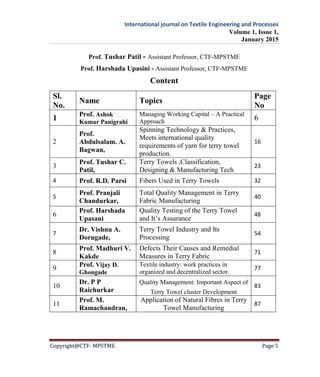
Content
Sl.
No.
Name Topics
Page
No
1
Prof. Ashok
Kumar Panigrahi
Managing Working Capital – A Practical
Approach 6
2
Prof.
Abdulsalam. A.
Bagwan,
Spinning Technology & Practices,
Meets international quality
requirements of yarn for terry towel
production.
16
3
Prof. Tushar C.
Patil,
Terry Towels ,Classification,
Designing & Manufacturing Tech
23
4 Prof. R.D. Parsi Fibers Used in Terry Towels 32
5
Prof. Pranjali
Chandurkar,
Total Quality Management in Terry
Fabric Manufacturing
40
6
Prof. Harshada
Upasani
Quality Testing of the Terry Towel
and It’s Assurance
48
7
Dr. Vishnu A.
Dorugade,
Terry Towel Industry and Its
Processing
54
8
Prof. Madhuri V.
Kakde
Defects Their Causes and Remedial
Measures in Terry Fabric
71
9
Prof. Vijay D.
Ghongade
Textile industry: work practices in
organized and decentralized sector.
77
10
Dr. P P
Raichurkar
Quality Management: Important Aspect of
Terry Towel cluster Development
83
11
Prof. M.
Ramachandran,
Application of Natural Fibres in Terry
Towel Manufacturing
87
International journal on Textile Engineering and Processes
Volume 1, Issue 1,
January 2015
Copyright@CTF- MPSTME Page 6
Managing Working Capital – A Practical Approach
Ashok Kumar Panigrahi
Associate Professor in Finance, NMIMS University, Shirpur.
Mail ID – panigrahi.ak@gmail.com
Abstract
Working capital management plays a significant role in improved profitability of firms.
Firms can achieve optimal management of working capital by making the trade-off
between profitability and liquidity. Though there are too many researches has been
conducted on the topic working capital management and its impact on profitability, but
there is no major research has been done for the negative working capital and its impact
on profitability. All the studies on working capital generally states that for the
improvement in profitability we should manage our working capital effectively and most
of the studies recommended to have good amount of working capital in the organization.
All the researches on this topic conclude that the companies should avoid under-
investment in working capital if they want higher profit margins. With negative working
capital there can be a danger of insolvency but it is not true forever. If the company is
having a good image in the market and good relation with their creditors it can get the
benefit from the negative working capital also.
Various studies shows that though there is a positive relationship between working
capital and profitability, yet it does not hold good for all the cases and that too always.
We have seen companies generating good profit with a negative working capital as well
as companies not able to generate good profit even with having good amount of positive
working capital. However, it can be said that negative working capital indicates non-
liquidity or less liquidity within the firm which is not desirable at each and every stages
of business.Hence, the question arises that having negative working capital is good for an
organization or not and if a company is earning profit continuously with having negative
working capital, can we say that it is a sign of managerial efficiency or there might be the
chances of possible bankruptcy of the company?
Key Words: Working Capital, Profitability, Liquidity, Bankruptcy, Working
Capital Cycle.
Introduction
International journal on Textile Engineering and Processes
Volume 1, Issue 1,
January 2015
Copyright@CTF- MPSTME Page 7
What is working capital management and why is working capital management important
to your business?In its most basic form, working capital is the cash available to a
business to pay its day-to-day operating expenses, such as salaries and raw materials.Yet
with businesses still finding it difficult to gain access to finance, managing working
capital has become more important than ever before.Effective management will mean
working at both ends of the equation, by managing the cash coming in as well as the cash
going out.
Understand the Working Capital Cycle
Cash flows in a cycle into, around and out of a business. It is the business's life blood and
every manager's primary task is to help keep it flowing and to use the cash flow to
generate profits. If a business is operating profitably, then it should, in theory, generate
cash surpluses. If it doesn't generate surpluses, the business will eventually run out of
cash and expire.
The faster a business expands the more cash it will need for working capital and
investment. The cheapest and best sources of cash exist as working capital right within
business. Good management of working capital will generate cash will help improve
profits and reduce risks. Bear in mind that the cost of providing credit to customers and
holding stocks can represent a substantial proportion of a firm's total profits.
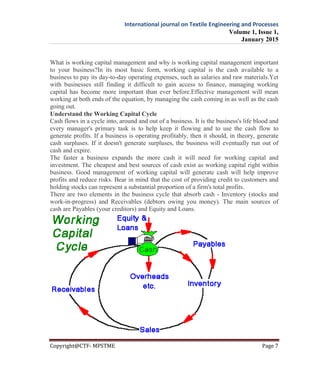
There are two elements in the business cycle that absorb cash - Inventory (stocks and
work-in-progress) and Receivables (debtors owing you money). The main sources of
cash are Payables (your creditors) and Equity and Loans.
International journal on Textile Engineering and Processes
Volume 1, Issue 1,
January 2015
Copyright@CTF- MPSTME Page 8
Each component of working capital (namely inventory, receivables and payables) has
two dimensions ........TIME ......... and MONEY. When it comes to managing working
capital - TIME IS MONEY. If you can get money to move faster around the cycle (e.g.
collect monies due from debtors more quickly) or reduce the amount of money tied up
(e.g. reduce inventory levels relative to sales), the business will generate more cash or it
will need to borrow less money to fund working capital. As a consequence, you could
reduce the cost of bank interest or you'll have additional free money available to support
additional sales growth or investment. Similarly, if you can negotiate improved terms
with suppliers e.g. get longer credit or an increased credit limit; you effectively create
free finance to help fund future sales.
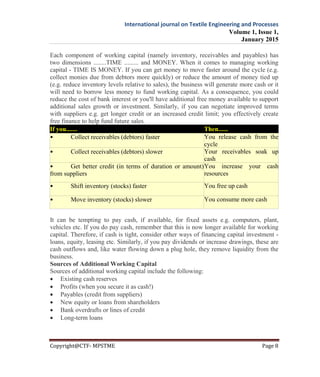
If you....... Then......
• Collect receivables (debtors) faster You release cash from the
cycle
• Collect receivables (debtors) slower Your receivables soak up
cash
• Get better credit (in terms of duration or amount)
from suppliers
You increase your cash
resources
• Shift inventory (stocks) faster You free up cash
• Move inventory (stocks) slower You consume more cash
It can be tempting to pay cash, if available, for fixed assets e.g. computers, plant,
vehicles etc. If you do pay cash, remember that this is now longer available for working
capital. Therefore, if cash is tight, consider other ways of financing capital investment -
loans, equity, leasing etc. Similarly, if you pay dividends or increase drawings, these are
cash outflows and, like water flowing down a plug hole, they remove liquidity from the
business.
Sources of Additional Working Capital
Sources of additional working capital include the following:
 Existing cash reserves
 Profits (when you secure it as cash!)
 Payables (credit from suppliers)
 New equity or loans from shareholders
 Bank overdrafts or lines of credit
 Long-term loans
International journal on Textile Engineering and Processes
Volume 1, Issue 1,
January 2015
Copyright@CTF- MPSTME Page 9
 If you have insufficient working capital and try to increase sales, you can easily
over-stretch the financial resources of the business. This is called overtrading. Early
warning signs include:
 Pressure on existing cash
 Exceptional cash generating activities e.g. offering high discounts for early cash
payment
 Bank overdraft exceeds authorized limit
 Seeking greater overdrafts or lines of credit
 Part-paying suppliers or other creditors
 Paying bills in cash to secure additional supplies
 Management pre-occupation with surviving rather than managing
 Frequent short-term emergency requests to the bank (to help pay wages, pending
receipt of a cheque).
More businesses fail for lack of cash than for want of profit.
Handling Receivables (Debtors)
Cash flow can be significantly enhanced if the amounts owing to a business are collected
faster. Every business needs to know.... who owes them money.... how much is owed....
how long it is owing.... for what it is owed.
Slow payment has a crippling effect on business; in particular on small businesses who
can least afford it. If you don't manage debtors, they will begin to manage your
business as you will gradually lose control due to reduced cash flow and, of course, you
could experience an increased incidence of bad debt. The following measures will help
manage your debtors:
 Have the right mental attitude to the control of credit and make sure that it gets the
priority it deserves.
 Establish clear credit practices as a matter of company policy.
 Make sure that these practices are clearly understood by staff, suppliers and
customers.
 Be professional when accepting new accounts, and especially larger ones.
 Check out each customer thoroughly before you offer credit. Use credit agencies,
bank references, industry sources etc.
 Establish credit limits for each customer... and stick to them.
 Continuously review these limits when you suspect tough times are coming or if
operating in a volatile sector.
 Keep very close to your larger customers.
International journal on Textile Engineering and Processes
Volume 1, Issue 1,
January 2015
Copyright@CTF- MPSTME Page 10
 Invoice promptly and clearly.
 Consider charging penalties on overdue accounts.
 Consider accepting credit /debit cards as a payment option.
 Monitor your debtor balances and ageing schedules, and don't let any debts get too
large or too old.
Recognize that the longer someone owes you, the greater the chance you will never get
paid. If the average age of your debtors is getting longer, or is already very long, you
may need to look for the following possible defects:
 weak credit judgment
 poor collection procedures
 lax enforcement of credit terms
 slow issue of invoices or statements
 errors in invoices or statements
 customer dissatisfaction.
Debtors due over 90 days (unless within agreed credit terms) should generally demand
immediate attention. Look for the warning signs of a future bad debt. For example.........
 longer credit terms taken with approval, particularly for smaller orders
 use of post-dated checks by debtors who normally settle within agreed terms
 evidence of customers switching to additional suppliers for the same goods
 new customers who are reluctant to give credit references
 receiving part payments from debtors.
Profits only come from paid sales.
The act of collecting money is one which most people dislike for many reasons and
therefore put on the long finger because they convince themselves there is something
more urgent or important that demands their attention now. There is nothing more
important than getting paid for your product or service. A customer who does not
pay is not a customer. Here are a few ideas that may help you in collecting money from
debtors:
• Develop appropriate procedures for handling late payments.
• Track and pursue late payers.
• Get external help if your own efforts fail.
• Don't feel guilty asking for money.... it’s yours and you are entitled to it.
• Make that call now. And keep asking until you get some satisfaction.
• In difficult circumstances, take what you can now and agree terms for the remainder.
It lessens the problem.
• When asking for your money, be hard on the issue - but soft on the person. Don't
give the debtor any excuses for not paying.
International journal on Textile Engineering and Processes
Volume 1, Issue 1,
January 2015
Copyright@CTF- MPSTME Page 11
• Make it your objective is to get the money - not to score points or get even.
Late payments erode profits and can lead to bad debts.
Managing Payables (Creditors)
Creditors are a vital part of effective cash management and should be managed carefully
to enhance the cash position.
Purchasing initiates cash outflows and an over-zealous purchasing function can create
liquidity problems. Consider the following:
• Who authorizes purchasing in your company - is it tightly managed or spread among
a number of (junior) people?
• Are purchase quantities geared to demand forecasts?
• Do you use order quantities which take account of stock-holding and purchasing
costs?
• Do you know the cost to the company of carrying stock?
• Do you have alternative sources of supply? If not, get quotes from major suppliers
and shop around for the best discounts, credit terms, and reduce dependence on a
single supplier.
• How many of your suppliers have a returns policy?
• Are you in a position to pass on cost increases quickly through price increases to
your customers?
• If a supplier of goods or services lets you down can you charge back the cost of the
delay?
• Can you arrange (with confidence!) to have delivery of supplies staggered or on a
just-in-time basis?
There is an old adage in business that if you can buy well then you can sell well.
Management of your creditors and suppliers is just as important as the management of
your debtors. It is important to look after your creditors - slow payment by you may
create ill-feeling and can signal that your company is inefficient (or in trouble!).
Remember, a good supplier is someone who will work with you to enhance the future
viability and profitability of your company.
Inventory Management
Managing inventory is a juggling act. Excessive stocks can place a heavy burden on the
cash resources of a business. Insufficient stocks can result in lost sales, delays for
customers etc.
International journal on Textile Engineering and Processes
Volume 1, Issue 1,
January 2015
Copyright@CTF- MPSTME Page 12
The key is to know how quickly your overall stock is moving or, put another way, how
long each item of stock sit on shelves before being sold. Obviously, average stock-
holding periods will be influenced by the nature of the business. For example, a fresh
vegetable shop might turn over its entire stock every few days while a motor factor
would be much slower as it may carry a wide range of rarely-used spare parts in case
somebody needs them.
Nowadays, many large manufacturers operate on a just-in-time (JIT) basis whereby all
the components to be assembled on a particular today, arrive at the factory early that
morning, no earlier - no later. This helps to minimize manufacturing costs as JIT stocks
take up little space, minimize stock-holding and virtually eliminate the risks of obsolete
or damaged stock. Because JIT manufacturers hold stock for a very short time, they are
able to conserve substantial cash. JIT is a good model to strive for as it embraces all the
principles of prudent stock management.
The key issue for a business is to identify the fast and slow stock movers with the
objectives of establishing optimum stock levels for each category and, thereby, minimize
the cash tied up in stocks. Factors to be considered when determining optimum stock
levels include:
• What are the projected sales of each product?
• How widely available are raw materials, components etc.?
• How long does it take for delivery by suppliers?
• Can you remove slow movers from your product range without compromising best
sellers?
• Remember that stock sitting on shelves for long periods of time ties up money which
is not working for you. For better stock control, try the following:
• Review the effectiveness of existing purchasing and inventory systems.
• Know the stock turn for all major items of inventory.
• Apply tight controls to the significant few items and simplify controls for the trivial
many.
• Sell off outdated or slow moving merchandise - it gets more difficult to sell the
longer you keep it.
• Consider having part of your product outsourced to another manufacturer rather than
make it yourself.
• Review your security procedures to ensure that no stock "is going out the back
door!”
• Higher than necessary stock levels tie up cash and cost more in insurance,
accommodation costs and interest charges.
Working Capital Management – The New Approach
International journal on Textile Engineering and Processes
Volume 1, Issue 1,
January 2015
Copyright@CTF- MPSTME Page 13
Working Capital Management is concerned with the management of the Current Assets
and Current Liabilities and the interrelation that exists between them, so to minimize the
risk of insolvency and to maximize the return on assets. The ultimate objective of
working capital management is to ensure that a firm is able to continue its operations and
that it has sufficient ability to satisfy both maturing short term debt and upcoming
operational expenses. Working capital management calls for addressing two basic issues
how much of current assets an organization should hold and how to finance the
investment in them. In the present scenario some companies are using negative working
capital and getting a good amount of profits and good return on capital also. Earlier
negative working capital is considered as a risk of insolvency of the organizations but at
present negative working capital is a sign of managerial efficiency in a business.
Earlier it was considered that the companies should avoid under-investment in working
capital if they wanted higher profits margins.
Negative working capital is a reverse situation as compared to normal working capital. It
is a situation in which current assets are lower as compared to current liabilities. A
negative working capital is an indication of managerial efficiency in a business with low
inventory and account receivables. This happens because customer pays in advance and
so quickly, the business enjoys cash transactions; products are delivered and sold to the
customer before the company even pays their suppliers and creditors. Negative Working
capital doesn't always mean bad financial condition; it indicates that most of the day to
day activities are funded by customers rather than company’s own working capital. Some
latest examples are movie theaters - customers are paying first and distributors are
normally paid later on; Schools/ educational institutions- fees paid in advance by the
students annually, whereas faculties are getting salary after one month. When an
organisation uses supplier’s credit and customers' advance to fulfill their day to day
needs, it leads to a situation of lower or negative working capital. Banks, financial
institutions, distributors, retailers with cash business or advance payment contract have
negative working capital.
Normally, when we analyse working capital, it always refers to normal or positive
working capital (excess or current assets over current liabilities). However, there are
certain situations in which working capital is in negative form (excess of current
liabilities over current assets). In that situation, how can a company manage liquidity
with the negative working capital? In modern business, the concept of negative working
capital is significant for the following reasons;
• It indicates operational efficiency of a corporate. That means without having or with
low current assets the firm is managing day to day operations in an efficient manner.
Eventually, it reduces cost of working capital and maximum earnings for the
shareholders, which is the ultimate goal of the financial management.
International journal on Textile Engineering and Processes
Volume 1, Issue 1,
January 2015
Copyright@CTF- MPSTME Page 14
• Concept of negative working capital is important to analyse liquidity position of
corporate. When current assets are lower than current liabilities, what about the liquidity
position of the corporate, how are they discharging current obligations in theshort period.
Traditionally, liquidity ratios are the measurement of liquidity of a firm with the ideal
standard of 2:1. Negative working capital indicates lower cost of working capital
(another way is higher profitability), but at the same time, it indicates poor liquidity
(worried situation for the creditors, etc.) or we can say company is overburdened with
current liabilities, which is not good for any situation (specially in a period of recession,
etc).
• Another important impact of negative working capital is cash recovery or realisation
situation. Negative working capital indicates quick realization of cash recourses
(conversion of debtors in to cash) or one can say working capital cycle is shorter (for a
days or maybe less than that). At the same time, payable policy of the company is to take
longer time for payment against creditor. It indicates significant variations in the credit
policy towards suppliers and customers.
To analyse, explain and focus on all these situations, a study of negative working capital
and its impact on liquidity, profit earning capacity and overall impact on shareholders’
value creation is important in the contemporary scenario. To understand how negative
working capital works, let us analyse Warner Brothers / Wal-Mart situation. When Wal-
Mart ordered the 500,000 copies of a DVD, they were supposed to pay Warner Brothers
within 30 days. What if by the sixth or seventh day, Wal-Mart had already put the DVDs
on the shelves of its stores across the country? By the twentieth day, they may have sold
all of the DVDs. In the end, Wal-Mart received the DVDs, shipped them to its stores, and
sold them to the customer (making a profit in the process), all before they had paid
Warner Brothers! If Wal-Mart can continue to do this with all of its suppliers, it doesn't
really need to have enough cash on hand to pay all of its accounts payable. As long as the
transactions are timed right, they can pay each bill as it comes due, maximizing their
efficiency.
There are many ways to create negative working capital. Most important method is to
minimise the size of current assets with favorable contract and agreement to the suppliers
and other parties (to delay payments) and the same time, try to minimise credit facilities
or maximise cash based business (collection of cash before the disbursement of actual
payments to the various parties). When maximum customers are paying in advance, low
or negative working capital is created. Another way to minimise the size of current assets
is to adopt efficient collection method or brand oriented collection policy. Many
companies are trying to minimise their cash resources with efficient utilisation of funds.
Some companies are effectively using ERP system involving trade partners in planning
International journal on Textile Engineering and Processes
Volume 1, Issue 1,
January 2015
Copyright@CTF- MPSTME Page 15
and monitoring working capital items to reduce the level of working capital. Efficient
cash collection and inventory management system provides an opportunity to run
business with the negative working capital, because most of the suppliers are granting 30
days credit in general. Companies who are able to operate and maintain with negative
working capital, have advantages to receive funds without cost as a form of credit from
their suppliers which will enhance ROI in a significant manner. However, non-
availability of liquid resources is not a good situation at any time (especially in the stage
of growth and boom). Hence, the question arises that having negative working capital is
good for an organization or not and if a company is earning profit continuously with
having negative working capital, can we say that it is a sign of managerial efficiency or
there might be the chances of possible bankruptcy of the company?
References
[1]. Arora, A. (2013): “Negative Working Capital and its Impact on Profitability” The
Management Accountant, March 2013.
[2]. Banerjee, S. (2000): "Financial management". S.Chand and company, New Delhi .
[3]. Bhalla, V. (1997): "Financial management and policy", Anmol publications
Ist edition,New Delhi .
[4]. Khan and Jain(2004): "Financial Management", Tata Mcgraw Hill publishing
company, New Delhi 4th edition .
[5]. Panigrahi, Ashok Kumar, Negative Working Capital and Profitability: An Empirical
Analysis of Indian Cement Companies (June 1, 2013). International Journal of
Research in Commerce & Management, Volume 4, No. 6, June 2013. Available at
SSRN: http://ssrn.com/abstract=2342457
[6]. Rustagi, R. (2000): "Financial Management, theory, concept and problems", second
edition pp860 Galgotia Publishing Company, New Delhi (2000).
[7]. Raheman A and Nasr M (2007), “Working Capital Management and Profitability:
Case of Pakistani Firms”, International Review of Business Research, Vol. 3, No. 2,
pp. 275–296.
[8]. Sur, D. (1997): “Working capital management in Colgate Palmolive (India) Ltd. -A
case study", The Management Accountant, November.
[9]. Singh, P. 2012, “Negative Working Capital and Indian Corporates – A Conceptual
Analysis” The Chartered Accountant, Dec. 2012.
[10]. Walker E.W. (1974): "Essentials of Financial Management", New Delhi,
Prentice Hall of India Pvt. Ltd.
[11]. http://www.planware.org/workingcapital.htm
International journal on Textile Engineering and Processes
Volume 1, Issue 1,
January 2015
Copyright@CTF- MPSTME Page 16
SPINNING TECHNOLOGY & PRACTICES, MEETS INTERNATIONAL
QUALITY REQUIREMENT OF YARN FOR TERRY TOWEL PRODUCTION.
Prof. Abdulsalam. A. Bagwan, CTF, MPSTME
Abstract
As per as Indian textile industries are concerned the production of international quality of
yarn considered to be big task, and only few mill can produce such type of yarn. This
reflected on performance of industries and export side. In present investigation, Two
methods described by the P Balsubramanian the first method followed by considering
Uster standards while analyzing yarn qualities but this method required very quality of
raw material which is very expensive to produce yarn quality which leads reduce
performance of exports in international market. While in Second methodology P
Subramanian suggested to consider buyer specification ,Precautionary handling of
material in post spinning process and systems to be followed while producing export
yarn ,Work practices to be avoided during preparation of the export quality yarn, by
using online quality systems like sliver data, Ring data ,Cone data systems equipped on
machine which leads improve spinner judgment and easy to check material 100% and
finally meet export or international quality requirement.
Keywords: International yarn quality, RKm, Thick and thin imperfection, yarn coefficient of
variation, Buyers specification, Work practices, systems.
Introduction
Yarn quality requirement is changing every day. Quality requirement is different for
different end uses and it is different for different customers. But it is difficult to produce
a good quality yarn with a minimum deviation. Amongst the other factors machine and
process parameter plays major role in deciding upon product quality and productivity. It
was felt that standardization of machine and process parameters along with correct work
practices would help to improve upon quality and productivity.
Quality of yarn should be at least within 25% Uster which means the quality is among
the best 25% of the mills in the world. Normally shuttles weaving machine works three
to four times faster and if the quality of warp remain same ,warp break will increase three
International journal on Textile Engineering and Processes
Volume 1, Issue 1,
January 2015
Copyright@CTF- MPSTME Page 17
to four times resulting in low production. Yarn should be more even and following
parameter of the yarn are critically reviewed i.e. C.V. of Count, Single yarn strength,
C.V. of Single yarn strength, Imperfection per 1000 meters such as thick place, thin
place, and neps. Yarn requirements in terms of strength, uniformity and freedom from
imperfections are dependent on two considerations: the performance & appearance
requirements of the cloth, and the level of productivity which is expected of the
operatives. As the first consideration does not constitute a severe constraint, it is only
necessary to take account of the second one. This essentially involves achievement of the
most economic balance between labour costs and machine utilization factor. No
problems arise in the case of auto looms /Unconventional: the weaver continues to tend
only one loom whatever quality of yarn is provided as his productivity should not fall
substantially if yarn quality is lowered. Fall in productivity - in comparison with
productivity achieved with perfect yarn - should not exceed 20% if the lowest quality
yarn were used.
The use of low quality yarns inevitably leads to higher breakage rates and consequently,
to an increase in the number of operative hours needed to produce a given quantity of
cloth. However, the type of loom used does not have a first order effect on the amount of
time spent in the repair of a weaving break, either of warp or weft. At the lowest level of
yarn quality - consistent with fabrics covered by this memorandum - one weaver might
reasonably be expected to tend two non-automatic power looms or four automatic looms.
With very well prepared yarn of the highest quality, one weaver could tend six non-
automatics or up to sixty automatic looms. Thus, the labour-saving potential of the
automatic looms is much more severely curtailed by the use of low quality yarn than is
the case with non-automatic looms. This does not necessarily mean that automatic looms
require better yarns, or that it is less economic to use automatic looms in conjunction
with low quality yarns. The basic consideration is that the amount of labour needed is
reduced when the quality of yarn is raised regardless of the type of loom. Thus, in high
wage cost countries, weaving becomes profitable only if yarn quality is high.
Furthermore, as the higher capital cost of automatic looms is justified by the high wages,
it is usual for high quality yarns to be used in conjunction with automatic weft
replenishment.
Yarns which are used in Towels:
In a terry towel there are four groups of yarn. These four groups are the pile warp,
ground warp, weft (filling), and border weft.
Pile Warp:
One hundred percent cotton yarns, carded or combed, in sizes of 16/1, 20/1 Ne counts,
240-255 turns/meter twist, are most commonly used. While towels of the fashion type are
International journal on Textile Engineering and Processes
Volume 1, Issue 1,
January 2015
Copyright@CTF- MPSTME Page 18
mainly piece dyed or printed. In general bulkier and absorbent yarns are used for both
types of towels. Rotor spun yarns are also used in pile warps low twist cotton.
Ground Warp:
Carded yarns of 20/2, or 24/2 Ne count with 550 turns/meter twist, and of 100% cotton
are commonly used for ground warp ends. Two ply yarns are preferred because the
ground warps ends have the highest tension during weaving. It is common to use a yarn
of cotton/polyester blend for greater strength. Rotor spun yarns are also used in ground
warps.
Weft: Carded yarns of 16/1, or 20/1 Ne counts with 240 – 255 turns/meter twist, 100%
cotton are used usually for weft or filling picks. Rotor spun yarns are also used in wefts.
Border Weft:
Premium or high end hand towels have complex borders with fancy weaves and use a
very wide range of filling yarns. Decorative, shiny and bulky yarns of rayon, viscose,
polyester, chenille, or mercerized cotton are used at different yarn sizes. Novelty types of
yarns may be used as a feature of design
Spinning Technology required for terry towel product:
The cotton yarn used in terry towel are produced by ring spinning technology or open
end spinning technology which are specially developed for producing warp pile yarn for
terry towel.
Ring Spinning:
The principle of ring spinning is first mixing or blending the fibers, opening them and
arranging as much as possible parallel to each other .Second is to give the fibers a twist
in order to increase the friction forces between fiber and assure they stay as yarn and
draw them to the desire size. These are achieved in several steps as follows.
Blow room and Carding OR Prior process:
All staple fibers are processed through blow room and carding ,After opening of the
cotton loose fiber goes in to the carding machine ,Here Fine flats wires on revolving
cylinders pull the fibers apart, remove adherence of waste which is associated with
cotton fibers and begin to arrange the fiber enough that they can be spun in to yarn. Fiber
emerges from carding in the fine web, which is gathered together in to loose, fine web
called as sliver. After carding, fiber is taken through a number of stages to become yarn.
Combing:
An extra process is introduced called combing for high quality yarns. The purposes of
combing are to 1) Remove Hooks 2) Remove short fiber 3) Improve fiber orientation.
Drawing (Drafting) and doubling:
This is process of running slivers between set of rollers, each moving faster than ones
before, which draw out or draft a number of slivers to the thickness of one: this process is
repeated until the fibers are well mixed.
International journal on Textile Engineering and Processes
Volume 1, Issue 1,
January 2015
Copyright@CTF- MPSTME Page 19
Speed frame:
Speed frame draws the sliver out to a strand about the size of pencil, called roving are
carried by the traveler around the edge of the ring, inside which is faster rotating spindle.
Spinning:
During spinning the roving is drawn out to yarn size and given considerable high twist to
become yarn. In ring spinning, twist is inserted as fibers from roving are carried by the
traveler around the edge of the ring, inside which is faster rotating spindle.
Carded, combed, open end, low twist yarn for terry towel:
Carded yarn has fuzzy appearance and loftier than combed yarn. Fabrics made from
carded yarn have more hairy surface and will neps more than fabrics of combed yarn.
Combing removes any shorter fiber and arranges the remaining lowest fibers more or less
a parallel to each other. During combing about 15% further weight is lost combed sliver
has silkier appearance.
Open end yarn : The basic principle of open-end spinning is sliver are feeding through
feed roller ,opening by high speed revolving opening roller and fibers feed through
transport tube and deposited on surface of rotor and high speed rotor inserted twist to
fiber strand yarn withdraw through tube and wound on winding roller. The open end yarn
has following properties bulkier, less strength compare to Ring yarn ,less U %, due to
these properties it can be used for pile yarn in terry products.
Low twist yarn:
The basic difference between low twist and the other cotton yarn is fiber. While ring
spun towel use a combination of long and short staple cotton fiber, low twist must be
constructed only from loner staple cotton yarn. After the fiber is made in to low twist
yarn, it must be wound with polyvinyl alcohol(PVA) yarn to keep the cotton intact
without the need for twisting . PVA dissolved during dyeing and yarn obtained with
extremely low twist yarn. This type of yarn is called as low twist, zero twist, no twist
yarn which can used for terry products.
Quality evaluation methods:
P Balsubramanian suggested two methods method, first method followed by considering
Uster standards while analyzing yarn qualities, and meet international standards.
Second methodology P Subramanian suggested to consider buyer specification
,Precautionary handling of material in post spinning process and systems to be followed
while producing export yarn ,Work practices to be avoided during preparation of the
export quality yarn, by using online quality systems like sliver data, Ring data ,Cone
International journal on Textile Engineering and Processes
Volume 1, Issue 1,
January 2015
Copyright@CTF- MPSTME Page 20
data systems equipped on machine which leads improve spinner judgment and easy to
check material 100% and finally meet export or international quality requirement.
International quality:
Most of the spinners under impression that, international quality means that all yarn
quality specification should be either equal to or better than uster 25% value most of
manufacturer try hard to attain international quality level by going for good quality of
raw material at higher cost or sacrificing productivity at critical stages in production line.
But as mentioned in uster statistics, A yarn whose mean value for all yarn characteristic
lie below uster 25% line value of uster statistics is seldom encountered and if so, it must
refer to yarn from expensive and special raw material. Practical experience has shown
that yarn need not necessarily be perfect in terms of all characteristics, it must not
advisable meet statistics for all quality parameter but it is more important to meet buyer
specifications.
Specification of buyer:
In export market buyer specify the quality requirement level, generally following
parameters are specified.
 Lea count and its Coefficient of variation
 Rkm and its Coefficient of variation.
 U% with imperfections
 ASTM appearance grade
 TPI variation.
Beside the above the buyer specify whether yarn should necessarily be electronically
cleared and spliced and I case of double yarn weather it should be twisted on two for one
twister. Occasionally some buyer specifies total number of objectionable fault as
measured by classimat.
Intrinsic quality requirements:
Meeting the specification is one part of yarn quality and the other part which is more
important is the performance of the yarn on the buyers machinery and ultimate quality of
his end product is the yarn should withstand various parameter, processing condition and
produce defect free product/yarn. Therefore spinner should aware of the end use product
which is supplying to his customer and Ultimate quality index is customer satisfaction
rather than yarn specification.
Yarn quality evaluation:
Many mills yarn evaluated for various quality characteristic like count strength and their
variability’s, U% and imperfection, yarn appearances etc at ring frame stages. Only few
mills evaluate yarn at cone stage , In the most of the mills post spinning operation were
neglected both in terms of housekeeping renovation, modernization which leads to
International journal on Textile Engineering and Processes
Volume 1, Issue 1,
January 2015
Copyright@CTF- MPSTME Page 21
deteriorate the yarn qualities. In order to improve the quality of the yarn following
quality evaluations in post spinning process were suggested.
 Each cone should be checked physically, proper package density, and contaminations
free.
 Rewinding test should be conducted at higher speed particularly for export yarn i.e.
1000 mtr/min. Record breaks should be at the most one per lakh meter. At least 10
lakh meters should be evaluated at classimat.
 Objectionable fault should be less than 2 per lakh meter.
 Quality of splicer and knotter should be checked al least once in week.
 Cone weight variation should be minimized (+-50gms)
 Yarn test, should be evaluated on high volume testing
System and practices followed in export unit
ForMaterial identification:
In order to avoid mixing of two different counts, following system suggested for material
identification.
 Tinting should not used to identify the material.
 Different colored card and draw frame cans used to identify the mixing
 Different colored ring and roving bobbins were use to identify the material.
 Cone with different colored sticker were use to identify the material.
Cotton processing practices:
The effort are made to make material more uniform
 Arrange the card at draw frame creel in such manner that all card equally
represented.
 Arrange breaker cans in row form and feed finisher cans in column form.
 Use block creeling system for speed frame and ring frame.
Work Practices
Most of the yarn faults in final yarn observed due poor work practices which leads to
deteriorate yarn qualities .In order to avoid bad practices and ensure the good qualities
following work practices followed by worker strictly avoided.
 Over end piecing at ring frame never allowed.
 The ring frame as well as roving creel piecing should be totally discouraged.
 In draw frame creel piecing should be done carefully, ensure it does not result in long
thick place.
 Worker should be aware of poor qualities.
 A continuous training scheme should be provided for worker.
Quality Assurances:
International journal on Textile Engineering and Processes
Volume 1, Issue 1,
January 2015
Copyright@CTF- MPSTME Page 22
In order to obtain good quality of yarn, spinners should implement online system on
machine such as ring data, sliver data, cone data with these systems spinners in position
to check 100% of material produced.
Conclusions
Present investigation reveals that, two methodology were given to obtain quality First
method required rich cotton quality parameter and even sacrificing production ,quality
increase stoppages one can difficult to meet international quality standards which was
deterioration performances of exports.
In Second methods, in order to obtained international qualities in terry yarn following
area is to be concentrated.
 Concentrate on specification of buyers
 Take necessary precautions while producing yarn
 Yarn qualities & its evaluation
 Avoid bad working practices
 Select the online technologies, which have online monitoring systems in order check
the material 100%.
By taking simple precautions during spinning, gives improvements in the performance
export and Second method is quite easy to understandable and installable in Textile
industries.
Acknowledgement:
The authors acknowledged valuable support received from The Director, NMIMS,
Associated Dean MPSTME Textile Technology, The Principal, Center for Textile
Functions MPSTME Dhule, District Dhule -425405
A ready reference copy of USTER STATISTICS enclosed with this study, it
contents, yarn properties evaluated for different count used in Weaving.
REFERENCES
[1]. Uster statistics (Uster Zellwger Ltd.) 1989 Norms.
[2]. Balsubramanian P., Control of winding parameter to reduce Neps and yarn
faults Paper presented at 16 th ATIRA Technological conference Ahmadabad 24 – 25
April 1992.
[3]. Kanthimathinathan A. & Chellamani P., Measure to produce yarn meeting
international quality standard, Paper presented at 32nd
Joint technological conference of
ATRA,BTRA,NITRA,SITRA Ahmadabad June -1991.
[4]. Venketrayan K., A critical look at specification of yarn for export vis a vis
Indian performance , Paper presented at 32nd
Joint Technological Conference of
ATRA,BTRA,NITRA,SITRA Ahmadabad June -1991.
International journal on Textile Engineering and Processes
Volume 1, Issue 1,
January 2015
Copyright@CTF- MPSTME Page 23
[5]. Güngör Durur, Eren Öner, Dokuz Eylül , The Comfort Properties of the Terry
Towels Made of Cotton and Polypropylene Yarns Journal of Engineered Fibers and
Fabrics Volume 8, Issue 2 – 2013 ,http://www.jeffjournal.org.
Terry Towels – Classification, Designing & Manufacturing Technology
Prof. Tushar C. Patil, CTF, MPSTME
Abstract:
Terry towels are often very complex with yarns of different types and colors, in
combination with various loop pile and flat structures. Towels are subject to changing
fashions, and the market is constantly demanding new designs with improved fabric
characteristics important to the consumer such as softness and absorbency. In satisfying
these requirements, the content and structure of terry towels are critical decisions
determining the resulting quality. This review of the terry classification, designing and
production will be of interest to academicians and industry personnel as a basis for
understanding the steps in producing a high quality woven terry fabric.
Introduction - History of terry weaving:
The name “terry” comes from the French word “tirer” which means to pull out, referring
to the pile loops which were pulled out by hand to make absorbent traditional Turkish
toweling. Latin “vellus”, meaning hair, has the derivation “velour”, which is the toweling
with cut loops. In research conducted on terry weaving by the Manchester Textile
Institute, it was concluded that original terry weaving was likely the result of defective
weaving. The research indicates that this development occurred in Turkey, probably in
Bursa City, one of the major traditional textile centers in Turkey. Terry weaving
construction is considered a later development in the evolution of woven fabrics. Terry
toweling is still known as "Turk Fabric", "Turkish Toweling" or "Turkish Terry"
Terry pile is a class of warp pile structures also known as the Turkish toweling in which
certain warp ends are made to form loops on the surface of the fabric. Only one series of
weft threads are used, whereas the warp consist of two series of threads namely ground
warp produces ground cloth with the weft from which the loops formed by the pile warp
and, the firm foundation structure terry cloth is really a combination of two cloths.
Terry towels are used for bathing purpose because of their water absorption properties.
Piles are formed on one or both sides by the variable periodic movement of the reed or
International journal on Textile Engineering and Processes
Volume 1, Issue 1,
January 2015
Copyright@CTF- MPSTME Page 24
cloth fell position, mostly over three picks. Figure shows the pile formation in terry
fabrics with the three-pick principle. According to this principle, the first two picks are
beaten up by the short movement of the reed some distance before the cloth fell position.
In the third pick, the reed makes an exact movement, and all three picks are carried up to
the cloth fell position. During this movement, the three picks slide between the ground
warp yarns. The pile warp yarns move forward together with three picks and take on the
pile form. The distance’s’ shown in Figure 1 corresponds to the pile length. It can be
adjusted on terry weaving machines to obtain different pile heights. If piles are to be
formed on the surface of a terry fabric, the pile warp yarns must be over the third and
first picks; similarly, if the piles are too formed on the back side of a terry fabric, then the
pile warps must be under the third and first picks. Terry fabrics must be produced at a
certain weight per square meter, using mostly100% cotton yarns as weft-, ground- and
pile warp yarns. Certain yarn counts, such as Ne20/2, Ne24/2, Ne16/1 1), and warp
density are used by factories producing terry fabrics. After the ground and pile warp
yarns are prepared and drafted as one ground and one pile warp yarn.
Parts of terry towel:
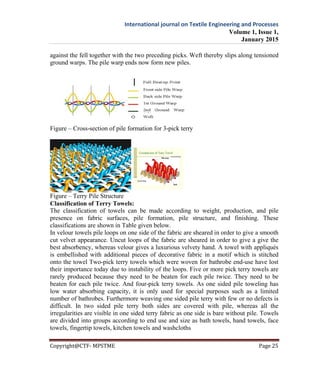
These are the pile area, fringes, beginning and end part, selvedge, border. Every towel
does not have to contain all of these parts. The pile area is considered the toweling part
of the towel. Fringes are tied or an untied tasseled part of ground warps and pile warps
which are left unwoven at the beginning and the end edges of the towel. The beginning
and end sections are the tightly woven areas of a towel which come before or after the
pile fabric part and prevent this pile area from unraveling. They are woven without pile
loops, in a flat weave construction. The selvedge contains fewer number of warp end s
than the pile area, for example 90 comparing to 4000 total warp ends, woven without pile
as a flat weave and has the purpose to reinforce the towel sides
Basics of terry weaving:
The principle of terry weaving is originated in France in 1841 by John Bright. Terry
cloth is defined as ‘a warp pile fabric having un-cut loops on both the sides. A fabric
made from ground and pile is in the form of loops such as in bath towels and bath mats.
Among pile fabrics, terry fabrics are woven by a special weaving "terry motion". Figure
shows the cross-section of pile formation for 3-pick terry; in which two picks are first
beaten up to a determined distance from the fabric fell. Third pick is then beaten up
International journal on Textile Engineering and Processes
Volume 1, Issue 1,
January 2015
Copyright@CTF- MPSTME Page 25
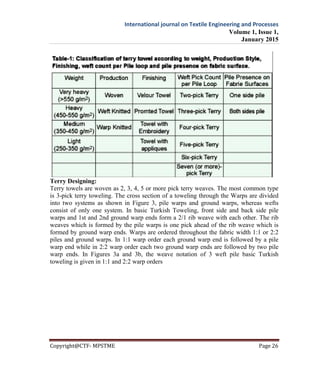
against the fell together with the two preceding picks. Weft thereby slips along tensioned
ground warps. The pile warp ends now form new piles.
Figure – Cross-section of pile formation for 3-pick terry
Figure – Terry Pile Structure
Classification of Terry Towels:
The classification of towels can be made according to weight, production, and pile
presence on fabric surfaces, pile formation, pile structure, and finishing. These
classifications are shown in Table given below.
In velour towels pile loops on one side of the fabric are sheared in order to give a smooth
cut velvet appearance. Uncut loops of the fabric are sheared in order to give a give the
best absorbency, whereas velour gives a luxurious velvety hand. A towel with appliqués
is embellished with additional pieces of decorative fabric in a motif which is stitched
onto the towel Two-pick terry towels which were woven for bathrobe end-use have lost
their importance today due to instability of the loops. Five or more pick terry towels are
rarely produced because they need to be beaten for each pile twice. They need to be
beaten for each pile twice. And four-pick terry towels. As one sided pile toweling has
low water absorbing capacity, it is only used for special purposes such as a limited
number of bathrobes. Furthermore weaving one sided pile terry with few or no defects is
difficult. In two sided pile terry both sides are covered with pile, whereas all the
irregularities are visible in one sided terry fabric as one side is bare without pile. Towels
are divided into groups according to end use and size as bath towels, hand towels, face
towels, fingertip towels, kitchen towels and washcloths
International journal on Textile Engineering and Processes
Volume 1, Issue 1,
January 2015
Copyright@CTF- MPSTME Page 26
Terry Designing:
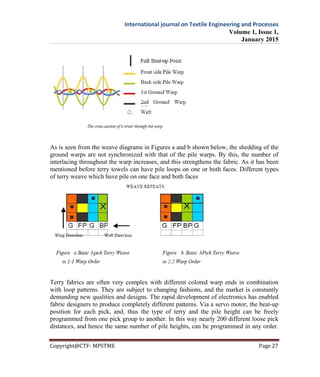
Terry towels are woven as 2, 3, 4, 5 or more pick terry weaves. The most common type
is 3-pick terry toweling. The cross section of a toweling through the Warps are divided
into two systems as shown in Figure 3, pile warps and ground warps, whereas wefts
consist of only one system. In basic Turkish Toweling, front side and back side pile
warps and 1st and 2nd ground warp ends form a 2/1 rib weave with each other. The rib
weaves which is formed by the pile warps is one pick ahead of the rib weave which is
formed by ground warp ends. Warps are ordered throughout the fabric width 1:1 or 2:2
piles and ground warps. In 1:1 warp order each ground warp end is followed by a pile
warp end while in 2:2 warp order each two ground warp ends are followed by two pile
warp ends. In Figures 3a and 3b, the weave notation of 3 weft pile basic Turkish
toweling is given in 1:1 and 2:2 warp orders
International journal on Textile Engineering and Processes
Volume 1, Issue 1,
January 2015
Copyright@CTF- MPSTME Page 27
As is seen from the weave diagrams in Figures a and b shown below, the shedding of the
ground warps are not synchronized with that of the pile warps. By this, the number of
interlacing throughout the warp increases, and this strengthens the fabric. As it has been
mentioned before terry towels can have pile loops on one or both faces. Different types
of terry weave which have pile on one face and both faces
Terry fabrics are often very complex with different colored warp ends in combination
with loop patterns. They are subject to changing fashions, and the market is constantly
demanding new qualities and designs. The rapid development of electronics has enabled
fabric designers to produce completely different patterns. Via a servo motor, the beat-up
position for each pick, and, thus the type of terry and the pile height can be freely
programmed from one pick group to another. In this way nearly 200 different loose pick
distances, and hence the same number of pile heights, can be programmed in any order.
International journal on Textile Engineering and Processes
Volume 1, Issue 1,
January 2015
Copyright@CTF- MPSTME Page 28
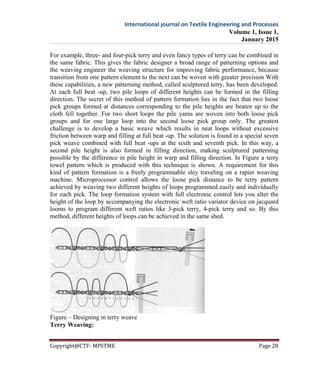
For example, three- and four-pick terry and even fancy types of terry can be combined in
the same fabric. This gives the fabric designer a broad range of patterning options and
the weaving engineer the weaving structure for improving fabric performance, because
transition from one pattern element to the next can be woven with greater precision With
these capabilities, a new patterning method, called sculptured terry, has been developed.
At each full beat -up, two pile loops of different heights can be formed in the filling
direction. The secret of this method of pattern formation lies in the fact that two loose
pick groups formed at distances corresponding to the pile heights are beaten up to the
cloth fell together. For two short loops the pile yarns are woven into both loose pick
groups and for one large loop into the second loose pick group only. The greatest
challenge is to develop a basic weave which results in neat loops without excessive
friction between warp and filling at full beat -up. The solution is found in a special seven
pick weave combined with full beat -ups at the sixth and seventh pick. In this way, a
second pile height is also formed in filling direction, making sculptured patterning
possible by the difference in pile height in warp and filling direction. In Figure a terry
towel pattern which is produced with this technique is shown. A requirement for this
kind of pattern formation is a freely programmable sley traveling on a rapier weaving
machine. Microprocessor control allows the loose pick distance to be terry pattern
achieved by weaving two different heights of loops programmed easily and individually
for each pick. The loop formation system with full electronic control lets you alter the
height of the loop by accompanying the electronic weft ratio variator device on jacquard
looms to program different weft ratios like 3-pick terry, 4-pick terry and so. By this
method, different heights of loops can be achieved in the same shed.
Figure – Designing in terry weave
Terry Weaving:
International journal on Textile Engineering and Processes
Volume 1, Issue 1,
January 2015
Copyright@CTF- MPSTME Page 29
The production of terry fabrics is a complex process and is only possible on specially
equipped weaving machines. Three yarn systems are woven in the terry loom compared
to the two system types of traditional weaving: Ground warp, pile warp and weft. The
two warps are processed simultaneously: the ground warp, with tightly tensioned ends
and the pile warp with lightly tensioned ends. A special weaving method enables loops to
be handled with the lightly tensioned warp ends on the surface. Ground warps and pile
warps are unwound separately, warped onto two different section beams and sized
separately. The processes they undergo show some
Steps of Terry Weaving:
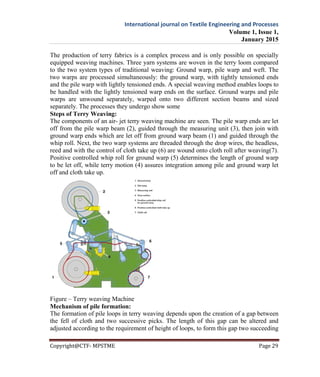
The components of an air- jet terry weaving machine are seen. The pile warp ends are let
off from the pile warp beam (2), guided through the measuring unit (3), then join with
ground warp ends which are let off from ground warp beam (1) and guided through the
whip roll. Next, the two warp systems are threaded through the drop wires, the headless,
reed and with the control of cloth take up (6) are wound onto cloth roll after weaving(7).
Positive controlled whip roll for ground warp (5) determines the length of ground warp
to be let off, while terry motion (4) assures integration among pile and ground warp let
off and cloth take up.
Figure – Terry weaving Machine
Mechanism of pile formation:
The formation of pile loops in terry weaving depends upon the creation of a gap between
the fell of cloth and two successive picks. The length of this gap can be altered and
adjusted according to the requirement of height of loops, to form this gap two succeeding
International journal on Textile Engineering and Processes
Volume 1, Issue 1,
January 2015
Copyright@CTF- MPSTME Page 30
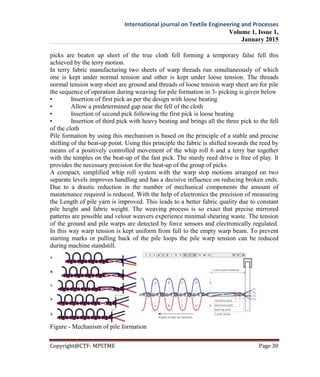
picks are beaten up short of the true cloth fell forming a temporary false fell this
achieved by the terry motion.
In terry fabric manufacturing two sheets of warp threads run simultaneously of which
one is kept under normal tension and other is kept under loose tension. The threads
normal tension warp sheet are ground and threads of loose tension warp sheet are for pile
the sequence of operation during weaving for pile formation in 3- picking is given below
• Insertion of first pick as per the design with loose beating
• Allow a predetermined gap near the fell of the cloth
• Insertion of second pick following the first pick is loose beating
• Insertion of third pick with heavy beating and brings all the three pick to the fell
of the cloth
Pile formation by using this mechanism is based on the principle of a stable and precise
shifting of the beat-up point. Using this principle the fabric is shifted towards the reed by
means of a positively controlled movement of the whip roll 6 and a terry bar together
with the temples on the beat-up of the fast pick. The sturdy reed drive is free of play. It
provides the necessary precision for the beat-up of the group of picks.
A compact, simplified whip roll system with the warp stop motions arranged on two
separate levels improves handling and has a decisive influence on reducing broken ends.
Due to a drastic reduction in the number of mechanical components the amount of
maintenance required is reduced. With the help of electronics the precision of measuring
the Length of pile yarn is improved. This leads to a better fabric quality due to constant
pile height and fabric weight. The weaving process is so exact that precise mirrored
patterns are possible and velour weavers experience minimal shearing waste. The tension
of the ground and pile warps are detected by force sensors and electronically regulated.
In this way warp tension is kept uniform from full to the empty warp beam. To prevent
starting marks or pulling back of the pile loops the pile warp tension can be reduced
during machine standstill.
Figure - Mechanism of pile formation
International journal on Textile Engineering and Processes
Volume 1, Issue 1,
January 2015
Copyright@CTF- MPSTME Page 31
Conclusion:
Terry towel is one of the integrated products of the textiles. Besides the yarn quality and
the finishing parameters, designing and manufacturing techniques are also plays the vital
role in construction of quality parameters of terry towels. This review of the terry
characteristics, specifications, production, and performance will be of interest to
academicians and industry personnel as a basis for understanding the steps in producing a
high quality woven terry fabric.
References:
[1]. Patil Subhash J. 2006, Manufacturing of terry towels, Universal Pub. Corp.,
Mumbai,
[2]. Ramaswamy G. 1992Modernization of terry towel weaving, Textile Magazine,
Vol.33.
[3]. Nancy Powell, Nazire Deniz Yilmaz and Gungor Durur. The technology of terry
towel production.
[4]. Adnur,s. 2001, Handbook of weaving, Technomic Pub.co.Inc. Lancaster, PA,
USA.
International journal on Textile Engineering and Processes
Volume 1, Issue 1,
January 2015
Copyright@CTF- MPSTME Page 32
FIBRES USED IN TERRY TOWELS
Prof. Rajendra D. Parsi,
CTF, MPSTME
Abstract
In order to obtain better feel from the terry fabrics manufacturer required to use different
fiber in order to improve serviceability of fabric and better absorption properties of terry
fabric. In present situation, decentralized sector contributed to terry products, which
gives excess of terry towel production against market requirement and which reduces the
cost of terry products. In production of terry towel if manufacturer are concentrated on
type of fibers and type of finishes to be used in order to obtain better comfort properties,
quality and serviceability of terry fabric, which gives more satisfaction to the customer.
It was observed that customer who purchased terry towel from 100% cotton, which gives
very good serviceability and customer used that terry towel for long duration. Instead of
using that terry towel for long period manufacturer required to add such properties like
absorption, feel, and colorfastness properties so customer desire to purchase that terry
towel frequently and fabric recycle time should be reduced. If manufacturer are used
microfibers, Tencel fiber, bamboo fiber, Bamboo charcoal fibers then fabric recycled
time reduced and cost benefits to customers and finally customer able to purchase terry
fabric frequently. Cotton is the king of fiber, fabric produced from 100% cotton is quite
expensive but in the market on different trade names regenerated fibers are also available
which gives better hand feel properties than cotton. .If manufacturer are used these fibers
in the production of terry fabrics that would give better scope for terry products.
FIBERS USED IN TOWELS
Properties required in the terry towel are high absorbency, high wet strength, and ability
to dye well, good colorfastness wash-ability, soft hand, and hypoallergenic, low cost, and
easy availability. Yarns made of cotton fibres and blends can provide these properties
most effectively.
Cotton Fibers
Cotton fibres consist of the unicellular seed hairs of the bolls of the cotton plant, the
Gossyum plant the chemical composition of typical cotton fiber is as follows: 94.0% of
dry weight is cellulose, 1.3% is protein, 1.2% is pectic substance, 0.6% is wax, 1.2% is
ash and 4% is other substances. Absorbency refers to a cotton fabric's ability to remove
liquid water from the skin as in a towel. Cotton is hydrophilic; it wets easily, and can
hold much more water than synthetic fibres can. Cotton releases a considerable amount
of heat when absorbing moisture, but it dries slowly. It is not only the amount of water
held that is most important, but the water held that is most important, but from the body.
The size and distribution of the pores, and capillaries, between and within cotton fibres
are uniquely suited for this purpose. Wet strength is one of the crucial properties required
International journal on Textile Engineering and Processes
Volume 1, Issue 1,
January 2015
Copyright@CTF- MPSTME Page 33
in towels, as they are most likely to remain wet as compared to other home textiles.
Cotton is stable in water and its wet tenacity is higher than its dry tenacity. The
toughness and initial modulus of cotton are lower compared to hemp fibres, whereas its
flexibility and its elastic recovery are higher. Cotton is a natural fiber and considered
hypoallergenic. This means cotton has a low tendency to cause allergic reactions. It also
does not cause skin irritation and can be sterilized. The microbial resistance of cotton is
low, but the fibres are highly resistant to moth and beetle damage. The microbial
resistance can be improved by antimicrobial finishing. Cotton uses in the medical
institutional area are well known for their hypoallergenic characteristic and sterilize-
ability. Cotton fabrics are often recommended for persons having skin allergies. Cotton
sanitary products and cosmetic aids are promoted for their health benefits. Cotton towels,
bedding and baby clothes have all been promoted on the basis of the hypoallergenic
nature of cotton. Moreover cotton’s resistance to high temperatures of water makes
cotton easy to be cleaned as it can be boiled. It has easy availability as it is grown in
more than seventy countries of the world. One other reason cotton is used for toweling is
it is the most economical fiber among the natural fibres Shorter staple cotton fibres are
generally used in towels because fine yarn counts are not required. The cotton fibres
which are used in towels have relatively low fiber length, relatively low fiber strength,
relatively low maturity ratio. The micronaire range can be said to be the middle range.
Other fibres:-
More and more towels are being produced from fibres other than cotton such as Modal®,
bamboo, seaweed, Lyocel® and now soybean, corn and other Tri-blend bamboo, silk and
cotton blend is also beginning to be used in towels. Bamboo may be the next premium
fiber other than high quality cotton fibres. Such as Egyptian, Pima and Supima qualities,
bamboo can be used in towels because of its softness, luster, antibacterial properties and
greater absorbency. However, it has yet to gain acceptance on a large scale. Flax is also
among the natural hydrophilic fibres of cellulose like cotton. The fiber is termed flax,
while the fabric made of flax it is called linen. Flax has better dry strength than cotton,
and like cotton it gets 25% stronger when wet. It absorbs more moisture, and it wicks. It
is longer, smoother, and more lustrous than cotton. However it is not used commonly in
International journal on Textile Engineering and Processes
Volume 1, Issue 1,
January 2015
Copyright@CTF- MPSTME Page 34
towels as it has been limited in supply and it is expensive because of the long processing
and intense labor it needs to be turned into a yarn although uncommon, flax towels have
a place in the specialty market. In the year place 2004, totally 1,949,421 flax towels were
in the specialty market. In the year imported to the U.S., which stands for 0.35% of the
total towel import of the U.S. Micro-fiber towels are also pushing into the ultra-
touch/high absorbency arena with a manmade synthetic product constructed primarily
from a blend of polyester and nylon with polyamide. Through a chemical process, the
polyester, nylon and the polyamide are bonded. The result is a cloth that goes through
another process to split its fiber into smaller “micro” fibres, creating tiny channels. Micro
fiber towels can absorb 5 to 7 times their weight in water. Like cotton, micro- fiber
towels are available in various colors and weaves, such as waffle, cut terry and loop
terry, with various patterns and in various weights. The heavier the micro- fiber towel,
the more water it can absorb. Compared to ring spun cotton, micro-fiber is said to be
more absorbent. Several companies are experimenting in combining micro-fiber with
cotton to make it softer, give a better hand and perhaps make it more appealing to those
who are unsure about having a synthetic towel product.
MODIFIED FIBERS, USED FOR TERRY TOWEL
Methods for the weaving and wet preparation of terry pile fabric for use in the production
of terry towels are reviewed. Emphasis is given to new methods for meeting special
requirements imposed by choice of style, type of fiber used and the size of the towels.
The use of polyester fibers in the ground section of toweling requires modified scouring
techniques involving the use of special sizing materials; i.e., polyvinyl alcohol. Like
polyester different fibers were used in the production of terry towel product so as to
reduce the cost and recycle time of the products. Some of the advanced fibers which are
using in terry towel industries, they are given below.
Microfiber for terry products:
Microfiber consists of very fine threads of polyester and polyamide (nylon) that combine
to form a single thread. Microfibers are so thin (100 times thinner than a single strand of
human hair) that when they are woven together they create a surface area 40 times more
than that of a regular fiber – creating an expanded surface area with dramatically
enhanced absorbing power due to the capillary action of the fine threads. Microfiber is
traditionally defined as a fiber with a denier of less than one. Denier is a measure of
thinness of fiber and is the weight in grams of a continuous fiber of 9,000 meters.
As each microfiber strand may be smaller than the bacteria it is attracting, it is able to
penetrate microscopic particles of dirt and grease on a surface. Split microfiber possesses
numerous wedges instead of the rounded surfaces on ordinary cloth, sweeping
underneath the particles and trapping them inside. In addition, the rounded fibers on most
cloths only push the dirt around, whereas the wedge-shaped microfibers grab the
International journal on Textile Engineering and Processes
Volume 1, Issue 1,
January 2015
Copyright@CTF- MPSTME Page 35
particles of dirt and pull the dirt into its dense internal structure. Furthermore, chemicals
only become necessary as a disinfectant, as the bonding agent is no longer necessary to
keep the dirt on the fiber.
Microfiber has two polymers. Polyester is lyophilic, or has an affinity to oil, so that oil
and grease adhere directly to the fibers. Polyamide is hydrophilic, which means it has an
affinity to water. As a result, any type of dirt is very quickly and completed removed
with microfiber, leaving a sparkling clean, streak-free surface. Microfiber cleans without
streaking, smearing, scratching or leaving lint. Microfiber is safe to use on all delicate
surfaces. It will clean without scratching or harming the surface in any way.
Ordinary cleaning towels move or push dirt and dust from one place to another -
microfiber actually lifts or scoops the dirt and stores the dirt particles in the towel, until it
is washed. Microfiber can absorb up to seven times its weight in fluids. Microfiber cloths
are also extremely durable. They can be washed up to 1000 times and still maintain their
effectiveness. This makes it an extremely cost effective product. Machine wash or hand-
wash microfiber with mild soapy water.
VISCOSE FIBERS AND THEIR DERIVATIVES USED IN TERRY TOWEL
Revolutionary and eco-friendly and the fiber of the future.
The production of TENCEL® is revolutionary. The production process is based on a
solvent spinning process and represents the greatest accomplishment in cellulosic fiber
technology. The unique closed loop production process makes TENCEL® the fiber of
the future: eco-friendly and economical.
Lenzing Modal®
These fibers extracted from beechwood. The beech tree is quite unique and has grown in
Europe for a very long time. Directly from beechwood forests, Lenzing Modal® gives
each and every textile a natural image. Beechwood, the raw material for Lenzing
Modal®, is known as a deep-rooting plant. For this reason, beechwood, which is
extremely resistant, has been known as the Mother of the Forest since the beginning of
time.
Lenzing FR® protects against heat stress. Produced from wood, a natural raw material,
Lenzing FR® offers protection against heat and flame in a variety of different
applications. Around the world Lenzing FR® sets the standard for quality among
cellulose fibers with an incorporated FR agent. Only Lenzing FR® is produced using the
Lenzing Modal® process. This ensures that the very highest fiber tenacities are obtained.
Lenzing FR® keeps the body dry and cool. Heat stress and heat stroke can be avoided.
BAMBOO CHARCOAL FIBER
Lihanre have developed white, gray and black bamboo charcoal fibers. The bamboo
charcoal fiber is made of the wild bamboos as raw material, using the new techniques of
pure oxygen and nitrogen high-temperature calcination barrier latency, make charcoal
International journal on Textile Engineering and Processes
Volume 1, Issue 1,
January 2015
Copyright@CTF- MPSTME Page 36
micropore innate and cellular technology more refined, and then with the trend of
honeycomb-like microporous structure modified polyester slices and made from melt-
spinning.
the bamboo charcoal products have the main characters of High ability of adsorption and
deodorization, Adjust the humidity automatically, Bacterium and mildew resistant, Good
moisture management, Warm in winter and cool in summer, Good Anti-pilling and Anti-
fuzzing, Easy dyeing, Easy care. Lihanre bamboo charcoal fiber is a kind of natural and
healthy green material with multi-effects of 1200℃ bamboo-carbon, and negative ion. It
is made of nanometer-level bamboo carbon and polyester, by using special spinning
technology. The product has great efficacy of odor neutralization, humidity control,
thermo preservation and health keeping.
we make the gray color and black color bamboo charcoal fiber by control the content of
bamboo charcoal in the fiber. And we make the gray color and black color bamboo
charcoal fiber by control the content of bamboo charcoal 2%-4%-6% in the fiber.
White bamboo-charcoal fiber is made of bamboo-charcoal which made by traditional
carbonized technology. Firstly grind the bamboo-charcoal into power by nanometer-lever
technology. Then cover the white catalyst onto the bamboo-charcoal power, smelt it with
polyester, at last spin into a kind of white high quality new fiber. The bamboo charcoal
powder surface is covered with a layer of white catalyst, and then mixed together with
the polyester melt, and then spin the fiber. Then the white charcoal fiber is a kind of new
functional modified polyester fibers. white bamboo charcoal are with the same function
of gray or black bamboo charcoal fiber but also white bamboo charcoal fiber are good
and easy for any color dyeing. white bamboo charcoal fibers with the black charcoal
fiber as the functional fiber fully embodied by the charcoal adsorption odor, improve air
quality, character of anti-bacteria bacteriostasis, block electromagnetic radiation,
emission far-infrared, such as regulating temperature and humidity effects, and has
excellent dye ability can be stained light, medium and deep variety of colors.
Fitness(D) Length(mm) Grade Color Application
1.5D/2D/3D 38/88/96 First white, grey,black
spinning HYPERLINK
"http://www.bamboo-
china.com/product/bamboo-
charcoal-
yarn.html" / nonwoven
6D/10D 51/64/76/96/102 First white,grey,black for filling
Bamboo charcoal fiber as the functional fiber fully embodied by the charcoal adsorption
odor, improve air quality, character of anti-bacteria bacteriostasis, block electromagnetic
radiation, emission far-infrared, such as regulating temperature and humidity effects.
International journal on Textile Engineering and Processes
Volume 1, Issue 1,
January 2015
Copyright@CTF- MPSTME Page 37
The use of fabrics made of bamboo charcoal fiber can be widely used in mattresses,
pillows, mattress covers, sheets and underwear, bra, shirt, warm clothing, health care
apparel, socks, towels, etc
Bamboo Charcoal fiber—Modified Polyester Staple Fiber:
With the rapid development of modern industry, humans life style and living
environment has been changed a lot, more and more people begin to pursue the natural,
simple and healthy life. Returning to nature is becoming the fashion style of the citizen
now, therefore, Bamboo Charcoal fiber is developed. This fiber owns the reputation of
"black diamond". In Japan, this fiber is called the "environment guarder of 21century
".The bamboo we used must be six years old and faced south. In order to make bamboo
charcoal with more tiny hole, we took the new technology of pure oxygen high
temperature, nitrogen obstructed and time-lapse calcining, and then melt spinning with
modified polyester chip, which are with honey comb structure.
Parameters considered in the production Terry Towel:-
 Weight & GSM: Weight and GSM should be same as required by customer. Every
manufacturer has some template or software (ERPs) where towel manufacturers
calculate everything likes pile’s height, density of picks and ends to meet
requirement. This database or any software has been developed through some basic
calculation.
 Softness/ Hand feel: It depends on properties of the yarn used in pile, finishing
chemicals and too some extent on pile orientation.
 Pile Orientation: Totally depends on process line.
 Lint: Lint is basically protruding fibers present in a finished towel. It is measured by
weight of accumulated fiber collected from washing machine and tumble drying
machine during testing.
 Absorbency: Terry towel should be highly water absorbent.
 Dimensional Stability: How a towel is behaving after washing is fall under
dimensional stability properties. Dimensional stability is measured by the residual
shrinkage % in a finished towel. Other Parameters are strength, color fastness etc.
 General Fabric Properties:-
 Tensile Strength:
The more the crimp the less the strength Other things being equal, plain weave
fabrics which have the highest crimp have the lowest strength.
 Extensibility:
The more crimp there is in the yarn the more extensible is the fabric, therefore longer
the floats, the less extensible is the fabric.
 Surface Friction:
International journal on Textile Engineering and Processes
Volume 1, Issue 1,
January 2015
Copyright@CTF- MPSTME Page 38
Whether surface is smooth or rough. Long floats produce smooth fabrics with low
crimp levels.
 Tear Strength:
In case of tensile loading, all the yarns in the direction of the loading share the load.
In tear loading only one, two or at most few yarns share the load. In tight
constructions, the movement of the yarn is restricted during loading and yarn will be
presented to the load one by one; this results in a low tearing strength. Loose open
constructions allow more freedom for the yarns to move and group together, thus
presenting bundles of yarns to the tearing load; in consequence the tear strength is
high. Designs which have group of yarns woven together such as rib or basket will
have height tear strength.
 Abrasion Resistance:
The most important factors are the crimp levels and the height of the crowns caused
by the crimp. The greater the number of crowns/area or the greater the area of each
crown, the less will be the stress concentration on the crowns and this leads to a high
abrasion resistance The longer the floats the larger the area of contact between the
yarn and the abrading and the higher the abrasion resistance.
 Drape:
Heavy fabrics from coarse yarns and dense constructions have poor drape
characteristics. Fabrics with long floats in the weave permit the yarns to move freely;
this reduces the bending and shear resistance of the fabric, leading to a better drape
behavior.
 Crease Resistance:
A plain woven fabric with a high fabric count puts a heavy strain on the fibers and
limits the recovery of the fabric. The longer the floats, the higher will be the crease
resistance of the fabric.
Conclusion:
The trends in terry towel marketplace are reviewed, basically In Indian textile market are
customer oriented market customer decide the price of the product and frequently
customer require change or value addition in the product. If value addition is not
incorporated in the product, customer not attracted towards the product which will affect
on selling of the product in market. It is seen that the terry towel market is a rapidly
growing and innovative market with the new technologies of spinning, which is special
for towel end use, new fibers -both natural and manmade-, new weaving features, new
finishes such as antimicrobial finishes. All these innovations are aimed to increase the
value gained from terry towels and reduce cost of the production of terry towel.
Manufactures required to use different fibers in different proportionate so that cost of the
International journal on Textile Engineering and Processes
Volume 1, Issue 1,
January 2015
Copyright@CTF- MPSTME Page 39
production reduces and also reduces the cycle time of product and customer purchase the
terry towel product frequently.
REFERENCES:
[1] Needless, H. L. (1986) Textile Fibers, Dyes, Finishes, and Processes, Noyes
Publications,
New Jersey, pp. 34-40.
[2] Cook, G. J. (1984) Handbook of Textile Fibres: Part 1 Natural Fibres, Merrow
Publishing Co. Ltd., London, pp 47-64.
[3] Taylor, J. (1972) Human Thermal Behavior”, Physics Group Conference, London,
pp.
117-118.
[4] Morton, W. E., and Hearle, M. A. (1993) Physical Properties of Textile Fibres, The
Textile Institute, Manchester, pp. 725.
[5] Moncrieff, R. W., (1975) Polypropylene, Man-Made Fibres, Newnes - Butterworths,
London, pp. 609-627.
International journal on Textile Engineering and Processes
Volume 1, Issue 1,
January 2015
Copyright@CTF- MPSTME Page 40
Total Quality Management in Terry Fabric Manufacturing
Pranjali Chandurkar, CTF
Abstract
The challenge that companies face as the 21st Century gets underway, is to succeed in
global economy where competition is fierce and where customers are becoming
demanding of quality. Companies must take a global perspective. They must supply
products and services that are competitive in both price and quality, and in international
as well as in domestic markets. To maintain a competitive edge in such an environment
they must continually improve the quality of what they offer. Total Quality Management
(TQM) has proven itself as a way of managing and continuously improving quality. Its
successful implementation in Japanese firms has been a major factor not only in their
success, but also in establishing the levels of quality that customers now expect in
whatever they purchase. What is Total Quality Management? What indeed do we mean
by quality? Quality may be simply defined as meeting customer requirements. In fact,
given the level of competition in today’s market place, we might better define it as
meeting and improving upon requirements. Total Quality Management, as the name
indicates, regards the continuous improvement of customer-oriented quality as both
requiring active management and involving the entire company – and often suppliers and
customers as well. TQM can be described in practical terms as customer focus,
continuous improvement and teamwork. A great deal has been written about TQM, and
more scholarly analyses have identified four fundamental orientations of TQM:
Systems, customer, learning and change. From this perspective, TQM is seen as a
dynamic economic effort by firms to adapt and survive indynamic environments.
Introduction to TQM
Total Quality Management is a management approach that originated in the 1950and has
steadily become more popular since the early 1980. Total Quality is a description of the
culture, attitude and organization of a company that strives to provide customers with
products and services that satisfy their needs. The culture requires quality in all aspects
of the company’s operations, with processes being done right the first time and defects
and waste eradicated from operations."TQM is a management approach for an
organization, centered on quality, based on the participation of all its members and
aiming at long-term success through customer satisfaction, and benefits to all members
of the organization and to society.
To be successful implementing TQM, an organization must concentrate on the eight key
elements:
 Ethics
 Integrity
 Trust
International journal on Textile Engineering and Processes
Volume 1, Issue 1,
January 2015
Copyright@CTF- MPSTME Page 41
 Training
 Teamwork
 Leadership
 Recognition
 Communication
Key Elements-TQM has been coined to describe a philosophy that makes quality the
driving force behind leadership, design, planning, and improvement initiatives. For this,
TQM requires the help of those eight key elements. These elements can be divided into
four groups according to their function. The groups are:
 Foundation - It includes: Ethics, Integrity and Trust.
 Building Bricks - It includes: Training, Teamwork and Leadership.
 Binding Mortar - It includes: Communication.
 Roof - It includes: Recognition.
Aim of TQM -One major aimof TQM is to reduce variation from every process so that
greater consistency of effort is obtained.
Implementation Process of Total Quality Management
The implementation program of TQM is of nine stages:
Stage 1: understanding the organization system.
Stage 2: developing a strategic plan for the TQM effort.
Stage 3: Planning Assumptions.
Stage 4: specifying strategic objectives.
Stage 5: specifying tactical objectives.
Stage 6: implementation planning.
Step 7: project management.
Step 8: measurement & evaluation
Step 9: evaluation, accountability, follow through, ensuring effective implementation.
Requirements for successful implementation of TQM
TQM is an approach to doing business that attempts to maximize the competitiveness of
an organization through the continual improvement of the quality of its products,
services, people, processes and environment. It is a customer oriented management
system, which seeks to meet or exceed customer expectations by providing defect free
goods or services the first time, on time, all the time. Although the ultimate goal is to
satisfy external customers without meeting the requirements of the internal customers as
well. Therefore, it seeks to meet or exceed the expectations of both internal and external
customers. In TQM, the search of improvement is a never ending process. Thus, when
the initial goals are meet, newer and higher goals are set. Seeking to achieve incremental
improvements continuously is the core stone of TQM. The continuous search for
improvement requires the full participation and involvement of all stakeholders of the
International journal on Textile Engineering and Processes
Volume 1, Issue 1,
January 2015
Copyright@CTF- MPSTME Page 42
organization, including managers, employees, suppliers and customers. Particularly
significant is the buy-in by employees, without whose support the TQM effort would be
fruitless. Partnerships must also be forged with suppliers. In TQM, collaboration through
team efforts among workers and departments is encouraged, and quality improvement
becomes everyone’s responsibility. In organization where the TQM culture is well
established, the manager’s role changes from being an administrator and controller to
that of coach and facilitator. The best principles of TQM are applicable in any
organization, whether manufacturing or service, public or private. Properly designed and
implemented, TQM can help private firms to attain competitiveness both in domestic and
international markets, and it can enable nations to achieve their economic growth
objectives. In view of the fact that TQM introduction involves a major change in
organization culture and structure, its implementation process should be adapted to the
specific situation based on the objective assessment of the external and internal
environment in which a firm operated. Even though the implementation process should
be tailored to each organization’s specific situation, however there are certain necessary
conditions for the successful implementation of TQM. These basic requirements are as
mentioned below:
 Top Management Support & Commitment
The degree of support and commitment by top management is critical for TQM
success. Top management must shoe unwavering support to quality and excellence,
and must promote the effort aggressively in order to ensure support among middle
managers and workers. A true test of management commitment lies in the amount of
resources that are willing to allocate to the TQM implementation effort. Top
managements willingness and commitment to accept such change can inspire the
entire organization to embrace the TQM process.
 Long Term Orientation & Persistence
TQM is a long term oriented process, which demands persistence and patience. It is
not a quick fix and it often takes a long time before its impact can be known.
Unwavering management support and its persistent guidance are needed in order to
steer the organization towards successful implementation.
 Customer Orientation
The customers‟ needs and expectations must be carefully and continuously assessed
and understood, and every effort must be made not just to meet those expectations
but also to exceed them. This applies both to internal and external customers.
 Employee Involvement
TQM success is unthinkable without the full and active involvement of all
employees. Workers should be encouraged to utilize their latent innovativeness and
International journal on Textile Engineering and Processes
Volume 1, Issue 1,
January 2015
Copyright@CTF- MPSTME Page 43
creativity should be empowered to make their own decisions in matters related to
specific work.
 Training
Through, continuous training is a must if the TQM efforts are to succeed. The
training offered should include group dynamics, problem solving and task skills
training.
Quality Control Tools
Among the most widely used tools are the seven quality control tools (QC7)
 Check sheets,
 Histograms,
 Stratification,
 Pareto diagrams,
 Cause and effect diagrams,
 Scatter diagrams,
 Control charts/graphs.
Such tools must of course be used within a method of investigation. The typical
TQMmethod is the PDCA (plan, do, check, act) Cycle, also known as Deming‘s Wheel.
Statistical Process Control can be used to measure variation and to indicate its cause.
Somevariation is tolerated in the output of processes. However, all variation is caused
and cantherefore be reduced. Knowledge of variation theory is a powerful tool in the
ongoingpursuit of quality.Among the most widely used tools are the seven quality
control tools (QC7): check sheets,
Tools and techniques
Central to the implementation of TQM is the gradual introduction of tools and techniques
with a problem-solving focus. Many of these have been around for a long time, or are
derived from traditional tools. Process mapping, where a flowchart is used to show all
the steps in a process with the aim of revealing irregularities and potential problems, is
not unlike work-study flow diagrams. TQM tools include those that are simple to use,
those that most employees can be trained to use, and those, such as Statistical Process
Control (SPC),that require specialist training. Statistical Process Control can be used to
measure variation and to indicate its cause. Some variation is tolerated in the output of
processes. However, all variation is caused and can therefore be reduced. Knowledge of
variation theory is a powerful tool in the ongoing pursuit of quality. Among the most
widely used tools are the seven quality control tools (QC7): check sheets, histograms,
stratification, Pareto diagrams, cause and effect diagrams, scatter diagrams, and control
charts/graphs. Such tools must of course be used within a method of investigation. The
typical TQM method is the PDCA (plan, do, check, act) Cycle, also known as Deming‘s
International journal on Textile Engineering and Processes
Volume 1, Issue 1,
January 2015
Copyright@CTF- MPSTME Page 44
Wheels and other techniques are Total Productive Maintenance (TPM) ‘5S’, Six Sigma,
Statistical methods, D.M.A.I.C, Lean Manufacturing ,7 Wastes, Kanban system
Total Productive Maintenance (TPM)
The goal of Total Productive Maintenance is to improve Overall Equipment
Effectiveness (OEE) by eliminating the "Big Six Losses"
Breakdown losses
Setup and Adjustment Losses
Idling and Minor stoppage losses
Speed losses
Quality defects and rework
Start-up/yield losses (reduced yield between machine start-up and stable production
5S.
The five S's are Sort, Set-in-Order, Shine, Standardize, and Sustain.
Together, the five S's work to organize and maintain an organized workplace.
A workplace that has implemented 5S is one that has predictable, repeatable processes.
Six sigma
6 Six Sigma is concerned with reducing variability.
The goal of Six Sigma is a six-sigma level of quality or 3.4 defects per million
opportunities.
Then, project teams attack the problems using the DMAIC method: Define, Measure,
Analyze, Improve, Control.
7 Wastes
waste of overproduction;
waste of time on hand (waiting);
waste in transportation;
waste of processing itself;
waste of stock on hand (inventory);
waste of movement; and
Waste of making defective products.
Kanban
Kanban is a material and information flow management tool. They are typically cards
attached to containers of parts. The cards contain information about the parts and these
cards are reused, traveling with parts.
Kanban are used to control the minimal amount of inventory in the system. It is based on
a formula that takes into account usage, lead-time to replenish, and a safety factory based
on known or probable breakdowns in the system.
International journal on Textile Engineering and Processes
Volume 1, Issue 1,
January 2015
Copyright@CTF- MPSTME Page 45
Quantities of cards are added or removed based on seasonal changes in demand.
Quantities of cards are also removed to make it harder to meet deliveries if there are
problems, in effect exposing weaknesses.
Kanban is used as an improvement tool with the aim of removing all slack from the
system by eliminating the need for a safety factory through root cause countermeasures
of the breakdowns in the system.
The PDCA Cycle
The PDCA Cycle, developed by Deming, one of the great original thinkers of TQM, is
aninvaluable strategy for improving any situation, from solving a tiny production
problem. It consists of 4 steps:
Plan: Gather data on the problem, identify the causes, decide on possible solutions or
Counter measures, and develop a plan with targets, and tests or standards that will check
whether the countermeasures are correct. This should be done systematically and
thoroughly.
Do: Implement the countermeasures.
Check: Check the results of the implementation of the countermeasures against the
Standards established in the ‘Plan’ stage. If the countermeasures do not work, begin the
cycle again with ‘Plan’.
Act. If the countermeasures are successful, standardize them and put them into regular
use.
The resulting standards may then be improved and refined in further cycles of PDCA.
The PDCA Cycle is in fact more than a problem-solving strategy. It is essentially a
means to continuous process improvement. Kondo, the Japanese TQM expert, has made
the critical point that the PDCA cycle is based not on the idea of “get it right first time”,
but rather on the fact that we rarely do get anything completely right the first time, nor
indeed even the second or third times. The PDCA cycle must therefore be continuously
applied if quality is to be a real goal. With each application the improvements made must
be standardized and become the base for further improvement. Kondo has also
emphasized that the PDCA cycle must operate.
ISO 9000
TQM has a close correspondence with the ISO 9000 series of standards, the set of
internationally recognized standards of good management practice which ensure that the
organization consistently provides products or services that meet the customer’s quality
requirements. They define the requirements of a quality management system that can be
applied in any organization. A company may invite its customers to audit its quality
system so that they can be confident the company is able to meet their quality
requirements. It may also get an independent quality system certification body to obtain
an ISO 9000 certification of conformity. This certificate is a good reference in dealing
International journal on Textile Engineering and Processes
Volume 1, Issue 1,
January 2015
Copyright@CTF- MPSTME Page 46
with potential clients, and reduces the need for customers to conduct their own audits.
TQM can assist companies in avery practical way to meet the requirements of ISO
certification.
Gurus
A number of original TQM thinkers, in both the west and Japan, have made important
contributions to the development and spread of TQM. The chief gurus on the western
sideare Deming, Crosby and Juran. Deming devised the PDCA Cycle and developed
statistical process control. He emphasizes the importance of management and leadership
in achieving quality. Major changes in business can only be brought about by an
organizational culture dedicated to quality, and such a culture can only be achieved by
changing the attitudes of top management. Crosby popularized the Zero Defects concept.
He too emphasizes the importance of transforming the culture of an organization, and of
gaining individual commitment to quality at each level of the organization. He believes
that each organization must create its own quality improvement process plan. His
approach has been effective in communicating the need to change attitudes and behavior,
and is popular with many managers because of its success in getting organizations started
with quality improvement. Juran has developed an approach in which problems are
thought of as projects, with all improvements being made project by project. He
advocates the annual formation of teams to analyze problems and find solutions to them.
This approach helps build communication and teamwork within an organization, and has
been successful in organizations in which upper management has been fully involved.
The leading Japanese thinkers on quality, including Professors Ishikawa, Kondo, ,Kano
and Taguchi – to name but a few – have ensured that Japan is the country where the
development and implementation of TQM has been most widespread.
Conclusion
Total Quality Management is a management philosophy that seeks to integrate all
organizational functions (marketing, finance, design, engineering, and production,
customer service, etc.) to focus on meeting customer needs and organizational objectives.
TQM views an organization as a collection of processes. It maintains that organizations
must strive to continuously improve these processes by incorporating the knowledge and
experiences of workers. The simple objective of TQM is “Do the right things, right the
first time, every time”. TQM is infinitely variable and adaptable. Although originally
applied to manufacturing operations, and for a number of years only used in that area,
TQM is now becoming recognized as a generic management tool, just as applicable in
service and public sector organizations. There are a number of evolutionary strands, with
different sectors creating their own versions from the common ancestor. TQM is the
foundation for activities. The success of any Six Sigma implementation project depends a
lot on the level of support that is provided by the top management to Six Sigma teams
International journal on Textile Engineering and Processes
Volume 1, Issue 1,
January 2015
Copyright@CTF- MPSTME Page 47
handling the implementations. Support and commitment is required in the form of time,
effort and resources, which are vital for the success of any quality improvement initiative
undertaken by an organization.
References:
• R.Subburaj, Total Quality Management, Tata Mc Graw Hill Pub.Com. Ltd. New
Delhi, 2009
• B.Purushothama, Effective Implementation of Quality Management System,
Woodhead Publishing Ltd, New Delhi, 2010
• H. Lal , Total Quality Management , New Age International Publishers Mumbai,
2009
• G.Vijaykumar; V. L. Sohani, Design and Development of Computer based Training
module for Total Quality Management in Textile Industry , The Bombay Textile
Research Association Mumbai, 2004
International journal on Textile Engineering and Processes
Volume 1, Issue 1,
January 2015
Copyright@CTF- MPSTME Page 48
QUALITY TESTING OF TERRY TOWEL AND ITS ASSURANCE
Prof. Harshada Upasani , CTF, MPSTME
Abstract
Under the preview of quality, the word Quality means the best quality performance for
customer’s utmost satisfaction within a competitive price structure. Textile Testing &
Quality Control (TTQC) is very important work or process in each department of export
oriented industry. The study of the quality of terry towel fabrics will reveal new
approaches. The terry-structured fabrics, used in bathroom, pool, sea, sauna and Turkish
bath, hold an important place in people’s personal lives as end-products. The methods of
quality testing of the terry-woven fabric structure are discussed in this study. In the
process of sample production, the towels were made on a loom and standard finishing
techniques were applied. The comfort parameters of the gray and finished fabrics such as
air-permeability, velocity of water absorption, and vapor permeability were measured
under standard laboratory conditions and the obtained data were evaluated statistically.
INTRODUCTION
The testing of quality of textile products is an expensive business. A laboratory has to be
set up and furnished with a range of test equipment not just when results are required.
Moreover all these costs are non productive and therefore add to the final cost of the
product. Therefore it is important that testing is not undertaken without adding some
benefit to the final product. There are a number of points in the production cycle where
quality testing may be carried out to improve the product or to prevent sub-standard
merchandise progressing further in the cycle.
Reasons for Textile Testing
 Checking Raw Materials
 Monitoring Production
 Assessing the Final Product
 Investigation of Faulty Material
Checking Raw Materials
The production cycle as far as quality testing is concerned starts with the delivery of raw
material. If the material is incorrect or sub-standard then it is impossible to produce the
required quality of final product. These processes are very often carried out in separate
establishments; therefore what is considered to be a raw material depends on the stage in
processing at which the testing takes place. It can be either the raw fibre for a spinner, the
yarn for a weaver or the finished fabric for a garment maker. The incoming material is
checked for the required properties so that unsuitable material can be rejected or
appropriate adjustments made to the production conditions. The standards that the raw
material has to meet must be set at a realistic level. If the standards are set too high then
International journal on Textile Engineering and Processes
Volume 1, Issue 1,
January 2015
Copyright@CTF- MPSTME Page 49
material will be rejected that is good enough for the end use, and if they are set too low
then large amounts of inferior material will go forward into production.
Monitoring Production
Production monitoring, which involves testing samples taken from the production line, is
known as quality control. Its aim is to maintain, within known tolerances, certain
specified properties of the product at the level at which they have been set. A quality
product for these purposes is defined as one whose properties meets or exceeds the set
specifications. Besides the need to carry out the tests correctly, successful monitoring of
production also requires thecareful design of appropriate sampling procedures and the
use of statistical analysis to make sense of the results.
Assessing the Final Product
In this process the bulk production is examined before delivery to the customer to see if
it meets the specifications. By its nature this takes place after the material has been
produced. It is therefore too late to alter the production conditions. In some cases
selected samples are tested and in other cases all the material is checked and steps taken
to rectify faults. For instance some qualities of fabric are inspected for faulty places
which are then mended by skilled operatives; this is a normal part of the process and the
material would be dispatched as first quality.
Investigation of Faulty Material
If faulty material is discovered either at final inspection or through a customer complaint
it is important that the cause is isolated. This enables steps to be taken to eliminate faulty
production in future and so provide a better quality product. Investigations of faults can
also involve the determination of which party is responsible for faulty material in the
case of a dispute between a supplier and a user, especially where processes such as
finishing have been undertaken by outside companies. Work of this nature is often
contracted out to independent laboratories that are then able to give an unbiased opinion.
Product Development and Research
In the textile industry technology is changing all the time, bringing modified materials or
different methods of production. Before any modified product reaches the market place it
is necessary to test the material to check that the properties have been improved or have
not been degraded by faster production methods. In this way an improved product or a
lower-cost product with the same properties can be provided for the customer. A large
organisation will often have a separate department to carry out research and
development; otherwise it is part of the normal duties of the testing department.
Basic Parameters of Quality Terry Towel
 Weight & GSM: Weight and GSM should be same as required by customer. Every
manufacturer has some template or software (ERPs) where towel manufacturers
calculate everything likes pile’s height, density of picks and ends to meet
International journal on Textile Engineering and Processes
Volume 1, Issue 1,
January 2015
Copyright@CTF- MPSTME Page 50
requirement. This database or any software has been developed through some basic
calculation.
 Softness/ Hand feel: It depends on properties of the yarn used in pile, finishing
chemicals and too some extent on pile orientation.
 Pile Orientation: Totally depends on process line.
 Lint: Lint is basically protruding fibers present in a finished towel. It is measured by
weight of accumulated fiber collected from washing machine and tumble drying
machine during testing.
 Absorbency: Terry towel should be highly water absorbent.
 Dimensional Stability: How a towel is behaving after washing is fall under
dimensional stability properties. Dimensional stability is measured by the residual
shrinkage % in a finished towel.
 Other Parameters are strength, color fastness etc.
METHODS
The conditioning and testing of textiles instances where such conditioning is specified in
a test method. Because prior exposure of textiles to high or low humidity (65 +/- 2 %.)
may affect the equilibrium moisture pick-up, a procedure also is given for
preconditioning the material when specified. The equipment to be used in the
conditioning and testing of textiles shall include conditioning room or chamber,
preconditioning cabinet, room, or suitable container, balance, and multiple shelf
conditioning rack. The conditioning room or chamber shall consist of equipment for
maintaining the standard atmosphere for testing textiles throughout the room or chamber
within the tolerances given and including facilities for circulating air over all surfaces of
the exposed sample or specimen and equipment for recording the temperature and
relative humidity of the air in the conditioning room or chamber. Samples or specimens
requiring preconditioning shall be brought to relatively low moisture content in a
specified atmosphere. Samples or specimens requiring conditioning shall be brought to
moisture equilibrium for testing in the standard atmosphere for testing textiles, or when
required.
Water Absorption Test:
This is most important test carried out for terry towel. Main use of terry towel is to
absorb the water after bathing. So to check the water absorbency is necessary. This test
method determines the ability of a terry fabric to rapidly absorb and retain liquid water
from surfaces such as human skin. The sample to be tested is mounted on an embroidery
ring with just sufficient tension for removing the wrinkles in the fabric. It is placed below
burette with the tip of the burette not more than 2.5cm above the fabric. The fabric is
placed horizontally. The burette is filled with distilled water up to the zero mark. A drop
of water is then allowed to fall on the fabric and the same time a stop watch is started.
International journal on Textile Engineering and Processes
Volume 1, Issue 1,
January 2015
Copyright@CTF- MPSTME Page 51
The drop is viewed at a low angle and as soon as the light from the drop vanishes, the
stop watch is stoppedand the time in seconds is noted. The test is repeated in other
portions of the same towel ten times and average is calculated. The time so calculated is
recorded as the absorbency of fabric.
Dimensional Stability Test:
To determine dimensional change of the towel comparing the distances between length
and width direction benchmarks before and after when subjected to an appropriate
combination of specified washing & drying procedure.ECE (European Colorfastness
Establishment) detergent (without BOA), sodium per borate tetra hydrate used.Lay the
towel to relax for 4 hours on a bench in ambient conditions so that it is smooth & tension
free. Select the correct programmed for the wash required depending on the type of
machine being used, set temperature, water levels. Dissolve the powder with a small
quantity of warm water in a beaker and start the machine. Tumble dryer used to dry the
towel.
Fastness Properties of Terry Towel:
Fastness there is resistance of dyeing and prints to external influences, is having
importance for the practical use of any dyestuff. Fastness property tests are consequently
very extensive and widely standardized. Technical committee 38, sub- committee of the
International Standards organisation (ISO) has to date defined 45 different methods. The
purpose for which for which a dyed material is to be used must always be born in mind
when dyestuffs are selected. The evaluation of its results, effected with the grey scale
used to determine changes of shade and staining.
Fastness to washing
• A 10 x 4 cm swatch of the dyed fabric is taken and is sandwiched between two adjacent
(grey cotton) fabrics and stitched. The sample and the adjacent fabric were washed
together. Five different types of washing are specified as different washing methods.
• The solution should be preheated to the required temperature of washing. The liquor
ratio should be 1: 50. After soaping treatment, the specimen is removed, rinse twice in
cold water and then in cold running tap water. Squeezed and dried in air at a temperature
not exceeding 60°C. Place the tested sample next to a sample of the same material which
has not been tested, and compare the change with the help of grey scale under good
lighting conditions and give the grades. If the dyeing being tested shows equal or less
change than the satisfactory sample, then it is as good as the satisfactory sample. Place
the adjacent fabric next to samples of the same material which have not been tested and
compare them. Equal or less staining shows equal or better fastness.
Fastness to Light:
It is an off line quality assurance system. Generally in India towels kept outside of the
home for drying purpose. In day; sun light fall on the towel surface. So it needs to know
International journal on Textile Engineering and Processes
Volume 1, Issue 1,
January 2015
Copyright@CTF- MPSTME Page 52
how much protection ability have a fabric to sun light. It is determined by an experiment
called color fastness to light.
Principle of Color Fastness to Light:
This test measures the resistance to fading of dyed textile when exposed to day light. The
test sample is exposed to light for a certain time which is about 24 hours to 72 hours or
by customer/buyer demand and compare the change with original unexposed sample the
changes
are assessed by Blue Scales.
Light Fastness Grades:
Grade Degree of Fading Light Fastness Type
8 No fading Outstanding
7 Very slight fading Excellent
6 Slight fading Very good
5 Moderate fading Good
4 Appreciable fading Moderate
3 Significant fading Fair
2 Extensive fading Poor
1 Very extensive fading Very poor
Fastness to Rubbing:
A fastness is a place, such as a castle, which is considered safe because it is difficult to
reach or easy to defend against attack. This test is designed to determine the degree of
color which may be transferred from the surface of a colored fabric to a specify test cloth
for rubbing (which could be dry and Wet).
There are two test methods for rubbing fastness
1.ISO-105-X12
2.AATCC-08
In ISO-105-X12 the wet pickup of the rubbing cloth is 100% .While in AATCC-08 the
wet Pickup of the rubbing cloth is 65%.We check rubbing by Dry and Wet methods. In
wet rubbing we wet the rubbing cloth according to test method and give rating by
comparing the Staining with the gray scale. Similarly for dry rubbing we check the
rubbing with dry rubbing cloth and compare the staining with gray scale for ratings.
Color Fastness to rubbing is a main test which is always required for every colored fabric
either it is Printed or dyed. So if the fixation is good it’s washing properties will be good.
Rubbing Fastness depends on:
• Nature of the Color
• Depth of the Shade
International journal on Textile Engineering and Processes
Volume 1, Issue 1,
January 2015
Copyright@CTF- MPSTME Page 53
There are some colors like black, Red, Burgundy, Navy blue which have poor Color
fastness properties because of their chemical structure. Like Black color is a carbon base
color and the particle size of carbon is large than the other colors that's why its rubbing
properties are poor. Similarly red and blue are in the same case. So to improve the color
fastness we add more binder to improve the fastness properties of these colors. It doesn't
mean that we cannot achieve the best results with these colors. The required results can
achieve but production cost will be increase. On the other hand the construction of the
fabric also affects the fastness properties.
Always Check
• Quality construction
• Color
• Depth of the Color
• End Use of the product
Results which we can achieve in Normal Conditions are
Dark Shade Medium shades Light Shades
Dry3-4 4 4-5
Wet2-2.5 3 3.5-4
CONCLUSION
Above mentioned methods used in terry towel industries for controlling quality. The
quality of the towel depends on the different weaving structures, different pile heights,
yarns made of different fibers and some of the fabrics finished. It can be seen from this
study that, in the towel weaving field, taking comfort into consideration and identifying
the variation of the parameters that effect quality. Selected methods like number of
washes, time for drying are based on buyer requirement. Buyers want quality but not
quantity. In every department of textile industry, quality will maintained for each
material. Because quality of previous material can affect the quality of next process. For
example, if qualified fiber is inputted then output will be good yarn.
REFERENCE
[1]. Booth, J.E.- Principle of Textile Testing- Butterworth’s, London, 1997.
[2]. Kothari, V.K. –Textile Fibres: Development and Ennovations.IAFL Pub., New
Delhi, 2000.
[3]. Shah, H A and Doshi, S M- Quality and Process Control- A R Garde, Textile
Association India
International journal on Textile Engineering and Processes
Volume 1, Issue 1,
January 2015
Copyright@CTF- MPSTME Page 54
TERRY TOWEL INDUSTRY AND ITS PROCESSING
Prof.(Dr.) Vishnu A. Dorugade,
I/C Principal, CTF-MPSTME, SVKM’S NMIMS,
Abstract
Terry or Turkish towels were originated in Constantinople, Turkey, wherein these fabrics
were woven in handlooms. In the middle of 19th century this technique of weaving
towels was further refined in the European countries and took a shape of power driven
looms [1,2]
Terry fabrics basically belong to the group of pile fabrics, wherein an additional yarn is
introduced/ inserted in such a manner that forms loop, called as pile, to give a distinct
appearance. These fabrics can be produced either by weaving or by knitting, out of these
two methods of terry fabric production, woven terry fabric, which is the first method
invented, still has major share [3]. This is because the quality of knitted terry fabric is not
comparable to that of woven terry fabric. Besides the methods employed to manufacture
the terry towels, other factors such as use of fibres, parameters of yarn, parameters of
weaving, and methods of chemical processing are also play a significant role in
determining the quality of terry towels [4]
Introduction
In India, terry fabrics are manufactured mainly in decentralized handloom and power
looms sectors [5]. Most of terry fabric centres are situated around Chennai, Erode, and
Sholapur. However terry fabrics are also manufactured in organized sector. But the
volume of production of terry fabrics in organized sector is much lesser than that of the
production in decentralized sector. Till last decade only 10-15% of total terry fabric
production was produced in organized sector [6]. Some of the prominent terry towel
manufacturers in organized sector are Bombay Dyeing, Modern Terry Towels, Abhishek
Industries, Garware Wall Paper, Welspun Polyesters, Trimbak Industries, Sharda Terry
Towel, Santogen Exports, Vanasthali Textiles, etc. Most of the organised sector units are
engaged in catering to market of export and high quality segment of domestic market.
Terry or Turkish Towels were originally woven in handloom and originated in
Constantinople of Turkey. Terry fabrics, basically belong to the group of pile fabrics,
wherein additional loose (with lesser tension) yarn is introduced to form loops called as
piles to give a distinct appearance and effect. In the present age, pile formation is
microprocessor controlled with high level of accuracy and distinct features.
The estimated annual production of terry towels is 100,000 tons and is likely to go up to
115,000 tons with ongoing expansion and new investment by 2012 in the country. The
leading players like Welspun and Trident together account for nearly 70% of the
country’s production from organized sector [7].
International journal on Textile Engineering and Processes
Volume 1, Issue 1,
January 2015
Copyright@CTF- MPSTME Page 55
Government Initiatives
In addition to the above, the Government announced on 7th December, 2008 and 2nd
January, 2009, packages of measures to stimulate the economy. So far as the textiles
sector is concerned, the measures, inter-alia, provide for the following:
• Additional allocation of US $533.87 million to clear the entire backlog of
Technology Upgradation Fund Scheme (TUFS).
• All items of handicrafts to be included under “Vishesh Krishi & Gram Udyog
Yojana (VK&GUY)”.
• Provision of Additional funds for full refund of Terminal Excise Duty/Central Sales
Tax.
• Enhanced back-up guarantee to EPGC to cover for exports to difficult
markets/products.
• Refund of Service Tax on foreign agent commissions of upto 10% of Freight on
Board (FOB)
• Value of exports as well as refund of service tax on output service while availing
benefits under Duty Drawback Scheme.
• Credit targets of Public Sector Banks revised upward to reflect the needs of the
economy.
• Guarantee cover under Credit Guarantee Scheme doubled to Rs.10 million with
cover of 50%.
THE ROAD AHEAD
The Indian Textiles Industry has an overwhelming presence in the economic life of the
country. Apart from providing one of the basic necessities of life, the textiles industry
also plays a pivotal role through its contribution to industrial output, employment
generation, and the export earnings of the country. Currently, it contributes about 14% to
industrial production, 4 percent to the GDP, and 17% to the country's export earnings. It
provides direct employment to over 35 million people. The Textiles sector is the second
largest provider of employment after agriculture. Thus, the growth and all round
development of this industry has a direct bearing on the improvement of the economy of
the nation.
The government strategizes to attract foreign investments in the textile sector by
initiating trade talks with manufacturers and business groups in Switzerland, Italy and
Turkey. The aim is to tap foreign capital towards establishing green field units in textiles
machinery, fabric and garment manufacturing and attracting investments in the field of
technical textiles. India offers various incentives to foreign investors like low-cost labour
and intellectual right protection. The government has allowed 100 per cent FDI in the
textiles sector. India has a vertical and horizontal integrated textiles value chain, and
International journal on Textile Engineering and Processes
Volume 1, Issue 1,
January 2015
Copyright@CTF- MPSTME Page 56
represents a strong presence in the entire value chain from raw materials to finished
goods.
The textile ministry expects Textile Industry to more than double to $115 billion by 2012
from the current $50 billion. India's share of global textile exports is expected to increase
from the current 4.0 per cent to around 7.0 per cent over the next three-years. The textile
ministry is also pursuing trade agreements with the US and the European Union, which
together account for almost 40 per cent of the country's textile exports. The government
is looking at new markets in Russia, China, South East Asia, the Middle East, Japan and
Latin America, under the new export policy. India's textile exports have shot up over 15
per cent from $19.14 billion in 2006-07 to $22.13 billion in 2007-08.
Till last decade, Indian terry towel industry was dominated by decentralized Handloom
and Power-loom sectors of Panipat, Karur, Erode, Mumbai, Sholapur, Ahmedabad and
Delhi constituting the share of over 80% of the total production of Towel Industry. But,
for the last 10 years, many of the organized sectors have entered in this segment [9].
Organized Sectors are mainly moving from mid low end to mid high end market
whereas decentralized Sholapur, Panipat are concentrating more on low end and
domestic market. Some of the high quality power loom fabrics from decentralized sectors
are being slowly accepted in leading markets of USA and EU. Many of the Indian
companies are also expected to enter in the World Market predominantly through
acquisition and branding with this segment in the years to come.
Future Prospects
The usage of towels in domestic market is constantly increasing with the expansion of
hospitality services and opening of Trade Centers and Malls. The Market for Terry
Towel has been growing rapidly. The Indian domestic Textiles industry is worth
Rs.1,75,000 Crore. The Terry Towel Sector is zooming with the new EXIM Policy and
increase in demand from US Markets. USA is the World''s single largest buyer for Made-
ups and Terry Towels. India, China and Pakistan together supply 65% towels, 81% of
sheets and 79% of comforters imported by USA. While India has a dominant position in
America''s terry towel import, with a share of around 26%, India''s home textile
contributes around 22% i.e. US $ 4.1 billion to India''s textile export of US $ 19 billion.
However, the share of terry towel is just 5.8% of total home textile export i.e. US$ 255
million in 2005-06 and US$ 239 million in 2006-07, and there is a room to grow. Till
recent time, marketing effort was concentrated in USA, but many are looking for other
markets of the EU and other parts of the World. In view of this the Company is confident
of serving new markets with higher profitability on its revival.
Structural Changes as far as textile industry is concerned are given in Table 1&2 and
represented in Graph 1.
Table 1: Structural Change: Asian Dominance in Home Textiles
International journal on Textile Engineering and Processes
Volume 1, Issue 1,
January 2015
Copyright@CTF- MPSTME Page 57
Textiles and Clothing
US$708bn
• China:36%
• India :4%
Textiles
US$286 bn
• China:33%
• India :5%
Home Textiles US$40 bn • India, China and Pakistan: 85%
Table 2: Structural Change: Non-India players facing challenges
China Pakistan Bangladesh
• Big Importer of
cotton
• Losing export
Competitiveness
• Focus shift from textiles
to higher value-added industries
• Wage inflation
• Rising power costs
• Stricter environmental
compliance
• Focus on domestic
consumption
• Yarn capacity closures
• Yuan appreciation
• Cotton
Importer
• Energy
issues
• Geopolitical
issues
• Compliance
issues
• Negligible Cotton
Production
• Environmental
compliance issues
• Workers' safety
issues
Graph 1: Structural Changes: More Prominent in Home Textiles
International journal on Textile Engineering and Processes
Volume 1, Issue 1,
January 2015
Copyright@CTF- MPSTME Page 58
TERRY TOWEL PROCESSING
The main fiber which is used in towels is cotton. As cotton fiber is not sensitive to alkali
or chlorine bleach but is to acids, all the dyeing and finishing processes must be planned
with these conditions. Like other textile materials the dyeing and finishing stage of terry
towels generally follow the workflow
PRETREATMENTS OF TERRY TOWELS
Cotton needs a pretreatment before dyeing. Fiber preparation ordinarily involves
scouring to remove foreign material and thus ensures even access to dye liquor from the
dye bath. This was done before the Spinning Stage, but after words we took the yarns
and put sizing on them, this must be removed. The steps of pretreatment are shown
below:
 Desizing
 Scoring
 Bleaching
Desizing is intended to remove size from the fabric to ensure even bleaching, level
dyeing and soft handle. Desizing processes differentiate according to the sizing agent
used. The classical desizing process consists of removing the starch from towel fabric
using enzymes. This desizing process simply involves liquefying the film of size on the
product. Bacterial, malt and pancreas amylases are used as desizing agents.
Enzymatic Desizing: This classical desizing process consists of removing the starch from
towel fabric using enzymes. This desizing process simply involves liquefying the film of
size on the product. Bacterial, malt and pancreas amylases are used as desizing agents.
Enzymatic desizing is the classical desizing process of degrading starch size on cotton
fabrics using enzymes. Enzymes are complex organic, soluble bio-catalysts, formed by
living organisms that catalyze chemical reaction in biological processes. Enzymes are
quite specific in their action on a particular substance. A small quantity of enzyme is able
to decompose a large quantity of the substance it acts upon. Enzymes are usually named
by the kind of substance degraded in the reaction it catalyzes.
The enzymes generally employed for desizing are:
· α – amylase
· β – amylase
· amyloglucosidase
Amylase is the enzyme that hydrolyses and reduced the molecular weight of amylose and
amylopectin molecules in starch, rendering it water soluble enough to be washed off the
fabric. Effective enzymatic desizing requires strict control of pH, temperature, water
hardness, electrolyte addition and choice of surfactant. Enzyme sources are either from
animal origin (slaughter house waste – pancreas, clotted blood, liver etc.), vegetable
origin (malt extract – made from germinated barley), and bacterial (produced by growing
International journal on Textile Engineering and Processes
Volume 1, Issue 1,
January 2015
Copyright@CTF- MPSTME Page 59
cultures of certain micro organisms). Bacterial enzymes are preferred because of their
activity over a wider pH range and tolerance to variations in pH. Since desizing is carried
out on grey fabric, which is essentially non-absorbent, a wetting and penetrating agent is
incorporated into the desizing liquor. Bacterial enzymes are commercially available in
three grades:
Effective enzymatic desizing requires strict control of pH, temperature, water hardness,
electrolyte addition and choice of surfactant. Enzyme sources are either from animal
origin (slaughter house waste – pancreas, clotted blood, liver etc.), vegetable origin (malt
extract – made from germinated barley), and bacterial (produced by growing cultures of
certain micro organisms). Bacterial enzymes are preferred because of their activity over a
wider pH range and tolerance to variations in pH. Since desizing is carried out on greige
fabric, which is essentially non-absorbent, a wetting and penetrating agent is
incorporated into the desizing liquor.
DYEING OF TERRY TOWEL
It is over thirty years since reactive dyes for cellulose were introduced and they now
account for about 25% of the total dye consumption on that fibre. There emerged after
the results of the work on the mechanisms of organic reactions were in place and their
enabled their development to be characterized by the study and application of reaction
mechanisms involved in the dye-fibre reaction. This factor has paid handsome dividend.
The work continues, increasingly gaining cost-effectiveness by enhancing reaction
mechanisms, such as polymerization, have met with little success and the simple
nucleophilic substitution and addition mechanisms of dye fixation remain totally
dominant.
The following factors rightly justify the usage of reactive dyes world wide
Bright shades
Good Fastness properties
Easy application
Moderate cost
Eco-friendliness
Bright shades: The reactive dyes are the brightest dyes available for the cellulosic fibres
and have a full range of shades.
Good Fastness properties: Colour Fastness may be defined as”the resistance of a
material to change in any of its color characteristics, to transfer its colorant(s) to adjacent
materials, or both, as a result of the exposure of the material to any environment that
might be encountered during the processing, testing, storage, or use of the material”
Wash Fastness: Textile materials coloured with reactive dyes have very good wash
fastness properties. The wash fastness rating is about 4-5. This is attributed to the very
stable covalent bond that exists between the dye molecule and the fibre.
International journal on Textile Engineering and Processes
Volume 1, Issue 1,
January 2015
Copyright@CTF- MPSTME Page 60
Light Fastness: Textile materials coloured with reactive dyes have very good light
fastness. The light fastness rating being about 6. These dyes have a very stable electron
arrangement and provide very good resistence to the degrading effect of the U.V
component of sunlight. There are, however, some reactive dyes with only fair light
fastness
Bleaching fastness:The reactive dyes are stable to peroxide bleaching and so are suitable
for dyeing cotton yarns to be used as effect threads. Strong reducing agents and chlorine,
however, destroy the chromogens.
Easy application: Reactive dyes offer a great flexibility in application methods with a
wide choice of equipment and process sequences and so have become very popular.
These are applied through exhaust and continuous systems both very comfortably.
Following is the list of equipments used for the application of these dyes:
a) Exhaust/Batch/Dis-Continuous Dyeing Systems
Jigger Open Width 3-5:1
Winch Rope Form 20:1
Jet/Soft Flow Rope Form 15:1
Beam Dyeing Open Width 10:1
Star Frame Open Width
b) Semi-Continuous Dyeing Systems
Pad-Batch
Pad-Jig
Pad-Roll
c) Continuous Dyeing Systems
Pad-Thermosol
Pad-Steam
Moderate cost
Reactive dyes as compared to vats are of lesser costs considering the fastness properties
of both. The dyeing process involved in vat dyeing is also costly which involves certain
steps like reduction and oxidation. On the other hand reactive dyeing is free from these
steps.
Eco-friendliness
Many consumers also appreciate the eco-friendliness of fiber reactive dyes. Some
companies process the dyes with natural ingredients and materials, focusing on creating a
product with a minimum of harmful waste. Since the dyes are colorfast, they will not
bleed into wash water, leading to a reduction in dye-laden water runoff, which can be
harmful for the environment.
International journal on Textile Engineering and Processes
Volume 1, Issue 1,
January 2015
Copyright@CTF- MPSTME Page 61
Aquarius Dyeing: Relax your exhaust dyeing process [11]
Aquarius is an open width dyeing machine for terry towels. It offers shorter process time
with lower water, energy and steam consumption.
Aquarius meets the advantages of both exhaust and pad-batch processes in one single
machine, combined with the fact that the fabric is gently transported in open width form
without tension making it possible to achieve best results. Additional advantages are:
· Appearance and handle of towel
· Less fabric weight loss (approx. 3-5%)
· Lowest water, steam and power consumption
The advantages of this concept are mainly based on the high number of intercharges
between fabric and bath, during pre-treatment, dyeing and wash-off. This effect is
supported by the foulard-squeezer, reducing the liquor content of the fabric after the
dyeing section on each cycle. Therefore dye liquor absorption by the toweling re-entering
into the dyeing section is very high ,contributing to an excellent appearance and colour
yield.
Package Dyeing:
For package dyeing, yarn is wound on dye tubes as packages, each with a hollow center
that allows liquid to flow through it. The packages are stacked on perforated, hollow
posts, and dye liquor is pumped through these. Package machines are enclosed and can
be pressurized so dye liquor can reach temperatures above atmospheric boiling point
(100o
C) for faster dyeing. The term yarn-dyed is associated with quality in woven
fabrics. A pattern with dyed yarns looks sharper than one printed. The fabric will
probably be more colorfast, and it is also reversible. The yarn dyeing process takes place
between spinning and weaving steps
PRINTING OF TERRY TOWELS
Printing is local dyeing in zones according to patterns. Thickeners ensure that these
zones defined by the engraved pattern are adhered to. The type and size of the artistic
design determine the printing process and method of dye paste application. Various
printing types like direct printing, discharge printing and resist printing and techniques
like roller printing and full screen printing are available for the colorist to realize the
print idea.
International journal on Textile Engineering and Processes
Volume 1, Issue 1,
January 2015
Copyright@CTF- MPSTME Page 62
Croma JET Printing [12]
Printing Line Entry unit Length control Dryer Exit unit
ChromoJET characteristics
 ChromoJET is the only digital printing system for terry products and other pile
fabrics.
 ChromoJET is a well proven technology which has been adapted to print on terry
products.
 The jets are injecting the dye deep into the terry fabric, so any desired penetration
can be achieved.
 ChromoJET works with all dyestuff groups (reactive, acid, disperse, pigment, …).
 The modular concept offers to extend the number of colours and jets from 8
colours/64 jets to 16 colours/
 256 jets at any time to increase flexibility and productivity.
ChromoJET specifications
 Printer type: Digital jet printer with high speed valves
 Fabric thickness: 2 – 20 mm
 Fabric weight: 200 – 600 g/sqm
 Processing: Roll to roll or piece to piece
International journal on Textile Engineering and Processes
Volume 1, Issue 1,
January 2015
Copyright@CTF- MPSTME Page 63
 Max. fabric width: 2.2 m
 Number of colours: 8, 12 or 16
 Jets per colour: 64, 128 or 256
 Resolution: 50 dpi and 72 dpi
 Print speed: 30, 60 or 120 sqm per hour (depending on number of jets per colour
and resolution)
 Printpaste/Dyestuff classes: Commercially available reactive, disperse, direct, acid,
cationic and pigment dyes
Viscosity: up to 100 cps
Pre treatment: not needed
Advantages of ChromoJET
 Maximum efficiency in short runs
 Lower cost for stock goods – just in time delivery
 No screens needed – unlimited repeat sizes
 Design change ”on the fly”
 Low paste cost due to standard commercially available dyestuff
 High fastness level
 Brilliant shades
 No fabric pre-treatment needed
 Adjustable penetration
 Spot colours with easy cleaning of paste supply system
FINISHING OF TERRY TOWELS
Final finishing includes all the finishing treatments applied to the fabric after dyeing and
printing it can be divided into two:
1- Chemical (or Wet) Treatments
2-Mechanical (or Decorative), Treatments
Chemical Treatments:
Softening, hydrophilling and antimicrobial treatments are among the chemical finishing
processes of terry towels
Hydrophilic Treatment:
Silicones are added to the towel to give hydrophilic properties. It is also used to give a
soft handle.
Softening:
The three basic types of softeners which are used on towels are cationic softeners, non-
ionic softeners and silicones. Cationic softeners give good softness, but also some
yellowness, so are only used for colored towels. Non-ionic softeners have less softening
effect but are used in white towels due to the colorlessness of the chemicals. Silicones
International journal on Textile Engineering and Processes
Volume 1, Issue 1,
January 2015
Copyright@CTF- MPSTME Page 64
are the best and the most expensive of the softeners Hydrophilic silicones also affect the
hydrophility of the towel positively. There are also applications of enzymatic softening
using cellulases.
Antimicrobial Treatment:
Towels can be treated with antimicrobial finishes in order to prevent mold and mildew,
reduce odor and minimize spread of harmful organisms Two types of antibacterial and
deodorant finishes are available The first is applied during fiber-forming process,
whereas the other is incorporated into the finishing process. The second approach is more
versatile and widely adapted. Chemical entities are responsible for imparting
antibacterial attributes including fungicides and bactericides. Obtaining antimicrobial
properties by using antimicrobial fibres is achieved by anchoring the antimicrobial agent
in the fiber. Trevira Bioactive (R) is an example of antimicrobial fiber used in towels
which has proven to fully retain its antimicrobial effect after 100 domestic or 50
commercial wash cycles.
Mechanical Treatments:
The main aims of dry treatments are to give the towels fuller volume, and dimensional
stability and Dryness
Tumble Drying:
The towel is given a fluffy and soft hand, and some particles are removed during drying.
The common way is to use continuous tumbler dryer generally called Turbang®, which
is the brand name of the machine brand. The second way is to use tumble dryers which
are a huge version of domestic tumble dryers.
Stentering:
Stentering or tentering is a controlled straightening and stretching process of cloth which
has been pulled out of shape due to the many vigorous finishing processes. The selvedges
of the cloth are attached to a series of pins/hooks/clips as it is fed through a stenter
machine which is an oven of controlled temperature. During the process, as the
pins/hooks/clips are gradually placed further apart width ways, the cloth is slowly and
permanently brought out to the desired width. Stentering gives the fabric particular
dimensions of length and width, and eliminates creasing.
Cutting and Sewing:
In this stage, towels pass through four steps
- Longitudinal cutting
- Longitudinal hemming
- Cross cutting
- Cross hemming
These processes are achieved by scissors and standard sewing machines by workers or by
machines specialized in towel cutting or sewing or even by automatic machines which
International journal on Textile Engineering and Processes
Volume 1, Issue 1,
January 2015
Copyright@CTF- MPSTME Page 65
can carry out some of or all of the mentioned processes Lengthwise cutting machines are
used for the first step of this stage, longitudinal cutting of towels which have been
produced on the weaving loom as several panels joined side by side. In these machines,
there are several cutters which cut lengthwise between adjacent towel panels in order to
separate them. The cutting process can be carried out by means of a pressing blade on a
motorized roll in the lengthwise cutter.
Next, longitudinal hemming is achieved by lengthwise hemming machines, most of
which are usually equipped with two 401 chain stitch sewing machines, one on the right
side and one on the left side, for the longitudinal hemming of towels.
Labels can be attached during lengthwise hemming. After lengthwise hemming, towels
pass through cross cutting as the third step. Transversal cutting machines carry out
product stacking and automatic discharge. The cut product is stacked in layers one on the
other.
CONTINUOUS PRETREATMENT AND DYEING OF TERRY TOWEL FABRIC
[13]
Küsters high performance machines ensure uniform dyeing, perfect steaming and
excellent fastness.
For dyeing Küsters provides the S-roll padder with two swimming rolls. Even in case of
large fabric widths this padder achieves exactly the same color from one edge of the
fabric to the centre and to the other edge. By the 2 S-rolls a completely uniform nip
pressure is achieved, even at working widths of 3000 mm and above. This is absolutely
necessary for uniform dyeing. The technology of the dyeing padder with two S-rolls is
unique worldwide.
This padder can be equipped with different dyeing troughs. Small liquor contents lead to
economical dyeing solutions and a high flexibility. Low wastage amounts occur during
color changes. Furthermore, a tailing length is substantially shortened. High turbulences
in the dyeing trough lead to an intensive exchange. One example for a dyeing trough
with small liquor content in combination with a long web path under liquor is the U-
Shaft, which is shown in combination with two S-rolls in Figure 1.The level of the
trough contents is kept constant by a level control system. This works closely together
with the highly recommendable dosing system, which mixes the color online and feeds it
into the dyeing trough. By this way the dyeing liquor has exactly the same formulation
from the first drop to the last, the level of the trough content is constant and only the
needed amount of dyeing liquor is prepared.
Small liquor contents and the dosing system in combination with a quick cleaning device
lead to highest flexibility. All relevant parameters are computer-controlled. The control
system also includes a temperature control as well as a tailing correction system.
International journal on Textile Engineering and Processes
Volume 1, Issue 1,
January 2015
Copyright@CTF- MPSTME Page 66
Figure 1: Dyeing padder
Figure 2: washing machine
TurboFlush
The Küsters dyeing padder may be introduced in different ranges like a Pad Steam range,
a Pad Flex Steam range or a CPB centre. It is also possible to design a range in a way
that it is suitable for continuous dyeing as well as for CPB dyeing.
Perfect Steaming
Uniform pretreatment and dyeing results depend on uniform steam conditions in a
steamer. Küsters provides steamers for both processes. They are equipped with precision
rolls; drives for the rolls are available. To achieve best steam conditions for both
purposes a cloud control system is used. This cloud control system measures the steam
conditions at the bottom of the steamer. By this way it is possible to introduce only the
amount of steam which is really necessary for the process. This steam is introduced at the
top of the steamer. Numerous steamers are already equipped with the cloud control
system. By this way it was possible to reduce the steam consumption substantially and to
improve economics of continuous processes.
Excellent Fastness
Especially in case of processing terry towel washing plays an important role. In most
cases production speeds are below 60 m/min. The objective is to achieve highest fastness
with low water and energy consumption. Another important point is the cloth guiding
through the machine without any creases or deviations of the fabric.
Küsters recommends the washing machine TurboFlush (Figure 2) for the washing of
terry towel fabric. This machine is equipped with a highly efficient circulation system.
The circulation system causes a high turbulence in the washing machine and an intensive
contact and exchange between the washing liquor and the fabric. This intensity does not
depend on the production speed as the circulation is done by a pumping system. High
washing efficiencies are obtained over a wide range of production speeds, starting
already at very low speeds.
International journal on Textile Engineering and Processes
Volume 1, Issue 1,
January 2015
Copyright@CTF- MPSTME Page 67
Each TurboFlush has two circulation systems. Each circulation system has a flow rate of
up to 35 m³/h. Water, which enters the machine, e.g. as fresh water or by a counter flow,
is circulated several times before leaving the ma-chine. If the machine is entered by a
flow rate of 7 m³/h the water circulates 10 times between entering and leaving a
TurboFlush. Figure 2 shows this different flows in the machine. Furthermore in the
TurboFlush there are 6 small troughs and 2 application pipes. By leaving the application
pipe and every small trough the liquor is applied on the textile again, so that in total
washing liquor is applied to the textile 80 times in this example. Furthermore in every
small trough and in the troughs at the bottom of the machine a turbulent washing takes
place.
These are the main reasons for the high efficiency of the TurboFlush even at low
production speeds, as the turbulences and the contacts between washing liquor and textile
are not introduced by the textile but by the circulation systems.
It is possible to equip each circulation system with an automatic drum filter to extract
loose fibers. This filter is automatically cleaned. Of course the filters are suitable for the
full circulation flows. The TurboFlush is essentially a completely steam tight machine,
which works at boiling temperature.
As also shown in Figure 2 the TurboFlush has small troughs at its bottom with low liquor
contents. This leads to shorten set up times as only small amounts of water have to be
heated to boiling temperature. This results also in very small water quantities which have
to be exchanged during changing lots.
Another important point is the short distance between the rolls in the TurboFlush. This
leads to an optimum cloth guiding and avoids creases and deviations of the web.
Many ranges exist which are equipped with the TurboFlush, even for the treatment of
terry towel. This machine has proved in many applications that excellent fastness are
achieved with minimum water and energy consumption. The washing results are also
achieved at low production speeds. For the treatment of terry towel additional equipment
is available for the TurboFlush which gives a further enhancement to the fluff and bulk
of the terry towel material.
The most interesting result in washing is fastness. In many cases during washing after
dyeing same fastness could be achieved with less water, but until now a suitable
measurement and control system is not available for this purpose. Küsters actually
develops a measurement device, which was already presented during ITMA 2003 in
Birmingham. With this measurement device it will be possible to determine the
concentration of dyestuff in the washing bath. It will be possible to adjust the water
consumption of a washing range exactly to the desired fastness of the product. Trials
have been done and show that in several cases water consumption could be reduced
International journal on Textile Engineering and Processes
Volume 1, Issue 1,
January 2015
Copyright@CTF- MPSTME Page 68
substantially. This measurement system will be available soon. It will also be possible to
install this measurement system in already existing Küsters washing machines.
Flexnip application for bleaching and dyeing
The Flexnip is a machine for the application of chemicals to the fabric. It is used for wet
in wet processes as it allows to add the chemicals to the textile. This machine is suitable
for the application of bleaching liquor to the fabric as well as for the application of
chemicals in case of VAT dyeing. In case of reactive dyeing this machine is also suitable
to achieve dark shades. Numerous ranges in the US are equipped with the FlexNip for
the dyeing of terry towel fabrics. Making use of the combination of Küsters S-roll
padders and the FlexNip led to high savings in dyestuff consumption for both reactive
dyes and vat dyes. In case of reactive dyestuff the consumption could be reduced about
some 20%. Range layout for pretreatment and dyeing
Processing of terry towel fabrics has the following characteristics:
Large production amounts per lot. Growing production amounts, especially in Asia High
economic pressure. Increasing quality demands from the customers with constant results
all over the year.
To meet these characteristics Küsters designed continuous pretreatment and dyeing
ranges adapted to the demands of Asian Terry Towel finisher. These ranges are suitable
for a start with small production amounts and to get extended if production amounts
grow. Different ranges are available for production amounts of 6 t/day, 12 t/day, 25 t/day
and 50 t/day. Of course further extensions of these ranges are possible for increasing
production amounts.
The modular system gives the following solutions
In case of small daily production amounts a CPB bleaching is recommended. This
includes the step of desizing as well. Washing after bleaching is done on a TurboFlush
washing range, followed by a can dryer. CPB dyeing will be done on the same padder as
used for CPB bleaching. Washing after dyeing will be done on the same range as
washing after bleaching.
For growing production amounts dyeing is done on a CPB padder. Desizing and
bleaching are done on a continuos range. The washing line of this range is also used for
washing after dyeing. As an alternative it is possible to use a separate padder with one S-
roll for bleaching. Dyeing is done continuously. Washing after bleaching is done on the
washing line of the dyeing range.
For high production amounts a continuous bleaching range and a continuous dyeing
range are proposed. Especially for continuous dyeing of dark shades a combination of a
Küsters dyeing padder with 2 S-rolls and a FlexNip lead to best results. This is in many
cases proved by ranges in the US.
This shows that the proposed ranges can grow with increasing production amounts. All
International journal on Textile Engineering and Processes
Volume 1, Issue 1,
January 2015
Copyright@CTF- MPSTME Page 69
range proposals make use of the above described Küsters machines with their unique
advantages.
Economical point of view
From the economical point of view a continuous treatment of terry towel fabrics is highly
recommended, especially in comparison with a discontinuous treatment. Continuous
treatment leads to a low consumption of water and energy. Furthermore the handling
properties and the internal logistics for the batches are very easy in case of a continuous
treatment in open width, especially in case of large production lots.
Additionally Küsters provides outstanding machines like the Küsters S-Roll padder, the
FlexNip, the TurboFlush and the steamers. All of these machines are to be combined in a
modular system, exactly adapted to the needs of the customers. Furthermore they all give
their tribute to an economical production by low liquor contents, low wastage and low
water and energy consumption in combination with optimized finishing results.
An excellent example for the economy of Küsters machines is the water efficiency of the
Turbo-Flush. Figure 3 shows data which were measured during washing trials. In this
case two ranges were compared. One range was made from three Compacta up-and-
down-washing machines with a cloth content of 30 m each. Between the washing
machines intermediate squeezers were situated. The other range was made from three
TurboFlush with a cloth content of 20 m each, also with intermediate squeezers between
each washing machine.
Tests were done by washing out of caustic soda. The test results show that a TurboFlush
achieves at a water amount of 3 l/kg the same washing results as a Compacta at a water
amount of 6 l/kg. As a result washing with the TurboFlush is found to be very efficient
and economical.
ORGANIC TOWELS
The processing of textiles should be cost effective and environment-friendly. Innovative
and efficient strategies to achieve these goals are needed.
Washcloths, hand towels, bath towels: pesticides, bleaches, and dyes. The journey from
the cotton field to the towel rack leaves a pretty large and cavernous footprint. Not only
does towel manufacturing put harmful chemicals in our soil and waterways, the
pesticide-heavy cotton business has long been associated with child labor abuses in
Egypt and other areas. Additionally, according to the Consumer Foundation, the same
chemicals that threaten wildlife and aquatic life through runoff pose serious harm to
human health when towels are used before laundering.
Greenies know choosing bathroom linens means more than just picking out
colors. Towels made from organic or sustainable fabrics don't require the heavy chemical
use that conventional crops do, which means our soil and water is left untainted and
International journal on Textile Engineering and Processes
Volume 1, Issue 1,
January 2015
Copyright@CTF- MPSTME Page 70
harvesting the plants is a much safer process for workers. Likewise, towels made from
sustainably harvested natural fibers typically come from resources that are rapidly
renewable. Ultimately, buying eco-friendly towels helps you go green because fewer
chemicals are used in farming and manufacturing, which means you're effectively
combating global warming! So the next time you're in the market for new towels, choose
unbleached, undyed cotton or 100 percent organic bamboo or hemp towels dyed with
low-impact vegetable dyes.
REFERENCE
[1]. http://www.fibre2fashion.com/industry-article/textile-industry-articles/terry-
towel-some-developments-for-quality-improvement/terry-towel-some-developments-for-
quality-improvement1.asp
[2]. Hobson V. (1990), ‘Terry towels unraveled’, Textile Horizons, Vol.10, No.4, pp.
27-29.
[3]. Kienbaum M. (1978), ‘Terry toweling - production techniques, construction, and
patterning range’, ITB, Vol.1/78, pp. 7-27.
[4]. Swani N.M., Hari P.K. and Anandjiwala R. (1984), ‘Performance properties of
terry towels made from open end ring spun yarns’, Indian Journal of Textile Research,
Vol.9, No. 3, pp. 90-94. And Teli M.D., Munawar Q., Chaudhary S. and Saraf N.
(2000), ‘Finishing terry towels with softeners’, International Dyer, Vol.185, No.4,
pp. 25-29.).
[5]. Gangopadhyay U.K., Vora H.R., Sakharkar C.H., Shaikh R.A. and Gawde V.A.
(1999), ‘Manufacture of terry towel in decentralized sector – a critical approach to
enhance productivity and quality’, Technological Conference, Vol.40, pp. 138-144.
[6]. Kwatra G.P.S. (1994), ‘Terry towel industry in India’, Asian Textile Journal,
Vol.2, No.3, pp. 17-21.Kwatra 1994.
[7]. http://www.ced-gujarat.org/pdf/Magazine/TERRY%20TOWEL.doc 29
[8]. Source: Annual Report 2008 – 2009, Ministry of Textiles, GOI
[9]. Source: http://www.domain-
b.com/industry/Textiles/20091007_textile_ministry.html
[10]. http://textlnfo.files.wordpress.com/2011/10/terry-towel.pdf
[11]. http://www.ptj.com.pk/Web%202004/01-2004/seminar.html.
[12]. http://www.zimmer-austria.com/cms/data/2/2013__ENG____ChromoJET_
Terry_Towel_ Printing_V1.pdf.
[13]. http://www.ifc.net.au/edit/library_fin_dye_finishing/4.1.04%20KUSTERS.PDF
[14]. Ref -http://www.chasinggreen.org/article/better-bathroom-towels/
International journal on Textile Engineering and Processes
Volume 1, Issue 1,
January 2015
Copyright@CTF- MPSTME Page 71
Defects Their Causes and Remedial Measures in Terry Fabric
Prof. Madhuri V. Kakde
Abstract:
Terry towels are often very complex with yarns of different types and colors, in
combination with various loop pile and flat structures. Towels are subject to changing
fashions, and market is constantly demanding new designs with improved fabric
characteristics important to the consumer such as softness and absorbency. In satisfying
these requirements, the content and structure of terry towel as well as defect free fabric
are critical decisions determining the resulting quality. This paper is an attempt to
present a spectrum of defects. It reveals that each defect has to be analyzed in terms of
causes of defects by a variety of reasons and the corrective actions taken. Analysis of
fabric defects fulfills one of the management objectives to achieve continuous
improvement in the product.
Introduction:
The manufacturing of terry towels/fabrics demand for specialize knowledge to avoid the
pitfall those are inherent and which causes many problems, right from the weaver to head
of department as well as sales staff too. Fabric defect can be defined as an unacceptable
textural difference, caused by many factors, that undetermines the quality of fabric.
Fabric quality can be quantified as the number of defects per square meter. One of the
most elusive and confusing problems faced by textile technologists is the analysis of the
fabric defects. To analyze the cause of defect a textile technologist has to make a guess
mate of “What could and where had happened” situation to put forth his hypothesis. It
may or may not be true reflection of a situation. Properties of raw material, processing
deviations in terms of man-machine settings and their interactions with the material, all
can contribute to the problem of defect generation. According to a report, fabric faults or
defects are responsible for nearly 85% of the defects encountered during the manufacture
of garments. Manufacturers recover only 45% to 65% of their profits from seconds or
off-quality goods. Identification of fabric defects offers both a challenges as well as
opportunity. Challenge comes in the form of pinpointing the exact stage at which the
fabric defect got inducted as well as its contributing factors. It provides opportunity to
enrich analytical ability and joy of finding the “solution”, on one hand and to eliminate
or at least restrict to a minimum the occurrence of these defects on the other hand. One
usual trouble occurring especially when weaving reversible patterns in two tones, or
white and color terry, where one color shows on the face, and the other color on the back
side of the terry fabric, or alternately changing from face to rear, is the tendency of color
to mix into the part, where only white terry should appear or where color should appear.
The smallest spinning slub or knot would to drag back the pile yarn from the loops
previously inserted during weaving, and either stops the loom because of the slackened
International journal on Textile Engineering and Processes
Volume 1, Issue 1,
January 2015
Copyright@CTF- MPSTME Page 72
end or make a slight tangle. On the way or another it either causes an annoyance to the
weaver or disturbs the overlay of the terry so as to produce “seconds”. No appreciable
gain in production, possibly a small loss. Terry fabrics and terry looms / terry weaving
machines are subject to most of the problems and the faults those are associated with the
weaving of flat fabrics, but there are some additional defects, associated specifically with
the three or more pick cycle of terry weaving.
Problems Caused Due to Weft Breakages:
If the loom does not stop “on pick”, when a weft break occurs then because of the basic
three pick terry structure, it may be necessary not simply to remove, and replace the pick
but to remove and replace the whole group of picks so as not to produce faulty or
abnormal loops. All picks must be pulled out to find the correct pick for a new start.
The ground beam and pile beam are pulled back, but care must be taken when pulling
back the pile beam not to pull back too far, or the terry loops left in cloth will be pulled
out.
Formation of Cracks When Changing From Border to Pile:
It is usually observed that a visible unsightly “crack” is formed across the full width of
fabric when changing from border weave to pile weave but which does not occur when
changing from pile weave to border. In order to prevent this defect, it is usual to insert
two or some times more “cramming picks” into the border weave immediately before the
change back onto terry weave takes place. The method of arranging the change is found
to influence its severity.
There are three different ways in which the fallback of reed can be made to operate when
changing from border to pile, depending on the point at which the pattern changeover has
been made from terry to border and similarly eventually back to terry weave.
The reed falls back for two picks, and then beats up fully after the three picks, which
causes the worst “crack”. The reed beats up fully on the first pick then fall back on
second and third picks, which gives a less pronounced “crack”. The reed falls back on the
second pick beats up fully on the second pick, and falls back on the third pick. This gives
the least pronounced “crack”, and if this arrangement is employed in conjunction with
the “cramming picks” the crack can be avoided. In first two arrangements, cramming will
not cover the crack.
Formation of Random Warp Wise Cracks:
Another type of “crack” that appears in terry fabric, is a gap in the warp direction in the
pile, extending typically for 2 to 15 cm. in length and randomly distributed. This gives
furrow like appearance in the terry fabric. Such appearances at places giving delusion of
missing piles from these portions.This defect is seen more prominently in figured pile
fabric than in plain pile fabrics.
Causes:
International journal on Textile Engineering and Processes
Volume 1, Issue 1,
January 2015
Copyright@CTF- MPSTME Page 73
In figured pile fabric, generally the furrows start at the point of crossover of a pile from
face to back or from superficially correct practice of arranging the warp yarns in the reed
in the way that gives the most uniform distribution of pile i.e. ground and pile alternately
with one of each, in each reed dent. Such an arrangement causes the around warp to
occupy the outer position in each dent in one half of the cloth. However, the natural
tendency for the cloth to contract at the fell causes the ends to be drawn inwards and the
around end being much tighter, tend to move past the pile warps causing them sometimes
to change the position.
Remedies:
 To draw two ground ends to a dent, then two piles ends and so on.
 To change the order at or near the centre of reed or shifting the reed sideway
relatively to the healds so as to give a one way bias across the whole width but both
methods may give rise to the other problems. One of the major problems encountered
is that when changing direction of pile for Jacquard figure effects, unsightly line
appears in the warp wise direction. These furrows appear in random on the face and
the back of the fabric, and are caused by the pile threads tending to migrate from one
side to the other of adjacent ground ends.
 In order to prevent unsightly warp wise cracks from appearing in counter changing
patterns, it is necessary to separate the pile ends from the ground ends in the dent.
 In order to prevent pile warp ends from migrating around each other, when adjoining
ends are forming loops on the same side of the cloth, i.e. lifting together, it is
necessary to separate them from each other in the dents.
 It is not necessary to separate the ground warp ends from each other, as they weave
in opposing shed all the time, and do not migrate around each other.
Mixed Terry:
This defect known by such names as mixed terry, mingling, dogs teeth etc, while ever
present can easily be corrected and not be repetitive trouble. The loosely weighted pile
end is likely to be adversely affected by anything, which it may come into contact.
Causes:
 The ground ends being heavily tensioned, and consequently tightly woven, must bear
heavily against the sides of reed wires as the shrinkage from yarn spread to cloth
width takes place during weaving when the pile end at the right hand side of its
adjacent ground end in the dents of the reed, there will be problem. But that applies
only to the right hand side of the fabric. The left hand end of the fabric will show
mixed or ragged looking terry loops.
 At this left hand side the ground ends are trapping the pile ends against the reed
wires. As when the fast pick of the three picks forming the terry weave cycle, is
beaten up to produce the loops, the imprisoned pile ends are nor perfectly looped.
International journal on Textile Engineering and Processes
Volume 1, Issue 1,
January 2015
Copyright@CTF- MPSTME Page 74
They mingled with the other ends, having loose and are pushed out of the position,
often being interwoven wrongly, while hanging loosely the loop will go to the
underside instead of the top a desired, or vice-versa, thus causing mixed terry or
loose loops.
Remedies:
 To draw the pile ends at the right hand side of their adjacent ground ends in each
dent in the right half of the towel. Somewhere near the centre, draw one pile – one
ground – one pile (p-g-p) in one dent.
 Reversing the last 9 inches while drawing a new set, and where necessary to increase
this amount at the loom, on observing full effect.
 In a full harness jacquard pattern fabric is to use the two and two method of drawing
the pile and ground ends in the healds, Jacquard harness and reed. Then instead of a
ground end another pile end is drawn through the next eye of Jacquard harness. Then
draw first ground end through the eye in the healds haft and again another ground
end in its respective eye of the ground healds. This across the full width of the yarn
spread, the ends will lie “pile, pile, ground, ground” manner.
 “Reversing the drawing” method only be used in good quality terry fabric with fairly
fine reeds, and improves terry cover by drawing the ends in one dent. The pile ends
are kept free from interference by the tight ground ends, the pile end being protected
by the reed wires from the pressure of the ground.
Occasional Imperfect Loops:
The ground ends, being drawn tight against the reed wires, may trap the pile ends
occasionally not allowing them to be fully drawn forward into the loops. When this
happens to a single end it does not influence the pile beam rotation, and delivery of yarn
that is not consumed causes that end to become slack leading to loss of control by the
healds or the formation of loops when there should not be one.
Ridgy Terry:
The term “Ridgy terry” is used when whole rows of loops or substantial lengths of rows
are formed with non-standard loop length, often alternate rows of different height. The
fault is associated with poor pile tension control, and had been blamed on certain types of
delivery mechanism. This fault will be referred to in relation to the terry loom.
Uneven Loops:
Spiked ring temples are generally employed on terry looms. Correct setting is especially
important because it is found that, if the temples are set too high or impede the
movement of the cloth, result in forming uneven loops near selvedges. An obvious
possible reason for this is that with an inclined reed the effective full back is a function of
fell height. It is also known that the widthwise contraction caused by crimping and hence
stretching of the weft at beat up leads to slackness in this warp threads near the edges of
International journal on Textile Engineering and Processes
Volume 1, Issue 1,
January 2015
Copyright@CTF- MPSTME Page 75
the cloth and leads to the problem in warp control. Because of the high ground warp
tension used in terry weaving, the weft crimp and cloth construction are greater that is
normally the case, 10% contraction being a typical value.
Dark Streaks:
This type of defect found in the case study of analysis of fabric defects carried out by the
ATIRA. The fabric exhibit dark shade warp – way lines of varying width on face side
having cut piles and were continuous in the given piece of fabric.
Causes
 As the streaks were parallel and continuous, these would have occurred due to
difference in characteristics of yarns used as pile warp.A group of caurse yarns
appears lighter and group of finer yarns appears darker in the shade than the body of
the fabric after dyeing.
 One of the most prominent causes is the uneven dent spacing or wrong drawing-in of
ends through the reed. Such streaks are relatively fine.
 Even a variation nominal count of about 10% is sufficient to generate warp streaks if
such yarns get grouped at warping and sizing.
 Differences in lusture, reflectance or differential dye pick up of yarns due to
difference in raw materials or blend composition can cause warp streaks.
Remedies:
 Proper drawing-in of ends from the reed and dent spacing should be done properly.
 If possible use group of yarns of same characteristics.
Curled and Folded Surfaces:
This defect is characterized by the appearance of curls and creases folds in the selvedges
of the fabric after wet processing. Dyeing and printing are uneven in the vicinity of such
creases. A selvedge, which gets curled and folded during wet processing, is often slack
and wavy and exhibits a corrugated appearance at the grey stage. During wet processing
such a selvedge gets further curled and folds itself at places, leading to crease formation
after the fabric passes through the squeezing nip
Causes
 Slackness of the selvedge is caused by incorrect choice of selvedge yarn count, twist,
weave, drawing and denting order.
 Selvedge folds are also some times caused by improper piece to piece stitching.
Remedies
Proper selection of yarn characteristics, weave, drawing and denting order reduce the
chances of folding the selvedge.
Conclusion:
Fabric defects can cause not only loss of profit but also of brand image in the market and
in some cases it can push the smaller units into a poor economic situation.
International journal on Textile Engineering and Processes
Volume 1, Issue 1,
January 2015
Copyright@CTF- MPSTME Page 76
Considering the variability of factors, which contribute to the conversion of raw material
into the finished product, it is quite obvious that with slight change in the properties of
raw material, machine settings, processing variability etc, a defect causing attributes may
get induced at any stages of production.To minimizing occurrences of any objectionable
defect and damage, is to record and critically analyze each type of defect as and when it
occurs. This may be taken as reference for the future analysis. However in many cases
the actual cause is difficult to pinpoint, as similar looking defects could arise due to a
variety of reasons.
References:
[1]. R S Chauhan and VrundaWala, “Fabric Defects – Causes and analysis”,
Published by ATIRA, ISBN 978-81-908338-006.
[2]. Subhash J. Patil, “Manufacturing of Terry Towel”, ISBN No. 81-85027-51-X,
pg. no.591-596.
[3]. http://textiletechnology,brarehost,com/spinning/barre.htm.
[4]. NazireDenizYilmaz et al, “The Technology of Terry Towel Production”, Journal
of Textile and Apparel, Technology and Management, Vol.4 issue4, Summer 2005.
International journal on Textile Engineering and Processes
Volume 1, Issue 1,
January 2015
Copyright@CTF- MPSTME Page 77
TEXTILE INDUSTRY:WORK PRACTICES IN ORGANIZED AND
DECENTRALIZED SECTOR.
Vijay D. Ghongade
Center for Textile Functions, Mukesh Patel School of Technology Management and
Engineering, NMIMS, Shirpur Campus, Shirpur-425405, District-Dhule, Maharashtra,
India
Abstract
The Terry towel sector is one of the important sectors of the Indian economy both in
terms of its spread over the economy and its contribution to the generation of income,
employment and foreign exchange earnings. The sector is sub-divided into two parts –
organised sector and unorganised sector. These two sectors differ significantly in terms
of gross value of output, employment generation and use of latest technologies etc. The
textile segment is highly fragmented and many large textile companies are also
conglomerates of medium-sized mills. This paper focused on work practices and energy
consumption for terry towel in solapur cluster. Solapur is renowned for towels and bed
sheets. The products manufactured in Solapur Textile Cluster units has domestic and
export market. The products are also exported to various European and Gulf countries.
Textile industry is one of the oldest and the most widespread in Solapur. The textile
industries in Solapur produce cotton yarn and process yarn for doubling, dyeing,
warping, and weaving by power looms. But in a World that is fast losing its traditional
boundaries and borders are becoming invisible, there is need to bring about technological
improvement and structural changes.
Introduction
About the solapur textile cluster
The products manufactured in Solapur Textile Cluster are cotton terry towels and bed
sheets. The towels and bed sheets are renowned in the country and have good market in
India. The main raw material for the units is cotton yarn, which is procured from local
spinning mills and agents. The cost of energy (electrical and thermal energy) as
percentage of manufacturing cost varies between 8 and 10%. Majority of the cluster units
are of integrated type, where the raw material yarn is processed in-house to the final
product. The energy cost is second to the raw materials cost. Majority of the units in the
cluster are dependent on local/ run of the mill technologies of low end and with little
investment initiatives and technology up-gradation. The main energy forms used in the
cluster units are grid electricity, wood, and small quantity of coal. The electricity is used
for power looms, doubling machines, winding machines, hydro extractors, warping
machines and lighting. Wood is used as fuel for boilers, thermic fluid heaters, and chul
has for hot water generation. The details of annual energy consumption of a typical unit
International journal on Textile Engineering and Processes
Volume 1, Issue 1,
January 2015
Copyright@CTF- MPSTME Page 78
having a production capacity of 1, 20,000 kg of final product of the cluster are furnished
in the Table below:
Table 1 Details of annual energy consumption of a typical unit
Sr. No. Parameter Unit Value
1 Electricity consumption kWh/annum 1,97,784
2 Wood consumption tonne/annum 144
3 Production kg/annum 1,20,000
Production process
The main operational process for production of towels and bed sheets in cluster units are:
Doubling
In the Doubling process, thin single yarn is converted to double yarn for strengthening
the
yarn by using doubling machine.
Yarn dyeing
Initially, the yarn is soaked in soap water for 24 hours to remove the dirt and other
foreignmaterials and after soaking, the yarn is taken for bleaching. Bleaching is carried
out bysoaking the yarn in tanks mixed with bleaching agents and after completion of the
process;the yarn is washed with normal water.The hang dyeing machine tanks are filled
with required quantity of normal water andrequired chemicals and dyeing agents are
added. The temperature of the water is raised byoil circulation or direct steam injection.
Fire wood is used as fuel. The required colors areadded to the yarn and the dyeing
process takes about 90 to 120 minutes per batch. Afterdyeing, the yarn is washed with
normal water, and the yarn is taken for soaping for colourfixation in hot water for about
20 minutes in hang dyeing machines. The water is drained tothe waste drainage lines.
The wet yarn is taken to hydro extractors for removing the water inthe yarn and taken for
drying in the natural sunlight.
Winding
The yarn after drying is taken for winding in which the yarn is wounded to bobbins
andcones. The winded yarn is taken for further process.
Warping
In warping, the winded yarn is wound to beams according to designed pattern
(customizeddesigns). Then the beams are taken for Weaving.
Weaving
The beams, which are wound with yarn are taken and placed in power looms where
thedesigned pattern is already set. In power looms, the yarn is converted to final product
International journal on Textile Engineering and Processes
Volume 1, Issue 1,
January 2015
Copyright@CTF- MPSTME Page 79
(Towelor bed sheets) by weaving. The product obtained from weaving is taken for
stitching andpacking.
Work Practices at Decentralized sector.
Energy performance in cluster
Majority of the industries located in solapur are engaged in manufacturing of towels and
bedsheets. The main energy sources for Solapur cluster units are electricity and fuels
such as Wood & briquettes. The wood and GN husk briquettes are used as fuel for
boilers, thermic fluid heaters and chulhas for hot water generation and electricity is used
for operation of prime movers of doubling machine motors, ID & FD fans, pumps, hank
dyeing machine drives, power loom drives, winding machine motors, etc. Majority of the
units in the Solapur textile cluster are using wood for thermal energy generation due to
easy availability and
economical point of view. Energy cost is around 8 to 10 percent of manufacturing cost in
typical manufacturing unit, out of which the cost of electrical energy works out to 58
percent of the total energy cost and remaining accounts for thermal energy. In a typical
textile manufacturing unit annual consumption of electrical energy and wood is1,97,784
kWh and 144 tonnes respectively for average production capacity of 1,20,000 kg of final
product.
Specific energy consumption of final product
Specific electrical and thermal energy consumption in textile unit depends upon the final
product manufactured in that unit. The electrical and thermal energy consumption of
typical textile unit is 1.65 kWh per kg of final product and 1.20 kg of wood per kg of
final product respectively (includes all colours dyeing in cold water, medium temperature
water and high temperature water)
Description of existing equipment
During energy audit studies in various textile industries in Solapur textile cluster, it was
observed that about 1200 power loom in Solapur Textile cluster. All power looms are of
shuttle type and are too old. These power looms are used for weaving terry towels and
bedsheets. In the present conventional shuttle looms, it is necessary to pass a shuttle
weighing around half a kilogram through the warp shed to insert a length of weft yarn
which weighs only few grams. The shuttle has to be accelerated rapidly at the starting of
picking cycle and also to be decelerated, stopped abruptly at the opposite end. This
process creates heavy noise and shock and consumes considerable energy. Beat-up is
done by slay motion which again weighs a few hundred kilograms. The wear life of the
picker and checking mechanism is also limited due to heavy shock. Due to the above
reasons smooth sequence of weaving is disturbed which affects the maximum running
speed and hence machine production. In multi Auto loom/Rapier Loom (8 Nos.)5colour
weft insertion, Drop box motion is attached which is also further limits the speed of the
International journal on Textile Engineering and Processes
Volume 1, Issue 1,
January 2015
Copyright@CTF- MPSTME Page 80
machine. The small weft package in the shuttle requires frequent replenishments and for
each loom stoppage there is a possibility of one defect. The probability of weft way
fabric defects are high to the tune of 70% in shuttle looms. Even in automatic shuttle
looms there is a chance of transfer failures and weft lashing in defects.
Role in process
The power looms are one of the most important equipment in producing of cotton terry
towels and bed sheets. The power looms are used for weaving the dyed yarn to towels
and bed sheets.
Baseline for existing equipment
Energy consumption for Power loom would depend on following:
• Load on Power loom
• Operational & maintenance practices
Design and operating parameter
Present conventional loom is operated for 12 hours in a day and average electricity
consumption is 34 kWh per day (8.5 kWh per loom for four conventional looms)
connected with 1 HP motor. The average production is 48 kg per day per machine. The
power loom machines are operated in two shifts in a day.
Barriers for adoption of proposed equipment
The technology and innovations in SMEs are generally different from that of large firms.
Technology in the SME sector has an increasingly complex or combinative character,
most of the SMEs units in Solapur cluster are labour intensive and utilize local resources.
The SME entrepreneurs are generally not willing to invest in state-or-art technology.
Major barriers in the up-gradation of technology in the cluster are non-availability of
technology; distrust on technology supplier, lack of awareness about energy efficiency
among small and medium enterprises, prevents them from adoption of energy efficient
technologies.
Technological Barriers
The major technical barriers that prevented the implementation of New Technology are
• Lack of awareness and information about the technology and its benefit
• Absence of local supplier
• Dependence on local equipment suppliers, whom doesn’t have technical knowledge
about looms and its proper installation
Financial Barrier
Implementation of latest technology requires much more investment per unit. Such
investment is not commonly seen in the cluster units for energy efficiency improvement.
Further, from the business perspective of SMEs, it is more viable, assured, and
convenient to invest on project expansion for improving the production capacity or
quality, rather than make piecemeal investment in retrofit and replace options for energy
International journal on Textile Engineering and Processes
Volume 1, Issue 1,
January 2015
Copyright@CTF- MPSTME Page 81
savings. In view of this and given the limited financial strength of the textile mills, it is
evident that the owners would not like to take the risk and invest in energy efficiency
measures. However, the financial attractiveness of the project activity may motivate the
owners to move forward in taking up initiatives in energy conservation and efficiency.
Skilled manpower: The non-availability of skilled manpower having awareness about
energy efficiency and related issues in the cluster is one of the major barriers. Lack of
skilled manpower for operation and maintenance of the new technology is also one of the
major barriers that prevented the implementation.
Other barrier (If any): The instability in for the products in national and international
markets was also one of the major barriers for the adaptation of technology.
Factors of low productivity: There are Some important factors which can affect the
productivity of textile SMEs :synchronization of management processes, weaving and
dyeing, input process quality, HR policies for textile SMEs, process technology, labor
behavior, use of scientific tools and techniques and systems deployment.
Work Practices in Organized Sector: Organized sector are more environment friendly.
In unorganized sector, consumption of fuel is high in comparison to organized sector.
However there may be chances that consumption of fuels for household activities are
also recorded against fuel consumed for manufacturing purpose which run from houses,
and it is difficult to bifurcate the consumptions for manufacturing activities of the
enterprises.
Strength of Organized Terry Towel Sectors: The main and basic strength of organised
terry towel sector is Up gradation of technology, due to adaptation of latest and new
technology, the organised sector have created the brand name in terry towel at global
market. This leads to increase the great responsibility for continuous production of best
quality of terry towel. As we know “Great Powers Come with Great Responsibilities”
Another one is the good management activity which tends to provide the continuous
labor force, providing the training for producing the good and skill full workers for
production of best quality of terry towel. Management activities provide huge
contribution in reduction of cost of production, by adopting the Optimum use concept.
The optimum use a of man, machine, material and money is help to tremendous increase
in the Quality, efficiency and production which directly make reduction in the cost of
production. In organized terry towel sector they focus on man and machine allocation on
the basis of operative efficiency of man, it will help to increase in production and quality
of terry towel, Operative efficiency of person is measured and increase by arranging the
training program for workers. The organized terry towel sector are also have main focus
on the waste generation, the continuous focusing on work practices at department, to
avoid the unnecessary generation of waste in department.
Economic Benefits for Organized Terry Towel Sector
International journal on Textile Engineering and Processes
Volume 1, Issue 1,
January 2015
Copyright@CTF- MPSTME Page 82
Fuel saving: Fuel saving is possible by the implementation of the latest Technology and
upgrading of old technology
Electricity saving: Huge saving in electric consumption per year.
Improvement in product quality: Latest Technology has significant impact in
improving the quality of the Terrey Towel.
Increase in production: The Technology upgradetion increased in production is almost
2.5 to 3 times per loom.
Reduction in raw material consumption: Raw material consumption is reduces due to
reduction in breakages of the yarn in shuttle
power loom.
Social Benefits
Improvement in working environment: An eliminates in Mechanical shock, Vibration
and sound etc., this may less the breakdowns and working environment may improve.
Improvement in skill set of workers: The technology selected for the implementation is
new and energy efficient. Implemented will create awareness among the workforce
about energy saving.
Environmental benefit
Reduction in effluent generation
Reduction in GHG emission such as CO2, NOx, etc:
Conclusion
The rationalization of the fiscal duty structure would strengthen the organized sector
particularly the composite sector which has intrinsic strength in terms of economies of
scale, higher productivity, superior technology, integrated working, skilled workforce
and has the capability to produce the superior quality of terry towels. In the competitive
globalized scenario the resurrection of composite sector is of utmost importance if India
has to emerge as a major player in the global textile market. Concentrated, coordinated
and focused approach for integration and modernization is the need of the hour.
References
[1]. Illustrations of the Textile Manufactures of India. Victoria & Albert Museum,
London. 1881.
[2]. Albert Buell Lewis (1924). Block Prints from India for Textiles. Field Museum for
Natural History, Chicago
[3]. India’s Textiles : Progress And Challenges by KanshiramRana
[4]. No.13/1/2013-ED Government of India Ministry of Textiles(Economic Division)
[5]. http://www.ibef.org/industry/textiles.aspx
[6]. Detailed Project Report on Auto Loom / Rapier Loom (8 Nos.)(Solapur Textile
Cluster))Zenith Energy Services Pvt. Ltd
International journal on Textile Engineering and Processes
Volume 1, Issue 1,
January 2015
Copyright@CTF- MPSTME Page 83
Quality Management: Important Aspect of Terry Towel cluster
Development
P P Raichurkar, Associate Dean, CTF NMIMS
Preamble
Industry Participation in Educations.
This concept has gained importance since new business development is very
important to survive in the present National and International competition. To
meet customer requirements continuous improvement in quality of the Textile
products is need of the hour. To survive in the completion India needs to go in for
large scale production and automation. Quality, in simple terms, connotes
‘competence of a company to solely satisfy implied and stated needs.’ So what
does it basically convey? The long and short of it means that whatever the
company is doing has to be 100 % and should meet all written essentials and
particulars while warranting the products and service functions as contracted. In
order to abide by the above annotation of quality management in Terry Towel
“Quality” businesses instill “Project Quality Management”. It is the practice for
insuring that all project activities mandatory to design, plan and implement a
project are effective and efficient with respect to the scope of the object and its
performance. Project Quality Management is not an isolated, independent process
that occurs at the bottom-line of an activity but is an evolving process, which is
more about averting and avoiding rather than measuring and mending poor
quality outputs. It is the part and parcel of a project from its inception to the final
steps in the project closure phase.
The main idea behind project quality management is to secure that the project
meets or exceeds stakeholder’s requisites and expectations. The whole project
team should foster a good relationship with key stakeholders to deduce what
quality means to them.
Mostly, turning a blind eye and deaf ear to stakeholders expectations and sticking
only to written requirements, is the major cause for poor project valuations.
International journal on Textile Engineering and Processes
Volume 1, Issue 1,
January 2015
Copyright@CTF- MPSTME Page 84
Quality management, hence, is not an episode but an evolving process, inclined
towards production of a high quality product or service.
Project Quality Management comprises of 3 main processes:
 Quality Planning based on the client needs Domestic and International
Market
 Quality Assurance depending on the brand to be developed
 Quality Control by strict implementation of the fibers , yarns , processing
technology
Let’s elaborate each of these to have a better idea.
Quality Planning: As the title implies, it is the steps taken to plan out how to
obtain quality requirements and blueprints, ordained by the company. In short,
this is a set of code to achieve the standards. The process is thoroughly devised to
substantially convey how to meet the demands of the customers because at the
end of the day, it is the customers, who is the final jury.
Examples
1) Yarn quality requirements. This depends on the quality of the towels to be
produced range of yarns available are Finest Egyptian cotton, Pima to coarser
counts made from local cotton .Microfiber production has created to new
products
2) Once the quality is decided we need Technology to weave. Technological
development are happening every day to facilitate Business development,
Stake holders play an important role. Here it is important that weavers ,
processers , finishers and marketing personnel’s to do the team work to
implement set blue prints.
3) New Terry Towels are developed with aesthetic appeal and performance ie
soft feel, good absorbing and quick dry, with anti mildew properties
Quality Assurance: Standards developed are important. Now, it’s clear that
quality planning is a crucial step towards providing A-1 quality Terry towel
product and services. Quality Assurance is another such facet that tends to assess
project functioning to make sure what’s being done is meeting the appropriate
International journal on Textile Engineering and Processes
Volume 1, Issue 1,
January 2015
Copyright@CTF- MPSTME Page 85
quality standards. It also ropes in the open ended quality upgrade by performing
quality analysis and benchmarking to amend and correct quality.
Adoption of the correct production systems and online monitoring of the process
parameters is better. Prevention is better than cure
Quality Control: It is the process that being the tailpiece, confirms that all the
quality planning and assurance norms taken are compliant with overall quality
missions of the company. It employs a toolbox of tactics to steer things when not
in place by lashing out the quality control charts, doing Pareto analysis and
resorting to Six Sigma. These quality control charts are visual illustrations of the
project quality outputs over the series of definite periods.
After being well enlightened of all the considerable sets of processes that go into
project quality management, in the end, one can sum up that quality is the
ultimate entity, that matters-may it be for business or clientele. It is a bilateral
dialogue between customer needs and feedback and company’s potentiality to
measure up to those needs and attend to the feedback.
Implementing 5s, 6 sigma and lean sigma are few quality control tools to assure
product qualities. A study of the Technology available in organized and
decentralized shows following problems to be managed
1) Supply of yarn with consistent quality
2) Needs improvement in preparatory process
3) Terry Towel Technology of weaving Ex Handloom , power loom , rapier
airjet
4) Towel Processing – Yarn Dyeing , preparatory process
All the plants available in the manufacturing sector needs to adopt following
concept
1) Adoption of Energy savings processes 2) Eco-friendly green technology
3) Up gradation of the Technology
For this continuous education and training of the all the concerned plays
important Role. It is preferable to develop distance learning academy with
practical emphasis. A need based practical training and capacity building
International journal on Textile Engineering and Processes
Volume 1, Issue 1,
January 2015
Copyright@CTF- MPSTME Page 86
mechanism is very important to take advantage of the technological
developments.
Recommendation
Terry Towel cluster development is possible by Team work. Quality
management in production processes is possible if certain basic standards are
developed in managing Raw Material ,Men , Machine to meet the customer
requirements. Role of educational Institute is very significant in bringing in new
adoptive Technology to the Industry. Development of the Innovative adoptive
research by collaboration of the Industry Institute needs to be strengthened to get
fruitful results
International journal on Textile Engineering and Processes
Volume 1, Issue 1,
January 2015
Copyright@CTF- MPSTME Page 87
Application of Natural Fibres in Terry Towel Manufacturing
M. Ramachandran, Asst. Professor, MPSTME
Abstract
Studies of woven fabric comfort properties have aroused the interest of
researchers in recent years. Although studies on the structures of woven terry
fabrics are rather limited, the study of the comfort properties these fabrics will
reveal new approaches regarding the subject. Towels are the most used textile
structures in water related usage of terry-woven fabrics. The users prefer that
ready-made bathrobes and towels be comfortable and fresh, made of a light and
soft structure, remain dry as they quickly transfer the water and sweat
accumulated on the body, and be hygienic and naturally formed. Therefore
comfort, an important property for the textile products, is also an important need
for terry fabrics in water-related usage. However, the comfort properties of terry
fabrics such as towels should be specific. The comfort parameters of air
permeability, water vapor permeability, liquid transfer velocity, drying time, and
water absorption will stand out in such products.
Cotton Fibers
Cotton fibres consist of the unicellular seed hairs of the bolls of the cotton plant,
the Gossyum plant the chemical composition of typical cotton fiber is as follows:
94.0% of dry weight is cellulose, 1.3% is protein, 1.2% is pectic substance, 0.6%
is wax, 1.2% is ash and 4% is other substances. Absorbency refers to a cotton
fabric's ability to remove liquid water from the skin as in a towel. Cotton is
hydrophilic; it wets easily, and can hold much more water than synthetic fibres
can. Cotton releases a considerable amount of heat when absorbing moisture, but
it dries slowly. It is not only the amount of water held that is most important, but
the water held that is most important, but from the body. The size and distribution
of the pores, and capillaries, between and within cotton fibres are uniquely suited
for this purpose. Wet strength is one of the crucial properties required in towels,
as they are most likely to remain wet as compared to other home textiles. Cotton
is stable in water and its wet tenacity is higher than its dry tenacity. The
toughness and initial modulus of cotton are lower compared to hemp fibres,
whereas its flexibility and its elastic recovery are higher. Cotton is a natural fiber
and considered hypoallergenic. This means cotton has a low tendency to cause
allergic reactions. It also does not cause skin irritation and can be sterilized. The
International journal on Textile Engineering and Processes
Volume 1, Issue 1,
January 2015
Copyright@CTF- MPSTME Page 88
microbial resistance of cotton is low, but the fibres are highly resistant to moth
and beetle damage. The microbial resistance can be improved by antimicrobial
finishing. Cotton uses in the medical institutional area are well known for their
hypoallergenic characteristic and sterilize- ability. Cotton fabrics are often
recommended for persons having skin allergies. Cotton sanitary products and
cosmetic aids are promoted for their health benefits. Cotton towels, bedding and
baby clothes have all been promoted on the basis of the hypoallergenic nature of
cotton. Moreover cotton’s resistance to high temperatures of water makes cotton
easy to be cleaned as it can be boiled. Cotton fibres are the backbone of the
Cotton fibres are the backbone of the It has the highest production and
consumption figures among the other natural fibres. It has easy availability as it is
grown in more than seventy countries of the world. One other reason cotton is
used for toweling is it is the most economical fiber among the natural fibres
Shorter staple cotton fibres are generally used in towels because fine yarn counts
are not required. The cotton fibres which are used in towels have relatively low
fiber length, relatively low fiber strength, relatively low maturity ratio. The
micronaire range can be said to be in the middle range
Bamboo fiber
Is a bamboo fiber as raw material, through careful design and multiple processing
techniques to produce a set of health, environmental and aesthetic health in one of
the new towels. Has become a focus on health, the pursuit of quality of life,
increase consumer choice bit of fashion. Bamboo fiber terry towel features:
1. Bamboo fiber towel smooth, velvet has a unique sense of softness to the
smooth skin of the most delicate care, skin care is doing my material of choice.
2. Cross-section of bamboo fiber towels covered with large and small oval-
shaped pores, the height of the natural hollow cross-section so that it can absorb
and evaporate in an instant a lot of water, called 'Fiber Queen.'
3. Bamboo contains a natural bactericidal components, it has antibacterial
properties of mites. Textile products by the State Quality Supervision and
Inspection Center for testing validation: the same number of bacteria under a
microscope, bacteria in the cotton, wood fiber products can flourish, and bamboo
fiber products, the bacteria killed in 24 hours after more than 80% antibacterial
ability is unmatched by other textile materials.
4. Bamboo fiber has been completely defatted, desugared, removal of protein
processing, to prevent the stains on the towels in the bamboo fiber residue.
International journal on Textile Engineering and Processes
Volume 1, Issue 1,
January 2015
Copyright@CTF- MPSTME Page 89
5. Bamboo fiber has been completely defatted, desugared, removal of protein
processing, to prevent the stains in the bamboo fiber towel chemical reaction, has
a strong cleaning ability, quick and thorough decontamination. Bamboo fiber is
six ten thousandths UV transmittance, ultraviolet transmittance of cotton, two
thousand five hundred ten thousandths, UV resistance of bamboo fiber is made of
cotton 4 ten 7 times.
6. Compendium of Materia Medica' in the sterilization on the bamboo, clear and
fire over 20 different medicinal functions and formulas of the elaborate, nearly a
thousand species of bamboo folk prescription
Hemp fiber
Hemp fiber has been used extensively throughout history, with production
climaxing soon after being introduced to the New World. Items ranging from
rope, to fabrics, to industrial materials were made from hemp fiber. Hemp was
often used to make sail canvas, and the wordcanvas derives from cannabis.
Today, a modest hemp fabric industry exists, and hemp fibers can be used in
clothing. Pure hemp has a texture similar to linen. Hemp fiber is one of the
strongest and most durable of all natural textile fibers. Products made from hemp
will outlast their competition by many years. Not only is hemp strong, but it also
holds its shape, stretching less than any other natural fiber. This prevents hemp
garments from stretching out or becoming distorted with use. Hemp may be
known for its durability, but its comfort and style are second to none. The more
hemp is used, the softer it gets. Hemp doesn't wear out, it wears in. Hemp is also
naturally resistant to mold and ultraviolet light. Due to the porous nature of the
fiber, hemp is more water absorbent, and will dye and retain its color better than
any fabric including cotton. This porous nature allows hemp to "breathe," so that
it is cool in warm weather. Furthermore, air which is trapped in the fibers is
warmed by the body, making hemp garments naturally warm in cooler weather.
Hemp is an extremely fast growing crop, producing more fiber yield per acre than
any other source. Hemp can produce 250% more fiber than cotton and 600%
more fiber than flax using the same amount of land. The amount of land needed
for obtaining equal yields of fiber place hemp at an advantage over other fibers.
Hemp leaves the soil in excellent condition for any succeeding crop, especially
when weeds may otherwise be troublesome. Where the ground permits, hemp's
strong roots descend for three feet or more. The roots anchor and protect the soil
from runoff, building and preserving topsoil and subsoil structures similar to
International journal on Textile Engineering and Processes
Volume 1, Issue 1,
January 2015
Copyright@CTF- MPSTME Page 90
those of forests. Moreover, hemp does not exhaust the soil. Hemp plants shed
their leaves all through the growing season, adding rich organic matter to the
topsoil and helping it retain moisture.
Wood fiber
Generally speaking, high-quality wood fiber has the following features:
1. Soft and pleasant and will not harden. High-quality wood fiber is generally
used in North America the growth of pine as raw material, through special
refining process. The cork pine and growth characteristics of a longer period,
determines the grade of cellulose wood fiber contained the highest number of
directly created a super-soft properties of wood fiber, its textile products made of
super soft and does not become The outstanding characteristics of hard, long-term
use until the discarded remains soft and pleasant time.
2. Row oil decontamination, cleaning no trace.
3. Super moisture absorption, comfort, and body care.
4. Anti-bacterium, comprehensive odor.
5. Summer and autumn breathable, warm in winter and spring.
6. superior flexibility and lasting security type: high-quality wood fiber with
superior flexibility, thus creating their product freely adjustable elastic, a pull-Yi
Che that is able to easily put on or take off, and can long maintain its bright
outside type.
7. Good drape, and never compacted. High-quality wood fiber has a natural
drape, thereby creating products Smoothness of its formation, long-term use of
non-compacted, more close, beautiful and sexy.
8. High whiteness, spinning and strong.
9. Green environmental protection, natural health: high-quality wood fiber is a
healthy type and environment-both natural plant cellulose fiber, textile products
have a significant characteristics of healthy skin care.
International journal on Textile Engineering and Processes
Volume 1, Issue 1,
January 2015
Copyright@CTF- MPSTME Page 91
REFERENCES
[1].Needless, H. L. (1986) Textile Fibers, Dyes, Finishes, and Processes, Noyes
Publications, New Jersey, pp. 34-40.
[2].Cook, G. J. (1984) Handbook of Textile Fibres: Part 1 Natural Fibres,
Merrow Publishing Co. Ltd., London, pp 47-64.
[3].Morton, W. E., and Hearle, M. A. (1993) Physical Properties of Textile
Fibres, The Textile Institute, Manchester, pp. 725.
[4].Hes, L. (2001) Fundaments of Design of Fabrics and Garments with
Demanded Thermophysiological Comfort”, Textile Congress 2001, Liberec,
pp 94-95.
[5].Hes, L. (2007) “Thermal Comfort Properties of Textile Fabrics in Wet State”,
XIth International Izmir Textile and Apparel Symposium, İzmir, pp. 87-96.
[6].P. Yang and S. Kokot, “Thermal analysis of different cellulosic
fabrics,” Journal of Applied Polymer Science, vol. 60, no. 8, pp. 1137–1146,
1996.
[7]. D. N. Saheb and J. P. Jog, “Natural fibre polymer composites: a
review,” Advances in Polymer Technology, vol. 18, no. 4, pp. 351–363, 1999.
[8].B. M. Prasad, M. M. Sain, and D. N. Roy, “Properties of ball milled thermally
treated hemp fibers in an inert atmosphere for potential composite
reinforcement,” Journal of Materials Science, vol. 40, no. 16, pp. 4271–4278,
2005.
International journal on Textile Engineering and Processes
Volume 1, Issue 1,
January 2015
Copyright@CTF- MPSTME Page 92

journal1

  • 2.
    International journal onTextile Engineering and Processes Volume 1, Issue 1, January 2015 Copyright@CTF- MPSTME Page 2 From the Desk of Editor in Chief We are very glad to present the first volume of Textile research journal with title “International Journal on Textile Engineering and Processes”. This volume contains a wide range of research papers covering different spectrums of Textiles Engineering and Processes. Authors from different areas like Technical personnel, academicians and Textile Machinery Manufacturers were contributed peer quality research papers to this Journal. This journal will be very helpful to develop a new breed of Entrepreneurs and Research Scholars. We would like to place in record the patronage and support provided by our beloved Director Dr. Pradeep Waychal in bringing out the journal. We are also thankful to our vice-chancellor, Pro vice chancellor, Dean and other authorities for their encouragement in publishing this Textile research journal We are thankful to all the contributors of papers and our well wishers and look forward for their valuable suggestions. Dr. P. P. Raichurkar Associate Dean
  • 3.
    International journal onTextile Engineering and Processes Volume 1, Issue 1, January 2015 Copyright@CTF- MPSTME Page 3 CTF MPSTME Best Wishes from Associate Dean Textile industry is important in the world which caters fundamental needs of large population of the world and offers employment as well as plays key role in economic ecosystem. India is having strong base of cotton growing farmers, machinery manufacturers, technologists, researchers and consumers. Textile industry needs to maintain pace with rapidly changing technologies and modern consumer demands. All textile industry stake holders should have exposure to advancement in the field. This journal is fulfilling exact need of the textile industry. I am sure that papers in this journal will help readers to keep updated and force them to think differently than conventional approaches to improve efficiency of production, various applications, automation, and customizable demand-supply and grow business. This effort will lead to increase in overall contribution to develop emerging economies. Dr. Manoj Kumar Deshpande PhD Professor & Associate Dean, Head-Innovative Entrepreneurship Development Center [ IEDC] Shirpur www.nmims.edu/shirpur/iedc
  • 4.
    International journal onTextile Engineering and Processes Volume 1, Issue 1, January 2015 Copyright@CTF- MPSTME Page 4 Editorial Board Editor in Chief Dr. P. P. Raichurkar- Associate Dean, CTF MPSTME Associate Editor Dr. Vishnu A. Dorugade- Principal, CTF-MPSTME Executive Editor Prof. M. Ramachandran- Assistant Professor, MPSTME Prof. Vijay Shivankar - Associate Professor CTF-MPSTME Managing Editor Mr. Kiran More- CTF- MPSTME Editorial Board Dr N N Mahapatra C.Col FSDC ( U.K), C.Text FTI ( Manchester ) Sen Mem ,AATCC( USA), FIC,FTA,FICS ,FIE( I),C.Engg Dr. Jasmine Zhang Green Initiatives, Intertek China Dr Gajanan Bhat Professor, Materials Science & Engineering The University of Tennessee, USA Dr V Subramaniam - Professor & Director Jaya Engineering College Chennai Prof. Madhuri Kakade -Assistant Professor, CTF-MPSTME
  • 5.
    International journal onTextile Engineering and Processes Volume 1, Issue 1, January 2015 Copyright@CTF- MPSTME Page 5 Prof. Tushar Patil - Assistant Professor, CTF-MPSTME Prof. Harshada Upasini - Assistant Professor, CTF-MPSTME Content Sl. No. Name Topics Page No 1 Prof. Ashok Kumar Panigrahi Managing Working Capital – A Practical Approach 6 2 Prof. Abdulsalam. A. Bagwan, Spinning Technology & Practices, Meets international quality requirements of yarn for terry towel production. 16 3 Prof. Tushar C. Patil, Terry Towels ,Classification, Designing & Manufacturing Tech 23 4 Prof. R.D. Parsi Fibers Used in Terry Towels 32 5 Prof. Pranjali Chandurkar, Total Quality Management in Terry Fabric Manufacturing 40 6 Prof. Harshada Upasani Quality Testing of the Terry Towel and It’s Assurance 48 7 Dr. Vishnu A. Dorugade, Terry Towel Industry and Its Processing 54 8 Prof. Madhuri V. Kakde Defects Their Causes and Remedial Measures in Terry Fabric 71 9 Prof. Vijay D. Ghongade Textile industry: work practices in organized and decentralized sector. 77 10 Dr. P P Raichurkar Quality Management: Important Aspect of Terry Towel cluster Development 83 11 Prof. M. Ramachandran, Application of Natural Fibres in Terry Towel Manufacturing 87
  • 6.
    International journal onTextile Engineering and Processes Volume 1, Issue 1, January 2015 Copyright@CTF- MPSTME Page 6 Managing Working Capital – A Practical Approach Ashok Kumar Panigrahi Associate Professor in Finance, NMIMS University, Shirpur. Mail ID – panigrahi.ak@gmail.com Abstract Working capital management plays a significant role in improved profitability of firms. Firms can achieve optimal management of working capital by making the trade-off between profitability and liquidity. Though there are too many researches has been conducted on the topic working capital management and its impact on profitability, but there is no major research has been done for the negative working capital and its impact on profitability. All the studies on working capital generally states that for the improvement in profitability we should manage our working capital effectively and most of the studies recommended to have good amount of working capital in the organization. All the researches on this topic conclude that the companies should avoid under- investment in working capital if they want higher profit margins. With negative working capital there can be a danger of insolvency but it is not true forever. If the company is having a good image in the market and good relation with their creditors it can get the benefit from the negative working capital also. Various studies shows that though there is a positive relationship between working capital and profitability, yet it does not hold good for all the cases and that too always. We have seen companies generating good profit with a negative working capital as well as companies not able to generate good profit even with having good amount of positive working capital. However, it can be said that negative working capital indicates non- liquidity or less liquidity within the firm which is not desirable at each and every stages of business.Hence, the question arises that having negative working capital is good for an organization or not and if a company is earning profit continuously with having negative working capital, can we say that it is a sign of managerial efficiency or there might be the chances of possible bankruptcy of the company? Key Words: Working Capital, Profitability, Liquidity, Bankruptcy, Working Capital Cycle. Introduction
  • 7.
    International journal onTextile Engineering and Processes Volume 1, Issue 1, January 2015 Copyright@CTF- MPSTME Page 7 What is working capital management and why is working capital management important to your business?In its most basic form, working capital is the cash available to a business to pay its day-to-day operating expenses, such as salaries and raw materials.Yet with businesses still finding it difficult to gain access to finance, managing working capital has become more important than ever before.Effective management will mean working at both ends of the equation, by managing the cash coming in as well as the cash going out. Understand the Working Capital Cycle Cash flows in a cycle into, around and out of a business. It is the business's life blood and every manager's primary task is to help keep it flowing and to use the cash flow to generate profits. If a business is operating profitably, then it should, in theory, generate cash surpluses. If it doesn't generate surpluses, the business will eventually run out of cash and expire. The faster a business expands the more cash it will need for working capital and investment. The cheapest and best sources of cash exist as working capital right within business. Good management of working capital will generate cash will help improve profits and reduce risks. Bear in mind that the cost of providing credit to customers and holding stocks can represent a substantial proportion of a firm's total profits. There are two elements in the business cycle that absorb cash - Inventory (stocks and work-in-progress) and Receivables (debtors owing you money). The main sources of cash are Payables (your creditors) and Equity and Loans.
  • 8.
    International journal onTextile Engineering and Processes Volume 1, Issue 1, January 2015 Copyright@CTF- MPSTME Page 8 Each component of working capital (namely inventory, receivables and payables) has two dimensions ........TIME ......... and MONEY. When it comes to managing working capital - TIME IS MONEY. If you can get money to move faster around the cycle (e.g. collect monies due from debtors more quickly) or reduce the amount of money tied up (e.g. reduce inventory levels relative to sales), the business will generate more cash or it will need to borrow less money to fund working capital. As a consequence, you could reduce the cost of bank interest or you'll have additional free money available to support additional sales growth or investment. Similarly, if you can negotiate improved terms with suppliers e.g. get longer credit or an increased credit limit; you effectively create free finance to help fund future sales. If you....... Then...... • Collect receivables (debtors) faster You release cash from the cycle • Collect receivables (debtors) slower Your receivables soak up cash • Get better credit (in terms of duration or amount) from suppliers You increase your cash resources • Shift inventory (stocks) faster You free up cash • Move inventory (stocks) slower You consume more cash It can be tempting to pay cash, if available, for fixed assets e.g. computers, plant, vehicles etc. If you do pay cash, remember that this is now longer available for working capital. Therefore, if cash is tight, consider other ways of financing capital investment - loans, equity, leasing etc. Similarly, if you pay dividends or increase drawings, these are cash outflows and, like water flowing down a plug hole, they remove liquidity from the business. Sources of Additional Working Capital Sources of additional working capital include the following:  Existing cash reserves  Profits (when you secure it as cash!)  Payables (credit from suppliers)  New equity or loans from shareholders  Bank overdrafts or lines of credit  Long-term loans
  • 9.
    International journal onTextile Engineering and Processes Volume 1, Issue 1, January 2015 Copyright@CTF- MPSTME Page 9  If you have insufficient working capital and try to increase sales, you can easily over-stretch the financial resources of the business. This is called overtrading. Early warning signs include:  Pressure on existing cash  Exceptional cash generating activities e.g. offering high discounts for early cash payment  Bank overdraft exceeds authorized limit  Seeking greater overdrafts or lines of credit  Part-paying suppliers or other creditors  Paying bills in cash to secure additional supplies  Management pre-occupation with surviving rather than managing  Frequent short-term emergency requests to the bank (to help pay wages, pending receipt of a cheque). More businesses fail for lack of cash than for want of profit. Handling Receivables (Debtors) Cash flow can be significantly enhanced if the amounts owing to a business are collected faster. Every business needs to know.... who owes them money.... how much is owed.... how long it is owing.... for what it is owed. Slow payment has a crippling effect on business; in particular on small businesses who can least afford it. If you don't manage debtors, they will begin to manage your business as you will gradually lose control due to reduced cash flow and, of course, you could experience an increased incidence of bad debt. The following measures will help manage your debtors:  Have the right mental attitude to the control of credit and make sure that it gets the priority it deserves.  Establish clear credit practices as a matter of company policy.  Make sure that these practices are clearly understood by staff, suppliers and customers.  Be professional when accepting new accounts, and especially larger ones.  Check out each customer thoroughly before you offer credit. Use credit agencies, bank references, industry sources etc.  Establish credit limits for each customer... and stick to them.  Continuously review these limits when you suspect tough times are coming or if operating in a volatile sector.  Keep very close to your larger customers.
  • 10.
    International journal onTextile Engineering and Processes Volume 1, Issue 1, January 2015 Copyright@CTF- MPSTME Page 10  Invoice promptly and clearly.  Consider charging penalties on overdue accounts.  Consider accepting credit /debit cards as a payment option.  Monitor your debtor balances and ageing schedules, and don't let any debts get too large or too old. Recognize that the longer someone owes you, the greater the chance you will never get paid. If the average age of your debtors is getting longer, or is already very long, you may need to look for the following possible defects:  weak credit judgment  poor collection procedures  lax enforcement of credit terms  slow issue of invoices or statements  errors in invoices or statements  customer dissatisfaction. Debtors due over 90 days (unless within agreed credit terms) should generally demand immediate attention. Look for the warning signs of a future bad debt. For example.........  longer credit terms taken with approval, particularly for smaller orders  use of post-dated checks by debtors who normally settle within agreed terms  evidence of customers switching to additional suppliers for the same goods  new customers who are reluctant to give credit references  receiving part payments from debtors. Profits only come from paid sales. The act of collecting money is one which most people dislike for many reasons and therefore put on the long finger because they convince themselves there is something more urgent or important that demands their attention now. There is nothing more important than getting paid for your product or service. A customer who does not pay is not a customer. Here are a few ideas that may help you in collecting money from debtors: • Develop appropriate procedures for handling late payments. • Track and pursue late payers. • Get external help if your own efforts fail. • Don't feel guilty asking for money.... it’s yours and you are entitled to it. • Make that call now. And keep asking until you get some satisfaction. • In difficult circumstances, take what you can now and agree terms for the remainder. It lessens the problem. • When asking for your money, be hard on the issue - but soft on the person. Don't give the debtor any excuses for not paying.
  • 11.
    International journal onTextile Engineering and Processes Volume 1, Issue 1, January 2015 Copyright@CTF- MPSTME Page 11 • Make it your objective is to get the money - not to score points or get even. Late payments erode profits and can lead to bad debts. Managing Payables (Creditors) Creditors are a vital part of effective cash management and should be managed carefully to enhance the cash position. Purchasing initiates cash outflows and an over-zealous purchasing function can create liquidity problems. Consider the following: • Who authorizes purchasing in your company - is it tightly managed or spread among a number of (junior) people? • Are purchase quantities geared to demand forecasts? • Do you use order quantities which take account of stock-holding and purchasing costs? • Do you know the cost to the company of carrying stock? • Do you have alternative sources of supply? If not, get quotes from major suppliers and shop around for the best discounts, credit terms, and reduce dependence on a single supplier. • How many of your suppliers have a returns policy? • Are you in a position to pass on cost increases quickly through price increases to your customers? • If a supplier of goods or services lets you down can you charge back the cost of the delay? • Can you arrange (with confidence!) to have delivery of supplies staggered or on a just-in-time basis? There is an old adage in business that if you can buy well then you can sell well. Management of your creditors and suppliers is just as important as the management of your debtors. It is important to look after your creditors - slow payment by you may create ill-feeling and can signal that your company is inefficient (or in trouble!). Remember, a good supplier is someone who will work with you to enhance the future viability and profitability of your company. Inventory Management Managing inventory is a juggling act. Excessive stocks can place a heavy burden on the cash resources of a business. Insufficient stocks can result in lost sales, delays for customers etc.
  • 12.
    International journal onTextile Engineering and Processes Volume 1, Issue 1, January 2015 Copyright@CTF- MPSTME Page 12 The key is to know how quickly your overall stock is moving or, put another way, how long each item of stock sit on shelves before being sold. Obviously, average stock- holding periods will be influenced by the nature of the business. For example, a fresh vegetable shop might turn over its entire stock every few days while a motor factor would be much slower as it may carry a wide range of rarely-used spare parts in case somebody needs them. Nowadays, many large manufacturers operate on a just-in-time (JIT) basis whereby all the components to be assembled on a particular today, arrive at the factory early that morning, no earlier - no later. This helps to minimize manufacturing costs as JIT stocks take up little space, minimize stock-holding and virtually eliminate the risks of obsolete or damaged stock. Because JIT manufacturers hold stock for a very short time, they are able to conserve substantial cash. JIT is a good model to strive for as it embraces all the principles of prudent stock management. The key issue for a business is to identify the fast and slow stock movers with the objectives of establishing optimum stock levels for each category and, thereby, minimize the cash tied up in stocks. Factors to be considered when determining optimum stock levels include: • What are the projected sales of each product? • How widely available are raw materials, components etc.? • How long does it take for delivery by suppliers? • Can you remove slow movers from your product range without compromising best sellers? • Remember that stock sitting on shelves for long periods of time ties up money which is not working for you. For better stock control, try the following: • Review the effectiveness of existing purchasing and inventory systems. • Know the stock turn for all major items of inventory. • Apply tight controls to the significant few items and simplify controls for the trivial many. • Sell off outdated or slow moving merchandise - it gets more difficult to sell the longer you keep it. • Consider having part of your product outsourced to another manufacturer rather than make it yourself. • Review your security procedures to ensure that no stock "is going out the back door!” • Higher than necessary stock levels tie up cash and cost more in insurance, accommodation costs and interest charges. Working Capital Management – The New Approach
  • 13.
    International journal onTextile Engineering and Processes Volume 1, Issue 1, January 2015 Copyright@CTF- MPSTME Page 13 Working Capital Management is concerned with the management of the Current Assets and Current Liabilities and the interrelation that exists between them, so to minimize the risk of insolvency and to maximize the return on assets. The ultimate objective of working capital management is to ensure that a firm is able to continue its operations and that it has sufficient ability to satisfy both maturing short term debt and upcoming operational expenses. Working capital management calls for addressing two basic issues how much of current assets an organization should hold and how to finance the investment in them. In the present scenario some companies are using negative working capital and getting a good amount of profits and good return on capital also. Earlier negative working capital is considered as a risk of insolvency of the organizations but at present negative working capital is a sign of managerial efficiency in a business. Earlier it was considered that the companies should avoid under-investment in working capital if they wanted higher profits margins. Negative working capital is a reverse situation as compared to normal working capital. It is a situation in which current assets are lower as compared to current liabilities. A negative working capital is an indication of managerial efficiency in a business with low inventory and account receivables. This happens because customer pays in advance and so quickly, the business enjoys cash transactions; products are delivered and sold to the customer before the company even pays their suppliers and creditors. Negative Working capital doesn't always mean bad financial condition; it indicates that most of the day to day activities are funded by customers rather than company’s own working capital. Some latest examples are movie theaters - customers are paying first and distributors are normally paid later on; Schools/ educational institutions- fees paid in advance by the students annually, whereas faculties are getting salary after one month. When an organisation uses supplier’s credit and customers' advance to fulfill their day to day needs, it leads to a situation of lower or negative working capital. Banks, financial institutions, distributors, retailers with cash business or advance payment contract have negative working capital. Normally, when we analyse working capital, it always refers to normal or positive working capital (excess or current assets over current liabilities). However, there are certain situations in which working capital is in negative form (excess of current liabilities over current assets). In that situation, how can a company manage liquidity with the negative working capital? In modern business, the concept of negative working capital is significant for the following reasons; • It indicates operational efficiency of a corporate. That means without having or with low current assets the firm is managing day to day operations in an efficient manner. Eventually, it reduces cost of working capital and maximum earnings for the shareholders, which is the ultimate goal of the financial management.
  • 14.
    International journal onTextile Engineering and Processes Volume 1, Issue 1, January 2015 Copyright@CTF- MPSTME Page 14 • Concept of negative working capital is important to analyse liquidity position of corporate. When current assets are lower than current liabilities, what about the liquidity position of the corporate, how are they discharging current obligations in theshort period. Traditionally, liquidity ratios are the measurement of liquidity of a firm with the ideal standard of 2:1. Negative working capital indicates lower cost of working capital (another way is higher profitability), but at the same time, it indicates poor liquidity (worried situation for the creditors, etc.) or we can say company is overburdened with current liabilities, which is not good for any situation (specially in a period of recession, etc). • Another important impact of negative working capital is cash recovery or realisation situation. Negative working capital indicates quick realization of cash recourses (conversion of debtors in to cash) or one can say working capital cycle is shorter (for a days or maybe less than that). At the same time, payable policy of the company is to take longer time for payment against creditor. It indicates significant variations in the credit policy towards suppliers and customers. To analyse, explain and focus on all these situations, a study of negative working capital and its impact on liquidity, profit earning capacity and overall impact on shareholders’ value creation is important in the contemporary scenario. To understand how negative working capital works, let us analyse Warner Brothers / Wal-Mart situation. When Wal- Mart ordered the 500,000 copies of a DVD, they were supposed to pay Warner Brothers within 30 days. What if by the sixth or seventh day, Wal-Mart had already put the DVDs on the shelves of its stores across the country? By the twentieth day, they may have sold all of the DVDs. In the end, Wal-Mart received the DVDs, shipped them to its stores, and sold them to the customer (making a profit in the process), all before they had paid Warner Brothers! If Wal-Mart can continue to do this with all of its suppliers, it doesn't really need to have enough cash on hand to pay all of its accounts payable. As long as the transactions are timed right, they can pay each bill as it comes due, maximizing their efficiency. There are many ways to create negative working capital. Most important method is to minimise the size of current assets with favorable contract and agreement to the suppliers and other parties (to delay payments) and the same time, try to minimise credit facilities or maximise cash based business (collection of cash before the disbursement of actual payments to the various parties). When maximum customers are paying in advance, low or negative working capital is created. Another way to minimise the size of current assets is to adopt efficient collection method or brand oriented collection policy. Many companies are trying to minimise their cash resources with efficient utilisation of funds. Some companies are effectively using ERP system involving trade partners in planning
  • 15.
    International journal onTextile Engineering and Processes Volume 1, Issue 1, January 2015 Copyright@CTF- MPSTME Page 15 and monitoring working capital items to reduce the level of working capital. Efficient cash collection and inventory management system provides an opportunity to run business with the negative working capital, because most of the suppliers are granting 30 days credit in general. Companies who are able to operate and maintain with negative working capital, have advantages to receive funds without cost as a form of credit from their suppliers which will enhance ROI in a significant manner. However, non- availability of liquid resources is not a good situation at any time (especially in the stage of growth and boom). Hence, the question arises that having negative working capital is good for an organization or not and if a company is earning profit continuously with having negative working capital, can we say that it is a sign of managerial efficiency or there might be the chances of possible bankruptcy of the company? References [1]. Arora, A. (2013): “Negative Working Capital and its Impact on Profitability” The Management Accountant, March 2013. [2]. Banerjee, S. (2000): "Financial management". S.Chand and company, New Delhi . [3]. Bhalla, V. (1997): "Financial management and policy", Anmol publications Ist edition,New Delhi . [4]. Khan and Jain(2004): "Financial Management", Tata Mcgraw Hill publishing company, New Delhi 4th edition . [5]. Panigrahi, Ashok Kumar, Negative Working Capital and Profitability: An Empirical Analysis of Indian Cement Companies (June 1, 2013). International Journal of Research in Commerce & Management, Volume 4, No. 6, June 2013. Available at SSRN: http://ssrn.com/abstract=2342457 [6]. Rustagi, R. (2000): "Financial Management, theory, concept and problems", second edition pp860 Galgotia Publishing Company, New Delhi (2000). [7]. Raheman A and Nasr M (2007), “Working Capital Management and Profitability: Case of Pakistani Firms”, International Review of Business Research, Vol. 3, No. 2, pp. 275–296. [8]. Sur, D. (1997): “Working capital management in Colgate Palmolive (India) Ltd. -A case study", The Management Accountant, November. [9]. Singh, P. 2012, “Negative Working Capital and Indian Corporates – A Conceptual Analysis” The Chartered Accountant, Dec. 2012. [10]. Walker E.W. (1974): "Essentials of Financial Management", New Delhi, Prentice Hall of India Pvt. Ltd. [11]. http://www.planware.org/workingcapital.htm
  • 16.
    International journal onTextile Engineering and Processes Volume 1, Issue 1, January 2015 Copyright@CTF- MPSTME Page 16 SPINNING TECHNOLOGY & PRACTICES, MEETS INTERNATIONAL QUALITY REQUIREMENT OF YARN FOR TERRY TOWEL PRODUCTION. Prof. Abdulsalam. A. Bagwan, CTF, MPSTME Abstract As per as Indian textile industries are concerned the production of international quality of yarn considered to be big task, and only few mill can produce such type of yarn. This reflected on performance of industries and export side. In present investigation, Two methods described by the P Balsubramanian the first method followed by considering Uster standards while analyzing yarn qualities but this method required very quality of raw material which is very expensive to produce yarn quality which leads reduce performance of exports in international market. While in Second methodology P Subramanian suggested to consider buyer specification ,Precautionary handling of material in post spinning process and systems to be followed while producing export yarn ,Work practices to be avoided during preparation of the export quality yarn, by using online quality systems like sliver data, Ring data ,Cone data systems equipped on machine which leads improve spinner judgment and easy to check material 100% and finally meet export or international quality requirement. Keywords: International yarn quality, RKm, Thick and thin imperfection, yarn coefficient of variation, Buyers specification, Work practices, systems. Introduction Yarn quality requirement is changing every day. Quality requirement is different for different end uses and it is different for different customers. But it is difficult to produce a good quality yarn with a minimum deviation. Amongst the other factors machine and process parameter plays major role in deciding upon product quality and productivity. It was felt that standardization of machine and process parameters along with correct work practices would help to improve upon quality and productivity. Quality of yarn should be at least within 25% Uster which means the quality is among the best 25% of the mills in the world. Normally shuttles weaving machine works three to four times faster and if the quality of warp remain same ,warp break will increase three
  • 17.
    International journal onTextile Engineering and Processes Volume 1, Issue 1, January 2015 Copyright@CTF- MPSTME Page 17 to four times resulting in low production. Yarn should be more even and following parameter of the yarn are critically reviewed i.e. C.V. of Count, Single yarn strength, C.V. of Single yarn strength, Imperfection per 1000 meters such as thick place, thin place, and neps. Yarn requirements in terms of strength, uniformity and freedom from imperfections are dependent on two considerations: the performance & appearance requirements of the cloth, and the level of productivity which is expected of the operatives. As the first consideration does not constitute a severe constraint, it is only necessary to take account of the second one. This essentially involves achievement of the most economic balance between labour costs and machine utilization factor. No problems arise in the case of auto looms /Unconventional: the weaver continues to tend only one loom whatever quality of yarn is provided as his productivity should not fall substantially if yarn quality is lowered. Fall in productivity - in comparison with productivity achieved with perfect yarn - should not exceed 20% if the lowest quality yarn were used. The use of low quality yarns inevitably leads to higher breakage rates and consequently, to an increase in the number of operative hours needed to produce a given quantity of cloth. However, the type of loom used does not have a first order effect on the amount of time spent in the repair of a weaving break, either of warp or weft. At the lowest level of yarn quality - consistent with fabrics covered by this memorandum - one weaver might reasonably be expected to tend two non-automatic power looms or four automatic looms. With very well prepared yarn of the highest quality, one weaver could tend six non- automatics or up to sixty automatic looms. Thus, the labour-saving potential of the automatic looms is much more severely curtailed by the use of low quality yarn than is the case with non-automatic looms. This does not necessarily mean that automatic looms require better yarns, or that it is less economic to use automatic looms in conjunction with low quality yarns. The basic consideration is that the amount of labour needed is reduced when the quality of yarn is raised regardless of the type of loom. Thus, in high wage cost countries, weaving becomes profitable only if yarn quality is high. Furthermore, as the higher capital cost of automatic looms is justified by the high wages, it is usual for high quality yarns to be used in conjunction with automatic weft replenishment. Yarns which are used in Towels: In a terry towel there are four groups of yarn. These four groups are the pile warp, ground warp, weft (filling), and border weft. Pile Warp: One hundred percent cotton yarns, carded or combed, in sizes of 16/1, 20/1 Ne counts, 240-255 turns/meter twist, are most commonly used. While towels of the fashion type are
  • 18.
    International journal onTextile Engineering and Processes Volume 1, Issue 1, January 2015 Copyright@CTF- MPSTME Page 18 mainly piece dyed or printed. In general bulkier and absorbent yarns are used for both types of towels. Rotor spun yarns are also used in pile warps low twist cotton. Ground Warp: Carded yarns of 20/2, or 24/2 Ne count with 550 turns/meter twist, and of 100% cotton are commonly used for ground warp ends. Two ply yarns are preferred because the ground warps ends have the highest tension during weaving. It is common to use a yarn of cotton/polyester blend for greater strength. Rotor spun yarns are also used in ground warps. Weft: Carded yarns of 16/1, or 20/1 Ne counts with 240 – 255 turns/meter twist, 100% cotton are used usually for weft or filling picks. Rotor spun yarns are also used in wefts. Border Weft: Premium or high end hand towels have complex borders with fancy weaves and use a very wide range of filling yarns. Decorative, shiny and bulky yarns of rayon, viscose, polyester, chenille, or mercerized cotton are used at different yarn sizes. Novelty types of yarns may be used as a feature of design Spinning Technology required for terry towel product: The cotton yarn used in terry towel are produced by ring spinning technology or open end spinning technology which are specially developed for producing warp pile yarn for terry towel. Ring Spinning: The principle of ring spinning is first mixing or blending the fibers, opening them and arranging as much as possible parallel to each other .Second is to give the fibers a twist in order to increase the friction forces between fiber and assure they stay as yarn and draw them to the desire size. These are achieved in several steps as follows. Blow room and Carding OR Prior process: All staple fibers are processed through blow room and carding ,After opening of the cotton loose fiber goes in to the carding machine ,Here Fine flats wires on revolving cylinders pull the fibers apart, remove adherence of waste which is associated with cotton fibers and begin to arrange the fiber enough that they can be spun in to yarn. Fiber emerges from carding in the fine web, which is gathered together in to loose, fine web called as sliver. After carding, fiber is taken through a number of stages to become yarn. Combing: An extra process is introduced called combing for high quality yarns. The purposes of combing are to 1) Remove Hooks 2) Remove short fiber 3) Improve fiber orientation. Drawing (Drafting) and doubling: This is process of running slivers between set of rollers, each moving faster than ones before, which draw out or draft a number of slivers to the thickness of one: this process is repeated until the fibers are well mixed.
  • 19.
    International journal onTextile Engineering and Processes Volume 1, Issue 1, January 2015 Copyright@CTF- MPSTME Page 19 Speed frame: Speed frame draws the sliver out to a strand about the size of pencil, called roving are carried by the traveler around the edge of the ring, inside which is faster rotating spindle. Spinning: During spinning the roving is drawn out to yarn size and given considerable high twist to become yarn. In ring spinning, twist is inserted as fibers from roving are carried by the traveler around the edge of the ring, inside which is faster rotating spindle. Carded, combed, open end, low twist yarn for terry towel: Carded yarn has fuzzy appearance and loftier than combed yarn. Fabrics made from carded yarn have more hairy surface and will neps more than fabrics of combed yarn. Combing removes any shorter fiber and arranges the remaining lowest fibers more or less a parallel to each other. During combing about 15% further weight is lost combed sliver has silkier appearance. Open end yarn : The basic principle of open-end spinning is sliver are feeding through feed roller ,opening by high speed revolving opening roller and fibers feed through transport tube and deposited on surface of rotor and high speed rotor inserted twist to fiber strand yarn withdraw through tube and wound on winding roller. The open end yarn has following properties bulkier, less strength compare to Ring yarn ,less U %, due to these properties it can be used for pile yarn in terry products. Low twist yarn: The basic difference between low twist and the other cotton yarn is fiber. While ring spun towel use a combination of long and short staple cotton fiber, low twist must be constructed only from loner staple cotton yarn. After the fiber is made in to low twist yarn, it must be wound with polyvinyl alcohol(PVA) yarn to keep the cotton intact without the need for twisting . PVA dissolved during dyeing and yarn obtained with extremely low twist yarn. This type of yarn is called as low twist, zero twist, no twist yarn which can used for terry products. Quality evaluation methods: P Balsubramanian suggested two methods method, first method followed by considering Uster standards while analyzing yarn qualities, and meet international standards. Second methodology P Subramanian suggested to consider buyer specification ,Precautionary handling of material in post spinning process and systems to be followed while producing export yarn ,Work practices to be avoided during preparation of the export quality yarn, by using online quality systems like sliver data, Ring data ,Cone
  • 20.
    International journal onTextile Engineering and Processes Volume 1, Issue 1, January 2015 Copyright@CTF- MPSTME Page 20 data systems equipped on machine which leads improve spinner judgment and easy to check material 100% and finally meet export or international quality requirement. International quality: Most of the spinners under impression that, international quality means that all yarn quality specification should be either equal to or better than uster 25% value most of manufacturer try hard to attain international quality level by going for good quality of raw material at higher cost or sacrificing productivity at critical stages in production line. But as mentioned in uster statistics, A yarn whose mean value for all yarn characteristic lie below uster 25% line value of uster statistics is seldom encountered and if so, it must refer to yarn from expensive and special raw material. Practical experience has shown that yarn need not necessarily be perfect in terms of all characteristics, it must not advisable meet statistics for all quality parameter but it is more important to meet buyer specifications. Specification of buyer: In export market buyer specify the quality requirement level, generally following parameters are specified.  Lea count and its Coefficient of variation  Rkm and its Coefficient of variation.  U% with imperfections  ASTM appearance grade  TPI variation. Beside the above the buyer specify whether yarn should necessarily be electronically cleared and spliced and I case of double yarn weather it should be twisted on two for one twister. Occasionally some buyer specifies total number of objectionable fault as measured by classimat. Intrinsic quality requirements: Meeting the specification is one part of yarn quality and the other part which is more important is the performance of the yarn on the buyers machinery and ultimate quality of his end product is the yarn should withstand various parameter, processing condition and produce defect free product/yarn. Therefore spinner should aware of the end use product which is supplying to his customer and Ultimate quality index is customer satisfaction rather than yarn specification. Yarn quality evaluation: Many mills yarn evaluated for various quality characteristic like count strength and their variability’s, U% and imperfection, yarn appearances etc at ring frame stages. Only few mills evaluate yarn at cone stage , In the most of the mills post spinning operation were neglected both in terms of housekeeping renovation, modernization which leads to
  • 21.
    International journal onTextile Engineering and Processes Volume 1, Issue 1, January 2015 Copyright@CTF- MPSTME Page 21 deteriorate the yarn qualities. In order to improve the quality of the yarn following quality evaluations in post spinning process were suggested.  Each cone should be checked physically, proper package density, and contaminations free.  Rewinding test should be conducted at higher speed particularly for export yarn i.e. 1000 mtr/min. Record breaks should be at the most one per lakh meter. At least 10 lakh meters should be evaluated at classimat.  Objectionable fault should be less than 2 per lakh meter.  Quality of splicer and knotter should be checked al least once in week.  Cone weight variation should be minimized (+-50gms)  Yarn test, should be evaluated on high volume testing System and practices followed in export unit ForMaterial identification: In order to avoid mixing of two different counts, following system suggested for material identification.  Tinting should not used to identify the material.  Different colored card and draw frame cans used to identify the mixing  Different colored ring and roving bobbins were use to identify the material.  Cone with different colored sticker were use to identify the material. Cotton processing practices: The effort are made to make material more uniform  Arrange the card at draw frame creel in such manner that all card equally represented.  Arrange breaker cans in row form and feed finisher cans in column form.  Use block creeling system for speed frame and ring frame. Work Practices Most of the yarn faults in final yarn observed due poor work practices which leads to deteriorate yarn qualities .In order to avoid bad practices and ensure the good qualities following work practices followed by worker strictly avoided.  Over end piecing at ring frame never allowed.  The ring frame as well as roving creel piecing should be totally discouraged.  In draw frame creel piecing should be done carefully, ensure it does not result in long thick place.  Worker should be aware of poor qualities.  A continuous training scheme should be provided for worker. Quality Assurances:
  • 22.
    International journal onTextile Engineering and Processes Volume 1, Issue 1, January 2015 Copyright@CTF- MPSTME Page 22 In order to obtain good quality of yarn, spinners should implement online system on machine such as ring data, sliver data, cone data with these systems spinners in position to check 100% of material produced. Conclusions Present investigation reveals that, two methodology were given to obtain quality First method required rich cotton quality parameter and even sacrificing production ,quality increase stoppages one can difficult to meet international quality standards which was deterioration performances of exports. In Second methods, in order to obtained international qualities in terry yarn following area is to be concentrated.  Concentrate on specification of buyers  Take necessary precautions while producing yarn  Yarn qualities & its evaluation  Avoid bad working practices  Select the online technologies, which have online monitoring systems in order check the material 100%. By taking simple precautions during spinning, gives improvements in the performance export and Second method is quite easy to understandable and installable in Textile industries. Acknowledgement: The authors acknowledged valuable support received from The Director, NMIMS, Associated Dean MPSTME Textile Technology, The Principal, Center for Textile Functions MPSTME Dhule, District Dhule -425405 A ready reference copy of USTER STATISTICS enclosed with this study, it contents, yarn properties evaluated for different count used in Weaving. REFERENCES [1]. Uster statistics (Uster Zellwger Ltd.) 1989 Norms. [2]. Balsubramanian P., Control of winding parameter to reduce Neps and yarn faults Paper presented at 16 th ATIRA Technological conference Ahmadabad 24 – 25 April 1992. [3]. Kanthimathinathan A. & Chellamani P., Measure to produce yarn meeting international quality standard, Paper presented at 32nd Joint technological conference of ATRA,BTRA,NITRA,SITRA Ahmadabad June -1991. [4]. Venketrayan K., A critical look at specification of yarn for export vis a vis Indian performance , Paper presented at 32nd Joint Technological Conference of ATRA,BTRA,NITRA,SITRA Ahmadabad June -1991.
  • 23.
    International journal onTextile Engineering and Processes Volume 1, Issue 1, January 2015 Copyright@CTF- MPSTME Page 23 [5]. Güngör Durur, Eren Öner, Dokuz Eylül , The Comfort Properties of the Terry Towels Made of Cotton and Polypropylene Yarns Journal of Engineered Fibers and Fabrics Volume 8, Issue 2 – 2013 ,http://www.jeffjournal.org. Terry Towels – Classification, Designing & Manufacturing Technology Prof. Tushar C. Patil, CTF, MPSTME Abstract: Terry towels are often very complex with yarns of different types and colors, in combination with various loop pile and flat structures. Towels are subject to changing fashions, and the market is constantly demanding new designs with improved fabric characteristics important to the consumer such as softness and absorbency. In satisfying these requirements, the content and structure of terry towels are critical decisions determining the resulting quality. This review of the terry classification, designing and production will be of interest to academicians and industry personnel as a basis for understanding the steps in producing a high quality woven terry fabric. Introduction - History of terry weaving: The name “terry” comes from the French word “tirer” which means to pull out, referring to the pile loops which were pulled out by hand to make absorbent traditional Turkish toweling. Latin “vellus”, meaning hair, has the derivation “velour”, which is the toweling with cut loops. In research conducted on terry weaving by the Manchester Textile Institute, it was concluded that original terry weaving was likely the result of defective weaving. The research indicates that this development occurred in Turkey, probably in Bursa City, one of the major traditional textile centers in Turkey. Terry weaving construction is considered a later development in the evolution of woven fabrics. Terry toweling is still known as "Turk Fabric", "Turkish Toweling" or "Turkish Terry" Terry pile is a class of warp pile structures also known as the Turkish toweling in which certain warp ends are made to form loops on the surface of the fabric. Only one series of weft threads are used, whereas the warp consist of two series of threads namely ground warp produces ground cloth with the weft from which the loops formed by the pile warp and, the firm foundation structure terry cloth is really a combination of two cloths. Terry towels are used for bathing purpose because of their water absorption properties. Piles are formed on one or both sides by the variable periodic movement of the reed or
  • 24.
    International journal onTextile Engineering and Processes Volume 1, Issue 1, January 2015 Copyright@CTF- MPSTME Page 24 cloth fell position, mostly over three picks. Figure shows the pile formation in terry fabrics with the three-pick principle. According to this principle, the first two picks are beaten up by the short movement of the reed some distance before the cloth fell position. In the third pick, the reed makes an exact movement, and all three picks are carried up to the cloth fell position. During this movement, the three picks slide between the ground warp yarns. The pile warp yarns move forward together with three picks and take on the pile form. The distance’s’ shown in Figure 1 corresponds to the pile length. It can be adjusted on terry weaving machines to obtain different pile heights. If piles are to be formed on the surface of a terry fabric, the pile warp yarns must be over the third and first picks; similarly, if the piles are too formed on the back side of a terry fabric, then the pile warps must be under the third and first picks. Terry fabrics must be produced at a certain weight per square meter, using mostly100% cotton yarns as weft-, ground- and pile warp yarns. Certain yarn counts, such as Ne20/2, Ne24/2, Ne16/1 1), and warp density are used by factories producing terry fabrics. After the ground and pile warp yarns are prepared and drafted as one ground and one pile warp yarn. Parts of terry towel: These are the pile area, fringes, beginning and end part, selvedge, border. Every towel does not have to contain all of these parts. The pile area is considered the toweling part of the towel. Fringes are tied or an untied tasseled part of ground warps and pile warps which are left unwoven at the beginning and the end edges of the towel. The beginning and end sections are the tightly woven areas of a towel which come before or after the pile fabric part and prevent this pile area from unraveling. They are woven without pile loops, in a flat weave construction. The selvedge contains fewer number of warp end s than the pile area, for example 90 comparing to 4000 total warp ends, woven without pile as a flat weave and has the purpose to reinforce the towel sides Basics of terry weaving: The principle of terry weaving is originated in France in 1841 by John Bright. Terry cloth is defined as ‘a warp pile fabric having un-cut loops on both the sides. A fabric made from ground and pile is in the form of loops such as in bath towels and bath mats. Among pile fabrics, terry fabrics are woven by a special weaving "terry motion". Figure shows the cross-section of pile formation for 3-pick terry; in which two picks are first beaten up to a determined distance from the fabric fell. Third pick is then beaten up
  • 25.
    International journal onTextile Engineering and Processes Volume 1, Issue 1, January 2015 Copyright@CTF- MPSTME Page 25 against the fell together with the two preceding picks. Weft thereby slips along tensioned ground warps. The pile warp ends now form new piles. Figure – Cross-section of pile formation for 3-pick terry Figure – Terry Pile Structure Classification of Terry Towels: The classification of towels can be made according to weight, production, and pile presence on fabric surfaces, pile formation, pile structure, and finishing. These classifications are shown in Table given below. In velour towels pile loops on one side of the fabric are sheared in order to give a smooth cut velvet appearance. Uncut loops of the fabric are sheared in order to give a give the best absorbency, whereas velour gives a luxurious velvety hand. A towel with appliqués is embellished with additional pieces of decorative fabric in a motif which is stitched onto the towel Two-pick terry towels which were woven for bathrobe end-use have lost their importance today due to instability of the loops. Five or more pick terry towels are rarely produced because they need to be beaten for each pile twice. They need to be beaten for each pile twice. And four-pick terry towels. As one sided pile toweling has low water absorbing capacity, it is only used for special purposes such as a limited number of bathrobes. Furthermore weaving one sided pile terry with few or no defects is difficult. In two sided pile terry both sides are covered with pile, whereas all the irregularities are visible in one sided terry fabric as one side is bare without pile. Towels are divided into groups according to end use and size as bath towels, hand towels, face towels, fingertip towels, kitchen towels and washcloths
  • 26.
    International journal onTextile Engineering and Processes Volume 1, Issue 1, January 2015 Copyright@CTF- MPSTME Page 26 Terry Designing: Terry towels are woven as 2, 3, 4, 5 or more pick terry weaves. The most common type is 3-pick terry toweling. The cross section of a toweling through the Warps are divided into two systems as shown in Figure 3, pile warps and ground warps, whereas wefts consist of only one system. In basic Turkish Toweling, front side and back side pile warps and 1st and 2nd ground warp ends form a 2/1 rib weave with each other. The rib weaves which is formed by the pile warps is one pick ahead of the rib weave which is formed by ground warp ends. Warps are ordered throughout the fabric width 1:1 or 2:2 piles and ground warps. In 1:1 warp order each ground warp end is followed by a pile warp end while in 2:2 warp order each two ground warp ends are followed by two pile warp ends. In Figures 3a and 3b, the weave notation of 3 weft pile basic Turkish toweling is given in 1:1 and 2:2 warp orders
  • 27.
    International journal onTextile Engineering and Processes Volume 1, Issue 1, January 2015 Copyright@CTF- MPSTME Page 27 As is seen from the weave diagrams in Figures a and b shown below, the shedding of the ground warps are not synchronized with that of the pile warps. By this, the number of interlacing throughout the warp increases, and this strengthens the fabric. As it has been mentioned before terry towels can have pile loops on one or both faces. Different types of terry weave which have pile on one face and both faces Terry fabrics are often very complex with different colored warp ends in combination with loop patterns. They are subject to changing fashions, and the market is constantly demanding new qualities and designs. The rapid development of electronics has enabled fabric designers to produce completely different patterns. Via a servo motor, the beat-up position for each pick, and, thus the type of terry and the pile height can be freely programmed from one pick group to another. In this way nearly 200 different loose pick distances, and hence the same number of pile heights, can be programmed in any order.
  • 28.
    International journal onTextile Engineering and Processes Volume 1, Issue 1, January 2015 Copyright@CTF- MPSTME Page 28 For example, three- and four-pick terry and even fancy types of terry can be combined in the same fabric. This gives the fabric designer a broad range of patterning options and the weaving engineer the weaving structure for improving fabric performance, because transition from one pattern element to the next can be woven with greater precision With these capabilities, a new patterning method, called sculptured terry, has been developed. At each full beat -up, two pile loops of different heights can be formed in the filling direction. The secret of this method of pattern formation lies in the fact that two loose pick groups formed at distances corresponding to the pile heights are beaten up to the cloth fell together. For two short loops the pile yarns are woven into both loose pick groups and for one large loop into the second loose pick group only. The greatest challenge is to develop a basic weave which results in neat loops without excessive friction between warp and filling at full beat -up. The solution is found in a special seven pick weave combined with full beat -ups at the sixth and seventh pick. In this way, a second pile height is also formed in filling direction, making sculptured patterning possible by the difference in pile height in warp and filling direction. In Figure a terry towel pattern which is produced with this technique is shown. A requirement for this kind of pattern formation is a freely programmable sley traveling on a rapier weaving machine. Microprocessor control allows the loose pick distance to be terry pattern achieved by weaving two different heights of loops programmed easily and individually for each pick. The loop formation system with full electronic control lets you alter the height of the loop by accompanying the electronic weft ratio variator device on jacquard looms to program different weft ratios like 3-pick terry, 4-pick terry and so. By this method, different heights of loops can be achieved in the same shed. Figure – Designing in terry weave Terry Weaving:
  • 29.
    International journal onTextile Engineering and Processes Volume 1, Issue 1, January 2015 Copyright@CTF- MPSTME Page 29 The production of terry fabrics is a complex process and is only possible on specially equipped weaving machines. Three yarn systems are woven in the terry loom compared to the two system types of traditional weaving: Ground warp, pile warp and weft. The two warps are processed simultaneously: the ground warp, with tightly tensioned ends and the pile warp with lightly tensioned ends. A special weaving method enables loops to be handled with the lightly tensioned warp ends on the surface. Ground warps and pile warps are unwound separately, warped onto two different section beams and sized separately. The processes they undergo show some Steps of Terry Weaving: The components of an air- jet terry weaving machine are seen. The pile warp ends are let off from the pile warp beam (2), guided through the measuring unit (3), then join with ground warp ends which are let off from ground warp beam (1) and guided through the whip roll. Next, the two warp systems are threaded through the drop wires, the headless, reed and with the control of cloth take up (6) are wound onto cloth roll after weaving(7). Positive controlled whip roll for ground warp (5) determines the length of ground warp to be let off, while terry motion (4) assures integration among pile and ground warp let off and cloth take up. Figure – Terry weaving Machine Mechanism of pile formation: The formation of pile loops in terry weaving depends upon the creation of a gap between the fell of cloth and two successive picks. The length of this gap can be altered and adjusted according to the requirement of height of loops, to form this gap two succeeding
  • 30.
    International journal onTextile Engineering and Processes Volume 1, Issue 1, January 2015 Copyright@CTF- MPSTME Page 30 picks are beaten up short of the true cloth fell forming a temporary false fell this achieved by the terry motion. In terry fabric manufacturing two sheets of warp threads run simultaneously of which one is kept under normal tension and other is kept under loose tension. The threads normal tension warp sheet are ground and threads of loose tension warp sheet are for pile the sequence of operation during weaving for pile formation in 3- picking is given below • Insertion of first pick as per the design with loose beating • Allow a predetermined gap near the fell of the cloth • Insertion of second pick following the first pick is loose beating • Insertion of third pick with heavy beating and brings all the three pick to the fell of the cloth Pile formation by using this mechanism is based on the principle of a stable and precise shifting of the beat-up point. Using this principle the fabric is shifted towards the reed by means of a positively controlled movement of the whip roll 6 and a terry bar together with the temples on the beat-up of the fast pick. The sturdy reed drive is free of play. It provides the necessary precision for the beat-up of the group of picks. A compact, simplified whip roll system with the warp stop motions arranged on two separate levels improves handling and has a decisive influence on reducing broken ends. Due to a drastic reduction in the number of mechanical components the amount of maintenance required is reduced. With the help of electronics the precision of measuring the Length of pile yarn is improved. This leads to a better fabric quality due to constant pile height and fabric weight. The weaving process is so exact that precise mirrored patterns are possible and velour weavers experience minimal shearing waste. The tension of the ground and pile warps are detected by force sensors and electronically regulated. In this way warp tension is kept uniform from full to the empty warp beam. To prevent starting marks or pulling back of the pile loops the pile warp tension can be reduced during machine standstill. Figure - Mechanism of pile formation
  • 31.
    International journal onTextile Engineering and Processes Volume 1, Issue 1, January 2015 Copyright@CTF- MPSTME Page 31 Conclusion: Terry towel is one of the integrated products of the textiles. Besides the yarn quality and the finishing parameters, designing and manufacturing techniques are also plays the vital role in construction of quality parameters of terry towels. This review of the terry characteristics, specifications, production, and performance will be of interest to academicians and industry personnel as a basis for understanding the steps in producing a high quality woven terry fabric. References: [1]. Patil Subhash J. 2006, Manufacturing of terry towels, Universal Pub. Corp., Mumbai, [2]. Ramaswamy G. 1992Modernization of terry towel weaving, Textile Magazine, Vol.33. [3]. Nancy Powell, Nazire Deniz Yilmaz and Gungor Durur. The technology of terry towel production. [4]. Adnur,s. 2001, Handbook of weaving, Technomic Pub.co.Inc. Lancaster, PA, USA.
  • 32.
    International journal onTextile Engineering and Processes Volume 1, Issue 1, January 2015 Copyright@CTF- MPSTME Page 32 FIBRES USED IN TERRY TOWELS Prof. Rajendra D. Parsi, CTF, MPSTME Abstract In order to obtain better feel from the terry fabrics manufacturer required to use different fiber in order to improve serviceability of fabric and better absorption properties of terry fabric. In present situation, decentralized sector contributed to terry products, which gives excess of terry towel production against market requirement and which reduces the cost of terry products. In production of terry towel if manufacturer are concentrated on type of fibers and type of finishes to be used in order to obtain better comfort properties, quality and serviceability of terry fabric, which gives more satisfaction to the customer. It was observed that customer who purchased terry towel from 100% cotton, which gives very good serviceability and customer used that terry towel for long duration. Instead of using that terry towel for long period manufacturer required to add such properties like absorption, feel, and colorfastness properties so customer desire to purchase that terry towel frequently and fabric recycle time should be reduced. If manufacturer are used microfibers, Tencel fiber, bamboo fiber, Bamboo charcoal fibers then fabric recycled time reduced and cost benefits to customers and finally customer able to purchase terry fabric frequently. Cotton is the king of fiber, fabric produced from 100% cotton is quite expensive but in the market on different trade names regenerated fibers are also available which gives better hand feel properties than cotton. .If manufacturer are used these fibers in the production of terry fabrics that would give better scope for terry products. FIBERS USED IN TOWELS Properties required in the terry towel are high absorbency, high wet strength, and ability to dye well, good colorfastness wash-ability, soft hand, and hypoallergenic, low cost, and easy availability. Yarns made of cotton fibres and blends can provide these properties most effectively. Cotton Fibers Cotton fibres consist of the unicellular seed hairs of the bolls of the cotton plant, the Gossyum plant the chemical composition of typical cotton fiber is as follows: 94.0% of dry weight is cellulose, 1.3% is protein, 1.2% is pectic substance, 0.6% is wax, 1.2% is ash and 4% is other substances. Absorbency refers to a cotton fabric's ability to remove liquid water from the skin as in a towel. Cotton is hydrophilic; it wets easily, and can hold much more water than synthetic fibres can. Cotton releases a considerable amount of heat when absorbing moisture, but it dries slowly. It is not only the amount of water held that is most important, but the water held that is most important, but from the body. The size and distribution of the pores, and capillaries, between and within cotton fibres are uniquely suited for this purpose. Wet strength is one of the crucial properties required
  • 33.
    International journal onTextile Engineering and Processes Volume 1, Issue 1, January 2015 Copyright@CTF- MPSTME Page 33 in towels, as they are most likely to remain wet as compared to other home textiles. Cotton is stable in water and its wet tenacity is higher than its dry tenacity. The toughness and initial modulus of cotton are lower compared to hemp fibres, whereas its flexibility and its elastic recovery are higher. Cotton is a natural fiber and considered hypoallergenic. This means cotton has a low tendency to cause allergic reactions. It also does not cause skin irritation and can be sterilized. The microbial resistance of cotton is low, but the fibres are highly resistant to moth and beetle damage. The microbial resistance can be improved by antimicrobial finishing. Cotton uses in the medical institutional area are well known for their hypoallergenic characteristic and sterilize- ability. Cotton fabrics are often recommended for persons having skin allergies. Cotton sanitary products and cosmetic aids are promoted for their health benefits. Cotton towels, bedding and baby clothes have all been promoted on the basis of the hypoallergenic nature of cotton. Moreover cotton’s resistance to high temperatures of water makes cotton easy to be cleaned as it can be boiled. It has easy availability as it is grown in more than seventy countries of the world. One other reason cotton is used for toweling is it is the most economical fiber among the natural fibres Shorter staple cotton fibres are generally used in towels because fine yarn counts are not required. The cotton fibres which are used in towels have relatively low fiber length, relatively low fiber strength, relatively low maturity ratio. The micronaire range can be said to be the middle range. Other fibres:- More and more towels are being produced from fibres other than cotton such as Modal®, bamboo, seaweed, Lyocel® and now soybean, corn and other Tri-blend bamboo, silk and cotton blend is also beginning to be used in towels. Bamboo may be the next premium fiber other than high quality cotton fibres. Such as Egyptian, Pima and Supima qualities, bamboo can be used in towels because of its softness, luster, antibacterial properties and greater absorbency. However, it has yet to gain acceptance on a large scale. Flax is also among the natural hydrophilic fibres of cellulose like cotton. The fiber is termed flax, while the fabric made of flax it is called linen. Flax has better dry strength than cotton, and like cotton it gets 25% stronger when wet. It absorbs more moisture, and it wicks. It is longer, smoother, and more lustrous than cotton. However it is not used commonly in
  • 34.
    International journal onTextile Engineering and Processes Volume 1, Issue 1, January 2015 Copyright@CTF- MPSTME Page 34 towels as it has been limited in supply and it is expensive because of the long processing and intense labor it needs to be turned into a yarn although uncommon, flax towels have a place in the specialty market. In the year place 2004, totally 1,949,421 flax towels were in the specialty market. In the year imported to the U.S., which stands for 0.35% of the total towel import of the U.S. Micro-fiber towels are also pushing into the ultra- touch/high absorbency arena with a manmade synthetic product constructed primarily from a blend of polyester and nylon with polyamide. Through a chemical process, the polyester, nylon and the polyamide are bonded. The result is a cloth that goes through another process to split its fiber into smaller “micro” fibres, creating tiny channels. Micro fiber towels can absorb 5 to 7 times their weight in water. Like cotton, micro- fiber towels are available in various colors and weaves, such as waffle, cut terry and loop terry, with various patterns and in various weights. The heavier the micro- fiber towel, the more water it can absorb. Compared to ring spun cotton, micro-fiber is said to be more absorbent. Several companies are experimenting in combining micro-fiber with cotton to make it softer, give a better hand and perhaps make it more appealing to those who are unsure about having a synthetic towel product. MODIFIED FIBERS, USED FOR TERRY TOWEL Methods for the weaving and wet preparation of terry pile fabric for use in the production of terry towels are reviewed. Emphasis is given to new methods for meeting special requirements imposed by choice of style, type of fiber used and the size of the towels. The use of polyester fibers in the ground section of toweling requires modified scouring techniques involving the use of special sizing materials; i.e., polyvinyl alcohol. Like polyester different fibers were used in the production of terry towel product so as to reduce the cost and recycle time of the products. Some of the advanced fibers which are using in terry towel industries, they are given below. Microfiber for terry products: Microfiber consists of very fine threads of polyester and polyamide (nylon) that combine to form a single thread. Microfibers are so thin (100 times thinner than a single strand of human hair) that when they are woven together they create a surface area 40 times more than that of a regular fiber – creating an expanded surface area with dramatically enhanced absorbing power due to the capillary action of the fine threads. Microfiber is traditionally defined as a fiber with a denier of less than one. Denier is a measure of thinness of fiber and is the weight in grams of a continuous fiber of 9,000 meters. As each microfiber strand may be smaller than the bacteria it is attracting, it is able to penetrate microscopic particles of dirt and grease on a surface. Split microfiber possesses numerous wedges instead of the rounded surfaces on ordinary cloth, sweeping underneath the particles and trapping them inside. In addition, the rounded fibers on most cloths only push the dirt around, whereas the wedge-shaped microfibers grab the
  • 35.
    International journal onTextile Engineering and Processes Volume 1, Issue 1, January 2015 Copyright@CTF- MPSTME Page 35 particles of dirt and pull the dirt into its dense internal structure. Furthermore, chemicals only become necessary as a disinfectant, as the bonding agent is no longer necessary to keep the dirt on the fiber. Microfiber has two polymers. Polyester is lyophilic, or has an affinity to oil, so that oil and grease adhere directly to the fibers. Polyamide is hydrophilic, which means it has an affinity to water. As a result, any type of dirt is very quickly and completed removed with microfiber, leaving a sparkling clean, streak-free surface. Microfiber cleans without streaking, smearing, scratching or leaving lint. Microfiber is safe to use on all delicate surfaces. It will clean without scratching or harming the surface in any way. Ordinary cleaning towels move or push dirt and dust from one place to another - microfiber actually lifts or scoops the dirt and stores the dirt particles in the towel, until it is washed. Microfiber can absorb up to seven times its weight in fluids. Microfiber cloths are also extremely durable. They can be washed up to 1000 times and still maintain their effectiveness. This makes it an extremely cost effective product. Machine wash or hand- wash microfiber with mild soapy water. VISCOSE FIBERS AND THEIR DERIVATIVES USED IN TERRY TOWEL Revolutionary and eco-friendly and the fiber of the future. The production of TENCEL® is revolutionary. The production process is based on a solvent spinning process and represents the greatest accomplishment in cellulosic fiber technology. The unique closed loop production process makes TENCEL® the fiber of the future: eco-friendly and economical. Lenzing Modal® These fibers extracted from beechwood. The beech tree is quite unique and has grown in Europe for a very long time. Directly from beechwood forests, Lenzing Modal® gives each and every textile a natural image. Beechwood, the raw material for Lenzing Modal®, is known as a deep-rooting plant. For this reason, beechwood, which is extremely resistant, has been known as the Mother of the Forest since the beginning of time. Lenzing FR® protects against heat stress. Produced from wood, a natural raw material, Lenzing FR® offers protection against heat and flame in a variety of different applications. Around the world Lenzing FR® sets the standard for quality among cellulose fibers with an incorporated FR agent. Only Lenzing FR® is produced using the Lenzing Modal® process. This ensures that the very highest fiber tenacities are obtained. Lenzing FR® keeps the body dry and cool. Heat stress and heat stroke can be avoided. BAMBOO CHARCOAL FIBER Lihanre have developed white, gray and black bamboo charcoal fibers. The bamboo charcoal fiber is made of the wild bamboos as raw material, using the new techniques of pure oxygen and nitrogen high-temperature calcination barrier latency, make charcoal
  • 36.
    International journal onTextile Engineering and Processes Volume 1, Issue 1, January 2015 Copyright@CTF- MPSTME Page 36 micropore innate and cellular technology more refined, and then with the trend of honeycomb-like microporous structure modified polyester slices and made from melt- spinning. the bamboo charcoal products have the main characters of High ability of adsorption and deodorization, Adjust the humidity automatically, Bacterium and mildew resistant, Good moisture management, Warm in winter and cool in summer, Good Anti-pilling and Anti- fuzzing, Easy dyeing, Easy care. Lihanre bamboo charcoal fiber is a kind of natural and healthy green material with multi-effects of 1200℃ bamboo-carbon, and negative ion. It is made of nanometer-level bamboo carbon and polyester, by using special spinning technology. The product has great efficacy of odor neutralization, humidity control, thermo preservation and health keeping. we make the gray color and black color bamboo charcoal fiber by control the content of bamboo charcoal in the fiber. And we make the gray color and black color bamboo charcoal fiber by control the content of bamboo charcoal 2%-4%-6% in the fiber. White bamboo-charcoal fiber is made of bamboo-charcoal which made by traditional carbonized technology. Firstly grind the bamboo-charcoal into power by nanometer-lever technology. Then cover the white catalyst onto the bamboo-charcoal power, smelt it with polyester, at last spin into a kind of white high quality new fiber. The bamboo charcoal powder surface is covered with a layer of white catalyst, and then mixed together with the polyester melt, and then spin the fiber. Then the white charcoal fiber is a kind of new functional modified polyester fibers. white bamboo charcoal are with the same function of gray or black bamboo charcoal fiber but also white bamboo charcoal fiber are good and easy for any color dyeing. white bamboo charcoal fibers with the black charcoal fiber as the functional fiber fully embodied by the charcoal adsorption odor, improve air quality, character of anti-bacteria bacteriostasis, block electromagnetic radiation, emission far-infrared, such as regulating temperature and humidity effects, and has excellent dye ability can be stained light, medium and deep variety of colors. Fitness(D) Length(mm) Grade Color Application 1.5D/2D/3D 38/88/96 First white, grey,black spinning HYPERLINK "http://www.bamboo- china.com/product/bamboo- charcoal- yarn.html" / nonwoven 6D/10D 51/64/76/96/102 First white,grey,black for filling Bamboo charcoal fiber as the functional fiber fully embodied by the charcoal adsorption odor, improve air quality, character of anti-bacteria bacteriostasis, block electromagnetic radiation, emission far-infrared, such as regulating temperature and humidity effects.
  • 37.
    International journal onTextile Engineering and Processes Volume 1, Issue 1, January 2015 Copyright@CTF- MPSTME Page 37 The use of fabrics made of bamboo charcoal fiber can be widely used in mattresses, pillows, mattress covers, sheets and underwear, bra, shirt, warm clothing, health care apparel, socks, towels, etc Bamboo Charcoal fiber—Modified Polyester Staple Fiber: With the rapid development of modern industry, humans life style and living environment has been changed a lot, more and more people begin to pursue the natural, simple and healthy life. Returning to nature is becoming the fashion style of the citizen now, therefore, Bamboo Charcoal fiber is developed. This fiber owns the reputation of "black diamond". In Japan, this fiber is called the "environment guarder of 21century ".The bamboo we used must be six years old and faced south. In order to make bamboo charcoal with more tiny hole, we took the new technology of pure oxygen high temperature, nitrogen obstructed and time-lapse calcining, and then melt spinning with modified polyester chip, which are with honey comb structure. Parameters considered in the production Terry Towel:-  Weight & GSM: Weight and GSM should be same as required by customer. Every manufacturer has some template or software (ERPs) where towel manufacturers calculate everything likes pile’s height, density of picks and ends to meet requirement. This database or any software has been developed through some basic calculation.  Softness/ Hand feel: It depends on properties of the yarn used in pile, finishing chemicals and too some extent on pile orientation.  Pile Orientation: Totally depends on process line.  Lint: Lint is basically protruding fibers present in a finished towel. It is measured by weight of accumulated fiber collected from washing machine and tumble drying machine during testing.  Absorbency: Terry towel should be highly water absorbent.  Dimensional Stability: How a towel is behaving after washing is fall under dimensional stability properties. Dimensional stability is measured by the residual shrinkage % in a finished towel. Other Parameters are strength, color fastness etc.  General Fabric Properties:-  Tensile Strength: The more the crimp the less the strength Other things being equal, plain weave fabrics which have the highest crimp have the lowest strength.  Extensibility: The more crimp there is in the yarn the more extensible is the fabric, therefore longer the floats, the less extensible is the fabric.  Surface Friction:
  • 38.
    International journal onTextile Engineering and Processes Volume 1, Issue 1, January 2015 Copyright@CTF- MPSTME Page 38 Whether surface is smooth or rough. Long floats produce smooth fabrics with low crimp levels.  Tear Strength: In case of tensile loading, all the yarns in the direction of the loading share the load. In tear loading only one, two or at most few yarns share the load. In tight constructions, the movement of the yarn is restricted during loading and yarn will be presented to the load one by one; this results in a low tearing strength. Loose open constructions allow more freedom for the yarns to move and group together, thus presenting bundles of yarns to the tearing load; in consequence the tear strength is high. Designs which have group of yarns woven together such as rib or basket will have height tear strength.  Abrasion Resistance: The most important factors are the crimp levels and the height of the crowns caused by the crimp. The greater the number of crowns/area or the greater the area of each crown, the less will be the stress concentration on the crowns and this leads to a high abrasion resistance The longer the floats the larger the area of contact between the yarn and the abrading and the higher the abrasion resistance.  Drape: Heavy fabrics from coarse yarns and dense constructions have poor drape characteristics. Fabrics with long floats in the weave permit the yarns to move freely; this reduces the bending and shear resistance of the fabric, leading to a better drape behavior.  Crease Resistance: A plain woven fabric with a high fabric count puts a heavy strain on the fibers and limits the recovery of the fabric. The longer the floats, the higher will be the crease resistance of the fabric. Conclusion: The trends in terry towel marketplace are reviewed, basically In Indian textile market are customer oriented market customer decide the price of the product and frequently customer require change or value addition in the product. If value addition is not incorporated in the product, customer not attracted towards the product which will affect on selling of the product in market. It is seen that the terry towel market is a rapidly growing and innovative market with the new technologies of spinning, which is special for towel end use, new fibers -both natural and manmade-, new weaving features, new finishes such as antimicrobial finishes. All these innovations are aimed to increase the value gained from terry towels and reduce cost of the production of terry towel. Manufactures required to use different fibers in different proportionate so that cost of the
  • 39.
    International journal onTextile Engineering and Processes Volume 1, Issue 1, January 2015 Copyright@CTF- MPSTME Page 39 production reduces and also reduces the cycle time of product and customer purchase the terry towel product frequently. REFERENCES: [1] Needless, H. L. (1986) Textile Fibers, Dyes, Finishes, and Processes, Noyes Publications, New Jersey, pp. 34-40. [2] Cook, G. J. (1984) Handbook of Textile Fibres: Part 1 Natural Fibres, Merrow Publishing Co. Ltd., London, pp 47-64. [3] Taylor, J. (1972) Human Thermal Behavior”, Physics Group Conference, London, pp. 117-118. [4] Morton, W. E., and Hearle, M. A. (1993) Physical Properties of Textile Fibres, The Textile Institute, Manchester, pp. 725. [5] Moncrieff, R. W., (1975) Polypropylene, Man-Made Fibres, Newnes - Butterworths, London, pp. 609-627.
  • 40.
    International journal onTextile Engineering and Processes Volume 1, Issue 1, January 2015 Copyright@CTF- MPSTME Page 40 Total Quality Management in Terry Fabric Manufacturing Pranjali Chandurkar, CTF Abstract The challenge that companies face as the 21st Century gets underway, is to succeed in global economy where competition is fierce and where customers are becoming demanding of quality. Companies must take a global perspective. They must supply products and services that are competitive in both price and quality, and in international as well as in domestic markets. To maintain a competitive edge in such an environment they must continually improve the quality of what they offer. Total Quality Management (TQM) has proven itself as a way of managing and continuously improving quality. Its successful implementation in Japanese firms has been a major factor not only in their success, but also in establishing the levels of quality that customers now expect in whatever they purchase. What is Total Quality Management? What indeed do we mean by quality? Quality may be simply defined as meeting customer requirements. In fact, given the level of competition in today’s market place, we might better define it as meeting and improving upon requirements. Total Quality Management, as the name indicates, regards the continuous improvement of customer-oriented quality as both requiring active management and involving the entire company – and often suppliers and customers as well. TQM can be described in practical terms as customer focus, continuous improvement and teamwork. A great deal has been written about TQM, and more scholarly analyses have identified four fundamental orientations of TQM: Systems, customer, learning and change. From this perspective, TQM is seen as a dynamic economic effort by firms to adapt and survive indynamic environments. Introduction to TQM Total Quality Management is a management approach that originated in the 1950and has steadily become more popular since the early 1980. Total Quality is a description of the culture, attitude and organization of a company that strives to provide customers with products and services that satisfy their needs. The culture requires quality in all aspects of the company’s operations, with processes being done right the first time and defects and waste eradicated from operations."TQM is a management approach for an organization, centered on quality, based on the participation of all its members and aiming at long-term success through customer satisfaction, and benefits to all members of the organization and to society. To be successful implementing TQM, an organization must concentrate on the eight key elements:  Ethics  Integrity  Trust
  • 41.
    International journal onTextile Engineering and Processes Volume 1, Issue 1, January 2015 Copyright@CTF- MPSTME Page 41  Training  Teamwork  Leadership  Recognition  Communication Key Elements-TQM has been coined to describe a philosophy that makes quality the driving force behind leadership, design, planning, and improvement initiatives. For this, TQM requires the help of those eight key elements. These elements can be divided into four groups according to their function. The groups are:  Foundation - It includes: Ethics, Integrity and Trust.  Building Bricks - It includes: Training, Teamwork and Leadership.  Binding Mortar - It includes: Communication.  Roof - It includes: Recognition. Aim of TQM -One major aimof TQM is to reduce variation from every process so that greater consistency of effort is obtained. Implementation Process of Total Quality Management The implementation program of TQM is of nine stages: Stage 1: understanding the organization system. Stage 2: developing a strategic plan for the TQM effort. Stage 3: Planning Assumptions. Stage 4: specifying strategic objectives. Stage 5: specifying tactical objectives. Stage 6: implementation planning. Step 7: project management. Step 8: measurement & evaluation Step 9: evaluation, accountability, follow through, ensuring effective implementation. Requirements for successful implementation of TQM TQM is an approach to doing business that attempts to maximize the competitiveness of an organization through the continual improvement of the quality of its products, services, people, processes and environment. It is a customer oriented management system, which seeks to meet or exceed customer expectations by providing defect free goods or services the first time, on time, all the time. Although the ultimate goal is to satisfy external customers without meeting the requirements of the internal customers as well. Therefore, it seeks to meet or exceed the expectations of both internal and external customers. In TQM, the search of improvement is a never ending process. Thus, when the initial goals are meet, newer and higher goals are set. Seeking to achieve incremental improvements continuously is the core stone of TQM. The continuous search for improvement requires the full participation and involvement of all stakeholders of the
  • 42.
    International journal onTextile Engineering and Processes Volume 1, Issue 1, January 2015 Copyright@CTF- MPSTME Page 42 organization, including managers, employees, suppliers and customers. Particularly significant is the buy-in by employees, without whose support the TQM effort would be fruitless. Partnerships must also be forged with suppliers. In TQM, collaboration through team efforts among workers and departments is encouraged, and quality improvement becomes everyone’s responsibility. In organization where the TQM culture is well established, the manager’s role changes from being an administrator and controller to that of coach and facilitator. The best principles of TQM are applicable in any organization, whether manufacturing or service, public or private. Properly designed and implemented, TQM can help private firms to attain competitiveness both in domestic and international markets, and it can enable nations to achieve their economic growth objectives. In view of the fact that TQM introduction involves a major change in organization culture and structure, its implementation process should be adapted to the specific situation based on the objective assessment of the external and internal environment in which a firm operated. Even though the implementation process should be tailored to each organization’s specific situation, however there are certain necessary conditions for the successful implementation of TQM. These basic requirements are as mentioned below:  Top Management Support & Commitment The degree of support and commitment by top management is critical for TQM success. Top management must shoe unwavering support to quality and excellence, and must promote the effort aggressively in order to ensure support among middle managers and workers. A true test of management commitment lies in the amount of resources that are willing to allocate to the TQM implementation effort. Top managements willingness and commitment to accept such change can inspire the entire organization to embrace the TQM process.  Long Term Orientation & Persistence TQM is a long term oriented process, which demands persistence and patience. It is not a quick fix and it often takes a long time before its impact can be known. Unwavering management support and its persistent guidance are needed in order to steer the organization towards successful implementation.  Customer Orientation The customers‟ needs and expectations must be carefully and continuously assessed and understood, and every effort must be made not just to meet those expectations but also to exceed them. This applies both to internal and external customers.  Employee Involvement TQM success is unthinkable without the full and active involvement of all employees. Workers should be encouraged to utilize their latent innovativeness and
  • 43.
    International journal onTextile Engineering and Processes Volume 1, Issue 1, January 2015 Copyright@CTF- MPSTME Page 43 creativity should be empowered to make their own decisions in matters related to specific work.  Training Through, continuous training is a must if the TQM efforts are to succeed. The training offered should include group dynamics, problem solving and task skills training. Quality Control Tools Among the most widely used tools are the seven quality control tools (QC7)  Check sheets,  Histograms,  Stratification,  Pareto diagrams,  Cause and effect diagrams,  Scatter diagrams,  Control charts/graphs. Such tools must of course be used within a method of investigation. The typical TQMmethod is the PDCA (plan, do, check, act) Cycle, also known as Deming‘s Wheel. Statistical Process Control can be used to measure variation and to indicate its cause. Somevariation is tolerated in the output of processes. However, all variation is caused and cantherefore be reduced. Knowledge of variation theory is a powerful tool in the ongoingpursuit of quality.Among the most widely used tools are the seven quality control tools (QC7): check sheets, Tools and techniques Central to the implementation of TQM is the gradual introduction of tools and techniques with a problem-solving focus. Many of these have been around for a long time, or are derived from traditional tools. Process mapping, where a flowchart is used to show all the steps in a process with the aim of revealing irregularities and potential problems, is not unlike work-study flow diagrams. TQM tools include those that are simple to use, those that most employees can be trained to use, and those, such as Statistical Process Control (SPC),that require specialist training. Statistical Process Control can be used to measure variation and to indicate its cause. Some variation is tolerated in the output of processes. However, all variation is caused and can therefore be reduced. Knowledge of variation theory is a powerful tool in the ongoing pursuit of quality. Among the most widely used tools are the seven quality control tools (QC7): check sheets, histograms, stratification, Pareto diagrams, cause and effect diagrams, scatter diagrams, and control charts/graphs. Such tools must of course be used within a method of investigation. The typical TQM method is the PDCA (plan, do, check, act) Cycle, also known as Deming‘s
  • 44.
    International journal onTextile Engineering and Processes Volume 1, Issue 1, January 2015 Copyright@CTF- MPSTME Page 44 Wheels and other techniques are Total Productive Maintenance (TPM) ‘5S’, Six Sigma, Statistical methods, D.M.A.I.C, Lean Manufacturing ,7 Wastes, Kanban system Total Productive Maintenance (TPM) The goal of Total Productive Maintenance is to improve Overall Equipment Effectiveness (OEE) by eliminating the "Big Six Losses" Breakdown losses Setup and Adjustment Losses Idling and Minor stoppage losses Speed losses Quality defects and rework Start-up/yield losses (reduced yield between machine start-up and stable production 5S. The five S's are Sort, Set-in-Order, Shine, Standardize, and Sustain. Together, the five S's work to organize and maintain an organized workplace. A workplace that has implemented 5S is one that has predictable, repeatable processes. Six sigma 6 Six Sigma is concerned with reducing variability. The goal of Six Sigma is a six-sigma level of quality or 3.4 defects per million opportunities. Then, project teams attack the problems using the DMAIC method: Define, Measure, Analyze, Improve, Control. 7 Wastes waste of overproduction; waste of time on hand (waiting); waste in transportation; waste of processing itself; waste of stock on hand (inventory); waste of movement; and Waste of making defective products. Kanban Kanban is a material and information flow management tool. They are typically cards attached to containers of parts. The cards contain information about the parts and these cards are reused, traveling with parts. Kanban are used to control the minimal amount of inventory in the system. It is based on a formula that takes into account usage, lead-time to replenish, and a safety factory based on known or probable breakdowns in the system.
  • 45.
    International journal onTextile Engineering and Processes Volume 1, Issue 1, January 2015 Copyright@CTF- MPSTME Page 45 Quantities of cards are added or removed based on seasonal changes in demand. Quantities of cards are also removed to make it harder to meet deliveries if there are problems, in effect exposing weaknesses. Kanban is used as an improvement tool with the aim of removing all slack from the system by eliminating the need for a safety factory through root cause countermeasures of the breakdowns in the system. The PDCA Cycle The PDCA Cycle, developed by Deming, one of the great original thinkers of TQM, is aninvaluable strategy for improving any situation, from solving a tiny production problem. It consists of 4 steps: Plan: Gather data on the problem, identify the causes, decide on possible solutions or Counter measures, and develop a plan with targets, and tests or standards that will check whether the countermeasures are correct. This should be done systematically and thoroughly. Do: Implement the countermeasures. Check: Check the results of the implementation of the countermeasures against the Standards established in the ‘Plan’ stage. If the countermeasures do not work, begin the cycle again with ‘Plan’. Act. If the countermeasures are successful, standardize them and put them into regular use. The resulting standards may then be improved and refined in further cycles of PDCA. The PDCA Cycle is in fact more than a problem-solving strategy. It is essentially a means to continuous process improvement. Kondo, the Japanese TQM expert, has made the critical point that the PDCA cycle is based not on the idea of “get it right first time”, but rather on the fact that we rarely do get anything completely right the first time, nor indeed even the second or third times. The PDCA cycle must therefore be continuously applied if quality is to be a real goal. With each application the improvements made must be standardized and become the base for further improvement. Kondo has also emphasized that the PDCA cycle must operate. ISO 9000 TQM has a close correspondence with the ISO 9000 series of standards, the set of internationally recognized standards of good management practice which ensure that the organization consistently provides products or services that meet the customer’s quality requirements. They define the requirements of a quality management system that can be applied in any organization. A company may invite its customers to audit its quality system so that they can be confident the company is able to meet their quality requirements. It may also get an independent quality system certification body to obtain an ISO 9000 certification of conformity. This certificate is a good reference in dealing
  • 46.
    International journal onTextile Engineering and Processes Volume 1, Issue 1, January 2015 Copyright@CTF- MPSTME Page 46 with potential clients, and reduces the need for customers to conduct their own audits. TQM can assist companies in avery practical way to meet the requirements of ISO certification. Gurus A number of original TQM thinkers, in both the west and Japan, have made important contributions to the development and spread of TQM. The chief gurus on the western sideare Deming, Crosby and Juran. Deming devised the PDCA Cycle and developed statistical process control. He emphasizes the importance of management and leadership in achieving quality. Major changes in business can only be brought about by an organizational culture dedicated to quality, and such a culture can only be achieved by changing the attitudes of top management. Crosby popularized the Zero Defects concept. He too emphasizes the importance of transforming the culture of an organization, and of gaining individual commitment to quality at each level of the organization. He believes that each organization must create its own quality improvement process plan. His approach has been effective in communicating the need to change attitudes and behavior, and is popular with many managers because of its success in getting organizations started with quality improvement. Juran has developed an approach in which problems are thought of as projects, with all improvements being made project by project. He advocates the annual formation of teams to analyze problems and find solutions to them. This approach helps build communication and teamwork within an organization, and has been successful in organizations in which upper management has been fully involved. The leading Japanese thinkers on quality, including Professors Ishikawa, Kondo, ,Kano and Taguchi – to name but a few – have ensured that Japan is the country where the development and implementation of TQM has been most widespread. Conclusion Total Quality Management is a management philosophy that seeks to integrate all organizational functions (marketing, finance, design, engineering, and production, customer service, etc.) to focus on meeting customer needs and organizational objectives. TQM views an organization as a collection of processes. It maintains that organizations must strive to continuously improve these processes by incorporating the knowledge and experiences of workers. The simple objective of TQM is “Do the right things, right the first time, every time”. TQM is infinitely variable and adaptable. Although originally applied to manufacturing operations, and for a number of years only used in that area, TQM is now becoming recognized as a generic management tool, just as applicable in service and public sector organizations. There are a number of evolutionary strands, with different sectors creating their own versions from the common ancestor. TQM is the foundation for activities. The success of any Six Sigma implementation project depends a lot on the level of support that is provided by the top management to Six Sigma teams
  • 47.
    International journal onTextile Engineering and Processes Volume 1, Issue 1, January 2015 Copyright@CTF- MPSTME Page 47 handling the implementations. Support and commitment is required in the form of time, effort and resources, which are vital for the success of any quality improvement initiative undertaken by an organization. References: • R.Subburaj, Total Quality Management, Tata Mc Graw Hill Pub.Com. Ltd. New Delhi, 2009 • B.Purushothama, Effective Implementation of Quality Management System, Woodhead Publishing Ltd, New Delhi, 2010 • H. Lal , Total Quality Management , New Age International Publishers Mumbai, 2009 • G.Vijaykumar; V. L. Sohani, Design and Development of Computer based Training module for Total Quality Management in Textile Industry , The Bombay Textile Research Association Mumbai, 2004
  • 48.
    International journal onTextile Engineering and Processes Volume 1, Issue 1, January 2015 Copyright@CTF- MPSTME Page 48 QUALITY TESTING OF TERRY TOWEL AND ITS ASSURANCE Prof. Harshada Upasani , CTF, MPSTME Abstract Under the preview of quality, the word Quality means the best quality performance for customer’s utmost satisfaction within a competitive price structure. Textile Testing & Quality Control (TTQC) is very important work or process in each department of export oriented industry. The study of the quality of terry towel fabrics will reveal new approaches. The terry-structured fabrics, used in bathroom, pool, sea, sauna and Turkish bath, hold an important place in people’s personal lives as end-products. The methods of quality testing of the terry-woven fabric structure are discussed in this study. In the process of sample production, the towels were made on a loom and standard finishing techniques were applied. The comfort parameters of the gray and finished fabrics such as air-permeability, velocity of water absorption, and vapor permeability were measured under standard laboratory conditions and the obtained data were evaluated statistically. INTRODUCTION The testing of quality of textile products is an expensive business. A laboratory has to be set up and furnished with a range of test equipment not just when results are required. Moreover all these costs are non productive and therefore add to the final cost of the product. Therefore it is important that testing is not undertaken without adding some benefit to the final product. There are a number of points in the production cycle where quality testing may be carried out to improve the product or to prevent sub-standard merchandise progressing further in the cycle. Reasons for Textile Testing  Checking Raw Materials  Monitoring Production  Assessing the Final Product  Investigation of Faulty Material Checking Raw Materials The production cycle as far as quality testing is concerned starts with the delivery of raw material. If the material is incorrect or sub-standard then it is impossible to produce the required quality of final product. These processes are very often carried out in separate establishments; therefore what is considered to be a raw material depends on the stage in processing at which the testing takes place. It can be either the raw fibre for a spinner, the yarn for a weaver or the finished fabric for a garment maker. The incoming material is checked for the required properties so that unsuitable material can be rejected or appropriate adjustments made to the production conditions. The standards that the raw material has to meet must be set at a realistic level. If the standards are set too high then
  • 49.
    International journal onTextile Engineering and Processes Volume 1, Issue 1, January 2015 Copyright@CTF- MPSTME Page 49 material will be rejected that is good enough for the end use, and if they are set too low then large amounts of inferior material will go forward into production. Monitoring Production Production monitoring, which involves testing samples taken from the production line, is known as quality control. Its aim is to maintain, within known tolerances, certain specified properties of the product at the level at which they have been set. A quality product for these purposes is defined as one whose properties meets or exceeds the set specifications. Besides the need to carry out the tests correctly, successful monitoring of production also requires thecareful design of appropriate sampling procedures and the use of statistical analysis to make sense of the results. Assessing the Final Product In this process the bulk production is examined before delivery to the customer to see if it meets the specifications. By its nature this takes place after the material has been produced. It is therefore too late to alter the production conditions. In some cases selected samples are tested and in other cases all the material is checked and steps taken to rectify faults. For instance some qualities of fabric are inspected for faulty places which are then mended by skilled operatives; this is a normal part of the process and the material would be dispatched as first quality. Investigation of Faulty Material If faulty material is discovered either at final inspection or through a customer complaint it is important that the cause is isolated. This enables steps to be taken to eliminate faulty production in future and so provide a better quality product. Investigations of faults can also involve the determination of which party is responsible for faulty material in the case of a dispute between a supplier and a user, especially where processes such as finishing have been undertaken by outside companies. Work of this nature is often contracted out to independent laboratories that are then able to give an unbiased opinion. Product Development and Research In the textile industry technology is changing all the time, bringing modified materials or different methods of production. Before any modified product reaches the market place it is necessary to test the material to check that the properties have been improved or have not been degraded by faster production methods. In this way an improved product or a lower-cost product with the same properties can be provided for the customer. A large organisation will often have a separate department to carry out research and development; otherwise it is part of the normal duties of the testing department. Basic Parameters of Quality Terry Towel  Weight & GSM: Weight and GSM should be same as required by customer. Every manufacturer has some template or software (ERPs) where towel manufacturers calculate everything likes pile’s height, density of picks and ends to meet
  • 50.
    International journal onTextile Engineering and Processes Volume 1, Issue 1, January 2015 Copyright@CTF- MPSTME Page 50 requirement. This database or any software has been developed through some basic calculation.  Softness/ Hand feel: It depends on properties of the yarn used in pile, finishing chemicals and too some extent on pile orientation.  Pile Orientation: Totally depends on process line.  Lint: Lint is basically protruding fibers present in a finished towel. It is measured by weight of accumulated fiber collected from washing machine and tumble drying machine during testing.  Absorbency: Terry towel should be highly water absorbent.  Dimensional Stability: How a towel is behaving after washing is fall under dimensional stability properties. Dimensional stability is measured by the residual shrinkage % in a finished towel.  Other Parameters are strength, color fastness etc. METHODS The conditioning and testing of textiles instances where such conditioning is specified in a test method. Because prior exposure of textiles to high or low humidity (65 +/- 2 %.) may affect the equilibrium moisture pick-up, a procedure also is given for preconditioning the material when specified. The equipment to be used in the conditioning and testing of textiles shall include conditioning room or chamber, preconditioning cabinet, room, or suitable container, balance, and multiple shelf conditioning rack. The conditioning room or chamber shall consist of equipment for maintaining the standard atmosphere for testing textiles throughout the room or chamber within the tolerances given and including facilities for circulating air over all surfaces of the exposed sample or specimen and equipment for recording the temperature and relative humidity of the air in the conditioning room or chamber. Samples or specimens requiring preconditioning shall be brought to relatively low moisture content in a specified atmosphere. Samples or specimens requiring conditioning shall be brought to moisture equilibrium for testing in the standard atmosphere for testing textiles, or when required. Water Absorption Test: This is most important test carried out for terry towel. Main use of terry towel is to absorb the water after bathing. So to check the water absorbency is necessary. This test method determines the ability of a terry fabric to rapidly absorb and retain liquid water from surfaces such as human skin. The sample to be tested is mounted on an embroidery ring with just sufficient tension for removing the wrinkles in the fabric. It is placed below burette with the tip of the burette not more than 2.5cm above the fabric. The fabric is placed horizontally. The burette is filled with distilled water up to the zero mark. A drop of water is then allowed to fall on the fabric and the same time a stop watch is started.
  • 51.
    International journal onTextile Engineering and Processes Volume 1, Issue 1, January 2015 Copyright@CTF- MPSTME Page 51 The drop is viewed at a low angle and as soon as the light from the drop vanishes, the stop watch is stoppedand the time in seconds is noted. The test is repeated in other portions of the same towel ten times and average is calculated. The time so calculated is recorded as the absorbency of fabric. Dimensional Stability Test: To determine dimensional change of the towel comparing the distances between length and width direction benchmarks before and after when subjected to an appropriate combination of specified washing & drying procedure.ECE (European Colorfastness Establishment) detergent (without BOA), sodium per borate tetra hydrate used.Lay the towel to relax for 4 hours on a bench in ambient conditions so that it is smooth & tension free. Select the correct programmed for the wash required depending on the type of machine being used, set temperature, water levels. Dissolve the powder with a small quantity of warm water in a beaker and start the machine. Tumble dryer used to dry the towel. Fastness Properties of Terry Towel: Fastness there is resistance of dyeing and prints to external influences, is having importance for the practical use of any dyestuff. Fastness property tests are consequently very extensive and widely standardized. Technical committee 38, sub- committee of the International Standards organisation (ISO) has to date defined 45 different methods. The purpose for which for which a dyed material is to be used must always be born in mind when dyestuffs are selected. The evaluation of its results, effected with the grey scale used to determine changes of shade and staining. Fastness to washing • A 10 x 4 cm swatch of the dyed fabric is taken and is sandwiched between two adjacent (grey cotton) fabrics and stitched. The sample and the adjacent fabric were washed together. Five different types of washing are specified as different washing methods. • The solution should be preheated to the required temperature of washing. The liquor ratio should be 1: 50. After soaping treatment, the specimen is removed, rinse twice in cold water and then in cold running tap water. Squeezed and dried in air at a temperature not exceeding 60°C. Place the tested sample next to a sample of the same material which has not been tested, and compare the change with the help of grey scale under good lighting conditions and give the grades. If the dyeing being tested shows equal or less change than the satisfactory sample, then it is as good as the satisfactory sample. Place the adjacent fabric next to samples of the same material which have not been tested and compare them. Equal or less staining shows equal or better fastness. Fastness to Light: It is an off line quality assurance system. Generally in India towels kept outside of the home for drying purpose. In day; sun light fall on the towel surface. So it needs to know
  • 52.
    International journal onTextile Engineering and Processes Volume 1, Issue 1, January 2015 Copyright@CTF- MPSTME Page 52 how much protection ability have a fabric to sun light. It is determined by an experiment called color fastness to light. Principle of Color Fastness to Light: This test measures the resistance to fading of dyed textile when exposed to day light. The test sample is exposed to light for a certain time which is about 24 hours to 72 hours or by customer/buyer demand and compare the change with original unexposed sample the changes are assessed by Blue Scales. Light Fastness Grades: Grade Degree of Fading Light Fastness Type 8 No fading Outstanding 7 Very slight fading Excellent 6 Slight fading Very good 5 Moderate fading Good 4 Appreciable fading Moderate 3 Significant fading Fair 2 Extensive fading Poor 1 Very extensive fading Very poor Fastness to Rubbing: A fastness is a place, such as a castle, which is considered safe because it is difficult to reach or easy to defend against attack. This test is designed to determine the degree of color which may be transferred from the surface of a colored fabric to a specify test cloth for rubbing (which could be dry and Wet). There are two test methods for rubbing fastness 1.ISO-105-X12 2.AATCC-08 In ISO-105-X12 the wet pickup of the rubbing cloth is 100% .While in AATCC-08 the wet Pickup of the rubbing cloth is 65%.We check rubbing by Dry and Wet methods. In wet rubbing we wet the rubbing cloth according to test method and give rating by comparing the Staining with the gray scale. Similarly for dry rubbing we check the rubbing with dry rubbing cloth and compare the staining with gray scale for ratings. Color Fastness to rubbing is a main test which is always required for every colored fabric either it is Printed or dyed. So if the fixation is good it’s washing properties will be good. Rubbing Fastness depends on: • Nature of the Color • Depth of the Shade
  • 53.
    International journal onTextile Engineering and Processes Volume 1, Issue 1, January 2015 Copyright@CTF- MPSTME Page 53 There are some colors like black, Red, Burgundy, Navy blue which have poor Color fastness properties because of their chemical structure. Like Black color is a carbon base color and the particle size of carbon is large than the other colors that's why its rubbing properties are poor. Similarly red and blue are in the same case. So to improve the color fastness we add more binder to improve the fastness properties of these colors. It doesn't mean that we cannot achieve the best results with these colors. The required results can achieve but production cost will be increase. On the other hand the construction of the fabric also affects the fastness properties. Always Check • Quality construction • Color • Depth of the Color • End Use of the product Results which we can achieve in Normal Conditions are Dark Shade Medium shades Light Shades Dry3-4 4 4-5 Wet2-2.5 3 3.5-4 CONCLUSION Above mentioned methods used in terry towel industries for controlling quality. The quality of the towel depends on the different weaving structures, different pile heights, yarns made of different fibers and some of the fabrics finished. It can be seen from this study that, in the towel weaving field, taking comfort into consideration and identifying the variation of the parameters that effect quality. Selected methods like number of washes, time for drying are based on buyer requirement. Buyers want quality but not quantity. In every department of textile industry, quality will maintained for each material. Because quality of previous material can affect the quality of next process. For example, if qualified fiber is inputted then output will be good yarn. REFERENCE [1]. Booth, J.E.- Principle of Textile Testing- Butterworth’s, London, 1997. [2]. Kothari, V.K. –Textile Fibres: Development and Ennovations.IAFL Pub., New Delhi, 2000. [3]. Shah, H A and Doshi, S M- Quality and Process Control- A R Garde, Textile Association India
  • 54.
    International journal onTextile Engineering and Processes Volume 1, Issue 1, January 2015 Copyright@CTF- MPSTME Page 54 TERRY TOWEL INDUSTRY AND ITS PROCESSING Prof.(Dr.) Vishnu A. Dorugade, I/C Principal, CTF-MPSTME, SVKM’S NMIMS, Abstract Terry or Turkish towels were originated in Constantinople, Turkey, wherein these fabrics were woven in handlooms. In the middle of 19th century this technique of weaving towels was further refined in the European countries and took a shape of power driven looms [1,2] Terry fabrics basically belong to the group of pile fabrics, wherein an additional yarn is introduced/ inserted in such a manner that forms loop, called as pile, to give a distinct appearance. These fabrics can be produced either by weaving or by knitting, out of these two methods of terry fabric production, woven terry fabric, which is the first method invented, still has major share [3]. This is because the quality of knitted terry fabric is not comparable to that of woven terry fabric. Besides the methods employed to manufacture the terry towels, other factors such as use of fibres, parameters of yarn, parameters of weaving, and methods of chemical processing are also play a significant role in determining the quality of terry towels [4] Introduction In India, terry fabrics are manufactured mainly in decentralized handloom and power looms sectors [5]. Most of terry fabric centres are situated around Chennai, Erode, and Sholapur. However terry fabrics are also manufactured in organized sector. But the volume of production of terry fabrics in organized sector is much lesser than that of the production in decentralized sector. Till last decade only 10-15% of total terry fabric production was produced in organized sector [6]. Some of the prominent terry towel manufacturers in organized sector are Bombay Dyeing, Modern Terry Towels, Abhishek Industries, Garware Wall Paper, Welspun Polyesters, Trimbak Industries, Sharda Terry Towel, Santogen Exports, Vanasthali Textiles, etc. Most of the organised sector units are engaged in catering to market of export and high quality segment of domestic market. Terry or Turkish Towels were originally woven in handloom and originated in Constantinople of Turkey. Terry fabrics, basically belong to the group of pile fabrics, wherein additional loose (with lesser tension) yarn is introduced to form loops called as piles to give a distinct appearance and effect. In the present age, pile formation is microprocessor controlled with high level of accuracy and distinct features. The estimated annual production of terry towels is 100,000 tons and is likely to go up to 115,000 tons with ongoing expansion and new investment by 2012 in the country. The leading players like Welspun and Trident together account for nearly 70% of the country’s production from organized sector [7].
  • 55.
    International journal onTextile Engineering and Processes Volume 1, Issue 1, January 2015 Copyright@CTF- MPSTME Page 55 Government Initiatives In addition to the above, the Government announced on 7th December, 2008 and 2nd January, 2009, packages of measures to stimulate the economy. So far as the textiles sector is concerned, the measures, inter-alia, provide for the following: • Additional allocation of US $533.87 million to clear the entire backlog of Technology Upgradation Fund Scheme (TUFS). • All items of handicrafts to be included under “Vishesh Krishi & Gram Udyog Yojana (VK&GUY)”. • Provision of Additional funds for full refund of Terminal Excise Duty/Central Sales Tax. • Enhanced back-up guarantee to EPGC to cover for exports to difficult markets/products. • Refund of Service Tax on foreign agent commissions of upto 10% of Freight on Board (FOB) • Value of exports as well as refund of service tax on output service while availing benefits under Duty Drawback Scheme. • Credit targets of Public Sector Banks revised upward to reflect the needs of the economy. • Guarantee cover under Credit Guarantee Scheme doubled to Rs.10 million with cover of 50%. THE ROAD AHEAD The Indian Textiles Industry has an overwhelming presence in the economic life of the country. Apart from providing one of the basic necessities of life, the textiles industry also plays a pivotal role through its contribution to industrial output, employment generation, and the export earnings of the country. Currently, it contributes about 14% to industrial production, 4 percent to the GDP, and 17% to the country's export earnings. It provides direct employment to over 35 million people. The Textiles sector is the second largest provider of employment after agriculture. Thus, the growth and all round development of this industry has a direct bearing on the improvement of the economy of the nation. The government strategizes to attract foreign investments in the textile sector by initiating trade talks with manufacturers and business groups in Switzerland, Italy and Turkey. The aim is to tap foreign capital towards establishing green field units in textiles machinery, fabric and garment manufacturing and attracting investments in the field of technical textiles. India offers various incentives to foreign investors like low-cost labour and intellectual right protection. The government has allowed 100 per cent FDI in the textiles sector. India has a vertical and horizontal integrated textiles value chain, and
  • 56.
    International journal onTextile Engineering and Processes Volume 1, Issue 1, January 2015 Copyright@CTF- MPSTME Page 56 represents a strong presence in the entire value chain from raw materials to finished goods. The textile ministry expects Textile Industry to more than double to $115 billion by 2012 from the current $50 billion. India's share of global textile exports is expected to increase from the current 4.0 per cent to around 7.0 per cent over the next three-years. The textile ministry is also pursuing trade agreements with the US and the European Union, which together account for almost 40 per cent of the country's textile exports. The government is looking at new markets in Russia, China, South East Asia, the Middle East, Japan and Latin America, under the new export policy. India's textile exports have shot up over 15 per cent from $19.14 billion in 2006-07 to $22.13 billion in 2007-08. Till last decade, Indian terry towel industry was dominated by decentralized Handloom and Power-loom sectors of Panipat, Karur, Erode, Mumbai, Sholapur, Ahmedabad and Delhi constituting the share of over 80% of the total production of Towel Industry. But, for the last 10 years, many of the organized sectors have entered in this segment [9]. Organized Sectors are mainly moving from mid low end to mid high end market whereas decentralized Sholapur, Panipat are concentrating more on low end and domestic market. Some of the high quality power loom fabrics from decentralized sectors are being slowly accepted in leading markets of USA and EU. Many of the Indian companies are also expected to enter in the World Market predominantly through acquisition and branding with this segment in the years to come. Future Prospects The usage of towels in domestic market is constantly increasing with the expansion of hospitality services and opening of Trade Centers and Malls. The Market for Terry Towel has been growing rapidly. The Indian domestic Textiles industry is worth Rs.1,75,000 Crore. The Terry Towel Sector is zooming with the new EXIM Policy and increase in demand from US Markets. USA is the World''s single largest buyer for Made- ups and Terry Towels. India, China and Pakistan together supply 65% towels, 81% of sheets and 79% of comforters imported by USA. While India has a dominant position in America''s terry towel import, with a share of around 26%, India''s home textile contributes around 22% i.e. US $ 4.1 billion to India''s textile export of US $ 19 billion. However, the share of terry towel is just 5.8% of total home textile export i.e. US$ 255 million in 2005-06 and US$ 239 million in 2006-07, and there is a room to grow. Till recent time, marketing effort was concentrated in USA, but many are looking for other markets of the EU and other parts of the World. In view of this the Company is confident of serving new markets with higher profitability on its revival. Structural Changes as far as textile industry is concerned are given in Table 1&2 and represented in Graph 1. Table 1: Structural Change: Asian Dominance in Home Textiles
  • 57.
    International journal onTextile Engineering and Processes Volume 1, Issue 1, January 2015 Copyright@CTF- MPSTME Page 57 Textiles and Clothing US$708bn • China:36% • India :4% Textiles US$286 bn • China:33% • India :5% Home Textiles US$40 bn • India, China and Pakistan: 85% Table 2: Structural Change: Non-India players facing challenges China Pakistan Bangladesh • Big Importer of cotton • Losing export Competitiveness • Focus shift from textiles to higher value-added industries • Wage inflation • Rising power costs • Stricter environmental compliance • Focus on domestic consumption • Yarn capacity closures • Yuan appreciation • Cotton Importer • Energy issues • Geopolitical issues • Compliance issues • Negligible Cotton Production • Environmental compliance issues • Workers' safety issues Graph 1: Structural Changes: More Prominent in Home Textiles
  • 58.
    International journal onTextile Engineering and Processes Volume 1, Issue 1, January 2015 Copyright@CTF- MPSTME Page 58 TERRY TOWEL PROCESSING The main fiber which is used in towels is cotton. As cotton fiber is not sensitive to alkali or chlorine bleach but is to acids, all the dyeing and finishing processes must be planned with these conditions. Like other textile materials the dyeing and finishing stage of terry towels generally follow the workflow PRETREATMENTS OF TERRY TOWELS Cotton needs a pretreatment before dyeing. Fiber preparation ordinarily involves scouring to remove foreign material and thus ensures even access to dye liquor from the dye bath. This was done before the Spinning Stage, but after words we took the yarns and put sizing on them, this must be removed. The steps of pretreatment are shown below:  Desizing  Scoring  Bleaching Desizing is intended to remove size from the fabric to ensure even bleaching, level dyeing and soft handle. Desizing processes differentiate according to the sizing agent used. The classical desizing process consists of removing the starch from towel fabric using enzymes. This desizing process simply involves liquefying the film of size on the product. Bacterial, malt and pancreas amylases are used as desizing agents. Enzymatic Desizing: This classical desizing process consists of removing the starch from towel fabric using enzymes. This desizing process simply involves liquefying the film of size on the product. Bacterial, malt and pancreas amylases are used as desizing agents. Enzymatic desizing is the classical desizing process of degrading starch size on cotton fabrics using enzymes. Enzymes are complex organic, soluble bio-catalysts, formed by living organisms that catalyze chemical reaction in biological processes. Enzymes are quite specific in their action on a particular substance. A small quantity of enzyme is able to decompose a large quantity of the substance it acts upon. Enzymes are usually named by the kind of substance degraded in the reaction it catalyzes. The enzymes generally employed for desizing are: · α – amylase · β – amylase · amyloglucosidase Amylase is the enzyme that hydrolyses and reduced the molecular weight of amylose and amylopectin molecules in starch, rendering it water soluble enough to be washed off the fabric. Effective enzymatic desizing requires strict control of pH, temperature, water hardness, electrolyte addition and choice of surfactant. Enzyme sources are either from animal origin (slaughter house waste – pancreas, clotted blood, liver etc.), vegetable origin (malt extract – made from germinated barley), and bacterial (produced by growing
  • 59.
    International journal onTextile Engineering and Processes Volume 1, Issue 1, January 2015 Copyright@CTF- MPSTME Page 59 cultures of certain micro organisms). Bacterial enzymes are preferred because of their activity over a wider pH range and tolerance to variations in pH. Since desizing is carried out on grey fabric, which is essentially non-absorbent, a wetting and penetrating agent is incorporated into the desizing liquor. Bacterial enzymes are commercially available in three grades: Effective enzymatic desizing requires strict control of pH, temperature, water hardness, electrolyte addition and choice of surfactant. Enzyme sources are either from animal origin (slaughter house waste – pancreas, clotted blood, liver etc.), vegetable origin (malt extract – made from germinated barley), and bacterial (produced by growing cultures of certain micro organisms). Bacterial enzymes are preferred because of their activity over a wider pH range and tolerance to variations in pH. Since desizing is carried out on greige fabric, which is essentially non-absorbent, a wetting and penetrating agent is incorporated into the desizing liquor. DYEING OF TERRY TOWEL It is over thirty years since reactive dyes for cellulose were introduced and they now account for about 25% of the total dye consumption on that fibre. There emerged after the results of the work on the mechanisms of organic reactions were in place and their enabled their development to be characterized by the study and application of reaction mechanisms involved in the dye-fibre reaction. This factor has paid handsome dividend. The work continues, increasingly gaining cost-effectiveness by enhancing reaction mechanisms, such as polymerization, have met with little success and the simple nucleophilic substitution and addition mechanisms of dye fixation remain totally dominant. The following factors rightly justify the usage of reactive dyes world wide Bright shades Good Fastness properties Easy application Moderate cost Eco-friendliness Bright shades: The reactive dyes are the brightest dyes available for the cellulosic fibres and have a full range of shades. Good Fastness properties: Colour Fastness may be defined as”the resistance of a material to change in any of its color characteristics, to transfer its colorant(s) to adjacent materials, or both, as a result of the exposure of the material to any environment that might be encountered during the processing, testing, storage, or use of the material” Wash Fastness: Textile materials coloured with reactive dyes have very good wash fastness properties. The wash fastness rating is about 4-5. This is attributed to the very stable covalent bond that exists between the dye molecule and the fibre.
  • 60.
    International journal onTextile Engineering and Processes Volume 1, Issue 1, January 2015 Copyright@CTF- MPSTME Page 60 Light Fastness: Textile materials coloured with reactive dyes have very good light fastness. The light fastness rating being about 6. These dyes have a very stable electron arrangement and provide very good resistence to the degrading effect of the U.V component of sunlight. There are, however, some reactive dyes with only fair light fastness Bleaching fastness:The reactive dyes are stable to peroxide bleaching and so are suitable for dyeing cotton yarns to be used as effect threads. Strong reducing agents and chlorine, however, destroy the chromogens. Easy application: Reactive dyes offer a great flexibility in application methods with a wide choice of equipment and process sequences and so have become very popular. These are applied through exhaust and continuous systems both very comfortably. Following is the list of equipments used for the application of these dyes: a) Exhaust/Batch/Dis-Continuous Dyeing Systems Jigger Open Width 3-5:1 Winch Rope Form 20:1 Jet/Soft Flow Rope Form 15:1 Beam Dyeing Open Width 10:1 Star Frame Open Width b) Semi-Continuous Dyeing Systems Pad-Batch Pad-Jig Pad-Roll c) Continuous Dyeing Systems Pad-Thermosol Pad-Steam Moderate cost Reactive dyes as compared to vats are of lesser costs considering the fastness properties of both. The dyeing process involved in vat dyeing is also costly which involves certain steps like reduction and oxidation. On the other hand reactive dyeing is free from these steps. Eco-friendliness Many consumers also appreciate the eco-friendliness of fiber reactive dyes. Some companies process the dyes with natural ingredients and materials, focusing on creating a product with a minimum of harmful waste. Since the dyes are colorfast, they will not bleed into wash water, leading to a reduction in dye-laden water runoff, which can be harmful for the environment.
  • 61.
    International journal onTextile Engineering and Processes Volume 1, Issue 1, January 2015 Copyright@CTF- MPSTME Page 61 Aquarius Dyeing: Relax your exhaust dyeing process [11] Aquarius is an open width dyeing machine for terry towels. It offers shorter process time with lower water, energy and steam consumption. Aquarius meets the advantages of both exhaust and pad-batch processes in one single machine, combined with the fact that the fabric is gently transported in open width form without tension making it possible to achieve best results. Additional advantages are: · Appearance and handle of towel · Less fabric weight loss (approx. 3-5%) · Lowest water, steam and power consumption The advantages of this concept are mainly based on the high number of intercharges between fabric and bath, during pre-treatment, dyeing and wash-off. This effect is supported by the foulard-squeezer, reducing the liquor content of the fabric after the dyeing section on each cycle. Therefore dye liquor absorption by the toweling re-entering into the dyeing section is very high ,contributing to an excellent appearance and colour yield. Package Dyeing: For package dyeing, yarn is wound on dye tubes as packages, each with a hollow center that allows liquid to flow through it. The packages are stacked on perforated, hollow posts, and dye liquor is pumped through these. Package machines are enclosed and can be pressurized so dye liquor can reach temperatures above atmospheric boiling point (100o C) for faster dyeing. The term yarn-dyed is associated with quality in woven fabrics. A pattern with dyed yarns looks sharper than one printed. The fabric will probably be more colorfast, and it is also reversible. The yarn dyeing process takes place between spinning and weaving steps PRINTING OF TERRY TOWELS Printing is local dyeing in zones according to patterns. Thickeners ensure that these zones defined by the engraved pattern are adhered to. The type and size of the artistic design determine the printing process and method of dye paste application. Various printing types like direct printing, discharge printing and resist printing and techniques like roller printing and full screen printing are available for the colorist to realize the print idea.
  • 62.
    International journal onTextile Engineering and Processes Volume 1, Issue 1, January 2015 Copyright@CTF- MPSTME Page 62 Croma JET Printing [12] Printing Line Entry unit Length control Dryer Exit unit ChromoJET characteristics  ChromoJET is the only digital printing system for terry products and other pile fabrics.  ChromoJET is a well proven technology which has been adapted to print on terry products.  The jets are injecting the dye deep into the terry fabric, so any desired penetration can be achieved.  ChromoJET works with all dyestuff groups (reactive, acid, disperse, pigment, …).  The modular concept offers to extend the number of colours and jets from 8 colours/64 jets to 16 colours/  256 jets at any time to increase flexibility and productivity. ChromoJET specifications  Printer type: Digital jet printer with high speed valves  Fabric thickness: 2 – 20 mm  Fabric weight: 200 – 600 g/sqm  Processing: Roll to roll or piece to piece
  • 63.
    International journal onTextile Engineering and Processes Volume 1, Issue 1, January 2015 Copyright@CTF- MPSTME Page 63  Max. fabric width: 2.2 m  Number of colours: 8, 12 or 16  Jets per colour: 64, 128 or 256  Resolution: 50 dpi and 72 dpi  Print speed: 30, 60 or 120 sqm per hour (depending on number of jets per colour and resolution)  Printpaste/Dyestuff classes: Commercially available reactive, disperse, direct, acid, cationic and pigment dyes Viscosity: up to 100 cps Pre treatment: not needed Advantages of ChromoJET  Maximum efficiency in short runs  Lower cost for stock goods – just in time delivery  No screens needed – unlimited repeat sizes  Design change ”on the fly”  Low paste cost due to standard commercially available dyestuff  High fastness level  Brilliant shades  No fabric pre-treatment needed  Adjustable penetration  Spot colours with easy cleaning of paste supply system FINISHING OF TERRY TOWELS Final finishing includes all the finishing treatments applied to the fabric after dyeing and printing it can be divided into two: 1- Chemical (or Wet) Treatments 2-Mechanical (or Decorative), Treatments Chemical Treatments: Softening, hydrophilling and antimicrobial treatments are among the chemical finishing processes of terry towels Hydrophilic Treatment: Silicones are added to the towel to give hydrophilic properties. It is also used to give a soft handle. Softening: The three basic types of softeners which are used on towels are cationic softeners, non- ionic softeners and silicones. Cationic softeners give good softness, but also some yellowness, so are only used for colored towels. Non-ionic softeners have less softening effect but are used in white towels due to the colorlessness of the chemicals. Silicones
  • 64.
    International journal onTextile Engineering and Processes Volume 1, Issue 1, January 2015 Copyright@CTF- MPSTME Page 64 are the best and the most expensive of the softeners Hydrophilic silicones also affect the hydrophility of the towel positively. There are also applications of enzymatic softening using cellulases. Antimicrobial Treatment: Towels can be treated with antimicrobial finishes in order to prevent mold and mildew, reduce odor and minimize spread of harmful organisms Two types of antibacterial and deodorant finishes are available The first is applied during fiber-forming process, whereas the other is incorporated into the finishing process. The second approach is more versatile and widely adapted. Chemical entities are responsible for imparting antibacterial attributes including fungicides and bactericides. Obtaining antimicrobial properties by using antimicrobial fibres is achieved by anchoring the antimicrobial agent in the fiber. Trevira Bioactive (R) is an example of antimicrobial fiber used in towels which has proven to fully retain its antimicrobial effect after 100 domestic or 50 commercial wash cycles. Mechanical Treatments: The main aims of dry treatments are to give the towels fuller volume, and dimensional stability and Dryness Tumble Drying: The towel is given a fluffy and soft hand, and some particles are removed during drying. The common way is to use continuous tumbler dryer generally called Turbang®, which is the brand name of the machine brand. The second way is to use tumble dryers which are a huge version of domestic tumble dryers. Stentering: Stentering or tentering is a controlled straightening and stretching process of cloth which has been pulled out of shape due to the many vigorous finishing processes. The selvedges of the cloth are attached to a series of pins/hooks/clips as it is fed through a stenter machine which is an oven of controlled temperature. During the process, as the pins/hooks/clips are gradually placed further apart width ways, the cloth is slowly and permanently brought out to the desired width. Stentering gives the fabric particular dimensions of length and width, and eliminates creasing. Cutting and Sewing: In this stage, towels pass through four steps - Longitudinal cutting - Longitudinal hemming - Cross cutting - Cross hemming These processes are achieved by scissors and standard sewing machines by workers or by machines specialized in towel cutting or sewing or even by automatic machines which
  • 65.
    International journal onTextile Engineering and Processes Volume 1, Issue 1, January 2015 Copyright@CTF- MPSTME Page 65 can carry out some of or all of the mentioned processes Lengthwise cutting machines are used for the first step of this stage, longitudinal cutting of towels which have been produced on the weaving loom as several panels joined side by side. In these machines, there are several cutters which cut lengthwise between adjacent towel panels in order to separate them. The cutting process can be carried out by means of a pressing blade on a motorized roll in the lengthwise cutter. Next, longitudinal hemming is achieved by lengthwise hemming machines, most of which are usually equipped with two 401 chain stitch sewing machines, one on the right side and one on the left side, for the longitudinal hemming of towels. Labels can be attached during lengthwise hemming. After lengthwise hemming, towels pass through cross cutting as the third step. Transversal cutting machines carry out product stacking and automatic discharge. The cut product is stacked in layers one on the other. CONTINUOUS PRETREATMENT AND DYEING OF TERRY TOWEL FABRIC [13] Küsters high performance machines ensure uniform dyeing, perfect steaming and excellent fastness. For dyeing Küsters provides the S-roll padder with two swimming rolls. Even in case of large fabric widths this padder achieves exactly the same color from one edge of the fabric to the centre and to the other edge. By the 2 S-rolls a completely uniform nip pressure is achieved, even at working widths of 3000 mm and above. This is absolutely necessary for uniform dyeing. The technology of the dyeing padder with two S-rolls is unique worldwide. This padder can be equipped with different dyeing troughs. Small liquor contents lead to economical dyeing solutions and a high flexibility. Low wastage amounts occur during color changes. Furthermore, a tailing length is substantially shortened. High turbulences in the dyeing trough lead to an intensive exchange. One example for a dyeing trough with small liquor content in combination with a long web path under liquor is the U- Shaft, which is shown in combination with two S-rolls in Figure 1.The level of the trough contents is kept constant by a level control system. This works closely together with the highly recommendable dosing system, which mixes the color online and feeds it into the dyeing trough. By this way the dyeing liquor has exactly the same formulation from the first drop to the last, the level of the trough content is constant and only the needed amount of dyeing liquor is prepared. Small liquor contents and the dosing system in combination with a quick cleaning device lead to highest flexibility. All relevant parameters are computer-controlled. The control system also includes a temperature control as well as a tailing correction system.
  • 66.
    International journal onTextile Engineering and Processes Volume 1, Issue 1, January 2015 Copyright@CTF- MPSTME Page 66 Figure 1: Dyeing padder Figure 2: washing machine TurboFlush The Küsters dyeing padder may be introduced in different ranges like a Pad Steam range, a Pad Flex Steam range or a CPB centre. It is also possible to design a range in a way that it is suitable for continuous dyeing as well as for CPB dyeing. Perfect Steaming Uniform pretreatment and dyeing results depend on uniform steam conditions in a steamer. Küsters provides steamers for both processes. They are equipped with precision rolls; drives for the rolls are available. To achieve best steam conditions for both purposes a cloud control system is used. This cloud control system measures the steam conditions at the bottom of the steamer. By this way it is possible to introduce only the amount of steam which is really necessary for the process. This steam is introduced at the top of the steamer. Numerous steamers are already equipped with the cloud control system. By this way it was possible to reduce the steam consumption substantially and to improve economics of continuous processes. Excellent Fastness Especially in case of processing terry towel washing plays an important role. In most cases production speeds are below 60 m/min. The objective is to achieve highest fastness with low water and energy consumption. Another important point is the cloth guiding through the machine without any creases or deviations of the fabric. Küsters recommends the washing machine TurboFlush (Figure 2) for the washing of terry towel fabric. This machine is equipped with a highly efficient circulation system. The circulation system causes a high turbulence in the washing machine and an intensive contact and exchange between the washing liquor and the fabric. This intensity does not depend on the production speed as the circulation is done by a pumping system. High washing efficiencies are obtained over a wide range of production speeds, starting already at very low speeds.
  • 67.
    International journal onTextile Engineering and Processes Volume 1, Issue 1, January 2015 Copyright@CTF- MPSTME Page 67 Each TurboFlush has two circulation systems. Each circulation system has a flow rate of up to 35 m³/h. Water, which enters the machine, e.g. as fresh water or by a counter flow, is circulated several times before leaving the ma-chine. If the machine is entered by a flow rate of 7 m³/h the water circulates 10 times between entering and leaving a TurboFlush. Figure 2 shows this different flows in the machine. Furthermore in the TurboFlush there are 6 small troughs and 2 application pipes. By leaving the application pipe and every small trough the liquor is applied on the textile again, so that in total washing liquor is applied to the textile 80 times in this example. Furthermore in every small trough and in the troughs at the bottom of the machine a turbulent washing takes place. These are the main reasons for the high efficiency of the TurboFlush even at low production speeds, as the turbulences and the contacts between washing liquor and textile are not introduced by the textile but by the circulation systems. It is possible to equip each circulation system with an automatic drum filter to extract loose fibers. This filter is automatically cleaned. Of course the filters are suitable for the full circulation flows. The TurboFlush is essentially a completely steam tight machine, which works at boiling temperature. As also shown in Figure 2 the TurboFlush has small troughs at its bottom with low liquor contents. This leads to shorten set up times as only small amounts of water have to be heated to boiling temperature. This results also in very small water quantities which have to be exchanged during changing lots. Another important point is the short distance between the rolls in the TurboFlush. This leads to an optimum cloth guiding and avoids creases and deviations of the web. Many ranges exist which are equipped with the TurboFlush, even for the treatment of terry towel. This machine has proved in many applications that excellent fastness are achieved with minimum water and energy consumption. The washing results are also achieved at low production speeds. For the treatment of terry towel additional equipment is available for the TurboFlush which gives a further enhancement to the fluff and bulk of the terry towel material. The most interesting result in washing is fastness. In many cases during washing after dyeing same fastness could be achieved with less water, but until now a suitable measurement and control system is not available for this purpose. Küsters actually develops a measurement device, which was already presented during ITMA 2003 in Birmingham. With this measurement device it will be possible to determine the concentration of dyestuff in the washing bath. It will be possible to adjust the water consumption of a washing range exactly to the desired fastness of the product. Trials have been done and show that in several cases water consumption could be reduced
  • 68.
    International journal onTextile Engineering and Processes Volume 1, Issue 1, January 2015 Copyright@CTF- MPSTME Page 68 substantially. This measurement system will be available soon. It will also be possible to install this measurement system in already existing Küsters washing machines. Flexnip application for bleaching and dyeing The Flexnip is a machine for the application of chemicals to the fabric. It is used for wet in wet processes as it allows to add the chemicals to the textile. This machine is suitable for the application of bleaching liquor to the fabric as well as for the application of chemicals in case of VAT dyeing. In case of reactive dyeing this machine is also suitable to achieve dark shades. Numerous ranges in the US are equipped with the FlexNip for the dyeing of terry towel fabrics. Making use of the combination of Küsters S-roll padders and the FlexNip led to high savings in dyestuff consumption for both reactive dyes and vat dyes. In case of reactive dyestuff the consumption could be reduced about some 20%. Range layout for pretreatment and dyeing Processing of terry towel fabrics has the following characteristics: Large production amounts per lot. Growing production amounts, especially in Asia High economic pressure. Increasing quality demands from the customers with constant results all over the year. To meet these characteristics Küsters designed continuous pretreatment and dyeing ranges adapted to the demands of Asian Terry Towel finisher. These ranges are suitable for a start with small production amounts and to get extended if production amounts grow. Different ranges are available for production amounts of 6 t/day, 12 t/day, 25 t/day and 50 t/day. Of course further extensions of these ranges are possible for increasing production amounts. The modular system gives the following solutions In case of small daily production amounts a CPB bleaching is recommended. This includes the step of desizing as well. Washing after bleaching is done on a TurboFlush washing range, followed by a can dryer. CPB dyeing will be done on the same padder as used for CPB bleaching. Washing after dyeing will be done on the same range as washing after bleaching. For growing production amounts dyeing is done on a CPB padder. Desizing and bleaching are done on a continuos range. The washing line of this range is also used for washing after dyeing. As an alternative it is possible to use a separate padder with one S- roll for bleaching. Dyeing is done continuously. Washing after bleaching is done on the washing line of the dyeing range. For high production amounts a continuous bleaching range and a continuous dyeing range are proposed. Especially for continuous dyeing of dark shades a combination of a Küsters dyeing padder with 2 S-rolls and a FlexNip lead to best results. This is in many cases proved by ranges in the US. This shows that the proposed ranges can grow with increasing production amounts. All
  • 69.
    International journal onTextile Engineering and Processes Volume 1, Issue 1, January 2015 Copyright@CTF- MPSTME Page 69 range proposals make use of the above described Küsters machines with their unique advantages. Economical point of view From the economical point of view a continuous treatment of terry towel fabrics is highly recommended, especially in comparison with a discontinuous treatment. Continuous treatment leads to a low consumption of water and energy. Furthermore the handling properties and the internal logistics for the batches are very easy in case of a continuous treatment in open width, especially in case of large production lots. Additionally Küsters provides outstanding machines like the Küsters S-Roll padder, the FlexNip, the TurboFlush and the steamers. All of these machines are to be combined in a modular system, exactly adapted to the needs of the customers. Furthermore they all give their tribute to an economical production by low liquor contents, low wastage and low water and energy consumption in combination with optimized finishing results. An excellent example for the economy of Küsters machines is the water efficiency of the Turbo-Flush. Figure 3 shows data which were measured during washing trials. In this case two ranges were compared. One range was made from three Compacta up-and- down-washing machines with a cloth content of 30 m each. Between the washing machines intermediate squeezers were situated. The other range was made from three TurboFlush with a cloth content of 20 m each, also with intermediate squeezers between each washing machine. Tests were done by washing out of caustic soda. The test results show that a TurboFlush achieves at a water amount of 3 l/kg the same washing results as a Compacta at a water amount of 6 l/kg. As a result washing with the TurboFlush is found to be very efficient and economical. ORGANIC TOWELS The processing of textiles should be cost effective and environment-friendly. Innovative and efficient strategies to achieve these goals are needed. Washcloths, hand towels, bath towels: pesticides, bleaches, and dyes. The journey from the cotton field to the towel rack leaves a pretty large and cavernous footprint. Not only does towel manufacturing put harmful chemicals in our soil and waterways, the pesticide-heavy cotton business has long been associated with child labor abuses in Egypt and other areas. Additionally, according to the Consumer Foundation, the same chemicals that threaten wildlife and aquatic life through runoff pose serious harm to human health when towels are used before laundering. Greenies know choosing bathroom linens means more than just picking out colors. Towels made from organic or sustainable fabrics don't require the heavy chemical use that conventional crops do, which means our soil and water is left untainted and
  • 70.
    International journal onTextile Engineering and Processes Volume 1, Issue 1, January 2015 Copyright@CTF- MPSTME Page 70 harvesting the plants is a much safer process for workers. Likewise, towels made from sustainably harvested natural fibers typically come from resources that are rapidly renewable. Ultimately, buying eco-friendly towels helps you go green because fewer chemicals are used in farming and manufacturing, which means you're effectively combating global warming! So the next time you're in the market for new towels, choose unbleached, undyed cotton or 100 percent organic bamboo or hemp towels dyed with low-impact vegetable dyes. REFERENCE [1]. http://www.fibre2fashion.com/industry-article/textile-industry-articles/terry- towel-some-developments-for-quality-improvement/terry-towel-some-developments-for- quality-improvement1.asp [2]. Hobson V. (1990), ‘Terry towels unraveled’, Textile Horizons, Vol.10, No.4, pp. 27-29. [3]. Kienbaum M. (1978), ‘Terry toweling - production techniques, construction, and patterning range’, ITB, Vol.1/78, pp. 7-27. [4]. Swani N.M., Hari P.K. and Anandjiwala R. (1984), ‘Performance properties of terry towels made from open end ring spun yarns’, Indian Journal of Textile Research, Vol.9, No. 3, pp. 90-94. And Teli M.D., Munawar Q., Chaudhary S. and Saraf N. (2000), ‘Finishing terry towels with softeners’, International Dyer, Vol.185, No.4, pp. 25-29.). [5]. Gangopadhyay U.K., Vora H.R., Sakharkar C.H., Shaikh R.A. and Gawde V.A. (1999), ‘Manufacture of terry towel in decentralized sector – a critical approach to enhance productivity and quality’, Technological Conference, Vol.40, pp. 138-144. [6]. Kwatra G.P.S. (1994), ‘Terry towel industry in India’, Asian Textile Journal, Vol.2, No.3, pp. 17-21.Kwatra 1994. [7]. http://www.ced-gujarat.org/pdf/Magazine/TERRY%20TOWEL.doc 29 [8]. Source: Annual Report 2008 – 2009, Ministry of Textiles, GOI [9]. Source: http://www.domain- b.com/industry/Textiles/20091007_textile_ministry.html [10]. http://textlnfo.files.wordpress.com/2011/10/terry-towel.pdf [11]. http://www.ptj.com.pk/Web%202004/01-2004/seminar.html. [12]. http://www.zimmer-austria.com/cms/data/2/2013__ENG____ChromoJET_ Terry_Towel_ Printing_V1.pdf. [13]. http://www.ifc.net.au/edit/library_fin_dye_finishing/4.1.04%20KUSTERS.PDF [14]. Ref -http://www.chasinggreen.org/article/better-bathroom-towels/
  • 71.
    International journal onTextile Engineering and Processes Volume 1, Issue 1, January 2015 Copyright@CTF- MPSTME Page 71 Defects Their Causes and Remedial Measures in Terry Fabric Prof. Madhuri V. Kakde Abstract: Terry towels are often very complex with yarns of different types and colors, in combination with various loop pile and flat structures. Towels are subject to changing fashions, and market is constantly demanding new designs with improved fabric characteristics important to the consumer such as softness and absorbency. In satisfying these requirements, the content and structure of terry towel as well as defect free fabric are critical decisions determining the resulting quality. This paper is an attempt to present a spectrum of defects. It reveals that each defect has to be analyzed in terms of causes of defects by a variety of reasons and the corrective actions taken. Analysis of fabric defects fulfills one of the management objectives to achieve continuous improvement in the product. Introduction: The manufacturing of terry towels/fabrics demand for specialize knowledge to avoid the pitfall those are inherent and which causes many problems, right from the weaver to head of department as well as sales staff too. Fabric defect can be defined as an unacceptable textural difference, caused by many factors, that undetermines the quality of fabric. Fabric quality can be quantified as the number of defects per square meter. One of the most elusive and confusing problems faced by textile technologists is the analysis of the fabric defects. To analyze the cause of defect a textile technologist has to make a guess mate of “What could and where had happened” situation to put forth his hypothesis. It may or may not be true reflection of a situation. Properties of raw material, processing deviations in terms of man-machine settings and their interactions with the material, all can contribute to the problem of defect generation. According to a report, fabric faults or defects are responsible for nearly 85% of the defects encountered during the manufacture of garments. Manufacturers recover only 45% to 65% of their profits from seconds or off-quality goods. Identification of fabric defects offers both a challenges as well as opportunity. Challenge comes in the form of pinpointing the exact stage at which the fabric defect got inducted as well as its contributing factors. It provides opportunity to enrich analytical ability and joy of finding the “solution”, on one hand and to eliminate or at least restrict to a minimum the occurrence of these defects on the other hand. One usual trouble occurring especially when weaving reversible patterns in two tones, or white and color terry, where one color shows on the face, and the other color on the back side of the terry fabric, or alternately changing from face to rear, is the tendency of color to mix into the part, where only white terry should appear or where color should appear. The smallest spinning slub or knot would to drag back the pile yarn from the loops previously inserted during weaving, and either stops the loom because of the slackened
  • 72.
    International journal onTextile Engineering and Processes Volume 1, Issue 1, January 2015 Copyright@CTF- MPSTME Page 72 end or make a slight tangle. On the way or another it either causes an annoyance to the weaver or disturbs the overlay of the terry so as to produce “seconds”. No appreciable gain in production, possibly a small loss. Terry fabrics and terry looms / terry weaving machines are subject to most of the problems and the faults those are associated with the weaving of flat fabrics, but there are some additional defects, associated specifically with the three or more pick cycle of terry weaving. Problems Caused Due to Weft Breakages: If the loom does not stop “on pick”, when a weft break occurs then because of the basic three pick terry structure, it may be necessary not simply to remove, and replace the pick but to remove and replace the whole group of picks so as not to produce faulty or abnormal loops. All picks must be pulled out to find the correct pick for a new start. The ground beam and pile beam are pulled back, but care must be taken when pulling back the pile beam not to pull back too far, or the terry loops left in cloth will be pulled out. Formation of Cracks When Changing From Border to Pile: It is usually observed that a visible unsightly “crack” is formed across the full width of fabric when changing from border weave to pile weave but which does not occur when changing from pile weave to border. In order to prevent this defect, it is usual to insert two or some times more “cramming picks” into the border weave immediately before the change back onto terry weave takes place. The method of arranging the change is found to influence its severity. There are three different ways in which the fallback of reed can be made to operate when changing from border to pile, depending on the point at which the pattern changeover has been made from terry to border and similarly eventually back to terry weave. The reed falls back for two picks, and then beats up fully after the three picks, which causes the worst “crack”. The reed beats up fully on the first pick then fall back on second and third picks, which gives a less pronounced “crack”. The reed falls back on the second pick beats up fully on the second pick, and falls back on the third pick. This gives the least pronounced “crack”, and if this arrangement is employed in conjunction with the “cramming picks” the crack can be avoided. In first two arrangements, cramming will not cover the crack. Formation of Random Warp Wise Cracks: Another type of “crack” that appears in terry fabric, is a gap in the warp direction in the pile, extending typically for 2 to 15 cm. in length and randomly distributed. This gives furrow like appearance in the terry fabric. Such appearances at places giving delusion of missing piles from these portions.This defect is seen more prominently in figured pile fabric than in plain pile fabrics. Causes:
  • 73.
    International journal onTextile Engineering and Processes Volume 1, Issue 1, January 2015 Copyright@CTF- MPSTME Page 73 In figured pile fabric, generally the furrows start at the point of crossover of a pile from face to back or from superficially correct practice of arranging the warp yarns in the reed in the way that gives the most uniform distribution of pile i.e. ground and pile alternately with one of each, in each reed dent. Such an arrangement causes the around warp to occupy the outer position in each dent in one half of the cloth. However, the natural tendency for the cloth to contract at the fell causes the ends to be drawn inwards and the around end being much tighter, tend to move past the pile warps causing them sometimes to change the position. Remedies:  To draw two ground ends to a dent, then two piles ends and so on.  To change the order at or near the centre of reed or shifting the reed sideway relatively to the healds so as to give a one way bias across the whole width but both methods may give rise to the other problems. One of the major problems encountered is that when changing direction of pile for Jacquard figure effects, unsightly line appears in the warp wise direction. These furrows appear in random on the face and the back of the fabric, and are caused by the pile threads tending to migrate from one side to the other of adjacent ground ends.  In order to prevent unsightly warp wise cracks from appearing in counter changing patterns, it is necessary to separate the pile ends from the ground ends in the dent.  In order to prevent pile warp ends from migrating around each other, when adjoining ends are forming loops on the same side of the cloth, i.e. lifting together, it is necessary to separate them from each other in the dents.  It is not necessary to separate the ground warp ends from each other, as they weave in opposing shed all the time, and do not migrate around each other. Mixed Terry: This defect known by such names as mixed terry, mingling, dogs teeth etc, while ever present can easily be corrected and not be repetitive trouble. The loosely weighted pile end is likely to be adversely affected by anything, which it may come into contact. Causes:  The ground ends being heavily tensioned, and consequently tightly woven, must bear heavily against the sides of reed wires as the shrinkage from yarn spread to cloth width takes place during weaving when the pile end at the right hand side of its adjacent ground end in the dents of the reed, there will be problem. But that applies only to the right hand side of the fabric. The left hand end of the fabric will show mixed or ragged looking terry loops.  At this left hand side the ground ends are trapping the pile ends against the reed wires. As when the fast pick of the three picks forming the terry weave cycle, is beaten up to produce the loops, the imprisoned pile ends are nor perfectly looped.
  • 74.
    International journal onTextile Engineering and Processes Volume 1, Issue 1, January 2015 Copyright@CTF- MPSTME Page 74 They mingled with the other ends, having loose and are pushed out of the position, often being interwoven wrongly, while hanging loosely the loop will go to the underside instead of the top a desired, or vice-versa, thus causing mixed terry or loose loops. Remedies:  To draw the pile ends at the right hand side of their adjacent ground ends in each dent in the right half of the towel. Somewhere near the centre, draw one pile – one ground – one pile (p-g-p) in one dent.  Reversing the last 9 inches while drawing a new set, and where necessary to increase this amount at the loom, on observing full effect.  In a full harness jacquard pattern fabric is to use the two and two method of drawing the pile and ground ends in the healds, Jacquard harness and reed. Then instead of a ground end another pile end is drawn through the next eye of Jacquard harness. Then draw first ground end through the eye in the healds haft and again another ground end in its respective eye of the ground healds. This across the full width of the yarn spread, the ends will lie “pile, pile, ground, ground” manner.  “Reversing the drawing” method only be used in good quality terry fabric with fairly fine reeds, and improves terry cover by drawing the ends in one dent. The pile ends are kept free from interference by the tight ground ends, the pile end being protected by the reed wires from the pressure of the ground. Occasional Imperfect Loops: The ground ends, being drawn tight against the reed wires, may trap the pile ends occasionally not allowing them to be fully drawn forward into the loops. When this happens to a single end it does not influence the pile beam rotation, and delivery of yarn that is not consumed causes that end to become slack leading to loss of control by the healds or the formation of loops when there should not be one. Ridgy Terry: The term “Ridgy terry” is used when whole rows of loops or substantial lengths of rows are formed with non-standard loop length, often alternate rows of different height. The fault is associated with poor pile tension control, and had been blamed on certain types of delivery mechanism. This fault will be referred to in relation to the terry loom. Uneven Loops: Spiked ring temples are generally employed on terry looms. Correct setting is especially important because it is found that, if the temples are set too high or impede the movement of the cloth, result in forming uneven loops near selvedges. An obvious possible reason for this is that with an inclined reed the effective full back is a function of fell height. It is also known that the widthwise contraction caused by crimping and hence stretching of the weft at beat up leads to slackness in this warp threads near the edges of
  • 75.
    International journal onTextile Engineering and Processes Volume 1, Issue 1, January 2015 Copyright@CTF- MPSTME Page 75 the cloth and leads to the problem in warp control. Because of the high ground warp tension used in terry weaving, the weft crimp and cloth construction are greater that is normally the case, 10% contraction being a typical value. Dark Streaks: This type of defect found in the case study of analysis of fabric defects carried out by the ATIRA. The fabric exhibit dark shade warp – way lines of varying width on face side having cut piles and were continuous in the given piece of fabric. Causes  As the streaks were parallel and continuous, these would have occurred due to difference in characteristics of yarns used as pile warp.A group of caurse yarns appears lighter and group of finer yarns appears darker in the shade than the body of the fabric after dyeing.  One of the most prominent causes is the uneven dent spacing or wrong drawing-in of ends through the reed. Such streaks are relatively fine.  Even a variation nominal count of about 10% is sufficient to generate warp streaks if such yarns get grouped at warping and sizing.  Differences in lusture, reflectance or differential dye pick up of yarns due to difference in raw materials or blend composition can cause warp streaks. Remedies:  Proper drawing-in of ends from the reed and dent spacing should be done properly.  If possible use group of yarns of same characteristics. Curled and Folded Surfaces: This defect is characterized by the appearance of curls and creases folds in the selvedges of the fabric after wet processing. Dyeing and printing are uneven in the vicinity of such creases. A selvedge, which gets curled and folded during wet processing, is often slack and wavy and exhibits a corrugated appearance at the grey stage. During wet processing such a selvedge gets further curled and folds itself at places, leading to crease formation after the fabric passes through the squeezing nip Causes  Slackness of the selvedge is caused by incorrect choice of selvedge yarn count, twist, weave, drawing and denting order.  Selvedge folds are also some times caused by improper piece to piece stitching. Remedies Proper selection of yarn characteristics, weave, drawing and denting order reduce the chances of folding the selvedge. Conclusion: Fabric defects can cause not only loss of profit but also of brand image in the market and in some cases it can push the smaller units into a poor economic situation.
  • 76.
    International journal onTextile Engineering and Processes Volume 1, Issue 1, January 2015 Copyright@CTF- MPSTME Page 76 Considering the variability of factors, which contribute to the conversion of raw material into the finished product, it is quite obvious that with slight change in the properties of raw material, machine settings, processing variability etc, a defect causing attributes may get induced at any stages of production.To minimizing occurrences of any objectionable defect and damage, is to record and critically analyze each type of defect as and when it occurs. This may be taken as reference for the future analysis. However in many cases the actual cause is difficult to pinpoint, as similar looking defects could arise due to a variety of reasons. References: [1]. R S Chauhan and VrundaWala, “Fabric Defects – Causes and analysis”, Published by ATIRA, ISBN 978-81-908338-006. [2]. Subhash J. Patil, “Manufacturing of Terry Towel”, ISBN No. 81-85027-51-X, pg. no.591-596. [3]. http://textiletechnology,brarehost,com/spinning/barre.htm. [4]. NazireDenizYilmaz et al, “The Technology of Terry Towel Production”, Journal of Textile and Apparel, Technology and Management, Vol.4 issue4, Summer 2005.
  • 77.
    International journal onTextile Engineering and Processes Volume 1, Issue 1, January 2015 Copyright@CTF- MPSTME Page 77 TEXTILE INDUSTRY:WORK PRACTICES IN ORGANIZED AND DECENTRALIZED SECTOR. Vijay D. Ghongade Center for Textile Functions, Mukesh Patel School of Technology Management and Engineering, NMIMS, Shirpur Campus, Shirpur-425405, District-Dhule, Maharashtra, India Abstract The Terry towel sector is one of the important sectors of the Indian economy both in terms of its spread over the economy and its contribution to the generation of income, employment and foreign exchange earnings. The sector is sub-divided into two parts – organised sector and unorganised sector. These two sectors differ significantly in terms of gross value of output, employment generation and use of latest technologies etc. The textile segment is highly fragmented and many large textile companies are also conglomerates of medium-sized mills. This paper focused on work practices and energy consumption for terry towel in solapur cluster. Solapur is renowned for towels and bed sheets. The products manufactured in Solapur Textile Cluster units has domestic and export market. The products are also exported to various European and Gulf countries. Textile industry is one of the oldest and the most widespread in Solapur. The textile industries in Solapur produce cotton yarn and process yarn for doubling, dyeing, warping, and weaving by power looms. But in a World that is fast losing its traditional boundaries and borders are becoming invisible, there is need to bring about technological improvement and structural changes. Introduction About the solapur textile cluster The products manufactured in Solapur Textile Cluster are cotton terry towels and bed sheets. The towels and bed sheets are renowned in the country and have good market in India. The main raw material for the units is cotton yarn, which is procured from local spinning mills and agents. The cost of energy (electrical and thermal energy) as percentage of manufacturing cost varies between 8 and 10%. Majority of the cluster units are of integrated type, where the raw material yarn is processed in-house to the final product. The energy cost is second to the raw materials cost. Majority of the units in the cluster are dependent on local/ run of the mill technologies of low end and with little investment initiatives and technology up-gradation. The main energy forms used in the cluster units are grid electricity, wood, and small quantity of coal. The electricity is used for power looms, doubling machines, winding machines, hydro extractors, warping machines and lighting. Wood is used as fuel for boilers, thermic fluid heaters, and chul has for hot water generation. The details of annual energy consumption of a typical unit
  • 78.
    International journal onTextile Engineering and Processes Volume 1, Issue 1, January 2015 Copyright@CTF- MPSTME Page 78 having a production capacity of 1, 20,000 kg of final product of the cluster are furnished in the Table below: Table 1 Details of annual energy consumption of a typical unit Sr. No. Parameter Unit Value 1 Electricity consumption kWh/annum 1,97,784 2 Wood consumption tonne/annum 144 3 Production kg/annum 1,20,000 Production process The main operational process for production of towels and bed sheets in cluster units are: Doubling In the Doubling process, thin single yarn is converted to double yarn for strengthening the yarn by using doubling machine. Yarn dyeing Initially, the yarn is soaked in soap water for 24 hours to remove the dirt and other foreignmaterials and after soaking, the yarn is taken for bleaching. Bleaching is carried out bysoaking the yarn in tanks mixed with bleaching agents and after completion of the process;the yarn is washed with normal water.The hang dyeing machine tanks are filled with required quantity of normal water andrequired chemicals and dyeing agents are added. The temperature of the water is raised byoil circulation or direct steam injection. Fire wood is used as fuel. The required colors areadded to the yarn and the dyeing process takes about 90 to 120 minutes per batch. Afterdyeing, the yarn is washed with normal water, and the yarn is taken for soaping for colourfixation in hot water for about 20 minutes in hang dyeing machines. The water is drained tothe waste drainage lines. The wet yarn is taken to hydro extractors for removing the water inthe yarn and taken for drying in the natural sunlight. Winding The yarn after drying is taken for winding in which the yarn is wounded to bobbins andcones. The winded yarn is taken for further process. Warping In warping, the winded yarn is wound to beams according to designed pattern (customizeddesigns). Then the beams are taken for Weaving. Weaving The beams, which are wound with yarn are taken and placed in power looms where thedesigned pattern is already set. In power looms, the yarn is converted to final product
  • 79.
    International journal onTextile Engineering and Processes Volume 1, Issue 1, January 2015 Copyright@CTF- MPSTME Page 79 (Towelor bed sheets) by weaving. The product obtained from weaving is taken for stitching andpacking. Work Practices at Decentralized sector. Energy performance in cluster Majority of the industries located in solapur are engaged in manufacturing of towels and bedsheets. The main energy sources for Solapur cluster units are electricity and fuels such as Wood & briquettes. The wood and GN husk briquettes are used as fuel for boilers, thermic fluid heaters and chulhas for hot water generation and electricity is used for operation of prime movers of doubling machine motors, ID & FD fans, pumps, hank dyeing machine drives, power loom drives, winding machine motors, etc. Majority of the units in the Solapur textile cluster are using wood for thermal energy generation due to easy availability and economical point of view. Energy cost is around 8 to 10 percent of manufacturing cost in typical manufacturing unit, out of which the cost of electrical energy works out to 58 percent of the total energy cost and remaining accounts for thermal energy. In a typical textile manufacturing unit annual consumption of electrical energy and wood is1,97,784 kWh and 144 tonnes respectively for average production capacity of 1,20,000 kg of final product. Specific energy consumption of final product Specific electrical and thermal energy consumption in textile unit depends upon the final product manufactured in that unit. The electrical and thermal energy consumption of typical textile unit is 1.65 kWh per kg of final product and 1.20 kg of wood per kg of final product respectively (includes all colours dyeing in cold water, medium temperature water and high temperature water) Description of existing equipment During energy audit studies in various textile industries in Solapur textile cluster, it was observed that about 1200 power loom in Solapur Textile cluster. All power looms are of shuttle type and are too old. These power looms are used for weaving terry towels and bedsheets. In the present conventional shuttle looms, it is necessary to pass a shuttle weighing around half a kilogram through the warp shed to insert a length of weft yarn which weighs only few grams. The shuttle has to be accelerated rapidly at the starting of picking cycle and also to be decelerated, stopped abruptly at the opposite end. This process creates heavy noise and shock and consumes considerable energy. Beat-up is done by slay motion which again weighs a few hundred kilograms. The wear life of the picker and checking mechanism is also limited due to heavy shock. Due to the above reasons smooth sequence of weaving is disturbed which affects the maximum running speed and hence machine production. In multi Auto loom/Rapier Loom (8 Nos.)5colour weft insertion, Drop box motion is attached which is also further limits the speed of the
  • 80.
    International journal onTextile Engineering and Processes Volume 1, Issue 1, January 2015 Copyright@CTF- MPSTME Page 80 machine. The small weft package in the shuttle requires frequent replenishments and for each loom stoppage there is a possibility of one defect. The probability of weft way fabric defects are high to the tune of 70% in shuttle looms. Even in automatic shuttle looms there is a chance of transfer failures and weft lashing in defects. Role in process The power looms are one of the most important equipment in producing of cotton terry towels and bed sheets. The power looms are used for weaving the dyed yarn to towels and bed sheets. Baseline for existing equipment Energy consumption for Power loom would depend on following: • Load on Power loom • Operational & maintenance practices Design and operating parameter Present conventional loom is operated for 12 hours in a day and average electricity consumption is 34 kWh per day (8.5 kWh per loom for four conventional looms) connected with 1 HP motor. The average production is 48 kg per day per machine. The power loom machines are operated in two shifts in a day. Barriers for adoption of proposed equipment The technology and innovations in SMEs are generally different from that of large firms. Technology in the SME sector has an increasingly complex or combinative character, most of the SMEs units in Solapur cluster are labour intensive and utilize local resources. The SME entrepreneurs are generally not willing to invest in state-or-art technology. Major barriers in the up-gradation of technology in the cluster are non-availability of technology; distrust on technology supplier, lack of awareness about energy efficiency among small and medium enterprises, prevents them from adoption of energy efficient technologies. Technological Barriers The major technical barriers that prevented the implementation of New Technology are • Lack of awareness and information about the technology and its benefit • Absence of local supplier • Dependence on local equipment suppliers, whom doesn’t have technical knowledge about looms and its proper installation Financial Barrier Implementation of latest technology requires much more investment per unit. Such investment is not commonly seen in the cluster units for energy efficiency improvement. Further, from the business perspective of SMEs, it is more viable, assured, and convenient to invest on project expansion for improving the production capacity or quality, rather than make piecemeal investment in retrofit and replace options for energy
  • 81.
    International journal onTextile Engineering and Processes Volume 1, Issue 1, January 2015 Copyright@CTF- MPSTME Page 81 savings. In view of this and given the limited financial strength of the textile mills, it is evident that the owners would not like to take the risk and invest in energy efficiency measures. However, the financial attractiveness of the project activity may motivate the owners to move forward in taking up initiatives in energy conservation and efficiency. Skilled manpower: The non-availability of skilled manpower having awareness about energy efficiency and related issues in the cluster is one of the major barriers. Lack of skilled manpower for operation and maintenance of the new technology is also one of the major barriers that prevented the implementation. Other barrier (If any): The instability in for the products in national and international markets was also one of the major barriers for the adaptation of technology. Factors of low productivity: There are Some important factors which can affect the productivity of textile SMEs :synchronization of management processes, weaving and dyeing, input process quality, HR policies for textile SMEs, process technology, labor behavior, use of scientific tools and techniques and systems deployment. Work Practices in Organized Sector: Organized sector are more environment friendly. In unorganized sector, consumption of fuel is high in comparison to organized sector. However there may be chances that consumption of fuels for household activities are also recorded against fuel consumed for manufacturing purpose which run from houses, and it is difficult to bifurcate the consumptions for manufacturing activities of the enterprises. Strength of Organized Terry Towel Sectors: The main and basic strength of organised terry towel sector is Up gradation of technology, due to adaptation of latest and new technology, the organised sector have created the brand name in terry towel at global market. This leads to increase the great responsibility for continuous production of best quality of terry towel. As we know “Great Powers Come with Great Responsibilities” Another one is the good management activity which tends to provide the continuous labor force, providing the training for producing the good and skill full workers for production of best quality of terry towel. Management activities provide huge contribution in reduction of cost of production, by adopting the Optimum use concept. The optimum use a of man, machine, material and money is help to tremendous increase in the Quality, efficiency and production which directly make reduction in the cost of production. In organized terry towel sector they focus on man and machine allocation on the basis of operative efficiency of man, it will help to increase in production and quality of terry towel, Operative efficiency of person is measured and increase by arranging the training program for workers. The organized terry towel sector are also have main focus on the waste generation, the continuous focusing on work practices at department, to avoid the unnecessary generation of waste in department. Economic Benefits for Organized Terry Towel Sector
  • 82.
    International journal onTextile Engineering and Processes Volume 1, Issue 1, January 2015 Copyright@CTF- MPSTME Page 82 Fuel saving: Fuel saving is possible by the implementation of the latest Technology and upgrading of old technology Electricity saving: Huge saving in electric consumption per year. Improvement in product quality: Latest Technology has significant impact in improving the quality of the Terrey Towel. Increase in production: The Technology upgradetion increased in production is almost 2.5 to 3 times per loom. Reduction in raw material consumption: Raw material consumption is reduces due to reduction in breakages of the yarn in shuttle power loom. Social Benefits Improvement in working environment: An eliminates in Mechanical shock, Vibration and sound etc., this may less the breakdowns and working environment may improve. Improvement in skill set of workers: The technology selected for the implementation is new and energy efficient. Implemented will create awareness among the workforce about energy saving. Environmental benefit Reduction in effluent generation Reduction in GHG emission such as CO2, NOx, etc: Conclusion The rationalization of the fiscal duty structure would strengthen the organized sector particularly the composite sector which has intrinsic strength in terms of economies of scale, higher productivity, superior technology, integrated working, skilled workforce and has the capability to produce the superior quality of terry towels. In the competitive globalized scenario the resurrection of composite sector is of utmost importance if India has to emerge as a major player in the global textile market. Concentrated, coordinated and focused approach for integration and modernization is the need of the hour. References [1]. Illustrations of the Textile Manufactures of India. Victoria & Albert Museum, London. 1881. [2]. Albert Buell Lewis (1924). Block Prints from India for Textiles. Field Museum for Natural History, Chicago [3]. India’s Textiles : Progress And Challenges by KanshiramRana [4]. No.13/1/2013-ED Government of India Ministry of Textiles(Economic Division) [5]. http://www.ibef.org/industry/textiles.aspx [6]. Detailed Project Report on Auto Loom / Rapier Loom (8 Nos.)(Solapur Textile Cluster))Zenith Energy Services Pvt. Ltd
  • 83.
    International journal onTextile Engineering and Processes Volume 1, Issue 1, January 2015 Copyright@CTF- MPSTME Page 83 Quality Management: Important Aspect of Terry Towel cluster Development P P Raichurkar, Associate Dean, CTF NMIMS Preamble Industry Participation in Educations. This concept has gained importance since new business development is very important to survive in the present National and International competition. To meet customer requirements continuous improvement in quality of the Textile products is need of the hour. To survive in the completion India needs to go in for large scale production and automation. Quality, in simple terms, connotes ‘competence of a company to solely satisfy implied and stated needs.’ So what does it basically convey? The long and short of it means that whatever the company is doing has to be 100 % and should meet all written essentials and particulars while warranting the products and service functions as contracted. In order to abide by the above annotation of quality management in Terry Towel “Quality” businesses instill “Project Quality Management”. It is the practice for insuring that all project activities mandatory to design, plan and implement a project are effective and efficient with respect to the scope of the object and its performance. Project Quality Management is not an isolated, independent process that occurs at the bottom-line of an activity but is an evolving process, which is more about averting and avoiding rather than measuring and mending poor quality outputs. It is the part and parcel of a project from its inception to the final steps in the project closure phase. The main idea behind project quality management is to secure that the project meets or exceeds stakeholder’s requisites and expectations. The whole project team should foster a good relationship with key stakeholders to deduce what quality means to them. Mostly, turning a blind eye and deaf ear to stakeholders expectations and sticking only to written requirements, is the major cause for poor project valuations.
  • 84.
    International journal onTextile Engineering and Processes Volume 1, Issue 1, January 2015 Copyright@CTF- MPSTME Page 84 Quality management, hence, is not an episode but an evolving process, inclined towards production of a high quality product or service. Project Quality Management comprises of 3 main processes:  Quality Planning based on the client needs Domestic and International Market  Quality Assurance depending on the brand to be developed  Quality Control by strict implementation of the fibers , yarns , processing technology Let’s elaborate each of these to have a better idea. Quality Planning: As the title implies, it is the steps taken to plan out how to obtain quality requirements and blueprints, ordained by the company. In short, this is a set of code to achieve the standards. The process is thoroughly devised to substantially convey how to meet the demands of the customers because at the end of the day, it is the customers, who is the final jury. Examples 1) Yarn quality requirements. This depends on the quality of the towels to be produced range of yarns available are Finest Egyptian cotton, Pima to coarser counts made from local cotton .Microfiber production has created to new products 2) Once the quality is decided we need Technology to weave. Technological development are happening every day to facilitate Business development, Stake holders play an important role. Here it is important that weavers , processers , finishers and marketing personnel’s to do the team work to implement set blue prints. 3) New Terry Towels are developed with aesthetic appeal and performance ie soft feel, good absorbing and quick dry, with anti mildew properties Quality Assurance: Standards developed are important. Now, it’s clear that quality planning is a crucial step towards providing A-1 quality Terry towel product and services. Quality Assurance is another such facet that tends to assess project functioning to make sure what’s being done is meeting the appropriate
  • 85.
    International journal onTextile Engineering and Processes Volume 1, Issue 1, January 2015 Copyright@CTF- MPSTME Page 85 quality standards. It also ropes in the open ended quality upgrade by performing quality analysis and benchmarking to amend and correct quality. Adoption of the correct production systems and online monitoring of the process parameters is better. Prevention is better than cure Quality Control: It is the process that being the tailpiece, confirms that all the quality planning and assurance norms taken are compliant with overall quality missions of the company. It employs a toolbox of tactics to steer things when not in place by lashing out the quality control charts, doing Pareto analysis and resorting to Six Sigma. These quality control charts are visual illustrations of the project quality outputs over the series of definite periods. After being well enlightened of all the considerable sets of processes that go into project quality management, in the end, one can sum up that quality is the ultimate entity, that matters-may it be for business or clientele. It is a bilateral dialogue between customer needs and feedback and company’s potentiality to measure up to those needs and attend to the feedback. Implementing 5s, 6 sigma and lean sigma are few quality control tools to assure product qualities. A study of the Technology available in organized and decentralized shows following problems to be managed 1) Supply of yarn with consistent quality 2) Needs improvement in preparatory process 3) Terry Towel Technology of weaving Ex Handloom , power loom , rapier airjet 4) Towel Processing – Yarn Dyeing , preparatory process All the plants available in the manufacturing sector needs to adopt following concept 1) Adoption of Energy savings processes 2) Eco-friendly green technology 3) Up gradation of the Technology For this continuous education and training of the all the concerned plays important Role. It is preferable to develop distance learning academy with practical emphasis. A need based practical training and capacity building
  • 86.
    International journal onTextile Engineering and Processes Volume 1, Issue 1, January 2015 Copyright@CTF- MPSTME Page 86 mechanism is very important to take advantage of the technological developments. Recommendation Terry Towel cluster development is possible by Team work. Quality management in production processes is possible if certain basic standards are developed in managing Raw Material ,Men , Machine to meet the customer requirements. Role of educational Institute is very significant in bringing in new adoptive Technology to the Industry. Development of the Innovative adoptive research by collaboration of the Industry Institute needs to be strengthened to get fruitful results
  • 87.
    International journal onTextile Engineering and Processes Volume 1, Issue 1, January 2015 Copyright@CTF- MPSTME Page 87 Application of Natural Fibres in Terry Towel Manufacturing M. Ramachandran, Asst. Professor, MPSTME Abstract Studies of woven fabric comfort properties have aroused the interest of researchers in recent years. Although studies on the structures of woven terry fabrics are rather limited, the study of the comfort properties these fabrics will reveal new approaches regarding the subject. Towels are the most used textile structures in water related usage of terry-woven fabrics. The users prefer that ready-made bathrobes and towels be comfortable and fresh, made of a light and soft structure, remain dry as they quickly transfer the water and sweat accumulated on the body, and be hygienic and naturally formed. Therefore comfort, an important property for the textile products, is also an important need for terry fabrics in water-related usage. However, the comfort properties of terry fabrics such as towels should be specific. The comfort parameters of air permeability, water vapor permeability, liquid transfer velocity, drying time, and water absorption will stand out in such products. Cotton Fibers Cotton fibres consist of the unicellular seed hairs of the bolls of the cotton plant, the Gossyum plant the chemical composition of typical cotton fiber is as follows: 94.0% of dry weight is cellulose, 1.3% is protein, 1.2% is pectic substance, 0.6% is wax, 1.2% is ash and 4% is other substances. Absorbency refers to a cotton fabric's ability to remove liquid water from the skin as in a towel. Cotton is hydrophilic; it wets easily, and can hold much more water than synthetic fibres can. Cotton releases a considerable amount of heat when absorbing moisture, but it dries slowly. It is not only the amount of water held that is most important, but the water held that is most important, but from the body. The size and distribution of the pores, and capillaries, between and within cotton fibres are uniquely suited for this purpose. Wet strength is one of the crucial properties required in towels, as they are most likely to remain wet as compared to other home textiles. Cotton is stable in water and its wet tenacity is higher than its dry tenacity. The toughness and initial modulus of cotton are lower compared to hemp fibres, whereas its flexibility and its elastic recovery are higher. Cotton is a natural fiber and considered hypoallergenic. This means cotton has a low tendency to cause allergic reactions. It also does not cause skin irritation and can be sterilized. The
  • 88.
    International journal onTextile Engineering and Processes Volume 1, Issue 1, January 2015 Copyright@CTF- MPSTME Page 88 microbial resistance of cotton is low, but the fibres are highly resistant to moth and beetle damage. The microbial resistance can be improved by antimicrobial finishing. Cotton uses in the medical institutional area are well known for their hypoallergenic characteristic and sterilize- ability. Cotton fabrics are often recommended for persons having skin allergies. Cotton sanitary products and cosmetic aids are promoted for their health benefits. Cotton towels, bedding and baby clothes have all been promoted on the basis of the hypoallergenic nature of cotton. Moreover cotton’s resistance to high temperatures of water makes cotton easy to be cleaned as it can be boiled. Cotton fibres are the backbone of the Cotton fibres are the backbone of the It has the highest production and consumption figures among the other natural fibres. It has easy availability as it is grown in more than seventy countries of the world. One other reason cotton is used for toweling is it is the most economical fiber among the natural fibres Shorter staple cotton fibres are generally used in towels because fine yarn counts are not required. The cotton fibres which are used in towels have relatively low fiber length, relatively low fiber strength, relatively low maturity ratio. The micronaire range can be said to be in the middle range Bamboo fiber Is a bamboo fiber as raw material, through careful design and multiple processing techniques to produce a set of health, environmental and aesthetic health in one of the new towels. Has become a focus on health, the pursuit of quality of life, increase consumer choice bit of fashion. Bamboo fiber terry towel features: 1. Bamboo fiber towel smooth, velvet has a unique sense of softness to the smooth skin of the most delicate care, skin care is doing my material of choice. 2. Cross-section of bamboo fiber towels covered with large and small oval- shaped pores, the height of the natural hollow cross-section so that it can absorb and evaporate in an instant a lot of water, called 'Fiber Queen.' 3. Bamboo contains a natural bactericidal components, it has antibacterial properties of mites. Textile products by the State Quality Supervision and Inspection Center for testing validation: the same number of bacteria under a microscope, bacteria in the cotton, wood fiber products can flourish, and bamboo fiber products, the bacteria killed in 24 hours after more than 80% antibacterial ability is unmatched by other textile materials. 4. Bamboo fiber has been completely defatted, desugared, removal of protein processing, to prevent the stains on the towels in the bamboo fiber residue.
  • 89.
    International journal onTextile Engineering and Processes Volume 1, Issue 1, January 2015 Copyright@CTF- MPSTME Page 89 5. Bamboo fiber has been completely defatted, desugared, removal of protein processing, to prevent the stains in the bamboo fiber towel chemical reaction, has a strong cleaning ability, quick and thorough decontamination. Bamboo fiber is six ten thousandths UV transmittance, ultraviolet transmittance of cotton, two thousand five hundred ten thousandths, UV resistance of bamboo fiber is made of cotton 4 ten 7 times. 6. Compendium of Materia Medica' in the sterilization on the bamboo, clear and fire over 20 different medicinal functions and formulas of the elaborate, nearly a thousand species of bamboo folk prescription Hemp fiber Hemp fiber has been used extensively throughout history, with production climaxing soon after being introduced to the New World. Items ranging from rope, to fabrics, to industrial materials were made from hemp fiber. Hemp was often used to make sail canvas, and the wordcanvas derives from cannabis. Today, a modest hemp fabric industry exists, and hemp fibers can be used in clothing. Pure hemp has a texture similar to linen. Hemp fiber is one of the strongest and most durable of all natural textile fibers. Products made from hemp will outlast their competition by many years. Not only is hemp strong, but it also holds its shape, stretching less than any other natural fiber. This prevents hemp garments from stretching out or becoming distorted with use. Hemp may be known for its durability, but its comfort and style are second to none. The more hemp is used, the softer it gets. Hemp doesn't wear out, it wears in. Hemp is also naturally resistant to mold and ultraviolet light. Due to the porous nature of the fiber, hemp is more water absorbent, and will dye and retain its color better than any fabric including cotton. This porous nature allows hemp to "breathe," so that it is cool in warm weather. Furthermore, air which is trapped in the fibers is warmed by the body, making hemp garments naturally warm in cooler weather. Hemp is an extremely fast growing crop, producing more fiber yield per acre than any other source. Hemp can produce 250% more fiber than cotton and 600% more fiber than flax using the same amount of land. The amount of land needed for obtaining equal yields of fiber place hemp at an advantage over other fibers. Hemp leaves the soil in excellent condition for any succeeding crop, especially when weeds may otherwise be troublesome. Where the ground permits, hemp's strong roots descend for three feet or more. The roots anchor and protect the soil from runoff, building and preserving topsoil and subsoil structures similar to
  • 90.
    International journal onTextile Engineering and Processes Volume 1, Issue 1, January 2015 Copyright@CTF- MPSTME Page 90 those of forests. Moreover, hemp does not exhaust the soil. Hemp plants shed their leaves all through the growing season, adding rich organic matter to the topsoil and helping it retain moisture. Wood fiber Generally speaking, high-quality wood fiber has the following features: 1. Soft and pleasant and will not harden. High-quality wood fiber is generally used in North America the growth of pine as raw material, through special refining process. The cork pine and growth characteristics of a longer period, determines the grade of cellulose wood fiber contained the highest number of directly created a super-soft properties of wood fiber, its textile products made of super soft and does not become The outstanding characteristics of hard, long-term use until the discarded remains soft and pleasant time. 2. Row oil decontamination, cleaning no trace. 3. Super moisture absorption, comfort, and body care. 4. Anti-bacterium, comprehensive odor. 5. Summer and autumn breathable, warm in winter and spring. 6. superior flexibility and lasting security type: high-quality wood fiber with superior flexibility, thus creating their product freely adjustable elastic, a pull-Yi Che that is able to easily put on or take off, and can long maintain its bright outside type. 7. Good drape, and never compacted. High-quality wood fiber has a natural drape, thereby creating products Smoothness of its formation, long-term use of non-compacted, more close, beautiful and sexy. 8. High whiteness, spinning and strong. 9. Green environmental protection, natural health: high-quality wood fiber is a healthy type and environment-both natural plant cellulose fiber, textile products have a significant characteristics of healthy skin care.
  • 91.
    International journal onTextile Engineering and Processes Volume 1, Issue 1, January 2015 Copyright@CTF- MPSTME Page 91 REFERENCES [1].Needless, H. L. (1986) Textile Fibers, Dyes, Finishes, and Processes, Noyes Publications, New Jersey, pp. 34-40. [2].Cook, G. J. (1984) Handbook of Textile Fibres: Part 1 Natural Fibres, Merrow Publishing Co. Ltd., London, pp 47-64. [3].Morton, W. E., and Hearle, M. A. (1993) Physical Properties of Textile Fibres, The Textile Institute, Manchester, pp. 725. [4].Hes, L. (2001) Fundaments of Design of Fabrics and Garments with Demanded Thermophysiological Comfort”, Textile Congress 2001, Liberec, pp 94-95. [5].Hes, L. (2007) “Thermal Comfort Properties of Textile Fabrics in Wet State”, XIth International Izmir Textile and Apparel Symposium, İzmir, pp. 87-96. [6].P. Yang and S. Kokot, “Thermal analysis of different cellulosic fabrics,” Journal of Applied Polymer Science, vol. 60, no. 8, pp. 1137–1146, 1996. [7]. D. N. Saheb and J. P. Jog, “Natural fibre polymer composites: a review,” Advances in Polymer Technology, vol. 18, no. 4, pp. 351–363, 1999. [8].B. M. Prasad, M. M. Sain, and D. N. Roy, “Properties of ball milled thermally treated hemp fibers in an inert atmosphere for potential composite reinforcement,” Journal of Materials Science, vol. 40, no. 16, pp. 4271–4278, 2005.
  • 92.
    International journal onTextile Engineering and Processes Volume 1, Issue 1, January 2015 Copyright@CTF- MPSTME Page 92