      José Cadalso y Vázquez was born the 8th of October 1741 in San
    Roque. He was a Spanish soldier and writer. His mother died during the
    birth, and his father was busy with his business in America. José Cadalso
    first met his father when he was 13 years old.

     The writer was brought up by his religious uncle, Mateo Vázquez, who
    sent José Cadalso to France. When his father arrived from the recently
    discovered land, he went to Paris to meet his son. Then, they both
    travelled all over Europe, and when they returned to Spain, the young
    boy had a very bad impression from a country he didn’t know in
    contrast with the experience he had in all the other European countries.
    This situation inspired one of his most famous works, ‘Cartas marruecas’.

     Then, at the age of 16 and by the will of his father he entered the
    Nobles Seminar. His father wanted to re-educate Cadalso and prepare
    him for a job related to bureaucracy, which he hated. During all this
    time, he tried to make his father send him again to the ‘real Europe’,
    and between the age of 18 and 20 he lived in London and Paris, but
    then he had to return to Spain due to his father death in 1761.
     Back in the country where he was born, José
    Cadalso made the arrangements for the inheritance
    so hurriedly that he ran out of cash some time after,
    so he had to join the army in 1762. He participated in
    the campaign of Portugal and in the mutiny of
    Esquilache.

     When his regiment was moved to Madrid, Cadalso
    fell in live with counsellor Collado´s daughter. They
    almost got married. He also fell in love with the
    Marquise of Escalona. Because of that relationship,
    José Cadalso had the chance to meet the president
    of the Council of Castilla. Then, the writer gave him a
    part of his novel ‘Observaciones de un official
    holandés en el recién descubierto reino de Felicia'.
     During his stay at Madrid, he started to write some
    critics about the civilians’ manners, so he was made
    to leave Madrid for six months, so he stayed in
    Zaragoza until 1770, where he wrote some his famous
    poems.

     After those six months, Cadalso went back to
    Madrid, where he stayed between 1770 and 1772.
    During this period he met the person who became
    the love of his live, María Ignacia Ibáñez. However,
    this love didn´t last too much because of María’s
    sudden death. It is said that once Cadalso tried to
    unearth his love’s corpse to say the last goodbye.
    Right after that, he wrote ‘Noches lúgubres’.
    After some time, the Spanish write finished
    ‘cartas marruecas’, between 1773 and 1774.
    During this period, he also made many friends
    who were writers too. Cadalso was a great
    influence for them, thing the former poets
    admitted.

     In 1777, he took part in the siege of Gibraltar.
    Unfortunately, he died during this siege the 27th
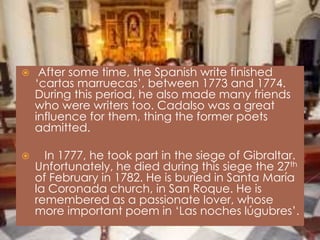
    of February in 1782. He is buried in Santa María
    la Coronada church, in San Roque. He is
    remembered as a passionate lover, whose
    more important poem in ‘Las noches lúgubres’.

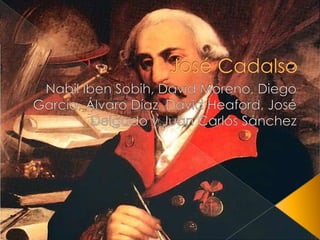
José cadalso

  • 2.
    José Cadalso y Vázquez was born the 8th of October 1741 in San Roque. He was a Spanish soldier and writer. His mother died during the birth, and his father was busy with his business in America. José Cadalso first met his father when he was 13 years old.  The writer was brought up by his religious uncle, Mateo Vázquez, who sent José Cadalso to France. When his father arrived from the recently discovered land, he went to Paris to meet his son. Then, they both travelled all over Europe, and when they returned to Spain, the young boy had a very bad impression from a country he didn’t know in contrast with the experience he had in all the other European countries. This situation inspired one of his most famous works, ‘Cartas marruecas’.  Then, at the age of 16 and by the will of his father he entered the Nobles Seminar. His father wanted to re-educate Cadalso and prepare him for a job related to bureaucracy, which he hated. During all this time, he tried to make his father send him again to the ‘real Europe’, and between the age of 18 and 20 he lived in London and Paris, but then he had to return to Spain due to his father death in 1761.
  • 3.
    Back in the country where he was born, José Cadalso made the arrangements for the inheritance so hurriedly that he ran out of cash some time after, so he had to join the army in 1762. He participated in the campaign of Portugal and in the mutiny of Esquilache.  When his regiment was moved to Madrid, Cadalso fell in live with counsellor Collado´s daughter. They almost got married. He also fell in love with the Marquise of Escalona. Because of that relationship, José Cadalso had the chance to meet the president of the Council of Castilla. Then, the writer gave him a part of his novel ‘Observaciones de un official holandés en el recién descubierto reino de Felicia'.
  • 4.
    During his stay at Madrid, he started to write some critics about the civilians’ manners, so he was made to leave Madrid for six months, so he stayed in Zaragoza until 1770, where he wrote some his famous poems.  After those six months, Cadalso went back to Madrid, where he stayed between 1770 and 1772. During this period he met the person who became the love of his live, María Ignacia Ibáñez. However, this love didn´t last too much because of María’s sudden death. It is said that once Cadalso tried to unearth his love’s corpse to say the last goodbye. Right after that, he wrote ‘Noches lúgubres’.
  • 5.
    After some time, the Spanish write finished ‘cartas marruecas’, between 1773 and 1774. During this period, he also made many friends who were writers too. Cadalso was a great influence for them, thing the former poets admitted.  In 1777, he took part in the siege of Gibraltar. Unfortunately, he died during this siege the 27th of February in 1782. He is buried in Santa María la Coronada church, in San Roque. He is remembered as a passionate lover, whose more important poem in ‘Las noches lúgubres’.