JOKES SEE ALSO “AMBIGUITY” AND “LANGUAGE PLAY” by Don L. F. Nilsen and Alleen Pace Nilsen
Joking Relationships Joking relationships occur “between two persons in which one is by custom permitted and in some instances required to tease or make fun of the other.” (Kuipers 364) (Radcliffe-Brown 195)
EXAGGERATION & SURPRISE Exaggeration and surprise are features that can be found in most jokes.  Bill Dana demonstrates that the same joke can be told with only the details and local color changing, and the rest of the joke remaining the same.
FIRST TELLING A large group is assembled in an auditorium when from the loudspeaker comes the message: “ Will the person with New York license plate BL 74468459030623145098725, kindly remove it?  Your license plate is blocking traffic.
SECOND TELLING Two cowboys are talking and the first one explains that the name of his ranch is the “Bar Nine Circle Z Rocking O Flying W Lazy R Happy Two Flying Nun Ranch.” A second cowboy asks if he has many cattle, and the first cowboy responds, “Not many survive the branding.”
THIRD TELLING Two football players are talking and one of them begins describing a heroic run he made during the final game of the season. Nobody on the opposing team could tackle him.
Finally, “they brought a cannon out onto the field, and they shot me with the cannon, and then airplanes came down with machine guns.  They still couldn’t stop me.  And I finally made a touchdown. The other player indignantly interjects that “Anybody who was in the stadium could prove that was a lie.” The first player responded, “There were no survivors.” (Nilsen & Nilsen 118)
JOKE CYCLES Very often jokes occur in joke cycles.  Consider the following joke cycles.
ACRONYM JOKES These jokes are often found on vanity license plates or bumper stickers: 10SNE1 (tennis anyone?) XQUSME (excuse me) 4RGRAN (for our grandchild) BS, MS, PhD (Bull Shit, More of the Same, Piled Higher and Deeper) (Nilsen & Nilsen 175)
LIGHTBULB JOKES How many New Yorkers? 3: One to do it and two to criticize. How many grad students? 3: 2 plus a professor to take the credit How many Jewish mothers? None:  I’ll just sit in the dark.
How many Los Angeles Police? 6: one to do it and five to smash the old bulb to smithereens. How many mice does it take to screw in a lightbulb? 2: but they have to be really small. How many Dolly clones? As many as you’d like.  As many as you’d like.  As many as you’d like. (Nilsen & Nilsen 176)
LIGHT BULB JOKE VARIATION: What’s the difference between a pregnant woman and a light bulb? You can unscrew the light bulb. (Nilsen & Nilsen 176)
NEW DEFINITIONS Artery : The study of painting Bacteria : The back door of a cafeteria Barium : What doctors do when patients die. Nilsen & Nilsen 177)
SNIGLETS Rich Hall invented the term “sniglet” for a word that should be in the dictionary, but isn’t. Elbonics (el bon’ iks) n. The actions of two people maneuvering for one armrest in a movie theater.
Esso Asso  (eso a’so): The person behind you in a right-hand turn lane who cuts through the Esso Station. Pupkus  (pup’kus) n. The moist residue left on a window after a dog presses its nose to it. Phonesia  (fo nee’ zhuh) n. The affliction of dialing a phone number and forgetting whom you were calling just as they answer.
TOM SWIFTIES People who used to read the  Tom Swift  novels invented a new type of joke: “ My name is Tom, he said Swiftly.” This pattern is extended to: “ I’d like my egg boiled,” she whispered softly.”
“ Get to the back of the boat!” he shouted sternly. “ Would you like another pancake?” she asked flippantly. “ She works in the mines,” he roared ironically. (Nilsen & Nilsen 176)
TOP TEN LIST In 1993 when David Letterman left NBC to move to a better time slot at CBS, he made a list of his “Top 10 Things I Have To Do Before I Leave NBC.”  Here are some of the items on that list: Drop off hairpiece at security desk. Vacuum out Wendell (his announcer) and write down his mileage.
Steal my weight in office supplies. Let my plastic surgeon step out and take a bow—this has been his show as much as mine. Get one more cheap laugh by saying the word  Buttafuoco . (Nilsen & Nilsen 176)
VIRUS JOKES AT&T Virus:  Every three minutes it tells you what great service you are getting. MCI Virus: Every three minutes it reminds you that you’re paying too much for the AT&T virus.
Paul Revere Virus: This revolutionary virus does not horse around.  It warns you of impending hard disk attack—once if by LAN, twice if by C:>. New World Order Virus:  Probably harmless, but it makes a lot of people really mad just thinking about it. (Nilsen & Nilsen 177)
!EPIPHANY What all jokes seem to have is an epiphany.  So here is a joke that illustrates the nature of epiphany: A man has been a customer in a particular restaurant for twenty years.  He sits down to his regular dinner and immediately calls the waiter over to his table and demands that he “taste the soup.”
!! The waiter is most apologetic and says, “I’m sorry sir.  What’s wrong?  Here, let me get you another bowl.” “ Taste the soup!” demands the irritated customer.
!!! Again the waiter apologizes and leans forward to whisk away the offending bowl. “ No!” demands the customer, who by now is irate: “Taste the soup.” The humbled waiter leans over to obey and asks in surprise, “Where’s the spoon?” “ Ah ha!” cries the customer. (Nilsen & Nilsen 292)
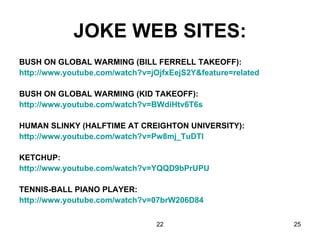
JOKE WEB SITES: BUSH ON GLOBAL WARMING (BILL FERRELL TAKEOFF): http://www.youtube.com/watch?v=jOjfxEejS2Y&feature=related   BUSH ON GLOBAL WARMING (KID TAKEOFF): http://www.youtube.com/watch?v=BWdiHtv6T6s   HUMAN SLINKY (HALFTIME AT CREIGHTON UNIVERSITY): http://www.youtube.com/watch?v=Pw8mj_TuDTI   KETCHUP: http://www.youtube.com/watch?v=YQQD9bPrUPU   TENNIS-BALL PIANO PLAYER: http://www.youtube.com/watch?v=07brW206D84
References: Asimov, Isaac.  Asimov Laughs Again: More Than 700 Jokes, Limericks, and Anecdotes . New York, NY: Harper Books, 1993. Asimov, Isaac.  Isaac Asimov’s Treasure of Humor: A Lifetime Collection of Favorite Jokes, Anecdotes, and Limericks with Copious Notes on How to Tell Them and Why . New York, NY: Houghton Mifflin, 1971. Asimov, Isaac. “Jokester.” in  Robot Dreams . London, England: Gollancz, 1956, 278-294. Attardo, Salvatore, and Jean-Charles Chabanne. “Jokes as a Text Type.”  HUMOR: International Journal of Humor Research  5.5 (1992):P 165-176. Attardo, Salvatore, and Victor Raskin. “Script Theory Revis(it)ed: Joke Similarity and Joke Representation Model.”  HUMOR: International Journal of Humor Research  4.3-4 (1991): 293-341. Benton, Gregor. “The Origins of the Political Joke.” in Powell and Paton (1988): 33-55.
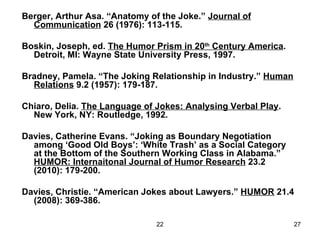
Berger, Arthur Asa. “Anatomy of the Joke.”  Journal of Communication  26 (1976): 113-115. Boskin, Joseph, ed.  The Humor Prism in 20 th  Century America . Detroit, MI: Wayne State University Press, 1997. Bradney, Pamela. “The Joking Relationship in Industry.”  Human Relations  9.2 (1957): 179-187. Chiaro, Delia.  The Language of Jokes: Analysing Verbal Play . New York, NY: Routledge, 1992. Davies, Catherine Evans. “Joking as Boundary Negotiation among ‘Good Old Boys’: ‘White Trash’ as a Social Category at the Bottom of the Southern Working Class in Alabama.”  HUMOR: Internaitonal Journal of Humor Research  23.2 (2010): 179-200. Davies, Christie. “American Jokes about Lawyers.”  HUMOR  21.4 (2008): 369-386.
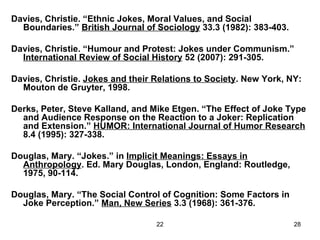
Davies, Christie. “Ethnic Jokes, Moral Values, and Social Boundaries.”  British Journal of Sociology  33.3 (1982): 383-403. Davies, Christie. “Humour and Protest: Jokes under Communism.”  International Review of Social History  52 (2007): 291-305. Davies, Christie.  Jokes and their Relations to Society . New York, NY: Mouton de Gruyter, 1998. Derks, Peter, Steve Kalland, and Mike Etgen. “The Effect of Joke Type and Audience Response on the Reaction to a Joker: Replication and Extension.”  HUMOR: International Journal of Humor Research  8.4 (1995): 327-338. Douglas, Mary. “Jokes.” in  Implicit Meanings: Essays in Anthropology . Ed. Mary Douglas, London, England: Routledge, 1975, 90-114. Douglas, Mary. “The Social Control of Cognition: Some Factors in Joke Perception.”  Man, New Series  3.3 (1968): 361-376.
Dundes, Alan. “Auschwitz Jokes.”  Western Folklore  42.4 (1983): 249-260. Dundes, Alan.  Cracking Jokes: Studies of Sick Humor Cycles and Stereotypes . Berkeley, CA: Ten Speed Press, 1987. Feldman, Gilda, and Phil Feldman.  Acronym Soup: A Stirring Guide to Our Newest Word Form . New York, NY: William Morrow, 1994. Freud, Sigmund.  Jokes and Their Relation to the Unconscious . New York, NY: Penguin Group, 1905. Galanter, Marc. “The Great American Lawyer Joke Explosion.”  HUMOR  21.4 (2008): 387-414. Galanter, Marc.  Lowering the Bar: Lawyer Jokes and Legal Culture . Madison, WI: University of Wisconsiln Press, 2004. Groch, A. “Joking and Appreciation of Humor in Nursery School Children.”  Child Development  45.4 (1974): 1098-1102.
Gundelach, Peter. “Joking Relationships and National Identity in Scandinavia.”  Acta Sociologica  43.2 (2000): 113-122. Hall, Jeffrey A., and Ken Sereno. “Offensive Jokes: How Do They Impact Long-Term Relationships?”  HUMOR: International Journal of Humor Research  23.3 (2010): 351-374. Hall, Rich.  Sniglets (Snig’lit)—Any Word That Doesn’t Appear in the Dictionary, but Should . New York, NY: Collier Books, 1984. Hart, Marjolein, and Dennis Bos, eds.  Humour and Social Protest . Special issue of  International Review of Social History  52, Supplement S15 (2007). Herzog, Thomas R., Anne C. Harris, Laura S. Knoposcott, and Katherine L. Fuller. “Joke Cruelty and Appreciation Reviseted.”  HUMOR: International Journal of Humor Research  19.2 (2006): 139-156. Kuipers, Giselinde. “The Difference between a Surinamese and a Turk: Ethnic Jokes and the Position of Ethnic Minorities in the Netherlands.”  HUMOR: International Journal of Humor Research  12.2 (2000): 141-175. Kuipers, Giselinde. “The Sociology of Humor.” in Raskin (2008): 361-398.
Kuipers, Giselinde. “Where was King Kong when We Needed Him?  Public Discourse, Digital Disaster Jokes, and the Functions of Laughter after 9/11.”  Journal of American Culture  28.1 (2005): 70-84. Lockyer, Sharon, and Michael Pickering.  Beyond the Joke: The Limits of Humour . Basingstoke, England: Palgrave, 2005. Martin, Rod A.  The Psychology of Humor: An Integrative Approach . London, England: Elsevier, 2007. Morrow, P. D. “Those Sick Challenger Jokes.”  Journal of Popular Culture  20.4 (1987): 175-184. Nilsen, Alleen Pace, and Don L. F. Nilsen.  Encyclopedia of 20 th  Century American Humor . Westport, Ct: Greenwood, 2000. Norrick, Neal R.  Conversational Joking: Humor in Everyday Talk . Bloomington, IN: Indiana University Press, 1993.
Norrick, Neal R. “Laughter before the Punch Line During the Performance of Narrative Jokes in Conversation.”  Text and Talk  30.1 (2010): 75-95. Norrick, Neal R. “Non-verbal Humor and Joke Performance.”  HUMOR  7.4 (2004): 401-409. Norrick, Neal R. “On the Conversational Performance of Narrative Jokes: Towards an Account of Timing.”  HUMOR . 14.3 (2001): 255-274. Oring, Elliott. “Between Jokes and Tales: On the Nature of Punch Lines.”  HUMOR: International Journal of Humor Research  2.4 (1989): 349-364. Oring, Elliott.  The Jokes of Sigmund Freud: A Study in Humor and Jewish Identity, 3 rd  Edition . Lanham, MD: Jason Aronson, 2007. Oring, Elliott. “Jokes and the Discourse on Disaster: The Challenger Shuttle Explosion and Its Joke Cycle.”  Journal of American Folklore  100 (1987): 276-286. Oring, Elliott.  Jokes and Their Relations . Lexington, KY: University of Kentucky, 1992.
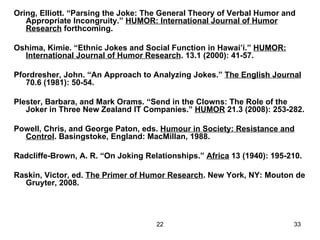
Oring, Elliott. “Parsing the Joke: The General Theory of Verbal Humor and Appropriate Incongruity.”  HUMOR: International Journal of Humor Research  forthcoming. Oshima, Kimie. “Ethnic Jokes and Social Function in Hawai’i.”  HUMOR: International Journal of Humor Research . 13.1 (2000): 41-57. Pfordresher, John. “An Approach to Analyzing Jokes.”  The English Journal  70.6 (1981): 50-54. Plester, Barbara, and Mark Orams. “Send in the Clowns: The Role of the Joker in Three New Zealand IT Companies.”  HUMOR  21.3 (2008): 253-282. Powell, Chris, and George Paton, eds.  Humour in Society: Resistance and Control . Basingstoke, England: MacMillan, 1988. Radcliffe-Brown, A. R. “On Joking Relationships.”  Africa  13 (1940): 195-210. Raskin, Victor, ed.  The Primer of Humor Research . New York, NY: Mouton de Gruyter, 2008.
Raskin, Victor.  Semantic Mechanisms of Humor . Dordrecht, Netherlands: D. Reidel, 1985. Sherzer, Joel. “On Play, Joking, Humor and Tricking in Kuna: The Agouti Story.”  Journal of Folklore Research  27.1 (1990): 85-114. Shiffman, Limor, Stephen Coleman, and Stephen Ward. “Only Joking? Online Humour in the 2005 UK General Election.”  Information, Communication and Society  10.4 (2007): 465-487. Sykes, A. J. M. “Joking Relationships in an Industrial Setting.”  American Anthropologist  68 (1966): 188-193. Walle, Alf. “Getting Picked Up Without Being Put Down: Jokes and the Bar Rush.”  Journal of the Folklore Institute  13 (1976): 201-217. Zenner, Walter P. “Joking and Ethnic Stereotyping.”  Anthropological Quarterly  43.2 (1970): 93-113.

Jokes

  • 1.
    JOKES SEE ALSO“AMBIGUITY” AND “LANGUAGE PLAY” by Don L. F. Nilsen and Alleen Pace Nilsen
  • 2.
    Joking Relationships Jokingrelationships occur “between two persons in which one is by custom permitted and in some instances required to tease or make fun of the other.” (Kuipers 364) (Radcliffe-Brown 195)
  • 3.
    EXAGGERATION & SURPRISEExaggeration and surprise are features that can be found in most jokes. Bill Dana demonstrates that the same joke can be told with only the details and local color changing, and the rest of the joke remaining the same.
  • 4.
    FIRST TELLING Alarge group is assembled in an auditorium when from the loudspeaker comes the message: “ Will the person with New York license plate BL 74468459030623145098725, kindly remove it? Your license plate is blocking traffic.
  • 5.
    SECOND TELLING Twocowboys are talking and the first one explains that the name of his ranch is the “Bar Nine Circle Z Rocking O Flying W Lazy R Happy Two Flying Nun Ranch.” A second cowboy asks if he has many cattle, and the first cowboy responds, “Not many survive the branding.”
  • 6.
    THIRD TELLING Twofootball players are talking and one of them begins describing a heroic run he made during the final game of the season. Nobody on the opposing team could tackle him.
  • 7.
    Finally, “they broughta cannon out onto the field, and they shot me with the cannon, and then airplanes came down with machine guns. They still couldn’t stop me. And I finally made a touchdown. The other player indignantly interjects that “Anybody who was in the stadium could prove that was a lie.” The first player responded, “There were no survivors.” (Nilsen & Nilsen 118)
  • 8.
    JOKE CYCLES Veryoften jokes occur in joke cycles. Consider the following joke cycles.
  • 9.
    ACRONYM JOKES Thesejokes are often found on vanity license plates or bumper stickers: 10SNE1 (tennis anyone?) XQUSME (excuse me) 4RGRAN (for our grandchild) BS, MS, PhD (Bull Shit, More of the Same, Piled Higher and Deeper) (Nilsen & Nilsen 175)
  • 10.
    LIGHTBULB JOKES Howmany New Yorkers? 3: One to do it and two to criticize. How many grad students? 3: 2 plus a professor to take the credit How many Jewish mothers? None: I’ll just sit in the dark.
  • 11.
    How many LosAngeles Police? 6: one to do it and five to smash the old bulb to smithereens. How many mice does it take to screw in a lightbulb? 2: but they have to be really small. How many Dolly clones? As many as you’d like. As many as you’d like. As many as you’d like. (Nilsen & Nilsen 176)
  • 12.
    LIGHT BULB JOKEVARIATION: What’s the difference between a pregnant woman and a light bulb? You can unscrew the light bulb. (Nilsen & Nilsen 176)
  • 13.
    NEW DEFINITIONS Artery: The study of painting Bacteria : The back door of a cafeteria Barium : What doctors do when patients die. Nilsen & Nilsen 177)
  • 14.
    SNIGLETS Rich Hallinvented the term “sniglet” for a word that should be in the dictionary, but isn’t. Elbonics (el bon’ iks) n. The actions of two people maneuvering for one armrest in a movie theater.
  • 15.
    Esso Asso (eso a’so): The person behind you in a right-hand turn lane who cuts through the Esso Station. Pupkus (pup’kus) n. The moist residue left on a window after a dog presses its nose to it. Phonesia (fo nee’ zhuh) n. The affliction of dialing a phone number and forgetting whom you were calling just as they answer.
  • 16.
    TOM SWIFTIES Peoplewho used to read the Tom Swift novels invented a new type of joke: “ My name is Tom, he said Swiftly.” This pattern is extended to: “ I’d like my egg boiled,” she whispered softly.”
  • 17.
    “ Get tothe back of the boat!” he shouted sternly. “ Would you like another pancake?” she asked flippantly. “ She works in the mines,” he roared ironically. (Nilsen & Nilsen 176)
  • 18.
    TOP TEN LISTIn 1993 when David Letterman left NBC to move to a better time slot at CBS, he made a list of his “Top 10 Things I Have To Do Before I Leave NBC.” Here are some of the items on that list: Drop off hairpiece at security desk. Vacuum out Wendell (his announcer) and write down his mileage.
  • 19.
    Steal my weightin office supplies. Let my plastic surgeon step out and take a bow—this has been his show as much as mine. Get one more cheap laugh by saying the word Buttafuoco . (Nilsen & Nilsen 176)
  • 20.
    VIRUS JOKES AT&TVirus: Every three minutes it tells you what great service you are getting. MCI Virus: Every three minutes it reminds you that you’re paying too much for the AT&T virus.
  • 21.
    Paul Revere Virus:This revolutionary virus does not horse around. It warns you of impending hard disk attack—once if by LAN, twice if by C:>. New World Order Virus: Probably harmless, but it makes a lot of people really mad just thinking about it. (Nilsen & Nilsen 177)
  • 22.
    !EPIPHANY What alljokes seem to have is an epiphany. So here is a joke that illustrates the nature of epiphany: A man has been a customer in a particular restaurant for twenty years. He sits down to his regular dinner and immediately calls the waiter over to his table and demands that he “taste the soup.”
  • 23.
    !! The waiteris most apologetic and says, “I’m sorry sir. What’s wrong? Here, let me get you another bowl.” “ Taste the soup!” demands the irritated customer.
  • 24.
    !!! Again thewaiter apologizes and leans forward to whisk away the offending bowl. “ No!” demands the customer, who by now is irate: “Taste the soup.” The humbled waiter leans over to obey and asks in surprise, “Where’s the spoon?” “ Ah ha!” cries the customer. (Nilsen & Nilsen 292)
  • 25.
    JOKE WEB SITES:BUSH ON GLOBAL WARMING (BILL FERRELL TAKEOFF): http://www.youtube.com/watch?v=jOjfxEejS2Y&feature=related BUSH ON GLOBAL WARMING (KID TAKEOFF): http://www.youtube.com/watch?v=BWdiHtv6T6s HUMAN SLINKY (HALFTIME AT CREIGHTON UNIVERSITY): http://www.youtube.com/watch?v=Pw8mj_TuDTI KETCHUP: http://www.youtube.com/watch?v=YQQD9bPrUPU TENNIS-BALL PIANO PLAYER: http://www.youtube.com/watch?v=07brW206D84
  • 26.
    References: Asimov, Isaac. Asimov Laughs Again: More Than 700 Jokes, Limericks, and Anecdotes . New York, NY: Harper Books, 1993. Asimov, Isaac. Isaac Asimov’s Treasure of Humor: A Lifetime Collection of Favorite Jokes, Anecdotes, and Limericks with Copious Notes on How to Tell Them and Why . New York, NY: Houghton Mifflin, 1971. Asimov, Isaac. “Jokester.” in Robot Dreams . London, England: Gollancz, 1956, 278-294. Attardo, Salvatore, and Jean-Charles Chabanne. “Jokes as a Text Type.” HUMOR: International Journal of Humor Research 5.5 (1992):P 165-176. Attardo, Salvatore, and Victor Raskin. “Script Theory Revis(it)ed: Joke Similarity and Joke Representation Model.” HUMOR: International Journal of Humor Research 4.3-4 (1991): 293-341. Benton, Gregor. “The Origins of the Political Joke.” in Powell and Paton (1988): 33-55.
  • 27.
    Berger, Arthur Asa.“Anatomy of the Joke.” Journal of Communication 26 (1976): 113-115. Boskin, Joseph, ed. The Humor Prism in 20 th Century America . Detroit, MI: Wayne State University Press, 1997. Bradney, Pamela. “The Joking Relationship in Industry.” Human Relations 9.2 (1957): 179-187. Chiaro, Delia. The Language of Jokes: Analysing Verbal Play . New York, NY: Routledge, 1992. Davies, Catherine Evans. “Joking as Boundary Negotiation among ‘Good Old Boys’: ‘White Trash’ as a Social Category at the Bottom of the Southern Working Class in Alabama.” HUMOR: Internaitonal Journal of Humor Research 23.2 (2010): 179-200. Davies, Christie. “American Jokes about Lawyers.” HUMOR 21.4 (2008): 369-386.
  • 28.
    Davies, Christie. “EthnicJokes, Moral Values, and Social Boundaries.” British Journal of Sociology 33.3 (1982): 383-403. Davies, Christie. “Humour and Protest: Jokes under Communism.” International Review of Social History 52 (2007): 291-305. Davies, Christie. Jokes and their Relations to Society . New York, NY: Mouton de Gruyter, 1998. Derks, Peter, Steve Kalland, and Mike Etgen. “The Effect of Joke Type and Audience Response on the Reaction to a Joker: Replication and Extension.” HUMOR: International Journal of Humor Research 8.4 (1995): 327-338. Douglas, Mary. “Jokes.” in Implicit Meanings: Essays in Anthropology . Ed. Mary Douglas, London, England: Routledge, 1975, 90-114. Douglas, Mary. “The Social Control of Cognition: Some Factors in Joke Perception.” Man, New Series 3.3 (1968): 361-376.
  • 29.
    Dundes, Alan. “AuschwitzJokes.” Western Folklore 42.4 (1983): 249-260. Dundes, Alan. Cracking Jokes: Studies of Sick Humor Cycles and Stereotypes . Berkeley, CA: Ten Speed Press, 1987. Feldman, Gilda, and Phil Feldman. Acronym Soup: A Stirring Guide to Our Newest Word Form . New York, NY: William Morrow, 1994. Freud, Sigmund. Jokes and Their Relation to the Unconscious . New York, NY: Penguin Group, 1905. Galanter, Marc. “The Great American Lawyer Joke Explosion.” HUMOR 21.4 (2008): 387-414. Galanter, Marc. Lowering the Bar: Lawyer Jokes and Legal Culture . Madison, WI: University of Wisconsiln Press, 2004. Groch, A. “Joking and Appreciation of Humor in Nursery School Children.” Child Development 45.4 (1974): 1098-1102.
  • 30.
    Gundelach, Peter. “JokingRelationships and National Identity in Scandinavia.” Acta Sociologica 43.2 (2000): 113-122. Hall, Jeffrey A., and Ken Sereno. “Offensive Jokes: How Do They Impact Long-Term Relationships?” HUMOR: International Journal of Humor Research 23.3 (2010): 351-374. Hall, Rich. Sniglets (Snig’lit)—Any Word That Doesn’t Appear in the Dictionary, but Should . New York, NY: Collier Books, 1984. Hart, Marjolein, and Dennis Bos, eds. Humour and Social Protest . Special issue of International Review of Social History 52, Supplement S15 (2007). Herzog, Thomas R., Anne C. Harris, Laura S. Knoposcott, and Katherine L. Fuller. “Joke Cruelty and Appreciation Reviseted.” HUMOR: International Journal of Humor Research 19.2 (2006): 139-156. Kuipers, Giselinde. “The Difference between a Surinamese and a Turk: Ethnic Jokes and the Position of Ethnic Minorities in the Netherlands.” HUMOR: International Journal of Humor Research 12.2 (2000): 141-175. Kuipers, Giselinde. “The Sociology of Humor.” in Raskin (2008): 361-398.
  • 31.
    Kuipers, Giselinde. “Wherewas King Kong when We Needed Him? Public Discourse, Digital Disaster Jokes, and the Functions of Laughter after 9/11.” Journal of American Culture 28.1 (2005): 70-84. Lockyer, Sharon, and Michael Pickering. Beyond the Joke: The Limits of Humour . Basingstoke, England: Palgrave, 2005. Martin, Rod A. The Psychology of Humor: An Integrative Approach . London, England: Elsevier, 2007. Morrow, P. D. “Those Sick Challenger Jokes.” Journal of Popular Culture 20.4 (1987): 175-184. Nilsen, Alleen Pace, and Don L. F. Nilsen. Encyclopedia of 20 th Century American Humor . Westport, Ct: Greenwood, 2000. Norrick, Neal R. Conversational Joking: Humor in Everyday Talk . Bloomington, IN: Indiana University Press, 1993.
  • 32.
    Norrick, Neal R.“Laughter before the Punch Line During the Performance of Narrative Jokes in Conversation.” Text and Talk 30.1 (2010): 75-95. Norrick, Neal R. “Non-verbal Humor and Joke Performance.” HUMOR 7.4 (2004): 401-409. Norrick, Neal R. “On the Conversational Performance of Narrative Jokes: Towards an Account of Timing.” HUMOR . 14.3 (2001): 255-274. Oring, Elliott. “Between Jokes and Tales: On the Nature of Punch Lines.” HUMOR: International Journal of Humor Research 2.4 (1989): 349-364. Oring, Elliott. The Jokes of Sigmund Freud: A Study in Humor and Jewish Identity, 3 rd Edition . Lanham, MD: Jason Aronson, 2007. Oring, Elliott. “Jokes and the Discourse on Disaster: The Challenger Shuttle Explosion and Its Joke Cycle.” Journal of American Folklore 100 (1987): 276-286. Oring, Elliott. Jokes and Their Relations . Lexington, KY: University of Kentucky, 1992.
  • 33.
    Oring, Elliott. “Parsingthe Joke: The General Theory of Verbal Humor and Appropriate Incongruity.” HUMOR: International Journal of Humor Research forthcoming. Oshima, Kimie. “Ethnic Jokes and Social Function in Hawai’i.” HUMOR: International Journal of Humor Research . 13.1 (2000): 41-57. Pfordresher, John. “An Approach to Analyzing Jokes.” The English Journal 70.6 (1981): 50-54. Plester, Barbara, and Mark Orams. “Send in the Clowns: The Role of the Joker in Three New Zealand IT Companies.” HUMOR 21.3 (2008): 253-282. Powell, Chris, and George Paton, eds. Humour in Society: Resistance and Control . Basingstoke, England: MacMillan, 1988. Radcliffe-Brown, A. R. “On Joking Relationships.” Africa 13 (1940): 195-210. Raskin, Victor, ed. The Primer of Humor Research . New York, NY: Mouton de Gruyter, 2008.
  • 34.
    Raskin, Victor. Semantic Mechanisms of Humor . Dordrecht, Netherlands: D. Reidel, 1985. Sherzer, Joel. “On Play, Joking, Humor and Tricking in Kuna: The Agouti Story.” Journal of Folklore Research 27.1 (1990): 85-114. Shiffman, Limor, Stephen Coleman, and Stephen Ward. “Only Joking? Online Humour in the 2005 UK General Election.” Information, Communication and Society 10.4 (2007): 465-487. Sykes, A. J. M. “Joking Relationships in an Industrial Setting.” American Anthropologist 68 (1966): 188-193. Walle, Alf. “Getting Picked Up Without Being Put Down: Jokes and the Bar Rush.” Journal of the Folklore Institute 13 (1976): 201-217. Zenner, Walter P. “Joking and Ethnic Stereotyping.” Anthropological Quarterly 43.2 (1970): 93-113.