1/27
Joint Autoencoder-Classifier Model for
Malfunction Identification and Classification on
Marine Diesel Engine Diagnostics Data
Kürşat İnce
HAVELSAN Inc.
Naval Combat Management
Technologies Center
kince@havelsan.com.tr​
Gazi Koçak
Istanbul Technical University
Marine Engineering
Department
kocakga@itu.edu.tr
Yakup Genç
Gebze Technical University
Computer Engineering
Department
yakup.genc@gtu.edu.tr​
2/27
Agenda
• Maintenance Strategies and Predictive Maintenance
• Ship Engine Room Simulation Dataset (MC90-V)
• Fault Classification Problem
• Joint Autoencoder-Classifier Architecture
• Emission Prediction Problem
• Experimental Results
• Conclusion
3/27
Maintenance Approaches
• Maintenance: The act of keeping something in good condition by
checking or repairing it regularly. (The Oxford Dictionary)
• Breakdown Maintenance
• Allow machine/equipment until it breaks down, i.e. run to failure, then replace the
defective part(s).
• Preventive Maintenance
• Carry out the repair or replacement via manufacturer specified time intervals.
• Proactive Maintenance
• Prevention of the failure: trace all failures to root cause(s). Take proactive measures to
ensure that they do not repeat. May require design change(s).
• Predictive Maintenance
• Monitor machine/equipment condition for possible performance/quality loss. Schedule
maintenance only when a functional failure is detected.
4/27
Predictive Maintenance
• Benefits
• Reduction or elimination of unscheduled equipment downtime
• Increased labor utilization
• Increased production capacity
• Reduced maintenance costs
• Increased equipment lifespan
• Problems (for data-driven models)
• Availability of system monitoring data (label/unlabeled)
• Availability of maintenance records
5/27
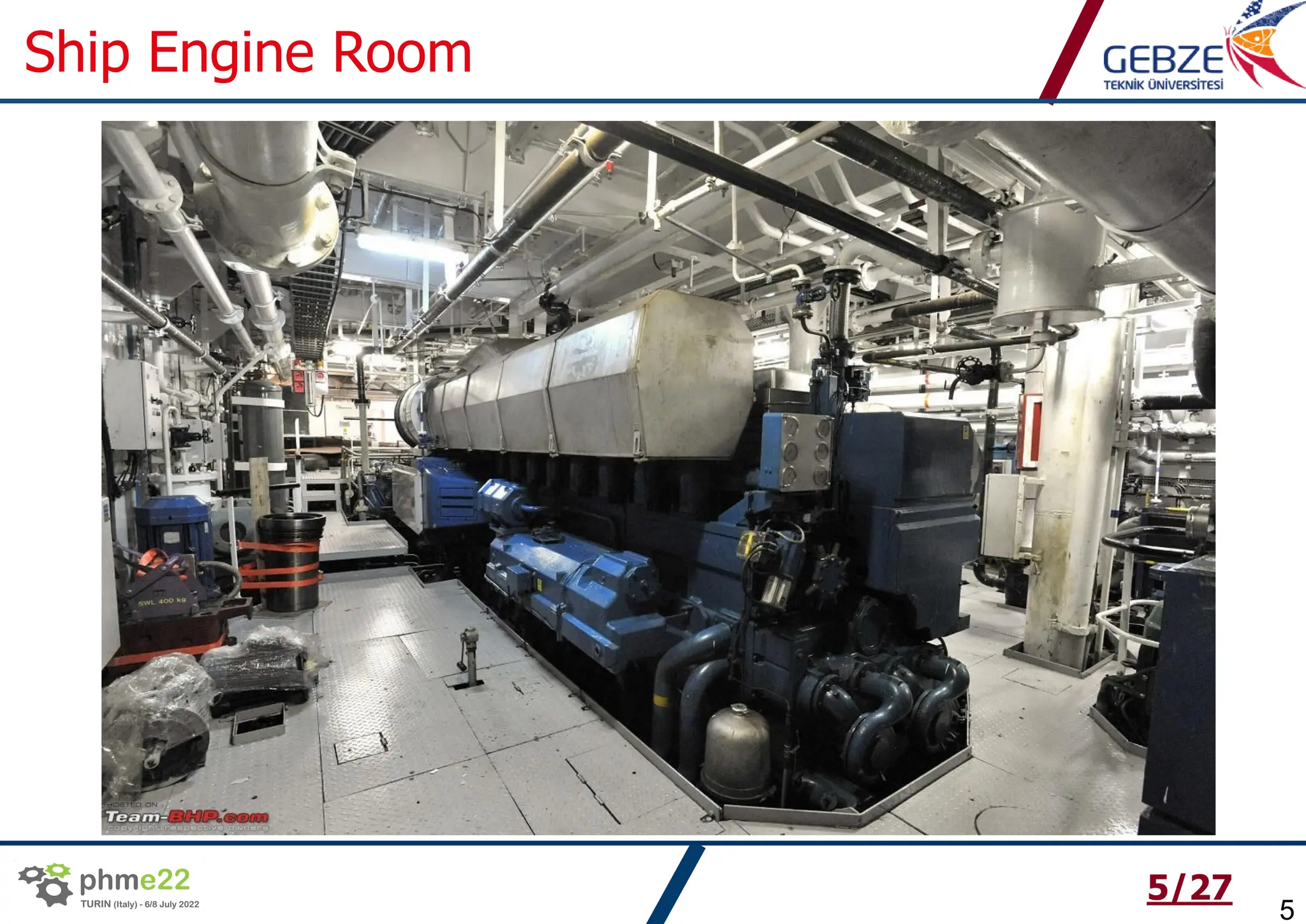
Ship Engine Room
5
6/27
MC90-V Engine Room Simulator
• K-Sim: A well-known ship engine room
simulator with high fidelity.
• ERS MAN B&W 5L90MC VLCC L11-V
• Simulates a very large crude carrier
• With a MAN B&W slow speed turbo
charged diesel engine
• The model is based on real engine data
that make the dynamic behavior of the
simulator close to real engine response.
• The simulator includes Control room
operator station and panels and bridge
and steering panels, etc.
7/27
MC90-V Engine Room Simulator
8/27
Ship Engine Room Simulation Dataset
• Initial Conditions
Condition Value
Ship Speed/Load Full Ahead Loaded (FAL)
Full Ahead Unloaded (FAU)
Sea Water Temperature 20oC,
25oC,
28oC
Sea condition (Beauf) 0
4
6
9/27
Ship Engine Room Simulation Dataset – Cont.ed
• Fault Classes
• Normal condition (M000)
• Cyl 1 injection valve nozzle wear (M2503)
• Cyl 1 injection valve nozzle clogged (M2508)
• Cyl 1 piston ring stiction (M2520)
10/27
Ship Engine Room Simulation Dataset – Cont.ed
•Dataset construction
• No of Fault Classes: 4
• Initial Conditions: 18
• 53 runs /per fault class /per IC
• 35 for training
• 18 for test
• 1000 to 1400 data point per run at 1 Hz
11/27
Ship Engine Room Simulation Dataset – Cont.ed
Variable Unit/Range Description Type
P01600 bar ME air receiver press Real
T01601 degC ME air receiver temp Real
G02051 ton/h ME cyl 1 air flow Virtual
T02042 degC ME cyl 1 air inlet temp Real
P02065 bar ME cyl 1 combustion press (pmax) Real
P02066 bar ME cyl 1 compression press (pcompr) Real
T02040 degC ME cyl 1 exh outlet temp Real
T02041 degC ME cyl 1 exh outlet temp deviation Real
G02050 kg/h ME cyl 1 FO flow Virtual
E02056 kW ME cyl 1 indicated power (IKW) Real
P02072 bar ME cyl 1 injection max press (pinjm) Real
P02071 bar ME cyl 1 injection open press (pinjo) Real
X02074 deg ME cyl 1 length of injection (linj) Virtual
P02055 bar ME Cyl 1 mean effective pressure (mip) Real
G02052 ton/h ME cyl 1 oil flow Virtual
T02044 degC ME cyl 1 oil outlet temp (piston) Real
… … … …
12/27
MC90-V Dataset Research Challenges
• Challenges related to predictive maintenance
• Fault identification and classification: Identifying the state of the
machinery, whether it is operating normal, and predicting the
fault type if it is not.
• Health index generation: Predicting the health state of the
machinery, i.e. Cyl 1.
• Remaining useful life prediction (RUL): Predicting time to failure
for Cyl 1.
• Challenges related to emissions
• NOx, SOx and Smoke Content
13/27
Initial Study on MC90-V Dataset
• Fault Detection with Joint Autoencoder-Classification Model
• NOx and SOx gases emission prediction
More info
14/27
General Framework
15/27
Fault Detection
Problem: Develop a model that will predict fault type
• M0000: Normal condition
• M2503: Cyl 1 injection valve nozzle wear
• M2508: Cyl 1 injection valve nozzle clogged
• M2520: Cyl 1 piston ring stiction
Inputs:
• Initial conditions
• Sensor values
Condition Value
Ship Speed/Load Full Ahead Loaded (FAL)
Full Ahead Unloaded (FAU)
Sea Water Temperature 20oC 25oC 28oC
Sea condition (Beauf) 0 4 6
16/27
Joint Autoencoder-Classification Architecture
• Inputs:
• X(t): Sensor readings at time (t)
• OC(t): Initial conditions for the experiment.
• Outputs:
• ෠
𝑋(𝑡): Predicted sensor values at time (t)
• ෣
𝐶𝑙𝑎𝑠𝑠(𝑡): Predicted fault class of the experiment
CNN
LSTM
CNN
17/27
Fault Classification Results
Test 20% 40% 60% 80% 100%
Train ACC F1 ACC F1 ACC F1 ACC F1 ACC F1
20% 79.77 79.83 85.39 85.39 73.22 72.88 65.35 64.78 61.78 60.56
40% 78.87 79.13 90.55 90.65 90.42 90.45 85.67 85.25 82.34 81.32
60% 79.15 79.12 90.68 90.68 94.00 94.00 93.70 93.69 91.78 91.78
80% 73.98 74.01 88.37 88.58 92.51 92.63 94.48 94.55 91.14 91.12
100% 73.17 73.23 88.01 88.25 92.28 92.41 94.31 94.39 93.61 93.63
18/27
Confusion Matrices (for 100% test data)
20% training data 40% training data 60% training data
80% training data Full training data
19/27
Important Features
Feature Description Unit
P02072 ME cyl 1 injection max press (pinjm) bar
T02044 ME cyl 1 oil outlet temp (piston) degC
Z02013 ME exhaust gas smoke content %
T01351 Main LO temp outlet ME degC
Z01970 ME exh NOx content final g/kWh
T02040 ME cyl 1 exh outlet temp degC
P02071 ME cyl 1 injection open press (pinjo) bar
E02056 ME cyl 1 indicated power (IKW) kW
P01600 ME air receiver press bar
Z00518 ME exh SOx content g/kWh
P02055
ME Cyl 1 mean effective pressure
(mip)
bar
T02042 ME cyl 1 air inlet temp degC
P02066
ME cyl 1 compression press
(pcompr)
bar
T01601 ME air receiver temp degC
20/27
Gas Emission Prediction
Problem:
• As the ships run on diesel fuel, and produce several gases while
burning, their emissions becomes a global concern → Increase
greenhouse effect and global warming
• Develop a model to predict NOx and SOx emissions.
Inputs:
• Initial conditions
• Sensor values
Model: Gradient Boosting model optimized with Optuna
21/27
NOx Plots
22/27
NOx Prediction Results
Ship Load ALL Conditions FAL FAU
Data in use MAE RMSE MAE RMSE MAE RMSE
FULL Data 0.0213 0.0478 0.0094 0.0337 0.0092 0.0276
M0000 0.0021 0.0030 0.0017 0.0023 0.0018 0.0028
M2503 0.0079 0.0115 0.0066 0.0093 0.0056 0.0076
M2508 0.0164 0.0554 0.0151 0.0575 0.0208 0.0562
Ship Load ALL Conditions FAL FAU
Data in use MEAN STD MEAN STD MEAN STD
FULL Data 14.1854 1.0699 15.0664 0.5027 13.2622 0.6433
M0000 13.9247 1.0893 15.0275 0.0207 12.8496 0.0390
M2503 14.6247 1.0358 15.4461 0.5228 13.7989 0.7186
M2508 13.9818 0.9141 14.7040 0.4593 13.1176 0.4605
23/27
SOx Plots
24/27
SOx Prediction Results
Ship Load ALL Conditions FAL FAU
Data in use MAE RMSE MAE RMSE MAE RMSE
FULL Data 0.0053 0.0161 0.0031 0.0084 0.0027 0.0111
M0000 0.0005 0.0009 0.0004 0.0006 0.0005 0.0007
M2503 0.0068 0.0098 0.0053 0.0075 0.0028 0.0038
M2508 0.0039 0.0188 0.0030 0.0114 0.0041 0.0201
Ship Load ALL Conditions FAL FAU
Data in use MEAN STD MEAN STD MEAN STD
FULL Data 13.0589 0.4050 13.1646 0.4764 12.9478 0.2718
M0000 12.8619 0.0584 12.9208 0.0041 12.8043 0.0039
M2503 13.4252 0.5029 13.6387 0.5666 13.2101 0.3037
M2508 12.8650 0.1027 12.9179 0.0637 12.8013 0.1046
25/27
Conclusion and Summary
• Fault Classification
• Joint autoencoder-classifier model
• Autoencoder: CNN. Effective for extracting time series features
• Classifier: LSTM. Does the actual classification
• Successfully added IC knowledge into the model.
• Gas Emission Prediction
• Gradient boosting model
• Reasonable results for NOx and SOx emissions.
• The joint autoencoder-classifier model will be useful for other
time series estimation task on other domains, especially where
the operating condition plays a role in the process.
26/27
Future Plans
• The MC90-V dataset has much more initial conditions than we
have used in this study. We will be inspecting other scenarios in
the future studies.
• We also plan developing a remaining useful life prediction model
which will predict when the failure will occur in the main engine
Cyl. 1.
• We will analyze other types of gas emissions, such as smoke
content, from the engine.
27/27
Thank you…
Kürşat İnce
kince@havelsan.com.tr
kince@gtu.edu.tr

Joint Autoencoder-Classifier Model for Malfunction Identification and Classification on Marine Diesel Engine Diagnostics Data

  • 1.
    1/27 Joint Autoencoder-Classifier Modelfor Malfunction Identification and Classification on Marine Diesel Engine Diagnostics Data Kürşat İnce HAVELSAN Inc. Naval Combat Management Technologies Center kince@havelsan.com.tr​ Gazi Koçak Istanbul Technical University Marine Engineering Department kocakga@itu.edu.tr Yakup Genç Gebze Technical University Computer Engineering Department yakup.genc@gtu.edu.tr​
  • 2.
    2/27 Agenda • Maintenance Strategiesand Predictive Maintenance • Ship Engine Room Simulation Dataset (MC90-V) • Fault Classification Problem • Joint Autoencoder-Classifier Architecture • Emission Prediction Problem • Experimental Results • Conclusion
  • 3.
    3/27 Maintenance Approaches • Maintenance:The act of keeping something in good condition by checking or repairing it regularly. (The Oxford Dictionary) • Breakdown Maintenance • Allow machine/equipment until it breaks down, i.e. run to failure, then replace the defective part(s). • Preventive Maintenance • Carry out the repair or replacement via manufacturer specified time intervals. • Proactive Maintenance • Prevention of the failure: trace all failures to root cause(s). Take proactive measures to ensure that they do not repeat. May require design change(s). • Predictive Maintenance • Monitor machine/equipment condition for possible performance/quality loss. Schedule maintenance only when a functional failure is detected.
  • 4.
    4/27 Predictive Maintenance • Benefits •Reduction or elimination of unscheduled equipment downtime • Increased labor utilization • Increased production capacity • Reduced maintenance costs • Increased equipment lifespan • Problems (for data-driven models) • Availability of system monitoring data (label/unlabeled) • Availability of maintenance records
  • 5.
  • 6.
    6/27 MC90-V Engine RoomSimulator • K-Sim: A well-known ship engine room simulator with high fidelity. • ERS MAN B&W 5L90MC VLCC L11-V • Simulates a very large crude carrier • With a MAN B&W slow speed turbo charged diesel engine • The model is based on real engine data that make the dynamic behavior of the simulator close to real engine response. • The simulator includes Control room operator station and panels and bridge and steering panels, etc.
  • 7.
  • 8.
    8/27 Ship Engine RoomSimulation Dataset • Initial Conditions Condition Value Ship Speed/Load Full Ahead Loaded (FAL) Full Ahead Unloaded (FAU) Sea Water Temperature 20oC, 25oC, 28oC Sea condition (Beauf) 0 4 6
  • 9.
    9/27 Ship Engine RoomSimulation Dataset – Cont.ed • Fault Classes • Normal condition (M000) • Cyl 1 injection valve nozzle wear (M2503) • Cyl 1 injection valve nozzle clogged (M2508) • Cyl 1 piston ring stiction (M2520)
  • 10.
    10/27 Ship Engine RoomSimulation Dataset – Cont.ed •Dataset construction • No of Fault Classes: 4 • Initial Conditions: 18 • 53 runs /per fault class /per IC • 35 for training • 18 for test • 1000 to 1400 data point per run at 1 Hz
  • 11.
    11/27 Ship Engine RoomSimulation Dataset – Cont.ed Variable Unit/Range Description Type P01600 bar ME air receiver press Real T01601 degC ME air receiver temp Real G02051 ton/h ME cyl 1 air flow Virtual T02042 degC ME cyl 1 air inlet temp Real P02065 bar ME cyl 1 combustion press (pmax) Real P02066 bar ME cyl 1 compression press (pcompr) Real T02040 degC ME cyl 1 exh outlet temp Real T02041 degC ME cyl 1 exh outlet temp deviation Real G02050 kg/h ME cyl 1 FO flow Virtual E02056 kW ME cyl 1 indicated power (IKW) Real P02072 bar ME cyl 1 injection max press (pinjm) Real P02071 bar ME cyl 1 injection open press (pinjo) Real X02074 deg ME cyl 1 length of injection (linj) Virtual P02055 bar ME Cyl 1 mean effective pressure (mip) Real G02052 ton/h ME cyl 1 oil flow Virtual T02044 degC ME cyl 1 oil outlet temp (piston) Real … … … …
  • 12.
    12/27 MC90-V Dataset ResearchChallenges • Challenges related to predictive maintenance • Fault identification and classification: Identifying the state of the machinery, whether it is operating normal, and predicting the fault type if it is not. • Health index generation: Predicting the health state of the machinery, i.e. Cyl 1. • Remaining useful life prediction (RUL): Predicting time to failure for Cyl 1. • Challenges related to emissions • NOx, SOx and Smoke Content
  • 13.
    13/27 Initial Study onMC90-V Dataset • Fault Detection with Joint Autoencoder-Classification Model • NOx and SOx gases emission prediction More info
  • 14.
  • 15.
    15/27 Fault Detection Problem: Developa model that will predict fault type • M0000: Normal condition • M2503: Cyl 1 injection valve nozzle wear • M2508: Cyl 1 injection valve nozzle clogged • M2520: Cyl 1 piston ring stiction Inputs: • Initial conditions • Sensor values Condition Value Ship Speed/Load Full Ahead Loaded (FAL) Full Ahead Unloaded (FAU) Sea Water Temperature 20oC 25oC 28oC Sea condition (Beauf) 0 4 6
  • 16.
    16/27 Joint Autoencoder-Classification Architecture •Inputs: • X(t): Sensor readings at time (t) • OC(t): Initial conditions for the experiment. • Outputs: • ෠ 𝑋(𝑡): Predicted sensor values at time (t) • ෣ 𝐶𝑙𝑎𝑠𝑠(𝑡): Predicted fault class of the experiment CNN LSTM CNN
  • 17.
    17/27 Fault Classification Results Test20% 40% 60% 80% 100% Train ACC F1 ACC F1 ACC F1 ACC F1 ACC F1 20% 79.77 79.83 85.39 85.39 73.22 72.88 65.35 64.78 61.78 60.56 40% 78.87 79.13 90.55 90.65 90.42 90.45 85.67 85.25 82.34 81.32 60% 79.15 79.12 90.68 90.68 94.00 94.00 93.70 93.69 91.78 91.78 80% 73.98 74.01 88.37 88.58 92.51 92.63 94.48 94.55 91.14 91.12 100% 73.17 73.23 88.01 88.25 92.28 92.41 94.31 94.39 93.61 93.63
  • 18.
    18/27 Confusion Matrices (for100% test data) 20% training data 40% training data 60% training data 80% training data Full training data
  • 19.
    19/27 Important Features Feature DescriptionUnit P02072 ME cyl 1 injection max press (pinjm) bar T02044 ME cyl 1 oil outlet temp (piston) degC Z02013 ME exhaust gas smoke content % T01351 Main LO temp outlet ME degC Z01970 ME exh NOx content final g/kWh T02040 ME cyl 1 exh outlet temp degC P02071 ME cyl 1 injection open press (pinjo) bar E02056 ME cyl 1 indicated power (IKW) kW P01600 ME air receiver press bar Z00518 ME exh SOx content g/kWh P02055 ME Cyl 1 mean effective pressure (mip) bar T02042 ME cyl 1 air inlet temp degC P02066 ME cyl 1 compression press (pcompr) bar T01601 ME air receiver temp degC
  • 20.
    20/27 Gas Emission Prediction Problem: •As the ships run on diesel fuel, and produce several gases while burning, their emissions becomes a global concern → Increase greenhouse effect and global warming • Develop a model to predict NOx and SOx emissions. Inputs: • Initial conditions • Sensor values Model: Gradient Boosting model optimized with Optuna
  • 21.
  • 22.
    22/27 NOx Prediction Results ShipLoad ALL Conditions FAL FAU Data in use MAE RMSE MAE RMSE MAE RMSE FULL Data 0.0213 0.0478 0.0094 0.0337 0.0092 0.0276 M0000 0.0021 0.0030 0.0017 0.0023 0.0018 0.0028 M2503 0.0079 0.0115 0.0066 0.0093 0.0056 0.0076 M2508 0.0164 0.0554 0.0151 0.0575 0.0208 0.0562 Ship Load ALL Conditions FAL FAU Data in use MEAN STD MEAN STD MEAN STD FULL Data 14.1854 1.0699 15.0664 0.5027 13.2622 0.6433 M0000 13.9247 1.0893 15.0275 0.0207 12.8496 0.0390 M2503 14.6247 1.0358 15.4461 0.5228 13.7989 0.7186 M2508 13.9818 0.9141 14.7040 0.4593 13.1176 0.4605
  • 23.
  • 24.
    24/27 SOx Prediction Results ShipLoad ALL Conditions FAL FAU Data in use MAE RMSE MAE RMSE MAE RMSE FULL Data 0.0053 0.0161 0.0031 0.0084 0.0027 0.0111 M0000 0.0005 0.0009 0.0004 0.0006 0.0005 0.0007 M2503 0.0068 0.0098 0.0053 0.0075 0.0028 0.0038 M2508 0.0039 0.0188 0.0030 0.0114 0.0041 0.0201 Ship Load ALL Conditions FAL FAU Data in use MEAN STD MEAN STD MEAN STD FULL Data 13.0589 0.4050 13.1646 0.4764 12.9478 0.2718 M0000 12.8619 0.0584 12.9208 0.0041 12.8043 0.0039 M2503 13.4252 0.5029 13.6387 0.5666 13.2101 0.3037 M2508 12.8650 0.1027 12.9179 0.0637 12.8013 0.1046
  • 25.
    25/27 Conclusion and Summary •Fault Classification • Joint autoencoder-classifier model • Autoencoder: CNN. Effective for extracting time series features • Classifier: LSTM. Does the actual classification • Successfully added IC knowledge into the model. • Gas Emission Prediction • Gradient boosting model • Reasonable results for NOx and SOx emissions. • The joint autoencoder-classifier model will be useful for other time series estimation task on other domains, especially where the operating condition plays a role in the process.
  • 26.
    26/27 Future Plans • TheMC90-V dataset has much more initial conditions than we have used in this study. We will be inspecting other scenarios in the future studies. • We also plan developing a remaining useful life prediction model which will predict when the failure will occur in the main engine Cyl. 1. • We will analyze other types of gas emissions, such as smoke content, from the engine.
  • 27.