Christian Nonduality


                                                                    Anglican - Roman Dialogue
NEW: Cathlimergent
Internet Forum

The Christian
Nonduality Blog

Home

Radical Emergence -
Nonduality & the
Emerging Church

Emergence Happens
When:

To Avow & Dis-avow
an Axiological
Vision of the Whole

Montmarte,
Colorado Springs &
the Kingdom

Wanted: Women
Warriors

Maiden, Mother,
Crone & Queen:
archetypes &
transformation

East Meets West
                        Discipline, Doctrine & Dogma – Roman & Anglican
Ki, Qi, Chi, Prana &
Kundalini               Dialogue
No-Self & Nirvana
elucidated by           I once strongly considered converting from Roman to Anglican
Dumoulin                Catholic, likely agonizing as much as
One: Essential
Writings in             Newman, who converted in the opposite direction. How many times
Nonduality - a review   have progressive Roman Catholics
Simone Weil
                        been sarcastically urged to go ahead and convert by various
John of the Cross
                        fundamentalistic traditionalists since our
Thomas Merton

The True Self
                        beliefs were "not in keeping with the faith?"

The Passion             After all, while there has never been an infallible papal pronouncement
Hermeneutical           to which I could not give my
Eclecticism &
Interreligious          wholehearted assent, I otherwise do adamantly disagree with many
Dialogue
                        hierarchical positions such as regarding
The Spirit
                        a married priesthood, women priests, obligatory confession,
Christian Nonduality
                        eucharistic sharing, divorce and remarriage,
more on Nonduality

The Contemplative       artificial contraception, various so-called grave & intrinsic moral
Stance                  disorders of human sexuality or any
Hesychasm
                        indubitable and a priori definitions employed vis a vis human
Mysticism - properly
considered
                        personhood and theological anthropology.

Karl Rahner             At times, I truly have wondered if I belonged to Rome or Canterbury,
Wounded Innocence       and I suspect many of you have, too,
Rogation Days           and, perhaps, still do? My short answer is: You're already home; take a
Radical Orthodoxy       look around ...
Presuppositionalism
vs Nihilism?             In other words, for example, take a look, below, at some excerpts from
Science
                         the September 2007 report of the
Epistemic Virtue         International Anglican - Roman Catholic Commission for Unity and
Pan-semio-               Mission: Growing Together in Unity
entheism: a
pneumatological          and Mission: Building on 40 years of Anglican - Roman Catholic
theology of nature
                         Dialogue.
Architectonic
                         Does anyone see any differences in essential dogma? Are some of you
Anglican - Roman
Dialogue                 not rather surprised at the extent of
The Ethos of Eros
                         agreement, especially given the nature of same?
Musings on Peirce
                         Are our differences not rather located in such accidentals as matters of
Eskimo Kiss Waltz
                         church discipline or in such moral
the Light Side of
Dark Comedy              teachings where Catholics can exercise legitimate choices in their
Blog Visits              moral decision-making? (To be sure,
Other Online
Resources
                         there
Are YOU Going to         has been a creeping infallibility in such differences but there have
Scarborough Fair?
                         never been infallible pronouncements
Suggested Reading
                         regarding same.)
Tim King's Post
Christian Blog
                         "As we shall see, reputable theologians defend positions on moral
The Dylan Mass
                         issues contrary to the official teaching of
If You Are In
Distress, Spiritual or   the Roman magisterium. If Catholics have the right to follow such
Otherwise
                         options, they must have the right to
pending
                         know that the options exist. It is wrong to attempt to conceal such
The Great Tradition
properly conceived       knowledge from Catholics. It is wrong to
Postmodern               present the official teachings, in Rahner's words, as though there were
Conservative
Catholic Pentecostal     no doubt whatever about their
                         definitive correctness and as though further discussion about the
                         matter by Catholic theologians would be
                         inappropriate....To deprive Catholics of the knowledge of legitimate
                         choices in their moral decisionmaking,

                         to insist that moral issues are closed when actually they are still open,
                         is itself immoral." See:
                         “Probabilism: The Right to Know of Moral Options”, which is the third
                         chapter of __Why You Can

                         Disagree and Remain a Faithful Catholic__ and available online at
                         http://www.saintjohnsabbey.org/kaufman/chapter3.html

                         For those who have neither the time nor inclination for a long post,
                         you can safely consider the above as an

                         executive summary. My conclusion is that we belong neither to Rome
                         nor Canterbury, but to the Perfector
                         and Finisher of our faith. And I'm going to submit to

                         ever-ongoing finishing by blooming where I was planted among my
                         family, friends and co-religionists,
                         enjoying the very special communion between our Anglican, Roman
                         and Orthodox traditions, the special

                         fellowship of all my Christian sisters and brothers, and the general
                         fellowship of all persons of goodwill.
I gathered these excerpts together to highlight and summarize the
report but recognize these affirmations
should not be taken out of context. So, I made this url where the entire
document can be accessed:

http://tinyurl.com/35p69h
to foster the wide study of these agreed statements.
Below is my heavily redacted summary.
In reflecting on our faith together it is vital that all bishops ensure that
the Agreed Statements of ARCIC are

widely studied in both Communions.
The constitutive elements of ecclesial communion include: one faith,
one baptism, the one Eucharist,
acceptance of basic moral values, a ministry of oversight entrusted to
the episcopate with collegial and
primatial dimensions, and the episcopal ministry of a universal primate
as the visible focus of unity.
God desires the visible unity of all Christian people and that such unity
is itself part of our witness.
Through this theological dialogue over forty years Anglicans and
Roman Catholics have grown closer
together and have come to see that what they hold in common is far
greater than those things in which they
differ.
In liturgical celebrations, we regularly make the same trinitarian
profession of faith in the form of the
Apostles’ Creed or the Nicene-Constantinopolitan Creed.

In approaching Scripture, the Christian faithful draw upon the rich
diversity of methods of reading and
interpretation used throughout the Church’s history (e.g. historical-
critical, exegetical, typological,
spiritual, sociological, canonical). These methods, which all have

value, have been developed in many different contexts of the Church’s
life, which need to be recalled and
respected.

The Anglican Communion and the Catholic Church recognise the
baptism each confers.
Anglicans and Catholics agree that the full participation in the
Eucharist, together with Baptism and

Confirmation, completes the sacramental process of Christian
initiation.

We agree that the Eucharist is the memorial (anamnesis) of the
crucified and risen Christ, of the entire work
of reconciliation God has accomplished in him.

Anglicans and Catholics believe in the real presence of Christ in the
Eucharist.
While Christ is present and active in a variety of ways in the entire
eucharistic celebration, so that his
presence is not limited to the consecrated elements, the bread and wine
are not empty signs: Christ’s body

and blood become really present and are really given in these
elements.
We agree that the Eucharist is the “meal of the Kingdom”, in which the
Church gives thanks for all the
signs of the coming Kingdom.

We agree that those who are ordained have responsibility for the
ministry of Word and Sacrament.
Roman Catholics and Anglicans share this agreement concerning the
ministry of the whole people of God,
the distinctive ministry of the ordained, the threefold ordering of the
ministry, its apostolic origins,
character and succession, and the ministry of oversight.
Anglicans and Roman Catholics agree that councils can be recognised
as authoritative when they express
the common faith and mind of the Church, consonant with Scripture
and the Apostolic Tradition.
Primacy and collegiality are complementary dimensions of episcope,
exercised within the life of the whole
Church. (Anglicans recognise the ministry of the Archbishop of
Canterbury in precisely this way.)
The Roman Catholic Church teaches that the ministry of the Bishop of
Rome as universal primate is in
accordance with Christ’s will for the Church and an essential element
for maintaining it in unity and truth.

Anglicans rejected the jurisdiction of the Bishop of Rome as universal
primate in the sixteenth century.

Today, however, some Anglicans are beginning to see the potential
value of a ministry of universal
primacy, which would be exercised by the Bishop of Rome, as a sign
and focus of unity within a re-united

Church.
Anglicans and Roman Catholics both believe in the indefectibility of
the Church, that the Holy Spirit leads

the Church into all truth.
Both Anglicans and Catholics acknowledge that private confession
before a priest is a means of grace and

an effective declaration of the forgiveness of Christ in response to
repentance.

Throughout its history the Church has sought to be faithful in
following Christ’s command to heal, and this
has inspired countless acts of ministry in medical and hospital care.
Alongside this physical ministry, both
traditions have continued to exercise the sacramental ministry of
anointing.
Anglicans and Roman Catholics share similar ways of moral reasoning.

Both Communions speak of marriage as a covenant and a vocation to
holiness and see it in the order of

creation as both sign and reality of God’s faithful love.

All generations of Anglicans and Roman Catholics have called the
Virgin Mary ‘blessed’.
Anglicans and Roman Catholics agree that it is impossible to be faithful
to Scripture without giving due
attention to the person of Mary.
Genuine faith is more than assent: it is expressed in action.

Given our mutual recognition of one another’s baptism, a number of
practical initiatives are possible. Local
churches may consider developing joint programmes for the formation
of families when they present
children for baptism, as well as preparing common catechetical
resources for use in baptismal and
confirmation preparation and in Sunday Schools.

Given the significant extent of our common understanding of the
Eucharist, and the central importance of
the Eucharist to our faith, we encourage attendance at each other’s
Eucharists, respecting the different
disciplines of our churches.
We also encourage more frequent joint non-eucharistic worship,
including celebrations of faith,
pilgrimages, processions of witness (e.g. on Good Friday), and shared
public liturgies on significant

occasions. We encourage those who pray the daily office to explore
how celebrating daily prayer together
can reinforce their common mission.

We welcome the growing Anglican custom of including in the prayers
of the faithful a prayer for the Pope,

and we invite Roman Catholics to pray regularly in public for the
Archbishop of Canterbury and the leaders
of the Anglican Communion.

We note the close similarities of Anglican and Roman Catholic
lectionaries which make it possible to foster
joint bible study groups based upon the Sunday lectionary.

There are numerous theological resources that can be shared,
including professional staff, libraries, and
formation and study programmes for clergy and laity.

Wherever possible, ordained and lay observers can be invited to attend
each other’s synodical and collegial

gatherings and conferences.
Anglicans and Roman Catholics share a rich heritage regarding the
place of religious orders in ecclesial
life. There are religious communities in both of our Communions that
trace their origins to the same
founders (e.g. Benedictines and Franciscans). We encourage the
continuation and strengthening of relations between Anglican and
Catholic religious orders, and

acknowledge the particular witness of monastic communities with an
ecumenical vocation.
There are many areas where pastoral and spiritual care can be shared.
We acknowledge the benefit derived

from many instances of spiritual direction given and received by
Anglicans to Catholics and Catholics to
Anglicans.

We recommend joint training where possible for lay ministries (e.g.
catechists, lectors, readers, teachers,
evangelists). We commend the sharing of the talents and resources of
lay ministers, particularly between
local Anglican and Roman Catholic parishes. We note the
potential for music ministries to enrich our relations and to strengthen
the Church’s outreach to the wider
society, especially young people.
We encourage joint participation in evangelism, developing specific
strategies to engage with those who

have yet to hear and respond to the Gospel.
We invite our churches to consider the development of joint
Anglican/Roman Catholic church schools,
shared teacher training programmes and contemporary religious
education curricula for use in our schools.

END OF EXCERPTS regarding stated agreements
Below are excerpts recognizing DIVERGENCES regarding: 1) papal and
teaching authority 2) the
recognition and validity of Anglican Orders and ministries 3)
ordination of women 4) eucharistic sharing 5)

obligatory confession 6) divorce and remarriage 7) the precise moment
a human person is formed 8)
methods of birth control 9) homosexual activity and 10) human
sexuality.
Thanks,

JB

BEGIN EXCERPTS regarding stated disagreements:
While already we can affirm together that universal primacy, as a
visible focus of unity, is “a gift to be
shared”, able to be “offered and received even before our Churches are
in full communion”, nevertheless
serious questions remain for Anglicans regarding the nature and
jurisdictional consequences of universal primacy.

There are further divergences in the way in which teaching authority in
the life of the Church is exercised
and the authentic tradition is discerned.
In his Apostolic Letter on Anglican Orders, Apostolicae Curae (1896),
Pope Leo XIII ruled against the
validity of Anglican Orders. The question of validity remains a
fundamental obstacle to the recognition of
Anglican ministries by the Catholic Church. In the light of the
agreements on the Eucharist and ministry set out both in the ARCIC
statements and in the official
responses of both Communions, there is evidence that we have a
common intention in ordination and in the
celebration of the Eucharist. This awareness would have to be part of
any fresh evaluation of Anglican
Orders.
Anglicans and Roman Catholics hold that there is an inextricable link
between Eucharist and Ministry.
Without recognition and reconciliation of ministries, therefore, it is not
possible to realise the full impact of
our common understanding of the Eucharist.
The twentieth century saw much discussion across the whole Christian
family on the question of the
ordination of women. The Roman Catholic Church points to the
unbroken tradition of the Church in not
ordaining women. Indeed, Pope John Paul II expressed the conviction
that “the Church has no authority

whatsoever to confer priestly ordination on women”. After careful
reflection and debate, a growing number
of Anglican Churches have

proceeded to ordain women to the presbyterate and some also to the
episcopate.
Churches of the Anglican Communion and the Roman Catholic
Church therefore have different disciplines

for eucharistic sharing. The Catholic Church does not permit the
Catholic faithful to receive the Eucharist

from, nor Catholic clergy to concelebrate with, those whose
ministry has not been officially recognised by the Catholic Church.
Anglican provinces regularly admit to

communion baptised believers who are communicant members from
other Christian communities.
Despite our common moral foundations, serious disagreements on
specific issues exist, some of which have

emerged in the long period of our separation.
Anglicans and Catholics have a different practice in respect of private
confession. “The Reformers’
emphasis on the direct access of the sinner to the forgiving and
sustaining Word of God led Anglicans to
reject the view that private confession before a priest was obligatory,
although they continued to maintain
that it was a wholesome means of grace, and made provision for it in
the Book of Common Prayer for those
with an unquiet and sorely troubled conscience.” Anglicans express
this discipline in the short formula ‘all
may, none must, some should’.

Whilst both Communions recognise that marriage is for life, both have
also had to recognise the failure of
many marriages in reality. For Roman Catholics, it is not possible
however to dissolve the marriage bond
once sacramentally constituted because of its indissoluble
character, as it signifies the covenantal relationship of Christ with the
Church. On certain grounds,
however, the Catholic Church recognises that a true marriage was
never contracted and a declaration of
nullity may be granted by the proper authorities. Anglicans have been
willing to recognise divorce
following the breakdown of a marriage, and in recent years, some
Anglican Churches have set forth
circumstances in which they are prepared to allow
partners from an earlier marriage to enter into another marriage.
Anglicans and Roman Catholics share the same fundamental teaching
concerning the mystery of human
life and the sanctity of the human person, but they differ in the way in
which they develop and apply this

fundamental moral teaching. Anglicans have no agreed teaching
concerning the precise moment from
which the new human life developing in the womb is to be given the
full protection due to a human person.

Roman Catholic teaching is that the human embryo must be treated as
a human person from the moment of

conception and rejects all direct abortion.
Anglicans and Roman Catholics agree that there are situations when a
couple would be morally justified in

avoiding bringing children into being. They are not agreed on the
method by which the responsibility of
parents is exercised.

Catholic teaching holds that homosexual activity is intrinsically
disordered and always objectively wrong.
Strong tensions have surfaced within the Anglican Communion
because of serious challenges from within
some Provinces to the traditional teaching on human
sexuality which was expressed in Resolution 1.10 of the 1998 Lambeth
Conference.
In the discussions on human sexuality within the Anglican
Communion, and between it and the Catholic
Church, stand anthropological and biblical hermeneutical questions
which need to be addressed.
END OF EXCERPTS regarding stated disagreements, some of which
seem rather incoherent once

considering certain of the agreements (for example, not recognizing
Anglican Orders and ministries!
Gimme a break!!!).
Discipline, Doctrine or Dogma? the Roman-Anglican CATHOLIC
Dialogue
I like to think of liberal and conservative, progressive and traditionalist,
in terms of
charisms, something analogous to pilgrims and settlers. And there is
room for the via
media, the middle path, something analogous to bridge-builders,
which might be the
loneliest and most difficult for, as Richard Rohr observes, they get
walked on by folks
coming from both directions.
Unfortunately, too much of what we see is nowadays is better
described in terms of maximalism,
minimalism and a/historicism. I'll unpack those terms below. Too
many so-called progressives consider
essential and core teachings as accidental and peripheral; too many so-
called traditionalists consider

accidental and peripheral teachings as essential and core. In essentials,
unity; in accidentals, diversity; in all
things, charity. (attributed to Augustine)

Ormond Rush writes, in Determining Catholic Orthodoxy: Monologue
or Dialogue (PACIFICA 12 (JUNE

1999): "The patristic scholar Rowan Williams speaks of 'orthodoxy as
always lying in the future'".
(see http://tinyurl.com/2p5q7w for the article)

Rush continues: Mathematicians talk of an asymptotic line that
continually approaches a given curve but
does not meet it at a finite distance. Somewhat like those two lines,
ressourcement and aggiornamento

never meet; the meeting point always lies ahead of the church as it
moves forward in history. Orthodoxy, in

that sense, lies always in the future. Christian truth is eschatological
truth. The church must continually
wait on the Holy Spirit to lead it to the fullness of truth.
Ressourcement and aggiornamento will only finally meet at that point
when history ends at the fullness of
time. "For now we see in a mirror, dimly, but then we will see face to
face. Now I know only in part; then I
will know fully, even as I have been fully known." (1 Cor 13:12)
To unpack this meaning further, see:
http://en.wikipedia.org/wiki/Ressourcement

In that Pacifica article, Rush draws distinctions between: 1) revelation
as propositional, where faith is
primarily assent and revelation as personalist, where faith is the
response of the whole person in loving
self-surrender to God; 2) verbal orthodoxy and lived orthopraxy; 3) the
Christological and
pneumatological; 4) hierarchical ecclesiology and communio
ecclesiology; and 5) monologic notion of
authority evoking passive obedience and dialogic notion of authority
evoking active obedience.
Rush then describes the extremes of on one hand,
1) dogmatic maximalism, where all beliefs are given equal weight;

2) magisterial maximalism, where the ecclesial magisterium, alone, has
access to the Holy Spirit;
3) dogmatic ahistoricism, where God's meaning and will are fixed and
clear to be seen;
and, on the other hand,
1) dogmatic minimalism, where all dogmatic statements are equally
unimportant;
2) magisterial minimalism, where communal guidance in
interpretation is superfluous;
3) dogmatic historicism, with an unmitigated relativist position
regarding human knowledge.

Rush finally describes and commends a VIA MEDIA between the
positions.

He notes that the church does not call the faithful that we may believe
in dogma, doctrine and disciplines
but, rather, to belief in God.

He describes how statements vary in relationship to the foundation of
faith vis a vis a Hierarchy of Truth
and thus have different weight:

to be believed as divinely revealed;
to be held as definitively proposed;

or as nondefinitively taught and requiring obsequium religiosum (see
discussion below re: obsequium).
The faithful reception of revelation requires interplay between the
different "witnesses" of revelation:

scripture, tradition, magisterium, sensus fidelium, theological
scholarship, including reason (philosophy)

and experience (biological & behavioral sciences, personal testimonies,
etc).

Rush thus asks: "How does the Holy Spirit guarantee orthodox
traditioning of the Gospel? According to

Dei Verbum, 'the help of the Holy Spirit' is manifested in the activity of
three distinguishable yet

overlapping groups of witnesses to the Gospel: the magisterium, the
whole people of God, and theologians.
The Holy Spirit guides each group of witnesses in different ways and to
different degrees; but no one alone
has possession of the Spirit of Truth."
Rush further asks: "The determination of orthodoxy needs to address
questions concerning the issue of
consensus in each of these three authorities. What constitutes a
consensus among theologians and how is it
to be ascertained? What constitutes a consensus among the one billion
Catholics throughout the world and
how is it to be ascertained? What constitutes a collegial consensus
among the bishops of the world with the
pope, and how is that consensus to be ascertained?"
As for obsequium religiosum, from
http://www.womenpriests.org/teaching/orsy3_2.asp
where it is written:
"Accordingly, the duty to offer obsequium may bind to respect, or to
submission-or to any other attitude
between the two."
"When the council spoke of religious obsequium it meant an attitude
toward the church which is rooted in
the virtue of religion, the love of God and the love of his church. This
attitude in every concrete case will

be in need of further specification, which could be 'respect', or could be
'submission,' depending on the
progress the church has made in clarifying its own beliefs. ... [W]e can
speak of obsequium fidei (one with
the believing church holding firm to a doctrine) ... [or] an obsequium
religiosum (one with the searching

church, working for clarification)."
Thus, on matters of dogma, I give obsequium fidei, and unqualified
assent (or submission); this includes

the creeds, the sacraments, the approach to scripture. On matters of
moral doctrine and church discipline, I

give my deference (or respect), even as I dissent, out of loyalty, on
many issues: married priests, women's
ordination, eucharistic sharing, obligatory confession, various moral
teachings re: so-called gravely,
intrinsic disorders of human sexuality; artificial contraception, etc.


Christian Nonduality
http://twitter.com/johnssylvest
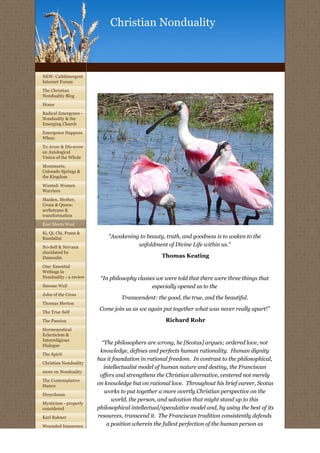
Bird Photos by David Joseph Sylvest

johnboy@christiannonduality.com
Christian Nonduality


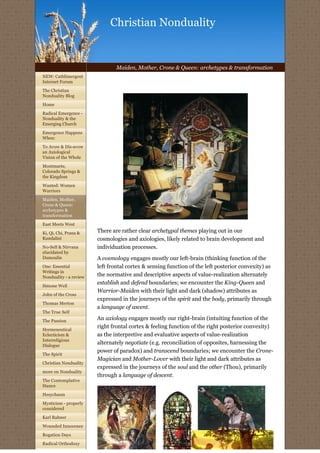
                                Maiden, Mother, Crone & Queen: archetypes & transformation
NEW: Cathlimergent
Internet Forum
                         
The Christian
Nonduality Blog
Home

Radical Emergence -
Nonduality & the
Emerging Church

Emergence Happens
When:

To Avow & Dis-avow
an Axiological
Vision of the Whole

Montmarte,
Colorado Springs &
the Kingdom

Wanted: Women
Warriors

Maiden, Mother,
Crone & Queen:
archetypes &
transformation

East Meets West

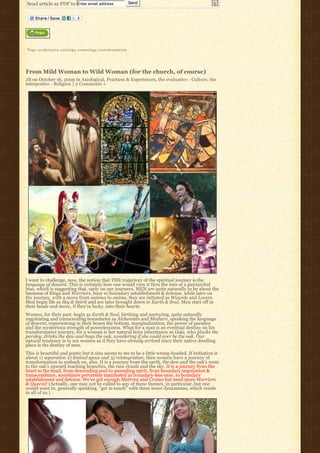
Ki, Qi, Chi, Prana &    There are rather clear archetypal themes playing out in our
Kundalini               cosmologies and axiologies, likely related to brain development and
No-Self & Nirvana       individuation processes.
elucidated by
Dumoulin                A cosmology engages mostly our left-brain (thinking function of the
One: Essential          left frontal cortex & sensing function of the left posterior convexity) as
Writings in
Nonduality - a review   the normative and descriptive aspects of value-realization alternately
Simone Weil
                        establish and defend boundaries; we encounter the King-Queen and
                        Warrior-Maiden with their light and dark (shadow) attributes as
John of the Cross
                        expressed in the journeys of the spirit and the body, primarily through
Thomas Merton
                        a language of ascent.
The True Self

The Passion             An axiology engages mostly our right-brain (intuiting function of the
Hermeneutical
                        right frontal cortex & feeling function of the right posterior convexity)
Eclecticism &           as the interpretive and evaluative aspects of value-realization
Interreligious
Dialogue
                        alternately negotiate (e.g. reconciliation of opposites, harnessing the
                        power of paradox) and transcend boundaries; we encounter the Crone-
The Spirit
                        Magician and Mother-Lover with their light and dark attributes as
Christian Nonduality
                        expressed in the journeys of the soul and the other (Thou), primarily
more on Nonduality
                        through a language of descent.
The Contemplative
Stance

Hesychasm

Mysticism - properly
considered

Karl Rahner

Wounded Innocence

Rogation Days

Radical Orthodoxy
Presuppositionalism
vs Nihilism?

Science
Epistemic Virtue

Pan-semio-
entheism: a
pneumatological
theology of nature
Architectonic

Anglican - Roman
Dialogue

The Ethos of Eros

Musings on Peirce
Eskimo Kiss Waltz

the Light Side of
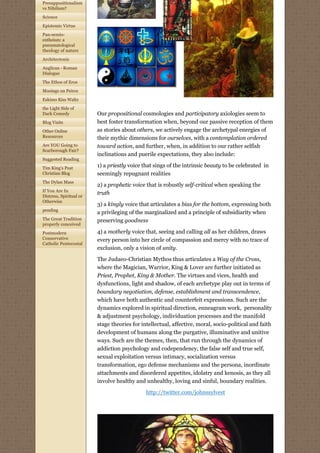
Dark Comedy              Our propositional cosmologies and participatory axiologies seem to
Blog Visits              best foster transformation when, beyond our passive reception of them
Other Online             as stories about others, we actively engage the archetypal energies of
Resources                their mythic dimensions for ourselves, with a contemplation ordered
Are YOU Going to         toward action, and further, when, in addition to our rather selfish
Scarborough Fair?
                         inclinations and puerile expectations, they also include:
Suggested Reading

Tim King's Post
                         1) a priestly voice that sings of the intrinsic beauty to be celebrated  in 
Christian Blog           seemingly repugnant realities
The Dylan Mass
                         2) a prophetic voice that is robustly self-critical when speaking the
If You Are In
                         truth
Distress, Spiritual or
Otherwise
                         3) a kingly voice that articulates a bias for the bottom, expressing both
pending
                         a privileging of the marginalized and a principle of subsidiarity when
The Great Tradition      preserving goodness
properly conceived

Postmodern               4) a motherly voice that, seeing and calling all as her children, draws
Conservative             every person into her circle of compassion and mercy with no trace of
Catholic Pentecostal
                         exclusion, only a vision of unity.
                         The Judaeo-Christian Mythos thus articulates a Way of the Cross,
                         where the Magician, Warrior, King & Lover are further initiated as
                         Priest, Prophet, King & Mother. The virtues and vices, health and
                         dysfunctions, light and shadow, of each archetype play out in terms of
                         boundary negotiation, defense, establishment and transcendence,
                         which have both authentic and counterfeit expressions. Such are the
                         dynamics explored in spiritual direction, enneagram work,  personality 
                         & adjustment psychology, individuation processes and the manifold
                         stage theories for intellectual, affective, moral, socio-political and faith
                         development of humans along the purgative, illuminative and unitive
                         ways. Such are the themes, then, that run through the dynamics of
                         addiction psychology and codependency, the false self and true self,  
                         sexual exploitation versus intimacy, socialization versus
                         transformation, ego defense mechanisms and the persona, inordinate
                         attachments and disordered appetites, idolatry and kenosis, as they all
                         involve healthy and unhealthy, loving and sinful, boundary realities.

                                              http://twitter.com/johnssylvest


Christian Nonduality
http://twitter.com/johnssylvest
Bird Photos by David Joseph Sylvest

johnboy@christiannonduality.com
Christian Nonduality


                                                                                  Architectonic
NEW: Cathlimergent
Internet Forum

The Christian
Nonduality Blog
Home

Radical Emergence -
Nonduality & the
Emerging Church

Emergence Happens
When:

To Avow & Dis-avow
an Axiological
Vision of the Whole

Montmarte,
Colorado Springs &
the Kingdom

Wanted: Women
Warriors
Maiden, Mother,
Crone & Queen:
archetypes &
transformation

East Meets West
                        NOTES ON DEVISING AN ARCHITECTONIC-ORGANON
Ki, Qi, Chi, Prana &
Kundalini               OF HUMAN KNOWLEDGE
No-Self & Nirvana
elucidated by           1) To describe Reality, devise an Architectonic/Organon of Human
Dumoulin                Knowledge of
One: Essential
Writings in             Environing Realities, which would include ourselves.
Nonduality - a review
                        2) To describe ourselves, devise such an account as would include the
Simone Weil
                        Human
John of the Cross

Thomas Merton           Knowledge Manifold as an Environed Reality, which would include
                        both evaluative and
The True Self

The Passion             rational continuua.
Hermeneutical           3) When devising a model of epistemic virtue (values), avoid the usual
Eclecticism &
Interreligious          (and many)
Dialogue
                        overworked distinctions and employ the very real but often under-
The Spirit
                        appreciated
Christian Nonduality

more on Nonduality      dichotomies.
The Contemplative       4) In our modal arguments for this or that reality, we must rigorously
Stance
                        define and
Hesychasm

Mysticism - properly
                        disambiguate our terms. Employ such criteria that, if met, will
considered              guarantee the conceptual
Karl Rahner
                        compatibility of any attributes we employ in our conceptualizations of
Wounded Innocence
                        this or that reality.
Rogation Days
                         In order to be conceptually compatible, while, at the same time,
Radical Orthodoxy
                         avoiding any absurdities
Presuppositionalism
vs Nihilism?             of parodied logic, attributes must not be logically impossible to
Science                  coinstantiate in our
Epistemic Virtue
                         arguments and they must also be described in terms that define a
Pan-semio-
entheism: a
                         reality's negative
pneumatological
theology of nature       properties. For an example, see:
Architectonic            http://www.iidb.org/vbb/showthread.php?s=&threadid=47897 and use
Anglican - Roman         your edit/find
Dialogue
                         browser facility to scroll down quickly to the first occurrence of the
The Ethos of Eros
                         word “negativity”
Musings on Peirce

Eskimo Kiss Waltz        and then also for the name of philosopher “Richard Gale”
the Light Side of        5) In defining such attributes as will describe the various aspects of this
Dark Comedy
                         or that
Blog Visits

Other Online             reality, we must draw the proper distinctions between those aspects
Resources                that are predicated a)
Are YOU Going to
Scarborough Fair?        univocally b) equivocally or c) relationally vis a vis other realities.
Suggested Reading
                         Univocal is defined as
Tim King's Post          having one meaning only. Equivocal means subject to two or more
Christian Blog
                         interpretations. These
The Dylan Mass
                         accounts necessarily utilize some terms univocally and others
If You Are In
Distress, Spiritual or   equivocally. The equivocal
Otherwise
                         can be either simply equivocal or analogical. The analogical can be
pending
                         attributive (if real
The Great Tradition
properly conceived       causes and effects are invoked) or proportional (if we are invoking
Postmodern               similarities in the
Conservative
Catholic Pentecostal     relationships between two different pairs of terms). If such an
                         similarity is essential to

                         those terms we have a proper proportionality but if it is accidental we
                         have an improper

                         proportionality, a metaphor. And we use a lot of metaphors, even in
                         physics, and they all
                         eventually collapse.

                         6) In our attempts to increase our descriptive accuracy of this or that
                         reality, we
                         must be clear whether we are proceeding through a) affirmation
                         [kataphatically, the via
                         positiva] b) negation [apophatically, the via negativa] or c) eminence
                         [unitively, neither

                         kataphatically nor apophatically but, rather, equivocally]. We must be
                         clear whether we
                         are proceeding a) metaphorically b) literally or c) analogically
                         [affirming the

                         metaphorical while invoking further dissimilarities].The best examples
                         can be found in

                         the book described at this url = http://www.psupress.org/books/titles/0-
271-01937-9.html

, Reality and Mystical Experience by F. Samuel Brainard.

7) We must be clear regarding our use of First Principles: a)
noncontradiction b)
excluded middle c) identity d) reality's intelligibility e) human
intelligence f) the
existence of other minds and such. See Robert Lane’s discussion:
http://www.digitalpeirce.fee.unicamp.br/lane/p-prilan.htm
8) We must be mindful of godelian (and godelian-like) constraints on
our
argumentation: a) complete accounts in formal systems are necessarily
inconsistent b)
consistent accounts in formal systems are necessarily incomplete and
c) we can model the
rules but cannot explain them within their own formal symbol system
[must reaxiomatize,
which is to say prove them in yet another system, at the same time,
suggesting we can, indeed, see the truth of certain propositions that we
cannot otherwise
prove]. We thus distinguish between local and global explanatory
attempts, models of
partial vs total reality.See
http://en.wikipedia.org/wiki/Gödel's_incompleteness_theorem

9) We must employ semantical [epistemological] vagueness, such that
for
attributes a) univocally predicated, excluded middle holds and
noncontradiction folds b)
equivocally predicated, both excluded middle and noncontradiction
hold and c)

relationally predicated, noncontradiction holds and excluded middle
folds. Ergo, re: First
Principles, you got to know when to hold 'em, know when to fold 'em,
know when to
walk away, know when to run. See Robert Lane’s discussion:

http://www.digitalpeirce.fee.unicamp.br/lane/p-prilan.htm

10) We must understand and appreciate the integral nature of the
humanknowledge

manifold (with evaluative and rational continuua) and Lonergan's
sensation, abstraction
& judgment: sensation & perception, emotion & motivation, learning &
memory,

intuition & cognition, non- & pre-inferential, abductive inference,
inductive inference,

deductive inference and deliberation.
11) We must appreciate and understand the true efficacy of: abduction,
fast & frugal
decision-making, ecological rationality, evolutionary rationality,
pragmatic rationality,

bounded rationality, common sense; also of both propositional and
doxastic justification,
and affective judgment: both aesthetic and prudential, the latter
including both pragmatic

and moral affective judgment. See http://www.free-
definition.com/Abduction-(logic).html

12) We must draw the distinction between peircean argument
(abduction, hypothesis
generation) and argumentation (inductive & deductive inference).See

http://www.bu.edu/wcp/Papers/Reli/ReliKess.htm
13) We must draw a distinction between partial apprehension of a
reality and total
comprehension of a reality.
14) We must employ dialectical analysis, properly discerning where our
different
accounts of this or that reality a) agree b) converge c) complement or d)
dialectically
reverse. We must distinguish between this dialectic and hegelian
synthesis and resist false
irenicism, facile syncretism and insidious indifferentism, while
exercising due care in our
attempts to map conceptualizations from one account onto another.
Also, we should
employ our scholastic distinctions: im/possible, im/plausible,
im/probable and un/certain.

15) We must distinguish between the different types of paradox
encountered in our
various attempts to describe this or that reality a) veridical b) falsidical
c) conditional and
d) antinomial. We must recognize that all metaphysics are fatally
flawed and that their

root metaphors will eventually collapse in true antinomial paradox of
a) infinite regress
b) causal disjunction or c) circular referentiality [ipse dixit - stipulated
beginning or

petitio - question begging]. See http://en.wikipedia.org/wiki/Paradox
16) As part and parcel of the isomorphicity implied in our
epistemological
vagueness, we must employ ontological vagueness, which is to say that
we must prescind

from the necessary to the probable in our modal logic. This applies to
the dance between
chance & necessity, pattern & paradox, random & systematic, order &
chaos.See

http://uhavax.hartford.edu/moen/PeirceRev2.html and the distinctions
between necessary

and non-necessary reasonings and also probable deductions.
17) We must properly integrate our classical causal distinctions such
that the
axiological/teleological [instrumental & formal] mediates between the
epistemological
[formal] and cosmological/ontological [efficient/material]. These
comprise a process and
not rather discrete events.This follows the grammar that the normative
sciences mediate
between our phenomenology and our metaphysics. See
http://hosting.uaa.alaska.edu/afjjl/LinkedDocuments/LiszkaSynopsisPeirce.htm

18) We must recognize the idea of emergence is mostly a heuristic
device inasmuch
as it has some descriptive accuracy but only limited predictive, hence,
explanatory
adequacy. It predicts novelty but cannot specify its nature.
Supervenience is even more
problematical, trivial when described as weak (and usually associated
with strong
emergence), question begging re: reducibility when described as strong
(and usually
associated with weak emergence).See
http://www.molbio.ku.dk/MolBioPages/abk/PersonalPages/Jesper/SemioEmergence.htm

Seehttp://www.nu.ac.za/undphil/collier/papers/Commentary on Don
Ross.htm

See http://www.nu.ac.za/undphil/collier/papers.html

19) We must avoid all manner of dualisms, essentialism, nominalism
and a priorism

as they give rise to mutual occlusivities and mutual unintelligibilities in
our arguments
and argumentations. The analogia relata (of process-experience
approaches, such as the

peircean and neoplatonic triadic relational) that is implicit in the triadic
grammar of all of
the above-described distinctions and rubrics can mediate between the
analogia antis (of
linguistic approaches, such as the scotistic univocity of being) and the
analogia entis (of

substance approaches, such as the thomistic analogy of being). This
includes such triads
as proodos (proceeding), mone (resting) and epistrophe (return) of
neoplatonic dionysian
mysticism. It anticipates such distinctions as a) the peircean distinction
between objective

reality and physical reality b) the scotistic formal distinction c) the
thomistic distinction

between material and immaterial substance, all of which imply
nonphysical causation

without violating physical causal closure, all proleptical, in a sense, to
such concepts as
memes, Baldwinian evolution, biosemiotics, etc See
http://consc.net/biblio/3.html

20) We must avoid the genetic and memetic fallacies of Dawkins and
Dennett and
the computational fallacies of other cognitive scientists, all as described
by Deacon.See
http://www.chass.utoronto.ca/epc/srb/srb/10-3edit.html
21) We must denominate the "cash value" of getting our metaphysics
correct in
terms of the accuracy of our anthropologies and psychologies because
getting our
descriptive and normative accounts correct is preliminary to properly
conducting our
evaluative attempts, which will then inform the prescriptions we devise
for an ailing
humanity and cosmos, rendering such prescriptions efficacious,
inefficacious, and even
harmful. This signals the importance of the dialogues between science,
religion,
philosophy and the arts. Further regarding “cash value” and the
“pragmatic maxim” and
all it might entail, asking what difference this or that metaphysical,
epistemological or
scientific supposition might make, if it were true or not, can clarify our
thinking, such as

better enabling us to discern the circular referentiality of a tautology,
e.g. taking existence
as a predicate of being (rather than employing a concept such as
“bounded” existence).

22) We must carefully nuance the parsimony we seek from Occam's
Razor moreso

in terms of the facility and resiliency of abduction and not necessarily
in terms of
complexity, honoring what we know from evolutionary psychology
about human

abductive and preinferential process.See
http://www.digitalpeirce.fee.unicamp.br/pscifor.

htm See http://kybele.psych.cornell.edu/~edelman/Psych-214-Fall-
2000/w7-3-
outline.text

23) At wits end, confronted with ineluctable paradox, in choosing the
most

compelling metaphysic, there is always the reductio ad absurdum. And
remember,
whatever is going on in analytical philosophy, semeiotics and
linguistics, you can know

thus much is true: A single, even small, thermonuclear explosion can
ruin your whole
day.
24) Regarding multiverse accounts, Polkinghorne rejects any notion
that science can
say anything about same if science is careful and scrupulous about
what science can
actually say, and this may be true, but it does seem that such an
explanatory attempt can
be indirectly determined at least consonant with what we are able to
directly observe
and/or indirectly measure (thinking of Max Tegmark's ideas). It is
plausible, for example,
insofar as it is an attempt to explain the apparent anthropic fine-
tuning.
25) Importantly, not all human knowledge is formal, which is what so
much of the
above has been about!
26) The major philosophical traditions can be described and
distinguished by their
postures toward idealism & realism, rationalism & empiricism, which
are related to their

various essentialisms and nominalisms, which can all be more
particularly described in

terms of what they do with the PEM (excluded middle) and PNC
(noncontradiction) as
they consider peircean 1ns, 2ns and 3ns, variously holding or folding
these First

Principles as they move from univocal to equivocal and relational
predications.

27) With the peircean perspective taken as normative, PEM holds for
1ns and 2ns
and PNC holds for 2ns and 3ns (hence, PNC folds for 1ns and PEM
folds for 3ns).

28) In a nominalistic perspective, PNC folds for 3ns and classical
notions of
causality and continuity are incoherent.

29) In an essentialistic perspective, PNC properly holds for 3ns but
PEM is
erroneously held for 3ns, suggesting that modal logic drives
algorithmically toward the

necessary and not, rather, the probable.
30) The nominalist’s objection to essentialism’s modal logic of the
necessary in 3ns
is warranted but folding PNC in 3ns is the wrong response, rendering
all notions of
causality incoherent.. The essentialist’s objection to nominalism’s
denial of any modal
logic in 3ns is warranted but holding PEM in 3ns is the wrong
response, investing reality
with an unwarranted determinacy. The peircean affirmation of PNC in
3ns and denial of
PEM in 3ns resolves such incoherency with a modal logic of probability
and draws the
proper distinctions between the univocal, equivocal and relational
predications, the
univocal folding PNC in 1ns, the equivocal folding PEM in 3ns and the
relational holding

PNC and PEM in 2ns.
31) The platonic rationalist-realist perspective is impaired by
essentialism. The
kantian rationalist-idealist perspective is impaired by both essentialism
and nominalism.
The humean empiricist idealist perspective is impaired by nominalism.
The aristotelian
empiricist realist perspective, with a nuanced hylomorphism, is not
impaired by

essentialism or nominalism but suffers from substantialism due to its
atomicity, which
impairs relationality. Finally, even a process-relational-substantial
approach must make
the scotistic/peircean formal distinction between objective reality and
physical reality.

Radically deconstructive, analytical, and even pragmatist, approaches
seize upon the
folding of PNC in 1ns and then run amok in denying PNC in 3ns and
sometimes even

2ns. Phenomenologists bracket these metaphysical considerations.
Existentialists argue

over what precedes what, existence vs essence, losing sight of their
necessary
coinstantiation in 2ns in physical reality and failing to draw the proper
distinction

between the objective reality of an attribute (its abstraction &
objectification) and the
physical reality where it is integrally instantiated. Neither essence nor
existence precedes

the other in physical reality; they always arrive at the scene together
and inextricably
intertwined.

32) The peircean grammar draws necessary distinctions between
univocal, equivocal
and relational predications of different aspects of reality but, in so
doing, is a heuristic
that does not otherwise predict the precise nature or degree of
univocity, equivocity or
relationality between those aspects. In that sense, it is like
emergentism, which predicts

novelty but does not describe its nature or degree. To that extent, it no
more resolves
philosophy of mind questions, in particular, than it does metaphysical
questions, in
general. What it does is help us to think more clearly about such issues
placing different
perspectives in dialogue, revealing where it is they agree, converge,
complement and
disagree. Further, it helps us better discern the nature of the paradoxes
that our different
systems encounter: veridical, falsidical, conditional and antinomial,
and why it is our
various root metaphors variously extend or collapse in describing
different aspects of
reality. It doesn’t predict or describe the precise nature of reality’s
givens in terms of

primitives, forces and axioms but does help us locate how and where
univocal, equivocal

and relational predications are to be applied to such givens by acting as
a philosophical
lingua franca between different perspectives and accounts.Where are
reality’s

continuities and discontinuities in terms of givens? The peircean
grammar speaks to how

they are related in terms of 1ns, 2ns and 3ns but not with respect to
nature or origin or to
what extent or degree (if for no other reason that not all phenomena
are equally probable,

in terms of 3ns). Is consciousness a primitive along with space, time,
mass and charge? Is

it emergent? epiphenomenal? explained by Dennett? described by
Penrose? a hard
problem as per Chalmers or Searle? an eliminated problem as per the
Churchlands? an
intractable problem as per William James? Each of these positions can
be described in

peircean terms and they can be compared and contrasted in a dialogue
that reveals where
they agree, disagree, converge and complement. They cannot be a
priori arbitrated by the

peircean perspective; rather, they can only be consistently articulated
and framed up
hypothetically on the same terms, which is to say, in such a manner
that hypotheticodeductive
and scientific-inductive methods can be applied to them and such that
a
posteriori experience can reveal their internal coherence/incoherence,
logical

consistency/inconsistency, external congruence/incongruence,
hypothetical
consonance/dissonance and interdisciplinary
consilience/inconsilience.
33) Do our various metaphysics collapse because of an encounter with
paradox that
is generated by a) the nature of the environing realities, which are
being explained? b) the
exigencies of the environed reality, which is explaining? or c) some
combination of
these? Is the paradox encountered veridical, falsidical, conditional or
antinomial? Did we
introduce the paradox ourselves or did an environing reality reveal its
intrinsic

paradoxical nature? We can describe reality’s categories (such as w/
CSP’s
phaneroscopy), a logic for those categories (such as CSP’s semeiotic
logic) and an

organon that relates these categories and logic (such as CSP’s
metaphysical architectonic)

and then employ such a heuristic in any given metaphysic using any
given root metaphor.
When we do, at some point, we will encounter an infinite regress, a
causal disjunction or

circular referentiality (petitio principii, ipse dixit, etc), and we might,
therefore, at some

level, have reason to suspect that those are the species of ineluctable
paradox that even
the most accurate metaphysics will inevitably encounter. If circular
referentiality is

avoidable, still, infinite regress and causal disjunction are not and our
metaphysics will
succumb to one or the other, possibly because these alternate accounts
present

complementary perspectives of reality and the nature of its apparent
continuities and

discontinuities (as measured in degrees of probability or as reflected in
the dissimilarities

between various givens and their natures and origins, some belonging
to this singularity,
some to another, this or another realm of reality variously pluralistic or
not).
34) What it all seems to boil down to is this: Different schools of
philosophy and
metaphysics are mostly disagreeing regarding the nature and degree,
the origin and
extent, of continuities and discontinuities in reality, some even
claiming to transcend this
debate by using a continuum of probability. The manifold and
multiform assertions
and/or denials of continuity and discontinuity in reality play out in the
different
conclusions of modal logic with respect to what is possible versus
actual versus necessary
regarding the nature of reality (usually in terms of givens, i.e.
primitives, forces and
axioms), some even claiming to transcend this modal logic by
substituting probable for
necessary. Even then, one is not so much transcending the fray as
avoiding the fray if one
does not venture to guess at the nature and degree, origin and extent,
of reality’s
probabilities, necessities, continuities and discontinuities. Sure, the
essentialists and

substantialists overemphasize discontinuities and the nominalists
overemphasize
continuities and the dualists introduce some false dichotomies, but
anyone who claims to
be above this metaphysical fray has not so much transcended these
issues with a new and

improved metaphysics as they have desisted from even doing
metaphysics, opting instead
for a meta-metaphysical heuristic device, at the same time, sacrificing
explanatory

adequacy. This is what happens with the emergentistic something
more from nothing but

and also what happens in semeiotic logic (for infinite regress is just as
fatal,
metaphysically, as causal disjunction and circular referentiality).
35) Evaluating Hypotheses:Does it beg questions?Does it traffic in
trivialities? Does

it overwork analogies?Does it overwork distinctions? Does it
underwork
dichotomies?Does it eliminate infinite regress?
36) Not to worry, this is to be expected at this stage of humankind’s
journey of

knowledge. However, if the answer to any of these questions is
affirmative, then one’s
hypothesis probably doesn’t belong in a science textbook for now. At
any rate, given our

inescapable fallibility, we best proceed in a community of inquiry as we
pursue our
practical and heuristic (both normative and speculative) sciences.
37) Couching this or that debate in the philosophy of science in terms
of dis/honesty
may very well address one aspect of any given controversy. I have often
wondered

whether or not some disagreements are rooted in disparate approaches
to epistemic
values, epistemic goods, epistemic virtues, epistemic goals, epistemic
success, epistemic
competence or whatever is truly at issue. I don't know who is being
dishonest or not,
aware or unawares, but I think one can perhaps discern in/authenticity
in a variety of
ways.

38) In trying to sort through and inventory such matters, through
time, I have come
to more broadly conceive the terms of such controversies, not only
beyond the notions of
epistemic disvalue, epistemic non-virtue and epistemic incompetence,
but, beyond the

epistemic, itself. Taking a cue from Lonergan's inventory of
conversions, which include
the cognitive, affective, moral, social and religious, one might identify
manifold other

ways to frustrate the diverse (but unitively-oriented) goals of human
authenticity, whether

through disvalue, non-virtue or incompetence.
39) Our approach to and grasp of reality, through both the heuristic
sciences

(normative and theoretical) and practical sciences, in my view, is quite
often frustrated by
the overworking of certain distinctions and the underworking of
certain dichotomies, by
our projection of discontinuities onto continuities and vice versa. And
this goes beyond

the issue of the One and the Many, the universal and the particular, the
local and the

global, beyond the disambiguation and predication of our terms,
beyond the setting forth
of our primitives, forces and axioms, beyond the truth of our premises
and the validity of
our logic, beyond noetical, aesthetical and ethical norms, beyond our
normative/prescriptive, speculative/descriptive and
pragmatic/practical enterprises,
beyond all this to living life, itself, and to our celebration of the arts.
40) In this vein, one failure in human authenticity that seems to too
often afflict
humankind is the overworking of the otherwise valid distinctions
between our truly novel
biosemiotic capacities and those of our phylogenetic ancestry and kin,
invoking such a
human exceptionalism (x-factor) as divorces us from nature of which
we're undeniably a

part. Another (and related) failure, in my view, is the overworking of
distinctions
between the different capacities that comprise the human evaluative
continuum, denying
the integral roles played by its nonrational, prerational and rational
aspects, by its
ecological, pragmatic, inferential and deliberative rationalities, by its
abductive, inductive
and deductive inferential aspects, by its noetical, aesthetical and ethical
aspects. These

otherwise distinct aspects of human knowledge that derive from our
interfacing as an

environed reality with our total environing reality (environed vs
environing realities not
lending themselves to sharp distinctions either?) are of a piece, form a
holistic fabric of

knowledge, mirrored by reality, which is also of a piece, not lending
itself fully to any

privileged aspect of the human evaluative continuum, not lending itself
to arbitrary dices
and slices based upon any human-contrived architectonic or organon
of knowledge, for

instance, as might be reflected in our academic disciplines or curricula.
41) So, perhaps it is too facile to say religion asks certain questions and
employs

certain aspects of the human evaluative continuum, while philosophy
asks others, science

yet others? Maybe it is enough to maintain that science does not
attempt to halt infinite

regress because humankind has discovered, a posteriori, that such
attempts invariably

involve trafficking in question begging (ipse dixit, petitio principii,
tautologies, etc) or
trivialities or overworked analogies, often employ overworked
distinctions or
underworked dichotomies, often lack explanatory adequacy, pragmatic
cash value and/or
the authentication of orthodoxy by orthopraxis? Maybe it is enough to
maintain that

science does not attempt to halt infinite regress because humankind
now maintains, a
priori, with Godel, that complete accounts are inconsistent, consistent
accounts,
incomplete? Maybe it is enough to maintain that science traffics in
formalizable proofs
and measurable results from hypotheses that are testable within
realistic time constraints
(iow, not eschatological)?
42) Or, maybe we needn't maintain even these distinctions but can say
an hypothesis
is an hypothesis is an hypothesis, whether theological or geological,
whether eliminating
or tolerating the paradox of infinity, and that the human evaluative
continuum, if
optimally (integrally and holistically) deployed, can aspire to test these
hypotheses,

however directly or indirectly, letting reality reveal or conceal itself at
its pleasure --- but

--- those hypotheses that are intractably question begging or
tautological, that overwork
analogies and distinctions and underwork dichotomies, that lack
explanatory adequacy

and pragmatic cash value --- are, at least for now, bad science, bad
philosophy, bad

theology, bad hypotheses? They are not authentic questions? Pursue
them if you must.
Back-burner them by all means, ready to come to the fore at a more
opportune time. But

don't publish them in textbooks or foist them on the general public or
body politic; rather,
keep them in the esoteric journals with a suitable fog index to match
their explanatory
opacity.
43) In the above consideration, it was not my aim to resolve any
controversies in the
philosophy of science, in particular, or to arbitrate between the great
schools of
philosophy, in general. I did want to offer some criteria for more
rigorously framing up
the debates that we might avoid talking past one another. It does seem
that certain

extreme positions can be contrasted in sharper relief in terms of
alternating assertions of
radical dis/continuities, wherein some distinctions are overworked into
false dichotomies
and some real dichotomies are ignored or denied.
44) Thus it is that the different “turns” have been made in the history
of philosophy
(to experience, to the subject, linguistic, hermeneutical, pragmatic,
etc). Thus it is that
nominalism, essentialism and substantialism critique each other. Thus
it is that fact-value,
is-ought, given-normative, descriptive-prescriptive distinctions
warrant dichotomizing or
not. Thus it is that the One and the Many, the universal and particular,
the global and
local, the whole and the part invite differing perspectives or not. Thus it
is that different
aspects of the human evaluative continuum get singularly privileged
without warrant
such as in fideism and rationalism or that different aspects of the
human architectonic of

knowledge get over- or under-emphasized such as in radical
fundamentalism and

scientism.
45) Thus it is that certain of our heuristic devices get overworked
beyond their

minimalist explanatory attempts such as when emergence is described
as weakly
supervenient, which is rather question-begging, or as strongly
supervenient, which is
rather trivial. And yet one might be able to affirm some utility in
making such

distinctions as a weak deontology or weak teleology, or between the
strongly and weakly
anthropic?

46) Thus it is that idealism and realism, rationalism and empiricism,
fight a
hermeneutical tug of war between kantian, humean, aristotelian and
platonic
perspectives, transcended, in part, even complemented by, the
analytical,
phenomenological and pragmatic approaches. Thus it is that various
metaphysics must
remain modest in their heuristic claims of explanatory power as we
witness the ongoing
blending and nuancing of substance, process, participative and
semiotic approaches. Thus

it is that our glorious -ologies get transmuted into insidious –isms.
47) Thus it is that all of these approaches, whether broadly conceived
as theoretical,
practical and normative sciences (including natural sciences, applied
sciences, theological
sciences and the sciences of logic, aesthetics and ethics), or more
narrowly conceived as
the more strictly empirical sciences, offer their hypotheses for critique
by an authentic
community of inquiry --- neither falling prey to the soporific consensus
gentium
(bandwagon fallacy) and irrelevant argumentum ad verecundiam
(appeal to authority) nor
arrogating to one’s own hermeneutic some type of archimedean
buoyancy for all sure
knowledge, as if inescapable leaps of faith weren’t required to get past
unmitigated
nihilism and solipsism, as if excluded middle, noncontradiction and
other first principles

could be apodictically maintained or logically demonstrated, as if
knowledge and proof

were indistinct, as if all human knowledge was algorithmic and could
be formalized.
48) Miscellany: In the peircean cohort of the American pragmatist
tradition, one

would say that the normative sciences mediate between
phenomenology and
metaphysics, which could reasonably be translated into philosophy
mediates between our
scientific methodologies and our cosmologies/ontologies.So, there is a
proper distinction

to be made between our normative and theoretical sciences, both
which can be considered
heuristic sciences, and yet another distinction to be made between
them and what we

would call our practical sciences.
49) I think it would be fair to say that we can bracket our [metaphysics]
and our

[cosmologies & ontologies] when doing empirical science but, at the
same time, we do
not bracket those aspects of philosophy that comprise our normative
sciences of logic,
aesthetics and ethics, which contribute integrally and holistically to all
scientific
endeavors and human knowledge pursuits. At least for my God-
concept, properly
conceived, suitably employed, sufficiently nuanced, carefully
disambiguated, precisely
defined, rigorously predicated --- to talk of empirical measurement
would be nonsensical.
50) I more broadly conceive knowledge & "knowing" and my
conceptualization
turns on the distinction between knowing and proving, the latter
consisting of formal
proofs. Since a God-concept would comprise a Theory of Everything
and we know, a
priori, from Gödel’s Incompleteness Theorems, that we cannot prove
such employing any
closed formal symbol system, a "proof" of God is out of the question.
51) Charles Sanders Peirce offers another useful distinction, which
turns on his
observations regarding inferential knowledge, which includes
abduction, induction and

deduction. Abductive inference is, in a nutshell, the generation of an
hypothesis. The

peircean distinction is that between an argument and argumentation.
Peirce offers, then,

what he calls the "Neglected Argument for the Reality of God," which
amounts to an
abduction of God, distinguishing same from the myriad other attempts
to prove God's

existence, whether inductively or deductively through argumentation.
Even the scholastic
and thomistic "proofs" realize their efficacy by demonstrating only the
reasonableness of
certain beliefs, not otherwise aspiring to apodictic claims or logically
conclusive

demonstrations. Peirce made another crucial distinction between the
"reality" of God and
the "existence" of God, considering all talk of God's existence to derive
from pure

fetishism, affirming in his own way, I suppose, an analogy of being
rather than a
univocity.
52) Given all this, one may find it somewhat of a curiosity that Godel,
himself,
attempted his own modal ontological argument. Anselm's argument,
likely considered the
weakest of all the classical "proofs" of God, was first called the
"ontological" argument
by Kant and was more recently given impetus by Hartshorne's modal
formulation. I think
these arguments by Godel and Hartshorne would be more compelling
if the modal
category of necessary was changed to probable and if the conceptual
compatibility of
putative divine attributes was guaranteed by employing only negative
properties for such
terms. At any rate, that Godel distinguished "formal proof" from
"knowing" is instructive,

I think, and his attempt at a modal ontological argument is also
revealing, suggesting,
perhaps, that one needn't make their way through half of Whitehead
and Russell’s
Principia in order to "know" that 2 + 2 = 4, but, rather, that would be
necessary only to
"prove" same.
53) I would agree that the statement, God cannot be measured, is true
for science as
narrowly conceived as natural science. More broadly conceived, science
includes

theology as a discipline and many typologies of the science-religion
interface would, for

instance, affirm the notion of hypothetical consonance between the
disciplines. Much of
Hans Kung's work entailed an elaborate formulation of the God
hypothesis, not

empirically testable by any means, but, which uses nihilism as a foil to
proceed reductio

ad absurdum toward what Kung calls a fundamental trust in uncertain
reality that, given a
suitable and "working" God-hypothesis, is not otherwise nowhere
anchored and

paradoxical. Another focus of theology as a scientific discipline is that
of practical
theology where orthopraxis might be considered to authenticate
orthodoxy.
54) Strong cases have been made by historians of science that
sustainable scientific
progress was birthed in the womb of a belief in creatio ex nihilo, in
other words, a belief

in the contingent nature of reality, which, when combined with the
Greek belief in
reality's rationality, provided the cultural matrix for science's explosive
growth in the
Christian West.

55) I suppose there is an element of the aesthetic that guides one
toward such an
interpretation as Bohm's rather than Bohr's, Chalmers, Searle or
Penrose rather than

Dennett, the Churchlands or Crick, Pascal rather than Nietzsche --- but
something else is
going on, and it is not time-honored, when anyone chooses info to fit
an interpretation,
which is a different enterprise from the formulation of alternative
interpretations that are
hypothetically consonant with whatever info is available at the time.

56) To say more succinctly what I elaborate below: Approaching facts is
one matter,
rules another, and facts about rules, yet another. There's no explaining
or justifying rules
within their own systems and one hops onto an epistemological pogo
stick, incessantly
jumping to yet another system with such explanatory/justificatory
attempts (cf. Godel).
Thankfully, Popperian falsification short circuits rule justification in
our pursuit of facts

and the reductio ad absurdum (with some caveats) short circuits
formal philosophy in our

pursuit of rule justification, which is otherwise, inescapably, going to
be question
begging, rendering our metasystems, in principle, tautological. An
example of a caveat

there is that one overworks the humean dictum re: existence as a
predicate of being when

asserting that existence cannot be taken as a predicate of being --
because it certainly can.
One underappreciates the humean perspective when one forgets that
taking existence as a

predicate of being is a tautology. But so are all metaphysics, which are
all fatally flawed.
None of this is about escaping all antinomial paradox but, rather,
finding the metasystem
least susceptible to multiple births of paradox, least pregnant with
paradox --- or, finding
that metasystem which, however fatally flawed, is least morbid.
57) In dealing with metasystem formulations, inevitably, we must
confront the timehonored

question: random or systematic? chance or necessity? order or chaos?
pattern or
paradox? At least, for me, this seems to capture the conundrum at
issue.This conundrum

is ubiquitous and presents itself not only in metaphysics but in physics,
not only in
speculative cosmology and the quantum realm but also in speculative
cognitive science
and the realm of consciousness. This is reminiscent of the dynamic in
the TV gameshow,
Jeopardy, for these dyads --- of random, chance, chaos, paradox vis a
vis systematic,
necessity, order, pattern --- offer themselves as answers to a larger
question posed in a
bigger framework. That question might be framed as: What is it that
mediates between
the possible and the actual?
58) My brain loves that question and pondering the implications of
those dyads
seems to help keep my neurotransmitters in balance, quite often firing
off enough extra
endorphins to help me pedal my bike an extra mile or two, any given
day. That question
presents when we consider reality both locally and globally, particularly
or universally, in

part or as a whole. I have pondered such extensively as set forth here:
http://bellsouthpwp.net/p/e/per-ardua-ad-astra/epistemic.htm and
elsewhere

http://bellsouthpwp.net/p/e/per-ardua-ad-astra/merton.htm [links at
the top of this page]

and one day I may take on the task of making such musings more
accessible. For now, it
seems that I have practiced the Franciscan virtue of seeking to
understand rather than to

be understood and turned it into a vice, practicing it to a fault.
59) I will say this: Science is a human convention, an agreement
entered into by an
earnest community of inquiry. It seems to operate on a consensus
regarding 1) primitives

(space, time, mass and energy/charge) 2) forces (strong and weak,
electromagnetic and
gravity) and 3) axioms (laws of thermodynamics and so forth) and the
relationships they
reveal as this community proceeds via 4) popperian falsification,
which, as Popper
properly understood and many others do not, is not, itself, falsifiable.
There are no strict

lines between physics and metaphysics inasmuch as any tweaking of
these categories by
theoretical scientists is meta-physical, for instance, such as by those
who'd add
consciousness as a primitive, quantum gravity as a force and statistical
quantum law as an
axiom. The crossing-over from philosophy to science and from
metaphysics to physics by
this or that notion is not so much determined a priori as based on any
given attributes of a
particular idea regarding primitives, forces and axioms but, rather,
takes place when such
can be framed up in such a manner as it can be empirically falsified. We
know this from
the history of philosophy, science and metaphysics -- although the
pace of cross-over has
slowed a tad.
60) Framing up reality in falsifiable bits and pieces is no simple matter
to one who
agrees with Haldane that reality is not only stranger than we imagine
but stranger than we
can imagine. Still, as is born into our very nature as epistemological
optimists, we might
temper this view by taking Chesterton's counsel that we do not know
enough about

reality, yet, to say that it is unknowable. We just do not know, a priori,
either where we
will hit an explanatory wall or where we will break through same, this
notwithstanding

such as G. E. Pugh's remark to the effect that if the brain were simple
enough for us to
understand it, we would be so simple that we couldn't.

61) What we do know, a priori, are our own rules and conventions and
we can

predict whether or not an explanatory wall will either be hit or
penetrated --- but only if
we narrowly conceive of that wall as being built with the bricks of
empirical evidence

and the mortar of formal proofs. An explanatory wall thus conceived is
indeed subject to
godelian constraints, which allow us to model rules that we are
otherwise precluded from
explaining. In reality, though, one would commit the equivalent of an
epistemological

Maginot Line blunder if one built her explanatory wall exclusively of
such materials, for,
as we know, a large portion of human knowledge lies outside of any
such a narrowly
conceived epistemic structure. Indeed, we know far more than we can
ever prove (or

falsify)
62) Now, to be sure, we must remain well aware that we are freely
choosing our
axioms and first principles and that, consistent with godelian and
popperian constraints,
they can neither be logically demonstrated, a priori, nor scientifically
falsified, a
posteriori. We should keep an eye open, too, to the critiques of
Descartes, Hume and
Kant, insofar as they seem to have anticipated, in many ways, these
godelian and
popperian formalizations, as well as some of the dynamics explored by
the analytical
cohort. What I personally cannot countenance, however, is any
epistemological caving in
to such constraints and critiques (cartesian, kantian and humean); the
proper response, if
the normative sciences are to retain any sway whatsoever, would seem,
rather, to be a
trading in of any naive realism for a critical realism (staying mostly
aristotelian cum

neoplatonic?). So, too, the humean fact-value distinction, worth
considering, should not
be overworked into a false dichotomy?

63) If, in our inescapable fallibility, we have been dispossessed of any
apodictic
claims to necessity and logical demonstrations of our first principles,
still, we do have at

our disposal the judicious use of the reductio ad absurdum as our
backdoor philosophy.

True enough, the counterintuitive is not, in and of itself, an infallible
beacon of truth, for
science has demonstrated many counterintuitive notions to be true,
given certain axioms.

Nonetheless, absent any demonstration to the contrary and guided by
an earnest
community of inquiry, would we not do best to reject such as solipsism
and radical
nihilism, and to embrace noncontradiction and excluded middle
(within the norms
suggested by both epistemological and ontological vagueness, which is
another
exhuastive consideration)?
64) So, yes, in freely choosing such axioms as we might employ in our
attempt to
answer the question --- What mediates between the possible and the
actual? --- we are

free to opt for chance or necessity, for order or chaos, for pattern or
paradox, for the
random or systematic, and we are free to apply such an option locally
and/or globally,
particularly or universally, to the whole of reality or to any part, and no
one can
dispossess us, through formal proof or with empirical evidence, of our
chosen axioms.
And, yes, once we have chosen such axioms, such meta-systems, we
must recognize that,
fundamentally, they are clearly tautological by design and in principle,
and that any
apologetic for same will be rather question begging. [Every time we
open an ontological
window, reality closes an epistemological door, I like to say.] The only
recourse we have
that seems to be at all compelling is the old reductio ad absurdum,
taking this or that set
of axioms, applying them to reality as best we have come to grasp same,
and, after

extrapolating it all to some putative logical conclusion, then testing it
all for congruence
with reality (and with whatever else happens to be in that suite of
epistemological criteria
as might comprise this or that community of inquiry's epistemic
desiderata).

65) As a relevant aside, I have found that we best modify our modal
ontological

logic of possible, actual and necessary to possible, actual and probable,
which allows one
to prescind from the dyads of chance/necessity, order/chaos,
pattern/paradox,

random/systematic --- as these more and more seem to describe
distinctions that should

not be overworked into dichotomies, not that I am an inveterate
peircean triadimaniac --
for I am, rather, a pan-entheistic tetradimaniac (seems to me to be the
least pregnant,
anyway).

66) What mediates between the possible and the actual? Probably, the
probable.

[And that may be the window Reality opened for Hefner's co-creators
as God shrunk

from the necessary? And that may be the future-oriented rupture
between our essential
possibilities and their existential realizations in Haught's teleological
account of original
sin?]
67) When the Beatles were with the Maharishi in India, at the end of
one session, he
offered anyone who was interested a ride back to the compound with
him on his
helicopter. John volunteered. When later queried about why he
decided to go, John
quipped: "Because I thought he'd slip me the answer." jb is going to slip
you the
answer.Ever heard of the pragmatic maxim?In my words, jb's maxim, it
translates into
What would you do differently if you had the answer? [And it doesn't
matter what the
question is or that it necessarily be THE question, whatever that is.]
Now, if Lonergan's
conversions --- cognitive, moral, affective, sociopolitical and religious -
-- were all fully
effected in a human being and that person were truly authentic in
lonerganian terms,
mostly transformed in terms of classical theosis, then how would an

authentic/transformed human answer the question: What would you
do differently if you
had the answer?S/he would answer thusly: Nothing.

68) That's what I really like most about lovers. I've seen them struggle
with all these
questions and have even seen them afflicted by these questions to an
extent, but lovers

are clearly among those for whom I know the answer to the above-
question is: Zero. Zip.

Zilch. Nada.That's the epitome of unconditional love and that's the
essence of the Imago
Dei.And that is a small comfort ... so, it's a good thing that comfort is
not what it's all

about, Alfie. Carry on. Do carry on
69) In another vein, all of philosophy seems to turn on those three big
questions of
Kant: What can I know? What can I hope for? What must I do?The
astute observer might
recognize that these questions correspond to truth, beauty and
goodness and have been
answered by philosophers in terms of logic, aesthetics and ethics and
by religions in
terms of creed, cult and code. They also correspond to the three
theological virtues of
faith, hope and love and to our psychological faculties of the cognitive,
affective and
moral (again, think Lonergan). At some point on my journey, I rested
and answered these
questions thusly: I don't know and I don't need to know. I don't feel
and I don't need to
feel. I love and I need to forgive.All of a sudden --- I kid ya not --- all
manner of truth,
beauty and goodness started chasing me rather than vice versa! If we
frame the issue in

terms of foci of concern, then the scientific focus will be more narrowly
defined than the
theological. The first is positivistic, the latter, philosophic.
70) The scientific focus looks at facts through the lens of popperian
falsification. It
structures its arguments formally and thus employs mathematics and
other closed,
formal symbol systems through which it can establish correspondence
between those

parts of reality we agree to call givens: primitives (space, time,
mass/charge, energy),
forces (weak, strong, electromagnetic, gravity) and axioms
(conservation,
thermodynamics). It seeks to provide descriptive accounts of these
parts of reality and

deals in proofs.
71) The philosophic focus is a wider perspective, which is to say it
embraces

additional concerns by looking through the lenses of the normative
sciences of logic,
aesthetics and ethics. It looks at rules. Its arguments are not formally
constructed but it
does try to establish coherence in its accounts of reality. It seeks to
provide evaluative

accounts of reality as a whole and deals in justifications.
72) Lonergan scholar, Daniel Helminiak, defines two additional foci of
concern,

which are progressively wider perspectives, the theistic and theotic, the
latter having to

do with human transformation in relation to God (and which might
represent one of many
perspectives presented at Star).

73) Broader perspectives, wider foci of concern, do not invalidate the
narrower foci,
if for no other reason, then, because they are focusing on different
aspects of reality, in

fact, additional aspects.
74) In Jeff's frontier town, out on the working edge of science, any
novel concepts
being introduced must indeed be precisely specified in the language of
science, which is
to say one must introduce a novel primitive, force or axiom, or a novel
interaction

between existing givens, into a closed, formal symbol system like
mathematics. This
novelty can then be tested for correspondence with reality, in other
words, factuality,
through popperian falisfication (which is not itself falsifiable).
75) As for unfortunate trends among scientists, philosophers and
theologians,
descriptively, in terms of blurred focus, these are manifold and varied
with no
monopolies on same? I am time-constrained, wrote this hurriedly and
must run. My next
consideration was going to be Theories of Everything and how they
should be
categorized and why? Any ideas?
76) Obviously, I could not elaborate a comprehensive
organon/architectonic of

human knowledge categories in only four paragraphs and thus did not
draw out such
distinctions as, for instance, the very living of life, itself, from the arts,
the practical

sciences, the heuristic sciences, the theoretical sciences, the normative
sciences and so

on. The particular point I was making, however, more particularly
turned on the
distinction between those matters in life which we prove versus those
which we

otherwise justify. As a retired bank chairman/president, I must say that
it would have

pleased me very much, too, to have seen the justice system derive more
of its rules from
logic. Note, also, the operative word, derive, and you'll have some
sense of how my

elaboration will unfold

77) Because one of the manifold criteria for good hypotheses vis a vis
the scientific
method is the making of measurable predictions in the context of
hypothetico-deductive
and inductive reasoning, we might properly talk about proof as being
more broadly
conceived, our descriptive accounts lending themselves to
measurements (and
hypothetical fecundity). Of course, induction, itself, is not formal logic,
anyway
78) Those trends that frighten me the most are the different
fundamentalisms
(including both the religious fundamentalisms and enlightenment
fundamentalism or

scientism).
79) By Theory of Everything (TOE). I mean such as M-theory,
superstrings,
quantum gravity, unified field theory, etc in the realm of theoretical
physics. I believe
there are metamathematical problems that inhere in such a TOE as set
forth in Godel's
incompleteness theorems. This is not to suggest a TOE could not be
mathematically
formulated but only to say it could not, in principle, be proven. Neither
is this to suggest
that, because it couldn't be formally demonstrated, we wouldn't
otherwise know we'd
discovered same.

80) A long time ago, my graduate research was in neuroendocrinology
Also, the
emergentist heuristic of something more from nothing but may have
implications for

some of the difficulties that remain in our understanding of
consciousness? As far as
philosophic accounts of same, my overall theological perspective
doesn't turn on whether
or not Dennett, Searle, Chalmers, Penrose, Ayn Rand or the
Churchlands are correct (vis

a vis the positivistic elements of their accounts), although, presently,
I'm leaning toward
Deacon's rather peircean biosemiotic perspective.

81) For me to have written this: "Neither is this to suggest that,
because it couldn't

be formally demonstrated, we wouldn't otherwise know we'd
discovered same," maybe I
was talking about both? I purposefully left the categorization of any
TOE open to tease
out different perspectives. My take, to avoid being too coy, is that a
TOE requires more
than a positivistic focus. It necessarily involves a broadening of our
scientific focus to
embrace the additional concerns of the philosophic. Some folks go
further.
82) It's my guess that Baldwinian evolution captures many
imaginations because it
employs the notion of downward causation. Furthermore, if one
frames up the problem of
consciousness biosemiotically, in some sense one recovers the classic
aristotelian notions
of material, formal and final causality. Exciting? Yes. But ...
83) However, one doesn't need to a priori dismiss cartesian dualism
and neither does
one need to a priori embrace a fully reductionistic philosophy of mind
(including the
physical causal closure of the universe) to, at the same time, recognize
that such
biosemiotic accounts do not, necessarily, violate known physical laws
or the idea of
physical causal closure. In other words, there can be strong and weak
versions of
downward causation, both being both nonphysical and nonreductive,
and the

emergentistic, biosemiotic account of evolving complexity utilizes the
weak version. This

does involve a work-around of frameworks that employ strictly
efficient causation.
84) What might some of us do with our imaginations? Well, we might
invoke

various analogies from different physical and/or semiotic accounts to
our philosophic,
metaphysical and even theological accounts. And, sometimes, we
might lose sight of how
progressively weak these analogies can become.

85) I suppose I could at least be pleased that Dawkins did not consider
mystics and
obscurantists to be a redundancy? My charitable interpretation would
be that he

recognized that the conscious and deliberate invocation of analogies by
authentic mystics,

who have their eyes open to this analogical dynamic (apophatically
inclined as they are!),

is valid (even if he might impute little pragmatic cash value to same),
while, for their

part, the obscurantists might even altogether deny the metaphorical
and analogical nature

of their extrapolations (not necessarily in bad faith). [The evidence in
favor of a

charitable interpretation is not being weighed here.] At any rate, the
medieval scotistic
notion of the formal distinction, the peircean distinction between
objective and physical

reality, and the semiotic notion of form realism don't invite ghosts into
machines or gods
into gaps. Metaphorically and analogically, and metaphysically,
however, different
notions of causation are ... let me say ... interesting.
86) All that said, consciousness remains way overdetermined,
scientifically

speaking, as well as, philosophically speaking, both epistemologically
and ontologically
open (as far as strongly emergent, weakly supervenient systems are
concerned, not to say
that supervenience might not be a rather trivial notion). Pugh may be
on to something: If
our brains were so simple we could understand them, we would be so
simple that we
couldn't (or something like that). I submit we have no a priori
justification for selecting a

philosophy of mind and precious little a posteriori warrant either. Gun
to my head,

however, I like Deacon (and his important nuances of the accounts of
Dennett and
Dawkins re: memetic, genetic and computational fallacies).

87) Godel's relevance to a TOE is controversial. I'd be willing to argue
both sides.
But let me agree with you by suggesting physics is formal and
physicists (and Nature and

God) are not, by drawing a distinction between proving and knowing,
by recognizing that

even if a TOE was mathematically formulated in a
positivistic/descriptive framework,
we'd have to fall back on our philosophic/evaluative framework to
justify our faith in it.

88) In reading Hawking's take on Godel's relevance to a TOE he does
seem to draw

an obvious direct metamathematical connection? But I cannot say that
he did so
unequivocally because almost everything else he said after that clearly
invoked Godel

analogously. So, at the very least, per Hawking, a physical theory is
going to be Godellike
(M-theory per his discussion). Hawking's lecture can be heard here:

http://www.damtp.cam.ac.uk/strtst/dirac/hawking/audio.ram
89) I can better wrap my positivistic mind around a weak anthropic
principle in the
same way I can accept weak versions of downward causation and weak
deontological
ethics even as I do not a priori rule out the strong versions. Heidegger's
question has been
rephrased, lately, as Why is there something and not rather something
else? and this
makes the strong anthropic principle more compelling in some
philosophic frameworks
(but understandably trivial in others). Wittgenstein's It's not how
things are but that things

are which is the mystical doesn't sway those who'd not take existence
as a predicate of
being, but what about a bounded existence, a universe in a multiverse,
in a pluralistic
reality? Maybe there is some univocity of being (Duns Scotist) and
some analogy of
being (thomism), too? [For instance, a pan-entheism is monistic,
dualistic and
pluralistic.]
90) Chesterton said that we do not know enough about reality to say
that it is

unknowable and Haldane says that reality is not only stranger than we
imagine but

stranger than we can imagine. They can both be correct. If humankind
does formulate a
TOE, it could well be something we have stumbled over and not rather
worked out

through hypothetico-deductive and inductive reasoning/imagination.
It not only takes

faith and the evaluative aspect of the human knowledge manifold to
believe a TOE might
be found. Those epistemic faculties would also necessarily be involved
in the recognition

that it had indeed been found.
91) To the extent that I may have had an agenda (transparent, I hope),
and to the

extent that agenda has been somewhat of an apologetic invoking
various (and sometimes

substantial)degrees of epistemological parity between the world's great,
extant

weltanschauungs, I am willing (and, in fact, pleased) to argue this point
in favor of your
conclusion. In that case, perhaps I have been concerning myself with
epistemological
strawmen or shadowboxing with the philosophical ghosts of
yesteryear, who advocated
logical positivism, radical empiricism, hyper-rationalism, scientism and
such or who
countered these with fideism, radical religious fundamentalism and
such, such advocacies

and counteradvocacies being the obverse sides of the same coin of the
realm of
epistemological hubris. As you are aware, neither do I countenance an
excessive
epistemological humility.
92) Perhaps we can say that for me to make such points on the
IRASnet or

MetaNexus would be a preaching to the choir, for the most part, and
that no discipline
has adopted that usage in a long time. In that case, I agree that I might
have drawn an
unnecessary distinction. Perhaps we can also suggest, however, that
not everyone,
perhaps even most (the un-disciplined), have been successfully
evangelized and that our
task is not done, our work is otherwise unfinished, and the distinction
for that audience

thus remains pertinent?
93) Theology (forgiving the erstwhile - I hope - extreme scholastic
realism)
employed what were known as the scholastic notations. Seminarians
were taught to place,

in the margin of their notebooks, little notes indicating whether a
proposition was: 1)
impossible 2) possible 3) improbable 4) implausible 5) uncertain 6)
plausible 7) probable

8) certain. Lately, in the modal logic of a) the possible b) the actual and
c) the necessary,

the latter has been amended to the probable, by some.
94) The distinction I'd offer here is something like Hume makes re:
skepticism and

induction. It is the distinction between the theoretical and the practical.
Even if a TOE is
beyond our grasp strictly theoretically speaking, all TOEs being fatally
flawed in

principle, still, from a practical perspective, I think it is fair to say that
we may be able to

justify our belief in a TOE, someday, in a universally compelling
manner. Does this
undermine my assertions re: Godel? I would say that I meant that it is
possible my
assertions could be undermined. How plausible or probable?
95) Since I am working on another project re: Criteria for Articulating a
TOE, I used
Michael's evocative query as a springboard in constructing my
epistemological preamble
to that project. Below is my original response, which I then edited and
sent along just
now as a much shorter version. I think TOE discussions are central to
the dialogue
between science and religion. However, they are notoriously difficult to
air out on listserv
forums because too much renormalization is required to translate all
hermeneutics into a

single lingua franca with logically compatible concepts and axioms.
With that caveat,
here it is for the few who may be interested.
96) To the extent that I may have had an agenda (transparent, I hope),
and to the
extent that agenda has been somewhat of an apologetic invoking
various (and sometimes
substantial) degrees of epistemological parity between the world's
great, extant
weltanschauungs, I am willing (and, in fact, pleased) to argue this point
in favor of your

conclusion. In that case, perhaps I have been concerning myself with
epistemological

strawmen or shadowboxing with the philosophical ghosts of
yesteryear, who advocated
logical positivism, radical empiricism, hyper-rationalism, scientism and
such or who

countered these with fideism, radical religious fundamentalism and
such, such advocacies
and counteradvocacies being the obverse sides of the same coin of the
realm of
epistemological hubris. As you are aware, neither do I countenance an
excessive

epistemological humility.
97) Theology (forgiving the erstwhile - I hope - extreme scholastic
realism)
employed what were known as the scholastic notations. Seminarians
were taught to place,
in the margin of their notebooks, little notes indicating whether a
proposition was: 1)
impossible 2) possible 3) improbable 4) implausible 5) uncertain 6)
plausible 7) probable
8) certain. Lately, in the modal logic of a) the possible b) the actual and
c) the necessary,
the latter has been amended to the probable. In semiotic logic, the
application of first
principles has been nuanced such that excluded middle and
noncontradiction hold or fold
based on modal categories under consideration (for the possible, NC
folds but EM holds;
for the actual, NC & EM hold; for the probable, NC holds but EM
folds). Such modal
logic reflects ontological vagueness. Such semiotic logic reflects
semantical or
epistemological vagueness. Alas, these are oversimplifications, but
they fit your thesis
(and mine).

98) Of course, a TOE would be, at best, consistent but incomplete. That
it would
thus not be absolute follows from any Godel-like implications
(arguably even directly
from Godel). It then follows that, having no recourse to apodictic proof,
we are thrown
back on the resources of our evaluative continuum as it works in
conjunction with the
other aspects of the human knowledge manifold (sensation,
perception, cognition,

rational continuum, etc), normatively guiding and regulating and
largely capacitating

them. It thus qualifies my godelian assertions only in the sense that
such constraints are
not overcome by JOTS (jumping outside the system, as some cavalierly
suggest) to the

extent that we are forever chasing the axioms for our axioms but are
overcome by JOTS

to the extent that we accept all attempts to justify a TOE as fatally
flawed from a
theoretical perspective but not necessarily from a practical perspective.
The godelian-like

implications, though not couched in this manner, are well-inventoried
by Suber in his The
Problem with Beginning.

99) So, what constitutes very persuasive? Is it not an issue of
justification? And you

have properly gathered my whole thrust regarding the epistemological
parity of many of

our extant alternate worldviews: they all fallback on justification
attempts. And this

brings us to the issue of epistemic virtue and vice and how humankind
might best define
same as a community of inquiry, whose foci of concern variously
overlap or not and do
so with great existential import and tremendous implications for the
therapies we devise
for what ails us. Finally, we can arbitrate between the worldviews once
we have
established a consensus on epistemic norms, but, if we had those in
place, even now, we
don't have enough info to apply them to everyone's complete
satisfaction. (However, let's
not forget that many are ALREADY and not, rather, Almost Persuaded,
as it is re: their
worldviews).
100) Alas, this brings us back, full circle, to the question of whether or
not it is just
too early to tell how a universally compelling TOE might unfold or
whether or not we
will ever truly unweave the rainbow and all of its antecedent causes,
theoretically or
practically. The following constitutes a longer response to an above-
question.
101) The art of epistemological nuance, as I imbibed it from Mother's
knee, albeit as

an unconscious competent, was handed down to me, not from the long
traditions of

thomism and scotism (which well articulated same), but, from the
longer tradition of
patristic theology (including dionysian mysticism and other
neoplatonic influences,

which would inform our aristotelian perspectives). My present
intuition, which I cannot

substantiate but will investigate further (some day), is that my
epistemological heritage
goes back past the early church fathers, even, to the mytho-poetic-
practical mindset of the

semitic imagination circa Hebrew Testament days. Let me elaborate.
102) As one looks at the human knowledge manifold, from sensation &
perception,
emotion & motivation, learning & memory, imagination & intuition,
inference &

deliberation, from instinctive to affective to cognitive, from nonrational
to prerational to
rational to suprarational, from noninferential to preinferential to
inferential to

postinferential, or any way one prefers to dice it and slice it, I suppose it
is not entirely
clear, anthropologically, how and when different peoples integrally
deployed these

different aspects. For example, suppose we assume that some of these
aspects constitute
what we might call the evaluative continuum of the human knowledge
manifold, while
others moreso represent the rational continuum (all of which is tightly
integrated).
103) Another correspondent has argued with me over whether or not
the early semitic
imagination employed any type of inference (more commonly known
as abduction,
induction, deduction & transduction). My guess was that surely it did
and that the proper
distinction between the semitic and hellenistic mindsets, let's say ca.
when the Christian
tradition was in formation, would not be the latter's employment of
inference but, rather,
the hellenistic employment of formal/abstract inference in addition to
any

informal/concrete inference. Inference, not otherwise distinguished, is
simply abduction,

induction and deduction. To say that the mytho-poetic-practical
mindset did not use
humanity's full cognitive capacities, which I do think is possible, maybe
even plausible,

is not to say that it did not engage the inferential aspects of the human
knowledge
manifold. Rather, one is suggesting that, perhaps, it did not develop
formal operational
abilities. It undoubtedly would have developed transductive, inductive
and deductive

reasoning and would even have thought abductively about such things
as coordinated
action. Still, such reasoning, if concretely operational and not formally
operational,
would not employ the hypothetico-deductive or scientific-inductive
reasoning that
requires both a more robust abductive facility as well as abstract
conceptual abilities.
104) Now, one might also say that many of the hellenistic mindset did
not use
humanity's full human knowledge manifold either insofar as many
overemphasized, to a
fault, the employment of the rational continuum without
acknowledging the role of the
evaluative continuum. (I have a friend who mourns the day Athens
met Jerusalem). All

that said, there was apparently a gravitation toward inductive inference
in the semitic and
deductive in the hellenistic.
105) We discussed previously that not all logic is binary, that some is
fuzzy and
contextual-relational, that we seek symmetry and patterns. The
Hebrew literature is
replete with concrete inductive and deductive inference. It gifts us with
a heightened
awareness of patterns in creation, for instance. The genius of the
mytho-poetic-practical
mind renders such inference wisdom and not merely reason. That
genius embodies
everything that gives the peircean perspective some of its advantage
(while it also has its
disadvantages) over the classical philosophical traditions insofar as it is
concrete,
dynamic, wholistic and relational over against abstract, static, dualistic
and ontological
(iow, escapes essentialism, nominalism, substantialism, dualism).

106) It is Our Story (hence the impetus behind Everybody's Story) that
unifies and
gives value to our experience, so we do not want to ignore this
indispensable unifying

element of the evaluative continuum and concrete inferences (and
faith, iow) even as we

do (and must) transcend the mythical-literal aspect. We must
proactively engage affective
judgment and imaginative-intuitive thinking integrally, holistically, in
conjunction with

inferential thinking (whether concretely or abstractly) for optimal
inferential performance
is my view. (Scientists with keen aesthetic sensibilities have an
advantage?) Abstract,
formal inferential thinking, including the hypothetico-deductive and
scientific-inductive,
of the formal operational stage of cognitive development, is a morally
neutral activity,

which can assist virtue or vice, which can become a fetish, but so can
any other aspect of
the human knowledge manifold (evaluative and rational continuua)
that asserts its
autonomy and denies any relationality with the other aspects.

107) There's a lot going on in philosophy that is analogous to what's
going on in math
(and metamathematics). There is a lot going on in metaphysics that is
analogous to what's

going on in theoretical physics. In a nutshell, there are a lot of different
systems with
different axioms and it requires so much careful predication, high
nuancing and
disambiguation of concepts before everyone is reading from the same
sheet of music that
most popular philosophical discussion consists of people talking past
one another.
Consider the renormalization required in physics as attempts are made
at a grand unified
theory because the natures of the alternate decriptions (quantum vs
field vs gravity and
such) are logically and mutually exclusive. Well, something like that is
required in
metaphysics as we jump back and forth between substance accounts,
process accounts,
substance-process accounts, participative accounts, semiotic accounts
and so on. Each
account attempts to eliminate the ambiguity (paradox) in the next
account and creates

new ambiguities of its own. Everytime a philosopher or metaphysician
opens a new
hermeneutical window, the axiomatic backdraft shuts another
epistemological door. Any
attempt to halt an infinite regress seems to introduce some type of
causal disjunction.

Any attempt at self-consistency introduces circular-referentiality.
Attempts to banish such
tautologies introduce stipulated beginning (ipse dixit) and question
begging (petitio)

fallacies. Our justification attempts can also fallback on the resources
of faith and

noncognitive strategies. Paradox is inescapable. There is no consistent
account that is
complete. There is no complete account that is consistent. These
accounts necessarily
utilize some terms univocally and others equivocally. The equivocal
can be either simply

equivocal or analogical. The analogical can be attributive (if real causes
and effects are

invoked) or proportional (if we are invoking similarities in the
relationships between two

different pairs of terms). If such an similarity is essential to those terms
we have a proper
proportinality but if it is accidental we have an improper
proportionality, a metaphor.
And we use a lot of metaphors, even if physics, and they all eventually
collapse.
108) These accounts are not Nature, so the godelian constraints and
godelian-like
constraints and attendant justification problems don't apply to Nature
per se but only to
our attempts to describe nature, which are abstractions. Maybe the
clarification we seek is
located in the distinction between a TOE as it might exist in some
platonic heaven and
one as might be abstracted by an earthly abstractor. I cannot conceive
of how the latter
would even be possible using human inferential capacities to the extent
a TOE is
predicated as a metaphysic and with all metaphysics being pregnant
with some form of
paradox (some multiple birthing and more fecund than others), all
meta-accounts being

fatally flawed (some more morbid than others). If you distinguish this
earthly-abstracted

TOE from one existing in a platonic heaven and perceivable from a
putative-God's eye
view by some being univocally predicated as a Consistent
Comprehendor, then Godel

would certainly not be lurking and neither would anyone else for who
could afford to pay
that kind of epistemological rent?

109) But for reasons we both stated before, not even much depending
on how one

predicates a TOE, I don't see it as either a theoretical or practical
concern except as might
belong to One predicated, in part, as Primal Ground. [Consistent
Comprehendor has been

one of my univocal predications of a hypothetical deity, in fact.
110) I've been giving this much thought of late, especially while reading
Merton but
also while contemplating "contemplation" and epistemology and such
related issues, in

general. Increasingly, I feel the need to make the following
distinction.Whether in
ascetical or mystical theology, formative spirituality or developmental
psychology, all as
integrally considered, when one employs the term "simple" or related
notions like
"simplicity," one must be clear as to whether one really means "simple
versus complex"

or, rather, "simple versus difficult".Very often, spiritual writers have
spoken of simplicity
both with respect to prayer and with respect to certain asceticisms,
disciplines and
practices that help to dispose one to prayer, cultivating solitude and
nurturing a
contemplative outlook. Increasingly, it seems to me that such
simplicity is moreso of the
"simple versus difficult" variety, which is to say that we are talking in
terms of ease and
facility [Webster's 9th definition, below] and not so much of any lack of
complexity
[Webster's 5th definition].
111) If contemplation is simple, then I would say that it is simple in the
sense that, for
the contemplative, prayer is facile, easy, readily performed. It is not
difficult for the

proficient. So it is with most any art, whether pertaining to dance or
music or athleticism.
So it is with many of life's tasks, whether riding a bike or driving a
standard automobile,
or performing one's trade as an accomplished technician.

112) The underlying deployment of the various aspects of the human
evaluative
continuum --- from awareness, sensation & perception, emotion &
motivation, learning &

memory, imagination & intuition, inference & deliberation ---
wholistically & integrally
employing our instinctive, affective and cognitive faculties, is clearly
complex and not at
all "simple" in the sense of being "uncomplicated" or "artless" or such.

113) Developmentally speaking, there are no shortcuts to such
simplicity, to such
artform, to such technical competence, to such proficiency.
Preparation through

catechesis, ongoing cultivation through liturgy and lectio divina,
fidelity to law and code
both obligationally and aspirationally, and commitment to community,
all contribute,

integrally, toward properly disposing one for higher gifts.
114) Now, it is true enough that the Holy Spirit gifts us with charisms
that exceed our

natural talents and with infused prayer that can be received only as gift
and that there is a
simplicity in such grace that transcends our human categories of
simple vs difficult,
simple vs complex. What I speak of, here, are all of the natural and
normal preparations
we make, no less cooperating with grace, such preparations and
practices being quite

complex when you think about them, psychologically and
epistemologically, even as they
are progressively done with great facility and simplicity, iow,
proficiency, through time
and dutiful practice.
115) In this sense, contemplation might best be equated with the total
offering
[perhaps, Webster's 8th definition] of our entire selves, the total
oblation of our entire
lives, the total disposal of our human evaluative continuum, to God.
And this offering is
wholly, holy whole.
116) And this offering is progressively easier, more facile, more simple -
-- even as it
is one of the most complex maneuvers, complicated dance steps, a
human will ever
perform. It starts off simple but gets increasingly complex. It starts off
difficult but gets

progressively simple (facile).
117) Main Entry: 1sim·ple

Pronunciation: 'sim-p&l
Function: adjective Etymology: Middle English, from Old French,
plain, uncomplicated,

artless, from Latin simplus, simplex, literally, single 5 a : SHEER,
UNMIXED <simple

honesty> b : free of secondary complications <a simple vitamin
deficiency> c (1) :
having only one main clause and no subordinate clauses <a simple
sentence> (2) of a

subject or predicate : having no modifiers, complements, or objects d :
constituting a
basic element : FUNDAMENTAL e : not made up of many like units <a
simple eye>`8 :
not limited or restricted : UNCONDITIONAL <a simple obligation>9 :
readily
understood or performed <simple directions> <the adjustment was
simple to
make>synonym see in addition EASY

118) Another angle. Recall the distinctions Washburn made vis a vis
Wilber and the
pre-trans fallacies.I built upon these such that, ontologically, we
distinguish between 1)
(meta)physical structures, 2) developmental stages and 3) phenomenal
states, while,
epistemologically, we distinguish between 1) our environing reality
(including ultimate
reality), 2) the environed reality (of the human evaluative continuum)
and 3) our foci of
concern (recall Helminiak).
119) In terms of simplicity, then, for the proficient on the spiritual
journey, what is
going on in one's physical structure (psychologically & spiritually,
integrally &

holistically), where one is re: developmental stages, how the environed
reality interacts
with the environing reality with ever expanded foci of concern --- all of
this is
increasingly complex. There is FAR more going on, epistemologically
and ontologically,
with the proficient than there is going on for the novice. If the
phenomenal state seems to
be rather quiet, this is only because of the smooth, proficiency and
well-practiced facility

of these advanced parts of the journey. A proficient shifting gears and
working the clutch

IS going to be QUIETER than a beginner, who is learning to drive the
spiritual motorcar.
This is due to a simplicity born of facility and not from a lack of
complexity.

120) I think it has been a failure to make this distinction that has led
folks down the

paths of error such as quietism, fideism and such, denigrating various
faculties of human
knowledge, wrongly deemphasizing various aspects of the human
knowledge manifold,

whether the evaluative and/or rational continuum.
121) The trick is not to confuse the distinctions we draw between the
instinctive and

the affective and the cognitive for dichotomies, which is to say that, in
order to be

authentically human, we employ all of these faculties, in some
meausre, all of the time.
There is an inauthenticity, a denial of our own humanity, in being
rationalistic (only the

head) or fideistic/pietistic (only the heart). The point is that there is no
superiority in the
sense that anyone can be an authentic human, even as we note that it
takes some doing.

Theresa, the Little Flower, is a Doctor of the Church, so certainly
underwent an
intellectual conversion in addition to any affective, moral, social and
religious
conversions. She may not have led with her intellect, let's say, the way
her fellow
Carmelite John of the Cross did, but she did not interfere with its being
transvalued by
her other conversion experiences. Wisdom results. Authenticity is an
"accomplishment"
of wholeness and intellectual conversion is not to be mistaken for
academic learning,
alone. If we first follow Lonergan's imperatives to be attent, intelligent,
reasonable and so
forth, very much matters of the will, too, it'll take care of itself in the
"simplest" of souls.

122) This is not unrelated to Occam's Razor and the Law of Parsimony,
eh? And

Charles Sanders Peirce suggests that it is the facility with which we
come up with an

hypothesis and not the lack of complexity in same that parsimony
should measure. As far
as priesthoods and power-hoarding, or clericalism, although that
happens we do not want

to commit the fallacy of misuse, which argues against something that is
otherwise good
and which should only be used properly. Arrogance can be a two way
street -- one side
arrogating and asserting it has the answers and is here to help and the
other side

arrogating and saying it has the answers and needs no help. Alas, good
storytelling
(homiletics) seems to be the best way to reach all audiences.

123) .I would agree and qualify that one can, as a proficient, afford to
just look
because the look-er's entire evaluative continuum has been so very
well prepared
(cultivated, disposed, trained or what have you). Every apophatic
moment contains, for
the proficient, all kataphasis, and every kataphatic moment contains all
apophasis, too, as
one encounters reality with one's entire evaluative continuum
integrally and holistically
deployed. The simplicity is real insofar as an organic whole is in
operation and is not
otherwise fractured. If the phenomenal state of the contemplative soul
resembles that of
one who has merely paused between sensation and abstraction, that is
a superficial
resemblance because the developmental stages and underlying
structures could be quite
different (formed, for instance, by catechesis, liturgy, lectio divina,
moral development,

etc a la lonerganian conversions). Of course, it does occur to me that
Maritain has already
done this work of drawing such distinctions between philosophical
contemplation,
connaturality, intuition of being, natural mysticism and mystical
contemplation, etc And,
of course, there are all of the problems about the use of the term
contemplation in the first
place, such as acquired vs infused, etc But I am just toying with what
we mean and do not
mean by simple. The non-reflective aspect is important --- whether
driving a car, playing
a guitar, dancing a ballet or praying. All proficiency seems to move
toward simplicty a la

facility and ease. I do not think I'll be playing Classical Gas tonight,
though, on my
guitar, no matter how simple it is for Mason Williams!

So, with the above caveats in mind, practically speaking, below are
some criteria I have gathered for

a fallibilistic attempt at a Theory of Everything:

1) Looking for an explanation in common sensical terms of causation is
not unreasonable.

2) Looking around at the whole of reality and wondering who, what,
when, where, how and why re:
any given part of it or re: reality as a whole is a meaningful pursuit.

3) Almost everyone comes up with an abduction of God (or per CSP, an
argument, by which he
simply means a god hypothesis) or some other-named primal cause of
it all.

4) Some use a substance approach, describing all of reality in those
thomistic-aristotelian terms like
form, substance, esse, essence and with nuances like analogy of being.
It doesn't have explanatory
adequacy in terms of leading to a universally compelling proof through
formal argument in tandem
with empirical experience because, by the time we have suitably
predicated a god-concept, the
dissimilarities and discontinuities between God and creature so far
outnumber the similarities that a
causal disjunction paradox is introduced. How can a Cause so
unrelated to other causes and not at all
explicable in intelligible terms vis a vis other causes really, effectively,
efficaciously truly effect
anything. Also, substance approaches are too essentialistic, as they
were classically conceived, iow,
too static. This has been addressed with substance-process approaches
but these still suffer the causal

disjunct.
5) Some describe reality dynamically interms of process and fall into
nominalism, violating our
common sense experience of reality as truly representative of real
meaning. They account for process
and dynamics but do not account for content that is communicated.
These explanations, especially if
materialist or idealist monisms also tend to fall into an infinte regress
of causes. The only way to stop

them is with some type of ontological discontinuity, which introduces
the old causal disjunct.
6) Some, seeing this conundrum, with the causal disjuncts and
essentialisms of substance approaches
and the infinite regressions and nominalism of process approaches,
and with the a prioristic context

in which they are grounded, prescind from such metaphysics or
ontologies to a semiotic approach
which then avoids nominalism by providing both a dynamic process
and content (meaning) and
which avoids essentialism by being dynamic. It also avoids a causal
disjunction since all of reality is

not framed up in terms of substance and being but rather in semiotic
and modal terms, such as sign,
interpreter, syntax, symbol, such as possible, actual, necessary and
probable. To prescind from these

other metaphysical perspectives does solve a host of problems and
does eliminate many mutual
occlusivities and unintelligibilities and paradoxes, but it still levaes the
question begging as to the
origin of things like chance, probability, necessity. IOW, one
inescapably must get ontological again

to satisfy the human curiosity, not wrongheaded, imo, with respect to
causal inferences that naturally
arise and which, in fact, ground our scientific method and
epistemologies. Why? Well, because causes
must be proportionate and whatever or whomever or however the
Cause of causes, of chances, of
probabilities is --- is then like the semiotic process and modal realities
we can describe in many ways
but necessarily unlike them in many more ways.

7) Still, Peirce may be right insofar as he suggests that going beyond
this simple abduction to a more
exhuastive description of the putative deity is a fetish (we can't help
ourselves), there is a great deal
of useful info (pragmatic maxim or cash-value) to be gathered from the
analogies we might then
draw from the semiotic and modal similarities that do exist. God is thus
intelligible, not to be
confused with comprehensible.
8) So, my thoughts are that we cannot get away from a) some type of
substance approach, from
ontology, from being, from esse ... if we are to address the paradox of
infinite regress b) some type of
process approach, if we are to avoid essentialism and causal
disjunctions and c) some type of semiotic

approach, if we are to avoid nominalism and account for meaning and
communicative content and d)
some type of theistic approach, if we are to avoid leaving the questions
of origin begging and if we are
going to preserve our common sensical notions of classical causality,
upon which much of our

community of inquiry depends, such as re: scientific method.
9) This does not mean we can syncretistically and facilely combine
these above approaches into some

master paradigm of semitoic-substance-process panentheism. There is
a problem of renormalization,
which is to say that they often employ mutually incompatible and
contradictory terms and
approaches, analogously speaking, sometimes using noneuclidean
geometry, sometimes base 2,

sometimes spatialized time, sometimes temporalized space, sometimes
imaginary numbers. It is
analogous to the same project that would try to combine quantum
mechanics with general and

special relativity to describe quantum gravity. It is not just analogous to
this renormalization in

physics required before a TOE is contrived, the normalization of
physical theories would itself be

part of the TOE we are working on!
10)What happens then is that by the time we finish renormalizing all of
our theories, predicating
and defining and nuancing and disambiguating all of our concepts, we
will have effectively generated
a novel language with its own grammar, its own terms ... and it will be
so arcane and esoteric and
inaccessible ... it would be like reading something that fellow johnboy
wrote, when he was relating his
latest interpretation of Thomas Merton as seen through a kurt-
vonnegutian hermeneutic.
11) All of the above notwithstanding, this TOE project is fun and we can
glimpse enough insight
from it to inform our theological anthropologies and formative
spiritualities.
All I have done thus far hereinabove is to get us to some metaphysical
deity. What might be Her
attributes?
See http://www.religion-online.org/showarticle.asp?title=2352


Christian Nonduality
http://twitter.com/johnssylvest
Bird Photos by David Joseph Sylvest

johnboy@christiannonduality.com
Christian Nonduality


                                       To Avow & Dis-avow an Axiological Vision of the Whole
NEW: Cathlimergent
Internet Forum
                        If human value-pursuits have both cosmological and axiological
The Christian
Nonduality Blog         aspects, and a cosmology includes both descriptive (scientific,
Home
                        positivist) and normative (philosophic) approaches, then what's
Radical Emergence -
                        involved in our axiological pursuits, which are interpretive and
Nonduality & the        evaluative?
Emerging Church
                        If a cosmology articulates knowledge, an axiological vision of the whole
Emergence Happens
When:                   conveys understanding via an interpretation, which articulates what
To Avow & Dis-avow      Charles Taylor calls a social imaginary, which he describes as much
an Axiological
                        like hometown know-how, this contrasted with scientific and
Vision of the Whole
                        philosophic knowledge, which are more like map-reading. The social
Montmarte,
Colorado Springs &      imaginary engages us through stories, narratives, myths and icons.
the Kingdom             Arguably, the great traditions and many native religions, in one way or
Wanted: Women           another, articulate a pneumatological social imaginary, all invoking
Warriors
                        some image of spirit. Evaluatively, these pneumatological social
Maiden, Mother,
Crone & Queen:          imaginaries address profound human aspirations, hopes, desires; the
archetypes &            value pursued is love.
transformation

East Meets West         Often, our axiological visions of the whole, AVOWs, lose touch with
Ki, Qi, Chi, Prana &
                        their spirit-filled roots and lose sight of their spirit-animated vision and
Kundalini               we then pursue inordinate desires (Ignatius) with disordered appetites
No-Self & Nirvana       (John of the Cross). Often, these AVOWs operate subconsciously, but
elucidated by
                        operate they will - for every human value-pursuit derives from the
Dumoulin
                        integral relating of our cosmologies and axiologies as the normative
One: Essential
Writings in             mediates between the descriptive and the interpretive to effect the
Nonduality - a review
                        evaluative, for better or for worse.  This is the basic epistemological 
Simone Weil             architectonic which I've employed as a heuristic when evaluating
John of the Cross       human value-pursuits. It has served as a foil and has provided a
Thomas Merton           critique, integrating all of the best insights I have been able to absorb
The True Self           from my favorite pastor-theologians, Richard Rohr and Amos Yong,
The Passion             and contemplative sojourners, Thomas Merton and Thomas Keating.
Hermeneutical           Much of what Christian Nonduality has been about is exploring, cross-
Eclecticism &
Interreligious          culturally and interreligiously, the role of contemplation, a nondual
Dialogue                stance, 3rd Eye seeing and such on the transformative journey. More
The Spirit              needs to be said about  basic religious formation and how it fits into 
Christian Nonduality    this architectonic, theoretically. Even more needs to be said about the
more on Nonduality      practicalities of religious formation. I'm very pleased to report that all
The Contemplative       of this has already been said and it has been said so very well by Jamie
Stance                  Smith.
Hesychasm

Mysticism - properly
considered

Karl Rahner

Wounded Innocence

Rogation Days

Radical Orthodoxy
Presuppositionalism
vs Nihilism?
Science

Epistemic Virtue

Pan-semio-
entheism: a
pneumatological
theology of nature

Architectonic

Anglican - Roman
Dialogue

The Ethos of Eros
Musings on Peirce

Eskimo Kiss Waltz

the Light Side of
Dark Comedy

Blog Visits

Other Online
Resources

Are YOU Going to
Scarborough Fair?        Desiring the Kingdom: Worship, Worldview, and Cultural
Suggested Reading        Formation (Cultural Liturgies) (Paperback) by James K. A. Smith is
Tim King's Post          the most stimulating and enriching book I've read this year (and
Christian Blog           Rohr's latest is pre-ordered).  It resonates beautifully with my own 
The Dylan Mass           axiological vision of the whole. It affirms the primacy of our affective,
If You Are In            desiring, loving self without asserting its autonomy from our cognitive,
Distress, Spiritual or
Otherwise
                         propositional, thinking (and even believing) self. It recognizes that an
                         axiological vision of the whole operates, even if subconsciously and
pending
                         implicitly, in the quasi-liturgies of mall and marketplace and urges a
The Great Tradition
properly conceived       conscious-competence on us all in our rituals, practices and liturgies.
Postmodern               Others say this much better:
Conservative
Catholic Pentecostal
                         From Amazon: Desiringthe Kingdom: Worship,
                         Worldview, and Cultural Formation (Cultural
                         Liturgies) (Paperback)
                         Malls, stadiums, and universities are actually liturgical structures that
                         influence and shape our thoughts and affections. Humans--as
                         Augustine noted--are "desiring agents," full of longings and passions;
                         in brief, we are what we love. James K. A. Smith focuses on the themes
                         of liturgy and desire in Desiring the Kingdom, the first book in what
                         will be a three-volume set on the theology of culture. He redirects our
                         yearnings to focus on the greatest good: God. Ultimately, Smith seeks
                         to re-vision education through the process and practice of worship.
                         Students of philosophy, theology, worldview, and culture will welcome
                         Desiring the Kingdom, as will those involved in ministry and other
                         interested readers.

                         From the Back Cover
                         A Philosophical Theology of Culture

                         Philosopher James K. A. Smith reshapes the very project of Christian
                         education in Desiring the Kingdom. The first of three volumes that will
                         ultimately provide a comprehensive theology of culture, Desiring the
                         Kingdom focuses education around the themes of liturgy, formation,
                         and desire. Smith's ultimate purpose is to re-vision Christian education
                         as a formative process that redirects our desire toward God's kingdom
                         and its vision of flourishing. In the same way, he re-visions Christian
worship as a pedagogical practice that trains our love.

"James Smith shows in clear, simple, and passionate prose what
worship has to do with formation and what both have to do with
education. He argues that the God-directed, embodied love that
worship gives us is central to all three areas and that those concerned
as Christians with teaching and learning need to pay attention, first and
last, to the ordering of love. This is an important book and one whose
audience should be much broader than the merely scholarly."--Paul
J. Griffiths, Duke Divinity School
"In lucid and lively prose, Jamie Smith reaches back past Calvin to
Augustine, crafting a new and insightful Reformed vision for higher
education that focuses on the fundamental desires of the human heart
rather than on worldviews. Smith deftly describes the 'liturgies' of
contemporary life that are played out in churches--but also in shopping
malls, sports arenas, and the ad industry--and then re-imagines the
Christian university as a place where students learn to properly love
the world and not just think about it."--Douglas Jacobsen and
Rhonda Hustedt Jacobsen, Messiah College; authors of
Scholarship and Christian Faith: Enlarging the Conversation
"This is a wise, provocative, and inspiring book. It prophetically blurs
the boundaries between theory and practice, between theology and
other disciplines, between descriptive analysis and constructive
imagination. Anyone involved in Christian education should read this
book to glimpse a holistic vision of learning and formation. Anyone
involved in the worship life of Christian communities should read this
book to discover again all that is at stake in the choices we make about
our practices."--John D. Witvliet, Calvin Institute of Christian
Worship; Calvin College and Calvin Theological Seminary
 

The Naked Now: Learning to                         http://twitter.com/johnssylvest
See as the Mystics See
(Paperback)
For Christians seeking a way of thinking 
outside of strict dualities, this guide explores
methods for letting go of division and living
in the present. Drawn from the Gospels,
Jesus, Paul, and the great Christian
contemplatives, this examination reveals
how many of the hidden truths of
Christianity have been misunderstood or lost
and how to read them with the eyes of the
mystics rather than interpreting them
through rational thought. Filled with
sayings, stories, quotations, and appeals to
the heart, specific methods for identifying
dualistic thinking are presented with simple
practices for stripping away ego and the fear 
of dwelling in the present.
Christian Nonduality
http://twitter.com/johnssylvest
Bird Photos by David Joseph Sylvest

johnboy@christiannonduality.com
CHRISTIANNONDUALITY . COM  B LOG                                                                
                                     beyond thinking & proposing to imagining & participating


Home   About


 The Emerging Church is BIGGER than Christianity – how to spot 
 it in other traditions
 JB on March 23, 2010 in  Uncategorized  | No Comments » 


 Per the Pneumatological Imagination , because there is one  Spirit, Who is Holy :

 1 ) In each of the great traditions, the  esoteric  and mystical  will present in terms of:
 a) some form of  critical realism  in their axiological epistemologies
 b) a critical scriptural scholarship

 c) a nondual, contemplative stance  toward reality
 d) social  justice  component in their  eschatological realism
 e) an eternal  now awareness  permeating their temporal milieu
 f) an institutionally marginalized  yet still  efficacious voice of  prophetic protest

 g) a solidarity  with and preferential  option for the marginalized
 h) a deep compassion  ensuing from an awakening to a profound solidarity
 i) broadly inclusivistic and  ecumenical  sensibility

 j) emergent, novel structures that are radically  egalitarian
 2 ) Esoteric experimentation  and mystical realization  can be pragmatically cashed out in terms of a 
 growth in human authenticity . That is to say that they will result in conversion, growth and 
 development in our intellectual, affective, moral, sociopolitical and religious spheres of existence.
 3 ) Counterintuitively to many, humankind ’s aspirations  to inter ­religious unity  would proceed 
 more swiftly and with less hindrance  — not first by unitive strivings on the exoteric plane of religious 
 reality via some putative reconcilement of otherwise disparate mythic elements  vis a vis  our 
 cognitive propositions  between  our traditions, but rather  —  by better  fostering greater degrees of 
 esoteric experimentation and mystical realization  vis a vis  our participatory imaginations  within  
 our traditions.  This is to  suggest that, transformatively, the  performative  enjoys primacy over  —
 but not  autonomy from  — the informative . Good News, then, enjoys a primacy over good  
 knowledge .
 4 ) Put differently, orthopraxy  authenticates  orthodoxy  and is first mediated by orthopathy  in 
 orthocommunio . Put simply,  belonging  precedes  behaving  which precedes  believing .
 5 ) In each of the  Great Traditions and in many indigenous religions, an authentic theological 
 anthropology typically emerges whenever a cohort of practitioners moves beyond an  exoteric 
 mythic spirituality  to also practice an  esoteric mystical spirituality . Both mythic and 
 mystical spiritualities are practiced in all traditions and some mystical elements are introduced at 
 every stage of faith development. So, the emergence of a  mystical  cohort  then presents in varying 
 degrees of mystical realization and not, rather, as an either ­or binary reality. This is a profoundly 
 relational and participatory reality, which cashes out its value in terms of  intimacy .
 6 ) However one conceives different value ­realization  approaches to reality, those approaches are 
 each  methodologically ­autonomous  but all axiologically ­integral . That is to simply say 
 that all are necessary, none  sufficient, in every human value­realization. (See  note  below for various 
 approaches.)
 7 ) My value ­realization conceptions are  irreducibly  tetradic . Each tetrad functions as a  holon  or 
 fractal unit  which, in various  ways, will correspond to  truth | beauty | goodness | unity .
 8 ) Sometimes explicitly and well formulated, at other times implicitly and inchoately, such an 
 axiological epistemology  finds expression in Continental phenomenology and American 
 pragmatism, also in various strands of Islamic, Hindu and Buddhist philosophies.
 9 )  An authentic axiological epistemology will  necessarily extend from an  evolutionary 
 (naturalistic)  epistemology .
 10 )  An authentic  theological anthropology , as a theology of nature, will then necessarily 
 extend from both an evolutionary  epistemology,  scientifically , and an axiological epistemology,  
 philosophically .
 Note: tetradic  — employing categories like truth|beauty|goodness|unity and 
 orthodoxy|orthopathy|orthopraxy|orthocommunio and creed|cult|code|community and 
 descriptive|evaluative|normative|interpretive and science|culture|philosophy|religion and 
 theoretic|heuristic|semiotic|dogmatic and objective|subjective|intraobjective|intersubjective
The above is a companion piece to this post:
10 Emerging Church Questions: Discovering What You Already 
Know but maybe didn’t realize you knew it (Walker Percy­ism) 
Send article as PDF to    Enter email address             Send


Tags:  axiological epistemology ,  axiologically ­integral ,  b e h a v i n g ,  believing ,  belonging ,  compassion , 
contemplative stance ,  critical realism ,  critical scriptural scholarship ,  ec umen i c a l ,  eg ali t ar i an , 
eschatolgical realism ,  esoteric ,  Esoteric experimentation ,  esoteric mystical spirituality ,  Eternal Now , 
evolutionary epistemology ,  exoteric mythic spirituality ,  fractal unit ,  Good News ,  Great Traditions , 
holon ,  h u m a n   a u t h e n t i c i t y ,  inclusivistic ,  institutionally marginalized ,  inter ­religious unity , 
methodologically autonomous ,  m y s t i c a l ,  mystical realization ,  naturalistic epistemology ,  nondual , 
orthocommunio ,  orthodoxy ,  orth op ath y ,  o r t h o p r a x y ,  performative ,  preferential option for the poor , 
prophetic protest ,  social justice ,  solidarity ,  tetradic


Abortion & the Senate Healthcare Bill – a prudential judgment 
JB on March 21, 2010 in  Uncategorized  | No Comments » 


        Prudential judgment  is also needed in applying moral principles  to specific policy 
        choices  in areas such as the war in Iraq, housing, health care, immigration, and 
        others. This does not mean that all choices are equally valid, or that our guidance 
        and that of other Church leaders is just another political opinion or policy 
        preference among many others. Rather, we urge Catholics to listen carefully to the 
        Church’s teachers when we apply Catholic social teaching to specific proposals and 
        situations. The judgments and recommendations that we make as bishops on 
        specific issues do not carry the same moral authority as statements of universal 
        moral teachings.
         Nevertheless, the Church ’s guidance on these matters is an essential resource for 
         Catholics as they determine whether their own moral judgments are consistent with 
         the Gospel and with Catholic teaching.
         Forming Consciences for Faithful Citizenship: A Call to Political 
         Responsibility from the Catholic Bishops of the United States


Regarding the matter of abortion and the Senate Healthcare bill, the following exchanges between 
contributors to  First Things  and Vox Nova  are instructive.

In the first instance, consider the role of prudential judgment  in the context of the war in Iraq:
Aphorisms, Sartre, Bishops, and Prudential Judgment by Richard John Neuhaus 
(2007) 

Neuhaus Annoys Again at Vox Nova (2007)
In the next, see how it plays into the debate surrounding abortion and the Senate Healthcare Bill:
The Captivity Of  ‘Catholic ’ Witness by Charles J. Chaput   
Chaput is Right, Chaput is Wrong at Vox Nova
An important take ­away from these types of debates is that there is an important distinction to be 
drawn between  moral  judgments and prudential  judgments. Equally significant, our Church 
leaders deserve deference  — not just regarding moral judgments, but — when they share their 
prudential judgment. This is to affirm that their teachings and recommendations are an 
indispensable resource for the faithful even regarding  empirical  and practical  matters that are 
essentially  strategic  and political  and not otherwise solely  moral  in nature.
All of the above considered, then, real questions are left begging by the Archbishop of Denver, 
Charles J. Chaput, as  he writes :


         Groups, trade associations and publications describing themselves as  “Catholic ” or 
         “prolife ” that endorse the Senate version  – whatever their intentions  – are doing a 
         serious disservice to the nation and to the Church, undermining the witness of the 
         Catholic community; and ensuring the failure of genuine, ethical health­care 
         reform.  By their public actions, they create confusion at exactly the moment 
         Catholics need to think clearly about the remaining issues in the health ­care debate.  
         They also provide the illusion of moral cover for an unethical piece of legislation.
How broadly or how narrowly should we conceive this referent:  “the witness of the Catholic 
community ”? 

Does the phrase “whatever their intentions ” refer to empirical findings, practical 
determinations, strategic considerations, political opinions, legislative rubrics, legal 
interpretations, technical matters and policy preferences? all which can differ even among those 
who otherwise agree, in every respect, regarding the moral realities?
In other words, when it comes to the  “Senate version, ” are the prudential judgments and policy 
recommendations of the United States Conference of Catholic Bishops  the sole witness  of the 
Catholic Community?
Why should the USCCB’s prudential judgment not be placed in dialogue with: 


       1 ) the Editors of Commonweal , who write: In fact, the longer one looks at the 
       Stupak Amendment and the Senate compromise, the less different they seem. Insofar 
       as there is a difference, the Stupak Amendment may be better—it’s certainly clearer 
       and simpler. But the difference is technical, not moral. It should not keep Catholics 
       who are both prolife and pro ­reform from supporting this important legislation.


       2 ) the Editors of the National Catholic Reporter, who recognize: In any event, 
       what is being debated is not the morality of abortion but the politics of abortion, 
       and there is plenty of room for honest and respectful disagreement among Catholics 
       about politics.


       3 ) Fr. Robert Imbelli , who says: It might be of help, then, if all sides were to 
       acknowledge the fallibility of their prudential judgment, and that it is entered upon 
       with a certain salutary “fear and trembling, ” since so much is at stake.  


       4 ) Matthew Boudway , who directs us to  Timothy Stoltzfus Jost ’s dialogue  
       with the USCCB: Jost’s response is a model of courtesy, scruple, and analytical 
       sobriety. He looks at every feverish speculation advanced by prolife opponents of 
       the Senate bill and heads it off at the pass. He offers the economic and historical 
       context without which it is impossible to understand what ’s really at stake. He offers 
       good prolife reasons to support the Senate bill (now the only bill worth talking 
       about).


       5 ) NETWORK, A National Catholic Social Justice Lobby , which released the 
       text of a letter to Congress supporting healthcare legislation from organizations and 
       communities representing tens of thousands of Catholic Sisters and asserted that the 
       Senate bill will not provide taxpayer funding for elective abortions.


       6 ) the Catholic Health Association of the United States , which emphasizes 
       that the  CHA has a major concern on life issues : We said there could not be any 
       federal funding for abortions and there had to be strong funding for maternity care, 
       especially for vulnerable women. The bill now being considered allows people 
       buying insurance through an exchange to use federal dollars in the form of tax 
       credits and their own dollars to buy a policy that covers their health care. If they 
       choose a policy with abortion coverage, then they must write a separate personal 
       check for the cost of that coverage.


       7 ) David Gibson , who represents: A close reading of the two bills, however, 
       informed by analyses from a range of experts, reveals that the pro­life claims about 
       the Senate bill and its abortion financing provisions are, in fact, mistaken. Indeed, 
       the Senate bill is in some respects arguably stronger in barring abortion financing 
       and in promoting abortion reduction.


       8 ) Retired Bishop John E. McCarthy , who told The Associated Press on 
       Wednesday that he is as opposed to abortion as every other bishop and that the bill 
       before Congress would guard against the use of taxpayer funds to pay for it.


       9 ) Fr. Thomas Reese , who points out: The disagreement is not over the morality 
       of abortion or federal funding for abortion. The disagreement is over the meaning of 
       the legislative language dealing with health insurance exchanges and community 
       health clinics in the Senate bill. Catholic social teaching has always acknowledged 
       that on the application of principles, Catholics can disagree even if adherence to the 
principles must be unbending. The area of disagreement in this case is not over 
       principle but over the interpretation of legal language. Neither the sisters nor the 
       bishops have any special charism when it comes to interpreting legislative language 
       or predicting how legislation will be interpreted by the courts.


       10 ) Bishop of Sioux City, R. Walker Nickless, who wrote regarding healthcare:  
       But how to do this is not self­evident. The decisions that we must collectively make 
       about how to administer health care therefore fall under “prudential judgment. ” 


When Archbishop Chaput suggests  that people who claim to be Catholic and then publicly 
undercut the teaching and leadership of their bishops spread confusion, cause grave damage to the 
believing community and give the illusion of moral cover to a version of health care  “reform” that 
is not simply bad, but dangerous  …  

certainly  he does not refer to those who disagree with the bishops’ conference on substantive 
prudential grounds?

Certainly, he refers only to those who  thoughtlessly disregard or cursorily dismiss the teachings and 
recommendations of the bishops, or worse, who engage others intemperately or uncivilly or, 
perhaps saddest of all, who most blatantly undercut their prudential competence, for example, like 
the late  Fr. John Neuhaus, who wrote : While individual bishops may be prudentially 
gifted or challenged, problems are multiplied when prudential judgments issue from 
the bureaucratic sausage ­grinder of the bishops ’ conference.  

Fr. Neuhaus, in First Things , continued:


       And, of course, the sex abuse crisis that broke open in January 2002 took its toll on 
       the bishops ’ credibility and self­confidence in issuing pronunciamentos  on subjects 
       beyond their self­evident competence. Catholics and others adopted a large and 
       understandable measure of skepticism about what bishops had to say. If they had so 
       gravely bungled the tasks that are unquestionably theirs —to teach, sanctify, and 
       govern —why should people pay attention to what they say about matters beyond 
       their ostensible competence? This is not to question but, on the contrary, to 
       underscore episcopal competence on matters of faith and morals.

       On most questions of domestic and foreign policy, it only compounds the problem to 
       declare that they are  “moral questions ” and are therefore encompassed within 
       episcopal charism and competence. Such overreach only invites critics to claim, 
       putting it bluntly, that the bishops don ’t know what they are talking about, or at 
       least don ’t know any more than is known by the well ­informed citizen. Archbishop 
       Dolan noted that, in recent years, the bishops in the conference have learned this 
       lesson and have been focusing their attention  ad intra rather than ad extra, 
       concentrating on matters clearly within their competence and authority as teachers 
       of the Church.


When all the political dust settles and rhetorical heat cools, there will be plenty of opportunity to 
conduct a post mortem  on who was undercut by whom and how and who was ineffective because of 
self­defeating tactics.
The witness of the Catholic Community, broadly conceived, will remain vibrant and effective. Sure, 
there will often be those isolated individuals who do disservice to nation and Church, but the overall 
tone and tenor and substance of our Catholic Community’s contributions to the latest healthcare 
deliberations, which are evidenced in the points and counterpoints below and the discussions 
referenced hereinabove, in my view, are a reality worth celebrating. I am grateful to our bishops’ 
conference and to our various pro ­life Catholic groups, trade associations and publications for their 
contributions in the public square.
                                               POINT


USCCB Health Care Reform website
U.S. Bishops Provide Resources Explaining Flaws in Senate Health Care Bill
Bishops to House of Representatives: Fix Flaws or Vote No on Health Reform Bill
United States Conference of Catholic Bishops Letter to House Members on Health Care 
legislation
Health Care Reform and the Pro ­Life Agenda, by Richard Doerflinger
Health Care Reform and the Pro ­Life Agenda 2, by Richard Doerflinger
Issues of Life and Conscience in Health Care Reform: A Comparison of the House and 
Senate Bills


                                         COUNTERPOINT


Nuns: Vote for health bill would be  ‘life­affirming ’ 
Prolife, Yes, & Pro­reform a Commonweal Editorial
Editorial: National Catholic Reporter backs health bill
Timothy Stoltzfus Jost of Washington and Lee law school
The House Health Reform Bill: An Abortion Funding Ban And Other Late Changes
WHAT ’S WRONG WITH THE SENATE HEALTH CARE BILL ON ABORTION? A response 
to Professor Jost from the USCCB

Timothy Stoltzfus Jost of Washington and Lee law school  – Response to Bishops  
Two Catholic, pro ­life supporters back Senate bill
The Senate Bill Funds Abortions? Nope, and It ’s More Pro­Life Than the House Version 
by David Gibson
Abortion Language in Health Bill Pits Catholic Against Catholic By  David Gibson

Pro­life Rep. Perriello Says Abortion Concerns Eased, May Back Health Bill By  David 
Gibson
Bishops Oppose Health Bill, Still Claiming It Could Fund Abortions By  David Gibson
The Devil in the Details by Robert P. Imbelli

“Crying Wolf” by Mollie Wilson O ’Reilly  

Jost answers the USCCB’s prolife office by Matthew Boudway   
Pro­life Rep. Tom Perriello backs Senate bill ’s abortion safeguards by David Gibson  

The USCCB ’s ‘worst case scenarioism ’ by Grant Gallicho   
The problem with last ­minute legislation by Matthew Boudway 

Fear, Trembling, and Trepidation by Robert P. Imbelli 
“False claims ” by Mollie Wilson O ’Reilly  
Catholic Nuns Support House Passage of HCR by Eduardo Pe ñalver 

Catholic Health Association Prez:  ‘The Time Is Now for Health Reform. ’ by Grant 
Gallicho 
Does the Senate bill fund abortion? by Matthew Boudway
Below is my response to  The Captivity Of  ‘Catholic ’ Witness by Charles J. Chaput:   


        Some here have already drawn the relevant distinction between  moral and 
        prudential  judgments. And while the prudential judgments and recommendations of 
        a bishops ’ conference do not carry the same moral authority as their statements of 
        universal moral teachings, still, as a Catholic, I very seriously consider those 
        judgments and recommendations in my own deliberations. That is to say that I 
        believe that the teachings and recommendations of our bishops are an indispensable 
        resource for the faithful, even regarding empirical and practical matters that are 
        essentially strategic and political and not otherwise solely moral in nature. 
        Furthermore, our bishops deserve respect and deference, even on such prudential 
        matters, and should not be undercut by incivility and intemperate speech.
        I have to agree with Archbishop Chaput that attack­ads against Congressman Bart 
        Stupack and E. J. Dionne’s hypothetical sanctioning of moral opprobrium against 
        the bishops are examples of the worst side of Catholic witness. Some might recall the 
        following lament regarding certain alleged past failures of the bishops to distinguish 
        between moral and practical matters, a conflation once described here on FT as 
        overreach : “While individual bishops may be prudentially gifted or 
        challenged, problems are multiplied when prudential judgments issue 
        from the bureaucratic sausage ­grinder of the bishops ’ conference. ” That 
        rhetorical heat, from the late Fr. John Neuhaus, was another sad example of the 
        worst side of Catholic witness as he, too, publicly undercut the teaching and 
        leadership of the bishops on prudential matters. In the same vein, other forms of ad 
        hominem s and innuendo (including the overuse of  ‘apostrophes ’ and italics and 
        quotations  – e.g. ‘Catholics ’ – to characterize others as  so­called  or quasi and any 
        overuse of the word  alibi in characterizing others’ motives in one ’s writings) also 
        contribute to the worst side of Catholic witness. Who hasn ’t thus lapsed? On the 
        other hand, such lapses become defining moments if followed by enough reinforcing 
        moments as isolated excusable events become unacceptable patterns.
         All that said,  ad hominem s and tu quoque s aside, I don’t consider polite public 
         disagreement with the bishops on prudential matters to be an undercutting of their 
         teachings and recommendations. I’m sure Archibishop Chaput is not suggesting 
         THAT!
        Accordingly, I respectfully disagree with the bishops’ conference regarding their 
        empirical and practical assessment of the Senate healthcare bill  vis a vis  abortion 
        funding. Timothy Stoltzfus Jost, a host of historically pro ­life House & Senate 
        members, Retired Bishop John E. McCarthy, the Catholic Health Association and 
        many others, in my view, make a much more compelling case regarding the 
        pertinent facts and interpretations of the proposed legislation than Richard 
        Doerflinger, just for example. No need to rehash them here.


Send article as PDF to    Enter email address           Send


Tags:  Archbishop Dolan ,  Catholic Health Association ,  Catholic social teaching ,  Charles J. Chaput , 
 C o m m o n w e a l ,  David Gibson ,  First Things ,  Fr. John Neuhaus ,  Fr. Robert Imbelli ,  Fr. Thomas Reese ,  Grant 
 Gallicho ,  John E. McCarthy ,  Matthew Boudway ,  Mollie Wilson O'Reilly ,  National Catholic Reporter , 
 NETWORK ,  politics of abortion ,  prolife ,  Prudential judgment ,  R. Walker Nickless ,  Richard Doerflinger , 
 Senate Healthcare bill ,  S t u p a k   A m e n d m e n t ,  Timothy Stoltzfus Jost ,  Tom Perriello ,  United States 
 Conference of Catholic Bishops ,  Vox Nova


10 historical developments propelling Emerging Christianity ~ 
Richard Rohr
JB on March 13, 2010 in  Practices & Experiences , Uncategorized , the interpretive  ­ Religion | No 
Comments » 

                    10 historical developments propelling Emerging Christianity

                               Excerpted from 14 | THE TABLET  | 6 February 2010  : 
                          The emerging Christianity movement  – Richard Rohr  


∙  recovery of   contemplative  tradition (Thomas Merton)
∙ critical  biblical scholarship  on a broad ecumenical level

∙ new global  sense of Christianity
∙ new ability to distinguish the essentials  from the incidentals in church practice & teaching

∙ broad awareness that Jesus was teaching  peacemaking, simplicity, love of Creation
∙ concerned with healing and transformation of persons & society  on earth  as it is to be in heaven

∙ charismatic  movement,  experiential  Christianity & a more  Trinitarian  theology
∙ developing spirituality & theology of  non ­violence
∙ new structures  of community and solidarity
∙ non ­dualistic thinking : a non­oppositional, contemplative mind and heart

Join our conversation 
 at Cathlimergent  !


Send article as PDF to    Enter email address            Send


Why Brian McLaren’s Greco­Roman Narrative is NOT a caricature 
JB on March 2, 2010 in  Axiological , Cosmological , Methods & Approaches , Practices & Experiences , 
Provisional Closures & Systems , the descriptive  ­ Science , the evaluative  ­ Culture, the interpretive  ­ 
Religion, the normative  ­ Philosophy  | No Comments »  

Why Brian McLaren’s Greco ­Roman Narrative is NOT a caricature of modernistic aspects of our 
religious traditions:
St. Bernard described a developmental trajectory for our relationship with God: 1) love of self for 
sake of self 2) love of God for sake of self 3) love of God for sake of God and 4) love of self for sake of 
God.
Thomas Merton described a similar trajectory in our stages of humanization, socialization and 
transformation. Humanization and socialization help form what he called our False Self. 
Transformation forms our True Self.
Richard Rohr draws a distinction between our problem ­solving, dualistic mindsets and our nondual, 
contemplative stance toward reality.
Such distinctions describe the faith journeys of all of our great traditions with their various exoteric 
and esoteric aspects.
The exoteric dimension engages reality in a more propositional way. That is to suggest that it 
engages reality with empirical, rational, moral and practical methods. It establishes and defends 
boundaries. When it encounters paradox, it makes an attempt to resolve, dissolve or evade it. It 
provides answers to many of our most fundamental questions.
The esoteric dimension engages reality in a more participatory and imaginative way. That is to 
suggest that it engages reality from a more personal, relational perspective. It negotiates and 
transcends boundaries. When it encounters the paradox in life ’s deepest mysteries, as they impact 
our most profound values, most cherished longings, most insistent urges and most ultimate 
concerns, it exploits this paradox by nurturing its creative tensions. It abides in trust and ponders 
life’s ultimate questions with awe, reverence and love. 

One might say that the more exoteric aspects of our traditions provide us with the answers to the 
question of why we should love God, which is to say, for the sake of self. These answers form in us an 
enlightened self­interest. Early on our journey, our faith is thus more clear but tentative.
The more esoteric aspects of our traditions provide us with the answer to the question of why God 
loves us, which is to say, because we are fashioned in His image and likeness. This answer transforms 
us and puts us in touch with our True Self. Later on our journey, our faith is thus more obscure but 
certain.
The later stages of Bernardian love do not negate the earlier. Our True Self does not annihilate our 
False Self. Our nondual, contemplative stance goes beyond but not without our problem ­solving 
dualistic mindset. The earlier stages of our journey are necessary but simply not sufficient. They are 
especially insufficient when our goal is a growth in relationship, in intimacy, whether with people or 
with God.
Our Greco ­Roman Narrative, in very many ways, has everything to do with our love of self for sake 
of self and love of God for sake of self. It is all about our humanization and socialization. It very 
much engages our problem ­solving, dualistic mindsets with their empirical, rational, moral and 
practical methods. It very clearly establishes and steadfastly defends all sorts of boundaries. When it 
encounters paradox, it makes every attempt to resolve, dissolve or evade it. More than anything, 
this narrative makes an attempt to provide answers toward the end of comprehensively describing 
and exhaustively norming our engagements with reality. This narrative largely comprises the grand 
storyline of modern science, philosophy and classical liberal politics. This is a storyline with a great 
many successes but no too few failures. Some of these failures were of epic proportion and were well 
chronicled in the writings of Walker Percy, who keenly diagnosed our postmodern malaise.

I have already drawn parallels to McLaren and Percy. See, for example:
Everything That ’s Old is New Again – this (McLaren ’s “New” Christianity) is truly an 
old time religion  and also the more fleshed­out, tongue ­partly ­in­cheek version:  A New Kind of 
Christianity? McLaren didn ’t make this up. It ’s worse than that! . 

The parallel I wish to offer here is that McLaren’s invitation simply mirrors that of St. Bernard, 
Thomas Merton, Richard Rohr, Walker Percy and many others in our Christian tradition and, indeed, 
that of the mystics of all of the Great Traditions. This is an invitation to engage not only the more 
exoteric but also the more esoteric dimensions of our tradition. And this will have everything to do 
with our love of God for sake of God and love of self for sake of God! It is all about our transformation 
and True Self! It will very much engage our nondual, contemplative stance toward reality with its 
robustly personal and deeply relational approach! When it encounters the paradox in life’s deepest 
mysteries, it nurtures its creative tensions in abiding trust. With an open mind  it negotiates all 
sorts of boundaries, with an  open heart  transcends them and with  open arms  welcomes the 
marginalized! This is the storyline of creation, liberation and reconciliation. THIS is our story! THIS 
is our song!
Now, clearly, McLaren ’s Greco ­Roman Narrative does not describe the best our tradition has had to 
offer when its exoteric and esoteric dimensions have been properly integrated. Clearly, this 
integration has indeed been preserved in varying degrees and transmitted to varying extents by 
manifold and diverse elements of our tradition. To deny this would indeed be a caricaturization. But 
this is not what I see McLaren doing. Instead, what I take away from his critique is the same lament 
that’s been heralded in our prophetic tradition since the days of old: God is offering us SO much 
more! But way too many of us are settling for so much less! That is to say that we need to go deeper 
and to better integrate the exoteric and esoteric dimensions of our religion.

The challenge, as I discern it, is for our institutional structures and non ­institutional vehicles to 
better foster ongoing intellectual, affective, moral, sociopolitical and religious development and 
conversion (cf. Lonergan & Donald Gelpi). As created co­creators, our work is to foster True Self­
realization and authentic transformation of individuals and society, liberating and reconciling all.
Yes, progress has been made.
But, if anyone imagines that the critiques of modernistic religion by such as Thomas Merton and 
Walker Percy, now Richard Rohr and Brain McLaren, are mere caricatures, where MOST religious 
practitioners are concerned, they are incredibly naive. (Keep in mind, no one is judging the 
disposition of anyone ’s soul; this is a conversation regarding developmental stages of the journey.) 
Are we robustly engaging our esoteric dimensions? Rather, do we bog down in the exoteric and 
render our religion, then, moralistic, legalistic, ritualistic, rationalistic? Take a look around. Listen 
to the rhetoric  – not just in the pews, but – from our pulpits! What are we mostly talking about? What 
best describes our predominant way of engaging our God?

Send article as PDF to     Enter email address                      Send


 Tags:  Bernardian love ,  Brian McLaren ,  dualistic mind ,  esoteric religion ,  exoteric religion ,  False Self, 
 Great Traditions ,  Greco ­R o m a n   n a r r a t i v e ,  h u m a n i z a t i o n ,  mystics ,  n o n d u a l i t y ,  paradox ,  Richard Rohr , 
 socialization ,  St. Bernard ,  Thomas Merton ,  transformation ,  True Self,  ultimate concern ,  Walker Percy


THE BOOK: Christian Nonduality – Postmodern Conservative 
Catholic Pentecostal
JB on February 19, 2010 in  Axiological , Cosmological , Methods & Approaches , Provisional Closures 
& Systems, Uncategorized , the descriptive  ­ Science , the evaluative  ­ Culture, the interpretive  ­ 
Religion, the normative  ­ Philosophy  | No Comments »  

See my story:  Christian Nonduality  – Postmodern Conservative Catholic Pentecostal   
John Sobert Sylvest  will not be tweeting, blogging or FB peeping 
this Lent but will be checking e­mail infrequently. Have a holy 
time     ee you at Sonrise 
       S                      

Send article as PDF to     Enter email address                      Send


 Tags:  Catholic ,  catholic charismatic ,  conse rvati ve ,  pentecostal ,  postmodern ,  postmodern conservative


Thoughts re: today’s debate – Philip Clayton vs Dan Dennett 
JB on February 16, 2010 in  Axiological , Cosmological , Methods & Approaches , Provisional Closures 
& Systems, Uncategorized , the descriptive  ­ Science , the evaluative  ­ Culture, the interpretive  ­ 
Religion, the normative  ­ Philosophy  | 7 Comments  »  

Emerson said that God arrives when the  half­gods  depart. 
Dennett has spent recent years tilting at the windmills of 
half­gods and imagines himself as Don Quixote. The fact of 
the matter is that I am largely in agreement with Dennett in 
that ALL of the gods he’s been dispatching are not worthy of 
anyone ’s belief. 

To some extent, it is a matter of two ships passing in the 
night. We all inhabit elaborate tautologies wherein our 
syllogistic conclusions are often hidden in the very terms 
we employ in our premises. So, the first problem will always 
be the proper disambiguation of terms.

If we do employ the same terms, then I think believers must 
concede that science, philosophy and culture, without 
religion, can realize truth, beauty and goodness in 
abundance, even. (At least this is a fundamental premise of 
anyone who holds a radically incarnational view. Life is 
good. Living a good and moral life is transparent to human 
reason.) So, it is not like religion even introduces a new 
horizon of concern vis a vis values. Values are already in 
place. Science, then, is descriptive. Philosophy is 
normative. Culture is evaluative.
Religion introduces a question re: truth, beauty and goodness. Even abundance. That question is: 
Might there be more? Might there be superabundance? Then, in an effort to augment these values, it 
amplifies the epistemic and existential risks we have already  taken (such as in our falsifiable  
science, provisional closures  in philosophy) by venturing forth to further wager with faith, hope  and 
love . We then cash out the pragmatic value of these wagers by seeing if we have indeed fostered 
human growth: intellectually, affectively, morally, socio ­politically and religiously.
There is no question that the life of religious faith, hope and love is riskier. That’s why it is called 
FAITH and HOPE. No one is being intellectually dishonest, here. No one is claiming that the Object of 
our worship can be empirically measured, logically demonstrated or practically proved. We are not 
saying that our cosmology of descriptive science, normative philosophy or evaluative culture 
differs one iota from Dennett’s such that WHAT we see when we engage reality is going to be any 
different. (If someone put a gun to my head, I ’d say consciousness is an emergent phenomenon vis a 
vis a nonreductive physicalism. But I wouldn ’t lose a wink of sleep if it were wholly reductive. My 
bets are on a physicalist account of the soul but, if it ended up being a radically Cartesian dualism, it 
wouldn ’t bother me a bit.)  
We do say that HOW we see this cosmology through an axiology, or via our religious interpretive 
axis, does differ when we imagine that reality has more in store than meets the eye and when we 
participate together with others in this imaginative vision. While we don’t adjudicate our claims, 
finally, evidentially, it doesn ’t mean there is no evidence. While we do not demonstrate them 
conclusively, rationally, it doesn ’t mean that we have no good reasons.  
Dennett will point out that all of this behavior has adaptive significance. Who would not disagree 
with this rather trivial grasp of the obvious?
His tautology quits processing reality at this point. No problem.
Ours does not.
He might invoke Occam ’s Razor. But one can only wield that weapon when one has already achieved 
explanatory adequacy and is choosing between two equally good explanations. Last time I checked, 
we have no Theory of Everything and, furthermore, it has just recently dawned on Hawking what 
others of us have known for decades, which is that Godel ­like constraints (incompleteness theorems) 
will apply to any and all closed formal symbol systems aspiring to a TOE. It is, ergo, a stalemate.

The only enduring question where the 4 Horsemen are concerned is whether or not they are familiar 
with the work of Judith Martin ?!?
                                                           There is a fundamental misunderstanding if 
                                                           anyone thinks people like Phil, Jack Haught, Joe 
                                                           Bracken et al are making religion look scientific or 
                                                           are conflating the autonomous methodologies of 
                                                           science and theology. What they are doing is what 
                                                           is called a Theology of Nature which begins within 
                                                           the faith. It is very much akin to St. Francis ’ 
                                                           hymns to nature and to the parables of nature 
                                                           found in scripture even though it is employing 
                                                           analogies and metaphors that are derived from 
                                                           the theory of evolution, speculative cosmology 
                                                           and the heuristic of emergence, for example. In 
                                                           this regard, they are not only not doing science, 
                                                           they are not even doing philosophy or what might 
                                                           be considered a natural theology.
                                                           When these gentlemen do begin within 
There is a fundamental misunderstanding if 
                                                       anyone thinks people like Phil, Jack Haught, Joe 
                                                       Bracken et al are making religion look scientific or 
                                                       are conflating the autonomous methodologies of 
                                                       science and theology. What they are doing is what 
                                                       is called a Theology of Nature which begins within 
                                                       the faith. It is very much akin to St. Francis ’ 
                                                       hymns to nature and to the parables of nature 
                                                       found in scripture even though it is employing 
                                                       analogies and metaphors that are derived from 
                                                       the theory of evolution, speculative cosmology 
                                                       and the heuristic of emergence, for example. In 
                                                       this regard, they are not only not doing science, 
                                                       they are not even doing philosophy or what might 
                                                       be considered a natural theology.

                                                      When these gentlemen do begin within 
                                                      philosophy, a natural philosophy or natural 
                                                      theology, their excursion is brief and for the 
                                                      purpose of disambiguating concepts, clarifying 
categories, formulating arguments or, in other words, framing up valid questions, which we might 
consider to be reality ’s “limit questions. ” They do not then aspire to answer these questions such as 
through formal syllogistic reasoning as if there could be proofs for God ’s existence or final 
explanations for reality. All a philosophy of nature demonstrates is the reasonableness of our limit 
questions, questions which cohere with our ultimate concerns.
Contrastingly, this is precisely where Dennett et al 
go astray in that they do claim to have answered 
such limit questions and to have eliminated the 
ultimate as a matter of concern. In doing so, it is 
Dennett who has conflated the otherwise 
autonomous methods of science and philosophy 
in what is known as a scientism, a label Dawkins 
apparently accepts but which Dennett claims is 
but a caricature of his naturalism, which is not 
philosophical but, rather, methodological (or so 
he protested to Jack Haught, when they last 
debated). This leaves a question left begging, 
however, for Dennett, which is that  – if he is truly 
a methodological naturalist, then,  – doesn ’t that 
mean that, vis a vis reality ’s limit questions, he 
must either remain, in principle, agnostic or otherwise transparently admit that his position, at 
bottom, is essentially one of faith, which is what Phil would also admit?
The only thing that Dennett will typically counter is that he goes no further than his empirical 
science and rationalist philosophy warrant, which he manifestly has!
What he must admit is that his is a type of faith, too, and that it is warranted. He might also claim that 
his position has more warrant than that of a believer in God. And our counter might be that our 
stance, epistemically, is indeed riskier, but that, existentially, this amplification of risks has huge 
rewards in terms of augmented human values; this value­augmentation is, itself, truth ­indicative. 
And we must reassert, here, that our stance does not refer to the caricatures of belief that Dennett 
habitually engages as  strawgods .
And thus would commence a whole other debate regarding the nature of justification and warrant.
But I doubt seriously Dennett can escape the tautology he ’s trapped in, which ironically, is the same 
mindset that snares his fundamentalist counterparts. By conflating philosophy and science, both the 
religious fundamentalists and Enlightenment fundamentalists are committing HUGE category errors 
and, ergo, represent the obverse sides of the same epistemic coin  — fideism and scientism — neither 
which has a purchase on reality.
Most of all, I really feel sorry for their poor horses  … 
Their riders are giving horse manure a bad name.
                                 Below is a relevant  Tweet Archive :


        pdclayton7
        Okay, so a New Atheist and a Christian Theologian walk into a bar … thoughts on the 
        Tues. debate with Dan Dennett at http://ow.ly/17mNf 8:49 PM Feb 14th 
        @pdclayton7  Dennett told Jack Haught he ’s NOT scientistic but a methodological 
        naturalist. He’s agnostic, not atheistic, re: cosmic origins?  10:31 PM Feb 12th from 
        web  in reply to pdclayton7
        @pdclayton7  Wim Drees’ critique http://bit.ly/9vy00P keeps gods out of gaps, 
        which is fine; but doesn ’t it validate our limit questions?  11:28 PM Feb 12th from 
        web  in reply to pdclayton7
       @pdclayton7  Does Dennett lose sleep b/c Popperian falsification & solipsism are not 
       falsifiable or b/c logical positivism is incoherent?  11:32 PM Feb 12th from web  in 
       reply to pdclayton7

       @pdclayton7  re: God, world’s BRIGHTest philosophers tender Scottish verdict = 
       unproven & not dis/proved. Do Dan’s peers think he ’s bright? 11:36 PM Feb 12th 
       from web  in reply to pdclayton7
        @Cathlimergent  — Thanks for the great suggestions — I’ll keep you posted!  — Philip 


Below is a bibliography I put together the first time I lost interest in Dan Dennett’s work. Click 
below to continue >>>
 

Read the rest of this entry »

    Send article as PDF to    Enter email address                        Send


    Tags:  atheism ,  Daniel Dennett ,  Emerson ,  E n l i g h t e n m e n t   f u n d a m e n t a l i s m ,  fideism ,  f u n d a m e n t a l i s m , 
    John Haught ,  Joseph Bracken ,  new atheists ,  Philip Clayton ,  Richard Dawkins ,  science and religion , 
    scientism ,  theology and science


Everything That’s Old is New Again – this (McLaren’s “New” 
Christianity) is truly an old time religion
JB on February 15, 2010 in  the interpretive  ­ Religion | 5 Comments »  

                                                        This is an abridged review.
                                                        In a New Kind of Christianity, there is a thread in  Brian 
                                                        McLaren ’s overall thrust that might escape the notice of the casual 
                                                        reader. That thread combines linguistic and semiotic approaches 
                                                        that can get very technical and which are very highly nuanced. I 
                                                        cannot even begin to unpack this observation in the space 
                                                        provided here. But think in terms of subjects and predicates, 
                                                        verbs and tenses, literal and figurative, icons and symbols, 
                                                        intentions and meanings, literary genres and parts of speech. And 
                                                        think about such as the senses of Scripture, literary criticism and 
                                                        historical ­critical exegesis.
                                                        While McLaren well describes the impact of the history of 
                                                        philosophy as it informs (forms, deforms & misinforms) our 
                                                        religious beliefs and practices, also embedded in both the history 
                                                        of philosophy and the history of Christianity are prominent 
                                                        linguistic and semiotic themes that ask probing questions about 
                                                        “how it is that we know what we know when we say we know 
                                                        something ” and “what it is that we mean when we say something 
                                                        now this way or now that to this audience or that. ” 

                                      To that extent, McLaren is squarely in the middle of what I like to 
call Christianity ’s semiotic tradition . I will not aspire to explicate that case here but I would suggest, 
for any interested in this angle, that one might explore, for example, whether casually via wikipedia 
or more depthfully via books, the thoughts of the Kabbalah  (Jewish) and Plotinus (Neoplatonist), 
Origen and Pseudo ­Dionysius  and John Scottus Eriugena , John Duns Scotus  and John of St. Thomas  
(Poinsot),  Charles Sanders Peirce and Walker Percy . I flesh this thesis out here: 
http://bit.ly/aQV2mS
McLaren is clearly not suggesting that we abandon our creeds, rituals, laws and communities! In so 
many words, rather, what I hear him saying is: If we have articulated truth in creed, we take care not 
to let our dogma devolve into  dogmatism . If we have cultivated beauty in the celebration of cult and 
liturgy, we dare not let it decay into  ritualism. If we have preserved goodness in code and discipline 
and law, we eschew their degeneration into  legalism . If we have enjoyed fellowship in community, 
we avoid at all costs any decadent  institutionalism .
In my words, not McLaren ’s, his survey of philosophy and theology is an inventory of different types 
of extremism. His critique is not aimed at our core beliefs but targets, instead, some peripheral 
tangents. Some really tangential extremes that go too far via idle  speculation , on one hand, or too 
far with affective  or emotional expressivism, on the other. And, he tends to the balance that needs to 
be struck between our positive, metaphorical affirmations about God ( kataphatic , via positiva) and 
that language which increases the accuracy of our God descriptions  – ahem, or should I say, rather, 
God references  – through negation ( apophatic , via negativa).  
What McLaren retrieves, revives and renews is a  balance  that has always been maintained at the 
center of our tradition. That is to say, then, again in my words, that there has never been anything 
inherent in our Christian religion that would, in principle, necessarily lend itself to such extremes as 
rationalism  (an overemphasis on the speculative and kataphatic),  encratism  (an overemphasis on 
the speculative and apophatic),  quietism  (an overemphasis on the affective and apophatic) or 
pietism , including an insufficiently nuanced fideism  (an overemphasis on the affective and 
kataphatic). Again, McLaren is square in the middle of our tradition, along with such apophatic 
influences in Christianity that drew  – not only from Gospel and Pauline narratives, but  – from Jewish 
and neoplatonic influences, then continuing through our early church fathers through Pseudo­
Dionysius and medievals like Meister Eckhart and Duns Scotus, all the way down to one of McLaren’s 
favorite novelists, Walker Percy.
Finally, McLaren ’s theory of Incarnation, in my view, sits squarely in the middle of the Franciscan 
tradition of Duns Scotus, which may be what one would consider a  “minority report ” in my own 
Roman Catholicism, but is clearly nothing that would be considered,  oh my , heterodox. McLaren ’s 
so­called  “New ” Christianity is going to be new in the sense that, where most modernists are 
concerned, it is novel  vis a vis  the extreme rationalism and fundamentalism  “gifted” us by 
modernity and which pervades our approach to ultimate reality. But, in another sense ( see how this 
works?), there has been a long ­established, even if somewhat esoteric, tradition in Christianity that 
has always served as a corrective and saving remnant. McLaren’s approach is, in that regard, Olde 
Time Religion , which is, as they say, good enough for me!
Below are some of my redacted comments in response to various  Amazon reviewers .


                                                                                +++
The continuity lies in a shared epistemology, which has anthropological  
         implications. One can share another ’s seamless garment of life ethos, even share  the 
         exact same epistemic justifications, ontological grounding and deontological  
         conclusions while rejecting the other ’s practical approaches and political strategies. 
                                                           +++

         JPD, you missed my point. I can’t even recall what McLaren ’s specific views are  re: 
         the complex moral reality of abortion. My point was that whatever those  views are 
         vis a vis Percy’s own views they are not dispositive of the larger  issue, which was 
         that there is a continuity in their pericean ­derived  epistemology, which is a 
         constructive postmodern approach. This is an approach I consider superior to 
         either a modernist rationalism or a radical  deconstructionism, which has 
         everything to do with McLaren ’s critique of the misapplication of the Greco ­Roman 
         narrative. PERIOD. Any extrapolations beyond that are your strawmen, not mine.
        In other words, your logic is flawed if you think you can always reason backwards 
        from one ’s practical approach to an  issue, or from one ’s political strategy regarding 
        an issue, to what one ’s moral stance must necessarily be regarding that issue, much 
        less what one ’s metaphysical stance or even epistemology of choice would be. This 
        is to say, to  make it plainer for you, that McLaren and Percy don’t have to agree on  
        everything else in order to share an epistemic outlook. Using that line of logic, I’m 
        surprised you didn’t offer an even more trivial graps of the obvious,  which is that 
        Percy was a Catholic, while McLaren is not (although that is  apparently a point of 
        contention for many of his fundamentalistic detractors, and, perhaps, they are not 
        entirely offbase).
        There is much too facile an  application of concepts in this thread for there to be any 
        meaningful discourse,  e.g. liberal and postmodernist. Your unnuanced use of the 
        word  “postmodernists ” as if it were a blanket pejorative falls into the same category 
        of offense (tarring too many people w/the same brush) of which you accused  
        McLaren re: neoconservatives.

         Tu quoque.
                                                           +++
        RE: Brian McLaren has put his finger on a problem –the  ontotheological critique of 
        western Christendom by Nietzsche and others –but unfortunately he doesn ’t have 
        either the chops or the perspective to address it  even adequately, let alone cogently.

        Yes, Brian sees problems with  metaphysics. And this particular response reveals 
        some of those problems. One  can still hold to metaphysical and moral realisms 
        while, at the same time,  recognizing that they are fallible, falsifiable hypotheses. 
        One practical upshot  of this is that our deontologies should be considered at least as 
        tentative as  our ontologies are speculative. A modernistic rationalism, then,  “gifts” 
        people  with a wholly unwarranted apodictic certainty that results in an untenable 
        epistemic hubris. It is this type of approach to reality that gets all worked up over 
        the notions offered in a nietzschean nihilism, a sophistic solipsism or  humean 
        critiques of induction and common sense notions of causality. Human knowledge 
        doesn ’t advance solely through formal syllogistic reasoning and  abstractions. We 
        do away with such silliness through an informal reductio ad absurdum, which is to 
        say that we evade such stupidity by ignoring it, for all  practical purposes, and not, 
        rather, by formal refutation (or building another  castle in the air a la Kant). At any 
        rate, there are constructive postmodern  approaches that are superior to both the 
        classical foundational epistemologies  with their naive realism and the radically 
        deconstructive forms of postmodernism. One that comes to mind is the semiotic 
        realism of Charles Sanders  Peirce, whose work largely influenced the great Catholic 
        novelist, Walker Percy,  who, in turn, has had a profound influence on Brian 
        McLaren. The above ­critique  of McLaren was facile and too cursorily dismissive. His 
        peircean ­derived  perspective is most adequate to the task and affirms both 
        metaphysical and moral  realisms, which is to say, does not at all correspond to the 
        caricature other  commentators have made of McLaren ’s epistemic stance by 
        equating it with a  vulgar postmodernism. This ain’t high octane. It ’s high vitriol.  
         Speaking of First Things, I am pleased to see its sponsorship of a postmodern  
         conservatism. As for McLaren ’s discussion of the neoconservative approach, it  
         seems to me that he was critiquing it as a political philosophy, which is to  say, as a 
         matter of practical judgment, which is methodologically distinct from our moral 
         calculus and religious beliefs. Some people mistake political ideology  and religion 
         (and most certainly not readers of FT).

                                                   +++
        This whole notion of Brian’s reinventing Christianity as if what he ’s proposing is 
        wholly new or even heterodox is being WAY overblown! His  theory of Incarnation 
        very much resonates with that of Duns Scotus and the Franciscans, who believed 
        that Jesus ’ coming was not occasioned by any human  felix culpa (oh, happy fault!) 
        in response to a need for a grand cosmic repair  job for some ontological rupture 
        located in some vividly ­imagined past. Rather,  the Incarnation was in the divine 
        cards from the cosmic get ­go as a teleological  striving oriented toward the future 
        and we are active participants as created  co ­creators. This also resonates with the 
        teilhardian and whiteheadian  perspectives of process theology. These would be 
        considered  “minority views ” o f atonement even in Catholicism but they are clearly 
        not heterodox, except,  perhaps, to fundamentalistic Biblical inerrantists, who 
        consider a penal,  substitutionary atonement as the only acceptable narrative.
                                                   +++
        Bravo, Michael. And, let ’s hear it for Scripture AND Tradition AND Reason AND 
        Experience! Enough of this fundamentalistic sola scriptura and solum magisterium 
        and away with the modernistic rationalism and vulgar  postmodern 
        deconstructionism. McLaren offers a robustly constructive postmodern critique and 
        not this strawman caricature ­bogeyman of epistemic and moral  relativism at which 
        so many continue to take cheap rhetorical shots. Thankfully, at least they know not 
        to be fooled by relativism. Sadly, they too cursorily  dismiss McLaren’s stance 
        because they miss the nuance and mistake it for  something it is not.


Send article as PDF to    Enter email address       Send
Send article as PDF to      Enter email address                         Send


 Tags:  apophatic ,  Brian McLaren ,  Charles Sanders Peirce ,  encratism ,  fideism ,  John Duns Scotus ,  John of 
 St. Thomas ,  John Poinsot ,  John Scottus Eriugena ,  Kabbalah ,  kata ph ati c ,  Neoplatonism ,  New Kind of 
 C h r i s t i a n i t y ,  Origen ,  pietism ,  Plotinus ,  Pseudo ­Dionysius ,  quietism ,  rationalism ,  semiotic tradition , 
 Walker Percy


A New Kind of Christianity? McLaren didn’t make this up. It’s 
worse than that!
JB on February 13, 2010 in  Axiological , Cosmological , Methods & Approaches , Practices & 
Experiences , Provisional Closures & Systems , the descriptive  ­ Science , the evaluative  ­ Culture, the 
interpretive  ­ Religion, the normative  ­ Philosophy  | 11 Comments  »  

I will cut to the chase, folks. I ’ve read most everything Brian 
McLaren ’s written. Most recently,  A New Kind of Christianity . 
And, while I don ’t go looking for them, it ’s hard to ignore 
McLaren ’s detractors, whose chief complaint has been that, when 
it comes to Christianity, he ’s not just coloring outside the lines, 
he’s actually making stuff up! 
Now, being very familiar with his body of work and having slowly 
discerned just what this so ­called heretic has been up to, I ’m 
afraid the problem with McLaren is really worse than one might 
first imagine. It seems that few of his critics are even remotely 
aware of a rather disturbing pattern in his writings, speeches and 
blogging, a pattern that most egregiously rises to the surface in his 
answering of the  Ten Questions that are Transforming the Faith , 
which is the subtitle of  A New Kind of Christianity .
The not so plain fact of the matter is that  Brian McLaren  
manifestly ain’t making all this stuff up. I say  “not so plain ” 
because, even when I tell you what ’s really going on, I ’m going to 
have to rather carefully make my case below. The plain deal is, 
gentle reader, that McLaren ain ’t fabricating a danged thang. He 
stole  all this stuff!
You heard me right.  This ain’t McLaren’s work.  
                            Now, I can already imagine what you Emergent loyalists are thinking and 
                            can even empathize with how you must feel. I ’ve been there before. My 
                            Sweet Lord! It was 1976. No, this ain ’t no exclamation invoking God in 
                            vain. I ’m talking, rather, about the first solo Beatles single to hit number 
                            one. George Harrison wrote My Sweet Lord  in December 1969. A US 
                            District Court judge in New York ruled in 1976 that Harrison had 
                            subconsciously infringed on the copyright of The Chiffons, who had 
                            recorded  He’s So Fine. So, that’s all I’m saying about McLaren. While he 
                            didn’t manufacture his version of Christianity out of thin air, as his 
                            detractors claim, it is quite possible that he lifted a good bit of his 
                            material, some mindfully, some inadvertently, straight out of the Judaeo ­
                            Christian tradition. Fortunately, for McLaren, no royalties are due 
because the Holy Spirit doesn ’t go around charging folks with copyright infringements. If no one 
picked up on this before, well, that’s likely due to the fact that much of the material that McLaren 
has, shall we say, re­articulated , is found in the more esoteric  (not to be confused with  heterodox ) 
aspects of the tradition.
Further below, I commence a rather rigorous and technical analysis of  the McLaren case . Before I 
do that, let me direct you to some materials that are much more accessible and intended for a 
general audience. Click on the link, below, to access 20 Good Online Resources to Help You 
Understand Brian McLaren ’s new book: A New Kind of Christianity  —> 
Read the rest of this entry »

Send article as PDF to      Enter email address                         Send


 Tags:  A New Kind of Christianity ,  anthropology ,  Apache ,  apophatic ,  arationalism ,  axiology ,  b e a u t y , 
 Becky Garrison ,  Bernard Lonergan ,  Bohm interpretation ,  Brian McLaren ,  Charles Sanders Peirce ,  Chinese 
 taoists ,  Christianized neoplatonism ,  Christology ,  code ,  c o m m u n i t y ,  contemplative ,  Copenhagen 
 interpretation ,  Copernican turn ,  cosmic boot camp ,  cosmology ,  creed ,  cult ,  culture ,  descriptive ,  dissolve 
 or evade paradox ,  dogmatism ,  Doug Pagitt ,  dualistic mind ,  Duns Scotus ,  ecclesiology ,  encratism , 
 eschatology ,  Eternal Now ,  e v a l u a t i v e ,  Everybody's Story ,  Evil and Original Sin ,  evolution ,  exploit 
 paradox ,  faith ,  fallibilist metaphysics ,  fideism ,  goodness ,  Greco ­R o m a n   n a r r a t i v e ,  Greek neoplatonists , 
 Hegelian dialectical synthesis ,  Heisenberg ,  henosis ,  heterodoxy ,  Hindu vedantists ,  hope and love , 
 Humean critique ,  iconography ,  incarnation ,  indigenous mysticism ,  indigenous religions , 
 institutionalism ,  interpretive ,  irrationalism ,  Islamic sufis ,  Jewish kabbalists ,  John Duns Scotus ,  John 
 H a u g h t ,  John of St. Thomas ,  John Poinsot ,  John Scottus Eriugena ,  Joseph Bracken ,  Kabbalah ,  Karl 
 Popper ,  k a t a pha t ic ,  Kester Brewin ,  Kevin Beck ,  Kierkegaard ,  Kuhnian paradigm shift ,  Lakota ,  legalism , 
 logical positivism ,  Lonergan's conversions ,  Ludwig Wittgenstein ,  Meister Eckhart ,  Mike Morrell , 
 m y s t e r i u m   t r e m e n d u m   e t   f a s c i n a n s ,  m y t h ,  naive scholastic realism ,  n a r r a t i v e ,  N a t i v e   A m e r i c a n , 
Natural Theology ,  Navajo ,  Nietzsche ,  nihilism ,  nondual mind ,  n o r m a t i v e ,  Origen ,  orthodoxy , 
 panentheism ,  pantheism ,  p a r t i c i p a t o r y   i m a g i n a t i o n ,  penal ,  Peter Rollins ,  philosophy ,  Phyllis Tickle , 
 pietism ,  platonizing cosmology ,  platonizing theology ,  Plotinus ,  p n e u m a t o l o g y ,  Postmodern Critique , 
 propositional cognition ,  Pseudo ­Dionysius ,  q u a n t u m   m e c h a n i c s ,  quietism ,  radical deconstructionism , 
 radical empiricism ,  radical orthodoxy ,  rationalism ,  resolve ,  Richard Rohr ,  ritualism ,  Science ,  scientism , 
 Scott Peck ,  Shane Claiborne ,  six ­line Biblical narrative ,  six ­line Greco ­R o m a n   n a r r a t i v e ,  solipsism , 
 soteriology ,  storytelling ,  substitutionary atonement ,  theology ,  Theology of Nature ,  theosis ,  Thomas 
 Merton ,  Tim King ,  Tony Jones ,  t r u t h ,  Walker Percy ,  Zen Buddhists


10 Emerging Church Questions: Discovering What You Already 
Know but maybe didn’t realize you knew it (Walker Percy­ism) 
JB on February 11, 2010 in  Axiological , Cosmological , the descriptive  ­ Science , the evaluative  ­ 
Culture, the interpretive  ­ Religion, the normative  ­ Philosophy  | 6 Comments  »  

Discovering What You Already Know but maybe didn ’t realize you knew it  

1 ) What about hell?
It’s a necessary theoretical construct. But it should only be used to console people who find a 
relationship with God positively repugnant. We need to comfort them with the notion that God 
would not coerce anyone into a relationship with Her. Otherwise, for all practical purposes, forget 
about it.
2 ) What about religion? Is it necessary?

A religion is an axis of interpretation, an interpretive stance or axiology , around which our 
cosmology  spins. Our cosmology is necessary to realize truth, beauty and goodness and, in that 
regard, it is also sufficient. Religion, then, is not necessary. One can live an abundant life without it. 
One can realize truth, beauty and goodness without religion. For example, many say they are 
spiritual but not religious ; they are not being disingenuous.
3 ) What do you mean by  “our ” cosmology? I thought there were as many cosmologies 
as there were religions?
Cosmology  represents the relationship between science, culture 
and philosophy. Science is a  descriptive  method that asks: What is 
that ? Culture, an evaluative  stance, asks: What is that to us? 
Philosophy is a  normative  method that asks: How do we best 
acquire or avoid that ?
Now, humankind celebrates this cosmological reality in many 
diverse and beautiful ways. But this story of the cosmos and our 
place in it is not really up for grabs. It’s Everybody ’s Story. We are 
stardust. We are golden. But we’re not necessarily making our way 
back to the garden  (although that ’s a rather popular interpretive 
stance). Our cosmological knowledge has advanced slowly but it 
does advance inexorably. It includes both cosmic and biological 
evolution, for example, and the paradigm of  emergence .
4 ) How does religion fit in? If there ’s no hell (for all 
practical purposes) and an abundant life of truth, beauty 
and goodness already available to us, what ’s left for 
religion to do?
Religion looks at cosmological reality and asks: How does all of this 
tie­back together or  re­ligate ? Put more simply, it looks at life’s 
truth, beauty and goodness and asks: Is there, perhaps, more ?
Religion, then, is our pursuit of superabundance . To the extent that life is a journey, we aspire to 
travel even more swiftly and with less hindrance toward truth, beauty and goodness. Religion seeks 
to augment these value ­realizations by amplifying the risks we have  already taken in science, 
culture and philosophy. Religion amplifies these risks through faith, hope and love  and realizes 
these augmented values in creed, cult and code. In  creed , we articulate truth in doctrine and dogma. 
In cult , we cultivate beauty in liturgy, ritual and practices. In  code , we preserve goodness in law and 
disciplines. And this new law, by the way, is  love . And its justice is known as  mercy . And its methods 
are not coercive; they ’re nonviolent . (Where nonviolence is concerned, I often think of Polanyi ’s 
tacit dimension  or of how in semiotic science and Baldwinian evolution there can be a downward 
causation without any violation of physical causal closure. Such forms of non ­energetic or formal 
causation can be ineluctably unobtrusive while, at the same time, utterly efficacious. This provides a 
great analog for the gentle, yet powerful, influence of the Spirit on all of creation, always  coaxing  but 
never  coercive . If it’s any consolation to our human passions, Jesus suggests that our nonviolent 
responses are experienced by our detractors like the heaping of burning coals upon their heads. ) 
Above all, we enjoy our unitive fellowship in  community . A community ( koinonia ) of peace or grand 
shalom , where we find – not perfection  – but wholeness . 

5 ) If everyone is, so to speak,  saved vis a vis any conception of hell and all religions are 
about the task of aspiring to superabundance, then why all the fuss about, for example, 
an insidious  indifferentism , a facile syncretism or false  irenicism  regarding different 
religions?
Well, we are not indifferent in that we want to give God the greatest possible glory,  ad majorem Dei 
gloriam . So, while it is one great image to conceive of us all there together in Eternity, lighting up the 
firmament to our fullest capacity, fired up by the very glory of God, it might otherwise be a 
somewhat sobering thought to also imagine that many of us will have escaped as through a fire with 
our little  40 watt bulbs  while folks like Mother Teresa shine forth as a blazing helios . We can believe, 
in my view, that every trace of human goodness, every beginning of a smile, will be eternalized. Each 
moment of our lives is ripe for eternalization or will be burned off as ever to be forgotten chaff.
But, far more than any fanciful contemplation of our eternal state, 
we are not indifferent because not all are equally able to enjoy and 
realize life ’s truth, beauty and goodness, life ’s intrinsically good and 
potentially abundant nature. And, yes, I affirm life ’s beauty and 
goodness and abundance, unconditionally, very much aware of 
some rather significant cosmic irony, not indifferent to the 
But, far more than any fanciful contemplation of our eternal state, 
we are not indifferent because not all are equally able to enjoy and 
realize life ’s truth, beauty and goodness, life ’s intrinsically good and 
potentially abundant nature. And, yes, I affirm life ’s beauty and 
goodness and abundance, unconditionally, very much aware of 
some rather significant cosmic irony, not indifferent to the 
immensity of human pain, the enormity of human suffering. And, 
while I haven ’t ignored some of those French existentialists ( Camus 
and Sartre), I have paid more attention to their Russian 
counterparts (Dostoevsky ).
I do believe that it is when we awaken to our solidarity that 
compassion will ensue. So, it seems like we would want to aspire to 
practice such a religion as would best foster human development 
and growth: intellectual, affective, moral, sociopolitical and 
religious. We want to get religion as right as we can in order to help 
as many as possible to run life ’s race more swiftly and with less 
hindrance, sharing and enjoying life ’s abundance. We seek 
enlightenment for ourselves, even, out of compassion for our fellow 
wo/men who would otherwise have to suffer our unenlightened 
selves.
It may be too early on humankind ’s journey to successfully discern 
which religions are best fostering such growth and conversion, but these are criteria about which we 
should care very deeply. We need to dialogue deeply and with great humility. I will say this: 
Religions that get away from  Everybody ’s Story and tinker wily nilly with cosmology are indeed out 
to lunch. Cosmology is not something one can just make up; it’s comprised of autonomous 
methodologies, like science and philosophy.
6 ) Where, then, does the Incarnation fit in?

                            Well, it is about at­ONE­ment  but not, in my view (or that of Scotus and 
                            the Franciscans), a penal, substitutionary atonement. In other words, it 
                            was not occasioned by some felix culpa  (happy fault) as if in response to 
                            some grand ontological rupture located in the past. Rather, it was in the 
                            divine cards from the cosmic get ­go, this, God­is­with­us, Emmanuel . It 
                            has more to do with a Teilhardian­like teleological striving oriented 
                            toward the future. Most concretely, it ’s all about a profound  intimacy  with 
                            a deeply caring  Lover . It’s a dance, perichoresis . 
                            7 ) What, then, about soteriology and eschatology?
                            Well, I’m with all the existentialists in recognizing that we are in a 
                            predicament of sorts. But I ’m also with those who affirm a radically 
                            incarnational view, which sees us as  co ­creators  in an unfinished universe, 
                            hence the moaning and groaning in this grand act of giving birth. I 
                            suppose I could join the theodicists and suggests that, surely, there 
                            must’ve been a better way! But I ’ve finally quit beating my head against 
that wall just because it felt good when I stopped and have decided to just put my shoulder to the 
plow and plant a few seeds for the Kingdom.
Eternity is not something that happens before or after time. It is an atemporal and thoroughly NOW 
thing! As has been said, it ’s heaven all the way to heaven, hell all the way to hell. Heavenly thoughts 
that are of no earthly significance will not be realized in eternity because by not being  now here  
they ’ll end up being no­where . The truth of religion is found in a soteriology that measures its 
success in terms of how well we are fostering an eschatological realism grounded in conversion 
(Lonergan ’s) and compassion (leading to diakonia, service),  NOW. 
8 ) What about God­talk, metaphysics and such?

                              There is a type of God­talk that begins with cosmology. We could call that 
                              philosophical or  natural theology . I am a metaphysical realist, even 
                              regarding God­concepts. Here we clarify categories, disambiguate vague 
                              concepts, frame up questions and formulate arguments. Here we affirm 
                              the reasonableness of our questions. This is not unimportant. But it is 
                              woefully insufficient for a number of reasons, like the excess of meaning 
                              we are dealing with, for example and to say the least. With Peirce, 
                              however, after forming the argument and asking the question, we then 
                              stop! We don’t pretend to have answered the questions and we don ’t 
                              proceed with God ­proofs via syllogistic argumentation, which Peirce 
                              considered a fetish  (and I agree).
                              There is another type of God ­talk that proceeds from within the faith. We 
                              call that a theology of nature .  Here we wax metaphorical with our 
                              analogical imaginations. All metaphors eventually collapse of course, but 
                              it is my belief that those drawn in fidelity to  our cosmology are going to 
                              be the most resilient because our analogs will be better, our tautologies 
                              more taut.
Of course, there are other descriptors for God ­talk, such as  kataphatic  and apophatic , both aspiring 
to increase our descriptive accuracy of God, the former through positive affirmations and the latter 
through negations. These categories apply to both natural theology and a theology of nature. Most 
God­talk is going to come from our theology of nature. We can exhaust what can be known from the 
perspective of natural theology in a single afternoon ’s parlor sitting. The currency of natural 
theology is the affirmation:  Good question!  This does not mean, however, that the  lingua franca of a 
theology of nature is going to therefore be:  Good answer!  A theology of nature traffics, instead, in 
iconography. It brings us to value ­realizations via a more nondual, contemplative stance toward 
reality. The chief  caveat emptor  where icons  are concerned is their elevation into  idols. In this 
regard, our 21st Century religion could use a huge therapeutic  dose of ancient apophatic mysticism 
to ensure that our icons do not become idols.
Another good distinction between natural theology and a theology of 
nature is that the former is philosophical and engages our problem­
solving dualistic mindset while the latter is robustly relational and 
nondual. Even some of the best theologies of nature, like Jack Haught’s 
aesthetic teleology  and Joe Bracken’s divine matrix , with all of their 
sophisticated references to the biological and cosmological sciences, are 
poetic ventures, metaphorical adventures, much more akin to St. 
Another good distinction between natural theology and a theology of 
nature is that the former is philosophical and engages our problem­
solving dualistic mindset while the latter is robustly relational and 
nondual. Even some of the best theologies of nature, like Jack Haught’s 
aesthetic teleology  and Joe Bracken’s divine matrix , with all of their 
sophisticated references to the biological and cosmological sciences, are 
poetic ventures, metaphorical adventures, much more akin to St. 
Francis ’ hymns to nature than, for example, G ödel’s modal ontological 
argument.

9 ) What do you make of institutional religion and such 
approaches as involve clerical and hierarchical models?
Well, for starters, we shouldn ’t confuse means  and ends. And, once we ’ve 
identified the means, we shouldn ’t so quickly insist that they are the only  
means. The Spirit, it seems, is well capable of work ­arounds?

Even the hierarchical structures I ’m familiar with are conceived in a way 
that gives primacy to bottom ­up dynamics. In other words, in theory, the top ­down dynamic is a 
dissemination of what ’s been received from below, not a de novo  fabrication emanating from above. 
When a hierarchy, on occasion, loses this integral relationship or integrity, it is in a state of ex ­
communication, a reality that travels a two ­way street.

10 ) What about interreligious dialogue?
We have made progress in moving from our  exclusivistic ecclesiocentrisms  to a more inclusivistic 
Christocentrism. I think our next good step is a pneumatological inclusivism , which needn ’t bracket 
our Christology but should lead, at least, with the Spirit.
Those of us with a radically incarnational view of reality can affirm the Spirit at work in science, 
philosophy and culture and can recognize the truth, beauty and goodness realized on the human 
journey, which is pervasively graced. And we can recognize the value ­realizations that have been 
augmented by our great religious traditions, affirming the efficacies and recognizing the inefficacies 
in their attempts to foster intellectual, affective, moral, sociopolitical and religious growth, 
development and conversion. We need to dialogue regarding what we ’re getting right and what we ’re 
getting wrong  — not preoccupied with heavenly destinations, but — in order to give God the greatest 
possible glory and in order to compassionately console and help others to travel more swiftly and 
with less hindrance on life ’s journey, realizing life ’s deepest values and greatest goods.  
Footnote: Walker Percy spoke of Kierkegaard ’s On the Difference Between a Genius and an Apostle : 


       Like the readings that mean most to you, what it did was confirm 
       something I suspected but that it took Søren Kierkegaard to put into 
       words: that what the greatest geniuses in science, literature, art and 
       philosophy utter are sentences which convey truths  sub specie 
       aeternitatis , that is to say, sentences which can be confirmed by 
       appropriate methods and by anyone, anywhere, any time. But only 
       the apostle can utter sentences which can be accepted on the 
       authority of the apostle, that is , his credentials, sobriety, 
       trustworthiness as a newsbearer. These sentences convey not  knowledge  sub 
       specie aeternitatis  but news.


The Art of Fiction XCVII: Walker Percy by Zoltan Abadi­Nagi/1986.
This reiterates the distinction between our  cosmology  as knowledge sub specie aeternitatis  and 
our axiology  as Good News .
Click on the Questions symbol  above to meet  Bill & Jacki Dahl, whom I “met” via Ron Cole !Bill & 
Below are the methodological presuppositions that situate my outlook as articulated above. Click on 
the following link to continue. >>>  Read the rest of this entry »

Send article as PDF to    Enter email address                    Send


Tags:  ad majorem Dei gloriam ,  aesthetic teleology ,  Amos Yong ,  analogical imagination ,  apophatic , 
apophatic mysticism ,  axiological epistemology ,  axiologically ­integral ,  beauty and goodness ,  b e h a v i n g , 
believing ,  belonging ,  C a m u s ,  Charles Sanders Peirce ,  Christocentrism ,  clerical ,  co­creator ,  compassion , 
contemplative ,  cosmic irony ,  cosmology ,  creed ,  critical realism ,  critical scriptural scholarship ,  cult , 
culture ,  descriptive method ,  Divine Matrix ,  Dostoevsky ,  dualistic mindset ,  ecclesiocentrism ,  e c umeni c a l , 
e c u m e n i s m ,  ega l it arian ,  emergence ,  eschatolgical realism ,  eschatology ,  esoteric mystical spirituality , 
Eternal Now ,  Eternity ,  Everybody's Story ,  evolutionary epistemology ,  exclusivism ,  exoteric mythic 
spirituality ,  faith ,  felix culpa ,  French existentialists ,  God ­talk ,  Gödel's modal ontological argument , 
h e a v e n ,  hell ,  h i e r a r c h i c a l ,  holon ,  hope and love ,  h u m a n   a u t h e n t i c i t y ,  incarnation ,  inclusivism , 
indifferentism ,  institutional religion ,  inter ­religious unity ,  irenicism ,  ka ta pha ti c ,  marginalized , 
methodologically autonomous ,  Natural Theology ,  naturalistic epistemology ,  nondual ,  n o n d u a l i t y , 
n o r m a t i v e ,  orthocommunio ,  orthodoxy ,  orth op ath y ,  o r t h o p r a x y ,  penal ,  performative ,  perichoresis , 
philosophy ,  pneumatological imagination ,  pneumatological inclusivism ,  preferential option for the poor , 
prophetic protest ,  Russian existentialists ,  Sartre ,  Science ,  social justice ,  solidarity ,  soteriology ,  Spirit , 
substitutionary atonement ,  s y n c r e t i s m ,  theodicy ,  Theological Anthropology ,  Theology of Nature ,  t r u t h


hermits with an informal, occasional apostolate
JB on February 11, 2010 in  Uncategorized  | No Comments » 

Thomas Merton in Disputed Questions  writes of the thirteenth century Carmelite hermits that they 
“initiated something quite original and unique: a loose ­knit community of hermits with an informal, 
occasional apostolate  … their life was left free and informal so that they could do anything that 
conformed to their ideal of solitude and free submission to the Holy Spirit.” 

Send article as PDF to    Enter email address                    Send


« Older Entries


      Today ’s Liturgy  


      Translator  


      By N2H
         Amos Yong  apophatic  
         Axiological  axiologically­
              Bernard 
         integral  
         Lonergan Brian                          
         McLaren                    
         Charles 
         Sanders 
         Peirce 
         contemplative  
         cosmology  emergence  
         emerging church  
         Enlightenment  
         epistemology  faith  False 
         Self  fideism  Hans 
         Kung  James K. A. Smith  
         Jesus Creed  John Duns 
         Scotus  kataphatic  Kevin 
         Beck  Kurt Godel  
         Merton  
         metaphysics  
         Mike Morrell  Natural 
         Theology  nihilism  
         nondual  nonduality  
         orthodoxy  radical 
         emergence  radical 
         orthodoxy  rationalism  
         Richard Rohr
         Science            
                                                              

         scientism  semiotic  
         theodicy  
                  Theological 
         Anthropology  
         Thomas 
         Merton Tim King                                      
         transformation                                   
         True Self  Walker Percy
         WP ­C u m u l u s   b y   Roy Tanck  
         and  Luke Morton  requires 
         Flash Player  9 or better.
      Cultivating the 
      Roots, Nurturing 
      the Shoots  
      MARCH  2010
        M     T      W     T           F        S   S
         1     2      3     4           5        6   7
         8     9     10    11          12       13  14
        15     16    17    18          19       20 21 
        22    23     24    25          26       27 28
        29    30     31                      
             « FEB                               

      Recent Posts  
      The Emerging Church is BIGGER 
      t h a n   C h r i s t i a n i t y   – how to spot 
      it in other traditions 
      Abortion & the Senate 
      Healthcare Bill  – a prudential 
      judgment 
      10 historical developments 
      propelling Emerging 
      Christianity ~ Richard Rohr 
      Why Brian McLaren ’s Greco ­
      Roman Narrative is NOT a 
      caricature 
      THE BOOK: Christian 
      Nonduality  – Postmodern 
      Conservative Catholic 
      Pentecostal 

      Recent Comments  
      christiannonduality.com Blog  » 
      Blog Archive  » Thoughts re: 
      today ’s debate  – Philip Clayton 
      vs Dan Dennett  on  Intelligent 
Design  – a poorly designed 
inference
christiannonduality.com Blog  » 
Blog Archive  » Why Brian 
McLaren ’s Greco ­Roman 
Narrative is NOT a caricature  on 
A New Kind of Christianity? 
McLaren didn ’t make this up. It ’s 
worse than that!
christiannonduality.com Blog  » 
Blog Archive  » Why Brian 
McLaren ’s Greco ­Roman 
Narrative is NOT a caricature  on 
E v e r y t h i n g   T h a t ’s Old is New 
Again  – this (McLaren ’s “ New ” 
Christianity) is truly an old 
time religion
Kieran Conroy  on  A New Kind of 
Christianity? McLaren didn ’t 
make this up. It ’s worse than 
that!
Philip Clayton on  Thoughts re: 
today ’s debate  – Philip Clayton 
vs Dan Dennett

Type, Hit Enter to Search              

We Distinguish in 
Order to Unite  
Select Category                                 
Blogroll  
Andrew Sullivan  
Beyond Blue  
Brian D. McLaren  
Commonweal  
Crunchy Con  
Cyn t hia  Bo urgeault  
Emergent Village  
Emerging Women  
First Thoughts  
Fors Clavigera  
Francis X. Clooney, S.J.  
Joseph S. O'Leary  
NCR Today  – the Catholic Blog   
Per Caritatem  
Phyllis Tickle  
Post Christian  
Postmodern Conservative  
Radical Emergence  
Sojourners  
Tall Skinny Kiwi  
The Website of Unknowing  
Transmillenial  
Vox Nova  
Weekly Standard Blog  
Worship Blog  
Zoecarnate  

Worthwhile Sites  
Amos Yong  
Boulder Integral  
Brother David Steindl ­Rast  
Center for Action and 
Contemplation  
Christian Nonduality  
Co nt empl a t ive  Outre ac h  
David Group International  
Dialogue Institute  
Ecumene  
Franciscan Archive  
Innerexplorations  
Institute on Religion in an Age of 
Science  
Metanexus  
Monastic Interreligious Dialogue  
National Catholic Reporter  
Radical Orthodoxy  
Shalomplace  
Sojourners  
Thomas Merton Center  
Virtual Chapel  
Zygon Center for Religion and 
Science  

Cloud of 
Unknowing  
Amos Yong  apophatic  
Axiological  axiologically­
     Bernard 
integral  
Lonergan Brian              
McLaren Charles 
Sanders            
Peirce
contemplative   
                            
cosmology  emergence  
emerging church  
Enlightenment   epistemology  
faith  False Self      fideism    
Hans Kung  James K. A. 
Smith  Jesus Creed  John 
Duns Scotus  kataphatic  
Kevin Beck Kurt       
Godel       Merton  
metaphysics                 Mike 
Morrell  Natural Theology  
nihilism         nondual  
nonduality           orthodoxy  
                radical 
radical emergence  
orthodoxy          rationalism  
Richard Rohr    
Science  scientism
semiotic  theodicy  
Theological 
Anthropology  
Thomas 
Merton Tim King                     
transformation True             
Self  Walker Percy
Join Other 
Visitors in Prayer  
Light A Candle & Pray
Join Us in the 
Liturgy of the 
Hours  


Get the  Cathlimergent on 
Twitter  widget and many other 
great free widgets  at  Widgetbox ! 
Not seeing a widget? ( More info )
   Tweets  
johnssylvest: Abortion & the 
Senate Healthcare Bill  – a 
prudential judgment 
http://bit.ly/aS2DwT
johnssylvest: 10 developments 
propelling Emerging 
Christianity ~ Richard Rohr 
http://bit.ly/a4AMtg
johnssylvest: RT @pdclayton7: 
"Theology After Google" opens 
Wed.  ­ 23 of the best speakers on 
emerging religion in Google Age; 
live stream at http://o ...
johnssylvest: RT @jonestony: 
New Blog Post: Society for 
Pentecostal Studies Paper: What 
Pentecostals Have to Learn from 
Emergents http://ow.ly/16KREU
johnssylvest: THE BOOK: An 
Emerging Church Conversation 
with a Postmodern Conservative 
Catholic Pentecostal 
http://bit.ly/91D570 #fb

John Sobert Sylvest


Johnboy Was Here
Feedjit Live Blog Stats


                   Follow this blog


        Visit  Cathlimergent Conversations
         
        Visit Anglimergent
        Meta  
        Log in  
        Entries  RSS  
        Comments  RSS  
        WordPress.org  


                                             © 2010 christiannonduality.com Blog is Proudly Powered By WordPress  | Theme by The Cloisters
     
 
CHRISTIANNONDUALITY. C O M                                                                              BL O G
                                     beyond thinking & proposing to imagining & participating

Home About
                                                                                                        T o d a y’ s L i t u r g y
Why I Love New Orleans: Iko Iko ah-nay Joc-a-mo-fee-no-ah-nah-
nay Joc-a-mo-fee-nah-nay
JB on February 10, 2010 in Uncategorized, the evaluative - Culture | No Comments »

It’s not WHAT you see of life when you come to N’awlins; it’s
HOW you see life!                                                                                       Translator

I was born here. I still live here. And I don’t leave often. Why the hell
should I? Anybody with common sense and a half a heart wishes
they lived here, too, especially after watching us on TV the past few
weeks!
                                                                                                        By N2H
Lemme ‘xplain how we see life.                                                                            Amos Yong apophatic
                                                                                                          Axiological axiologically-
We ain’t pollyannas, mind ya, but … we’re easy like a Sunday …
                                                                                                               Bernard
                                                                                                          integral
                           Take that statue in the Cathedral. Look on dat lady-saint’s face and           Lonergan Brian
                                                                                                          McLaren
                           stare into it but good. Now, you told me whether that’s pain you see
                           dere or some type o’ really good pleasure. Ya can’t do it, no? One             Charles
                                                                                                          Sanders
                           moment it’s as if she’s in dem dere – what dey call ‘em? never seen it
                           for myself, oh, yeah – trows of orgasmic ecstasy, poo-yie-yie!  But in         Peirce
                                                                                                          contemplative
                           the very next instant, just tilt you little head to da side a bit and, mon     cosmology emergence
                           cher, you could swear she was at the Rock ‘n Bowl on South                     emerging church
                           Carrollton and had just dropped a bowling ball on her used-to-be-              Enlightenment
                           good foot.                                                                     epistemology faith False
                           Yep. One day it’s Mardi Gras. The next day it’s Lent. Dat’s N’awlins.          Self fideism Hans
                           Jes sayin’.                                                                    Kung James K. A. Smith
                                                                                                          Jesus Creed John Duns
No one can tell us here in N’awlins ’bout famine & feast, agony & ecstasy or tragedy &                    Scotus kataphatic Kevin
comedy. Just read some of that highfalutin fiction by our own Walker Percy ’bout how we                   Beck Kurt Godel
hold it all together, both predicament & sacrament.                                                       Merton
                                                                                                          metaphysics
                                                                                                          Mike Morrell Natural
Ain’t nobody here gonna quote you Job. Ain’t nobody gonna take the blame on hisself. And,
fer sure, dere ain’t no fool preacher blaming life’s crap on the devil. We got our own wisdom             Theology nihilism
tradition that’s hard to trace ‘xactly but our indians, blacks and creoles pretty much got it             nondual nonduality
figured out dat Joc-a-mo has got something to do with it. Now, ‘gain, Joc-amo ain’t the devil             orthodoxy radical
and he ain’t even necessarily your enemy. He’s just a jester is all, not one to be figured out,           emergence radical
just one to be dealt with. We reckon that, if God’s got plans, dem designs are kinda whatcha              orthodoxy rationalism
might call loose or easy. God, the Really Big Easy, makes a move. We make a move. Joc-a-
mo makes a move. Some moves work out, like when Elvis gets the girl. And some, like dem
                                                                                                          Richard Rohr
                                                                                                          Science
world class biotches, Betsy and Katrina? What can I say? Sometimes, it’s like dropping                    scientism semiotic
                                                                                                          theodicy Theological
bowling balls on both yo’ feet, which is to say, it don’t work out too well, n’est pas?
                                                                                                          Anthropology
But here in N’awlins, there ain’t no bitching and moaning.                                                Thomas
We just sing, instead. Through the yellow fever and malaria, fire and flood, the Battle of New
                                                                                                          Merton Tim King
                                                                                                          transformation
Orleans, first we ask Our Lady to pray with us for prompt succoring and next we sing:                     True Self Walker Percy
                                                                                                          W P-C u m u l u s b y R o y T a n c k
                                                                                                          a n d Luke Morton requires
                                                                                                          F l a s h P l a y e r 9 or better.
       Talkin ’bout                                                                                     Cultivating the
       Hey now, Hey now                                                                                 Roots, Nurturing
       Iko Iko ah-nay                                                                                   the Shoots
       Joc-a-mo-fee-no-ah-nah-nay                                                                       MARCH 2010
       Joc-a-mo-fee-nah-nay                                                                              M     T      W    T     F       S    S
       enòn enòn                                                                                          1      2     3    4    5        6   7
       Aìku Aìku nde                                                                                      8      9    10   11   12       13   14
       Jacouman Fi na ida – n – de                                                                       15     16    17   18   19       20   21
       Jacouman Fi na dè                                                                                 22     23    24   25   26       27   28
                                                                                                         29     30    31              
                                                                                                              « FEB                       

And that roughly translates into:                                                                       Recent Posts
God is watching
                                                                                                        The Emerging Church is BIGGER
Jacouman causes it; we will be
                                                                                                        t h a n C h r i s t i a n i t y – how to spot
emancipated
                                                                                                        it in other traditions
Jacouman urges it; we will wait
                                                                                                        Abortion & the Senate
And sometimes we wait a very long time.                                                                 Healthcare Bill – a p r u d e n t i a l
                                                                                                        judgment
It’s called patience. Look it up. It’s a virtue.                                                        10 historical developments
                                                                                                        propelling Emerging
And it doesn’t mean we sit on our asses. We keep working hard.                                          Christianity ~ Richard Rohr
                                                                                                        Why Brian McLaren’s Greco-
And when our backs are against the Superdome wall, whether for Katrina or the NFL                       Roman Narrative is NOT a
Playoffs, still we sing:                                                                                caricature
                                                                                                        THE BOOK: Christian
                                                                                                        N o n d u a l i t y – Postmodern
                                                                                                        Conservative Catholic
       Good for your bod-y                                                                              Pentecostal
       And it’s good for your soul
       I said hey, hey hey hey                                                                          Recent Comments
       Hey pocky-a-way                                                                                  christiannonduality.com Blog » 
       I said hey, hey hey hey                                                                          Blog Archive » Thoughts re:
       Tuway pakyway                                                                                    t o d a y’s debate – Philip Clayton
       T’ouwais bas q’ouwais                                                                            vs Dan Dennett on Intelligent
       Hou tendais                                                                                      Design – a poorly designed
                                                                                                        inference
                                                                                                        christiannonduality.com Blog » 
And that roughly translates into:                                                                                              Blog Archive » W h y B r i a n
I’ll kill you if you don’t get out the                                                                                         McLaren’s Greco-R o m a n
way!                                                                                                                           Narrative is NOT a caricature on
                                                                                                                               A New Kind of Christianity?
And the proper response to N’awlins                                                                                            McLaren didn’t make this up. It’s
would be:                                                                                                                      worse than that!
Entendez!                                                                                                                      christiannonduality.com Blog » 
                                                                                                                               Blog Archive » W h y B r i a n
And that roughly translates into:                                                                                              McLaren’s Greco-R o m a n
I hear ya!                                                                                                                     Narrative is NOT a caricature on
                                                                                                                               E v e r y t h i n g T h a t’s Old is New
Now, don’t get us wrong. We mean kill ya metaphorically, which is to say, in a nice kinda                                      A g a i n – this (McLaren’s “ N e w”  
way!                                                                                                                           Christianity) is truly an old
                                                                                                                               time religion
With red beans & rice, creole gumbo and our boys, the Saints.  Bless You, Boys!                                                K i e r a n C o n r o y on A New Kind of
                                                                                                                               Christianity? McLaren didn’t
Send article as PDF to Enter email address                        Send                                                         make this up. It’s worse than
                                                                                                                               that!
                                                                                                                               Philip Clayton on Thoughts re:
                                                                                                                               t o d a y’s debate – Philip Clayton
                                                                                                                               vs Dan Dennett


                                                                                                                               Type, Hit Enter to Search
                                                                                                                               We Distinguish in
                                                                                                                               Order to Unite
 Tags: H e y P o c k y w a y, H u r r i c a n e K a t r i n a, Iko Iko, Jocamo, New Orleans, New Orleans Saints, Super Bowl,    Select Category                           6
 S u p e r d o m e, t h e o d i c y, W a l k e r P e r c y
                                                                                                                               Blogroll
                                                                                                                               Andrew Sullivan
                                                                                                                               Beyond Blue
                                                                                                                               Brian D. McLaren
I’ve already got truth, beauty & goodness! Why bother with faith,                                                              Commonweal
hope & love?                                                                                                                   Crunchy Con
                                                                                                                               Cynthia Bourgeault
JB on February 3, 2010 in Axiological, Cosmological, Methods & Approaches, Practices &                                         Emergent Village
Experiences, Provisional Closures & Systems, the descriptive - Science, the evaluative -                                       Emerging Women
Culture, the interpretive - Religion, the normative - Philosophy | 3 Comments »                                                First Thoughts
                                                                                                                               Fors Clavigera
This Post is a Syncroblog. Join our Syncroblogathon by blogging on the question:                                               Francis X. Clooney, S.J.
                                                                                                                               Joseph S. O'Leary
“What does it mean to express faith, hope, and love in the 21st Century (or                                                    NCR Today – the Catholic Blog
postmodern world)?”                                                                                                            Per Caritatem
                                                                                                                               Phyllis Tickle
And then cross-reference the following links in your post:                                                                     Post Christian
                                                                                                                               Postmodern Conservative
Mike Morrell – Faith. Hope. And Love. (A Syncroblog)
                                                                                                                               Radical Emergence
Jeff Goins – Faith, Hope, and Love in the 21st Century: A Manifesto?                                                           Sojourners
                                                                                                                               Tall Skinny Kiwi
John Sylvest – I’ve Already Got Truth, Beauty, & Goodness! Why Bother with                                                     The Website of Unknowing
Faith, Hope & Love?                                                                                                            Transmillenial
                                                                                                                               Vox Nova
Matt Snyder – Faith, Hope, and Love: Expressed in Simplicity                                                                   Weekly Standard Blog
                                                                                                                               Worship Blog
To answer this most concretely —                                                                                               Zoecarnate

                                                                                                                               Worthwhile Sites
                                                                                                                               Amos Yong
                                                                                                                               Boulder Integral
                                          We should amplify the risks we took when we moved
                                                                                                                               Brother David Steindl-Rast
                                          from our exclusivistic ecclesiocentrisms to a more                                   Center for Action and
                                          inclusivistic Christocentricism by exploring a robust                                Contemplation
                                          pneumatological inclusivism in our interreligious                                    Christian Nonduality
                                          dialogue. Put simply, we should take more risks in our                               Contemplative Outreach
                                          faith outlook by being more open regarding where we                                  David Group International
                                          expect to find the Spirit at work in our world, for                                  Dialogue Institute
                                          example, among other peoples, in both sacred and                                     Ecumene
                                          secular settings, thereby augmenting the value to be                                 Franciscan Archive
                                          realized from a broader ecumenism.                                                   Innerexplorations
                                                                                                                               Institute on Religion in an Age of
                                                                                                                               Science
                                                                                                                               Metanexus
                                                                                                                               Monastic Interreligious Dialogue
         We should amplify the risks we’ve already taken                                                                       National Catholic Reporter
         liturgically being more open to how it is the Spirit can                                                              Radical Orthodoxy
         form our desires, recognizing that we can fruitfully                                                                  Shalomplace
         adopt the spiritual technology of other religions,                                                                    Sojourners
         such as certain asceticisms, disciplines and practices,                                                               Thomas Merton Center
         without necessarily adopting their conclusions, thus                                                                  Virtual Chapel
         augmenting the value to be mined from desiring the                                                                    Zygon Center for Religion and
         Kingdom above all else and being sensitive to its less                                                                Science
         visible manifestations.
                                                                                                                               Cloud of
                                                                                                                               Unknowing
Amos Yong apophatic
                                We should amplify the risks involved in our dualistic,               Axiological axiologically-
                                problem-solving mind, with its empirical, rational,                      Bernard
                                                                                                     integral
                                                                                                     Lonergan Brian
                                practical and moral approach to reality to engage
                                reality more holistically and integrally with our                    McLaren Charles
                                nondual mind and its contemplative stance thus                       Sanders
                                                                                                     Peirce
                                augmenting the value of relationship to God, others,
                                the environment and even self.                                       contemplative
                                                                                                     cosmology emergence
                                                                                                     emerging church
                                                                                                     E n l i g h t e n m e n t epistemology
                                                                                                     faith False Self fideism
                                                                                                     Hans Kung James K. A.
       We should amplify the risks involved in our moral                                             Smith Jesus Creed John
       ventures by moving beyond our legalistic approach to                                          Duns Scotus kataphatic
       moral realities in society to a more social justice-                                          Kevin Beck Kurt
       oriented approach, striving less for a theocratic and                                         Godel Merton
       coercive moral statism and more for the establishment
       of the Kingdom via our successful  institutionalization 
                                                                                                     metaphysics Mike
                                                                                                     Morrell Natural Theology
       of the corporal works of mercy, thus augmenting the
       value to be mined on behalf of those who’ve been
                                                                                                     nihilism nondual
                                                                                                     nonduality orthodoxy
       marginalized.                                                                                 radical emergence radical
                                                                                                     orthodoxy rationalism
                                                                                                     Richard Rohr
                                                                                                     Science scientism
                                                                                                     semiotic theodicy
                                We should amplify the risks                                          Theological
                                involved in conducting a more scientifically rigorous                Anthropology
                                Biblical exegesis, unafraid of historical-critical                   Thomas
                                methods, literary criticism and honest Jesus
                                scholarship, thus augmenting the value of the Good
                                                                                                     Merton Tim King
                                                                                                     transformation True
                                News for all people of the world through enhanced                    Self Walker Percy
                                reliability, credibility and authoritativeness.                      Join Other
                                                                                                     Visitors in Prayer
                                                                                                     Light A Candle & Pray
                                                                                                     Join Us in the
                                                                                                     Liturgy of the
       We should amplify the risks involved in ministering to the                                    Hours
       world through noninstitutional vehicles, affirming
       them as partners and mining the value they create in the
       ecclesiological models they afford us, egalitarian models
       that are free of clericalism, paternalism, hierarchicalism,
       colonialism, parochialism, sexism, institutionalism and so
       on, thereby augmenting the value to be realized from a
       more dutiful engagement of the Sensus Fidelium.


         Be Not Afraid. Take risks for God’s sake!                                                   Get the C a t h l i m e r g e n t o n
For those interested in the theological development of the                                           Twitter widget and many other
above-described Risk-based Approach to Value-Realization:                                            great free widgets a t Widgetbox!
                                                                                                     Not seeing a widget? (More info)
Faith, hope and love are adventures in that                                                              Tweets
they involve risk or what Pascal called a
wager. And it is a grand cosmic adventure in                                                         johnssylvest: Abortion & the
which we are invited to participate as we                                                            Senate Healthcare Bill – a
unconditionally assent to the proposition that                                                       prudential judgment
the pursuits of truth, beauty and goodness are                                                       http://bit.ly/aS2DwT
their own reward. This quest, itself, becomes                                                        johnssylvest: 10 developments
our grail. This journey becomes our                                                                  propelling Emerging
destination.                                                                                         Christianity ~ Richard Rohr
                                                                                                     http://bit.ly/a4AMtg
As we observe this 13.7 billion year old                                                             johnssylvest: RT @pdclayton7:
universe, notwithstanding humankind’s                                                                "Theology After Google" opens
cumulative advances in science, philosophy,                                                          Wed. - 23 of the best speakers on
culture and religion, questions still beg regarding the initial, boundary and limit conditions of    emerging religion in Google Age;
the cosmos. There is, however, an overarching narrative that begins to address these                 live stream at http://o ...
questions. It is the story of Emergence.                                                             johnssylvest: RT @jonestony:
                                                                                                     New Blog Post: Society for
                                                 Emergence gifts the universe with an                Pentecostal Studies Paper: What
                                                 increasing complexity as its novel structures       Pentecostals Have to Learn from
                                                 and properties present the beauty that              Emergents http://ow.ly/16KREU
                                                 surrounds us. It is a complexity, however, that     johnssylvest: THE BOOK: An
                                                 is willing to run the risk of disintegration. The   Emerging Church Conversation
                                                 greater the number of bifurcations and              with a Postmodern Conservative
                                                 permutations involved in any given system,          Catholic Pentecostal
                                                 the more fragile. And, the more fragile, the        http://bit.ly/91D570 #fb
                                                 more beautiful. Put most simply, an emergent
                                                 cosmos amplifies risk and thus augments             John Sobert Sylvest
                                                 beauty.
                                                 These are realities we can understand without
                                                 the benefit of special divine revelation. A
                                                 descriptive human science queries reality
                                                 asking: What is that? Our evaluative human
                                                 culture inquires: What’s that to us? And our
                                                 normative human philosophy then aspires to
                                                 answer the ensuing question: How do we best
                                                 acquire or avoid that?
                                                The answers we have derived for these
                                                perennial questions take the form of truth,
beauty and goodness. And while each individual asks these questions everyday, as radically
social animals, these values are realized in community. Because we are radically finite, hence
needy,  we form communities of value-realizers. Thus we talk about the scientific
community, philosophic community, cultural community and so on. Each such community,
in its pursuit of value, in its own way, embarks on a risk-taking adventure, amplifying risks
in order to augment our human value-realizations of truth, beauty and goodness.
The scientist, for her part, ventures forth with hypotheses that are inherently falsifiable by
design. The philosopher, for his part, articulates a provisional closure, which is represented as
                                                                                                     Johnboy Was Here
this school or that. Human culture has been a veritable laboratory, wherein our falsifiable          Feedjit Live Blog Stats
sciences and provisional philosophies have played out as anthropological explorations, as we         Feedjit Live Blog Stats
know, sometimes to humankind’s utmost benefit but, all to often, to humanity’s everlasting
dismay.
Before we introduce competing meta-narratives, or axes of interpretation of reality, we
already observe our communities of value-realization in pursuit of the intrinsically rewarding                  Follow this blog
values of truth, beauty and goodness. And we observe science, philosophy and culture
harvesting these values in abundance in what is an inherently spiritual quest. Before our
interpretive narratives (religions) are introduced, our descriptive, evaluative and normative
narratives are in place, as a cosmology, amplifying risks and thereby augmenting our value-
realizations. In this regard, they might very well be considered both necessary and sufficient.  
Still, as the ultimate value-realizer, our species might naturally wonder: Is there, perhaps,
more?
                            In our distinctly human way, most of us not only wonder but
                            also pursue more truth, more beauty and more goodness,
                            than is already realizable by science, culture and philosophy. In
                            so doing, we ask: How does all of that tie-together? And this re-
                            ligation query is a distinctly religious question. It is, then, our
                            axiology.
                            Now, if science, culture and philosophy, each in their own way,
                            comprise a  risk-venture in pursuit of truth, beauty and goodness,
                            amplifying our epistemic, normative and evaluative risks toward
                            the end of augmenting these intrinsically rewarding values, then
                            what inheres in the very fabric of the religious quest is a further
                            amplification of risks. These amplified risks are nothing less, then,
                            than faith, hope and love.
It is no accident, then, that the world’s literature has ubiquitously employed the journey, the
quest, the adventure as its root metaphor for the religious quest and that its preferred             Visit Cathlimergent Conversations
allegory has been an erotic love that risks all for the sake of all.
                                                                                                     Visit Anglimergent
We’ve come a long way in this presentation without addressing the postmodern influence on            Meta
our 21st Century expressions of faith, hope and love. And if you’ve hung in here with me thus
                                                                                                     Log in
far, know that we’re now on the threshold of describing the postmodern prescription for what
                                                                                                     Entries R S S
has ailed our modernistic religious quest.
                                                                                                     Comments R S S
The chief problem with the modernistic approach to the religious quest  is that it lost touch        WordPress.org
with the essential risk-taking nature of faith, hope and love. Perhaps due to our natural
human anxiety to banish all mystery, perhaps due to our rather feeble ability to tolerate
ambiguity, and perhaps due to our insatiable need to either resolve, dissolve or evade all
paradox, humanity has largely surrendered to a neurotically-induced hubris that imagines
that all mystery has thus been comprehended, all ambiguity has thus been eliminated and all
paradox is subject to either synthetic resolution, perspectival dissolution or practical evasion.
The practical upshot of such hubris is that we begin to imagine that there are no risks to
undertake, much less amplify, no further values to pursue, much less augment, no quests to
launch, no journeys on which to embark. Life, then, is no longer an adventure.
The chief malady of such a malaise is that an insidious ennui settles over us. It’s not so much
that we think we have all the right answers, which is bad enough, but that we imagine that
we even have all the right questions. Our science devolves into scientism. Our culture caves
into a practical nihilism. Our philosophies decay into a sterile rationalism. The only thing
that remains to be seen is whether our planet will go out with a silent ecological whimper or
a fiery nuclear holocaust. Our religion, for its part, gets hyper-eschatological with heavenly
notions that are of little earthly use. A once enchanted world becomes inhabited with terribly
disenchanted denizens.
Modernism, in its pretense, bottled up the elixir of risk and offered us instead a vile concoction
that it mistook for some type of truth serum, a formula with all the answers, which diluted
any risk. It’s ingredients included a fideism, which walled itself in to a house of language
game mirrors claiming immunity for religion to cultural critique. It also mixed in an
inordinate amount of theological nonrealism due to a hyper-active dialectical imagination
that approached God as not only wholly incomprehensible (which He is), but as not even
partly intelligible (which She is). It suggested that no reasons could be given for religious
belief as if all reasons necessarily derived from empirical and rational argumentation with
their informative propositions and epistemic warrants, when, so much of human reasoning,
instead, is prudential and moral with performative significance and normative justification.
Put much more simply, modernism overemphasized reasons of the head and relegated
reasons of the heart to history’s propositional dustbin.
A radically deconstructive postmodernism, in one of philosophy’s most tragic ironies, ends up
being nothing more than a hypermodernistic outlook, with great hubris putting a priori
limits on human knowledge … except, well, for one singular exception, which would be the
limits they refuse to place on their own anthropology. In their caricature of all human
communication as language games, the Wittgensteinian fideists misappropriate Wittgenstein
as they saw off the epistemological limbs wherein their own ontological eggs are nested. In
their anxiety to annihilate metaphysics, both the social construction theorists and the
scientistic cabal do away with the very analogia that fuel both highly theoretical science and
speculative cosmology. This is just as insidious as the tautologies that were inhabited by those
who bought into Feuerbach, Marx, Freud, Nietzsche and others, whose anthropological
conclusions were buried in their reductionistic premises and hidden in their cynical
definitions.
None of this is to deny that we do not all inhabit elaborate tautologies with their various
circular references, causal disjunctions, infinite regressions and question begging. It is to
suggest that not all tautologies are equally taut and that we can and should attempt to
adjudicate between them based on such anthropological metrics as provided by Lonergan’s
conversions (expanded by Gelpi): intellectual, affective, moral, sociopolitical and religious.
And this is not to claim that such sociologic metrics are readily available or easily
interpretable but, come on folks, some religious cohorts are rather transparently
dysfunctional, wouldn’t ya say? And judging different approaches to faith by employing such
pragmatic criteria is admittedly not robustly truth-conducive but it is certainly reasonable to
imagine that it is truth-indicative. Our inability to finally discriminate between all religious
approaches, some which end up being quite equiplausible, even if not equiprobable, does not
make our approach moot; rather, it makes it problematical. It does not mean that we do not
have reasons (and very good reasons, at that) to embrace one faith approach and to eschew
another; it only means that those reasons will not be universally compelling.
Faith, hope and love in the 21st Century will look like an
adventure. It will look like a risk-filled adventure where
believers run the cosmic risk of disintegration in self-
emptying kenotic love. Like Pip in Great Expectations, we
will embark on a search for our Benefactor. Like Mark
Twain’s Huckleberry Finn, we will be a people of hope,
always looking in expectant anticipation for what’s
around the river’s bend. Like the cosmos, itself, and with
the grand Cosmic Adventurer, we will actively
participate, not without some moaning and groaning, in
the great act of giving birth.
Faith, hope and love in the 21st Century will look a lot
more like that time of enchantment in the early days of
Christianity, when the apostles and disciples and closest
confidants of Jesus, Himself, took great risks in following
Him. It will look a lot less like that self-righteous certitude
of fundamentalistic religion, scientistic philosophy or
even, ironically, a social constructionist nonrealism.
These are, in the end, very pessimistic anthropologies
whether gnostic or agnostic. We simply cannot a priori
know how knowable or unknowable reality will turn out
to be. In makes a lot more sense to believe that, as we progressively enhance our modeling
power of reality, albeit in a very fallibilist way, our concepts and constructs and categories are
making some of our tautologies much more taut vis a vis reality writ large. And this includes
our God-concepts, which, in-principle, must be inherently vague. If there is a grand telic
design and we actively participate in same, there is every good reason to hypothesize that the
inexorable advance of human knowledge gifts us with a more coherent outlook on both
proximate and ultimate reality. To the extent we understand reality better, the analogs we
apply to ultimate reality will improve.
This is not to deny that such analogs will
invoke an infinite number of dissimilarities
over against the similarities they will reveal. It
is to affirm that those similarities, however
meager, have profound existential import
because they pertain to a VERY BIG reality,
indeed. Over against any radically positive
theology (kataphasis) of the gnostics,
fundamentalists and rationalists, and over
against any radically negative theology
(apophasis) of the agnostics, nonrealists and
fideists, a postmodern theology eschews both
an epistemic hubris and an excessive
epistemic humility in favor of a Goldilocks
approach that is just right, an epistemic holism with an integral approach to reality.
In our postmodern milieu, science, culture, philosophy and religion are intertwined. When
one advances, they all advance. When one regresses, they all regress. This is not to say that
they are not otherwise autonomous methodologies. A postmodern theology recognizes and
affirms this autonomy. It is to say that these approaches to reality are integrally-related in
every human value-realization. They are, then, methodologically-autonomous but
axiologically-integral. Enhanced modeling power of reality, whether in science, culture,
philosophy or religion, translates into an enhanced modeling power of reality writ large. We
best not set these value-pursuits over against or in competition.
A modernist rationalism is a failed risk-management technique, attempting to domesticate
this risk and ameliorate its adventuresome nature. A modernist fideism is a failed risk-
elimination technique, attempting to immunize faith from critique by reducing it to mere
expression. Only a constructive postmodern approach can successfully retrieve, revive
and renew our sense of adventure, enchantment and risk-taking, inviting us anew to journey
on a quest for a grail worthy of our ineradicable human aspirations for more, a LOT more!
                                                                        Thus we amplify our risk in our pursuit of
                                                                        truth into a faith, often articulated in creed;
                                                                        in our pursuit of beauty into a hope, often
                                                                        celebrated in the cultivation of liturgy and
                                                                        ritual; in our pursuit of goodness in love,
                                                                        often preserved in our codes and laws; in our
                                                                        pursuit of community, often enjoyed in our
                                                                        fellowship and unity of believers. Thus
                                                                        humankind augments truth, beauty,
                                                                        goodness and unity in creed, cult, code and
                                                                        community. Thus we participate in the
                                                                        grand cosmic adventure, amplifying risks and
                                                                        thereby augmenting values, courageously
                                                                        running the risk of disintegration as God’s
                                                                        fragile, but beautiful creatures.
                                                                        Footnote: A Relevant Ping-Back from Mike
                                                                        Morrell’s Zoecarnate: ‘All Will Be Well’ –
                                                                        Polyanna Platitude or Responsible
                                                                        Mystical Theodicy?


Send article as PDF to Enter email address                                   Send


Tags: aesthetic teleology, a n a l o g i a, axes of interpretation, a x i o l o g i c a l l y-i n t e g r a l, b r o a d e r e c u m e n i s m,
c l e r i c a l i s m, colonialism, c o m p l e x i t y, c o m p l e x i t y t h e o r y, constructive postmodern approach,
constructive postmodernism, c o n t e m p l a t i v e s t a n c e, corporal works of mercy, C o s m i c A d v e n t u r e,
cosmology, deconstructive postmodernism, descriptive science, d i a l e c t i c a l i m a g i n a t i o n, e m e r g e n c e,
epistemic holism, e p i s t e m i c w a r r a n t, e v a l u a t i v e c u l t u r e, f a i t h, fideism, grail quest, Great Expectations,
h i e r a r c h i c a l i s m, hope, hope and love, H u c k l e b e r r y F i n n, informative propositions, i n s t i t u t i o n a l i s m,
i n t e g r a l a p p r o a c h, interreligious dialogue, Jesus scholarship, kenotic love, l a n g u a g e g a m e s, Lonergan's
conversions, l o v e, m e t a-n a r r a t i v e, methodologically autonomous, modeling power, m o r a l s t a t i s m,
n i h i l i s m, n o n d u a l m i n d, noninstitutional vehicles, n o r m a t i v e j u s t i f i c a t i o n, n o r m a t i v e p h i l o s o p h y,
p a r o c h i a l i s m, Pascal, Pascal's wager, p a t e r n a l i s m, p n e u m a t o l o g i c a l i n c l u s i v i s m, Popperian falsification,
postmodern, p r a g m a t i c c r i t e r i a, r a t i o n a l i s m, religious quest, risk of disintegration, r i s k-e l i m i n a t i o n,
r i s k-m a n a g e m e n t, root metaphor, s c i e n t i f i c c o m m u n i t y, scientism, sensus fidelium, s e x i s m, social
justice-oriented, special divine revelation, spiritual quest, spiritual technology, Theological
A n t h r o p o l o g y, theological nonrealism, t r u t h-c o n d u c i v e, t r u t h-i n d i c a t i v e, v a l u e-realization,
Wittgensteinian Fideism


We Are Church: Our local community is 200 years old but its
foundation is 2000 years old
JB on January 30, 2010 in Uncategorized | No Comments »

We are the people of God of East St. James Parish.
We are the Houmas, Chetimacha,
Quenipessa, Bayougoula and Choctaw. We
lived and moved and had our being here along
the Mississippi River’s banks in the roosting
place of the wild ducks, Cabahanoce. During
the summer when the kernels of the corn crop
filled out and could be roasted and eaten we
had our most important religious celebration,
the Green Corn festival, which was a
ceremony of thanksgiving and self-
purification. It was followed by two days of
fast, a reconciliation of social conflicts
fostering forgiveness and then concluded with
a fire ritual.
                                      We are the Acadians
                                      who arrived in two
                                      waves after deportation from Canada to settle on the Acadian Coast
                                      of the Mississippi River and who were joined by other settlers from
                                      France and elsewhere. We, too, were a Eucharistic community,
                                      celebrating thanksgiving and reconciliation. And we have our fire
                                      rituals, too – of Easter liturgy and Christmas levee.
                                      We are the French and Spanish Capuchins who traveled the Great
                                      River Road and ministered to its earliest settlers.
                                      We are the founders and members of St. Michael the Archangel
Parish in Convent.
We are the local slaves who manufactured the red bricks for the first major building to be
constructed in St. James Parish, a temple to God the Most High under the patronage of St.
Michael the Archangel, which also houses the Lourdes Grotto, constructed only 18 years after
the apparition of the Blessed Virgin to Bernadette Soubirous. Some of us were baptized and
catechized. Most of us integrated Catholic rituals into our expressions of spirituality.
We are the Religious of the Sacred Heart, who established an academy for girls near St.
Michael’s Church. Many families moved into the area to be part of the vitality we brought to
the community.
We are the survivors of cholera, yellow fever and floods, of the Battle of New Orleans and a
terrible Civil War.
We are the Society of Mary, who opened St. Mary’s Jefferson College, and the Society of
Jesus, who oversaw the establishment of two chapels, St. Mary of the River for the
community of Union, which hosted several railroad lines, and St. Joseph’s in Longview
(Paulina).
We are the students and teachers of St. Joseph’s School for African-Americans, the first
parochial school for African-Americans in the South. We are the beneficiaries of St. Katerine
Drexel, founder of the Sisters of the Blessed Sacrament, who assisted the Sacred Heart sisters
spiritually and finanically in St. Joseph’s administration and in ministry to the African-
American field workers.
                                                                            We are the students and teachers of St.
                                                                            Michael Parochial School, built from materials
                                                                            of the school buildings of Jefferson College,
                                                                            which were torn down.
                                                                            We are the members of St. Vincent de Paul
                                                                            Society, who minister to the poor and needy.
                                                                            We are the people of Grand Point, who have
                                                                            worshiped at our own St. Vincent de Paul
                                                                            Chapel, which, when rebuilt after a hurricane,
                                                                            was renamed for St. Philomena, whose statue
                                                                            was found intact amidst the storm
                                                                            destruction. St. Mary’s and St. Joseph’s were
                                                                            eventually outgrown and replaced as our
                                                                            communities of faith grew.
We are the members of St. Joseph Parish in Paulina, established at the turn of the 20th
Century. We are the builders of Our Lady of Prompt Succor Chapel in Lutcher.
We are the religious orders of men and women who would serve the Church in East. St.
James for its first 200 years.
We are the Knights of Columbus, Gramercy Council 1817, who helped establish the Sacred
Heart Chapel in Gramercy and have provided spiritual and social nourishment of our
community through many service projects.
We are the Kinghts of St. Peter Claver Council 65 and Ladies Auxiliary, sponsoring service
projects in our community and encouraging ministries in our parishes.
We are the Catholic Daughters of the Americas, chartered in all three parishes of the River
Road, doing works of charity and service for Church and community, providing fellowship
for the important celebrations of our parish lives.
We are the students of the St. Joseph Parochial school and the Dominican sisters who formed
them. We are the students of St. Peter Chanel.
We are the members of the Most Sacred Heart of Jesus Parish in Gramercy, originally part of
the New Orleans Archdiocese, now part of the Diocese of Baton Rouge.
We are the Men of Manresa and hosts of the
Manresa House of Retreats, established on the
property of the St. Mary’s Jefferson College,
serving Louisiana and surrounding states and
staffed with retreat masters from the Society
of Jesus.
We are mothers and fathers, sons and
daughters, grandparents and cousins, lots of
cousins. We are the survivors of fires and
floods and hurricanes. We are the growers of
sugarcane and the builders of bonfires on the
levee. We are homemakers and cooks
extraordinaire. We are ministers, ordained and lay. We are religious, secular and regular. We
make a living in business and commerce, in farming and industry, in government and public
services. We are proud members of the US Armed Forces: veterans, guardsmen, active duty
                        and reservists. We are professionals, medical and legal. We are
                        teachers and principals, students and coaches, scholars and athletes.
                        We are volunteer firemen, law enforcers and civil defense workers.
                        We are grocers and pharmacists and news reporters. We are hosts
                        and hostesses to tourists and travelers. We celebrate festivals and
                        fundraisers. Do we celebrate! And we are proud members of the Who
                        Dat Nation. We are a refuge for evacuees. Yes, our Eucharistic
                        community gives thanks and forgives 24/7 and 365.
                         We minister to one another in sacrament and song and celebration,
                         to young and old, married and single, in every kind of ministry:
                         liturgical, spiritual, financial, administrative, social, catechetical and
community life. We worship together and celebrate the sacraments together. We gather in
groups, large and small, and are commited adorers, alone, in our Adoration Chapel. We assist
one another through bereavement and reach out to the hospitalized and shut-ins. We have
baptized 32,524 new Christians and prepared and married 7,517 new couples. Together, we
have articulated a vision grounded in a beautiful tradition. A tradition that is 200 years old.
We are Stones Beside a River … of bricks,
mortar and stucco … Living Stones of a people
of faith and love. Our local community is 200
years old but its foundation is 2000 years old,
apostles and prophets of Christ Jesus, who is
our capstone.
We have a story to tell. Each event above has
a year attached to it and evokes images. More
importantly, it has the names of our families
and our pastors. Wouldn’t you like to know
those dates, see those faces, once again, and
learn those names?
Fr. Frank Uter, who pastored us through a
transition to the Church of East. St. James
Parish, through another labor of love, now
leads us through this story of two centuries in poem and prose, in picture and narrative, in his
new book: Stones Beside a River: A History of the Catholic Church on the East
Bank of St. James Parish, 1809-2009. Each generation of each family will want this
treasure in their home to consult again and again, to evoke wonderful memories, to reflect on
a tradition and remember how important it is to pass it on with a vision to our precious
future, our children and grandchildren. What more could we possibly give them?

Send article as PDF to Enter email address          Send


Emerging Church & Pentecostalism: a creative tension
JB on January 30, 2010 in Axiological, Practices & Experiences, Provisional Closures &
Systems, the evaluative - Culture, the interpretive - Religion | No Comments »

Below are my archived responses to Tony Jones’ question: “What Do Emergence and
Pentecostalism Have to Learn from One Another?”. I encourage all to visit that thread
on his blog.
It has been said that those who’ve done the
best at evangelizing have not always done
as well at catechizing and vice versa. While
there is danger in overgeneralization, there
is often some insight we can gain. To the
extent catechesis fosters re-cognition,
evangelization fosters real-ization. The first
movement is propositional, evidential,
rational, presuppositional, moral and
practical and the next is existential,
experiential and robustly relational. The
distinction is between seeing the path and
walking it, between conceptual map-
making and participatory imagination.
Both the emerging church conversation
and pentecostalism do seem, in my view,
responses to a modernist rationalism.
Interestingly, my own reflections on these
matters have not so much dealt with the
emergent and pentecostal as recent
phenomena via a vis the postmodern
critique, but have employed a postmodern (postfoundational) approach to bring together
emergence as a useful heuristic device as has been appropriated in the hard and human
sciences, in general, and a pentecostal perspective as gathered from the Biblical narrative re:
the implications of the Incarnation & Pentecost. So, there are two contexts that interest me,
one being an overarching narrative and the other a specific historical event.
Regarding the recent phenomena, to some extent, pentecostalism has better instilled first
fervor and a fully realized first naivete. Emergence has perhaps better served as a vehicle for
2nd naivete. This works much like the Zen formulation of first, there is a mountain (pre-
critically), then there is no mountain (critically), then there is (post-critical). It might be
rendered: first there is a premodernist essentialism (naive realism & enchantment), then
there is a modernist nominalism (nonrealism & disenchantment), then there is a constructive
postmodernism (critical realism & re-enchantment).
Emergent and pentecostal perspectives, held together in a creative tension, provide an answer
to modernist excesses that have led to a/theological nonrealism, moral relativism and
practical nihilism, as well as sterile scholastic rationalisms and Wittgensteinian fideisms.
Taken together, we get a more holistic theological anthropology that mines all of the value to
be realized from our pre-modern, modern and postmodern experiences without the need to
cut out and invalidate large swaths of our Christian tradition.
                                                    We do not want to lose our “First, there is a mountain”-
                                                    encounter of Pentecost and the fire of first fervor gifted by
                                                    our participatory, analogical imagination, nor do we want to
                                                    lose the “Then there is no mountain-recognition” provided by
                                                    our conceptual map-making and dialectical imagination, as
                                                    we move into the reappropriation of “Then there is” and we
                                                    realize through our 2nd naivete and pneumatological
                                                    imagination that everything that’s old is new again, as we see
                                                    the original realities come alive in inculturated forms that
                                                    reveal that the Good News is as fresh and vibrant and
                                                    relevant to humankind as it was in the beginning, is now and
                                                    ever shall be.
                                 I have seen some in their Pentecostal experience get rather
                                 stuck in a pre-critical first naivete. I have encountered some
                                 who, from an Emergent stance, have gotten stuck in a
                                 radically deconstructive nonrealism, what some have called
                                 Evangellyfish, washed up on postmodern shores, unable to
                                 get fully back into the swim. Those who severely critique both
                                 movements are generally describing these elements of
                                 Pentecostalism and emergence, which are mere caricatures
                                 of what these movements are and can become as they exploit
the creative tension that they offer each other in ongoing and ever-fruitful mutual critique.
We have enjoyed the fruits, in interreligious dialogue, as our rather exclusivistic
ecclesiocentrisms have slowly yielded on the ecumenical front to a more inclusivistic
Christocentrism. Without forsaking our own Christocentric stances, we might foster an even
more fruitful interreligious dialogue by opening same with a pneumatological inclusivism.
Pentecostals & Charismatics have led the way on such mutual understanding within
Christianity, sharing our experience of Spirit. This may be the model for advancing dialogue
and understanding between the Great Traditions, too? Pentecostals might have some
suggestions for a way forward.
Pentecostals also have something to offer regarding emergence, human anthropology,
epistemology and the science and religion dialogue. Counterintuitive on the surface? Scroll
down to this list of articles in the Dec 2008 Zygon: Pentecostal Voices in the Theology-
Science Conversation .
Finally, I’m sure most have at least heard of the distinction between our dialectical and
analogical imaginations. Amos Yong has made some proposals regarding the
pneumatological imagination and the difference it can make in one’s approach to reality. My
own panSEMIOentheism, what I call a radical emergence, is grounded in my experience in
the Charismatic Renewal in the 70’s.

Send article as PDF to Enter email address                                        Send


Tags: A m o s Y o n g, a n a l o g i c a l i m a g i n a t i o n, catechesis, C h a r i s m a t i c R e n e w a l, c o n s t r u c t i v e
postmodernism, c r i t i c a l r e a l i s m, d i a l e c t i c a l i m a g i n a t i o n, e m e r g e n c e, e m e r g i n g c h u r c h, epistemology,
essentialism, e v a n g e l i z a t i o n, E v a n g e l l y f i s h, exclusivistic ecclesiocentrism, first fervor, f i r s t n a i v e t e,
inclusivistic Christocentrism, interreligious dialogue, modernist rationalism, m o r a l r e l a t i v i s m, n a i v e
r e a l i s m, n o m i n a l i s m, n o n r e a l i s m, panSEMIOentheism, p a r t i c i p a t o r y i m a g i n a t i o n, Pentecostalism,
p n e u m a t o l o g i c a l i m a g i n a t i o n, p n e u m a t o l o g i c a l i n c l u s i v i s m, postfoundationa, Postmodern Critique,
p r a c t i c a l n i h i l i s m, r a d i c a l e m e r g e n c e, science and religion dialogue, second naivete, Theological
A n t h r o p o l o g y, theological nonrealism, Tony Jones, Wittgensteinian Fideism, Z e n


Emerging Church: What’s This About Nurturing the Creative
Tension of Paradox?
JB on January 27, 2010 in Axiological, Cosmological, Methods & Approaches, Practices &
Experiences, Provisional Closures & Systems, Uncategorized, the descriptive - Science, the
evaluative - Culture, the interpretive - Religion, the normative - Philosophy | No Comments
»
The dialectical imagination (think Barth and apophasis) and analogical imagination (think
catholic and kataphasis) are best held in a creative tension where neither drowns the other.
Wittgenstein correctly affirmed the methodological autonomy of science, philosophy and
religion, but a Wittgensteinian fideism fails to recognize that these different horizons of
human concern are axiologically integral, which is to suggest that they mutually influence
each other.
Whether we employ a language game paradigm or an ontology with a chosen root
metaphor, these human endeavors, while not logically-related, are very much intellectually-
related. And this is to further suggest that religion is not merely expressive but also
interpretive and to further recognize that it is not immune to cultural criticism employing
prudential, pragmatic and practical criteria, which in themselves are at least weakly
inferential or truth-indicative even if not robustly inferential and truth-conducive.
The dialectical imagination enjoys a certain primacy in God-talk and it critiques the
analogical imagination in that, where God is concerned, we employ the weakest of analogies
in metaphor, which express dissimilarities that differ infinitely vis a vis any similarities they
may otherwise invoke.
The analogical imagination critiques the dialectical insofar as the exclusively dialectical
would so distance God in a radical apophaticism as would render all God-talk
incomprehensible and suggests that, however meager our metaphorical knowledge, it is
precisely because we are grappling with a reality on the order of an infinitude that such
knowledge becomes increasingly significant to us who, as radically finite creatures, greet such
knowledge recognizing that it has profound existential import to us in our human condition.
This is to say, then, while our dialectical approach properly invokes God’s utter
incomprehensibility, our analogical approach affirms His infinite intelligibility. God dwells in
ineluctable mystery and it would drown us if we tried to drink it all in, but we can taste and
see His goodness in drops because He is not wholly unintelligible. It is a false dichotomy,
indeed, that juxtaposes a choice between incomprehensibility and a final theory of
everything. Rather, we move slowly but inexorably in our partial apprehensions and with our
fallibilist provisional closures regarding ultimate reality, closures that do not aspire to the
level of robust theory but, instead, to the presentation of a rather vague heuristic.
A radical apophaticism and hyper-active dialectical imagination quickly devolve into  such a 
theological nonrealism as will cut large swaths out of our Christian tradition, leading finally
to insidious metaphysical and moral nonrealisms, too, which support nothing, in the end, but
a practical nihilism and sad cynicism. This is existentialism, to be sure, but not of the
Christian variety. It is Sartre and Camus and not Dostoevsky and Kierkegaard.
                                                In science and philosophy, we evaluate
                                                paradox and attempt to resolve it dialectically
                                                in synthesis, or to dissolve it perspectivally via
                                                paradigm shift, or to even evade it practically,
                                                such as by ignoring it. When it comes to life’s
                                                most ultimate concerns and deepest mysteries,
                                                any attempts to resolve, dissolve or evade
                                                paradox are futile. What we do rather, such as
                                                where God-talk is involved, is we exploit
                                                paradox, transformatively, nurturing the
                                                creative tensions that present in the mutual
                                                critique, for example, between our dialectical
                                                and analogical imaginations.
                                                While it is certainly true that our existential
                                                move into faith involves an unconditional
                                                assent, quite often it will be pragmatic
                                                arguments that lead us to the ocean’s edge and
                                                prudential criteria that will inspire our leap,
where we discover the buoyancy of faith. And we will be thus tempted by the psalmist to taste
and see the goodness of the Lord. And sometimes our human predicament will make us feel
as if we’re about to drown. But when Jesus knew for certain, only drowning men could see
Him, he said all men shall be sailors, then, until the sea shall free them (Leonard Cohen). So,
our life of faith will very much require us to many times praise the Lord, anyway.
And so we believe with a certain resiliency despite life’s tragedies. And we nurture God’s
analogical goodness in a creative tension with His infinitely dissimilar dialectical goodness,
exploiting the paradox transformatively, neither banishing the mystery with our ill-conceived
aspirations to an exhaustive theodicy nor refraining from our frail theodicies, which, in the
end, must properly retain the element of mystery.
Love is not a syllogism. God is not an argument. But incomprehensibility and unintelligibility
are two radically different semiotic realities. A deeply compassionate pastoral sensitivity will
help us to hold our God-analogs loosely without letting go of our apophatic dialectic and to
nurture the creative tension in the paradox presented by natural evil in a world created by,
yes, a good God, as we suffer with God and transform our suffering co-creatively.
Only a puerile iconoclasm inspired by a seriously misguided theological nonrealism would try
to snatch these consoling God-analogs, however simplistic, out of a suffering world’s hands.
Cajoling people with the distinctions of theo-esoterica in an attempt to dispossess them of the
exoteric apprehensions of their God is at best an exercise in pedantry and at worst may leave
others feeling not edified but bullied. Finally, it’s just plain philosophically indefensible to
resolve such paradox in a wholly dialectical manner.
Note: In applying scholastic notations like possible, plausible, probable, certain, uncertain,
improbable, implausible and impossible to arguments and propositions regarding our
ultimate concerns, while it may be true that we are at most dealing with equiplausible or
equiprobable propositions and while it may also be true that the lex dubia non obligat axiom
applies, meaning one has no obligation in conscience, it is manifestly not true that one can
find no reasons to assent to one proposition rather than another, especially employing
pragmatic criteria and prudential & relational (trust) arguments, which also happen to have
normative epistemic force as truth-indicative criteria. Such existential moves might be
transrational or suprarational or super-reasonable, but they need not be irrational or
arational or without reason.


Send article as PDF to Enter email address         Send
Tags: a n a l o g i c a l i m a g i n a t i o n, a p o p h a t i c, C a m u s, creative tension, c u l t u r a l c r i t i c i s m, dialectical
i m a g i n a t i o n, Dostoevsky, existential, existentialism, f a i t h, fallibilism, God-a n a l o g, God-t a l k, h u m a n
condition, iconoclasm, k a t a p h a t i c, K i e r k e g a a r d, l a n g u a g e g a m e, m e t a p h o r, m e t a p h y s i c a l n o n r e a l i s m,
m o r a l n o n r e a l i s m, n a t u r a l e v i l, o n t o l o g y, p a r a d i g m s h i f t, p a r a d o x, pastoral sensitivity, p r a c t i c a l
n i h i l i s m, p r a g m a t i c a r g u m e n t, provisional closure, p r u d e n t i a l c r i t e r i a, radical apophaticism, religion,
root metaphor, S a r t r e, theological nonrealism, u l t i m a t e c o n c e r n, u l t i m a t e r e a l i t y, unconditional assent,
W i t t g e n s t e i n, Wittgensteinian Fideism


What’s all this fuss about nondual awareness?
JB on January 27, 2010 in Uncategorized | No Comments »
The following is a response I provided to a correspondent on the first day of our new year
2010. The question was: “What’s all this fuss about nondual awareness?”
EVERYBODY has contemplative, nondual moments.
The only reason for the fuss is that too often we
squander them or allow them to be taken from us.
A nondual stance toward a reality is that moment of
pure raw awareness prior to any problem-solving
processing. If that reality is another person, for
example, if our encounter of that person places us
immediately in a problem-solving mode, whether from
our perspective or their’s, whether of a moral or a
practical nature, then we are using our dualistic mind,
which is empirical (measuring), rational (logical),
practical (making use or meeting a need of either
person) or moral (evaluating right and wrong, good
and evil) and so on.
Sometimes this functional mode is absolutely what is
called for.
On the other hand, if our encounter of that other
person is sheer enjoyment of presence and wholly
relational and involving verbs like trust, love, forgive
and such, and if we are engaging in what is more like
pure play and growing intimacy and self-forgetful ecstasy, then we are using our nondual
mode.
One can think in terms of paradox, too. In our problem-solving mode, we can resolve
paradox (dialectical synthesis), dissolve paradox (thru paradigm and perspectival shifts) or
evade paradox, practically (for example by ignoring it).
Life’s biggest paradoxes, its cosmic ironies and deepest mysteries (like theodicy questions), it
seems, do not lend themselves very readily to problem-solving resolutions, dissolutions or
evasions but require, instead, what I like to call exploitation, whereby we take a tension and
exploit it transformatively by maintaining the tension as a creative tension.
In a nutshell, if you read the Old Testament and make a list of all of the complaints issued by
the Psalmists and questions raised in Job, or even look in the New Testament, you notice that
   the age-old time-honored philosophical questions regarding life’s deepest mysteries like
                   1) what about creation, how and when did that take place
                                2) suffering and why THAT? and
                            3) other questions put directly to Jesus —
        are not answered in philosophical or scientific or empirical or rational terms.
God did not answer our night terrors from our beds with explanations and ideas.
He answered by showing up, hugging us, telling us everything will be alright. He answered in
a relational way but not a problem-solving way.
He doesn’t deconstruct our boogeymans.
He holds us and sings us a lullaby. And we forget how scared and lonely we were.
The nondual is robustly RELATIONAL.
The problem is that people think religion is mostly about what is right and wrong, morally, or
what we can do to earn God’s love; or religion is about how to have our practical needs met,
our pocketbooks and health and prosperity Gospel garbage; or that religion answers our
empirical questions about creation; or that religion shows us how to think logically to solve
philosophical puzzles.
If you listen to fundamentalistic evangelists, whether Protestant or Catholic, if they are
preoccupied with empirical, rational, practical and moral questions, which are NOT
unimportant or irrelevant, but spend very little time on RELATIONAL questions, like
growing in trust, intimacy, forgiveness and love, then they are reinforcing the dualistic
mindset and human socialization processes but neglecting the nondual stance and human
transformational processes.
We do not need special divine revelation to know what is true empirically, logically,
rationally, practically or morally for that is all transparent to human reason (general
revelation).
The value-added aspect of special divine revelation is the GOOD NEWS of Jesus that God is
not the deistic watchmaker but the lover, the Daddy. That’s where the emphasis needs to be
placed — on the Good News and less on the old news that anyone could figure out (like how
to be good), even without Jesus.
Nondual awareness is what one does when they are being loved, being love, beloved one.


Send article as PDF to Enter email address                                   Send


Tags: c o n t e m p l a t i v e, creative tension, n o n d u a l, p a r a d o x


Sartre, Camus, Huckleberry Finn & Jesus
JB on January 25, 2010 in Axiological, the evaluative - Culture, the interpretive - Religion | 1
Comment »

We can back up and look at the overall thrust of Jesus’ life, and that of other traditions even,
from a more vague perspective, and we can reasonably come away with the idea that the
saints and mystics and authentic practitioners of these traditions are testifying to profound
experiences of a reality that is ultimately unitive and love-filled, that awakens us to solidarity
and inspires in us compassion, and that inspires a trust-relationship with and toward reality,
itself.
This, then, is a rather universal testimony to the idea THAT reality is, at bottom, friendly,
even as we might be left to wonder exactly HOW this may be so, because the evidence, of
course, is ambiguous.
Once we situate Christianity and its specific message in the
context of the other great traditions, its specific hopes – that
all may be well – do not appear wholly unreasonable. I think
the novelist Walker Percy was very faithful in his articulation
of the human predicament, as informed by his appreciation
of the French existentialists and folks like Dostoevsky and
Kierkegaard. Sartre and Camus et al and their perspectives on
the human condition are not to be facilely engaged and then
casually dismissed. Tillich was spot on in recognizing that
faith was a polar reality with doubt an indispensable element,
a state of being ultimately concerned and not, rather,
propositionally certain.


         Walker said: “I suppose my typical protagonist or
         hero or anti-hero is a fellow to whom a great deal has
         happened, who sees all the dark things that we are
         talking about, who’s more or less dislocated like a
         Sartrean or a Camus character, but who,
         nevertheless, despite everything, sees a certain
         hopefulness, but has a certain resilience and reserve,
         and a feeling that there is something around the bend, like Huckleberry Finn.”


                                                            Now, that Walker quote strikes me as a distinctly
                                                            axiological take on reality. It interprets and evaluates
                                                            reality and speaks to the forming of our desires and the
                                                            nurturance of our hopes. It’s an interpretive-evaluative
                                                            posit that has neither denied nor ignored the
                                                            ambiguous and often brutal cosmological evidence. It’s
                                                            a practical existential response that goes beyond but
                                                            not without the evidential and rational perspectives.
                                                            To some extent, until we move beyond the extrinsic
                                                            reward and punishment paradigm — driven by the
                                                            what’s in it for me approach of our early moral and
                                                            affective development — in order to enjoy the intrinsic
                                                            rewards of the pursuit of truth, beauty, goodness and
                                                            unity for their own sakes, an approach associated with
                                                            a more advanced affective and moral development,
                                                            our religion has only socialized us and not really
                                                            transformed us.
                                                            Transformed folks have stared into the abyss, in one
                                                            way or another, and not unflinchingly, and have
                                                            nevertheless said: “Let’s see what’s around the bend!”
                                                            and then go on loving, creating beauty and searching
for truth.
The journey becomes their destination.
The quest becomes their grail.
Our questions and concerns, hopes and desires, unite us far more than any metaphysical
propositions and theological answers ever will.
Send article as PDF to Enter email address                              Send


Tags: C a m u s, Dostoevsky, faith and doubt, French existentialists, g r a i l, H u c k l e b e r r y F i n n, K i e r k e g a a r d,
m e t a p h y s i c a l, S a r t r e, theological answers, T i l l i c h, u l t i m a t e c o n c e r n, W a l k e r P e r c y


Affirming an Ancient-Future Impulse – but what about Norah
Jones?
JB on January 19, 2010 in Uncategorized | No Comments »

My good friend, Kevin Beck, writes: The Protestant impulse to embrace an “ancient-future” 
faith (to use Robert Webber’s phrase) seems like it could be a welcome attempt to bridge the
ages. However, I’m a bit pessimistic about the endeavor for various reasons.
I encourage all to take a look at Kevin’s reasons.
In my view, Kevin is really onto something. We do not
want to too narrowly conceive when and where it is that
value is to be mined, and not just liturgically speaking,
but broadly speaking, philosophically, culturally,
scientifically and religiously.
The primary value to be realized from an Ancient-Future
approach, as I conceive it, is the retrieval, revival and
renewal of a harmony that existed between science,
culture, philosophy and religion.
This is not to ignore the fact that each of these human
endeavors was being conducted at a much earlier stage of
development than the stage we enjoy now. However, it is
to suggest that the relationship between these human
values was more holistic and integral. This is to recognize
and affirm that theology must always be contextual,
which is to say, related to our concrete lived experiences,
where we can recognize how the Gospel speaks to the
problems we encounter, here and now. A contextual
approach requires, then, an inculturated theology, which
involves much more than worship forms.
                                                   To the extent our outlook is radically incarnational and
                                                   robustly pneumatological, we will be on the lookout for
                                                   the treasures of different cultures, whether across time or
                                                   geography, because the Spirit has helped place them
                                                   there. And we will want to preserve their diversity, form,
                                                   expression and integrity. Such cultural realities not only
                                                   include song, dance, meditative practices, story-telling
                                                   and worship forms. They also include social realities like
                                                   conceptions of marriage and family life, community
                                                   interactions, pastoral approaches, philosophical norms
                                                   and scientific-technological adaptations. Such cultural
                                                   values are to be integrated into Christianity, which in
                                                   turn is to be inserted into each culture.
                                      Ancient-Future covers only a temporal dimension, which
                                      needs to be complemented by a geographic dimension,
                                      North-South and East-West, vis a vis inculturation. We
                                      do not have to choose between the old and new or East &
                                      West; we get to have it all! We especially don’t want to
                                      cloak the Gospel in exclusively European garments for
                                      others to put on. We risk not only the renewal of an
                                      authoritarian approach but a terribly parochialistic,
colonialistic, paternalistic and hierarchicalistic approach.
The most salient issue is making the Gospel relevant in this place, in this time, to this person,
to these people. And we are called to pay attention to that truth, beauty, goodness and unity
that have already emerged within a given culture, because the forms those values have taken
are gifts from created co-creators, who’ve responded to the same Spirit.
The harmony to be rediscovered, retrieved, revived and renewed is the holistic, integral
relationship between the distinct value-endeavors of science, philosophy, culture & religion,
whereby our descriptive, normative, evaluative and interpretive methodologies are affirmed
as methodologically-autonomous but axiologically-integral.
This DOES seem to more so characterize our
premodern situation, wherein we affirmed
approaches to reality that were robustly
participatory and common sensical. It is a
harmony that can heal the Cartesian split of
modernism and bridge the nihilistic abyss of a
radically deconstructive postmodernism.
It is nothing less than an affirmation of the
mind, spirit, heart and soul in proper
relationship to one another within each person
and each people. We don’t want to too
narrowly conceive how this harmony can be
nurtured and sustained, not temporally, not
geographically.
These are cute lyrics:
Call me a relic call me what you will
Say I’m old fashioned say I’m over the hill
Today’s music don’t have the same soul
Just give me old time rock and roll
But the fact of the matter is that today’s music DOES have soul, just like yesterday’s. And
African drums and Indian sitars do, also. Who wants a world without Ravi Shankar and the
cultural intermingling he fostered in more ways than one? We’d have no Norwegian Wood!
Worse yet, we’d have no Norah Jones! I shudder to think about it.

Send article as PDF to Enter email address         Send


Response to: The Earthquake in Haiti, God, and the Arbitrariness
of Life
JB on January 15, 2010 in Uncategorized, the interpretive - Religion | 4 Comments »

The following musing is in response to The Earthquake in Haiti, God, and the
Arbitrariness of Life, which provides a video and reads:


       In a recent review of Life.Support.Music., I referenced the question, “Is God
       as Arbitrary as Life?,” that was posed to the theologians at the
       Transforming Theology conference last spring.


                                                The response with which I most resonated
                                                was that of Tom Reynolds of the University of
                                                Toronto. In my words, he well captured both
                                                “the now” & “the future” aspects of the
                                                Kingdom. There are fruits we enjoy now even
                                                as we orient to a more complete realization in
                                                the future.
                                                  The question of God being arbitrary involves
                                                  all of the philosophical issues surrounding
                                                  how we apply predicates to God via
                                                  kataphasis, where we attempt an increase in
our descriptive accuracy of a reality by employing positive affirmations via analogy and
metaphor, and apophasis, where we increase such accuracy through negative descriptions of
what God is not (literally) or is not like (metaphorically). For example, God is true, good and
beautiful. God is like a parent. God is not indifferent. God is not uninvolved.
So, one might go back and notice how each theologian must first deal with the
disambiguation of the concept, arbitrary, and then must grapple with its application as a
divine attribute through alternating kataphatic and apophatic descriptions. On the surface,
one may come away with the initial impression that there has been some disagreement
between these theologians. Upon further review, this is not really the case, whatsoever,
because not everyone, when disambiguating and clarifying the concept, defined it & then
employed it in the same way.
Some were more so kataphatic in tenor, others more apophatic. Some were grappling via a
propositional approach to the question, metaphysically. Others addressed the question in a
more relational way, de-emphasizing conceptual map-making and more so engaging our
participatory imaginations and how they engage God nonpropositionally via our existential &
trans-rational orientations with their evaluative posits and affective dispositions. Put another
way, we can answer that question with our mind, our spirit, our heart or our soul, but best
answer it, holistically, with Ignatius engaging and then surrendering, our memory,
understanding, our entire will, seeking only love.
This is not unrelated to our postmodern giftedness, whereby our ontological modal categories
changed from the possible, actual and necessary, to the possible, actual and probable. No
longer is ours a philosophical or existential tug of war between pattern or
paradox, order or chaos, chance or necessity, symmetry or asymmetry, or the
random or systematic. These are false dichotomies, just like arbitrary or nonarbitrary.
Reality is, instead, probabilistic. On one hand, it appears to have initial, boundary and limit
conditions, while, on the other hand, it seems to be coaxing us forward toward a somewhat
open future.
I suppose we might suggest that Einstein was wrong in that it does look very much like God
does indeed play dice; but the nihilists are manifestly wrong insofar as those dice very clearly
appear to be loaded. Everywhere in reality, especially in mathematics and logic, the modal
category of the necessary seems to suggest itself. But nowhere in reality have we ever
encountered its physical instantiation!
God may very well be the Ens Necessarium, but this doesn’t leave us with a choice between
determinism and indeterminism, ontologically. Instead, it leaves us in a fallible position,
epistemologically, where our takes on reality are variously over- and under-determined.
I suppose my final answer (Is this your final answer?), is that if we take the word arbitrary
as a mathematical conception related to chance and necessity, then it cannot be predicated of
God, metaphorically, because nowhere in reality can we find their physical analog, for reality
is, instead, probabilistic.
If we take the word arbitrary as an interpersonal reality related to the whimsical, then we are
dealing with an affective disposition and I would find it very difficult to suggest that reality,
from a human perspective, does not appear somewhat ambiguous for me and clearly
ambivalent toward me. What I choose to imagine is that, should reality be less ambiguous
for me and ambivalent toward me, it would somehow limit my freedom and coerce my
relationship to God, Who, in spite of the apparent ambiguity and ambivalence, already seems
true enough, beautiful enough and good enough to encourage my trust, inspire my awe and
abide with my doubt and fear. But even when I cannot even imagine that inchoate theodicy,
I believe, anyway, hope, anyway, love, anyway and trust, anyway.  To Whom else can we 
go?
As Hans Kung notes, we all have a fundamental trust in uncertain
reality. For some, this trust is paradoxical and nowhere anchored.
Others anchor this trust in God. Anchor is too strong an analogy to
describe my trust. A sailing metaphor would seem more apt. I’ve seen
so many of my sisters and brothers throughout history, time and time
again, who catch the winds of both incredible fortune and outrageous
misfortune, alike, in the fragile but resilient sails of their human spirits.
And then I’ve watched them courageously tack and jibe their way back
to the shores of faith, hope and love. I want to be like them. We can
trust these winds, and use them, even when we cannot predict or
understand their variable nature. And even when they are headwinds
and not rather tailwinds.


Read the rest of this entry »

Send article as PDF to Enter email address                                       Send


Tags: apophasis, d i v i n e a t t r i b u t e, Ens Necessarium, f u n d a m e n t a l t r u s t i n u n c e r t a i n r e a l i t y, H a i t i
e a r t h q u a k e, H a n s K u n g, k a t a p h a s i s, t h e o d i c y


What Does p2p Networking have to do with Epiphany?
JB on January 14, 2010 in Practices & Experiences, Uncategorized, the interpretive - Religion
| No Comments »

The following essay was evoked by Mike Morrell’s blog post: Ministry without Hierarchy.
When Reuther uses the phrase “intrinsic aspect of the mission of the church,” I sense in that
a subversion of some of the logic employed by many in her (our) church’s teaching office.
There is an old, sterile scholasticism that employs a substance metaphysic as an ontology
from which a deontology then issues forth with all manner of descriptions that specify the
intrinsic nature of this reality or that. Where sex and gender issues are involved, such an
approach is sterile because it is too rationalistic, a prioristic, biologistic and physicalistic and
therefore divorced from the concrete lived experience of the faithful. (My memory of things
taught by Richard McBrien, Charles Curran & Richard McCormick). It’s all abstractions, like
the sentences above, which leave us scratching our heads and asking: say what?
Put differently, such an approach takes too
narrow a view of the way things are
(ontology) and then reasons to how things
ought to be (deontology) from their very
nature (intrinsically). A male is created like
this and a female like that, therefore a male
must do this and a female must do that and
neither must do otherwise because that would
go against one’s intrinsic nature. This then
pervades one’s views of church polity, moral
doctrine, sacramental theology and church
disciplines.
Now, I’m all for deontology- is it right?
(complemented by consequentialist- is it
helpful?, contractarian- is it fair? and aretaic-
is it virtuous?, approaches), but it is premised
on starting with a good ontology, which,
when we’re talking about people, means a
good anthropology. We can ask the question, what if we as created co-creators, rather than
being passive observers and characters playing out an author’s script, have been gifted with a
participatory role in creation such that we have something to contribute to how things are
supposed to unfold (teleologically)?
What if this whole notion of original sin as some ontological rupture rooted in the past is
bass-ackwards and our experience of a most radical finitude is due, instead, to Somebody’s
unfinished business, which we experience as a teleological striving oriented toward the
future? (Recalling Jack Haught’s aesthetic teleology.) In that case, we as created co-creators,
while still partially determined and bounded (by our genetic inheritance & environmental
parameters), would also be autopoietic (self-organizing) and free (quasi-autonomous in the
divine matrix). (cf. Phil Hefner’s theological anthropology and Joe Bracken’s Divine Matrix)
From an axiological (value-oriented) perspective, as semiotic (meaning-making) animals, we
would not just discover meaning and values, but, without in any way disvaluing those we
have discovered, or violating them, we would create new meanings and new values, which is
to say that they would be novel, emergent realities. (Combining Robert C. Neville’s axiology
and Charles Sanders Peirce’s triadic semeiotic)
If we thus change our perspective on the nature of our finitude, then we must change our
understanding of the nature of atonement. This is to say that, if we change our assessment
on what we think is wrong with reality (original sin and the Fall), this changes our view of
how reality is to be fixed (soteriologically), which changes our view of the incarnation, itself
(why God became man and why the Spirit so profusely permeates our reality,
panentheistically). This would suggest that the incarnation, rather than being some grand
cosmic repair job of some ontological rupture located in the past (“the” Fall), was a grand
telic design built into the plan from the cosmic get-go, teleologically (think Teilhard and
Scotus & Jack Haught’s Cosmic Adventure).
This would all then change our perspective on 1) where things might be headed in the future
(eschatologically, HT Transmillenial) 2) Who the Cosmic Christ is (Christologically), and 3)
how the Spirit empowers us (pneumatologically), all which then bear directly on 4) how we
will experience one another in community (ecclesiologically).
And I think the answers to these questions will have to take into account a radically
incarnational and profusely pneumatological reality, which is then “intrinsically” 
participatory, profoundly inclusive and wonderfully universalist in its indelible catholicity.
(Hat Tip to Amos Yong) This need not, in the least, call into question the salvific efficacy of
the incarnation and its indispensable role in effecting our at-one-ment. Rather, it broadens
our conception of how deep is the love of the Trinity for creation and how we are called to a
relationship of unspeakable intimacy in response to this divine eros, which then impels our
agape’ toward self, toward other, toward our cosmos and toward our God, all in right-
relationship, shall we say, intrinsically. (cf. Thomas Merton re: these 4 vectors of love)
                                                  A servant-leader’s role becomes that of a host,
                                                  patterned after this grand cosmic hospitality
                                                  that I just described. (I think of Chad
                                                  Crawford & Tripp Fuller’s Homebrewed
                                                  Christianity & Philip Clayton’s Transforming
                                                  Theology) As such, this role more so
                                                  resembles that of a scribe or note-taker, asking
                                                  each Participant where they’ve been, what
                                                  they’ve been up to and where they’ve
                                                  witnessed the Spirit at work and inviting each
                                                  to give voice in hymn, psalm, story-telling,
                                                  ritual-sharing and fellowship-enjoying
                                                  community, as they say, lex orandi lex
                                                  credendi, our worship birthing our creeds.
                                                  There is nothing exclusively top-down about
                                                  this. It’s all peer to peer (p2p), in essence.
Do we institutionalize sacrament? Sure we do, as the radically social animals we are. Is there
a clerical role? Sure there is, but we needn’t be clericalistic. Neither do we need to be
institutionalistic, over-identifying the Mystical Body with one aspect of an institution or
another, denying the salvific efficacies of other traditions, institutions or even what are,
ostensibly, noninstitutional vehicles (Hat Tip Tim King & Kevin Beck).
We might ask what the role of a hierarchy is in a p2p environment and whether that need be
an intrinsic feature of its architecture. Emergence, itself, is intrinsically hierarchical, which is
to recognize that a system’s novel emergent properties can indeed effect a top-down
causation. But we must also recognize that it is also in the nature of this causation to not
violate the structures and properties from which it emerged. Complex emergence is a rich
reality with both bottom-up and top-down causations. The essential element of the systems
approach is that the value added to the system comes from the relationships between the
parts and not from the parts per se, which is to suggest that the hierarchy doesn’t impart
value per se but that the value derives from the feedback loop as the hierarchy channels the
information it has received from other system structures and processes, all for the good of the
system as a whole. Anything else devolves into a degenerate hierarchicalism.
In robustly semiotic systems, we must also pay heed to Walker Percy’s distinction between
information and news, or what Benedict XVI calls the informative and performative, the
latter which can be of profound existential import and eminently actionable. We might call
such: Good News. (Yes, Brian McLaren opened and read the Message in a Bottle)
What the hierarchy is to pass along, then, for example,
is only that information first heralded by a shepherd
who asked: Do you see what I see? Do you hear what I
hear? Do you know what I know?
It is only then that the king has any authority to say:
Listen to what I say!
That’s what an epiphany is per dictionary.com: a
sudden, intuitive perception of or insight into the reality
or essential meaning of something, usually initiated by
some simple, homely, or commonplace occurrence or
experience.
If it isn’t simple, homely or commonplace in origin, well
… my advice is to leave it alone.
David Foster Wallace said it well:


       It is about the real value of a real education,
       which has almost nothing to do with knowledge, and everything to do with
       simple awareness; awareness of what is so real and essential, so hidden in plain
       sight all around us, all the time, that we have to keep reminding ourselves over
       and over:
       “This is water.”
       “This is water.”


One might want to see: DAVID FOSTER WALLACE, IN HIS OWN WORDS. He says stuff
way better than me. (Big HT Chris Frederic)
The following essay is in response to: Philip Clayton talks with Spencer Burke about
Theology After Google
Charles Sanders Peirce drew a helpful distinction between the theoretic and the practical,
suggesting that we should speculate boldly in our theoretical endeavors but move more
tentatively in our practical affairs. One way of interpreting his approach might be to say that
we should employ a progressive bias in our academic, propositional disciplines and a
conservative or traditionalist bias in our practical and pastoral approaches. This strikes me as
right-headed in that, while in the first instance, we are dealing with relationships between
ideas, in the latter case we are dealing with relationships between people.
This aphorism seems easy enough to apply when we are drawing a distinction such as
between our theoretic sciences and our practical politics. It gets more complicated, however,
when we adopt the view that theology, itself, is very much more a practical science, not so
much a theoretical endeavor. What are the implications?
For starters, this means that theology advances as a science much more inductively via
empirical observation than deductively via rational considerations (ahem, or at least it
should). It also means that when theology gets descriptive and normative, what it describes
and norms are interpretive and evaluative realities, like religions and cultures, and not
physical, metaphysical, practical and moral realities, like sciences and philosophies. More
concretely, then, theology does not gift us with cosmological insights, such as taking positions
on the philosophies of mind, the origins of species or the putative reconciliations of gravity &
quantum mechanics. Theology gifts us with axiological insights, observing and reporting how
it is that humankind interprets cosmological realities and what it is about these realities that
humans value most.
One needn’t be a distinctly Christian theologian to recognize that humankind, by and large,
has interpreted reality pneumatologically, which is to say that it interprets reality with Spirit
as a rather basic and universal category, and also participatively, which is to recognize that
we all have co-creative roles. As we move from the vague to the more specific, our
interpretations begin to diverge. Where we enjoy the strongest convergence, though, is
evaluatively vis a vis what it is we most treasure or desire and, by and large, humankind
desires the Kingdom of a God, Who is love. Again, as we move from the vague to the specific,
there’s some divergence in value-realization strategies, what we call spiritual practices and
disciplines, but, increasingly, we are eagerly exploring and profitably exchanging them.
If human religious realities are pretty much universally conceived, then, as thoroughly
pneumatological, robustly participatory and profitably pluralistic, then theology as a
discipline, it would seem, is going to be incredibly open-sourced. Those whose gifts include
teaching and leadership charisms will exercise those roles, primarily by hosting, listening and
observing those who are participating and profiting from manifold and multiform
interpretations and practices and then exchanging that information with the rest of us.
This is how Scripture itself came about, as a collation of hymns, psalmody, prayers,
meditative practices, myths, parables, wisdom sayings, narratives, stories, rituals and other
traditions. This is how my own tradition’s magisterium is conceived as listening to and
observing the faithful and then promulgating these hearings and observations to all via the
articulation of truth in dogma, celebration of beauty in the cultivation of ritual & liturgy,
preservation of goodness in code & law and enjoyment of fellowship in community. This is to
say that what we promulgate is the sensus fidelium or sense of the faithful, which is an
inherently bottom-up, grass roots activity and not a trickle-down reality, whatsoever.
And no hierarchy goes around wily nilly making changes based on ivory tower theological
abstractions and constructions. Instead, it involves an indispensable active listening and
observing process. Caveat: Note I said that this is how the magisterium is conceived and did
not represent that this is how it always works in practice. (Good grief!)
What’s the practical upshot of all of this? Well, as our communication vehicles become
increasingly peer to peer (p2p), the exchange of interpretations and practices will accelerate
and will less and less require institutional channels.
What is so very curious about all of this open-sourcing is that, perhaps counterintuitively,
from a practical and pastoral perspective, rather than anarchically and indiscriminately
jettisoning the old and embracing the wholly novel, what seems to be emerging is, instead, a
radical orthodoxy, a returning to our roots, a retrieval, revival and renewal of our ancient
interpretations and practices, an ardent appreciation for all that has been true in our creeds,
beautiful in our cults, good in our codes and unitive in our communities. If joy is the infallible
sign of the presence of God (Madeline L’Engle), then truth, beauty, goodness and unity are
assuredly an indelible sign of the presence of the Spirit.
Although humankind has often lacked much in the way of cosmological knowledge, it has
more than compensated for this deficit with an abundance of axiological wisdom. That we
move forward rather tentatively in our practical (most vital) affairs suggests that Peirce was
more so making an observation rather than a suggestion. That’s why this open-source
theology doesn’t scare me at all. If all the academic tongues were still, the noise would still
continue; we rocks and stones, ourselves, will start to sing: Hosanna, heysanna, sanna,
sanna, ho, sanny he, sanny ho, sanna!

Send article as PDF to Enter email address         Send
Tags: aesthetic teleology, A m o s Y o n g, a t o n e m e n t, autopoietic, Axiological, Benedict XVI, Brian McLaren,
  C h a d C r a w f o r d, C h a r l e s C u r r a n, Charles Sanders Peirce, Chris Frederic, C h r i s t o l o g y, c l e r i c a l i s m, Cosmic
  A d v e n t u r e, created co-c r e a t o r, David Foster Wallace, deontology, Divine Matrix, Do you hear what I
  h e a r ?, ecclesiology, e m e r g e n c e, e p i p h a n y, h i e r a r c h i c a l i s m, h i e r a r c h y, H o m e b r e w e d C h r i s t i a n i t y,
  h o s p i t a l i t y, i n s t i t u t i o n a l i s m, i n t r i n s i c n a t u r e, John Duns Scotus, J o h n H a u g h t, Joseph Bracken, K e v i n
  Beck, lex orandi lex credendi, Message in a Bottle, Mike Morrell, original sin, p 2 p, p a n e n t h e i s m, peer to
  p e e r, p e r f o r m a t i v e, Phil Hefner, Philip Clayton, p n e u m a t o l o g y, Richard McBrien, Richard McCormick,
  Robert C. Neville, Rosemary Radford Reuther, semiotic, soteriology, Teilhard de Chardin, Theological
  A n t h r o p o l o g y, Thomas Merton, T i m K i n g, top-down causation, T r a n s f o r m i n g T h e o l o g y, T r a n s m i l l e n i a l,
  triadic semeiotic, Tripp Fuller, W a l k e r P e r c y


« Older Entries                                                                                                                       Newer Entries »


                                                     © 2010 christiannonduality.com Blog is Proudly Powered By WordPress | Theme by The Cloisters
CHRISTIANNONDUALITY. C O M                                                                          BL O G
                                    beyond thinking & proposing to imagining & participating

Home About
                                                                                                    T o d a y’ s L i t u r g y
The “Dead” Emerging Church – an Elvis sighting!
JB on January 9, 2010 in Uncategorized | 2 Comments »

Today, Tall Skinny Kiwi provides us with Dr Paul Pierson’s criteria for How To Spot a
Church Movement.
                                                                                                    Translator
This strikes me as having some bearing on the timely consideration of whether or not the
Emerging Church movement, as a movement, perdures even as, assuredly, it continues as a
conversation.
In reviewing Dr. Pierson’s list, it’s interesting to note
that, while propositional or theoretical or creedal                                                 By N2H
aspects of a movement are not unimportant, there                                                      Amos Yong apophatic
seems to be a much greater emphasis on the primacy                                                    Axiological axiologically-
of the participatory and practical and experiential                                                        Bernard
                                                                                                      integral
aspects. Thus questions of ecclesiology and
pneumatology, or how to be church and respond in
                                                                                                      Lonergan Brian
                                                                                                      McLaren
the Spirit, are being answered existentially in the way
we live and move and have our being. One could not                                                    Charles
                                                                                                      Sanders
better describe our 20th Century church-emergent.                                                     Peirce
                                                                                                      contemplative
To the extent theological breakthroughs occur, there                                                  cosmology emergence
are no new discoveries in anthropology, soteriology,                                                  emerging church
Christology and eschatology, providing new                                                            Enlightenment
propositions about what it means to be human, what                                                    epistemology faith False
is wrong with humanity and how to fix it, Who                                                         Self fideism Hans
Jesus is and why our hopes are fixed on Him.                                                          Kung James K. A. Smith
Rather, there are rediscoveries of the truths long                                                    Jesus Creed John Duns
articulated in our creeds, of the beauties well                                                       Scotus kataphatic Kevin
cultivated in our celebrations of liturgy and ritual, of                                              Beck Kurt Godel
the goodness well preserved in God’s laws and of the                                                  Merton
fellowship long enjoyed in our communities. There
are corrections in various over- and under-emphases                                                   metaphysics
                                                                                                      Mike Morrell Natural
as we then eschew any decay (seemingly inevitable &                                                   Theology nihilism
recurring) of dogma into dogmatism, ritual into                                                       nondual nonduality
ritualism, law into legalism & moralism, and                                                          orthodoxy radical
institution into institutionalism. The latest iteration                                               emergence radical
of our church-emergent precisely emulates such                                                        orthodoxy rationalism
retrieval, revival and renewal dynamics.
                                                                                                      Richard Rohr
                                                                                                      Science
And there is a reawakened nurturance of creative tensions as we re-cognize that life’s deepest
paradoxes remain ours to exploit, transformatively, and will not otherwise yield to our               scientism semiotic
                                                                                                      theodicy Theological
attempts to resolve (dialectically thru synthesis), dissolve (perspectivally thru paradigm            Anthropology
shifts) or evade (practically by ignoring) them, reductively, as happens with life’s lesser
paradoxes of science, philosophy and metaphysics. Our world remains enchanted and needs               Thomas
re-enchantment, on an ongoing basis it seems, but only in our stance toward reality and not           Merton Tim King
                                                                                                      transformation
in Nature, Herself, which is enchanted through and through!  When it comes to life’s most             True Self Walker Percy
important questions, then, the church-emergent du jour precisely resists the                          W P-C u m u l u s b y R o y T a n c k
fundamentalistic, rationalistic, reductionistic strategies of dualistic problem-solving and           a n d Luke Morton requires
nurtures a robustly nondual contemplative stance toward our ultimate concerns. (See this              F l a s h P l a y e r 9 or better.
Cathlimergent essay.)                                                                               Cultivating the
                                                                                                    Roots, Nurturing
                                                                                                    the Shoots
                                 The paradox is really the pathos of intellectual life and          MARCH 2010
                                 just as only great souls are exposed to passions it is              M     T      W    T     F       S    S
                                 only the great thinker who is exposed to what I call                 1      2     3    4    5        6   7
                                                                                                      8      9    10   11   12       13   14
                                 paradoxes, which are nothing else than grandiose                    15     16    17   18   19       20   21
                                 thoughts in embryo. … … Take away paradox from                      22     23    24   25   26       27   28
                                 the thinker and you have a professor. ~ Soren                       29     30    31              
                                 Kierkegaard                                                              « FEB                       

                                                                                                    Recent Posts
                                   To the extent our anthropologies, soteriologies, Christologies   The Emerging Church is BIGGER
                                   and eschatologies do get rearticulated propositionally, there    t h a n C h r i s t i a n i t y – how to spot
does seem to be an ongoing and ever-growing universalizing tendency (an ecumenical and              it in other traditions
inclusivistic catholicity) to affirm the radically egalitarian nature of the Good News as we        Abortion & the Senate
better come to realize — over against our own marginalizations, hierarchicalisms,                   Healthcare Bill – a p r u d e n t i a l
colonialisms, patriarchicalisms, clericalisms, sexisms, ecclesiocentrisms, exclusivisms,            judgment
traditionalisms, institutionalisms, gnosticisms and, finally, even movementisms —  that,            10 historical developments
sooner or later, the Gospel’s preferential option for the poor will be consolation for every last   propelling Emerging
one of us. To paraphrase Pogo: “We have met the poor and they are us.”                              Christianity ~ Richard Rohr
                                                                                                    Why Brian McLaren’s Greco-
So, as the Spirit moves when He wills, where She wills, how They will, may the Spirit of God’s      Roman Narrative is NOT a
love, now, move within me and you and all. That’s the fugal movement that perdures even as          caricature
other movements, most assuredly, do come and go. When we look carefully at what is going            THE BOOK: Christian
on, what we call emergent, in one sense, might be the re-emergence of a reality that,               N o n d u a l i t y – Postmodern
inevitably, gets submerged, time and again. It’s a reignition and conflagration of a Fire lit       Conservative Catholic
long ago.                                                                                           Pentecostal
Emergence also has a more generic sense and, in that sense, is inextricably associated with        Recent Comments
novelty, a reality that will not go away for those of us who buy into telos, an inexorable
movement built into the very fabric of creation. What seems radically new is humankind’s           christiannonduality.com Blog » 
conscious appropriation of emergentist dynamics and how they possess an autopoietic (self-         Blog Archive » Thoughts re:
organizing, for better or worse) trait, which is to say that we now know we can harness some       t o d a y’s debate – Philip Clayton
evolutionary impulses and possibly kedge forward (HT Mike Morrell & Frank Spencer) with a          vs Dan Dennett on Intelligent
more consciously competent emergence (cf. Jamie Smith’s “Desiring the Kingdom”), shaping           Design – a poorly designed
and forming, as co-creators (cf. Phil Hefner), the unfolding of the Kingdom that we desire         inference
(Ps. 37:4). Conversely, we ignore this dynamic and forsake this movement at our own peril.         christiannonduality.com Blog » 
                                                                                                   Blog Archive » W h y B r i a n
Below is Cathlimergent Response to Deacon Hall’s Response to Is the Emerging                       McLaren’s Greco-R o m a n
Church Movement Waning? | Homebrewed Christianity                                                  Narrative is NOT a caricature on
                                                                                                   A New Kind of Christianity?
Such wisdom.                                                                                       McLaren didn’t make this up. It’s
                                                                                                   worse than that!
Amen to Emergence broadly conceived vis a vis the Church Universal.                                christiannonduality.com Blog » 
                                                                                                   Blog Archive » W h y B r i a n
The more narrowly conceived particular movement seems to be an ecclesial reiteration of a          McLaren’s Greco-R o m a n
constructive postmodernism. This pomo-impetus, in a nutshell, has transitioned science and         Narrative is NOT a caricature on
philosophy, which I like to categorize as cosmological enterprises that are primarily              E v e r y t h i n g T h a t’s Old is New
descriptive and normative, from a naive realism to a more critical realism. This changed the       A g a i n – this (McLaren’s “ N e w”  
way humankind engaged reality vis a vis propositional cosmology making our approach                Christianity) is truly an old
more fallibilist. If in our descriptive sciences our knowledge advances mostly involved            time religion
standing on the shoulders of our forefathers, in our normative philosophies our perspectival       K i e r a n C o n r o y on A New Kind of
changes have often more so resembled standing on their necks.                                      Christianity? McLaren didn’t
                                                                                                   make this up. It’s worse than
There’s a related but distinct dynamism in play when we look at the effect of pomo-impetus         that!
on our axiological enterprises of evaluative cultures and interpretive religions, which are less   Philip Clayton on Thoughts re:
propositional and more relational and existential. I suppose this is to suggest that, if a         t o d a y’s debate – Philip Clayton
constructive postmodern approach will change the way we treat ideas, cosmologically, let’s         vs Dan Dennett
say with an epistemic holism over against either the epistemic hubris of a sterile rationalism
with its a prioristic and apodictic certainties or the excessive epistemic humility of a radical
deconstructionism with its nihilistic tendencies, then, axiologically, we might expect it to       Type, Hit Enter to Search
change the way we treat one another.                                                               We Distinguish in
For example, one way we might change the way we treat one another would be to take my              Order to Unite
above two paragraphs with their dense and narrowly philosophic prose and to translate them
into an idiom that can be engaged by our children and young adults. The conversations we            Select Category                           6
are having in the academy are terribly important and we do not want to proceed without             Blogroll
them. At the same time, without translation into a much more accessible and engaging form,
                                                                                                   Andrew Sullivan
they remain regrettably irrelevant.
                                                                                                   Beyond Blue
And I wrote all of this as an example and just to say: WOW !!! The questions Deacon raised         Brian D. McLaren
and the response they evoked in Jo Ann are so incredibly right-on! To wit, Jo Ann wrote:           Commonweal
                                                                                                   Crunchy Con
                                                                                                   Cynthia Bourgeault
                                                                                                   Emergent Village
                                                                                                   Emerging Women
       “It is possible that it could take on even yet a “new form.” This is all good. Keep         First Thoughts
       people thinking, conversing, writing, communicating through song, dance,                    Fors Clavigera
       loving each other, learning and experiencing God, sharing our stories, etc. All             Francis X. Clooney, S.J.
       of this is challenging and we must step up to the task. We must be “radicals” in            Joseph S. O'Leary
       a loving and spiritual way.”                                                                NCR Today – the Catholic Blog
                                                                                                   Per Caritatem
                                                                                                   Phyllis Tickle
                                                                                                   Post Christian
This discussion continues here >>> Read the rest of this entry »
                                                                                                   Postmodern Conservative
                                                                                                   Radical Emergence
Send article as PDF to Enter email address         Send                                            Sojourners
                                                                                                   Tall Skinny Kiwi
                                                                                                   The Website of Unknowing
                                                                                                   Transmillenial
                                                                                                   Vox Nova
                                                                                                   Weekly Standard Blog
                                                                                                   Worship Blog
                                                                                                   Zoecarnate

                                                                                                   Worthwhile Sites
                                                                                                   Amos Yong
                                                                                                   Boulder Integral
                                                                                                   Brother David Steindl-Rast
                                                                                                   Center for Action and
Catholics in the Emerging Church Conversation – Cathlimergent                                      Contemplation
(an archive of articles)                                                                           Christian Nonduality
                                                                                                   Contemplative Outreach
JB on December 27, 2009 in Uncategorized | No Comments »                                           David Group International
                                                                                                   Dialogue Institute
Brian McLaren’s blog Catholics emerging: cathlimergent at                                          Ecumene
http://www.brianmclaren.net/archives/blog/catholics-emerging-cathlimergent.html 10:34              Franciscan Archive
PM Dec 10th from web                                                                               Innerexplorations
                                                                                                   Institute on Religion in an Age of
Catholics & Others – Join Cathlimergent & our emerging church conversation at                      Science
http://cathlimergent.ning.com/ 9:06 AM Dec 17th from web                                           Metanexus
                                                                                                   Monastic Interreligious Dialogue
emergence = ecclesia reformata semper reformanda = aggiornamento (bring up to date) +              National Catholic Reporter
ressourcement (return to earlier sources & traditions) 9:15 PM Dec 25th from web                   Radical Orthodoxy
                                                                                                   Shalomplace
Anglimergent Baptimergent Presbymergent Methomergent Reformergent Luthermergent –
                                                                                                   Sojourners
and now Cathlimergent http://cathlimergent.ning.com/ 6:46 PM Nov 24th from web
                                                                                                   Thomas Merton Center
Cathlimergent at http://cathlimergent.ning.com/ is set up to foster Catholic participation in   Virtual Chapel
emerging conversation. All are welcome. 6:56 PM Nov 24th from web                               Zygon Center for Religion and
                                                                                                Science
Cathlimergent on Facebook http://bit.ly/4JCYUG 9:07 AM Dec 23rd from API
                                                                                                Cloud of
Radical Emergence – It’s a small, small world – global dialogue http://bit.ly/7vDJzk 4:53       Unknowing
AM Dec 24th from web
                                                                                                Amos Yong apophatic
Catholics in the Emerging Church Conversation http://bit.ly/5TxhET 10:10 PM Nov 24th            Axiological axiologically-
from web                                                                                            Bernard
                                                                                                integral
                                                                                                Lonergan Brian
Tall Skinny Kiwi: 3 Things the Emerging Church Took From the Catholics                          McLaren Charles
http://bit.ly/74NV7w 1:14 PM Dec 26th from web                                                  Sanders
                                                                                                Peirce
Andrew Jones asks: What do Catholics have to do with the emerging church? A lot, actually.
http://bit.ly/5QyCZT 9:05 PM Dec 25th from web
                                                                                                contemplative
                                                                                                cosmology emergence
                                                                                                emerging church
In Search of the Emerging Church? – look on the margins http://bit.ly/5ne3kI 6:55 AM Dec        E n l i g h t e n m e n t epistemology
24th from API                                                                                   faith False Self fideism
Radical Emergence: about roots & shoots http://bit.ly/73eF0D 10:47 PM Dec 23rd from web         Hans Kung James K. A.
                                                                                                Smith Jesus Creed John
The Emergent Roaming Catholic – a pictorial autobiography http://bit.ly/OFh2d 9:46 PM           Duns Scotus kataphatic
Dec 23rd from web                                                                               Kevin Beck Kurt
                                                                                                Godel Merton
What do we mean by Convergence in the emerging church conversation?                             metaphysics Mike
                                                                                                Morrell Natural Theology
http://bit.ly/80ruuX 1:50 AM Dec 24th from web
                                                                                                nihilism nondual
The 6 Moments, Dynamics & Dialogues of the Emerging Church Conversation                         nonduality orthodoxy
http://bit.ly/547HJk 2:51 AM Dec 24th from web                                                  radical emergence radical
                                                                                                orthodoxy rationalism
Emergence Happens When … http://bit.ly/2miXIx 8:56 AM Dec 24th from API                         Richard Rohr
                                                                                                Science scientism
Radical Emergence – the Emerging Church Conversation as Strategic Planning Exercise             semiotic theodicy
http://bit.ly/6ROszC 3:52 AM Dec 24th from API                                                  Theological
The emerging church conversation is less about positions and more about dispositions:
                                                                                                Anthropology
http://bit.ly/80ruuX 9:36 AM Dec 22nd from web                                                  Thomas
                                                                                                Merton Tim King
                                                                                                transformation True
emerging church conversation: fugue-like interplay of boundary establishment, defense,
negotiation & transcendence. http://bit.ly/2Bd34i 2:33 PM Dec 4th from web                      Self Walker Percy
                                                                                                Join Other
Radical Emergence – Institutional Religion – what’s up with that? http://bit.ly/4lOFh 2:02      Visitors in Prayer
PM Dec 24th from API                                                                            Light A Candle & Pray
                                                                                                Join Us in the
Cathlimergent – its origins http://bit.ly/5Ococe 5:54 AM Dec 24th from web                      Liturgy of the
Radical Emergence – Right questions can be more important than right answers                    Hours
http://bit.ly/4tNCtb 3:02 PM Dec 24th from web
Radical Emergence – What makes a Catholic, catholic? (nothing cultural, scientific,
philosophical or metaphysical) http://bit.ly/4y3hK3 8:57 AM Dec 24th from web
Radical Emergence – we are liturgical animals, Homo liturgicus http://bit.ly/EJeQm 10:59
AM Dec 24th from API
Radical Emergence – Liturgical Spirituality serves an erotic love http://bit.ly/3a21Ge 4:28
PM Dec 24th from web
                                                                                                Get the C a t h l i m e r g e n t o n
Radical Emergence – Map-making & Story-telling – the twain shall meet                           Twitter widget and many other
http://bit.ly/7YpQhf 4:28 PM Dec 24th from web                                                  great free widgets a t Widgetbox!
                                                                                                Not seeing a widget? (More info)
Radical Emergence – Searching for Reenchantment in all the wrong places
http://bit.ly/YVGYU 10:11 PM Dec 24th from API                                                      Tweets
                                                                                                johnssylvest: Abortion & the
Radical Emergence – Eucharist – sacrament of unity http://bit.ly/TL1z2 6:31 PM Dec 24th         Senate Healthcare Bill – a
from web                                                                                        prudential judgment
Prayer, in the True Self, would be as quiet as a sewing machine but as powerful as a cement     http://bit.ly/aS2DwT
truck http://bit.ly/3DjqiY 10:40 PM Dec 24th from API                                           johnssylvest: 10 developments
                                                                                                propelling Emerging
Radical Emergence – Thomas Merton – contemplative prayer http://bit.ly/3ORdxP 10:37             Christianity ~ Richard Rohr
PM Dec 24th from API                                                                            http://bit.ly/a4AMtg
                                                                                                johnssylvest: RT @pdclayton7:
Radical Emergence – Merton – insoluble problems? http://bit.ly/1TINf9 10:36 PM Dec 24th         "Theology After Google" opens
from API                                                                                        Wed. - 23 of the best speakers on
                                                                                                emerging religion in Google Age;
Radical Emergence – Merton – It was Him! He done it! http://bit.ly/1uMs9e 9:35 PM Dec           live stream at http://o ...
24th from web                                                                                   johnssylvest: RT @jonestony:
                                                                                                New Blog Post: Society for
Radical Emergence – Merton – on the risk of stagnation, desolation, aridity                     Pentecostal Studies Paper: What
http://bit.ly/42gcsv 9:35 PM Dec 24th from API                                                  Pentecostals Have to Learn from
                                                                                                Emergents http://ow.ly/16KREU
Radical Emergence – God is not a syllogism, Love is not a formal argument                       johnssylvest: THE BOOK: An
http://bit.ly/8Cb1Sb 9:10 PM Dec 24th from API                                                  Emerging Church Conversation
                                                                                                with a Postmodern Conservative
Radical Emergence – Merton – move into crisis to lose crisis http://bit.ly/4kW1xy 8:34 PM       Catholic Pentecostal
Dec 24th from web                                                                               http://bit.ly/91D570 #fb
Radical Emergence – Merton – the False Self (properly understood) http://bit.ly/4FaJMw
8:33 PM Dec 24th from web                                                                       John Sobert Sylvest

Radical Emergence – love eternal will not be denied http://bit.ly/8EEH15 8:09 PM Dec 24th
from web
Radical Emergence – Merton- New Seeds of Contemplation http://bit.ly/34bYJm 7:33 PM
Dec 24th from API
Radical Emergence – Praying Our True Self http://bit.ly/qcLuq 7:32 PM Dec 24th from API
Radical Emergence – About Hesychasm http://bit.ly/5Lyxa 7:08 PM Dec 24th from API
Radical Emergence – Fundamentalists versus Heretics? not really, not always
http://bit.ly/38EUjD 7:07 PM Dec 24th from web
Radical Emergence – Pouring out a welter of confused thoughts http://bit.ly/5dxdbT 6:32
PM Dec 24th from web
Radical Emergence – Let There Be Peace on Earth – preambles to dialogue
http://bit.ly/3rbM8W 6:06 PM Dec 24th from web
Radical Emergence – Social Networks Can Be Thoreau’s Post Office http://bit.ly/1yFLTe
6:05 PM Dec 24th from API
                                                                                             Johnboy Was Here
Radical Emergence – Simone Weil – the rest of the story http://bit.ly/8aLIqr 5:30 PM Dec     Feedjit Live Blog Stats
24th from web                                                                                Feedjit Live Blog Stats

Radical Emergence – Simone Weil – unbaptized & outside the church http://bit.ly/UyKoq
5:29 PM Dec 24th from API
                                                                                                        Follow this blog
Radical Emergence – the Oneness to which we can awaken http://bit.ly/7XBleG 5:04 PM
Dec 24th from API
Radical Emergence – Ecstatic, Enstatic & Epektasis – we bear the future Oneness now
http://bit.ly/s0gIu 4:04 PM Dec 24th from web
Science vs Natural Theology vs Theology of Nature http://bit.ly/4abouU 3:27 PM Dec 24th
from API
One: Essential Writings in Nonduality – a review http://bit.ly/3rZrNM 2:26 PM Dec 24th
from web
An elucidation of Buddhism by Dumoulin with an assist from Peirce, Polanyi and Lonergan
http://bit.ly/1ask9Z 2:25 PM Dec 24th from web
Radical Emergence – East Meets West interreligiously – but how? http://bit.ly/406Mli 1:25
PM Dec 24th from web
The Non-dual Way – Fr. Richard Rohr at Boulder Integral – podcasts http://bit.ly/5d0fxu
1:03 PM Dec 24th from web
Radical Emergence – The Spirit Poured Out on All Flesh http://bit.ly/CvRgM 1:02 PM Dec
24th from web
Radical Emergence – Desiring the Kingdom http://bit.ly/2onevG 12:24 PM Dec 24th from
web                                                                                          Visit Cathlimergent Conversations

Radical Emergence – Montmarte, Colorado Springs & the Kingdom http://bit.ly/YgLX0            Visit Anglimergent
12:24 PM Dec 24th from API                                                                   Meta
Radical Emergence – Why PostmodernISM & ModernISM are Both Silly                             Log in
http://bit.ly/4p787B 11:59 AM Dec 24th from API                                              Entries R S S
                                                                                             Comments R S S
Radical Emergence – From Mild Woman to Wild Woman (for the church, of course)                WordPress.org
http://bit.ly/BQ16F 11:23 AM Dec 24th from web
Radical Emergence – Maiden, Mother, Crone & Queen: archetypes & transformation
http://bit.ly/3Mz1HH 10:22 AM Dec 24th from web
DOUBT: nagging late-night and early-dawn questions http://bit.ly/3b434r 9:58 AM Dec
24th from API
Radical Emergence – Ki, Qi, Chi, Prana & Kundalini (& Reiki) http://bit.ly/2VLXcX 9:22 AM
Dec 24th from API
Radical Emergence – Angel, let me help you with your wings … http://bit.ly/bq1Bn 8:21 AM
Dec 24th from web
Science, Theology, Zen, Contemplation – podcasts http://bit.ly/4A1sTg 7:20 AM Dec 24th
from web
Radical Emergence – What differentiates the Gospel in the marketplace? http://bit.ly/HI29Q
7:20 AM Dec 24th from API
Radical Emergence – Theodicy – love is all you need (Beatles) http://bit.ly/3d2kzk 6:19 AM
Dec 24th from web
Radical Emergence – Intelligent Design – a poorly designed inference http://bit.ly/vVNSe
5:18 AM Dec 24th from API
Radical Emergence – The New Atheism, a wimpy caricature of the old http://bit.ly/2XZfsS
4:17 AM Dec 24th from web
Radical Emergence – Church & State – aspiration & coercion http://bit.ly/49JTPM 4:16 AM
Dec 24th from web
Radical Emergence – Spirit Move When You Will, Where You Will, How You Will
http://bit.ly/1tjMBW 3:16 AM Dec 24th from API
Radical Emergence – There’s No Place Like Home – common sense & simple faith
http://bit.ly/rh68E 2:14 AM Dec 24th from web
Radical Emergence – to value our yearning, treasure our wanting & embrace our
incompleteness http://bit.ly/3EGqYK 1:13 AM Dec 24th from web
Radical Emergence – Science, Philosophy, Culture & Religion http://bit.ly/8G6alS 12:49 AM
Dec 24th from API
Radical Emergence – Meaning in Life – abundance for believers & unbelievers
http://bit.ly/2909vC 12:13 AM Dec 24th from API
Radical Emergence – Nonduality & the Emerging Church http://bit.ly/4cvmNc 11:48 PM
Dec 23rd from web
Radical Emergence – The Fugue: truth, beauty, goodness & unity http://bit.ly/77Y9A 11:12
PM Dec 23rd from web
What could one possibly mean by convergence in the emerging church conversation?
http://bit.ly/80ruuX 10:14 AM Dec 21st from web
I view the emerging conversation as dialogue & prayer, the fruits of which are quite
unpredictable http://bit.ly/547HJk 12:05 PM Dec 20th from web
johnssylvest
4 ways we most often deal w/paradox & 1 way is very much related to prayer See
http://bit.ly/547HJk 12:03 PM Dec 20th from web Retweeted by you
The 6 Moments, Dynamics & Dialogues of the Emerging Church Conversation
http://bit.ly/547HJk 6:15 PM Dec 19th from web
Do Xtn universities do enough to instill DOUBT: those nagging late-night and early-dawn
questions? http://bit.ly/3b434r 11:25 AM Dec 19th from web
My Version of Mary & Elizabeth Story: Ode to Mothers Who Had Lost Their Boys
http://bit.ly/5jSEy2 3:41 AM Dec 19th from web in reply to revdebmatt
Many atheists have rejected gods whom I would never choose to worship either. Many
believers worship gods I wouldn’t X the street to meet. 7:18 PM Dec 18th from web
Merton – insoluble problems? http://bit.ly/1TINf9 4:33 PM Dec 18th from web
Merton – It was Him! He done it! (losing our existential fears thru praise)
http://bit.ly/1uMs9e 3:33 PM Dec 18th from web
johnssylvest
If You Are In Distress, Spiritual or Otherwise http://bit.ly/17kOVj 5:17 PM Oct 17th from
web Retweeted by you
Merton – on the risk of stagnation, desolation, aridity http://bit.ly/42gcsv 1:32 PM Dec 18th
from web
the 3rd Way; nondual thinking; contemplative stance – Richard Rohr video
http://tinyurl.com/rohr-newMind 1:09 PM Dec 18th from API
nondual thinking; a new reformation; Richard Rohr video: http://tinyurl.com/rohr-
emerging 1:06 PM Dec 18th from web
Merton – move into crisis to lose crisis http://bit.ly/4kW1xy 12:33 PM Dec 18th from API
Merton – the False Self (properly understood) http://bit.ly/4FaJMw 12:32 PM Dec 18th from
web
We don’t enter the monastery or undertake a life of prayer to make us better human beings
— rather http://bit.ly/34bYJm (Merton) 11:30 AM Dec 18th from web
honest vs dishonest questions? Richard Rohr video: http://tinyurl.com/rohr-honestQuestions
11:05 AM Dec 18th from API
being tribes without being tribal; Richard Rohr video: http://tinyurl.com/rohr-noTribalism
11:04 AM Dec 18th from API
Prayer, in the True Self, would be as quiet as a sewing machine but as powerful as a cement
truck http://bit.ly/3DjqiY 10:30 AM Dec 18th from web
an evening w/Brian McLaren video: http://tinyurl.com/McLaren-Quest Your questions can
send you on a Quest! 10:04 AM Dec 18th from web
Praying Our True Self http://bit.ly/qcLuq 9:29 AM Dec 18th from API
commonalities between emergents; Brian Mclaren video: http://tinyurl.com/mclaren-
commonality 9:03 AM Dec 18th from API
“The contemplative mind is really just the mind that emerges when you pray instead of think
first.” – Richard Rohr 8:38 AM Dec 18th from web
Ever think of John of the Cross as dark, dry, arid? Think again! http://bit.ly/4uzsh3 8:16 AM
Dec 18th from web
why so much focus on convincing others re: our versions of heaven and so little effort
providing them just a small taste of it NOW? 8:16 AM Dec 18th from web
Christianity’s not an intellectual system, collection of dogmas, or a moralism; it’s an
encounter, a love story, an event. Benedict XVI 4:08 PM Aug 31st from web Retweeted by
you and 5 others
johnssylvest
I think it pisses God off if you walk by the color purple in a field somewhere and don’t notice
it.~Alice Walker 11:48 AM Sep 4th from web Retweeted by you
the 3rd Way; nondual thinking; contemplative stance – Richard Rohr video
http://tinyurl.com/rohr-newMind 8:35 AM Dec 17th from web
Twitter’s a real Godsend to my longsuffering correspondents, who use to get 140,000 words
of my obfuscatorily dense prose but now enjoy the 
What SECULAR society? The supermajority of humankind prays to a Spirit, Who is Holy,
variously conceiving God in our PLURALISTIC society! 12:14 PM Dec 16th from web
The preferential option for the poor, sooner or later, will be consolation for every last one of
us. http://bit.ly/5ne3kI 10:11 AM Dec 16th from web
the question one should pose to gurus, mystics & saints is not what they think about reality’s
essential nature, it’s Lord, teach us to pray 9:34 AM Dec 16th from web
It ain’t rocket surgery… 9:30 AM Dec 16th from web
Then he went away and hanged himself. Mt 27:5 Go and do thou likewise. Lk 10:37 Or why
we shouldn’t take (Biblical) things out of context. 9:29 AM Dec 16th from web
¿Who’s searching for YOU on social networking sites? Click to find out ►
http://tinyurl.com/tweetfinder411 To Share ► http://bit.ly/KHcw5 9:24 AM Dec 16th from
web
A Lucky Dog vendor in New Orleans’ French Quarter asked: “Would you like me to make
you one with everything?” Panentheism’s just everywhere! 9:19 AM Dec 16th from web
While theologians quibble over what’s necessary for salvation, let’s busy ourselves with what’s
necessary to give God the greatest glory! 9:00 AM Dec 16th from web
Faith provides a response, not an answer, to the mystery of suffering. We defer our “Why?” in
trust & proceed with our “Here I am” in love. 8:59 AM Dec 16th from web
I’ve met quite a few atheists over the years, all who’d rejected gods whom I would never
choose to worship either. 8:55 AM Dec 16th from web
Richard Rohr on Action and Contemplation: Homebrewed Christianity 41
http://34i26.th8.us 8:46 AM Dec 16th from web
And if u would know God be not therefore a solver of riddles. Rather look about u and u shall
see Him playing w/ your children. ~ Gibran 8:45 AM Dec 16th from web
Follow this link & its step by step directions & you will experience peace. Light A Candle
http://bit.ly/38RwEV Please Share 12:02 AM Dec 16th from web
@ROFTERS FT Influence the Obama Doctrine? Gary Dorrien: neocon Niebuhrians are
kidding selves about having much in common with Niebuhr 8:56 PM Dec 15th from web in
reply to ROFTERS
Liturgy
There are 37 responses to the discussion: There’s probably no God? http://bit.ly/7Uc2zS
Come and read, add your bit, & plz RT 12:28 AM Dec 15th from TweetDeck Retweeted by
you and 1 other
Resolved: not all traditionalists are fundamentalistic & not all emergents are hard pomos. In
sheer numbers, however, the bigger problem is? 8:28 PM Dec 14th from web
Denis Read OCD, calls Juan the “liturgical mystic” and sanjuanist spirituality “liturgical
spirituality” http://bit.ly/3a21Ge 8:00 PM Dec 14th from web Retweeted by you
There’s Probably No God? Be good for goodness’ sake! http://bit.ly/52V3yq 7:56 PM Dec
14th from web
Resource Center (mp3, DVD, books, CD, audiotape, Radical Grace Magazine, donations) –
Center for Action & Contemplation http://bit.ly/90V9pL 9:55 PM Dec 13th from web
template for a Liturgy of Lament (pdf) fr Center for Action & Contemplation (Fr. Rohr)
http://bit.ly/59sZJS 9:52 PM Dec 13th from web
We Need to Take Better Care Of Sister Earth by RichardRohr 2009-Nov-02 (pdf)
http://bit.ly/8uQMrT 9:47 PM Dec 13th from web
Fr Richard Rohr Homilies (mp3 files) at Holy Family Church Albuquerque NM
http://bit.ly/6JkIwe 9:45 PM Dec 13th from web
Subscribe to Center for Action & Contemplation Mailing Lists http://bit.ly/6hQVu incl Daily
Meditation (Reflections by Fr. Richard Rohr) 9:43 PM Dec 13th from web
Cathlimergent on Facebook http://bit.ly/4JCYUG 7:03 PM Dec 13th from web
Don’t waste years of your life being against anybody, talking past those who don’t even share
our concepts & categories http://bit.ly/4GpKWe 2:51 AM Dec 12th from web
Emerging fr modernity’s preoccupation w/boundary establishment & defense is a
postmodern openness to boundary negotiation & transcendence. 12:08 PM Dec 11th from
web
Have you experienced these tensions on your journey? Can you see them playing out in our
churches & culture? Join us! http://bit.ly/7S7JKf 7:47 AM Dec 11th from web
Here we are, as Fr. Rohr says, tribal but not tribalistic. We avoid, then, institutionalism and
hierarchicalism. 7:45 AM Dec 11th from web
more on the Manhattan Declaration http://bit.ly/65kdHb 11:14 AM Dec 9th from web
The Stem Cell Challenge (in response to Jesus Creed thread) http://bit.ly/6dr5fU 3:45 PM
Dec 8th from web
God is not a syllogism, Love is not a formal argument http://bit.ly/8Cb1Sb 10:30 AM Dec
7th from web Retweeted by you
Ain’t heterodox to believe that there ain’t a snowball’s chance in the Superdome that anyone
will ever end up in hell. http://bit.ly/8EEH15 2:12 PM Dec 6th from web Retweeted by you
love eternal will not be denied http://bit.ly/8EEH15 1:58 PM Dec 6th from web Retweeted by
you
sacrament & song & psalmody & story-telling & bread-breaking came first in our tradition &
remains first in our lives http://bit.ly/6ROszC 8:21 PM Dec 4th from web
Liturgy
Wonderful responses & discussions about: does blog exist? http://bit.ly/5QIwwp 2:32 PM
Dec 4th from TweetDeck Retweeted by you
mincemeat pie recipe fr scratch: 1) begin w/ quantum vacuum fluctuation 2) Big Bang 3)
Turn stardust into elements ~ more later 11:20 PM Dec 3rd from web
don’t miss @zoecarnate the Promiscuous Love of God http://bit.ly/7×5NX1 4:32 PM Dec 3rd
from web
Jesus was a Capricorn, but was He an ESFJ? an Enneagram 2? http://bit.ly/7NixyL 2:03
PM Dec 3rd from web
“Introverts In The Church: Finding Our Place In An Extroverted Culture” by Adam McHugh
http://bit.ly/7NixyL 2:02 PM Dec 3rd from web
Emergent Village is a growing, generative friendship among missional Christians
http://bit.ly/Xdlnv 1:31 PM Nov 29th from web
emergingchurch.info : a touching place for the emerging church http://bit.ly/4j492I 1:30
PM Nov 29th from web
changing church for a changing world | Fresh Expressions http://bit.ly/6pxKDd 1:30 PM
Nov 29th from web
common root http://bit.ly/4B9tPa 1:29 PM Nov 29th from web
Resonate: growing missional friendship of Canadians http://bit.ly/5okmNW 1:28 PM Nov
29th from web
presbymergent http://bit.ly/bbMYZ 1:27 PM Nov 29th from web
Luthermergent http://bit.ly/4b9X8 1:26 PM Nov 29th from web
emergingumc http://bit.ly/14tzW 1:25 PM Nov 29th from web
Convergent Friends http://bit.ly/6kjpKR 1:24 PM Nov 29th from web
Baptimergent – An emergent baptist network of friends. http://bit.ly/67uYN9 1:23 PM Nov
29th from web
Anglimergent http://bit.ly/1mfnft 1:23 PM Nov 29th from web
Emerging Pentecostal http://bit.ly/ed0PO 1:22 PM Nov 29th from web
Here’s how the sun came up on Cathlimergent on one of the very first days of its presence in
cyberspace: http://bit.ly/7vDJzk 12:30 PM Nov 28th from web
Our approach would be vastly changed if we shifted from universalis to katholikos in our
understanding of Catholicity http://bit.ly/7k6dRa 2:11 AM Nov 28th from web
Father Roy Bourgeois from our hometown, Lutcher, Louisiana, nominated for the 2010
Nobel Peace Prize. http://bit.ly/7a4d3u #fb 10:16 PM Nov 27th from web
The preferential option for the poor, sooner or later, will be consolation for every last one of
us. http://bit.ly/5ne3kI 10:08 AM Nov 27th from web
Set a guard, O LORD, over my monitor; Keep watch over the door of my keyboard. 8:28 PM
Nov 25th from web
RT @zoecarnate: Catholic? Emerging? Join the CATHLIMERGENT social network!
http://cathlimergent.ning.com // emerging is invading everywhere 8:24 AM Nov 25th from
SimplyTweet Retweeted by you
RT @transmillennial: Cutting edge Catholics. Emerging Catholics. Check out
CATHLIMERGENT. http://bit.ly/7k6dRa Thanks Kevin! 1:32 PM Nov 25th from CoTweet
Andrew’s right. Neither emergence nor convergence are novel for Catholics. Catholics &
Emerging Church http://bit.ly/6ThpfE 11:00 AM Nov 25th from web
tallskinnykiwi
What do Catholics have to do with the emerging church? A lot, actually.
http://bit.ly/5QyCZT 8:55 AM Nov 25th from TweetDeck Retweeted by you and 3 others
Where are all the ‘Emerging’ Catholics? « this fragile tent http://bit.ly/4NSdpu 10:49 AM
Nov 25th from web

Send article as PDF to Enter email address          Send


What do we mean by Convergence in the emerging church
conversation?
JB on December 21, 2009 in Practices & Experiences, Uncategorized, the interpretive -
Religion | No Comments »

What could one possibly mean by convergence in the emerging church conversation,
especially once recognizing and acknowledging that we remain, in the same instance,
Anglimergent, Baptimergent, Cathlimergent, Luthermergent, Presbymergent and so on?
To the extent the conversation primarily involves a consideration of methods, practices and
experiences and not, rather, belief systems, conclusions and propositions, and given the
conversation’s postfoundational orientation, what emerges will not be in the form of  
arguments in the strict sense. Instead, we are discovering a convergence that is more so of
nonpropositional nature.
This is to say that this convergence does not articulate, for example, a new narrative arch of a
distinctly descriptive, normative or speculative nature, which would be a cosmological
enterprise. Rather, this convergence has an axiological trajectory, which is to say that it
fosters a harmonic resonance of an evaluative, interpretive or existential nature.
Interpretively, we are coming away with a deepened sense of solidarity. Evaluatively, we
share a profound sense of compassion. We share, then, a great unity of mission even as
we recognize our diversity of ministry and acknowledge our plurality of belief
systems.
What emerges, then, is not so much a convergence of metanarratives but, instead, of
meta-perspectives. It is a convergence of perspectives that conditions HOW we will first
see and experience reality, so to speak, desiring the Kingdom, and not of narratives
setting forth WHAT we will eventually think about reality in order to somehow argue and
prove the Kingdom.
A lot of people, who remain immersed in dualistic mindsets with their problem-solving
orientation to all of reality, have a difficult time evaluating the emerging church
conversation. These are likely the same tweeple who are repeatedly tweeting their frustration
with trying to nail jello to the wall in their coming to grips with what the emerging
conversation is all about. For so many, apologetics is primarily evidential, rational and
presuppositional, proceeding with empirical, logical, practical and moral reasoning. And, by
all means, this approach to reality is indispensable and necessary. When it comes to life’s
deepest mysteries, more ultimate concerns and most significant value-realizations, however,
we must go beyond this dualistic approach and engage reality with a more nondual,
contemplative stance.
So, when we speak of a convergence in the emerging conversation, we are not suggesting a
novel set of concepts and categories. Neither should one look for a specific political agenda. It
is not a convergence of moral reasoning, such that emergent folk will all necessarily share the
same positions on one moral reality or another. Even regarding cosmological matters, we are
not suggesting a convergence of views regarding such things as philosophy of mind,
theological anthropology, divine interactions and so on.
A distinctly nonpropositional convergence of shared practice and shared experience, of a
deepened sense of solidarity and heightened sense of compassion, will very much condition
our approach to environmental & social justice, ecclesiology, worship and Jesus.
Notice how these are not primarily propositional realities but are, first and foremost,
relational realities. We are not first preoccupied with getting answers right as if we were
mostly dealing with ideas. This convergence is not about getting the correct relationships
between ideas, whether through a harmony of reasons or even intuitions. This is about
realizing the right relationships between humankind and God, ourselves and one
another, ourselves and nature and even our relationship to our own self.
This harmonic convergence, then, is like a symphony of many instruments, each with its
own sound and timbre, all playing together in the same key, in harmony and to the rhythm
of the same Drum.
This is not to deny, however, that to the extent that we are conditioned, shaped and formed
by a convergence of nonpropositional influences, that it will not eventually transvalue our
more propositional approaches, effecting their convergence also. It will. But that requires a
great deal of patience.
I have to run. The exigencies of life press in. But I will elaborate on all of this later and
hopefully in a more accessible way.
Update: Really, the best articulation of the emerging conversation trajectory from a Catholic
perspective is in this video clip of Fr. Richard Rohr: Fr. Richard Rohr describes the
Emerging Church Conversation
Also, here’s the latest HomeBrewed Christianity Podcast of Fr. Rohr: Get your Non-
dualism on with Richard Rohr
Day 3 – continuing
Beyond socialization, we are opening ourselves up to ongoing transformation and a deep
desiring of the Kingdom. We experience a deep desiring for environmental and social justice
in solidarity with and compassion for humankind and our cosmos. Ever more identified with
Jesus and His deep desiring of communion with the Father, we long for the coming of the
Cosmic Christ. Our ecclesiology is more ecumenical and egalitarian as we go beyond
institutional structures (and not necessarily without them) seeking authentic community in
manifold and multiform ways, wherever two or more can gather in His Name. Our worship
becomes the practice of the Presence of God as we seek an abiding relationship with Him –
not Whom we possess, but – Who possesses us.
In solidarity and sharing this same deep desiring, we may otherwise differ in HOW we see
justice playing out morally, practically and politically, in HOW we see the Kingdom unfolding
eschatologically and metaphysically. And we can abide with these differences because of our
deep humility and deep love for one another, encouraging and forgiving one another, sharing
a vision THAT in the Kingdom all may be well, all will be well, all shall be well and we will
know that all manner of things shall be well.
The emerging church conversation is less about positions and more about dispositions,
about being disposed to a Deep Awareness, Deep Solidarity, Deep Compassion, Deep
Humility, Deep Worship, Deep Justice, Deep Ecology and Deep Community. That these
realities will play out in our lives we are confidently assured. How they will play out is
something we explore in humility and civility with all people of goodwill. Ours is foremost a
shared axiology, interpretively and evaluatively, of what we deeply desire and deeply value.
We share practices that shape, form, cultivate and celebrate these desires and values. We
believe that, one day, this will lead also to a shared cosmology, descriptively and normatively,
consistent with the best science and best philosophy.


         “Your life is shaped by the end you live for. You are made in the image of what
         you desire.” Thomas Merton


Below is a contribution evoked by Kevin Beck’s question re: empathy & compassion: Read
the rest of this entry »

Send article as PDF to Enter email address                                     Send


Tags: compassion, c o n t e m p l a t i v e, c o n v e r g e n c e, d i v e r s i t y o f m i n i s t r y, dualistic mindset, e m e r g i n g
c h u r c h c o n v e r s a t i o n, m e t a-n a r r a t i v e, m e t a-perspective, n o n d u a l, plurality of belief systems, s o l i d a r i t y,
unity of mission
The 6 Moments, Dynamics & Dialogues of the Emerging Church
Conversation
JB on December 19, 2009 in Uncategorized | 1 Comment »

This is a follow to the Emerging Church Conversation as Strategic Planning
Exercise.
Below are some touchpoints for the emerging church conversation as it represents the fruits
of prayer of individuals and of peoples gathered. This emerging church dialogue doesn’t really
lend itself to categories used to describe systems, products, conclusions or movements; rather,
it is more so about methods, processes, practices or conversations.
This dialogue, then, is best conceived as prayer, as people interacting with God and one
another. It is an ongoing exchange of Do You Hear What I Hear? as the Spirit moves among
the People of God as always.
Sometimes, the Spirit moves and we
respond competently even if not wholly
consciously. We respond implicitly even if
not with an explicit awareness. At different
times in church history, our response
becomes a tad more self-reflective,
explicitly-aware, self-critical and
consciously competent. That’s what the
emerging conversation is to me – not a
novel move of the Spirit per se or a
response of the church, but – another
moment in time where many are simply
paying more attention and appropriating a
new awareness of what our gracious God
has always been about. Certainly, efficacies
will always flow when implicit faith is
made explicit, when unconscious
competence is made conscious, when we
pause, from time to time, to reflect and
resource and retrieve and revive and
renew.
Because I view the emerging conversation as dialogue and prayer, the fruits of
which are quite unpredictable as they flow from the hand of a sovereign God, Who seems to
have quite the sense of humor, I find it helpful to view the conversation through the lens of
Lectio Divina, our prayer. If there is a “movement,” then it is really no more and no less
than prayer, itself, which does not lend itself to specific programs and definite agenda but
yields itself to transformation, solidarity and compassion. These are realities that come about
quite spontaneously and outside of our preconceived channels.
While in creation, novelty arises that transcends but does not violate the order from which it
emerged, still we cannot really look behind to get a sense of where we’re headed. Rather, we
can look back and realize that others have been in places like this before and have been
superabundantly rewarded in unpredictable, novel ways when they have trustfully
surrendered. Joy remains a surprise. What emerges from this conversation will inspire joy
but will be no less a surprise. The Spirit is like that is all I can observe. Seldom do we know
how God’s designs will be worked even as we look forward with a confident assurance that
all will be well.
Below, I will describe 6 moments in prayer and 6 dynamics at play during these moments.
They capture, for me, 6 dialogues going on in the emerging church conversation.
                                    6 moments in prayer
                                                1 ) Creation reveals God in a moment of
                                                Creatio. In the beginning was The Word.
                                                2 ) The Word is received in a moment of Lectio
                                                by the Witnesses to Revelation.
                                                3 ) The Word is pondered in a moment of
                                                Meditatio as the Witnesses meditate together
                                                on Revelation.
                                                4 ) As the Word is accepted and spoken in a
                                                moment of Oratio, Revelation transforms its
                                                Witnesses.
                                                5 ) As transformed Witnesses in a moment of
                                                Contemplatio, we respire the Word in every
                                                contemplative breath as the Word becomes life,
                                                itself.
                                                6 ) We act on the Word in a moment of
                                                Operatio as the Word is integrated into every
                                                aspect of our lives.
                                      6 dynamics at play
1 ) In Creatio, Revelation pours forth in Truth, Beauty, Goodness & Unity in a
Teleological Dynamic which speaks to the transcendental imperatives and divine
attributes that we experience in our existential orientations. This includes a robustly
relational dynamic with four vectors  as each value is realized in the self, the other, the 
environment and God, trajectories emphasized by Merton and further explicated by his
description of Bernardian love – of self for sake of self, of God for sake of self, of God for sake
of God, of self for sake of God.
This is what some have called Beginning with the End in mind. It’s articulated in the
question What’s It All About Alfie? All of the great traditions have in their own way
articulated truth, celebrated beauty, preserved goodness and fostered unity.
2 ) In Lectio, we encounter the witnesses to Revelation in a Perspectival Dynamic which
listens to the voices of these witnesses from objective, intersubjective, interobjective and
subjective perspectives that mutually critique each other. For example and respectively,
Scripture, Tradition, Reason and Experience. Or, in apologetics, the evidential,
presuppositional, rational and existential approaches.
We might think here of the Wesleyan Quadrilateral, the Anglican Three-Legged Stool, Fides
et Ratio.
3 ) In Meditatio, we employ a Methodological Dynamic which has four moments,  the 
descriptive and normative moments of our cosmological methods and the evaluative and
interpretive moments of our axiological methods. For example, we employ descriptive
science and normative philosophy and evaluative culture and interpretive religion, each
which is methodologically autonomous but axiologically-integral, which is to say all
necessary but none sufficient, all intellectually-related though not strictly logically-related, in
every human value-realization.
Here we are reminded of the Science & Religion Dialogue, of Postmodern epistemology and
other such discussions.
4 ) In Oratio, we speak the word as a first moment of accepting it and allowing it to work
toward our transformation in a Developmental Dynamic, whereby we move toward
authenticity in ongoing intellectual, affective, moral, socio-political and religious conversion.
I especially think of Bernard Lonergan’s conversions as expanded and explicated by Donald
Gelpi.
5 ) In Contemplatio, we live out of a Paradoxical Dynamic which takes us beyond but not
without our dualistic, problem-solving mind to engage reality with a nondual approach that
is more robustly relational. In our dualistic mind we have grappled with some success in
dealing with paradoxical tensions, resolving some dialectically in synthesis, dissolving
some perspectivally through paradigm shifts that introduce new concepts and categories, and
evading others practically, although they are otherwise true antinomies, which reveal the
limits of our formal approaches (as they would require our forsaking of some aspects of
reason, itself, in order to eliminate certain apparent absurdities).
These strategies of resolving, dissolving and evading paradox are somewhat
successful as we grapple with life’s cosmological questions in science and philosophy, where
we deal with how to describe and norm reality. When it comes to life’s most important
questions, our most ultimate concerns and most significant value-realizations, as we grapple
with life’s axiological questions in human culture and religion, our strategy shifts from
getting the right answers through problem-solving to getting the questions right, in other
words, to embarking on the right quest. This is about getting relationships right.
Axiological paradox, which deals with how we value and  interpret reality, does not yield to 
cosmological speculation with its empirical, rational and practical resolutions, dissolutions
and evasions of paradox.  Its paradoxical tensions are, instead, nurtured and maintained 
creatively. Creative tensions are the stuff of life’s deepest mysteries and most profound
meanings and yield its most cherished value-realizations. One might say, then, when it
comes to life’s deepest paradoxes, we exploit them transformatively.
There is no better treatment of paradox and the nondual approach than that of Franciscan
Richard Rohr.
6 ) In Operatio, where we act on the Word and integrate it into every aspect of our lives, we
employ an Integral Dynamic, which fosters integrity and authenticity through an ongoing
process of boundary establishment, boundary defense, boundary negotiation and boundary
transcendence. These boundary dynamics can be healthy or unhealthy, hence efficacious or
counterproductive,  if not maintained in a creative tension. Dogma can decay into 
dogmatism, cult into ritualism, code into legalism and community into institutionalism.
Creed can otherwise articulate truth. Ritual can otherwise celebrate beauty. Code can
otherwise preserve goodness. Community can otherwise enjoy fellowship.
                        6 dialogues in the Emerging Conversation
1 ) The exploration of teleological dynamics is quite straightforward in that it reflects a
collective voice of prophetic protest that is coming from the margins of institutionalized
Christianity and calling us to snap back into awareness in order to quit mistaking the finger
pointing at the moon for the moon itself. It’s nothing less than the age old clarification of
means and ends.


       See Brian McLaren break open the essentials of our quest.
       Brian McLaren, author of the groundbreaking Everything Must Change,
       again shows his penchant for challenging conventional thinking about faith
       and religion in this interview with host Dean Nelson as part of the 2009
       Writers Symposium by the Sea, sponsored by Point Loma Nazarene
       University. Series: Writer’s Symposium By The Sea [5/2009]


2 )  The exploration of perspectival dynamics reflects the wisdom of mutual critique and
the avoidance of various over- and under-emphases, whether sola scriptura or solum
magisterium, whether a rationalistic foundationalism or a radically deconstructive
postmodernism.


       See Diana Butler Bass set forth a fresh perspective or narrative arch in her
       People’s History of Christianity.
       In the same spirit as Howard Zinn’s groundbreaking work The People’s
       History of the United States, Diana Butler Bass reveals the under-reported
       movements, personalities, and spiritual practices that continue to inform and
       ignite contemporary Christian worship, activism, and social justice reforms in
       the name of Jesus.


3 ) The consideration of methodological dynamics looks at the methods that are
employed from within all of the perspectives and affirms their autonomy as each constrains
and mutually critiques the others. Thus we avoid the conflation of science and religion and
philosophy and respect what each contributes to every human value-realization. We
therefore eschew scientism as well as fideism, for example.
See John Haught’s presentation: Genes and God: Explaining Life, Mind,
         Morality and Religion
         Scientists, philosophers and an increasing number of scholars in the
         humanities now to look to Darwinian and Mendelian science for the ultimate
         explanation of living phenomena including our own intellectual, ethical and
         religious characteristics.


4 ) The dialogue about developmental dynamics respects the human growth trajectory
and recognizes that we are being transformed both as individuals and as a people. We think
here of Bernard Lonergan’s conversions, Clare Graves Spiral Dynamics and so on.


         See Tim King’s Meeting at the Intersection of Humility & Mystery.
         Summary: Tim King’s talk, delivered the International Peace & Reconciliation
         conference in Amman Jordan, December 17, 2009. Read by Mike Morrell of
         KedgeForward. For more on Tim & The David Group International, see
         http://postchristianblog.com and http://davidgroupinternational.com


5 )  Our interest in paradoxical dynamics draws its impetus from life’s inescapable
mystery and inexhaustible depth dimensions. Here we explore the wisdom of uncertainty, the
reality of doubt even in the midst of faith, the nondual nature of the contemplative stance.


         See Fr. Richard Rohr talk about The Contemplative Mind.
         For Christians seeking a way of thinking outside of strict dualities, Fr. Rohr 
         explores methods for letting go of division and living in the present. He draws
         his teachings from the Gospels, Jesus, Paul, and the great Christian
         contemplatives. He reveals how many of the hidden truths of Christianity have
         been misunderstood or lost and how to read them with the eyes of the mystics
         rather than interpreting them through rational thought.


6 ) Our exploration of integral dynamics is an exploration of boundary realities and how
we are to establish, defend, negotiate and transcend this boundary or that, while maintaining
our integrity and growing our authenticity.


         See Phyllis Tickle as she emphasizes: This is God we’re talking about.
         Phyllis Tickle shares her thoughts on how we can spark new life in Christian
         communities at the Christianity 21 conference. Jesus is God (no metaphor)
         and this matters!


Send article as PDF to Enter email address                                   Send


Tags: Contemplatio, C r e a t i o, Creative tensions, c u l t u r e, D e v e l o p m e n t a l D y n a m i c, I n t e g r a l D y n a m i c,
Lectio, Lectio Divina, Meditatio, Methodological Dynamic, Operatio, O r a t i o, P a r a d o x i c a l D y n a m i c,
P e r s p e c t i v a l D y n a m i c, philosophy, religion, Science, Teleological Dynamic, v a l u e-realizations


There’s Probably No God? Be good for goodness’ sake!
JB on December 14, 2009 in Uncategorized, the interpretive - Religion, the normative -
Philosophy | No Comments »

Rev. Bosco Peters blogs this week: There’s Probably No God?
He describes a situation:


         New Zealand is following other
         countries in having an “atheist
         bus campaign”. Atheists are
         raising $NZ10,000 to mimic the
         UK campaign and place “There’s
         probably no God. Now stop
         worrying and enjoy your life” 
         on several buses in major New
         Zealand cities.


But then Rev. Peters suggests:


         Rather than fear, or tut-tut, this campaign, I welcome the
         opportunity for some serious dialogue.
I agree with his suggestion and offer my comment below. Please click on the photo, above, to
visit Liturgy.com and to read his excellent post and comments.
It is true that the “New” atheists engage but a caricature of authentic belief. And they, in
turn, offer us naught but a caricature of a more philosophically rigorous atheism.
Those of us who subscribe to a radically incarnational view of reality certainly want to affirm
that humankind can indeed be good for goodness’ sake. We can and do pursue truth,
beauty, goodness and unity because such a pursuit is its own reward. Of course, we also view
our existential orientations to these intrinsically rewarding values as transcendental
imperatives. We believe that humans can recognize and realize these values without the
benefit of special divine revelation. So, we acknowledge the possibility of an implicit faith
even as we maintain that, with an explicit faith, believers can move more swiftly and with
less hindrance toward these values on life’s transformative journey.
I enjoy natural theology, metaphysics and philosophy but acknowledge that beyond our
evidential, rational and presuppositional arguments, which, at the most, establish the
reasonableness of faith, it is our existential experience of God that gifts us with a confident
assurance in the things we hope for. Beyond our abstract speculative formulations and
cognitive propositions, it is our participatory imagination that best engages reality, not just
religiously but also scientifically and philosophically and relationally. This imagination is
shaped and formed by liturgies of the mall, the marketplace, the stadium and our worship,
where we learn (and finally decide) to most desire one Kingdom or another.
So, we do not even want to deny that one can live a life of abundance and realize life’s great
values without an explicit belief in God (even as we have our own faith-based interpretations
of why this may be so and Who makes this possible). Neither would we deny, however, that a
life of faith is a life of SUPERabundance, enabling us to journey more swiftly and with less
hindrance along The Way.
This discussion continues at this link>>> Read the rest of this entry »

Send article as PDF to Enter email address                                    Send


Tags: a t h e i s t b u s c a m p a i g n, existential orientations, implicit faith, m e t a p h y s i c s, N a t u r a l T h e o l o g y,
p a r t i c i p a t o r y i m a g i n a t i o n, t r a n s c e n d e n t a l i m p e r a t i v e s, t r a n s f o r m a t i v e j o u r n e y


President Obama’s Nobel Peace Prize Lecture
Administrator on December 10, 2009 in the evaluative - Culture | No Comments »

Your Majesties, Your Royal Highnesses, Distinguished Members of the Norwegian Nobel
Committee, citizens of America, and citizens of the world:
I receive this honor with deep gratitude and great humility. It is an award that speaks to our
highest aspirations — that for all the cruelty and hardship of our world, we are not mere
prisoners of fate. Our actions matter, and can bend history in the direction of justice.
And yet I would be remiss if I did not acknowledge the considerable controversy that your
generous decision has generated. In part, this is because I am at the beginning, and not the
end, of my labors on the world stage. Compared to some of the giants of history who have
received this prize — Schweitzer and King; Marshall and Mandela — my accomplishments
are slight. And then there are the men and women around the world who have been jailed
and beaten in the pursuit of justice; those who toil in humanitarian organizations to relieve
suffering; the unrecognized millions whose quiet acts of courage and compassion inspire even
the most hardened of cynics. I cannot argue with those who find these men and women —
some known, some obscure to all but those they help — to be far more deserving of this
honor than I.
But perhaps the most profound issue surrounding my receipt of this prize is the fact that I am
the Commander-in-Chief of a nation in the midst of two wars. One of these wars is winding
down. The other is a conflict that America did not seek; one in which we are joined by 43
other countries — including Norway — in an effort to defend ourselves and all nations from
further attacks.
Still, we are at war, and I am responsible for the deployment of thousands of young
Americans to battle in a distant land. Some will kill. Some will be killed. And so I come here
with an acute sense of the cost of armed conflict — filled with difficult questions about the
relationship between war and peace, and our effort to replace one with the other.
These questions are not new. War, in one form or another, appeared with the first man. At
the dawn of history, its morality was not questioned; it was simply a fact, like drought or
disease — the manner in which tribes and then civilizations sought power and settled their
differences.
Over time, as codes of law sought to control violence within groups, so did philosophers,
clerics and statesmen seek to regulate the destructive power of war. The concept of a “just
war” emerged, suggesting that war is justified only when it meets certain preconditions: if it is
waged as a last resort or in self-defense; if the forced used is proportional; and if, whenever
possible, civilians are spared from violence.
For most of history, this concept of just war was rarely observed. The capacity of human
beings to think up new ways to kill one another proved inexhaustible, as did our capacity to
exempt from mercy those who look different or pray to a different God. Wars between armies
gave way to wars between nations — total wars in which the distinction between combatant
and civilian became blurred. In the span of 30 years, such carnage would twice engulf this
continent. And while it is hard to conceive of a cause more just than the defeat of the Third
Reich and the Axis powers, World War II was a conflict in which the total number of
civilians who died exceeded the number of soldiers who perished.
In the wake of such destruction, and with the advent of the nuclear age, it became clear to
victor and vanquished alike that the world needed institutions to prevent another World War.
And so, a quarter century after the United States Senate rejected the League of Nations — an
idea for which Woodrow Wilson received this Prize — America led the world in constructing
an architecture to keep the peace: a Marshall Plan and a United Nations, mechanisms to
govern the waging of war, treaties to protect human rights, prevent genocide and restrict the
most dangerous weapons.
In many ways, these efforts succeeded. Yes, terrible wars have been fought, and atrocities
committed. But there has been no Third World War. The Cold War ended with jubilant
crowds dismantling a wall. Commerce has stitched much of the world together. Billions have
been lifted from poverty. The ideals of liberty, self-determination, equality and the rule of law
have haltingly advanced. We are the heirs of the fortitude and foresight of generations past,
and it is a legacy for which my own country is rightfully proud.
A decade into a new century, this old architecture is buckling under the weight of new
threats. The world may no longer shudder at the prospect of war between two nuclear
superpowers, but proliferation may increase the risk of catastrophe. Terrorism has long been
a tactic, but modern technology allows a few small men with outsized rage to murder
innocents on a horrific scale.
Moreover, wars between nations have increasingly given way to wars within nations. The
resurgence of ethnic or sectarian conflicts, the growth of secessionist movements,
insurgencies and failed states have increasingly trapped civilians in unending chaos. In
today’s wars, many more civilians are killed than soldiers; the seeds of future conflict are
sown, economies are wrecked, civil societies torn asunder, refugees amassed and children
scarred.
I do not bring with me today a definitive solution to the problems of war. What I do know is
that meeting these challenges will require the same vision, hard work and persistence of those
men and women who acted so boldly decades ago. And it will require us to think in new ways
about the notions of just war and the imperatives of a just peace.
We must begin by acknowledging the hard truth that we will not eradicate violent conflict in
our lifetimes. There will be times when nations — acting individually or in concert — will find
the use of force not only necessary but morally justified.
I make this statement mindful of what Martin Luther King said in this same ceremony years
ago: “Violence never brings permanent peace. It solves no social problem: It merely creates
new and more complicated ones.” As someone who stands here as a direct consequence of Dr.
King’s life’s work, I am living testimony to the moral force of non-violence. I know there is
nothing weak, nothing passive, nothing naive in the creed and lives of Gandhi and King.
But as a head of state sworn to protect and defend my nation, I cannot be guided by their
examples alone. I face the world as it is, and cannot stand idle in the face of threats to the
American people. For make no mistake: Evil does exist in the world. A nonviolent movement
could not have halted Hitler’s armies. Negotiations cannot convince al-Qaidas leaders to lay
down their arms. To say that force is sometimes necessary is not a call to cynicism — it is a
recognition of history, the imperfections of man and the limits of reason.
I raise this point because in many countries there is a deep ambivalence about military action
today, no matter the cause. At times, this is joined by a reflexive suspicion of America, the
worlds sole military superpower.
Yet the world must remember that it was not simply international institutions —
not just treaties and declarations — that brought stability to a post-World War II
world. Whatever mistakes we have made, the plain fact is this: The United States
of America has helped underwrite global security for more than six decades with
the blood of our citizens and the strength of our arms. The service and sacrifice of
our men and women in uniform has promoted peace and prosperity from
Germany to Korea, and enabled democracy to take hold in places like the
Balkans. We have borne this burden not because we seek to impose our will. We
have done so out of enlightened self-interest — because we seek a better future for
our children and grandchildren, and we believe that their lives will be better if
other people’s children and grandchildren can live in freedom and prosperity.
So yes, the instruments of war do have a role to play in preserving the peace. And yet this
truth must coexist with another — that no matter how justified, war promises human
tragedy. The soldiers courage and sacrifice is full of glory, expressing devotion to country, to
cause and to comrades in arms. But war itself is never glorious, and we must never trumpet
it as such.
So part of our challenge is reconciling these two seemingly irreconcilable truths — that war is
sometimes necessary, and war is at some level an expression of human folly. Concretely, we
must direct our effort to the task that President Kennedy called for long ago. “Let us focus,” 
he said, “on a more practical, more attainable peace, based not on a sudden revolution in
human nature but on a gradual evolution in human institutions.”
What might this evolution look like? What might these practical steps be?
To begin with, I believe that all nations — strong and weak alike — must adhere to standards
that govern the use of force. I — like any head of state — reserve the right to act unilaterally
if necessary to defend my nation. Nevertheless, I am convinced that adhering to standards
strengthens those who do, and isolates — and weakens — those who dont.
The world rallied around America after the 9/11 attacks, and continues to support our efforts
in Afghanistan, because of the horror of those senseless attacks and the recognized principle
of self-defense. Likewise, the world recognized the need to confront Saddam Hussein when he
invaded Kuwait — a consensus that sent a clear message to all about the cost of aggression.
Furthermore, America cannot insist that others follow the rules of the road if we refuse to
follow them ourselves. For when we don’t, our action can appear arbitrary, and undercut the
legitimacy of future intervention — no matter how justified.
This becomes particularly important when the purpose of military action extends beyond self-
defense or the defense of one nation against an aggressor. More and more, we all confront
difficult questions about how to prevent the slaughter of civilians by their own government,
or to stop a civil war whose violence and suffering can engulf an entire region.
I believe that force can be justified on humanitarian grounds, as it was in the Balkans, or in
other places that have been scarred by war. Inaction tears at our conscience and can lead to
more costly intervention later. That is why all responsible nations must embrace the role that
militaries with a clear mandate can play to keep the peace.
America’s commitment to global security will never waver. But in a world in which threats
are more diffuse, and missions more complex, America cannot act alone. This is true in
Afghanistan. This is true in failed states like Somalia, where terrorism and piracy is joined by
famine and human suffering. And sadly, it will continue to be true in unstable regions for
years to come.
The leaders and soldiers of NATO countries — and other friends and allies — demonstrate this
truth through the capacity and courage they have shown in Afghanistan. But in many
countries, there is a disconnect between the efforts of those who serve and the ambivalence of
the broader public. I understand why war is not popular. But I also know this: The belief that
peace is desirable is rarely enough to achieve it. Peace requires responsibility. Peace entails
sacrifice. That is why NATO continues to be indispensable. That is why we must strengthen
U.N. and regional peacekeeping, and not leave the task to a few countries. That is why we
honor those who return home from peacekeeping and training abroad to Oslo and Rome; to
Ottawa and Sydney; to Dhaka and Kigali — we honor them not as makers of war, but as
wagers of peace.
Let me make one final point about the use of force. Even as we make difficult decisions about
going to war, we must also think clearly about how we fight it. The Nobel Committee
recognized this truth in awarding its first prize for peace to Henry Dunant — the founder of
the Red Cross, and a driving force behind the Geneva Conventions.
Where force is necessary, we have a moral and strategic interest in binding ourselves to
certain rules of conduct. And even as we confront a vicious adversary that abides by no rules,
I believe that the United States of America must remain a standard bearer in the conduct of
war. That is what makes us different from those whom we fight. That is a source of our
strength. That is why I prohibited torture. That is why I ordered the prison at Guantanamo
Bay closed. And that is why I have reaffirmed America’s commitment to abide by the Geneva
Conventions. We lose ourselves when we compromise the very ideals that we fight to defend.
And we honor those ideals by upholding them not just when it is easy, but when it is hard.
I have spoken to the questions that must weigh on our minds and our hearts as we choose to
wage war. But let me turn now to our effort to avoid such tragic choices, and speak of three
ways that we can build a just and lasting peace.
First, in dealing with those nations that break rules and laws, I believe that we must develop
alternatives to violence that are tough enough to change behavior — for if we want a lasting
peace, then the words of the international community must mean something. Those regimes
that break the rules must be held accountable. Sanctions must exact a real price.
Intransigence must be met with increased pressure — and such pressure exists only when the
world stands together as one.
One urgent example is the effort to prevent the spread of nuclear weapons, and to seek a
world without them. In the middle of the last century, nations agreed to be bound by a treaty
whose bargain is clear: All will have access to peaceful nuclear power; those without nuclear
weapons will forsake them; and those with nuclear weapons will work toward disarmament.
I am committed to upholding this treaty. It is a centerpiece of my foreign policy. And I am
working with President Medvedev to reduce America and Russia’s nuclear stockpiles.
But it is also incumbent upon all of us to insist that nations like Iran and North Korea do not
game the system. Those who claim to respect international law cannot avert their eyes when
those laws are flouted. Those who care for their own security cannot ignore the danger of an
arms race in the Middle East or East Asia. Those who seek peace cannot stand idly by as
nations arm themselves for nuclear war.
The same principle applies to those who violate international law by brutalizing their own
people. When there is genocide in Darfur, systematic rape in Congo or repression in Burma —
there must be consequences. And the closer we stand together, the less likely we will be faced
with the choice between armed intervention and complicity in oppression.
This brings me to a second point — the nature of the peace that we seek. For peace is not
merely the absence of visible conflict. Only a just peace based upon the inherent rights and
dignity of every individual can truly be lasting.
It was this insight that drove drafters of the Universal Declaration of Human Rights after the
Second World War. In the wake of devastation, they recognized that if human rights are not
protected, peace is a hollow promise.
And yet all too often, these words are ignored. In some countries, the failure to uphold
human rights is excused by the false suggestion that these are Western principles, foreign to
local cultures or stages of a nation’s development. And within America, there has long been a
tension between those who describe themselves as realists or idealists — a tension that
suggests a stark choice between the narrow pursuit of interests or an endless campaign to
impose our values.
I reject this choice. I believe that peace is unstable where citizens are denied the right to speak
freely or worship as they please, choose their own leaders or assemble without fear. Pent up
grievances fester, and the suppression of tribal and religious identity can lead to violence. We
also know that the opposite is true. Only when Europe became free did it finally find peace.
America has never fought a war against a democracy, and our closest friends are
governments that protect the rights of their citizens. No matter how callously defined, neither
America’s interests — nor the worlds — are served by the denial of human aspirations.
So even as we respect the unique culture and traditions of different countries, America will
always be a voice for those aspirations that are universal. We will bear witness to the quiet
dignity of reformers like Aung Sang Suu Kyi; to the bravery of Zimbabweans who cast their
ballots in the face of beatings; to the hundreds of thousands who have marched silently
through the streets of Iran. It is telling that the leaders of these governments fear the
aspirations of their own people more than the power of any other nation. And it is the
responsibility of all free people and free nations to make clear to these movements that hope
and history are on their side.
Let me also say this: The promotion of human rights cannot be about exhortation alone. At
times, it must be coupled with painstaking diplomacy. I know that engagement with
repressive regimes lacks the satisfying purity of indignation. But I also know that sanctions
without outreach — and condemnation without discussion — can carry forward a crippling
status quo. No repressive regime can move down a new path unless it has the choice of an
open door.
In light of the Cultural Revolution’s horrors, Nixon’s meeting with Mao appeared inexcusable
— and yet it surely helped set China on a path where millions of its citizens have been lifted
from poverty, and connected to open societies. Pope John Paul’s engagement with Poland
created space not just for the Catholic Church, but for labor leaders like Lech Walesa. Ronald
Reagan’s efforts on arms control and embrace of perestroika not only improved relations
with the Soviet Union, but empowered dissidents throughout Eastern Europe. There is no
simple formula here. But we must try as best we can to balance isolation and engagement,
pressure and incentives, so that human rights and dignity are advanced over time.
Third, a just peace includes not only civil and political rights — it must encompass economic
security and opportunity. For true peace is not just freedom from fear, but freedom from
want.
It is undoubtedly true that development rarely takes root without security; it is also true that
security does not exist where human beings do not have access to enough food, or clean
water, or the medicine they need to survive. It does not exist where children cannot aspire to
a decent education or a job that supports a family. The absence of hope can rot a society from
within.
And that is why helping farmers feed their own people — or nations educate their children
and care for the sick — is not mere charity. It is also why the world must come together to
confront climate change. There is little scientific dispute that if we do nothing, we will face
more drought, famine and mass displacement that will fuel more conflict for decades. For
this reason, it is not merely scientists and activists who call for swift and forceful action — it is
military leaders in my country and others who understand that our common security hangs
in the balance.
Agreements among nations. Strong institutions. Support for human rights. Investments in
development. All of these are vital ingredients in bringing about the evolution that President
Kennedy spoke about. And yet, I do not believe that we will have the will, or the staying
power, to complete this work without something more — and that is the continued expansion
of our moral imagination, an insistence that there is something irreducible that we all share.
As the world grows smaller, you might think it would be easier for human beings to
recognize how similar we are, to understand that we all basically want the same things, that
we all hope for the chance to live out our lives with some measure of happiness and
fulfillment for ourselves and our families.
And yet, given the dizzying pace of globalization, and the cultural leveling of modernity, it
should come as no surprise that people fear the loss of what they cherish about their
particular identities — their race, their tribe and, perhaps most powerfully, their religion. In
some places, this fear has led to conflict. At times, it even feels like we are moving backwards.
We see it in the Middle East, as the conflict between Arabs and Jews seems to harden. We see
it in nations that are torn asunder by tribal lines.
Most dangerously, we see it in the way that religion is used to justify the murder of innocents
by those who have distorted and defiled the great religion of Islam, and who attacked my
country from Afghanistan. These extremists are not the first to kill in the name of God; the
cruelties of the Crusades are amply recorded. But they remind us that no Holy War can ever
be a just war. For if you truly believe that you are carrying out divine will, then there is no
need for restraint — no need to spare the pregnant mother, or the medic, or even a person of
one’s own faith. Such a warped view of religion is not just incompatible with the concept of
peace, but the purpose of faith — for the one rule that lies at the heart of every major religion
is that we do unto others as we would have them do unto us.
Adhering to this law of love has always been the core struggle of human nature. We are
fallible. We make mistakes, and fall victim to the temptations of pride, and power, and
sometimes evil. Even those of us with the best intentions will at times fail to right the wrongs
before us.
But we do not have to think that human nature is perfect for us to still believe that the
human condition can be perfected. We do not have to live in an idealized world to still reach
for those ideals that will make it a better place. The nonviolence practiced by men like Gandhi
and King may not have been practical or possible in every circumstance, but the love that
they preached — their faith in human progress — must always be the North Star that guides
us on our journey.
For if we lose that faith — if we dismiss it as silly or naive, if we divorce it from the decisions
that we make on issues of war and peace — then we lose what is best about humanity. We
lose our sense of possibility. We lose our moral compass.
Like generations have before us, we must reject that future. As Dr. King said at this occasion
so many years ago: “I refuse to accept despair as the final response to the ambiguities of
history. I refuse to accept the idea that the ‘isness’ of man’s present nature makes him
morally incapable of reaching up for the eternal ‘oughtness’ that forever confronts him.”
So let us reach for the world that ought to be — that spark of the divine that still
stirs within each of our souls. Somewhere today, in the here and now, a soldier
sees he’s outgunned but stands firm to keep the peace. Somewhere today, in this
world, a young protestor awaits the brutality of her government, but has the
courage to march on. Somewhere today, a mother facing punishing poverty still
takes the time to teach her child, who believes that a cruel world still has a place
for his dreams.
Let us live by their example. We can acknowledge that oppression will always be with us, and
still strive for justice. We can admit the intractability of deprivation, and still strive for dignity.
We can understand that there will be war, and still strive for peace. We can do that — for that
is the story of human progress; that is the hope of all the world; and at this moment of
challenge, that must be our work here on Earth.

Send article as PDF to Enter email address            Send
more on the Manhattan Declaration
JB on December 9, 2009 in Uncategorized, the evaluative - Culture, the normative -
Philosophy | No Comments »

In the old thomist tradition, distinctions were drawn between an essentialist or idealist
interpretation and application of Gospel norms and an existentialist or realist interpretation
and application of them. This distinction is necessary because we live in a tension where we
are undeniably realizing the Kingdom now even as we, as created co-creators, join all of
creation in the labor and groaning of the act of giving birth to an ever more full Kingdom
realization.
The essentialist understanding seizes upon the efficacies of the Spirit’s help and the Word,
itself, proclaimed and lived by faithful witnesses. The existentialist understanding recognizes
our human frailty due to our radical finitude and sinfulness and so makes allowances
knowing humankind will yet fall short of Gospel ideals. One would not want to say that the
essentialist approach is theoretical and the existentialist practical, because one would not
want to discourage any courageous persons from living out the Gospel, radically, as prophetic
witnesses and lovers of God and all. We can say that the existentialist approach is pastoral,
however, looking with compassion and understanding on us in our human condition, helping
us to do the best we can.
Concretely, then, for example, this tradition
affirms both pacifism and just war principles
as legitimate expressions of Gospel ideals.
While I am not a pacifist, myself, I am in deep
solidarity with and very much supportive of
my pacifist sisters and brothers in my
denomination and in other traditions. I would
not want to live in a world without their voice
of prophetic protest and without the witness
of their lives. Your sharing of your personal
experience with these tensions was depthful
and generous.
With respect to the law, the same distinctions
apply, I think. Those who eschew any active
and coercive legal and political engagements can also serve as authentic voices of prophetic
protest and witnesses to the reality of the Kingdom, now among us and yet to come more
fully. From a pastoral perspective, consistent with an incarnational outlook, we can also
legitimately seek to permeate and improve the temporal order. I am thankful that our US
founders integrated religion into the public square, strengthening its influence through
nonestablishment and free exercise provisions. This was a healthy response to Enlightenment
principles, healthier than the Enlightenment fundamentalism of the Continental experience,
where religion was marginalized by secularistic forces.
                              So, I’m for a robust engagement of religious and metaphysical
                              perspectives in the public square. That’s not what’s wrong per se with
                              the approach of the Manhattan Declaration drafters, in particular,
                              and many on the Religious Right, in general. Where they go wrong,
                              in my view, is two fold: 1) They too often fail to translate their moral
                              stances into a language that would give their moral intuitions a
                              normative impetus for other groups of believers and even
                              unbelievers. 2) They too often give jurisprudential considerations
                              short shrift, emphasizing form over substance, paying too little heed
                              to whether a law will, in actuality, be efficacious and bring about its
                              desired aim, especially in a pluralistic society where demographics
                              reveal a proposed law as not only unenforceable but possibly even
counterproductive.
There is a related problem, which is that the failure to successfully translate some
religiously-derived moral intuitions results from the fact that certain of those
intuitions are philosophically and anthropologically indefensible.
More discussion follows here>>> Read the rest of this entry »

Send article as PDF to Enter email address                    Send


Tags: essentialist, existentialist, Gospel ideals, Gospel norms, j u r i s p r u d e n c e, just war principles,
Manhattan Declaration, p a c i f i s m, pastoral, prophetic protest, religion in the public square, Religious
R i g h t, secularistic


The Stem Cell Challenge (in response to Jesus Creed thread)
JB on December 8, 2009 in Uncategorized, the normative - Philosophy | No Comments »

At Jesus Creed, there is a discussion about
The Stem Cell Challenge, which evoked my
response below.
The Catholic Church does not have a position
on ensoulment. Rather, the position is that,
for all practical purposes, from the moment of
conception, human life is to be treated with all
the dignity of a human person. The Catholic
teaching office addresses, in different ways,
the sanctity of human nature, human life and
human persons, and does not recognize a
parvity of matter regarding offenses against
same. This means that it views all offenses
against human nature, life and persons as
very grave matter.
Most people (most US Catholics, included) do draw distinctions in the relative gravity of such
moral realities. The moral objects of the generative aspects of life (e.g. birth control,
masturbation, erotic behaviors) are not deemed equal in significance to those of incipient
human life, itself (e.g. abortifacients, embryonic stem cells, cloning, in vitro fertilization).
Apparently, for many (most?) people, the moral status of the embryo increases as it advances
through gestation from incipient through sentient to sapient human life, such that any
human values in competition with the moral value of the embryo (e.g. medical research, life
of the mother) must become increasingly more significant if one is to justify its destruction.
The physicalist conception of the soul does not eliminate metaphysics; it advances yet
another metaphysical hypothesis. Whether one employs a substance, process or some other
root metaphor in one’s metaphysical approach, one will encounter the classical sorite
paradox, which asks when an aggregate of individual grains of sand becomes a heap of sand.
This paradox results from our conceptual confusion between efficient causation (adding
grains of sand, in other words, the gestation process) and logical causation (defining a heap,
in other words, a human person).
The substance approach doesn’t square with our moral intuitions because its essentialism
(overemphasis on logical causation) cannot account for the changing moral status of the
embryo, which most people seem to – not unreasonably – impute. The process approach is
equally unsatisfying because its nominalism (overemphasis on efficient causation) is
dismissive of our most deeply felt epistemic and moral sensibilities regarding a person’s very
identity, in which one’s personhood is grounded, even as a member of Homo sapiens, much
less, as an imago Dei.
I mentioned Charles Hartshorne’s concept of nonstrict identity based on asymmetric
temporal relations (in another context on another thread) and it has some bearing, here. The
practical upshot of this concept is that a human organism’s past, but not its future, comprises
its identity, which basically means that, once ensouled, personhood perdures with all of its
necessary and sufficient conditions (notwithstanding a lack of certain traits and
characteristics such as in sleep and coma) until death.
The collective moral intuitions that seem to ground the apparent consensus regarding the
increasing moral status of the embryo as gestation advances, I strongly suspect, do not derive
from most people’s metaphysical presuppositions and postures. Instead, they derive more
holistically from a constellation of irrational, pre-rational, nonrational, rational and supra-
rational dispositions, which honor, even if only implicitly, ethical approaches that are
somewhat aretaic (virtue), somewhat deontological, somewhat consequentialist
(teleological), somewhat authoritarian & traditional & scriptural, somewhat contractarian
and so on. For the most part, then, they are not apposite to formal argumentation with its
clearly disambiguated and rigorously defined concepts, apodictic certainties and moral
verities, but are more so an assortment of informal arguments, inclinations and dispositions
that gift us with probabilistic notions and deeply felt epistemic, aesthetic and moral
sensibilities.
                                               We must prescind from our robustly
                                               metaphysical approach to a more vague
                                               phenomenological perspective, then, which
                                               embraces a semiotic realism, while, at the
                                               same time avoiding the mutual
                                               unintelligibility, incommensurability and
                                               occlusivity of the old substance-process,
                                               essentialism-nominalism conundrum and
                                               associated paradoxes. This is to say that we
                                               are realizing values, making meaning and
                                               attaining, albeit fallibly, absolute moral truths.
                                               We have been gifted by scripture and
                                               tradition, reason and experience, with basic
                                               moral precepts, profound anthropological
                                               truths and theological insights. Beyond the
                                               most basic of precepts, however, we need to
                                               come together in charity and dialogue to
                                               wrestle with some very thorny bioethical
issues, remaining open to divine guidance and civil public discourse, wherein the Spirit
moves.
Some of the most compelling arguments, then, in the public square, can indeed come from
slippery slope appeals and reductio ad absurdum arguments, notwithstanding that they are
otherwise considered logical fallacies in formal arguments. We do not enjoy, in my view, the
luxury of indubitable formal arguments with apodictic certainties. Metaphysics, in the end,
are neither irrelevant nor unimportant, but they are only one rational appeal among many
others and, for manifold reasons, generally lack sufficient normative impetus because they
are otherwise so descriptively elusive. Some of the most compelling arguments in the public
square can come from nonbelievers, even, secularists like Nat Hentoff and Charles
Krauthammer.
One can read an excellent consideration of the topic at hand as articulated by Dr.
Krauthammer at the following link, which has similar statements by many others on the
Bioethics Commission appointed by Bush: Human Cloning and Human Dignity: An
Ethical Inquiry – Statement of Dr. Krauthammer
It is for reasons such as those given by Dr. Krauthammer and others, as well as deference to
the arguments advanced by the teaching office of my church and other conservative
Christian leaders, that I believe that human life is sacred and deserves respect from its
inception, requiring compelling reasons when one wants to manipulate it or interfere with it,
even therapeutically.
In my view, for all practical purposes, human life should be treated with the dignity of
a human person well before the origins of sapience and, absent the most serious
consideration and very compelling reasons, should still be considered inviolable well before
the origins of sentience. As for the earliest days and weeks following conception, it is difficult
to advance a formal metaphysical or theological argument, or even to make a more informal
appeal, based on ensoulment or personhood. Still, regarding this early post-conception period,
any such considerations and deliberations, in my view, if too casual, could have a morally
corrosive effect and so deserve our utmost moral circumspection and dutiful deliberation.
This discussion, now regarding soul & resurrection, continues here >>> Read the
rest of this entry »

Send article as PDF to Enter email address         Send
Tags: abortifacient, a r e t a i c, Charles Hartshorne, C h a r l e s K r a u t h a m m e r, c l o n i n g, consequentialist,
deontological, Divine Matrix, efficient causation, embryonic stem cells, e n s o u l m e n t, equiplausibility
principle, essentialism, H a n s K u n g, h u m a n l i f e, h u m a n n a t u r e, h u m a n p e r s o n, imago Dei, i n v i t r o
fertilization, Jesus Creed, John Polkinghorne, Joseph Ratzinger, logical causation, moral status of the
e m b r y o, Nat Hentoff, noetic contributions, n o m i n a l i s m, n o n s t r i c t i d e n t i t y, p a n e n t h e i s t, p a r v i t y o f
m a t t e r, physicalist conception of the soul, radically deconstructive postmodernism, semiotic realism,
sorite paradox, Stem Cell


How tolerant are we to be of intolerance? (Tim King asks.)
JB on December 7, 2009 in Uncategorized, the normative - Philosophy | No Comments »

Brian McLaren and Tim King, among others, have been blogging about Uganda’s
proposed anti-homosexuality legislation, the Bahati Bill. Both ask some pointed
questions.
Tim closes with:


         So I have a question on top of Brian’s insightful question, but this one pointed
         at ‘us,’ the readers of this blog. 2,000 years ago Paul of Tarsus called those
         seeking to walk in the way of friendship with God ‘ministers of reconciliation.’ 
         Reconciliation is something near and dear to my heart; reconcilers often get
         walked on by all kinds of shoes. Friends of God who are waking up and in the
         reconciling business might find themselves befriending and welcoming groups
         that are very different from one another; groups that do not like each other –
         like evangelicals and Muslims and gay people! So as we’re trying to befriend
         and extend hospitality to one other, what do we do with their prejudices?
         (What do they do with ours?) What when your heterosexism clashes with my
         poverty-phobia? How tolerant are we to be of intolerance? Do two
         intolerations cancel each other out…does one bleed into the other? How do we
         bear one another’s cultural convictions and burdens with integrity and love?
         I don’t have the answers…I’m just a guy asking questions.


My musing follows:
First, we acknowledge our grief and then naturally grieve all of this pain and
misunderstanding. And we allow this pain to somehow transform us that we will not
continue to somehow transmit it. How can MY response change is my first responsibility.
Where others are concerned, we must recognize that such deeply held convictions, whether
wholly or partly erroneous, are a very complex combination of irrational, pre-rational,
nonrational, rational and supra-rational dispositions. As such, they do not yield in the face of
superior logical argumentation, debates about religious epistemology, scriptural proof-
texting, pragmatic appeals, enlightened self-interest, meta-ethical reformulations or natural
law syllogisms. Such approaches only serve to further harden hearts and close minds.
To reach people holistically, with a full body-soul-spirit and heart-mind “blow,” we need
parables, stories, poems, songs, plays, movies and other musical & dramatic arts
presentations. And, even more than that, primarily, we need to tell our relevant
personal stories, share and exchange our personal, real life experiences, reinforcing our
compassionate outlooks and forming and reforming our desires in prayer and liturgy.
And we need to recognize that, such seeds that we plant, we may not be around to see sprout
but others will assuredly reap the benefits. We must be willing to plant trees, the shade of
which will not be ours to enjoy.
Ministers of Reconciliation and Story-tellers are the most important people in the world (on
average, about two generations after they’re dead.)
In this vein, below is part of my personal story-telling, which I published years ago,
elsewhere.
+++++++++++++++++++++++++++++++++++++++++++++++++
How would you like it if that happened to you? My Keys Unlock Your Shackles:
Our Unwitting Kinship?
My fourth child, now a young man on the verge of adolescence, has always brought a great
deal of sensitivity and tenderness to our family. From a young age, whenever he’d witness a
tragedy on TV, he’d exclaim, for example, to no one in particular: “How would you like it if
that happened to your house?!”
One can substitute any noun, any person, place or thing, in place of the word “house,” and
you’ll get my drift. His childhood angst remains palpable. Living in the New Orleans metro
area will do that to one nowadays.
I think it was in one of Rahner’s very first sermons, around 1946, that he noted that most
people do not seem to experience a theodicy problem until tragedy overtakes them personally,
this despite the fact that millions of “other” parents, each year, lose millions of “other” 
children, for example.
I mention my son and Rahner’s sermon as a backdrop to my acknowledgment of how out of
touch I have often been with the depth of suffering of so many who have been marginalized
in different ways by our churches and societies.
Growing up in South Louisiana, I was sensitized to racial discrimination and am grateful
that my conscience was properly formed by family and church in that regard. Regrettably,
however, there is too much truth in one of my favorite jokes: “I was almost forty years old
before I learned that not every serious sin is sexual!” That may sound like hyperbole but,
realistically, possibilities for larceny, murder and heresy weren’t really blips on my ethical
radar screen (so, if I wanted permanent existential alienation from God, illicit sex was one of
my only options, as I understood such things).
I say all of this by way of admitting that, earlier on my journey, I simply did not seriously
engage many church-related issues and enjoy any ensuing aha moments until those issues
overtook me, personally. For example, only when I got married did I seriously look at the
birth control issue. Only when I had to catechize children did I try to better understand what
the church was trying to say regarding masturbation. Teachings on liturgical renewal, social
justice and just war theory were stimulating and engaging, compelling even, for those of us
coming of age in the sixties; a natural law discussion of homosexuality was not even
interesting to me.
Long story short, the more I dug into the underlying philosophy and metaphysics of the
church’s theology regarding gender and sexual behavior, prompted by my attempt to
reconcile my own personal experiences and beliefs regarding same with that of the teaching
office, the more it dawned on me that I had uncritically swallowed a doubtful perspective
regarding other matters, too, especially such as masturbation, celibacy, women’s ordination,
homosexual orientation and homoerotic behaviors. This realization was painful because
certain of my earlier responses to certain of my very good friends had been tremendously
hurtful and the resulting long estrangement so very unnecessary. (This is NOT to say that
my response at all squared with the church’s supposedly sensitive pastoral guidance.)
What could I say to my friends? How have I said it in so many ways? I am SO sorry.
Forgive me; I did not know what I was doing. It was only in my attempt to free myself that
I opened the gates that would free you, too.
The Archbishop of Canterbury has been in town the past few days and the wounds of my past
transgressions were feeling somewhat raw because of my again-raised consciousness
regarding this divisive, almost schism-inducing misunderstanding. I am slowly learning to
ask, more often: “How would you like it if that happened to you?”
It seems that gender and sexuality issues have broad implications. People need to be able to
see and understand that the keys that unlocked their fundamentalist shackles regarding
manifold moral doctrines and church disciplines are the very same keys that will free all who
are marginalized, in this way or that, by such as the “intrinsic disorder question.”
If one group remains bound, all of us remain enslaved.

Send article as PDF to Enter email address                  Send


Tags: Bahati Bill, Brian McLaren, T i m K i n g, U g a n d a’s proposed anti-homosexuality legislation


God is not a syllogism, Love is not a formal argument
JB on December 7, 2009 in Uncategorized, the interpretive - Religion, the normative -
Philosophy | No Comments »

Jesus Creed introduced Peter Kreeft’s series on Thomas Aquinas in a post called Learning
St. Thomas Aquinas, recently, evoking these thoughts below.
I can relate to people’s ambivalence regarding “proofs” of God.
I like many of the distinctions Charles Sanders
Peirce offers. He says that we can interpret
Occam’s Razor vis a vis the word “simple” in
terms of epistemic facility rather than
ontological complexity. In other words, it’s
not the needless multiplication of ontologies
we need to avoid; instead, we need to pay
attention to the facility or ease with which an
abduction or hypothesis comes to mind when
we’re confronted with a problem because that,
in my words, is often truth-indicative. He also
distinguishes between an argument, the initial
abduction or hypothesis formulation, or, in his
words, “any process of thought reasonably
tending to produce a definite belief,” and
argumentation, in his words, “an argument
proceeding upon definitely formulated
premises.” Peirce devised what he called the “Neglected Argument for the Reality of God,” 
but he derisively considered formal argumentation, where God was concerned, a fetish. He
distinguished, too, between God’s so-called “existence” and God’s “reality.”
I found it curious, at first, that folks like Charles Hartshorne and Kurt Godel would fool with
(modal) ontological arguments but better came to appreciate what they were doing through
time. One of the better modal arguments, in my view, has been advanced by Christopher
McHugh. Those are all names worth Googling if one likes this type of approach. Also,
Mortimer Adler and Ralph McInerny.
Peirce employs a cable metaphor for knowledge, which takes our different arguments to be
strands, any which alone could not lift this or that epistemic load without breaking (my crude
wording), that when wound together gain strength and resiliency.
In other words, most of our knowledge in life
                                                                         does not proceed from mere formal
                                                                         argumentation via indubitable premises with
                                                                         clearly disambiguated concepts and logical
                                                                         validity to incontrovertible proof. Most of our
                                                                         knowledge comes from a cumulative case-like
                                                                         approach, is very much informal and
                                                                         probabilistic. From a rigorously philosophical
                                                                         approach, formal proofs of God, taken alone,
                                                                         lead only to Scottish verdicts of unproven.
                                                                         Taken together as arguments (facile
                                                                         abductions) along with other evidential,
                                                                         experiential, presuppositional and existential
                                                                         strands, we have quite a strong and resilient
                                                                         cable of belief that is eminently reasonable
                                                                         and existentially actionable, which is to say,
                                                                         with more than sufficient epistemic warrant.
 There is a reason that radical empiricism, logical positivism, scientism and modernistic
 rationalism fell into general disrepute, philosophically: pragmatically, they don’t work.
 Common sense is a better guide, as fallible as it is. Most people may not be able to articulate
 the reasons for their beliefs using epistemological jargon and many may thus be
 unconsciously competent, but they are competent, indeed, and their beliefs are very well
 warranted.
 My chief caveat is that metaphysical formal argumentation, taken to an extreme, can lead to
 a sterile, scholastic and naive realism, foundationalism and essentialism (with their overly a
 prioristic, physicalistic, biologistic, absolutistic, infallibilistic and rationalistic approaches to
 human moral realities, such as regarding gender roles and human sexuality).
 Postmodernity has gifted us a more critical realism, which comes in the form of weakened
 foundationalism, nonfoundationalism or postfoundationalism, all pretty much the same
 from a practical perspective as long as they affirm metaphysical and moral realism. Of
 course, it has also “gifted” us with postmodernISM, which as a radically deconstructive
 approach is epistemically bankrupt. I appreciate aristotelian-like thinkers as long as they do
 not caricaturize as strawmen all postmodern approaches, such as fallibilism, in terms of
 radical deconstruction. The postmodern, in and of itself, is not the bogeyman. Sometimes,
 Peter Kreeft and his ilk can be a tad too syllogistic, in my view.


  Send article as PDF to Enter email address                                 Send


  Tags: a prioristic, absolutistic, biologistic, cable metaphor for knowledge, Charles Hartshorne, Charles
  Sanders Peirce, Christopher McHugh, c r i t i c a l r e a l i s m, c u m u l a t i v e c a s e, e p i s t e m i c w a r r a n t, essentialism,
  fallibilism, foundationalism, infallibilistic, Kurt Godel, logical positivism, m e t a p h y s i c a l r e a l i s m, m o d a l
  o n t o l o g i c a l a r g u m e n t, m o r a l r e a l i s m, Mortimer Adler, n a i v e r e a l i s m, Neglected Argument for the
  Reality of God, nonfoundationalism, Occam's Razor, Peter Kreeft, p h y s i c a l i s t i c, postfoundationalism,
  p o s t m o d e r n i t y, Proofs of God, r a d i c a l e m p i r i c i s m, Ralph McInerny, r a t i o n a l i s m, rationalistic, scientism,
  syllogistic, weakened foundationalism


« Older Entries                                                                                                            Newer Entries »


                                                 © 2010 christiannonduality.com Blog is Proudly Powered By WordPress | Theme by The Cloisters
CHRISTIANNONDUALITY. C O M                                                                        BL O G
                                  beyond thinking & proposing to imagining & participating

Home About
                                                                                                  T o d a y’ s L i t u r g y
love eternal will not be denied
JB on December 6, 2009 in Uncategorized, the interpretive - Religion | No Comments »


                                                                                                  Translator


                                                                                                  By N2H
                                                                                                    Amos Yong apophatic
                                                                                                    Axiological axiologically-
                                                                                                         Bernard
                                                                                                    integral
                                                                                                    Lonergan Brian
                                                                                                    McLaren
                                                                                                    Charles
                                                                                                    Sanders
                                                                                                    Peirce
                                                                                                    contemplative
                                                                                                    cosmology emergence
                                                                                                    emerging church
                                                                                                    Enlightenment
                                                                                                    epistemology faith False
                                                                                                    Self fideism Hans
                                                                                                    Kung James K. A. Smith
                                                                                                    Jesus Creed John Duns
                                                                                                    Scotus kataphatic Kevin
                                                                                                    Beck Kurt Godel
                                                                                                    Merton
                                                                                                    metaphysics
                                                                                                    Mike Morrell Natural
Mike Morrell muses in an evocative, for some, and provocative, for others, post at his blog,        Theology nihilism
Blessings Not Just for the Ones Who Kneel – the Promiscuous Love of God:                            nondual nonduality
                                                                                                    orthodoxy radical
                                                                                                    emergence radical
                                                                                                    orthodoxy rationalism
       Bottom-line: God is love. Love is orthodoxy. (Agapetheism, as my friend Kevin                Richard Rohr
                                                                                                    Science
       Beck likes to put it) It’s God’s kindness that leads to repentance, not the big
       stick that you imagine God’s holiness to be. Let’s join together in the Great                scientism semiotic
                                                                                                    theodicy Theological
       Work of our age – becoming the leaves of the Tree of Life for the healing of
       our relationships, our neighborhoods, our ecosystems, our economies – in                     Anthropology
       short, our world. This begins, as Brennan Manning says, with healing our                     Thomas
       image of God – and the ones God loves. Which is all of us. God brings                        Merton Tim King
                                                                                                    transformation
       abundant blessings…not just for the ones who kneel. May we model this same
       lavish, indiscriminate, sloppy, positively promiscuous love.                                 True Self Walker Percy
                                                                                                    W P-C u m u l u s b y R o y T a n c k
       Amen and amen.                                                                               a n d Luke Morton requires
                                                                                                    F l a s h P l a y e r 9 or better.
       PS: What songs, art, poetry and cultural artifacts remind you of God’s blessing            Cultivating the
       breaking out of the confines of empire and religion?                                       Roots, Nurturing
                                                                                                  the Shoots
                                                                                                  MARCH 2010
As far as theological constructs go, I reckon one must affirm a reality like hell as necessary,    M     T      W    T     F       S    S
in theory, only because true love is not coercive and God would force no one into relationship      1      2     3    4    5        6   7
with Him, respecting our freedom. (How such a self-imposed alienation might be experienced          8      9    10   11   12       13   14
in an atemporal existence, who knows? I doubt seriously fire and sulphur are involved.)            15     16    17   18   19       20   21
                                                                                                   22     23    24   25   26       27   28
                                                                                                   29     30    31              
As far as theodicy questions, trying to reconcile such disparate God-concepts such as                   « FEB                       
omnipotence and omnibenevolence, I’d affirm the latter and ditch the former. For one thing,
if creation was any less ambiguous for us and seemingly less ambivalent toward us, we might       Recent Posts
experience the reality of God too coercively, diminishing the need for faith and thereby
limiting our freedom.                                                                             The Emerging Church is BIGGER
                                                                                                  t h a n C h r i s t i a n i t y – how to spot
In my view, we should abandon our puerile                                                         it in other traditions
notions of substitutionary and penal                                                              Abortion & the Senate
atonement. We needn’t conceive of the                                                             Healthcare Bill – a p r u d e n t i a l
incarnation as some type of divine initiative in                                                  judgment
response to some so-called felix culpa, as some                                                   10 historical developments
type of cosmic repair job for an ontological                                                      propelling Emerging
rupture that took place in the past. Rather,                                                      Christianity ~ Richard Rohr
from an emergentist perspective of cosmic                                                         Why Brian McLaren’s Greco-
evolution, we can conceive of a God who so                                                        Roman Narrative is NOT a
loved created reality that the incarnation was                                                    caricature
in the plans from the cosmic get-go.                                                              THE BOOK: Christian
                                                                                                  N o n d u a l i t y – Postmodern
What we experience, then, is His and our teleological striving ordered toward the future,         Conservative Catholic
where our role as created co-creators is robustly participatory, where our questions change       Pentecostal
from Why is there suffering? to What am I going to do about it? That all of creation is
groaning in one great act of giving birth need never be conceived as divine punishment or         Recent Comments
retribution but can instead be envisioned as God’s shrinking to make room for creation,
finally shrinking so far as to take on human flesh without ever deeming equality with God as      christiannonduality.com Blog » 
something to be grasped at.                                                                       Blog Archive » Thoughts re:
t o d a y’s debate – Philip Clayton
Once we’ve recognized this divine initiative and fully                                              vs Dan Dennett on Intelligent
experienced its efficacies in our lives, any notion that God                                        Design – a poorly designed
employs the created order to punish us earthly heathen (as                                          inference
temporal punishment) seems rather facile. As for a                                                  christiannonduality.com Blog » 
theological construct like hell (an eternal punishment),                                            Blog Archive » W h y B r i a n
such a theoretical necessity increasingly seems to be a                                             McLaren’s Greco-R o m a n
practical improbability, for our God may be coy but She’s                                           Narrative is NOT a caricature on
not timid, for, as a wily seductress and charming temptress,                                        A New Kind of Christianity?
She will, eventually, have Her way with each and everyone                                           McLaren didn’t make this up. It’s
of us, I just have to believe. And so did many of the Church                                        worse than that!
Fathers, who articulated the notion of apokatastasis, which                                         christiannonduality.com Blog » 
means that God’s loving initiatives are so overwhelmingly                                           Blog Archive » W h y B r i a n
efficacious that, in the end, no one will escape them.                                              McLaren’s Greco-R o m a n
                                                                                                    Narrative is NOT a caricature on
It might be heterodox to deny the reality of hell as                                                E v e r y t h i n g T h a t’s Old is New
an indispensable theological construct but it is                                                    A g a i n – this (McLaren’s “ N e w”  
manifestly not heterodox to hope and believe that                                                   Christianity) is truly an old
there ain’t a snowball’s chance in the Superdome                                                    time religion
that anyone will ever end up there.                                                                 K i e r a n C o n r o y on A New Kind of
                                                                                                    Christianity? McLaren didn’t
                        Rather, I believe that every                                                make this up. It’s worse than
                        beginning of a smile, every trace of                                        that!
                        human goodness, will be                                                     Philip Clayton on Thoughts re:
                        eternalized. We will each adorn the eternal firmament, filled to our        t o d a y’s debate – Philip Clayton
                        capacity with the ever unobtrusive but finally inescapable love of          vs Dan Dennett
                        God, some of us, perhaps like Mother Teresa, a blindingly bright and
                        blazing helios, others, perhaps like that little altar boy, Hitler, but a
                        tiny votive candle.                                                         Type, Hit Enter to Search

                        Often, I imagine God singing, to each of us, that Moody Blues song:         We Distinguish in
                                                                                                    Order to Unite
                                                                                                     Select Category                           6
                                                                                                    Blogroll
      I Know You’re Out There Somewhere
      Moody Blues                                                                                   Andrew Sullivan
                                                                                                    Beyond Blue
      I know you’re out there somewhere                                                             Brian D. McLaren
      Somewhere somewhere                                                                           Commonweal
      I know I’ll find you somehow                                                                  Crunchy Con
      And somehow I’ll return again to you                                                          Cynthia Bourgeault
                                                                                                    Emergent Village
      The mist is lifting slowly                                                                    Emerging Women
      I can see the way ahead                                                                       First Thoughts
      And I’ve left behind the empty streets                                                        Fors Clavigera
      That once inspired my life                                                                    Francis X. Clooney, S.J.
      And the strength of the emotion                                                               Joseph S. O'Leary
      Is like thunder in the air                                                                    NCR Today – the Catholic Blog
      ‘Cause the promise that we made each other                                                    Per Caritatem
      Haunts me to the end                                                                          Phyllis Tickle
                                                                                                    Post Christian
      CHORUS
                                                                                                    Postmodern Conservative
      I know you’re out there somewhere
                                                                                                    Radical Emergence
      Somewhere somewhere
                                                                                                    Sojourners
      I know you’re out there somewhere
                                                                                                    Tall Skinny Kiwi
      Somewhere you can hear my voice
                                                                                                    The Website of Unknowing
      I know I’ll find you somehow
                                                                                                    Transmillenial
      Somehow somehow
                                                                                                    Vox Nova
      I know I’ll find you somehow
                                                                                                    Weekly Standard Blog
      And somehow I’ll return again to you
                                                                                                    Worship Blog
      The secret of your beauty                                                                     Zoecarnate
      And the mystery of your soul
      I’ve been searching for in everyone I meet                                                    Worthwhile Sites
      And the times I’ve been mistaken                                                              Amos Yong
      It’s impossible to say                                                                        Boulder Integral
      And the grass is growing                                                                      Brother David Steindl-Rast
      Underneath our feet                                                                           Center for Action and
                                                                                                    Contemplation
      CHORUS
                                                                                                    Christian Nonduality
The words that I remember                                                                                                     Contemplative Outreach
         From my childhood still are                                                                                                   David Group International
         true                                                                                                                          Dialogue Institute
         That there’s none so blind                                                                                                    Ecumene
         As those who will not see                                                                                                     Franciscan Archive
         And to those who lack the                                                                                                     Innerexplorations
         courage                                                                                                                       Institute on Religion in an Age of
         And say it’s dangerous to try                                                                                                 Science
         Well they just don’t know                                                                                                     Metanexus
         That love eternal will not be                                                                                                 Monastic Interreligious Dialogue
         denied                                                                                                                        National Catholic Reporter
                                                                                                                                       Radical Orthodoxy
         CHORUS                                                                                                                        Shalomplace
                                                                                                                                       Sojourners
         You know it’s going to happen                                                                                                 Thomas Merton Center
         I can feel you getting near                                                                                                   Virtual Chapel
         And soon we’ll be returning                                                                                                   Zygon Center for Religion and
         To the fountains of our youth                                                                                                 Science
         And if you wake up wondering
         In the darkness I’ll be there                                                                                                 Cloud of
         My arms will close around you                                                                                                 Unknowing
         And protect you with the truth
                                                                                                                                       Amos Yong apophatic
                                                                                                                                       Axiological axiologically-
                                                                                                                                           Bernard
                                                                                                                                       integral
Thus imagined, that song gives me chills and brings a tear.                                                                            Lonergan Brian
                                                                                                                                       McLaren Charles
Send article as PDF to Enter email address                              Send                                                           Sanders
                                                                                                                                       Peirce
                                                                                                                                       contemplative
                                                                                                                                       cosmology emergence
                                                                                                                                       emerging church
                                                                                                                                       E n l i g h t e n m e n t epistemology
                                                                                                                                       faith False Self fideism
                                                                                                                                       Hans Kung James K. A.
                                                                                                                                       Smith Jesus Creed John
                                                                                                                                       Duns Scotus kataphatic
                                                                                                                                       Kevin Beck Kurt
Tags: A g a p e t h e i s m, apokatastasis, cosmic evolution, created co-c r e a t o r, felix culpa, h e l l, i n c a r n a t i o n,   Godel Merton
Kevin Beck, Mike Morrell, p e n a l a t o n e m e n t, s u b s t i t u t i o n a r y a t o n e m e n t, t h e o d i c y                metaphysics Mike
                                                                                                                                       Morrell Natural Theology
                                                                                                                                       nihilism nondual
                                                                                                                                       nonduality orthodoxy
                                                                                                                                       radical emergence radical
the Emerging Church Conversation as Strategic Planning Exercise                                                                        orthodoxy rationalism
JB on December 4, 2009 in Axiological, Cosmological, Practices & Experiences, Provisional                                              Richard Rohr
                                                                                                                                       Science scientism
Closures & Systems, Uncategorized, the descriptive - Science, the evaluative - Culture, the                                            semiotic theodicy
interpretive - Religion, the normative - Philosophy | 1 Comment »                                                                      Theological
                                                                                                                                       Anthropology
Below, I will employ a Strategic Plan                                                                                                  Thomas
paradigm to characterize and organize the
emerging church conversation employing
                                                                                                                                       Merton Tim King
                                                                                                                                       transformation True
what might, at first, appear to be                                                                                                     Self Walker Percy
characteristically Catholic categories. In doing                                                                                       Join Other
so, I hope to emphasize how this conversation                                                                                          Visitors in Prayer
proceeds more from a consideration of
                                                                                                                                       Light A Candle & Pray
questions rather than answers, practices
rather than conclusions, methods rather than                                                                                           Join Us in the
systems.                                                                                                                               Liturgy of the
                                                                                                                                       Hours
While there is certainly an implicit assumption
that one will take from these conversations
some best practices, which will then be
integrated into some otherwise disparate
ecclesial systems, we hope to show how such approaches as descriptive science, normative
philosophy, evaluative culture and interpretive religion can be methodologically autonomous
even while, at the same time, being axiologically integral, which is to say that each method is
necessary, none alone sufficient, in every human value-realization.
For example, put more plainly, how can we answer the normative question How does one
best acquire or avoid that? without first answering the descriptive question What is that?                                             Get the C a t h l i m e r g e n t o n
much less the evaluative question What’s that to us? (I say to “us” rather than “me” in                                                Twitter widget and many other
recognition of our radically social nature). And we dare not ignore our interpretive grand                                             great free widgets a t Widgetbox!
narratives, which, sometimes for better and sometimes for worse, contextualize all of these                                            Not seeing a widget? (More info)
questions with their (often implicit, very often unconscious even) answers to the question                                                 Tweets
How does all of this re-ligate or tie-back together?
                                                                                                                                       johnssylvest: Abortion & the
                                                                    Before laying out a Cathlimergent approach, I                      Senate Healthcare Bill – a
                                                                    want to build a conceptual bridge to the                           prudential judgment
                                                                    approaches taken by many of our Protestant                         http://bit.ly/aS2DwT
                                                                    sisters and brothers. Dialogue about                               johnssylvest: 10 developments
                                                                    prescriptive realities is very much dependent                      propelling Emerging
                                                                    on fair and accurate descriptive                                   Christianity ~ Richard Rohr
                                                                    representations (avoiding unnecessary                              http://bit.ly/a4AMtg
                                                                    strawmen and ad hominems). When it comes                           johnssylvest: RT @pdclayton7:
                                                                    to good scholarship and civil discourse, few                       "Theology After Google" opens
                                                                    have gone about it better than the author of                       Wed. - 23 of the best speakers on
                                                                    Deep Church, Jim Belcher,  so I will employ                        emerging religion in Google Age;
                                                                    his categories in our bridge-building effort.                      live stream at http://o ...
                                                                                                                                       johnssylvest: RT @jonestony:
                                                                    To wit, when Jim —                                                 New Blog Post: Society for
Pentecostal Studies Paper: What
                                                prescribes Deep Truth in response to a           Pentecostals Have to Learn from
                                                captivity to Enlightenment rationalism he’s      Emergents http://ow.ly/16KREU
breaking open our category of normative philosophy;                                              johnssylvest: THE BOOK: An
prescribes Deep Preaching in response to ineffective preaching he’s breaking open our            Emerging Church Conversation
category of orthodoxy vis a  vis boundary establishment and defense;                             with a Postmodern Conservative
prescribes Deep Evangelism in response to an overemphasis on belief before belonging he’s        Catholic Pentecostal
breaking open our category of orthodoxy vis a vis inclusivism and boundary negotiation;          http://bit.ly/91D570 #fb
prescribes Deep Worship in response to uncontextualized worship he’s breaking open our
category of orthopathy;                                                                          John Sobert Sylvest
prescribes Deep Gospel in response to a narrow view of salvation he’s breaking open our
category of orthopraxy in relationship to orthodoxy;
prescribes Deep Ecclesiology in response to weak ecclesiology he’s breaking open our category
of orthocommunio vis a vis church as institution and tradition;
prescribes Deep Culture in response to tribalism he’s breaking open our category of
orthocommunio vis a vis church as organism, in the world, transcending boundaries to
permeate and improve the temporal order by being tribal not tribalistic (cf. Rohr).
The emerging church conversation is lyrical in a sense as a pattern presents that reveals a
fugue-like interplay of boundary establishment, boundary defense, boundary negotiation and
boundary transcendence.
Does everyone come out singing the same lyrics even if we all seem to be humming the same
melody? Of course not! But there’s a not too distant drumbeat that has us all marching,
sometimes swiftly with little hindrance, often bumbling and stumbling, to the same beat and
beckoning us into a banquet hall where the banner over us all is love.
To some extent, boundary establishment is largely a discursive, descriptive enterprise where
orthodoxy enjoys its moment and has its say; it describes such as our essential creeds,  
theological anthropology and social ontology (marriage, children, family, institutions, etc).
Boundary defense is a normative enterprise where orthopraxy exerts its influence in loving
and compassionate action ordered to the end of orthocommunio or authentic unity in
community, where we realize our telic aim of boundary transcendence.                             Johnboy Was Here
                                                                                                 Feedjit Live Blog Stats
None of these boundary dynamics enjoy any efficacy in and of themselves, however, apart          Feedjit Live Blog Stats
from the boundary negotiation that occurs in orthopathy, where our desires, themselves, are
first shaped and formed by liturgy, whether of the mall, the marketplace or Eucharist. (I
cannot more highly recommend Jamie Smith’s Desiring the Kingdom, in this regard.)
                                                                                                            Follow this blog
Liturgy, then, nurturing our nondual, contemplative stance, enjoys an epistemic primacy in
the fugal movement of orthopathic, orthodoxic, orthopraxic and orthocommunal moments.
This is to recognize that sacrament and song and psalmody and story-telling and
gathering for bread-breaking came first in our tradition, our ecclesial phylogeny, so to
speak, and that it remains first, even now, in each of our lives, our spiritual ontogeny, in
other words, as ontogeny recapitulates phylogeny in religion as well as biology and every
other emergent reality.
A question that begs regarding this exercise is if we are primarily about finding questions,
exploring methods and exchanging practices, where might the theoretical rubber hit the road
in next proposing concrete ecclesial changes?
Where I hope to take my questions and concerns is here:
American Catholic Council
The outline below is meant to be comprehensive but
not exhaustive. In each category are sample
strengths, weaknesses, threats and opportunities and
sample resources. It is intended as a catalyst for
constructive conversation and a guideline for
dialogue, a conceptual bridge-builder or heuristic
device. It is expected that you will engage this
outline, perhaps even suggesting an entirely different
paradigm, certainly adding different strengths,                                                  Visit Cathlimergent Conversations
weaknesses, threats, opportunities and resources,
raising new questions and concerns, breaking open                                                Visit Anglimergent
new categories.                                                                                  Meta
I’m a retired Bank CEO so thought, immediately,                                                  Log in
that this resembles strategic planning. A spiritual                                              Entries R S S
director might look and see a prayer ladder of lectio,                                           Comments R S S
meditatio,  operatio, contemplatio. A social media                                               WordPress.org
consultant might see a P2P platform or a viral
meme. A conflict resolution mediator might see
(Greg, what DO you see?) … What, then, do YOU
see?
So, Catholics and nonCatholics, alike, please join us
at Cathlimergent!


What’s Up? wussup? or WOTS up?: the Emerging Church Conversation as
Strategic Planning Exercise (Risk Management)
                     EXTERNAL OPPORTUNITIES & THREATS
Axiological Visions as amplification of risks (through beliefs) ordered toward augmentation of
value thru:
DESCRIPTIVE SCIENCE (a cosmological methodology) asking What’s that?
Threats:
Scientism
Opportunities:
Technological Advance
Dualistic, problem-solving approach
Resources:
The Cosmic Adventure: Science, Religion and the Quest for
Purpose by John F. Haught
Institute on Religion in an Age of Science
Metanexus
Zygon Center for Religion and Science
EVALUATIVE CULTURE (an axiological methodology) asking
What’s that to us?
Threats:
Practical Nihilism
Consumerism
Narcissism
Opportunities:
Story-telling
Music & Dramatic Arts
Resources:
Inter Mirifica, Decree On the Means of Social Communication, 1963.
Gaudium et Spes, Pastoral Constitution On the Church In the Modern
World,1965.
Ad Gentes, Decree On the Mission Activity of the Church, 1965.
NORMATIVE PHILOSOPHY (a cosmological methodology) asking How do we acquire or
avoid that?
Threats:
Enlightenment Rationalism – naïve realism
Radically Deconstructive Postmodernism
Opportunities:
Critical Realisms thru weak foundationalism and nonfoundational (fallibilism) &
postfoundational epistemologies
Semiotic Realism
Resources:
Donald L. Gelpi, S.J.
Centre of Theology and Philosophy
INTERPRETIVE RELIGION & IDEOLOGY (an axiological methodology) asking How does
all of this re-ligate or tie-back together?
Threats:
Religious Fundamentalism
Enlightenment Fundamentalism
Colonialism
Paternalism
Opportunities:
Ecumenism
Inter-religious & Inter-ideological Dialogue
Resources:
Dialogue Institute
Ecumene
David Group International
Francis X. Clooney, S.J.
Innerexplorations
Dignitatis Humanae, Declaration On Religious Freedom,
1965.
Monastic Interreligious Dialogue
                     INTERNAL STRENGTHS & WEAKNESSES
Religion as a further amplification of risk ordered toward the further augmentation of value
thru:
ORTHODOXY & TRUTH ARTICULATED IN CREED (DOGMA) or boundary
establishment
Weaknesses:
Dogmatism
Ecclesiocentric Exclusivism
Strengths:
Pneumatocentric Vision
Christocentric Inclusivism
Theocentric Inclusivism
Honest Jesus Scholarship (cf. Rohr)
Resources:
Dei Verbum, Dogmatic Constitution On Divine Revelation, 1965.
Fides et Ratio
Gravissimum Educationis, Declaration On Christian Education, 1965.
Unitatis Redintegratio, Decree on Ecumenism, 1964.
Orientalium Ecclesiarum, Decree On the Catholic Churches of the Eastern
Rite,1964.
Nostra Aetate, Declaration On the Relation Of the Church to Non-Christian
Religions, 1965.
ORTHOPATHY & BEAUTY CELEBRATED & CULTIVATED (CULT / RITUAL) IN
LITURGY or boundary negotiation
Weaknesses:
Ritualism
Dualistic Approach
Traditionalism
Strengths:
Retrieval, Renewal, Revival of Tradition
Contemplative Stance
Nonduality
Resources:
Center for Action and Contemplation
Fors Clavigera (Jamie Smith)
Brother David Steindl-Rast
Christian Nonduality
Cynthia Bourgeault
Contemplative Outreach
Worship Blog
The Website of Unknowing
Shalomplace
Sacrosanctum concilium, Constitution on the Sacred Liturgy, 1963.
ORTHOPRAXY & GOODNESS PRESERVED IN CODE (LAW) or boundary defense
Weaknesses:
Legalism
Strengths:
Social Justice
Resources:
Religion Online – Social Issues
Sojourners
Center for Action and Contemplation
ORTHOCOMMUNIO & UNITY ENJOYED IN FELLOWSHIP or boundary transcendence
Weaknesses:
Institutionalism, Heirarchicalism,Patriarchalism, Sexism
Strengths:
Magisterial Reform
Democratization
Organic Growth
Noninstitutional Vehicles
Resources:
Lumen Gentium, Dogmatic Constitution On the Church,
1964.
Christus Dominus, Decree Concerning the Pastoral Office of
Bishops In the Church, 1965.
Perfectae Caritatis, Decree On Renewal of Religious Life,
1965.
Optatam Totius, Decree On Priestly Training, 1965.
Presbyterorum Ordinis, Decree On the Ministry and Life of Priests, 1965.
Apostolicam Actuositatem, Decree On the Apostolate of the Laity, 1965.
GENERAL RESOURCES
Brian D. McLaren
Commonweal
Emergent Village
Emerging Women
Per Caritatem
Phyllis Tickle
Post Christian
Radical Emergence
Transmillenial
Zoecarnate
Anglimergent
Boulder Integral
Catholica
Emerging Church Portal (international)
Phyllis Tickle
Taming the Wolf
Thomas Merton Center
Virtual Chapel

Send article as PDF to Enter email address                                                  Send


Tags: a x i o l o g i c a l l y-i n t e g r a l, belief before belonging, best practices, boundary defense, b o u n d a r y
e s t a b l i s h m e n t, b o u n d a r y n e g o t i a t i o n, b o u n d a r y t r a n s c e n d e n c e, C a t h l i m e r g e n t, c o n t e m p l a t i v e s t a n c e,
Deep Church, descriptive science, Desiring the Kingdom, e m e r g i n g c h u r c h c o n v e r s a t i o n, E n l i g h t e n m e n t
r a t i o n a l i s m, e v a l u a t i v e c u l t u r e, g r a n d n a r r a t i v e, h u m a n v a l u e-realization, interpretive religion, James
K . A . S m i t h, Jim Belcher, l i t u r g y, methodologically autonomous, n o n d u a l, n o r m a t i v e p h i l o s o p h y,
o n t o g e n y r e c a p i t u l a t e s p h y l o g e n y, social ontology, S t r a t e g i c P l a n, Theological Anthropology, t r i b a l i s m


“Introverts In The Church: Finding Our Place In An Extroverted
Culture” by Adam McHugh
JB on December 3, 2009 in Uncategorized | 2 Comments »

Adam McHugh’s “Introverts In The Church:
Finding Our Place In An Extroverted Culture” has
just been released. A few months ago, Jamie Arpin-
Ricci interviewed Adam McHugh (<<< click on link
to read this interview).
This brings to mind a post I wrote seven years ago along
the same lines. Enjoy!
Jesus was a Capricorn, but was He an ESFJ? an
Enneagram 2?
There are some religious sects that have been turning out
ESFJ’s based on research conducted utilizing MBTI
personality testing. Critics of such groups and movements
charge that leaders of these sects are 1) making members
over after their own image, 2) controlling them in such a
way that their personalities are changed to conform to the
group norm and 3) argue that such personality changes
are destructive psychologically and spiritually. Leaders of
these groups claim that such research simply proves that
Jesus was an ESFJ !
These are the ideas explored in __The Discipling
Dilemma__ the Second Edition by Flavil R. Yeakley, Jr.,
Editor, Howard W. Norton, Don E. Vinzant and Gene Vinzant, which can be read online at
the above link.
They write:


           quote:


           “In some religious sects, it is a fact that the observed changes presented a
           clear pattern of convergence in a single type: ESFJ. There was a strong
           tendency for introverts to become extraverts, for intuitors to become
           sensors, for thinkers to become feelers, and for perceivers to become
           judgers. The observed results indicate a dangerous falsification of type
           produced by some kind of group pressure.” 


What do you think?
The discussion continues with a poem, here>>> Read the rest of this entry »

Send article as PDF to Enter email address                                                  Send


Cathlimergent – its origins
JB on December 3, 2009 in Uncategorized | No Comments »

Below is an e-mail response to an inquiry about my writing an article to explain what
Cathlimergent is and how it came about.
The emerging church conversation is an ecumenical meta-dialogue. While our different
denominations all have their propositional elements, which are not unimportant, such a
dialogue goes beyond the propositional to those aspects of religious experience that are more
robustly relational and participatory. Our focus, then, is less on what to think and see and
more on how to think and see. We search, then, less for the right answers and more for
the right questions. What we take away from our exchanges are new and different
practices, not so much new and different conclusions. In many ways, what we converse
about are methods and, from these conversations, what we take away are best practices;
we then discern for ourselves what their implications might be for our otherwise disparate
systems. Our conversation radically “roots” its orthodoxy in Jesus, orthopathy in
contemplation, orthopraxy in social justice & orthocommunio in authentic community.
Cathlimergent is only 9 days old today!
The most astonishing reality that has emerged with the network’s launch is the geographic
diversity of the site visitors. See this in real-time:
http://live.feedjit.com/live/cathlimergent.ning.com/
I quit counting the number of different countries represented, but one can look at the
Visitors’ Map in the right column toward the bottom of the page:
http://cathlimergent.ning.com/
I agree that an introductory article would be of interest to the wider emergent community, in
part because Catholics remain quite the curiosity to so many. In such an article, one would
need to address the historical-theoretical-theological context of the emerging church
conversation, in general, and then demonstrate how the Catholic participants are situated in
that context, in particular. A separate issue would be from the social-practical angle
regarding what’s been happening on the ground with Catholics and their emerging church
conversation partners.
Regarding the first matter, the context, if one understands how the Anglicans are situated,
then a conversation regarding how the Roman Catholics fit in would be something of a
redundancy, especially to those of us who maintain that we are one in essentials or core
elements or first order realities and differ only in accidentals or peripheral elements or second
order realities. In other words, when it comes to creed, sacrament, incarnational outlook and
liturgy, for example, we’re one. When it comes to certain moral doctrines, church disciplines
and church polity, we differ. Other than that, as Andrew Jones points out, there are many
things the emerging church movement inherited from the Catholics: Tall Skinny Kiwi: 3
Things the Emerging Church Took From the Catholics .
Regarding the second matter, the most visible concrete social reality has been the recent
collaboration between Fr. Richard Rohr of the Center for Action & Contemplation in
New Mexico and other leaders like Brian McLaren & Phyllis Tickle.
Less visible, but still very real, are the individual Catholics like myself who’ve been cyber-
squatting and inter-loping on the virtual real estate of the Protestant leaders of the emerging
church conversation, variously lurking or actively contributing to their conversations in
discussion forums, networking sites, Twitter, Facebook and so on.
Also, there are a few of us Catholics who have been blogging as individuals, perhaps most
notably, Carl McColman and Alan Creech, both whom personify, in my estimation, what
it means to be a Catholic in this emerging church conversation. Bryan Froehle is another
high profile Catholic participant, whom I met through Brian McLaren.
In my case, which may be typical for most bloggers and tweeters (Twitter), Mike Morrell (a
spiritual networking cyberforce extraordinaire) tapped Tim King’s cybershoulders, which
led to me “meeting” Kevin Beck, Brian McLaren, Tony Jones, Steve Knight, Doug
Pagitt and very notably, both TransFORM (a missional community formation network)
and Anglimergent, which are also on the ning network and from whom I got the idea for
Cathlimergent.
Cathlimergent had only 8 Google hits a week ago (abstract references) but now has 800 or
so (de novo virtual reality!).
And why?
Well, because everyone of my sisters and brothers aforementioned either implicitly endorsed
the Cathlimergent network launch by joining and/or by explicitly mentioning and
soliciting members for the network via their blogs, Twitter or Facebook. In other words,
they made a proactive and selfless effort to help me gather in my emergent coreligionists
from the vast regions of our great cyberdiaspora, with never a concern about poaching or
territoriality or cannibalizing their own bases (alas, there’s a lesson there, too, n’est pas?).
Here, I need to especially thank the Reverend Bosco Peters of @Liturgy, who is the
Oprah Winfrey of Twitter & Facebook, tens of thousands of followers but interacting with
each of us like BFFs (best friend forever, for those without access to urban dictionaries)!
A few short months ago, when my annual domain subscription came around, I had resolved
to surrender my domain name for http://christiannonduality.com/ . Instead, I even
started to blog and decided to keep my cyberhomestead intact, mostly because Tim King,
whom I did not know from Adam’s cat, was gracious and kind enough to e-mail me and
say that he was so happy to find me, so appreciated my writing and research and encouraged
me to persist because he thought it was a valuable contribution to inter-religious dialogue.
(Object lesson: encouragement matters. It’s a primary mode of the Spirit.)
And I’m here at Cathlimergent because Brian McLaren, about 10 days ago, encouraged me
and said to stay in touch regarding ways to reach out to “Catholic folk.” The next day it
dawned on me. No need to reinvent the wheel! Just look at what’s being done by my sisters
and brothers at Agmergent (Assemblies of God), Anglimergent (Anglicans),
Anglicans Fresh Expressions (Anglicans & Methodists in UK), Baptimergent
(Baptist), Convergent Friends (Quakers), Emerging Church (Emerging Church
Europe & UK), EmergeUMC (Methodist), Emerging Penetcostal, Emergent Village
(ecumenical, USA), Luthermergent (Lutheran), Presbymergent (Presbyterian),
Resonate (Canada. ecumenical) and The Common Root (Mennonite).
More than anything else or anyone else, from the standpoint of religious formation, I’m here
because of the ministry of my brother in the faith, Richard Rohr, whose books and other
media, over recent decades, have continued to inspire me to go on making friends and
exchanging stories, which is what Cathlimergent is all about, the greatest story of all being
the One, Whose life we’re getting ready to celebrate: Jesus.
If nothing else, this missive is a shout-out of gratitude to all of my sisters and brothers,
especially those mentioned above (some whom I’ve omitted only due to neglect on my part),
who are mentoring me and companioning with me on life’s journey. In some sense, this
journey, itself, has been my destination; this quest for Jesus has, itself, been my grail.
So, I wrote this all as a prelude to protesting that I am not the one to write such an article
and that it may be too early to do so. On the other hand, I may have provided a Letter to the
Editor of some interest, which tells folks: Stay tuned!


Send article as PDF to Enter email address                        Send


Tags: A l a n C r e e c h, Andrew Jones, A n g l i m e r g e n t, best practices, Brian McLaren, Bryan Froehle, C a r l
M c C o l m a n, C a t h l i m e r g e n t, Center for Action & Contemplation, Doug Pagitt, Fr. Richard Rohr, K e v i n
Beck, Mike Morrell, n i n g n e t w o r k, Phyllis Tickle, S t e v e K n i g h t, T i m K i n g, Tony Jones, TransFORM


Theology & Anthropology – body, soul, spirit?
JB on December 3, 2009 in Uncategorized | No Comments »

Consider this quote by Marc Cortez in EMBODIED SOULS, ENSOULED BODIES — AN
EXERCISE IN CHRISTOLOGICAL ANTHROPOLOGY AND ITS SIGNIFICANCE FOR THE MIND/BODY
DEBATE:


        quote:


        The thesis thus comprises two major sections. The first develops an
        understanding of Karl Barth’s theological anthropology focusing on three major
        facets: (1) the centrality of Jesus Christ for any real understanding of human
        persons; (2) the resources that such a christologically determined view of
        human nature has for engaging in interdisciplinary discourse; and (3) the
        ontological implications of this approach for understanding the mind/body
        relationship. The second part of the study then draws on this theological
        foundation to consider the implications that understanding human nature
        christologically has for analyzing and assessing several prominent ways of
        explaining the mind/body relationship.

        This study, then, is an exercise in understanding the nature of a
        christocentric anthropology and its implications for understanding human
        ontology.


This doesn’t deny that science and metaphysics and philosophy are autonomous and even
narrower foci of human concern that get appropriated by theology as a broader focus of
human concern, but it does illustrate how theology can inform some of our axiomatic
commitments or presuppositions for these other foci, such as, for example, requiring moral
and metaphysical realism, epistemological realism, fundamental human dignity and so on.

Cortez closes with:


        quote:


        In this study, we have not attempted to resolve this theoretical conundrum.
        In fact, the approach developed in the course of this study suggests that
        theologians should resist the temptation to wed Christian theology to any
        particular theory of human ontology.


This is echoed by Alfredo Dinis, who is the Dean, Associate Professor, and Lecturer of Logic,
Philosophy of Science and Cognitive Science, Faculty of Philosophy of Braga, Catholic
University of Portugal, in this paper , which is entitled Body, Soul and God: Philosophy,
Theology and the Cognitive Sciences. Dinis writes:


        quote:


        The concept of a soul is not theological but rather philosophical. As a
        consequence, one may leave it out of the theological discourse. Concepts like
        ‘mind,’ ‘soul,’ ‘self,’ and ‘consciousness’ are not specifically theological
        concepts. They are rather philosophical concepts.

        Theology has over the centuries used such concepts to express some
        religious beliefs, but such beliefs do not have a necessary connection with
        those concepts and certainly not with the metaphysical meaning they have in
        some philosophical traditions. Today, however, it is the sciences, especially
        the cognitive sciences, that wish to clarify such concepts.
In this task, they are most of the time against religious beliefs because such
       beliefs seem to be necessarily connected with those concepts. I want to
       argue that this is a mistake, and that most authors in the cognitive sciences
       are basing their analysis on misleading presuppositions.
       But it is also true that a new theology needs a new anthropology, one that is
       less dependent on the traditional metaphysics of Thomas Aquinas and more in
       line with a relational paradigm.


And in the spirit of those two papers cited above, I commend the following work of Nancey
Murphy to all:
THEOLOGY IN A POSTMODERN AGE: which included three lectures: 1) BEYOND MODERN
LIBERALISM AND FUNDAMENTALISM; 2) BEYOND MODERN DUALISM AND REDUCTIONISM; and
3) BEYOND MODERN INWARDNESS.

A more concise summary can be found here and also here at Counterbalance, entitled
Neuroscience & the Person and Neuroscience, Religious Experience and the Self,
respectively.
Finally, here are some interview transcripts of Nancey Murphy’s The Conscious Mind.
Alfredo Dinis amplifies this:


       quote:


       The metaphysical mind-body dualism is now being systematically challenged
       by a growing number of Christian philosophers and theologians (Murphy 1998,
       Brown 1998, Clayton 1999, Gregersen 2000). Nancy Murphy, for example,
       argues philosophically in favour of a non-reductive physicalism, which she
       describes as “the view that the human nervous system, operating in concert
       with the rest of the body in its environment, is the seat of consciousness
       (and also of human spiritual and religious capacities).” (1998, 131) These
       Christian philosophers and theologians believe that we do not need either the
       concept of a metaphysical self or that of a metaphysical soul. A relational self
       seems more adequate to understand the nature of human beings than a
       metaphysical self. Indeed, every traditional metaphysical category appears
       increasingly to be inadequate and in need to be abandoned in our search for
       knowledge. A relational view of the person, and indeed of God, needs no
       immortal soul to assure immortality. Instead, immortality is a relational
       situation. Human relationships constitute the individuals as persons. For those
       who believe in God, it is God’s foundational relation with the whole creation
       that makes human immortality possible.


Now, let me say that the metaphysics of the human person remain an open question,
especially vis a vis philosophy of mind issues and the hard problem of consciousness. And
let me reassert that, on matters metaphysical, I am agnostic. I incline, however, to the
more nondual approaches to the human person. And to the human person’s relationship to
God as being only quasiautonomous. My panentheism is indifferent to metaphsyics, for the
most part, and very much indifferent to whether or not any subjective aspect of human
personhood is immortal.

Now, as to any teachings, dogmas or creedal elements, those are distinctly theological,
necessarily vague, and certainly open to interpretation and rearticulation, metaphysically and
philosophically. They certainly do not presuppose aristotelian or thomistic metaphysics, in
general, or the soul, in particular. The “descent into hell” was possibly understood by the early
church as an emphasis on Jesus’ death and the resurrection of the body is foundational for
the doctrine of the Communion of Saints, the church militant, penitent and triumphant. For
those in the church penitent (a state) and the church triumphant (heaven), we needn’t
conceive of them as disembodied. With Kung, we can argue against the idea of a separated
soul between particular judgment and the general resurrection as understood in either a
platonic or aristotelian-thomist way, recognizing that, in Kung’s words, “man dies a whole,
with body and soul, as a psychosomatic unity … into that eternity of the divine Now which,
for those who have died, makes irrelevant the temporal distance of this world between
personal death and the last judgement.”
While theology certainly does have implications for our metaphysical and philosophical
presuppositions, our authors above affirm, one will note that all of the above-listed authors
consider other anthropological approaches, other than the distinctly dualistic conception, to
be live options for the inquiring theological anthropologists.
A reader wrote:


       quote:


       Some of these teachings are dogmas, one is even in the Creed — all long
       before the rediscovery of Aristotle and the teachings of Thomas Aquinas,
       Scholasticism, etc.


and, in fact, many of the earliest Christian writers of both the 1st and 2nd centuries, and
even later Athanasius, did not believe in human immortality. It came later with hellenization.

Nancey Murphy summarizes:


       quote:
Both Judaism and Christianity apparently began with a concept of human
        nature that comes closer to contemporary nonreductive physicalism than to
        Platonic dualism. But, both made accommodations to a prevailing dualistic
        philosophy, and combined a doctrine of the immortality of the soul with a
        doctrine of the resurrection of the body. The pressing question now, concerns
        whether to return to those earlier nonreductive physicalist accounts of
        human nature, as many Christian theologians have urged throughout this
        century.


As for any persistence of the soul after death, while Kung, in Eternal Life, finds a two-fold
view of human nature unscientific and any life based thereon untenable, he allows for
resurrection, as does John Hick, right after death. Kung has tried to rehabilitate the concept
of purgatory, which is less problematical conceived as a state not a place (thanks JPII for
clearing that up).

Alfredo Dinis also wrote:


        quote:


                   From this externalist point of view, it is possible to think about
                   immortality within a non-dualistic framework – within a
                   relational and dialogical framework. In his book Introduction
                   to Christianity Joseph Ratzinger, the actual Pope, has put
                   forward a relational view of the soul:
                   “ ‘having a spiritual soul’ means precisely being willed, known,
                   and loved by God in a special way; it means being a creature
                   called by God to an eternal dialogue and therefore for its own
                   part capable of knowing God and of replying to him. What we
                   call in substantialist language ‘having a soul’ we will describe in a
                   more historical, actual language as ‘being God’s partner in a
                   dialogue’.“ (2004, 355)


                   A dialogical concept of the human soul has for Ratzinger an
                   immediate consequence: an equally dialogical concept of
                   immortality: “man’s immortality is based on his dialogic
                   relationship with and reliance upon God, whose love alone
                   bestows eternity” (2004, 355). A dialogical concept of
                   immortality needs no body-soul scheme, no natural-supernatural
                   dualism. Thus, according to Ratzinger, “it is also perfectly
                   possible to develop the idea [of immortality] out of the body-
                   soul schema” (2004, 355), and so “it becomes evident once
                   again at this point that in the last analysis one cannot make a
                   neat distinction between ‘natural’ and ‘supernatural’,” (2004,
                   355-6), since it is the dialogue of love between God and the
                   human beings, and among the human beings themselves, that is
                   truly the essence of every religious experience.


It is precisely Occam, who applied his razor to any philosophical demonstration of the
immortality of the soul. Scotus, too, saw such arguments as inconclusive. Proper scriptural
exegesis doesn’t allow proof-texting either on this metaphysical issue. While it remains, in my
view, an open question, parsimony doesn’t needlessly multiply ontological layers for
explanations that have ever increasing probabilities based on empirically falsifiable and
verifiable observations regarding those faculties of the human brain once explained by those
of the soul.

With Peirce, I’m all for the mattering of mind and the minding of matter. Against Kung,
however, I’m not ready to toss out psychic phenomena and other paranormal evidence. It is
too early to draw such conclusions. Neither, however, do I want to foreclose on physicalist
and/or naturalist accounts of the soul.

I think we have a situation where revelation and theology can certainly help us with an
account that elevates human nature and dignity via a Christocentric anthropology. But I also
believe that theology has overstepped its bounds if it leaves anyone with the impression that
the metaphysics of philosophy of mind are loaded with inescapable philosophical
presuppositions.
This conversation continues at this link >>> Read the rest of this entry »

Send article as PDF to Enter email address                             Send


Tags: Alfredo Dinis, Chesterton, emergentist perspective, First Principles, god-of-t h e-g a p s, H a l d a n e, H a n s
K u n g, h e u r i s t i c, h u m a n s o u l, implicate order, John Hick, K a r l B a r t h, Marc Cortez, m a t e r i a l i s m,
m e t a p h y s i c s, m o r a l r e a l i s m, N a n c e y M u r p h y, negotiated concepts, Nietzsche, n i h i l i s m, philosophy of
m i n d, radical deconstructionism, reductio ad absurdum, r e l a t i v i s m, root metaphor, scientism, semiotic,
semiotic realism, semiotic science, solipsism, s p e c u l a t i v e m e t a p h y s i c s, theoretic, theoretical physics,
u n c e r t a i n r e a l i t y, W i t t g e n s t e i n
K994RATW26YU
Administrator on December 1, 2009 in Uncategorized | No Comments »

K994RATW26YU oh come on

Send article as PDF to Enter email address           Send


K994RATW26YU
Administrator on December 1, 2009 in Uncategorized | No Comments »

K994RATW26YU

Send article as PDF to Enter email address           Send


The Manhattan Declaration – yes & no
JB on December 1, 2009 in the evaluative - Culture, the interpretive - Religion, the
normative - Philosophy | 2 Comments »

The dignity of the human person, the sanctity of human life, legal
justice & the common good, and the primacy of our responsibility to
protect the weak & vulnerable are the core values being addressed in
the Manhattan Declaration. The document makes an appeal –
not only to religious foundations, but – to the nature of the human
person, the light of human reason, the historical institutions of
human society and vast human experience. The declaration, in my
view, presents an honest portrayal of how the Christian conscience
has influenced civilization with a tone and tenor that is both irenic
and self-critical (not triumphalistic).
                         This appeal is philosophically rigorous and
                         psychologically holistic in that it honors the integral nature of our
                         empirical, rational, practical, prudential, relational and religious
                         approaches to all human value-realizations. The language is
                         authentically dialogical. This document represents a legitimate
                         entrance of religious voices into the public square. And these voices,
                         because of the manner in which they have spoken (at least, in this
                         instance) deserve respect, deference and earnest engagement.
                         I don’t think anyone could seriously disagree that our world is badly
                         ailing from the evil that flows from the disregard of human dignity
                         and human life.
                         I do think that people of large intelligence and profound goodwill can
                         honestly disagree on a number of things declared in that document.
                         People might disagree about various specific moral realities, about
                         what is indeed right or wrong, good or evil, and why. People might
                         more broadly or narrowly conceive the concepts employed in the
                         document. People might disagree about specific diagnoses of societal
                         problems and/or about the prescriptions devised to cure those ills.
                         People might disagree about specific sociological facts and practical
                         solutions, including administrative (executive), legislative and
                         judicial remedies. It is for these types of reasons that I would not
                         wholly endorse the Manhattan Declaration. It is for all the reasons I
                         listed further above, though, that I welcome its introduction into our
public discourse.
This discussion continues at this link: Read the rest of this entry »

Send article as PDF to Enter email address           Send


Tags: common good, dignity of the human person, Manhattan Declaration, sanctity of human life
It’s a small, small world – global dialogue
JB on November 28, 2009 in Uncategorized, the interpretive - Religion | No Comments »


A few days ago, I launched a social networking site called Cathlimergent for Catholics and
others who are participating in the Emerging Church Conversation. At midnight last night, I
installed a widget to keep track of where our visitors are coming from. When people join
Cathlimergent, it’s easy enough to know where they live but I also wanted to get some sense
of who might be listening in on our conversation.
Below are the flags of the countries  and the names of the places from those first few hours. I 
thought I would freeze-frame these hours for posterity because my first impression was how
so very small our world has become. My next impression was that I was literally watching
the sun rise and set around the globe. (Place your cursor over each flag to see that country’s
initials.)


If you are interested, you can click HERE and watch visitors come and go in real-time. One
object lesson is that we need to behave in cyberspace. Another is that we should not too
narrowly define participation in terms of active content contributors but should realize that
the listening audience, however quiet or lurking, can be much larger than we might
otherwise imagine and is an integral part of our global dialogue.


Here’s how the sun came up on Cathlimergent on one of the very first days of its presence in
cyberspace:
                              Madurai, Tamil Nadu (India)
                                  Tehran, Esfahan (Iran)
                                    Philippine, Benguet
Chongqing (China)
                              Palembang (Indonesia)
                            Antipolo, Rizal (Phillipines)
                           Bombay, Maharashtra (India)
                                     Singapore
                              Palembang (Indonesia)
                           Calcutta, West Bengal (India)
                         Johor Bahru, Johor (Malaysia)
                                   Hilo, Hawaii
                   Middlewich, Cheshire (United Kingdom)
                               Islamabad (Pakistan)
                             Libyan Arab Jamahiriya
                       Malaya, Donets’ka Oblast’ (Ukraine)
               Kuala Lumpur, Wilayah Persekutuan (Malaysia)
                                      Algeria
                                 Okinawa (Japan)
                            Killara, Victoria (Australia)
                              Warri, Rivers (Nigeria)
                         San Juan, Batangas (Phillipines)
                           Bombay, Maharashtra (India)
                  Fernando De La Mora, Central (Paraguay)
                         My Tho, Tien Giang (Viet Nam)
                             West Babylon, New York
                            Bacoor, Cavite (Phillipines)
                         Bangkok, Krung Thep (Thailand)
                                  Beijing (China)
                  Central District (Hong Kong S.A.R., China)
                            Pune, Maharashtra (India)
                              Ephrata, Pennsylvania
                                San Antonio, Texas
                               Versailles, Kentucky
                               Oak Park, California
                                 Toronto, Ontario
                           Warsaw, Warszawa (Poland)


                 Others in the Emerging Church Conversation
Agmergent (Assemblies of God).
Anglimergent (Anglicans)
Anglicans Fresh Expressions (Anglicans & Methodists in UK)
Baptimergent (Baptist)
Convergent Friends (Quakers)
Emerging Church (Emerging Church Europe & UK)
Emerging Penetcostal
EmergeUMC (Methodist)
Emergent Village (ecumenical, USA)
Luthermergent (Lutheran)
Presbymergent (Presbyterian)
Resonate (Canada. ecumenical)
The Common Root (Mennonite)

Update: In addition to visitors from many of the countries listed-above, last night, many
others from around the world visited Cathlimergent:


                                                  Rome, Lazio (Italy)
                                              Nairobi, Nairobi (Kenya)
                                      Bogot, Cundinamarca (Colombia)
                                                  Kathmandu (Nepal)
                                           Radauti, Suceava (Romania)
                                             Cairo, Al Qahirah (Egypt)
                            Prague, Hlavni Mesto Praha (Czech Republic)
                                   Seoul, Seoul-t’ukpyolsi (South Korea)
                                        Abidjan, Lagunes (Ivory Coast)
                                             Doha, Ad Dawhah (Qatar)
                                          Maracaibo, Zulia (Venezuela)
Send article as PDF to             Enter email address                 Send


Tags: A g m e r g e n t, Anglicans Fresh Expressions, A n g l i m e r g e n t, B a p t i m e r g e n t, C a t h l i m e r g e n t,
Convergent Friends, E m e r g e n t V i l l a g e, EmergeUMC, e m e r g i n g c h u r c h, global dialogue, L u t h e r m e r g e n t,
P r e s b y m e r g e n t, S u b m e r g e n t


In Search of the Emerging Church? – look on the margins
JB on November 26, 2009 in Practices & Experiences, Uncategorized, the interpretive -
Religion | No Comments »

Tom Roberts is editor at large for the National Catholic Reporter. To get a better feel for
parish life today, he has been on the road visiting Catholics along the way.
Watch NCRonline.org for updates. He recently turned in his 19th installment.
http://ncronline.org/blogs/in-search-of-the-emerging-church
From reading Tom’s series, a reality that has been impressed upon me is how well so many
are doing and being church. And the way they live and move and have their being emulates
the aspirations our leaders have articulated in our emerging church conversations.
Many of these people will never blog, never tweet and never use Facebook or friend as a verb,
but they competently (even if unconsciously) integrate contemplative lives with social
justice in an honest relationship to Jesus finding, sometimes founding, authentic
community. And there you have it: Emergence with a capital “E”!
Of course, we recognize and affirm a diversity of
                                        ministry in our unity of mission. When I was in
                                        Louisiana’s nonpartisan think tank on poverty, I
                                        sought out the Fourth World Movement, which
                                        was working with the radically poor in New Orleans
                                        (a precious little French missionary family, at that;
                                        in other words, foreign missionaries in America!). I
 learned that what the desperately poor want, sometimes more than a crumb of
 bread or a sip of water, even, was a place at any table of dialogue where there
 destinies were being worked out. (And I sigh and think of the lines that were drawn on
 Middle Eastern maps by departing colonial powers.)
 Another thing that was impressed upon me
 was that they wanted to tell their stories and
 to have their stories passed along, such that
 they might matter as persons to somebody.
 My eyes were opened by one quote relayed to
 me by one of the 4th World missionaries. A
 desperately poor person crying: “I don’t want
 to be an icon of your fucking Christ!” That
 made me a post-patriarchal, post-colonial,
 post-paternalistic, post-hierarchical, post-
 institutionalistic, post-whatever faster,
 smoother and more efficaciously than all of
 my immersion in abstract postmodern
 philosophy and theology. We objectify people
 when we make them a salve for our hurting
 consciences or a badge of honor for our heroic
 strivings.
 And we learn this from Merton, that we all have crises of creativity and continuity, the first
 corresponding to our need to feel like we make a difference to someone, the latter, all the
 forms of death we encounter, literally and metaphorically.
 And in this regard, I realized how poverty-stricken so many in America’s board rooms, war
 rooms, classrooms, living rooms and even bedrooms are, how utterly miserable are so many
 of the people we all rub elbows with daily. And I resolved to minister to what I came to call
 The 5th World, in other words, this litany of rooms, which all too often has so much less joy
 than we can find in either the 4th or 3rd world.
 And this is no naive romanticization of poverty.
 I know, now, in my heart of hearts, that the preferential option for the poor is the
 Gospel because it is Good News for all, for at some time or another, sooner or
 later, it is going to be consolation for every last one of us.


 This is reproduced from my post at Cathlimergent Conversation: Catholics in the
 Emerging Church Conversation. Please, join us there!

  Send article as PDF to Enter email address                 Send


  Tags: e m e r g i n g c h u r c h, Fourth World Movement, Merton, National Catholic Reporter, preferential option
  for the poor, Tom Roberts


« Older Entries                                                                                  Newer Entries »


                                       © 2010 christiannonduality.com Blog is Proudly Powered By WordPress | Theme by The Cloisters
CHRISTIANNONDUALITY. C O M                                                                                                                   BL O G
                                                             beyond thinking & proposing to imagining & participating

Home About
                                                                                                                                                 T o d a y’ s L i t u r g y
Catholics in the Emerging Church Conversation
JB on November 24, 2009 in Practices & Experiences, Uncategorized, the interpretive -
Religion | No Comments »

                                                                                                                                                 Translator


                                http://cathlimergent.ning.com/                                                                                   By N2H
                                                                                                                                                   Amos Yong apophatic
                                                                                     Radically “rooting” orthodoxy in Jesus,                       Axiological axiologically-
                                                                                     orthopathy in contemplation,                                       Bernard
                                                                                                                                                   integral
                                                                                     orthopraxy in social justice &
                                                                                     orthocommunio in authentic
                                                                                                                                                   Lonergan Brian
                                                                                                                                                   McLaren
                                                                                     community                                                     Charles
                                                                                                                                                   Sanders
                                                                                            Follow Cathlimergence on Twitter                       Peirce
                                                                                                                                                   contemplative
                                                                                            http://twitter.com/Cathlimergent                       cosmology emergence
                                                                                                                                                   emerging church
                                                                                                                                                   Enlightenment
                                                                                                                                                   epistemology faith False
                                                                                                                                                   Self fideism Hans
                                                                                                                                                   Kung James K. A. Smith
                                                                                          Send                                                     Jesus Creed John Duns
 Send article as PDF to Enter email address                                                                                                        Scotus kataphatic Kevin
                                                                                                                                                   Beck Kurt Godel
                                                                                                                                                   Merton
                                                                                                                                                   metaphysics
                                                                                                                                                   Mike Morrell Natural
                                                                                                                                                   Theology nihilism
                                                                                                                                                   nondual nonduality
                                                                                                                                                   orthodoxy radical
                                                                                                                                                   emergence radical
                                                                                                                                                   orthodoxy rationalism
 Tags: C a t h l i m e r g e n t, c o n t e m p l a t i o n, e m e r g i n g c h u r c h, e m e r g i n g c h u r c h c o n v e r s a t i o n,
 o r t h o c o m m u n i o, o r t h o d o x y, o r t h o p a t h y, o r t h o p r a x y, social justice
                                                                                                                                                   Richard Rohr
                                                                                                                                                   Science
                                                                                                                                                   scientism semiotic
                                                                                                                                                   theodicy Theological
                                                                                                                                                   Anthropology
                                                                                                                                                   Thomas
Vatican declares new Saint for New Orleans                                                                                                         Merton Tim King
                                                                                                                                                   transformation
JB on November 23, 2009 in Uncategorized | No Comments »                                                                                           True Self Walker Percy
                                                                                                                                                   W P-C u m u l u s b y R o y T a n c k
In the Catholic Church (both the Latin Rite                                                                                                        a n d Luke Morton requires
and Eastern Rites) the act of canonization is                                                                                                      F l a s h P l a y e r 9 or better.
reserved to the Holy See and occurs at the                                                                                                       Cultivating the
conclusion of a long process requiring                                                                                                           Roots, Nurturing
extensive proof that the person proposed for                                                                                                     the Shoots
canonization lived in such an exemplary and                                                                                                      MARCH 2010
holy way that he or she is worthy to be
                                                                                                                                                  M     T      W    T     F       S    S
recognized as a Saint.                                                                                                                             1      2     3    4    5        6   7
                                                                                                                                                   8      9    10   11   12       13   14
The Church’s official recognition of sanctity                                                                                                     15     16    17   18   19       20   21
implies that the persons are now in heavenly                                                                                                      22     23    24   25   26       27   28
glory, that they may be publicly invoked and                                                                                                      29     30    31              
mentioned officially in the liturgy of the                                                                                                             « FEB                       
Church, most especially in the Litany of the
Saints (Ricky Jackson, Morton Anderson,                                                                                                          Recent Posts
Archie Manning, Dalton Hilliard, Hokie Gajan, Pat Swilling and so on).                                                                           The Emerging Church is BIGGER
                                                                                  Beatification is a statement by the church that it             t h a n C h r i s t i a n i t y – how to spot
                                                                                  is “worthy of belief” that the person is in heaven.            it in other traditions
                                                                                  To be canonized a saint, one (or more) miracle                 Abortion & the Senate
                                                                                  is necessary. The Pope can place these processes               Healthcare Bill – a p r u d e n t i a l
                                                                                  on a fast track as he’s apparently done in this                judgment
                                                                                  New Orleans case.                                              10 historical developments
                                                                                                                                                 propelling Emerging
                                                                                  First declared the Venerable Drew after                        Christianity ~ Richard Rohr
                                                                                  leading the Saints to their first NFC Title Game               Why Brian McLaren’s Greco-
                                                                                  ever, the Blessed Drew was declared after he                   Roman Narrative is NOT a
                                                                                  led the Saints to their first 9-0 record in                    caricature
                                                                                  franchise history. He was declared Saint Drew                  THE BOOK: Christian
                                                                                  when the 10-0 season start was declared a                      N o n d u a l i t y – Postmodern
                                                                                  miracle. Can there be any serious doubt that                   Conservative Catholic
                                                                                  this man is now in heavenly glory? It is most                  Pentecostal
                                                                                  certainly worthy of belief. Assuredly, the faithful
                                                                                  will continue to petition this man for more                    Recent Comments
                                                                                  miracles.                                                      christiannonduality.com Blog » 
                                                                                                                                                 Blog Archive » Thoughts re:
                                                                                                                                                 t o d a y’s debate – Philip Clayton
                                                                                                                                                 vs Dan Dennett on Intelligent
                                                                                                                                                 Design – a poorly designed
 Send article as PDF to Enter email address                                               Send                                                   inference
                                                                                                                                                 christiannonduality.com Blog » 
                                                                                                                                                 Blog Archive » W h y B r i a n
McLaren’s Greco-R o m a n
                                                                                                  Narrative is NOT a caricature on
                                                                                                  A New Kind of Christianity?
                                                                                                  McLaren didn’t make this up. It’s
                                                                                                  worse than that!
                                                                                                  christiannonduality.com Blog » 
                                                                                                  Blog Archive » W h y B r i a n
                                                                                                  McLaren’s Greco-R o m a n
                                                                                                  Narrative is NOT a caricature on
                                                                                                  E v e r y t h i n g T h a t’s Old is New
                                                                                                  A g a i n – this (McLaren’s “ N e w”  
                                                                                                  Christianity) is truly an old
The Folk Mass Revolution                                                                          time religion
JB on November 23, 2009 in Uncategorized | No Comments »                                          K i e r a n C o n r o y on A New Kind of
                                                                                                  Christianity? McLaren didn’t
                                                                                                  make this up. It’s worse than
You either hated it (see The Fire Is Out by Jeffrey Tucker) or you loved it (see Susan            that!
Bailey’s review), but the Folk Mass Revolution is an integral part of every Roman                 Philip Clayton on Thoughts re:
Catholic Baby Boomer’s formation and heritage.                                                    t o d a y’s debate – Philip Clayton
I’m not going to review the book, here, other than to agree with Susan Bailey:                    vs Dan Dennett

                                                                                                  Type, Hit Enter to Search
                                                                                                  We Distinguish in
       I had expected a wonderful, nostalgic read but Keep the Fire Burning                       Order to Unite
       proved to be so much more. Ken Canedo lay the ground work for what was to
       become the folk mass by reviewing the history of reform (and how it affected                Select Category                           6
       music) in the Roman liturgy. Canedo takes this history and weaves it through
       the lives of people who were the movers and shakers in the reform movement,                Blogroll
       some of whom eventually became key players in the folk mass revolution.                    Andrew Sullivan
                                                                                                  Beyond Blue
                                                                                                  Brian D. McLaren
                                                                                                  Commonweal
So, let it be resolved that this book is much more than a walk down memory lane. I devoured       Crunchy Con
it in one, rather long, sitting. It took me extra time to read because, as the names of the       Cynthia Bourgeault
different composers, artists and songs came up, I could not resist singing the songs to myself.   Emergent Village
I could not keep reading without constantly putting the book down and pausing to reflect on       Emerging Women
the places and the faces – not just of the singing artists, but – of the storyline of my young    First Thoughts
life in the Spirit. ♫♪ We are one in the Spirit. We are one in the Lord.  ♪♬ (See what I mean!)
                                                                                                  Fors Clavigera
Let me just share with you a copy of the book cover, which I optimized to fit this blog space.    Francis X. Clooney, S.J.
Below that, I will list a sampling of some of the artists and songs which are not only            Joseph S. O'Leary
discussed in the book but made available via podcasts at Ken Canedo’s website. That’ll be         NCR Today – the Catholic Blog
enough to set the hook for friends, family and acquaintances who walked right to that Glory       Per Caritatem
Land with me!                                                                                     Phyllis Tickle
                                                                                                  Post Christian
                                                                                                  Postmodern Conservative
                                                                                                  Radical Emergence
                                                                                                  Sojourners
                                                                                                  Tall Skinny Kiwi
                                                                                                  The Website of Unknowing
                                                                                                  Transmillenial
                                                                                                  Vox Nova
                                                                                                  Weekly Standard Blog
                                                                                                  Worship Blog
                                                                                                  Zoecarnate

                                                                                                  Worthwhile Sites
                                                                                                  Amos Yong
                                                                                                  Boulder Integral
                                                                                                  Brother David Steindl-Rast
                                                                                                  Center for Action and
                                                                                                  Contemplation
                                                                                                  Christian Nonduality
                                                                                                  Contemplative Outreach
                                                                                                  David Group International
                                                                                                  Dialogue Institute
                                                                                                  Ecumene
                                                                                                  Franciscan Archive
                                                                                                  Innerexplorations
                                                                                                  Institute on Religion in an Age of
                                                                                                  Science
                                                                                                  Metanexus
                                                                                                  Monastic Interreligious Dialogue
                                                                                                  National Catholic Reporter
                                                                                                  Radical Orthodoxy
                                                                                                  Shalomplace
                                                                                                  Sojourners
                                                                                                  Thomas Merton Center
                                                                                                  Virtual Chapel
                                                                                                  Zygon Center for Religion and
                                                                                                  Science

                                                                                                  Cloud of
                                                                                                  Unknowing
Amos Yong apophatic
                                                                                                  Axiological axiologically-
                                                                                                      Bernard
                                                                                                  integral
                                                                                                  Lonergan Brian
                                                                                                  McLaren Charles
                                                                                                  Sanders
                                                                                                  Peirce
                                                                                                  contemplative
                                                                                                  cosmology emergence
                                                                                                  emerging church
                                                                                                  E n l i g h t e n m e n t epistemology
                                                                                                  faith False Self fideism
                                                                                                  Hans Kung James K. A.
                                                                                                  Smith Jesus Creed John
                                                                                                  Duns Scotus kataphatic
                                                                                                  Kevin Beck Kurt
                                                                                                  Godel Merton
                                                                                                  metaphysics Mike
                                                                                                  Morrell Natural Theology
“The Witness Song” composed by Robert Blue, performed by the Dameans on their 1969
FEL recording Tell the World
                                                                                                  nihilism nondual
                                                                                                  nonduality orthodoxy
“Here We Are,” “Of My Hands,” “Hear, O Lord,” “And I Will Follow,” “Clap Your Hands,”             radical emergence radical
“Hear, O Lord,” “Come Away,”  and “Shout from the Highest Mountain,” by Ray Repp from             orthodoxy rationalism
the 1966 FEL recording, Mass for Young Americans                                                  Richard Rohr
                                                                                                  Science scientism
“The Spirit Is a-Movin’” by Carey Landry                                                          semiotic theodicy
from the 1973 NALR recording, Hi, God                                                             Theological
                                                                                                  Anthropology
“The New Creation” by Gary Ault                                                                   Thomas
from the 1970 FEL recording, Songs of the New Creation by the Dameans                             Merton Tim King
                                                                                                  transformation True
“Sons of God” by James Theim, OSB from the 1966 FEL recording, Mass for Young                     Self Walker Percy
Americans                                                                                         Join Other
                                                                                                  Visitors in Prayer
“Allelu” by Ray Repp from the 1968 FEL recording, Sing Praise!
                                                                                                  Light A Candle & Pray
“They’ll Know We Are Christians by Our Love” by Peter Scholtes from the 1966 FEL                  Join Us in the
recording, Missa Bossa Nova                                                                       Liturgy of the
                                                                                                  Hours
“All of My Life,” “You Are My People,” “Fear Not,” “Jerusalem,” and “Love One Another” by
Sister Germaine Habjan from the 1966 FEL recording, Songs of Salvation
“Take My Hands,” “Sing, People of God, Sing,” “The Living God,” “We Are One,” and “The
Blessed Sacrament” by Sebastian Temple from the 1967 Franciscan Communications
recording, Sing! People of God, Sing!
“Make Me a Channel of Your Peace (Prayer of St. Francis)” by Sebastian Temple from the
1967 Franciscan Communications recording, Happy the Man
“Let All the Earth” by Gary Ault from the 1969 FEL recording, Tell the World by the               Get the C a t h l i m e r g e n t o n
Dameans                                                                                           Twitter widget and many other
                                                                                                  great free widgets a t Widgetbox!
Send article as PDF to Enter email address         Send                                           Not seeing a widget? (More info)
                                                                                                      Tweets
                                                                                                  johnssylvest: Abortion & the
                                                                                                  Senate Healthcare Bill – a
                                                                                                  prudential judgment
                                                                                                  http://bit.ly/aS2DwT
                                                                                                  johnssylvest: 10 developments
                                                                                                  propelling Emerging
                                                                                                  Christianity ~ Richard Rohr
                                                                                                  http://bit.ly/a4AMtg
                                                                                                  johnssylvest: RT @pdclayton7:
                                                                                                  "Theology After Google" opens
                                                                                                  Wed. - 23 of the best speakers on
                                                                                                  emerging religion in Google Age;
Ode to Mothers Who’ve Lost Children                                                               live stream at http://o ...
                                                                                                  johnssylvest: RT @jonestony:
JB on November 22, 2009 in Uncategorized | 1 Comment »                                            New Blog Post: Society for
                                                                                                  Pentecostal Studies Paper: What
Long ago, in pain, I wrote an                                                                     Pentecostals Have to Learn from
Ode to Mothers Who Had Lost Their Boys.                                                           Emergents http://ow.ly/16KREU
                                                                                                  johnssylvest: THE BOOK: An
It expresses truths that satisfy no questions in our heads but that respond, instead, to broken   Emerging Church Conversation
hearts. We realize through time that our hearts have broken, not in two, but open. And we         with a Postmodern Conservative
recognize that we never get over such enormous pain and immense loss, only through it.            Catholic Pentecostal
Together.                                                                                         http://bit.ly/91D570 #fb

                                                Mary: Our road began with the Word of God,        John Sobert Sylvest
                                                Where a witness, Elizabeth’s son,
                                                In a town in the hills of Judah,
                                                Spoke of Jesus, the Chosen One.
                                                Elizabeth: Little boys we carried in our wombs
                                                Knew one another, even there !
                                                And were destined, both, for early tombs,
                                                Any mother’s worst nightmare.
                                                Mary: My son was killed by Pilate,
With indignity and disgrace.
Elizabeth: My John was brutally murdered,
Beheaded at Herod’s place.
Narrator: I asked of Mary: “What of Pilate ?”                                                     Johnboy Was Here
Feedjit Live Blog Stats
“What of Herod ?” of Elizabeth.                                                                Feedjit Live Blog Stats
“Of the people who rejected them
Even in Nazareth ?”
                                                                                                          Follow this blog
They both were silent, for a while
Then each, in their own turn,
Spoke openly and lovingly
Of the lessons they had learned.
Mary: Like my Joseph, through King David’s line,
Did my baby, Jesus, come
A Savior given unto us
Each and every one.
Elizabeth: Yes, adulterers and murderers
Like Herod (King David, too)
Were the reason that Our Lord was born
Mary: And also me and you.
Elizabeth: No it’s not for us to understand.
                                                                                               Visit Cathlimergent Conversations
It’s not for us to see:
                                                                                               Visit Anglimergent
What of David ? Pilate ? Herod ?                                                               Meta
Mary: What of them or you or me ?                                                              Log in
                                                                                               Entries R S S
Mary: Like the criminals murdered with Him                                                     Comments R S S
                                                                                               WordPress.org
On His left and on His right
‘Til one’s dying breath He’ll save you
Bathe you in Eternal Light.
Narrator: Elizabeth stood, took Mary’s arms.
They embraced with loving tears.
Then as at The Visitation
John and Jesus then appeared !
I watched in silence and in awe
With love and peace and joy,
As with such warmth and tenderness
Each mother hugged her boy.
They were little kids like yours and mine !
With faces oh so fair !
Their mommies kissed their little heads
Ran fingers through their hair.
They pinched their cheeks, held little faces
In between each hand,
Looked proudly down into their eyes
Each mother’s little man.
There they saw the face of God and lived
As the prophet said they’d see.
They all stared in little Jesus’ face
Then turned and said to me:
All: We’ll have all been there ten thousand years
Bright shining as the sun
Each generation’s moms and dads
Each daughter and each son;
                                               The loves we’ll have shared continuing on,
                                               The pains we’ll have shared forgotten,
                                               With the God we’ll have known from ages hence
                                               From Mary’s womb begotten.
                                               For nothing can quench the love of God
                                               Not anguish nor distress
                                               Persecution, famine nor the sword
                                               Peril nor nakedness.
Neither death nor life nor angels
Not any principality
Could stifle the love of these mothers’ boys
From here to Eternity.
The entire poem is here:
http://christiannonduality.com/the_passion

Send article as PDF to Enter email address         Send


What makes a Catholic, catholic? (nothing cultural, scientific,
philosophical or metaphysical)
JB on November 20, 2009 in Axiological, Cosmological, Methods & Approaches, Provisional
Closures & Systems, Uncategorized, the descriptive - Science, the evaluative - Culture, the
interpretive - Religion, the normative - Philosophy | No Comments »

We must remain mindful of an important
distinction re: so-called common views, does
one mean a view commonly held by
academics & theologians or that held by the
majority of persons no matter their education.
That will be in play, below. Another critical
distinction is that between the Catholic
hierarchy or magisterial teaching office (a/k/a
Rome) versus mainstream theologians versus
even what the faithful (sensus fidelium)
actually believe and practice.
Perhaps the most critical distinction in play,
however, is that between more progressive
and more traditional believers. At the extreme,
progressives have a tendency, it seems, to treat what might really be essential or core as
accidental or peripheral. For their part, ultra-traditionalists have a tendency to treat what
might really be accidental or peripheral as essential or core.
                                               A question that begs, then, is what could one
                                               possibly mean by the qualifier REALLY core
                                               or peripheral. While it is true that, in addition
                                               to Scripture & Tradition, Faith & Reason,
                                               Mysticism & Experience, Catholics have
                                               another leg to our stool called the
                                               Magisterium or hierarchical teaching office, in
                                               THEORY the Magisterium is NOT structured
                                               as a TOP-DOWN reality, although IN
                                               PRACTICE, that dynamic does seem to be in
                                               effect, at least in part, because their’s is a
                                               “temporal” power of the purse and of juridical
                                               authority that very much controls the destiny
                                               of many people’s lives vis a vis their expression
                                               of and experience of church. Being less
                                               abstract: 1) women cannot be ordained 2)
some priests must remain celibate 3) some politicians get visibly interdicted at the
communion rail 4) some ex-priests cannot teach in a parochial school because they weren’t
laicized via a formal dispensation 5) some divorced and remarried teachers, similarly, are
turned away from church employment because they did not obtain a marriage annulment.
In theory though, the Magisterium is only supposed to articulate the faith and morals that it
has faithfully, diligently and dutifully observed via an active listening process, whereby it has
discerned, BOTTOM-UP, what has already been received through the aid of the Holy Spirit
by the Faithful, the sensus fidelium. In other words, the universal church asks: What is the
sense of the faithful? And the Magisterium, speaking on our behalf, should respond with
what the church, broadly conceived, has properly gathered and practiced via scripture,
tradition, reason and experience. Let’s just say that many of us recognize that, just like with
scriptural exegesis and interpreting God’s Word, this process of interpreting the sensus
fidelium and articulating its beliefs is a tad more problematical than many, including those
both in the hierarchy and the laity, seem able to imagine.
What do I think is going on?
Catholic progressives, both Roman and Anglican,
are more closely related hermeneutically to each
other than they are to their coreligionists in their
respective denominations. Same thing with our
traditionalist brothers and sisters. Increasingly, I
have found that progressive Roman and Anglican
catholics have a GREAT deal in common with
much of liberal Protestantism and the emerging
church conversation(s). This is to say that we are
in large agreement regarding essentials vs
accidentals, core vs peripheral beliefs. I am in
much more agreement with the Anglican
approach to moral doctrine, church disciplines
and church polity than I am with my own
Roman tradition, but these are not essentials in
my view, while our creeds, our sacraments, our
liturgical traditions and incarnational outlooks are.
Otherwise, out of personal integrity, I’d have to
offer myself up in the recent prisoner swap (yes,
that’s a euphemism for a recent impolitic event).
What makes one distinctly catholic?
It is not atonement theory. Most Franciscans, following Scotus, don’t buy into the notion that
the incarnation was a divine initiative in response to some earthly felix culpa.
                       It’s not Greek metaphysics. Even the hierarchy is clear in that
                       science and philosophy are autonomous from faith. While
                       theological discourse will employ inculturated language in
                       articulating beliefs, it is no more tied to this or that metaphysical
                       concept than it is tied to a particular language. It simply translates
                       the essentials of the faith into this or that idiom. I am heavily
                       invested in the American pragmatist tradition (Peirce, less so James,
                       much less so Dewey) and the best parts of our Transcendentalist
                       tradition (Josiah Royce) and don’t do substance metaphysics or
                       Thomism, so my (meta)metaphysical constructs are going to be
                       nondual vis a vis a triadic semiotic. Rome doesn’t publish catechisms
                       in this idiom, only a group of folks who belong to the John Courtney
Murray Society at Berkeley find it engaging (best I can tell, anyway; I’m not an academic
and I do not get around much).
I could go on dismissing what is not essential and trying to overcome stereotypes, which we
have earned, but …
Essentially, the catholic outlook on created reality is radically incarnational, rejects moral
depravity, sees all of creation as intrinsically good even if flawed, sees created realities
mediating the God-encounter & is thus sacramental. Catholicism embraces faith and reason
(fides et ratio) but rejects any conflation of science, philosophy and faith, viewing these
approaches to reality as methodologically autonomous, hence rejecting fideism and
scientism. Essential dogma is contained in the creeds with other stuff up for grabs, although
controversy surrounds the only two so-called infallible pronouncements ever articulated, the
Assumption and Immaculate Conception, which is more vs less problematical depending on
how one conceives so-called “original” sin. There is the matter of the Petrine Ministry, but
that, too, could be more narrowly or broadly conceived (e.g. creeping infallibilism).
Finally, coming full circle back to the aim of this thread, there is the question of whether or
not there can even be such a thing as a Christian Philosophy or a Theological Anthropology
or a Religious Epistemology. And my answer, and I’m pretty sure the orthodox Catholic
answer, is no. Anthropology is science. Epistemology is philosophy. Metaphysics belong to
various philosophical schools.
                                               Do people articulate anthropologies,
                                               epistemologies, metaphysics and philosophies
                                               that would be incompatible with faith? Of
                                               course, but that’s because they are doing bad
                                               anthropology, bad epistemology, bad
                                               metaphysics and bad philosophy, in ways that
                                               don’t employ philosophical rigor and can’t
                                               withstand philosophical scrutiny. Do believers
                                               articulate scientific and philosophical
                                               perspectives derived from their religious
                                               stances? Sure, but that’s because they’re doing
                                               bad science and bad philosophy. In other words,
                                               category errors are not uncommon.
                                               From the Archbishop of Canterbury to the
                                               Vatican’s Pontifical Council for Promoting
                                               Christian Unity, yesterday, 19 November 2009:


                                               Therefore the major question that
                                               remains is whether in the light of that
                                               depth of agreement the issues that still
                                               divide us have the same weight – issues
                                               about authority in the Church, about
                                               primacy (especially the unique position
                                               of the pope), and the relations between
                                               the local churches and the universal
       church in making decisions (about matters like the ordination of women, for
       instance).  Are they theological questions in the same sense as the bigger issues
       on which there is already clear agreement?  And if they are, how exactly is it 
       that they make a difference to our basic understanding of salvation and
       communion?  But if they are not, why do they still stand in the way of 
       fullervisible unity?  Can there, for example, be a model of unity as a 
       communion of churches which have different attitudes to how the papal
       primacy is expressed?
       The central question is whether and how we can properly tell the
       difference between ’second order’ and ‘first order’ issues. When so
       very much agreement has been firmly established in first-order matters about
       the identity and mission of the Church, is it really justifiable to treat other
       issues as equally vital for its health and integrity?”
This discussion continues below >>> Read the rest of this entry »

Send article as PDF to Enter email address                                      Send


Tags: A m e r i c a n p r a g m a t i s t t r a d i t i o n, a t o n e m e n t t h e o r y, c a t e g o r y e r r o r s, Catholic progressives, Charles
Sanders Peirce, Christian Philosophy, church disciplines, c h u r c h p o l i t y, creeds, creeping infallibilism,
deontology, e l i m i n a t i v e m a t e r i a l i s m, Faith & Reason, fideism, fides et ratio, Immaculate Conception,
interaction problem, J o h n C o u r t n e y M u r r a y S o c i e t y, John Duns Scotus, Josiah Royce, l i t u r g i c a l
traditions, magisterial teaching office, M a g i s t e r i u m, m a t e r i a l i s m, m e t a p h y s i c a l, m e t a p h y s i c s, m o r a l
d e p r a v i t y, moral doctrine, nature of the soul, o n t o l o g y, p a r t i c i p a t o r y i m a g i n a t i o n, P e t r i n e m i n i s t r y,
phenomenological, Religious Epistemology, root metaphor, s a c r a m e n t a l, s a c r a m e n t s, scientism,
scriptural exegesis, Scripture & Tradition, sense of the faithful, sensus fidelium, s u p e r n a t u r a l, t h e
A s s u m p t i o n, Theological Anthropology, W i l l i a m J a m e s


Searching for Reenchantment in all the wrong places
JB on November 20, 2009 in Practices & Experiences, Uncategorized, the evaluative -
Culture, the interpretive - Religion | No Comments »

The New Age seems to be a dysfunctional response to postmodernity.
I use the word response to indicate an over against or counter-movement. For example, it
seems to me that the emerging church conversation is a response to Protestant
fundamentalism (and, I’m hoping, Catholic fundamentalism). For its part, the New Atheism,
is a form of Enlightenment fundamentalism. Another example, in the Catholic church our
new priests are tending toward a reactionary traditionalism, what sociologist, Fr. Andy
Greeley, has called “young fogeys.” Radical Orthodoxy seems to be another response to both
modernism and postmodernism; I’m sympathetic to and interested in RO’s response.
If I had to choose one word to describe what
many, many people seem to be searching for
it would be reenchantment and I would
reckon it is motivated by a nostalgia for an
experience of the world prior to it being
demythologized. (If only they understood our
true myth.)
If the transformative journey is marked by
movement from a naive understanding
through reflection to a novel hermeneutic of
the second naivete’, then some movements,
as responses, seem to entail an en masse
regression back to an original, first naivete’.
I’m no sociologist of religion but this dynamic
does seem to capture at least part of what is
going on.
                                      I would like to add that, in my view, the New Age movement has
                                      done violence to the wisdom of the Eastern traditions. It has engaged
                                      them at a very superficial level, especially where ontological monism
                                      is concerned. The East, for the most part, is not engaging in classical
                                      Western metaphysics. It’s practices are geared toward leading people
                                      into phenomenal experiences and not, rather, to metaphysical
                                      conclusions. The New Age movement, in my view, is a superficial
                                      engagement of the East that results in a perversion of those
                                      traditions, which I treat here, for any interested: No-Self &
                                      Nirvana elucidated by Dumoulin.
                         The New Age, then, is a facile syncretism and seems a kindred
spirit to the Prosperity Gospel movement in that it tries to do an end around the Cross.
What has often been called transrational, in the New Age movement, is actually an
arational gnosticism, which tells us spiritual pedestrians of the metaphysical bourgeoisie:
“You don’t see this truth because you are not at this stage, on our level.” And they are blind
to and caught up in this silly tautology, which is like saying you don’t see any elephants
around here because I carry an elephant gun and they wouldn’t dare come ’round here.

Send article as PDF to Enter email address                                      Send


Tags: arational gnosticism, C a t h o l i c f u n d a m e n t a l i s m, Eastern traditions, e m e r g i n g c h u r c h
c o n v e r s a t i o n, f a c i l e s y n c r e t i s m, F r . A n d r e w G r e e l e y, m o d e r n i s m, N e w A g e, N e w A t h e i s m,
p o s t m o d e r n i t y, Prosperity Gospel, P r o t e s t a n t f u n d a m e n t a l i s m, radical orthodoxy, r e e n c h a n t m e n t,
second naivete’, t r a d i t i o n a l i s m, t r a n s r a t i o n a l, t r u e m y t h


The Fugue: truth, beauty, goodness & unity
JB on November 19, 2009 in Cosmological, Methods & Approaches, Practices & Experiences,
Provisional Closures & Systems, Uncategorized, the descriptive - Science, the evaluative -
Culture, the interpretive - Religion, the normative - Philosophy | No Comments »
In the John Keats poem, Ode On A Grecian Urn, we hear:
“Beauty is truth, truth beauty, that is all Ye know on
earth, and all ye need to know.” I see what he was
driving at but that doesn’t withstand philosophical scrutiny.
I believe it was Thomas Merton who noted that truth
often comes flying in on the wings of beauty and
goodness. Let me set forth how this might indeed be so.
In epistemology, the competing schools have included 1)
correspondence theory 2) virtue epistemology 3) coherence
theory and 4) community of inquiry (semiotic theory).
In aesthetics, the competing schools have included 1)
formalism & essentialism 2) mimesis & imitationalism 3)
emotionalism & expressivism and 4) agency &
instrumentalism.
In ethics, the competing schools have included 1)
deontological ethics 2) virtue or aretaic ethics 3)
contractarian ethics and 4) teleological or consequentialist
ethics.
In natural theology, the “proofs” have included the 1) ontological 2) cosmological 3)
axiological and 4) teleological.
In religion, our approaches include 1) creed or dogma 2) cult or ritual 3) code or law and 4)
community or fellowship.
In religion, our apologetics have included the 1) evidential 2) rational 3) presuppositional
and 4) existential.
In science, our approaches include the 1) empirical 2) logical 3) practical and 4) relational
and peer review.
The pattern that seems to inevitably emerge in most human
enterprises seems to be a matrix that includes, on one axis,
the values of 1) truth 2) beauty 3) goodness 4) unity, and,
on the other axis, the different approaches to those values of
the 1) objective 2) subjective 3) intraobjective 4)
intersubjective.
Put differently, there seems to be a 1) descriptive 2)
interpretive 3) normative and 4) evaluative moment in every
type of  human value-realization. This is to suggest that every
human value-realization involves 1) a description of a
given reality  2) an evaluation of that reality’s significance
to the individual, but even more so to the community 3)
norms regarding how to best acquire or avoid that reality
and 4) an interpretation of how it all re-ligates or ties-
back-together. What seems to have happened in almost every
academic discipline regarding various human endeavors or
human value-realization is that these integrally-related
moments, each which is methodologically autonomous,
have been variously overemphasized at the expense of the
other moments such that methods have been inflated into
systems, approaches into schools, practices into conclusions.
To avoid this confusion, this conflation of methods and systems, we can draw some helpful
distinctions.
The descriptive, the objective, the empirical, the evidential, the creedal, the ontological, the
deontological, the formalist, the essential – all derive from a fundamental presupposition that
reality is intelligible and include other such basic notions as the existence of other minds over
against solipsism, as various first principles such as noncontradiction and excluded middle
and other epistemic stances toward reality which cannot be proved but without which
knowledge itself would not be possible. Taken together, the categories represent a
correspondence theory of truth, including a metaphysical realism.
                                                The postmodern critique did not challenge
                                                correspondence theory or metaphysical
                                                realism, a radically deconstructive
                                                postmodernism did that but was not
                                                successful, theoretically, which is not to say
                                                that we do not see a practical nihilism
                                                playing out in various aspects of
                                                postmodernity. It is to recognize that, as a
                                                system or school or conclusion, radical
                                                deconstruction was philosophically bankrupt
                                                and intrinsically incoherent.
                                               The evaluative, the intersubjective, the
                                               relational, the existential, community and
fellowship – all represent the end for which we exist and the unity and intimacy to which we
aspire, hence comprise the desired consequences, the instrumental purpose of our agency, the
very telos of our existence.
The normative, the intraobjective, the practical, the law, the contractarian, the prudential,
the axiological, the emotional even – all represent the means by which we aspire to attain
our end. Implicit in these means is the fundamental presupposition that the normative
inheres in the descriptive, that epistemology is inherently normative, that our
approaches to reality, even if not strictly logically-related, even if otherwise
methodologically autonomous, are intellectually-related, more specifically,
axiologically-integral. This coherence is not a “theory” of truth but a “test” of truth and
includes, if not a robust, at least, a rudimentary moral realism and an extrinsic reward
mechanism, pragmatic utility.
The interpretive, the subjective, the logical, the rational, the
                                                          ritual, the cosmological, beauty for beauty’s sake, virtue for
                                                          virtue’s sake – all represent the intrinsically rewarding
                                                          dynamics of pure play, of art, of symmetry, elegance,
                                                          parsimony, simplicity, of pattern dancing with paradox, of
                                                          order mingling with chaos, of chance teasing necessity, of
                                                          the systematic emerging from the random and similar
                                                          fugues in reality. Like utility and coherence, such realities as
                                                          symmetry, parsimony and elegance are not robustly truth-
                                                          conducive but are, instead, more weakly truth-
                                                          indicative. What is useful or beautiful will not necessarily
                                                          be true, but since what is true is useful and beautiful, we
                                                          have some probabilistic indication that a reality that is
                                                          pragmatic and beautiful is certainly more likely to be true
                                                          than other alternatives. Such is pragmatism, properly
                                                          conceived, which has no relationship to the corrosive
                                                          pragmatic so-called theory of truth, which most folks
                                                          suitably deride.
                                  Thus it is that I have derived my heuristic that the
                                  normative mediates between the descriptive and the
                                  interpretive to effect the evaluative in a probabilistic,
fallibilistic manner, the probable prescinding from the necessary in the speculative grammar
of my meta-metaphysic.
When it comes to adjudicating between otherwise equiplausible interpretive systems, such as
religions and ideologies, I apply an equiplausibility principle, which chooses what is the
most beautiful, the most good (life-giving) and the most unitive (relationship-enhancing) as
likely being the most true. Ergo, Jesus.
One may wish to take a look at my related essay, Getting to Is from Ought, to see how one
can ground one’s moral realism in God in a manner that is philosophically rigorous but also
pluralistically aware.

Send article as PDF to Enter email address                                                Send


 Tags: aesthetics, apologetics, aretaic ethics, Axiological, a x i o l o g i c a l l y-i n t e g r a l, b e a u t y, c o h e r e n c e t h e o r y,
 c o m m u n i t y o f i n q u i r y, consequentialist ethics, c o n t r a c t a r i a n e t h i c s, correspondence theory,
 correspondence theory of truth, Cosmological, deontological ethics, e m o t i o n a l i s m, epistemology,
 equiplausibility principle, essentialism, e t h i c s, e x p r e s s i v i s m, First Principles, f o r m a l i s m, goodness,
 i m i t a t i o n a l i s m, i n t e g r a l, i n t e g r a l i s t, i n t e r s u b j e c t i v e, i n t r a o b j e c t i v e, Jesus, John Keats, Ken Wilber,
 m e t a-m e t a p h y s i c, m e t a p h y s i c a l r e a l i s m, m e t a p h y s i c s, methodologically autonomous, m i m e s i s, m o r a l
 r e a l i s m, N a t u r a l T h e o l o g y, Ode On A Grecian Urn, ontological, p e e r r e v i e w, Postmodern Critique,
 p r a c t i c a l n i h i l i s m, p r a g m a t i c, p r a g m a t i c u t i l i t y, p r a g m a t i s m, probabilistic, r a d i c a l l y d e c o n s t r u c t i v e
 postmodernism, semiotic theory, teleological, telos, Thomas Merton, t r u t h, t r u t h-c o n d u c i v e, t r u t h-
 i n d i c a t i v e, u n i t y, v a l u e-realization, v i r t u e e p i s t e m o l o g y


The Nature of the Soul
JB on November 19, 2009 in Uncategorized | 2 Comments »

If someone put a gun to my head and told me I had to get it right or else, I would opt for a
nonreductive physicalism to describe human nature, pretty much following Nancey
Murphy.
The better our anthropology, the better our theology will be.
At the same time, beyond a robust phenomenology, which
needn’t delve heavily into minute ontological particulars in
order to capture the essence of the human experience, it
seems to me that we will rather quickly reach a point of
diminishing returns with our investments in one speculative
metaphysic or another, one philosophy of mind or another.
To some extent, good old fashioned common sense and a
simple faith seem to be enough to properly understand
humanity.
We can successfully defend notions of downward causality
without any violations of physical causal closure. We
know that tacit dimensions can, in an ineluctably
unobtrusive manner, be utterly efficacious. By analogy, then,
if we do live in an hierarchical reality, it is not that difficult to
imagine divine causal joints that would be unobtrusive and
undetectable, in principle, even while quite effective in
actuality. We cannot know a priori whether such an
ontological discontinuity between Creator and creature is
the only such discontinuity in nature, itself.
                                                        In other words, such a
                                                        putative hierarchy could be multi-layered and there is no way
                                                        we could, in principle, empirically measure or logically
                                                        demonstrate same. An appeal to the notion that there is
                                                        scientific support for physicalism but not dualism seems
                                                        disingenuous; after all, if created reality is in any way
                                                        dualistic, we’re not going to be able to subject same to science.
                                                        At some point, our investigations could be thwarted and we’d
                                                        simply be left with metaphysical conceptions and inferences
                                                        that are not empirically measurable, logically conclusive or
                                                        hypothetically falsifiable. The soul, however, does not seem to
                                                        be one of those elusive realities; neuroscience seems to have
                                                        described its functions rather well.
Whatever the case may be, I don’t think Scripture or tradition
                               are inextricably intertwined with one particular anthropology
                               or one particular metaphysic. Science doesn’t ask the
                               questions that are the most meaningful to us, anyway. Its role
                               is not to “reduce” our culture, philosophy or religion or other
                               emergent realities that are terribly interesting and
                               tremendously significant as phenomena no matter what their
                               underlying mechanisms are. I’m not denying that folks don’t
devise wholly reductionistic explanations , only observing that they lack explanatory
adequacy and are question-begging tautologies, uninteresting at that (to me).
With no gun to my head, metaphysically, I’m agnostic regarding the created realm. My
nonduality is an epistemic stance and not an ontological position, except for my nuanced
panentheism and except for my sneaking suspicions, or very provisional closure, regarding
the soul.

Send article as PDF to Enter email address                                               Send


Tags: a n t h r o p o l o g y, d i v i n e c a u s a t i o n, d o w n w a r d c a u s a l i t y, d u a l i s m, e x p l a n a t o r y a d e q u a c y, falsifiable,
h i e r a r c h i c a l r e a l i t y, m e t a p h y s i c s, N a n c e y M u r p h y, n o n d u a l i t y, n o n r e d u c t i v e p h y s i c a l i s m, ontological
d i s c o n t i n u i t y, p a n e n t h e i s m, p h e n o m e n o l o g y, philosophy of mind, p h y s i c a l i s m, reductionistic, Science,
soul, tacit dimension


Getting from Is to Ought
JB on November 19, 2009 in Uncategorized | No Comments »

In essence, an authoritarian deontology ends up being an appeal – not to our Judaeo-
Christian heritage, but – to a foundational epistemology (a method) and a robust moral
realism (a conclusion). I am in deep sympathy with a moral realism that is ultimately
grounded in God, but adopt that interpretive stance as a basic presupposition, which is
indispensable to my faith outlook but otherwise not required as a presupposition for
knowledge, itself, a method, which is fallible and probabilistic and not foundational, providing
us with apodictic certainty.
As it is, with so many different authorities
(religious traditions) around, all appealing to
diverse foundational sources (scriptures &
traditions & natural laws) and no way to
successfully adjudicate between them in a
logically coercive way, appeals to a
foundational epistemology coupled with an
authoritarian deontology aren’t going to take
us very far, either meta-ethically or toward
the articulation of a more global ethic.
At the same time, we can expect to reason
successfully from an IS to an OUGHT, from
the given to the normative, from the
descriptive to the prescriptive, from a fact to a
value, notwithstanding Hume’s objections,
and we can distinguish between apparent and real goods, lesser and higher goods,
notwithstanding any so-called naturalistic fallacy. We can also recognize, with Sartre, that,
since we are similarly-situated in this somewhat universal human condition, the prescriptions
we devise for any human situation we describe are going to be remarkably consistent, for all
practical purposes, even if the interpretations in which we ground them are otherwise very
divergent (or even relativistic), theoretically speaking.
This discussion continues here>>> Read the rest of this entry »

Send article as PDF to Enter email address                                               Send


Tags: a u t h o r i t a r i a n d e o n t o l o g y, Axiological, a x i o l o g i c a l l y-i n t e g r a l, Cosmological, D a v i d H u m e,
deontological, fallible, foundational epistemology, global ethic, m o r a l r e a l i t y, n a t u r a l i s t i c f a l l a c y,
ontological, Robert Cummings Neville, semiotic


Meaning in Life – abundance for believers & unbelievers
JB on November 18, 2009 in Provisional Closures & Systems, the evaluative - Culture, the
interpretive - Religion | No Comments »

We do not advance formal arguments for evaluative posits. In a similar vein, I can find no
grounds to dismiss the abundant meaning to be found in our human existence, whether by
people of implicit faith or no faith at all. Anthropology reveals, and no too few nontheistic
friends of mine faithfully report to me, profound existential orientations to such values as
truth, beauty, goodness and unity, even within their agnostic and atheistic interpretive
stances.
That I take such existential orientations and interpret
 them also as transcendental imperatives in my theism
 is viewed by some as a needless multiplication of
 ontologies and a meaningless tautology. For their part,
 they inhabit a different tautology. Those believers, like
 myself, who view reality as radically incarnational and
 who do not buy into traditional views of atonement or
 see reality as morally depraved but as intrinsically good
 even if flawed, would expect that all humans would
 discover reality’s goodness and realize, in varying
 degrees, reality’s values.
                                                                     So, I
                                                                     expect
                                                                     most
                                                                     people,
                                                                     for the
                                                                     most
                                                                     part, to
                                                                     report a
                                                                     mostly
                                              abundant life, once taking into account
                                              economic disparities and other senseless
                                              suffering (which doesn’t undermine many
                                              people’s fundamental trust in God, anyway).
                                              The only distinction I would offer is that I
                                              persist in faith in a particular tradition because
                                              FOR ME it seems to provide for a
 superabundance in my human value-realizations (including personal integrity) vis a vis other
 pathways and I would concede to others that this may be one of the reasons they choose
 their particular path.
 It is perhaps too early on humankind’s journey to successfully adjudicate between the
 propositional elements of these otherwise disparate interpretive positions and evaluative
 posits, the value of which gets cashed out in our practical lived experiences.

  Send article as PDF to Enter email address                            Send


  Tags: agnostic, a t h e i s t, evaluative posits, existential orientations, f o r m a l a r g u m e n t s, h u m a n v a l u e-
  realizations, i n c a r n a t i o n a l, interpretive stances, m o r a l d e p r a v i t y, t h e i s m


« Older Entries                                                                                                    Newer Entries »


                                              © 2010 christiannonduality.com Blog is Proudly Powered By WordPress | Theme by The Cloisters
CHRISTIANNONDUALITY. C O M                                                                      BL O G
                                     beyond thinking & proposing to imagining & participating

Home About
                                                                                                T o d a y’ s L i t u r g y
to value our yearning, treasure our wanting & embrace our
incompleteness
JB on November 18, 2009 in Uncategorized | No Comments »

The post below is in response to a post on the Reflecting on Awareness blog where today’s
reflection is on Strategy & the soft work of noticing. It is a very generous personal           Translator
sharing and opens with:


       One of the way I spend a huge amount of                                                  By N2H
       energy on, is in order to avoid hurt in life                                               Amos Yong apophatic
       protecting myself;  strategies.                                                            Axiological axiologically-
       From putting on my make up in the                                                               Bernard
                                                                                                  integral
       morning, to staying in my room and closing                                                 Lonergan Brian
                                                                                                  McLaren
       the door. To the more subtle realm of
       thoughts, and the inner manipulations and                                                  Charles
                                                                                                  Sanders
       movement to not feel any hurt, or
       woundedness.                                                                               Peirce
                                                                                                  contemplative
       There is some belief in me that says                                                       cosmology emergence
                                                                                                  emerging church
       ‘I can avoid disappointments, I could avoid                                                Enlightenment
       hurt’ But can I?                                                                           epistemology faith False
                                                                                                  Self fideism Hans
                                                                                                  Kung James K. A. Smith
                                                                                                  Jesus Creed John Duns
Yes.                                                                                              Scotus kataphatic Kevin
Amen.                                                                                             Beck Kurt Godel
So be it.                                                                                         Merton
Well said.
Nicely felt.
                                                                                                  metaphysics
                                                                                                  Mike Morrell Natural
                                                                                                  Theology nihilism
Increasingly, I have given up the old spiritual paradigm, which frames OUR journey in             nondual nonduality
terms of perfection, and embraced another, which suggests we’re on a road, rather, to             orthodoxy radical
completion.                                                                                       emergence radical
We will experience lacking and painfully and poignantly so. And, as Richard Rohr                  orthodoxy rationalism
emphasizes, that pain which we do not allow to somehow transform us we will continue to           Richard Rohr
                                                                                                  Science
transmit to others. Allowing pain to do its transformative work is precisely a journey into
intimacy because intimacy is what will complete us. So this pain impels us to longing and         scientism semiotic
                                                                                                  theodicy Theological
yearning.                                                                                         Anthropology
Consider my favorite Gerald May quotes:                                                           Thomas
                                                                                                  Merton Tim King
                                                                                                  transformation
                                                                                                  True Self Walker Percy
                                                                                                  W P-C u m u l u s b y R o y T a n c k
       We are conscious not just because our hearts are beating but because they are              a n d Luke Morton requires
       yearning (1).                                                                              F l a s h P l a y e r 9 or better.
                                                                                                Cultivating the
       The only way to own and claim love as our identity is:                                   Roots, Nurturing
                                                                                                the Shoots
       to fall in love with love itself,
                                                                                                MARCH 2010
       to feel affection for our longing,                                                        M     T      W    T     F       S    S
                                                                                                  1      2     3    4    5        6   7
       to value our yearning,                                                                     8      9    10   11   12       13   14
                                                                                                 15     16    17   18   19       20   21
       treasure our wanting,                                                                     22     23    24   25   26       27   28
                                                                                                 29     30    31              
       embrace our incompleteness,                                                                    « FEB                       

       be overwhelmed by the beauty of our need (2).                                            Recent Posts
       Love is present in any desire … in all feelings of attraction, in all caring and         The Emerging Church is BIGGER
       connectedness. It embraces us in precious moments of immediate presence. It              t h a n C h r i s t i a n i t y – how to spot
       is also present when we experience loneliness, loss, grief and rejection. We may         it in other traditions
       say such feelings come from the absence of love, but in fact they are signs of           Abortion & the Senate
       our loving; they express how much we care. We grieve according to how                    Healthcare Bill – a p r u d e n t i a l
       much of ourselves we have already given; we yearn according to how much                  judgment
       we would give, if only we could (3).                                                     10 historical developments
                                                                                                propelling Emerging
                                                                                                Christianity ~ Richard Rohr
Why Brian McLaren’s Greco-
                                                  So, our choices play out in terms of whether our                                Roman Narrative is NOT a
                                                  responses will be existential, which is to say life-giving                      caricature
                                                  and relationship-enhancing, or neurotic, which is to                            THE BOOK: Christian
                                                  say life-detracting and relationship-destroying. And                            N o n d u a l i t y – Postmodern
                                                  these are the choices whether we experience guilt,                              Conservative Catholic
                                                  anger, lust, greed, envy, jealousy, pride or any other                          Pentecostal
                                                  passion, whether somewhat bridled or not. We sit in the
                                                  front row of a crowded theater and, on the big screen, a                        Recent Comments
                                                  train is lurching toward us, picking up speed, getting
                                                  ever larger and ever louder. Our sympathetic nervous                            christiannonduality.com Blog » 
                                                  system kicks in, adrenaline is released, our liver                              Blog Archive » Thoughts re:
                                                  glycogen converts to glucose, our muscles tense and our                         t o d a y’s debate – Philip Clayton
                                                  heart starts pumping furiously as we enter fight or flight                      vs Dan Dennett on Intelligent
                                                  mode. To run out of the theater would be neurotic. On                           Design – a poorly designed
                                                  the other hand, should we be strolling down the railroad                        inference
                                                  tracks, leisurely tossing stones into the adjacent stream,                      christiannonduality.com Blog » 
                                                  and a train rushes toward us, to jump off of the tracks                         Blog Archive » W h y B r i a n
                                                  into the stream would be existential. So, with Gerald                           McLaren’s Greco-R o m a n
                                                  May, let us value our feelings as they give us                                  Narrative is NOT a caricature on
                                                  information about both our external environment and                             A New Kind of Christianity?
                                                  internal milieu. And let us enjoy the ways we squirm,                           McLaren didn’t make this up. It’s
                                                  cringe, and avoid life and relationships, existentially                         worse than that!
rather than neurotically.                                                                                                         christiannonduality.com Blog » 
                                                                                                                                  Blog Archive » W h y B r i a n
                                                                                                                                  McLaren’s Greco-R o m a n
Send article as PDF to Enter email address                          Send
                                                                                                                                  Narrative is NOT a caricature on
                                                                                                                                  E v e r y t h i n g T h a t’s Old is New
                                                                                                                                  A g a i n – this (McLaren’s “ N e w”  
                                                                                                                                  Christianity) is truly an old
                                                                                                                                  time religion
                                                                                                                                  K i e r a n C o n r o y on A New Kind of
                                                                                                                                  Christianity? McLaren didn’t
                                                                                                                                  make this up. It’s worse than
                                                                                                                                  that!
                                                                                                                                  Philip Clayton on Thoughts re:
Tags: existential, feelings, G e r a l d M a y, n e u r o t i c, Reflecting on Awareness, Richard Rohr, S t r a t e g y & t h e   t o d a y’s debate – Philip Clayton
soft work of noticing                                                                                                             vs Dan Dennett


                                                                                                                                  Type, Hit Enter to Search
                                                                                                                                  We Distinguish in
we are liturgical animals, Homo liturgicus                                                                                        Order to Unite

JB on November 17, 2009 in Practices & Experiences, the interpretive - Religion | 2                                                Select Category                           6
Comments »                                                                                                                        Blogroll
This is in response to a Jesus Creed blog post The Age of the Spirit – Sacrament and                                              Andrew Sullivan
Mission:                                                                                                                          Beyond Blue
                                                                                                                                  Brian D. McLaren
                                It seems we have learned from anthropology that we are story-tellers                              Commonweal
                                and that our intellectual, affective, moral and social growth comes                               Crunchy Con
                                not only from propositional cognition but also from our participatory                             Cynthia Bourgeault
                                imagination, our active participation in various narratives.                                      Emergent Village
                                                                                                                                  Emerging Women
                          One could say we are liturgical                                                                         First Thoughts
                          animals, Homo liturgicus. And                                                                           Fors Clavigera
                          this is true whether one practices                                                                      Francis X. Clooney, S.J.
                          an explicit faith, implicit faith or                                                                    Joseph S. O'Leary
                          no faith at all. And this is true for                                                                   NCR Today – the Catholic Blog
                          better and for worse, as our                                                                            Per Caritatem
                          desires are formed, shaped and                                                                          Phyllis Tickle
reinforced by the liturgies of the mall, sports stadia and                                                                        Post Christian
the marketplace as well as by our worship and fellowship.                                                                         Postmodern Conservative
So, an approach that best articulates our faith (including                                                                        Radical Emergence
propositions), best celebrates our hopes and best                                                                                 Sojourners
reinforces our love will, in my view, help us move more                                                                           Tall Skinny Kiwi
swiftly and with less hindrance along our ongoing                                                                                 The Website of Unknowing
journeys of transformation, enjoying a life of                                                                                    Transmillenial
superabundance. So, I’m thinking there will be some type                                                                          Vox Nova
of sacramental economy in play for all, again, for better                                                                         Weekly Standard Blog
or worse, which helps order our orthodoxy, orthopathy                                                                             Worship Blog
and orthopraxy. What that should be, precisely, is                                                                                Zoecarnate
another consideration but there certainly will be norms in
play.                                                                                                                             Worthwhile Sites
                                Even people of implicit faith and                                                                 Amos Yong
                                no “formal” sacramental access will be realizing life’s most important                            Boulder Integral
                                values of truth, beauty, goodness and unity, in other words, a life of                            Brother David Steindl-Rast
                                love and abundance (as various semiotic signs and symbols bring                                   Center for Action and
                                into reality what they bring to mind). I don’t view these value-                                  Contemplation
                                realizations in terms of all or nothing but more so in terms of degrees                           Christian Nonduality
                                of fullness of realization of the God-encounter (as well as frustration                           Contemplative Outreach
                                of). It is said that the God-encounter is a full body-blow (head &                                David Group International
                                heart, body, soul & spirit) and that seems an apt anthropological                                 Dialogue Institute
                                description.                                                                                      Ecumene
                                                                                                                                  Franciscan Archive
                          As for the nature of the soul, however dual or nondual or in-between                                    Innerexplorations
(hylomorphic), I think it suffices to recognize that our temporal experience is radically                                         Institute on Religion in an Age of
integral, which is to recognize that our experience is wholly embodied & wholly ensouled.                                         Science
What happens transtemporally in an eternal realm is nothing God can’t handle insofar as                                           Metanexus
He’s not constrained by our speculative metaphysical constructions.                                                               Monastic Interreligious Dialogue
                                                                                                                                  National Catholic Reporter
For more on Homo liturgicus, see this article, Liturgy Forty Years after the Council,                                             Radical Orthodoxy
written by Cardinal Godfried Danneels, Archbishop of Mechelen-Brussels.                                                           Shalomplace
                                                                                                                                  Sojourners
This discussion continues with follow-up posts from Jesus Creed. Click on the following                                           Thomas Merton Center
link to continue>>> Read the rest of this entry »                                                                                 Virtual Chapel
                                                                                                                                  Zygon Center for Religion and
Send article as PDF to Enter email address                          Send                                                          Science

                                                                                                                                  Cloud of
                                                                                                                                  Unknowing
Amos Yong apophatic
                                                                                                                                                              Axiological axiologically-
                                                                                                                                                                  Bernard
                                                                                                                                                              integral
                                                                                                                                                              Lonergan Brian
                                                                                                                                                              McLaren Charles
Tags: a n t h r o p o l o g y, Cardinal Godfried Danneels, church discipline, Desiring the Kingdom, e n c u l t u r a t e d
                                                                                                                                                              Sanders
                                                                                                                                                              Peirce
t h e o l o g y, E u c h a r i s t, Homo liturgicus, implicit faith, James K. A. Smith, Jesus Creed, l i t u r g y, m o r a l                                 contemplative
doctrine, nature of the soul, o r t h o d o x y, o r t h o p a t h y, o r t h o p r a x y, R o m a n-A n g l i c a n d i a l o g u e, s a c r a m e n t a l   cosmology emergence
e c o n o m y, s a c r a m e n t a l t h e o l o g y, semiotic, transignification, t r a n s u b s t a n t i a t i o n                                        emerging church
                                                                                                                                                              E n l i g h t e n m e n t epistemology
                                                                                                                                                              faith False Self fideism
                                                                                                                                                              Hans Kung James K. A.
                                                                                                                                                              Smith Jesus Creed John
build your life according to this necessity                                                                                                                   Duns Scotus kataphatic
                                                                                                                                                              Kevin Beck Kurt
JB on November 17, 2009 in Practices & Experiences, Uncategorized | No Comments »                                                                             Godel Merton
Rainer Maria Rilke “Letters to a Young Poet”
                                                                                                                                                              metaphysics Mike
                                                                                                                                                              Morrell Natural Theology
                                                                                                                                                              nihilism nondual
                                                                                                                                                              nonduality orthodoxy
                                                                                                                                                              radical emergence radical
          Nobody can counsel and help you. Nobody. There is only one single way. Go into                                                                      orthodoxy rationalism
          yourself. Search for the reason that bids you write; find out whether it is spreading                                                               Richard Rohr
                                                                                                                                                              Science scientism
          out its roots in the deepest places of your heart, acknowledge to yourself whether
          you would have to die if it were denied you to write. This above all – ask yourself in                                                              semiotic theodicy
          the stillest hour of your night must I write? Delve into yourself for a deep answer.                                                                Theological
          And if this should be affirmative, if you may meet his earnest question with a strong                                                               Anthropology
          and simple “I must,” then build your life according to this necessity: your life even                                                               Thomas
          into its most indifferent and slightest hour must be a sign of this urge and a                                                                      Merton Tim King
                                                                                                                                                              transformation True
          testimony to it.
                                                                                                                                                              Self Walker Percy
                                                                                                                                                              Join Other
                                                                                                                                                              Visitors in Prayer

Send article as PDF to Enter email address                                        Send                                                                        Light A Candle & Pray
                                                                                                                                                              Join Us in the
                                                                                                                                                              Liturgy of the
                                                                                                                                                              Hours


Tags: "Letters to a Young Poet", Rainer Maria Rilke


                                                                                                                                                              Get the C a t h l i m e r g e n t o n
                                                                                                                                                              Twitter widget and many other
There’s No Place Like Home – common sense & simple faith                                                                                                      great free widgets a t Widgetbox!
                                                                                                                                                              Not seeing a widget? (More info)
JB on November 16, 2009 in Uncategorized | No Comments »
                                                                                                                                                                  Tweets
Carl McColman shared this quote of the day from Ralph Norman’s The Rediscovery of                                                                             johnssylvest: Abortion & the
Mysticism, in The Blackwell Companion to Modern Theology                                                                                                      Senate Healthcare Bill – a
                                                                                                                                                              prudential judgment
                                                                                                                                                              http://bit.ly/aS2DwT
                                                                                                                                                              johnssylvest: 10 developments
          Now if God is beyond distinctions, God is also beyond language. This explains                                                                       propelling Emerging
          the mystics’ playful use of language to subvert itself… Whichever way                                                                               Christianity ~ Richard Rohr
          language is used, God is not named by it. It does not matter if language is used                                                                    http://bit.ly/a4AMtg
          only to deny things of God for these denials always fall short of the mark and                                                                      johnssylvest: RT @pdclayton7:
          have themselves to be denied. Thus apophaticism creates room for a great deal                                                                       "Theology After Google" opens
          of affirmative language about God (as long as it is remembered that these                                                                           Wed. - 23 of the best speakers on
          affirmations also fall short of the unknowable God)… Predictably, the mystics’                                                                      emerging religion in Google Age;
          recognition that God ruptures language has been of great interest for                                                                               live stream at http://o ...
          postmodern philosophers. This is partly because of the mystics’ subversive                                                                          johnssylvest: RT @jonestony:
          playfulness with language, partly because they are nevertheless concerned                                                                           New Blog Post: Society for
          with unsaying the foundation of language that is the foundation of all — God                                                                        Pentecostal Studies Paper: What
          the creator who is outside the universe, indistinct from all that is, and                                                                           Pentecostals Have to Learn from
          therefore one with it.                                                                                                                              Emergents http://ow.ly/16KREU
                                                                                                                                                              johnssylvest: THE BOOK: An
                                                                                                                                                              Emerging Church Conversation
                                                                                                                                                              with a Postmodern Conservative
Be sure to check out Carl’s blog for yesterday’s post Amazing Books from Blackwell.                                                                           Catholic Pentecostal
                                                                                                                                                              http://bit.ly/91D570 #fb
Because I was first immersed in the mystical literature of
both the patristic and medieval periods and also Merton,                                                                                                      John Sobert Sylvest
when I did eventually encounter the postmodern critique,
it did not seem entirely new. Dionysian logic and Scotistic
semiotics, at least inchoately, recognized this language
play.
In some sense, modernism perverted the best of the
modern with a radical kataphaticism, while
postmodernism perverted the best of the postmodern with
a radical apophaticism. Contrastingly, the best modern
and postmodern insights thus seem to be in continuity
with our early church mothers and fathers and medieval
mystics. In my view, this is evident in those parts of an
emerging Christianity that, in different ways, is also
radically orthodox or properly rooted in our ancient
tradition, which is why I advocate a radical emergence.
While reality remains wholly
                        incomprehensible, it is still partly
                        apprehensible. We will fall short,
                        but our falling short involves such
                        a very tall reality. Thus our
                        alternating apophatic negations and kataphatic affirmations, which
                        tender very little knowledge of God’s nature, nevertheless provide us                                          Johnboy Was Here
                                                                                                                                       Feedjit Live Blog Stats
                        a great deal because to know very little about a reality that LARGE
                                                                                                                                       Feedjit Live Blog Stats
                        still amounts to an overwhelming amount of information for us as
                        creatures. And this knowledge, which is more participatory &
                        relational (nondual) than propositional & cognitive (dual), is of
                        profound existential import insofar as it addresses our most insistent
longings, our most urgent needs and our most pressing ultimate concerns. And this                                                                 Follow this blog
knowledge is accessible to us through simple common sense combined with a simple open
heart.
After studying epistemology in earnest, I came away with the distinct notion that all of the
most egregious errors of modernism and postmodernism came from academics who’d over-
thought, departing from common sense and a simple faith.
So, I came to the eventual realization that my childhood formation in my Catholic faith had
gifted me with all the competence I needed to realize life’s greatest values, even if my
competence had been somewhat, so to speak, an unconscious competence. The worldly
sophisticates, for their part, thus seemed to be consciously incompetent; this would include
both the new atheists, with their scientism, the radical deconstructionists, with their nihilism,
and the modern religious fundamentalisms, with their fideism.
                                                                   In Bede’s Ecclesiastical History, where it
                                                                   relates the conversion of King Edwin, a
                                                                   nobleman counsels the King:


                                              Life is like a banquet hall. Inside is light
                                              and fire and warmth and feasting, but
                                              outside it is cold and dark. A sparrow
                                              flies in through a window at one end,
                                              flies the length of the hall, and out                                                    Visit Cathlimergent Conversations
                                              through a window at the other end.
                                              That is what life is like. At birth we                                                   Visit Anglimergent
                                              emerge from the unknown, and for a                                                       Meta
                                              brief while we are here on this earth,
                                              with a fair amount of comfort and                                                        Log in
                                              happiness. But then we fly out the                                                       Entries R S S
                                              window at the other end, into the cold                                                   Comments R S S
        and dark and unknown future. If the new religion can lighten that darkness                                                     WordPress.org
        for us, then let us follow it.

Like Dorothy in The Wizard of Oz, on my philosophical sojourns, I discovered there was no
place like home. James Taylor once said that, at bottom, all of his music is about going
home. I hope you’re home for Christmas. A cryptic note to my children: Remember the
spoons.

Send article as PDF to Enter email address                             Send


Tags: a p o p h a t i c i s m, Bede’s Ecclesiastical History, Carl McColman, Catholic faith, C h r i s t m a s, Dionysian
logic, e a r l y c h u r c h f a t h e r s, epistemology, fideism, J a m e s T a y l o r, King Edwin, m e d i e v a l m y s t i c s,
m o d e r n i s m, new atheists, n i h i l i s m, postmodernism, radical deconstructionism, r a d i c a l e m e r g e n c e,
radical orthodoxy, R a l p h N o r m a n, r e l i g i o u s f u n d a m e n t a l i s m, scientism, Scotistic semiotics, T h e
Rediscovery of Mysticism


Cal Thomas is caricaturizing “diversity”
JB on November 15, 2009 in Uncategorized, the evaluative - Culture, the interpretive -
Religion, the normative - Philosophy | No Comments »

In E. Pluribus Diversity, Cal Thomas is
caricaturizing diversity as if it were a notion
over against metaphysical and moral realisms.
There IS a problem with the excessive
epistemic humility of a wimpy postmodernism
just like there is a problem with the epistemic
hubris of modernism and its various
fundamentalisms. However, to set diversity up
as opposed to objective truth is a strawman.
                                   Regarding the
                                   public order,
                                   diversity applies to
                                   accidentals, not
                                   essentials. To be sure,
                                   many conservative
                                   extremists tend to
                                   treat accidentals as essentials, just as many progressive extremists
                                   tend to treat essentials as accidentals. Providentially, our system of
                                   laws and jurisprudence adjudicates these matters as well as any on
                                   the planet, even if imperfectly.
ALL the extremist fundamentalists
                                                                                 deserve a roadblock via our
                                                                                 nonestablishment clause such
                                                                                 that they cannot raise accidentals to
                                                                                 the level of essentials, and ALL
                                                                                 religions deserve protection via our
                                                                                 free exercise clause such that
                                                                                 diversity may flourish for matters
                                                                                 that are indeed accidental. Further,
                                                                                 our political and moral orders are
                                                                                 not expected to overlap except to the
                                                                                 extent necessary to preserve the
                                                                                 public order.
                                                                                 Finally, re: Army Maj. Nidal
                                                                                 Malik Hasan, responsible
                                                                                 journalists and politicians would
                                                                                 cease and desist from rhetoric
                                                                                 characterizing what took place and
                                                                                 who & how he really was until
                                                                                 investigations have been completed?
                                                         What’s good for the geese and White
House spin doctors is good for the ganders, like Cal Thomas and Charles Krauthammer.

Send article as PDF to Enter email address                             Send


Tags: Army Maj. Nidal Malik Hasan, C a l T h o m a s, d i v e r s i t y, free exercise clause, f u n d a m e n t a l i s t s,
nonestablishment clause, public order


Why PostmodernISM & ModernISM are Both Silly
JB on November 14, 2009 in Axiological, Cosmological, Methods & Approaches, Practices &
Experiences, Provisional Closures & Systems, Uncategorized, the descriptive - Science, the
evaluative - Culture, the interpretive - Religion, the normative - Philosophy | 3 Comments »

Human knowledge advances incrementally, building on what we learned in and from the
past. We see how this plays out in our word usage as we add various prefixes and suffixes and
come up with new words (neologisms). Three prefixes come especially to mind: 1) post-, 2)
trans- and 3) meta-.
In the way I most often use these prefixes, 1) post- means after, 2) trans- means beyond or
through and 3) meta- means more comprehensive. None of these prefixes necessarily also
means without (which is most often indicated by the prefix a-). Not even the prefix non-
necessarily means without; it primarily means we are talking about something else.
The postmodern critique remains a critical assessment of modernism. In my view, it
suggests, for example, that modern methods should not be considered systems, modern
practices should not be confused with conclusions and philosophical approaches should not
misconstrued into schools of philosophy. It recognizes that the best methods, practices and
approaches are fallible but self-subverting, self-critical, self-correcting and guided
probabilistically (in other words, neither absolutely, infallibly nor apodictically). Our closures
are then provisional.
Ironically and tragically, there has been a
perversion of this critique from a method into
a system, a practice into a conclusion, an
approach into a school of thought. This
tragedy, postmodernism, mimics the failed
school of modernism in its over-reaching.
Modernism, for its part, was guilty of
epistemic hubris. Postmodernism, a tonic
turned toxic, proceeds with an excessive
epistemic humility, which is manifestly
unwarranted.


                                                        Silliness thus abounds. Modernity gone awry with its
                                                        conflation of methods into systems gave us
                                                        scientism, an arrogation of science into a full-blown
                                                        philosophical school, as well as fideism, a
                                                        subjugation of faith via its divorce from reason. A
                                                        metaphysic, misconstrued, imagines it can decouple
                                                        from physics and many claim to be transrational
                                                        whose approach is, in fact, arational. All manner of
                                                        insidious -isms abounded as the approaches of
                                                        modernity were inflated into such schools as logical
                                                        positivism and radical empiricism. Religious
                                                        approaches were perverted into encratism, pietism,
                                                        rationalism, quietism and every variety of absolutist
                                                        fundamentalism, including both sola scriptura and
                                                        solum magisterium approaches of Protestantism and
                                                        Roman Catholicism.
As a therapeutic critique, the postmodern perspective would have
us go beyond the modern not without it. We go beyond science
but not without it. Faith, narrowly conceived as an epistemic leap
beyond such nonrational presuppositions as nihilism, solipsism
and relativism, is an indispensable prerequisite to knowledge.
More broadly conceived, faith is a super-reasonable and
existential response to reality that can be considered a forced
(not to choose is to choose), vital (pertains to our ultimate
concerns, most urgent and insistent longings, and most deeply
cherished values) and live (neither empirically measurable nor
logically demonstrable but still rationally equiplausible and
practically defensible) option.
Our great traditions, with their interpretive approaches to ultimate reality, and our science
and philosophy, with their descriptive and normative approaches to more proximate realities,
are all ordered, evaluatively,  toward human value-realizations, which can be in turn
assessed for how well they institutionalize our ongoing conversion and transformation,
intellectually, affectively, morally, socio-politically and religiously (what Gelpi building on
Lonergan might equate with a growth in human authenticity).
What is the way forward?
If it is indeed going to be posthierarchical, in addition
to being more dialogical and democratic, will it
necessarily be ahierarchical? or even necessarily
noninstitutional? Or will some hierarchical and
institutional apparatus inevitably emerge as a necessary
evil, at least where it is, so to speak, developmentally-
appropriate? For that matter, if authentically post-
Western, post-European and postcolonial, won’t we
much more narrowly conceive the meaning of
developmentally-appropriate, especially vis a vis
language, practices and cultural traditions? Under any
other circumstances, it positively must be
postpatriarchal and postpaternalistic?
Certainly, it will be postfoundational, recognizing a
plurality of methodologies and the primacy of narrative
in all human knowing, but will it also acknowledge
certain indispensable propositions and essential
metanarratives? Certainly metaphysical and moral
realisms are indispensable presuppositions?
It will affirm that science, philosophy, culture and
religion are methodologically-autonomous but will it acknowledge that they are also
axiologically-integral?
                                                 Will it eschew evidentialism, rationalism,
                                                 presuppositionalism and existentialism in
                                                 favor of a more holistic perspectivalism but
                                                 without defining holism in terms of a facile
                                                 moderation or simple balancing act,
                                                 acknowledging that certain approaches will
                                                 sometimes enjoy at least a primacy if not an
                                                 autonomy? This is to ask, then, if the dual and
                                                 nondual approaches to reality might better be
                                                 described as the transdual, which necessarily
                                                 goes beyond, but not without, our
                                                 dualistic, problem-solving mind in
                                                 approaching life’s most important values,
                                                 primarily, from a nondual approach?
                                                 Whatever we do, let’s not be silly. Let’s avoid
                                                 modernism and postmodernism as we
                                                 embrace the best of the modern and
                                                 postmodern, as we embrace reality, one
another, ourselves and our God.


       When we encounter a seemingly insoluble conundrum or deep mystery, we
       will not a priori know whether such a paradox might resolve dialectically (in
       an Hegelian-like synthesis), dissolve perspectivally (from a simple paradigm
       shift, changing how we approach the problem or overcoming a category
       error), best be maintained in a creative tension between competing aspects in a
       both-and manner or might present in a truly antinomial fashion (such that a
       reductio ad absurdum cannot be overcome without sacrificing the basic
       presuppositions of reason, itself).
       For life’s most important questions and most pressing concerns, don’t expect
       easy problem resolutions and dissolutions. One best learn to nurture creative
       tensions and to live with absurdity. All of the great wisdom traditions are in
       agreement about this reality; in Christianity, it’s called the Cross. In the end,
       our trust in this process must go beyond our rational problem-solving and
       apologetics to be grounded in a relationship, which believes and hopes for the
       sake of love, alone, and loves for the sake of love, itself; in Christianity, this
       relationship is grounded in Jesus.


Note: Most of the posts on this blog deal with epistemology, an exploration of how we know
what we know. And they eschew any notion of a religious epistemology over against any
other epistemologies, defending a stance that says that epistemology is epistemology is
epistemology. I invite you to explore both the Christian Nonduality Blog and Website
and to connect with me, Radical Emergence, on Twitter.
This conversation continues here>>> Read the rest of this entry »

Send article as PDF to Enter email address          Send
Tags: Bernard Lonergan, common sense, Daniel Helminiak, Donald Gelpi, E n l i g h t e n m e n t, E n l i g h t e n m e n t
f u n d a m e n t a l i s m, fideism, GK Chesterton, J. B. S. H a l d a n e, Kurt Godel, live option, m e t a n a r r a t i v e,
m e t a p h y s i c s, m o d e r n i s m, n i h i l i s m, n o n d u a l, p a t e r n a l i s t i c, p a t r i a r c h a l, p e r s p e c t i v a l i s m,
postfoundational, Postmodern Critique, postmodernism, postpaternalistic, scientific naturalism,
scientism, simple faith, sola scriptura, s o l u m m a g i s t e r i u m, t r a n s d u a l, Willem Drees


The Spirit Poured Out on All Flesh
JB on November 13, 2009 in Uncategorized, the interpretive - Religion, the normative -
Philosophy | No Comments »

Per Amos Yong, the coming Christendom will be radically pluralistic, centered not in Rome
or Canterbury but variously in Seoul, Beijing, Singapore, Bombay, Lagos, Rio, Sao Paulo and
Mexico City.
                                                                            The emphases in dialogue will be: 1)
                                                                            postmodern theology that hears the voices
                                                                            of the marginalized 2) postpatriarchal
                                                                            theology 3) postfoundationalist theology
                                                                            that values methodological pluralism 4)
                                                                            postcolonial theology that privileges local
                                                                            traditions, languages and practices 5)
                                                                            posthierarchical that embraces dialogical
                                                                            and democratic processes 6) post-Cartesian
                                                                            theology that gives recognition to the
                                                                            inductive, lived, existential and nondual
                                                                            character of reflection alongside deductive,
                                                                            propositional, more abstract and dualistic
                                                                            forms of theologizing 7) post-Western and
                                                                            post-European theology open to engaging
                                                                            the multiple religious, cultural and
                                                                            philosophical voices of Asian traditions and
                                                                            spiritualities
                                              A pneumatological approach to
                                              revelation will then be 1) transcendental –
                                              Spirit breaks thru human condition from
beyond ourselves 2) historical 3) contextual, concerned w/real lives, real  histories, real 
societies 4) personal, both interpersonal and intersubjective 5) transformational 6)
communal 7) a verb not just a noun 8 ) progressive & dynamic Spirit calls us to
interpret, respond and act 9) marked by love, an unmistakable criterion for discernment 10)
received by humble faith seeking understanding 11) propositional and resisting our fallen
interpretations 12) eschatological
I commend Amos’ The Spirit Poured Out on All Flesh
(2005 Baker Academic). Therein he employs the semiotic
approach of Charles Sanders Peirce and discusses the work of
Don Gelpi, SJ, breaking open new categories and eschewing
the old (such as natural and supernatural). Amos is leading a
new generation of pentecostal scholars into a credible
dialogue with modern science, modern philosophy and
modern theology. The above inventories regarding
theological dialogue and a pneumatological approach to
revelation are slightly abbreviated, mostly verbatim excerpts
from pages  20 and 298, respectively, of Spirit Poured Out.
I bring this up in the context of suggesting that these
approaches have profound implications for ecclesiology.
What is emerging is nothing less than an ecumenical
pneumatological ecclesiology. It criticizes our Western
approach, which is largely discursive theology. It emphasizes
that Life in the Spirit is also an experience.


Send article as PDF to Enter email address                                       Send


Tags: A m o s Y o n g, Charles Sanders Peirce, Don Gelpi, ecclesiology, post-Cartesian theology, postcolonial
t h e o l o g y, postfoundationalist theology, posthierarchical theology, postmodern theology, postpatriarchal
t h e o l o g y, S J, The Spirit Poured Out on All Flesh


Spirit Move When You Will, Where You Will, How You Will
JB on November 12, 2009 in Uncategorized | 1 Comment »

                                                   This reflection was evoked by a post at the Jesus Creed,
                                                   Faith & the Future.
My primary interests have long been formative and
                                                  contemplative spirituality, inter-religious dialogue and the
                                                  interface of science and religion. My spiritual formation was
                                                  primarily Roman Catholic in the Charismatic Renewal circa
                                                  1970 at Loyola in New Orleans. My outlook is both radically
                                                  incarnational and radically pneumatological.
                                While there is much in tradition to conserve, there has been a
                                tendency in much of the North American pentecostal
                                experience toward fundamentalism and, in the RC
                                charismatic tradition, this has played out as a solum
                                magisterium, curiously analogous to the sola scriptura of our
                                Protestant fundamentalist counterparts. MANY RC
                                charismatic youth of the 70’s, a very evident majority of my
                                friends, traded-in their Catholicism for other Pentecostal
                                groups. In some cases, maybe moreso due to personality and
                                temperament, they kept their authoritarian inclinations
                                (trading institution for text, so to speak). In many cases, they
                                remained good, independent critical thinkers and self-critical
                                at that. I remain deeply sympathetic to their longing for a less
muted, less muffled, more robustly experiential encounter of God in their lives and remain in
great solidarity with them, cherishing our long-standing friendships and mutual love of God.
The Spirit that holds us together is stronger than any of our hermeneutical differences.
An honest self-description would label me a member of the loyal opposition where our
hierarchy is concerned. In my view, it was derailed by a sterile, scholastic and rationalistic
metaphysics and has been slow to get back on track; this largely accounts for its being out of
touch with the sensus fidelium on many issues related to gender and sex regarding both
moral doctrine and church discipline and otherwise out of touch regarding church polity. I’d
join the Episcopal Church tomorrow if I considered such doctrine, discipline and polity
essential rather than accidental. For its part, the ECUSA seems like it would benefit from a
better organized teaching office (if only we RCs could more narrowly conceive the petrine
ministry and better nuance its primacy, I wonder what could happen re: Christian unity).
Well, denominations are the means and not the End.
Modern semiotic science has reaffirmed a role for telos, hence formal and final causations,
although minimalistically conceived. Without going into detail, we now recognize that
otherwise tacit dimensions can remain ineluctably unobtrusive while still utterly efficacious.
By analogy, my own theology of nature (not natural theology), fired perhaps by what my
friend Amos Yong calls a pneumatological imagination, sees a robust telic dimension of
reality, which is to say that I affirm a highly nuanced panentheism. My own panentheism
doesn’t aspire to locate divine causal joints or to describe cosmological realities (as others do &
I see them being a tad misguided) but is much more ontologically vague and tends to
axiological realities (our ultimate concerns & semiotic meanings). The practical upshot is
that, semiotically, I can imagine the Spirit, gently but efficaciously, influencing reality from
its cosmic origins through its telic destinies, drawing us all together in ways no eye has seen
nor ear heard nor heart conceived.
I suppose this is to suggest that I think it is enough for us to focus on our phenomenological
experiences and value-realizations and THAT we have thus been gifted and less important to
concern ourselves with describing, in metaphysical parlance, just HOW this is so (e.g. one
philosophy of mind vs another). This is also to say that I do not see a whole lot to be gained
from fretting over one conception of the soul versus another (nonreductive physicalist vs
Cartesian dualist vs Aristotelian hylomorphism) or even over such distinctions as natural
versus supernatural (which, in my view, very often may have more to do with differences in
degrees of realization of our God-encounter and less to do with differences in origin, natural
vs supernatural). Another upshot of my approach is that it moreso resonates with the view of
atonement held by Scotus and the Franciscans than with the classical views that see the
Incarnation as a response to some felix culpa, which is to say that I imagine that God chose
an intimate involvement in creation from the very start.
I see the Spirit everywhere, meeting each of us
where we are and gently coaxing us to take the
next good step. It’s almost scandalous where the
Spirit seems willing to blow and on whom! I see
the Spirit at work in creation and enabling and
encouraging us as co-creators. I see the Spirit at
work in all of the Great Traditions and in each of
our denominations and in others who lack
explicit faith (while, at the same time, suspecting
that degrees of realization of our God-encounter
vary widely and fare better in certain environs). I
think the Spirit moves us toward a type of
balance that transcends our own notions of
moderation in that we are drawn by the Spirit
more toward a reality of completeness than
toward that of perfection (as classically-
described). The Spirit in us makes up for what is
lacking in others vis a vis its own indwelling and
in others makes up for what is lacking in us.
As my all-time favorite singing group, the Dameans, sang in the immediate aftermath of
Vatican II:


         Spirit move when You will, where You will, how You will. Spirit of
         God’s love now move within me.


Send article as PDF to Enter email address                                      Send


Tags: A m o s Y o n g, a t o n e m e n t, a u t h o r i t a r i a n, C h a r i s m a t i c R e n e w a l, Holy Spirit, Jesus Creed, N a t u r a l
T h e o l o g y, p a n e n t h e i s m, p n e u m a t o l o g i c a l, p n e u m a t o l o g i c a l i m a g i n a t i o n, Scotus, semiotic science, sensus
  f i d e l i u m, sola scriptura, s o l u m m a g i s t e r i u m, teaching office, T h e D a m e a n s, Theology of Nature


 The Non-dual Way – Fr. Richard Rohr at Boulder Integral –
 podcasts
 JB on November 6, 2009 in Practices & Experiences, Uncategorized | No Comments »

 Visit Boulder Integral to learn what they say about the Integral
 Age and how they define explicitly integral values and capacities.
 New Podcast: Fr. Richard Rohr – Contemplative Consciousness:
 The Non-Dual Way (Part 1)
 New Podcast: Fr. Richard Rohr – Contemplative Consciousness:
 The Non-Dual Way (Part 2)
 New Podcast: Fr. Richard Rohr – Contemplative Consciousness:
 The Non-Dual Way (Part 3)

  Send article as PDF to Enter email address                                        Send


  Tags: Boulder Integral, c o n t e m p l a t i v e, n o n-d u a l w a y, Richard Rohr


 The Color Chartreuse (or purple, whatever)
 JB on November 6, 2009 in the evaluative - Culture | No Comments »

                                                               Robert Johnson, not the bluesman, Carl Jung’s protege’,
                                                               once asked an artist what color would not go with
                                                               chartreuse. The artist thought for a moment, turned
                                                               blue and then hurled.
                                                               Shug, a character in The Color Purple, says: “I think it
                                                               pisses God off when you walk by the color purple in a
                                                               field & don’t notice it.”


                                                               Honestly, I don’t know much
                                                               about aesthetic realism (except
                                                               that it’s been grievously
                                                               misapplied at times). I do know
                                                               it’ll piss your PawPaw off if the
                                                               sac-a-lait swim by his
                                                               chartreuse beetle-spin and don’t
                                                               notice it!
                                                               This just in from First
                                                               T h i n g s :G o d’ s F a v o r i t e
                                                               Color is Beige

  Send article as PDF to Enter email address                                        Send


  Tags: aesthetic realism, C a r l J u n g, Robert Johnson, The Color Purple


« Older Entries                                                                                                                       Newer Entries »


                                                     © 2010 christiannonduality.com Blog is Proudly Powered By WordPress | Theme by The Cloisters
CHRISTIANNONDUALITY. C O M                                                                        BL O G
                                    beyond thinking & proposing to imagining & participating

Home About
                                                                                                  T o d a y’ s L i t u r g y
Institutional Religion – what’s up with that?
JB on November 5, 2009 in the interpretive - Religion | No Comments »

                          In my view, all of the great traditions and even indigenous religions
                          are Spirit-animated human attempts to articulate truth in creed,
                          celebrate beauty in cult or ritual, preserve goodness in code or law,   Translator
                          and celebrate fellowship in community. They engage us,
                          participatively, in myth, story-telling, song and symbol, addressing
                          our most insistent longings and ultimate concerns. They all suffer
                          tendencies for dogma to decay into dogmatism, ritual into ritualism,
                          law into legalism and community into institutionalism, but all have
                                                                                                  By N2H
                          also gifted humankind with authentically transformed individuals.
                                                                                                    Amos Yong apophatic
I buy into the notion that orthopraxy authenticates orthodoxy such that the efficacies of a         Axiological axiologically-
religious approach would be reflected in how well it institutionalizes Lonergan’s conversions            Bernard
                                                                                                    integral
(as expanded by Gelpi): intellectual, affective, moral, social-political and religious. At the
same time, I don’t suggest that we can very easily gather and interpret such sociologic data in
                                                                                                    Lonergan Brian
                                                                                                    McLaren
order to adjudicate which path(s) work(s)  best. I also think we should avoid any facile 
syncretism, insidious indifferentism or false irenicism between traditions.
                                                                                                    Charles
                                                                                                    Sanders
This is all to say that I do not think it is unreasonable or uncharitable or that one is            Peirce
                                                                                                    contemplative
necessarily “stuck” in mythic membership consciousness, so to speak, when suggesting such           cosmology emergence
distinctions as:                                                                                    emerging church
                                                                                                    Enlightenment
1) Christianity has a robustly self-critical, self-correcting prophetic tradition.                  epistemology faith False
2) Christianity has elements of a true myth.                                                        Self fideism Hans
                                                                                                    Kung James K. A. Smith
3) Even if other traditions or denominations enjoy a salvific efficacy via our own belief in a      Jesus Creed John Duns
pneumatological inclusivity and even if one could live a life of abundance via an implicit          Scotus kataphatic Kevin
faith, we might legitimately aspire, nonetheless, to a life of superabundance, to the most          Beck Kurt Godel
nearly perfect articulation, celebration, preservation & enjoyment of truth, beauty, goodness       Merton
and unity available even if it is terribly problematic figuring out what that might be.             metaphysics
                                                                                                    Mike Morrell Natural
4) Being on one path vs another might result in our moving more                                     Theology nihilism
swiftly and with less hindrance on our ongoing journeys of                                          nondual nonduality
conversion and transformation and we want to get this right out of                                  orthodoxy radical
genuine compassion for all.                                                                         emergence radical
                                                                                                    orthodoxy rationalism
5) There may well be a dynamic in play of what is or is not
developmentally-appropriate for one individual or another, even one
                                                                                                    Richard Rohr
                                                                                                    Science
culture or another, or even for humankind as a whole, different                                     scientism semiotic
                                                                                                    theodicy Theological
pages for different stages, so to speak.
                                                                                                    Anthropology
6) Christianity reveals a God inviting us into an ever more intimate and personal                   Thomas
relationship.                                                                                       Merton Tim King
                                                                                                    transformation
7) Jesus did not answer the philosophical and metaphysical questions of old or provide a well-      True Self Walker Percy
worked out theodicy in response to Job and the psalmists or fully address our propositional         W P-C u m u l u s b y R o y T a n c k
concerns but responded to our deepest needs with Presence, both modeling and warranting a           a n d Luke Morton requires
trust relationship with the Father and encouraging, even now, the same thru a Helper, the           F l a s h P l a y e r 9 or better.
Spirit.                                                                                           Cultivating the
                                                                                                  Roots, Nurturing
8 ) the Resurrection Event may be hard to describe in historical detail or a metaphysical         the Shoots
account of HOW but has an overwhelming impetus and significance for us insofar as we can
be confidently assured THAT something happened and it is responsible for our being here           MARCH 2010
together, now, in love.                                                                            M     T      W    T     F       S    S
                                                                                                    1      2     3    4    5        6   7
I want to address the notion of “piping in                                                          8      9    10   11   12       13   14
God” or mediated God-experiences. In an                                                            15     16    17   18   19       20   21
incarnational view, we might see God coming                                                        22     23    24   25   26       27   28
                                                                                                   29     30    31              
to us and at us from many different angles                                                              « FEB                       
and perspectives, using His creatures,
indirectly, sometimes overwhelming us with                                                        Recent Posts
Her Beauty more directly. It seems that we
can recognize and affirm a sacramental                                                            The Emerging Church is BIGGER
economy that mediates presence,                                                                   t h a n C h r i s t i a n i t y – how to spot
thanksgiving, reconciliation, healing and other                                                   it in other traditions
gifts of God, while at the same time                                                              Abortion & the Senate
acknowledging that these very same gifts are                                                      Healthcare Bill – a p r u d e n t i a l
available, variously directly and indirectly,                                                     judgment
sometimes more versus less mediated. As co-                                                       10 historical developments
creators in a participatory unfolding, we are witnesses to and participants in a Divine           propelling Emerging
Largesse that bowls us over from every angle.                                                     Christianity ~ Richard Rohr
                                                                                                  Why Brian McLaren’s Greco-
That said, we do want to avoid clericalism, institutionalism and other insidious -isms. I fully   Roman Narrative is NOT a
believe that there will be increasing numbers who will mindfully eschew and purposefully          caricature
avoid institutional vehicles, as did Simone Weil, and that many of these folks are authentic      THE BOOK: Christian
voices of prophetic protest, who don’t just critique by walking away but who then articulate      N o n d u a l i t y – Postmodern
and live an alternative approach on its own terms and in a positive manner, which is to say       Conservative Catholic
not in solely an over against manner.                                                             Pentecostal

At the same time, institutionalization is a natural response for humankind as radically social    Recent Comments
animals, a necessary evil in our temporal juridical realm of social, economic, political and
cultural realities, which must employ civic coercion toward the end of fostering the common       christiannonduality.com Blog » 
good. Even then, such coercion only legitimately extends to the maintenance of that aspect of     Blog Archive » Thoughts re:
the common good known as the public order.                                                        t o d a y’s debate – Philip Clayton
vs Dan Dennett on Intelligent
Our religious institutions are not ordered toward the juridical                                                                         Design – a poorly designed
temporal realm, however, but are ordered to trans-temporal realities,                                                                   inference
which admit of no coercion. If, in our early religious formation,                                                                       christiannonduality.com Blog » 
things are presented in an obligational mode, they are thus geared in                                                                   Blog Archive » W h y B r i a n
a developmentally-appropriate way and religion will have, hopefully                                                                     McLaren’s Greco-R o m a n
minimalistically, juridical functions and a somewhat coercive tone                                                                      Narrative is NOT a caricature on
and tenor. If, later on our journey, we have not realized that                                                                          A New Kind of Christianity?
religious realities, instead, belong to a much more aspirational mode                                                                   McLaren didn’t make this up. It’s
of life and relationship, then we will have very much missed the                                                                        worse than that!
whole point, which is that the essential nature of love, beyond early                                                                   christiannonduality.com Blog » 
formation, knows nothing of coercion.                                                                                                   Blog Archive » W h y B r i a n
                                                                                                                                        McLaren’s Greco-R o m a n
                                                                     In other words, when you came to your                              Narrative is NOT a caricature on
                                                                     parents’ table as a child, it may be that you                      E v e r y t h i n g T h a t’s Old is New
                                                                     were required and also that you would not                          A g a i n – this (McLaren’s “ N e w”  
                                                                     have otherwise been fed. Coercion thus served                      Christianity) is truly an old
                                                                     a function and met your extrinsic needs.                           time religion
                                                                     Hopefully, as you return to your parents’ and                      K i e r a n C o n r o y on A New Kind of
                                                                     grandparents’ tables for Thanksgiving, it will                     Christianity? McLaren didn’t
                                                                     be for personal not functional reasons, for the                    make this up. It’s worse than
                                                                     intrinsic rewards of being together and not                        that!
                                                                     because you were coerced or would otherwise                        Philip Clayton on Thoughts re:
                                                                     not be fed!                                                        t o d a y’s debate – Philip Clayton
                                                                                                                                        vs Dan Dennett
                                                                     Afterward -
                                                        There is a Jewish concept:                                                      Type, Hit Enter to Search
http://en.wikipedia.org/wiki/Dayenu and dayenu basically means
“ I t w o u l d’ v e b e e n e n o u g h t h a t Y o u d i d T H I S b u t t h e n Y o u a l s o                                        We Distinguish in
w e n t a n d d i d T H A T !”  O v e r t h e y e a r s , I’ v e m a d e u p m y o w n v e r s e s ,                                    Order to Unite
which are very personal, which inventory my own manifold and
m u l t i f o r m b l e s s i n g s . I t t a k e s m e a h a l f a n h o u r to p r a y m y                                             Select Category                           6
Dayenu each day and it awes me when God responds with “Y o u                                                                            Blogroll
a i n’ t s e e n n o t h i n g , y e t !” . L i f e r e m a i n s d i f f i c u l t b u t D a y e n u
trumps it all.                                                                                                                          Andrew Sullivan
                                                                                                                                        Beyond Blue
                                                                        Send                                                            Brian D. McLaren
Send article as PDF to Enter email address                                                                                              Commonweal
                                                                                                                                        Crunchy Con
                                                                                                                                        Cynthia Bourgeault
                                                                                                                                        Emergent Village
                                                                                                                                        Emerging Women
                                                                                                                                        First Thoughts
                                                                                                                                        Fors Clavigera
                                                                                                                                        Francis X. Clooney, S.J.
                                                                                                                                        Joseph S. O'Leary
                                                                                                                                        NCR Today – the Catholic Blog
Tags: Bernard Lonergan, c l e r i c a l i s m, common good, d o g m a t i s m, Donald, indifferentism, indigenous                       Per Caritatem
religions, i n s t i t u t i o n a l i s m, i r e n i c i s m, l e g a l i s m, m y t h, mythic membership consciousness,               Phyllis Tickle
p n e u m a t o l o g i c a l i n c l u s i v i t y, prophetic tradition, public order, Resurrection Event, r i t u a l i s m, Simone   Post Christian
W e i l, s t o r y-t e l l i n g, s y n c r e t i s m, t h e o d i c y, t r u e m y t h, trust relationship                             Postmodern Conservative
                                                                                                                                        Radical Emergence
                                                                                                                                        Sojourners
                                                                                                                                        Tall Skinny Kiwi
                                                                                                                                        The Website of Unknowing
Church & State – aspiration & coercion                                                                                                  Transmillenial
                                                                                                                                        Vox Nova
JB on November 4, 2009 in the evaluative - Culture, the interpretive - Religion, the                                                    Weekly Standard Blog
normative - Philosophy | 1 Comment »                                                                                                    Worship Blog
                                                                                                                                        Zoecarnate
I commend to all the thoughts of John Courtney Murray
regarding the dangers of civic coercion. Humanity enjoys a rich                                                                         Worthwhile Sites
institutional life, socially, economically, politically, culturally and
religiously. The socioeconomic-politico-cultural realm is ordered,                                                                      Amos Yong
horizontally, toward interpersonal relations, which are juridical,                                                                      Boulder Integral
and the church is not bound to any of their forms or systems.                                                                           Brother David Steindl-Rast
                                                                                                                                        Center for Action and
The dignity and rights of persons and families and the exigencies of                                                                    Contemplation
the common good are essentially juridical. Even then, only the                                                                          Christian Nonduality
public order aspect of the common good is the concern of the state,                                                                     Contemplative Outreach
not the full common good, because excessive coercion, in the end,                                                                       David Group International
can not advance public virtue as well as, for example, substantive                                                                      Dialogue Institute
public argument, which makes for a better school of virtue. Moral                                                                       Ecumene
statism thus violates the subsidiarity principle every bit as much as                                                                   Franciscan Archive
excessive economic interventionism or, for that matter, excessive                                                                       Innerexplorations
foreign interventionism (e.g. neoconservatism).                                                                                         Institute on Religion in an Age of
                                                                                                                                        Science
For its part, then, the religious realm is ordered, vertically, in human relations to God, which                                        Metanexus
are transtemporal.                                                                                                                      Monastic Interreligious Dialogue
                                                                                                                                        National Catholic Reporter
                                   While integrally-related, the juridical and transtemporal orders of                                  Radical Orthodoxy
                                   discourse are also distinct in their modes of freedom. In the                                        Shalomplace
                                   transtemporal order, the church enjoys a positive freedom “for” belief                               Sojourners
                                   and evangelization. In the juridical order, the church enjoys a                                      Thomas Merton Center
                                   negative freedom “from” secular coercive constraints.                                                Virtual Chapel
                                                                                                                                        Zygon Center for Religion and
                                   In my view, the church should not seek coercive assistance in                                        Science
                                   furtherance of its mission, neither via social conservatism nor
                                   liberation theology. It DOES otherwise seek to permeate and                                          Cloud of
                                   improve the temporal order.                                                                          Unknowing
Send                                                             Amos Yong apophatic
Send article as PDF to Enter email address                                                                                            Axiological axiologically-
                                                                                                                                          Bernard
                                                                                                                                      integral
                                                                                                                                      Lonergan Brian
                                                                                                                                      McLaren Charles
                                                                                                                                      Sanders
                                                                                                                                      Peirce
                                                                                                                                      contemplative
                                                                                                                                      cosmology emergence
                                                                                                                                      emerging church
                                                                                                                                      E n l i g h t e n m e n t epistemology
Tags: civic coercion, common good, J o h n C o u r t n e y M u r r a y, liberation theology, m o r a l s t a t i s m,                 faith False Self fideism
n e o c o n s e r v a t i s m, social conservatism, subsidiarity principle                                                            Hans Kung James K. A.
                                                                                                                                      Smith Jesus Creed John
                                                                                                                                      Duns Scotus kataphatic
                                                                                                                                      Kevin Beck Kurt
                                                                                                                                      Godel Merton
The New Atheism, a wimpy caricature of the old                                                                                        metaphysics Mike
                                                                                                                                      Morrell Natural Theology
JB on November 3, 2009 in Uncategorized, the descriptive - Science, the interpretive -                                                nihilism nondual
Religion, the normative - Philosophy | No Comments »                                                                                  nonduality orthodoxy
                                                                                                                                      radical emergence radical
                                            The New Atheism is a superficial conflation of descriptive                                orthodoxy rationalism
                                            science, normative philosophy and interpretive metaphysics,
                                            which amounts to an Enlightenment fundamentalism or
                                                                                                                                      Richard Rohr
                                                                                                                                      Science scientism
                                            scientism. It is the obverse side of the epistemic coin of the                            semiotic theodicy
                                            same philosophically bankrupt realm as religious                                          Theological
                                            fundamentalism or fideism, which similarly conflates these                                Anthropology
                                            approaches to reality.                                                                    Thomas
                                            This wimpy atheism is but a caricature of the kind we
                                                                                                                                      Merton Tim King
                                                                                                                                      transformation True
                                            encounter in the history of philosophy and I am thus reticent                             Self Walker Percy
                                            to engage what’s tantamount to a straw-man argument in                                    Join Other
                                            bothering to refute it at length. For their part, however, the                            Visitors in Prayer
                                            new atheists don’t hesitate to engage only those religious                                Light A Candle & Pray
                                            fundamentalisms that are but a caricature of modern
                                            theology.                                                                                 Join Us in the
                                                                                                                                      Liturgy of the
                                  As for any suggestion by David                                                                      Hours
                                  Bentley Hart that an authentic
                                  Christianity nurtures its own
                                  nihilism insofar as it’s our
                                  supposed view that what we’re
given by nature and tradition is nothing if not transformed or
unredeemed, that is poppycock! At least there are those of us
with a radically incarnational outlook, who do not view at-
one-ment as a response to some ontological rupture located in
the past but instead as a teleological striving oriented toward
the future, who, with Scotus and the Franciscans, hold that
the incarnation was not occasioned by some felix culpa but                                                                            Get the C a t h l i m e r g e n t o n
was otherwise in the cosmic cards from the get-go. Even                                                                               Twitter widget and many other
among those who take a more classical approach to                                                                                     great free widgets a t Widgetbox!
atonement, not all buy into a notion of total depravity,                                                                              Not seeing a widget? (More info)
anyway. And this leads into my next point, which is that we                                                                               Tweets
do not believe that special revelation is or was necessary in
order for humankind to discern right from wrong, to                                                                                   johnssylvest: Abortion & the
distinguish good from evil. At the same time, we would not                                                                            Senate Healthcare Bill – a
deny that the Good News helps us to journey more swiftly and                                                                          prudential judgment
with less hindrance through all of Lonergan’s ongoing                                                                                 http://bit.ly/aS2DwT
conversions (intellectual, affective, moral, social and religious,                                                                    johnssylvest: 10 developments
as expanded by Don Gelpi).                                                                                                            propelling Emerging
                                                                                                                                      Christianity ~ Richard Rohr
                         As a radically social animal and story-teller, humankind is                                                  http://bit.ly/a4AMtg
                         inescapably liturgical, although the liturgy will be either doxologic                                        johnssylvest: RT @pdclayton7:
                         or nihilistic. Among the doxologic approaches, in addition to such                                           "Theology After Google" opens
                         as the Eucharistic stance (of thanksgiving), there is the                                                    Wed. - 23 of the best speakers on
                         existentialistic, which even if not explicitly theistic need not be                                          emerging religion in Google Age;
                         necessarily considered nihilistic, whereby people of large                                                   live stream at http://o ...
                         intelligence and profound goodwill realize such values as truth,                                             johnssylvest: RT @jonestony:
                         beauty, goodness and unity, as they care deeply, are concerned                                               New Blog Post: Society for
                         with ultimates and celebrate whole-heartedly. How such people                                                Pentecostal Studies Paper: What
                         were formed and how many are where are historical and sociologic                                             Pentecostals Have to Learn from
                         data, which are beyond me. That we should expect to encounter                                                Emergents http://ow.ly/16KREU
                         them, however, is our own theological anthropology grounded in a                                             johnssylvest: THE BOOK: An
pneumatological (or even Christocentric) inclusivity? (And I do not ground mine in any                                                Emerging Church Conversation
Kantian-inspired, transcendental Thomism, which is a tad too optimistic.)                                                             with a Postmodern Conservative
                                                                                                                                      Catholic Pentecostal
It does seem that the Enlightenment project ran amok on the Continent in its                                                          http://bit.ly/91D570 #fb
marginalization of religion but that the US approach properly integrated and even
strengthened the influence of religion through its separation and non-establishment                                                   John Sobert Sylvest
provisions. Still, while we needn’t bracket our metaphysical and religious views in the
marketplace, we must translate them in a pluralistic society. And to Peter Lawler, amen, “the
ground of our freedom in our (merely human) natures is evident to anyone who sees with his
or her own eyes.”
This was crafted in response to Peter Lawler’s essay, Postmodern Reflections on the
Inevitability of Our Post-Christian Thought.

Send article as PDF to Enter email address                           Send


Tags: a t o n e m e n t, Bernard Lonergan, David Bentley Hart, Donald Gelpi, E n l i g h t e n m e n t f u n d a m e n t a l i s m,
fideism, John Duns Scotus, N e w A t h e i s m, Peter Lawler, r e l i g i o u s f u n d a m e n t a l i s m
                                                                                                                                      Johnboy Was Here
                                                                                                                                      Feedjit Live Blog Stats
Feedjit Live Blog Stats

another Design Inference, properly conceived
JB on November 3, 2009 in the descriptive - Science, the interpretive - Religion | No                          Follow this blog
Comments »

While I haven’t seen a design inference
regarding any particular reality that, in my
view, makes for good science or good
philosophy, at the same time, I very much
affirm a design inference regarding reality as a
whole. While the various “proofs” of the
reality of God are not empirically
demonstrable or logically coercive, they raise
valid questions that are left begging and they
frame answers that, vis a vis other interpretive
stances toward reality, are equiplausible.
Modern semiotic science has reinvigorated
notions of formal and final causation, which,
for quite awhile, had been abandoned by
science, which restricted its ambit to efficient
causation. Notions of formal, final, efficient,
material and instrumental causation have
variously given rise to such “proofs” of God as we might call, respectively, epistemological,
teleological, cosmological, ontological and axiological.
                                                   Whichever “root metaphor” one chooses for
                                                   one’s metaphysics, any account aspiring to       Visit Cathlimergent Conversations
                                                   both completeness and consistency eventually
                                                   collapses due to question begging, circular      Visit Anglimergent
                                                   referentiality, infinite regress, causal         Meta
                                                   disjunction and so on. Still, just because an
                                                   account is tautological doesn’t mean it isn’t    Log in
                                                   true; it only means we have not added any        Entries R S S
                                                   new info to our system.                          Comments R S S
                                                                                                    WordPress.org
                                                  At any rate, from a semiotic approach to
                                                  reality, we know that certain tacit dimensions
                                                  of reality can be ineluctably unobtrusive while
                                                  utterly efficacious. We also know that such
                                                  semiotic realities can effect a downward
                                                  causation without violating physical causal
                                                  closure. It is perhaps beyond the scope of this
consideration to explore this in more depth but I bring this up in the context of recognizing
the role of telos in ordinary physical reality. By analogy, one would not unreasonably
extrapolate this minimalist telos into a more robustly conceived telic dimension. This is
exactly what John Haught does in his writings such as regarding the Cosmic Adventure (or
even The New Atheists) and what Joe Bracken does in what he describes as The Divine
Matrix.
These approaches begin within the faith and are theologies of nature, which proceed via
analogy and metaphor and sheer poetry, and they go beyond the proofs of God of such as
natural theology as begins within philosophy but ends with the Scottish verdict, unproven.
In one sense, we can recognize that generic
faith is epistemologically prior to science,
which could not otherwise proceed without
our belief in reality’s intelligibility, a belief
which, itself, cannot be proved (just like our
belief in other minds over against solipsism).
This hermeneutical moment or basic
interpretive stance toward reality is thus
analogous to our belief in a Primal Design,
Primal Cause, Primal Meaning, Primal
Being, Primal Support, Primal Ground and
so on. Primal Reality would not, in principle,
lend itself to empirical measurement or logical demonstrability or rational proof, but the
inference of such a Cause as would be proper to the effect we know as reality-as-a-whole is in
no way unreasonable and remains eminently compelling to most of humankind. This
inference, epistemologically, precedes both descriptive science and normative philosophy, and
admits of no apologetic, whether evidential, presuppositional, rational or existential. It is
what Hans Kung describes as a justified fundamental trust in uncertain reality over against a
nowhere anchored and paradoxical trust in uncertain reality.
                         Faith’s chief foil is nihilism, a practical interpretive stance toward
                         reality that is essentially an evaluative posit, having no way to
                         articulate propositional cognitions. We either fundamentally trust
                         uncertain reality or we do not because we are presented with options
                         in faith and nihilism that are forced and vital. And make no mistake,
                         both of these options are “live” in that most of us choose between
                         them every moment of our waking life, living a life of vibrant faith
                         but lapsing, too often, into what a dispassionate observer might
                         otherwise conclude is a practical nihilism.
Send article as PDF to Enter email address                          Send


Tags: design inference, f a i t h, H a n s K u n g, J o h n H a u g h t, Joseph Bracken, n i h i l i s m, Proofs of God, semiotic


Right questions can be more important than right answers
JB on November 3, 2009 in Uncategorized | No Comments »

                                                                 When it comes to life’s most important
                                                                 questions, most urgent longings, most
                                                                 ultimate concerns … my goal has been to
                                                                 provide my children with the right
                                                                 questions.
                                                                 It is not that there are no right answers, so to
                                                                 speak, but those belong mostly to the
                                                                 empirical, logical, practical and moral
                                                                 reasoning of our problem-solving approach to
                                                                 reality, which is mostly propositional. What
                                                                 we value most, our relationships to others and
                                                                 God, is realized by a participatory approach,
                                                                 by a being present in love. It doesn’t ignore the
                                                                 propositional but it so very FAR surpasses it in
                                                                 significance.
                                                The right questions will then deal with
                                                relational realities like how to abide in faith,
hope, love, joy, courage, peace and trust. These are existential questions that break us open
and call for a response in the way we live and move and have our being, not academic
questions that we break open.
Good religion has WAY more to do with practices than with conclusions. And this is no less
true for good science and good philosophy, where methods are far more important than
systems, where philosophical norms trump philosophical schools, where cosmological
approaches are best done without a preconceived cosmology.
a follow-up consideration:
We often see these types of tensions introduced. A similar tension was being discussed
yesterday in the Religion or Revolution thread re: Greg Boyd. Andrew Jones, yesterday,
said that emerging church energies, in the coming decade, will be re-directed from creative
worship arts to creative social enterprises. Tim King, yesterday, wrote about the difference
between knowing that and knowing how.
Is the life of faith knowing THAT or knowing
HOW? Is it propositional or participatory? Is it
practices or conclusions? Is it about institution
or revolution? Is it about orthopraxy or
orthodoxy or orthopathy or orthocommunio?
Should religious apologetics be evidential,
presuppositional, rational or existential? Is
religion about creed (dogma), cult (ritual), code
(law) or community? Is it about truth, beauty,
goodness or unity?
I don’t think we are dealing with dichotomies in
such distinctions. Rather, I see these distinct
approaches as integrally related. I do think we
are often dealing with various over- and under-
emphases. Still, I do not think the correction of
these undue emphases is a simple matter of
giving each aspect equal attention or equal time.
In other words, I think we can honestly say that the life of faith includes THIS, to be sure,
but it has a whole lot more to do with THAT!
                                                                 In other words, we might concede a certain
                                                                 PRIMACY to one or another aspect of the life
                                                                 of faith even if we maintain, at the same time,
                                                                 that no particular aspect is otherwise
                                                                 autonomous from the others. (This is a
                                                                 normative question regarding what the life of
                                                                 faith should be about, which is different from
                                                                 the historical descriptive question, which asks
                                                                 what religion has been about.)
                                                                 I think it is proper, then, to ask what the life of
                                                                 faith should mostly be about and how we
                                                                 might best get on with it. Is this the right
                                                                 question? If so, how would you answer it?
Send article as PDF to Enter email address                              Send


Intelligent Design – a poorly designed inference
JB on October 29, 2009 in the descriptive - Science, the interpretive - Religion, the normative
- Philosophy | 1 Comment »

At Jesus Creed, a discussion regarding Evolution & Evangelicals continues.
There are many different issues in play in such discussions as this. For me, there are three
that come quickly to mind. The first concerns biblical hermeneutics, which I won’t address.
The others involve the design inference and demarcation criteria for science.
Advocates of the design inference confuse complexity and improbability. When they say a
structure is irreducibly complex or suggest a specified complexity, they describe it as either
an inordinately high improbability or virtually zero probability and they further confuse
improbability (chance) and coincidence.
Coincidence is something that pertains to the present or past. Chance has meaning only
when information is lacking. So, we distinguish the two in temporal terms. If we are
considering an event a priori, chance is in play. If we consider it a posteriori, we have
coincidence (something which, however, over the course of a lifetime — even of a multiverse
— might otherwise be considered likely).
So, the concept of probability has no validity vis a vis a coincidence and statistical science
thus pertains to chance and not coincidence. Probability deals with the epistemically-
unavailable, is an empirical notion subject to empirical methods and is assigned to arguments
with premises and conclusions (and not rather to events, states or types of same).
Specified complexity and the strong anthropic
principle thus deal with the past and with
coincidence. It is not that one could not
imaginatively walk oneself backwards in time
and thereby properly invoke chance or
probability. However, we do not know enough
about the initial conditions of life’s origins
much less that of the universe to inform our
grasp of what should or should not be
expected of this reality.
This discussion continues at this link
>>> Read the rest of this entry »


Send article as PDF to Enter email address                              Send


Tags: anthropic principle, c h a n c e, Charles Sanders Peirce, coincidence, d e m a r c a t i o n c r i t e r i a, e v o l u t i o n,
intelligent design, irreducible complexity, Kitzmiller vs Dover Area School District, methodological
n a t u r a l i s m, philosophical naturalism, p r o b a b i l i t y, specified complexity


Which Denomination’s Got “IT” ? Anglican-Roman relations
(cont’d)
JB on October 27, 2009 in Practices & Experiences, the interpretive - Religion | No
Comments »

Continuing this conversation:
Canterbury Tails We Win, Heads You Lose (Anglican-Roman dialogue)
and elaborating on additional reflections by Rev. Bosco Peters:


        Increasingly, it appears to me, denominational boundaries are no longer the
        primary “partitioning”. If one visualises denominational boundaries, for
        example, as vertical lines, then it seems to me that the horizontal lines are far
        more significant – where people receive support and encouragement.


That has been my personal experience.
In East-West inter-religious dialogue, I recall
certain admonitions against any false
irenicism, facile syncretism or insidious
indifferentism. Sometimes, these dynamics
seem to be no less in play as we pursue
Christian unity, discerning what is truly
essential or accidental.
This discussion continues here>>> Read
the rest of this entry »


Send article as PDF to Enter email address                           Send


Tags: A n g l i c a n, Bernard Lonergan, Bosco Peters, R o m a n


Ecstatic, Enstatic & Epektasis – we bear the future Oneness now
JB on October 27, 2009 in Practices & Experiences, Uncategorized, the interpretive - Religion
| No Comments »

Even as we accept the view of atonement as a
teleological striving, we still affirm an
eschatological dynamic (even if not
apocalyptic), a mark toward which we
press vis a vis the epektasis [1] of
Philippians 3:13 and in our prayer for the
coming of the Kingdom, as taught by the
Master. And insofar as it is indeed your and
my inheritance as members of the Mystical
Body (and not just some esoteric privilege of
the so-called initiated)  to both see the 
Oneness, ecstatically [2], and to see from
Oneness, enstatically [3], we enjoy — in
this very present moment, in this very
Presence — a real participation in this
Oneness as we proleptically bear the future
consummation, now!
                                                                  We accept our incompleteness and through
                                                                  kenosis self-empty in order to be filled with the
                                                                  utter fullness of God. Paradoxically, we are
                                                                  not promised any cessation of the satiety of
                                                                  our desire, according to Gregory of Nyssa (the
                                                                  one who looks up to God never ceases in that
                                                                  desire). Hence, through contemplation we see
                                                                  with the Dionysian ray of darkness. Thus the
                                                                  ecstatic yields to the enstatic. Thus Merton
                                                                  says that we do not have an experience but
                                                                  become an experience. Merton explains:


                                                And here all adjectives fall to pieces.
                                                Words become stupid. Everything you
                                                say is misleading – unless you list
        every possible experience and say: That is not what it is. Metaphor has now
        become hopeless altogether. Talk about the darkness if you must: but the
        thought of darkness is too dense and too coarse.


Notes follow beyond this link >>> Read the rest of this entry »

Send article as PDF to Enter email address                           Send


Tags: C y n t h i a B o u r g e a u l t, ecstatic, e n s t a t i c, epektasis, Gregory of Nyssa, J. Glenn Friesen, kenosis,
M y s t i c i s m, oneness, presence, Pseudo-Dionysius, Thomas Merton, Unitive consciousness


the Oneness to which we can awaken
JB on October 27, 2009 in Practices & Experiences, the interpretive - Religion | No
Comments »
Tim King writes: “I sometimes wonder what would happen if more teachers/pastors put
their emphasis not so much on ‘joining the body of Christ,’ but on ‘embodying’ Jesus. There’s
a big difference between these two perspectives.” And he clarifies in a follow-up comment:
“For many on this board, the way of non-institutional religion does not take away from some
form of community and is not about your typical American individualism.”
I agree with the distinction between (non)
institutional religion and community; those
are two different realities. One can enjoy
community fellowship outside of
institutionalized realities (the good, the bad
and the ugly).
Another distinction in play might be one’s
perspective on atonement or at-one-ment. In
my own tradition there is a less commonly
received take on atonement that is still not
considered heterodox. In a nutshell, the
incarnation is not considered some type of
cosmic repair job. If we are groaning, it is not
because we have been injured. Rather, it is
because we are participating in one great
cosmic act of giving birth.
The theo-wonk take on this is that we are not
unfortunate participants in some ontological
rupture located in the past but gifted co-
creators in a teleological striving oriented
toward the future and taking place right now,
in the present. The Franciscans with Scotus, and I reckon some of the Jesuits with Teilhard,
do not see the incarnation as God’s response to any felix culpa (happy fault) of humankind
but as an integral event foreordained in creation’s unfolding from the cosmic get-go. In other
words, God was indeed coming because He so loves the world and participates intimately
with the world and not because it was otherwise in need of a cosmic makeover.
                                                                               Our solidarity is not, then, a reality to
                                                                               establish or re-establish but a Oneness to
                                                                               which we can awaken. We do not join the
                                                                               Mystical Body but either realize it or not. We
                                                                               are participating and will participate in this
                                                                               embodiment and can either come knowingly,
                                                                               willingly and celebrating or otherwise get drug
                                                                               kicking and screaming into His banquet hall
                                                                               where Her banner over us is love, for nothing
                                                                               can separate us … as it is written.


Send article as PDF to Enter email address                                          Send


Tags: Felix Culpa. atonement, F r a n c i s c a n, Jesuit, John Duns Scotus, Mystical Body, oneness, s o l i d a r i t y,
Teilhard de Chardin, T i m K i n g


Our Encounter of the World is Inescapably Liturgical – for better
& worse
JB on October 26, 2009 in Uncategorized | No Comments »

What our own speech is not and cannot be reduced to is plain speech about some
other reality. It is itself part of the enchanted reality which is part of the
spokenness of God. ~ Melvyn Matthews in Both Alike to Thee
As far as I have been able to discern, the following formula best describes our human
interaction with reality:
                           The Liturgical = The Cosmological + The Axiological
where the Liturgical = participation in a Grand Narrative or Meta-narrative comprised of our
cosmological narratives (both descriptive and normative) and our axiological narratives
(both evaluative and interpretive).
Our descriptive, normative, evaluative and interpretive narratives, for the most part, roughly
correspond to science, philosophy, culture and religion. I explicate these interactions at great
length elsewhere on this blog and its related website.
This discussion also continues at this link >>> Read the rest of this entry »

Send article as PDF to Enter email address                                          Send


Tags: Axiological, Catherine Pickstock, Cosmological, c u l t u r e, Cynthia R. Nielsen, descriptive, doxologic,
doxological, E n l i g h t e n m e n t f u n d a m e n t a l i s m, E u c h a r i s t i c, e v a l u a t i v e, existentialistic, i n t e r p r e t i v e, John
Milbank, l i t u r g i c a l, M e l v y n M a t t h e w s, m e t a-n a r r a t i v e, m e t a p h y s i c s, m o d e r n i s m, nihilistic, n o r m a t i v e,
  philosophy, Postmodern Critique, postmodernism, radical orthodoxy, religion, Science, semiotic, s t o r y-
  telling


« Older Entries                                                                                                                          Newer Entries »


                                                      © 2010 christiannonduality.com Blog is Proudly Powered By WordPress | Theme by The Cloisters
CHRISTIANNONDUALITY. C O M                                                                        BL O G
                                  beyond thinking & proposing to imagining & participating

Home About
                                                                                                  T o d a y’ s L i t u r g y
Social Networks Can Be Thoreau’s Post Office
JB on October 25, 2009 in Uncategorized | 1 Comment »

When our life ceases to be inward and private, conversation degenerates into mere gossip. We
rarely meet a man who can tell us any news which he has not read in a newspaper or been
told by his neighbor; and for the most part, the only difference between us and our fellow is     Translator
that he has seen the news paper, or been out to tea, and we have not. In proportion as our
inward life fails, we go more constantly and desperately to the Post Office. You
may depend upon it, that the poor fellow who walks away with the greatest number of
letters, proud of his extensive correspondence, has not heard from himself this long while. ~
Henry David Thoreau
                                                                                                  By N2H
                                                                                                    Amos Yong apophatic
                                                                                                    Axiological axiologically-
                                                                                                         Bernard
                                                                                                    integral
                                                                                                    Lonergan Brian
                                                                                                    McLaren
                                                                                                    Charles
                                                                                                    Sanders
                                                                                                    Peirce
                                                                                                    contemplative
                                                                                                    cosmology emergence
                                                                                                    emerging church
                                                                                                    Enlightenment
                                                                                                    epistemology faith False
                                                                                                    Self fideism Hans
                                                                                                    Kung James K. A. Smith
                                                                                                    Jesus Creed John Duns
                                                                                                    Scotus kataphatic Kevin
                                                                                                    Beck Kurt Godel
                                                                                                    Merton
                                                                                                    metaphysics
                                                                                                    Mike Morrell Natural
                                                                                                    Theology nihilism
                                                                                                    nondual nonduality
                                                                                                    orthodoxy radical
                                                                                                    emergence radical
                                                                                                    orthodoxy rationalism
                                                                                                    Richard Rohr
                                                                                                    Science
Social life, so-called worldly life, in its own way promotes this illusory and narcissistic
existence to the very limit. The curious state of alienation and confusion of modern man in
                                                                                                    scientism semiotic
                                                                                                    theodicy Theological
modern society is perhaps more bearable because it is lived in common, with a multitude of          Anthropology
distractions and escapes — and is also with opportunities for fruitful action and genuine self-     Thomas
forgetfulness. But underlying all life is the ground of doubt and self questioning which sooner
or later must bring us face to face with the ultimate meaning of life. ~ Thomas Merton,
                                                                                                    Merton Tim King
                                                                                                    transformation
Contemplative Prayer                                                                                True Self Walker Percy
                                                                                                    W P-C u m u l u s b y R o y T a n c k
                                                                                                    a n d Luke Morton requires
 Send article as PDF to Enter email address         Send
                                                                                                    F l a s h P l a y e r 9 or better.
                                                                                                  Cultivating the
                                                                                                  Roots, Nurturing
                                                                                                  the Shoots
                                                                                                  MARCH 2010
                                                                                                   M     T      W    T     F       S    S
                                                                                                    1      2     3    4    5        6   7
                                                                                                    8      9    10   11   12       13   14
                                                                                                   15     16    17   18   19       20   21
                                                                                                   22     23    24   25   26       27   28
                                                                                                   29     30    31              
                                                                                                        « FEB                       

                                                                                                  Recent Posts
Krauthammer equates Fox with factions, interests & parties                                        The Emerging Church is BIGGER
JB on October 23, 2009 in Uncategorized | 1 Comment »                                             t h a n C h r i s t i a n i t y – how to spot
                                                                                                  it in other traditions
                                                                                                  Abortion & the Senate
Charles Krauthammer notes today that “The White House has declared war on Fox                     Healthcare Bill – a p r u d e n t i a l
News. White House communications director Anita Dunn said that Fox is opinion                     judgment
journalism masquerading as news.”                                                                 10 historical developments
He then goes on, in his usual eloquence, to                                                       propelling Emerging
frame his objection vis a vis Madisonian norms:                                                   Christianity ~ Richard Rohr
“Madison argued that the safety of a great                                                        Why Brian McLaren’s Greco-
republic, its defense against tyranny, requires                                                   Roman Narrative is NOT a
the contest between factions or interests. His                                                    caricature
insight was to understand the greater security                                                    THE BOOK: Christian
afforded by a greater variety of parties. They                                                    N o n d u a l i t y – Postmodern
would help guarantee liberty by checking and                                                      Conservative Catholic
balancing and restraining each other — and an                                                     Pentecostal
otherwise imperious government. Factions
should compete, but also recognize the                                                            Recent Comments
legitimacy of other factions and, indeed, their                                                   christiannonduality.com Blog » 
necessity for a vigorous self-regulating                                                          Blog Archive » Thoughts re:
democracy. Seeking to deliberately undermine,                                                     t o d a y’s debate – Philip Clayton
delegitimize and destroy is not Madisonian. It is                                                 vs Dan Dennett on Intelligent
Nixonian.”                                                                                        Design – a poorly designed
                                                                                                  inference
Krauthammer, himself, thus characterizes Fox                                                      christiannonduality.com Blog » 
in terms of factions, interests and parties.                                                      Blog Archive » W h y B r i a n
Yes, Charles, that’s the point. That’s the main                                             McLaren’s Greco-R o m a n
objection. Where’s the rub?                                                                 Narrative is NOT a caricature on
                                                                                            A New Kind of Christianity?
                                                                                            McLaren didn’t make this up. It’s
Send article as PDF to Enter email address        Send                                      worse than that!
                                                                                            christiannonduality.com Blog » 
                                                                                            Blog Archive » W h y B r i a n
                                                                                            McLaren’s Greco-R o m a n
                                                                                            Narrative is NOT a caricature on
                                                                                            E v e r y t h i n g T h a t’s Old is New
                                                                                            A g a i n – this (McLaren’s “ N e w”  
                                                                                            Christianity) is truly an old
                                                                                            time religion
                                                                                            K i e r a n C o n r o y on A New Kind of
                                                                                            Christianity? McLaren didn’t
                                                                                            make this up. It’s worse than
                                                                                            that!
                                                                                            Philip Clayton on Thoughts re:
                                                                                            t o d a y’s debate – Philip Clayton
the Anglican provision – comprehensive list of links                                        vs Dan Dennett
JB on October 22, 2009 in Uncategorized | No Comments »
                                                                                            Type, Hit Enter to Search
                                                                                            We Distinguish in
                                                                                            Order to Unite
                                                                                             Select Category                           6
                                                                                            Blogroll
                                                                                            Andrew Sullivan
                                                                                            Beyond Blue
                                                                                            Brian D. McLaren
                                                                                            Commonweal
                                                                                            Crunchy Con
                                                                                            Cynthia Bourgeault
                                                                                            Emergent Village
                                                                                            Emerging Women
                                                                                            First Thoughts
                                                                                            Fors Clavigera
                                                                                            Francis X. Clooney, S.J.
                                                                                            Joseph S. O'Leary
                                                                                            NCR Today – the Catholic Blog
                                                                                            Per Caritatem
                                                                                            Phyllis Tickle
                                                                                            Post Christian
                                                                                            Postmodern Conservative
                                                                                            Radical Emergence
                                                                                            Sojourners
                                                                                            Tall Skinny Kiwi
                                                                                            The Website of Unknowing
                                                                                            Transmillenial
                                                                                            Vox Nova
                                                                                            Weekly Standard Blog
                                                                                            Worship Blog
                                                                                            Zoecarnate
news release from Call to Action: An open letter to Anglicans http://bit.ly/4meevH2
minutes ago from web                                                                        Worthwhile Sites
                                                                                            Amos Yong
Archbishop Vincent Nichols welcomes Anglican convert plan as an ‘opportunity’ – Telegraph   Boulder Integral
http://bit.ly/AHG3n39 minutes ago from web                                                  Brother David Steindl-Rast
                                                                                            Center for Action and
                                                                                            Contemplation
asking if the Apostolic Constitution is the fulfilment of Cardinal Newman’s dream of an     Christian Nonduality
Anglican Uniate Church http://bit.ly/4zWQN042 minutes ago from web                          Contemplative Outreach
                                                                                            David Group International
There are 30 more links below. Read the rest of this entry »                                Dialogue Institute
                                                                                            Ecumene
                                                  Send                                      Franciscan Archive
Send article as PDF to Enter email address
                                                                                            Innerexplorations
                                                                                            Institute on Religion in an Age of
                                                                                            Science
                                                                                            Metanexus
                                                                                            Monastic Interreligious Dialogue
                                                                                            National Catholic Reporter
                                                                                            Radical Orthodoxy
                                                                                            Shalomplace
                                                                                            Sojourners
                                                                                            Thomas Merton Center
                                                                                            Virtual Chapel
                                                                                            Zygon Center for Religion and
                                                                                            Science
Let There Be Peace on Earth – preambles to dialogue                                                                                                       Cloud of
                                                                                                                                                          Unknowing
JB on October 22, 2009 in Uncategorized | No Comments »
                                                                                                                                                          Amos Yong apophatic
                                                                               Tim King, at his Post-Christian Blog, writes                               Axiological axiologically-
                                                                               about change and says: “I hope I’m around to
                                                                               see a world where diverse and disparate faiths
                                                                                                                                                              Bernard
                                                                                                                                                          integral
                                                                                                                                                          Lonergan Brian
                                                                               learn to celebrate what each has to offer to                               McLaren Charles
                                                                               help all of us understand the Numinous a bit
                                                                               better than we do now.”
                                                                                                                                                          Sanders
                                                                                                                                                          Peirce
                                                                                                                                                          contemplative
                                                                               The changes Tim describes, the moves he                                    cosmology emergence
                                                                               prescribes, very much resonate with what I                                 emerging church
                                                                               have gathered from reflecting on Thomas                                    E n l i g h t e n m e n t epistemology
                                                                               Merton’s writings over the years. And I have                               faith False Self fideism
                                                                               been trying to say it in so many ways myself                               Hans Kung James K. A.
                                                                               and keep trying different approaches.                                      Smith Jesus Creed John
                                                                                                                                                          Duns Scotus kataphatic
                                                                               Today’s thought is this:                                                   Kevin Beck Kurt
Our disparate faiths, including many indigenous religions as well as the great traditions, have
                                                                                                                                                          Godel Merton
a certain core competency. From that core competency derives the nature of their distinct                                                                 metaphysics Mike
                                                                                                                                                          Morrell Natural Theology
contribution, their unique role, in our lives. This role is not to describe reality scientifically,
not to prescribe reality morally or ethically, not to norm reality philosophically, not to
                                                                                                                                                          nihilism nondual
manipulate reality practically, and not to govern reality politically. These functions belong,
                                                                                                                                                          nonduality orthodoxy
                                                                                                                                                          radical emergence radical
rather, to the cosmological story told by science and philosophy, what some have called                                                                   orthodoxy rationalism
Everybody’s Story, and rightly so, because it transcends cultures. And it does include our
rather rudimentary, vague understanding of a Creator Spirit, one could say,                                                                               Richard Rohr
                                                                                                                                                          Science scientism
pneumatologically.                                                                                                                                        semiotic theodicy
There are other stories to be told by religions and cultures, which are axiological. Their role is                                                        Theological
to help us interpret reality evaluatively. More plainly, their distinct contribution is to help us                                                        Anthropology
celebrate and value reality.                                                                                                                              Thomas
                                                                                                                                                          Merton Tim King
                                                                                                                                                          transformation True
The opposite of good religion is neither bad science nor bad morality, although many would
leave us with that impression. The opposite of religion is indifference and nihilism, an attitude                                                         Self Walker Percy
that reality offers nothing of enduring value to celebrate. We cannot talk people out of such                                                             Join Other
an attitude with empirical evidence, logical reasoning or moral persuasion because these                                                                  Visitors in Prayer
basic attitudes are not constructed of formal arguments. Instead, good religion forms people                                                              Light A Candle & Pray
through exchanges of stories about lives well-lived, and through moments of celebration, and                                                              Join Us in the
through the handing down of formative and transformative practices and through the                                                                        Liturgy of the
comfort and enjoyment of fellowship in community.                                                                                                         Hours
Inter-religious dialogue, then, is much more an exchange of practices and has very little to
do with conclusions. It has a lot more to do with celebratory methods and transformative
processes and very little to do with philosophical systems and products of moral reasoning.
Religion is more so a participatory engagement and much less a propositional exchange.
In my view, then, much of the strife on our
planet comes from religion masquerading as
cosmology, attempting but failing to co-opt
the prerogatives of good science and good
philosophy with  pseudo-religion. Creationism
isn’t bad religion; it’s bad science. Theocratic                                                                                                          Get the C a t h l i m e r g e n t o n
rule isn’t bad religion; it’s bad political science.                                                                                                      Twitter widget and many other
Misogyny and homophobia aren’t bad                                                                                                                        great free widgets a t Widgetbox!
religion; they’re grounded in bad anthropology                                                                                                            Not seeing a widget? (More info)
and are bad morality. Such dysfunctional                                                                                                                      Tweets
approaches to reality inevitably result when
                                                                                                                                                          johnssylvest: Abortion & the
religion departs from its core competency,
                                                                                                                                                          Senate Healthcare Bill – a
strays from its distinct role and fails to attend
                                                                                                                                                          prudential judgment
to its own unique contribution, which Merton
                                                                                                                                                          http://bit.ly/aS2DwT
emphasized was transformation not
                                                                                                                                                          johnssylvest: 10 developments
socialization.
                                                                                                                                                          propelling Emerging
Below is a more philosophically nuanced discussion of these dynamics. Read the rest of this                                                               Christianity ~ Richard Rohr
entry »                                                                                                                                                   http://bit.ly/a4AMtg
                                                                                                                                                          johnssylvest: RT @pdclayton7:
                                                                                                                                                          "Theology After Google" opens
Send article as PDF to Enter email address                                         Send                                                                   Wed. - 23 of the best speakers on
                                                                                                                                                          emerging religion in Google Age;
                                                                                                                                                          live stream at http://o ...
                                                                                                                                                          johnssylvest: RT @jonestony:
                                                                                                                                                          New Blog Post: Society for
                                                                                                                                                          Pentecostal Studies Paper: What
                                                                                                                                                          Pentecostals Have to Learn from
                                                                                                                                                          Emergents http://ow.ly/16KREU
                                                                                                                                                          johnssylvest: THE BOOK: An
                                                                                                                                                          Emerging Church Conversation
 Tags: Axiological, Bernard Lonergan, Cosmological, creative tension, c u l t u r e, descriptive, dialectical,                                            with a Postmodern Conservative
 d o g m a t i c, epistemic risk, epistemology, e v a l u a t i v e, e x i s t e n t i a l w a g e r, e x t r i n s i c r e w a r d, h e u r i s t i c,   Catholic Pentecostal
 Incompleteness Theorem, i n t e r p r e t i v e, i n t r i n s i c r e w a r d, John Polkinghorne, Kurt Godel, negotiated                                http://bit.ly/91D570 #fb
 concepts, n o n d u a l i t y, n o r m a t i v e, o n t o l o g y, p a r a d o x, philosophy, religion, Science, semiotic,
 socialization, S t e p h e n H a w k i n g, s t o r y-t e l l i n g, t h e o d i c y, theoretic, Thomas Merton, t r a n s c e n d e n t a l              John Sobert Sylvest
 i m p e r a t i v e s, t r a n s f o r m a t i o n


Fundamentalists versus Heretics? not really, not always
JB on October 21, 2009 in the interpretive - Religion | No Comments »

Today, in Ending Christian Euphemisms: “Fundamentalist,” Tony Jones makes the
point that “liberals and progressives often use ‘fundamentalist’ as a cheap and easy stand-in
for someone who has a more conservative biblical hermeneutic.
Many words that end in -ism and -ist are merely descriptive and only
                                  get pejorative when morphed into -istic. There are some, however, that
                                  describe realities precisely in terms of their normative implications,
                                  typically involving over- and under-emphases of various epistemic
                                  perspectives, e.g. empiricism, scientism, rationalism, positivism. In the
                                  realm of faith, for example, an overemphasis on the 1) kataphatic and
                                  affective is pietism, sometimes fideism 2) kataphatic and speculative is
                                  rationalism 3) apophatic and speculative is encratism and 4) apophatic
                                  and affective is quietism.                                                                                       Johnboy Was Here
                                                                                                                                                   Feedjit Live Blog Stats
                        There are many terms                                                                                                       Feedjit Live Blog Stats
that otherwise describe what I like to consider in
terms of giftedness vis a vis the roles one might
play in community, for example, as a settler or
pioneer, conservative or progressive. Following                                                                                                               Follow this blog
St. Augustine’s aphorism – in essentials, unity;
in accidentals, liberty or diversity; in all things,
charity – those with a conservative or
traditionalist charism help preserve and
celebrate the essentials of the faith, while those
with a liberal or progressive charism help
explore and celebrate the plurality of our faith
expressions.
                                      In this vein, then, it
                                      seems there have
                                      always been some who
                                      are traditionalistic or
                                      fundamentalistic in
                                      their tendency to treat
                                      faith’s accidentals as if
                                      they were essentials and
                                      no too few who are, conversely, liberalistic or progressivistic in
                                      that they tend to treat essentials as if they were accidentals. (Which
                                      elements of the Christian faith are the essentials and which are the
                                      accidentals is not the focus, here.)
Such considerations will often involve different epistemological schools and various theories
of truth and justification vis a vis modernism and postmodernism and various
non/foundationalist approaches.                                                                                                                    Visit Cathlimergent Conversations

I agree with Tony and others of you who are saying that many of these descriptors are                                                              Visit Anglimergent
misused and erroneously tossed around as facile pejoratives. It’s easier to label others than to                                                   Meta
engage in authentic dialogue.
                                                                                                                                                   Log in
                                                                                                                                                   Entries R S S
Send article as PDF to Enter email address                                      Send                                                               Comments R S S
                                                                                                                                                   WordPress.org


Tags: b i b l i c a l h e r m e n e u t i c, e n c r a t i s m, epistemology, fideism, f u n d a m e n t a l i s m, f u n d a m e n t a l i s t,
nonfoundationalism, p i e t i s m, postmodernism, quietism, r a t i o n a l i s m, scientism, S t . A u g u s t i n e, T o n y
Jones


Canterbury Tails We Win, Heads You Lose (Anglican-Roman
dialogue)
JB on October 20, 2009 in Practices & Experiences, Uncategorized, the interpretive - Religion
| 1 Comment »

                                                         Austen Ivereigh, in an article at America today, Rome
                                                         offers new home to Anglican trads, writes: “Rome
                                                         today has announced a legal means for disaffected
                                                         Anglicans to become Roman Catholic while hanging on
                                                         to their liturgies and rites.”
                                                         John L. Allen Jr., at the National Catholic Reporter, in an
                                                         article entitled Vatican reveals plan to welcome
                                                         disaffected Anglicans, writes: “In an unusual move,
                                                         the Vatican this morning issued a joint statement from
                                                         the Catholic Archbishop of Westminster, Vincent Nichols,
                                                         and the Anglican Archbishop of Canterbury, Rowan
                                                         Williams, attempting to calm the waters. ‘The apostolic
                                                         constitution [creating the new structures] is further
                                                         recognition of the substantial overlap in faith, doctrine
                                                         and spirituality between the Catholic Church and the
                                                         Anglican tradition,’ that statement said.”
In recent
                                     years, I
                                     wrote an
                                     essay
                                     entitled
Discipline, Doctrine & Dogma – Roman
& Anglican Dialogue wherein I wrote: “At
times, I truly have wondered if I belonged to
Rome or Canterbury, and I suspect many of
you have, too, and, perhaps, still do? My short
answer is: You’re already home; take a look
around … In other words, for example, take a
look, below, at some excerpts from the
September 2007 report of the International
Anglican – Roman Catholic
Commission for Unity and Mission:
Growing Together in Unity and Mission: Building on 40 years of Anglican –
Roman Catholic Dialogue. Does anyone see any differences in essential dogma? Are
some of you not rather surprised at the extent of agreement, especially given the nature of
same? Are our differences not rather located in such accidentals as matters of church
discipline or in such moral teachings where Catholics can exercise legitimate choices in their
moral decision-making?”
Whatever comes of the recent Apostolic Constitution, thankfully, denominations are means
and not ends. And as far as distinctly ecclesial means are concerned, realities like church
polity, juridical order, corporate discipline and moral doctrine are accidentals – not entirely
unimportant, but – not essentials. Any consideration of such means will very much involve
the cosmological thrusts of descriptive science and normative philosophy, which are clearly
propositional, very much evidential and rational, ordered toward empirical, logical and
practical/moral problem-solving. Strategically, we certainly want to get means right.
Contrastingly, though, religion’s distinct contribution and core competency in the
marketplace of human encounters is axiological, firing up our participatory imaginations,
interpretively and evaluatively, through liturgical practices, thereby transforming our
existential orientations to truth, beauty and goodness into the transcendental imperatives of
faith, hope and love, which, as intrinsically rewarding, are their own ends. This axiological
thrust is generally noninferential and nonpropositional, very much existential, relational and
contemplative, the end for which we were fashioned.
The Apostolic Constitution seems to affirm the full communion between Anglican and
Roman Catholics on these paramount essentials and ends, leaving us, perhaps, with Rome’s
implicit recognition and tacit admission that what remains at stake in future ecumenical
dialogue are accidentals and means.
                                 As for any Petrine ministry, if it is narrowly and properly conceived,
                                 then it need not be a stumbling block. Too broadly conceived,
                                 however, one might reasonably suspect something else is going on?
                                 At any rate, the traditionalistic fundamentalists will continue to
                                 conflate the cosmological and axiological, to confuse means and ends
                                 and to treat accidentals as essentials. And the mystics of all of the
                                 great Traditions will continue to recognize that our solidarity is a
                                 reality to which we can awaken but not something that needs to be
                                 established — for we are One.
                                 This discussion continues below. Read the rest of this entry »

Send article as PDF to Enter email address                            Send


Tags: A n g l i c a n t r a d i t i o n, Apostolic Constitution, Archbishop of Canterbury, A u s t e n I v e r e i g h, John L.
Allen Jr., P e t r i n e m i n i s t r y, Rowan Williams


Thom Stark’s Crying (in his Beer) Game
JB on October 19, 2009 in Axiological, Cosmological, Methods & Approaches, the descriptive
- Science, the evaluative - Culture, the interpretive - Religion, the normative - Philosophy | 2
Comments »

Thom Stark at Jesus Politics is sponsoring a competition, which I couldn’t really enter
because I don’t buy the contest’s premise that would require me to demonstrate that Thom
employs erroneous presuppositions that control his interpretive options, especially regarding
Biblical hermeneutics. The whole discussion is evocative though and, in response, I wrote this
tongue-in-cheek parody, below.
Hang Down Your Head Thom Stark
A thoroughgoing solipsist, still, Thom finds it useful to suspend his disbelief in other minds.
An incurable nihilist, still, Thom finds it useful to suspend his disbelief in reality’s
intelligibility.
As did Kurt Vonnegut, Thom enjoys his life in this incredible
                                                         chronosynclastic infundibulum, where all is at once both
                                                         true and false (this recognizing that Thom has also
                                                         suspended his disbelief in the silly notion that such concepts
                                                         as true and false successfully refer). While so-called First
                                                         Principles, like noncontradiction and excluded middle,
                                                         certainly entertain Thom, he sees that they only work
                                                         within formal symbol systems, the axioms of which remain
                                                         otherwise unprovable within that system, which, itself,
                                                         remains either incomplete or inconsistent. Incompleteness
                                                         and inconsistency are concepts which, paradoxically, do
                                                         appear to make successful references to reality insofar as
                                                         they add no new information to Thom’s otherwise
                                                         unintelligible tautological accounts.
                                    Even if these interpretive stances remain otherwise
                                    empirically indemonstrable and rationally unprovable, still,
                                    Thom finds them practically indispensable. Of course,
                                    Thom’s pragmatism is strictly strategic and in no way
                                    philosophical. Thom feels this way notwithstanding any
                                    reductio ad absurdum arguments, which could only serve
                                    to suggest that his approach is to many unpalatable and not
                                    to otherwise demonstrate that it is – to use their categories,
                                    not Thom’s – untrue. So, Thom actively suspends his
disbelief in other minds, in reality’s unintelligibility and in so-called First Principles because he
finds such noninferential, nonpropositional, evaluative posits just positively liberating.
This silliness continues below. Read the rest of this entry »

Send article as PDF to Enter email address                                           Send


Tags: a n a l y t i c a l p h i l o s o p h y, Biblical hermeneutics, b i b l i c a l i n e r r a n c y, c h r o n o s y n c l a s t i c i n f u n d i b u l u m,
cosmology, excluded middle, fallibilism, First Principles, Kurt Godel, K u r t V o n n e g u t, l i n g u i s t i c, n i h i l i s m,
noncontradiction, postmodernism, p r a g m a t i s m, solipsism, s t o r y-t e l l i n g, T h o m S t a r k, W i l l i a m J a m e s


giving credit to God – football, celebrity awards
JB on October 19, 2009 in Axiological, Cosmological, Uncategorized, the descriptive -
Science, the evaluative - Culture, the interpretive - Religion, the normative - Philosophy | No
Comments »

In a post, Football and Faith at Jesus Creed, Scot McKnight inquires about players
giving credit to God:
                                                      What do you make of this phenomenon?   Does it 
                                                      bother you?
                                                      We might consider this in the context of Merton’s description
                                                      of Bernardian Love which progresses from 1) love of self for
                                                      sake of self to 2) love of God for sake of self to 3) love of God
                                                      for sake of God to 4) love of self for sake of God. This is
                                                      reminiscent of but doesn’t map perfectly over C.S. Lewis’ 4
                                                      Loves.
                                                      Early on our journey, our loves of self & God for sake of self
                                                      reflect part of our problem-solving, empirical, logical and
                                                      practical rationalities, which we acquire through early
                                                      humanization & socialization processes. At this point on our
                                                      journey, we practice imperfect contrition, for example, sorry
                                                      for the consequences that we suffer from our sin. We also
                                                      enjoy an enlightened self-interest, which helps us function in
                                                      society as we focus on the extrinsic rewards of shunning vice
                                                      and embracing virtue (vis a vis Ignatius’ degrees of humility,
                                                      for example). Some say our faith, here, is clear but tentative.
                                   Later on our journey, we come to love God for the sake of
God and pursue the intrinsic rewards of truth, beauty and goodness for their own sake. We
are sorry for the consequences that our sin has on others and on our relationship to God,
perfect contrition. We move beyond but not without our earlier loves, our imperfect
contrition and our enlightened self-interest. We move beyond but not without our problem-
solving, dualistic rationalities to a more contemplative (nondual) and robustly relational
approach to God and others and an agapic love. We move beyond the mere functionality of
socialization to the more robust relationality of transformation. Some say our faith, here, is
obscure but certain.
This discussion continues below. Read the rest of this entry »

Send article as PDF to Enter email address                                           Send


Tags: Axiological, Cosmological, h u m a n i z a t i o n, Jesus Creed, K a r l R a h n e r, p i e t y, Prosperity Gospel, Scot
McKnight, socialization, St. Bernard, t h e o d i c y, Thomas Merton, t r a n s f o r m a t i o n
Panentheism explained in 2 min video – AWESOME.
JB on October 17, 2009 in Uncategorized | No Comments »

Click on this link for video: Wendy Francisco’s GoD and DoG


                     Also, please visit Wendy by clicking on goD, above.
As is often the case, thanks to Bosco Peters.

Send article as PDF to Enter email address       Send


Theodicy – love is all you need
JB on October 17, 2009 in Uncategorized | No Comments »

                              Best I can understand, most theodicies, in one way or another,
                              all seem to suggest that, if the cosmos was any less ambiguous
                              for us & ambivalent toward us, then it would coerce our belief 
                              in God, ergo limit our freedom & thereby diminish our love.
                              There are no
                              too few folks,
                              I’d imagine,
                              who’d be
                              willing to
                              sacrifice
                              themselves as a
                              guinea pig to
                              see if this is true
                              … who’d want
                              to climb into
                              the Maharishi’s
                              helicopter with John Lennon to see if the guru would slip him
                              the answer – listen to Paul.
                                                         But, not me, I don’t need those
                                                         answers.
                                                         Lennon & McCartney already had
                                                         ‘em.
                                                         ♫♪ All you need is love … love … 
                                                         ♫♪♬
                                                         Love is all you need. ♥
                                                         Yep, I’m good.
                                                         Hey, somebody
                                                         … peel me another grape …


Send article as PDF to Enter email address       Send
« Older Entries                                              Newer Entries »


                  © 2010 christiannonduality.com Blog is Proudly Powered By WordPress | Theme by The Cloisters
CHRISTIANNONDUALITY. C O M                                                                                                                             BL O G
                                                       beyond thinking & proposing to imagining & participating

Home About
                                                                                                                                                          T o d a y’ s L i t u r g y
About Hesychasm
JB on October 17, 2009 in Practices & Experiences, the interpretive - Religion | No
Comments »

In the Byzantine East, the hesychast tradition had a tremendous influence and found a
powerful interpreter in Gregory Palamas in the 14th century. Palamas, the most influential                                                                Translator
Greek Orthodox theologian of the Middle Ages, taught that the most effective way to increase
our awareness, integrate body and soul, and open ourselves to God is to attend to our
breathing.
                                     In The Triads in Defense of the Holy Hesychasts, Gregory described
                                     the process of pure prayer beyond words or thoughts or concepts and                                                  By N2H
                                     advised his students what to expect.                                                                                   Amos Yong apophatic
                                                                                                                                                            Axiological axiologically-
                                     The first step is to enter into our own body, not to flee from it. While                                                    Bernard
                                                                                                                                                            integral
                                     this is very difficult at the beginning, with repeated effort in time
                                     attention to breathing gathers together the mind that has been
                                                                                                                                                            Lonergan Brian
                                                                                                                                                            McLaren
                                     dissipated and produces inner detachment and freedom.                                                                  Charles
                                                                                                                                                            Sanders
                      For Palamas, this activity is not itself grace (although it might better
                      be conceived in degrees of cooperation and participation and not in                                                                   Peirce
                                                                                                                                                            contemplative
                      either/or terms), but he tells us that God works in and through the                                                                   cosmology emergence
                      body and soul together to communicate supernatural gifts. As long as                                                                  emerging church
we have not experienced this transformation, we believe that the body is always driven only                                                                 Enlightenment
by corporeal and material passions.                                                                                                                         epistemology faith False
This discussion continues below. Read the rest of this entry »                                                                                              Self fideism Hans
                                                                                                                                                            Kung James K. A. Smith
                                                                                                                                                            Jesus Creed John Duns
 Send article as PDF to Enter email address                                      Send                                                                       Scotus kataphatic Kevin
                                                                                                                                                            Beck Kurt Godel
                                                                                                                                                            Merton
                                                                                                                                                            metaphysics
                                                                                                                                                            Mike Morrell Natural
                                                                                                                                                            Theology nihilism
                                                                                                                                                            nondual nonduality
                                                                                                                                                            orthodoxy radical
                                                                                                                                                            emergence radical
                                                                                                                                                            orthodoxy rationalism
 Tags: A p a t h e i a, Buddhist, Byzantine East, George A. Maloney, Greek Orthodox, G r e g o r y P a l a m a s, H .                                       Richard Rohr
                                                                                                                                                            Science
 T r i s t r a m E n g e l h a r t J r ., h e s y c h a s t, Philip Clayton, William Johnston
                                                                                                                                                            scientism semiotic
                                                                                                                                                            theodicy Theological
                                                                                                                                                            Anthropology
                                                                                                                                                            Thomas
Mythopoeia, Myth & God                                                                                                                                      Merton Tim King
                                                                                                                                                            transformation
JB on October 17, 2009 in Axiological, the evaluative - Culture, the interpretive - Religion |                                                              True Self Walker Percy
                                                                                                                                                            W P-C u m u l u s b y R o y T a n c k
No Comments »                                                                                                                                               a n d Luke Morton requires
                                                                                                                                                            F l a s h P l a y e r 9 or better.
I appreciate the insights that folks like Campbell & Jung brought to anthropology. They are                                                               Cultivating the
important & deserve serious consideration from a scientific perspective. However, I’m not                                                                 Roots, Nurturing
among those who consider them theologically competent.                                                                                                    the Shoots
For some, all religious myth is mythopoeia, God’s expressions thru the minds of poets.                                                                    MARCH 2010
                                                                                                                                                           M     T      W    T     F       S    S
For the Christian, the true myth of Christ is God’s expression of Himself through, with & in                                                                1      2     3    4    5        6   7
Himself.                                                                                                                                                    8      9    10   11   12       13   14
                                                                                                                                                           15     16    17   18   19       20   21
For the Christian, for whom God’s moral nature was revealed in Christ, God’s essential                                                                     22     23    24   25   26       27   28
nature remains an unfathomable mystery. We do NOT, however, say that God is                                                                                29     30    31              
inapprehensible (in part) even as we maintain that God is wholly incomprehensible.                                                                              « FEB                       

We do not consider mystery to be wholly unintelligible even as Yahweh remains the                                                                         Recent Posts
UnNameable One.                                                                                                                                           The Emerging Church is BIGGER
This discussion continues at this link: Read the rest of this entry »                                                                                     t h a n C h r i s t i a n i t y – how to spot
 Send article as PDF to Enter email address                                      Send                                                                     it in other traditions
                                                                                                                                                          Abortion & the Senate
                                                                                                                                                          Healthcare Bill – a p r u d e n t i a l
                                                                                                                                                          judgment
                                                                                                                                                          10 historical developments
                                                                                                                                                          propelling Emerging
                                                                                                                                                          Christianity ~ Richard Rohr
                                                                                                                                                          Why Brian McLaren’s Greco-
                                                                                                                                                          Roman Narrative is NOT a
                                                                                                                                                          caricature
                                                                                                                                                          THE BOOK: Christian
 Tags: a p o p h a t i c i s m, C a r l J u n g, Charles A. Coulombe, e n c r a t i s m, fallibilism, H e g e l, Joseph Campbell,                         N o n d u a l i t y – Postmodern
 Kurt Godel, m y s t e r i a n, m y t h, m y t h o p o e i a, p i e t i s m, quietism, r a t i o n a l i s m, scientism, s o c i a l i m a g i n a r y,   Conservative Catholic
 William F. Buckley                                                                                                                                       Pentecostal

                                                                                                                                                          Recent Comments
                                                                                                                                                          christiannonduality.com Blog » 
If You Are In Distress, Spiritual or Otherwise                                                                                                            Blog Archive » Thoughts re:
                                                                                                                                                          t o d a y’s debate – Philip Clayton
JB on October 17, 2009 in Practices & Experiences, Uncategorized | No Comments »                                                                          vs Dan Dennett on Intelligent
                                                                                                                                                          Design – a poorly designed
                                                                                                                                                          inference
                                                                                                                                                          christiannonduality.com Blog » 
                                                                                                                                                          Blog Archive » W h y B r i a n
McLaren’s Greco-R o m a n
                                                                                                    Narrative is NOT a caricature on
                                                                                                    A New Kind of Christianity?
                                                                                                    McLaren didn’t make this up. It’s
                                                                                                    worse than that!
                                                                                                    christiannonduality.com Blog » 
                                                                                                    Blog Archive » W h y B r i a n
                                                                                                    McLaren’s Greco-R o m a n
                                                                                                    Narrative is NOT a caricature on
                                                                                                    E v e r y t h i n g T h a t’s Old is New
                                                                                                    A g a i n – this (McLaren’s “ N e w”  
                                                                                                    Christianity) is truly an old
                                                                                                    time religion
                                                                                                    K i e r a n C o n r o y on A New Kind of
                                                                                                    Christianity? McLaren didn’t
                                                                                                    make this up. It’s worse than
                                                                                                    that!
                                                                                                    Philip Clayton on Thoughts re:
                                                                                                    t o d a y’s debate – Philip Clayton
                                                                                                    vs Dan Dennett

                                                                                                    Type, Hit Enter to Search
                                                                                                    We Distinguish in
                                                                                                    Order to Unite
Because of the nature of this website, I often getting inquiries from people suffering
from spiritual emergence issues, real spiritual emergencies, as well as those who                    Select Category                           6
have suffered from a variety of debilitating emotional and mental illnesses, including              Blogroll
depression, bipolar disorder and schizophrenia. Because I am not a trained spiritual                Andrew Sullivan
director, social worker or psychological counselor, I cannot (should not) presume to                Beyond Blue
                                                                                                    Brian D. McLaren
be of much help to these people, but I have fashioned something of a boilerplate                    Commonweal
response below. I have kept all of you in earnest prayer and close to my heart.                     Crunchy Con
                                                                                                    Cynthia Bourgeault
How Wide Is Your Moat? – our holistic moat                                                          Emergent Village
                                                                                                    Emerging Women
The mutual fund industry has popularized the moat metaphor, a moat being that deep and              First Thoughts
wide trench around the rampart of a castle , that is usually filled with water. There are even      Fors Clavigera
pinball games, like Medieval Madness , in which players use different strategies to breach the      Francis X. Clooney, S.J.
castle’s defenses, such as the moat, the drawbridge, the gate, the wall. Sometimes the              Joseph S. O'Leary
madness is not so medieval but very much contemporary, within our own psychological                 NCR Today – the Catholic Blog
castle walls.                                                                                       Per Caritatem
                                                                                                    Phyllis Tickle
I have often thought of the analogy of the moat in other than economic terms. It might also         Post Christian
be a useful image in considering a person’s general well being , notwithstanding your 401K          Postmodern Conservative
might now look more like a 201K.                                                                    Radical Emergence
                                                                                                    Sojourners
Like a castle with its multiple layers of defenses, one’s general well being is also bolstered by   Tall Skinny Kiwi
its own moats and walls and gatekeepers and can be breached by many different types of              The Website of Unknowing
attacks.                                                                                            Transmillenial
There are times in our lives when we know our well being will have to do battle, when we            Vox Nova
need to both widen and deepen our psychological moats and pull up the drawbridges of our            Weekly Standard Blog
physical ramparts. The size of such bulwarks must be determined by many factors.                    Worship Blog
                                                                                                    Zoecarnate
Let’s consider some examples of the types of battles we must all fight and of the kinds of
defenses we might need to put in place to fortify our general well being.                           Worthwhile Sites

This discussion continues at this link: Read the rest of this entry »                               Amos Yong
                                                                                                    Boulder Integral
                                                                                                    Brother David Steindl-Rast
Send article as PDF to Enter email address          Send                                            Center for Action and
                                                                                                    Contemplation
                                                                                                    Christian Nonduality
                                                                                                    Contemplative Outreach
                                                                                                    David Group International
                                                                                                    Dialogue Institute
                                                                                                    Ecumene
                                                                                                    Franciscan Archive
                                                                                                    Innerexplorations
                                                                                                    Institute on Religion in an Age of
                                                                                                    Science
Tags: p r a y e r, s p i r i t u a l i t y
                                                                                                    Metanexus
                                                                                                    Monastic Interreligious Dialogue
                                                                                                    National Catholic Reporter
                                                                                                    Radical Orthodoxy
                                                                                                    Shalomplace
What differentiates the Gospel in the marketplace?                                                  Sojourners
JB on October 17, 2009 in Uncategorized | No Comments »                                             Thomas Merton Center
                                                                                                    Virtual Chapel
In the New Testament, the Gospel, the Good                                                          Zygon Center for Religion and
                                                                                                    Science
News, Jesus revealed the aspirational aspects of
human transformation, a process that brings us                                                    Cloud of
                                                                                                  Unknowing
i n t o a n i n t i m a t e D a d d y- l i k e r e l a t i o n s h i p w i t h a
                                                                                                  Amos Yong apophatic
tender, loving God. This differentiates the                                                       Axiological axiologically-
Gospel in the marketplace, so the aspirational                                                        Bernard
                                                                                                  integral
                                                                                                  Lonergan Brian
should be emphasized at least as much as the                                                      McLaren Charles
o b l i g a t i o n a l. M a y b e m o r e?                                                       Sanders
                                                                                                  Peirce
                                                                                                  contemplative
                                                                                                  cosmology emergence
                                                                                                  emerging church
Right & wrong. Good & evil. Merits & demerits. Debits &                                           E n l i g h t e n m e n t epistemology
credits. Reward & punishment. Responsibility &                                                    faith False Self fideism
accountability. These are the obligational aspects of human                                       Hans Kung James K. A.
socialization, a process of formation & reformation that helps                                    Smith Jesus Creed John
us function in society. Every society already “gets” this                                         Duns Scotus kataphatic
without the benefit of special revelation. The Old Testament                                      Kevin Beck Kurt
revealed that a personal, faithful God was active & involved                                      Godel Merton
with humanity, establishing covenants, making promises.                                           metaphysics Mike
                                                                                                  Morrell Natural Theology
                           In the New Testament, the Gospel,
                           the Good News, Jesus revealed the
                                                                                                  nihilism nondual
                                                                                                  nonduality orthodoxy
                           aspirational aspects of human                                          radical emergence radical
                           transformation, a process that                                         orthodoxy rationalism
                           brings us into an intimate Daddy-
                           like relationship with a tender,                                       Richard Rohr
                                                                                                  Science scientism
                           loving God.                                                            semiotic theodicy
                                                                                                  Theological
                           This differentiates the Gospel in                                      Anthropology
                           the marketplace, so the
                                                                                                  Thomas
                           aspirational should be emphasized at least as much as the
                           obligational. Maybe more?                                              Merton Tim King
                                                                                                  transformation True
                                                                                                  Self Walker Percy
                           So, the obligational aspect of our growth is about things like         Join Other
                           enlightened self-interest, imperfect contrition (sorrow for            Visitors in Prayer
                           consequences to ourselves), extrinsic rewards and eros (what’s in it
                           for me?).                                                              Light A Candle & Pray
The aspirational is about the intrinsic rewards of truth, beauty, goodness & unity, the pursuit   Join Us in the
of which is its own reward. It’s about agape (what’s in it for others) and perfect contrition     Liturgy of the
(sorrow for consequences that others suffer).                                                     Hours


                                                                                                  Get the C a t h l i m e r g e n t o n
                                                                                                  Twitter widget and many other
                                                                                                  great free widgets a t Widgetbox!
                                                                                                  Not seeing a widget? (More info)
                                                                                                      Tweets
                             It’s about growing in intimacy.                                      johnssylvest: Abortion & the
                                                                                                  Senate Healthcare Bill – a
                                                                                                  prudential judgment
The Old Covenant still works and the meeting of our basic obligations is still sufficient to      http://bit.ly/aS2DwT
enter the Kingdom (& abundance). It’s just that, in the Gospel, the New Covenant, we are          johnssylvest: 10 developments
called to so much more, to superabundance!                                                        propelling Emerging
                                                                                                  Christianity ~ Richard Rohr
God, like any good father or mother, wants more for us than we want for ourselves. When           http://bit.ly/a4AMtg
we see anyone settle for less, it is natural to grieve, but we should be gentle & accepting of    johnssylvest: RT @pdclayton7:
where they are & respectful of their choices.                                                     "Theology After Google" opens
                                                                                                  Wed. - 23 of the best speakers on
Send article as PDF to Enter email address         Send                                           emerging religion in Google Age;
                                                                                                  live stream at http://o ...
                                                                                                  johnssylvest: RT @jonestony:
                                                                                                  New Blog Post: Society for
                                                                                                  Pentecostal Studies Paper: What
                                                                                                  Pentecostals Have to Learn from
                                                                                                  Emergents http://ow.ly/16KREU
                                                                                                  johnssylvest: THE BOOK: An
                                                                                                  Emerging Church Conversation
                                                                                                  with a Postmodern Conservative
                                                                                                  Catholic Pentecostal
                                                                                                  http://bit.ly/91D570 #fb

                                                                                                  John Sobert Sylvest
The Great Tradition properly conceived
JB on October 17, 2009 in Axiological, Cosmological, Methods & Approaches, the descriptive
- Science, the evaluative - Culture, the interpretive - Religion, the normative - Philosophy |
No Comments »

What might one mean by The Great Tradition?
Some conceptions of the Great Tradition are too broad in some ways and too narrow in
others. My categories work like this: Theological = Cosmological + Axiological, where
the cosmological includes our descriptive science & normative philosophy and the axiological
includes our evaluative cultural milieu & interpretive religious stance. This roughly maps
over a perspectivalism such that the evidential = science, rational = philosophy, existential =
cultural & presuppositional = interpretive. The only reason that our descriptive & interpretive
realms do not wholly conflate is b/c we are radically finite & fallible.
My Peircean rubric says that the normative mediates between the descriptive and the
interpretive to effect the evaluative, or, alternatively, that the philosophic (rational)
mediates between the scientific (evidential) and the religious (presuppositional) to effect the
cultural (existential). Some Religious Epistemologies often seem to be saying that the
Biblical mediates between the scientific and religious to effect our existential longings
(ultimate concerns).                                                                                                                  Johnboy Was Here
                                                                                                                                      Feedjit Live Blog Stats
What happens, then, is that some folk seem to think that the Great Tradition has something                                            Feedjit Live Blog Stats
to say about the cosmological, about science and philosophy, for example about
anthropology. In my view, this too broadly conceives the Great Tradition, which has only to
do with our axiological concerns. The Great Tradition shapes and influences the answers to
our questions: What’s it to me? (evaluatively & existentially) and How’s all of this tie back                                                    Follow this blog
together? or re-ligate (interpretively & presuppositionally)? It does not attempt to answer the
questions: What is that? or Is that a fact? (descriptively & evidentially) or How can I best
avoid or acquire that? (normatively or philosophically or ethically or morally). Special
revelation is not required for a human to live the good and moral life. (I’m not denying that
it might not otherwise allow us to run the good race more swiftly and with less hindrance as
it transvalues all of our value pursuits.)
More concretely, then, the Great Tradition has nothing to reveal to us about anthropology
such as regarding the nature of the soul or the history of the species. It does not rely on one
metaphysic or ontology vs another and does not help us adjudicate such questions. For
example, it does not tell us which theory of atonement is better, the classical theory of an
ontological rupture located in the past or the Scotistic view of a teleological striving oriented
toward the future. Presently, the evidence seems to support Scotus (the Franciscans) and
Teilhard?
Axiologically, however, the Great Tradition is often being conceived much too narrowly.
Mere Christianity is WAY more than creedal formulations. Creeds, in my view, are
secondary propositional articulations that grew out of our primary participatory
celebrations (cf Jamie Smith). There is more to be had from the retrieval of songs,
hymns, stories, letters, rituals and such and a more robust semiotic grasp of what they
conveyed in the way of truth articulated, beauty celebrated, goodness preserved and unity
enjoyed vis a vis the primary encounter of a People Gathered and properly understood. The
participatory understanding narratively precedes the propositional formulation.
As it is, these propositional formulations in creeds are too heavily encrusted in cosmological                                        Visit Cathlimergent Conversations
speculations and there is a danger in overemphasizing them because there is a tendency to
take some of these cosmological accretions and to consider them essentials when they are not                                          Visit Anglimergent
even accidentals but, instead, somewhat irrelevant, even.                                                                             Meta
                                                                                                                                      Log in
                                                                                                                                      Entries R S S
                                                                                                                                      Comments R S S
                                                                                                                                      WordPress.org


Send article as PDF to Enter email address                           Send


Tags: a x i o l o g y, Charles Sanders Peirce, cosmology, Duns Scotus, epistemology, p e r s p e c t i v a l i s m, T i e l h a r d


Visit Christian Nonduality on the web
JB on October 17, 2009 in Uncategorized | No Comments »
In the East, a distinction is drawn between the “way of the baby monkey” and the “way of
the kitten,” the first way describing that of the ascetics in pursuit of Enlightenment,
Knowledge and Wisdom, the second that of Devotion.
The metaphorical implications are that there is more effort on the part of the baby monkey,
which must actively cling tightly to its parent in getting transported around, while, as we are
all aware, the kitten is passively transported by the nape of its neck in its mother’s teeth.
I offer another distinction, which is the “way of the baby goose,” implying an imprinted
following of the parent or an imitation of Action. Finally, we might consider the “way of the
baby martin,” which is familiar to any who’ve observed the parents knocking a fledgling off
of the Purple Martin House that it might thereby learn to fly, the implication here describing
the Way of the Cross via formative, reformative and transformative suffering.
If these are different path-ways, perhaps roughly corresponding to creed, cult, code and
community in our great traditions, where do they ultimately lead?
I will discuss, herein, how they are all ordered toward a unitive Life in the Spirit and are
animated via Lonergan’s conversions (intellectual, affective, moral, social and religious) by
the very same Spirit.


              Click on the wizard to visit the Christian Nonduality website.
Click on the Bird to visit Radical Emergence on twitter.

Send article as PDF to Enter email address           Send


Tags: Christian Nonduality Website, Radical Emergence on Twitter


Tweets – offsite data storage
JB on October 17, 2009 in Uncategorized | No Comments »


johnssylvest
Which tradition best honors God is a valid question but’ll get adjudicated practically long b4
we know speculatively. U got game?7 minutes ago from web

Faith works w/ reason but we should lighten up re: this path vs that b/c that’s increasingly
an evaluative posit.14 minutes ago from web

When you’re mentally ill, no one brings you a casserole http://bit.ly/18nJNo44 minutes ago
from web

Science, fear, God and the mystical http://bit.ly/48cEg8 Beatrice Bruteau contemplative,
passionate scientist & philosopher (podcast)about 1 hour ago from web
Robert E. Kennedy ‘I wanted a faith that was deeper’: Jesuit priest and Zen master
http://bit.ly/14KqZ5 (podcast)
There are nearly 800 of my tweets archived at this link:
Read the rest of this entry »

Send article as PDF to Enter email address           Send


Science, Theology, Zen, Contemplation – podcasts
JB on October 17, 2009 in Axiological, Cosmological, Methods & Approaches, Practices &
Experiences, the descriptive - Science, the evaluative - Culture, the interpretive - Religion, the
normative - Philosophy | No Comments »


                                         clickable banner
Beatrice Bruteau contemplative, passionate scientist & philosopher:
                  Science, fear, God and the mystical http://bit.ly/48cEg8
Robert E. Kennedy Jesuit priest and Zen master:
                  ‘I wanted a faith that was deeper’ http://bit.ly/14KqZ5
Elizabeth Johnson:
                    The Quest for the Living God http://bit.ly/2vUOM3
Fr. Richard Rohr:
                        Seeing with God’s eyes http://bit.ly/T5mNJ

Send article as PDF to Enter email address           Send
Tags: Beatrice Bruteau, c o n t e m p l a t i v e, Elizabeth Johnson, Richard Rohr, Robert E. Kennedy, Science,
t h e o l o g y, Z e n


The Emergent Roaming Catholic – a pictorial autobiography
JB on October 17, 2009 in Practices & Experiences | No Comments »


After that act of defiance Grigor was never heard from again.  And none in the company ever 
spoke of the incident.  He was my best friend.

Send article as PDF to Enter email address                   Send


Workplace Dynamics (and mnemonics for getting along)
JB on October 16, 2009 in Uncategorized, the normative - Philosophy | No Comments »

Many years ago, I was asked, in an online spirituality discussion forum, how to best engage a
CEO. (Never thought of myself as thus stereotyped, jeepers.) Below was my response.
Let me engage a little humor, not by way of being flippant or dismissive, but I think you’ll see
a grain of truth that may help you. First, to engage a CEO, you need his or her enneagram,
16PF and MMPI results. What I am suggesting is that, any answer of mine, responding to a
general stereotyping of CEO’s won’t be useful.

I’ll give you a more specific stereotyping, still general but maybe more useful. I encountered
three types of CEO’s/employees on my career path based on 3 major criteria: character,
competence and personality. Character involves honesty and integrity and ethical
matters; compassion, too. Competence involves knowledge, skills and experience; creativity,
too. Personality involves interpersonal relationship skills (self-explanatory?).
Too often, one encounters folks who lack one of these very important criteria and the
organization suffers. There is the CEO who:
1) is competent and has great interpersonal relationship skills but who lacks character,
otherwise known as the Con Artist;
2) has good interpersonal relationship skills and character but who otherwise is incompetent,
basically your Nice Guy;
3) has character and competence but lacks personality, your Straw Boss or Plantation Owner
(sometimes just known as a Jerk); etc
This discussion continues at this link: Read the rest of this entry »

Send article as PDF to Enter email address                   Send
« Older Entries                                              Newer Entries »


                  © 2010 christiannonduality.com Blog is Proudly Powered By WordPress | Theme by The Cloisters
CHRISTIANNONDUALITY. C O M                                                                                                                 BL O G
                                                     beyond thinking & proposing to imagining & participating

Home About
                                                                                                                                              T o d a y’ s L i t u r g y
Angel, let me help you with your wings …
JB on October 16, 2009 in Practices & Experiences, the interpretive - Religion | No
Comments »

I just read my latest Parousia e-zine via Kevin Beck which had an article that I’m sure
(hope) will show up on his blog next week. [Update, here's Kevin's piece called Being                                                         Translator
Present.] In it, Kevin emphasized being really and truly and wholly present to others. I’ll
link back to it in a follow-up comment. It reminded me of a post I wrote in August 2002
which was called Stop! Drop! Roll! which I now share below.
Friends, I made up a little mnemonic to help me better answer certain e-mails, to better
engage others with “prudence, learning and experience” (per St. Teresa) and “genuineness,                                                     By N2H
caring and understanding” (per Carl Rogers?).                                                                                                   Amos Yong apophatic
                                                                                                                                                Axiological axiologically-
It is this: Stop. Drop. Roll.                                                                                                                        Bernard
                                                                                                                                                integral
You recognize it as what to do if you are on fire.                                                                                              Lonergan Brian
                                                                                                                                                McLaren
My take is that, when asked for advice, or when giving advice, however solicited or not, that                                                   Charles
                                                                                                                                                Sanders
especially in e-mail, lacking invaluable nonverbal cues, to avoid misunderstanding (which is
EASY, the misunderstanding not the avoidance, that is), I will:                                                                                 Peirce
                                                                                                                                                contemplative
STOP and not give my kneejerk, boilerplate answers. Stop the default, textbook response,                                                        cosmology emergence
interpretations or commentary.                                                                                                                  emerging church
                                                                                                                                                Enlightenment
DROP my own agenda, which may involve me processing my own garbage and projecting                                                               epistemology faith False
my own issues into another’s situation, which might just involve the “need”, on my part, to                                                     Self fideism Hans
be consulted or considered knowledgeable (see the Litany of Humility, for instance), which                                                      Kung James K. A. Smith
might result more in transference dynamics and not legitimate journeying as fellow pilgrim,                                                     Jesus Creed John Duns
as kindred sojourner, or what have ya.                                                                                                          Scotus kataphatic Kevin
                                                                                                                                                Beck Kurt Godel
ROLL around in the other person’s FIRE and feel their joy or their pain or their energy                                                         Merton
upheaval. Wait a day or so to respond, to prayerfully ponder, to empathize.                                                                     metaphysics
                                                                                                                                                Mike Morrell Natural
Then, prayerfully and empathetically respond.                                                                                                   Theology nihilism
                                                                                                                                                nondual nonduality
I think of the lyrics to that Nickel Creek song: “My                                                                                            orthodoxy radical
greatest fear is that you will crash and burn                                                                                                   emergence radical
and I won’t feel your fire” (from “When You                                                                                                     orthodoxy rationalism
Come Back Down”).                                                                                                                               Richard Rohr
                                                                                                                                                Science
Thus we can avoid giving easy answers to complex
problems. We can avoid inadvertently minimizing                                                                                                 scientism semiotic
                                                                                                                                                theodicy Theological
another’s feelings, grief, pain, struggles or joys. We                                                                                          Anthropology
can avoid trivializing transformative life events of
another. We can avoid invalidating another’s real                                                                                               ThomasTim King
                                                                                                                                                Merton
problems by giving too casual a response, or too
cursorily dismissive an answer. Quite often, others
                                                                                                                                                transformation
                                                                                                                                                True Self Walker Percy
want to simply be well listened to and it is best we                                                                                            W P-C u m u l u s b y R o y T a n c k
stay in a non-directive, interrogatory mode. I think it                                                                                         a n d Luke Morton requires
was Rogers who taught us GCU’s? or genuineness,                                                                                                 F l a s h P l a y e r 9 or better.
caring and understanding, something the Carmelites                                                                                            Cultivating the
have identified in John of the Cross’ letters (was it                                                                                         Roots, Nurturing
maybe Kevin Culligan OCD?).                                                                                                                   the Shoots
Thus, once another is convinced of the depth of our caring, our response will be somewhat                                                     MARCH 2010
healing, however on or off the mark we are academically.                                                                                       M     T      W    T     F       S    S
                                                                                                                                                1      2     3    4    5        6   7
Anyone else have some little rubrics such as this, which we all might benefit from?                                                             8      9    10   11   12       13   14
                                                                                                                                               15     16    17   18   19       20   21
                                                                                                                                               22     23    24   25   26       27   28
                                                Angel, let me help you with your wings …                                                       29     30    31              
                                                                                                                                                    « FEB                       

                                                                                                                                              Recent Posts
                                                                                                                                              The Emerging Church is BIGGER
                                                                                                                                              t h a n C h r i s t i a n i t y – how to spot
                                                                                                                                              it in other traditions
                                                                                                                                              Abortion & the Senate
                                                                                                                                              Healthcare Bill – a p r u d e n t i a l
                                                                                                                                              judgment
                                                                                                                                              10 historical developments
                                                                                                                                              propelling Emerging
                                                                                                                                              Christianity ~ Richard Rohr
                                                                                                                                              Why Brian McLaren’s Greco-
                                                                                                                                              Roman Narrative is NOT a
                                                                                                                                              caricature
                                                                                                                                              THE BOOK: Christian
 Send article as PDF to Enter email address                                   Send                                                            N o n d u a l i t y – Postmodern
                                                                                                                                              Conservative Catholic
                                                                                                                                              Pentecostal

                                                                                                                                              Recent Comments
                                                                                                                                              christiannonduality.com Blog » 
                                                                                                                                              Blog Archive » Thoughts re:
                                                                                                                                              t o d a y’s debate – Philip Clayton
                                                                                                                                              vs Dan Dennett on Intelligent
                                                                                                                                              Design – a poorly designed
 Tags: Carl Rogers, h e a l i n g, Kevin Beck, K e v i n C u l l i g a n, l i s t e n i n g, L i t a n y o f H u m i l i t y, Nickel Creek,   inference
 presence, St. Teresa of Avila                                                                                                                christiannonduality.com Blog » 
                                                                                                                                              Blog Archive » W h y B r i a n
McLaren’s Greco-R o m a n
                                                                                                                                                                   Narrative is NOT a caricature on
                                                                                                                                                                   A New Kind of Christianity?
Praying Our True Self                                                                                                                                              McLaren didn’t make this up. It’s
                                                                                                                                                                   worse than that!
JB on October 16, 2009 in Practices & Experiences | No Comments »                                                                                                  christiannonduality.com Blog » 
                                                                                                                                                                   Blog Archive » W h y B r i a n
[The next paragraph is my embellishment of something I heard Fr. Rohr saying.]                                                                                     McLaren’s Greco-R o m a n
                                                                                                                                                                   Narrative is NOT a caricature on
So, we pray in that manner that best silences the false self, quieting it and its faculties,                                                                       E v e r y t h i n g T h a t’s Old is New
however discursive or nondiscursive, and this manner may be for some the rosary, for others                                                                        A g a i n – this (McLaren’s “ N e w”  
the Eucharist, for others walking meditation or this or that practice coupled with this or that                                                                    Christianity) is truly an old
discipline. And we thus pray in a manner that most fully engages the True Self, allowing it to                                                                     time religion
commune with God in utter simplicity and most holistically and integratively — as quietly as                                                                       K i e r a n C o n r o y on A New Kind of
a sewing machine but as powerfully as a cement truck.                                                                                                              Christianity? McLaren didn’t
                                                                                                                                                                   make this up. It’s worse than
Being quiet and simple and powerful results from being holistic, single-minded and whole-
                                                                                                                                                                   that!
hearted – praying the True Self.
                                                                                                                                                                   Philip Clayton on Thoughts re:
Being noisy and complex and inefficacious results from being disintegrated, monkey-minded                                                                          t o d a y’s debate – Philip Clayton
and divided in one’s affections – praying the false self.                                                                                                          vs Dan Dennett

It is not so much what temperament or which faculties we bring to prayer or not but, rather,                                                                       Type, Hit Enter to Search
which s/Self.
                                                                                                                                                                   We Distinguish in
Discussion continues at length: >>>                                                                                                                                Order to Unite
Read the rest of this entry »                                                                                                                                       Select Category                           6
                                                                                                                                                                   Blogroll
Send article as PDF to Enter email address                                          Send
                                                                                                                                                                   Andrew Sullivan
                                                                                                                                                                   Beyond Blue
                                                                                                                                                                   Brian D. McLaren
                                                                                                                                                                   Commonweal
                                                                                                                                                                   Crunchy Con
                                                                                                                                                                   Cynthia Bourgeault
                                                                                                                                                                   Emergent Village
                                                                                                                                                                   Emerging Women
                                                                                                                                                                   First Thoughts
                                                                                                                                                                   Fors Clavigera
Tags: a p o p h a t i c, C e n t e r i n g P r a y e r, c o n t e m p l a t i o n, e n e r g y u p h e a v a l s, E n l i g h t e n m e n t, False Self, Jacques   Francis X. Clooney, S.J.
M a r i t a i n, k a t a p h a t i c, K u n d a l i n i, n a t u r a l m y s t i c i s m, Richard Rohr, T h o m a s K e a t i n g, TM, True Self, Z e n            Joseph S. O'Leary
                                                                                                                                                                   NCR Today – the Catholic Blog
                                                                                                                                                                   Per Caritatem
                                                                                                                                                                   Phyllis Tickle
                                                                                                                                                                   Post Christian
Theological Anthropologies – optimism & pessimism                                                                                                                  Postmodern Conservative
                                                                                                                                                                   Radical Emergence
JB on October 16, 2009 in Practices & Experiences, the interpretive - Religion, the normative                                                                      Sojourners
- Philosophy | No Comments »                                                                                                                                       Tall Skinny Kiwi
                                                                                                                                                                   The Website of Unknowing
One thing of immediate interest to me is Pope Benedict’s augustinian rather than thomistic                                                                         Transmillenial
perspective, which has large implications for our theological anthropologies. To keep it                                                                           Vox Nova
simple, I would just say that Pope Benedict’s perspective on human nature is more                                                                                  Weekly Standard Blog
pessimistic than JPII’s.                                                                                                                                           Worship Blog
                                                                                                                                                                   Zoecarnate
One major issue such a perspective will address, for example, is what human nature is
capable of without the benefit of Divine revelation. Another issue would be to ask just how                                                                        Worthwhile Sites
depraved we are vs how good we are (on a continuum, of course), before grace builds on
nature, which is to ask, perhaps, what type of foundation does human nature afford the Spirit                                                                      Amos Yong
as each soul begins its journey of transformation?                                                                                                                 Boulder Integral
                                                                                                                                                                   Brother David Steindl-Rast
Pope Benedict, in relying so much on Augustine, will be very aware of the very best that                                                                           Center for Action and
Luther had to offer by way of critique and is in a very authoritative position, theologically, to                                                                  Contemplation
advance ecumenical dialogue with Protestantism. This would make for a great papal legacy                                                                           Christian Nonduality
and great strides have already been made, for example, regarding the joint accord between                                                                          Contemplative Outreach
Catholics and Lutherans on the doctrine of justification. [Much credit is due Hans Kung, too,                                                                      David Group International
whose role has, regrettably, been largely unacknowledged.]                                                                                                         Dialogue Institute
                                                                                                                                                                   Ecumene
This discussion continues at this link: Read the rest of this entry »                                                                                              Franciscan Archive
                                                                                                                                                                   Innerexplorations
                                                                                    Send                                                                           Institute on Religion in an Age of
Send article as PDF to Enter email address                                                                                                                         Science
                                                                                                                                                                   Metanexus
                                                                                                                                                                   Monastic Interreligious Dialogue
                                                                                                                                                                   National Catholic Reporter
                                                                                                                                                                   Radical Orthodoxy
                                                                                                                                                                   Shalomplace
                                                                                                                                                                   Sojourners
                                                                                                                                                                   Thomas Merton Center
                                                                                                                                                                   Virtual Chapel
                                                                                                                                                                   Zygon Center for Religion and
Tags: A q u i n a s, A u g u s t i n e, A u g u s t i n i a n i s m, Bernard Lonergan, Donald Gelpi, False Self, H a n s K u n g, K a r l                          Science
R a h n e r, L u t h e r, Pope Benedict, Pope John Paul II, Pope John XXIII, T h o m i s m, t r a n s f o r m a t i o n, True Self
                                                                                                                                                                   Cloud of
                                                                                                                                                                   Unknowing
Amos Yong apophatic
Merton- New Seeds of Contemplation                                                                 Axiological axiologically-
                                                                                                       Bernard
                                                                                                   integral
JB on October 16, 2009 in Practices & Experiences, the interpretive - Religion | No                Lonergan Brian
Comments »                                                                                         McLaren Charles
One of the richest reflections on this I have ever come across is in Merton’s __New Seeds of
                                                                                                   Sanders
                                                                                                   Peirce
Contemplation__, especially in the preface and first three chapters, which reflect on what         contemplative
contemplation is and is not and what the true self and false self are.                             cosmology emergence
                                                                                                   emerging church
The most concise summary I could come up with would be that,                                       E n l i g h t e n m e n t epistemology
                                                                                                   faith False Self fideism
1) for our true self, our joy is found in God’s glory;                                             Hans Kung James K. A.
                                                                                                   Smith Jesus Creed John
2) our will is oriented to God’s love;                                                             Duns Scotus kataphatic
3) the work of our journey is to co-create with God our identity through and with and in           Kevin Beck Kurt
God;                                                                                               Godel Merton
                                                                                                   metaphysics Mike
                                                                                                   Morrell Natural Theology
4) that we may become wholly in His image, holy in His image;
                                                                                                   nihilism nondual
5) when we do have our memory, understanding and will integrated and holistically                  nonduality orthodoxy
operative, we experience our true self but                                                         radical emergence radical
                                                                                                   orthodoxy rationalism
6) this co-creation of our identity and this surrender of our memory, understanding and will
to faith, hope and love are effected through theological virtue gifted by the Spirit by an
                                                                                                   Richard Rohr
                                                                                                   Science scientism
elevation of nature through grace and transmutation of experience through grace and not by         semiotic theodicy
a perfection of the natural order by our natural efforts, which is to say                          Theological
                                                                                                   Anthropology
7) we are in need of salvation to overcome both death and sin and the most fundamental             Thomas
vocational call we answer is                                                                       Merton Tim King
                                                                                                   transformation True
8 ) to be saved and then                                                                           Self Walker Percy
                                                                                                   Join Other
9) transformed.                                                                                    Visitors in Prayer
                                                                                In other           Light A Candle & Pray
                                                                                words, we          Join Us in the
                                                                                don’t enter        Liturgy of the
                                                                                the                Hours
                                                                                monastery or
                                                                                undertake a
                                                                                life of prayer
                                                                                to make us
                                                                                better human
                                                                                beings —
                                                                                rather, we
                                                                                urgently and
                                                                                in crisis and
                                                                                seriously and
                                                                                radically          Get the C a t h l i m e r g e n t o n
                                                                                place the          Twitter widget and many other
                                                                                utter              great free widgets a t Widgetbox!
                                                                                dependency         Not seeing a widget? (More info)
                                                                                and abject             Tweets
                                                                                poverty of
                                                                                our selves         johnssylvest: Abortion & the
                                                                                (which are         Senate Healthcare Bill – a
                                                                                nevertheless       prudential judgment
                                                                                good) at           http://bit.ly/aS2DwT
                                                                                God’s              johnssylvest: 10 developments
                                                                                disposal in        propelling Emerging
                                                                                order to be        Christianity ~ Richard Rohr
                                                                                dramatically       http://bit.ly/a4AMtg
rescued.                                                                                           johnssylvest: RT @pdclayton7:
                                                                                                   "Theology After Google" opens
Teresa of Avila did say that we must desire and occupy ourselves in prayer not so much so as       Wed. - 23 of the best speakers on
to receive consolations but so as to gain the strength to serve. Still, a careful reading and      emerging religion in Google Age;
parsing will note that she didn’t negate or eliminate our desire for consolations but only added   live stream at http://o ...
to them. I like the simple distinction between eros or what’s in it for me? and agape or what’s    johnssylvest: RT @jonestony:
in it for God & others?                                                                            New Blog Post: Society for
                                                                                                   Pentecostal Studies Paper: What
Agape, however, does not extinguish or negate eros, but, rather, transvalues it and                Pentecostals Have to Learn from
recontextualizes it. Thus we do not let go of what’s in it for me? even as we strive to            Emergents http://ow.ly/16KREU
transcend it with agapic love.                                                                     johnssylvest: THE BOOK: An
                                                                                                   Emerging Church Conversation
This discussion continues at this link: Read the rest of this entry »                              with a Postmodern Conservative
                                                                                                   Catholic Pentecostal
Send article as PDF to Enter email address                        Send                             http://bit.ly/91D570 #fb

                                                                                                   John Sobert Sylvest


Tags: c o n t e m p l a t i o n, Merton, St. Bernard, Teresa of Avila


Merton – the False Self (properly understood)
JB on October 16, 2009 in Practices & Experiences, the interpretive - Religion | No
Comments »

Below is a sidebar conversation I was having with someone else re: the Rohr-Keating retreat,
where the subject of the true-false self terminology came up. I thought I’d tack it on here:
It turns me off in this sense. It is bad terminology. Unfortunate use of words. But we work
with them because of their heritage in our tradition.                                              Johnboy Was Here
                                                                                                   Feedjit Live Blog Stats
Why unfortunate? Because of what you said: False self is not bad.                                    Feedjit Live Blog Stats

I prefer to use: early on our journey and later on our journey thus and such happens. [This is
not to deny that many unduly put off the journey to such things as transformation and even
adulthood.] The early stages of formation and transformation are good. So are the later. And                    Follow this blog
nothing that takes place on our early journey is abandoned.
The false self represents our socialization, moving from little animals to humans. It
represents our humanization. And our humanization and divinization are inextricably
intertwined, not really distinguishable really. The more fully human we become, the more we
reflect the Divine Image, the imago Dei. So, we don’t abandon the false self. Not at all.
Rather, we take full possession of it in order to surrender it to crucifixion. [And one cannot
surrender what one does not form and possess.] We give it up in order to be radically saved
(from sin and death); it is no mere pious gesture. Thus the seed falls to the ground and dies … 
Thus every other metaphor for the Paschal Mystery …
This is my False Self.
I give it up for you.
This discussion continues at this link: Read the rest of this entry »

Send article as PDF to Enter email address                         Send


                                                                                                     Visit Cathlimergent Conversations

                                                                                                     Visit Anglimergent
                                                                                                     Meta
Tags: False Self, Merton, t r a n s f o r m a t i o n, True Self
                                                                                                     Log in
                                                                                                     Entries R S S
                                                                                                     Comments R S S
                                                                                                     WordPress.org
Merton – move into crisis to lose crisis
JB on October 16, 2009 in Practices & Experiences, the interpretive - Religion | No
Comments »

Another Mertonesque thought: We are moving toward an existential realization of how
critical to our spiritual survival prayer really is. This realization is attained when we feel our
need for prayer as acutely as we would feel the need for a breath when underwater.
That is my crude rendering from memory. I think this has something to say to us all whether
we are called to discursive mediation, lectio, meditatio, oratio, contemplatio, operatio or what
have ya. Whatever our prayer gift as led by the Spirit, it is to be engaged with the sense of
critical and acute and urgent need that affirms our radical dependence and perennial state of
existential crisis.
Now, don’t get Merton wrong. This is all dialectical. One moves into crisis to lose crisis. One
loses self to gain self. First, there is a mountain. Then, there is no mountain. Then, there is.
One recognzies one’s radical dependency to move to place of radical trust. One experiences
one’s emptiness and abject poverty to realize one’s utter fullness. One moves into paradox and
pain and contradiction to realize that, whatdaya know, all is well.
This discussion continues at length at this link: Read the rest of this entry »

Send article as PDF to Enter email address                         Send


Tags: C.S. Lewis, False Self, Hasidic Mystics, Leonard Cohen, Merton, St. Bernard, Sufi Mystics,
t r a n s f o r m a t i o n, True Self, V i k t o r F r a n k l


Merton – on the risk of stagnation, desolation, aridity
JB on October 16, 2009 in Practices & Experiences, the interpretive - Religion | No
Comments »

Love, eminently reasonable, needs no reason, inasmuch as it is sufficient unto itself.
Happiness, finally, cannot be pursued but must ensue. So, too, with good feelings. They aren’t
needed but will often ensue, which is to say, follow, love.
Merton noted that often, when we are in pain and conflict and contradiction, we incorrectly
associate same with old wounds, with old injuries that truly have been resolved and healed
already. During such times, Merton encourages us to consider the very real possibility that we
are, rather, being invited to open ourselves to a new level of being through such pain and
conflict and contradiction. In other words, if we are not properly attentive, then we run the
risk of stagnation, desolation and aridity, sometimes for months or years, dwelling on the
wrong integrative and transformative issues, missing the invitation to move to another level,
a level that could be attained in a day even.
This discussion continues at this link: Read the rest of this entry »

Send article as PDF to Enter email address                         Send
Tags: a r i d i t y, desolation, Merton


Merton – It was Him! He done it!
JB on October 16, 2009 in Practices & Experiences, the interpretive - Religion | No
Comments »

Another distinction from Merton.
Merton discusses two of the types of confessio, of confession, but I don’t recall the latin terms
for both. One was laude or praise. The other was re: the more familiar “It was me. I done it.” 
that we know from the Rite of Reconciliation and from police shakedowns, or parental busts
re: hands in cookie jars.
This distinction makes for rich reflection and meditation but I’ll try to control my
imagination and focus on the transformative process.
The confession of praise is the converse: “It was God. He done it.”
The psalms are about 50:50 penitential supplication taking the form of “I done it” and of
praise taking the form of adoration of “He done it.”
The discussion continues at this link: Read the rest of this entry »

Send article as PDF to Enter email address                     Send


Tags: confessio, J a m e s T a y l o r, Louis Evely, Merton, St. Bernard


Merton – insoluble problems?
JB on October 16, 2009 in Practices & Experiences, the interpretive - Religion | No
Comments »

Merton has touched upon a dynamic, when he speaks of existential crisis, which is very
much related to the Cross for Christians although it happens with all people, even in science.
The dynamic, more specifically, involves our confrontation with a problem. We initially
perceive the problem as soluble and we work mightily to solve it. It matters not whether it is
a philosophical conundrum or some scientific hypothesis or some existential crisis/spiritual
emergency. We exhaust all of our resources and then arrive at the point where we pretty
much conclude that this particular issue is insoluble. At this point, we resolve to leave it
alone, give it a rest, to forget about it altogether.
So, we do.
Then, when you least expect it, whether in a dream or while playing or working or chopping
wood and carrying water, the solution comes to us in a flash, totally gratuitously and
unmerited as pure grace, so to speak.
Now, this dynamic is very natural and involves the workings of the human mind at a
subconscious level, intuitions bubbling up to the surface, to be sure, not unaided by the Holy
Spirit.

Send article as PDF to Enter email address                     Send


Tags: Merton


Natural Mysticism & Enlightenment
JB on October 16, 2009 in Practices & Experiences, the interpretive - Religion | No
Comments »

To the extent that natural mysticism and enlightenment seem to gift humans with what I
think are authentic insights and intuitions about cosmotheandric unity and human solidarity
and Divine immanence, then I truly believe they foster human authenticity in the fullest
lonerganian sense. They contribute, in my view, to Lonergan’s secular conversions:
intellectually, affectively, morally and socially. So it is with anything that truly humanizes a
human being: good diet, good hygiene, good discipline, good awareness, good asceticism,
good habits, etc Even the construction of the false self, the social persona, is part of the
humanization process of this animal, Homo sapiens. So, this drives at the question of
whether or not humanization and divinization are the same thing, perhaps. And I think we
can answer in the affirmative.
However, complete humanization, into the Imago Dei, seems to require the Lonerganian
 religious conversion, too, and seems to require Helminiak’s theotic focus or realm of concern.
 Humanization and divinization go hand in hand but the process can be frustrated before one
 undergoes religious conversion and before one’s realm of concern opens up beyond the
 positivistic, philosophic and theistic into the theotic.
 So, I think, yes, there is something dynamically ordered about Zen and TM and natural
 mysticism, that moves one toward humanization and authenticity and which can improve
 on human nature in such a way that grace can build on a better foundation. That is what the
 Holy Spirit does n’est pas? Grace builds on nature. So, anything that helps us more fully
 realize our humanity and authentic human nature can help dispose us to gifts of the Spirit,
 among which is infused contemplation. [Especially since enlightenment seems to gift one
 with docility, openness, quietness, stillness, solitude, solidarity, compassion, good asceticisms
 and habits that transmute into true virtue, all related to the life of love and prayer that help
 properly dispose others to infused contemplation etc?] The Spirit, however, as with anyone
 who progresses in the prayer life on through advanced stages of meditation to the simplest
 forms of active prayer, remains sovereignly in control, in my view, of contemplative grace.
 Further, it does seem that one must have habitually nurtured kataphatic devotion and loving
 intentionality in a fully relational approach, in addition to any apophatic experience of
 nonduality or void, if one is to then expand their focus of concern to include the theotic, if one
 is to have their secular conversions transvalued by a distinctly religious conversion, which is
 clearly explicit and kataphatic, devotional and intentional and relational. In other words, for
 example, ditching one’s mythic-membership consciousness (credally) is NOT the way to go,
 for that is a negation of a stage and not rather a transvaluation.

  Send article as PDF to Enter email address                                      Send


  Tags: Bernard Lonergan, d i v i n i z a t i o n, E n l i g h t e n m e n t, h u m a n i z a t i o n, n a t u r a l m y s t i c i s m, theosis


« Older Entries                                                                                                                    Newer Entries »


                                                    © 2010 christiannonduality.com Blog is Proudly Powered By WordPress | Theme by The Cloisters
CHRISTIANNONDUALITY. C O M                                                                             BL O G
                                                  beyond thinking & proposing to imagining & participating

Home About
                                                                                                             T o d a y’ s L i t u r g y
Thomas Merton – contemplative prayer
JB on October 16, 2009 in Practices & Experiences, the interpretive - Religion | No
Comments »

“there must be a renewal of communion between the traditional, contemplative
disciplines and those of science, between the poet and the physicist, the priest and                         Translator
the depth psychologist, the monk and the politician.” Merton
While Merton affirms that our symbols can bring us into closer contact with reality, he
cautions against identifying them with reality. In a sense, he was saying, with Ralph Waldo
Emerson : “Heartily know, When half-gods go, The gods arrive.”.
                                                                                                             By N2H
“What is this (contemplative prayer) in relation to action? Simply this. He (and                               Amos Yong apophatic
she) who attempts to act and do things for others or for the world without this                                Axiological axiologically-
deepening of his own self-understanding, freedom, integrity, and capacity to love,                                  Bernard
                                                                                                               integral
will not have anything to give others. He will communicate to them nothing but
the contagion of his own obsessions, his aggressiveness, his egocentered
                                                                                                               Lonergan Brian
                                                                                                               McLaren
ambitions, his delusions about ends and means, his doctrinaire prejudices and
ideas.” Thomas Merton,” The Climate of Monastic Prayer”                                                        Charles
                                                                                                               Sanders
                                                                        Send
                                                                                                               Peirce
                                                                                                               contemplative
    Send article as PDF to Enter email address                                                                 cosmology emergence
                                                                                                               emerging church
                                                                                                               Enlightenment
                                                                                                               epistemology faith False
                                                                                                               Self fideism Hans
                                                                                                               Kung James K. A. Smith
                                                                                                               Jesus Creed John Duns
                                                                                                               Scotus kataphatic Kevin
                                                                                                               Beck Kurt Godel
                                                                                                               Merton
    T a g s : c o n t e m p l a t i v e p r a y e r, Ralph Waldo Emerson, Thomas Merton                        metaphysics
                                                                                                               Mike Morrell Natural
                                                                                                               Theology nihilism
                                                                                                               nondual nonduality
                                                                                                               orthodoxy radical
Catholic Bishops’ Advice on Afghanistan                                                                        emergence radical
                                                                                                               orthodoxy rationalism
JB on October 16, 2009 in the normative - Philosophy | No Comments »                                           Richard Rohr
                                                                                                               Science
                                                                                                               scientism semiotic
                                                                                                               theodicy Theological
United States Conference of Catholic Bishops                                                                   Anthropology
                                                                                                               Thomas
Committee on International Justice and Peace
3211 FOURTH STREET NE • WASHINGTON DC 20017-1194 • 202-541-3160                                                Merton Tim King
                                                                                                               transformation
WEBSITE: WWW.USCCB.ORG/JPHD • FAX 202-541-3339                                                                 True Self Walker Percy
October 6, 2009                                                                                                W P-C u m u l u s b y R o y T a n c k
                                                                                                               a n d Luke Morton requires
General James L. Jones, USMC (Ret.)                                                                            F l a s h P l a y e r 9 or better.
National Security Advisor                                                                                    Cultivating the
                                                                                                             Roots, Nurturing
National Security Council                                                                                    the Shoots
                                                                                                             MARCH 2010
Washington, DC
                                                                                                              M    T     W     T     F    S     S
Dear General Jones:                                                                                           1     2     3    4     5    6    7
                                                                                                              8     9    10    11   12   13    14
15     16 1 7     18   19       20   21
As the Administration reviews U.S. strategy in Afghanistan, I write on behalf of the United         22     23 24      25   26       27   28
States Conference of Catholic Bishops and its Committee on International Justice and Peace.         29     30 3 1                
While we are pastors and teachers and not military experts, we can share Catholic teaching               « FEB                       
and experience which may help inform various policy choices. We recognize that the
situation in Afghanistan and neighboring Pakistan is at a critical juncture. Should these states   Recent Posts
fail, particularly with Pakistan possessing nuclear weapons, there are grave implications for
regional and international security. Electoral problems and corruption have led many,              The Emerging Church is BIGGER
including Afghans, to question the legitimacy of the Afghan government.                            t h a n C h r i s t i a n i t y – how to spot
                                                                                                   it in other traditions
In the face of terrorist threats, we know that our nation must respond to indiscriminate           Abortion & the Senate
attacks against innocent civilians in ways that combine a resolve to do what is necessary, the     Healthcare Bill – a p r u d e n t i a l
restraint to ensure that we act justly, and the vision to focus on broader issues of poverty and   judgment
injustice that are unscrupulously exploited by terrorists in gaining recruits. In a pastoral       10 historical developments
message, “Living with Faith and Hope after September 11,” we bishops offered criteria for          propelling Emerging
moral discernment and a call to solidarity in response to the terrorist attacks on our nation      Christianity ~ Richard Rohr
and the subsequent military action in Afghanistan. In that statement we warned, “Probability       Why Brian McLaren’s Greco-
of success is particularly difficult to measure in dealing with an amorphous, global terrorist     Roman Narrative is NOT a
network. Therefore, special attention must be given to developing criteria for when it is          caricature
appropriate to end military action in Afghanistan.” We noted some principles to help guide         THE BOOK: Christian
U.S. actions:                                                                                      N o n d u a l i t y – Postmodern
                                                                                                   Conservative Catholic
• Restrain use of military force and ensure that civilians are not targeted: When military         Pentecostal
force is used, it should be directed against terrorist or insurgent combatants, not at the
Afghan people, and its use should be monitored. Military force must be discriminate and            Recent Comments
proportional, especially if our nation is to be perceived as acting justly and is to win popular
support for the struggle against terrorism.                                                        christiannonduality.com Blog » 
• Address the root causes of terrorism rather than relying solely on military means to solve       Blog Archive » Thoughts re:
conflict: Military force alone cannot deal with the terrorist threat. Non-military measures        t o d a y’s debate – Philip Clayton
must be pursued to defend the common good, protect the innocent and advance peace. These           vs Dan Dennett on Intelligent
non-military actions include addressing poverty and injustice, exercising diplomacy, and           Design – a poorly designed
engaging in dialogue with Muslims.                                                                 inference
• Encourage international collaboration to provide humanitarian assistance and rebuild             christiannonduality.com Blog » 
Afghanistan: The United States, working with the UN and other interested parties, must deal        Blog Archive » W h y B r i a n
with the long-standing humanitarian crisis in Afghanistan, especially Afghan refugees and          McLaren’s Greco-R o m a n
displaced persons, and help Afghans rebuild their political, economic and cultural life.           Narrative is NOT a caricature on
                                                                                                   A New Kind of Christianity?
We observe that some military leaders now share the view that the success of U.S. operations       McLaren didn’t make this up. It’s
in Afghanistan cannot come from military measures alone. In light of the current situation,        worse than that!
the moral guidance of our earlier pastoral message still seems applicable. We urge the             christiannonduality.com Blog » 
Administration to consider the following actions:                                                  Blog Archive » W h y B r i a n
                                                                                                   McLaren’s Greco-R o m a n
• Review the use of military force–when force is necessary to protect the innocent and resist      Narrative is NOT a caricature on
terrorism–to insure that it is proportionate and discriminate;                                     E v e r y t h i n g T h a t’s Old is New
• Develop criteria for when it is appropriate to end military action in Afghanistan;               A g a i n – this (McLaren’s “ N e w”  
• Focus more on diplomacy, long-term development (particularly agricultural programs),             Christianity) is truly an old
and humanitarian assistance;                                                                       time religion
• Strengthen local governance and participation of local groups in planning their own              K i e r a n C o n r o y on A New Kind of
development; and                                                                                   Christianity? McLaren didn’t
• Encourage international support to create effective national and local governments and to        make this up. It’s worse than
foster economic development.                                                                       that!
                                                                                                   Philip Clayton on Thoughts re:
We understand that for humanitarian assistance and development projects to be carried out          t o d a y’s debate – Philip Clayton
in Afghanistan, security is important. But too much development assistance appears to be           vs Dan Dennett
directed to short-term security objectives or channeled through the military. These funds,
often used for building projects with little community involvement, are less-effective in          Type, Hit Enter to Search
building stable communities and meeting the legitimate needs of Afghan citizens. Whenever
possible, U.S. policy and funding should more clearly delineate and differentiate foreign          We Distinguish in
assistance provided through military channels versus civilian channels. Otherwise,                 Order to Unite
integrating these strategies, capabilities and activities on the ground may undermine recovery
and sustainable development in Afghanistan. Military involvement in development should be           Select Category                                6
phased out as local situations stabilize and civilian agencies resume activity. Catholic Relief    Blogroll
Services (CRS) has been working with local communities in Afghanistan on projects in
agriculture, water, income generation, education and health since 1998. CRS’ ability to            Andrew Sullivan
develop local partnerships, involving people in examining their needs and determining              Beyond Blue
priorities, has meant that those communities have a greater commitment to their own                Brian D. McLaren
development, as well as protecting CRS programs and staff. CRS’ approach exemplifies how           Commonweal
long-term efforts can lead to sustainable development and contribute to improved security.         Crunchy Con
                                                                                                   Cynthia Bourgeault
We bishops acknowledge that our nation has moral responsibilities to combat terrorism and          Emergent Village
to help rebuild Afghanistan. Unfortunately, there are no easy answers on how best to               Emerging Women
accomplish these objectives, but we offer these reflections based upon our teaching and the        First Thoughts
experience of CRS as the Administration formulates future strategy for Afghanistan.                Fors Clavigera
                                                                                                   Francis X. Clooney, S.J.
Sincerely, Most Rev. Howard J. Hubbard Bishop of Albany                                            Joseph S. O'Leary
Chairman, Committee on International Justice and Peace                                             NCR Today – the Catholic Blog
                                                                                                   Per Caritatem
Send article as PDF to Enter email address         Send                                            Phyllis Tickle
                                                                                                   Post Christian
                                                                                                   Postmodern Conservative
                                                                                                   Radical Emergence
                                                                                                   Sojourners
                                                                                                   Tall Skinny Kiwi
                                                                                                   The Website of Unknowing
                                                                                                   Transmillenial
                                                                                                   Vox Nova
                                                                                                   Weekly Standard Blog
                                                                                                   Worship Blog
Tags: A f g h a n i s t a n, J u s t W a r                                                         Zoecarnate

                                                                                                   Worthwhile Sites
                                                                                                   Amos Yong
Ki, Qi, Chi, Prana & Kundalini (& Reiki)                                                           Boulder Integral
                                                                                                   Brother David Steindl-Rast
JB on October 16, 2009 in Practices & Experiences | 1 Comment »                                    Center for Action and
                                                                                                   Contemplation
Rather than treat these so-called energies, specifically, for there is much written elsewhere,     Christian Nonduality
let me raise another issue from a wider perspective. Much of the thrust of the epistemological     Contemplative Outreach
approach advocated throughout this website has been directed at the need to prescind from          David Group International
robustly metaphysical accounts of reality to more vaguely phenomenological perspectives,           Dialogue Institute
precisely to avoid saying more than we know, to refrain from telling untellable stories — or,      Ecumene
quite simply, to avoid certain dogmatisms and gnosticisms (as well as a host of other              Franciscan Archive
insidious -isms or epistemic vices).                                                               Innerexplorations
Institute on Religion in an Age of
Generically, then,  to assert any type of energy paradigm apart from science would involve                                                  Science
gnosticism or superstition. In my view, it is not helpful to interpret our life experiences in                                              Metanexus
such paradigms while asserting metaphysical reality to such phenomena.                                                                      Monastic Interreligious Dialogue
                                                                                                                                            National Catholic Reporter
The wider perspective asks whether or not various Eastern techniques — practices, rituals and                                               Radical Orthodoxy
exercises — might not be abstracted from their classical metaphysical (or even,                                                             Shalomplace
sometimes, robustly theological) accounts and interpreted from a more vague                                                                 Sojourners
phenomenological perspective, especially when they are associated with certain therapeutic                                                  Thomas Merton Center
efficacies realized in genuine life experiences, some of these efficacies yet to be fully described                                         Virtual Chapel
scientifically regarding their precise mechanisms of action, in which case it is best left to such                                          Zygon Center for Religion and
entities as the National Institute of Health (http://nccam.nih.gov/) to sort out.                                                           Science
In my view, when we reappropriate such “technologies” to situate them in a Christian                                                        Cloud of
perspective, while they will no longer be classically metaphysical and, just perhaps, not even                                              Unknowing
authentically Eastern, there should be no a priori dismissal of their efficacies, especially when
legitimate research remains underway due to the global ubiquity of this or that technology;                                                 Amos Yong apophatic
such a dismissal would, itself, be gnostic!                                                                                                 Axiological axiologically-
In any case, practitioners should be more clear, in their employment of related terminology,                                                    Bernard
                                                                                                                                            integral
like chakras and ki and kundalini, that these words are being employed as general concepts                                                  Lonergan Brian
corresponding to real life experiences (various constellations of experiences and symptoms in                                               McLaren Charles
association with specific practices that recur in noticable patterns that merit investigation) of                                           Sanders
                                                                                                                                            Peirce
millions of people that are to best be understood as vague phenomena, which are still being                                                 contemplative
researched by science, and not rather as specific terms, which are heavily invested in gnostic                                              cosmology emergence
metaphysics. Such a distinction is easy enough to make and quite valid. References to energy                                                emerging church
paradigms should not be taken literally but claims regarding these patterns of experience                                                   E n l i g h t e n m e n t epistemology
deserve to be taken seriously.                                                                                                              faith False Self fideism
Gosh knows, Christianity’s had its own problems with gnostic metaphysics, for example,                                                      Hans Kung James K. A.
interpreting life, gender and sexual realities in rationalistic categories little resembling, and                                           Smith Jesus Creed John
thus not well corresponding to, the lived experiences of the faithful. Some of its teachers                                                 Duns Scotus kataphatic
would  do well to take their own counsel and guidelines                                                                                     Kevin Beck Kurt
(http://www.usccb.org/dpp/Evaluation_Guidelines_finaltext_2009-03.pdf).                                                                     Godel Merton
                                                                                                                                            metaphysics Mike
                                                                                                                                            Morrell Natural Theology
All of our deontologies should be as modest as our ontologies are tentative, both East and
West. And, if one’s ontology is not tentative, then, one is way out in front of science,                                                    nihilism nondual
themselves.                                                                                                                                 nonduality orthodoxy
                                                                                                                                            radical emergence radical
To be more clear in the practical implications of my view: a redacted excerpt from                                                          orthodoxy rationalism
recent (April 2009) correspondence with a friend who’s a Reiki practitioner:                                                                Richard Rohr
                                                                                                                                            Science scientism
The way I like to approach this is to say that we can appropriate reiki, like so many                                                       semiotic theodicy
other wonderful spiritual technologies of the East, as a practice, as an exercise, as a                                                     Theological
                                                                                                                                            Anthropology
ritual. This is true of other meditative practices, yogic exercises and so on, all of which                                                 Thomas
are being actively researched by the NIH-CAM precisely because of the efficacies                                                            Merton Tim King
                                                                                                                                            transformation True
reported by MILLIONS. Science does not have to fully understand what is going on
                                                                                                                                            Self Walker Percy
with, for example, acupuncture, in order for it to be efficacious. Gosh knows, this is true                                                 Join Other
for most psychoactive pharmaceuticals where we can only speculate about the precise                                                         Visitors in Prayer
mechanisms of action. So, my position is to continue to prayerfully minister and practice                                                   Light A Candle & Pray
all of these time-honored Eastern technologies and to situate them within one’s                                                             Join Us in the
Christian worldview while refraining from characterizing them in precise physical                                                           Liturgy of the
and/or metaphysical terms. We do not need to know HOW something works in order to                                                           Hours
discover THAT it works. It is enough to say that science does not fully understand; we
do not need to offer any physical or metaphysical hypotheses along with our treatments;
only our loving intentionality.
When I speak of kundalini or reiki (both of which I have experienced), I consider them
realities yet to be explained. I have experienced phenomena associated with certain
“practices.” I don’t feel a need to label these metaphysically even as I cannot account for
them scientifically. So, I actually agree with the bishops that it would be gnostic or
superstitious to make definitive metaphysical assertions about the putative reality of
chakras, life forces or subtle energies. I adamantly disagree and am saddened that they                                                     Get the C a t h l i m e r g e n t o n
do not avail themselves of such distinctions as I’ve proposed, whereby we can                                                               Twitter widget and many other
successfully abstract spiritual technologies — useful rituals, devotionals, practices and                                                   great free widgets a t Widgetbox!
exercises — from their classical metaphysical accounts and enjoy the many efficacies                                                        Not seeing a widget? (More info)
that flow therefrom, as attested by you and so many other people of large intelligence                                                          Tweets
and profound goodwill and actual experience, which they ignored.
                                                                                                                                            johnssylvest: Abortion & the
                                                                                                                                            Senate Healthcare Bill – a
Send article as PDF to Enter email address                                   Send                                                           prudential judgment
                                                                                                                                            http://bit.ly/aS2DwT
                                                                                                                                            johnssylvest: 10 developments
                                                                                                                                            propelling Emerging
                                                                                                                                            Christianity ~ Richard Rohr
                                                                                                                                            http://bit.ly/a4AMtg
                                                                                                                                            johnssylvest: RT @pdclayton7:
                                                                                                                                            "Theology After Google" opens
                                                                                                                                            Wed. - 23 of the best speakers on
                                                                                                                                            emerging religion in Google Age;
Tags: c h a k r a s, C h i, e n e r g y m e d i c i n e, gnosticism, K i, K u n d a l i n i, m e t a p h y s i c s, National Institute of   live stream at http://o ...
H e a l t h, NIH-C A M, P r a n a, Q i, r e i k i                                                                                           johnssylvest: RT @jonestony:
                                                                                                                                            New Blog Post: Society for
                                                                                                                                            Pentecostal Studies Paper: What
                                                                                                                                            Pentecostals Have to Learn from
                                                                                                                                            Emergents http://ow.ly/16KREU
                                                                                                                                            johnssylvest: THE BOOK: An
Maiden, Mother, Crone & Queen: archetypes & transformation                                                                                  Emerging Church Conversation
JB on October 16, 2009 in Axiological, Cosmological, Practices & Experiences, the descriptive                                               with a Postmodern Conservative
- Science, the evaluative - Culture, the interpretive - Religion, the normative - Philosophy |                                              Catholic Pentecostal
No Comments »                                                                                                                               http://bit.ly/91D570 #fb

                                                                                                                                            John Sobert Sylvest
Johnboy Was Here
                                                                                                   Feedjit Live Blog Stats
                                                                                                   Feedjit Live Blog Stats


                                                                                                              Follow this blog

There are rather clear archetypal themes playing out in our cosmologies and axiologies, likely
related to brain development and individuation processes.
A cosmology engages mostly our left-brain (thinking function of the left frontal cortex &
sensing function of the left posterior convexity) as the normative and descriptive aspects of
value-realization alternately establish and defend boundaries; we encounter the King-Queen
and Warrior-Maiden with their light and dark (shadow) attributes as expressed in the
journeys of the spirit and the body, primarily through a language of ascent.
An axiology engages mostly our right-brain (intuiting function of the right frontal cortex &
feeling function of the right posterior convexity) as the interpretive and evaluative aspects of
value-realization alternately negotiate (e.g. reconciliation of opposites, harnessing the power
of paradox) and transcend boundaries; we encounter the Crone-Magician and Mother-Lover
with their light and dark attributes as expressed in the journeys of the soul and the other
(Thou), primarily through a language of descent.


                                                                                                   Visit Cathlimergent Conversations

                                                                                                   Visit Anglimergent
                                                                                                   Meta
                                                                                                   Log in
                                                                                                   Entries R S S
                                                                                                   Comments R S S
                                                                                                   WordPress.org


Our propositional cosmologies and participatory axiologies seem to best foster
transformation when, beyond our passive reception of them as stories about others, we
actively engage the archetypal energies of their mythic dimensions for ourselves, with a
contemplation ordered toward action, and further, when, in addition to our rather selfish
inclinations and puerile expectations, they also include:
1) a priestly voice that sings of the intrinsic beauty to be celebrated  in seemingly repugnant 
realities
2) a prophetic voice that is robustly self-critical when speaking the truth
3) a kingly voice that articulates a bias for the bottom, expressing both a privileging of the
marginalized and a principle of subsidiarity when preserving goodness
4) a motherly voice that, seeing and calling all as her children, draws every person into her
circle of compassion and mercy with no trace of exclusion, only a vision of unity.
The Judaeo-Christian Mythos thus articulates a Way of the Cross, where the Magician,
Warrior, King & Lover are further initiated as Priest, Prophet, King & Mother. The virtues
and vices, health and dysfunctions, light and shadow, of each archetype play out in terms of
boundary negotiation, defense, establishment and transcendence, which have both authentic
and counterfeit expressions. Such are the dynamics explored in spiritual direction, enneagram
work,  personality & adjustment psychology, individuation processes and the manifold stage 
theories for intellectual, affective, moral, socio-political and faith development of humans
along the purgative, illuminative and unitive ways. Such are the themes, then, that run
through the dynamics of addiction psychology and codependency, the false self and true self,  
sexual exploitation versus intimacy, socialization versus transformation, ego defense
mechanisms and the persona, inordinate attachments and disordered appetites, idolatry and
kenosis, as they all involve healthy and unhealthy, loving and sinful, boundary realities.
Send article as PDF to Enter email address                                           Send


Tags: a r c h e t y p e s, a x i o l o g y, cosmology, t r a n s f o r m a t i o n


From Mild Woman to Wild Woman (for the church, of course)
JB on October 16, 2009 in Axiological, Practices & Experiences, the evaluative - Culture, the
interpretive - Religion | 2 Comments »


I want to challenge, now, the notion that THE trajectory of the spiritual journey is the
language of descent. This is certainly how one would view it thru the lens of a patriarchal
bias, which is suggesting that, early on our journeys, MEN are quite naturally to be about the
business of Kings and Warriors, busy w/boundary establishment & defense, while later on
the journey, with a move from animus to anima, they are initiated as Wizards and Lovers.
Men begin life as Sky & Spirit and are later brought down to Earth & Soul. Men start off in
their heads and move, if they’re lucky, into their hearts.
Women, for their part, begin as Earth & Soul, birthing and nurturing, quite naturally
negotiating and transcending boundaries as Alchemists and Mothers, speaking the language
of descent, experiencing in their bones the bottom, marginalization, the power of paradox
and the mysterious strength of powerlessness. What for a man is an eventual destiny on his
transformative journey, for a woman is her natural born inheritance as Gaia, who plucks the
parsley, drinks the dew and hugs the oak, wondering if she could ever be the oak. Our
natural tendency is to see women as if they have already arrived since their native dwelling
place is the destiny of men.
This is beautiful and poetic but it also seems to me to be a little wrong-headed. If Initiation is
about 1) separation 2) liminal space and 3) reintegration, then women have a journey of
transformation to embark on, also. It is a journey from the earth, the dew and the oak’s roots
to the oak’s upward reaching branches, the rain clouds and the sky. It is a journey from the
heart to the head, from descending soul to ascending spirit, from boundary negotiation &
transcendence, sometimes perversely manifested as boundary-less-ness, to boundary
establishment and defense. We’ve got enough Matrons and Crones but need more Warriors
& Queens! (Actually, one may not be called to any of these themes, in particular, but one
would want to, generally speaking, “get in touch” with these inner dynamisms, which reside
in all of us.)
For example, one practical upshot of all of this is that, if you wonder why our culture is
overrun with so many male alcoholics, then, it is because so many of our women are natural
born codependents. Humility is not about meekness; it’s about knowing who you really are!
Jesus was not all anima and no animus! Jesus threw the moneychangers out the temple and
He spent most of His time questioning “authorities” and challenging the established order by
establishing new boundaries for the Kingdom! It is true that His boundary defense was
nonviolent but His approach was wholly subversive, submitting to no will but His Father’s
and taking no cue but His Mother’s. There are nonviolent, but wholly efficacious, ways, to
subvert, re-establish and defend the Kingdom of God, on Earth as it is in Heaven, especially if
we are as wise as serpents (yes, women theologians) when gentle as doves. I wonder if we
need to re-conceive the journey of transformation for our women? The archetypes and
symbols and sacraments belong to everyone and they will usher in the realities that they
bring to heart AND MIND, soul AND SPIRIT, lover AND WARRIOR.
I have one daughter and my message to her is PLEASE establish and defend some
boundaries. Not just your happiness but your transformation into a fully individuated person
and TRUE SELF depend on it.
Clearly, both the languages of ascent & descent have their place. Boundary establishment,
defense, negotiation and transcendence are an integral dynamism, wherein each aspect
presupposes each other aspect in an ongoing cycle of renewal and transformation for each of
us as persons and for all of us as church in ecclesia semper reformada est. Hence, where we
begin should determine where we end up on the spiritual journey and this applies not
only to gender issues but also to personality and temperament as well (Enneagram, Myers-
Briggs and so on). There are general patterns but each journey is incredibly unique.
Ed Murray, SM said the 8th sacrament was ignorance. While it is true that most of us are not
ever going to lead a life that is optimally enlightened, fully individuated, completely
transformed or utterly holy, and while it is also true that this is because we will somehow fail
to cooperate with grace, we must distinguish between those failures to cooperate that result
from refusal (sin) and those that come from ignorance (mistakes). Most such failures come
from ignorance and  from not having drunk deeply from the cup of transformative suffering 
or from not having enjoyed the opportunity to have been formed in the way of contemplative
prayer. Most such ignorance comes from the quite obvious fact that we are simply finite. So,
if others do suffer more of our unenlightened, codependent, addicted, pain-transmitting, false
selves and less of our True Selves, it seems very likely it may be because we have become as
holy as God desires and, if so, there is certainly no sense in beating ourselves and others up
over this. I’m totally with Teresa of Avila on this: If God has so few really close friends, well,
just look at the way He treats them! As the Desiderata says, beyond a wholesome discipline,
be gentle with yourself. Folks who are hard on others, you can bet, are equally harsh with
themselves and this ain’t nothing but a false self run amok with pride. Easy does it …
______________________________________________
Afterward:
As one might imagine, many of these musings come from the concrete situations of my own daily
life, such as Veronica and I discuss on our daily walk. Today, she asked me what “women’s work” 
would look like as compared to the men’s work & initiation rites made familiar to us by Richard Rohr.
I told her that I wasn’t really sure about the answers to the questions I was raising but was still at the
stage of figuring out if my questions were even right. As all know, we teach best what we need to
learn the most.

I responded to Veronica, though, that if Rohr’s workshop was called (and I dunno, just guessing)
“Wild Man to Wise Man,” then I would call women’s work “Mild Woman to Wild Woman.” Well,
she reflexively recoiled from that but then we broke open the meaning of the word “wild” as more
broadly conceived with all of its positive connotations. So, we went on to identify certain tasks: 1)
finding one’s voice and using it 2) actively demanding & “taking” one’s place at the table of dialogue
in any arena where one’s destiny is being worked out 3) empowerment thru exercising power
directly & not just indirectly 4) cultivating an interest in ideas and not just in persons & events 5)
making choices & accepting consequences.

So, the theme was an outward directing of energy rather than an inner repression & suppression, but
in a constructive & reconstructive manner not destructive. Before reconstructive work can begin we
must do our painful d e-constructive work, for we cannot solve a problem using the same
consciousness that created the problem (Rohr quoting Einstein).

We discussed distractions in prayer (when meditative, not contemplative) and I told Veronica that I
use a stream. Across the stream is a grotto with a cross and I keep refixing my heart on that image
letting each distraction float downstream. Some distractions are cares placed by the Spirit in our
hearts but even those are candles I light and let float down the stream w/no concern of whether they
are blown out by a breeze and w/every confidence that, if they are meant to burn, the forest fire of
the Spirit will reignite it in due time at the proper place. More than anything else, though, whenever
we get too attached to outcomes, we can be sure that we are AT WORK on our own agenda and not,
rather, AT PLAY in the fields of the Lord.

To the extent we feel resistance to lowering our expectations, I counsel folks to hold fast their higher
expectations re: their deepest aspirations but to be willing to DEFER seeing them fulfilled, for, what
no eye has seen nor ear heard, such are the things prepared for us. In the mean time, life is an
admixture of joy and suffering as we live in a Cosmic Boot Camp where we are learning how to love
(Scott Peck).
Send article as PDF to Enter email address         Send


Tags: a r c h e t y p e s, women's spirituality


Montmarte, Colorado Springs & the Kingdom
JB on October 15, 2009 in Axiological, Practices & Experiences, the evaluative - Culture, the
interpretive - Religion | No Comments »

Some redacted conversations (my contributions only):

I f w e w a n t p e o p l e t o l a u g h , w e d o n’ t o r d e r t h e m
t o l a u g h , w e t e l l t h e m a j o k e . L a u g h i n g’ s m o r e
so a participatory reality & much less so
p r o p o s i t i o n a l . I t’ s t h e s a m e w / t e a c h i n g r e l i g i o n ,
w h e r e m o r e i s c a u g h t t h a n t a u g h t . S o l i d a r i t y…
is not a reality we need to pursue or establish;
i t’ s o n e w e n e e d t o r e c o g n i z e . W h e n w e a w a k e n
to our solidarity, compassion, like laughter,
will ensue. What awakened you?
Even when we draw such distinctions as between the propositional & participatory, the
descriptive/normative & the interpretive/evaluative, the cosmological & axiological, the
cognitive & affective AND even if we rightly recognize that one aspect enjoys a certain
PRIMACY, being more foundational or fundamental, we do NOT want to introduce a false
dichotomy, which suggests that any one aspect is AUTONOMOUS from the others b/c,
instead, they are integrally-related. There has been some tendency 1) in evangelical &
Arminian traditions to overemphasize the evidential (evidence that demands a verdict) 2) in
reformed & Calvinist traditions – the presuppositional (belief as philosophically basic) 3) in
fideist, Lutheran & neoevangelical traditions – the existential (faith as experience) and 4) in
Catholic, both Roman & Anglican, the rational (logical argument). In all of these traditions,
a more holistic approach is EMERGING.
All that said, once we recognize the primacy of the social imaginary (hometown know-how)
over doctrinal propositions (map-reading), as an anthropological datum, it then behooves us
to come to grips w/the fact that the para-liturgical realities & liminoid experiences of mall &
marketplace & stadiums, where the wrong values are often caught, will not be re-formed
thru propositional-instructional teaching or catechesis, alone, but must also (even primarily)
be gifted thru participatory liturgy & liminal experiences. That’s why I intentionally
employed the qualifiers “more so” and “less so” in order to convey the “necessary but not
sufficient” dynamic; we do not want to claim that any given aspect is “enough.” This is, in
large measure, what a nondual approach is all about. There ARE some either/or realities, just
not as many as some would imagine.
What you describe sounds like what my tradition calls mystagogia, whereby symbols effect
what they signify, bring into reality precisely what they bring to body, soul & spirit via a
pedagogy of right desire. The liturgical celebration engages our social imaginary thru which
we understand our world as we sing and pray and dance and engage our rituals & practices.
From this understanding, via noncognitive dispositions (values & desires) acquired thru
participation, there FOLLOWS an attempt at theoretical articulation of cognitive beliefs in
propositional doctrine. Doctrine should not be superimposed (added as the dominant feature)
such that liturgy expresses it; it is quite the other way around!
In the same way that hymns, psalms, doxologies, letters & worship practices (breaking of the
bread) preceded the NT canon, as well as articulated doctrines & a Xtn worldview,
ecclesiologically (via a vis the church), worship precedes & births & forms an individual’s
beliefs & worldview as practices precede ideas. Transformation is a full body-blow and DOES
include theological abstractions or scientia, eventually, but, first and foremost, we are Homo
sapiens, so sapienta, or wisdom or practical knowledge, is how we encounter life’s deepest
mysteries and engage our most ultimate concerns. Orthopathically, thru Worship, and
orthopraxically, thru Walk, we became an orthocommunio, a We, and expressed it all
orthodoxically, thru Word.
And so one could suggest that the Kingdom looks more like Montmarte than Colorado
Springs!
from Jamie Smith’s Desiring the Kingdom
Send article as PDF to Enter email address   Send
Tags: A n g l i c a n, A r m i n i a n, C a l v i n i s t, C a t h o l i c, Desiring the Kingdom, e v a n g e l i c a l, James K. A. Smith,
L u t h e r a n, N e o e v a n g e l i c a l, Reformed


Get “Naked Now”
JB on October 15, 2009 in Practices & Experiences, Uncategorized, the interpretive - Religion
| No Comments »
The Naked Now: Learning to See as the Mystics See (Paperback)
For Christians seeking a way of thinking outside of strict dualities, this guide explores 
methods for letting go of division and living in the present. Drawn from the Gospels, Jesus,
Paul, and the great Christian contemplatives, this examination reveals how many of the
hidden truths of Christianity have been misunderstood or lost and how to read them with the
eyes of the mystics rather than interpreting them through rational thought. Filled with
sayings, stories, quotations, and appeals to the heart, specific methods for identifying dualistic
thinking are presented with simple practices for stripping away ego and the fear of dwelling 
in the present. (Amazon Publishers Intro)


Send article as PDF to Enter email address                                 Send


Tags: c o n t e m p l a t i v e, m y s t i c s, n o n d u a l i t y, Richard Rohr, The Naked Now


Desiring the Kingdom
JB on October 15, 2009 in the evaluative - Culture, the interpretive - Religion | 3 Comments
»

If human value-pursuits have both cosmological and axiological aspects, and a cosmology
includes both descriptive (scientific, positivist) and normative (philosophic) approaches, then
what’s involved in our axiological pursuits, which are interpretive and evaluative?
If a cosmology articulates knowledge, an axiological vision of the whole conveys
understanding via an interpretation, which articulates what Charles Taylor calls a social
imaginary, which he describes as much like hometown know-how, this contrasted with
scientific and philosophic knowledge, which are more like map-reading. The social imaginary
engages us through stories, narratives, myths and icons. Arguably, the great traditions and
many native religions, in one way or another, articulate a pneumatological social imaginary,
all invoking some image of spirit. Evaluatively, these pneumatological social imaginaries
address profound human aspirations, hopes, desires; the value pursued is love.
Often, our axiological visions of the whole, AVOWs, lose touch with their spirit-filled roots
and lose sight of their spirit-animated vision and we then pursue inordinate desires (Ignatius)
with disordered appetites (John of the Cross). Often, these AVOWs operate subconsciously,
but operate they will – for every human value-pursuit derives from the integral relating of
our cosmologies and axiologies as the normative mediates between the descriptive and the
interpretive to effect the evaluative, for better or for worse.  This is the basic epistemological 
architectonic which I’ve employed as a heuristic when evaluating human value-pursuits. It
has served as a foil and has provided a critique, integrating all of the best insights I have been
able to absorb from my favorite pastor-theologians, Richard Rohr and Amos Yong, and
contemplative sojourners, Thomas Merton and Thomas Keating.
Much of what Christian Nonduality has been about is exploring, cross-culturally and
interreligiously, the role of contemplation, a nondual stance, 3rd Eye seeing and such on the
transformative journey. More needs to be said about  basic religious formation and how it fits 
into this architectonic, theoretically. Even more needs to be said about the practicalities of
religious formation. I’m very pleased to report that all of this has already been said and it has
been said so very well by Jamie Smith.


Desiring the Kingdom: Worship, Worldview, and Cultural Formation (Cultural Liturgies)
(Paperback) by James K. A. Smith is the most stimulating and enriching book I’ve read this
year (and Rohr’s latest is pre-ordered).  It resonates beautifully with my own axiological
vision of the whole. It affirms the primacy of our affective, desiring, loving self without
asserting its autonomy from our cognitive, propositional, thinking (and even believing) self.
It recognizes that an axiological vision of the whole operates, even if subconsciously and
implicitly, in the quasi-liturgies of mall and marketplace and urges a conscious-competence
on us all in our rituals, practices and liturgies.
Others say this much better:

From Amazon: Desiringthe Kingdom: Worship, Worldview, and
Cultural Formation (Cultural Liturgies) (Paperback)
Malls, stadiums, and universities are actually liturgical structures that influence and shape
our thoughts and affections. Humans–as Augustine noted–are “desiring agents,” full of
longings and passions; in brief, we are what we love. James K. A. Smith focuses on the
themes of liturgy and desire in Desiring the Kingdom, the first book in what will be a three-
volume set on the theology of culture. He redirects our yearnings to focus on the greatest
good: God. Ultimately, Smith seeks to re-vision education through the process and practice of
worship. Students of philosophy, theology, worldview, and culture will welcome Desiring the
Kingdom, as will those involved in ministry and other interested readers.
From the Back Cover
A Philosophical Theology of Culture
Philosopher James K. A. Smith reshapes the very project of Christian education in Desiring
the Kingdom. The first of three volumes that will ultimately provide a comprehensive
theology of culture, Desiring the Kingdom focuses education around the themes of liturgy,
formation, and desire. Smith’s ultimate purpose is to re-vision Christian education as a
formative process that redirects our desire toward God’s kingdom and its vision of flourishing.
In the same way, he re-visions Christian worship as a pedagogical practice that trains our
love.
“James Smith shows in clear, simple, and passionate prose what worship has to do with
formation and what both have to do with education. He argues that the God-directed,
embodied love that worship gives us is central to all three areas and that those concerned as
Christians with teaching and learning need to pay attention, first and last, to the ordering of
love. This is an important book and one whose audience should be much broader than the
merely scholarly.”–Paul J. Griffiths, Duke Divinity School
“In lucid and lively prose, Jamie Smith reaches back past Calvin to Augustine, crafting a new
and insightful Reformed vision for higher education that focuses on the fundamental desires
of the human heart rather than on worldviews. Smith deftly describes the ‘liturgies’ of
contemporary life that are played out in churches–but also in shopping malls, sports arenas,
and the ad industry–and then re-imagines the Christian university as a place where students
learn to properly love the world and not just think about it.”–Douglas Jacobsen and
Rhonda Hustedt Jacobsen, Messiah College; authors of Scholarship and Christian Faith:
Enlarging the Conversation
“This is a wise, provocative, and inspiring book. It prophetically blurs the boundaries between
theory and practice, between theology and other disciplines, between descriptive analysis and
constructive imagination. Anyone involved in Christian education should read this book to
glimpse a holistic vision of learning and formation. Anyone involved in the worship life of
Christian communities should read this book to discover again all that is at stake in the
choices we make about our practices.”–John D. Witvliet, Calvin Institute of Christian
Worship; Calvin College and Calvin Theological Seminary

Send article as PDF to Enter email address                                  Send


Tags: C h a r l e s T a y l o r, C u l t u r a l L i t u r g i e s, Desiring the Kingdom, James K. A. Smith, s o c i a l i m a g i n a r y


Emergence Happens When …
JB on October 15, 2009 in the interpretive - Religion | No Comments »

                               An archive of Tweets ♫♪♬♪♫♪♬♪♫
                                                   from twitter
Emergence Happens: when people are robustly self-critical, privilege the marginalized, can
see beauty in ugly realities & are inclusive.
Emergence Happens: when prophets are robustly self-critical, othodoxically, vis a vis their
articulation of truth.
Emergence Happens: when priests celebrate the beauty in ugly realities, orthopathically, vis
a vis crux probat omnia.
Emergence Happens: when kings privilege the marginalized, orthopraxically, vis a vis the
preservation of goodness.
Emergence Happens: when communities are inclusive in enjoying fellowship vis a vis
orthocommunio.
Emergent conversation is not elusive; beyond mere dialogue, it’s meta-discourse, thus
inherently vague/indeterminate, not specific.
The essence of Emergent Meta-Discourse is the healthy negotiation & transcendence of
dysfunctionally established boundaries & defenses.
A preoccupation w/boundary establishment & defense reveals a sick identity structure for
religious institutions focused on who’s in/out.
There can be healthy establishment & defense of boundaries (radical orthodoxy) in religious
institutions that nurture self-criticality.
Boundary establishment, defense, negotiation & transcendence integrally presuppose each
other w/in healthy institutions.
Dogma decays into dogmatism, ritual to ritualism, code to legalism and community to
institutionalism w/ dysfunctional boundaries.
When boundary dynamism is dysfunctional, conditions do not favor emergent realities.
Emergence introduces unpredictable novelty; it’s epistemically & ontologically open.
The emergentist paradigm is only a heuristic device, placeholder for ideas, even in
biosemiotics.
Borrowing fr Peirce’s semiotic: normative mediates between descriptive & interpretive to
effect evaluative.
Orthopathos mediates between orthodoxy & orthopraxy to effect orthocommunio.
Boundary negotiation mediates between establishment & defense to effect transcendence.
When boundaries are negotiated, are they authentic? suitably normed? do they foster robust
transformation?
Boundaries negotiated w/o various ortho-norms are ontologically open, indeed; false
transcendence & quasi-liturgical emerge.

                           http://twitter.com/johnssylvest
Send article as PDF to Enter email address                                  Send
Tags: e m e r g e n c e, k i n g, o r t h o c o m m u n i o, o r t h o d o x y, o r t h o p a t h y, o r t h o p r a x y, priest, prophet, t w i t t e r


Radical Emergence – Nonduality & the Emerging Church
JB on October 15, 2009 in Uncategorized | No Comments »

Richard Rohr speaks of the four pillars of the Emerging Church 1) honest Jesus scholarship
2) peace & social justice 3) contemplation & nonduality and 4) noninstitutional vehicles.
I would like to unpack this a little because I think it speaks directly to his approach to
apologetics, which is merely “doing it better,” this over against any overt proselytizing or
critiquing of others (putting them down, maybe, to preserve our own sick identity structures).
This fits well with the approach to evangelism articulated by the founder of Richard’s order,
the little man from Assisi, whom I’ll roughly paraphrase: Take every opportunity to
evangelize and, only if absolutely necessary, use words!
There is clearly a self-subversive reform underway in the Emerging Church. The first pillar of
honest Jesus scholarship, in its efforts to articulate the truth we have encountered, addresses
an orthodoxy that eschews dogmatism . The second pillar of peace & social justice, in its
efforts to preserve the goodness we have encountered, addresses an orthopraxy that eschews
legalism . The third pillar of contemplation & nonduality, in its efforts to celebrate the beauty
we have encountered, addresses an orthopathos that eschews ritualism. The fourth pillar of
noninstitutional vehicles, in its efforts to enjoy the fellowship (unity) we have encountered,
addresses an orthocommunio that eschews institutionalism.
So, in some sense, the great traditions have always been about the articulation of truth in
creed, preservation of goodness in code, celebration of beauty in cult (or ritual) and
enjoyment of fellowship in community.
An authentically integralist approach, then, will recognize Wilber’s quadrants such that the
objective enjoys its moment of primacy in our pursuit of truth, the interobjective in our
pursuit of goodness, the subjective in our pursuit of beauty and the intersubjective in our
pursuit of community. In what I have called 1) the descriptive focus of human concern, we
pursue truth in asking What is it? 2) the normative focus, we pursue goodness in asking How
do I acquire/avoid it? 3) the evaluative focus, we pursue beauty in asking What’s it to me?
and 4) interpretive focus, we pursue unity in asking How does all this tie-together (re-ligate)?
Each focus is a distinctly different value-pursuit and entails distinctly autonomous
methodologies, which is only to recognize that science, philosophy, culture and religion are,
indeed, autonomous disciplines, methodologically. What relates them integrally is that they
are anything but autonomous, axiologically, which is only to recognize that none of these
value-pursuits, alone, can effect a value-realization without some involvement of the other
foci of human concern, each which presupposes the others, each which nests within the
others, holonically. We can say that they are intellectually-related but not logically-related;
this is a vague heuristic and not some purely formal system.
Where we are headed, ecclesiologically, in my view then, is toward a model of church that,
respectively, vis a vis Rohr’s pillars, is 1) pneumatological, which is to say that it will
primarily engage in interreligious dialogue from the perspective of the Spirit, this over against
any ecclesiocentric approach and perhaps even bracketing our various Christological
approaches 2) servant, which is to actively grapple with the questions of social justice &
peace 3) herald, which is to recognize the orthopathic efficacies of the contemplative,
nondual stance, inviting others to transformation via a shared social imaginary as cultivated
by authentically transformative liturgical approaches, this participatory approach
emphasized over (while complementing) the sterile and stale propositional apologetics of
yesteryear and 4) mystical body, a visible manifestation of an invisible reality, to be sure,
but dropping our old and insidious overemphases on the manifold and varied institutional
structures. (cf. Dulles’ models of church)
Wim Drees defines theology as a cosmology plus an axiology. Drees notes that, and serious
emergentists might pay special attention, the discontinuity in emergent reality threatens the
unity of the sciences. Because laws, themselves, emerge, we are on thin theoretical ice when
speculating metaphysically re: the nature of primal reality, causal joints for divine
prerogatives, and so on.
While cosmological and axiological approaches are integrally-related, they are
methodologically autonomous. Cosmology answers the questions 1) Is that a fact?
(descriptively) and 2) How do I best acquire/avoid that? (normatively). Daniel Helminiak, a
Lonergan protege, would describe these as positivist and philosophic activities and rightly
affirms, in my view, the philosophic as spiritual quest.
Even if one concedes, for argument’s sake, our ability to travel from the descriptive to the
prescriptive, given to normative, is to ought (and Mortimer Adler well-demonstrates that we
can get from an is to an ought) still, due to our universal human condition, wherein we are
all, for the most part, similarly situated, even if our reasoning differs for certain precepts &
would be theoretically relativistic, still, from a practical perspective our precepts are going to
be remarkably consistent.
The practical upshot of all of this is that cosmology, thus narrowly conceived, is truly
Everybody’s Story, which is to say we really shouldn’t go around wily-nily just making this
stuff up because it isn’t really negotiable but is given.
Axiology answers the questions 3) What’s it to me? (evaluatively) and 4) How’s all this tie-
together? (interpretively). Here we are dealing with human value-realizations, their
definitions and prioritization, and with religion. The reason we even have such a category as
interpretation results from our radical human finitude. It is not that we don’t affirm such a
metaphysical realism as recognizes the validity and soundness of a putative best
interpretative “vision of the whole,” but that, at this stage of humankind’s journey, it is
exceedingly problematical to fallibly discern and adjudicate between competing
interpretations, especially as they fit into elaborate tautologies, all which are variously taut in
their grasp of reality.
In some sense, our cosmology comprises the propositional aspect of our metanarratives
(aspiring to successful and robust descriptions with indications of correspondence) and our
axiology comprises the narrative aspect (aspiring to vague but successful references with
invitations to particpate). The postmodern critique does not instill incredulity toward our
metanarratives per se; rather, it takes note of how every narrative aspect of our
metanarratives is rooted in myth (yes, including scientism no less than fideism).  Analogous 
to Gödel’s incompleteness theorems, we cannot prove our system’s axioms within the system
(evidentially, rationally, presuppositionally or propositionally), itself, but this does not mean
that we cannot taste and see (existentially, as recommended by Ignatius, the Psalmist &
enlightened speculative cosmologists …) the truth of those axioms, which we would
necessarily express – not formally, but – through narrative, story, myth.
This framework establishes a certain amount of epistemic parity between worldviews and
religions, which then get authenticated by how well they institutionalize conversions:
intellectual, affective, moral, social and religious and adjudicated with an equiplausibility
principle, which looks for life-giving and relationship-enhancing criteria when choosing
between otherwise ambiguous courses of action. We can also remain on the lookout for
Gospel norms like a language of descent or “downward mobility” and a prophetic element
(self-criticism). So, we do draw distinctions between a theory of truth and a test of truth and
we do recognize that some aspects of reality are best grasped through correspondence while
other aspects grasp us through participation.
One lesson we take away is that our reliance on myth reveals that reality overflows our
ability to process it, that creation, Creator and people present unfathomable depth dimensions
that no encounter can capture or exhaust. If in our cosmologies, with their empirical, logical
and practical foci, it is very much our intent to get the right answers, when it comes to our
axiologies, with their relational foci, then, our quest is to get the right questions (Whom does
the grail serve?).
Our fundamental trust in uncertain reality requires no apologetic, then, and fashioning one is
as futile as explaining why we love our Beloved in empirical, logical and practical terms (as if
only extrinsically rewarding). Embodiments of truth, beauty, goodness and unity are their
own rewards (intrinsically); they grasp us and possess us as we participate in these values
with our existential orientations to these transcendental imperatives. As we distinguish
between wants and needs, real and acquired desires, lesser and higher goods, our axiologies
orient and dispose us to the higher goods, which we can enjoy without measure, and properly
dispose us to the created goods that we really need in moderation and not in a disordered
(John of the Cross) or inordinate (Ignatius) way.
Our cosmology, which is scientific and philosophic, descriptive and normative, also includes
our essentially spiritual quest, which is shaped by the positivist and normative sciences and
addresses the orthopraxes of our ethical and moral strivings as well as those ascetical
practices and disciplines that enhance awareness, including certain meditative practices,
many which come from the East and are not inextricably bound to any religion or worldview
(hence some are indeed spiritual without being religious, explicitly anyway). In our
cosmology, we better come to grips with our empirical, logical and practical foci of concern
and foster intellectual, moral and social conversions.
Our axiology, which is interpretive and evaluative, goes beyond but not without our
cosmology and is shaped by our religious myths and liturgical celebrations, which address the
orthopathos of our prayer and worship, public and private, forming and reinforcing our
aspirations and hopes, answering the question “What’s it to me?” in a manner that is properly
ordered, truly fitting and proper, which is to say, Eucharistically. There is no worldview or
metanarrative without either an implicit or explicit axiology that is integrally related to one’s
cosmology (so we’d best tend to an explicit axiology in a consciously-competent manner). In
fact, in addition to their methodological autonomy, our axiologies enjoy a primacy in relation
to our cosmologies, although otherwise axiologically-integrated.  It is our orthopathos that 
mediates between our orthodoxy and orthopraxis to effect an authentic orthocommunio. If
our unitive strivings come up short, whether geopolitically or in our primary communities
and families, we might look at our prayer lives for, if we invoke, it is only because we have
been convoked. In our axiology, we better come to grips with our relational foci of concern,
where our value-realizations are trust, assent, fidelity, loyalty, faith, hope, love, eros, philia,
agape and so on and we better foster affective and religious conversions.
We do our best to discern where Lonergan’s conversions have been institutionalized, looking
to see which interpretive approach best fosters ongoing intellectual, affective, moral and
social growth and development, leading to human authenticity. But we’re clearly in more
negotiable territory here with discourse dominated more by dogmatic (non-negotiated) and
heuristic (still-in-negotiation) concepts, this contrasted to cosmological discourse, which has
more theoretic (negotiated in community) concepts and semiotic concepts (non-negotiable
b/c meaning, itself, is invested in them).
In defining what my own Radical Emergence approach would be about, then, I see it as
an axiological vision of the whole. In such a metanarrative, cosmology is left to the
positivist, empirical scientific methodologies, and to the philosophic, normative sciences.
Religion, an interpretive endeavor, is constrained by the positivist & normative sciences, and
employs a different & autonomous methodology (myth and liturgy), even though integrally-
related to the other methodologies in every value-realization. To be clear, by “integrally-
related,” I am suggesting that a cosmology presupposes an axiology and vice versa, that our
descriptive, normative, interpretive and evaluative foci of human concern presuppose each
other.
As an axiological endeavor, the Emerging Church would foster the intentional evolution of
the interpretive and evaluative aspects of human value-realizations, which would enhance
(and transvalue), also, our cosmological modeling power without interfering with its
autonomous methodologies (faith illuminating understanding). Over against both scientism
and fideism, the Emerging Church would not conflate or compromise the autonomous
methodologies of science, philosophy and religion, of descriptive, normative and interpretive
endeavors, but would integrate them axiologically.
What would intentional evolution address? Nothing less than creed, cult, code and
community (institutionalized), which are deconstructible, as semiotic realities ordered toward
truth, beauty, goodness and unity, which are not deconstructible. How would it address
them? Through the amplification of epistemic risks as ordered toward the augmentation of
human value-realizations.
Less abstractly and more concretely, how does one amplify epistemic risks? Understanding
yields to faith, memory to hope, will to love and alienation to community.
More programatically, what route do I advocate? A Radical Emergence, rooted in the
orthopathos and orthodoxy of tradition, as articulated and valued by some in the Radical
Orthodoxy movement, and open to the orthopraxes and orthocommunio of the future, as
articulated and valued by some in the Emerging Church conversation.
Specifically, one efficacious route to ecclesial and personal transformation is the surrender to
 the contemplative stance, the 3rd Eye seeing, of nonduality, which is what
 http://christiannonduality.com/ is all about.
 Update on 06 Sept 2009 -See Tom Roberts “In Search of the Emerging Church” the
 contemplative tradition grounds emerging Christianity
 Emerging Church Pillars:
 I orthodoxy = honest Jesus scholarship
 I I orthopraxy = peace & social justice
 I I I orthopathy = contemplative tradition, nonduality
 IV orthocommunio = noninstitutional vehicles (complementary & happily on the side)
 There are rather clear archetypal themes playing out in our cosmologies and axiologies, likely
 related to brain development and individuation processes.
 A cosmology engages mostly our left-brain (thinking function of the left frontal cortex &
 sensing function of the left posterior convexity) as the normative and descriptive aspects of
 value-realization alternately establish and defend boundaries; we encounter the King-Queen
 and Warrior-Maiden with their light and dark (shadow) attributes as expressed in the
 journeys of the spirit and the body, primarily through a language of ascent.
 An axiology engages mostly our right-brain (intuiting function of the right frontal cortex &
 feeling function of the right posterior convexity) as the interpretive and evaluative aspects of
 value-realization alternately negotiate (e.g. reconciliation of opposites, harnessing the power
 of paradox) and transcend boundaries; we encounter the Crone-Magician and Mother-Lover
 with their light and dark attributes as expressed in the journeys of the soul and the other
 (Thou), primarily through a language of descent.
 Our propositional cosmologies and participatory axiologies seem to best foster transformation
 when, beyond our passive reception of them as stories about others, we actively engage the
 archetypal energies of their mythic dimensions with a contemplation ordered toward action,
 and also, when in addition to our rather natural expectations, they include 1) a priestly voice
 that sings of the intrinsic beauty to be celebrated  in seemingly repugnant realities 2) a 
 prophetic voice that is robustly self-critical when speaking the truth 3) a kingly voice that
 articulates a bias for the bottom, expressing both a privileging of the marginalized and a
 principle of subsidiarity when preserving goodness 4) a motherly voice that, seeing and
 calling all as her children, draws every person into her circle of compassion and mercy with
 no trace of exclusion, only a vision of unity.

  Send article as PDF to Enter email address                           Send


  Tags: a r c h e t y p e s, A v e r y D u l l e s, axiological vision of the whole, a x i o l o g y, Bernard Lonergan,
  c o n t e m p l a t i o n, cosmology, Daniel Helminiak, e m e r g e n c e, e m e r g i n g c h u r c h, Ignatius of Loyola, Jesus
  scholarship, John of the Cross, Ken Wilber, Kurt Godel, Mortimer Adler, n o n d u a l i t y, r a d i c a l e m e r g e n c e,
  radical orthodoxy, Richard Rohr, social justice, Willem Drees


« Older Entries                                                                                                  Newer Entries »


                                             © 2010 christiannonduality.com Blog is Proudly Powered By WordPress | Theme by The Cloisters
CHRISTIANNONDUALITY. C O M                                                                               BL O G
                                    beyond thinking & proposing to imagining & participating

Home About
                                                                                                         T o d a y’ s L i t u r g y
East Meets West interreligiously – but how?
JB on October 15, 2009 in Practices & Experiences, the evaluative - Culture, the interpretive -
Religion | No Comments »

  “Awakening to beauty, truth, and goodness is to waken to the unfoldment of Divine Life
                                      within us.”                                                        Translator

                                        Thomas Keating
“In philosophy classes we were told that there were three things that especially opened us to
                                             the
                                                                                                         By N2H
                      Transcendent: the good, the true, and the beautiful.                                 Amos Yong apophatic
                                                                                                           Axiological axiologically-
             Come join us as we again put together what was never really apart!”
                                                                                                                Bernard
                                                                                                           integral
                                                                                                           Lonergan Brian
                                          Richard Rohr
                                                                                                           McLaren
 “The philosophers are wrong, he [Scotus] argues; ordered love, not knowledge, defines and
   perfects human rationality.  Human dignity has it foundation in rational freedom.  In 
                                                                                                           Charles
                                                                                                           Sanders
    contrast to the philosophical, intellectualist model of human nature and destiny, the
    Franciscan offers and strengthens the Christian alternative, centered not merely on
                                                                                                           Peirce
                                                                                                           contemplative
knowledge but on rational love.  Throughout his brief career, Scotus works to put together a               cosmology emergence
more overtly Christian perspective on the world, the person, and salvation that might stand                emerging church
                                                                                                           Enlightenment
up to this philosophical intellectual/speculative model and, by using the best of its resources,
  transcend it.  The Franciscan tradition consistently defends a position wherein the fullest              epistemology faith False
perfection of the human person as rational involves loving in the way God loves, rather than               Self fideism Hans
 knowing in the way God knows.  His position in this overall project can be best understood                Kung James K. A. Smith
 within Franciscan spirituality, which emphasizes the will and its attraction to beauty, love,             Jesus Creed John Duns
                                        and simplicity.”                                                   Scotus kataphatic Kevin
                                                                                                           Beck Kurt Godel
                                   Ingham and Mechthild’s                                                  Merton
                         The Philosophical Vision of John Duns Scotus
                                                                                                           metaphysics
                                                                                                           Mike Morrell Natural
                                                                                                           Theology nihilism
 We do well to learn from India’s very long history of reflection on God and gods, Goddess                 nondual nonduality
 and goddesses, if we are to speak intelligently of the God in whom we believe and to whom                 orthodoxy radical
  we pray. Faith ought to be single-minded, but theology has a duty to be broad and ever                   emergence radical
                                 more open to new learning.                                                orthodoxy rationalism
                                    Francis X. Clooney, S.J.                                               Richard Rohr
                                                                                                           Science
                     America Blog, Teaching God at Harvard, Spring 2009                                    scientism semiotic
                                                                                                           theodicy Theological
Fr. Richard Rohr OFM describes much of Buddhism as gifting one with “practices” and not                    Anthropology
“conclusions.” In this consideration, I’d like to open up the gift of this succinct insight and            Thomas
offer one interpretation of what this might mean for Christianity.                                         Merton Tim King
                                                                                                           transformation
The Advaita Vedanta and Bhakti schools of Hinduism, and the Mahayana school of                             True Self Walker Percy
                                                                                                           W P-C u m u l u s b y R o y T a n c k
Buddhism, are now the major (larger) schools of these great living traditions and all have
                                                                                                           a n d Luke Morton requires
prominent devotional elements. While the dualist and modified nondualist Vedantic schools
                                                                                                           F l a s h P l a y e r 9 or better.
are primarily associated with Bhakti thought, even the Advaitic school can be associated with
devotional elements through its founder, Shankara. Even in Zen Buddhism (Mahayanan),                     Cultivating the
both Chinese (Chan) and Korean (Soen) schools integrate devotional elements.                             Roots, Nurturing
                                                                                                         the Shoots
What about the “reform” movement of the Japanese (Soto) school, which, by many                           MARCH 2010
accounts, does not so readily accommodate devotional elements? Some say this movement 
was rooted in the late 19th-early 20th Century Japanese nationalist tendencies, which both                M     T      W    T     F       S    S
                                                                                                           1      2     3    4    5        6   7
sought to differentiate itself from other schools in Asia and to support the country’s                     8      9    10   11   12       13   14
militaristic approach. Others say the reform was a response to Zen’s commercialization in                 15     16    17   18   19       20   21
Japan. Whatever the case may be, for manifold and varied historical reasons, the Japanese                 22     23    24   25   26       27   28
school lineages predominate in North America. To the extent that Japanese Zen lacks a                     29     30    31              
governing body and a per se orthodoxy, unlike other Asian schools, it naturally lends itself to                « FEB                       
what would otherwise be considered heterodox adaptations, such as the emergent Christian
Zen lineage.                                                                                             Recent Posts
                                                                                                         The Emerging Church is BIGGER
My purpose in providing this background is to dispel any facile misconception that Eastern 
                                                                                                         t h a n C h r i s t i a n i t y – how to spot
spiritual practices writ large, even when otherwise associated with various
                                                                                                         it in other traditions
nondualities, necessarily lack a robust relationality or are otherwise incompatible with 
                                                                                                         Abortion & the Senate
devotional elements. This is also to suggest that Americans, who have been primarily exposed
                                                                                                         Healthcare Bill – a p r u d e n t i a l
to the Soto school, may especially fall prey to caricaturizing what are in fact the largest and
                                                                                                         judgment
most predominant living traditions of the East based on what for them has otherwise been a
                                                                                                         10 historical developments
very narrow exposure to a “reform” element that turns out to otherwise be somewhat
                                                                                                         propelling Emerging
aberrant. I say this to affirm that, in my view, relationality is essential in all aspects of the life
                                                                                                         Christianity ~ Richard Rohr
of the radically social animal known as Homo sapiens. I would argue that it is considered
                                                                                                         Why Brian McLaren’s Greco-
essential by most people in most all sects and denominations of the great traditions.
                                                                                                         Roman Narrative is NOT a
It therefore seems likely that there is no, so to speak, “essential” Enlightenment experience for        caricature
most people, neither East nor West, which is to suggest that most people, who undertake the              THE BOOK: Christian
ascetic disciplines and nondiscursive and/or apophatic meditative practices that can lead to             N o n d u a l i t y – Postmodern
experiences of absolute unitary being, cosmic awareness or even various energy arousals and              Conservative Catholic
awakenings, are already both formatively prepared and kataphatically situated in a                       Pentecostal
devotional environs that is, more or less, conducive to an orderly unfolding of the psychic
energies often associated with spiritual emergence such that they will not otherwise fall prey           Recent Comments
to what can be some very unsettling spiritual emergencies.                                               christiannonduality.com Blog » 
                                                                                                         Blog Archive » Thoughts re:
This has profound implications for our inter-religious dialogue, especially as it pertains to our
                                                                                                         t o d a y’s debate – Philip Clayton
mutually enriching exchanges of spiritual technologies (ascetic and meditative practices),
                                                                                                         vs Dan Dennett on Intelligent
which might be a lot more adaptable (abstracted from doctrinal elements) between Eastern
                                                                                                         Design – a poorly designed
and Western traditions than one might first suspect, especially if only familiar with Japanese
                                                                                                         inference
Zen as is the case with most Americans .
                                                                                                         christiannonduality.com Blog » 
Normatively speaking, this is to suggest that our emergent Christian Zen lineages need not          Blog Archive » W h y B r i a n
feel compelled to turn away from devotional practices and may indeed want to more actively          McLaren’s Greco-R o m a n
engage the many other schools of Hinduism and Buddhism precisely in search of their                 Narrative is NOT a caricature on
devotional modalities. Another problem in the West is the fact that there is an emergent pop-       A New Kind of Christianity?
Advaitan and/or neo-Advaitan lineage that facilely engages Shankara’s illuminative                  McLaren didn’t make this up. It’s
teachings while ignoring the founder’s devotional practices. This can only exacerbate the           worse than that!
misconceptions, hence misapplications, that arise from the already narrow and misguided             christiannonduality.com Blog » 
view of the Eastern traditions. Thankfully, many Western and Christian Zen lineages do offer        Blog Archive » W h y B r i a n
caveats regarding any such over-conceptualizations of Zen.                                          McLaren’s Greco-R o m a n
                                                                                                    Narrative is NOT a caricature on
At the same time, as Robert Sharf points out: “… there is a world of difference between             E v e r y t h i n g T h a t’s Old is New
issuing such warnings in a monastic environment where ritual and doctrinal study are de             A g a i n – this (McLaren’s “ N e w”  
rigueur, and issuing such warnings to laypersons with little or no competence in such areas.        Christianity) is truly an old
In short, the Sanbokyodan has taken the antinomian and iconoclastic rhetoric of Zen                 time religion
literally, doing away with much of the disciplined ceremonial, liturgical, and intellectual         K i e r a n C o n r o y on A New Kind of
culture of the monastery in favor of the single-minded emphasis on zazen and a simplified           Christianity? McLaren didn’t
form of koan study.” Sanbokyodan: Zen and the Way of the New Religions p. 427-428                   make this up. It’s worse than
                                                                                                    that!
Whatever the divergent ontological views of our many traditions, for the most part, in the          Philip Clayton on Thoughts re:
East, there is a subtle distinction that is drawn between ultimate or absolute reality and          t o d a y’s debate – Philip Clayton
phenomenal or practical reality, such that it is lost on many Westerners that various               vs Dan Dennett
words/cognates, in fact, retain their conventional or pragmatic usefulness in a movement
that, first, suspends our naive affirmations, then, subjects them to philosophical scrutiny and,    Type, Hit Enter to Search
finally, returns them back to their conventional understanding with deeper insights and with 
maybe a hygienic hermeneutic of suspicion. This insight and hermeneutic does not cast               We Distinguish in
suspicion with the skeptics on all matters unseen but instead invites us to go beyond (not          Order to Unite
without) our senses and reason to penetrate reality more depthfully.
                                                                                                     Select Category                           6
In Christianity, Richard of St. Victor thus informs the Franciscan tradition thru Bonaventure       Blogroll
about the occulus carnis (eye of the senses), the occulus rationis (eye of reason), and the
occulus fidei (eye of faith). This “eye of faith” is what Rohr refers to as the “third eye” and,    Andrew Sullivan
consistent with Merton, it integrally takes us beyond our senses and reason but not without         Beyond Blue
them. This conceptually maps fairly well, but not completely, over such as Jewish and               Brian D. McLaren
Tibetan concepts of Third Eye seeing.                                                               Commonweal
                                                                                                    Crunchy Con
Rohr often refers to knowledge through connaturality, which, per Maritain is knowledge              Cynthia Bourgeault
through union or inclination, connaturality or congeniality, where the intellect is at play not     Emergent Village
alone, but together with affective inclinations and the dispositions of the will, and is guided     Emerging Women
and directed by them. It is not rational knowledge, knowledge through the conceptual,               First Thoughts
logical and discursive exercise of Reason. But it is really and genuinely knowledge, though         Fors Clavigera
obscure and perhaps incapable of giving account of itself, or of being translated into words.       Francis X. Clooney, S.J.
                                                                                                    Joseph S. O'Leary
                                                                                                    NCR Today – the Catholic Blog
Rohr writes: “Contemplation is also saying how you see is what you will see, and we must            Per Caritatem
clean our own lens of seeing. I call it knowing by “connaturality” (Aquinas), or knowing by         Phyllis Tickle
affinity or kinship, it is the participative knowing by which the Indwelling Spirit in us knows     Post Christian
God, Love, Truth, and Eternity. LIKE KNOWS LIKE, and that is very important to know.                Postmodern Conservative
There definitely is a communion between the seer and the seen, the knower and the known             Radical Emergence
Hatred cannot nor will not know God, fear cannot nor will not recognize love. Because this          Sojourners
deep contemplative wisdom has not been taught in recent Catholic centuries, and hardly at           Tall Skinny Kiwi
all among Protestants, it is a great big lack and absence in our God given ability to know          The Website of Unknowing
spiritual things spiritually, as Paul would say (1 Cor.2:13).”                                      Transmillenial
                                                                                                    Vox Nova
Clearly, then, Rohr advocates nonduality and not nondualism. The latter is a metaphysical
                                                                                                    Weekly Standard Blog
proposition; the former is an epistemic method. In philosophy, we have recognized that
                                                                                                    Worship Blog
methods can be successfully extricated from systems. In our East-West dialogue, we have
                                                                                                    Zoecarnate
recognized that some practices can be successfully extricated from their doctrinal contexts.
Nonduality is a practice, a method, that can be successfully extricated from nondualism (as
system or doctrine). In fact, it has a philosophical meaning vis a vis the false dichotomy          Worthwhile Sites
fallacy that is quite independent of any Eastern traditions. That’s the meaning employed by         Amos Yong
Rohr.                                                                                               Boulder Integral
                                                                                                    Brother David Steindl-Rast
Here’s a quote on the same theme from Pseudo-Dionysius: “Do thou, in the intent practice of         Center for Action and
mystic contemplation, leave behind the senses and the operations of the intellect, and all          Contemplation
things that the senses or the intellect can perceive, and all things which are not and things       Christian Nonduality
which are, and strain upwards in unknowing as far as may be towards the union with Him              Contemplative Outreach
who is above all being and knowledge. For by unceasing and absolute withdrawal from                 David Group International
thyself and all things in purity, abandoning all and set free from all, thou wilt be borne up to    Dialogue Institute
the ray of the Divine Darkness that surpasses all being.”                                           Ecumene
                                                                                                    Franciscan Archive
Christianity is recovering its mystical core via a neoplatonic-influenced dionysian logic. The
                                                                                                    Innerexplorations
classical emphasis has been on the dialectic between the apophatic and kataphatic, the
                                                                                                    Institute on Religion in an Age of
former referring literally to what God is not, the latter an affirmation of what God is like,
                                                                                                    Science
analogically. This has reduced all God-talk to metaphor and leaves a question begging as to
                                                                                                    Metanexus
how there can be any causal efficacy between Creator and creatures with such a causal
                                                                                                    Monastic Interreligious Dialogue
disjunction as is necessarily implied by such a weak analogy.
                                                                                                    National Catholic Reporter
The classical logic looks like this:                                                                Radical Orthodoxy
                                                                                                    Shalomplace
1) God is | x | is true analogically and kataphatically.                                            Sojourners
                                                                                                    Thomas Merton Center
2) God is | not x | is true literally and apophatically.                                            Virtual Chapel
                                                                                                    Zygon Center for Religion and
Dionysian logic breaks out of this dualistic dyad, going beyond it but not without it:              Science
3) God is neither | x | nor | not x | is true unitively.                                                Cloud of
                                                                                                        Unknowing
This triadic perspective resolves the tension between the classical neoplatonic henosis, which
refers to the dance between intersubjectivity and identity with ultimate reality, and                   Amos Yong apophatic
dinonysian theosis, which refers to the growth in intimacy with ultimate reality, by affirming          Axiological axiologically-
both an intraobjective identity between creature and Creator, in a panentheistic divine matrix
                                                                                                            Bernard
                                                                                                        integral
of interrelated causes and effects, as well as an intersubjective intimacy between creature and
                                                                                                        Lonergan Brian
Creator, the creature thus being quasi-autonomous. (auto = self)
                                                                                                        McLaren Charles
The practical upshot, then, which might be quite the essence (pun intended), of such a                  Sanders
                                                                                                        Peirce
nondual perspective is that all may be well and that all are radically interrelated and this is         contemplative
true whether one is indeed an absolute monist, qualified monist, panentheist or classical               cosmology emergence
theist. The theoretical rub would be ontological but all traditions, in fidelity to right               emerging church
speech, had better remain in search of a metaphysic at this stage on humankind’s journey?               E n l i g h t e n m e n t epistemology
For Rohr, I’d say the nondual refers mostly to an epistemic process, such as in Zen’s                   faith False Self fideism
dethroning of the conceptualizing ego in order to otherwise relate to some seeming                      Hans Kung James K. A.
contradictions, instead, as paradoxes, which might perdure as mystery, resolve dialectically,           Smith Jesus Creed John
or even dissolve from a stepping out of an inadequate framework of logic or any other                   Duns Scotus kataphatic
dispositions (or lack thereof) known to this paradox or another. This maps well with the                Kevin Beck Kurt
broad conceptions of nonduality such as at Nonduality Salon and Wikipedia. Predominantly,               Godel Merton
though, Rohr affirms nondual thinking in an over against fashion as related to either-or                metaphysics Mike
                                                                                                        Morrell Natural Theology
thinking, i.e. false dichotomies, and as related to a failure to self-critique one’s own systems
and logical frameworks, as a failure, too, to affirm the rays of truth in other perspectives and        nihilism nondual
traditions. It is a failure to move beyond the Law thru the Prophets to the Wisdom tradition,           nonduality orthodoxy
not to do away with them but to properly fulfill them.                                                  radical emergence radical
                                                                                                        orthodoxy rationalism
We can draw a distinction between Rohr’s philosophical treatment or method of nonduality                Richard Rohr
                                                                                                        Science scientism
or nondual consciousness and the practice of contemplative prayer forms. The former is at
the service of the latter, to be sure, but it is also at the service of all other value-realizations,   semiotic theodicy
as one should expect from a whole brain approach. Here we come full circle back to our                  Theological
consideration of the devotional elements that can be fruitfully employed in conjunction with            Anthropology
any nondual approach, whether conceived from an epistemic and/or ontological stance.                    Thomas
Rohr thus goes beyond any Mertonesque Zen-like formulations when he says that
                                                                                                        Merton Tim King
                                                                                                        transformation True
contemplation is a long, loving look at what really is. He writes: “Contemplation means                 Self Walker Percy
returning to this deep source. Each one of us tries to find the spiritual exercise that helps us        Join Other
come to this source. If reading the Bible helps you, then read the Bible. If the Eucharist helps,       Visitors in Prayer
then celebrate the Eucharist. If praying the rosary helps, pray the rosary. If sitting in silence       Light A Candle & Pray
helps, just sit there and keep silence. But we must find a way to get to the place where                Join Us in the
everything is. We have to take this long, loving look at reality, where we don’t judge and we           Liturgy of the
simply receive. Of course, emptiness in and of itself isn’t enough. The point of emptiness is to        Hours
get ourselves out of the way so that Christ can fill us up. As soon as we’re empty, there’s a
place for Christ, because only then are we in any sense ready to recognize and accept Christ
as the totally other, who is not me.” (Simplicity revised from 1991, Crossroad Publishing
2003)
In a nutshell, the general thrust of this whole brain approach is that, in order to have a
relationship with your spouse in marriage, as was intended in creation, one has to approach
one’s spouse with more than words, logic, science, math, analytical skills and pragmatic
considerations. One has to go beyond (NOT WITHOUT) these ways of knowing (Aquinas-
like approach) to a knowledge that comes from love (Bonaventure’s approach). One must
enter a relational realm, in addition to the logical, empirical and practical realm. One must
move beyond the language of math, philosophy, business & commerce, engineering and so                   Get the C a t h l i m e r g e n t o n
on to learn the language of relationship, the grammar of assent, loyalty, fidelity, trust, faith,       Twitter widget and many other
hope, love. We tend to eventually “get this” in marriage, or it dissolves (and half of all              great free widgets a t Widgetbox!
marriages do). There is reason to suspect, then, that “getting this” in our relationship with           Not seeing a widget? (More info)
God is similarly problematical for most people.                                                             Tweets
In the story of Malunkyaputta, who queried the Buddha on the fundamental nature of                      johnssylvest: Abortion & the
reality by asking whether the cosmos was eternal or not, infinite or not, whether the body              Senate Healthcare Bill – a
and soul are the same, whether the Buddha lived on after death, and so on, the Buddha                   prudential judgment
responded that Malunkyaputta was like the man who, when shot with an arrow, would not                   http://bit.ly/aS2DwT
let another pull it out without first telling him who shot the arrow, how the arrow was made            johnssylvest: 10 developments
and so on. Thus the Buddha turns our attention to the elimination of suffering, a practical             propelling Emerging
concern, and away from the speculative metaphysical concerns.                                           Christianity ~ Richard Rohr
                                                                                                        http://bit.ly/a4AMtg
This story of Malunkyaputta might thus help us to reframe some of our concerns, both                    johnssylvest: RT @pdclayton7:
regarding Buddhism, in particular, and metaphysics, in general. For example, perhaps we                 "Theology After Google" opens
have wondered whether, here or there, the Buddha was ever 1) “doing” metaphysics or 2)                  Wed. - 23 of the best speakers on
anti-metaphysical or 3) metaphysically-neutral. In fact, we might have wondered if the                  emerging religion in Google Age;
soteriological aspects of any of the great traditions were necessarily intertwined with any             live stream at http://o ...
specific ontological commitments. In some sense, now, we certainly want to say that all of              johnssylvest: RT @jonestony:
the great traditions are committed to both metaphysical and moral realisms. However, at the             New Blog Post: Society for
same time, we might like to think that, out of fidelity to the truth, none of our traditions            Pentecostal Studies Paper: What
would ever have us telling untellable stories, saying more than we know or proving too                  Pentecostals Have to Learn from
much.                                                                                                   Emergents http://ow.ly/16KREU
                                                                                                        johnssylvest: THE BOOK: An
One interpretation of Malunkyaputta’s story, then, might suggest that it is not that the                Emerging Church Conversation
Buddha eschewed metaphysics or was even ontologically neutral; rather, it may be that the               with a Postmodern Conservative
Buddha just positively eschewed category errors. This would imply that the Buddha would                 Catholic Pentecostal
neither countenance the categorical verve of yesteryear’s scholastics nor the ontological vigor         http://bit.ly/91D570 #fb
of our modern fundamentalists (neither the Enlightenment fundamentalists of the scientistic
cabal nor the radical religious fundamentalists, whether of Islam, Christianity, Zen or any             John Sobert Sylvest
other tradition). Thus we might come to recognize that our deontologies should be as modest
as our ontologies are tentative, that we should be as epistemically determinate as we can but
as indeterminate as we must, that we should be as ontologically specific as we can but as
vague as we must and that our semantics should reflect the dynamical nature of both reality
and our apprehension of same, which advances inexorably but fallibly. The Buddha seemed
to at least inchoately anticipate this fallibilism and, in some ways, to explicitly preach and
practice it.
To the Buddha’s point, then, regarding the no-self — humankind, as a community of earnest
inquiry, has no better grasp now than we did then of the ultimate nature of the cosmos or the
soul. The Mahayanan Buddhists, and many in other traditions and schools, apparently have 
no problem dealing with the self in conventional, hence practical terms, whether in the
temporal or celestial sphere, and have a lively devotional practice, affirming a robust inter-
relationality vis a vis their pantheon of goddesses and gods, whom they worship, and all
sentient beings, whom they offer karuna. They would thus seem to have no more trouble,
practically speaking, in relating to “self” or “other” as a phenomenal experience than
Westerners would have. Where they would have trouble is when, theoretically speaking, it
comes to defining self using ontological categories, whether substantialist or process,
essentialist or nominalist, in ways that would pretend to exhaustively comprehend primal 
reality. This, one might observe, is the type of trouble more Westerners should have. I am
otherwise inclined, then, having some exposures to certain phenomenal experiences myself,
not to interpret the no-self experience, ontologically, and instead associate the experience          Johnboy Was Here
with what Jim Arraj calls the loss of the affective ego.                                              Feedjit Live Blog Stats
                                                                                                      Feedjit Live Blog Stats
As Arraj writes and I agree: “It would probably by wrong, as well, to imagine that Zen
Buddhism, or even the advaitan Vedanta is making any kind of ontological nondualist
claims. Rather, they are trying to take into account a nondual experience, and sometimes
their post-experience reflections can leave the impression that they are creating a nondual                      Follow this blog
ontology. But they are not interested in philosophy in the Western sense, but rather, leading
people to the experience, itself. The real question, which we will pursue later, is whether
enlightenment is nondual in itself, or is presented in a nondual way because of the very
means by which the enlightenment experience is attained. There should be no rush to
judgment on the part of Christians as if they need to express Christianity in some nondual
ontological fashion. This is not precisely what Zen Buddhists, and advaitan Hindus are
doing.” Christianity in the Crucible of East-West Dialogue
It would be considered comical, if it were not otherwise so distressing, the way Advaitan
accounts of absolute reality are manipulated in cyberforums and some popular literature,
drawing the most absurd conclusions as they are misapplied to the practical considerations of
our phenomenal experience, when conventional usage would otherwise indeed be the 
prescribed approach even for orthodox nonduality.
Arguably, even Shankara’s philosophy need not be interpreted as an absolute monism,
especially once taking into consideration its account of causation in phenomenal reality, 
which at least resembles Aristotle’s vis a vis its teleological dimension, even if otherwise
approaching Plato’s idealist conceptions. The Advaitan ontology addresses causes and effects
in sufficiently vague references and its epistemology is most notably triadic, wherein the
pramana (sources of knowledge, Sanskrit) each form one part of a triputi (trio), which
include the subject and object mediated by the cause or means of knowledge.
There are thus inchoate traces of the ontological vagueness, epistemic indeterminacy and
semantical versatility that have made their way through the West vis a vis such as the
Dionysian logic of the Neoplatonists, Meister Eckhart’s apophatic predications, Scotus’ formal        Visit Cathlimergent Conversations
distinction, Peirce’s triadic semeiotic and some postmodern criticisms. One might properly
wonder if Hindu’s Rita successfully refers to, even if it does not robustly describe, such            Visit Anglimergent
regularities as Peircean Thirdness, deontological accounts of right and wrong, liturgical
celebrations of ritual or other analogs, maybe even modalities, of the eternal Logos and Spirit       Meta
at the mystical core of all of our traditions? Thus we might think of Hindu’s Dharma and              Log in
Rita, Taoism’s Tao, Buddhism’s Dhamma, Judaism’s Torah and Christianity’s Pneuma &                    Entries R S S
Logos.                                                                                                Comments R S S
                                                                                                      WordPress.org
Toshihiko Izutsu poetically describes certain regularities that, in my view, demonstrate a tacit
dimensionality that, like the Spirit, is ineluctably unobstrusive but utterly efficacious: “Listen!
Do you not hear the trailing sound of the wind as it comes blowing from afar? The trees in
the mountain forests begin to rustle, stir, and sway, and then all the hollows and holes of
huge trees measuring a hundred arms’ lengths around begin to give forth different sounds.
There are holes like noses, like mouths, like ears; some are (square) like crosspieces upon
pillars; some are (round) as cups, some are like mortars. Some are like deep ponds; some are
like shallow basins… However, once the raging gale has passed on, all these hollows and holes
are empty and soundless. You see only the boughs swaying silently, and the tender twigs
gentle moving.” Sufism and Taoism, p. 368-369

Father Rohr spent five weeks, during Lent 2008, in a hermitage, in solitude. He spent this
time reflecting and writing a new book, The Third Eye. On Easter Monday, he made a
presentation of an outline of these thoughts. Fr. Rohr defines his conception of the Third Eye
as derived from two 11th Century monks, Hugh and Richard of the Monastery of St. Victor in
Paris. The flowering of this thinking in his Franciscan tradition, he tells us, took place in the
12th and 13th centuries. Although the metaphor is similar to the same concept of Hindu and
Buddhist traditions, it is apparently independent of those in that there was no contact
between those and this Christian conceptualization, which is talking about the eyes of 1)
sense, 2) reason and 3) faith. Basically, Fr. Rohr is amplifying his teaching on contemplative
living, which, in my view, continues to be heavily informed by his love of Thomas Merton.
He makes frequent references to Merton, False Self and True Self and compares and contrasts
them in many different ways, using many different adjectives and metaphors.
Fr. Rohr likes the word “realization” and sees it as being richer than the word “experience” for
he describes the robust encounter of God as a “total body blow,” where not only head and
heart are engaged but the body, too. Unfortunately, he says, we “localize knowing” and too
often try to access God only in the top 3 inches of the body and only on the left side at that.
This dualistic, binary or dyadic thinking, which we employ in math, science and engineering,
or when we are driving a car, is of course good and necessary. It is the mind that “divides the
field” into classes and categories and then applies labels through compare and contrast
exercises. It is the egoic mind that is looking for control and order, but, unfortunately, also
superiority. It can lead to both intellectual and spiritual laziness, however, to an egoic
operating system (Cynthia Bourgeault), which views all through a lens of “How does it affect
me?”
The contemplative mind goes beyond the tasks of the dualistic mind to deal with concepts like
love, mercy, compassion and forgiveness. It doesn’t need to “divide the field” for such tasks.
The contemplative mind is practicing heaven in that it sees the Divine image as being
“equally distributed” and present in all others. We see that presence, honor it and know it. The
contemplative mind starts each moment with “yes.” It is vulnerable before the moment,
opening “heart space.” It is present to people and does not put them in a box. So, in our
primary level encounter with others, we do not prejudge. At the secondary and tertiary level,
a “no” may be absolutely necessary. Once you know you can say “yes,” then it is important to
be able to say “no,” when appropriate. Rohr makes clear, in his words, that we “include
previous categories” and “retain what we learn in early stages.” Our goal, in his words, is to
master both dualistic and nondualistic thinking. This matches my interpretation of the
different perspectives engaged in the East, both the absolute and phenomenal.
We must go beyond (not without) that part of our tradition that was informed mostly by
Greek logic in order to be more open to paradox and mystery. Rohr described some of the
early apophatic and nondual elements of the Christian tradition, especially in the first three
centuries with the Desert Mothers and Fathers, especially in the Orthodox and eastern
Christian churches, and describing John of the Cross and Teresa of Avila as the last
supernovae. The apophatic and unknowing tradition has not been constant.
For 400 years after these Carmelites there has been no real tradition. He credits Merton with
almost single-handedly retrieving authentic contemplative teaching that has not been taught
for almost 500 years. This type of mysticism, he, like Merton says, is available to all but it
takes a type of humility to “let go of our control tower.”
We and others are living tabernacles, even given the contrary evidence. That God dwells in us
is the foundation of human dignity. Fr. Rohr discusses the Gift of Tongues in this
contemplative vein and notes that when it died out, prayer-based beads emerged. He went on
to discuss prayer beads in other traditions. Fr. Rohr notes that the East and West differ in that
more emphasis is placed on discipline, practice and asceticism in the East, while, in the West,
we emphasize surrender and trust. Both East and West have elements of all of these
approaches, of course. Our Christian path is more one of letting go and yielding of self. He
believes that most of us, a very high percentage, have enjoyed unitive moments, but that
there was no one there to say “that’s it.” He thinks that it would be useful to retrieve our
contemplative tradition because we apparently need some degree of discipline or practice to
keep seeing and trusting our unitive moments, our union, our communion. The Spirit will
thus teach us all things and re-mind you that you are in union with God, that you are select;
you are chosen; you are beloved. We need to learn how to live in communion, now, for that
is what we’ll enjoy in heaven.
Fr. Rohr then describes practices that open up this contemplative mind: silence, stillness,
solitude, patience about needing to know everything, poetry, art, body movement, music,
humility and redemptive listening. He describes how we need to stand back and
compassionately and calmly observe reality, without initial regard for how it affects us, but to
see persons and events nakedly, seeing our drama almost as if it wasn’t us. If we cannot thus
detach, then we are over-identified. Whenever we’re defensive, it is usually our false self.
What characterizes an addict is typically all or nothing thinking. We do not hate the False
Self. We must simply see it. It is not our “bad” self, just not our “true” self. We need to better
learn to hold together opposites and contradictions. A modern retrieval of our ancient
practices of contemplative seeing can foster this type of non-judging awareness.
Rohr says that a master of nondual thinking needs to also be a master of dualistic thinking.
The Catholic tradition has great wisdom in retaining icon and art and symbols and music.
The primary teachers of this approach to God and others and all of reality are great love and
great suffering. Our primary paths have been suffering and prayer. When head and heart
and body are all connected, that is prayer. This, says Fr. Rohr, is not esoteric teaching.
Everybody has the Holy Spirit!
What appears to be the new theme emerging from Fr. Rohr’s latest thought is that of
supplementing and complementing our traditional approach to belief-based religion with
more practice-based religion. In particular, he sees great wisdom in retrieving those practices
which have been lost or deemphasized that we can better cultivate a contemplative outlook.
In prayer, we are like “tuning forks” that come in to God’s presence and seek to abide inside
of a resonance with God. We need to set aside whatever blocks our reception, especially a lack
of love or lack of forgiveness. And we need to embrace the gifts of the East, which, as Rohr
properly recognizes, are “practices” and not “conclusions.” I see the Buddha smiling.
May namaste, then, become more than a greeting but a way of life, as we look always and
everywhere and in everyone for the pneumatological realities we profess herein. May our
inter-religious stance be more irenic as we acknowledge the Spirit in one another with true
reverence, in authentic solidarity and utmost compassion. A most fundamental aspect of the
unqualified affirmation of human dignity would seem to be our nurturance of the attitude
that all other humans come bearing an irreplaceable gift for us, that we are to maintain a
stance of receptivity toward them, open to receive what it is they offer us through, with and
in the Spirit. Whether the Magi were occidental or oriental, Jesus was receptive. When John
offered baptism, Jesus was receptive. When Mary anointed his feet, Jesus was receptive.
When invited to dine with tax collectors and prostitutes, Jesus was receptive. A critical gaze
not first turned on oneself and one’s ways of looking at reality will have very little efficacy
when it is otherwise habitually and arrogantly turned first on others.
All of this is to observe that, beyond whatever it is that we offer to the world as our unique
gift, rather than always approaching our sisters and brothers as fix-it-upper projects in need
of our counsel and ministry, sometimes the Spirit may be inviting us to listen, observe and
learn from them in a posture of authentic humility and from a stance of genuine affirmation
of their infinite value and unique giftedness. While our encounters of the Spirit may be
manifold and varied from one phenomenal experience to the next, especially when situated in
one major tradition versus another, we may be saying more than we know if we attempt to
describe such experiences with more ontological specificity than can be reasonably claimed
metaphysically or theologically, suggesting, for example, that such experiences necessarily
differ in either origin or degree even if they otherwise differ, as might be expected, in other
cognitive, affective, moral, social or religious aspects.
More than semantics is at stake, here. We are not merely saying the same thing using
different words when we draw such distinctions as between nature and grace, natural and
supernatural, acquired and infused, existential and theological, immanent and transcendent;
such explicit denotations also have strong connotative implications that might betray
attitudes of epistemic hubris, pneumatological exclusivity or religious hegemony, which are
clearly unwarranted once we understand that our faith outlooks are effectively evaluative. I
say this because, in my view, our belief systems are otherwise, at best, normatively justified
existentially after essentially attaining, minimally, an epistemic parity with other
hermeneutics vis a vis our best evidential, rational and presuppositional approaches. While
there are rubrics for discernment of where the Spirit is active and where humans are
cooperative, they do not lend themselves to facile and cursory a priori assessments, neither by
an academic theology with its rationalistic categorizing nor by a popular fideistic piety with
its supernaturalistic religiosity, predispositions that tend to divide and not unite, to arrogate
and not serve, with their vain comparisons and spiritual pretensions.
“It is a serious thing, to live in a society of possible gods and goddesses, to remember that the
 dullest and most uninteresting person you talk to may one day be a creature which, if you
  saw it now, you would be strongly tempted to worship, or else a horror and a corruption
  such as you now meet, if at all, only in a nightmare. All day long we are, in some degree,
        helping each other to one or other of these destinations. It is in the light of these
overwhelming possibilities, it is with the awe and the circumspection proper to them, that we
     should conduct all our dealings with one another, all friendships, all loves, all play, all
  politics. There are no ‘ordinary’ people. You have never talked to a mere mortal. Nations,
  cultures, arts, civilizations — these are mortal, and their life is to ours as the life of a gnat.
  But it is immortals whom we joke with, work with, marry, snub and exploit — immortal
horrors or everlasting splendours. This does not mean that we are to be perpetually solemn.
 We must play. But our merriment must be of that kind (and it is, in fact, the merriest kind)
   which exists between people who have, from the outset, taken each other seriously – no
 flippancy, no superiority, no presumption. And our charity must be a real and costly love,
  with deep feeling for the sins in spite of which we love the sinner — no mere tolerance or
               indulgence which parodies love as flippancy parodies merriment.”
                                                             C.S. Lewis
                                                 __The Weight of Glory__

Send article as PDF to Enter email address                                 Send


Tags: A d v a i t a V e d a n t a, A d v a i t i c, B h a k t i, B u d d h a, C.S. Lewis, Christian Zen, Christianity in the Crucible
of East-West Dialogue, c o n n a t u r a l i t y, c o n t e m p l a t i v e, C y n t h i a B o u r g e a u l t, Dionysian logic, Duns Scotus,
E n l i g h t e n m e n t, False Self, Francis X. Clooney, Gift of Tongues, Holy Spirit, Jacques Maritain, J i m A r r a j,
John of the Cross, k a r u n a, M a h a y a n a, M a l u n k y a p u t t a, M a r y B e t h I n g h a m, Meister Eckhart,
Neoplatonists, Pseudo-Dionysius, Richard of St. Victor, Richard Rohr, Robert Sharf, Sanbokyodan: Zen
and the Way of the New Religions, S h a n k a r a, Soto school, Teresa of Avila, T h i r d E y e, T h o m a s K e a t i n g,
Thomas Merton, Toshihiko Izutsu, True Self, V e d a n t i c, Ze
Johnboy musings part1a

Johnboy musings part1a

  • 1.
    Christian Nonduality Anglican - Roman Dialogue NEW: Cathlimergent Internet Forum The Christian Nonduality Blog Home Radical Emergence - Nonduality & the Emerging Church Emergence Happens When: To Avow & Dis-avow an Axiological Vision of the Whole Montmarte, Colorado Springs & the Kingdom Wanted: Women Warriors Maiden, Mother, Crone & Queen: archetypes & transformation East Meets West Discipline, Doctrine & Dogma – Roman & Anglican Ki, Qi, Chi, Prana & Kundalini Dialogue No-Self & Nirvana elucidated by I once strongly considered converting from Roman to Anglican Dumoulin Catholic, likely agonizing as much as One: Essential Writings in Newman, who converted in the opposite direction. How many times Nonduality - a review have progressive Roman Catholics Simone Weil been sarcastically urged to go ahead and convert by various John of the Cross fundamentalistic traditionalists since our Thomas Merton The True Self beliefs were "not in keeping with the faith?" The Passion After all, while there has never been an infallible papal pronouncement Hermeneutical to which I could not give my Eclecticism & Interreligious wholehearted assent, I otherwise do adamantly disagree with many Dialogue hierarchical positions such as regarding The Spirit a married priesthood, women priests, obligatory confession, Christian Nonduality eucharistic sharing, divorce and remarriage, more on Nonduality The Contemplative artificial contraception, various so-called grave & intrinsic moral Stance disorders of human sexuality or any Hesychasm indubitable and a priori definitions employed vis a vis human Mysticism - properly considered personhood and theological anthropology. Karl Rahner At times, I truly have wondered if I belonged to Rome or Canterbury, Wounded Innocence and I suspect many of you have, too, Rogation Days and, perhaps, still do? My short answer is: You're already home; take a Radical Orthodoxy look around ...
  • 2.
    Presuppositionalism vs Nihilism? In other words, for example, take a look, below, at some excerpts from Science the September 2007 report of the Epistemic Virtue International Anglican - Roman Catholic Commission for Unity and Pan-semio- Mission: Growing Together in Unity entheism: a pneumatological and Mission: Building on 40 years of Anglican - Roman Catholic theology of nature Dialogue. Architectonic Does anyone see any differences in essential dogma? Are some of you Anglican - Roman Dialogue not rather surprised at the extent of The Ethos of Eros agreement, especially given the nature of same? Musings on Peirce Are our differences not rather located in such accidentals as matters of Eskimo Kiss Waltz church discipline or in such moral the Light Side of Dark Comedy teachings where Catholics can exercise legitimate choices in their Blog Visits moral decision-making? (To be sure, Other Online Resources there Are YOU Going to has been a creeping infallibility in such differences but there have Scarborough Fair? never been infallible pronouncements Suggested Reading regarding same.) Tim King's Post Christian Blog "As we shall see, reputable theologians defend positions on moral The Dylan Mass issues contrary to the official teaching of If You Are In Distress, Spiritual or the Roman magisterium. If Catholics have the right to follow such Otherwise options, they must have the right to pending know that the options exist. It is wrong to attempt to conceal such The Great Tradition properly conceived knowledge from Catholics. It is wrong to Postmodern present the official teachings, in Rahner's words, as though there were Conservative Catholic Pentecostal no doubt whatever about their definitive correctness and as though further discussion about the matter by Catholic theologians would be inappropriate....To deprive Catholics of the knowledge of legitimate choices in their moral decisionmaking, to insist that moral issues are closed when actually they are still open, is itself immoral." See: “Probabilism: The Right to Know of Moral Options”, which is the third chapter of __Why You Can Disagree and Remain a Faithful Catholic__ and available online at http://www.saintjohnsabbey.org/kaufman/chapter3.html For those who have neither the time nor inclination for a long post, you can safely consider the above as an executive summary. My conclusion is that we belong neither to Rome nor Canterbury, but to the Perfector and Finisher of our faith. And I'm going to submit to ever-ongoing finishing by blooming where I was planted among my family, friends and co-religionists, enjoying the very special communion between our Anglican, Roman and Orthodox traditions, the special fellowship of all my Christian sisters and brothers, and the general fellowship of all persons of goodwill.
  • 3.
    I gathered theseexcerpts together to highlight and summarize the report but recognize these affirmations should not be taken out of context. So, I made this url where the entire document can be accessed: http://tinyurl.com/35p69h to foster the wide study of these agreed statements. Below is my heavily redacted summary. In reflecting on our faith together it is vital that all bishops ensure that the Agreed Statements of ARCIC are widely studied in both Communions. The constitutive elements of ecclesial communion include: one faith, one baptism, the one Eucharist, acceptance of basic moral values, a ministry of oversight entrusted to the episcopate with collegial and primatial dimensions, and the episcopal ministry of a universal primate as the visible focus of unity. God desires the visible unity of all Christian people and that such unity is itself part of our witness. Through this theological dialogue over forty years Anglicans and Roman Catholics have grown closer together and have come to see that what they hold in common is far greater than those things in which they differ. In liturgical celebrations, we regularly make the same trinitarian profession of faith in the form of the Apostles’ Creed or the Nicene-Constantinopolitan Creed. In approaching Scripture, the Christian faithful draw upon the rich diversity of methods of reading and interpretation used throughout the Church’s history (e.g. historical- critical, exegetical, typological, spiritual, sociological, canonical). These methods, which all have value, have been developed in many different contexts of the Church’s life, which need to be recalled and respected. The Anglican Communion and the Catholic Church recognise the baptism each confers. Anglicans and Catholics agree that the full participation in the Eucharist, together with Baptism and Confirmation, completes the sacramental process of Christian initiation. We agree that the Eucharist is the memorial (anamnesis) of the crucified and risen Christ, of the entire work of reconciliation God has accomplished in him. Anglicans and Catholics believe in the real presence of Christ in the Eucharist.
  • 4.
    While Christ ispresent and active in a variety of ways in the entire eucharistic celebration, so that his presence is not limited to the consecrated elements, the bread and wine are not empty signs: Christ’s body and blood become really present and are really given in these elements. We agree that the Eucharist is the “meal of the Kingdom”, in which the Church gives thanks for all the signs of the coming Kingdom. We agree that those who are ordained have responsibility for the ministry of Word and Sacrament. Roman Catholics and Anglicans share this agreement concerning the ministry of the whole people of God, the distinctive ministry of the ordained, the threefold ordering of the ministry, its apostolic origins, character and succession, and the ministry of oversight. Anglicans and Roman Catholics agree that councils can be recognised as authoritative when they express the common faith and mind of the Church, consonant with Scripture and the Apostolic Tradition. Primacy and collegiality are complementary dimensions of episcope, exercised within the life of the whole Church. (Anglicans recognise the ministry of the Archbishop of Canterbury in precisely this way.) The Roman Catholic Church teaches that the ministry of the Bishop of Rome as universal primate is in accordance with Christ’s will for the Church and an essential element for maintaining it in unity and truth. Anglicans rejected the jurisdiction of the Bishop of Rome as universal primate in the sixteenth century. Today, however, some Anglicans are beginning to see the potential value of a ministry of universal primacy, which would be exercised by the Bishop of Rome, as a sign and focus of unity within a re-united Church. Anglicans and Roman Catholics both believe in the indefectibility of the Church, that the Holy Spirit leads the Church into all truth. Both Anglicans and Catholics acknowledge that private confession before a priest is a means of grace and an effective declaration of the forgiveness of Christ in response to repentance. Throughout its history the Church has sought to be faithful in following Christ’s command to heal, and this has inspired countless acts of ministry in medical and hospital care. Alongside this physical ministry, both
  • 5.
    traditions have continuedto exercise the sacramental ministry of anointing. Anglicans and Roman Catholics share similar ways of moral reasoning. Both Communions speak of marriage as a covenant and a vocation to holiness and see it in the order of creation as both sign and reality of God’s faithful love. All generations of Anglicans and Roman Catholics have called the Virgin Mary ‘blessed’. Anglicans and Roman Catholics agree that it is impossible to be faithful to Scripture without giving due attention to the person of Mary. Genuine faith is more than assent: it is expressed in action. Given our mutual recognition of one another’s baptism, a number of practical initiatives are possible. Local churches may consider developing joint programmes for the formation of families when they present children for baptism, as well as preparing common catechetical resources for use in baptismal and confirmation preparation and in Sunday Schools. Given the significant extent of our common understanding of the Eucharist, and the central importance of the Eucharist to our faith, we encourage attendance at each other’s Eucharists, respecting the different disciplines of our churches. We also encourage more frequent joint non-eucharistic worship, including celebrations of faith, pilgrimages, processions of witness (e.g. on Good Friday), and shared public liturgies on significant occasions. We encourage those who pray the daily office to explore how celebrating daily prayer together can reinforce their common mission. We welcome the growing Anglican custom of including in the prayers of the faithful a prayer for the Pope, and we invite Roman Catholics to pray regularly in public for the Archbishop of Canterbury and the leaders of the Anglican Communion. We note the close similarities of Anglican and Roman Catholic lectionaries which make it possible to foster joint bible study groups based upon the Sunday lectionary. There are numerous theological resources that can be shared, including professional staff, libraries, and formation and study programmes for clergy and laity. Wherever possible, ordained and lay observers can be invited to attend each other’s synodical and collegial gatherings and conferences.
  • 6.
    Anglicans and RomanCatholics share a rich heritage regarding the place of religious orders in ecclesial life. There are religious communities in both of our Communions that trace their origins to the same founders (e.g. Benedictines and Franciscans). We encourage the continuation and strengthening of relations between Anglican and Catholic religious orders, and acknowledge the particular witness of monastic communities with an ecumenical vocation. There are many areas where pastoral and spiritual care can be shared. We acknowledge the benefit derived from many instances of spiritual direction given and received by Anglicans to Catholics and Catholics to Anglicans. We recommend joint training where possible for lay ministries (e.g. catechists, lectors, readers, teachers, evangelists). We commend the sharing of the talents and resources of lay ministers, particularly between local Anglican and Roman Catholic parishes. We note the potential for music ministries to enrich our relations and to strengthen the Church’s outreach to the wider society, especially young people. We encourage joint participation in evangelism, developing specific strategies to engage with those who have yet to hear and respond to the Gospel. We invite our churches to consider the development of joint Anglican/Roman Catholic church schools, shared teacher training programmes and contemporary religious education curricula for use in our schools. END OF EXCERPTS regarding stated agreements Below are excerpts recognizing DIVERGENCES regarding: 1) papal and teaching authority 2) the recognition and validity of Anglican Orders and ministries 3) ordination of women 4) eucharistic sharing 5) obligatory confession 6) divorce and remarriage 7) the precise moment a human person is formed 8) methods of birth control 9) homosexual activity and 10) human sexuality. Thanks, JB BEGIN EXCERPTS regarding stated disagreements: While already we can affirm together that universal primacy, as a visible focus of unity, is “a gift to be shared”, able to be “offered and received even before our Churches are in full communion”, nevertheless
  • 7.
    serious questions remainfor Anglicans regarding the nature and jurisdictional consequences of universal primacy. There are further divergences in the way in which teaching authority in the life of the Church is exercised and the authentic tradition is discerned. In his Apostolic Letter on Anglican Orders, Apostolicae Curae (1896), Pope Leo XIII ruled against the validity of Anglican Orders. The question of validity remains a fundamental obstacle to the recognition of Anglican ministries by the Catholic Church. In the light of the agreements on the Eucharist and ministry set out both in the ARCIC statements and in the official responses of both Communions, there is evidence that we have a common intention in ordination and in the celebration of the Eucharist. This awareness would have to be part of any fresh evaluation of Anglican Orders. Anglicans and Roman Catholics hold that there is an inextricable link between Eucharist and Ministry. Without recognition and reconciliation of ministries, therefore, it is not possible to realise the full impact of our common understanding of the Eucharist. The twentieth century saw much discussion across the whole Christian family on the question of the ordination of women. The Roman Catholic Church points to the unbroken tradition of the Church in not ordaining women. Indeed, Pope John Paul II expressed the conviction that “the Church has no authority whatsoever to confer priestly ordination on women”. After careful reflection and debate, a growing number of Anglican Churches have proceeded to ordain women to the presbyterate and some also to the episcopate. Churches of the Anglican Communion and the Roman Catholic Church therefore have different disciplines for eucharistic sharing. The Catholic Church does not permit the Catholic faithful to receive the Eucharist from, nor Catholic clergy to concelebrate with, those whose ministry has not been officially recognised by the Catholic Church. Anglican provinces regularly admit to communion baptised believers who are communicant members from other Christian communities. Despite our common moral foundations, serious disagreements on specific issues exist, some of which have emerged in the long period of our separation.
  • 8.
    Anglicans and Catholicshave a different practice in respect of private confession. “The Reformers’ emphasis on the direct access of the sinner to the forgiving and sustaining Word of God led Anglicans to reject the view that private confession before a priest was obligatory, although they continued to maintain that it was a wholesome means of grace, and made provision for it in the Book of Common Prayer for those with an unquiet and sorely troubled conscience.” Anglicans express this discipline in the short formula ‘all may, none must, some should’. Whilst both Communions recognise that marriage is for life, both have also had to recognise the failure of many marriages in reality. For Roman Catholics, it is not possible however to dissolve the marriage bond once sacramentally constituted because of its indissoluble character, as it signifies the covenantal relationship of Christ with the Church. On certain grounds, however, the Catholic Church recognises that a true marriage was never contracted and a declaration of nullity may be granted by the proper authorities. Anglicans have been willing to recognise divorce following the breakdown of a marriage, and in recent years, some Anglican Churches have set forth circumstances in which they are prepared to allow partners from an earlier marriage to enter into another marriage. Anglicans and Roman Catholics share the same fundamental teaching concerning the mystery of human life and the sanctity of the human person, but they differ in the way in which they develop and apply this fundamental moral teaching. Anglicans have no agreed teaching concerning the precise moment from which the new human life developing in the womb is to be given the full protection due to a human person. Roman Catholic teaching is that the human embryo must be treated as a human person from the moment of conception and rejects all direct abortion. Anglicans and Roman Catholics agree that there are situations when a couple would be morally justified in avoiding bringing children into being. They are not agreed on the method by which the responsibility of parents is exercised. Catholic teaching holds that homosexual activity is intrinsically disordered and always objectively wrong. Strong tensions have surfaced within the Anglican Communion because of serious challenges from within
  • 9.
    some Provinces tothe traditional teaching on human sexuality which was expressed in Resolution 1.10 of the 1998 Lambeth Conference. In the discussions on human sexuality within the Anglican Communion, and between it and the Catholic Church, stand anthropological and biblical hermeneutical questions which need to be addressed. END OF EXCERPTS regarding stated disagreements, some of which seem rather incoherent once considering certain of the agreements (for example, not recognizing Anglican Orders and ministries! Gimme a break!!!). Discipline, Doctrine or Dogma? the Roman-Anglican CATHOLIC Dialogue I like to think of liberal and conservative, progressive and traditionalist, in terms of charisms, something analogous to pilgrims and settlers. And there is room for the via media, the middle path, something analogous to bridge-builders, which might be the loneliest and most difficult for, as Richard Rohr observes, they get walked on by folks coming from both directions. Unfortunately, too much of what we see is nowadays is better described in terms of maximalism, minimalism and a/historicism. I'll unpack those terms below. Too many so-called progressives consider essential and core teachings as accidental and peripheral; too many so- called traditionalists consider accidental and peripheral teachings as essential and core. In essentials, unity; in accidentals, diversity; in all things, charity. (attributed to Augustine) Ormond Rush writes, in Determining Catholic Orthodoxy: Monologue or Dialogue (PACIFICA 12 (JUNE 1999): "The patristic scholar Rowan Williams speaks of 'orthodoxy as always lying in the future'". (see http://tinyurl.com/2p5q7w for the article) Rush continues: Mathematicians talk of an asymptotic line that continually approaches a given curve but does not meet it at a finite distance. Somewhat like those two lines, ressourcement and aggiornamento never meet; the meeting point always lies ahead of the church as it moves forward in history. Orthodoxy, in that sense, lies always in the future. Christian truth is eschatological truth. The church must continually wait on the Holy Spirit to lead it to the fullness of truth.
  • 10.
    Ressourcement and aggiornamentowill only finally meet at that point when history ends at the fullness of time. "For now we see in a mirror, dimly, but then we will see face to face. Now I know only in part; then I will know fully, even as I have been fully known." (1 Cor 13:12) To unpack this meaning further, see: http://en.wikipedia.org/wiki/Ressourcement In that Pacifica article, Rush draws distinctions between: 1) revelation as propositional, where faith is primarily assent and revelation as personalist, where faith is the response of the whole person in loving self-surrender to God; 2) verbal orthodoxy and lived orthopraxy; 3) the Christological and pneumatological; 4) hierarchical ecclesiology and communio ecclesiology; and 5) monologic notion of authority evoking passive obedience and dialogic notion of authority evoking active obedience. Rush then describes the extremes of on one hand, 1) dogmatic maximalism, where all beliefs are given equal weight; 2) magisterial maximalism, where the ecclesial magisterium, alone, has access to the Holy Spirit; 3) dogmatic ahistoricism, where God's meaning and will are fixed and clear to be seen; and, on the other hand, 1) dogmatic minimalism, where all dogmatic statements are equally unimportant; 2) magisterial minimalism, where communal guidance in interpretation is superfluous; 3) dogmatic historicism, with an unmitigated relativist position regarding human knowledge. Rush finally describes and commends a VIA MEDIA between the positions. He notes that the church does not call the faithful that we may believe in dogma, doctrine and disciplines but, rather, to belief in God. He describes how statements vary in relationship to the foundation of faith vis a vis a Hierarchy of Truth and thus have different weight: to be believed as divinely revealed; to be held as definitively proposed; or as nondefinitively taught and requiring obsequium religiosum (see discussion below re: obsequium). The faithful reception of revelation requires interplay between the different "witnesses" of revelation: scripture, tradition, magisterium, sensus fidelium, theological
  • 11.
    scholarship, including reason(philosophy) and experience (biological & behavioral sciences, personal testimonies, etc). Rush thus asks: "How does the Holy Spirit guarantee orthodox traditioning of the Gospel? According to Dei Verbum, 'the help of the Holy Spirit' is manifested in the activity of three distinguishable yet overlapping groups of witnesses to the Gospel: the magisterium, the whole people of God, and theologians. The Holy Spirit guides each group of witnesses in different ways and to different degrees; but no one alone has possession of the Spirit of Truth." Rush further asks: "The determination of orthodoxy needs to address questions concerning the issue of consensus in each of these three authorities. What constitutes a consensus among theologians and how is it to be ascertained? What constitutes a consensus among the one billion Catholics throughout the world and how is it to be ascertained? What constitutes a collegial consensus among the bishops of the world with the pope, and how is that consensus to be ascertained?" As for obsequium religiosum, from http://www.womenpriests.org/teaching/orsy3_2.asp where it is written: "Accordingly, the duty to offer obsequium may bind to respect, or to submission-or to any other attitude between the two." "When the council spoke of religious obsequium it meant an attitude toward the church which is rooted in the virtue of religion, the love of God and the love of his church. This attitude in every concrete case will be in need of further specification, which could be 'respect', or could be 'submission,' depending on the progress the church has made in clarifying its own beliefs. ... [W]e can speak of obsequium fidei (one with the believing church holding firm to a doctrine) ... [or] an obsequium religiosum (one with the searching church, working for clarification)." Thus, on matters of dogma, I give obsequium fidei, and unqualified assent (or submission); this includes the creeds, the sacraments, the approach to scripture. On matters of moral doctrine and church discipline, I give my deference (or respect), even as I dissent, out of loyalty, on many issues: married priests, women's ordination, eucharistic sharing, obligatory confession, various moral teachings re: so-called gravely,
  • 12.
    intrinsic disorders ofhuman sexuality; artificial contraception, etc. Christian Nonduality http://twitter.com/johnssylvest Bird Photos by David Joseph Sylvest johnboy@christiannonduality.com
  • 13.
    Christian Nonduality Maiden, Mother, Crone & Queen: archetypes & transformation NEW: Cathlimergent Internet Forum   The Christian Nonduality Blog Home Radical Emergence - Nonduality & the Emerging Church Emergence Happens When: To Avow & Dis-avow an Axiological Vision of the Whole Montmarte, Colorado Springs & the Kingdom Wanted: Women Warriors Maiden, Mother, Crone & Queen: archetypes & transformation East Meets West Ki, Qi, Chi, Prana & There are rather clear archetypal themes playing out in our Kundalini cosmologies and axiologies, likely related to brain development and No-Self & Nirvana individuation processes. elucidated by Dumoulin A cosmology engages mostly our left-brain (thinking function of the One: Essential left frontal cortex & sensing function of the left posterior convexity) as Writings in Nonduality - a review the normative and descriptive aspects of value-realization alternately Simone Weil establish and defend boundaries; we encounter the King-Queen and Warrior-Maiden with their light and dark (shadow) attributes as John of the Cross expressed in the journeys of the spirit and the body, primarily through Thomas Merton a language of ascent. The True Self The Passion An axiology engages mostly our right-brain (intuiting function of the Hermeneutical right frontal cortex & feeling function of the right posterior convexity) Eclecticism & as the interpretive and evaluative aspects of value-realization Interreligious Dialogue alternately negotiate (e.g. reconciliation of opposites, harnessing the power of paradox) and transcend boundaries; we encounter the Crone- The Spirit Magician and Mother-Lover with their light and dark attributes as Christian Nonduality expressed in the journeys of the soul and the other (Thou), primarily more on Nonduality through a language of descent. The Contemplative Stance Hesychasm Mysticism - properly considered Karl Rahner Wounded Innocence Rogation Days Radical Orthodoxy
  • 14.
    Presuppositionalism vs Nihilism? Science Epistemic Virtue Pan-semio- entheism:a pneumatological theology of nature Architectonic Anglican - Roman Dialogue The Ethos of Eros Musings on Peirce Eskimo Kiss Waltz the Light Side of Dark Comedy Our propositional cosmologies and participatory axiologies seem to Blog Visits best foster transformation when, beyond our passive reception of them Other Online as stories about others, we actively engage the archetypal energies of Resources their mythic dimensions for ourselves, with a contemplation ordered Are YOU Going to toward action, and further, when, in addition to our rather selfish Scarborough Fair? inclinations and puerile expectations, they also include: Suggested Reading Tim King's Post 1) a priestly voice that sings of the intrinsic beauty to be celebrated  in  Christian Blog seemingly repugnant realities The Dylan Mass 2) a prophetic voice that is robustly self-critical when speaking the If You Are In truth Distress, Spiritual or Otherwise 3) a kingly voice that articulates a bias for the bottom, expressing both pending a privileging of the marginalized and a principle of subsidiarity when The Great Tradition preserving goodness properly conceived Postmodern 4) a motherly voice that, seeing and calling all as her children, draws Conservative every person into her circle of compassion and mercy with no trace of Catholic Pentecostal exclusion, only a vision of unity. The Judaeo-Christian Mythos thus articulates a Way of the Cross, where the Magician, Warrior, King & Lover are further initiated as Priest, Prophet, King & Mother. The virtues and vices, health and dysfunctions, light and shadow, of each archetype play out in terms of boundary negotiation, defense, establishment and transcendence, which have both authentic and counterfeit expressions. Such are the dynamics explored in spiritual direction, enneagram work,  personality  & adjustment psychology, individuation processes and the manifold stage theories for intellectual, affective, moral, socio-political and faith development of humans along the purgative, illuminative and unitive ways. Such are the themes, then, that run through the dynamics of addiction psychology and codependency, the false self and true self,   sexual exploitation versus intimacy, socialization versus transformation, ego defense mechanisms and the persona, inordinate attachments and disordered appetites, idolatry and kenosis, as they all involve healthy and unhealthy, loving and sinful, boundary realities. http://twitter.com/johnssylvest  
  • 15.
        Christian Nonduality http://twitter.com/johnssylvest Bird Photosby David Joseph Sylvest johnboy@christiannonduality.com
  • 16.
    Christian Nonduality Architectonic NEW: Cathlimergent Internet Forum The Christian Nonduality Blog Home Radical Emergence - Nonduality & the Emerging Church Emergence Happens When: To Avow & Dis-avow an Axiological Vision of the Whole Montmarte, Colorado Springs & the Kingdom Wanted: Women Warriors Maiden, Mother, Crone & Queen: archetypes & transformation East Meets West NOTES ON DEVISING AN ARCHITECTONIC-ORGANON Ki, Qi, Chi, Prana & Kundalini OF HUMAN KNOWLEDGE No-Self & Nirvana elucidated by 1) To describe Reality, devise an Architectonic/Organon of Human Dumoulin Knowledge of One: Essential Writings in Environing Realities, which would include ourselves. Nonduality - a review 2) To describe ourselves, devise such an account as would include the Simone Weil Human John of the Cross Thomas Merton Knowledge Manifold as an Environed Reality, which would include both evaluative and The True Self The Passion rational continuua. Hermeneutical 3) When devising a model of epistemic virtue (values), avoid the usual Eclecticism & Interreligious (and many) Dialogue overworked distinctions and employ the very real but often under- The Spirit appreciated Christian Nonduality more on Nonduality dichotomies. The Contemplative 4) In our modal arguments for this or that reality, we must rigorously Stance define and Hesychasm Mysticism - properly disambiguate our terms. Employ such criteria that, if met, will considered guarantee the conceptual Karl Rahner compatibility of any attributes we employ in our conceptualizations of Wounded Innocence this or that reality.
  • 17.
    Rogation Days In order to be conceptually compatible, while, at the same time, Radical Orthodoxy avoiding any absurdities Presuppositionalism vs Nihilism? of parodied logic, attributes must not be logically impossible to Science coinstantiate in our Epistemic Virtue arguments and they must also be described in terms that define a Pan-semio- entheism: a reality's negative pneumatological theology of nature properties. For an example, see: Architectonic http://www.iidb.org/vbb/showthread.php?s=&threadid=47897 and use Anglican - Roman your edit/find Dialogue browser facility to scroll down quickly to the first occurrence of the The Ethos of Eros word “negativity” Musings on Peirce Eskimo Kiss Waltz and then also for the name of philosopher “Richard Gale” the Light Side of 5) In defining such attributes as will describe the various aspects of this Dark Comedy or that Blog Visits Other Online reality, we must draw the proper distinctions between those aspects Resources that are predicated a) Are YOU Going to Scarborough Fair? univocally b) equivocally or c) relationally vis a vis other realities. Suggested Reading Univocal is defined as Tim King's Post having one meaning only. Equivocal means subject to two or more Christian Blog interpretations. These The Dylan Mass accounts necessarily utilize some terms univocally and others If You Are In Distress, Spiritual or equivocally. The equivocal Otherwise can be either simply equivocal or analogical. The analogical can be pending attributive (if real The Great Tradition properly conceived causes and effects are invoked) or proportional (if we are invoking Postmodern similarities in the Conservative Catholic Pentecostal relationships between two different pairs of terms). If such an similarity is essential to those terms we have a proper proportionality but if it is accidental we have an improper proportionality, a metaphor. And we use a lot of metaphors, even in physics, and they all eventually collapse. 6) In our attempts to increase our descriptive accuracy of this or that reality, we must be clear whether we are proceeding through a) affirmation [kataphatically, the via positiva] b) negation [apophatically, the via negativa] or c) eminence [unitively, neither kataphatically nor apophatically but, rather, equivocally]. We must be clear whether we are proceeding a) metaphorically b) literally or c) analogically [affirming the metaphorical while invoking further dissimilarities].The best examples can be found in the book described at this url = http://www.psupress.org/books/titles/0-
  • 18.
    271-01937-9.html , Reality andMystical Experience by F. Samuel Brainard. 7) We must be clear regarding our use of First Principles: a) noncontradiction b) excluded middle c) identity d) reality's intelligibility e) human intelligence f) the existence of other minds and such. See Robert Lane’s discussion: http://www.digitalpeirce.fee.unicamp.br/lane/p-prilan.htm 8) We must be mindful of godelian (and godelian-like) constraints on our argumentation: a) complete accounts in formal systems are necessarily inconsistent b) consistent accounts in formal systems are necessarily incomplete and c) we can model the rules but cannot explain them within their own formal symbol system [must reaxiomatize, which is to say prove them in yet another system, at the same time, suggesting we can, indeed, see the truth of certain propositions that we cannot otherwise prove]. We thus distinguish between local and global explanatory attempts, models of partial vs total reality.See http://en.wikipedia.org/wiki/Gödel's_incompleteness_theorem 9) We must employ semantical [epistemological] vagueness, such that for attributes a) univocally predicated, excluded middle holds and noncontradiction folds b) equivocally predicated, both excluded middle and noncontradiction hold and c) relationally predicated, noncontradiction holds and excluded middle folds. Ergo, re: First Principles, you got to know when to hold 'em, know when to fold 'em, know when to walk away, know when to run. See Robert Lane’s discussion: http://www.digitalpeirce.fee.unicamp.br/lane/p-prilan.htm 10) We must understand and appreciate the integral nature of the humanknowledge manifold (with evaluative and rational continuua) and Lonergan's sensation, abstraction & judgment: sensation & perception, emotion & motivation, learning & memory, intuition & cognition, non- & pre-inferential, abductive inference, inductive inference, deductive inference and deliberation. 11) We must appreciate and understand the true efficacy of: abduction,
  • 19.
    fast & frugal decision-making,ecological rationality, evolutionary rationality, pragmatic rationality, bounded rationality, common sense; also of both propositional and doxastic justification, and affective judgment: both aesthetic and prudential, the latter including both pragmatic and moral affective judgment. See http://www.free- definition.com/Abduction-(logic).html 12) We must draw the distinction between peircean argument (abduction, hypothesis generation) and argumentation (inductive & deductive inference).See http://www.bu.edu/wcp/Papers/Reli/ReliKess.htm 13) We must draw a distinction between partial apprehension of a reality and total comprehension of a reality. 14) We must employ dialectical analysis, properly discerning where our different accounts of this or that reality a) agree b) converge c) complement or d) dialectically reverse. We must distinguish between this dialectic and hegelian synthesis and resist false irenicism, facile syncretism and insidious indifferentism, while exercising due care in our attempts to map conceptualizations from one account onto another. Also, we should employ our scholastic distinctions: im/possible, im/plausible, im/probable and un/certain. 15) We must distinguish between the different types of paradox encountered in our various attempts to describe this or that reality a) veridical b) falsidical c) conditional and d) antinomial. We must recognize that all metaphysics are fatally flawed and that their root metaphors will eventually collapse in true antinomial paradox of a) infinite regress b) causal disjunction or c) circular referentiality [ipse dixit - stipulated beginning or petitio - question begging]. See http://en.wikipedia.org/wiki/Paradox 16) As part and parcel of the isomorphicity implied in our epistemological vagueness, we must employ ontological vagueness, which is to say that we must prescind from the necessary to the probable in our modal logic. This applies to the dance between chance & necessity, pattern & paradox, random & systematic, order &
  • 20.
    chaos.See http://uhavax.hartford.edu/moen/PeirceRev2.html and thedistinctions between necessary and non-necessary reasonings and also probable deductions. 17) We must properly integrate our classical causal distinctions such that the axiological/teleological [instrumental & formal] mediates between the epistemological [formal] and cosmological/ontological [efficient/material]. These comprise a process and not rather discrete events.This follows the grammar that the normative sciences mediate between our phenomenology and our metaphysics. See http://hosting.uaa.alaska.edu/afjjl/LinkedDocuments/LiszkaSynopsisPeirce.htm 18) We must recognize the idea of emergence is mostly a heuristic device inasmuch as it has some descriptive accuracy but only limited predictive, hence, explanatory adequacy. It predicts novelty but cannot specify its nature. Supervenience is even more problematical, trivial when described as weak (and usually associated with strong emergence), question begging re: reducibility when described as strong (and usually associated with weak emergence).See http://www.molbio.ku.dk/MolBioPages/abk/PersonalPages/Jesper/SemioEmergence.htm Seehttp://www.nu.ac.za/undphil/collier/papers/Commentary on Don Ross.htm See http://www.nu.ac.za/undphil/collier/papers.html 19) We must avoid all manner of dualisms, essentialism, nominalism and a priorism as they give rise to mutual occlusivities and mutual unintelligibilities in our arguments and argumentations. The analogia relata (of process-experience approaches, such as the peircean and neoplatonic triadic relational) that is implicit in the triadic grammar of all of the above-described distinctions and rubrics can mediate between the analogia antis (of linguistic approaches, such as the scotistic univocity of being) and the analogia entis (of substance approaches, such as the thomistic analogy of being). This includes such triads as proodos (proceeding), mone (resting) and epistrophe (return) of neoplatonic dionysian
  • 21.
    mysticism. It anticipatessuch distinctions as a) the peircean distinction between objective reality and physical reality b) the scotistic formal distinction c) the thomistic distinction between material and immaterial substance, all of which imply nonphysical causation without violating physical causal closure, all proleptical, in a sense, to such concepts as memes, Baldwinian evolution, biosemiotics, etc See http://consc.net/biblio/3.html 20) We must avoid the genetic and memetic fallacies of Dawkins and Dennett and the computational fallacies of other cognitive scientists, all as described by Deacon.See http://www.chass.utoronto.ca/epc/srb/srb/10-3edit.html 21) We must denominate the "cash value" of getting our metaphysics correct in terms of the accuracy of our anthropologies and psychologies because getting our descriptive and normative accounts correct is preliminary to properly conducting our evaluative attempts, which will then inform the prescriptions we devise for an ailing humanity and cosmos, rendering such prescriptions efficacious, inefficacious, and even harmful. This signals the importance of the dialogues between science, religion, philosophy and the arts. Further regarding “cash value” and the “pragmatic maxim” and all it might entail, asking what difference this or that metaphysical, epistemological or scientific supposition might make, if it were true or not, can clarify our thinking, such as better enabling us to discern the circular referentiality of a tautology, e.g. taking existence as a predicate of being (rather than employing a concept such as “bounded” existence). 22) We must carefully nuance the parsimony we seek from Occam's Razor moreso in terms of the facility and resiliency of abduction and not necessarily in terms of complexity, honoring what we know from evolutionary psychology about human abductive and preinferential process.See http://www.digitalpeirce.fee.unicamp.br/pscifor. htm See http://kybele.psych.cornell.edu/~edelman/Psych-214-Fall- 2000/w7-3-
  • 22.
    outline.text 23) At witsend, confronted with ineluctable paradox, in choosing the most compelling metaphysic, there is always the reductio ad absurdum. And remember, whatever is going on in analytical philosophy, semeiotics and linguistics, you can know thus much is true: A single, even small, thermonuclear explosion can ruin your whole day. 24) Regarding multiverse accounts, Polkinghorne rejects any notion that science can say anything about same if science is careful and scrupulous about what science can actually say, and this may be true, but it does seem that such an explanatory attempt can be indirectly determined at least consonant with what we are able to directly observe and/or indirectly measure (thinking of Max Tegmark's ideas). It is plausible, for example, insofar as it is an attempt to explain the apparent anthropic fine- tuning. 25) Importantly, not all human knowledge is formal, which is what so much of the above has been about! 26) The major philosophical traditions can be described and distinguished by their postures toward idealism & realism, rationalism & empiricism, which are related to their various essentialisms and nominalisms, which can all be more particularly described in terms of what they do with the PEM (excluded middle) and PNC (noncontradiction) as they consider peircean 1ns, 2ns and 3ns, variously holding or folding these First Principles as they move from univocal to equivocal and relational predications. 27) With the peircean perspective taken as normative, PEM holds for 1ns and 2ns and PNC holds for 2ns and 3ns (hence, PNC folds for 1ns and PEM folds for 3ns). 28) In a nominalistic perspective, PNC folds for 3ns and classical notions of causality and continuity are incoherent. 29) In an essentialistic perspective, PNC properly holds for 3ns but PEM is
  • 23.
    erroneously held for3ns, suggesting that modal logic drives algorithmically toward the necessary and not, rather, the probable. 30) The nominalist’s objection to essentialism’s modal logic of the necessary in 3ns is warranted but folding PNC in 3ns is the wrong response, rendering all notions of causality incoherent.. The essentialist’s objection to nominalism’s denial of any modal logic in 3ns is warranted but holding PEM in 3ns is the wrong response, investing reality with an unwarranted determinacy. The peircean affirmation of PNC in 3ns and denial of PEM in 3ns resolves such incoherency with a modal logic of probability and draws the proper distinctions between the univocal, equivocal and relational predications, the univocal folding PNC in 1ns, the equivocal folding PEM in 3ns and the relational holding PNC and PEM in 2ns. 31) The platonic rationalist-realist perspective is impaired by essentialism. The kantian rationalist-idealist perspective is impaired by both essentialism and nominalism. The humean empiricist idealist perspective is impaired by nominalism. The aristotelian empiricist realist perspective, with a nuanced hylomorphism, is not impaired by essentialism or nominalism but suffers from substantialism due to its atomicity, which impairs relationality. Finally, even a process-relational-substantial approach must make the scotistic/peircean formal distinction between objective reality and physical reality. Radically deconstructive, analytical, and even pragmatist, approaches seize upon the folding of PNC in 1ns and then run amok in denying PNC in 3ns and sometimes even 2ns. Phenomenologists bracket these metaphysical considerations. Existentialists argue over what precedes what, existence vs essence, losing sight of their necessary coinstantiation in 2ns in physical reality and failing to draw the proper distinction between the objective reality of an attribute (its abstraction & objectification) and the
  • 24.
    physical reality whereit is integrally instantiated. Neither essence nor existence precedes the other in physical reality; they always arrive at the scene together and inextricably intertwined. 32) The peircean grammar draws necessary distinctions between univocal, equivocal and relational predications of different aspects of reality but, in so doing, is a heuristic that does not otherwise predict the precise nature or degree of univocity, equivocity or relationality between those aspects. In that sense, it is like emergentism, which predicts novelty but does not describe its nature or degree. To that extent, it no more resolves philosophy of mind questions, in particular, than it does metaphysical questions, in general. What it does is help us to think more clearly about such issues placing different perspectives in dialogue, revealing where it is they agree, converge, complement and disagree. Further, it helps us better discern the nature of the paradoxes that our different systems encounter: veridical, falsidical, conditional and antinomial, and why it is our various root metaphors variously extend or collapse in describing different aspects of reality. It doesn’t predict or describe the precise nature of reality’s givens in terms of primitives, forces and axioms but does help us locate how and where univocal, equivocal and relational predications are to be applied to such givens by acting as a philosophical lingua franca between different perspectives and accounts.Where are reality’s continuities and discontinuities in terms of givens? The peircean grammar speaks to how they are related in terms of 1ns, 2ns and 3ns but not with respect to nature or origin or to what extent or degree (if for no other reason that not all phenomena are equally probable, in terms of 3ns). Is consciousness a primitive along with space, time, mass and charge? Is it emergent? epiphenomenal? explained by Dennett? described by Penrose? a hard problem as per Chalmers or Searle? an eliminated problem as per the Churchlands? an
  • 25.
    intractable problem asper William James? Each of these positions can be described in peircean terms and they can be compared and contrasted in a dialogue that reveals where they agree, disagree, converge and complement. They cannot be a priori arbitrated by the peircean perspective; rather, they can only be consistently articulated and framed up hypothetically on the same terms, which is to say, in such a manner that hypotheticodeductive and scientific-inductive methods can be applied to them and such that a posteriori experience can reveal their internal coherence/incoherence, logical consistency/inconsistency, external congruence/incongruence, hypothetical consonance/dissonance and interdisciplinary consilience/inconsilience. 33) Do our various metaphysics collapse because of an encounter with paradox that is generated by a) the nature of the environing realities, which are being explained? b) the exigencies of the environed reality, which is explaining? or c) some combination of these? Is the paradox encountered veridical, falsidical, conditional or antinomial? Did we introduce the paradox ourselves or did an environing reality reveal its intrinsic paradoxical nature? We can describe reality’s categories (such as w/ CSP’s phaneroscopy), a logic for those categories (such as CSP’s semeiotic logic) and an organon that relates these categories and logic (such as CSP’s metaphysical architectonic) and then employ such a heuristic in any given metaphysic using any given root metaphor. When we do, at some point, we will encounter an infinite regress, a causal disjunction or circular referentiality (petitio principii, ipse dixit, etc), and we might, therefore, at some level, have reason to suspect that those are the species of ineluctable paradox that even the most accurate metaphysics will inevitably encounter. If circular referentiality is avoidable, still, infinite regress and causal disjunction are not and our metaphysics will
  • 26.
    succumb to oneor the other, possibly because these alternate accounts present complementary perspectives of reality and the nature of its apparent continuities and discontinuities (as measured in degrees of probability or as reflected in the dissimilarities between various givens and their natures and origins, some belonging to this singularity, some to another, this or another realm of reality variously pluralistic or not). 34) What it all seems to boil down to is this: Different schools of philosophy and metaphysics are mostly disagreeing regarding the nature and degree, the origin and extent, of continuities and discontinuities in reality, some even claiming to transcend this debate by using a continuum of probability. The manifold and multiform assertions and/or denials of continuity and discontinuity in reality play out in the different conclusions of modal logic with respect to what is possible versus actual versus necessary regarding the nature of reality (usually in terms of givens, i.e. primitives, forces and axioms), some even claiming to transcend this modal logic by substituting probable for necessary. Even then, one is not so much transcending the fray as avoiding the fray if one does not venture to guess at the nature and degree, origin and extent, of reality’s probabilities, necessities, continuities and discontinuities. Sure, the essentialists and substantialists overemphasize discontinuities and the nominalists overemphasize continuities and the dualists introduce some false dichotomies, but anyone who claims to be above this metaphysical fray has not so much transcended these issues with a new and improved metaphysics as they have desisted from even doing metaphysics, opting instead for a meta-metaphysical heuristic device, at the same time, sacrificing explanatory adequacy. This is what happens with the emergentistic something more from nothing but and also what happens in semeiotic logic (for infinite regress is just as fatal, metaphysically, as causal disjunction and circular referentiality).
  • 27.
    35) Evaluating Hypotheses:Doesit beg questions?Does it traffic in trivialities? Does it overwork analogies?Does it overwork distinctions? Does it underwork dichotomies?Does it eliminate infinite regress? 36) Not to worry, this is to be expected at this stage of humankind’s journey of knowledge. However, if the answer to any of these questions is affirmative, then one’s hypothesis probably doesn’t belong in a science textbook for now. At any rate, given our inescapable fallibility, we best proceed in a community of inquiry as we pursue our practical and heuristic (both normative and speculative) sciences. 37) Couching this or that debate in the philosophy of science in terms of dis/honesty may very well address one aspect of any given controversy. I have often wondered whether or not some disagreements are rooted in disparate approaches to epistemic values, epistemic goods, epistemic virtues, epistemic goals, epistemic success, epistemic competence or whatever is truly at issue. I don't know who is being dishonest or not, aware or unawares, but I think one can perhaps discern in/authenticity in a variety of ways. 38) In trying to sort through and inventory such matters, through time, I have come to more broadly conceive the terms of such controversies, not only beyond the notions of epistemic disvalue, epistemic non-virtue and epistemic incompetence, but, beyond the epistemic, itself. Taking a cue from Lonergan's inventory of conversions, which include the cognitive, affective, moral, social and religious, one might identify manifold other ways to frustrate the diverse (but unitively-oriented) goals of human authenticity, whether through disvalue, non-virtue or incompetence. 39) Our approach to and grasp of reality, through both the heuristic sciences (normative and theoretical) and practical sciences, in my view, is quite often frustrated by the overworking of certain distinctions and the underworking of certain dichotomies, by
  • 28.
    our projection ofdiscontinuities onto continuities and vice versa. And this goes beyond the issue of the One and the Many, the universal and the particular, the local and the global, beyond the disambiguation and predication of our terms, beyond the setting forth of our primitives, forces and axioms, beyond the truth of our premises and the validity of our logic, beyond noetical, aesthetical and ethical norms, beyond our normative/prescriptive, speculative/descriptive and pragmatic/practical enterprises, beyond all this to living life, itself, and to our celebration of the arts. 40) In this vein, one failure in human authenticity that seems to too often afflict humankind is the overworking of the otherwise valid distinctions between our truly novel biosemiotic capacities and those of our phylogenetic ancestry and kin, invoking such a human exceptionalism (x-factor) as divorces us from nature of which we're undeniably a part. Another (and related) failure, in my view, is the overworking of distinctions between the different capacities that comprise the human evaluative continuum, denying the integral roles played by its nonrational, prerational and rational aspects, by its ecological, pragmatic, inferential and deliberative rationalities, by its abductive, inductive and deductive inferential aspects, by its noetical, aesthetical and ethical aspects. These otherwise distinct aspects of human knowledge that derive from our interfacing as an environed reality with our total environing reality (environed vs environing realities not lending themselves to sharp distinctions either?) are of a piece, form a holistic fabric of knowledge, mirrored by reality, which is also of a piece, not lending itself fully to any privileged aspect of the human evaluative continuum, not lending itself to arbitrary dices and slices based upon any human-contrived architectonic or organon of knowledge, for instance, as might be reflected in our academic disciplines or curricula. 41) So, perhaps it is too facile to say religion asks certain questions and employs certain aspects of the human evaluative continuum, while philosophy
  • 29.
    asks others, science yetothers? Maybe it is enough to maintain that science does not attempt to halt infinite regress because humankind has discovered, a posteriori, that such attempts invariably involve trafficking in question begging (ipse dixit, petitio principii, tautologies, etc) or trivialities or overworked analogies, often employ overworked distinctions or underworked dichotomies, often lack explanatory adequacy, pragmatic cash value and/or the authentication of orthodoxy by orthopraxis? Maybe it is enough to maintain that science does not attempt to halt infinite regress because humankind now maintains, a priori, with Godel, that complete accounts are inconsistent, consistent accounts, incomplete? Maybe it is enough to maintain that science traffics in formalizable proofs and measurable results from hypotheses that are testable within realistic time constraints (iow, not eschatological)? 42) Or, maybe we needn't maintain even these distinctions but can say an hypothesis is an hypothesis is an hypothesis, whether theological or geological, whether eliminating or tolerating the paradox of infinity, and that the human evaluative continuum, if optimally (integrally and holistically) deployed, can aspire to test these hypotheses, however directly or indirectly, letting reality reveal or conceal itself at its pleasure --- but --- those hypotheses that are intractably question begging or tautological, that overwork analogies and distinctions and underwork dichotomies, that lack explanatory adequacy and pragmatic cash value --- are, at least for now, bad science, bad philosophy, bad theology, bad hypotheses? They are not authentic questions? Pursue them if you must. Back-burner them by all means, ready to come to the fore at a more opportune time. But don't publish them in textbooks or foist them on the general public or body politic; rather, keep them in the esoteric journals with a suitable fog index to match their explanatory
  • 30.
    opacity. 43) In theabove consideration, it was not my aim to resolve any controversies in the philosophy of science, in particular, or to arbitrate between the great schools of philosophy, in general. I did want to offer some criteria for more rigorously framing up the debates that we might avoid talking past one another. It does seem that certain extreme positions can be contrasted in sharper relief in terms of alternating assertions of radical dis/continuities, wherein some distinctions are overworked into false dichotomies and some real dichotomies are ignored or denied. 44) Thus it is that the different “turns” have been made in the history of philosophy (to experience, to the subject, linguistic, hermeneutical, pragmatic, etc). Thus it is that nominalism, essentialism and substantialism critique each other. Thus it is that fact-value, is-ought, given-normative, descriptive-prescriptive distinctions warrant dichotomizing or not. Thus it is that the One and the Many, the universal and particular, the global and local, the whole and the part invite differing perspectives or not. Thus it is that different aspects of the human evaluative continuum get singularly privileged without warrant such as in fideism and rationalism or that different aspects of the human architectonic of knowledge get over- or under-emphasized such as in radical fundamentalism and scientism. 45) Thus it is that certain of our heuristic devices get overworked beyond their minimalist explanatory attempts such as when emergence is described as weakly supervenient, which is rather question-begging, or as strongly supervenient, which is rather trivial. And yet one might be able to affirm some utility in making such distinctions as a weak deontology or weak teleology, or between the strongly and weakly anthropic? 46) Thus it is that idealism and realism, rationalism and empiricism, fight a
  • 31.
    hermeneutical tug ofwar between kantian, humean, aristotelian and platonic perspectives, transcended, in part, even complemented by, the analytical, phenomenological and pragmatic approaches. Thus it is that various metaphysics must remain modest in their heuristic claims of explanatory power as we witness the ongoing blending and nuancing of substance, process, participative and semiotic approaches. Thus it is that our glorious -ologies get transmuted into insidious –isms. 47) Thus it is that all of these approaches, whether broadly conceived as theoretical, practical and normative sciences (including natural sciences, applied sciences, theological sciences and the sciences of logic, aesthetics and ethics), or more narrowly conceived as the more strictly empirical sciences, offer their hypotheses for critique by an authentic community of inquiry --- neither falling prey to the soporific consensus gentium (bandwagon fallacy) and irrelevant argumentum ad verecundiam (appeal to authority) nor arrogating to one’s own hermeneutic some type of archimedean buoyancy for all sure knowledge, as if inescapable leaps of faith weren’t required to get past unmitigated nihilism and solipsism, as if excluded middle, noncontradiction and other first principles could be apodictically maintained or logically demonstrated, as if knowledge and proof were indistinct, as if all human knowledge was algorithmic and could be formalized. 48) Miscellany: In the peircean cohort of the American pragmatist tradition, one would say that the normative sciences mediate between phenomenology and metaphysics, which could reasonably be translated into philosophy mediates between our scientific methodologies and our cosmologies/ontologies.So, there is a proper distinction to be made between our normative and theoretical sciences, both which can be considered heuristic sciences, and yet another distinction to be made between them and what we would call our practical sciences.
  • 32.
    49) I thinkit would be fair to say that we can bracket our [metaphysics] and our [cosmologies & ontologies] when doing empirical science but, at the same time, we do not bracket those aspects of philosophy that comprise our normative sciences of logic, aesthetics and ethics, which contribute integrally and holistically to all scientific endeavors and human knowledge pursuits. At least for my God- concept, properly conceived, suitably employed, sufficiently nuanced, carefully disambiguated, precisely defined, rigorously predicated --- to talk of empirical measurement would be nonsensical. 50) I more broadly conceive knowledge & "knowing" and my conceptualization turns on the distinction between knowing and proving, the latter consisting of formal proofs. Since a God-concept would comprise a Theory of Everything and we know, a priori, from Gödel’s Incompleteness Theorems, that we cannot prove such employing any closed formal symbol system, a "proof" of God is out of the question. 51) Charles Sanders Peirce offers another useful distinction, which turns on his observations regarding inferential knowledge, which includes abduction, induction and deduction. Abductive inference is, in a nutshell, the generation of an hypothesis. The peircean distinction is that between an argument and argumentation. Peirce offers, then, what he calls the "Neglected Argument for the Reality of God," which amounts to an abduction of God, distinguishing same from the myriad other attempts to prove God's existence, whether inductively or deductively through argumentation. Even the scholastic and thomistic "proofs" realize their efficacy by demonstrating only the reasonableness of certain beliefs, not otherwise aspiring to apodictic claims or logically conclusive demonstrations. Peirce made another crucial distinction between the "reality" of God and the "existence" of God, considering all talk of God's existence to derive from pure fetishism, affirming in his own way, I suppose, an analogy of being rather than a
  • 33.
    univocity. 52) Given allthis, one may find it somewhat of a curiosity that Godel, himself, attempted his own modal ontological argument. Anselm's argument, likely considered the weakest of all the classical "proofs" of God, was first called the "ontological" argument by Kant and was more recently given impetus by Hartshorne's modal formulation. I think these arguments by Godel and Hartshorne would be more compelling if the modal category of necessary was changed to probable and if the conceptual compatibility of putative divine attributes was guaranteed by employing only negative properties for such terms. At any rate, that Godel distinguished "formal proof" from "knowing" is instructive, I think, and his attempt at a modal ontological argument is also revealing, suggesting, perhaps, that one needn't make their way through half of Whitehead and Russell’s Principia in order to "know" that 2 + 2 = 4, but, rather, that would be necessary only to "prove" same. 53) I would agree that the statement, God cannot be measured, is true for science as narrowly conceived as natural science. More broadly conceived, science includes theology as a discipline and many typologies of the science-religion interface would, for instance, affirm the notion of hypothetical consonance between the disciplines. Much of Hans Kung's work entailed an elaborate formulation of the God hypothesis, not empirically testable by any means, but, which uses nihilism as a foil to proceed reductio ad absurdum toward what Kung calls a fundamental trust in uncertain reality that, given a suitable and "working" God-hypothesis, is not otherwise nowhere anchored and paradoxical. Another focus of theology as a scientific discipline is that of practical theology where orthopraxis might be considered to authenticate orthodoxy. 54) Strong cases have been made by historians of science that sustainable scientific
  • 34.
    progress was birthedin the womb of a belief in creatio ex nihilo, in other words, a belief in the contingent nature of reality, which, when combined with the Greek belief in reality's rationality, provided the cultural matrix for science's explosive growth in the Christian West. 55) I suppose there is an element of the aesthetic that guides one toward such an interpretation as Bohm's rather than Bohr's, Chalmers, Searle or Penrose rather than Dennett, the Churchlands or Crick, Pascal rather than Nietzsche --- but something else is going on, and it is not time-honored, when anyone chooses info to fit an interpretation, which is a different enterprise from the formulation of alternative interpretations that are hypothetically consonant with whatever info is available at the time. 56) To say more succinctly what I elaborate below: Approaching facts is one matter, rules another, and facts about rules, yet another. There's no explaining or justifying rules within their own systems and one hops onto an epistemological pogo stick, incessantly jumping to yet another system with such explanatory/justificatory attempts (cf. Godel). Thankfully, Popperian falsification short circuits rule justification in our pursuit of facts and the reductio ad absurdum (with some caveats) short circuits formal philosophy in our pursuit of rule justification, which is otherwise, inescapably, going to be question begging, rendering our metasystems, in principle, tautological. An example of a caveat there is that one overworks the humean dictum re: existence as a predicate of being when asserting that existence cannot be taken as a predicate of being -- because it certainly can. One underappreciates the humean perspective when one forgets that taking existence as a predicate of being is a tautology. But so are all metaphysics, which are all fatally flawed. None of this is about escaping all antinomial paradox but, rather, finding the metasystem least susceptible to multiple births of paradox, least pregnant with paradox --- or, finding
  • 35.
    that metasystem which,however fatally flawed, is least morbid. 57) In dealing with metasystem formulations, inevitably, we must confront the timehonored question: random or systematic? chance or necessity? order or chaos? pattern or paradox? At least, for me, this seems to capture the conundrum at issue.This conundrum is ubiquitous and presents itself not only in metaphysics but in physics, not only in speculative cosmology and the quantum realm but also in speculative cognitive science and the realm of consciousness. This is reminiscent of the dynamic in the TV gameshow, Jeopardy, for these dyads --- of random, chance, chaos, paradox vis a vis systematic, necessity, order, pattern --- offer themselves as answers to a larger question posed in a bigger framework. That question might be framed as: What is it that mediates between the possible and the actual? 58) My brain loves that question and pondering the implications of those dyads seems to help keep my neurotransmitters in balance, quite often firing off enough extra endorphins to help me pedal my bike an extra mile or two, any given day. That question presents when we consider reality both locally and globally, particularly or universally, in part or as a whole. I have pondered such extensively as set forth here: http://bellsouthpwp.net/p/e/per-ardua-ad-astra/epistemic.htm and elsewhere http://bellsouthpwp.net/p/e/per-ardua-ad-astra/merton.htm [links at the top of this page] and one day I may take on the task of making such musings more accessible. For now, it seems that I have practiced the Franciscan virtue of seeking to understand rather than to be understood and turned it into a vice, practicing it to a fault. 59) I will say this: Science is a human convention, an agreement entered into by an earnest community of inquiry. It seems to operate on a consensus regarding 1) primitives (space, time, mass and energy/charge) 2) forces (strong and weak, electromagnetic and gravity) and 3) axioms (laws of thermodynamics and so forth) and the relationships they
  • 36.
    reveal as thiscommunity proceeds via 4) popperian falsification, which, as Popper properly understood and many others do not, is not, itself, falsifiable. There are no strict lines between physics and metaphysics inasmuch as any tweaking of these categories by theoretical scientists is meta-physical, for instance, such as by those who'd add consciousness as a primitive, quantum gravity as a force and statistical quantum law as an axiom. The crossing-over from philosophy to science and from metaphysics to physics by this or that notion is not so much determined a priori as based on any given attributes of a particular idea regarding primitives, forces and axioms but, rather, takes place when such can be framed up in such a manner as it can be empirically falsified. We know this from the history of philosophy, science and metaphysics -- although the pace of cross-over has slowed a tad. 60) Framing up reality in falsifiable bits and pieces is no simple matter to one who agrees with Haldane that reality is not only stranger than we imagine but stranger than we can imagine. Still, as is born into our very nature as epistemological optimists, we might temper this view by taking Chesterton's counsel that we do not know enough about reality, yet, to say that it is unknowable. We just do not know, a priori, either where we will hit an explanatory wall or where we will break through same, this notwithstanding such as G. E. Pugh's remark to the effect that if the brain were simple enough for us to understand it, we would be so simple that we couldn't. 61) What we do know, a priori, are our own rules and conventions and we can predict whether or not an explanatory wall will either be hit or penetrated --- but only if we narrowly conceive of that wall as being built with the bricks of empirical evidence and the mortar of formal proofs. An explanatory wall thus conceived is indeed subject to godelian constraints, which allow us to model rules that we are otherwise precluded from
  • 37.
    explaining. In reality,though, one would commit the equivalent of an epistemological Maginot Line blunder if one built her explanatory wall exclusively of such materials, for, as we know, a large portion of human knowledge lies outside of any such a narrowly conceived epistemic structure. Indeed, we know far more than we can ever prove (or falsify) 62) Now, to be sure, we must remain well aware that we are freely choosing our axioms and first principles and that, consistent with godelian and popperian constraints, they can neither be logically demonstrated, a priori, nor scientifically falsified, a posteriori. We should keep an eye open, too, to the critiques of Descartes, Hume and Kant, insofar as they seem to have anticipated, in many ways, these godelian and popperian formalizations, as well as some of the dynamics explored by the analytical cohort. What I personally cannot countenance, however, is any epistemological caving in to such constraints and critiques (cartesian, kantian and humean); the proper response, if the normative sciences are to retain any sway whatsoever, would seem, rather, to be a trading in of any naive realism for a critical realism (staying mostly aristotelian cum neoplatonic?). So, too, the humean fact-value distinction, worth considering, should not be overworked into a false dichotomy? 63) If, in our inescapable fallibility, we have been dispossessed of any apodictic claims to necessity and logical demonstrations of our first principles, still, we do have at our disposal the judicious use of the reductio ad absurdum as our backdoor philosophy. True enough, the counterintuitive is not, in and of itself, an infallible beacon of truth, for science has demonstrated many counterintuitive notions to be true, given certain axioms. Nonetheless, absent any demonstration to the contrary and guided by an earnest community of inquiry, would we not do best to reject such as solipsism and radical
  • 38.
    nihilism, and toembrace noncontradiction and excluded middle (within the norms suggested by both epistemological and ontological vagueness, which is another exhuastive consideration)? 64) So, yes, in freely choosing such axioms as we might employ in our attempt to answer the question --- What mediates between the possible and the actual? --- we are free to opt for chance or necessity, for order or chaos, for pattern or paradox, for the random or systematic, and we are free to apply such an option locally and/or globally, particularly or universally, to the whole of reality or to any part, and no one can dispossess us, through formal proof or with empirical evidence, of our chosen axioms. And, yes, once we have chosen such axioms, such meta-systems, we must recognize that, fundamentally, they are clearly tautological by design and in principle, and that any apologetic for same will be rather question begging. [Every time we open an ontological window, reality closes an epistemological door, I like to say.] The only recourse we have that seems to be at all compelling is the old reductio ad absurdum, taking this or that set of axioms, applying them to reality as best we have come to grasp same, and, after extrapolating it all to some putative logical conclusion, then testing it all for congruence with reality (and with whatever else happens to be in that suite of epistemological criteria as might comprise this or that community of inquiry's epistemic desiderata). 65) As a relevant aside, I have found that we best modify our modal ontological logic of possible, actual and necessary to possible, actual and probable, which allows one to prescind from the dyads of chance/necessity, order/chaos, pattern/paradox, random/systematic --- as these more and more seem to describe distinctions that should not be overworked into dichotomies, not that I am an inveterate peircean triadimaniac -- for I am, rather, a pan-entheistic tetradimaniac (seems to me to be the least pregnant,
  • 39.
    anyway). 66) What mediatesbetween the possible and the actual? Probably, the probable. [And that may be the window Reality opened for Hefner's co-creators as God shrunk from the necessary? And that may be the future-oriented rupture between our essential possibilities and their existential realizations in Haught's teleological account of original sin?] 67) When the Beatles were with the Maharishi in India, at the end of one session, he offered anyone who was interested a ride back to the compound with him on his helicopter. John volunteered. When later queried about why he decided to go, John quipped: "Because I thought he'd slip me the answer." jb is going to slip you the answer.Ever heard of the pragmatic maxim?In my words, jb's maxim, it translates into What would you do differently if you had the answer? [And it doesn't matter what the question is or that it necessarily be THE question, whatever that is.] Now, if Lonergan's conversions --- cognitive, moral, affective, sociopolitical and religious - -- were all fully effected in a human being and that person were truly authentic in lonerganian terms, mostly transformed in terms of classical theosis, then how would an authentic/transformed human answer the question: What would you do differently if you had the answer?S/he would answer thusly: Nothing. 68) That's what I really like most about lovers. I've seen them struggle with all these questions and have even seen them afflicted by these questions to an extent, but lovers are clearly among those for whom I know the answer to the above- question is: Zero. Zip. Zilch. Nada.That's the epitome of unconditional love and that's the essence of the Imago Dei.And that is a small comfort ... so, it's a good thing that comfort is not what it's all about, Alfie. Carry on. Do carry on 69) In another vein, all of philosophy seems to turn on those three big questions of
  • 40.
    Kant: What canI know? What can I hope for? What must I do?The astute observer might recognize that these questions correspond to truth, beauty and goodness and have been answered by philosophers in terms of logic, aesthetics and ethics and by religions in terms of creed, cult and code. They also correspond to the three theological virtues of faith, hope and love and to our psychological faculties of the cognitive, affective and moral (again, think Lonergan). At some point on my journey, I rested and answered these questions thusly: I don't know and I don't need to know. I don't feel and I don't need to feel. I love and I need to forgive.All of a sudden --- I kid ya not --- all manner of truth, beauty and goodness started chasing me rather than vice versa! If we frame the issue in terms of foci of concern, then the scientific focus will be more narrowly defined than the theological. The first is positivistic, the latter, philosophic. 70) The scientific focus looks at facts through the lens of popperian falsification. It structures its arguments formally and thus employs mathematics and other closed, formal symbol systems through which it can establish correspondence between those parts of reality we agree to call givens: primitives (space, time, mass/charge, energy), forces (weak, strong, electromagnetic, gravity) and axioms (conservation, thermodynamics). It seeks to provide descriptive accounts of these parts of reality and deals in proofs. 71) The philosophic focus is a wider perspective, which is to say it embraces additional concerns by looking through the lenses of the normative sciences of logic, aesthetics and ethics. It looks at rules. Its arguments are not formally constructed but it does try to establish coherence in its accounts of reality. It seeks to provide evaluative accounts of reality as a whole and deals in justifications. 72) Lonergan scholar, Daniel Helminiak, defines two additional foci of concern, which are progressively wider perspectives, the theistic and theotic, the
  • 41.
    latter having to dowith human transformation in relation to God (and which might represent one of many perspectives presented at Star). 73) Broader perspectives, wider foci of concern, do not invalidate the narrower foci, if for no other reason, then, because they are focusing on different aspects of reality, in fact, additional aspects. 74) In Jeff's frontier town, out on the working edge of science, any novel concepts being introduced must indeed be precisely specified in the language of science, which is to say one must introduce a novel primitive, force or axiom, or a novel interaction between existing givens, into a closed, formal symbol system like mathematics. This novelty can then be tested for correspondence with reality, in other words, factuality, through popperian falisfication (which is not itself falsifiable). 75) As for unfortunate trends among scientists, philosophers and theologians, descriptively, in terms of blurred focus, these are manifold and varied with no monopolies on same? I am time-constrained, wrote this hurriedly and must run. My next consideration was going to be Theories of Everything and how they should be categorized and why? Any ideas? 76) Obviously, I could not elaborate a comprehensive organon/architectonic of human knowledge categories in only four paragraphs and thus did not draw out such distinctions as, for instance, the very living of life, itself, from the arts, the practical sciences, the heuristic sciences, the theoretical sciences, the normative sciences and so on. The particular point I was making, however, more particularly turned on the distinction between those matters in life which we prove versus those which we otherwise justify. As a retired bank chairman/president, I must say that it would have pleased me very much, too, to have seen the justice system derive more of its rules from logic. Note, also, the operative word, derive, and you'll have some
  • 42.
    sense of howmy elaboration will unfold 77) Because one of the manifold criteria for good hypotheses vis a vis the scientific method is the making of measurable predictions in the context of hypothetico-deductive and inductive reasoning, we might properly talk about proof as being more broadly conceived, our descriptive accounts lending themselves to measurements (and hypothetical fecundity). Of course, induction, itself, is not formal logic, anyway 78) Those trends that frighten me the most are the different fundamentalisms (including both the religious fundamentalisms and enlightenment fundamentalism or scientism). 79) By Theory of Everything (TOE). I mean such as M-theory, superstrings, quantum gravity, unified field theory, etc in the realm of theoretical physics. I believe there are metamathematical problems that inhere in such a TOE as set forth in Godel's incompleteness theorems. This is not to suggest a TOE could not be mathematically formulated but only to say it could not, in principle, be proven. Neither is this to suggest that, because it couldn't be formally demonstrated, we wouldn't otherwise know we'd discovered same. 80) A long time ago, my graduate research was in neuroendocrinology Also, the emergentist heuristic of something more from nothing but may have implications for some of the difficulties that remain in our understanding of consciousness? As far as philosophic accounts of same, my overall theological perspective doesn't turn on whether or not Dennett, Searle, Chalmers, Penrose, Ayn Rand or the Churchlands are correct (vis a vis the positivistic elements of their accounts), although, presently, I'm leaning toward Deacon's rather peircean biosemiotic perspective. 81) For me to have written this: "Neither is this to suggest that, because it couldn't be formally demonstrated, we wouldn't otherwise know we'd
  • 43.
    discovered same," maybeI was talking about both? I purposefully left the categorization of any TOE open to tease out different perspectives. My take, to avoid being too coy, is that a TOE requires more than a positivistic focus. It necessarily involves a broadening of our scientific focus to embrace the additional concerns of the philosophic. Some folks go further. 82) It's my guess that Baldwinian evolution captures many imaginations because it employs the notion of downward causation. Furthermore, if one frames up the problem of consciousness biosemiotically, in some sense one recovers the classic aristotelian notions of material, formal and final causality. Exciting? Yes. But ... 83) However, one doesn't need to a priori dismiss cartesian dualism and neither does one need to a priori embrace a fully reductionistic philosophy of mind (including the physical causal closure of the universe) to, at the same time, recognize that such biosemiotic accounts do not, necessarily, violate known physical laws or the idea of physical causal closure. In other words, there can be strong and weak versions of downward causation, both being both nonphysical and nonreductive, and the emergentistic, biosemiotic account of evolving complexity utilizes the weak version. This does involve a work-around of frameworks that employ strictly efficient causation. 84) What might some of us do with our imaginations? Well, we might invoke various analogies from different physical and/or semiotic accounts to our philosophic, metaphysical and even theological accounts. And, sometimes, we might lose sight of how progressively weak these analogies can become. 85) I suppose I could at least be pleased that Dawkins did not consider mystics and obscurantists to be a redundancy? My charitable interpretation would be that he recognized that the conscious and deliberate invocation of analogies by authentic mystics, who have their eyes open to this analogical dynamic (apophatically
  • 44.
    inclined as theyare!), is valid (even if he might impute little pragmatic cash value to same), while, for their part, the obscurantists might even altogether deny the metaphorical and analogical nature of their extrapolations (not necessarily in bad faith). [The evidence in favor of a charitable interpretation is not being weighed here.] At any rate, the medieval scotistic notion of the formal distinction, the peircean distinction between objective and physical reality, and the semiotic notion of form realism don't invite ghosts into machines or gods into gaps. Metaphorically and analogically, and metaphysically, however, different notions of causation are ... let me say ... interesting. 86) All that said, consciousness remains way overdetermined, scientifically speaking, as well as, philosophically speaking, both epistemologically and ontologically open (as far as strongly emergent, weakly supervenient systems are concerned, not to say that supervenience might not be a rather trivial notion). Pugh may be on to something: If our brains were so simple we could understand them, we would be so simple that we couldn't (or something like that). I submit we have no a priori justification for selecting a philosophy of mind and precious little a posteriori warrant either. Gun to my head, however, I like Deacon (and his important nuances of the accounts of Dennett and Dawkins re: memetic, genetic and computational fallacies). 87) Godel's relevance to a TOE is controversial. I'd be willing to argue both sides. But let me agree with you by suggesting physics is formal and physicists (and Nature and God) are not, by drawing a distinction between proving and knowing, by recognizing that even if a TOE was mathematically formulated in a positivistic/descriptive framework, we'd have to fall back on our philosophic/evaluative framework to justify our faith in it. 88) In reading Hawking's take on Godel's relevance to a TOE he does seem to draw an obvious direct metamathematical connection? But I cannot say that
  • 45.
    he did so unequivocallybecause almost everything else he said after that clearly invoked Godel analogously. So, at the very least, per Hawking, a physical theory is going to be Godellike (M-theory per his discussion). Hawking's lecture can be heard here: http://www.damtp.cam.ac.uk/strtst/dirac/hawking/audio.ram 89) I can better wrap my positivistic mind around a weak anthropic principle in the same way I can accept weak versions of downward causation and weak deontological ethics even as I do not a priori rule out the strong versions. Heidegger's question has been rephrased, lately, as Why is there something and not rather something else? and this makes the strong anthropic principle more compelling in some philosophic frameworks (but understandably trivial in others). Wittgenstein's It's not how things are but that things are which is the mystical doesn't sway those who'd not take existence as a predicate of being, but what about a bounded existence, a universe in a multiverse, in a pluralistic reality? Maybe there is some univocity of being (Duns Scotist) and some analogy of being (thomism), too? [For instance, a pan-entheism is monistic, dualistic and pluralistic.] 90) Chesterton said that we do not know enough about reality to say that it is unknowable and Haldane says that reality is not only stranger than we imagine but stranger than we can imagine. They can both be correct. If humankind does formulate a TOE, it could well be something we have stumbled over and not rather worked out through hypothetico-deductive and inductive reasoning/imagination. It not only takes faith and the evaluative aspect of the human knowledge manifold to believe a TOE might be found. Those epistemic faculties would also necessarily be involved in the recognition that it had indeed been found. 91) To the extent that I may have had an agenda (transparent, I hope), and to the extent that agenda has been somewhat of an apologetic invoking
  • 46.
    various (and sometimes substantial)degreesof epistemological parity between the world's great, extant weltanschauungs, I am willing (and, in fact, pleased) to argue this point in favor of your conclusion. In that case, perhaps I have been concerning myself with epistemological strawmen or shadowboxing with the philosophical ghosts of yesteryear, who advocated logical positivism, radical empiricism, hyper-rationalism, scientism and such or who countered these with fideism, radical religious fundamentalism and such, such advocacies and counteradvocacies being the obverse sides of the same coin of the realm of epistemological hubris. As you are aware, neither do I countenance an excessive epistemological humility. 92) Perhaps we can say that for me to make such points on the IRASnet or MetaNexus would be a preaching to the choir, for the most part, and that no discipline has adopted that usage in a long time. In that case, I agree that I might have drawn an unnecessary distinction. Perhaps we can also suggest, however, that not everyone, perhaps even most (the un-disciplined), have been successfully evangelized and that our task is not done, our work is otherwise unfinished, and the distinction for that audience thus remains pertinent? 93) Theology (forgiving the erstwhile - I hope - extreme scholastic realism) employed what were known as the scholastic notations. Seminarians were taught to place, in the margin of their notebooks, little notes indicating whether a proposition was: 1) impossible 2) possible 3) improbable 4) implausible 5) uncertain 6) plausible 7) probable 8) certain. Lately, in the modal logic of a) the possible b) the actual and c) the necessary, the latter has been amended to the probable, by some. 94) The distinction I'd offer here is something like Hume makes re: skepticism and induction. It is the distinction between the theoretical and the practical. Even if a TOE is
  • 47.
    beyond our graspstrictly theoretically speaking, all TOEs being fatally flawed in principle, still, from a practical perspective, I think it is fair to say that we may be able to justify our belief in a TOE, someday, in a universally compelling manner. Does this undermine my assertions re: Godel? I would say that I meant that it is possible my assertions could be undermined. How plausible or probable? 95) Since I am working on another project re: Criteria for Articulating a TOE, I used Michael's evocative query as a springboard in constructing my epistemological preamble to that project. Below is my original response, which I then edited and sent along just now as a much shorter version. I think TOE discussions are central to the dialogue between science and religion. However, they are notoriously difficult to air out on listserv forums because too much renormalization is required to translate all hermeneutics into a single lingua franca with logically compatible concepts and axioms. With that caveat, here it is for the few who may be interested. 96) To the extent that I may have had an agenda (transparent, I hope), and to the extent that agenda has been somewhat of an apologetic invoking various (and sometimes substantial) degrees of epistemological parity between the world's great, extant weltanschauungs, I am willing (and, in fact, pleased) to argue this point in favor of your conclusion. In that case, perhaps I have been concerning myself with epistemological strawmen or shadowboxing with the philosophical ghosts of yesteryear, who advocated logical positivism, radical empiricism, hyper-rationalism, scientism and such or who countered these with fideism, radical religious fundamentalism and such, such advocacies and counteradvocacies being the obverse sides of the same coin of the realm of epistemological hubris. As you are aware, neither do I countenance an excessive epistemological humility. 97) Theology (forgiving the erstwhile - I hope - extreme scholastic
  • 48.
    realism) employed what wereknown as the scholastic notations. Seminarians were taught to place, in the margin of their notebooks, little notes indicating whether a proposition was: 1) impossible 2) possible 3) improbable 4) implausible 5) uncertain 6) plausible 7) probable 8) certain. Lately, in the modal logic of a) the possible b) the actual and c) the necessary, the latter has been amended to the probable. In semiotic logic, the application of first principles has been nuanced such that excluded middle and noncontradiction hold or fold based on modal categories under consideration (for the possible, NC folds but EM holds; for the actual, NC & EM hold; for the probable, NC holds but EM folds). Such modal logic reflects ontological vagueness. Such semiotic logic reflects semantical or epistemological vagueness. Alas, these are oversimplifications, but they fit your thesis (and mine). 98) Of course, a TOE would be, at best, consistent but incomplete. That it would thus not be absolute follows from any Godel-like implications (arguably even directly from Godel). It then follows that, having no recourse to apodictic proof, we are thrown back on the resources of our evaluative continuum as it works in conjunction with the other aspects of the human knowledge manifold (sensation, perception, cognition, rational continuum, etc), normatively guiding and regulating and largely capacitating them. It thus qualifies my godelian assertions only in the sense that such constraints are not overcome by JOTS (jumping outside the system, as some cavalierly suggest) to the extent that we are forever chasing the axioms for our axioms but are overcome by JOTS to the extent that we accept all attempts to justify a TOE as fatally flawed from a theoretical perspective but not necessarily from a practical perspective. The godelian-like implications, though not couched in this manner, are well-inventoried by Suber in his The
  • 49.
    Problem with Beginning. 99)So, what constitutes very persuasive? Is it not an issue of justification? And you have properly gathered my whole thrust regarding the epistemological parity of many of our extant alternate worldviews: they all fallback on justification attempts. And this brings us to the issue of epistemic virtue and vice and how humankind might best define same as a community of inquiry, whose foci of concern variously overlap or not and do so with great existential import and tremendous implications for the therapies we devise for what ails us. Finally, we can arbitrate between the worldviews once we have established a consensus on epistemic norms, but, if we had those in place, even now, we don't have enough info to apply them to everyone's complete satisfaction. (However, let's not forget that many are ALREADY and not, rather, Almost Persuaded, as it is re: their worldviews). 100) Alas, this brings us back, full circle, to the question of whether or not it is just too early to tell how a universally compelling TOE might unfold or whether or not we will ever truly unweave the rainbow and all of its antecedent causes, theoretically or practically. The following constitutes a longer response to an above- question. 101) The art of epistemological nuance, as I imbibed it from Mother's knee, albeit as an unconscious competent, was handed down to me, not from the long traditions of thomism and scotism (which well articulated same), but, from the longer tradition of patristic theology (including dionysian mysticism and other neoplatonic influences, which would inform our aristotelian perspectives). My present intuition, which I cannot substantiate but will investigate further (some day), is that my epistemological heritage goes back past the early church fathers, even, to the mytho-poetic- practical mindset of the semitic imagination circa Hebrew Testament days. Let me elaborate. 102) As one looks at the human knowledge manifold, from sensation &
  • 50.
    perception, emotion & motivation,learning & memory, imagination & intuition, inference & deliberation, from instinctive to affective to cognitive, from nonrational to prerational to rational to suprarational, from noninferential to preinferential to inferential to postinferential, or any way one prefers to dice it and slice it, I suppose it is not entirely clear, anthropologically, how and when different peoples integrally deployed these different aspects. For example, suppose we assume that some of these aspects constitute what we might call the evaluative continuum of the human knowledge manifold, while others moreso represent the rational continuum (all of which is tightly integrated). 103) Another correspondent has argued with me over whether or not the early semitic imagination employed any type of inference (more commonly known as abduction, induction, deduction & transduction). My guess was that surely it did and that the proper distinction between the semitic and hellenistic mindsets, let's say ca. when the Christian tradition was in formation, would not be the latter's employment of inference but, rather, the hellenistic employment of formal/abstract inference in addition to any informal/concrete inference. Inference, not otherwise distinguished, is simply abduction, induction and deduction. To say that the mytho-poetic-practical mindset did not use humanity's full cognitive capacities, which I do think is possible, maybe even plausible, is not to say that it did not engage the inferential aspects of the human knowledge manifold. Rather, one is suggesting that, perhaps, it did not develop formal operational abilities. It undoubtedly would have developed transductive, inductive and deductive reasoning and would even have thought abductively about such things as coordinated action. Still, such reasoning, if concretely operational and not formally operational, would not employ the hypothetico-deductive or scientific-inductive reasoning that
  • 51.
    requires both amore robust abductive facility as well as abstract conceptual abilities. 104) Now, one might also say that many of the hellenistic mindset did not use humanity's full human knowledge manifold either insofar as many overemphasized, to a fault, the employment of the rational continuum without acknowledging the role of the evaluative continuum. (I have a friend who mourns the day Athens met Jerusalem). All that said, there was apparently a gravitation toward inductive inference in the semitic and deductive in the hellenistic. 105) We discussed previously that not all logic is binary, that some is fuzzy and contextual-relational, that we seek symmetry and patterns. The Hebrew literature is replete with concrete inductive and deductive inference. It gifts us with a heightened awareness of patterns in creation, for instance. The genius of the mytho-poetic-practical mind renders such inference wisdom and not merely reason. That genius embodies everything that gives the peircean perspective some of its advantage (while it also has its disadvantages) over the classical philosophical traditions insofar as it is concrete, dynamic, wholistic and relational over against abstract, static, dualistic and ontological (iow, escapes essentialism, nominalism, substantialism, dualism). 106) It is Our Story (hence the impetus behind Everybody's Story) that unifies and gives value to our experience, so we do not want to ignore this indispensable unifying element of the evaluative continuum and concrete inferences (and faith, iow) even as we do (and must) transcend the mythical-literal aspect. We must proactively engage affective judgment and imaginative-intuitive thinking integrally, holistically, in conjunction with inferential thinking (whether concretely or abstractly) for optimal inferential performance is my view. (Scientists with keen aesthetic sensibilities have an advantage?) Abstract, formal inferential thinking, including the hypothetico-deductive and scientific-inductive,
  • 52.
    of the formaloperational stage of cognitive development, is a morally neutral activity, which can assist virtue or vice, which can become a fetish, but so can any other aspect of the human knowledge manifold (evaluative and rational continuua) that asserts its autonomy and denies any relationality with the other aspects. 107) There's a lot going on in philosophy that is analogous to what's going on in math (and metamathematics). There is a lot going on in metaphysics that is analogous to what's going on in theoretical physics. In a nutshell, there are a lot of different systems with different axioms and it requires so much careful predication, high nuancing and disambiguation of concepts before everyone is reading from the same sheet of music that most popular philosophical discussion consists of people talking past one another. Consider the renormalization required in physics as attempts are made at a grand unified theory because the natures of the alternate decriptions (quantum vs field vs gravity and such) are logically and mutually exclusive. Well, something like that is required in metaphysics as we jump back and forth between substance accounts, process accounts, substance-process accounts, participative accounts, semiotic accounts and so on. Each account attempts to eliminate the ambiguity (paradox) in the next account and creates new ambiguities of its own. Everytime a philosopher or metaphysician opens a new hermeneutical window, the axiomatic backdraft shuts another epistemological door. Any attempt to halt an infinite regress seems to introduce some type of causal disjunction. Any attempt at self-consistency introduces circular-referentiality. Attempts to banish such tautologies introduce stipulated beginning (ipse dixit) and question begging (petitio) fallacies. Our justification attempts can also fallback on the resources of faith and noncognitive strategies. Paradox is inescapable. There is no consistent account that is complete. There is no complete account that is consistent. These accounts necessarily
  • 53.
    utilize some termsunivocally and others equivocally. The equivocal can be either simply equivocal or analogical. The analogical can be attributive (if real causes and effects are invoked) or proportional (if we are invoking similarities in the relationships between two different pairs of terms). If such an similarity is essential to those terms we have a proper proportinality but if it is accidental we have an improper proportionality, a metaphor. And we use a lot of metaphors, even if physics, and they all eventually collapse. 108) These accounts are not Nature, so the godelian constraints and godelian-like constraints and attendant justification problems don't apply to Nature per se but only to our attempts to describe nature, which are abstractions. Maybe the clarification we seek is located in the distinction between a TOE as it might exist in some platonic heaven and one as might be abstracted by an earthly abstractor. I cannot conceive of how the latter would even be possible using human inferential capacities to the extent a TOE is predicated as a metaphysic and with all metaphysics being pregnant with some form of paradox (some multiple birthing and more fecund than others), all meta-accounts being fatally flawed (some more morbid than others). If you distinguish this earthly-abstracted TOE from one existing in a platonic heaven and perceivable from a putative-God's eye view by some being univocally predicated as a Consistent Comprehendor, then Godel would certainly not be lurking and neither would anyone else for who could afford to pay that kind of epistemological rent? 109) But for reasons we both stated before, not even much depending on how one predicates a TOE, I don't see it as either a theoretical or practical concern except as might belong to One predicated, in part, as Primal Ground. [Consistent Comprehendor has been one of my univocal predications of a hypothetical deity, in fact. 110) I've been giving this much thought of late, especially while reading Merton but
  • 54.
    also while contemplating"contemplation" and epistemology and such related issues, in general. Increasingly, I feel the need to make the following distinction.Whether in ascetical or mystical theology, formative spirituality or developmental psychology, all as integrally considered, when one employs the term "simple" or related notions like "simplicity," one must be clear as to whether one really means "simple versus complex" or, rather, "simple versus difficult".Very often, spiritual writers have spoken of simplicity both with respect to prayer and with respect to certain asceticisms, disciplines and practices that help to dispose one to prayer, cultivating solitude and nurturing a contemplative outlook. Increasingly, it seems to me that such simplicity is moreso of the "simple versus difficult" variety, which is to say that we are talking in terms of ease and facility [Webster's 9th definition, below] and not so much of any lack of complexity [Webster's 5th definition]. 111) If contemplation is simple, then I would say that it is simple in the sense that, for the contemplative, prayer is facile, easy, readily performed. It is not difficult for the proficient. So it is with most any art, whether pertaining to dance or music or athleticism. So it is with many of life's tasks, whether riding a bike or driving a standard automobile, or performing one's trade as an accomplished technician. 112) The underlying deployment of the various aspects of the human evaluative continuum --- from awareness, sensation & perception, emotion & motivation, learning & memory, imagination & intuition, inference & deliberation --- wholistically & integrally employing our instinctive, affective and cognitive faculties, is clearly complex and not at all "simple" in the sense of being "uncomplicated" or "artless" or such. 113) Developmentally speaking, there are no shortcuts to such simplicity, to such artform, to such technical competence, to such proficiency. Preparation through catechesis, ongoing cultivation through liturgy and lectio divina,
  • 55.
    fidelity to lawand code both obligationally and aspirationally, and commitment to community, all contribute, integrally, toward properly disposing one for higher gifts. 114) Now, it is true enough that the Holy Spirit gifts us with charisms that exceed our natural talents and with infused prayer that can be received only as gift and that there is a simplicity in such grace that transcends our human categories of simple vs difficult, simple vs complex. What I speak of, here, are all of the natural and normal preparations we make, no less cooperating with grace, such preparations and practices being quite complex when you think about them, psychologically and epistemologically, even as they are progressively done with great facility and simplicity, iow, proficiency, through time and dutiful practice. 115) In this sense, contemplation might best be equated with the total offering [perhaps, Webster's 8th definition] of our entire selves, the total oblation of our entire lives, the total disposal of our human evaluative continuum, to God. And this offering is wholly, holy whole. 116) And this offering is progressively easier, more facile, more simple - -- even as it is one of the most complex maneuvers, complicated dance steps, a human will ever perform. It starts off simple but gets increasingly complex. It starts off difficult but gets progressively simple (facile). 117) Main Entry: 1sim·ple Pronunciation: 'sim-p&l Function: adjective Etymology: Middle English, from Old French, plain, uncomplicated, artless, from Latin simplus, simplex, literally, single 5 a : SHEER, UNMIXED <simple honesty> b : free of secondary complications <a simple vitamin deficiency> c (1) : having only one main clause and no subordinate clauses <a simple sentence> (2) of a subject or predicate : having no modifiers, complements, or objects d : constituting a
  • 56.
    basic element :FUNDAMENTAL e : not made up of many like units <a simple eye>`8 : not limited or restricted : UNCONDITIONAL <a simple obligation>9 : readily understood or performed <simple directions> <the adjustment was simple to make>synonym see in addition EASY 118) Another angle. Recall the distinctions Washburn made vis a vis Wilber and the pre-trans fallacies.I built upon these such that, ontologically, we distinguish between 1) (meta)physical structures, 2) developmental stages and 3) phenomenal states, while, epistemologically, we distinguish between 1) our environing reality (including ultimate reality), 2) the environed reality (of the human evaluative continuum) and 3) our foci of concern (recall Helminiak). 119) In terms of simplicity, then, for the proficient on the spiritual journey, what is going on in one's physical structure (psychologically & spiritually, integrally & holistically), where one is re: developmental stages, how the environed reality interacts with the environing reality with ever expanded foci of concern --- all of this is increasingly complex. There is FAR more going on, epistemologically and ontologically, with the proficient than there is going on for the novice. If the phenomenal state seems to be rather quiet, this is only because of the smooth, proficiency and well-practiced facility of these advanced parts of the journey. A proficient shifting gears and working the clutch IS going to be QUIETER than a beginner, who is learning to drive the spiritual motorcar. This is due to a simplicity born of facility and not from a lack of complexity. 120) I think it has been a failure to make this distinction that has led folks down the paths of error such as quietism, fideism and such, denigrating various faculties of human knowledge, wrongly deemphasizing various aspects of the human knowledge manifold, whether the evaluative and/or rational continuum. 121) The trick is not to confuse the distinctions we draw between the
  • 57.
    instinctive and the affectiveand the cognitive for dichotomies, which is to say that, in order to be authentically human, we employ all of these faculties, in some meausre, all of the time. There is an inauthenticity, a denial of our own humanity, in being rationalistic (only the head) or fideistic/pietistic (only the heart). The point is that there is no superiority in the sense that anyone can be an authentic human, even as we note that it takes some doing. Theresa, the Little Flower, is a Doctor of the Church, so certainly underwent an intellectual conversion in addition to any affective, moral, social and religious conversions. She may not have led with her intellect, let's say, the way her fellow Carmelite John of the Cross did, but she did not interfere with its being transvalued by her other conversion experiences. Wisdom results. Authenticity is an "accomplishment" of wholeness and intellectual conversion is not to be mistaken for academic learning, alone. If we first follow Lonergan's imperatives to be attent, intelligent, reasonable and so forth, very much matters of the will, too, it'll take care of itself in the "simplest" of souls. 122) This is not unrelated to Occam's Razor and the Law of Parsimony, eh? And Charles Sanders Peirce suggests that it is the facility with which we come up with an hypothesis and not the lack of complexity in same that parsimony should measure. As far as priesthoods and power-hoarding, or clericalism, although that happens we do not want to commit the fallacy of misuse, which argues against something that is otherwise good and which should only be used properly. Arrogance can be a two way street -- one side arrogating and asserting it has the answers and is here to help and the other side arrogating and saying it has the answers and needs no help. Alas, good storytelling (homiletics) seems to be the best way to reach all audiences. 123) .I would agree and qualify that one can, as a proficient, afford to just look
  • 58.
    because the look-er'sentire evaluative continuum has been so very well prepared (cultivated, disposed, trained or what have you). Every apophatic moment contains, for the proficient, all kataphasis, and every kataphatic moment contains all apophasis, too, as one encounters reality with one's entire evaluative continuum integrally and holistically deployed. The simplicity is real insofar as an organic whole is in operation and is not otherwise fractured. If the phenomenal state of the contemplative soul resembles that of one who has merely paused between sensation and abstraction, that is a superficial resemblance because the developmental stages and underlying structures could be quite different (formed, for instance, by catechesis, liturgy, lectio divina, moral development, etc a la lonerganian conversions). Of course, it does occur to me that Maritain has already done this work of drawing such distinctions between philosophical contemplation, connaturality, intuition of being, natural mysticism and mystical contemplation, etc And, of course, there are all of the problems about the use of the term contemplation in the first place, such as acquired vs infused, etc But I am just toying with what we mean and do not mean by simple. The non-reflective aspect is important --- whether driving a car, playing a guitar, dancing a ballet or praying. All proficiency seems to move toward simplicty a la facility and ease. I do not think I'll be playing Classical Gas tonight, though, on my guitar, no matter how simple it is for Mason Williams! So, with the above caveats in mind, practically speaking, below are some criteria I have gathered for a fallibilistic attempt at a Theory of Everything: 1) Looking for an explanation in common sensical terms of causation is not unreasonable. 2) Looking around at the whole of reality and wondering who, what, when, where, how and why re: any given part of it or re: reality as a whole is a meaningful pursuit. 3) Almost everyone comes up with an abduction of God (or per CSP, an argument, by which he simply means a god hypothesis) or some other-named primal cause of
  • 59.
    it all. 4) Someuse a substance approach, describing all of reality in those thomistic-aristotelian terms like form, substance, esse, essence and with nuances like analogy of being. It doesn't have explanatory adequacy in terms of leading to a universally compelling proof through formal argument in tandem with empirical experience because, by the time we have suitably predicated a god-concept, the dissimilarities and discontinuities between God and creature so far outnumber the similarities that a causal disjunction paradox is introduced. How can a Cause so unrelated to other causes and not at all explicable in intelligible terms vis a vis other causes really, effectively, efficaciously truly effect anything. Also, substance approaches are too essentialistic, as they were classically conceived, iow, too static. This has been addressed with substance-process approaches but these still suffer the causal disjunct. 5) Some describe reality dynamically interms of process and fall into nominalism, violating our common sense experience of reality as truly representative of real meaning. They account for process and dynamics but do not account for content that is communicated. These explanations, especially if materialist or idealist monisms also tend to fall into an infinte regress of causes. The only way to stop them is with some type of ontological discontinuity, which introduces the old causal disjunct. 6) Some, seeing this conundrum, with the causal disjuncts and essentialisms of substance approaches and the infinite regressions and nominalism of process approaches, and with the a prioristic context in which they are grounded, prescind from such metaphysics or ontologies to a semiotic approach which then avoids nominalism by providing both a dynamic process and content (meaning) and which avoids essentialism by being dynamic. It also avoids a causal disjunction since all of reality is not framed up in terms of substance and being but rather in semiotic and modal terms, such as sign, interpreter, syntax, symbol, such as possible, actual, necessary and probable. To prescind from these other metaphysical perspectives does solve a host of problems and does eliminate many mutual
  • 60.
    occlusivities and unintelligibilitiesand paradoxes, but it still levaes the question begging as to the origin of things like chance, probability, necessity. IOW, one inescapably must get ontological again to satisfy the human curiosity, not wrongheaded, imo, with respect to causal inferences that naturally arise and which, in fact, ground our scientific method and epistemologies. Why? Well, because causes must be proportionate and whatever or whomever or however the Cause of causes, of chances, of probabilities is --- is then like the semiotic process and modal realities we can describe in many ways but necessarily unlike them in many more ways. 7) Still, Peirce may be right insofar as he suggests that going beyond this simple abduction to a more exhuastive description of the putative deity is a fetish (we can't help ourselves), there is a great deal of useful info (pragmatic maxim or cash-value) to be gathered from the analogies we might then draw from the semiotic and modal similarities that do exist. God is thus intelligible, not to be confused with comprehensible. 8) So, my thoughts are that we cannot get away from a) some type of substance approach, from ontology, from being, from esse ... if we are to address the paradox of infinite regress b) some type of process approach, if we are to avoid essentialism and causal disjunctions and c) some type of semiotic approach, if we are to avoid nominalism and account for meaning and communicative content and d) some type of theistic approach, if we are to avoid leaving the questions of origin begging and if we are going to preserve our common sensical notions of classical causality, upon which much of our community of inquiry depends, such as re: scientific method. 9) This does not mean we can syncretistically and facilely combine these above approaches into some master paradigm of semitoic-substance-process panentheism. There is a problem of renormalization, which is to say that they often employ mutually incompatible and contradictory terms and approaches, analogously speaking, sometimes using noneuclidean geometry, sometimes base 2, sometimes spatialized time, sometimes temporalized space, sometimes imaginary numbers. It is analogous to the same project that would try to combine quantum
  • 61.
    mechanics with generaland special relativity to describe quantum gravity. It is not just analogous to this renormalization in physics required before a TOE is contrived, the normalization of physical theories would itself be part of the TOE we are working on! 10)What happens then is that by the time we finish renormalizing all of our theories, predicating and defining and nuancing and disambiguating all of our concepts, we will have effectively generated a novel language with its own grammar, its own terms ... and it will be so arcane and esoteric and inaccessible ... it would be like reading something that fellow johnboy wrote, when he was relating his latest interpretation of Thomas Merton as seen through a kurt- vonnegutian hermeneutic. 11) All of the above notwithstanding, this TOE project is fun and we can glimpse enough insight from it to inform our theological anthropologies and formative spiritualities. All I have done thus far hereinabove is to get us to some metaphysical deity. What might be Her attributes? See http://www.religion-online.org/showarticle.asp?title=2352 Christian Nonduality http://twitter.com/johnssylvest Bird Photos by David Joseph Sylvest johnboy@christiannonduality.com
  • 62.
    Christian Nonduality To Avow & Dis-avow an Axiological Vision of the Whole NEW: Cathlimergent Internet Forum If human value-pursuits have both cosmological and axiological The Christian Nonduality Blog aspects, and a cosmology includes both descriptive (scientific, Home positivist) and normative (philosophic) approaches, then what's Radical Emergence - involved in our axiological pursuits, which are interpretive and Nonduality & the evaluative? Emerging Church If a cosmology articulates knowledge, an axiological vision of the whole Emergence Happens When: conveys understanding via an interpretation, which articulates what To Avow & Dis-avow Charles Taylor calls a social imaginary, which he describes as much an Axiological like hometown know-how, this contrasted with scientific and Vision of the Whole philosophic knowledge, which are more like map-reading. The social Montmarte, Colorado Springs & imaginary engages us through stories, narratives, myths and icons. the Kingdom Arguably, the great traditions and many native religions, in one way or Wanted: Women another, articulate a pneumatological social imaginary, all invoking Warriors some image of spirit. Evaluatively, these pneumatological social Maiden, Mother, Crone & Queen: imaginaries address profound human aspirations, hopes, desires; the archetypes & value pursued is love. transformation East Meets West Often, our axiological visions of the whole, AVOWs, lose touch with Ki, Qi, Chi, Prana & their spirit-filled roots and lose sight of their spirit-animated vision and Kundalini we then pursue inordinate desires (Ignatius) with disordered appetites No-Self & Nirvana (John of the Cross). Often, these AVOWs operate subconsciously, but elucidated by operate they will - for every human value-pursuit derives from the Dumoulin integral relating of our cosmologies and axiologies as the normative One: Essential Writings in mediates between the descriptive and the interpretive to effect the Nonduality - a review evaluative, for better or for worse.  This is the basic epistemological  Simone Weil architectonic which I've employed as a heuristic when evaluating John of the Cross human value-pursuits. It has served as a foil and has provided a Thomas Merton critique, integrating all of the best insights I have been able to absorb The True Self from my favorite pastor-theologians, Richard Rohr and Amos Yong, The Passion and contemplative sojourners, Thomas Merton and Thomas Keating. Hermeneutical Much of what Christian Nonduality has been about is exploring, cross- Eclecticism & Interreligious culturally and interreligiously, the role of contemplation, a nondual Dialogue stance, 3rd Eye seeing and such on the transformative journey. More The Spirit needs to be said about  basic religious formation and how it fits into  Christian Nonduality this architectonic, theoretically. Even more needs to be said about the more on Nonduality practicalities of religious formation. I'm very pleased to report that all The Contemplative of this has already been said and it has been said so very well by Jamie Stance Smith. Hesychasm Mysticism - properly considered Karl Rahner Wounded Innocence Rogation Days Radical Orthodoxy
  • 63.
    Presuppositionalism vs Nihilism? Science Epistemic Virtue Pan-semio- entheism:a pneumatological theology of nature Architectonic Anglican - Roman Dialogue The Ethos of Eros Musings on Peirce Eskimo Kiss Waltz the Light Side of Dark Comedy Blog Visits Other Online Resources Are YOU Going to Scarborough Fair? Desiring the Kingdom: Worship, Worldview, and Cultural Suggested Reading Formation (Cultural Liturgies) (Paperback) by James K. A. Smith is Tim King's Post the most stimulating and enriching book I've read this year (and Christian Blog Rohr's latest is pre-ordered).  It resonates beautifully with my own  The Dylan Mass axiological vision of the whole. It affirms the primacy of our affective, If You Are In desiring, loving self without asserting its autonomy from our cognitive, Distress, Spiritual or Otherwise propositional, thinking (and even believing) self. It recognizes that an axiological vision of the whole operates, even if subconsciously and pending implicitly, in the quasi-liturgies of mall and marketplace and urges a The Great Tradition properly conceived conscious-competence on us all in our rituals, practices and liturgies. Postmodern Others say this much better: Conservative Catholic Pentecostal From Amazon: Desiringthe Kingdom: Worship, Worldview, and Cultural Formation (Cultural Liturgies) (Paperback) Malls, stadiums, and universities are actually liturgical structures that influence and shape our thoughts and affections. Humans--as Augustine noted--are "desiring agents," full of longings and passions; in brief, we are what we love. James K. A. Smith focuses on the themes of liturgy and desire in Desiring the Kingdom, the first book in what will be a three-volume set on the theology of culture. He redirects our yearnings to focus on the greatest good: God. Ultimately, Smith seeks to re-vision education through the process and practice of worship. Students of philosophy, theology, worldview, and culture will welcome Desiring the Kingdom, as will those involved in ministry and other interested readers. From the Back Cover A Philosophical Theology of Culture Philosopher James K. A. Smith reshapes the very project of Christian education in Desiring the Kingdom. The first of three volumes that will ultimately provide a comprehensive theology of culture, Desiring the Kingdom focuses education around the themes of liturgy, formation, and desire. Smith's ultimate purpose is to re-vision Christian education as a formative process that redirects our desire toward God's kingdom and its vision of flourishing. In the same way, he re-visions Christian
  • 64.
    worship as apedagogical practice that trains our love. "James Smith shows in clear, simple, and passionate prose what worship has to do with formation and what both have to do with education. He argues that the God-directed, embodied love that worship gives us is central to all three areas and that those concerned as Christians with teaching and learning need to pay attention, first and last, to the ordering of love. This is an important book and one whose audience should be much broader than the merely scholarly."--Paul J. Griffiths, Duke Divinity School "In lucid and lively prose, Jamie Smith reaches back past Calvin to Augustine, crafting a new and insightful Reformed vision for higher education that focuses on the fundamental desires of the human heart rather than on worldviews. Smith deftly describes the 'liturgies' of contemporary life that are played out in churches--but also in shopping malls, sports arenas, and the ad industry--and then re-imagines the Christian university as a place where students learn to properly love the world and not just think about it."--Douglas Jacobsen and Rhonda Hustedt Jacobsen, Messiah College; authors of Scholarship and Christian Faith: Enlarging the Conversation "This is a wise, provocative, and inspiring book. It prophetically blurs the boundaries between theory and practice, between theology and other disciplines, between descriptive analysis and constructive imagination. Anyone involved in Christian education should read this book to glimpse a holistic vision of learning and formation. Anyone involved in the worship life of Christian communities should read this book to discover again all that is at stake in the choices we make about our practices."--John D. Witvliet, Calvin Institute of Christian Worship; Calvin College and Calvin Theological Seminary   The Naked Now: Learning to http://twitter.com/johnssylvest See as the Mystics See (Paperback) For Christians seeking a way of thinking  outside of strict dualities, this guide explores methods for letting go of division and living in the present. Drawn from the Gospels, Jesus, Paul, and the great Christian contemplatives, this examination reveals how many of the hidden truths of Christianity have been misunderstood or lost and how to read them with the eyes of the mystics rather than interpreting them through rational thought. Filled with sayings, stories, quotations, and appeals to the heart, specific methods for identifying dualistic thinking are presented with simple practices for stripping away ego and the fear  of dwelling in the present.
  • 65.
    Christian Nonduality http://twitter.com/johnssylvest Bird Photosby David Joseph Sylvest johnboy@christiannonduality.com
  • 66.
    CHRISTIANNONDUALITY . COM B LOG   beyond thinking & proposing to imagining & participating Home About The Emerging Church is BIGGER than Christianity – how to spot  it in other traditions JB on March 23, 2010 in  Uncategorized  | No Comments »  Per the Pneumatological Imagination , because there is one  Spirit, Who is Holy : 1 ) In each of the great traditions, the  esoteric  and mystical  will present in terms of: a) some form of  critical realism  in their axiological epistemologies b) a critical scriptural scholarship c) a nondual, contemplative stance  toward reality d) social  justice  component in their  eschatological realism e) an eternal  now awareness  permeating their temporal milieu f) an institutionally marginalized  yet still  efficacious voice of  prophetic protest g) a solidarity  with and preferential  option for the marginalized h) a deep compassion  ensuing from an awakening to a profound solidarity i) broadly inclusivistic and  ecumenical  sensibility j) emergent, novel structures that are radically  egalitarian 2 ) Esoteric experimentation  and mystical realization  can be pragmatically cashed out in terms of a  growth in human authenticity . That is to say that they will result in conversion, growth and  development in our intellectual, affective, moral, sociopolitical and religious spheres of existence. 3 ) Counterintuitively to many, humankind ’s aspirations  to inter ­religious unity  would proceed  more swiftly and with less hindrance  — not first by unitive strivings on the exoteric plane of religious  reality via some putative reconcilement of otherwise disparate mythic elements  vis a vis  our  cognitive propositions  between  our traditions, but rather  —  by better  fostering greater degrees of  esoteric experimentation and mystical realization  vis a vis  our participatory imaginations  within   our traditions.  This is to  suggest that, transformatively, the  performative  enjoys primacy over  — but not  autonomy from  — the informative . Good News, then, enjoys a primacy over good   knowledge . 4 ) Put differently, orthopraxy  authenticates  orthodoxy  and is first mediated by orthopathy  in  orthocommunio . Put simply,  belonging  precedes  behaving  which precedes  believing . 5 ) In each of the  Great Traditions and in many indigenous religions, an authentic theological  anthropology typically emerges whenever a cohort of practitioners moves beyond an  exoteric  mythic spirituality  to also practice an  esoteric mystical spirituality . Both mythic and  mystical spiritualities are practiced in all traditions and some mystical elements are introduced at  every stage of faith development. So, the emergence of a  mystical  cohort  then presents in varying  degrees of mystical realization and not, rather, as an either ­or binary reality. This is a profoundly  relational and participatory reality, which cashes out its value in terms of  intimacy . 6 ) However one conceives different value ­realization  approaches to reality, those approaches are  each  methodologically ­autonomous  but all axiologically ­integral . That is to simply say  that all are necessary, none  sufficient, in every human value­realization. (See  note  below for various  approaches.) 7 ) My value ­realization conceptions are  irreducibly  tetradic . Each tetrad functions as a  holon  or  fractal unit  which, in various  ways, will correspond to  truth | beauty | goodness | unity . 8 ) Sometimes explicitly and well formulated, at other times implicitly and inchoately, such an  axiological epistemology  finds expression in Continental phenomenology and American  pragmatism, also in various strands of Islamic, Hindu and Buddhist philosophies. 9 )  An authentic axiological epistemology will  necessarily extend from an  evolutionary  (naturalistic)  epistemology . 10 )  An authentic  theological anthropology , as a theology of nature, will then necessarily  extend from both an evolutionary  epistemology,  scientifically , and an axiological epistemology,   philosophically . Note: tetradic  — employing categories like truth|beauty|goodness|unity and  orthodoxy|orthopathy|orthopraxy|orthocommunio and creed|cult|code|community and  descriptive|evaluative|normative|interpretive and science|culture|philosophy|religion and  theoretic|heuristic|semiotic|dogmatic and objective|subjective|intraobjective|intersubjective
  • 67.
    The above is a companion piece to this post: 10 Emerging Church Questions: Discovering What You Already  Know but maybe didn’t realize you knew it (Walker Percy­ism)  Send article as PDF to  Enter email address   Send     Tags:  axiological epistemology ,  axiologically ­integral ,  b e h a v i n g ,  believing ,  belonging ,  compassion ,  contemplative stance ,  critical realism ,  critical scriptural scholarship ,  ec umen i c a l ,  eg ali t ar i an ,  eschatolgical realism ,  esoteric ,  Esoteric experimentation ,  esoteric mystical spirituality ,  Eternal Now ,  evolutionary epistemology ,  exoteric mythic spirituality ,  fractal unit ,  Good News ,  Great Traditions ,  holon ,  h u m a n   a u t h e n t i c i t y ,  inclusivistic ,  institutionally marginalized ,  inter ­religious unity ,  methodologically autonomous ,  m y s t i c a l ,  mystical realization ,  naturalistic epistemology ,  nondual ,  orthocommunio ,  orthodoxy ,  orth op ath y ,  o r t h o p r a x y ,  performative ,  preferential option for the poor ,  prophetic protest ,  social justice ,  solidarity ,  tetradic Abortion & the Senate Healthcare Bill – a prudential judgment  JB on March 21, 2010 in  Uncategorized  | No Comments »  Prudential judgment  is also needed in applying moral principles  to specific policy  choices  in areas such as the war in Iraq, housing, health care, immigration, and  others. This does not mean that all choices are equally valid, or that our guidance  and that of other Church leaders is just another political opinion or policy  preference among many others. Rather, we urge Catholics to listen carefully to the  Church’s teachers when we apply Catholic social teaching to specific proposals and  situations. The judgments and recommendations that we make as bishops on  specific issues do not carry the same moral authority as statements of universal  moral teachings. Nevertheless, the Church ’s guidance on these matters is an essential resource for  Catholics as they determine whether their own moral judgments are consistent with  the Gospel and with Catholic teaching. Forming Consciences for Faithful Citizenship: A Call to Political  Responsibility from the Catholic Bishops of the United States Regarding the matter of abortion and the Senate Healthcare bill, the following exchanges between  contributors to  First Things  and Vox Nova  are instructive. In the first instance, consider the role of prudential judgment  in the context of the war in Iraq: Aphorisms, Sartre, Bishops, and Prudential Judgment by Richard John Neuhaus  (2007)  Neuhaus Annoys Again at Vox Nova (2007) In the next, see how it plays into the debate surrounding abortion and the Senate Healthcare Bill: The Captivity Of  ‘Catholic ’ Witness by Charles J. Chaput    Chaput is Right, Chaput is Wrong at Vox Nova An important take ­away from these types of debates is that there is an important distinction to be  drawn between  moral  judgments and prudential  judgments. Equally significant, our Church  leaders deserve deference  — not just regarding moral judgments, but — when they share their  prudential judgment. This is to affirm that their teachings and recommendations are an  indispensable resource for the faithful even regarding  empirical  and practical  matters that are  essentially  strategic  and political  and not otherwise solely  moral  in nature. All of the above considered, then, real questions are left begging by the Archbishop of Denver,  Charles J. Chaput, as  he writes : Groups, trade associations and publications describing themselves as  “Catholic ” or  “prolife ” that endorse the Senate version  – whatever their intentions  – are doing a  serious disservice to the nation and to the Church, undermining the witness of the  Catholic community; and ensuring the failure of genuine, ethical health­care  reform.  By their public actions, they create confusion at exactly the moment  Catholics need to think clearly about the remaining issues in the health ­care debate.   They also provide the illusion of moral cover for an unethical piece of legislation.
  • 68.
    How broadly or how narrowly should we conceive this referent:  “the witness of the Catholic  community ”?  Does the phrase “whatever their intentions” refer to empirical findings, practical  determinations, strategic considerations, political opinions, legislative rubrics, legal  interpretations, technical matters and policy preferences? all which can differ even among those  who otherwise agree, in every respect, regarding the moral realities? In other words, when it comes to the  “Senate version, ” are the prudential judgments and policy  recommendations of the United States Conference of Catholic Bishops  the sole witness  of the  Catholic Community? Why should the USCCB’s prudential judgment not be placed in dialogue with:  1 ) the Editors of Commonweal , who write: In fact, the longer one looks at the  Stupak Amendment and the Senate compromise, the less different they seem. Insofar  as there is a difference, the Stupak Amendment may be better—it’s certainly clearer  and simpler. But the difference is technical, not moral. It should not keep Catholics  who are both prolife and pro ­reform from supporting this important legislation. 2 ) the Editors of the National Catholic Reporter, who recognize: In any event,  what is being debated is not the morality of abortion but the politics of abortion,  and there is plenty of room for honest and respectful disagreement among Catholics  about politics. 3 ) Fr. Robert Imbelli , who says: It might be of help, then, if all sides were to  acknowledge the fallibility of their prudential judgment, and that it is entered upon  with a certain salutary “fear and trembling, ” since so much is at stake.   4 ) Matthew Boudway , who directs us to  Timothy Stoltzfus Jost ’s dialogue   with the USCCB: Jost’s response is a model of courtesy, scruple, and analytical  sobriety. He looks at every feverish speculation advanced by prolife opponents of  the Senate bill and heads it off at the pass. He offers the economic and historical  context without which it is impossible to understand what ’s really at stake. He offers  good prolife reasons to support the Senate bill (now the only bill worth talking  about). 5 ) NETWORK, A National Catholic Social Justice Lobby , which released the  text of a letter to Congress supporting healthcare legislation from organizations and  communities representing tens of thousands of Catholic Sisters and asserted that the  Senate bill will not provide taxpayer funding for elective abortions. 6 ) the Catholic Health Association of the United States , which emphasizes  that the  CHA has a major concern on life issues : We said there could not be any  federal funding for abortions and there had to be strong funding for maternity care,  especially for vulnerable women. The bill now being considered allows people  buying insurance through an exchange to use federal dollars in the form of tax  credits and their own dollars to buy a policy that covers their health care. If they  choose a policy with abortion coverage, then they must write a separate personal  check for the cost of that coverage. 7 ) David Gibson , who represents: A close reading of the two bills, however,  informed by analyses from a range of experts, reveals that the pro­life claims about  the Senate bill and its abortion financing provisions are, in fact, mistaken. Indeed,  the Senate bill is in some respects arguably stronger in barring abortion financing  and in promoting abortion reduction. 8 ) Retired Bishop John E. McCarthy , who told The Associated Press on  Wednesday that he is as opposed to abortion as every other bishop and that the bill  before Congress would guard against the use of taxpayer funds to pay for it. 9 ) Fr. Thomas Reese , who points out: The disagreement is not over the morality  of abortion or federal funding for abortion. The disagreement is over the meaning of  the legislative language dealing with health insurance exchanges and community  health clinics in the Senate bill. Catholic social teaching has always acknowledged  that on the application of principles, Catholics can disagree even if adherence to the 
  • 69.
    principles must be unbending. The area of disagreement in this case is not over  principle but over the interpretation of legal language. Neither the sisters nor the  bishops have any special charism when it comes to interpreting legislative language  or predicting how legislation will be interpreted by the courts. 10 ) Bishop of Sioux City, R. Walker Nickless, who wrote regarding healthcare:   But how to do this is not self­evident. The decisions that we must collectively make  about how to administer health care therefore fall under “prudential judgment. ”  When Archbishop Chaput suggests  that people who claim to be Catholic and then publicly  undercut the teaching and leadership of their bishops spread confusion, cause grave damage to the  believing community and give the illusion of moral cover to a version of health care  “reform” that  is not simply bad, but dangerous  …   certainly  he does not refer to those who disagree with the bishops’ conference on substantive  prudential grounds? Certainly, he refers only to those who  thoughtlessly disregard or cursorily dismiss the teachings and  recommendations of the bishops, or worse, who engage others intemperately or uncivilly or,  perhaps saddest of all, who most blatantly undercut their prudential competence, for example, like  the late  Fr. John Neuhaus, who wrote : While individual bishops may be prudentially  gifted or challenged, problems are multiplied when prudential judgments issue from  the bureaucratic sausage ­grinder of the bishops ’ conference.   Fr. Neuhaus, in First Things , continued: And, of course, the sex abuse crisis that broke open in January 2002 took its toll on  the bishops ’ credibility and self­confidence in issuing pronunciamentos  on subjects  beyond their self­evident competence. Catholics and others adopted a large and  understandable measure of skepticism about what bishops had to say. If they had so  gravely bungled the tasks that are unquestionably theirs —to teach, sanctify, and  govern —why should people pay attention to what they say about matters beyond  their ostensible competence? This is not to question but, on the contrary, to  underscore episcopal competence on matters of faith and morals. On most questions of domestic and foreign policy, it only compounds the problem to  declare that they are  “moral questions ” and are therefore encompassed within  episcopal charism and competence. Such overreach only invites critics to claim,  putting it bluntly, that the bishops don ’t know what they are talking about, or at  least don ’t know any more than is known by the well ­informed citizen. Archbishop  Dolan noted that, in recent years, the bishops in the conference have learned this  lesson and have been focusing their attention  ad intra rather than ad extra,  concentrating on matters clearly within their competence and authority as teachers  of the Church. When all the political dust settles and rhetorical heat cools, there will be plenty of opportunity to  conduct a post mortem  on who was undercut by whom and how and who was ineffective because of  self­defeating tactics. The witness of the Catholic Community, broadly conceived, will remain vibrant and effective. Sure,  there will often be those isolated individuals who do disservice to nation and Church, but the overall  tone and tenor and substance of our Catholic Community’s contributions to the latest healthcare  deliberations, which are evidenced in the points and counterpoints below and the discussions  referenced hereinabove, in my view, are a reality worth celebrating. I am grateful to our bishops’  conference and to our various pro ­life Catholic groups, trade associations and publications for their  contributions in the public square. POINT USCCB Health Care Reform website U.S. Bishops Provide Resources Explaining Flaws in Senate Health Care Bill Bishops to House of Representatives: Fix Flaws or Vote No on Health Reform Bill United States Conference of Catholic Bishops Letter to House Members on Health Care  legislation Health Care Reform and the Pro ­Life Agenda, by Richard Doerflinger Health Care Reform and the Pro ­Life Agenda 2, by Richard Doerflinger Issues of Life and Conscience in Health Care Reform: A Comparison of the House and  Senate Bills COUNTERPOINT Nuns: Vote for health bill would be  ‘life­affirming ’  Prolife, Yes, & Pro­reform a Commonweal Editorial Editorial: National Catholic Reporter backs health bill Timothy Stoltzfus Jost of Washington and Lee law school
  • 70.
    The House Health Reform Bill: An Abortion Funding Ban And Other Late Changes WHAT ’S WRONG WITH THE SENATE HEALTH CARE BILL ON ABORTION? A response  to Professor Jost from the USCCB Timothy Stoltzfus Jost of Washington and Lee law school  – Response to Bishops  Two Catholic, pro ­life supporters back Senate bill The Senate Bill Funds Abortions? Nope, and It ’s More Pro­Life Than the House Version  by David Gibson Abortion Language in Health Bill Pits Catholic Against Catholic By  David Gibson Pro­life Rep. Perriello Says Abortion Concerns Eased, May Back Health Bill By  David  Gibson Bishops Oppose Health Bill, Still Claiming It Could Fund Abortions By  David Gibson The Devil in the Details by Robert P. Imbelli “Crying Wolf” by Mollie Wilson O ’Reilly   Jost answers the USCCB’s prolife office by Matthew Boudway    Pro­life Rep. Tom Perriello backs Senate bill ’s abortion safeguards by David Gibson   The USCCB ’s ‘worst case scenarioism ’ by Grant Gallicho    The problem with last ­minute legislation by Matthew Boudway  Fear, Trembling, and Trepidation by Robert P. Imbelli  “False claims ” by Mollie Wilson O ’Reilly   Catholic Nuns Support House Passage of HCR by Eduardo Pe ñalver  Catholic Health Association Prez:  ‘The Time Is Now for Health Reform. ’ by Grant  Gallicho  Does the Senate bill fund abortion? by Matthew Boudway Below is my response to  The Captivity Of  ‘Catholic ’ Witness by Charles J. Chaput:    Some here have already drawn the relevant distinction between  moral and  prudential  judgments. And while the prudential judgments and recommendations of  a bishops ’ conference do not carry the same moral authority as their statements of  universal moral teachings, still, as a Catholic, I very seriously consider those  judgments and recommendations in my own deliberations. That is to say that I  believe that the teachings and recommendations of our bishops are an indispensable  resource for the faithful, even regarding empirical and practical matters that are  essentially strategic and political and not otherwise solely moral in nature.  Furthermore, our bishops deserve respect and deference, even on such prudential  matters, and should not be undercut by incivility and intemperate speech. I have to agree with Archbishop Chaput that attack­ads against Congressman Bart  Stupack and E. J. Dionne’s hypothetical sanctioning of moral opprobrium against  the bishops are examples of the worst side of Catholic witness. Some might recall the  following lament regarding certain alleged past failures of the bishops to distinguish  between moral and practical matters, a conflation once described here on FT as  overreach : “While individual bishops may be prudentially gifted or  challenged, problems are multiplied when prudential judgments issue  from the bureaucratic sausage ­grinder of the bishops ’ conference. ” That  rhetorical heat, from the late Fr. John Neuhaus, was another sad example of the  worst side of Catholic witness as he, too, publicly undercut the teaching and  leadership of the bishops on prudential matters. In the same vein, other forms of ad  hominem s and innuendo (including the overuse of  ‘apostrophes ’ and italics and  quotations  – e.g. ‘Catholics ’ – to characterize others as  so­called  or quasi and any  overuse of the word  alibi in characterizing others’ motives in one ’s writings) also  contribute to the worst side of Catholic witness. Who hasn ’t thus lapsed? On the  other hand, such lapses become defining moments if followed by enough reinforcing  moments as isolated excusable events become unacceptable patterns. All that said,  ad hominem s and tu quoque s aside, I don’t consider polite public  disagreement with the bishops on prudential matters to be an undercutting of their  teachings and recommendations. I’m sure Archibishop Chaput is not suggesting  THAT! Accordingly, I respectfully disagree with the bishops’ conference regarding their  empirical and practical assessment of the Senate healthcare bill  vis a vis  abortion  funding. Timothy Stoltzfus Jost, a host of historically pro ­life House & Senate  members, Retired Bishop John E. McCarthy, the Catholic Health Association and  many others, in my view, make a much more compelling case regarding the  pertinent facts and interpretations of the proposed legislation than Richard  Doerflinger, just for example. No need to rehash them here. Send article as PDF to  Enter email address   Send    
  • 71.
    Tags:  Archbishop Dolan , Catholic Health Association ,  Catholic social teaching ,  Charles J. Chaput ,  C o m m o n w e a l ,  David Gibson ,  First Things ,  Fr. John Neuhaus ,  Fr. Robert Imbelli ,  Fr. Thomas Reese ,  Grant  Gallicho ,  John E. McCarthy ,  Matthew Boudway ,  Mollie Wilson O'Reilly ,  National Catholic Reporter ,  NETWORK ,  politics of abortion ,  prolife ,  Prudential judgment ,  R. Walker Nickless ,  Richard Doerflinger ,  Senate Healthcare bill ,  S t u p a k   A m e n d m e n t ,  Timothy Stoltzfus Jost ,  Tom Perriello ,  United States  Conference of Catholic Bishops ,  Vox Nova 10 historical developments propelling Emerging Christianity ~  Richard Rohr JB on March 13, 2010 in  Practices & Experiences , Uncategorized , the interpretive  ­ Religion | No  Comments »  10 historical developments propelling Emerging Christianity Excerpted from 14 | THE TABLET  | 6 February 2010  :  The emerging Christianity movement  – Richard Rohr   ∙  recovery of   contemplative  tradition (Thomas Merton) ∙ critical  biblical scholarship  on a broad ecumenical level ∙ new global  sense of Christianity ∙ new ability to distinguish the essentials  from the incidentals in church practice & teaching ∙ broad awareness that Jesus was teaching  peacemaking, simplicity, love of Creation ∙ concerned with healing and transformation of persons & society  on earth  as it is to be in heaven ∙ charismatic  movement,  experiential  Christianity & a more  Trinitarian  theology ∙ developing spirituality & theology of  non ­violence ∙ new structures  of community and solidarity ∙ non ­dualistic thinking : a non­oppositional, contemplative mind and heart Join our conversation  at Cathlimergent  ! Send article as PDF to  Enter email address   Send     Why Brian McLaren’s Greco­Roman Narrative is NOT a caricature  JB on March 2, 2010 in  Axiological , Cosmological , Methods & Approaches , Practices & Experiences ,  Provisional Closures & Systems , the descriptive  ­ Science , the evaluative  ­ Culture, the interpretive  ­  Religion, the normative  ­ Philosophy  | No Comments »   Why Brian McLaren’s Greco ­Roman Narrative is NOT a caricature of modernistic aspects of our  religious traditions: St. Bernard described a developmental trajectory for our relationship with God: 1) love of self for  sake of self 2) love of God for sake of self 3) love of God for sake of God and 4) love of self for sake of  God. Thomas Merton described a similar trajectory in our stages of humanization, socialization and  transformation. Humanization and socialization help form what he called our False Self.  Transformation forms our True Self. Richard Rohr draws a distinction between our problem ­solving, dualistic mindsets and our nondual,  contemplative stance toward reality. Such distinctions describe the faith journeys of all of our great traditions with their various exoteric  and esoteric aspects. The exoteric dimension engages reality in a more propositional way. That is to suggest that it  engages reality with empirical, rational, moral and practical methods. It establishes and defends  boundaries. When it encounters paradox, it makes an attempt to resolve, dissolve or evade it. It  provides answers to many of our most fundamental questions. The esoteric dimension engages reality in a more participatory and imaginative way. That is to  suggest that it engages reality from a more personal, relational perspective. It negotiates and  transcends boundaries. When it encounters the paradox in life ’s deepest mysteries, as they impact  our most profound values, most cherished longings, most insistent urges and most ultimate  concerns, it exploits this paradox by nurturing its creative tensions. It abides in trust and ponders  life’s ultimate questions with awe, reverence and love.  One might say that the more exoteric aspects of our traditions provide us with the answers to the  question of why we should love God, which is to say, for the sake of self. These answers form in us an  enlightened self­interest. Early on our journey, our faith is thus more clear but tentative.
  • 72.
    The more esoteric aspects of our traditions provide us with the answer to the question of why God  loves us, which is to say, because we are fashioned in His image and likeness. This answer transforms  us and puts us in touch with our True Self. Later on our journey, our faith is thus more obscure but  certain. The later stages of Bernardian love do not negate the earlier. Our True Self does not annihilate our  False Self. Our nondual, contemplative stance goes beyond but not without our problem ­solving  dualistic mindset. The earlier stages of our journey are necessary but simply not sufficient. They are  especially insufficient when our goal is a growth in relationship, in intimacy, whether with people or  with God. Our Greco ­Roman Narrative, in very many ways, has everything to do with our love of self for sake  of self and love of God for sake of self. It is all about our humanization and socialization. It very  much engages our problem­solving, dualistic mindsets with their empirical, rational, moral and  practical methods. It very clearly establishes and steadfastly defends all sorts of boundaries. When it  encounters paradox, it makes every attempt to resolve, dissolve or evade it. More than anything,  this narrative makes an attempt to provide answers toward the end of comprehensively describing  and exhaustively norming our engagements with reality. This narrative largely comprises the grand  storyline of modern science, philosophy and classical liberal politics. This is a storyline with a great  many successes but no too few failures. Some of these failures were of epic proportion and were well  chronicled in the writings of Walker Percy, who keenly diagnosed our postmodern malaise. I have already drawn parallels to McLaren and Percy. See, for example: Everything That ’s Old is New Again – this (McLaren ’s “New” Christianity) is truly an  old time religion  and also the more fleshed­out, tongue ­partly ­in­cheek version:  A New Kind of  Christianity? McLaren didn ’t make this up. It ’s worse than that! .  The parallel I wish to offer here is that McLaren’s invitation simply mirrors that of St. Bernard,  Thomas Merton, Richard Rohr, Walker Percy and many others in our Christian tradition and, indeed,  that of the mystics of all of the Great Traditions. This is an invitation to engage not only the more  exoteric but also the more esoteric dimensions of our tradition. And this will have everything to do  with our love of God for sake of God and love of self for sake of God! It is all about our transformation  and True Self! It will very much engage our nondual, contemplative stance toward reality with its  robustly personal and deeply relational approach! When it encounters the paradox in life’s deepest  mysteries, it nurtures its creative tensions in abiding trust. With an open mind  it negotiates all  sorts of boundaries, with an  open heart  transcends them and with  open arms  welcomes the  marginalized! This is the storyline of creation, liberation and reconciliation. THIS is our story! THIS  is our song! Now, clearly, McLaren ’s Greco ­Roman Narrative does not describe the best our tradition has had to  offer when its exoteric and esoteric dimensions have been properly integrated. Clearly, this  integration has indeed been preserved in varying degrees and transmitted to varying extents by  manifold and diverse elements of our tradition. To deny this would indeed be a caricaturization. But  this is not what I see McLaren doing. Instead, what I take away from his critique is the same lament  that’s been heralded in our prophetic tradition since the days of old: God is offering us SO much  more! But way too many of us are settling for so much less! That is to say that we need to go deeper  and to better integrate the exoteric and esoteric dimensions of our religion. The challenge, as I discern it, is for our institutional structures and non ­institutional vehicles to  better foster ongoing intellectual, affective, moral, sociopolitical and religious development and  conversion (cf. Lonergan & Donald Gelpi). As created co­creators, our work is to foster True Self­ realization and authentic transformation of individuals and society, liberating and reconciling all. Yes, progress has been made. But, if anyone imagines that the critiques of modernistic religion by such as Thomas Merton and  Walker Percy, now Richard Rohr and Brain McLaren, are mere caricatures, where MOST religious  practitioners are concerned, they are incredibly naive. (Keep in mind, no one is judging the  disposition of anyone ’s soul; this is a conversation regarding developmental stages of the journey.)  Are we robustly engaging our esoteric dimensions? Rather, do we bog down in the exoteric and  render our religion, then, moralistic, legalistic, ritualistic, rationalistic? Take a look around. Listen  to the rhetoric  – not just in the pews, but – from our pulpits! What are we mostly talking about? What  best describes our predominant way of engaging our God? Send article as PDF to  Enter email address   Send     Tags:  Bernardian love ,  Brian McLaren ,  dualistic mind ,  esoteric religion ,  exoteric religion ,  False Self,  Great Traditions ,  Greco ­R o m a n   n a r r a t i v e ,  h u m a n i z a t i o n ,  mystics ,  n o n d u a l i t y ,  paradox ,  Richard Rohr ,  socialization ,  St. Bernard ,  Thomas Merton ,  transformation ,  True Self,  ultimate concern ,  Walker Percy THE BOOK: Christian Nonduality – Postmodern Conservative  Catholic Pentecostal JB on February 19, 2010 in  Axiological , Cosmological , Methods & Approaches , Provisional Closures  & Systems, Uncategorized , the descriptive  ­ Science , the evaluative  ­ Culture, the interpretive  ­  Religion, the normative  ­ Philosophy  | No Comments »   See my story:  Christian Nonduality  – Postmodern Conservative Catholic Pentecostal    John Sobert Sylvest  will not be tweeting, blogging or FB peeping  this Lent but will be checking e­mail infrequently. Have a holy  time    ee you at Sonrise  S   Send article as PDF to  Enter email address   Send  
  • 73.
      Tags:  Catholic,  catholic charismatic ,  conse rvati ve ,  pentecostal ,  postmodern ,  postmodern conservative Thoughts re: today’s debate – Philip Clayton vs Dan Dennett  JB on February 16, 2010 in  Axiological , Cosmological , Methods & Approaches , Provisional Closures  & Systems, Uncategorized , the descriptive  ­ Science , the evaluative  ­ Culture, the interpretive  ­  Religion, the normative  ­ Philosophy  | 7 Comments  »   Emerson said that God arrives when the  half­gods  depart.  Dennett has spent recent years tilting at the windmills of  half­gods and imagines himself as Don Quixote. The fact of  the matter is that I am largely in agreement with Dennett in  that ALL of the gods he’s been dispatching are not worthy of  anyone ’s belief.  To some extent, it is a matter of two ships passing in the  night. We all inhabit elaborate tautologies wherein our  syllogistic conclusions are often hidden in the very terms  we employ in our premises. So, the first problem will always  be the proper disambiguation of terms. If we do employ the same terms, then I think believers must  concede that science, philosophy and culture, without  religion, can realize truth, beauty and goodness in  abundance, even. (At least this is a fundamental premise of  anyone who holds a radically incarnational view. Life is  good. Living a good and moral life is transparent to human  reason.) So, it is not like religion even introduces a new  horizon of concern vis a vis values. Values are already in  place. Science, then, is descriptive. Philosophy is  normative. Culture is evaluative. Religion introduces a question re: truth, beauty and goodness. Even abundance. That question is:  Might there be more? Might there be superabundance? Then, in an effort to augment these values, it  amplifies the epistemic and existential risks we have already  taken (such as in our falsifiable   science, provisional closures  in philosophy) by venturing forth to further wager with faith, hope  and  love . We then cash out the pragmatic value of these wagers by seeing if we have indeed fostered  human growth: intellectually, affectively, morally, socio ­politically and religiously. There is no question that the life of religious faith, hope and love is riskier. That’s why it is called  FAITH and HOPE. No one is being intellectually dishonest, here. No one is claiming that the Object of  our worship can be empirically measured, logically demonstrated or practically proved. We are not  saying that our cosmology of descriptive science, normative philosophy or evaluative culture  differs one iota from Dennett’s such that WHAT we see when we engage reality is going to be any  different. (If someone put a gun to my head, I ’d say consciousness is an emergent phenomenon vis a  vis a nonreductive physicalism. But I wouldn ’t lose a wink of sleep if it were wholly reductive. My  bets are on a physicalist account of the soul but, if it ended up being a radically Cartesian dualism, it  wouldn ’t bother me a bit.)   We do say that HOW we see this cosmology through an axiology, or via our religious interpretive  axis, does differ when we imagine that reality has more in store than meets the eye and when we  participate together with others in this imaginative vision. While we don’t adjudicate our claims,  finally, evidentially, it doesn ’t mean there is no evidence. While we do not demonstrate them  conclusively, rationally, it doesn ’t mean that we have no good reasons.   Dennett will point out that all of this behavior has adaptive significance. Who would not disagree  with this rather trivial grasp of the obvious? His tautology quits processing reality at this point. No problem. Ours does not. He might invoke Occam ’s Razor. But one can only wield that weapon when one has already achieved  explanatory adequacy and is choosing between two equally good explanations. Last time I checked,  we have no Theory of Everything and, furthermore, it has just recently dawned on Hawking what  others of us have known for decades, which is that Godel ­like constraints (incompleteness theorems)  will apply to any and all closed formal symbol systems aspiring to a TOE. It is, ergo, a stalemate. The only enduring question where the 4 Horsemen are concerned is whether or not they are familiar  with the work of Judith Martin ?!? There is a fundamental misunderstanding if  anyone thinks people like Phil, Jack Haught, Joe  Bracken et al are making religion look scientific or  are conflating the autonomous methodologies of  science and theology. What they are doing is what  is called a Theology of Nature which begins within  the faith. It is very much akin to St. Francis ’  hymns to nature and to the parables of nature  found in scripture even though it is employing  analogies and metaphors that are derived from  the theory of evolution, speculative cosmology  and the heuristic of emergence, for example. In  this regard, they are not only not doing science,  they are not even doing philosophy or what might  be considered a natural theology. When these gentlemen do begin within 
  • 74.
    There is a fundamental misunderstanding if  anyone thinks people like Phil, Jack Haught, Joe  Bracken et al are making religion look scientific or  are conflating the autonomous methodologies of  science and theology. What they are doing is what  is called a Theology of Nature which begins within  the faith. It is very much akin to St. Francis ’  hymns to nature and to the parables of nature  found in scripture even though it is employing  analogies and metaphors that are derived from  the theory of evolution, speculative cosmology  and the heuristic of emergence, for example. In  this regard, they are not only not doing science,  they are not even doing philosophy or what might  be considered a natural theology. When these gentlemen do begin within  philosophy, a natural philosophy or natural  theology, their excursion is brief and for the  purpose of disambiguating concepts, clarifying  categories, formulating arguments or, in other words, framing up valid questions, which we might  consider to be reality ’s “limit questions. ” They do not then aspire to answer these questions such as  through formal syllogistic reasoning as if there could be proofs for God ’s existence or final  explanations for reality. All a philosophy of nature demonstrates is the reasonableness of our limit  questions, questions which cohere with our ultimate concerns. Contrastingly, this is precisely where Dennett et al  go astray in that they do claim to have answered  such limit questions and to have eliminated the  ultimate as a matter of concern. In doing so, it is  Dennett who has conflated the otherwise  autonomous methods of science and philosophy  in what is known as a scientism, a label Dawkins  apparently accepts but which Dennett claims is  but a caricature of his naturalism, which is not  philosophical but, rather, methodological (or so  he protested to Jack Haught, when they last  debated). This leaves a question left begging,  however, for Dennett, which is that  – if he is truly  a methodological naturalist, then,  – doesn ’t that  mean that, vis a vis reality ’s limit questions, he  must either remain, in principle, agnostic or otherwise transparently admit that his position, at  bottom, is essentially one of faith, which is what Phil would also admit? The only thing that Dennett will typically counter is that he goes no further than his empirical  science and rationalist philosophy warrant, which he manifestly has! What he must admit is that his is a type of faith, too, and that it is warranted. He might also claim that  his position has more warrant than that of a believer in God. And our counter might be that our  stance, epistemically, is indeed riskier, but that, existentially, this amplification of risks has huge  rewards in terms of augmented human values; this value­augmentation is, itself, truth ­indicative.  And we must reassert, here, that our stance does not refer to the caricatures of belief that Dennett  habitually engages as  strawgods . And thus would commence a whole other debate regarding the nature of justification and warrant. But I doubt seriously Dennett can escape the tautology he ’s trapped in, which ironically, is the same  mindset that snares his fundamentalist counterparts. By conflating philosophy and science, both the  religious fundamentalists and Enlightenment fundamentalists are committing HUGE category errors  and, ergo, represent the obverse sides of the same epistemic coin  — fideism and scientism — neither  which has a purchase on reality. Most of all, I really feel sorry for their poor horses  …  Their riders are giving horse manure a bad name. Below is a relevant  Tweet Archive : pdclayton7 Okay, so a New Atheist and a Christian Theologian walk into a bar … thoughts on the  Tues. debate with Dan Dennett at http://ow.ly/17mNf 8:49 PM Feb 14th  @pdclayton7  Dennett told Jack Haught he ’s NOT scientistic but a methodological  naturalist. He’s agnostic, not atheistic, re: cosmic origins?  10:31 PM Feb 12th from  web  in reply to pdclayton7 @pdclayton7  Wim Drees’ critique http://bit.ly/9vy00P keeps gods out of gaps,  which is fine; but doesn ’t it validate our limit questions?  11:28 PM Feb 12th from  web  in reply to pdclayton7 @pdclayton7  Does Dennett lose sleep b/c Popperian falsification & solipsism are not  falsifiable or b/c logical positivism is incoherent?  11:32 PM Feb 12th from web  in  reply to pdclayton7 @pdclayton7  re: God, world’s BRIGHTest philosophers tender Scottish verdict =  unproven & not dis/proved. Do Dan’s peers think he ’s bright? 11:36 PM Feb 12th  from web  in reply to pdclayton7 @Cathlimergent  — Thanks for the great suggestions — I’ll keep you posted!  — Philip  Below is a bibliography I put together the first time I lost interest in Dan Dennett’s work. Click  below to continue >>>
  • 75.
      Read the rest of this entry » Send article as PDF to  Enter email address   Send     Tags:  atheism ,  Daniel Dennett ,  Emerson ,  E n l i g h t e n m e n t   f u n d a m e n t a l i s m ,  fideism ,  f u n d a m e n t a l i s m ,  John Haught ,  Joseph Bracken ,  new atheists ,  Philip Clayton ,  Richard Dawkins ,  science and religion ,  scientism ,  theology and science Everything That’s Old is New Again – this (McLaren’s “New”  Christianity) is truly an old time religion JB on February 15, 2010 in  the interpretive  ­ Religion | 5 Comments »   This is an abridged review. In a New Kind of Christianity, there is a thread in  Brian  McLaren ’s overall thrust that might escape the notice of the casual  reader. That thread combines linguistic and semiotic approaches  that can get very technical and which are very highly nuanced. I  cannot even begin to unpack this observation in the space  provided here. But think in terms of subjects and predicates,  verbs and tenses, literal and figurative, icons and symbols,  intentions and meanings, literary genres and parts of speech. And  think about such as the senses of Scripture, literary criticism and  historical ­critical exegesis. While McLaren well describes the impact of the history of  philosophy as it informs (forms, deforms & misinforms) our  religious beliefs and practices, also embedded in both the history  of philosophy and the history of Christianity are prominent  linguistic and semiotic themes that ask probing questions about  “how it is that we know what we know when we say we know  something ” and “what it is that we mean when we say something  now this way or now that to this audience or that. ”  To that extent, McLaren is squarely in the middle of what I like to  call Christianity ’s semiotic tradition . I will not aspire to explicate that case here but I would suggest,  for any interested in this angle, that one might explore, for example, whether casually via wikipedia  or more depthfully via books, the thoughts of the Kabbalah  (Jewish) and Plotinus (Neoplatonist),  Origen and Pseudo ­Dionysius  and John Scottus Eriugena , John Duns Scotus  and John of St. Thomas   (Poinsot),  Charles Sanders Peirce and Walker Percy . I flesh this thesis out here:  http://bit.ly/aQV2mS McLaren is clearly not suggesting that we abandon our creeds, rituals, laws and communities! In so  many words, rather, what I hear him saying is: If we have articulated truth in creed, we take care not  to let our dogma devolve into  dogmatism . If we have cultivated beauty in the celebration of cult and  liturgy, we dare not let it decay into  ritualism. If we have preserved goodness in code and discipline  and law, we eschew their degeneration into  legalism . If we have enjoyed fellowship in community,  we avoid at all costs any decadent  institutionalism . In my words, not McLaren ’s, his survey of philosophy and theology is an inventory of different types  of extremism. His critique is not aimed at our core beliefs but targets, instead, some peripheral  tangents. Some really tangential extremes that go too far via idle  speculation , on one hand, or too  far with affective  or emotional expressivism, on the other. And, he tends to the balance that needs to  be struck between our positive, metaphorical affirmations about God ( kataphatic , via positiva) and  that language which increases the accuracy of our God descriptions  – ahem, or should I say, rather,  God references  – through negation ( apophatic , via negativa).   What McLaren retrieves, revives and renews is a  balance  that has always been maintained at the  center of our tradition. That is to say, then, again in my words, that there has never been anything  inherent in our Christian religion that would, in principle, necessarily lend itself to such extremes as  rationalism  (an overemphasis on the speculative and kataphatic),  encratism  (an overemphasis on  the speculative and apophatic),  quietism  (an overemphasis on the affective and apophatic) or  pietism , including an insufficiently nuanced fideism  (an overemphasis on the affective and  kataphatic). Again, McLaren is square in the middle of our tradition, along with such apophatic  influences in Christianity that drew  – not only from Gospel and Pauline narratives, but  – from Jewish  and neoplatonic influences, then continuing through our early church fathers through Pseudo­ Dionysius and medievals like Meister Eckhart and Duns Scotus, all the way down to one of McLaren’s  favorite novelists, Walker Percy. Finally, McLaren ’s theory of Incarnation, in my view, sits squarely in the middle of the Franciscan  tradition of Duns Scotus, which may be what one would consider a  “minority report ” in my own  Roman Catholicism, but is clearly nothing that would be considered,  oh my , heterodox. McLaren ’s  so­called  “New ” Christianity is going to be new in the sense that, where most modernists are  concerned, it is novel  vis a vis  the extreme rationalism and fundamentalism  “gifted” us by  modernity and which pervades our approach to ultimate reality. But, in another sense ( see how this  works?), there has been a long ­established, even if somewhat esoteric, tradition in Christianity that  has always served as a corrective and saving remnant. McLaren’s approach is, in that regard, Olde  Time Religion , which is, as they say, good enough for me! Below are some of my redacted comments in response to various  Amazon reviewers . +++
  • 76.
    The continuity lies in a shared epistemology, which has anthropological   implications. One can share another ’s seamless garment of life ethos, even share  the  exact same epistemic justifications, ontological grounding and deontological   conclusions while rejecting the other ’s practical approaches and political strategies.  +++ JPD, you missed my point. I can’t even recall what McLaren ’s specific views are  re:  the complex moral reality of abortion. My point was that whatever those  views are  vis a vis Percy’s own views they are not dispositive of the larger  issue, which was  that there is a continuity in their pericean ­derived  epistemology, which is a  constructive postmodern approach. This is an approach I consider superior to  either a modernist rationalism or a radical  deconstructionism, which has  everything to do with McLaren ’s critique of the misapplication of the Greco ­Roman  narrative. PERIOD. Any extrapolations beyond that are your strawmen, not mine. In other words, your logic is flawed if you think you can always reason backwards  from one ’s practical approach to an  issue, or from one ’s political strategy regarding  an issue, to what one ’s moral stance must necessarily be regarding that issue, much  less what one ’s metaphysical stance or even epistemology of choice would be. This  is to say, to  make it plainer for you, that McLaren and Percy don’t have to agree on   everything else in order to share an epistemic outlook. Using that line of logic, I’m  surprised you didn’t offer an even more trivial graps of the obvious,  which is that  Percy was a Catholic, while McLaren is not (although that is  apparently a point of  contention for many of his fundamentalistic detractors, and, perhaps, they are not  entirely offbase). There is much too facile an  application of concepts in this thread for there to be any  meaningful discourse,  e.g. liberal and postmodernist. Your unnuanced use of the  word  “postmodernists ” as if it were a blanket pejorative falls into the same category  of offense (tarring too many people w/the same brush) of which you accused   McLaren re: neoconservatives. Tu quoque. +++ RE: Brian McLaren has put his finger on a problem –the  ontotheological critique of  western Christendom by Nietzsche and others –but unfortunately he doesn ’t have  either the chops or the perspective to address it  even adequately, let alone cogently. Yes, Brian sees problems with  metaphysics. And this particular response reveals  some of those problems. One  can still hold to metaphysical and moral realisms  while, at the same time,  recognizing that they are fallible, falsifiable hypotheses.  One practical upshot  of this is that our deontologies should be considered at least as  tentative as  our ontologies are speculative. A modernistic rationalism, then,  “gifts”  people  with a wholly unwarranted apodictic certainty that results in an untenable  epistemic hubris. It is this type of approach to reality that gets all worked up over  the notions offered in a nietzschean nihilism, a sophistic solipsism or  humean  critiques of induction and common sense notions of causality. Human knowledge  doesn ’t advance solely through formal syllogistic reasoning and  abstractions. We  do away with such silliness through an informal reductio ad absurdum, which is to  say that we evade such stupidity by ignoring it, for all  practical purposes, and not,  rather, by formal refutation (or building another  castle in the air a la Kant). At any  rate, there are constructive postmodern  approaches that are superior to both the  classical foundational epistemologies  with their naive realism and the radically  deconstructive forms of postmodernism. One that comes to mind is the semiotic  realism of Charles Sanders  Peirce, whose work largely influenced the great Catholic  novelist, Walker Percy,  who, in turn, has had a profound influence on Brian  McLaren. The above ­critique  of McLaren was facile and too cursorily dismissive. His  peircean ­derived  perspective is most adequate to the task and affirms both  metaphysical and moral  realisms, which is to say, does not at all correspond to the  caricature other  commentators have made of McLaren ’s epistemic stance by  equating it with a  vulgar postmodernism. This ain’t high octane. It ’s high vitriol.   Speaking of First Things, I am pleased to see its sponsorship of a postmodern   conservatism. As for McLaren ’s discussion of the neoconservative approach, it   seems to me that he was critiquing it as a political philosophy, which is to  say, as a  matter of practical judgment, which is methodologically distinct from our moral  calculus and religious beliefs. Some people mistake political ideology  and religion  (and most certainly not readers of FT). +++ This whole notion of Brian’s reinventing Christianity as if what he ’s proposing is  wholly new or even heterodox is being WAY overblown! His  theory of Incarnation  very much resonates with that of Duns Scotus and the Franciscans, who believed  that Jesus ’ coming was not occasioned by any human  felix culpa (oh, happy fault!)  in response to a need for a grand cosmic repair  job for some ontological rupture  located in some vividly ­imagined past. Rather,  the Incarnation was in the divine  cards from the cosmic get ­go as a teleological  striving oriented toward the future  and we are active participants as created  co ­creators. This also resonates with the  teilhardian and whiteheadian  perspectives of process theology. These would be  considered  “minority views ” o f atonement even in Catholicism but they are clearly  not heterodox, except,  perhaps, to fundamentalistic Biblical inerrantists, who  consider a penal,  substitutionary atonement as the only acceptable narrative. +++ Bravo, Michael. And, let ’s hear it for Scripture AND Tradition AND Reason AND  Experience! Enough of this fundamentalistic sola scriptura and solum magisterium  and away with the modernistic rationalism and vulgar  postmodern  deconstructionism. McLaren offers a robustly constructive postmodern critique and  not this strawman caricature ­bogeyman of epistemic and moral  relativism at which  so many continue to take cheap rhetorical shots. Thankfully, at least they know not  to be fooled by relativism. Sadly, they too cursorily  dismiss McLaren’s stance  because they miss the nuance and mistake it for  something it is not. Send article as PDF to  Enter email address   Send
  • 77.
    Send article as PDF to  Enter email address   Send     Tags:  apophatic ,  Brian McLaren ,  Charles Sanders Peirce ,  encratism ,  fideism ,  John Duns Scotus ,  John of  St. Thomas ,  John Poinsot ,  John Scottus Eriugena ,  Kabbalah ,  kata ph ati c ,  Neoplatonism ,  New Kind of  C h r i s t i a n i t y ,  Origen ,  pietism ,  Plotinus ,  Pseudo ­Dionysius ,  quietism ,  rationalism ,  semiotic tradition ,  Walker Percy A New Kind of Christianity? McLaren didn’t make this up. It’s  worse than that! JB on February 13, 2010 in  Axiological , Cosmological , Methods & Approaches , Practices &  Experiences , Provisional Closures & Systems , the descriptive  ­ Science , the evaluative  ­ Culture, the  interpretive  ­ Religion, the normative  ­ Philosophy  | 11 Comments  »   I will cut to the chase, folks. I ’ve read most everything Brian  McLaren ’s written. Most recently,  A New Kind of Christianity .  And, while I don ’t go looking for them, it ’s hard to ignore  McLaren ’s detractors, whose chief complaint has been that, when  it comes to Christianity, he ’s not just coloring outside the lines,  he’s actually making stuff up!  Now, being very familiar with his body of work and having slowly  discerned just what this so ­called heretic has been up to, I ’m  afraid the problem with McLaren is really worse than one might  first imagine. It seems that few of his critics are even remotely  aware of a rather disturbing pattern in his writings, speeches and  blogging, a pattern that most egregiously rises to the surface in his  answering of the  Ten Questions that are Transforming the Faith ,  which is the subtitle of  A New Kind of Christianity . The not so plain fact of the matter is that  Brian McLaren   manifestly ain’t making all this stuff up. I say  “not so plain ”  because, even when I tell you what ’s really going on, I ’m going to  have to rather carefully make my case below. The plain deal is,  gentle reader, that McLaren ain ’t fabricating a danged thang. He  stole  all this stuff! You heard me right.  This ain’t McLaren’s work.   Now, I can already imagine what you Emergent loyalists are thinking and  can even empathize with how you must feel. I ’ve been there before. My  Sweet Lord! It was 1976. No, this ain ’t no exclamation invoking God in  vain. I ’m talking, rather, about the first solo Beatles single to hit number  one. George Harrison wrote My Sweet Lord  in December 1969. A US  District Court judge in New York ruled in 1976 that Harrison had  subconsciously infringed on the copyright of The Chiffons, who had  recorded  He’s So Fine. So, that’s all I’m saying about McLaren. While he  didn’t manufacture his version of Christianity out of thin air, as his  detractors claim, it is quite possible that he lifted a good bit of his  material, some mindfully, some inadvertently, straight out of the Judaeo ­ Christian tradition. Fortunately, for McLaren, no royalties are due  because the Holy Spirit doesn ’t go around charging folks with copyright infringements. If no one  picked up on this before, well, that’s likely due to the fact that much of the material that McLaren  has, shall we say, re­articulated , is found in the more esoteric  (not to be confused with  heterodox )  aspects of the tradition. Further below, I commence a rather rigorous and technical analysis of  the McLaren case . Before I  do that, let me direct you to some materials that are much more accessible and intended for a  general audience. Click on the link, below, to access 20 Good Online Resources to Help You  Understand Brian McLaren ’s new book: A New Kind of Christianity  —>  Read the rest of this entry » Send article as PDF to  Enter email address   Send     Tags:  A New Kind of Christianity ,  anthropology ,  Apache ,  apophatic ,  arationalism ,  axiology ,  b e a u t y ,  Becky Garrison ,  Bernard Lonergan ,  Bohm interpretation ,  Brian McLaren ,  Charles Sanders Peirce ,  Chinese  taoists ,  Christianized neoplatonism ,  Christology ,  code ,  c o m m u n i t y ,  contemplative ,  Copenhagen  interpretation ,  Copernican turn ,  cosmic boot camp ,  cosmology ,  creed ,  cult ,  culture ,  descriptive ,  dissolve  or evade paradox ,  dogmatism ,  Doug Pagitt ,  dualistic mind ,  Duns Scotus ,  ecclesiology ,  encratism ,  eschatology ,  Eternal Now ,  e v a l u a t i v e ,  Everybody's Story ,  Evil and Original Sin ,  evolution ,  exploit  paradox ,  faith ,  fallibilist metaphysics ,  fideism ,  goodness ,  Greco ­R o m a n   n a r r a t i v e ,  Greek neoplatonists ,  Hegelian dialectical synthesis ,  Heisenberg ,  henosis ,  heterodoxy ,  Hindu vedantists ,  hope and love ,  Humean critique ,  iconography ,  incarnation ,  indigenous mysticism ,  indigenous religions ,  institutionalism ,  interpretive ,  irrationalism ,  Islamic sufis ,  Jewish kabbalists ,  John Duns Scotus ,  John  H a u g h t ,  John of St. Thomas ,  John Poinsot ,  John Scottus Eriugena ,  Joseph Bracken ,  Kabbalah ,  Karl  Popper ,  k a t a pha t ic ,  Kester Brewin ,  Kevin Beck ,  Kierkegaard ,  Kuhnian paradigm shift ,  Lakota ,  legalism ,  logical positivism ,  Lonergan's conversions ,  Ludwig Wittgenstein ,  Meister Eckhart ,  Mike Morrell ,  m y s t e r i u m   t r e m e n d u m   e t   f a s c i n a n s ,  m y t h ,  naive scholastic realism ,  n a r r a t i v e ,  N a t i v e   A m e r i c a n , 
  • 78.
    Natural Theology ,  Navajo,  Nietzsche ,  nihilism ,  nondual mind ,  n o r m a t i v e ,  Origen ,  orthodoxy ,  panentheism ,  pantheism ,  p a r t i c i p a t o r y   i m a g i n a t i o n ,  penal ,  Peter Rollins ,  philosophy ,  Phyllis Tickle ,  pietism ,  platonizing cosmology ,  platonizing theology ,  Plotinus ,  p n e u m a t o l o g y ,  Postmodern Critique ,  propositional cognition ,  Pseudo ­Dionysius ,  q u a n t u m   m e c h a n i c s ,  quietism ,  radical deconstructionism ,  radical empiricism ,  radical orthodoxy ,  rationalism ,  resolve ,  Richard Rohr ,  ritualism ,  Science ,  scientism ,  Scott Peck ,  Shane Claiborne ,  six ­line Biblical narrative ,  six ­line Greco ­R o m a n   n a r r a t i v e ,  solipsism ,  soteriology ,  storytelling ,  substitutionary atonement ,  theology ,  Theology of Nature ,  theosis ,  Thomas  Merton ,  Tim King ,  Tony Jones ,  t r u t h ,  Walker Percy ,  Zen Buddhists 10 Emerging Church Questions: Discovering What You Already  Know but maybe didn’t realize you knew it (Walker Percy­ism)  JB on February 11, 2010 in  Axiological , Cosmological , the descriptive  ­ Science , the evaluative  ­  Culture, the interpretive  ­ Religion, the normative  ­ Philosophy  | 6 Comments  »   Discovering What You Already Know but maybe didn ’t realize you knew it   1 ) What about hell? It’s a necessary theoretical construct. But it should only be used to console people who find a  relationship with God positively repugnant. We need to comfort them with the notion that God  would not coerce anyone into a relationship with Her. Otherwise, for all practical purposes, forget  about it. 2 ) What about religion? Is it necessary? A religion is an axis of interpretation, an interpretive stance or axiology , around which our  cosmology  spins. Our cosmology is necessary to realize truth, beauty and goodness and, in that  regard, it is also sufficient. Religion, then, is not necessary. One can live an abundant life without it.  One can realize truth, beauty and goodness without religion. For example, many say they are  spiritual but not religious ; they are not being disingenuous. 3 ) What do you mean by  “our ” cosmology? I thought there were as many cosmologies  as there were religions? Cosmology  represents the relationship between science, culture  and philosophy. Science is a  descriptive  method that asks: What is  that ? Culture, an evaluative  stance, asks: What is that to us?  Philosophy is a  normative  method that asks: How do we best  acquire or avoid that ? Now, humankind celebrates this cosmological reality in many  diverse and beautiful ways. But this story of the cosmos and our  place in it is not really up for grabs. It’s Everybody ’s Story. We are  stardust. We are golden. But we’re not necessarily making our way  back to the garden  (although that ’s a rather popular interpretive  stance). Our cosmological knowledge has advanced slowly but it  does advance inexorably. It includes both cosmic and biological  evolution, for example, and the paradigm of  emergence . 4 ) How does religion fit in? If there ’s no hell (for all  practical purposes) and an abundant life of truth, beauty  and goodness already available to us, what ’s left for  religion to do? Religion looks at cosmological reality and asks: How does all of this  tie­back together or  re­ligate ? Put more simply, it looks at life’s  truth, beauty and goodness and asks: Is there, perhaps, more ? Religion, then, is our pursuit of superabundance . To the extent that life is a journey, we aspire to  travel even more swiftly and with less hindrance toward truth, beauty and goodness. Religion seeks  to augment these value ­realizations by amplifying the risks we have  already taken in science,  culture and philosophy. Religion amplifies these risks through faith, hope and love  and realizes  these augmented values in creed, cult and code. In  creed , we articulate truth in doctrine and dogma.  In cult , we cultivate beauty in liturgy, ritual and practices. In  code , we preserve goodness in law and  disciplines. And this new law, by the way, is  love . And its justice is known as  mercy . And its methods  are not coercive; they ’re nonviolent . (Where nonviolence is concerned, I often think of Polanyi ’s  tacit dimension  or of how in semiotic science and Baldwinian evolution there can be a downward  causation without any violation of physical causal closure. Such forms of non ­energetic or formal  causation can be ineluctably unobtrusive while, at the same time, utterly efficacious. This provides a  great analog for the gentle, yet powerful, influence of the Spirit on all of creation, always  coaxing  but  never  coercive . If it’s any consolation to our human passions, Jesus suggests that our nonviolent  responses are experienced by our detractors like the heaping of burning coals upon their heads. )  Above all, we enjoy our unitive fellowship in  community . A community ( koinonia ) of peace or grand  shalom , where we find – not perfection  – but wholeness .  5 ) If everyone is, so to speak,  saved vis a vis any conception of hell and all religions are  about the task of aspiring to superabundance, then why all the fuss about, for example,  an insidious  indifferentism , a facile syncretism or false  irenicism  regarding different  religions? Well, we are not indifferent in that we want to give God the greatest possible glory,  ad majorem Dei  gloriam . So, while it is one great image to conceive of us all there together in Eternity, lighting up the  firmament to our fullest capacity, fired up by the very glory of God, it might otherwise be a  somewhat sobering thought to also imagine that many of us will have escaped as through a fire with  our little  40 watt bulbs  while folks like Mother Teresa shine forth as a blazing helios . We can believe,  in my view, that every trace of human goodness, every beginning of a smile, will be eternalized. Each  moment of our lives is ripe for eternalization or will be burned off as ever to be forgotten chaff. But, far more than any fanciful contemplation of our eternal state,  we are not indifferent because not all are equally able to enjoy and  realize life ’s truth, beauty and goodness, life ’s intrinsically good and  potentially abundant nature. And, yes, I affirm life ’s beauty and  goodness and abundance, unconditionally, very much aware of  some rather significant cosmic irony, not indifferent to the 
  • 79.
    But, far more than any fanciful contemplation of our eternal state,  we are not indifferent because not all are equally able to enjoy and  realize life ’s truth, beauty and goodness, life ’s intrinsically good and  potentially abundant nature. And, yes, I affirm life’s beauty and  goodness and abundance, unconditionally, very much aware of  some rather significant cosmic irony, not indifferent to the  immensity of human pain, the enormity of human suffering. And,  while I haven ’t ignored some of those French existentialists ( Camus  and Sartre), I have paid more attention to their Russian  counterparts (Dostoevsky ). I do believe that it is when we awaken to our solidarity that  compassion will ensue. So, it seems like we would want to aspire to  practice such a religion as would best foster human development  and growth: intellectual, affective, moral, sociopolitical and  religious. We want to get religion as right as we can in order to help  as many as possible to run life ’s race more swiftly and with less  hindrance, sharing and enjoying life ’s abundance. We seek  enlightenment for ourselves, even, out of compassion for our fellow  wo/men who would otherwise have to suffer our unenlightened  selves. It may be too early on humankind ’s journey to successfully discern  which religions are best fostering such growth and conversion, but these are criteria about which we  should care very deeply. We need to dialogue deeply and with great humility. I will say this:  Religions that get away from  Everybody ’s Story and tinker wily nilly with cosmology are indeed out  to lunch. Cosmology is not something one can just make up; it’s comprised of autonomous  methodologies, like science and philosophy. 6 ) Where, then, does the Incarnation fit in? Well, it is about at­ONE­ment  but not, in my view (or that of Scotus and  the Franciscans), a penal, substitutionary atonement. In other words, it  was not occasioned by some felix culpa  (happy fault) as if in response to  some grand ontological rupture located in the past. Rather, it was in the  divine cards from the cosmic get ­go, this, God­is­with­us, Emmanuel . It  has more to do with a Teilhardian­like teleological striving oriented  toward the future. Most concretely, it ’s all about a profound  intimacy  with  a deeply caring  Lover . It’s a dance, perichoresis .  7 ) What, then, about soteriology and eschatology? Well, I’m with all the existentialists in recognizing that we are in a  predicament of sorts. But I ’m also with those who affirm a radically  incarnational view, which sees us as  co ­creators  in an unfinished universe,  hence the moaning and groaning in this grand act of giving birth. I  suppose I could join the theodicists and suggests that, surely, there  must’ve been a better way! But I ’ve finally quit beating my head against  that wall just because it felt good when I stopped and have decided to just put my shoulder to the  plow and plant a few seeds for the Kingdom. Eternity is not something that happens before or after time. It is an atemporal and thoroughly NOW  thing! As has been said, it ’s heaven all the way to heaven, hell all the way to hell. Heavenly thoughts  that are of no earthly significance will not be realized in eternity because by not being  now here   they ’ll end up being no­where . The truth of religion is found in a soteriology that measures its  success in terms of how well we are fostering an eschatological realism grounded in conversion  (Lonergan ’s) and compassion (leading to diakonia, service),  NOW.  8 ) What about God­talk, metaphysics and such? There is a type of God­talk that begins with cosmology. We could call that  philosophical or  natural theology . I am a metaphysical realist, even  regarding God­concepts. Here we clarify categories, disambiguate vague  concepts, frame up questions and formulate arguments. Here we affirm  the reasonableness of our questions. This is not unimportant. But it is  woefully insufficient for a number of reasons, like the excess of meaning  we are dealing with, for example and to say the least. With Peirce,  however, after forming the argument and asking the question, we then  stop! We don’t pretend to have answered the questions and we don ’t  proceed with God ­proofs via syllogistic argumentation, which Peirce  considered a fetish  (and I agree). There is another type of God ­talk that proceeds from within the faith. We  call that a theology of nature .  Here we wax metaphorical with our  analogical imaginations. All metaphors eventually collapse of course, but  it is my belief that those drawn in fidelity to  our cosmology are going to  be the most resilient because our analogs will be better, our tautologies  more taut. Of course, there are other descriptors for God ­talk, such as  kataphatic  and apophatic , both aspiring  to increase our descriptive accuracy of God, the former through positive affirmations and the latter  through negations. These categories apply to both natural theology and a theology of nature. Most  God­talk is going to come from our theology of nature. We can exhaust what can be known from the  perspective of natural theology in a single afternoon ’s parlor sitting. The currency of natural  theology is the affirmation:  Good question!  This does not mean, however, that the  lingua franca of a  theology of nature is going to therefore be:  Good answer!  A theology of nature traffics, instead, in  iconography. It brings us to value ­realizations via a more nondual, contemplative stance toward  reality. The chief  caveat emptor  where icons  are concerned is their elevation into  idols. In this  regard, our 21st Century religion could use a huge therapeutic  dose of ancient apophatic mysticism  to ensure that our icons do not become idols. Another good distinction between natural theology and a theology of  nature is that the former is philosophical and engages our problem­ solving dualistic mindset while the latter is robustly relational and  nondual. Even some of the best theologies of nature, like Jack Haught’s  aesthetic teleology  and Joe Bracken’s divine matrix , with all of their  sophisticated references to the biological and cosmological sciences, are  poetic ventures, metaphorical adventures, much more akin to St. 
  • 80.
    Another good distinction between natural theology and a theology of  nature is that the former is philosophical and engages our problem­ solving dualistic mindset while the latter is robustly relational and  nondual. Even some of the best theologies of nature, like Jack Haught’s  aesthetic teleology  and Joe Bracken’s divine matrix , with all of their  sophisticated references to the biological and cosmological sciences, are  poetic ventures, metaphorical adventures, much more akin to St.  Francis’ hymns to nature than, for example, G ödel’s modal ontological  argument. 9 ) What do you make of institutional religion and such  approaches as involve clerical and hierarchical models? Well, for starters, we shouldn ’t confuse means  and ends. And, once we ’ve  identified the means, we shouldn ’t so quickly insist that they are the only   means. The Spirit, it seems, is well capable of work ­arounds? Even the hierarchical structures I ’m familiar with are conceived in a way  that gives primacy to bottom ­up dynamics. In other words, in theory, the top ­down dynamic is a  dissemination of what ’s been received from below, not a de novo  fabrication emanating from above.  When a hierarchy, on occasion, loses this integral relationship or integrity, it is in a state of ex ­ communication, a reality that travels a two ­way street. 10 ) What about interreligious dialogue? We have made progress in moving from our  exclusivistic ecclesiocentrisms  to a more inclusivistic  Christocentrism. I think our next good step is a pneumatological inclusivism , which needn ’t bracket  our Christology but should lead, at least, with the Spirit. Those of us with a radically incarnational view of reality can affirm the Spirit at work in science,  philosophy and culture and can recognize the truth, beauty and goodness realized on the human  journey, which is pervasively graced. And we can recognize the value ­realizations that have been  augmented by our great religious traditions, affirming the efficacies and recognizing the inefficacies  in their attempts to foster intellectual, affective, moral, sociopolitical and religious growth,  development and conversion. We need to dialogue regarding what we ’re getting right and what we ’re  getting wrong  — not preoccupied with heavenly destinations, but — in order to give God the greatest  possible glory and in order to compassionately console and help others to travel more swiftly and  with less hindrance on life ’s journey, realizing life ’s deepest values and greatest goods.   Footnote: Walker Percy spoke of Kierkegaard ’s On the Difference Between a Genius and an Apostle :  Like the readings that mean most to you, what it did was confirm  something I suspected but that it took Søren Kierkegaard to put into  words: that what the greatest geniuses in science, literature, art and  philosophy utter are sentences which convey truths  sub specie  aeternitatis , that is to say, sentences which can be confirmed by  appropriate methods and by anyone, anywhere, any time. But only  the apostle can utter sentences which can be accepted on the  authority of the apostle, that is , his credentials, sobriety,  trustworthiness as a newsbearer. These sentences convey not  knowledge  sub  specie aeternitatis  but news. The Art of Fiction XCVII: Walker Percy by Zoltan Abadi­Nagi/1986. This reiterates the distinction between our  cosmology  as knowledge sub specie aeternitatis  and  our axiology  as Good News .
  • 81.
    Click on the Questions symbol  above to meet  Bill & Jacki Dahl, whom I “met” via Ron Cole!Bill &  Below are the methodological presuppositions that situate my outlook as articulated above. Click on  the following link to continue. >>>  Read the rest of this entry » Send article as PDF to  Enter email address   Send     Tags:  ad majorem Dei gloriam ,  aesthetic teleology ,  Amos Yong ,  analogical imagination ,  apophatic ,  apophatic mysticism ,  axiological epistemology ,  axiologically ­integral ,  beauty and goodness ,  b e h a v i n g ,  believing ,  belonging ,  C a m u s ,  Charles Sanders Peirce ,  Christocentrism ,  clerical ,  co­creator ,  compassion ,  contemplative ,  cosmic irony ,  cosmology ,  creed ,  critical realism ,  critical scriptural scholarship ,  cult ,  culture ,  descriptive method ,  Divine Matrix ,  Dostoevsky ,  dualistic mindset ,  ecclesiocentrism ,  e c umeni c a l ,  e c u m e n i s m ,  ega l it arian ,  emergence ,  eschatolgical realism ,  eschatology ,  esoteric mystical spirituality ,  Eternal Now ,  Eternity ,  Everybody's Story ,  evolutionary epistemology ,  exclusivism ,  exoteric mythic  spirituality ,  faith ,  felix culpa ,  French existentialists ,  God ­talk ,  Gödel's modal ontological argument ,  h e a v e n ,  hell ,  h i e r a r c h i c a l ,  holon ,  hope and love ,  h u m a n   a u t h e n t i c i t y ,  incarnation ,  inclusivism ,  indifferentism ,  institutional religion ,  inter ­religious unity ,  irenicism ,  ka ta pha ti c ,  marginalized ,  methodologically autonomous ,  Natural Theology ,  naturalistic epistemology ,  nondual ,  n o n d u a l i t y ,  n o r m a t i v e ,  orthocommunio ,  orthodoxy ,  orth op ath y ,  o r t h o p r a x y ,  penal ,  performative ,  perichoresis ,  philosophy ,  pneumatological imagination ,  pneumatological inclusivism ,  preferential option for the poor ,  prophetic protest ,  Russian existentialists ,  Sartre ,  Science ,  social justice ,  solidarity ,  soteriology ,  Spirit ,  substitutionary atonement ,  s y n c r e t i s m ,  theodicy ,  Theological Anthropology ,  Theology of Nature ,  t r u t h hermits with an informal, occasional apostolate JB on February 11, 2010 in  Uncategorized  | No Comments »  Thomas Merton in Disputed Questions  writes of the thirteenth century Carmelite hermits that they  “initiated something quite original and unique: a loose ­knit community of hermits with an informal,  occasional apostolate  … their life was left free and informal so that they could do anything that  conformed to their ideal of solitude and free submission to the Holy Spirit.”  Send article as PDF to  Enter email address   Send    
  • 82.
    « Older Entries Today ’s Liturgy     Translator   By N2H Amos Yong  apophatic   Axiological  axiologically­ Bernard  integral   Lonergan Brian    McLaren   Charles  Sanders  Peirce  contemplative   cosmology  emergence   emerging church   Enlightenment   epistemology  faith  False  Self  fideism  Hans  Kung  James K. A. Smith   Jesus Creed  John Duns  Scotus  kataphatic  Kevin  Beck  Kurt Godel   Merton   metaphysics   Mike Morrell  Natural  Theology  nihilism   nondual  nonduality   orthodoxy  radical  emergence  radical  orthodoxy  rationalism   Richard Rohr Science     scientism  semiotic   theodicy   Theological  Anthropology   Thomas  Merton Tim King     transformation   True Self  Walker Percy WP ­C u m u l u s   b y   Roy Tanck   and  Luke Morton  requires  Flash Player  9 or better. Cultivating the  Roots, Nurturing  the Shoots   MARCH  2010 M T W T F S S 1 2  3 4 5 6 7 8 9 10 11 12 13  14 15 16 17 18 19 20 21  22 23  24 25 26 27 28 29 30 31   « FEB     Recent Posts   The Emerging Church is BIGGER  t h a n   C h r i s t i a n i t y   – how to spot  it in other traditions  Abortion & the Senate  Healthcare Bill  – a prudential  judgment  10 historical developments  propelling Emerging  Christianity ~ Richard Rohr  Why Brian McLaren ’s Greco ­ Roman Narrative is NOT a  caricature  THE BOOK: Christian  Nonduality  – Postmodern  Conservative Catholic  Pentecostal  Recent Comments   christiannonduality.com Blog  »  Blog Archive  » Thoughts re:  today ’s debate  – Philip Clayton  vs Dan Dennett  on  Intelligent 
  • 83.
    Design  – a poorly designed  inference christiannonduality.com Blog  »  Blog Archive » Why Brian  McLaren ’s Greco ­Roman  Narrative is NOT a caricature  on  A New Kind of Christianity?  McLaren didn ’t make this up. It ’s  worse than that! christiannonduality.com Blog  »  Blog Archive  » Why Brian  McLaren ’s Greco ­Roman  Narrative is NOT a caricature  on  E v e r y t h i n g   T h a t ’s Old is New  Again  – this (McLaren ’s “ New ”  Christianity) is truly an old  time religion Kieran Conroy  on  A New Kind of  Christianity? McLaren didn ’t  make this up. It ’s worse than  that! Philip Clayton on  Thoughts re:  today ’s debate  – Philip Clayton  vs Dan Dennett Type, Hit Enter to Search   We Distinguish in  Order to Unite   Select Category   Blogroll   Andrew Sullivan   Beyond Blue   Brian D. McLaren   Commonweal   Crunchy Con   Cyn t hia  Bo urgeault   Emergent Village   Emerging Women   First Thoughts   Fors Clavigera   Francis X. Clooney, S.J.   Joseph S. O'Leary   NCR Today  – the Catholic Blog    Per Caritatem   Phyllis Tickle   Post Christian   Postmodern Conservative   Radical Emergence   Sojourners   Tall Skinny Kiwi   The Website of Unknowing   Transmillenial   Vox Nova   Weekly Standard Blog   Worship Blog   Zoecarnate   Worthwhile Sites   Amos Yong   Boulder Integral   Brother David Steindl ­Rast   Center for Action and  Contemplation   Christian Nonduality   Co nt empl a t ive  Outre ac h   David Group International   Dialogue Institute   Ecumene   Franciscan Archive   Innerexplorations   Institute on Religion in an Age of  Science   Metanexus   Monastic Interreligious Dialogue   National Catholic Reporter   Radical Orthodoxy   Shalomplace   Sojourners   Thomas Merton Center   Virtual Chapel   Zygon Center for Religion and  Science   Cloud of  Unknowing   Amos Yong  apophatic   Axiological  axiologically­ Bernard  integral   Lonergan Brian    McLaren Charles  Sanders   
  • 84.
    Peirce contemplative     cosmology  emergence   emerging church   Enlightenment   epistemology   faith  False Self   fideism   Hans Kung  James K. A.  Smith  Jesus Creed  John  Duns Scotus  kataphatic   Kevin Beck Kurt    Godel   Merton   metaphysics   Mike  Morrell  Natural Theology   nihilism   nondual   nonduality   orthodoxy   radical  radical emergence   orthodoxy   rationalism   Richard Rohr     Science  scientism semiotic  theodicy   Theological  Anthropology   Thomas  Merton Tim King     transformation True    Self  Walker Percy Join Other  Visitors in Prayer   Light A Candle & Pray Join Us in the  Liturgy of the  Hours     Get the  Cathlimergent on  Twitter  widget and many other  great free widgets  at  Widgetbox !  Not seeing a widget? ( More info )  Tweets   johnssylvest: Abortion & the  Senate Healthcare Bill  – a  prudential judgment  http://bit.ly/aS2DwT johnssylvest: 10 developments  propelling Emerging  Christianity ~ Richard Rohr  http://bit.ly/a4AMtg johnssylvest: RT @pdclayton7:  "Theology After Google" opens  Wed.  ­ 23 of the best speakers on  emerging religion in Google Age;  live stream at http://o ... johnssylvest: RT @jonestony:  New Blog Post: Society for  Pentecostal Studies Paper: What  Pentecostals Have to Learn from  Emergents http://ow.ly/16KREU johnssylvest: THE BOOK: An  Emerging Church Conversation  with a Postmodern Conservative  Catholic Pentecostal  http://bit.ly/91D570 #fb John Sobert Sylvest Johnboy Was Here Feedjit Live Blog Stats
  • 85.
    Feedjit Live Blog Stats Follow this blog   Visit  Cathlimergent Conversations   Visit Anglimergent Meta   Log in   Entries  RSS   Comments  RSS   WordPress.org     © 2010 christiannonduality.com Blog is Proudly Powered By WordPress  | Theme by The Cloisters    
  • 86.
    CHRISTIANNONDUALITY. C OM BL O G beyond thinking & proposing to imagining & participating Home About T o d a y’ s L i t u r g y Why I Love New Orleans: Iko Iko ah-nay Joc-a-mo-fee-no-ah-nah- nay Joc-a-mo-fee-nah-nay JB on February 10, 2010 in Uncategorized, the evaluative - Culture | No Comments » It’s not WHAT you see of life when you come to N’awlins; it’s HOW you see life! Translator I was born here. I still live here. And I don’t leave often. Why the hell should I? Anybody with common sense and a half a heart wishes they lived here, too, especially after watching us on TV the past few weeks! By N2H Lemme ‘xplain how we see life. Amos Yong apophatic Axiological axiologically- We ain’t pollyannas, mind ya, but … we’re easy like a Sunday … Bernard integral Take that statue in the Cathedral. Look on dat lady-saint’s face and Lonergan Brian McLaren stare into it but good. Now, you told me whether that’s pain you see dere or some type o’ really good pleasure. Ya can’t do it, no? One Charles Sanders moment it’s as if she’s in dem dere – what dey call ‘em? never seen it for myself, oh, yeah – trows of orgasmic ecstasy, poo-yie-yie!  But in  Peirce contemplative the very next instant, just tilt you little head to da side a bit and, mon cosmology emergence cher, you could swear she was at the Rock ‘n Bowl on South emerging church Carrollton and had just dropped a bowling ball on her used-to-be- Enlightenment good foot. epistemology faith False Yep. One day it’s Mardi Gras. The next day it’s Lent. Dat’s N’awlins. Self fideism Hans Jes sayin’. Kung James K. A. Smith Jesus Creed John Duns No one can tell us here in N’awlins ’bout famine & feast, agony & ecstasy or tragedy & Scotus kataphatic Kevin comedy. Just read some of that highfalutin fiction by our own Walker Percy ’bout how we Beck Kurt Godel hold it all together, both predicament & sacrament. Merton metaphysics Mike Morrell Natural Ain’t nobody here gonna quote you Job. Ain’t nobody gonna take the blame on hisself. And, fer sure, dere ain’t no fool preacher blaming life’s crap on the devil. We got our own wisdom Theology nihilism tradition that’s hard to trace ‘xactly but our indians, blacks and creoles pretty much got it nondual nonduality figured out dat Joc-a-mo has got something to do with it. Now, ‘gain, Joc-amo ain’t the devil orthodoxy radical and he ain’t even necessarily your enemy. He’s just a jester is all, not one to be figured out, emergence radical just one to be dealt with. We reckon that, if God’s got plans, dem designs are kinda whatcha orthodoxy rationalism might call loose or easy. God, the Really Big Easy, makes a move. We make a move. Joc-a- mo makes a move. Some moves work out, like when Elvis gets the girl. And some, like dem Richard Rohr Science world class biotches, Betsy and Katrina? What can I say? Sometimes, it’s like dropping scientism semiotic theodicy Theological bowling balls on both yo’ feet, which is to say, it don’t work out too well, n’est pas? Anthropology But here in N’awlins, there ain’t no bitching and moaning. Thomas We just sing, instead. Through the yellow fever and malaria, fire and flood, the Battle of New Merton Tim King transformation Orleans, first we ask Our Lady to pray with us for prompt succoring and next we sing: True Self Walker Percy W P-C u m u l u s b y R o y T a n c k a n d Luke Morton requires F l a s h P l a y e r 9 or better. Talkin ’bout Cultivating the Hey now, Hey now Roots, Nurturing Iko Iko ah-nay the Shoots Joc-a-mo-fee-no-ah-nah-nay MARCH 2010 Joc-a-mo-fee-nah-nay M T W T F S S enòn enòn 1 2 3 4 5 6 7 Aìku Aìku nde 8 9 10 11 12 13 14 Jacouman Fi na ida – n – de 15 16 17 18 19 20 21 Jacouman Fi na dè 22 23 24 25 26 27 28 29 30 31   « FEB     And that roughly translates into: Recent Posts God is watching The Emerging Church is BIGGER Jacouman causes it; we will be t h a n C h r i s t i a n i t y – how to spot emancipated it in other traditions Jacouman urges it; we will wait Abortion & the Senate And sometimes we wait a very long time. Healthcare Bill – a p r u d e n t i a l judgment It’s called patience. Look it up. It’s a virtue. 10 historical developments propelling Emerging And it doesn’t mean we sit on our asses. We keep working hard. Christianity ~ Richard Rohr Why Brian McLaren’s Greco- And when our backs are against the Superdome wall, whether for Katrina or the NFL Roman Narrative is NOT a Playoffs, still we sing: caricature THE BOOK: Christian N o n d u a l i t y – Postmodern Conservative Catholic Good for your bod-y Pentecostal And it’s good for your soul I said hey, hey hey hey Recent Comments Hey pocky-a-way christiannonduality.com Blog »  I said hey, hey hey hey Blog Archive » Thoughts re: Tuway pakyway t o d a y’s debate – Philip Clayton T’ouwais bas q’ouwais vs Dan Dennett on Intelligent Hou tendais Design – a poorly designed inference christiannonduality.com Blog » 
  • 87.
    And that roughlytranslates into: Blog Archive » W h y B r i a n I’ll kill you if you don’t get out the McLaren’s Greco-R o m a n way! Narrative is NOT a caricature on A New Kind of Christianity? And the proper response to N’awlins McLaren didn’t make this up. It’s would be: worse than that! Entendez! christiannonduality.com Blog »  Blog Archive » W h y B r i a n And that roughly translates into: McLaren’s Greco-R o m a n I hear ya! Narrative is NOT a caricature on E v e r y t h i n g T h a t’s Old is New Now, don’t get us wrong. We mean kill ya metaphorically, which is to say, in a nice kinda A g a i n – this (McLaren’s “ N e w”   way! Christianity) is truly an old time religion With red beans & rice, creole gumbo and our boys, the Saints.  Bless You, Boys! K i e r a n C o n r o y on A New Kind of Christianity? McLaren didn’t Send article as PDF to Enter email address Send make this up. It’s worse than that! Philip Clayton on Thoughts re: t o d a y’s debate – Philip Clayton vs Dan Dennett Type, Hit Enter to Search We Distinguish in Order to Unite Tags: H e y P o c k y w a y, H u r r i c a n e K a t r i n a, Iko Iko, Jocamo, New Orleans, New Orleans Saints, Super Bowl, Select Category 6 S u p e r d o m e, t h e o d i c y, W a l k e r P e r c y Blogroll Andrew Sullivan Beyond Blue Brian D. McLaren I’ve already got truth, beauty & goodness! Why bother with faith, Commonweal hope & love? Crunchy Con Cynthia Bourgeault JB on February 3, 2010 in Axiological, Cosmological, Methods & Approaches, Practices & Emergent Village Experiences, Provisional Closures & Systems, the descriptive - Science, the evaluative - Emerging Women Culture, the interpretive - Religion, the normative - Philosophy | 3 Comments » First Thoughts Fors Clavigera This Post is a Syncroblog. Join our Syncroblogathon by blogging on the question: Francis X. Clooney, S.J. Joseph S. O'Leary “What does it mean to express faith, hope, and love in the 21st Century (or NCR Today – the Catholic Blog postmodern world)?” Per Caritatem Phyllis Tickle And then cross-reference the following links in your post: Post Christian Postmodern Conservative Mike Morrell – Faith. Hope. And Love. (A Syncroblog) Radical Emergence Jeff Goins – Faith, Hope, and Love in the 21st Century: A Manifesto? Sojourners Tall Skinny Kiwi John Sylvest – I’ve Already Got Truth, Beauty, & Goodness! Why Bother with The Website of Unknowing Faith, Hope & Love? Transmillenial Vox Nova Matt Snyder – Faith, Hope, and Love: Expressed in Simplicity Weekly Standard Blog Worship Blog To answer this most concretely — Zoecarnate Worthwhile Sites Amos Yong Boulder Integral We should amplify the risks we took when we moved Brother David Steindl-Rast from our exclusivistic ecclesiocentrisms to a more Center for Action and inclusivistic Christocentricism by exploring a robust Contemplation pneumatological inclusivism in our interreligious Christian Nonduality dialogue. Put simply, we should take more risks in our Contemplative Outreach faith outlook by being more open regarding where we   David Group International expect to find the Spirit at work in our world, for Dialogue Institute example, among other peoples, in both sacred and Ecumene secular settings, thereby augmenting the value to be Franciscan Archive realized from a broader ecumenism. Innerexplorations Institute on Religion in an Age of Science Metanexus Monastic Interreligious Dialogue We should amplify the risks we’ve already taken National Catholic Reporter liturgically being more open to how it is the Spirit can Radical Orthodoxy form our desires, recognizing that we can fruitfully Shalomplace adopt the spiritual technology of other religions, Sojourners such as certain asceticisms, disciplines and practices, Thomas Merton Center without necessarily adopting their conclusions, thus Virtual Chapel augmenting the value to be mined from desiring the Zygon Center for Religion and Kingdom above all else and being sensitive to its less Science visible manifestations. Cloud of Unknowing
  • 88.
    Amos Yong apophatic We should amplify the risks involved in our dualistic, Axiological axiologically- problem-solving mind, with its empirical, rational, Bernard integral Lonergan Brian practical and moral approach to reality to engage reality more holistically and integrally with our McLaren Charles nondual mind and its contemplative stance thus Sanders Peirce augmenting the value of relationship to God, others, the environment and even self. contemplative cosmology emergence emerging church E n l i g h t e n m e n t epistemology faith False Self fideism Hans Kung James K. A. We should amplify the risks involved in our moral Smith Jesus Creed John ventures by moving beyond our legalistic approach to Duns Scotus kataphatic moral realities in society to a more social justice- Kevin Beck Kurt oriented approach, striving less for a theocratic and Godel Merton coercive moral statism and more for the establishment of the Kingdom via our successful  institutionalization  metaphysics Mike Morrell Natural Theology of the corporal works of mercy, thus augmenting the value to be mined on behalf of those who’ve been nihilism nondual nonduality orthodoxy marginalized. radical emergence radical orthodoxy rationalism Richard Rohr Science scientism semiotic theodicy We should amplify the risks Theological involved in conducting a more scientifically rigorous Anthropology Biblical exegesis, unafraid of historical-critical Thomas methods, literary criticism and honest Jesus scholarship, thus augmenting the value of the Good Merton Tim King transformation True News for all people of the world through enhanced Self Walker Percy reliability, credibility and authoritativeness. Join Other Visitors in Prayer Light A Candle & Pray Join Us in the Liturgy of the We should amplify the risks involved in ministering to the Hours world through noninstitutional vehicles, affirming them as partners and mining the value they create in the ecclesiological models they afford us, egalitarian models that are free of clericalism, paternalism, hierarchicalism, colonialism, parochialism, sexism, institutionalism and so on, thereby augmenting the value to be realized from a more dutiful engagement of the Sensus Fidelium. Be Not Afraid. Take risks for God’s sake! Get the C a t h l i m e r g e n t o n For those interested in the theological development of the Twitter widget and many other above-described Risk-based Approach to Value-Realization: great free widgets a t Widgetbox! Not seeing a widget? (More info) Faith, hope and love are adventures in that Tweets they involve risk or what Pascal called a wager. And it is a grand cosmic adventure in johnssylvest: Abortion & the which we are invited to participate as we Senate Healthcare Bill – a unconditionally assent to the proposition that prudential judgment the pursuits of truth, beauty and goodness are http://bit.ly/aS2DwT their own reward. This quest, itself, becomes johnssylvest: 10 developments our grail. This journey becomes our propelling Emerging destination. Christianity ~ Richard Rohr http://bit.ly/a4AMtg As we observe this 13.7 billion year old johnssylvest: RT @pdclayton7: universe, notwithstanding humankind’s "Theology After Google" opens cumulative advances in science, philosophy, Wed. - 23 of the best speakers on culture and religion, questions still beg regarding the initial, boundary and limit conditions of emerging religion in Google Age; the cosmos. There is, however, an overarching narrative that begins to address these live stream at http://o ... questions. It is the story of Emergence. johnssylvest: RT @jonestony: New Blog Post: Society for Emergence gifts the universe with an Pentecostal Studies Paper: What increasing complexity as its novel structures Pentecostals Have to Learn from and properties present the beauty that Emergents http://ow.ly/16KREU surrounds us. It is a complexity, however, that johnssylvest: THE BOOK: An is willing to run the risk of disintegration. The Emerging Church Conversation greater the number of bifurcations and with a Postmodern Conservative permutations involved in any given system, Catholic Pentecostal the more fragile. And, the more fragile, the http://bit.ly/91D570 #fb more beautiful. Put most simply, an emergent cosmos amplifies risk and thus augments John Sobert Sylvest beauty. These are realities we can understand without the benefit of special divine revelation. A descriptive human science queries reality asking: What is that? Our evaluative human culture inquires: What’s that to us? And our normative human philosophy then aspires to answer the ensuing question: How do we best acquire or avoid that? The answers we have derived for these perennial questions take the form of truth, beauty and goodness. And while each individual asks these questions everyday, as radically social animals, these values are realized in community. Because we are radically finite, hence needy,  we form communities of value-realizers. Thus we talk about the scientific community, philosophic community, cultural community and so on. Each such community, in its pursuit of value, in its own way, embarks on a risk-taking adventure, amplifying risks in order to augment our human value-realizations of truth, beauty and goodness.
  • 89.
    The scientist, forher part, ventures forth with hypotheses that are inherently falsifiable by design. The philosopher, for his part, articulates a provisional closure, which is represented as Johnboy Was Here this school or that. Human culture has been a veritable laboratory, wherein our falsifiable Feedjit Live Blog Stats sciences and provisional philosophies have played out as anthropological explorations, as we Feedjit Live Blog Stats know, sometimes to humankind’s utmost benefit but, all to often, to humanity’s everlasting dismay. Before we introduce competing meta-narratives, or axes of interpretation of reality, we already observe our communities of value-realization in pursuit of the intrinsically rewarding Follow this blog values of truth, beauty and goodness. And we observe science, philosophy and culture harvesting these values in abundance in what is an inherently spiritual quest. Before our interpretive narratives (religions) are introduced, our descriptive, evaluative and normative narratives are in place, as a cosmology, amplifying risks and thereby augmenting our value- realizations. In this regard, they might very well be considered both necessary and sufficient.   Still, as the ultimate value-realizer, our species might naturally wonder: Is there, perhaps, more? In our distinctly human way, most of us not only wonder but also pursue more truth, more beauty and more goodness, than is already realizable by science, culture and philosophy. In so doing, we ask: How does all of that tie-together? And this re- ligation query is a distinctly religious question. It is, then, our axiology. Now, if science, culture and philosophy, each in their own way, comprise a  risk-venture in pursuit of truth, beauty and goodness, amplifying our epistemic, normative and evaluative risks toward the end of augmenting these intrinsically rewarding values, then what inheres in the very fabric of the religious quest is a further amplification of risks. These amplified risks are nothing less, then, than faith, hope and love. It is no accident, then, that the world’s literature has ubiquitously employed the journey, the quest, the adventure as its root metaphor for the religious quest and that its preferred Visit Cathlimergent Conversations allegory has been an erotic love that risks all for the sake of all. Visit Anglimergent We’ve come a long way in this presentation without addressing the postmodern influence on Meta our 21st Century expressions of faith, hope and love. And if you’ve hung in here with me thus Log in far, know that we’re now on the threshold of describing the postmodern prescription for what Entries R S S has ailed our modernistic religious quest. Comments R S S The chief problem with the modernistic approach to the religious quest  is that it lost touch  WordPress.org with the essential risk-taking nature of faith, hope and love. Perhaps due to our natural human anxiety to banish all mystery, perhaps due to our rather feeble ability to tolerate ambiguity, and perhaps due to our insatiable need to either resolve, dissolve or evade all paradox, humanity has largely surrendered to a neurotically-induced hubris that imagines that all mystery has thus been comprehended, all ambiguity has thus been eliminated and all paradox is subject to either synthetic resolution, perspectival dissolution or practical evasion. The practical upshot of such hubris is that we begin to imagine that there are no risks to undertake, much less amplify, no further values to pursue, much less augment, no quests to launch, no journeys on which to embark. Life, then, is no longer an adventure. The chief malady of such a malaise is that an insidious ennui settles over us. It’s not so much that we think we have all the right answers, which is bad enough, but that we imagine that we even have all the right questions. Our science devolves into scientism. Our culture caves into a practical nihilism. Our philosophies decay into a sterile rationalism. The only thing that remains to be seen is whether our planet will go out with a silent ecological whimper or a fiery nuclear holocaust. Our religion, for its part, gets hyper-eschatological with heavenly notions that are of little earthly use. A once enchanted world becomes inhabited with terribly disenchanted denizens. Modernism, in its pretense, bottled up the elixir of risk and offered us instead a vile concoction that it mistook for some type of truth serum, a formula with all the answers, which diluted any risk. It’s ingredients included a fideism, which walled itself in to a house of language game mirrors claiming immunity for religion to cultural critique. It also mixed in an inordinate amount of theological nonrealism due to a hyper-active dialectical imagination that approached God as not only wholly incomprehensible (which He is), but as not even partly intelligible (which She is). It suggested that no reasons could be given for religious belief as if all reasons necessarily derived from empirical and rational argumentation with their informative propositions and epistemic warrants, when, so much of human reasoning, instead, is prudential and moral with performative significance and normative justification. Put much more simply, modernism overemphasized reasons of the head and relegated reasons of the heart to history’s propositional dustbin. A radically deconstructive postmodernism, in one of philosophy’s most tragic ironies, ends up being nothing more than a hypermodernistic outlook, with great hubris putting a priori limits on human knowledge … except, well, for one singular exception, which would be the limits they refuse to place on their own anthropology. In their caricature of all human communication as language games, the Wittgensteinian fideists misappropriate Wittgenstein as they saw off the epistemological limbs wherein their own ontological eggs are nested. In their anxiety to annihilate metaphysics, both the social construction theorists and the scientistic cabal do away with the very analogia that fuel both highly theoretical science and speculative cosmology. This is just as insidious as the tautologies that were inhabited by those who bought into Feuerbach, Marx, Freud, Nietzsche and others, whose anthropological conclusions were buried in their reductionistic premises and hidden in their cynical definitions. None of this is to deny that we do not all inhabit elaborate tautologies with their various circular references, causal disjunctions, infinite regressions and question begging. It is to suggest that not all tautologies are equally taut and that we can and should attempt to adjudicate between them based on such anthropological metrics as provided by Lonergan’s conversions (expanded by Gelpi): intellectual, affective, moral, sociopolitical and religious. And this is not to claim that such sociologic metrics are readily available or easily interpretable but, come on folks, some religious cohorts are rather transparently dysfunctional, wouldn’t ya say? And judging different approaches to faith by employing such pragmatic criteria is admittedly not robustly truth-conducive but it is certainly reasonable to imagine that it is truth-indicative. Our inability to finally discriminate between all religious approaches, some which end up being quite equiplausible, even if not equiprobable, does not make our approach moot; rather, it makes it problematical. It does not mean that we do not have reasons (and very good reasons, at that) to embrace one faith approach and to eschew another; it only means that those reasons will not be universally compelling.
  • 90.
    Faith, hope andlove in the 21st Century will look like an adventure. It will look like a risk-filled adventure where believers run the cosmic risk of disintegration in self- emptying kenotic love. Like Pip in Great Expectations, we will embark on a search for our Benefactor. Like Mark Twain’s Huckleberry Finn, we will be a people of hope, always looking in expectant anticipation for what’s around the river’s bend. Like the cosmos, itself, and with the grand Cosmic Adventurer, we will actively participate, not without some moaning and groaning, in the great act of giving birth. Faith, hope and love in the 21st Century will look a lot more like that time of enchantment in the early days of Christianity, when the apostles and disciples and closest confidants of Jesus, Himself, took great risks in following Him. It will look a lot less like that self-righteous certitude of fundamentalistic religion, scientistic philosophy or even, ironically, a social constructionist nonrealism. These are, in the end, very pessimistic anthropologies whether gnostic or agnostic. We simply cannot a priori know how knowable or unknowable reality will turn out to be. In makes a lot more sense to believe that, as we progressively enhance our modeling power of reality, albeit in a very fallibilist way, our concepts and constructs and categories are making some of our tautologies much more taut vis a vis reality writ large. And this includes our God-concepts, which, in-principle, must be inherently vague. If there is a grand telic design and we actively participate in same, there is every good reason to hypothesize that the inexorable advance of human knowledge gifts us with a more coherent outlook on both proximate and ultimate reality. To the extent we understand reality better, the analogs we apply to ultimate reality will improve. This is not to deny that such analogs will invoke an infinite number of dissimilarities over against the similarities they will reveal. It is to affirm that those similarities, however meager, have profound existential import because they pertain to a VERY BIG reality, indeed. Over against any radically positive theology (kataphasis) of the gnostics, fundamentalists and rationalists, and over against any radically negative theology (apophasis) of the agnostics, nonrealists and fideists, a postmodern theology eschews both an epistemic hubris and an excessive epistemic humility in favor of a Goldilocks approach that is just right, an epistemic holism with an integral approach to reality. In our postmodern milieu, science, culture, philosophy and religion are intertwined. When one advances, they all advance. When one regresses, they all regress. This is not to say that they are not otherwise autonomous methodologies. A postmodern theology recognizes and affirms this autonomy. It is to say that these approaches to reality are integrally-related in every human value-realization. They are, then, methodologically-autonomous but axiologically-integral. Enhanced modeling power of reality, whether in science, culture, philosophy or religion, translates into an enhanced modeling power of reality writ large. We best not set these value-pursuits over against or in competition. A modernist rationalism is a failed risk-management technique, attempting to domesticate this risk and ameliorate its adventuresome nature. A modernist fideism is a failed risk- elimination technique, attempting to immunize faith from critique by reducing it to mere expression. Only a constructive postmodern approach can successfully retrieve, revive and renew our sense of adventure, enchantment and risk-taking, inviting us anew to journey on a quest for a grail worthy of our ineradicable human aspirations for more, a LOT more! Thus we amplify our risk in our pursuit of truth into a faith, often articulated in creed; in our pursuit of beauty into a hope, often celebrated in the cultivation of liturgy and ritual; in our pursuit of goodness in love, often preserved in our codes and laws; in our pursuit of community, often enjoyed in our fellowship and unity of believers. Thus humankind augments truth, beauty, goodness and unity in creed, cult, code and community. Thus we participate in the grand cosmic adventure, amplifying risks and thereby augmenting values, courageously running the risk of disintegration as God’s fragile, but beautiful creatures. Footnote: A Relevant Ping-Back from Mike Morrell’s Zoecarnate: ‘All Will Be Well’ – Polyanna Platitude or Responsible Mystical Theodicy? Send article as PDF to Enter email address Send Tags: aesthetic teleology, a n a l o g i a, axes of interpretation, a x i o l o g i c a l l y-i n t e g r a l, b r o a d e r e c u m e n i s m, c l e r i c a l i s m, colonialism, c o m p l e x i t y, c o m p l e x i t y t h e o r y, constructive postmodern approach, constructive postmodernism, c o n t e m p l a t i v e s t a n c e, corporal works of mercy, C o s m i c A d v e n t u r e, cosmology, deconstructive postmodernism, descriptive science, d i a l e c t i c a l i m a g i n a t i o n, e m e r g e n c e, epistemic holism, e p i s t e m i c w a r r a n t, e v a l u a t i v e c u l t u r e, f a i t h, fideism, grail quest, Great Expectations, h i e r a r c h i c a l i s m, hope, hope and love, H u c k l e b e r r y F i n n, informative propositions, i n s t i t u t i o n a l i s m, i n t e g r a l a p p r o a c h, interreligious dialogue, Jesus scholarship, kenotic love, l a n g u a g e g a m e s, Lonergan's conversions, l o v e, m e t a-n a r r a t i v e, methodologically autonomous, modeling power, m o r a l s t a t i s m,
  • 91.
    n i hi l i s m, n o n d u a l m i n d, noninstitutional vehicles, n o r m a t i v e j u s t i f i c a t i o n, n o r m a t i v e p h i l o s o p h y, p a r o c h i a l i s m, Pascal, Pascal's wager, p a t e r n a l i s m, p n e u m a t o l o g i c a l i n c l u s i v i s m, Popperian falsification, postmodern, p r a g m a t i c c r i t e r i a, r a t i o n a l i s m, religious quest, risk of disintegration, r i s k-e l i m i n a t i o n, r i s k-m a n a g e m e n t, root metaphor, s c i e n t i f i c c o m m u n i t y, scientism, sensus fidelium, s e x i s m, social justice-oriented, special divine revelation, spiritual quest, spiritual technology, Theological A n t h r o p o l o g y, theological nonrealism, t r u t h-c o n d u c i v e, t r u t h-i n d i c a t i v e, v a l u e-realization, Wittgensteinian Fideism We Are Church: Our local community is 200 years old but its foundation is 2000 years old JB on January 30, 2010 in Uncategorized | No Comments » We are the people of God of East St. James Parish. We are the Houmas, Chetimacha, Quenipessa, Bayougoula and Choctaw. We lived and moved and had our being here along the Mississippi River’s banks in the roosting place of the wild ducks, Cabahanoce. During the summer when the kernels of the corn crop filled out and could be roasted and eaten we had our most important religious celebration, the Green Corn festival, which was a ceremony of thanksgiving and self- purification. It was followed by two days of fast, a reconciliation of social conflicts fostering forgiveness and then concluded with a fire ritual. We are the Acadians who arrived in two waves after deportation from Canada to settle on the Acadian Coast of the Mississippi River and who were joined by other settlers from France and elsewhere. We, too, were a Eucharistic community, celebrating thanksgiving and reconciliation. And we have our fire rituals, too – of Easter liturgy and Christmas levee. We are the French and Spanish Capuchins who traveled the Great River Road and ministered to its earliest settlers. We are the founders and members of St. Michael the Archangel Parish in Convent. We are the local slaves who manufactured the red bricks for the first major building to be constructed in St. James Parish, a temple to God the Most High under the patronage of St. Michael the Archangel, which also houses the Lourdes Grotto, constructed only 18 years after the apparition of the Blessed Virgin to Bernadette Soubirous. Some of us were baptized and catechized. Most of us integrated Catholic rituals into our expressions of spirituality. We are the Religious of the Sacred Heart, who established an academy for girls near St. Michael’s Church. Many families moved into the area to be part of the vitality we brought to the community. We are the survivors of cholera, yellow fever and floods, of the Battle of New Orleans and a terrible Civil War. We are the Society of Mary, who opened St. Mary’s Jefferson College, and the Society of Jesus, who oversaw the establishment of two chapels, St. Mary of the River for the community of Union, which hosted several railroad lines, and St. Joseph’s in Longview (Paulina). We are the students and teachers of St. Joseph’s School for African-Americans, the first parochial school for African-Americans in the South. We are the beneficiaries of St. Katerine Drexel, founder of the Sisters of the Blessed Sacrament, who assisted the Sacred Heart sisters spiritually and finanically in St. Joseph’s administration and in ministry to the African- American field workers. We are the students and teachers of St. Michael Parochial School, built from materials of the school buildings of Jefferson College, which were torn down. We are the members of St. Vincent de Paul Society, who minister to the poor and needy. We are the people of Grand Point, who have worshiped at our own St. Vincent de Paul Chapel, which, when rebuilt after a hurricane, was renamed for St. Philomena, whose statue was found intact amidst the storm destruction. St. Mary’s and St. Joseph’s were eventually outgrown and replaced as our communities of faith grew. We are the members of St. Joseph Parish in Paulina, established at the turn of the 20th Century. We are the builders of Our Lady of Prompt Succor Chapel in Lutcher. We are the religious orders of men and women who would serve the Church in East. St. James for its first 200 years. We are the Knights of Columbus, Gramercy Council 1817, who helped establish the Sacred Heart Chapel in Gramercy and have provided spiritual and social nourishment of our community through many service projects. We are the Kinghts of St. Peter Claver Council 65 and Ladies Auxiliary, sponsoring service projects in our community and encouraging ministries in our parishes. We are the Catholic Daughters of the Americas, chartered in all three parishes of the River Road, doing works of charity and service for Church and community, providing fellowship for the important celebrations of our parish lives.
  • 92.
    We are thestudents of the St. Joseph Parochial school and the Dominican sisters who formed them. We are the students of St. Peter Chanel. We are the members of the Most Sacred Heart of Jesus Parish in Gramercy, originally part of the New Orleans Archdiocese, now part of the Diocese of Baton Rouge. We are the Men of Manresa and hosts of the Manresa House of Retreats, established on the property of the St. Mary’s Jefferson College, serving Louisiana and surrounding states and staffed with retreat masters from the Society of Jesus. We are mothers and fathers, sons and daughters, grandparents and cousins, lots of cousins. We are the survivors of fires and floods and hurricanes. We are the growers of sugarcane and the builders of bonfires on the levee. We are homemakers and cooks extraordinaire. We are ministers, ordained and lay. We are religious, secular and regular. We make a living in business and commerce, in farming and industry, in government and public services. We are proud members of the US Armed Forces: veterans, guardsmen, active duty and reservists. We are professionals, medical and legal. We are teachers and principals, students and coaches, scholars and athletes. We are volunteer firemen, law enforcers and civil defense workers. We are grocers and pharmacists and news reporters. We are hosts and hostesses to tourists and travelers. We celebrate festivals and fundraisers. Do we celebrate! And we are proud members of the Who Dat Nation. We are a refuge for evacuees. Yes, our Eucharistic community gives thanks and forgives 24/7 and 365. We minister to one another in sacrament and song and celebration, to young and old, married and single, in every kind of ministry: liturgical, spiritual, financial, administrative, social, catechetical and community life. We worship together and celebrate the sacraments together. We gather in groups, large and small, and are commited adorers, alone, in our Adoration Chapel. We assist one another through bereavement and reach out to the hospitalized and shut-ins. We have baptized 32,524 new Christians and prepared and married 7,517 new couples. Together, we have articulated a vision grounded in a beautiful tradition. A tradition that is 200 years old. We are Stones Beside a River … of bricks, mortar and stucco … Living Stones of a people of faith and love. Our local community is 200 years old but its foundation is 2000 years old, apostles and prophets of Christ Jesus, who is our capstone. We have a story to tell. Each event above has a year attached to it and evokes images. More importantly, it has the names of our families and our pastors. Wouldn’t you like to know those dates, see those faces, once again, and learn those names? Fr. Frank Uter, who pastored us through a transition to the Church of East. St. James Parish, through another labor of love, now leads us through this story of two centuries in poem and prose, in picture and narrative, in his new book: Stones Beside a River: A History of the Catholic Church on the East Bank of St. James Parish, 1809-2009. Each generation of each family will want this treasure in their home to consult again and again, to evoke wonderful memories, to reflect on a tradition and remember how important it is to pass it on with a vision to our precious future, our children and grandchildren. What more could we possibly give them? Send article as PDF to Enter email address Send Emerging Church & Pentecostalism: a creative tension JB on January 30, 2010 in Axiological, Practices & Experiences, Provisional Closures & Systems, the evaluative - Culture, the interpretive - Religion | No Comments » Below are my archived responses to Tony Jones’ question: “What Do Emergence and Pentecostalism Have to Learn from One Another?”. I encourage all to visit that thread on his blog. It has been said that those who’ve done the best at evangelizing have not always done as well at catechizing and vice versa. While there is danger in overgeneralization, there is often some insight we can gain. To the extent catechesis fosters re-cognition, evangelization fosters real-ization. The first movement is propositional, evidential, rational, presuppositional, moral and practical and the next is existential, experiential and robustly relational. The distinction is between seeing the path and walking it, between conceptual map- making and participatory imagination.
  • 93.
    Both the emergingchurch conversation and pentecostalism do seem, in my view, responses to a modernist rationalism. Interestingly, my own reflections on these matters have not so much dealt with the emergent and pentecostal as recent phenomena via a vis the postmodern critique, but have employed a postmodern (postfoundational) approach to bring together emergence as a useful heuristic device as has been appropriated in the hard and human sciences, in general, and a pentecostal perspective as gathered from the Biblical narrative re: the implications of the Incarnation & Pentecost. So, there are two contexts that interest me, one being an overarching narrative and the other a specific historical event. Regarding the recent phenomena, to some extent, pentecostalism has better instilled first fervor and a fully realized first naivete. Emergence has perhaps better served as a vehicle for 2nd naivete. This works much like the Zen formulation of first, there is a mountain (pre- critically), then there is no mountain (critically), then there is (post-critical). It might be rendered: first there is a premodernist essentialism (naive realism & enchantment), then there is a modernist nominalism (nonrealism & disenchantment), then there is a constructive postmodernism (critical realism & re-enchantment). Emergent and pentecostal perspectives, held together in a creative tension, provide an answer to modernist excesses that have led to a/theological nonrealism, moral relativism and practical nihilism, as well as sterile scholastic rationalisms and Wittgensteinian fideisms. Taken together, we get a more holistic theological anthropology that mines all of the value to be realized from our pre-modern, modern and postmodern experiences without the need to cut out and invalidate large swaths of our Christian tradition. We do not want to lose our “First, there is a mountain”- encounter of Pentecost and the fire of first fervor gifted by our participatory, analogical imagination, nor do we want to lose the “Then there is no mountain-recognition” provided by our conceptual map-making and dialectical imagination, as we move into the reappropriation of “Then there is” and we realize through our 2nd naivete and pneumatological imagination that everything that’s old is new again, as we see the original realities come alive in inculturated forms that reveal that the Good News is as fresh and vibrant and relevant to humankind as it was in the beginning, is now and ever shall be. I have seen some in their Pentecostal experience get rather stuck in a pre-critical first naivete. I have encountered some who, from an Emergent stance, have gotten stuck in a radically deconstructive nonrealism, what some have called Evangellyfish, washed up on postmodern shores, unable to get fully back into the swim. Those who severely critique both movements are generally describing these elements of Pentecostalism and emergence, which are mere caricatures of what these movements are and can become as they exploit the creative tension that they offer each other in ongoing and ever-fruitful mutual critique. We have enjoyed the fruits, in interreligious dialogue, as our rather exclusivistic ecclesiocentrisms have slowly yielded on the ecumenical front to a more inclusivistic Christocentrism. Without forsaking our own Christocentric stances, we might foster an even more fruitful interreligious dialogue by opening same with a pneumatological inclusivism. Pentecostals & Charismatics have led the way on such mutual understanding within Christianity, sharing our experience of Spirit. This may be the model for advancing dialogue and understanding between the Great Traditions, too? Pentecostals might have some suggestions for a way forward. Pentecostals also have something to offer regarding emergence, human anthropology, epistemology and the science and religion dialogue. Counterintuitive on the surface? Scroll down to this list of articles in the Dec 2008 Zygon: Pentecostal Voices in the Theology- Science Conversation . Finally, I’m sure most have at least heard of the distinction between our dialectical and analogical imaginations. Amos Yong has made some proposals regarding the pneumatological imagination and the difference it can make in one’s approach to reality. My own panSEMIOentheism, what I call a radical emergence, is grounded in my experience in the Charismatic Renewal in the 70’s. Send article as PDF to Enter email address Send Tags: A m o s Y o n g, a n a l o g i c a l i m a g i n a t i o n, catechesis, C h a r i s m a t i c R e n e w a l, c o n s t r u c t i v e postmodernism, c r i t i c a l r e a l i s m, d i a l e c t i c a l i m a g i n a t i o n, e m e r g e n c e, e m e r g i n g c h u r c h, epistemology, essentialism, e v a n g e l i z a t i o n, E v a n g e l l y f i s h, exclusivistic ecclesiocentrism, first fervor, f i r s t n a i v e t e, inclusivistic Christocentrism, interreligious dialogue, modernist rationalism, m o r a l r e l a t i v i s m, n a i v e r e a l i s m, n o m i n a l i s m, n o n r e a l i s m, panSEMIOentheism, p a r t i c i p a t o r y i m a g i n a t i o n, Pentecostalism, p n e u m a t o l o g i c a l i m a g i n a t i o n, p n e u m a t o l o g i c a l i n c l u s i v i s m, postfoundationa, Postmodern Critique, p r a c t i c a l n i h i l i s m, r a d i c a l e m e r g e n c e, science and religion dialogue, second naivete, Theological A n t h r o p o l o g y, theological nonrealism, Tony Jones, Wittgensteinian Fideism, Z e n Emerging Church: What’s This About Nurturing the Creative Tension of Paradox? JB on January 27, 2010 in Axiological, Cosmological, Methods & Approaches, Practices & Experiences, Provisional Closures & Systems, Uncategorized, the descriptive - Science, the evaluative - Culture, the interpretive - Religion, the normative - Philosophy | No Comments »
  • 94.
    The dialectical imagination(think Barth and apophasis) and analogical imagination (think catholic and kataphasis) are best held in a creative tension where neither drowns the other. Wittgenstein correctly affirmed the methodological autonomy of science, philosophy and religion, but a Wittgensteinian fideism fails to recognize that these different horizons of human concern are axiologically integral, which is to suggest that they mutually influence each other. Whether we employ a language game paradigm or an ontology with a chosen root metaphor, these human endeavors, while not logically-related, are very much intellectually- related. And this is to further suggest that religion is not merely expressive but also interpretive and to further recognize that it is not immune to cultural criticism employing prudential, pragmatic and practical criteria, which in themselves are at least weakly inferential or truth-indicative even if not robustly inferential and truth-conducive. The dialectical imagination enjoys a certain primacy in God-talk and it critiques the analogical imagination in that, where God is concerned, we employ the weakest of analogies in metaphor, which express dissimilarities that differ infinitely vis a vis any similarities they may otherwise invoke. The analogical imagination critiques the dialectical insofar as the exclusively dialectical would so distance God in a radical apophaticism as would render all God-talk incomprehensible and suggests that, however meager our metaphorical knowledge, it is precisely because we are grappling with a reality on the order of an infinitude that such knowledge becomes increasingly significant to us who, as radically finite creatures, greet such knowledge recognizing that it has profound existential import to us in our human condition. This is to say, then, while our dialectical approach properly invokes God’s utter incomprehensibility, our analogical approach affirms His infinite intelligibility. God dwells in ineluctable mystery and it would drown us if we tried to drink it all in, but we can taste and see His goodness in drops because He is not wholly unintelligible. It is a false dichotomy, indeed, that juxtaposes a choice between incomprehensibility and a final theory of everything. Rather, we move slowly but inexorably in our partial apprehensions and with our fallibilist provisional closures regarding ultimate reality, closures that do not aspire to the level of robust theory but, instead, to the presentation of a rather vague heuristic. A radical apophaticism and hyper-active dialectical imagination quickly devolve into  such a  theological nonrealism as will cut large swaths out of our Christian tradition, leading finally to insidious metaphysical and moral nonrealisms, too, which support nothing, in the end, but a practical nihilism and sad cynicism. This is existentialism, to be sure, but not of the Christian variety. It is Sartre and Camus and not Dostoevsky and Kierkegaard. In science and philosophy, we evaluate paradox and attempt to resolve it dialectically in synthesis, or to dissolve it perspectivally via paradigm shift, or to even evade it practically, such as by ignoring it. When it comes to life’s most ultimate concerns and deepest mysteries, any attempts to resolve, dissolve or evade paradox are futile. What we do rather, such as where God-talk is involved, is we exploit paradox, transformatively, nurturing the creative tensions that present in the mutual critique, for example, between our dialectical and analogical imaginations. While it is certainly true that our existential move into faith involves an unconditional assent, quite often it will be pragmatic arguments that lead us to the ocean’s edge and prudential criteria that will inspire our leap, where we discover the buoyancy of faith. And we will be thus tempted by the psalmist to taste and see the goodness of the Lord. And sometimes our human predicament will make us feel as if we’re about to drown. But when Jesus knew for certain, only drowning men could see Him, he said all men shall be sailors, then, until the sea shall free them (Leonard Cohen). So, our life of faith will very much require us to many times praise the Lord, anyway. And so we believe with a certain resiliency despite life’s tragedies. And we nurture God’s analogical goodness in a creative tension with His infinitely dissimilar dialectical goodness, exploiting the paradox transformatively, neither banishing the mystery with our ill-conceived aspirations to an exhaustive theodicy nor refraining from our frail theodicies, which, in the end, must properly retain the element of mystery. Love is not a syllogism. God is not an argument. But incomprehensibility and unintelligibility are two radically different semiotic realities. A deeply compassionate pastoral sensitivity will help us to hold our God-analogs loosely without letting go of our apophatic dialectic and to nurture the creative tension in the paradox presented by natural evil in a world created by, yes, a good God, as we suffer with God and transform our suffering co-creatively. Only a puerile iconoclasm inspired by a seriously misguided theological nonrealism would try to snatch these consoling God-analogs, however simplistic, out of a suffering world’s hands. Cajoling people with the distinctions of theo-esoterica in an attempt to dispossess them of the exoteric apprehensions of their God is at best an exercise in pedantry and at worst may leave others feeling not edified but bullied. Finally, it’s just plain philosophically indefensible to resolve such paradox in a wholly dialectical manner. Note: In applying scholastic notations like possible, plausible, probable, certain, uncertain, improbable, implausible and impossible to arguments and propositions regarding our ultimate concerns, while it may be true that we are at most dealing with equiplausible or equiprobable propositions and while it may also be true that the lex dubia non obligat axiom applies, meaning one has no obligation in conscience, it is manifestly not true that one can find no reasons to assent to one proposition rather than another, especially employing pragmatic criteria and prudential & relational (trust) arguments, which also happen to have normative epistemic force as truth-indicative criteria. Such existential moves might be transrational or suprarational or super-reasonable, but they need not be irrational or arational or without reason. Send article as PDF to Enter email address Send
  • 95.
    Tags: a na l o g i c a l i m a g i n a t i o n, a p o p h a t i c, C a m u s, creative tension, c u l t u r a l c r i t i c i s m, dialectical i m a g i n a t i o n, Dostoevsky, existential, existentialism, f a i t h, fallibilism, God-a n a l o g, God-t a l k, h u m a n condition, iconoclasm, k a t a p h a t i c, K i e r k e g a a r d, l a n g u a g e g a m e, m e t a p h o r, m e t a p h y s i c a l n o n r e a l i s m, m o r a l n o n r e a l i s m, n a t u r a l e v i l, o n t o l o g y, p a r a d i g m s h i f t, p a r a d o x, pastoral sensitivity, p r a c t i c a l n i h i l i s m, p r a g m a t i c a r g u m e n t, provisional closure, p r u d e n t i a l c r i t e r i a, radical apophaticism, religion, root metaphor, S a r t r e, theological nonrealism, u l t i m a t e c o n c e r n, u l t i m a t e r e a l i t y, unconditional assent, W i t t g e n s t e i n, Wittgensteinian Fideism What’s all this fuss about nondual awareness? JB on January 27, 2010 in Uncategorized | No Comments » The following is a response I provided to a correspondent on the first day of our new year 2010. The question was: “What’s all this fuss about nondual awareness?” EVERYBODY has contemplative, nondual moments. The only reason for the fuss is that too often we squander them or allow them to be taken from us. A nondual stance toward a reality is that moment of pure raw awareness prior to any problem-solving processing. If that reality is another person, for example, if our encounter of that person places us immediately in a problem-solving mode, whether from our perspective or their’s, whether of a moral or a practical nature, then we are using our dualistic mind, which is empirical (measuring), rational (logical), practical (making use or meeting a need of either person) or moral (evaluating right and wrong, good and evil) and so on. Sometimes this functional mode is absolutely what is called for. On the other hand, if our encounter of that other person is sheer enjoyment of presence and wholly relational and involving verbs like trust, love, forgive and such, and if we are engaging in what is more like pure play and growing intimacy and self-forgetful ecstasy, then we are using our nondual mode. One can think in terms of paradox, too. In our problem-solving mode, we can resolve paradox (dialectical synthesis), dissolve paradox (thru paradigm and perspectival shifts) or evade paradox, practically (for example by ignoring it). Life’s biggest paradoxes, its cosmic ironies and deepest mysteries (like theodicy questions), it seems, do not lend themselves very readily to problem-solving resolutions, dissolutions or evasions but require, instead, what I like to call exploitation, whereby we take a tension and exploit it transformatively by maintaining the tension as a creative tension. In a nutshell, if you read the Old Testament and make a list of all of the complaints issued by the Psalmists and questions raised in Job, or even look in the New Testament, you notice that the age-old time-honored philosophical questions regarding life’s deepest mysteries like 1) what about creation, how and when did that take place 2) suffering and why THAT? and 3) other questions put directly to Jesus — are not answered in philosophical or scientific or empirical or rational terms. God did not answer our night terrors from our beds with explanations and ideas. He answered by showing up, hugging us, telling us everything will be alright. He answered in a relational way but not a problem-solving way. He doesn’t deconstruct our boogeymans. He holds us and sings us a lullaby. And we forget how scared and lonely we were. The nondual is robustly RELATIONAL. The problem is that people think religion is mostly about what is right and wrong, morally, or what we can do to earn God’s love; or religion is about how to have our practical needs met, our pocketbooks and health and prosperity Gospel garbage; or that religion answers our empirical questions about creation; or that religion shows us how to think logically to solve philosophical puzzles. If you listen to fundamentalistic evangelists, whether Protestant or Catholic, if they are preoccupied with empirical, rational, practical and moral questions, which are NOT unimportant or irrelevant, but spend very little time on RELATIONAL questions, like growing in trust, intimacy, forgiveness and love, then they are reinforcing the dualistic mindset and human socialization processes but neglecting the nondual stance and human transformational processes. We do not need special divine revelation to know what is true empirically, logically, rationally, practically or morally for that is all transparent to human reason (general revelation). The value-added aspect of special divine revelation is the GOOD NEWS of Jesus that God is not the deistic watchmaker but the lover, the Daddy. That’s where the emphasis needs to be placed — on the Good News and less on the old news that anyone could figure out (like how to be good), even without Jesus.
  • 96.
    Nondual awareness iswhat one does when they are being loved, being love, beloved one. Send article as PDF to Enter email address Send Tags: c o n t e m p l a t i v e, creative tension, n o n d u a l, p a r a d o x Sartre, Camus, Huckleberry Finn & Jesus JB on January 25, 2010 in Axiological, the evaluative - Culture, the interpretive - Religion | 1 Comment » We can back up and look at the overall thrust of Jesus’ life, and that of other traditions even, from a more vague perspective, and we can reasonably come away with the idea that the saints and mystics and authentic practitioners of these traditions are testifying to profound experiences of a reality that is ultimately unitive and love-filled, that awakens us to solidarity and inspires in us compassion, and that inspires a trust-relationship with and toward reality, itself. This, then, is a rather universal testimony to the idea THAT reality is, at bottom, friendly, even as we might be left to wonder exactly HOW this may be so, because the evidence, of course, is ambiguous. Once we situate Christianity and its specific message in the context of the other great traditions, its specific hopes – that all may be well – do not appear wholly unreasonable. I think the novelist Walker Percy was very faithful in his articulation of the human predicament, as informed by his appreciation of the French existentialists and folks like Dostoevsky and Kierkegaard. Sartre and Camus et al and their perspectives on the human condition are not to be facilely engaged and then casually dismissed. Tillich was spot on in recognizing that faith was a polar reality with doubt an indispensable element, a state of being ultimately concerned and not, rather, propositionally certain. Walker said: “I suppose my typical protagonist or hero or anti-hero is a fellow to whom a great deal has happened, who sees all the dark things that we are talking about, who’s more or less dislocated like a Sartrean or a Camus character, but who, nevertheless, despite everything, sees a certain hopefulness, but has a certain resilience and reserve, and a feeling that there is something around the bend, like Huckleberry Finn.” Now, that Walker quote strikes me as a distinctly axiological take on reality. It interprets and evaluates reality and speaks to the forming of our desires and the nurturance of our hopes. It’s an interpretive-evaluative posit that has neither denied nor ignored the ambiguous and often brutal cosmological evidence. It’s a practical existential response that goes beyond but not without the evidential and rational perspectives. To some extent, until we move beyond the extrinsic reward and punishment paradigm — driven by the what’s in it for me approach of our early moral and affective development — in order to enjoy the intrinsic rewards of the pursuit of truth, beauty, goodness and unity for their own sakes, an approach associated with a more advanced affective and moral development, our religion has only socialized us and not really transformed us. Transformed folks have stared into the abyss, in one way or another, and not unflinchingly, and have nevertheless said: “Let’s see what’s around the bend!” and then go on loving, creating beauty and searching for truth. The journey becomes their destination. The quest becomes their grail. Our questions and concerns, hopes and desires, unite us far more than any metaphysical propositions and theological answers ever will.
  • 97.
    Send article asPDF to Enter email address Send Tags: C a m u s, Dostoevsky, faith and doubt, French existentialists, g r a i l, H u c k l e b e r r y F i n n, K i e r k e g a a r d, m e t a p h y s i c a l, S a r t r e, theological answers, T i l l i c h, u l t i m a t e c o n c e r n, W a l k e r P e r c y Affirming an Ancient-Future Impulse – but what about Norah Jones? JB on January 19, 2010 in Uncategorized | No Comments » My good friend, Kevin Beck, writes: The Protestant impulse to embrace an “ancient-future”  faith (to use Robert Webber’s phrase) seems like it could be a welcome attempt to bridge the ages. However, I’m a bit pessimistic about the endeavor for various reasons. I encourage all to take a look at Kevin’s reasons. In my view, Kevin is really onto something. We do not want to too narrowly conceive when and where it is that value is to be mined, and not just liturgically speaking, but broadly speaking, philosophically, culturally, scientifically and religiously. The primary value to be realized from an Ancient-Future approach, as I conceive it, is the retrieval, revival and renewal of a harmony that existed between science, culture, philosophy and religion. This is not to ignore the fact that each of these human endeavors was being conducted at a much earlier stage of development than the stage we enjoy now. However, it is to suggest that the relationship between these human values was more holistic and integral. This is to recognize and affirm that theology must always be contextual, which is to say, related to our concrete lived experiences, where we can recognize how the Gospel speaks to the problems we encounter, here and now. A contextual approach requires, then, an inculturated theology, which involves much more than worship forms. To the extent our outlook is radically incarnational and robustly pneumatological, we will be on the lookout for the treasures of different cultures, whether across time or geography, because the Spirit has helped place them there. And we will want to preserve their diversity, form, expression and integrity. Such cultural realities not only include song, dance, meditative practices, story-telling and worship forms. They also include social realities like conceptions of marriage and family life, community interactions, pastoral approaches, philosophical norms and scientific-technological adaptations. Such cultural values are to be integrated into Christianity, which in turn is to be inserted into each culture. Ancient-Future covers only a temporal dimension, which needs to be complemented by a geographic dimension, North-South and East-West, vis a vis inculturation. We do not have to choose between the old and new or East & West; we get to have it all! We especially don’t want to cloak the Gospel in exclusively European garments for others to put on. We risk not only the renewal of an authoritarian approach but a terribly parochialistic, colonialistic, paternalistic and hierarchicalistic approach. The most salient issue is making the Gospel relevant in this place, in this time, to this person, to these people. And we are called to pay attention to that truth, beauty, goodness and unity that have already emerged within a given culture, because the forms those values have taken are gifts from created co-creators, who’ve responded to the same Spirit. The harmony to be rediscovered, retrieved, revived and renewed is the holistic, integral relationship between the distinct value-endeavors of science, philosophy, culture & religion, whereby our descriptive, normative, evaluative and interpretive methodologies are affirmed as methodologically-autonomous but axiologically-integral. This DOES seem to more so characterize our premodern situation, wherein we affirmed approaches to reality that were robustly participatory and common sensical. It is a harmony that can heal the Cartesian split of modernism and bridge the nihilistic abyss of a radically deconstructive postmodernism. It is nothing less than an affirmation of the mind, spirit, heart and soul in proper relationship to one another within each person and each people. We don’t want to too narrowly conceive how this harmony can be nurtured and sustained, not temporally, not geographically. These are cute lyrics:
  • 98.
    Call me arelic call me what you will Say I’m old fashioned say I’m over the hill Today’s music don’t have the same soul Just give me old time rock and roll But the fact of the matter is that today’s music DOES have soul, just like yesterday’s. And African drums and Indian sitars do, also. Who wants a world without Ravi Shankar and the cultural intermingling he fostered in more ways than one? We’d have no Norwegian Wood! Worse yet, we’d have no Norah Jones! I shudder to think about it. Send article as PDF to Enter email address Send Response to: The Earthquake in Haiti, God, and the Arbitrariness of Life JB on January 15, 2010 in Uncategorized, the interpretive - Religion | 4 Comments » The following musing is in response to The Earthquake in Haiti, God, and the Arbitrariness of Life, which provides a video and reads: In a recent review of Life.Support.Music., I referenced the question, “Is God as Arbitrary as Life?,” that was posed to the theologians at the Transforming Theology conference last spring. The response with which I most resonated was that of Tom Reynolds of the University of Toronto. In my words, he well captured both “the now” & “the future” aspects of the Kingdom. There are fruits we enjoy now even as we orient to a more complete realization in the future. The question of God being arbitrary involves all of the philosophical issues surrounding how we apply predicates to God via kataphasis, where we attempt an increase in our descriptive accuracy of a reality by employing positive affirmations via analogy and metaphor, and apophasis, where we increase such accuracy through negative descriptions of what God is not (literally) or is not like (metaphorically). For example, God is true, good and beautiful. God is like a parent. God is not indifferent. God is not uninvolved. So, one might go back and notice how each theologian must first deal with the disambiguation of the concept, arbitrary, and then must grapple with its application as a divine attribute through alternating kataphatic and apophatic descriptions. On the surface, one may come away with the initial impression that there has been some disagreement between these theologians. Upon further review, this is not really the case, whatsoever, because not everyone, when disambiguating and clarifying the concept, defined it & then employed it in the same way. Some were more so kataphatic in tenor, others more apophatic. Some were grappling via a propositional approach to the question, metaphysically. Others addressed the question in a more relational way, de-emphasizing conceptual map-making and more so engaging our participatory imaginations and how they engage God nonpropositionally via our existential & trans-rational orientations with their evaluative posits and affective dispositions. Put another way, we can answer that question with our mind, our spirit, our heart or our soul, but best answer it, holistically, with Ignatius engaging and then surrendering, our memory, understanding, our entire will, seeking only love. This is not unrelated to our postmodern giftedness, whereby our ontological modal categories changed from the possible, actual and necessary, to the possible, actual and probable. No longer is ours a philosophical or existential tug of war between pattern or paradox, order or chaos, chance or necessity, symmetry or asymmetry, or the random or systematic. These are false dichotomies, just like arbitrary or nonarbitrary. Reality is, instead, probabilistic. On one hand, it appears to have initial, boundary and limit conditions, while, on the other hand, it seems to be coaxing us forward toward a somewhat open future. I suppose we might suggest that Einstein was wrong in that it does look very much like God does indeed play dice; but the nihilists are manifestly wrong insofar as those dice very clearly appear to be loaded. Everywhere in reality, especially in mathematics and logic, the modal category of the necessary seems to suggest itself. But nowhere in reality have we ever encountered its physical instantiation! God may very well be the Ens Necessarium, but this doesn’t leave us with a choice between determinism and indeterminism, ontologically. Instead, it leaves us in a fallible position, epistemologically, where our takes on reality are variously over- and under-determined. I suppose my final answer (Is this your final answer?), is that if we take the word arbitrary as a mathematical conception related to chance and necessity, then it cannot be predicated of God, metaphorically, because nowhere in reality can we find their physical analog, for reality is, instead, probabilistic.
  • 99.
    If we takethe word arbitrary as an interpersonal reality related to the whimsical, then we are dealing with an affective disposition and I would find it very difficult to suggest that reality, from a human perspective, does not appear somewhat ambiguous for me and clearly ambivalent toward me. What I choose to imagine is that, should reality be less ambiguous for me and ambivalent toward me, it would somehow limit my freedom and coerce my relationship to God, Who, in spite of the apparent ambiguity and ambivalence, already seems true enough, beautiful enough and good enough to encourage my trust, inspire my awe and abide with my doubt and fear. But even when I cannot even imagine that inchoate theodicy, I believe, anyway, hope, anyway, love, anyway and trust, anyway.  To Whom else can we  go? As Hans Kung notes, we all have a fundamental trust in uncertain reality. For some, this trust is paradoxical and nowhere anchored. Others anchor this trust in God. Anchor is too strong an analogy to describe my trust. A sailing metaphor would seem more apt. I’ve seen so many of my sisters and brothers throughout history, time and time again, who catch the winds of both incredible fortune and outrageous misfortune, alike, in the fragile but resilient sails of their human spirits. And then I’ve watched them courageously tack and jibe their way back to the shores of faith, hope and love. I want to be like them. We can trust these winds, and use them, even when we cannot predict or understand their variable nature. And even when they are headwinds and not rather tailwinds. Read the rest of this entry » Send article as PDF to Enter email address Send Tags: apophasis, d i v i n e a t t r i b u t e, Ens Necessarium, f u n d a m e n t a l t r u s t i n u n c e r t a i n r e a l i t y, H a i t i e a r t h q u a k e, H a n s K u n g, k a t a p h a s i s, t h e o d i c y What Does p2p Networking have to do with Epiphany? JB on January 14, 2010 in Practices & Experiences, Uncategorized, the interpretive - Religion | No Comments » The following essay was evoked by Mike Morrell’s blog post: Ministry without Hierarchy. When Reuther uses the phrase “intrinsic aspect of the mission of the church,” I sense in that a subversion of some of the logic employed by many in her (our) church’s teaching office. There is an old, sterile scholasticism that employs a substance metaphysic as an ontology from which a deontology then issues forth with all manner of descriptions that specify the intrinsic nature of this reality or that. Where sex and gender issues are involved, such an approach is sterile because it is too rationalistic, a prioristic, biologistic and physicalistic and therefore divorced from the concrete lived experience of the faithful. (My memory of things taught by Richard McBrien, Charles Curran & Richard McCormick). It’s all abstractions, like the sentences above, which leave us scratching our heads and asking: say what? Put differently, such an approach takes too narrow a view of the way things are (ontology) and then reasons to how things ought to be (deontology) from their very nature (intrinsically). A male is created like this and a female like that, therefore a male must do this and a female must do that and neither must do otherwise because that would go against one’s intrinsic nature. This then pervades one’s views of church polity, moral doctrine, sacramental theology and church disciplines.
  • 100.
    Now, I’m allfor deontology- is it right? (complemented by consequentialist- is it helpful?, contractarian- is it fair? and aretaic- is it virtuous?, approaches), but it is premised on starting with a good ontology, which, when we’re talking about people, means a good anthropology. We can ask the question, what if we as created co-creators, rather than being passive observers and characters playing out an author’s script, have been gifted with a participatory role in creation such that we have something to contribute to how things are supposed to unfold (teleologically)? What if this whole notion of original sin as some ontological rupture rooted in the past is bass-ackwards and our experience of a most radical finitude is due, instead, to Somebody’s unfinished business, which we experience as a teleological striving oriented toward the future? (Recalling Jack Haught’s aesthetic teleology.) In that case, we as created co-creators, while still partially determined and bounded (by our genetic inheritance & environmental parameters), would also be autopoietic (self-organizing) and free (quasi-autonomous in the divine matrix). (cf. Phil Hefner’s theological anthropology and Joe Bracken’s Divine Matrix) From an axiological (value-oriented) perspective, as semiotic (meaning-making) animals, we would not just discover meaning and values, but, without in any way disvaluing those we have discovered, or violating them, we would create new meanings and new values, which is to say that they would be novel, emergent realities. (Combining Robert C. Neville’s axiology and Charles Sanders Peirce’s triadic semeiotic) If we thus change our perspective on the nature of our finitude, then we must change our understanding of the nature of atonement. This is to say that, if we change our assessment on what we think is wrong with reality (original sin and the Fall), this changes our view of how reality is to be fixed (soteriologically), which changes our view of the incarnation, itself (why God became man and why the Spirit so profusely permeates our reality, panentheistically). This would suggest that the incarnation, rather than being some grand cosmic repair job of some ontological rupture located in the past (“the” Fall), was a grand telic design built into the plan from the cosmic get-go, teleologically (think Teilhard and Scotus & Jack Haught’s Cosmic Adventure). This would all then change our perspective on 1) where things might be headed in the future (eschatologically, HT Transmillenial) 2) Who the Cosmic Christ is (Christologically), and 3) how the Spirit empowers us (pneumatologically), all which then bear directly on 4) how we will experience one another in community (ecclesiologically). And I think the answers to these questions will have to take into account a radically incarnational and profusely pneumatological reality, which is then “intrinsically”  participatory, profoundly inclusive and wonderfully universalist in its indelible catholicity. (Hat Tip to Amos Yong) This need not, in the least, call into question the salvific efficacy of the incarnation and its indispensable role in effecting our at-one-ment. Rather, it broadens our conception of how deep is the love of the Trinity for creation and how we are called to a relationship of unspeakable intimacy in response to this divine eros, which then impels our agape’ toward self, toward other, toward our cosmos and toward our God, all in right- relationship, shall we say, intrinsically. (cf. Thomas Merton re: these 4 vectors of love) A servant-leader’s role becomes that of a host, patterned after this grand cosmic hospitality that I just described. (I think of Chad Crawford & Tripp Fuller’s Homebrewed Christianity & Philip Clayton’s Transforming Theology) As such, this role more so resembles that of a scribe or note-taker, asking each Participant where they’ve been, what they’ve been up to and where they’ve witnessed the Spirit at work and inviting each to give voice in hymn, psalm, story-telling, ritual-sharing and fellowship-enjoying community, as they say, lex orandi lex credendi, our worship birthing our creeds. There is nothing exclusively top-down about this. It’s all peer to peer (p2p), in essence. Do we institutionalize sacrament? Sure we do, as the radically social animals we are. Is there a clerical role? Sure there is, but we needn’t be clericalistic. Neither do we need to be institutionalistic, over-identifying the Mystical Body with one aspect of an institution or another, denying the salvific efficacies of other traditions, institutions or even what are, ostensibly, noninstitutional vehicles (Hat Tip Tim King & Kevin Beck). We might ask what the role of a hierarchy is in a p2p environment and whether that need be an intrinsic feature of its architecture. Emergence, itself, is intrinsically hierarchical, which is to recognize that a system’s novel emergent properties can indeed effect a top-down causation. But we must also recognize that it is also in the nature of this causation to not violate the structures and properties from which it emerged. Complex emergence is a rich reality with both bottom-up and top-down causations. The essential element of the systems approach is that the value added to the system comes from the relationships between the parts and not from the parts per se, which is to suggest that the hierarchy doesn’t impart value per se but that the value derives from the feedback loop as the hierarchy channels the information it has received from other system structures and processes, all for the good of the system as a whole. Anything else devolves into a degenerate hierarchicalism. In robustly semiotic systems, we must also pay heed to Walker Percy’s distinction between information and news, or what Benedict XVI calls the informative and performative, the latter which can be of profound existential import and eminently actionable. We might call such: Good News. (Yes, Brian McLaren opened and read the Message in a Bottle) What the hierarchy is to pass along, then, for example, is only that information first heralded by a shepherd who asked: Do you see what I see? Do you hear what I hear? Do you know what I know? It is only then that the king has any authority to say: Listen to what I say! That’s what an epiphany is per dictionary.com: a sudden, intuitive perception of or insight into the reality or essential meaning of something, usually initiated by some simple, homely, or commonplace occurrence or experience.
  • 101.
    If it isn’tsimple, homely or commonplace in origin, well … my advice is to leave it alone. David Foster Wallace said it well: It is about the real value of a real education, which has almost nothing to do with knowledge, and everything to do with simple awareness; awareness of what is so real and essential, so hidden in plain sight all around us, all the time, that we have to keep reminding ourselves over and over: “This is water.” “This is water.” One might want to see: DAVID FOSTER WALLACE, IN HIS OWN WORDS. He says stuff way better than me. (Big HT Chris Frederic) The following essay is in response to: Philip Clayton talks with Spencer Burke about Theology After Google Charles Sanders Peirce drew a helpful distinction between the theoretic and the practical, suggesting that we should speculate boldly in our theoretical endeavors but move more tentatively in our practical affairs. One way of interpreting his approach might be to say that we should employ a progressive bias in our academic, propositional disciplines and a conservative or traditionalist bias in our practical and pastoral approaches. This strikes me as right-headed in that, while in the first instance, we are dealing with relationships between ideas, in the latter case we are dealing with relationships between people. This aphorism seems easy enough to apply when we are drawing a distinction such as between our theoretic sciences and our practical politics. It gets more complicated, however, when we adopt the view that theology, itself, is very much more a practical science, not so much a theoretical endeavor. What are the implications? For starters, this means that theology advances as a science much more inductively via empirical observation than deductively via rational considerations (ahem, or at least it should). It also means that when theology gets descriptive and normative, what it describes and norms are interpretive and evaluative realities, like religions and cultures, and not physical, metaphysical, practical and moral realities, like sciences and philosophies. More concretely, then, theology does not gift us with cosmological insights, such as taking positions on the philosophies of mind, the origins of species or the putative reconciliations of gravity & quantum mechanics. Theology gifts us with axiological insights, observing and reporting how it is that humankind interprets cosmological realities and what it is about these realities that humans value most. One needn’t be a distinctly Christian theologian to recognize that humankind, by and large, has interpreted reality pneumatologically, which is to say that it interprets reality with Spirit as a rather basic and universal category, and also participatively, which is to recognize that we all have co-creative roles. As we move from the vague to the more specific, our interpretations begin to diverge. Where we enjoy the strongest convergence, though, is evaluatively vis a vis what it is we most treasure or desire and, by and large, humankind desires the Kingdom of a God, Who is love. Again, as we move from the vague to the specific, there’s some divergence in value-realization strategies, what we call spiritual practices and disciplines, but, increasingly, we are eagerly exploring and profitably exchanging them. If human religious realities are pretty much universally conceived, then, as thoroughly pneumatological, robustly participatory and profitably pluralistic, then theology as a discipline, it would seem, is going to be incredibly open-sourced. Those whose gifts include teaching and leadership charisms will exercise those roles, primarily by hosting, listening and observing those who are participating and profiting from manifold and multiform interpretations and practices and then exchanging that information with the rest of us. This is how Scripture itself came about, as a collation of hymns, psalmody, prayers, meditative practices, myths, parables, wisdom sayings, narratives, stories, rituals and other traditions. This is how my own tradition’s magisterium is conceived as listening to and observing the faithful and then promulgating these hearings and observations to all via the articulation of truth in dogma, celebration of beauty in the cultivation of ritual & liturgy, preservation of goodness in code & law and enjoyment of fellowship in community. This is to say that what we promulgate is the sensus fidelium or sense of the faithful, which is an inherently bottom-up, grass roots activity and not a trickle-down reality, whatsoever. And no hierarchy goes around wily nilly making changes based on ivory tower theological abstractions and constructions. Instead, it involves an indispensable active listening and observing process. Caveat: Note I said that this is how the magisterium is conceived and did not represent that this is how it always works in practice. (Good grief!) What’s the practical upshot of all of this? Well, as our communication vehicles become increasingly peer to peer (p2p), the exchange of interpretations and practices will accelerate and will less and less require institutional channels. What is so very curious about all of this open-sourcing is that, perhaps counterintuitively, from a practical and pastoral perspective, rather than anarchically and indiscriminately jettisoning the old and embracing the wholly novel, what seems to be emerging is, instead, a radical orthodoxy, a returning to our roots, a retrieval, revival and renewal of our ancient interpretations and practices, an ardent appreciation for all that has been true in our creeds, beautiful in our cults, good in our codes and unitive in our communities. If joy is the infallible sign of the presence of God (Madeline L’Engle), then truth, beauty, goodness and unity are assuredly an indelible sign of the presence of the Spirit. Although humankind has often lacked much in the way of cosmological knowledge, it has more than compensated for this deficit with an abundance of axiological wisdom. That we move forward rather tentatively in our practical (most vital) affairs suggests that Peirce was more so making an observation rather than a suggestion. That’s why this open-source theology doesn’t scare me at all. If all the academic tongues were still, the noise would still continue; we rocks and stones, ourselves, will start to sing: Hosanna, heysanna, sanna, sanna, ho, sanny he, sanny ho, sanna! Send article as PDF to Enter email address Send
  • 102.
    Tags: aesthetic teleology,A m o s Y o n g, a t o n e m e n t, autopoietic, Axiological, Benedict XVI, Brian McLaren, C h a d C r a w f o r d, C h a r l e s C u r r a n, Charles Sanders Peirce, Chris Frederic, C h r i s t o l o g y, c l e r i c a l i s m, Cosmic A d v e n t u r e, created co-c r e a t o r, David Foster Wallace, deontology, Divine Matrix, Do you hear what I h e a r ?, ecclesiology, e m e r g e n c e, e p i p h a n y, h i e r a r c h i c a l i s m, h i e r a r c h y, H o m e b r e w e d C h r i s t i a n i t y, h o s p i t a l i t y, i n s t i t u t i o n a l i s m, i n t r i n s i c n a t u r e, John Duns Scotus, J o h n H a u g h t, Joseph Bracken, K e v i n Beck, lex orandi lex credendi, Message in a Bottle, Mike Morrell, original sin, p 2 p, p a n e n t h e i s m, peer to p e e r, p e r f o r m a t i v e, Phil Hefner, Philip Clayton, p n e u m a t o l o g y, Richard McBrien, Richard McCormick, Robert C. Neville, Rosemary Radford Reuther, semiotic, soteriology, Teilhard de Chardin, Theological A n t h r o p o l o g y, Thomas Merton, T i m K i n g, top-down causation, T r a n s f o r m i n g T h e o l o g y, T r a n s m i l l e n i a l, triadic semeiotic, Tripp Fuller, W a l k e r P e r c y « Older Entries Newer Entries » © 2010 christiannonduality.com Blog is Proudly Powered By WordPress | Theme by The Cloisters
  • 103.
    CHRISTIANNONDUALITY. C OM BL O G beyond thinking & proposing to imagining & participating Home About T o d a y’ s L i t u r g y The “Dead” Emerging Church – an Elvis sighting! JB on January 9, 2010 in Uncategorized | 2 Comments » Today, Tall Skinny Kiwi provides us with Dr Paul Pierson’s criteria for How To Spot a Church Movement. Translator This strikes me as having some bearing on the timely consideration of whether or not the Emerging Church movement, as a movement, perdures even as, assuredly, it continues as a conversation. In reviewing Dr. Pierson’s list, it’s interesting to note that, while propositional or theoretical or creedal By N2H aspects of a movement are not unimportant, there Amos Yong apophatic seems to be a much greater emphasis on the primacy Axiological axiologically- of the participatory and practical and experiential Bernard integral aspects. Thus questions of ecclesiology and pneumatology, or how to be church and respond in Lonergan Brian McLaren the Spirit, are being answered existentially in the way we live and move and have our being. One could not Charles Sanders better describe our 20th Century church-emergent. Peirce contemplative To the extent theological breakthroughs occur, there cosmology emergence are no new discoveries in anthropology, soteriology, emerging church Christology and eschatology, providing new Enlightenment propositions about what it means to be human, what epistemology faith False is wrong with humanity and how to fix it, Who Self fideism Hans Jesus is and why our hopes are fixed on Him. Kung James K. A. Smith Rather, there are rediscoveries of the truths long Jesus Creed John Duns articulated in our creeds, of the beauties well Scotus kataphatic Kevin cultivated in our celebrations of liturgy and ritual, of Beck Kurt Godel the goodness well preserved in God’s laws and of the Merton fellowship long enjoyed in our communities. There are corrections in various over- and under-emphases metaphysics Mike Morrell Natural as we then eschew any decay (seemingly inevitable & Theology nihilism recurring) of dogma into dogmatism, ritual into nondual nonduality ritualism, law into legalism & moralism, and orthodoxy radical institution into institutionalism. The latest iteration emergence radical of our church-emergent precisely emulates such orthodoxy rationalism retrieval, revival and renewal dynamics. Richard Rohr Science And there is a reawakened nurturance of creative tensions as we re-cognize that life’s deepest paradoxes remain ours to exploit, transformatively, and will not otherwise yield to our scientism semiotic theodicy Theological attempts to resolve (dialectically thru synthesis), dissolve (perspectivally thru paradigm Anthropology shifts) or evade (practically by ignoring) them, reductively, as happens with life’s lesser paradoxes of science, philosophy and metaphysics. Our world remains enchanted and needs Thomas re-enchantment, on an ongoing basis it seems, but only in our stance toward reality and not Merton Tim King transformation in Nature, Herself, which is enchanted through and through!  When it comes to life’s most True Self Walker Percy important questions, then, the church-emergent du jour precisely resists the W P-C u m u l u s b y R o y T a n c k fundamentalistic, rationalistic, reductionistic strategies of dualistic problem-solving and a n d Luke Morton requires nurtures a robustly nondual contemplative stance toward our ultimate concerns. (See this F l a s h P l a y e r 9 or better. Cathlimergent essay.) Cultivating the Roots, Nurturing the Shoots The paradox is really the pathos of intellectual life and MARCH 2010 just as only great souls are exposed to passions it is M T W T F S S only the great thinker who is exposed to what I call 1 2 3 4 5 6 7 8 9 10 11 12 13 14 paradoxes, which are nothing else than grandiose 15 16 17 18 19 20 21 thoughts in embryo. … … Take away paradox from 22 23 24 25 26 27 28 the thinker and you have a professor. ~ Soren 29 30 31   Kierkegaard « FEB     Recent Posts To the extent our anthropologies, soteriologies, Christologies The Emerging Church is BIGGER and eschatologies do get rearticulated propositionally, there t h a n C h r i s t i a n i t y – how to spot does seem to be an ongoing and ever-growing universalizing tendency (an ecumenical and it in other traditions inclusivistic catholicity) to affirm the radically egalitarian nature of the Good News as we Abortion & the Senate better come to realize — over against our own marginalizations, hierarchicalisms, Healthcare Bill – a p r u d e n t i a l colonialisms, patriarchicalisms, clericalisms, sexisms, ecclesiocentrisms, exclusivisms, judgment traditionalisms, institutionalisms, gnosticisms and, finally, even movementisms —  that, 10 historical developments sooner or later, the Gospel’s preferential option for the poor will be consolation for every last propelling Emerging one of us. To paraphrase Pogo: “We have met the poor and they are us.” Christianity ~ Richard Rohr Why Brian McLaren’s Greco- So, as the Spirit moves when He wills, where She wills, how They will, may the Spirit of God’s Roman Narrative is NOT a love, now, move within me and you and all. That’s the fugal movement that perdures even as caricature other movements, most assuredly, do come and go. When we look carefully at what is going THE BOOK: Christian on, what we call emergent, in one sense, might be the re-emergence of a reality that, N o n d u a l i t y – Postmodern inevitably, gets submerged, time and again. It’s a reignition and conflagration of a Fire lit Conservative Catholic long ago. Pentecostal
  • 104.
    Emergence also hasa more generic sense and, in that sense, is inextricably associated with Recent Comments novelty, a reality that will not go away for those of us who buy into telos, an inexorable movement built into the very fabric of creation. What seems radically new is humankind’s christiannonduality.com Blog »  conscious appropriation of emergentist dynamics and how they possess an autopoietic (self- Blog Archive » Thoughts re: organizing, for better or worse) trait, which is to say that we now know we can harness some t o d a y’s debate – Philip Clayton evolutionary impulses and possibly kedge forward (HT Mike Morrell & Frank Spencer) with a vs Dan Dennett on Intelligent more consciously competent emergence (cf. Jamie Smith’s “Desiring the Kingdom”), shaping Design – a poorly designed and forming, as co-creators (cf. Phil Hefner), the unfolding of the Kingdom that we desire inference (Ps. 37:4). Conversely, we ignore this dynamic and forsake this movement at our own peril. christiannonduality.com Blog »  Blog Archive » W h y B r i a n Below is Cathlimergent Response to Deacon Hall’s Response to Is the Emerging McLaren’s Greco-R o m a n Church Movement Waning? | Homebrewed Christianity Narrative is NOT a caricature on A New Kind of Christianity? Such wisdom. McLaren didn’t make this up. It’s worse than that! Amen to Emergence broadly conceived vis a vis the Church Universal. christiannonduality.com Blog »  Blog Archive » W h y B r i a n The more narrowly conceived particular movement seems to be an ecclesial reiteration of a McLaren’s Greco-R o m a n constructive postmodernism. This pomo-impetus, in a nutshell, has transitioned science and Narrative is NOT a caricature on philosophy, which I like to categorize as cosmological enterprises that are primarily E v e r y t h i n g T h a t’s Old is New descriptive and normative, from a naive realism to a more critical realism. This changed the A g a i n – this (McLaren’s “ N e w”   way humankind engaged reality vis a vis propositional cosmology making our approach Christianity) is truly an old more fallibilist. If in our descriptive sciences our knowledge advances mostly involved time religion standing on the shoulders of our forefathers, in our normative philosophies our perspectival K i e r a n C o n r o y on A New Kind of changes have often more so resembled standing on their necks. Christianity? McLaren didn’t make this up. It’s worse than There’s a related but distinct dynamism in play when we look at the effect of pomo-impetus that! on our axiological enterprises of evaluative cultures and interpretive religions, which are less Philip Clayton on Thoughts re: propositional and more relational and existential. I suppose this is to suggest that, if a t o d a y’s debate – Philip Clayton constructive postmodern approach will change the way we treat ideas, cosmologically, let’s vs Dan Dennett say with an epistemic holism over against either the epistemic hubris of a sterile rationalism with its a prioristic and apodictic certainties or the excessive epistemic humility of a radical deconstructionism with its nihilistic tendencies, then, axiologically, we might expect it to Type, Hit Enter to Search change the way we treat one another. We Distinguish in For example, one way we might change the way we treat one another would be to take my Order to Unite above two paragraphs with their dense and narrowly philosophic prose and to translate them into an idiom that can be engaged by our children and young adults. The conversations we Select Category 6 are having in the academy are terribly important and we do not want to proceed without Blogroll them. At the same time, without translation into a much more accessible and engaging form, Andrew Sullivan they remain regrettably irrelevant. Beyond Blue And I wrote all of this as an example and just to say: WOW !!! The questions Deacon raised Brian D. McLaren and the response they evoked in Jo Ann are so incredibly right-on! To wit, Jo Ann wrote: Commonweal Crunchy Con Cynthia Bourgeault Emergent Village Emerging Women “It is possible that it could take on even yet a “new form.” This is all good. Keep First Thoughts people thinking, conversing, writing, communicating through song, dance, Fors Clavigera loving each other, learning and experiencing God, sharing our stories, etc. All Francis X. Clooney, S.J. of this is challenging and we must step up to the task. We must be “radicals” in Joseph S. O'Leary a loving and spiritual way.” NCR Today – the Catholic Blog Per Caritatem Phyllis Tickle Post Christian This discussion continues here >>> Read the rest of this entry » Postmodern Conservative Radical Emergence Send article as PDF to Enter email address Send Sojourners Tall Skinny Kiwi The Website of Unknowing Transmillenial Vox Nova Weekly Standard Blog Worship Blog Zoecarnate Worthwhile Sites Amos Yong Boulder Integral Brother David Steindl-Rast Center for Action and Catholics in the Emerging Church Conversation – Cathlimergent Contemplation (an archive of articles) Christian Nonduality Contemplative Outreach JB on December 27, 2009 in Uncategorized | No Comments » David Group International Dialogue Institute Brian McLaren’s blog Catholics emerging: cathlimergent at Ecumene http://www.brianmclaren.net/archives/blog/catholics-emerging-cathlimergent.html 10:34 Franciscan Archive PM Dec 10th from web Innerexplorations Institute on Religion in an Age of Catholics & Others – Join Cathlimergent & our emerging church conversation at Science http://cathlimergent.ning.com/ 9:06 AM Dec 17th from web Metanexus Monastic Interreligious Dialogue emergence = ecclesia reformata semper reformanda = aggiornamento (bring up to date) + National Catholic Reporter ressourcement (return to earlier sources & traditions) 9:15 PM Dec 25th from web Radical Orthodoxy Shalomplace Anglimergent Baptimergent Presbymergent Methomergent Reformergent Luthermergent – Sojourners and now Cathlimergent http://cathlimergent.ning.com/ 6:46 PM Nov 24th from web Thomas Merton Center
  • 105.
    Cathlimergent at http://cathlimergent.ning.com/is set up to foster Catholic participation in Virtual Chapel emerging conversation. All are welcome. 6:56 PM Nov 24th from web Zygon Center for Religion and Science Cathlimergent on Facebook http://bit.ly/4JCYUG 9:07 AM Dec 23rd from API Cloud of Radical Emergence – It’s a small, small world – global dialogue http://bit.ly/7vDJzk 4:53 Unknowing AM Dec 24th from web Amos Yong apophatic Catholics in the Emerging Church Conversation http://bit.ly/5TxhET 10:10 PM Nov 24th Axiological axiologically- from web Bernard integral Lonergan Brian Tall Skinny Kiwi: 3 Things the Emerging Church Took From the Catholics McLaren Charles http://bit.ly/74NV7w 1:14 PM Dec 26th from web Sanders Peirce Andrew Jones asks: What do Catholics have to do with the emerging church? A lot, actually. http://bit.ly/5QyCZT 9:05 PM Dec 25th from web contemplative cosmology emergence emerging church In Search of the Emerging Church? – look on the margins http://bit.ly/5ne3kI 6:55 AM Dec E n l i g h t e n m e n t epistemology 24th from API faith False Self fideism Radical Emergence: about roots & shoots http://bit.ly/73eF0D 10:47 PM Dec 23rd from web Hans Kung James K. A. Smith Jesus Creed John The Emergent Roaming Catholic – a pictorial autobiography http://bit.ly/OFh2d 9:46 PM Duns Scotus kataphatic Dec 23rd from web Kevin Beck Kurt Godel Merton What do we mean by Convergence in the emerging church conversation? metaphysics Mike Morrell Natural Theology http://bit.ly/80ruuX 1:50 AM Dec 24th from web nihilism nondual The 6 Moments, Dynamics & Dialogues of the Emerging Church Conversation nonduality orthodoxy http://bit.ly/547HJk 2:51 AM Dec 24th from web radical emergence radical orthodoxy rationalism Emergence Happens When … http://bit.ly/2miXIx 8:56 AM Dec 24th from API Richard Rohr Science scientism Radical Emergence – the Emerging Church Conversation as Strategic Planning Exercise semiotic theodicy http://bit.ly/6ROszC 3:52 AM Dec 24th from API Theological The emerging church conversation is less about positions and more about dispositions: Anthropology http://bit.ly/80ruuX 9:36 AM Dec 22nd from web Thomas Merton Tim King transformation True emerging church conversation: fugue-like interplay of boundary establishment, defense, negotiation & transcendence. http://bit.ly/2Bd34i 2:33 PM Dec 4th from web Self Walker Percy Join Other Radical Emergence – Institutional Religion – what’s up with that? http://bit.ly/4lOFh 2:02 Visitors in Prayer PM Dec 24th from API Light A Candle & Pray Join Us in the Cathlimergent – its origins http://bit.ly/5Ococe 5:54 AM Dec 24th from web Liturgy of the Radical Emergence – Right questions can be more important than right answers Hours http://bit.ly/4tNCtb 3:02 PM Dec 24th from web Radical Emergence – What makes a Catholic, catholic? (nothing cultural, scientific, philosophical or metaphysical) http://bit.ly/4y3hK3 8:57 AM Dec 24th from web Radical Emergence – we are liturgical animals, Homo liturgicus http://bit.ly/EJeQm 10:59 AM Dec 24th from API Radical Emergence – Liturgical Spirituality serves an erotic love http://bit.ly/3a21Ge 4:28 PM Dec 24th from web Get the C a t h l i m e r g e n t o n Radical Emergence – Map-making & Story-telling – the twain shall meet Twitter widget and many other http://bit.ly/7YpQhf 4:28 PM Dec 24th from web great free widgets a t Widgetbox! Not seeing a widget? (More info) Radical Emergence – Searching for Reenchantment in all the wrong places http://bit.ly/YVGYU 10:11 PM Dec 24th from API Tweets johnssylvest: Abortion & the Radical Emergence – Eucharist – sacrament of unity http://bit.ly/TL1z2 6:31 PM Dec 24th Senate Healthcare Bill – a from web prudential judgment Prayer, in the True Self, would be as quiet as a sewing machine but as powerful as a cement http://bit.ly/aS2DwT truck http://bit.ly/3DjqiY 10:40 PM Dec 24th from API johnssylvest: 10 developments propelling Emerging Radical Emergence – Thomas Merton – contemplative prayer http://bit.ly/3ORdxP 10:37 Christianity ~ Richard Rohr PM Dec 24th from API http://bit.ly/a4AMtg johnssylvest: RT @pdclayton7: Radical Emergence – Merton – insoluble problems? http://bit.ly/1TINf9 10:36 PM Dec 24th "Theology After Google" opens from API Wed. - 23 of the best speakers on emerging religion in Google Age; Radical Emergence – Merton – It was Him! He done it! http://bit.ly/1uMs9e 9:35 PM Dec live stream at http://o ... 24th from web johnssylvest: RT @jonestony: New Blog Post: Society for Radical Emergence – Merton – on the risk of stagnation, desolation, aridity Pentecostal Studies Paper: What http://bit.ly/42gcsv 9:35 PM Dec 24th from API Pentecostals Have to Learn from Emergents http://ow.ly/16KREU Radical Emergence – God is not a syllogism, Love is not a formal argument johnssylvest: THE BOOK: An http://bit.ly/8Cb1Sb 9:10 PM Dec 24th from API Emerging Church Conversation with a Postmodern Conservative Radical Emergence – Merton – move into crisis to lose crisis http://bit.ly/4kW1xy 8:34 PM Catholic Pentecostal Dec 24th from web http://bit.ly/91D570 #fb Radical Emergence – Merton – the False Self (properly understood) http://bit.ly/4FaJMw 8:33 PM Dec 24th from web John Sobert Sylvest Radical Emergence – love eternal will not be denied http://bit.ly/8EEH15 8:09 PM Dec 24th from web Radical Emergence – Merton- New Seeds of Contemplation http://bit.ly/34bYJm 7:33 PM Dec 24th from API Radical Emergence – Praying Our True Self http://bit.ly/qcLuq 7:32 PM Dec 24th from API Radical Emergence – About Hesychasm http://bit.ly/5Lyxa 7:08 PM Dec 24th from API Radical Emergence – Fundamentalists versus Heretics? not really, not always http://bit.ly/38EUjD 7:07 PM Dec 24th from web Radical Emergence – Pouring out a welter of confused thoughts http://bit.ly/5dxdbT 6:32 PM Dec 24th from web
  • 106.
    Radical Emergence –Let There Be Peace on Earth – preambles to dialogue http://bit.ly/3rbM8W 6:06 PM Dec 24th from web Radical Emergence – Social Networks Can Be Thoreau’s Post Office http://bit.ly/1yFLTe 6:05 PM Dec 24th from API Johnboy Was Here Radical Emergence – Simone Weil – the rest of the story http://bit.ly/8aLIqr 5:30 PM Dec Feedjit Live Blog Stats 24th from web Feedjit Live Blog Stats Radical Emergence – Simone Weil – unbaptized & outside the church http://bit.ly/UyKoq 5:29 PM Dec 24th from API Follow this blog Radical Emergence – the Oneness to which we can awaken http://bit.ly/7XBleG 5:04 PM Dec 24th from API Radical Emergence – Ecstatic, Enstatic & Epektasis – we bear the future Oneness now http://bit.ly/s0gIu 4:04 PM Dec 24th from web Science vs Natural Theology vs Theology of Nature http://bit.ly/4abouU 3:27 PM Dec 24th from API One: Essential Writings in Nonduality – a review http://bit.ly/3rZrNM 2:26 PM Dec 24th from web An elucidation of Buddhism by Dumoulin with an assist from Peirce, Polanyi and Lonergan http://bit.ly/1ask9Z 2:25 PM Dec 24th from web Radical Emergence – East Meets West interreligiously – but how? http://bit.ly/406Mli 1:25 PM Dec 24th from web The Non-dual Way – Fr. Richard Rohr at Boulder Integral – podcasts http://bit.ly/5d0fxu 1:03 PM Dec 24th from web Radical Emergence – The Spirit Poured Out on All Flesh http://bit.ly/CvRgM 1:02 PM Dec 24th from web Radical Emergence – Desiring the Kingdom http://bit.ly/2onevG 12:24 PM Dec 24th from web Visit Cathlimergent Conversations Radical Emergence – Montmarte, Colorado Springs & the Kingdom http://bit.ly/YgLX0 Visit Anglimergent 12:24 PM Dec 24th from API Meta Radical Emergence – Why PostmodernISM & ModernISM are Both Silly Log in http://bit.ly/4p787B 11:59 AM Dec 24th from API Entries R S S Comments R S S Radical Emergence – From Mild Woman to Wild Woman (for the church, of course) WordPress.org http://bit.ly/BQ16F 11:23 AM Dec 24th from web Radical Emergence – Maiden, Mother, Crone & Queen: archetypes & transformation http://bit.ly/3Mz1HH 10:22 AM Dec 24th from web DOUBT: nagging late-night and early-dawn questions http://bit.ly/3b434r 9:58 AM Dec 24th from API Radical Emergence – Ki, Qi, Chi, Prana & Kundalini (& Reiki) http://bit.ly/2VLXcX 9:22 AM Dec 24th from API Radical Emergence – Angel, let me help you with your wings … http://bit.ly/bq1Bn 8:21 AM Dec 24th from web Science, Theology, Zen, Contemplation – podcasts http://bit.ly/4A1sTg 7:20 AM Dec 24th from web Radical Emergence – What differentiates the Gospel in the marketplace? http://bit.ly/HI29Q 7:20 AM Dec 24th from API Radical Emergence – Theodicy – love is all you need (Beatles) http://bit.ly/3d2kzk 6:19 AM Dec 24th from web Radical Emergence – Intelligent Design – a poorly designed inference http://bit.ly/vVNSe 5:18 AM Dec 24th from API Radical Emergence – The New Atheism, a wimpy caricature of the old http://bit.ly/2XZfsS 4:17 AM Dec 24th from web Radical Emergence – Church & State – aspiration & coercion http://bit.ly/49JTPM 4:16 AM Dec 24th from web Radical Emergence – Spirit Move When You Will, Where You Will, How You Will http://bit.ly/1tjMBW 3:16 AM Dec 24th from API Radical Emergence – There’s No Place Like Home – common sense & simple faith http://bit.ly/rh68E 2:14 AM Dec 24th from web Radical Emergence – to value our yearning, treasure our wanting & embrace our incompleteness http://bit.ly/3EGqYK 1:13 AM Dec 24th from web Radical Emergence – Science, Philosophy, Culture & Religion http://bit.ly/8G6alS 12:49 AM Dec 24th from API Radical Emergence – Meaning in Life – abundance for believers & unbelievers http://bit.ly/2909vC 12:13 AM Dec 24th from API Radical Emergence – Nonduality & the Emerging Church http://bit.ly/4cvmNc 11:48 PM Dec 23rd from web Radical Emergence – The Fugue: truth, beauty, goodness & unity http://bit.ly/77Y9A 11:12 PM Dec 23rd from web What could one possibly mean by convergence in the emerging church conversation? http://bit.ly/80ruuX 10:14 AM Dec 21st from web I view the emerging conversation as dialogue & prayer, the fruits of which are quite unpredictable http://bit.ly/547HJk 12:05 PM Dec 20th from web johnssylvest
  • 107.
    4 ways wemost often deal w/paradox & 1 way is very much related to prayer See http://bit.ly/547HJk 12:03 PM Dec 20th from web Retweeted by you The 6 Moments, Dynamics & Dialogues of the Emerging Church Conversation http://bit.ly/547HJk 6:15 PM Dec 19th from web Do Xtn universities do enough to instill DOUBT: those nagging late-night and early-dawn questions? http://bit.ly/3b434r 11:25 AM Dec 19th from web My Version of Mary & Elizabeth Story: Ode to Mothers Who Had Lost Their Boys http://bit.ly/5jSEy2 3:41 AM Dec 19th from web in reply to revdebmatt Many atheists have rejected gods whom I would never choose to worship either. Many believers worship gods I wouldn’t X the street to meet. 7:18 PM Dec 18th from web Merton – insoluble problems? http://bit.ly/1TINf9 4:33 PM Dec 18th from web Merton – It was Him! He done it! (losing our existential fears thru praise) http://bit.ly/1uMs9e 3:33 PM Dec 18th from web johnssylvest If You Are In Distress, Spiritual or Otherwise http://bit.ly/17kOVj 5:17 PM Oct 17th from web Retweeted by you Merton – on the risk of stagnation, desolation, aridity http://bit.ly/42gcsv 1:32 PM Dec 18th from web the 3rd Way; nondual thinking; contemplative stance – Richard Rohr video http://tinyurl.com/rohr-newMind 1:09 PM Dec 18th from API nondual thinking; a new reformation; Richard Rohr video: http://tinyurl.com/rohr- emerging 1:06 PM Dec 18th from web Merton – move into crisis to lose crisis http://bit.ly/4kW1xy 12:33 PM Dec 18th from API Merton – the False Self (properly understood) http://bit.ly/4FaJMw 12:32 PM Dec 18th from web We don’t enter the monastery or undertake a life of prayer to make us better human beings — rather http://bit.ly/34bYJm (Merton) 11:30 AM Dec 18th from web honest vs dishonest questions? Richard Rohr video: http://tinyurl.com/rohr-honestQuestions 11:05 AM Dec 18th from API being tribes without being tribal; Richard Rohr video: http://tinyurl.com/rohr-noTribalism 11:04 AM Dec 18th from API Prayer, in the True Self, would be as quiet as a sewing machine but as powerful as a cement truck http://bit.ly/3DjqiY 10:30 AM Dec 18th from web an evening w/Brian McLaren video: http://tinyurl.com/McLaren-Quest Your questions can send you on a Quest! 10:04 AM Dec 18th from web Praying Our True Self http://bit.ly/qcLuq 9:29 AM Dec 18th from API commonalities between emergents; Brian Mclaren video: http://tinyurl.com/mclaren- commonality 9:03 AM Dec 18th from API “The contemplative mind is really just the mind that emerges when you pray instead of think first.” – Richard Rohr 8:38 AM Dec 18th from web Ever think of John of the Cross as dark, dry, arid? Think again! http://bit.ly/4uzsh3 8:16 AM Dec 18th from web why so much focus on convincing others re: our versions of heaven and so little effort providing them just a small taste of it NOW? 8:16 AM Dec 18th from web Christianity’s not an intellectual system, collection of dogmas, or a moralism; it’s an encounter, a love story, an event. Benedict XVI 4:08 PM Aug 31st from web Retweeted by you and 5 others johnssylvest I think it pisses God off if you walk by the color purple in a field somewhere and don’t notice it.~Alice Walker 11:48 AM Sep 4th from web Retweeted by you the 3rd Way; nondual thinking; contemplative stance – Richard Rohr video http://tinyurl.com/rohr-newMind 8:35 AM Dec 17th from web Twitter’s a real Godsend to my longsuffering correspondents, who use to get 140,000 words of my obfuscatorily dense prose but now enjoy the  What SECULAR society? The supermajority of humankind prays to a Spirit, Who is Holy, variously conceiving God in our PLURALISTIC society! 12:14 PM Dec 16th from web The preferential option for the poor, sooner or later, will be consolation for every last one of us. http://bit.ly/5ne3kI 10:11 AM Dec 16th from web the question one should pose to gurus, mystics & saints is not what they think about reality’s essential nature, it’s Lord, teach us to pray 9:34 AM Dec 16th from web It ain’t rocket surgery… 9:30 AM Dec 16th from web Then he went away and hanged himself. Mt 27:5 Go and do thou likewise. Lk 10:37 Or why we shouldn’t take (Biblical) things out of context. 9:29 AM Dec 16th from web ¿Who’s searching for YOU on social networking sites? Click to find out ► http://tinyurl.com/tweetfinder411 To Share ► http://bit.ly/KHcw5 9:24 AM Dec 16th from web A Lucky Dog vendor in New Orleans’ French Quarter asked: “Would you like me to make you one with everything?” Panentheism’s just everywhere! 9:19 AM Dec 16th from web While theologians quibble over what’s necessary for salvation, let’s busy ourselves with what’s necessary to give God the greatest glory! 9:00 AM Dec 16th from web
  • 108.
    Faith provides aresponse, not an answer, to the mystery of suffering. We defer our “Why?” in trust & proceed with our “Here I am” in love. 8:59 AM Dec 16th from web I’ve met quite a few atheists over the years, all who’d rejected gods whom I would never choose to worship either. 8:55 AM Dec 16th from web Richard Rohr on Action and Contemplation: Homebrewed Christianity 41 http://34i26.th8.us 8:46 AM Dec 16th from web And if u would know God be not therefore a solver of riddles. Rather look about u and u shall see Him playing w/ your children. ~ Gibran 8:45 AM Dec 16th from web Follow this link & its step by step directions & you will experience peace. Light A Candle http://bit.ly/38RwEV Please Share 12:02 AM Dec 16th from web @ROFTERS FT Influence the Obama Doctrine? Gary Dorrien: neocon Niebuhrians are kidding selves about having much in common with Niebuhr 8:56 PM Dec 15th from web in reply to ROFTERS Liturgy There are 37 responses to the discussion: There’s probably no God? http://bit.ly/7Uc2zS Come and read, add your bit, & plz RT 12:28 AM Dec 15th from TweetDeck Retweeted by you and 1 other Resolved: not all traditionalists are fundamentalistic & not all emergents are hard pomos. In sheer numbers, however, the bigger problem is? 8:28 PM Dec 14th from web Denis Read OCD, calls Juan the “liturgical mystic” and sanjuanist spirituality “liturgical spirituality” http://bit.ly/3a21Ge 8:00 PM Dec 14th from web Retweeted by you There’s Probably No God? Be good for goodness’ sake! http://bit.ly/52V3yq 7:56 PM Dec 14th from web Resource Center (mp3, DVD, books, CD, audiotape, Radical Grace Magazine, donations) – Center for Action & Contemplation http://bit.ly/90V9pL 9:55 PM Dec 13th from web template for a Liturgy of Lament (pdf) fr Center for Action & Contemplation (Fr. Rohr) http://bit.ly/59sZJS 9:52 PM Dec 13th from web We Need to Take Better Care Of Sister Earth by RichardRohr 2009-Nov-02 (pdf) http://bit.ly/8uQMrT 9:47 PM Dec 13th from web Fr Richard Rohr Homilies (mp3 files) at Holy Family Church Albuquerque NM http://bit.ly/6JkIwe 9:45 PM Dec 13th from web Subscribe to Center for Action & Contemplation Mailing Lists http://bit.ly/6hQVu incl Daily Meditation (Reflections by Fr. Richard Rohr) 9:43 PM Dec 13th from web Cathlimergent on Facebook http://bit.ly/4JCYUG 7:03 PM Dec 13th from web Don’t waste years of your life being against anybody, talking past those who don’t even share our concepts & categories http://bit.ly/4GpKWe 2:51 AM Dec 12th from web Emerging fr modernity’s preoccupation w/boundary establishment & defense is a postmodern openness to boundary negotiation & transcendence. 12:08 PM Dec 11th from web Have you experienced these tensions on your journey? Can you see them playing out in our churches & culture? Join us! http://bit.ly/7S7JKf 7:47 AM Dec 11th from web Here we are, as Fr. Rohr says, tribal but not tribalistic. We avoid, then, institutionalism and hierarchicalism. 7:45 AM Dec 11th from web more on the Manhattan Declaration http://bit.ly/65kdHb 11:14 AM Dec 9th from web The Stem Cell Challenge (in response to Jesus Creed thread) http://bit.ly/6dr5fU 3:45 PM Dec 8th from web God is not a syllogism, Love is not a formal argument http://bit.ly/8Cb1Sb 10:30 AM Dec 7th from web Retweeted by you Ain’t heterodox to believe that there ain’t a snowball’s chance in the Superdome that anyone will ever end up in hell. http://bit.ly/8EEH15 2:12 PM Dec 6th from web Retweeted by you love eternal will not be denied http://bit.ly/8EEH15 1:58 PM Dec 6th from web Retweeted by you sacrament & song & psalmody & story-telling & bread-breaking came first in our tradition & remains first in our lives http://bit.ly/6ROszC 8:21 PM Dec 4th from web Liturgy Wonderful responses & discussions about: does blog exist? http://bit.ly/5QIwwp 2:32 PM Dec 4th from TweetDeck Retweeted by you mincemeat pie recipe fr scratch: 1) begin w/ quantum vacuum fluctuation 2) Big Bang 3) Turn stardust into elements ~ more later 11:20 PM Dec 3rd from web don’t miss @zoecarnate the Promiscuous Love of God http://bit.ly/7×5NX1 4:32 PM Dec 3rd from web Jesus was a Capricorn, but was He an ESFJ? an Enneagram 2? http://bit.ly/7NixyL 2:03 PM Dec 3rd from web “Introverts In The Church: Finding Our Place In An Extroverted Culture” by Adam McHugh http://bit.ly/7NixyL 2:02 PM Dec 3rd from web Emergent Village is a growing, generative friendship among missional Christians http://bit.ly/Xdlnv 1:31 PM Nov 29th from web emergingchurch.info : a touching place for the emerging church http://bit.ly/4j492I 1:30 PM Nov 29th from web changing church for a changing world | Fresh Expressions http://bit.ly/6pxKDd 1:30 PM Nov 29th from web common root http://bit.ly/4B9tPa 1:29 PM Nov 29th from web
  • 109.
    Resonate: growing missionalfriendship of Canadians http://bit.ly/5okmNW 1:28 PM Nov 29th from web presbymergent http://bit.ly/bbMYZ 1:27 PM Nov 29th from web Luthermergent http://bit.ly/4b9X8 1:26 PM Nov 29th from web emergingumc http://bit.ly/14tzW 1:25 PM Nov 29th from web Convergent Friends http://bit.ly/6kjpKR 1:24 PM Nov 29th from web Baptimergent – An emergent baptist network of friends. http://bit.ly/67uYN9 1:23 PM Nov 29th from web Anglimergent http://bit.ly/1mfnft 1:23 PM Nov 29th from web Emerging Pentecostal http://bit.ly/ed0PO 1:22 PM Nov 29th from web Here’s how the sun came up on Cathlimergent on one of the very first days of its presence in cyberspace: http://bit.ly/7vDJzk 12:30 PM Nov 28th from web Our approach would be vastly changed if we shifted from universalis to katholikos in our understanding of Catholicity http://bit.ly/7k6dRa 2:11 AM Nov 28th from web Father Roy Bourgeois from our hometown, Lutcher, Louisiana, nominated for the 2010 Nobel Peace Prize. http://bit.ly/7a4d3u #fb 10:16 PM Nov 27th from web The preferential option for the poor, sooner or later, will be consolation for every last one of us. http://bit.ly/5ne3kI 10:08 AM Nov 27th from web Set a guard, O LORD, over my monitor; Keep watch over the door of my keyboard. 8:28 PM Nov 25th from web RT @zoecarnate: Catholic? Emerging? Join the CATHLIMERGENT social network! http://cathlimergent.ning.com // emerging is invading everywhere 8:24 AM Nov 25th from SimplyTweet Retweeted by you RT @transmillennial: Cutting edge Catholics. Emerging Catholics. Check out CATHLIMERGENT. http://bit.ly/7k6dRa Thanks Kevin! 1:32 PM Nov 25th from CoTweet Andrew’s right. Neither emergence nor convergence are novel for Catholics. Catholics & Emerging Church http://bit.ly/6ThpfE 11:00 AM Nov 25th from web tallskinnykiwi What do Catholics have to do with the emerging church? A lot, actually. http://bit.ly/5QyCZT 8:55 AM Nov 25th from TweetDeck Retweeted by you and 3 others Where are all the ‘Emerging’ Catholics? « this fragile tent http://bit.ly/4NSdpu 10:49 AM Nov 25th from web Send article as PDF to Enter email address Send What do we mean by Convergence in the emerging church conversation? JB on December 21, 2009 in Practices & Experiences, Uncategorized, the interpretive - Religion | No Comments » What could one possibly mean by convergence in the emerging church conversation, especially once recognizing and acknowledging that we remain, in the same instance, Anglimergent, Baptimergent, Cathlimergent, Luthermergent, Presbymergent and so on? To the extent the conversation primarily involves a consideration of methods, practices and experiences and not, rather, belief systems, conclusions and propositions, and given the conversation’s postfoundational orientation, what emerges will not be in the form of   arguments in the strict sense. Instead, we are discovering a convergence that is more so of nonpropositional nature. This is to say that this convergence does not articulate, for example, a new narrative arch of a distinctly descriptive, normative or speculative nature, which would be a cosmological enterprise. Rather, this convergence has an axiological trajectory, which is to say that it fosters a harmonic resonance of an evaluative, interpretive or existential nature. Interpretively, we are coming away with a deepened sense of solidarity. Evaluatively, we share a profound sense of compassion. We share, then, a great unity of mission even as we recognize our diversity of ministry and acknowledge our plurality of belief systems. What emerges, then, is not so much a convergence of metanarratives but, instead, of meta-perspectives. It is a convergence of perspectives that conditions HOW we will first see and experience reality, so to speak, desiring the Kingdom, and not of narratives setting forth WHAT we will eventually think about reality in order to somehow argue and prove the Kingdom.
  • 110.
    A lot ofpeople, who remain immersed in dualistic mindsets with their problem-solving orientation to all of reality, have a difficult time evaluating the emerging church conversation. These are likely the same tweeple who are repeatedly tweeting their frustration with trying to nail jello to the wall in their coming to grips with what the emerging conversation is all about. For so many, apologetics is primarily evidential, rational and presuppositional, proceeding with empirical, logical, practical and moral reasoning. And, by all means, this approach to reality is indispensable and necessary. When it comes to life’s deepest mysteries, more ultimate concerns and most significant value-realizations, however, we must go beyond this dualistic approach and engage reality with a more nondual, contemplative stance. So, when we speak of a convergence in the emerging conversation, we are not suggesting a novel set of concepts and categories. Neither should one look for a specific political agenda. It is not a convergence of moral reasoning, such that emergent folk will all necessarily share the same positions on one moral reality or another. Even regarding cosmological matters, we are not suggesting a convergence of views regarding such things as philosophy of mind, theological anthropology, divine interactions and so on. A distinctly nonpropositional convergence of shared practice and shared experience, of a deepened sense of solidarity and heightened sense of compassion, will very much condition our approach to environmental & social justice, ecclesiology, worship and Jesus. Notice how these are not primarily propositional realities but are, first and foremost, relational realities. We are not first preoccupied with getting answers right as if we were mostly dealing with ideas. This convergence is not about getting the correct relationships between ideas, whether through a harmony of reasons or even intuitions. This is about realizing the right relationships between humankind and God, ourselves and one another, ourselves and nature and even our relationship to our own self. This harmonic convergence, then, is like a symphony of many instruments, each with its own sound and timbre, all playing together in the same key, in harmony and to the rhythm of the same Drum. This is not to deny, however, that to the extent that we are conditioned, shaped and formed by a convergence of nonpropositional influences, that it will not eventually transvalue our more propositional approaches, effecting their convergence also. It will. But that requires a great deal of patience. I have to run. The exigencies of life press in. But I will elaborate on all of this later and hopefully in a more accessible way. Update: Really, the best articulation of the emerging conversation trajectory from a Catholic perspective is in this video clip of Fr. Richard Rohr: Fr. Richard Rohr describes the Emerging Church Conversation Also, here’s the latest HomeBrewed Christianity Podcast of Fr. Rohr: Get your Non- dualism on with Richard Rohr Day 3 – continuing Beyond socialization, we are opening ourselves up to ongoing transformation and a deep desiring of the Kingdom. We experience a deep desiring for environmental and social justice in solidarity with and compassion for humankind and our cosmos. Ever more identified with Jesus and His deep desiring of communion with the Father, we long for the coming of the Cosmic Christ. Our ecclesiology is more ecumenical and egalitarian as we go beyond institutional structures (and not necessarily without them) seeking authentic community in manifold and multiform ways, wherever two or more can gather in His Name. Our worship becomes the practice of the Presence of God as we seek an abiding relationship with Him – not Whom we possess, but – Who possesses us. In solidarity and sharing this same deep desiring, we may otherwise differ in HOW we see justice playing out morally, practically and politically, in HOW we see the Kingdom unfolding eschatologically and metaphysically. And we can abide with these differences because of our deep humility and deep love for one another, encouraging and forgiving one another, sharing a vision THAT in the Kingdom all may be well, all will be well, all shall be well and we will know that all manner of things shall be well. The emerging church conversation is less about positions and more about dispositions, about being disposed to a Deep Awareness, Deep Solidarity, Deep Compassion, Deep Humility, Deep Worship, Deep Justice, Deep Ecology and Deep Community. That these realities will play out in our lives we are confidently assured. How they will play out is something we explore in humility and civility with all people of goodwill. Ours is foremost a shared axiology, interpretively and evaluatively, of what we deeply desire and deeply value. We share practices that shape, form, cultivate and celebrate these desires and values. We believe that, one day, this will lead also to a shared cosmology, descriptively and normatively, consistent with the best science and best philosophy. “Your life is shaped by the end you live for. You are made in the image of what you desire.” Thomas Merton Below is a contribution evoked by Kevin Beck’s question re: empathy & compassion: Read the rest of this entry » Send article as PDF to Enter email address Send Tags: compassion, c o n t e m p l a t i v e, c o n v e r g e n c e, d i v e r s i t y o f m i n i s t r y, dualistic mindset, e m e r g i n g c h u r c h c o n v e r s a t i o n, m e t a-n a r r a t i v e, m e t a-perspective, n o n d u a l, plurality of belief systems, s o l i d a r i t y, unity of mission
  • 111.
    The 6 Moments,Dynamics & Dialogues of the Emerging Church Conversation JB on December 19, 2009 in Uncategorized | 1 Comment » This is a follow to the Emerging Church Conversation as Strategic Planning Exercise. Below are some touchpoints for the emerging church conversation as it represents the fruits of prayer of individuals and of peoples gathered. This emerging church dialogue doesn’t really lend itself to categories used to describe systems, products, conclusions or movements; rather, it is more so about methods, processes, practices or conversations. This dialogue, then, is best conceived as prayer, as people interacting with God and one another. It is an ongoing exchange of Do You Hear What I Hear? as the Spirit moves among the People of God as always. Sometimes, the Spirit moves and we respond competently even if not wholly consciously. We respond implicitly even if not with an explicit awareness. At different times in church history, our response becomes a tad more self-reflective, explicitly-aware, self-critical and consciously competent. That’s what the emerging conversation is to me – not a novel move of the Spirit per se or a response of the church, but – another moment in time where many are simply paying more attention and appropriating a new awareness of what our gracious God has always been about. Certainly, efficacies will always flow when implicit faith is made explicit, when unconscious competence is made conscious, when we pause, from time to time, to reflect and resource and retrieve and revive and renew. Because I view the emerging conversation as dialogue and prayer, the fruits of which are quite unpredictable as they flow from the hand of a sovereign God, Who seems to have quite the sense of humor, I find it helpful to view the conversation through the lens of Lectio Divina, our prayer. If there is a “movement,” then it is really no more and no less than prayer, itself, which does not lend itself to specific programs and definite agenda but yields itself to transformation, solidarity and compassion. These are realities that come about quite spontaneously and outside of our preconceived channels. While in creation, novelty arises that transcends but does not violate the order from which it emerged, still we cannot really look behind to get a sense of where we’re headed. Rather, we can look back and realize that others have been in places like this before and have been superabundantly rewarded in unpredictable, novel ways when they have trustfully surrendered. Joy remains a surprise. What emerges from this conversation will inspire joy but will be no less a surprise. The Spirit is like that is all I can observe. Seldom do we know how God’s designs will be worked even as we look forward with a confident assurance that all will be well. Below, I will describe 6 moments in prayer and 6 dynamics at play during these moments. They capture, for me, 6 dialogues going on in the emerging church conversation. 6 moments in prayer 1 ) Creation reveals God in a moment of Creatio. In the beginning was The Word. 2 ) The Word is received in a moment of Lectio by the Witnesses to Revelation. 3 ) The Word is pondered in a moment of Meditatio as the Witnesses meditate together on Revelation. 4 ) As the Word is accepted and spoken in a moment of Oratio, Revelation transforms its Witnesses. 5 ) As transformed Witnesses in a moment of Contemplatio, we respire the Word in every contemplative breath as the Word becomes life, itself. 6 ) We act on the Word in a moment of Operatio as the Word is integrated into every aspect of our lives. 6 dynamics at play 1 ) In Creatio, Revelation pours forth in Truth, Beauty, Goodness & Unity in a Teleological Dynamic which speaks to the transcendental imperatives and divine attributes that we experience in our existential orientations. This includes a robustly relational dynamic with four vectors  as each value is realized in the self, the other, the  environment and God, trajectories emphasized by Merton and further explicated by his description of Bernardian love – of self for sake of self, of God for sake of self, of God for sake of God, of self for sake of God. This is what some have called Beginning with the End in mind. It’s articulated in the question What’s It All About Alfie? All of the great traditions have in their own way articulated truth, celebrated beauty, preserved goodness and fostered unity. 2 ) In Lectio, we encounter the witnesses to Revelation in a Perspectival Dynamic which listens to the voices of these witnesses from objective, intersubjective, interobjective and subjective perspectives that mutually critique each other. For example and respectively, Scripture, Tradition, Reason and Experience. Or, in apologetics, the evidential, presuppositional, rational and existential approaches.
  • 112.
    We might thinkhere of the Wesleyan Quadrilateral, the Anglican Three-Legged Stool, Fides et Ratio. 3 ) In Meditatio, we employ a Methodological Dynamic which has four moments,  the  descriptive and normative moments of our cosmological methods and the evaluative and interpretive moments of our axiological methods. For example, we employ descriptive science and normative philosophy and evaluative culture and interpretive religion, each which is methodologically autonomous but axiologically-integral, which is to say all necessary but none sufficient, all intellectually-related though not strictly logically-related, in every human value-realization. Here we are reminded of the Science & Religion Dialogue, of Postmodern epistemology and other such discussions. 4 ) In Oratio, we speak the word as a first moment of accepting it and allowing it to work toward our transformation in a Developmental Dynamic, whereby we move toward authenticity in ongoing intellectual, affective, moral, socio-political and religious conversion. I especially think of Bernard Lonergan’s conversions as expanded and explicated by Donald Gelpi. 5 ) In Contemplatio, we live out of a Paradoxical Dynamic which takes us beyond but not without our dualistic, problem-solving mind to engage reality with a nondual approach that is more robustly relational. In our dualistic mind we have grappled with some success in dealing with paradoxical tensions, resolving some dialectically in synthesis, dissolving some perspectivally through paradigm shifts that introduce new concepts and categories, and evading others practically, although they are otherwise true antinomies, which reveal the limits of our formal approaches (as they would require our forsaking of some aspects of reason, itself, in order to eliminate certain apparent absurdities). These strategies of resolving, dissolving and evading paradox are somewhat successful as we grapple with life’s cosmological questions in science and philosophy, where we deal with how to describe and norm reality. When it comes to life’s most important questions, our most ultimate concerns and most significant value-realizations, as we grapple with life’s axiological questions in human culture and religion, our strategy shifts from getting the right answers through problem-solving to getting the questions right, in other words, to embarking on the right quest. This is about getting relationships right. Axiological paradox, which deals with how we value and  interpret reality, does not yield to  cosmological speculation with its empirical, rational and practical resolutions, dissolutions and evasions of paradox.  Its paradoxical tensions are, instead, nurtured and maintained  creatively. Creative tensions are the stuff of life’s deepest mysteries and most profound meanings and yield its most cherished value-realizations. One might say, then, when it comes to life’s deepest paradoxes, we exploit them transformatively. There is no better treatment of paradox and the nondual approach than that of Franciscan Richard Rohr. 6 ) In Operatio, where we act on the Word and integrate it into every aspect of our lives, we employ an Integral Dynamic, which fosters integrity and authenticity through an ongoing process of boundary establishment, boundary defense, boundary negotiation and boundary transcendence. These boundary dynamics can be healthy or unhealthy, hence efficacious or counterproductive,  if not maintained in a creative tension. Dogma can decay into  dogmatism, cult into ritualism, code into legalism and community into institutionalism. Creed can otherwise articulate truth. Ritual can otherwise celebrate beauty. Code can otherwise preserve goodness. Community can otherwise enjoy fellowship. 6 dialogues in the Emerging Conversation 1 ) The exploration of teleological dynamics is quite straightforward in that it reflects a collective voice of prophetic protest that is coming from the margins of institutionalized Christianity and calling us to snap back into awareness in order to quit mistaking the finger pointing at the moon for the moon itself. It’s nothing less than the age old clarification of means and ends. See Brian McLaren break open the essentials of our quest. Brian McLaren, author of the groundbreaking Everything Must Change, again shows his penchant for challenging conventional thinking about faith and religion in this interview with host Dean Nelson as part of the 2009 Writers Symposium by the Sea, sponsored by Point Loma Nazarene University. Series: Writer’s Symposium By The Sea [5/2009] 2 )  The exploration of perspectival dynamics reflects the wisdom of mutual critique and the avoidance of various over- and under-emphases, whether sola scriptura or solum magisterium, whether a rationalistic foundationalism or a radically deconstructive postmodernism. See Diana Butler Bass set forth a fresh perspective or narrative arch in her People’s History of Christianity. In the same spirit as Howard Zinn’s groundbreaking work The People’s History of the United States, Diana Butler Bass reveals the under-reported movements, personalities, and spiritual practices that continue to inform and ignite contemporary Christian worship, activism, and social justice reforms in the name of Jesus. 3 ) The consideration of methodological dynamics looks at the methods that are employed from within all of the perspectives and affirms their autonomy as each constrains and mutually critiques the others. Thus we avoid the conflation of science and religion and philosophy and respect what each contributes to every human value-realization. We therefore eschew scientism as well as fideism, for example.
  • 113.
    See John Haught’spresentation: Genes and God: Explaining Life, Mind, Morality and Religion Scientists, philosophers and an increasing number of scholars in the humanities now to look to Darwinian and Mendelian science for the ultimate explanation of living phenomena including our own intellectual, ethical and religious characteristics. 4 ) The dialogue about developmental dynamics respects the human growth trajectory and recognizes that we are being transformed both as individuals and as a people. We think here of Bernard Lonergan’s conversions, Clare Graves Spiral Dynamics and so on. See Tim King’s Meeting at the Intersection of Humility & Mystery. Summary: Tim King’s talk, delivered the International Peace & Reconciliation conference in Amman Jordan, December 17, 2009. Read by Mike Morrell of KedgeForward. For more on Tim & The David Group International, see http://postchristianblog.com and http://davidgroupinternational.com 5 )  Our interest in paradoxical dynamics draws its impetus from life’s inescapable mystery and inexhaustible depth dimensions. Here we explore the wisdom of uncertainty, the reality of doubt even in the midst of faith, the nondual nature of the contemplative stance. See Fr. Richard Rohr talk about The Contemplative Mind. For Christians seeking a way of thinking outside of strict dualities, Fr. Rohr  explores methods for letting go of division and living in the present. He draws his teachings from the Gospels, Jesus, Paul, and the great Christian contemplatives. He reveals how many of the hidden truths of Christianity have been misunderstood or lost and how to read them with the eyes of the mystics rather than interpreting them through rational thought. 6 ) Our exploration of integral dynamics is an exploration of boundary realities and how we are to establish, defend, negotiate and transcend this boundary or that, while maintaining our integrity and growing our authenticity. See Phyllis Tickle as she emphasizes: This is God we’re talking about. Phyllis Tickle shares her thoughts on how we can spark new life in Christian communities at the Christianity 21 conference. Jesus is God (no metaphor) and this matters! Send article as PDF to Enter email address Send Tags: Contemplatio, C r e a t i o, Creative tensions, c u l t u r e, D e v e l o p m e n t a l D y n a m i c, I n t e g r a l D y n a m i c, Lectio, Lectio Divina, Meditatio, Methodological Dynamic, Operatio, O r a t i o, P a r a d o x i c a l D y n a m i c, P e r s p e c t i v a l D y n a m i c, philosophy, religion, Science, Teleological Dynamic, v a l u e-realizations There’s Probably No God? Be good for goodness’ sake! JB on December 14, 2009 in Uncategorized, the interpretive - Religion, the normative - Philosophy | No Comments » Rev. Bosco Peters blogs this week: There’s Probably No God? He describes a situation: New Zealand is following other countries in having an “atheist bus campaign”. Atheists are raising $NZ10,000 to mimic the UK campaign and place “There’s probably no God. Now stop worrying and enjoy your life”  on several buses in major New Zealand cities. But then Rev. Peters suggests: Rather than fear, or tut-tut, this campaign, I welcome the opportunity for some serious dialogue.
  • 114.
    I agree withhis suggestion and offer my comment below. Please click on the photo, above, to visit Liturgy.com and to read his excellent post and comments. It is true that the “New” atheists engage but a caricature of authentic belief. And they, in turn, offer us naught but a caricature of a more philosophically rigorous atheism. Those of us who subscribe to a radically incarnational view of reality certainly want to affirm that humankind can indeed be good for goodness’ sake. We can and do pursue truth, beauty, goodness and unity because such a pursuit is its own reward. Of course, we also view our existential orientations to these intrinsically rewarding values as transcendental imperatives. We believe that humans can recognize and realize these values without the benefit of special divine revelation. So, we acknowledge the possibility of an implicit faith even as we maintain that, with an explicit faith, believers can move more swiftly and with less hindrance toward these values on life’s transformative journey. I enjoy natural theology, metaphysics and philosophy but acknowledge that beyond our evidential, rational and presuppositional arguments, which, at the most, establish the reasonableness of faith, it is our existential experience of God that gifts us with a confident assurance in the things we hope for. Beyond our abstract speculative formulations and cognitive propositions, it is our participatory imagination that best engages reality, not just religiously but also scientifically and philosophically and relationally. This imagination is shaped and formed by liturgies of the mall, the marketplace, the stadium and our worship, where we learn (and finally decide) to most desire one Kingdom or another. So, we do not even want to deny that one can live a life of abundance and realize life’s great values without an explicit belief in God (even as we have our own faith-based interpretations of why this may be so and Who makes this possible). Neither would we deny, however, that a life of faith is a life of SUPERabundance, enabling us to journey more swiftly and with less hindrance along The Way. This discussion continues at this link>>> Read the rest of this entry » Send article as PDF to Enter email address Send Tags: a t h e i s t b u s c a m p a i g n, existential orientations, implicit faith, m e t a p h y s i c s, N a t u r a l T h e o l o g y, p a r t i c i p a t o r y i m a g i n a t i o n, t r a n s c e n d e n t a l i m p e r a t i v e s, t r a n s f o r m a t i v e j o u r n e y President Obama’s Nobel Peace Prize Lecture Administrator on December 10, 2009 in the evaluative - Culture | No Comments » Your Majesties, Your Royal Highnesses, Distinguished Members of the Norwegian Nobel Committee, citizens of America, and citizens of the world: I receive this honor with deep gratitude and great humility. It is an award that speaks to our highest aspirations — that for all the cruelty and hardship of our world, we are not mere prisoners of fate. Our actions matter, and can bend history in the direction of justice. And yet I would be remiss if I did not acknowledge the considerable controversy that your generous decision has generated. In part, this is because I am at the beginning, and not the end, of my labors on the world stage. Compared to some of the giants of history who have received this prize — Schweitzer and King; Marshall and Mandela — my accomplishments are slight. And then there are the men and women around the world who have been jailed and beaten in the pursuit of justice; those who toil in humanitarian organizations to relieve suffering; the unrecognized millions whose quiet acts of courage and compassion inspire even the most hardened of cynics. I cannot argue with those who find these men and women — some known, some obscure to all but those they help — to be far more deserving of this honor than I. But perhaps the most profound issue surrounding my receipt of this prize is the fact that I am the Commander-in-Chief of a nation in the midst of two wars. One of these wars is winding down. The other is a conflict that America did not seek; one in which we are joined by 43 other countries — including Norway — in an effort to defend ourselves and all nations from further attacks. Still, we are at war, and I am responsible for the deployment of thousands of young Americans to battle in a distant land. Some will kill. Some will be killed. And so I come here with an acute sense of the cost of armed conflict — filled with difficult questions about the relationship between war and peace, and our effort to replace one with the other. These questions are not new. War, in one form or another, appeared with the first man. At the dawn of history, its morality was not questioned; it was simply a fact, like drought or disease — the manner in which tribes and then civilizations sought power and settled their differences. Over time, as codes of law sought to control violence within groups, so did philosophers, clerics and statesmen seek to regulate the destructive power of war. The concept of a “just war” emerged, suggesting that war is justified only when it meets certain preconditions: if it is waged as a last resort or in self-defense; if the forced used is proportional; and if, whenever possible, civilians are spared from violence. For most of history, this concept of just war was rarely observed. The capacity of human beings to think up new ways to kill one another proved inexhaustible, as did our capacity to exempt from mercy those who look different or pray to a different God. Wars between armies gave way to wars between nations — total wars in which the distinction between combatant and civilian became blurred. In the span of 30 years, such carnage would twice engulf this continent. And while it is hard to conceive of a cause more just than the defeat of the Third Reich and the Axis powers, World War II was a conflict in which the total number of civilians who died exceeded the number of soldiers who perished.
  • 115.
    In the wakeof such destruction, and with the advent of the nuclear age, it became clear to victor and vanquished alike that the world needed institutions to prevent another World War. And so, a quarter century after the United States Senate rejected the League of Nations — an idea for which Woodrow Wilson received this Prize — America led the world in constructing an architecture to keep the peace: a Marshall Plan and a United Nations, mechanisms to govern the waging of war, treaties to protect human rights, prevent genocide and restrict the most dangerous weapons. In many ways, these efforts succeeded. Yes, terrible wars have been fought, and atrocities committed. But there has been no Third World War. The Cold War ended with jubilant crowds dismantling a wall. Commerce has stitched much of the world together. Billions have been lifted from poverty. The ideals of liberty, self-determination, equality and the rule of law have haltingly advanced. We are the heirs of the fortitude and foresight of generations past, and it is a legacy for which my own country is rightfully proud. A decade into a new century, this old architecture is buckling under the weight of new threats. The world may no longer shudder at the prospect of war between two nuclear superpowers, but proliferation may increase the risk of catastrophe. Terrorism has long been a tactic, but modern technology allows a few small men with outsized rage to murder innocents on a horrific scale. Moreover, wars between nations have increasingly given way to wars within nations. The resurgence of ethnic or sectarian conflicts, the growth of secessionist movements, insurgencies and failed states have increasingly trapped civilians in unending chaos. In today’s wars, many more civilians are killed than soldiers; the seeds of future conflict are sown, economies are wrecked, civil societies torn asunder, refugees amassed and children scarred. I do not bring with me today a definitive solution to the problems of war. What I do know is that meeting these challenges will require the same vision, hard work and persistence of those men and women who acted so boldly decades ago. And it will require us to think in new ways about the notions of just war and the imperatives of a just peace. We must begin by acknowledging the hard truth that we will not eradicate violent conflict in our lifetimes. There will be times when nations — acting individually or in concert — will find the use of force not only necessary but morally justified. I make this statement mindful of what Martin Luther King said in this same ceremony years ago: “Violence never brings permanent peace. It solves no social problem: It merely creates new and more complicated ones.” As someone who stands here as a direct consequence of Dr. King’s life’s work, I am living testimony to the moral force of non-violence. I know there is nothing weak, nothing passive, nothing naive in the creed and lives of Gandhi and King. But as a head of state sworn to protect and defend my nation, I cannot be guided by their examples alone. I face the world as it is, and cannot stand idle in the face of threats to the American people. For make no mistake: Evil does exist in the world. A nonviolent movement could not have halted Hitler’s armies. Negotiations cannot convince al-Qaidas leaders to lay down their arms. To say that force is sometimes necessary is not a call to cynicism — it is a recognition of history, the imperfections of man and the limits of reason. I raise this point because in many countries there is a deep ambivalence about military action today, no matter the cause. At times, this is joined by a reflexive suspicion of America, the worlds sole military superpower. Yet the world must remember that it was not simply international institutions — not just treaties and declarations — that brought stability to a post-World War II world. Whatever mistakes we have made, the plain fact is this: The United States of America has helped underwrite global security for more than six decades with the blood of our citizens and the strength of our arms. The service and sacrifice of our men and women in uniform has promoted peace and prosperity from Germany to Korea, and enabled democracy to take hold in places like the Balkans. We have borne this burden not because we seek to impose our will. We have done so out of enlightened self-interest — because we seek a better future for our children and grandchildren, and we believe that their lives will be better if other people’s children and grandchildren can live in freedom and prosperity. So yes, the instruments of war do have a role to play in preserving the peace. And yet this truth must coexist with another — that no matter how justified, war promises human tragedy. The soldiers courage and sacrifice is full of glory, expressing devotion to country, to cause and to comrades in arms. But war itself is never glorious, and we must never trumpet it as such. So part of our challenge is reconciling these two seemingly irreconcilable truths — that war is sometimes necessary, and war is at some level an expression of human folly. Concretely, we must direct our effort to the task that President Kennedy called for long ago. “Let us focus,”  he said, “on a more practical, more attainable peace, based not on a sudden revolution in human nature but on a gradual evolution in human institutions.” What might this evolution look like? What might these practical steps be? To begin with, I believe that all nations — strong and weak alike — must adhere to standards that govern the use of force. I — like any head of state — reserve the right to act unilaterally if necessary to defend my nation. Nevertheless, I am convinced that adhering to standards strengthens those who do, and isolates — and weakens — those who dont. The world rallied around America after the 9/11 attacks, and continues to support our efforts in Afghanistan, because of the horror of those senseless attacks and the recognized principle of self-defense. Likewise, the world recognized the need to confront Saddam Hussein when he invaded Kuwait — a consensus that sent a clear message to all about the cost of aggression. Furthermore, America cannot insist that others follow the rules of the road if we refuse to follow them ourselves. For when we don’t, our action can appear arbitrary, and undercut the legitimacy of future intervention — no matter how justified. This becomes particularly important when the purpose of military action extends beyond self- defense or the defense of one nation against an aggressor. More and more, we all confront difficult questions about how to prevent the slaughter of civilians by their own government, or to stop a civil war whose violence and suffering can engulf an entire region. I believe that force can be justified on humanitarian grounds, as it was in the Balkans, or in other places that have been scarred by war. Inaction tears at our conscience and can lead to more costly intervention later. That is why all responsible nations must embrace the role that militaries with a clear mandate can play to keep the peace.
  • 116.
    America’s commitment toglobal security will never waver. But in a world in which threats are more diffuse, and missions more complex, America cannot act alone. This is true in Afghanistan. This is true in failed states like Somalia, where terrorism and piracy is joined by famine and human suffering. And sadly, it will continue to be true in unstable regions for years to come. The leaders and soldiers of NATO countries — and other friends and allies — demonstrate this truth through the capacity and courage they have shown in Afghanistan. But in many countries, there is a disconnect between the efforts of those who serve and the ambivalence of the broader public. I understand why war is not popular. But I also know this: The belief that peace is desirable is rarely enough to achieve it. Peace requires responsibility. Peace entails sacrifice. That is why NATO continues to be indispensable. That is why we must strengthen U.N. and regional peacekeeping, and not leave the task to a few countries. That is why we honor those who return home from peacekeeping and training abroad to Oslo and Rome; to Ottawa and Sydney; to Dhaka and Kigali — we honor them not as makers of war, but as wagers of peace. Let me make one final point about the use of force. Even as we make difficult decisions about going to war, we must also think clearly about how we fight it. The Nobel Committee recognized this truth in awarding its first prize for peace to Henry Dunant — the founder of the Red Cross, and a driving force behind the Geneva Conventions. Where force is necessary, we have a moral and strategic interest in binding ourselves to certain rules of conduct. And even as we confront a vicious adversary that abides by no rules, I believe that the United States of America must remain a standard bearer in the conduct of war. That is what makes us different from those whom we fight. That is a source of our strength. That is why I prohibited torture. That is why I ordered the prison at Guantanamo Bay closed. And that is why I have reaffirmed America’s commitment to abide by the Geneva Conventions. We lose ourselves when we compromise the very ideals that we fight to defend. And we honor those ideals by upholding them not just when it is easy, but when it is hard. I have spoken to the questions that must weigh on our minds and our hearts as we choose to wage war. But let me turn now to our effort to avoid such tragic choices, and speak of three ways that we can build a just and lasting peace. First, in dealing with those nations that break rules and laws, I believe that we must develop alternatives to violence that are tough enough to change behavior — for if we want a lasting peace, then the words of the international community must mean something. Those regimes that break the rules must be held accountable. Sanctions must exact a real price. Intransigence must be met with increased pressure — and such pressure exists only when the world stands together as one. One urgent example is the effort to prevent the spread of nuclear weapons, and to seek a world without them. In the middle of the last century, nations agreed to be bound by a treaty whose bargain is clear: All will have access to peaceful nuclear power; those without nuclear weapons will forsake them; and those with nuclear weapons will work toward disarmament. I am committed to upholding this treaty. It is a centerpiece of my foreign policy. And I am working with President Medvedev to reduce America and Russia’s nuclear stockpiles. But it is also incumbent upon all of us to insist that nations like Iran and North Korea do not game the system. Those who claim to respect international law cannot avert their eyes when those laws are flouted. Those who care for their own security cannot ignore the danger of an arms race in the Middle East or East Asia. Those who seek peace cannot stand idly by as nations arm themselves for nuclear war. The same principle applies to those who violate international law by brutalizing their own people. When there is genocide in Darfur, systematic rape in Congo or repression in Burma — there must be consequences. And the closer we stand together, the less likely we will be faced with the choice between armed intervention and complicity in oppression. This brings me to a second point — the nature of the peace that we seek. For peace is not merely the absence of visible conflict. Only a just peace based upon the inherent rights and dignity of every individual can truly be lasting. It was this insight that drove drafters of the Universal Declaration of Human Rights after the Second World War. In the wake of devastation, they recognized that if human rights are not protected, peace is a hollow promise. And yet all too often, these words are ignored. In some countries, the failure to uphold human rights is excused by the false suggestion that these are Western principles, foreign to local cultures or stages of a nation’s development. And within America, there has long been a tension between those who describe themselves as realists or idealists — a tension that suggests a stark choice between the narrow pursuit of interests or an endless campaign to impose our values. I reject this choice. I believe that peace is unstable where citizens are denied the right to speak freely or worship as they please, choose their own leaders or assemble without fear. Pent up grievances fester, and the suppression of tribal and religious identity can lead to violence. We also know that the opposite is true. Only when Europe became free did it finally find peace. America has never fought a war against a democracy, and our closest friends are governments that protect the rights of their citizens. No matter how callously defined, neither America’s interests — nor the worlds — are served by the denial of human aspirations. So even as we respect the unique culture and traditions of different countries, America will always be a voice for those aspirations that are universal. We will bear witness to the quiet dignity of reformers like Aung Sang Suu Kyi; to the bravery of Zimbabweans who cast their ballots in the face of beatings; to the hundreds of thousands who have marched silently through the streets of Iran. It is telling that the leaders of these governments fear the aspirations of their own people more than the power of any other nation. And it is the responsibility of all free people and free nations to make clear to these movements that hope and history are on their side. Let me also say this: The promotion of human rights cannot be about exhortation alone. At times, it must be coupled with painstaking diplomacy. I know that engagement with repressive regimes lacks the satisfying purity of indignation. But I also know that sanctions without outreach — and condemnation without discussion — can carry forward a crippling status quo. No repressive regime can move down a new path unless it has the choice of an open door.
  • 117.
    In light ofthe Cultural Revolution’s horrors, Nixon’s meeting with Mao appeared inexcusable — and yet it surely helped set China on a path where millions of its citizens have been lifted from poverty, and connected to open societies. Pope John Paul’s engagement with Poland created space not just for the Catholic Church, but for labor leaders like Lech Walesa. Ronald Reagan’s efforts on arms control and embrace of perestroika not only improved relations with the Soviet Union, but empowered dissidents throughout Eastern Europe. There is no simple formula here. But we must try as best we can to balance isolation and engagement, pressure and incentives, so that human rights and dignity are advanced over time. Third, a just peace includes not only civil and political rights — it must encompass economic security and opportunity. For true peace is not just freedom from fear, but freedom from want. It is undoubtedly true that development rarely takes root without security; it is also true that security does not exist where human beings do not have access to enough food, or clean water, or the medicine they need to survive. It does not exist where children cannot aspire to a decent education or a job that supports a family. The absence of hope can rot a society from within. And that is why helping farmers feed their own people — or nations educate their children and care for the sick — is not mere charity. It is also why the world must come together to confront climate change. There is little scientific dispute that if we do nothing, we will face more drought, famine and mass displacement that will fuel more conflict for decades. For this reason, it is not merely scientists and activists who call for swift and forceful action — it is military leaders in my country and others who understand that our common security hangs in the balance. Agreements among nations. Strong institutions. Support for human rights. Investments in development. All of these are vital ingredients in bringing about the evolution that President Kennedy spoke about. And yet, I do not believe that we will have the will, or the staying power, to complete this work without something more — and that is the continued expansion of our moral imagination, an insistence that there is something irreducible that we all share. As the world grows smaller, you might think it would be easier for human beings to recognize how similar we are, to understand that we all basically want the same things, that we all hope for the chance to live out our lives with some measure of happiness and fulfillment for ourselves and our families. And yet, given the dizzying pace of globalization, and the cultural leveling of modernity, it should come as no surprise that people fear the loss of what they cherish about their particular identities — their race, their tribe and, perhaps most powerfully, their religion. In some places, this fear has led to conflict. At times, it even feels like we are moving backwards. We see it in the Middle East, as the conflict between Arabs and Jews seems to harden. We see it in nations that are torn asunder by tribal lines. Most dangerously, we see it in the way that religion is used to justify the murder of innocents by those who have distorted and defiled the great religion of Islam, and who attacked my country from Afghanistan. These extremists are not the first to kill in the name of God; the cruelties of the Crusades are amply recorded. But they remind us that no Holy War can ever be a just war. For if you truly believe that you are carrying out divine will, then there is no need for restraint — no need to spare the pregnant mother, or the medic, or even a person of one’s own faith. Such a warped view of religion is not just incompatible with the concept of peace, but the purpose of faith — for the one rule that lies at the heart of every major religion is that we do unto others as we would have them do unto us. Adhering to this law of love has always been the core struggle of human nature. We are fallible. We make mistakes, and fall victim to the temptations of pride, and power, and sometimes evil. Even those of us with the best intentions will at times fail to right the wrongs before us. But we do not have to think that human nature is perfect for us to still believe that the human condition can be perfected. We do not have to live in an idealized world to still reach for those ideals that will make it a better place. The nonviolence practiced by men like Gandhi and King may not have been practical or possible in every circumstance, but the love that they preached — their faith in human progress — must always be the North Star that guides us on our journey. For if we lose that faith — if we dismiss it as silly or naive, if we divorce it from the decisions that we make on issues of war and peace — then we lose what is best about humanity. We lose our sense of possibility. We lose our moral compass. Like generations have before us, we must reject that future. As Dr. King said at this occasion so many years ago: “I refuse to accept despair as the final response to the ambiguities of history. I refuse to accept the idea that the ‘isness’ of man’s present nature makes him morally incapable of reaching up for the eternal ‘oughtness’ that forever confronts him.” So let us reach for the world that ought to be — that spark of the divine that still stirs within each of our souls. Somewhere today, in the here and now, a soldier sees he’s outgunned but stands firm to keep the peace. Somewhere today, in this world, a young protestor awaits the brutality of her government, but has the courage to march on. Somewhere today, a mother facing punishing poverty still takes the time to teach her child, who believes that a cruel world still has a place for his dreams. Let us live by their example. We can acknowledge that oppression will always be with us, and still strive for justice. We can admit the intractability of deprivation, and still strive for dignity. We can understand that there will be war, and still strive for peace. We can do that — for that is the story of human progress; that is the hope of all the world; and at this moment of challenge, that must be our work here on Earth. Send article as PDF to Enter email address Send
  • 118.
    more on theManhattan Declaration JB on December 9, 2009 in Uncategorized, the evaluative - Culture, the normative - Philosophy | No Comments » In the old thomist tradition, distinctions were drawn between an essentialist or idealist interpretation and application of Gospel norms and an existentialist or realist interpretation and application of them. This distinction is necessary because we live in a tension where we are undeniably realizing the Kingdom now even as we, as created co-creators, join all of creation in the labor and groaning of the act of giving birth to an ever more full Kingdom realization. The essentialist understanding seizes upon the efficacies of the Spirit’s help and the Word, itself, proclaimed and lived by faithful witnesses. The existentialist understanding recognizes our human frailty due to our radical finitude and sinfulness and so makes allowances knowing humankind will yet fall short of Gospel ideals. One would not want to say that the essentialist approach is theoretical and the existentialist practical, because one would not want to discourage any courageous persons from living out the Gospel, radically, as prophetic witnesses and lovers of God and all. We can say that the existentialist approach is pastoral, however, looking with compassion and understanding on us in our human condition, helping us to do the best we can. Concretely, then, for example, this tradition affirms both pacifism and just war principles as legitimate expressions of Gospel ideals. While I am not a pacifist, myself, I am in deep solidarity with and very much supportive of my pacifist sisters and brothers in my denomination and in other traditions. I would not want to live in a world without their voice of prophetic protest and without the witness of their lives. Your sharing of your personal experience with these tensions was depthful and generous. With respect to the law, the same distinctions apply, I think. Those who eschew any active and coercive legal and political engagements can also serve as authentic voices of prophetic protest and witnesses to the reality of the Kingdom, now among us and yet to come more fully. From a pastoral perspective, consistent with an incarnational outlook, we can also legitimately seek to permeate and improve the temporal order. I am thankful that our US founders integrated religion into the public square, strengthening its influence through nonestablishment and free exercise provisions. This was a healthy response to Enlightenment principles, healthier than the Enlightenment fundamentalism of the Continental experience, where religion was marginalized by secularistic forces. So, I’m for a robust engagement of religious and metaphysical perspectives in the public square. That’s not what’s wrong per se with the approach of the Manhattan Declaration drafters, in particular, and many on the Religious Right, in general. Where they go wrong, in my view, is two fold: 1) They too often fail to translate their moral stances into a language that would give their moral intuitions a normative impetus for other groups of believers and even unbelievers. 2) They too often give jurisprudential considerations short shrift, emphasizing form over substance, paying too little heed to whether a law will, in actuality, be efficacious and bring about its desired aim, especially in a pluralistic society where demographics reveal a proposed law as not only unenforceable but possibly even counterproductive. There is a related problem, which is that the failure to successfully translate some religiously-derived moral intuitions results from the fact that certain of those intuitions are philosophically and anthropologically indefensible. More discussion follows here>>> Read the rest of this entry » Send article as PDF to Enter email address Send Tags: essentialist, existentialist, Gospel ideals, Gospel norms, j u r i s p r u d e n c e, just war principles, Manhattan Declaration, p a c i f i s m, pastoral, prophetic protest, religion in the public square, Religious R i g h t, secularistic The Stem Cell Challenge (in response to Jesus Creed thread) JB on December 8, 2009 in Uncategorized, the normative - Philosophy | No Comments » At Jesus Creed, there is a discussion about The Stem Cell Challenge, which evoked my response below. The Catholic Church does not have a position on ensoulment. Rather, the position is that, for all practical purposes, from the moment of conception, human life is to be treated with all the dignity of a human person. The Catholic teaching office addresses, in different ways, the sanctity of human nature, human life and human persons, and does not recognize a parvity of matter regarding offenses against same. This means that it views all offenses against human nature, life and persons as very grave matter.
  • 119.
    Most people (mostUS Catholics, included) do draw distinctions in the relative gravity of such moral realities. The moral objects of the generative aspects of life (e.g. birth control, masturbation, erotic behaviors) are not deemed equal in significance to those of incipient human life, itself (e.g. abortifacients, embryonic stem cells, cloning, in vitro fertilization). Apparently, for many (most?) people, the moral status of the embryo increases as it advances through gestation from incipient through sentient to sapient human life, such that any human values in competition with the moral value of the embryo (e.g. medical research, life of the mother) must become increasingly more significant if one is to justify its destruction. The physicalist conception of the soul does not eliminate metaphysics; it advances yet another metaphysical hypothesis. Whether one employs a substance, process or some other root metaphor in one’s metaphysical approach, one will encounter the classical sorite paradox, which asks when an aggregate of individual grains of sand becomes a heap of sand. This paradox results from our conceptual confusion between efficient causation (adding grains of sand, in other words, the gestation process) and logical causation (defining a heap, in other words, a human person). The substance approach doesn’t square with our moral intuitions because its essentialism (overemphasis on logical causation) cannot account for the changing moral status of the embryo, which most people seem to – not unreasonably – impute. The process approach is equally unsatisfying because its nominalism (overemphasis on efficient causation) is dismissive of our most deeply felt epistemic and moral sensibilities regarding a person’s very identity, in which one’s personhood is grounded, even as a member of Homo sapiens, much less, as an imago Dei. I mentioned Charles Hartshorne’s concept of nonstrict identity based on asymmetric temporal relations (in another context on another thread) and it has some bearing, here. The practical upshot of this concept is that a human organism’s past, but not its future, comprises its identity, which basically means that, once ensouled, personhood perdures with all of its necessary and sufficient conditions (notwithstanding a lack of certain traits and characteristics such as in sleep and coma) until death. The collective moral intuitions that seem to ground the apparent consensus regarding the increasing moral status of the embryo as gestation advances, I strongly suspect, do not derive from most people’s metaphysical presuppositions and postures. Instead, they derive more holistically from a constellation of irrational, pre-rational, nonrational, rational and supra- rational dispositions, which honor, even if only implicitly, ethical approaches that are somewhat aretaic (virtue), somewhat deontological, somewhat consequentialist (teleological), somewhat authoritarian & traditional & scriptural, somewhat contractarian and so on. For the most part, then, they are not apposite to formal argumentation with its clearly disambiguated and rigorously defined concepts, apodictic certainties and moral verities, but are more so an assortment of informal arguments, inclinations and dispositions that gift us with probabilistic notions and deeply felt epistemic, aesthetic and moral sensibilities. We must prescind from our robustly metaphysical approach to a more vague phenomenological perspective, then, which embraces a semiotic realism, while, at the same time avoiding the mutual unintelligibility, incommensurability and occlusivity of the old substance-process, essentialism-nominalism conundrum and associated paradoxes. This is to say that we are realizing values, making meaning and attaining, albeit fallibly, absolute moral truths. We have been gifted by scripture and tradition, reason and experience, with basic moral precepts, profound anthropological truths and theological insights. Beyond the most basic of precepts, however, we need to come together in charity and dialogue to wrestle with some very thorny bioethical issues, remaining open to divine guidance and civil public discourse, wherein the Spirit moves. Some of the most compelling arguments, then, in the public square, can indeed come from slippery slope appeals and reductio ad absurdum arguments, notwithstanding that they are otherwise considered logical fallacies in formal arguments. We do not enjoy, in my view, the luxury of indubitable formal arguments with apodictic certainties. Metaphysics, in the end, are neither irrelevant nor unimportant, but they are only one rational appeal among many others and, for manifold reasons, generally lack sufficient normative impetus because they are otherwise so descriptively elusive. Some of the most compelling arguments in the public square can come from nonbelievers, even, secularists like Nat Hentoff and Charles Krauthammer. One can read an excellent consideration of the topic at hand as articulated by Dr. Krauthammer at the following link, which has similar statements by many others on the Bioethics Commission appointed by Bush: Human Cloning and Human Dignity: An Ethical Inquiry – Statement of Dr. Krauthammer It is for reasons such as those given by Dr. Krauthammer and others, as well as deference to the arguments advanced by the teaching office of my church and other conservative Christian leaders, that I believe that human life is sacred and deserves respect from its inception, requiring compelling reasons when one wants to manipulate it or interfere with it, even therapeutically. In my view, for all practical purposes, human life should be treated with the dignity of a human person well before the origins of sapience and, absent the most serious consideration and very compelling reasons, should still be considered inviolable well before the origins of sentience. As for the earliest days and weeks following conception, it is difficult to advance a formal metaphysical or theological argument, or even to make a more informal appeal, based on ensoulment or personhood. Still, regarding this early post-conception period, any such considerations and deliberations, in my view, if too casual, could have a morally corrosive effect and so deserve our utmost moral circumspection and dutiful deliberation. This discussion, now regarding soul & resurrection, continues here >>> Read the rest of this entry » Send article as PDF to Enter email address Send
  • 120.
    Tags: abortifacient, ar e t a i c, Charles Hartshorne, C h a r l e s K r a u t h a m m e r, c l o n i n g, consequentialist, deontological, Divine Matrix, efficient causation, embryonic stem cells, e n s o u l m e n t, equiplausibility principle, essentialism, H a n s K u n g, h u m a n l i f e, h u m a n n a t u r e, h u m a n p e r s o n, imago Dei, i n v i t r o fertilization, Jesus Creed, John Polkinghorne, Joseph Ratzinger, logical causation, moral status of the e m b r y o, Nat Hentoff, noetic contributions, n o m i n a l i s m, n o n s t r i c t i d e n t i t y, p a n e n t h e i s t, p a r v i t y o f m a t t e r, physicalist conception of the soul, radically deconstructive postmodernism, semiotic realism, sorite paradox, Stem Cell How tolerant are we to be of intolerance? (Tim King asks.) JB on December 7, 2009 in Uncategorized, the normative - Philosophy | No Comments » Brian McLaren and Tim King, among others, have been blogging about Uganda’s proposed anti-homosexuality legislation, the Bahati Bill. Both ask some pointed questions. Tim closes with: So I have a question on top of Brian’s insightful question, but this one pointed at ‘us,’ the readers of this blog. 2,000 years ago Paul of Tarsus called those seeking to walk in the way of friendship with God ‘ministers of reconciliation.’  Reconciliation is something near and dear to my heart; reconcilers often get walked on by all kinds of shoes. Friends of God who are waking up and in the reconciling business might find themselves befriending and welcoming groups that are very different from one another; groups that do not like each other – like evangelicals and Muslims and gay people! So as we’re trying to befriend and extend hospitality to one other, what do we do with their prejudices? (What do they do with ours?) What when your heterosexism clashes with my poverty-phobia? How tolerant are we to be of intolerance? Do two intolerations cancel each other out…does one bleed into the other? How do we bear one another’s cultural convictions and burdens with integrity and love? I don’t have the answers…I’m just a guy asking questions. My musing follows: First, we acknowledge our grief and then naturally grieve all of this pain and misunderstanding. And we allow this pain to somehow transform us that we will not continue to somehow transmit it. How can MY response change is my first responsibility. Where others are concerned, we must recognize that such deeply held convictions, whether wholly or partly erroneous, are a very complex combination of irrational, pre-rational, nonrational, rational and supra-rational dispositions. As such, they do not yield in the face of superior logical argumentation, debates about religious epistemology, scriptural proof- texting, pragmatic appeals, enlightened self-interest, meta-ethical reformulations or natural law syllogisms. Such approaches only serve to further harden hearts and close minds. To reach people holistically, with a full body-soul-spirit and heart-mind “blow,” we need parables, stories, poems, songs, plays, movies and other musical & dramatic arts presentations. And, even more than that, primarily, we need to tell our relevant personal stories, share and exchange our personal, real life experiences, reinforcing our compassionate outlooks and forming and reforming our desires in prayer and liturgy. And we need to recognize that, such seeds that we plant, we may not be around to see sprout but others will assuredly reap the benefits. We must be willing to plant trees, the shade of which will not be ours to enjoy. Ministers of Reconciliation and Story-tellers are the most important people in the world (on average, about two generations after they’re dead.) In this vein, below is part of my personal story-telling, which I published years ago, elsewhere. +++++++++++++++++++++++++++++++++++++++++++++++++ How would you like it if that happened to you? My Keys Unlock Your Shackles: Our Unwitting Kinship? My fourth child, now a young man on the verge of adolescence, has always brought a great deal of sensitivity and tenderness to our family. From a young age, whenever he’d witness a tragedy on TV, he’d exclaim, for example, to no one in particular: “How would you like it if that happened to your house?!” One can substitute any noun, any person, place or thing, in place of the word “house,” and you’ll get my drift. His childhood angst remains palpable. Living in the New Orleans metro area will do that to one nowadays. I think it was in one of Rahner’s very first sermons, around 1946, that he noted that most people do not seem to experience a theodicy problem until tragedy overtakes them personally, this despite the fact that millions of “other” parents, each year, lose millions of “other”  children, for example. I mention my son and Rahner’s sermon as a backdrop to my acknowledgment of how out of touch I have often been with the depth of suffering of so many who have been marginalized in different ways by our churches and societies.
  • 121.
    Growing up inSouth Louisiana, I was sensitized to racial discrimination and am grateful that my conscience was properly formed by family and church in that regard. Regrettably, however, there is too much truth in one of my favorite jokes: “I was almost forty years old before I learned that not every serious sin is sexual!” That may sound like hyperbole but, realistically, possibilities for larceny, murder and heresy weren’t really blips on my ethical radar screen (so, if I wanted permanent existential alienation from God, illicit sex was one of my only options, as I understood such things). I say all of this by way of admitting that, earlier on my journey, I simply did not seriously engage many church-related issues and enjoy any ensuing aha moments until those issues overtook me, personally. For example, only when I got married did I seriously look at the birth control issue. Only when I had to catechize children did I try to better understand what the church was trying to say regarding masturbation. Teachings on liturgical renewal, social justice and just war theory were stimulating and engaging, compelling even, for those of us coming of age in the sixties; a natural law discussion of homosexuality was not even interesting to me. Long story short, the more I dug into the underlying philosophy and metaphysics of the church’s theology regarding gender and sexual behavior, prompted by my attempt to reconcile my own personal experiences and beliefs regarding same with that of the teaching office, the more it dawned on me that I had uncritically swallowed a doubtful perspective regarding other matters, too, especially such as masturbation, celibacy, women’s ordination, homosexual orientation and homoerotic behaviors. This realization was painful because certain of my earlier responses to certain of my very good friends had been tremendously hurtful and the resulting long estrangement so very unnecessary. (This is NOT to say that my response at all squared with the church’s supposedly sensitive pastoral guidance.) What could I say to my friends? How have I said it in so many ways? I am SO sorry. Forgive me; I did not know what I was doing. It was only in my attempt to free myself that I opened the gates that would free you, too. The Archbishop of Canterbury has been in town the past few days and the wounds of my past transgressions were feeling somewhat raw because of my again-raised consciousness regarding this divisive, almost schism-inducing misunderstanding. I am slowly learning to ask, more often: “How would you like it if that happened to you?” It seems that gender and sexuality issues have broad implications. People need to be able to see and understand that the keys that unlocked their fundamentalist shackles regarding manifold moral doctrines and church disciplines are the very same keys that will free all who are marginalized, in this way or that, by such as the “intrinsic disorder question.” If one group remains bound, all of us remain enslaved. Send article as PDF to Enter email address Send Tags: Bahati Bill, Brian McLaren, T i m K i n g, U g a n d a’s proposed anti-homosexuality legislation God is not a syllogism, Love is not a formal argument JB on December 7, 2009 in Uncategorized, the interpretive - Religion, the normative - Philosophy | No Comments » Jesus Creed introduced Peter Kreeft’s series on Thomas Aquinas in a post called Learning St. Thomas Aquinas, recently, evoking these thoughts below. I can relate to people’s ambivalence regarding “proofs” of God. I like many of the distinctions Charles Sanders Peirce offers. He says that we can interpret Occam’s Razor vis a vis the word “simple” in terms of epistemic facility rather than ontological complexity. In other words, it’s not the needless multiplication of ontologies we need to avoid; instead, we need to pay attention to the facility or ease with which an abduction or hypothesis comes to mind when we’re confronted with a problem because that, in my words, is often truth-indicative. He also distinguishes between an argument, the initial abduction or hypothesis formulation, or, in his words, “any process of thought reasonably tending to produce a definite belief,” and argumentation, in his words, “an argument proceeding upon definitely formulated premises.” Peirce devised what he called the “Neglected Argument for the Reality of God,”  but he derisively considered formal argumentation, where God was concerned, a fetish. He distinguished, too, between God’s so-called “existence” and God’s “reality.” I found it curious, at first, that folks like Charles Hartshorne and Kurt Godel would fool with (modal) ontological arguments but better came to appreciate what they were doing through time. One of the better modal arguments, in my view, has been advanced by Christopher McHugh. Those are all names worth Googling if one likes this type of approach. Also, Mortimer Adler and Ralph McInerny. Peirce employs a cable metaphor for knowledge, which takes our different arguments to be strands, any which alone could not lift this or that epistemic load without breaking (my crude wording), that when wound together gain strength and resiliency.
  • 122.
    In other words,most of our knowledge in life does not proceed from mere formal argumentation via indubitable premises with clearly disambiguated concepts and logical validity to incontrovertible proof. Most of our knowledge comes from a cumulative case-like approach, is very much informal and probabilistic. From a rigorously philosophical approach, formal proofs of God, taken alone, lead only to Scottish verdicts of unproven. Taken together as arguments (facile abductions) along with other evidential, experiential, presuppositional and existential strands, we have quite a strong and resilient cable of belief that is eminently reasonable and existentially actionable, which is to say, with more than sufficient epistemic warrant. There is a reason that radical empiricism, logical positivism, scientism and modernistic rationalism fell into general disrepute, philosophically: pragmatically, they don’t work. Common sense is a better guide, as fallible as it is. Most people may not be able to articulate the reasons for their beliefs using epistemological jargon and many may thus be unconsciously competent, but they are competent, indeed, and their beliefs are very well warranted. My chief caveat is that metaphysical formal argumentation, taken to an extreme, can lead to a sterile, scholastic and naive realism, foundationalism and essentialism (with their overly a prioristic, physicalistic, biologistic, absolutistic, infallibilistic and rationalistic approaches to human moral realities, such as regarding gender roles and human sexuality). Postmodernity has gifted us a more critical realism, which comes in the form of weakened foundationalism, nonfoundationalism or postfoundationalism, all pretty much the same from a practical perspective as long as they affirm metaphysical and moral realism. Of course, it has also “gifted” us with postmodernISM, which as a radically deconstructive approach is epistemically bankrupt. I appreciate aristotelian-like thinkers as long as they do not caricaturize as strawmen all postmodern approaches, such as fallibilism, in terms of radical deconstruction. The postmodern, in and of itself, is not the bogeyman. Sometimes, Peter Kreeft and his ilk can be a tad too syllogistic, in my view. Send article as PDF to Enter email address Send Tags: a prioristic, absolutistic, biologistic, cable metaphor for knowledge, Charles Hartshorne, Charles Sanders Peirce, Christopher McHugh, c r i t i c a l r e a l i s m, c u m u l a t i v e c a s e, e p i s t e m i c w a r r a n t, essentialism, fallibilism, foundationalism, infallibilistic, Kurt Godel, logical positivism, m e t a p h y s i c a l r e a l i s m, m o d a l o n t o l o g i c a l a r g u m e n t, m o r a l r e a l i s m, Mortimer Adler, n a i v e r e a l i s m, Neglected Argument for the Reality of God, nonfoundationalism, Occam's Razor, Peter Kreeft, p h y s i c a l i s t i c, postfoundationalism, p o s t m o d e r n i t y, Proofs of God, r a d i c a l e m p i r i c i s m, Ralph McInerny, r a t i o n a l i s m, rationalistic, scientism, syllogistic, weakened foundationalism « Older Entries Newer Entries » © 2010 christiannonduality.com Blog is Proudly Powered By WordPress | Theme by The Cloisters
  • 123.
    CHRISTIANNONDUALITY. C OM BL O G beyond thinking & proposing to imagining & participating Home About T o d a y’ s L i t u r g y love eternal will not be denied JB on December 6, 2009 in Uncategorized, the interpretive - Religion | No Comments » Translator By N2H Amos Yong apophatic Axiological axiologically- Bernard integral Lonergan Brian McLaren Charles Sanders Peirce contemplative cosmology emergence emerging church Enlightenment epistemology faith False Self fideism Hans Kung James K. A. Smith Jesus Creed John Duns Scotus kataphatic Kevin Beck Kurt Godel Merton metaphysics Mike Morrell Natural Mike Morrell muses in an evocative, for some, and provocative, for others, post at his blog, Theology nihilism Blessings Not Just for the Ones Who Kneel – the Promiscuous Love of God: nondual nonduality orthodoxy radical emergence radical orthodoxy rationalism Bottom-line: God is love. Love is orthodoxy. (Agapetheism, as my friend Kevin Richard Rohr Science Beck likes to put it) It’s God’s kindness that leads to repentance, not the big stick that you imagine God’s holiness to be. Let’s join together in the Great scientism semiotic theodicy Theological Work of our age – becoming the leaves of the Tree of Life for the healing of our relationships, our neighborhoods, our ecosystems, our economies – in Anthropology short, our world. This begins, as Brennan Manning says, with healing our Thomas image of God – and the ones God loves. Which is all of us. God brings Merton Tim King transformation abundant blessings…not just for the ones who kneel. May we model this same lavish, indiscriminate, sloppy, positively promiscuous love. True Self Walker Percy W P-C u m u l u s b y R o y T a n c k Amen and amen. a n d Luke Morton requires F l a s h P l a y e r 9 or better. PS: What songs, art, poetry and cultural artifacts remind you of God’s blessing Cultivating the breaking out of the confines of empire and religion? Roots, Nurturing the Shoots MARCH 2010 As far as theological constructs go, I reckon one must affirm a reality like hell as necessary, M T W T F S S in theory, only because true love is not coercive and God would force no one into relationship 1 2 3 4 5 6 7 with Him, respecting our freedom. (How such a self-imposed alienation might be experienced 8 9 10 11 12 13 14 in an atemporal existence, who knows? I doubt seriously fire and sulphur are involved.) 15 16 17 18 19 20 21 22 23 24 25 26 27 28 29 30 31   As far as theodicy questions, trying to reconcile such disparate God-concepts such as « FEB     omnipotence and omnibenevolence, I’d affirm the latter and ditch the former. For one thing, if creation was any less ambiguous for us and seemingly less ambivalent toward us, we might Recent Posts experience the reality of God too coercively, diminishing the need for faith and thereby limiting our freedom. The Emerging Church is BIGGER t h a n C h r i s t i a n i t y – how to spot In my view, we should abandon our puerile it in other traditions notions of substitutionary and penal Abortion & the Senate atonement. We needn’t conceive of the Healthcare Bill – a p r u d e n t i a l incarnation as some type of divine initiative in judgment response to some so-called felix culpa, as some 10 historical developments type of cosmic repair job for an ontological propelling Emerging rupture that took place in the past. Rather, Christianity ~ Richard Rohr from an emergentist perspective of cosmic Why Brian McLaren’s Greco- evolution, we can conceive of a God who so Roman Narrative is NOT a loved created reality that the incarnation was caricature in the plans from the cosmic get-go. THE BOOK: Christian N o n d u a l i t y – Postmodern What we experience, then, is His and our teleological striving ordered toward the future, Conservative Catholic where our role as created co-creators is robustly participatory, where our questions change Pentecostal from Why is there suffering? to What am I going to do about it? That all of creation is groaning in one great act of giving birth need never be conceived as divine punishment or Recent Comments retribution but can instead be envisioned as God’s shrinking to make room for creation, finally shrinking so far as to take on human flesh without ever deeming equality with God as christiannonduality.com Blog »  something to be grasped at. Blog Archive » Thoughts re:
  • 124.
    t o da y’s debate – Philip Clayton Once we’ve recognized this divine initiative and fully vs Dan Dennett on Intelligent experienced its efficacies in our lives, any notion that God Design – a poorly designed employs the created order to punish us earthly heathen (as inference temporal punishment) seems rather facile. As for a christiannonduality.com Blog »  theological construct like hell (an eternal punishment), Blog Archive » W h y B r i a n such a theoretical necessity increasingly seems to be a McLaren’s Greco-R o m a n practical improbability, for our God may be coy but She’s Narrative is NOT a caricature on not timid, for, as a wily seductress and charming temptress, A New Kind of Christianity? She will, eventually, have Her way with each and everyone McLaren didn’t make this up. It’s of us, I just have to believe. And so did many of the Church worse than that! Fathers, who articulated the notion of apokatastasis, which christiannonduality.com Blog »  means that God’s loving initiatives are so overwhelmingly Blog Archive » W h y B r i a n efficacious that, in the end, no one will escape them. McLaren’s Greco-R o m a n Narrative is NOT a caricature on It might be heterodox to deny the reality of hell as E v e r y t h i n g T h a t’s Old is New an indispensable theological construct but it is A g a i n – this (McLaren’s “ N e w”   manifestly not heterodox to hope and believe that Christianity) is truly an old there ain’t a snowball’s chance in the Superdome time religion that anyone will ever end up there. K i e r a n C o n r o y on A New Kind of Christianity? McLaren didn’t Rather, I believe that every make this up. It’s worse than beginning of a smile, every trace of that! human goodness, will be Philip Clayton on Thoughts re: eternalized. We will each adorn the eternal firmament, filled to our t o d a y’s debate – Philip Clayton capacity with the ever unobtrusive but finally inescapable love of vs Dan Dennett God, some of us, perhaps like Mother Teresa, a blindingly bright and blazing helios, others, perhaps like that little altar boy, Hitler, but a tiny votive candle. Type, Hit Enter to Search Often, I imagine God singing, to each of us, that Moody Blues song: We Distinguish in Order to Unite Select Category 6 Blogroll I Know You’re Out There Somewhere Moody Blues Andrew Sullivan Beyond Blue I know you’re out there somewhere Brian D. McLaren Somewhere somewhere Commonweal I know I’ll find you somehow Crunchy Con And somehow I’ll return again to you Cynthia Bourgeault Emergent Village The mist is lifting slowly Emerging Women I can see the way ahead First Thoughts And I’ve left behind the empty streets Fors Clavigera That once inspired my life Francis X. Clooney, S.J. And the strength of the emotion Joseph S. O'Leary Is like thunder in the air NCR Today – the Catholic Blog ‘Cause the promise that we made each other Per Caritatem Haunts me to the end Phyllis Tickle Post Christian CHORUS Postmodern Conservative I know you’re out there somewhere Radical Emergence Somewhere somewhere Sojourners I know you’re out there somewhere Tall Skinny Kiwi Somewhere you can hear my voice The Website of Unknowing I know I’ll find you somehow Transmillenial Somehow somehow Vox Nova I know I’ll find you somehow Weekly Standard Blog And somehow I’ll return again to you Worship Blog The secret of your beauty Zoecarnate And the mystery of your soul I’ve been searching for in everyone I meet Worthwhile Sites And the times I’ve been mistaken Amos Yong It’s impossible to say Boulder Integral And the grass is growing Brother David Steindl-Rast Underneath our feet Center for Action and Contemplation CHORUS Christian Nonduality
  • 125.
    The words thatI remember Contemplative Outreach From my childhood still are David Group International true Dialogue Institute That there’s none so blind Ecumene As those who will not see Franciscan Archive And to those who lack the Innerexplorations courage Institute on Religion in an Age of And say it’s dangerous to try Science Well they just don’t know Metanexus That love eternal will not be Monastic Interreligious Dialogue denied National Catholic Reporter Radical Orthodoxy CHORUS Shalomplace Sojourners You know it’s going to happen Thomas Merton Center I can feel you getting near Virtual Chapel And soon we’ll be returning Zygon Center for Religion and To the fountains of our youth Science And if you wake up wondering In the darkness I’ll be there Cloud of My arms will close around you Unknowing And protect you with the truth Amos Yong apophatic Axiological axiologically- Bernard integral Thus imagined, that song gives me chills and brings a tear. Lonergan Brian McLaren Charles Send article as PDF to Enter email address Send Sanders Peirce contemplative cosmology emergence emerging church E n l i g h t e n m e n t epistemology faith False Self fideism Hans Kung James K. A. Smith Jesus Creed John Duns Scotus kataphatic Kevin Beck Kurt Tags: A g a p e t h e i s m, apokatastasis, cosmic evolution, created co-c r e a t o r, felix culpa, h e l l, i n c a r n a t i o n, Godel Merton Kevin Beck, Mike Morrell, p e n a l a t o n e m e n t, s u b s t i t u t i o n a r y a t o n e m e n t, t h e o d i c y metaphysics Mike Morrell Natural Theology nihilism nondual nonduality orthodoxy radical emergence radical the Emerging Church Conversation as Strategic Planning Exercise orthodoxy rationalism JB on December 4, 2009 in Axiological, Cosmological, Practices & Experiences, Provisional Richard Rohr Science scientism Closures & Systems, Uncategorized, the descriptive - Science, the evaluative - Culture, the semiotic theodicy interpretive - Religion, the normative - Philosophy | 1 Comment » Theological Anthropology Below, I will employ a Strategic Plan Thomas paradigm to characterize and organize the emerging church conversation employing Merton Tim King transformation True what might, at first, appear to be Self Walker Percy characteristically Catholic categories. In doing Join Other so, I hope to emphasize how this conversation Visitors in Prayer proceeds more from a consideration of Light A Candle & Pray questions rather than answers, practices rather than conclusions, methods rather than Join Us in the systems. Liturgy of the Hours While there is certainly an implicit assumption that one will take from these conversations some best practices, which will then be integrated into some otherwise disparate ecclesial systems, we hope to show how such approaches as descriptive science, normative philosophy, evaluative culture and interpretive religion can be methodologically autonomous even while, at the same time, being axiologically integral, which is to say that each method is necessary, none alone sufficient, in every human value-realization. For example, put more plainly, how can we answer the normative question How does one best acquire or avoid that? without first answering the descriptive question What is that? Get the C a t h l i m e r g e n t o n much less the evaluative question What’s that to us? (I say to “us” rather than “me” in Twitter widget and many other recognition of our radically social nature). And we dare not ignore our interpretive grand great free widgets a t Widgetbox! narratives, which, sometimes for better and sometimes for worse, contextualize all of these Not seeing a widget? (More info) questions with their (often implicit, very often unconscious even) answers to the question Tweets How does all of this re-ligate or tie-back together? johnssylvest: Abortion & the Before laying out a Cathlimergent approach, I Senate Healthcare Bill – a want to build a conceptual bridge to the prudential judgment approaches taken by many of our Protestant http://bit.ly/aS2DwT sisters and brothers. Dialogue about johnssylvest: 10 developments prescriptive realities is very much dependent propelling Emerging on fair and accurate descriptive Christianity ~ Richard Rohr representations (avoiding unnecessary http://bit.ly/a4AMtg strawmen and ad hominems). When it comes johnssylvest: RT @pdclayton7: to good scholarship and civil discourse, few "Theology After Google" opens have gone about it better than the author of Wed. - 23 of the best speakers on Deep Church, Jim Belcher,  so I will employ  emerging religion in Google Age; his categories in our bridge-building effort. live stream at http://o ... johnssylvest: RT @jonestony: To wit, when Jim — New Blog Post: Society for
  • 126.
    Pentecostal Studies Paper:What prescribes Deep Truth in response to a Pentecostals Have to Learn from captivity to Enlightenment rationalism he’s Emergents http://ow.ly/16KREU breaking open our category of normative philosophy; johnssylvest: THE BOOK: An prescribes Deep Preaching in response to ineffective preaching he’s breaking open our Emerging Church Conversation category of orthodoxy vis a  vis boundary establishment and defense; with a Postmodern Conservative prescribes Deep Evangelism in response to an overemphasis on belief before belonging he’s Catholic Pentecostal breaking open our category of orthodoxy vis a vis inclusivism and boundary negotiation; http://bit.ly/91D570 #fb prescribes Deep Worship in response to uncontextualized worship he’s breaking open our category of orthopathy; John Sobert Sylvest prescribes Deep Gospel in response to a narrow view of salvation he’s breaking open our category of orthopraxy in relationship to orthodoxy; prescribes Deep Ecclesiology in response to weak ecclesiology he’s breaking open our category of orthocommunio vis a vis church as institution and tradition; prescribes Deep Culture in response to tribalism he’s breaking open our category of orthocommunio vis a vis church as organism, in the world, transcending boundaries to permeate and improve the temporal order by being tribal not tribalistic (cf. Rohr). The emerging church conversation is lyrical in a sense as a pattern presents that reveals a fugue-like interplay of boundary establishment, boundary defense, boundary negotiation and boundary transcendence. Does everyone come out singing the same lyrics even if we all seem to be humming the same melody? Of course not! But there’s a not too distant drumbeat that has us all marching, sometimes swiftly with little hindrance, often bumbling and stumbling, to the same beat and beckoning us into a banquet hall where the banner over us all is love. To some extent, boundary establishment is largely a discursive, descriptive enterprise where orthodoxy enjoys its moment and has its say; it describes such as our essential creeds,   theological anthropology and social ontology (marriage, children, family, institutions, etc). Boundary defense is a normative enterprise where orthopraxy exerts its influence in loving and compassionate action ordered to the end of orthocommunio or authentic unity in community, where we realize our telic aim of boundary transcendence. Johnboy Was Here Feedjit Live Blog Stats None of these boundary dynamics enjoy any efficacy in and of themselves, however, apart Feedjit Live Blog Stats from the boundary negotiation that occurs in orthopathy, where our desires, themselves, are first shaped and formed by liturgy, whether of the mall, the marketplace or Eucharist. (I cannot more highly recommend Jamie Smith’s Desiring the Kingdom, in this regard.) Follow this blog Liturgy, then, nurturing our nondual, contemplative stance, enjoys an epistemic primacy in the fugal movement of orthopathic, orthodoxic, orthopraxic and orthocommunal moments. This is to recognize that sacrament and song and psalmody and story-telling and gathering for bread-breaking came first in our tradition, our ecclesial phylogeny, so to speak, and that it remains first, even now, in each of our lives, our spiritual ontogeny, in other words, as ontogeny recapitulates phylogeny in religion as well as biology and every other emergent reality. A question that begs regarding this exercise is if we are primarily about finding questions, exploring methods and exchanging practices, where might the theoretical rubber hit the road in next proposing concrete ecclesial changes? Where I hope to take my questions and concerns is here: American Catholic Council The outline below is meant to be comprehensive but not exhaustive. In each category are sample strengths, weaknesses, threats and opportunities and sample resources. It is intended as a catalyst for constructive conversation and a guideline for dialogue, a conceptual bridge-builder or heuristic device. It is expected that you will engage this outline, perhaps even suggesting an entirely different paradigm, certainly adding different strengths, Visit Cathlimergent Conversations weaknesses, threats, opportunities and resources, raising new questions and concerns, breaking open Visit Anglimergent new categories. Meta I’m a retired Bank CEO so thought, immediately, Log in that this resembles strategic planning. A spiritual Entries R S S director might look and see a prayer ladder of lectio, Comments R S S meditatio,  operatio, contemplatio. A social media  WordPress.org consultant might see a P2P platform or a viral meme. A conflict resolution mediator might see (Greg, what DO you see?) … What, then, do YOU see? So, Catholics and nonCatholics, alike, please join us at Cathlimergent! What’s Up? wussup? or WOTS up?: the Emerging Church Conversation as Strategic Planning Exercise (Risk Management) EXTERNAL OPPORTUNITIES & THREATS Axiological Visions as amplification of risks (through beliefs) ordered toward augmentation of value thru: DESCRIPTIVE SCIENCE (a cosmological methodology) asking What’s that? Threats: Scientism Opportunities: Technological Advance Dualistic, problem-solving approach Resources: The Cosmic Adventure: Science, Religion and the Quest for Purpose by John F. Haught
  • 127.
    Institute on Religionin an Age of Science Metanexus Zygon Center for Religion and Science EVALUATIVE CULTURE (an axiological methodology) asking What’s that to us? Threats: Practical Nihilism Consumerism Narcissism Opportunities: Story-telling Music & Dramatic Arts Resources: Inter Mirifica, Decree On the Means of Social Communication, 1963. Gaudium et Spes, Pastoral Constitution On the Church In the Modern World,1965. Ad Gentes, Decree On the Mission Activity of the Church, 1965. NORMATIVE PHILOSOPHY (a cosmological methodology) asking How do we acquire or avoid that? Threats: Enlightenment Rationalism – naïve realism Radically Deconstructive Postmodernism Opportunities: Critical Realisms thru weak foundationalism and nonfoundational (fallibilism) & postfoundational epistemologies Semiotic Realism Resources: Donald L. Gelpi, S.J. Centre of Theology and Philosophy INTERPRETIVE RELIGION & IDEOLOGY (an axiological methodology) asking How does all of this re-ligate or tie-back together? Threats: Religious Fundamentalism Enlightenment Fundamentalism Colonialism Paternalism Opportunities: Ecumenism Inter-religious & Inter-ideological Dialogue Resources: Dialogue Institute Ecumene David Group International Francis X. Clooney, S.J. Innerexplorations Dignitatis Humanae, Declaration On Religious Freedom, 1965. Monastic Interreligious Dialogue INTERNAL STRENGTHS & WEAKNESSES Religion as a further amplification of risk ordered toward the further augmentation of value thru: ORTHODOXY & TRUTH ARTICULATED IN CREED (DOGMA) or boundary establishment Weaknesses: Dogmatism Ecclesiocentric Exclusivism Strengths: Pneumatocentric Vision Christocentric Inclusivism Theocentric Inclusivism Honest Jesus Scholarship (cf. Rohr) Resources: Dei Verbum, Dogmatic Constitution On Divine Revelation, 1965. Fides et Ratio Gravissimum Educationis, Declaration On Christian Education, 1965. Unitatis Redintegratio, Decree on Ecumenism, 1964. Orientalium Ecclesiarum, Decree On the Catholic Churches of the Eastern Rite,1964. Nostra Aetate, Declaration On the Relation Of the Church to Non-Christian Religions, 1965. ORTHOPATHY & BEAUTY CELEBRATED & CULTIVATED (CULT / RITUAL) IN LITURGY or boundary negotiation
  • 128.
    Weaknesses: Ritualism Dualistic Approach Traditionalism Strengths: Retrieval, Renewal,Revival of Tradition Contemplative Stance Nonduality Resources: Center for Action and Contemplation Fors Clavigera (Jamie Smith) Brother David Steindl-Rast Christian Nonduality Cynthia Bourgeault Contemplative Outreach Worship Blog The Website of Unknowing Shalomplace Sacrosanctum concilium, Constitution on the Sacred Liturgy, 1963. ORTHOPRAXY & GOODNESS PRESERVED IN CODE (LAW) or boundary defense Weaknesses: Legalism Strengths: Social Justice Resources: Religion Online – Social Issues Sojourners Center for Action and Contemplation ORTHOCOMMUNIO & UNITY ENJOYED IN FELLOWSHIP or boundary transcendence Weaknesses: Institutionalism, Heirarchicalism,Patriarchalism, Sexism Strengths: Magisterial Reform Democratization Organic Growth Noninstitutional Vehicles Resources: Lumen Gentium, Dogmatic Constitution On the Church, 1964. Christus Dominus, Decree Concerning the Pastoral Office of Bishops In the Church, 1965. Perfectae Caritatis, Decree On Renewal of Religious Life, 1965. Optatam Totius, Decree On Priestly Training, 1965. Presbyterorum Ordinis, Decree On the Ministry and Life of Priests, 1965. Apostolicam Actuositatem, Decree On the Apostolate of the Laity, 1965. GENERAL RESOURCES Brian D. McLaren Commonweal Emergent Village Emerging Women Per Caritatem Phyllis Tickle Post Christian Radical Emergence Transmillenial Zoecarnate Anglimergent Boulder Integral Catholica Emerging Church Portal (international) Phyllis Tickle Taming the Wolf
  • 129.
    Thomas Merton Center VirtualChapel Send article as PDF to Enter email address Send Tags: a x i o l o g i c a l l y-i n t e g r a l, belief before belonging, best practices, boundary defense, b o u n d a r y e s t a b l i s h m e n t, b o u n d a r y n e g o t i a t i o n, b o u n d a r y t r a n s c e n d e n c e, C a t h l i m e r g e n t, c o n t e m p l a t i v e s t a n c e, Deep Church, descriptive science, Desiring the Kingdom, e m e r g i n g c h u r c h c o n v e r s a t i o n, E n l i g h t e n m e n t r a t i o n a l i s m, e v a l u a t i v e c u l t u r e, g r a n d n a r r a t i v e, h u m a n v a l u e-realization, interpretive religion, James K . A . S m i t h, Jim Belcher, l i t u r g y, methodologically autonomous, n o n d u a l, n o r m a t i v e p h i l o s o p h y, o n t o g e n y r e c a p i t u l a t e s p h y l o g e n y, social ontology, S t r a t e g i c P l a n, Theological Anthropology, t r i b a l i s m “Introverts In The Church: Finding Our Place In An Extroverted Culture” by Adam McHugh JB on December 3, 2009 in Uncategorized | 2 Comments » Adam McHugh’s “Introverts In The Church: Finding Our Place In An Extroverted Culture” has just been released. A few months ago, Jamie Arpin- Ricci interviewed Adam McHugh (<<< click on link to read this interview). This brings to mind a post I wrote seven years ago along the same lines. Enjoy! Jesus was a Capricorn, but was He an ESFJ? an Enneagram 2? There are some religious sects that have been turning out ESFJ’s based on research conducted utilizing MBTI personality testing. Critics of such groups and movements charge that leaders of these sects are 1) making members over after their own image, 2) controlling them in such a way that their personalities are changed to conform to the group norm and 3) argue that such personality changes are destructive psychologically and spiritually. Leaders of these groups claim that such research simply proves that Jesus was an ESFJ ! These are the ideas explored in __The Discipling Dilemma__ the Second Edition by Flavil R. Yeakley, Jr., Editor, Howard W. Norton, Don E. Vinzant and Gene Vinzant, which can be read online at the above link. They write: quote: “In some religious sects, it is a fact that the observed changes presented a clear pattern of convergence in a single type: ESFJ. There was a strong tendency for introverts to become extraverts, for intuitors to become sensors, for thinkers to become feelers, and for perceivers to become judgers. The observed results indicate a dangerous falsification of type produced by some kind of group pressure.”  What do you think? The discussion continues with a poem, here>>> Read the rest of this entry » Send article as PDF to Enter email address Send Cathlimergent – its origins JB on December 3, 2009 in Uncategorized | No Comments » Below is an e-mail response to an inquiry about my writing an article to explain what Cathlimergent is and how it came about.
  • 130.
    The emerging churchconversation is an ecumenical meta-dialogue. While our different denominations all have their propositional elements, which are not unimportant, such a dialogue goes beyond the propositional to those aspects of religious experience that are more robustly relational and participatory. Our focus, then, is less on what to think and see and more on how to think and see. We search, then, less for the right answers and more for the right questions. What we take away from our exchanges are new and different practices, not so much new and different conclusions. In many ways, what we converse about are methods and, from these conversations, what we take away are best practices; we then discern for ourselves what their implications might be for our otherwise disparate systems. Our conversation radically “roots” its orthodoxy in Jesus, orthopathy in contemplation, orthopraxy in social justice & orthocommunio in authentic community. Cathlimergent is only 9 days old today! The most astonishing reality that has emerged with the network’s launch is the geographic diversity of the site visitors. See this in real-time: http://live.feedjit.com/live/cathlimergent.ning.com/ I quit counting the number of different countries represented, but one can look at the Visitors’ Map in the right column toward the bottom of the page: http://cathlimergent.ning.com/ I agree that an introductory article would be of interest to the wider emergent community, in part because Catholics remain quite the curiosity to so many. In such an article, one would need to address the historical-theoretical-theological context of the emerging church conversation, in general, and then demonstrate how the Catholic participants are situated in that context, in particular. A separate issue would be from the social-practical angle regarding what’s been happening on the ground with Catholics and their emerging church conversation partners. Regarding the first matter, the context, if one understands how the Anglicans are situated, then a conversation regarding how the Roman Catholics fit in would be something of a redundancy, especially to those of us who maintain that we are one in essentials or core elements or first order realities and differ only in accidentals or peripheral elements or second order realities. In other words, when it comes to creed, sacrament, incarnational outlook and liturgy, for example, we’re one. When it comes to certain moral doctrines, church disciplines and church polity, we differ. Other than that, as Andrew Jones points out, there are many things the emerging church movement inherited from the Catholics: Tall Skinny Kiwi: 3 Things the Emerging Church Took From the Catholics . Regarding the second matter, the most visible concrete social reality has been the recent collaboration between Fr. Richard Rohr of the Center for Action & Contemplation in New Mexico and other leaders like Brian McLaren & Phyllis Tickle. Less visible, but still very real, are the individual Catholics like myself who’ve been cyber- squatting and inter-loping on the virtual real estate of the Protestant leaders of the emerging church conversation, variously lurking or actively contributing to their conversations in discussion forums, networking sites, Twitter, Facebook and so on. Also, there are a few of us Catholics who have been blogging as individuals, perhaps most notably, Carl McColman and Alan Creech, both whom personify, in my estimation, what it means to be a Catholic in this emerging church conversation. Bryan Froehle is another high profile Catholic participant, whom I met through Brian McLaren. In my case, which may be typical for most bloggers and tweeters (Twitter), Mike Morrell (a spiritual networking cyberforce extraordinaire) tapped Tim King’s cybershoulders, which led to me “meeting” Kevin Beck, Brian McLaren, Tony Jones, Steve Knight, Doug Pagitt and very notably, both TransFORM (a missional community formation network) and Anglimergent, which are also on the ning network and from whom I got the idea for Cathlimergent. Cathlimergent had only 8 Google hits a week ago (abstract references) but now has 800 or so (de novo virtual reality!). And why? Well, because everyone of my sisters and brothers aforementioned either implicitly endorsed the Cathlimergent network launch by joining and/or by explicitly mentioning and soliciting members for the network via their blogs, Twitter or Facebook. In other words, they made a proactive and selfless effort to help me gather in my emergent coreligionists from the vast regions of our great cyberdiaspora, with never a concern about poaching or territoriality or cannibalizing their own bases (alas, there’s a lesson there, too, n’est pas?). Here, I need to especially thank the Reverend Bosco Peters of @Liturgy, who is the Oprah Winfrey of Twitter & Facebook, tens of thousands of followers but interacting with each of us like BFFs (best friend forever, for those without access to urban dictionaries)! A few short months ago, when my annual domain subscription came around, I had resolved to surrender my domain name for http://christiannonduality.com/ . Instead, I even started to blog and decided to keep my cyberhomestead intact, mostly because Tim King, whom I did not know from Adam’s cat, was gracious and kind enough to e-mail me and say that he was so happy to find me, so appreciated my writing and research and encouraged me to persist because he thought it was a valuable contribution to inter-religious dialogue. (Object lesson: encouragement matters. It’s a primary mode of the Spirit.) And I’m here at Cathlimergent because Brian McLaren, about 10 days ago, encouraged me and said to stay in touch regarding ways to reach out to “Catholic folk.” The next day it dawned on me. No need to reinvent the wheel! Just look at what’s being done by my sisters and brothers at Agmergent (Assemblies of God), Anglimergent (Anglicans), Anglicans Fresh Expressions (Anglicans & Methodists in UK), Baptimergent (Baptist), Convergent Friends (Quakers), Emerging Church (Emerging Church Europe & UK), EmergeUMC (Methodist), Emerging Penetcostal, Emergent Village (ecumenical, USA), Luthermergent (Lutheran), Presbymergent (Presbyterian), Resonate (Canada. ecumenical) and The Common Root (Mennonite). More than anything else or anyone else, from the standpoint of religious formation, I’m here because of the ministry of my brother in the faith, Richard Rohr, whose books and other media, over recent decades, have continued to inspire me to go on making friends and exchanging stories, which is what Cathlimergent is all about, the greatest story of all being the One, Whose life we’re getting ready to celebrate: Jesus. If nothing else, this missive is a shout-out of gratitude to all of my sisters and brothers, especially those mentioned above (some whom I’ve omitted only due to neglect on my part), who are mentoring me and companioning with me on life’s journey. In some sense, this journey, itself, has been my destination; this quest for Jesus has, itself, been my grail.
  • 131.
    So, I wrotethis all as a prelude to protesting that I am not the one to write such an article and that it may be too early to do so. On the other hand, I may have provided a Letter to the Editor of some interest, which tells folks: Stay tuned! Send article as PDF to Enter email address Send Tags: A l a n C r e e c h, Andrew Jones, A n g l i m e r g e n t, best practices, Brian McLaren, Bryan Froehle, C a r l M c C o l m a n, C a t h l i m e r g e n t, Center for Action & Contemplation, Doug Pagitt, Fr. Richard Rohr, K e v i n Beck, Mike Morrell, n i n g n e t w o r k, Phyllis Tickle, S t e v e K n i g h t, T i m K i n g, Tony Jones, TransFORM Theology & Anthropology – body, soul, spirit? JB on December 3, 2009 in Uncategorized | No Comments » Consider this quote by Marc Cortez in EMBODIED SOULS, ENSOULED BODIES — AN EXERCISE IN CHRISTOLOGICAL ANTHROPOLOGY AND ITS SIGNIFICANCE FOR THE MIND/BODY DEBATE: quote: The thesis thus comprises two major sections. The first develops an understanding of Karl Barth’s theological anthropology focusing on three major facets: (1) the centrality of Jesus Christ for any real understanding of human persons; (2) the resources that such a christologically determined view of human nature has for engaging in interdisciplinary discourse; and (3) the ontological implications of this approach for understanding the mind/body relationship. The second part of the study then draws on this theological foundation to consider the implications that understanding human nature christologically has for analyzing and assessing several prominent ways of explaining the mind/body relationship. This study, then, is an exercise in understanding the nature of a christocentric anthropology and its implications for understanding human ontology. This doesn’t deny that science and metaphysics and philosophy are autonomous and even narrower foci of human concern that get appropriated by theology as a broader focus of human concern, but it does illustrate how theology can inform some of our axiomatic commitments or presuppositions for these other foci, such as, for example, requiring moral and metaphysical realism, epistemological realism, fundamental human dignity and so on. Cortez closes with: quote: In this study, we have not attempted to resolve this theoretical conundrum. In fact, the approach developed in the course of this study suggests that theologians should resist the temptation to wed Christian theology to any particular theory of human ontology. This is echoed by Alfredo Dinis, who is the Dean, Associate Professor, and Lecturer of Logic, Philosophy of Science and Cognitive Science, Faculty of Philosophy of Braga, Catholic University of Portugal, in this paper , which is entitled Body, Soul and God: Philosophy, Theology and the Cognitive Sciences. Dinis writes: quote: The concept of a soul is not theological but rather philosophical. As a consequence, one may leave it out of the theological discourse. Concepts like ‘mind,’ ‘soul,’ ‘self,’ and ‘consciousness’ are not specifically theological concepts. They are rather philosophical concepts. Theology has over the centuries used such concepts to express some religious beliefs, but such beliefs do not have a necessary connection with those concepts and certainly not with the metaphysical meaning they have in some philosophical traditions. Today, however, it is the sciences, especially the cognitive sciences, that wish to clarify such concepts.
  • 132.
    In this task,they are most of the time against religious beliefs because such beliefs seem to be necessarily connected with those concepts. I want to argue that this is a mistake, and that most authors in the cognitive sciences are basing their analysis on misleading presuppositions. But it is also true that a new theology needs a new anthropology, one that is less dependent on the traditional metaphysics of Thomas Aquinas and more in line with a relational paradigm. And in the spirit of those two papers cited above, I commend the following work of Nancey Murphy to all: THEOLOGY IN A POSTMODERN AGE: which included three lectures: 1) BEYOND MODERN LIBERALISM AND FUNDAMENTALISM; 2) BEYOND MODERN DUALISM AND REDUCTIONISM; and 3) BEYOND MODERN INWARDNESS. A more concise summary can be found here and also here at Counterbalance, entitled Neuroscience & the Person and Neuroscience, Religious Experience and the Self, respectively. Finally, here are some interview transcripts of Nancey Murphy’s The Conscious Mind. Alfredo Dinis amplifies this: quote: The metaphysical mind-body dualism is now being systematically challenged by a growing number of Christian philosophers and theologians (Murphy 1998, Brown 1998, Clayton 1999, Gregersen 2000). Nancy Murphy, for example, argues philosophically in favour of a non-reductive physicalism, which she describes as “the view that the human nervous system, operating in concert with the rest of the body in its environment, is the seat of consciousness (and also of human spiritual and religious capacities).” (1998, 131) These Christian philosophers and theologians believe that we do not need either the concept of a metaphysical self or that of a metaphysical soul. A relational self seems more adequate to understand the nature of human beings than a metaphysical self. Indeed, every traditional metaphysical category appears increasingly to be inadequate and in need to be abandoned in our search for knowledge. A relational view of the person, and indeed of God, needs no immortal soul to assure immortality. Instead, immortality is a relational situation. Human relationships constitute the individuals as persons. For those who believe in God, it is God’s foundational relation with the whole creation that makes human immortality possible. Now, let me say that the metaphysics of the human person remain an open question, especially vis a vis philosophy of mind issues and the hard problem of consciousness. And let me reassert that, on matters metaphysical, I am agnostic. I incline, however, to the more nondual approaches to the human person. And to the human person’s relationship to God as being only quasiautonomous. My panentheism is indifferent to metaphsyics, for the most part, and very much indifferent to whether or not any subjective aspect of human personhood is immortal. Now, as to any teachings, dogmas or creedal elements, those are distinctly theological, necessarily vague, and certainly open to interpretation and rearticulation, metaphysically and philosophically. They certainly do not presuppose aristotelian or thomistic metaphysics, in general, or the soul, in particular. The “descent into hell” was possibly understood by the early church as an emphasis on Jesus’ death and the resurrection of the body is foundational for the doctrine of the Communion of Saints, the church militant, penitent and triumphant. For those in the church penitent (a state) and the church triumphant (heaven), we needn’t conceive of them as disembodied. With Kung, we can argue against the idea of a separated soul between particular judgment and the general resurrection as understood in either a platonic or aristotelian-thomist way, recognizing that, in Kung’s words, “man dies a whole, with body and soul, as a psychosomatic unity … into that eternity of the divine Now which, for those who have died, makes irrelevant the temporal distance of this world between personal death and the last judgement.” While theology certainly does have implications for our metaphysical and philosophical presuppositions, our authors above affirm, one will note that all of the above-listed authors consider other anthropological approaches, other than the distinctly dualistic conception, to be live options for the inquiring theological anthropologists. A reader wrote: quote: Some of these teachings are dogmas, one is even in the Creed — all long before the rediscovery of Aristotle and the teachings of Thomas Aquinas, Scholasticism, etc. and, in fact, many of the earliest Christian writers of both the 1st and 2nd centuries, and even later Athanasius, did not believe in human immortality. It came later with hellenization. Nancey Murphy summarizes: quote:
  • 133.
    Both Judaism andChristianity apparently began with a concept of human nature that comes closer to contemporary nonreductive physicalism than to Platonic dualism. But, both made accommodations to a prevailing dualistic philosophy, and combined a doctrine of the immortality of the soul with a doctrine of the resurrection of the body. The pressing question now, concerns whether to return to those earlier nonreductive physicalist accounts of human nature, as many Christian theologians have urged throughout this century. As for any persistence of the soul after death, while Kung, in Eternal Life, finds a two-fold view of human nature unscientific and any life based thereon untenable, he allows for resurrection, as does John Hick, right after death. Kung has tried to rehabilitate the concept of purgatory, which is less problematical conceived as a state not a place (thanks JPII for clearing that up). Alfredo Dinis also wrote: quote: From this externalist point of view, it is possible to think about immortality within a non-dualistic framework – within a relational and dialogical framework. In his book Introduction to Christianity Joseph Ratzinger, the actual Pope, has put forward a relational view of the soul: “ ‘having a spiritual soul’ means precisely being willed, known, and loved by God in a special way; it means being a creature called by God to an eternal dialogue and therefore for its own part capable of knowing God and of replying to him. What we call in substantialist language ‘having a soul’ we will describe in a more historical, actual language as ‘being God’s partner in a dialogue’.“ (2004, 355) A dialogical concept of the human soul has for Ratzinger an immediate consequence: an equally dialogical concept of immortality: “man’s immortality is based on his dialogic relationship with and reliance upon God, whose love alone bestows eternity” (2004, 355). A dialogical concept of immortality needs no body-soul scheme, no natural-supernatural dualism. Thus, according to Ratzinger, “it is also perfectly possible to develop the idea [of immortality] out of the body- soul schema” (2004, 355), and so “it becomes evident once again at this point that in the last analysis one cannot make a neat distinction between ‘natural’ and ‘supernatural’,” (2004, 355-6), since it is the dialogue of love between God and the human beings, and among the human beings themselves, that is truly the essence of every religious experience. It is precisely Occam, who applied his razor to any philosophical demonstration of the immortality of the soul. Scotus, too, saw such arguments as inconclusive. Proper scriptural exegesis doesn’t allow proof-texting either on this metaphysical issue. While it remains, in my view, an open question, parsimony doesn’t needlessly multiply ontological layers for explanations that have ever increasing probabilities based on empirically falsifiable and verifiable observations regarding those faculties of the human brain once explained by those of the soul. With Peirce, I’m all for the mattering of mind and the minding of matter. Against Kung, however, I’m not ready to toss out psychic phenomena and other paranormal evidence. It is too early to draw such conclusions. Neither, however, do I want to foreclose on physicalist and/or naturalist accounts of the soul. I think we have a situation where revelation and theology can certainly help us with an account that elevates human nature and dignity via a Christocentric anthropology. But I also believe that theology has overstepped its bounds if it leaves anyone with the impression that the metaphysics of philosophy of mind are loaded with inescapable philosophical presuppositions. This conversation continues at this link >>> Read the rest of this entry » Send article as PDF to Enter email address Send Tags: Alfredo Dinis, Chesterton, emergentist perspective, First Principles, god-of-t h e-g a p s, H a l d a n e, H a n s K u n g, h e u r i s t i c, h u m a n s o u l, implicate order, John Hick, K a r l B a r t h, Marc Cortez, m a t e r i a l i s m, m e t a p h y s i c s, m o r a l r e a l i s m, N a n c e y M u r p h y, negotiated concepts, Nietzsche, n i h i l i s m, philosophy of m i n d, radical deconstructionism, reductio ad absurdum, r e l a t i v i s m, root metaphor, scientism, semiotic, semiotic realism, semiotic science, solipsism, s p e c u l a t i v e m e t a p h y s i c s, theoretic, theoretical physics, u n c e r t a i n r e a l i t y, W i t t g e n s t e i n
  • 134.
    K994RATW26YU Administrator on December1, 2009 in Uncategorized | No Comments » K994RATW26YU oh come on Send article as PDF to Enter email address Send K994RATW26YU Administrator on December 1, 2009 in Uncategorized | No Comments » K994RATW26YU Send article as PDF to Enter email address Send The Manhattan Declaration – yes & no JB on December 1, 2009 in the evaluative - Culture, the interpretive - Religion, the normative - Philosophy | 2 Comments » The dignity of the human person, the sanctity of human life, legal justice & the common good, and the primacy of our responsibility to protect the weak & vulnerable are the core values being addressed in the Manhattan Declaration. The document makes an appeal – not only to religious foundations, but – to the nature of the human person, the light of human reason, the historical institutions of human society and vast human experience. The declaration, in my view, presents an honest portrayal of how the Christian conscience has influenced civilization with a tone and tenor that is both irenic and self-critical (not triumphalistic). This appeal is philosophically rigorous and psychologically holistic in that it honors the integral nature of our empirical, rational, practical, prudential, relational and religious approaches to all human value-realizations. The language is authentically dialogical. This document represents a legitimate entrance of religious voices into the public square. And these voices, because of the manner in which they have spoken (at least, in this instance) deserve respect, deference and earnest engagement. I don’t think anyone could seriously disagree that our world is badly ailing from the evil that flows from the disregard of human dignity and human life. I do think that people of large intelligence and profound goodwill can honestly disagree on a number of things declared in that document. People might disagree about various specific moral realities, about what is indeed right or wrong, good or evil, and why. People might more broadly or narrowly conceive the concepts employed in the document. People might disagree about specific diagnoses of societal problems and/or about the prescriptions devised to cure those ills. People might disagree about specific sociological facts and practical solutions, including administrative (executive), legislative and judicial remedies. It is for these types of reasons that I would not wholly endorse the Manhattan Declaration. It is for all the reasons I listed further above, though, that I welcome its introduction into our public discourse. This discussion continues at this link: Read the rest of this entry » Send article as PDF to Enter email address Send Tags: common good, dignity of the human person, Manhattan Declaration, sanctity of human life
  • 135.
    It’s a small,small world – global dialogue JB on November 28, 2009 in Uncategorized, the interpretive - Religion | No Comments » A few days ago, I launched a social networking site called Cathlimergent for Catholics and others who are participating in the Emerging Church Conversation. At midnight last night, I installed a widget to keep track of where our visitors are coming from. When people join Cathlimergent, it’s easy enough to know where they live but I also wanted to get some sense of who might be listening in on our conversation. Below are the flags of the countries  and the names of the places from those first few hours. I  thought I would freeze-frame these hours for posterity because my first impression was how so very small our world has become. My next impression was that I was literally watching the sun rise and set around the globe. (Place your cursor over each flag to see that country’s initials.) If you are interested, you can click HERE and watch visitors come and go in real-time. One object lesson is that we need to behave in cyberspace. Another is that we should not too narrowly define participation in terms of active content contributors but should realize that the listening audience, however quiet or lurking, can be much larger than we might otherwise imagine and is an integral part of our global dialogue. Here’s how the sun came up on Cathlimergent on one of the very first days of its presence in cyberspace: Madurai, Tamil Nadu (India) Tehran, Esfahan (Iran) Philippine, Benguet
  • 136.
    Chongqing (China) Palembang (Indonesia) Antipolo, Rizal (Phillipines) Bombay, Maharashtra (India) Singapore Palembang (Indonesia) Calcutta, West Bengal (India) Johor Bahru, Johor (Malaysia) Hilo, Hawaii Middlewich, Cheshire (United Kingdom) Islamabad (Pakistan) Libyan Arab Jamahiriya Malaya, Donets’ka Oblast’ (Ukraine) Kuala Lumpur, Wilayah Persekutuan (Malaysia) Algeria Okinawa (Japan) Killara, Victoria (Australia) Warri, Rivers (Nigeria) San Juan, Batangas (Phillipines) Bombay, Maharashtra (India) Fernando De La Mora, Central (Paraguay) My Tho, Tien Giang (Viet Nam) West Babylon, New York Bacoor, Cavite (Phillipines) Bangkok, Krung Thep (Thailand) Beijing (China) Central District (Hong Kong S.A.R., China) Pune, Maharashtra (India) Ephrata, Pennsylvania San Antonio, Texas Versailles, Kentucky Oak Park, California Toronto, Ontario Warsaw, Warszawa (Poland) Others in the Emerging Church Conversation Agmergent (Assemblies of God). Anglimergent (Anglicans) Anglicans Fresh Expressions (Anglicans & Methodists in UK) Baptimergent (Baptist) Convergent Friends (Quakers) Emerging Church (Emerging Church Europe & UK) Emerging Penetcostal EmergeUMC (Methodist) Emergent Village (ecumenical, USA) Luthermergent (Lutheran) Presbymergent (Presbyterian)
  • 137.
    Resonate (Canada. ecumenical) TheCommon Root (Mennonite) Update: In addition to visitors from many of the countries listed-above, last night, many others from around the world visited Cathlimergent: Rome, Lazio (Italy) Nairobi, Nairobi (Kenya) Bogot, Cundinamarca (Colombia) Kathmandu (Nepal) Radauti, Suceava (Romania) Cairo, Al Qahirah (Egypt) Prague, Hlavni Mesto Praha (Czech Republic) Seoul, Seoul-t’ukpyolsi (South Korea) Abidjan, Lagunes (Ivory Coast) Doha, Ad Dawhah (Qatar) Maracaibo, Zulia (Venezuela) Send article as PDF to Enter email address Send Tags: A g m e r g e n t, Anglicans Fresh Expressions, A n g l i m e r g e n t, B a p t i m e r g e n t, C a t h l i m e r g e n t, Convergent Friends, E m e r g e n t V i l l a g e, EmergeUMC, e m e r g i n g c h u r c h, global dialogue, L u t h e r m e r g e n t, P r e s b y m e r g e n t, S u b m e r g e n t In Search of the Emerging Church? – look on the margins JB on November 26, 2009 in Practices & Experiences, Uncategorized, the interpretive - Religion | No Comments » Tom Roberts is editor at large for the National Catholic Reporter. To get a better feel for parish life today, he has been on the road visiting Catholics along the way. Watch NCRonline.org for updates. He recently turned in his 19th installment. http://ncronline.org/blogs/in-search-of-the-emerging-church From reading Tom’s series, a reality that has been impressed upon me is how well so many are doing and being church. And the way they live and move and have their being emulates the aspirations our leaders have articulated in our emerging church conversations. Many of these people will never blog, never tweet and never use Facebook or friend as a verb, but they competently (even if unconsciously) integrate contemplative lives with social justice in an honest relationship to Jesus finding, sometimes founding, authentic community. And there you have it: Emergence with a capital “E”!
  • 138.
    Of course, werecognize and affirm a diversity of ministry in our unity of mission. When I was in Louisiana’s nonpartisan think tank on poverty, I sought out the Fourth World Movement, which was working with the radically poor in New Orleans (a precious little French missionary family, at that; in other words, foreign missionaries in America!). I learned that what the desperately poor want, sometimes more than a crumb of bread or a sip of water, even, was a place at any table of dialogue where there destinies were being worked out. (And I sigh and think of the lines that were drawn on Middle Eastern maps by departing colonial powers.) Another thing that was impressed upon me was that they wanted to tell their stories and to have their stories passed along, such that they might matter as persons to somebody. My eyes were opened by one quote relayed to me by one of the 4th World missionaries. A desperately poor person crying: “I don’t want to be an icon of your fucking Christ!” That made me a post-patriarchal, post-colonial, post-paternalistic, post-hierarchical, post- institutionalistic, post-whatever faster, smoother and more efficaciously than all of my immersion in abstract postmodern philosophy and theology. We objectify people when we make them a salve for our hurting consciences or a badge of honor for our heroic strivings. And we learn this from Merton, that we all have crises of creativity and continuity, the first corresponding to our need to feel like we make a difference to someone, the latter, all the forms of death we encounter, literally and metaphorically. And in this regard, I realized how poverty-stricken so many in America’s board rooms, war rooms, classrooms, living rooms and even bedrooms are, how utterly miserable are so many of the people we all rub elbows with daily. And I resolved to minister to what I came to call The 5th World, in other words, this litany of rooms, which all too often has so much less joy than we can find in either the 4th or 3rd world. And this is no naive romanticization of poverty. I know, now, in my heart of hearts, that the preferential option for the poor is the Gospel because it is Good News for all, for at some time or another, sooner or later, it is going to be consolation for every last one of us. This is reproduced from my post at Cathlimergent Conversation: Catholics in the Emerging Church Conversation. Please, join us there! Send article as PDF to Enter email address Send Tags: e m e r g i n g c h u r c h, Fourth World Movement, Merton, National Catholic Reporter, preferential option for the poor, Tom Roberts « Older Entries Newer Entries » © 2010 christiannonduality.com Blog is Proudly Powered By WordPress | Theme by The Cloisters
  • 139.
    CHRISTIANNONDUALITY. C OM BL O G beyond thinking & proposing to imagining & participating Home About T o d a y’ s L i t u r g y Catholics in the Emerging Church Conversation JB on November 24, 2009 in Practices & Experiences, Uncategorized, the interpretive - Religion | No Comments » Translator http://cathlimergent.ning.com/ By N2H Amos Yong apophatic Radically “rooting” orthodoxy in Jesus, Axiological axiologically- orthopathy in contemplation, Bernard integral orthopraxy in social justice & orthocommunio in authentic Lonergan Brian McLaren community Charles Sanders Follow Cathlimergence on Twitter Peirce contemplative http://twitter.com/Cathlimergent cosmology emergence emerging church Enlightenment epistemology faith False Self fideism Hans Kung James K. A. Smith Send Jesus Creed John Duns Send article as PDF to Enter email address Scotus kataphatic Kevin Beck Kurt Godel Merton metaphysics Mike Morrell Natural Theology nihilism nondual nonduality orthodoxy radical emergence radical orthodoxy rationalism Tags: C a t h l i m e r g e n t, c o n t e m p l a t i o n, e m e r g i n g c h u r c h, e m e r g i n g c h u r c h c o n v e r s a t i o n, o r t h o c o m m u n i o, o r t h o d o x y, o r t h o p a t h y, o r t h o p r a x y, social justice Richard Rohr Science scientism semiotic theodicy Theological Anthropology Thomas Vatican declares new Saint for New Orleans Merton Tim King transformation JB on November 23, 2009 in Uncategorized | No Comments » True Self Walker Percy W P-C u m u l u s b y R o y T a n c k In the Catholic Church (both the Latin Rite a n d Luke Morton requires and Eastern Rites) the act of canonization is F l a s h P l a y e r 9 or better. reserved to the Holy See and occurs at the Cultivating the conclusion of a long process requiring Roots, Nurturing extensive proof that the person proposed for the Shoots canonization lived in such an exemplary and MARCH 2010 holy way that he or she is worthy to be M T W T F S S recognized as a Saint. 1 2 3 4 5 6 7 8 9 10 11 12 13 14 The Church’s official recognition of sanctity 15 16 17 18 19 20 21 implies that the persons are now in heavenly 22 23 24 25 26 27 28 glory, that they may be publicly invoked and 29 30 31   mentioned officially in the liturgy of the « FEB     Church, most especially in the Litany of the Saints (Ricky Jackson, Morton Anderson, Recent Posts Archie Manning, Dalton Hilliard, Hokie Gajan, Pat Swilling and so on). The Emerging Church is BIGGER Beatification is a statement by the church that it t h a n C h r i s t i a n i t y – how to spot is “worthy of belief” that the person is in heaven. it in other traditions To be canonized a saint, one (or more) miracle Abortion & the Senate is necessary. The Pope can place these processes Healthcare Bill – a p r u d e n t i a l on a fast track as he’s apparently done in this judgment New Orleans case. 10 historical developments propelling Emerging First declared the Venerable Drew after Christianity ~ Richard Rohr leading the Saints to their first NFC Title Game Why Brian McLaren’s Greco- ever, the Blessed Drew was declared after he Roman Narrative is NOT a led the Saints to their first 9-0 record in caricature franchise history. He was declared Saint Drew THE BOOK: Christian when the 10-0 season start was declared a N o n d u a l i t y – Postmodern miracle. Can there be any serious doubt that Conservative Catholic this man is now in heavenly glory? It is most Pentecostal certainly worthy of belief. Assuredly, the faithful will continue to petition this man for more Recent Comments miracles. christiannonduality.com Blog »  Blog Archive » Thoughts re: t o d a y’s debate – Philip Clayton vs Dan Dennett on Intelligent Design – a poorly designed Send article as PDF to Enter email address Send inference christiannonduality.com Blog »  Blog Archive » W h y B r i a n
  • 140.
    McLaren’s Greco-R om a n Narrative is NOT a caricature on A New Kind of Christianity? McLaren didn’t make this up. It’s worse than that! christiannonduality.com Blog »  Blog Archive » W h y B r i a n McLaren’s Greco-R o m a n Narrative is NOT a caricature on E v e r y t h i n g T h a t’s Old is New A g a i n – this (McLaren’s “ N e w”   Christianity) is truly an old The Folk Mass Revolution time religion JB on November 23, 2009 in Uncategorized | No Comments » K i e r a n C o n r o y on A New Kind of Christianity? McLaren didn’t make this up. It’s worse than You either hated it (see The Fire Is Out by Jeffrey Tucker) or you loved it (see Susan that! Bailey’s review), but the Folk Mass Revolution is an integral part of every Roman Philip Clayton on Thoughts re: Catholic Baby Boomer’s formation and heritage. t o d a y’s debate – Philip Clayton I’m not going to review the book, here, other than to agree with Susan Bailey: vs Dan Dennett Type, Hit Enter to Search We Distinguish in I had expected a wonderful, nostalgic read but Keep the Fire Burning Order to Unite proved to be so much more. Ken Canedo lay the ground work for what was to become the folk mass by reviewing the history of reform (and how it affected Select Category 6 music) in the Roman liturgy. Canedo takes this history and weaves it through the lives of people who were the movers and shakers in the reform movement, Blogroll some of whom eventually became key players in the folk mass revolution. Andrew Sullivan Beyond Blue Brian D. McLaren Commonweal So, let it be resolved that this book is much more than a walk down memory lane. I devoured Crunchy Con it in one, rather long, sitting. It took me extra time to read because, as the names of the Cynthia Bourgeault different composers, artists and songs came up, I could not resist singing the songs to myself. Emergent Village I could not keep reading without constantly putting the book down and pausing to reflect on Emerging Women the places and the faces – not just of the singing artists, but – of the storyline of my young First Thoughts life in the Spirit. ♫♪ We are one in the Spirit. We are one in the Lord.  ♪♬ (See what I mean!) Fors Clavigera Let me just share with you a copy of the book cover, which I optimized to fit this blog space. Francis X. Clooney, S.J. Below that, I will list a sampling of some of the artists and songs which are not only Joseph S. O'Leary discussed in the book but made available via podcasts at Ken Canedo’s website. That’ll be NCR Today – the Catholic Blog enough to set the hook for friends, family and acquaintances who walked right to that Glory Per Caritatem Land with me! Phyllis Tickle Post Christian Postmodern Conservative Radical Emergence Sojourners Tall Skinny Kiwi The Website of Unknowing Transmillenial Vox Nova Weekly Standard Blog Worship Blog Zoecarnate Worthwhile Sites Amos Yong Boulder Integral Brother David Steindl-Rast Center for Action and Contemplation Christian Nonduality Contemplative Outreach David Group International Dialogue Institute Ecumene Franciscan Archive Innerexplorations Institute on Religion in an Age of Science Metanexus Monastic Interreligious Dialogue National Catholic Reporter Radical Orthodoxy Shalomplace Sojourners Thomas Merton Center Virtual Chapel Zygon Center for Religion and Science Cloud of Unknowing
  • 141.
    Amos Yong apophatic Axiological axiologically- Bernard integral Lonergan Brian McLaren Charles Sanders Peirce contemplative cosmology emergence emerging church E n l i g h t e n m e n t epistemology faith False Self fideism Hans Kung James K. A. Smith Jesus Creed John Duns Scotus kataphatic Kevin Beck Kurt Godel Merton metaphysics Mike Morrell Natural Theology “The Witness Song” composed by Robert Blue, performed by the Dameans on their 1969 FEL recording Tell the World nihilism nondual nonduality orthodoxy “Here We Are,” “Of My Hands,” “Hear, O Lord,” “And I Will Follow,” “Clap Your Hands,”  radical emergence radical “Hear, O Lord,” “Come Away,”  and “Shout from the Highest Mountain,” by Ray Repp from orthodoxy rationalism the 1966 FEL recording, Mass for Young Americans Richard Rohr Science scientism “The Spirit Is a-Movin’” by Carey Landry semiotic theodicy from the 1973 NALR recording, Hi, God Theological Anthropology “The New Creation” by Gary Ault Thomas from the 1970 FEL recording, Songs of the New Creation by the Dameans Merton Tim King transformation True “Sons of God” by James Theim, OSB from the 1966 FEL recording, Mass for Young Self Walker Percy Americans Join Other Visitors in Prayer “Allelu” by Ray Repp from the 1968 FEL recording, Sing Praise! Light A Candle & Pray “They’ll Know We Are Christians by Our Love” by Peter Scholtes from the 1966 FEL Join Us in the recording, Missa Bossa Nova Liturgy of the Hours “All of My Life,” “You Are My People,” “Fear Not,” “Jerusalem,” and “Love One Another” by Sister Germaine Habjan from the 1966 FEL recording, Songs of Salvation “Take My Hands,” “Sing, People of God, Sing,” “The Living God,” “We Are One,” and “The Blessed Sacrament” by Sebastian Temple from the 1967 Franciscan Communications recording, Sing! People of God, Sing! “Make Me a Channel of Your Peace (Prayer of St. Francis)” by Sebastian Temple from the 1967 Franciscan Communications recording, Happy the Man “Let All the Earth” by Gary Ault from the 1969 FEL recording, Tell the World by the Get the C a t h l i m e r g e n t o n Dameans Twitter widget and many other great free widgets a t Widgetbox! Send article as PDF to Enter email address Send Not seeing a widget? (More info) Tweets johnssylvest: Abortion & the Senate Healthcare Bill – a prudential judgment http://bit.ly/aS2DwT johnssylvest: 10 developments propelling Emerging Christianity ~ Richard Rohr http://bit.ly/a4AMtg johnssylvest: RT @pdclayton7: "Theology After Google" opens Wed. - 23 of the best speakers on emerging religion in Google Age; Ode to Mothers Who’ve Lost Children live stream at http://o ... johnssylvest: RT @jonestony: JB on November 22, 2009 in Uncategorized | 1 Comment » New Blog Post: Society for Pentecostal Studies Paper: What Long ago, in pain, I wrote an Pentecostals Have to Learn from Ode to Mothers Who Had Lost Their Boys. Emergents http://ow.ly/16KREU johnssylvest: THE BOOK: An It expresses truths that satisfy no questions in our heads but that respond, instead, to broken Emerging Church Conversation hearts. We realize through time that our hearts have broken, not in two, but open. And we with a Postmodern Conservative recognize that we never get over such enormous pain and immense loss, only through it. Catholic Pentecostal Together. http://bit.ly/91D570 #fb Mary: Our road began with the Word of God, John Sobert Sylvest Where a witness, Elizabeth’s son, In a town in the hills of Judah, Spoke of Jesus, the Chosen One. Elizabeth: Little boys we carried in our wombs Knew one another, even there ! And were destined, both, for early tombs, Any mother’s worst nightmare. Mary: My son was killed by Pilate, With indignity and disgrace. Elizabeth: My John was brutally murdered, Beheaded at Herod’s place. Narrator: I asked of Mary: “What of Pilate ?” Johnboy Was Here
  • 142.
    Feedjit Live BlogStats “What of Herod ?” of Elizabeth. Feedjit Live Blog Stats “Of the people who rejected them Even in Nazareth ?” Follow this blog They both were silent, for a while Then each, in their own turn, Spoke openly and lovingly Of the lessons they had learned. Mary: Like my Joseph, through King David’s line, Did my baby, Jesus, come A Savior given unto us Each and every one. Elizabeth: Yes, adulterers and murderers Like Herod (King David, too) Were the reason that Our Lord was born Mary: And also me and you. Elizabeth: No it’s not for us to understand. Visit Cathlimergent Conversations It’s not for us to see: Visit Anglimergent What of David ? Pilate ? Herod ? Meta Mary: What of them or you or me ? Log in Entries R S S Mary: Like the criminals murdered with Him Comments R S S WordPress.org On His left and on His right ‘Til one’s dying breath He’ll save you Bathe you in Eternal Light. Narrator: Elizabeth stood, took Mary’s arms. They embraced with loving tears. Then as at The Visitation John and Jesus then appeared ! I watched in silence and in awe With love and peace and joy, As with such warmth and tenderness Each mother hugged her boy. They were little kids like yours and mine ! With faces oh so fair ! Their mommies kissed their little heads Ran fingers through their hair. They pinched their cheeks, held little faces In between each hand, Looked proudly down into their eyes Each mother’s little man. There they saw the face of God and lived As the prophet said they’d see. They all stared in little Jesus’ face Then turned and said to me: All: We’ll have all been there ten thousand years Bright shining as the sun Each generation’s moms and dads Each daughter and each son; The loves we’ll have shared continuing on, The pains we’ll have shared forgotten, With the God we’ll have known from ages hence From Mary’s womb begotten. For nothing can quench the love of God Not anguish nor distress Persecution, famine nor the sword Peril nor nakedness.
  • 143.
    Neither death norlife nor angels Not any principality Could stifle the love of these mothers’ boys From here to Eternity. The entire poem is here: http://christiannonduality.com/the_passion Send article as PDF to Enter email address Send What makes a Catholic, catholic? (nothing cultural, scientific, philosophical or metaphysical) JB on November 20, 2009 in Axiological, Cosmological, Methods & Approaches, Provisional Closures & Systems, Uncategorized, the descriptive - Science, the evaluative - Culture, the interpretive - Religion, the normative - Philosophy | No Comments » We must remain mindful of an important distinction re: so-called common views, does one mean a view commonly held by academics & theologians or that held by the majority of persons no matter their education. That will be in play, below. Another critical distinction is that between the Catholic hierarchy or magisterial teaching office (a/k/a Rome) versus mainstream theologians versus even what the faithful (sensus fidelium) actually believe and practice. Perhaps the most critical distinction in play, however, is that between more progressive and more traditional believers. At the extreme, progressives have a tendency, it seems, to treat what might really be essential or core as accidental or peripheral. For their part, ultra-traditionalists have a tendency to treat what might really be accidental or peripheral as essential or core. A question that begs, then, is what could one possibly mean by the qualifier REALLY core or peripheral. While it is true that, in addition to Scripture & Tradition, Faith & Reason, Mysticism & Experience, Catholics have another leg to our stool called the Magisterium or hierarchical teaching office, in THEORY the Magisterium is NOT structured as a TOP-DOWN reality, although IN PRACTICE, that dynamic does seem to be in effect, at least in part, because their’s is a “temporal” power of the purse and of juridical authority that very much controls the destiny of many people’s lives vis a vis their expression of and experience of church. Being less abstract: 1) women cannot be ordained 2) some priests must remain celibate 3) some politicians get visibly interdicted at the communion rail 4) some ex-priests cannot teach in a parochial school because they weren’t laicized via a formal dispensation 5) some divorced and remarried teachers, similarly, are turned away from church employment because they did not obtain a marriage annulment. In theory though, the Magisterium is only supposed to articulate the faith and morals that it has faithfully, diligently and dutifully observed via an active listening process, whereby it has discerned, BOTTOM-UP, what has already been received through the aid of the Holy Spirit by the Faithful, the sensus fidelium. In other words, the universal church asks: What is the sense of the faithful? And the Magisterium, speaking on our behalf, should respond with what the church, broadly conceived, has properly gathered and practiced via scripture, tradition, reason and experience. Let’s just say that many of us recognize that, just like with scriptural exegesis and interpreting God’s Word, this process of interpreting the sensus fidelium and articulating its beliefs is a tad more problematical than many, including those both in the hierarchy and the laity, seem able to imagine. What do I think is going on?
  • 144.
    Catholic progressives, bothRoman and Anglican, are more closely related hermeneutically to each other than they are to their coreligionists in their respective denominations. Same thing with our traditionalist brothers and sisters. Increasingly, I have found that progressive Roman and Anglican catholics have a GREAT deal in common with much of liberal Protestantism and the emerging church conversation(s). This is to say that we are in large agreement regarding essentials vs accidentals, core vs peripheral beliefs. I am in much more agreement with the Anglican approach to moral doctrine, church disciplines and church polity than I am with my own Roman tradition, but these are not essentials in my view, while our creeds, our sacraments, our liturgical traditions and incarnational outlooks are. Otherwise, out of personal integrity, I’d have to offer myself up in the recent prisoner swap (yes, that’s a euphemism for a recent impolitic event). What makes one distinctly catholic? It is not atonement theory. Most Franciscans, following Scotus, don’t buy into the notion that the incarnation was a divine initiative in response to some earthly felix culpa. It’s not Greek metaphysics. Even the hierarchy is clear in that science and philosophy are autonomous from faith. While theological discourse will employ inculturated language in articulating beliefs, it is no more tied to this or that metaphysical concept than it is tied to a particular language. It simply translates the essentials of the faith into this or that idiom. I am heavily invested in the American pragmatist tradition (Peirce, less so James, much less so Dewey) and the best parts of our Transcendentalist tradition (Josiah Royce) and don’t do substance metaphysics or Thomism, so my (meta)metaphysical constructs are going to be nondual vis a vis a triadic semiotic. Rome doesn’t publish catechisms in this idiom, only a group of folks who belong to the John Courtney Murray Society at Berkeley find it engaging (best I can tell, anyway; I’m not an academic and I do not get around much). I could go on dismissing what is not essential and trying to overcome stereotypes, which we have earned, but … Essentially, the catholic outlook on created reality is radically incarnational, rejects moral depravity, sees all of creation as intrinsically good even if flawed, sees created realities mediating the God-encounter & is thus sacramental. Catholicism embraces faith and reason (fides et ratio) but rejects any conflation of science, philosophy and faith, viewing these approaches to reality as methodologically autonomous, hence rejecting fideism and scientism. Essential dogma is contained in the creeds with other stuff up for grabs, although controversy surrounds the only two so-called infallible pronouncements ever articulated, the Assumption and Immaculate Conception, which is more vs less problematical depending on how one conceives so-called “original” sin. There is the matter of the Petrine Ministry, but that, too, could be more narrowly or broadly conceived (e.g. creeping infallibilism). Finally, coming full circle back to the aim of this thread, there is the question of whether or not there can even be such a thing as a Christian Philosophy or a Theological Anthropology or a Religious Epistemology. And my answer, and I’m pretty sure the orthodox Catholic answer, is no. Anthropology is science. Epistemology is philosophy. Metaphysics belong to various philosophical schools. Do people articulate anthropologies, epistemologies, metaphysics and philosophies that would be incompatible with faith? Of course, but that’s because they are doing bad anthropology, bad epistemology, bad metaphysics and bad philosophy, in ways that don’t employ philosophical rigor and can’t withstand philosophical scrutiny. Do believers articulate scientific and philosophical perspectives derived from their religious stances? Sure, but that’s because they’re doing bad science and bad philosophy. In other words, category errors are not uncommon. From the Archbishop of Canterbury to the Vatican’s Pontifical Council for Promoting Christian Unity, yesterday, 19 November 2009: Therefore the major question that remains is whether in the light of that depth of agreement the issues that still divide us have the same weight – issues about authority in the Church, about primacy (especially the unique position of the pope), and the relations between the local churches and the universal church in making decisions (about matters like the ordination of women, for instance).  Are they theological questions in the same sense as the bigger issues on which there is already clear agreement?  And if they are, how exactly is it  that they make a difference to our basic understanding of salvation and communion?  But if they are not, why do they still stand in the way of  fullervisible unity?  Can there, for example, be a model of unity as a  communion of churches which have different attitudes to how the papal primacy is expressed? The central question is whether and how we can properly tell the difference between ’second order’ and ‘first order’ issues. When so very much agreement has been firmly established in first-order matters about the identity and mission of the Church, is it really justifiable to treat other issues as equally vital for its health and integrity?”
  • 145.
    This discussion continuesbelow >>> Read the rest of this entry » Send article as PDF to Enter email address Send Tags: A m e r i c a n p r a g m a t i s t t r a d i t i o n, a t o n e m e n t t h e o r y, c a t e g o r y e r r o r s, Catholic progressives, Charles Sanders Peirce, Christian Philosophy, church disciplines, c h u r c h p o l i t y, creeds, creeping infallibilism, deontology, e l i m i n a t i v e m a t e r i a l i s m, Faith & Reason, fideism, fides et ratio, Immaculate Conception, interaction problem, J o h n C o u r t n e y M u r r a y S o c i e t y, John Duns Scotus, Josiah Royce, l i t u r g i c a l traditions, magisterial teaching office, M a g i s t e r i u m, m a t e r i a l i s m, m e t a p h y s i c a l, m e t a p h y s i c s, m o r a l d e p r a v i t y, moral doctrine, nature of the soul, o n t o l o g y, p a r t i c i p a t o r y i m a g i n a t i o n, P e t r i n e m i n i s t r y, phenomenological, Religious Epistemology, root metaphor, s a c r a m e n t a l, s a c r a m e n t s, scientism, scriptural exegesis, Scripture & Tradition, sense of the faithful, sensus fidelium, s u p e r n a t u r a l, t h e A s s u m p t i o n, Theological Anthropology, W i l l i a m J a m e s Searching for Reenchantment in all the wrong places JB on November 20, 2009 in Practices & Experiences, Uncategorized, the evaluative - Culture, the interpretive - Religion | No Comments » The New Age seems to be a dysfunctional response to postmodernity. I use the word response to indicate an over against or counter-movement. For example, it seems to me that the emerging church conversation is a response to Protestant fundamentalism (and, I’m hoping, Catholic fundamentalism). For its part, the New Atheism, is a form of Enlightenment fundamentalism. Another example, in the Catholic church our new priests are tending toward a reactionary traditionalism, what sociologist, Fr. Andy Greeley, has called “young fogeys.” Radical Orthodoxy seems to be another response to both modernism and postmodernism; I’m sympathetic to and interested in RO’s response. If I had to choose one word to describe what many, many people seem to be searching for it would be reenchantment and I would reckon it is motivated by a nostalgia for an experience of the world prior to it being demythologized. (If only they understood our true myth.) If the transformative journey is marked by movement from a naive understanding through reflection to a novel hermeneutic of the second naivete’, then some movements, as responses, seem to entail an en masse regression back to an original, first naivete’. I’m no sociologist of religion but this dynamic does seem to capture at least part of what is going on. I would like to add that, in my view, the New Age movement has done violence to the wisdom of the Eastern traditions. It has engaged them at a very superficial level, especially where ontological monism is concerned. The East, for the most part, is not engaging in classical Western metaphysics. It’s practices are geared toward leading people into phenomenal experiences and not, rather, to metaphysical conclusions. The New Age movement, in my view, is a superficial engagement of the East that results in a perversion of those traditions, which I treat here, for any interested: No-Self & Nirvana elucidated by Dumoulin. The New Age, then, is a facile syncretism and seems a kindred spirit to the Prosperity Gospel movement in that it tries to do an end around the Cross. What has often been called transrational, in the New Age movement, is actually an arational gnosticism, which tells us spiritual pedestrians of the metaphysical bourgeoisie: “You don’t see this truth because you are not at this stage, on our level.” And they are blind to and caught up in this silly tautology, which is like saying you don’t see any elephants around here because I carry an elephant gun and they wouldn’t dare come ’round here. Send article as PDF to Enter email address Send Tags: arational gnosticism, C a t h o l i c f u n d a m e n t a l i s m, Eastern traditions, e m e r g i n g c h u r c h c o n v e r s a t i o n, f a c i l e s y n c r e t i s m, F r . A n d r e w G r e e l e y, m o d e r n i s m, N e w A g e, N e w A t h e i s m, p o s t m o d e r n i t y, Prosperity Gospel, P r o t e s t a n t f u n d a m e n t a l i s m, radical orthodoxy, r e e n c h a n t m e n t, second naivete’, t r a d i t i o n a l i s m, t r a n s r a t i o n a l, t r u e m y t h The Fugue: truth, beauty, goodness & unity JB on November 19, 2009 in Cosmological, Methods & Approaches, Practices & Experiences, Provisional Closures & Systems, Uncategorized, the descriptive - Science, the evaluative - Culture, the interpretive - Religion, the normative - Philosophy | No Comments »
  • 146.
    In the JohnKeats poem, Ode On A Grecian Urn, we hear: “Beauty is truth, truth beauty, that is all Ye know on earth, and all ye need to know.” I see what he was driving at but that doesn’t withstand philosophical scrutiny. I believe it was Thomas Merton who noted that truth often comes flying in on the wings of beauty and goodness. Let me set forth how this might indeed be so. In epistemology, the competing schools have included 1) correspondence theory 2) virtue epistemology 3) coherence theory and 4) community of inquiry (semiotic theory). In aesthetics, the competing schools have included 1) formalism & essentialism 2) mimesis & imitationalism 3) emotionalism & expressivism and 4) agency & instrumentalism. In ethics, the competing schools have included 1) deontological ethics 2) virtue or aretaic ethics 3) contractarian ethics and 4) teleological or consequentialist ethics. In natural theology, the “proofs” have included the 1) ontological 2) cosmological 3) axiological and 4) teleological. In religion, our approaches include 1) creed or dogma 2) cult or ritual 3) code or law and 4) community or fellowship. In religion, our apologetics have included the 1) evidential 2) rational 3) presuppositional and 4) existential. In science, our approaches include the 1) empirical 2) logical 3) practical and 4) relational and peer review. The pattern that seems to inevitably emerge in most human enterprises seems to be a matrix that includes, on one axis, the values of 1) truth 2) beauty 3) goodness 4) unity, and, on the other axis, the different approaches to those values of the 1) objective 2) subjective 3) intraobjective 4) intersubjective. Put differently, there seems to be a 1) descriptive 2) interpretive 3) normative and 4) evaluative moment in every type of  human value-realization. This is to suggest that every human value-realization involves 1) a description of a given reality  2) an evaluation of that reality’s significance to the individual, but even more so to the community 3) norms regarding how to best acquire or avoid that reality and 4) an interpretation of how it all re-ligates or ties- back-together. What seems to have happened in almost every academic discipline regarding various human endeavors or human value-realization is that these integrally-related moments, each which is methodologically autonomous, have been variously overemphasized at the expense of the other moments such that methods have been inflated into systems, approaches into schools, practices into conclusions. To avoid this confusion, this conflation of methods and systems, we can draw some helpful distinctions. The descriptive, the objective, the empirical, the evidential, the creedal, the ontological, the deontological, the formalist, the essential – all derive from a fundamental presupposition that reality is intelligible and include other such basic notions as the existence of other minds over against solipsism, as various first principles such as noncontradiction and excluded middle and other epistemic stances toward reality which cannot be proved but without which knowledge itself would not be possible. Taken together, the categories represent a correspondence theory of truth, including a metaphysical realism. The postmodern critique did not challenge correspondence theory or metaphysical realism, a radically deconstructive postmodernism did that but was not successful, theoretically, which is not to say that we do not see a practical nihilism playing out in various aspects of postmodernity. It is to recognize that, as a system or school or conclusion, radical deconstruction was philosophically bankrupt and intrinsically incoherent. The evaluative, the intersubjective, the relational, the existential, community and fellowship – all represent the end for which we exist and the unity and intimacy to which we aspire, hence comprise the desired consequences, the instrumental purpose of our agency, the very telos of our existence. The normative, the intraobjective, the practical, the law, the contractarian, the prudential, the axiological, the emotional even – all represent the means by which we aspire to attain our end. Implicit in these means is the fundamental presupposition that the normative inheres in the descriptive, that epistemology is inherently normative, that our approaches to reality, even if not strictly logically-related, even if otherwise methodologically autonomous, are intellectually-related, more specifically, axiologically-integral. This coherence is not a “theory” of truth but a “test” of truth and includes, if not a robust, at least, a rudimentary moral realism and an extrinsic reward mechanism, pragmatic utility.
  • 147.
    The interpretive, thesubjective, the logical, the rational, the ritual, the cosmological, beauty for beauty’s sake, virtue for virtue’s sake – all represent the intrinsically rewarding dynamics of pure play, of art, of symmetry, elegance, parsimony, simplicity, of pattern dancing with paradox, of order mingling with chaos, of chance teasing necessity, of the systematic emerging from the random and similar fugues in reality. Like utility and coherence, such realities as symmetry, parsimony and elegance are not robustly truth- conducive but are, instead, more weakly truth- indicative. What is useful or beautiful will not necessarily be true, but since what is true is useful and beautiful, we have some probabilistic indication that a reality that is pragmatic and beautiful is certainly more likely to be true than other alternatives. Such is pragmatism, properly conceived, which has no relationship to the corrosive pragmatic so-called theory of truth, which most folks suitably deride. Thus it is that I have derived my heuristic that the normative mediates between the descriptive and the interpretive to effect the evaluative in a probabilistic, fallibilistic manner, the probable prescinding from the necessary in the speculative grammar of my meta-metaphysic. When it comes to adjudicating between otherwise equiplausible interpretive systems, such as religions and ideologies, I apply an equiplausibility principle, which chooses what is the most beautiful, the most good (life-giving) and the most unitive (relationship-enhancing) as likely being the most true. Ergo, Jesus. One may wish to take a look at my related essay, Getting to Is from Ought, to see how one can ground one’s moral realism in God in a manner that is philosophically rigorous but also pluralistically aware. Send article as PDF to Enter email address Send Tags: aesthetics, apologetics, aretaic ethics, Axiological, a x i o l o g i c a l l y-i n t e g r a l, b e a u t y, c o h e r e n c e t h e o r y, c o m m u n i t y o f i n q u i r y, consequentialist ethics, c o n t r a c t a r i a n e t h i c s, correspondence theory, correspondence theory of truth, Cosmological, deontological ethics, e m o t i o n a l i s m, epistemology, equiplausibility principle, essentialism, e t h i c s, e x p r e s s i v i s m, First Principles, f o r m a l i s m, goodness, i m i t a t i o n a l i s m, i n t e g r a l, i n t e g r a l i s t, i n t e r s u b j e c t i v e, i n t r a o b j e c t i v e, Jesus, John Keats, Ken Wilber, m e t a-m e t a p h y s i c, m e t a p h y s i c a l r e a l i s m, m e t a p h y s i c s, methodologically autonomous, m i m e s i s, m o r a l r e a l i s m, N a t u r a l T h e o l o g y, Ode On A Grecian Urn, ontological, p e e r r e v i e w, Postmodern Critique, p r a c t i c a l n i h i l i s m, p r a g m a t i c, p r a g m a t i c u t i l i t y, p r a g m a t i s m, probabilistic, r a d i c a l l y d e c o n s t r u c t i v e postmodernism, semiotic theory, teleological, telos, Thomas Merton, t r u t h, t r u t h-c o n d u c i v e, t r u t h- i n d i c a t i v e, u n i t y, v a l u e-realization, v i r t u e e p i s t e m o l o g y The Nature of the Soul JB on November 19, 2009 in Uncategorized | 2 Comments » If someone put a gun to my head and told me I had to get it right or else, I would opt for a nonreductive physicalism to describe human nature, pretty much following Nancey Murphy. The better our anthropology, the better our theology will be. At the same time, beyond a robust phenomenology, which needn’t delve heavily into minute ontological particulars in order to capture the essence of the human experience, it seems to me that we will rather quickly reach a point of diminishing returns with our investments in one speculative metaphysic or another, one philosophy of mind or another. To some extent, good old fashioned common sense and a simple faith seem to be enough to properly understand humanity. We can successfully defend notions of downward causality without any violations of physical causal closure. We know that tacit dimensions can, in an ineluctably unobtrusive manner, be utterly efficacious. By analogy, then, if we do live in an hierarchical reality, it is not that difficult to imagine divine causal joints that would be unobtrusive and undetectable, in principle, even while quite effective in actuality. We cannot know a priori whether such an ontological discontinuity between Creator and creature is the only such discontinuity in nature, itself. In other words, such a putative hierarchy could be multi-layered and there is no way we could, in principle, empirically measure or logically demonstrate same. An appeal to the notion that there is scientific support for physicalism but not dualism seems disingenuous; after all, if created reality is in any way dualistic, we’re not going to be able to subject same to science. At some point, our investigations could be thwarted and we’d simply be left with metaphysical conceptions and inferences that are not empirically measurable, logically conclusive or hypothetically falsifiable. The soul, however, does not seem to be one of those elusive realities; neuroscience seems to have described its functions rather well.
  • 148.
    Whatever the casemay be, I don’t think Scripture or tradition are inextricably intertwined with one particular anthropology or one particular metaphysic. Science doesn’t ask the questions that are the most meaningful to us, anyway. Its role is not to “reduce” our culture, philosophy or religion or other emergent realities that are terribly interesting and tremendously significant as phenomena no matter what their underlying mechanisms are. I’m not denying that folks don’t devise wholly reductionistic explanations , only observing that they lack explanatory adequacy and are question-begging tautologies, uninteresting at that (to me). With no gun to my head, metaphysically, I’m agnostic regarding the created realm. My nonduality is an epistemic stance and not an ontological position, except for my nuanced panentheism and except for my sneaking suspicions, or very provisional closure, regarding the soul. Send article as PDF to Enter email address Send Tags: a n t h r o p o l o g y, d i v i n e c a u s a t i o n, d o w n w a r d c a u s a l i t y, d u a l i s m, e x p l a n a t o r y a d e q u a c y, falsifiable, h i e r a r c h i c a l r e a l i t y, m e t a p h y s i c s, N a n c e y M u r p h y, n o n d u a l i t y, n o n r e d u c t i v e p h y s i c a l i s m, ontological d i s c o n t i n u i t y, p a n e n t h e i s m, p h e n o m e n o l o g y, philosophy of mind, p h y s i c a l i s m, reductionistic, Science, soul, tacit dimension Getting from Is to Ought JB on November 19, 2009 in Uncategorized | No Comments » In essence, an authoritarian deontology ends up being an appeal – not to our Judaeo- Christian heritage, but – to a foundational epistemology (a method) and a robust moral realism (a conclusion). I am in deep sympathy with a moral realism that is ultimately grounded in God, but adopt that interpretive stance as a basic presupposition, which is indispensable to my faith outlook but otherwise not required as a presupposition for knowledge, itself, a method, which is fallible and probabilistic and not foundational, providing us with apodictic certainty. As it is, with so many different authorities (religious traditions) around, all appealing to diverse foundational sources (scriptures & traditions & natural laws) and no way to successfully adjudicate between them in a logically coercive way, appeals to a foundational epistemology coupled with an authoritarian deontology aren’t going to take us very far, either meta-ethically or toward the articulation of a more global ethic. At the same time, we can expect to reason successfully from an IS to an OUGHT, from the given to the normative, from the descriptive to the prescriptive, from a fact to a value, notwithstanding Hume’s objections, and we can distinguish between apparent and real goods, lesser and higher goods, notwithstanding any so-called naturalistic fallacy. We can also recognize, with Sartre, that, since we are similarly-situated in this somewhat universal human condition, the prescriptions we devise for any human situation we describe are going to be remarkably consistent, for all practical purposes, even if the interpretations in which we ground them are otherwise very divergent (or even relativistic), theoretically speaking. This discussion continues here>>> Read the rest of this entry » Send article as PDF to Enter email address Send Tags: a u t h o r i t a r i a n d e o n t o l o g y, Axiological, a x i o l o g i c a l l y-i n t e g r a l, Cosmological, D a v i d H u m e, deontological, fallible, foundational epistemology, global ethic, m o r a l r e a l i t y, n a t u r a l i s t i c f a l l a c y, ontological, Robert Cummings Neville, semiotic Meaning in Life – abundance for believers & unbelievers JB on November 18, 2009 in Provisional Closures & Systems, the evaluative - Culture, the interpretive - Religion | No Comments » We do not advance formal arguments for evaluative posits. In a similar vein, I can find no grounds to dismiss the abundant meaning to be found in our human existence, whether by people of implicit faith or no faith at all. Anthropology reveals, and no too few nontheistic friends of mine faithfully report to me, profound existential orientations to such values as truth, beauty, goodness and unity, even within their agnostic and atheistic interpretive stances.
  • 149.
    That I takesuch existential orientations and interpret them also as transcendental imperatives in my theism is viewed by some as a needless multiplication of ontologies and a meaningless tautology. For their part, they inhabit a different tautology. Those believers, like myself, who view reality as radically incarnational and who do not buy into traditional views of atonement or see reality as morally depraved but as intrinsically good even if flawed, would expect that all humans would discover reality’s goodness and realize, in varying degrees, reality’s values. So, I expect most people, for the most part, to report a mostly abundant life, once taking into account economic disparities and other senseless suffering (which doesn’t undermine many people’s fundamental trust in God, anyway). The only distinction I would offer is that I persist in faith in a particular tradition because FOR ME it seems to provide for a superabundance in my human value-realizations (including personal integrity) vis a vis other pathways and I would concede to others that this may be one of the reasons they choose their particular path. It is perhaps too early on humankind’s journey to successfully adjudicate between the propositional elements of these otherwise disparate interpretive positions and evaluative posits, the value of which gets cashed out in our practical lived experiences. Send article as PDF to Enter email address Send Tags: agnostic, a t h e i s t, evaluative posits, existential orientations, f o r m a l a r g u m e n t s, h u m a n v a l u e- realizations, i n c a r n a t i o n a l, interpretive stances, m o r a l d e p r a v i t y, t h e i s m « Older Entries Newer Entries » © 2010 christiannonduality.com Blog is Proudly Powered By WordPress | Theme by The Cloisters
  • 150.
    CHRISTIANNONDUALITY. C OM BL O G beyond thinking & proposing to imagining & participating Home About T o d a y’ s L i t u r g y to value our yearning, treasure our wanting & embrace our incompleteness JB on November 18, 2009 in Uncategorized | No Comments » The post below is in response to a post on the Reflecting on Awareness blog where today’s reflection is on Strategy & the soft work of noticing. It is a very generous personal Translator sharing and opens with: One of the way I spend a huge amount of By N2H energy on, is in order to avoid hurt in life Amos Yong apophatic protecting myself;  strategies. Axiological axiologically- From putting on my make up in the Bernard integral morning, to staying in my room and closing Lonergan Brian McLaren the door. To the more subtle realm of thoughts, and the inner manipulations and Charles Sanders movement to not feel any hurt, or woundedness. Peirce contemplative There is some belief in me that says cosmology emergence emerging church ‘I can avoid disappointments, I could avoid Enlightenment hurt’ But can I? epistemology faith False Self fideism Hans Kung James K. A. Smith Jesus Creed John Duns Yes. Scotus kataphatic Kevin Amen. Beck Kurt Godel So be it. Merton Well said. Nicely felt. metaphysics Mike Morrell Natural Theology nihilism Increasingly, I have given up the old spiritual paradigm, which frames OUR journey in nondual nonduality terms of perfection, and embraced another, which suggests we’re on a road, rather, to orthodoxy radical completion. emergence radical We will experience lacking and painfully and poignantly so. And, as Richard Rohr orthodoxy rationalism emphasizes, that pain which we do not allow to somehow transform us we will continue to Richard Rohr Science transmit to others. Allowing pain to do its transformative work is precisely a journey into intimacy because intimacy is what will complete us. So this pain impels us to longing and scientism semiotic theodicy Theological yearning. Anthropology Consider my favorite Gerald May quotes: Thomas Merton Tim King transformation True Self Walker Percy W P-C u m u l u s b y R o y T a n c k We are conscious not just because our hearts are beating but because they are a n d Luke Morton requires yearning (1). F l a s h P l a y e r 9 or better. Cultivating the The only way to own and claim love as our identity is: Roots, Nurturing the Shoots to fall in love with love itself, MARCH 2010 to feel affection for our longing, M T W T F S S 1 2 3 4 5 6 7 to value our yearning, 8 9 10 11 12 13 14 15 16 17 18 19 20 21 treasure our wanting, 22 23 24 25 26 27 28 29 30 31   embrace our incompleteness, « FEB     be overwhelmed by the beauty of our need (2). Recent Posts Love is present in any desire … in all feelings of attraction, in all caring and The Emerging Church is BIGGER connectedness. It embraces us in precious moments of immediate presence. It t h a n C h r i s t i a n i t y – how to spot is also present when we experience loneliness, loss, grief and rejection. We may it in other traditions say such feelings come from the absence of love, but in fact they are signs of Abortion & the Senate our loving; they express how much we care. We grieve according to how Healthcare Bill – a p r u d e n t i a l much of ourselves we have already given; we yearn according to how much judgment we would give, if only we could (3). 10 historical developments propelling Emerging Christianity ~ Richard Rohr
  • 151.
    Why Brian McLaren’sGreco- So, our choices play out in terms of whether our Roman Narrative is NOT a responses will be existential, which is to say life-giving caricature and relationship-enhancing, or neurotic, which is to THE BOOK: Christian say life-detracting and relationship-destroying. And N o n d u a l i t y – Postmodern these are the choices whether we experience guilt, Conservative Catholic anger, lust, greed, envy, jealousy, pride or any other Pentecostal passion, whether somewhat bridled or not. We sit in the front row of a crowded theater and, on the big screen, a Recent Comments train is lurching toward us, picking up speed, getting ever larger and ever louder. Our sympathetic nervous christiannonduality.com Blog »  system kicks in, adrenaline is released, our liver Blog Archive » Thoughts re: glycogen converts to glucose, our muscles tense and our t o d a y’s debate – Philip Clayton heart starts pumping furiously as we enter fight or flight vs Dan Dennett on Intelligent mode. To run out of the theater would be neurotic. On Design – a poorly designed the other hand, should we be strolling down the railroad inference tracks, leisurely tossing stones into the adjacent stream, christiannonduality.com Blog »  and a train rushes toward us, to jump off of the tracks Blog Archive » W h y B r i a n into the stream would be existential. So, with Gerald McLaren’s Greco-R o m a n May, let us value our feelings as they give us Narrative is NOT a caricature on information about both our external environment and A New Kind of Christianity? internal milieu. And let us enjoy the ways we squirm, McLaren didn’t make this up. It’s cringe, and avoid life and relationships, existentially worse than that! rather than neurotically. christiannonduality.com Blog »  Blog Archive » W h y B r i a n McLaren’s Greco-R o m a n Send article as PDF to Enter email address Send Narrative is NOT a caricature on E v e r y t h i n g T h a t’s Old is New A g a i n – this (McLaren’s “ N e w”   Christianity) is truly an old time religion K i e r a n C o n r o y on A New Kind of Christianity? McLaren didn’t make this up. It’s worse than that! Philip Clayton on Thoughts re: Tags: existential, feelings, G e r a l d M a y, n e u r o t i c, Reflecting on Awareness, Richard Rohr, S t r a t e g y & t h e t o d a y’s debate – Philip Clayton soft work of noticing vs Dan Dennett Type, Hit Enter to Search We Distinguish in we are liturgical animals, Homo liturgicus Order to Unite JB on November 17, 2009 in Practices & Experiences, the interpretive - Religion | 2 Select Category 6 Comments » Blogroll This is in response to a Jesus Creed blog post The Age of the Spirit – Sacrament and Andrew Sullivan Mission: Beyond Blue Brian D. McLaren It seems we have learned from anthropology that we are story-tellers Commonweal and that our intellectual, affective, moral and social growth comes Crunchy Con not only from propositional cognition but also from our participatory Cynthia Bourgeault imagination, our active participation in various narratives. Emergent Village Emerging Women One could say we are liturgical First Thoughts animals, Homo liturgicus. And Fors Clavigera this is true whether one practices Francis X. Clooney, S.J. an explicit faith, implicit faith or Joseph S. O'Leary no faith at all. And this is true for NCR Today – the Catholic Blog better and for worse, as our Per Caritatem desires are formed, shaped and Phyllis Tickle reinforced by the liturgies of the mall, sports stadia and Post Christian the marketplace as well as by our worship and fellowship. Postmodern Conservative So, an approach that best articulates our faith (including Radical Emergence propositions), best celebrates our hopes and best Sojourners reinforces our love will, in my view, help us move more Tall Skinny Kiwi swiftly and with less hindrance along our ongoing The Website of Unknowing journeys of transformation, enjoying a life of Transmillenial superabundance. So, I’m thinking there will be some type Vox Nova of sacramental economy in play for all, again, for better Weekly Standard Blog or worse, which helps order our orthodoxy, orthopathy Worship Blog and orthopraxy. What that should be, precisely, is Zoecarnate another consideration but there certainly will be norms in play. Worthwhile Sites Even people of implicit faith and Amos Yong no “formal” sacramental access will be realizing life’s most important Boulder Integral values of truth, beauty, goodness and unity, in other words, a life of Brother David Steindl-Rast love and abundance (as various semiotic signs and symbols bring Center for Action and into reality what they bring to mind). I don’t view these value- Contemplation realizations in terms of all or nothing but more so in terms of degrees Christian Nonduality of fullness of realization of the God-encounter (as well as frustration Contemplative Outreach of). It is said that the God-encounter is a full body-blow (head & David Group International heart, body, soul & spirit) and that seems an apt anthropological Dialogue Institute description. Ecumene Franciscan Archive As for the nature of the soul, however dual or nondual or in-between Innerexplorations (hylomorphic), I think it suffices to recognize that our temporal experience is radically Institute on Religion in an Age of integral, which is to recognize that our experience is wholly embodied & wholly ensouled. Science What happens transtemporally in an eternal realm is nothing God can’t handle insofar as Metanexus He’s not constrained by our speculative metaphysical constructions. Monastic Interreligious Dialogue National Catholic Reporter For more on Homo liturgicus, see this article, Liturgy Forty Years after the Council, Radical Orthodoxy written by Cardinal Godfried Danneels, Archbishop of Mechelen-Brussels. Shalomplace Sojourners This discussion continues with follow-up posts from Jesus Creed. Click on the following Thomas Merton Center link to continue>>> Read the rest of this entry » Virtual Chapel Zygon Center for Religion and Send article as PDF to Enter email address Send Science Cloud of Unknowing
  • 152.
    Amos Yong apophatic Axiological axiologically- Bernard integral Lonergan Brian McLaren Charles Tags: a n t h r o p o l o g y, Cardinal Godfried Danneels, church discipline, Desiring the Kingdom, e n c u l t u r a t e d Sanders Peirce t h e o l o g y, E u c h a r i s t, Homo liturgicus, implicit faith, James K. A. Smith, Jesus Creed, l i t u r g y, m o r a l contemplative doctrine, nature of the soul, o r t h o d o x y, o r t h o p a t h y, o r t h o p r a x y, R o m a n-A n g l i c a n d i a l o g u e, s a c r a m e n t a l cosmology emergence e c o n o m y, s a c r a m e n t a l t h e o l o g y, semiotic, transignification, t r a n s u b s t a n t i a t i o n emerging church E n l i g h t e n m e n t epistemology faith False Self fideism Hans Kung James K. A. Smith Jesus Creed John build your life according to this necessity Duns Scotus kataphatic Kevin Beck Kurt JB on November 17, 2009 in Practices & Experiences, Uncategorized | No Comments » Godel Merton Rainer Maria Rilke “Letters to a Young Poet” metaphysics Mike Morrell Natural Theology nihilism nondual nonduality orthodoxy radical emergence radical Nobody can counsel and help you. Nobody. There is only one single way. Go into orthodoxy rationalism yourself. Search for the reason that bids you write; find out whether it is spreading Richard Rohr Science scientism out its roots in the deepest places of your heart, acknowledge to yourself whether you would have to die if it were denied you to write. This above all – ask yourself in semiotic theodicy the stillest hour of your night must I write? Delve into yourself for a deep answer. Theological And if this should be affirmative, if you may meet his earnest question with a strong Anthropology and simple “I must,” then build your life according to this necessity: your life even Thomas into its most indifferent and slightest hour must be a sign of this urge and a Merton Tim King transformation True testimony to it. Self Walker Percy Join Other Visitors in Prayer Send article as PDF to Enter email address Send Light A Candle & Pray Join Us in the Liturgy of the Hours Tags: "Letters to a Young Poet", Rainer Maria Rilke Get the C a t h l i m e r g e n t o n Twitter widget and many other There’s No Place Like Home – common sense & simple faith great free widgets a t Widgetbox! Not seeing a widget? (More info) JB on November 16, 2009 in Uncategorized | No Comments » Tweets Carl McColman shared this quote of the day from Ralph Norman’s The Rediscovery of johnssylvest: Abortion & the Mysticism, in The Blackwell Companion to Modern Theology Senate Healthcare Bill – a prudential judgment http://bit.ly/aS2DwT johnssylvest: 10 developments Now if God is beyond distinctions, God is also beyond language. This explains propelling Emerging the mystics’ playful use of language to subvert itself… Whichever way Christianity ~ Richard Rohr language is used, God is not named by it. It does not matter if language is used http://bit.ly/a4AMtg only to deny things of God for these denials always fall short of the mark and johnssylvest: RT @pdclayton7: have themselves to be denied. Thus apophaticism creates room for a great deal "Theology After Google" opens of affirmative language about God (as long as it is remembered that these Wed. - 23 of the best speakers on affirmations also fall short of the unknowable God)… Predictably, the mystics’  emerging religion in Google Age; recognition that God ruptures language has been of great interest for live stream at http://o ... postmodern philosophers. This is partly because of the mystics’ subversive johnssylvest: RT @jonestony: playfulness with language, partly because they are nevertheless concerned New Blog Post: Society for with unsaying the foundation of language that is the foundation of all — God Pentecostal Studies Paper: What the creator who is outside the universe, indistinct from all that is, and Pentecostals Have to Learn from therefore one with it. Emergents http://ow.ly/16KREU johnssylvest: THE BOOK: An Emerging Church Conversation with a Postmodern Conservative Be sure to check out Carl’s blog for yesterday’s post Amazing Books from Blackwell. Catholic Pentecostal http://bit.ly/91D570 #fb Because I was first immersed in the mystical literature of both the patristic and medieval periods and also Merton, John Sobert Sylvest when I did eventually encounter the postmodern critique, it did not seem entirely new. Dionysian logic and Scotistic semiotics, at least inchoately, recognized this language play. In some sense, modernism perverted the best of the modern with a radical kataphaticism, while postmodernism perverted the best of the postmodern with a radical apophaticism. Contrastingly, the best modern and postmodern insights thus seem to be in continuity with our early church mothers and fathers and medieval mystics. In my view, this is evident in those parts of an emerging Christianity that, in different ways, is also radically orthodox or properly rooted in our ancient tradition, which is why I advocate a radical emergence.
  • 153.
    While reality remainswholly incomprehensible, it is still partly apprehensible. We will fall short, but our falling short involves such a very tall reality. Thus our alternating apophatic negations and kataphatic affirmations, which tender very little knowledge of God’s nature, nevertheless provide us Johnboy Was Here Feedjit Live Blog Stats a great deal because to know very little about a reality that LARGE Feedjit Live Blog Stats still amounts to an overwhelming amount of information for us as creatures. And this knowledge, which is more participatory & relational (nondual) than propositional & cognitive (dual), is of profound existential import insofar as it addresses our most insistent longings, our most urgent needs and our most pressing ultimate concerns. And this Follow this blog knowledge is accessible to us through simple common sense combined with a simple open heart. After studying epistemology in earnest, I came away with the distinct notion that all of the most egregious errors of modernism and postmodernism came from academics who’d over- thought, departing from common sense and a simple faith. So, I came to the eventual realization that my childhood formation in my Catholic faith had gifted me with all the competence I needed to realize life’s greatest values, even if my competence had been somewhat, so to speak, an unconscious competence. The worldly sophisticates, for their part, thus seemed to be consciously incompetent; this would include both the new atheists, with their scientism, the radical deconstructionists, with their nihilism, and the modern religious fundamentalisms, with their fideism. In Bede’s Ecclesiastical History, where it relates the conversion of King Edwin, a nobleman counsels the King: Life is like a banquet hall. Inside is light and fire and warmth and feasting, but outside it is cold and dark. A sparrow flies in through a window at one end, flies the length of the hall, and out Visit Cathlimergent Conversations through a window at the other end. That is what life is like. At birth we Visit Anglimergent emerge from the unknown, and for a Meta brief while we are here on this earth, with a fair amount of comfort and Log in happiness. But then we fly out the Entries R S S window at the other end, into the cold Comments R S S and dark and unknown future. If the new religion can lighten that darkness WordPress.org for us, then let us follow it. Like Dorothy in The Wizard of Oz, on my philosophical sojourns, I discovered there was no place like home. James Taylor once said that, at bottom, all of his music is about going home. I hope you’re home for Christmas. A cryptic note to my children: Remember the spoons. Send article as PDF to Enter email address Send Tags: a p o p h a t i c i s m, Bede’s Ecclesiastical History, Carl McColman, Catholic faith, C h r i s t m a s, Dionysian logic, e a r l y c h u r c h f a t h e r s, epistemology, fideism, J a m e s T a y l o r, King Edwin, m e d i e v a l m y s t i c s, m o d e r n i s m, new atheists, n i h i l i s m, postmodernism, radical deconstructionism, r a d i c a l e m e r g e n c e, radical orthodoxy, R a l p h N o r m a n, r e l i g i o u s f u n d a m e n t a l i s m, scientism, Scotistic semiotics, T h e Rediscovery of Mysticism Cal Thomas is caricaturizing “diversity” JB on November 15, 2009 in Uncategorized, the evaluative - Culture, the interpretive - Religion, the normative - Philosophy | No Comments » In E. Pluribus Diversity, Cal Thomas is caricaturizing diversity as if it were a notion over against metaphysical and moral realisms. There IS a problem with the excessive epistemic humility of a wimpy postmodernism just like there is a problem with the epistemic hubris of modernism and its various fundamentalisms. However, to set diversity up as opposed to objective truth is a strawman. Regarding the public order, diversity applies to accidentals, not essentials. To be sure, many conservative extremists tend to treat accidentals as essentials, just as many progressive extremists tend to treat essentials as accidentals. Providentially, our system of laws and jurisprudence adjudicates these matters as well as any on the planet, even if imperfectly.
  • 154.
    ALL the extremistfundamentalists deserve a roadblock via our nonestablishment clause such that they cannot raise accidentals to the level of essentials, and ALL religions deserve protection via our free exercise clause such that diversity may flourish for matters that are indeed accidental. Further, our political and moral orders are not expected to overlap except to the extent necessary to preserve the public order. Finally, re: Army Maj. Nidal Malik Hasan, responsible journalists and politicians would cease and desist from rhetoric characterizing what took place and who & how he really was until investigations have been completed? What’s good for the geese and White House spin doctors is good for the ganders, like Cal Thomas and Charles Krauthammer. Send article as PDF to Enter email address Send Tags: Army Maj. Nidal Malik Hasan, C a l T h o m a s, d i v e r s i t y, free exercise clause, f u n d a m e n t a l i s t s, nonestablishment clause, public order Why PostmodernISM & ModernISM are Both Silly JB on November 14, 2009 in Axiological, Cosmological, Methods & Approaches, Practices & Experiences, Provisional Closures & Systems, Uncategorized, the descriptive - Science, the evaluative - Culture, the interpretive - Religion, the normative - Philosophy | 3 Comments » Human knowledge advances incrementally, building on what we learned in and from the past. We see how this plays out in our word usage as we add various prefixes and suffixes and come up with new words (neologisms). Three prefixes come especially to mind: 1) post-, 2) trans- and 3) meta-. In the way I most often use these prefixes, 1) post- means after, 2) trans- means beyond or through and 3) meta- means more comprehensive. None of these prefixes necessarily also means without (which is most often indicated by the prefix a-). Not even the prefix non- necessarily means without; it primarily means we are talking about something else. The postmodern critique remains a critical assessment of modernism. In my view, it suggests, for example, that modern methods should not be considered systems, modern practices should not be confused with conclusions and philosophical approaches should not misconstrued into schools of philosophy. It recognizes that the best methods, practices and approaches are fallible but self-subverting, self-critical, self-correcting and guided probabilistically (in other words, neither absolutely, infallibly nor apodictically). Our closures are then provisional. Ironically and tragically, there has been a perversion of this critique from a method into a system, a practice into a conclusion, an approach into a school of thought. This tragedy, postmodernism, mimics the failed school of modernism in its over-reaching. Modernism, for its part, was guilty of epistemic hubris. Postmodernism, a tonic turned toxic, proceeds with an excessive epistemic humility, which is manifestly unwarranted. Silliness thus abounds. Modernity gone awry with its conflation of methods into systems gave us scientism, an arrogation of science into a full-blown philosophical school, as well as fideism, a subjugation of faith via its divorce from reason. A metaphysic, misconstrued, imagines it can decouple from physics and many claim to be transrational whose approach is, in fact, arational. All manner of insidious -isms abounded as the approaches of modernity were inflated into such schools as logical positivism and radical empiricism. Religious approaches were perverted into encratism, pietism, rationalism, quietism and every variety of absolutist fundamentalism, including both sola scriptura and solum magisterium approaches of Protestantism and Roman Catholicism.
  • 155.
    As a therapeuticcritique, the postmodern perspective would have us go beyond the modern not without it. We go beyond science but not without it. Faith, narrowly conceived as an epistemic leap beyond such nonrational presuppositions as nihilism, solipsism and relativism, is an indispensable prerequisite to knowledge. More broadly conceived, faith is a super-reasonable and existential response to reality that can be considered a forced (not to choose is to choose), vital (pertains to our ultimate concerns, most urgent and insistent longings, and most deeply cherished values) and live (neither empirically measurable nor logically demonstrable but still rationally equiplausible and practically defensible) option. Our great traditions, with their interpretive approaches to ultimate reality, and our science and philosophy, with their descriptive and normative approaches to more proximate realities, are all ordered, evaluatively,  toward human value-realizations, which can be in turn assessed for how well they institutionalize our ongoing conversion and transformation, intellectually, affectively, morally, socio-politically and religiously (what Gelpi building on Lonergan might equate with a growth in human authenticity). What is the way forward? If it is indeed going to be posthierarchical, in addition to being more dialogical and democratic, will it necessarily be ahierarchical? or even necessarily noninstitutional? Or will some hierarchical and institutional apparatus inevitably emerge as a necessary evil, at least where it is, so to speak, developmentally- appropriate? For that matter, if authentically post- Western, post-European and postcolonial, won’t we much more narrowly conceive the meaning of developmentally-appropriate, especially vis a vis language, practices and cultural traditions? Under any other circumstances, it positively must be postpatriarchal and postpaternalistic? Certainly, it will be postfoundational, recognizing a plurality of methodologies and the primacy of narrative in all human knowing, but will it also acknowledge certain indispensable propositions and essential metanarratives? Certainly metaphysical and moral realisms are indispensable presuppositions? It will affirm that science, philosophy, culture and religion are methodologically-autonomous but will it acknowledge that they are also axiologically-integral? Will it eschew evidentialism, rationalism, presuppositionalism and existentialism in favor of a more holistic perspectivalism but without defining holism in terms of a facile moderation or simple balancing act, acknowledging that certain approaches will sometimes enjoy at least a primacy if not an autonomy? This is to ask, then, if the dual and nondual approaches to reality might better be described as the transdual, which necessarily goes beyond, but not without, our dualistic, problem-solving mind in approaching life’s most important values, primarily, from a nondual approach? Whatever we do, let’s not be silly. Let’s avoid modernism and postmodernism as we embrace the best of the modern and postmodern, as we embrace reality, one another, ourselves and our God. When we encounter a seemingly insoluble conundrum or deep mystery, we will not a priori know whether such a paradox might resolve dialectically (in an Hegelian-like synthesis), dissolve perspectivally (from a simple paradigm shift, changing how we approach the problem or overcoming a category error), best be maintained in a creative tension between competing aspects in a both-and manner or might present in a truly antinomial fashion (such that a reductio ad absurdum cannot be overcome without sacrificing the basic presuppositions of reason, itself). For life’s most important questions and most pressing concerns, don’t expect easy problem resolutions and dissolutions. One best learn to nurture creative tensions and to live with absurdity. All of the great wisdom traditions are in agreement about this reality; in Christianity, it’s called the Cross. In the end, our trust in this process must go beyond our rational problem-solving and apologetics to be grounded in a relationship, which believes and hopes for the sake of love, alone, and loves for the sake of love, itself; in Christianity, this relationship is grounded in Jesus. Note: Most of the posts on this blog deal with epistemology, an exploration of how we know what we know. And they eschew any notion of a religious epistemology over against any other epistemologies, defending a stance that says that epistemology is epistemology is epistemology. I invite you to explore both the Christian Nonduality Blog and Website and to connect with me, Radical Emergence, on Twitter. This conversation continues here>>> Read the rest of this entry » Send article as PDF to Enter email address Send
  • 156.
    Tags: Bernard Lonergan,common sense, Daniel Helminiak, Donald Gelpi, E n l i g h t e n m e n t, E n l i g h t e n m e n t f u n d a m e n t a l i s m, fideism, GK Chesterton, J. B. S. H a l d a n e, Kurt Godel, live option, m e t a n a r r a t i v e, m e t a p h y s i c s, m o d e r n i s m, n i h i l i s m, n o n d u a l, p a t e r n a l i s t i c, p a t r i a r c h a l, p e r s p e c t i v a l i s m, postfoundational, Postmodern Critique, postmodernism, postpaternalistic, scientific naturalism, scientism, simple faith, sola scriptura, s o l u m m a g i s t e r i u m, t r a n s d u a l, Willem Drees The Spirit Poured Out on All Flesh JB on November 13, 2009 in Uncategorized, the interpretive - Religion, the normative - Philosophy | No Comments » Per Amos Yong, the coming Christendom will be radically pluralistic, centered not in Rome or Canterbury but variously in Seoul, Beijing, Singapore, Bombay, Lagos, Rio, Sao Paulo and Mexico City. The emphases in dialogue will be: 1) postmodern theology that hears the voices of the marginalized 2) postpatriarchal theology 3) postfoundationalist theology that values methodological pluralism 4) postcolonial theology that privileges local traditions, languages and practices 5) posthierarchical that embraces dialogical and democratic processes 6) post-Cartesian theology that gives recognition to the inductive, lived, existential and nondual character of reflection alongside deductive, propositional, more abstract and dualistic forms of theologizing 7) post-Western and post-European theology open to engaging the multiple religious, cultural and philosophical voices of Asian traditions and spiritualities A pneumatological approach to revelation will then be 1) transcendental – Spirit breaks thru human condition from beyond ourselves 2) historical 3) contextual, concerned w/real lives, real  histories, real  societies 4) personal, both interpersonal and intersubjective 5) transformational 6) communal 7) a verb not just a noun 8 ) progressive & dynamic Spirit calls us to interpret, respond and act 9) marked by love, an unmistakable criterion for discernment 10) received by humble faith seeking understanding 11) propositional and resisting our fallen interpretations 12) eschatological I commend Amos’ The Spirit Poured Out on All Flesh (2005 Baker Academic). Therein he employs the semiotic approach of Charles Sanders Peirce and discusses the work of Don Gelpi, SJ, breaking open new categories and eschewing the old (such as natural and supernatural). Amos is leading a new generation of pentecostal scholars into a credible dialogue with modern science, modern philosophy and modern theology. The above inventories regarding theological dialogue and a pneumatological approach to revelation are slightly abbreviated, mostly verbatim excerpts from pages  20 and 298, respectively, of Spirit Poured Out. I bring this up in the context of suggesting that these approaches have profound implications for ecclesiology. What is emerging is nothing less than an ecumenical pneumatological ecclesiology. It criticizes our Western approach, which is largely discursive theology. It emphasizes that Life in the Spirit is also an experience. Send article as PDF to Enter email address Send Tags: A m o s Y o n g, Charles Sanders Peirce, Don Gelpi, ecclesiology, post-Cartesian theology, postcolonial t h e o l o g y, postfoundationalist theology, posthierarchical theology, postmodern theology, postpatriarchal t h e o l o g y, S J, The Spirit Poured Out on All Flesh Spirit Move When You Will, Where You Will, How You Will JB on November 12, 2009 in Uncategorized | 1 Comment » This reflection was evoked by a post at the Jesus Creed, Faith & the Future.
  • 157.
    My primary interestshave long been formative and contemplative spirituality, inter-religious dialogue and the interface of science and religion. My spiritual formation was primarily Roman Catholic in the Charismatic Renewal circa 1970 at Loyola in New Orleans. My outlook is both radically incarnational and radically pneumatological. While there is much in tradition to conserve, there has been a tendency in much of the North American pentecostal experience toward fundamentalism and, in the RC charismatic tradition, this has played out as a solum magisterium, curiously analogous to the sola scriptura of our Protestant fundamentalist counterparts. MANY RC charismatic youth of the 70’s, a very evident majority of my friends, traded-in their Catholicism for other Pentecostal groups. In some cases, maybe moreso due to personality and temperament, they kept their authoritarian inclinations (trading institution for text, so to speak). In many cases, they remained good, independent critical thinkers and self-critical at that. I remain deeply sympathetic to their longing for a less muted, less muffled, more robustly experiential encounter of God in their lives and remain in great solidarity with them, cherishing our long-standing friendships and mutual love of God. The Spirit that holds us together is stronger than any of our hermeneutical differences. An honest self-description would label me a member of the loyal opposition where our hierarchy is concerned. In my view, it was derailed by a sterile, scholastic and rationalistic metaphysics and has been slow to get back on track; this largely accounts for its being out of touch with the sensus fidelium on many issues related to gender and sex regarding both moral doctrine and church discipline and otherwise out of touch regarding church polity. I’d join the Episcopal Church tomorrow if I considered such doctrine, discipline and polity essential rather than accidental. For its part, the ECUSA seems like it would benefit from a better organized teaching office (if only we RCs could more narrowly conceive the petrine ministry and better nuance its primacy, I wonder what could happen re: Christian unity). Well, denominations are the means and not the End. Modern semiotic science has reaffirmed a role for telos, hence formal and final causations, although minimalistically conceived. Without going into detail, we now recognize that otherwise tacit dimensions can remain ineluctably unobtrusive while still utterly efficacious. By analogy, my own theology of nature (not natural theology), fired perhaps by what my friend Amos Yong calls a pneumatological imagination, sees a robust telic dimension of reality, which is to say that I affirm a highly nuanced panentheism. My own panentheism doesn’t aspire to locate divine causal joints or to describe cosmological realities (as others do & I see them being a tad misguided) but is much more ontologically vague and tends to axiological realities (our ultimate concerns & semiotic meanings). The practical upshot is that, semiotically, I can imagine the Spirit, gently but efficaciously, influencing reality from its cosmic origins through its telic destinies, drawing us all together in ways no eye has seen nor ear heard nor heart conceived. I suppose this is to suggest that I think it is enough for us to focus on our phenomenological experiences and value-realizations and THAT we have thus been gifted and less important to concern ourselves with describing, in metaphysical parlance, just HOW this is so (e.g. one philosophy of mind vs another). This is also to say that I do not see a whole lot to be gained from fretting over one conception of the soul versus another (nonreductive physicalist vs Cartesian dualist vs Aristotelian hylomorphism) or even over such distinctions as natural versus supernatural (which, in my view, very often may have more to do with differences in degrees of realization of our God-encounter and less to do with differences in origin, natural vs supernatural). Another upshot of my approach is that it moreso resonates with the view of atonement held by Scotus and the Franciscans than with the classical views that see the Incarnation as a response to some felix culpa, which is to say that I imagine that God chose an intimate involvement in creation from the very start. I see the Spirit everywhere, meeting each of us where we are and gently coaxing us to take the next good step. It’s almost scandalous where the Spirit seems willing to blow and on whom! I see the Spirit at work in creation and enabling and encouraging us as co-creators. I see the Spirit at work in all of the Great Traditions and in each of our denominations and in others who lack explicit faith (while, at the same time, suspecting that degrees of realization of our God-encounter vary widely and fare better in certain environs). I think the Spirit moves us toward a type of balance that transcends our own notions of moderation in that we are drawn by the Spirit more toward a reality of completeness than toward that of perfection (as classically- described). The Spirit in us makes up for what is lacking in others vis a vis its own indwelling and in others makes up for what is lacking in us. As my all-time favorite singing group, the Dameans, sang in the immediate aftermath of Vatican II: Spirit move when You will, where You will, how You will. Spirit of God’s love now move within me. Send article as PDF to Enter email address Send Tags: A m o s Y o n g, a t o n e m e n t, a u t h o r i t a r i a n, C h a r i s m a t i c R e n e w a l, Holy Spirit, Jesus Creed, N a t u r a l
  • 158.
    T h eo l o g y, p a n e n t h e i s m, p n e u m a t o l o g i c a l, p n e u m a t o l o g i c a l i m a g i n a t i o n, Scotus, semiotic science, sensus f i d e l i u m, sola scriptura, s o l u m m a g i s t e r i u m, teaching office, T h e D a m e a n s, Theology of Nature The Non-dual Way – Fr. Richard Rohr at Boulder Integral – podcasts JB on November 6, 2009 in Practices & Experiences, Uncategorized | No Comments » Visit Boulder Integral to learn what they say about the Integral Age and how they define explicitly integral values and capacities. New Podcast: Fr. Richard Rohr – Contemplative Consciousness: The Non-Dual Way (Part 1) New Podcast: Fr. Richard Rohr – Contemplative Consciousness: The Non-Dual Way (Part 2) New Podcast: Fr. Richard Rohr – Contemplative Consciousness: The Non-Dual Way (Part 3) Send article as PDF to Enter email address Send Tags: Boulder Integral, c o n t e m p l a t i v e, n o n-d u a l w a y, Richard Rohr The Color Chartreuse (or purple, whatever) JB on November 6, 2009 in the evaluative - Culture | No Comments » Robert Johnson, not the bluesman, Carl Jung’s protege’, once asked an artist what color would not go with chartreuse. The artist thought for a moment, turned blue and then hurled. Shug, a character in The Color Purple, says: “I think it pisses God off when you walk by the color purple in a field & don’t notice it.” Honestly, I don’t know much about aesthetic realism (except that it’s been grievously misapplied at times). I do know it’ll piss your PawPaw off if the sac-a-lait swim by his chartreuse beetle-spin and don’t notice it! This just in from First T h i n g s :G o d’ s F a v o r i t e Color is Beige Send article as PDF to Enter email address Send Tags: aesthetic realism, C a r l J u n g, Robert Johnson, The Color Purple « Older Entries Newer Entries » © 2010 christiannonduality.com Blog is Proudly Powered By WordPress | Theme by The Cloisters
  • 159.
    CHRISTIANNONDUALITY. C OM BL O G beyond thinking & proposing to imagining & participating Home About T o d a y’ s L i t u r g y Institutional Religion – what’s up with that? JB on November 5, 2009 in the interpretive - Religion | No Comments » In my view, all of the great traditions and even indigenous religions are Spirit-animated human attempts to articulate truth in creed, celebrate beauty in cult or ritual, preserve goodness in code or law, Translator and celebrate fellowship in community. They engage us, participatively, in myth, story-telling, song and symbol, addressing our most insistent longings and ultimate concerns. They all suffer tendencies for dogma to decay into dogmatism, ritual into ritualism, law into legalism and community into institutionalism, but all have By N2H also gifted humankind with authentically transformed individuals. Amos Yong apophatic I buy into the notion that orthopraxy authenticates orthodoxy such that the efficacies of a Axiological axiologically- religious approach would be reflected in how well it institutionalizes Lonergan’s conversions Bernard integral (as expanded by Gelpi): intellectual, affective, moral, social-political and religious. At the same time, I don’t suggest that we can very easily gather and interpret such sociologic data in Lonergan Brian McLaren order to adjudicate which path(s) work(s)  best. I also think we should avoid any facile  syncretism, insidious indifferentism or false irenicism between traditions. Charles Sanders This is all to say that I do not think it is unreasonable or uncharitable or that one is Peirce contemplative necessarily “stuck” in mythic membership consciousness, so to speak, when suggesting such cosmology emergence distinctions as: emerging church Enlightenment 1) Christianity has a robustly self-critical, self-correcting prophetic tradition. epistemology faith False 2) Christianity has elements of a true myth. Self fideism Hans Kung James K. A. Smith 3) Even if other traditions or denominations enjoy a salvific efficacy via our own belief in a Jesus Creed John Duns pneumatological inclusivity and even if one could live a life of abundance via an implicit Scotus kataphatic Kevin faith, we might legitimately aspire, nonetheless, to a life of superabundance, to the most Beck Kurt Godel nearly perfect articulation, celebration, preservation & enjoyment of truth, beauty, goodness Merton and unity available even if it is terribly problematic figuring out what that might be. metaphysics Mike Morrell Natural 4) Being on one path vs another might result in our moving more Theology nihilism swiftly and with less hindrance on our ongoing journeys of nondual nonduality conversion and transformation and we want to get this right out of orthodoxy radical genuine compassion for all. emergence radical orthodoxy rationalism 5) There may well be a dynamic in play of what is or is not developmentally-appropriate for one individual or another, even one Richard Rohr Science culture or another, or even for humankind as a whole, different scientism semiotic theodicy Theological pages for different stages, so to speak. Anthropology 6) Christianity reveals a God inviting us into an ever more intimate and personal Thomas relationship. Merton Tim King transformation 7) Jesus did not answer the philosophical and metaphysical questions of old or provide a well- True Self Walker Percy worked out theodicy in response to Job and the psalmists or fully address our propositional W P-C u m u l u s b y R o y T a n c k concerns but responded to our deepest needs with Presence, both modeling and warranting a a n d Luke Morton requires trust relationship with the Father and encouraging, even now, the same thru a Helper, the F l a s h P l a y e r 9 or better. Spirit. Cultivating the Roots, Nurturing 8 ) the Resurrection Event may be hard to describe in historical detail or a metaphysical the Shoots account of HOW but has an overwhelming impetus and significance for us insofar as we can be confidently assured THAT something happened and it is responsible for our being here MARCH 2010 together, now, in love. M T W T F S S 1 2 3 4 5 6 7 I want to address the notion of “piping in 8 9 10 11 12 13 14 God” or mediated God-experiences. In an 15 16 17 18 19 20 21 incarnational view, we might see God coming 22 23 24 25 26 27 28 29 30 31   to us and at us from many different angles « FEB     and perspectives, using His creatures, indirectly, sometimes overwhelming us with Recent Posts Her Beauty more directly. It seems that we can recognize and affirm a sacramental The Emerging Church is BIGGER economy that mediates presence, t h a n C h r i s t i a n i t y – how to spot thanksgiving, reconciliation, healing and other it in other traditions gifts of God, while at the same time Abortion & the Senate acknowledging that these very same gifts are Healthcare Bill – a p r u d e n t i a l available, variously directly and indirectly, judgment sometimes more versus less mediated. As co- 10 historical developments creators in a participatory unfolding, we are witnesses to and participants in a Divine propelling Emerging Largesse that bowls us over from every angle. Christianity ~ Richard Rohr Why Brian McLaren’s Greco- That said, we do want to avoid clericalism, institutionalism and other insidious -isms. I fully Roman Narrative is NOT a believe that there will be increasing numbers who will mindfully eschew and purposefully caricature avoid institutional vehicles, as did Simone Weil, and that many of these folks are authentic THE BOOK: Christian voices of prophetic protest, who don’t just critique by walking away but who then articulate N o n d u a l i t y – Postmodern and live an alternative approach on its own terms and in a positive manner, which is to say Conservative Catholic not in solely an over against manner. Pentecostal At the same time, institutionalization is a natural response for humankind as radically social Recent Comments animals, a necessary evil in our temporal juridical realm of social, economic, political and cultural realities, which must employ civic coercion toward the end of fostering the common christiannonduality.com Blog »  good. Even then, such coercion only legitimately extends to the maintenance of that aspect of Blog Archive » Thoughts re: the common good known as the public order. t o d a y’s debate – Philip Clayton
  • 160.
    vs Dan Dennetton Intelligent Our religious institutions are not ordered toward the juridical Design – a poorly designed temporal realm, however, but are ordered to trans-temporal realities, inference which admit of no coercion. If, in our early religious formation, christiannonduality.com Blog »  things are presented in an obligational mode, they are thus geared in Blog Archive » W h y B r i a n a developmentally-appropriate way and religion will have, hopefully McLaren’s Greco-R o m a n minimalistically, juridical functions and a somewhat coercive tone Narrative is NOT a caricature on and tenor. If, later on our journey, we have not realized that A New Kind of Christianity? religious realities, instead, belong to a much more aspirational mode McLaren didn’t make this up. It’s of life and relationship, then we will have very much missed the worse than that! whole point, which is that the essential nature of love, beyond early christiannonduality.com Blog »  formation, knows nothing of coercion. Blog Archive » W h y B r i a n McLaren’s Greco-R o m a n In other words, when you came to your Narrative is NOT a caricature on parents’ table as a child, it may be that you E v e r y t h i n g T h a t’s Old is New were required and also that you would not A g a i n – this (McLaren’s “ N e w”   have otherwise been fed. Coercion thus served Christianity) is truly an old a function and met your extrinsic needs. time religion Hopefully, as you return to your parents’ and K i e r a n C o n r o y on A New Kind of grandparents’ tables for Thanksgiving, it will Christianity? McLaren didn’t be for personal not functional reasons, for the make this up. It’s worse than intrinsic rewards of being together and not that! because you were coerced or would otherwise Philip Clayton on Thoughts re: not be fed! t o d a y’s debate – Philip Clayton vs Dan Dennett Afterward - There is a Jewish concept: Type, Hit Enter to Search http://en.wikipedia.org/wiki/Dayenu and dayenu basically means “ I t w o u l d’ v e b e e n e n o u g h t h a t Y o u d i d T H I S b u t t h e n Y o u a l s o We Distinguish in w e n t a n d d i d T H A T !”  O v e r t h e y e a r s , I’ v e m a d e u p m y o w n v e r s e s , Order to Unite which are very personal, which inventory my own manifold and m u l t i f o r m b l e s s i n g s . I t t a k e s m e a h a l f a n h o u r to p r a y m y Select Category 6 Dayenu each day and it awes me when God responds with “Y o u Blogroll a i n’ t s e e n n o t h i n g , y e t !” . L i f e r e m a i n s d i f f i c u l t b u t D a y e n u trumps it all. Andrew Sullivan Beyond Blue Send Brian D. McLaren Send article as PDF to Enter email address Commonweal Crunchy Con Cynthia Bourgeault Emergent Village Emerging Women First Thoughts Fors Clavigera Francis X. Clooney, S.J. Joseph S. O'Leary NCR Today – the Catholic Blog Tags: Bernard Lonergan, c l e r i c a l i s m, common good, d o g m a t i s m, Donald, indifferentism, indigenous Per Caritatem religions, i n s t i t u t i o n a l i s m, i r e n i c i s m, l e g a l i s m, m y t h, mythic membership consciousness, Phyllis Tickle p n e u m a t o l o g i c a l i n c l u s i v i t y, prophetic tradition, public order, Resurrection Event, r i t u a l i s m, Simone Post Christian W e i l, s t o r y-t e l l i n g, s y n c r e t i s m, t h e o d i c y, t r u e m y t h, trust relationship Postmodern Conservative Radical Emergence Sojourners Tall Skinny Kiwi The Website of Unknowing Church & State – aspiration & coercion Transmillenial Vox Nova JB on November 4, 2009 in the evaluative - Culture, the interpretive - Religion, the Weekly Standard Blog normative - Philosophy | 1 Comment » Worship Blog Zoecarnate I commend to all the thoughts of John Courtney Murray regarding the dangers of civic coercion. Humanity enjoys a rich Worthwhile Sites institutional life, socially, economically, politically, culturally and religiously. The socioeconomic-politico-cultural realm is ordered, Amos Yong horizontally, toward interpersonal relations, which are juridical, Boulder Integral and the church is not bound to any of their forms or systems. Brother David Steindl-Rast Center for Action and The dignity and rights of persons and families and the exigencies of Contemplation the common good are essentially juridical. Even then, only the Christian Nonduality public order aspect of the common good is the concern of the state, Contemplative Outreach not the full common good, because excessive coercion, in the end, David Group International can not advance public virtue as well as, for example, substantive Dialogue Institute public argument, which makes for a better school of virtue. Moral Ecumene statism thus violates the subsidiarity principle every bit as much as Franciscan Archive excessive economic interventionism or, for that matter, excessive Innerexplorations foreign interventionism (e.g. neoconservatism). Institute on Religion in an Age of Science For its part, then, the religious realm is ordered, vertically, in human relations to God, which Metanexus are transtemporal. Monastic Interreligious Dialogue National Catholic Reporter While integrally-related, the juridical and transtemporal orders of Radical Orthodoxy discourse are also distinct in their modes of freedom. In the Shalomplace transtemporal order, the church enjoys a positive freedom “for” belief Sojourners and evangelization. In the juridical order, the church enjoys a Thomas Merton Center negative freedom “from” secular coercive constraints. Virtual Chapel Zygon Center for Religion and In my view, the church should not seek coercive assistance in Science furtherance of its mission, neither via social conservatism nor liberation theology. It DOES otherwise seek to permeate and Cloud of improve the temporal order. Unknowing
  • 161.
    Send Amos Yong apophatic Send article as PDF to Enter email address Axiological axiologically- Bernard integral Lonergan Brian McLaren Charles Sanders Peirce contemplative cosmology emergence emerging church E n l i g h t e n m e n t epistemology Tags: civic coercion, common good, J o h n C o u r t n e y M u r r a y, liberation theology, m o r a l s t a t i s m, faith False Self fideism n e o c o n s e r v a t i s m, social conservatism, subsidiarity principle Hans Kung James K. A. Smith Jesus Creed John Duns Scotus kataphatic Kevin Beck Kurt Godel Merton The New Atheism, a wimpy caricature of the old metaphysics Mike Morrell Natural Theology JB on November 3, 2009 in Uncategorized, the descriptive - Science, the interpretive - nihilism nondual Religion, the normative - Philosophy | No Comments » nonduality orthodoxy radical emergence radical The New Atheism is a superficial conflation of descriptive orthodoxy rationalism science, normative philosophy and interpretive metaphysics, which amounts to an Enlightenment fundamentalism or Richard Rohr Science scientism scientism. It is the obverse side of the epistemic coin of the semiotic theodicy same philosophically bankrupt realm as religious Theological fundamentalism or fideism, which similarly conflates these Anthropology approaches to reality. Thomas This wimpy atheism is but a caricature of the kind we Merton Tim King transformation True encounter in the history of philosophy and I am thus reticent Self Walker Percy to engage what’s tantamount to a straw-man argument in Join Other bothering to refute it at length. For their part, however, the Visitors in Prayer new atheists don’t hesitate to engage only those religious Light A Candle & Pray fundamentalisms that are but a caricature of modern theology. Join Us in the Liturgy of the As for any suggestion by David Hours Bentley Hart that an authentic Christianity nurtures its own nihilism insofar as it’s our supposed view that what we’re given by nature and tradition is nothing if not transformed or unredeemed, that is poppycock! At least there are those of us with a radically incarnational outlook, who do not view at- one-ment as a response to some ontological rupture located in the past but instead as a teleological striving oriented toward the future, who, with Scotus and the Franciscans, hold that the incarnation was not occasioned by some felix culpa but Get the C a t h l i m e r g e n t o n was otherwise in the cosmic cards from the get-go. Even Twitter widget and many other among those who take a more classical approach to great free widgets a t Widgetbox! atonement, not all buy into a notion of total depravity, Not seeing a widget? (More info) anyway. And this leads into my next point, which is that we Tweets do not believe that special revelation is or was necessary in order for humankind to discern right from wrong, to johnssylvest: Abortion & the distinguish good from evil. At the same time, we would not Senate Healthcare Bill – a deny that the Good News helps us to journey more swiftly and prudential judgment with less hindrance through all of Lonergan’s ongoing http://bit.ly/aS2DwT conversions (intellectual, affective, moral, social and religious, johnssylvest: 10 developments as expanded by Don Gelpi). propelling Emerging Christianity ~ Richard Rohr As a radically social animal and story-teller, humankind is http://bit.ly/a4AMtg inescapably liturgical, although the liturgy will be either doxologic johnssylvest: RT @pdclayton7: or nihilistic. Among the doxologic approaches, in addition to such "Theology After Google" opens as the Eucharistic stance (of thanksgiving), there is the Wed. - 23 of the best speakers on existentialistic, which even if not explicitly theistic need not be emerging religion in Google Age; necessarily considered nihilistic, whereby people of large live stream at http://o ... intelligence and profound goodwill realize such values as truth, johnssylvest: RT @jonestony: beauty, goodness and unity, as they care deeply, are concerned New Blog Post: Society for with ultimates and celebrate whole-heartedly. How such people Pentecostal Studies Paper: What were formed and how many are where are historical and sociologic Pentecostals Have to Learn from data, which are beyond me. That we should expect to encounter Emergents http://ow.ly/16KREU them, however, is our own theological anthropology grounded in a johnssylvest: THE BOOK: An pneumatological (or even Christocentric) inclusivity? (And I do not ground mine in any Emerging Church Conversation Kantian-inspired, transcendental Thomism, which is a tad too optimistic.) with a Postmodern Conservative Catholic Pentecostal It does seem that the Enlightenment project ran amok on the Continent in its http://bit.ly/91D570 #fb marginalization of religion but that the US approach properly integrated and even strengthened the influence of religion through its separation and non-establishment John Sobert Sylvest provisions. Still, while we needn’t bracket our metaphysical and religious views in the marketplace, we must translate them in a pluralistic society. And to Peter Lawler, amen, “the ground of our freedom in our (merely human) natures is evident to anyone who sees with his or her own eyes.” This was crafted in response to Peter Lawler’s essay, Postmodern Reflections on the Inevitability of Our Post-Christian Thought. Send article as PDF to Enter email address Send Tags: a t o n e m e n t, Bernard Lonergan, David Bentley Hart, Donald Gelpi, E n l i g h t e n m e n t f u n d a m e n t a l i s m, fideism, John Duns Scotus, N e w A t h e i s m, Peter Lawler, r e l i g i o u s f u n d a m e n t a l i s m Johnboy Was Here Feedjit Live Blog Stats
  • 162.
    Feedjit Live BlogStats another Design Inference, properly conceived JB on November 3, 2009 in the descriptive - Science, the interpretive - Religion | No Follow this blog Comments » While I haven’t seen a design inference regarding any particular reality that, in my view, makes for good science or good philosophy, at the same time, I very much affirm a design inference regarding reality as a whole. While the various “proofs” of the reality of God are not empirically demonstrable or logically coercive, they raise valid questions that are left begging and they frame answers that, vis a vis other interpretive stances toward reality, are equiplausible. Modern semiotic science has reinvigorated notions of formal and final causation, which, for quite awhile, had been abandoned by science, which restricted its ambit to efficient causation. Notions of formal, final, efficient, material and instrumental causation have variously given rise to such “proofs” of God as we might call, respectively, epistemological, teleological, cosmological, ontological and axiological. Whichever “root metaphor” one chooses for one’s metaphysics, any account aspiring to Visit Cathlimergent Conversations both completeness and consistency eventually collapses due to question begging, circular Visit Anglimergent referentiality, infinite regress, causal Meta disjunction and so on. Still, just because an account is tautological doesn’t mean it isn’t Log in true; it only means we have not added any Entries R S S new info to our system. Comments R S S WordPress.org At any rate, from a semiotic approach to reality, we know that certain tacit dimensions of reality can be ineluctably unobtrusive while utterly efficacious. We also know that such semiotic realities can effect a downward causation without violating physical causal closure. It is perhaps beyond the scope of this consideration to explore this in more depth but I bring this up in the context of recognizing the role of telos in ordinary physical reality. By analogy, one would not unreasonably extrapolate this minimalist telos into a more robustly conceived telic dimension. This is exactly what John Haught does in his writings such as regarding the Cosmic Adventure (or even The New Atheists) and what Joe Bracken does in what he describes as The Divine Matrix. These approaches begin within the faith and are theologies of nature, which proceed via analogy and metaphor and sheer poetry, and they go beyond the proofs of God of such as natural theology as begins within philosophy but ends with the Scottish verdict, unproven. In one sense, we can recognize that generic faith is epistemologically prior to science, which could not otherwise proceed without our belief in reality’s intelligibility, a belief which, itself, cannot be proved (just like our belief in other minds over against solipsism). This hermeneutical moment or basic interpretive stance toward reality is thus analogous to our belief in a Primal Design, Primal Cause, Primal Meaning, Primal Being, Primal Support, Primal Ground and so on. Primal Reality would not, in principle, lend itself to empirical measurement or logical demonstrability or rational proof, but the inference of such a Cause as would be proper to the effect we know as reality-as-a-whole is in no way unreasonable and remains eminently compelling to most of humankind. This inference, epistemologically, precedes both descriptive science and normative philosophy, and admits of no apologetic, whether evidential, presuppositional, rational or existential. It is what Hans Kung describes as a justified fundamental trust in uncertain reality over against a nowhere anchored and paradoxical trust in uncertain reality. Faith’s chief foil is nihilism, a practical interpretive stance toward reality that is essentially an evaluative posit, having no way to articulate propositional cognitions. We either fundamentally trust uncertain reality or we do not because we are presented with options in faith and nihilism that are forced and vital. And make no mistake, both of these options are “live” in that most of us choose between them every moment of our waking life, living a life of vibrant faith but lapsing, too often, into what a dispassionate observer might otherwise conclude is a practical nihilism.
  • 163.
    Send article asPDF to Enter email address Send Tags: design inference, f a i t h, H a n s K u n g, J o h n H a u g h t, Joseph Bracken, n i h i l i s m, Proofs of God, semiotic Right questions can be more important than right answers JB on November 3, 2009 in Uncategorized | No Comments » When it comes to life’s most important questions, most urgent longings, most ultimate concerns … my goal has been to provide my children with the right questions. It is not that there are no right answers, so to speak, but those belong mostly to the empirical, logical, practical and moral reasoning of our problem-solving approach to reality, which is mostly propositional. What we value most, our relationships to others and God, is realized by a participatory approach, by a being present in love. It doesn’t ignore the propositional but it so very FAR surpasses it in significance. The right questions will then deal with relational realities like how to abide in faith, hope, love, joy, courage, peace and trust. These are existential questions that break us open and call for a response in the way we live and move and have our being, not academic questions that we break open. Good religion has WAY more to do with practices than with conclusions. And this is no less true for good science and good philosophy, where methods are far more important than systems, where philosophical norms trump philosophical schools, where cosmological approaches are best done without a preconceived cosmology. a follow-up consideration: We often see these types of tensions introduced. A similar tension was being discussed yesterday in the Religion or Revolution thread re: Greg Boyd. Andrew Jones, yesterday, said that emerging church energies, in the coming decade, will be re-directed from creative worship arts to creative social enterprises. Tim King, yesterday, wrote about the difference between knowing that and knowing how. Is the life of faith knowing THAT or knowing HOW? Is it propositional or participatory? Is it practices or conclusions? Is it about institution or revolution? Is it about orthopraxy or orthodoxy or orthopathy or orthocommunio? Should religious apologetics be evidential, presuppositional, rational or existential? Is religion about creed (dogma), cult (ritual), code (law) or community? Is it about truth, beauty, goodness or unity? I don’t think we are dealing with dichotomies in such distinctions. Rather, I see these distinct approaches as integrally related. I do think we are often dealing with various over- and under- emphases. Still, I do not think the correction of these undue emphases is a simple matter of giving each aspect equal attention or equal time. In other words, I think we can honestly say that the life of faith includes THIS, to be sure, but it has a whole lot more to do with THAT! In other words, we might concede a certain PRIMACY to one or another aspect of the life of faith even if we maintain, at the same time, that no particular aspect is otherwise autonomous from the others. (This is a normative question regarding what the life of faith should be about, which is different from the historical descriptive question, which asks what religion has been about.) I think it is proper, then, to ask what the life of faith should mostly be about and how we might best get on with it. Is this the right question? If so, how would you answer it?
  • 164.
    Send article asPDF to Enter email address Send Intelligent Design – a poorly designed inference JB on October 29, 2009 in the descriptive - Science, the interpretive - Religion, the normative - Philosophy | 1 Comment » At Jesus Creed, a discussion regarding Evolution & Evangelicals continues. There are many different issues in play in such discussions as this. For me, there are three that come quickly to mind. The first concerns biblical hermeneutics, which I won’t address. The others involve the design inference and demarcation criteria for science. Advocates of the design inference confuse complexity and improbability. When they say a structure is irreducibly complex or suggest a specified complexity, they describe it as either an inordinately high improbability or virtually zero probability and they further confuse improbability (chance) and coincidence. Coincidence is something that pertains to the present or past. Chance has meaning only when information is lacking. So, we distinguish the two in temporal terms. If we are considering an event a priori, chance is in play. If we consider it a posteriori, we have coincidence (something which, however, over the course of a lifetime — even of a multiverse — might otherwise be considered likely). So, the concept of probability has no validity vis a vis a coincidence and statistical science thus pertains to chance and not coincidence. Probability deals with the epistemically- unavailable, is an empirical notion subject to empirical methods and is assigned to arguments with premises and conclusions (and not rather to events, states or types of same). Specified complexity and the strong anthropic principle thus deal with the past and with coincidence. It is not that one could not imaginatively walk oneself backwards in time and thereby properly invoke chance or probability. However, we do not know enough about the initial conditions of life’s origins much less that of the universe to inform our grasp of what should or should not be expected of this reality. This discussion continues at this link >>> Read the rest of this entry » Send article as PDF to Enter email address Send Tags: anthropic principle, c h a n c e, Charles Sanders Peirce, coincidence, d e m a r c a t i o n c r i t e r i a, e v o l u t i o n, intelligent design, irreducible complexity, Kitzmiller vs Dover Area School District, methodological n a t u r a l i s m, philosophical naturalism, p r o b a b i l i t y, specified complexity Which Denomination’s Got “IT” ? Anglican-Roman relations (cont’d) JB on October 27, 2009 in Practices & Experiences, the interpretive - Religion | No Comments » Continuing this conversation: Canterbury Tails We Win, Heads You Lose (Anglican-Roman dialogue) and elaborating on additional reflections by Rev. Bosco Peters: Increasingly, it appears to me, denominational boundaries are no longer the primary “partitioning”. If one visualises denominational boundaries, for example, as vertical lines, then it seems to me that the horizontal lines are far more significant – where people receive support and encouragement. That has been my personal experience.
  • 165.
    In East-West inter-religiousdialogue, I recall certain admonitions against any false irenicism, facile syncretism or insidious indifferentism. Sometimes, these dynamics seem to be no less in play as we pursue Christian unity, discerning what is truly essential or accidental. This discussion continues here>>> Read the rest of this entry » Send article as PDF to Enter email address Send Tags: A n g l i c a n, Bernard Lonergan, Bosco Peters, R o m a n Ecstatic, Enstatic & Epektasis – we bear the future Oneness now JB on October 27, 2009 in Practices & Experiences, Uncategorized, the interpretive - Religion | No Comments » Even as we accept the view of atonement as a teleological striving, we still affirm an eschatological dynamic (even if not apocalyptic), a mark toward which we press vis a vis the epektasis [1] of Philippians 3:13 and in our prayer for the coming of the Kingdom, as taught by the Master. And insofar as it is indeed your and my inheritance as members of the Mystical Body (and not just some esoteric privilege of the so-called initiated)  to both see the  Oneness, ecstatically [2], and to see from Oneness, enstatically [3], we enjoy — in this very present moment, in this very Presence — a real participation in this Oneness as we proleptically bear the future consummation, now! We accept our incompleteness and through kenosis self-empty in order to be filled with the utter fullness of God. Paradoxically, we are not promised any cessation of the satiety of our desire, according to Gregory of Nyssa (the one who looks up to God never ceases in that desire). Hence, through contemplation we see with the Dionysian ray of darkness. Thus the ecstatic yields to the enstatic. Thus Merton says that we do not have an experience but become an experience. Merton explains: And here all adjectives fall to pieces. Words become stupid. Everything you say is misleading – unless you list every possible experience and say: That is not what it is. Metaphor has now become hopeless altogether. Talk about the darkness if you must: but the thought of darkness is too dense and too coarse. Notes follow beyond this link >>> Read the rest of this entry » Send article as PDF to Enter email address Send Tags: C y n t h i a B o u r g e a u l t, ecstatic, e n s t a t i c, epektasis, Gregory of Nyssa, J. Glenn Friesen, kenosis, M y s t i c i s m, oneness, presence, Pseudo-Dionysius, Thomas Merton, Unitive consciousness the Oneness to which we can awaken JB on October 27, 2009 in Practices & Experiences, the interpretive - Religion | No Comments »
  • 166.
    Tim King writes:“I sometimes wonder what would happen if more teachers/pastors put their emphasis not so much on ‘joining the body of Christ,’ but on ‘embodying’ Jesus. There’s a big difference between these two perspectives.” And he clarifies in a follow-up comment: “For many on this board, the way of non-institutional religion does not take away from some form of community and is not about your typical American individualism.” I agree with the distinction between (non) institutional religion and community; those are two different realities. One can enjoy community fellowship outside of institutionalized realities (the good, the bad and the ugly). Another distinction in play might be one’s perspective on atonement or at-one-ment. In my own tradition there is a less commonly received take on atonement that is still not considered heterodox. In a nutshell, the incarnation is not considered some type of cosmic repair job. If we are groaning, it is not because we have been injured. Rather, it is because we are participating in one great cosmic act of giving birth. The theo-wonk take on this is that we are not unfortunate participants in some ontological rupture located in the past but gifted co- creators in a teleological striving oriented toward the future and taking place right now, in the present. The Franciscans with Scotus, and I reckon some of the Jesuits with Teilhard, do not see the incarnation as God’s response to any felix culpa (happy fault) of humankind but as an integral event foreordained in creation’s unfolding from the cosmic get-go. In other words, God was indeed coming because He so loves the world and participates intimately with the world and not because it was otherwise in need of a cosmic makeover. Our solidarity is not, then, a reality to establish or re-establish but a Oneness to which we can awaken. We do not join the Mystical Body but either realize it or not. We are participating and will participate in this embodiment and can either come knowingly, willingly and celebrating or otherwise get drug kicking and screaming into His banquet hall where Her banner over us is love, for nothing can separate us … as it is written. Send article as PDF to Enter email address Send Tags: Felix Culpa. atonement, F r a n c i s c a n, Jesuit, John Duns Scotus, Mystical Body, oneness, s o l i d a r i t y, Teilhard de Chardin, T i m K i n g Our Encounter of the World is Inescapably Liturgical – for better & worse JB on October 26, 2009 in Uncategorized | No Comments » What our own speech is not and cannot be reduced to is plain speech about some other reality. It is itself part of the enchanted reality which is part of the spokenness of God. ~ Melvyn Matthews in Both Alike to Thee As far as I have been able to discern, the following formula best describes our human interaction with reality: The Liturgical = The Cosmological + The Axiological where the Liturgical = participation in a Grand Narrative or Meta-narrative comprised of our cosmological narratives (both descriptive and normative) and our axiological narratives (both evaluative and interpretive). Our descriptive, normative, evaluative and interpretive narratives, for the most part, roughly correspond to science, philosophy, culture and religion. I explicate these interactions at great length elsewhere on this blog and its related website. This discussion also continues at this link >>> Read the rest of this entry » Send article as PDF to Enter email address Send Tags: Axiological, Catherine Pickstock, Cosmological, c u l t u r e, Cynthia R. Nielsen, descriptive, doxologic, doxological, E n l i g h t e n m e n t f u n d a m e n t a l i s m, E u c h a r i s t i c, e v a l u a t i v e, existentialistic, i n t e r p r e t i v e, John
  • 167.
    Milbank, l it u r g i c a l, M e l v y n M a t t h e w s, m e t a-n a r r a t i v e, m e t a p h y s i c s, m o d e r n i s m, nihilistic, n o r m a t i v e, philosophy, Postmodern Critique, postmodernism, radical orthodoxy, religion, Science, semiotic, s t o r y- telling « Older Entries Newer Entries » © 2010 christiannonduality.com Blog is Proudly Powered By WordPress | Theme by The Cloisters
  • 168.
    CHRISTIANNONDUALITY. C OM BL O G beyond thinking & proposing to imagining & participating Home About T o d a y’ s L i t u r g y Social Networks Can Be Thoreau’s Post Office JB on October 25, 2009 in Uncategorized | 1 Comment » When our life ceases to be inward and private, conversation degenerates into mere gossip. We rarely meet a man who can tell us any news which he has not read in a newspaper or been told by his neighbor; and for the most part, the only difference between us and our fellow is Translator that he has seen the news paper, or been out to tea, and we have not. In proportion as our inward life fails, we go more constantly and desperately to the Post Office. You may depend upon it, that the poor fellow who walks away with the greatest number of letters, proud of his extensive correspondence, has not heard from himself this long while. ~ Henry David Thoreau By N2H Amos Yong apophatic Axiological axiologically- Bernard integral Lonergan Brian McLaren Charles Sanders Peirce contemplative cosmology emergence emerging church Enlightenment epistemology faith False Self fideism Hans Kung James K. A. Smith Jesus Creed John Duns Scotus kataphatic Kevin Beck Kurt Godel Merton metaphysics Mike Morrell Natural Theology nihilism nondual nonduality orthodoxy radical emergence radical orthodoxy rationalism Richard Rohr Science Social life, so-called worldly life, in its own way promotes this illusory and narcissistic existence to the very limit. The curious state of alienation and confusion of modern man in scientism semiotic theodicy Theological modern society is perhaps more bearable because it is lived in common, with a multitude of Anthropology distractions and escapes — and is also with opportunities for fruitful action and genuine self- Thomas forgetfulness. But underlying all life is the ground of doubt and self questioning which sooner or later must bring us face to face with the ultimate meaning of life. ~ Thomas Merton, Merton Tim King transformation Contemplative Prayer True Self Walker Percy W P-C u m u l u s b y R o y T a n c k a n d Luke Morton requires Send article as PDF to Enter email address Send F l a s h P l a y e r 9 or better. Cultivating the Roots, Nurturing the Shoots MARCH 2010 M T W T F S S 1 2 3 4 5 6 7 8 9 10 11 12 13 14 15 16 17 18 19 20 21 22 23 24 25 26 27 28 29 30 31   « FEB     Recent Posts Krauthammer equates Fox with factions, interests & parties The Emerging Church is BIGGER JB on October 23, 2009 in Uncategorized | 1 Comment » t h a n C h r i s t i a n i t y – how to spot it in other traditions Abortion & the Senate Charles Krauthammer notes today that “The White House has declared war on Fox Healthcare Bill – a p r u d e n t i a l News. White House communications director Anita Dunn said that Fox is opinion judgment journalism masquerading as news.” 10 historical developments He then goes on, in his usual eloquence, to propelling Emerging frame his objection vis a vis Madisonian norms: Christianity ~ Richard Rohr “Madison argued that the safety of a great Why Brian McLaren’s Greco- republic, its defense against tyranny, requires Roman Narrative is NOT a the contest between factions or interests. His caricature insight was to understand the greater security THE BOOK: Christian afforded by a greater variety of parties. They N o n d u a l i t y – Postmodern would help guarantee liberty by checking and Conservative Catholic balancing and restraining each other — and an Pentecostal otherwise imperious government. Factions should compete, but also recognize the Recent Comments legitimacy of other factions and, indeed, their christiannonduality.com Blog »  necessity for a vigorous self-regulating Blog Archive » Thoughts re: democracy. Seeking to deliberately undermine, t o d a y’s debate – Philip Clayton delegitimize and destroy is not Madisonian. It is vs Dan Dennett on Intelligent Nixonian.” Design – a poorly designed inference Krauthammer, himself, thus characterizes Fox christiannonduality.com Blog »  in terms of factions, interests and parties. Blog Archive » W h y B r i a n
  • 169.
    Yes, Charles, that’sthe point. That’s the main McLaren’s Greco-R o m a n objection. Where’s the rub? Narrative is NOT a caricature on A New Kind of Christianity? McLaren didn’t make this up. It’s Send article as PDF to Enter email address Send worse than that! christiannonduality.com Blog »  Blog Archive » W h y B r i a n McLaren’s Greco-R o m a n Narrative is NOT a caricature on E v e r y t h i n g T h a t’s Old is New A g a i n – this (McLaren’s “ N e w”   Christianity) is truly an old time religion K i e r a n C o n r o y on A New Kind of Christianity? McLaren didn’t make this up. It’s worse than that! Philip Clayton on Thoughts re: t o d a y’s debate – Philip Clayton the Anglican provision – comprehensive list of links vs Dan Dennett JB on October 22, 2009 in Uncategorized | No Comments » Type, Hit Enter to Search We Distinguish in Order to Unite Select Category 6 Blogroll Andrew Sullivan Beyond Blue Brian D. McLaren Commonweal Crunchy Con Cynthia Bourgeault Emergent Village Emerging Women First Thoughts Fors Clavigera Francis X. Clooney, S.J. Joseph S. O'Leary NCR Today – the Catholic Blog Per Caritatem Phyllis Tickle Post Christian Postmodern Conservative Radical Emergence Sojourners Tall Skinny Kiwi The Website of Unknowing Transmillenial Vox Nova Weekly Standard Blog Worship Blog Zoecarnate news release from Call to Action: An open letter to Anglicans http://bit.ly/4meevH2 minutes ago from web Worthwhile Sites Amos Yong Archbishop Vincent Nichols welcomes Anglican convert plan as an ‘opportunity’ – Telegraph Boulder Integral http://bit.ly/AHG3n39 minutes ago from web Brother David Steindl-Rast Center for Action and Contemplation asking if the Apostolic Constitution is the fulfilment of Cardinal Newman’s dream of an Christian Nonduality Anglican Uniate Church http://bit.ly/4zWQN042 minutes ago from web Contemplative Outreach David Group International There are 30 more links below. Read the rest of this entry » Dialogue Institute Ecumene Send Franciscan Archive Send article as PDF to Enter email address Innerexplorations Institute on Religion in an Age of Science Metanexus Monastic Interreligious Dialogue National Catholic Reporter Radical Orthodoxy Shalomplace Sojourners Thomas Merton Center Virtual Chapel Zygon Center for Religion and Science
  • 170.
    Let There BePeace on Earth – preambles to dialogue Cloud of Unknowing JB on October 22, 2009 in Uncategorized | No Comments » Amos Yong apophatic Tim King, at his Post-Christian Blog, writes Axiological axiologically- about change and says: “I hope I’m around to see a world where diverse and disparate faiths Bernard integral Lonergan Brian learn to celebrate what each has to offer to McLaren Charles help all of us understand the Numinous a bit better than we do now.” Sanders Peirce contemplative The changes Tim describes, the moves he cosmology emergence prescribes, very much resonate with what I emerging church have gathered from reflecting on Thomas E n l i g h t e n m e n t epistemology Merton’s writings over the years. And I have faith False Self fideism been trying to say it in so many ways myself Hans Kung James K. A. and keep trying different approaches. Smith Jesus Creed John Duns Scotus kataphatic Today’s thought is this: Kevin Beck Kurt Our disparate faiths, including many indigenous religions as well as the great traditions, have Godel Merton a certain core competency. From that core competency derives the nature of their distinct metaphysics Mike Morrell Natural Theology contribution, their unique role, in our lives. This role is not to describe reality scientifically, not to prescribe reality morally or ethically, not to norm reality philosophically, not to nihilism nondual manipulate reality practically, and not to govern reality politically. These functions belong, nonduality orthodoxy radical emergence radical rather, to the cosmological story told by science and philosophy, what some have called orthodoxy rationalism Everybody’s Story, and rightly so, because it transcends cultures. And it does include our rather rudimentary, vague understanding of a Creator Spirit, one could say, Richard Rohr Science scientism pneumatologically. semiotic theodicy There are other stories to be told by religions and cultures, which are axiological. Their role is Theological to help us interpret reality evaluatively. More plainly, their distinct contribution is to help us Anthropology celebrate and value reality. Thomas Merton Tim King transformation True The opposite of good religion is neither bad science nor bad morality, although many would leave us with that impression. The opposite of religion is indifference and nihilism, an attitude Self Walker Percy that reality offers nothing of enduring value to celebrate. We cannot talk people out of such Join Other an attitude with empirical evidence, logical reasoning or moral persuasion because these Visitors in Prayer basic attitudes are not constructed of formal arguments. Instead, good religion forms people Light A Candle & Pray through exchanges of stories about lives well-lived, and through moments of celebration, and Join Us in the through the handing down of formative and transformative practices and through the Liturgy of the comfort and enjoyment of fellowship in community. Hours Inter-religious dialogue, then, is much more an exchange of practices and has very little to do with conclusions. It has a lot more to do with celebratory methods and transformative processes and very little to do with philosophical systems and products of moral reasoning. Religion is more so a participatory engagement and much less a propositional exchange. In my view, then, much of the strife on our planet comes from religion masquerading as cosmology, attempting but failing to co-opt the prerogatives of good science and good philosophy with  pseudo-religion. Creationism isn’t bad religion; it’s bad science. Theocratic Get the C a t h l i m e r g e n t o n rule isn’t bad religion; it’s bad political science. Twitter widget and many other Misogyny and homophobia aren’t bad great free widgets a t Widgetbox! religion; they’re grounded in bad anthropology Not seeing a widget? (More info) and are bad morality. Such dysfunctional Tweets approaches to reality inevitably result when johnssylvest: Abortion & the religion departs from its core competency, Senate Healthcare Bill – a strays from its distinct role and fails to attend prudential judgment to its own unique contribution, which Merton http://bit.ly/aS2DwT emphasized was transformation not johnssylvest: 10 developments socialization. propelling Emerging Below is a more philosophically nuanced discussion of these dynamics. Read the rest of this Christianity ~ Richard Rohr entry » http://bit.ly/a4AMtg johnssylvest: RT @pdclayton7: "Theology After Google" opens Send article as PDF to Enter email address Send Wed. - 23 of the best speakers on emerging religion in Google Age; live stream at http://o ... johnssylvest: RT @jonestony: New Blog Post: Society for Pentecostal Studies Paper: What Pentecostals Have to Learn from Emergents http://ow.ly/16KREU johnssylvest: THE BOOK: An Emerging Church Conversation Tags: Axiological, Bernard Lonergan, Cosmological, creative tension, c u l t u r e, descriptive, dialectical, with a Postmodern Conservative d o g m a t i c, epistemic risk, epistemology, e v a l u a t i v e, e x i s t e n t i a l w a g e r, e x t r i n s i c r e w a r d, h e u r i s t i c, Catholic Pentecostal Incompleteness Theorem, i n t e r p r e t i v e, i n t r i n s i c r e w a r d, John Polkinghorne, Kurt Godel, negotiated http://bit.ly/91D570 #fb concepts, n o n d u a l i t y, n o r m a t i v e, o n t o l o g y, p a r a d o x, philosophy, religion, Science, semiotic, socialization, S t e p h e n H a w k i n g, s t o r y-t e l l i n g, t h e o d i c y, theoretic, Thomas Merton, t r a n s c e n d e n t a l John Sobert Sylvest i m p e r a t i v e s, t r a n s f o r m a t i o n Fundamentalists versus Heretics? not really, not always JB on October 21, 2009 in the interpretive - Religion | No Comments » Today, in Ending Christian Euphemisms: “Fundamentalist,” Tony Jones makes the point that “liberals and progressives often use ‘fundamentalist’ as a cheap and easy stand-in for someone who has a more conservative biblical hermeneutic.
  • 171.
    Many words thatend in -ism and -ist are merely descriptive and only get pejorative when morphed into -istic. There are some, however, that describe realities precisely in terms of their normative implications, typically involving over- and under-emphases of various epistemic perspectives, e.g. empiricism, scientism, rationalism, positivism. In the realm of faith, for example, an overemphasis on the 1) kataphatic and affective is pietism, sometimes fideism 2) kataphatic and speculative is rationalism 3) apophatic and speculative is encratism and 4) apophatic and affective is quietism. Johnboy Was Here Feedjit Live Blog Stats There are many terms Feedjit Live Blog Stats that otherwise describe what I like to consider in terms of giftedness vis a vis the roles one might play in community, for example, as a settler or pioneer, conservative or progressive. Following Follow this blog St. Augustine’s aphorism – in essentials, unity; in accidentals, liberty or diversity; in all things, charity – those with a conservative or traditionalist charism help preserve and celebrate the essentials of the faith, while those with a liberal or progressive charism help explore and celebrate the plurality of our faith expressions. In this vein, then, it seems there have always been some who are traditionalistic or fundamentalistic in their tendency to treat faith’s accidentals as if they were essentials and no too few who are, conversely, liberalistic or progressivistic in that they tend to treat essentials as if they were accidentals. (Which elements of the Christian faith are the essentials and which are the accidentals is not the focus, here.) Such considerations will often involve different epistemological schools and various theories of truth and justification vis a vis modernism and postmodernism and various non/foundationalist approaches. Visit Cathlimergent Conversations I agree with Tony and others of you who are saying that many of these descriptors are Visit Anglimergent misused and erroneously tossed around as facile pejoratives. It’s easier to label others than to Meta engage in authentic dialogue. Log in Entries R S S Send article as PDF to Enter email address Send Comments R S S WordPress.org Tags: b i b l i c a l h e r m e n e u t i c, e n c r a t i s m, epistemology, fideism, f u n d a m e n t a l i s m, f u n d a m e n t a l i s t, nonfoundationalism, p i e t i s m, postmodernism, quietism, r a t i o n a l i s m, scientism, S t . A u g u s t i n e, T o n y Jones Canterbury Tails We Win, Heads You Lose (Anglican-Roman dialogue) JB on October 20, 2009 in Practices & Experiences, Uncategorized, the interpretive - Religion | 1 Comment » Austen Ivereigh, in an article at America today, Rome offers new home to Anglican trads, writes: “Rome today has announced a legal means for disaffected Anglicans to become Roman Catholic while hanging on to their liturgies and rites.” John L. Allen Jr., at the National Catholic Reporter, in an article entitled Vatican reveals plan to welcome disaffected Anglicans, writes: “In an unusual move, the Vatican this morning issued a joint statement from the Catholic Archbishop of Westminster, Vincent Nichols, and the Anglican Archbishop of Canterbury, Rowan Williams, attempting to calm the waters. ‘The apostolic constitution [creating the new structures] is further recognition of the substantial overlap in faith, doctrine and spirituality between the Catholic Church and the Anglican tradition,’ that statement said.”
  • 172.
    In recent years, I wrote an essay entitled Discipline, Doctrine & Dogma – Roman & Anglican Dialogue wherein I wrote: “At times, I truly have wondered if I belonged to Rome or Canterbury, and I suspect many of you have, too, and, perhaps, still do? My short answer is: You’re already home; take a look around … In other words, for example, take a look, below, at some excerpts from the September 2007 report of the International Anglican – Roman Catholic Commission for Unity and Mission: Growing Together in Unity and Mission: Building on 40 years of Anglican – Roman Catholic Dialogue. Does anyone see any differences in essential dogma? Are some of you not rather surprised at the extent of agreement, especially given the nature of same? Are our differences not rather located in such accidentals as matters of church discipline or in such moral teachings where Catholics can exercise legitimate choices in their moral decision-making?” Whatever comes of the recent Apostolic Constitution, thankfully, denominations are means and not ends. And as far as distinctly ecclesial means are concerned, realities like church polity, juridical order, corporate discipline and moral doctrine are accidentals – not entirely unimportant, but – not essentials. Any consideration of such means will very much involve the cosmological thrusts of descriptive science and normative philosophy, which are clearly propositional, very much evidential and rational, ordered toward empirical, logical and practical/moral problem-solving. Strategically, we certainly want to get means right. Contrastingly, though, religion’s distinct contribution and core competency in the marketplace of human encounters is axiological, firing up our participatory imaginations, interpretively and evaluatively, through liturgical practices, thereby transforming our existential orientations to truth, beauty and goodness into the transcendental imperatives of faith, hope and love, which, as intrinsically rewarding, are their own ends. This axiological thrust is generally noninferential and nonpropositional, very much existential, relational and contemplative, the end for which we were fashioned. The Apostolic Constitution seems to affirm the full communion between Anglican and Roman Catholics on these paramount essentials and ends, leaving us, perhaps, with Rome’s implicit recognition and tacit admission that what remains at stake in future ecumenical dialogue are accidentals and means. As for any Petrine ministry, if it is narrowly and properly conceived, then it need not be a stumbling block. Too broadly conceived, however, one might reasonably suspect something else is going on? At any rate, the traditionalistic fundamentalists will continue to conflate the cosmological and axiological, to confuse means and ends and to treat accidentals as essentials. And the mystics of all of the great Traditions will continue to recognize that our solidarity is a reality to which we can awaken but not something that needs to be established — for we are One. This discussion continues below. Read the rest of this entry » Send article as PDF to Enter email address Send Tags: A n g l i c a n t r a d i t i o n, Apostolic Constitution, Archbishop of Canterbury, A u s t e n I v e r e i g h, John L. Allen Jr., P e t r i n e m i n i s t r y, Rowan Williams Thom Stark’s Crying (in his Beer) Game JB on October 19, 2009 in Axiological, Cosmological, Methods & Approaches, the descriptive - Science, the evaluative - Culture, the interpretive - Religion, the normative - Philosophy | 2 Comments » Thom Stark at Jesus Politics is sponsoring a competition, which I couldn’t really enter because I don’t buy the contest’s premise that would require me to demonstrate that Thom employs erroneous presuppositions that control his interpretive options, especially regarding Biblical hermeneutics. The whole discussion is evocative though and, in response, I wrote this tongue-in-cheek parody, below. Hang Down Your Head Thom Stark A thoroughgoing solipsist, still, Thom finds it useful to suspend his disbelief in other minds. An incurable nihilist, still, Thom finds it useful to suspend his disbelief in reality’s intelligibility.
  • 173.
    As did KurtVonnegut, Thom enjoys his life in this incredible chronosynclastic infundibulum, where all is at once both true and false (this recognizing that Thom has also suspended his disbelief in the silly notion that such concepts as true and false successfully refer). While so-called First Principles, like noncontradiction and excluded middle, certainly entertain Thom, he sees that they only work within formal symbol systems, the axioms of which remain otherwise unprovable within that system, which, itself, remains either incomplete or inconsistent. Incompleteness and inconsistency are concepts which, paradoxically, do appear to make successful references to reality insofar as they add no new information to Thom’s otherwise unintelligible tautological accounts. Even if these interpretive stances remain otherwise empirically indemonstrable and rationally unprovable, still, Thom finds them practically indispensable. Of course, Thom’s pragmatism is strictly strategic and in no way philosophical. Thom feels this way notwithstanding any reductio ad absurdum arguments, which could only serve to suggest that his approach is to many unpalatable and not to otherwise demonstrate that it is – to use their categories, not Thom’s – untrue. So, Thom actively suspends his disbelief in other minds, in reality’s unintelligibility and in so-called First Principles because he finds such noninferential, nonpropositional, evaluative posits just positively liberating. This silliness continues below. Read the rest of this entry » Send article as PDF to Enter email address Send Tags: a n a l y t i c a l p h i l o s o p h y, Biblical hermeneutics, b i b l i c a l i n e r r a n c y, c h r o n o s y n c l a s t i c i n f u n d i b u l u m, cosmology, excluded middle, fallibilism, First Principles, Kurt Godel, K u r t V o n n e g u t, l i n g u i s t i c, n i h i l i s m, noncontradiction, postmodernism, p r a g m a t i s m, solipsism, s t o r y-t e l l i n g, T h o m S t a r k, W i l l i a m J a m e s giving credit to God – football, celebrity awards JB on October 19, 2009 in Axiological, Cosmological, Uncategorized, the descriptive - Science, the evaluative - Culture, the interpretive - Religion, the normative - Philosophy | No Comments » In a post, Football and Faith at Jesus Creed, Scot McKnight inquires about players giving credit to God: What do you make of this phenomenon?   Does it  bother you? We might consider this in the context of Merton’s description of Bernardian Love which progresses from 1) love of self for sake of self to 2) love of God for sake of self to 3) love of God for sake of God to 4) love of self for sake of God. This is reminiscent of but doesn’t map perfectly over C.S. Lewis’ 4 Loves. Early on our journey, our loves of self & God for sake of self reflect part of our problem-solving, empirical, logical and practical rationalities, which we acquire through early humanization & socialization processes. At this point on our journey, we practice imperfect contrition, for example, sorry for the consequences that we suffer from our sin. We also enjoy an enlightened self-interest, which helps us function in society as we focus on the extrinsic rewards of shunning vice and embracing virtue (vis a vis Ignatius’ degrees of humility, for example). Some say our faith, here, is clear but tentative. Later on our journey, we come to love God for the sake of God and pursue the intrinsic rewards of truth, beauty and goodness for their own sake. We are sorry for the consequences that our sin has on others and on our relationship to God, perfect contrition. We move beyond but not without our earlier loves, our imperfect contrition and our enlightened self-interest. We move beyond but not without our problem- solving, dualistic rationalities to a more contemplative (nondual) and robustly relational approach to God and others and an agapic love. We move beyond the mere functionality of socialization to the more robust relationality of transformation. Some say our faith, here, is obscure but certain. This discussion continues below. Read the rest of this entry » Send article as PDF to Enter email address Send Tags: Axiological, Cosmological, h u m a n i z a t i o n, Jesus Creed, K a r l R a h n e r, p i e t y, Prosperity Gospel, Scot McKnight, socialization, St. Bernard, t h e o d i c y, Thomas Merton, t r a n s f o r m a t i o n
  • 174.
    Panentheism explained in2 min video – AWESOME. JB on October 17, 2009 in Uncategorized | No Comments » Click on this link for video: Wendy Francisco’s GoD and DoG Also, please visit Wendy by clicking on goD, above. As is often the case, thanks to Bosco Peters. Send article as PDF to Enter email address Send Theodicy – love is all you need JB on October 17, 2009 in Uncategorized | No Comments » Best I can understand, most theodicies, in one way or another, all seem to suggest that, if the cosmos was any less ambiguous for us & ambivalent toward us, then it would coerce our belief  in God, ergo limit our freedom & thereby diminish our love. There are no too few folks, I’d imagine, who’d be willing to sacrifice themselves as a guinea pig to see if this is true … who’d want to climb into the Maharishi’s helicopter with John Lennon to see if the guru would slip him the answer – listen to Paul. But, not me, I don’t need those answers. Lennon & McCartney already had ‘em. ♫♪ All you need is love … love …  ♫♪♬ Love is all you need. ♥ Yep, I’m good. Hey, somebody … peel me another grape … Send article as PDF to Enter email address Send
  • 175.
    « Older Entries Newer Entries » © 2010 christiannonduality.com Blog is Proudly Powered By WordPress | Theme by The Cloisters
  • 176.
    CHRISTIANNONDUALITY. C OM BL O G beyond thinking & proposing to imagining & participating Home About T o d a y’ s L i t u r g y About Hesychasm JB on October 17, 2009 in Practices & Experiences, the interpretive - Religion | No Comments » In the Byzantine East, the hesychast tradition had a tremendous influence and found a powerful interpreter in Gregory Palamas in the 14th century. Palamas, the most influential Translator Greek Orthodox theologian of the Middle Ages, taught that the most effective way to increase our awareness, integrate body and soul, and open ourselves to God is to attend to our breathing. In The Triads in Defense of the Holy Hesychasts, Gregory described the process of pure prayer beyond words or thoughts or concepts and By N2H advised his students what to expect. Amos Yong apophatic Axiological axiologically- The first step is to enter into our own body, not to flee from it. While Bernard integral this is very difficult at the beginning, with repeated effort in time attention to breathing gathers together the mind that has been Lonergan Brian McLaren dissipated and produces inner detachment and freedom. Charles Sanders For Palamas, this activity is not itself grace (although it might better be conceived in degrees of cooperation and participation and not in Peirce contemplative either/or terms), but he tells us that God works in and through the cosmology emergence body and soul together to communicate supernatural gifts. As long as emerging church we have not experienced this transformation, we believe that the body is always driven only Enlightenment by corporeal and material passions. epistemology faith False This discussion continues below. Read the rest of this entry » Self fideism Hans Kung James K. A. Smith Jesus Creed John Duns Send article as PDF to Enter email address Send Scotus kataphatic Kevin Beck Kurt Godel Merton metaphysics Mike Morrell Natural Theology nihilism nondual nonduality orthodoxy radical emergence radical orthodoxy rationalism Tags: A p a t h e i a, Buddhist, Byzantine East, George A. Maloney, Greek Orthodox, G r e g o r y P a l a m a s, H . Richard Rohr Science T r i s t r a m E n g e l h a r t J r ., h e s y c h a s t, Philip Clayton, William Johnston scientism semiotic theodicy Theological Anthropology Thomas Mythopoeia, Myth & God Merton Tim King transformation JB on October 17, 2009 in Axiological, the evaluative - Culture, the interpretive - Religion | True Self Walker Percy W P-C u m u l u s b y R o y T a n c k No Comments » a n d Luke Morton requires F l a s h P l a y e r 9 or better. I appreciate the insights that folks like Campbell & Jung brought to anthropology. They are Cultivating the important & deserve serious consideration from a scientific perspective. However, I’m not Roots, Nurturing among those who consider them theologically competent. the Shoots For some, all religious myth is mythopoeia, God’s expressions thru the minds of poets. MARCH 2010 M T W T F S S For the Christian, the true myth of Christ is God’s expression of Himself through, with & in 1 2 3 4 5 6 7 Himself. 8 9 10 11 12 13 14 15 16 17 18 19 20 21 For the Christian, for whom God’s moral nature was revealed in Christ, God’s essential 22 23 24 25 26 27 28 nature remains an unfathomable mystery. We do NOT, however, say that God is 29 30 31   inapprehensible (in part) even as we maintain that God is wholly incomprehensible. « FEB     We do not consider mystery to be wholly unintelligible even as Yahweh remains the Recent Posts UnNameable One. The Emerging Church is BIGGER This discussion continues at this link: Read the rest of this entry » t h a n C h r i s t i a n i t y – how to spot Send article as PDF to Enter email address Send it in other traditions Abortion & the Senate Healthcare Bill – a p r u d e n t i a l judgment 10 historical developments propelling Emerging Christianity ~ Richard Rohr Why Brian McLaren’s Greco- Roman Narrative is NOT a caricature THE BOOK: Christian Tags: a p o p h a t i c i s m, C a r l J u n g, Charles A. Coulombe, e n c r a t i s m, fallibilism, H e g e l, Joseph Campbell, N o n d u a l i t y – Postmodern Kurt Godel, m y s t e r i a n, m y t h, m y t h o p o e i a, p i e t i s m, quietism, r a t i o n a l i s m, scientism, s o c i a l i m a g i n a r y, Conservative Catholic William F. Buckley Pentecostal Recent Comments christiannonduality.com Blog »  If You Are In Distress, Spiritual or Otherwise Blog Archive » Thoughts re: t o d a y’s debate – Philip Clayton JB on October 17, 2009 in Practices & Experiences, Uncategorized | No Comments » vs Dan Dennett on Intelligent Design – a poorly designed inference christiannonduality.com Blog »  Blog Archive » W h y B r i a n
  • 177.
    McLaren’s Greco-R om a n Narrative is NOT a caricature on A New Kind of Christianity? McLaren didn’t make this up. It’s worse than that! christiannonduality.com Blog »  Blog Archive » W h y B r i a n McLaren’s Greco-R o m a n Narrative is NOT a caricature on E v e r y t h i n g T h a t’s Old is New A g a i n – this (McLaren’s “ N e w”   Christianity) is truly an old time religion K i e r a n C o n r o y on A New Kind of Christianity? McLaren didn’t make this up. It’s worse than that! Philip Clayton on Thoughts re: t o d a y’s debate – Philip Clayton vs Dan Dennett Type, Hit Enter to Search We Distinguish in Order to Unite Because of the nature of this website, I often getting inquiries from people suffering from spiritual emergence issues, real spiritual emergencies, as well as those who Select Category 6 have suffered from a variety of debilitating emotional and mental illnesses, including Blogroll depression, bipolar disorder and schizophrenia. Because I am not a trained spiritual Andrew Sullivan director, social worker or psychological counselor, I cannot (should not) presume to Beyond Blue Brian D. McLaren be of much help to these people, but I have fashioned something of a boilerplate Commonweal response below. I have kept all of you in earnest prayer and close to my heart. Crunchy Con Cynthia Bourgeault How Wide Is Your Moat? – our holistic moat Emergent Village Emerging Women The mutual fund industry has popularized the moat metaphor, a moat being that deep and First Thoughts wide trench around the rampart of a castle , that is usually filled with water. There are even Fors Clavigera pinball games, like Medieval Madness , in which players use different strategies to breach the Francis X. Clooney, S.J. castle’s defenses, such as the moat, the drawbridge, the gate, the wall. Sometimes the Joseph S. O'Leary madness is not so medieval but very much contemporary, within our own psychological NCR Today – the Catholic Blog castle walls. Per Caritatem Phyllis Tickle I have often thought of the analogy of the moat in other than economic terms. It might also Post Christian be a useful image in considering a person’s general well being , notwithstanding your 401K Postmodern Conservative might now look more like a 201K. Radical Emergence Sojourners Like a castle with its multiple layers of defenses, one’s general well being is also bolstered by Tall Skinny Kiwi its own moats and walls and gatekeepers and can be breached by many different types of The Website of Unknowing attacks. Transmillenial There are times in our lives when we know our well being will have to do battle, when we Vox Nova need to both widen and deepen our psychological moats and pull up the drawbridges of our Weekly Standard Blog physical ramparts. The size of such bulwarks must be determined by many factors. Worship Blog Zoecarnate Let’s consider some examples of the types of battles we must all fight and of the kinds of defenses we might need to put in place to fortify our general well being. Worthwhile Sites This discussion continues at this link: Read the rest of this entry » Amos Yong Boulder Integral Brother David Steindl-Rast Send article as PDF to Enter email address Send Center for Action and Contemplation Christian Nonduality Contemplative Outreach David Group International Dialogue Institute Ecumene Franciscan Archive Innerexplorations Institute on Religion in an Age of Science Tags: p r a y e r, s p i r i t u a l i t y Metanexus Monastic Interreligious Dialogue National Catholic Reporter Radical Orthodoxy Shalomplace What differentiates the Gospel in the marketplace? Sojourners JB on October 17, 2009 in Uncategorized | No Comments » Thomas Merton Center Virtual Chapel In the New Testament, the Gospel, the Good Zygon Center for Religion and Science News, Jesus revealed the aspirational aspects of
  • 178.
    human transformation, aprocess that brings us Cloud of Unknowing i n t o a n i n t i m a t e D a d d y- l i k e r e l a t i o n s h i p w i t h a Amos Yong apophatic tender, loving God. This differentiates the Axiological axiologically- Gospel in the marketplace, so the aspirational Bernard integral Lonergan Brian should be emphasized at least as much as the McLaren Charles o b l i g a t i o n a l. M a y b e m o r e? Sanders Peirce contemplative cosmology emergence emerging church Right & wrong. Good & evil. Merits & demerits. Debits & E n l i g h t e n m e n t epistemology credits. Reward & punishment. Responsibility & faith False Self fideism accountability. These are the obligational aspects of human Hans Kung James K. A. socialization, a process of formation & reformation that helps Smith Jesus Creed John us function in society. Every society already “gets” this Duns Scotus kataphatic without the benefit of special revelation. The Old Testament Kevin Beck Kurt revealed that a personal, faithful God was active & involved Godel Merton with humanity, establishing covenants, making promises. metaphysics Mike Morrell Natural Theology In the New Testament, the Gospel, the Good News, Jesus revealed the nihilism nondual nonduality orthodoxy aspirational aspects of human radical emergence radical transformation, a process that orthodoxy rationalism brings us into an intimate Daddy- like relationship with a tender, Richard Rohr Science scientism loving God. semiotic theodicy Theological This differentiates the Gospel in Anthropology the marketplace, so the Thomas aspirational should be emphasized at least as much as the obligational. Maybe more? Merton Tim King transformation True Self Walker Percy So, the obligational aspect of our growth is about things like Join Other enlightened self-interest, imperfect contrition (sorrow for Visitors in Prayer consequences to ourselves), extrinsic rewards and eros (what’s in it for me?). Light A Candle & Pray The aspirational is about the intrinsic rewards of truth, beauty, goodness & unity, the pursuit Join Us in the of which is its own reward. It’s about agape (what’s in it for others) and perfect contrition Liturgy of the (sorrow for consequences that others suffer). Hours Get the C a t h l i m e r g e n t o n Twitter widget and many other great free widgets a t Widgetbox! Not seeing a widget? (More info) Tweets It’s about growing in intimacy. johnssylvest: Abortion & the Senate Healthcare Bill – a prudential judgment The Old Covenant still works and the meeting of our basic obligations is still sufficient to http://bit.ly/aS2DwT enter the Kingdom (& abundance). It’s just that, in the Gospel, the New Covenant, we are johnssylvest: 10 developments called to so much more, to superabundance! propelling Emerging Christianity ~ Richard Rohr God, like any good father or mother, wants more for us than we want for ourselves. When http://bit.ly/a4AMtg we see anyone settle for less, it is natural to grieve, but we should be gentle & accepting of johnssylvest: RT @pdclayton7: where they are & respectful of their choices. "Theology After Google" opens Wed. - 23 of the best speakers on Send article as PDF to Enter email address Send emerging religion in Google Age; live stream at http://o ... johnssylvest: RT @jonestony: New Blog Post: Society for Pentecostal Studies Paper: What Pentecostals Have to Learn from Emergents http://ow.ly/16KREU johnssylvest: THE BOOK: An Emerging Church Conversation with a Postmodern Conservative Catholic Pentecostal http://bit.ly/91D570 #fb John Sobert Sylvest The Great Tradition properly conceived JB on October 17, 2009 in Axiological, Cosmological, Methods & Approaches, the descriptive - Science, the evaluative - Culture, the interpretive - Religion, the normative - Philosophy | No Comments » What might one mean by The Great Tradition? Some conceptions of the Great Tradition are too broad in some ways and too narrow in others. My categories work like this: Theological = Cosmological + Axiological, where the cosmological includes our descriptive science & normative philosophy and the axiological includes our evaluative cultural milieu & interpretive religious stance. This roughly maps over a perspectivalism such that the evidential = science, rational = philosophy, existential = cultural & presuppositional = interpretive. The only reason that our descriptive & interpretive realms do not wholly conflate is b/c we are radically finite & fallible.
  • 179.
    My Peircean rubricsays that the normative mediates between the descriptive and the interpretive to effect the evaluative, or, alternatively, that the philosophic (rational) mediates between the scientific (evidential) and the religious (presuppositional) to effect the cultural (existential). Some Religious Epistemologies often seem to be saying that the Biblical mediates between the scientific and religious to effect our existential longings (ultimate concerns). Johnboy Was Here Feedjit Live Blog Stats What happens, then, is that some folk seem to think that the Great Tradition has something Feedjit Live Blog Stats to say about the cosmological, about science and philosophy, for example about anthropology. In my view, this too broadly conceives the Great Tradition, which has only to do with our axiological concerns. The Great Tradition shapes and influences the answers to our questions: What’s it to me? (evaluatively & existentially) and How’s all of this tie back Follow this blog together? or re-ligate (interpretively & presuppositionally)? It does not attempt to answer the questions: What is that? or Is that a fact? (descriptively & evidentially) or How can I best avoid or acquire that? (normatively or philosophically or ethically or morally). Special revelation is not required for a human to live the good and moral life. (I’m not denying that it might not otherwise allow us to run the good race more swiftly and with less hindrance as it transvalues all of our value pursuits.) More concretely, then, the Great Tradition has nothing to reveal to us about anthropology such as regarding the nature of the soul or the history of the species. It does not rely on one metaphysic or ontology vs another and does not help us adjudicate such questions. For example, it does not tell us which theory of atonement is better, the classical theory of an ontological rupture located in the past or the Scotistic view of a teleological striving oriented toward the future. Presently, the evidence seems to support Scotus (the Franciscans) and Teilhard? Axiologically, however, the Great Tradition is often being conceived much too narrowly. Mere Christianity is WAY more than creedal formulations. Creeds, in my view, are secondary propositional articulations that grew out of our primary participatory celebrations (cf Jamie Smith). There is more to be had from the retrieval of songs, hymns, stories, letters, rituals and such and a more robust semiotic grasp of what they conveyed in the way of truth articulated, beauty celebrated, goodness preserved and unity enjoyed vis a vis the primary encounter of a People Gathered and properly understood. The participatory understanding narratively precedes the propositional formulation. As it is, these propositional formulations in creeds are too heavily encrusted in cosmological Visit Cathlimergent Conversations speculations and there is a danger in overemphasizing them because there is a tendency to take some of these cosmological accretions and to consider them essentials when they are not Visit Anglimergent even accidentals but, instead, somewhat irrelevant, even. Meta Log in Entries R S S Comments R S S WordPress.org Send article as PDF to Enter email address Send Tags: a x i o l o g y, Charles Sanders Peirce, cosmology, Duns Scotus, epistemology, p e r s p e c t i v a l i s m, T i e l h a r d Visit Christian Nonduality on the web JB on October 17, 2009 in Uncategorized | No Comments »
  • 180.
    In the East,a distinction is drawn between the “way of the baby monkey” and the “way of the kitten,” the first way describing that of the ascetics in pursuit of Enlightenment, Knowledge and Wisdom, the second that of Devotion. The metaphorical implications are that there is more effort on the part of the baby monkey, which must actively cling tightly to its parent in getting transported around, while, as we are all aware, the kitten is passively transported by the nape of its neck in its mother’s teeth. I offer another distinction, which is the “way of the baby goose,” implying an imprinted following of the parent or an imitation of Action. Finally, we might consider the “way of the baby martin,” which is familiar to any who’ve observed the parents knocking a fledgling off of the Purple Martin House that it might thereby learn to fly, the implication here describing the Way of the Cross via formative, reformative and transformative suffering. If these are different path-ways, perhaps roughly corresponding to creed, cult, code and community in our great traditions, where do they ultimately lead? I will discuss, herein, how they are all ordered toward a unitive Life in the Spirit and are animated via Lonergan’s conversions (intellectual, affective, moral, social and religious) by the very same Spirit. Click on the wizard to visit the Christian Nonduality website.
  • 181.
    Click on theBird to visit Radical Emergence on twitter. Send article as PDF to Enter email address Send Tags: Christian Nonduality Website, Radical Emergence on Twitter Tweets – offsite data storage JB on October 17, 2009 in Uncategorized | No Comments » johnssylvest Which tradition best honors God is a valid question but’ll get adjudicated practically long b4 we know speculatively. U got game?7 minutes ago from web Faith works w/ reason but we should lighten up re: this path vs that b/c that’s increasingly an evaluative posit.14 minutes ago from web When you’re mentally ill, no one brings you a casserole http://bit.ly/18nJNo44 minutes ago from web Science, fear, God and the mystical http://bit.ly/48cEg8 Beatrice Bruteau contemplative, passionate scientist & philosopher (podcast)about 1 hour ago from web Robert E. Kennedy ‘I wanted a faith that was deeper’: Jesuit priest and Zen master http://bit.ly/14KqZ5 (podcast) There are nearly 800 of my tweets archived at this link: Read the rest of this entry » Send article as PDF to Enter email address Send Science, Theology, Zen, Contemplation – podcasts JB on October 17, 2009 in Axiological, Cosmological, Methods & Approaches, Practices & Experiences, the descriptive - Science, the evaluative - Culture, the interpretive - Religion, the normative - Philosophy | No Comments » clickable banner Beatrice Bruteau contemplative, passionate scientist & philosopher: Science, fear, God and the mystical http://bit.ly/48cEg8 Robert E. Kennedy Jesuit priest and Zen master: ‘I wanted a faith that was deeper’ http://bit.ly/14KqZ5 Elizabeth Johnson: The Quest for the Living God http://bit.ly/2vUOM3 Fr. Richard Rohr: Seeing with God’s eyes http://bit.ly/T5mNJ Send article as PDF to Enter email address Send
  • 182.
    Tags: Beatrice Bruteau,c o n t e m p l a t i v e, Elizabeth Johnson, Richard Rohr, Robert E. Kennedy, Science, t h e o l o g y, Z e n The Emergent Roaming Catholic – a pictorial autobiography JB on October 17, 2009 in Practices & Experiences | No Comments » After that act of defiance Grigor was never heard from again.  And none in the company ever  spoke of the incident.  He was my best friend. Send article as PDF to Enter email address Send Workplace Dynamics (and mnemonics for getting along) JB on October 16, 2009 in Uncategorized, the normative - Philosophy | No Comments » Many years ago, I was asked, in an online spirituality discussion forum, how to best engage a CEO. (Never thought of myself as thus stereotyped, jeepers.) Below was my response. Let me engage a little humor, not by way of being flippant or dismissive, but I think you’ll see a grain of truth that may help you. First, to engage a CEO, you need his or her enneagram, 16PF and MMPI results. What I am suggesting is that, any answer of mine, responding to a general stereotyping of CEO’s won’t be useful. I’ll give you a more specific stereotyping, still general but maybe more useful. I encountered three types of CEO’s/employees on my career path based on 3 major criteria: character, competence and personality. Character involves honesty and integrity and ethical matters; compassion, too. Competence involves knowledge, skills and experience; creativity, too. Personality involves interpersonal relationship skills (self-explanatory?). Too often, one encounters folks who lack one of these very important criteria and the organization suffers. There is the CEO who: 1) is competent and has great interpersonal relationship skills but who lacks character, otherwise known as the Con Artist; 2) has good interpersonal relationship skills and character but who otherwise is incompetent, basically your Nice Guy; 3) has character and competence but lacks personality, your Straw Boss or Plantation Owner (sometimes just known as a Jerk); etc This discussion continues at this link: Read the rest of this entry » Send article as PDF to Enter email address Send
  • 183.
    « Older Entries Newer Entries » © 2010 christiannonduality.com Blog is Proudly Powered By WordPress | Theme by The Cloisters
  • 184.
    CHRISTIANNONDUALITY. C OM BL O G beyond thinking & proposing to imagining & participating Home About T o d a y’ s L i t u r g y Angel, let me help you with your wings … JB on October 16, 2009 in Practices & Experiences, the interpretive - Religion | No Comments » I just read my latest Parousia e-zine via Kevin Beck which had an article that I’m sure (hope) will show up on his blog next week. [Update, here's Kevin's piece called Being Translator Present.] In it, Kevin emphasized being really and truly and wholly present to others. I’ll link back to it in a follow-up comment. It reminded me of a post I wrote in August 2002 which was called Stop! Drop! Roll! which I now share below. Friends, I made up a little mnemonic to help me better answer certain e-mails, to better engage others with “prudence, learning and experience” (per St. Teresa) and “genuineness, By N2H caring and understanding” (per Carl Rogers?). Amos Yong apophatic Axiological axiologically- It is this: Stop. Drop. Roll. Bernard integral You recognize it as what to do if you are on fire. Lonergan Brian McLaren My take is that, when asked for advice, or when giving advice, however solicited or not, that Charles Sanders especially in e-mail, lacking invaluable nonverbal cues, to avoid misunderstanding (which is EASY, the misunderstanding not the avoidance, that is), I will: Peirce contemplative STOP and not give my kneejerk, boilerplate answers. Stop the default, textbook response, cosmology emergence interpretations or commentary. emerging church Enlightenment DROP my own agenda, which may involve me processing my own garbage and projecting epistemology faith False my own issues into another’s situation, which might just involve the “need”, on my part, to Self fideism Hans be consulted or considered knowledgeable (see the Litany of Humility, for instance), which Kung James K. A. Smith might result more in transference dynamics and not legitimate journeying as fellow pilgrim, Jesus Creed John Duns as kindred sojourner, or what have ya. Scotus kataphatic Kevin Beck Kurt Godel ROLL around in the other person’s FIRE and feel their joy or their pain or their energy Merton upheaval. Wait a day or so to respond, to prayerfully ponder, to empathize. metaphysics Mike Morrell Natural Then, prayerfully and empathetically respond. Theology nihilism nondual nonduality I think of the lyrics to that Nickel Creek song: “My orthodoxy radical greatest fear is that you will crash and burn emergence radical and I won’t feel your fire” (from “When You orthodoxy rationalism Come Back Down”). Richard Rohr Science Thus we can avoid giving easy answers to complex problems. We can avoid inadvertently minimizing scientism semiotic theodicy Theological another’s feelings, grief, pain, struggles or joys. We Anthropology can avoid trivializing transformative life events of another. We can avoid invalidating another’s real ThomasTim King Merton problems by giving too casual a response, or too cursorily dismissive an answer. Quite often, others transformation True Self Walker Percy want to simply be well listened to and it is best we W P-C u m u l u s b y R o y T a n c k stay in a non-directive, interrogatory mode. I think it a n d Luke Morton requires was Rogers who taught us GCU’s? or genuineness, F l a s h P l a y e r 9 or better. caring and understanding, something the Carmelites Cultivating the have identified in John of the Cross’ letters (was it Roots, Nurturing maybe Kevin Culligan OCD?). the Shoots Thus, once another is convinced of the depth of our caring, our response will be somewhat MARCH 2010 healing, however on or off the mark we are academically. M T W T F S S 1 2 3 4 5 6 7 Anyone else have some little rubrics such as this, which we all might benefit from? 8 9 10 11 12 13 14 15 16 17 18 19 20 21 22 23 24 25 26 27 28 Angel, let me help you with your wings … 29 30 31   « FEB     Recent Posts The Emerging Church is BIGGER t h a n C h r i s t i a n i t y – how to spot it in other traditions Abortion & the Senate Healthcare Bill – a p r u d e n t i a l judgment 10 historical developments propelling Emerging Christianity ~ Richard Rohr Why Brian McLaren’s Greco- Roman Narrative is NOT a caricature THE BOOK: Christian Send article as PDF to Enter email address Send N o n d u a l i t y – Postmodern Conservative Catholic Pentecostal Recent Comments christiannonduality.com Blog »  Blog Archive » Thoughts re: t o d a y’s debate – Philip Clayton vs Dan Dennett on Intelligent Design – a poorly designed Tags: Carl Rogers, h e a l i n g, Kevin Beck, K e v i n C u l l i g a n, l i s t e n i n g, L i t a n y o f H u m i l i t y, Nickel Creek, inference presence, St. Teresa of Avila christiannonduality.com Blog »  Blog Archive » W h y B r i a n
  • 185.
    McLaren’s Greco-R om a n Narrative is NOT a caricature on A New Kind of Christianity? Praying Our True Self McLaren didn’t make this up. It’s worse than that! JB on October 16, 2009 in Practices & Experiences | No Comments » christiannonduality.com Blog »  Blog Archive » W h y B r i a n [The next paragraph is my embellishment of something I heard Fr. Rohr saying.] McLaren’s Greco-R o m a n Narrative is NOT a caricature on So, we pray in that manner that best silences the false self, quieting it and its faculties, E v e r y t h i n g T h a t’s Old is New however discursive or nondiscursive, and this manner may be for some the rosary, for others A g a i n – this (McLaren’s “ N e w”   the Eucharist, for others walking meditation or this or that practice coupled with this or that Christianity) is truly an old discipline. And we thus pray in a manner that most fully engages the True Self, allowing it to time religion commune with God in utter simplicity and most holistically and integratively — as quietly as K i e r a n C o n r o y on A New Kind of a sewing machine but as powerfully as a cement truck. Christianity? McLaren didn’t make this up. It’s worse than Being quiet and simple and powerful results from being holistic, single-minded and whole- that! hearted – praying the True Self. Philip Clayton on Thoughts re: Being noisy and complex and inefficacious results from being disintegrated, monkey-minded t o d a y’s debate – Philip Clayton and divided in one’s affections – praying the false self. vs Dan Dennett It is not so much what temperament or which faculties we bring to prayer or not but, rather, Type, Hit Enter to Search which s/Self. We Distinguish in Discussion continues at length: >>> Order to Unite Read the rest of this entry » Select Category 6 Blogroll Send article as PDF to Enter email address Send Andrew Sullivan Beyond Blue Brian D. McLaren Commonweal Crunchy Con Cynthia Bourgeault Emergent Village Emerging Women First Thoughts Fors Clavigera Tags: a p o p h a t i c, C e n t e r i n g P r a y e r, c o n t e m p l a t i o n, e n e r g y u p h e a v a l s, E n l i g h t e n m e n t, False Self, Jacques Francis X. Clooney, S.J. M a r i t a i n, k a t a p h a t i c, K u n d a l i n i, n a t u r a l m y s t i c i s m, Richard Rohr, T h o m a s K e a t i n g, TM, True Self, Z e n Joseph S. O'Leary NCR Today – the Catholic Blog Per Caritatem Phyllis Tickle Post Christian Theological Anthropologies – optimism & pessimism Postmodern Conservative Radical Emergence JB on October 16, 2009 in Practices & Experiences, the interpretive - Religion, the normative Sojourners - Philosophy | No Comments » Tall Skinny Kiwi The Website of Unknowing One thing of immediate interest to me is Pope Benedict’s augustinian rather than thomistic Transmillenial perspective, which has large implications for our theological anthropologies. To keep it Vox Nova simple, I would just say that Pope Benedict’s perspective on human nature is more Weekly Standard Blog pessimistic than JPII’s. Worship Blog Zoecarnate One major issue such a perspective will address, for example, is what human nature is capable of without the benefit of Divine revelation. Another issue would be to ask just how Worthwhile Sites depraved we are vs how good we are (on a continuum, of course), before grace builds on nature, which is to ask, perhaps, what type of foundation does human nature afford the Spirit Amos Yong as each soul begins its journey of transformation? Boulder Integral Brother David Steindl-Rast Pope Benedict, in relying so much on Augustine, will be very aware of the very best that Center for Action and Luther had to offer by way of critique and is in a very authoritative position, theologically, to Contemplation advance ecumenical dialogue with Protestantism. This would make for a great papal legacy Christian Nonduality and great strides have already been made, for example, regarding the joint accord between Contemplative Outreach Catholics and Lutherans on the doctrine of justification. [Much credit is due Hans Kung, too, David Group International whose role has, regrettably, been largely unacknowledged.] Dialogue Institute Ecumene This discussion continues at this link: Read the rest of this entry » Franciscan Archive Innerexplorations Send Institute on Religion in an Age of Send article as PDF to Enter email address Science Metanexus Monastic Interreligious Dialogue National Catholic Reporter Radical Orthodoxy Shalomplace Sojourners Thomas Merton Center Virtual Chapel Zygon Center for Religion and Tags: A q u i n a s, A u g u s t i n e, A u g u s t i n i a n i s m, Bernard Lonergan, Donald Gelpi, False Self, H a n s K u n g, K a r l Science R a h n e r, L u t h e r, Pope Benedict, Pope John Paul II, Pope John XXIII, T h o m i s m, t r a n s f o r m a t i o n, True Self Cloud of Unknowing
  • 186.
    Amos Yong apophatic Merton-New Seeds of Contemplation Axiological axiologically- Bernard integral JB on October 16, 2009 in Practices & Experiences, the interpretive - Religion | No Lonergan Brian Comments » McLaren Charles One of the richest reflections on this I have ever come across is in Merton’s __New Seeds of Sanders Peirce Contemplation__, especially in the preface and first three chapters, which reflect on what contemplative contemplation is and is not and what the true self and false self are. cosmology emergence emerging church The most concise summary I could come up with would be that, E n l i g h t e n m e n t epistemology faith False Self fideism 1) for our true self, our joy is found in God’s glory; Hans Kung James K. A. Smith Jesus Creed John 2) our will is oriented to God’s love; Duns Scotus kataphatic 3) the work of our journey is to co-create with God our identity through and with and in Kevin Beck Kurt God; Godel Merton metaphysics Mike Morrell Natural Theology 4) that we may become wholly in His image, holy in His image; nihilism nondual 5) when we do have our memory, understanding and will integrated and holistically nonduality orthodoxy operative, we experience our true self but radical emergence radical orthodoxy rationalism 6) this co-creation of our identity and this surrender of our memory, understanding and will to faith, hope and love are effected through theological virtue gifted by the Spirit by an Richard Rohr Science scientism elevation of nature through grace and transmutation of experience through grace and not by semiotic theodicy a perfection of the natural order by our natural efforts, which is to say Theological Anthropology 7) we are in need of salvation to overcome both death and sin and the most fundamental Thomas vocational call we answer is Merton Tim King transformation True 8 ) to be saved and then Self Walker Percy Join Other 9) transformed. Visitors in Prayer In other Light A Candle & Pray words, we Join Us in the don’t enter Liturgy of the the Hours monastery or undertake a life of prayer to make us better human beings — rather, we urgently and in crisis and seriously and radically Get the C a t h l i m e r g e n t o n place the Twitter widget and many other utter great free widgets a t Widgetbox! dependency Not seeing a widget? (More info) and abject Tweets poverty of our selves johnssylvest: Abortion & the (which are Senate Healthcare Bill – a nevertheless prudential judgment good) at http://bit.ly/aS2DwT God’s johnssylvest: 10 developments disposal in propelling Emerging order to be Christianity ~ Richard Rohr dramatically http://bit.ly/a4AMtg rescued. johnssylvest: RT @pdclayton7: "Theology After Google" opens Teresa of Avila did say that we must desire and occupy ourselves in prayer not so much so as Wed. - 23 of the best speakers on to receive consolations but so as to gain the strength to serve. Still, a careful reading and emerging religion in Google Age; parsing will note that she didn’t negate or eliminate our desire for consolations but only added live stream at http://o ... to them. I like the simple distinction between eros or what’s in it for me? and agape or what’s johnssylvest: RT @jonestony: in it for God & others? New Blog Post: Society for Pentecostal Studies Paper: What Agape, however, does not extinguish or negate eros, but, rather, transvalues it and Pentecostals Have to Learn from recontextualizes it. Thus we do not let go of what’s in it for me? even as we strive to Emergents http://ow.ly/16KREU transcend it with agapic love. johnssylvest: THE BOOK: An Emerging Church Conversation This discussion continues at this link: Read the rest of this entry » with a Postmodern Conservative Catholic Pentecostal Send article as PDF to Enter email address Send http://bit.ly/91D570 #fb John Sobert Sylvest Tags: c o n t e m p l a t i o n, Merton, St. Bernard, Teresa of Avila Merton – the False Self (properly understood) JB on October 16, 2009 in Practices & Experiences, the interpretive - Religion | No Comments » Below is a sidebar conversation I was having with someone else re: the Rohr-Keating retreat, where the subject of the true-false self terminology came up. I thought I’d tack it on here: It turns me off in this sense. It is bad terminology. Unfortunate use of words. But we work with them because of their heritage in our tradition. Johnboy Was Here Feedjit Live Blog Stats
  • 187.
    Why unfortunate? Becauseof what you said: False self is not bad. Feedjit Live Blog Stats I prefer to use: early on our journey and later on our journey thus and such happens. [This is not to deny that many unduly put off the journey to such things as transformation and even adulthood.] The early stages of formation and transformation are good. So are the later. And Follow this blog nothing that takes place on our early journey is abandoned. The false self represents our socialization, moving from little animals to humans. It represents our humanization. And our humanization and divinization are inextricably intertwined, not really distinguishable really. The more fully human we become, the more we reflect the Divine Image, the imago Dei. So, we don’t abandon the false self. Not at all. Rather, we take full possession of it in order to surrender it to crucifixion. [And one cannot surrender what one does not form and possess.] We give it up in order to be radically saved (from sin and death); it is no mere pious gesture. Thus the seed falls to the ground and dies …  Thus every other metaphor for the Paschal Mystery … This is my False Self. I give it up for you. This discussion continues at this link: Read the rest of this entry » Send article as PDF to Enter email address Send Visit Cathlimergent Conversations Visit Anglimergent Meta Tags: False Self, Merton, t r a n s f o r m a t i o n, True Self Log in Entries R S S Comments R S S WordPress.org Merton – move into crisis to lose crisis JB on October 16, 2009 in Practices & Experiences, the interpretive - Religion | No Comments » Another Mertonesque thought: We are moving toward an existential realization of how critical to our spiritual survival prayer really is. This realization is attained when we feel our need for prayer as acutely as we would feel the need for a breath when underwater. That is my crude rendering from memory. I think this has something to say to us all whether we are called to discursive mediation, lectio, meditatio, oratio, contemplatio, operatio or what have ya. Whatever our prayer gift as led by the Spirit, it is to be engaged with the sense of critical and acute and urgent need that affirms our radical dependence and perennial state of existential crisis. Now, don’t get Merton wrong. This is all dialectical. One moves into crisis to lose crisis. One loses self to gain self. First, there is a mountain. Then, there is no mountain. Then, there is. One recognzies one’s radical dependency to move to place of radical trust. One experiences one’s emptiness and abject poverty to realize one’s utter fullness. One moves into paradox and pain and contradiction to realize that, whatdaya know, all is well. This discussion continues at length at this link: Read the rest of this entry » Send article as PDF to Enter email address Send Tags: C.S. Lewis, False Self, Hasidic Mystics, Leonard Cohen, Merton, St. Bernard, Sufi Mystics, t r a n s f o r m a t i o n, True Self, V i k t o r F r a n k l Merton – on the risk of stagnation, desolation, aridity JB on October 16, 2009 in Practices & Experiences, the interpretive - Religion | No Comments » Love, eminently reasonable, needs no reason, inasmuch as it is sufficient unto itself. Happiness, finally, cannot be pursued but must ensue. So, too, with good feelings. They aren’t needed but will often ensue, which is to say, follow, love. Merton noted that often, when we are in pain and conflict and contradiction, we incorrectly associate same with old wounds, with old injuries that truly have been resolved and healed already. During such times, Merton encourages us to consider the very real possibility that we are, rather, being invited to open ourselves to a new level of being through such pain and conflict and contradiction. In other words, if we are not properly attentive, then we run the risk of stagnation, desolation and aridity, sometimes for months or years, dwelling on the wrong integrative and transformative issues, missing the invitation to move to another level, a level that could be attained in a day even. This discussion continues at this link: Read the rest of this entry » Send article as PDF to Enter email address Send
  • 188.
    Tags: a ri d i t y, desolation, Merton Merton – It was Him! He done it! JB on October 16, 2009 in Practices & Experiences, the interpretive - Religion | No Comments » Another distinction from Merton. Merton discusses two of the types of confessio, of confession, but I don’t recall the latin terms for both. One was laude or praise. The other was re: the more familiar “It was me. I done it.”  that we know from the Rite of Reconciliation and from police shakedowns, or parental busts re: hands in cookie jars. This distinction makes for rich reflection and meditation but I’ll try to control my imagination and focus on the transformative process. The confession of praise is the converse: “It was God. He done it.” The psalms are about 50:50 penitential supplication taking the form of “I done it” and of praise taking the form of adoration of “He done it.” The discussion continues at this link: Read the rest of this entry » Send article as PDF to Enter email address Send Tags: confessio, J a m e s T a y l o r, Louis Evely, Merton, St. Bernard Merton – insoluble problems? JB on October 16, 2009 in Practices & Experiences, the interpretive - Religion | No Comments » Merton has touched upon a dynamic, when he speaks of existential crisis, which is very much related to the Cross for Christians although it happens with all people, even in science. The dynamic, more specifically, involves our confrontation with a problem. We initially perceive the problem as soluble and we work mightily to solve it. It matters not whether it is a philosophical conundrum or some scientific hypothesis or some existential crisis/spiritual emergency. We exhaust all of our resources and then arrive at the point where we pretty much conclude that this particular issue is insoluble. At this point, we resolve to leave it alone, give it a rest, to forget about it altogether. So, we do. Then, when you least expect it, whether in a dream or while playing or working or chopping wood and carrying water, the solution comes to us in a flash, totally gratuitously and unmerited as pure grace, so to speak. Now, this dynamic is very natural and involves the workings of the human mind at a subconscious level, intuitions bubbling up to the surface, to be sure, not unaided by the Holy Spirit. Send article as PDF to Enter email address Send Tags: Merton Natural Mysticism & Enlightenment JB on October 16, 2009 in Practices & Experiences, the interpretive - Religion | No Comments » To the extent that natural mysticism and enlightenment seem to gift humans with what I think are authentic insights and intuitions about cosmotheandric unity and human solidarity and Divine immanence, then I truly believe they foster human authenticity in the fullest lonerganian sense. They contribute, in my view, to Lonergan’s secular conversions: intellectually, affectively, morally and socially. So it is with anything that truly humanizes a human being: good diet, good hygiene, good discipline, good awareness, good asceticism, good habits, etc Even the construction of the false self, the social persona, is part of the humanization process of this animal, Homo sapiens. So, this drives at the question of whether or not humanization and divinization are the same thing, perhaps. And I think we can answer in the affirmative.
  • 189.
    However, complete humanization,into the Imago Dei, seems to require the Lonerganian religious conversion, too, and seems to require Helminiak’s theotic focus or realm of concern. Humanization and divinization go hand in hand but the process can be frustrated before one undergoes religious conversion and before one’s realm of concern opens up beyond the positivistic, philosophic and theistic into the theotic. So, I think, yes, there is something dynamically ordered about Zen and TM and natural mysticism, that moves one toward humanization and authenticity and which can improve on human nature in such a way that grace can build on a better foundation. That is what the Holy Spirit does n’est pas? Grace builds on nature. So, anything that helps us more fully realize our humanity and authentic human nature can help dispose us to gifts of the Spirit, among which is infused contemplation. [Especially since enlightenment seems to gift one with docility, openness, quietness, stillness, solitude, solidarity, compassion, good asceticisms and habits that transmute into true virtue, all related to the life of love and prayer that help properly dispose others to infused contemplation etc?] The Spirit, however, as with anyone who progresses in the prayer life on through advanced stages of meditation to the simplest forms of active prayer, remains sovereignly in control, in my view, of contemplative grace. Further, it does seem that one must have habitually nurtured kataphatic devotion and loving intentionality in a fully relational approach, in addition to any apophatic experience of nonduality or void, if one is to then expand their focus of concern to include the theotic, if one is to have their secular conversions transvalued by a distinctly religious conversion, which is clearly explicit and kataphatic, devotional and intentional and relational. In other words, for example, ditching one’s mythic-membership consciousness (credally) is NOT the way to go, for that is a negation of a stage and not rather a transvaluation. Send article as PDF to Enter email address Send Tags: Bernard Lonergan, d i v i n i z a t i o n, E n l i g h t e n m e n t, h u m a n i z a t i o n, n a t u r a l m y s t i c i s m, theosis « Older Entries Newer Entries » © 2010 christiannonduality.com Blog is Proudly Powered By WordPress | Theme by The Cloisters
  • 190.
    CHRISTIANNONDUALITY. C OM BL O G beyond thinking & proposing to imagining & participating Home About T o d a y’ s L i t u r g y Thomas Merton – contemplative prayer JB on October 16, 2009 in Practices & Experiences, the interpretive - Religion | No Comments » “there must be a renewal of communion between the traditional, contemplative disciplines and those of science, between the poet and the physicist, the priest and Translator the depth psychologist, the monk and the politician.” Merton While Merton affirms that our symbols can bring us into closer contact with reality, he cautions against identifying them with reality. In a sense, he was saying, with Ralph Waldo Emerson : “Heartily know, When half-gods go, The gods arrive.”. By N2H “What is this (contemplative prayer) in relation to action? Simply this. He (and Amos Yong apophatic she) who attempts to act and do things for others or for the world without this Axiological axiologically- deepening of his own self-understanding, freedom, integrity, and capacity to love, Bernard integral will not have anything to give others. He will communicate to them nothing but the contagion of his own obsessions, his aggressiveness, his egocentered Lonergan Brian McLaren ambitions, his delusions about ends and means, his doctrinaire prejudices and ideas.” Thomas Merton,” The Climate of Monastic Prayer” Charles Sanders Send Peirce contemplative Send article as PDF to Enter email address cosmology emergence emerging church Enlightenment epistemology faith False Self fideism Hans Kung James K. A. Smith Jesus Creed John Duns Scotus kataphatic Kevin Beck Kurt Godel Merton T a g s : c o n t e m p l a t i v e p r a y e r, Ralph Waldo Emerson, Thomas Merton metaphysics Mike Morrell Natural Theology nihilism nondual nonduality orthodoxy radical Catholic Bishops’ Advice on Afghanistan emergence radical orthodoxy rationalism JB on October 16, 2009 in the normative - Philosophy | No Comments » Richard Rohr Science   scientism semiotic theodicy Theological United States Conference of Catholic Bishops Anthropology Thomas Committee on International Justice and Peace 3211 FOURTH STREET NE • WASHINGTON DC 20017-1194 • 202-541-3160 Merton Tim King transformation WEBSITE: WWW.USCCB.ORG/JPHD • FAX 202-541-3339 True Self Walker Percy October 6, 2009 W P-C u m u l u s b y R o y T a n c k a n d Luke Morton requires General James L. Jones, USMC (Ret.) F l a s h P l a y e r 9 or better. National Security Advisor Cultivating the Roots, Nurturing National Security Council the Shoots MARCH 2010 Washington, DC M T W T F S S Dear General Jones: 1 2 3 4 5 6 7 8 9 10 11 12 13 14
  • 191.
    15 16 1 7 18 19 20 21 As the Administration reviews U.S. strategy in Afghanistan, I write on behalf of the United 22 23 24 25 26 27 28 States Conference of Catholic Bishops and its Committee on International Justice and Peace. 29 30 3 1   While we are pastors and teachers and not military experts, we can share Catholic teaching « FEB     and experience which may help inform various policy choices. We recognize that the situation in Afghanistan and neighboring Pakistan is at a critical juncture. Should these states Recent Posts fail, particularly with Pakistan possessing nuclear weapons, there are grave implications for regional and international security. Electoral problems and corruption have led many, The Emerging Church is BIGGER including Afghans, to question the legitimacy of the Afghan government. t h a n C h r i s t i a n i t y – how to spot it in other traditions In the face of terrorist threats, we know that our nation must respond to indiscriminate Abortion & the Senate attacks against innocent civilians in ways that combine a resolve to do what is necessary, the Healthcare Bill – a p r u d e n t i a l restraint to ensure that we act justly, and the vision to focus on broader issues of poverty and judgment injustice that are unscrupulously exploited by terrorists in gaining recruits. In a pastoral 10 historical developments message, “Living with Faith and Hope after September 11,” we bishops offered criteria for propelling Emerging moral discernment and a call to solidarity in response to the terrorist attacks on our nation Christianity ~ Richard Rohr and the subsequent military action in Afghanistan. In that statement we warned, “Probability Why Brian McLaren’s Greco- of success is particularly difficult to measure in dealing with an amorphous, global terrorist Roman Narrative is NOT a network. Therefore, special attention must be given to developing criteria for when it is caricature appropriate to end military action in Afghanistan.” We noted some principles to help guide THE BOOK: Christian U.S. actions: N o n d u a l i t y – Postmodern Conservative Catholic • Restrain use of military force and ensure that civilians are not targeted: When military Pentecostal force is used, it should be directed against terrorist or insurgent combatants, not at the Afghan people, and its use should be monitored. Military force must be discriminate and Recent Comments proportional, especially if our nation is to be perceived as acting justly and is to win popular support for the struggle against terrorism. christiannonduality.com Blog »  • Address the root causes of terrorism rather than relying solely on military means to solve Blog Archive » Thoughts re: conflict: Military force alone cannot deal with the terrorist threat. Non-military measures t o d a y’s debate – Philip Clayton must be pursued to defend the common good, protect the innocent and advance peace. These vs Dan Dennett on Intelligent non-military actions include addressing poverty and injustice, exercising diplomacy, and Design – a poorly designed engaging in dialogue with Muslims. inference • Encourage international collaboration to provide humanitarian assistance and rebuild christiannonduality.com Blog »  Afghanistan: The United States, working with the UN and other interested parties, must deal Blog Archive » W h y B r i a n with the long-standing humanitarian crisis in Afghanistan, especially Afghan refugees and McLaren’s Greco-R o m a n displaced persons, and help Afghans rebuild their political, economic and cultural life. Narrative is NOT a caricature on A New Kind of Christianity? We observe that some military leaders now share the view that the success of U.S. operations McLaren didn’t make this up. It’s in Afghanistan cannot come from military measures alone. In light of the current situation, worse than that! the moral guidance of our earlier pastoral message still seems applicable. We urge the christiannonduality.com Blog »  Administration to consider the following actions: Blog Archive » W h y B r i a n McLaren’s Greco-R o m a n • Review the use of military force–when force is necessary to protect the innocent and resist Narrative is NOT a caricature on terrorism–to insure that it is proportionate and discriminate; E v e r y t h i n g T h a t’s Old is New • Develop criteria for when it is appropriate to end military action in Afghanistan; A g a i n – this (McLaren’s “ N e w”   • Focus more on diplomacy, long-term development (particularly agricultural programs), Christianity) is truly an old and humanitarian assistance; time religion • Strengthen local governance and participation of local groups in planning their own K i e r a n C o n r o y on A New Kind of development; and Christianity? McLaren didn’t • Encourage international support to create effective national and local governments and to make this up. It’s worse than foster economic development. that! Philip Clayton on Thoughts re: We understand that for humanitarian assistance and development projects to be carried out t o d a y’s debate – Philip Clayton in Afghanistan, security is important. But too much development assistance appears to be vs Dan Dennett directed to short-term security objectives or channeled through the military. These funds, often used for building projects with little community involvement, are less-effective in Type, Hit Enter to Search building stable communities and meeting the legitimate needs of Afghan citizens. Whenever possible, U.S. policy and funding should more clearly delineate and differentiate foreign We Distinguish in assistance provided through military channels versus civilian channels. Otherwise, Order to Unite integrating these strategies, capabilities and activities on the ground may undermine recovery and sustainable development in Afghanistan. Military involvement in development should be Select Category 6 phased out as local situations stabilize and civilian agencies resume activity. Catholic Relief Blogroll Services (CRS) has been working with local communities in Afghanistan on projects in agriculture, water, income generation, education and health since 1998. CRS’ ability to Andrew Sullivan develop local partnerships, involving people in examining their needs and determining Beyond Blue priorities, has meant that those communities have a greater commitment to their own Brian D. McLaren development, as well as protecting CRS programs and staff. CRS’ approach exemplifies how Commonweal long-term efforts can lead to sustainable development and contribute to improved security. Crunchy Con Cynthia Bourgeault We bishops acknowledge that our nation has moral responsibilities to combat terrorism and Emergent Village to help rebuild Afghanistan. Unfortunately, there are no easy answers on how best to Emerging Women accomplish these objectives, but we offer these reflections based upon our teaching and the First Thoughts experience of CRS as the Administration formulates future strategy for Afghanistan. Fors Clavigera Francis X. Clooney, S.J. Sincerely, Most Rev. Howard J. Hubbard Bishop of Albany Joseph S. O'Leary Chairman, Committee on International Justice and Peace NCR Today – the Catholic Blog Per Caritatem Send article as PDF to Enter email address Send Phyllis Tickle Post Christian Postmodern Conservative Radical Emergence Sojourners Tall Skinny Kiwi The Website of Unknowing Transmillenial Vox Nova Weekly Standard Blog Worship Blog Tags: A f g h a n i s t a n, J u s t W a r Zoecarnate Worthwhile Sites Amos Yong Ki, Qi, Chi, Prana & Kundalini (& Reiki) Boulder Integral Brother David Steindl-Rast JB on October 16, 2009 in Practices & Experiences | 1 Comment » Center for Action and Contemplation Rather than treat these so-called energies, specifically, for there is much written elsewhere, Christian Nonduality let me raise another issue from a wider perspective. Much of the thrust of the epistemological Contemplative Outreach approach advocated throughout this website has been directed at the need to prescind from David Group International robustly metaphysical accounts of reality to more vaguely phenomenological perspectives, Dialogue Institute precisely to avoid saying more than we know, to refrain from telling untellable stories — or, Ecumene quite simply, to avoid certain dogmatisms and gnosticisms (as well as a host of other Franciscan Archive insidious -isms or epistemic vices). Innerexplorations
  • 192.
    Institute on Religionin an Age of Generically, then,  to assert any type of energy paradigm apart from science would involve  Science gnosticism or superstition. In my view, it is not helpful to interpret our life experiences in Metanexus such paradigms while asserting metaphysical reality to such phenomena. Monastic Interreligious Dialogue National Catholic Reporter The wider perspective asks whether or not various Eastern techniques — practices, rituals and Radical Orthodoxy exercises — might not be abstracted from their classical metaphysical (or even, Shalomplace sometimes, robustly theological) accounts and interpreted from a more vague  Sojourners phenomenological perspective, especially when they are associated with certain therapeutic Thomas Merton Center efficacies realized in genuine life experiences, some of these efficacies yet to be fully described Virtual Chapel scientifically regarding their precise mechanisms of action, in which case it is best left to such Zygon Center for Religion and entities as the National Institute of Health (http://nccam.nih.gov/) to sort out. Science In my view, when we reappropriate such “technologies” to situate them in a Christian Cloud of perspective, while they will no longer be classically metaphysical and, just perhaps, not even  Unknowing authentically Eastern, there should be no a priori dismissal of their efficacies, especially when legitimate research remains underway due to the global ubiquity of this or that technology; Amos Yong apophatic such a dismissal would, itself, be gnostic! Axiological axiologically- In any case, practitioners should be more clear, in their employment of related terminology, Bernard integral like chakras and ki and kundalini, that these words are being employed as general concepts Lonergan Brian corresponding to real life experiences (various constellations of experiences and symptoms in McLaren Charles association with specific practices that recur in noticable patterns that merit investigation) of Sanders Peirce millions of people that are to best be understood as vague phenomena, which are still being contemplative researched by science, and not rather as specific terms, which are heavily invested in gnostic cosmology emergence metaphysics. Such a distinction is easy enough to make and quite valid. References to energy emerging church paradigms should not be taken literally but claims regarding these patterns of experience E n l i g h t e n m e n t epistemology deserve to be taken seriously. faith False Self fideism Gosh knows, Christianity’s had its own problems with gnostic metaphysics, for example, Hans Kung James K. A. interpreting life, gender and sexual realities in rationalistic categories little resembling, and Smith Jesus Creed John thus not well corresponding to, the lived experiences of the faithful. Some of its teachers  Duns Scotus kataphatic would  do well to take their own counsel and guidelines  Kevin Beck Kurt (http://www.usccb.org/dpp/Evaluation_Guidelines_finaltext_2009-03.pdf). Godel Merton metaphysics Mike Morrell Natural Theology All of our deontologies should be as modest as our ontologies are tentative, both East and West. And, if one’s ontology is not tentative, then, one is way out in front of science, nihilism nondual themselves. nonduality orthodoxy radical emergence radical To be more clear in the practical implications of my view: a redacted excerpt from orthodoxy rationalism recent (April 2009) correspondence with a friend who’s a Reiki practitioner: Richard Rohr Science scientism The way I like to approach this is to say that we can appropriate reiki, like so many semiotic theodicy other wonderful spiritual technologies of the East, as a practice, as an exercise, as a Theological Anthropology ritual. This is true of other meditative practices, yogic exercises and so on, all of which Thomas are being actively researched by the NIH-CAM precisely because of the efficacies Merton Tim King transformation True reported by MILLIONS. Science does not have to fully understand what is going on Self Walker Percy with, for example, acupuncture, in order for it to be efficacious. Gosh knows, this is true Join Other for most psychoactive pharmaceuticals where we can only speculate about the precise Visitors in Prayer mechanisms of action. So, my position is to continue to prayerfully minister and practice Light A Candle & Pray all of these time-honored Eastern technologies and to situate them within one’s Join Us in the Christian worldview while refraining from characterizing them in precise physical Liturgy of the and/or metaphysical terms. We do not need to know HOW something works in order to Hours discover THAT it works. It is enough to say that science does not fully understand; we do not need to offer any physical or metaphysical hypotheses along with our treatments; only our loving intentionality. When I speak of kundalini or reiki (both of which I have experienced), I consider them realities yet to be explained. I have experienced phenomena associated with certain “practices.” I don’t feel a need to label these metaphysically even as I cannot account for them scientifically. So, I actually agree with the bishops that it would be gnostic or superstitious to make definitive metaphysical assertions about the putative reality of chakras, life forces or subtle energies. I adamantly disagree and am saddened that they Get the C a t h l i m e r g e n t o n do not avail themselves of such distinctions as I’ve proposed, whereby we can Twitter widget and many other successfully abstract spiritual technologies — useful rituals, devotionals, practices and great free widgets a t Widgetbox! exercises — from their classical metaphysical accounts and enjoy the many efficacies Not seeing a widget? (More info) that flow therefrom, as attested by you and so many other people of large intelligence Tweets and profound goodwill and actual experience, which they ignored. johnssylvest: Abortion & the Senate Healthcare Bill – a Send article as PDF to Enter email address Send prudential judgment http://bit.ly/aS2DwT johnssylvest: 10 developments propelling Emerging Christianity ~ Richard Rohr http://bit.ly/a4AMtg johnssylvest: RT @pdclayton7: "Theology After Google" opens Wed. - 23 of the best speakers on emerging religion in Google Age; Tags: c h a k r a s, C h i, e n e r g y m e d i c i n e, gnosticism, K i, K u n d a l i n i, m e t a p h y s i c s, National Institute of live stream at http://o ... H e a l t h, NIH-C A M, P r a n a, Q i, r e i k i johnssylvest: RT @jonestony: New Blog Post: Society for Pentecostal Studies Paper: What Pentecostals Have to Learn from Emergents http://ow.ly/16KREU johnssylvest: THE BOOK: An Maiden, Mother, Crone & Queen: archetypes & transformation Emerging Church Conversation JB on October 16, 2009 in Axiological, Cosmological, Practices & Experiences, the descriptive with a Postmodern Conservative - Science, the evaluative - Culture, the interpretive - Religion, the normative - Philosophy | Catholic Pentecostal No Comments » http://bit.ly/91D570 #fb John Sobert Sylvest
  • 193.
    Johnboy Was Here Feedjit Live Blog Stats Feedjit Live Blog Stats Follow this blog There are rather clear archetypal themes playing out in our cosmologies and axiologies, likely related to brain development and individuation processes. A cosmology engages mostly our left-brain (thinking function of the left frontal cortex & sensing function of the left posterior convexity) as the normative and descriptive aspects of value-realization alternately establish and defend boundaries; we encounter the King-Queen and Warrior-Maiden with their light and dark (shadow) attributes as expressed in the journeys of the spirit and the body, primarily through a language of ascent. An axiology engages mostly our right-brain (intuiting function of the right frontal cortex & feeling function of the right posterior convexity) as the interpretive and evaluative aspects of value-realization alternately negotiate (e.g. reconciliation of opposites, harnessing the power of paradox) and transcend boundaries; we encounter the Crone-Magician and Mother-Lover with their light and dark attributes as expressed in the journeys of the soul and the other (Thou), primarily through a language of descent. Visit Cathlimergent Conversations Visit Anglimergent Meta Log in Entries R S S Comments R S S WordPress.org Our propositional cosmologies and participatory axiologies seem to best foster transformation when, beyond our passive reception of them as stories about others, we actively engage the archetypal energies of their mythic dimensions for ourselves, with a contemplation ordered toward action, and further, when, in addition to our rather selfish inclinations and puerile expectations, they also include: 1) a priestly voice that sings of the intrinsic beauty to be celebrated  in seemingly repugnant  realities 2) a prophetic voice that is robustly self-critical when speaking the truth 3) a kingly voice that articulates a bias for the bottom, expressing both a privileging of the marginalized and a principle of subsidiarity when preserving goodness 4) a motherly voice that, seeing and calling all as her children, draws every person into her circle of compassion and mercy with no trace of exclusion, only a vision of unity. The Judaeo-Christian Mythos thus articulates a Way of the Cross, where the Magician, Warrior, King & Lover are further initiated as Priest, Prophet, King & Mother. The virtues and vices, health and dysfunctions, light and shadow, of each archetype play out in terms of boundary negotiation, defense, establishment and transcendence, which have both authentic and counterfeit expressions. Such are the dynamics explored in spiritual direction, enneagram work,  personality & adjustment psychology, individuation processes and the manifold stage  theories for intellectual, affective, moral, socio-political and faith development of humans along the purgative, illuminative and unitive ways. Such are the themes, then, that run through the dynamics of addiction psychology and codependency, the false self and true self,   sexual exploitation versus intimacy, socialization versus transformation, ego defense mechanisms and the persona, inordinate attachments and disordered appetites, idolatry and kenosis, as they all involve healthy and unhealthy, loving and sinful, boundary realities.
  • 194.
    Send article asPDF to Enter email address Send Tags: a r c h e t y p e s, a x i o l o g y, cosmology, t r a n s f o r m a t i o n From Mild Woman to Wild Woman (for the church, of course) JB on October 16, 2009 in Axiological, Practices & Experiences, the evaluative - Culture, the interpretive - Religion | 2 Comments » I want to challenge, now, the notion that THE trajectory of the spiritual journey is the language of descent. This is certainly how one would view it thru the lens of a patriarchal bias, which is suggesting that, early on our journeys, MEN are quite naturally to be about the business of Kings and Warriors, busy w/boundary establishment & defense, while later on the journey, with a move from animus to anima, they are initiated as Wizards and Lovers. Men begin life as Sky & Spirit and are later brought down to Earth & Soul. Men start off in their heads and move, if they’re lucky, into their hearts. Women, for their part, begin as Earth & Soul, birthing and nurturing, quite naturally negotiating and transcending boundaries as Alchemists and Mothers, speaking the language of descent, experiencing in their bones the bottom, marginalization, the power of paradox and the mysterious strength of powerlessness. What for a man is an eventual destiny on his transformative journey, for a woman is her natural born inheritance as Gaia, who plucks the parsley, drinks the dew and hugs the oak, wondering if she could ever be the oak. Our natural tendency is to see women as if they have already arrived since their native dwelling place is the destiny of men. This is beautiful and poetic but it also seems to me to be a little wrong-headed. If Initiation is about 1) separation 2) liminal space and 3) reintegration, then women have a journey of transformation to embark on, also. It is a journey from the earth, the dew and the oak’s roots to the oak’s upward reaching branches, the rain clouds and the sky. It is a journey from the heart to the head, from descending soul to ascending spirit, from boundary negotiation & transcendence, sometimes perversely manifested as boundary-less-ness, to boundary establishment and defense. We’ve got enough Matrons and Crones but need more Warriors & Queens! (Actually, one may not be called to any of these themes, in particular, but one would want to, generally speaking, “get in touch” with these inner dynamisms, which reside in all of us.)
  • 195.
    For example, onepractical upshot of all of this is that, if you wonder why our culture is overrun with so many male alcoholics, then, it is because so many of our women are natural born codependents. Humility is not about meekness; it’s about knowing who you really are! Jesus was not all anima and no animus! Jesus threw the moneychangers out the temple and He spent most of His time questioning “authorities” and challenging the established order by establishing new boundaries for the Kingdom! It is true that His boundary defense was nonviolent but His approach was wholly subversive, submitting to no will but His Father’s and taking no cue but His Mother’s. There are nonviolent, but wholly efficacious, ways, to subvert, re-establish and defend the Kingdom of God, on Earth as it is in Heaven, especially if we are as wise as serpents (yes, women theologians) when gentle as doves. I wonder if we need to re-conceive the journey of transformation for our women? The archetypes and symbols and sacraments belong to everyone and they will usher in the realities that they bring to heart AND MIND, soul AND SPIRIT, lover AND WARRIOR. I have one daughter and my message to her is PLEASE establish and defend some boundaries. Not just your happiness but your transformation into a fully individuated person and TRUE SELF depend on it. Clearly, both the languages of ascent & descent have their place. Boundary establishment, defense, negotiation and transcendence are an integral dynamism, wherein each aspect presupposes each other aspect in an ongoing cycle of renewal and transformation for each of us as persons and for all of us as church in ecclesia semper reformada est. Hence, where we begin should determine where we end up on the spiritual journey and this applies not only to gender issues but also to personality and temperament as well (Enneagram, Myers- Briggs and so on). There are general patterns but each journey is incredibly unique. Ed Murray, SM said the 8th sacrament was ignorance. While it is true that most of us are not ever going to lead a life that is optimally enlightened, fully individuated, completely transformed or utterly holy, and while it is also true that this is because we will somehow fail to cooperate with grace, we must distinguish between those failures to cooperate that result from refusal (sin) and those that come from ignorance (mistakes). Most such failures come from ignorance and  from not having drunk deeply from the cup of transformative suffering  or from not having enjoyed the opportunity to have been formed in the way of contemplative prayer. Most such ignorance comes from the quite obvious fact that we are simply finite. So, if others do suffer more of our unenlightened, codependent, addicted, pain-transmitting, false selves and less of our True Selves, it seems very likely it may be because we have become as holy as God desires and, if so, there is certainly no sense in beating ourselves and others up over this. I’m totally with Teresa of Avila on this: If God has so few really close friends, well, just look at the way He treats them! As the Desiderata says, beyond a wholesome discipline, be gentle with yourself. Folks who are hard on others, you can bet, are equally harsh with themselves and this ain’t nothing but a false self run amok with pride. Easy does it … ______________________________________________ Afterward: As one might imagine, many of these musings come from the concrete situations of my own daily life, such as Veronica and I discuss on our daily walk. Today, she asked me what “women’s work”  would look like as compared to the men’s work & initiation rites made familiar to us by Richard Rohr. I told her that I wasn’t really sure about the answers to the questions I was raising but was still at the stage of figuring out if my questions were even right. As all know, we teach best what we need to learn the most. I responded to Veronica, though, that if Rohr’s workshop was called (and I dunno, just guessing) “Wild Man to Wise Man,” then I would call women’s work “Mild Woman to Wild Woman.” Well, she reflexively recoiled from that but then we broke open the meaning of the word “wild” as more broadly conceived with all of its positive connotations. So, we went on to identify certain tasks: 1) finding one’s voice and using it 2) actively demanding & “taking” one’s place at the table of dialogue in any arena where one’s destiny is being worked out 3) empowerment thru exercising power directly & not just indirectly 4) cultivating an interest in ideas and not just in persons & events 5) making choices & accepting consequences. So, the theme was an outward directing of energy rather than an inner repression & suppression, but in a constructive & reconstructive manner not destructive. Before reconstructive work can begin we must do our painful d e-constructive work, for we cannot solve a problem using the same consciousness that created the problem (Rohr quoting Einstein). We discussed distractions in prayer (when meditative, not contemplative) and I told Veronica that I use a stream. Across the stream is a grotto with a cross and I keep refixing my heart on that image letting each distraction float downstream. Some distractions are cares placed by the Spirit in our hearts but even those are candles I light and let float down the stream w/no concern of whether they are blown out by a breeze and w/every confidence that, if they are meant to burn, the forest fire of the Spirit will reignite it in due time at the proper place. More than anything else, though, whenever we get too attached to outcomes, we can be sure that we are AT WORK on our own agenda and not, rather, AT PLAY in the fields of the Lord. To the extent we feel resistance to lowering our expectations, I counsel folks to hold fast their higher expectations re: their deepest aspirations but to be willing to DEFER seeing them fulfilled, for, what no eye has seen nor ear heard, such are the things prepared for us. In the mean time, life is an admixture of joy and suffering as we live in a Cosmic Boot Camp where we are learning how to love (Scott Peck).
  • 196.
    Send article asPDF to Enter email address Send Tags: a r c h e t y p e s, women's spirituality Montmarte, Colorado Springs & the Kingdom JB on October 15, 2009 in Axiological, Practices & Experiences, the evaluative - Culture, the interpretive - Religion | No Comments » Some redacted conversations (my contributions only): I f w e w a n t p e o p l e t o l a u g h , w e d o n’ t o r d e r t h e m t o l a u g h , w e t e l l t h e m a j o k e . L a u g h i n g’ s m o r e so a participatory reality & much less so p r o p o s i t i o n a l . I t’ s t h e s a m e w / t e a c h i n g r e l i g i o n , w h e r e m o r e i s c a u g h t t h a n t a u g h t . S o l i d a r i t y… is not a reality we need to pursue or establish; i t’ s o n e w e n e e d t o r e c o g n i z e . W h e n w e a w a k e n to our solidarity, compassion, like laughter, will ensue. What awakened you? Even when we draw such distinctions as between the propositional & participatory, the descriptive/normative & the interpretive/evaluative, the cosmological & axiological, the cognitive & affective AND even if we rightly recognize that one aspect enjoys a certain PRIMACY, being more foundational or fundamental, we do NOT want to introduce a false dichotomy, which suggests that any one aspect is AUTONOMOUS from the others b/c, instead, they are integrally-related. There has been some tendency 1) in evangelical & Arminian traditions to overemphasize the evidential (evidence that demands a verdict) 2) in reformed & Calvinist traditions – the presuppositional (belief as philosophically basic) 3) in fideist, Lutheran & neoevangelical traditions – the existential (faith as experience) and 4) in Catholic, both Roman & Anglican, the rational (logical argument). In all of these traditions, a more holistic approach is EMERGING. All that said, once we recognize the primacy of the social imaginary (hometown know-how) over doctrinal propositions (map-reading), as an anthropological datum, it then behooves us to come to grips w/the fact that the para-liturgical realities & liminoid experiences of mall & marketplace & stadiums, where the wrong values are often caught, will not be re-formed thru propositional-instructional teaching or catechesis, alone, but must also (even primarily) be gifted thru participatory liturgy & liminal experiences. That’s why I intentionally employed the qualifiers “more so” and “less so” in order to convey the “necessary but not sufficient” dynamic; we do not want to claim that any given aspect is “enough.” This is, in large measure, what a nondual approach is all about. There ARE some either/or realities, just not as many as some would imagine. What you describe sounds like what my tradition calls mystagogia, whereby symbols effect what they signify, bring into reality precisely what they bring to body, soul & spirit via a pedagogy of right desire. The liturgical celebration engages our social imaginary thru which we understand our world as we sing and pray and dance and engage our rituals & practices. From this understanding, via noncognitive dispositions (values & desires) acquired thru participation, there FOLLOWS an attempt at theoretical articulation of cognitive beliefs in propositional doctrine. Doctrine should not be superimposed (added as the dominant feature) such that liturgy expresses it; it is quite the other way around! In the same way that hymns, psalms, doxologies, letters & worship practices (breaking of the bread) preceded the NT canon, as well as articulated doctrines & a Xtn worldview, ecclesiologically (via a vis the church), worship precedes & births & forms an individual’s beliefs & worldview as practices precede ideas. Transformation is a full body-blow and DOES include theological abstractions or scientia, eventually, but, first and foremost, we are Homo sapiens, so sapienta, or wisdom or practical knowledge, is how we encounter life’s deepest mysteries and engage our most ultimate concerns. Orthopathically, thru Worship, and orthopraxically, thru Walk, we became an orthocommunio, a We, and expressed it all orthodoxically, thru Word. And so one could suggest that the Kingdom looks more like Montmarte than Colorado Springs! from Jamie Smith’s Desiring the Kingdom
  • 197.
    Send article asPDF to Enter email address Send
  • 198.
    Tags: A ng l i c a n, A r m i n i a n, C a l v i n i s t, C a t h o l i c, Desiring the Kingdom, e v a n g e l i c a l, James K. A. Smith, L u t h e r a n, N e o e v a n g e l i c a l, Reformed Get “Naked Now” JB on October 15, 2009 in Practices & Experiences, Uncategorized, the interpretive - Religion | No Comments » The Naked Now: Learning to See as the Mystics See (Paperback) For Christians seeking a way of thinking outside of strict dualities, this guide explores  methods for letting go of division and living in the present. Drawn from the Gospels, Jesus, Paul, and the great Christian contemplatives, this examination reveals how many of the hidden truths of Christianity have been misunderstood or lost and how to read them with the eyes of the mystics rather than interpreting them through rational thought. Filled with sayings, stories, quotations, and appeals to the heart, specific methods for identifying dualistic thinking are presented with simple practices for stripping away ego and the fear of dwelling  in the present. (Amazon Publishers Intro) Send article as PDF to Enter email address Send Tags: c o n t e m p l a t i v e, m y s t i c s, n o n d u a l i t y, Richard Rohr, The Naked Now Desiring the Kingdom JB on October 15, 2009 in the evaluative - Culture, the interpretive - Religion | 3 Comments » If human value-pursuits have both cosmological and axiological aspects, and a cosmology includes both descriptive (scientific, positivist) and normative (philosophic) approaches, then what’s involved in our axiological pursuits, which are interpretive and evaluative? If a cosmology articulates knowledge, an axiological vision of the whole conveys understanding via an interpretation, which articulates what Charles Taylor calls a social imaginary, which he describes as much like hometown know-how, this contrasted with scientific and philosophic knowledge, which are more like map-reading. The social imaginary engages us through stories, narratives, myths and icons. Arguably, the great traditions and many native religions, in one way or another, articulate a pneumatological social imaginary, all invoking some image of spirit. Evaluatively, these pneumatological social imaginaries address profound human aspirations, hopes, desires; the value pursued is love.
  • 199.
    Often, our axiologicalvisions of the whole, AVOWs, lose touch with their spirit-filled roots and lose sight of their spirit-animated vision and we then pursue inordinate desires (Ignatius) with disordered appetites (John of the Cross). Often, these AVOWs operate subconsciously, but operate they will – for every human value-pursuit derives from the integral relating of our cosmologies and axiologies as the normative mediates between the descriptive and the interpretive to effect the evaluative, for better or for worse.  This is the basic epistemological  architectonic which I’ve employed as a heuristic when evaluating human value-pursuits. It has served as a foil and has provided a critique, integrating all of the best insights I have been able to absorb from my favorite pastor-theologians, Richard Rohr and Amos Yong, and contemplative sojourners, Thomas Merton and Thomas Keating. Much of what Christian Nonduality has been about is exploring, cross-culturally and interreligiously, the role of contemplation, a nondual stance, 3rd Eye seeing and such on the transformative journey. More needs to be said about  basic religious formation and how it fits  into this architectonic, theoretically. Even more needs to be said about the practicalities of religious formation. I’m very pleased to report that all of this has already been said and it has been said so very well by Jamie Smith. Desiring the Kingdom: Worship, Worldview, and Cultural Formation (Cultural Liturgies) (Paperback) by James K. A. Smith is the most stimulating and enriching book I’ve read this year (and Rohr’s latest is pre-ordered).  It resonates beautifully with my own axiological vision of the whole. It affirms the primacy of our affective, desiring, loving self without asserting its autonomy from our cognitive, propositional, thinking (and even believing) self. It recognizes that an axiological vision of the whole operates, even if subconsciously and implicitly, in the quasi-liturgies of mall and marketplace and urges a conscious-competence on us all in our rituals, practices and liturgies. Others say this much better: From Amazon: Desiringthe Kingdom: Worship, Worldview, and Cultural Formation (Cultural Liturgies) (Paperback) Malls, stadiums, and universities are actually liturgical structures that influence and shape our thoughts and affections. Humans–as Augustine noted–are “desiring agents,” full of longings and passions; in brief, we are what we love. James K. A. Smith focuses on the themes of liturgy and desire in Desiring the Kingdom, the first book in what will be a three- volume set on the theology of culture. He redirects our yearnings to focus on the greatest good: God. Ultimately, Smith seeks to re-vision education through the process and practice of worship. Students of philosophy, theology, worldview, and culture will welcome Desiring the Kingdom, as will those involved in ministry and other interested readers. From the Back Cover A Philosophical Theology of Culture Philosopher James K. A. Smith reshapes the very project of Christian education in Desiring the Kingdom. The first of three volumes that will ultimately provide a comprehensive theology of culture, Desiring the Kingdom focuses education around the themes of liturgy, formation, and desire. Smith’s ultimate purpose is to re-vision Christian education as a formative process that redirects our desire toward God’s kingdom and its vision of flourishing. In the same way, he re-visions Christian worship as a pedagogical practice that trains our love. “James Smith shows in clear, simple, and passionate prose what worship has to do with formation and what both have to do with education. He argues that the God-directed, embodied love that worship gives us is central to all three areas and that those concerned as Christians with teaching and learning need to pay attention, first and last, to the ordering of love. This is an important book and one whose audience should be much broader than the merely scholarly.”–Paul J. Griffiths, Duke Divinity School
  • 200.
    “In lucid andlively prose, Jamie Smith reaches back past Calvin to Augustine, crafting a new and insightful Reformed vision for higher education that focuses on the fundamental desires of the human heart rather than on worldviews. Smith deftly describes the ‘liturgies’ of contemporary life that are played out in churches–but also in shopping malls, sports arenas, and the ad industry–and then re-imagines the Christian university as a place where students learn to properly love the world and not just think about it.”–Douglas Jacobsen and Rhonda Hustedt Jacobsen, Messiah College; authors of Scholarship and Christian Faith: Enlarging the Conversation “This is a wise, provocative, and inspiring book. It prophetically blurs the boundaries between theory and practice, between theology and other disciplines, between descriptive analysis and constructive imagination. Anyone involved in Christian education should read this book to glimpse a holistic vision of learning and formation. Anyone involved in the worship life of Christian communities should read this book to discover again all that is at stake in the choices we make about our practices.”–John D. Witvliet, Calvin Institute of Christian Worship; Calvin College and Calvin Theological Seminary Send article as PDF to Enter email address Send Tags: C h a r l e s T a y l o r, C u l t u r a l L i t u r g i e s, Desiring the Kingdom, James K. A. Smith, s o c i a l i m a g i n a r y Emergence Happens When … JB on October 15, 2009 in the interpretive - Religion | No Comments » An archive of Tweets ♫♪♬♪♫♪♬♪♫ from twitter Emergence Happens: when people are robustly self-critical, privilege the marginalized, can see beauty in ugly realities & are inclusive. Emergence Happens: when prophets are robustly self-critical, othodoxically, vis a vis their articulation of truth. Emergence Happens: when priests celebrate the beauty in ugly realities, orthopathically, vis a vis crux probat omnia. Emergence Happens: when kings privilege the marginalized, orthopraxically, vis a vis the preservation of goodness. Emergence Happens: when communities are inclusive in enjoying fellowship vis a vis orthocommunio. Emergent conversation is not elusive; beyond mere dialogue, it’s meta-discourse, thus inherently vague/indeterminate, not specific. The essence of Emergent Meta-Discourse is the healthy negotiation & transcendence of dysfunctionally established boundaries & defenses. A preoccupation w/boundary establishment & defense reveals a sick identity structure for religious institutions focused on who’s in/out. There can be healthy establishment & defense of boundaries (radical orthodoxy) in religious institutions that nurture self-criticality. Boundary establishment, defense, negotiation & transcendence integrally presuppose each other w/in healthy institutions. Dogma decays into dogmatism, ritual to ritualism, code to legalism and community to institutionalism w/ dysfunctional boundaries. When boundary dynamism is dysfunctional, conditions do not favor emergent realities. Emergence introduces unpredictable novelty; it’s epistemically & ontologically open. The emergentist paradigm is only a heuristic device, placeholder for ideas, even in biosemiotics. Borrowing fr Peirce’s semiotic: normative mediates between descriptive & interpretive to effect evaluative. Orthopathos mediates between orthodoxy & orthopraxy to effect orthocommunio. Boundary negotiation mediates between establishment & defense to effect transcendence. When boundaries are negotiated, are they authentic? suitably normed? do they foster robust transformation? Boundaries negotiated w/o various ortho-norms are ontologically open, indeed; false transcendence & quasi-liturgical emerge. http://twitter.com/johnssylvest Send article as PDF to Enter email address Send
  • 201.
    Tags: e me r g e n c e, k i n g, o r t h o c o m m u n i o, o r t h o d o x y, o r t h o p a t h y, o r t h o p r a x y, priest, prophet, t w i t t e r Radical Emergence – Nonduality & the Emerging Church JB on October 15, 2009 in Uncategorized | No Comments » Richard Rohr speaks of the four pillars of the Emerging Church 1) honest Jesus scholarship 2) peace & social justice 3) contemplation & nonduality and 4) noninstitutional vehicles. I would like to unpack this a little because I think it speaks directly to his approach to apologetics, which is merely “doing it better,” this over against any overt proselytizing or critiquing of others (putting them down, maybe, to preserve our own sick identity structures). This fits well with the approach to evangelism articulated by the founder of Richard’s order, the little man from Assisi, whom I’ll roughly paraphrase: Take every opportunity to evangelize and, only if absolutely necessary, use words! There is clearly a self-subversive reform underway in the Emerging Church. The first pillar of honest Jesus scholarship, in its efforts to articulate the truth we have encountered, addresses an orthodoxy that eschews dogmatism . The second pillar of peace & social justice, in its efforts to preserve the goodness we have encountered, addresses an orthopraxy that eschews legalism . The third pillar of contemplation & nonduality, in its efforts to celebrate the beauty we have encountered, addresses an orthopathos that eschews ritualism. The fourth pillar of noninstitutional vehicles, in its efforts to enjoy the fellowship (unity) we have encountered, addresses an orthocommunio that eschews institutionalism. So, in some sense, the great traditions have always been about the articulation of truth in creed, preservation of goodness in code, celebration of beauty in cult (or ritual) and enjoyment of fellowship in community. An authentically integralist approach, then, will recognize Wilber’s quadrants such that the objective enjoys its moment of primacy in our pursuit of truth, the interobjective in our pursuit of goodness, the subjective in our pursuit of beauty and the intersubjective in our pursuit of community. In what I have called 1) the descriptive focus of human concern, we pursue truth in asking What is it? 2) the normative focus, we pursue goodness in asking How do I acquire/avoid it? 3) the evaluative focus, we pursue beauty in asking What’s it to me? and 4) interpretive focus, we pursue unity in asking How does all this tie-together (re-ligate)? Each focus is a distinctly different value-pursuit and entails distinctly autonomous methodologies, which is only to recognize that science, philosophy, culture and religion are, indeed, autonomous disciplines, methodologically. What relates them integrally is that they are anything but autonomous, axiologically, which is only to recognize that none of these value-pursuits, alone, can effect a value-realization without some involvement of the other foci of human concern, each which presupposes the others, each which nests within the others, holonically. We can say that they are intellectually-related but not logically-related; this is a vague heuristic and not some purely formal system. Where we are headed, ecclesiologically, in my view then, is toward a model of church that, respectively, vis a vis Rohr’s pillars, is 1) pneumatological, which is to say that it will primarily engage in interreligious dialogue from the perspective of the Spirit, this over against any ecclesiocentric approach and perhaps even bracketing our various Christological approaches 2) servant, which is to actively grapple with the questions of social justice & peace 3) herald, which is to recognize the orthopathic efficacies of the contemplative, nondual stance, inviting others to transformation via a shared social imaginary as cultivated by authentically transformative liturgical approaches, this participatory approach emphasized over (while complementing) the sterile and stale propositional apologetics of yesteryear and 4) mystical body, a visible manifestation of an invisible reality, to be sure, but dropping our old and insidious overemphases on the manifold and varied institutional structures. (cf. Dulles’ models of church) Wim Drees defines theology as a cosmology plus an axiology. Drees notes that, and serious emergentists might pay special attention, the discontinuity in emergent reality threatens the unity of the sciences. Because laws, themselves, emerge, we are on thin theoretical ice when speculating metaphysically re: the nature of primal reality, causal joints for divine prerogatives, and so on. While cosmological and axiological approaches are integrally-related, they are methodologically autonomous. Cosmology answers the questions 1) Is that a fact? (descriptively) and 2) How do I best acquire/avoid that? (normatively). Daniel Helminiak, a Lonergan protege, would describe these as positivist and philosophic activities and rightly affirms, in my view, the philosophic as spiritual quest. Even if one concedes, for argument’s sake, our ability to travel from the descriptive to the prescriptive, given to normative, is to ought (and Mortimer Adler well-demonstrates that we can get from an is to an ought) still, due to our universal human condition, wherein we are all, for the most part, similarly situated, even if our reasoning differs for certain precepts & would be theoretically relativistic, still, from a practical perspective our precepts are going to be remarkably consistent. The practical upshot of all of this is that cosmology, thus narrowly conceived, is truly Everybody’s Story, which is to say we really shouldn’t go around wily-nily just making this stuff up because it isn’t really negotiable but is given. Axiology answers the questions 3) What’s it to me? (evaluatively) and 4) How’s all this tie- together? (interpretively). Here we are dealing with human value-realizations, their definitions and prioritization, and with religion. The reason we even have such a category as interpretation results from our radical human finitude. It is not that we don’t affirm such a metaphysical realism as recognizes the validity and soundness of a putative best interpretative “vision of the whole,” but that, at this stage of humankind’s journey, it is exceedingly problematical to fallibly discern and adjudicate between competing interpretations, especially as they fit into elaborate tautologies, all which are variously taut in their grasp of reality.
  • 202.
    In some sense,our cosmology comprises the propositional aspect of our metanarratives (aspiring to successful and robust descriptions with indications of correspondence) and our axiology comprises the narrative aspect (aspiring to vague but successful references with invitations to particpate). The postmodern critique does not instill incredulity toward our metanarratives per se; rather, it takes note of how every narrative aspect of our metanarratives is rooted in myth (yes, including scientism no less than fideism).  Analogous  to Gödel’s incompleteness theorems, we cannot prove our system’s axioms within the system (evidentially, rationally, presuppositionally or propositionally), itself, but this does not mean that we cannot taste and see (existentially, as recommended by Ignatius, the Psalmist & enlightened speculative cosmologists …) the truth of those axioms, which we would necessarily express – not formally, but – through narrative, story, myth. This framework establishes a certain amount of epistemic parity between worldviews and religions, which then get authenticated by how well they institutionalize conversions: intellectual, affective, moral, social and religious and adjudicated with an equiplausibility principle, which looks for life-giving and relationship-enhancing criteria when choosing between otherwise ambiguous courses of action. We can also remain on the lookout for Gospel norms like a language of descent or “downward mobility” and a prophetic element (self-criticism). So, we do draw distinctions between a theory of truth and a test of truth and we do recognize that some aspects of reality are best grasped through correspondence while other aspects grasp us through participation. One lesson we take away is that our reliance on myth reveals that reality overflows our ability to process it, that creation, Creator and people present unfathomable depth dimensions that no encounter can capture or exhaust. If in our cosmologies, with their empirical, logical and practical foci, it is very much our intent to get the right answers, when it comes to our axiologies, with their relational foci, then, our quest is to get the right questions (Whom does the grail serve?). Our fundamental trust in uncertain reality requires no apologetic, then, and fashioning one is as futile as explaining why we love our Beloved in empirical, logical and practical terms (as if only extrinsically rewarding). Embodiments of truth, beauty, goodness and unity are their own rewards (intrinsically); they grasp us and possess us as we participate in these values with our existential orientations to these transcendental imperatives. As we distinguish between wants and needs, real and acquired desires, lesser and higher goods, our axiologies orient and dispose us to the higher goods, which we can enjoy without measure, and properly dispose us to the created goods that we really need in moderation and not in a disordered (John of the Cross) or inordinate (Ignatius) way. Our cosmology, which is scientific and philosophic, descriptive and normative, also includes our essentially spiritual quest, which is shaped by the positivist and normative sciences and addresses the orthopraxes of our ethical and moral strivings as well as those ascetical practices and disciplines that enhance awareness, including certain meditative practices, many which come from the East and are not inextricably bound to any religion or worldview (hence some are indeed spiritual without being religious, explicitly anyway). In our cosmology, we better come to grips with our empirical, logical and practical foci of concern and foster intellectual, moral and social conversions. Our axiology, which is interpretive and evaluative, goes beyond but not without our cosmology and is shaped by our religious myths and liturgical celebrations, which address the orthopathos of our prayer and worship, public and private, forming and reinforcing our aspirations and hopes, answering the question “What’s it to me?” in a manner that is properly ordered, truly fitting and proper, which is to say, Eucharistically. There is no worldview or metanarrative without either an implicit or explicit axiology that is integrally related to one’s cosmology (so we’d best tend to an explicit axiology in a consciously-competent manner). In fact, in addition to their methodological autonomy, our axiologies enjoy a primacy in relation to our cosmologies, although otherwise axiologically-integrated.  It is our orthopathos that  mediates between our orthodoxy and orthopraxis to effect an authentic orthocommunio. If our unitive strivings come up short, whether geopolitically or in our primary communities and families, we might look at our prayer lives for, if we invoke, it is only because we have been convoked. In our axiology, we better come to grips with our relational foci of concern, where our value-realizations are trust, assent, fidelity, loyalty, faith, hope, love, eros, philia, agape and so on and we better foster affective and religious conversions. We do our best to discern where Lonergan’s conversions have been institutionalized, looking to see which interpretive approach best fosters ongoing intellectual, affective, moral and social growth and development, leading to human authenticity. But we’re clearly in more negotiable territory here with discourse dominated more by dogmatic (non-negotiated) and heuristic (still-in-negotiation) concepts, this contrasted to cosmological discourse, which has more theoretic (negotiated in community) concepts and semiotic concepts (non-negotiable b/c meaning, itself, is invested in them). In defining what my own Radical Emergence approach would be about, then, I see it as an axiological vision of the whole. In such a metanarrative, cosmology is left to the positivist, empirical scientific methodologies, and to the philosophic, normative sciences. Religion, an interpretive endeavor, is constrained by the positivist & normative sciences, and employs a different & autonomous methodology (myth and liturgy), even though integrally- related to the other methodologies in every value-realization. To be clear, by “integrally- related,” I am suggesting that a cosmology presupposes an axiology and vice versa, that our descriptive, normative, interpretive and evaluative foci of human concern presuppose each other. As an axiological endeavor, the Emerging Church would foster the intentional evolution of the interpretive and evaluative aspects of human value-realizations, which would enhance (and transvalue), also, our cosmological modeling power without interfering with its autonomous methodologies (faith illuminating understanding). Over against both scientism and fideism, the Emerging Church would not conflate or compromise the autonomous methodologies of science, philosophy and religion, of descriptive, normative and interpretive endeavors, but would integrate them axiologically. What would intentional evolution address? Nothing less than creed, cult, code and community (institutionalized), which are deconstructible, as semiotic realities ordered toward truth, beauty, goodness and unity, which are not deconstructible. How would it address them? Through the amplification of epistemic risks as ordered toward the augmentation of human value-realizations. Less abstractly and more concretely, how does one amplify epistemic risks? Understanding yields to faith, memory to hope, will to love and alienation to community. More programatically, what route do I advocate? A Radical Emergence, rooted in the orthopathos and orthodoxy of tradition, as articulated and valued by some in the Radical Orthodoxy movement, and open to the orthopraxes and orthocommunio of the future, as articulated and valued by some in the Emerging Church conversation.
  • 203.
    Specifically, one efficaciousroute to ecclesial and personal transformation is the surrender to the contemplative stance, the 3rd Eye seeing, of nonduality, which is what http://christiannonduality.com/ is all about. Update on 06 Sept 2009 -See Tom Roberts “In Search of the Emerging Church” the contemplative tradition grounds emerging Christianity Emerging Church Pillars: I orthodoxy = honest Jesus scholarship I I orthopraxy = peace & social justice I I I orthopathy = contemplative tradition, nonduality IV orthocommunio = noninstitutional vehicles (complementary & happily on the side) There are rather clear archetypal themes playing out in our cosmologies and axiologies, likely related to brain development and individuation processes. A cosmology engages mostly our left-brain (thinking function of the left frontal cortex & sensing function of the left posterior convexity) as the normative and descriptive aspects of value-realization alternately establish and defend boundaries; we encounter the King-Queen and Warrior-Maiden with their light and dark (shadow) attributes as expressed in the journeys of the spirit and the body, primarily through a language of ascent. An axiology engages mostly our right-brain (intuiting function of the right frontal cortex & feeling function of the right posterior convexity) as the interpretive and evaluative aspects of value-realization alternately negotiate (e.g. reconciliation of opposites, harnessing the power of paradox) and transcend boundaries; we encounter the Crone-Magician and Mother-Lover with their light and dark attributes as expressed in the journeys of the soul and the other (Thou), primarily through a language of descent. Our propositional cosmologies and participatory axiologies seem to best foster transformation when, beyond our passive reception of them as stories about others, we actively engage the archetypal energies of their mythic dimensions with a contemplation ordered toward action, and also, when in addition to our rather natural expectations, they include 1) a priestly voice that sings of the intrinsic beauty to be celebrated  in seemingly repugnant realities 2) a  prophetic voice that is robustly self-critical when speaking the truth 3) a kingly voice that articulates a bias for the bottom, expressing both a privileging of the marginalized and a principle of subsidiarity when preserving goodness 4) a motherly voice that, seeing and calling all as her children, draws every person into her circle of compassion and mercy with no trace of exclusion, only a vision of unity. Send article as PDF to Enter email address Send Tags: a r c h e t y p e s, A v e r y D u l l e s, axiological vision of the whole, a x i o l o g y, Bernard Lonergan, c o n t e m p l a t i o n, cosmology, Daniel Helminiak, e m e r g e n c e, e m e r g i n g c h u r c h, Ignatius of Loyola, Jesus scholarship, John of the Cross, Ken Wilber, Kurt Godel, Mortimer Adler, n o n d u a l i t y, r a d i c a l e m e r g e n c e, radical orthodoxy, Richard Rohr, social justice, Willem Drees « Older Entries Newer Entries » © 2010 christiannonduality.com Blog is Proudly Powered By WordPress | Theme by The Cloisters
  • 204.
    CHRISTIANNONDUALITY. C OM BL O G beyond thinking & proposing to imagining & participating Home About T o d a y’ s L i t u r g y East Meets West interreligiously – but how? JB on October 15, 2009 in Practices & Experiences, the evaluative - Culture, the interpretive - Religion | No Comments » “Awakening to beauty, truth, and goodness is to waken to the unfoldment of Divine Life within us.” Translator Thomas Keating “In philosophy classes we were told that there were three things that especially opened us to the By N2H Transcendent: the good, the true, and the beautiful. Amos Yong apophatic Axiological axiologically- Come join us as we again put together what was never really apart!” Bernard integral Lonergan Brian Richard Rohr McLaren “The philosophers are wrong, he [Scotus] argues; ordered love, not knowledge, defines and perfects human rationality.  Human dignity has it foundation in rational freedom.  In  Charles Sanders contrast to the philosophical, intellectualist model of human nature and destiny, the Franciscan offers and strengthens the Christian alternative, centered not merely on Peirce contemplative knowledge but on rational love.  Throughout his brief career, Scotus works to put together a  cosmology emergence more overtly Christian perspective on the world, the person, and salvation that might stand emerging church Enlightenment up to this philosophical intellectual/speculative model and, by using the best of its resources, transcend it.  The Franciscan tradition consistently defends a position wherein the fullest  epistemology faith False perfection of the human person as rational involves loving in the way God loves, rather than Self fideism Hans knowing in the way God knows.  His position in this overall project can be best understood  Kung James K. A. Smith within Franciscan spirituality, which emphasizes the will and its attraction to beauty, love, Jesus Creed John Duns and simplicity.”  Scotus kataphatic Kevin Beck Kurt Godel Ingham and Mechthild’s Merton The Philosophical Vision of John Duns Scotus metaphysics Mike Morrell Natural Theology nihilism We do well to learn from India’s very long history of reflection on God and gods, Goddess nondual nonduality and goddesses, if we are to speak intelligently of the God in whom we believe and to whom orthodoxy radical we pray. Faith ought to be single-minded, but theology has a duty to be broad and ever emergence radical more open to new learning. orthodoxy rationalism Francis X. Clooney, S.J. Richard Rohr Science America Blog, Teaching God at Harvard, Spring 2009 scientism semiotic theodicy Theological Fr. Richard Rohr OFM describes much of Buddhism as gifting one with “practices” and not Anthropology “conclusions.” In this consideration, I’d like to open up the gift of this succinct insight and Thomas offer one interpretation of what this might mean for Christianity. Merton Tim King transformation The Advaita Vedanta and Bhakti schools of Hinduism, and the Mahayana school of True Self Walker Percy W P-C u m u l u s b y R o y T a n c k Buddhism, are now the major (larger) schools of these great living traditions and all have a n d Luke Morton requires prominent devotional elements. While the dualist and modified nondualist Vedantic schools F l a s h P l a y e r 9 or better. are primarily associated with Bhakti thought, even the Advaitic school can be associated with devotional elements through its founder, Shankara. Even in Zen Buddhism (Mahayanan), Cultivating the both Chinese (Chan) and Korean (Soen) schools integrate devotional elements. Roots, Nurturing the Shoots What about the “reform” movement of the Japanese (Soto) school, which, by many MARCH 2010 accounts, does not so readily accommodate devotional elements? Some say this movement  was rooted in the late 19th-early 20th Century Japanese nationalist tendencies, which both M T W T F S S 1 2 3 4 5 6 7 sought to differentiate itself from other schools in Asia and to support the country’s 8 9 10 11 12 13 14 militaristic approach. Others say the reform was a response to Zen’s commercialization in 15 16 17 18 19 20 21 Japan. Whatever the case may be, for manifold and varied historical reasons, the Japanese 22 23 24 25 26 27 28 school lineages predominate in North America. To the extent that Japanese Zen lacks a 29 30 31   governing body and a per se orthodoxy, unlike other Asian schools, it naturally lends itself to « FEB     what would otherwise be considered heterodox adaptations, such as the emergent Christian Zen lineage. Recent Posts The Emerging Church is BIGGER My purpose in providing this background is to dispel any facile misconception that Eastern  t h a n C h r i s t i a n i t y – how to spot spiritual practices writ large, even when otherwise associated with various it in other traditions nondualities, necessarily lack a robust relationality or are otherwise incompatible with  Abortion & the Senate devotional elements. This is also to suggest that Americans, who have been primarily exposed Healthcare Bill – a p r u d e n t i a l to the Soto school, may especially fall prey to caricaturizing what are in fact the largest and judgment most predominant living traditions of the East based on what for them has otherwise been a 10 historical developments very narrow exposure to a “reform” element that turns out to otherwise be somewhat propelling Emerging aberrant. I say this to affirm that, in my view, relationality is essential in all aspects of the life Christianity ~ Richard Rohr of the radically social animal known as Homo sapiens. I would argue that it is considered Why Brian McLaren’s Greco- essential by most people in most all sects and denominations of the great traditions. Roman Narrative is NOT a It therefore seems likely that there is no, so to speak, “essential” Enlightenment experience for caricature most people, neither East nor West, which is to suggest that most people, who undertake the THE BOOK: Christian ascetic disciplines and nondiscursive and/or apophatic meditative practices that can lead to N o n d u a l i t y – Postmodern experiences of absolute unitary being, cosmic awareness or even various energy arousals and Conservative Catholic awakenings, are already both formatively prepared and kataphatically situated in a Pentecostal devotional environs that is, more or less, conducive to an orderly unfolding of the psychic energies often associated with spiritual emergence such that they will not otherwise fall prey Recent Comments to what can be some very unsettling spiritual emergencies. christiannonduality.com Blog »  Blog Archive » Thoughts re: This has profound implications for our inter-religious dialogue, especially as it pertains to our t o d a y’s debate – Philip Clayton mutually enriching exchanges of spiritual technologies (ascetic and meditative practices), vs Dan Dennett on Intelligent which might be a lot more adaptable (abstracted from doctrinal elements) between Eastern Design – a poorly designed and Western traditions than one might first suspect, especially if only familiar with Japanese inference Zen as is the case with most Americans . christiannonduality.com Blog » 
  • 205.
    Normatively speaking, thisis to suggest that our emergent Christian Zen lineages need not Blog Archive » W h y B r i a n feel compelled to turn away from devotional practices and may indeed want to more actively McLaren’s Greco-R o m a n engage the many other schools of Hinduism and Buddhism precisely in search of their Narrative is NOT a caricature on devotional modalities. Another problem in the West is the fact that there is an emergent pop- A New Kind of Christianity? Advaitan and/or neo-Advaitan lineage that facilely engages Shankara’s illuminative McLaren didn’t make this up. It’s teachings while ignoring the founder’s devotional practices. This can only exacerbate the worse than that! misconceptions, hence misapplications, that arise from the already narrow and misguided  christiannonduality.com Blog »  view of the Eastern traditions. Thankfully, many Western and Christian Zen lineages do offer Blog Archive » W h y B r i a n caveats regarding any such over-conceptualizations of Zen. McLaren’s Greco-R o m a n Narrative is NOT a caricature on At the same time, as Robert Sharf points out: “… there is a world of difference between E v e r y t h i n g T h a t’s Old is New issuing such warnings in a monastic environment where ritual and doctrinal study are de A g a i n – this (McLaren’s “ N e w”   rigueur, and issuing such warnings to laypersons with little or no competence in such areas. Christianity) is truly an old In short, the Sanbokyodan has taken the antinomian and iconoclastic rhetoric of Zen time religion literally, doing away with much of the disciplined ceremonial, liturgical, and intellectual K i e r a n C o n r o y on A New Kind of culture of the monastery in favor of the single-minded emphasis on zazen and a simplified Christianity? McLaren didn’t form of koan study.” Sanbokyodan: Zen and the Way of the New Religions p. 427-428 make this up. It’s worse than that! Whatever the divergent ontological views of our many traditions, for the most part, in the Philip Clayton on Thoughts re: East, there is a subtle distinction that is drawn between ultimate or absolute reality and t o d a y’s debate – Philip Clayton phenomenal or practical reality, such that it is lost on many Westerners that various vs Dan Dennett words/cognates, in fact, retain their conventional or pragmatic usefulness in a movement that, first, suspends our naive affirmations, then, subjects them to philosophical scrutiny and,  Type, Hit Enter to Search finally, returns them back to their conventional understanding with deeper insights and with  maybe a hygienic hermeneutic of suspicion. This insight and hermeneutic does not cast We Distinguish in suspicion with the skeptics on all matters unseen but instead invites us to go beyond (not Order to Unite without) our senses and reason to penetrate reality more depthfully. Select Category 6 In Christianity, Richard of St. Victor thus informs the Franciscan tradition thru Bonaventure Blogroll about the occulus carnis (eye of the senses), the occulus rationis (eye of reason), and the occulus fidei (eye of faith). This “eye of faith” is what Rohr refers to as the “third eye” and, Andrew Sullivan consistent with Merton, it integrally takes us beyond our senses and reason but not without Beyond Blue them. This conceptually maps fairly well, but not completely, over such as Jewish and Brian D. McLaren Tibetan concepts of Third Eye seeing. Commonweal Crunchy Con Rohr often refers to knowledge through connaturality, which, per Maritain is knowledge Cynthia Bourgeault through union or inclination, connaturality or congeniality, where the intellect is at play not Emergent Village alone, but together with affective inclinations and the dispositions of the will, and is guided Emerging Women and directed by them. It is not rational knowledge, knowledge through the conceptual, First Thoughts logical and discursive exercise of Reason. But it is really and genuinely knowledge, though Fors Clavigera obscure and perhaps incapable of giving account of itself, or of being translated into words. Francis X. Clooney, S.J. Joseph S. O'Leary NCR Today – the Catholic Blog Rohr writes: “Contemplation is also saying how you see is what you will see, and we must Per Caritatem clean our own lens of seeing. I call it knowing by “connaturality” (Aquinas), or knowing by Phyllis Tickle affinity or kinship, it is the participative knowing by which the Indwelling Spirit in us knows Post Christian God, Love, Truth, and Eternity. LIKE KNOWS LIKE, and that is very important to know. Postmodern Conservative There definitely is a communion between the seer and the seen, the knower and the known Radical Emergence Hatred cannot nor will not know God, fear cannot nor will not recognize love. Because this Sojourners deep contemplative wisdom has not been taught in recent Catholic centuries, and hardly at Tall Skinny Kiwi all among Protestants, it is a great big lack and absence in our God given ability to know The Website of Unknowing spiritual things spiritually, as Paul would say (1 Cor.2:13).” Transmillenial Vox Nova Clearly, then, Rohr advocates nonduality and not nondualism. The latter is a metaphysical Weekly Standard Blog proposition; the former is an epistemic method. In philosophy, we have recognized that Worship Blog methods can be successfully extricated from systems. In our East-West dialogue, we have Zoecarnate recognized that some practices can be successfully extricated from their doctrinal contexts. Nonduality is a practice, a method, that can be successfully extricated from nondualism (as system or doctrine). In fact, it has a philosophical meaning vis a vis the false dichotomy Worthwhile Sites fallacy that is quite independent of any Eastern traditions. That’s the meaning employed by Amos Yong Rohr. Boulder Integral Brother David Steindl-Rast Here’s a quote on the same theme from Pseudo-Dionysius: “Do thou, in the intent practice of Center for Action and mystic contemplation, leave behind the senses and the operations of the intellect, and all Contemplation things that the senses or the intellect can perceive, and all things which are not and things Christian Nonduality which are, and strain upwards in unknowing as far as may be towards the union with Him Contemplative Outreach who is above all being and knowledge. For by unceasing and absolute withdrawal from David Group International thyself and all things in purity, abandoning all and set free from all, thou wilt be borne up to Dialogue Institute the ray of the Divine Darkness that surpasses all being.” Ecumene Franciscan Archive Christianity is recovering its mystical core via a neoplatonic-influenced dionysian logic. The Innerexplorations classical emphasis has been on the dialectic between the apophatic and kataphatic, the Institute on Religion in an Age of former referring literally to what God is not, the latter an affirmation of what God is like, Science analogically. This has reduced all God-talk to metaphor and leaves a question begging as to Metanexus how there can be any causal efficacy between Creator and creatures with such a causal Monastic Interreligious Dialogue disjunction as is necessarily implied by such a weak analogy. National Catholic Reporter The classical logic looks like this: Radical Orthodoxy Shalomplace 1) God is | x | is true analogically and kataphatically. Sojourners Thomas Merton Center 2) God is | not x | is true literally and apophatically. Virtual Chapel Zygon Center for Religion and Dionysian logic breaks out of this dualistic dyad, going beyond it but not without it: Science
  • 206.
    3) God isneither | x | nor | not x | is true unitively. Cloud of Unknowing This triadic perspective resolves the tension between the classical neoplatonic henosis, which refers to the dance between intersubjectivity and identity with ultimate reality, and Amos Yong apophatic dinonysian theosis, which refers to the growth in intimacy with ultimate reality, by affirming Axiological axiologically- both an intraobjective identity between creature and Creator, in a panentheistic divine matrix Bernard integral of interrelated causes and effects, as well as an intersubjective intimacy between creature and Lonergan Brian Creator, the creature thus being quasi-autonomous. (auto = self) McLaren Charles The practical upshot, then, which might be quite the essence (pun intended), of such a Sanders Peirce nondual perspective is that all may be well and that all are radically interrelated and this is contemplative true whether one is indeed an absolute monist, qualified monist, panentheist or classical cosmology emergence theist. The theoretical rub would be ontological but all traditions, in fidelity to right emerging church speech, had better remain in search of a metaphysic at this stage on humankind’s journey? E n l i g h t e n m e n t epistemology For Rohr, I’d say the nondual refers mostly to an epistemic process, such as in Zen’s faith False Self fideism dethroning of the conceptualizing ego in order to otherwise relate to some seeming Hans Kung James K. A. contradictions, instead, as paradoxes, which might perdure as mystery, resolve dialectically, Smith Jesus Creed John or even dissolve from a stepping out of an inadequate framework of logic or any other Duns Scotus kataphatic dispositions (or lack thereof) known to this paradox or another. This maps well with the Kevin Beck Kurt broad conceptions of nonduality such as at Nonduality Salon and Wikipedia. Predominantly, Godel Merton though, Rohr affirms nondual thinking in an over against fashion as related to either-or metaphysics Mike Morrell Natural Theology thinking, i.e. false dichotomies, and as related to a failure to self-critique one’s own systems and logical frameworks, as a failure, too, to affirm the rays of truth in other perspectives and nihilism nondual traditions. It is a failure to move beyond the Law thru the Prophets to the Wisdom tradition, nonduality orthodoxy not to do away with them but to properly fulfill them. radical emergence radical orthodoxy rationalism We can draw a distinction between Rohr’s philosophical treatment or method of nonduality Richard Rohr Science scientism or nondual consciousness and the practice of contemplative prayer forms. The former is at the service of the latter, to be sure, but it is also at the service of all other value-realizations, semiotic theodicy as one should expect from a whole brain approach. Here we come full circle back to our Theological consideration of the devotional elements that can be fruitfully employed in conjunction with Anthropology any nondual approach, whether conceived from an epistemic and/or ontological stance. Thomas Rohr thus goes beyond any Mertonesque Zen-like formulations when he says that Merton Tim King transformation True contemplation is a long, loving look at what really is. He writes: “Contemplation means Self Walker Percy returning to this deep source. Each one of us tries to find the spiritual exercise that helps us Join Other come to this source. If reading the Bible helps you, then read the Bible. If the Eucharist helps, Visitors in Prayer then celebrate the Eucharist. If praying the rosary helps, pray the rosary. If sitting in silence Light A Candle & Pray helps, just sit there and keep silence. But we must find a way to get to the place where Join Us in the everything is. We have to take this long, loving look at reality, where we don’t judge and we Liturgy of the simply receive. Of course, emptiness in and of itself isn’t enough. The point of emptiness is to Hours get ourselves out of the way so that Christ can fill us up. As soon as we’re empty, there’s a place for Christ, because only then are we in any sense ready to recognize and accept Christ as the totally other, who is not me.” (Simplicity revised from 1991, Crossroad Publishing 2003) In a nutshell, the general thrust of this whole brain approach is that, in order to have a relationship with your spouse in marriage, as was intended in creation, one has to approach one’s spouse with more than words, logic, science, math, analytical skills and pragmatic considerations. One has to go beyond (NOT WITHOUT) these ways of knowing (Aquinas- like approach) to a knowledge that comes from love (Bonaventure’s approach). One must enter a relational realm, in addition to the logical, empirical and practical realm. One must move beyond the language of math, philosophy, business & commerce, engineering and so Get the C a t h l i m e r g e n t o n on to learn the language of relationship, the grammar of assent, loyalty, fidelity, trust, faith, Twitter widget and many other hope, love. We tend to eventually “get this” in marriage, or it dissolves (and half of all great free widgets a t Widgetbox! marriages do). There is reason to suspect, then, that “getting this” in our relationship with Not seeing a widget? (More info) God is similarly problematical for most people. Tweets In the story of Malunkyaputta, who queried the Buddha on the fundamental nature of johnssylvest: Abortion & the reality by asking whether the cosmos was eternal or not, infinite or not, whether the body  Senate Healthcare Bill – a and soul are the same, whether the Buddha lived on after death, and so on, the Buddha prudential judgment responded that Malunkyaputta was like the man who, when shot with an arrow, would not http://bit.ly/aS2DwT let another pull it out without first telling him who shot the arrow, how the arrow was made johnssylvest: 10 developments and so on. Thus the Buddha turns our attention to the elimination of suffering, a practical propelling Emerging concern, and away from the speculative metaphysical concerns. Christianity ~ Richard Rohr http://bit.ly/a4AMtg This story of Malunkyaputta might thus help us to reframe some of our concerns, both johnssylvest: RT @pdclayton7: regarding Buddhism, in particular, and metaphysics, in general. For example, perhaps we "Theology After Google" opens have wondered whether, here or there, the Buddha was ever 1) “doing” metaphysics or 2) Wed. - 23 of the best speakers on anti-metaphysical or 3) metaphysically-neutral. In fact, we might have wondered if the emerging religion in Google Age; soteriological aspects of any of the great traditions were necessarily intertwined with any live stream at http://o ... specific ontological commitments. In some sense, now, we certainly want to say that all of johnssylvest: RT @jonestony: the great traditions are committed to both metaphysical and moral realisms. However, at the New Blog Post: Society for same time, we might like to think that, out of fidelity to the truth, none of our traditions Pentecostal Studies Paper: What would ever have us telling untellable stories, saying more than we know or proving too Pentecostals Have to Learn from much. Emergents http://ow.ly/16KREU johnssylvest: THE BOOK: An One interpretation of Malunkyaputta’s story, then, might suggest that it is not that the  Emerging Church Conversation Buddha eschewed metaphysics or was even ontologically neutral; rather, it may be that the with a Postmodern Conservative Buddha just positively eschewed category errors. This would imply that the Buddha would Catholic Pentecostal neither countenance the categorical verve of yesteryear’s scholastics nor the ontological vigor http://bit.ly/91D570 #fb of our modern fundamentalists (neither the Enlightenment fundamentalists of the scientistic cabal nor the radical religious fundamentalists, whether of Islam, Christianity, Zen or any John Sobert Sylvest other tradition). Thus we might come to recognize that our deontologies should be as modest as our ontologies are tentative, that we should be as epistemically determinate as we can but as indeterminate as we must, that we should be as ontologically specific as we can but as vague as we must and that our semantics should reflect the dynamical nature of both reality and our apprehension of same, which advances inexorably but fallibly. The Buddha seemed to at least inchoately anticipate this fallibilism and, in some ways, to explicitly preach and practice it.
  • 207.
    To the Buddha’spoint, then, regarding the no-self — humankind, as a community of earnest inquiry, has no better grasp now than we did then of the ultimate nature of the cosmos or the soul. The Mahayanan Buddhists, and many in other traditions and schools, apparently have  no problem dealing with the self in conventional, hence practical terms, whether in the temporal or celestial sphere, and have a lively devotional practice, affirming a robust inter- relationality vis a vis their pantheon of goddesses and gods, whom they worship, and all sentient beings, whom they offer karuna. They would thus seem to have no more trouble, practically speaking, in relating to “self” or “other” as a phenomenal experience than Westerners would have. Where they would have trouble is when, theoretically speaking, it comes to defining self using ontological categories, whether substantialist or process, essentialist or nominalist, in ways that would pretend to exhaustively comprehend primal  reality. This, one might observe, is the type of trouble more Westerners should have. I am otherwise inclined, then, having some exposures to certain phenomenal experiences myself, not to interpret the no-self experience, ontologically, and instead associate the experience Johnboy Was Here with what Jim Arraj calls the loss of the affective ego. Feedjit Live Blog Stats Feedjit Live Blog Stats As Arraj writes and I agree: “It would probably by wrong, as well, to imagine that Zen Buddhism, or even the advaitan Vedanta is making any kind of ontological nondualist claims. Rather, they are trying to take into account a nondual experience, and sometimes their post-experience reflections can leave the impression that they are creating a nondual Follow this blog ontology. But they are not interested in philosophy in the Western sense, but rather, leading people to the experience, itself. The real question, which we will pursue later, is whether enlightenment is nondual in itself, or is presented in a nondual way because of the very means by which the enlightenment experience is attained. There should be no rush to judgment on the part of Christians as if they need to express Christianity in some nondual ontological fashion. This is not precisely what Zen Buddhists, and advaitan Hindus are doing.” Christianity in the Crucible of East-West Dialogue It would be considered comical, if it were not otherwise so distressing, the way Advaitan accounts of absolute reality are manipulated in cyberforums and some popular literature, drawing the most absurd conclusions as they are misapplied to the practical considerations of our phenomenal experience, when conventional usage would otherwise indeed be the  prescribed approach even for orthodox nonduality. Arguably, even Shankara’s philosophy need not be interpreted as an absolute monism, especially once taking into consideration its account of causation in phenomenal reality,  which at least resembles Aristotle’s vis a vis its teleological dimension, even if otherwise approaching Plato’s idealist conceptions. The Advaitan ontology addresses causes and effects in sufficiently vague references and its epistemology is most notably triadic, wherein the pramana (sources of knowledge, Sanskrit) each form one part of a triputi (trio), which include the subject and object mediated by the cause or means of knowledge. There are thus inchoate traces of the ontological vagueness, epistemic indeterminacy and semantical versatility that have made their way through the West vis a vis such as the Dionysian logic of the Neoplatonists, Meister Eckhart’s apophatic predications, Scotus’ formal Visit Cathlimergent Conversations distinction, Peirce’s triadic semeiotic and some postmodern criticisms. One might properly wonder if Hindu’s Rita successfully refers to, even if it does not robustly describe, such Visit Anglimergent regularities as Peircean Thirdness, deontological accounts of right and wrong, liturgical celebrations of ritual or other analogs, maybe even modalities, of the eternal Logos and Spirit Meta at the mystical core of all of our traditions? Thus we might think of Hindu’s Dharma and Log in Rita, Taoism’s Tao, Buddhism’s Dhamma, Judaism’s Torah and Christianity’s Pneuma & Entries R S S Logos. Comments R S S WordPress.org Toshihiko Izutsu poetically describes certain regularities that, in my view, demonstrate a tacit dimensionality that, like the Spirit, is ineluctably unobstrusive but utterly efficacious: “Listen! Do you not hear the trailing sound of the wind as it comes blowing from afar? The trees in the mountain forests begin to rustle, stir, and sway, and then all the hollows and holes of huge trees measuring a hundred arms’ lengths around begin to give forth different sounds. There are holes like noses, like mouths, like ears; some are (square) like crosspieces upon pillars; some are (round) as cups, some are like mortars. Some are like deep ponds; some are like shallow basins… However, once the raging gale has passed on, all these hollows and holes are empty and soundless. You see only the boughs swaying silently, and the tender twigs gentle moving.” Sufism and Taoism, p. 368-369 Father Rohr spent five weeks, during Lent 2008, in a hermitage, in solitude. He spent this time reflecting and writing a new book, The Third Eye. On Easter Monday, he made a presentation of an outline of these thoughts. Fr. Rohr defines his conception of the Third Eye as derived from two 11th Century monks, Hugh and Richard of the Monastery of St. Victor in Paris. The flowering of this thinking in his Franciscan tradition, he tells us, took place in the 12th and 13th centuries. Although the metaphor is similar to the same concept of Hindu and Buddhist traditions, it is apparently independent of those in that there was no contact between those and this Christian conceptualization, which is talking about the eyes of 1) sense, 2) reason and 3) faith. Basically, Fr. Rohr is amplifying his teaching on contemplative living, which, in my view, continues to be heavily informed by his love of Thomas Merton. He makes frequent references to Merton, False Self and True Self and compares and contrasts them in many different ways, using many different adjectives and metaphors. Fr. Rohr likes the word “realization” and sees it as being richer than the word “experience” for he describes the robust encounter of God as a “total body blow,” where not only head and heart are engaged but the body, too. Unfortunately, he says, we “localize knowing” and too often try to access God only in the top 3 inches of the body and only on the left side at that. This dualistic, binary or dyadic thinking, which we employ in math, science and engineering, or when we are driving a car, is of course good and necessary. It is the mind that “divides the field” into classes and categories and then applies labels through compare and contrast exercises. It is the egoic mind that is looking for control and order, but, unfortunately, also superiority. It can lead to both intellectual and spiritual laziness, however, to an egoic operating system (Cynthia Bourgeault), which views all through a lens of “How does it affect me?” The contemplative mind goes beyond the tasks of the dualistic mind to deal with concepts like love, mercy, compassion and forgiveness. It doesn’t need to “divide the field” for such tasks. The contemplative mind is practicing heaven in that it sees the Divine image as being “equally distributed” and present in all others. We see that presence, honor it and know it. The contemplative mind starts each moment with “yes.” It is vulnerable before the moment, opening “heart space.” It is present to people and does not put them in a box. So, in our primary level encounter with others, we do not prejudge. At the secondary and tertiary level, a “no” may be absolutely necessary. Once you know you can say “yes,” then it is important to be able to say “no,” when appropriate. Rohr makes clear, in his words, that we “include previous categories” and “retain what we learn in early stages.” Our goal, in his words, is to master both dualistic and nondualistic thinking. This matches my interpretation of the different perspectives engaged in the East, both the absolute and phenomenal.
  • 208.
    We must gobeyond (not without) that part of our tradition that was informed mostly by Greek logic in order to be more open to paradox and mystery. Rohr described some of the early apophatic and nondual elements of the Christian tradition, especially in the first three centuries with the Desert Mothers and Fathers, especially in the Orthodox and eastern Christian churches, and describing John of the Cross and Teresa of Avila as the last supernovae. The apophatic and unknowing tradition has not been constant. For 400 years after these Carmelites there has been no real tradition. He credits Merton with almost single-handedly retrieving authentic contemplative teaching that has not been taught for almost 500 years. This type of mysticism, he, like Merton says, is available to all but it takes a type of humility to “let go of our control tower.” We and others are living tabernacles, even given the contrary evidence. That God dwells in us is the foundation of human dignity. Fr. Rohr discusses the Gift of Tongues in this contemplative vein and notes that when it died out, prayer-based beads emerged. He went on to discuss prayer beads in other traditions. Fr. Rohr notes that the East and West differ in that more emphasis is placed on discipline, practice and asceticism in the East, while, in the West, we emphasize surrender and trust. Both East and West have elements of all of these approaches, of course. Our Christian path is more one of letting go and yielding of self. He believes that most of us, a very high percentage, have enjoyed unitive moments, but that there was no one there to say “that’s it.” He thinks that it would be useful to retrieve our contemplative tradition because we apparently need some degree of discipline or practice to keep seeing and trusting our unitive moments, our union, our communion. The Spirit will thus teach us all things and re-mind you that you are in union with God, that you are select; you are chosen; you are beloved. We need to learn how to live in communion, now, for that is what we’ll enjoy in heaven. Fr. Rohr then describes practices that open up this contemplative mind: silence, stillness, solitude, patience about needing to know everything, poetry, art, body movement, music, humility and redemptive listening. He describes how we need to stand back and compassionately and calmly observe reality, without initial regard for how it affects us, but to see persons and events nakedly, seeing our drama almost as if it wasn’t us. If we cannot thus detach, then we are over-identified. Whenever we’re defensive, it is usually our false self. What characterizes an addict is typically all or nothing thinking. We do not hate the False Self. We must simply see it. It is not our “bad” self, just not our “true” self. We need to better learn to hold together opposites and contradictions. A modern retrieval of our ancient practices of contemplative seeing can foster this type of non-judging awareness. Rohr says that a master of nondual thinking needs to also be a master of dualistic thinking. The Catholic tradition has great wisdom in retaining icon and art and symbols and music. The primary teachers of this approach to God and others and all of reality are great love and great suffering. Our primary paths have been suffering and prayer. When head and heart and body are all connected, that is prayer. This, says Fr. Rohr, is not esoteric teaching. Everybody has the Holy Spirit! What appears to be the new theme emerging from Fr. Rohr’s latest thought is that of supplementing and complementing our traditional approach to belief-based religion with more practice-based religion. In particular, he sees great wisdom in retrieving those practices which have been lost or deemphasized that we can better cultivate a contemplative outlook. In prayer, we are like “tuning forks” that come in to God’s presence and seek to abide inside of a resonance with God. We need to set aside whatever blocks our reception, especially a lack of love or lack of forgiveness. And we need to embrace the gifts of the East, which, as Rohr properly recognizes, are “practices” and not “conclusions.” I see the Buddha smiling. May namaste, then, become more than a greeting but a way of life, as we look always and everywhere and in everyone for the pneumatological realities we profess herein. May our inter-religious stance be more irenic as we acknowledge the Spirit in one another with true reverence, in authentic solidarity and utmost compassion. A most fundamental aspect of the unqualified affirmation of human dignity would seem to be our nurturance of the attitude that all other humans come bearing an irreplaceable gift for us, that we are to maintain a stance of receptivity toward them, open to receive what it is they offer us through, with and in the Spirit. Whether the Magi were occidental or oriental, Jesus was receptive. When John offered baptism, Jesus was receptive. When Mary anointed his feet, Jesus was receptive. When invited to dine with tax collectors and prostitutes, Jesus was receptive. A critical gaze not first turned on oneself and one’s ways of looking at reality will have very little efficacy when it is otherwise habitually and arrogantly turned first on others. All of this is to observe that, beyond whatever it is that we offer to the world as our unique gift, rather than always approaching our sisters and brothers as fix-it-upper projects in need of our counsel and ministry, sometimes the Spirit may be inviting us to listen, observe and learn from them in a posture of authentic humility and from a stance of genuine affirmation of their infinite value and unique giftedness. While our encounters of the Spirit may be manifold and varied from one phenomenal experience to the next, especially when situated in one major tradition versus another, we may be saying more than we know if we attempt to describe such experiences with more ontological specificity than can be reasonably claimed metaphysically or theologically, suggesting, for example, that such experiences necessarily differ in either origin or degree even if they otherwise differ, as might be expected, in other cognitive, affective, moral, social or religious aspects. More than semantics is at stake, here. We are not merely saying the same thing using different words when we draw such distinctions as between nature and grace, natural and supernatural, acquired and infused, existential and theological, immanent and transcendent; such explicit denotations also have strong connotative implications that might betray attitudes of epistemic hubris, pneumatological exclusivity or religious hegemony, which are clearly unwarranted once we understand that our faith outlooks are effectively evaluative. I say this because, in my view, our belief systems are otherwise, at best, normatively justified existentially after essentially attaining, minimally, an epistemic parity with other hermeneutics vis a vis our best evidential, rational and presuppositional approaches. While there are rubrics for discernment of where the Spirit is active and where humans are cooperative, they do not lend themselves to facile and cursory a priori assessments, neither by an academic theology with its rationalistic categorizing nor by a popular fideistic piety with its supernaturalistic religiosity, predispositions that tend to divide and not unite, to arrogate and not serve, with their vain comparisons and spiritual pretensions.
  • 209.
    “It is aserious thing, to live in a society of possible gods and goddesses, to remember that the dullest and most uninteresting person you talk to may one day be a creature which, if you saw it now, you would be strongly tempted to worship, or else a horror and a corruption such as you now meet, if at all, only in a nightmare. All day long we are, in some degree, helping each other to one or other of these destinations. It is in the light of these overwhelming possibilities, it is with the awe and the circumspection proper to them, that we should conduct all our dealings with one another, all friendships, all loves, all play, all politics. There are no ‘ordinary’ people. You have never talked to a mere mortal. Nations, cultures, arts, civilizations — these are mortal, and their life is to ours as the life of a gnat. But it is immortals whom we joke with, work with, marry, snub and exploit — immortal horrors or everlasting splendours. This does not mean that we are to be perpetually solemn. We must play. But our merriment must be of that kind (and it is, in fact, the merriest kind) which exists between people who have, from the outset, taken each other seriously – no flippancy, no superiority, no presumption. And our charity must be a real and costly love, with deep feeling for the sins in spite of which we love the sinner — no mere tolerance or indulgence which parodies love as flippancy parodies merriment.” C.S. Lewis __The Weight of Glory__ Send article as PDF to Enter email address Send Tags: A d v a i t a V e d a n t a, A d v a i t i c, B h a k t i, B u d d h a, C.S. Lewis, Christian Zen, Christianity in the Crucible of East-West Dialogue, c o n n a t u r a l i t y, c o n t e m p l a t i v e, C y n t h i a B o u r g e a u l t, Dionysian logic, Duns Scotus, E n l i g h t e n m e n t, False Self, Francis X. Clooney, Gift of Tongues, Holy Spirit, Jacques Maritain, J i m A r r a j, John of the Cross, k a r u n a, M a h a y a n a, M a l u n k y a p u t t a, M a r y B e t h I n g h a m, Meister Eckhart, Neoplatonists, Pseudo-Dionysius, Richard of St. Victor, Richard Rohr, Robert Sharf, Sanbokyodan: Zen and the Way of the New Religions, S h a n k a r a, Soto school, Teresa of Avila, T h i r d E y e, T h o m a s K e a t i n g, Thomas Merton, Toshihiko Izutsu, True Self, V e d a n t i c, Ze