Job Order
         Costing


KHALID AZIZ 0322-3385752
Learning Objective 1

Describe the building-block
concepts of costing systems.


KHALID AZIZ 0322-3385752
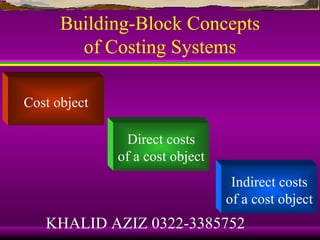
Building-Block Concepts
        of Costing Systems

Cost object

                Direct costs
              of a cost object
                                  Indirect costs
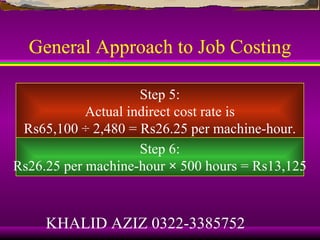
                                 of a cost object
   KHALID AZIZ 0322-3385752
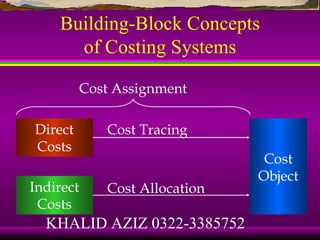
Building-Block Concepts
      of Costing Systems

         Cost Assignment

Direct      Cost Tracing
Costs
                               Cost
                              Object
Indirect    Cost Allocation
 Costs
  KHALID AZIZ 0322-3385752
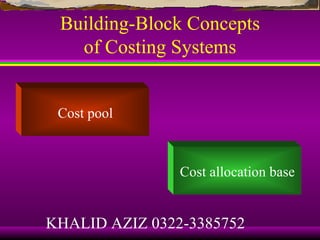
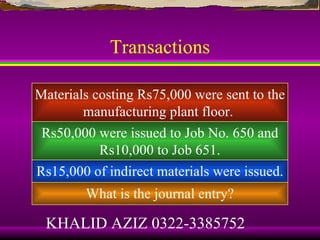
Building-Block Concepts
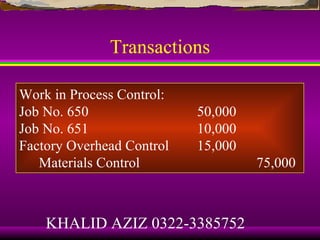
   of Costing Systems


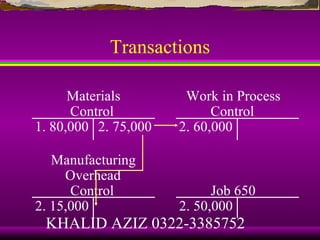
 Cost pool


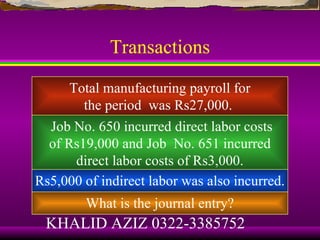
                Cost allocation base


KHALID AZIZ 0322-3385752
Learning Objective 2

  Distinguish between job
costing and process costing.


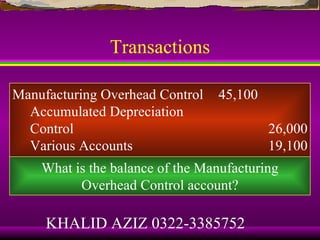
KHALID AZIZ 0322-3385752
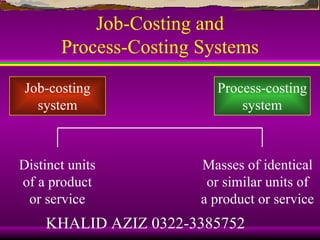
Job-Costing and
       Process-Costing Systems

 Job-costing             Process-costing
   system                    system


Distinct units         Masses of identical
of a product            or similar units of
 or service            a product or service
    KHALID AZIZ 0322-3385752
Learning Objective 3

   Outline a seven-step
 approach to job costing.


KHALID AZIZ 0322-3385752
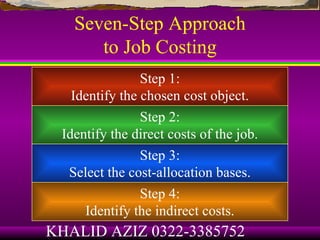
Seven-Step Approach
      to Job Costing
                Step 1:
   Identify the chosen cost object.
                Step 2:
 Identify the direct costs of the job.
                Step 3:
  Select the cost-allocation bases.
                Step 4:
     Identify the indirect costs.
KHALID AZIZ 0322-3385752
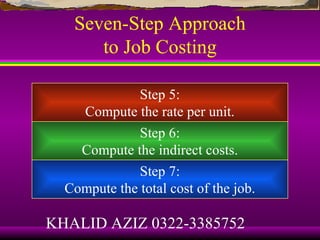
Seven-Step Approach
      to Job Costing

              Step 5:
    Compute the rate per unit.
              Step 6:
    Compute the indirect costs.
              Step 7:
  Compute the total cost of the job.

KHALID AZIZ 0322-3385752
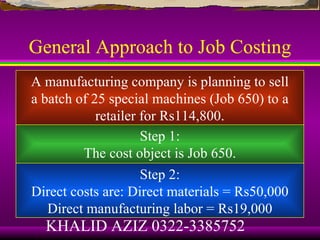
General Approach to Job Costing
A manufacturing company is planning to sell
a batch of 25 special machines (Job 650) to a
            retailer for Rs114,800.
                     Step 1:
         The cost object is Job 650.
                     Step 2:
Direct costs are: Direct materials = Rs50,000
   Direct manufacturing labor = Rs19,000
  KHALID AZIZ 0322-3385752
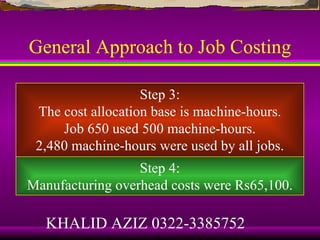
General Approach to Job Costing

                   Step 3:
 The cost allocation base is machine-hours.
     Job 650 used 500 machine-hours.
 2,480 machine-hours were used by all jobs.
                  Step 4:
Manufacturing overhead costs were Rs65,100.

   KHALID AZIZ 0322-3385752
General Approach to Job Costing

                     Step 5:
            Actual indirect cost rate is
 Rs65,100 ÷ 2,480 = Rs26.25 per machine-hour.
                     Step 6:
Rs26.25 per machine-hour × 500 hours = Rs13,125


     KHALID AZIZ 0322-3385752
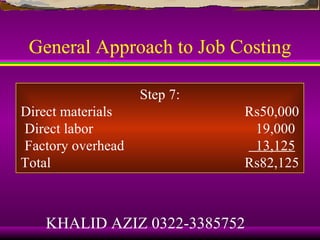
General Approach to Job Costing

                   Step 7:
Direct materials             Rs50,000
Direct labor                  19,000
Factory overhead              13,125
Total                        Rs82,125


   KHALID AZIZ 0322-3385752
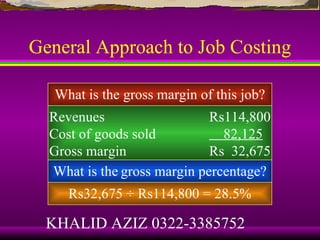
General Approach to Job Costing

   What is the gross margin of this job?
  Revenues                   Rs114,800
  Cost of goods sold           82,125
  Gross margin               Rs 32,675
  What is the gross margin percentage?
     Rs32,675 ÷ Rs114,800 = 28.5%

  KHALID AZIZ 0322-3385752
Source Documents

          Job cost record


    Materials requisition record


        Labor time record
KHALID AZIZ 0322-3385752
Learning Objective 4

Distinguish actual costing
  from normal costing.


KHALID AZIZ 0322-3385752
Costing Systems

  Actual costing is a system that uses actual
costs to determine the cost of individual jobs.
It allocates indirect costs based on the actual
indirect-cost rate(s) times the actual quantity
         of the cost-allocation base(s).


  KHALID AZIZ 0322-3385752
Costing Systems

Normal costing is a method that allocates
 indirect costs based on the budgeted
  indirect-cost rate(s) times the actual
 quantity of the cost allocation base(s).


KHALID AZIZ 0322-3385752
Normal Costing
Assume that the manufacturing company budgets
 $60,000 for total manufacturing overhead costs
           and 2,400 machine-hours.
    What is the budgeted indirect-cost rate?
       Rs60,000 ÷ 2,400 = Rs25 per hour
How much indirect cost was allocated to Job 650?
     500 machine-hours × Rs25 = Rs12,500
    KHALID AZIZ 0322-3385752
Normal Costing

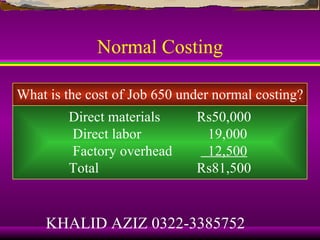
What is the cost of Job 650 under normal costing?
        Direct materials      Rs50,000
        Direct labor           19,000
        Factory overhead       12,500
        Total                 Rs81,500


    KHALID AZIZ 0322-3385752
Learning Objective 5

   Track the flow of costs
  in a job-costing system.


KHALID AZIZ 0322-3385752
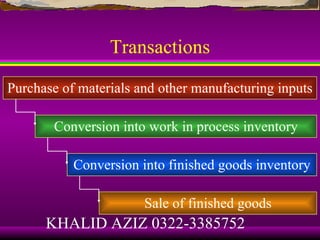
Transactions

Purchase of materials and other manufacturing inputs

       Conversion into work in process inventory

           Conversion into finished goods inventory

                       Sale of finished goods
      KHALID AZIZ 0322-3385752
Transactions

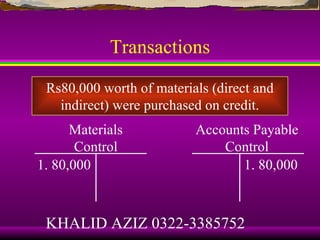
 Rs80,000 worth of materials (direct and
   indirect) were purchased on credit.
      Materials           Accounts Payable
       Control                Control
1. 80,000                        1. 80,000


 KHALID AZIZ 0322-3385752
Transactions

Materials costing Rs75,000 were sent to the
        manufacturing plant floor.
 Rs50,000 were issued to Job No. 650 and
           Rs10,000 to Job 651.
Rs15,000 of indirect materials were issued.
        What is the journal entry?

 KHALID AZIZ 0322-3385752
Transactions

Work in Process Control:
Job No. 650                50,000
Job No. 651                10,000
Factory Overhead Control   15,000
   Materials Control                75,000


    KHALID AZIZ 0322-3385752
Transactions

      Materials        Work in Process
      Control               Control
1. 80,000 2. 75,000   2. 60,000

   Manufacturing
     Overhead
      Control               Job 650
2. 15,000             2. 50,000
 KHALID AZIZ 0322-3385752
Transactions

      Total manufacturing payroll for
        the period was Rs27,000.
  Job No. 650 incurred direct labor costs
  of Rs19,000 and Job No. 651 incurred
       direct labor costs of Rs3,000.
Rs5,000 of indirect labor was also incurred.
        What is the journal entry?
 KHALID AZIZ 0322-3385752
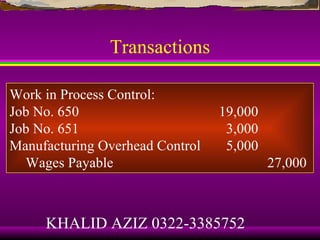
Transactions

Work in Process Control:
Job No. 650                      19,000
Job No. 651                       3,000
Manufacturing Overhead Control    5,000
  Wages Payable                           27,000


     KHALID AZIZ 0322-3385752
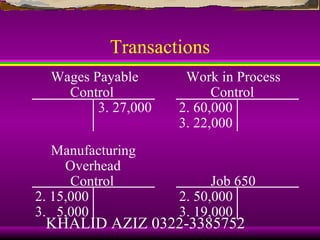
Transactions
  Wages Payable       Work in Process
    Control                Control
         3. 27,000   2. 60,000
                     3. 22,000
   Manufacturing
     Overhead
      Control              Job 650
2. 15,000            2. 50,000
3. 5,000             3. 19,000
 KHALID AZIZ 0322-3385752
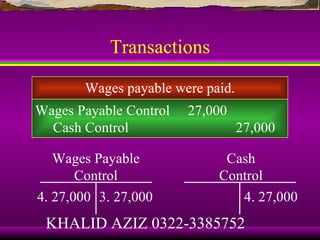
Transactions

       Wages payable were paid.
Wages Payable Control   27,000
  Cash Control                    27,000

   Wages Payable             Cash
       Control              Control
4. 27,000 3. 27,000            4. 27,000
 KHALID AZIZ 0322-3385752
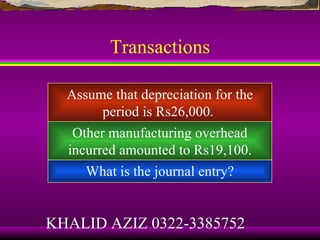
Transactions

  Assume that depreciation for the
        period is Rs26,000.
   Other manufacturing overhead
  incurred amounted to Rs19,100.
     What is the journal entry?


KHALID AZIZ 0322-3385752
Transactions

Manufacturing Overhead Control   45,100
  Accumulated Depreciation
  Control                                 26,000
  Various Accounts                        19,100
    What is the balance of the Manufacturing
          Overhead Control account?

     KHALID AZIZ 0322-3385752
Transactions

   Rs62,000 of overhead was allocated to the
various jobs of which Rs12,500 went to Job 650.
Work in Process Control 62,000
   Manufacturing Overhead Control       62,000
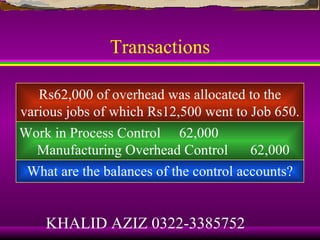
 What are the balances of the control accounts?


    KHALID AZIZ 0322-3385752
Transactions

Manufacturing Overhead    Work in Process
       Control                Control
2.   15,000 6. 62,000    2.    60,000
3.    5,000              3.    22,000
5.   45,100              6.    62,000
Bal. 3,100               Bal. 144,000

   KHALID AZIZ 0322-3385752
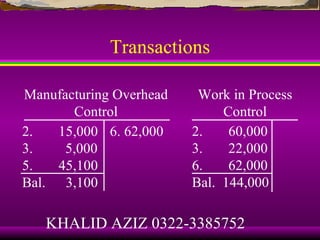
Transactions

     The cost of Job 650 is:

             Job 650
    2. 50,000
    3. 19,000
    6. 12,500
    Bal. 81,500

KHALID AZIZ 0322-3385752
Transactions

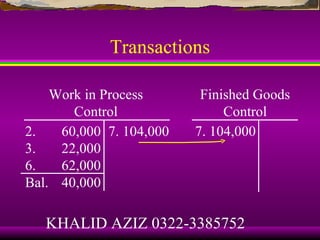
   Jobs costing Rs104,000 were completed and
 transferred to finished goods, including Job 650.
What effect does this have on the control accounts?


     KHALID AZIZ 0322-3385752
Transactions

    Work in Process       Finished Goods
       Control                Control
2.   60,000 7. 104,000   7. 104,000
3.   22,000
6.   62,000
Bal. 40,000

   KHALID AZIZ 0322-3385752
Transactions

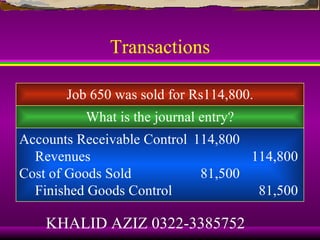
       Job 650 was sold for Rs114,800.
          What is the journal entry?
Accounts Receivable Control 114,800
  Revenues                          114,800
Cost of Goods Sold           81,500
  Finished Goods Control             81,500

    KHALID AZIZ 0322-3385752
Transactions

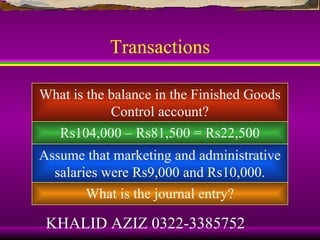
What is the balance in the Finished Goods
            Control account?
   Rs104,000 – Rs81,500 = Rs22,500
Assume that marketing and administrative
  salaries were Rs9,000 and Rs10,000.
        What is the journal entry?

 KHALID AZIZ 0322-3385752
Transactions

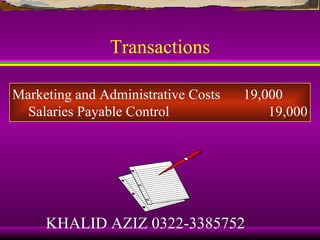
Marketing and Administrative Costs   19,000
  Salaries Payable Control               19,000


     KHALID AZIZ 0322-3385752
Transactions

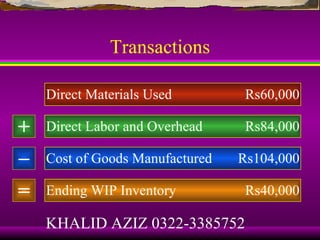
    Direct Materials Used         Rs60,000

+   Direct Labor and Overhead     Rs84,000

–   Cost of Goods Manufactured   Rs104,000

=   Ending WIP Inventory          Rs40,000

    KHALID AZIZ 0322-3385752
Transactions

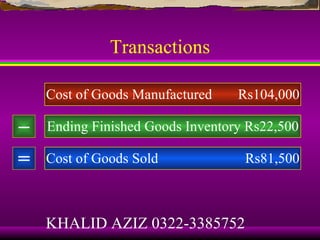
    Cost of Goods Manufactured    Rs104,000

–   Ending Finished Goods Inventory Rs22,500

=   Cost of Goods Sold             Rs81,500


    KHALID AZIZ 0322-3385752
Learning Objective 6

  Account for end-of-period
underallocated or overallocated
      indirect costs using
     alternative methods.
  KHALID AZIZ 0322-3385752
End-Of-Period Adjustments

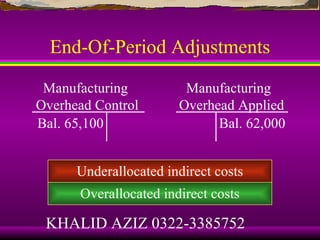
 Manufacturing          Manufacturing
Overhead Control       Overhead Applied
Bal. 65,100                  Bal. 62,000


      Underallocated indirect costs
      Overallocated indirect costs

 KHALID AZIZ 0322-3385752
End-Of-Period Adjustments

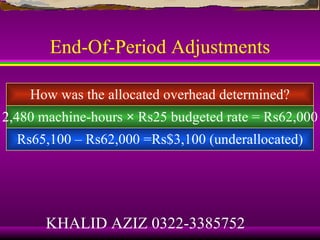
    How was the allocated overhead determined?
2,480 machine-hours × Rs25 budgeted rate = Rs62,000
  Rs65,100 – Rs62,000 =Rs$3,100 (underallocated)


       KHALID AZIZ 0322-3385752
End-Of-Period Adjustments

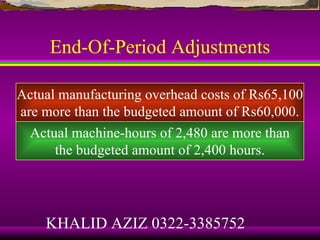
Actual manufacturing overhead costs of Rs65,100
are more than the budgeted amount of Rs60,000.
  Actual machine-hours of 2,480 are more than
      the budgeted amount of 2,400 hours.


    KHALID AZIZ 0322-3385752
End-Of-Period Adjustments

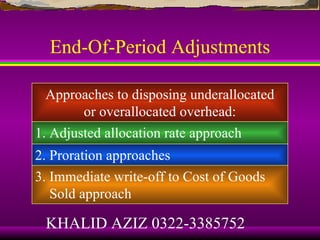
 Approaches to disposing underallocated
      or overallocated overhead:
1. Adjusted allocation rate approach
2. Proration approaches
3. Immediate write-off to Cost of Goods
   Sold approach

 KHALID AZIZ 0322-3385752
Adjusted Allocation
           Rate Approach

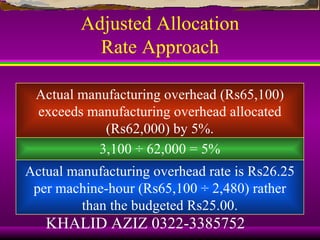
 Actual manufacturing overhead (Rs65,100)
 exceeds manufacturing overhead allocated
            (Rs62,000) by 5%.
           3,100 ÷ 62,000 = 5%
Actual manufacturing overhead rate is Rs26.25
 per machine-hour (Rs65,100 ÷ 2,480) rather
         than the budgeted Rs25.00.
   KHALID AZIZ 0322-3385752
Adjusted Allocation
          Rate Approach
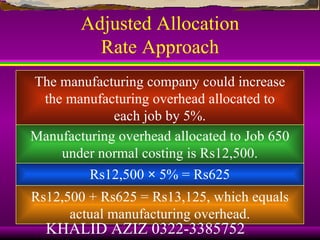
The manufacturing company could increase
 the manufacturing overhead allocated to
             each job by 5%.
Manufacturing overhead allocated to Job 650
    under normal costing is Rs12,500.
         Rs12,500 × 5% = Rs625
Rs12,500 + Rs625 = Rs13,125, which equals
      actual manufacturing overhead.
  KHALID AZIZ 0322-3385752
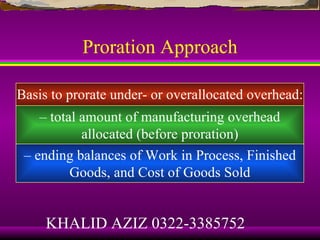
Proration Approach

Basis to prorate under- or overallocated overhead:
    – total amount of manufacturing overhead
            allocated (before proration)
 – ending balances of Work in Process, Finished
          Goods, and Cost of Goods Sold


     KHALID AZIZ 0322-3385752
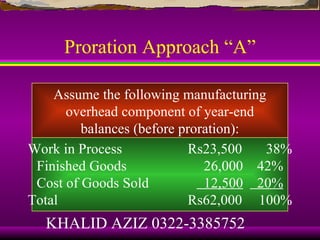
Proration Approach “A”

    Assume the following manufacturing
      overhead component of year-end
         balances (before proration):
Work in Process             Rs23,500  38%
 Finished Goods               26,000 42%
 Cost of Goods Sold           12,500 20%
Total                       Rs62,000 100%
  KHALID AZIZ 0322-3385752
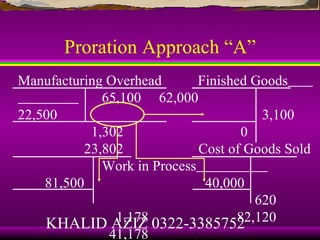
Proration Approach “A”
Manufacturing Overhead       Finished Goods
             65,100 62,000
22,500                                  3,100
           1,302                     0
          23,802             Cost of Goods Sold
             Work in Process
    81,500                    40,000
                                       620
    KHALID AZIZ1,178 0322-3385752   82,120
              41,178
Proration Approach “B”

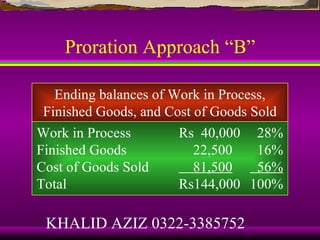
   Ending balances of Work in Process,
 Finished Goods, and Cost of Goods Sold
Work in Process        Rs 40,000 28%
Finished Goods            22,500    16%
Cost of Goods Sold        81,500    56%
Total                  Rs144,000 100%

 KHALID AZIZ 0322-3385752
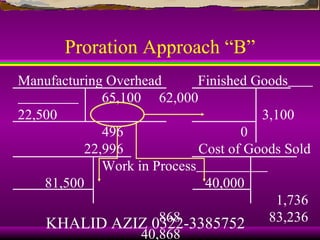
Proration Approach “B”
Manufacturing Overhead       Finished Goods
             65,100 62,000
22,500                                 3,100
             496                    0
          22,996             Cost of Goods Sold
             Work in Process
    81,500                    40,000
                                         1,736
                      868
    KHALID AZIZ 0322-3385752            83,236
                   40,868
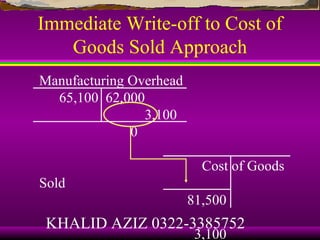
Immediate Write-off to Cost of
   Goods Sold Approach
Manufacturing Overhead
  65,100 62,000
                3,100
              0

                           Cost of Goods
Sold
                         81,500
 KHALID AZIZ 0322-3385752
                          3,100
Learning Objective 7

     Apply variations
           from
     normal costing.


KHALID AZIZ 0322-3385752
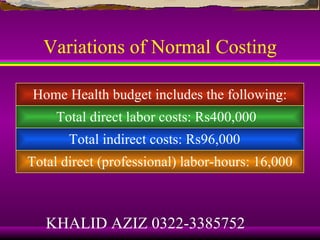
Variations of Normal Costing

Home Health budget includes the following:
     Total direct labor costs: Rs400,000
       Total indirect costs: Rs96,000
Total direct (professional) labor-hours: 16,000


   KHALID AZIZ 0322-3385752
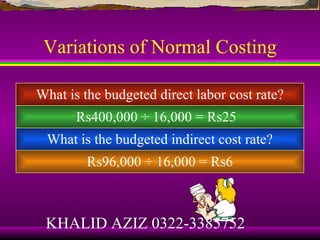
Variations of Normal Costing

What is the budgeted direct labor cost rate?
       Rs400,000 ÷ 16,000 = Rs25
 What is the budgeted indirect cost rate?
         Rs96,000 ÷ 16,000 = Rs6


 KHALID AZIZ 0322-3385752
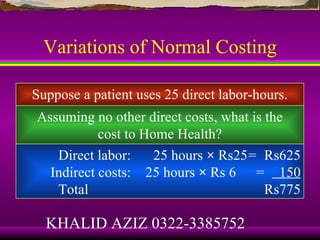
Variations of Normal Costing

Suppose a patient uses 25 direct labor-hours.
Assuming no other direct costs, what is the
           cost to Home Health?
   Direct labor:     25 hours × Rs25= Rs625
  Indirect costs: 25 hours × Rs 6 = 150
   Total                                Rs775

  KHALID AZIZ 0322-3385752

Job order

  • 1.
    Job Order Costing KHALID AZIZ 0322-3385752
  • 2.
    Learning Objective 1 Describethe building-block concepts of costing systems. KHALID AZIZ 0322-3385752
  • 3.
    Building-Block Concepts of Costing Systems Cost object Direct costs of a cost object Indirect costs of a cost object KHALID AZIZ 0322-3385752
  • 4.
    Building-Block Concepts of Costing Systems Cost Assignment Direct Cost Tracing Costs Cost Object Indirect Cost Allocation Costs KHALID AZIZ 0322-3385752
  • 5.
    Building-Block Concepts of Costing Systems Cost pool Cost allocation base KHALID AZIZ 0322-3385752
  • 6.
    Learning Objective 2 Distinguish between job costing and process costing. KHALID AZIZ 0322-3385752
  • 7.
    Job-Costing and Process-Costing Systems Job-costing Process-costing system system Distinct units Masses of identical of a product or similar units of or service a product or service KHALID AZIZ 0322-3385752
  • 8.
    Learning Objective 3 Outline a seven-step approach to job costing. KHALID AZIZ 0322-3385752
  • 9.
    Seven-Step Approach to Job Costing Step 1: Identify the chosen cost object. Step 2: Identify the direct costs of the job. Step 3: Select the cost-allocation bases. Step 4: Identify the indirect costs. KHALID AZIZ 0322-3385752
  • 10.
    Seven-Step Approach to Job Costing Step 5: Compute the rate per unit. Step 6: Compute the indirect costs. Step 7: Compute the total cost of the job. KHALID AZIZ 0322-3385752
  • 11.
    General Approach toJob Costing A manufacturing company is planning to sell a batch of 25 special machines (Job 650) to a retailer for Rs114,800. Step 1: The cost object is Job 650. Step 2: Direct costs are: Direct materials = Rs50,000 Direct manufacturing labor = Rs19,000 KHALID AZIZ 0322-3385752
  • 12.
    General Approach toJob Costing Step 3: The cost allocation base is machine-hours. Job 650 used 500 machine-hours. 2,480 machine-hours were used by all jobs. Step 4: Manufacturing overhead costs were Rs65,100. KHALID AZIZ 0322-3385752
  • 13.
    General Approach toJob Costing Step 5: Actual indirect cost rate is Rs65,100 ÷ 2,480 = Rs26.25 per machine-hour. Step 6: Rs26.25 per machine-hour × 500 hours = Rs13,125 KHALID AZIZ 0322-3385752
  • 14.
    General Approach toJob Costing Step 7: Direct materials Rs50,000 Direct labor 19,000 Factory overhead 13,125 Total Rs82,125 KHALID AZIZ 0322-3385752
  • 15.
    General Approach toJob Costing What is the gross margin of this job? Revenues Rs114,800 Cost of goods sold 82,125 Gross margin Rs 32,675 What is the gross margin percentage? Rs32,675 ÷ Rs114,800 = 28.5% KHALID AZIZ 0322-3385752
  • 16.
    Source Documents Job cost record Materials requisition record Labor time record KHALID AZIZ 0322-3385752
  • 17.
    Learning Objective 4 Distinguishactual costing from normal costing. KHALID AZIZ 0322-3385752
  • 18.
    Costing Systems Actual costing is a system that uses actual costs to determine the cost of individual jobs. It allocates indirect costs based on the actual indirect-cost rate(s) times the actual quantity of the cost-allocation base(s). KHALID AZIZ 0322-3385752
  • 19.
    Costing Systems Normal costingis a method that allocates indirect costs based on the budgeted indirect-cost rate(s) times the actual quantity of the cost allocation base(s). KHALID AZIZ 0322-3385752
  • 20.
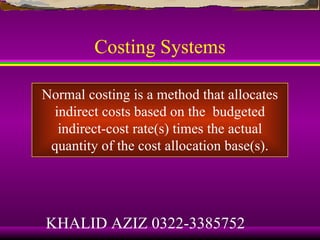
    Normal Costing Assume thatthe manufacturing company budgets $60,000 for total manufacturing overhead costs and 2,400 machine-hours. What is the budgeted indirect-cost rate? Rs60,000 ÷ 2,400 = Rs25 per hour How much indirect cost was allocated to Job 650? 500 machine-hours × Rs25 = Rs12,500 KHALID AZIZ 0322-3385752
  • 21.
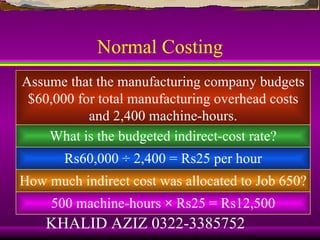
    Normal Costing What isthe cost of Job 650 under normal costing? Direct materials Rs50,000 Direct labor 19,000 Factory overhead 12,500 Total Rs81,500 KHALID AZIZ 0322-3385752
  • 22.
    Learning Objective 5 Track the flow of costs in a job-costing system. KHALID AZIZ 0322-3385752
  • 23.
    Transactions Purchase of materialsand other manufacturing inputs Conversion into work in process inventory Conversion into finished goods inventory Sale of finished goods KHALID AZIZ 0322-3385752
  • 24.
    Transactions Rs80,000 worthof materials (direct and indirect) were purchased on credit. Materials Accounts Payable Control Control 1. 80,000 1. 80,000 KHALID AZIZ 0322-3385752
  • 25.
    Transactions Materials costing Rs75,000were sent to the manufacturing plant floor. Rs50,000 were issued to Job No. 650 and Rs10,000 to Job 651. Rs15,000 of indirect materials were issued. What is the journal entry? KHALID AZIZ 0322-3385752
  • 26.
    Transactions Work in ProcessControl: Job No. 650 50,000 Job No. 651 10,000 Factory Overhead Control 15,000 Materials Control 75,000 KHALID AZIZ 0322-3385752
  • 27.
    Transactions Materials Work in Process Control Control 1. 80,000 2. 75,000 2. 60,000 Manufacturing Overhead Control Job 650 2. 15,000 2. 50,000 KHALID AZIZ 0322-3385752
  • 28.
    Transactions Total manufacturing payroll for the period was Rs27,000. Job No. 650 incurred direct labor costs of Rs19,000 and Job No. 651 incurred direct labor costs of Rs3,000. Rs5,000 of indirect labor was also incurred. What is the journal entry? KHALID AZIZ 0322-3385752
  • 29.
    Transactions Work in ProcessControl: Job No. 650 19,000 Job No. 651 3,000 Manufacturing Overhead Control 5,000 Wages Payable 27,000 KHALID AZIZ 0322-3385752
  • 30.
    Transactions WagesPayable Work in Process Control Control 3. 27,000 2. 60,000 3. 22,000 Manufacturing Overhead Control Job 650 2. 15,000 2. 50,000 3. 5,000 3. 19,000 KHALID AZIZ 0322-3385752
  • 31.
    Transactions Wages payable were paid. Wages Payable Control 27,000 Cash Control 27,000 Wages Payable Cash Control Control 4. 27,000 3. 27,000 4. 27,000 KHALID AZIZ 0322-3385752
  • 32.
    Transactions Assumethat depreciation for the period is Rs26,000. Other manufacturing overhead incurred amounted to Rs19,100. What is the journal entry? KHALID AZIZ 0322-3385752
  • 33.
    Transactions Manufacturing Overhead Control 45,100 Accumulated Depreciation Control 26,000 Various Accounts 19,100 What is the balance of the Manufacturing Overhead Control account? KHALID AZIZ 0322-3385752
  • 34.
    Transactions Rs62,000 of overhead was allocated to the various jobs of which Rs12,500 went to Job 650. Work in Process Control 62,000 Manufacturing Overhead Control 62,000 What are the balances of the control accounts? KHALID AZIZ 0322-3385752
  • 35.
    Transactions Manufacturing Overhead Work in Process Control Control 2. 15,000 6. 62,000 2. 60,000 3. 5,000 3. 22,000 5. 45,100 6. 62,000 Bal. 3,100 Bal. 144,000 KHALID AZIZ 0322-3385752
  • 36.
    Transactions The cost of Job 650 is: Job 650 2. 50,000 3. 19,000 6. 12,500 Bal. 81,500 KHALID AZIZ 0322-3385752
  • 37.
    Transactions Jobs costing Rs104,000 were completed and transferred to finished goods, including Job 650. What effect does this have on the control accounts? KHALID AZIZ 0322-3385752
  • 38.
    Transactions Work in Process Finished Goods Control Control 2. 60,000 7. 104,000 7. 104,000 3. 22,000 6. 62,000 Bal. 40,000 KHALID AZIZ 0322-3385752
  • 39.
    Transactions Job 650 was sold for Rs114,800. What is the journal entry? Accounts Receivable Control 114,800 Revenues 114,800 Cost of Goods Sold 81,500 Finished Goods Control 81,500 KHALID AZIZ 0322-3385752
  • 40.
    Transactions What is thebalance in the Finished Goods Control account? Rs104,000 – Rs81,500 = Rs22,500 Assume that marketing and administrative salaries were Rs9,000 and Rs10,000. What is the journal entry? KHALID AZIZ 0322-3385752
  • 41.
    Transactions Marketing and AdministrativeCosts 19,000 Salaries Payable Control 19,000 KHALID AZIZ 0322-3385752
  • 42.
    Transactions Direct Materials Used Rs60,000 + Direct Labor and Overhead Rs84,000 – Cost of Goods Manufactured Rs104,000 = Ending WIP Inventory Rs40,000 KHALID AZIZ 0322-3385752
  • 43.
    Transactions Cost of Goods Manufactured Rs104,000 – Ending Finished Goods Inventory Rs22,500 = Cost of Goods Sold Rs81,500 KHALID AZIZ 0322-3385752
  • 44.
    Learning Objective 6 Account for end-of-period underallocated or overallocated indirect costs using alternative methods. KHALID AZIZ 0322-3385752
  • 45.
    End-Of-Period Adjustments Manufacturing Manufacturing Overhead Control Overhead Applied Bal. 65,100 Bal. 62,000 Underallocated indirect costs Overallocated indirect costs KHALID AZIZ 0322-3385752
  • 46.
    End-Of-Period Adjustments How was the allocated overhead determined? 2,480 machine-hours × Rs25 budgeted rate = Rs62,000 Rs65,100 – Rs62,000 =Rs$3,100 (underallocated) KHALID AZIZ 0322-3385752
  • 47.
    End-Of-Period Adjustments Actual manufacturingoverhead costs of Rs65,100 are more than the budgeted amount of Rs60,000. Actual machine-hours of 2,480 are more than the budgeted amount of 2,400 hours. KHALID AZIZ 0322-3385752
  • 48.
    End-Of-Period Adjustments Approachesto disposing underallocated or overallocated overhead: 1. Adjusted allocation rate approach 2. Proration approaches 3. Immediate write-off to Cost of Goods Sold approach KHALID AZIZ 0322-3385752
  • 49.
    Adjusted Allocation Rate Approach Actual manufacturing overhead (Rs65,100) exceeds manufacturing overhead allocated (Rs62,000) by 5%. 3,100 ÷ 62,000 = 5% Actual manufacturing overhead rate is Rs26.25 per machine-hour (Rs65,100 ÷ 2,480) rather than the budgeted Rs25.00. KHALID AZIZ 0322-3385752
  • 50.
    Adjusted Allocation Rate Approach The manufacturing company could increase the manufacturing overhead allocated to each job by 5%. Manufacturing overhead allocated to Job 650 under normal costing is Rs12,500. Rs12,500 × 5% = Rs625 Rs12,500 + Rs625 = Rs13,125, which equals actual manufacturing overhead. KHALID AZIZ 0322-3385752
  • 51.
    Proration Approach Basis toprorate under- or overallocated overhead: – total amount of manufacturing overhead allocated (before proration) – ending balances of Work in Process, Finished Goods, and Cost of Goods Sold KHALID AZIZ 0322-3385752
  • 52.
    Proration Approach “A” Assume the following manufacturing overhead component of year-end balances (before proration): Work in Process Rs23,500 38% Finished Goods 26,000 42% Cost of Goods Sold 12,500 20% Total Rs62,000 100% KHALID AZIZ 0322-3385752
  • 53.
    Proration Approach “A” ManufacturingOverhead Finished Goods 65,100 62,000 22,500 3,100 1,302 0 23,802 Cost of Goods Sold Work in Process 81,500 40,000 620 KHALID AZIZ1,178 0322-3385752 82,120 41,178
  • 54.
    Proration Approach “B” Ending balances of Work in Process, Finished Goods, and Cost of Goods Sold Work in Process Rs 40,000 28% Finished Goods 22,500 16% Cost of Goods Sold 81,500 56% Total Rs144,000 100% KHALID AZIZ 0322-3385752
  • 55.
    Proration Approach “B” ManufacturingOverhead Finished Goods 65,100 62,000 22,500 3,100 496 0 22,996 Cost of Goods Sold Work in Process 81,500 40,000 1,736 868 KHALID AZIZ 0322-3385752 83,236 40,868
  • 56.
    Immediate Write-off toCost of Goods Sold Approach Manufacturing Overhead 65,100 62,000 3,100 0 Cost of Goods Sold 81,500 KHALID AZIZ 0322-3385752 3,100
  • 57.
    Learning Objective 7 Apply variations from normal costing. KHALID AZIZ 0322-3385752
  • 58.
    Variations of NormalCosting Home Health budget includes the following: Total direct labor costs: Rs400,000 Total indirect costs: Rs96,000 Total direct (professional) labor-hours: 16,000 KHALID AZIZ 0322-3385752
  • 59.
    Variations of NormalCosting What is the budgeted direct labor cost rate? Rs400,000 ÷ 16,000 = Rs25 What is the budgeted indirect cost rate? Rs96,000 ÷ 16,000 = Rs6 KHALID AZIZ 0322-3385752
  • 60.
    Variations of NormalCosting Suppose a patient uses 25 direct labor-hours. Assuming no other direct costs, what is the cost to Home Health? Direct labor: 25 hours × Rs25= Rs625 Indirect costs: 25 hours × Rs 6 = 150 Total Rs775 KHALID AZIZ 0322-3385752