Dr. Jonathan Plucker, University of Connecticut
Dr. Jennifer Giancola, Jack Kent Cooke Foundation
Grace Healey, Daniel Arndt, and Chen Wang, University of Connecticut
March 2015
EQUAL TALENTS,
UNEQUAL OPPORTUNITIES:
A Report Card on State Support for
Academically Talented Low-Income Students
3
EQUAL TALENTS, UNEQUAL OPPORTUNITIES	 JACK KENT COOKE FOUNDATION
America has a tremendous need for talent. The vibrancy of our
economy depends on talent, our quality of life is enriched by it,
and the moral code of our society is based on the free exchange of
creative ideas. Through educating the nation’s youth, our schools
continuously cultivate our next generation’s talent. Yet the vast
majority of students achieving high levels of academic excellence
comes from upper-income, economically secure circumstances.
Low-income students, recently estimated to be roughly half of our
public school population, are much less likely to achieve academic
excellence even when demonstrating the potential to do so. Low-
income students initially identified as high-ability often fail to
achieve at high levels or backslide as they progress through school.
This report examines the performance of America’s high-ability
students, with an emphasis on those who come from low-
income backgrounds. The report examines a range of state-level
interventions that are intended to foster academic talent, with
the goal of identifying the policies currently in use that should be
implemented more widely. Working with an expert advisory panel,
the project team identified a range of indicators related to state-
level policy inputs and student outcomes. Ultimately, 18 indicators
were included in the analyses, representing nine distinct state-level
policies and nine specific student outcomes. All data were collected
at the state level, as we believe that changes to state-level policies
are most likely to improve the country’s education of high-ability
students, especially students from low-income families. States
were then graded on both their policy interventions and their
student outcomes.
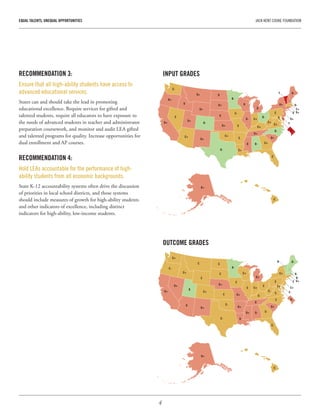
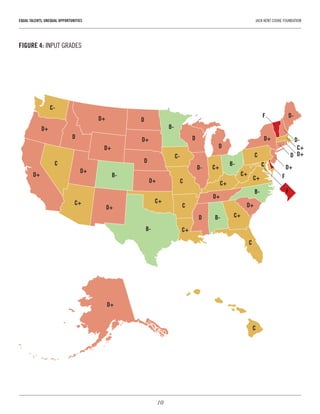
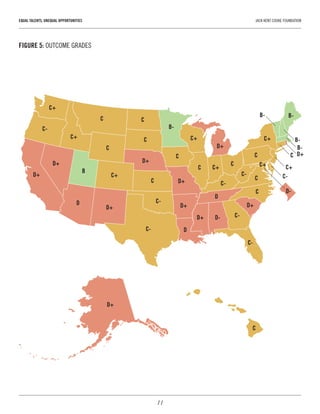
The initial results (see maps on page 2, larger maps on pages 10-11)
are not encouraging. Few states have comprehensive policies in
place to address the education of talented students, let alone the
education of high-performing students from low-income families.
In this state policy vacuum, support for advanced learning rests on
local districts, schools, and families. Multiple recent studies have
highlighted the educational advantages students in higher-income
families receive, from hearing more vocabulary words from their
parents to taking part in extracurricular enrichment and attending
schools with more experienced teachers and smaller class sizes.
The opportunities available to low-income students are decidedly
restricted and limiting.
Without significant differences in state interventions to support
advanced education, student performance outcomes at the advanced
level appear to be normally distributed across states—as one
would expect in the absence of attention to talent development.
Our data suggest a correlation between state demographics and
outcomes—higher poverty states tend to have lower outcomes.
Not surprisingly, large excellence gaps (differences in performance
between low-income and other students) exist in nearly all states.
It is a story of demography predetermining destiny, with bright
low-income students becoming what one research team referred to
as a “persistent talent underclass.” This is both unacceptable and
incompatible with the country’s long-term prosperity.
Despite these findings, there are reasons for optimism. Talent
development is becoming a concern of policymakers, and many
of the necessary policies identified by the expert panel and in the
research literature are relatively low cost and easy to implement.
Several states lead the nation in producing higher percentages of
talented students, and many states appear to have the structures
in place to begin addressing student talent development
more effectively.
To help states build on this groundwork, the Jack Kent Cooke
Foundation plans to conduct this survey periodically, with an
increasingly broadened set of indicators and data sources, to inform
the national dialogue about how best to educate our most advanced
students, especially those from low-income families. As a starting
point, we offer the following recommendations to states:
RECOMMENDATION 1:
Make high-performing students highly visible.
Require local education agencies (LEAs) to identify high-
ability students and their income levels and collect data on their
performance over time, especially those who are low-income.
When releasing state data on student outcomes, ensure that the
performance of high-achieving students is highlighted.
RECOMMENDATION 2:
Remove barriers that prevent high-ability students from
moving through coursework at a pace that matches their
achievement level.
Require LEAs to allow and encourage a range of academic
acceleration options, such as early entrance to kindergarten,
acceleration between grades, dual enrollment in middle school and
high school (with middle school students able to earn high school
credit), and early graduation from high school.
EXECUTIVE SUMMARY
4
EQUAL TALENTS, UNEQUAL OPPORTUNITIES	 JACK KENT COOKE FOUNDATION
RECOMMENDATION 3:
Ensure that all high-ability students have access to
advanced educational services.
States can and should take the lead in promoting
educational excellence. Require services for gifted and
talented students, require all educators to have exposure to
the needs of advanced students in teacher and administrator
preparation coursework, and monitor and audit LEA gifted
and talented programs for quality. Increase opportunities for
dual enrollment and AP courses.
RECOMMENDATION 4:
Hold LEAs accountable for the performance of high-
ability students from all economic backgrounds.
State K-12 accountability systems often drive the discussion
of priorities in local school districts, and those systems
should include measures of growth for high-ability students
and other indicators of excellence, including distinct
indicators for high-ability, low-income students.
INPUT GRADES
B-
B-
B-
B-
B-
B-
C+
C+
C+
C+
C+
C-
C-
C+
C+
C+
C
C
C
C
C
C
D+
D+
D+
D+
D+
D-
D
D
D
D
D
D+
C+
D D
D-
D-
F
F
C
FD+
D+
D+
D+
D+
D+
D+
D+
OUTCOME GRADES
D-
C
C-
C
B-
C+
D
C+
C-
C-
D
C
C+
C-
C-
C
D+
C
D+
D+
C-
C+
D+
C+
D+
C
C
B-
C
D+
C
D+
D+
D
B-
C+ C+
C
B-
D-
B-
C
C-D+
C
D+
B
C-
C+
C
D+
5
EQUAL TALENTS, UNEQUAL OPPORTUNITIES	 JACK KENT COOKE FOUNDATION
INTRODUCTION
The lack of academic success of high-ability, low-income students
should be among the country’s most pressing education and policy
issues.1
Conventional wisdom has it that smart, poor students
“can write their own ticket,” yet a growing body of research offers
evidence that these students are not succeeding at anything close to
the rate of their high income peers. Lacking access to the enriched
academic opportunities, differentiated learning, and counseling
afforded to wealthier students, high-ability, low-income children
are becoming what one leading team of researchers has termed a
persistent talent underclass—underserved and therefore prevented
from fully developing their talents.2
Although systematic efforts to address known problems with
educating minority students have resulted in narrowing racial
achievement gaps, the performance of the most talented low-
income children lags far behind that of their high-ability, higher-
income peers. In fact, the gap between these groups of students (the
“excellence gap”) has grown substantially over the past generation.3
Since recent studies have shown that low-income students constitute
over 50 percent of the student population in many states,4
the
inadequacy of educational policies for such a large group of students
has enormous implications for social mobility, preservation of the
American Dream, and the nation’s future economic prosperity.
Without more deliberate focus on this issue, our education system
will become an unwitting accomplice to the nation’s growing
income inequality.
PURPOSE OF THIS REPORT
The Jack Kent Cooke Foundation has been committed since 2000
to supporting the talent development of high-ability students with
financial need. The Cooke Foundation funded this state-by-state
analysis to measure state policy support for advanced learning and
highlight disparities in educational outcomes of advanced learners
from low-income families. This report measures the extent to which
states are addressing the needs of advanced learners, identifies best
practices that states may adopt, and collects in one place critical
data suggesting which interventions have the greatest efficacy. To
maximize this report’s usefulness, states were rated on policies they
have in place (“inputs”) and how high-ability, low-income students
currently perform (“outcomes”).
WHAT WE DID
Our goal for this research was to illustrate the excellence gap
using indicators that were readily available, easily understood, and
comprehensive. We wanted to create a report that would provide
clear guidance to states on how they might better support advanced
learning for all students, by implementing policies to insure
that all high-ability students—including those from low-income
backgrounds—have the supports they deserve.
We began the project by convening an expert advisory board of
national experts familiar with the landscape of state policy as it
relates to advanced learning.5
Following a series of email exchanges
EQUAL TALENTS,
UNEQUAL OPPORTUNITIES
1	 All students have talent and ability. We use the term “high-ability” to refer
to students with the intellectual capacity to reach high levels of academic
performance in school. We use the term “low-income” to identify students’ family
financial resources (as opposed to “low-socioeconomic status ” or “economically
vulnerable”) because most of the data indicators included use some proxy of
family income (free or reduced price lunch status, for example) to identify
students. This by no means is intended to de-emphasize the importance of social
capital in nurturing students’ academic potential.
2	 Plucker, J., Hardesty, J. & Burroughs, N. (2013) Talent on the Sidelines: Excellence
Gaps and America’s Persistent Talent Underclass.
3	 Plucker et al. (2013)
4	 Southern Education Foundation (January 2015) Research Bulletin A New
Majority: Low Income Students Now a Majority in the Nation’s Public Schools.
http://www.southerneducation.org/getattachment/4ac62e27-5260-47a5-9d02-
14896ec3a531/A-New-Majority-2015-Update-Low-Income-Students-Now.aspx
6
EQUAL TALENTS, UNEQUAL OPPORTUNITIES	 JACK KENT COOKE FOUNDATION
•	 Identification of advanced
learners
•	 Allocation of resources to
support advanced learners
•	 Policies to support
advanced learners
•	 Tracking and reporting the
progress of advanced learners
•	 Percent of students reaching
advanced levels
•	 Excellence gaps in percentage of
low-income and other students
reaching advanced levels
•	 Opportunities, in and out of
classrooms, for advanced
learning
•	 Acceleration and early
graduation rates
•	 Equity of participation between
low-income and other students
5	 Members of the expert advisory board included Professor Carolyn Callahan
(University of Virginia), Dr. Molly Chamberlin (Indiana Youth Institute), Peter
Laing (Arizona Department of Education), Professor Matthew McBee (East
Tennessee State University), Professor James Moore (Ohio State University), and
Dr. Rena Subotnik (American Psychological Association). We gratefully appreciate
their input, although all opinions expressed in this report are the responsibility of
the authors.
6	 The master list of indicators was lengthy and included readily identifiable
performance data and institutional structures as well as a “wish list” of additional
data that will be collected for use in future iterations of the state-by-state
comparisons.
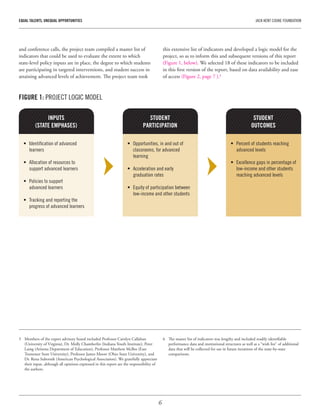
and conference calls, the project team compiled a master list of
indicators that could be used to evaluate the extent to which
state-level policy inputs are in place, the degree to which students
are participating in targeted interventions, and student success in
attaining advanced levels of achievement. The project team took
this extensive list of indicators and developed a logic model for the
project, so as to inform this and subsequent versions of this report
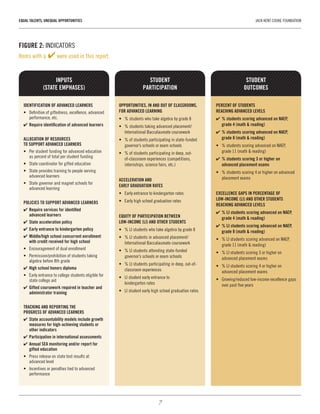
(Figure 1, below). We selected 18 of these indicators to be included
in this first version of the report, based on data availability and ease
of access (Figure 2, page 7 ).6
FIGURE 1: PROJECT LOGIC MODEL
INPUTS
(STATE EMPHASES)
STUDENT
OUTCOMES
STUDENT
PARTICIPATION
7
EQUAL TALENTS, UNEQUAL OPPORTUNITIES	 JACK KENT COOKE FOUNDATION
FIGURE 2: INDICATORS
Items with a 4 were used in this report.
IDENTIFICATION OF ADVANCED LEARNERS
•	 Definition of giftedness, excellence, advanced
performance, etc.
4	Require identification of advanced learners
ALLOCATION OF RESOURCES
TO SUPPORT ADVANCED LEARNERS
•	 Per student funding for advanced education
as percent of total per student funding
•	 State coordinator for gifted education
•	 State provides training to people serving
advanced learners
•	 State governor and magnet schools for
advanced learning
POLICIES TO SUPPORT ADVANCED LEARNERS
4	Require services for identified
advanced learners
4	State acceleration policy
4	Early entrance to kindergarten policy
4	Middle/high school concurrent enrollment
with credit received for high school
•	 Encouragement of dual enrollment
•	 Permission/prohibition of students taking
algebra before 8th grade
4	High school honors diploma
•	 Early entrance to college students eligible for
state college aid
4	Gifted coursework required in teacher and
administrator training
TRACKING AND REPORTING THE
PROGRESS OF ADVANCED LEARNERS
4	State accountability models include growth
measures for high-achieving students or
other indicators
4	Participation in international assessments
4	Annual SEA monitoring and/or report for
gifted education
•	 Press release on state test results at
advanced level
•	 Incentives or penalties tied to advanced
performance
PERCENT OF STUDENTS
REACHING ADVANCED LEVELS
4	% students scoring advanced on NAEP,
grade 4 (math & reading)
4	% students scoring advanced on NAEP,
grade 8 (math & reading)
•	 % students scoring advanced on NAEP,
grade 11 (math & reading)
4	% students scoring 3 or higher on
advanced placement exams
•	 % students scoring 4 or higher on advanced
placement exams
EXCELLENCE GAPS IN PERCENTAGE OF
LOW-INCOME (LI) AND OTHER STUDENTS
REACHING ADVANCED LEVELS
4	% LI students scoring advanced on NAEP,
grade 4 (math & reading)
4	% LI students scoring advanced on NAEP,
grade 8 (math & reading)
•	 % LI students scoring advanced on NAEP,
grade 11 (math & reading)
•	 % LI students scoring 3 or higher on
advanced placement exams
•	 % LI students scoring 4 or higher on
advanced placement exams
•	 Growing/reduced low-income excellence gaps
over past five years
OPPORTUNITIES, IN AND OUT OF CLASSROOMS,
FOR ADVANCED LEARNING
•	 % students who take algebra by grade 8
•	 % students taking advanced placement/
International Baccalaureate coursework
•	 % of students participating in state-funded
governor’s schools or exam schools
•	 % of students participating in deep, out-
of-classroom experiences (competitions,
internships, science fairs, etc.)
ACCELERATION AND
EARLY GRADUATION RATES
•	 Early entrance to kindergarten rates
•	 Early high school graduation rates
EQUITY OF PARTICIPATION BETWEEN
LOW-INCOME (LI) AND OTHER STUDENTS
•	 % LI students who take algebra by grade 8
•	 % LI students in advanced placement/
International Baccalaureate coursework
•	 % LI students attending state-funded
governor’s schools or exam schools
•	 % LI students participating in deep, out-of-
classroom experiences
•	 LI student early entrance to
kindergarten rates
•	 LI student early high school graduation rates
INPUTS
(STATE EMPHASES)
STUDENT
OUTCOMES
STUDENT
PARTICIPATION
8
EQUAL TALENTS, UNEQUAL OPPORTUNITIES	 JACK KENT COOKE FOUNDATION
METHODS AND LIMITATIONS
Project staff compiled a database to record each variable for
each state plus the District of Columbia. Data were drawn from
numerous online and documentary sources.7
When critical data
were missing, project staff contacted state education agency (SEA)
staff directly, and if that effort was unsuccessful, we used data from
earlier versions of the targeted data sets. These cases are marked in
the data set (Appendix B, pages 28-??).
Much of the policy data are self-reported by SEA officials on
various surveys. Self-reported data have well-known limitations,
but the consistency of responses across the past few administrations
of the surveys, in combination with random checks of the
responses by the research team, provide a level of confidence in the
reliability and validity of those data. The biggest limitation of this
report is the lack of available data on the education of advanced
students, especially as it relates to excellence gaps and low-income
students and their families. Many of the indicators recommended
by the expert panel were not readily available, and in some cases the
data of interest do not appear to be publicly available.8
In the following section, each variable is described along with our
findings of the extent to which states have implemented these
inputs and achieved these desired outcomes. Appendix A (pages
25-27) contains detailed descriptions of each indicator and how
states were graded. Variables that were not readily available, or
which were excluded due to data quality issues that emerged
during the data collection process, are described at the end of each
Appendix A subsection.
7	 Data sources included a report called the 2012-13 State of the States in Gifted
Education, from the National Association for Gifted Children (NAGC) and
the Council of State Directors of Programs for the Gifted (CSDPG) (http://
www.nagc.org/resources-publications/gifted-state), various materials and reports
provided by the College Board, materials posted online by the Organisation for
Economic Co-operation and Development (OECD), International Association
for the Evaluation of Educational Achievement (IEA), Education Commission of
the States (ECS), and state education agency (SEA) websites and databases.
8	 We acknowledge that our methodology probably depresses the input grades
for states that attempt to address the needs of high-ability students specifically
through the use of special schools. Although we intended to include such an
indicator, we were not able to create a master list of special schools; this will be a
priority in future versions of the report.
RESULTS
Figures 4 and 5 (pages 10-11) present the individual state grades for
inputs and outcomes. Individual indicators are described in detail in
Figures 6 and 7 (pages 12-16).
Collectively, the 50 states and D.C. report a range of policy
positions and accountability measures for advanced learning. No
states currently have in place even seven of the input indicators we
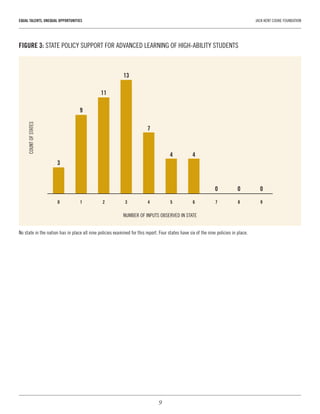
examined, let alone all nine (Figure 3, page 9). More than half (28)
of the states require the identification and service of high-ability
students, and an equal number annually report or monitor those
services. But policies that would formally allow students to progress
faster than normal (by entering kindergarten early, accelerating
grades, or graduating early) appear in fewer than half of the states.
On average states have implemented three of the nine indicators
we examined.
Student performance outcomes are similarly mixed. Fewer than
one-third of states report significant percentages of their public
school students reaching advanced levels in achievement. Only a
handful of states received full or nearly full points on the excellence
gap measures. In many cases, these states had low overall levels
of advanced performance, creating an artificial ceiling on their
excellence gaps.
9
EQUAL TALENTS, UNEQUAL OPPORTUNITIES	 JACK KENT COOKE FOUNDATION
FIGURE 3: STATE POLICY SUPPORT FOR ADVANCED LEARNING OF HIGH-ABILITY STUDENTS
9876543210
000
44
7
13
11
9
3
NUMBER OF INPUTS OBSERVED IN STATE
COUNTOFSTATES
No state in the nation has in place all nine policies examined for this report. Four states have six of the nine policies in place.
10
EQUAL TALENTS, UNEQUAL OPPORTUNITIES	 JACK KENT COOKE FOUNDATION
B-
B-
B-
B-
B-
B-
C+
C+
C+
C+
C+
C-
C-
C+
C+
C+
C
C
C
C
C
C
D+
D+
D+
D+
D+
D-
D
D
D
D
D
D+
C+
D D
D-
D-
F
F
C
FD+
D+
D+
D+
D+
D+
D+
D+
FIGURE 4: INPUT GRADES
11
EQUAL TALENTS, UNEQUAL OPPORTUNITIES	 JACK KENT COOKE FOUNDATION
D-
C
C-
C
B-
C+
D
C+
C-
C-
D
C
C+
C-
C-
C
D+
C
D+
D+
C-
C+
D+
C+
D+
C
C
B-
C
D+
C
D+
D+
D
B-
C+ C+
C
B-
D-
B-
C
C-D+
C
D+
B
C-
C+
C
D+
FIGURE 5: OUTCOME GRADES
12
EQUAL TALENTS, UNEQUAL OPPORTUNITIES	 JACK KENT COOKE FOUNDATION
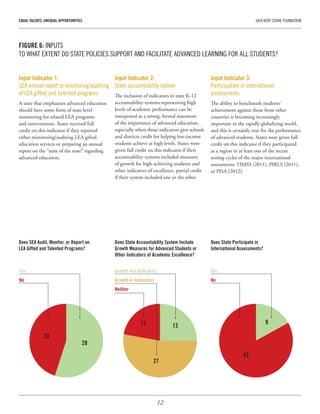
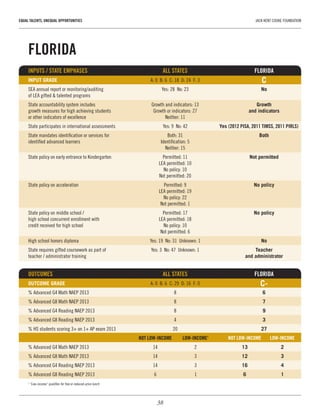
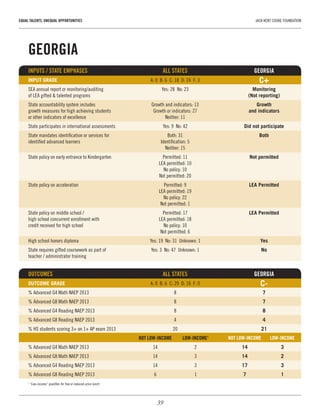
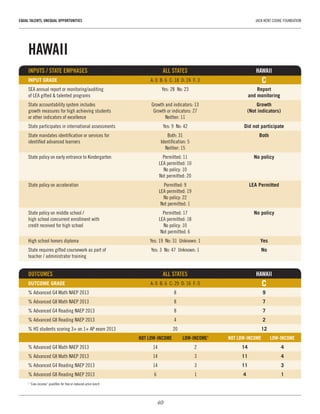
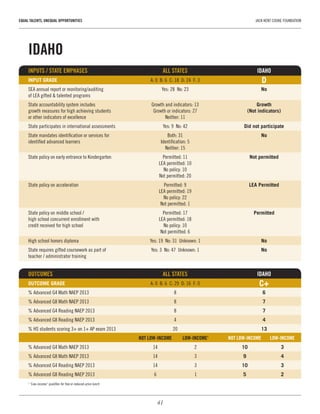
FIGURE 6: INPUTS
TO WHAT EXTENT DO STATE POLICIES SUPPORT AND FACILITATE ADVANCED LEARNING FOR ALL STUDENTS?
Input Indicator 1:
SEA annual report or monitoring/auditing
of LEA gifted and talented programs
A state that emphasizes advanced education
should have some form of state-level
monitoring for related LEA programs
and interventions. States received full
credit on this indicator if they reported
either monitoring/auditing LEA gifted
education services or preparing an annual
report on the “state of the state” regarding
advanced education.
Input Indicator 2:
State accountability system
The inclusion of indicators in state K-12
accountability systems representing high
levels of academic performance can be
interpreted as a strong, formal statement
of the importance of advanced education,
especially when those indicators give schools
and districts credit for helping low-income
students achieve at high levels. States were
given full credit on this indicator if their
accountability systems included measures
of growth for high-achieving students and
other indicators of excellence, partial credit
if their system included one or the other.
Input Indicator 3:
Participation in international
assessments
The ability to benchmark students’
achievement against those from other
countries is becoming increasingly
important in the rapidly globalizing world,
and this is certainly true for the performance
of advanced students. States were given full
credit on this indicator if they participated
as a region in at least one of the recent
testing cycles of the major international
assessments: TIMSS (2011), PIRLS (2011),
or PISA (2012).
Does State Accountability System Include
Growth Measures for Advanced Students or
Other Indicators of Academic Excellence?
Growth and Indicators
Growth or Indicators
Neither
Yes
No
Yes
No
Does SEA Audit, Monitor, or Report on
LEA Gifted and Talented Programs?
Does State Participate in
International Assessments?
11
27
13
28
42
9
23
13
EQUAL TALENTS, UNEQUAL OPPORTUNITIES	 JACK KENT COOKE FOUNDATION
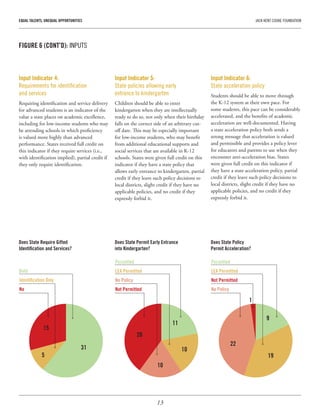
Input Indicator 4:
Requirements for identification
and services
Requiring identification and service delivery
for advanced students is an indicator of the
value a state places on academic excellence,
including for low-income students who may
be attending schools in which proficiency
is valued more highly than advanced
performance. States received full credit on
this indicator if they require services (i.e.,
with identification implied), partial credit if
they only require identification.
Input Indicator 5:
State policies allowing early
entrance to kindergarten
Children should be able to enter
kindergarten when they are intellectually
ready to do so, not only when their birthday
falls on the correct side of an arbitrary cut-
off date. This may be especially important
for low-income students, who may benefit
from additional educational supports and
social services that are available in K-12
schools. States were given full credit on this
indicator if they have a state policy that
allows early entrance to kindergarten, partial
credit if they leave such policy decisions to
local districts, slight credit if they have no
applicable policies, and no credit if they
expressly forbid it.
Input Indicator 6:
State acceleration policy
Students should be able to move through
the K-12 system at their own pace. For
some students, this pace can be considerably
accelerated, and the benefits of academic
acceleration are well-documented. Having
a state acceleration policy both sends a
strong message that acceleration is valued
and permissible and provides a policy lever
for educators and parents to use when they
encounter anti-acceleration bias. States
were given full credit on this indicator if
they have a state acceleration policy, partial
credit if they leave such policy decisions to
local districts, slight credit if they have no
applicable policies, and no credit if they
expressly forbid it.
Both
Identification Only
No
Permitted
LEA Permitted
No Policy
Not Permitted
Permitted
LEA Permitted
Not Permitted
No Policy
Does State Require Gifted
Identification and Services?
Does State Permit Early Entrance
into Kindergarten?
Does State Policy
Permit Acceleration?
31 10
11
10
20
22
1
19
9
5
15
FIGURE 6 (CONT’D): INPUTS
14
EQUAL TALENTS, UNEQUAL OPPORTUNITIES	 JACK KENT COOKE FOUNDATION
Permitted
LEA Permitted
No Policy
Not Permitted
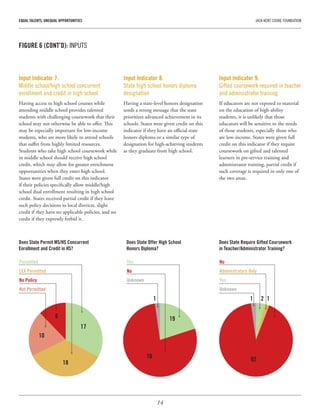
Input Indicator 7:
Middle school/high school concurrent
enrollment and credit in high school
Having access to high school courses while
attending middle school provides talented
students with challenging coursework that their
school may not otherwise be able to offer. This
may be especially important for low-income
students, who are more likely to attend schools
that suffer from highly limited resources.
Students who take high school coursework while
in middle school should receive high school
credit, which may allow for greater enrichment
opportunities when they enter high school.
States were given full credit on this indicator
if their policies specifically allow middle/high
school dual enrollment resulting in high school
credit. States received partial credit if they leave
such policy decisions to local districts, slight
credit if they have no applicable policies, and no
credit if they expressly forbid it.
Input Indicator 8:
State high school honors diploma
designation
Having a state-level honors designation
sends a strong message that the state
prioritizes advanced achievement in its
schools. States were given credit on this
indicator if they have an official state
honors diploma or a similar type of
designation for high-achieving students
as they graduate from high school.
Input Indicator 9:
Gifted coursework required in teacher
and administrator training
If educators are not exposed to material
on the education of high-ability
students, it is unlikely that those
educators will be sensitive to the needs
of those students, especially those who
are low-income. States were given full
credit on this indicator if they require
coursework on gifted and talented
learners in pre-service training and
administrator training, partial credit if
such coverage is required in only one of
the two areas.
18
10
17
6
Yes
No
Unknown
No
Administrators Only
Yes
Unknown
Does State Offer High School
Honors Diploma?
Does State Require Gifted Coursework
in Teacher/Administrator Training?
Does State Permit MS/HS Concurrent
Enrollment and Credit in HS?
19
78
1 1 12
92
FIGURE 6 (CONT’D): INPUTS
15
EQUAL TALENTS, UNEQUAL OPPORTUNITIES	 JACK KENT COOKE FOUNDATION
Outcome Indicators 1-5:
Advanced achievement, all students
A key outcome is obviously the percent
of public school students who perform
academically at advanced levels. We
included indicators on student performance
at several levels: NAEP math and reading/
language arts data for grade 4 and grade 8,
and advanced placement (AP) exam data
to represent high school achievement. To
receive full credit on these indicators, state
data needed to reflect:
•	 At least 10 percent scored in the
advanced range (grade 4 and 8 math,
grade 4 reading)
•	 At least 8 percent scored in the advanced
range (grade 8 reading)9
•	 At least 21 percent of students scored 3 or
higher on at least one AP exam
The five achievement indicators were equally
weighted, and they collectively accounted
for half of the “outcome” grade.
FIGURE 7: OUTCOMES.
TO WHAT EXTENT DO STUDENTS REACH ADVANCED LEVELS OF PERFORMANCE?
HOW LARGE ARE THE EXCELLENCE GAPS BETWEEN LOW-INCOME AND OTHER STUDENTS?
9	 We adjusted the scoring cut points down for grade
8 reading to reflect the overall lower levels of
student achievement in this subject/grade level in
the nation.
0-2%
3-5%
6-7%
3-5%
6-7%
3-5%
6-7%
8%+
0-1%
2-3%
0-5%
6-10%
11-15%
10%
8-9%
10%
8-9%
0-2% - 0
10%
8-9%
6-7%
4-5%
21%+
16-20%
NAEP Grade 4 Math,
Percent Scoring Advanced
NAEP Grade 8 Math,
Percent Scoring Advanced
NAEP Grade 4 Reading,
Percent Scoring Advanced
NAEP Grade 8 Reading,
Percent Scoring Advanced
Students Scoring 3+
on at Least One AP Exam
18
15
11
7
1824
6
16
11
14
8
16
13
1011
1
16
13
10
12
1
2
2
16
EQUAL TALENTS, UNEQUAL OPPORTUNITIES	 JACK KENT COOKE FOUNDATION
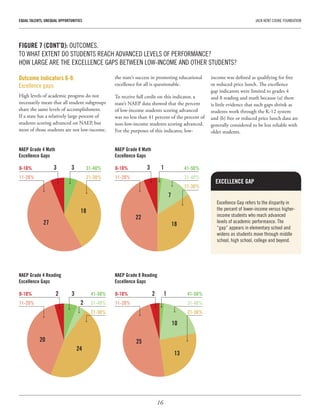
Outcome Indicators 6-9:
Excellence gaps
High levels of academic progress do not
necessarily mean that all student subgroups
share the same levels of accomplishment.
If a state has a relatively large percent of
students scoring advanced on NAEP, but
most of those students are not low-income,
the state’s success in promoting educational
excellence for all is questionable.
To receive full credit on this indicator, a
state’s NAEP data showed that the percent
of low-income students scoring advanced
was no less than 41 percent of the percent of
non-low-income students scoring advanced.
For the purposes of this indicator, low-
income was defined as qualifying for free
or reduced price lunch. The excellence
gap indicators were limited to grades 4
and 8 reading and math because (a) there
is little evidence that such gaps shrink as
students work through the K-12 system
and (b) free or reduced price lunch data are
generally considered to be less reliable with
older students.
FIGURE 7 (CONT’D): OUTCOMES.
TO WHAT EXTENT DO STUDENTS REACH ADVANCED LEVELS OF PERFORMANCE?
HOW LARGE ARE THE EXCELLENCE GAPS BETWEEN LOW-INCOME AND OTHER STUDENTS?
0-10%
11-20%
0-10%
11-20%
0-10%
11-20%
0-10%
11-20%
41-50%
31-40%
21-30%
31-40%
21-30%
41-50%
31-40%
21-30%
41-50%
31-40%
21-30%
NAEP Grade 4 Reading
Excellence Gaps
NAEP Grade 4 Math
Excellence Gaps
NAEP Grade 8 Reading
Excellence Gaps
NAEP Grade 8 Math
Excellence Gaps
24
18
13
22
18
7
20
27
25
10
3 3 13
2
2 3 2 1
Excellence Gap refers to the disparity in
the percent of lower-income versus higher-
income students who reach advanced
levels of academic performance. The
“gap” appears in elementary school and
widens as students move through middle
school, high school, college and beyond.
EXCELLENCE GAP
17
EQUAL TALENTS, UNEQUAL OPPORTUNITIES	 JACK KENT COOKE FOUNDATION
WHAT WE LEARNED
Five basic lessons about how the states address excellence gaps
emerged from the research. Collectively, they describe a system
that is not focused on the high-achieving student and overlooks
research suggesting the particular fragility of low-income, high-
ability children.
1. In most states, attention to advanced learning is
incomplete and haphazard.
Variation among states was substantial. We hoped to identify
patterns of support, with some states doing much more than others.
What we found instead was each state hit some indicators but not
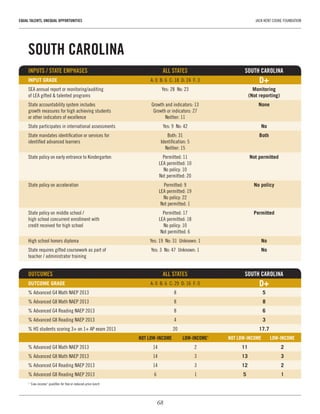
others. For example, South Carolina requires identification and
services for advanced learners, but has no measures of academic
excellence and advanced student growth in its state accountability
system. Washington has state-level monitoring and auditing of
local education agency gifted and talented programs, but does
not require instruction on working with gifted students to be
included in teacher and administrator training programs. We found
only four states (Minnesota, North Carolina, Ohio, Texas) with
policies that explicitly permit early entrance to kindergarten, grade
acceleration, and concurrent middle school/high school enrollment
with credit for high school—yet all but four of the remaining states
have policies in place permitting at least one of these modifications
for advanced learners, either state-wide or at the local education
agency level.
There were stand-out policy strengths in some states: inclusion
of student growth indicators in state accountability systems,
requirements for gifted education identification and services,
and allowing for acceleration (see “Promising Examples” section
below). However, for any given policy, between a quarter to
three-quarters of states forbid these accommodations, do not have
policies addressing these issues, or leave decisions about specific
interventions to the discretion of local districts. This has resulted in
a patchwork of services that we suspect benefits primarily students
in wealthier districts.
2. In the absence of comprehensive policy support for
advanced learning, economic conditions appear to
drive outcomes.
Policy support for advanced learning was weak in the vast majority
of states. Given that finding, it was not surprising that the inputs
and outcomes used in this study are not highly correlated. In
other words, there is not enough policy work with which the
outcomes can be correlated. Given this limited attention, support
for advanced learning becomes primarily a function of school and
student resources. This trend is especially noticeable at the lowest
and highest ends of the poverty spectrum; states with very high
(or low) percentages of children living in low-income families have
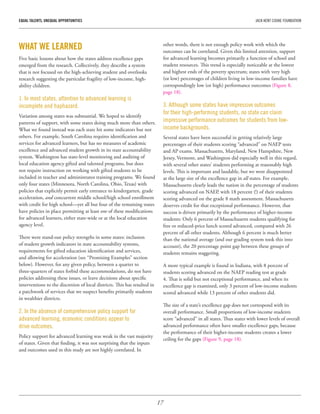
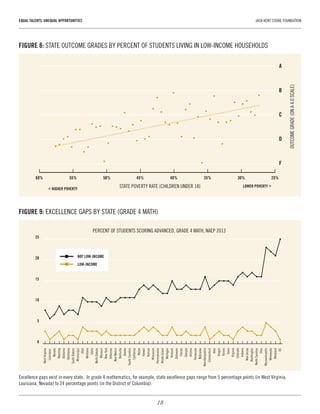
correspondingly low (or high) performance outcomes (Figure 8,
page 18).
3. Although some states have impressive outcomes
for their high-performing students, no state can claim
impressive performance outcomes for students from low-
income backgrounds.
Several states have been successful in getting relatively large
percentages of their students scoring “advanced” on NAEP tests
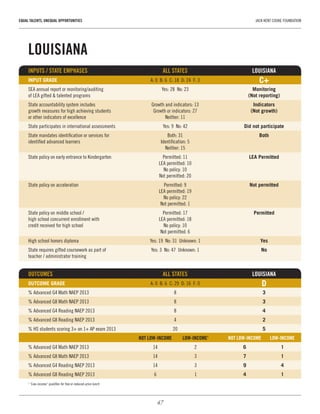
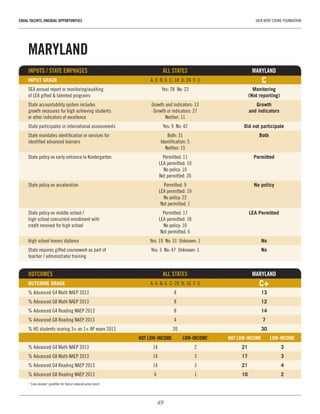
and AP exams. Massachusetts, Maryland, New Hampshire, New
Jersey, Vermont, and Washington did especially well in this regard,
with several other states’ students performing at reasonably high
levels. This is important and laudable, but we were disappointed
at the large size of the excellence gap in all states. For example,
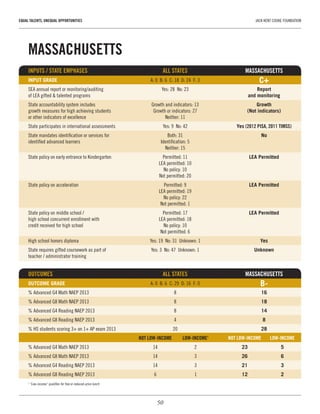
Massachusetts clearly leads the nation in the percentage of students
scoring advanced on NAEP, with 18 percent (!) of their students
scoring advanced on the grade 8 math assessment. Massachusetts
deserves credit for that exceptional performance. However, that
success is driven primarily by the performance of higher-income
students: Only 6 percent of Massachusetts students qualifying for
free or reduced-price lunch scored advanced, compared with 26
percent of all other students. Although 6 percent is much better
than the national average (and our grading system took this into
account), the 20 percentage point gap between these groups of
students remains staggering.
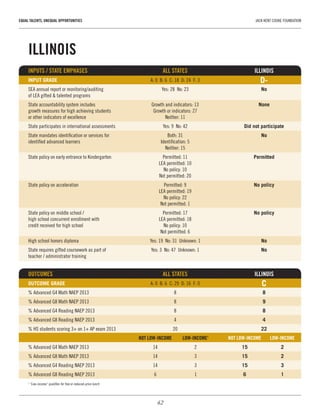
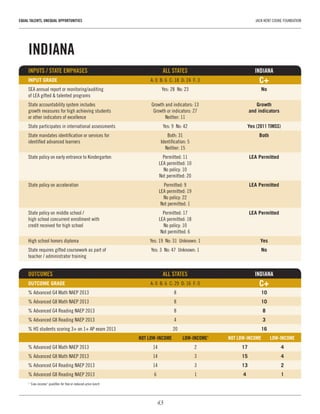
A more typical example is found in Indiana, with 8 percent of
students scoring advanced on the NAEP reading test at grade
4. That is solid but not exceptional performance, and when its
excellence gap is examined, only 3 percent of low-income students
scored advanced while 13 percent of other students did.
The size of a state’s excellence gap does not correspond with its
overall performance. Small proportions of low-income students
score “advanced” in all states. Thus states with lower levels of overall
advanced performance often have smaller excellence gaps, because
the performance of their higher-income students creates a lower
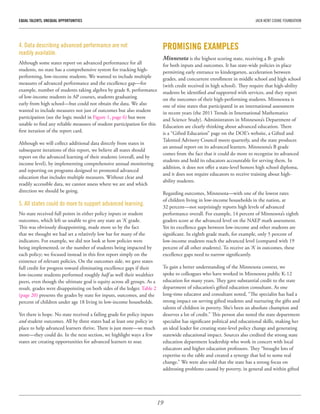
ceiling for the gaps (Figure 9, page 18).
18
EQUAL TALENTS, UNEQUAL OPPORTUNITIES	 JACK KENT COOKE FOUNDATION
FIGURE 8: STATE OUTCOME GRADES BY PERCENT OF STUDENTS LIVING IN LOW-INCOME HOUSEHOLDS
A
B
C
D
F
60% 55% 50% 45% 40% 35% 30% 25%
0
5
10
15
20
25
DC
Maryland
Minnesota
Massachusetts
Ohio
NorthCarolina
Washington
NewJersey
Indiana
Colorado
Virginia
Texas
Illinois
Oregon
Iowa
Connecticut
NewHampshire
Nebraska
Tennessee
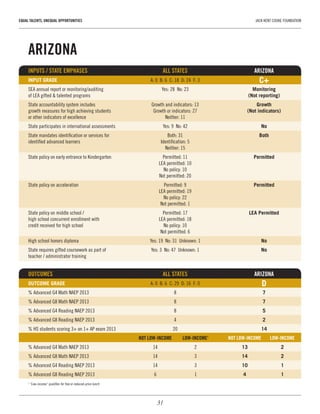
Arizona
Georgia
Florida
Delaware
Vermont
Michigan
RhodeIsland
Pennsylvania
Wisconsin
Kansas
Hawaii
Maine
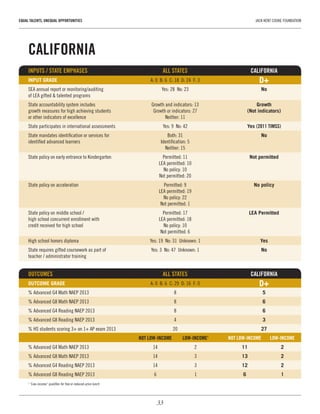
California
SouthCarolina
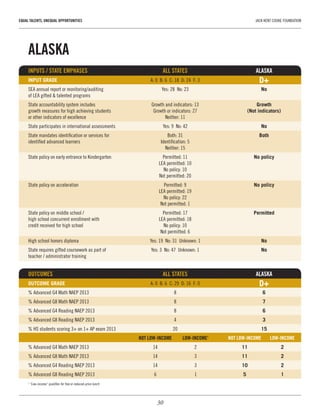
Alaska
Kentucky
NewMexico
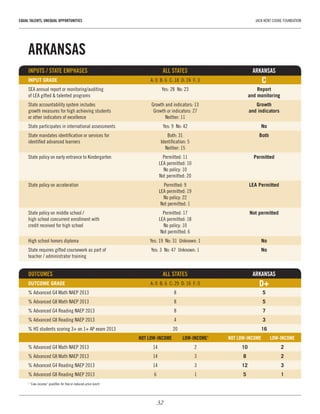
Arkansas
NewYork
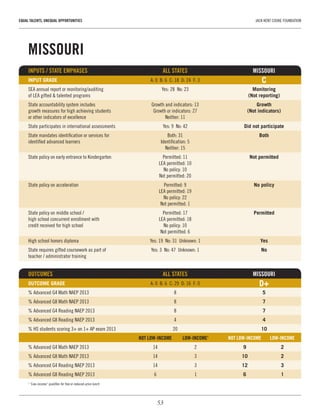
Missouri
NorthDakota
Idaho
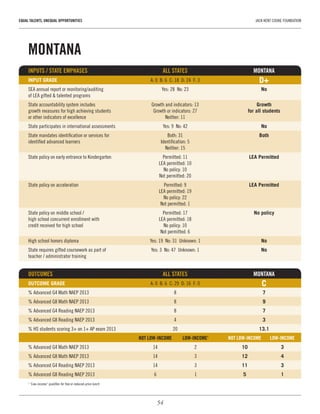
Montana
Utah
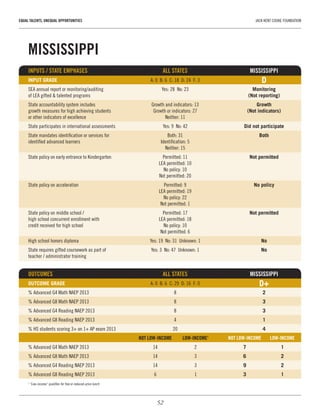
Mississippi
SouthDakora
Oklahoma
Alabama
Wyoming
Nevada
Louisiana
WestVirginia
FIGURE 9: EXCELLENCE GAPS BY STATE (GRADE 4 MATH)
STATE POVERTY RATE (CHILDREN UNDER 18)
PERCENT OF STUDENTS SCORING ADVANCED, GRADE 4 MATH, NAEP 2013
< HIGHER POVERTY
LOWER POVERTY >
OUTCOMEGRADE(ONA4.0SCALE)
NOT LOW-INCOME
LOW-INCOME
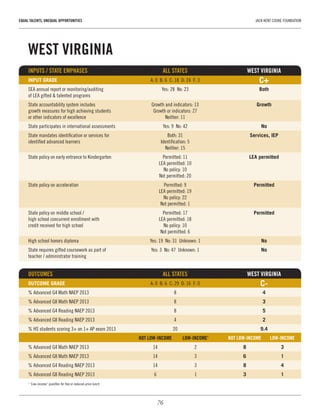
Excellence gaps exist in every state.  In grade 4 mathematics, for example, state excellence gaps range from 5 percentage points (in West Virginia,
Louisiana, Nevada) to 24 percentage points (in the District of Columbia).
19
EQUAL TALENTS, UNEQUAL OPPORTUNITIES	 JACK KENT COOKE FOUNDATION
4. Data describing advanced performance are not
readily available.
Although some states report on advanced performance for all
students, no state has a comprehensive system for tracking high-
performing, low-income students. We wanted to include multiple
measures of advanced performance and the excellence gap—for
example, number of students taking algebra by grade 8, performance
of low-income students in AP courses, students graduating
early from high school—but could not obtain the data. We also
wanted to include measures not just of outcomes but also student
participation (see the logic model in Figure 1, page 6) but were
unable to find any reliable measures of student participation for this
first iteration of the report card.
Although we will collect additional data directly from states in
subsequent iterations of this report, we believe all states should
report on the advanced learning of their students (overall, and by
income level), by implementing comprehensive annual monitoring
and reporting on programs designed to promoted advanced
education that includes multiple measures. Without clear and
readily accessible data, we cannot assess where we are and which
direction we should be going.
5. All states could do more to support advanced learning.
No state received full points in either policy inputs or student
outcomes, which left us unable to give any state an ‘A’ grade.
This was obviously disappointing, made more so by the fact
that we thought we had set a relatively low bar for many of the
indicators. For example, we did not look at how policies were
being implemented, or the number of students being impacted by
each policy; we focused instead in this first report simply on the
existence of relevant policies. On the outcomes side, we gave states
full credit for progress toward eliminating excellence gaps if their
low-income students performed roughly half as well their wealthier
peers, even though the ultimate goal is equity across all groups. As a
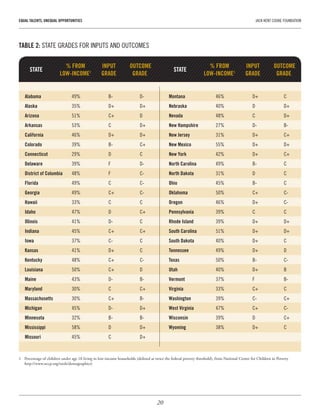
result, grades were disappointing on both sides of the ledger. Table 2
(page 20) presents the grades by state for inputs, outcomes, and the
percent of children under age 18 living in low-income households.
Yet there is hope. No state received a failing grade for policy inputs
and student outcomes. All by three states had at least one policy in
place to help advanced learners thrive. There is just more—so much
more—they could do. In the next section, we highlight ways a few
states are creating opportunities for advanced learners to soar.
PROMISING EXAMPLES
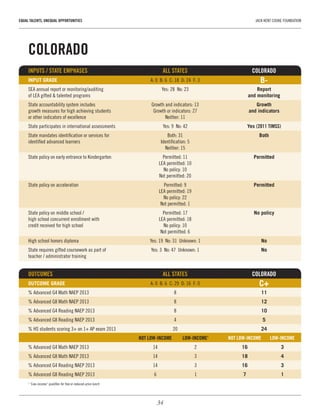
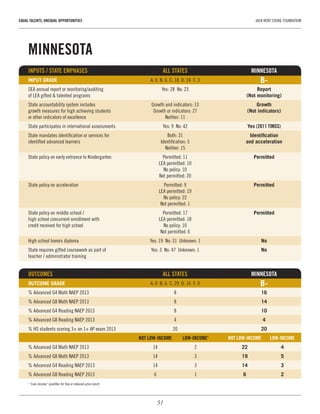
Minnesota is the highest scoring state, receiving a B- grade
for both inputs and outcomes. It has state-wide policies in place
permitting early entrance to kindergarten, acceleration between
grades, and concurrent enrollment in middle school and high school
(with credit received in high school). They require that high-ability
students be identified and supported with services, and they report
on the outcomes of their high-performing students. Minnesota is
one of nine states that participated in an international assessment
in recent years (the 2011 Trends in International Mathematics
and Science Study). Administrators in Minnesota’s Department of
Education are clearly thinking about advanced education. There
is a “Gifted Education” page on the DOE’s website, a Gifted and
Talented Advisory Council meets quarterly, and the state produces
an annual report on its advanced learners. Minnesota’s B grade
comes from the fact that it could do more to recognize its advanced
students and hold its educators accountable for serving them. In
addition, it does not offer a state-level honors high school diploma,
and it does not require educators to receive training about high-
ability students.
Regarding outcomes, Minnesota—with one of the lowest rates
of children living in low-income households in the nation, at
32 percent—not surprisingly reports high levels of advanced
performance overall. For example, 14 percent of Minnesota’s eighth
graders score at the advanced level on the NAEP math assessment.
Yet its excellence gaps between low-income and other students are
significant. In eighth grade math, for example, only 5 percent of
low-income students reach the advanced level (compared with 19
percent of all other students). To receive an ‘A’ in outcomes, these
excellence gaps need to narrow significantly.
To gain a better understanding of the Minnesota context, we
spoke to colleagues who have worked in Minnesota public K-12
education for many years. They gave substantial credit to the state
department of education’s gifted education consultant. As one
long-time educator and consultant noted, “The specialist has had a
strong impact on serving gifted students and nurturing the gifts and
talents of children in poverty. She’s been an absolute champion and
deserves a lot of credit.” This person also noted the state department
specialist has significant political and educational skills, making her
an ideal leader for creating state-level policy change and generating
statewide educational impact. Sources also credited the strong state
education department leadership who work in concert with local
educators and higher education professors. They “brought lots of
expertise to the table and created a synergy that led to some real
change.” We were also told that the state has a strong focus on
addressing problems caused by poverty, in general and within gifted
20
EQUAL TALENTS, UNEQUAL OPPORTUNITIES	 JACK KENT COOKE FOUNDATION
1 	 Percentage of children under age 18 living in low-income households (defined as twice the federal poverty threshold), from National Center for Children in Poverty
http://www.nccp.org/tools/demographics)
TABLE 2: STATE GRADES FOR INPUTS AND OUTCOMES
STATE STATE
INPUT
GRADE
INPUT
GRADE
% FROM
LOW-INCOME1
% FROM
LOW-INCOME1
OUTCOME
GRADE
OUTCOME
GRADE
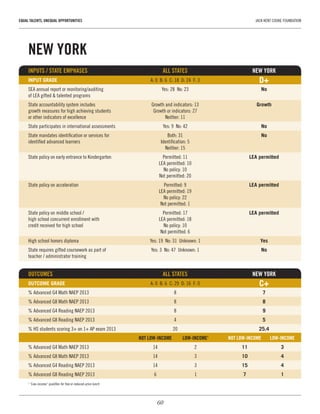
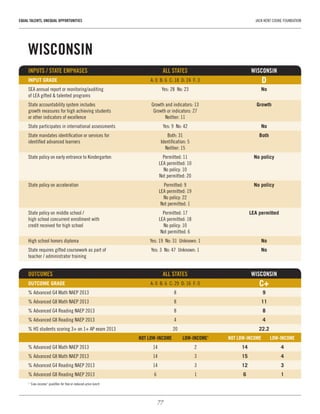
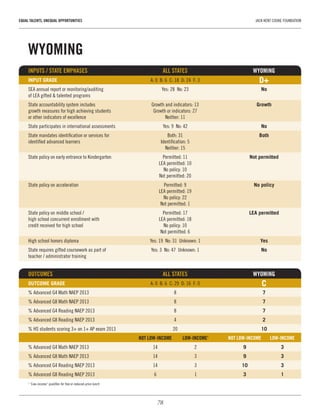
Alabama	 49%	 B-	 D-
Alaska	 35%	 D+	 D+
Arizona	 51%	 C+	 D
Arkansas	 53%	 C	 D+
California	 46%	 D+	 D+
Colorado	 39%	 B-	 C+
Connecticut	 29%	 D	 C
Delaware	 39%	 F	 D-
District of Columbia	 48%	 F	 C-
Florida	 49%	 C	 C-
Georgia	 49%	 C+	 C-
Hawaii	 33%	 C	 C
Idaho	 47%	 D	 C+
Illinois	 41%	 D-	 C
Indiana	 45%	 C+	 C+
Iowa	 37%	 C-	 C
Kansas	 41%	 D+	 C
Kentucky	 48%	 C+	 C-
Louisiana	 50%	 C+	 D
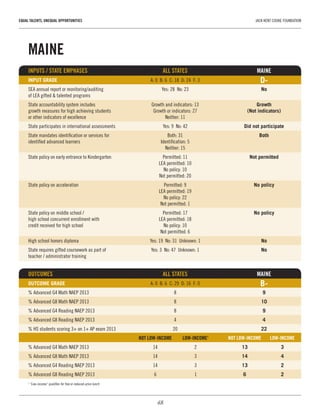
Maine	 43%	 D-	 B-
Maryland	 30%	 C	 C+
Massachusetts	 30%	 C+	 B-
Michigan	 45%	 D-	 D+
Minnesota	 32%	 B-	 B-
Mississippi	 58%	 D	 D+
Missouri	 45%	 C	 D+
Montana	 46%	 D+	 C
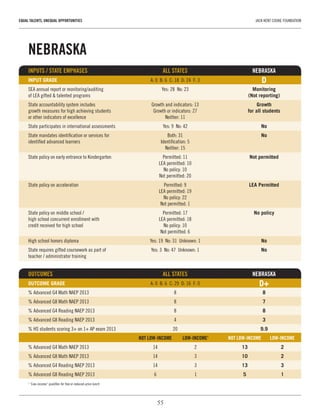
Nebraska	 40%	 D	 D+
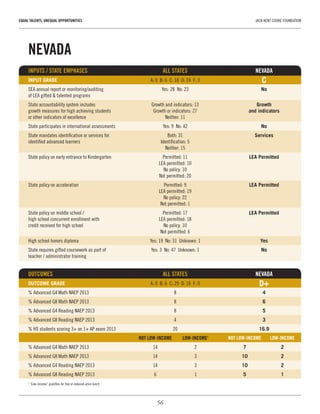
Nevada	 48%	 C	 D+
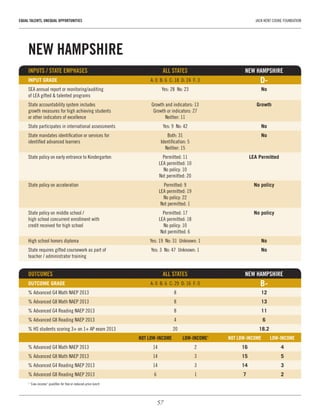
New Hampshire	 27%	 D-	 B-
New Jersey	 31%	 D+	 C+
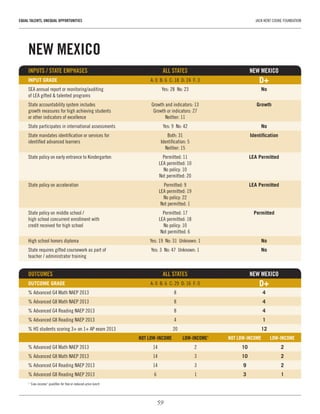
New Mexico	 55%	 D+	 D+
New York	 42%	 D+	 C+
North Carolina	 49%	 B-	 C
North Dakota	 31%	 D	 C
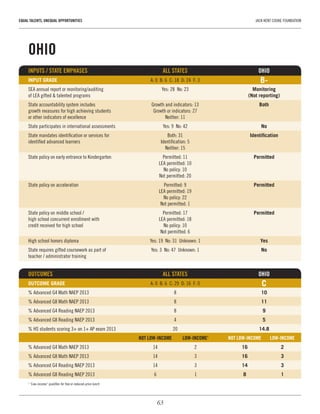
Ohio	 45%	 B-	 C
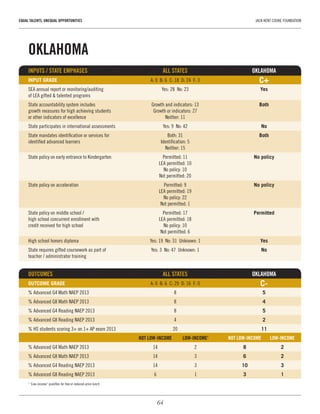
Oklahoma	 50%	 C+	 C-
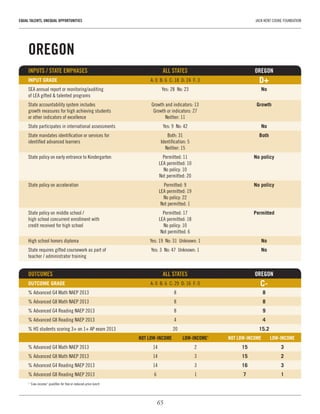
Oregon	 46%	 D+	 C-
Pennsylvania	 39%	 C	 C
Rhode Island	 39%	 D+	 D+
South Carolina	 51%	 D+	 D+
South Dakota	 40%	 D+	 C
Tennessee	 49%	 D+	 D
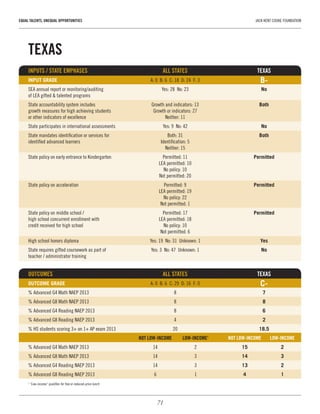
Texas	 50%	 B-	 C-
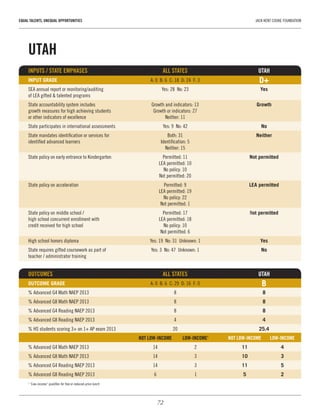
Utah	 40%	 D+	 B
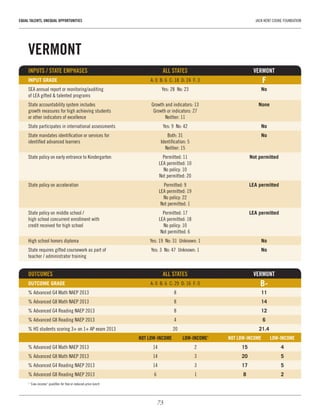
Vermont	 37%	 F	 B-
Virginia	 33%	 C+	 C
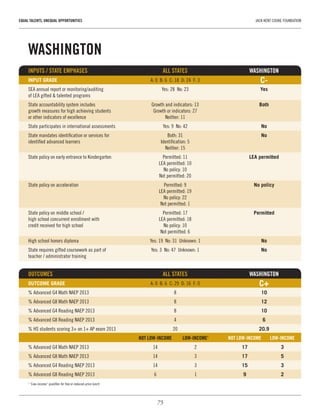
Washington	 39%	 C-	 C+
West Virginia	 47%	 C+	 C-
Wisconsin	 39%	 D	 C+
Wyoming	 38%	 D+	 C
21
EQUAL TALENTS, UNEQUAL OPPORTUNITIES	 JACK KENT COOKE FOUNDATION
education contexts. This observation—that strong SEA leadership
and university support are critically important—was a theme across
the relatively high-scoring policy input states.
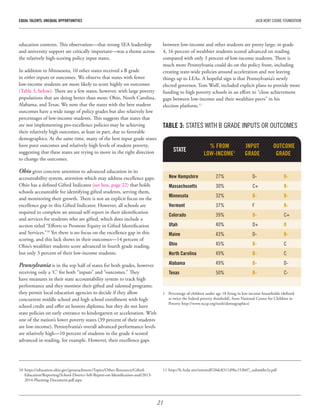
In addition to Minnesota, 10 other states received a B grade
in either inputs or outcomes. We observe that states with fewer
low-income students are more likely to score highly on outcomes
(Table 3, below). There are a few states, however, with large poverty
populations that are doing better than most: Ohio, North Carolina,
Alabama, and Texas. We note that the states with the best student
outcomes have a wide range of policy grades but also relatively low
percentages of low-income students. This suggests that states that
are not implementing pro-excellence policies may be achieving
their relatively high outcomes, at least in part, due to favorable
demographics. At the same time, many of the best input grade states
have poor outcomes and relatively high levels of student poverty,
suggesting that these states are trying to move in the right direction
to change the outcomes.
Ohio gives concrete attention to advanced education in its
accountability system, attention which may address excellence gaps.
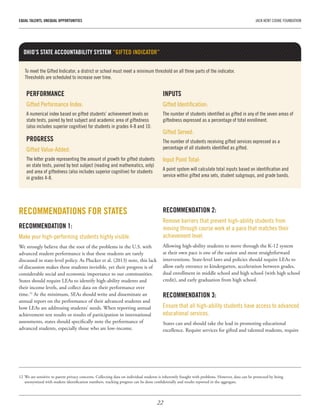
Ohio has a defined Gifted Indicator (see box, page 22) that holds
schools accountable for identifying gifted students, serving them,
and monitoring their growth. There is not an explicit focus on the
excellence gap in this Gifted Indicator. However, all schools are
required to complete an annual self-report in their identification
and services for students who are gifted, which does include a
section titled “Efforts to Promote Equity in Gifted Identification
and Services.”10
Yet there is no focus on the excellence gap in this
scoring, and this lack shows in their outcomes—14 percent of
Ohio’s wealthier students score advanced in fourth grade reading,
but only 3 percent of their low-income students.
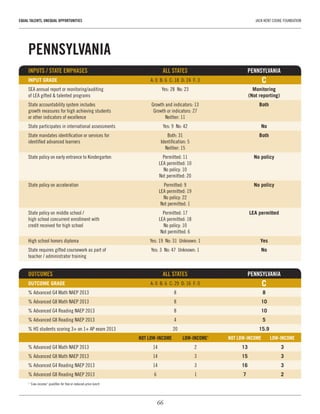
Pennsylvania is in the top half of states for both grades, however
receiving only a ‘C’ for both “inputs” and “outcomes.” They
have measures in their state accountability system to track high
performance and they monitor their gifted and talented programs;
they permit local education agencies to decide if they allow
concurrent middle school and high school enrollment with high
school credit and offer an honors diploma; but they do not have
state policies on early entrance to kindergarten or acceleration. With
one of the nation’s lower poverty states (39 percent of their students
are low-income), Pennsylvania’s overall advanced performance levels
are relatively high—10 percent of students in the grade 4 scored
advanced in reading, for example. However, their excellence gaps
between low-income and other students are pretty large; in grade
4, 16 percent of wealthier students scored advanced on reading
compared with only 3 percent of low-income students. There is
much more Pennsylvania could do on the policy front, including
creating state-wide policies around acceleration and not leaving
things up to LEAs. A hopeful sign is that Pennsylvania’s newly
elected governor, Tom Wolf, included explicit plans to provide more
funding to high poverty schools in an effort to “close achievement
gaps between low-income and their wealthier peers” in his
election platform.11
10	https://education.ohio.gov/getattachment/Topics/Other-Resources/Gifted-
Education/Reporting/School-District-Self-Report-on-Identification-and/2013-
2014-Planning-Document.pdf.aspx
1 	 Percentage of children under age 18 living in low-income households (defined
as twice the federal poverty threshold), from National Center for Children in
Poverty http://www.nccp.org/tools/demographics)
11	http://b.3cdn.net/tomwolf/28dc8311d9bc153b07_uabm6br2y.pdf
TABLE 3: STATES WITH B GRADE INPUTS OR OUTCOMES
STATE
INPUT
GRADE
% FROM
LOW-INCOME1
OUTCOME
GRADE
New Hampshire	 27%	 D-	 B-
Massachusetts	 30%	 C+	 B-
Minnesota	 32%	 B-	 B-
Vermont	 37%	 F	 B-
Colorado	 39%	 B-	 C+
Utah	 40%	 D+	 B
Maine	 43%	 D-	 B-
Ohio	 45%	 B-	C
North Carolina	 49%	 B-	C
Alabama	 49%	 B-	D-
Texas	 50%	 B-	C-
22
EQUAL TALENTS, UNEQUAL OPPORTUNITIES	 JACK KENT COOKE FOUNDATION
To meet the Gifted Indicator, a district or school must meet a minimum threshold on all three parts of the indicator.
Thresholds are scheduled to increase over time.
PERFORMANCE
Gifted Performance Index:
A numerical index based on gifted students’ achievement levels on
state tests, paired by test subject and academic area of giftedness
(also includes superior cognitive) for students in grades 4-8 and 10.
PROGRESS
Gifted Value-Added:
The letter grade representing the amount of growth for gifted students
on state tests, paired by test subject (reading and mathematics, only)
and area of giftedness (also includes superior cognitive) for students
in grades 4-8.
INPUTS
Gifted Identification:
The number of students identified as gifted in any of the seven areas of
giftedness expressed as a percentage of total enrollment.
Gifted Served:
The number of students receiving gifted services expressed as a
percentage of all students identified as gifted.
Input Point Total:
A point system will calculate total inputs based on identification and
service within gifted area sets, student subgroups, and grade bands.
OHIO’S STATE ACCOUNTABILITY SYSTEM “GIFTED INDICATOR”
RECOMMENDATIONS FOR STATES
RECOMMENDATION 1:
Make your high-performing students highly visible.
We strongly believe that the root of the problems in the U.S. with
advanced student performance is that these students are rarely
discussed in state-level policy. As Plucker et al. (2013) note, this lack
of discussion makes these students invisible, yet their progress is of
considerable social and economic importance to our communities.
States should require LEAs to identify high-ability students and
their income levels, and collect data on their performance over
time.12
At the minimum, SEAs should write and disseminate an
annual report on the performance of their advanced students and
how LEAs are addressing students’ needs. When reporting annual
achievement test results or results of participation in international
assessments, states should specifically note the performance of
advanced students, especially those who are low- income.
RECOMMENDATION 2:
Remove barriers that prevent high-ability students from
moving through course work at a pace that matches their
achievement level.
Allowing high-ability students to move through the K-12 system
at their own pace is one of the easiest and most straightforward
interventions. State-level laws and policies should require LEAs to
allow early entrance to kindergarten, acceleration between grades,
dual enrollment in middle school and high school (with high school
credit), and early graduation from high school.
RECOMMENDATION 3:
Ensure that all high-ability students have access to advanced
educational services.
States can and should take the lead in promoting educational
excellence. Require services for gifted and talented students, require
12	We are sensitive to parent privacy concerns. Collecting data on individual students is inherently fraught with problems. However, data can be protected by being
anonymized with student identification numbers, tracking progress can be done confidentially and results reported in the aggregate.
23
EQUAL TALENTS, UNEQUAL OPPORTUNITIES	 JACK KENT COOKE FOUNDATION
all educators to have exposure to the needs of advanced students
in teacher and administrator preparation coursework, and monitor
and audit LEA gifted and talented programs for quality. Provide for
dual enrollment for high school students in college level coursework
either in local cooperating higher educational institutions, providing
AP courses or facilitating dual enrollment in bricks-and-mortar and
online college courses.
RECOMMENDATION 4:
Hold LEAs accountable for the performance of high-ability
students from all economic backgrounds.

State K-12 accountability systems often drive the discussion of
priorities in local school districts. Include in state accountability
systems measures of growth for high-ability students and other
indicators of excellence, identifying separately low-income and
other students.
CONCLUSION
The data indicators used in this report are the so-called “low
hanging fruit.” They were chosen because they were (relatively) easy
to collect and compile. They also represent steps which all states can
take to support advanced learning, without significant additional
effort or cost. Some of these policy interventions may actually save
states money, e.g., permitting acceleration moves students through
the system more quickly, thereby reducing the number of years a
student receives educational services.13
Yet even easy-to-implement policies such as permitting acceleration
are not universal. Rather, we repeatedly found that very smart
students from all income backgrounds are largely being ignored.
Although conventional wisdom holds that the United States
has moved away from the traditional, “one size fits all” model of
education, states are not creating systems that will allow advanced
students to move through the grades at a developmentally
appropriate pace. Individualized learning programs, which
theoretically would benefit high performers from all income
brackets, are simply not yet in place. Very few states require
that exceptionally high performing students have an Individual
Educational Plan, which is required for special education students.
Our most vulnerable high-ability students are paying a steep
price for this policy silence. Students from higher-income families
are more likely to live in districts where services are valued and
provided; and if not, they are more likely to have families that
seek out supplemental services such as afterschool, weekend, and
summer programs or leave public school entirely to pursue advanced
instruction in private schools or through homeschooling. Those
students are more likely to perform at advanced levels regardless of
state-level policy support; low-income students are much less likely
to do so.14
That high-ability, low-income children disproportionately
fall behind is not surprising; nor is it adequately documented or
squarely addressed.
The Cooke Foundation intends to conduct this study regularly.
The current set of indicators will be updated, and future iterations
will include surveys of state education agencies so as to broaden the
range of indicators that may be included. Our intention to refine the
analysis is, of course, no reason to delay action; children go through
their public school experiences once.
The alternative—to accept the excellence gap as inevitable—is a
recipe for long-term social and economic decline. The country
recently reached the point where roughly half its students are low-
income. As suggested by the evidence of the extraordinary support
that better-resourced families can provide their children, ever fewer
high-ability low-income students are performing at advanced
levels.15
If those two trends continue, it is reasonable to question
how the United States will satisfy its insatiable need for talent. We
are laying the groundwork for a persistent talent underclass. In the
final analysis the problem is stark: if we fail to reduce the barriers
to excellence for talent development of our brightest students, our
economic preeminence will be fundamentally jeopardized.
13	Some forms of acceleration may also require less differentiation on the part of
teachers, as students are placed in a more appropriate challenge level given their
ability in a specific subject.
14	Furthermore, although students from higher-income families may outperform
students from lower-income families in the United States, both groups of students
lag behind in international comparisons, even when controlling for family
socioeconomic status (Plucker et al., 2013).
15	Regarding low-income students, see http://nces.ed.gov/programs/digest/d13/
tables/dt13_204.10.asp and DeNavas-Walt, C., & Proctor, B. D. (2014). Income
and poverty in the United States: 2013 [U.S. Census Bureau, Current population
reports, P60-249]. Washington, DC: U.S. Government Printing Office.;
regarding performance of high-ability students, see Plucker et al. (2013).
24
EQUAL TALENTS, UNEQUAL OPPORTUNITIES	 JACK KENT COOKE FOUNDATION
ABOUT THE AUTHORS
Jonathan Plucker is the Raymond Neag Endowed Professor
of Education at the University of Connecticut’s Neag School of
Education. His research examines education policy and talent
development, with over 200 publications to his credit. Recent
books include Critical Issues and Practices in Gifted Education with
Carolyn Callahan and Intelligence 101 with Amber Esping. His
work defining and studying excellence gaps (http://cepa.uconn.
edu/mindthegap) is part of a larger effort to reorient policymakers’
thinking about how best to promote success and high achievement
for all children. He was the recipient of the 2012 Arnheim Award
for Outstanding Achievement from the American Psychological
Association and 2013 Distinguished Scholar Award from the
National Association for Gifted Children. Professor Plucker is an
APA and AAAS Fellow and has been ranked one of the top 100
most influential academics in education the past two years.
Jennifer Giancola is the Director of Research at the Jack Kent
Cooke Foundation where she oversees the foundation’s internal
and external research efforts. Her work focuses on issues of college
readiness, access and success for students from all backgrounds.
Prior to joining the foundation, Dr. Giancola led evaluations of
nationwide federal and foundation-funded education programs as a
senior associate at Abt Associates Inc., a social policy research firm
headquartered in Boston, MA, where she evaluated postsecondary
programs for the National Science Foundation, National
Aeronautics Space Administration, and United Negro College Fund.
Grace Healey is an undergraduate student enrolled in the Neag
School of Education at the University of Connecticut. She is
currently pursuing a major in comprehensive special education, with
the hopes of one day inspiring and promoting positive change in the
world of special education in developing nations.
Daniel Arndt is a dual degree undergraduate student at the
University of Connecticut, majoring in Biological Sciences and
Secondary Biology Education. Previously, he interned for the
Connecticut Invention Convention writing curricular resources and
currently acts as a student teaching candidate at the Edwin O. Smith
High School in Mansfield, Connecticut.
Chen Wang is a graduate student at the University of
Connecticut, where she studies in the Neag School of Education’s
Cognition, Instruction, and Learning Technologies program.
The Jack Kent Cooke Foundation is dedicated to advancing
the education of exceptionally promising students who have
financial need. By offering the largest scholarships in the country, in-
depth academic counseling and other direct services, the Foundation
seeks to help high-performing, low-income students to develop
their talents and excel educationally. In addition to providing
students both counseling and financial support from middle school
to graduate school, the Foundation provides grants for noteworthy
and innovative initiatives that support high-performing, low-income
students. Founded in 2000, the Foundation has awarded over
$130 million in scholarships to nearly 1,900 students and over $80
million in grants. www.jkcf.org
25
EQUAL TALENTS, UNEQUAL OPPORTUNITIES	 JACK KENT COOKE FOUNDATION
APPENDIX A
INDICATOR DESCRIPTIONS
AND DATA SOURCES
INPUTS
Each of the nine input indicators were weighted equally in the
calculation of the Input grade for each state.
Input Indicator 1:
SEA annual report or monitoring/auditing of LEA G/T programs
Data source: 2012-13 State of the States in Gifted Education,
from the National Association for Gifted Children (NAGC)
and the Council of State Directors of Programs for the Gifted
(CSDPG) (“State-of-the-States Report”) Table F, http://www.
nagc.org/sites/default/files/Gifted-by-State/Table%20F%20
%28accountability%29.pdf
Rationale: A state that emphasizes advanced education should have
some form of state-level monitoring for related LEA programs and
interventions. States received full credit on this indicator if they
reported either monitoring/auditing LEA gifted education services
or preparing an annual report on the “state of the state” regarding
advanced education. Specifically, the State of the States survey asks,
“Does the state monitor/audit LEA’s GT Programs?” and “Does the
state publish an annual report on state GT services?”
Input Indicator 2:
State accountability system
Data source: 2012-13 State of the States in Gifted Education,
from the National Association for Gifted Children (NAGC)
and the Council of State Directors of Programs for the Gifted
(CSDPG) (“State-of-the-States Report”) Table F, http://www.
nagc.org/sites/default/files/Gifted-by-State/Table%20F%20
%28accountability%29.pdf
Rationale: The inclusion of indicators in state K-12 accountability
systems representing high levels of academic performance can be
interpreted as a strong, formal statement of the importance of
advanced education, especially when those indicators give schools
and districts credit for helping low-income students achieve at
high levels. States were given full credit on this indicator if their
accountability systems included measures of growth for high
achieving students and other indicators of excellence. These
data were drawn from the State of the States survey (“Are there
or will there be GT indicators on district report cards or other
state accountability forms? If yes, what are the specific indicators
included?”) and were supplemented by examinations of each state’s
accountability system as described in applicable state statutes and
SEA documents.
Input Indicator 3:
Participation in international assessments
Data source: 2012 PISA reports, http://www.oecd.org/pisa, 2011
TIMSS & PIRLS reports, http://timssandpirls.bc.edu/
Rationale: The ability to benchmark students’ achievement against
those from other countries is becoming increasingly important
in the rapidly globalizing world, and this is certainly true for the
performance of advanced students. States were given full credit on
this indicator if they participated as a region in at least one of the
recent testing cycles of the major international assessments: TIMSS
(2011), PIRLS (2011), or PISA (2012).
Input Indicator 4:
Requirements for identification and services
Data source: 2012-13 State of the States in Gifted Education, from
the National Association for Gifted Children (NAGC) and the
Council of State Directors of Programs for the Gifted (CSDPG)
(“State-of-the-States Report”) Table C, http://www.nagc.org/sites/
default/files/Gifted-by-State/Table%20C%20%28mandates%20
%20funding%29.pdf
Rationale: Requiring LEAs to identify and serve advanced students
is an indicator of the value a state places on academic excellence,
including for low-income students who may be attending schools
in which proficiency is valued more highly than advanced
performance. Students received full credit on this indicator if they
require services (i.e., with identification implied). Specifically, the
State of the States survey asks, “Does the state have a mandate for
GT ID or services? What areas are included in the mandate?”
Input Indicator 5:
State policies allowing early entrance to kindergarten
Data source: 2012-13 State of the States in Gifted Education, from
the National Association for Gifted Children (NAGC) and the
Council of State Directors of Programs for the Gifted (CSDPG)
(“State-of-the-States Report”) Table D, http://www.nagc.org/
sites/default/files/Gifted-by-State/Table%20D%20%28state%20
policies%29.pdf
Rationale: Children should be able to enter kindergarten when
they are intellectually ready to do so, not only when their birthday
falls on the correct side of an arbitrary cut-off date. This may be
especially important for low-income students, who may benefit from
additional educational supports and social services that are available
in K-12 schools. States were given full credit on this indicator if
26
EQUAL TALENTS, UNEQUAL OPPORTUNITIES	 JACK KENT COOKE FOUNDATION
they have a state policy that allows early entrance to kindergarten.
Specifically, the State of the States survey asks, “Does the state have a
policy on early entrance to kindergarten?”
Input Indicator 6:
State acceleration policy
Data source: 2012-13 State of the States in Gifted Education, from
the National Association for Gifted Children (NAGC) and the
Council of State Directors of Programs for the Gifted (CSDPG)
(“State-of-the-States Report”) Table D, http://www.nagc.org/
sites/default/files/Gifted-by-State/Table%20D%20%28state%20
policies%29.pdf
Rationale: Students should be able to move through the K-12
system at their own pace. For some students, this pace can be
considerably accelerated, and the benefits of academic acceleration
are well-documented. Having a state acceleration policy both sends
a strong message that acceleration is valued and permissible and
provides a policy lever for educators and parents to use when they
encounter anti-acceleration bias. States were given full credit on
this indicator if they have a state acceleration policy. Specifically,
the State of the States survey asks, “Does the state have an
acceleration policy?”
Input Indicator 7:
MS/HS concurrent enrollment and credit in HS
Data source: 2012-13 State of the States in Gifted Education, from
the National Association for Gifted Children (NAGC) and the
Council of State Directors of Programs for the Gifted (CSDPG)
(“State-of-the-States Report”) Table D, http://www.nagc.org/
sites/default/files/Gifted-by-State/Table%20D%20%28state%20
policies%29.pdf
Rationale: Having access to high school courses while attending
middle school provides talented students with challenging
coursework that their school may not otherwise be able to offer. This
may be especially important for low-income students, who are more
likely to attend schools that suffer from highly limited resources,
therefore limiting the number and range of advanced options in the
middle school. At the same time, students who take high school
coursework while in middle school should be able to get high school
credit, which allows students to move through the K-12 system
at a more appropriate pace and/or allows for greater enrichment
opportunities when the students enter high school. States were given
full credit on this indicator if they have policies that specifically
allow middle school/high school dual enrollment, and if the state
allows for such enrollment to result in the granting of high school
credit. Specifically, the State of the States survey asks, “Are middle
school students permitted to be dually/concurrently enrolled in
high school?” and “May middle school students receive high school
credit towards graduation for the courses in which they are dually/
concurrently enrolled?”
Input Indicator 8:
State high school honors diploma designation
Data source: ECS graduation policy database http://ecs.force.com/
mbdata/mbprofall?Rep=HS02
Rationale: Having a state-level honors designation sends a strong
message that the state prioritizes advanced achievement in its
schools. States were given credit on this indicator if they have an
official state honors diploma or a similar type of designation for high
achieving students as they graduate from high school.
Input Indicator 9:
Gifted coursework required in teacher and
administrator training
Data source: 2012-13 State of the States in Gifted Education, from
the National Association for Gifted Children (NAGC) and the
Council of State Directors of Programs for the Gifted (CSDPG)
(“State-of-the-States Report”) Table E, http://www.nagc.org/sites/
default/files/Gifted-by-State/Table%20E%20%28training%29.pdf
Rationale: If educators are not exposed to material on the education
of high ability students, it is unlikely that those educators will be
sensitive to the needs of those students, especially those who are
low-income. States were given full credit on this indicator if they
require coursework on gifted and talented learners in pre-service
training and administrator training, partial credit if such coverage
is required in only one of the two areas. Specifically, the State of
the States survey asks, “Does the state require GT coursework for
all pre-service teachers?” and “ Is training in nature & needs of GT
students required in administrators’ coursework?”
Unavailable Input Indicators
A number of input variables were not included because of lack of
availability and/or data reliability issues. We hope to collect these
data in subsequent years.
For example, we intended to include an analysis of press releases
from each state from the annual release of state test results (e.g.,
Does the press release even mention the percentage of students who
score at advanced levels?), but those press releases proved to be very
difficult to obtain for all 50 states. We could not determine which
states allow early high school graduates to received state financial
aid for college, in part because of the difficulty in determining
which states allow early high school graduation. And we could
not determine which states have adopted official definitions of
high performance, giftedness, talent, educational excellence, or
related terms.
27
EQUAL TALENTS, UNEQUAL OPPORTUNITIES	 JACK KENT COOKE FOUNDATION
PARTICIPATION
Participation data provide insight into the vital link between inputs
and outcomes in the education of advanced students. However,
we did not find any of the desired participation variables to be of
sufficient quality to be included in this report. For example, the
expert panel recommended that the number of Governor’s schools
or other publicly-funded special schools for advanced students be
considered as an indicator of a state’s emphasis on meeting the
academic needs of those students. But no standard list of those
schools exists, and although we pulled the data from various sources,
we were not confident in the validity of the final list. We were
not able to find a data base with the percent of students who take
algebra by 8th grade that was less than 10 years old, and searching
individual SEA data sets was not fruitful. The percent of low-income
students taking Advanced Placement courses was also not available.
Finally, data on funding for advanced education was considered to
be too unreliable and too much of a black box to be included in
the final model (i.e., it was impossible to determine which activities
were funded by the reported resources). These and other measures
of student participation in advanced learning will be part of
subsequent year’s data collections.
OUTCOMES
Each of the nine outcome indicators were equally weighted in the
calculation of the Outcome grade for each state.
Outcome Indicators 1-5:
Advanced achievement, all students
Data sources: National Assessment of Educational Progress (NAEP),
http://nces.ed.gov/nationsreportcard/, College Board, http://media.
collegeboard.com/digitalServices/pdf/ap/rtn/10th-annual/10th-
annual-ap-report-to-the-nation-single-page.pdf
Rationale: A key outcome is obviously the percent of public school
students who perform academically at advanced levels. We included
indicators on student performance at several levels: NAEP math and
reading/language arts data for Grade 4 and Grade 8, and Advanced
Placement exam data to represent high school achievement. To
receive full credit on these indicators, state data needed to reflect:
•	 At least 10% scored in the advanced range (Grade 4 and 8 math,
Grade 4 reading)
•	 At least 8% scored in the advanced range (Grade 8 reading)
•	 At least 21% of students scored 3 or higher on at least one
AP exam
The five achievement indicators were equally weighted, and they
collectively accounted for half of the Outcome grade.
Outcome Indicators 6-9:
Excellence gaps
Data source: National Assessment of Educational Progress (NAEP),
http://nces.ed.gov/nationsreportcard/
Rationale: High levels of academic progress do not necessarily mean
that all student subgroups share the same levels of accomplishment.
If a state has a relatively large percent of students scoring advanced
on NAEP, but most of those students are not low-income, the
state’s success in promoting educational excellence can be called
into question. To receive full credit on this indicator, a state’s NAEP
data showed that the percent of low-income students scoring
advanced was no less than 41% percent of the percent of other
students scoring advanced. For the purposes of this indicator, low-
income was defined as qualifying for free/reduced price lunch. The
excellence gap indicators were limited to Grades 4 and 8 reading
and math because (a) there is little evidence that such gaps shrink
as students work through the K-12 system and (b) free/reduced
price lunch data is generally considered to be less reliable with
older students.
Unavailable Outcome Indicators
Compared to the Input and Participation indicators, most of the
desired outcomes were available and are included in this report.
One exception is the percent of students in each state’s graduating
cohort that earned a 4 or higher on at least one AP exam. These
data are not readily available, even from the College Board. We
also wanted to report the number of students who take advantage
of early graduation from high school, but those data are reported
inconsistently across states, with no central data collection on that
variable. We did not include the number of students taking Algebra
by 8th grade because few states report this information. Finally, we
omitted trends in excellence gaps, because states’ excellence gaps
appear to generally be quite stable. Since they are also rather large,
states had little opportunity to benefit from the indicator, so it was
not included in the final model.
28
EQUAL TALENTS, UNEQUAL OPPORTUNITIES	 JACK KENT COOKE FOUNDATION
APPENDIX B
STATE DATA TABLES
The following tables (pages 29-78) report the specific indicators for
each state, Inputs and Outcomes. Cells noted with an asterisk were
not obtained through the primary data source, but through project
staff research and/or phone calls to state officials.
29
EQUAL TALENTS, UNEQUAL OPPORTUNITIES	 JACK KENT COOKE FOUNDATION
ALABAMA
INPUTS / STATE EMPHASES	 ALL STATES	ALABAMA
INPUT GRADE	 A: 0  B: 6  C: 18  D: 24  F: 3	 B-
SEA annual report or monitoring/auditing 	 Yes: 28  No: 23	 Monitoring
of LEA gifted & talented programs		 (Not reporting)
State accountability system includes 	 Growth and indicators: 13	 Growth
growth measures for high achieving students 	 Growth or indicators: 27	 and indicators
or other indicators of excellence	 Neither: 11
State participates in international assessments	 Yes: 9  No: 42	 Yes (2011 TIMSS)
State mandates identification or services for 	 Both: 31	 Both
identified advanced learners	 Identification: 5
	 Neither: 15
State policy on early entrance to Kindergarten	 Permitted: 11	 Not permitted
	 LEA permitted: 10
	 No policy: 10
	 Not permitted: 20
State policy on acceleration	 Permitted: 9	 Permitted
	 LEA permitted: 19
	 No policy: 22
	 Not permitted: 1
State policy on middle school / 	 Permitted: 17	 Not permitted
high school concurrent enrollment with 	 LEA permitted: 18
credit received for high school	 No policy: 10
	 Not permitted: 6
High school honors diploma	 Yes: 19  No: 31  Unknown: 1	 Yes
State requires gifted coursework as part of 	 Yes: 3  No: 47  Unknown: 1	 No
teacher / administrator training
OUTCOMES 	 ALL STATES	 ALABAMA
OUTCOME GRADE	 A: 0  B: 6  C: 29  D: 16  F: 0	 D-
% Advanced G4 Math NAEP 2013	 8	 3
% Advanced G8 Math NAEP 2013	 8	 3
% Advanced G4 Reading NAEP 2013	 8	 6
% Advanced G8 Reading NAEP 2013	 4	 2
% HS students scoring 3+ on 1+ AP exam 2013	 20	 11
	 NOT LOW-INCOME	 LOW-INCOME1
	 NOT LOW-INCOME	 LOW-INCOME
% Advanced G4 Math NAEP 2013	 14	 2	 7	1
% Advanced G8 Math NAEP 2013	 14	 3	 7	0
% Advanced G4 Reading NAEP 2013	 14	 3	 13	2
% Advanced G8 Reading NAEP 2013	 6	 1	 3	0
1
“Low-income” qualifies for free or reduced-price lunch
30
EQUAL TALENTS, UNEQUAL OPPORTUNITIES	 JACK KENT COOKE FOUNDATION
ALASKA
INPUTS / STATE EMPHASES	 ALL STATES	ALASKA
INPUT GRADE	 A: 0  B: 6  C: 18  D: 24  F: 3	 D+
SEA annual report or monitoring/auditing 	 Yes: 28  No: 23	 No
of LEA gifted & talented programs		
State accountability system includes 	 Growth and indicators: 13	 Growth
growth measures for high achieving students 	 Growth or indicators: 27	 (Not indicators)
or other indicators of excellence	 Neither: 11
State participates in international assessments	 Yes: 9  No: 42	 No
State mandates identification or services for 	 Both: 31	 Both
identified advanced learners	 Identification: 5
	 Neither: 15
State policy on early entrance to Kindergarten	 Permitted: 11	 No policy
	 LEA permitted: 10
	 No policy: 10
	 Not permitted: 20
State policy on acceleration	 Permitted: 9	 No policy
	 LEA permitted: 19
	 No policy: 22
	 Not permitted: 1
State policy on middle school / 	 Permitted: 17	 Permitted
high school concurrent enrollment with 	 LEA permitted: 18
credit received for high school	 No policy: 10
	 Not permitted: 6
High school honors diploma	 Yes: 19  No: 31  Unknown: 1	 No
State requires gifted coursework as part of 	 Yes: 3  No: 47  Unknown: 1	 No
teacher / administrator training
OUTCOMES 	 ALL STATES	 ALASKA
OUTCOME GRADE	 A: 0  B: 6  C: 29  D: 16  F: 0	 D+
% Advanced G4 Math NAEP 2013	 8	 6
% Advanced G8 Math NAEP 2013	 8	 7
% Advanced G4 Reading NAEP 2013	 8	 6
% Advanced G8 Reading NAEP 2013	 4	 3
% HS students scoring 3+ on 1+ AP exam 2013	 20	 15
	 NOT LOW-INCOME	 LOW-INCOME1
	 NOT LOW-INCOME	 LOW-INCOME
% Advanced G4 Math NAEP 2013	 14	 2	 11	2
% Advanced G8 Math NAEP 2013	 14	 3	 11	2
% Advanced G4 Reading NAEP 2013	 14	 3	 10	2
% Advanced G8 Reading NAEP 2013	 6	 1	 5	1
1
“Low-income” qualifies for free or reduced-price lunch
31
EQUAL TALENTS, UNEQUAL OPPORTUNITIES	 JACK KENT COOKE FOUNDATION
ARIZONA
INPUTS / STATE EMPHASES	 ALL STATES	ARIZONA
INPUT GRADE	 A: 0  B: 6  C: 18  D: 24  F: 3	 C+
SEA annual report or monitoring/auditing 	 Yes: 28  No: 23	 Monitoring
of LEA gifted & talented programs		 (Not reporting)
State accountability system includes 	 Growth and indicators: 13	 Growth
growth measures for high achieving students 	 Growth or indicators: 27	 (Not indicators)
or other indicators of excellence	 Neither: 11
State participates in international assessments	 Yes: 9  No: 42	 No
State mandates identification or services for 	 Both: 31	 Both
identified advanced learners	 Identification: 5
	 Neither: 15
State policy on early entrance to Kindergarten	 Permitted: 11	 Permitted
	 LEA permitted: 10
	 No policy: 10
	 Not permitted: 20
State policy on acceleration	 Permitted: 9	 Permitted
	 LEA permitted: 19
	 No policy: 22
	 Not permitted: 1
State policy on middle school / 	 Permitted: 17	 LEA Permitted
high school concurrent enrollment with 	 LEA permitted: 18
credit received for high school	 No policy: 10
	 Not permitted: 6
High school honors diploma	 Yes: 19  No: 31  Unknown: 1	 No
State requires gifted coursework as part of 	 Yes: 3  No: 47  Unknown: 1	 No
teacher / administrator training
OUTCOMES 	 ALL STATES	 ARIZONA
OUTCOME GRADE	 A: 0  B: 6  C: 29  D: 16  F: 0	 D
% Advanced G4 Math NAEP 2013	 8	 7
% Advanced G8 Math NAEP 2013	 8	 7
% Advanced G4 Reading NAEP 2013	 8	 5
% Advanced G8 Reading NAEP 2013	 4	 2
% HS students scoring 3+ on 1+ AP exam 2013	 20	 14
	 NOT LOW-INCOME	 LOW-INCOME1
	 NOT LOW-INCOME	 LOW-INCOME
% Advanced G4 Math NAEP 2013	 14	 2	 13	2
% Advanced G8 Math NAEP 2013	 14	 3	 14	2
% Advanced G4 Reading NAEP 2013	 14	 3	 10	1
% Advanced G8 Reading NAEP 2013	 6	 1	 4	1
1
“Low-income” qualifies for free or reduced-price lunch
32
EQUAL TALENTS, UNEQUAL OPPORTUNITIES	 JACK KENT COOKE FOUNDATION
ARKANSAS
INPUTS / STATE EMPHASES	 ALL STATES	ARKANSAS
INPUT GRADE	 A: 0  B: 6  C: 18  D: 24  F: 3	 C
SEA annual report or monitoring/auditing 	 Yes: 28  No: 23	 Report
of LEA gifted & talented programs		 and monitoring
State accountability system includes 	 Growth and indicators: 13	 Growth
growth measures for high achieving students 	 Growth or indicators: 27	 and indicators
or other indicators of excellence	 Neither: 11
State participates in international assessments	 Yes: 9  No: 42	 No
State mandates identification or services for 	 Both: 31	 Both
identified advanced learners	 Identification: 5
	 Neither: 15
State policy on early entrance to Kindergarten	 Permitted: 11	 Permitted
	 LEA permitted: 10
	 No policy: 10
	 Not permitted: 20
State policy on acceleration	 Permitted: 9	 LEA Permitted
	 LEA permitted: 19
	 No policy: 22
	 Not permitted: 1
State policy on middle school / 	 Permitted: 17	 Not permitted
high school concurrent enrollment with 	 LEA permitted: 18
credit received for high school	 No policy: 10
	 Not permitted: 6
High school honors diploma	 Yes: 19  No: 31  Unknown: 1	 No
State requires gifted coursework as part of 	 Yes: 3  No: 47  Unknown: 1	 No
teacher / administrator training
OUTCOMES 	 ALL STATES	 ARKANSAS
OUTCOME GRADE	 A: 0  B: 6  C: 29  D: 16  F: 0	 D+
% Advanced G4 Math NAEP 2013	 8	 5
% Advanced G8 Math NAEP 2013	 8	 5
% Advanced G4 Reading NAEP 2013	 8	 7
% Advanced G8 Reading NAEP 2013	 4	 3
% HS students scoring 3+ on 1+ AP exam 2013	 20	 16
	 NOT LOW-INCOME	 LOW-INCOME1
	 NOT LOW-INCOME	 LOW-INCOME
% Advanced G4 Math NAEP 2013	 14	 2	 10	2
% Advanced G8 Math NAEP 2013	 14	 3	 8	2
% Advanced G4 Reading NAEP 2013	 14	 3	 12	3
% Advanced G8 Reading NAEP 2013	 6	 1	 5	1
1
“Low-income” qualifies for free or reduced-price lunch
33
EQUAL TALENTS, UNEQUAL OPPORTUNITIES	 JACK KENT COOKE FOUNDATION
CALIFORNIA
INPUTS / STATE EMPHASES	 ALL STATES	CALIFORNIA
INPUT GRADE	 A: 0  B: 6  C: 18  D: 24  F: 3	 D+
SEA annual report or monitoring/auditing 	 Yes: 28  No: 23	 No
of LEA gifted & talented programs		
State accountability system includes 	 Growth and indicators: 13	 Growth
growth measures for high achieving students 	 Growth or indicators: 27	 (Not indicators)
or other indicators of excellence	 Neither: 11
State participates in international assessments	 Yes: 9  No: 42	 Yes (2011 TIMSS)
State mandates identification or services for 	 Both: 31	 No
identified advanced learners	 Identification: 5
	 Neither: 15
State policy on early entrance to Kindergarten	 Permitted: 11	 Not permitted
	 LEA permitted: 10
	 No policy: 10
	 Not permitted: 20
State policy on acceleration	 Permitted: 9	 No policy
	 LEA permitted: 19
	 No policy: 22
	 Not permitted: 1
State policy on middle school / 	 Permitted: 17	 LEA Permitted
high school concurrent enrollment with 	 LEA permitted: 18
credit received for high school	 No policy: 10
	 Not permitted: 6
High school honors diploma	 Yes: 19  No: 31  Unknown: 1	 Yes
State requires gifted coursework as part of 	 Yes: 3  No: 47  Unknown: 1	 No
teacher / administrator training
OUTCOMES 	 ALL STATES	 CALIFORNIA
OUTCOME GRADE	 A: 0  B: 6  C: 29  D: 16  F: 0	 D+
% Advanced G4 Math NAEP 2013	 8	 5
% Advanced G8 Math NAEP 2013	 8	 6
% Advanced G4 Reading NAEP 2013	 8	 6
% Advanced G8 Reading NAEP 2013	 4	 3
% HS students scoring 3+ on 1+ AP exam 2013	 20	 27
	 NOT LOW-INCOME	 LOW-INCOME1
	 NOT LOW-INCOME	 LOW-INCOME
% Advanced G4 Math NAEP 2013	 14	 2	 11	2
% Advanced G8 Math NAEP 2013	 14	 3	 13	2
% Advanced G4 Reading NAEP 2013	 14	 3	 12	2
% Advanced G8 Reading NAEP 2013	 6	 1	 6	1
1
“Low-income” qualifies for free or reduced-price lunch
34
EQUAL TALENTS, UNEQUAL OPPORTUNITIES	 JACK KENT COOKE FOUNDATION
COLORADO
INPUTS / STATE EMPHASES	 ALL STATES	COLORADO
INPUT GRADE	 A: 0  B: 6  C: 18  D: 24  F: 3	 B-
SEA annual report or monitoring/auditing 	 Yes: 28  No: 23	 Report
of LEA gifted & talented programs		 and monitoring
State accountability system includes 	 Growth and indicators: 13	 Growth
growth measures for high achieving students 	 Growth or indicators: 27	 and indicators
or other indicators of excellence	 Neither: 11
State participates in international assessments	 Yes: 9  No: 42	 Yes (2011 TIMSS)
State mandates identification or services for 	 Both: 31	 Both
identified advanced learners	 Identification: 5
	 Neither: 15
State policy on early entrance to Kindergarten	 Permitted: 11	 Permitted
	 LEA permitted: 10
	 No policy: 10
	 Not permitted: 20
State policy on acceleration	 Permitted: 9	 Permitted
	 LEA permitted: 19
	 No policy: 22
	 Not permitted: 1
State policy on middle school / 	 Permitted: 17	 No policy
high school concurrent enrollment with 	 LEA permitted: 18
credit received for high school	 No policy: 10
	 Not permitted: 6
High school honors diploma	 Yes: 19  No: 31  Unknown: 1	 No
State requires gifted coursework as part of 	 Yes: 3  No: 47  Unknown: 1	 No
teacher / administrator training
OUTCOMES 	 ALL STATES	 COLORADO
OUTCOME GRADE	 A: 0  B: 6  C: 29  D: 16  F: 0	 C+
% Advanced G4 Math NAEP 2013	 8	 11
% Advanced G8 Math NAEP 2013	 8	 12
% Advanced G4 Reading NAEP 2013	 8	 10
% Advanced G8 Reading NAEP 2013	 4	 5
% HS students scoring 3+ on 1+ AP exam 2013	 20	 24
	 NOT LOW-INCOME	 LOW-INCOME1
	 NOT LOW-INCOME	 LOW-INCOME
% Advanced G4 Math NAEP 2013	 14	 2	 16	3
% Advanced G8 Math NAEP 2013	 14	 3	 18	4
% Advanced G4 Reading NAEP 2013	 14	 3	 16	3
% Advanced G8 Reading NAEP 2013	 6	 1	 7	1
1
“Low-income” qualifies for free or reduced-price lunch
35
EQUAL TALENTS, UNEQUAL OPPORTUNITIES	 JACK KENT COOKE FOUNDATION
CONNECTICUT
INPUTS / STATE EMPHASES	 ALL STATES	CONNECTICUT
INPUT GRADE	 A: 0  B: 6  C: 18  D: 24  F: 3	 D
SEA annual report or monitoring/auditing 	 Yes: 28  No: 23	 No
of LEA gifted & talented programs		
State accountability system includes 	 Growth and indicators: 13	 None
growth measures for high achieving students 	 Growth or indicators: 27	
or other indicators of excellence	 Neither: 11
State participates in international assessments	 Yes: 9  No: 42	 Yes (2012 PISA, 2011 TIMSS)
State mandates identification or services for 	 Both: 31	 Identification
identified advanced learners	 Identification: 5	 (Not services)
	 Neither: 15
State policy on early entrance to Kindergarten	 Permitted: 11	 Not permitted
	 LEA permitted: 10
	 No policy: 10
	 Not permitted: 20
State policy on acceleration	 Permitted: 9	 LEA Permitted
	 LEA permitted: 19
	 No policy: 22
	 Not permitted: 1
State policy on middle school / 	 Permitted: 17	 No policy
high school concurrent enrollment with 	 LEA permitted: 18
credit received for high school	 No policy: 10
	 Not permitted: 6
High school honors diploma	 Yes: 19  No: 31  Unknown: 1	 No
State requires gifted coursework as part of 	 Yes: 3  No: 47  Unknown: 1	 No
teacher / administrator training
OUTCOMES 	 ALL STATES	 CONNECTICUT
OUTCOME GRADE	 A: 0  B: 6  C: 29  D: 16  F: 0	 C
% Advanced G4 Math NAEP 2013	 8	 9
% Advanced G8 Math NAEP 2013	 8	 10
% Advanced G4 Reading NAEP 2013	 8	 12
% Advanced G8 Reading NAEP 2013	 4	 6
% HS students scoring 3+ on 1+ AP exam 2013	 20	 29
	 NOT LOW-INCOME	 LOW-INCOME1
	 NOT LOW-INCOME	 LOW-INCOME
% Advanced G4 Math NAEP 2013	 14	 2	 13	1
% Advanced G8 Math NAEP 2013	 14	 3	 14	2
% Advanced G4 Reading NAEP 2013	 14	 3	 18	2
% Advanced G8 Reading NAEP 2013	 6	 1	 9	2
1
“Low-income” qualifies for free or reduced-price lunch
36
EQUAL TALENTS, UNEQUAL OPPORTUNITIES	 JACK KENT COOKE FOUNDATION
DELAWARE
INPUTS / STATE EMPHASES	 ALL STATES	DELAWARE
INPUT GRADE	 A: 0  B: 6  C: 18  D: 24  F: 3	 F
SEA annual report or monitoring/auditing 	 Yes: 28  No: 23	 No
of LEA gifted & talented programs		
State accountability system includes 	 Growth and indicators: 13	 None
growth measures for high achieving students 	 Growth or indicators: 27	
or other indicators of excellence	 Neither: 11
State participates in international assessments	 Yes: 9  No: 42	 Did not participate
State mandates identification or services for 	 Both: 31	 No
identified advanced learners	 Identification: 5	
	 Neither: 15
State policy on early entrance to Kindergarten	 Permitted: 11	 No policy
	 LEA permitted: 10
	 No policy: 10
	 Not permitted: 20
State policy on acceleration	 Permitted: 9	 No policy
	 LEA permitted: 19
	 No policy: 22
	 Not permitted: 1
State policy on middle school / 	 Permitted: 17	 LEA Permitted
high school concurrent enrollment with 	 LEA permitted: 18
credit received for high school	 No policy: 10
	 Not permitted: 6
High school honors diploma	 Yes: 19  No: 31  Unknown: 1	 No
State requires gifted coursework as part of 	 Yes: 3  No: 47  Unknown: 1	 No
teacher / administrator training
OUTCOMES 	 ALL STATES	 DELAWARE
OUTCOME GRADE	 A: 0  B: 6  C: 29  D: 16  F: 0	 C-
% Advanced G4 Math NAEP 2013	 8	 7
% Advanced G8 Math NAEP 2013	 8	 8
% Advanced G4 Reading NAEP 2013	 8	 9
% Advanced G8 Reading NAEP 2013	 4	 4
% HS students scoring 3+ on 1+ AP exam 2013	 20	 17
	 NOT LOW-INCOME	 LOW-INCOME1
	 NOT LOW-INCOME	 LOW-INCOME
% Advanced G4 Math NAEP 2013	 14	 2	 13	2
% Advanced G8 Math NAEP 2013	 14	 3	 13	2
% Advanced G4 Reading NAEP 2013	 14	 3	 14	4
% Advanced G8 Reading NAEP 2013	 6	 1	 6	1
1
“Low-income” qualifies for free or reduced-price lunch
37
EQUAL TALENTS, UNEQUAL OPPORTUNITIES	 JACK KENT COOKE FOUNDATION
DISTRICT OF COLUMBIA
INPUTS / STATE EMPHASES	 ALL STATES	DC
INPUT GRADE	 A: 0  B: 6  C: 18  D: 24  F: 3	 F
SEA annual report or monitoring/auditing 	 Yes: 28  No: 23	 No
of LEA gifted & talented programs		
State accountability system includes 	 Growth and indicators: 13	 Growth
growth measures for high achieving students 	 Growth or indicators: 27	 (Not indicators)
or other indicators of excellence	 Neither: 11
State participates in international assessments	 Yes: 9  No: 42	 Did not participate
State mandates identification or services for 	 Both: 31	 No
identified advanced learners	 Identification: 5	
	 Neither: 15
State policy on early entrance to Kindergarten	 Permitted: 11	 Not permitted
	 LEA permitted: 10
	 No policy: 10
	 Not permitted: 20
State policy on acceleration	 Permitted: 9	 No policy
	 LEA permitted: 19
	 No policy: 22
	 Not permitted: 1
State policy on middle school / 	 Permitted: 17	 Not permitted
high school concurrent enrollment with 	 LEA permitted: 18
credit received for high school	 No policy: 10
	 Not permitted: 6
High school honors diploma	 Yes: 19  No: 31  Unknown: 1	 No
State requires gifted coursework as part of 	 Yes: 3  No: 47  Unknown: 1	 No
teacher / administrator training
OUTCOMES 	 ALL STATES	 DC
OUTCOME GRADE	 A: 0  B: 6  C: 29  D: 16  F: 0	 D-
% Advanced G4 Math NAEP 2013	 8	 6
% Advanced G8 Math NAEP 2013	 8	 4
% Advanced G4 Reading NAEP 2013	 8	 7
% Advanced G8 Reading NAEP 2013	 4	 2
% HS students scoring 3+ on 1+ AP exam 2013	 20	 14
	 NOT LOW-INCOME	 LOW-INCOME1
	 NOT LOW-INCOME	 LOW-INCOME
% Advanced G4 Math NAEP 2013	 14	 2	 25	1
% Advanced G8 Math NAEP 2013	 14	 3	 16	1
% Advanced G4 Reading NAEP 2013	 14	 3	 26	2
% Advanced G8 Reading NAEP 2013	 6	 1	 7	0
1
“Low-income” qualifies for free or reduced-price lunch
38
EQUAL TALENTS, UNEQUAL OPPORTUNITIES	 JACK KENT COOKE FOUNDATION
FLORIDA
INPUTS / STATE EMPHASES	 ALL STATES	FLORIDA
INPUT GRADE	 A: 0  B: 6  C: 18  D: 24  F: 3	 C
SEA annual report or monitoring/auditing 	 Yes: 28  No: 23	 No
of LEA gifted & talented programs		
State accountability system includes 	 Growth and indicators: 13	 Growth
growth measures for high achieving students 	 Growth or indicators: 27	 and indicators
or other indicators of excellence	 Neither: 11
State participates in international assessments	 Yes: 9  No: 42	 Yes (2012 PISA, 2011 TIMSS, 2011 PIRLS)
State mandates identification or services for 	 Both: 31	 Both
identified advanced learners	 Identification: 5	
	 Neither: 15
State policy on early entrance to Kindergarten	 Permitted: 11	 Not permitted
	 LEA permitted: 10
	 No policy: 10
	 Not permitted: 20
State policy on acceleration	 Permitted: 9	 No policy
	 LEA permitted: 19
	 No policy: 22
	 Not permitted: 1
State policy on middle school / 	 Permitted: 17	 No policy
high school concurrent enrollment with 	 LEA permitted: 18
credit received for high school	 No policy: 10
	 Not permitted: 6
High school honors diploma	 Yes: 19  No: 31  Unknown: 1	 No
State requires gifted coursework as part of 	 Yes: 3  No: 47  Unknown: 1	 Teacher
teacher / administrator training	 	 and administrator
OUTCOMES 	 ALL STATES	 FLORIDA
OUTCOME GRADE	 A: 0  B: 6  C: 29  D: 16  F: 0	 C-
% Advanced G4 Math NAEP 2013	 8	 6
% Advanced G8 Math NAEP 2013	 8	 7
% Advanced G4 Reading NAEP 2013	 8	 9
% Advanced G8 Reading NAEP 2013	 4	 3
% HS students scoring 3+ on 1+ AP exam 2013	 20	 27
	 NOT LOW-INCOME	 LOW-INCOME1
	 NOT LOW-INCOME	 LOW-INCOME
% Advanced G4 Math NAEP 2013	 14	 2	 13	2
% Advanced G8 Math NAEP 2013	 14	 3	 12	3
% Advanced G4 Reading NAEP 2013	 14	 3	 16	4
% Advanced G8 Reading NAEP 2013	 6	 1	 6	1
1
“Low-income” qualifies for free or reduced-price lunch
39
EQUAL TALENTS, UNEQUAL OPPORTUNITIES	 JACK KENT COOKE FOUNDATION
GEORGIA
INPUTS / STATE EMPHASES	 ALL STATES	GEORGIA
INPUT GRADE	 A: 0  B: 6  C: 18  D: 24  F: 3	 C+
SEA annual report or monitoring/auditing 	 Yes: 28  No: 23	 Monitoring
of LEA gifted & talented programs		 (Not reporting)
State accountability system includes 	 Growth and indicators: 13	 Growth
growth measures for high achieving students 	 Growth or indicators: 27	 and indicators
or other indicators of excellence	 Neither: 11
State participates in international assessments	 Yes: 9  No: 42	 Did not participate
State mandates identification or services for 	 Both: 31	 Both
identified advanced learners	 Identification: 5	
	 Neither: 15
State policy on early entrance to Kindergarten	 Permitted: 11	 Not permitted
	 LEA permitted: 10
	 No policy: 10
	 Not permitted: 20
State policy on acceleration	 Permitted: 9	 LEA Permitted
	 LEA permitted: 19
	 No policy: 22
	 Not permitted: 1
State policy on middle school / 	 Permitted: 17	 LEA Permitted
high school concurrent enrollment with 	 LEA permitted: 18
credit received for high school	 No policy: 10
	 Not permitted: 6
High school honors diploma	 Yes: 19  No: 31  Unknown: 1	 Yes
State requires gifted coursework as part of 	 Yes: 3  No: 47  Unknown: 1	 No
teacher / administrator training
OUTCOMES 	 ALL STATES	 GEORGIA
OUTCOME GRADE	 A: 0  B: 6  C: 29  D: 16  F: 0	 C-
% Advanced G4 Math NAEP 2013	 8	 7
% Advanced G8 Math NAEP 2013	 8	 7
% Advanced G4 Reading NAEP 2013	 8	 8
% Advanced G8 Reading NAEP 2013	 4	 4
% HS students scoring 3+ on 1+ AP exam 2013	 20	 21
	 NOT LOW-INCOME	 LOW-INCOME1
	 NOT LOW-INCOME	 LOW-INCOME
% Advanced G4 Math NAEP 2013	 14	 2	 14	3
% Advanced G8 Math NAEP 2013	 14	 3	 14	2
% Advanced G4 Reading NAEP 2013	 14	 3	 17	3
% Advanced G8 Reading NAEP 2013	 6	 1	 7	1
1
“Low-income” qualifies for free or reduced-price lunch
40
EQUAL TALENTS, UNEQUAL OPPORTUNITIES	 JACK KENT COOKE FOUNDATION
HAWAII
INPUTS / STATE EMPHASES	 ALL STATES	HAWAII
INPUT GRADE	 A: 0  B: 6  C: 18  D: 24  F: 3	 C
SEA annual report or monitoring/auditing 	 Yes: 28  No: 23	 Report
of LEA gifted & talented programs		 and monitoring
State accountability system includes 	 Growth and indicators: 13	 Growth
growth measures for high achieving students 	 Growth or indicators: 27	 (Not indicators)
or other indicators of excellence	 Neither: 11
State participates in international assessments	 Yes: 9  No: 42	 Did not participate
State mandates identification or services for 	 Both: 31	 Both
identified advanced learners	 Identification: 5	
	 Neither: 15
State policy on early entrance to Kindergarten	 Permitted: 11	 No policy
	 LEA permitted: 10
	 No policy: 10
	 Not permitted: 20
State policy on acceleration	 Permitted: 9	 LEA Permitted
	 LEA permitted: 19
	 No policy: 22
	 Not permitted: 1
State policy on middle school / 	 Permitted: 17	 No policy
high school concurrent enrollment with 	 LEA permitted: 18
credit received for high school	 No policy: 10
	 Not permitted: 6
High school honors diploma	 Yes: 19  No: 31  Unknown: 1	 Yes
State requires gifted coursework as part of 	 Yes: 3  No: 47  Unknown: 1	 No
teacher / administrator training
OUTCOMES 	 ALL STATES	 HAWAII
OUTCOME GRADE	 A: 0  B: 6  C: 29  D: 16  F: 0	 C
% Advanced G4 Math NAEP 2013	 8	 9
% Advanced G8 Math NAEP 2013	 8	 7
% Advanced G4 Reading NAEP 2013	 8	 7
% Advanced G8 Reading NAEP 2013	 4	 2
% HS students scoring 3+ on 1+ AP exam 2013	 20	 12
	 NOT LOW-INCOME	 LOW-INCOME1
	 NOT LOW-INCOME	 LOW-INCOME
% Advanced G4 Math NAEP 2013	 14	 2	 14	4
% Advanced G8 Math NAEP 2013	 14	 3	 11	4
% Advanced G4 Reading NAEP 2013	 14	 3	 11	3
% Advanced G8 Reading NAEP 2013	 6	 1	 4	1
1
“Low-income” qualifies for free or reduced-price lunch
41
EQUAL TALENTS, UNEQUAL OPPORTUNITIES	 JACK KENT COOKE FOUNDATION
IDAHO
INPUTS / STATE EMPHASES	 ALL STATES	IDAHO
INPUT GRADE	 A: 0  B: 6  C: 18  D: 24  F: 3	 D
SEA annual report or monitoring/auditing 	 Yes: 28  No: 23	 No
of LEA gifted & talented programs		
State accountability system includes 	 Growth and indicators: 13	 Growth
growth measures for high achieving students 	 Growth or indicators: 27	 (Not indicators)
or other indicators of excellence	 Neither: 11
State participates in international assessments	 Yes: 9  No: 42	 Did not participate
State mandates identification or services for 	 Both: 31	 No
identified advanced learners	 Identification: 5	
	 Neither: 15
State policy on early entrance to Kindergarten	 Permitted: 11	 Not permitted
	 LEA permitted: 10
	 No policy: 10
	 Not permitted: 20
State policy on acceleration	 Permitted: 9	 LEA Permitted
	 LEA permitted: 19
	 No policy: 22
	 Not permitted: 1
State policy on middle school / 	 Permitted: 17	 Permitted
high school concurrent enrollment with 	 LEA permitted: 18
credit received for high school	 No policy: 10
	 Not permitted: 6
High school honors diploma	 Yes: 19  No: 31  Unknown: 1	 No
State requires gifted coursework as part of 	 Yes: 3  No: 47  Unknown: 1	 No
teacher / administrator training
OUTCOMES 	 ALL STATES	 IDAHO
OUTCOME GRADE	 A: 0  B: 6  C: 29  D: 16  F: 0	 C+
% Advanced G4 Math NAEP 2013	 8	 6
% Advanced G8 Math NAEP 2013	 8	 7
% Advanced G4 Reading NAEP 2013	 8	 7
% Advanced G8 Reading NAEP 2013	 4	 4
% HS students scoring 3+ on 1+ AP exam 2013	 20	 13
	 NOT LOW-INCOME	 LOW-INCOME1
	 NOT LOW-INCOME	 LOW-INCOME
% Advanced G4 Math NAEP 2013	 14	 2	 10	3
% Advanced G8 Math NAEP 2013	 14	 3	 9	4
% Advanced G4 Reading NAEP 2013	 14	 3	 10	3
% Advanced G8 Reading NAEP 2013	 6	 1	 5	2
1
“Low-income” qualifies for free or reduced-price lunch
42
EQUAL TALENTS, UNEQUAL OPPORTUNITIES	 JACK KENT COOKE FOUNDATION
ILLINOIS
INPUTS / STATE EMPHASES	 ALL STATES	ILLINOIS
INPUT GRADE	 A: 0  B: 6  C: 18  D: 24  F: 3	 D-
SEA annual report or monitoring/auditing 	 Yes: 28  No: 23	 No
of LEA gifted & talented programs		
State accountability system includes 	 Growth and indicators: 13	 None
growth measures for high achieving students 	 Growth or indicators: 27	
or other indicators of excellence	 Neither: 11
State participates in international assessments	 Yes: 9  No: 42	 Did not participate
State mandates identification or services for 	 Both: 31	 No
identified advanced learners	 Identification: 5	
	 Neither: 15
State policy on early entrance to Kindergarten	 Permitted: 11	 Permitted
	 LEA permitted: 10
	 No policy: 10
	 Not permitted: 20
State policy on acceleration	 Permitted: 9	 No policy
	 LEA permitted: 19
	 No policy: 22
	 Not permitted: 1
State policy on middle school / 	 Permitted: 17	 No policy
high school concurrent enrollment with 	 LEA permitted: 18
credit received for high school	 No policy: 10
	 Not permitted: 6
High school honors diploma	 Yes: 19  No: 31  Unknown: 1	 No
State requires gifted coursework as part of 	 Yes: 3  No: 47  Unknown: 1	 No
teacher / administrator training
OUTCOMES 	 ALL STATES	 ILLINOIS
OUTCOME GRADE	 A: 0  B: 6  C: 29  D: 16  F: 0	 C
% Advanced G4 Math NAEP 2013	 8	 8
% Advanced G8 Math NAEP 2013	 8	 9
% Advanced G4 Reading NAEP 2013	 8	 8
% Advanced G8 Reading NAEP 2013	 4	 4
% HS students scoring 3+ on 1+ AP exam 2013	 20	 22
	 NOT LOW-INCOME	 LOW-INCOME1
	 NOT LOW-INCOME	 LOW-INCOME
% Advanced G4 Math NAEP 2013	 14	 2	 15	2
% Advanced G8 Math NAEP 2013	 14	 3	 15	2
% Advanced G4 Reading NAEP 2013	 14	 3	 15	3
% Advanced G8 Reading NAEP 2013	 6	 1	 6	1
1
“Low-income” qualifies for free or reduced-price lunch
43
EQUAL TALENTS, UNEQUAL OPPORTUNITIES	 JACK KENT COOKE FOUNDATION
INDIANA
INPUTS / STATE EMPHASES	 ALL STATES	INDIANA
INPUT GRADE	 A: 0  B: 6  C: 18  D: 24  F: 3	 C+
SEA annual report or monitoring/auditing 	 Yes: 28  No: 23	 No
of LEA gifted & talented programs		
State accountability system includes 	 Growth and indicators: 13	 Growth
growth measures for high achieving students 	 Growth or indicators: 27	 and indicators
or other indicators of excellence	 Neither: 11
State participates in international assessments	 Yes: 9  No: 42	 Yes (2011 TIMSS)
State mandates identification or services for 	 Both: 31	 Both
identified advanced learners	 Identification: 5	
	 Neither: 15
State policy on early entrance to Kindergarten	 Permitted: 11	 LEA Permitted
	 LEA permitted: 10
	 No policy: 10
	 Not permitted: 20
State policy on acceleration	 Permitted: 9	 LEA Permitted
	 LEA permitted: 19
	 No policy: 22
	 Not permitted: 1
State policy on middle school / 	 Permitted: 17	 LEA Permitted
high school concurrent enrollment with 	 LEA permitted: 18
credit received for high school	 No policy: 10
	 Not permitted: 6
High school honors diploma	 Yes: 19  No: 31  Unknown: 1	 Yes
State requires gifted coursework as part of 	 Yes: 3  No: 47  Unknown: 1	 No
teacher / administrator training
OUTCOMES 	 ALL STATES	 INDIANA
OUTCOME GRADE	 A: 0  B: 6  C: 29  D: 16  F: 0	 C+
% Advanced G4 Math NAEP 2013	 8	 10
% Advanced G8 Math NAEP 2013	 8	 10
% Advanced G4 Reading NAEP 2013	 8	 8
% Advanced G8 Reading NAEP 2013	 4	 3
% HS students scoring 3+ on 1+ AP exam 2013	 20	 16
	 NOT LOW-INCOME	 LOW-INCOME1
	 NOT LOW-INCOME	 LOW-INCOME
% Advanced G4 Math NAEP 2013	 14	 2	 17	4
% Advanced G8 Math NAEP 2013	 14	 3	 15	4
% Advanced G4 Reading NAEP 2013	 14	 3	 13	2
% Advanced G8 Reading NAEP 2013	 6	 1	 4	1
1
“Low-income” qualifies for free or reduced-price lunch
44
EQUAL TALENTS, UNEQUAL OPPORTUNITIES	 JACK KENT COOKE FOUNDATION
IOWA
INPUTS / STATE EMPHASES	 ALL STATES	IOWA
INPUT GRADE	 A: 0  B: 6  C: 18  D: 24  F: 3	 C-
SEA annual report or monitoring/auditing 	 Yes: 28  No: 23	 No
of LEA gifted & talented programs		
State accountability system includes 	 Growth and indicators: 13	 Monitoring
growth measures for high achieving students 	 Growth or indicators: 27	 (Not reporting)
or other indicators of excellence	 Neither: 11
State participates in international assessments	 Yes: 9  No: 42	 None
State mandates identification or services for 	 Both: 31	 Both
identified advanced learners	 Identification: 5	
	 Neither: 15
State policy on early entrance to Kindergarten	 Permitted: 11	 Not permitted
	 LEA permitted: 10
	 No policy: 10
	 Not permitted: 20
State policy on acceleration	 Permitted: 9	 LEA Permitted
	 LEA permitted: 19
	 No policy: 22
	 Not permitted: 1
State policy on middle school / 	 Permitted: 17	 LEA Permitted
high school concurrent enrollment with 	 LEA permitted: 18
credit received for high school	 No policy: 10
	 Not permitted: 6
High school honors diploma	 Yes: 19  No: 31  Unknown: 1	 No
State requires gifted coursework as part of 	 Yes: 3  No: 47  Unknown: 1	 Administrator
teacher / administrator training	 	 (Not teacher)
OUTCOMES 	 ALL STATES	 IOWA
OUTCOME GRADE	 A: 0  B: 6  C: 29  D: 16  F: 0	 C
% Advanced G4 Math NAEP 2013	 8	 9
% Advanced G8 Math NAEP 2013	 8	 8
% Advanced G4 Reading NAEP 2013	 8	 9
% Advanced G8 Reading NAEP 2013	 4	 3
% HS students scoring 3+ on 1+ AP exam 2013	 20	 11
	 NOT LOW-INCOME	 LOW-INCOME1
	 NOT LOW-INCOME	 LOW-INCOME
% Advanced G4 Math NAEP 2013	 14	 2	 14	2
% Advanced G8 Math NAEP 2013	 14	 3	 10	2
% Advanced G4 Reading NAEP 2013	 14	 3	 12	3
% Advanced G8 Reading NAEP 2013	 6	 1	 4	1
1
“Low-income” qualifies for free or reduced-price lunch
45
EQUAL TALENTS, UNEQUAL OPPORTUNITIES	 JACK KENT COOKE FOUNDATION
KANSAS
INPUTS / STATE EMPHASES	 ALL STATES	KANSAS
INPUT GRADE	 A: 0  B: 6  C: 18  D: 24  F: 3	 D+
SEA annual report or monitoring/auditing 	 Yes: 28  No: 23	 Monitoring
of LEA gifted & talented programs		 (Not reporting)
State accountability system includes 	 Growth and indicators: 13	 None
growth measures for high achieving students 	 Growth or indicators: 27	
or other indicators of excellence	 Neither: 11
State participates in international assessments	 Yes: 9  No: 42	 Did not participate
State mandates identification or services for 	 Both: 31	 Identification
identified advanced learners	 Identification: 5	 (Not services)
	 Neither: 15
State policy on early entrance to Kindergarten	 Permitted: 11	 Not permitted
	 LEA permitted: 10
	 No policy: 10
	 Not permitted: 20
State policy on acceleration	 Permitted: 9	 Permitted
	 LEA permitted: 19
	 No policy: 22
	 Not permitted: 1
State policy on middle school / 	 Permitted: 17	 Permitted
high school concurrent enrollment with 	 LEA permitted: 18
credit received for high school	 No policy: 10
	 Not permitted: 6
High school honors diploma	 Yes: 19  No: 31  Unknown: 1	 No
State requires gifted coursework as part of 	 Yes: 3  No: 47  Unknown: 1	 No
teacher / administrator training	 	
OUTCOMES 	 ALL STATES	 KANSAS
OUTCOME GRADE	 A: 0  B: 6  C: 29  D: 16  F: 0	 C
% Advanced G4 Math NAEP 2013	 8	 8
% Advanced G8 Math NAEP 2013	 8	 10
% Advanced G4 Reading NAEP 2013	 8	 8
% Advanced G8 Reading NAEP 2013	 4	 3
% HS students scoring 3+ on 1+ AP exam 2013	 20	 11
	 NOT LOW-INCOME	 LOW-INCOME1
	 NOT LOW-INCOME	 LOW-INCOME
% Advanced G4 Math NAEP 2013	 14	 2	 13	3
% Advanced G8 Math NAEP 2013	 14	 3	 14	4
% Advanced G4 Reading NAEP 2013	 14	 3	 15	4
% Advanced G8 Reading NAEP 2013	 6	 1	 5	1
1
“Low-income” qualifies for free or reduced-price lunch
46
EQUAL TALENTS, UNEQUAL OPPORTUNITIES	 JACK KENT COOKE FOUNDATION
KENTUCKY
INPUTS / STATE EMPHASES	 ALL STATES	KENTUCKY
INPUT GRADE	 A: 0  B: 6  C: 18  D: 24  F: 3	 C+
SEA annual report or monitoring/auditing 	 Yes: 28  No: 23	 Report
of LEA gifted & talented programs		 and monitoring
State accountability system includes 	 Growth and indicators: 13	 Growth
growth measures for high achieving students 	 Growth or indicators: 27	 (Not indicators)
or other indicators of excellence	 Neither: 11
State participates in international assessments	 Yes: 9  No: 42	 Did not participate
State mandates identification or services for 	 Both: 31	 Both
identified advanced learners	 Identification: 5	
	 Neither: 15
State policy on early entrance to Kindergarten	 Permitted: 11	 No policy
	 LEA permitted: 10
	 No policy: 10
	 Not permitted: 20
State policy on acceleration	 Permitted: 9	 No policy
	 LEA permitted: 19
	 No policy: 22
	 Not permitted: 1
State policy on middle school / 	 Permitted: 17	 LEA Permitted
high school concurrent enrollment with 	 LEA permitted: 18
credit received for high school	 No policy: 10
	 Not permitted: 6
High school honors diploma	 Yes: 19  No: 31  Unknown: 1	 Yes
State requires gifted coursework as part of 	 Yes: 3  No: 47  Unknown: 1	 Teacher
teacher / administrator training	 	 and administrator
OUTCOMES 	 ALL STATES	 KENTUCKY
OUTCOME GRADE	 A: 0  B: 6  C: 29  D: 16  F: 0	 C-
% Advanced G4 Math NAEP 2013	 8	 6
% Advanced G8 Math NAEP 2013	 8	 6
% Advanced G4 Reading NAEP 2013	 8	 9
% Advanced G8 Reading NAEP 2013	 4	 5
% HS students scoring 3+ on 1+ AP exam 2013	 20	 16
	 NOT LOW-INCOME	 LOW-INCOME1
	 NOT LOW-INCOME	 LOW-INCOME
% Advanced G4 Math NAEP 2013	 14	 2	 11	2
% Advanced G8 Math NAEP 2013	 14	 3	 10	2
% Advanced G4 Reading NAEP 2013	 14	 3	 14	3
% Advanced G8 Reading NAEP 2013	 6	 1	 8	2
1
“Low-income” qualifies for free or reduced-price lunch
47
EQUAL TALENTS, UNEQUAL OPPORTUNITIES	 JACK KENT COOKE FOUNDATION
LOUISIANA
INPUTS / STATE EMPHASES	 ALL STATES	LOUISIANA
INPUT GRADE	 A: 0  B: 6  C: 18  D: 24  F: 3	 C+
SEA annual report or monitoring/auditing 	 Yes: 28  No: 23	 Monitoring
of LEA gifted & talented programs		 (Not reporting)
State accountability system includes 	 Growth and indicators: 13	 Indicators
growth measures for high achieving students 	 Growth or indicators: 27	 (Not growth)
or other indicators of excellence	 Neither: 11
State participates in international assessments	 Yes: 9  No: 42	 Did not participate
State mandates identification or services for 	 Both: 31	 Both
identified advanced learners	 Identification: 5	
	 Neither: 15
State policy on early entrance to Kindergarten	 Permitted: 11	 LEA Permitted
	 LEA permitted: 10
	 No policy: 10
	 Not permitted: 20
State policy on acceleration	 Permitted: 9	 Not permitted
	 LEA permitted: 19
	 No policy: 22
	 Not permitted: 1
State policy on middle school / 	 Permitted: 17	 Permitted
high school concurrent enrollment with 	 LEA permitted: 18
credit received for high school	 No policy: 10
	 Not permitted: 6
High school honors diploma	 Yes: 19  No: 31  Unknown: 1	 Yes
State requires gifted coursework as part of 	 Yes: 3  No: 47  Unknown: 1	 No
teacher / administrator training	 	
OUTCOMES 	 ALL STATES	 LOUISIANA
OUTCOME GRADE	 A: 0  B: 6  C: 29  D: 16  F: 0	 D
% Advanced G4 Math NAEP 2013	 8	 3
% Advanced G8 Math NAEP 2013	 8	 3
% Advanced G4 Reading NAEP 2013	 8	 4
% Advanced G8 Reading NAEP 2013	 4	 2
% HS students scoring 3+ on 1+ AP exam 2013	 20	 5
	 NOT LOW-INCOME	 LOW-INCOME1
	 NOT LOW-INCOME	 LOW-INCOME
% Advanced G4 Math NAEP 2013	 14	 2	 6	1
% Advanced G8 Math NAEP 2013	 14	 3	 7	1
% Advanced G4 Reading NAEP 2013	 14	 3	 9	4
% Advanced G8 Reading NAEP 2013	 6	 1	 4	1
1
“Low-income” qualifies for free or reduced-price lunch
48
EQUAL TALENTS, UNEQUAL OPPORTUNITIES	 JACK KENT COOKE FOUNDATION
MAINE
INPUTS / STATE EMPHASES	 ALL STATES	MAINE
INPUT GRADE	 A: 0  B: 6  C: 18  D: 24  F: 3	 D-
SEA annual report or monitoring/auditing 	 Yes: 28  No: 23	 No
of LEA gifted & talented programs		
State accountability system includes 	 Growth and indicators: 13	 Growth
growth measures for high achieving students 	 Growth or indicators: 27	 (Not indicators)
or other indicators of excellence	 Neither: 11
State participates in international assessments	 Yes: 9  No: 42	 Did not participate
State mandates identification or services for 	 Both: 31	 Both
identified advanced learners	 Identification: 5	
	 Neither: 15
State policy on early entrance to Kindergarten	 Permitted: 11	 Not permitted
	 LEA permitted: 10
	 No policy: 10
	 Not permitted: 20
State policy on acceleration	 Permitted: 9	 No policy
	 LEA permitted: 19
	 No policy: 22
	 Not permitted: 1
State policy on middle school / 	 Permitted: 17	 No policy
high school concurrent enrollment with 	 LEA permitted: 18
credit received for high school	 No policy: 10
	 Not permitted: 6
High school honors diploma	 Yes: 19  No: 31  Unknown: 1	 No
State requires gifted coursework as part of 	 Yes: 3  No: 47  Unknown: 1	 No
teacher / administrator training	 	
OUTCOMES 	 ALL STATES	 MAINE
OUTCOME GRADE	 A: 0  B: 6  C: 29  D: 16  F: 0	 B-
% Advanced G4 Math NAEP 2013	 8	 9
% Advanced G8 Math NAEP 2013	 8	 10
% Advanced G4 Reading NAEP 2013	 8	 9
% Advanced G8 Reading NAEP 2013	 4	 4
% HS students scoring 3+ on 1+ AP exam 2013	 20	 22
	 NOT LOW-INCOME	 LOW-INCOME1
	 NOT LOW-INCOME	 LOW-INCOME
% Advanced G4 Math NAEP 2013	 14	 2	 13	3
% Advanced G8 Math NAEP 2013	 14	 3	 14	4
% Advanced G4 Reading NAEP 2013	 14	 3	 13	2
% Advanced G8 Reading NAEP 2013	 6	 1	 6	2
1
“Low-income” qualifies for free or reduced-price lunch
49
EQUAL TALENTS, UNEQUAL OPPORTUNITIES	 JACK KENT COOKE FOUNDATION
MARYLAND
INPUTS / STATE EMPHASES	 ALL STATES	MARYLAND
INPUT GRADE	 A: 0  B: 6  C: 18  D: 24  F: 3	 C
SEA annual report or monitoring/auditing 	 Yes: 28  No: 23	 Monitoring
of LEA gifted & talented programs		 (Not reporting)
State accountability system includes 	 Growth and indicators: 13	 Growth
growth measures for high achieving students 	 Growth or indicators: 27	 and indicators
or other indicators of excellence	 Neither: 11
State participates in international assessments	 Yes: 9  No: 42	 Did not participate
State mandates identification or services for 	 Both: 31	 Both
identified advanced learners	 Identification: 5	
	 Neither: 15
State policy on early entrance to Kindergarten	 Permitted: 11	 Permitted
	 LEA permitted: 10
	 No policy: 10
	 Not permitted: 20
State policy on acceleration	 Permitted: 9	 No policy
	 LEA permitted: 19
	 No policy: 22
	 Not permitted: 1
State policy on middle school / 	 Permitted: 17	 LEA Permitted
high school concurrent enrollment with 	 LEA permitted: 18
credit received for high school	 No policy: 10
	 Not permitted: 6
High school honors diploma	 Yes: 19  No: 31  Unknown: 1	 No
State requires gifted coursework as part of 	 Yes: 3  No: 47  Unknown: 1	 No
teacher / administrator training	 	
OUTCOMES 	 ALL STATES	 MARYLAND
OUTCOME GRADE	 A: 0  B: 6  C: 29  D: 16  F: 0	 C+
% Advanced G4 Math NAEP 2013	 8	 13
% Advanced G8 Math NAEP 2013	 8	 12
% Advanced G4 Reading NAEP 2013	 8	 14
% Advanced G8 Reading NAEP 2013	 4	 7
% HS students scoring 3+ on 1+ AP exam 2013	 20	 30
	 NOT LOW-INCOME	 LOW-INCOME1
	 NOT LOW-INCOME	 LOW-INCOME
% Advanced G4 Math NAEP 2013	 14	 2	 21	3
% Advanced G8 Math NAEP 2013	 14	 3	 17	3
% Advanced G4 Reading NAEP 2013	 14	 3	 21	4
% Advanced G8 Reading NAEP 2013	 6	 1	 10	2
1
“Low-income” qualifies for free or reduced-price lunch
50
EQUAL TALENTS, UNEQUAL OPPORTUNITIES	 JACK KENT COOKE FOUNDATION
MASSACHUSETTS
INPUTS / STATE EMPHASES	 ALL STATES	MASSACHUSETTS
INPUT GRADE	 A: 0  B: 6  C: 18  D: 24  F: 3	 C+
SEA annual report or monitoring/auditing 	 Yes: 28  No: 23	 Report
of LEA gifted & talented programs		 and monitoring
State accountability system includes 	 Growth and indicators: 13	 Growth
growth measures for high achieving students 	 Growth or indicators: 27	 (Not indicators)
or other indicators of excellence	 Neither: 11
State participates in international assessments	 Yes: 9  No: 42	 Yes (2012 PISA, 2011 TIMSS)
State mandates identification or services for 	 Both: 31	 No
identified advanced learners	 Identification: 5	
	 Neither: 15
State policy on early entrance to Kindergarten	 Permitted: 11	 LEA Permitted
	 LEA permitted: 10
	 No policy: 10
	 Not permitted: 20
State policy on acceleration	 Permitted: 9	 LEA Permitted
	 LEA permitted: 19
	 No policy: 22
	 Not permitted: 1
State policy on middle school / 	 Permitted: 17	 LEA Permitted
high school concurrent enrollment with 	 LEA permitted: 18
credit received for high school	 No policy: 10
	 Not permitted: 6
High school honors diploma	 Yes: 19  No: 31  Unknown: 1	 Yes
State requires gifted coursework as part of 	 Yes: 3  No: 47  Unknown: 1	 Unknown
teacher / administrator training	 	
OUTCOMES 	 ALL STATES	 MASSACHUSETTS
OUTCOME GRADE	 A: 0  B: 6  C: 29  D: 16  F: 0	 B-
% Advanced G4 Math NAEP 2013	 8	 16
% Advanced G8 Math NAEP 2013	 8	 18
% Advanced G4 Reading NAEP 2013	 8	 14
% Advanced G8 Reading NAEP 2013	 4	 8
% HS students scoring 3+ on 1+ AP exam 2013	 20	 28
	 NOT LOW-INCOME	 LOW-INCOME1
	 NOT LOW-INCOME	 LOW-INCOME
% Advanced G4 Math NAEP 2013	 14	 2	 23	5
% Advanced G8 Math NAEP 2013	 14	 3	 26	6
% Advanced G4 Reading NAEP 2013	 14	 3	 21	3
% Advanced G8 Reading NAEP 2013	 6	 1	 12	2
1
“Low-income” qualifies for free or reduced-price lunch
51
EQUAL TALENTS, UNEQUAL OPPORTUNITIES	 JACK KENT COOKE FOUNDATION
MINNESOTA
INPUTS / STATE EMPHASES	 ALL STATES	MINNESOTA
INPUT GRADE	 A: 0  B: 6  C: 18  D: 24  F: 3	 B-
SEA annual report or monitoring/auditing 	 Yes: 28  No: 23	 Report
of LEA gifted & talented programs		 (Not monitoring)
State accountability system includes 	 Growth and indicators: 13	 Growth
growth measures for high achieving students 	 Growth or indicators: 27	 (Not indicators)
or other indicators of excellence	 Neither: 11
State participates in international assessments	 Yes: 9  No: 42	 Yes (2011 TIMSS)
State mandates identification or services for 	 Both: 31	 Identification
identified advanced learners	 Identification: 5	 and acceleration
	 Neither: 15
State policy on early entrance to Kindergarten	 Permitted: 11	 Permitted
	 LEA permitted: 10
	 No policy: 10
	 Not permitted: 20
State policy on acceleration	 Permitted: 9	 Permitted
	 LEA permitted: 19
	 No policy: 22
	 Not permitted: 1
State policy on middle school / 	 Permitted: 17	 Permitted
high school concurrent enrollment with 	 LEA permitted: 18
credit received for high school	 No policy: 10
	 Not permitted: 6
High school honors diploma	 Yes: 19  No: 31  Unknown: 1	 No
State requires gifted coursework as part of 	 Yes: 3  No: 47  Unknown: 1	 No
teacher / administrator training	 	
OUTCOMES 	 ALL STATES	 MINNESOTA
OUTCOME GRADE	 A: 0  B: 6  C: 29  D: 16  F: 0	 B-
% Advanced G4 Math NAEP 2013	 8	 16
% Advanced G8 Math NAEP 2013	 8	 14
% Advanced G4 Reading NAEP 2013	 8	 10
% Advanced G8 Reading NAEP 2013	 4	 4
% HS students scoring 3+ on 1+ AP exam 2013	 20	 20
	 NOT LOW-INCOME	 LOW-INCOME1
	 NOT LOW-INCOME	 LOW-INCOME
% Advanced G4 Math NAEP 2013	 14	 2	 22	4
% Advanced G8 Math NAEP 2013	 14	 3	 19	5
% Advanced G4 Reading NAEP 2013	 14	 3	 14	3
% Advanced G8 Reading NAEP 2013	 6	 1	 6	2
1
“Low-income” qualifies for free or reduced-price lunch
52
EQUAL TALENTS, UNEQUAL OPPORTUNITIES	 JACK KENT COOKE FOUNDATION
MISSISSIPPI
INPUTS / STATE EMPHASES	 ALL STATES	MISSISSIPPI
INPUT GRADE	 A: 0  B: 6  C: 18  D: 24  F: 3	 D
SEA annual report or monitoring/auditing 	 Yes: 28  No: 23	 Monitoring
of LEA gifted & talented programs		 (Not reporting)
State accountability system includes 	 Growth and indicators: 13	 Growth
growth measures for high achieving students 	 Growth or indicators: 27	 (Not indicators)
or other indicators of excellence	 Neither: 11
State participates in international assessments	 Yes: 9  No: 42	 Did not participate
State mandates identification or services for 	 Both: 31	 Both
identified advanced learners	 Identification: 5	
	 Neither: 15
State policy on early entrance to Kindergarten	 Permitted: 11	 Not permitted
	 LEA permitted: 10
	 No policy: 10
	 Not permitted: 20
State policy on acceleration	 Permitted: 9	 No policy
	 LEA permitted: 19
	 No policy: 22
	 Not permitted: 1
State policy on middle school / 	 Permitted: 17	 Not permitted
high school concurrent enrollment with 	 LEA permitted: 18
credit received for high school	 No policy: 10
	 Not permitted: 6
High school honors diploma	 Yes: 19  No: 31  Unknown: 1	 No
State requires gifted coursework as part of 	 Yes: 3  No: 47  Unknown: 1	 No
teacher / administrator training	 	
OUTCOMES 	 ALL STATES	 MISSISSIPPI
OUTCOME GRADE	 A: 0  B: 6  C: 29  D: 16  F: 0	 D+
% Advanced G4 Math NAEP 2013	 8	 2
% Advanced G8 Math NAEP 2013	 8	 3
% Advanced G4 Reading NAEP 2013	 8	 3
% Advanced G8 Reading NAEP 2013	 4	 1
% HS students scoring 3+ on 1+ AP exam 2013	 20	 4
	 NOT LOW-INCOME	 LOW-INCOME1
	 NOT LOW-INCOME	 LOW-INCOME
% Advanced G4 Math NAEP 2013	 14	 2	 7	1
% Advanced G8 Math NAEP 2013	 14	 3	 6	2
% Advanced G4 Reading NAEP 2013	 14	 3	 9	2
% Advanced G8 Reading NAEP 2013	 6	 1	 3	1
1
“Low-income” qualifies for free or reduced-price lunch
53
EQUAL TALENTS, UNEQUAL OPPORTUNITIES	 JACK KENT COOKE FOUNDATION
MISSOURI
INPUTS / STATE EMPHASES	 ALL STATES	MISSOURI
INPUT GRADE	 A: 0  B: 6  C: 18  D: 24  F: 3	 C
SEA annual report or monitoring/auditing 	 Yes: 28  No: 23	 Monitoring
of LEA gifted & talented programs		 (Not reporting)
State accountability system includes 	 Growth and indicators: 13	 Growth
growth measures for high achieving students 	 Growth or indicators: 27	 (Not indicators)
or other indicators of excellence	 Neither: 11
State participates in international assessments	 Yes: 9  No: 42	 Did not participate
State mandates identification or services for 	 Both: 31	 Both
identified advanced learners	 Identification: 5	
	 Neither: 15
State policy on early entrance to Kindergarten	 Permitted: 11	 Not permitted
	 LEA permitted: 10
	 No policy: 10
	 Not permitted: 20
State policy on acceleration	 Permitted: 9	 No policy
	 LEA permitted: 19
	 No policy: 22
	 Not permitted: 1
State policy on middle school / 	 Permitted: 17	 Permitted
high school concurrent enrollment with 	 LEA permitted: 18
credit received for high school	 No policy: 10
	 Not permitted: 6
High school honors diploma	 Yes: 19  No: 31  Unknown: 1	 Yes
State requires gifted coursework as part of 	 Yes: 3  No: 47  Unknown: 1	 No
teacher / administrator training	 	
OUTCOMES 	 ALL STATES	 MISSOURI
OUTCOME GRADE	 A: 0  B: 6  C: 29  D: 16  F: 0	 D+
% Advanced G4 Math NAEP 2013	 8	 5
% Advanced G8 Math NAEP 2013	 8	 7
% Advanced G4 Reading NAEP 2013	 8	 7
% Advanced G8 Reading NAEP 2013	 4	 4
% HS students scoring 3+ on 1+ AP exam 2013	 20	 10
	 NOT LOW-INCOME	 LOW-INCOME1
	 NOT LOW-INCOME	 LOW-INCOME
% Advanced G4 Math NAEP 2013	 14	 2	 9	2
% Advanced G8 Math NAEP 2013	 14	 3	 10	2
% Advanced G4 Reading NAEP 2013	 14	 3	 12	3
% Advanced G8 Reading NAEP 2013	 6	 1	 6	1
1
“Low-income” qualifies for free or reduced-price lunch
54
EQUAL TALENTS, UNEQUAL OPPORTUNITIES	 JACK KENT COOKE FOUNDATION
MONTANA
INPUTS / STATE EMPHASES	 ALL STATES	MONTANA
INPUT GRADE	 A: 0  B: 6  C: 18  D: 24  F: 3	 D+
SEA annual report or monitoring/auditing 	 Yes: 28  No: 23	 No
of LEA gifted & talented programs		
State accountability system includes 	 Growth and indicators: 13	 Growth
growth measures for high achieving students 	 Growth or indicators: 27	 for all students
or other indicators of excellence	 Neither: 11
State participates in international assessments	 Yes: 9  No: 42	 No
State mandates identification or services for 	 Both: 31	 Both
identified advanced learners	 Identification: 5	
	 Neither: 15
State policy on early entrance to Kindergarten	 Permitted: 11	 LEA Permitted
	 LEA permitted: 10
	 No policy: 10
	 Not permitted: 20
State policy on acceleration	 Permitted: 9	 LEA Permitted
	 LEA permitted: 19
	 No policy: 22
	 Not permitted: 1
State policy on middle school / 	 Permitted: 17	 No policy
high school concurrent enrollment with 	 LEA permitted: 18
credit received for high school	 No policy: 10
	 Not permitted: 6
High school honors diploma	 Yes: 19  No: 31  Unknown: 1	 No
State requires gifted coursework as part of 	 Yes: 3  No: 47  Unknown: 1	 No
teacher / administrator training	 	
OUTCOMES 	 ALL STATES	 MONTANA
OUTCOME GRADE	 A: 0  B: 6  C: 29  D: 16  F: 0	 C
% Advanced G4 Math NAEP 2013	 8	 7
% Advanced G8 Math NAEP 2013	 8	 9
% Advanced G4 Reading NAEP 2013	 8	 7
% Advanced G8 Reading NAEP 2013	 4	 3
% HS students scoring 3+ on 1+ AP exam 2013	 20	 13.1
	 NOT LOW-INCOME	 LOW-INCOME1
	 NOT LOW-INCOME	 LOW-INCOME
% Advanced G4 Math NAEP 2013	 14	 2	 10	3
% Advanced G8 Math NAEP 2013	 14	 3	 12	4
% Advanced G4 Reading NAEP 2013	 14	 3	 11	3
% Advanced G8 Reading NAEP 2013	 6	 1	 5	1
1
“Low-income” qualifies for free or reduced-price lunch
55
EQUAL TALENTS, UNEQUAL OPPORTUNITIES	 JACK KENT COOKE FOUNDATION
NEBRASKA
INPUTS / STATE EMPHASES	 ALL STATES	NEBRASKA
INPUT GRADE	 A: 0  B: 6  C: 18  D: 24  F: 3	 D
SEA annual report or monitoring/auditing 	 Yes: 28  No: 23	 Monitoring
of LEA gifted & talented programs		 (Not reporting)
State accountability system includes 	 Growth and indicators: 13	 Growth
growth measures for high achieving students 	 Growth or indicators: 27	 for all students
or other indicators of excellence	 Neither: 11
State participates in international assessments	 Yes: 9  No: 42	 No
State mandates identification or services for 	 Both: 31	 No
identified advanced learners	 Identification: 5	
	 Neither: 15
State policy on early entrance to Kindergarten	 Permitted: 11	 Not permitted
	 LEA permitted: 10
	 No policy: 10
	 Not permitted: 20
State policy on acceleration	 Permitted: 9	 LEA Permitted
	 LEA permitted: 19
	 No policy: 22
	 Not permitted: 1
State policy on middle school / 	 Permitted: 17	 No policy
high school concurrent enrollment with 	 LEA permitted: 18
credit received for high school	 No policy: 10
	 Not permitted: 6
High school honors diploma	 Yes: 19  No: 31  Unknown: 1	 No
State requires gifted coursework as part of 	 Yes: 3  No: 47  Unknown: 1	 No
teacher / administrator training	 	
OUTCOMES 	 ALL STATES	 NEBRASKA
OUTCOME GRADE	 A: 0  B: 6  C: 29  D: 16  F: 0	 D+
% Advanced G4 Math NAEP 2013	 8	 8
% Advanced G8 Math NAEP 2013	 8	 7
% Advanced G4 Reading NAEP 2013	 8	 8
% Advanced G8 Reading NAEP 2013	 4	 3
% HS students scoring 3+ on 1+ AP exam 2013	 20	 9.9
	 NOT LOW-INCOME	 LOW-INCOME1
	 NOT LOW-INCOME	 LOW-INCOME
% Advanced G4 Math NAEP 2013	 14	 2	 13	2
% Advanced G8 Math NAEP 2013	 14	 3	 10	2
% Advanced G4 Reading NAEP 2013	 14	 3	 13	3
% Advanced G8 Reading NAEP 2013	 6	 1	 5	1
1
“Low-income” qualifies for free or reduced-price lunch
56
EQUAL TALENTS, UNEQUAL OPPORTUNITIES	 JACK KENT COOKE FOUNDATION
NEVADA
INPUTS / STATE EMPHASES	 ALL STATES	NEVADA
INPUT GRADE	 A: 0  B: 6  C: 18  D: 24  F: 3	 C
SEA annual report or monitoring/auditing 	 Yes: 28  No: 23	 No
of LEA gifted & talented programs		
State accountability system includes 	 Growth and indicators: 13	 Growth
growth measures for high achieving students 	 Growth or indicators: 27	 and indicators
or other indicators of excellence	 Neither: 11
State participates in international assessments	 Yes: 9  No: 42	 No
State mandates identification or services for 	 Both: 31	 Services
identified advanced learners	 Identification: 5	
	 Neither: 15
State policy on early entrance to Kindergarten	 Permitted: 11	 LEA Permitted
	 LEA permitted: 10
	 No policy: 10
	 Not permitted: 20
State policy on acceleration	 Permitted: 9	 LEA Permitted
	 LEA permitted: 19
	 No policy: 22
	 Not permitted: 1
State policy on middle school / 	 Permitted: 17	 LEA Permitted
high school concurrent enrollment with 	 LEA permitted: 18
credit received for high school	 No policy: 10
	 Not permitted: 6
High school honors diploma	 Yes: 19  No: 31  Unknown: 1	 Yes
State requires gifted coursework as part of 	 Yes: 3  No: 47  Unknown: 1	 No
teacher / administrator training	 	
OUTCOMES 	 ALL STATES	 NEVADA
OUTCOME GRADE	 A: 0  B: 6  C: 29  D: 16  F: 0	 D+
% Advanced G4 Math NAEP 2013	 8	 4
% Advanced G8 Math NAEP 2013	 8	 6
% Advanced G4 Reading NAEP 2013	 8	 5
% Advanced G8 Reading NAEP 2013	 4	 3
% HS students scoring 3+ on 1+ AP exam 2013	 20	 16.9
	 NOT LOW-INCOME	 LOW-INCOME1
	 NOT LOW-INCOME	 LOW-INCOME
% Advanced G4 Math NAEP 2013	 14	 2	 7	2
% Advanced G8 Math NAEP 2013	 14	 3	 10	2
% Advanced G4 Reading NAEP 2013	 14	 3	 10	2
% Advanced G8 Reading NAEP 2013	 6	 1	 5	1
1
“Low-income” qualifies for free or reduced-price lunch
57
EQUAL TALENTS, UNEQUAL OPPORTUNITIES	 JACK KENT COOKE FOUNDATION
NEW HAMPSHIRE
INPUTS / STATE EMPHASES	 ALL STATES	 NEW HAMPSHIRE
INPUT GRADE	 A: 0  B: 6  C: 18  D: 24  F: 3	 D-
SEA annual report or monitoring/auditing 	 Yes: 28  No: 23	 No
of LEA gifted & talented programs		
State accountability system includes 	 Growth and indicators: 13	 Growth
growth measures for high achieving students 	 Growth or indicators: 27	
or other indicators of excellence	 Neither: 11
State participates in international assessments	 Yes: 9  No: 42	 No
State mandates identification or services for 	 Both: 31	 No
identified advanced learners	 Identification: 5	
	 Neither: 15
State policy on early entrance to Kindergarten	 Permitted: 11	 LEA Permitted
	 LEA permitted: 10
	 No policy: 10
	 Not permitted: 20
State policy on acceleration	 Permitted: 9	 No policy
	 LEA permitted: 19
	 No policy: 22
	 Not permitted: 1
State policy on middle school / 	 Permitted: 17	 No policy
high school concurrent enrollment with 	 LEA permitted: 18
credit received for high school	 No policy: 10
	 Not permitted: 6
High school honors diploma	 Yes: 19  No: 31  Unknown: 1	 No
State requires gifted coursework as part of 	 Yes: 3  No: 47  Unknown: 1	 No
teacher / administrator training	 	
OUTCOMES 	 ALL STATES	 NEW HAMPSHIRE
OUTCOME GRADE	 A: 0  B: 6  C: 29  D: 16  F: 0	 B-
% Advanced G4 Math NAEP 2013	 8	 12
% Advanced G8 Math NAEP 2013	 8	 13
% Advanced G4 Reading NAEP 2013	 8	 11
% Advanced G8 Reading NAEP 2013	 4	 6
% HS students scoring 3+ on 1+ AP exam 2013	 20	 18.2
	 NOT LOW-INCOME	 LOW-INCOME1
	 NOT LOW-INCOME	 LOW-INCOME
% Advanced G4 Math NAEP 2013	 14	 2	 16	4
% Advanced G8 Math NAEP 2013	 14	 3	 15	5
% Advanced G4 Reading NAEP 2013	 14	 3	 14	3
% Advanced G8 Reading NAEP 2013	 6	 1	 7	2
1
“Low-income” qualifies for free or reduced-price lunch
58
EQUAL TALENTS, UNEQUAL OPPORTUNITIES	 JACK KENT COOKE FOUNDATION
NEW JERSEY
INPUTS / STATE EMPHASES	 ALL STATES	 NEW JERSEY
INPUT GRADE	 A: 0  B: 6  C: 18  D: 24  F: 3	 D+
SEA annual report or monitoring/auditing 	 Yes: 28  No: 23	 Monitoring
of LEA gifted & talented programs		 (Not reporting)
State accountability system includes 	 Growth and indicators: 13	 Neither
growth measures for high achieving students 	 Growth or indicators: 27	
or other indicators of excellence	 Neither: 11
State participates in international assessments	 Yes: 9  No: 42	 No
State mandates identification or services for 	 Both: 31	 Both
identified advanced learners	 Identification: 5	
	 Neither: 15
State policy on early entrance to Kindergarten	 Permitted: 11	 No policy
	 LEA permitted: 10
	 No policy: 10
	 Not permitted: 20
State policy on acceleration	 Permitted: 9	 No policy
	 LEA permitted: 19
	 No policy: 22
	 Not permitted: 1
State policy on middle school / 	 Permitted: 17	 LEA Permitted
high school concurrent enrollment with 	 LEA permitted: 18
credit received for high school	 No policy: 10
	 Not permitted: 6
High school honors diploma	 Yes: 19  No: 31  Unknown: 1	 No
State requires gifted coursework as part of 	 Yes: 3  No: 47  Unknown: 1	 No
teacher / administrator training	 	
OUTCOMES 	 ALL STATES	 NEW JERSEY
OUTCOME GRADE	 A: 0  B: 6  C: 29  D: 16  F: 0	 C+
% Advanced G4 Math NAEP 2013	 8	 10
% Advanced G8 Math NAEP 2013	 8	 16
% Advanced G4 Reading NAEP 2013	 8	 12
% Advanced G8 Reading NAEP 2013	 4	 7
% HS students scoring 3+ on 1+ AP exam 2013	 20	 23.6
	 NOT LOW-INCOME	 LOW-INCOME1
	 NOT LOW-INCOME	 LOW-INCOME
% Advanced G4 Math NAEP 2013	 14	 2	 16	3
% Advanced G8 Math NAEP 2013	 14	 3	 21	5
% Advanced G4 Reading NAEP 2013	 14	 3	 17	3
% Advanced G8 Reading NAEP 2013	 6	 1	 9	2
1
“Low-income” qualifies for free or reduced-price lunch
59
EQUAL TALENTS, UNEQUAL OPPORTUNITIES	 JACK KENT COOKE FOUNDATION
NEW MEXICO
INPUTS / STATE EMPHASES	 ALL STATES	 NEW MEXICO
INPUT GRADE	 A: 0  B: 6  C: 18  D: 24  F: 3	 D+
SEA annual report or monitoring/auditing 	 Yes: 28  No: 23	 No
of LEA gifted & talented programs		
State accountability system includes 	 Growth and indicators: 13	 Growth
growth measures for high achieving students 	 Growth or indicators: 27	
or other indicators of excellence	 Neither: 11
State participates in international assessments	 Yes: 9  No: 42	 No
State mandates identification or services for 	 Both: 31	 Identification
identified advanced learners	 Identification: 5	
	 Neither: 15
State policy on early entrance to Kindergarten	 Permitted: 11	 LEA Permitted
	 LEA permitted: 10
	 No policy: 10
	 Not permitted: 20
State policy on acceleration	 Permitted: 9	 LEA Permitted
	 LEA permitted: 19
	 No policy: 22
	 Not permitted: 1
State policy on middle school / 	 Permitted: 17	 Permitted
high school concurrent enrollment with 	 LEA permitted: 18
credit received for high school	 No policy: 10
	 Not permitted: 6
High school honors diploma	 Yes: 19  No: 31  Unknown: 1	 No
State requires gifted coursework as part of 	 Yes: 3  No: 47  Unknown: 1	 No
teacher / administrator training	 	
OUTCOMES 	 ALL STATES	 NEW MEXICO
OUTCOME GRADE	 A: 0  B: 6  C: 29  D: 16  F: 0	 D+
% Advanced G4 Math NAEP 2013	 8	 4
% Advanced G8 Math NAEP 2013	 8	 4
% Advanced G4 Reading NAEP 2013	 8	 4
% Advanced G8 Reading NAEP 2013	 4	 1
% HS students scoring 3+ on 1+ AP exam 2013	 20	 12
	 NOT LOW-INCOME	 LOW-INCOME1
	 NOT LOW-INCOME	 LOW-INCOME
% Advanced G4 Math NAEP 2013	 14	 2	 10	2
% Advanced G8 Math NAEP 2013	 14	 3	 10	2
% Advanced G4 Reading NAEP 2013	 14	 3	 9	2
% Advanced G8 Reading NAEP 2013	 6	 1	 3	1
1
“Low-income” qualifies for free or reduced-price lunch
60
EQUAL TALENTS, UNEQUAL OPPORTUNITIES	 JACK KENT COOKE FOUNDATION
NEW YORK
INPUTS / STATE EMPHASES	 ALL STATES	 NEW YORK
INPUT GRADE	 A: 0  B: 6  C: 18  D: 24  F: 3	 D+
SEA annual report or monitoring/auditing 	 Yes: 28  No: 23	 No
of LEA gifted & talented programs		
State accountability system includes 	 Growth and indicators: 13	 Growth
growth measures for high achieving students 	 Growth or indicators: 27	
or other indicators of excellence	 Neither: 11
State participates in international assessments	 Yes: 9  No: 42	 No
State mandates identification or services for 	 Both: 31	 No
identified advanced learners	 Identification: 5	
	 Neither: 15
State policy on early entrance to Kindergarten	 Permitted: 11	 LEA permitted
	 LEA permitted: 10
	 No policy: 10
	 Not permitted: 20
State policy on acceleration	 Permitted: 9	 LEA permitted
	 LEA permitted: 19
	 No policy: 22
	 Not permitted: 1
State policy on middle school / 	 Permitted: 17	 LEA permitted
high school concurrent enrollment with 	 LEA permitted: 18
credit received for high school	 No policy: 10
	 Not permitted: 6
High school honors diploma	 Yes: 19  No: 31  Unknown: 1	 Yes
State requires gifted coursework as part of 	 Yes: 3  No: 47  Unknown: 1	 No
teacher / administrator training	 	
OUTCOMES 	 ALL STATES	 NEW YORK
OUTCOME GRADE	 A: 0  B: 6  C: 29  D: 16  F: 0	 C+
% Advanced G4 Math NAEP 2013	 8	 7
% Advanced G8 Math NAEP 2013	 8	 8
% Advanced G4 Reading NAEP 2013	 8	 9
% Advanced G8 Reading NAEP 2013	 4	 5
% HS students scoring 3+ on 1+ AP exam 2013	 20	 25.4
	 NOT LOW-INCOME	 LOW-INCOME1
	 NOT LOW-INCOME	 LOW-INCOME
% Advanced G4 Math NAEP 2013	 14	 2	 11	3
% Advanced G8 Math NAEP 2013	 14	 3	 10	4
% Advanced G4 Reading NAEP 2013	 14	 3	 15	4
% Advanced G8 Reading NAEP 2013	 6	 1	 7	1
1
“Low-income” qualifies for free or reduced-price lunch
61
EQUAL TALENTS, UNEQUAL OPPORTUNITIES	 JACK KENT COOKE FOUNDATION
NORTH CAROLINA
INPUTS / STATE EMPHASES	 ALL STATES	 NORTH CAROLINA
INPUT GRADE	 A: 0  B: 6  C: 18  D: 24  F: 3	 B-
SEA annual report or monitoring/auditing 	 Yes: 28  No: 23	 Monitoring
of LEA gifted & talented programs		 (Not reporting)
State accountability system includes 	 Growth and indicators: 13	 Growth
growth measures for high achieving students 	 Growth or indicators: 27	
or other indicators of excellence	 Neither: 11
State participates in international assessments	 Yes: 9  No: 42	 Yes (2011 TIMSS)
State mandates identification or services for 	 Both: 31	 Both
identified advanced learners	 Identification: 5	
	 Neither: 15
State policy on early entrance to Kindergarten	 Permitted: 11	 Permitted
	 LEA permitted: 10
	 No policy: 10
	 Not permitted: 20
State policy on acceleration	 Permitted: 9	 Permitted
	 LEA permitted: 19
	 No policy: 22
	 Not permitted: 1
State policy on middle school / 	 Permitted: 17	 Permitted
high school concurrent enrollment with 	 LEA permitted: 18
credit received for high school	 No policy: 10
	 Not permitted: 6
High school honors diploma	 Yes: 19  No: 31  Unknown: 1	 No
State requires gifted coursework as part of 	 Yes: 3  No: 47  Unknown: 1	 No
teacher / administrator training	 	
OUTCOMES 	 ALL STATES	 NORTH CAROLINA
OUTCOME GRADE	 A: 0  B: 6  C: 29  D: 16  F: 0	 C
% Advanced G4 Math NAEP 2013	 8	 8
% Advanced G8 Math NAEP 2013	 8	 9
% Advanced G4 Reading NAEP 2013	 8	 8
% Advanced G8 Reading NAEP 2013	 4	 4
% HS students scoring 3+ on 1+ AP exam 2013	 20	 19.3
	 NOT LOW-INCOME	 LOW-INCOME1
	 NOT LOW-INCOME	 LOW-INCOME
% Advanced G4 Math NAEP 2013	 14	 2	 16	2
% Advanced G8 Math NAEP 2013	 14	 3	 16	4
% Advanced G4 Reading NAEP 2013	 14	 3	 15	3
% Advanced G8 Reading NAEP 2013	 6	 1	 7	1
1
“Low-income” qualifies for free or reduced-price lunch
62
EQUAL TALENTS, UNEQUAL OPPORTUNITIES	 JACK KENT COOKE FOUNDATION
NORTH DAKOTA
INPUTS / STATE EMPHASES	 ALL STATES	 NORTH DAKOTA
INPUT GRADE	 A: 0  B: 6  C: 18  D: 24  F: 3	 D
SEA annual report or monitoring/auditing 	 Yes: 28  No: 23	 No
of LEA gifted & talented programs		
State accountability system includes 	 Growth and indicators: 13	 Growth
growth measures for high achieving students 	 Growth or indicators: 27	
or other indicators of excellence	 Neither: 11
State participates in international assessments	 Yes: 9  No: 42	 No
State mandates identification or services for 	 Both: 31	 No
identified advanced learners	 Identification: 5	
	 Neither: 15
State policy on early entrance to Kindergarten	 Permitted: 11	 Permitted
	 LEA permitted: 10
	 No policy: 10
	 Not permitted: 20
State policy on acceleration	 Permitted: 9	 LEA permitted
	 LEA permitted: 19
	 No policy: 22
	 Not permitted: 1
State policy on middle school / 	 Permitted: 17	 Not permitted
high school concurrent enrollment with 	 LEA permitted: 18
credit received for high school	 No policy: 10
	 Not permitted: 6
High school honors diploma	 Yes: 19  No: 31  Unknown: 1	 No
State requires gifted coursework as part of 	 Yes: 3  No: 47  Unknown: 1	 No
teacher / administrator training	 	
OUTCOMES 	 ALL STATES	 NORTH DAKOTA
OUTCOME GRADE	 A: 0  B: 6  C: 29  D: 16  F: 0	 C
% Advanced G4 Math NAEP 2013	 8	 7
% Advanced G8 Math NAEP 2013	 8	 8
% Advanced G4 Reading NAEP 2013	 8	 6
% Advanced G8 Reading NAEP 2013	 4	 2
% HS students scoring 3+ on 1+ AP exam 2013	 20	 9.1
	 NOT LOW-INCOME	 LOW-INCOME1
	 NOT LOW-INCOME	 LOW-INCOME
% Advanced G4 Math NAEP 2013	 14	 2	 10	3
% Advanced G8 Math NAEP 2013	 14	 3	 11	3
% Advanced G4 Reading NAEP 2013	 14	 3	 7	3
% Advanced G8 Reading NAEP 2013	 6	 1	 3	1
1
“Low-income” qualifies for free or reduced-price lunch
63
EQUAL TALENTS, UNEQUAL OPPORTUNITIES	 JACK KENT COOKE FOUNDATION
OHIO
INPUTS / STATE EMPHASES	 ALL STATES	OHIO
INPUT GRADE	 A: 0  B: 6  C: 18  D: 24  F: 3	 B-
SEA annual report or monitoring/auditing 	 Yes: 28  No: 23	 Monitoring
of LEA gifted & talented programs		 (Not reporting)
State accountability system includes 	 Growth and indicators: 13	 Both
growth measures for high achieving students 	 Growth or indicators: 27	
or other indicators of excellence	 Neither: 11
State participates in international assessments	 Yes: 9  No: 42	 No
State mandates identification or services for 	 Both: 31	 Identification
identified advanced learners	 Identification: 5	
	 Neither: 15
State policy on early entrance to Kindergarten	 Permitted: 11	 Permitted
	 LEA permitted: 10
	 No policy: 10
	 Not permitted: 20
State policy on acceleration	 Permitted: 9	 Permitted
	 LEA permitted: 19
	 No policy: 22
	 Not permitted: 1
State policy on middle school / 	 Permitted: 17	 Permitted
high school concurrent enrollment with 	 LEA permitted: 18
credit received for high school	 No policy: 10
	 Not permitted: 6
High school honors diploma	 Yes: 19  No: 31  Unknown: 1	 Yes
State requires gifted coursework as part of 	 Yes: 3  No: 47  Unknown: 1	 No
teacher / administrator training	 	
OUTCOMES 	 ALL STATES	 OHIO
OUTCOME GRADE	 A: 0  B: 6  C: 29  D: 16  F: 0	 C
% Advanced G4 Math NAEP 2013	 8	 10
% Advanced G8 Math NAEP 2013	 8	 11
% Advanced G4 Reading NAEP 2013	 8	 9
% Advanced G8 Reading NAEP 2013	 4	 5
% HS students scoring 3+ on 1+ AP exam 2013	 20	 14.8
	 NOT LOW-INCOME	 LOW-INCOME1
	 NOT LOW-INCOME	 LOW-INCOME
% Advanced G4 Math NAEP 2013	 14	 2	 16	2
% Advanced G8 Math NAEP 2013	 14	 3	 16	3
% Advanced G4 Reading NAEP 2013	 14	 3	 14	3
% Advanced G8 Reading NAEP 2013	 6	 1	 8	1
1
“Low-income” qualifies for free or reduced-price lunch
64
EQUAL TALENTS, UNEQUAL OPPORTUNITIES	 JACK KENT COOKE FOUNDATION
OKLAHOMA
INPUTS / STATE EMPHASES	 ALL STATES	OKLAHOMA
INPUT GRADE	 A: 0  B: 6  C: 18  D: 24  F: 3	 C+
SEA annual report or monitoring/auditing 	 Yes: 28  No: 23	 Yes
of LEA gifted & talented programs		
State accountability system includes 	 Growth and indicators: 13	 Both
growth measures for high achieving students 	 Growth or indicators: 27	
or other indicators of excellence	 Neither: 11
State participates in international assessments	 Yes: 9  No: 42	 No
State mandates identification or services for 	 Both: 31	 Both
identified advanced learners	 Identification: 5	
	 Neither: 15
State policy on early entrance to Kindergarten	 Permitted: 11	 No policy
	 LEA permitted: 10
	 No policy: 10
	 Not permitted: 20
State policy on acceleration	 Permitted: 9	 No policy
	 LEA permitted: 19
	 No policy: 22
	 Not permitted: 1
State policy on middle school / 	 Permitted: 17	 Permitted
high school concurrent enrollment with 	 LEA permitted: 18
credit received for high school	 No policy: 10
	 Not permitted: 6
High school honors diploma	 Yes: 19  No: 31  Unknown: 1	 Yes
State requires gifted coursework as part of 	 Yes: 3  No: 47  Unknown: 1	 No
teacher / administrator training	 	
OUTCOMES 	 ALL STATES	 OKLAHOMA
OUTCOME GRADE	 A: 0  B: 6  C: 29  D: 16  F: 0	 C-
% Advanced G4 Math NAEP 2013	 8	 5
% Advanced G8 Math NAEP 2013	 8	 4
% Advanced G4 Reading NAEP 2013	 8	 5
% Advanced G8 Reading NAEP 2013	 4	 2
% HS students scoring 3+ on 1+ AP exam 2013	 20	 11
	 NOT LOW-INCOME	 LOW-INCOME1
	 NOT LOW-INCOME	 LOW-INCOME
% Advanced G4 Math NAEP 2013	 14	 2	 8	2
% Advanced G8 Math NAEP 2013	 14	 3	 6	2
% Advanced G4 Reading NAEP 2013	 14	 3	 10	3
% Advanced G8 Reading NAEP 2013	 6	 1	 3	1
1
“Low-income” qualifies for free or reduced-price lunch
65
EQUAL TALENTS, UNEQUAL OPPORTUNITIES	 JACK KENT COOKE FOUNDATION
OREGON
INPUTS / STATE EMPHASES	 ALL STATES	OREGON
INPUT GRADE	 A: 0  B: 6  C: 18  D: 24  F: 3	 D+
SEA annual report or monitoring/auditing 	 Yes: 28  No: 23	 No
of LEA gifted & talented programs		
State accountability system includes 	 Growth and indicators: 13	 Growth
growth measures for high achieving students 	 Growth or indicators: 27	
or other indicators of excellence	 Neither: 11
State participates in international assessments	 Yes: 9  No: 42	 No
State mandates identification or services for 	 Both: 31	 Both
identified advanced learners	 Identification: 5	
	 Neither: 15
State policy on early entrance to Kindergarten	 Permitted: 11	 No policy
	 LEA permitted: 10
	 No policy: 10
	 Not permitted: 20
State policy on acceleration	 Permitted: 9	 No policy
	 LEA permitted: 19
	 No policy: 22
	 Not permitted: 1
State policy on middle school / 	 Permitted: 17	 Permitted
high school concurrent enrollment with 	 LEA permitted: 18
credit received for high school	 No policy: 10
	 Not permitted: 6
High school honors diploma	 Yes: 19  No: 31  Unknown: 1	 No
State requires gifted coursework as part of 	 Yes: 3  No: 47  Unknown: 1	 No
teacher / administrator training	 	
OUTCOMES 	 ALL STATES	 OREGON
OUTCOME GRADE	 A: 0  B: 6  C: 29  D: 16  F: 0	 C-
% Advanced G4 Math NAEP 2013	 8	 8
% Advanced G8 Math NAEP 2013	 8	 8
% Advanced G4 Reading NAEP 2013	 8	 9
% Advanced G8 Reading NAEP 2013	 4	 4
% HS students scoring 3+ on 1+ AP exam 2013	 20	 15.2
	 NOT LOW-INCOME	 LOW-INCOME1
	 NOT LOW-INCOME	 LOW-INCOME
% Advanced G4 Math NAEP 2013	 14	 2	 15	3
% Advanced G8 Math NAEP 2013	 14	 3	 15	2
% Advanced G4 Reading NAEP 2013	 14	 3	 16	3
% Advanced G8 Reading NAEP 2013	 6	 1	 7	1
1
“Low-income” qualifies for free or reduced-price lunch
66
EQUAL TALENTS, UNEQUAL OPPORTUNITIES	 JACK KENT COOKE FOUNDATION
PENNSYLVANIA
INPUTS / STATE EMPHASES	 ALL STATES	PENNSYLVANIA
INPUT GRADE	 A: 0  B: 6  C: 18  D: 24  F: 3	 C
SEA annual report or monitoring/auditing 	 Yes: 28  No: 23	 Monitoring
of LEA gifted & talented programs		 (Not reporting)
State accountability system includes 	 Growth and indicators: 13	 Both
growth measures for high achieving students 	 Growth or indicators: 27	
or other indicators of excellence	 Neither: 11
State participates in international assessments	 Yes: 9  No: 42	 No
State mandates identification or services for 	 Both: 31	 Both
identified advanced learners	 Identification: 5	
	 Neither: 15
State policy on early entrance to Kindergarten	 Permitted: 11	 No policy
	 LEA permitted: 10
	 No policy: 10
	 Not permitted: 20
State policy on acceleration	 Permitted: 9	 No policy
	 LEA permitted: 19
	 No policy: 22
	 Not permitted: 1
State policy on middle school / 	 Permitted: 17	 LEA permitted
high school concurrent enrollment with 	 LEA permitted: 18
credit received for high school	 No policy: 10
	 Not permitted: 6
High school honors diploma	 Yes: 19  No: 31  Unknown: 1	 Yes
State requires gifted coursework as part of 	 Yes: 3  No: 47  Unknown: 1	 No
teacher / administrator training	 	
OUTCOMES 	 ALL STATES	 PENNSYLVANIA
OUTCOME GRADE	 A: 0  B: 6  C: 29  D: 16  F: 0	 C
% Advanced G4 Math NAEP 2013	 8	 8
% Advanced G8 Math NAEP 2013	 8	 10
% Advanced G4 Reading NAEP 2013	 8	 10
% Advanced G8 Reading NAEP 2013	 4	 5
% HS students scoring 3+ on 1+ AP exam 2013	 20	 15.9
	 NOT LOW-INCOME	 LOW-INCOME1
	 NOT LOW-INCOME	 LOW-INCOME
% Advanced G4 Math NAEP 2013	 14	 2	 13	3
% Advanced G8 Math NAEP 2013	 14	 3	 15	3
% Advanced G4 Reading NAEP 2013	 14	 3	 16	3
% Advanced G8 Reading NAEP 2013	 6	 1	 7	2
1
“Low-income” qualifies for free or reduced-price lunch
67
EQUAL TALENTS, UNEQUAL OPPORTUNITIES	 JACK KENT COOKE FOUNDATION
RHODE ISLAND
INPUTS / STATE EMPHASES	 ALL STATES	 RHODE ISLAND
INPUT GRADE	 A: 0  B: 6  C: 18  D: 24  F: 3	 D+
SEA annual report or monitoring/auditing 	 Yes: 28  No: 23	 Monitoring
of LEA gifted & talented programs		 (Not reporting)
State accountability system includes 	 Growth and indicators: 13	 Growth
growth measures for high achieving students 	 Growth or indicators: 27	
or other indicators of excellence	 Neither: 11
State participates in international assessments	 Yes: 9  No: 42	 No
State mandates identification or services for 	 Both: 31	 Services
identified advanced learners	 Identification: 5	
	 Neither: 15
State policy on early entrance to Kindergarten	 Permitted: 11	 Not permitted
	 LEA permitted: 10
	 No policy: 10
	 Not permitted: 20
State policy on acceleration	 Permitted: 9	 No policy
	 LEA permitted: 19
	 No policy: 22
	 Not permitted: 1
State policy on middle school / 	 Permitted: 17	 No policy
high school concurrent enrollment with 	 LEA permitted: 18
credit received for high school	 No policy: 10
	 Not permitted: 6
High school honors diploma	 Yes: 19  No: 31  Unknown: 1	 No
State requires gifted coursework as part of 	 Yes: 3  No: 47  Unknown: 1	 No
teacher / administrator training	 	
OUTCOMES 	 ALL STATES	 RHODE ISLAND
OUTCOME GRADE	 A: 0  B: 6  C: 29  D: 16  F: 0	 D+
% Advanced G4 Math NAEP 2013	 8	 7
% Advanced G8 Math NAEP 2013	 8	 8
% Advanced G4 Reading NAEP 2013	 8	 9
% Advanced G8 Reading NAEP 2013	 4	 4
% HS students scoring 3+ on 1+ AP exam 2013	 20	 14.6
	 NOT LOW-INCOME	 LOW-INCOME1
	 NOT LOW-INCOME	 LOW-INCOME
% Advanced G4 Math NAEP 2013	 14	 2	 12	2
% Advanced G8 Math NAEP 2013	 14	 3	 14	1
% Advanced G4 Reading NAEP 2013	 14	 3	 15	3
% Advanced G8 Reading NAEP 2013	 6	 1	 6	1
1
“Low-income” qualifies for free or reduced-price lunch
68
EQUAL TALENTS, UNEQUAL OPPORTUNITIES	 JACK KENT COOKE FOUNDATION
SOUTH CAROLINA
INPUTS / STATE EMPHASES	 ALL STATES	 SOUTH CAROLINA
INPUT GRADE	 A: 0  B: 6  C: 18  D: 24  F: 3	 D+
SEA annual report or monitoring/auditing 	 Yes: 28  No: 23	 Monitoring
of LEA gifted & talented programs		 (Not reporting)
State accountability system includes 	 Growth and indicators: 13	 None
growth measures for high achieving students 	 Growth or indicators: 27	
or other indicators of excellence	 Neither: 11
State participates in international assessments	 Yes: 9  No: 42	 No
State mandates identification or services for 	 Both: 31	 Both
identified advanced learners	 Identification: 5	
	 Neither: 15
State policy on early entrance to Kindergarten	 Permitted: 11	 Not permitted
	 LEA permitted: 10
	 No policy: 10
	 Not permitted: 20
State policy on acceleration	 Permitted: 9	 No policy
	 LEA permitted: 19
	 No policy: 22
	 Not permitted: 1
State policy on middle school / 	 Permitted: 17	 Permitted
high school concurrent enrollment with 	 LEA permitted: 18
credit received for high school	 No policy: 10
	 Not permitted: 6
High school honors diploma	 Yes: 19  No: 31  Unknown: 1	 No
State requires gifted coursework as part of 	 Yes: 3  No: 47  Unknown: 1	 No
teacher / administrator training	 	
OUTCOMES 	 ALL STATES	 SOUTH CAROLINA
OUTCOME GRADE	 A: 0  B: 6  C: 29  D: 16  F: 0	 D+
% Advanced G4 Math NAEP 2013	 8	 5
% Advanced G8 Math NAEP 2013	 8	 8
% Advanced G4 Reading NAEP 2013	 8	 6
% Advanced G8 Reading NAEP 2013	 4	 3
% HS students scoring 3+ on 1+ AP exam 2013	 20	 17.7
	 NOT LOW-INCOME	 LOW-INCOME1
	 NOT LOW-INCOME	 LOW-INCOME
% Advanced G4 Math NAEP 2013	 14	 2	 11	2
% Advanced G8 Math NAEP 2013	 14	 3	 13	3
% Advanced G4 Reading NAEP 2013	 14	 3	 12	2
% Advanced G8 Reading NAEP 2013	 6	 1	 5	1
1
“Low-income” qualifies for free or reduced-price lunch
69
EQUAL TALENTS, UNEQUAL OPPORTUNITIES	 JACK KENT COOKE FOUNDATION
SOUTH DAKOTA
INPUTS / STATE EMPHASES	 ALL STATES	 SOUTH DAKOTA
INPUT GRADE	 A: 0  B: 6  C: 18  D: 24  F: 3	 D+
SEA annual report or monitoring/auditing 	 Yes: 28  No: 23	 No
of LEA gifted & talented programs		
State accountability system includes 	 Growth and indicators: 13	 Growth
growth measures for high achieving students 	 Growth or indicators: 27	
or other indicators of excellence	 Neither: 11
State participates in international assessments	 Yes: 9  No: 42	 No
State mandates identification or services for 	 Both: 31	 No
identified advanced learners	 Identification: 5	
	 Neither: 15
State policy on early entrance to Kindergarten	 Permitted: 11	 No policy
	 LEA permitted: 10
	 No policy: 10
	 Not permitted: 20
State policy on acceleration	 Permitted: 9	 No policy
	 LEA permitted: 19
	 No policy: 22
	 Not permitted: 1
State policy on middle school / 	 Permitted: 17	 Permitted
high school concurrent enrollment with 	 LEA permitted: 18
credit received for high school	 No policy: 10
	 Not permitted: 6
High school honors diploma	 Yes: 19  No: 31  Unknown: 1	 Yes
State requires gifted coursework as part of 	 Yes: 3  No: 47  Unknown: 1	 No
teacher / administrator training	 	
OUTCOMES 	 ALL STATES	 SOUTH DAKOTA
OUTCOME GRADE	 A: 0  B: 6  C: 29  D: 16  F: 0	 C
% Advanced G4 Math NAEP 2013	 8	 5
% Advanced G8 Math NAEP 2013	 8	 7
% Advanced G4 Reading NAEP 2013	 8	 6
% Advanced G8 Reading NAEP 2013	 4	 3
% HS students scoring 3+ on 1+ AP exam 2013	 20	 12.4
	 NOT LOW-INCOME	 LOW-INCOME1
	 NOT LOW-INCOME	 LOW-INCOME
% Advanced G4 Math NAEP 2013	 14	 2	 8	2
% Advanced G8 Math NAEP 2013	 14	 3	 10	3
% Advanced G4 Reading NAEP 2013	 14	 3	 9	2
% Advanced G8 Reading NAEP 2013	 6	 1	 3	2
1
“Low-income” qualifies for free or reduced-price lunch
70
EQUAL TALENTS, UNEQUAL OPPORTUNITIES	 JACK KENT COOKE FOUNDATION
TENNESSEE
INPUTS / STATE EMPHASES	 ALL STATES	TENNESSEE
INPUT GRADE	 A: 0  B: 6  C: 18  D: 24  F: 3	 D+
SEA annual report or monitoring/auditing 	 Yes: 28  No: 23	 Monitoring
of LEA gifted & talented programs		 (Not reporting)
State accountability system includes 	 Growth and indicators: 13	 Included in
growth measures for high achieving students 	 Growth or indicators: 27	 state report card, but not
or other indicators of excellence	 Neither: 11	 in accountability system
State participates in international assessments	 Yes: 9  No: 42	 No
State mandates identification or services for 	 Both: 31	 Identification
identified advanced learners	 Identification: 5	
	 Neither: 15
State policy on early entrance to Kindergarten	 Permitted: 11	 Not permitted
	 LEA permitted: 10
	 No policy: 10
	 Not permitted: 20
State policy on acceleration	 Permitted: 9	 LEA permitted
	 LEA permitted: 19
	 No policy: 22
	 Not permitted: 1
State policy on middle school / 	 Permitted: 17	 LEA permitted
high school concurrent enrollment with 	 LEA permitted: 18
credit received for high school	 No policy: 10
	 Not permitted: 6
High school honors diploma	 Yes: 19  No: 31  Unknown: 1	 Unknown
State requires gifted coursework as part of 	 Yes: 3  No: 47  Unknown: 1	 No
teacher / administrator training	 	
OUTCOMES 	 ALL STATES	 TENNESSEE
OUTCOME GRADE	 A: 0  B: 6  C: 29  D: 16  F: 0	 D
% Advanced G4 Math NAEP 2013	 8	 7
% Advanced G8 Math NAEP 2013	 8	 5
% Advanced G4 Reading NAEP 2013	 8	 8
% Advanced G8 Reading NAEP 2013	 4	 3
% HS students scoring 3+ on 1+ AP exam 2013	 20	 10.1
	 NOT LOW-INCOME	 LOW-INCOME1
	 NOT LOW-INCOME	 LOW-INCOME
% Advanced G4 Math NAEP 2013	 14	 2	 13	2
% Advanced G8 Math NAEP 2013	 14	 3	 9	1
% Advanced G4 Reading NAEP 2013	 14	 3	 14	2
% Advanced G8 Reading NAEP 2013	 6	 1	 5	1
1
“Low-income” qualifies for free or reduced-price lunch
71
EQUAL TALENTS, UNEQUAL OPPORTUNITIES	 JACK KENT COOKE FOUNDATION
TEXAS
INPUTS / STATE EMPHASES	 ALL STATES	TEXAS
INPUT GRADE	 A: 0  B: 6  C: 18  D: 24  F: 3	 B-
SEA annual report or monitoring/auditing 	 Yes: 28  No: 23	 No
of LEA gifted & talented programs		
State accountability system includes 	 Growth and indicators: 13	 Both
growth measures for high achieving students 	 Growth or indicators: 27	
or other indicators of excellence	 Neither: 11
State participates in international assessments	 Yes: 9  No: 42	 No
State mandates identification or services for 	 Both: 31	 Both
identified advanced learners	 Identification: 5	
	 Neither: 15
State policy on early entrance to Kindergarten	 Permitted: 11	 Permitted
	 LEA permitted: 10
	 No policy: 10
	 Not permitted: 20
State policy on acceleration	 Permitted: 9	 Permitted
	 LEA permitted: 19
	 No policy: 22
	 Not permitted: 1
State policy on middle school / 	 Permitted: 17	 Permitted
high school concurrent enrollment with 	 LEA permitted: 18
credit received for high school	 No policy: 10
	 Not permitted: 6
High school honors diploma	 Yes: 19  No: 31  Unknown: 1	 Yes
State requires gifted coursework as part of 	 Yes: 3  No: 47  Unknown: 1	 No
teacher / administrator training	 	
OUTCOMES 	 ALL STATES	 TEXAS
OUTCOME GRADE	 A: 0  B: 6  C: 29  D: 16  F: 0	 C-
% Advanced G4 Math NAEP 2013	 8	 7
% Advanced G8 Math NAEP 2013	 8	 8
% Advanced G4 Reading NAEP 2013	 8	 6
% Advanced G8 Reading NAEP 2013	 4	 2
% HS students scoring 3+ on 1+ AP exam 2013	 20	 18.5
	 NOT LOW-INCOME	 LOW-INCOME1
	 NOT LOW-INCOME	 LOW-INCOME
% Advanced G4 Math NAEP 2013	 14	 2	 15	2
% Advanced G8 Math NAEP 2013	 14	 3	 14	3
% Advanced G4 Reading NAEP 2013	 14	 3	 13	2
% Advanced G8 Reading NAEP 2013	 6	 1	 4	1
1
“Low-income” qualifies for free or reduced-price lunch
72
EQUAL TALENTS, UNEQUAL OPPORTUNITIES	 JACK KENT COOKE FOUNDATION
UTAH
INPUTS / STATE EMPHASES	 ALL STATES	UTAH
INPUT GRADE	 A: 0  B: 6  C: 18  D: 24  F: 3	 D+
SEA annual report or monitoring/auditing 	 Yes: 28  No: 23	 Yes
of LEA gifted & talented programs		
State accountability system includes 	 Growth and indicators: 13	 Growth
growth measures for high achieving students 	 Growth or indicators: 27	
or other indicators of excellence	 Neither: 11
State participates in international assessments	 Yes: 9  No: 42	 No
State mandates identification or services for 	 Both: 31	 Neither
identified advanced learners	 Identification: 5	
	 Neither: 15
State policy on early entrance to Kindergarten	 Permitted: 11	 Not permitted
	 LEA permitted: 10
	 No policy: 10
	 Not permitted: 20
State policy on acceleration	 Permitted: 9	 LEA permitted
	 LEA permitted: 19
	 No policy: 22
	 Not permitted: 1
State policy on middle school / 	 Permitted: 17	 Not permitted
high school concurrent enrollment with 	 LEA permitted: 18
credit received for high school	 No policy: 10
	 Not permitted: 6
High school honors diploma	 Yes: 19  No: 31  Unknown: 1	 Yes
State requires gifted coursework as part of 	 Yes: 3  No: 47  Unknown: 1	 No
teacher / administrator training	 	
OUTCOMES 	 ALL STATES	 UTAH
OUTCOME GRADE	 A: 0  B: 6  C: 29  D: 16  F: 0	 B
% Advanced G4 Math NAEP 2013	 8	 8
% Advanced G8 Math NAEP 2013	 8	 8
% Advanced G4 Reading NAEP 2013	 8	 8
% Advanced G8 Reading NAEP 2013	 4	 4
% HS students scoring 3+ on 1+ AP exam 2013	 20	 25.4
	 NOT LOW-INCOME	 LOW-INCOME1
	 NOT LOW-INCOME	 LOW-INCOME
% Advanced G4 Math NAEP 2013	 14	 2	 11	4
% Advanced G8 Math NAEP 2013	 14	 3	 10	3
% Advanced G4 Reading NAEP 2013	 14	 3	 11	5
% Advanced G8 Reading NAEP 2013	 6	 1	 5	2
1
“Low-income” qualifies for free or reduced-price lunch
73
EQUAL TALENTS, UNEQUAL OPPORTUNITIES	 JACK KENT COOKE FOUNDATION
VERMONT
INPUTS / STATE EMPHASES	 ALL STATES	VERMONT
INPUT GRADE	 A: 0  B: 6  C: 18  D: 24  F: 3	 F
SEA annual report or monitoring/auditing 	 Yes: 28  No: 23	 No
of LEA gifted & talented programs		
State accountability system includes 	 Growth and indicators: 13	 None
growth measures for high achieving students 	 Growth or indicators: 27	
or other indicators of excellence	 Neither: 11
State participates in international assessments	 Yes: 9  No: 42	 No
State mandates identification or services for 	 Both: 31	 No
identified advanced learners	 Identification: 5	
	 Neither: 15
State policy on early entrance to Kindergarten	 Permitted: 11	 Not permitted
	 LEA permitted: 10
	 No policy: 10
	 Not permitted: 20
State policy on acceleration	 Permitted: 9	 LEA permitted
	 LEA permitted: 19
	 No policy: 22
	 Not permitted: 1
State policy on middle school / 	 Permitted: 17	 LEA permitted
high school concurrent enrollment with 	 LEA permitted: 18
credit received for high school	 No policy: 10
	 Not permitted: 6
High school honors diploma	 Yes: 19  No: 31  Unknown: 1	 No
State requires gifted coursework as part of 	 Yes: 3  No: 47  Unknown: 1	 No
teacher / administrator training	 	
OUTCOMES 	 ALL STATES	 VERMONT
OUTCOME GRADE	 A: 0  B: 6  C: 29  D: 16  F: 0	 B-
% Advanced G4 Math NAEP 2013	 8	 11
% Advanced G8 Math NAEP 2013	 8	 14
% Advanced G4 Reading NAEP 2013	 8	 12
% Advanced G8 Reading NAEP 2013	 4	 6
% HS students scoring 3+ on 1+ AP exam 2013	 20	 21.4
	 NOT LOW-INCOME	 LOW-INCOME1
	 NOT LOW-INCOME	 LOW-INCOME
% Advanced G4 Math NAEP 2013	 14	 2	 15	4
% Advanced G8 Math NAEP 2013	 14	 3	 20	5
% Advanced G4 Reading NAEP 2013	 14	 3	 17	5
% Advanced G8 Reading NAEP 2013	 6	 1	 8	2
1
“Low-income” qualifies for free or reduced-price lunch
74
EQUAL TALENTS, UNEQUAL OPPORTUNITIES	 JACK KENT COOKE FOUNDATION
VIRGINIA
INPUTS / STATE EMPHASES	 ALL STATES	VIRGINIA
INPUT GRADE	 A: 0  B: 6  C: 18  D: 24  F: 3	 C+
SEA annual report or monitoring/auditing 	 Yes: 28  No: 23	 Yes
of LEA gifted & talented programs		
State accountability system includes 	 Growth and indicators: 13	 None
growth measures for high achieving students 	 Growth or indicators: 27	
or other indicators of excellence	 Neither: 11
State participates in international assessments	 Yes: 9  No: 42	 No
State mandates identification or services for 	 Both: 31	 Both
identified advanced learners	 Identification: 5	
	 Neither: 15
State policy on early entrance to Kindergarten	 Permitted: 11	 Permitted
	 LEA permitted: 10
	 No policy: 10
	 Not permitted: 20
State policy on acceleration	 Permitted: 9	 LEA permitted
	 LEA permitted: 19
	 No policy: 22
	 Not permitted: 1
State policy on middle school / 	 Permitted: 17	 LEA permitted
high school concurrent enrollment with 	 LEA permitted: 18
credit received for high school	 No policy: 10
	 Not permitted: 6
High school honors diploma	 Yes: 19  No: 31  Unknown: 1	 Yes
State requires gifted coursework as part of 	 Yes: 3  No: 47  Unknown: 1	 No
teacher / administrator training	 	
OUTCOMES 	 ALL STATES	 VIRGINIA
OUTCOME GRADE	 A: 0  B: 6  C: 29  D: 16  F: 0	 C
% Advanced G4 Math NAEP 2013	 8	 9
% Advanced G8 Math NAEP 2013	 8	 10
% Advanced G4 Reading NAEP 2013	 8	 12
% Advanced G8 Reading NAEP 2013	 4	 4
% HS students scoring 3+ on 1+ AP exam 2013	 20	 28.3
	 NOT LOW-INCOME	 LOW-INCOME1
	 NOT LOW-INCOME	 LOW-INCOME
% Advanced G4 Math NAEP 2013	 14	 2	 14	1
% Advanced G8 Math NAEP 2013	 14	 3	 15	2
% Advanced G4 Reading NAEP 2013	 14	 3	 18	3
% Advanced G8 Reading NAEP 2013	 6	 1	 6	1
1
“Low-income” qualifies for free or reduced-price lunch
75
EQUAL TALENTS, UNEQUAL OPPORTUNITIES	 JACK KENT COOKE FOUNDATION
WASHINGTON
INPUTS / STATE EMPHASES	 ALL STATES	WASHINGTON
INPUT GRADE	 A: 0  B: 6  C: 18  D: 24  F: 3	 C-
SEA annual report or monitoring/auditing 	 Yes: 28  No: 23	 Yes
of LEA gifted & talented programs		
State accountability system includes 	 Growth and indicators: 13	 Both
growth measures for high achieving students 	 Growth or indicators: 27	
or other indicators of excellence	 Neither: 11
State participates in international assessments	 Yes: 9  No: 42	 No
State mandates identification or services for 	 Both: 31	 No
identified advanced learners	 Identification: 5	
	 Neither: 15
State policy on early entrance to Kindergarten	 Permitted: 11	 LEA permitted
	 LEA permitted: 10
	 No policy: 10
	 Not permitted: 20
State policy on acceleration	 Permitted: 9	 No policy
	 LEA permitted: 19
	 No policy: 22
	 Not permitted: 1
State policy on middle school / 	 Permitted: 17	 Permitted
high school concurrent enrollment with 	 LEA permitted: 18
credit received for high school	 No policy: 10
	 Not permitted: 6
High school honors diploma	 Yes: 19  No: 31  Unknown: 1	 No
State requires gifted coursework as part of 	 Yes: 3  No: 47  Unknown: 1	 No
teacher / administrator training	 	
OUTCOMES 	 ALL STATES	 WASHINGTON
OUTCOME GRADE	 A: 0  B: 6  C: 29  D: 16  F: 0	 C+
% Advanced G4 Math NAEP 2013	 8	 10
% Advanced G8 Math NAEP 2013	 8	 12
% Advanced G4 Reading NAEP 2013	 8	 10
% Advanced G8 Reading NAEP 2013	 4	 6
% HS students scoring 3+ on 1+ AP exam 2013	 20	 20.9
	 NOT LOW-INCOME	 LOW-INCOME1
	 NOT LOW-INCOME	 LOW-INCOME
% Advanced G4 Math NAEP 2013	 14	 2	 17	3
% Advanced G8 Math NAEP 2013	 14	 3	 17	5
% Advanced G4 Reading NAEP 2013	 14	 3	 15	3
% Advanced G8 Reading NAEP 2013	 6	 1	 9	2
1
“Low-income” qualifies for free or reduced-price lunch
76
EQUAL TALENTS, UNEQUAL OPPORTUNITIES	 JACK KENT COOKE FOUNDATION
WEST VIRGINIA
INPUTS / STATE EMPHASES	 ALL STATES	 WEST VIRGINIA
INPUT GRADE	 A: 0  B: 6  C: 18  D: 24  F: 3	 C+
SEA annual report or monitoring/auditing 	 Yes: 28  No: 23	 Both
of LEA gifted & talented programs		
State accountability system includes 	 Growth and indicators: 13	 Growth
growth measures for high achieving students 	 Growth or indicators: 27	
or other indicators of excellence	 Neither: 11
State participates in international assessments	 Yes: 9  No: 42	 No
State mandates identification or services for 	 Both: 31	 Services, IEP
identified advanced learners	 Identification: 5	
	 Neither: 15
State policy on early entrance to Kindergarten	 Permitted: 11	 LEA permitted
	 LEA permitted: 10
	 No policy: 10
	 Not permitted: 20
State policy on acceleration	 Permitted: 9	 Permitted
	 LEA permitted: 19
	 No policy: 22
	 Not permitted: 1
State policy on middle school / 	 Permitted: 17	 Permitted
high school concurrent enrollment with 	 LEA permitted: 18
credit received for high school	 No policy: 10
	 Not permitted: 6
High school honors diploma	 Yes: 19  No: 31  Unknown: 1	 No
State requires gifted coursework as part of 	 Yes: 3  No: 47  Unknown: 1	 No
teacher / administrator training	 	
OUTCOMES 	 ALL STATES	 WEST VIRGINIA
OUTCOME GRADE	 A: 0  B: 6  C: 29  D: 16  F: 0	 C-
% Advanced G4 Math NAEP 2013	 8	 4
% Advanced G8 Math NAEP 2013	 8	 3
% Advanced G4 Reading NAEP 2013	 8	 5
% Advanced G8 Reading NAEP 2013	 4	 2
% HS students scoring 3+ on 1+ AP exam 2013	 20	 9.4
	 NOT LOW-INCOME	 LOW-INCOME1
	 NOT LOW-INCOME	 LOW-INCOME
% Advanced G4 Math NAEP 2013	 14	 2	 8	3
% Advanced G8 Math NAEP 2013	 14	 3	 6	1
% Advanced G4 Reading NAEP 2013	 14	 3	 8	4
% Advanced G8 Reading NAEP 2013	 6	 1	 3	1
1
“Low-income” qualifies for free or reduced-price lunch
77
EQUAL TALENTS, UNEQUAL OPPORTUNITIES	 JACK KENT COOKE FOUNDATION
WISCONSIN
INPUTS / STATE EMPHASES	 ALL STATES	WISCONSIN
INPUT GRADE	 A: 0  B: 6  C: 18  D: 24  F: 3	 D
SEA annual report or monitoring/auditing 	 Yes: 28  No: 23	 No
of LEA gifted & talented programs		
State accountability system includes 	 Growth and indicators: 13	 Growth
growth measures for high achieving students 	 Growth or indicators: 27	
or other indicators of excellence	 Neither: 11
State participates in international assessments	 Yes: 9  No: 42	 No
State mandates identification or services for 	 Both: 31	 Both
identified advanced learners	 Identification: 5	
	 Neither: 15
State policy on early entrance to Kindergarten	 Permitted: 11	 No policy
	 LEA permitted: 10
	 No policy: 10
	 Not permitted: 20
State policy on acceleration	 Permitted: 9	 No policy
	 LEA permitted: 19
	 No policy: 22
	 Not permitted: 1
State policy on middle school / 	 Permitted: 17	 LEA permitted
high school concurrent enrollment with 	 LEA permitted: 18
credit received for high school	 No policy: 10
	 Not permitted: 6
High school honors diploma	 Yes: 19  No: 31  Unknown: 1	 No
State requires gifted coursework as part of 	 Yes: 3  No: 47  Unknown: 1	 No
teacher / administrator training	 	
OUTCOMES 	 ALL STATES	 WISCONSIN
OUTCOME GRADE	 A: 0  B: 6  C: 29  D: 16  F: 0	 C+
% Advanced G4 Math NAEP 2013	 8	 9
% Advanced G8 Math NAEP 2013	 8	 11
% Advanced G4 Reading NAEP 2013	 8	 8
% Advanced G8 Reading NAEP 2013	 4	 4
% HS students scoring 3+ on 1+ AP exam 2013	 20	 22.2
	 NOT LOW-INCOME	 LOW-INCOME1
	 NOT LOW-INCOME	 LOW-INCOME
% Advanced G4 Math NAEP 2013	 14	 2	 14	4
% Advanced G8 Math NAEP 2013	 14	 3	 15	4
% Advanced G4 Reading NAEP 2013	 14	 3	 12	3
% Advanced G8 Reading NAEP 2013	 6	 1	 6	1
1
“Low-income” qualifies for free or reduced-price lunch
78
EQUAL TALENTS, UNEQUAL OPPORTUNITIES	 JACK KENT COOKE FOUNDATION
WYOMING
INPUTS / STATE EMPHASES	 ALL STATES	WYOMING
INPUT GRADE	 A: 0  B: 6  C: 18  D: 24  F: 3	 D+
SEA annual report or monitoring/auditing 	 Yes: 28  No: 23	 No
of LEA gifted & talented programs		
State accountability system includes 	 Growth and indicators: 13	 Growth
growth measures for high achieving students 	 Growth or indicators: 27	
or other indicators of excellence	 Neither: 11
State participates in international assessments	 Yes: 9  No: 42	 No
State mandates identification or services for 	 Both: 31	 Both
identified advanced learners	 Identification: 5	
	 Neither: 15
State policy on early entrance to Kindergarten	 Permitted: 11	 Not permitted
	 LEA permitted: 10
	 No policy: 10
	 Not permitted: 20
State policy on acceleration	 Permitted: 9	 No policy
	 LEA permitted: 19
	 No policy: 22
	 Not permitted: 1
State policy on middle school / 	 Permitted: 17	 LEA permitted
high school concurrent enrollment with 	 LEA permitted: 18
credit received for high school	 No policy: 10
	 Not permitted: 6
High school honors diploma	 Yes: 19  No: 31  Unknown: 1	 Yes
State requires gifted coursework as part of 	 Yes: 3  No: 47  Unknown: 1	 No
teacher / administrator training	 	
OUTCOMES 	 ALL STATES	 WYOMING
OUTCOME GRADE	 A: 0  B: 6  C: 29  D: 16  F: 0	 C
% Advanced G4 Math NAEP 2013	 8	 7
% Advanced G8 Math NAEP 2013	 8	 7
% Advanced G4 Reading NAEP 2013	 8	 7
% Advanced G8 Reading NAEP 2013	 4	 2
% HS students scoring 3+ on 1+ AP exam 2013	 20	 10
	 NOT LOW-INCOME	 LOW-INCOME1
	 NOT LOW-INCOME	 LOW-INCOME
% Advanced G4 Math NAEP 2013	 14	 2	 9	3
% Advanced G8 Math NAEP 2013	 14	 3	 9	3
% Advanced G4 Reading NAEP 2013	 14	 3	 10	3
% Advanced G8 Reading NAEP 2013	 6	 1	 3	1
1
“Low-income” qualifies for free or reduced-price lunch
www.jkcf.org

JKCF ETUO Report v2

  • 1.
    Dr. Jonathan Plucker,University of Connecticut Dr. Jennifer Giancola, Jack Kent Cooke Foundation Grace Healey, Daniel Arndt, and Chen Wang, University of Connecticut March 2015 EQUAL TALENTS, UNEQUAL OPPORTUNITIES: A Report Card on State Support for Academically Talented Low-Income Students
  • 3.
    3 EQUAL TALENTS, UNEQUALOPPORTUNITIES JACK KENT COOKE FOUNDATION America has a tremendous need for talent. The vibrancy of our economy depends on talent, our quality of life is enriched by it, and the moral code of our society is based on the free exchange of creative ideas. Through educating the nation’s youth, our schools continuously cultivate our next generation’s talent. Yet the vast majority of students achieving high levels of academic excellence comes from upper-income, economically secure circumstances. Low-income students, recently estimated to be roughly half of our public school population, are much less likely to achieve academic excellence even when demonstrating the potential to do so. Low- income students initially identified as high-ability often fail to achieve at high levels or backslide as they progress through school. This report examines the performance of America’s high-ability students, with an emphasis on those who come from low- income backgrounds. The report examines a range of state-level interventions that are intended to foster academic talent, with the goal of identifying the policies currently in use that should be implemented more widely. Working with an expert advisory panel, the project team identified a range of indicators related to state- level policy inputs and student outcomes. Ultimately, 18 indicators were included in the analyses, representing nine distinct state-level policies and nine specific student outcomes. All data were collected at the state level, as we believe that changes to state-level policies are most likely to improve the country’s education of high-ability students, especially students from low-income families. States were then graded on both their policy interventions and their student outcomes. The initial results (see maps on page 2, larger maps on pages 10-11) are not encouraging. Few states have comprehensive policies in place to address the education of talented students, let alone the education of high-performing students from low-income families. In this state policy vacuum, support for advanced learning rests on local districts, schools, and families. Multiple recent studies have highlighted the educational advantages students in higher-income families receive, from hearing more vocabulary words from their parents to taking part in extracurricular enrichment and attending schools with more experienced teachers and smaller class sizes. The opportunities available to low-income students are decidedly restricted and limiting. Without significant differences in state interventions to support advanced education, student performance outcomes at the advanced level appear to be normally distributed across states—as one would expect in the absence of attention to talent development. Our data suggest a correlation between state demographics and outcomes—higher poverty states tend to have lower outcomes. Not surprisingly, large excellence gaps (differences in performance between low-income and other students) exist in nearly all states. It is a story of demography predetermining destiny, with bright low-income students becoming what one research team referred to as a “persistent talent underclass.” This is both unacceptable and incompatible with the country’s long-term prosperity. Despite these findings, there are reasons for optimism. Talent development is becoming a concern of policymakers, and many of the necessary policies identified by the expert panel and in the research literature are relatively low cost and easy to implement. Several states lead the nation in producing higher percentages of talented students, and many states appear to have the structures in place to begin addressing student talent development more effectively. To help states build on this groundwork, the Jack Kent Cooke Foundation plans to conduct this survey periodically, with an increasingly broadened set of indicators and data sources, to inform the national dialogue about how best to educate our most advanced students, especially those from low-income families. As a starting point, we offer the following recommendations to states: RECOMMENDATION 1: Make high-performing students highly visible. Require local education agencies (LEAs) to identify high- ability students and their income levels and collect data on their performance over time, especially those who are low-income. When releasing state data on student outcomes, ensure that the performance of high-achieving students is highlighted. RECOMMENDATION 2: Remove barriers that prevent high-ability students from moving through coursework at a pace that matches their achievement level. Require LEAs to allow and encourage a range of academic acceleration options, such as early entrance to kindergarten, acceleration between grades, dual enrollment in middle school and high school (with middle school students able to earn high school credit), and early graduation from high school. EXECUTIVE SUMMARY
  • 4.
    4 EQUAL TALENTS, UNEQUALOPPORTUNITIES JACK KENT COOKE FOUNDATION RECOMMENDATION 3: Ensure that all high-ability students have access to advanced educational services. States can and should take the lead in promoting educational excellence. Require services for gifted and talented students, require all educators to have exposure to the needs of advanced students in teacher and administrator preparation coursework, and monitor and audit LEA gifted and talented programs for quality. Increase opportunities for dual enrollment and AP courses. RECOMMENDATION 4: Hold LEAs accountable for the performance of high- ability students from all economic backgrounds. State K-12 accountability systems often drive the discussion of priorities in local school districts, and those systems should include measures of growth for high-ability students and other indicators of excellence, including distinct indicators for high-ability, low-income students. INPUT GRADES B- B- B- B- B- B- C+ C+ C+ C+ C+ C- C- C+ C+ C+ C C C C C C D+ D+ D+ D+ D+ D- D D D D D D+ C+ D D D- D- F F C FD+ D+ D+ D+ D+ D+ D+ D+ OUTCOME GRADES D- C C- C B- C+ D C+ C- C- D C C+ C- C- C D+ C D+ D+ C- C+ D+ C+ D+ C C B- C D+ C D+ D+ D B- C+ C+ C B- D- B- C C-D+ C D+ B C- C+ C D+

  • 5.
    5 EQUAL TALENTS, UNEQUALOPPORTUNITIES JACK KENT COOKE FOUNDATION INTRODUCTION The lack of academic success of high-ability, low-income students should be among the country’s most pressing education and policy issues.1 Conventional wisdom has it that smart, poor students “can write their own ticket,” yet a growing body of research offers evidence that these students are not succeeding at anything close to the rate of their high income peers. Lacking access to the enriched academic opportunities, differentiated learning, and counseling afforded to wealthier students, high-ability, low-income children are becoming what one leading team of researchers has termed a persistent talent underclass—underserved and therefore prevented from fully developing their talents.2 Although systematic efforts to address known problems with educating minority students have resulted in narrowing racial achievement gaps, the performance of the most talented low- income children lags far behind that of their high-ability, higher- income peers. In fact, the gap between these groups of students (the “excellence gap”) has grown substantially over the past generation.3 Since recent studies have shown that low-income students constitute over 50 percent of the student population in many states,4 the inadequacy of educational policies for such a large group of students has enormous implications for social mobility, preservation of the American Dream, and the nation’s future economic prosperity. Without more deliberate focus on this issue, our education system will become an unwitting accomplice to the nation’s growing income inequality. PURPOSE OF THIS REPORT The Jack Kent Cooke Foundation has been committed since 2000 to supporting the talent development of high-ability students with financial need. The Cooke Foundation funded this state-by-state analysis to measure state policy support for advanced learning and highlight disparities in educational outcomes of advanced learners from low-income families. This report measures the extent to which states are addressing the needs of advanced learners, identifies best practices that states may adopt, and collects in one place critical data suggesting which interventions have the greatest efficacy. To maximize this report’s usefulness, states were rated on policies they have in place (“inputs”) and how high-ability, low-income students currently perform (“outcomes”). WHAT WE DID Our goal for this research was to illustrate the excellence gap using indicators that were readily available, easily understood, and comprehensive. We wanted to create a report that would provide clear guidance to states on how they might better support advanced learning for all students, by implementing policies to insure that all high-ability students—including those from low-income backgrounds—have the supports they deserve. We began the project by convening an expert advisory board of national experts familiar with the landscape of state policy as it relates to advanced learning.5 Following a series of email exchanges EQUAL TALENTS, UNEQUAL OPPORTUNITIES 1 All students have talent and ability. We use the term “high-ability” to refer to students with the intellectual capacity to reach high levels of academic performance in school. We use the term “low-income” to identify students’ family financial resources (as opposed to “low-socioeconomic status ” or “economically vulnerable”) because most of the data indicators included use some proxy of family income (free or reduced price lunch status, for example) to identify students. This by no means is intended to de-emphasize the importance of social capital in nurturing students’ academic potential. 2 Plucker, J., Hardesty, J. & Burroughs, N. (2013) Talent on the Sidelines: Excellence Gaps and America’s Persistent Talent Underclass. 3 Plucker et al. (2013) 4 Southern Education Foundation (January 2015) Research Bulletin A New Majority: Low Income Students Now a Majority in the Nation’s Public Schools. http://www.southerneducation.org/getattachment/4ac62e27-5260-47a5-9d02- 14896ec3a531/A-New-Majority-2015-Update-Low-Income-Students-Now.aspx
  • 6.
    6 EQUAL TALENTS, UNEQUALOPPORTUNITIES JACK KENT COOKE FOUNDATION • Identification of advanced learners • Allocation of resources to support advanced learners • Policies to support advanced learners • Tracking and reporting the progress of advanced learners • Percent of students reaching advanced levels • Excellence gaps in percentage of low-income and other students reaching advanced levels • Opportunities, in and out of classrooms, for advanced learning • Acceleration and early graduation rates • Equity of participation between low-income and other students 5 Members of the expert advisory board included Professor Carolyn Callahan (University of Virginia), Dr. Molly Chamberlin (Indiana Youth Institute), Peter Laing (Arizona Department of Education), Professor Matthew McBee (East Tennessee State University), Professor James Moore (Ohio State University), and Dr. Rena Subotnik (American Psychological Association). We gratefully appreciate their input, although all opinions expressed in this report are the responsibility of the authors. 6 The master list of indicators was lengthy and included readily identifiable performance data and institutional structures as well as a “wish list” of additional data that will be collected for use in future iterations of the state-by-state comparisons. and conference calls, the project team compiled a master list of indicators that could be used to evaluate the extent to which state-level policy inputs are in place, the degree to which students are participating in targeted interventions, and student success in attaining advanced levels of achievement. The project team took this extensive list of indicators and developed a logic model for the project, so as to inform this and subsequent versions of this report (Figure 1, below). We selected 18 of these indicators to be included in this first version of the report, based on data availability and ease of access (Figure 2, page 7 ).6 FIGURE 1: PROJECT LOGIC MODEL INPUTS (STATE EMPHASES) STUDENT OUTCOMES STUDENT PARTICIPATION
  • 7.
    7 EQUAL TALENTS, UNEQUALOPPORTUNITIES JACK KENT COOKE FOUNDATION FIGURE 2: INDICATORS Items with a 4 were used in this report. IDENTIFICATION OF ADVANCED LEARNERS • Definition of giftedness, excellence, advanced performance, etc. 4 Require identification of advanced learners ALLOCATION OF RESOURCES TO SUPPORT ADVANCED LEARNERS • Per student funding for advanced education as percent of total per student funding • State coordinator for gifted education • State provides training to people serving advanced learners • State governor and magnet schools for advanced learning POLICIES TO SUPPORT ADVANCED LEARNERS 4 Require services for identified advanced learners 4 State acceleration policy 4 Early entrance to kindergarten policy 4 Middle/high school concurrent enrollment with credit received for high school • Encouragement of dual enrollment • Permission/prohibition of students taking algebra before 8th grade 4 High school honors diploma • Early entrance to college students eligible for state college aid 4 Gifted coursework required in teacher and administrator training TRACKING AND REPORTING THE PROGRESS OF ADVANCED LEARNERS 4 State accountability models include growth measures for high-achieving students or other indicators 4 Participation in international assessments 4 Annual SEA monitoring and/or report for gifted education • Press release on state test results at advanced level • Incentives or penalties tied to advanced performance PERCENT OF STUDENTS REACHING ADVANCED LEVELS 4 % students scoring advanced on NAEP, grade 4 (math & reading) 4 % students scoring advanced on NAEP, grade 8 (math & reading) • % students scoring advanced on NAEP, grade 11 (math & reading) 4 % students scoring 3 or higher on advanced placement exams • % students scoring 4 or higher on advanced placement exams EXCELLENCE GAPS IN PERCENTAGE OF LOW-INCOME (LI) AND OTHER STUDENTS REACHING ADVANCED LEVELS 4 % LI students scoring advanced on NAEP, grade 4 (math & reading) 4 % LI students scoring advanced on NAEP, grade 8 (math & reading) • % LI students scoring advanced on NAEP, grade 11 (math & reading) • % LI students scoring 3 or higher on advanced placement exams • % LI students scoring 4 or higher on advanced placement exams • Growing/reduced low-income excellence gaps over past five years OPPORTUNITIES, IN AND OUT OF CLASSROOMS, FOR ADVANCED LEARNING • % students who take algebra by grade 8 • % students taking advanced placement/ International Baccalaureate coursework • % of students participating in state-funded governor’s schools or exam schools • % of students participating in deep, out- of-classroom experiences (competitions, internships, science fairs, etc.) ACCELERATION AND EARLY GRADUATION RATES • Early entrance to kindergarten rates • Early high school graduation rates EQUITY OF PARTICIPATION BETWEEN LOW-INCOME (LI) AND OTHER STUDENTS • % LI students who take algebra by grade 8 • % LI students in advanced placement/ International Baccalaureate coursework • % LI students attending state-funded governor’s schools or exam schools • % LI students participating in deep, out-of- classroom experiences • LI student early entrance to kindergarten rates • LI student early high school graduation rates INPUTS (STATE EMPHASES) STUDENT OUTCOMES STUDENT PARTICIPATION
  • 8.
    8 EQUAL TALENTS, UNEQUALOPPORTUNITIES JACK KENT COOKE FOUNDATION METHODS AND LIMITATIONS Project staff compiled a database to record each variable for each state plus the District of Columbia. Data were drawn from numerous online and documentary sources.7 When critical data were missing, project staff contacted state education agency (SEA) staff directly, and if that effort was unsuccessful, we used data from earlier versions of the targeted data sets. These cases are marked in the data set (Appendix B, pages 28-??). Much of the policy data are self-reported by SEA officials on various surveys. Self-reported data have well-known limitations, but the consistency of responses across the past few administrations of the surveys, in combination with random checks of the responses by the research team, provide a level of confidence in the reliability and validity of those data. The biggest limitation of this report is the lack of available data on the education of advanced students, especially as it relates to excellence gaps and low-income students and their families. Many of the indicators recommended by the expert panel were not readily available, and in some cases the data of interest do not appear to be publicly available.8 In the following section, each variable is described along with our findings of the extent to which states have implemented these inputs and achieved these desired outcomes. Appendix A (pages 25-27) contains detailed descriptions of each indicator and how states were graded. Variables that were not readily available, or which were excluded due to data quality issues that emerged during the data collection process, are described at the end of each Appendix A subsection. 7 Data sources included a report called the 2012-13 State of the States in Gifted Education, from the National Association for Gifted Children (NAGC) and the Council of State Directors of Programs for the Gifted (CSDPG) (http:// www.nagc.org/resources-publications/gifted-state), various materials and reports provided by the College Board, materials posted online by the Organisation for Economic Co-operation and Development (OECD), International Association for the Evaluation of Educational Achievement (IEA), Education Commission of the States (ECS), and state education agency (SEA) websites and databases. 8 We acknowledge that our methodology probably depresses the input grades for states that attempt to address the needs of high-ability students specifically through the use of special schools. Although we intended to include such an indicator, we were not able to create a master list of special schools; this will be a priority in future versions of the report. RESULTS Figures 4 and 5 (pages 10-11) present the individual state grades for inputs and outcomes. Individual indicators are described in detail in Figures 6 and 7 (pages 12-16). Collectively, the 50 states and D.C. report a range of policy positions and accountability measures for advanced learning. No states currently have in place even seven of the input indicators we examined, let alone all nine (Figure 3, page 9). More than half (28) of the states require the identification and service of high-ability students, and an equal number annually report or monitor those services. But policies that would formally allow students to progress faster than normal (by entering kindergarten early, accelerating grades, or graduating early) appear in fewer than half of the states. On average states have implemented three of the nine indicators we examined. Student performance outcomes are similarly mixed. Fewer than one-third of states report significant percentages of their public school students reaching advanced levels in achievement. Only a handful of states received full or nearly full points on the excellence gap measures. In many cases, these states had low overall levels of advanced performance, creating an artificial ceiling on their excellence gaps.
  • 9.
    9 EQUAL TALENTS, UNEQUALOPPORTUNITIES JACK KENT COOKE FOUNDATION FIGURE 3: STATE POLICY SUPPORT FOR ADVANCED LEARNING OF HIGH-ABILITY STUDENTS 9876543210 000 44 7 13 11 9 3 NUMBER OF INPUTS OBSERVED IN STATE COUNTOFSTATES No state in the nation has in place all nine policies examined for this report. Four states have six of the nine policies in place.
  • 10.
    10 EQUAL TALENTS, UNEQUALOPPORTUNITIES JACK KENT COOKE FOUNDATION B- B- B- B- B- B- C+ C+ C+ C+ C+ C- C- C+ C+ C+ C C C C C C D+ D+ D+ D+ D+ D- D D D D D D+ C+ D D D- D- F F C FD+ D+ D+ D+ D+ D+ D+ D+ FIGURE 4: INPUT GRADES
  • 11.
    11 EQUAL TALENTS, UNEQUALOPPORTUNITIES JACK KENT COOKE FOUNDATION D- C C- C B- C+ D C+ C- C- D C C+ C- C- C D+ C D+ D+ C- C+ D+ C+ D+ C C B- C D+ C D+ D+ D B- C+ C+ C B- D- B- C C-D+ C D+ B C- C+ C D+ FIGURE 5: OUTCOME GRADES
  • 12.
    12 EQUAL TALENTS, UNEQUALOPPORTUNITIES JACK KENT COOKE FOUNDATION FIGURE 6: INPUTS TO WHAT EXTENT DO STATE POLICIES SUPPORT AND FACILITATE ADVANCED LEARNING FOR ALL STUDENTS? Input Indicator 1: SEA annual report or monitoring/auditing of LEA gifted and talented programs A state that emphasizes advanced education should have some form of state-level monitoring for related LEA programs and interventions. States received full credit on this indicator if they reported either monitoring/auditing LEA gifted education services or preparing an annual report on the “state of the state” regarding advanced education. Input Indicator 2: State accountability system The inclusion of indicators in state K-12 accountability systems representing high levels of academic performance can be interpreted as a strong, formal statement of the importance of advanced education, especially when those indicators give schools and districts credit for helping low-income students achieve at high levels. States were given full credit on this indicator if their accountability systems included measures of growth for high-achieving students and other indicators of excellence, partial credit if their system included one or the other. Input Indicator 3: Participation in international assessments The ability to benchmark students’ achievement against those from other countries is becoming increasingly important in the rapidly globalizing world, and this is certainly true for the performance of advanced students. States were given full credit on this indicator if they participated as a region in at least one of the recent testing cycles of the major international assessments: TIMSS (2011), PIRLS (2011), or PISA (2012). Does State Accountability System Include Growth Measures for Advanced Students or Other Indicators of Academic Excellence? Growth and Indicators Growth or Indicators Neither Yes No Yes No Does SEA Audit, Monitor, or Report on LEA Gifted and Talented Programs? Does State Participate in International Assessments? 11 27 13 28 42 9 23
  • 13.
    13 EQUAL TALENTS, UNEQUALOPPORTUNITIES JACK KENT COOKE FOUNDATION Input Indicator 4: Requirements for identification and services Requiring identification and service delivery for advanced students is an indicator of the value a state places on academic excellence, including for low-income students who may be attending schools in which proficiency is valued more highly than advanced performance. States received full credit on this indicator if they require services (i.e., with identification implied), partial credit if they only require identification. Input Indicator 5: State policies allowing early entrance to kindergarten Children should be able to enter kindergarten when they are intellectually ready to do so, not only when their birthday falls on the correct side of an arbitrary cut- off date. This may be especially important for low-income students, who may benefit from additional educational supports and social services that are available in K-12 schools. States were given full credit on this indicator if they have a state policy that allows early entrance to kindergarten, partial credit if they leave such policy decisions to local districts, slight credit if they have no applicable policies, and no credit if they expressly forbid it. Input Indicator 6: State acceleration policy Students should be able to move through the K-12 system at their own pace. For some students, this pace can be considerably accelerated, and the benefits of academic acceleration are well-documented. Having a state acceleration policy both sends a strong message that acceleration is valued and permissible and provides a policy lever for educators and parents to use when they encounter anti-acceleration bias. States were given full credit on this indicator if they have a state acceleration policy, partial credit if they leave such policy decisions to local districts, slight credit if they have no applicable policies, and no credit if they expressly forbid it. Both Identification Only No Permitted LEA Permitted No Policy Not Permitted Permitted LEA Permitted Not Permitted No Policy Does State Require Gifted Identification and Services? Does State Permit Early Entrance into Kindergarten? Does State Policy Permit Acceleration? 31 10 11 10 20 22 1 19 9 5 15 FIGURE 6 (CONT’D): INPUTS
  • 14.
    14 EQUAL TALENTS, UNEQUALOPPORTUNITIES JACK KENT COOKE FOUNDATION Permitted LEA Permitted No Policy Not Permitted Input Indicator 7: Middle school/high school concurrent enrollment and credit in high school Having access to high school courses while attending middle school provides talented students with challenging coursework that their school may not otherwise be able to offer. This may be especially important for low-income students, who are more likely to attend schools that suffer from highly limited resources. Students who take high school coursework while in middle school should receive high school credit, which may allow for greater enrichment opportunities when they enter high school. States were given full credit on this indicator if their policies specifically allow middle/high school dual enrollment resulting in high school credit. States received partial credit if they leave such policy decisions to local districts, slight credit if they have no applicable policies, and no credit if they expressly forbid it. Input Indicator 8: State high school honors diploma designation Having a state-level honors designation sends a strong message that the state prioritizes advanced achievement in its schools. States were given credit on this indicator if they have an official state honors diploma or a similar type of designation for high-achieving students as they graduate from high school. Input Indicator 9: Gifted coursework required in teacher and administrator training If educators are not exposed to material on the education of high-ability students, it is unlikely that those educators will be sensitive to the needs of those students, especially those who are low-income. States were given full credit on this indicator if they require coursework on gifted and talented learners in pre-service training and administrator training, partial credit if such coverage is required in only one of the two areas. 18 10 17 6 Yes No Unknown No Administrators Only Yes Unknown Does State Offer High School Honors Diploma? Does State Require Gifted Coursework in Teacher/Administrator Training? Does State Permit MS/HS Concurrent Enrollment and Credit in HS? 19 78 1 1 12 92 FIGURE 6 (CONT’D): INPUTS
  • 15.
    15 EQUAL TALENTS, UNEQUALOPPORTUNITIES JACK KENT COOKE FOUNDATION Outcome Indicators 1-5: Advanced achievement, all students A key outcome is obviously the percent of public school students who perform academically at advanced levels. We included indicators on student performance at several levels: NAEP math and reading/ language arts data for grade 4 and grade 8, and advanced placement (AP) exam data to represent high school achievement. To receive full credit on these indicators, state data needed to reflect: • At least 10 percent scored in the advanced range (grade 4 and 8 math, grade 4 reading) • At least 8 percent scored in the advanced range (grade 8 reading)9 • At least 21 percent of students scored 3 or higher on at least one AP exam The five achievement indicators were equally weighted, and they collectively accounted for half of the “outcome” grade. FIGURE 7: OUTCOMES. TO WHAT EXTENT DO STUDENTS REACH ADVANCED LEVELS OF PERFORMANCE? HOW LARGE ARE THE EXCELLENCE GAPS BETWEEN LOW-INCOME AND OTHER STUDENTS? 9 We adjusted the scoring cut points down for grade 8 reading to reflect the overall lower levels of student achievement in this subject/grade level in the nation. 0-2% 3-5% 6-7% 3-5% 6-7% 3-5% 6-7% 8%+ 0-1% 2-3% 0-5% 6-10% 11-15% 10% 8-9% 10% 8-9% 0-2% - 0 10% 8-9% 6-7% 4-5% 21%+ 16-20% NAEP Grade 4 Math, Percent Scoring Advanced NAEP Grade 8 Math, Percent Scoring Advanced NAEP Grade 4 Reading, Percent Scoring Advanced NAEP Grade 8 Reading, Percent Scoring Advanced Students Scoring 3+ on at Least One AP Exam 18 15 11 7 1824 6 16 11 14 8 16 13 1011 1 16 13 10 12 1 2 2
  • 16.
    16 EQUAL TALENTS, UNEQUALOPPORTUNITIES JACK KENT COOKE FOUNDATION Outcome Indicators 6-9: Excellence gaps High levels of academic progress do not necessarily mean that all student subgroups share the same levels of accomplishment. If a state has a relatively large percent of students scoring advanced on NAEP, but most of those students are not low-income, the state’s success in promoting educational excellence for all is questionable. To receive full credit on this indicator, a state’s NAEP data showed that the percent of low-income students scoring advanced was no less than 41 percent of the percent of non-low-income students scoring advanced. For the purposes of this indicator, low- income was defined as qualifying for free or reduced price lunch. The excellence gap indicators were limited to grades 4 and 8 reading and math because (a) there is little evidence that such gaps shrink as students work through the K-12 system and (b) free or reduced price lunch data are generally considered to be less reliable with older students. FIGURE 7 (CONT’D): OUTCOMES. TO WHAT EXTENT DO STUDENTS REACH ADVANCED LEVELS OF PERFORMANCE? HOW LARGE ARE THE EXCELLENCE GAPS BETWEEN LOW-INCOME AND OTHER STUDENTS? 0-10% 11-20% 0-10% 11-20% 0-10% 11-20% 0-10% 11-20% 41-50% 31-40% 21-30% 31-40% 21-30% 41-50% 31-40% 21-30% 41-50% 31-40% 21-30% NAEP Grade 4 Reading Excellence Gaps NAEP Grade 4 Math Excellence Gaps NAEP Grade 8 Reading Excellence Gaps NAEP Grade 8 Math Excellence Gaps 24 18 13 22 18 7 20 27 25 10 3 3 13 2 2 3 2 1 Excellence Gap refers to the disparity in the percent of lower-income versus higher- income students who reach advanced levels of academic performance. The “gap” appears in elementary school and widens as students move through middle school, high school, college and beyond. EXCELLENCE GAP
  • 17.
    17 EQUAL TALENTS, UNEQUALOPPORTUNITIES JACK KENT COOKE FOUNDATION WHAT WE LEARNED Five basic lessons about how the states address excellence gaps emerged from the research. Collectively, they describe a system that is not focused on the high-achieving student and overlooks research suggesting the particular fragility of low-income, high- ability children. 1. In most states, attention to advanced learning is incomplete and haphazard. Variation among states was substantial. We hoped to identify patterns of support, with some states doing much more than others. What we found instead was each state hit some indicators but not others. For example, South Carolina requires identification and services for advanced learners, but has no measures of academic excellence and advanced student growth in its state accountability system. Washington has state-level monitoring and auditing of local education agency gifted and talented programs, but does not require instruction on working with gifted students to be included in teacher and administrator training programs. We found only four states (Minnesota, North Carolina, Ohio, Texas) with policies that explicitly permit early entrance to kindergarten, grade acceleration, and concurrent middle school/high school enrollment with credit for high school—yet all but four of the remaining states have policies in place permitting at least one of these modifications for advanced learners, either state-wide or at the local education agency level. There were stand-out policy strengths in some states: inclusion of student growth indicators in state accountability systems, requirements for gifted education identification and services, and allowing for acceleration (see “Promising Examples” section below). However, for any given policy, between a quarter to three-quarters of states forbid these accommodations, do not have policies addressing these issues, or leave decisions about specific interventions to the discretion of local districts. This has resulted in a patchwork of services that we suspect benefits primarily students in wealthier districts. 2. In the absence of comprehensive policy support for advanced learning, economic conditions appear to drive outcomes. Policy support for advanced learning was weak in the vast majority of states. Given that finding, it was not surprising that the inputs and outcomes used in this study are not highly correlated. In other words, there is not enough policy work with which the outcomes can be correlated. Given this limited attention, support for advanced learning becomes primarily a function of school and student resources. This trend is especially noticeable at the lowest and highest ends of the poverty spectrum; states with very high (or low) percentages of children living in low-income families have correspondingly low (or high) performance outcomes (Figure 8, page 18). 3. Although some states have impressive outcomes for their high-performing students, no state can claim impressive performance outcomes for students from low- income backgrounds. Several states have been successful in getting relatively large percentages of their students scoring “advanced” on NAEP tests and AP exams. Massachusetts, Maryland, New Hampshire, New Jersey, Vermont, and Washington did especially well in this regard, with several other states’ students performing at reasonably high levels. This is important and laudable, but we were disappointed at the large size of the excellence gap in all states. For example, Massachusetts clearly leads the nation in the percentage of students scoring advanced on NAEP, with 18 percent (!) of their students scoring advanced on the grade 8 math assessment. Massachusetts deserves credit for that exceptional performance. However, that success is driven primarily by the performance of higher-income students: Only 6 percent of Massachusetts students qualifying for free or reduced-price lunch scored advanced, compared with 26 percent of all other students. Although 6 percent is much better than the national average (and our grading system took this into account), the 20 percentage point gap between these groups of students remains staggering. A more typical example is found in Indiana, with 8 percent of students scoring advanced on the NAEP reading test at grade 4. That is solid but not exceptional performance, and when its excellence gap is examined, only 3 percent of low-income students scored advanced while 13 percent of other students did. The size of a state’s excellence gap does not correspond with its overall performance. Small proportions of low-income students score “advanced” in all states. Thus states with lower levels of overall advanced performance often have smaller excellence gaps, because the performance of their higher-income students creates a lower ceiling for the gaps (Figure 9, page 18).
  • 18.
    18 EQUAL TALENTS, UNEQUALOPPORTUNITIES JACK KENT COOKE FOUNDATION FIGURE 8: STATE OUTCOME GRADES BY PERCENT OF STUDENTS LIVING IN LOW-INCOME HOUSEHOLDS A B C D F 60% 55% 50% 45% 40% 35% 30% 25% 0 5 10 15 20 25 DC Maryland Minnesota Massachusetts Ohio NorthCarolina Washington NewJersey Indiana Colorado Virginia Texas Illinois Oregon Iowa Connecticut NewHampshire Nebraska Tennessee Arizona Georgia Florida Delaware Vermont Michigan RhodeIsland Pennsylvania Wisconsin Kansas Hawaii Maine California SouthCarolina Alaska Kentucky NewMexico Arkansas NewYork Missouri NorthDakota Idaho Montana Utah Mississippi SouthDakora Oklahoma Alabama Wyoming Nevada Louisiana WestVirginia FIGURE 9: EXCELLENCE GAPS BY STATE (GRADE 4 MATH) STATE POVERTY RATE (CHILDREN UNDER 18) PERCENT OF STUDENTS SCORING ADVANCED, GRADE 4 MATH, NAEP 2013 < HIGHER POVERTY LOWER POVERTY > OUTCOMEGRADE(ONA4.0SCALE) NOT LOW-INCOME LOW-INCOME Excellence gaps exist in every state. In grade 4 mathematics, for example, state excellence gaps range from 5 percentage points (in West Virginia, Louisiana, Nevada) to 24 percentage points (in the District of Columbia).
  • 19.
    19 EQUAL TALENTS, UNEQUALOPPORTUNITIES JACK KENT COOKE FOUNDATION 4. Data describing advanced performance are not readily available. Although some states report on advanced performance for all students, no state has a comprehensive system for tracking high- performing, low-income students. We wanted to include multiple measures of advanced performance and the excellence gap—for example, number of students taking algebra by grade 8, performance of low-income students in AP courses, students graduating early from high school—but could not obtain the data. We also wanted to include measures not just of outcomes but also student participation (see the logic model in Figure 1, page 6) but were unable to find any reliable measures of student participation for this first iteration of the report card. Although we will collect additional data directly from states in subsequent iterations of this report, we believe all states should report on the advanced learning of their students (overall, and by income level), by implementing comprehensive annual monitoring and reporting on programs designed to promoted advanced education that includes multiple measures. Without clear and readily accessible data, we cannot assess where we are and which direction we should be going. 5. All states could do more to support advanced learning. No state received full points in either policy inputs or student outcomes, which left us unable to give any state an ‘A’ grade. This was obviously disappointing, made more so by the fact that we thought we had set a relatively low bar for many of the indicators. For example, we did not look at how policies were being implemented, or the number of students being impacted by each policy; we focused instead in this first report simply on the existence of relevant policies. On the outcomes side, we gave states full credit for progress toward eliminating excellence gaps if their low-income students performed roughly half as well their wealthier peers, even though the ultimate goal is equity across all groups. As a result, grades were disappointing on both sides of the ledger. Table 2 (page 20) presents the grades by state for inputs, outcomes, and the percent of children under age 18 living in low-income households. Yet there is hope. No state received a failing grade for policy inputs and student outcomes. All by three states had at least one policy in place to help advanced learners thrive. There is just more—so much more—they could do. In the next section, we highlight ways a few states are creating opportunities for advanced learners to soar. PROMISING EXAMPLES Minnesota is the highest scoring state, receiving a B- grade for both inputs and outcomes. It has state-wide policies in place permitting early entrance to kindergarten, acceleration between grades, and concurrent enrollment in middle school and high school (with credit received in high school). They require that high-ability students be identified and supported with services, and they report on the outcomes of their high-performing students. Minnesota is one of nine states that participated in an international assessment in recent years (the 2011 Trends in International Mathematics and Science Study). Administrators in Minnesota’s Department of Education are clearly thinking about advanced education. There is a “Gifted Education” page on the DOE’s website, a Gifted and Talented Advisory Council meets quarterly, and the state produces an annual report on its advanced learners. Minnesota’s B grade comes from the fact that it could do more to recognize its advanced students and hold its educators accountable for serving them. In addition, it does not offer a state-level honors high school diploma, and it does not require educators to receive training about high- ability students. Regarding outcomes, Minnesota—with one of the lowest rates of children living in low-income households in the nation, at 32 percent—not surprisingly reports high levels of advanced performance overall. For example, 14 percent of Minnesota’s eighth graders score at the advanced level on the NAEP math assessment. Yet its excellence gaps between low-income and other students are significant. In eighth grade math, for example, only 5 percent of low-income students reach the advanced level (compared with 19 percent of all other students). To receive an ‘A’ in outcomes, these excellence gaps need to narrow significantly. To gain a better understanding of the Minnesota context, we spoke to colleagues who have worked in Minnesota public K-12 education for many years. They gave substantial credit to the state department of education’s gifted education consultant. As one long-time educator and consultant noted, “The specialist has had a strong impact on serving gifted students and nurturing the gifts and talents of children in poverty. She’s been an absolute champion and deserves a lot of credit.” This person also noted the state department specialist has significant political and educational skills, making her an ideal leader for creating state-level policy change and generating statewide educational impact. Sources also credited the strong state education department leadership who work in concert with local educators and higher education professors. They “brought lots of expertise to the table and created a synergy that led to some real change.” We were also told that the state has a strong focus on addressing problems caused by poverty, in general and within gifted
  • 20.
    20 EQUAL TALENTS, UNEQUALOPPORTUNITIES JACK KENT COOKE FOUNDATION 1 Percentage of children under age 18 living in low-income households (defined as twice the federal poverty threshold), from National Center for Children in Poverty http://www.nccp.org/tools/demographics) TABLE 2: STATE GRADES FOR INPUTS AND OUTCOMES STATE STATE INPUT GRADE INPUT GRADE % FROM LOW-INCOME1 % FROM LOW-INCOME1 OUTCOME GRADE OUTCOME GRADE Alabama 49% B- D- Alaska 35% D+ D+ Arizona 51% C+ D Arkansas 53% C D+ California 46% D+ D+ Colorado 39% B- C+ Connecticut 29% D C Delaware 39% F D- District of Columbia 48% F C- Florida 49% C C- Georgia 49% C+ C- Hawaii 33% C C Idaho 47% D C+ Illinois 41% D- C Indiana 45% C+ C+ Iowa 37% C- C Kansas 41% D+ C Kentucky 48% C+ C- Louisiana 50% C+ D Maine 43% D- B- Maryland 30% C C+ Massachusetts 30% C+ B- Michigan 45% D- D+ Minnesota 32% B- B- Mississippi 58% D D+ Missouri 45% C D+ Montana 46% D+ C Nebraska 40% D D+ Nevada 48% C D+ New Hampshire 27% D- B- New Jersey 31% D+ C+ New Mexico 55% D+ D+ New York 42% D+ C+ North Carolina 49% B- C North Dakota 31% D C Ohio 45% B- C Oklahoma 50% C+ C- Oregon 46% D+ C- Pennsylvania 39% C C Rhode Island 39% D+ D+ South Carolina 51% D+ D+ South Dakota 40% D+ C Tennessee 49% D+ D Texas 50% B- C- Utah 40% D+ B Vermont 37% F B- Virginia 33% C+ C Washington 39% C- C+ West Virginia 47% C+ C- Wisconsin 39% D C+ Wyoming 38% D+ C
  • 21.
    21 EQUAL TALENTS, UNEQUALOPPORTUNITIES JACK KENT COOKE FOUNDATION education contexts. This observation—that strong SEA leadership and university support are critically important—was a theme across the relatively high-scoring policy input states. In addition to Minnesota, 10 other states received a B grade in either inputs or outcomes. We observe that states with fewer low-income students are more likely to score highly on outcomes (Table 3, below). There are a few states, however, with large poverty populations that are doing better than most: Ohio, North Carolina, Alabama, and Texas. We note that the states with the best student outcomes have a wide range of policy grades but also relatively low percentages of low-income students. This suggests that states that are not implementing pro-excellence policies may be achieving their relatively high outcomes, at least in part, due to favorable demographics. At the same time, many of the best input grade states have poor outcomes and relatively high levels of student poverty, suggesting that these states are trying to move in the right direction to change the outcomes. Ohio gives concrete attention to advanced education in its accountability system, attention which may address excellence gaps. Ohio has a defined Gifted Indicator (see box, page 22) that holds schools accountable for identifying gifted students, serving them, and monitoring their growth. There is not an explicit focus on the excellence gap in this Gifted Indicator. However, all schools are required to complete an annual self-report in their identification and services for students who are gifted, which does include a section titled “Efforts to Promote Equity in Gifted Identification and Services.”10 Yet there is no focus on the excellence gap in this scoring, and this lack shows in their outcomes—14 percent of Ohio’s wealthier students score advanced in fourth grade reading, but only 3 percent of their low-income students. Pennsylvania is in the top half of states for both grades, however receiving only a ‘C’ for both “inputs” and “outcomes.” They have measures in their state accountability system to track high performance and they monitor their gifted and talented programs; they permit local education agencies to decide if they allow concurrent middle school and high school enrollment with high school credit and offer an honors diploma; but they do not have state policies on early entrance to kindergarten or acceleration. With one of the nation’s lower poverty states (39 percent of their students are low-income), Pennsylvania’s overall advanced performance levels are relatively high—10 percent of students in the grade 4 scored advanced in reading, for example. However, their excellence gaps between low-income and other students are pretty large; in grade 4, 16 percent of wealthier students scored advanced on reading compared with only 3 percent of low-income students. There is much more Pennsylvania could do on the policy front, including creating state-wide policies around acceleration and not leaving things up to LEAs. A hopeful sign is that Pennsylvania’s newly elected governor, Tom Wolf, included explicit plans to provide more funding to high poverty schools in an effort to “close achievement gaps between low-income and their wealthier peers” in his election platform.11 10 https://education.ohio.gov/getattachment/Topics/Other-Resources/Gifted- Education/Reporting/School-District-Self-Report-on-Identification-and/2013- 2014-Planning-Document.pdf.aspx 1 Percentage of children under age 18 living in low-income households (defined as twice the federal poverty threshold), from National Center for Children in Poverty http://www.nccp.org/tools/demographics) 11 http://b.3cdn.net/tomwolf/28dc8311d9bc153b07_uabm6br2y.pdf TABLE 3: STATES WITH B GRADE INPUTS OR OUTCOMES STATE INPUT GRADE % FROM LOW-INCOME1 OUTCOME GRADE New Hampshire 27% D- B- Massachusetts 30% C+ B- Minnesota 32% B- B- Vermont 37% F B- Colorado 39% B- C+ Utah 40% D+ B Maine 43% D- B- Ohio 45% B- C North Carolina 49% B- C Alabama 49% B- D- Texas 50% B- C-
  • 22.
    22 EQUAL TALENTS, UNEQUALOPPORTUNITIES JACK KENT COOKE FOUNDATION To meet the Gifted Indicator, a district or school must meet a minimum threshold on all three parts of the indicator. Thresholds are scheduled to increase over time. PERFORMANCE Gifted Performance Index: A numerical index based on gifted students’ achievement levels on state tests, paired by test subject and academic area of giftedness (also includes superior cognitive) for students in grades 4-8 and 10. PROGRESS Gifted Value-Added: The letter grade representing the amount of growth for gifted students on state tests, paired by test subject (reading and mathematics, only) and area of giftedness (also includes superior cognitive) for students in grades 4-8. INPUTS Gifted Identification: The number of students identified as gifted in any of the seven areas of giftedness expressed as a percentage of total enrollment. Gifted Served: The number of students receiving gifted services expressed as a percentage of all students identified as gifted. Input Point Total: A point system will calculate total inputs based on identification and service within gifted area sets, student subgroups, and grade bands. OHIO’S STATE ACCOUNTABILITY SYSTEM “GIFTED INDICATOR” RECOMMENDATIONS FOR STATES RECOMMENDATION 1: Make your high-performing students highly visible. We strongly believe that the root of the problems in the U.S. with advanced student performance is that these students are rarely discussed in state-level policy. As Plucker et al. (2013) note, this lack of discussion makes these students invisible, yet their progress is of considerable social and economic importance to our communities. States should require LEAs to identify high-ability students and their income levels, and collect data on their performance over time.12 At the minimum, SEAs should write and disseminate an annual report on the performance of their advanced students and how LEAs are addressing students’ needs. When reporting annual achievement test results or results of participation in international assessments, states should specifically note the performance of advanced students, especially those who are low- income. RECOMMENDATION 2: Remove barriers that prevent high-ability students from moving through course work at a pace that matches their achievement level. Allowing high-ability students to move through the K-12 system at their own pace is one of the easiest and most straightforward interventions. State-level laws and policies should require LEAs to allow early entrance to kindergarten, acceleration between grades, dual enrollment in middle school and high school (with high school credit), and early graduation from high school. RECOMMENDATION 3: Ensure that all high-ability students have access to advanced educational services. States can and should take the lead in promoting educational excellence. Require services for gifted and talented students, require 12 We are sensitive to parent privacy concerns. Collecting data on individual students is inherently fraught with problems. However, data can be protected by being anonymized with student identification numbers, tracking progress can be done confidentially and results reported in the aggregate.
  • 23.
    23 EQUAL TALENTS, UNEQUALOPPORTUNITIES JACK KENT COOKE FOUNDATION all educators to have exposure to the needs of advanced students in teacher and administrator preparation coursework, and monitor and audit LEA gifted and talented programs for quality. Provide for dual enrollment for high school students in college level coursework either in local cooperating higher educational institutions, providing AP courses or facilitating dual enrollment in bricks-and-mortar and online college courses. RECOMMENDATION 4: Hold LEAs accountable for the performance of high-ability students from all economic backgrounds. State K-12 accountability systems often drive the discussion of priorities in local school districts. Include in state accountability systems measures of growth for high-ability students and other indicators of excellence, identifying separately low-income and other students. CONCLUSION The data indicators used in this report are the so-called “low hanging fruit.” They were chosen because they were (relatively) easy to collect and compile. They also represent steps which all states can take to support advanced learning, without significant additional effort or cost. Some of these policy interventions may actually save states money, e.g., permitting acceleration moves students through the system more quickly, thereby reducing the number of years a student receives educational services.13 Yet even easy-to-implement policies such as permitting acceleration are not universal. Rather, we repeatedly found that very smart students from all income backgrounds are largely being ignored. Although conventional wisdom holds that the United States has moved away from the traditional, “one size fits all” model of education, states are not creating systems that will allow advanced students to move through the grades at a developmentally appropriate pace. Individualized learning programs, which theoretically would benefit high performers from all income brackets, are simply not yet in place. Very few states require that exceptionally high performing students have an Individual Educational Plan, which is required for special education students. Our most vulnerable high-ability students are paying a steep price for this policy silence. Students from higher-income families are more likely to live in districts where services are valued and provided; and if not, they are more likely to have families that seek out supplemental services such as afterschool, weekend, and summer programs or leave public school entirely to pursue advanced instruction in private schools or through homeschooling. Those students are more likely to perform at advanced levels regardless of state-level policy support; low-income students are much less likely to do so.14 That high-ability, low-income children disproportionately fall behind is not surprising; nor is it adequately documented or squarely addressed. The Cooke Foundation intends to conduct this study regularly. The current set of indicators will be updated, and future iterations will include surveys of state education agencies so as to broaden the range of indicators that may be included. Our intention to refine the analysis is, of course, no reason to delay action; children go through their public school experiences once. The alternative—to accept the excellence gap as inevitable—is a recipe for long-term social and economic decline. The country recently reached the point where roughly half its students are low- income. As suggested by the evidence of the extraordinary support that better-resourced families can provide their children, ever fewer high-ability low-income students are performing at advanced levels.15 If those two trends continue, it is reasonable to question how the United States will satisfy its insatiable need for talent. We are laying the groundwork for a persistent talent underclass. In the final analysis the problem is stark: if we fail to reduce the barriers to excellence for talent development of our brightest students, our economic preeminence will be fundamentally jeopardized. 13 Some forms of acceleration may also require less differentiation on the part of teachers, as students are placed in a more appropriate challenge level given their ability in a specific subject. 14 Furthermore, although students from higher-income families may outperform students from lower-income families in the United States, both groups of students lag behind in international comparisons, even when controlling for family socioeconomic status (Plucker et al., 2013). 15 Regarding low-income students, see http://nces.ed.gov/programs/digest/d13/ tables/dt13_204.10.asp and DeNavas-Walt, C., & Proctor, B. D. (2014). Income and poverty in the United States: 2013 [U.S. Census Bureau, Current population reports, P60-249]. Washington, DC: U.S. Government Printing Office.; regarding performance of high-ability students, see Plucker et al. (2013).
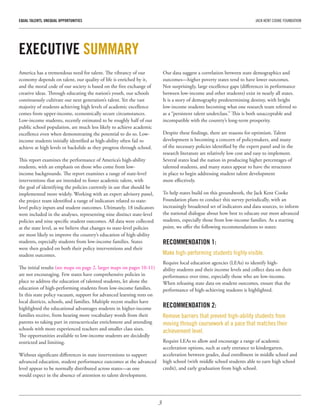
  • 24.
    24 EQUAL TALENTS, UNEQUALOPPORTUNITIES JACK KENT COOKE FOUNDATION ABOUT THE AUTHORS Jonathan Plucker is the Raymond Neag Endowed Professor of Education at the University of Connecticut’s Neag School of Education. His research examines education policy and talent development, with over 200 publications to his credit. Recent books include Critical Issues and Practices in Gifted Education with Carolyn Callahan and Intelligence 101 with Amber Esping. His work defining and studying excellence gaps (http://cepa.uconn. edu/mindthegap) is part of a larger effort to reorient policymakers’ thinking about how best to promote success and high achievement for all children. He was the recipient of the 2012 Arnheim Award for Outstanding Achievement from the American Psychological Association and 2013 Distinguished Scholar Award from the National Association for Gifted Children. Professor Plucker is an APA and AAAS Fellow and has been ranked one of the top 100 most influential academics in education the past two years. Jennifer Giancola is the Director of Research at the Jack Kent Cooke Foundation where she oversees the foundation’s internal and external research efforts. Her work focuses on issues of college readiness, access and success for students from all backgrounds. Prior to joining the foundation, Dr. Giancola led evaluations of nationwide federal and foundation-funded education programs as a senior associate at Abt Associates Inc., a social policy research firm headquartered in Boston, MA, where she evaluated postsecondary programs for the National Science Foundation, National Aeronautics Space Administration, and United Negro College Fund. Grace Healey is an undergraduate student enrolled in the Neag School of Education at the University of Connecticut. She is currently pursuing a major in comprehensive special education, with the hopes of one day inspiring and promoting positive change in the world of special education in developing nations. Daniel Arndt is a dual degree undergraduate student at the University of Connecticut, majoring in Biological Sciences and Secondary Biology Education. Previously, he interned for the Connecticut Invention Convention writing curricular resources and currently acts as a student teaching candidate at the Edwin O. Smith High School in Mansfield, Connecticut. Chen Wang is a graduate student at the University of Connecticut, where she studies in the Neag School of Education’s Cognition, Instruction, and Learning Technologies program. The Jack Kent Cooke Foundation is dedicated to advancing the education of exceptionally promising students who have financial need. By offering the largest scholarships in the country, in- depth academic counseling and other direct services, the Foundation seeks to help high-performing, low-income students to develop their talents and excel educationally. In addition to providing students both counseling and financial support from middle school to graduate school, the Foundation provides grants for noteworthy and innovative initiatives that support high-performing, low-income students. Founded in 2000, the Foundation has awarded over $130 million in scholarships to nearly 1,900 students and over $80 million in grants. www.jkcf.org
  • 25.
    25 EQUAL TALENTS, UNEQUALOPPORTUNITIES JACK KENT COOKE FOUNDATION APPENDIX A INDICATOR DESCRIPTIONS AND DATA SOURCES INPUTS Each of the nine input indicators were weighted equally in the calculation of the Input grade for each state. Input Indicator 1: SEA annual report or monitoring/auditing of LEA G/T programs Data source: 2012-13 State of the States in Gifted Education, from the National Association for Gifted Children (NAGC) and the Council of State Directors of Programs for the Gifted (CSDPG) (“State-of-the-States Report”) Table F, http://www. nagc.org/sites/default/files/Gifted-by-State/Table%20F%20 %28accountability%29.pdf Rationale: A state that emphasizes advanced education should have some form of state-level monitoring for related LEA programs and interventions. States received full credit on this indicator if they reported either monitoring/auditing LEA gifted education services or preparing an annual report on the “state of the state” regarding advanced education. Specifically, the State of the States survey asks, “Does the state monitor/audit LEA’s GT Programs?” and “Does the state publish an annual report on state GT services?” Input Indicator 2: State accountability system Data source: 2012-13 State of the States in Gifted Education, from the National Association for Gifted Children (NAGC) and the Council of State Directors of Programs for the Gifted (CSDPG) (“State-of-the-States Report”) Table F, http://www. nagc.org/sites/default/files/Gifted-by-State/Table%20F%20 %28accountability%29.pdf Rationale: The inclusion of indicators in state K-12 accountability systems representing high levels of academic performance can be interpreted as a strong, formal statement of the importance of advanced education, especially when those indicators give schools and districts credit for helping low-income students achieve at high levels. States were given full credit on this indicator if their accountability systems included measures of growth for high achieving students and other indicators of excellence. These data were drawn from the State of the States survey (“Are there or will there be GT indicators on district report cards or other state accountability forms? If yes, what are the specific indicators included?”) and were supplemented by examinations of each state’s accountability system as described in applicable state statutes and SEA documents. Input Indicator 3: Participation in international assessments Data source: 2012 PISA reports, http://www.oecd.org/pisa, 2011 TIMSS & PIRLS reports, http://timssandpirls.bc.edu/ Rationale: The ability to benchmark students’ achievement against those from other countries is becoming increasingly important in the rapidly globalizing world, and this is certainly true for the performance of advanced students. States were given full credit on this indicator if they participated as a region in at least one of the recent testing cycles of the major international assessments: TIMSS (2011), PIRLS (2011), or PISA (2012). Input Indicator 4: Requirements for identification and services Data source: 2012-13 State of the States in Gifted Education, from the National Association for Gifted Children (NAGC) and the Council of State Directors of Programs for the Gifted (CSDPG) (“State-of-the-States Report”) Table C, http://www.nagc.org/sites/ default/files/Gifted-by-State/Table%20C%20%28mandates%20 %20funding%29.pdf Rationale: Requiring LEAs to identify and serve advanced students is an indicator of the value a state places on academic excellence, including for low-income students who may be attending schools in which proficiency is valued more highly than advanced performance. Students received full credit on this indicator if they require services (i.e., with identification implied). Specifically, the State of the States survey asks, “Does the state have a mandate for GT ID or services? What areas are included in the mandate?” Input Indicator 5: State policies allowing early entrance to kindergarten Data source: 2012-13 State of the States in Gifted Education, from the National Association for Gifted Children (NAGC) and the Council of State Directors of Programs for the Gifted (CSDPG) (“State-of-the-States Report”) Table D, http://www.nagc.org/ sites/default/files/Gifted-by-State/Table%20D%20%28state%20 policies%29.pdf Rationale: Children should be able to enter kindergarten when they are intellectually ready to do so, not only when their birthday falls on the correct side of an arbitrary cut-off date. This may be especially important for low-income students, who may benefit from additional educational supports and social services that are available in K-12 schools. States were given full credit on this indicator if
  • 26.
    26 EQUAL TALENTS, UNEQUALOPPORTUNITIES JACK KENT COOKE FOUNDATION they have a state policy that allows early entrance to kindergarten. Specifically, the State of the States survey asks, “Does the state have a policy on early entrance to kindergarten?” Input Indicator 6: State acceleration policy Data source: 2012-13 State of the States in Gifted Education, from the National Association for Gifted Children (NAGC) and the Council of State Directors of Programs for the Gifted (CSDPG) (“State-of-the-States Report”) Table D, http://www.nagc.org/ sites/default/files/Gifted-by-State/Table%20D%20%28state%20 policies%29.pdf Rationale: Students should be able to move through the K-12 system at their own pace. For some students, this pace can be considerably accelerated, and the benefits of academic acceleration are well-documented. Having a state acceleration policy both sends a strong message that acceleration is valued and permissible and provides a policy lever for educators and parents to use when they encounter anti-acceleration bias. States were given full credit on this indicator if they have a state acceleration policy. Specifically, the State of the States survey asks, “Does the state have an acceleration policy?” Input Indicator 7: MS/HS concurrent enrollment and credit in HS Data source: 2012-13 State of the States in Gifted Education, from the National Association for Gifted Children (NAGC) and the Council of State Directors of Programs for the Gifted (CSDPG) (“State-of-the-States Report”) Table D, http://www.nagc.org/ sites/default/files/Gifted-by-State/Table%20D%20%28state%20 policies%29.pdf Rationale: Having access to high school courses while attending middle school provides talented students with challenging coursework that their school may not otherwise be able to offer. This may be especially important for low-income students, who are more likely to attend schools that suffer from highly limited resources, therefore limiting the number and range of advanced options in the middle school. At the same time, students who take high school coursework while in middle school should be able to get high school credit, which allows students to move through the K-12 system at a more appropriate pace and/or allows for greater enrichment opportunities when the students enter high school. States were given full credit on this indicator if they have policies that specifically allow middle school/high school dual enrollment, and if the state allows for such enrollment to result in the granting of high school credit. Specifically, the State of the States survey asks, “Are middle school students permitted to be dually/concurrently enrolled in high school?” and “May middle school students receive high school credit towards graduation for the courses in which they are dually/ concurrently enrolled?” Input Indicator 8: State high school honors diploma designation Data source: ECS graduation policy database http://ecs.force.com/ mbdata/mbprofall?Rep=HS02 Rationale: Having a state-level honors designation sends a strong message that the state prioritizes advanced achievement in its schools. States were given credit on this indicator if they have an official state honors diploma or a similar type of designation for high achieving students as they graduate from high school. Input Indicator 9: Gifted coursework required in teacher and administrator training Data source: 2012-13 State of the States in Gifted Education, from the National Association for Gifted Children (NAGC) and the Council of State Directors of Programs for the Gifted (CSDPG) (“State-of-the-States Report”) Table E, http://www.nagc.org/sites/ default/files/Gifted-by-State/Table%20E%20%28training%29.pdf Rationale: If educators are not exposed to material on the education of high ability students, it is unlikely that those educators will be sensitive to the needs of those students, especially those who are low-income. States were given full credit on this indicator if they require coursework on gifted and talented learners in pre-service training and administrator training, partial credit if such coverage is required in only one of the two areas. Specifically, the State of the States survey asks, “Does the state require GT coursework for all pre-service teachers?” and “ Is training in nature & needs of GT students required in administrators’ coursework?” Unavailable Input Indicators A number of input variables were not included because of lack of availability and/or data reliability issues. We hope to collect these data in subsequent years. For example, we intended to include an analysis of press releases from each state from the annual release of state test results (e.g., Does the press release even mention the percentage of students who score at advanced levels?), but those press releases proved to be very difficult to obtain for all 50 states. We could not determine which states allow early high school graduates to received state financial aid for college, in part because of the difficulty in determining which states allow early high school graduation. And we could not determine which states have adopted official definitions of high performance, giftedness, talent, educational excellence, or related terms.
  • 27.
    27 EQUAL TALENTS, UNEQUALOPPORTUNITIES JACK KENT COOKE FOUNDATION PARTICIPATION Participation data provide insight into the vital link between inputs and outcomes in the education of advanced students. However, we did not find any of the desired participation variables to be of sufficient quality to be included in this report. For example, the expert panel recommended that the number of Governor’s schools or other publicly-funded special schools for advanced students be considered as an indicator of a state’s emphasis on meeting the academic needs of those students. But no standard list of those schools exists, and although we pulled the data from various sources, we were not confident in the validity of the final list. We were not able to find a data base with the percent of students who take algebra by 8th grade that was less than 10 years old, and searching individual SEA data sets was not fruitful. The percent of low-income students taking Advanced Placement courses was also not available. Finally, data on funding for advanced education was considered to be too unreliable and too much of a black box to be included in the final model (i.e., it was impossible to determine which activities were funded by the reported resources). These and other measures of student participation in advanced learning will be part of subsequent year’s data collections. OUTCOMES Each of the nine outcome indicators were equally weighted in the calculation of the Outcome grade for each state. Outcome Indicators 1-5: Advanced achievement, all students Data sources: National Assessment of Educational Progress (NAEP), http://nces.ed.gov/nationsreportcard/, College Board, http://media. collegeboard.com/digitalServices/pdf/ap/rtn/10th-annual/10th- annual-ap-report-to-the-nation-single-page.pdf Rationale: A key outcome is obviously the percent of public school students who perform academically at advanced levels. We included indicators on student performance at several levels: NAEP math and reading/language arts data for Grade 4 and Grade 8, and Advanced Placement exam data to represent high school achievement. To receive full credit on these indicators, state data needed to reflect: • At least 10% scored in the advanced range (Grade 4 and 8 math, Grade 4 reading) • At least 8% scored in the advanced range (Grade 8 reading) • At least 21% of students scored 3 or higher on at least one AP exam The five achievement indicators were equally weighted, and they collectively accounted for half of the Outcome grade. Outcome Indicators 6-9: Excellence gaps Data source: National Assessment of Educational Progress (NAEP), http://nces.ed.gov/nationsreportcard/ Rationale: High levels of academic progress do not necessarily mean that all student subgroups share the same levels of accomplishment. If a state has a relatively large percent of students scoring advanced on NAEP, but most of those students are not low-income, the state’s success in promoting educational excellence can be called into question. To receive full credit on this indicator, a state’s NAEP data showed that the percent of low-income students scoring advanced was no less than 41% percent of the percent of other students scoring advanced. For the purposes of this indicator, low- income was defined as qualifying for free/reduced price lunch. The excellence gap indicators were limited to Grades 4 and 8 reading and math because (a) there is little evidence that such gaps shrink as students work through the K-12 system and (b) free/reduced price lunch data is generally considered to be less reliable with older students. Unavailable Outcome Indicators Compared to the Input and Participation indicators, most of the desired outcomes were available and are included in this report. One exception is the percent of students in each state’s graduating cohort that earned a 4 or higher on at least one AP exam. These data are not readily available, even from the College Board. We also wanted to report the number of students who take advantage of early graduation from high school, but those data are reported inconsistently across states, with no central data collection on that variable. We did not include the number of students taking Algebra by 8th grade because few states report this information. Finally, we omitted trends in excellence gaps, because states’ excellence gaps appear to generally be quite stable. Since they are also rather large, states had little opportunity to benefit from the indicator, so it was not included in the final model.
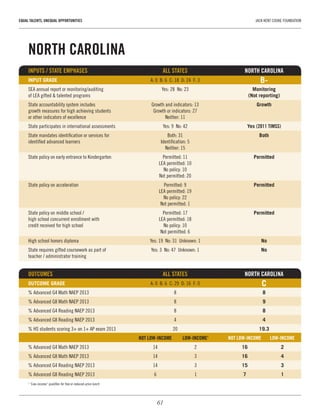
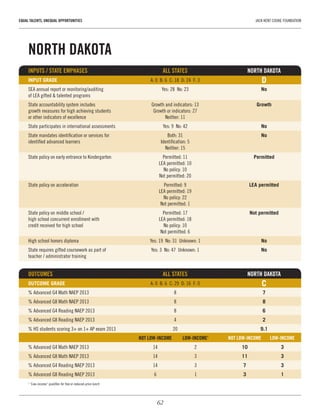
  • 28.
    28 EQUAL TALENTS, UNEQUALOPPORTUNITIES JACK KENT COOKE FOUNDATION APPENDIX B STATE DATA TABLES The following tables (pages 29-78) report the specific indicators for each state, Inputs and Outcomes. Cells noted with an asterisk were not obtained through the primary data source, but through project staff research and/or phone calls to state officials.
  • 29.
    29 EQUAL TALENTS, UNEQUALOPPORTUNITIES JACK KENT COOKE FOUNDATION ALABAMA INPUTS / STATE EMPHASES ALL STATES ALABAMA INPUT GRADE A: 0 B: 6 C: 18 D: 24 F: 3 B- SEA annual report or monitoring/auditing Yes: 28 No: 23 Monitoring of LEA gifted & talented programs (Not reporting) State accountability system includes Growth and indicators: 13 Growth growth measures for high achieving students Growth or indicators: 27 and indicators or other indicators of excellence Neither: 11 State participates in international assessments Yes: 9 No: 42 Yes (2011 TIMSS) State mandates identification or services for Both: 31 Both identified advanced learners Identification: 5 Neither: 15 State policy on early entrance to Kindergarten Permitted: 11 Not permitted LEA permitted: 10 No policy: 10 Not permitted: 20 State policy on acceleration Permitted: 9 Permitted LEA permitted: 19 No policy: 22 Not permitted: 1 State policy on middle school / Permitted: 17 Not permitted high school concurrent enrollment with LEA permitted: 18 credit received for high school No policy: 10 Not permitted: 6 High school honors diploma Yes: 19 No: 31 Unknown: 1 Yes State requires gifted coursework as part of Yes: 3 No: 47 Unknown: 1 No teacher / administrator training OUTCOMES ALL STATES ALABAMA OUTCOME GRADE A: 0 B: 6 C: 29 D: 16 F: 0 D- % Advanced G4 Math NAEP 2013 8 3 % Advanced G8 Math NAEP 2013 8 3 % Advanced G4 Reading NAEP 2013 8 6 % Advanced G8 Reading NAEP 2013 4 2 % HS students scoring 3+ on 1+ AP exam 2013 20 11 NOT LOW-INCOME LOW-INCOME1 NOT LOW-INCOME LOW-INCOME % Advanced G4 Math NAEP 2013 14 2 7 1 % Advanced G8 Math NAEP 2013 14 3 7 0 % Advanced G4 Reading NAEP 2013 14 3 13 2 % Advanced G8 Reading NAEP 2013 6 1 3 0 1 “Low-income” qualifies for free or reduced-price lunch
  • 30.
    30 EQUAL TALENTS, UNEQUALOPPORTUNITIES JACK KENT COOKE FOUNDATION ALASKA INPUTS / STATE EMPHASES ALL STATES ALASKA INPUT GRADE A: 0 B: 6 C: 18 D: 24 F: 3 D+ SEA annual report or monitoring/auditing Yes: 28 No: 23 No of LEA gifted & talented programs State accountability system includes Growth and indicators: 13 Growth growth measures for high achieving students Growth or indicators: 27 (Not indicators) or other indicators of excellence Neither: 11 State participates in international assessments Yes: 9 No: 42 No State mandates identification or services for Both: 31 Both identified advanced learners Identification: 5 Neither: 15 State policy on early entrance to Kindergarten Permitted: 11 No policy LEA permitted: 10 No policy: 10 Not permitted: 20 State policy on acceleration Permitted: 9 No policy LEA permitted: 19 No policy: 22 Not permitted: 1 State policy on middle school / Permitted: 17 Permitted high school concurrent enrollment with LEA permitted: 18 credit received for high school No policy: 10 Not permitted: 6 High school honors diploma Yes: 19 No: 31 Unknown: 1 No State requires gifted coursework as part of Yes: 3 No: 47 Unknown: 1 No teacher / administrator training OUTCOMES ALL STATES ALASKA OUTCOME GRADE A: 0 B: 6 C: 29 D: 16 F: 0 D+ % Advanced G4 Math NAEP 2013 8 6 % Advanced G8 Math NAEP 2013 8 7 % Advanced G4 Reading NAEP 2013 8 6 % Advanced G8 Reading NAEP 2013 4 3 % HS students scoring 3+ on 1+ AP exam 2013 20 15 NOT LOW-INCOME LOW-INCOME1 NOT LOW-INCOME LOW-INCOME % Advanced G4 Math NAEP 2013 14 2 11 2 % Advanced G8 Math NAEP 2013 14 3 11 2 % Advanced G4 Reading NAEP 2013 14 3 10 2 % Advanced G8 Reading NAEP 2013 6 1 5 1 1 “Low-income” qualifies for free or reduced-price lunch
  • 31.
    31 EQUAL TALENTS, UNEQUALOPPORTUNITIES JACK KENT COOKE FOUNDATION ARIZONA INPUTS / STATE EMPHASES ALL STATES ARIZONA INPUT GRADE A: 0 B: 6 C: 18 D: 24 F: 3 C+ SEA annual report or monitoring/auditing Yes: 28 No: 23 Monitoring of LEA gifted & talented programs (Not reporting) State accountability system includes Growth and indicators: 13 Growth growth measures for high achieving students Growth or indicators: 27 (Not indicators) or other indicators of excellence Neither: 11 State participates in international assessments Yes: 9 No: 42 No State mandates identification or services for Both: 31 Both identified advanced learners Identification: 5 Neither: 15 State policy on early entrance to Kindergarten Permitted: 11 Permitted LEA permitted: 10 No policy: 10 Not permitted: 20 State policy on acceleration Permitted: 9 Permitted LEA permitted: 19 No policy: 22 Not permitted: 1 State policy on middle school / Permitted: 17 LEA Permitted high school concurrent enrollment with LEA permitted: 18 credit received for high school No policy: 10 Not permitted: 6 High school honors diploma Yes: 19 No: 31 Unknown: 1 No State requires gifted coursework as part of Yes: 3 No: 47 Unknown: 1 No teacher / administrator training OUTCOMES ALL STATES ARIZONA OUTCOME GRADE A: 0 B: 6 C: 29 D: 16 F: 0 D % Advanced G4 Math NAEP 2013 8 7 % Advanced G8 Math NAEP 2013 8 7 % Advanced G4 Reading NAEP 2013 8 5 % Advanced G8 Reading NAEP 2013 4 2 % HS students scoring 3+ on 1+ AP exam 2013 20 14 NOT LOW-INCOME LOW-INCOME1 NOT LOW-INCOME LOW-INCOME % Advanced G4 Math NAEP 2013 14 2 13 2 % Advanced G8 Math NAEP 2013 14 3 14 2 % Advanced G4 Reading NAEP 2013 14 3 10 1 % Advanced G8 Reading NAEP 2013 6 1 4 1 1 “Low-income” qualifies for free or reduced-price lunch
  • 32.
    32 EQUAL TALENTS, UNEQUALOPPORTUNITIES JACK KENT COOKE FOUNDATION ARKANSAS INPUTS / STATE EMPHASES ALL STATES ARKANSAS INPUT GRADE A: 0 B: 6 C: 18 D: 24 F: 3 C SEA annual report or monitoring/auditing Yes: 28 No: 23 Report of LEA gifted & talented programs and monitoring State accountability system includes Growth and indicators: 13 Growth growth measures for high achieving students Growth or indicators: 27 and indicators or other indicators of excellence Neither: 11 State participates in international assessments Yes: 9 No: 42 No State mandates identification or services for Both: 31 Both identified advanced learners Identification: 5 Neither: 15 State policy on early entrance to Kindergarten Permitted: 11 Permitted LEA permitted: 10 No policy: 10 Not permitted: 20 State policy on acceleration Permitted: 9 LEA Permitted LEA permitted: 19 No policy: 22 Not permitted: 1 State policy on middle school / Permitted: 17 Not permitted high school concurrent enrollment with LEA permitted: 18 credit received for high school No policy: 10 Not permitted: 6 High school honors diploma Yes: 19 No: 31 Unknown: 1 No State requires gifted coursework as part of Yes: 3 No: 47 Unknown: 1 No teacher / administrator training OUTCOMES ALL STATES ARKANSAS OUTCOME GRADE A: 0 B: 6 C: 29 D: 16 F: 0 D+ % Advanced G4 Math NAEP 2013 8 5 % Advanced G8 Math NAEP 2013 8 5 % Advanced G4 Reading NAEP 2013 8 7 % Advanced G8 Reading NAEP 2013 4 3 % HS students scoring 3+ on 1+ AP exam 2013 20 16 NOT LOW-INCOME LOW-INCOME1 NOT LOW-INCOME LOW-INCOME % Advanced G4 Math NAEP 2013 14 2 10 2 % Advanced G8 Math NAEP 2013 14 3 8 2 % Advanced G4 Reading NAEP 2013 14 3 12 3 % Advanced G8 Reading NAEP 2013 6 1 5 1 1 “Low-income” qualifies for free or reduced-price lunch
  • 33.
    33 EQUAL TALENTS, UNEQUALOPPORTUNITIES JACK KENT COOKE FOUNDATION CALIFORNIA INPUTS / STATE EMPHASES ALL STATES CALIFORNIA INPUT GRADE A: 0 B: 6 C: 18 D: 24 F: 3 D+ SEA annual report or monitoring/auditing Yes: 28 No: 23 No of LEA gifted & talented programs State accountability system includes Growth and indicators: 13 Growth growth measures for high achieving students Growth or indicators: 27 (Not indicators) or other indicators of excellence Neither: 11 State participates in international assessments Yes: 9 No: 42 Yes (2011 TIMSS) State mandates identification or services for Both: 31 No identified advanced learners Identification: 5 Neither: 15 State policy on early entrance to Kindergarten Permitted: 11 Not permitted LEA permitted: 10 No policy: 10 Not permitted: 20 State policy on acceleration Permitted: 9 No policy LEA permitted: 19 No policy: 22 Not permitted: 1 State policy on middle school / Permitted: 17 LEA Permitted high school concurrent enrollment with LEA permitted: 18 credit received for high school No policy: 10 Not permitted: 6 High school honors diploma Yes: 19 No: 31 Unknown: 1 Yes State requires gifted coursework as part of Yes: 3 No: 47 Unknown: 1 No teacher / administrator training OUTCOMES ALL STATES CALIFORNIA OUTCOME GRADE A: 0 B: 6 C: 29 D: 16 F: 0 D+ % Advanced G4 Math NAEP 2013 8 5 % Advanced G8 Math NAEP 2013 8 6 % Advanced G4 Reading NAEP 2013 8 6 % Advanced G8 Reading NAEP 2013 4 3 % HS students scoring 3+ on 1+ AP exam 2013 20 27 NOT LOW-INCOME LOW-INCOME1 NOT LOW-INCOME LOW-INCOME % Advanced G4 Math NAEP 2013 14 2 11 2 % Advanced G8 Math NAEP 2013 14 3 13 2 % Advanced G4 Reading NAEP 2013 14 3 12 2 % Advanced G8 Reading NAEP 2013 6 1 6 1 1 “Low-income” qualifies for free or reduced-price lunch
  • 34.
    34 EQUAL TALENTS, UNEQUALOPPORTUNITIES JACK KENT COOKE FOUNDATION COLORADO INPUTS / STATE EMPHASES ALL STATES COLORADO INPUT GRADE A: 0 B: 6 C: 18 D: 24 F: 3 B- SEA annual report or monitoring/auditing Yes: 28 No: 23 Report of LEA gifted & talented programs and monitoring State accountability system includes Growth and indicators: 13 Growth growth measures for high achieving students Growth or indicators: 27 and indicators or other indicators of excellence Neither: 11 State participates in international assessments Yes: 9 No: 42 Yes (2011 TIMSS) State mandates identification or services for Both: 31 Both identified advanced learners Identification: 5 Neither: 15 State policy on early entrance to Kindergarten Permitted: 11 Permitted LEA permitted: 10 No policy: 10 Not permitted: 20 State policy on acceleration Permitted: 9 Permitted LEA permitted: 19 No policy: 22 Not permitted: 1 State policy on middle school / Permitted: 17 No policy high school concurrent enrollment with LEA permitted: 18 credit received for high school No policy: 10 Not permitted: 6 High school honors diploma Yes: 19 No: 31 Unknown: 1 No State requires gifted coursework as part of Yes: 3 No: 47 Unknown: 1 No teacher / administrator training OUTCOMES ALL STATES COLORADO OUTCOME GRADE A: 0 B: 6 C: 29 D: 16 F: 0 C+ % Advanced G4 Math NAEP 2013 8 11 % Advanced G8 Math NAEP 2013 8 12 % Advanced G4 Reading NAEP 2013 8 10 % Advanced G8 Reading NAEP 2013 4 5 % HS students scoring 3+ on 1+ AP exam 2013 20 24 NOT LOW-INCOME LOW-INCOME1 NOT LOW-INCOME LOW-INCOME % Advanced G4 Math NAEP 2013 14 2 16 3 % Advanced G8 Math NAEP 2013 14 3 18 4 % Advanced G4 Reading NAEP 2013 14 3 16 3 % Advanced G8 Reading NAEP 2013 6 1 7 1 1 “Low-income” qualifies for free or reduced-price lunch
  • 35.
    35 EQUAL TALENTS, UNEQUALOPPORTUNITIES JACK KENT COOKE FOUNDATION CONNECTICUT INPUTS / STATE EMPHASES ALL STATES CONNECTICUT INPUT GRADE A: 0 B: 6 C: 18 D: 24 F: 3 D SEA annual report or monitoring/auditing Yes: 28 No: 23 No of LEA gifted & talented programs State accountability system includes Growth and indicators: 13 None growth measures for high achieving students Growth or indicators: 27 or other indicators of excellence Neither: 11 State participates in international assessments Yes: 9 No: 42 Yes (2012 PISA, 2011 TIMSS) State mandates identification or services for Both: 31 Identification identified advanced learners Identification: 5 (Not services) Neither: 15 State policy on early entrance to Kindergarten Permitted: 11 Not permitted LEA permitted: 10 No policy: 10 Not permitted: 20 State policy on acceleration Permitted: 9 LEA Permitted LEA permitted: 19 No policy: 22 Not permitted: 1 State policy on middle school / Permitted: 17 No policy high school concurrent enrollment with LEA permitted: 18 credit received for high school No policy: 10 Not permitted: 6 High school honors diploma Yes: 19 No: 31 Unknown: 1 No State requires gifted coursework as part of Yes: 3 No: 47 Unknown: 1 No teacher / administrator training OUTCOMES ALL STATES CONNECTICUT OUTCOME GRADE A: 0 B: 6 C: 29 D: 16 F: 0 C % Advanced G4 Math NAEP 2013 8 9 % Advanced G8 Math NAEP 2013 8 10 % Advanced G4 Reading NAEP 2013 8 12 % Advanced G8 Reading NAEP 2013 4 6 % HS students scoring 3+ on 1+ AP exam 2013 20 29 NOT LOW-INCOME LOW-INCOME1 NOT LOW-INCOME LOW-INCOME % Advanced G4 Math NAEP 2013 14 2 13 1 % Advanced G8 Math NAEP 2013 14 3 14 2 % Advanced G4 Reading NAEP 2013 14 3 18 2 % Advanced G8 Reading NAEP 2013 6 1 9 2 1 “Low-income” qualifies for free or reduced-price lunch
  • 36.
    36 EQUAL TALENTS, UNEQUALOPPORTUNITIES JACK KENT COOKE FOUNDATION DELAWARE INPUTS / STATE EMPHASES ALL STATES DELAWARE INPUT GRADE A: 0 B: 6 C: 18 D: 24 F: 3 F SEA annual report or monitoring/auditing Yes: 28 No: 23 No of LEA gifted & talented programs State accountability system includes Growth and indicators: 13 None growth measures for high achieving students Growth or indicators: 27 or other indicators of excellence Neither: 11 State participates in international assessments Yes: 9 No: 42 Did not participate State mandates identification or services for Both: 31 No identified advanced learners Identification: 5 Neither: 15 State policy on early entrance to Kindergarten Permitted: 11 No policy LEA permitted: 10 No policy: 10 Not permitted: 20 State policy on acceleration Permitted: 9 No policy LEA permitted: 19 No policy: 22 Not permitted: 1 State policy on middle school / Permitted: 17 LEA Permitted high school concurrent enrollment with LEA permitted: 18 credit received for high school No policy: 10 Not permitted: 6 High school honors diploma Yes: 19 No: 31 Unknown: 1 No State requires gifted coursework as part of Yes: 3 No: 47 Unknown: 1 No teacher / administrator training OUTCOMES ALL STATES DELAWARE OUTCOME GRADE A: 0 B: 6 C: 29 D: 16 F: 0 C- % Advanced G4 Math NAEP 2013 8 7 % Advanced G8 Math NAEP 2013 8 8 % Advanced G4 Reading NAEP 2013 8 9 % Advanced G8 Reading NAEP 2013 4 4 % HS students scoring 3+ on 1+ AP exam 2013 20 17 NOT LOW-INCOME LOW-INCOME1 NOT LOW-INCOME LOW-INCOME % Advanced G4 Math NAEP 2013 14 2 13 2 % Advanced G8 Math NAEP 2013 14 3 13 2 % Advanced G4 Reading NAEP 2013 14 3 14 4 % Advanced G8 Reading NAEP 2013 6 1 6 1 1 “Low-income” qualifies for free or reduced-price lunch
  • 37.
    37 EQUAL TALENTS, UNEQUALOPPORTUNITIES JACK KENT COOKE FOUNDATION DISTRICT OF COLUMBIA INPUTS / STATE EMPHASES ALL STATES DC INPUT GRADE A: 0 B: 6 C: 18 D: 24 F: 3 F SEA annual report or monitoring/auditing Yes: 28 No: 23 No of LEA gifted & talented programs State accountability system includes Growth and indicators: 13 Growth growth measures for high achieving students Growth or indicators: 27 (Not indicators) or other indicators of excellence Neither: 11 State participates in international assessments Yes: 9 No: 42 Did not participate State mandates identification or services for Both: 31 No identified advanced learners Identification: 5 Neither: 15 State policy on early entrance to Kindergarten Permitted: 11 Not permitted LEA permitted: 10 No policy: 10 Not permitted: 20 State policy on acceleration Permitted: 9 No policy LEA permitted: 19 No policy: 22 Not permitted: 1 State policy on middle school / Permitted: 17 Not permitted high school concurrent enrollment with LEA permitted: 18 credit received for high school No policy: 10 Not permitted: 6 High school honors diploma Yes: 19 No: 31 Unknown: 1 No State requires gifted coursework as part of Yes: 3 No: 47 Unknown: 1 No teacher / administrator training OUTCOMES ALL STATES DC OUTCOME GRADE A: 0 B: 6 C: 29 D: 16 F: 0 D- % Advanced G4 Math NAEP 2013 8 6 % Advanced G8 Math NAEP 2013 8 4 % Advanced G4 Reading NAEP 2013 8 7 % Advanced G8 Reading NAEP 2013 4 2 % HS students scoring 3+ on 1+ AP exam 2013 20 14 NOT LOW-INCOME LOW-INCOME1 NOT LOW-INCOME LOW-INCOME % Advanced G4 Math NAEP 2013 14 2 25 1 % Advanced G8 Math NAEP 2013 14 3 16 1 % Advanced G4 Reading NAEP 2013 14 3 26 2 % Advanced G8 Reading NAEP 2013 6 1 7 0 1 “Low-income” qualifies for free or reduced-price lunch
  • 38.
    38 EQUAL TALENTS, UNEQUALOPPORTUNITIES JACK KENT COOKE FOUNDATION FLORIDA INPUTS / STATE EMPHASES ALL STATES FLORIDA INPUT GRADE A: 0 B: 6 C: 18 D: 24 F: 3 C SEA annual report or monitoring/auditing Yes: 28 No: 23 No of LEA gifted & talented programs State accountability system includes Growth and indicators: 13 Growth growth measures for high achieving students Growth or indicators: 27 and indicators or other indicators of excellence Neither: 11 State participates in international assessments Yes: 9 No: 42 Yes (2012 PISA, 2011 TIMSS, 2011 PIRLS) State mandates identification or services for Both: 31 Both identified advanced learners Identification: 5 Neither: 15 State policy on early entrance to Kindergarten Permitted: 11 Not permitted LEA permitted: 10 No policy: 10 Not permitted: 20 State policy on acceleration Permitted: 9 No policy LEA permitted: 19 No policy: 22 Not permitted: 1 State policy on middle school / Permitted: 17 No policy high school concurrent enrollment with LEA permitted: 18 credit received for high school No policy: 10 Not permitted: 6 High school honors diploma Yes: 19 No: 31 Unknown: 1 No State requires gifted coursework as part of Yes: 3 No: 47 Unknown: 1 Teacher teacher / administrator training and administrator OUTCOMES ALL STATES FLORIDA OUTCOME GRADE A: 0 B: 6 C: 29 D: 16 F: 0 C- % Advanced G4 Math NAEP 2013 8 6 % Advanced G8 Math NAEP 2013 8 7 % Advanced G4 Reading NAEP 2013 8 9 % Advanced G8 Reading NAEP 2013 4 3 % HS students scoring 3+ on 1+ AP exam 2013 20 27 NOT LOW-INCOME LOW-INCOME1 NOT LOW-INCOME LOW-INCOME % Advanced G4 Math NAEP 2013 14 2 13 2 % Advanced G8 Math NAEP 2013 14 3 12 3 % Advanced G4 Reading NAEP 2013 14 3 16 4 % Advanced G8 Reading NAEP 2013 6 1 6 1 1 “Low-income” qualifies for free or reduced-price lunch
  • 39.
    39 EQUAL TALENTS, UNEQUALOPPORTUNITIES JACK KENT COOKE FOUNDATION GEORGIA INPUTS / STATE EMPHASES ALL STATES GEORGIA INPUT GRADE A: 0 B: 6 C: 18 D: 24 F: 3 C+ SEA annual report or monitoring/auditing Yes: 28 No: 23 Monitoring of LEA gifted & talented programs (Not reporting) State accountability system includes Growth and indicators: 13 Growth growth measures for high achieving students Growth or indicators: 27 and indicators or other indicators of excellence Neither: 11 State participates in international assessments Yes: 9 No: 42 Did not participate State mandates identification or services for Both: 31 Both identified advanced learners Identification: 5 Neither: 15 State policy on early entrance to Kindergarten Permitted: 11 Not permitted LEA permitted: 10 No policy: 10 Not permitted: 20 State policy on acceleration Permitted: 9 LEA Permitted LEA permitted: 19 No policy: 22 Not permitted: 1 State policy on middle school / Permitted: 17 LEA Permitted high school concurrent enrollment with LEA permitted: 18 credit received for high school No policy: 10 Not permitted: 6 High school honors diploma Yes: 19 No: 31 Unknown: 1 Yes State requires gifted coursework as part of Yes: 3 No: 47 Unknown: 1 No teacher / administrator training OUTCOMES ALL STATES GEORGIA OUTCOME GRADE A: 0 B: 6 C: 29 D: 16 F: 0 C- % Advanced G4 Math NAEP 2013 8 7 % Advanced G8 Math NAEP 2013 8 7 % Advanced G4 Reading NAEP 2013 8 8 % Advanced G8 Reading NAEP 2013 4 4 % HS students scoring 3+ on 1+ AP exam 2013 20 21 NOT LOW-INCOME LOW-INCOME1 NOT LOW-INCOME LOW-INCOME % Advanced G4 Math NAEP 2013 14 2 14 3 % Advanced G8 Math NAEP 2013 14 3 14 2 % Advanced G4 Reading NAEP 2013 14 3 17 3 % Advanced G8 Reading NAEP 2013 6 1 7 1 1 “Low-income” qualifies for free or reduced-price lunch
  • 40.
    40 EQUAL TALENTS, UNEQUALOPPORTUNITIES JACK KENT COOKE FOUNDATION HAWAII INPUTS / STATE EMPHASES ALL STATES HAWAII INPUT GRADE A: 0 B: 6 C: 18 D: 24 F: 3 C SEA annual report or monitoring/auditing Yes: 28 No: 23 Report of LEA gifted & talented programs and monitoring State accountability system includes Growth and indicators: 13 Growth growth measures for high achieving students Growth or indicators: 27 (Not indicators) or other indicators of excellence Neither: 11 State participates in international assessments Yes: 9 No: 42 Did not participate State mandates identification or services for Both: 31 Both identified advanced learners Identification: 5 Neither: 15 State policy on early entrance to Kindergarten Permitted: 11 No policy LEA permitted: 10 No policy: 10 Not permitted: 20 State policy on acceleration Permitted: 9 LEA Permitted LEA permitted: 19 No policy: 22 Not permitted: 1 State policy on middle school / Permitted: 17 No policy high school concurrent enrollment with LEA permitted: 18 credit received for high school No policy: 10 Not permitted: 6 High school honors diploma Yes: 19 No: 31 Unknown: 1 Yes State requires gifted coursework as part of Yes: 3 No: 47 Unknown: 1 No teacher / administrator training OUTCOMES ALL STATES HAWAII OUTCOME GRADE A: 0 B: 6 C: 29 D: 16 F: 0 C % Advanced G4 Math NAEP 2013 8 9 % Advanced G8 Math NAEP 2013 8 7 % Advanced G4 Reading NAEP 2013 8 7 % Advanced G8 Reading NAEP 2013 4 2 % HS students scoring 3+ on 1+ AP exam 2013 20 12 NOT LOW-INCOME LOW-INCOME1 NOT LOW-INCOME LOW-INCOME % Advanced G4 Math NAEP 2013 14 2 14 4 % Advanced G8 Math NAEP 2013 14 3 11 4 % Advanced G4 Reading NAEP 2013 14 3 11 3 % Advanced G8 Reading NAEP 2013 6 1 4 1 1 “Low-income” qualifies for free or reduced-price lunch
  • 41.
    41 EQUAL TALENTS, UNEQUALOPPORTUNITIES JACK KENT COOKE FOUNDATION IDAHO INPUTS / STATE EMPHASES ALL STATES IDAHO INPUT GRADE A: 0 B: 6 C: 18 D: 24 F: 3 D SEA annual report or monitoring/auditing Yes: 28 No: 23 No of LEA gifted & talented programs State accountability system includes Growth and indicators: 13 Growth growth measures for high achieving students Growth or indicators: 27 (Not indicators) or other indicators of excellence Neither: 11 State participates in international assessments Yes: 9 No: 42 Did not participate State mandates identification or services for Both: 31 No identified advanced learners Identification: 5 Neither: 15 State policy on early entrance to Kindergarten Permitted: 11 Not permitted LEA permitted: 10 No policy: 10 Not permitted: 20 State policy on acceleration Permitted: 9 LEA Permitted LEA permitted: 19 No policy: 22 Not permitted: 1 State policy on middle school / Permitted: 17 Permitted high school concurrent enrollment with LEA permitted: 18 credit received for high school No policy: 10 Not permitted: 6 High school honors diploma Yes: 19 No: 31 Unknown: 1 No State requires gifted coursework as part of Yes: 3 No: 47 Unknown: 1 No teacher / administrator training OUTCOMES ALL STATES IDAHO OUTCOME GRADE A: 0 B: 6 C: 29 D: 16 F: 0 C+ % Advanced G4 Math NAEP 2013 8 6 % Advanced G8 Math NAEP 2013 8 7 % Advanced G4 Reading NAEP 2013 8 7 % Advanced G8 Reading NAEP 2013 4 4 % HS students scoring 3+ on 1+ AP exam 2013 20 13 NOT LOW-INCOME LOW-INCOME1 NOT LOW-INCOME LOW-INCOME % Advanced G4 Math NAEP 2013 14 2 10 3 % Advanced G8 Math NAEP 2013 14 3 9 4 % Advanced G4 Reading NAEP 2013 14 3 10 3 % Advanced G8 Reading NAEP 2013 6 1 5 2 1 “Low-income” qualifies for free or reduced-price lunch
  • 42.
    42 EQUAL TALENTS, UNEQUALOPPORTUNITIES JACK KENT COOKE FOUNDATION ILLINOIS INPUTS / STATE EMPHASES ALL STATES ILLINOIS INPUT GRADE A: 0 B: 6 C: 18 D: 24 F: 3 D- SEA annual report or monitoring/auditing Yes: 28 No: 23 No of LEA gifted & talented programs State accountability system includes Growth and indicators: 13 None growth measures for high achieving students Growth or indicators: 27 or other indicators of excellence Neither: 11 State participates in international assessments Yes: 9 No: 42 Did not participate State mandates identification or services for Both: 31 No identified advanced learners Identification: 5 Neither: 15 State policy on early entrance to Kindergarten Permitted: 11 Permitted LEA permitted: 10 No policy: 10 Not permitted: 20 State policy on acceleration Permitted: 9 No policy LEA permitted: 19 No policy: 22 Not permitted: 1 State policy on middle school / Permitted: 17 No policy high school concurrent enrollment with LEA permitted: 18 credit received for high school No policy: 10 Not permitted: 6 High school honors diploma Yes: 19 No: 31 Unknown: 1 No State requires gifted coursework as part of Yes: 3 No: 47 Unknown: 1 No teacher / administrator training OUTCOMES ALL STATES ILLINOIS OUTCOME GRADE A: 0 B: 6 C: 29 D: 16 F: 0 C % Advanced G4 Math NAEP 2013 8 8 % Advanced G8 Math NAEP 2013 8 9 % Advanced G4 Reading NAEP 2013 8 8 % Advanced G8 Reading NAEP 2013 4 4 % HS students scoring 3+ on 1+ AP exam 2013 20 22 NOT LOW-INCOME LOW-INCOME1 NOT LOW-INCOME LOW-INCOME % Advanced G4 Math NAEP 2013 14 2 15 2 % Advanced G8 Math NAEP 2013 14 3 15 2 % Advanced G4 Reading NAEP 2013 14 3 15 3 % Advanced G8 Reading NAEP 2013 6 1 6 1 1 “Low-income” qualifies for free or reduced-price lunch
  • 43.
    43 EQUAL TALENTS, UNEQUALOPPORTUNITIES JACK KENT COOKE FOUNDATION INDIANA INPUTS / STATE EMPHASES ALL STATES INDIANA INPUT GRADE A: 0 B: 6 C: 18 D: 24 F: 3 C+ SEA annual report or monitoring/auditing Yes: 28 No: 23 No of LEA gifted & talented programs State accountability system includes Growth and indicators: 13 Growth growth measures for high achieving students Growth or indicators: 27 and indicators or other indicators of excellence Neither: 11 State participates in international assessments Yes: 9 No: 42 Yes (2011 TIMSS) State mandates identification or services for Both: 31 Both identified advanced learners Identification: 5 Neither: 15 State policy on early entrance to Kindergarten Permitted: 11 LEA Permitted LEA permitted: 10 No policy: 10 Not permitted: 20 State policy on acceleration Permitted: 9 LEA Permitted LEA permitted: 19 No policy: 22 Not permitted: 1 State policy on middle school / Permitted: 17 LEA Permitted high school concurrent enrollment with LEA permitted: 18 credit received for high school No policy: 10 Not permitted: 6 High school honors diploma Yes: 19 No: 31 Unknown: 1 Yes State requires gifted coursework as part of Yes: 3 No: 47 Unknown: 1 No teacher / administrator training OUTCOMES ALL STATES INDIANA OUTCOME GRADE A: 0 B: 6 C: 29 D: 16 F: 0 C+ % Advanced G4 Math NAEP 2013 8 10 % Advanced G8 Math NAEP 2013 8 10 % Advanced G4 Reading NAEP 2013 8 8 % Advanced G8 Reading NAEP 2013 4 3 % HS students scoring 3+ on 1+ AP exam 2013 20 16 NOT LOW-INCOME LOW-INCOME1 NOT LOW-INCOME LOW-INCOME % Advanced G4 Math NAEP 2013 14 2 17 4 % Advanced G8 Math NAEP 2013 14 3 15 4 % Advanced G4 Reading NAEP 2013 14 3 13 2 % Advanced G8 Reading NAEP 2013 6 1 4 1 1 “Low-income” qualifies for free or reduced-price lunch
  • 44.
    44 EQUAL TALENTS, UNEQUALOPPORTUNITIES JACK KENT COOKE FOUNDATION IOWA INPUTS / STATE EMPHASES ALL STATES IOWA INPUT GRADE A: 0 B: 6 C: 18 D: 24 F: 3 C- SEA annual report or monitoring/auditing Yes: 28 No: 23 No of LEA gifted & talented programs State accountability system includes Growth and indicators: 13 Monitoring growth measures for high achieving students Growth or indicators: 27 (Not reporting) or other indicators of excellence Neither: 11 State participates in international assessments Yes: 9 No: 42 None State mandates identification or services for Both: 31 Both identified advanced learners Identification: 5 Neither: 15 State policy on early entrance to Kindergarten Permitted: 11 Not permitted LEA permitted: 10 No policy: 10 Not permitted: 20 State policy on acceleration Permitted: 9 LEA Permitted LEA permitted: 19 No policy: 22 Not permitted: 1 State policy on middle school / Permitted: 17 LEA Permitted high school concurrent enrollment with LEA permitted: 18 credit received for high school No policy: 10 Not permitted: 6 High school honors diploma Yes: 19 No: 31 Unknown: 1 No State requires gifted coursework as part of Yes: 3 No: 47 Unknown: 1 Administrator teacher / administrator training (Not teacher) OUTCOMES ALL STATES IOWA OUTCOME GRADE A: 0 B: 6 C: 29 D: 16 F: 0 C % Advanced G4 Math NAEP 2013 8 9 % Advanced G8 Math NAEP 2013 8 8 % Advanced G4 Reading NAEP 2013 8 9 % Advanced G8 Reading NAEP 2013 4 3 % HS students scoring 3+ on 1+ AP exam 2013 20 11 NOT LOW-INCOME LOW-INCOME1 NOT LOW-INCOME LOW-INCOME % Advanced G4 Math NAEP 2013 14 2 14 2 % Advanced G8 Math NAEP 2013 14 3 10 2 % Advanced G4 Reading NAEP 2013 14 3 12 3 % Advanced G8 Reading NAEP 2013 6 1 4 1 1 “Low-income” qualifies for free or reduced-price lunch
  • 45.
    45 EQUAL TALENTS, UNEQUALOPPORTUNITIES JACK KENT COOKE FOUNDATION KANSAS INPUTS / STATE EMPHASES ALL STATES KANSAS INPUT GRADE A: 0 B: 6 C: 18 D: 24 F: 3 D+ SEA annual report or monitoring/auditing Yes: 28 No: 23 Monitoring of LEA gifted & talented programs (Not reporting) State accountability system includes Growth and indicators: 13 None growth measures for high achieving students Growth or indicators: 27 or other indicators of excellence Neither: 11 State participates in international assessments Yes: 9 No: 42 Did not participate State mandates identification or services for Both: 31 Identification identified advanced learners Identification: 5 (Not services) Neither: 15 State policy on early entrance to Kindergarten Permitted: 11 Not permitted LEA permitted: 10 No policy: 10 Not permitted: 20 State policy on acceleration Permitted: 9 Permitted LEA permitted: 19 No policy: 22 Not permitted: 1 State policy on middle school / Permitted: 17 Permitted high school concurrent enrollment with LEA permitted: 18 credit received for high school No policy: 10 Not permitted: 6 High school honors diploma Yes: 19 No: 31 Unknown: 1 No State requires gifted coursework as part of Yes: 3 No: 47 Unknown: 1 No teacher / administrator training OUTCOMES ALL STATES KANSAS OUTCOME GRADE A: 0 B: 6 C: 29 D: 16 F: 0 C % Advanced G4 Math NAEP 2013 8 8 % Advanced G8 Math NAEP 2013 8 10 % Advanced G4 Reading NAEP 2013 8 8 % Advanced G8 Reading NAEP 2013 4 3 % HS students scoring 3+ on 1+ AP exam 2013 20 11 NOT LOW-INCOME LOW-INCOME1 NOT LOW-INCOME LOW-INCOME % Advanced G4 Math NAEP 2013 14 2 13 3 % Advanced G8 Math NAEP 2013 14 3 14 4 % Advanced G4 Reading NAEP 2013 14 3 15 4 % Advanced G8 Reading NAEP 2013 6 1 5 1 1 “Low-income” qualifies for free or reduced-price lunch
  • 46.
    46 EQUAL TALENTS, UNEQUALOPPORTUNITIES JACK KENT COOKE FOUNDATION KENTUCKY INPUTS / STATE EMPHASES ALL STATES KENTUCKY INPUT GRADE A: 0 B: 6 C: 18 D: 24 F: 3 C+ SEA annual report or monitoring/auditing Yes: 28 No: 23 Report of LEA gifted & talented programs and monitoring State accountability system includes Growth and indicators: 13 Growth growth measures for high achieving students Growth or indicators: 27 (Not indicators) or other indicators of excellence Neither: 11 State participates in international assessments Yes: 9 No: 42 Did not participate State mandates identification or services for Both: 31 Both identified advanced learners Identification: 5 Neither: 15 State policy on early entrance to Kindergarten Permitted: 11 No policy LEA permitted: 10 No policy: 10 Not permitted: 20 State policy on acceleration Permitted: 9 No policy LEA permitted: 19 No policy: 22 Not permitted: 1 State policy on middle school / Permitted: 17 LEA Permitted high school concurrent enrollment with LEA permitted: 18 credit received for high school No policy: 10 Not permitted: 6 High school honors diploma Yes: 19 No: 31 Unknown: 1 Yes State requires gifted coursework as part of Yes: 3 No: 47 Unknown: 1 Teacher teacher / administrator training and administrator OUTCOMES ALL STATES KENTUCKY OUTCOME GRADE A: 0 B: 6 C: 29 D: 16 F: 0 C- % Advanced G4 Math NAEP 2013 8 6 % Advanced G8 Math NAEP 2013 8 6 % Advanced G4 Reading NAEP 2013 8 9 % Advanced G8 Reading NAEP 2013 4 5 % HS students scoring 3+ on 1+ AP exam 2013 20 16 NOT LOW-INCOME LOW-INCOME1 NOT LOW-INCOME LOW-INCOME % Advanced G4 Math NAEP 2013 14 2 11 2 % Advanced G8 Math NAEP 2013 14 3 10 2 % Advanced G4 Reading NAEP 2013 14 3 14 3 % Advanced G8 Reading NAEP 2013 6 1 8 2 1 “Low-income” qualifies for free or reduced-price lunch
  • 47.
    47 EQUAL TALENTS, UNEQUALOPPORTUNITIES JACK KENT COOKE FOUNDATION LOUISIANA INPUTS / STATE EMPHASES ALL STATES LOUISIANA INPUT GRADE A: 0 B: 6 C: 18 D: 24 F: 3 C+ SEA annual report or monitoring/auditing Yes: 28 No: 23 Monitoring of LEA gifted & talented programs (Not reporting) State accountability system includes Growth and indicators: 13 Indicators growth measures for high achieving students Growth or indicators: 27 (Not growth) or other indicators of excellence Neither: 11 State participates in international assessments Yes: 9 No: 42 Did not participate State mandates identification or services for Both: 31 Both identified advanced learners Identification: 5 Neither: 15 State policy on early entrance to Kindergarten Permitted: 11 LEA Permitted LEA permitted: 10 No policy: 10 Not permitted: 20 State policy on acceleration Permitted: 9 Not permitted LEA permitted: 19 No policy: 22 Not permitted: 1 State policy on middle school / Permitted: 17 Permitted high school concurrent enrollment with LEA permitted: 18 credit received for high school No policy: 10 Not permitted: 6 High school honors diploma Yes: 19 No: 31 Unknown: 1 Yes State requires gifted coursework as part of Yes: 3 No: 47 Unknown: 1 No teacher / administrator training OUTCOMES ALL STATES LOUISIANA OUTCOME GRADE A: 0 B: 6 C: 29 D: 16 F: 0 D % Advanced G4 Math NAEP 2013 8 3 % Advanced G8 Math NAEP 2013 8 3 % Advanced G4 Reading NAEP 2013 8 4 % Advanced G8 Reading NAEP 2013 4 2 % HS students scoring 3+ on 1+ AP exam 2013 20 5 NOT LOW-INCOME LOW-INCOME1 NOT LOW-INCOME LOW-INCOME % Advanced G4 Math NAEP 2013 14 2 6 1 % Advanced G8 Math NAEP 2013 14 3 7 1 % Advanced G4 Reading NAEP 2013 14 3 9 4 % Advanced G8 Reading NAEP 2013 6 1 4 1 1 “Low-income” qualifies for free or reduced-price lunch
  • 48.
    48 EQUAL TALENTS, UNEQUALOPPORTUNITIES JACK KENT COOKE FOUNDATION MAINE INPUTS / STATE EMPHASES ALL STATES MAINE INPUT GRADE A: 0 B: 6 C: 18 D: 24 F: 3 D- SEA annual report or monitoring/auditing Yes: 28 No: 23 No of LEA gifted & talented programs State accountability system includes Growth and indicators: 13 Growth growth measures for high achieving students Growth or indicators: 27 (Not indicators) or other indicators of excellence Neither: 11 State participates in international assessments Yes: 9 No: 42 Did not participate State mandates identification or services for Both: 31 Both identified advanced learners Identification: 5 Neither: 15 State policy on early entrance to Kindergarten Permitted: 11 Not permitted LEA permitted: 10 No policy: 10 Not permitted: 20 State policy on acceleration Permitted: 9 No policy LEA permitted: 19 No policy: 22 Not permitted: 1 State policy on middle school / Permitted: 17 No policy high school concurrent enrollment with LEA permitted: 18 credit received for high school No policy: 10 Not permitted: 6 High school honors diploma Yes: 19 No: 31 Unknown: 1 No State requires gifted coursework as part of Yes: 3 No: 47 Unknown: 1 No teacher / administrator training OUTCOMES ALL STATES MAINE OUTCOME GRADE A: 0 B: 6 C: 29 D: 16 F: 0 B- % Advanced G4 Math NAEP 2013 8 9 % Advanced G8 Math NAEP 2013 8 10 % Advanced G4 Reading NAEP 2013 8 9 % Advanced G8 Reading NAEP 2013 4 4 % HS students scoring 3+ on 1+ AP exam 2013 20 22 NOT LOW-INCOME LOW-INCOME1 NOT LOW-INCOME LOW-INCOME % Advanced G4 Math NAEP 2013 14 2 13 3 % Advanced G8 Math NAEP 2013 14 3 14 4 % Advanced G4 Reading NAEP 2013 14 3 13 2 % Advanced G8 Reading NAEP 2013 6 1 6 2 1 “Low-income” qualifies for free or reduced-price lunch
  • 49.
    49 EQUAL TALENTS, UNEQUALOPPORTUNITIES JACK KENT COOKE FOUNDATION MARYLAND INPUTS / STATE EMPHASES ALL STATES MARYLAND INPUT GRADE A: 0 B: 6 C: 18 D: 24 F: 3 C SEA annual report or monitoring/auditing Yes: 28 No: 23 Monitoring of LEA gifted & talented programs (Not reporting) State accountability system includes Growth and indicators: 13 Growth growth measures for high achieving students Growth or indicators: 27 and indicators or other indicators of excellence Neither: 11 State participates in international assessments Yes: 9 No: 42 Did not participate State mandates identification or services for Both: 31 Both identified advanced learners Identification: 5 Neither: 15 State policy on early entrance to Kindergarten Permitted: 11 Permitted LEA permitted: 10 No policy: 10 Not permitted: 20 State policy on acceleration Permitted: 9 No policy LEA permitted: 19 No policy: 22 Not permitted: 1 State policy on middle school / Permitted: 17 LEA Permitted high school concurrent enrollment with LEA permitted: 18 credit received for high school No policy: 10 Not permitted: 6 High school honors diploma Yes: 19 No: 31 Unknown: 1 No State requires gifted coursework as part of Yes: 3 No: 47 Unknown: 1 No teacher / administrator training OUTCOMES ALL STATES MARYLAND OUTCOME GRADE A: 0 B: 6 C: 29 D: 16 F: 0 C+ % Advanced G4 Math NAEP 2013 8 13 % Advanced G8 Math NAEP 2013 8 12 % Advanced G4 Reading NAEP 2013 8 14 % Advanced G8 Reading NAEP 2013 4 7 % HS students scoring 3+ on 1+ AP exam 2013 20 30 NOT LOW-INCOME LOW-INCOME1 NOT LOW-INCOME LOW-INCOME % Advanced G4 Math NAEP 2013 14 2 21 3 % Advanced G8 Math NAEP 2013 14 3 17 3 % Advanced G4 Reading NAEP 2013 14 3 21 4 % Advanced G8 Reading NAEP 2013 6 1 10 2 1 “Low-income” qualifies for free or reduced-price lunch
  • 50.
    50 EQUAL TALENTS, UNEQUALOPPORTUNITIES JACK KENT COOKE FOUNDATION MASSACHUSETTS INPUTS / STATE EMPHASES ALL STATES MASSACHUSETTS INPUT GRADE A: 0 B: 6 C: 18 D: 24 F: 3 C+ SEA annual report or monitoring/auditing Yes: 28 No: 23 Report of LEA gifted & talented programs and monitoring State accountability system includes Growth and indicators: 13 Growth growth measures for high achieving students Growth or indicators: 27 (Not indicators) or other indicators of excellence Neither: 11 State participates in international assessments Yes: 9 No: 42 Yes (2012 PISA, 2011 TIMSS) State mandates identification or services for Both: 31 No identified advanced learners Identification: 5 Neither: 15 State policy on early entrance to Kindergarten Permitted: 11 LEA Permitted LEA permitted: 10 No policy: 10 Not permitted: 20 State policy on acceleration Permitted: 9 LEA Permitted LEA permitted: 19 No policy: 22 Not permitted: 1 State policy on middle school / Permitted: 17 LEA Permitted high school concurrent enrollment with LEA permitted: 18 credit received for high school No policy: 10 Not permitted: 6 High school honors diploma Yes: 19 No: 31 Unknown: 1 Yes State requires gifted coursework as part of Yes: 3 No: 47 Unknown: 1 Unknown teacher / administrator training OUTCOMES ALL STATES MASSACHUSETTS OUTCOME GRADE A: 0 B: 6 C: 29 D: 16 F: 0 B- % Advanced G4 Math NAEP 2013 8 16 % Advanced G8 Math NAEP 2013 8 18 % Advanced G4 Reading NAEP 2013 8 14 % Advanced G8 Reading NAEP 2013 4 8 % HS students scoring 3+ on 1+ AP exam 2013 20 28 NOT LOW-INCOME LOW-INCOME1 NOT LOW-INCOME LOW-INCOME % Advanced G4 Math NAEP 2013 14 2 23 5 % Advanced G8 Math NAEP 2013 14 3 26 6 % Advanced G4 Reading NAEP 2013 14 3 21 3 % Advanced G8 Reading NAEP 2013 6 1 12 2 1 “Low-income” qualifies for free or reduced-price lunch
  • 51.
    51 EQUAL TALENTS, UNEQUALOPPORTUNITIES JACK KENT COOKE FOUNDATION MINNESOTA INPUTS / STATE EMPHASES ALL STATES MINNESOTA INPUT GRADE A: 0 B: 6 C: 18 D: 24 F: 3 B- SEA annual report or monitoring/auditing Yes: 28 No: 23 Report of LEA gifted & talented programs (Not monitoring) State accountability system includes Growth and indicators: 13 Growth growth measures for high achieving students Growth or indicators: 27 (Not indicators) or other indicators of excellence Neither: 11 State participates in international assessments Yes: 9 No: 42 Yes (2011 TIMSS) State mandates identification or services for Both: 31 Identification identified advanced learners Identification: 5 and acceleration Neither: 15 State policy on early entrance to Kindergarten Permitted: 11 Permitted LEA permitted: 10 No policy: 10 Not permitted: 20 State policy on acceleration Permitted: 9 Permitted LEA permitted: 19 No policy: 22 Not permitted: 1 State policy on middle school / Permitted: 17 Permitted high school concurrent enrollment with LEA permitted: 18 credit received for high school No policy: 10 Not permitted: 6 High school honors diploma Yes: 19 No: 31 Unknown: 1 No State requires gifted coursework as part of Yes: 3 No: 47 Unknown: 1 No teacher / administrator training OUTCOMES ALL STATES MINNESOTA OUTCOME GRADE A: 0 B: 6 C: 29 D: 16 F: 0 B- % Advanced G4 Math NAEP 2013 8 16 % Advanced G8 Math NAEP 2013 8 14 % Advanced G4 Reading NAEP 2013 8 10 % Advanced G8 Reading NAEP 2013 4 4 % HS students scoring 3+ on 1+ AP exam 2013 20 20 NOT LOW-INCOME LOW-INCOME1 NOT LOW-INCOME LOW-INCOME % Advanced G4 Math NAEP 2013 14 2 22 4 % Advanced G8 Math NAEP 2013 14 3 19 5 % Advanced G4 Reading NAEP 2013 14 3 14 3 % Advanced G8 Reading NAEP 2013 6 1 6 2 1 “Low-income” qualifies for free or reduced-price lunch
  • 52.
    52 EQUAL TALENTS, UNEQUALOPPORTUNITIES JACK KENT COOKE FOUNDATION MISSISSIPPI INPUTS / STATE EMPHASES ALL STATES MISSISSIPPI INPUT GRADE A: 0 B: 6 C: 18 D: 24 F: 3 D SEA annual report or monitoring/auditing Yes: 28 No: 23 Monitoring of LEA gifted & talented programs (Not reporting) State accountability system includes Growth and indicators: 13 Growth growth measures for high achieving students Growth or indicators: 27 (Not indicators) or other indicators of excellence Neither: 11 State participates in international assessments Yes: 9 No: 42 Did not participate State mandates identification or services for Both: 31 Both identified advanced learners Identification: 5 Neither: 15 State policy on early entrance to Kindergarten Permitted: 11 Not permitted LEA permitted: 10 No policy: 10 Not permitted: 20 State policy on acceleration Permitted: 9 No policy LEA permitted: 19 No policy: 22 Not permitted: 1 State policy on middle school / Permitted: 17 Not permitted high school concurrent enrollment with LEA permitted: 18 credit received for high school No policy: 10 Not permitted: 6 High school honors diploma Yes: 19 No: 31 Unknown: 1 No State requires gifted coursework as part of Yes: 3 No: 47 Unknown: 1 No teacher / administrator training OUTCOMES ALL STATES MISSISSIPPI OUTCOME GRADE A: 0 B: 6 C: 29 D: 16 F: 0 D+ % Advanced G4 Math NAEP 2013 8 2 % Advanced G8 Math NAEP 2013 8 3 % Advanced G4 Reading NAEP 2013 8 3 % Advanced G8 Reading NAEP 2013 4 1 % HS students scoring 3+ on 1+ AP exam 2013 20 4 NOT LOW-INCOME LOW-INCOME1 NOT LOW-INCOME LOW-INCOME % Advanced G4 Math NAEP 2013 14 2 7 1 % Advanced G8 Math NAEP 2013 14 3 6 2 % Advanced G4 Reading NAEP 2013 14 3 9 2 % Advanced G8 Reading NAEP 2013 6 1 3 1 1 “Low-income” qualifies for free or reduced-price lunch
  • 53.
    53 EQUAL TALENTS, UNEQUALOPPORTUNITIES JACK KENT COOKE FOUNDATION MISSOURI INPUTS / STATE EMPHASES ALL STATES MISSOURI INPUT GRADE A: 0 B: 6 C: 18 D: 24 F: 3 C SEA annual report or monitoring/auditing Yes: 28 No: 23 Monitoring of LEA gifted & talented programs (Not reporting) State accountability system includes Growth and indicators: 13 Growth growth measures for high achieving students Growth or indicators: 27 (Not indicators) or other indicators of excellence Neither: 11 State participates in international assessments Yes: 9 No: 42 Did not participate State mandates identification or services for Both: 31 Both identified advanced learners Identification: 5 Neither: 15 State policy on early entrance to Kindergarten Permitted: 11 Not permitted LEA permitted: 10 No policy: 10 Not permitted: 20 State policy on acceleration Permitted: 9 No policy LEA permitted: 19 No policy: 22 Not permitted: 1 State policy on middle school / Permitted: 17 Permitted high school concurrent enrollment with LEA permitted: 18 credit received for high school No policy: 10 Not permitted: 6 High school honors diploma Yes: 19 No: 31 Unknown: 1 Yes State requires gifted coursework as part of Yes: 3 No: 47 Unknown: 1 No teacher / administrator training OUTCOMES ALL STATES MISSOURI OUTCOME GRADE A: 0 B: 6 C: 29 D: 16 F: 0 D+ % Advanced G4 Math NAEP 2013 8 5 % Advanced G8 Math NAEP 2013 8 7 % Advanced G4 Reading NAEP 2013 8 7 % Advanced G8 Reading NAEP 2013 4 4 % HS students scoring 3+ on 1+ AP exam 2013 20 10 NOT LOW-INCOME LOW-INCOME1 NOT LOW-INCOME LOW-INCOME % Advanced G4 Math NAEP 2013 14 2 9 2 % Advanced G8 Math NAEP 2013 14 3 10 2 % Advanced G4 Reading NAEP 2013 14 3 12 3 % Advanced G8 Reading NAEP 2013 6 1 6 1 1 “Low-income” qualifies for free or reduced-price lunch
  • 54.
    54 EQUAL TALENTS, UNEQUALOPPORTUNITIES JACK KENT COOKE FOUNDATION MONTANA INPUTS / STATE EMPHASES ALL STATES MONTANA INPUT GRADE A: 0 B: 6 C: 18 D: 24 F: 3 D+ SEA annual report or monitoring/auditing Yes: 28 No: 23 No of LEA gifted & talented programs State accountability system includes Growth and indicators: 13 Growth growth measures for high achieving students Growth or indicators: 27 for all students or other indicators of excellence Neither: 11 State participates in international assessments Yes: 9 No: 42 No State mandates identification or services for Both: 31 Both identified advanced learners Identification: 5 Neither: 15 State policy on early entrance to Kindergarten Permitted: 11 LEA Permitted LEA permitted: 10 No policy: 10 Not permitted: 20 State policy on acceleration Permitted: 9 LEA Permitted LEA permitted: 19 No policy: 22 Not permitted: 1 State policy on middle school / Permitted: 17 No policy high school concurrent enrollment with LEA permitted: 18 credit received for high school No policy: 10 Not permitted: 6 High school honors diploma Yes: 19 No: 31 Unknown: 1 No State requires gifted coursework as part of Yes: 3 No: 47 Unknown: 1 No teacher / administrator training OUTCOMES ALL STATES MONTANA OUTCOME GRADE A: 0 B: 6 C: 29 D: 16 F: 0 C % Advanced G4 Math NAEP 2013 8 7 % Advanced G8 Math NAEP 2013 8 9 % Advanced G4 Reading NAEP 2013 8 7 % Advanced G8 Reading NAEP 2013 4 3 % HS students scoring 3+ on 1+ AP exam 2013 20 13.1 NOT LOW-INCOME LOW-INCOME1 NOT LOW-INCOME LOW-INCOME % Advanced G4 Math NAEP 2013 14 2 10 3 % Advanced G8 Math NAEP 2013 14 3 12 4 % Advanced G4 Reading NAEP 2013 14 3 11 3 % Advanced G8 Reading NAEP 2013 6 1 5 1 1 “Low-income” qualifies for free or reduced-price lunch
  • 55.
    55 EQUAL TALENTS, UNEQUALOPPORTUNITIES JACK KENT COOKE FOUNDATION NEBRASKA INPUTS / STATE EMPHASES ALL STATES NEBRASKA INPUT GRADE A: 0 B: 6 C: 18 D: 24 F: 3 D SEA annual report or monitoring/auditing Yes: 28 No: 23 Monitoring of LEA gifted & talented programs (Not reporting) State accountability system includes Growth and indicators: 13 Growth growth measures for high achieving students Growth or indicators: 27 for all students or other indicators of excellence Neither: 11 State participates in international assessments Yes: 9 No: 42 No State mandates identification or services for Both: 31 No identified advanced learners Identification: 5 Neither: 15 State policy on early entrance to Kindergarten Permitted: 11 Not permitted LEA permitted: 10 No policy: 10 Not permitted: 20 State policy on acceleration Permitted: 9 LEA Permitted LEA permitted: 19 No policy: 22 Not permitted: 1 State policy on middle school / Permitted: 17 No policy high school concurrent enrollment with LEA permitted: 18 credit received for high school No policy: 10 Not permitted: 6 High school honors diploma Yes: 19 No: 31 Unknown: 1 No State requires gifted coursework as part of Yes: 3 No: 47 Unknown: 1 No teacher / administrator training OUTCOMES ALL STATES NEBRASKA OUTCOME GRADE A: 0 B: 6 C: 29 D: 16 F: 0 D+ % Advanced G4 Math NAEP 2013 8 8 % Advanced G8 Math NAEP 2013 8 7 % Advanced G4 Reading NAEP 2013 8 8 % Advanced G8 Reading NAEP 2013 4 3 % HS students scoring 3+ on 1+ AP exam 2013 20 9.9 NOT LOW-INCOME LOW-INCOME1 NOT LOW-INCOME LOW-INCOME % Advanced G4 Math NAEP 2013 14 2 13 2 % Advanced G8 Math NAEP 2013 14 3 10 2 % Advanced G4 Reading NAEP 2013 14 3 13 3 % Advanced G8 Reading NAEP 2013 6 1 5 1 1 “Low-income” qualifies for free or reduced-price lunch
  • 56.
    56 EQUAL TALENTS, UNEQUALOPPORTUNITIES JACK KENT COOKE FOUNDATION NEVADA INPUTS / STATE EMPHASES ALL STATES NEVADA INPUT GRADE A: 0 B: 6 C: 18 D: 24 F: 3 C SEA annual report or monitoring/auditing Yes: 28 No: 23 No of LEA gifted & talented programs State accountability system includes Growth and indicators: 13 Growth growth measures for high achieving students Growth or indicators: 27 and indicators or other indicators of excellence Neither: 11 State participates in international assessments Yes: 9 No: 42 No State mandates identification or services for Both: 31 Services identified advanced learners Identification: 5 Neither: 15 State policy on early entrance to Kindergarten Permitted: 11 LEA Permitted LEA permitted: 10 No policy: 10 Not permitted: 20 State policy on acceleration Permitted: 9 LEA Permitted LEA permitted: 19 No policy: 22 Not permitted: 1 State policy on middle school / Permitted: 17 LEA Permitted high school concurrent enrollment with LEA permitted: 18 credit received for high school No policy: 10 Not permitted: 6 High school honors diploma Yes: 19 No: 31 Unknown: 1 Yes State requires gifted coursework as part of Yes: 3 No: 47 Unknown: 1 No teacher / administrator training OUTCOMES ALL STATES NEVADA OUTCOME GRADE A: 0 B: 6 C: 29 D: 16 F: 0 D+ % Advanced G4 Math NAEP 2013 8 4 % Advanced G8 Math NAEP 2013 8 6 % Advanced G4 Reading NAEP 2013 8 5 % Advanced G8 Reading NAEP 2013 4 3 % HS students scoring 3+ on 1+ AP exam 2013 20 16.9 NOT LOW-INCOME LOW-INCOME1 NOT LOW-INCOME LOW-INCOME % Advanced G4 Math NAEP 2013 14 2 7 2 % Advanced G8 Math NAEP 2013 14 3 10 2 % Advanced G4 Reading NAEP 2013 14 3 10 2 % Advanced G8 Reading NAEP 2013 6 1 5 1 1 “Low-income” qualifies for free or reduced-price lunch
  • 57.
    57 EQUAL TALENTS, UNEQUALOPPORTUNITIES JACK KENT COOKE FOUNDATION NEW HAMPSHIRE INPUTS / STATE EMPHASES ALL STATES NEW HAMPSHIRE INPUT GRADE A: 0 B: 6 C: 18 D: 24 F: 3 D- SEA annual report or monitoring/auditing Yes: 28 No: 23 No of LEA gifted & talented programs State accountability system includes Growth and indicators: 13 Growth growth measures for high achieving students Growth or indicators: 27 or other indicators of excellence Neither: 11 State participates in international assessments Yes: 9 No: 42 No State mandates identification or services for Both: 31 No identified advanced learners Identification: 5 Neither: 15 State policy on early entrance to Kindergarten Permitted: 11 LEA Permitted LEA permitted: 10 No policy: 10 Not permitted: 20 State policy on acceleration Permitted: 9 No policy LEA permitted: 19 No policy: 22 Not permitted: 1 State policy on middle school / Permitted: 17 No policy high school concurrent enrollment with LEA permitted: 18 credit received for high school No policy: 10 Not permitted: 6 High school honors diploma Yes: 19 No: 31 Unknown: 1 No State requires gifted coursework as part of Yes: 3 No: 47 Unknown: 1 No teacher / administrator training OUTCOMES ALL STATES NEW HAMPSHIRE OUTCOME GRADE A: 0 B: 6 C: 29 D: 16 F: 0 B- % Advanced G4 Math NAEP 2013 8 12 % Advanced G8 Math NAEP 2013 8 13 % Advanced G4 Reading NAEP 2013 8 11 % Advanced G8 Reading NAEP 2013 4 6 % HS students scoring 3+ on 1+ AP exam 2013 20 18.2 NOT LOW-INCOME LOW-INCOME1 NOT LOW-INCOME LOW-INCOME % Advanced G4 Math NAEP 2013 14 2 16 4 % Advanced G8 Math NAEP 2013 14 3 15 5 % Advanced G4 Reading NAEP 2013 14 3 14 3 % Advanced G8 Reading NAEP 2013 6 1 7 2 1 “Low-income” qualifies for free or reduced-price lunch
  • 58.
    58 EQUAL TALENTS, UNEQUALOPPORTUNITIES JACK KENT COOKE FOUNDATION NEW JERSEY INPUTS / STATE EMPHASES ALL STATES NEW JERSEY INPUT GRADE A: 0 B: 6 C: 18 D: 24 F: 3 D+ SEA annual report or monitoring/auditing Yes: 28 No: 23 Monitoring of LEA gifted & talented programs (Not reporting) State accountability system includes Growth and indicators: 13 Neither growth measures for high achieving students Growth or indicators: 27 or other indicators of excellence Neither: 11 State participates in international assessments Yes: 9 No: 42 No State mandates identification or services for Both: 31 Both identified advanced learners Identification: 5 Neither: 15 State policy on early entrance to Kindergarten Permitted: 11 No policy LEA permitted: 10 No policy: 10 Not permitted: 20 State policy on acceleration Permitted: 9 No policy LEA permitted: 19 No policy: 22 Not permitted: 1 State policy on middle school / Permitted: 17 LEA Permitted high school concurrent enrollment with LEA permitted: 18 credit received for high school No policy: 10 Not permitted: 6 High school honors diploma Yes: 19 No: 31 Unknown: 1 No State requires gifted coursework as part of Yes: 3 No: 47 Unknown: 1 No teacher / administrator training OUTCOMES ALL STATES NEW JERSEY OUTCOME GRADE A: 0 B: 6 C: 29 D: 16 F: 0 C+ % Advanced G4 Math NAEP 2013 8 10 % Advanced G8 Math NAEP 2013 8 16 % Advanced G4 Reading NAEP 2013 8 12 % Advanced G8 Reading NAEP 2013 4 7 % HS students scoring 3+ on 1+ AP exam 2013 20 23.6 NOT LOW-INCOME LOW-INCOME1 NOT LOW-INCOME LOW-INCOME % Advanced G4 Math NAEP 2013 14 2 16 3 % Advanced G8 Math NAEP 2013 14 3 21 5 % Advanced G4 Reading NAEP 2013 14 3 17 3 % Advanced G8 Reading NAEP 2013 6 1 9 2 1 “Low-income” qualifies for free or reduced-price lunch
  • 59.
    59 EQUAL TALENTS, UNEQUALOPPORTUNITIES JACK KENT COOKE FOUNDATION NEW MEXICO INPUTS / STATE EMPHASES ALL STATES NEW MEXICO INPUT GRADE A: 0 B: 6 C: 18 D: 24 F: 3 D+ SEA annual report or monitoring/auditing Yes: 28 No: 23 No of LEA gifted & talented programs State accountability system includes Growth and indicators: 13 Growth growth measures for high achieving students Growth or indicators: 27 or other indicators of excellence Neither: 11 State participates in international assessments Yes: 9 No: 42 No State mandates identification or services for Both: 31 Identification identified advanced learners Identification: 5 Neither: 15 State policy on early entrance to Kindergarten Permitted: 11 LEA Permitted LEA permitted: 10 No policy: 10 Not permitted: 20 State policy on acceleration Permitted: 9 LEA Permitted LEA permitted: 19 No policy: 22 Not permitted: 1 State policy on middle school / Permitted: 17 Permitted high school concurrent enrollment with LEA permitted: 18 credit received for high school No policy: 10 Not permitted: 6 High school honors diploma Yes: 19 No: 31 Unknown: 1 No State requires gifted coursework as part of Yes: 3 No: 47 Unknown: 1 No teacher / administrator training OUTCOMES ALL STATES NEW MEXICO OUTCOME GRADE A: 0 B: 6 C: 29 D: 16 F: 0 D+ % Advanced G4 Math NAEP 2013 8 4 % Advanced G8 Math NAEP 2013 8 4 % Advanced G4 Reading NAEP 2013 8 4 % Advanced G8 Reading NAEP 2013 4 1 % HS students scoring 3+ on 1+ AP exam 2013 20 12 NOT LOW-INCOME LOW-INCOME1 NOT LOW-INCOME LOW-INCOME % Advanced G4 Math NAEP 2013 14 2 10 2 % Advanced G8 Math NAEP 2013 14 3 10 2 % Advanced G4 Reading NAEP 2013 14 3 9 2 % Advanced G8 Reading NAEP 2013 6 1 3 1 1 “Low-income” qualifies for free or reduced-price lunch
  • 60.
    60 EQUAL TALENTS, UNEQUALOPPORTUNITIES JACK KENT COOKE FOUNDATION NEW YORK INPUTS / STATE EMPHASES ALL STATES NEW YORK INPUT GRADE A: 0 B: 6 C: 18 D: 24 F: 3 D+ SEA annual report or monitoring/auditing Yes: 28 No: 23 No of LEA gifted & talented programs State accountability system includes Growth and indicators: 13 Growth growth measures for high achieving students Growth or indicators: 27 or other indicators of excellence Neither: 11 State participates in international assessments Yes: 9 No: 42 No State mandates identification or services for Both: 31 No identified advanced learners Identification: 5 Neither: 15 State policy on early entrance to Kindergarten Permitted: 11 LEA permitted LEA permitted: 10 No policy: 10 Not permitted: 20 State policy on acceleration Permitted: 9 LEA permitted LEA permitted: 19 No policy: 22 Not permitted: 1 State policy on middle school / Permitted: 17 LEA permitted high school concurrent enrollment with LEA permitted: 18 credit received for high school No policy: 10 Not permitted: 6 High school honors diploma Yes: 19 No: 31 Unknown: 1 Yes State requires gifted coursework as part of Yes: 3 No: 47 Unknown: 1 No teacher / administrator training OUTCOMES ALL STATES NEW YORK OUTCOME GRADE A: 0 B: 6 C: 29 D: 16 F: 0 C+ % Advanced G4 Math NAEP 2013 8 7 % Advanced G8 Math NAEP 2013 8 8 % Advanced G4 Reading NAEP 2013 8 9 % Advanced G8 Reading NAEP 2013 4 5 % HS students scoring 3+ on 1+ AP exam 2013 20 25.4 NOT LOW-INCOME LOW-INCOME1 NOT LOW-INCOME LOW-INCOME % Advanced G4 Math NAEP 2013 14 2 11 3 % Advanced G8 Math NAEP 2013 14 3 10 4 % Advanced G4 Reading NAEP 2013 14 3 15 4 % Advanced G8 Reading NAEP 2013 6 1 7 1 1 “Low-income” qualifies for free or reduced-price lunch
  • 61.
    61 EQUAL TALENTS, UNEQUALOPPORTUNITIES JACK KENT COOKE FOUNDATION NORTH CAROLINA INPUTS / STATE EMPHASES ALL STATES NORTH CAROLINA INPUT GRADE A: 0 B: 6 C: 18 D: 24 F: 3 B- SEA annual report or monitoring/auditing Yes: 28 No: 23 Monitoring of LEA gifted & talented programs (Not reporting) State accountability system includes Growth and indicators: 13 Growth growth measures for high achieving students Growth or indicators: 27 or other indicators of excellence Neither: 11 State participates in international assessments Yes: 9 No: 42 Yes (2011 TIMSS) State mandates identification or services for Both: 31 Both identified advanced learners Identification: 5 Neither: 15 State policy on early entrance to Kindergarten Permitted: 11 Permitted LEA permitted: 10 No policy: 10 Not permitted: 20 State policy on acceleration Permitted: 9 Permitted LEA permitted: 19 No policy: 22 Not permitted: 1 State policy on middle school / Permitted: 17 Permitted high school concurrent enrollment with LEA permitted: 18 credit received for high school No policy: 10 Not permitted: 6 High school honors diploma Yes: 19 No: 31 Unknown: 1 No State requires gifted coursework as part of Yes: 3 No: 47 Unknown: 1 No teacher / administrator training OUTCOMES ALL STATES NORTH CAROLINA OUTCOME GRADE A: 0 B: 6 C: 29 D: 16 F: 0 C % Advanced G4 Math NAEP 2013 8 8 % Advanced G8 Math NAEP 2013 8 9 % Advanced G4 Reading NAEP 2013 8 8 % Advanced G8 Reading NAEP 2013 4 4 % HS students scoring 3+ on 1+ AP exam 2013 20 19.3 NOT LOW-INCOME LOW-INCOME1 NOT LOW-INCOME LOW-INCOME % Advanced G4 Math NAEP 2013 14 2 16 2 % Advanced G8 Math NAEP 2013 14 3 16 4 % Advanced G4 Reading NAEP 2013 14 3 15 3 % Advanced G8 Reading NAEP 2013 6 1 7 1 1 “Low-income” qualifies for free or reduced-price lunch
  • 62.
    62 EQUAL TALENTS, UNEQUALOPPORTUNITIES JACK KENT COOKE FOUNDATION NORTH DAKOTA INPUTS / STATE EMPHASES ALL STATES NORTH DAKOTA INPUT GRADE A: 0 B: 6 C: 18 D: 24 F: 3 D SEA annual report or monitoring/auditing Yes: 28 No: 23 No of LEA gifted & talented programs State accountability system includes Growth and indicators: 13 Growth growth measures for high achieving students Growth or indicators: 27 or other indicators of excellence Neither: 11 State participates in international assessments Yes: 9 No: 42 No State mandates identification or services for Both: 31 No identified advanced learners Identification: 5 Neither: 15 State policy on early entrance to Kindergarten Permitted: 11 Permitted LEA permitted: 10 No policy: 10 Not permitted: 20 State policy on acceleration Permitted: 9 LEA permitted LEA permitted: 19 No policy: 22 Not permitted: 1 State policy on middle school / Permitted: 17 Not permitted high school concurrent enrollment with LEA permitted: 18 credit received for high school No policy: 10 Not permitted: 6 High school honors diploma Yes: 19 No: 31 Unknown: 1 No State requires gifted coursework as part of Yes: 3 No: 47 Unknown: 1 No teacher / administrator training OUTCOMES ALL STATES NORTH DAKOTA OUTCOME GRADE A: 0 B: 6 C: 29 D: 16 F: 0 C % Advanced G4 Math NAEP 2013 8 7 % Advanced G8 Math NAEP 2013 8 8 % Advanced G4 Reading NAEP 2013 8 6 % Advanced G8 Reading NAEP 2013 4 2 % HS students scoring 3+ on 1+ AP exam 2013 20 9.1 NOT LOW-INCOME LOW-INCOME1 NOT LOW-INCOME LOW-INCOME % Advanced G4 Math NAEP 2013 14 2 10 3 % Advanced G8 Math NAEP 2013 14 3 11 3 % Advanced G4 Reading NAEP 2013 14 3 7 3 % Advanced G8 Reading NAEP 2013 6 1 3 1 1 “Low-income” qualifies for free or reduced-price lunch
  • 63.
    63 EQUAL TALENTS, UNEQUALOPPORTUNITIES JACK KENT COOKE FOUNDATION OHIO INPUTS / STATE EMPHASES ALL STATES OHIO INPUT GRADE A: 0 B: 6 C: 18 D: 24 F: 3 B- SEA annual report or monitoring/auditing Yes: 28 No: 23 Monitoring of LEA gifted & talented programs (Not reporting) State accountability system includes Growth and indicators: 13 Both growth measures for high achieving students Growth or indicators: 27 or other indicators of excellence Neither: 11 State participates in international assessments Yes: 9 No: 42 No State mandates identification or services for Both: 31 Identification identified advanced learners Identification: 5 Neither: 15 State policy on early entrance to Kindergarten Permitted: 11 Permitted LEA permitted: 10 No policy: 10 Not permitted: 20 State policy on acceleration Permitted: 9 Permitted LEA permitted: 19 No policy: 22 Not permitted: 1 State policy on middle school / Permitted: 17 Permitted high school concurrent enrollment with LEA permitted: 18 credit received for high school No policy: 10 Not permitted: 6 High school honors diploma Yes: 19 No: 31 Unknown: 1 Yes State requires gifted coursework as part of Yes: 3 No: 47 Unknown: 1 No teacher / administrator training OUTCOMES ALL STATES OHIO OUTCOME GRADE A: 0 B: 6 C: 29 D: 16 F: 0 C % Advanced G4 Math NAEP 2013 8 10 % Advanced G8 Math NAEP 2013 8 11 % Advanced G4 Reading NAEP 2013 8 9 % Advanced G8 Reading NAEP 2013 4 5 % HS students scoring 3+ on 1+ AP exam 2013 20 14.8 NOT LOW-INCOME LOW-INCOME1 NOT LOW-INCOME LOW-INCOME % Advanced G4 Math NAEP 2013 14 2 16 2 % Advanced G8 Math NAEP 2013 14 3 16 3 % Advanced G4 Reading NAEP 2013 14 3 14 3 % Advanced G8 Reading NAEP 2013 6 1 8 1 1 “Low-income” qualifies for free or reduced-price lunch
  • 64.
    64 EQUAL TALENTS, UNEQUALOPPORTUNITIES JACK KENT COOKE FOUNDATION OKLAHOMA INPUTS / STATE EMPHASES ALL STATES OKLAHOMA INPUT GRADE A: 0 B: 6 C: 18 D: 24 F: 3 C+ SEA annual report or monitoring/auditing Yes: 28 No: 23 Yes of LEA gifted & talented programs State accountability system includes Growth and indicators: 13 Both growth measures for high achieving students Growth or indicators: 27 or other indicators of excellence Neither: 11 State participates in international assessments Yes: 9 No: 42 No State mandates identification or services for Both: 31 Both identified advanced learners Identification: 5 Neither: 15 State policy on early entrance to Kindergarten Permitted: 11 No policy LEA permitted: 10 No policy: 10 Not permitted: 20 State policy on acceleration Permitted: 9 No policy LEA permitted: 19 No policy: 22 Not permitted: 1 State policy on middle school / Permitted: 17 Permitted high school concurrent enrollment with LEA permitted: 18 credit received for high school No policy: 10 Not permitted: 6 High school honors diploma Yes: 19 No: 31 Unknown: 1 Yes State requires gifted coursework as part of Yes: 3 No: 47 Unknown: 1 No teacher / administrator training OUTCOMES ALL STATES OKLAHOMA OUTCOME GRADE A: 0 B: 6 C: 29 D: 16 F: 0 C- % Advanced G4 Math NAEP 2013 8 5 % Advanced G8 Math NAEP 2013 8 4 % Advanced G4 Reading NAEP 2013 8 5 % Advanced G8 Reading NAEP 2013 4 2 % HS students scoring 3+ on 1+ AP exam 2013 20 11 NOT LOW-INCOME LOW-INCOME1 NOT LOW-INCOME LOW-INCOME % Advanced G4 Math NAEP 2013 14 2 8 2 % Advanced G8 Math NAEP 2013 14 3 6 2 % Advanced G4 Reading NAEP 2013 14 3 10 3 % Advanced G8 Reading NAEP 2013 6 1 3 1 1 “Low-income” qualifies for free or reduced-price lunch
  • 65.
    65 EQUAL TALENTS, UNEQUALOPPORTUNITIES JACK KENT COOKE FOUNDATION OREGON INPUTS / STATE EMPHASES ALL STATES OREGON INPUT GRADE A: 0 B: 6 C: 18 D: 24 F: 3 D+ SEA annual report or monitoring/auditing Yes: 28 No: 23 No of LEA gifted & talented programs State accountability system includes Growth and indicators: 13 Growth growth measures for high achieving students Growth or indicators: 27 or other indicators of excellence Neither: 11 State participates in international assessments Yes: 9 No: 42 No State mandates identification or services for Both: 31 Both identified advanced learners Identification: 5 Neither: 15 State policy on early entrance to Kindergarten Permitted: 11 No policy LEA permitted: 10 No policy: 10 Not permitted: 20 State policy on acceleration Permitted: 9 No policy LEA permitted: 19 No policy: 22 Not permitted: 1 State policy on middle school / Permitted: 17 Permitted high school concurrent enrollment with LEA permitted: 18 credit received for high school No policy: 10 Not permitted: 6 High school honors diploma Yes: 19 No: 31 Unknown: 1 No State requires gifted coursework as part of Yes: 3 No: 47 Unknown: 1 No teacher / administrator training OUTCOMES ALL STATES OREGON OUTCOME GRADE A: 0 B: 6 C: 29 D: 16 F: 0 C- % Advanced G4 Math NAEP 2013 8 8 % Advanced G8 Math NAEP 2013 8 8 % Advanced G4 Reading NAEP 2013 8 9 % Advanced G8 Reading NAEP 2013 4 4 % HS students scoring 3+ on 1+ AP exam 2013 20 15.2 NOT LOW-INCOME LOW-INCOME1 NOT LOW-INCOME LOW-INCOME % Advanced G4 Math NAEP 2013 14 2 15 3 % Advanced G8 Math NAEP 2013 14 3 15 2 % Advanced G4 Reading NAEP 2013 14 3 16 3 % Advanced G8 Reading NAEP 2013 6 1 7 1 1 “Low-income” qualifies for free or reduced-price lunch
  • 66.
    66 EQUAL TALENTS, UNEQUALOPPORTUNITIES JACK KENT COOKE FOUNDATION PENNSYLVANIA INPUTS / STATE EMPHASES ALL STATES PENNSYLVANIA INPUT GRADE A: 0 B: 6 C: 18 D: 24 F: 3 C SEA annual report or monitoring/auditing Yes: 28 No: 23 Monitoring of LEA gifted & talented programs (Not reporting) State accountability system includes Growth and indicators: 13 Both growth measures for high achieving students Growth or indicators: 27 or other indicators of excellence Neither: 11 State participates in international assessments Yes: 9 No: 42 No State mandates identification or services for Both: 31 Both identified advanced learners Identification: 5 Neither: 15 State policy on early entrance to Kindergarten Permitted: 11 No policy LEA permitted: 10 No policy: 10 Not permitted: 20 State policy on acceleration Permitted: 9 No policy LEA permitted: 19 No policy: 22 Not permitted: 1 State policy on middle school / Permitted: 17 LEA permitted high school concurrent enrollment with LEA permitted: 18 credit received for high school No policy: 10 Not permitted: 6 High school honors diploma Yes: 19 No: 31 Unknown: 1 Yes State requires gifted coursework as part of Yes: 3 No: 47 Unknown: 1 No teacher / administrator training OUTCOMES ALL STATES PENNSYLVANIA OUTCOME GRADE A: 0 B: 6 C: 29 D: 16 F: 0 C % Advanced G4 Math NAEP 2013 8 8 % Advanced G8 Math NAEP 2013 8 10 % Advanced G4 Reading NAEP 2013 8 10 % Advanced G8 Reading NAEP 2013 4 5 % HS students scoring 3+ on 1+ AP exam 2013 20 15.9 NOT LOW-INCOME LOW-INCOME1 NOT LOW-INCOME LOW-INCOME % Advanced G4 Math NAEP 2013 14 2 13 3 % Advanced G8 Math NAEP 2013 14 3 15 3 % Advanced G4 Reading NAEP 2013 14 3 16 3 % Advanced G8 Reading NAEP 2013 6 1 7 2 1 “Low-income” qualifies for free or reduced-price lunch
  • 67.
    67 EQUAL TALENTS, UNEQUALOPPORTUNITIES JACK KENT COOKE FOUNDATION RHODE ISLAND INPUTS / STATE EMPHASES ALL STATES RHODE ISLAND INPUT GRADE A: 0 B: 6 C: 18 D: 24 F: 3 D+ SEA annual report or monitoring/auditing Yes: 28 No: 23 Monitoring of LEA gifted & talented programs (Not reporting) State accountability system includes Growth and indicators: 13 Growth growth measures for high achieving students Growth or indicators: 27 or other indicators of excellence Neither: 11 State participates in international assessments Yes: 9 No: 42 No State mandates identification or services for Both: 31 Services identified advanced learners Identification: 5 Neither: 15 State policy on early entrance to Kindergarten Permitted: 11 Not permitted LEA permitted: 10 No policy: 10 Not permitted: 20 State policy on acceleration Permitted: 9 No policy LEA permitted: 19 No policy: 22 Not permitted: 1 State policy on middle school / Permitted: 17 No policy high school concurrent enrollment with LEA permitted: 18 credit received for high school No policy: 10 Not permitted: 6 High school honors diploma Yes: 19 No: 31 Unknown: 1 No State requires gifted coursework as part of Yes: 3 No: 47 Unknown: 1 No teacher / administrator training OUTCOMES ALL STATES RHODE ISLAND OUTCOME GRADE A: 0 B: 6 C: 29 D: 16 F: 0 D+ % Advanced G4 Math NAEP 2013 8 7 % Advanced G8 Math NAEP 2013 8 8 % Advanced G4 Reading NAEP 2013 8 9 % Advanced G8 Reading NAEP 2013 4 4 % HS students scoring 3+ on 1+ AP exam 2013 20 14.6 NOT LOW-INCOME LOW-INCOME1 NOT LOW-INCOME LOW-INCOME % Advanced G4 Math NAEP 2013 14 2 12 2 % Advanced G8 Math NAEP 2013 14 3 14 1 % Advanced G4 Reading NAEP 2013 14 3 15 3 % Advanced G8 Reading NAEP 2013 6 1 6 1 1 “Low-income” qualifies for free or reduced-price lunch
  • 68.
    68 EQUAL TALENTS, UNEQUALOPPORTUNITIES JACK KENT COOKE FOUNDATION SOUTH CAROLINA INPUTS / STATE EMPHASES ALL STATES SOUTH CAROLINA INPUT GRADE A: 0 B: 6 C: 18 D: 24 F: 3 D+ SEA annual report or monitoring/auditing Yes: 28 No: 23 Monitoring of LEA gifted & talented programs (Not reporting) State accountability system includes Growth and indicators: 13 None growth measures for high achieving students Growth or indicators: 27 or other indicators of excellence Neither: 11 State participates in international assessments Yes: 9 No: 42 No State mandates identification or services for Both: 31 Both identified advanced learners Identification: 5 Neither: 15 State policy on early entrance to Kindergarten Permitted: 11 Not permitted LEA permitted: 10 No policy: 10 Not permitted: 20 State policy on acceleration Permitted: 9 No policy LEA permitted: 19 No policy: 22 Not permitted: 1 State policy on middle school / Permitted: 17 Permitted high school concurrent enrollment with LEA permitted: 18 credit received for high school No policy: 10 Not permitted: 6 High school honors diploma Yes: 19 No: 31 Unknown: 1 No State requires gifted coursework as part of Yes: 3 No: 47 Unknown: 1 No teacher / administrator training OUTCOMES ALL STATES SOUTH CAROLINA OUTCOME GRADE A: 0 B: 6 C: 29 D: 16 F: 0 D+ % Advanced G4 Math NAEP 2013 8 5 % Advanced G8 Math NAEP 2013 8 8 % Advanced G4 Reading NAEP 2013 8 6 % Advanced G8 Reading NAEP 2013 4 3 % HS students scoring 3+ on 1+ AP exam 2013 20 17.7 NOT LOW-INCOME LOW-INCOME1 NOT LOW-INCOME LOW-INCOME % Advanced G4 Math NAEP 2013 14 2 11 2 % Advanced G8 Math NAEP 2013 14 3 13 3 % Advanced G4 Reading NAEP 2013 14 3 12 2 % Advanced G8 Reading NAEP 2013 6 1 5 1 1 “Low-income” qualifies for free or reduced-price lunch
  • 69.
    69 EQUAL TALENTS, UNEQUALOPPORTUNITIES JACK KENT COOKE FOUNDATION SOUTH DAKOTA INPUTS / STATE EMPHASES ALL STATES SOUTH DAKOTA INPUT GRADE A: 0 B: 6 C: 18 D: 24 F: 3 D+ SEA annual report or monitoring/auditing Yes: 28 No: 23 No of LEA gifted & talented programs State accountability system includes Growth and indicators: 13 Growth growth measures for high achieving students Growth or indicators: 27 or other indicators of excellence Neither: 11 State participates in international assessments Yes: 9 No: 42 No State mandates identification or services for Both: 31 No identified advanced learners Identification: 5 Neither: 15 State policy on early entrance to Kindergarten Permitted: 11 No policy LEA permitted: 10 No policy: 10 Not permitted: 20 State policy on acceleration Permitted: 9 No policy LEA permitted: 19 No policy: 22 Not permitted: 1 State policy on middle school / Permitted: 17 Permitted high school concurrent enrollment with LEA permitted: 18 credit received for high school No policy: 10 Not permitted: 6 High school honors diploma Yes: 19 No: 31 Unknown: 1 Yes State requires gifted coursework as part of Yes: 3 No: 47 Unknown: 1 No teacher / administrator training OUTCOMES ALL STATES SOUTH DAKOTA OUTCOME GRADE A: 0 B: 6 C: 29 D: 16 F: 0 C % Advanced G4 Math NAEP 2013 8 5 % Advanced G8 Math NAEP 2013 8 7 % Advanced G4 Reading NAEP 2013 8 6 % Advanced G8 Reading NAEP 2013 4 3 % HS students scoring 3+ on 1+ AP exam 2013 20 12.4 NOT LOW-INCOME LOW-INCOME1 NOT LOW-INCOME LOW-INCOME % Advanced G4 Math NAEP 2013 14 2 8 2 % Advanced G8 Math NAEP 2013 14 3 10 3 % Advanced G4 Reading NAEP 2013 14 3 9 2 % Advanced G8 Reading NAEP 2013 6 1 3 2 1 “Low-income” qualifies for free or reduced-price lunch
  • 70.
    70 EQUAL TALENTS, UNEQUALOPPORTUNITIES JACK KENT COOKE FOUNDATION TENNESSEE INPUTS / STATE EMPHASES ALL STATES TENNESSEE INPUT GRADE A: 0 B: 6 C: 18 D: 24 F: 3 D+ SEA annual report or monitoring/auditing Yes: 28 No: 23 Monitoring of LEA gifted & talented programs (Not reporting) State accountability system includes Growth and indicators: 13 Included in growth measures for high achieving students Growth or indicators: 27 state report card, but not or other indicators of excellence Neither: 11 in accountability system State participates in international assessments Yes: 9 No: 42 No State mandates identification or services for Both: 31 Identification identified advanced learners Identification: 5 Neither: 15 State policy on early entrance to Kindergarten Permitted: 11 Not permitted LEA permitted: 10 No policy: 10 Not permitted: 20 State policy on acceleration Permitted: 9 LEA permitted LEA permitted: 19 No policy: 22 Not permitted: 1 State policy on middle school / Permitted: 17 LEA permitted high school concurrent enrollment with LEA permitted: 18 credit received for high school No policy: 10 Not permitted: 6 High school honors diploma Yes: 19 No: 31 Unknown: 1 Unknown State requires gifted coursework as part of Yes: 3 No: 47 Unknown: 1 No teacher / administrator training OUTCOMES ALL STATES TENNESSEE OUTCOME GRADE A: 0 B: 6 C: 29 D: 16 F: 0 D % Advanced G4 Math NAEP 2013 8 7 % Advanced G8 Math NAEP 2013 8 5 % Advanced G4 Reading NAEP 2013 8 8 % Advanced G8 Reading NAEP 2013 4 3 % HS students scoring 3+ on 1+ AP exam 2013 20 10.1 NOT LOW-INCOME LOW-INCOME1 NOT LOW-INCOME LOW-INCOME % Advanced G4 Math NAEP 2013 14 2 13 2 % Advanced G8 Math NAEP 2013 14 3 9 1 % Advanced G4 Reading NAEP 2013 14 3 14 2 % Advanced G8 Reading NAEP 2013 6 1 5 1 1 “Low-income” qualifies for free or reduced-price lunch
  • 71.
    71 EQUAL TALENTS, UNEQUALOPPORTUNITIES JACK KENT COOKE FOUNDATION TEXAS INPUTS / STATE EMPHASES ALL STATES TEXAS INPUT GRADE A: 0 B: 6 C: 18 D: 24 F: 3 B- SEA annual report or monitoring/auditing Yes: 28 No: 23 No of LEA gifted & talented programs State accountability system includes Growth and indicators: 13 Both growth measures for high achieving students Growth or indicators: 27 or other indicators of excellence Neither: 11 State participates in international assessments Yes: 9 No: 42 No State mandates identification or services for Both: 31 Both identified advanced learners Identification: 5 Neither: 15 State policy on early entrance to Kindergarten Permitted: 11 Permitted LEA permitted: 10 No policy: 10 Not permitted: 20 State policy on acceleration Permitted: 9 Permitted LEA permitted: 19 No policy: 22 Not permitted: 1 State policy on middle school / Permitted: 17 Permitted high school concurrent enrollment with LEA permitted: 18 credit received for high school No policy: 10 Not permitted: 6 High school honors diploma Yes: 19 No: 31 Unknown: 1 Yes State requires gifted coursework as part of Yes: 3 No: 47 Unknown: 1 No teacher / administrator training OUTCOMES ALL STATES TEXAS OUTCOME GRADE A: 0 B: 6 C: 29 D: 16 F: 0 C- % Advanced G4 Math NAEP 2013 8 7 % Advanced G8 Math NAEP 2013 8 8 % Advanced G4 Reading NAEP 2013 8 6 % Advanced G8 Reading NAEP 2013 4 2 % HS students scoring 3+ on 1+ AP exam 2013 20 18.5 NOT LOW-INCOME LOW-INCOME1 NOT LOW-INCOME LOW-INCOME % Advanced G4 Math NAEP 2013 14 2 15 2 % Advanced G8 Math NAEP 2013 14 3 14 3 % Advanced G4 Reading NAEP 2013 14 3 13 2 % Advanced G8 Reading NAEP 2013 6 1 4 1 1 “Low-income” qualifies for free or reduced-price lunch
  • 72.
    72 EQUAL TALENTS, UNEQUALOPPORTUNITIES JACK KENT COOKE FOUNDATION UTAH INPUTS / STATE EMPHASES ALL STATES UTAH INPUT GRADE A: 0 B: 6 C: 18 D: 24 F: 3 D+ SEA annual report or monitoring/auditing Yes: 28 No: 23 Yes of LEA gifted & talented programs State accountability system includes Growth and indicators: 13 Growth growth measures for high achieving students Growth or indicators: 27 or other indicators of excellence Neither: 11 State participates in international assessments Yes: 9 No: 42 No State mandates identification or services for Both: 31 Neither identified advanced learners Identification: 5 Neither: 15 State policy on early entrance to Kindergarten Permitted: 11 Not permitted LEA permitted: 10 No policy: 10 Not permitted: 20 State policy on acceleration Permitted: 9 LEA permitted LEA permitted: 19 No policy: 22 Not permitted: 1 State policy on middle school / Permitted: 17 Not permitted high school concurrent enrollment with LEA permitted: 18 credit received for high school No policy: 10 Not permitted: 6 High school honors diploma Yes: 19 No: 31 Unknown: 1 Yes State requires gifted coursework as part of Yes: 3 No: 47 Unknown: 1 No teacher / administrator training OUTCOMES ALL STATES UTAH OUTCOME GRADE A: 0 B: 6 C: 29 D: 16 F: 0 B % Advanced G4 Math NAEP 2013 8 8 % Advanced G8 Math NAEP 2013 8 8 % Advanced G4 Reading NAEP 2013 8 8 % Advanced G8 Reading NAEP 2013 4 4 % HS students scoring 3+ on 1+ AP exam 2013 20 25.4 NOT LOW-INCOME LOW-INCOME1 NOT LOW-INCOME LOW-INCOME % Advanced G4 Math NAEP 2013 14 2 11 4 % Advanced G8 Math NAEP 2013 14 3 10 3 % Advanced G4 Reading NAEP 2013 14 3 11 5 % Advanced G8 Reading NAEP 2013 6 1 5 2 1 “Low-income” qualifies for free or reduced-price lunch
  • 73.
    73 EQUAL TALENTS, UNEQUALOPPORTUNITIES JACK KENT COOKE FOUNDATION VERMONT INPUTS / STATE EMPHASES ALL STATES VERMONT INPUT GRADE A: 0 B: 6 C: 18 D: 24 F: 3 F SEA annual report or monitoring/auditing Yes: 28 No: 23 No of LEA gifted & talented programs State accountability system includes Growth and indicators: 13 None growth measures for high achieving students Growth or indicators: 27 or other indicators of excellence Neither: 11 State participates in international assessments Yes: 9 No: 42 No State mandates identification or services for Both: 31 No identified advanced learners Identification: 5 Neither: 15 State policy on early entrance to Kindergarten Permitted: 11 Not permitted LEA permitted: 10 No policy: 10 Not permitted: 20 State policy on acceleration Permitted: 9 LEA permitted LEA permitted: 19 No policy: 22 Not permitted: 1 State policy on middle school / Permitted: 17 LEA permitted high school concurrent enrollment with LEA permitted: 18 credit received for high school No policy: 10 Not permitted: 6 High school honors diploma Yes: 19 No: 31 Unknown: 1 No State requires gifted coursework as part of Yes: 3 No: 47 Unknown: 1 No teacher / administrator training OUTCOMES ALL STATES VERMONT OUTCOME GRADE A: 0 B: 6 C: 29 D: 16 F: 0 B- % Advanced G4 Math NAEP 2013 8 11 % Advanced G8 Math NAEP 2013 8 14 % Advanced G4 Reading NAEP 2013 8 12 % Advanced G8 Reading NAEP 2013 4 6 % HS students scoring 3+ on 1+ AP exam 2013 20 21.4 NOT LOW-INCOME LOW-INCOME1 NOT LOW-INCOME LOW-INCOME % Advanced G4 Math NAEP 2013 14 2 15 4 % Advanced G8 Math NAEP 2013 14 3 20 5 % Advanced G4 Reading NAEP 2013 14 3 17 5 % Advanced G8 Reading NAEP 2013 6 1 8 2 1 “Low-income” qualifies for free or reduced-price lunch
  • 74.
    74 EQUAL TALENTS, UNEQUALOPPORTUNITIES JACK KENT COOKE FOUNDATION VIRGINIA INPUTS / STATE EMPHASES ALL STATES VIRGINIA INPUT GRADE A: 0 B: 6 C: 18 D: 24 F: 3 C+ SEA annual report or monitoring/auditing Yes: 28 No: 23 Yes of LEA gifted & talented programs State accountability system includes Growth and indicators: 13 None growth measures for high achieving students Growth or indicators: 27 or other indicators of excellence Neither: 11 State participates in international assessments Yes: 9 No: 42 No State mandates identification or services for Both: 31 Both identified advanced learners Identification: 5 Neither: 15 State policy on early entrance to Kindergarten Permitted: 11 Permitted LEA permitted: 10 No policy: 10 Not permitted: 20 State policy on acceleration Permitted: 9 LEA permitted LEA permitted: 19 No policy: 22 Not permitted: 1 State policy on middle school / Permitted: 17 LEA permitted high school concurrent enrollment with LEA permitted: 18 credit received for high school No policy: 10 Not permitted: 6 High school honors diploma Yes: 19 No: 31 Unknown: 1 Yes State requires gifted coursework as part of Yes: 3 No: 47 Unknown: 1 No teacher / administrator training OUTCOMES ALL STATES VIRGINIA OUTCOME GRADE A: 0 B: 6 C: 29 D: 16 F: 0 C % Advanced G4 Math NAEP 2013 8 9 % Advanced G8 Math NAEP 2013 8 10 % Advanced G4 Reading NAEP 2013 8 12 % Advanced G8 Reading NAEP 2013 4 4 % HS students scoring 3+ on 1+ AP exam 2013 20 28.3 NOT LOW-INCOME LOW-INCOME1 NOT LOW-INCOME LOW-INCOME % Advanced G4 Math NAEP 2013 14 2 14 1 % Advanced G8 Math NAEP 2013 14 3 15 2 % Advanced G4 Reading NAEP 2013 14 3 18 3 % Advanced G8 Reading NAEP 2013 6 1 6 1 1 “Low-income” qualifies for free or reduced-price lunch
  • 75.
    75 EQUAL TALENTS, UNEQUALOPPORTUNITIES JACK KENT COOKE FOUNDATION WASHINGTON INPUTS / STATE EMPHASES ALL STATES WASHINGTON INPUT GRADE A: 0 B: 6 C: 18 D: 24 F: 3 C- SEA annual report or monitoring/auditing Yes: 28 No: 23 Yes of LEA gifted & talented programs State accountability system includes Growth and indicators: 13 Both growth measures for high achieving students Growth or indicators: 27 or other indicators of excellence Neither: 11 State participates in international assessments Yes: 9 No: 42 No State mandates identification or services for Both: 31 No identified advanced learners Identification: 5 Neither: 15 State policy on early entrance to Kindergarten Permitted: 11 LEA permitted LEA permitted: 10 No policy: 10 Not permitted: 20 State policy on acceleration Permitted: 9 No policy LEA permitted: 19 No policy: 22 Not permitted: 1 State policy on middle school / Permitted: 17 Permitted high school concurrent enrollment with LEA permitted: 18 credit received for high school No policy: 10 Not permitted: 6 High school honors diploma Yes: 19 No: 31 Unknown: 1 No State requires gifted coursework as part of Yes: 3 No: 47 Unknown: 1 No teacher / administrator training OUTCOMES ALL STATES WASHINGTON OUTCOME GRADE A: 0 B: 6 C: 29 D: 16 F: 0 C+ % Advanced G4 Math NAEP 2013 8 10 % Advanced G8 Math NAEP 2013 8 12 % Advanced G4 Reading NAEP 2013 8 10 % Advanced G8 Reading NAEP 2013 4 6 % HS students scoring 3+ on 1+ AP exam 2013 20 20.9 NOT LOW-INCOME LOW-INCOME1 NOT LOW-INCOME LOW-INCOME % Advanced G4 Math NAEP 2013 14 2 17 3 % Advanced G8 Math NAEP 2013 14 3 17 5 % Advanced G4 Reading NAEP 2013 14 3 15 3 % Advanced G8 Reading NAEP 2013 6 1 9 2 1 “Low-income” qualifies for free or reduced-price lunch
  • 76.
    76 EQUAL TALENTS, UNEQUALOPPORTUNITIES JACK KENT COOKE FOUNDATION WEST VIRGINIA INPUTS / STATE EMPHASES ALL STATES WEST VIRGINIA INPUT GRADE A: 0 B: 6 C: 18 D: 24 F: 3 C+ SEA annual report or monitoring/auditing Yes: 28 No: 23 Both of LEA gifted & talented programs State accountability system includes Growth and indicators: 13 Growth growth measures for high achieving students Growth or indicators: 27 or other indicators of excellence Neither: 11 State participates in international assessments Yes: 9 No: 42 No State mandates identification or services for Both: 31 Services, IEP identified advanced learners Identification: 5 Neither: 15 State policy on early entrance to Kindergarten Permitted: 11 LEA permitted LEA permitted: 10 No policy: 10 Not permitted: 20 State policy on acceleration Permitted: 9 Permitted LEA permitted: 19 No policy: 22 Not permitted: 1 State policy on middle school / Permitted: 17 Permitted high school concurrent enrollment with LEA permitted: 18 credit received for high school No policy: 10 Not permitted: 6 High school honors diploma Yes: 19 No: 31 Unknown: 1 No State requires gifted coursework as part of Yes: 3 No: 47 Unknown: 1 No teacher / administrator training OUTCOMES ALL STATES WEST VIRGINIA OUTCOME GRADE A: 0 B: 6 C: 29 D: 16 F: 0 C- % Advanced G4 Math NAEP 2013 8 4 % Advanced G8 Math NAEP 2013 8 3 % Advanced G4 Reading NAEP 2013 8 5 % Advanced G8 Reading NAEP 2013 4 2 % HS students scoring 3+ on 1+ AP exam 2013 20 9.4 NOT LOW-INCOME LOW-INCOME1 NOT LOW-INCOME LOW-INCOME % Advanced G4 Math NAEP 2013 14 2 8 3 % Advanced G8 Math NAEP 2013 14 3 6 1 % Advanced G4 Reading NAEP 2013 14 3 8 4 % Advanced G8 Reading NAEP 2013 6 1 3 1 1 “Low-income” qualifies for free or reduced-price lunch
  • 77.
    77 EQUAL TALENTS, UNEQUALOPPORTUNITIES JACK KENT COOKE FOUNDATION WISCONSIN INPUTS / STATE EMPHASES ALL STATES WISCONSIN INPUT GRADE A: 0 B: 6 C: 18 D: 24 F: 3 D SEA annual report or monitoring/auditing Yes: 28 No: 23 No of LEA gifted & talented programs State accountability system includes Growth and indicators: 13 Growth growth measures for high achieving students Growth or indicators: 27 or other indicators of excellence Neither: 11 State participates in international assessments Yes: 9 No: 42 No State mandates identification or services for Both: 31 Both identified advanced learners Identification: 5 Neither: 15 State policy on early entrance to Kindergarten Permitted: 11 No policy LEA permitted: 10 No policy: 10 Not permitted: 20 State policy on acceleration Permitted: 9 No policy LEA permitted: 19 No policy: 22 Not permitted: 1 State policy on middle school / Permitted: 17 LEA permitted high school concurrent enrollment with LEA permitted: 18 credit received for high school No policy: 10 Not permitted: 6 High school honors diploma Yes: 19 No: 31 Unknown: 1 No State requires gifted coursework as part of Yes: 3 No: 47 Unknown: 1 No teacher / administrator training OUTCOMES ALL STATES WISCONSIN OUTCOME GRADE A: 0 B: 6 C: 29 D: 16 F: 0 C+ % Advanced G4 Math NAEP 2013 8 9 % Advanced G8 Math NAEP 2013 8 11 % Advanced G4 Reading NAEP 2013 8 8 % Advanced G8 Reading NAEP 2013 4 4 % HS students scoring 3+ on 1+ AP exam 2013 20 22.2 NOT LOW-INCOME LOW-INCOME1 NOT LOW-INCOME LOW-INCOME % Advanced G4 Math NAEP 2013 14 2 14 4 % Advanced G8 Math NAEP 2013 14 3 15 4 % Advanced G4 Reading NAEP 2013 14 3 12 3 % Advanced G8 Reading NAEP 2013 6 1 6 1 1 “Low-income” qualifies for free or reduced-price lunch
  • 78.
    78 EQUAL TALENTS, UNEQUALOPPORTUNITIES JACK KENT COOKE FOUNDATION WYOMING INPUTS / STATE EMPHASES ALL STATES WYOMING INPUT GRADE A: 0 B: 6 C: 18 D: 24 F: 3 D+ SEA annual report or monitoring/auditing Yes: 28 No: 23 No of LEA gifted & talented programs State accountability system includes Growth and indicators: 13 Growth growth measures for high achieving students Growth or indicators: 27 or other indicators of excellence Neither: 11 State participates in international assessments Yes: 9 No: 42 No State mandates identification or services for Both: 31 Both identified advanced learners Identification: 5 Neither: 15 State policy on early entrance to Kindergarten Permitted: 11 Not permitted LEA permitted: 10 No policy: 10 Not permitted: 20 State policy on acceleration Permitted: 9 No policy LEA permitted: 19 No policy: 22 Not permitted: 1 State policy on middle school / Permitted: 17 LEA permitted high school concurrent enrollment with LEA permitted: 18 credit received for high school No policy: 10 Not permitted: 6 High school honors diploma Yes: 19 No: 31 Unknown: 1 Yes State requires gifted coursework as part of Yes: 3 No: 47 Unknown: 1 No teacher / administrator training OUTCOMES ALL STATES WYOMING OUTCOME GRADE A: 0 B: 6 C: 29 D: 16 F: 0 C % Advanced G4 Math NAEP 2013 8 7 % Advanced G8 Math NAEP 2013 8 7 % Advanced G4 Reading NAEP 2013 8 7 % Advanced G8 Reading NAEP 2013 4 2 % HS students scoring 3+ on 1+ AP exam 2013 20 10 NOT LOW-INCOME LOW-INCOME1 NOT LOW-INCOME LOW-INCOME % Advanced G4 Math NAEP 2013 14 2 9 3 % Advanced G8 Math NAEP 2013 14 3 9 3 % Advanced G4 Reading NAEP 2013 14 3 10 3 % Advanced G8 Reading NAEP 2013 6 1 3 1 1 “Low-income” qualifies for free or reduced-price lunch
  • 80.