attorney advertisement
© 2013 Cooley LLP
Five Palo Alto Square, 3000 El Camino Real, Palo Alto, CA 94306
The content of this packet is an introduction to Cooley LLP’s capabilities and
is not intended, by itself, to provide legal advice or create an attorney-client
relationship. Prior results do not guarantee future outcome.
U.S. Regulation of Canadian
Internet Traffic
J.G. Harrington
September 24, 2015
u FCC Regulation
u Law Enforcement Issues
u National Security
u Miscellaneous
Topics
u General regulatory authority over communications matters at the
national level
u Covers interstate and foreign communication by wire or radio
u States can regulate intrastate services (not relevant here)
u Has asserted authority over Internet access services
u Hotly contested
FCC
u Direct power over common carriers
u Defined to cover transmission with no change in form or content
u Domestic and international service covered
u Historically, no direct regulation of Internet providers
u 1997 decision and later orders classified Internet access as an
“information service” not subject to common carrier regulation
The FCC’s Authority
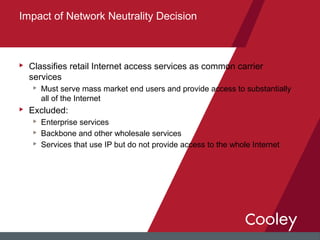
u Classifies retail Internet access services as common carrier
services
u Must serve mass market end users and provide access to substantially
all of the Internet
u Excluded:
u Enterprise services
u Backbone and other wholesale services
u Services that use IP but do not provide access to the whole Internet
Impact of Network Neutrality Decision
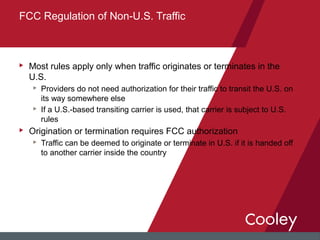
u Most rules apply only when traffic originates or terminates in the
U.S.
u Providers do not need authorization for their traffic to transit the U.S. on
its way somewhere else
u If a U.S.-based transiting carrier is used, that carrier is subject to U.S.
rules
u Origination or termination requires FCC authorization
u Traffic can be deemed to originate or terminate in U.S. if it is handed off
to another carrier inside the country
FCC Regulation of Non-U.S. Traffic
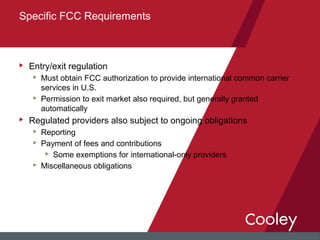
u Entry/exit regulation
u Must obtain FCC authorization to provide international common carrier
services in U.S.
u Permission to exit market also required, but generally granted
automatically
u Regulated providers also subject to ongoing obligations
u Reporting
u Payment of fees and contributions
u Some exemptions for international-only providers
u Miscellaneous obligations
Specific FCC Requirements
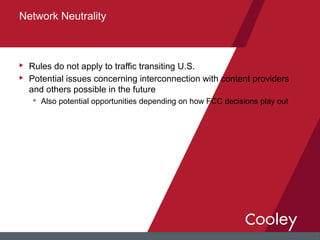
u Rules do not apply to traffic transiting U.S.
u Potential issues concerning interconnection with content providers
and others possible in the future
u Also potential opportunities depending on how FCC decisions play out
Network Neutrality
u U.S. carriers are subject to significant law enforcement obligations
u Response to lawful process for surveillance and production of records
u CALEA – requires specific capabilities to comply with surveillance
requests
u These requirements will apply to underlying carriers used to transport
traffic across the U.S.
u Law enforcement issues often addressed in FCC authorization
process
Law Enforcement Issues
u U.S. national security agencies have broad powers to obtain access
to data transmitted internationally.
u Subject to authorization and legal review by special court
u Court has pushed back on occasion, but not often
u Typically no power over purely domestic U.S. traffic, but non-U.S.
traffic transiting the country is subject to surveillance
National Security
u Most U.S. content-related requirements apply only when U.S. end
users have access to content
u Copyright, trademark
u Defamation
u U.S. border crossings require State Department approval.
Miscellaneous
J.G. Harrington
Cooley LLP
1299 Pennsylvania Avenue, NW
Suite 700
Washington, DC 20004
+1 202/776-2818
jgharrington@cooley.com
Contact Information

J.G Harrington: Securing our Internet Traffic

  • 1.
    attorney advertisement © 2013Cooley LLP Five Palo Alto Square, 3000 El Camino Real, Palo Alto, CA 94306 The content of this packet is an introduction to Cooley LLP’s capabilities and is not intended, by itself, to provide legal advice or create an attorney-client relationship. Prior results do not guarantee future outcome. U.S. Regulation of Canadian Internet Traffic J.G. Harrington September 24, 2015
  • 2.
    u FCC Regulation uLaw Enforcement Issues u National Security u Miscellaneous Topics
  • 3.
    u General regulatoryauthority over communications matters at the national level u Covers interstate and foreign communication by wire or radio u States can regulate intrastate services (not relevant here) u Has asserted authority over Internet access services u Hotly contested FCC
  • 4.
    u Direct powerover common carriers u Defined to cover transmission with no change in form or content u Domestic and international service covered u Historically, no direct regulation of Internet providers u 1997 decision and later orders classified Internet access as an “information service” not subject to common carrier regulation The FCC’s Authority
  • 5.
    u Classifies retailInternet access services as common carrier services u Must serve mass market end users and provide access to substantially all of the Internet u Excluded: u Enterprise services u Backbone and other wholesale services u Services that use IP but do not provide access to the whole Internet Impact of Network Neutrality Decision
  • 6.
    u Most rulesapply only when traffic originates or terminates in the U.S. u Providers do not need authorization for their traffic to transit the U.S. on its way somewhere else u If a U.S.-based transiting carrier is used, that carrier is subject to U.S. rules u Origination or termination requires FCC authorization u Traffic can be deemed to originate or terminate in U.S. if it is handed off to another carrier inside the country FCC Regulation of Non-U.S. Traffic
  • 7.
    u Entry/exit regulation uMust obtain FCC authorization to provide international common carrier services in U.S. u Permission to exit market also required, but generally granted automatically u Regulated providers also subject to ongoing obligations u Reporting u Payment of fees and contributions u Some exemptions for international-only providers u Miscellaneous obligations Specific FCC Requirements
  • 8.
    u Rules donot apply to traffic transiting U.S. u Potential issues concerning interconnection with content providers and others possible in the future u Also potential opportunities depending on how FCC decisions play out Network Neutrality
  • 9.
    u U.S. carriersare subject to significant law enforcement obligations u Response to lawful process for surveillance and production of records u CALEA – requires specific capabilities to comply with surveillance requests u These requirements will apply to underlying carriers used to transport traffic across the U.S. u Law enforcement issues often addressed in FCC authorization process Law Enforcement Issues
  • 10.
    u U.S. nationalsecurity agencies have broad powers to obtain access to data transmitted internationally. u Subject to authorization and legal review by special court u Court has pushed back on occasion, but not often u Typically no power over purely domestic U.S. traffic, but non-U.S. traffic transiting the country is subject to surveillance National Security
  • 11.
    u Most U.S.content-related requirements apply only when U.S. end users have access to content u Copyright, trademark u Defamation u U.S. border crossings require State Department approval. Miscellaneous
  • 12.
    J.G. Harrington Cooley LLP 1299Pennsylvania Avenue, NW Suite 700 Washington, DC 20004 +1 202/776-2818 jgharrington@cooley.com Contact Information

Editor's Notes

  • #2 <number>
  • #3 <number>
  • #4 <number>
  • #5 <number>
  • #6 <number>
  • #7 <number>
  • #8 <number>
  • #9 <number>
  • #10 <number>
  • #11 <number>
  • #12 <number>
  • #13 <number>