90 Jetstar.com
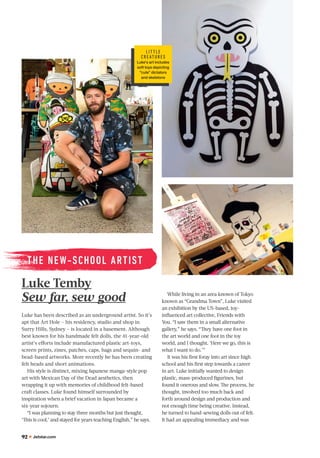
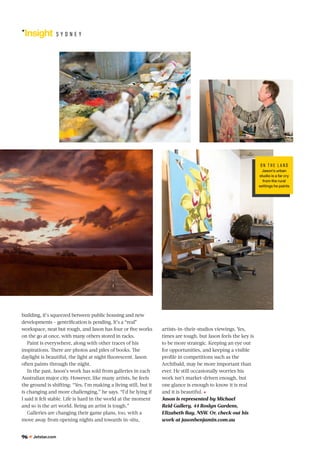
S T ROKE OF
GENIUS
Jason Benjamin
is a traditional fine
artist who loves
painting in oils
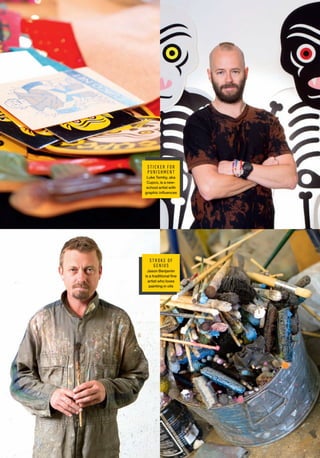
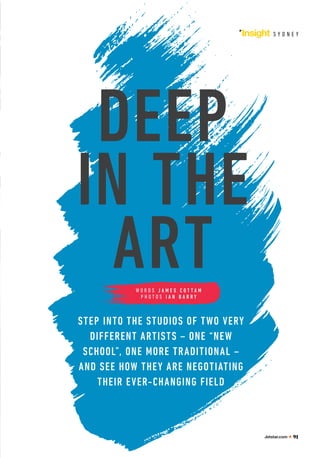
S T ICKER FOR
PUNISHMEN T
Luke Temby, aka
Cupco, is a new-
school artist with
graphic influences
Insight S Y D N E Y
DEEP
IN THE
ART
STEP INTO THE STUDIOS OF TWO VERY
DIFFERENT ARTISTS – ONE “NEW
SCHOOL”, ONE MORE TRADITIONAL –
AND SEE HOW THEY ARE NEGOTIATING
THEIR EVER-CHANGING FIELD
W O R D S J A M E S C O T T A M
P H O T O S I A N B A R R Y
Jetstar.com 91
92 Jetstar.com
Luke has been described as an underground artist. So it’s
apt that Art Hole – his residency, studio and shop in
Surry Hills, Sydney – is located in a basement. Although
best known for his handmade felt dolls, the 41-year-old
artist’s efforts include manufactured plastic art-toys,
screen prints, zines, patches, caps, bags and sequin- and
bead-based artworks. More recently he has been creating
felt heads and short animations.
His style is distinct, mixing Japanese manga-style pop
art with Mexican Day of the Dead aesthetics, then
wrapping it up with memories of childhood felt-based
craft classes. Luke found himself surrounded by
inspiration when a brief vacation in Japan became a
six-year sojourn.
“I was planning to stay three months but just thought,
‘This is cool,’ and stayed for years teaching English,” he says.
Luke Temby
Sew far, sew good
THE NEW-SCHOOL ARTIST
While living in an area known of Tokyo
known as “Grandma Town”, Luke visited
an exhibition by the US-based, toy-
influenced art collective, Friends with
You. “I saw them in a small alternative
gallery,” he says. “They have one foot in
the art world and one foot in the toy
world, and I thought, ‘Here we go, this is
what I want to do.’”
It was his first foray into art since high
school and his first step towards a career
in art. Luke initially wanted to design
plastic, mass-produced figurines, but
found it onerous and slow. The process, he
thought, involved too much back and
forth around design and production and
not enough time being creative. Instead,
he turned to hand-sewing dolls out of felt.
It had an appealing immediacy and was
L IT T L E
C RE AT URE S
Luke's art includes
soft toys depicting
"cute" dictators
and skeletons
Jetstar.com 93
Insight S Y D N E Y
something he could do at home. Home
was where he made most of his work,
both in Japan and back in Australia.
“[I did that] for over eight years… often
at my kitchen table,” he says, “so having
Art Hole is very different and the first time
I’ve had a proper working space.”
Temby is sharing Art Hole's space and
workload with artist Neil McCann, aka
Captain Pipe. It is both their studio and
their commercial outlet. The area is littered
with incomplete works, skateboard decks
and a golf driving range. Artworks cover
the walls and the air reeks of spray-paint,
like a freshly graffitied alley.
Although not strictly an exhibition
space, he does feel “it’s a bit like a
retrospective; it’s good to see everything
together in one place," he says. "My
favorite part of the process is the initial
idea. After that my work can be slow,
taking weeks or months, and the last 10%
is probably the worst. It’s good to be in a
studio with the work out where I can
easily spot what needs to be finished.”
The commercial aspect is very different as well. Art Hole is
described as a “creative retail residency program”. The space
is provided for artists to both work and sell in. Luke says the
“great advantage is that you can learn a different way of
selling your work without all the pressures of commercial
rent and such. It allows you time to figure it all out.”
Initially he sold his works on Etsy, a website for
handmade items, but had to stop when his process started
to involve more manufacturing. Upon returning to
Australia he was introduced to the Damien Minton Gallery
in Redfern, which led to a series of shows. Sadly, the
gallery recently closed, leaving not only Luke
unrepresented but the entire industry feeling squeezed.
It’s a sign of changing buyers’ habits, says Luke.
“A gallery is like an album was in the old days,” he says.
“It’s supposed to be listened to as a whole, not as a bunch
of singles. Nowadays it seems that not everyone has the
patience to hear the whole thing through.”
As we go to print, Art Hole is relocating to L3 Central, a
cool multidisciplinary arts space located inside a designer
shopping centre with gallery pop-ups and rehearsal studios.
“Our work will fit in there, both as art and for its price
point,” Luke says. “Our stuff isn’t expensive.”
Art Hole is located at L3 Central, 28 Broadway,
Chippendale, NSW. See more of Luke’s work at cupco.net
Artworks cover the walls and
the air reeks of spray-paint,
like a freshly graffitied alley
HUE 'S T H AT
GU Y ?
Cupco is all about
vibrant colour,
simple lines and
multiple mediums
Insight S Y D N E Y
94 Jetstar.com
FINE BODY
OF WORK
Jason Benjamin's
landscape
paintings are
highly detailed
JASON BENJAMIN IS A VERY BUSY MAN. The painter, known
for his sparse, considered Australian landscapes and floral
still-life works, is finessing paintings for a Sydney show.
Born in Melbourne in 1971, he moved to New York in the
late 1980s as a teen, on a baseball scholarship. Art studies
took him to the prestigious Pratt Institute in Brooklyn but,
impatient to paint, Jason left before graduating to work in
a succession of small Soho galleries. It taught him about
being a starving artist and art as a business, and exposed
him to some amazing works.
“I got to see works that changed the way I looked at art,
works that really influenced me,” he says.
Returning to Australia, and perhaps influenced by those
hungry days, Jason became a chef by night and a painter by
day. Though it worked well at first, his art practice
diminished as his chef’s career progressed. Eventually, after
the birth of his first child, he decided to paint full-time. It
may have seemed crazy at the time, but it paid off, with his
works now held in collections across the globe.
Jason’s career path is typical of “old-school” artists – he
focuses on one medium, painting, and is represented by
Jason Benjamin
Oil and toil
THE TRADITIONAL ARTIST
fine-art galleries. He prefers to work in oils:
“I like oil,” says Jason. “[Fellow admired
Aussie artist] Tim Storrier has tried to
convince me to go acrylic, but he’s the only
one who can get the results he gets, so I
keep saying ‘no way’. Oils are slow, like me.
You have to be patient as you work,
thinking ahead and moving on.”
For oil you need space, and his studio
for the last 12 years, a converted car park,
has plenty. Located in a mid-century
“Oils are slow,
like me. You
have be patient…
think ahead”
96 Jetstar.com
Insight S Y D N E Y
building, it’s squeezed between public housing and new
developments – gentrification is pending. It’s a “real”
workspace, neat but rough, and Jason has four or five works
on the go at once, with many others stored in racks.
Paint is everywhere, along with other traces of his
inspirations. There are photos and piles of books. The
daylight is beautiful, the light at night fluorescent. Jason
often paints through the night.
In the past, Jason’s work has sold from galleries in each
Australian major city. However, like many artists, he feels
the ground is shifting: “Yes, I’m making a living still, but it
is changing and more challenging,” he says. “I’d be lying if
I said it felt stable. Life is hard in the world at the moment
and so is the art world. Being an artist is tough.”
Galleries are changing their game plans, too, with a
move away from opening nights and towards in-situ,
artists-in-their-studios viewings. Yes,
times are tough, but Jason feels the key is
to be more strategic. Keeping an eye out
for opportunities, and keeping a visible
profile in competitions such as the
Archibald, may be more important than
ever. He still occasionally worries his
work isn’t market-driven enough, but
one glance is enough to know it is real
and it is beautiful.
Jason is represented by Michael
Reid Gallery, 44 Roslyn Gardens,
Elizabeth Bay, NSW. Or, check out his
work at jasonbenjamin.com.au
ON T HE L A ND
Jason's urban
studio is a far cry
from the rural
settings he paints

JetStar1

  • 1.
    90 Jetstar.com S TROKE OF GENIUS Jason Benjamin is a traditional fine artist who loves painting in oils S T ICKER FOR PUNISHMEN T Luke Temby, aka Cupco, is a new- school artist with graphic influences
  • 2.
    Insight S YD N E Y DEEP IN THE ART STEP INTO THE STUDIOS OF TWO VERY DIFFERENT ARTISTS – ONE “NEW SCHOOL”, ONE MORE TRADITIONAL – AND SEE HOW THEY ARE NEGOTIATING THEIR EVER-CHANGING FIELD W O R D S J A M E S C O T T A M P H O T O S I A N B A R R Y Jetstar.com 91
  • 3.
    92 Jetstar.com Luke hasbeen described as an underground artist. So it’s apt that Art Hole – his residency, studio and shop in Surry Hills, Sydney – is located in a basement. Although best known for his handmade felt dolls, the 41-year-old artist’s efforts include manufactured plastic art-toys, screen prints, zines, patches, caps, bags and sequin- and bead-based artworks. More recently he has been creating felt heads and short animations. His style is distinct, mixing Japanese manga-style pop art with Mexican Day of the Dead aesthetics, then wrapping it up with memories of childhood felt-based craft classes. Luke found himself surrounded by inspiration when a brief vacation in Japan became a six-year sojourn. “I was planning to stay three months but just thought, ‘This is cool,’ and stayed for years teaching English,” he says. Luke Temby Sew far, sew good THE NEW-SCHOOL ARTIST While living in an area known of Tokyo known as “Grandma Town”, Luke visited an exhibition by the US-based, toy- influenced art collective, Friends with You. “I saw them in a small alternative gallery,” he says. “They have one foot in the art world and one foot in the toy world, and I thought, ‘Here we go, this is what I want to do.’” It was his first foray into art since high school and his first step towards a career in art. Luke initially wanted to design plastic, mass-produced figurines, but found it onerous and slow. The process, he thought, involved too much back and forth around design and production and not enough time being creative. Instead, he turned to hand-sewing dolls out of felt. It had an appealing immediacy and was L IT T L E C RE AT URE S Luke's art includes soft toys depicting "cute" dictators and skeletons
  • 4.
    Jetstar.com 93 Insight SY D N E Y something he could do at home. Home was where he made most of his work, both in Japan and back in Australia. “[I did that] for over eight years… often at my kitchen table,” he says, “so having Art Hole is very different and the first time I’ve had a proper working space.” Temby is sharing Art Hole's space and workload with artist Neil McCann, aka Captain Pipe. It is both their studio and their commercial outlet. The area is littered with incomplete works, skateboard decks and a golf driving range. Artworks cover the walls and the air reeks of spray-paint, like a freshly graffitied alley. Although not strictly an exhibition space, he does feel “it’s a bit like a retrospective; it’s good to see everything together in one place," he says. "My favorite part of the process is the initial idea. After that my work can be slow, taking weeks or months, and the last 10% is probably the worst. It’s good to be in a studio with the work out where I can easily spot what needs to be finished.” The commercial aspect is very different as well. Art Hole is described as a “creative retail residency program”. The space is provided for artists to both work and sell in. Luke says the “great advantage is that you can learn a different way of selling your work without all the pressures of commercial rent and such. It allows you time to figure it all out.” Initially he sold his works on Etsy, a website for handmade items, but had to stop when his process started to involve more manufacturing. Upon returning to Australia he was introduced to the Damien Minton Gallery in Redfern, which led to a series of shows. Sadly, the gallery recently closed, leaving not only Luke unrepresented but the entire industry feeling squeezed. It’s a sign of changing buyers’ habits, says Luke. “A gallery is like an album was in the old days,” he says. “It’s supposed to be listened to as a whole, not as a bunch of singles. Nowadays it seems that not everyone has the patience to hear the whole thing through.” As we go to print, Art Hole is relocating to L3 Central, a cool multidisciplinary arts space located inside a designer shopping centre with gallery pop-ups and rehearsal studios. “Our work will fit in there, both as art and for its price point,” Luke says. “Our stuff isn’t expensive.” Art Hole is located at L3 Central, 28 Broadway, Chippendale, NSW. See more of Luke’s work at cupco.net Artworks cover the walls and the air reeks of spray-paint, like a freshly graffitied alley HUE 'S T H AT GU Y ? Cupco is all about vibrant colour, simple lines and multiple mediums
  • 5.
    Insight S YD N E Y 94 Jetstar.com FINE BODY OF WORK Jason Benjamin's landscape paintings are highly detailed JASON BENJAMIN IS A VERY BUSY MAN. The painter, known for his sparse, considered Australian landscapes and floral still-life works, is finessing paintings for a Sydney show. Born in Melbourne in 1971, he moved to New York in the late 1980s as a teen, on a baseball scholarship. Art studies took him to the prestigious Pratt Institute in Brooklyn but, impatient to paint, Jason left before graduating to work in a succession of small Soho galleries. It taught him about being a starving artist and art as a business, and exposed him to some amazing works. “I got to see works that changed the way I looked at art, works that really influenced me,” he says. Returning to Australia, and perhaps influenced by those hungry days, Jason became a chef by night and a painter by day. Though it worked well at first, his art practice diminished as his chef’s career progressed. Eventually, after the birth of his first child, he decided to paint full-time. It may have seemed crazy at the time, but it paid off, with his works now held in collections across the globe. Jason’s career path is typical of “old-school” artists – he focuses on one medium, painting, and is represented by Jason Benjamin Oil and toil THE TRADITIONAL ARTIST fine-art galleries. He prefers to work in oils: “I like oil,” says Jason. “[Fellow admired Aussie artist] Tim Storrier has tried to convince me to go acrylic, but he’s the only one who can get the results he gets, so I keep saying ‘no way’. Oils are slow, like me. You have to be patient as you work, thinking ahead and moving on.” For oil you need space, and his studio for the last 12 years, a converted car park, has plenty. Located in a mid-century “Oils are slow, like me. You have be patient… think ahead”
  • 6.
    96 Jetstar.com Insight SY D N E Y building, it’s squeezed between public housing and new developments – gentrification is pending. It’s a “real” workspace, neat but rough, and Jason has four or five works on the go at once, with many others stored in racks. Paint is everywhere, along with other traces of his inspirations. There are photos and piles of books. The daylight is beautiful, the light at night fluorescent. Jason often paints through the night. In the past, Jason’s work has sold from galleries in each Australian major city. However, like many artists, he feels the ground is shifting: “Yes, I’m making a living still, but it is changing and more challenging,” he says. “I’d be lying if I said it felt stable. Life is hard in the world at the moment and so is the art world. Being an artist is tough.” Galleries are changing their game plans, too, with a move away from opening nights and towards in-situ, artists-in-their-studios viewings. Yes, times are tough, but Jason feels the key is to be more strategic. Keeping an eye out for opportunities, and keeping a visible profile in competitions such as the Archibald, may be more important than ever. He still occasionally worries his work isn’t market-driven enough, but one glance is enough to know it is real and it is beautiful. Jason is represented by Michael Reid Gallery, 44 Roslyn Gardens, Elizabeth Bay, NSW. Or, check out his work at jasonbenjamin.com.au ON T HE L A ND Jason's urban studio is a far cry from the rural settings he paints