JESUS WAS THE LIGHT IN THE DARKNESS
EDITED BY GLENN PEASE
John 1:5 5The light shines in the darkness, and the
darkness has not overcomeit.
BIBLEHUB RESOURCES
The light shineth in darkness, and the darkness comprehendeth it not.
John 1:5
How different men receive the light
W. Denton.
1. Some merely receive it to evidence their own darkness.
2. Some by outward professionmerely.
3. Others receive and impart it as lights which are lighted by the true light.
(W. Denton.)
Darkness andlight
Lange.
I. THE DARKNESS.
1. Of falsehood.
2. Of hatred.
3. Of death.
II. THE LIGHT IN CONTEST WITHTHE DARKNESS;or, the progress of
revelation in the sinful world.
1. The light shining in the darkness (the shaded, colouredlight).
2. The light breaking through the darkness.
3. The meridian of gospelday.
(Lange.)
Christ's pre-incarnate activity
T. Whitelaw, D. D.
I. SHINING IN THE DARKNESS. Darkness points to the Fall. Had the union
betweenman and the Loges continued, His life would have streamedin light
around the souls of men, inspiring them with truth and arraying them in
purity. But man severedthe connection. Turning from the light, he chose a
sphere of darkness. Nevertheless, the light continued to penetrate the dark
atmosphere of ignorance and sin which thickened round man.
II. REJECTEDBY THE DARKNESS. Thoughthe light kept on shining
through
(1)the teachings of nature;
(2)the intuitions of conscience;
(3)the Mosaic systemand the prophets; yet men had not hold of the light,
because —
1. They did not fully understand it.
2. Becausethey did not see it.
3. Becausethey did not deserve it.
4. Becausethey hated it.
(T. Whitelaw, D. D.)
The manifestations of the light of the Word in darkness
H. Melvill, B. D.
I. The light shone in the CONSCIENCESofmen. A man without a conscience
has never been born: never amidst the dreariness of heathenism — a faculty
to distinguish right from wrong, to know that the Supreme Being is pleased
with righteousness andangeredat wrong-doing, and that sin will be punished.
But this light shone in darkness. Consciencepersuades resistanceofevil
passions, but inclination quenches the light. Consciencewarns respecting the
future, but is silencedby the gratificationof the present. Conscience reminds
of allegiance owing to a Creator, but the inducements of other masters drown
its voice.
II. CREATION glows withradiations of its Maker. But its illumination has to
enter that darkestof spots, the human heart, where it is opposedby mists of
passion, clouds of ignorance, the night of unwillingness to know God. Hence,
in spite of the light, men abandoned themselves to every kind of
unrighteousness and fell into most degrading superstitions.
III. THE PATRIARCHAL RELIGION was derived from immediate
revelation. The Eternal Word shone upon man, as soonas he had
transgressed, in the promises of deliverance and institutions of worship. But
when men multiplied they forgottheir ancestralreligionwhile retaining some
of its features, disguisedand debased, but recognizable. Hence the universal
prevalence of sacrifice and the hope of salvation. In every age and district of
heathenism the light has thus shone, so that men, in the midst of their
idolatries, are witnessesthat a revelationhas been vouchsafed. This light, too,
preservedin the legends of paganism o! the Fall, Deluge, etc. Yet the slaves of
superstition comprehended not the light.
IV. THE TYPES AND FIGURES OF THE LAW sent forth rays converging
towards the Sun of Righteousness,which, in the fulness of time, was to cross
man's horizon. Yet the understanding of the Jews was so cloudy, and their
hearts so gross, thatthey substituted the type for the antitype.
V. What can be declaredof those who are privileged with the full shining of
THE GOSPEL? The theologyof conscience, creation, tradition, type, fade
awayfrom the revelationof these lastdays. The true light now shineth. How?
Men are insensible to it. By placing men under a variety of dispensations God
would prove that no amount of light will suffice to illuminate fallen creatures
unless the Holy Spirit purge the sight. The sun may be in the heavens, but if
the light in us be darkness, we shall not be illumined by his beams. The Holy
Spirit alone canremove that darkness.
(H. Melvill, B. D.)
Darkness andblindness
J. Fawcett, M. A.
If persons who can see are shut up togetherwith others who are blind, in a
perfectly dark room, the seeing and the blind are in the same situation; no
objectis perceivedby any, no colours discerned; but if light is introduced into
the room, there is then a wonderful difference. To those who are endowed
with sight, every objectappears in its true form and just colouring; but to the
blind all things remain as they were;they are in darkness still; and this
because the darkness is in themselves. So it is with the outward revelationof
Divine truth: while it is withheld, all are in darkness, but it may shine not only
on those who live, and are awake, andcan see, but also on the dead, and on
the sleeping, and on the blind.
(J. Fawcett, M. A.)
Men in darkness
W. H. H. Murray.
There are some vines that never actually come to the surface;they can
scarcelybe called vines — they are roots, rather, whose home is in the earth.
They feed on the loam, and not on the sunshine. Grow as much as they may,
they are never anything but a prolongationof fibres. They are earth-eaters;
they live in the soil and they die in the soil. They add nothing to the beauty of
the landscape;and among the higher orders of life and growth their names
are never mentioned. So it is with some men; they are only human roots, that
might become men. They live underground. All the fibres of their lives suck in
earthiness. Their growthis all lateral. They spread out on all sides. They are
never lifted up into moral and spiritual expression. Theyare of the earth,
earthy. They die where they lived, and God alone knows whatbecomes of
them. We only know that the Divine life is not in them, and, therefore, the
Divine destiny cannot be. For there is no destiny that does not germinate here.
(W. H. H. Murray.)
The dense darkness of the period when the true light appe
S. R. Bosanquet.
ared: — At no time was it so universal or so deep. All the powers and
principles of the world had been tried to the uttermost, and found utterly
wanting. The religion of heathenism had stretched to that extent that,
according to Varro, there were three hundred different gods in Rome alone.
The Romans had consummatedtheir idolatry by deifying their emperors and
greatmen, and so had degradedthemselves to the basestform of man-
worship. The Greeks had speculatedin religion till they had brought
themselves to a conviction and acknowledgmentoftheir ignorance, as testified
in their altar inscribed at Athens, the very seatof religion (Acts 17:22
διεσιδαμονεστερους)and learning, "to the Unknown God." Their wisdom and
philosophy had burnt itself out; and there was no longerany one of their
successive schools ofdoctrine, howeverformerly dogmatic, which now had an
ascendencyevenamong themselves. The Eclectic schoolhad selected
something from eachof them, and in so doing had condemned them all; and
even thus it had not obtained a privilege for itself; for so eachperson was, of
course, atliberty to make his own selection;and so every one in effect
condemned every other, and no one gave to any other, or obtained for himself,
any respect. The Powers of the world were also in their last stage, bothof
greatness andcorruption. The Babylonian empire was representedby a
golden head; the Persianby a breastof silver; the Grecianby thighs of brass:
and now the Roman had swallowedup all other nations, and was become
universal; but its substance was iron; it was the last of the worldly empires; it
was tottering to its fall with its own weight and immensity; it was but feet and
toes, base, divided, corrupted, and diseased, andwas about to crumble into
ruins. The religion of the Jews had also run its course, and had at this time
fermented into a new separation. The generalmass had corrupted itself. The
law of ceremonies had lostits ownsmall portion of life — vegetable life — and
had become a more dead letter only, gravenin stone, as obstinate and
immovable — a withered and dry tree — yet still raising its barren and
leafless branches with proud and pompous pride, and self-conceit, and
defiance:but its barrenness had procured it disrespectand distrust, and men
refused to shadow under its shadowlesstop, and even its own vitality was
denied and disregardedby the Sadducees. At the same time a spiritual seed
had been sown, not resting in the letter; not branching from the now spiritless
trunk; but, though small, and lowly, and young, and tender, having yet the
real principle of life within it, and meet for the digging, and pruning, and
watering of the husbandman. At this time, in the fulness of preparation and
unpreparedness, of superstition and infidelity, of ignorance and learning, of
powerand weakness, ofevil and good, of hope and unbelief, Christ came in
the flesh; the Sun of light and life was embodied, to convince and dispel the
darkness, to lighten the ignorance, to overcome the power, to consume the dry
tree, to vivify the green tree, to divide betweenday and night, betweenthe
goodand evil, to rule over the one, to condemn and expel the other.
(S. R. Bosanquet.)
God's candles are and have been evershining
J. Culross, D. D.
This world has never been given over to the unchallenged reign of darkness:
there have always been souls wherein the life has been kindled, and through
whom it has shot its rays into the world's gloom — God's candles lighted and
placed according to His own will. In this respectthe Fatherof lights has never
been left without witness.
(J. Culross, D. D.)
The condition of receiving the light
Octavius Perinchief.
It is a fact in physical nature that the sunlight passes through empty space,
and neither warms nor lights it. Climb up to the top of the highest mountains
at noonday, and the stars come out. The air is thin — it is therefore dark; we
see only by as much light as is intercepted. So with your car. That alone is
music which you hear. That is pleasure which you feel. That which your nerve
does not report to you does not exist. It is precisely so in morals. There must
be something to intercept the light, or that light itself is nothing. It was so with
Christ. He was an infinite light. He satthere where there was no soul. They do
not know He was God. It is so to-day. He sits among men. He is not God to
those who only call Him God. You teacha man nothing if you only teachhim
to do that. The souls that intercept His rays, to them He is God. There is not
one to whom all of God is revealed, because there is no soul that can intercept
all there was in Jesus. The light still shineth in darkness, and the darkness
comprehendeth it not. Have whateversoul we may, there is ever more soul to
be gained. Even Paul said the one yearning of his soul was to apprehend that
for which also he was apprehended.
(Octavius Perinchief.)
The historicalparallel to the truth of the text
Octavius Perinchief.
This fact respecting Christ, that His light shone in darkness, andthe darkness
comprehended it not, hath its parallel in history respecting all truth. All the
substances ofnature, and all their laws, have been in being, certainly, ever
since man has existed. Why did man not see them? Steam has been a fact ever
since heat was first applied to water. How was it that man knew it not? The
electric current has passedround this earth ever since the earth was made.
How is it man but yesterdaydiscoveredit? Facts as plain as the daylight have
been staring man in the face, sporting with him, and he satthere in his
blindness and knew them not. To-day, endless facts, things we sadly need, are
across ourpath; we are stumbling over them, and yet see them not. Coal lay in
the earth, how many years? oil, how many centuries? Men needed them both.
Why are they but now found to be serviceable? We saythat things come just
as man wants them. That is true. God must look in very pity upon us. Our
misfortune is, we want not yet the tithe of what He is rich enoughto give:
"The light shineth in the darkness, andthe darkness comprehendedit not."
Men are everywhere hunting fortunes. Where are they hunting them? With
the old muck-rake. Why not open the eye? Why not introduce ourselves to
some of the wonders that are yearning to make themselves known to us? We
think a man is crazy when he begins to see.
(Octavius Perinchief.)
The light needed
admitted the necessityofDivine interposition to teach man his duty.
Zenophanes died at the age of nearly one hundred years, and is said to have
thus expressedhimself: "Oh, that mine were the deep mind, prudent and
looking to both sides!Long, alas I have I strayed on the road of error,
beguiled, and am now hoary of years, yet disposedto doubt and distractionof
all kinds; for, whereverI turn to consider, I am lostin the One and All." ,
after all his researches, assertedthat "Vain man hath no accurate knowledge
which is possessedalone by the God, but that man learns from the God as the
boy does from the man." saw and confessedhis ignorance, and deplored the
want of a superior direction. s last prayer was, "Ientered the world corruptly,
I have lived in it anxiously, I quit it in perturbation." confessedthat no
excellence couldexist without a celestialafflation. Hierocles andSeneca tell us
that but by the help of God no man can become either goodor prosperous;so
that he who would repudiate the necessityof a Divine revelationto lead him
by the Holy Spirit into all truth arrogates a power which the greatest
reasoners ofancienttimes disclaimed.
Without Christ -- darkness
Varro, a Roman writer of the first century, B.C., states that, in his day, he had
been at the pains to collectthe various opinions on the question, "What is the
true objectof human life?" in other words, "What is the supreme good? He
had reckonedup as many as three hundred and twenty different answers.
How needful is Divine revelation, and how essentialto those who are starting
in life, that a heavenly guide should teach them the true end and purpose of
earthly existence!
The darkness ofthe natural mind
T. de Witt Talmage.
A goodmany years ago, in Washington, there were two Congressionerswho
met once every week to talk about the immortality of the soul; but they
despisedthe Bible. They found no comfort. Their time expired, and they went
home. Years passedalong. They both visited Washington at the same time,
and happened to meet at the president's levee. They saw eachother at a great
distance across the room. They pressedtheir way through the crowd until
they came to eachother, and, after years of absence, the first thing that one
said to the other was:"John, any light?" "No light." Then this one accosted
the other, and said: "Henry, any light?" "No light." They said nothing more;
they parted to meet at the judgment. Oh, are there any who have swung off
from this grand old gospelofJesus Christ, thinking to find rest for their soul?
Have you found comfort, peace, joy, heaven? From a score of souls there
comes up to me the cry to-night, "No light! no light!"
(T. de Witt Talmage.)
Christ is full of light
H. W. Beecher.
Going into a village at night, with the lights gleaming on eachside of the
street, in some houses they will be in the basementand nowhere else, and in
others in the attic and nowhere else, and in others in some middle chamber;
but in no house will every window gleamfrom top to bottom. So is it with
men's faculties. Mostof them are in darkness. One shines here, and another
there; but there is no man whose soulis luminous throughout. But Christ
presenteda perfect character. Every room in His soul was filled with light. He
is light.
(H. W. Beecher.)
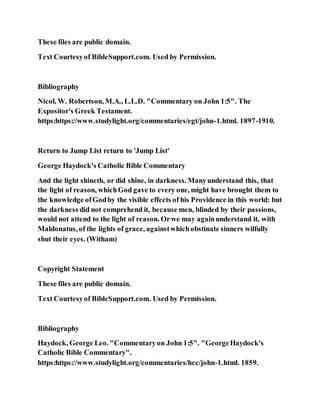
An alternative rendering
J. Cynddylan Jones, D. D.
"The darkness overcame it not." Sin did not succeedin extinguishing the
inner light. "The spirit of man is the candle of the Lord" — a candle lit by
God's own breath. When man fell the candle was sadlybruised, but it did not
blow out. The greatfundamental truths God planted in man continue to shine
despite sin and its grievous consequences. Accordinglythe darkness of the Fall
was not complete — complete, I mean, in the sense that it could not be
blacker;a little light was still continuing to glimmer — candle-light, if you
like, but light all the same. Much talk is indulged in concerning originalsin,
though not quite as much as in former years; but we ought also to speak of
original light, a light deeperand more primitive even than our sin. Do I not
believe in the total depravity of the race? Yes, in the sense that every power is
more or less tangled, that every faculty is more or less corrupt. No, in the
sense that the derangementcould not be greater, that the putridity could not
be more advanced. The confusion and depravity here are great, but in hell
they are considerably greater. So far a little light doubtless glimmers in the
soul of every man on his coming into this world; the goldenbeams of the Sun
of Righteousnessare to be seenplaying in the mental faculties of childhood.
"The light shineth in darkness" — the darkness ofour fall — "and the
darkness overcame it not"; the light still burns. But if the darkness did not
overcome the light, on the other hand the light did not overcome the darkness.
In the other world, the world prior to the Incarnation, the light and the
darkness confrontedeachother without making much impression one on the
other. The darkness did not conquer the light, neither did the light conquer
the darkness;and if the light is to win the victory, it must receive an ample
increase, andthis increase we find in the gospelof Jesus Christ.
(J. Cynddylan Jones, D. D.)
COMMENTARIES
Ellicott's Commentary for English Readers
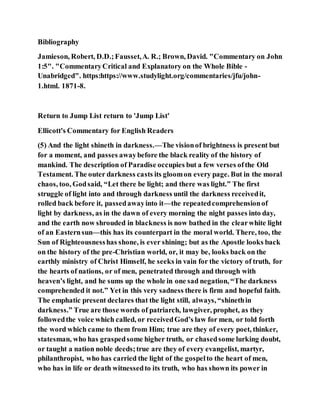
(5) And the light shineth in darkness.—The visionof brightness is present but
for a moment, and passes awaybefore the black reality of the history of
mankind. The description of Paradise occupies but a few verses ofthe Old
Testament. The outer darkness casts its gloomon every page. But in the moral
chaos, too, Godsaid, “Let there be light; and there was light.” The first
struggle of light into and through darkness until the darkness receivedit,
rolled back before it, passedawayinto it—the repeatedcomprehensionof
light by darkness, as in the dawn of every morning the night passes into day,
and the earth now shrouded in blackness is now bathed in the clearwhite light
of an Easternsun—this has its counterpart in the moral world. There, too, the
Sun of Righteousnesshas shone, is ever shining; but as the Apostle looks back
on the history of the pre-Christian world, or, it may be, looks back on the
earthly ministry of Christ Himself, he seeks in vain for the victory of truth, for
the hearts of nations, or of men, penetrated through and through with
heaven’s light, and he sums up the whole in one sad negation, “The darkness
comprehended it not.” Yet in this very sadness there is firm and hopeful faith.
The emphatic present declares that the light still, always, “shinethin
darkness.” True are those words of patriarch, lawgiver, prophet, as they
followedthe voice which called, or receivedGod’s law for men, or told forth
the word which came to them from Him; true are they of every poet, thinker,
statesman, who has graspedsome higher truth, or chasedsome lurking doubt,
or taught a nation noble deeds;true are they of every evangelist, martyr,
philanthropist, who has carried the light of the gospelto the heart of men,
who has in life or death witnessedto its truth, who has shown its power in
deeds of mercy and of love; true are they of the humblest Christian who seeks
to walk in the light, and from the sick-chamberof the lowliesthome may be
letting a light shine before men which leads them to glorify the Father which
is in heaven. The Light is ever shining, ofttimes, indeed, colouredas it passes
through the differing minds of different men, and meeting us across the space
that separates continents, andthe time that separatesages, in widely varying
hues; but these shades pass into eachother, and in the harmony of all is the
pure light of truth.
Comprehended it not.—The meaning of this word differs from that rendered
“knew not” in John 1:10. The thought here is that the darkness did not lay
hold of, did not appropriate the light, so as itself to become light; the thought
there is that individuals did not recognise it. Comp. Notes on Romans 9:30;
1Corinthians 9:24; Philippians 3:12-13, where the same Greek word occurs.
See also Ephesians 3:18, which is the only passagein the New Testament,
besides the present one, where the word is rendered by “comprehend.”
Matthew Henry's Concise Commentary
1:1-5 The plainest reasonwhy the Son of God is calledthe Word, seems to be,
that as our words explain our minds to others, so was the Son of God sent in
order to reveal his Father's mind to the world. What the evangelistsays of
Christ proves that he is God. He asserts, His existence in the beginning; His
coexistencewith the Father. The Word was with God. All things were made
by him, and not as an instrument. Without him was not any thing made that
was made, from the highest angelto the meanestworm. This shows how well
qualified he was for the work of our redemption and salvation. The light of
reason, as wellas the life of sense, is derived from him, and depends upon him.
This eternal Word, this true Light shines, but the darkness comprehends it
not. Let us pray without ceasing, thatour eyes may be opened to behold this
Light, that we may walk in it; and thus be made wise unto salvation, by faith
in Jesus Christ.
Barnes'Notes on the Bible
The light shineth in darkness - Darkness,in the Bible, commonly denotes
ignorance, guilt, or misery. See Isaiah9:1-2; Matthew 4:16; Acts 26:18;
Ephesians 5:8, Ephesians 5:11; Romans 13:12. It refers here to a wickedand
ignorant people. When it is said that "the light shineth in darkness,"it is
meant that the Lord Jesus came to teachan ignorant, benighted, and wicked
world. This has always beenthe case. It was so when he sent his prophets; so
during his own ministry; and so in every age since. His efforts to enlighten and
save men have been like light struggling to penetrate a thick, dense cloud; and
though a few rays may pierce the gloom, yet the greatmass is still an
impenetrable shade.
Comprehended it not - This word means "admitted" it not, or "received" it
not. The word "comprehend," with us, means to "understand." This is not the
meaning of the original. The darkness did not "receive" or"admit" the rays
of light; the shades were so thick that the light could not penetrate them; or,
to drop the figure, men were so ignorant, so guilty, so debased, that they did
not appreciate the value of his instructions; they despisedand rejectedhim.
And so it is still. The greatmass of men, sunk in sin, will not receive his
teachings, and be enlightened and savedby him. Sin always blinds the mind to
the beauty and excellencyof the characterof the Lord Jesus. It indisposes the
mind to receive his instructions, just as "darkness" has no affinity for "light;"
and if the one exists, the other must be displaced.
Jamieson-Fausset-BrownBible Commentary
5. shineth in darkness, &c.—inthis dark, fallen world, or in mankind "sitting
in darkness and the shadow of death," with no ability to find the way either of
truth or of holiness. In this thick darkness, andconsequentintellectual and
moral obliquity, "the light of the Word" shineth—by all the rays whether of
natural or revealedteaching which men (apart from the Incarnation of the
Word) are favored with.
the darkness comprehendedit not—did not take it in, a brief summary of the
effectof all the strivings of this unincarnate Word throughout this wide world
from the beginning, and a hint of the necessityof His putting on flesh, if any
recoveryof men was to be effected(1Co 1:21).
Matthew Poole's Commentary
The light shineth in darkness:he had said before, that life was in Christ, in
him as in the fountain; and the life in him was the light of men, giving light to
men. Now this light which was in him had its emanations (as light in the sun);
and the darkness, that is, men of dark minds, (the abstractbeing put for the
concrete),
comprehended (that is, received)it not. This was true concerning the Jews in
former times, upon whom Christ the true Light had shined in many types and
prophecies;it was also true concerning the Jews ofthat present age, to whom,
through the favour of him who had undertaken the redemption of man, the
means of grace were continued; through the blindness of their minds and
hardness of their hearts, they wilfully rejectedthose means of illumination
which God granted to them.
Gill's Exposition of the Entire Bible
And the light shineth in darkness,....Which, through sin, came upon the
minds of men; who are naturally in the dark about the nature and perfections
of God; about sin, and the consequencesofit; about Christ, and salvationby
him; about the Spirit of God, and his work upon the soul; and about the
Scriptures of truth, and the doctrines of the Gospel. Man was createda
knowing creature, but, not content with his knowledge, sins, and is banished
from the presence ofGod, the fountain of light; which brought a darkness on
him, and his posterity, and which is increasedin them by personaliniquity,
and in which Satan, the god of this world, has an hand; and sometimes they
are left to judicial blindness, and which issues in worse darkness, ifgrace
prevents not: now amidst this darkness there were some remains of the light
of nature: with respectto the being of God, which shines in the works of
creationand providence and to the worship of God, though very dimly; and to
the knowledge ofmoral goodand evil:
and the darkness comprehended it not; or "perceivedit not"; as the Syriac
version renders it. By the light of nature, and the remains of it, men could not
come to any clearand distinct knowledge ofthe above things; and much less
to any knowledge ofthe true way of salvation: unless, rather by the light
should be meant, the light of the Messiah, orof the Gospelshining in the
figures, types, and shadows ofthe law, and in the prophecies and promises of
the Old Testament:and yet, such was the darkness upon the minds of men,
that they could not very distinctly apprehend it, and much less fully
comprehend it, so that there was need of a fresh and fuller revelation; an
accountof which follows;
Geneva Study Bible
{3} And the light shineth in darkness;and the darkness {m} comprehended it
not.
(3) The light of men is turned into darkness, but yet there is enough clearness
so that they are without excuse.
(m) They could not perceive nor reach it to receive any light from it, no, they
did not so much as acknowledgehim.
EXEGETICAL(ORIGINAL LANGUAGES)
Meyer's NT Commentary
John 1:5. Relationof the light to the darkness.
καὶ τὸ φῶς] and the light shineth;[78] not “and thus, as the light, the Logos
shineth” (Lücke). The discourse steadilyprogresseslink by link, so that the
preceding predicate becomes the subject.
φαίνει] Present, i.e. uninterruptedly from the beginning until now; it
embraces, therefore, the illuminating activity of the λόγος ἄσαρκος[79]and
ἔνσαρκος. As it is arbitrary to supply the idea of “still present” (Weiss), so
also is its limitation to the revelations by the prophets of the O. T., which
would make φαίνει merely the descriptive praesens historicum (De Wette).
For the assumption of this, however, in connectionwith pure preterites there
is no warrant; comp. rather φωτίζωι, John1:9. According to Ewald, Jahrb. V.
194 (see his Johann. Schr. I. 121), φαίνει represents as present the time in
which the Light, which since the creationhad enlightened men only from afar,
had now suddenly come down into the world, which without it is darkness,
and was shining in the midst of this darkness. An antithetic relation is thus
assumed(“only from afar,—but now suddenly in the midst”) which has no
support in the present tense alone, without some more distinct intimation in
the text. The stress, moreover, is not on φαίνει, but the (tragic) emphasis is
laid on the ἐν τῇ σκοτίᾳ, whichwith this objectprecedes it. It is the
continuation of the discourse, John1:7 ff., which first leads speciallyto the
actionof the Incarnate One (this also againstHengstenb.).
The σκοτία is the negationand opposite of the φῶς, the condition and order of
things in which man does not possess the divine ἀλήθεια, but has become the
prey of folly, falsehood, and sin, as a godless ruling power, with all its misery.
Here the abstractterm “darkness,” as the element in which the light shines,
denotes not the individual subjectof darkness (Ephesians 5:8), but, as the
context requires, that same totality which had been previously describedby
τῶν ἀνθρώπων, consequentlymankind in general, in so far as in and for
themselves they have since the fall been destitute of divine truth, and have
become corrupt in understanding and will. Melancthonwell says, “genus
humanum oppressum peccato vocattenebras.”Frommann is altogether
mistakenin holding that σκοτία differs in the two clauses,and means (1)
humanity so far as it yet lay beyond the influence of the light, and (2)
humanity so far as it was opposedthereto. But Hilgenfeld is likewise in error,
when, out of a different circle of ideas, he imports the notion that “light and
darkness are primeval opposites, which did not first originate with the fall;”
see on John 8:44.
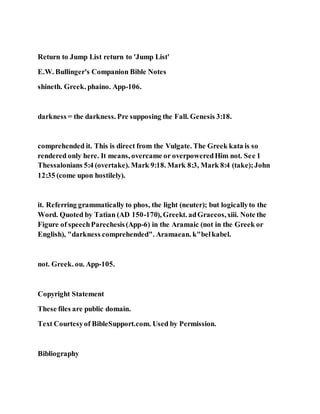
οὐ κατέλαβεν]apprehended it not, look not possessionofit; it was not
appropriated by the darkness, so that thereby the latter might have become
light, but remained aloofand alien to it. Comp. Php 3:12-13, 1 Corinthians
9:24, and especiallyRomans 9:30; also expressions like καταλαμβ. σοφίαν, Sir
15:1; Sir 15:7. The explanation apprehended, i.e. ἔγνω, John 1:10 (Ephesians
3:18; Acts 10:34; Acts 4:13; Plato, Phaedr. p. 250 D; Phil. p. 16 D; Polyb. viii.
4. 6), is on one side arbitrarily narrowing, on another anticipatory, since it
foists in the individual subjects of the σκοτία, which is conceivedof as a realm.
It is erroneous to interpret, as Origen, Chrysostom, Theophylact, Euthymius
Zigabenus, Bos., Schulthess, Hoelemann, p. 60, also Lange: “The darkness did
not hem it in, oppress it; it was invincible before it.” Linguistically this is
allowable (see Schweighaüser, Lex. Herod. II. p. 18), but it nowhere so occurs
in the N. T., and is here opposedto the parallels, John 1:10-11.
Observe that οὐ κατέλαβεν, whichpresupposes no Gnostic absolutism, but
freedom of moral self-determination (comp. John 1:11-12), reflects the
phenomenon as a whole, and indeed as it presented itself to John in history
and experience;hence the aorist. Comp. John 3:19.
[78] φαίνει, lucet, not interchangeable with φαίνεται, whichmeans apparet.
See on Php 2:15. Godet’s criticism of the distinction is erroneous.
[79] Godetthinks that the law written in the heart, the light of conscience, is
meant (Romans 2:14), which the Logos makes use of; and this His relation to
all mankind is essentialand permanent. But this would be utterly inadequate
to the fulness of meaning expressedby φῶς, especiallyin its antithesis to
σκοτία. The φῶς shines as divine light before Christ (by revelation and
prophecy), and after Him. It is supernatural, heavenly. Comp. 1 John 2:8.
There is no mention here of the λόγος σπερματικός.
Expositor's Greek Testament
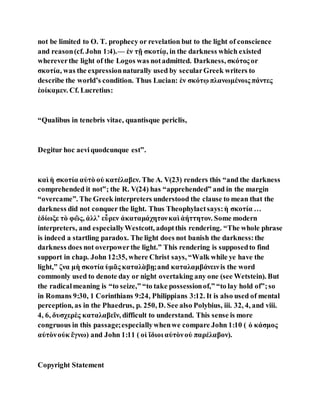
John 1:5. καὶ τὸ φῶς ἐν τῇ σκοτίᾳ φαίνει, “and the light shineth in the
darkness”. Three interpretations are possible. The words may refer to the
incarnate, or to the pre-incarnate experience of the Logos, or to both.
Holtzmann and Weiss both considerthe clause refers to the incarnate
condition (cf. 1 John 2:8). De Wette refers it to the pre-incarnate operationof
the Logos in the O. T. prophets. Meyer and others interpret φαίνει as meaning
“present, i.e., uninterruptedly from the beginning until now”. The use of the
aoristκατέλαβενseems to make the first interpretation impossible; while the
secondis obviously too restricted. What “shining” is meant? This also must
not be limited to O. T. prophecy or revelation but to the light of conscience
and reason(cf. John 1:4).—ἐν τῇ σκοτίᾳ, in the darkness whichexisted
whereverthe light of the Logos was notadmitted. Darkness, σκότος or
σκοτία, was the expressionnaturally used by secularGreek writers to
describe the world’s condition. Thus Lucian: ἐν σκότῳ πλανωμένοις πάντες
ἐοίκαμεν. Cf. Lucretius:
“Qualibus in tenebris vitae, quantisque periclis,
Degitur hoc aeviquodcunque est”.
καὶ ἡ σκοτία αὐτὸ οὐ κατέλαβεν. The A. V[23] renders this “and the darkness
comprehended it not”; the R. V[24] has “apprehended” and in the margin
“overcame”. The Greek interpreters understood the clause to mean that the
darkness did not conquer the light. Thus Theophylactsays:ἡ σκοτία …
ἐδίωξε τὸ φῶς, ἀλλʼ εὗρεν ἀκαταμάχητονκαὶ ἀήττητον. Some modern
interpreters, and especiallyWestcott, adoptthis rendering. “The whole phrase
is indeed a startling paradox. The light does not banish the darkness:the
darkness does not overpowerthe light.” This rendering is supposedto find
support in chap. John 12:35, where Christ says, “Walk while ye have the
light,” ζνα μὴ σκοτία ὑμᾶς καταλὰβῃ;and καταλαμβάνεινis the word
commonly used to denote day or night overtaking any one (see Wetstein). But
the radicalmeaning is “to seize,” “to take possessionof,” “to lay hold of”;so
in Romans 9:30, 1 Corinthians 9:24, Php 3:12. It is also used of mental
perception, as in the Phaedrus, p. 250, D. See also Polybius, iii. 32, 4, and viii.
4, 6, δυσχερὲς καταλαβεῖν, difficult to understand. This sense is more
congruous in this passage;especiallywhenwe compare John 1:10 (ὁ κάσμος
αὐτὸνοὐκ ἔγνω) and John 1:11 (οἱ ἴδιοι αὐτὸν οὐ παρέλαβον).
[23] Authorised Version.
[24] RevisedVersion.
Cambridge Bible for Schools andColleges
5. shineth] Note the present tense;the only one in the section. It brings us
down to the Apostle’s own day: now, as of old, the Light shines—in reason, in
creation, in conscience,—andshines in vain. Note also the progress:in John
1:1-2 we have the period before Creation; in John 1:3, the Creation;John 1:4,
man before the Fall; John 1:5, man after the Fall.
in darkness]Better, in the darkness. The Fallis presupposed.
and the darkness]Mark the strong connexion betweenthe two halves of John
1:5 as also betweenJohn 1:4 and John 1:5, resulting in both casesfrom a
portion of the predicate of one clause becoming the subject of the next clause.
Such strong connexions are frequent in St John. Sometimes the whole of the
predicate is taken; sometimes the subject or a portion of the subject is
repeated.—By‘the darkness’is meant all that the Divine Revelationdoes not
reach, whether by God’s decree or their ownstubbornness, ignorant Gentile
or unbelieving Jew. ‘Darkness’in a metaphoricalsense for spiritual and
moral darkness is peculiar to S. John 8:12; John 12:35; John 12:46;1 John
1:5; 1 John 2:8-9; 1 John 2:11.
comprehended it not] Or, apprehended it not: very appropriate of that which
requires mental and moral effort. Comp. Ephesians 3:18. The darkness
remained apart, unyielding, and unpenetrated. The words ‘the darkness
apprehendeth not the light’ are given by Tatian as a quotation (Orat. ad
Graecos, xiii.). He flourished a.d. 150–170:so this is early testimony to the
existence ofthe Gospel. This and the reference to John 1:3 (see note) are quite
beyond reasonable dispute.
We have here an instance of what has been calledthe “tragic tone” in S. John.
He frequently states a gracious fact, and in immediate connexionwith it the
very opposite of what might have been expectedto result from it. The Light
shines in Darkness, and (insteadof yielding and dispersing) the darkness shut
it out. Comp. John 1:10-11, (John2:24,) John 3:11; John 3:19; John 3:32,
John 5:39-40, John 6:36; John 6:43, John 8:45, &c. The word rendered
‘comprehended’ may also mean ‘overcame;’ and this makes goodsense.
Comp. John 12:35.
Bengel's Gnomen
John 1:5. Καὶ, and) From this verse the doctrine of evil and its rise, receives
much light.—ἐ τῇ σκοτίᾳ, in darkness)This darkness is not said to be made.
For it is a privation, which men have incurred [To wit, that state of the human
race is expressedby this word, which has prevailed since Adams transgression
down to the appearance ofthe true Light.—V. g.] It is in the darkness that the
glory of the Light is the more conspicuouslyseen.—φαίνει, shines)The present
time has the same force as in φωτίζει, John 1:9. It always φαίνει, shineth. The
Light was always nigh at hand, even in the Old Testament, ready to apply a
remedy to darkness and sin. The same word φαίνει, shineth, as regards the
New Testament, 1 John 2:8, “The darkness is past, and the true light now
shineth.”—καὶ—οὐ, and—not)Similarly and—not, John 1:10-11.—ἡ σκοτία,
the darkness)i.e. men wrapt in darkness.—αὐτὸοὐ κατέλαβεν,
[comprehended it not] did not attain to it) Men, it seems, were too much
averse from the Light, as well as too deeply sunk in darkness. Whenthey did
not comprehend the λόγον ἄσαρκον, The Word unclothed in flesh, “He was
made flesh,” John 1:14.
Pulpit Commentary
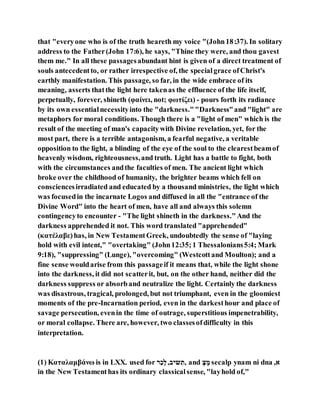
Verse 5. -
(3) The antagonismbetweenlight and darkness. The highest manifestation
and proof of the following statement will be found in that greatentrance of
the EternalLogos into human life which will shed the most complete ray of
Divine light upon men; but before that greatevent, during its occurrence, and
ever since, i.e. throughout all times and nations, the light shineth in the
darkness. Manyexpositors, like Godet, after long wavering and pondering,
resolve this expressioninto a distinct epitome of the effect of the Incarnation,
the highestmanifestation of the light in the theanthropic life, and hesitate to
see any reference to the shining of the light upon the darkness ofhumanity or
of the heathen world. They do this on the ground that there is no confirmation
or illustration of this idea in John's Gospel. However, letthe following
parallels and expositions of this thought be considered. Our Lord
discriminates betweenthose who "hate the light" and "those who do the truth
and come to the light" (John 3:21). He delights in those whom the Father has
given to him, and who come to him (John 6:37). He speaks of"other sheep
which are not of this fold, who hear his voice" (John 10:16). He tells Pilate
that "everyone who is of the truth heareth my voice "(John18:37). In solitary
address to the Father(John 17:6), he says, "Thine they were, and thou gavest
them me." In all these passagesabundant hint is given of a direct treatment of
souls antecedentto, or rather irrespective of, the specialgrace ofChrist's
earthly manifestation. This passage, so far, in the wide embrace of its
meaning, asserts thatthe light here takenas the effluence of the life itself,
perpetually, forever, shineth (φαίνει, not; φωτίζει) - pours forth its radiance
by its own essentialnecessityinto the "darkness.""Darkness"and "light" are
metaphors for moral conditions. Though there is a "light of men" which is the
result of the meeting of man's capacitywith Divine revelation, yet, for the
most part, there is a terrible antagonism, a fearful negative, a veritable
opposition to the light, a blinding of the eye of the soul to the clearestbeamof
heavenly wisdom, righteousness,and truth. Light has a battle to fight, both
with the circumstances andthe faculties of men. The ancient light which
broke over the childhood of humanity, the brighter beams which fell on
consciencesirradiated and educated by a thousand ministries, the light which
was focusedin the incarnate Logos and diffused in all the "entrance of the
Divine Word" into the heart of men, have all and always this solemn
contingencyto encounter - "The light shineth in the darkness."And the
darkness apprehended it not. This word translated "apprehended"
(κατέλαβε)has, in New TestamentGreek, undoubtedly the sense of "laying
hold with evil intent," "overtaking" (John12:35;1 Thessalonians5:4; Mark
9:18), "suppressing" (Lunge), "overcoming" (Westcottand Moulton); and a
fine sense wouldarise from this passageif it means that, while the light shone
into the darkness, it did not scatterit, but, on the other hand, neither did the
darkness suppress or absorband neutralize the light. Certainly the darkness
was disastrous, tragical, prolonged, but not triumphant, even in the gloomiest
moments of the pre-Incarnation period, even in the darkesthour and place of
savage persecution, evenin the time of outrage, superstitious impenetrability,
or moral collapse. There are, however, two classesofdifficulty in this
interpretation.
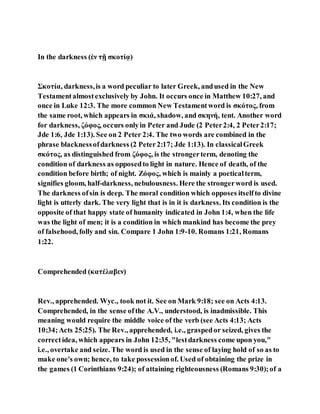
(1) Καταλαμβάνω is in LXX. used for ‫ִת‬ִ‫ביש‬,‫כָל‬ ַ‫,ר‬ and ‫צי‬ ‫ָי‬ secalp ynam ni dna ,‫א‬
in the New Testamenthas its ordinary classicalsense, "layhold of,"
"apprehend," "comprehend," "understand," "come to know," intelligo, and
cognosco (Ephesians3:18), though in this latter sense it is mostly used in the
middle voice.
(2) When the apostle, in greaterdetail and more immediate reference to the
individual illustrations he gives of the relation of the darkness to the light,
says in vers. 10, 11, Ὁ κόσμος αὐτὸνοὐκ ἔγνω, and Οἱ ἴδιοι αὐτὸνοὐ
παρέλαβον; though slightly different words are used, yet the return upon the
thought in these parallel sentences is too obvious to be overlooked. The
nonsusceptibility of the darkness, the positive resistance itmakes to the action
of light, finds its strongestillustration in the more defined regions and
narrowersphere of the coming of the Logos to the world, and in his special
mission to his ownpeople. In this view Alford, Bengel, Schaff, Godet,
Luthardt, Tholuck, Meyer, Ewald, coincide, though the suggestionofOrigen
and Chrysostom, and in later years of Schulthess, Westcott, etc.,has been
powerfully urged. The broad, generalfactis stated, not excluding the
exceptions on which the evangelisthimself afterwards enlarges. If the
darkness had "apprehended" the light, it would no more be darkness. The
melancholy fact is that the corruption in the world has been, for the most
part, impervious to the light alike of nature, of life, of conscience, and even of
revelation. Hence, says Bengel, "the occasionfor the Incarnation." This is
exaggeration, becausethe whole recordof the incarnate Word is a continuous
story of the resistance ofthe darkness to the light.
Vincent's Word Studies
Shineth (φαίσει)
Note the presenttense, indicating not merely the presentpoint of time, but
that the light has gone forth continuously and without interruption from the
beginning until now, and is still shining. Hence φαίνει, shineth, denoting the
peculiar property of light under all circumstances, andnot φωτίζει, lighteneth
or illuminateth, as in John 1:9. The shining does not always illuminate.
Compare 1 John 2:8.
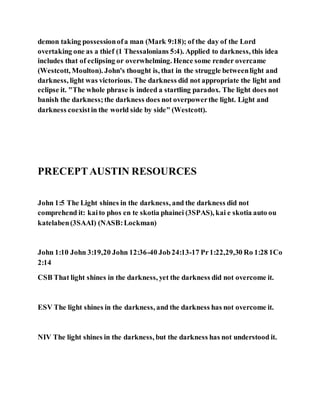
In the darkness (ἐν τῇ σκοτίᾳ)
Σκοτία, darkness,is a word peculiar to later Greek, andused in the New
Testamentalmostexclusively by John. It occurs once in Matthew 10:27, and
once in Luke 12:3. The more common New Testamentword is σκότος, from
the same root, which appears in σκιά, shadow, and σκηνή, tent. Another word
for darkness, ζόφος, occurs onlyin Peter and Jude (2 Peter2:4, 2 Peter2:17;
Jde 1:6, Jde 1:13). See on 2 Peter 2:4. The two words are combined in the
phrase blacknessofdarkness (2 Peter2:17; Jde 1:13). In classicalGreek
σκότος, as distinguished from ζόφος, is the strongerterm, denoting the
condition of darkness as opposedto light in nature. Hence of death, of the
condition before birth; of night. Ζόφος, which is mainly a poeticalterm,
signifies gloom, half-darkness, nebulousness. Here the strongerword is used.
The darkness ofsin is deep. The moral condition which opposes itselfto divine
light is utterly dark. The very light that is in it is darkness. Its condition is the
opposite of that happy state of humanity indicated in John 1:4, when the life
was the light of men; it is a condition in which mankind has become the prey
of falsehood, folly and sin. Compare 1 John 1:9-10. Romans 1:21, Romans
1:22.
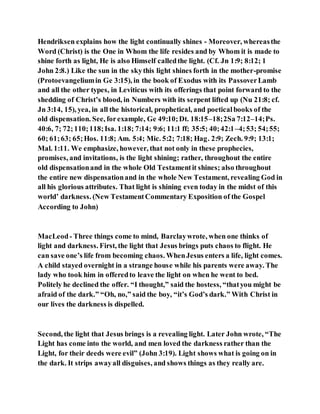
Comprehended (κατέλαβεν)
Rev., apprehended. Wyc., took not it. See on Mark 9:18; see on Acts 4:13.
Comprehended, in the sense ofthe A.V., understood, is inadmissible. This
meaning would require the middle voice of the verb (see Acts 4:13; Acts
10:34;Acts 25:25). The Rev., apprehended, i.e., graspedor seized, gives the
correctidea, which appears in John 12:35, "lestdarkness come upon you,"
i.e., overtake and seize. The word is used in the sense of laying hold of so as to
make one's own; hence, to take possessionof. Used of obtaining the prize in
the games (1 Corinthians 9:24); of attaining righteousness (Romans 9:30);of a
demon taking possessionofa man (Mark 9:18); of the day of the Lord
overtaking one as a thief (1 Thessalonians 5:4). Applied to darkness, this idea
includes that of eclipsing or overwhelming. Hence some render overcame
(Westcott, Moulton). John's thought is, that in the struggle betweenlight and
darkness, light was victorious. The darkness did not appropriate the light and
eclipse it. "The whole phrase is indeed a startling paradox. The light does not
banish the darkness;the darkness does not overpowerthe light. Light and
darkness coexistin the world side by side" (Westcott).
PRECEPTAUSTIN RESOURCES
John 1:5 The Light shines in the darkness, and the darkness did not
comprehend it: kaito phos en te skotia phainei (3SPAS), kai e skotia auto ou
katelaben(3SAAI) (NASB:Lockman)
John 1:10 John 3:19,20 John 12:36-40 Job24:13-17 Pr1:22,29,30 Ro 1:28 1Co
2:14
CSB That light shines in the darkness, yet the darkness did not overcome it.
ESV The light shines in the darkness, and the darkness has not overcome it.
NIV The light shines in the darkness, but the darkness has not understood it.
NET And the light shines on in the darkness, but the darkness has not
masteredit.
NLT The light shines in the darkness, and the darkness cannever extinguish
it.
Wuest - And the light in the darkness is constantly shining. And the darkness
did not overwhelm it.
Barclay- And the light shines in the darkness, andthe darkness did not put it
out.
Compare Jn 1:9 which says "There was the true light which, coming into the
world, enlightens every man."
The light shines in the darkness - As noted below the tense switches from
imperfect (Jn 1:4 - "life was [imperfect] the light...")to the present tense
indicating the light continually shines.
R Kent Hughes explains that "Literally, this (the light shines in the darkness)
means it shines continually in the darkness, meaning that Christ is continually
bombarding every corner of our hearts of darkness through the work of His
Holy Spirit in nature, conscience, andthe Scriptures. Whether you are with or
without Christ, meditate upon Christ being light, and you will better
understand how much He loves you. (John- That You May Believe -
Preaching the Word)
Hendriksen explains how the light continually shines - Moreover, whereasthe
Word (Christ) is the One in Whom the life resides and by Whom it is made to
shine forth as light, He is also Himself calledthe light. (Cf. Jn 1:9; 8:12; 1
John 2:8.) Like the sun in the skythis light shines forth in the mother-promise
(Protoevangeliumin Ge 3:15), in the book of Exodus with its PassoverLamb
and all the other types, in Leviticus with its offerings that point forward to the
shedding of Christ’s blood, in Numbers with its serpent lifted up (Nu 21:8; cf.
Jn 3:14, 15), yea, in all the historical, prophetical, and poeticalbooks of the
old dispensation. See, forexample, Ge 49:10;Dt. 18:15–18;2Sa 7:12–14;Ps.
40:6, 7; 72;110;118;Isa. 1:18; 7:14; 9:6; 11:1 ff; 35:5; 40;42:1–4;53; 54;55;
60; 61;63; 65;Hos. 11:8; Am. 5:4; Mic. 5:2; 7:18; Hag. 2:9; Zech. 9:9; 13:1;
Mal. 1:11. We emphasize, however, that not only in these prophecies,
promises, and invitations, is the light shining; rather, throughout the entire
old dispensationand in the whole Old Testamentit shines; also throughout
the entire new dispensationand in the whole New Testament, revealing God in
all his glorious attributes. That light is shining even today in the midst of this
world’ darkness. (New TestamentCommentary Exposition of the Gospel
According to John)
MacLeod- Three things come to mind, Barclaywrote, when one thinks of
light and darkness. First, the light that Jesus brings puts chaos to flight. He
can save one’s life from becoming chaos. WhenJesus enters a life, light comes.
A child stayed overnight in a strange house while his parents were away. The
lady who took him in offeredto leave the light on when he went to bed.
Politely he declined the offer. “I thought,” said the hostess, “thatyou might be
afraid of the dark.” “Oh, no,” said the boy, “it’s God’s dark.” With Christ in
our lives the darkness is dispelled.
Second, the light that Jesus brings is a revealing light. Later John wrote, “The
Light has come into the world, and men loved the darkness rather than the
Light, for their deeds were evil” (John 3:19). Light shows what is going on in
the dark. It strips awayall disguises, and shows things as they really are.
People never see themselves truly until they see themselves through the eyes of
Jesus. He drives people to Godby revealing them to themselves.
Third, the light that Jesus brings is a guiding light. When someone walks in
darkness, he “does not know where he goes” (Jn12:35). When he receives the
light and believes the light, however, he no longer walks in darkness (Jn
12:36). When Jesus comesinto a life, guessing and groping about the meaning
of life are ended. (The Eternality and Deity of the Word- John 1:1-2)
Light (5457)(phos)from pháo = to shine) is defined by many lexicons as that
which contrasts with darkness. Light is the medium of illumination that
makes sight possible or makes things visible. In Scripture phos canrefer to
literal, physical light (Ge 1:3), but often is used metaphorically or
symbolically, the greatestmetaphoricaluse being used to symbolize Jesus as
"the Light of the world." (Jn 8:12).
Zodhiates says figuratively phos means "moral and spiritual light and
knowledge whichenlightens the mind, soul or conscience;including also the
idea of moral goodness, purity and holiness, and of consequentreward and
happiness." (Complete Word Study Dictionary- New Testament)
Light - phos -
John 1:4 In Him was life, and the life was the Light of men.
5 The Light shines in the darkness, and the darkness did not comprehend it.
7 He came as a witness, to testify about the Light, so that all might believe
through him.
8 He was not the Light, but he came to testify about the Light.
9 There was the true Light which, coming into the world, enlightens every
man.
John 3:19 "This is the judgment, that the Light has come into the world, and
men loved the darkness ratherthan the Light, for their deeds were evil.
20 "Foreveryone who does evil hates the Light, and does not come to the
Light for fear that his deeds will be exposed.
21 "But he who practices the truth comes to the Light, so that his deeds may
be manifested as having been wrought in God."
John 5:35 "He was the lamp that was burning and was shining and you were
willing to rejoice for a while in his light.
John 8:12 Then Jesus againspoke to them, saying, "I am the Light of the
world; he who follows Me will not walk in the darkness, but will have the
Light of life."
John 9:5 "While I am in the world, I am the Light of the world."
John 11:9 Jesus answered, "Are there not twelve hours in the day? If anyone
walks in the day, he does not stumble, because he sees the light of this world.
10 "But if anyone walks in the night, he stumbles, because the light is not in
him."
John 12:35 So Jesus saidto them, "Fora little while longer the Light is among
you. Walk while you have the Light, so that darkness will not overtake
(katalambano)you; he who walks in the darkness does not know where he
goes.
John 12:36 "While you have the Light, believe in the Light, so that you may
become sons of Light." These things Jesus spoke, andHe went awayand hid
Himself from them.
John 12:46 "I have come as Light into the world, so that everyone who
believes in Me will not remain in darkness.
Bruce Barton on the Light shines - The timeless Light (Ed: of Christ, in the
Gospelmessage)has invaded our time, and we can see it in our darkness.
Christ’s life and message are still effective. Johncould see it around him in his
day as he witnessedthe strength of the Christian church—planted, thriving,
growing. And it is still presenttense today—for Christ’s light still shines in
our dark world. (Life Application New TestamentCommentary)
Robertsonon the light shines - Linear presentactive indicative of
phaino....“The light keeps on giving light.”....(Lightis) An evident allusion to
the darkness brought on by sin. In 2Pet. 2:17 we have "the blackness of
darkness". The Logos, the only realmoral light, keeps on shining both in the
Pre-incarnate state and after the Incarnation (Ed: How? See Hendriksen's
reasonable explanationabove). John is fond of skotia, skotosfor moral
darkness from sin and phōs, phōtizō, phainō for the light that is in Christ
alone. In 1 John 2:8 he proclaims that “the darkness is passing by and the true
light is already shining.” The Gnostics oftenemployed these words and John
takes them and puts them in the proper place!
Shines (5316)(phaino)means to bring to light, to cause to appear. To shed
light upon (Rev 8:12). To seemto be (Lk 24:11). Figuratively of sin being
shown to be sin (Ro 7:13). "The sinfulness of sin is revealedin its violations of
God’s law." (ATR). Figuratively phaino is used of the Word of God as that
which shines in a dark place (2Pe 1:19). Phaino describes the glorified Jesus'
face (Rev 1:16). Appear ("are seen")in Php 2:15 could be translated"shine."
In Mt 24:30 phaino refers to the SecondComing of Christ (cp Mt 24:27).
Phaino is in the presenttense indicating that this supernatural light
continually shines in the darkness. This is not the shine of the sun or the
moon, but the Son's shine! "The present here has gnomic force;it expresses
the timeless truth that the light of the world (cf. Jn 8:12, 9:5, 12:46) never
ceases to shine." (W Hall Harris)
Vincent comments on the present tense "Note the present tense, indicating not
merely the present point of time, but that the light has gone forth continuously
and without interruption from the beginning until now, and is still shining."
(John 1 Commentary - Vincent's Word Studies) (See above for Hendriksen's
discussionof how the light is continually shining.)
Jn 8:12 Again therefore Jesus spoke to them, saying, “I am the light of the
world; he who follows Me shall not walk in the darkness, but shall have the
light of life.”
Jn 9:5 “While I am in the world, I am the light of the world.”
Jn 12:46 “I have come as light into the world, that everyone who believes in
Me may not remain in darkness.
NET Note - To this point the author has used past tenses (imperfects, aorists);
now he switches to a present. The light continually shines (thus the
translation, "shines on"). Even as the author writes, it is shining. The present
here most likely has gnomic force (though it is possible to take it as a historical
present); it expresses the timeless truth that the light of the world (cf Jn 8:12,
9:5, 12:46) never ceases to shine.
John writes that "God is Light, and in Him there is (absolutely) no darkness
at all." (1Jn 1:5) And as John says Christ's Light is still shining in our dark
world and that it will shine in the world to come, John describing heaven
"And the city has no need of the sun or of the moon to shine upon it, for the
glory of God has illumined it, and its lamp is the Lamb. And the nations shall
walk by its light, and the kings of the earth shall bring their glory into
it....And there shall no longerbe any night; and they shall not have need of the
light of a lamp nor the light of the sun, because the Lord God shall illumine
them; and they shall reign forever and ever." (Rev 21:23-24-note,Rev22:5-
note)
Paul speaks ofdarkness (signifying sinful deeds) to the believers in Ephesus
telling them "do not participate in the unfruitful deeds of darkness, but
instead even expose them; 12 for it is disgracefuleven to speak ofthe things
which are done by them in secret. 13 But all things become visible when they
are exposedby the light, for everything that becomes visible is light. 14 For
this reasonit says, "Awake, sleeper, And arise from the dead, And Christ will
shine on you." (Eph 5:11-12-note;Eph 5:13-14-note)
Vincent on darkness - In classicalGreek skotos, as distinguishedfrom zophos,
is the strongerterm, denoting the condition of darkness as opposedto light in
nature. Hence of death; of the condition before birth; of night. Zophos, which
is mainly a poeticalterm, signifies gloom, half-darkness, nebulousness. Here
the strongerword is used. The darkness of sin is deep. The moral condition
which opposes itselfto divine light is utterly dark. The very light that is in it is
darkness. Its condition is the opposite of that happy state of humanity
indicated in Jn 1:4, when the life was the light of men; it is a condition in
which mankind has become the prey of falsehood, folly and sin. Compare
1John1:9–10. Ro 1:21, 22. (John 1 Commentary - Vincent's Word Studies)
Hendriksen on darkness - The darkness to which the evangelistrefers has a
concrete meaning. It refers to fallen mankind, darkenedby sin and unbelief.
This is not the only case in the New Testamentin which an abstractnoun
acquires a concrete meaning. For other examples see Rom. 11:7 (“the
election,” meaning the electremnant), Rom. 3:30 (“the circumcision,”
signifying the circumcisedindividuals). This darkness is synonymous with
“the world” of Jn 1:10. It is the antagonistof Christ, the light. It is an active,
personaldarkness:it did not acceptor appropriate the light.
John Calvin - Unless God’s Word illumine the way, the whole life of men is
wrapped in darkness and mist, so that they cannot but miserably stray....The
light of human reasondiffers little from darkness.
Harris - Here we are introduced to what will become a major theme of John’s
Gospel:the opposition of light and darkness. The antithesis is a natural one,
widespreadin antiquity. Genesis 1 (Ed: Dark = Ge 1:2, 4, 18;Light = Ge 1:3-
5, 14-18)gives considerable emphasis to it in the accountof the creation, and
so do the writings of Qumran. (Prologue John 1:1-18)
Alexander Maclaren- So far, John has been speaking as from the upper or
divine side, but in John 1:5 he speaks from the under or human, and shows us
how the self-revelationof the Word has, by some mysterious necessity, been
conflict. The ‘darkness’was not made by Him, but it is there, and the beams
of the light have to contend with it. Something alien must have come in, some
catastrophe have happened, that the light should have to stream into a region
of darkness. Johntakes ‘the Fall’ for granted, and in John 1:5 describes the
whole condition of things, both within and beyond the regionof special
revelation. The shining of the light is continuous, but the darkness is obstinate.
It is the tragedy and crime of the world that the darkness will not have the
light. It is the long-suffering mercy of God that the light repelled is not
extinguished, but shines meekly on. (John 1 Commentary)
D A Carsonon darkness and light - The ‘darkness’in John is not only absence
of light, but positive evil (cf. Jn 3:19; 8:12; 12:35, 46;1Jn. 1:5, 6; 2:8, 9, 11);
the light is not only revelation bound up with creation, but with salvation.
Apart from the light brought by the Messiah, the incarnate Word, people love
darkness because theirdeeds are evil (Jn 3:19), and when the light does put in
an appearance, they hate it, because theydo not want their deeds to be
exposed(Jn 3:20). (The Gospelaccording to John -The Pillar New Testament
Commentary)
Darkness (4653)(skotia from skotos = darkness)is a condition resulting from
the partial or complete absence oflight and refers to literal darkness in Jn
6:17, 20:1, but more often is used figuratively to refer to spiritual darkness. In
every NT figurative use, darkness is contrastedwith light in all but one
passage(1Jn2:11). "Darkness has no existence by itself, being definable
simply as an absence oflight." Darkness is also the realm of sin and evil.
See also William Barclay's discussionbelow on Darkness
In the spiritual sense darkness describesboth the state and works of a person.
It symbolizes evil and sin, everything that life should not be and everything
that a personshould not do!
When the Light shines, it drives awaythe spiritual darkness for the unsaved
world is blinded by the prince of this world.
Jesus explained to Paul that the purpose of the Gospelwas "to open their eyes
so that they may turn from darkness to light and from the dominion of Satan
to God, in order that they may receive forgiveness ofsins and an inheritance
among those who have been sanctifiedby faith in Me.’(Acts 26:18)
In Colossianswe learn that we as believers should continually be "giving
thanks to the Father, who has qualified us to share in the inheritance of the
saints in light, for He delivered us from the domain (right and the might) of
darkness, and transferred us to the kingdom of His beloved Son in Whom we
have redemption, the forgiveness ofsins." (Col 1:12-14)
Paul writes "And even if our gospelis veiled, it is veiled to those who are
perishing, in whose case the god of this world has blinded the minds of the
unbelieving, that they might not see the light of the gospelof the glory of
Christ, Who is the image of God. 5 For we do not preach ourselves but Christ
Jesus as Lord, and ourselves as your bond-servants for Jesus’sake.6 For
God, who said, “Light shall shine out of darkness,”is the One who has shone
in our hearts to give the light of the knowledge ofthe glory of God in the face
of Christ." (2 Corinthians 4:3-6)
Therefore do not be partakers with them; for you were formerly darkness,
but now you are light in the Lord; walk as children of light. (Eph 5:7-8)
Dictionary of Biblical Imagery - The greatestofGod’s acts in regard to
darkness, though, is his spiritual rescue of people from darkness through the
work of Christ. Godhimself “is light and in him there is no darkness at all” (1
Jn 1:5). Christ is a light that “shines in the darkness, and the darkness did not
overcome it” (Jn 1:5). Whoeverfollows Jesus “willnever walk in darkness but
will have the light of life” (Jn 8:12). Jesus came “as light into the world,” so
that everyone who believes in him “should not remain in the darkness” (Jn
12:46). In a similar vein Paul writes that believers in Christ once “were
darkness, but now in the Lord you are light” (Eph 5:8 NRSV).
Skotia - 14 of 16 NT uses are by John, twice to in the literal physical sense (Jn
6:17, 20:1) and the remainder in the spiritual sense.
Matthew 10:27 "What I tell you in the darkness, speak in the light; and what
you hear whisperedin your ear, proclaim upon the housetops.
Luke 12:3 "Accordingly, whatever you have said in the dark will be heard in
the light, and what you have whisperedin the inner rooms will be proclaimed
upon the housetops.
John 1:5 The Light shines in the darkness, and the darkness did not
comprehend it.
John 6:17 and after getting into a boat, they startedto cross the sea to
Capernaum. It had already become dark, and Jesus had not yet come to them.
John 8:12 Then Jesus againspoke to them, saying, "I am the Light of the
world; he who follows Me will not walk in the darkness, but will have the
Light of life."
John 12:35 So Jesus saidto them, "Fora little while longer the Light is among
you. Walk while you have the Light, so that darkness will not overtake you; he
who walks in the darkness does not know where he goes.
46 "I have come as Light into the world, so that everyone who believes in Me
will not remain in darkness.
John 20:1 Now on the first day of the week Mary Magdalene came earlyto the
tomb, while it was still dark, and saw the stone alreadytaken awayfrom the
tomb.
1 John 1:5 This is the message we have heard from Him and announce to you,
that God is Light, and in Him there is no darkness at all.
1 John 2:8 On the other hand, I am writing a new commandment to you,
which is true in Him and in you, because the darkness is passing awayand the
true Light is already shining.
9 The one who says he is in the Light and yet hates his brother is in the
darkness until now.
11 But the one who hates his brother is in the darkness and walks in the
darkness, and does not know where he is going because the darkness has
blinded his eyes.
THE DARKNESS DID NOT
GRASP OR OVERPOWERTHE LIGHT
Hughes writes - The light met with tremendous resistance.Jn1:10–11 round
out the description in terms that are tragicallyabsurd as we bear in mind the
immense description of Christ that has gone before: “He was in the world,
and though the world was made through him, the world did not recognize
him. He came to that which was his own, but his owndid not receive him.”
The One who said, “Let there be light,” the One whose love constrainedhim
to shine his saving light through creationand conscience, the One who
mercifully sheathedhis light in a human body so that he might bring light to
men, the One who setaside a specialpeople for himself to be a light to the
nations, was rejected!Yet today he is still light and continues to seek to pry
his wayinto hostile hearts. Amazing love! (John- That You May Believe -
Preaching the Word)
The light cannotlose againstthe darkness. The darkness did not comprehend,
apprehend, appropriate, grasp, master, extinguish or overcome the Light of
Jesus!
Wiersbe on katalambano - The Greek verb can mean “to overcome” or“to
grasp, to understand.” Throughout the Gospelof John, you will see both
attitudes revealed:people will not understand what the Lord is saying and
doing and, as a result, they will oppose Him. John 7–12 records the growth of
that opposition, which ultimately led to the crucifixion of Christ. Whenever
Jesus taught a spiritual truth, His listeners interpreted it in a material or
physical way (Ed: That is they were unable to comprehend the light). The
light was unable to penetrate the darkness in their minds. This was true when
He spoke about the temple of His body (John 2:19–21), the new birth (John
3:4), the living water (John 4:11), eating His flesh (John 6:51ff), spiritual
freedom (John 8:30-36), death as sleep(John 11:11-13), and many other
spiritual truths. Satan strives to keeppeople in the darkness, because
darkness means death and hell, while light means life and heaven. (The Bible
Exposition Commentary)
Paul speaks to darkness not comprehending the Light - "But a natural man
does not acceptthe things of the Spirit of God; for they are foolishness to him,
and he cannot understand them, because theyare spiritually appraised."
(1Cor2:14-note)
Paul describes the danger of rejecting the Light - And just as they did not see
fit to acknowledgeGodany longer, God gave them over to a depraved mind,
to do those things which are not proper (Ro 1:28-note)
Steven Cole on katalambano - The word translated “comprehend” (NAS
translation) can have two meanings, much like our word grasp. It canmean to
comprehend or graspmentally, or it can mean to overcome or take hold of
something in the sense of mastering it physically. ....Johnuses the present
tense (for shines) here, which probably focuses onJesus’coming to earth and
the conflictbetweenHim and the powers of darkness that unfold in this
Gospel. Theycrucified Him, but He arose and conquered the darkness. His
salvationconquers the spiritual darkness in every heart that trusts in Him.
But the word may also be translated“comprehend,” and this meaning also fits
a theme in this Gospel. In Jn 1:10b, those in the world “did not know Him.” In
Jn 1:11b, even His own people “did not receive Him.” Jesus points out (Jn
3:19-20)that those in the darkness love the darkness and hate the Light
because their deeds are evil. Thus they didn’t “comprehend” Jesus. Because
sinners walk in darkness (Jn 8:12), they fail to see who Jesus reallyis. In John
8:48, they actually accuse Him of having a demon! So perhaps John’s use of
this ambiguous term has both meanings: the darkness will not overcome the
Light as it comes through Jesus. Also, the darkness cannotcomprehend the
Light, unless Jesus opens their blind eyes to see. (John 1:1-5 Jesus:Revealerof
God )
Constable favors katalambano having the sense ofovercome - John did not
view the world as a stage on which two equal and opposing forces battle; He
was not a philosophical dualist. He viewedJesus as superior to the forces of
darkness that sought to overcome Him but could not. This gives humankind
hope. The forces oflight are strongerthan the forces of darkness. Johnwas
here anticipating the outcome of the story that he would tell, specifically,
Calvary. Though darkness continues to prevail, the light can overcome it.
(John 1 Commentary - Expository Notes)
Barton on meaning of katalambano writes that "On one hand, this word can
refer to physical restraint, controlling, or conquering. On the other hand, the
word can allude to a mental grasping or understanding. John may well have
meant both (Ed: John is fond of using words that seemto conveya double
meaning). Unbelievers did not comprehend Christ’s true identity and tried to
conquer him. Thus, darkness failed on both counts to master Christ!" (Life
Application New TestamentCommentary)
Blaise Pascalwrote that "There is enough light for those who only desire to
see the light, and enoughdarkness for those who only desire the contrary."
John Calvin said that "The blindness of unbelievers in no way detracts from
the clarity of the gospel;the sun is no less bright because blind men do not
perceive its light."
A. W. Tozer- The human intellect, even in its fallen state, is an awesome work
of God, but it lies in darkness until it has been illuminated by the Holy Spirit.
Spurgeonon the fact that the darkness will not overcome the light - It never
has done so;it never will. You may sometimes callthe darkness, the ignorance
of men, or the sin of men. If you like, you may call it the wisdom of men, and
the righteousnessofmen, for that is only another form of the same darkness.
“The light shines in darkness;and the darkness comprehendedit not.”
Vincent on the meaning of the verb katalambano - The word is used in the
sense oflaying hold of so as to make one’s own; hence, to take possessionof.
Used of obtaining the prize in the games (1Cor. 9:24); of attaining
righteousness (Ro 9:30); of a demon taking possessionofa man (Mk 9:18); of
the day of the Lord overtaking one as a thief (1Th. 5:4). Applied to darkness,
this idea includes that of eclipsing or overwhelming. Hence some render
overcame (Westcott, Moulton). John’s thought is, that in the struggle between
light and darkness, light was victorious. The darkness did not appropriate the
light and eclipse it. “The whole phrase is indeed a startling paradox. The light
does not banish the darkness;the darkness does not overpowerthe light.
Light and darkness coexistin the world side by side” (Westcott). (John 1
Commentary - Vincent's Word Studies)
W Hall Harris on katalambano - “To seize” or“to grasp” is possible, but this
also permits “to grasp with the mind” in the sense of “to comprehend” (esp. in
the middle voice). We are probably facedwith another Johannine double
meaning here, but I prefer the sense of “to overcome” rather than “to
understand”: one does not usually think of Darkness as trying to understand
light. Forit to mean this, we must understand “darkness”as meaning “certain
men,” or perhaps “mankind” at large, darkened in understanding. But in
John’s usage, darknessis not normally used of men or a group of men. Rather
it usually signifies the evil environment or ‘sphere’ in which men find
themselves. They loved darkness rather than light (Jn 3:19). Those who follow
Jesus do not walk in darkness (Jn8:12). They are to walk while they have
light, lestthe darkness “overtake”/”overcome”them (Jn 12:35, same verb as
here). For John, with his setof symbols and imagery, darkness is not
something which seeks to “understand/comprehend” the light, but the forces
of evil which seek to “overcome/conquer” it. But they did not succeed.
(Prologue John 1:1-18)
Did not comprehend (2638)(katalambano from katá = adds intensity [or
surprise as in 1Th5:4] to the meaning of the verb + lambáno = take;gives us
our word catalepsy)means to take eagerly, graspwith force, lay hold of, seize
with hostile intent (this literal meaning vividly depicted by the demon who
seizes the sonand dashed him to the ground in Mark 9:18). Katalambano was
used in the sense oflaying hold of so as to gain controlof. In a secularGreek
use we read "they were pursued and overtaken."
Katalambano is used with its meaning to overtake, lay hold of or seize in Jn
8:3-4 ("caughtin adultery") and Jn 12:35 = "Jesus therefore saidto them,
“Fora little while longer the light is among you. Walk while you have the
light, that darkness may not overtake (katalambano)you; he who walks in the
darkness does not know where he goes."Pauluses katalambano with a similar
sense writing " But you, brethren, are not in darkness, that the day should
overtake you like a thief." (1Thess 5:4)
Boice on katalambano - the word canalso mean “to overtake” and, thus, by
extension“to overtake in pursuit” or “to overcome.” This is the clearmeaning
of the verb in the only other place where it occurs in John’s Gospel—John
12:35—where we read, “Walk while you have the light, before darkness
overtakes you.” In this sense the word passedinto the sports vocabularyof
antiquity and was used when a wrestlerwas said to have “takendown” his
opponent. This is the meaning adopted by Williams, who says that the
darkness “neveroverpowered” the light, and by the New ScofieldBible and
the RevisedStandard Version, which use the verb “overcome.”....Andyet,
there is another meaning of the word that I believe comes evencloserto
John’s true meaning and is more appropriate. It is “to quench,” “to
extinguish,” or “to eclipse,”the concepts employedby J. B. Phillips and the
New English Bible. Thus, to use the terms of astronomy, which may certainly
be involved here, we cansay that God’s light is shining in the darkness and
that it has never been eclipsed. (The Gospelof John: An Expositional
Commentary)
Barclaywrites that katalambano "canhave three meanings. (a) It canmean
that the darkness never understood the light. There is a sense in which the
man of the world simply cannotunderstand the demands of Christ and the
way Christ offers him. To him it seems sheerfoolishness. A man cannot
understand Christ until he first submits to him. (b) It can mean the darkness
never overcame the light. Katalambanein can mean to pursue until one
overtakes andso lays hold on and overcomes. This could mean that the
darkness of the world had done everything possible to eliminate Jesus Christ,
even to crucifying him, but it could never destroyhim. This could be a
reference to the crucified and conquering Christ. (c) It canbe used of
extinguishing a fire or flame. That is the sense in which we have takenit here.
Although men did all they could to obscure and extinguish the light of God in
Christ, they could not quench it. In every generationthe light of Christ still
shines in spite of the efforts of men to extinguish the flame. (John
Commentary- Daily Study Bible)
A T Robertsonsays "The light kept on shining in spite of the darkness that
was worse than a London fog as the Old Testamentand archaeological
discoveries in Egypt, Assyria, Babylonia, Persia, Crete, Asia Minor show."
Hendriksen favors the sense in Jn 1:5 that the darkness did not appropriate or
apprehend the light. Hendriksen goes onto explain that "From passagessuch
as Jn 3:20 (cf. Eph. 6:12) it is evident that this darkness does not merely
behave negatively;on the contrary, it hates the light. It refers to the world of
mankind viewed as a hostile power, which actively resists the light and refuses
to acceptit. What we have here is a manifestation of the absolute antithesis
betweenlight and darkness, kingdomof God and the world, Christ and the
forces of the evil one." (New TestamentCommentary Exposition of the Gospel
According to John)
John frequently contrasts light and darkness - John 1:5, 3:19, 8:12, 12:35,
12:46.
Steven Cole's conclusionofJohn 1:1-5 - So John’s point in this opening
stunning description of Jesus Christ is to tell us that He is the eternal Word,
the Creatorof everything, and that He reveals the life and light of God to this
dark world. Have you ever been stunned like that soldier in Ben Hur because
God opened your eyes to see who Jesus really is? BecauseHe is the eternal
God, we should believe in Him and submit everything in our lives to Him as
the SovereignLord. BecauseHe is the Creator, we should worship Him as we
see His handiwork in what He has made. If His life is in us, our salvationis
secure. BecauseHe is our life, we should be filled with hope because we will
spend eternity with Him. BecauseHe is our light, we should let Him shine into
every decisionwe make and into every area of our lives. To know God, look to
Jesus, the eternal Word of God! (John 1:1-5 Jesus:RevealerofGod )
Hendriksen's synthesis of John 1:1-5 -
a. In the beginning. When the universe was created, he already existed; he is
from everlasting. He enjoyed an eternity of infinitely close communion with
his Father, rejoicing always before him. He was himself God.
b. At the creation. All things, one by one, came into being through him. Of all
that exists today there is nothing that originated apart from him. In him from
eternity and also
c. After the fall, throughout the entire old dispensation, the full, rich life of
God resided. Throughout that same old dispensationthat life was made
manifest: God’s glorious attributes, exhibited in the work of salvation, were
proclaimed to mankind. Life which is made manifest is calledlight. Thus, the
life was the light of men. But the light is shining still, also during the new
dispensation: it is the very nature of light to shine. However, the world did not
appropriate the light: is steadfastlyrefused and actively opposedthe message
of God’s truth and love. It hated the Christ in whom the life of God resided
and from whom as light it shines forth to those in darkness. (New Testament
Commentary Exposition of the GospelAccording to John)
Boice applies the truth about the light continually shining to believers - Jesus
is no longerthe light of the world directly but is so only as his light is reflected
to the world by Christians. It is true that John uses the present tense in
describing Christ’s light—“the light shines in the darkness”—butJohn would
be the first to say that Christ shines in our day only through Christians (cf. 1
John 2:7–11). Thus, when Jesus was in the world he said, “As long as I am in
the world, I am the light of the world.” But when he turned to those who had
believed on him, he said, “You are the light of the world” (Matt. 5:14). He did
not mean that they were to glow in their own right like fireflies. Rather, they
were to be kindled lights, like John the Baptist, whom Jesus termed a “lamp
that burned and gave light” (John 5:35). Do you see what Christ is saying? He
is saying that today Christians are the light of the world. But they can be the
light of the world only because he is their light and they reflect him. It is as
Paul wrote to the Corinthians, “ForGod, who said, ‘Let light shine out of
darkness,’made his light shine in our hearts to give us the light of the
knowledge ofthe glory of God in the face of Christ” (2 Cor. 4:6).
Do men see Christ in you? They will not find him in the world today—not in
the world’s literature, culture, or pastimes. They will see him only as you look
to Jesus, as he increasinglybecomes your light, and as he is reflectedfrom
your life to others.
Is Jesus your light? He is if he does for you what light always does when it
issues forth from the Father. First, it puts confusion to flight. This is the
picture that we have in the opening chapter of Genesis where we are told how
God moved upon the formless void that existed before the world began and
said, “Letthere be light.” The light of God dispelled the darkness and brought
forth life and order. If Jesus is the light of your life, he also dispels the
darkness and places your life in order.
Second, the light of Jesus Christ is revealing. That is, it penetrates the
darkness and shows us what has always beenthere. If the light of the Lord
Jesus has had this effect in you, then you will not be playing the part of the
hypocrite. You will have seenyour heart. You will have been able to say with
Isaiah, “Woe to me! … I am ruined! For I am a man of unclean lips, and I live
among a people of unclean lips” (Isa. 6:5); or with Peter, “Go awayfrom me,
Lord; I am a sinful man!” (Luke 5:8); or with Paul, “I am the worst” of
sinners (1 Tim. 1:15).
Finally, if Christ is your light, you will have guidance in the midst of darkness
and, with the guidance of God, true liberty. (The Gospelof John: An
ExpositionalCommentary)
Long my imprisoned spirit lay,
Fastbound in sin and nature’s night:
Thine eye diffused a quickening ray,
I woke, the dungeon flamed with light:
My chains fell off, my heart was free,
I rose, went forth, and followedThee.
WILLIAM BARCLAY
ON DARKNESS
HERE we meet another of John’s key-words—darkness(skotos,skotia). This
word occurs seventimes in the gospel. To John there was a darkness in the
world that was as real as the light.
(i) The darkness is hostile to the light.
The light shines in the darkness, but, howeverhard the darkness tries, it
cannot extinguish it. Sinning man loves the darkness and hates the light,
because the light shows up too many things.
It may well be that in John’s mind there is a borrowed thought here. John, as
we know, was prepared to go out and to take in new ideas, if by so doing he
could present and commend the Christian message to men. The greatPersian
religion of Zoroastrianismhad at this time a very greatinfluence on men’s
thoughts. It believed that there were two greatopposing powers in the
universe, the god of the light and the god of the dark, Ahriman and Ormuzd.
This whole universe was a battle-ground in the eternal, cosmic conflict
betweenthe light and the dark; and all that mattered in life was the side a
man chose
So John is saying:“Into this world there comes Jesus,the light of the world;
there is a darkness which would seek to eliminate him, to banish him from
life, to extinguish him. But there is a powerin Jesus that is undefeatable. The
darkness canhate him, but it can never get rid of him.” As has been truly
said: “Notall the darkness in the world canextinguish the littlest flame.” The
unconquerable light will in the end defeat the hostile dark. John is saying:
“Chooseyour side in the eternalconflict and choose aright.”
(ii) The darkness stands for the natural sphere of all those who hate the good.
It is men whose deeds are evil who fear the light (Jn 3:19, 20). The man who
has something to hide loves the dark; but it is impossible to hide anything
from God. His searchlightsweeps the shadows and illuminates the skulking
evils of the world.
(iii) There are certainpassageswhere the darkness seems to stand for
ignorance, especiallyfor that wilful ignorance which refuses the light of Jesus
Christ.
Jesus says:“I am the light of the world; he who follows me will not walk in
darkness” (Jn8:12). He says to his disciples that the light will be with them
only for so short a time; let them walk in it; if they do not, the darkness comes
and a man who walks in darkness does not know where he is going (Jn 12:35).
He says that he came with his light that men should not abide in darkness (Jn
12:46). Without Jesus Christ a man cannot find or see the way. He is like a
blindfolded man or even a blind man. Without Jesus Christ life goes lost. It
was Goethe who cried out for: “Light, more light!” It was one of the old Scots
leaders who saidto his friends towards the end: “Light the candle that I may
see to die.” Jesus is the light which shows a man the road, and which lights the
road at every step of the way.
There are times when John uses this word darkness symbolically. He uses it at
times to mean more than merely the dark of an earthly night. He tells of Jesus
walking on the water. He tells how the disciples had embarkedon their boat
and were crossing the lake without Jesus;and then he says, “And it was now
dark, and Jesus had not yet come to them” (Jn 6:17). Without the presence of
Jesus there was nothing but the threatening dark. He tells of the Resurrection
morning and of the hours before those who had loved Jesus realizedthat he
had risen from the dead. He begins the story: “Now on the first day of the
week MaryMagdalene came, while it was still dark” (Jn 20:1). She was living
at the moment in a world from which she thought Jesus had been eliminated,
and a world like that was dark. He tells the story of the Last Supper. He tells
how Judas receivedthe sop and then went out to do his terrible work and
arrange for the betrayal of Jesus;and he says with a kind of terrible
symbolism: “So, afterreceiving the morsel, he immediately went out; and it
was night” (Jn 13:30). Judas was going out into the night of a life which had
betrayed Christ.
To John the Christless life was life in the dark. The darkness stands for life
without Christ, and especiallyfor that which has turned its back on Christ.
STUDYLIGHTRESOURCES
Adam Clarke Commentary
And the light shineth in darkness - By darkness here may be understood:
The heathen world, Ephesians 5:8.
The Jewishpeople.
The fallen spirit of man.
Comprehended it not - Αυτο ου κατελαβεν, Preventedit not - hindered it not,
says Mr. Wakefield, who adds the following judicious note: - "Evenin the
midst of that darkness of ignorance and idolatry which overspreadthe world,
this light of Divine wisdom was not totally eclipsed:the Jewishnation was a
lamp perpetually shining to the surrounding nations; and many bright
luminaries, among the heathen, were never wanting in just and worthy
notions of the attributes and providence of God's wisdom; which enabled
them to shine in some degree, though but as lights in a dark place, 2 Peter
1:19. Compare Acts 14:17;Acts 17:28, Acts 17:29."
Copyright Statement
These files are public domain.
Bibliography
Clarke, Adam. "Commentary on John 1:5". "The Adam Clarke
Commentary". https:https://www.studylight.org/commentaries/acc/john-
1.html. 1832.
Return to Jump List return to 'Jump List'
Albert Barnes'Notes onthe Whole Bible
The light shineth in darkness - Darkness,in the Bible, commonly denotes
ignorance, guilt, or misery. See Isaiah9:1-2; Matthew 4:16; Acts 26:18;
Ephesians 5:8, Ephesians 5:11; Romans 13:12. It refers here to a wickedand
ignorant people. When it is said that “the light shineth in darkness,”it is
meant that the Lord Jesus came to teachan ignorant, benighted, and wicked
world. This has always beenthe case. It was so when he sent his prophets; so
during his own ministry; and so in every age since. His efforts to enlighten and
save men have been like light struggling to penetrate a thick, dense cloud; and
though a few rays may pierce the gloom, yet the greatmass is still an
impenetrable shade.
Comprehended it not - This word means “admitted” it not, or “received” it
not. The word “comprehend,” with us, means to “understand.” This is not the
meaning of the original. The darkness did not “receive” or“admit” the rays of
light; the shades were so thick that the light could not penetrate them; or, to
drop the figure, men were so ignorant, so guilty, so debased, that they did not
appreciate the value of his instructions; they despised and rejectedhim. And
so it is still. The greatmass of men, sunk in sin, will not receive his teachings,
and be enlightened and savedby him. Sin always blinds the mind to the
beauty and excellencyof the characterofthe Lord Jesus. It indisposes the
mind to receive his instructions, just as “darkness” has no affinity for “light;”
and if the one exists, the other must be displaced.
Copyright Statement
These files are public domain.
Bibliography
Barnes, Albert. "Commentaryon John 1:5". "Barnes'Notesonthe Whole
Bible". https:https://www.studylight.org/commentaries/bnb/john-1.html.
1870.
Return to Jump List return to 'Jump List'
The Biblical Illustrator
John 1:5
The light shineth in darkness, and the darkness comprehendeth it not
How different men receive the light
1.
Some merely receive it to evidence their own darkness.
2. Some by outward professionmerely.
3. Others receive and impart it as lights which are lighted by the true light.
(W. Denton.)
Darkness andlight
I. THE DARKNESS.
1. Of falsehood.
2. Of hatred.
3. Of death.
II. THE LIGHT IN CONTEST WITHTHE DARKNESS or, the progress of
revelation in the sinful world.
1. The light shining in the darkness (the shaded, colouredlight).
2. The light breaking through the darkness.
3. The meridian of gospelday. (Lange.)
Christ’s pre-incarnate activity
I. SHINING IN THE DARKNESS. Darkness points to the Fall. Had the union
betweenman and the Loges continued, His life would have streamedin light
around the souls of men, inspiring them with truth and arraying them in
purity. But man severedthe connection. Turning from the light, he chose a
sphere of darkness. Nevertheless, the light continued to penetrate the dark
atmosphere of ignorance and sin which thickened round man.
II. REJECTEDBY THE DARKNESS. Thoughthe light kept on shining
through
1. They did not fully understand it.
2. Becausethey did not see it.
3. Becausethey did not deserve it.
4. Becausethey hated it. (T. Whitelaw, D. D.)
The manifestations of the light of the Word in darkness
I. The light shone in the CONSCIENCESofmen. A man without a conscience
has never been born: never amidst the dreariness of heathenism--a faculty to
distinguish right from wrong, to know that the SupremeBeing is pleasedwith
righteousness andangeredat wrong-doing, and that sin will be punished. But
this light shone in darkness. Consciencepersuades resistance ofevil passions,
but inclination quenches the light. Consciencewarns respecting the future,
but is silencedby the gratificationof the present. Consciencereminds of
allegiance owing to a Creator, but the inducements of other masters drown its
voice.
II. CREATION glows withradiations of its Maker. But its illumination has to
enter that darkestof spots, the human heart, where it is opposedby mists of
passion, clouds of ignorance, the night of unwillingness to know God. Hence,
in spite of the light, men abandoned themselves to every kind of
unrighteousness and fell into most degrading superstitions.
III. THE PATRIARCHAL RELIGION was derived from immediate
revelation. The Eternal Word shone upon man, as soonas he had
transgressed, in the promises of deliverance and institutions of worship. But
when men multiplied they forgottheir ancestralreligionwhile retaining some
of its features, disguisedand debased, but recognizable. Hence the universal
prevalence of sacrifice and the hope of salvation. In every age and district of
heathenism the light has thus shone, so that men, in the midst of their
idolatries, are witnessesthat a revelationhas been vouchsafed. This light, too,
preservedin the legends of paganism o! the Fall, Deluge, etc. Yet the slaves of
superstition comprehended not the light.
IV. THE TYPES AND FIGURES OF THE LAW sent forth rays converging
towards the Sun of Righteousness,which, in the fulness of time, was to cross
man’s horizon. Yet the understanding of the Jews was so cloudy, and their
hearts so gross, thatthey substituted the type for the antitype.
V. What can be declaredof those who are privileged with the full shining of
THE GOSPEL? The theologyof conscience, creation, tradition, type, fade
awayfrom the revelationof these lastdays. The true light now shineth. How?
Men are insensible to it. By placing men under a variety of dispensations God
would prove that no amount of light will suffice to illuminate fallen creatures
unless the Holy Spirit purge the sight. The sun may be in the heavens, but if
the light in us be darkness, we shall not be illumined by his beams. The Holy
Spirit alone canremove that darkness. (H. Melvill, B. D.)
Darkness andblindness
If persons who can see are shut up togetherwith others who are blind, in a
perfectly dark room, the seeing and the blind are in the same situation; no
objectis perceivedby any, no colours discerned; but if light is introduced into
the room, there is then a wonderful difference. To those who are endowed
with sight, every objectappears in its true form and just colouring; but to the
blind all things remain as they were;they are in darkness still; and this
because the darkness is in themselves. So it is with the outward revelationof
Divine truth: while it is withheld, all are in darkness, but it may shine not only
on those who live, and are awake, andcan see, but also on the dead, and on
the sleeping, and on the blind. (J. Fawcett, M. A.)
Men in darkness
There are some vines that never actually come to the surface;they can
scarcelybe called vines--they are roots, rather, whose home is in the earth.
They feed on the loam, and not on the sunshine. Grow as much as they may,
they are never anything but a prolongationof fibres. They are earth-eaters;
they live in the soil and they die in the soil. They add nothing to the beauty of
the landscape;and among the higher orders of life and growth their names
are never mentioned. So it is with some men; they are only human roots, that
might become men. They live underground. All the fibres of their lives suck in
earthiness. Their growthis all lateral. They spread out on all sides. They are
never lifted up into moral and spiritual expression. Theyare of the earth,
earthy. They die where they lived, and God alone knows whatbecomes of
them. We only know that the Divine life is not in them, and, therefore, the
Divine destiny cannot be. For there is no destiny that does not germinate here.
(W. H. H. Murray.)
The dense darkness of the period when the true light appeared
At no time was it so universal or so deep. All the powers and principles of the
world had been tried to the uttermost, and found utterly wanting. The religion
of heathenism had stretchedto that extent that, according to Varro, there
were three hundred different gods in Rome alone. The Romans had
consummated their idolatry by deifying their emperors and greatmen, and so
had degradedthemselves to the basestform of man-worship. The Greeks had
speculatedin religion till they had brought themselves to a conviction and
acknowledgmentof their ignorance, as testifiedin their altar inscribed at
Athens, the very seatof religion (Acts 17:22 διεσιδαμονεστερους)and
learning, “to the Unknown God.” Their wisdom and philosophy had burnt
itself out; and there was no longerany one of their successive schools of
doctrine, howeverformerly dogmatic, which now had an ascendencyeven
among themselves. The Eclectic schoolhad selectedsomething from eachof
them, and in so doing had condemned them all; and even thus it had not
obtained a privilege for itself; for so eachperson was, ofcourse, at liberty to
make his own selection;and so every one in effectcondemned every other,
and no one gave to any other, or obtained for himself, any respect. The
Powers ofthe world were also in their last stage, bothof greatnessand
corruption. The Babylonian empire was representedby a golden head; the
Persianby a breast of silver; the Grecianby thighs of brass:and now the
Roman had swallowedup all other nations, and was become universal; but its
substance was iron; it was the lastof the worldly empires; it was tottering to
its fall with its own weight and immensity; it was but feet and toes, base,
divided, corrupted, and diseased, and was about to crumble into ruins. The
religion of the Jews hadalso run its course, and had at this time fermented
into a new separation. The generalmass had corrupted itself. The law of
ceremonies had lostits own small portion of life--vegetable life--and had
become a more dead letter only, gravenin stone, as obstinate and immovable--
a withered and dry tree--yet still raising its barren and leafless branches with
proud and pompous pride, and self-conceit, and defiance:but its barrenness
had procured it disrespectand distrust, and men refused to shadow under its
shadowlesstop, and even its own vitality was denied and disregardedby the
Sadducees. At the same time a spiritual seedhad been sown, not resting in the
letter; not branching from the now spiritless trunk; but, though small, and
lowly, and young, and tender, having yet the real principle of life within it,
and meet for the digging, and pruning, and watering of the husbandman. At
this time, in the fulness of preparation and unpreparedness, of superstition
and infidelity, of ignorance and learning, of power and weakness, ofevil and
good, of hope and unbelief, Christ came in the flesh; the Sun of light and life
was embodied, to convince and dispel the darkness, to lighten the ignorance,
to overcome the power, to consume the dry tree, to vivify the green tree, to
divide betweenday and night, betweenthe goodand evil, to rule over the one,
to condemn and expel the other. (S. R. Bosanquet.)
God’s candles are and have been ever shining
This world has never been given over to the unchallenged reign of darkness:
there have always been souls wherein the life has been kindled, and through
whom it has shot its rays into the world’s gloom--God’s candles lighted and
placed according to His own will. In this respectthe Fatherof lights has never
been left without witness. (J. Culross, D. D.)
The condition of receiving the light
It is a fact in physical nature that the sunlight passes through empty space,
and neither warms nor lights it. Climb up to the top of the highest mountains
at noonday, and the stars come out. The air is thin--it is therefore dark; we see
only by as much light as is intercepted. So with your car. That alone is music
which you hear. That is pleasure which you feel. That which your nerve does
not report to you does not exist. It is preciselyso in morals. There must be
something to intercept the light, or that light itself is nothing. It was so with
Christ. He was an infinite light. He satthere where there was no soul. They do
not know He was God. It is so to-day. He sits among men. He is not God to
those who only call Him God. You teacha man nothing if you only teachhim
to do that. The souls that intercept His rays, to them He is God. There is not
one to whom all of God is revealed, because there is no soul that can intercept
all there was in Jesus. The light still shineth in darkness, and the darkness
comprehendeth it not. Have whateversoul we may, there is ever more soul to
be gained. Even Paul said the one yearning of his soul was to apprehend that
for which also he was apprehended. (Octavius Perinchief.)
The historicalparallel to the truth of the text
This fact respecting Christ, that His light shone in darkness, andthe darkness
comprehended it not, hath its parallel in history respecting all truth. All the
substances ofnature, and all their laws, have been in being, certainly, ever
since man has existed. Why did man not see them? Steam has been a fact ever
since heat was first applied to water. How was it that man knew it not? The
electric current has passedround this earth ever since the earth was made.
How is it man but yesterdaydiscoveredit? Facts as plain as the daylight have
been staring man in the face, sporting with him, and he satthere in his
blindness and knew them not. To-day, endless facts, things we sadly need, are
across ourpath; we are stumbling over them, and yet see them not. Coallay in
the earth, how many years? oil, how many centuries? Men needed them both.
Why are they but now found to be serviceable? We saythat things come just
as man wants them. That is true. God must look in very pity upon us. Our
misfortune is, we want not yet the tithe of what He is rich enoughto give:
“The light shineth in the darkness, andthe darkness comprehendedit not.”
Men are everywhere hunting fortunes. Where are they hunting them? With
the old muck-rake. Why not open the eye? Why not introduce ourselves to
some of the wonders that are yearning to make themselves known to us? We
think a man is crazy when he begins to see. (Octavius Perinchief.)
The light needed
Pythagoras admitted the necessityofDivine interposition to teachman his
duty. Zenophanes died at the age ofnearly one hundred years, and is saidto
have thus expressedhimself: “Oh, that mine were the deep mind, prudent and
looking to both sides!Long, alas I have I strayed on the road of error,
beguiled, and am now hoary of years, yet disposedto doubt and distractionof
all kinds; for, whereverI turn to consider, I am lostin the One and All.”
Heraclitus, after all his researches, assertedthat“Vain man hath no accurate
knowledge whichis possessedalone by the God, but that man learns from the
God as the boy does from the man.” Socratessaw and confessedhis ignorance,
and deplored the want of a superior direction. Aristotle’s lastprayer was, “I
entered the world corruptly, I have lived in it anxiously, I quit it in
perturbation.” Cicero confessedthat no excellencecouldexist without a
celestialafflation. Hierocles and Seneca tellus that but by the help of God no
man can become either goodor prosperous;so that he who would repudiate
the necessityof a Divine revelationto lead him by the Holy Spirit into all truth
arrogates a powerwhich the greatestreasonersofancient times disclaimed.
Without Christ--darkness
Varro, a Roman writer of the first century, B.C., states that, in his day, he had
been at the pains to collectthe various opinions on the question, “What is the
true objectof human life?” in other words, “What is the supreme good? He
had reckonedup as many as three hundred and twenty different answers.
How needful is Divine revelation, and how essentialto those who are starting
in life, that a heavenly guide should teach them the true end and purpose of
earthly existence!
The darkness ofthe natural mind
A goodmany years ago, in Washington, there were two Congressionerswho
met once every week to talk about the immortality of the soul; but they
despisedthe Bible. They found no comfort. Their time expired, and they went
home. Years passedalong. They both visited Washington at the same time,
and happened to meet at the president’s levee. They saw eachother at a great
distance across the room. They pressedtheir way through the crowd until
they came to eachother, and, after years of absence, the first thing that one
said to the other was:“John, any light?” “No light.” Then this one accosted
the other, and said: “Henry, any light?” “No light.” They said nothing more;
they parted to meet at the judgment. Oh, are there any who have swung off
from this grand old gospelofJesus Christ, thinking to find rest for their soul?
Have you found comfort, peace, joy, heaven? From a score of souls there
comes up to me the cry to-night, “No light! no light!” (T. deWitt Talmage.)
Christ is full of light
Going into a village at night, with the lights gleaming on eachside of the
street, in some houses they will be in the basementand nowhere else, and in
others in the attic and nowhere else, and in others in some middle chamber;
but in no house will every window gleamfrom top to bottom. So is it with
men’s faculties. Mostof them are in darkness. One shines here, and another
there; but there is no man whose soulis luminous throughout. But Christ
presenteda perfect character. Every room in His soul was filled with light. He
is light. (H. W. Beecher.)
An alternative rendering
“The darkness overcame it not.” Sin did not succeedin extinguishing the
inner light. “The spirit of man is the candle of the Lord”--a candle lit by
God’s own breath. When man fell the candle was sadly bruised, but it did not
blow out. The greatfundamental truths God planted in man continue to shine
despite sin and its grievous consequences. Accordinglythe darkness of the Fall
was not complete--complete, I mean, in the sense that it could not be blacker;
a little light was still continuing to glimmer--candle-light, if you like, but light
all the same. Much talk is indulged in concerning original sin, though not
quite as much as in former years;but we ought also to speak oforiginal light,
a light deeper and more primitive even than our sin. Do I not believe in the
total depravity of the race? Yes, in the sense that every poweris more or less
tangled, that every faculty is more or less corrupt. No, in the sense that the
derangementcould not be greater, that the putridity could not be more
advanced. The confusionand depravity here are great, but in hell they are
considerablygreater. So far a little light doubtless glimmers in the soul of
every man on his coming into this world; the goldenbeams of the Sun of
Righteousnessare to be seenplaying in the mental faculties of childhood. “The
light shineth in darkness”--the darkness ofour fall--“and the darkness
overcame it not”; the light still burns. But if the darkness did not overcome
the light, on the other hand the light did not overcome the darkness. In the
other world, the world prior to the Incarnation, the light and the darkness
confronted eachother without making much impression one on the other. The
darkness did not conquer the light, neither did the light conquer the darkness;
and if the light is to win the victory, it must receive an ample increase, and
this increase we find in the gospelof Jesus Christ. (J. Cynddylan Jones, D. D.)
Copyright Statement
These files are public domain.
Text Courtesyof BibleSupport.com. Used by Permission.
Bibliography
Exell, JosephS. "Commentary on "John 1:5". The Biblical Illustrator.
https:https://www.studylight.org/commentaries/tbi/john-1.html. 1905-1909.
New York.
Return to Jump List return to 'Jump List'
Coffman's Commentaries on the Bible
And the light shineth in the darkness;and the darkness apprehended it not.
The dramatic shift to the present tense shows that John was not here dealing
merely with a past phenomenon, but with a present reality. In the very nature
of that ineffable light in Christ Jesus, it is at once past, present, and future,
ever shining in the gloom of mortal darkness;and in the remarkable truth of
this Gospel, that light was viewedas a blazing sun illuminating the night of
human sin and rebellion againstGod.
And the darkness apprehended it not ... Some of the translations favor "the
darkness overcame it not"; however, a comparisonwith parallel expressions:
"the world knew him not" (John 1:10b), and "his own receivedhim not"
(John 1:11b), justifies the rendition here. Of course, it is also true that "the
darkness overcame it not," nor will it ever do so. The basic hostility between
light and darkness, goodand evil, the kingdom of God and the kingdom of
evil, appears in this verse. The unregeneratedworld hates God and the
knowledge ofhis truth; but the hatred and opposition of evil men cannot
prevent the light from shining. It shines of its own inherent glory regardless of
how inadequate human response to it might be. The history of the lasttwo
millenniums is here summarized as the Light shining in darkness!
Copyright Statement
James Burton Coffman Commentaries reproduced by permission of Abilene
Christian University Press, Abilene, Texas, USA. All other rights reserved.
Bibliography
Coffman, James Burton. "Commentary on John 1:5". "Coffman
Commentaries on the Old and New Testament".
https:https://www.studylight.org/commentaries/bcc/john-1.html. Abilene
Christian University Press, Abilene, Texas, USA. 1983-1999.
Return to Jump List return to 'Jump List'
John Gill's Exposition of the Whole Bible
And the light shineth in darkness,....Which, through sin, came upon the
minds of men; who are naturally in the dark about the nature and perfections
of God; about sin, and the consequencesofit; about Christ, and salvationby
him; about the Spirit of God, and his work upon the soul; and about the
Scriptures of truth, and the doctrines of the Gospel. Man was createda
knowing creature, but, not content with his knowledge, sins, and is banished
from the presence ofGod, the fountain of light; which brought a darkness on
him, and his posterity, and which is increasedin them by personaliniquity,
and in which Satan, the god of this world, has an hand; and sometimes they
are left to judicial blindness, and which issues in worse darkness, ifgrace
prevents not: now amidst this darkness there were some remains of the light
of nature: with respectto the being of God, which shines in the works of
creationand providence and to the worship of God, though very dimly; and to
the knowledge ofmoral goodand evil:
and the darkness comprehended it not; or "perceivedit not"; as the Syriac
version renders it. By the light of nature, and the remains of it, men could not
come to any clearand distinct knowledge ofthe above things; and much less
to any knowledge ofthe true way of salvation: unless, rather by the light
should be meant, the light of the Messiah, orof the Gospelshining in the
figures, types, and shadows ofthe law, and in the prophecies and promises of
the Old Testament:and yet, such was the darkness upon the minds of men,
that they could not very distinctly apprehend it, and much less fully
comprehend it, so that there was need of a fresh and fuller revelation; an
accountof which follows;
Copyright Statement
The New John Gill's Exposition of the Entire Bible Modernisedand adapted
for the computer by Larry Pierce of Online Bible. All Rightes Reserved,
Larry Pierce, Winterbourne, Ontario.
A printed copy of this work can be ordered from: The Baptist Standard
Bearer, 1 Iron Oaks Dr, Paris, AR, 72855
Bibliography
Gill, John. "Commentary on John 1:5". "The New John Gill Exposition of the
Entire Bible". https:https://www.studylight.org/commentaries/geb/john-
1.html. 1999.
Return to Jump List return to 'Jump List'
Geneva Study Bible
3 And the light shineth in darkness;and the darkness m comprehended it not.
(3) The light of men is turned into darkness, but yet there is enough clearness
so that they are without excuse.
(m) They could not perceive nor reach it to receive any light from it, no, they
did not so much as acknowledgehim.
Copyright Statement
These files are public domain.
Text Courtesyof BibleSupport.com. Used by Permission.
Bibliography
Beza, Theodore. "Commentaryon John 1:5". "The 1599 Geneva Study
Bible". https:https://www.studylight.org/commentaries/gsb/john-1.html. 1599-
1645.
Return to Jump List return to 'Jump List'
Commentary Critical and Explanatory on the Whole Bible
shineth in darkness, etc. — in this dark, fallen world, or in mankind “sitting
in darkness and the shadow of death,” with no ability to find the way either of
truth or of holiness. In this thick darkness, andconsequentintellectual and
moral obliquity, “the light of the Word” shineth - by all the rays whether of
natural or revealedteaching which men (apart from the Incarnation of the
Word) are favored with.
the darkness comprehendedit not — did not take it in, a brief summary of the
effectof all the strivings of this unincarnate Word throughout this wide world
from the beginning, and a hint of the necessityof His putting on flesh, if any
recoveryof men was to be effected(1 Corinthians 1:21).
Copyright Statement
These files are a derivative of an electronic edition prepared from text
scannedby Woodside Bible Fellowship.
This expanded edition of the Jameison-Faussett-BrownCommentary is in the
public domain and may be freely used and distributed.
Bibliography
Jamieson, Robert, D.D.;Fausset,A. R.; Brown, David. "Commentary on John
1:5". "CommentaryCritical and Explanatory on the Whole Bible".
https:https://www.studylight.org/commentaries/jfb/john-1.html. 1871-8.
Return to Jump List return to 'Jump List'
John Lightfoot's Commentary on the Gospels
5. And the light shineth in darkness;and the darkness comprehendedit not.
[And the light shineth in darkness.]This light of promise and life by Christ
shined in the darkness of all the cloudy types and shadows under the law and
obscurity of the prophets. And those dark things 'comprehended it not,' i.e.
did not so cloud and suppress it but it would break out; nor yet so
comprehended it, but that there was an absolute necessitythere should a
greaterlight appear. I do so much the rather incline to such a paraphrase
upon this place, because I observe the evangelisthere treateth of the ways and
means by which Christ made himself knownto the world before his great
manifestation in the flesh; first, in the promise of life, verse 4; next, by types
and prophecies;and lastly, by John Baptist.
Copyright Statement
These files are public domain.
Text Courtesyof BibleSupport.com. Used by Permission.
Bibliography
Lightfoot, John. "Commentary on John 1:5". "JohnLightfoot Commentary
on the Gospels".https:https://www.studylight.org/commentaries/jlc/john-
1.html. 1675.
Return to Jump List return to 'Jump List'
Robertson's WordPictures in the New Testament
Shineth (παινει — phainei). Linear present active indicative of παινω —
phainō old verb from παω — phaō to shine (παοσ πως — phaos class="greek-
hebrew">εντηι σκοτιαι — phōs). “The light keeps on giving light.”
In the darkness (σκοτος — en tēi skotiāi). Late word for the common σκια —
skotos (kinto ο ζοπος του σκοτου — skia shadow). An evident allusion to the
darkness brought on by sin. In 2 Peter2:17 we have σκοτια — ho zophos tou
skotou(the blackness ofdarkness). The Logos, the only realmoral light, keeps
on shining both in the Pre-incarnate state and after the Incarnation. John is
fond of σκοτος — skotia (πως — skotos)for moral darkness from sin and
πωτιζω παινω — phōs (αυτο ου κατελαβεν — phōtizō class="greek-
hebrew">καταλαμβανω — phainō) for the light that is in Christ alone. In 1
John 2:8 he proclaims that “the darkness is passing by and the true light is
already shining.” The Gnostics often employed these words and John takes
them and puts them in the proper place.
Apprehended it not (ινα μη σκοτια υμας καταλαβηι — auto ou katelaben).
Secondaoristactive indicative of ινα καταλαβηι — katalambanō old verb to
lay hold of, to seize. This very phrase occurs in John 12:35 (κατελαβεδε
αυτους η σκοτια — hina mē skotia humas katalabēi) “that darkness overtake
you not,” the metaphor of night following day and in 1 Thessalonians 5:4 the
same idiom (hina katalabēi)is used of day overtaking one as a thief. This is
the view of Origenand appears also in 2Macc 8:18. The same word appears in
Aleph D in John 6:17 katelabe de autous hē skotia (“but darkness overtook
them,” came down on them). Hence, in spite of the Vulgate comprehenderunt,
“overtook”or“overcame” seems to be the idea here. The light kept on shining
in spite of the darkness that was worse than a London fog as the Old
Testamentand archaeologicaldiscoveriesin Egypt, Assyria, Babylonia,
Persia, Crete, Asia Minor show.
sa120
Copyright Statement
The Robertson's WordPictures of the New Testament. Copyright �
Broadman Press 1932,33,Renewal1960. All rights reserved. Used by
permission of Broadman Press (Southern BaptistSunday SchoolBoard)
Bibliography
Robertson, A.T. "Commentary on John 1:5". "Robertson's WordPictures of
the New Testament".
https:https://www.studylight.org/commentaries/rwp/john-1.html. Broadman
Press 1932,33. Renewal1960.
Return to Jump List return to 'Jump List'
Vincent's Word Studies
Shineth ( φαίσει )
Note the presenttense, indicating not merely the presentpoint of time, but
that the light has gone forth continuously and without interruption from the
beginning until now, and is still shining. Hence φαίνει , shineth, denoting the
peculiar property of light under all circumstances, andnot φωτίζει ,
lighteneth or illuminateth, as in John 1:9. The shining does not always
illuminate. Compare 1 John 2:8.
In the darkness ( ἐν τῇ σκοτίᾳ )
Σκοτία , darkness, is a word peculiar to later Greek, and used in the New
Testamentalmostexclusively by John. It occurs once in Matthew 10:27, and
once in Luke 12:3. The more common New Testamentword is σκότος , from
the same root, which appears in σκιά , shadow, and σκηνή , tent. Another
word for darkness, ζόφος , occurs only in Peterand Jude (2 Peter 2:4, 2 Peter
2:17; Judges 1:6, Judges 1:13). See on 2 Peter2:4. The two words are
combined in the phrase blackness ofdarkness (2 Peter2:17; Judges 1:13). In
classicalGreek σκότος , as distinguished from ζόφος , is the strongerterm,
denoting the condition of darkness as opposedto light in nature. Hence of
death, of the condition before birth; of night. Ζόφος , which is mainly a
poeticalterm, signifies gloom, half-darkness, nebulousness. Here the stronger
word is used. The darkness ofsin is deep. The moral condition which opposes
itself to divine light is utterly dark. The very light that is in it is darkness. Its
condition is the opposite of that happy state of humanity indicated in John
1:4, when the life was the light of men; it is a condition in which mankind has
become the prey of falsehood, folly and sin. Compare 1 John 1:9-10. Romans
1:21, Romans 1:22.
Comprehended ( κατέλαβεν)
Rev., apprehended. Wyc., took not it. See on Mark 9:18; see on Acts 4:13.
Comprehended, in the sense ofthe A.V., understood, is inadmissible. This
meaning would require the middle voice of the verb (see Acts 4:13; Acts
10:34;Acts 25:25). The Rev., apprehended, i.e., graspedor seized, gives the
correctidea, which appears in John 12:35, “lestdarkness come upon you,”
i.e., overtake and seize. The word is used in the sense of laying hold of so as to
make one's own; hence, to take possessionof. Used of obtaining the prize in
the games (1 Corinthians 9:24); of attaining righteousness (Romans 9:30);of a
demon taking possessionofa man (Mark 9:18); of the day of the Lord
overtaking one as a thief (1 Thessalonians 5:4). Applied to darkness, this idea
includes that of eclipsing or overwhelming. Hence some render overcame
(Westcott, Moulton). John's thought is, that in the struggle betweenlight and
darkness, light was victorious. The darkness did not appropriate the light and
eclipse it. “The whole phrase is indeed a startling paradox. The light does not
banish the darkness;the darkness does not overpowerthe light. Light and
darkness coexistin the world side by side” (Westcott).
Copyright Statement
The text of this work is public domain.
Bibliography
Vincent, Marvin R. DD. "Commentaryon John 1:5". "Vincent's Word
Studies in the New Testament".
https:https://www.studylight.org/commentaries/vnt/john-1.html. Charles
Schribner's Sons. New York, USA. 1887.
Return to Jump List return to 'Jump List'
Wesley's ExplanatoryNotes
And the light shineth in darkness;and the darkness comprehended it not.
And the light shineth in darkness — Shines even on fallen man; but the
darkness - Dark, sinful man, perceiveth it not.
Copyright Statement
These files are public domain and are a derivative of an electronic edition that
is available on the Christian ClassicsEtherealLibrary Website.
Bibliography
Wesley, John. "Commentary on John 1:5". "John Wesley's Explanatory
Notes on the Whole Bible".
https:https://www.studylight.org/commentaries/wen/john-1.html. 1765.
Return to Jump List return to 'Jump List'
Abbott's Illustrated New Testament
And the light, &c. The meaning is, that the light shone into this world of
darkness and sin, but the world would not receive it.
Copyright Statement
These files are public domain.
Bibliography
Abbott, John S. C. & Abbott, Jacob. "Commentaryon John 1:5". "Abbott's
Illustrated New Testament".
https:https://www.studylight.org/commentaries/ain/john-1.html. 1878.
Return to Jump List return to 'Jump List'
Calvin's Commentary on the Bible
5.And the light shineth in darkness. It might be objected, that the passagesof
Scripture in which men are calledblind are so numerous and that the
blindness for which they are condemned is but too well known. For in all their
reasoning faculties they miserably fail. How comes it that there are so many
labyrinths of errors in the world, but because men, by their own guidance, are
led only to vanity and lies? But if no light appears in men, that testimony of
the divinity of Christ, which the Evangelistlately mentioned, is destroyed; for
that is the third step, as I have said, that in the life of men there is something
more excellentthan motion and breathing. The Evangelistanticipates this
question, and first of all lays down this caution, that the light which was
originally bestowedon men must not be estimated by their present condition;
because in this corrupted and degenerate nature light has been turned into
darkness. And yet he affirms that the light of understanding is not wholly
extinguished; for, amidst the thick darkness of the human mind, some
remaining sparks ofthe brightness still shine.
My readers now understand that this sentence contains two clauses;for he
says that men are now widely distant from that perfectly holy nature with
which they were originally endued; because their understanding, which ought
to have shed light in every direction, has been plunged in darkness, andis
wretchedly blinded; and that thus the glory of Christ may be said to be
darkenedamidst this corruption of nature. But, on the other hand, the
Evangelistmaintains that, in the midst of the darkness:, there are still some
remains of light, which show in some degree the divine power of Christ. The
Evangelistadmits, therefore, that the mind of man is blinded; so that it may
justly be pronounced to be coveredwith darkness. Forhe might have used a
milder term, and might have said that the light is dark or cloudy; but he chose
to state more distinctly how wretchedour condition has become since the fall
of the first man. The statement that the light shineth in darkness is not at all
intended for the commendation of depraved nature, but rather for taking
awayevery excuse for ignorance.
And the darkness did not comprehend it. Although by that small measure of
light which still remains in us, the Son of God has always invited men to
himself, yet the Evangelistsays that this was attended by no advantage,
because seeing,they did not see, (Matthew 13:13.)For since man lostthe favor
of God, his mind is so completely overwhelmedby the thralldom of ignorance,
that any portion of light which remains in it is quenched and useless.This is
daily proved by experience;for all who are not regeneratedby the Spirit of
God possesssome reason, and this is an undeniable proof that man was made
not only to breathe, but to have understanding. But by that guidance of their
reasonthey do not come to God, and do not even approach to him; so that all
their understanding is nothing else than mere vanity. Hence it follows that
there is no hope of the salvationof men, unless God grant new aid; for though
the Sonof Godsheds his light upon them, they are so dull that they do not
comprehend whence that light proceeds, but are carried awayby foolish and
wickedimaginations to absolute madness.
The light which still dwells in corrupt nature consists chiefly of two parts; for,
first, all men naturally possesssome seedofreligion; and, secondly, the
distinction betweengoodand evil is engraven on their consciences. But what
are the fruits that ultimately spring from it, except that religion degenerates
into a thousand monsters of superstition, and conscienceperverts every
decision, so as to confound vice with virtue? In short, natural reasonnever
will direct men to Christ; and as to their being endued with prudence for
regulating their lives, or born to cultivate the liberal arts and sciences, allthis
passes awaywithout yielding any advantage.
It ought to be understood that the Evangelistspeaks ofnatural gifts only, and
does not as yet say any thing about the grace ofregeneration. Forthere are
two distinct powers which belong to the Son of God: the first, which is
manifested in the structure of the world and the order of nature; and the
second, by which he renews and restores fallennature. As he is the eternal
Speechof God, by him the world was made; by his powerall things continue
to possessthe life which they once received; man especiallywas endued with
an extraordinary gift of understanding; and though by his revolt he lost the
light of understanding, yet he still sees and understands, so that what he
naturally possessesfrom the grace of the Son of God is not entirely destroyed.
But since by his stupidity and perversenesshe darkens the light which still
dwells in him, it remains that a new office be undertaken by the Son of God,
the office of Mediator, to renew, by the Spirit of regeneration, man who had
been ruined. Those persons, therefore, reasonabsurdly and inconclusively,
who refer this light, which the Evangelistmentions, to the gospeland the
doctrine of salvation.
Copyright Statement
These files are public domain.
Bibliography
Calvin, John. "Commentary on John 1:5". "Calvin's Commentary on the
Bible". https:https://www.studylight.org/commentaries/cal/john-1.html. 1840-
57.
Return to Jump List return to 'Jump List'
[See also the "General Considerations onthe Prologue" inthe comments of
John 1:18.]
Vv. 5: "And the light shines in the darkness, andthe darkness apprehended it
not."
What, then, is thisdarkness ( σκοτία)which all at once fills the scene ofthe
world createdand enlightened by the Word? It is impossible, with some
interpreters of Baur"s school, to think of eternal darkness, ofa kingdom of
evil co-eternalwith that of good. John 1:3 is positively opposedto this:
everything that is, without exception, is the work of the Logos. But John, as
John 1:3-4 have proved, wrote for readers who were acquainted with the
accountin Genesis. We must also explain John 1:5 according to this account.
The darkness ofwhich the evangelistspeaks is the subjection to sin and
falsehoodin which humanity lives in consequenceofthe fact of the fall,
narrated in Genesis 3. As the Logos was the principle of life and light for the
world, moral obscurity invaded it, as soonas humanity had ceasedto live in
Him(John 1:3); there was darkness. The Logos, however, none the less
perseveres in His office of illuminator (John 1:4), and He ends by appearing
Himself on this theatre which He has never ceasedto enlighten. Formerly, I
referred the presentφαίνει, it shines, to the beneficentaction of the Logos
before His incarnation: this is the thought which I have just shownto be
containedin the secondclause of John 1:4. This view approaches the
explanation of de Wette, who refers the φαίνει, shines, to the revelations of the
O. T., and that of the interpreters who apply it to the moral light granted to
the heathen by means of reasonand conscience. Three reasons have made me
give up this explanation:
1. The present φαίνει, shines, is only naturally explained, especiallyin contrast
to the two pasttenses of John 1:4, if we refer it to a present fact; now this fact
contemporaneous with the moment when the evangelistwrites can only be the
earthly appearance ofChrist and of the Gospelproclamationwhich
perpetuates the glory of it here on earth.
2. The very striking parallel passage, 1 John 2:8 : "Becausethe darkness is
passing away, and the true light already shineth" ( ἤδη φαίνει), can apply
only, according to the context, to the Gospelera, and it thus determines the
meaning of the same expressionin the Prologue.
3. The truly decisive reason, to my view, is the significant asyndetonbetween
John 1:5 and John 1:6. The absence ofa logicalparticle most frequently
indicates, in Greek, a more emphatic and more developedreaffirmation of the
thought already expressed. Now, it does not appear to me possible to interpret
otherwise this form of expressionin this passage. The historicalfact so
abruptly introduced in John 1:6 by the words: "There appeareda man....,"
can only be thus mentioned with the design of giving through history the proof
of the thought declaredin John 1:5; and as the development which opens at
John 1:6 and closes in John 1:11 relates wholly to the rejectionof Christ by
Israel, it follows that the secondpart of John 1:5, the theme of this
development, can only relate to this same fact. Thus the φαίνει, shines, is
understood byEwald, Hengstenberg, Luthardt, Weiss. Some interpreters
think that the actof shining can apply to the actionof the Logos alike before
and during His earthly life; so Olshausen, Meyer, Westcott,—the lastwriter
extending the meaning of the present shines from the moment of the creation
even to the consummation of things. But the two modes of illumination,
internal and external, which would be thus attributed to the Logos here, are of
too heterogeneous a nature to make it possible to unite them in the same term.
We have, moreover, already seenthat the presentshines cannotnaturally
apply to the time which preceded the incarnation.
The καί, and, simply indicates the calm continuity of the work of the Logos
throughout these different stages;the office which He accomplishedin the
depths of the human soul (John 1:4) has ended in that which He has just
accomplishedas Messiahin the midst of the Jewishpeople (John 1:5-11).
Weiss and Gess objectto this explanation, that it forces us to give to the word
τὸ φῶς, the light, a different sense in John 1:4 and John 1:5 : there, the light
as a gift of the Logos;here, the light as being the Logos Himself. But in John
1:4 the question is of a light emanating from the life, and consequently
impersonal, while in John 1:5, John speaks ofthe light as visibly and
personally present. This, then, is his meaning: that that moral good the ideal
of which the Logos causedto shine in the human soul, He has come to realize
in Himself here on earth, and thus to display it in all its brightness (John 1:5).
John uses this notion of light with great freedom. We find the same two senses
united in the same verse in John 8:12 : "Iam the light of the world"—this is
the sense ofthe light in our John 1:5—and "He that followethme shall have
the light of life"—this is the sense of the word in John 1:4. The active form
φαίνει, shines, is purposely employed rather than the middle φαίνεται, which
would signify: appears, shows itself. John means, not that it has appeared, but
that from this time forward it pours forth its brilliancy in the darkness of
humanity, striving to dissipate the darkness.
The secondpart of John 1:5 is explained in two opposite ways, according to
the two opposite meanings which are given to the verb, κατέλαβεν. This verb,
which signifies to lay hands on, to seize, may denote a hostile act:to seize in
order to restrain, to overcome, or a friendly act:to seize in order to
appropriate to oneself, to possess. The first of these meanings is that which the
ancient Greek interpreters (Origen, Chrysostom, etc.), adopt: for a long time
abandoned, it is now againpreferred by some modern writers (Lange, Weiss,
Westcott);"And the darkness did not succeedin restraining, in extinguishing
this light." In favor of this meaning the expressionin John 12:35 is cited:
"Walk while you have the light, lestthe darkness overtake you( καταλάβῃ in
the hostile sense)." Buteven in that passage,the meaning of this verb is not
overcome;Jesus speaksofthe night, not as restraining the day, but as
overtaking the traveler who started on his journey too late. This single
example which is cited, therefore, is not really one. Besides,this meaning is
excluded by the context when properly understood. We have seenthat the
asyndeton betweenJohn 1:5-6, implies a very close relationof thought
betweenthem. Now, this relation exists only as John 1:5 states a fact which
already refers, like all that which follows, to the development of unbelief, not
of faith. This it is which prevents us from translating: "and the darkness did
not restrain it." In order to find in what follows the evidence of a similar idea,
we must pass beyond the entire development of John 1:6-11, and proceedto
discoverit in the fact mentioned in John 1:12-13 : "To all those who received
him...;" which is, of course, impossible, and the more so as John 1:12 is
connectedwith John 1:11 by the adversative particle δέ . Besides, if the
apostle wishedto express the idea which is attributed to him, he had for this
purpose the very natural word κατέχειν, to check, to repress:comp. Romans
1:18. It is fitting, therefore, to apply to the word here the other meaning which
is the prevailing one throughout the whole New Testament. Comp. Philippians
3:12-13 (to attain the end); 1 Corinthians 9:24 (to lay hold of the prize);
Romans 9:30 (to obtain the righteousness offaith). In the same sense it is also
used in Sirach 15:1-7 : καταλαμβάνεινσοφίαν(to attain to wisdom). I lay
stress only on the passages where the verb is used, as it is here, in the active.
The sense ofcomprehend in which it is taken in the middle (Acts 4:13; Acts
10:34;Ephesians 3:18) rests also on the meaning of the verb which we here
adopt. John means, accordingly, that the darkness did not suffer itself to be
penetrated by the light which was shining in order to dissipate it. To
understand this somewhatstrange figure, we must recallto mind the fact that
the word darkness here denotes, not an abstractprinciple, but living and free
beings, corrupted humanity. Understood in this sense, this secondproposition
is the summary statement which is developed in the following passage, John
1:6-11; it has its counterpart in the second propositionof John 1:11. The
choice of the slightly different term παρέλαβεν received(John 1:11), in order
to express nearly the same idea as κατέλαβενof John 1:5, will be easily
explained. The καί, and, which joins this proposition to the preceding one,
takes the place, as is often the case, ofa δέ, but. John presents the course of
things, not from the point of view of the changing conduct of mankind
towards God, but from that of the faithful and persevering conduct of the
Logos towards mankind. The aoristκατέλαβενstands out in relief on the
generalbasis of the presentφαίνει, as a particular and unique act, an attitude
takenonce for all. To the view of the evangelist, the refusal of the mass of
mankind to allow themselves to be enlightened by the Gospelis already an
accomplishedfact. Comp. the saying of Jesus in John 3:19, which is, as it
were, the text from which are derived the present words: "The light is come
into the world, and men loved the darkness rather than the light, because
their works were evil." The apostle passes now to the accountof the manner
in which this decisive moral factstated in John 1:5 was accomplishedand how
it was consummated in Israel. And that he may make the gravity of it
thoroughly apprehended, he begins by calling to mind the extraordinary
means which God adopted, in order, as it would seem, to render it impossible,
John 1:6-8.
Copyright Statement
These files are public domain.
Text Courtesyof BibleSupport.com. Used by Permission.
Bibliography
Godet, Frédéric Louis. "Commentary on John 1:5". "Frédéric Louis Godet -
Commentary on SelectedBooks".
https:https://www.studylight.org/commentaries/gsc/john-1.html.
Return to Jump List return to 'Jump List'
Scofield's ReferenceNotes
comprehended
Or, apprehended; lit. "laid not hold of it."
Copyright Statement
These files are consideredpublic domain and are a derivative of an electronic
edition that is available in the Online Bible Software Library.
Bibliography
Scofield, C. I. "ScofieldReferenceNoteson John 1:5". "ScofieldReference
Notes (1917 Edition)".
https:https://www.studylight.org/commentaries/srn/john-1.html. 1917.
Return to Jump List return to 'Jump List'
John Trapp Complete Commentary
5 And the light shineth in darkness;and the darkness comprehended it not.
Ver. 5. And the light shineth] The light both of nature and of Scripture. The
former is but a dim half-light, a rush candle, that will light a man but into
utter darkness. The latter is a clearthorough light: the commandment is a
lamp, et lex, lux, and the law is light, Proverbs 6:23. As for the gospel, it is set
up as a beaconon a hill, Titus 2:11, επεφανη, or as the sun in the firmament,
Luke 1:78-79, bringing "life and immortality to light," 2 Timothy 1:10; where
God by his Holy Spirit enlighteneth organ and object, Acts 26:18, and shineth
on the heart, in the face of Jesus Christ, 2 Corinthians 4:6.
And the darkness comprehendeth it not] Nor will be comprehended by it,
Philippians 3:12, but repels it, rebels againstit, Job 24:13;imprisons it, as
those wizards did, Romans 1:18; spurns at it (as Balaamthe devil’s spelman
did, Numbers 24:1-2, when he set his face toward the wilderness, and resolved
to curse howsoever);execratesit, as the Ethiopians do the rising sun.
(Herodot.) The morning is to such as the shadow of death, Job 24:17; for
being born in hell, they seek no other heaven.
Copyright Statement
These files are public domain.
Text Courtesyof BibleSupport.com. Used by Permission.
Bibliography
Trapp, John. "Commentary on John 1:5". John Trapp Complete
Commentary. https:https://www.studylight.org/commentaries/jtc/john-1.html.
1865-1868.
Return to Jump List return to 'Jump List'
Sermon Bible Commentary
John 1:5
In these few and simple words the great Evangelistdescribes the agencyof
Christ in the world. In Him, he tells us, was life; vital powerfor time and for
eternity, able to quicken and invigorate man, and to setaside death. And that
life was the light of men. Accordingly, when He appeared here on earth in our
nature, this His enlightening powerwas signified and displayed at the very
outset. The Gentiles came to the brightness of His rising.
I. It is in darkness that the light is, and ever has been, shining. Whether it be
the world or the Church that we speak of, this is equally true; and it is a truth
belonging of necessityto the glorious and lofty nature of Christ's
manifestation of Himself. His light wins its way—not by absolute and
irresistible power, but by gradual and persuading love. Like Himself, it
struggles with the cold-heartedness andcontradiction of sinners. It is not the
lightning, withering as it flashes;not the conflagration, wasting in its advance;
but the quiet light that looks in the night from the far-off hillside, telling of
peace and comfort and security; which the traveller may seek, but which he
may also avoid. It is contentedto overcome the darkness ofman's nature by
turning it into light; by a sure and blessedtransformation, not a mighty and
sudden overpowering.
II. Though in darkness, the light still shineth. In Judæa, in Samaria, in
Galilee, it was never quenched. Amidst the slow-heartednessandlittleness of
faith of the disciples it shone with undiminished brightness. Throughout the
whole history of the Church it has been shining on. Dark we may be, and even
at this day for the most part in obscurity, but we have the light among us.
While we have been weak, Christhas been strong; while we have been
indolent and fickle, He has never been weary. While we have been darkness,
His blessedlight has been ever shining againstand through and in spite of our
darkness. If we were not darkness, if the light had exhaustedits power and
wholly penetratedus, we might distrust it for the deeper trials which are to
come—forthe storms which have yet to blow, the floods which have yet to
fall; we might fearfor the day which shall be revealed, whether we should
then be found light in the Lord; but now that we see daily more of our own
unworthiness and ignorance and darkness, now that the light is hourly shining
onwards toward the perfect day, let us have all confidence in its endurance,
and its power and its sufficiency.
H. Alford, Quebec Chapel Sermons, vol. iii., p. 1.
Christ Hidden from the World.
I. Christ, the sinless Son of God, might be living now in the world as our next-
door neighbour, and perhaps we not find it out. And this is a thought that
should be dwelt on. In the ordinary condition of private life people look very
like eachother. And yet, though we have no right to judge others, but must
leave this to God, it is very certainthat a really holy man, a true saint, though
he looks like other men, still has a sort of secretpowerin him to attract others
to him who are like-minded, and to influence all who have anything in them
like him. And thus it often becomes a test whether we are like-minded with the
saints of God, whether they have influence over us. Alas! too often we shall
find that we were close to them for a long time, had means of knowing them,
and knew them not; and that is a heavy condemnation on us, indeed. Now this
was singularly exemplified in our Saviour's history, by how much He was so
very holy. The holier a man is, the less he is understood by men of the world.
All who have any spark of living faith will understand man in a measure, and
the holier he is, they will, for the most part, be attracted the more; but those
who serve the world will be blind to him, or scornand dislike him, the holier
he is.
II. We are very apt to wish we had been born in the days of Christ, and in this
way we excuse our misconduct when conscience reproaches us. We saythat
had we had the advantage ofbeing with Christ, we should have had stronger
motives, strongerrestraints againstsin. I answer, that so far from our sinful
habits being reformed by the presence ofChrist, the chance is, that those same
habits would have hindered us from recognising Him. Observe what a fearful
light this casts upon our prospects in the next world. Sinners would walk close
to the throne of God; they would stupidly gaze at it; they would touch it; they
would meddle with the holiestthings; they would go on intruding and prying,
not meaning anything wrong by it, but with a sort of brute curiosity, till the
avenging lightnings destroyedthem,—all because they have no sensesto guide
them in the matter.
III. Christ is still on earth. He is a hidden Saviour, and may be approached
(unless we are careful) without due reverence and fear. He is here in His
Church, in His poor, in His ordinances. Let us pray Him ever to enlighten the
eyes of our understanding, that we may belong to the heavenly host, not to this
world. As the carnal-minded would not perceive Him, even in heaven, so the
spiritual heart may approach Him, possess Him, see Him, even upon earth.
J. H. Newman, Parochialand Plain Sermons, 4th series, p. 239.
References:John 1:5.—Homiletic Magazine, vol. xiii., p. 298. John1:6.— P. J.
Turquand, Christian World Pulpit, vol. v., p. 173. John1:8.—Preacher's
Monthly, vol. ii., p. 243. John 1:9.—Ibid., p. 107;Ibid., vol. viii., p. 74;H. W.
Price, Christian World Pulpit, vol. xxvii., p. 347;G. Brooks, Outlines of
Sermons, p. 268;G. Huntington, Sermons for Holy Seasons, p. 141;Church of
England Pulpit, vol. iv., p. 309;Ibid., vol. xiv., pp. 158, 257. John1:9-12.—H.
W. Beecher, ChristianWorld Pulpit, vol. xxi., p. 298. John1:10, John 1:11.—
W. M. Statham, Ibid., vol. iii., p. 232. John 1:10-12.—Homilist, vol. i., p. 209.
Copyright Statement
These files are public domain.
Text Courtesyof BibleSupport.com. Used by Permission.
Bibliography
Nicoll, William R. "Commentary on John 1:5". "SermonBible
Commentary". https:https://www.studylight.org/commentaries/sbc/john-
1.html.
Return to Jump List return to 'Jump List'
Thomas Coke Commentary on the Holy Bible
John 1:5. And the light shineth in darkness;— We have observedin the
former verse, that Christ is the fountain of all spiritual light, so that nothing
can be spiritually discernedbut by his Spirit. This light shone in the heathen
world, and under the dispensationof Moses, andstill shineth in darkness,
even upon the minds of the most ignorant and wickedpart of mankind;
darkness being not only used for a state of ignorance, whetherwilful or
natural, but likewise for a state of obstinate wickedness. See Ephesians5:8. It
is not easyto determine with exactness the sense of the original word
κατελαβεν, which we render comprehend. Some have observed, that it
signifies to attend to, or embrace, so as to attain or enjoy the end and benefit
designedby a thing. Thus it is applied to the knowledge ofthe law, Sirach 15:7
and to justice, or righteousness, Sirach27:8 of the same book. Darkness,as we
have intimated, is used for persons involved in darkness.—Ye were sometimes
darkness, but now are light in the Lord; where we may note the same double
use in the word light, which darkness, in St. John's gospelis capable of
admitting; as it first signifies persons enlightened, and then simply light itself.
Copyright Statement
These files are public domain.
Text Courtesyof BibleSupport.com. Used by Permission.
Bibliography
Coke, Thomas. "Commentaryon John 1:5". Thomas Coke Commentary on
the Holy Bible. https:https://www.studylight.org/commentaries/tcc/john-
1.html. 1801-1803.
Return to Jump List return to 'Jump List'
Golden Chain Commentary on the Gospels
Ver 5. And the light shines in darkness.
AUG. Whereas that life is the light of men, but foolishhearts cannotreceive
that light, being so encumbered with sins that they cannotsee it; for this cause
lest any should think there is no light near them, because theycannot see it, he
continues: And the light shines in darkness, and the darkness comprehended
it not. For suppose a blind man standing in the sun, the sun is present to him,
but he is absent from the sun. In like manner every fool is blind, and wisdom
is present to him; but, though present, absentfrom his sight, forasmuchas
sight is gone:the truth being, not that she is absent from him, but that he is
absent from her.
ORIGEN This kind of darkness howeveris not in men by nature, according to
the text in the Ephesians, You were some time darkness, but now are you light
in the Lord.
ORIGEN Or thus, The light shines in the darkness offaithful souls, beginning
from faith, and drawing onwards to hope; but the deceitand ignorance of
undisciplined souls did not comprehended the light of the Word of God
shining in the flesh. That howeveris an ethical meaning. The metaphysical
significationof the words is as follows. Human nature, even though it sinned
not, could not shine by its own strength simply; for it is not naturally light, but
only a recipient of it; it is capable of containing wisdom, but is not wisdom
itself. As the air, of itself, shines not, but is called by the name of darkness,
even so is our nature, consideredin itself; a dark substance, whichhowever
admits of and is made partakerof the light of wisdom. And as when the air
receives the sun"s rays, it is not said to shine of itself, but the sun"s radiance
to be apparent in it; so the reasonable part of our nature, while possessing the
presence ofthe Word of God, does not of itself understand God, and
intellectual things, but by means of the divine light implanted in it. Thus, The
light shines in darkness:for the Word of God, the life and the light of men,
ceases notto shine in our nature; though regardedin itself, that nature is
without form and darkness. And forasmuchas pure light cannotbe
comprehended by any creature, hence the text: The darkness comprehended
it not.
CHRYS. Or thus: throughout the whole foregoing passagehe, had been
speaking ofcreation; then he mentions the spiritual; benefits which the Word
brought w with it: and the life was the light of men. He said not, the light of
Jews, but of all men without exception;for not the Jews only, but the Gentiles
also have come to this knowledge. The Angels he omits, for he is speaking of
human nature, to whom the Word came bringing glad tidings.
ORIGEN But they ask, why is not the Word Itself calledthe light of men,
instead of the life which is in the Word? We reply, that the life here spokenof
is not that which rational and irrational animals have in common, but that
which is annexed to the Word which is within us through participation of the
primeval Word. For we must distinguish the external and false life, from the
desirable and true. We are first made partakers of life: and this life with some
is light potentially only, not in act; with those, viz. who are not eagerto search
out the things which appertain to knowledge:with others it is actual light,
those who, as the Apostle said, covetearnestlythe best gifts, that is to say, the
word of wisdom. (If the life and the light of men are the same, whoso is in
darkness is proved not to live, and none who lives abides in darkness.)
CHRYS. Life having come to us, the empire of death is dissolved; a light
having shone upon us, there is darkness no longer: but there remains evera
life which death, a light which darkness cannotovercome. Whence he
continues, And the light shines in darkness:by darkness meaning death and
error, for sensible light does not shine in darkness, but darkness must be
removed first; whereas the preaching of Christ shone forth amidst the reign of
error, and causedit to disappear, and Christ by dying changeddeath into life,
so overcoming it, that, those who were alreadyin its grasp, were brought back
again. Forasmuchthen as neither death nor error has overcome his light,
which is every where conspicuous shilling forth by its own strength; therefore
he adds, And the darkness comprehendedit not.
ORIGEN As the light of men is a word expressing two spiritual things, so is
darkness also. To one who possessesthe light, we attribute both the doing the
deeds of the light, and also true understanding, inasmuch as he is illuminated
by the light of knowledge:and, on the other hand, the term darkness we apply
both to unlawful acts, and also to that knowledge,whichseems such, but is
not. Now as the Father is light, and in Him is no darkness atall, so is the
Savior also. Yet, inasmuch as he underwent the similitude of our sinful flesh,
it is not incorrectly saidof Him, that in Him there was some darkness;for He
took our darkness upon Himself, in order that He might dissipate it. This
Light therefore, which was made the life of man, shines in the darkness ofour
hearts, when the prince of this darkness wars with the human race. This Light
the darkness persecuted, as is clearfrom what our Saviorand His children
suffer; the darkness fighting againstthe children of light. But, forasmuch as
God takes up the cause, they do not prevail; nor do they apprehend the light,
for they are either of too slow a nature to overtake the light"s quick course,
or, waiting for it to come up to them, they are put to flight at its approach. We
should bear in mind, however, that darkness is not always used in a bad sense,
but sometimes in a good, as in Psalmxvii. He made darkness His secretplace:
the things of God being unknown and incomprehensible. This darkness then I
will callpraiseworthy, since it tends toward light, and lays hold on it: for,
though it were darkness before, while it was not known, yet it is turned to
light and knowledge in him who has learned.
AUG. A certain Platonistonce said, that the beginning of this Gospelought to
be copied in letters of gold, and placed in the most conspicuous place in every
church.
BEDE The other Evangelists describe Christas born in time; John witnesses
that He was in the beginning, saying, In the beginning was the Word. The
others describe His sudden appearance among men; he witnesses thatHe was
ever with God, saying, And the Word was with God. The others prove Him
very man; he very God, saying, And the Word was God. The others exhibit
Him as man conversing with men for a season;he pronounces Him God
abiding with God in the beginning, saying, The Same was in the beginning
with God. The others relate the greatdeeds which He did amongstmen; he
that God the Father made every creature through Him, saying, All things
were made by Him, and without Him was not any shiny made.
Copyright Statement
These files are public domain.
Text Courtesyof BibleSupport.com. Used by Permission.
Bibliography
Aquinas, Thomas. "Commentaryon John 1:5". "Golden Chain Commentary
on the Gospel". https:https://www.studylight.org/commentaries/gcc/john-
1.html.
Return to Jump List return to 'Jump List'
Hawker's PoorMan's Commentary
And the light shineth in darkness;and the darkness comprehended it not.
Here is drawn the line of distinction betweenthe characterofthose who from
the natural blindness of a fallen state, unawakenedby the Holy Ghost, have no
perception of the personand glory of Christ; and those who from grace-union
with him, are calledout of darkness into his marvellous light. Pause, Reader!
and contemplate the vastprivileges of the Lord's people.
Copyright Statement
These files are public domain.
Text Courtesyof BibleSupport.com. Used by Permission.
Bibliography
Hawker, Robert, D.D. "Commentary on John 1:5". "Hawker's PoorMan's
Commentary". https:https://www.studylight.org/commentaries/pmc/john-
1.html. 1828.
Return to Jump List return to 'Jump List'
Greek TestamentCriticalExegeticalCommentary
5.] As light and life are closelyconnectedideas, so are death and darkness.
The whole world, lying in death and in darkness, is the σκοτία here spoken
of:—not merely the ἐσκοτωμένοι (Ephesians 4:18;see ib. Ephesians 5:7-8),
but the whole mass, with the sole exception(see below, John 1:12) of ὅσοι
ἔλαβον αὐτόν(compare ch. John 3:19 : 1 John 5:19).
This φαίνει is not merely the historicalpresent, but describes the whole
process ofthe light of life in the Eternal Word shining in this evil and dark
world; both by the O.T. revelations, and (see ch. John 10:16;John 11:52) by
all the scatteredfragments of light glittering among the thick darkness of
heathendom.
καὶ … κατέλ.]and the darkness comprehended(understood, apprehended) it
not. That this is the meaning, will be clearfrom the context. John states here
as a generalfact, what he afterwards states ofthe appearance ofthe Incarnate
Word to the chosenpeople, John 1:11. The sentences are strictly parallel. τὸ
φ. ἐν τῇ σκ. φαίνει (7) εἰς τὰ ἴδια ἦλθεν, and κ. ἡ σκ. αὐτὸ οὐ κατέλ. (8) καὶ οἱ
ἴδιοι αὐτὸνοὐ παρέλαβον. In the first, he is speaking ofthe whole shining of
this light over the world; in the second, ofits historical manifestationto the
Jews. In both cases, the Divine Word was rejected. παρέλαβονis used in the
secondcase as expressing the personalassumption to oneselfas a friend or
companion: see reff.
Lücke observes (i. 313), that the almost tragic tone of this verse is prevalent
through the GospelofJohn and his First Epistle, see ch. John 3:19; John
12:37 ff. alli(9).: and is occasionallyfound in Paul also, see Romans 1:18 ff.
The other interpretation of κατέλαβεν, ‘overtook,’‘came upon’ (for that of
‘overcame’(Orig(10), Theophyl., Euthym(11)) is not admissible, the word
never importing this), is unobjectionable as far as the usage of the word is
concerned(see ch. John 12:35 : Mark 9:18); but yields no sense in the context.
The connexionof the two members of our verse by καί is not, ‘The Light
shineth in the darkness, andtherefore (i.e. because darkness is the opposition
to light, and they exclude one another) the darkness comprehendedit not;’
but, ‘The Light shineth in the darkness, and yet (notwithstanding that the
effectof light in darkness is so greatand immediate in the physical world) the
darkness comprehendedit not:’ see καί below, John 1:11.
Copyright Statement
These files are public domain.
Text Courtesyof BibleSupport.com. Used by Permission.
Bibliography
Alford, Henry. "Commentary on John 1:5". Greek TestamentCritical
ExegeticalCommentary.
https:https://www.studylight.org/commentaries/hac/john-1.html. 1863-1878.
Return to Jump List return to 'Jump List'
Heinrich Meyer's Critical and ExegeticalCommentaryon the New Testament
John 1:5. Relationof the light to the darkness.
καὶ τὸ φῶς] and the light shineth;(78) not “and thus, as the light, the Logos
shineth” (Lücke). The discourse steadilyprogresseslink by link, so that the
preceding predicate becomes the subject.
φαίνει] Present, i.e. uninterruptedly from the beginning until now; it
embraces, therefore, the illuminating activity of the λόγος ἄσαρκος(79)and
ἔνσαρκος. As it is arbitrary to supply the idea of “still present” (Weiss), so
also is its limitation to the revelations by the prophets of the O. T., which
would make φαίνει merely the descriptive praesens historicum (De Wette).
For the assumption of this, however, in connectionwith pure preterites there
is no warrant; comp. rather φωτίζωι, John1:9. According to Ewald, Jahrb. V.
194 (see his Johann. Schr. I. 121), φαίνει represents as present the time in
which the Light, which since the creationhad enlightened men only from afar,
had now suddenly come down into the world, which without it is darkness,
and was shining in the midst of this darkness. An antithetic relation is thus
assumed(“only from afar,—but now suddenly in the midst”) which has no
support in the present tense alone, without some more distinct intimation in
the text. The stress, moreover, is not on φαίνει, but the (tragic) emphasis is
laid on the ἐν τῇ σκοτίᾳ, whichwith this objectprecedes it. It is the
continuation of the discourse, John1:7 ff., which first leads speciallyto the
actionof the Incarnate One (this also againstHengstenb.).
The σκοτία is the negationand opposite of the φῶς, the condition and order of
things in which man does not possess the divine ἀλήθεια, but has become the
prey of folly, falsehood, and sin, as a godless ruling power, with all its misery.
Here the abstractterm “darkness,” as the element in which the light shines,
denotes not the individual subjectof darkness (Ephesians 5:8), but, as the
context requires, that same totality which had been previously describedby
τῶν ἀνθρώπων, consequentlymankind in general, in so far as in and for
themselves they have since the fall been destitute of divine truth, and have
become corrupt in understanding and will. Melancthonwell says, “genus
humanum oppressum peccato vocattenebras.”Frommann is altogether
mistakenin holding that σκοτία differs in the two clauses,and means (1)
humanity so far as it yet lay beyond the influence of the light, and (2)
humanity so far as it was opposedthereto. But Hilgenfeld is likewise in error,
when, out of a different circle of ideas, he imports the notion that “light and
darkness are primeval opposites, which did not first originate with the fall;”
see on John 8:44.
οὐ κατέλαβεν]apprehended it not, look not possessionofit; it was not
appropriated by the darkness, so that thereby the latter might have become
light, but remained aloofand alien to it. Comp. Philippians 3:12-13, 1
Corinthians 9:24, and especiallyRomans 9:30; also expressions like
καταλαμβ. σοφίαν, Sirach15:1;Sirach15:7. The explanation apprehended,
i.e. ἔγνω, John 1:10 (Ephesians 3:18; Acts 10:34; Acts 4:13; Plato, Phaedr. p.
250 D Phil. p. 16 D Polyb. viii. 4. 6), is on one side arbitrarily narrowing, on
another anticipatory, since it foists in the individual subjects of the σκοτία,
which is conceivedofas a realm. It is erroneous to interpret, as Origen,
Chrysostom, Theophylact, Euthymius Zigabenus, Bos., Schulthess,
Hoelemann, p. 60, also Lange: “The darkness did not hem it in, oppress it; it
was invincible before it.” Linguistically this is allowable (see Schweighaüser,
Lex. Herod. II. p. 18), but it nowhere so occurs in the N. T., and is here
opposedto the parallels, John 1:10-11.
Observe that οὐ κατέλαβεν, whichpresupposes no Gnostic absolutism, but
freedom of moral self-determination (comp. John 1:11-12), reflects the
phenomenon as a whole, and indeed as it presented itself to John in history
and experience;hence the aorist. Comp. John 3:19.
Copyright Statement
These files are public domain.
Text Courtesyof BibleSupport.com. Used by Permission.
Bibliography
Meyer, Heinrich. "Commentary on John 1:5". Heinrich Meyer's Critical and
ExegeticalCommentaryon the New Testament.
https:https://www.studylight.org/commentaries/hmc/john-1.html. 1832.
Return to Jump List return to 'Jump List'
Johann Albrecht Bengel's Gnomonof the New Testament
John 1:5. καὶ, and) From this verse the doctrine of evil and its rise, receives
much light.— ἐ τῇ σκοτίᾳ, in darkness)This darkness is not said to be made.
For it is a privation, which men have incurred [To wit, that state of the human
race is expressedby this word, which has prevailed since Adams transgression
down to the appearance ofthe true Light.—V. g.] It is in the darkness that the
glory of the Light is the more conspicuouslyseen.— φαίνει, shines)The
present time has the same force as in φωτίζει, John1:9. It always φαίνει,
shineth. The Light was always nigh at hand, even in the Old Testament, ready
to apply a remedy to darkness and sin. The same word φαίνει, shineth, as
regards the New Testament, 1 John 2:8, “The darkness is past, and the true
light now shineth.”— καὶ— οὐ, and—not) Similarly and—not, John 1:10-
11.— ἡ σκοτία, the darkness)i.e. men wrapt in darkness.— αὐτὸ οὐ
κατέλαβεν, [comprehended it not] did not attain to it) Men, it seems, were too
much averse from the Light, as wellas too deeply sunk in darkness. When
they did not comprehend the λόγον ἄσαρκον, The Word unclothed in flesh,
“He was made flesh,” John 1:14.
Copyright Statement
These files are public domain.
Text Courtesyof BibleSupport.com. Used by Permission.
Bibliography
Bengel, JohannAlbrecht. "Commentary on John 1:5". Johann Albrecht
Bengel's Gnomonof the New Testament.
https:https://www.studylight.org/commentaries/jab/john-1.html. 1897.
Return to Jump List return to 'Jump List'
Matthew Poole's EnglishAnnotations on the Holy Bible
The light shineth in darkness:he had said before, that life was in Christ, in
him as in the fountain; and the life in him was the light of men, giving light to
men. Now this light which was in him had its emanations (as light in the sun);
and the darkness, that is, men of dark minds, (the abstractbeing put for the
concrete),
comprehended (that is, received)it not. This was true concerning the Jews in
former times, upon whom Christ the true Light had shined in many types and
prophecies;it was also true concerning the Jews ofthat present age, to whom,
through the favour of him who had undertaken the redemption of man, the
means of grace were continued; through the blindness of their minds and
hardness of their hearts, they wilfully rejectedthose means of illumination
which God granted to them.
Copyright Statement
These files are public domain.
Text Courtesyof BibleSupport.com. Used by Permission.
Bibliography
Poole, Matthew, "Commentaryon John 1:5". Matthew Poole's English
Annotations on the Holy Bible.
https:https://www.studylight.org/commentaries/mpc/john-1.html. 1685.
Return to Jump List return to 'Jump List'
Justin Edwards' Family Bible New Testament
Shineth in darkness;sheds its rays among the spiritually ignorant, debased,
and wretched.
Comprehended it not; did not understand, and therefore rejectedit. Compare
chap John 8:19; John 16:3; Matthew 11:25-27;1 Corinthians 2:8; 1
Corinthians 2:14.
Copyright Statement
These files are public domain.
Text Courtesyof BibleSupport.com. Used by Permission.
Bibliography
Edwards, Justin. "Commentary on John 1:5". "Family Bible New
Testament". https:https://www.studylight.org/commentaries/fam/john-1.html.
American Tract Society. 1851.
Return to Jump List return to 'Jump List'
Cambridge Greek Testamentfor Schools andColleges
5. φαίνει. The elementary distinction betweenφαίνειν, ‘to shine,’ and
φαίνεσθαι, ‘to appear,’ is not always observedby our translators. In Acts
27:20 φαίνειν is translated like φαίνεσθαι;in Matthew 24:27 and Philippians
2:15 the converse mistake is made. Here note the present tense, the only one in
the section. It brings us down to the Apostle’s own day: comp. ἤδη φαίνει (1
John 2:8). Now, as of old, the Light shines, and shines in vain. In John 1:1-2
we have the period preceding Creation; in John 1:3 the Creation;John 1:4
man before the Fall; John 1:5 man after the Fall.
καὶ ἡ σκοτία. Note the strong connexionbetweenJohn 1:4-5, as betweenthe
two halves of John 1:5, resulting in both cases froma portion of the predicate
in one clause becoming the subject of the next clause. Suchstrong connexions
are very frequent in S. John.
ἡ σκοτία. All that the Divine Revelationdoes not reach, whether by God’s
appointment or their own stubbornness, ignorant Gentile and unbelieving
Jew. Σκοτία in a metaphorical sense formoral and spiritual darkness is
peculiar to S. John 8:12; John 12:35; John 12:46;1 John 1:5; 1 John 2:8-9; 1
John 2:11.
οὐ κατέλαβεν. Did not apprehend: very appropriate of that which requires
mental and moral effort. Cf. Ephesians 3:18. The darkness remainedapart,
unyielding and unpenetrated. The words ‘the darkness apprehendeth not the
light’ (ἡ σκοτία τὸ φῶς οὐ καταλαμβάνει)are given by Tatianas a quotation
(Orat. ad Graecos,XIII.). As he flourished c. A.D. 150–170, this is early
testimony to the existence of the Gospel. We have here an instance of what has
been calledthe “tragic tone” in S. John: he frequently states a gracious fact,
and in immediate connexionwith it the very opposite of what might have been
expectedto result from it. ‘The Light shines in darkness, and (instead of
yielding and dispersing) the darkness shut it out.’ Cf. John 1:10-11;John
3:11; John 3:19; John 3:32, John 5:39-40, John 6:36; John 6:43, &c.
Καταλαμβάνεινsometimes = ‘to overcome,’which makes goodsense here, as
in John 12:35.
Copyright Statement
These files are public domain.
Text Courtesyof BibleSupport.com. Used by Permission.
Bibliography
"Commentary on John 1:5". "Cambridge Greek Testamentfor Schools and
Colleges".https:https://www.studylight.org/commentaries/cgt/john-1.html.
1896.
Return to Jump List return to 'Jump List'
Whedon's Commentary on the Bible
5. Light shineth in darkness—Notonly was there from the Logos a moral
consciousnesscreatedin man’s original nature; but when, nevertheless, the
moral and spiritual consciousnessofmen through sin againbecame dark and
inert, the Logos, Christ, shed the beams of truth and love into it,
unappreciated and unaccepted. This shining and rejecting existed in all ages;
but speciallyduring the incarnation, of which John is about to write.
Copyright Statement
These files are public domain.
Text Courtesyof BibleSupport.com. Used by Permission.
Bibliography
Whedon, Daniel. "Commentary on John 1:5". "Whedon's Commentary on
the Bible". https:https://www.studylight.org/commentaries/whe/john-1.html.
1874-1909.
Return to Jump List return to 'Jump List'
PeterPett's Commentary on the Bible
‘And the light shines in the darkness and the darkness does not lay hold of it.’
John now turns to the purpose of His coming. His first emphasis here is on the
fact that the world is in darkness. It is ever waiting for light. And just as at
creationdarkness had to be brought into subjection by the creationof light, so
must spiritual darkness be overcome by spiritual light, the light of God. Into
the prevailing darkness light must come (Genesis 1:3). Both Greek and Jew
would have agreedthat this was so. The Greek would have agreedthat they
were still seeking greaterknowledgeand understanding, the Jew that they
needed more light on the Torah. Thus both would have agreedthat, while
considering themselves more enlightened than others, they were still short of
the full light. Now, says John, here is that full light. The light of the world
(John 8:12) has come.
John here surely has initially in mind the ‘conflict’ betweenlight and
darkness in Genesis 1:3-5 (compare how Paul uses the same idea in 2
Corinthians 4:4-6). God createdlight thus putting darkness to flight, and then
had to separate the two so that the darkness could not overcome the light.
Every night darkness overtakes the world, although not completelybecause of
God-given moon and stars (even at its height darkness is still controlled), and
every day the victory of darkness is prevented because the sun rises and puts
it to flight (compare Psalms 19:1-6 for the idea of the importance of the sun.
See Psalms 74:16 for the factthat God controls both day and night by means
of ‘the luminary and the sun’. See also Psalms 136:7-9). Thatis why in the end
the cessationofthe light of the sun, moon and stars is seenas an essentialpart
of God’s judgments. When judgment comes light will be destroyed and
darkness will overcome the world (Isaiah 13:9-10;Isaiah34:4; Ezekiel32:7-8;
Joel2:31; Joel3:15; Amos 8:9; Matthew 24:29; Mark 13:24-25;Revelation
6:12-13;Revelation8:12). Thus judgment will result in the world once again
being plunged into eternal darkness. Butin contrastthose who are His will
enjoy the Lord Who will be their everlasting light (Isaiah 60:19-20).
But just as the Old Testamentdoes in places John spiritualises the idea. There
can be little doubt from the language that he uses that he has Isaiah 9:2 in
mind. There to those who ‘walkedin darkness’and ‘dwelt in darkness’there
was to ‘shine a great light’, and that light was connectedwith the coming of
the expectedKing who would make all right (John 9:5-6). Thus when we read
here that ‘the light shone in the darkness’, and that Jesus later speaks of
‘walking in darkness’(John 8:12; John 12:35)and ‘abiding in darkness’
(John 12:46) we can hardly fail to see a connection. This is especiallyso as
Matthew cites the same verse in relation to the ministry of Jesus (Matthew
4:15-16). Thus the shining of the light in the darkness has in mind the coming
of the Messiah.
The writer deals regularly with the theme of spiritual darkness (compare
Micah3:6; 2 Samuel 22:29). The world is in darkness. It is the sphere where
men can hide from their sinfulness - ‘men loved darkness rather than the light
because their deeds were evil’ (John 3:19; compare Proverbs 2:13; Proverbs
4:19; Isaiah 5:20; Isaiah58:10). That is why they do not respond to Jesus
Christ because theydo not want to come into the light. It is the sphere in
which men walk blindly on. Thus in John 8:12 and John 12:46 we are told
that those who follow Jesus ‘will not walk or abide in darkness’(compare
Isaiah9:2; Isaiah 50:10;Isaiah 59:9; Psalms 107:10-14). And most
importantly in John 12:35 it is the sphere which should be avoided at all costs
(which cannow be accomplishedbecausethe light has come - Isaiah 9:2;
Isaiah60:2). ‘Walk while you have the light that darkness may not overtake
you’ says Jesus in John 12:35. There the verb is the same as here. So to be in
darkness is to be awayfrom the truth as revealedthrough Jesus.
But now, says John, in contrastthe Light has come (compare Isaiah 9:2;
Isaiah60:1-2). Jesus, God’s very Word manifest as a human being, has come
with the light of life to dispel that darkness. He is Himself as a light shining in
the darkness, andas that Light He will make men aware of their sinfulness
and need, and lead them into truth by bringing them to Himself. As Jesus
would say later, ‘I am the light of the world, he who walks with me will not
walk in darkness but will have the light of life’ (John 8:12). Through Him it is
possible for us to walk continually in God’s light (1 John 1:7), and this
through enjoying His life, through being ‘born of God’ (John 1:13).
Thus the word He has brought, and the truth He reveals and the life that He
offers come as a light to men to take them out of darkness, and revealto them
full truth. That is why He is ‘the Word’. The Greeks thought of the light of
reason, the Jews the light of the Torah. John is saying that Jesus has come to
make that light fully effective within. He is a greaterlight than either Reason
or the Torah. As he will say later, ‘the Torahwas given by Moses but grace
and truth came through Jesus Christ’ (John 1:17). This last is important
because it brings out that finally it is the Hebrew thought that lies at the back
of John’s idea of Him as ‘the Word’. It is to be seenas in contrastto the Torah
(as interpreted by men).
‘The darkness does not lay hold of it.’ The Greek verb used here has more
than one meaning. This could mean that although the light is shining men
refuse to graspit because they are in darkness, (light has come into the world,
but men love darkness rather than light - John 3:19). Or it could mean that
the darkness cannot‘lay hold of it’ and suppress it, cannot ‘overcome it’, that
this new light is triumphant over all the attempts of darkness to snuff it out.
Both interpretations are true and would express John’s thought accurately.
The darkness is powerless againstthe true light. However, comparisonwith
John 12:35 where Jesus speaksof‘darkness laying hold of you’ (same verb),
picturing darkness as seeking to engulf men and prevent them responding to
the light, suggests thatthe emphasis is on the second, and this is confirmed by
the comparisonwith Isaiah9:2. Darkness willnever overcome this light, even
though it will overtake those who refuse the light.
So the picture is of the Word of God coming with the light of life (‘eternal life’
as it will often be spokenoffrom now on) and overcoming the darkness that
blinds mankind. Truth has come. Darknesswillbe dispelled for those who
respond, just as it was dispelled at the beginning. The Word has brought life
(John 1:13; John 3:15-16;John 5:24; John 8:12; and often). And in receiving
His life we receive light. It is this receptionof life that is a central theme of the
Gospel(John 20:31. See John 3:15-16;John 3:36; John 4:14; John 4:36; John
5:24; John 5:26; John 5:29; John 5:39-40;John 6:27; John 6:33; John 6:35;
John 6:40; John 6:47-48;John 6:51; John 6:53-54;John 6:63; John 6:68;
John 8:12; John 10:10; John 10:28;John 11:25;John 12:25; John 12:50;John
14:6;John 17:2-3;John 20:21). Specific mention of the light-giving aspectis
mainly concentratedin chapters 8-12 (John 8:12; John 9:5; John 11:9-10;
John 12:35-36;John 12:46;but note John 3:19-21). And it is no accidentthat,
continuing the parallel with the creationaccount, in John 20:22 Jesus
breathes on His disciples with the breath of life, the Holy Spirit (compare
Genesis 2:7). The Gospelwill conclude where it began with the triumph of
God’s new creationas he imparts His light-giving life.
The centrality of Jesus as the source of our life will come out later in those
sayings which take us right into the heart of God, the ‘I AM’ sayings. ‘I am
the bread of life’ (John 6:35). ‘I am the light of the world -- (bringing) the
light of life’ (John 8:12) ‘I am the resurrectionand the life’ (John 11:25). ‘I
am the way, the truth and the life’ (John 14:6). Our life as His people is totally
bound up in Him. ‘He who has the Son, has life’ (1 John 5:12).
But now there is a sudden change in emphasis. Up to this point John has been
somewhatphilosophical, looking at the grand scope of things. But now he goes
on to ground the idea of the coming of the Word firmly in history. Forthe
Word ‘was made flesh and dwelt among us’ (John 1:14). He wants them
therefore to know that he is not writing simply in order to bring some new
ideas for men to consider. Ratherhe is writing in order to introduce them to
the Word as One Who is made flesh and living among us (John 1:14). The
dispelling of spiritual darkness by the Light has become an actuality. And that
is what the Gospelwill go on to reveal.
Copyright Statement
These files are public domain.
Text Courtesyof BibleSupport.com. Used by Permission.
Bibliography
Pett, Peter. "Commentary on John 1:5". "PeterPett's Commentary on the
Bible ". https:https://www.studylight.org/commentaries/pet/john-1.html. 2013.
Return to Jump List return to 'Jump List'
Expository Notes ofDr. Thomas Constable
As light shines (present tense for the first time) in the darkness, so Jesus
brought the revelationand salvationof God to humanity in its fallen and lost
condition. He did this in the Incarnation. As the word of God brought light to
the chaos before Creation, so Jesus brought light to fallen humankind when
He became a man.
Furthermore the light that Jesus brought was superior to the darkness that
existed both physically and spiritually. The darkness did not overcome (Gr.
katelaben, "layhold of," cf. John 6:17; John 8:3-4; John 12:35;Mark 9:18)
and consume the light, but the light overcame the darkness. Johndid not view
the world as a stage on which two equal and opposing forces battle; He was
not a philosophicaldualist. He viewed Jesus as superiorto the forces of
darkness that sought to overcome Him but could not. This gives humankind
hope. The forces oflight are strongerthan the forces of darkness. Johnwas
here anticipating the outcome of the story that he would tell, specifically,
Calvary. Though darkness continues to prevail, the light can overcome it.
[Note:See David J. MacLeod, "The Creationof the Universe by the Word:
John 1:3-5 ," Bibliotheca Sacra160:638 (April-June2003):187-201.]
"The imagery of John , though limited to certain concepts and expressedin a
fixed vocabulary, is integratedwith the total theme of the Gospel. It expresses
the conflictof goodwith evil, culminating in the incarnation and death of
Christ, who brought light into darkness, and, though He suffered death, was
not overcome by it." [Note:Merrill C. Tenney, "The Imagery of John ,"
Bibliotheca Sacra121:481 (January-March1964):21.]
Tenny"s article just quoted contains discussionof about20 images that John
used.
Throughout these introductory verses Johnwas clearly hinting at parallels
betweenwhat Jesus did physically in Creationand what He did spiritually
through the Incarnation. These parallels continue through the Gospel, as do
the figures of light and darkness. Light represents both revelation and
salvation. Likewise darkness stands forignorance and sin ( John 3:19-20;
John 8:12; John 12:35; John 12:46).
Copyright Statement
These files are public domain.
Text Courtesyof BibleSupport.com. Used by Permission.
Bibliography
Constable, Thomas. DD. "Commentaryon John 1:5". "ExpositoryNotes of
Dr. Thomas Constable".
https:https://www.studylight.org/commentaries/dcc/john-1.html. 2012.
Return to Jump List return to 'Jump List'
Schaff's Popular Commentary on the New Testament
John 1:5. And the light shineth in the darkness. The darkness here spokenof
is not an original darkness coexistentwith createdbeing (John 1:3). It belongs
to the development of thought begun at John 1:4, and is coexistentonly with
the moral process ofrejecting the Word, implied, though not expresslystated,
in that verse. The Word through whom all come into being offers Himself at
the same time to all as their light. Let them acknowledge andacceptHim, they
have life (chap. John 8:12); let them reject Him, they are in a darkness for
which they are responsible, because theyhave chosenit. It is a fact, however,
that many always did, and still do, rejectthe light; and thus the darkness has
been and is a positively existing thing. Yet the Light has not forsakenthe
world. No merely present point of time is indicated; in that case Johncould
not have immediately added the past tense, overcame. The idea is general. The
Light, as it had existed, had shone; as it exists, it shines, always seeking to
draw men into the full brightness of its beams.
And the darkness overcame it not. Such is the most probable meaning of these
words, and so were they understood by the most ancient Christian writers.
The verb which we have rendered ‘overcame’occurs not unfrequently in the
New Testament;but (when used, as here, in the active voice)it has not, and
cannot have, the meaning comprehend (i.e. understand), which is given to it in
the Authorised Version. The most important guide to the meaning is chap.
John 12:35, where the same word is used, and where also the metaphor is
similar: ‘Walk . . . lest darkness overtake you,’—come overyou, seize you. In
the verse before us we read of light shining in the darkness;the darkness, ever
antagonistic to the light, yet does not overtake orcome over the light. The idea
of seizing, in connectionwith this figure, is equivalent to overcoming or
intercepting the light. Even if ‘comprehend’ were possible as a translation, it
would be nothing to tell us that the darkness did not comprehend the light.
That is implied in the fact that the darkness is self-chosen(comp. on John
1:4). But it is much to tell us that, in the conflict betweenthe darkness and the
light, the darkness failed to overcome (or eclipse)the light. The light, though
sometimes apparently overcome, was really victorious;it withstood every
assault, and shone on triumphantly in a darkenedworld. So far, therefore,
from our finding here a ‘wail’ (as some have said), we have a note of
exultation, a token of that victory which throughout the whole Gospelrises to
our view through sorrow.
We thus close whatis obviously the first paragraphof the Gospel;and
although it relates to the Pre-incarnate Word, and expresses the principles of
His dealings in their most generalform, the development of thought is
preciselythe same as that which the history of the Incarnate Word will be
found to present. Through the Word all things have come into being. To all
He offers Himself, that He may make them not only exist in Him, but, in the
free appropriation of what He offers, live in Him. Some receive Him, and He
becomes their light; others rejectHim, and are immersed in the darkness
which they choose. The darkness opposesandseeks to destroy the light, but
the light shines on to victory.
Copyright Statement
These files are public domain.
Text Courtesyof BibleSupport.com. Used by Permission.
Bibliography
Schaff, Philip. "Commentary on John 1:5". "Schaff's Popular Commentary
on the New Testament".
https:https://www.studylight.org/commentaries/scn/john-1.html. 1879-90.
Return to Jump List return to 'Jump List'
The Expositor's Greek Testament
John 1:5. καὶ τὸ φῶς ἐν τῇ σκοτίᾳ φαίνει, “and the light shineth in the
darkness”. Three interpretations are possible. The words may refer to the
incarnate, or to the pre-incarnate experience of the Logos, or to both.
Holtzmann and Weiss both considerthe clause refers to the incarnate
condition (cf. 1 John 2:8). De Wette refers it to the pre-incarnate operationof
the Logos in the O. T. prophets. Meyer and others interpret φαίνει as meaning
“present, i.e., uninterruptedly from the beginning until now”. The use of the
aoristκατέλαβενseems to make the first interpretation impossible; while the
secondis obviously too restricted. What “shining” is meant? This also must
not be limited to O. T. prophecy or revelation but to the light of conscience
and reason(cf. John 1:4).— ἐν τῇ σκοτίᾳ, in the darkness which existed
whereverthe light of the Logos was notadmitted. Darkness, σκότος or
σκοτία, was the expressionnaturally used by secularGreek writers to
describe the world’s condition. Thus Lucian: ἐν σκότῳ πλανωμένοις πάντες
ἐοίκαμεν. Cf. Lucretius:
“Qualibus in tenebris vitae, quantisque periclis,
Degitur hoc aeviquodcunque est”.
καὶ ἡ σκοτία αὐτὸ οὐ κατέλαβεν. The A. V(23) renders this “and the darkness
comprehended it not”; the R. V(24) has “apprehended” and in the margin
“overcame”. The Greek interpreters understood the clause to mean that the
darkness did not conquer the light. Thus Theophylactsays:ἡ σκοτία …
ἐδίωξε τὸ φῶς, ἀλλʼ εὗρεν ἀκαταμάχητονκαὶ ἀήττητον. Some modern
interpreters, and especiallyWestcott, adoptthis rendering. “The whole phrase
is indeed a startling paradox. The light does not banish the darkness:the
darkness does not overpowerthe light.” This rendering is supposedto find
support in chap. John 12:35, where Christ says, “Walk while ye have the
light,” ζνα μὴ σκοτία ὑμᾶς καταλὰβῃ;and καταλαμβάνεινis the word
commonly used to denote day or night overtaking any one (see Wetstein). But
the radicalmeaning is “to seize,” “to take possessionof,” “to lay hold of”;so
in Romans 9:30, 1 Corinthians 9:24, Philippians 3:12. It is also used of mental
perception, as in the Phaedrus, p. 250, D. See also Polybius, iii. 32, 4, and viii.
4, 6, δυσχερὲς καταλαβεῖν, difficult to understand. This sense is more
congruous in this passage;especiallywhenwe compare John 1:10 ( ὁ κάσμος
αὐτὸνοὐκ ἔγνω) and John 1:11 ( οἱ ἴδιοι αὐτὸνοὐ παρέλαβον).
Copyright Statement
These files are public domain.
Text Courtesyof BibleSupport.com. Used by Permission.
Bibliography
Nicol, W. Robertson, M.A., L.L.D. "Commentary on John 1:5". The
Expositor's Greek Testament.
https:https://www.studylight.org/commentaries/egt/john-1.html. 1897-1910.
Return to Jump List return to 'Jump List'
George Haydock's Catholic Bible Commentary
And the light shineth, or did shine, in darkness. Manyunderstand this, that
the light of reason, whichGod gave to every one, might have brought them to
the knowledge ofGodby the visible effects of his Providence in this world: but
the darkness did not comprehend it, because men, blinded by their passions,
would not attend to the light of reason. Orwe may againunderstand it, with
Maldonatus, of the lights of grace, againstwhichobstinate sinners wilfully
shut their eyes. (Witham)
Copyright Statement
These files are public domain.
Text Courtesyof BibleSupport.com. Used by Permission.
Bibliography
Haydock, George Leo. "Commentaryon John 1:5". "GeorgeHaydock's
Catholic Bible Commentary".
https:https://www.studylight.org/commentaries/hcc/john-1.html. 1859.
Return to Jump List return to 'Jump List'
E.W. Bullinger's Companion Bible Notes
shineth. Greek. phaino. App-106.
darkness = the darkness. Pre supposing the Fall. Genesis 3:18.
comprehended it. This is direct from the Vulgate. The Greek kata is so
rendered only here. It means, overcame or overpoweredHim not. See 1
Thessalonians 5:4 (overtake). Mark 9:18. Mark 8:3, Mark 8:4 (take);John
12:35 (come upon hostilely).
it. Referring grammatically to phos, the light (neuter); but logicallyto the
Word. Quoted by Tatian (AD 150-170), Greekt. adGraecos,xiii. Note the
Figure of speechParechesis(App-6) in the Aramaic (not in the Greek or
English), "darkness comprehended". Aramaean. k"belkabel.
not. Greek. ou. App-105.
Copyright Statement
These files are public domain.
Text Courtesyof BibleSupport.com. Used by Permission.
Bibliography
Bullinger, Ethelbert William. "Commentary on John 1:5". "E.W. Bullinger's
Companion bible Notes".
https:https://www.studylight.org/commentaries/bul/john-1.html. 1909-1922.
Return to Jump List return to 'Jump List'
Commentary Critical and Explanatory on the Whole Bible - Unabridged
And the light shineth in darkness;and the darkness comprehended it not.
And the light shineth in darkness - that is, in this dark fallen world; for
though the Life was the light of men," they were "sitting in darkness and the
shadow of death" when He came of whom our Evangelistis about to speak,
with no ability to find the wayeither of truth or of holiness. In this thick
darkness, then-in this obliquity, intellectual and moral, the light of the Living
Word "shineth;" that is, by all the rays of natural or revealedteaching with
which men were favoured before the Incarnation.
And the darkness comprehended it not , [ ou (Greek #3756)katelaben(Greek
#2638)] - 'did not take it in.' Compare Romans 1:28, "They did not like to
retain God in their knowledge." Thus does our Evangelist, by hinting at the
inefficacyof all the strivings of the unincarnate Word, gradually pave the way
for the announcement of that final remedy-the Incarnation. Compare 1
Corinthians 1:21.
Copyright Statement
These files are public domain.
Text Courtesyof BibleSupport.com. Used by Permission.
Bibliography
Jamieson, Robert, D.D.;Fausset,A. R.; Brown, David. "Commentary on John
1:5". "CommentaryCritical and Explanatory on the Whole Bible -
Unabridged". https:https://www.studylight.org/commentaries/jfu/john-
1.html. 1871-8.
Return to Jump List return to 'Jump List'
Ellicott's Commentary for English Readers
(5) And the light shineth in darkness.—The visionof brightness is present but
for a moment, and passes awaybefore the black reality of the history of
mankind. The description of Paradise occupies but a few verses ofthe Old
Testament. The outer darkness casts its gloomon every page. But in the moral
chaos, too, Godsaid, “Let there be light; and there was light.” The first
struggle of light into and through darkness until the darkness receivedit,
rolled back before it, passedawayinto it—the repeatedcomprehensionof
light by darkness, as in the dawn of every morning the night passes into day,
and the earth now shrouded in blackness is now bathed in the clearwhite light
of an Easternsun—this has its counterpart in the moral world. There, too, the
Sun of Righteousnesshas shone, is ever shining; but as the Apostle looks back
on the history of the pre-Christian world, or, it may be, looks back on the
earthly ministry of Christ Himself, he seeks in vain for the victory of truth, for
the hearts of nations, or of men, penetrated through and through with
heaven’s light, and he sums up the whole in one sad negation, “The darkness
comprehended it not.” Yet in this very sadness there is firm and hopeful faith.
The emphatic present declares that the light still, always, “shinethin
darkness.” True are those words of patriarch, lawgiver, prophet, as they
followedthe voice which called, or receivedGod’s law for men, or told forth
the word which came to them from Him; true are they of every poet, thinker,
statesman, who has graspedsome higher truth, or chasedsome lurking doubt,
or taught a nation noble deeds;true are they of every evangelist, martyr,
philanthropist, who has carried the light of the gospelto the heart of men,
who has in life or death witnessedto its truth, who has shown its power in
deeds of mercy and of love; true are they of the humblest Christian who seeks
to walk in the light, and from the sick-chamberof the lowliesthome may be
letting a light shine before men which leads them to glorify the Father which
is in heaven. The Light is ever shining, ofttimes, indeed, colouredas it passes
through the differing minds of different men, and meeting us across the space
that separates continents, andthe time that separatesages, in widely varying
hues; but these shades pass into eachother, and in the harmony of all is the
pure light of truth.
Comprehended it not.—The meaning of this word differs from that rendered
“knew not” in John 1:10. The thought here is that the darkness did not lay
hold of, did not appropriate the light, so as itself to become light; the thought
there is that individuals did not recognise it. Comp. Notes on Romans 9:30; 1
Corinthians 9:24; Philippians 3:12-13, where the same Greek wordoccurs.
See also Ephesians 3:18, which is the only passagein the New Testament,
besides the present one, where the word is rendered by “comprehend.”

Jesus was the light in the darkness

  • 1.
    JESUS WAS THELIGHT IN THE DARKNESS EDITED BY GLENN PEASE John 1:5 5The light shines in the darkness, and the darkness has not overcomeit. BIBLEHUB RESOURCES The light shineth in darkness, and the darkness comprehendeth it not. John 1:5 How different men receive the light W. Denton. 1. Some merely receive it to evidence their own darkness. 2. Some by outward professionmerely. 3. Others receive and impart it as lights which are lighted by the true light. (W. Denton.) Darkness andlight Lange. I. THE DARKNESS.
  • 2.
    1. Of falsehood. 2.Of hatred. 3. Of death. II. THE LIGHT IN CONTEST WITHTHE DARKNESS;or, the progress of revelation in the sinful world. 1. The light shining in the darkness (the shaded, colouredlight). 2. The light breaking through the darkness. 3. The meridian of gospelday. (Lange.) Christ's pre-incarnate activity T. Whitelaw, D. D. I. SHINING IN THE DARKNESS. Darkness points to the Fall. Had the union betweenman and the Loges continued, His life would have streamedin light around the souls of men, inspiring them with truth and arraying them in purity. But man severedthe connection. Turning from the light, he chose a sphere of darkness. Nevertheless, the light continued to penetrate the dark atmosphere of ignorance and sin which thickened round man.
  • 3.
    II. REJECTEDBY THEDARKNESS. Thoughthe light kept on shining through (1)the teachings of nature; (2)the intuitions of conscience; (3)the Mosaic systemand the prophets; yet men had not hold of the light, because — 1. They did not fully understand it. 2. Becausethey did not see it. 3. Becausethey did not deserve it. 4. Becausethey hated it. (T. Whitelaw, D. D.) The manifestations of the light of the Word in darkness H. Melvill, B. D. I. The light shone in the CONSCIENCESofmen. A man without a conscience has never been born: never amidst the dreariness of heathenism — a faculty
  • 4.
    to distinguish rightfrom wrong, to know that the Supreme Being is pleased with righteousness andangeredat wrong-doing, and that sin will be punished. But this light shone in darkness. Consciencepersuades resistanceofevil passions, but inclination quenches the light. Consciencewarns respecting the future, but is silencedby the gratificationof the present. Conscience reminds of allegiance owing to a Creator, but the inducements of other masters drown its voice. II. CREATION glows withradiations of its Maker. But its illumination has to enter that darkestof spots, the human heart, where it is opposedby mists of passion, clouds of ignorance, the night of unwillingness to know God. Hence, in spite of the light, men abandoned themselves to every kind of unrighteousness and fell into most degrading superstitions. III. THE PATRIARCHAL RELIGION was derived from immediate revelation. The Eternal Word shone upon man, as soonas he had transgressed, in the promises of deliverance and institutions of worship. But when men multiplied they forgottheir ancestralreligionwhile retaining some of its features, disguisedand debased, but recognizable. Hence the universal prevalence of sacrifice and the hope of salvation. In every age and district of heathenism the light has thus shone, so that men, in the midst of their idolatries, are witnessesthat a revelationhas been vouchsafed. This light, too, preservedin the legends of paganism o! the Fall, Deluge, etc. Yet the slaves of superstition comprehended not the light. IV. THE TYPES AND FIGURES OF THE LAW sent forth rays converging towards the Sun of Righteousness,which, in the fulness of time, was to cross man's horizon. Yet the understanding of the Jews was so cloudy, and their hearts so gross, thatthey substituted the type for the antitype. V. What can be declaredof those who are privileged with the full shining of THE GOSPEL? The theologyof conscience, creation, tradition, type, fade
  • 5.
    awayfrom the revelationofthese lastdays. The true light now shineth. How? Men are insensible to it. By placing men under a variety of dispensations God would prove that no amount of light will suffice to illuminate fallen creatures unless the Holy Spirit purge the sight. The sun may be in the heavens, but if the light in us be darkness, we shall not be illumined by his beams. The Holy Spirit alone canremove that darkness. (H. Melvill, B. D.) Darkness andblindness J. Fawcett, M. A. If persons who can see are shut up togetherwith others who are blind, in a perfectly dark room, the seeing and the blind are in the same situation; no objectis perceivedby any, no colours discerned; but if light is introduced into the room, there is then a wonderful difference. To those who are endowed with sight, every objectappears in its true form and just colouring; but to the blind all things remain as they were;they are in darkness still; and this because the darkness is in themselves. So it is with the outward revelationof Divine truth: while it is withheld, all are in darkness, but it may shine not only on those who live, and are awake, andcan see, but also on the dead, and on the sleeping, and on the blind. (J. Fawcett, M. A.) Men in darkness W. H. H. Murray. There are some vines that never actually come to the surface;they can scarcelybe called vines — they are roots, rather, whose home is in the earth. They feed on the loam, and not on the sunshine. Grow as much as they may, they are never anything but a prolongationof fibres. They are earth-eaters;
  • 6.
    they live inthe soil and they die in the soil. They add nothing to the beauty of the landscape;and among the higher orders of life and growth their names are never mentioned. So it is with some men; they are only human roots, that might become men. They live underground. All the fibres of their lives suck in earthiness. Their growthis all lateral. They spread out on all sides. They are never lifted up into moral and spiritual expression. Theyare of the earth, earthy. They die where they lived, and God alone knows whatbecomes of them. We only know that the Divine life is not in them, and, therefore, the Divine destiny cannot be. For there is no destiny that does not germinate here. (W. H. H. Murray.) The dense darkness of the period when the true light appe S. R. Bosanquet. ared: — At no time was it so universal or so deep. All the powers and principles of the world had been tried to the uttermost, and found utterly wanting. The religion of heathenism had stretched to that extent that, according to Varro, there were three hundred different gods in Rome alone. The Romans had consummatedtheir idolatry by deifying their emperors and greatmen, and so had degradedthemselves to the basestform of man- worship. The Greeks had speculatedin religion till they had brought themselves to a conviction and acknowledgmentoftheir ignorance, as testified in their altar inscribed at Athens, the very seatof religion (Acts 17:22 διεσιδαμονεστερους)and learning, "to the Unknown God." Their wisdom and philosophy had burnt itself out; and there was no longerany one of their successive schools ofdoctrine, howeverformerly dogmatic, which now had an ascendencyevenamong themselves. The Eclectic schoolhad selected something from eachof them, and in so doing had condemned them all; and even thus it had not obtained a privilege for itself; for so eachperson was, of course, atliberty to make his own selection;and so every one in effect condemned every other, and no one gave to any other, or obtained for himself, any respect. The Powers of the world were also in their last stage, bothof greatness andcorruption. The Babylonian empire was representedby a
  • 7.
    golden head; thePersianby a breastof silver; the Grecianby thighs of brass: and now the Roman had swallowedup all other nations, and was become universal; but its substance was iron; it was the last of the worldly empires; it was tottering to its fall with its own weight and immensity; it was but feet and toes, base, divided, corrupted, and diseased, andwas about to crumble into ruins. The religion of the Jews had also run its course, and had at this time fermented into a new separation. The generalmass had corrupted itself. The law of ceremonies had lostits ownsmall portion of life — vegetable life — and had become a more dead letter only, gravenin stone, as obstinate and immovable — a withered and dry tree — yet still raising its barren and leafless branches with proud and pompous pride, and self-conceit, and defiance:but its barrenness had procured it disrespectand distrust, and men refused to shadow under its shadowlesstop, and even its own vitality was denied and disregardedby the Sadducees. At the same time a spiritual seed had been sown, not resting in the letter; not branching from the now spiritless trunk; but, though small, and lowly, and young, and tender, having yet the real principle of life within it, and meet for the digging, and pruning, and watering of the husbandman. At this time, in the fulness of preparation and unpreparedness, of superstition and infidelity, of ignorance and learning, of powerand weakness, ofevil and good, of hope and unbelief, Christ came in the flesh; the Sun of light and life was embodied, to convince and dispel the darkness, to lighten the ignorance, to overcome the power, to consume the dry tree, to vivify the green tree, to divide betweenday and night, betweenthe goodand evil, to rule over the one, to condemn and expel the other. (S. R. Bosanquet.) God's candles are and have been evershining J. Culross, D. D. This world has never been given over to the unchallenged reign of darkness: there have always been souls wherein the life has been kindled, and through whom it has shot its rays into the world's gloom — God's candles lighted and
  • 8.
    placed according toHis own will. In this respectthe Fatherof lights has never been left without witness. (J. Culross, D. D.) The condition of receiving the light Octavius Perinchief. It is a fact in physical nature that the sunlight passes through empty space, and neither warms nor lights it. Climb up to the top of the highest mountains at noonday, and the stars come out. The air is thin — it is therefore dark; we see only by as much light as is intercepted. So with your car. That alone is music which you hear. That is pleasure which you feel. That which your nerve does not report to you does not exist. It is precisely so in morals. There must be something to intercept the light, or that light itself is nothing. It was so with Christ. He was an infinite light. He satthere where there was no soul. They do not know He was God. It is so to-day. He sits among men. He is not God to those who only call Him God. You teacha man nothing if you only teachhim to do that. The souls that intercept His rays, to them He is God. There is not one to whom all of God is revealed, because there is no soul that can intercept all there was in Jesus. The light still shineth in darkness, and the darkness comprehendeth it not. Have whateversoul we may, there is ever more soul to be gained. Even Paul said the one yearning of his soul was to apprehend that for which also he was apprehended. (Octavius Perinchief.) The historicalparallel to the truth of the text Octavius Perinchief. This fact respecting Christ, that His light shone in darkness, andthe darkness comprehended it not, hath its parallel in history respecting all truth. All the substances ofnature, and all their laws, have been in being, certainly, ever
  • 9.
    since man hasexisted. Why did man not see them? Steam has been a fact ever since heat was first applied to water. How was it that man knew it not? The electric current has passedround this earth ever since the earth was made. How is it man but yesterdaydiscoveredit? Facts as plain as the daylight have been staring man in the face, sporting with him, and he satthere in his blindness and knew them not. To-day, endless facts, things we sadly need, are across ourpath; we are stumbling over them, and yet see them not. Coal lay in the earth, how many years? oil, how many centuries? Men needed them both. Why are they but now found to be serviceable? We saythat things come just as man wants them. That is true. God must look in very pity upon us. Our misfortune is, we want not yet the tithe of what He is rich enoughto give: "The light shineth in the darkness, andthe darkness comprehendedit not." Men are everywhere hunting fortunes. Where are they hunting them? With the old muck-rake. Why not open the eye? Why not introduce ourselves to some of the wonders that are yearning to make themselves known to us? We think a man is crazy when he begins to see. (Octavius Perinchief.) The light needed admitted the necessityofDivine interposition to teach man his duty. Zenophanes died at the age of nearly one hundred years, and is said to have thus expressedhimself: "Oh, that mine were the deep mind, prudent and looking to both sides!Long, alas I have I strayed on the road of error, beguiled, and am now hoary of years, yet disposedto doubt and distractionof all kinds; for, whereverI turn to consider, I am lostin the One and All." , after all his researches, assertedthat "Vain man hath no accurate knowledge which is possessedalone by the God, but that man learns from the God as the boy does from the man." saw and confessedhis ignorance, and deplored the want of a superior direction. s last prayer was, "Ientered the world corruptly, I have lived in it anxiously, I quit it in perturbation." confessedthat no excellence couldexist without a celestialafflation. Hierocles andSeneca tell us that but by the help of God no man can become either goodor prosperous;so
  • 10.
    that he whowould repudiate the necessityof a Divine revelationto lead him by the Holy Spirit into all truth arrogates a power which the greatest reasoners ofancienttimes disclaimed. Without Christ -- darkness Varro, a Roman writer of the first century, B.C., states that, in his day, he had been at the pains to collectthe various opinions on the question, "What is the true objectof human life?" in other words, "What is the supreme good? He had reckonedup as many as three hundred and twenty different answers. How needful is Divine revelation, and how essentialto those who are starting in life, that a heavenly guide should teach them the true end and purpose of earthly existence! The darkness ofthe natural mind T. de Witt Talmage. A goodmany years ago, in Washington, there were two Congressionerswho met once every week to talk about the immortality of the soul; but they despisedthe Bible. They found no comfort. Their time expired, and they went home. Years passedalong. They both visited Washington at the same time, and happened to meet at the president's levee. They saw eachother at a great distance across the room. They pressedtheir way through the crowd until they came to eachother, and, after years of absence, the first thing that one said to the other was:"John, any light?" "No light." Then this one accosted the other, and said: "Henry, any light?" "No light." They said nothing more; they parted to meet at the judgment. Oh, are there any who have swung off from this grand old gospelofJesus Christ, thinking to find rest for their soul? Have you found comfort, peace, joy, heaven? From a score of souls there comes up to me the cry to-night, "No light! no light!" (T. de Witt Talmage.) Christ is full of light H. W. Beecher.
  • 11.
    Going into avillage at night, with the lights gleaming on eachside of the street, in some houses they will be in the basementand nowhere else, and in others in the attic and nowhere else, and in others in some middle chamber; but in no house will every window gleamfrom top to bottom. So is it with men's faculties. Mostof them are in darkness. One shines here, and another there; but there is no man whose soulis luminous throughout. But Christ presenteda perfect character. Every room in His soul was filled with light. He is light. (H. W. Beecher.) An alternative rendering J. Cynddylan Jones, D. D. "The darkness overcame it not." Sin did not succeedin extinguishing the inner light. "The spirit of man is the candle of the Lord" — a candle lit by God's own breath. When man fell the candle was sadlybruised, but it did not blow out. The greatfundamental truths God planted in man continue to shine despite sin and its grievous consequences. Accordinglythe darkness of the Fall was not complete — complete, I mean, in the sense that it could not be blacker;a little light was still continuing to glimmer — candle-light, if you like, but light all the same. Much talk is indulged in concerning originalsin, though not quite as much as in former years; but we ought also to speak of original light, a light deeperand more primitive even than our sin. Do I not believe in the total depravity of the race? Yes, in the sense that every power is more or less tangled, that every faculty is more or less corrupt. No, in the sense that the derangementcould not be greater, that the putridity could not be more advanced. The confusion and depravity here are great, but in hell they are considerably greater. So far a little light doubtless glimmers in the soul of every man on his coming into this world; the goldenbeams of the Sun of Righteousnessare to be seenplaying in the mental faculties of childhood. "The light shineth in darkness" — the darkness ofour fall — "and the darkness overcame it not"; the light still burns. But if the darkness did not overcome the light, on the other hand the light did not overcome the darkness.
  • 12.
    In the otherworld, the world prior to the Incarnation, the light and the darkness confrontedeachother without making much impression one on the other. The darkness did not conquer the light, neither did the light conquer the darkness;and if the light is to win the victory, it must receive an ample increase, andthis increase we find in the gospelof Jesus Christ. (J. Cynddylan Jones, D. D.) COMMENTARIES Ellicott's Commentary for English Readers (5) And the light shineth in darkness.—The visionof brightness is present but for a moment, and passes awaybefore the black reality of the history of mankind. The description of Paradise occupies but a few verses ofthe Old Testament. The outer darkness casts its gloomon every page. But in the moral chaos, too, Godsaid, “Let there be light; and there was light.” The first struggle of light into and through darkness until the darkness receivedit, rolled back before it, passedawayinto it—the repeatedcomprehensionof light by darkness, as in the dawn of every morning the night passes into day, and the earth now shrouded in blackness is now bathed in the clearwhite light of an Easternsun—this has its counterpart in the moral world. There, too, the Sun of Righteousnesshas shone, is ever shining; but as the Apostle looks back on the history of the pre-Christian world, or, it may be, looks back on the earthly ministry of Christ Himself, he seeks in vain for the victory of truth, for the hearts of nations, or of men, penetrated through and through with heaven’s light, and he sums up the whole in one sad negation, “The darkness comprehended it not.” Yet in this very sadness there is firm and hopeful faith. The emphatic present declares that the light still, always, “shinethin darkness.” True are those words of patriarch, lawgiver, prophet, as they followedthe voice which called, or receivedGod’s law for men, or told forth the word which came to them from Him; true are they of every poet, thinker,
  • 13.
    statesman, who hasgraspedsome higher truth, or chasedsome lurking doubt, or taught a nation noble deeds;true are they of every evangelist, martyr, philanthropist, who has carried the light of the gospelto the heart of men, who has in life or death witnessedto its truth, who has shown its power in deeds of mercy and of love; true are they of the humblest Christian who seeks to walk in the light, and from the sick-chamberof the lowliesthome may be letting a light shine before men which leads them to glorify the Father which is in heaven. The Light is ever shining, ofttimes, indeed, colouredas it passes through the differing minds of different men, and meeting us across the space that separates continents, andthe time that separatesages, in widely varying hues; but these shades pass into eachother, and in the harmony of all is the pure light of truth. Comprehended it not.—The meaning of this word differs from that rendered “knew not” in John 1:10. The thought here is that the darkness did not lay hold of, did not appropriate the light, so as itself to become light; the thought there is that individuals did not recognise it. Comp. Notes on Romans 9:30; 1Corinthians 9:24; Philippians 3:12-13, where the same Greek word occurs. See also Ephesians 3:18, which is the only passagein the New Testament, besides the present one, where the word is rendered by “comprehend.” Matthew Henry's Concise Commentary 1:1-5 The plainest reasonwhy the Son of God is calledthe Word, seems to be, that as our words explain our minds to others, so was the Son of God sent in order to reveal his Father's mind to the world. What the evangelistsays of Christ proves that he is God. He asserts, His existence in the beginning; His coexistencewith the Father. The Word was with God. All things were made by him, and not as an instrument. Without him was not any thing made that was made, from the highest angelto the meanestworm. This shows how well qualified he was for the work of our redemption and salvation. The light of reason, as wellas the life of sense, is derived from him, and depends upon him. This eternal Word, this true Light shines, but the darkness comprehends it
  • 14.
    not. Let uspray without ceasing, thatour eyes may be opened to behold this Light, that we may walk in it; and thus be made wise unto salvation, by faith in Jesus Christ. Barnes'Notes on the Bible The light shineth in darkness - Darkness,in the Bible, commonly denotes ignorance, guilt, or misery. See Isaiah9:1-2; Matthew 4:16; Acts 26:18; Ephesians 5:8, Ephesians 5:11; Romans 13:12. It refers here to a wickedand ignorant people. When it is said that "the light shineth in darkness,"it is meant that the Lord Jesus came to teachan ignorant, benighted, and wicked world. This has always beenthe case. It was so when he sent his prophets; so during his own ministry; and so in every age since. His efforts to enlighten and save men have been like light struggling to penetrate a thick, dense cloud; and though a few rays may pierce the gloom, yet the greatmass is still an impenetrable shade. Comprehended it not - This word means "admitted" it not, or "received" it not. The word "comprehend," with us, means to "understand." This is not the meaning of the original. The darkness did not "receive" or"admit" the rays of light; the shades were so thick that the light could not penetrate them; or, to drop the figure, men were so ignorant, so guilty, so debased, that they did not appreciate the value of his instructions; they despisedand rejectedhim. And so it is still. The greatmass of men, sunk in sin, will not receive his teachings, and be enlightened and savedby him. Sin always blinds the mind to the beauty and excellencyof the characterof the Lord Jesus. It indisposes the mind to receive his instructions, just as "darkness" has no affinity for "light;" and if the one exists, the other must be displaced. Jamieson-Fausset-BrownBible Commentary 5. shineth in darkness, &c.—inthis dark, fallen world, or in mankind "sitting in darkness and the shadow of death," with no ability to find the way either of truth or of holiness. In this thick darkness, andconsequentintellectual and moral obliquity, "the light of the Word" shineth—by all the rays whether of
  • 15.
    natural or revealedteachingwhich men (apart from the Incarnation of the Word) are favored with. the darkness comprehendedit not—did not take it in, a brief summary of the effectof all the strivings of this unincarnate Word throughout this wide world from the beginning, and a hint of the necessityof His putting on flesh, if any recoveryof men was to be effected(1Co 1:21). Matthew Poole's Commentary The light shineth in darkness:he had said before, that life was in Christ, in him as in the fountain; and the life in him was the light of men, giving light to men. Now this light which was in him had its emanations (as light in the sun); and the darkness, that is, men of dark minds, (the abstractbeing put for the concrete), comprehended (that is, received)it not. This was true concerning the Jews in former times, upon whom Christ the true Light had shined in many types and prophecies;it was also true concerning the Jews ofthat present age, to whom, through the favour of him who had undertaken the redemption of man, the means of grace were continued; through the blindness of their minds and hardness of their hearts, they wilfully rejectedthose means of illumination which God granted to them. Gill's Exposition of the Entire Bible And the light shineth in darkness,....Which, through sin, came upon the minds of men; who are naturally in the dark about the nature and perfections of God; about sin, and the consequencesofit; about Christ, and salvationby him; about the Spirit of God, and his work upon the soul; and about the Scriptures of truth, and the doctrines of the Gospel. Man was createda knowing creature, but, not content with his knowledge, sins, and is banished from the presence ofGod, the fountain of light; which brought a darkness on him, and his posterity, and which is increasedin them by personaliniquity,
  • 16.
    and in whichSatan, the god of this world, has an hand; and sometimes they are left to judicial blindness, and which issues in worse darkness, ifgrace prevents not: now amidst this darkness there were some remains of the light of nature: with respectto the being of God, which shines in the works of creationand providence and to the worship of God, though very dimly; and to the knowledge ofmoral goodand evil: and the darkness comprehended it not; or "perceivedit not"; as the Syriac version renders it. By the light of nature, and the remains of it, men could not come to any clearand distinct knowledge ofthe above things; and much less to any knowledge ofthe true way of salvation: unless, rather by the light should be meant, the light of the Messiah, orof the Gospelshining in the figures, types, and shadows ofthe law, and in the prophecies and promises of the Old Testament:and yet, such was the darkness upon the minds of men, that they could not very distinctly apprehend it, and much less fully comprehend it, so that there was need of a fresh and fuller revelation; an accountof which follows; Geneva Study Bible {3} And the light shineth in darkness;and the darkness {m} comprehended it not. (3) The light of men is turned into darkness, but yet there is enough clearness so that they are without excuse. (m) They could not perceive nor reach it to receive any light from it, no, they did not so much as acknowledgehim. EXEGETICAL(ORIGINAL LANGUAGES) Meyer's NT Commentary John 1:5. Relationof the light to the darkness.
  • 17.
    καὶ τὸ φῶς]and the light shineth;[78] not “and thus, as the light, the Logos shineth” (Lücke). The discourse steadilyprogresseslink by link, so that the preceding predicate becomes the subject. φαίνει] Present, i.e. uninterruptedly from the beginning until now; it embraces, therefore, the illuminating activity of the λόγος ἄσαρκος[79]and ἔνσαρκος. As it is arbitrary to supply the idea of “still present” (Weiss), so also is its limitation to the revelations by the prophets of the O. T., which would make φαίνει merely the descriptive praesens historicum (De Wette). For the assumption of this, however, in connectionwith pure preterites there is no warrant; comp. rather φωτίζωι, John1:9. According to Ewald, Jahrb. V. 194 (see his Johann. Schr. I. 121), φαίνει represents as present the time in which the Light, which since the creationhad enlightened men only from afar, had now suddenly come down into the world, which without it is darkness, and was shining in the midst of this darkness. An antithetic relation is thus assumed(“only from afar,—but now suddenly in the midst”) which has no support in the present tense alone, without some more distinct intimation in the text. The stress, moreover, is not on φαίνει, but the (tragic) emphasis is laid on the ἐν τῇ σκοτίᾳ, whichwith this objectprecedes it. It is the continuation of the discourse, John1:7 ff., which first leads speciallyto the actionof the Incarnate One (this also againstHengstenb.). The σκοτία is the negationand opposite of the φῶς, the condition and order of things in which man does not possess the divine ἀλήθεια, but has become the prey of folly, falsehood, and sin, as a godless ruling power, with all its misery. Here the abstractterm “darkness,” as the element in which the light shines, denotes not the individual subjectof darkness (Ephesians 5:8), but, as the context requires, that same totality which had been previously describedby τῶν ἀνθρώπων, consequentlymankind in general, in so far as in and for themselves they have since the fall been destitute of divine truth, and have become corrupt in understanding and will. Melancthonwell says, “genus
  • 18.
    humanum oppressum peccatovocattenebras.”Frommann is altogether mistakenin holding that σκοτία differs in the two clauses,and means (1) humanity so far as it yet lay beyond the influence of the light, and (2) humanity so far as it was opposedthereto. But Hilgenfeld is likewise in error, when, out of a different circle of ideas, he imports the notion that “light and darkness are primeval opposites, which did not first originate with the fall;” see on John 8:44. οὐ κατέλαβεν]apprehended it not, look not possessionofit; it was not appropriated by the darkness, so that thereby the latter might have become light, but remained aloofand alien to it. Comp. Php 3:12-13, 1 Corinthians 9:24, and especiallyRomans 9:30; also expressions like καταλαμβ. σοφίαν, Sir 15:1; Sir 15:7. The explanation apprehended, i.e. ἔγνω, John 1:10 (Ephesians 3:18; Acts 10:34; Acts 4:13; Plato, Phaedr. p. 250 D; Phil. p. 16 D; Polyb. viii. 4. 6), is on one side arbitrarily narrowing, on another anticipatory, since it foists in the individual subjects of the σκοτία, which is conceivedof as a realm. It is erroneous to interpret, as Origen, Chrysostom, Theophylact, Euthymius Zigabenus, Bos., Schulthess, Hoelemann, p. 60, also Lange: “The darkness did not hem it in, oppress it; it was invincible before it.” Linguistically this is allowable (see Schweighaüser, Lex. Herod. II. p. 18), but it nowhere so occurs in the N. T., and is here opposedto the parallels, John 1:10-11. Observe that οὐ κατέλαβεν, whichpresupposes no Gnostic absolutism, but freedom of moral self-determination (comp. John 1:11-12), reflects the phenomenon as a whole, and indeed as it presented itself to John in history and experience;hence the aorist. Comp. John 3:19. [78] φαίνει, lucet, not interchangeable with φαίνεται, whichmeans apparet. See on Php 2:15. Godet’s criticism of the distinction is erroneous.
  • 19.
    [79] Godetthinks thatthe law written in the heart, the light of conscience, is meant (Romans 2:14), which the Logos makes use of; and this His relation to all mankind is essentialand permanent. But this would be utterly inadequate to the fulness of meaning expressedby φῶς, especiallyin its antithesis to σκοτία. The φῶς shines as divine light before Christ (by revelation and prophecy), and after Him. It is supernatural, heavenly. Comp. 1 John 2:8. There is no mention here of the λόγος σπερματικός. Expositor's Greek Testament John 1:5. καὶ τὸ φῶς ἐν τῇ σκοτίᾳ φαίνει, “and the light shineth in the darkness”. Three interpretations are possible. The words may refer to the incarnate, or to the pre-incarnate experience of the Logos, or to both. Holtzmann and Weiss both considerthe clause refers to the incarnate condition (cf. 1 John 2:8). De Wette refers it to the pre-incarnate operationof the Logos in the O. T. prophets. Meyer and others interpret φαίνει as meaning “present, i.e., uninterruptedly from the beginning until now”. The use of the aoristκατέλαβενseems to make the first interpretation impossible; while the secondis obviously too restricted. What “shining” is meant? This also must not be limited to O. T. prophecy or revelation but to the light of conscience and reason(cf. John 1:4).—ἐν τῇ σκοτίᾳ, in the darkness whichexisted whereverthe light of the Logos was notadmitted. Darkness, σκότος or σκοτία, was the expressionnaturally used by secularGreek writers to describe the world’s condition. Thus Lucian: ἐν σκότῳ πλανωμένοις πάντες ἐοίκαμεν. Cf. Lucretius: “Qualibus in tenebris vitae, quantisque periclis, Degitur hoc aeviquodcunque est”. καὶ ἡ σκοτία αὐτὸ οὐ κατέλαβεν. The A. V[23] renders this “and the darkness comprehended it not”; the R. V[24] has “apprehended” and in the margin
  • 20.
    “overcame”. The Greekinterpreters understood the clause to mean that the darkness did not conquer the light. Thus Theophylactsays:ἡ σκοτία … ἐδίωξε τὸ φῶς, ἀλλʼ εὗρεν ἀκαταμάχητονκαὶ ἀήττητον. Some modern interpreters, and especiallyWestcott, adoptthis rendering. “The whole phrase is indeed a startling paradox. The light does not banish the darkness:the darkness does not overpowerthe light.” This rendering is supposedto find support in chap. John 12:35, where Christ says, “Walk while ye have the light,” ζνα μὴ σκοτία ὑμᾶς καταλὰβῃ;and καταλαμβάνεινis the word commonly used to denote day or night overtaking any one (see Wetstein). But the radicalmeaning is “to seize,” “to take possessionof,” “to lay hold of”;so in Romans 9:30, 1 Corinthians 9:24, Php 3:12. It is also used of mental perception, as in the Phaedrus, p. 250, D. See also Polybius, iii. 32, 4, and viii. 4, 6, δυσχερὲς καταλαβεῖν, difficult to understand. This sense is more congruous in this passage;especiallywhenwe compare John 1:10 (ὁ κάσμος αὐτὸνοὐκ ἔγνω) and John 1:11 (οἱ ἴδιοι αὐτὸν οὐ παρέλαβον). [23] Authorised Version. [24] RevisedVersion. Cambridge Bible for Schools andColleges 5. shineth] Note the present tense;the only one in the section. It brings us down to the Apostle’s own day: now, as of old, the Light shines—in reason, in creation, in conscience,—andshines in vain. Note also the progress:in John 1:1-2 we have the period before Creation; in John 1:3, the Creation;John 1:4, man before the Fall; John 1:5, man after the Fall. in darkness]Better, in the darkness. The Fallis presupposed.
  • 21.
    and the darkness]Markthe strong connexion betweenthe two halves of John 1:5 as also betweenJohn 1:4 and John 1:5, resulting in both casesfrom a portion of the predicate of one clause becoming the subject of the next clause. Such strong connexions are frequent in St John. Sometimes the whole of the predicate is taken; sometimes the subject or a portion of the subject is repeated.—By‘the darkness’is meant all that the Divine Revelationdoes not reach, whether by God’s decree or their ownstubbornness, ignorant Gentile or unbelieving Jew. ‘Darkness’in a metaphoricalsense for spiritual and moral darkness is peculiar to S. John 8:12; John 12:35; John 12:46;1 John 1:5; 1 John 2:8-9; 1 John 2:11. comprehended it not] Or, apprehended it not: very appropriate of that which requires mental and moral effort. Comp. Ephesians 3:18. The darkness remained apart, unyielding, and unpenetrated. The words ‘the darkness apprehendeth not the light’ are given by Tatian as a quotation (Orat. ad Graecos, xiii.). He flourished a.d. 150–170:so this is early testimony to the existence ofthe Gospel. This and the reference to John 1:3 (see note) are quite beyond reasonable dispute. We have here an instance of what has been calledthe “tragic tone” in S. John. He frequently states a gracious fact, and in immediate connexionwith it the very opposite of what might have been expectedto result from it. The Light shines in Darkness, and (insteadof yielding and dispersing) the darkness shut it out. Comp. John 1:10-11, (John2:24,) John 3:11; John 3:19; John 3:32, John 5:39-40, John 6:36; John 6:43, John 8:45, &c. The word rendered ‘comprehended’ may also mean ‘overcame;’ and this makes goodsense. Comp. John 12:35. Bengel's Gnomen John 1:5. Καὶ, and) From this verse the doctrine of evil and its rise, receives much light.—ἐ τῇ σκοτίᾳ, in darkness)This darkness is not said to be made. For it is a privation, which men have incurred [To wit, that state of the human
  • 22.
    race is expressedbythis word, which has prevailed since Adams transgression down to the appearance ofthe true Light.—V. g.] It is in the darkness that the glory of the Light is the more conspicuouslyseen.—φαίνει, shines)The present time has the same force as in φωτίζει, John 1:9. It always φαίνει, shineth. The Light was always nigh at hand, even in the Old Testament, ready to apply a remedy to darkness and sin. The same word φαίνει, shineth, as regards the New Testament, 1 John 2:8, “The darkness is past, and the true light now shineth.”—καὶ—οὐ, and—not)Similarly and—not, John 1:10-11.—ἡ σκοτία, the darkness)i.e. men wrapt in darkness.—αὐτὸοὐ κατέλαβεν, [comprehended it not] did not attain to it) Men, it seems, were too much averse from the Light, as well as too deeply sunk in darkness. Whenthey did not comprehend the λόγον ἄσαρκον, The Word unclothed in flesh, “He was made flesh,” John 1:14. Pulpit Commentary Verse 5. - (3) The antagonismbetweenlight and darkness. The highest manifestation and proof of the following statement will be found in that greatentrance of the EternalLogos into human life which will shed the most complete ray of Divine light upon men; but before that greatevent, during its occurrence, and ever since, i.e. throughout all times and nations, the light shineth in the darkness. Manyexpositors, like Godet, after long wavering and pondering, resolve this expressioninto a distinct epitome of the effect of the Incarnation, the highestmanifestation of the light in the theanthropic life, and hesitate to see any reference to the shining of the light upon the darkness ofhumanity or of the heathen world. They do this on the ground that there is no confirmation or illustration of this idea in John's Gospel. However, letthe following parallels and expositions of this thought be considered. Our Lord discriminates betweenthose who "hate the light" and "those who do the truth and come to the light" (John 3:21). He delights in those whom the Father has given to him, and who come to him (John 6:37). He speaks of"other sheep which are not of this fold, who hear his voice" (John 10:16). He tells Pilate
  • 23.
    that "everyone whois of the truth heareth my voice "(John18:37). In solitary address to the Father(John 17:6), he says, "Thine they were, and thou gavest them me." In all these passagesabundant hint is given of a direct treatment of souls antecedentto, or rather irrespective of, the specialgrace ofChrist's earthly manifestation. This passage, so far, in the wide embrace of its meaning, asserts thatthe light here takenas the effluence of the life itself, perpetually, forever, shineth (φαίνει, not; φωτίζει) - pours forth its radiance by its own essentialnecessityinto the "darkness.""Darkness"and "light" are metaphors for moral conditions. Though there is a "light of men" which is the result of the meeting of man's capacitywith Divine revelation, yet, for the most part, there is a terrible antagonism, a fearful negative, a veritable opposition to the light, a blinding of the eye of the soul to the clearestbeamof heavenly wisdom, righteousness,and truth. Light has a battle to fight, both with the circumstances andthe faculties of men. The ancient light which broke over the childhood of humanity, the brighter beams which fell on consciencesirradiated and educated by a thousand ministries, the light which was focusedin the incarnate Logos and diffused in all the "entrance of the Divine Word" into the heart of men, have all and always this solemn contingencyto encounter - "The light shineth in the darkness."And the darkness apprehended it not. This word translated "apprehended" (κατέλαβε)has, in New TestamentGreek, undoubtedly the sense of "laying hold with evil intent," "overtaking" (John12:35;1 Thessalonians5:4; Mark 9:18), "suppressing" (Lunge), "overcoming" (Westcottand Moulton); and a fine sense wouldarise from this passageif it means that, while the light shone into the darkness, it did not scatterit, but, on the other hand, neither did the darkness suppress or absorband neutralize the light. Certainly the darkness was disastrous, tragical, prolonged, but not triumphant, even in the gloomiest moments of the pre-Incarnation period, even in the darkesthour and place of savage persecution, evenin the time of outrage, superstitious impenetrability, or moral collapse. There are, however, two classesofdifficulty in this interpretation. (1) Καταλαμβάνω is in LXX. used for ‫ִת‬ִ‫ביש‬,‫כָל‬ ַ‫,ר‬ and ‫צי‬ ‫ָי‬ secalp ynam ni dna ,‫א‬ in the New Testamenthas its ordinary classicalsense, "layhold of,"
  • 24.
    "apprehend," "comprehend," "understand,""come to know," intelligo, and cognosco (Ephesians3:18), though in this latter sense it is mostly used in the middle voice. (2) When the apostle, in greaterdetail and more immediate reference to the individual illustrations he gives of the relation of the darkness to the light, says in vers. 10, 11, Ὁ κόσμος αὐτὸνοὐκ ἔγνω, and Οἱ ἴδιοι αὐτὸνοὐ παρέλαβον; though slightly different words are used, yet the return upon the thought in these parallel sentences is too obvious to be overlooked. The nonsusceptibility of the darkness, the positive resistance itmakes to the action of light, finds its strongestillustration in the more defined regions and narrowersphere of the coming of the Logos to the world, and in his special mission to his ownpeople. In this view Alford, Bengel, Schaff, Godet, Luthardt, Tholuck, Meyer, Ewald, coincide, though the suggestionofOrigen and Chrysostom, and in later years of Schulthess, Westcott, etc.,has been powerfully urged. The broad, generalfactis stated, not excluding the exceptions on which the evangelisthimself afterwards enlarges. If the darkness had "apprehended" the light, it would no more be darkness. The melancholy fact is that the corruption in the world has been, for the most part, impervious to the light alike of nature, of life, of conscience, and even of revelation. Hence, says Bengel, "the occasionfor the Incarnation." This is exaggeration, becausethe whole recordof the incarnate Word is a continuous story of the resistance ofthe darkness to the light. Vincent's Word Studies Shineth (φαίσει) Note the presenttense, indicating not merely the presentpoint of time, but that the light has gone forth continuously and without interruption from the beginning until now, and is still shining. Hence φαίνει, shineth, denoting the peculiar property of light under all circumstances, andnot φωτίζει, lighteneth or illuminateth, as in John 1:9. The shining does not always illuminate. Compare 1 John 2:8.
  • 25.
    In the darkness(ἐν τῇ σκοτίᾳ) Σκοτία, darkness,is a word peculiar to later Greek, andused in the New Testamentalmostexclusively by John. It occurs once in Matthew 10:27, and once in Luke 12:3. The more common New Testamentword is σκότος, from the same root, which appears in σκιά, shadow, and σκηνή, tent. Another word for darkness, ζόφος, occurs onlyin Peter and Jude (2 Peter2:4, 2 Peter2:17; Jde 1:6, Jde 1:13). See on 2 Peter 2:4. The two words are combined in the phrase blacknessofdarkness (2 Peter2:17; Jde 1:13). In classicalGreek σκότος, as distinguished from ζόφος, is the strongerterm, denoting the condition of darkness as opposedto light in nature. Hence of death, of the condition before birth; of night. Ζόφος, which is mainly a poeticalterm, signifies gloom, half-darkness, nebulousness. Here the strongerword is used. The darkness ofsin is deep. The moral condition which opposes itselfto divine light is utterly dark. The very light that is in it is darkness. Its condition is the opposite of that happy state of humanity indicated in John 1:4, when the life was the light of men; it is a condition in which mankind has become the prey of falsehood, folly and sin. Compare 1 John 1:9-10. Romans 1:21, Romans 1:22. Comprehended (κατέλαβεν) Rev., apprehended. Wyc., took not it. See on Mark 9:18; see on Acts 4:13. Comprehended, in the sense ofthe A.V., understood, is inadmissible. This meaning would require the middle voice of the verb (see Acts 4:13; Acts 10:34;Acts 25:25). The Rev., apprehended, i.e., graspedor seized, gives the correctidea, which appears in John 12:35, "lestdarkness come upon you," i.e., overtake and seize. The word is used in the sense of laying hold of so as to make one's own; hence, to take possessionof. Used of obtaining the prize in the games (1 Corinthians 9:24); of attaining righteousness (Romans 9:30);of a
  • 26.
    demon taking possessionofaman (Mark 9:18); of the day of the Lord overtaking one as a thief (1 Thessalonians 5:4). Applied to darkness, this idea includes that of eclipsing or overwhelming. Hence some render overcame (Westcott, Moulton). John's thought is, that in the struggle betweenlight and darkness, light was victorious. The darkness did not appropriate the light and eclipse it. "The whole phrase is indeed a startling paradox. The light does not banish the darkness;the darkness does not overpowerthe light. Light and darkness coexistin the world side by side" (Westcott). PRECEPTAUSTIN RESOURCES John 1:5 The Light shines in the darkness, and the darkness did not comprehend it: kaito phos en te skotia phainei (3SPAS), kai e skotia auto ou katelaben(3SAAI) (NASB:Lockman) John 1:10 John 3:19,20 John 12:36-40 Job24:13-17 Pr1:22,29,30 Ro 1:28 1Co 2:14 CSB That light shines in the darkness, yet the darkness did not overcome it. ESV The light shines in the darkness, and the darkness has not overcome it. NIV The light shines in the darkness, but the darkness has not understood it.
  • 27.
    NET And thelight shines on in the darkness, but the darkness has not masteredit. NLT The light shines in the darkness, and the darkness cannever extinguish it. Wuest - And the light in the darkness is constantly shining. And the darkness did not overwhelm it. Barclay- And the light shines in the darkness, andthe darkness did not put it out. Compare Jn 1:9 which says "There was the true light which, coming into the world, enlightens every man." The light shines in the darkness - As noted below the tense switches from imperfect (Jn 1:4 - "life was [imperfect] the light...")to the present tense indicating the light continually shines. R Kent Hughes explains that "Literally, this (the light shines in the darkness) means it shines continually in the darkness, meaning that Christ is continually bombarding every corner of our hearts of darkness through the work of His Holy Spirit in nature, conscience, andthe Scriptures. Whether you are with or without Christ, meditate upon Christ being light, and you will better understand how much He loves you. (John- That You May Believe - Preaching the Word)
  • 28.
    Hendriksen explains howthe light continually shines - Moreover, whereasthe Word (Christ) is the One in Whom the life resides and by Whom it is made to shine forth as light, He is also Himself calledthe light. (Cf. Jn 1:9; 8:12; 1 John 2:8.) Like the sun in the skythis light shines forth in the mother-promise (Protoevangeliumin Ge 3:15), in the book of Exodus with its PassoverLamb and all the other types, in Leviticus with its offerings that point forward to the shedding of Christ’s blood, in Numbers with its serpent lifted up (Nu 21:8; cf. Jn 3:14, 15), yea, in all the historical, prophetical, and poeticalbooks of the old dispensation. See, forexample, Ge 49:10;Dt. 18:15–18;2Sa 7:12–14;Ps. 40:6, 7; 72;110;118;Isa. 1:18; 7:14; 9:6; 11:1 ff; 35:5; 40;42:1–4;53; 54;55; 60; 61;63; 65;Hos. 11:8; Am. 5:4; Mic. 5:2; 7:18; Hag. 2:9; Zech. 9:9; 13:1; Mal. 1:11. We emphasize, however, that not only in these prophecies, promises, and invitations, is the light shining; rather, throughout the entire old dispensationand in the whole Old Testamentit shines; also throughout the entire new dispensationand in the whole New Testament, revealing God in all his glorious attributes. That light is shining even today in the midst of this world’ darkness. (New TestamentCommentary Exposition of the Gospel According to John) MacLeod- Three things come to mind, Barclaywrote, when one thinks of light and darkness. First, the light that Jesus brings puts chaos to flight. He can save one’s life from becoming chaos. WhenJesus enters a life, light comes. A child stayed overnight in a strange house while his parents were away. The lady who took him in offeredto leave the light on when he went to bed. Politely he declined the offer. “I thought,” said the hostess, “thatyou might be afraid of the dark.” “Oh, no,” said the boy, “it’s God’s dark.” With Christ in our lives the darkness is dispelled. Second, the light that Jesus brings is a revealing light. Later John wrote, “The Light has come into the world, and men loved the darkness rather than the Light, for their deeds were evil” (John 3:19). Light shows what is going on in the dark. It strips awayall disguises, and shows things as they really are.
  • 29.
    People never seethemselves truly until they see themselves through the eyes of Jesus. He drives people to Godby revealing them to themselves. Third, the light that Jesus brings is a guiding light. When someone walks in darkness, he “does not know where he goes” (Jn12:35). When he receives the light and believes the light, however, he no longer walks in darkness (Jn 12:36). When Jesus comesinto a life, guessing and groping about the meaning of life are ended. (The Eternality and Deity of the Word- John 1:1-2) Light (5457)(phos)from pháo = to shine) is defined by many lexicons as that which contrasts with darkness. Light is the medium of illumination that makes sight possible or makes things visible. In Scripture phos canrefer to literal, physical light (Ge 1:3), but often is used metaphorically or symbolically, the greatestmetaphoricaluse being used to symbolize Jesus as "the Light of the world." (Jn 8:12). Zodhiates says figuratively phos means "moral and spiritual light and knowledge whichenlightens the mind, soul or conscience;including also the idea of moral goodness, purity and holiness, and of consequentreward and happiness." (Complete Word Study Dictionary- New Testament) Light - phos - John 1:4 In Him was life, and the life was the Light of men. 5 The Light shines in the darkness, and the darkness did not comprehend it.
  • 30.
    7 He cameas a witness, to testify about the Light, so that all might believe through him. 8 He was not the Light, but he came to testify about the Light. 9 There was the true Light which, coming into the world, enlightens every man. John 3:19 "This is the judgment, that the Light has come into the world, and men loved the darkness ratherthan the Light, for their deeds were evil. 20 "Foreveryone who does evil hates the Light, and does not come to the Light for fear that his deeds will be exposed. 21 "But he who practices the truth comes to the Light, so that his deeds may be manifested as having been wrought in God." John 5:35 "He was the lamp that was burning and was shining and you were willing to rejoice for a while in his light. John 8:12 Then Jesus againspoke to them, saying, "I am the Light of the world; he who follows Me will not walk in the darkness, but will have the Light of life." John 9:5 "While I am in the world, I am the Light of the world."
  • 31.
    John 11:9 Jesusanswered, "Are there not twelve hours in the day? If anyone walks in the day, he does not stumble, because he sees the light of this world. 10 "But if anyone walks in the night, he stumbles, because the light is not in him." John 12:35 So Jesus saidto them, "Fora little while longer the Light is among you. Walk while you have the Light, so that darkness will not overtake (katalambano)you; he who walks in the darkness does not know where he goes. John 12:36 "While you have the Light, believe in the Light, so that you may become sons of Light." These things Jesus spoke, andHe went awayand hid Himself from them. John 12:46 "I have come as Light into the world, so that everyone who believes in Me will not remain in darkness. Bruce Barton on the Light shines - The timeless Light (Ed: of Christ, in the Gospelmessage)has invaded our time, and we can see it in our darkness. Christ’s life and message are still effective. Johncould see it around him in his day as he witnessedthe strength of the Christian church—planted, thriving, growing. And it is still presenttense today—for Christ’s light still shines in our dark world. (Life Application New TestamentCommentary) Robertsonon the light shines - Linear presentactive indicative of phaino....“The light keeps on giving light.”....(Lightis) An evident allusion to the darkness brought on by sin. In 2Pet. 2:17 we have "the blackness of darkness". The Logos, the only realmoral light, keeps on shining both in the
  • 32.
    Pre-incarnate state andafter the Incarnation (Ed: How? See Hendriksen's reasonable explanationabove). John is fond of skotia, skotosfor moral darkness from sin and phōs, phōtizō, phainō for the light that is in Christ alone. In 1 John 2:8 he proclaims that “the darkness is passing by and the true light is already shining.” The Gnostics oftenemployed these words and John takes them and puts them in the proper place! Shines (5316)(phaino)means to bring to light, to cause to appear. To shed light upon (Rev 8:12). To seemto be (Lk 24:11). Figuratively of sin being shown to be sin (Ro 7:13). "The sinfulness of sin is revealedin its violations of God’s law." (ATR). Figuratively phaino is used of the Word of God as that which shines in a dark place (2Pe 1:19). Phaino describes the glorified Jesus' face (Rev 1:16). Appear ("are seen")in Php 2:15 could be translated"shine." In Mt 24:30 phaino refers to the SecondComing of Christ (cp Mt 24:27). Phaino is in the presenttense indicating that this supernatural light continually shines in the darkness. This is not the shine of the sun or the moon, but the Son's shine! "The present here has gnomic force;it expresses the timeless truth that the light of the world (cf. Jn 8:12, 9:5, 12:46) never ceases to shine." (W Hall Harris) Vincent comments on the present tense "Note the present tense, indicating not merely the present point of time, but that the light has gone forth continuously and without interruption from the beginning until now, and is still shining." (John 1 Commentary - Vincent's Word Studies) (See above for Hendriksen's discussionof how the light is continually shining.) Jn 8:12 Again therefore Jesus spoke to them, saying, “I am the light of the world; he who follows Me shall not walk in the darkness, but shall have the light of life.”
  • 33.
    Jn 9:5 “WhileI am in the world, I am the light of the world.” Jn 12:46 “I have come as light into the world, that everyone who believes in Me may not remain in darkness. NET Note - To this point the author has used past tenses (imperfects, aorists); now he switches to a present. The light continually shines (thus the translation, "shines on"). Even as the author writes, it is shining. The present here most likely has gnomic force (though it is possible to take it as a historical present); it expresses the timeless truth that the light of the world (cf Jn 8:12, 9:5, 12:46) never ceases to shine. John writes that "God is Light, and in Him there is (absolutely) no darkness at all." (1Jn 1:5) And as John says Christ's Light is still shining in our dark world and that it will shine in the world to come, John describing heaven "And the city has no need of the sun or of the moon to shine upon it, for the glory of God has illumined it, and its lamp is the Lamb. And the nations shall walk by its light, and the kings of the earth shall bring their glory into it....And there shall no longerbe any night; and they shall not have need of the light of a lamp nor the light of the sun, because the Lord God shall illumine them; and they shall reign forever and ever." (Rev 21:23-24-note,Rev22:5- note) Paul speaks ofdarkness (signifying sinful deeds) to the believers in Ephesus telling them "do not participate in the unfruitful deeds of darkness, but instead even expose them; 12 for it is disgracefuleven to speak ofthe things which are done by them in secret. 13 But all things become visible when they are exposedby the light, for everything that becomes visible is light. 14 For
  • 34.
    this reasonit says,"Awake, sleeper, And arise from the dead, And Christ will shine on you." (Eph 5:11-12-note;Eph 5:13-14-note) Vincent on darkness - In classicalGreek skotos, as distinguishedfrom zophos, is the strongerterm, denoting the condition of darkness as opposedto light in nature. Hence of death; of the condition before birth; of night. Zophos, which is mainly a poeticalterm, signifies gloom, half-darkness, nebulousness. Here the strongerword is used. The darkness of sin is deep. The moral condition which opposes itselfto divine light is utterly dark. The very light that is in it is darkness. Its condition is the opposite of that happy state of humanity indicated in Jn 1:4, when the life was the light of men; it is a condition in which mankind has become the prey of falsehood, folly and sin. Compare 1John1:9–10. Ro 1:21, 22. (John 1 Commentary - Vincent's Word Studies) Hendriksen on darkness - The darkness to which the evangelistrefers has a concrete meaning. It refers to fallen mankind, darkenedby sin and unbelief. This is not the only case in the New Testamentin which an abstractnoun acquires a concrete meaning. For other examples see Rom. 11:7 (“the election,” meaning the electremnant), Rom. 3:30 (“the circumcision,” signifying the circumcisedindividuals). This darkness is synonymous with “the world” of Jn 1:10. It is the antagonistof Christ, the light. It is an active, personaldarkness:it did not acceptor appropriate the light. John Calvin - Unless God’s Word illumine the way, the whole life of men is wrapped in darkness and mist, so that they cannot but miserably stray....The light of human reasondiffers little from darkness. Harris - Here we are introduced to what will become a major theme of John’s Gospel:the opposition of light and darkness. The antithesis is a natural one, widespreadin antiquity. Genesis 1 (Ed: Dark = Ge 1:2, 4, 18;Light = Ge 1:3-
  • 35.
    5, 14-18)gives considerableemphasis to it in the accountof the creation, and so do the writings of Qumran. (Prologue John 1:1-18) Alexander Maclaren- So far, John has been speaking as from the upper or divine side, but in John 1:5 he speaks from the under or human, and shows us how the self-revelationof the Word has, by some mysterious necessity, been conflict. The ‘darkness’was not made by Him, but it is there, and the beams of the light have to contend with it. Something alien must have come in, some catastrophe have happened, that the light should have to stream into a region of darkness. Johntakes ‘the Fall’ for granted, and in John 1:5 describes the whole condition of things, both within and beyond the regionof special revelation. The shining of the light is continuous, but the darkness is obstinate. It is the tragedy and crime of the world that the darkness will not have the light. It is the long-suffering mercy of God that the light repelled is not extinguished, but shines meekly on. (John 1 Commentary) D A Carsonon darkness and light - The ‘darkness’in John is not only absence of light, but positive evil (cf. Jn 3:19; 8:12; 12:35, 46;1Jn. 1:5, 6; 2:8, 9, 11); the light is not only revelation bound up with creation, but with salvation. Apart from the light brought by the Messiah, the incarnate Word, people love darkness because theirdeeds are evil (Jn 3:19), and when the light does put in an appearance, they hate it, because theydo not want their deeds to be exposed(Jn 3:20). (The Gospelaccording to John -The Pillar New Testament Commentary) Darkness (4653)(skotia from skotos = darkness)is a condition resulting from the partial or complete absence oflight and refers to literal darkness in Jn 6:17, 20:1, but more often is used figuratively to refer to spiritual darkness. In every NT figurative use, darkness is contrastedwith light in all but one passage(1Jn2:11). "Darkness has no existence by itself, being definable simply as an absence oflight." Darkness is also the realm of sin and evil.
  • 36.
    See also WilliamBarclay's discussionbelow on Darkness In the spiritual sense darkness describesboth the state and works of a person. It symbolizes evil and sin, everything that life should not be and everything that a personshould not do! When the Light shines, it drives awaythe spiritual darkness for the unsaved world is blinded by the prince of this world. Jesus explained to Paul that the purpose of the Gospelwas "to open their eyes so that they may turn from darkness to light and from the dominion of Satan to God, in order that they may receive forgiveness ofsins and an inheritance among those who have been sanctifiedby faith in Me.’(Acts 26:18) In Colossianswe learn that we as believers should continually be "giving thanks to the Father, who has qualified us to share in the inheritance of the saints in light, for He delivered us from the domain (right and the might) of darkness, and transferred us to the kingdom of His beloved Son in Whom we have redemption, the forgiveness ofsins." (Col 1:12-14) Paul writes "And even if our gospelis veiled, it is veiled to those who are perishing, in whose case the god of this world has blinded the minds of the unbelieving, that they might not see the light of the gospelof the glory of Christ, Who is the image of God. 5 For we do not preach ourselves but Christ Jesus as Lord, and ourselves as your bond-servants for Jesus’sake.6 For God, who said, “Light shall shine out of darkness,”is the One who has shone in our hearts to give the light of the knowledge ofthe glory of God in the face of Christ." (2 Corinthians 4:3-6)
  • 37.
    Therefore do notbe partakers with them; for you were formerly darkness, but now you are light in the Lord; walk as children of light. (Eph 5:7-8) Dictionary of Biblical Imagery - The greatestofGod’s acts in regard to darkness, though, is his spiritual rescue of people from darkness through the work of Christ. Godhimself “is light and in him there is no darkness at all” (1 Jn 1:5). Christ is a light that “shines in the darkness, and the darkness did not overcome it” (Jn 1:5). Whoeverfollows Jesus “willnever walk in darkness but will have the light of life” (Jn 8:12). Jesus came “as light into the world,” so that everyone who believes in him “should not remain in the darkness” (Jn 12:46). In a similar vein Paul writes that believers in Christ once “were darkness, but now in the Lord you are light” (Eph 5:8 NRSV). Skotia - 14 of 16 NT uses are by John, twice to in the literal physical sense (Jn 6:17, 20:1) and the remainder in the spiritual sense. Matthew 10:27 "What I tell you in the darkness, speak in the light; and what you hear whisperedin your ear, proclaim upon the housetops. Luke 12:3 "Accordingly, whatever you have said in the dark will be heard in the light, and what you have whisperedin the inner rooms will be proclaimed upon the housetops. John 1:5 The Light shines in the darkness, and the darkness did not comprehend it.
  • 38.
    John 6:17 andafter getting into a boat, they startedto cross the sea to Capernaum. It had already become dark, and Jesus had not yet come to them. John 8:12 Then Jesus againspoke to them, saying, "I am the Light of the world; he who follows Me will not walk in the darkness, but will have the Light of life." John 12:35 So Jesus saidto them, "Fora little while longer the Light is among you. Walk while you have the Light, so that darkness will not overtake you; he who walks in the darkness does not know where he goes. 46 "I have come as Light into the world, so that everyone who believes in Me will not remain in darkness. John 20:1 Now on the first day of the week Mary Magdalene came earlyto the tomb, while it was still dark, and saw the stone alreadytaken awayfrom the tomb. 1 John 1:5 This is the message we have heard from Him and announce to you, that God is Light, and in Him there is no darkness at all. 1 John 2:8 On the other hand, I am writing a new commandment to you, which is true in Him and in you, because the darkness is passing awayand the true Light is already shining. 9 The one who says he is in the Light and yet hates his brother is in the darkness until now.
  • 39.
    11 But theone who hates his brother is in the darkness and walks in the darkness, and does not know where he is going because the darkness has blinded his eyes. THE DARKNESS DID NOT GRASP OR OVERPOWERTHE LIGHT Hughes writes - The light met with tremendous resistance.Jn1:10–11 round out the description in terms that are tragicallyabsurd as we bear in mind the immense description of Christ that has gone before: “He was in the world, and though the world was made through him, the world did not recognize him. He came to that which was his own, but his owndid not receive him.” The One who said, “Let there be light,” the One whose love constrainedhim to shine his saving light through creationand conscience, the One who mercifully sheathedhis light in a human body so that he might bring light to men, the One who setaside a specialpeople for himself to be a light to the nations, was rejected!Yet today he is still light and continues to seek to pry his wayinto hostile hearts. Amazing love! (John- That You May Believe - Preaching the Word) The light cannotlose againstthe darkness. The darkness did not comprehend, apprehend, appropriate, grasp, master, extinguish or overcome the Light of Jesus! Wiersbe on katalambano - The Greek verb can mean “to overcome” or“to grasp, to understand.” Throughout the Gospelof John, you will see both attitudes revealed:people will not understand what the Lord is saying and doing and, as a result, they will oppose Him. John 7–12 records the growth of
  • 40.
    that opposition, whichultimately led to the crucifixion of Christ. Whenever Jesus taught a spiritual truth, His listeners interpreted it in a material or physical way (Ed: That is they were unable to comprehend the light). The light was unable to penetrate the darkness in their minds. This was true when He spoke about the temple of His body (John 2:19–21), the new birth (John 3:4), the living water (John 4:11), eating His flesh (John 6:51ff), spiritual freedom (John 8:30-36), death as sleep(John 11:11-13), and many other spiritual truths. Satan strives to keeppeople in the darkness, because darkness means death and hell, while light means life and heaven. (The Bible Exposition Commentary) Paul speaks to darkness not comprehending the Light - "But a natural man does not acceptthe things of the Spirit of God; for they are foolishness to him, and he cannot understand them, because theyare spiritually appraised." (1Cor2:14-note) Paul describes the danger of rejecting the Light - And just as they did not see fit to acknowledgeGodany longer, God gave them over to a depraved mind, to do those things which are not proper (Ro 1:28-note) Steven Cole on katalambano - The word translated “comprehend” (NAS translation) can have two meanings, much like our word grasp. It canmean to comprehend or graspmentally, or it can mean to overcome or take hold of something in the sense of mastering it physically. ....Johnuses the present tense (for shines) here, which probably focuses onJesus’coming to earth and the conflictbetweenHim and the powers of darkness that unfold in this Gospel. Theycrucified Him, but He arose and conquered the darkness. His salvationconquers the spiritual darkness in every heart that trusts in Him. But the word may also be translated“comprehend,” and this meaning also fits a theme in this Gospel. In Jn 1:10b, those in the world “did not know Him.” In Jn 1:11b, even His own people “did not receive Him.” Jesus points out (Jn
  • 41.
    3:19-20)that those inthe darkness love the darkness and hate the Light because their deeds are evil. Thus they didn’t “comprehend” Jesus. Because sinners walk in darkness (Jn 8:12), they fail to see who Jesus reallyis. In John 8:48, they actually accuse Him of having a demon! So perhaps John’s use of this ambiguous term has both meanings: the darkness will not overcome the Light as it comes through Jesus. Also, the darkness cannotcomprehend the Light, unless Jesus opens their blind eyes to see. (John 1:1-5 Jesus:Revealerof God ) Constable favors katalambano having the sense ofovercome - John did not view the world as a stage on which two equal and opposing forces battle; He was not a philosophical dualist. He viewedJesus as superior to the forces of darkness that sought to overcome Him but could not. This gives humankind hope. The forces oflight are strongerthan the forces of darkness. Johnwas here anticipating the outcome of the story that he would tell, specifically, Calvary. Though darkness continues to prevail, the light can overcome it. (John 1 Commentary - Expository Notes) Barton on meaning of katalambano writes that "On one hand, this word can refer to physical restraint, controlling, or conquering. On the other hand, the word can allude to a mental grasping or understanding. John may well have meant both (Ed: John is fond of using words that seemto conveya double meaning). Unbelievers did not comprehend Christ’s true identity and tried to conquer him. Thus, darkness failed on both counts to master Christ!" (Life Application New TestamentCommentary) Blaise Pascalwrote that "There is enough light for those who only desire to see the light, and enoughdarkness for those who only desire the contrary."
  • 42.
    John Calvin saidthat "The blindness of unbelievers in no way detracts from the clarity of the gospel;the sun is no less bright because blind men do not perceive its light." A. W. Tozer- The human intellect, even in its fallen state, is an awesome work of God, but it lies in darkness until it has been illuminated by the Holy Spirit. Spurgeonon the fact that the darkness will not overcome the light - It never has done so;it never will. You may sometimes callthe darkness, the ignorance of men, or the sin of men. If you like, you may call it the wisdom of men, and the righteousnessofmen, for that is only another form of the same darkness. “The light shines in darkness;and the darkness comprehendedit not.” Vincent on the meaning of the verb katalambano - The word is used in the sense oflaying hold of so as to make one’s own; hence, to take possessionof. Used of obtaining the prize in the games (1Cor. 9:24); of attaining righteousness (Ro 9:30); of a demon taking possessionofa man (Mk 9:18); of the day of the Lord overtaking one as a thief (1Th. 5:4). Applied to darkness, this idea includes that of eclipsing or overwhelming. Hence some render overcame (Westcott, Moulton). John’s thought is, that in the struggle between light and darkness, light was victorious. The darkness did not appropriate the light and eclipse it. “The whole phrase is indeed a startling paradox. The light does not banish the darkness;the darkness does not overpowerthe light. Light and darkness coexistin the world side by side” (Westcott). (John 1 Commentary - Vincent's Word Studies) W Hall Harris on katalambano - “To seize” or“to grasp” is possible, but this also permits “to grasp with the mind” in the sense of “to comprehend” (esp. in the middle voice). We are probably facedwith another Johannine double meaning here, but I prefer the sense of “to overcome” rather than “to
  • 43.
    understand”: one doesnot usually think of Darkness as trying to understand light. Forit to mean this, we must understand “darkness”as meaning “certain men,” or perhaps “mankind” at large, darkened in understanding. But in John’s usage, darknessis not normally used of men or a group of men. Rather it usually signifies the evil environment or ‘sphere’ in which men find themselves. They loved darkness rather than light (Jn 3:19). Those who follow Jesus do not walk in darkness (Jn8:12). They are to walk while they have light, lestthe darkness “overtake”/”overcome”them (Jn 12:35, same verb as here). For John, with his setof symbols and imagery, darkness is not something which seeks to “understand/comprehend” the light, but the forces of evil which seek to “overcome/conquer” it. But they did not succeed. (Prologue John 1:1-18) Did not comprehend (2638)(katalambano from katá = adds intensity [or surprise as in 1Th5:4] to the meaning of the verb + lambáno = take;gives us our word catalepsy)means to take eagerly, graspwith force, lay hold of, seize with hostile intent (this literal meaning vividly depicted by the demon who seizes the sonand dashed him to the ground in Mark 9:18). Katalambano was used in the sense oflaying hold of so as to gain controlof. In a secularGreek use we read "they were pursued and overtaken." Katalambano is used with its meaning to overtake, lay hold of or seize in Jn 8:3-4 ("caughtin adultery") and Jn 12:35 = "Jesus therefore saidto them, “Fora little while longer the light is among you. Walk while you have the light, that darkness may not overtake (katalambano)you; he who walks in the darkness does not know where he goes."Pauluses katalambano with a similar sense writing " But you, brethren, are not in darkness, that the day should overtake you like a thief." (1Thess 5:4) Boice on katalambano - the word canalso mean “to overtake” and, thus, by extension“to overtake in pursuit” or “to overcome.” This is the clearmeaning
  • 44.
    of the verbin the only other place where it occurs in John’s Gospel—John 12:35—where we read, “Walk while you have the light, before darkness overtakes you.” In this sense the word passedinto the sports vocabularyof antiquity and was used when a wrestlerwas said to have “takendown” his opponent. This is the meaning adopted by Williams, who says that the darkness “neveroverpowered” the light, and by the New ScofieldBible and the RevisedStandard Version, which use the verb “overcome.”....Andyet, there is another meaning of the word that I believe comes evencloserto John’s true meaning and is more appropriate. It is “to quench,” “to extinguish,” or “to eclipse,”the concepts employedby J. B. Phillips and the New English Bible. Thus, to use the terms of astronomy, which may certainly be involved here, we cansay that God’s light is shining in the darkness and that it has never been eclipsed. (The Gospelof John: An Expositional Commentary) Barclaywrites that katalambano "canhave three meanings. (a) It canmean that the darkness never understood the light. There is a sense in which the man of the world simply cannotunderstand the demands of Christ and the way Christ offers him. To him it seems sheerfoolishness. A man cannot understand Christ until he first submits to him. (b) It can mean the darkness never overcame the light. Katalambanein can mean to pursue until one overtakes andso lays hold on and overcomes. This could mean that the darkness of the world had done everything possible to eliminate Jesus Christ, even to crucifying him, but it could never destroyhim. This could be a reference to the crucified and conquering Christ. (c) It canbe used of extinguishing a fire or flame. That is the sense in which we have takenit here. Although men did all they could to obscure and extinguish the light of God in Christ, they could not quench it. In every generationthe light of Christ still shines in spite of the efforts of men to extinguish the flame. (John Commentary- Daily Study Bible)
  • 45.
    A T Robertsonsays"The light kept on shining in spite of the darkness that was worse than a London fog as the Old Testamentand archaeological discoveries in Egypt, Assyria, Babylonia, Persia, Crete, Asia Minor show." Hendriksen favors the sense in Jn 1:5 that the darkness did not appropriate or apprehend the light. Hendriksen goes onto explain that "From passagessuch as Jn 3:20 (cf. Eph. 6:12) it is evident that this darkness does not merely behave negatively;on the contrary, it hates the light. It refers to the world of mankind viewed as a hostile power, which actively resists the light and refuses to acceptit. What we have here is a manifestation of the absolute antithesis betweenlight and darkness, kingdomof God and the world, Christ and the forces of the evil one." (New TestamentCommentary Exposition of the Gospel According to John) John frequently contrasts light and darkness - John 1:5, 3:19, 8:12, 12:35, 12:46. Steven Cole's conclusionofJohn 1:1-5 - So John’s point in this opening stunning description of Jesus Christ is to tell us that He is the eternal Word, the Creatorof everything, and that He reveals the life and light of God to this dark world. Have you ever been stunned like that soldier in Ben Hur because God opened your eyes to see who Jesus really is? BecauseHe is the eternal God, we should believe in Him and submit everything in our lives to Him as the SovereignLord. BecauseHe is the Creator, we should worship Him as we see His handiwork in what He has made. If His life is in us, our salvationis secure. BecauseHe is our life, we should be filled with hope because we will spend eternity with Him. BecauseHe is our light, we should let Him shine into every decisionwe make and into every area of our lives. To know God, look to Jesus, the eternal Word of God! (John 1:1-5 Jesus:RevealerofGod )
  • 46.
    Hendriksen's synthesis ofJohn 1:1-5 - a. In the beginning. When the universe was created, he already existed; he is from everlasting. He enjoyed an eternity of infinitely close communion with his Father, rejoicing always before him. He was himself God. b. At the creation. All things, one by one, came into being through him. Of all that exists today there is nothing that originated apart from him. In him from eternity and also c. After the fall, throughout the entire old dispensation, the full, rich life of God resided. Throughout that same old dispensationthat life was made manifest: God’s glorious attributes, exhibited in the work of salvation, were proclaimed to mankind. Life which is made manifest is calledlight. Thus, the life was the light of men. But the light is shining still, also during the new dispensation: it is the very nature of light to shine. However, the world did not appropriate the light: is steadfastlyrefused and actively opposedthe message of God’s truth and love. It hated the Christ in whom the life of God resided and from whom as light it shines forth to those in darkness. (New Testament Commentary Exposition of the GospelAccording to John) Boice applies the truth about the light continually shining to believers - Jesus is no longerthe light of the world directly but is so only as his light is reflected to the world by Christians. It is true that John uses the present tense in describing Christ’s light—“the light shines in the darkness”—butJohn would be the first to say that Christ shines in our day only through Christians (cf. 1 John 2:7–11). Thus, when Jesus was in the world he said, “As long as I am in the world, I am the light of the world.” But when he turned to those who had believed on him, he said, “You are the light of the world” (Matt. 5:14). He did not mean that they were to glow in their own right like fireflies. Rather, they
  • 47.
    were to bekindled lights, like John the Baptist, whom Jesus termed a “lamp that burned and gave light” (John 5:35). Do you see what Christ is saying? He is saying that today Christians are the light of the world. But they can be the light of the world only because he is their light and they reflect him. It is as Paul wrote to the Corinthians, “ForGod, who said, ‘Let light shine out of darkness,’made his light shine in our hearts to give us the light of the knowledge ofthe glory of God in the face of Christ” (2 Cor. 4:6). Do men see Christ in you? They will not find him in the world today—not in the world’s literature, culture, or pastimes. They will see him only as you look to Jesus, as he increasinglybecomes your light, and as he is reflectedfrom your life to others. Is Jesus your light? He is if he does for you what light always does when it issues forth from the Father. First, it puts confusion to flight. This is the picture that we have in the opening chapter of Genesis where we are told how God moved upon the formless void that existed before the world began and said, “Letthere be light.” The light of God dispelled the darkness and brought forth life and order. If Jesus is the light of your life, he also dispels the darkness and places your life in order. Second, the light of Jesus Christ is revealing. That is, it penetrates the darkness and shows us what has always beenthere. If the light of the Lord Jesus has had this effect in you, then you will not be playing the part of the hypocrite. You will have seenyour heart. You will have been able to say with Isaiah, “Woe to me! … I am ruined! For I am a man of unclean lips, and I live among a people of unclean lips” (Isa. 6:5); or with Peter, “Go awayfrom me, Lord; I am a sinful man!” (Luke 5:8); or with Paul, “I am the worst” of sinners (1 Tim. 1:15).
  • 48.
    Finally, if Christis your light, you will have guidance in the midst of darkness and, with the guidance of God, true liberty. (The Gospelof John: An ExpositionalCommentary) Long my imprisoned spirit lay, Fastbound in sin and nature’s night: Thine eye diffused a quickening ray, I woke, the dungeon flamed with light: My chains fell off, my heart was free, I rose, went forth, and followedThee. WILLIAM BARCLAY ON DARKNESS HERE we meet another of John’s key-words—darkness(skotos,skotia). This word occurs seventimes in the gospel. To John there was a darkness in the world that was as real as the light. (i) The darkness is hostile to the light. The light shines in the darkness, but, howeverhard the darkness tries, it cannot extinguish it. Sinning man loves the darkness and hates the light, because the light shows up too many things.
  • 49.
    It may wellbe that in John’s mind there is a borrowed thought here. John, as we know, was prepared to go out and to take in new ideas, if by so doing he could present and commend the Christian message to men. The greatPersian religion of Zoroastrianismhad at this time a very greatinfluence on men’s thoughts. It believed that there were two greatopposing powers in the universe, the god of the light and the god of the dark, Ahriman and Ormuzd. This whole universe was a battle-ground in the eternal, cosmic conflict betweenthe light and the dark; and all that mattered in life was the side a man chose So John is saying:“Into this world there comes Jesus,the light of the world; there is a darkness which would seek to eliminate him, to banish him from life, to extinguish him. But there is a powerin Jesus that is undefeatable. The darkness canhate him, but it can never get rid of him.” As has been truly said: “Notall the darkness in the world canextinguish the littlest flame.” The unconquerable light will in the end defeat the hostile dark. John is saying: “Chooseyour side in the eternalconflict and choose aright.” (ii) The darkness stands for the natural sphere of all those who hate the good. It is men whose deeds are evil who fear the light (Jn 3:19, 20). The man who has something to hide loves the dark; but it is impossible to hide anything from God. His searchlightsweeps the shadows and illuminates the skulking evils of the world. (iii) There are certainpassageswhere the darkness seems to stand for ignorance, especiallyfor that wilful ignorance which refuses the light of Jesus Christ.
  • 50.
    Jesus says:“I amthe light of the world; he who follows me will not walk in darkness” (Jn8:12). He says to his disciples that the light will be with them only for so short a time; let them walk in it; if they do not, the darkness comes and a man who walks in darkness does not know where he is going (Jn 12:35). He says that he came with his light that men should not abide in darkness (Jn 12:46). Without Jesus Christ a man cannot find or see the way. He is like a blindfolded man or even a blind man. Without Jesus Christ life goes lost. It was Goethe who cried out for: “Light, more light!” It was one of the old Scots leaders who saidto his friends towards the end: “Light the candle that I may see to die.” Jesus is the light which shows a man the road, and which lights the road at every step of the way. There are times when John uses this word darkness symbolically. He uses it at times to mean more than merely the dark of an earthly night. He tells of Jesus walking on the water. He tells how the disciples had embarkedon their boat and were crossing the lake without Jesus;and then he says, “And it was now dark, and Jesus had not yet come to them” (Jn 6:17). Without the presence of Jesus there was nothing but the threatening dark. He tells of the Resurrection morning and of the hours before those who had loved Jesus realizedthat he had risen from the dead. He begins the story: “Now on the first day of the week MaryMagdalene came, while it was still dark” (Jn 20:1). She was living at the moment in a world from which she thought Jesus had been eliminated, and a world like that was dark. He tells the story of the Last Supper. He tells how Judas receivedthe sop and then went out to do his terrible work and arrange for the betrayal of Jesus;and he says with a kind of terrible symbolism: “So, afterreceiving the morsel, he immediately went out; and it was night” (Jn 13:30). Judas was going out into the night of a life which had betrayed Christ. To John the Christless life was life in the dark. The darkness stands for life without Christ, and especiallyfor that which has turned its back on Christ.
  • 51.
    STUDYLIGHTRESOURCES Adam Clarke Commentary Andthe light shineth in darkness - By darkness here may be understood: The heathen world, Ephesians 5:8. The Jewishpeople. The fallen spirit of man. Comprehended it not - Αυτο ου κατελαβεν, Preventedit not - hindered it not, says Mr. Wakefield, who adds the following judicious note: - "Evenin the midst of that darkness of ignorance and idolatry which overspreadthe world, this light of Divine wisdom was not totally eclipsed:the Jewishnation was a lamp perpetually shining to the surrounding nations; and many bright luminaries, among the heathen, were never wanting in just and worthy notions of the attributes and providence of God's wisdom; which enabled them to shine in some degree, though but as lights in a dark place, 2 Peter 1:19. Compare Acts 14:17;Acts 17:28, Acts 17:29." Copyright Statement These files are public domain. Bibliography Clarke, Adam. "Commentary on John 1:5". "The Adam Clarke Commentary". https:https://www.studylight.org/commentaries/acc/john- 1.html. 1832.
  • 52.
    Return to JumpList return to 'Jump List' Albert Barnes'Notes onthe Whole Bible The light shineth in darkness - Darkness,in the Bible, commonly denotes ignorance, guilt, or misery. See Isaiah9:1-2; Matthew 4:16; Acts 26:18; Ephesians 5:8, Ephesians 5:11; Romans 13:12. It refers here to a wickedand ignorant people. When it is said that “the light shineth in darkness,”it is meant that the Lord Jesus came to teachan ignorant, benighted, and wicked world. This has always beenthe case. It was so when he sent his prophets; so during his own ministry; and so in every age since. His efforts to enlighten and save men have been like light struggling to penetrate a thick, dense cloud; and though a few rays may pierce the gloom, yet the greatmass is still an impenetrable shade. Comprehended it not - This word means “admitted” it not, or “received” it not. The word “comprehend,” with us, means to “understand.” This is not the meaning of the original. The darkness did not “receive” or“admit” the rays of light; the shades were so thick that the light could not penetrate them; or, to drop the figure, men were so ignorant, so guilty, so debased, that they did not appreciate the value of his instructions; they despised and rejectedhim. And so it is still. The greatmass of men, sunk in sin, will not receive his teachings, and be enlightened and savedby him. Sin always blinds the mind to the beauty and excellencyof the characterofthe Lord Jesus. It indisposes the mind to receive his instructions, just as “darkness” has no affinity for “light;” and if the one exists, the other must be displaced. Copyright Statement These files are public domain.
  • 53.
    Bibliography Barnes, Albert. "CommentaryonJohn 1:5". "Barnes'Notesonthe Whole Bible". https:https://www.studylight.org/commentaries/bnb/john-1.html. 1870. Return to Jump List return to 'Jump List' The Biblical Illustrator John 1:5 The light shineth in darkness, and the darkness comprehendeth it not How different men receive the light 1. Some merely receive it to evidence their own darkness. 2. Some by outward professionmerely. 3. Others receive and impart it as lights which are lighted by the true light. (W. Denton.) Darkness andlight
  • 54.
    I. THE DARKNESS. 1.Of falsehood. 2. Of hatred. 3. Of death. II. THE LIGHT IN CONTEST WITHTHE DARKNESS or, the progress of revelation in the sinful world. 1. The light shining in the darkness (the shaded, colouredlight). 2. The light breaking through the darkness. 3. The meridian of gospelday. (Lange.) Christ’s pre-incarnate activity I. SHINING IN THE DARKNESS. Darkness points to the Fall. Had the union betweenman and the Loges continued, His life would have streamedin light around the souls of men, inspiring them with truth and arraying them in
  • 55.
    purity. But manseveredthe connection. Turning from the light, he chose a sphere of darkness. Nevertheless, the light continued to penetrate the dark atmosphere of ignorance and sin which thickened round man. II. REJECTEDBY THE DARKNESS. Thoughthe light kept on shining through 1. They did not fully understand it. 2. Becausethey did not see it. 3. Becausethey did not deserve it. 4. Becausethey hated it. (T. Whitelaw, D. D.) The manifestations of the light of the Word in darkness I. The light shone in the CONSCIENCESofmen. A man without a conscience has never been born: never amidst the dreariness of heathenism--a faculty to distinguish right from wrong, to know that the SupremeBeing is pleasedwith righteousness andangeredat wrong-doing, and that sin will be punished. But this light shone in darkness. Consciencepersuades resistance ofevil passions, but inclination quenches the light. Consciencewarns respecting the future, but is silencedby the gratificationof the present. Consciencereminds of
  • 56.
    allegiance owing toa Creator, but the inducements of other masters drown its voice. II. CREATION glows withradiations of its Maker. But its illumination has to enter that darkestof spots, the human heart, where it is opposedby mists of passion, clouds of ignorance, the night of unwillingness to know God. Hence, in spite of the light, men abandoned themselves to every kind of unrighteousness and fell into most degrading superstitions. III. THE PATRIARCHAL RELIGION was derived from immediate revelation. The Eternal Word shone upon man, as soonas he had transgressed, in the promises of deliverance and institutions of worship. But when men multiplied they forgottheir ancestralreligionwhile retaining some of its features, disguisedand debased, but recognizable. Hence the universal prevalence of sacrifice and the hope of salvation. In every age and district of heathenism the light has thus shone, so that men, in the midst of their idolatries, are witnessesthat a revelationhas been vouchsafed. This light, too, preservedin the legends of paganism o! the Fall, Deluge, etc. Yet the slaves of superstition comprehended not the light. IV. THE TYPES AND FIGURES OF THE LAW sent forth rays converging towards the Sun of Righteousness,which, in the fulness of time, was to cross man’s horizon. Yet the understanding of the Jews was so cloudy, and their hearts so gross, thatthey substituted the type for the antitype.
  • 57.
    V. What canbe declaredof those who are privileged with the full shining of THE GOSPEL? The theologyof conscience, creation, tradition, type, fade awayfrom the revelationof these lastdays. The true light now shineth. How? Men are insensible to it. By placing men under a variety of dispensations God would prove that no amount of light will suffice to illuminate fallen creatures unless the Holy Spirit purge the sight. The sun may be in the heavens, but if the light in us be darkness, we shall not be illumined by his beams. The Holy Spirit alone canremove that darkness. (H. Melvill, B. D.) Darkness andblindness If persons who can see are shut up togetherwith others who are blind, in a perfectly dark room, the seeing and the blind are in the same situation; no objectis perceivedby any, no colours discerned; but if light is introduced into the room, there is then a wonderful difference. To those who are endowed with sight, every objectappears in its true form and just colouring; but to the blind all things remain as they were;they are in darkness still; and this because the darkness is in themselves. So it is with the outward revelationof Divine truth: while it is withheld, all are in darkness, but it may shine not only on those who live, and are awake, andcan see, but also on the dead, and on the sleeping, and on the blind. (J. Fawcett, M. A.) Men in darkness There are some vines that never actually come to the surface;they can scarcelybe called vines--they are roots, rather, whose home is in the earth. They feed on the loam, and not on the sunshine. Grow as much as they may, they are never anything but a prolongationof fibres. They are earth-eaters; they live in the soil and they die in the soil. They add nothing to the beauty of the landscape;and among the higher orders of life and growth their names
  • 58.
    are never mentioned.So it is with some men; they are only human roots, that might become men. They live underground. All the fibres of their lives suck in earthiness. Their growthis all lateral. They spread out on all sides. They are never lifted up into moral and spiritual expression. Theyare of the earth, earthy. They die where they lived, and God alone knows whatbecomes of them. We only know that the Divine life is not in them, and, therefore, the Divine destiny cannot be. For there is no destiny that does not germinate here. (W. H. H. Murray.) The dense darkness of the period when the true light appeared At no time was it so universal or so deep. All the powers and principles of the world had been tried to the uttermost, and found utterly wanting. The religion of heathenism had stretchedto that extent that, according to Varro, there were three hundred different gods in Rome alone. The Romans had consummated their idolatry by deifying their emperors and greatmen, and so had degradedthemselves to the basestform of man-worship. The Greeks had speculatedin religion till they had brought themselves to a conviction and acknowledgmentof their ignorance, as testifiedin their altar inscribed at Athens, the very seatof religion (Acts 17:22 διεσιδαμονεστερους)and learning, “to the Unknown God.” Their wisdom and philosophy had burnt itself out; and there was no longerany one of their successive schools of doctrine, howeverformerly dogmatic, which now had an ascendencyeven among themselves. The Eclectic schoolhad selectedsomething from eachof them, and in so doing had condemned them all; and even thus it had not obtained a privilege for itself; for so eachperson was, ofcourse, at liberty to make his own selection;and so every one in effectcondemned every other, and no one gave to any other, or obtained for himself, any respect. The Powers ofthe world were also in their last stage, bothof greatnessand corruption. The Babylonian empire was representedby a golden head; the Persianby a breast of silver; the Grecianby thighs of brass:and now the Roman had swallowedup all other nations, and was become universal; but its
  • 59.
    substance was iron;it was the lastof the worldly empires; it was tottering to its fall with its own weight and immensity; it was but feet and toes, base, divided, corrupted, and diseased, and was about to crumble into ruins. The religion of the Jews hadalso run its course, and had at this time fermented into a new separation. The generalmass had corrupted itself. The law of ceremonies had lostits own small portion of life--vegetable life--and had become a more dead letter only, gravenin stone, as obstinate and immovable-- a withered and dry tree--yet still raising its barren and leafless branches with proud and pompous pride, and self-conceit, and defiance:but its barrenness had procured it disrespectand distrust, and men refused to shadow under its shadowlesstop, and even its own vitality was denied and disregardedby the Sadducees. At the same time a spiritual seedhad been sown, not resting in the letter; not branching from the now spiritless trunk; but, though small, and lowly, and young, and tender, having yet the real principle of life within it, and meet for the digging, and pruning, and watering of the husbandman. At this time, in the fulness of preparation and unpreparedness, of superstition and infidelity, of ignorance and learning, of power and weakness, ofevil and good, of hope and unbelief, Christ came in the flesh; the Sun of light and life was embodied, to convince and dispel the darkness, to lighten the ignorance, to overcome the power, to consume the dry tree, to vivify the green tree, to divide betweenday and night, betweenthe goodand evil, to rule over the one, to condemn and expel the other. (S. R. Bosanquet.) God’s candles are and have been ever shining This world has never been given over to the unchallenged reign of darkness: there have always been souls wherein the life has been kindled, and through whom it has shot its rays into the world’s gloom--God’s candles lighted and placed according to His own will. In this respectthe Fatherof lights has never been left without witness. (J. Culross, D. D.)
  • 60.
    The condition ofreceiving the light It is a fact in physical nature that the sunlight passes through empty space, and neither warms nor lights it. Climb up to the top of the highest mountains at noonday, and the stars come out. The air is thin--it is therefore dark; we see only by as much light as is intercepted. So with your car. That alone is music which you hear. That is pleasure which you feel. That which your nerve does not report to you does not exist. It is preciselyso in morals. There must be something to intercept the light, or that light itself is nothing. It was so with Christ. He was an infinite light. He satthere where there was no soul. They do not know He was God. It is so to-day. He sits among men. He is not God to those who only call Him God. You teacha man nothing if you only teachhim to do that. The souls that intercept His rays, to them He is God. There is not one to whom all of God is revealed, because there is no soul that can intercept all there was in Jesus. The light still shineth in darkness, and the darkness comprehendeth it not. Have whateversoul we may, there is ever more soul to be gained. Even Paul said the one yearning of his soul was to apprehend that for which also he was apprehended. (Octavius Perinchief.) The historicalparallel to the truth of the text This fact respecting Christ, that His light shone in darkness, andthe darkness comprehended it not, hath its parallel in history respecting all truth. All the substances ofnature, and all their laws, have been in being, certainly, ever since man has existed. Why did man not see them? Steam has been a fact ever since heat was first applied to water. How was it that man knew it not? The electric current has passedround this earth ever since the earth was made. How is it man but yesterdaydiscoveredit? Facts as plain as the daylight have been staring man in the face, sporting with him, and he satthere in his blindness and knew them not. To-day, endless facts, things we sadly need, are across ourpath; we are stumbling over them, and yet see them not. Coallay in
  • 61.
    the earth, howmany years? oil, how many centuries? Men needed them both. Why are they but now found to be serviceable? We saythat things come just as man wants them. That is true. God must look in very pity upon us. Our misfortune is, we want not yet the tithe of what He is rich enoughto give: “The light shineth in the darkness, andthe darkness comprehendedit not.” Men are everywhere hunting fortunes. Where are they hunting them? With the old muck-rake. Why not open the eye? Why not introduce ourselves to some of the wonders that are yearning to make themselves known to us? We think a man is crazy when he begins to see. (Octavius Perinchief.) The light needed Pythagoras admitted the necessityofDivine interposition to teachman his duty. Zenophanes died at the age ofnearly one hundred years, and is saidto have thus expressedhimself: “Oh, that mine were the deep mind, prudent and looking to both sides!Long, alas I have I strayed on the road of error, beguiled, and am now hoary of years, yet disposedto doubt and distractionof all kinds; for, whereverI turn to consider, I am lostin the One and All.” Heraclitus, after all his researches, assertedthat“Vain man hath no accurate knowledge whichis possessedalone by the God, but that man learns from the God as the boy does from the man.” Socratessaw and confessedhis ignorance, and deplored the want of a superior direction. Aristotle’s lastprayer was, “I entered the world corruptly, I have lived in it anxiously, I quit it in perturbation.” Cicero confessedthat no excellencecouldexist without a celestialafflation. Hierocles and Seneca tellus that but by the help of God no man can become either goodor prosperous;so that he who would repudiate the necessityof a Divine revelationto lead him by the Holy Spirit into all truth arrogates a powerwhich the greatestreasonersofancient times disclaimed. Without Christ--darkness
  • 62.
    Varro, a Romanwriter of the first century, B.C., states that, in his day, he had been at the pains to collectthe various opinions on the question, “What is the true objectof human life?” in other words, “What is the supreme good? He had reckonedup as many as three hundred and twenty different answers. How needful is Divine revelation, and how essentialto those who are starting in life, that a heavenly guide should teach them the true end and purpose of earthly existence! The darkness ofthe natural mind A goodmany years ago, in Washington, there were two Congressionerswho met once every week to talk about the immortality of the soul; but they despisedthe Bible. They found no comfort. Their time expired, and they went home. Years passedalong. They both visited Washington at the same time, and happened to meet at the president’s levee. They saw eachother at a great distance across the room. They pressedtheir way through the crowd until they came to eachother, and, after years of absence, the first thing that one said to the other was:“John, any light?” “No light.” Then this one accosted the other, and said: “Henry, any light?” “No light.” They said nothing more; they parted to meet at the judgment. Oh, are there any who have swung off from this grand old gospelofJesus Christ, thinking to find rest for their soul? Have you found comfort, peace, joy, heaven? From a score of souls there comes up to me the cry to-night, “No light! no light!” (T. deWitt Talmage.) Christ is full of light Going into a village at night, with the lights gleaming on eachside of the street, in some houses they will be in the basementand nowhere else, and in others in the attic and nowhere else, and in others in some middle chamber; but in no house will every window gleamfrom top to bottom. So is it with
  • 63.
    men’s faculties. Mostofthem are in darkness. One shines here, and another there; but there is no man whose soulis luminous throughout. But Christ presenteda perfect character. Every room in His soul was filled with light. He is light. (H. W. Beecher.) An alternative rendering “The darkness overcame it not.” Sin did not succeedin extinguishing the inner light. “The spirit of man is the candle of the Lord”--a candle lit by God’s own breath. When man fell the candle was sadly bruised, but it did not blow out. The greatfundamental truths God planted in man continue to shine despite sin and its grievous consequences. Accordinglythe darkness of the Fall was not complete--complete, I mean, in the sense that it could not be blacker; a little light was still continuing to glimmer--candle-light, if you like, but light all the same. Much talk is indulged in concerning original sin, though not quite as much as in former years;but we ought also to speak oforiginal light, a light deeper and more primitive even than our sin. Do I not believe in the total depravity of the race? Yes, in the sense that every poweris more or less tangled, that every faculty is more or less corrupt. No, in the sense that the derangementcould not be greater, that the putridity could not be more advanced. The confusionand depravity here are great, but in hell they are considerablygreater. So far a little light doubtless glimmers in the soul of every man on his coming into this world; the goldenbeams of the Sun of Righteousnessare to be seenplaying in the mental faculties of childhood. “The light shineth in darkness”--the darkness ofour fall--“and the darkness overcame it not”; the light still burns. But if the darkness did not overcome the light, on the other hand the light did not overcome the darkness. In the other world, the world prior to the Incarnation, the light and the darkness confronted eachother without making much impression one on the other. The darkness did not conquer the light, neither did the light conquer the darkness; and if the light is to win the victory, it must receive an ample increase, and this increase we find in the gospelof Jesus Christ. (J. Cynddylan Jones, D. D.)
  • 64.
    Copyright Statement These filesare public domain. Text Courtesyof BibleSupport.com. Used by Permission. Bibliography Exell, JosephS. "Commentary on "John 1:5". The Biblical Illustrator. https:https://www.studylight.org/commentaries/tbi/john-1.html. 1905-1909. New York. Return to Jump List return to 'Jump List' Coffman's Commentaries on the Bible And the light shineth in the darkness;and the darkness apprehended it not. The dramatic shift to the present tense shows that John was not here dealing merely with a past phenomenon, but with a present reality. In the very nature of that ineffable light in Christ Jesus, it is at once past, present, and future, ever shining in the gloom of mortal darkness;and in the remarkable truth of this Gospel, that light was viewedas a blazing sun illuminating the night of human sin and rebellion againstGod. And the darkness apprehended it not ... Some of the translations favor "the darkness overcame it not"; however, a comparisonwith parallel expressions: "the world knew him not" (John 1:10b), and "his own receivedhim not" (John 1:11b), justifies the rendition here. Of course, it is also true that "the darkness overcame it not," nor will it ever do so. The basic hostility between light and darkness, goodand evil, the kingdom of God and the kingdom of
  • 65.
    evil, appears inthis verse. The unregeneratedworld hates God and the knowledge ofhis truth; but the hatred and opposition of evil men cannot prevent the light from shining. It shines of its own inherent glory regardless of how inadequate human response to it might be. The history of the lasttwo millenniums is here summarized as the Light shining in darkness! Copyright Statement James Burton Coffman Commentaries reproduced by permission of Abilene Christian University Press, Abilene, Texas, USA. All other rights reserved. Bibliography Coffman, James Burton. "Commentary on John 1:5". "Coffman Commentaries on the Old and New Testament". https:https://www.studylight.org/commentaries/bcc/john-1.html. Abilene Christian University Press, Abilene, Texas, USA. 1983-1999. Return to Jump List return to 'Jump List' John Gill's Exposition of the Whole Bible And the light shineth in darkness,....Which, through sin, came upon the minds of men; who are naturally in the dark about the nature and perfections of God; about sin, and the consequencesofit; about Christ, and salvationby him; about the Spirit of God, and his work upon the soul; and about the Scriptures of truth, and the doctrines of the Gospel. Man was createda knowing creature, but, not content with his knowledge, sins, and is banished from the presence ofGod, the fountain of light; which brought a darkness on him, and his posterity, and which is increasedin them by personaliniquity, and in which Satan, the god of this world, has an hand; and sometimes they are left to judicial blindness, and which issues in worse darkness, ifgrace prevents not: now amidst this darkness there were some remains of the light
  • 66.
    of nature: withrespectto the being of God, which shines in the works of creationand providence and to the worship of God, though very dimly; and to the knowledge ofmoral goodand evil: and the darkness comprehended it not; or "perceivedit not"; as the Syriac version renders it. By the light of nature, and the remains of it, men could not come to any clearand distinct knowledge ofthe above things; and much less to any knowledge ofthe true way of salvation: unless, rather by the light should be meant, the light of the Messiah, orof the Gospelshining in the figures, types, and shadows ofthe law, and in the prophecies and promises of the Old Testament:and yet, such was the darkness upon the minds of men, that they could not very distinctly apprehend it, and much less fully comprehend it, so that there was need of a fresh and fuller revelation; an accountof which follows; Copyright Statement The New John Gill's Exposition of the Entire Bible Modernisedand adapted for the computer by Larry Pierce of Online Bible. All Rightes Reserved, Larry Pierce, Winterbourne, Ontario. A printed copy of this work can be ordered from: The Baptist Standard Bearer, 1 Iron Oaks Dr, Paris, AR, 72855 Bibliography Gill, John. "Commentary on John 1:5". "The New John Gill Exposition of the Entire Bible". https:https://www.studylight.org/commentaries/geb/john- 1.html. 1999. Return to Jump List return to 'Jump List'
  • 67.
    Geneva Study Bible 3And the light shineth in darkness;and the darkness m comprehended it not. (3) The light of men is turned into darkness, but yet there is enough clearness so that they are without excuse. (m) They could not perceive nor reach it to receive any light from it, no, they did not so much as acknowledgehim. Copyright Statement These files are public domain. Text Courtesyof BibleSupport.com. Used by Permission. Bibliography Beza, Theodore. "Commentaryon John 1:5". "The 1599 Geneva Study Bible". https:https://www.studylight.org/commentaries/gsb/john-1.html. 1599- 1645. Return to Jump List return to 'Jump List' Commentary Critical and Explanatory on the Whole Bible shineth in darkness, etc. — in this dark, fallen world, or in mankind “sitting in darkness and the shadow of death,” with no ability to find the way either of truth or of holiness. In this thick darkness, andconsequentintellectual and moral obliquity, “the light of the Word” shineth - by all the rays whether of natural or revealedteaching which men (apart from the Incarnation of the Word) are favored with.
  • 68.
    the darkness comprehendeditnot — did not take it in, a brief summary of the effectof all the strivings of this unincarnate Word throughout this wide world from the beginning, and a hint of the necessityof His putting on flesh, if any recoveryof men was to be effected(1 Corinthians 1:21). Copyright Statement These files are a derivative of an electronic edition prepared from text scannedby Woodside Bible Fellowship. This expanded edition of the Jameison-Faussett-BrownCommentary is in the public domain and may be freely used and distributed. Bibliography Jamieson, Robert, D.D.;Fausset,A. R.; Brown, David. "Commentary on John 1:5". "CommentaryCritical and Explanatory on the Whole Bible". https:https://www.studylight.org/commentaries/jfb/john-1.html. 1871-8. Return to Jump List return to 'Jump List' John Lightfoot's Commentary on the Gospels 5. And the light shineth in darkness;and the darkness comprehendedit not. [And the light shineth in darkness.]This light of promise and life by Christ shined in the darkness of all the cloudy types and shadows under the law and obscurity of the prophets. And those dark things 'comprehended it not,' i.e. did not so cloud and suppress it but it would break out; nor yet so comprehended it, but that there was an absolute necessitythere should a greaterlight appear. I do so much the rather incline to such a paraphrase upon this place, because I observe the evangelisthere treateth of the ways and means by which Christ made himself knownto the world before his great
  • 69.
    manifestation in theflesh; first, in the promise of life, verse 4; next, by types and prophecies;and lastly, by John Baptist. Copyright Statement These files are public domain. Text Courtesyof BibleSupport.com. Used by Permission. Bibliography Lightfoot, John. "Commentary on John 1:5". "JohnLightfoot Commentary on the Gospels".https:https://www.studylight.org/commentaries/jlc/john- 1.html. 1675. Return to Jump List return to 'Jump List' Robertson's WordPictures in the New Testament Shineth (παινει — phainei). Linear present active indicative of παινω — phainō old verb from παω — phaō to shine (παοσ πως — phaos class="greek- hebrew">εντηι σκοτιαι — phōs). “The light keeps on giving light.” In the darkness (σκοτος — en tēi skotiāi). Late word for the common σκια — skotos (kinto ο ζοπος του σκοτου — skia shadow). An evident allusion to the darkness brought on by sin. In 2 Peter2:17 we have σκοτια — ho zophos tou skotou(the blackness ofdarkness). The Logos, the only realmoral light, keeps on shining both in the Pre-incarnate state and after the Incarnation. John is fond of σκοτος — skotia (πως — skotos)for moral darkness from sin and πωτιζω παινω — phōs (αυτο ου κατελαβεν — phōtizō class="greek- hebrew">καταλαμβανω — phainō) for the light that is in Christ alone. In 1 John 2:8 he proclaims that “the darkness is passing by and the true light is
  • 70.
    already shining.” TheGnostics often employed these words and John takes them and puts them in the proper place. Apprehended it not (ινα μη σκοτια υμας καταλαβηι — auto ou katelaben). Secondaoristactive indicative of ινα καταλαβηι — katalambanō old verb to lay hold of, to seize. This very phrase occurs in John 12:35 (κατελαβεδε αυτους η σκοτια — hina mē skotia humas katalabēi) “that darkness overtake you not,” the metaphor of night following day and in 1 Thessalonians 5:4 the same idiom (hina katalabēi)is used of day overtaking one as a thief. This is the view of Origenand appears also in 2Macc 8:18. The same word appears in Aleph D in John 6:17 katelabe de autous hē skotia (“but darkness overtook them,” came down on them). Hence, in spite of the Vulgate comprehenderunt, “overtook”or“overcame” seems to be the idea here. The light kept on shining in spite of the darkness that was worse than a London fog as the Old Testamentand archaeologicaldiscoveriesin Egypt, Assyria, Babylonia, Persia, Crete, Asia Minor show. sa120 Copyright Statement The Robertson's WordPictures of the New Testament. Copyright � Broadman Press 1932,33,Renewal1960. All rights reserved. Used by permission of Broadman Press (Southern BaptistSunday SchoolBoard) Bibliography Robertson, A.T. "Commentary on John 1:5". "Robertson's WordPictures of the New Testament". https:https://www.studylight.org/commentaries/rwp/john-1.html. Broadman Press 1932,33. Renewal1960. Return to Jump List return to 'Jump List'
  • 71.
    Vincent's Word Studies Shineth( φαίσει ) Note the presenttense, indicating not merely the presentpoint of time, but that the light has gone forth continuously and without interruption from the beginning until now, and is still shining. Hence φαίνει , shineth, denoting the peculiar property of light under all circumstances, andnot φωτίζει , lighteneth or illuminateth, as in John 1:9. The shining does not always illuminate. Compare 1 John 2:8. In the darkness ( ἐν τῇ σκοτίᾳ ) Σκοτία , darkness, is a word peculiar to later Greek, and used in the New Testamentalmostexclusively by John. It occurs once in Matthew 10:27, and once in Luke 12:3. The more common New Testamentword is σκότος , from the same root, which appears in σκιά , shadow, and σκηνή , tent. Another word for darkness, ζόφος , occurs only in Peterand Jude (2 Peter 2:4, 2 Peter 2:17; Judges 1:6, Judges 1:13). See on 2 Peter2:4. The two words are combined in the phrase blackness ofdarkness (2 Peter2:17; Judges 1:13). In classicalGreek σκότος , as distinguished from ζόφος , is the strongerterm, denoting the condition of darkness as opposedto light in nature. Hence of death, of the condition before birth; of night. Ζόφος , which is mainly a poeticalterm, signifies gloom, half-darkness, nebulousness. Here the stronger word is used. The darkness ofsin is deep. The moral condition which opposes itself to divine light is utterly dark. The very light that is in it is darkness. Its condition is the opposite of that happy state of humanity indicated in John 1:4, when the life was the light of men; it is a condition in which mankind has become the prey of falsehood, folly and sin. Compare 1 John 1:9-10. Romans 1:21, Romans 1:22.
  • 72.
    Comprehended ( κατέλαβεν) Rev.,apprehended. Wyc., took not it. See on Mark 9:18; see on Acts 4:13. Comprehended, in the sense ofthe A.V., understood, is inadmissible. This meaning would require the middle voice of the verb (see Acts 4:13; Acts 10:34;Acts 25:25). The Rev., apprehended, i.e., graspedor seized, gives the correctidea, which appears in John 12:35, “lestdarkness come upon you,” i.e., overtake and seize. The word is used in the sense of laying hold of so as to make one's own; hence, to take possessionof. Used of obtaining the prize in the games (1 Corinthians 9:24); of attaining righteousness (Romans 9:30);of a demon taking possessionofa man (Mark 9:18); of the day of the Lord overtaking one as a thief (1 Thessalonians 5:4). Applied to darkness, this idea includes that of eclipsing or overwhelming. Hence some render overcame (Westcott, Moulton). John's thought is, that in the struggle betweenlight and darkness, light was victorious. The darkness did not appropriate the light and eclipse it. “The whole phrase is indeed a startling paradox. The light does not banish the darkness;the darkness does not overpowerthe light. Light and darkness coexistin the world side by side” (Westcott). Copyright Statement The text of this work is public domain. Bibliography Vincent, Marvin R. DD. "Commentaryon John 1:5". "Vincent's Word Studies in the New Testament". https:https://www.studylight.org/commentaries/vnt/john-1.html. Charles Schribner's Sons. New York, USA. 1887. Return to Jump List return to 'Jump List'
  • 73.
    Wesley's ExplanatoryNotes And thelight shineth in darkness;and the darkness comprehended it not. And the light shineth in darkness — Shines even on fallen man; but the darkness - Dark, sinful man, perceiveth it not. Copyright Statement These files are public domain and are a derivative of an electronic edition that is available on the Christian ClassicsEtherealLibrary Website. Bibliography Wesley, John. "Commentary on John 1:5". "John Wesley's Explanatory Notes on the Whole Bible". https:https://www.studylight.org/commentaries/wen/john-1.html. 1765. Return to Jump List return to 'Jump List' Abbott's Illustrated New Testament And the light, &c. The meaning is, that the light shone into this world of darkness and sin, but the world would not receive it. Copyright Statement These files are public domain.
  • 74.
    Bibliography Abbott, John S.C. & Abbott, Jacob. "Commentaryon John 1:5". "Abbott's Illustrated New Testament". https:https://www.studylight.org/commentaries/ain/john-1.html. 1878. Return to Jump List return to 'Jump List' Calvin's Commentary on the Bible 5.And the light shineth in darkness. It might be objected, that the passagesof Scripture in which men are calledblind are so numerous and that the blindness for which they are condemned is but too well known. For in all their reasoning faculties they miserably fail. How comes it that there are so many labyrinths of errors in the world, but because men, by their own guidance, are led only to vanity and lies? But if no light appears in men, that testimony of the divinity of Christ, which the Evangelistlately mentioned, is destroyed; for that is the third step, as I have said, that in the life of men there is something more excellentthan motion and breathing. The Evangelistanticipates this question, and first of all lays down this caution, that the light which was originally bestowedon men must not be estimated by their present condition; because in this corrupted and degenerate nature light has been turned into darkness. And yet he affirms that the light of understanding is not wholly extinguished; for, amidst the thick darkness of the human mind, some remaining sparks ofthe brightness still shine. My readers now understand that this sentence contains two clauses;for he says that men are now widely distant from that perfectly holy nature with which they were originally endued; because their understanding, which ought to have shed light in every direction, has been plunged in darkness, andis wretchedly blinded; and that thus the glory of Christ may be said to be darkenedamidst this corruption of nature. But, on the other hand, the Evangelistmaintains that, in the midst of the darkness:, there are still some remains of light, which show in some degree the divine power of Christ. The
  • 75.
    Evangelistadmits, therefore, thatthe mind of man is blinded; so that it may justly be pronounced to be coveredwith darkness. Forhe might have used a milder term, and might have said that the light is dark or cloudy; but he chose to state more distinctly how wretchedour condition has become since the fall of the first man. The statement that the light shineth in darkness is not at all intended for the commendation of depraved nature, but rather for taking awayevery excuse for ignorance. And the darkness did not comprehend it. Although by that small measure of light which still remains in us, the Son of God has always invited men to himself, yet the Evangelistsays that this was attended by no advantage, because seeing,they did not see, (Matthew 13:13.)For since man lostthe favor of God, his mind is so completely overwhelmedby the thralldom of ignorance, that any portion of light which remains in it is quenched and useless.This is daily proved by experience;for all who are not regeneratedby the Spirit of God possesssome reason, and this is an undeniable proof that man was made not only to breathe, but to have understanding. But by that guidance of their reasonthey do not come to God, and do not even approach to him; so that all their understanding is nothing else than mere vanity. Hence it follows that there is no hope of the salvationof men, unless God grant new aid; for though the Sonof Godsheds his light upon them, they are so dull that they do not comprehend whence that light proceeds, but are carried awayby foolish and wickedimaginations to absolute madness. The light which still dwells in corrupt nature consists chiefly of two parts; for, first, all men naturally possesssome seedofreligion; and, secondly, the distinction betweengoodand evil is engraven on their consciences. But what are the fruits that ultimately spring from it, except that religion degenerates into a thousand monsters of superstition, and conscienceperverts every decision, so as to confound vice with virtue? In short, natural reasonnever will direct men to Christ; and as to their being endued with prudence for
  • 76.
    regulating their lives,or born to cultivate the liberal arts and sciences, allthis passes awaywithout yielding any advantage. It ought to be understood that the Evangelistspeaks ofnatural gifts only, and does not as yet say any thing about the grace ofregeneration. Forthere are two distinct powers which belong to the Son of God: the first, which is manifested in the structure of the world and the order of nature; and the second, by which he renews and restores fallennature. As he is the eternal Speechof God, by him the world was made; by his powerall things continue to possessthe life which they once received; man especiallywas endued with an extraordinary gift of understanding; and though by his revolt he lost the light of understanding, yet he still sees and understands, so that what he naturally possessesfrom the grace of the Son of God is not entirely destroyed. But since by his stupidity and perversenesshe darkens the light which still dwells in him, it remains that a new office be undertaken by the Son of God, the office of Mediator, to renew, by the Spirit of regeneration, man who had been ruined. Those persons, therefore, reasonabsurdly and inconclusively, who refer this light, which the Evangelistmentions, to the gospeland the doctrine of salvation. Copyright Statement These files are public domain. Bibliography Calvin, John. "Commentary on John 1:5". "Calvin's Commentary on the Bible". https:https://www.studylight.org/commentaries/cal/john-1.html. 1840- 57. Return to Jump List return to 'Jump List'
  • 77.
    [See also the"General Considerations onthe Prologue" inthe comments of John 1:18.] Vv. 5: "And the light shines in the darkness, andthe darkness apprehended it not." What, then, is thisdarkness ( σκοτία)which all at once fills the scene ofthe world createdand enlightened by the Word? It is impossible, with some interpreters of Baur"s school, to think of eternal darkness, ofa kingdom of evil co-eternalwith that of good. John 1:3 is positively opposedto this: everything that is, without exception, is the work of the Logos. But John, as John 1:3-4 have proved, wrote for readers who were acquainted with the accountin Genesis. We must also explain John 1:5 according to this account. The darkness ofwhich the evangelistspeaks is the subjection to sin and falsehoodin which humanity lives in consequenceofthe fact of the fall, narrated in Genesis 3. As the Logos was the principle of life and light for the world, moral obscurity invaded it, as soonas humanity had ceasedto live in Him(John 1:3); there was darkness. The Logos, however, none the less perseveres in His office of illuminator (John 1:4), and He ends by appearing Himself on this theatre which He has never ceasedto enlighten. Formerly, I referred the presentφαίνει, it shines, to the beneficentaction of the Logos before His incarnation: this is the thought which I have just shownto be containedin the secondclause of John 1:4. This view approaches the explanation of de Wette, who refers the φαίνει, shines, to the revelations of the O. T., and that of the interpreters who apply it to the moral light granted to the heathen by means of reasonand conscience. Three reasons have made me give up this explanation: 1. The present φαίνει, shines, is only naturally explained, especiallyin contrast to the two pasttenses of John 1:4, if we refer it to a present fact; now this fact contemporaneous with the moment when the evangelistwrites can only be the
  • 78.
    earthly appearance ofChristand of the Gospelproclamationwhich perpetuates the glory of it here on earth. 2. The very striking parallel passage, 1 John 2:8 : "Becausethe darkness is passing away, and the true light already shineth" ( ἤδη φαίνει), can apply only, according to the context, to the Gospelera, and it thus determines the meaning of the same expressionin the Prologue. 3. The truly decisive reason, to my view, is the significant asyndetonbetween John 1:5 and John 1:6. The absence ofa logicalparticle most frequently indicates, in Greek, a more emphatic and more developedreaffirmation of the thought already expressed. Now, it does not appear to me possible to interpret otherwise this form of expressionin this passage. The historicalfact so abruptly introduced in John 1:6 by the words: "There appeareda man....," can only be thus mentioned with the design of giving through history the proof of the thought declaredin John 1:5; and as the development which opens at John 1:6 and closes in John 1:11 relates wholly to the rejectionof Christ by Israel, it follows that the secondpart of John 1:5, the theme of this development, can only relate to this same fact. Thus the φαίνει, shines, is understood byEwald, Hengstenberg, Luthardt, Weiss. Some interpreters think that the actof shining can apply to the actionof the Logos alike before and during His earthly life; so Olshausen, Meyer, Westcott,—the lastwriter extending the meaning of the present shines from the moment of the creation even to the consummation of things. But the two modes of illumination, internal and external, which would be thus attributed to the Logos here, are of too heterogeneous a nature to make it possible to unite them in the same term. We have, moreover, already seenthat the presentshines cannotnaturally apply to the time which preceded the incarnation. The καί, and, simply indicates the calm continuity of the work of the Logos throughout these different stages;the office which He accomplishedin the
  • 79.
    depths of thehuman soul (John 1:4) has ended in that which He has just accomplishedas Messiahin the midst of the Jewishpeople (John 1:5-11). Weiss and Gess objectto this explanation, that it forces us to give to the word τὸ φῶς, the light, a different sense in John 1:4 and John 1:5 : there, the light as a gift of the Logos;here, the light as being the Logos Himself. But in John 1:4 the question is of a light emanating from the life, and consequently impersonal, while in John 1:5, John speaks ofthe light as visibly and personally present. This, then, is his meaning: that that moral good the ideal of which the Logos causedto shine in the human soul, He has come to realize in Himself here on earth, and thus to display it in all its brightness (John 1:5). John uses this notion of light with great freedom. We find the same two senses united in the same verse in John 8:12 : "Iam the light of the world"—this is the sense ofthe light in our John 1:5—and "He that followethme shall have the light of life"—this is the sense of the word in John 1:4. The active form φαίνει, shines, is purposely employed rather than the middle φαίνεται, which would signify: appears, shows itself. John means, not that it has appeared, but that from this time forward it pours forth its brilliancy in the darkness of humanity, striving to dissipate the darkness. The secondpart of John 1:5 is explained in two opposite ways, according to the two opposite meanings which are given to the verb, κατέλαβεν. This verb, which signifies to lay hands on, to seize, may denote a hostile act:to seize in order to restrain, to overcome, or a friendly act:to seize in order to appropriate to oneself, to possess. The first of these meanings is that which the ancient Greek interpreters (Origen, Chrysostom, etc.), adopt: for a long time abandoned, it is now againpreferred by some modern writers (Lange, Weiss, Westcott);"And the darkness did not succeedin restraining, in extinguishing this light." In favor of this meaning the expressionin John 12:35 is cited: "Walk while you have the light, lestthe darkness overtake you( καταλάβῃ in the hostile sense)." Buteven in that passage,the meaning of this verb is not overcome;Jesus speaksofthe night, not as restraining the day, but as overtaking the traveler who started on his journey too late. This single example which is cited, therefore, is not really one. Besides,this meaning is excluded by the context when properly understood. We have seenthat the
  • 80.
    asyndeton betweenJohn 1:5-6,implies a very close relationof thought betweenthem. Now, this relation exists only as John 1:5 states a fact which already refers, like all that which follows, to the development of unbelief, not of faith. This it is which prevents us from translating: "and the darkness did not restrain it." In order to find in what follows the evidence of a similar idea, we must pass beyond the entire development of John 1:6-11, and proceedto discoverit in the fact mentioned in John 1:12-13 : "To all those who received him...;" which is, of course, impossible, and the more so as John 1:12 is connectedwith John 1:11 by the adversative particle δέ . Besides, if the apostle wishedto express the idea which is attributed to him, he had for this purpose the very natural word κατέχειν, to check, to repress:comp. Romans 1:18. It is fitting, therefore, to apply to the word here the other meaning which is the prevailing one throughout the whole New Testament. Comp. Philippians 3:12-13 (to attain the end); 1 Corinthians 9:24 (to lay hold of the prize); Romans 9:30 (to obtain the righteousness offaith). In the same sense it is also used in Sirach 15:1-7 : καταλαμβάνεινσοφίαν(to attain to wisdom). I lay stress only on the passages where the verb is used, as it is here, in the active. The sense ofcomprehend in which it is taken in the middle (Acts 4:13; Acts 10:34;Ephesians 3:18) rests also on the meaning of the verb which we here adopt. John means, accordingly, that the darkness did not suffer itself to be penetrated by the light which was shining in order to dissipate it. To understand this somewhatstrange figure, we must recallto mind the fact that the word darkness here denotes, not an abstractprinciple, but living and free beings, corrupted humanity. Understood in this sense, this secondproposition is the summary statement which is developed in the following passage, John 1:6-11; it has its counterpart in the second propositionof John 1:11. The choice of the slightly different term παρέλαβεν received(John 1:11), in order to express nearly the same idea as κατέλαβενof John 1:5, will be easily explained. The καί, and, which joins this proposition to the preceding one, takes the place, as is often the case, ofa δέ, but. John presents the course of things, not from the point of view of the changing conduct of mankind towards God, but from that of the faithful and persevering conduct of the Logos towards mankind. The aoristκατέλαβενstands out in relief on the generalbasis of the presentφαίνει, as a particular and unique act, an attitude takenonce for all. To the view of the evangelist, the refusal of the mass of
  • 81.
    mankind to allowthemselves to be enlightened by the Gospelis already an accomplishedfact. Comp. the saying of Jesus in John 3:19, which is, as it were, the text from which are derived the present words: "The light is come into the world, and men loved the darkness rather than the light, because their works were evil." The apostle passes now to the accountof the manner in which this decisive moral factstated in John 1:5 was accomplishedand how it was consummated in Israel. And that he may make the gravity of it thoroughly apprehended, he begins by calling to mind the extraordinary means which God adopted, in order, as it would seem, to render it impossible, John 1:6-8. Copyright Statement These files are public domain. Text Courtesyof BibleSupport.com. Used by Permission. Bibliography Godet, Frédéric Louis. "Commentary on John 1:5". "Frédéric Louis Godet - Commentary on SelectedBooks". https:https://www.studylight.org/commentaries/gsc/john-1.html. Return to Jump List return to 'Jump List' Scofield's ReferenceNotes comprehended Or, apprehended; lit. "laid not hold of it." Copyright Statement
  • 82.
    These files areconsideredpublic domain and are a derivative of an electronic edition that is available in the Online Bible Software Library. Bibliography Scofield, C. I. "ScofieldReferenceNoteson John 1:5". "ScofieldReference Notes (1917 Edition)". https:https://www.studylight.org/commentaries/srn/john-1.html. 1917. Return to Jump List return to 'Jump List' John Trapp Complete Commentary 5 And the light shineth in darkness;and the darkness comprehended it not. Ver. 5. And the light shineth] The light both of nature and of Scripture. The former is but a dim half-light, a rush candle, that will light a man but into utter darkness. The latter is a clearthorough light: the commandment is a lamp, et lex, lux, and the law is light, Proverbs 6:23. As for the gospel, it is set up as a beaconon a hill, Titus 2:11, επεφανη, or as the sun in the firmament, Luke 1:78-79, bringing "life and immortality to light," 2 Timothy 1:10; where God by his Holy Spirit enlighteneth organ and object, Acts 26:18, and shineth on the heart, in the face of Jesus Christ, 2 Corinthians 4:6. And the darkness comprehendeth it not] Nor will be comprehended by it, Philippians 3:12, but repels it, rebels againstit, Job 24:13;imprisons it, as those wizards did, Romans 1:18; spurns at it (as Balaamthe devil’s spelman did, Numbers 24:1-2, when he set his face toward the wilderness, and resolved to curse howsoever);execratesit, as the Ethiopians do the rising sun.
  • 83.
    (Herodot.) The morningis to such as the shadow of death, Job 24:17; for being born in hell, they seek no other heaven. Copyright Statement These files are public domain. Text Courtesyof BibleSupport.com. Used by Permission. Bibliography Trapp, John. "Commentary on John 1:5". John Trapp Complete Commentary. https:https://www.studylight.org/commentaries/jtc/john-1.html. 1865-1868. Return to Jump List return to 'Jump List' Sermon Bible Commentary John 1:5 In these few and simple words the great Evangelistdescribes the agencyof Christ in the world. In Him, he tells us, was life; vital powerfor time and for eternity, able to quicken and invigorate man, and to setaside death. And that life was the light of men. Accordingly, when He appeared here on earth in our nature, this His enlightening powerwas signified and displayed at the very outset. The Gentiles came to the brightness of His rising. I. It is in darkness that the light is, and ever has been, shining. Whether it be the world or the Church that we speak of, this is equally true; and it is a truth belonging of necessityto the glorious and lofty nature of Christ's manifestation of Himself. His light wins its way—not by absolute and
  • 84.
    irresistible power, butby gradual and persuading love. Like Himself, it struggles with the cold-heartedness andcontradiction of sinners. It is not the lightning, withering as it flashes;not the conflagration, wasting in its advance; but the quiet light that looks in the night from the far-off hillside, telling of peace and comfort and security; which the traveller may seek, but which he may also avoid. It is contentedto overcome the darkness ofman's nature by turning it into light; by a sure and blessedtransformation, not a mighty and sudden overpowering. II. Though in darkness, the light still shineth. In Judæa, in Samaria, in Galilee, it was never quenched. Amidst the slow-heartednessandlittleness of faith of the disciples it shone with undiminished brightness. Throughout the whole history of the Church it has been shining on. Dark we may be, and even at this day for the most part in obscurity, but we have the light among us. While we have been weak, Christhas been strong; while we have been indolent and fickle, He has never been weary. While we have been darkness, His blessedlight has been ever shining againstand through and in spite of our darkness. If we were not darkness, if the light had exhaustedits power and wholly penetratedus, we might distrust it for the deeper trials which are to come—forthe storms which have yet to blow, the floods which have yet to fall; we might fearfor the day which shall be revealed, whether we should then be found light in the Lord; but now that we see daily more of our own unworthiness and ignorance and darkness, now that the light is hourly shining onwards toward the perfect day, let us have all confidence in its endurance, and its power and its sufficiency. H. Alford, Quebec Chapel Sermons, vol. iii., p. 1. Christ Hidden from the World.
  • 85.
    I. Christ, thesinless Son of God, might be living now in the world as our next- door neighbour, and perhaps we not find it out. And this is a thought that should be dwelt on. In the ordinary condition of private life people look very like eachother. And yet, though we have no right to judge others, but must leave this to God, it is very certainthat a really holy man, a true saint, though he looks like other men, still has a sort of secretpowerin him to attract others to him who are like-minded, and to influence all who have anything in them like him. And thus it often becomes a test whether we are like-minded with the saints of God, whether they have influence over us. Alas! too often we shall find that we were close to them for a long time, had means of knowing them, and knew them not; and that is a heavy condemnation on us, indeed. Now this was singularly exemplified in our Saviour's history, by how much He was so very holy. The holier a man is, the less he is understood by men of the world. All who have any spark of living faith will understand man in a measure, and the holier he is, they will, for the most part, be attracted the more; but those who serve the world will be blind to him, or scornand dislike him, the holier he is. II. We are very apt to wish we had been born in the days of Christ, and in this way we excuse our misconduct when conscience reproaches us. We saythat had we had the advantage ofbeing with Christ, we should have had stronger motives, strongerrestraints againstsin. I answer, that so far from our sinful habits being reformed by the presence ofChrist, the chance is, that those same habits would have hindered us from recognising Him. Observe what a fearful light this casts upon our prospects in the next world. Sinners would walk close to the throne of God; they would stupidly gaze at it; they would touch it; they would meddle with the holiestthings; they would go on intruding and prying, not meaning anything wrong by it, but with a sort of brute curiosity, till the avenging lightnings destroyedthem,—all because they have no sensesto guide them in the matter.
  • 86.
    III. Christ isstill on earth. He is a hidden Saviour, and may be approached (unless we are careful) without due reverence and fear. He is here in His Church, in His poor, in His ordinances. Let us pray Him ever to enlighten the eyes of our understanding, that we may belong to the heavenly host, not to this world. As the carnal-minded would not perceive Him, even in heaven, so the spiritual heart may approach Him, possess Him, see Him, even upon earth. J. H. Newman, Parochialand Plain Sermons, 4th series, p. 239. References:John 1:5.—Homiletic Magazine, vol. xiii., p. 298. John1:6.— P. J. Turquand, Christian World Pulpit, vol. v., p. 173. John1:8.—Preacher's Monthly, vol. ii., p. 243. John 1:9.—Ibid., p. 107;Ibid., vol. viii., p. 74;H. W. Price, Christian World Pulpit, vol. xxvii., p. 347;G. Brooks, Outlines of Sermons, p. 268;G. Huntington, Sermons for Holy Seasons, p. 141;Church of England Pulpit, vol. iv., p. 309;Ibid., vol. xiv., pp. 158, 257. John1:9-12.—H. W. Beecher, ChristianWorld Pulpit, vol. xxi., p. 298. John1:10, John 1:11.— W. M. Statham, Ibid., vol. iii., p. 232. John 1:10-12.—Homilist, vol. i., p. 209. Copyright Statement These files are public domain. Text Courtesyof BibleSupport.com. Used by Permission. Bibliography Nicoll, William R. "Commentary on John 1:5". "SermonBible Commentary". https:https://www.studylight.org/commentaries/sbc/john- 1.html. Return to Jump List return to 'Jump List'
  • 87.
    Thomas Coke Commentaryon the Holy Bible John 1:5. And the light shineth in darkness;— We have observedin the former verse, that Christ is the fountain of all spiritual light, so that nothing can be spiritually discernedbut by his Spirit. This light shone in the heathen world, and under the dispensationof Moses, andstill shineth in darkness, even upon the minds of the most ignorant and wickedpart of mankind; darkness being not only used for a state of ignorance, whetherwilful or natural, but likewise for a state of obstinate wickedness. See Ephesians5:8. It is not easyto determine with exactness the sense of the original word κατελαβεν, which we render comprehend. Some have observed, that it signifies to attend to, or embrace, so as to attain or enjoy the end and benefit designedby a thing. Thus it is applied to the knowledge ofthe law, Sirach 15:7 and to justice, or righteousness, Sirach27:8 of the same book. Darkness,as we have intimated, is used for persons involved in darkness.—Ye were sometimes darkness, but now are light in the Lord; where we may note the same double use in the word light, which darkness, in St. John's gospelis capable of admitting; as it first signifies persons enlightened, and then simply light itself. Copyright Statement These files are public domain. Text Courtesyof BibleSupport.com. Used by Permission. Bibliography Coke, Thomas. "Commentaryon John 1:5". Thomas Coke Commentary on the Holy Bible. https:https://www.studylight.org/commentaries/tcc/john- 1.html. 1801-1803. Return to Jump List return to 'Jump List' Golden Chain Commentary on the Gospels
  • 88.
    Ver 5. Andthe light shines in darkness. AUG. Whereas that life is the light of men, but foolishhearts cannotreceive that light, being so encumbered with sins that they cannotsee it; for this cause lest any should think there is no light near them, because theycannot see it, he continues: And the light shines in darkness, and the darkness comprehended it not. For suppose a blind man standing in the sun, the sun is present to him, but he is absent from the sun. In like manner every fool is blind, and wisdom is present to him; but, though present, absentfrom his sight, forasmuchas sight is gone:the truth being, not that she is absent from him, but that he is absent from her. ORIGEN This kind of darkness howeveris not in men by nature, according to the text in the Ephesians, You were some time darkness, but now are you light in the Lord. ORIGEN Or thus, The light shines in the darkness offaithful souls, beginning from faith, and drawing onwards to hope; but the deceitand ignorance of undisciplined souls did not comprehended the light of the Word of God shining in the flesh. That howeveris an ethical meaning. The metaphysical significationof the words is as follows. Human nature, even though it sinned not, could not shine by its own strength simply; for it is not naturally light, but only a recipient of it; it is capable of containing wisdom, but is not wisdom itself. As the air, of itself, shines not, but is called by the name of darkness, even so is our nature, consideredin itself; a dark substance, whichhowever admits of and is made partakerof the light of wisdom. And as when the air receives the sun"s rays, it is not said to shine of itself, but the sun"s radiance to be apparent in it; so the reasonable part of our nature, while possessing the presence ofthe Word of God, does not of itself understand God, and intellectual things, but by means of the divine light implanted in it. Thus, The light shines in darkness:for the Word of God, the life and the light of men,
  • 89.
    ceases notto shinein our nature; though regardedin itself, that nature is without form and darkness. And forasmuchas pure light cannotbe comprehended by any creature, hence the text: The darkness comprehended it not. CHRYS. Or thus: throughout the whole foregoing passagehe, had been speaking ofcreation; then he mentions the spiritual; benefits which the Word brought w with it: and the life was the light of men. He said not, the light of Jews, but of all men without exception;for not the Jews only, but the Gentiles also have come to this knowledge. The Angels he omits, for he is speaking of human nature, to whom the Word came bringing glad tidings. ORIGEN But they ask, why is not the Word Itself calledthe light of men, instead of the life which is in the Word? We reply, that the life here spokenof is not that which rational and irrational animals have in common, but that which is annexed to the Word which is within us through participation of the primeval Word. For we must distinguish the external and false life, from the desirable and true. We are first made partakers of life: and this life with some is light potentially only, not in act; with those, viz. who are not eagerto search out the things which appertain to knowledge:with others it is actual light, those who, as the Apostle said, covetearnestlythe best gifts, that is to say, the word of wisdom. (If the life and the light of men are the same, whoso is in darkness is proved not to live, and none who lives abides in darkness.) CHRYS. Life having come to us, the empire of death is dissolved; a light having shone upon us, there is darkness no longer: but there remains evera life which death, a light which darkness cannotovercome. Whence he continues, And the light shines in darkness:by darkness meaning death and error, for sensible light does not shine in darkness, but darkness must be removed first; whereas the preaching of Christ shone forth amidst the reign of error, and causedit to disappear, and Christ by dying changeddeath into life,
  • 90.
    so overcoming it,that, those who were alreadyin its grasp, were brought back again. Forasmuchthen as neither death nor error has overcome his light, which is every where conspicuous shilling forth by its own strength; therefore he adds, And the darkness comprehendedit not. ORIGEN As the light of men is a word expressing two spiritual things, so is darkness also. To one who possessesthe light, we attribute both the doing the deeds of the light, and also true understanding, inasmuch as he is illuminated by the light of knowledge:and, on the other hand, the term darkness we apply both to unlawful acts, and also to that knowledge,whichseems such, but is not. Now as the Father is light, and in Him is no darkness atall, so is the Savior also. Yet, inasmuch as he underwent the similitude of our sinful flesh, it is not incorrectly saidof Him, that in Him there was some darkness;for He took our darkness upon Himself, in order that He might dissipate it. This Light therefore, which was made the life of man, shines in the darkness ofour hearts, when the prince of this darkness wars with the human race. This Light the darkness persecuted, as is clearfrom what our Saviorand His children suffer; the darkness fighting againstthe children of light. But, forasmuch as God takes up the cause, they do not prevail; nor do they apprehend the light, for they are either of too slow a nature to overtake the light"s quick course, or, waiting for it to come up to them, they are put to flight at its approach. We should bear in mind, however, that darkness is not always used in a bad sense, but sometimes in a good, as in Psalmxvii. He made darkness His secretplace: the things of God being unknown and incomprehensible. This darkness then I will callpraiseworthy, since it tends toward light, and lays hold on it: for, though it were darkness before, while it was not known, yet it is turned to light and knowledge in him who has learned. AUG. A certain Platonistonce said, that the beginning of this Gospelought to be copied in letters of gold, and placed in the most conspicuous place in every church.
  • 91.
    BEDE The otherEvangelists describe Christas born in time; John witnesses that He was in the beginning, saying, In the beginning was the Word. The others describe His sudden appearance among men; he witnesses thatHe was ever with God, saying, And the Word was with God. The others prove Him very man; he very God, saying, And the Word was God. The others exhibit Him as man conversing with men for a season;he pronounces Him God abiding with God in the beginning, saying, The Same was in the beginning with God. The others relate the greatdeeds which He did amongstmen; he that God the Father made every creature through Him, saying, All things were made by Him, and without Him was not any shiny made. Copyright Statement These files are public domain. Text Courtesyof BibleSupport.com. Used by Permission. Bibliography Aquinas, Thomas. "Commentaryon John 1:5". "Golden Chain Commentary on the Gospel". https:https://www.studylight.org/commentaries/gcc/john- 1.html. Return to Jump List return to 'Jump List' Hawker's PoorMan's Commentary And the light shineth in darkness;and the darkness comprehended it not. Here is drawn the line of distinction betweenthe characterofthose who from the natural blindness of a fallen state, unawakenedby the Holy Ghost, have no perception of the personand glory of Christ; and those who from grace-union
  • 92.
    with him, arecalledout of darkness into his marvellous light. Pause, Reader! and contemplate the vastprivileges of the Lord's people. Copyright Statement These files are public domain. Text Courtesyof BibleSupport.com. Used by Permission. Bibliography Hawker, Robert, D.D. "Commentary on John 1:5". "Hawker's PoorMan's Commentary". https:https://www.studylight.org/commentaries/pmc/john- 1.html. 1828. Return to Jump List return to 'Jump List' Greek TestamentCriticalExegeticalCommentary 5.] As light and life are closelyconnectedideas, so are death and darkness. The whole world, lying in death and in darkness, is the σκοτία here spoken of:—not merely the ἐσκοτωμένοι (Ephesians 4:18;see ib. Ephesians 5:7-8), but the whole mass, with the sole exception(see below, John 1:12) of ὅσοι ἔλαβον αὐτόν(compare ch. John 3:19 : 1 John 5:19). This φαίνει is not merely the historicalpresent, but describes the whole process ofthe light of life in the Eternal Word shining in this evil and dark world; both by the O.T. revelations, and (see ch. John 10:16;John 11:52) by all the scatteredfragments of light glittering among the thick darkness of heathendom.
  • 93.
    καὶ … κατέλ.]andthe darkness comprehended(understood, apprehended) it not. That this is the meaning, will be clearfrom the context. John states here as a generalfact, what he afterwards states ofthe appearance ofthe Incarnate Word to the chosenpeople, John 1:11. The sentences are strictly parallel. τὸ φ. ἐν τῇ σκ. φαίνει (7) εἰς τὰ ἴδια ἦλθεν, and κ. ἡ σκ. αὐτὸ οὐ κατέλ. (8) καὶ οἱ ἴδιοι αὐτὸνοὐ παρέλαβον. In the first, he is speaking ofthe whole shining of this light over the world; in the second, ofits historical manifestationto the Jews. In both cases, the Divine Word was rejected. παρέλαβονis used in the secondcase as expressing the personalassumption to oneselfas a friend or companion: see reff. Lücke observes (i. 313), that the almost tragic tone of this verse is prevalent through the GospelofJohn and his First Epistle, see ch. John 3:19; John 12:37 ff. alli(9).: and is occasionallyfound in Paul also, see Romans 1:18 ff. The other interpretation of κατέλαβεν, ‘overtook,’‘came upon’ (for that of ‘overcame’(Orig(10), Theophyl., Euthym(11)) is not admissible, the word never importing this), is unobjectionable as far as the usage of the word is concerned(see ch. John 12:35 : Mark 9:18); but yields no sense in the context. The connexionof the two members of our verse by καί is not, ‘The Light shineth in the darkness, andtherefore (i.e. because darkness is the opposition to light, and they exclude one another) the darkness comprehendedit not;’ but, ‘The Light shineth in the darkness, and yet (notwithstanding that the effectof light in darkness is so greatand immediate in the physical world) the darkness comprehendedit not:’ see καί below, John 1:11. Copyright Statement These files are public domain.
  • 94.
    Text Courtesyof BibleSupport.com.Used by Permission. Bibliography Alford, Henry. "Commentary on John 1:5". Greek TestamentCritical ExegeticalCommentary. https:https://www.studylight.org/commentaries/hac/john-1.html. 1863-1878. Return to Jump List return to 'Jump List' Heinrich Meyer's Critical and ExegeticalCommentaryon the New Testament John 1:5. Relationof the light to the darkness. καὶ τὸ φῶς] and the light shineth;(78) not “and thus, as the light, the Logos shineth” (Lücke). The discourse steadilyprogresseslink by link, so that the preceding predicate becomes the subject. φαίνει] Present, i.e. uninterruptedly from the beginning until now; it embraces, therefore, the illuminating activity of the λόγος ἄσαρκος(79)and ἔνσαρκος. As it is arbitrary to supply the idea of “still present” (Weiss), so also is its limitation to the revelations by the prophets of the O. T., which would make φαίνει merely the descriptive praesens historicum (De Wette). For the assumption of this, however, in connectionwith pure preterites there is no warrant; comp. rather φωτίζωι, John1:9. According to Ewald, Jahrb. V. 194 (see his Johann. Schr. I. 121), φαίνει represents as present the time in which the Light, which since the creationhad enlightened men only from afar, had now suddenly come down into the world, which without it is darkness, and was shining in the midst of this darkness. An antithetic relation is thus assumed(“only from afar,—but now suddenly in the midst”) which has no support in the present tense alone, without some more distinct intimation in the text. The stress, moreover, is not on φαίνει, but the (tragic) emphasis is
  • 95.
    laid on theἐν τῇ σκοτίᾳ, whichwith this objectprecedes it. It is the continuation of the discourse, John1:7 ff., which first leads speciallyto the actionof the Incarnate One (this also againstHengstenb.). The σκοτία is the negationand opposite of the φῶς, the condition and order of things in which man does not possess the divine ἀλήθεια, but has become the prey of folly, falsehood, and sin, as a godless ruling power, with all its misery. Here the abstractterm “darkness,” as the element in which the light shines, denotes not the individual subjectof darkness (Ephesians 5:8), but, as the context requires, that same totality which had been previously describedby τῶν ἀνθρώπων, consequentlymankind in general, in so far as in and for themselves they have since the fall been destitute of divine truth, and have become corrupt in understanding and will. Melancthonwell says, “genus humanum oppressum peccato vocattenebras.”Frommann is altogether mistakenin holding that σκοτία differs in the two clauses,and means (1) humanity so far as it yet lay beyond the influence of the light, and (2) humanity so far as it was opposedthereto. But Hilgenfeld is likewise in error, when, out of a different circle of ideas, he imports the notion that “light and darkness are primeval opposites, which did not first originate with the fall;” see on John 8:44. οὐ κατέλαβεν]apprehended it not, look not possessionofit; it was not appropriated by the darkness, so that thereby the latter might have become light, but remained aloofand alien to it. Comp. Philippians 3:12-13, 1 Corinthians 9:24, and especiallyRomans 9:30; also expressions like καταλαμβ. σοφίαν, Sirach15:1;Sirach15:7. The explanation apprehended, i.e. ἔγνω, John 1:10 (Ephesians 3:18; Acts 10:34; Acts 4:13; Plato, Phaedr. p. 250 D Phil. p. 16 D Polyb. viii. 4. 6), is on one side arbitrarily narrowing, on another anticipatory, since it foists in the individual subjects of the σκοτία, which is conceivedofas a realm. It is erroneous to interpret, as Origen, Chrysostom, Theophylact, Euthymius Zigabenus, Bos., Schulthess, Hoelemann, p. 60, also Lange: “The darkness did not hem it in, oppress it; it
  • 96.
    was invincible beforeit.” Linguistically this is allowable (see Schweighaüser, Lex. Herod. II. p. 18), but it nowhere so occurs in the N. T., and is here opposedto the parallels, John 1:10-11. Observe that οὐ κατέλαβεν, whichpresupposes no Gnostic absolutism, but freedom of moral self-determination (comp. John 1:11-12), reflects the phenomenon as a whole, and indeed as it presented itself to John in history and experience;hence the aorist. Comp. John 3:19. Copyright Statement These files are public domain. Text Courtesyof BibleSupport.com. Used by Permission. Bibliography Meyer, Heinrich. "Commentary on John 1:5". Heinrich Meyer's Critical and ExegeticalCommentaryon the New Testament. https:https://www.studylight.org/commentaries/hmc/john-1.html. 1832. Return to Jump List return to 'Jump List' Johann Albrecht Bengel's Gnomonof the New Testament John 1:5. καὶ, and) From this verse the doctrine of evil and its rise, receives much light.— ἐ τῇ σκοτίᾳ, in darkness)This darkness is not said to be made. For it is a privation, which men have incurred [To wit, that state of the human race is expressedby this word, which has prevailed since Adams transgression down to the appearance ofthe true Light.—V. g.] It is in the darkness that the glory of the Light is the more conspicuouslyseen.— φαίνει, shines)The present time has the same force as in φωτίζει, John1:9. It always φαίνει, shineth. The Light was always nigh at hand, even in the Old Testament, ready
  • 97.
    to apply aremedy to darkness and sin. The same word φαίνει, shineth, as regards the New Testament, 1 John 2:8, “The darkness is past, and the true light now shineth.”— καὶ— οὐ, and—not) Similarly and—not, John 1:10- 11.— ἡ σκοτία, the darkness)i.e. men wrapt in darkness.— αὐτὸ οὐ κατέλαβεν, [comprehended it not] did not attain to it) Men, it seems, were too much averse from the Light, as wellas too deeply sunk in darkness. When they did not comprehend the λόγον ἄσαρκον, The Word unclothed in flesh, “He was made flesh,” John 1:14. Copyright Statement These files are public domain. Text Courtesyof BibleSupport.com. Used by Permission. Bibliography Bengel, JohannAlbrecht. "Commentary on John 1:5". Johann Albrecht Bengel's Gnomonof the New Testament. https:https://www.studylight.org/commentaries/jab/john-1.html. 1897. Return to Jump List return to 'Jump List' Matthew Poole's EnglishAnnotations on the Holy Bible The light shineth in darkness:he had said before, that life was in Christ, in him as in the fountain; and the life in him was the light of men, giving light to men. Now this light which was in him had its emanations (as light in the sun); and the darkness, that is, men of dark minds, (the abstractbeing put for the concrete), comprehended (that is, received)it not. This was true concerning the Jews in former times, upon whom Christ the true Light had shined in many types and
  • 98.
    prophecies;it was alsotrue concerning the Jews ofthat present age, to whom, through the favour of him who had undertaken the redemption of man, the means of grace were continued; through the blindness of their minds and hardness of their hearts, they wilfully rejectedthose means of illumination which God granted to them. Copyright Statement These files are public domain. Text Courtesyof BibleSupport.com. Used by Permission. Bibliography Poole, Matthew, "Commentaryon John 1:5". Matthew Poole's English Annotations on the Holy Bible. https:https://www.studylight.org/commentaries/mpc/john-1.html. 1685. Return to Jump List return to 'Jump List' Justin Edwards' Family Bible New Testament Shineth in darkness;sheds its rays among the spiritually ignorant, debased, and wretched. Comprehended it not; did not understand, and therefore rejectedit. Compare chap John 8:19; John 16:3; Matthew 11:25-27;1 Corinthians 2:8; 1 Corinthians 2:14. Copyright Statement These files are public domain.
  • 99.
    Text Courtesyof BibleSupport.com.Used by Permission. Bibliography Edwards, Justin. "Commentary on John 1:5". "Family Bible New Testament". https:https://www.studylight.org/commentaries/fam/john-1.html. American Tract Society. 1851. Return to Jump List return to 'Jump List' Cambridge Greek Testamentfor Schools andColleges 5. φαίνει. The elementary distinction betweenφαίνειν, ‘to shine,’ and φαίνεσθαι, ‘to appear,’ is not always observedby our translators. In Acts 27:20 φαίνειν is translated like φαίνεσθαι;in Matthew 24:27 and Philippians 2:15 the converse mistake is made. Here note the present tense, the only one in the section. It brings us down to the Apostle’s own day: comp. ἤδη φαίνει (1 John 2:8). Now, as of old, the Light shines, and shines in vain. In John 1:1-2 we have the period preceding Creation; in John 1:3 the Creation;John 1:4 man before the Fall; John 1:5 man after the Fall. καὶ ἡ σκοτία. Note the strong connexionbetweenJohn 1:4-5, as betweenthe two halves of John 1:5, resulting in both cases froma portion of the predicate in one clause becoming the subject of the next clause. Suchstrong connexions are very frequent in S. John. ἡ σκοτία. All that the Divine Revelationdoes not reach, whether by God’s appointment or their own stubbornness, ignorant Gentile and unbelieving Jew. Σκοτία in a metaphorical sense formoral and spiritual darkness is peculiar to S. John 8:12; John 12:35; John 12:46;1 John 1:5; 1 John 2:8-9; 1 John 2:11.
  • 100.
    οὐ κατέλαβεν. Didnot apprehend: very appropriate of that which requires mental and moral effort. Cf. Ephesians 3:18. The darkness remainedapart, unyielding and unpenetrated. The words ‘the darkness apprehendeth not the light’ (ἡ σκοτία τὸ φῶς οὐ καταλαμβάνει)are given by Tatianas a quotation (Orat. ad Graecos,XIII.). As he flourished c. A.D. 150–170, this is early testimony to the existence of the Gospel. We have here an instance of what has been calledthe “tragic tone” in S. John: he frequently states a gracious fact, and in immediate connexionwith it the very opposite of what might have been expectedto result from it. ‘The Light shines in darkness, and (instead of yielding and dispersing) the darkness shut it out.’ Cf. John 1:10-11;John 3:11; John 3:19; John 3:32, John 5:39-40, John 6:36; John 6:43, &c. Καταλαμβάνεινsometimes = ‘to overcome,’which makes goodsense here, as in John 12:35. Copyright Statement These files are public domain. Text Courtesyof BibleSupport.com. Used by Permission. Bibliography "Commentary on John 1:5". "Cambridge Greek Testamentfor Schools and Colleges".https:https://www.studylight.org/commentaries/cgt/john-1.html. 1896. Return to Jump List return to 'Jump List' Whedon's Commentary on the Bible 5. Light shineth in darkness—Notonly was there from the Logos a moral consciousnesscreatedin man’s original nature; but when, nevertheless, the
  • 101.
    moral and spiritualconsciousnessofmen through sin againbecame dark and inert, the Logos, Christ, shed the beams of truth and love into it, unappreciated and unaccepted. This shining and rejecting existed in all ages; but speciallyduring the incarnation, of which John is about to write. Copyright Statement These files are public domain. Text Courtesyof BibleSupport.com. Used by Permission. Bibliography Whedon, Daniel. "Commentary on John 1:5". "Whedon's Commentary on the Bible". https:https://www.studylight.org/commentaries/whe/john-1.html. 1874-1909. Return to Jump List return to 'Jump List' PeterPett's Commentary on the Bible ‘And the light shines in the darkness and the darkness does not lay hold of it.’ John now turns to the purpose of His coming. His first emphasis here is on the fact that the world is in darkness. It is ever waiting for light. And just as at creationdarkness had to be brought into subjection by the creationof light, so must spiritual darkness be overcome by spiritual light, the light of God. Into the prevailing darkness light must come (Genesis 1:3). Both Greek and Jew would have agreedthat this was so. The Greek would have agreedthat they were still seeking greaterknowledgeand understanding, the Jew that they needed more light on the Torah. Thus both would have agreedthat, while considering themselves more enlightened than others, they were still short of
  • 102.
    the full light.Now, says John, here is that full light. The light of the world (John 8:12) has come. John here surely has initially in mind the ‘conflict’ betweenlight and darkness in Genesis 1:3-5 (compare how Paul uses the same idea in 2 Corinthians 4:4-6). God createdlight thus putting darkness to flight, and then had to separate the two so that the darkness could not overcome the light. Every night darkness overtakes the world, although not completelybecause of God-given moon and stars (even at its height darkness is still controlled), and every day the victory of darkness is prevented because the sun rises and puts it to flight (compare Psalms 19:1-6 for the idea of the importance of the sun. See Psalms 74:16 for the factthat God controls both day and night by means of ‘the luminary and the sun’. See also Psalms 136:7-9). Thatis why in the end the cessationofthe light of the sun, moon and stars is seenas an essentialpart of God’s judgments. When judgment comes light will be destroyed and darkness will overcome the world (Isaiah 13:9-10;Isaiah34:4; Ezekiel32:7-8; Joel2:31; Joel3:15; Amos 8:9; Matthew 24:29; Mark 13:24-25;Revelation 6:12-13;Revelation8:12). Thus judgment will result in the world once again being plunged into eternal darkness. Butin contrastthose who are His will enjoy the Lord Who will be their everlasting light (Isaiah 60:19-20). But just as the Old Testamentdoes in places John spiritualises the idea. There can be little doubt from the language that he uses that he has Isaiah 9:2 in mind. There to those who ‘walkedin darkness’and ‘dwelt in darkness’there was to ‘shine a great light’, and that light was connectedwith the coming of the expectedKing who would make all right (John 9:5-6). Thus when we read here that ‘the light shone in the darkness’, and that Jesus later speaks of ‘walking in darkness’(John 8:12; John 12:35)and ‘abiding in darkness’ (John 12:46) we can hardly fail to see a connection. This is especiallyso as Matthew cites the same verse in relation to the ministry of Jesus (Matthew 4:15-16). Thus the shining of the light in the darkness has in mind the coming of the Messiah.
  • 103.
    The writer dealsregularly with the theme of spiritual darkness (compare Micah3:6; 2 Samuel 22:29). The world is in darkness. It is the sphere where men can hide from their sinfulness - ‘men loved darkness rather than the light because their deeds were evil’ (John 3:19; compare Proverbs 2:13; Proverbs 4:19; Isaiah 5:20; Isaiah58:10). That is why they do not respond to Jesus Christ because theydo not want to come into the light. It is the sphere in which men walk blindly on. Thus in John 8:12 and John 12:46 we are told that those who follow Jesus ‘will not walk or abide in darkness’(compare Isaiah9:2; Isaiah 50:10;Isaiah 59:9; Psalms 107:10-14). And most importantly in John 12:35 it is the sphere which should be avoided at all costs (which cannow be accomplishedbecausethe light has come - Isaiah 9:2; Isaiah60:2). ‘Walk while you have the light that darkness may not overtake you’ says Jesus in John 12:35. There the verb is the same as here. So to be in darkness is to be awayfrom the truth as revealedthrough Jesus. But now, says John, in contrastthe Light has come (compare Isaiah 9:2; Isaiah60:1-2). Jesus, God’s very Word manifest as a human being, has come with the light of life to dispel that darkness. He is Himself as a light shining in the darkness, andas that Light He will make men aware of their sinfulness and need, and lead them into truth by bringing them to Himself. As Jesus would say later, ‘I am the light of the world, he who walks with me will not walk in darkness but will have the light of life’ (John 8:12). Through Him it is possible for us to walk continually in God’s light (1 John 1:7), and this through enjoying His life, through being ‘born of God’ (John 1:13). Thus the word He has brought, and the truth He reveals and the life that He offers come as a light to men to take them out of darkness, and revealto them full truth. That is why He is ‘the Word’. The Greeks thought of the light of reason, the Jews the light of the Torah. John is saying that Jesus has come to make that light fully effective within. He is a greaterlight than either Reason or the Torah. As he will say later, ‘the Torahwas given by Moses but grace
  • 104.
    and truth camethrough Jesus Christ’ (John 1:17). This last is important because it brings out that finally it is the Hebrew thought that lies at the back of John’s idea of Him as ‘the Word’. It is to be seenas in contrastto the Torah (as interpreted by men). ‘The darkness does not lay hold of it.’ The Greek verb used here has more than one meaning. This could mean that although the light is shining men refuse to graspit because they are in darkness, (light has come into the world, but men love darkness rather than light - John 3:19). Or it could mean that the darkness cannot‘lay hold of it’ and suppress it, cannot ‘overcome it’, that this new light is triumphant over all the attempts of darkness to snuff it out. Both interpretations are true and would express John’s thought accurately. The darkness is powerless againstthe true light. However, comparisonwith John 12:35 where Jesus speaksof‘darkness laying hold of you’ (same verb), picturing darkness as seeking to engulf men and prevent them responding to the light, suggests thatthe emphasis is on the second, and this is confirmed by the comparisonwith Isaiah9:2. Darkness willnever overcome this light, even though it will overtake those who refuse the light. So the picture is of the Word of God coming with the light of life (‘eternal life’ as it will often be spokenoffrom now on) and overcoming the darkness that blinds mankind. Truth has come. Darknesswillbe dispelled for those who respond, just as it was dispelled at the beginning. The Word has brought life (John 1:13; John 3:15-16;John 5:24; John 8:12; and often). And in receiving His life we receive light. It is this receptionof life that is a central theme of the Gospel(John 20:31. See John 3:15-16;John 3:36; John 4:14; John 4:36; John 5:24; John 5:26; John 5:29; John 5:39-40;John 6:27; John 6:33; John 6:35; John 6:40; John 6:47-48;John 6:51; John 6:53-54;John 6:63; John 6:68; John 8:12; John 10:10; John 10:28;John 11:25;John 12:25; John 12:50;John 14:6;John 17:2-3;John 20:21). Specific mention of the light-giving aspectis mainly concentratedin chapters 8-12 (John 8:12; John 9:5; John 11:9-10; John 12:35-36;John 12:46;but note John 3:19-21). And it is no accidentthat,
  • 105.
    continuing the parallelwith the creationaccount, in John 20:22 Jesus breathes on His disciples with the breath of life, the Holy Spirit (compare Genesis 2:7). The Gospelwill conclude where it began with the triumph of God’s new creationas he imparts His light-giving life. The centrality of Jesus as the source of our life will come out later in those sayings which take us right into the heart of God, the ‘I AM’ sayings. ‘I am the bread of life’ (John 6:35). ‘I am the light of the world -- (bringing) the light of life’ (John 8:12) ‘I am the resurrectionand the life’ (John 11:25). ‘I am the way, the truth and the life’ (John 14:6). Our life as His people is totally bound up in Him. ‘He who has the Son, has life’ (1 John 5:12). But now there is a sudden change in emphasis. Up to this point John has been somewhatphilosophical, looking at the grand scope of things. But now he goes on to ground the idea of the coming of the Word firmly in history. Forthe Word ‘was made flesh and dwelt among us’ (John 1:14). He wants them therefore to know that he is not writing simply in order to bring some new ideas for men to consider. Ratherhe is writing in order to introduce them to the Word as One Who is made flesh and living among us (John 1:14). The dispelling of spiritual darkness by the Light has become an actuality. And that is what the Gospelwill go on to reveal. Copyright Statement These files are public domain. Text Courtesyof BibleSupport.com. Used by Permission. Bibliography Pett, Peter. "Commentary on John 1:5". "PeterPett's Commentary on the Bible ". https:https://www.studylight.org/commentaries/pet/john-1.html. 2013.
  • 106.
    Return to JumpList return to 'Jump List' Expository Notes ofDr. Thomas Constable As light shines (present tense for the first time) in the darkness, so Jesus brought the revelationand salvationof God to humanity in its fallen and lost condition. He did this in the Incarnation. As the word of God brought light to the chaos before Creation, so Jesus brought light to fallen humankind when He became a man. Furthermore the light that Jesus brought was superior to the darkness that existed both physically and spiritually. The darkness did not overcome (Gr. katelaben, "layhold of," cf. John 6:17; John 8:3-4; John 12:35;Mark 9:18) and consume the light, but the light overcame the darkness. Johndid not view the world as a stage on which two equal and opposing forces battle; He was not a philosophicaldualist. He viewed Jesus as superiorto the forces of darkness that sought to overcome Him but could not. This gives humankind hope. The forces oflight are strongerthan the forces of darkness. Johnwas here anticipating the outcome of the story that he would tell, specifically, Calvary. Though darkness continues to prevail, the light can overcome it. [Note:See David J. MacLeod, "The Creationof the Universe by the Word: John 1:3-5 ," Bibliotheca Sacra160:638 (April-June2003):187-201.] "The imagery of John , though limited to certain concepts and expressedin a fixed vocabulary, is integratedwith the total theme of the Gospel. It expresses the conflictof goodwith evil, culminating in the incarnation and death of Christ, who brought light into darkness, and, though He suffered death, was not overcome by it." [Note:Merrill C. Tenney, "The Imagery of John ," Bibliotheca Sacra121:481 (January-March1964):21.]
  • 107.
    Tenny"s article justquoted contains discussionof about20 images that John used. Throughout these introductory verses Johnwas clearly hinting at parallels betweenwhat Jesus did physically in Creationand what He did spiritually through the Incarnation. These parallels continue through the Gospel, as do the figures of light and darkness. Light represents both revelation and salvation. Likewise darkness stands forignorance and sin ( John 3:19-20; John 8:12; John 12:35; John 12:46). Copyright Statement These files are public domain. Text Courtesyof BibleSupport.com. Used by Permission. Bibliography Constable, Thomas. DD. "Commentaryon John 1:5". "ExpositoryNotes of Dr. Thomas Constable". https:https://www.studylight.org/commentaries/dcc/john-1.html. 2012. Return to Jump List return to 'Jump List' Schaff's Popular Commentary on the New Testament John 1:5. And the light shineth in the darkness. The darkness here spokenof is not an original darkness coexistentwith createdbeing (John 1:3). It belongs to the development of thought begun at John 1:4, and is coexistentonly with the moral process ofrejecting the Word, implied, though not expresslystated, in that verse. The Word through whom all come into being offers Himself at the same time to all as their light. Let them acknowledge andacceptHim, they have life (chap. John 8:12); let them reject Him, they are in a darkness for
  • 108.
    which they areresponsible, because theyhave chosenit. It is a fact, however, that many always did, and still do, rejectthe light; and thus the darkness has been and is a positively existing thing. Yet the Light has not forsakenthe world. No merely present point of time is indicated; in that case Johncould not have immediately added the past tense, overcame. The idea is general. The Light, as it had existed, had shone; as it exists, it shines, always seeking to draw men into the full brightness of its beams. And the darkness overcame it not. Such is the most probable meaning of these words, and so were they understood by the most ancient Christian writers. The verb which we have rendered ‘overcame’occurs not unfrequently in the New Testament;but (when used, as here, in the active voice)it has not, and cannot have, the meaning comprehend (i.e. understand), which is given to it in the Authorised Version. The most important guide to the meaning is chap. John 12:35, where the same word is used, and where also the metaphor is similar: ‘Walk . . . lest darkness overtake you,’—come overyou, seize you. In the verse before us we read of light shining in the darkness;the darkness, ever antagonistic to the light, yet does not overtake orcome over the light. The idea of seizing, in connectionwith this figure, is equivalent to overcoming or intercepting the light. Even if ‘comprehend’ were possible as a translation, it would be nothing to tell us that the darkness did not comprehend the light. That is implied in the fact that the darkness is self-chosen(comp. on John 1:4). But it is much to tell us that, in the conflict betweenthe darkness and the light, the darkness failed to overcome (or eclipse)the light. The light, though sometimes apparently overcome, was really victorious;it withstood every assault, and shone on triumphantly in a darkenedworld. So far, therefore, from our finding here a ‘wail’ (as some have said), we have a note of exultation, a token of that victory which throughout the whole Gospelrises to our view through sorrow. We thus close whatis obviously the first paragraphof the Gospel;and although it relates to the Pre-incarnate Word, and expresses the principles of
  • 109.
    His dealings intheir most generalform, the development of thought is preciselythe same as that which the history of the Incarnate Word will be found to present. Through the Word all things have come into being. To all He offers Himself, that He may make them not only exist in Him, but, in the free appropriation of what He offers, live in Him. Some receive Him, and He becomes their light; others rejectHim, and are immersed in the darkness which they choose. The darkness opposesandseeks to destroy the light, but the light shines on to victory. Copyright Statement These files are public domain. Text Courtesyof BibleSupport.com. Used by Permission. Bibliography Schaff, Philip. "Commentary on John 1:5". "Schaff's Popular Commentary on the New Testament". https:https://www.studylight.org/commentaries/scn/john-1.html. 1879-90. Return to Jump List return to 'Jump List' The Expositor's Greek Testament John 1:5. καὶ τὸ φῶς ἐν τῇ σκοτίᾳ φαίνει, “and the light shineth in the darkness”. Three interpretations are possible. The words may refer to the incarnate, or to the pre-incarnate experience of the Logos, or to both. Holtzmann and Weiss both considerthe clause refers to the incarnate condition (cf. 1 John 2:8). De Wette refers it to the pre-incarnate operationof the Logos in the O. T. prophets. Meyer and others interpret φαίνει as meaning “present, i.e., uninterruptedly from the beginning until now”. The use of the aoristκατέλαβενseems to make the first interpretation impossible; while the secondis obviously too restricted. What “shining” is meant? This also must
  • 110.
    not be limitedto O. T. prophecy or revelation but to the light of conscience and reason(cf. John 1:4).— ἐν τῇ σκοτίᾳ, in the darkness which existed whereverthe light of the Logos was notadmitted. Darkness, σκότος or σκοτία, was the expressionnaturally used by secularGreek writers to describe the world’s condition. Thus Lucian: ἐν σκότῳ πλανωμένοις πάντες ἐοίκαμεν. Cf. Lucretius: “Qualibus in tenebris vitae, quantisque periclis, Degitur hoc aeviquodcunque est”. καὶ ἡ σκοτία αὐτὸ οὐ κατέλαβεν. The A. V(23) renders this “and the darkness comprehended it not”; the R. V(24) has “apprehended” and in the margin “overcame”. The Greek interpreters understood the clause to mean that the darkness did not conquer the light. Thus Theophylactsays:ἡ σκοτία … ἐδίωξε τὸ φῶς, ἀλλʼ εὗρεν ἀκαταμάχητονκαὶ ἀήττητον. Some modern interpreters, and especiallyWestcott, adoptthis rendering. “The whole phrase is indeed a startling paradox. The light does not banish the darkness:the darkness does not overpowerthe light.” This rendering is supposedto find support in chap. John 12:35, where Christ says, “Walk while ye have the light,” ζνα μὴ σκοτία ὑμᾶς καταλὰβῃ;and καταλαμβάνεινis the word commonly used to denote day or night overtaking any one (see Wetstein). But the radicalmeaning is “to seize,” “to take possessionof,” “to lay hold of”;so in Romans 9:30, 1 Corinthians 9:24, Philippians 3:12. It is also used of mental perception, as in the Phaedrus, p. 250, D. See also Polybius, iii. 32, 4, and viii. 4, 6, δυσχερὲς καταλαβεῖν, difficult to understand. This sense is more congruous in this passage;especiallywhenwe compare John 1:10 ( ὁ κάσμος αὐτὸνοὐκ ἔγνω) and John 1:11 ( οἱ ἴδιοι αὐτὸνοὐ παρέλαβον). Copyright Statement
  • 111.
    These files arepublic domain. Text Courtesyof BibleSupport.com. Used by Permission. Bibliography Nicol, W. Robertson, M.A., L.L.D. "Commentary on John 1:5". The Expositor's Greek Testament. https:https://www.studylight.org/commentaries/egt/john-1.html. 1897-1910. Return to Jump List return to 'Jump List' George Haydock's Catholic Bible Commentary And the light shineth, or did shine, in darkness. Manyunderstand this, that the light of reason, whichGod gave to every one, might have brought them to the knowledge ofGodby the visible effects of his Providence in this world: but the darkness did not comprehend it, because men, blinded by their passions, would not attend to the light of reason. Orwe may againunderstand it, with Maldonatus, of the lights of grace, againstwhichobstinate sinners wilfully shut their eyes. (Witham) Copyright Statement These files are public domain. Text Courtesyof BibleSupport.com. Used by Permission. Bibliography Haydock, George Leo. "Commentaryon John 1:5". "GeorgeHaydock's Catholic Bible Commentary". https:https://www.studylight.org/commentaries/hcc/john-1.html. 1859.
  • 112.
    Return to JumpList return to 'Jump List' E.W. Bullinger's Companion Bible Notes shineth. Greek. phaino. App-106. darkness = the darkness. Pre supposing the Fall. Genesis 3:18. comprehended it. This is direct from the Vulgate. The Greek kata is so rendered only here. It means, overcame or overpoweredHim not. See 1 Thessalonians 5:4 (overtake). Mark 9:18. Mark 8:3, Mark 8:4 (take);John 12:35 (come upon hostilely). it. Referring grammatically to phos, the light (neuter); but logicallyto the Word. Quoted by Tatian (AD 150-170), Greekt. adGraecos,xiii. Note the Figure of speechParechesis(App-6) in the Aramaic (not in the Greek or English), "darkness comprehended". Aramaean. k"belkabel. not. Greek. ou. App-105. Copyright Statement These files are public domain. Text Courtesyof BibleSupport.com. Used by Permission. Bibliography
  • 113.
    Bullinger, Ethelbert William."Commentary on John 1:5". "E.W. Bullinger's Companion bible Notes". https:https://www.studylight.org/commentaries/bul/john-1.html. 1909-1922. Return to Jump List return to 'Jump List' Commentary Critical and Explanatory on the Whole Bible - Unabridged And the light shineth in darkness;and the darkness comprehended it not. And the light shineth in darkness - that is, in this dark fallen world; for though the Life was the light of men," they were "sitting in darkness and the shadow of death" when He came of whom our Evangelistis about to speak, with no ability to find the wayeither of truth or of holiness. In this thick darkness, then-in this obliquity, intellectual and moral, the light of the Living Word "shineth;" that is, by all the rays of natural or revealedteaching with which men were favoured before the Incarnation. And the darkness comprehended it not , [ ou (Greek #3756)katelaben(Greek #2638)] - 'did not take it in.' Compare Romans 1:28, "They did not like to retain God in their knowledge." Thus does our Evangelist, by hinting at the inefficacyof all the strivings of the unincarnate Word, gradually pave the way for the announcement of that final remedy-the Incarnation. Compare 1 Corinthians 1:21. Copyright Statement These files are public domain. Text Courtesyof BibleSupport.com. Used by Permission.
  • 114.
    Bibliography Jamieson, Robert, D.D.;Fausset,A.R.; Brown, David. "Commentary on John 1:5". "CommentaryCritical and Explanatory on the Whole Bible - Unabridged". https:https://www.studylight.org/commentaries/jfu/john- 1.html. 1871-8. Return to Jump List return to 'Jump List' Ellicott's Commentary for English Readers (5) And the light shineth in darkness.—The visionof brightness is present but for a moment, and passes awaybefore the black reality of the history of mankind. The description of Paradise occupies but a few verses ofthe Old Testament. The outer darkness casts its gloomon every page. But in the moral chaos, too, Godsaid, “Let there be light; and there was light.” The first struggle of light into and through darkness until the darkness receivedit, rolled back before it, passedawayinto it—the repeatedcomprehensionof light by darkness, as in the dawn of every morning the night passes into day, and the earth now shrouded in blackness is now bathed in the clearwhite light of an Easternsun—this has its counterpart in the moral world. There, too, the Sun of Righteousnesshas shone, is ever shining; but as the Apostle looks back on the history of the pre-Christian world, or, it may be, looks back on the earthly ministry of Christ Himself, he seeks in vain for the victory of truth, for the hearts of nations, or of men, penetrated through and through with heaven’s light, and he sums up the whole in one sad negation, “The darkness comprehended it not.” Yet in this very sadness there is firm and hopeful faith. The emphatic present declares that the light still, always, “shinethin darkness.” True are those words of patriarch, lawgiver, prophet, as they followedthe voice which called, or receivedGod’s law for men, or told forth the word which came to them from Him; true are they of every poet, thinker, statesman, who has graspedsome higher truth, or chasedsome lurking doubt, or taught a nation noble deeds;true are they of every evangelist, martyr, philanthropist, who has carried the light of the gospelto the heart of men, who has in life or death witnessedto its truth, who has shown its power in
  • 115.
    deeds of mercyand of love; true are they of the humblest Christian who seeks to walk in the light, and from the sick-chamberof the lowliesthome may be letting a light shine before men which leads them to glorify the Father which is in heaven. The Light is ever shining, ofttimes, indeed, colouredas it passes through the differing minds of different men, and meeting us across the space that separates continents, andthe time that separatesages, in widely varying hues; but these shades pass into eachother, and in the harmony of all is the pure light of truth. Comprehended it not.—The meaning of this word differs from that rendered “knew not” in John 1:10. The thought here is that the darkness did not lay hold of, did not appropriate the light, so as itself to become light; the thought there is that individuals did not recognise it. Comp. Notes on Romans 9:30; 1 Corinthians 9:24; Philippians 3:12-13, where the same Greek wordoccurs. See also Ephesians 3:18, which is the only passagein the New Testament, besides the present one, where the word is rendered by “comprehend.”