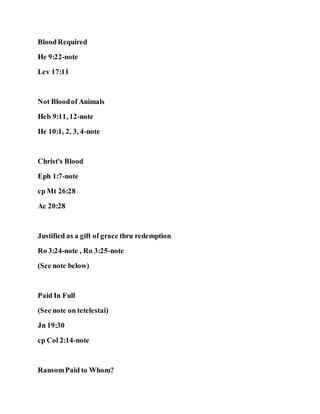
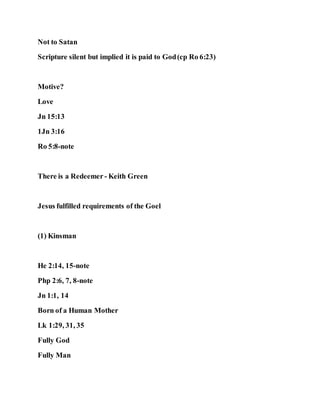
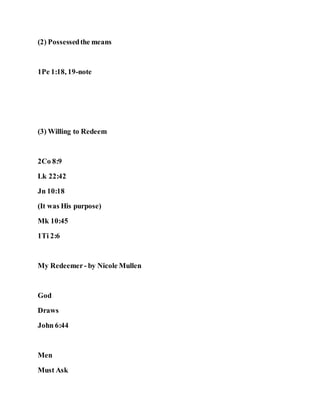
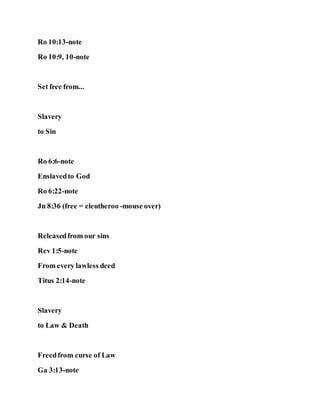
JESUS WAS OUR KINSMAN REDEEMER
EDITED BY GLENN PEASE
What is a kinsman redeemer?
kinsman redeemeraudio
Question:"What is a kinsman redeemer?"
Answer: The kinsman-redeemeris a male relative who, according to various
laws of the Pentateuch, had the privilege or responsibility to acton behalf of a
relative who was in trouble, danger, or need. The Hebrew term (go el) for
kinsman-redeemerdesignates one who delivers or rescues (Genesis 48:16;
Exodus 6:6) or redeems property or person (Leviticus 27:9–25, 25:47–55). The
kinsman who redeems or vindicates a relative is illustrated most clearlyin the
book of Ruth, where the kinsman-redeemeris Boaz.
The story of Ruth and Boazbegins when Ruth and her mother-in-law, Naomi,
return to Bethlehemfrom Moabwhere they had been living. Naomi’s
husband and both sons, one the husband of Ruth, had died, leaving the
women penniless and without a male protector. Upon arriving in Bethlehem,
Naomi sends Ruth to gleanin the fields of Boaz, a wealthy relative of Naomi to
whom they, through a series of divinely appointed circumstances, appealas
their go el. Boazacquiesces, willingly takes Ruth as his wife, and togetherthey
bear a son named Obed who became the grandfather of David, the forefather
of Jesus.
Yahweh is Israel’s Redeemer, the one who promises to defend and vindicate
them. He is both Father and Deliverer(Exodus 20:2). There are numerous
Old Testamentappeals to Godas rescuerof the weak and needy (Psalm82:4;
Daniel 6:27; Jeremiah20:13)and preserver of the sheep of Israel(Ezekiel
34:10–12,22).
In the New Testament, Christ is often regardedas an example of a kinsman-
redeemerbecause, as our brother (Hebrews 2:11), He also redeems us because
of our greatneed, one that only He cansatisfy. In Ruth 3:9, we see a beautiful
and poignant picture of the needy supplicant, unable to rescue herself,
requesting of the kinsman-redeemer that he coverher with his protection,
redeem her, and make her his wife. In the same way, the Lord Jesus Christ
bought us for Himself, out of the curse, out of our destitution; made us His
own beloved bride; and blessedus for all generations. He is the true kinsman-
redeemerof all who call on Him in faith.
The Kinsman Redeemer
Sermons Ruth 80-238 May20, 2001
A + A - RESET
There are so many ways to look at the cross, so many ways to geta
perspective on the death of Christ. I want to take what may appearto be a
somewhatdistant one, as we prepare for the Lord’s Table. Open your Bible to
the little book of Ruth. You have to go eight books into the Bible to find Ruth.
There are only two books of the Bible named for women, Ruth and Esther.
The book of Esther, we don’t know who wrote that. Could’ve been Mordecai,
someone else. The book of Ruth, we don’t know for certain, either, who wrote
it. Perhaps Samuel. He seems to fit the scene very well. But the little book of
Ruth has an important place in the history of Scripture. It is an exquisite
story.
It was written during the time of King David’s reign in Israel, which
would’ve been about 1,000 B.C. King David is mentioned in chapter 4 twice,
verses 17 and 22. It is the story of a woman calledRuth. The name Ruth
means friendship. There are many things about the story that are instructive,
but above all things, it is one of the loveliestillustrations of God’s redeeming
grace in the Scripture.
Ruth, who is the star, if you will, or the main characterof the story, was a
Moabite. And that is to say, she was of the people of a country calledMoab.
She was not an Israelite, not a Jew. She lived in Moab, which is eastof the
land of Israel, across the DeadSea in a barren desertarea. Moabwas cursed
by God and, consequently, Ruth, being a Moabitess, wasunder that curse.
Moabwas cursed by God, because Moabrejectedthe true and living God.
Moabwas an idolatrous nation, and Moabwas the perennial enemy of Israel.
That nation was constantlyhostile to the people of God and to God.
Moab was actuallyformed when Lot - you remember the brother of
Abraham - had a child (Genesis 19:37)named Moab. That child, Moab, was
born to Lot through an incestuous relationship with his oldestdaughter, the
grossestkind of human relationship. Incestbetweena father and a daughter
produced Moab. And so that nation was, in a sense, cursedfrom the very
beginning. Centuries later, the Jews sufferedopposition from one of the kings
of Moab by the name of Balak.
And were you to read Numbers 22 to 25, you would remember that Balak
wanted to curse Israel. And so he found a prophet for hire by the name of
Balaam, and he hired Balaamto pronounce some kind of supernatural curse
on Israel. Balaam, you remember, had a hard time pulling it off and finally
got a goodtalking-to from his donkey. For many years, Moaboppressed
Israelduring the period of the judges, if you read Judges chapter3, at least18
years of direct oppressionby MoabagainstIsraelduring the period of the
judges. Now, the period of the judges was before Israelhad a king - before
Saul, David, Solomon.
When Saul came along, after the Israelites had endured this oppressionat
the hands of the Moabites, Saul, the first king of Israel, dischargedone of his
first duties and that was to defeatMoab. 1 Samuel 14:47 tells about that. As a
result of Saul’s conquering, as it were, the people of Moab, when David came
to the throne, he enjoyed the resulting peacefulrelationship with the
Moabites. 1 Samuel 22 describes that. However, later, Moabreturned to
trouble Israel. We find that in 2 Kings chapter 3.
So Moab, on and off again, was troublesome to Israel. Moabwas
idolatrous, rejectedthe true God, and was generallyan enemy of Israel. And,
as I said, they had a horrible beginning, cursedfrom the very outset, because
Moabwas a child of the grossestkind of incest. Beyond that, Moabworshiped
a god by the name of Chemosh, and one of the characteristics ofworshipping
Chemoshwas child sacrifice. It was customary for those who worshiped this
god Chemoshto offer their infant children as sacrifices onan altar, burnt
offerings. First Kings chapter 11; 2 Kings chapter 3 describes that.
And it was because ofbad beginnings, it was because ofthe rejectionof the
true God, it was because ofidolatry, it was because ofchild sacrifice, because
of all of that, God pronounced a curse on Moab. Isaiahchapter 15/Isaiah
chapter 16 give us some insight into that curse. If you would look at it for just
a moment because it really sets the stage forthe story of Ruth. Isaiahchapters
15 and 16. Isaiah 15 begins the oracle concerning Moab. So here is the
pronunciation of judgment on Moabthat God gave through Isaiah, and you
have down through chapter 15 this pronouncement of judgment against
Moab.
Flow down, if you will, through the entire text to chapter 16 and verse 13,
and this kind of sums it up. This is the Word which the Lord spoke earlier
concerning Moab. But now the Lord speaks, saying - in other words, what has
just been given in chapters 15 and 16 is the earlierjudgment againstMoab,
but now the Lord has something else to say. Verse 14, “Within three years, as
a hired man would count them, the glory of Moabwill be degradedalong with
all its greatpopulation, and his remnant will be very small and impotent.”
The prophet said, “God is going to give you three more years, and that’s the
end.”
Three more years would take the life of Moabto about 715 B.C., so it’s
about 300 years after David. And what happened three years after Isaiah’s
prophecy was that the Assyrian king, by the name of Sargon, came into Moab
and absolutelydestroyed that nation, killing people, conquering the nation,
leaving only a small - as verse 14 says, only a small and impotent or feeble
remnant. Judgment of devastating proportions fell on Moab, leaving just a
small group of people remaining.
In the forty-eighth chapter of Jeremiah, again, Jeremiah the prophet
because ofMoab’s incessantrejectionof the true God and wickednessalso
was used by God to pronounce judgment. And it’s a quite fascinating
judgment. Jeremiah48, verse 11. And it says in verse 11, “Moabhas been at
ease since his youth.” And what the prophet is saying here is Moabhas had it
pretty well. Since the very beginning, Moabhas lived a fairly comfortable life.
It was only Saul who really brought a serious conquering, and then he didn’t
destroy the nation, he allowedthem to continue their life, and there was a
certain amount of prosperity and peace there.
And that had gone on since the time of Saul, who predates David, so for at
least300 years until the judgment of Sargoncame, they’d had it pretty well.
They had been - verse 11 says - undisturbed, hadn’t been emptied from vessel
to vessel. Thatis to say, when they made wine, they would put wine in a skin.
And the way you produced pure, sweetwine was to pour it in a skin, new skin,
and it would ferment, producing expansionbecause ofthe gas.
And what happens in a period of time is the dregs, the bitter goes to the
bottom, and the sweeterpartof the juice remains on the top. So after a certain
period of time, you pour out that top part, the sweetpart, into another skin,
and the process continues, and a little more dregs will appear in the bottom,
and you do it againat a later time, and finally, no dregs remain. The dregs
that do remain are what we call the dregs and were used to produce sour,
bitter vinegar. But you kept doing that and doing that and doing that until
you gota pure, sweetwine.
And that is a metaphor or a picture of going through trouble and trouble
and trouble and trouble, and trouble has the ability to drain out all the
bitterness of life, to leave you sweetenedby triumphing over trouble. They
hadn’t had trouble, and so they had never been poured from vesselto vessel.
They had never gone into exile. Therefore, they had retained sort of their
original bitter flavor, and their aroma had never become really sweetlike
wine that’s been poured from vesselto vessel. Becausethat had never
happened, they had continued in their idolatry. Nothing had ever been
challenged.
And so, “Therefore, behold, the days are coming,” declares the Lord,
“when I will send to him who tip vessels, and they will tip him overand empty
his vesselsand shatter his jars. And Moab will be ashamedof Chemosh” -
that’s the god they worshiped - “as the house of Israelwas ashamedof Bethel,
their confidence.” There’s going to come a judgment, Jeremiah says, serious
judgment.
If you go overin the same chapter to verse 42, it says Moabwill be
destroyedfrom being a people because he has become arroganttoward the
Lord. “‘Terror, pit, and snare are coming upon you, O inhabitant of Moab,’
declares the Lord.” So again, Jeremiahaddresses judgment. If we had time,
we could read the twenty-fifth chapter of Ezekiel. Ezekiel25, verses 8 to 11. In
that section, the Lord says, “I’m going to execute judgments on Moab, and
they will know that I am the Lord, finally.”
And I think most interesting is Amos chapter 2, verse 1, “Forthus saith the
Lord, ‘For three transgressions ofMoaband for four, I will not revoke its
punishment because he burned the bones of the king of Edom to lime. So I will
send fire upon Moab, and it will consume the citadels of Kerioth. And Moab
will die amid tumult, with warcries and the sound of a trumpet. I will also cut
off the judge from her midst and slay all her princes with him,’ says the
Lord.” Here againis the fourth prophet that says there’s going to come a
deadly, devastating judgment on this cursedpeople.
Now let’s go back, all the way back to Deuteronomy chapter 23. Back in
Deuteronomy chapter23, we have here a summation, really, of the curse on
Moab. “No Ammonite or Moabite shall enter the assemblyof the Lord. None
of their descendants, evento the tenth generation, shallever enter the
assemblyof the Lord.” And in this case, it wasn’tjust their idolatry, wasn’t
just their sin, wasn’t just their rejection of God, it was the fact that they’d
never helped the people of Israel. So because ofall of these things, the curse
was that none of them would ever be allowed to enter the assemblyof Israel;
that is, none of them would ever come inside the covenant.
In Nehemiah, much later when the people had been in captivity, come back
from captivity, they pickedup the book of Moses -Nehemiah 13 - they turned
to Deuteronomy 23. They read aloud from the book of Moses. There was
found written in that no Ammonite or Moabite shall ever enter the assembly
of God - ever - because they didn’t meet the sons of Israelwith bread and
water. They hired Balaamagainto curse them. And so they were a cursed
people, and the curse was nobody from that country is ever going to enter the
assemblyof God. Moabites, then, are symbolic of cursedsinners, alienated
from God.
Let’s go back to Ruth. Ruth was a Moabitess.This is a problem. The story
takes place, not in the time of David, it was written in the time of David, but it
takes place in the time of the judges. Probably during the judgeship of a man
named Jair, J-A-I-R, according to Judges chapter 10, before the time of Saul
and David. It’s the time of the judges. It’s the time when the curse on Moab is
in force. It was always in force until the destruction of that nation -
specifically, the curse said, to the tenth generation. Interestinglyenough, some
scholars have calculated that Ruth was a member of generationnumber
eleven.
It is also possible that the tenth generationwas just a sort of a simile for
permanently. Becausein the repetition of the curse in Nehemiah 13, the tenth
generationis not mentioned, and the curse there appears to be permanent.
Whether or not Ruth was a member of the eleventh generation, and you take
it specifically, or you take it sortof generically, meaning permanently, is sort
of unprovable either way.
But the point is I lean towardthe forever characterofthe curse rather than
simply the actual ten generations becauseit’s not repeatedin Nehemiah13.
Moabite people were, by God, shut out from the assembly of those who
worshiped Him. Shut out, as it were, from redemption because oftheir
iniquities.
Turn to Isaiah56. I’m taking a long time to getto the point, but the point’s
going to be goodwhen I get there. Isaiah 56, verse 1. Prophet writes, “Thus
says the Lord:” - this is from God - “‘Preserve justice and do righteousness,
for my salvationis about to come and my righteousnessto be revealed. How
blessedis the man who does this, and the son of man who takes hold of it, who
keeps from profaning the Sabbath, keeps his hand from doing any evil.’ Let
not the foreignerwho has joined himself to the Lord say, ‘The Lord will
surely separate me from His people.’Neither let the eunuch say, ‘Behold, I am
a dry tree.’”
Boy, verse 3 introduces a brand new thought. “Let not the foreignerwho
has joined himself to the Lord say, ‘The Lord will surely separate me from
His people.’” Godhad said no Moabite, no Ammonite, but something’s
different here: Let not the foreignerthink that he can’t be joined to the Lord.
Verse 4, “Forthus says the Lord, ‘Eunuchs who are also cursedwho keepmy
Sabbaths and choose whatpleases me and hold fast my covenant, to them I
will give in my house and within my walls a memorial and a name better than
that of sons and daughters; I will give them an everlasting name which will
not be cut off.”
Now, there is an interesting double meaning. Eunuch, by definition, had
something cut off, but “I will not cut them off.” In verse 6, “Also the
foreigners who join themselves to the Lord, to minister to Him, and to love the
name of the Lord, to be His servants, everyone who keeps from profaning the
Sabbath and holds fast my covenant, even those I will bring to my holy
mountain and make them joyful in my house of prayer. Their burnt offerings
and their sacrificeswill be acceptable onmy altar; for my house will be called
a house of prayer for” - what? - “all the peoples.” Wow.
So the curse is only in place until a foreignerand a cursed person, alienated
from and separatedfrom God, turns to God, joins himself to the Lord, holds
fast the covenant, observes the Sabbath, and does what pleases God. Curse,
then, is only in place unless there’s a turning to Him.
We’ll go back to Ruth now, find ourselves in the book of Ruth in Moab. It
was “in the days” - verse 1 says of chapter 1 - “when judges governed, and
there was a famine in Israel.” So there was a certain man who lived in
Bethlehem, in Judah, went to sojourn in the land of Moabwith his wife and
two sons. Took his wife, two sons, went to Moabbecause he wanted some food.
There was a famine in Israel. The man’s name was Elimelech. Name of his
wife was Naomi, and his two sons were Mahlon and Chilion, and they were
from Bethlehem in Judah. “They entered the land of Moab, and they
remained there.”
Then, you know the story, Elimelech, Naomi’s husband, died. She was left
two boys, and they took two Moabite women as wives, one named Orpah and
the other, Ruth. They lived there about ten years. So here we meet Ruth. She’s
a Moabite. She married an Israelite man who had come with his whole family
to Moab due to severe famine in Israel. He was from Bethlehem. After ten
years of marriage, the husband dies, brother dies, and the father has already
died. Verse 5, Mahlonand Chilion died, and now there aren’t any men.
There’s just three widows. The mother-in-law, Naomi, and two widowed
daughter-in-laws, Orpah and Ruth.
Now, Naomi says, “I’m going to go back to Israel and you girls should stay
here.” That’s when the story gets interesting. “She arose with her daughters-
in-law” - verse 6 - “that she might return from the land of Moab. She had
heard in the land of Moab that the Lord had visited His people and given
them food. There was food back there. She was going back. Naomi said to her
two daughter-in-laws, in verse 8, “Go, and return to your own mother’s
house.” Go back to your home, your parents will take care of you.
“May the Lord deal kindly with you as you have dealt with the dead and
with me. May the Lord grant you that you may find rest, eachin the house of
her husband” - I mean the husband’s house would then take care of the
widow. She kissedthem. “They lifted up their voices and wept.” There was
real love among these women, and they said to her, “No, but we will surely
return with you to your people.” Naomi said, “Return, my daughters. Why
should you go with me? Have I yet sons in my womb that they may be your
husbands?” (Like, “I can’t help you - I don’t have any more sons.”)
“Return, my daughters. Go, for I am too old to have a husband. If I said I
have hope, if I should even have a husband tonight and also bear sons, would
you therefore wait until they were grown? No, there’s no hope with me. Just
go on.” Verse 14, they lifted up their voices, weptagain. Orpah kissedher
mother-in-law, but Ruth clung to her. And then she said, “Behold, your sister-
in-law has gone back to her people and her gods. Return after your sister-in-
law.” That’s very important. Orpah went back to her family and also her
what? Her gods.
But the implication here is that Ruth was interestedin the true and living
God, the God of her husband, her mother-in-law, and her father-in-law, and
brother-in-law. So in verse 16, “Ruth said, ‘Do not urge me to leave you or
turn back from following you. For where you go, I will go, and where you
lodge, I will lodge. Your people shall be my people, and your God, my God.’”
That’s the testimony of Ruth’s conversion, isn’t it? At leasther interest in the
true God. “Where you die, I will die, and there will I be buried.” That is a
very familiar portion of Scripture often read at weddings. “Thus may the
Lord do to me and worse if anything but death parts you and me.”
And she went. Verse 19, “Theywent until they came to Bethlehem,” and
there they were in Bethlehem. Two widows. She choosesto go with Naomi.
After a ten-year stay in Moab, they come back in a societywhere widows were
often ignored, especiallythose who were from Moab. And these two needed
support. She was a cursed woman, Ruth, a Moabite, the enemy.
Providentially, by the way, when they got back there, it was the time of the
barley harvest, and one of the provisions of the Old Testamentlaw was that,
during the harvest, poor people could glean. What that really meant was they
could go behind the harvesters and pick up what the harvesters dropped or
what the harvestdidn’t cut, they could cut. What fell off the wagon, they
could pick up. And Ruth agreedto go gleaning in the field. The end of verse
22, “Theycame to Bethlehem at the beginning of the barley harvest.”
And I think you know the story from there. Ruth goes out to glean, and she
winds up in a field that belongs to a man named Boaz. If you go down to verse
3 in chapter 2, “She departed, went and gleanedin the field after the reapers.”
She would follow the reapers and pick up what they dropped. She happened
to come to the portion of the field belonging to Boaz - look at this - who was of
the family of Elimelech. She had already decided she wanted to follow the true
God, and so there she was, destitute in the land, a foreigner, an enemy, cursed.
“Boazcame and said to the reapers, ‘May the Lord be with you.’ And they
said to him, ‘May the Lord bless you.’” And that’s just a little insight into the
kind of man he was, who had such a kindness and such a spiritual attitude
toward those who did his work. “Boazsaidto his servant who was in charge of
the reapers, ‘Whose young woman is this? I don’t recognize her.’ The servant
in charge of the reapers answeredand said, ‘She’s the young Moabite woman
who returned with Naomi from the land of Moab.’ And she said, “Pleaselet
me gleanand gatherafter the reapers among the sheaves.”’”She really didn’t
have a right to do it, I guess, in one sense, becauseshe wasn’tan Israelite.
“She came and has remained from morning until now.” She has been
sitting in the house for a little while. She’s just waiting for permission to do
what she needs to do. “Boazsaid to Ruth, ‘Listen carefully, my daughter. Do
not go to gleanin another field; furthermore, do not go on from this one, but
stay here with my maids.’” You stay right here, and you work right here.
“‘Let your eyes be on the field which they reap, and go after them. Indeed, I
have commanded the servants not to touch you. When you are thirsty, go to
the waterjars and drink from what the servants draw. You have all the
privileges of gleaning in my field.’
“And she fell on her face, bowing to the ground and said to him, ‘Why have
I found favor in your sight that you should take notice of me, since I’m a
foreigner?’Boazansweredand said to her, ‘All that you have done for your
mother-in-law after the death of your husband has been fully reported to me,
and how you left your father and your mother and the land of your birth, and
you came to a people that you didn’t previously know. May the Lord reward
your work, and your wagesbe full from the Lord, the God of Israel, under
whose wings you have come to seek refuge.’”
Isn’t that great? This was a spiritual decisionon her part. She came to be
under the wings of the true and living God, the Lord God of Israel. “At
mealtime, Boazsaid to her, ‘Come here, that you may eat of the bread and dip
the piece of bread in the vinegar.’ So she satbeside the reapers;and he served
her roastedgrain, and she ate and was satisfiedand had some left.” Now, this
guy’s really a kind man and generous. “Whenshe rose to glean, Boaz
commanded his servants, saying, ‘Let her gleaneven among the sheaves, and
do not insult her.’” Let her go where you’re not supposed to go.
“‘Let her go right into the sheaves whenyou gatherthe sheaves andpull
out anything she wants.’” That was not part of the deal. “So she gleanedin the
field until evening.” - verse 17 - “She beat out what she had gleaned” - that
was the process ofgetting the grain out - “and it was about an ephah of
barley. And she took it and went up to the city, and her mother-in-law saw
what she had gleaned. She also took it out and gave Naomi what she had after
she was satisfied.
“Her mother-in-law said to her, ‘Where did you gleanand where did you
work?’” - and, of course, she says - “‘The man’s name was Boaz.’And Naomi
said to her daughter-in-law, ‘May he be blessedto the Lord who has not
withdrawn his kindness to the living and to the dead.’ And Naomi said to her,
‘The man is our relative.’” Wow. This is an amazing coincidence. He happens
to be a relative. “‘He is one of our closestrelatives.’”
Is that important? Oh, it’s very important because there was, in the law of
Israel, a principle called the kinsman redeemer. When someone was widowed,
it was the responsibility of an unmarried man in the family to take her as his
bride so that she was not destitute. Rather than take another womanout of a
family, that family already should take care of its own, and so the law of what
was calledlevirate marriage, kinsman marriage, was that the nearest
unmarried man would take the widow for his own bride so that she might not
be left destitute. Well, Naomi thinks this is a great possibility.
So you remember the story in chapter 3, verse 1, “Naomisaid to her, ‘My
daughter, shall I not seek securityfor you, that it may be well with you?’” I
want to work this deal out for you. This is an ancient NearEasterncustom.
Since Boazwas older by a generation, he would not ask her. That’s not what
was done. She would have to make an overture to him.
So verse 3, “‘Washyourself, anoint yourself.’” What’s that? You know,
cleanup and put on some perfume. “‘Put on your best clothes. Go down to the
threshing floor. But don’t make yourself known to the man until he’s finished
eating and drinking, his meal is over. When he lies down, you shall notice the
place where he lies. You shall go and uncover his feetand lie down.’” You say,
“Thatis strange.” Itis strange. It was an old NearEasterncustom. Boaz
would not, being older by a generation, approachher.
He showedtremendous kindness, but he would not have initiated a
proposal. But this is the way a woman could very gracefullyinitiate a proposal
to a man. And so, with no breach of her moral virtue, “In the middle of the
night, the man was startled, bent forward, and behold, a woman was lying at
his feet. He said, ‘Who are you?’ She said, ‘I’m Ruth, your maid. So please,
sir, spread your covering over you maid, for you’re a close relative.’” What’s
she’s saying is, “Marry me.”
Men, I know you would dream that this will happen, but it won’t. It is an
ancient NearEasterncustom. “Marry me.” “And he said,” - what a kind man
- “‘Mayyou blessedof the Lord, my daughter. You have shownyour last
kindness to be better than the first by not going after young men, whether
poor or rich.’” She could’ve gone after a young man, maybe more attractive.
Maybe promising a longer life together. But she knew levirate marriage, and
she knew that this was what the people of Israeldid, and she wantedto
conform to what they did.
And he had so much integrity, he says, “Now, my daughter, do not fear. I
will do for you whatever you ask, for all my people in the city know that you
are a womanof excellence.”She had alreadygarnered a reputation as a
virtuous woman, and now it’s time - “It’s true,” he said, “I am a close relative;
however, there is a relative closerthan I am.” This is how much integrity he
has. He says, you know, there’s somebodywho’s a closerrelative who has the
first right of refusal on the deal. We got to find this guy.
So they do. “Remainthis night” - verse 13 - “and when the morning comes,
if he will redeem you, good.” Oh, here’s a new word. The word what?
Redeem. “If he doesn’t want to redeemyou, I’ll redeem you. Just go to sleep
until morning.” You know what the act of redemption is? Buying someone for
your own personalpossession. “Soshe lay at his feet until morning and rose
before one could recognize another” - that’s in the dark, in case you didn’t
know. “And he said, ‘Let it not be known that the woman came to the
threshing floor.’” Just go away. Don’t say anything about this.
“And he said, ‘Give me the cloak that is on you and hold it.’ So she held it,
and he measured six measures of barley and laid it on her.” Some translations
say six ephahs. That would be ridiculous. She couldn’t carry 200 pounds.
Probably seahs, which would be 60 to 75 pounds. He loaded her up. She went
into the city. This was like goodfaith, you know? She’s coming in, and she’s
got this blanket full of 75 pounds of grain, and her mother-in-law says, “Well,
how did it go?” It went really well. Yeah, I think it did, didn’t it?
So in chapter 4, Boazgoes into the town to find the guy who’s the nearest
relative because that’s appropriate to do that, and the first six verses of
chapter 4 tell the story that the nearestrelative won’t redeem her. He won’t
do it. The end of verse 6, he says to Boaz, “Redeemfor yourself. You may
have my right of redemption, for I can’t redeem. Now, this was the custom -
verse 7 - in former times in Israel concerning the redemption and how it was
to be done. There’s a little exchange of a sandaland so forth and so on. Verse
8, “The closestrelative said to Boaz, ‘Buy it for yourself.’ And he removed his
sandal.
“Boazsaid to the elders and all the people, ‘You are witness today that I
have bought from the hand of Naomiall that belongedto Elimelech.’” He had
purchased all the land that belonged to Elimelech, which provided all kinds of
money resource forNaomi, the widow. “All that belongedto Chilion. All that
belongedto Mahlon. I’ve bought it all. Paid for it. I have also acquired Ruth,
the Moabitess, the widow of Mahlon, to be my wife in order to raise up the
name of the deceasedon his inheritance, so that the name of the deceasedmay
not be cut off from his brothers or from the court of his birth place. You are
witnesses today.”
And so he purchases the Moabite woman. Look at verse 13. “So Boaztook
Ruth, and she became his wife, and he went in to her. And the Lord enabled
her to conceive, andshe gave birth to a son.” Wow. “Thenthe women said to
Naomi, ‘Blessedis the Lord who has not left you without a redeemer. May his
name become famous in Israel. May he also be to you a restorerof life and a
sustainerof your old age, for your daughter-in-law, who loves you and is
better to you than seven sons, has given birth to him.’ And Naomi took the
child and laid him in her lap and became his nurse.
“The neighbor womengave him a name, saying, ‘A sonhas been born to
Naomi.’So they named him Obed. He was the father of Jesse, who was the
father of” - whom? - “David.” Wow. This cursed Moabite was the great-
grandmother of David. If you read Matthew 1, you’re going along through the
genealogy, you’ll come to verse 5, Ruth. How did a cursed Moabite getinto the
line of Messiah? Answer:Because Godprovided for her a redeemer. Boazis a
picture of our kinsman redeemer. The Lord Jesus Christ, who bought us for
Himself, out of the curse, out of our destitution, made us His own beloved
bride and blesses us for all generations.
When you come to the Gospelof Luke, as we remember, in chapter 2, verse
38, there were a group of people in Israelwho were waiting for the
redemption. Rememberthat? They were waiting for the Redeemer, and they
were not disappointed. But when Jesus came, Hebrews 9:12 says, “He brought
eternal redemption.” Those who sought to know the true God - those who seek
to know the true God - are redeemed by the Lord Jesus Christ, who paid the
price in full to make us His purchased possession, His eternal bride, to which
He for all eternity pours out blessing. Join me in prayer.
Father, as we come to the Lord’s Table, we remember the Lord, our
Redeemer. We remember that He paid the price of our redemption on the
cross. Thatprice, not like Boazpaid. Boazpaid out of his substance;Christ
paid with His ownlife, His own blood. And He purchaseda bride, cursed,
doomed to judgment, but bought with a price. Not silver and gold but the
precious blood of a Lamb without blemish and without spot.
This is the cross where our kinsman Redeemer, one of us, in the likeness of
a man, paid the full price to redeem us from the curse and take us out of our
spiritual poverty and bankruptcy and bring us into eternal blessing. And so,
as we come to the cross, maywe meet againwith hearts filled with gratitude,
our Redeemer.
Kinsman-Redeemer
Bible / Our Library / Bible Dictionaries / Quick Reference Dictionary/
Kinsman-Redeemer
Share Tweet Save
Bible Dictionaries - Baker's EvangelicalDictionaryof Biblical Theology -
Kinsman-Redeemer
Kinsman-Redeemer
Male relative who, according to various laws found in the Pentateuch, had the
privilege or responsibility to act for a relative who was in trouble, danger, or
need of vindication.
Although the term "kinsman-redeemer" is used only seventimes in the NIV
(all in the Book of Ruth) and "avengerof blood" is used twelve times, the
Hebrew verb ga'al[l;a"G],from which both of these terms are translated, is
used over 100 times and rendered by such additional terms as "redeemer" or
"nearrelative." The Hebrew term designates a male relative who delivers or
rescues ( Gen 48:16 ; Exod 6:6 ); redeems property ( Lev27:9-25 ) or person(
Lev 25:47-55 );avenges the murder of a relative as a guiltless executioner(
Num 35:9-34 ); and receives restitutionfor wrong done to a relative who has
since died ( Num 5:8 ). The unique emphasis of the
redemption/salvation/vindication associatedwith the kinsman-redeemeris the
fact that this action is carried out by a kinsman on behalf of a near relative in
need. This idea is most clearlyillustrated in the Book ofRuth.
God is Israel's Redeemer, the one who will defend and vindicate them. The
idea that God is a kinsman to Israelcan be defended by those passagesof
Scripture that identify him as Israel's Creatorand Father( Exod 4:22-23 ;
Deut 32:6 ),Deliverer( Exod 20:2 ),ownerof the land ( Lev25:23 ), the one who
hears innocent blood crying out for vengeance ( Deut 19:10 ; 21:6-9 ), and the
King who has made his covenant with the people ( Exod 6:2-8 ). David, in his
use of the term ( Psalm 19:14 ; 103:4 ), doubtless has in mind the actions of his
great-grandfatherBoaz( Ruth 4:9-10 ).
In the psalms Godoften redeems in the sense of rescuing from danger. In Job
19:25 the term "redeemer" in context refers to God who, as friend and
kinsman of Job, through faith will ultimately defend and vindicate him. The
same idea of vindication (this time with the term translated"Defender")is
used in Proverbs 23:11.
Although the doctrine of redemption from sin is taught extensivelyin the New
Testament, it is not connectedcloselywith the Old Testamentconceptof
kinsman-redeemer. Christ can, however, be regardedas an example of a
kinsman-redeemersince he identified himself with us and redeemedus
because ofour need. Hebrews 2:11 states that "Boththe one who makes men
holy and those who are made holy are of the same family. So Jesus is not
ashamedto call them brothers." Jesus is not only our redeemerfrom sin, but
as Hebrews 2:16-18 and 4:14-16 point out, he is a kinsman to us and
understands our struggles. Thus he is able to help us in our times of need.
Stephen J. Bramer
JESUS, OUR KINSMAN REDEEMER
By Dr. Kenneth C. Kemble
PostOffice Box 5204,
Uvalde,
Texas 78802-5204
Tabernacles,this is the time of year when many Christians remember the
birth of our Lord Jesus Christ and praise Him or His goodness towards us, in
that while we were yet sinners, He came to this earth in order that He might
redeem us, His people.
According to Leviticus 25:47-49, if a man lost everything that he had through
some greatmisfortune and had to sellhimself as a slave, he could redeem
himself-but if he didn’t have the price necessaryto redeem himself, he could
only be redeemed by a near kinsman. This was calledthe kinsman-
redemption, and it dealt with the redemption of persons and inheritance.
As a people, we have found ourselves in the same predicament spokenof in
this passagein Leviticus- except our situation is worse, becausethe stakes are
much higher! Ours is one of eternal consequence!We are a fallen people, and
have been sold as slaves under sin (Romans 7:14; 3:23; Isaiah53:6)!
According to God’s Law, we may redeem ourselves­we just have to have the
price necessaryto do it. The problem is, that price is sinless perfection, and
any attempt that you or I might make to pay this price would come back
marked insufficient funds! That means the only way out of our bondage , and
the only hope for the regenerationofour souls and the restorationof our lost
inheritance, is for one of our kinsmen to redeem us.
But in the kinsman-redemption, all of the following requirements had to be
met in order for redemption to be secured:
First, the redeemer must be a near kinsman (related by flesh and blood). This
could really be anyone-a father, an uncle, a brother, a cousin. But God knew
that none of the above had the price required. We have all sinned-none of us
are without blemish-so He “kinned” himself to us, by donning flesh and blood.
He was born of the virgin Mary, who was an Israelite of the tribe of Judah.
Thus, our Godbecame one of us, our own flesh and blood-and in doing so, He
made Himself eligible to become our kinsman-redeemer!That’s the whole
reasonfor the manger! He made Himself our kinsman. He met the
requirement!
Secondly, the kinsman-redeemermust have the price required . That price, as
has been stated, is sinless perfection. Our Lord Jesus Christis the only one in
all of history who was absolutely flawless in regardto God’s Law. He was
tempted in all points like we are, yet without sin (Hebrews 4:15). He met the
requirement!
Thirdly, the kinsman-redeemer must be willing to pay the price required.
Having the price required was not enough. That price-that sinless life-had to
be given willingly for the redemption. But was Christ willing to lay down His
own sinless life in order to redeemus lowly, pitiful sinners?
As stated earlier, the stakeswere high. It was much more than paying off all
our debts.
It was more like sitting in the electric chair in our stead, but even that
example is mild! God stepped into flesh and blood to kin Himself to us, and
He had the price required . . . now He had to be willing to pay that price. But
was He willing?
To His everlasting praise, He was indeed willing to pay the price (Ruth 4:4-10;
Matthew 26:39,42;Hebrews 12:2)! Hallelujah! He met the requirement!
Lastly, all of the above requirements having been met, He must now actually
pay the price of redemption. Our Lord did this on the cross!As the song says,
“He paid a debt He did not owe, I oweda debt I could not pay!” He has
exchangedHis sinlessnessfor our sinfulness, and has paid the price for our
redemption in FULL (Isaiah53:5; Romans 3:24-6, 5:8; 2 Corinthians 5:21; 1
Peter1:18- 21)! Bless His Holy Name!He met the requirement! He met all of
the requirements! Our Lord Jesus Christ, our near kinsman, has redeemed
us!
“Forscarcelyfor a righteous man will one die: yet peradventure for a good
man some would evendare to die. But God commendeth his love toward us, in
that, while we were yet sinners, Christ died for us.”
The principle of the kinsman-redeemeris the main theme of the Old
Testamentbook of Ruth. Just as Boazredeemed Ruth, our Lord Jesus Christ
has redeemedus! But more than that-as if that weren’t enough-just as Boaz
took Ruth to wife, our Lord Jesus Christhas takenus to be His Bride!
Hallelujah! The redemption has been obtained, and we have been betrothed to
our kinsman-redeemer!Glory to Godand the Lamb forever!
So, whether you remember Christ’s birth at the fall feasts or in December, or
both, make that time of remembrance a celebrationof rejoicing in your
salvation!Because He could have never gone to the cross if He hadn’t first
gone to the manger and kinned Himself with us!
“Blessedbe the Lord God of Israel; for he hath visited and redeemed his
people, and hath raisedup an horn of salvationfor us in the house of his
servant David”.
AMEN.
The Kinsman Redeemer
The kinsman redeemeris an important, but little-understood conceptin
scripture. It is actually connectedto a very important question in Revelation5
that should be of greatinterest to us. This is page one of a series of three pages
on this topic.
I have heard it said that the two most important questions in the book of
Revelationare:
"... Who is worthy to open the book ...? (Rev 5:2)
and
"... who shall be able to stand? (Rev 6:17)
That the first of these questions is important in the setting of Revelation5 is
testified to by the greatinterest and emotion with which John regarded the
matter.
"And no man in heaven, nor in earth, neither under the earth, was able to
open the book, neither to look thereon. And I wept much, because no man was
found worthy to open and to read the book, neither to look thereon." (Rev
5:3-4)
But, you ask, how is the book in Revelation5 connectedto the conceptof the
kinsman redeemer? Well, let's first get some backgroundfrom scripture on
what the kinsman redeemeris all about.
Jeremiah
During a time of national crisis, a messagecame to Jeremiah:
"The word that came to Jeremiahfrom the LORD in the tenth year of
Zedekiahking of Judah, which was the eighteenth year of Nebuchadrezzar.
For then the king of Babylon's army besiegedJerusalem:and Jeremiahthe
prophet was shut up in the court of the prison, which was in the king of
Judah's house." (Jer32:1-2)
This "the tenth year of Zedekiah king of Judah" was 588/587 BC and it was in
the midst of the final siege ofJerusalemby Nebuchadnezzar, the king of
Babylon. Jeremiahhad earlierpredicted that the Babylonians would invade
Israel. However, Jeremiahand his words of prophecy were rejected;this is
partly why he is calledthe weeping prophet. Jeremiah was in prison for
making his predictions while they were actually coming true - talk about
rejection!While this was going on, he receivedthis messagefrom God:
"... Behold, Hanameel the sonof Shallum thine uncle shall come unto thee,
saying, Buy thee my field that is in Anathoth: for the right of redemption is
thine to buy it. So Hanameel mine uncle's soncame to me in the court of the
prison according to the word of the LORD, and said unto me, Buy my field, I
pray thee, that is in Anathoth, which is in the country of Benjamin: for the
right of inheritance is thine, and the redemption is thine; buy it for thyself.
Then I knew that this was the word of the LORD." (Jer 32:6-8)
Remember the circumstances - the whole land just been invaded. Great
calamity has fallen upon the people. Their rights and freedom are being
restricted. Many were being carriedaway as captives to a foreign country.
Jeremiahhimself had predicted that the Babylonian captivity would last for
70 years. Why would anyone in a situation like that think about buying land?
We would think it more appropriate to liquidate assets andbe ready to move
if there was opportunity. So why this directive from God for Jeremiah to buy
land - occupiedland?
Here is more detail of what Jeremiahwas to do:
"Thus saith the LORD of hosts, the God of Israel;Take these evidences, this
evidence of the purchase, both which is sealed, and this evidence which is
open; and put them in an earthen vessel, that they may continue many days.
For thus saith the LORD of hosts, the God of Israel;Houses and fields and
vineyards shall be possessedagainin this land." (Jer32:14-15)
Why in an earthen vessel? "Thatthey may continue many days" - perhaps
that they might last till after the 70 years. This seemingly inappropriate action
of buying the land was, in fact, to back up God's promise that the captivity
would end and things would return to normal.
"Forthus saith the LORD;Like as I have brought all this greatevil upon this
people, so will I bring upon them all the good that I have promised them. And
fields shall be bought in this land, whereofye say, It is desolate without man
or beast; it is given into the hand of the Chaldeans. Men shall buy fields for
money, and subscribe evidences, and sealthem, and take witnesses in the land
of Benjamin, and in the places about Jerusalem, and in the cities of Judah,
and in the cities of the mountains, and in the cities of the valley, and in the
cities of the south: for I will cause their captivity to return, saith the LORD."
(Jer 32:42-44)
Jeremiah's purchase of land would be evidence of his own faith in God's
messagegiventhrough him. Even though Jeremiahwas in Jerusalemat the
time, the Lord also mentioned the territory of Benjamin because that is where
the particular land in question was located. But what is this about Jeremiah
having the right of redemption to buy the land? We need to understand
something about ownership of land in Israel.
How IsraelDealt With Land
"And the LORD spake unto Moses in mount Sinai, saying, Speak unto the
children of Israel, and say unto them, When ye come into the land which I
give you, then shall the land keepa sabbath unto the LORD. Six years thou
shalt sow thy field, and six years thou shalt prune thy vineyard, and gather in
the fruit thereof;But in the seventh year shall be a sabbath of rest unto the
land, a sabbath for the LORD: thou shalt neither sow thy field, nor prune thy
vineyard." (Lev 25:1-4)
"And thou shalt number seven sabbaths of years unto thee, seventimes seven
years;and the space ofthe sevensabbaths of years shall be unto thee forty
and nine years. Then shalt thou cause the trumpet of the jubile to sound on
the tenth day of the seventh month, in the day of atonement shall ye make the
trumpet sound throughout all your land. And ye shall hallow the fiftieth year,
and proclaim liberty throughout all the land unto all the inhabitants thereof:
it shall be a jubile unto you; and ye shall return every man unto his
possession, andye shall return every man unto his family. A jubile shall that
fiftieth year be unto you: ye shall not sow, neither reap that which growethof
itself in it, nor gatherthe grapes in it of thy vine undressed. Forit is the jubile;
it shall be holy unto you: ye shall eatthe increase thereofout of the field. In
the yearof this jubile ye shall return every man unto his possession. (Lev 25:8-
13)
This was God's appointed means of keeping land within a family to help avoid
poverty or excess riches. Here are more details:
"If thy brother be waxen poor, and hath sold awaysome of his possession, and
if any of his kin come to redeemit, then shall he redeem that which his
brother sold. And if the man have none to redeem it, and himself be able to
redeem it; Then let him count the years of the sale thereof, and restore the
overplus unto the man to whom he sold it; that he may return unto his
possession. Butif he be not able to restore it to him, then that which is sold
shall remain in the hand of him that hath bought it until the year of jubile:
and in the jubile it shall go out, and he shall return unto his possession. And if
a man sell a dwelling house in a walled city, then he may redeem it within a
whole year after it is sold; within a full year may he redeem it. And if it be not
redeemedwithin the space ofa full year, then the house that is in the walled
city shall be establishedfor ever to him that bought it throughout his
generations:it shall not go out in the jubile." (Lev 25:25-30)
So if a family had to sell land, the price would be dependent upon how many
years the purchasercould expectto gain a return from the use of the land
until it returned to the owner in the year of Jubilee. Essentially, it was a lease
arrangement.
Jeremiah's Purchase
"And I bought the field of Hanameelmy uncle's son, that was in Anathoth,
and weighedhim the money, even seventeenshekels ofsilver. And I
subscribed the evidence, and sealedit, and took witnesses,and weighedhim
the money in the balances. So I took the evidence of the purchase, both that
which was sealedaccording to the law and custom, and that which was open:
And I gave the evidence of the purchase unto Baruchthe son of Neriah, the
son of Maaseiah, in the sight of Hanameel mine uncle's son, and in the
presence ofthe witnesses thatsubscribed the book of the purchase, before all
the Jews thatsat in the court of the prison." (Jer 32:9-12)
In Jeremiah's case, he bought the land, the documentation was signed,
witnessed, sealedand securelystored. After the 70 years captivity the scroll
(the purchase deed) would provide evidence of who was the rightful owner of
the land and it could be restoredto Jeremiah or his estate. Note that
Jeremiah's ministry started when he was a young man (Jer 1:6-7) and lasted
about 40 years to about the time of the fall of Jerusalemto the Babylonians
(about 626 BC to 586 BC). Then he was takento Egypt (Jer 43:6) and
probably died there.
Is it possible that the situation John was looking at also had to do with
ownership/possessionofland? John would have been familiar with land
transactions in Jewishculture and the conceptof the kinsman redeemer. I
think the book John is speaking of in Revelationmay be just such a scroll - it
involves seals and witnessesand, if that is true, would containevidence of who
has land rights to the whole earth - that would make it important not just to
John but to us as well. If no one can open the scroll, no one would know who is
the rightful owner of the land, this earth. That would be of concernto John.
The next page, the story of Ruth and Boazwill add another dimension to this
comparisonbetweenthe kinsman redeemerand the book of Revelation5.
Ruth and Boaz
The story of Ruth and Boaz, Naomiand her husband Elimelech and their sons
Mahlon and Chilion has much to teachabout the important theme of the
kinsman-redeemer.
Below is the family tree to show the relationship betweenthe people in this
story.
Family tree in Ruth
This page is page 2 a continuation of a study on the kinsman redeemer(back
to page 1) theme in scripture especiallyas it relates to the book being opened
in Revelation6.
The story starts with Elimelech moving with his wife Naomiand two sons
Mahlon and Chilion to Moabin a time of famine in Israel. While there,
Elimelech died and the sons married Moabite women. Then the two sons died
leaving Naomiwith her two daughters-in-law Ruth and Orpah. Naomi,
learning that the drought in Israelhad ended, decided to return to her
homeland. While Orpah electedto stay in her own country, Ruth made a
different decision:
"And Ruth said [to Naomi], Intreat me not to leave thee, or to return from
following after thee: for whither thou goest, I will go; and where thou lodgest,
I will lodge:thy people shall be my people, and thy God my God:" (Ruth 1:16)
This is a goodverse showing that anyone can be joined to Israel. After they
returned to Israel, probably just about penniless, Naomiwanted to find a
husband for her daughter Ruth and did what she could to arrange something.
"And Naomi had a kinsman of her husband's, a mighty man of wealth, of the
family of Elimelech;and his name was Boaz. And Ruth the Moabitess said
unto Naomi, Let me now go to the field, and gleanears of corn after him in
whose sight I shall find grace. And she said unto her, Go, my daughter" (Ruth
2:1-2)
The story reveals that there was some interestbetweenRuth and Boaz. The
question of the rights to land previously owned by Elimelech also came up.
Again, the customof the kinsmen redeemer having the right to redeem land
enters into the story.
"Then went Boazup to the gate, and sat him down there: and, behold, the
kinsman of whom Boazspake came by; unto whom he said, Ho, such a one!
turn aside, sit down here. And he turned aside, and sat down. And he took ten
men of the elders of the city, and said, Sit ye down here. And they satdown.
And he said unto the kinsman, Naomi, that is come againout of the country of
Moab, selleth a parcelof land, which was our brother Elimelech's:And I
thought to advertise thee, saying, Buy it before the inhabitants, and before the
elders of my people. If thou wilt redeem it, redeem it: but if thou wilt not
redeem it, then tell me, that I may know:for there is none to redeem it beside
thee; and I am after thee. And he said, I will redeem it." (Ruth 4:1-4)
The closestrelative (as in Jeremiah)had first opportunity to buy the land and,
at first, was happy to do so as he could gain a profit from the use of the land
but, in this case, there was another factorinvolved:
"Then saidBoaz, What day thou buyest the field of the hand of Naomi, thou
must buy it also of Ruth the Moabitess,the wife of the dead, to raise up the
name of the dead upon his inheritance. And the kinsman said, I cannot
redeem it for myself, lestI mar mine own inheritance: redeem thou my right
to thyself; for I cannot redeem it (Ruth 4:5-6)
With this land, came a widow who had rights that needed to be fulfilled and
the next of kin didn't want to marry her.
"Now this was the manner in former time in Israel concerning redeeming and
concerning changing, for to confirm all things; a man plucked off his shoe,
and gave it to his neighbour: and this was a testimony in Israel. Therefore the
kinsman said unto Boaz, Buy it for thee. So he drew off his shoe. And Boaz
said unto the elders, and unto all the people, Ye are witnesses this day, that I
have bought all that was Elimelech's, and all that was Chilion's and Mahlon's,
of the hand of Naomi. MoreoverRuth the Moabitess,the wife of Mahlon, have
I purchased to be my wife, to raise up the name of the dead upon his
inheritance, that the name of the dead be not cut off from among his brethren,
and from the gate of his place:ye are witnesses this day. And all the people
that were in the gate, and the elders, said, We are witnesses. The LORD make
the womanthat is come into thine house like Racheland like Leah, which two
did build the house of Israel:and do thou worthily in Ephratah, and be
famous in Bethlehem: (Ruth 4:7-11)
So Ruth and Boazwere married with Boazfulfilling the role of the kinsman
redeemerboth in the matter of the land and in perpetuating the family line of
Mahlon. Of course, this is a type of what Jesus would do both with the land
(this earth) and the bride (the descendents ofAdam). We could make the
comparisonlike this:
Type
Antitype
The kinsman/redeemer Boaz Jesus
redeemed Elimelech's land the earth
from the previous buyer Satan
and redeemed Ruth the church
to perpetuate the family of Mahlon Adam
In connectionwith this 3-part study on the kinsman-redeemer, we first looked
at the conceptof the kinsman-redeemer (part 1) in connectionwith the story
of Jeremiah and then at the story of Ruth and Boazon this page (part 2). On
the next page we will look in more detail at Jesus Christ as Redeemer(part 3)
as the fulfillment of what the previous stories pointed to.
Jesus Christ RedeemerofHis Bride,
and His Earth
Jesus Christ as Redeemeris normally thought of as redeeming those who are
saved, those who have acceptedHim as their Saviour. But He is also
redeeming the land - the whole earth - to restore it to its original owner.
This page is part 3 of a 3-part study on the topic of the kinsman redeemer
(back to part 1) and how it is relatedto Revelationchapter 5.
Why would there even be a question about ownership of or rights to this
world? There is scriptural evidence that Satanis laying claim to this earth.
Jesus Himself seems to have recognizedthat:
"Now is the judgment of this world: now shall the prince of this world be cast
out." (John 12:31)
Jesus came as the nearestkinsman - the kinsman redeemerto redeem this
land (the world) that had been sold into slavery. Jesus redeemedthe land; He
paid the price while it was yet in possessionofthe enemy.
The opening of the scrollthat begins in Revelation6 reveals the evidence
including the testimony of witnessesto support His claim as next of kin to be
able to redeem this earth and restore it to Adam and his family who were
originally given dominion over it. Then the saved, whose names are in the
book as co-inheritors with him will take possessionoftheir inheritance.
"Blessedare the meek: for they shall inherit the earth." (Matt 5:5)
While the examples brought up (Jeremiahand Boaz)illustrate how the
kinsman-redeemerfunctioned, the wording in the Biblical accountbrings up
some questions about who was actuallyselling the land.
The kinsman-redeemerwas to buy the land to return it to the original family.
A land owner could sellhis land to anyone willing to buy it and the role of the
next of kin was to buy it back so that it was restoredto the family - the
original owneror his descendents. Let's look againat eachsituation.
Jeremiah
If Hanameel just wanted to sellhis land (because ofthe Babylonian invasion
he might have wantedto liquidate his assets), he could have sold it to anyone
but quite likely, in light of the circumstances,it would be very hard to find a
buyer. If Jeremiah was functioning as the kinsman-redeemerit would make
sense that he was buying it back from someone else who had previously
acquired it from Hanameel.
Buy Sell Land
Hanameel said:
"... Buy thee my field that is in Anathoth: for the right of redemption is thine
to buy it. ..." (Jer 32:8)
He didn't say "buy it from me" because, atthe time, it was still under lease to
the leasee. Yet, he could say "buy my field" because he was the original
owner.
Note that there would be a year of Jubilee within that 70 years of captivity - so
it would have reverted to Hanameelor his estate anyway. Hanameel may not
have understood or appreciatedthe predicted return after 70 years or he felt
the responsibility to have the land back in the family. In any event, it seems
God may have directed him to approach Jeremiah about redeeming it and
primarily this transactionwas for a lessonand encouragementto Israel. If
Jeremiahwas redeeming it, restoring it to his family who had the original
ownership of the land, then it would still be his or his families after the 70
years.
Ruth
Three verses in the story of Ruth suggestthat the purchase is being made
from Naomi the wife of Elimelech who ownedthe land before the family left
for Moab.
"And he saidunto the kinsman, Naomi, that is come again out of the country
of Moab, selleth a parcelof land, which was our brother Elimelech's:" (Ruth
4:3)
"Then saidBoaz, What day thou buyest the field of the hand of Naomi, thou
must buy it also of Ruth the Moabitess,the wife of the dead, to raise up the
name of the dead upon his inheritance." (Ruth 4:5)
"And Boazsaid unto the elders, and unto all the people, Ye are witnessesthis
day, that I have bought all that was Elimelech's, and all that was Chilion's and
Mahlon's, of the hand of Naomi." (Ruth 4:9)
Yet if, at that point in the story, the land was in the possessionofNaomi she
could sell it to whomever would buy it and would not require a kinsman-
redeemerto do so. If it had previously been sold - perhaps before the family
moved to Moab- then she, not being able to buy it back again, would require
a kinsman-redeemerto purchase it on her behalf. There are some translations
that indicate this is the case:
"And he saith to the redeemer, 'A portion of the field which is to our brother,
to Elimelech, hath Naomi sold, who hath come back from the fields of Moab;"
(Ruth 4:3, Young's Literal Translation)
"Then he said to the near kinsman, Naomi, who has come back from the
country of Moab, sold the piece of land which belonged to our brother
Elimelech." (Ruth 4:3, New King James Version)
Those versions put Naomi's sale of the land in the past. It makes sense,
considering the circumstances,that Elimelechwould have sold the land before
moving to Moab. Perhaps the phrase in Ruth 4:5 "buyest the field of the hand
of Naomi" is a way of saying that Boazwas buying the field (from whoever
had possession/use ofit at that time) that was, ultimately, the land of Naomi,
by inheritance, before she moved to Moab.
Verse 9 refers to the land as "that was Chilion's and Mahlon's" and they
never possessedthe land - they only had rights of inheritance to it. Verse 5
even says "buy it also of Ruth the Moabitess"who had never even seenthe
land while it was in the possessionof Elimelechand Naomi. So it is quite
possible that to buy the field "of the hand of Naomi" is a way of saying "buy it
from the one who has rights of inheritance."
With the Land Came a Bride
In the case ofRuth, there was another matter in addition to the land
ownership. Not only did the land need to be redeemedbut Ruth, the wife of
the one (Mahlon) with rights of inheritance to the land, neededto be
redeemedafter the manner of levirate marriage as specifiedin Deuteronomy:
"If brethren dwell together, and one of them die, and have no child, the wife
of the dead shall not marry without unto a stranger:her husband's brother
shall go in unto her, and take her to him to wife, and perform the duty of an
husband's brother unto her. And it shall be, that the firstborn which she
beareth shall succeedin the name of his brother which is dead, that his name
be not put out of Israel." (Deut 25:5-6)
Jesus referredto this practice as well:
"Saying, Master, Moseswrote unto us, If any man's brother die, having a
wife, and he die without children, that his brother should take his wife, and
raise up seedunto his brother." (Luke 20:28)
So, in the case ofRuth, not only was there the matter of the land but there was
an obligation on the part of the near kinsmen to marry the widow so that she
could be provided for.
In the situation John is thinking of, he understood that both the land and the
bride were in need of redemption. This bride, of course, included himself.
John would have been familiar with both the stories of Jeremiahand Ruth
and, understanding that the book included details of who was the eligible
kinsmen-redeemer, was anxious to have the contents revealedso that the
situation with the land (the whole earth) and the bride (the Christian church)
could be resolved.
What he witnessedshowedthat when the seals are finally removed, Jesus will
be declaredas the kinsmen redeemer. So John was weeping not about future
events which hadn't yet been revealedto him but about the status of the land -
this earth - and who would inherit it. He would have been greatly relieved at
the pronouncement:
"... Weepnot: behold, the Lion of the tribe of Juda, the Rootof David, hath
prevailed to open the book, and to loose the sevenseals thereof." (Rev5:5)
Jesus Christ, the Redeemer, will finally be able to redeem the land for those
who have rights of inheritance and redeem the bride who will finally be able
to enjoy this land and make it their home forever. Praise God!
https://www.jesus-resurrection.info/jesus-christ-redeemer.html
The Kinsman-Redeemer
Expositions of Holy Scripture — Alexander Maclaren
'Their Redeemeris strong; the Lord of Hosts is His name: He shall thoroughly
plead their cause.' -- JER. l.34.
Among the remarkable provisions of the Mosaic law there were some very
peculiar ones affecting the next-of-kin. The nearestliving blood relation to a
man had certainobligations and offices to discharge, under certain
contingencies, inrespectof which he receiveda specialname; which is
sometimes translatedin the Old Testament'Redeemer,'and sometimes
'Avenger' of blood. What the etymologicalsignificationofthe word may be is,
perhaps, somewhatdoubtful. It is taken by some authorities to come from a
word meaning 'to setfree.' But a considerationofthe offices which the law
prescribed for the 'Goel'is of more value for understanding the peculiar force
of the metaphor in such a text as this, than any examination of the original
meaning of the word. Jehovahis representedas having takenupon Himself
the functions of the next-of-kin, and is the Kinsman-Redeemerof His people.
The same thought recurs frequently in the Old Testament, especiallyin the
secondhalf of the prophecies of Isaiah, and it were much to be desired that
the RevisedVersionhad adopted some means of showing an English reader
the instances, since the expressionsuggestsa very interesting and pathetic
view of God's relationto His people.
I. Let me state briefly the qualifications and offices of the kinsman- redeemer,
'the Goel.'
The qualifications may be all summed up in one -- that he must be the nearest
blood relation of the person whose Goelhe was. He might be brother, or less
nearly related, but this was essential, that of all living men, he was the most
closelyconnected. Thatqualification has to be kept well in mind when
thinking of the transference ofthe office to God in His relation to Israel, and
through Israelto us.
Such being his qualification, what were his duties? Mainly three. The first was
connectedwith property, and is thus stated in the words of the law, 'If thy
brother be waxen poor, and sell some of his possession, then shall his kinsman
that is next unto him come, and shall redeem that which his brother hath sold'
(Lev. xxv.25, R. V.). The Mosaic law was very jealous of large estates.The
prophet pronounced a curse upon those who joined 'land to land, and field to
field... that they may be alone in the midst of the earth.' One greatpurpose
steadily kept in view in all the Mosaic land-laws was the prevention of the
alienation of the land from its original holders, and of its accumulation in a
few hands. The idea underlying the law was that of the tribal or family
ownership -- or rather occupancy, forGod was the ownerand Israelbut a
tenant -- and not individual possession. Thatthought carries us back to a
socialstate long since passedaway, but of which traces are still left even
among ourselves. It was carriedout thoroughly in the law of Moses, however
imperfectly in actual practice. The singular institution of the yearof Jubilee
operated, among other effects, to check the acquisition of large estates. It
provided that land which had been alienated was to revert to its original
occupants, and so, in substance, prohibited purchase and permitted only the
lease ofland for a maximum term of fifty years. We do not know how far its
enactments were a dead letter, but their spirit and intention were obviously to
secure the land of the tribe to the tribe for ever, to keepthe territory of each
distinct, to discourage the creationof a landowning class, with its consequent
landless class, to prevent the extremes of poverty and wealth, and to
perpetuate a diffused, and nearly uniform, modest wellbeing amongsta
pastoraland agricultural community, and to keepall in mind that the land
was 'not to be sold for ever, for it is Mine,' saith the Lord.
The obligationon the next-of-kin to buy back alienated property was quite as
much imposed on him for the sake ofthe family as of the individual.
The secondof his duties was to buy back a member of his family fallen into
slavery. 'If a strangeror sojourner with thee be waxenrich, and thy brother
be waxen poor beside him, and sellhimself unto the stranger... afterthat he is
sold, he may be redeemed; one of his brethren may redeem him.' The price
was to vary according to the time which had to elapse before the year of
Jubilee, when all slaves were necessarilysetfree. So Hebrew slavery was
entirely unlike the thing calledby the same name in other countries, and by
virtue of this power of purchase at any time, which was vested in the nearest
relative, taken along with the compulsory manumission of all 'slaves'every
fiftieth year, came to be substantially a voluntary engagementfora fixed time,
which might be ended evenbefore that time had expired, if compensationfor
the unexpired term was made to the master.
It is to be observedthat this provision applied only to the case ofa Hebrew
who had sold himself. No other personcould sella man into slavery. And it
applied only to the case ofa Hebrew who had sold himself to a foreigner. No
Jew was allowedto hold a Jew as a slave. 'If thy brother be waxenpoor with
thee, and sell himself unto thee, thou shalt not make him to serve as a
bondservant: as an hired servant, and as a sojourner, he shall be with thee.'
(Lev. xxv.39, R. V.).
The lastof the offices of the kinsman-redeemerwas that of avenging the blood
of a murdered relative. If a man were strickento death, it became a solemn
obligation to exactlife for life, and the blood-feud incumbent on all the family
was especiallybinding on the next-of-kin. The obligation shocks a modern
mind, accustomedto relegate allpunishment to the action of law which no
criminal thinks of resisting. But customs and laws are unfairly estimated
when the state of things which they regulatedis forgotten or confusedwith
that of today. The law of blood-feud among the Hebrews was all in the
direction of restricting the wild justice of revenge, and of entrusting it to
certain chosenpersons out of the kindred of the murdered man. The savage
vendetta was too deeply engrained in the national habits to be done awaywith
altogether. All that was for the time possible was to check and systematise it,
and this was done by the institution in question, which did not so much put
the swordinto the hand of the next-of-kin as strike it out of the hand of all the
rest of the clan.
These, then, were the main parts of the duty of the Goel, the kinsman-
redeemer-- buying back the alienatedland, purchasing the freedom of the
man who had voluntarily sold himself as a slave, and avenging the slaying of a
kinsman.
II. Notice the grand mysterious transference of this office to Jehovah.
This singular institution was gradually discernedto be chargedwith lofty
meaning and to be capable of being turned into a dim shadowing of something
greaterthan itself. You will find that God begins to be spokenof in the later
portions of Scripture as the Kinsman-Redeemer. I reckoneighteeninstances,
of which thirteen are in the secondhalf of Isaiah. The reference is, no doubt,
mainly to the great deliverance from captivity in Egypt and Babylon, but the
thought sweeps a much wider circle and goes much deeper down than these
historicalfacts. There was in it some dim feeling that though Godwas
separatedfrom them by all the distance betweenfinitude and infinitude, yet
they were nearerto Him than to any one else;that the nearestliving relation
whom these poor persecutedJews hadwas the Lord of Hosts, beneath whose
wings they might come to trust. Therefore does the prophet kindle into
rapture and triumphant confidence as he thinks that the Lord of Hosts,
mighty, unspeakable, high above our thoughts, our words, or our praise, is
Israel's Kinsman, and, therefore, their Redeemer. How profound a
consciousnessthatman was made in the image of God, and that, in spite of all
the gulf betweenfinite and infinite, and the yet deepergulf betweensinful
man and righteous God, He was closerto a poor struggling soul than even the
dearestwere, must have been at all events dawning on the prophet who dared
to think of the Holy One in the Heavens as Israel's Kinsman. No doubt, he was
dwelling mostly on historicaloutward deliverances wroughtfor the nation,
and his idea of Israel's kinship to God applied to the people, not to
individuals, and meant chiefly that the nation had been chosenfor God's. But
still the thought must have been felt to be greatand wonderful, and some faint
apprehension of the yet deeper sense in which it is true that God is the next-of-
kin to every soul and ready to be its Redeemer, would no doubt begin to be
felt.
The deepening of the idea from a reference to external and national
deliverances, and the large, dim hopes which clusteredround it, may be
illustrated by one or two significantinstances. Take, forexample, that
mysterious and very beautiful utterance in the Book ofJob, where the man, in
the very depth of his despair, and just because there is not a human being that
has any drop of pity for him, turns from earth, and striking confidence out of
his very despair, like fire from flint, sees there his Kinsman-Redeemer. 'I
know that my Redeemerliveth.' Men may mock him, friends may turn
againsthim, the wife of his bosom may tempt him, comforters may pour
vitriol instead of oil into his wounds, yet he, sitting on his dunghill there,
poverty-strickenand desolate, knows thatGod is of kin to him, and will do the
kinsman's part by him. The very metaphor implies that the divine
intervention which he expects is to take place after his death. It was a dead
man whose blood the Goelavenged. Thus the view which sees in the
subsequent words a hope, howeverdim and undefined, of an experience of a
divine manifestation on his behalf beyond the grave is the only one which
gives its full force to the central idea of the passage,as wellas to the obscure
individual expressions. Moststrikingly, then, he goes onto say, carrying out
the allusion, 'and that he shall stand at the last upon the dust.' Little did it
boot the murdered man, lying there stark, with the knife in his bosom, that
the murderer should be slain by the swift justice of his kinsman-avenger, but
Job felt that, in some mysterious way, God would appear for him, after he had
been laid in the dust, and that he would somehow share in the gladness ofHis
manifestation -- for he believes that 'without his flesh' he will see God, 'whom
I shall see for myself, and mine eyes shall behold, and not another.'Large and
mysterious hopes are gathering round the metaphor, which flash some light
into the darkness of the grave, and give to the troubled soul the assurance that
when life with all its troubles is past, and flesh has seencorruption, the inmost
personalbeing of every man who commits his cause to God will behold Him
coming forth his Kinsman-Redeemer.
Another illustration of the hopes which gathered round this image is found in
the greatpsalm which prophesies of the true King of Peace, inlanguage too
wide for any poeticallicence to warrant if intended only to describe a Jewish
king (Ps. lxxii.14). The universal dominion of this greatKing is described in
terms which, though they may be partly referred to the Jewishmonarchy at
its greatestexpansion, sweepfarbeyond its bounds in exulting anticipation
that 'all kings shall fall down before Him, all nations shall serve Him.' The
reasonfor this world-wide dominion is not military power, as was the case
with the warriorkings of old, who bound nations togetherfor a little while in
an artificial unity with iron chains, but His dominion is universal, 'for He shall
deliver the needy when he crieth,...He shall redeem their souls from
oppressionand violence, and precious shall their blood be in His sight.' Two of
the functions of the Kinsman-Redeemerare here united. He buys back slaves
from their tyrannous masters, and He avenges their shed blood. And because
His Kingdom is a kingdom of gentle pity and loving help, because He is of the
same blood with His subjects, and brings liberty to the captives, therefore it is
universal and everlasting. Forthe strongestthing in all the world is love, and
He who can staunch men's wounds, and will hear their cries and help them,
will rule them with authority which conquerors cannot wield.
This universal King, the kinsman and the sovereignof all the needy, is not
God. A human figure is rising before the prophet-psalmist's eye, whose
meekness as wellas His majesty, and whose kingdomas well as His redeeming
power, seemto pass beyond human limits. Divine offices seemto be devolved
on a man's shoulders. Dim hopes are springing which point onwards. So that
greatpsalm leads us a step further.
III. See the perfect fulfilment of this divine office by the man Christ Jesus.
Job's anticipation and the psalmist's rapturous vision are fulfilled in the
Incarnate Word, in whom God comes nearto us all and makes Himself
kindred to our flesh, that He may discharge all those blessedoffices, of
redeeming from slavery, of recovering our alienatedinheritance, and of
guarding our lives, which demand at once divine powerand human nearness.
Christ is our Kinsman. True, the divine nature and the human are nearly
allied, so that even apart from the Incarnation, men may feel that none is so
truly and closelyakinto them as their Father in Heaven is. But how much
more blessedthan even that kinship is the consanguinity of Christ, who is
doubly of kin to eachsoul of man, both because in His true manhood He is
bone of our bone and flesh of our flesh, and because in His divinity He is
nearer to us than the closesthuman kindred can everbe. By both He comes so
near to us that we may claspHim by our faith, and rest upon Him, and have
Him for our nearestfriend, our brother. He is nearerto eachof us than our
dearestis. He loves us with the love of kindred, and can fill our hearts and
wills, and help our weakness in better, more inward ways than all sympathy
and love of human hearts can do. Betweenthe atoms of the densestof material
bodies there is an interspace of air, as is shownby the fact that everything is
compressible if you can find the force sufficient to compress it. That is to say,
in the material universe no particle touches another. And so in the spiritual
region, there is an awful film of separationbetweeneachof us and all others,
howevercloselywe may be united. We eachlive on our own little island in the
deep, 'with echoing straits betweenus thrown.' We have a solemn
consciousnessofpersonality, of responsibility unshared by any, of a separate
destiny parting us from our dearest. Arms may be twined, but they must be
unlinked some day, and eachin turn must face the awful solitude of death, as
eachhas really facedthat scarcelyless awfulsolitude of life, alone. But 'he
that is joined to the Lord is one spirit,' and our kinsman, Christ, will come so
near to us, that we shall be in Him and He in us, one spirit and one life. He is
your nearestrelation, nearer than husband, wife, parent, brother, sister, or
friend. He is nearerto you than your very selves. He is your better self. That is
His qualification for His office.
BecauseHe is man's kinsman, He buys back His enslavedbrethren. The
bondage from which 'one of His brethren' might 'redeem' the Israelite was a
voluntary bondage into which he had sold himself. And such is our slavery.
None can rob us of our freedom but ourselves. The world and the flesh and
the devil cannotput their chains on us unless our own wills hold out our hands
for the manacles.
And, alas!it is often an unsuspected slavery. 'How sayestthou, ye shall be
made free. We were never in bondage to any man,' boastedthe angry
disputants with Christ. And if they had lifted up their eyes they might have
seenfrom the Temple courts in which they stood, the citadelfull of Roman
soldiers, and perhaps the golden eaglesgleaming in the sunshine on the loftiest
battlements. Yet with that strange powerof ignoring disagreeable facts they
dared to asserttheir freedom. 'Neverin bondage to any man!' -- what about
Egypt, and Assyria, and Babylon? Had there never been an Antiochus? Was
Rome a reality? Did it lay no yoke on them? Was it all a dream?
Some of us are just as foolish, and try as desperatelyto annihilate facts by
ignoring them, and to make ourselves free by passionatelydenying that we are
slaves. But 'he that committeth sin is the slave of sin.' That sounds a paradox.
I am masterof my own actions, you may say, and never freer than when I
break the bonds of right and duty and choose to do what is contrary to them,
for no reasonon earth but because I choose. Thatis liberty, emancipation
from the burdensome restraints which your narrow preaching about law and
consciencewouldimpose. Yes, you are masters of your actions, and your
sinful actions very soonbecome masters of you. Do we not know that that is
true? You fall into, or walk into a habit, and then it gets the mastery of you,
and you cannotget rid of it. Whosoeversets his foot upon that slippery
inclined plane of wrongdoing, after he has gone a little way, gravitation is too
much for him and away he goes downthe hill. 'Whosoevercommitteth sin is
the slave of sin.' Did you ever try to kill a bad habit, a vice? Did you find it
easywork? Was it not your master? You thought that a chain no stronger
than a spider's web was round your wrist till you tried to break it; and then
you found it a chain of adamant. Many men who boastthemselves free are
'tied and bound with the cords of their sins.'
Dreaming of freedom, you have sold yourself, and that 'for nought.' Is that
not true, tragically true?
What have you made out of sin? Is the game worth the candle? Will it
continue to be so? Ye shall be redeemed without money, for Jesus Christ laid
down His life for you and me, that by His death we might receive forgiveness
and deliverance from the power of sin. And so your Kinsman, nearer to you
than all else, has bought you back. Do not refuse the offeredemancipation,
but 'if thou mayest be made free, use it rather.' Be not like the spiritless
slaves, for whose servile choice the law provided, who had rather remain bond
than go out free. Surely when Christ calls you to liberty, you will not turn
from Him to the tyrannous masters whom you have served, and, like the
Hebrew slave, let them fasten you to their door-posts with their awl through
your ear. Do you hug your chains and prefer your bondage?
Your Kinsman-Redeemer brings back your squandered inheritance, which is
God. God is the only possessionthat makes a man rich. He alone is worth
calling 'my portion.' It is only when we have God in our hearts, God in our
heads, God in our souls, God in our life -- it is only when we love Him, and
think about Him, and obey Him, and bring our characters into harmony with
Him, and so possess Him -- it is only then that we become truly rich. No other
possessioncorresponds to our capacities so as to fill up all our needs and
satisfy all our being. No other possessionpasses into our very substance and
becomes inseparable from ourselves. So the mystical fervour of the psalmist's
devotion spoke a simple prose truth when he exclaimed, 'The Lord is the
portion of mine inheritance and of my cup.'
We have squandered our inheritance. We have sinned awayfellowship with
God. We have flung away our true wealth, 'wastedour substance in riotous
living.' And here is our Elder Brother, our nearestrelative, who has always
been with the Father;but who, insteadof grudging the prodigals their fatted
calf and their hearty welcome whenthey come back, has Himself, by the
sacrifice ofHimself, won for them the inheritance, its earnestin the possession
of God's spirit here and its completion in the broad fields of 'the inheritance
of the saints in light,' the entire fruition and possessionof the divine in the life
to come. 'If children, then heirs, heirs of God and joint heirs with Christ.'
Your Kinsman-Redeemer will keepyour lives under His care, and be ready to
plead your cause. 'He that touches you, touches the apple of Mine eye.''He
reproved kings for their sake, saying, Touchnot Mine anointed.' Not in vain
does the cry go up to Him, 'Avenge, O Lord, Thy slaughteredsaints,' -- and if
no apparent retribution has followed, and if often His servant's blood seems to
have been shed in vain, still we know that it has often been the seedof the
Church, and that He who puts our tears into His bottle will not count our
blood less precious in His sight. So we may rest confident that our Kinsman-
Redeemerwill charge Himself with pleading our cause and intervening in our
behalf, that He will compass us about with His protection, and that we are
knit so close to Him that our woes and foes are His, and that we cannot die as
long as He lives.
So, dear brethren, be sure of this, that if only you will take Christ for your
Saviour and brother, your Helper and Friend, if only you will rest yourself
upon that complete sacrifice which He has made for the sins of the world, He
will give you liberty, and restore your lost inheritance, and your blood shall be
precious in His sight, and He will keepHis hand around you and preserve
you; and finally will bring you into His home and yours. 'In Him we have
redemption through His blood,' and He comes to every one of you now, even
through my poor lips, with His ancientword of merciful invitation: 'Behold! I
have blotted out as a cloud thy sins and as a thick cloud thy transgressions.
Turn unto Me, for I have redeemedthee.'
23 Bible Verses aboutKinsman redeemer
‹›
MostRelevantVerses
Leviticus 25:25-28
‘If a fellow countryman of yours becomes so poor he has to sell part of his
property, then his nearestkinsman is to come and buy back what his relative
has sold. Or in case a man has no kinsman, but so recovers his means as to
find sufficient for its redemption, then he shall calculate the years since its sale
and refund the balance to the man to whom he soldit, and so return to his
property.read more.
Jeremiah32:6-9
And Jeremiahsaid, “The word of the Lord came to me, saying, ‘Behold,
Hanamel the son of Shallum your uncle is coming to you, saying, “Buy for
yourself my field which is at Anathoth, for you have the right of redemption to
buy it.”’ Then Hanamel my uncle’s soncame to me in the court of the guard
according to the word of the Lord and said to me, ‘Buy my field, please, that is
at Anathoth, which is in the land of Benjamin; for you have the right of
possessionandthe redemption is yours; buy it for yourself.’ Then I knew that
this was the word of the Lord.read more.
Leviticus 25:47-55
‘Now if the means of a strangeror of a sojourner with you becomes sufficient,
and a countryman of yours becomes so poor with regardto him as to sell
himself to a strangerwho is sojourning with you, or to the descendants of a
stranger’s family, then he shall have redemption right after he has been sold.
One of his brothers may redeemhim, or his uncle, or his uncle’s son, may
redeem him, or one of his blood relatives from his family may redeem him; or
if he prospers, he may redeemhimself.read more.
Genesis 38:8-10
Then Judah said to Onan, “Go in to your brother’s wife, and perform your
duty as a brother-in-law to her, and raise up offspring for your brother.”
Onan knew that the offspring would not be his; so when he went in to his
brother’s wife, he wastedhis seedon the ground in order not to give offspring
to his brother. But what he did was displeasing in the sight of the Lord; so He
took his life also.
Deuteronomy 25:5-10
“When brothers live togetherand one of them dies and has no son, the wife of
the deceasedshallnot be married outside the family to a strange man. Her
husband’s brother shall go in to her and take her to himself as wife and
perform the duty of a husband’s brother to her. It shall be that the firstborn
whom she bears shall assume the name of his dead brother, so that his name
will not be blotted out from Israel. But if the man does not desire to take his
brother’s wife, then his brother’s wife shall go up to the gate to the elders and
say, ‘My husband’s brother refuses to establisha name for his brother in
Israel; he is not willing to perform the duty of a husband’s brother to
me.’read more.
Matthew 22:23-28
On that day some Sadducees (who say there is no resurrection) came to Jesus
and questioned Him, asking, “Teacher, Mosessaid, ‘If a man dies having no
children, his brother as next of kin shall marry his wife, and raise up children
for his brother.’ Now there were sevenbrothers with us; and the first married
and died, and having no children left his wife to his brother;read more.
Mark 12:18-23
Some Sadducees (who say that there is no resurrection) *came to Jesus, and
beganquestioning Him, saying, “Teacher, Moseswrote for us that if a man’s
brother dies and leaves behind a wife and leaves no child, his brother should
marry the wife and raise up children to his brother. There were seven
brothers; and the first took a wife, and died leaving no children.read more.
Luke 20:27-33
Now there came to Him some of the Sadducees (who say that there is no
resurrection), and they questioned Him, saying, “Teacher, Moseswrote for us
that if a man’s brother dies, having a wife, and he is childless, his brother
should marry the wife and raise up children to his brother. Now there were
sevenbrothers; and the first took a wife and died childless;read more.
Numbers 35:16-21
‘But if he struck him down with an iron object, so that he died, he is a
murderer; the murderer shall surely be put to death. If he struck him down
with a stone in the hand, by which he will die, and as a result he died, he is a
murderer; the murderer shall surely be put to death. Or if he struck him with
a woodenobjectin the hand, by which he might die, and as a result he died, he
is a murderer; the murderer shall surely be put to death.readmore.
Numbers 5:5-8
Then the Lord spoke to Moses, saying, “Speakto the sons of Israel, ‘When a
man or woman commits any of the sins of mankind, acting unfaithfully
againstthe Lord, and that personis guilty, then he shall confess his sins which
he has committed, and he shall make restitution in full for his wrong and add
to it one-fifth of it, and give it to him whom he has wronged.readmore.
Ruth 2:20
Verse Concepts
Naomi saidto her daughter-in-law, “May he be blessedof the Lord who has
not withdrawn his kindness to the living and to the dead.” Again Naomi said
to her, “The man is our relative, he is one of our closest relatives.”
Ruth 3:1-4
Then Naomi her mother-in-law said to her, “My daughter, shall I not seek
security for you, that it may be well with you? Now is not Boazour kinsman,
with whose maids you were? Behold, he winnows barley at the threshing floor
tonight. Wash yourself therefore, and anoint yourself and put on your best
clothes, and go down to the threshing floor; but do not make yourself known
to the man until he has finished eating and drinking.read more.
Exodus 6:6-7
Say, therefore, to the sons of Israel, ‘I am the Lord, and I will bring you out
from under the burdens of the Egyptians, and I will deliver you from their
bondage. I will also redeem you with an outstretchedarm and with great
judgments. Then I will take you for My people, and I will be your God; and
you shall know that I am the Lord your God, who brought you out from
under the burdens of the Egyptians.
2 Samuel 7:22-24
For this reasonYou are great, O Lord God; for there is none like You, and
there is no God besides You, according to all that we have heard with our
ears. And what one nation on the earth is like Your people Israel, whom God
went to redeem for Himself as a people and to make a name for Himself, and
to do a greatthing for You and awesome things for Your land, before Your
people whom You have redeemedfor Yourself from Egypt, from nations and
their gods? ForYou have establishedfor Yourself Your people Israel as Your
own people forever, and You, O Lord, have become their God.
Isaiah43:1-7
But now, thus says the Lord, your Creator, O Jacob,
And He who formed you, O Israel,
“Do not fear, for I have redeemed you;
I have calledyou by name; you are Mine!
“When you pass through the waters, I will be with you;
And through the rivers, they will not overflow you.
When you walk through the fire, you will not be scorched,
Nor will the flame burn you.
“ForI am the Lord your God,
The Holy One of Israel, your Savior;
I have given Egypt as your ransom,
Cush and Seba in your place.
read more.
Source:https://bible.knowing-jesus.com/topics/Kinsman-Redeemer
2 Ways BoazPoints Us to Christ as Our Kinsman Redeemer
Ruth in Boaz's Field by Julius Schnorr von Carolsfeld;NationalGallery,
United Kingdom. Image from Wikimedia Commons .
Ruth in Boaz's Field by Julius Schnorr von Carolsfeld;NationalGallery,
United Kingdom. Image from Wikimedia Commons.
Many theologians have acknowledgedthe typologicalrole that Boazplayed in
redemptive history. He descendedfrom the tribe of Judah, came out of
Bethlehem to bless his people, was the greatgrandfather of David, the one to
whom the promise of Messiahwas given, and was therefore in the genealogical
line of the Christ.
Boazowned a field into which he sent his laborers. He receiveda Gentile,
Ruth, when she came to the fields to glean. He ultimately became the kinsman
redeemerof both Jew and Gentile, buying the lost inheritance of Naomiand
Ruth (Ruth 4:4 and 4:8), thus gaining the right to make Ruth his bride.
In all these ways Boazis a type of Christ. Christ is the Lion of the tribe of
Judah, who comes out of Bethlehem to bless his people. He is the Son of
David, the redeemerof God’s elect. He sends his laborers into his fields to
work. He treats his own people well. He receives andwelcomes Gentiles. He
pays our debt, and therefore gains the right to make us his bride. Yet, there
are two significant elements of the work of Boaz, the typical redeemer, that
must be recognized.
1. Boazhad to honor and keepthe demands of the Mosaic law.
When Ruth comes and lays at Boaz’s feet, he does not immediately receive
her. He tells her that there is a relative closerthan himself who has a right to
redeem her. Boazis acting in accordwith the law of God as revealedin
Numbers 27:8-11 and Leviticus 25:25:
If a man dies and has no son, then you shall cause his inheritance to pass to his
daughter. If he has no daughter, then you shall give his inheritance to his
brothers. If he has no brothers, then you shall give his inheritance to his
father’s brothers. And if his father has no brothers, then you shall give his
inheritance to the relative closestto him in his family, and he shall possessit.
And it shall be to the children of Israel a statute of judgment, just as the
LORD commanded Moses.(Num. 27:8-11)
If one of your brethren becomes poor, and has soldsome of his possession,
and if his redeeming relative comes to redeem it, then he may redeem what his
brother sold. (Lev. 25:25)
In this way, Boazwas acting in accordwith the law of God. He was honoring
the demands of the law and obeying the Lord in his dealings with Ruth. He
does not—and in a very realsense cannot—redeemRuth and Naomiuntil he
obeyed the legaldemands of the Lord.
2. Boazalso had to pay the price to redeem Ruth.
In order for him to be Ruth’s redeemer, Boaz must first obey the demands of
the law, and then pay the price to redeem her. It is a beautiful picture of the
dual nature of the work of Christ. Jesus first fulfills the righteous
requirements of the law of God, and then he pays the price in his death on the
cross.
Mediavine
Our redemption was accomplishedin the active and passive obedience of the
Savior. He was, in the words of the apostle Paul, “obedientto the point of
death, even the death of the cross”(Phil. 2:8).
Together, these two aspects of the obedience of Christ form the grounds of our
justification. We are forgiven by his death, and we are counted righteous by
his perfectlife. Jesus’sacrifice is acceptedbecauseofhis sinless conformity to
the law. By his obedience and death, Christ has merited righteousness forhis
people. He is our redeemeraccording to the prescriptions of his Father, as
typified in the laws of the kinsman redeemer.
RelatedArticles:
Who Is Representing You—Adam or Jesus?
One Word That Explains Why Your Salvationin Christ Is Secure
Got PeaceRightNow? 7 Things You Needto Know About Your Justification
in Christ
Jesus Is the True and Faithful GardenerWho Cares for Your Soul
6 ReasonsWhy Adam and Eve’s Eating of the Forbidden Fruit Was a
Terrible TransgressionagainstGod
Rev. Nick Batzig is an associateeditorfor Ligonier Ministries and a pastor at
Wayside Presbyterian Church (PCA). He formerly served as the organizing
pastor of New CovenantPresbyterianChurch in Richmond Hill, Georgia.
This article is adapted from “Boaz:The Law-Keeping/Debt-Paying
Redeemer” from feedingonchrist.org.
The Ultimate Kinsman-Redeemer
FROM Stephanie Van Eyk Jun 05, 2013 Category:Articles
The narrative at the centerof the book of Ruth (Ruth 3:1-8) depicts the
scheming of Naomiand Ruth to attract the attention of Boaz, their kinsman-
redeemer. The rest of the story (and history) hinges on Boaz’s response to
their efforts. What will it be? Will he prove himself a kinsman-redeemerand
redeem these needy women? Will he portray righteousness and Christ-
likeness?
As the story unfolds, Ruth follows her mother-in-law’s advice and after
perfuming and adorning herselfwith fine clothing, she hides herselfin Boaz’s
threshing house until he has feastedand drunk. Then, once he has fallen
asleep, Ruth positions herself at Boaz’s feet and waits for him to notice her.
Startled, Boazawakensand immediately questions Ruth’s identity. Ruth
replies with her identity and directly announces her mission; she proposes
marriage to Boazby requesting that he fulfill his role as kinsman-redeemer.
The role of kinsman-redeemeris found in Leviticus 25, in the case ofan
Israelite man’s death in which he fails to leave behind a son, the brother of the
deceasedman is commanded to take his widow as wife and both redeemthe
land and provide a sonto carry on the deceasedfather’s name. This is Boaz’s
allegedposition as indicated by Naomiin Ruth 2:20 and it is this responsibility
that Ruth pleads with Boaz to fulfill. Being the godly man that he is, Boaz
graciouslyreceives Ruth’s offer, but communicates that he is not the nearest
kinsman-redeemer(Ruth 3:12). However, he promises that as soonas
morning breaks, he will look into the situation. Additionally, he supplies Ruth
with six measures of barley. Through a series of events, the door opens for
Boazto fulfill his position as kinsman-redeemer. With the greatesthesed
(compassionateloving-kindness), Boazrises to the task of becoming kinsman-
redeemer.
It is worth noting Ruth’s position in the Hebrew Bible. It is placeddirectly
succeeding Proverbs. As the book of Proverbs illustrates the wisdom of a
righteous man, it concludes with chapter31—the description of the virtuous
woman. Ironically, Boazis wisdom personified. He is a wise man, who acts
with respectand dignity even in the most tempting situation. Interestingly,
Ruth, a Moabitess,is personified as the godly woman. In fact, the very
language usedto describe the Proverbs 31 woman of characterwhose “works
praise her in the gates” (Prov. 31:31), is used regarding Ruth in 3:11, which
literally reads “all the gate of my people knows that you are a woman of
worth.” It is as if the compliers of the Hebrew Bible placed the book of Ruth
directly after Proverbs to describe the marriage betweenthe wise man and the
virtuous woman.
Tweetthis
BOAZ FORESHADOWSJESUS CHRIST, THE ULTIMATE KINSMAN
REDEEMER WHO WILL REDEEMA BRIDE FOR HIMSELF—THE
CHURCH.
The story of Ruth portrays God’s blessing on the righteous. This outcome was
only accomplishedthough, through Boaz’s righteous response. Throughhis
actions, Boazcommunicates Christ. His person and characterillustrate the
incredible hesedthat Christ possessesforhis people, as well as, the great
measures he is willing to take to redeem his bride. Though Ruth arrives at
Boaz’s bed, empty-handed and humbled to the core, Boaztreats her with
respectand kindness (3:10-13). Disgracedby her position and despisedfor her
ethnicity, the young Moabite woman appears to have little to offer. Yet,
despite all this, Boaz views her as a worthy woman (3:11). Though Ruth comes
from a family that has turned their backs onthe Lord, the Lord turns his face
towards Ruth and reveals himself to her through Boaz. Boazforeshadows
Jesus Christ, the ultimate kinsman redeemer who will redeem a bride for
himself—the church.
As a redeemer, Boaz not only takes Ruth as a wife, but he also fulfills the
levirate law by producing a sonto carry on Elimelek’s family line. We see
Ruth’s need fulfilled in Ruth 4:13, which reads, “So Boaztook Ruth, and she
became his wife. And he went in to her, and the Lord gave her conception,
and she bore a son.” But, this wasn’t merely a son. This was a specialson who
would preserve the royal line from which not only the greatking David would
descendthrough, but most importantly through whom would descendthe
greatestking—King Jesus!This is why the language ofIsaiah 9 that Handel so
brilliantly expressedin the Messiahjoyfully anticipates the birth of a son. A
son who would be named Jesus, “forhe will save his people from their sins”
(Matt. 1:21). It was this son who would redeem his electas the ultimate
kinsman-redeemer. Though Boazredeemedthe line of Elimelek, Jesus would
come to redeem all the people of God. It was him to whom Boaz’s position
pointed to, for in the person and work of Christ was found the true definition
of kinsman-redeemer.
Stephanie van Eyk is a graduate of ReformationBible College (RBC). Learn
more about RBC and apply before their upcoming admissiondeadline.
THE LAW OF THE KINSMAN-REDEEMER
Ken March21, 2018 Old TestamentComments Offon THE LAW OF THE
KINSMAN-REDEEMER4,226Views
RelatedArticles
CHRIST, THE WISE KING, AND THE VIRTUOUS WOMAN WITHOUT
SPOT
January 15, 2020
GOD’S NUMBERS THROUGHTHE GENERATIONS
January 15, 2020
TRUTHS FOR THE TRIBULATION PERIOD
January 15, 2020
RETURN TO SYLLABUS
RUTH 2:17-23
Lesson#06
THE LAW OF THE KINSMAN-REDEEMER
Memory verse:Psalms 16:9
Ruth trusted in God to provide for her and Naomi in the same waywe trust in
God to provide for us.
The Christian life is a life of faith (2Cor5:7).
Without faith it is impossible to please God. (Heb 11:6)
In our last lessonwe saw that Boazwent beyond the gleaning law to provide
abundantly for Ruth.
In the same way Jesus Christ goes beyondthe Law to provide for us.
We do not earn or deserve God’s blessing. Therefore, we live by grace. (Eph
2:8)
In our lessontoday we will discuss how the Christian is supposedto live in
hope.
ReadRuth 2:17-23
The abundant supply:
When Ruth came home from the field of Boazduring the barley harvest, she
had an ephah of barley.
En ephah was about 1.1 bushels (40 liters).
This was a large amount for a widow to gleanin one day.
In fact, it was so much that Naomi was very surprised and questioned her
about it.
Ruth tells Naomi about Boaz. Up to this point in the story, Ruth does not
know Boazand Naomi are related.
However, as soonas Ruth tells Naomi about Boaz, Naomi immediately knows
who he is and gives praise to God (20).
What does Naomi know that Ruth does not know?
Naomi knows aboutthe law of the kinsman-redeemer that was unique to the
Jews.
What was the law of the kinsman-redeemer?
ReadLev 25:23-25, 47-48
The Hebrew word for kinsman-redeemer is “goel”.
It is a unique part of Jewishculture establishedby God earlierin the Old
Testament(Lev 25:25-55).
It is a strange custom to us today because we do not have anything like it.
It was God’s way of taking care of his people in that day and that time.
I have explained other parts of Jewishculture in our study:
The law of the levirate marriage (brother-in-law)
The law of gleaning
The law of the kinsman-redeemer, however, is very important to our story.
Without an understanding of this law,
=1= You cannot understand the rest of the book of Ruth.
=2= You cannot understand fully what the New Testamentmeans when we
call Christ our Redeemer.
=3= You cannot understand Revelation5.
The scrollwritten on the front and back is the title deed to this earth lost by
the sin of Adam and Eve.
The writing on the front and back state the written requirements necessary
for redemption of the earth.
There are three aspects ofthe law of the kinsman-redeemer
(Lev 25:25-55)
=1= The law functions in connectionwith redeeming land. (Lev 25:25-34)
=2= The law functions in connectionwith redeeming poor people. (Lev 25:35-
55)
=1= The law functions in connectionwith redeeming widows. (Deu25:5-10 in
fulfilling the levirate marriage law)
The meaning of the words:
The word “redemption” = the deliverance or freedom from some evil by the
payment of a price.
The word “kinsman” = the closestmale relative by blood relationship was to
be the protector.
The “kinsman-redeemer” (goel)=
Any close male relative could bring deliverance or freedom to a personor to
property by paying the appropriate price.
The Bible does not specificallysaywhat the blood relationship was between
Boazand Naomi’s husband, Elimelech.
We do know that Boazwas not the nearestmale relative to Naomi’s husband
(Ruth 3:12). However, he was a close relative and possibly a brother to
Elimelech.
The requirements of a kinsman-redeemer:
=1= He must be the nearestmale relative.
=2= He must be able to perform the obligations.
=3= He must be willing to perform the obligations.
=4= He must fulfill all the obligations.
The obligations of a kinsman-redeemer:
=1= If a close relative was murdered, the kinsman must be the “avengerof
blood” who would catchthe murderer and kill him. (Num 35:6-34)
=2= If a close relative lost his land through poverty, the kinsman redeemer
must pay to buy it back for him.
=3= If a close relative died and left a widow without children, he must marry
the widow. The first child would be consideredthe child of the dead man.
(The law of levirate marriage)
The purpose of the law of the kinsman-redeemer:
This was God’s welfare system embodied within the family.
This was God’s physical example to the Jews that Jesus Christ would be our
Kinsman-Redeemer.
What happened if a close relative refused to perform his duty as kinsman-
redeemer? In other words, if he was able to perform but he was unwilling.
If the man was a near relative and was able to perform his duty, but he was
not willing to do so, he must remove one shoe from his foot in front of the
elders of the city and give it to the person he was unwilling to redeem.
The unredeemed person would spit in his face. Thenthe unwilling relative
must walk without one shoe for a period of time so that all his neighbors
would know he was unwilling to perform his duty.
It was a socialdisgrace to be able to perform the duty but to be unwilling to
do so.
After that, another near relative could decide to fulfill the obligation of
kinsman-redeemer.
Naomi’s reactionto the name of Boaz:
Naomi praises Godthat the Holy Spirit has led Ruth to Boazand that he gives
her his favor.
Like any goodJewishmother-in-law, she instructs Ruth on how to take
advantage of the situation. (22)
She tells Ruth to gleannowhere else but in the fields of Boaz.
Every day Boazwould see Ruth there. He would be reminded that he has a
responsibility to Naomi.
Why is an understanding of the kinsman-redeemerimportant to Revelation
5?
ReadRev 5:1-10 The scroll
The scrollis the title deed to this earth. God gave dominion over this planet to
Adam, but Adam lost the deed to Satanwhen he and Eve submitted to Satan’s
temptations in Genesis. Satanbecame the “godof this world” system.
Notice that the scrollis written “within and on the back” (Rev5:1)
In Biblical times, on the back of a scroll which was a legaltitle deed to
property, it had the conditions that a kinsman-redeemermust fulfill to
redeem that property.
Jesus Christ, the slain lamb of God, in Revelation5 qualifies as the kinsman-
redeemer(see Rev 5:9).
=1= He is our near kinsman in that He was completely human while He was
still completelyGod.
=2= He was able to perform as our kinsman-redeemerin that he was without
sin and had the powerof God in him to pay the price of our redemption on the
cross.
=3= He was willing to perform as our kinsman-redeemer. He was willing to
suffer the crucifixion for us and pay the price.
=4= He said on the cross, “itis finished” meaning that He had paid the full
price of redemption and fulfilled all the obligations of a kinsman redeemer.
SpecialNote:Not representedin the book of Ruth is the responsibility of the
kinsman-redeemerto be the “avengerof blood” representedin the book of
Numbers.
ReadNum 35:6-34
Jesus Christ is the “avengerof blood”.
Satanbrought death upon mankind through Adam’s sin.
Jesus Christ takes revenge onSatan in Revelation20:10,14whenHe casts
Satan, death, and Hades in the lake of fire for eternity.
Application:
We cansee that Boazis a prefigure or illustration of the kinsman-redeemer,
Jesus Christ.
Remember that Boaz’name means = “in him there is strength”.
He is able and willing to perform this duty.
Discussion:
What does the word “redemption” mean to you?
Where does “hope” fit into this lessonon the kinsman-redeemer?
Remember what Naomisaid back in Ruth 1:21?
She felt bitter againstGodbecause ofher loss. She had no hope that her life
would ever get better.
When Naomi heard the name of Boaz, she had hope that God would make the
situation better for them.
What is Biblical hope?
It is not the idea of maybe God will or maybe God won’t do something.
Biblical hope is an inner assurance thatsurely, without a doubt God will
provide what He promised.
Notice that faith comes first in the Christian life. then comes trusting in God’s
grace. Thenas you begin to see God provide basedon faith and grace, you
have the inner assurance ofhope for the future that surely God will take care
of you to fulfill his promises. (1Tim 1:1 1Thes 1:3 Col 1:27)
Read1Pet1:3
Homework
Ruth 3:1-5
Application of Ruth 2:17-23
How does hope in Jesus Christ, your kinsman-redeemer, affectyour attitude
toward your life on earth today?
Preparationfor Ruth 3:1-5
ReadRuth 3:1-5
What four things does Naomitell Ruth to do?
=1=
=2=
=3=
=4=
How do these 4 things relate to the Christian and his relationship to Christ?
Readeachscripture before you answerthe question.
=1= (2Cor 7:1)
=2= (1John 2:20,27)
=3= (Isaiah 61:10)
=4= (Rom 10:9-11 Gal4:4-5)
Memory verse:John 1:12
http://pueblovision.org/english/the-law-of-the-kinsman-redeemer/
WHAT IS A KINSMAN-REDEEMER?
When Ruth told her the man who had been her benefactorwas named Boaz,
Naomi instantly saw the hand of God in the blessing. “Naomisaid to her
daughter-in-law, ‘Blessedbe he of the LORD, who has not forsakenHis
kindness to the living and the dead!’ And Naomi said to her, ‘This man is a
relation of ours, one of our close relatives’ ” (v. 20 NKJV).
The Hebrew word translated“one of our close relatives” is goel. It is a
technicalterm that means much more than “kinsman.” The goelwas a
relative who came to the rescue. The word goelincludes the idea of
redemption, or deliverance. In fact, in order to express the idea more perfectly
in English, Old Testamentscholars sometimesspeak ofthe goelas a
“kinsman-redeemer.” In Scripture, the word is sometimes translatedas
“redeemer” (Job19:25 NKJV) and sometimes as “avenger” (Num. 35:12
NKJV).
A goelwas usually a prominent male in one’s extended family. He was the
official guardian of the family’s honor. If the occasionarose, he would be the
one to avenge the blood of a murdered relative (Josh. 20:2–9). He could buy
back family lands sold in times of hardship (Lev. 25:23–28). He could pay the
redemption-price for family members sold into slavery(Lev. 25:47–49).Or (if
he were a single man or widowerand thus eligible to marry) he could revive
the family lineage when someone died without an heir by marrying the widow
and fathering offspring who would inherit the name and the property of the
one who had died. This was knownas the law of levirate marriage, and
Deuteronomy 25:5–10 presentedit as a duty in caseswhere one brother
(obviously unmarried and presumably younger) was living in the household of
a married brother who died. If the surviving brother refused to fulfill the duty
of the goelby marrying his brother’s widow, he was treatedwith contempt by
all of society.
The Old Testamentplaces a greatdeal of emphasis on the role of the goel.
There was a significant redemptive aspectto this person’s function. Every
kinsman-redeemerwas, in effect, a living illustration of the position and work
of Christ with respectto His people: He is our true Kinsman-Redeemer, who
becomes our human Brother, buys us back from our bondage to evil, redeems
our lives from death, and ultimately returns to us everything we lostbecause
of our sin.
Boazwould become Ruth’s goel. He would redeem her life from poverty and
widowhood. He would be her deliverer—and Naomigraspedthe potential of
this glad turn of events the very moment she learned it was Boazwho had
takenan interestin Ruth. He was not only a kinsman; he had the means to be
a redeemertoo. Naomistrongly encouragedRuth to follow Boaz’s instructions
and stay exclusivelyin his fields. Ruth did this until the end of the harvest
season(Ruth 2:21–23).
Kinsman Redeemer
DEVOTIONAL
POSTED ONMAY18, 2020
Share on FacebookTweetonTwitterLinkedInPinterestMail
The Holy One of Israelis your Redeemer;the God of the whole earth he is
called. – Isaiah54:5
Before Jesus came to Earth, the Fatherwas known as a Redeemeras today’s
verse says. An earlier phrase in the same verse says, “Foryour Maker is your
Husband.” Think on that a while. In many instances, Godcompares Himself
to a husband regarding Israel. And in the New Testament, the church is
referred to as the bride of Christ.
The story of Ruth paints a picture of who Jesus is. Ruth was a Moabite
woman who came to Israelwith her mother-in-law Naomiafter their
husbands died. Ruth found favor in Boaz’s sight who happened to be a
kinsman redeemer. He had the right to buy Naomi’s land and be a husband to
Ruth, which is what he did after Ruth approachedhim and lay at his feet. She
had a baby who turned out to be the grandfather of King David, thus Ruth
was an ancestorofJesus.
Of particular interest is what the womensaid of what Boazdid for Naomiand
Ruth. “Blessedbe the Lord, who has not left you this day without a redeemer,
and may his name be renownedin Israel!He shall be to you a restorerof life
and a nourisher of your old age” (Ruth 4:14-15). Christ is the Redeemerwho
accepts youinto God’s family, restores your life and nourishes you spiritually
through old age. Godknows you and loves you. He desires an intimate
relationship with you. Spend time with Him in prayer. Intercede for the
leaders of the United States to become thankful for the Holy One of Israel, the
Maker, the Husband, and the Redeemer.
https://www.presidentialprayerteam.org/2020/05/18/kinsman-redeemer/
PRECEPTAUSTIN RESOURCES
Kinsman-Redeemer- The Goel
Updated: Wed, 10/30/2019 - 06:01 By admin
Resourcesonthis page:
Old TestamentShadows ofRedemption and Kinsman Redeemer
New TestamentFulfillment of Kinsman Redeemerin Christ
Redemption by the Lamb of God
Jesus Our Kinsman Redeemerand BloodAvenger
GOD'S ROMANCE OF REDEMPTION
PREFIGUREDIN THE OLD TESTAMENT
FULFILLED IN THE NEW TESTAMENT
Why Needa
Kinsman Redeemer How does the Goelaccomplishredemption? Who
is the Kinsman Redeemer? When does the Kinsman RedeemerAct? What
Are the Results of Redemption? What is the Response to the
Redeemer? What New Relationship to the Redeemer?
Old TestamentShadows ofMessiah
in Ruth and the Passover
Book of
Ruth
Naomi - Land
Ru 4:3
Ruth - Name
Ru 4:10
(See Dt 25:5, 6)
Redemption
Price
Paid in Full
Ru 4:4,6, 9
Motive?
Love
Boaz
(See requirements of the Goel)
Ruth = Asked
Ru 3:9
Boaz= Acted
Ru 3:11, 4:1, 4, 5, 6, 7, 8, 9, 10
Boazaffirmed with an oath
Ru 3:13
Restore life
Sustain life
Ru 4:15
Praise
"Bless the LORD = Jehovah"
Ru 4:14
Contrast:Ru 1:19, 14,15,16
Empty vs Full
Joy
Ruth Becomes Bride of Boaz
Ru 4:10, 13
The
Passover
In Bondage:
Slavery
Ex 6:5, 6
I will redeemthem Ex 6:6 Bloodof Lamb
Ex 12:5, 6, 7, 13, 14
Motive?
Love
Dt 7:8
Jehovah
CovenantKeeping Godof Abraham, Isaac, Jacob
Ex 6:2, 4, Dt 7:7, 8, 9
The land (Ge 12:1, 2, 3,4)
Ex 6:5
Groaning
of sons of Israel
(cp Ex 2:23)
God's Timing
Ge 15:13, 16
Deliveredfrom bondage
Ex 6:6
Redeemedfrom the house of slavery
Dt 7:8
Grumbling
Ex 15:24
Israelbecomes Wife of Jehovah
Je 31:31, 32, Is 54:5, Ho 2:2 (Note)
When?
Ezek 16:8
Click for OT Redemption — by the PassoverLamb — fulfilled in the NT in
Christ
OT Shadows Fulfilled
in the NT Substance of Christ
(Col 2:17-note, Heb 10:1-note)
The
Problem The
Price The
Person The
Way The
Results The
Response The
Relationship
NEW TESTAMENT
Redeemer
Redemption
Slaves to...
(1)
Sin
Jn 8:34
Pr 5:22-note
2Pe 2:19NLT-note
Ro 6:16-note
(2)
Law
Death
Ro 5:12-note
Gal 4:4,5
Heb 2:15NLT-note
(3)
Satan
Ep 2:2NLT-note
1Jn 3:7, 8, 9, 10 (Every use of practice = as one's lifestyle = present tense)
Spurgeon: “The grace that does not change my life will not save my soul.”
Acts 26:18
(4)
World
Ep 2:2-note
1Jn 5:19,
Ro 12:2-note,
Ga 1:4KJV
Basic Problem?
Man cannot redeemhis soul
Ps 49:7, 8
Ps 49:8NIV
(5)
Law
Gal 4:4-5
The Price Paid...
BloodRequired
He 9:22-note
Lev 17:11
Not Bloodof Animals
Heb 9:11, 12-note
He 10:1, 2, 3, 4-note
Christ's Blood
Eph 1:7-note
cp Mt 26:28
Ac 20:28
Justified as a gift of grace thru redemption
Ro 3:24-note , Ro 3:25-note
(See note below)
Paid In Full
(See note on tetelestai)
Jn 19:30
cp Col 2:14-note
RansomPaid to Whom?
Not to Satan
Scripture silent but implied it is paid to God(cp Ro 6:23)
Motive?
Love
Jn 15:13
1Jn 3:16
Ro 5:8-note
There is a Redeemer - Keith Green
Jesus fulfilled requirements of the Goel
(1) Kinsman
He 2:14, 15-note
Php 2:6, 7, 8-note
Jn 1:1, 14
Born of a Human Mother
Lk 1:29, 31, 35
Fully God
Fully Man
(2) Possessedthe means
1Pe 1:18, 19-note
(3) Willing to Redeem
2Co 8:9
Lk 22:42
Jn 10:18
(It was His purpose)
Mk 10:45
1Ti 2:6
My Redeemer- by Nicole Mullen
God
Draws
John 6:44
Men
Must Ask
Ro 10:13-note
Ro 10:9, 10-note
Set free from...
Slavery
to Sin
Ro 6:6-note
Enslavedto God
Ro 6:22-note
Jn 8:36 (free = eleutheroo -mouse over)
Releasedfrom our sins
Rev 1:5-note
From every lawless deed
Titus 2:14-note
Slavery
to Law & Death
Freedfrom curse of Law
Ga 3:13-note
Gal 4:4,5
1Co 15:55, 56
From fear of death
Heb 2:15-note
Slavery
to Satan
Transferredfrom Kingdom of Darkness (Satan)to Light (Jesus)
Col 1:13-note
Acts 26:18
1Jn 5:18NLT
1Jn 4:4
2Ti 2:25, 26-note
MIGHTY TO SAVE
Change of Masters:
Not our own = Boughtwith a price
1Co 6:19, 20-note
1Pe 2:9-note
Titus 2:14-note
Rev 5:9-note
Slavery
to the World
"I" Crucified to the world
& world to "I"
Gal 6:14-note
Jn 16:33
1Jn 5:4, 5
cp Mk 8:34, 35, 36, 37
Deadto...
lusts of the flesh, eyes, pride
1Jn 2:16-note
Forgiveness
Eph 1:7-note
Col 1:14-note
Mt 26:28
Eternal Redemption
He 9:11,12-note
Adopted as Sons-note
Gal 4:5
Justified
Ro 3:24-note ,
Ro 3:25-note
Continue
Considering
(pres imp) Yourself Deadto Sin
Ro 6:11-note
Stop
(pres imp) presenting your body to Sin
Ro 6:12-note
Decisively
(aor imp) Presentyour body to God
Ro 6:13-note
Remember
Redemption
1Co 11:24, 25
ProclaimHis death until He comes
1Co 11:26
Walk in Light
Ep 5:8NLT
Lay aside deeds of darkness
Ro 13:12, 13,
Put on Jesus
Stop making provision to sin
Ro 13:14
Be sober
1Th 5:5-note
1Th 5:8-note
Glorify God
1Cor6:20-note
Mt 5:16-note
Do Not Love
or
Be Conformed
to World
1Jn 2:15-note
Ro 12:2-note
Jas 4:4-note
Be
Zealous for good deeds
Titus 2:14-note
Look forward to our future redemption
Eph 1:14-note
Eph 4:30-note
Lk 21:28
Ro 8:23-note
(eagerlyawait= apekdechomai-study - mouseover)
cp 1Jn 3:3-note
God's redemptive love on the Cross should constrainus
2Co 5:15
Come Now is the Time to Worship
Bride
of Christ
2Co 11:2, 3
Ep 5:25, 26, 27-note
Re 19:7, 8, 9-note
BlessedBe Your Name - Awesome Video
Explanatory Notes on Chart:
The goalof this chart is to show how the OT shadow of the Goelor Kinsman-
Redeemeris perfectly fulfilled in the substance ofChrist (Col 2:17-note, cp
"the very form of things" in Heb 10:1-note) and to summarize the results of
His redemption which has wrought for us "so greata salvation" (Heb 2:3-
note), God's truth which should motivate us to walk worthy of the calling to
which we have been calledin Christ, our Kinsman-Redeemer (Eph 4:1, 2, 3-
note, Col1:9-note, Col 1:10-note, 1Th2:10, 11, 12-note, cp the "ultimate
worthy walk" in Rev 3:4-note) .
The Problem - BecauseofAdam's sin ("the man" = Ge 2:16, 17, 3:6, Ro 5:12-
note, Ps 51:5, Job 14:4, 1Ki 8:46, Ec 7:20, Ps 130:3-note, Ps 143:2-note, Pr
20:9), everyone ever born was born into a state of servitude or slavery to Sin
(Jn 8:34, Pr 5:22-note, Ro 6:6-note, Ro 6:12-note, Ro 6:16-note, Ro 6:19, 20-
note), Statutes (Ro 3:19-note, Gal4:4, 5, 3:13, Gal5:18-note), Satan(cp
diabolos)(Ep 2:2NLT-note, Ep 6:12-note, Lk 4:6, Jn 8:44 = speaking to
unbelieving Jews but applicable to all unbelievers, Jn 12:31, 1Jn 5:19, Acts
26:18, Re 12:9-note) and Stablishment (The World System[see kosmos] - Gal
1:4, 1Jn 2:15-note, 1Jn 2:16-note, 1Jn2:17-note, Jas 4:4-note), and as slaves to
these harsh task masters, men and womenneeded a radical redemption that
would pay the price to set the slaves free. Every religion other than
Christianity (which is more of a relationship than a religion) seeksin one way
or another to do "goodworks"in order to pay off the the debt (to merit or
earn freedom) that resulted in enslavement. But all human efforts fall short
for "No man can by any means redeemhis brother, or give to God a ransom
for him--for the redemption of his soul is costly, And he should ceasetrying
forever" (Ps 49:7,8-note, Isa 64:6)
The Price - As summarized in this column above, the price of redemption is
blood and only the blood of a perfect sacrifice was acceptable to effect
redemption.
The Person- Christ came to earth in order that He might be our Goelor
Kinsman Redeemer, the OT type He fulfilled perfectly by (1) becoming our
"Kinsman", (2) possessing the means or price of redemption and (3)
manifesting a willingness to redeem.
The Results - The results of Christ's radical redemption liberate sinful men
from eachof the harsh task masters - Sin, Statutes (Death), Satan, and
Stablishment (the World System).
Of specialnote is the associationof Christ's redemption with forgiveness of
sins (Mt 26:28, Eph 1:7-note, Col 1:14-note), which has radical implications
on our responsibility and ability to forgive others. See the following resources
for discussionofthe liberating truth regarding forgiveness...
List of links related to forgiveness/unforgiveness
Multiple illustrations and quotes relatedto forgiveness/unforgiveness
Exposition of "Forgiveness"in Ephesians 4:32
Exposition of "Forgiveness"in Colossians 3:13
Exposition of "Forgiveness"in Matthew 6:12 and Matthew 6:14-15
Jesus said"this is My blood of the covenant, which is poured out for many for
forgiveness ofsins."
Now the Godof peace, who brought up from the dead the greatShepherd of
the sheepthrough the blood of the eternalcovenant, even Jesus our Lord,
equip you in every good thing to do His will, working in us that which is
pleasing in His sight, through Jesus Christ, to whom be the glory forever and
ever. Amen.
See the related resources onCovenantlisted below - you may have studied,
taught or preachedon the Biblical covenants, but the notes below will take
you through God's major covenants from a perspective you may not have
consideredand one which is as liberating as it is challenging.
Jehovah- CovenantKeeping God
Covenant: Solemnand Binding
Covenant: A Walk Into Death
Covenant: The Oneness of Covenant
Covenant: Oneness Notes
Covenant: Withholding Nothing from God
Covenant: Abrahamic versus Mosaic
Covenant: New Covenantin the Old Testament
Covenant: Why the New is Better
Covenant: Abrahamic vs Old vs New
The Response -This column deals with our new responsibility (and power) to
live as those who have been liberated by Christ's full payment of the
redemption price.
Redeemed, How I Love to ProclaimIt!
Fanny Crosby
Redeemed, how I love to proclaim it!
Redeemedby the blood of the Lamb;
Redeemedthrough His infinite mercy,
His child and foreverI am.
Refrain
Redeemed, redeemed,
Redeemedby the blood of the Lamb;
Redeemed, redeemed,
His child and foreverI am.
Redeemed, and so happy in Jesus,
No language my rapture can tell;
I know that the light of His presence
With me doth continually dwell.
Refrain
I think of my blessèdRedeemer,
I think of Him all the day long:
I sing, for I cannot be silent;
His love is the theme of my song.
Refrain
I know I shall see in His beauty
The King in whose law I delight;
Who lovingly guardeth my footsteps,
And giveth me songs in the night.
Refrain
I know there’s a crownthat is waiting,
In yonder bright mansion for me,
And soon, with the spirits made perfect,
At home with the Lord I shall be.
Refrain
The Relationship- This column summarizes the passagesthatrelate to every
believer's new relationship as the Bride of their Kinsman Redeemer, our
Bridegroom, much as Ruth became the bride of Boaz, the OT type of the Goel
or Kinsman Redeemer. Everybeliever's new identity as Christ's bride, calls
for a commitment to live in purity until that day when He returns to "sweep
us off our feet" (cp 1Th 4:13, 14, 15, 16, 17).
Redemption by
the Lamb of God
The Questionin
the Old Testamentwas...
Where is
the Lamb?
The Answer in
the New Testamentis...
Behold
the Lamb!
The Cry throughout eternity is...
Worthy
is the Lamb!
The ram in
the thicket
The Passover
Lamb
The Lamb
of God
Christ our Passover
The Lamb
that was slain
Ge 22:1, 2, 7, 8, 13, 14
JehovahJireh: The LORD Will Provide
Ex 12:5, 6, 7, 13, 14
[ReadEx 12:1-51]
430 yr in Egypt, 30 yr free,
400 in bondage
cp Ex 12:40 (430)
with Acts 7:6 (400)
Jn 1:29, 36+
Jn 19:31, 32, 33, 36,
Ps 34:19, 20
(See study of JehovahRoi - The LORD is my Shepherd)
1Cor5:7
Isa 53:7+
Acts 8:32, 33, 34, 35+
1 Pe 1:18-19+
1 Pe 2:24+
Jn 20:20, 27
Rev 5:6+
Re 5:12+
Re 19:7, 9+
Re 21:22, 2+
Re 22:1-+
Re 22:3+
Come Let Us Worship
Here I Am to Worship
We Bow Down
CLICK HERE and take a few moments out of your busy schedule
Listen, watch and worship the Lamb of God!
Summary of the Role
of the Goelor Kinsman Redeemer
(1) REDEEM THE LAND
Lev 25:23, 24, 25, 26, 27 (Note:NearestKinsman = Goel= Kinsman
Redeemer)
(2) REDEEM THE ENSLAVED
Lev 25:47, 48, 49
Watch and Play MichaelCard's wonderful song - Jubilee
(3) REVENGE MURDER = BLOOD AVENGER
Nu 35:19
RelatedResources:
Leviticus 16:22 The Scapegoatby Alexander Maclaren
Leviticus 16:22 The Kinsman Redeemerby Alexander Maclaren
Leviticus 26:13 EmancipatedSlaves by Alexander Maclaren
Word study of Hebrew word Goel= "Kinsman Redeemer"
Ruth: Kinsman Redeemer, Pt1 - Kay Arthur
Ruth: Kinsman Redeemer, Pt2 - Kay Arthur
Belonging to a Kinsman-Redeemer- Kay Arthur
A Blood Avenger - Kay Arthur
Redemption Free At Last! - sermonby Dr. Ray Pritchard - March 1995
The Requirements
of the Goelor Kinsman Redeemer
(1) A near relative or kinsman
(2) One who had the means to bring about the redemption
(3) One who had the desire to accomplishredemption
BoazFulfills the Requirements
of the Goelor Kinsman Redeemer
(1) A near relative or kinsman
A kinsman - Relatedto Naomi's husband Elimelech- Ru 2:1, 20, 3:9,
(2) One who had the means to bring about the redemption
A wealthy man - Ru 2:1, Ru 2:4 (servants)
(3) One who had the desire to accomplishredemption
A willing man - Ru 3:11, 13, 18
Jesus Christ Fulfills the Requirements
of the Goelor Kinsman Redeemer
Play - There is a Redeemer - Keith Green
(1) A near relative or kinsman
Christ took on human flesh to fulfill this requirement to be our Goel. His
incarnation fulfilled this requirement. - Heb 2:14, 15, 17, cp Php 2:6, 7, 8, Jn
1:1, 14
Note that Jesus calls Himself the Son of Man in Mk 10:45 and associatesthis
name with His role as our Redeemer.
(2) One who had the means to bring about the redemption
His perfect, precious blood - 1Pe 1:18, 19
Not the blood of animals - Heb 9:11, 12-note He 9:22-note
(3) One who had the desire to accomplishredemption
Jesus laid down His life on His owninitiative John 10:18
Jesus said"NotMy will but Thine be done" Lk 22:42
There Is a Fountain Filled with Blood — (Beautiful choral version)
by William Cowper
There is a fountain filled with blood drawn from Emmanuel’s veins;
And sinners plunged beneath that flood lose all their guilty stains.
Lose all their guilty stains, lose all their guilty stains;
And sinners plunged beneath that flood lose all their guilty stains.
The dying thief rejoicedto see that fountain in his day;
And there have I, though vile as he, washedall my sins away.
Washedall my sins away, washedall my sins away;
And there have I, though vile as he, washedall my sins away.
Deardying Lamb, Thy precious blood shall never lose its power
Till all the ransomedchurch of God be saved, to sin no more.
Be saved, to sin no more, be saved, to sin no more;
Till all the ransomedchurch of God be saved, to sin no more.
E’er since, by faith, I saw the stream Thy flowing wounds supply,
Redeeming love has been my theme, and shall be till I die.
And shall be till I die, and shall be till I die;
Redeeming love has been my theme, and shall be till I die.
Then in a nobler, sweetersong, I’ll sing Thy power to save,
When this poor lisping, stammering tongue lies silent in the grave.
Lies silent in the grave, lies silent in the grave;
When this poor lisping, stammering tongue lies silent in the grave.
Lord, I believe Thou hast prepared, unworthy though I be,
For me a blood bought free reward, a golden harp for me!
’Tis strung and tuned for endless years, and formed by powerdivine,
To sound in God the Father’s ears no other name but Thine.
Word Studies on Redeem, Redemption
Agorazo [see word study]- to buy in the slave market(1Cor. 6:20, 7:23, 2Pe
2:1) = Christ bought us in this slave marketof sin by His own blood; believers
are His bondslaves
Exagorazo [see wordstudy]- to purchase, especiallyto buy out of the slave
market with a view to his freedom (Gal. 3:13, 4:5 - referring especiallyto
Jewishbelievers who are delivered from the Law and its curse). Exagorazo
conveys the sense that the slave who is thus redeemed is never to be put up for
sale in any slave market, that the one thus purchased might never return
there again! (Dearbeliever, you might want to read that statementagain...and
then shout "Hallelujah! Thank You LORD!"). Idea of buying up an
opportunity (Ep 5:16, Col 4:5)
Boice adds:This is a particularly blessedthought for Christians because it has
to do with the effective and permanent nature of redemption. When we are
speaking in spiritual terms the redemption we have in mind is from sin, and
the promise of this word is that we might never be sold under the powerof sin
again. In secularterms, we can imagine a case where a well-meaning, merciful
person might purchase a slave to work in his or her household but then tire of
the slave’s performance or abilities and thus sell him again. In ancient times
that must have happened repeatedly, so that a slave’s positionwas never
really secure. Notso with Christ! Jesus purchasedus so that we might be
takenout of the marketplace and never have to return. “Once saved, always
saved” is the way some put it. Having been purchased at the infinite costof
the blood of God’s ownSon, there is no one who can possibly top the price and
thus purchase us awayfrom him. (Boice, J. M. Ephesians:An Expositional
Commentary) (Bolding added)
Lutroo [see word study]- to setfree by paying a price (Titus 2:14, 1Pe 1:18) =
the believeris setfree from sin and free to live a life pleasing to God in the
powerof the Holy Spirit.
Boice adds:"this word group (luo, lutroo, lutron, lutrosis, apolutroo,
apolutrosis)means “to loose, setfree or deliver”—by the payment of a price.
Here too is a beautiful and encouraging thought for Christians. For it is not
merely that we are bought out of the marketplace ofsin, never to be returned
there. A person could be bought on the slave block, never be soldon the block
againbut nevertheless continue for the remainder of his life as a slave. This is
not what Jesus Christdoes for us. He buys us from sin to setus free. This is
what enabled Charles Wesleyto write:
Long my imprisoned spirit lay
Fastbound in sin and nature’s night;
Thine eye diffused a quick’ning ray,
I woke, the dungeon flamed with light;
My chains fell off, my heart was free,
I rose, went forth and followed thee.
So long as we know that the death of the Lord Jesus Christ has accomplished
that for us, we will continue to love him and serve him as our “dear
Redeemer.” (Boice, J. M. Ephesians:An ExpositionalCommentary) (Bolding
added)
Redemption (629)apolutrosis
Redemption (3085)lutrosis
How to do Greek WordStudy using tools on the Web - apolutrosis = the
example
Blow Ye the Trumpet, Blow!
Ye slaves of sin and hell,
Your liberty receive;
Redemption through His blood
Throughout the world proclaim.
O perfect redemption, the purchase of blood!
To every believer the promise of God;
The vilest offender who truly believes,
That moment from Jesus forgiveness receives.
NOTES ON
REDEMPTION
Marriage is one of poignant figures God uses to picture His relationship with
mankind in both the Old and New Testaments. Marriageis a picture that
speaks oflove, intimacy, privilege and responsibility.
The Marriage ofIsrael to Jehovah - (Je 31:31, 32, Is 54:5, Ho 2:2) In the OT,
under the Old Covenant, Israelformally became Jehovah's "Wife" at the
"ceremony" ofthe at the foot of Mt. Sinai (Ex 16:8) when God gave Moses the
Law and Israelsaid "Yes" to the vows, the solemn, binding nature of their
entrance into this covenantbeing marked by blood (Ex 24:3, 4, 5, 6, 7, 8).
Israelwas unfaithful and was disowned by Jehovahbut will she will one day
in the future repent and be restored(Is 62:4, 5 - to be fulfilled in the Messianic
Age - see [a] Events Leading up to the Millennium; [b] OT Promises ofGod to
Israelwhich will finally be fulfilled in the Millennium).
The Marriage ofBelievers to Christ - In the NT, under the New Covenant,
believers comprising the Church become the Bride of Christ (2Co 11:1, 2, Re
19:6, 7,8)when they enter the New Covenantin His blood by grace through
faith.
ILLUSTRATIONS RELATED TO REDEMPTION
REMOVING YOU HEAD FROM THE COLLAR! - A missionary in West
Africa was trying to convey the meaning of the word redeem in the Bambara
language. So he askedhis African assistantto express it in his native tongue.
"We say," the assistantreplied, "that God took our heads out." "But how
does that explain redemption?" the perplexed missionary asked. The man told
him that many years ago some of his ancestorshad been captured by slave-
traders, chained together, and driven to the seacoast. Eachofthe prisoners
had a heavy iron collararound his neck. As the slaves passedthrough a
village, a chief might notice a friend of his among the captives and offer to pay
the slave-traders in gold, ivory, silver, or brass. The prisoner would be
redeemedby the payment. His head then would be takenout of his iron collar.
What an unusual and graphic illustration of the word redeem! Ephesians 1:7
states, "In Him we have redemption through His blood, the forgiveness of
sins, according to the riches of His grace." Jesus diedon the cross to purchase
our freedom from the bondage of sin. Have you put your trust in Jesus as
your Redeemer? Let Him take your head out of the enslaving collar of sin and
setyou free. —Vernon C Grounds (Our Daily Bread, Copyright RBC
Ministries, Grand Rapids, MI. Reprinted by permission. All rights reserved)
Redeemed--how I love to proclaim it!
Redeemedby the blood of the Lamb;
Redeemedthrough His infinite mercy--
His child, and forever I am. --Crosby
Redeemed, and with the price of blood,
Which Thou hast shed for me,
I stand, a monument of grace,
A witness, Lord, for Thee.
(Play this greatold hymn!)
(Vocal)
Christ was lifted up on the cross
that we might be lifted out of our sin.
Charles Wesley's greathymn And Can It Be That I Should Gain (play this
beautiful vocaloffering)parallels the preceding illustration...
Long my imprisoned spirit lay
Fastbound in sin and nature's night.
Thine eye diffused a quick'ning ray:
I woke the dungeon flamed with Light!
My chains fell off, my heart was free
I rose, went forth, and followedThee.
Amazing Love! How canit be
That Thou, my God, shouldst die for me?
Redemption is a Gift of God but it Must Be Received - ILLUSTRATION: The
year was 1829. A man by the name of George Wilsonhad been arrested, tried
and convictedof murder and theft through the mail. Because his family was
well known, when he was sentto prison, his family made appeal after appeal.
Eventually the appeals reachedthe desk of the PresidentAndrew Jackson.
After he reviewedthe files and because he knew the family and their
background, and for their accounthe offered not just clemency, but a pardon
to George Wilson. Theytook the news into the prison. George Wilsonrefused
the pardon. He saidhe didn’t want it because he was guilty and deserved to
die. They told him he couldn’t say no to it because it was a presidential
pardon. But he saidhe could and was saying no to it. This is a true story. He
refused the pardon. That setforth a tremendous legalbattle because that
question had never been raised in American history. Eventually it workedits
way up to the Supreme Court and the decisioncame down from Chief Justice
John Marshall, who said,
A pardon is of no effectuntil it is acceptedby the one for whom it is intended.
Though it is almost inconceivable that a condemned criminal would refuse a
pardon, if he does refuse it, the pardon is of no effect. George Wilsonmust die.
And die he did because he would not acceptthe pardon that had been offered.
CURSE OF THE LAW - Galatians 3:13
Christ redeemedus from the curse of the Law, having become a curse for us--
for it is written, "CURSED IS EVERYONE WHO HANGS ON A TREE"--in
order that in Christ Jesus the blessing of Abraham might come to the
Gentiles, so that we might receive the promise of the Spirit through faith. (Gal
3:13, 14)
The word redeemed(exagorazo [word study]) in Galatians 3:13 means to
purchase a slave for the purpose of setting him free. Galatians 5:1 "It was for
freedom (eleutheria [word study]) that Christ set us free; therefore keep
standing firm and do not be subject againto a yoke of slavery." Eleutheria
means freedom, independence or liberty but freedom is not a license to sin but
in fact true liberty is living as we should not as we please (Ga 5:13; 1Pe 2:16).
Freedomis presented as a signalblessing of the economyof grace, which, in
contrastwith the OT economyof Law (although clearly there were OT saints
who partook of God's plenteous grace), is representedas including
independence from religious regulations and legalrestrictions (1Co 10:29;
2Co 3:17; Gal 2:4; 2Pe 2:19) and freedom from the yoke of the Mosaic Law
(Gal 5:1, 13) and from the yoke of observances in general(1Pe 2:16). Freedom
includes release from dominion or power or rule of our old "Adamic" sinful
appetites and passions (Jas 1:25, 2:12). Some turn this "freedom" into
licentiousness (Jude 1:4), but they are in grave error, for the freedom that our
Goelpurchased for us is not freedom to live now as we please (Gal5:13), but
the powerto live life as we should, to be pleasing to our Master, to Whom we
now belong by right of His paying the purchase price on the Cross (1Co 6:19,
1Co 6:20).
Redeemed(exagorazo)has the idea of “buying back” or “purchasing out of.”
The idea is not just that of a rescue (as in the Biblical idea of salvation), but of
paying a price in order to bring about the "greatescape"orrescue from
bondage to the powerSin, the dominion (exousia = the right and the might
over sinners) of Satan, from the fear of Death(and the curse of the law which
was death!) and from the strong pull to be conformed to this evil world
system. Jesus paid the perfect, infinitely costlyprice with His precious blood
to purchase sinners out from under the curse of the law. Glory! Hallelujah!
Thank you Father, Sonand Holy Spirit!
MacDonald...
Christ redeemedmen by dying in their place, enduring the dreadful wrath of
God againstsins. The curse of God fell on Him as man’s Substitute. He did
not become sinful in Himself, but man’s sins were placed upon Him. Christ
did not redeem men from the curse of the law by keeping the Ten
Commandments perfectly during His lifetime. Scripture does not teach that
His perfectobedience to the law is reckonedto us. Rather He delivered men
from the law by bearing its dreadful curse in death. Apart from His death
there could be no salvation.
HOW THEN SHALL WE LIVE?
John Piper commenting on the world exhorts believers declaring that...
We must cultivate the mindset of exiles. What this does mainly is sober us up
and wake us up so that we don't drift with the world and take for granted that
the waythe world thinks and acts is the best way. We don't assume that what
is on TV is helpful to the soul; we don't assume that the priorities of
advertisers is helpful to the soul; we don't assume that the strategies and
values of business and industry are helpful to the soul. We don't assume that
any of this glorifies God. We stop and we think and we consult the Wisdom of
our own country, heaven, and we don't assume that the conventionalwisdom
of this age is God's wisdom. We get our bearings from God in his word. When
you see yourselfas an alien and an exile with your citizenship in heaven, and
God as your only Sovereign, you stop drifting with the current of the day. You
ponder what is goodfor the soul and what honors Godin everything: food,
cars, videos, bathing suits, birth control, driving speeds, bed times, financial
savings, educationfor the children, unreachedpeoples, famine, refugee
camps, sports, death, and everything else. Aliens gettheir cue from God and
not the world." (Readthe full sermon The War Against the Soul and the
Glory of God)
IT IS FINISHED!= PAID IN FULL!
THE PRICE OF REDEMPTION
John 19:30 When Jesus therefore had receivedthe sour wine, He said, "It is
finished!" And He bowed His head, and gave up His spirit.
RelatedResource:See Commentaryon John 19:30 - there is some overlapof
information
Hark! the Voice of Love and Mercy — (Play Hymn)
Hark! the voice of love and mercy
Sounds aloud from Calvary;
See, it rends the rocks asunder,
Shakes the earth, and veils the sky:
“It is finished!” “It is finished!”
“It is finished!” Hear the dying Savior cry;
Hear the dying Savior cry.
--Jonathan Evans
It is finished (5055)(tetelestai)is a single Greek verb teleo (see word study).
and means that something is brought to an end, is fully accomplished, has
achievedits destined goalor is brought to perfection. Indeed, all of these
senses apply to Jesus'death on the Cross, but one sense oftetelestaipresents a
powerful picture of Jesus'finished work on the Cross, the grand work of
redemption about which He Himself had "prophesied"...
For even the Son of Man did not come to be served, but to serve, and to give
His life a ransom for many. (Mark 10:45)
Glory Ever Be to Jesus — (Play Hymn)
Glory ever be to Jesus,
God’s own well belovèd Son;
By His grace He hath redeemedus,
“It is finished,” all is done.
Refrain
Savedby grace through faith in Jesus,
Savedby His own precious blood,
May we in His love abiding,
Follow on to know the Lord.
--Fanny Crosby
Tetelestaiwas usedin severalways in Jesus'day. A servant would use
tetelestaiwhenreporting to his or her master, “I have completed the work
assignedto me” (cp Jesus words on His "work" in Jn 4:34,17:4)Jesus had
brought to completion all the Father had desired for Him to accomplishas the
God Man. When a priest examined an animal sacrifice and found it faultless,
it was describedas tetelestai. Jesus, ofcourse, is the perfect Lamb of God,
without spot or blemish (1Pe 1:18, 19-note). When an artist completed a
picture, or a writer a manuscript, they might say, “It is finished!” The death
of Jesus on the cross “completes the picture” that God had been painting of
"redemption" which God had painted from eternity past (cp 2Ti 1:9NIV-note,
Ep 3:11-note, Titus 1:2-note, 1Peter1:20-note).
Hallelujah! What a Savior
(Play Hymn sung by children)
Lifted up was He to die,
"It is finished," was His cry;
Now in heaven exalted high:
Hallelujah, what a Savior!
--Bliss
Perhaps the meaning that Jesus had foremostin His mind when He uttered
the word tetelestaiwas relatedto its secularuse in the context of payment of
debts. When someone had a debt in ancient times and it was paid off, they
would write "tetelestai" onthe certificate signifying "Paid in Full". When He
gave Himself on the cross, Jesusfully met the righteous demands of a holy
law; He paid our debt in full. None of the Old Testamentsacrifices couldtake
awaysins. Their blood only coveredsin. But the Lamb of God shed His blood,
(for the redemption of the transgressionsthat were committed under the first
covenant, Heb 9:15-note)and that blood (and only that blood) cantake away
the sins of the world (Jn 1:29; He 9:24-note, He 9:25, 26-note, He 9:27, 28-
note).
Go to Dark Gethsemane — (Play Hymn)
Calvary’s mournful mountain climb; there, adoring at His feet,
Mark that miracle of time, God’s own sacrifice complete.
“It is finished!” hear Him cry; learn of Jesus Christ to die.
--James Montgomery
There is anothersense in which tetelestaiwas usedin the ancient world. When
a Roman citizen was convictedof a crime, the law of that day slammed him in
prison. They prepared a "Certificate ofDebt" that listed all the crimes he was
convictedof on it, and nailed it to his celldoor for all to see. It remained
nailed there so all would be assuredthat he served his full sentence, and"paid
in full" the penalty ("debt owed")for his crimes. When Jesus shouted
"Tetelestai"from the cross, it was a very familiar phrase to those within the
sound of His voice. It was the same word that would be stamped acrossthe
Certificate of Debt after a criminal completed his prison term. It would
literally mean "Paidin Full" for all your crimes. Then the criminal was given
the certificate. He would be able to produce it to show that his crimes were
"paid in full." He could never become a victim of "double jeopardy" (paying
for the same crime twice - cp the result in Ro 8:1-note = No Condemnation
and Ro 8:39-note = No Separation). This is a beautiful picture of what Christ
did on the Cross, Paulrecording (quoting the original versionof the NLT)
that...
(God the Father) canceledthe record (Greek verb exaleipho = wiped it away,
completely obliterating the evidence) that containedthe charges againstus. He
took it and destroyedit by nailing it to Christ's cross. (Col2:14-note)
Finally, there is one other truth about tetelestaithat is notable - it is in the
perfect tense, a tense which is identifies a past completed action(or event)
with continuing effects orresults. In context the perfect tense clearly speaks of
the past, historicalreality of the Crucifixion of Christ, and the factthat His
death on the Cross has permanent effects which ultimately will last
throughout eternity! All that truth with one Greek tense!Beloved our
Kinsman-Redeemer's ransom payment is sufficient for this life and the life to
come!Let us live in the powerof the Cross (1Co 1:18 where "being saved" is
in the present tense indicating that believers are continually being savedevery
day of their life (also implying that in one sense we needHis saving power to
live the "victorious Christian life" day by day, even moment by moment! cp
Mt 26:41, Gal5:16-note, Gal 5:17-note). We have been saved[justification].
We are being saved [sanctification], We will be saved[glorification] - see
discussionof Three Tenses ofSalvation)
Leonard Ravenhill saidof John 19:30
The GreatestWords Ever Uttered - By the GreatestManThat Ever Lived....
In these three words I see the consummation of all the Old Testamenttruth
and the germination of all New Testamenttruth.
The evangelistAlexander Wootenwas approachedby a young man who
asked,
What must I do to be saved?
Wootenreplied
It’s too late!
The young man became alarmed asking.
Do you mean that it’s too late for me to be saved? Is there nothing I cando?”
Wootenreplied
Too late! It’s already been done! The only thing you can do is believe.
It Is Finished! — (Play Hymn)
Nothing, either greator small—
Nothing, sinner, no;
Jesus died and paid it all,
Long, long ago.
Refrain
“It is finished!” yes, indeed,
Finished, ev’ry jot;
Sinner, this is all you need,
Tell me, is it not?
--Ira Sankey
PAID IN FULL (Colossians 2:14) - The newspaperarticle reported that a
Utah businessmanhad filed for bankruptcy and declaredhis debts to be $613
billion. It seemedridiculous! What's more, the man claimed assets ofonly
$7,310. In other words, if all debts were honored, his creditors would receive
about one-millionth of a cent on the dollar. There was no wayhe could begin
to pay his debts.
Sometimes I feelthat's how I stand with God. Why should I even try to pay
the debt of love that I owe Him? The situation seems hopeless. WhenI
considerHis demand of perfect righteousness,I feeltotally bankrupt and
helpless.
But then I remember that my debt has been taken care of. Jesus the Son of
God shed His precious blood to pay the infinite price for my countless sins.
Now I'm free to pursue a relationship with God that is motivated by gratitude
and energizedby the power of the Holy Spirit.
This is what Colossians2 is all about (cp Jn 19:30). The law of God has
declaredus spiritually bankrupt. But our greatdebt has been completely
removed. It has been paid in full by Jesus Christ on the cross ofCalvary. We
are free. The only thing we owe now is an eternaldebt of thanks and praise to
our wonderful Lord. — Mart De Haan (Our Daily Bread, Copyright RBC
Ministries, Grand Rapids, MI. Reprinted by permission. All rights reserved)
But drops of grief can ne'er repay
The debt of love I owe:
Here, Lord, I give myself away,
'Tis all that I can do! --Watts
Some think that they have everything
When riches come their way,
But that they're poor will be revealed
On God's accounting day.
-- Henry G. Bosch
Our salvationis free
because Christpaid an enormous price.
DONE!So many of our hopes and dreams remain unfulfilled. Composer
Franz Schubert departed this world leaving behind his "Unfinished
Symphony." Similarly, prolific author Charles Dickens was unable to fully
develop the plot of his novel The Mystery of Edwin Drood.
We too undoubtedly have aspirations that we will be unable to fulfill. But
what a blessing to know that the work of our redemption was totally and
perfectly accomplishedby Jesus on the cross.
The lastwords of Jesus, "It is finished," are actually a single word in the
original language (John 19:30). But that word holds oceans ofmeaning. What
Jesus gaspedwas "Completed!" or "Ended!" That cry from the cross
announced that not only had His suffering come to an end but also His
redemptive work was eternally accomplished. All that He had come to achieve
in His human life was finished. Done!
We cando nothing to add to His sacrifice. Christ's self-giving death was all-
sufficient. We stretchout the empty hand of faith, and God in grace puts into
it the gift of eternallife.
Have you stretchedout your hand of faith to receive this gift? — Vernon C.
Grounds (Our Daily Bread, Copyright RBC Ministries, Grand Rapids, MI.
Reprinted by permission. All rights reserved)
"It is finished," Jesus cried,
Then on Calvary's cross He died;
Christ the Lord atonement made,
And sin's debt was fully paid.
—Hess
Christ's sacrifice was whatGod desired
and what our sin required.
HE IS ENOUGH - Sometimes we are overwhelmed by life. The crushing
waves of disappointment, endless debt, debilitating illness, or trouble with
people cancause hopelessness, depression, ordespair. It happened to Jesus’
disciples. And it has happened to me.
Three statements by the Lord beginning with the words “It is . . .” offer us
comfort, reassurance, andhope that Jesus is enough. The first is in Matthew 4
and is repeatedthree times: “It is written” (vv.4,7,10). In responding to the
three temptations of Satan, Jesus gave us proof enough that the Word of God
is true and overcomes the most powerful forms of temptation and pressure.
The secondstatement, “It is I” (Matt. 14:27), was spokenwhenJesus told His
terrified disciples that He Himself was presence enoughto stop the howling
storm and calm the raging seas.
Jesus spoke the third “It is” from the cross:“It is finished!” (John 19:30). He
assuredus that His death was provision enough to pay the debt for our sins
and setus free.
Whateverour circumstances, Jesus is present with His love, compassion, and
grace. He is proof, presence, and provision enough to carry us safelythrough.
— David C. Egner(Our Daily Bread, Copyright RBC Ministries, Grand
Rapids, MI. Reprinted by permission. All rights reserved)
When trials overwhelmour souls
And tempt us to despair,
We need to reachout to the Lord
And trust His tender care. —Sper
God’s love does not keepus from trials;
it helps us getthrough them.
FINISHED!- Outside Madrid stands an ancient monasterywhere the kings of
Spain have been buried. The architect designedan elongatedarch so flat that
the reigning monarch insisted it could not hold the structure above it.
Against the architect's protest, the king ordered that a column be placed
underneath the arch as a safetyprecaution. After the king died, the architect
revealedthat he had deliberately made the column a quarter of an inch too
short--and the arch had never sagged!
Nothing need be, or can be, added to the finished work of Christ on Calvary to
sustain the weight of the world's salvation. Our Savior's cry from the cross,
"It is finished!" (Jn. 19:30), is a translation of a single Greek word which
more literally could be rendered as "Ended!" "Completed!" or
"Accomplished!"
That one word tells of the greatestmiracle our Lord performed, the work of
redeeming a lostworld. Because ourredemption was perfectly finished, it is
impossible for us to add even one submicroscopic work of our own to what
was already done on the cross.
With utter assurance, then, we can rest our eternalhope on that one all-
important word, "Finished!" — Vernon C. Grounds (Our Daily Bread,
Copyright RBC Ministries, Grand Rapids, MI. Reprinted by permission. All
rights reserved)
Once for all, O sinner, receive it!
Once for all, O brother, believe it!
Cling to the cross, the burden will fall.
Christ has redeemed us once for all. --Bliss
We are saved not by what we do
but by what Christ has done.
ADDING TO A MASTERPIECE- Could you improve on a masterpiece?
Imagine that you are walking through the Louvre museum in Paris. As you
approachthe Mona Lisa by Leonardo da Vinci, would you think about taking
a palette and brushes and touching up the painting? Maybe put some more
colorin her cheeks?Perhaps change hernose a little?
"That's ridiculous!" you say. For nearly 500 years the Mona Lisa has been
consideredone of the greatestartistic works of all time. How absurd to think
we could add anything to this masterpiece!
Yet that's what many people try to do with Christ's masterpiece—salvation.
They think they must improve on it with some work of their own. But that
masterpiece was completedwhen Jesus said, "It is finished," while hanging on
the cross (John19:30). Then He proved that His work of redemption was done
when He rose from the dead.
When you hear that Jesus paid the price for your sin and that you don't have
to do anything to merit God's grace, do you think it's too goodto be true? Do
you think there's something you must do to earn it?
You can't add anything! Receive God's gift of salvation. Jesus paid it all. The
masterpiece is complete. — Dave Branon(Our Daily Bread, Copyright RBC
Ministries, Grand Rapids, MI. Reprinted by permission. All rights reserved)
Christ's work for my salvationis complete!
No work of mine can add to what He's done;
I bow to worship at the Master's feet,
And honor God the Father's only Son. —Hess
Salvationis a gift to be received—nota goalto be achieved.
Spurgeoncommenting on Jn 19:30 said...
There is nothing for God to do. “It is finished.” There is nothing for you to do.
“It is finished.” Christ need not bleed. “It is finished.” You need not weep. “It
is finished.” God the Holy Spirit need not delay because ofyour unworthiness,
nor need you delay because ofyour helplessness. “Itis finished.” Every
stumbling block is rolled out of the road; every gate is opened. The bars of
brass are broken, the gates ofiron are burst asunder. “It is finished.” Come
and welcome;come and welcome!
The generalreligionof mankind is “Do,” but the religion of a true Christian is
“Done.” “Itis finished,” is the believer’s conquering word.
What “it” was it that was finished? I will not attempt to expound it. It is the
biggest“it” that ever was. Turn it over and you will see that it will grow, and
grow, and grow, and grow, till it fills the whole earth: “It is finished.”
Octavius Winslow devotional...
"When Jesus therefore had receivedthe vinegar, he said, It is finished; and he
bowed his head, and gave up the spirit." John 19:30
A jar of sour wine was sitting there, so they soakeda sponge in it, put it on a
hyssop branch, and held it up to his lips. When Jesus had tastedit, he said, "It
is finished!" Then he bowed his head and gave up his spirit. John 19:29, 30
Believerin Jesus!remember, all your confidence, all your hope, all your
comfort flows from the finished work of your Savior. See that you unwittingly
add nothing to the perfection of this work. You may be betrayed into this sin
and this folly by looking within yourself, rather than to the person of Jesus;by
attaching an importance too greatto repentance and faith, and your own
doings and strivings, rather than ceasing fromyour ownworks altogether,
and resting for your peace, and joy, and hope; simply, entirely, and
exclusively in the work of Jesus. Remember, that whateverwe unintentionally
add to the finished work of Christ mars the perfection and obscures the
beauty of that work. "If you lift up your toolupon it, you have polluted it."
We have nothing to do, but in our moral pollution and nakedness to plunge
beneath the fountain, and wrap ourselves within the robe of that Savior's
blood and righteousness, who, whenHe expired on the tree, so completed our
redemption, as to leave us nothing to do but to believe and be saved.
"It is finished!" Oh words pregnant of the deepestmeaning! Oh words rich in
the richestconsolation!Salvation is finished! Look awayfrom your
fluctuating frames, and fitful feelings, and changing clouds, to "Jesus only."
Look awayfrom sins and guilt, from emptiness and poverty, to "Jesus only."
"It is finished!" Let devils hear it, and tremble! Let sinners hear it, and
believe! Let saints hear it, and rejoice!All is finished!
"Then, Lord, I flee to You, just as I am! I have stayed awayfrom You too
long, and am 'yet insteadof getting better, I grew worse.'Too exclusivelyhave
I lookedat my unworthiness, too absorbedhave I been with my
impoverishment, too bitterly have I mourned having nothing to pay. Upon
Your own finished work I now castmyself. Save, Lord, and I shall be saved!"
Before this stupendous truth, let all creature merit sink, let all human glory
pale, let all man's boasting vanish, and let Jesus be all in all. Perish, forms and
ceremonies;perish, rites and rituals; perish, creeds and churches; perish,
utterly and forever perish, whatever would be a substitute for the finished
work of Jesus, whateverwould tend to neutralize the finished work of Jesus,
whateverwould obscure with a cloud, or dim with a vapor; the beauty, the
luster, and the glory of the finished work of Jesus!
It was "Jesus only" in the councils of eternity; it was "Jesus only" in the
everlasting covenantof grace;it was "Jesusonly" in the manger of
Bethlehem; it was "Jesus only" in the garden of Gethsemane;it was "Jesus
only" upon the cross ofCalvary; it was "Jesusonly" in the tomb of Joseph;it
was "Jesus only" who, "when He had by Himself purged our sins, sat down
on the right hand of the Majestyon high." And it shall be "Jesus only"; the
joy of our hearts, the object of our glory, the theme of our song, the Belovedof
our adoration, our service, and our praise, through the endless ages of
eternity. Oh, stand fast, in life and in death, by the finished work of Jesus.
John Flavel on John 19:30...
Has Christ perfected and completely finished all His work for us? How sweet
a relief is this to againstall the defects and imperfections of all the works
which are wrought by us. There is nothing finished that we do. All our duties
are imperfect duties; they come off lamely and defectively from our hands. O
there is much sin and vanity in the best of our duties. But Jesus Christhas
finished all His work, though we can finish none of ours. And so, even though
we are defective, poor, imperfect creatures in ourselves, yetwe are complete
in Christ. His complete obedience being imputed to us, makes us complete,
and without fault before God. (See the full discourse by Flavelon The
Fountain of Life)
Our Daily Homily
F B Meyer
COMPARING the Gospels,we discoverthat these words were said "with a
loud voice." It was the shout of a conqueror, who has fought through a long
and terrible day, but greets victory as evening closesin.
Finished, the long line of sacrificialrile. From the gates ofEden the blood of
sacrifice had begun to flow, augmented by the confluent streams of the years.
From that moment, however, not another drop need be shed. The types were
finished now that the Antitype had been realized.
Finished, His fulfillment of prophecy.--How contradictory some had seemed!
Ancient of Days, yet a babe; the Mighty God. yet marred of visage, and led to
the slaughter;Son of Man, yet scion of David's stock;ruling in the midst of
enemies, yet a bruised and broken Sufferer. But all of them, even to the last
pathetic intimation of His dying thirst, fulfilled.
Finished, His mortal life.--Neveragain to be weary, hungered, tempted,
buffeted, or to bear the contradictionof sinners. Neveragain to sweatthe
bloody sweat, orbear the accumulated faults of men. Nevermore to die.
Finished, a world's redemption.--He had wrought out and brought in a perfect
salvation. The world, so far as God could make it so, was already reconciled.
Sin was put away.
Finished, the perfect obedience.--He alone of all born of womanwas able to
say that there was nothing which the Father had askedthat He had not given;
nothing that the Father had imposed that He had not gladly borne. He had
finished the work given Him to do.
Christ’s Victory, Death and Dominion.
John 19. 30
Isaac Watts
1 I sing my Saviour’s wondrous death;
He conquered when he fell.
“’Tis finished!” said his dying breath,
And shook the gates ofhell.
2 “’Tis finished!” our Immanuel cries;
The dreadful work is done.
Hence shall his sovereignthrone arise;
His kingdom is begun.
3 His cross a sure foundation laid
For glory and renown,
When through the regions of the dead
He passedto reach the crown.
4 Exalted at his Father’s side,
Sits our victorious Lord;
To heaven and hell his hands divide
The vengeance orreward.
5 The saints from his propitious eye
Await their severalcrowns;
And all the sons of darkness fly
The terror of his frowns.
From Henry Law's "Family Prayers" - The following prayer is related to
John 19:30...
Holy Father, The heavens, the earth, and all that are therein, proclaim Your
wondrous goodness. ButYour love shines forth in surpassing luster—at
Calvary's stupendous scene!At the cross we see Your heavenly grace
removing the tremendous load of our iniquities from us—and heaping them
all on Your beloved Son! We see Him standing as a transgressorin our place.
We see Him, who knew no sin—made sin for us. We see Him, the all-holy
One—accountedas a curse!We see Your justice leading the spotless Lamb to
the slaughter—andrigorouslydemanding the full payment for all our sin-
debt!
The avenging sword enters into His very heart!
The streamof sin-atoning blood flows!
Full recompense is meted out!
Divine Justice canask no more.
Charges againstus are all obliterated.
The debt-book is cancelled. If our sins are searchedfor, they cannot now be
found!
The spotless Lamb is devoted to all anguish—that we may be inheritors of all
joy.
He is castoff from You—that we may be brought near to You.
He is treatedas Your enemy—that we may be welcomedas Your friends.
He is desertedby You—that we may be receivedto Your everlasting favor.
He is surrendered to hell's worst—thatwe may attain heaven's best.
He is stripped—that we may be clothed.
He is wounded—that we may be healed.
He thirsts—that we may drink of the water of life.
He is in darkness—thatwe may rejoice in the glories ofeternal day.
He weeps—thatall tears may be forever wiped from our eyes.
He groans—thatwe may sing an endless song.
He endures all pain—that we may rejoice in unfading health.
He wears a crownof thorns—that we may receive a crownof glory.
He bows His head in death—that we may lift up our head in heaven.
He bears earth's reproach—thatwe may receive heaven's welcome.
He is tormented—that we may be comforted.
He is made all shame—that we may inherit all glory.
His eyes are dark in death—that our eyes may gaze on unclouded brightness.
He dies—that we may escape the seconddeath, and live forevermore.
O gracious Father, thus You spare not Your only begottenSon—that You
may spare us! All our sins are castbehind Your back—allare buried in the
oceanof reconciling blood!
We canonly fall low and cry, "We adore You for the gift of Your Son as our
substitute; for the death of Your Son as our ransom!"
BlessedJesus, we have been standing beneath Your cross. The sightconstrains
us to the deepesthumility. Our vile iniquity—is the cause ofYour shame!We
cannot fathom the sins which plunged You into such depths of unutterable
woe!We cannotestimate the burden of wrath which thus crushed You. We
cannot deny that the sins which stain us are evils of infinite malignity, since
nothing but Your blood could washaway their guilty stains! As transgressors,
we abhor ourselves before You.
While we humbly gaze—maywe anxiously ponder, "Why, blessedJesus—
why did You thus die?" May His precious answersound through every part of
our hearts and souls,
"I die—that you may not die.
I lay down My life—to purchase your life.
I present Myselfas a sin-offering to—expiate all your sins.
My blood thus streams—to washout all your guilt.
The fountain is thus opened in My side—to cleanse youfrom all impurity. I
thus endure your curse. I thus pay your debt. I thus rescue you from all
condemnation. I thus satisfy divine justice for you!"
RelatedResourcesonJohn 19:30 "It is Finished"
Devotionalfrom Our Daily Breadentitled - Not GoodEnough
Devotionalfrom Our Daily Breadentitled - Finished! (Another devotional)
(Another = "Done")
Devotionalby OswaldChambers - "It is Finished!"
Devotionalthoughts on John 19:30 - "It is Finished!"
Sermon by Charles Simeon on John 19:30 - "It is Finished!"
Sermon by C H Spurgeonon John 19:30 - Christ’s Finished Work
Sermon by C H Spurgeonon John 19:30 Christ’s Dying Word for His Church
Sermon by C H Spurgeonon John 19:30 It Is Finished!
Psalm49:7, 8 (cp Job14:4, 25:4, Isa 64:6KJV)
The New and the Old Testamentboth draw a cleardistinction betweenthe
ransom and the redemption.
No man can by any means redeem (Hebrew padah [06299]conveys senseof
the achieving of the transfer of ownership from one to another through the
payment of a price. Lxx = lutroo) his brother, nor give to God a ransom
(Hebrew kopher/koper, a cover, a redemption-price paid; Lxx = Hexilasma =
ransom, propitiatory offering, make atonement)for him: for the redemption
(Heb. pidyom, a redeeming deliverance)of their soul is precious (costly), and
must be let alone forever” (Ps. 49:7, 8)
ESV = Psalm 49:7, 8 Truly no man can ransom another, or give to God the
price of his life, for the ransom of their life is costlyand can never suffice,
NET = Psalm 49:7, 8 Certainly a man cannotrescue his brother; he cannot
pay God an adequate ransom price. (the ransom price for a human life is too
high, and people go to their final destiny),
NIV Psalm49:7, 8 No man can redeem the life of another or give to God a
ransom for him--the ransom for a life is costly, no payment is ever enough--
NJB = Psalm 49:7, 8 But no one can ever redeemhimself or pay his own
ransom to God, the price for himself is too high; it cannever be
Spurgeoncomments
(Ps 49:7) With all their riches, the whole of them put togethercould not rescue
a comrade from the chill graspof death. They boast of what they will do with
us, let them see to themselves. Let them weigh their gold in the scalesofdeath,
and see how much they can buy therewith from the worm and the grave. The
poor are their equals in this respect;let them love their friend ever so dearly,
they cannot give to Goda ransomfor him. A king's ransom would be of no
avail, a Monte Rosa of rubies, an America of silver, a world of gold, a sun of
diamonds, would all be utterly contemned. O ye boasters, think not to terrify
us with your worthless wealth, go ye and intimidate death before ye threaten
men in whom is immortality and life.
(Ps 49:8) Forthe redemption of their soul is precious, and it ceasethfor ever.
Too greatis the price, the purchase is hopeless. Forever must the attempt to
redeem a soul with money remain a failure. Death comes and wealthcannot
bribe him; hell follows and no goldenkey can unlock its dungeon. Vain, then,
are your threatenings, ye possessors ofthe yellow clay; your childish toys are
despisedby men who estimate the value of possessions by the shekelof the
sanctuary.
Spurgeoncommenting on 1John 3:7, 8, 9, 10 said...
Well, labor under no mistake, sir. 'He that commits (present tense = as one's
lifestyle) sin is of the devil.' (1Jn 3:8) It is no use making excuses and
apologies;if you are a lover of sin, you shall go where sinners go. If you, who
live after this fashion, say that you have believed in the precious blood of
Christ, I do not believe you, sir. If you had a true faith in that precious blood,
you would hate sin. If you dare to say you are trusting in the atonement while
you live in sin, you lie, sir (1Jn 1:6, 4:20); you do not trust in the atonement;
for where there is a real faith in the atoning sacrifice, itpurifies the man
(Titus 2:14-note), and makes him hate the sin which shed the Redeemer’s
blood.
Results of Redemption
Redemption has both a present and future fulfillment (Ro 8:23, Eph 4:30, Ep
1:14, Luke 21:28)
1) Forgiveness -see these relatedresources...
List of links related to forgiveness/unforgiveness
Multiple illustrations and quotes relatedto forgiveness/unforgiveness
Exposition of "Forgiveness"in Ephesians 4:32
Exposition of "Forgiveness"in Colossians 3:13
Exposition of "Forgiveness"in Matthew 6:12 and Matthew 6:14-15
Redemption requires payment of a price and that price is the blood of Christ,
in the OT this price was foreshadowedin many ways and surely one of the
most dramatic being the shedding of the blood of countless sacrificialanimals.
This is My blood of the covenant, which is to be shed on behalf of many for
forgiveness ofsins. (Mt 26:28)
As a result of redemption the believerhas complete forgiveness ofall sins,
past, presentand future. An understanding of the infinite costto procure this
forgiveness, farfrom giving one license to sin, causes one to be overwhelmed
with love for the Redeemer, whichmotivates godly, holy behavior.
Redemption brings forgiveness, because “withoutshedding of blood there is
no forgiveness” (Heb. 9:22).
Colossians 1:13 ForHe delivered us from the domain of darkness, and
transferred us to the kingdom of His beloved Son, 14 in whom we have
redemption, the forgiveness ofsins.
Our responsibility (our privilege and our power) as new creatures is to be...
bearing with one another, and forgiving eachother, whoeverhas a complaint
againstanyone; just as the Lord forgave you, so also should you. (Col 3:13)
This greatliberating truth (unforgiveness will "eatyou alive") is so important
it was a major component of our Lord's teaching on how disciples are to
pray...
And forgive us our debts, as we also have forgiven our debtors
ReadJesus'words on prayer again. Like me you've probably recited these
words so many times they have lost their true meaning. Do you see whatJesus
is saying? This prayer begs severalquestions. "How do I forgive others?"
"Does my forgiveness have an "asterisk"so to speak...I'llforgive you if...?"
"Do I harbor unforgiveness in my heart?" If your answeris "yes", then this is
how you are asking the Father to forgive you - just "as we also have forgiven"
others! And because forgiveness is so important Jesus repeats His teaching to
drive home the point that forgiveness is not optional for a believer...
For (introduces His explanation of Mt 6:12) if you forgive men for their
transgressions, yourheavenly Fatherwill also forgive you. But (presents a
dramatic contrast) if you do not forgive men, then your Fatherwill not forgive
your transgressions. (Mt6:14, 15)
The Greek verb for “forgive" is aphiemi (word study) and the word for
forgiveness” is aphesis (word study) which in essence pictures that which is
sent awaynever to return. It was used as a legalterm, meaning to repay a
debt, to cancela debt or to grant a pardon.
John Piper adds these thoughts on Jesus'words in Matthew 6...
Forgive us our debts as we forgive our debtors” does not mean that we are lost
if the old unforgiving spirit raises its head just once. It means: No one who
cherishes a grudge againstsomeone dare approachGod in searchof mercy.
God treats us in accordancewith the belief of our heart: if we believe it is
goodand beautiful to harbor resentments and tabulate wrongs done against
us, then God will recognize that our plea for forgiveness is sheerhypocrisy—
for we will be asking him to do what we believe to be bad. It is a dreadful
thing to try to make God your patsy by asking him to actin a way that you, as
your actionshows, esteemvery lowly.
Forgivenessis not a work by which we earn God’s forgiveness.It flows from a
heart satisfiedwith the mercy of God and rejoicing in the cancellationofour
own ten million dollar debt (Matthew 18:24). With man it is impossible, but
not with God. “Every tree that does not bear goodfruit will be cut down and
thrown into the fire” (Matthew 7:19). But the plant which endures does so
because it is planted by God (Matthew 15:13). No one can boastin his self-
wrought merit before God (Luke 17:10); and it is not the rigorous following of
rules but a poor spirit and a total reliance on God’s mercy which attains a
standing before God (Luke 18:9-14;Matthew 5:3).
But one thing is certain: the person who has, through mercy, been born from
above cannot be the same any more. He cannot go on sinning as before since
“the seedof God” is in him (1 John 3:9). He walks not according to the flesh,
but according to the Spirit (Romans 8:4), for he is led by the Spirit (Romans
8:14; Galatians 5:18). God is at work in him to will and to do his good
pleasure (Philippians 2:13). When we “forgive from the heart,” it is the fruit
of the Spirit (Galatians 5:22). We have been crucified with Christ; it is no
longerwe who live, but Christ who lives in us (Galatians 5:20). We are a new
creation(Galatians 6:15); and the mark of our newness is not yet perfection,
but a persistentinclination to forgive, a hasty repair of our failure to do so
and a steadypetition for God to disregardthe sin that we are abandoning.
(Forgive Us Our Debts as We Forgive Our Debtors)
THE GOEL AS
OUR BLOOD
AVENGER
(The Avenger of Blood)
(Hebrew = goelhaddam)
As outlined in the table above (click), Jesus Christ is the NT fulfillment of the
OT shadow of the Kinsman Redeemeras portrayed by Boazin the book of
Ruth. In the NT we learn that our Kinsman Redeemerwill redeem and
restore all that man lostwhen Adam sinned in the Garden of Eden and will
avenge Adam's "murder" at that time, as described below.
What happened as a result of man's fall in the Garden?
When Adam and Eve sinned in that garden they became slaves to the power
of Sin. (Ro 6:16-note)
What else happened in the Garden?
Adam and Eve were "'murdered''! You may never have thought of their
"death" in the Garden as "murder", but God calledit that in the NT. They
were alive but when they sinned they died spiritually and from that time on
they were dead in their trespassesand sins (Ge 2:17, Ro 5:12-note, Eph 2:1-
note). In John 8:43 we learn that Jesus turns to the Jewishreligious leaders
and asks them...
Why do you not understand what I am saying? (And before they cananswer
Jesus explains that...) It is because youcannot hear My word. You are of your
father the Devil, and you want to do the desires ofyour father. He was a
MURDERER FROM THE BEGINNING, and does not stand in the truth,
because there is no truth in him. Whenever he speaks a lie, he speaks from his
own nature; for he is a liar, and the father of lies."
So Jesus calls Satana murderer and the time phrase "in the beginning"
carries us back to Genesis 3. God's promise of death was fulfilled to the letter
(as it always is - both the positive and negative promises) when Adam and Eve
sinned (Ge 2:17).
What was God's original intention for Adam and Eve in regard to the earth?
CREATED TO BE
KINGS!
The writer of Hebrews confirms God's original plan for man writing...
"THOU HAST MADE HIM FOR A LITTLE WHILE LOWER THAN THE
ANGELS; THOU HAST CROWNEDHIM WITH GLORY AND HONOR,
AND HAST APPOINTED HIM OVER THE WORKS OF THY HANDS;
THOU HAST PUT ALL THINGS IN SUBJECTIONUNDER HIS FEET
(dominion over all -Ge1:26,28)." Forin subjecting all things to him, He left
nothing that is not subject to him. But now we do not yet see all things
subjectedto him. (He 2:7-note, He 2:8-note)
Comment: While some interpret this passageas referring to Jesus, the context
favors this as a reference to man (notice that He 2:9-note opens with a
contrast"but we..." and clearlyrefers to Jesus. Note also the context of the
original source -- Ps 8:4, 5, 6, especiallyverse 4). The writer of Hebrews points
out that man is not, as evolutionists foolishly reason, "a little higher than the
apes," but rather "a little lower than the angels." The Psalmistrefers to God's
purpose in creating man with his original destiny being to reign as master
over all nature. The verb stephanoo [word study] means to crownwith honor
and indeed when God createdAdam and Eve sinless, pure and innocent, He
bestowedon them honor and glory. When they sinned they losttheir regal
rule. Someday, this honor and the right to rule over the earth will be restored
but not until Jesus our Kinsman Redeemercompletes His work of redemption
and restorationof creation.
KJV Bible Commentary: This Psalm(Heb 2:7, 8 quotes Psalm 8:5, 6) does not
speak both of man and Christ; it is not messianic. The sonof man is not to be
distinguished from man. The phrases are merely an example of the common
synonymous parallelism in Hebrew poetry. “Hence this passagewas not
regardedas a messianic prediction by Jewishteachers, but as a description of
what God intended man to be” (Kent, p. 53). God made man a little lower
than the angels. (Dobson, E G, Charles Feinberg, E Hindson, Woodrow Kroll,
H L. Wilmington: KJV Bible Commentary: Nelson)
Believer's Bible Commentary: (1) Ps 8:5 refers to man's unfallen state;(2)
Heb 2:7 pictures man's fallen state;(3) Heb 2:9 denotes Christ's human and
unglorified state (cf. Heb 2:7-9). (MacDonald, W & Farstad, A. Believer's
Bible Commentary: Thomas Nelson)
Kenneth Wuest commenting on Hebrews 2:7-8: Adam was therefore made for
a little time lowerthan the angels. In his position as the federalhead of the
race, in his unfallen state, God crownedhim with glory and honor. This is a
picture of Adam in the paradise of Eden, before he sinned...The position of
Adam as the federal head of the human race, his controlof the animal
kingdom through love, all spoke of his exalted position. And he was given
honor and glory in view of it....
(He 2:8) God put all things in subjection to Adam. He was the head of the
human race, the lord of the earth. Even the animal kingdom was in subjection
to him. But now comes a sadnote. The words, “But now we see not yet all
things put under him,” point to the fact that Adam through his fall into sin,
lost the dominion he had before enjoyed. He was no longermaster of himself.
He had become a fallen creature, with a totally depraved nature. He was a
slave to sin. The animal kingdom was subservient to him not now through
affectionbut fear. The ground, insteadof yielding only goodthings, now
produced also thorns, weeds, and other harmful things. Extremes of heat and
cold, poisonous reptiles, earthquakes, typhoons, hurricanes, all conspired to
make his life a constantbattle to survive. He had lostthe dominion over all
these things. But now, in the midst of this dark picture of man’s lost dominion,
the writer (in He 2:9) calls our attention to a bright beam of light that pierces
the surrounding gloom. It is Jesus. (Wuest, K. S. Wuest's Word Studies from
the Greek New Testament:Eerdmans)
John MacArthur: Did you know that God's original design destiny for man
was that man is to be the king of the earth? And that everything in existence
was to be in subjectionto man...God originally intended that man in
innocence was king over the undefiled earth. It also tells us here that he was
createda little lowerthan the angels, so the chain of command is God, angels,
man, and earth...It was not that man was lowerthan angels in the sense of
importance to God. It was only that man was lowerthan angels in the sense
that He was physical and angels were spiritual. (See his full discussionof The
RediscoveryofMan's Lost Destiny)
Richard Phillips commenting on He 2:8 writes:the author points out how
thorough mankind's dominion was:"Now in putting everything in subjection
to him, he left nothing outside his control." Such was the lordship man was
given over all the creation. Yet, the writer points out, this is not the situation
we currently enjoy: "At present, we do not yet see everything in subjection to
him." Here is a statementof the problem of our race—the problem of
dominion lost. What God intended for man in creationis not what we see at
present. What an understatement! As we look around, the Bible says, it
certainly doesn't appear as if man has everything under control!...
Thus man—createdby God as his image-bearer, crownedwith glory and
honor and dominion—became subject to God's curse even to the point of
death. That curse marks mankind even now, with all its frustration and
futility. Far from reigning over the creation, eachand every one of us instead
will return to the dust from which we came. This is the problem of mankind:
Paradise lost, and with it the dominion and blessing offered by God. This is
the problem of history—the basic problem set forth at the beginning of the
Bible—the answerto which is unfolded in all the restof Scripture. God's
creationof mankind, recordedin Genesis 1:26 and poetically celebratedin
Psalm8, has been spoiled by Adam's sin and the resulting curse of
death...Whenwe see that man's fall into sin and death is the greatproblem of
history, it is easierto see the focus of God's redemptive work in the
achievementof Jesus Christ....
On one hand there is man, captured in the darkness of his Paradise lost. Then
onto the stage Godsends his own Son (He 2:9), the New Man and Second
Adam. He is the answerboth to man's problem and to the problem of history.
He is the great, the last, the only hope of a dying race;in him is the fulfillment
not only of man's promised destiny but of God's plan as setforth in Psalm8.
History has become his story. Jesus is the new Adam of the new creation;
what Adam losthe has regained. All who are found in him through faith will
partake of the new humanity's reclaimed glory and honor and dominion. "We
see Jesus."This is the aim of the book of Hebrews from start to finish, to show
us Jesus as the Answer, the One who reclaims what mankind was createdto
be and to do. (Reformed Expository Commentary – Hebrews)
And so we observe that Adam and Eve lost their crown and their right to rule
over the earth, which had been God's original intention before sin entered the
world...
Then God said, "Let Us make man in Our image, according to Our likeness;
and let them rule (have dominion, subdue, prevail) over the fish of the sea and
over the birds of the sky and over the cattle and over all the earth, and over
every creeping thing that creeps on the earth." And God createdman in His
own image, in the image of God He createdhim; male and female He created
them. And God blessedthem; and Godsaid to them, "Be fruitful and
multiply, and fill the earth, and subdue it; and rule (have dominion, subdue,
prevail) over the fish of the sea and over the birds of the sky, and over every
living thing that moves on the earth." (Genesis 1:26, 27, 28)
MURDER IN THE
GARDEN!
And thus before the Fall of man, the earth was under the dominion of Adam
and Eve, but Satancrept in the perfect environment and craftily deceived
them, tempting them to commit sin, and in effect (to use Jesus'words)
"murdered" them "in the beginning". (Ge 3:1, 2, 3, 4, 5, 6). Having
accomplishedhis goal, Satan, the greatusurper, became the ruler, the prince
over the world (Eph 2:2-note)
In the temptation of Christ we read...
And he (Devil) led Him (Jesus)up and showedHim all the kingdoms of the
world in a moment of time. And the devil said to Him, "I will give You all this
domain (exousia = the right and the might) and its glory; for it has been
handed over to me, and I give it to whomever I wish. (Luke 4:5,6)
Comment: Notice that Jesus does not dispute Satan's claim as ruler over all
the kingdoms of the earth. As discussedbelow Satan's rule is temporary and
will terminated by our Kinsman Redeemer, who fulfills His obligation as the
Avenger of Blood.
Other passagesreferto Satan's presentdominion over the whole world...
We know that we are of God, and the whole world lies in the power ("the
power" not in the original Greek but implied by the context) of the evil one
(implying Satan, cp 2Co 4:4). (1Jn 5:19)
(Paul was given the gospelto take to the Gentiles)to open their eyes so that
they may turn from darkness to light and from the dominion (exousia = the
right and the might) of Satan (Satanhas been given temporary rule over
fallen man and the entire world) to God, in order that they may receive
forgiveness ofsins and an inheritance among those who have been sanctified
by faith in Me.'(Acts 26:18)
SIN AFFECTED
ALL CREATION
Paul explains the effectof Adam's sin on the whole of creationnoting that...
the creationwas subjectedto futility, not of its own will, but because of Him
who subjectedit, in hope that the creationitself also will be setfree from its
slavery to corruption into the freedom of the glory of the children of God
(describing the believer's future glorified state that follows the time of the
Rapture and the believer's change in the twinkling of an eye). For we know
that the whole creationgroans and suffers the pains of childbirth together
until now (birth pains speak ofa "delivery", in contextthis is the time when
Creationwill be redeemed by the Kinsman Redeemer)And not only this, but
also we ourselves, having the first fruits of the Spirit, even we ourselves groan
within ourselves, waiting eagerlyfor our adoption as sons, the redemption
(apolutrosis [word study]) of our body. (Ro 8:20, 21-note, Ro 8:22, 23-note)
Comment: We who have been redeemed by the blood of Jesus, our Kinsman
Redeemer, are awaiting a future redemption which culminates when we
receive our glorified bodies (glorification) an event sometimes referred to as
future tense salvation(see Three Tenses ofSalvation)(See similar truth taught
in 1Pe1:5-note, 1Pe 1:13-note, Ro 8:30-note). At the time of this "future
redemption" believers will finally be freed even from the presence ofSin .
The divine curse on the ground (Ge 3:17) extends through the entire created
cosmos, notjust the earth inhabited by man. And so we find that the creation
is now travailing like a woman about to deliver a child. The "ETA" or
delivery date of a glorious new age is intimately linked with the revealing of
the redeemedchildren of God in glory.
And so creationis groaning and suffering, awaiting the glorious day when
man receives back his crown and his right to rule!
Let's review -- What did man lose when Adam sinned?
The answercanbe summarized as....
(1) The land and the right to rule the land.
(2) His life -- He died and was in murdered by Satan(Jn 8:44, Ge 2:16, 17)!
(3) His freedom -- Men became enslavedto sin and Satanand in so doing lost
their freedom.
Jesus by becoming our Kinsman Redeemer(Goel)effectively and forever
"reverses"everyone of these losses!
Review - How did Jesus become our Kinsman Redeemer?
As outlined in the table above (click), Jesus became our Kinsman by emptying
"Himself, taking the form of a bond-servant, and being made in the likeness of
men and being found in appearance as a man." (Phil 2:7-note, Php 2:8-note)
As the perfect God-ManHe was now able to relate to men, meeting the
qualifications (becoming a "kinsman")to provide the payment for our
redemption. He had the desire to redeem us (Ro 5:8-note). He had the
adequate means to pay for the redemption price (1Pe 1:18, 19-note), a
payment He accomplishedon Calvary His death on Calvary, in which He gave
"Himself for us, that He might redeem us from every lawless deedand purify
for Himself a people for His own possession, zealousfor gooddeeds." (Titus
2:14-note) His precious blood also paid the price to bring about the
redemption of Creationincluding the land (the earth) overwhich sinful man
had forfeited rule.
We see Jesus beginning His redemption of the land in Revelationfirst taking
the "book" orscrollfrom God the Father. This is describedin more detail
below.
What is the relationship of the Kinsman-Redeemerto the Avenger of Blood?
In the OT, the Kinsman-Redeemerwould also function as the Avenger of
Blood(Blood Avenger) under certaincircumstances, Moses recording that...
The blood avengerhimself shall put the murderer to death; he shall put him
to death when he meets him. (Nu 35:19, see Nu 35:20, 21, 22, 23, 24, 25, 26,
27).
Under this law, when someone intentionally put another personto death, the
slain person's kinsman would have the right to put the murderer to death.
Note that the Avenger of Bloodis not also committing an actof murder, but
an act of capital punishment which God, a principle God had established
before the Law was given (Ge 9:6), and which Moses reaffirmed under the
Law (Ex 21:12). What is forbidden in Exodus 20:13 is the crime of murder,
and what is permitted in Numbers 35:19ff is the responsibility of of the
Avenger of Blood to carry out capitalpunishment.
We allude to the "crime againstman" earlier, but who murdered Adam and
Eve (and in so doing the entire human race)?
The Serpent of Old, Satan, for as Jesus explained...
the devil...was a murderer from the beginning (beginning of time = the
Garden of Eden), and does not stand in the truth (implying that the "weapon"
he used to "murder" us was "the lie" - see below)(Jn 8:44)
What was the lie?
Indeed, has God said, 'You shall not eat from any tree of the garden'?
(Placing Doubt about God's Word in her mind)...And the serpentsaid to the
woman, "You surely shall not die! (Directly contradicting God's Word) For
God knows that in the day you eatfrom it your eyes will be opened, and you
will be like God, knowing goodand evil (Brought God's goodnessinto
question)." (Ge 3:1, 4, 5)
So in the book of beginnings, we can see that the Devil became our murderer
and also the usurper, who took man's ordained role to rule over the earth. In
a sense Satanbecame a "temporary squatter" for although he was given the
right and the might over the whole earth, this dominion was to be temporary
and he did not receive the "title deed" (see below)of the earth. As we discover
in Revelation5 Jesus functioning as our Kinsman Redeemerreceives the "title
deed" of the earth and as our BloodAvenger, He avenges ourmurder by
Satanin Revelation20.
What is the Scroll(biblion) in Revelation5 and what role does it play in the
redemption and restorationof the world?
Although there is not uniform agreementregarding the meaning of the scroll,
most conservative literal interpreters of the Revelation(e.g., JohnMacArthur,
Warren Wiersbe, Henry Morris - The RevelationRecord)hold that the scroll
represents the the "Title Deed" to the earth.
Revelation5 records what John saw...
And I saw in the right hand of Him who sat on the throne a book (scroll)
written inside and on the back, sealedup with seven seals. 2 And I saw a
strong angelproclaiming with a loud voice, "Who is worthy to open the book
(scroll) and to break its seals?"3 And no one in heaven, or on the earth, or
under the earth, was able to open the book (scroll), or to look into it. 4 And I
beganto weepgreatly, because no one was found worthy (axios [word study])
to open the book (scroll), or to look into it; 5 and one of the elders said to me,
"Stopweeping; behold, the Lion that is from the tribe of Judah, the Rootof
David, has overcome (nikao [word study] in the perfect tense = ) so as to open
the book (scroll)and its seven seals."6 And I saw betweenthe throne (with
the four living creatures)and the elders a Lamb standing, as if slain (perfect
tense = past completed action[The Crucifixion] with continuing results/effect,
speaks ofthe permanence of His past slaying, and it testified to by His scars,
His marks of the new covenant, an unbreakable, eternal covenant), having
sevenhorns and seven eyes, which are the sevenSpirits of God, sent out into
all the earth. 7 And He came, and He took it out of the right hand of Him who
saton the throne.
The description of Jesus'"as if slain" needs to be further examined because of
the beautiful picture it paints of the PassoverLamb, our Kinsman
Redeemer....
In Isaiah the Lion of the tribe of Judah declares...
"Behold, I have inscribed you on the palms of My hands..." (Isaiah49:16)
Dave Guzik writes (and I agree)that...
This has obvious and beautiful fulfillment in the nail-scarredhands of Jesus.
John records this description of the resurrection body of Jesus...
So when it was evening on that day, the first day of the week, and when the
doors were shut where the disciples were, for fearof the Jews, Jesuscame and
stoodin their midst and saidto them, “Peacebe with you.” And when He had
said this, He showedthem both His hands and His side. The disciples then
rejoicedwhen they saw the Lord. (Jn 20:19-20)
Compare the response of"doubting" Thomas...
But Thomas, one of the twelve, calledDidymus, was not with them when Jesus
came. 25 The other disciples therefore were saying to him , "We have seenthe
Lord!" But he said to them, "Unless I shall see in His hands the imprint of the
nails, and put my finger into the place of the nails, and put my hand into His
side, I will not believe." 26 And after eight days againHis disciples were
inside, and Thomas with them. Jesus came, the doors having been shut, and
stoodin their midst, and said, "Peace be with you." 27 Then He said to
Thomas, "Reachhere your finger, and see My hands; and reachhere your
hand, and put it into My side; and be not unbelieving, but believing." 28
Thomas answeredand said to Him, "My Lord and my God!" 29 Jesus saidto
him, "Becauseyou have seenMe, have you believed? Blessedare they who did
not see, and yet believed." (Jn 10:25, 26, 27, 28, 29).
My name from the palms of His hands
Eternity will not erase;
Imprest on His heart it remains
In marks of indelible grace.
—Augustus Toplady
What transpires when our "worthy" Kinsman Redeemerbreaks the sealand
opens the SevenSealedScroll?
As the Lamb broke the first sealof the SevenSealedScroll, He set in motion
the sequentialevents through the sevenseals, the seventrumpets and the
sevenbowl judgments, which culminate in the kingdom of this world
becoming the kingdom of our Christ.
What about the redemption of the land that had been temporarily given to
Satan?
Jesus becomes the REDEEMER OF THE LAND that had been "sold to
another". In the OT God provided the year of Jubilee every 50 years, and at
this time the slaves were to be set free and the land returned to its original
owner(cp Lev 25:10, 13, 39, 40, 41, 53, 54), these events in a sense pre-figuring
the return of the land to mankind who had forfeited it when Adam sinned. To
be sure, the Jews were excitedin the year of Jubilee. But we as blood bought,
heaven bound believers have a "Jubilee" coming like no one has ever seen
because we have a KINSMAN REDEEMERthat is going to take the scrollout
of the hand of Him Who sits on the throne and He is going to break the seals
which lead to the trumpets, the seventhculminating in the Kingdom of this
world becoming the Kingdom of His Christ. John alludes to this glorious of
restorationof the land...
And they sang a new song, saying, "Worthy art Thou to take the book, and to
break its seals;for Thou wastslain, and didst purchase (agorazo [word
study]) for God with Thy blood (a picture of redemption) men from every
tribe and tongue and people and nation. And Thou hast made them to be a
kingdom (Adam relinquished his rule, but the Last Adam [1Co 15:45], our
Redeemer, restoresrule to the redeemed)and priests to our God; and they
will reign upon the earth." (Rev 5:9-note, Rev5:10-note)
Blessedand holy is the one who has a part in the first resurrection;over these
the seconddeathhas no power(all who are overcomers - see 1Jn5:4, 5 = all
believers), but they will be priests of Godand of Christ and will reign with
Him for a thousand years. (Rev 20:6-note)
By Christ Redeemed, in Christ Restored,
We keepthe memory adored,
And show the death of our dear Lord,
Until He come.
The "land" redeemedby the precious blood of our Kinsman Redeemerand
returned to men and women who have been reborn by placing their faith in
their Redeemer. Thenour Kinsman Redeemerfulfills one final role of
Avenging our blood, by punishing our murderer Satan.
And what happens to the "greatdragon...the serpentof old who is calledthe
devil and Satan, who deceives the whole world"?
After describing the glorious period of 1000 years (Millennium) in which
Satanis bound (Rev 20:1, Rev20:2, Rev 20:3), John describes his brief
"unleashing" and his final punishment...
And when the thousand years are completed, Satanwill be releasedfrom his
prison, 8 and will come out to deceive the nations which are in the four
corners of the earth, Gog and Magog, to gatherthem togetherfor the war; the
number of them is like the sand of the seashore. 9 And they came up on the
broad plain of the earth and surrounded the camp of the saints and the
beloved city, and fire came down from heaven and devoured them. 10 And the
devil who deceivedthem was thrown into the lake of fire and brimstone,
where the beastand the false prophet are also;and they will be tormented day
and night forever and ever. (Rev 20:7-note, Rev 20:8-note, Rev 20:9-note, Rev
20:10-note)
Comment: The devil is finally and eternally castinto the lake of fire, where
the worm dies not and the fire is not quenched. This is the destination for all
who fail to believe in Messiahas their Redeemer, but it was not originally
prepared for man but for the devil and his angels (Mt 25:41)
So Jesus our KINSMAN-REDEEMER alsohas became our BLOOD
AVENGER.
THE SEVENTH
TRUMPET WILL SOUND
John writes these fitting words...
And the seventh angel sounded; and there arose loud voices in heaven, saying,
"The kingdom of the world has become (prophetic aorist - see comment) the
kingdom of our Lord, and of His Christ; and He will reign forever and ever."
16 And the twenty-four elders, who sit on their thrones before God, fell on
their faces and worshiped God, 17 saying, "We give Thee thanks, O Lord
God, the Almighty, who art and who wast, because Thouhast takenThy great
powerand hast begun to reign. 18 "And the nations were enraged, and Thy
wrath came, and the time came for the dead to be judged, and the time to give
their reward to Thy bond-servants the prophets and to the saints and to those
who fear Thy name, the small and the great, and to destroy those who destroy
the earth." (Rev 11:15-note, Rev11:16-note, Rev11:17-note, Rev11:18-note)
Comment: Garland explains that "has become" is the "prophetic aorist. The
event is so certainin the sounding of the seventh angelthat it is treated as if
already past. However, the kingdom will not have arrived in totality until all
sevenbowl judgments are poured forth (Rev. 16:17-note)and the King
Himself returns to earth to defeat the armies of the nations (Isa. 63:1-6; Zec.
12:1-9; 14:1-8;Rev. 19:11-21).
John MacArthur explains: The sounding of the 7th trumpet marks a
significant milestone in the book of Revelation. It sets in motion the final
events leading up to the return of the Lord Jesus Christ and the establishment
of His earthly millennial kingdom. Rev 10:7 expressesthe finality of the
seventh trumpet: “In the days of the voice of the seventh angel, when he is
about to sound, then the mystery of God is finished, as He preachedto His
servants the prophets.” That mystery is the full revelation of the
consummation of God’s plan. It was prophesied by the Old Testament
preachers, but its fullness was never revealeduntil the book of Revelation.
The seventh trumpet sets in motion the final consummation of God’s
redemptive plan for the present universe. During its tenure will come the final
fury of the Day of the Lord judgments (Re 16:1-21), the final harvest of
judgment on earth (Re 11:18;16:19), and the Lamb’s defeatof the kings of
the earth (Re 17:12-18), culminating in the final, climactic triumph of Christ
at Armageddon (Re 19:11-21). The sounding of the seventh trumpet signals
God’s answerto the prayer, “Your kingdom come. Your will be done, on
earth as it is in heaven” (Mt 6:10). That answersweepsthrough Rev 12:1-
22:21 as Godfinishes His mighty work of reclaiming creation from the
usurper, Satan...Thoughits effects onearth were delayed (as with the seventh
seal;Rev 8:2, 3, 4, 5), there was an immediate response in heavenwhen the
seventh angelsounded his (7th) trumpet...That dramatic proclamation is
obviously connectedto the effects ofthe seventh trumpet. There is
unrestrained joy that the power of Satanis to be forever broken, and Jesus
Christ is to reign supreme as King of kings and Lord of lords. With the defeat
of the usurper, the question of sovereigntyover the world will be forever
settled. What Jesus refused to take on Satan’s terms (cf. Lk 4:5, 6, 7, 8) He
will take on His own terms. Heavenrejoices that the long rebellion of the
world againstGod the Fatherand the Lord Jesus Christis about to end. The
setting up of Christ’s long-awaitedkingdom (Ed: See discussionof
Millennium 2 and Millennium 3) is the apex of redemptive history.
(Macarthur J. Revelation1-11. and Revelation12-22. MoodyorLogos)
(Bolding added)
WORTHY IS THE LAMB!
BREAK YOUR SEALS!
LET THE FOUR RIDERS
OF THE APOCALYPSE COME FORTH!
LET THY KINGDOM COME!
AMEN!
A. MACLAREN
Leviticus 26:13 EMANCIPATED SLAVES
‘I am the Lord your God, which brought you forth out of the land of Egypt,
that ye should not be their bondmen; and I have broken the bands of your
yoke, and made you go upright.’— Lev 26:13
The history of Israelis a parable and a prophecy as well as a history.
The greatcentral word of the New Testamenthas been drawn from it, viz.
‘redemption,’ i.e. a buying out of bondage.
The Hebrew slaves in Egypt were ‘delivered.’ The deliverance made them a
nation. God acquired them for Himself, and they became His servants.
The greattruths of the gospelare all there.
Henceforth the fact of their deliverance became the basis of all His appeals to
them; the ground of His law;the reasonfor their obedience. In the previous
context it has shaped the institution of slavery. Here it is the foundation of a
generalexhortation to obedience. The emphatic picture of the men stooping
beneath the yoke, and then straightening themselves up, erect, illustrates the
joyful freedom which Christ gives. That freedom is our subject.
I. Jesus gives freedomfrom the slaveryof sin.
Freedomconsists in power to follow unhindered the law of our being. So sin is
slavery because it is contrary to that law.
When Jesus promised freedom through the truth, the Jews indignantly
spurned the offer with the proud boast, which the presence of a Roman
garrisonin Jerusalemshould have made to stick in their throats: ‘We were
never in bondage to any man.’ A like hardy shutting of eyes to plain facts
characterises the attitude of multitudes to the Christian view of man’s
condition. Jesus answeredthe Jews by the deep saying: ‘He that committeth
sin is the servant of sin.’ A man fancies himself showing off his freedom by
throwing off the restraints of morality or law, and by ‘doing as he likes,’but
he is really showing his servitude. Self-will looks like liberty, but it is serfdom.
The libertine is a slave. That slavery under sin takes two forms. The man who
sins is a slave to the powerof sin. Will and conscienceare meant to guide and
impel us, and we never sin without first coercing orsilencing them and
subjecting them to the upstart tyranny of desires and senses whichshould
obey and not command. The ‘beggars’are on horseback,and the ‘princes’
walking. There is a servile revolt, and we know what horrors accompanythat.
But that slaveryunder sin is shown also by the terrible force with which any
sin, if once committed, appeals to the doer to repeat it. It is not only in regard
to sensualsins that the awful insistence of habit grips the doer, and makes it
the rarestthing that evil once done is done only once.
But he who sins is also a slave to the guilt of sin. True, that sense ofguilt is for
the most part and in most men dormant, but the snake is but hibernating, and
often wakes andstings at most unexpected moments. ‘The deceitfulness ofsin’
lies to the sinner, so that for the most part he ‘wipes his mouth, saying I have
done no harm,’ but some chance incident may at any time, and certainly
something will at some time, dissipate the illusion, as a stray sunbeam might
scattera wisp of mist and show startled eyes the grim fact that had always
been there. And even while not consciouslyfelt, guilt hampers the soul’s
insight into divine realities, clips its wings so that it cannot soar, paralyses its
efforts after noble aims, and inclines it to ignoble grovelling as far awayfrom
thoughts of God and goodness as may be.
Christ makes the man bound and tied by the cords of his sins lift himself up
and stand erect. By His death He brings forgiveness whichremoves guilt and
the consciousness ofit. By His inbreathed life He gives a new nature akin to
His own, and brings into force a new motive, eventransforming love, which is
strongerthan the death with which sin has cursed its doers. ‘The law of the
Spirit of Life in Christ Jesus has made me free from the law of sin and death.’
II. Jesus gives freedomfrom a slavish relation to God.
Apart from Him, God, if recognisedat all, is for the most part thought of as
‘austere, reaping where He did not sow,’and His commandments as grievous.
Men may sullenly recognisethat they cannotresist, but they do not submit.
They may obey in act, but there is no obedience in their wills, nor any
cheerfulness in their hearts. The elder brother in the parable could say,
‘Neither transgressedI at any time thy commandment,’ but his service had
been joyless, and he never remembered having receivedgifts that made him
‘merry with his friends.’
But from all such slavish, and therefore worthless, obedience, and all such
reluctant, and therefore unreal, submission, Jesus liberates those who believe
on Him and abide in His word. He declares Godas our loving Father, and
through Him we have authority to become sons of God. He ‘sends forth the
Spirit of His Son into our hearts,’ and that makes us to be no more slaves but
sons. Sullen obedience becomes gladchoice, and it is the inmost desire, and
the deepestdelight, of the loving child to do always the things that please the
loving Father. ‘I ought’ and ‘I will’ coalesce,and so there is no slavery, but
perfect freedom, in recognising andbowing to the great‘I must’ which
sweetlyrules the life.
III. Christ gives deliverance from servility to men.
We need not touch on the historicalconnection, plain as that is, between
modern conceptions ofindividual freedom and the influence of Christ’s
teaching. Modern democracyis rootedin Christ, though it is often unaware of
its genesis, andblindly attacks the force to which it owes its existence.
Becauseallmen are redeemedby Christ, because by that redemption all stand
in the same relation to Him, because allhave equal accessto Him, and are
taught and guided by His Spirit, because ‘we must all appear before the
judgment-seat of Christ,’ therefore class prerogativesand subjectclassesfade
away, and there is ‘neither bond nor free,’but ‘all are one in Christ Jesus.’
But there are other ways in which men tyrannise over men and in which
Christ’s redemption sets us free.
There is the undue authority of favourite teachers and examples.
There is the tyranny of public opinion.
There is undue regard to human approbation.
There is the swayof priestcraft.
How does Christianity deliver from these? It makes Christ’s law our
unconditional duty. It makes His approbation our highestjoy. It gives
legitimate scope to the instinct of loyalty, submission, and imitation, and of
subjection to authority. It reduces to insignificance men’s judgment, and all
their loud voices to a babble of nothings. ‘With me it is a very small matter to
be judged of man’s judgment.’ It brings the soul into direct communion with
God, and sweeps awayall intermediaries.
‘Not for that we have dominion over your faith but are helpers of your joy;
for by faith ye stand.’
So personal independence and individuality of characterare the result of
Christianity. ‘I have made you go upright.
IV. Christ gives us freedom from the powerof circumstances.
Mostmen are made by these. We need not here enter on questions of the
influence of their environment on all men’s development.
But Christ gives us—
(a) A greataim for our lives high above these.
(b) A foothold in Him outside of them. We are not the slaves of our
circumstances, but their masters.
(c) The power to utilise them.
So Christians are ‘free’ in all senses ofthe word.
The greatAct of Emancipation has been passedfor us all. Only Christ has
rule over us, and we have our perfectfreedom in His service. We have been
sitting in the prison-house, and He has come and declared‘The Spirit of the
Lord is upon Me to proclaim liberty to the captives.’
Ruth 3:13-15 Commentary
Ruth 3 Resources
Updated: Tue, 08/20/2019 -10:15 By admin
PREVIOUSNEXT
Ruth 3:13 "Remainthis night, and when morning comes, if he will redeem
you, good; let him redeem you. But if he does not wish to redeem you, then I
will redeemyou, as the LORD lives. Lie down until morning." (NASB:
Lockman)
Amplified: Remain tonight, and in the morning if he will perform for you the
part of a kinsman, good;let him do it. But if he will not do the part of a
kinsman for you, then, as the Lord lives, I will do the part of a kinsman for
you. Lie down until the morning. (Amplified Bible - Lockman)
BBE:Take your rest here tonight; and in the morning, if he will do for you
what it is right for a relation to do, very well, let him do so: but if he will not,
then by the living Lord I myself will do so.
CEV: Stay here until morning, then I will find out if he is willing to look after
you. If he isn't, I promise by the living God to do it myself. Now go back to
sleepuntil morning. (CEV)
GWT: Stayhere tonight. In the morning if he will agree to take care of you,
that is good. He can take care of you. But if he does not wish to take care of
you, then, I solemnly swear, as the LORD lives, I will take care of you myself.
Lie down until morning." (GWT)
KJV: Tarry this night, and it shall be in the morning, that if he will perform
unto thee the part of a kinsman, well; let him do the kinsman's part: but if he
will not do the part of a kinsman to thee, then will I do the part of a kinsman
to thee, as the LORD liveth: lie down until the morning.
NET:Remain here tonight. Then in the morning, if he agrees to marry you,
fine, let him do so. But if he does not want to do so, I promise, as surely as the
LORD lives, to marry you. Sleep here until morning."
NJB:Stay here for tonight and, in the morning, if he wishes to exercise his
right over you, very well, let him redeem you. But if he does not wish to do so,
then as Yahweh lives, I shall redeem you. Lie here till morning.' (NJB)
TEV: Stay here the restof the night, and in the morning we will find out
whether or not he will take responsibility for you. If so, welland good;if not,
then I swearby the living Lord that I will take the responsibility. Now lie
down and stay here till morning.”
Young's Literal: Lodge to night, and it hath been in the morning, if he doth
redeem thee, well: he redeemeth; and if he delight not to redeem thee, then I
have redeemedthee -- I; Jehovahliveth! lie down till the morning.'
Septuagint (LXX): aulistheti (2SAPM)ten nukta kai estai(3SFMI)to proi ean
agchisteusese agathonagchisteueto (3SAAS)eande me bouletai (3SPAS)
athchisteusai(AAN) se athchisteuso (1SFAI)se ego ze kurios koimetheti
(2SAPM)eos proi
Click here for explanation of verb parsing abbreviations in parentheses after
eachverb
English of Septuagint: Lodge here for the night, and it shall be in the
morning, if he will do the part of a kinsman to thee, well - let him do it: but if
he will not do the part of a kinsman to thee, I will do the kinsman's part to
thee, as the Lord lives; lie down till the morning
REMAIN THIS NIGHT AND WHEN MORNING COMESIF HE WILL
REDEEM YOU GOOD LET HIM REDEEM YOU, GOOD:
Ru 2:20; 4:5; Dt 25:5, 6, 7, 8, 9; Mt 22:24, 25, 26, 27
Ruth 3 Resources - Multiple Sermons and Commentaries
Click to listen to ballad which goes through all 4 chapters - The Lady Who
Laid There Was Ruth!
If he will marry thee by right of relationship, let him marry thee, but if he will
not, I will marry thee. (William Gesenius, Hebrew and Chaldee Lexicon)
if he will do for you what it is right for a relation to do, very well, let him do so
(BBE)
in the morning I’ll talk to him, and if he will marry you, fine; let him do his
duty (TLB)
Then in the morning, if he agrees to marry you, fine, let him do so (NET)
Remain (a command) (03885)(luwn/lun) means to lodge and in modern
Hebrew the word for "hotel" derives from this verb. Boazuses the Hebrew
imperative, commanding her to remain. This Hebrew verb was used by Ruth
in chapter 1 (Ru 1:16)
Arnold Fruchtenbaum makes the distinction regarding the verb remain that...
The word in Hebrew is lun and not shachav, and that is significantbecause
shachavdoes carry sexual connotations, but lun does not. So, by the use of this
verb, all ambiguity is removed concerning the sexual implication betweenthe
two. When they were in the very crucible of temptation, they proved
themselves righteous by choosing integrity over passion. (Fruchtenbaum, A.
G. Ariel's Bible Commentary: The books of Judges and Ruth. Page 331. San
Antonio, Tex.:Ariel Ministries)
When the morning comes - Here is another promise from Boaz, specifically
declaring that he will resolve the issue the next day!
Morning (1242)(boqer) means daybreak, the point of time at which night is
changing to day, just before the rising of the sun. In the ancient NearEastthe
night was divided into three watches. The lastperiod of the night was called
the morning watch(Ex 14:24)and lastedfrom 2:00 A.M.- sunrise. When we
read about the period of the Judges, we learn that people did not travel the
main highways because theywere not safe. Insteadthey would take off across
the fields.
Boazas Ruth's Protector - This truth about the danger of night travel helps us
understand Boaz's charge for Ruth to remain the rest of the night, for in this
way she would be protected from any potential physical harm. In the next
verse (Ru 3:14) Boazundertakes to protect her reputation.
Redeemyou - Notice that this phrase occurs 4 times in this verse in the NAS
emphasizing specificallythat the redemption is of Ruth. This associationis
obscuredby the NIV (Ru 3:13NIV, cp the literal rendering Ru 3:13YLT).
If...redeem(01350)(ga'al)means to redeem as a kinsman-redeemer. Boaz
repeatedly emphasizes the fulfilling of the kinsman redeemer's responsibilities
as a guardian of the family interests, specificallyin this case marrying Ruth.
Ga'alis translated in the Septuagint (LXX) by the Greek verb agchisteuo
which means to be the next of kin, to do what a kinsman was supposed to do
(marry a woman) thus exercising the rights and responsibilities of the
kinsman.
Agchisteuo= 32xin 21 verses in the Septuagint (LXX) - Lev. 25:25, 26;Nu 5:8;
35:12, 19, 21, 24f, 27; 36:8; Dt. 19:6, 12; Jos. 20:3, 9; Ru 2:20; Ru 3:13 = 4x;
Ru 4:4 = 5x, Ru 4:6 = 3x, Ru 4:7; Ezra 2:62; Neh. 7:64
What does the fact that he told Ruth there was anothernearer kinsman-
redeemershow about Boaz's character?
Christ-like unselfishness (cp Php 2:3, 4, 5-see notes;notes v5), as well as
honesty and humility. The humble person is not one who thinks meanly of
himself; he simply does not think of himself at all! (Andrew Murray) Humility
is that grace that, when you know you have it, you have lost it! The truly
humble personknows himself and accepts himself(Ro 12:3-note). He yields
himself to Christ to be a servant, to use what he is and has for the glory of
God and the goodof others.
In short, both Ruth (giving up what other young women would choose...rich
or even poor young men) and Boaz(laying aside his own personalinterests in
Ruth) manifest this Christ-like attitude.
To summarize, Boazdemonstrated his integrity in two ways:
(1) He did not send Ruth home in the middle of the night for that would have
been potentially dangerous. And even though she lay at his feetthe remainder
of the night, his intentions remained steadfastlyhonorable. Boazwould
protect her and would not touch her inappropriately. These actions speak
volumes about this godly man's characterin the dark days of the judges (Jdg
21:25).
(2) Boaz also protectedthe rights of the Goelwho was an even closerrelative
than he. This man understood denial of self, long before the "GreaterBoaz"
uttered those words (Mk 8:34).
BUT IF HE DOES NOT WISH TO REDEEM YOU THEN I WILL
REDEEM YOU AS THE LORD LIVES:
Jdg 8:19; Jer4:2; 2Co 1:23; Heb 6:16
Ruth 3 Resources - Multiple Sermons and Commentaries
Click to listen to ballad which goes through all 4 chapters - The Lady Who
Laid There Was Ruth!
but if he will not, then by the living Lord I myself will do so (BBE)
but if he won’t, then I will, I swearby Jehovah(TLB)
if not, then I swearby the living Lord that I will take the responsibility. Now
lie down and stay here till morning (TEV)
But if he does not want to do so, I promise, as surely as the Lord lives, to
marry you (NET)
But if he does not wish to take care of you, then, I solemnly swear, as the Lord
lives, I will take care of you myself (GWT)
Redeem...redeem- This is the verb gaal - see discussionbelow. See also
Excursus on 3 Hebrew words that describe redemption.
Wish (02654)(chaphets)means to delight in, to have pleasure, to have favor,
to be pleased, to feel greatfavor towards something and to desire and/or be
willing to do something not by force implying voluntary choice.
Chaphets - 70v in the OT - See word study
Moses uses chaphets in describing Shechem feelings towardDinah...
And the young man (Shechem) did not delay to do the thing, because he was
delighted with Jacob's daughter. Now he was more respectedthan all the
household of his father. (Ge 34:19)
In the OT the idea of desire means much more than merely ‘to long for’ but in
Hebrew psychologythe whole personality was involved in desire. The idea
includes a longing for something that promises enjoyment or satisfaction.
Boazdefinitely had the desire to marry Ruth, but he was uncertain whether
the nearestkinsmanwould also have this desire.
A SOLEMN
COMMITMENT
I will redeemyou - As alluded to above, this phrase is repeatedfor emphasis.
In fact the Hebrew text adds the emphatic pronoun "you" to the verb as
translated in the New American Bible -- "I will claim you myself" (NAB).
As the LORD lives - This was the most solemn, binding oath a Jew could vow.
Thus Boazbound himself, by an oath to fulfill his promise to redeem Ruth if
the first in line Goelshould refuse. For Boazto not carry out his commitment
after invoking the Lord's name would have been to violate the third
commandment (Ex 20:7).
The usual formula of an oath was either: "Godis witness betwixt me and
thee" (Ge 31:5) or more commonly: "As Yahweh (or God) lives" (Jdg 8:19-
note; Ru 3:13-note;2Sa 2:27; Jer 38:16)or "Yahweh be a true and faithful
witness amongstus" Jer42:5.
Usually the penalty invoked by the oath was only suggested:"Yahweh do so to
me" as in the first chapter (Ru 1:17-note) In some cases ofgiving such an
oath, the punishment was expresslymentioned (Jer 29:22).
G Campbell Morgancomments on "Thenwill I do the part of a kinsman to
thee" writing that...
In these words the nobility and faithfulness of Boazare manifested. It is
hardly possible to read the story without seeing that he loved Ruth, and that
therefore he was perfectly ready to take the responsi-bility of the next-of-kin.
There was, how-everanother who had a prior right, and in loyalty to the law
of his people, he gave that one his opportunity. The actionof Naomiin this
matter canhardly be characterizedas other than doubtful, and on the basis of
faith alone, it is difficult to justify it. Nevertheless, the expedient to which she
resortedmust be judged in the light of her own age. We must recognize that at
the lowestit was an error of judgment, rather than a willful disobedience;and
the overruling love of God carried it to a beneficent issue. One element, and
perhaps the strongest, in her action, was that of her confidence in Boaz. Her
appeal should have been made to the next-of-kin, but the whole attitude of
Boaztoward Ruth had made it natural for her to look to him. He, however,
fulfilled his first obligation to the law, as he gave the first opportunity to the
true kinsman. This next-of-kin had a perfect right lawfully to abandon his
claim, seeing that another was ready to assume it. Thus againthe Divine,
overruling to highest ends is seenin the case ofthose who walk by faith, and in
strict obedience to the known law of God (Morgan, G. C. Life Applications
from Every Chapter of the Bible).
LIE DOWN UNTIL MORNING:
Ruth 3 Resources - Multiple Sermons and Commentaries
Click to listen to ballad which goes through all 4 chapters - The Lady Who
Laid There Was Ruth!
Lie down (command)(7901)(sakab)means to lie down, to sleep -- to put
oneselfin a reclining position when sleeping or resting.
The Septuagint (LXX) translates the Hebrew verb for "lie down" with the
Greek verb "koimao" (2837)whichin the New Testamentis always used to
refer to lying down to sleep.
It would have been both unsafe and difficult at night without light (which if
one used would attract attention) to find her way back home to Naomi. In the
Song of Solomon we find a verse that seems to support that Ruth might entail
some risks returning home at night --
The watchmenwho make the rounds in the city found me, They struck me
and wounded me; The guardsmen of the walls took away my shawl from me.
(Song 5:7)
As previously alluded to , some "scholars" interpret the events in this section
as indicative of an improper (sexual) relationship but they fail to appreciate
the elementof Ruth’s trust that Boazwould not dishonor her whom he
wanted for his wife. They fail to appreciate the cultural taboos of Ruth’s time
that would have prevented a man of Boaz’s position from taking advantage of
Ruth, thereby destroying her reputation and perhaps endangering his own.
Biblical writers were not squeamish about describing sexualencounters, but
the writer of Ruth has deliberately refrained from evenhinting at such an
encounter betweenRuth and Boaz. If one reads carefully and with sensitivity,
it becomes quite clearthat the author was saying just the opposite. Chastity
was not an unknown virtue in the ancient world, even in the time of the
Judges!
QUESTIONS
What does lie down mean?
Go to sleep. There is no sexual connotationsuggestedby the context.
Why does Boazask her to spend the night?
This is intended to protecther from possible physical harm (night travel in
time of Judges was not safe!ReadespeciallyJudges 17:1ff, 18:1ff, 19:1ff) and
also to protect her reputation (Ru 3:14).
As an aside note what Boaz's interactions demonstrate...
(1) Prays for her audibly (benediction) Ru 3:10 - these were his first words
(other than "Who are you?" Ru 3:9) after she made the "risky" maneuver of
uncovering his feet and seeking his protection as her goel. She had no
guarantee that he would answeraffirmatively.
(2) Praises her - Ru 3:10
(3) Protects her emotions - Ru 3:11 "Do not fear" which is more than just a
command but is then substantiated by his promise to do whatever she asks.
Our "greaterBoaz" repeatedlysaid"Do not be afraid". The antidote for fear
is faith, and faith comes from hearing the Word of promise (in Ruth's case
Boaz's promise), believing this Word, obeying this Word and finding our faith
grow. In this way, the feelings of fear are countered by faith in our "Boaz"
Christ Jesus. Evenwhen we cannot see His face, we can hear His voice and we
can trust His voice (in His Word)! Don't trust your feelings. Trust the truth
revealedin God's Word.
(4) Protects her physically ("Remainthis night...lie down until morning...rose
before one could recognize another" - Ru 3:13, 14).
(5) Protects her reputation (Ru 3:14).
(6) Provides for her (Ru 3:15)
What does the "revelation" that there is a closer"goel"teachabout Boaz's
character? How does it parallel Phil 2:3-5?
The humble personis not one who thinks meanly of himself; he simply does
not think of himself at all! (Andrew Murray) Humility is that grace that, when
you know you have it, you have lost it! The truly humble person knows
himself and accepts himself(Ro 12:3-note). He yields himself to Christ to be a
servant, to use what he is and has for the glory of God and the goodof others.
So both Ruth (giving up what other young women would choose...richor even
poor young men) and Boaz(laying aside his own personalinterests in Ruth)
manifest this Christ-like attitude.
How does Boazcement his promise?
He gives Ruth an oath...he is a man of commitment. The most solemn, binding
oath a Jew could vow. (cp He 6:13, 17 God's promise and oath)
THE KINSMAN REDEEMER:
A PICTURE OF JESUS CHRIST
QUALIFICATIONS
TO BE MET FULFILLMENT
IN THE MESSIAH
BloodRelative = A Kinsman Gal 4:4, 4:5 Heb 2:14,15, 16, 17
cp Jn 1:1, 14, Php 2:5-11
Possessing the necessaryresources 1Cor6:20 Gal 3:13 1Pet1:18, 19
He 7:25, He 10:10-14
Willing to pay
the purchase price Jn 10:15, 16, 17, 18 1Jn3:16
Jn 18:37, Ro 5:8 Is 53:4, 5, 6, 7
Willing to take
as one's bride Ro 7:4 2Co 11:2
Ep 5:25, 26, 27, 28, 29, 30, 31, 32
Re 19:7
There are some very interesting Rabbinic comments (Midrash Rabbah, Ruth
V, 6) on this sectionof Ruth:
"…The fifth interpretation makes it refer to the Messiah. COME HITHER;
approachto royal state … AND EAT OF THY BREAD refers to the bread of
royalty; AND DIP THY MORSELIN THE VINEGAR refers to his
sufferings, as it is said But he was wounded because ofour transgressions (Isa
53:5). AND SHE SAT BESIDE THE REAPERS, forhe will be deprived of his
sovereigntyfor a time, as it is said, For I will gather all nations against
Jerusalemto battle; and the city shall be taken(Zech. 14:2). AND THEY
REACHED HER PARCHED CORN, means that he will be restoredto his
throne, as it is said, And he shall smite the land with the rod of his mouth (Isa
11:2). R. Berekiahsaidin the name of R. Levi "The future Redeemerwill be
like the former Redeemer. Justas the former Redeemerrevealedhimself and
later was hidden from them … , so the future Redeemerwill be revealedto
them, and then hidden from them." Unlike the common Jewishbelief made
popular by Raashiin the 9th century that Isaiah 53 is referring to the nation
Israel, this ancientrabbinic ancientcommentary shows that Isaiah 53 was
earlier believed by at leastsome to be a Messianic text. The former
"redeemer" in this Midrash is Moses and the future "Redeemer"is the
Messiahhaving a striking parallelin the New Testamentthat Jesus of
Nazarethis the Messiah. According to Scripture He like Moses came and was
rejectedby Israel as their Redeemerat his first appearance and like Mosesis
hidden from them now. Rabbi Judah b. Simon said: The meaning is that as a
reward for, AND HE MEASURED SIX BARLEYS AND LAID [THEM] ON
HER, he was vouchsafedthat there should arise from her six righteous men,
eachone of them possessing sixoutstanding virtues, viz. David, Hezekiah,
Josiah, Hananiah, Mishaeland Azariah, Daniel, and the Messiah… The
Messiah, as it is said, And the spirit of the Lord shall rest upon him, the spirit
of wisdom and understanding, etc. (Isa 11:2). (From the Targum to the
Hagiographa)
QUESTION
What does Boaz's actionteachabout his character?
He is modeling the role of the man as "provider", addressing her emotional
and physical needs (cp 1Pe 3:7-note). Boaznot only calmed Ruth’s fears and
gave her assurancefor the future, but he also met her presentneeds in a
gracious and generous way. She had not askedhim for anything, but he gave
the grain to her because he loved her. A perfectillustration of what New
Testamentagape (selfless)love looks like - giving without expectationof
receiving.
Ruth 3:14 So she lay at his feet until morning and rose before one could
recognize another; and he said, "Let it not be known that the woman came to
the threshing floor." (NASB: Lockman)
Amplified: And she lay at his feetuntil the morning, but arose before one
could recognize another; for he said, Let it not be knownthat the woman
came to the threshing floor. (Amplified Bible - Lockman)
BBE:And she took her rest at his feet till the morning: and she got up before
it was light enough for one to see another. And he said, Let it not come to
anyone's knowledge that the woman came to the grain-floor.
CEV: Ruth lay down again, but she got up before daylight, because Boazdid
not want anyone to know she had been there. (CEV)
GWT: So Ruth lay at his feet until morning. Then she gotup early before
anyone could be recognized. At that moment Boazthought to himself, "I hope
that no one will ever know that this woman came to the threshing floor."
(GWT)
KJV: And she lay at his feet until the morning: and she rose up before one
could know another. And he said, Let it not be knownthat a woman came into
the floor.
NJB:So she lay at his feet till morning, but got up before the hour when one
man can recogniseanother;and he thought, 'It must not be known that this
woman came to the threshing-floor.' (NJB)
Young's Literal: And she lieth down at his feet till the morning, and riseth
before one doth discern another; and he saith, 'Let it not be knownthat the
woman hath come into the floor.'
Septuagint (LXX): kaiekoimethe (3SAPI) pros podon autou eos proi e de
aneste (3SAAI) pro tou epignonai(AAN) andra ton plesion autou kai eipen
(3SAAI) Boos me gnostheto (3SAPM)hoti elthen (3SAAI) gune eis ton alona
English of Septuagint: And she lay at his feet until the morning; and she rose
up before a man could know his neighbour; and Boozsaid, Let it not be
known that a woman came into the floor
SO SHE LAY AT HIS FEET UNTIL MORNING:
AT HIS FEET
NOT
AT HIS SIDE!
So she lay at his feet - In perfect obedience and subbmission (attributes of a
woman of excellence)to Boaz's command (imperative mood) to remain (Ru
3:13)
The NET Bible is somewhatmisleading in my opinion...
Ruth 3:14 So she slept beside him until morning. She woke up while it was still
dark. Boazthought, "No one must know that a woman visited the threshing
floor."
This translation contradicts the next word! It also gives the wrong impression!
At his feet (04772)(margelah)not by his side!. This Hebrew word is a
masculine plural noun referring to feetor a place for the feet and describes
the place where one’s feet rest or stand, the area immediately around them
This is the fourth time in chapter 3 the pedal position is emphasized! (Ru 3:4,
7, 8, 14 plus one use in Da 10:6). Don't miss this detail for it is critical to a
correctinterpretation of the events of this blessednight, which was a
righteous rendezvous. Boazis beginning to take Ruth "under his wings
(cover)", his provision in this passagebeing for the protectionof Ruth’s
reputation. God would later intervene to protect Ruth's descendantMary
from scurrilous gossipthus ensuring that Josephwould not put her awayas
unchaste (Mt 1:19, 20, 21, 22, 23, 24, 25).
Once againthe Septuagint uses the Greek verb koimao (word study) which
conveys the picture of ''sleeping" at his feet until morning. There is absolutely
no hint of improper behavior betweenthese two persons of excellence and
virtue (Ru 2:1, 3:11)!
Peterwriting to Gentile believers but applicable to the events of this night
wrote...
Keep your behavior excellent among the Gentiles, so that in the thing in which
they slander you as evildoers, they may on accountof your gooddeeds, as they
observe them, glorify God in the day of visitation. (1Pe 2:12-note)
AND ROSE BEFOREONE COULD RECOGNIZE ANOTHER:
Ruth 3 Resources - Multiple Sermons and Commentaries
Click to listen to ballad which goes through all 4 chapters - The Lady Who
Laid There Was Ruth!
The Hebrew literally reads...
before a man could recognize his companion(or neighbor)
Rose (06965)(qum) means to arise, to stand, to stand up and pictures the
physical actionof rising up.
Recognize (05234)(nakar)means to considercarefully, to investigate, to
acknowledge andto recognize. The idea is to identify and correlate
information and is usually basedon seeing and perception.
Before one could recognize another - An idiom meaning before dawn.
AND HE SAID LET IT NOT BE KNOWN THAT THE WOMAN CAME TO
THE THRESHING FLOOR:
Ro 12:17; 14:16;1Co 10:32; 2Co 8:21; 1Pe 2:12
Ruth 3 Resources - Multiple Sermons and Commentaries
Click to listen to ballad which goes through all 4 chapters - The Lady Who
Laid There Was Ruth!
And he said - Notice this is subsequent to Ruth arising. The text does not
specificallystate but does imply that she had already departed before Boaz's
order suggests thatsome of his reapers were aware ofRuth's presence, but
Boaztold them to keepRuth’s presence there a secretas explained below.
Why would Boaznot want it to be known Ruth was presentthat night? He
desired to protect her excellentname, Solomon explaining that
A goodname is better than a goodointment... (Eccl7:1)
As Paul wrote centuries later God's people are to
abstain (present imperative) from every form (morphe - word study) of evil
(1Th 5:22-note)
Boazdid not even want there to be a suggestionofimpropriety that might
lead to inaccurate, judgmental gossip. Boazknew the old World War II saying
is just as true in relationships as in wars...
Loose lips
sink ships!
Clearly Boazsoughtto protectRuth from the town gossips. Nothing had
happened that was improper but when were gossipers evercarefulabout the
facts?
The point is that Boazonce againshows his greatconcernfor Ruth's integrity
(Ru 2:9-note I have commanded the servants not to touch you.) Thus, given
this contextualinformation, the readercan rest quite assuredthat Boaztook
no advantage of Ruth. In fact Boazinsisted on not even the appearance ofevil,
reminding one of Paul's word to the Ephesians to
not let immorality or any impurity or greed even be named among you, as is
proper among saints. (Ep 5:3-note).
Boazknew that if it became known, town gossips wouldput the worst
constructionon the incident, just as some modern commentators do (!),
thereby destroying Ruth's virtuous reputation and perhaps even his own.
Ruth 3:15 Again he said, "Give me the cloak that is on you and hold it." So
she held it, and he measured six measures of barley and laid it on her. Then
she went into the city. (NASB: Lockman)
Amplified: Also he said, Bring the mantle you are wearing and hold it. So
[Ruth] held it, and he measured out six measures of barley and laid it on her.
And she went into the town. (Amplified Bible - Lockman)
BBE:And he said, Take your robe, stretching it out in your hands: and she
did so, and he took six measures of grain and put them into it, and gave it her
to take:and she went back to the town.
CEV: Then he told her to spreadout her cape. And he filled it with a lot of
grain and placed it on her shoulder. When Ruth got back to town, (CEV)
GWT: Then Boaztold Ruth, "Stretch out the cape you're wearing and hold it
tight." So she held it tight while he measuredout six measures of barley. Then
he placed it on her back and went into the town. (GWT)
KJV: Also he said, Bring the veil that thou hast upon thee, and hold it. And
when she held it, he measuredsix measures ofbarley, and laid it on her: and
she went into the city.
NJB:He then said, 'Let me have the cloak you are wearing, hold it out!' She
held it out while he put six measures of barley into it and then loaded it on to
her; and off she went to the town.
TEV: Boazsaid to her, "Take offyour cloak and spreadit out here." She did,
and he poured out almost fifty pounds of barley and helped her lift it to her
shoulder. Then she returned to town with it.
Young's Literal: And he saith, 'Give the covering which is on thee, and keep
hold on it;' and she keepethhold on it, and he measureth six measures of
barley, and layeth it on her; and he goethinto the city.
Septuagint (LXX): kaieipen (3SAAI) aute phere (2SPAM)to perizoma to
epano sou kai ekratesen(3SAAI) auto kai emetresen(3SAAI) ex krithon kai
epetheken(3SAAI) ep' auten kai eiselthen(3SAAI) eis ten polin
English of Septuagint: And he said to her, "Bring the apron that is upon
thee":and she held it, and he measuredsix measures ofbarley, and put them
upon her, and she went into the city
AGAIN HE SAID GIVE ME THE CLOAK THAT IS ON YOU AND HOLD
IT :
Ruth 3 Resources - Multiple Sermons and Commentaries
Click to listen to ballad which goes through all 4 chapters - The Lady Who
Laid There Was Ruth!
"Then Boaztold Ruth, "Stretchout the cape you're wearing and hold it tight"
(GWT)
Give...hold- These are both commands in Hebrew. In light of this truth,
observe Ruth's response "So she held...", reflecting her humble, submissive,
obedient spirit. A woman of excellence indeed! Delayed"obedience"is
disobedience!
Cloak (04304)(mitpahat) was used for wrapping the head and shoulders and
is used only here and Isa 3:22-note. The Septuagint (LXX) translates the
Hebrew word mitpahat with the Greek noun perizoma which refers literally
to a girdle around (as around the loins) and was used to describe an apron as
a cook might wear.
SO SHE HELD IT AND HE MEASURED SIX MEASURES OF BARLEY
AND LAID IT ON HER THEN SHE WENT INTO THE CITY:
Isa 32:8; Gal6:10
Ruth 3 Resources - Multiple Sermons and Commentaries
Click to listen to ballad which goes through all 4 chapters - The Lady Who
Laid There Was Ruth!
and he poured out almost fifty pounds of barley and helped her lift it to her
shoulder. Then she returned to town with it (TEV)
So she held it tight while he measuredout six measures of barley. Then he
placed it on her back and went into the town (GWT)
The NASB adds the word "measures"to the literal phrase six of barley. The
NKJV adds the word "ephahs" which is a very an unlikely translationas 1
ephah is anywhere from 3/8's of a bushel to a full bushel. It is virtually
inconceivable that Boazmeasured out such a huge quantity (over 200 pounds
- she was a woman of strength yes, but strength of characternot of her ability
to carry a physical load)!
NET Bible - The unit of measure is not indicated in the Hebrew text, although
it would probably have been clearto the original hearers of the account. Six
ephahs, the equivalent of 180–300pounds, is clearlytoo heavy, especiallyif
carried in a garment. Six omers (an omer being a tenth of an ephah) seems too
little, since this would have amounted to six-tenths of an ephah, less than Ruth
had gleanedin a single day (Ru 2:!7). Thus a seah(one third of an ephah) may
be in view here; six seahs would amount to two ephahs, about 60 pounds (27
kg).
Laid it on her - This statementsupports that this was probably a fairly heavy
load of barley. This picture emphasizes Boaz's concern for the needs of Ruth
and Naomi. Boazwas wealthy and it would have been easyto overlook the
needs of others, but he did not. When we are without pain, sadly we often
forgetthose who are in pain. In addition the grain would and been an
additional signto undergird his verbal commitment to carry out what he had
promised. Finally the grain gift shows Boaz's gracious,giving heart, which
expressedhis agape love of giving unconditionally.
Porten quipped that...
The seedto fill the stomachwas promise of the seedto fill the womb.
EXCURSUS ON HEBREW WORDS
FOR REDEEM
INDEX TO THE NOTES:
Gaal/Goel
Gaal/Goel -Vine's Definition
Gaal/Goel -TWOT's Definition
All OT Uses of Gaal/Goel
Geullah - Passive Participle ofGaal
Padah - Redeem, Ransom
All OT Uses of Padah
ISBE Article on Redeemer, Redemption
Redemption - TopicalReferences
Three Hebrew words are used to describe various aspects ofredemption in
the Old Testament...
Gaal- Verb (01350)-to redeem, to actas a kinsman. The derivative Go'el
(01350)is the active participle of verb Ga'al.
Geullah (01353)
Padah - Verb (06299)
One difference betweenGaaland padah is that Gaalplaces emphasis on the
redemption being the privilege or duty of the near relative.
The Book ofRuth (Ru 2:20 3:9 12 3:13 4:1 3 4 6 8 14 - Note "closerelative" in
NAS = kinsman redeemer)presents the beautiful accountof a human
kinsman-redeemer(Boaz-charton his character)who beautifully pictures
Christ the consummate Kinsman-Redeemer.
GA'AL/GO'EL
The main word is the verb gaal(01350).Goel(01350)is the active participle of
the verb gaaland conveys a primary sense of “restoredto an originalstate”. A
Goeltherefore was one who not only delivered but who effectedrestorationto
an original state. The Goelis to do the part of a kinsman and thus to redeem
their kin from difficulty or danger by the payment of a price.
Goel, the active participial form of gaalhas practically become a noun in its
own right. Thus goelis translatedas noun with the words as redeemer,
kinsman or avenger.
Don't be confusedif you are looking up the Strong's numbers because Strong
did not assigna separate number to the rootverb gaal(01350)and the active
participle goel(01350), althoughfor reasons unclearto me, he did assigna
separate number (01353)forgeullah which is the passive participle of gaal.
Ga'al:(01350)is the root verb form. The active participle = Go'el and is
usually translatedkinsman, redeemer or avenger. The passive participle =
Geullah, (see below)
Ga'al= BloodAvenger in Dt 19:6, which describes the individual who had the
duty to execute the murderer of his relative. Ga'alis used with this same sense
in Nu 35:19, 21, 24, 27 35:12. Apparently the idea is that the next of kin must
effectthe payment of life for life. As a house is repurchased or a slave
redeemedby payment, so the lostlife of the relative must be paid for by the
equivalent life of the murderer. The kinsman is the avengerof blood. This
system of executionmust be distinguished from blood feuds for the blood
avengerwas a guiltless executionerand not to be murdered in turn.
Vine writes that the main use of Ga'alrefers to "the deliverance of persons or
property that had been sold for debt, as in Lv 25:25...Ifhe prospers, the man
himself may “redeem” it (Lv 25:26). A poor man may sell himself to a fellow
Israelite (Lv 25:39)or to an alien living in Israel(Lv 25:47). The responsibility
“to redeem” belongedto the nearestrelative—brother, uncle, uncle’s son, or a
blood relative from his family (Lv 25:25, 48, 49). The person(kinsman) who
“redeemed” the one in financial difficulties was knownas a Kinsman
Redeemer, (Ru 2:20NIV).
RelatedArticles:
Kinsman-Redeemer, Part 1
Kinsman-Redeemer, Part 2 Jesus our Kinsman-Redeemerand BloodAvenger
and year of Jubilee
Goel- Our Kinsman Redeemer- In Shadow (Type) & Substance)
The Following Notes onGAAL/GOEL have some duplication
(1) If a Jew because ofpoverty had been obliged to sell himself to a wealthy
"strangeror sojourner," it became the duty of his relatives to redeem him.
Compare Lev 25:47 and the article Jubilee.
(2) The same duty fell upon the nearestkinsman, if his brother, being poor,
had been forcedto sellsome of his property. Compare Lev 25:23;Ru 4:4-note,
and the article Jubilee. (Click Kinsman-Redeemer, Part 1 and Kinsman-
Redeemer, Part2 for discussionon Jesus as our Kinsman-Redeemerand
BloodAvenger and year of Jubilee by K Arthur)
(3) It also devolved upon the nearestrelative to marry the childless widow of
his brother (Ru 2:13-note).
(4) In Nu 5:5 a law is statedwhich demands that restitution be made to the
nearestrelative, and after him to the priest, if the injured party has died (Lev
6:1).
(5) The law of blood-revenge (Blut-Rache)made it the sacredduty of the
nearestrelative to avenge the blood of his kinsman. He was calledthe go'elha-
dam, "the avengerof blood." This law was basedupon the command given in
Ge 9:5f: (see also Avenger)
REDEEM - GAAL
THORULF GILBRANT
The main meanings of this verb include "to redeem," "to ransom" or "to
deliver." The Israelite understanding of the conceptmay be unique. There
seems to be no direct evidence outside of the Hebrew Bible for the members of
the debtor's kinship group to become actively involved in one's debts
(although a newly discoveredand imperfectly understood Phoenician
inscription from Anatolia may relate).
The primary meaning of the root is to do the duty of a kinsman and thus
redeem his kin from difficulty or danger. Gāʾalwith its derivatives occurs well
over 100 times in the OT. Of the more than eighty times the Septuagint uses
lutroō (GED #3056), it translates gāʾalforty-nine times and pādhāh (HED
#6540)forty times. The two words are closelytied. According to Hebrew
understanding, if the debtor is unable to alleviate his debt, it is the
responsibility of the next of kin to redeem the surety, whether an object,
property or the individual.
One aspectof gāʾalinvolves the responsibility of a near relative to maintain
the property and rights of a widow (Deut. 25:5-10). Upon the husband's death,
it is the brother-in-law's duty to take her as his wife. In the Book ofRuth,
Boazreceives both the obligationto buy back the property (it had been sold
by Elimelech and Naomiduring difficult times) and to take the widow Ruth as
his wife. The male relative with the prime responsibility for these obligations
refused the latter and legally transferred his right to Boaz(Ruth 4:1-6). Obed,
the child of Boazand Ruth, is referred to as the sonof Naomi(4:16f; cf. Deut.
25:6), as the heir to the household of Ruth's deceasedfirst husband, the son of
Naomi. Legally, the child did not belong to the genealogyofthe redeemer, but
to the deceased. The primary reasonfor this legal function was to insure the
smooth transfer of property from generationto generationwithin the same
clan.
Gāʾalis also used in the phrase "the avengerof blood," a technicalor legal
term for the individual upon whom the responsibility to avenge a wrongful
death is laid (Num. 35:19, 21, 24f, 27; Josh. 20:3, 5). An animal, land, house or
slave was valued at a specifiedprice, but the penalty for taking a life was setat
an equivalent price having no monetary value. An allowance was made for the
accusedin the case ofnon-premeditated murder in the form of a trial after his
arrival at a city of refuge. If exonerated, he must remain in the city. Leaving
prior to the death of the high priest put him at risk at the hand of the avenger.
While there was acquittal for an accidentaldeath, the value of a life was
retained.
The legislationof the Pentateuchcontains many references and applications of
gāʾal. The basic idea of the term is the release orfreedom upon the payment
of a price. Often this involved what one could do for oneself. Animals (when
unclean), lands, houses or persons dedicatedto the Lord may be redeemed by
an individual (Lev. 27:2, 13, 15f). Twenty percenthad to be added to the
assessedvalue to insure honesty in these transactions. A slave (one who had
sold himself to settle a debt) could redeem himself.
Ultimately, God is the One who redeems. References to God's redeeming
actions occurprimarily in the Psalms and the Prophets. He is the One who
will stand up for his people (Israel) and vindicate them. He first brought them
out of a "slave house" (Exo. 20:2). In regardto the enslavementin Egypt,
Yahweh says, "I will free you from being slaves to them" (Exo. 6:6). With the
act of redemption completed, Moses'song voicespraise regarding "the people
you have redeemed," (Exo. 15:13). The actof redeeming continues throughout
the history of the nation into exilic times (from Babylon, Isa. 48:20;and
others, Isa. 49:7). In these instances ofnational redemption, the recipient and
ransom price is unclear. Perhaps the price and payment are expressedin
terms of Godbeing true to his nature as the champion of the righteous and
downtrodden. Punishment of the oppressoris included as part of the process.
Israelwas takeninto exile because ofindividual and national sin. God is a
Kinsman-Redeemer(Isa. 60:16). As Creator, He has the right of ownership.
"The earth is the Lord's, and everything in it," (Ps. 24:1). As a concerned
"nearkinsman," He deals with sin, which is a greaterproblem than exile. "I
have sweptaway your offenses like a cloud, your sins like the morning mist,"
(Isa. 44:22). (Complete Biblical Library Hebrew-EnglishDictionary)
REDEEM -GAAL
W E VINE
EXPOSITORYDICTIONARY
ga˒al( ,‫א‬ַ‫,ל‬ 1350), “to redeem, deliver, avenge, actas a kinsman.”
This word group is used 90 times, chiefly in the Pentateuch, Psalms, Isaiah,
and Ruth. The root appears to be almostexclusively Hebrew, the only cognate
being an Amorite proper name.
The first occurrence ofgaalis in Ge 48:16: “The angelwhich redeemedme
[Jacob]from all evil" (KJV), means as in the NIV, “deliveredme from all
harm.” Its basic use had to do with the deliverance of persons or property that
had been sold for debt, as in Lev. 25:25....Ifhe prospers, the man himself may
“redeem” it (Lev. 25:26). A poor man may sell himself to a fellow Israelite
(Lev. 25:39)or to an alien living in Israel(Lev. 25:47). The responsibility “to
redeem” belongedto the nearestrelative—brother, uncle, uncle’s son, or a
blood relative from his family (Lev. 25:25, 48-49). The personwho
“redeemed” the one in financial difficulties was knownas a kinsman-
redeemer, as the NIV translates the word in Ruth 2:20. In Dt. 19:6 the
redeemeris called the “avengerof blood” whose duty it was to execute the
murderer of his relative. The verb occurs in this sense 12 times and is
translated “revenger” in KJV (Nu 35:19, 21, 24, 27) or “avenger” (Nu 35:12;
always so in NASB and NIV).
The Book ofRuth is a beautiful accountof the kinsman-redeemer. His
responsibility is summed up in Ruth 4:5: “What day thou buyest the field of
the hand of Naomi, thou must buy it also of Ruth the Moabitess,the wife of
the dead, to raise up the name of the dead upon his inheritance.” (Ed:
Although descriptive of what the kinsman is to do, this verse actually does not
have the word ga'al, go'elor ge Thus the kinsman-redeemerwas responsible
for preserving the integrity, life, property, and family name of his close
relative or for executing justice upon his murderer.
The greaterusage ofthis word group is of God Who promised: “I am the
Lord … I will redeem you with a stretchedout arm and with great
judgments” (Ex. 6:6; cf. Ps. 77:15). Israelconfessed:“Thou in thy mercy hast
led forth the people which thou hast redeemed…” (Ex 15:13). “And they
remembered that God was their rock, and the high God their redeemer” (Ps.
78:35).
The Book ofIsaiah evidences the word Redeemerusedof God13 times, all in
chapters 41-63, and gaalis used 9 times of God, first in Isaiah43:1: “Fearnot;
for I have redeemed thee, I have called thee by thy name; thou art mine.”
Gaalis used of deliverance from Egypt (Isaiah 51:10;63:9) and from captivity
in Babylon (Isaiah 48:20;52:3, 9; 62:12). Israel’s “Redeemer” is “the Holy
One of Israel” (Isaiah41:14), “the creatorof Israel, your King” (Isaiah 43:14-
15), “the Lord of hosts” (Isaiah 44:6), and “the mighty One of Jacob” (Isaiah
49:26). Those who share His salvation are “the redeemed” (Isaiah 35:9).
The Book ofPsalms often places spiritual redemption in parallel with physical
redemption. Forexample: “Draw nigh unto my soul, and redeem it: // deliver
me because ofmine enemies” (Ps. 69:18). “Blessthe Lord, O my soul, and
forgetnot all his benefits...Who redeems thy life from destruction; who
crowns thee with loving-kindness and tender mercies” (Ps. 103:2, 4). (Vine's
Expository Dictionary)
REDEEM -GAAL
R LAIRD HARRIS
THEOLOGICAL WORDBOOKOF OLD TESTAMENT
‫א‬ַ‫,ל‬ (gāʾal) I, redeem, avenge, revenge, ransom, do the part of a kinsman.
(ASV and RSV similar, except that they translate “avengerofblood” instead
of “revengerof blood.”)
Derivatives
300a ‫ג‬ַ‫לּוא‬ ַ (gĕʾûlay) redemption (Isa 63:4 only).
300b (Strong's - 01353)--- ‫ג‬,‫לֻא‬ ַ (gĕʾūllâ) redemption, right of
redemption, price of redemption, kindred.
300c (Strong's - 01350) --- ‫א‬ֹּ‫ל‬ֵ (gōʾēl)I, redeemer.
The participial form of the Qal stem of the verb has practically become a
noun in its own right though it may properly be consideredas merely a form
of the verb.
The primary meaning of this root is to do the part of a kinsman and thus to
redeem his kin from difficulty or danger. It is used with its derivatives 118
times. One difference betweenthis root and the very similar root pādâ
“redeem,” is that there is usually an emphasis in gāʾalon the redemption
being the privilege or duty of a nearrelative. The participial form of the Qal
stem has indeed been translated by some as “kinsman-redeemer” oras in
KJV merely “kinsman.” The root is to be distinguished from gāʾalII, “defile”
(which see).
The root is used in four basic situations covering the things a goodand true
man would do for his kinsman.
First, it is used in the Pentateuchallegislationto refer to the repurchase of a
field which was sold in time of need (Lev 25:25 ff.), or the freeing of an
Israelite slave who sold himself in time of poverty (Lev 25:48ff.). Such
purchase and restitution was the duty of the next of kin.
Secondly, but associatedwith this usage was the “redemption” of property or
non-sacrificialanimals dedicatedto the Lord, or the redemption of the
firstborn of unclean animals (Lev 27:11ff’.). The idea was that a man could
give an equivalent to the Lord in exchange, but the redemption price was to be
a bit extra to avoid dishonestexchanges. In these cases,the redeemerwas not
a relative, but the ownerof the property.
Thirdly, the root is used to refer to the next of kin who is the “avengerof
blood” (RSV “revenger”)fora murdered man. The full phrase “avengerof
blood” is almostalways used (cf. Nu 35:12ff.). Apparently the idea is that the
next of kin must effectthe payment of life for life. As a house is repurchased
or a slave redeemed by payment, so the lost life of the relative must be paid
for by the equivalent life of the murderer. The kinsman is the avengerof
blood. This system of executionmust be distinguished from blood feuds for
the gōʾēlwas a guiltless executionerand not to be murdered in turn.
Finally, there is the very common usage prominent in the Psalms and
prophets that God is Israel’s Redeemerwho will stand up for his people and
vindicate them. There may be a hint of the Father’s near kinship or
ownership in the use of this word. A redemption price is not usually cited,
though the idea of judgment on Israel’s oppressors as a ransom is included in
Isa 43:1–3. God, as it were, redeems his sons from a bondage worse than
slavery.
LAW OF LEVIRATE
MARRIAGE
Perhaps the bestknown instance of redemption of the poor is in the book of
Ruth which is the most extensive OT witness for the law of Levirate marriage.
According to Deut 25:5–10, a widow without issue should be takenby her
husband’s brother to perpetuate seedand thus insure the succession ofthe
land which was bound to the male descendants. The nearrelative here is
calleda yābām. The root gāʾalis not used. In the situation in Ruth two things
are mentioned, the field and the levirate marriage. The near kin was willing to
buy the field, but not to marry Ruth.
The point is that when Naomi in her poverty had to sell the field the next of
kin was obligatedto buy it back for her. This he was willing to do for his
brother’s widow without issue. The land would presumably revert to him
anyway at last. When he learned that he must marry Ruth and raise children
who would maintain their inheritance, he refusedand Boazstepped in. But
the two things, kinsman redemption and levirate marriage, are to be
distinguished. The word gōʾēl“redeemer,” does notrefer to the latter
institution. (Ed: See also:Goel - Our Kinsman Redeemer- In Shadow (Type)
& Substance)
JOB'S REDEEMER
In the famous verse Job 19:25 the word gōʾēlis translated“redeemer” in the
AV and some have takenit to refer to the coming of Christ in his work of
atonement. This would be expressedmore characteristicallyby the Hebrew
word pādâ. This word in Job 19:25 is now more accuratelyreferred to the
work of God Who as Friend and Kinsman through faith will ultimately
redeem Job from the dust of death. The enigmatic “aftermy skin” of Job
19:26 could well be read with different vowels “afterI awake” (see NIV
footnote and Job 14:12–14where Job’s question about resurrectionis
climaxed by his hope that God will have regardfor him at last and that Job
like a tree will have a secondgrowth–ḥălîpâ, Job14:14, which answers to the
ḥālap of Job14:7). In any case Jobexpects with his own eyes to see Godhis
Goʾēlat last.
Bibliography: A. R. Johnson, “The Primary Meaning of the Rootgʾl,” Supp
VT 1:67–77. AI, 11–12, 21–23. Leggett, DonaldA., The Levirate Goel
Institutions in the OT, Presbyterian& ReformedPress. TDOT, II, pp. 350–55.
(Harris, R. L., Harris, R. L., Archer, G. L., & Waltke, B. K. Theological
Wordbook of the Old TestamentMoody Press)
ALL OT USES
OF GAAL/GOEL
Gaal/Goel -99x in 84v in NAS - Majority of uses in Isaiah. Many of the uses of
gaalare translated in the Septuagint with the Greek verb lutroo (see NT word
study) which conveys the idea of releasing someone who is captive (e.g., a
prisoner or a slave or one who owes a debt) on receipt of a ransom payment.
NAS translates Gaal/goelas follows - Redeemer, 18;avenger, 13;bought back,
1; buy back, 1; claim, 1; close relative, 3; closestrelative, 3; closestrelatives, 1;
ever wish to redeem, 2; kinsman, 2; redeem, 22; redeemed, 25; redeemer, 1;
redeems, 1; relative, 2; relatives, 1; rescue, 1;wishes to redeem, 1.
Genesis 48:16 The Angel (Not a createdangelbut Angel of the LORD, cp
Isaiah63:9 below) Who has redeemed(ga'al; Lxx = rhuomai) = deliver,
rescue, save)me from all evil (cp Ge 31:11, 12, 13), bless the lads; and may my
name live on in them, and the names of my fathers Abraham and Isaac;and
may they grow into a multitude in the midst of the earth.”
Exodus 6:6 “Say, therefore, to the sons of Israel, ‘I am the Lord, and I will
bring you out from under the burdens of the Egyptians, and I will deliver you
from their bondage. I will also redeem(ga'al; Lxx = lutroo) you with an
outstretchedarm and with greatjudgments. (See also Ps 77:15-note, cp
similar use of Ga'alin Isaiah51:10)
Exodus 15:13 “In Your lovingkindness You have led the people whom You
have redeemed(ga'al; Lxx = lutroo); In Your strength You have guided them
to Your holy habitation.
Leviticus 25:25 If a fellow countryman of yours becomes so poorhe has to sell
part of his property, then his nearestkinsman (ga'al/goel;Lxx = agchisteuo =
to be next of kin) is to come and buy back (ga'al;Lxx = ) what his relative has
sold.
Comment: This passageis a "prototype" for the OT conceptof Kinsman-
Redeemer- Study the other uses in Leviticus for amplification of this concept.
Leviticus 25:26 'Or in case a man has no kinsman, but so recovers his means
as to find sufficient for its redemption,
Leviticus 25:30 'But if it is not bought back for him within the space of a full
year, then the house that is in the walled city passes permanently to its
purchaser throughout his generations;it does not revert in the jubilee.
Leviticus 25:33 'What, therefore, belongs to the Levites may be redeemedand
a house sale in the city of this possessionreverts in the jubilee, for the houses
of the cities of the Levites are their possessionamong the sons of Israel.
Leviticus 25:48 then he shall have redemption right (geullah) after he has
been sold. One of his brothers may redeem him,
Leviticus 25:49 orhis uncle, or his uncle's son, may redeemhim, or one of his
blood relatives from his family may redeem him; or if he prospers, he may
redeem himself.
Leviticus 25:54 'Even if he is not redeemedby these means, he shall still go
out in the year of jubilee, he and his sons with him.
Leviticus 27:13 'But if he should ever wish to redeem it, then he shall add
one-fifth of it to your valuation.
Leviticus 27:15 'Yet if the one who consecrates itshould wish to redeem his
house, then he shall add one-fifth of your valuation price to it, so that it may
be his.
Leviticus 27:19 'If the one who consecratesit should ever wish to redeem the
field, then he shall add one-fifth of your valuation price to it, so that it may
pass to him.
Leviticus 27:20 'Yet if he will not redeem the field, but has sold the field to
another man, it may no longerbe redeemed;
Leviticus 27:27 'But if it is among the unclean animals, then he shall redeem
it according to your valuation and add to it one-fifth of it; and if it is not
redeemed, then it shall be soldaccording to your valuation.
Leviticus 27:28 'Nevertheless, anything which a man sets apart to the LORD
out of all that he has, of man or animal or of the fields of his own property,
shall not be sold or redeemed. Anything devoted to destruction is most holy to
the LORD.
Leviticus 27:31 'If, therefore, a man wishes to redeem part of his tithe, he
shall add to it one-fifth of it.
Leviticus 27:33 'He is not to be concernedwhether it is goodor bad, nor shall
he exchange it; or if he does exchange it, then both it and its substitute shall
become holy. It shall not be redeemed.'"
Numbers 5:8 'But if the man has no relative to whom restitution may be
made for the wrong, the restitution which is made for the wrong must go to
the LORD for the priest, besides the ram of atonement, by which atonementis
made for him.
Numbers 35:12 'The cities shall be to you as a refuge from the avenger, so
that the manslayer will not die until he stands before the congregationfor
trial.
Numbers 35:19 'The blood avengerhimself shall put the murderer to death;
he shall put him to death when he meets him.
Numbers 35:21 or if he struck him down with his hand in enmity, and as a
result he died, the one who struck him shall surely be put to death, he is a
murderer; the blood avengershall put the murderer to death when he meets
him.
Numbers 35:24 then the congregationshalljudge between the slayerand the
blood avengeraccording to these ordinances.
Numbers 35:25 'The congregationshalldeliver the manslayer from the hand
of the blood avenger, and the congregationshallrestore him to his city of
refuge to which he fled; and he shall live in it until the death of the high priest
who was anointed with the holy oil.
Numbers 35:27 and the blood avengerfinds him outside the border of his city
of refuge, and the blood avengerkills the manslayer, he will not be guilty of
blood
Deuteronomy 19:6 otherwise the avengerof blood might pursue the
manslayer in the heat of his anger, and overtake him, because the way is long,
and take his life, though he was not deserving of death, since he had not hated
him previously.
Deuteronomy 19:12 then the elders of his city shall send and take him from
there and deliver him into the hand of the avengerof blood, that he may die.
Joshua 20:3 that the manslayerwho kills any personunintentionally, without
premeditation, may flee there, and they shall become your refuge from the
avengerof blood.
Joshua 20:5 'Now if the avengerof blood pursues him, then they shall not
deliver the manslayer into his hand, because he struck his neighbor without
premeditation and did not hate him beforehand.
Joshua 20:9 These were the appointed cities for all the sons of Israeland for
the strangerwho sojourns among them, that whoeverkills any person
unintentionally may flee there, and not die by the hand of the avengerof blood
until he stands before the congregation.
Ruth 2:20 Naomisaid to her daughter-in-law, "Mayhe be blessedof the
LORD who has not withdrawn his kindness to the living and to the dead."
Again Naomi said to her, "The man is our relative, he is one of our closest
relatives."
Ruth 3:9 He said, "Who are you?" And she answered, "I am Ruth your
maid. So spread your covering over your maid, for you are a close relative."
Ruth 3:12 "Now it is true I am a close relative;however, there is a relative
closerthan I.
Ruth 3:13 "Remainthis night, and when morning comes, if he will redeem
you, good; let him redeem you. But if he does not wish to redeem you, then I
will redeemyou, as the LORD lives. Lie down until morning."
Ruth 4:1 Now Boazwent up to the gate and sat down there, and behold, the
close relative of whom Boazspoke was passing by, so he said, "Turn aside,
friend, sit down here." And he turned aside and sat down.
Ruth 4:3 Then he said to the closestrelative, "Naomi, who has come back
from the land of Moab, has to sellthe piece of land which belongedto our
brother Elimelech.
Ruth 4:4 "So I thought to inform you, saying, 'Buy it before those who are
sitting here, and before the elders of my people. If you will redeem it, redeem
it; but if not, tell me that I may know; for there is no one but you to redeem it,
and I am after you.'" And he said, "I will redeem it."
Ruth 4:6 The closestrelative (gaal)said, "I cannotredeem (gaal)it for
myself, because I would jeopardize my own inheritance. Redeem(gaal)it for
yourself; you may have my right of redemption, for I cannotredeem (gaal)
it."
Comment: It is interesting that the Lxx uses agchisteia (duty of redeeming,
responsibility of next of kin) in all four uses of gaalin this passage.
Ruth 4:8 So the closestrelative said to Boaz, "Buy it for yourself." And he
removed his sandal.
Ruth 4:14 Then the women said to Naomi, "Blessedis the LORD who has not
left you without a redeemer today, and may his name become famous in
Israel.
2 Samuel 14:11 Then she said, "Pleaseletthe king remember the LORD your
God, so that the avengerof blood will not continue to destroy, otherwise they
will destroy my son." And he said, "As the LORD lives, not one hair of your
son shall fall to the ground."
1 Kings 16:11 It came about when he became king, as soonas he saton his
throne, that he killed all the householdof Baasha;he did not leave a single
male, neither of his relatives nor of his friends.
Job 3:5 "Let darkness and black gloom claim it; Let a cloud settle on it; Let
the blacknessofthe day terrify it.
Job 19:25 "As for me, I know that my Redeemerlives, And at the lastHe will
take His stand on the earth.
Psalm19:14 Let the words of my mouth and the meditation of my heart be
acceptable in Your sight, O Lord, my Rock and my Redeemer. (cp Ps 78:35-
note)
Spurgeoncomments: We must in prayer view Jehovahas our strength
enabling, and our Redeemersaving, or we shall not pray aright, and it is well
to feel our personalinterest so as to use the word my, or our prayers will be
hindered. Our near Kinsman's name, our Goelor Redeemer, makes a blessed
ending to the Psalm; it began with the heavens, but it ends with him whose
glory fills heaven and earth. BlessedKinsman, give us now to meditate
acceptablyupon thy most sweetlove and tenderness.
Psalm69:18 Oh draw near to my soul and redeem it; Ransom(padah) me
because ofmy enemies!
Psalm72:14 He will rescue their life from oppressionand violence, And their
blood will be precious in his sight;
Psalm74:2 Remember Your congregation, whichYou have purchased of old,
Which You have redeemed to be the tribe of Your inheritance; And this
Mount Zion, where You have dwelt.
Psalm77:15 You have by Your powerredeemed Your people, The sons of
Jacoband Joseph. Selah.
Psalm78:35 And they remembered that God was their rock, And the Most
High God their Redeemer.
Psalm103:4 Who redeems (ga'al;Lxx = lutroo) your life from the pit, Who
crowns you with lovingkindness and compassion;
Psalm106:10 So He saved(Hebrew = yasha = to deliver; Lxx = sozo) them
from the hand of the one who hated them, And redeemed (ga'al;Lxx = lutroo)
them from the hand of the enemy.
Psalm107:2 Let the redeemed(ga'al; Lxx = lutroo) of the LORD say so,
Whom He has redeemedfrom the hand of the adversary
Psalm119:154 Pleadmy cause and redeem me; Revive me according to Your
word.
Proverbs 23:11 Fortheir Redeemer(ga'al;Lxx = lutroo) is strong; He will
plead their case againstyou.
Isaiah35:9 No lion will be there, Nor will any vicious beastgo up on it; These
will not be found there. But the redeemed will walk there,
Isaiah41:14 "Do not fear, you worm Jacob, you men of Israel; I will help
you," declares the LORD, "and your Redeemeris the Holy One of Israel.
Isaiah43:1 But now, thus says the LORD, your Creator, O Jacob, And He
who formed you, O Israel, "Do not fear, for I have redeemedyou; I have
calledyou by name; you are Mine!
Isaiah43:14 Thus says the LORD your Redeemer, the Holy One of Israel,
"Foryour sake I have sent to Babylon, And will bring them all down as
fugitives, Even the Chaldeans, into the ships in which they rejoice.
Isaiah44:6 "Thus says the LORD, the King of Israel and his Redeemer, the
LORD of hosts:'I am the first and I am the last, And there is no God besides
Me.
Isaiah44:22 "I have wiped out your transgressions like a thick cloud And
your sins like a heavy mist. Return to Me, for I have redeemed you."
Isaiah44:23 Shout for joy, O heavens, for the LORD has done it! Shout
joyfully, you lower parts of the earth; Break forth into a shout of joy, you
mountains, O forest, and every tree in it; For the LORD has redeemed Jacob
And in IsraelHe shows forth His glory.
Comment: This verse (and Isa 44:22) will be fulfilled in the end times when
"all Israelwill be saved" by the "Deliverer!" (Ro 11:26, 27).
Isaiah44:24 Thus says the LORD, your Redeemer, and the one who formed
you from the womb, "I, the LORD, am the maker of all things, Stretching out
the heavens by Myself And spreading out the earth all alone,
Isaiah47:4 Our Redeemer, the LORD of hosts is His name, The Holy One of
Israel.
Isaiah48:17 Thus says the LORD, your Redeemer, the Holy One of Israel, "I
am the LORD your God, who teaches you to profit, Who leads you in the way
you should go.
Isaiah48:20 Go forth from Babylon! Flee from the Chaldeans!Declare with
the sound of joyful shouting, proclaim this, Send it out to the end of the earth;
Say, "The LORD has redeemedHis servant Jacob."
Isaiah49:7 Thus says the LORD, the Redeemerof Israel and its Holy One, To
the despisedOne, To the One abhorred by the nation, To the Servant of
rulers, "Kings will see and arise, Princes will also bow down, Becauseofthe
LORD who is faithful, the Holy One of Israelwho has chosenYou."
Isaiah49:26 "I will feed your oppressors with their own flesh, And they will
become drunk with their own blood as with sweetwine;And all flesh will
know that I, the LORD, am your Savior And your Redeemer, the Mighty One
of Jacob."
Isaiah51:10 Was it not You who dried up the sea, The waters of the great
deep; Who made the depths of the sea a pathway For the redeemedto cross
over?
Isaiah52:3 For thus says the LORD, "You were sold for nothing and you will
be redeemed (ga'al;Lxx = lutroo) without money (See 1 Peter 1:18!)."
Isaiah52:9 Break forth, shout joyfully together, You waste places of
Jerusalem;For the LORD has comforted His people, He has redeemed
Jerusalem.
Isaiah54:5 "Foryour husband is your Maker, Whose name is the LORD of
hosts;And your Redeemer(gaal;Lxx = rhuomai)is the Holy One of Israel,
Who is called the God of all the earth.
Isaiah54:8 "In an outburst of anger I hid My face from you for a moment,
But with everlasting lovingkindness I will have compassionon you," Says the
LORD your Redeemer(gaal;Lxx = rhuomai - the one Who delivers, rescues!).
Isaiah59:20 "A Redeemer(gaal;Lxx = rhuomai) will come to Zion, And to
those who turn from transgressionin Jacob," declares the LORD.
Comment: Quoted by Paul as "the Deliverer" of Israelin Romans 11:26-note.
Isaiah60:16 "You will also suck the milk of nations And suck the breast of
kings;Then you will know that I, the LORD, am your Savior And your
Redeemer, the Mighty One of Jacob.
Isaiah62:12 And they will call them, "The holy people, The redeemed (ga'al;
Lxx = lutroo in the perfect tense = forever we will be the redeemed) of the
LORD";And you will be called, "Soughtout, a city not forsaken."
Isaiah63:9 In all their affliction He was afflicted, And the angel of His
presence (Almost certainly a Preincarnate Christophany - Angel of the
LORD, cp Genesis 48:16)savedthem; In His love and in His mercy He
redeemed(ga'al; Lxx = lutroo) them, And He lifted them and carried them all
the days of old.
Isaiah63:16 ForYou are our Father, though Abraham does not know us And
Israeldoes not recognize us. You, O LORD, are our Father, Our Redeemer
(gaal;Lxx = rhuomai) from of old is Your name.
Comment: It is notable that the Lxx uses rhuomai, which is the same Greek
word Paul uses to describe "the Deliverer" of Israelin Romans 11:26-note.
Therefore this use of Redeemerultimately refers to the Messiah. In 1 Thes
1:10 Paul says "Jesus...delivers (rhuomai) us from the wrath to come." See
Isaiah59:20 above, which is the passagequotedin Ro 11:26.
Jeremiah31:11 Forthe LORD has ransomed(padah) JacobAnd redeemed
(gaal)him from the hand of him who was strongerthan he.
Jeremiah50:34 "TheirRedeemeris strong, the LORD of hosts is His name;
He will vigorously plead their case So that He may bring rest to the earth, But
turmoil to the inhabitants of Babylon.
Lamentations 3:58 O Lord, You have pleaded my soul's cause;You have
redeemedmy life.
Hosea 13:14 Shall I ransom (padah) them from the power of Sheol? Shall I
redeem (gaal;Lxx = lutroo) them from death? O Death, where are your
thorns? O Sheol, where is your sting? Compassionwill be hidden from My
sight. (Quoted in part by Paul in 1 Cor15:55)
Micah4:10 "Writhe and labor to give birth, Daughterof Zion, Like a woman
in childbirth; For now you will go out of the city, Dwell in the field, And go to
Babylon. There you will be rescued;There the LORD will redeem you From
the hand of your enemies.
GEULLAH
PASSIVE PARTICIPLE OF GAAL
Geullah (01353)is a feminine singular noun (Passive participle of Ga'al)
means redemption, the right of buying back, the right of redemption, price of
redemption, kindred. Redemption was a means by which property remained
in families or clans. The best picture of this customin the Bible is Ruth 4:6, 7.
W E Vine's entry on geullah( ,‫ג‬,‫לֻא‬ ַ 01353), "(rightof) redemption.”
This word is used in regardto deliverance of persons or property that had
been sold for debt. The law required that the “right of redemption” of land
and of persons be protected (Lev. 25:24, 48). The redemption price was
determined by the number of years remaining until the releaseofdebts in the
year of jubilee (Lev. 25:27-28). The word ge˒ullah also occurs in Jer. 32:7:
“Behold, Hanameelthe son of Shallum thine uncle shall come unto thee,
saying, Buy thee my field that is in Anathoth: for the right of redemption is
thine to buy it.”
Brown-Driver-Briggs ExpandedDefinition - on Geullah noun feminine kin
(?), redemption — Leviticus 25:24 5t.; construct ‫ג‬ַ‫לֻא‬ ַ Leviticus 25:32;suffix
‫ג‬ ְּ‫ג‬,‫לֻא‬ ַ Ruth 4:6, ‫ג‬ ְּ ‫א‬‫ג‬,‫לֻא‬ ַ Ezekiel11:15, ֵ‫גא‬,‫לֻא‬ ַ Leviticus 25:26 4t.; —
1 kin, ‫ג‬ ְּ ‫א‬‫ג‬,‫לֻא‬ ַ ‫ג‬ ַָֹּּ ַ‫ל‬ men of thy kindred Ezekiel11:15, RV Thes Hi and others;
but ᵐ5ᵑ6 Ew Co ‫ל׳ךגאאג‬ thy fellow-exiles.
2 redemption, of field Leviticus 25:24 (H) Ruth 4:7.
3 right of redemption Leviticus 25:29,31,32,48(H) Ruth 4:6; Jeremiah 32:8 =
‫גגלאג‬ ‫הָּאג‬Jeremiah32:7.
4 price of redemption Leviticus 25:26,51,52(H).
Gesenius Definition ‫ג‬,‫לֻא‬ ַ f.
(1) the redemption of a field and farm, Leviticus 25:24;Ruth 4:6 hence
(a) the right of redemption, more fully ‫ג‬,‫לֻא‬ ַ ַ‫ג‬ ‫ג‬ַ‫א‬ ַָּ ְּ‫ה‬ Jeremiah32:7, comp.
Jeremiah32:8 (see ‫ג‬ ,‫רֹוכ‬ ַ‫ה‬ ); Leviticus 25:29, 31 Leviticus 25:31, 48 Leviticus
25:48 ‫ג‬,‫לֹוא‬ ‫ג‬ַ‫לֻא‬ ַ the right of redeeming for ever, Leviticus 25:32.
(b) followed by a gen. a field to be redeemedby any one by right of
relationship, Ruth 4:6.
(c) price of redemption, Leviticus 25:26, 51 Leviticus 25:51, 52 Leviticus
25:52.
(2) relationship, kindredship (see root I, 3). Ezekiel 11:15, ‫ג‬ ‫א‬‫ג‬,‫לֻא‬ ַ‫ג‬ ‫ג‬ ַָֹּּ ַ‫ל‬ thy
kindred.
ALL OT USES
OF GEULLAH
Geullah - 13x in 12vin the OT. NAS = redemption(7), redemption right(2),
redemption rights(1), right of redemption(3).
Leviticus 25:24 'Thus for every piece of your property, you are to provide for
the redemption of the land.
Leviticus 25:26 'Or in case a man has no kinsman, but so recovers his means
as to find sufficient for its redemption,
Leviticus 25:29 'Likewise, if a man sells a dwelling house in a walled city, then
his redemption right remains valid until a full year from its sale;his right of
redemption lasts a full year.
Leviticus 25:31 'The houses ofthe villages, however, which have no
surrounding wall shall be consideredas open fields; they have redemption
rights and revert in the jubilee.
Leviticus 25:32 'As for cities of the Levites, the Levites have a permanent
right of redemption for the houses of the cities which are their possession.
Leviticus 25:48 then he shall have redemption right after he has been sold.
One of his brothers may redeemhim,
Leviticus 25:51 'If there are still many years, he shall refund part of his
purchase price in proportion to them for his own redemption;
Leviticus 25:52 and if few years remain until the yearof jubilee, he shall so
calculate with him. In proportion to his years he is to refund the amount for
his redemption.
Ruth 4:6 The closestrelative said, "I cannotredeem it for myself, because I
would jeopardize my own inheritance. Redeemit for yourself; you may have
my right of redemption, for I cannot redeemit."
Ruth 4:7 Now this was the customin former times in Israelconcerning the
redemption and the exchange of land to confirm any matter: a man removed
his sandaland gave it to another; and this was the manner of attestationin
Israel.
Jeremiah32:7 'Behold, Hanamel the sonof Shallum your uncle is coming to
you, saying, "Buy for yourself my field which is at Anathoth, for you have the
right of redemption to buy it."'
Jeremiah32:8 "Then Hanamel my uncle's son came to me in the court of the
guard according to the word of the LORD and said to me, 'Buy my field,
please, that is at Anathoth, which is in the land of Benjamin; for you have the
right of possessionand the redemption is yours; buy it for yourself.' Then I
knew that this was the word of the LORD.
TWOT says that the right of redemption "is used in regard to deliverance of
persons or property that had been sold for debt. The law required that the
"right of redemption" of land and of persons be protected (Lv 25:24, 48). The
redemption price was determined by the number of years remaining until the
release ofdebts in the year of jubilee (Lv 25:27, 28). (Harris, R L, Archer, G L
& Waltke, B K TheologicalWordbook ofthe Old Testament. MoodyPress)
PADAH
REDEEM, RANSOM
Padah (06299)means to redeem, ransom, buy and so to cause the freedom or
release ofa personfrom bondage or ownership, often implying a delivering or
rescue of a personin distress. Padahis not used in Ruth.
The basic meaning of the Hebrew root is to achieve the transfer of ownership
from one to another through payment of a price or an equivalent substitute.
Padah is used to depict God's actof redeeming; He redeemedHis people with
a mighty hand from Pharaohand the slavery they were under in Egypt (Dt.
7:8; Mic. 6:4). Egypt was literally the house of slavery and became the symbol
of slavery and oppressionfrom which Israelwas delivered (Dt. 9:26; 24:18).
Padah is a distinct word unrelated etymologicallyto Ga'al/geullah.
Padah is often translatedin the Septuagint with the verb lutroo or a related
word lutron/lytron (from luo = to loosenthat which is bound, especially
freeing those in prison). The noun lutron is the ransomprice paid for loosing
captives from their bonds and setting them at liberty. The verb lutroo refers
to the releasing ofsomeone held captive (e.g., a prisoner or a slave)on receipt
of the ransom payment.
Padah is also usedfiguratively with the meaning of delivering, whether in the
casesofindividuals (Ps 34:22-note)or of the deliverance granted to Israelas a
nation (Dt 9:26; 2Sa 7:23; 1Chr 17:21; Isa 29:22). It is especiallyassociated
with the deliverance from Egypt (Dt 7:8; 13:5; 24:18; Mic 6:4). In one
instance it is used of redemption from sin: “redeemIsrael from all his
iniquities” (Ps 130:8-note)."
One difference betweenga'al/goeland the similar root padah is that there is
usually an emphasis in ga'al/goelon the redemption being the privilege or
duty of a near relative.
Gilbrant on padah - The prime conceptdriving this rootis that some mode of
exchange is required for consumers to receive the objects they desire. In OT
times, the possessionofthe objectoftentimes was acquired by the seller. For
example, one could redeema female slave, that she might againexperience
freedom (Lev. 19:20). The synonym gāʾal(HED #1381)is usually employed
for this act. The owner of a female Israelite slave was required to allow her to
be redeemed and was prohibited from selling her to foreigners (Exo. 21:8).
The verb is often employed metaphorically, outside of its strict legalsense.
The Psalms repeatedlyassertthat the author had been redeemed from some
distress by Yahweh (e.g., 26:11). Likewise, Davidassertedthat he had been
redeemedrepeatedly by the Lord (1 Ki. 1:29). Indeed, the Lord redeemed
Israelfrom slavery as his firstborn (Exo. 13:13), which was further celebrated
in David's prayer of thanksgiving upon receiving the covenant that
establishedhis descendants as perpetual rulers (2 Sam. 7:23). Zion would be
redeemedfrom its current state of desolation, according to Isa. 1:27. The
redemption of the Israelites was atthe costof the firstborn of the Egyptians
(cf. Exo. 4:23). The firstborn children of the Israelites were redeemedby
substituting the Levites for service to Yahweh (Num. 3:44ff). Further, human
offspring and unclean animal offspring were redeemedby offerings of large or
small cattle, depending upon the occasion(e.g.,18:8ff). There were classes of
unredeemable objects. Anything declared cherem(HED #2869), "devotedto
Yahweh," was not redeemable, including humans (Lev. 27:27ff). (Complete
Biblical Library Greek-EnglishDictionary)
William Cokerwrites that "The semantic development of pādâ is one of great
significance to Christian theology. Originally, it had to do with the payment of
a required sum for the transfer of ownership, a commercialterm. Exodus and
Leviticus 19:20 speak ofthe redemption of a slave girl for the purpose of
marriage. It is also used to speak of the redemption of a man's life who is
under the sentence ofdeath, as in 1 Samuel 14:45, when Jonathanwas
redeemedby the people of Israel. The word was given specialreligious
significance by the Exodus. When God delivered Israelfrom servitude to
Egypt, he did so at the price of the slaughterof all the firstborn in Egypt, man
and beast(Exodus 4:23; Exodus 12:29). Consequently, the event was to be
perpetually commemoratedin Israel by the consecrationofall the firstborn of
man and beastto the Lord (Exodus 13:12). (TheologicalWordbook ofthe Old
Testament)
Vine on padah ( ,‫ג‬ ,‫ה‬,‫,)9926א‬ “to redeem, ransom.”
Originally, the usage ofthis word overlapped with that of kapar; both meant
"to ransom." In theologicalusage, however, eachroottended to develop in
different directions, so that they can often be consideredsynonymous only in a
very broad sense.
Padah indicates that some intervening or substitutionary actioneffects a
release from an undesirable undesirable condition. In more secularcontexts,
it implies a payment of some sort. But 1Sa 14:45 indicates that money is not
intrinsic in the word; Saul is determined to execute Jonathanfor his
involuntary transgression, but "the people rescuedJonathan, that he died
not."
Slavery appears as a condition from which one may be "ransomed" (Ex 21:8;
Lev 19:20).
The word is connectedwith the laws of the firstborn. As a reminder of slaying
all the Egyptian firstborn but sparing the Israelites, Godretained an eternal
claim on the life of all Israelite firstborn males, both of men and of cattle. The
latter were often sacrificed, "but all the firstborn of my children I redeem"
(Ex 13:15). God acceptedthe separationof the tribe of Levi for liturgical
service in lieu of all Israelite firstborn (Nu 3:40ff.). However, the Israelite
males still had to be "redeemed" (padah) from this service by payment of
specified"redemption" money" (Nu 3:44-51).
When God is the subject of padah, the word emphasizes His complete,
sovereignfreedomto liberate human beings. Sometimes God is said to
"redeem" individuals (Abraham, Is 29:22;David, 1Ki 1:29; and often in the
Psalter, e.g., Ps 26:11;Ps 44:26;Ps 69:18);but usually Israel, the electpeople,
is the beneficiary. Sometimes the redemption or deliverance is proclaimed
absolutely (2Sa 7:23; Ps 44:26;Ho 7:13); but the subjectis said to be
"ransomed" from a specific oppression. At other times, the reference is less
explicit, e.g., from "troubles" (Ps 25:22) and from "wicked" men (Je 15:21).
Only once is padah used to describe liberation from sin or iniquity (Ps 130:8).
Gesenius Definition - ‫ג‬ ,‫ה‬,‫א‬ to loose (pr. by cutting; losfchneiden; cogn. to the
verb ‫ה‬ ַ‫ה‬,‫;)א‬ hence
(1) to redeem by paying a price (Arab. ‫,)ادف‬ Exodus 13:13 followedby ַ‫ה‬ of the
price; as Exodus 34:20, ‫ג‬ ‫א‬‫ט‬ ַ‫ר‬ ‫ג‬ ‫מא‬ ַ‫א‬ ְּ‫ת‬ ‫הֶּהֹוכ‬ ‫כ‬ ‫גא‬‫אא‬ “the firstborn of an ass thou shalt
redeem with a sheep.”
(2) to let go, as a priest (a firstling), Numbers 18:15, 16 Numbers 18:16, 17
Numbers 18:17.
(3) to setfree, e.g. from servitude, Deuteronomy 7:8, 13:6 Jeremiah15:21,
31:11 to preserve, to deliver life from danger, Psa. 34:23 followedby ִ ְּ‫2ה‬
Samuel 4:9; 1 Kings 1:29; Job 6:23 ַ‫(ה‬in danger), Job 5:20.
Niphal, pass. of No. 1, Leviticus 19:20 of No. 3, Isaiah1:27.
Hiphil ‫ג‬ ,‫מ‬ ַ‫א‬ ‫,גא‬ causat, ofKal. No. 1; Exodus 21:8.
Hophal, pass. inf. absol. ‫ג‬ ֹּ‫מ‬ ַ‫א‬ ,‫ג‬ Leviticus 19:20.
Derivatives, ‫א‬ֹּ‫ל‬ ַ‫ג‬ַ‫ה‬ ַ‫גֹוגְּא‬ ַ‫ה‬ ְּ‫.א‬
Brown-Driver-Briggs ExpandedDefinition - ‫ג‬ ,‫ה‬ ,‫ה‬ verb ransom (Late Hebrew
in derivatives; Phoenicianin proper name; Assyrian padû, id., Arabic ;
Ethiopic ; Minaean‫גגהא‬ redeemedor purchased land Mordt Beitr. 23); —
Qal Perfect3 masculine singular ‫ג‬ ,‫ה‬ ,‫ה‬ Leviticus 27:27 +; suffix ‫ג‬ ַ‫ה‬ ‫ד‬,‫ה‬ Job 5:20; 2
masculine singular ,‫גג‬ ְּ‫ה‬ ,‫ה‬ Deuteronomy 9:26 +, etc.;Imperfect ‫ג‬ ‫מא‬ ַ‫א‬ְּ‫ג‬ Psalm49:8
+, etc.;Imperative ‫ג‬ ֹּ‫ה‬ ַ‫ה‬ Psalm25:22; suffix ‫ג‬ְּ ֹּ‫ה‬ ַ‫ה‬ Psalm 26:11 3t.; Infinitive
absolute ‫ג‬ֵ‫ה‬ ,‫ה‬ Numbers 18:15; Psalm49:8; construct ‫ג‬ֵ‫מא‬ ַ‫א‬ ְּ‫2א‬ Samuel7:23 = 1
Chronicles 17:2; Participle active ‫ג‬ ‫הא‬ֵ‫הא‬ Psalm 34:23;suffix ‫ג‬ ַ‫ה‬ֵ‫ה‬ Deuteronomy
13:6; passive plural construct ‫ֹּג‬‫ד‬‫הּו‬ ַ‫ה‬ Isaiah 35:10;Isaiah 51:11;Numbers 3:49;
also absolute ‫ג‬ְּ‫הּוג‬ ַ‫ה‬Numbers 3:51 (Qr; Kt ‫,)אהגג‬ construct ‫ֹּג‬‫ג‬‫הּו‬ ַ‫ה‬ Numbers 3:46;
suffix ‫,א‬‫ג‬‫הּו‬ ַ‫ה‬ Numbers 18:16 (all noun abstractaccording to Di Kö ii. 1,138, see
‫ג‬ֵ‫ג‬ ַ‫ה‬ ְּ‫ה‬,‫ג‬ְּ‫הּוג‬ ַ‫ה‬ below);—
RANSOM:
1 for an assessedprice Exodus 13:13,15;Exodus 34:20 (J), Leviticus 27:27;
Numbers 3:46,48,49,51;Numbers 18:15,16,17(P).
2 from violence and death 1 Samuel 14:45;Job 6:23; Psalm 49:8.
3 God subject (underlying thought of payment):
a. from Egypt, with ִ ְּ‫,ה‬ ‫גג‬ ְּ‫ה‬ ,‫ֶּר‬‫ע‬ ‫גג‬ ֹּ‫ה‬ ְּ‫ה‬ Deuteronomy7:8; Deuteronomy 13:6;
Micah6:4; ‫כ‬ ,‫נ‬ִּ‫ג‬ְּ ְּ‫ה‬ Psalm78:42; ‫2ההִּכגג‬ Samuel 7:23 (but strike out ,‫גג‬ ְּ‫ה‬ ,‫ה‬ Gei
Urschr. 288 We Dr and others) = 1 Chronicles 17:21;‫ג‬ ,‫ש‬ ְּ‫ה‬ Deuteronomy
24:18;absolute Deuteronomy9:26; Deuteronomy 15:15;Deuteronomy 21:8;
Nehemiah 1:10.
b. from exile, Jeremiah 31:11;Zechariah 10:8; ‫ג‬ ‫ֹּג‬‫ד‬‫הּו‬ ַ‫רּוִ׳ה‬ַָֻּ‫ג‬ Isaiah35:10 =
Isaiah51:11.
c. in GeneralHosea 7:13;‫גא‬ ,‫ג‬ֵ‫כא‬ ,ִּ ‫ֵָא‬ ְּ‫ה‬ Psalm25:22; ‫גא‬ ,‫ג‬ֵ‫א‬ ֵ‫ֶּא‬‫ע‬ ‫ֵָא‬ ְּ‫ה‬ Psalm130:8.
d. with accusative individual Psalm26:11; Psalm31:6; Psalm 44:27;Psalm
69:19;Abraham Isaiah29:22; ָּ‫א‬ ‫׳א‬ Psalm 34:23;Psalm71:23; + ‫ִּכג‬ ‫2הרא‬
Samuel 4:9; 1 Kings 1:29; ‫ג‬ ַ‫ה‬ ְּ ,‫ש‬ ַ‫ה‬ ‫כ‬ֵ‫ֶּר‬‫ע‬ ֹּ‫ה‬Job33:28;‫ג‬ ְּ‫נ‬‫רא‬ ,‫כ‬ ַ ְּ‫ה‬ Psalm55:19; ‫אג‬‫א‬ ,‫ה‬ ְּ‫ה‬ Job
5:20; ‫ָּלאא‬ ‫הגה‬ Psalm 49:16;Hosea 13:14;‫ג‬ ,‫ה‬ ,‫ל‬ ‫א‬ָּ‫ל‬ ֹּ‫ה‬ Psalm119:134;‫גג‬ ְִּּ‫ג‬ ְּ‫כ‬,‫ע‬ ‫ַָי‬ ְּ‫ה‬
Jeremiah15:21.
Niph`al Perfect3 feminine singular (+
Hoph`al Infinitive absolute) ‫ג‬ ,‫ג‬ְּ ,‫מ‬ ַ‫א‬ְּ ‫ֵל‬‫א‬‫ג‬ ֹּ‫מ‬ ַ‫א‬ ,‫ג‬ Leviticus 19:20 she hath not been at
all ransomed (from bondage); Imperfect ‫ג‬ ‫הא‬ ,‫גְּה‬ Leviticus 27:29 (from ban); 3
feminine singular ‫ג‬ְּ ‫א‬‫ה‬ ,‫ה‬ ְּ‫ת‬ ‫ג‬ ,‫ה‬ ַָּ ְּ‫ה‬ ַ‫ה‬ ִֵ‫דא‬ ְִּּ Isaiah 1:27.
Hiph`il Perfect 3 masculine singular suffix ‫ו‬ ,‫מ‬ ַ‫א‬ ‫גא‬ ַ‫א‬ Exodus 21:8 he shall let her
be ransomed.
Hiph`il Infinitive absolute see
Niph`al
ALL OT USES
OF PADAH
Padah - 51v in the OT -The NAS renders padah as any means redeem(1), in a
way redeemed(1), ransom(4), ransomed(7), redeem(26), redeemed(16),
redeems(1), redemption price(1), rescued(m)(1), surely redeem(1).
Exodus 13:13 "But every first offspring of a donkey you shall redeem with a
lamb, but if you do not redeem it, then you shall break its neck;and every
firstborn of man among your sons you shall redeem.
Exodus 13:15 'It came about, when Pharaohwas stubborn about letting us go,
that the LORD killed every firstborn in the land of Egypt, both the firstborn
of man and the firstborn of beast. Therefore, I sacrifice to the LORD the
males, the first offspring of every womb, but every firstborn of my sons I
redeem.'
Exodus 21:8 "If she is displeasing in the eyes of her master who designated
her for himself, then he shall let her be redeemed. He does not have authority
to sell her to a foreignpeople because ofhis unfairness to her.
Exodus 34:20 "You shall redeem with a lamb the first offspring from a
donkey; and if you do not redeemit, then you shall break its neck. You shall
redeem all the firstborn of your sons. None shall appear before Me empty-
handed.
Leviticus 19:20 'Now if a man lies carnally with a woman who is a slave
acquired for another man, but who has in no way been redeemednor given
her freedom, there shall be punishment; they shall not, however, be put to
death, because she was not free.
Leviticus 27:27 'But if it is among the unclean animals, then he shall redeem it
according to your valuation and add to it one-fifth of it; and if it is not
redeemed, then it shall be soldaccording to your valuation....29 'No one who
may have been setapart among men shall be ransomed;he shall surely be put
to death.
Numbers 3:46 "Forthe ransom of the 273 ofthe firstborn of the sons of Israel
who are in excessbeyond the Levites...49 So Mosestook the ransom money
from those who were in excess, beyondthose ransomed by the Levites;
Numbers 3:51 Then Moses gave the ransom money to Aaron and to his sons,
at the command of the LORD, just as the LORD had commanded Moses.
Numbers 18:15 "Everyfirst issue of the womb of all flesh, whether man or
animal, which they offer to the LORD, shall be yours; nevertheless the
firstborn of man you shall surely redeem, and the firstborn of unclean animals
you shall redeem. 16 "As to their redemption price, from a month old you
shall redeem them, by your valuation, five shekels in silver, according to the
shekelof the sanctuary, which is twenty gerahs. 17 "Butthe firstborn of an ox
or the firstborn of a sheep or the firstborn of a goat, you shall not redeem;
they are holy. You shall sprinkle their blood on the altar and shall offer up
their fat in smoke as an offering by fire, for a soothing aroma to the LORD.
Deuteronomy 7:8 but because the LORD loved you and kept the oath which
He swore to your forefathers, the LORD brought you out by a mighty hand
and redeemedyou from the house of slavery, from the hand of Pharaohking
of Egypt.
Deuteronomy 9:26 "I prayed to the LORD and said, 'O Lord GOD, do not
destroy Your people, even Your inheritance, whom You have redeemed
through Your greatness, whomYou have brought out of Egypt with a mighty
hand.
Deuteronomy 13:5 "But that prophet or that dreamer of dreams shall be put
to death, because he has counseledrebellion againstthe LORD your God who
brought you from the land of Egypt and redeemedyou from the house of
slavery, to seduce you from the wayin which the LORD your God
commanded you to walk. So you shall purge the evil from among you.
Deuteronomy 15:15 "You shall remember that you were a slave in the land of
Egypt, and the LORD your God redeemedyou; therefore I command you this
today.
Deuteronomy 21:8 'Forgive Your people Israel whom You have redeemed, O
LORD, and do not place the guilt of innocent blood in the midst of Your
people Israel.'And the bloodguiltiness shall be forgiven them.
Deuteronomy 24:18 "But you shall remember that you were a slave in Egypt,
and that the LORD your God redeemedyou from there; therefore I am
commanding you to do this thing.
1 Samuel 14:45 But the people said to Saul, "MustJonathan die, who has
brought about this greatdeliverance in Israel? Far from it! As the LORD
lives, not one hair of his head shall fall to the ground, for he has workedwith
God this day." So the people rescuedJonathanand he did not die.
2 Samuel 4:9 David answeredRechaband Baanahhis brother, sons of
Rimmon the Beerothite, and said to them, "As the LORD lives, who has
redeemedmy life from all distress,
2 Samuel 7:23 "And what one nation on the earth is like Your people Israel,
whom God went to redeemfor Himself as a people and to make a name for
Himself, and to do a greatthing for You and awesome things for Your land,
before Your people whom You have redeemedfor Yourself from Egypt, from
nations and their gods?
1 Kings 1:29 The king vowed and said, "As the LORD lives, who has
redeemedmy life from all distress,
1 Chronicles 17:21 "And what one nation in the earth is like Your people
Israel, whom God went to redeemfor Himself as a people, to make You a
name by greatand terrible things, in driving out nations from before Your
people, whom You redeemedout of Egypt?
Nehemiah 1:10 "They are Your servants and Your people whom You
redeemedby Your greatpower and by Your strong hand.
Job 5:20 "In famine He will redeem you from death, And in war from the
powerof the sword.
Job 6:23 Or, 'Deliver me from the hand of the adversary,'Or, 'Redeem me
from the hand of the tyrants '?
Job 33:28 'He has redeemed my soul from going to the pit, And my life shall
see the light.'
Psalm25:22 RedeemIsrael, O God, Out of all his troubles.
Psalm26:11 But as for me, I shall walk in my integrity; Redeemme, and be
gracious to me.
Psalm31:5 Into Your hand I commit my spirit; You have ransomed me, O
LORD, God of truth.
Psalm34:22 The LORD redeems the soul of His servants, And none of those
who take refuge in Him will be condemned.
Psalm44:26 Rise up, be our help, And redeem us for the sake of Your
lovingkindness.
Psalm49:7 No man canby any means redeem his brother Or give to God a
ransom for him--
15 But God will redeemmy soul from the powerof Sheol, For He will receive
me. Selah.
Psalm55:18 He will redeem my soul in peace from the battle which is against
me, For they are many who strive with me.
Psalm69:18 Oh draw near to my soul and redeem it; Ransomme because of
my enemies!
Psalm71:23 My lips will shout for joy when I sing praises to You; And my
soul, which You have redeemed.
Psalm78:42 They did not remember His power, The day when He redeemed
them from the adversary,
Psalm119:134 Redeemme from the oppressionof man, That I may keep
Your precepts.
Psalm130:8 And He will redeem IsraelFrom all his iniquities.
Isaiah1:27 Zion will be redeemed with justice And her repentant ones with
righteousness.
Isaiah29:22 Therefore thus says the LORD, who redeemedAbraham,
concerning the house of Jacob:"Jacobshallnot now be ashamed, nor shall his
face now turn pale;
Isaiah35:10 And the ransomed of the LORD will return And come with joyful
shouting to Zion, With everlasting joy upon their heads. They will find
gladness and joy, And sorrow and sighing will flee away.
Isaiah51:11 So the ransomedof the LORD will return And come with joyful
shouting to Zion, And everlasting joy will be on their heads. They will obtain
gladness and joy, And sorrow and sighing will flee away.
Jeremiah15:21 "So I will deliver you from the hand of the wicked, And I will
redeem you from the graspof the violent."
Jeremiah31:11 Forthe LORD has ransomed JacobAnd redeemed(ga'al) him
from the hand of him who was strongerthan he.
Hosea 7:13 Woe to them, for they have strayed from Me!Destructionis theirs,
for they have rebelled againstMe! I would redeem them, but they speak lies
againstMe.
Hosea 13:14 Shall I ransom them from the power of Sheol? Shall I redeem
(ga'al)them from death? O Death, where are your thorns? O Sheol, where is
your sting? Compassionwill be hidden from My sight.
Micah6:4 "Indeed, I brought you up from the land of Egypt And ransomed
you from the house of slavery, And I sent before you Moses, Aaronand
Miriam.
Zechariah 10:8 "I will whistle for them to gather them together, ForI have
redeemedthem; And they will be as numerous as they were before.
INTERNATIONALSTANDARD BIBLE ENCYCLOPEDIA
REDEEMER, REDEMPTION
REDEEMER;REDEMPTION- re-dem'-er, re-demp'-shun (paraq, "to tear
loose,""to rescue," padhah, ga'al;agorazo, referring to purchase, lutroumai,
from lutron, "a ransom"):
1. Gradual Moralizing of Idea of Redemption
2. Redemption as Life in Individual
3. Redemption as Social
4. Redemption as Process
5. MoralImplications in Scriptural Idea of Redeemer
6. Uniqueness of Son of God as Redeemer
The idea of redemption in the Old Testamenttakes its start from the thought
of property (Lev 25:26; Ru 4:4ff). Money is paid according to law to buy back
something which must be delivered or rescued(Nu 3:51; Neh 5:8). From this
start the word "redemption" throughout the Old Testamentis used in the
generalsense ofdeliverance. God is the Redeemerof Israelin the sense that
He is the Delivererof Israel(Dt 9:26; 2Sa 7:23; 1Ch17:21; Isa 52:3). The idea
of deliverance includes deliverance from all forms of evil lot, from national
misfortune (Isa 52:9; 63:9; cp Lk 2:38), or from plague (Ps 78:35,52), orfrom
calamity of any sort (Ge 48:16;Nu 25:4,9). Of course, the generalthought of
the relationof Israelto God was that God had both a claim upon Israel(Dt
15:15)and an obligationtoward Israel(1Ch 17:21; Ps 25:22). Israel belonged
to Him, and it was by His ownright that He could move into the life of Israel
so as to redeem Israel. On the other hand, obligationwas upon Him to redeem
Israel.
In the New Testamentthe idea of redemption has more a suggestionof
ransom. Menare held under the curse of the law (Gal 3:13), or of sin itself (Ro
7:23f). The Redeemerpurchases their deliverance by offering Himself as
payment for their redemption (Ep 1:7; 1Pe 1:18).
1. Gradual Moralizing of Idea of Redemption:
Throughout both the Old Testamentand the New Testamentthere is to be
observeda gradual moralizing of the meaning of redemption. The same
process ofmoralizing has continued throughout all the Christian ages.
Starting with the idea of redemption price, conceivedalmostin material
terms, religious thought has advancedto conceptions entirely moral and
spiritual. Through the Scriptures, too, the idea of redemption becomes more
specific with the progress of Christian revelation. In the beginning God is the
Redeemerfrom distressesofall kinds. He redeems from calamity and from
sorrows. This generalidea, of course, persists throughout the revelationand
enters largely into our thinking of today, but the growing moral discernment
of the Biblical writers comes to attachmore and more importance to sin as the
chief disturber of man's welfare. We would not minimize the force of the
Scriptural idea that God is the Delivererfrom all misfortune to which man
falls heir, but the Scriptural emphasis moves more and more to deliverance
from sin. Paul states this deliverance as a deliverance from the law which
brings sin out into expression, but we must not conceive his idea in any
artificial fashion. He would have men delivered not only from the law, but also
from the consequences ofevil doing and from the spirit of evil itself (Ro 8:2).
2. Redemption as Life in the Individual:
In trying to discern the meaning of redemption from sin, toward which the
entire progress of Biblical and Christian thought points, we may well keepin
mind the Master's words that He came that men might have life and might
have it more abundantly (Jn 10:10). The word "life" seems to be the final New
Testamentword as a statement of the purpose of Christ. God sent His Son to
bring men to life. The word "life,"'however, is indefinite. Life means more at
one period of the world's history than at another. It has the advantage,
nevertheless, ofalways being entirely intelligible in its essentialsignificance.
Our aim must be to keepthis essentialsignificance inmind and at the same
time to provide for an increasing fullness and enlargementof human capacity
and endeavor. The aim of redemption canonly be to bring men to the fullest
use and enjoyment of their powers. This is really the conceptionimplicit even
in the earlieststatements ofredemption. The man redeemedby money
payment comes out of the prison to the light of day, or he comes out of slavery
into freedom, or he is restoredto his home and friends. The man under the
law is redeemedfrom the burden and curse of the law. Paul speaks ofhis
experience under the law as the experience of one chained to a dead body
(Rom 7:24). Of course, relief from such bondage would mean life. In the more
spiritual passages ofthe New Testament, the evil in men's hearts is like a
blight which paralyzes their higher activities (Jn 8:33-51).
In all redemption, as conceivedofin Christian terms, there is a double
element. There is first the deliverance as from a curse. Something binds a man
or weights him down: redemption relieves him from this load. On the other
hand, there is the positive movement of the soul thus relieved towardlarger
and fuller life. We have said that the Biblical emphasis is always upon
deliverance from sin as the essentialin redemption, but this deliverance is so
essentialthat the life cannot progress in any of its normal activities until it is
redeemedfrom evil. Accordingly in the Scriptural thought all manner of
blessings follow deliverance. The man who seeksfirst the Kingdom of God
and His righteousness finds all other things added unto him (Mt 6:33).
Material, intellectual and socialblessings follow as matters of course from the
redemption of the inner spirit from evil. The aim of redemption, to begetin
men's hearts the will to do right, once fulfilled, leads men to seek successfully
along all possible avenues for life. This, of course, does not mean that the
redeemedlife gives itself up to the cultivation of itself toward higher
excellencies. It means that the redeemedlife is delivered from every form of
selfishness. In the unselfish seeking of life for others the redeemedlife finds its
own greatestachievementand happiness (Mt 16:25).
3. Redemption as Social:
Just as the idea of redemption concerneditselfchiefly with the inner spirit; so
also it concerns itselfwith the individual as the object of redemption. But as
the redemption of the inner spirit leads to freedom in all realms of life, so also
the redemption of the individual leads to large socialtransformations. It is
impossible to strike out of the Scriptures the idea of a redeemedhumanity.
But humanity is not conceivedof in generalor class terms. The objectof
redemption is not humanity, or mankind, or the masses. The objectof
redemption is rather men setin relation to eachother as members of a family.
But it would do violence to the Scriptural conceptionto conceive ofthe
individual's relations in any narrow or restricted fashion (1Co 12:12-27).
An important enlargementof the idea of redemption in our own time has
come as men have conceivedof the redemption of individuals in their social
relationships. Very often men have thought of redemption as a snatching of
individuals from the perils of a world in itself absolutelywicked. Even the
material environment of men has at times been regardedas containing
something inherently evil. The thought of redemption which seems mostin
line with Scriptural interpretation would seem to be that which brings the
material and socialforces within reachof individual wills. Paul speaks ofthe
whole creationgroaning and travailing in pain waiting for the revelation of
the sons of God (Rom 8:22). This graphic figure sets before us the essentially
Christian conceptionof the redemption of the forces in the midst of which
men are placed. Those redeemedfor the largestlife, by the very force of their
life, will seize all powers of this world to make them the servants of divine
purposes. The seersaw a greatmultitude which no man could number, of
every kindred and nation and tongue, shouting the joys of salvation (Rev 7:9),
yet the implication nowhere appears that these were redeemed in any other
fashion than by surrendering themselves to the forces of righteousness.
4. Redemption as Process:
We have said that the aim of redemption is to bring men to the largestand
fullest life. We have also said that "life" is a generalterm. To keepclose to the
Scriptural conceptions we would bestsay that the aim of redemption is to
make men like Christ (Ro 8:9). Otherwise, it might be possible to use the word
"life" so as to imply that the riotous exercise of the faculties is what we mean
by redemption. The idea of redemption, as a matter of fact, has been thus
interpreted in various times in the history of Christian thinking. Life has been
lookedupon as sheerquantitative exuberance--the lowerpleasures of sense
being reckonedas about on the same plane with the higher. We can see the
moral and spiritual anarchy which would thus be brought about. In Christ's
words to His disciples He once used the expression, "Ye are cleanbecause of
the word which I have spokenunto you" (Jn 15:3). In this particular context
the idea does not seemto be that of an external washing. Christ seems rather
to mean that His disciples are cleansedas a vineyard is cleansedby pruning
awaysome of the branches that others may bear fruit. In other words, the
redemption of life is to be interpreted so that stress is laid upon the qualitative
rather than the quantitative. Christ indeed found place in His instructions and
in His own life for the normal and healthy activities of human existence. He
was not an ascetic;He went to feasts and to weddings, but His emphasis was
always upon life conceivedof in the highest terms. We can saythen that the
aim of redemption is to beget in men life like that in Christ.
5. MoralImplications in the Scriptural Idea of Redeemer:
Moreover, redemption must not be conceivedof in such fashion as to do away
with the need of response upon the part of the individual will. The literal
suggestionofransom has to do with paying a price for a man's deliverance,
whether the man is willing to be delivered or not. Of course, the assumption in
the mind of the Biblicalwriters was that any man in prison or in slaveryor in
sicknesswouldbe overjoyedat being redeemed;but in dealing with men
whose lives are settoward sin we cannot always make this assumption. The
dreadfulness of sin is largely in the love of sinning which sinning begets. Some
thinkers have interpreted redemption to mean almost a seizing of men without
regard to their own will. It is very easyto see how this conceptionarises. A
man who himself hates sin may not stop to realize that some other men love
sin. Redemption, to mean anything, must touch this inner attitude of will. We
cannot then hold to any idea of redemption which brings men under a
cleansing processwithout the assentoftheir own wills. If we keepourselves
alive to the growing moral discernment which moves through the Scriptures,
we must lay stress always upon redemption as a moral process. Notonly must
we say that the aim of redemption is to make men like Christ, but we must say
also that the method of redemption must be the method of Christ, the method
of appealing to the moral will. There is no Scriptural warrant for the idea that
men are redeemed by fiat. The most we can getfrom the words of Christ is a
statementof the persistence ofGod in His searchfor the lost: `(He goeth)after
that which is lost, until he finds it' (Lk 15:4). Some would interpret these
words to mean that the process ofredemption continues until every man is
brought into the kingdom. We cannot, in the light of the New Testament, limit
the redeeming love of God; but we cannot, on the other hand, take passages
from figurative expressions in such sense as to limit the freedom of men. The
redemption must be conceivedof as respecting the moral choices of men. In
our thought of the divine searchfor the control of inner human motive we
must not stop short of the idea of men redeemedto the love of righteousness
on its own account. This would do awaywith the plan of redeeming men by
merely relieving them of the consequences oftheir sins. Out of a changedlife,
of course, there must come changedconsequences.But the Scriptural teaching
is that the emphasis in redemption is always moral, the turning to life because
of what life is.
Having thus attempted to determine, at leastin outline, the content of the
Christian idea of redemption, it remains for us to point out some implications
as to the work of the Redeemer. Throughoutthe entire teaching on
redemption in the Scriptures, redemption is set before us primarily as God's
own affair (Jn 3:16). Godredeems His people; He redeems them out of love
for them. But the love of God is not to be conceivedof as mere indulgence,
partiality, or good-humored affection. The love of God rests down upon moral
foundations. Throughout the Scriptures, therefore, we find implied often, if
not always clearlystated, the idea that God is under obligations to redeemHis
people. The progress oflater thinking has expanded this implication with
sureness ofmoral discernment. We have come to see the obligations of power.
The more powerful the man the heavier his obligations in the discharge of this
power. This is a genuinely Christian conception, and this Christian conception
we apply to the characterofGod, feeling confident that we are in line with
Scriptural teaching. Hence, we may put the obligations of God somewhatas
follows:God is the most obligatedbeing in the universe. If a man is under
heavy obligations to use aright the powerof controlling the forces alreadyat
work in the world, how much heavier must be the obligations on the Creator
who started these forces!The obligation becomes appalling to our human
thought when we think that creationincludes the calling of human beings into
existence and endowing them with the unsolicited boon of freedom. Men are
not in the world of their own choice. Vastmasses ofthem seemto be here as
the outworking of impulses almost blind. The surroundings of men make it
very easyfor them to sin. The tendencies which at leastseemto be innate are
too often tragicallyinclined toward evil. Men seem, of themselves, utterly
inadequate for their own redemption. If there is to be redemption it must
come from God, and the Christian thought of a moral God would seem to
include the obligation on the part of God to redeem those whom He has sent
into the world. Christ has made clearforever the absolutely binding nature of
moral considerations. If the obligationto redeem men meant everything to
Christ, it must also mean everything to the God of Christ. So we feel in line
with true Christian thinking in the doctrine that redemption comes first as a
discharge of the obligations on the part of God Himself.
If we look for the common thought in all the Christian statements of God's
part in redemption we find it in this: that in all these statements God is
conceivedof as doing all that He can do for the redemption of man. If in
earlier times men conceivedofthe human race as under the dominion of
Satan, and of Satanas robbed of his due by the deliverance of man and
therefore entitled to some compensation, they also conceivedofGod Himself
as paying the ransom to Satan. If they thought of God as a feudal lord whose
dignity had been offended by sin, they thought of God as Himself paying the
costdue to offended dignity. If their idea was that a substitute for sinners
must be furnished, the idea included the thought of God as Himself providing
a substitute. If they conceivedof the universe as a vast systemof moral laws--
broken by sin--whose dignity must be upheld, they thought of God Himself as
providing the means for maintaining the dignity of the laws. If they conceived
of men as saved by a vast moral influence setat work, they thought of this
influence as proceeding, not from man, but from God. The common thought
in theories of redemption then, so far as concerns God's part, is that God
Himself takes the initiative and does all He can in the discharge of the
obligation upon Himself. Eachphrasing of the doctrine of redemption is the
attempt of an age of Christian thinking to say in its own way that God has
done all that He cando for men.
6. Uniqueness of the Son of God as Redeemer:
It is from this standpoint that we must approach the part played by Christ in
redemption. This is not the place for an attempt at formal statement, but some
elements of Christian teaching are, at leastin outline, at once clear. The
question is, first, to provide some relation betweenGod and Christ which will
make the redemptive work of Christ really effective. Some have thought to
find such a statementin the conceptionthat Christ is a prophet. They would
empty the expression, "Sonof God," of any unique meaning; they would
make Christ the Son of God in the same sense that any greatprophet could be
conceivedof as a son of God. Of course, we would not minimize the teaching
of the Scripture as to the full humanity of Christ, and yet we may be
permitted to voice our belief that the representationof Christ as the
Redeemermerely in the same sense in which a prophet is a redeemerdoes not
do justice to the Scripture teaching;and we feel, too, that such a solution of
the problem of Christ would be inadequate for the practicaltask of
redemption. If Christ is just a prophet giving us His teaching we rejoice in the
teaching, but we are confronted with the problem as to how to make the
teaching effective. If it be urged that Christ is a prophet who in Himself
realized the moral ideal, we feel constrainedto reply that this really puts
Christ at a vast distance from us. Such a doctrine of Christ's person would
make Him the supreme religious genius, but the human genius stands apart
from the ordinary mass of men. He may gather up into Himself and realize
the ideals of men; He may voice the aspirations of men and realize those
aspirations;but He may not be able to make men like unto Himself.
Shakespeare is a consummate literary genius. He has said once and for all
many things which the common man thinks or half thinks. When the common
man comes upon a phrase of Shakespeare he feels that Shakespearehas said
for all time the things which he would himself have said if he had been able.
But the appreciation of Shakespearedoes not make the ordinary man like
Shakespeare;the appreciationof Christ has not proved successfulin itself in
making men like unto Christ.
If, on the contrary, without attempting formal theologicalconstruction, we
put some real meaning into the idea of Christ as the Sonof Godand hold fast
to a unique relationship betweenChrist and God which makes Christ the
greatestgift that God can give us, we find indeed that Christ is lifted up to
essentiallydivine existence;but we find also that this divinity does not
estrange Him from us. Redemption becomes feasible, notmerely when we
have a revelation of how far up man cango, but when we have also a
revelation of how far down God can come. If we can think of God as having in
some real way come into the world through His Son Jesus Christ, that
revelation makes Christ the Lord who can lead us to redemption.
Such a conceptionfurnishes the dynamic which we must have in any real
process ofredemption. We need not only the ideal, but we need power by
which to reachthe ideal. If we canfeel that the universe is under the swayof a
moral God, a God who is under obligations to bear the burdens of men, and
who willingly assumes these obligations, we reallyfeel that moral life at its
fullest and best is the greatestfactin the universe. Moreover, we must be true
to the Scriptures and lift the entire conceptionof redemption beyond the
realm of conscience to the realm of the heart. What the conscienceofGod
calls for, the love of God willingly discharges. The Cross ofChrist becomes at
once the revelationof the righteousness ofGod and the love of God. Poweris
thus put back of human conscience andhuman love to move forward toward
redemption (Ro 8:35, 36, 37, 38, 39).
The aim of the redemption in Christ then is to lift men out of death toward
life. The mind is to be quickened by the revelationof the true ideals of human
life. The conscienceis to be reenforcedby the revelation of the moral God who
carries on all things in the interests of righteousness. The heartis to be stirred
and won by the revelationof the love which sends an only begottenSon to the
cross for our redemption. And we must take the work of Christ, not as a
solitary incident or a mere historic event, but as a manifestationof the spirit
which has been at work from the beginning and works forever. The Lamb was
slain from the foundation of the world (Rev 13:8); the spirit of God revealed
in the cross ofChrist is the same yesterday, today and forever. We have in the
cross a revelation of holy love which, in a sense, overpowersand at the same
time encourages. The cross is the revelation of the length to which Godis
willing to go in redemption rather than setaside one jot or tittle of His moral
law. He will not redeem men excepton terms which leave them men. He will
not overwhelmthem in any such manner as to do away with their powerof
free choice. He will show men His own feeling of holiness and love. In the
name of a holy love which they canforever aspire after, but which they can
never fully reach, men call to Him for forgiveness and that forgiveness men
find forever available.
It remains to add one further item of Scriptural teaching, namely that
redemption is a continuous process. If we may againuse the word "life,"
which has been the keyto this discussion, we may say that the aim of
redemption is to make men progressivelyalive. There are not limits to the
development of human powers touched by the redemptive processes ofGod.
The cross is a revelation of divine willingness to bear with men who are
forever being redeemed. Of course, we speak ofthe redeemed man as
redeemedonce and for all. By this we mean that he is redeemedonce and for
all in being facedabout and started in a right direction, but the progress
toward full life may be fasteror sloweraccording to the man and the
circumstances in the midst of which he is placed. Still the chief factis the
direction in which the man is moving. The revelationof God who aids in
redemption is of the God who takes the direction as the chief factrather than
the length of the stride or the rate of the movement. Every man is expected to
do his best. If he stumbles he is supposedto find his wayto his feet; if he is
moving slowly, he must attempt to move faster;if he is moving at a slower
rate than he can attain, he must strive after the higher rate, but always the
dynamic force is the revelationof the holy love of God.
The Scriptures honor the prophets in whateverland or time they appear. The
Scriptures welcome goodnessunder any and all circumstances. Theyhave a
place for a "light that lighteneth every man that cometh into the world," but
they still make it clearthat the chief force in the redemption of men is the
revelation of holy love in Jesus Christ. The redemption, we repeat, is never
conceivedof in artificial or mechanicalterms. If any man hath not the spirit of
Christ he does not belong to Christ (Ro 8:9). The aim of redemption is to
begetthis spirit, and this spirit is life.
LITERATURE. H. C. Sheldon, Systematic Theology; Clarke, Outline of
Christian Theology;Brown, Christian Theologyin Outline; Mackintosh,
Doctrine of Personof Christ; Bowne, Studies in Christianity; Tymms, The
Christian Atonement.
Francis J. McConnell
RELATED RESOURCES:
Holman Bible Dictionary Kinsman
Easton's Bible Dictionary Kinsman
King James DictionaryKinsman
Morrish Bible Dictionary Kinsman
Hawker's PoorMan's Dictionary Kinsman
McClintock and Strong's Bible Encyclopedia Kinsman
The JewishEncyclopedia Kinsman
Baker's EvangelicalDictionaryKinsman-Redeemer
Hastings'Dictionary of the Bible Avenger of Blood
Morrish Bible Dictionary Avenger, Avenger of Blood
1911 Encyclopedia Britannica Avengerof Blood
McClintock and Strong's Bible Encyclopedia Avenger of Blood
The JewishEncyclopedia Avengerof Blood
Goel- Definition
Avenger of Blood - Hastings'Dictionary of the Bible
Kin - Hastings'Dictionary of the Bible
Goel- Cyclopedia of Biblical, TheologicalandEcclesiasticalLiterature
Easton's Bible Dictionary Goel
Hastings'Dictionary of the Bible Goel
Watson's TheologicalDictionaryGoel
International Standard Bible Encyclopedia Goel
McClintock and Strong's Bible Encyclopedia Goel
REDEMPTION
TOPICAL REFERENCES
Defined. 1Cor6:20; 1Co 7:23
Is of God. Isa 44:21, 22, 23;43:1; Lk 1:68
Is by Christ. Mt 20:28; Gal3:13
Is by the blood of Christ. Acts 20:28;Heb 9:12; 1Pe 1:19; Re 5:9
Christ sentto effect. Gal4:4,5
Christ is made, to us. 1Co 1:30
REDEMPTION:Is from
The bondage of the law. Gal 4:5
The curse of the law. Gal 3:13
The powerof sin. Ro 6:18,22
The powerof the grave. Ps 49:15
All troubles. Ps 25:22
All iniquity. Ps 130:8; Titus 2:14
All evil. Gen 48:16
The present evil world. Gal 1:4
Vain conversation. 1Pe 1:18
Enemies. Ps 106:10,11;Jer 15:21
Death. Ho 13:14
Destruction. Ps 103:4
Man cannot effect. Ps 49:7
Corruptible things cannotpurchase. 1 Pet 1:18
REDEMPTION:Procures forus
Justification. Ro 3:24
Forgivenessofsin. Ep 1:7; Col1:14
Adoption. Gal 4:4,5
Purification. Titus 2:14
The present life, the only seasonfor. Job 36:18,19
REDEMPTION:Describedas
Precious. Ps 49:8
Plenteous. Ps 130:7
Eternal. He 9:12
REDEMPTION:Subjects of
The soul. Ps 49:8
The body. Ro 8:23
The life. Ps 103:4; Lam 3:58
The inheritance. Ep 1:14
REDEMPTION:Manifests the
Powerof God. Is 50:2
Grace of God. Is 52:3
Love and pity of God. Isa 63:9; Jn 3:16; Ro 6:8; 1Jn 4:10
REDEMPTION:
A subject for praise. Isa 44:22,23;51:11
OT saints partakers of. He 9:15.
REDEMPTION:They who partake of
Are the property of God. Is 43:1; 1Co 6:20.
Are first-fruits to God. Rev 14:4.
Are a peculiar people. 2Sa 7:23; Titus 2:14; 1Pe 2:9.
Are assuredof. Job19:25; Ps 31:5.
Are sealedto the day of. Ep 4:30.
Are Zealous of goodworks. Eph 2:10; Titus 2:14; 1Pe 2:9.
Walk safely in holiness. Isa 35:8,9.
Shall return to Zion with joy. Isa 35:10.
Alone can learn the songs ofheaven. Rev14:3,4.
Commit themselves to God. Ps 31:5.
Have an earnestof the completion of. Ep 1:14; 2Cor 1:22.
Wait for the completion of. Rom 8:23; Phil 3:20,21;Titus 2:11, 12, 13.
Pray for the completion of. Ps 26:11; 44:26.
Praise Godfor. Ps 71:23;103:4; Rev 5:9.
Should glorify God for. 1Cor 6:20.
Should be without fear. Is 43:1.
REDEMPTION:Typified
Israel. Ex 6:6.
Firstborn. Ex 13:11-15;Num 18:15.
Atonement-money. Ex 30:12-15.
Bond-servant. Lev 25:47-54.
https://www.preceptaustin.org/ruth_313-
18#goel%20isbe%20comparison%20w%20padah
RAY PRITCHARD
Redemption: Free At Last!
Various
Of all the names that the Bible gives and of all the names that believers give to
Jesus Christ, none is more precious than the name Redeemer. There are other
names we use more often, such as Lord and Savior, and rightly so because
those too are Bible terms, but no word touches the heart like the word
redeemer. When we sayLord, we are recalling that Jesus Christ is the master
over sin and death. When we say Savior, we are recalling that he saved us
from our sin. But when we say Redeemer, we remember what it costhim to
save us. Redeemeris the name of Christ on the cross. Whenwe saythat word,
the cross is placardedbefore our eyes. We remember not only that he gave us
salvation, but that he paid a mighty price for it.
Redeemeris the name of Christ on the cross.
It is no wonder, then, that we often use this word in music.
“Oh for a thousand tongues to sing my greatRedeemer’s praise, the glories of
my Godand King, the triumphs of his grace.”
“All glory, laud and honor to thee, Redeemer, King, to whom the lips of
children made sweethosannas ring.”
“BlessedRedeemer, precious Redeemer, seemsnow I see him on Calvary’s
tree, wounded and bleeding for sinners pleading.”
“Norsilver nor gold has obtained my redemption, nor riches of earth could
have savedmy poor soul. The blood of the cross is my only foundation, the
death of my Savior now makethme whole.”
William Calper wrote the famous hymn “There is a Fountain.” The fourth
verse goes like this: “E’re since by faith I saw the streamthy flowing wounds
supply, redeeming love has been my theme, and shall be till I die: and shall be
till I die, and shall be till I die; redeeming love has been my theme, and shall
be till I die.”
Fanny Crosbywrote much about redemption. This is one we often sing,
“Perfectredemption, the purchase of blood, to every believer the promise of
God; the vilest offender who truly believes, that moment from Jesus a pardon
receives.”
Another one goes like this: “Redeemedand so happy in Jesus, no language my
rapture can tell; I know that the light of his presence with me doth continually
dwell. Redeemed, redeemed, redeemedby the blood of the lamb; redeemed,
through his infinite mercy, his child and forever, I am.”
All those songs have this in common—they speak of the cross. Forwhen you
say Redeemer, you speak ofwhat Jesus did when he paid for our sins with his
own blood. Herbert Lockersaidit this way, “Redemptionis chief among the
doctrines of grace forfrom it all the rivers of grace flow.”
To redeem means to setfree by the payment of a price.
This sermon will deal with redemption. I begin with the definition. To redeem
means to setfree by the payment of a price. It is a word that comes first from
the marketplace. Second, it comes from the slave market. Third, it comes
from the prison house.
Justificationsets the scene in the courtroom.
Propitiation takes us back to the mercy seatin the tabernacle.
Reconciliationbrings us to the living room, where enemies become friends.
Redemption takes us to the slave marketwhere men and women who were
slaves to sin are setfree by the powerof Jesus Christ.
The purchase price for a slave was calledthe redemption money.
In the ancient world men, womenand children were routinely bought and
sold. They were owned, traded, purchased, put to work. They could be handed
down from one generationto another. You might be born into slavery or you
might go into debt and legally fall into slavery. You might be captured by an
army and takenas a slave as part of the booty, the victorious spoils of war.
But if you became a slave in the days of the Bible, there were only two ways
you could ever be freed from your slavery. In just a few rare cases, a
condemned man might have enough money to pay a price and purchase his
own freedom. That purchase price was calledredemption. Far more often, it
would be this—you were in slaveryand somebody took pity upon you. They
purchased you out of slavery. Then they, having purchased you, having paid
the price, if they chose to, they could make you work for them as a slave or, in
rare occasions,they could set you free. The purchase price for a slave was
calledthe redemption money. To redeemmeans to see a slave, to pay the
price, to take them off the market and then setthem free. In redemption there
is a divine exchange. One man pays the price so another man can go free.
Instead of our death, there is his.
There are three primary Greek words that are used in the New Testamentfor
redemption. The first is "agorazo". It comes from the Greek agora which
means the market place. In its secularsense, it means to go into the
marketplace and buy something. You see something you like and purchase it.
Applied to redemption, it means to go in and purchase a slave who is on the
auction block.
The secondword is "exagorazo". "Ex" means out of. When you add it to
agorazo it means to go into the slave market, to pay the price and to take
somebody off the slave marketand out of that area altogether.
The third word is the word "lutron", which means to setfree or deliver
somebody from captivity.
Now then, "agorazo" means to purchase; "exagorazo"means to purchase and
remove from the slave market; "lutron" means having purchased and
removed, you are now setfree.
All three words are used in the New Testamentto describe what Jesus did on
the cross.
Instead of our blood, there is his.
Ephesians 1:7 says, “In him we have redemption through his blood, the
forgiveness ofsins, in accordancewith the riches of God’s grace.”
Titus 2:14 says, “Who gave himself for us to redeem us from all wickedness.”
Galatians 3:13 says, “Christ redeemedus from the curse of the law.”
And our centraltext for this sermon is I Peter1:18-19, which says, “Foryou
know that it was not with perishable things such as silver or gold that you
were redeemedfrom the empty wayof life handed down to you from your
forefathers, but with the precious blood of Christ, a lamb without blemish or
defect.”
Instead of our death, there is his. Instead of our blood, there is his.
In the Old Testamentthere is an illustration that may help us understand. It
comes from the Old Testamentbook of Ruth. It is the illustration of the
kinsman redeemer. You see, in the Old Testamenta member of the nation of
Israelfell into slaveryeither because they went into debt or somehow they lost
all of their possessions, oras in the case ofNaomibecause her husband
Elimelech and then her two sons died, because allthe male members of the
family died, she lostall the houses and lands and all the possessions thatshe
had. Her daughter-in-law, Ruth, was forcedto go around into the fields.
Naomi told Ruth to go find that man Boazbecause he was their kinfolk. He
was part of their family. He had the legalright to redeem them. He could
purchase the right to take them out of poverty. He could bring them back into
prosperity.
In the Old Testamentthere were four conditions that had to be met before a
kinsman redeemer could pay the price.
1. He had to be a kinsman. He had to be part of the family. There had to be a
blood relationship.
2. He had to be acceptable to all the parties involved.
3. He had to be able to pay the price, i.e. he couldn’t himself be in debt,
because if he were in debt he couldn’t pay the price of redemption.
4. He had to be willing.
The story in the book of Ruth tells us that Boaztook a liking to Ruth. Then he
realized that he was kinsman to Ruth and to her family and he had the right
of redemption. But chapterfour tells us that he wasn’tthe number one
kinsman because whoeverwas the closestkinsmanhad the first chance, then
the second, third, fourth, etc. And Boazwas number two in line. So they have
a meeting and Boaztalks to the number one man. He tells him that he is closer
to the family than Boazis and has the right to redeem the family and pay the
price to bring them out of poverty. The number one man agreedhe would do
it. Then Boaztells him that there is a little catch, because along with paying
the price he would have to take Naomiand Ruth, and assume the whole family
responsibility. The number one guy says, “I just changedmy mind. I think I’ll
pass. It’s all yours.” So Boazsays he would pay the price. They exchange their
sandals, which was the public way of saying he would assume the debt and
pay the price himself. So Boazand Ruth were married and Ruth came into the
line that eventually came down to David and down to the Lord Jesus Christ.
But it is a perfect example of Boazwho was kin, who was acceptable,who was
able and who was willing to serve as a redeemer.
Even so our Lord Jesus Christ is our kinsman. “Thoughhe was rich, for our
sakes he became poor.” “The Word became flesh and dwelt among us.” He
became one with us. The Lord of glory became our kinsman.
Was he acceptable? Yes, because he is the God-man, acceptable to God and
also to man.
Was he able? Yes, because he was totally without sin.
Was he willing? Just look at the cross andyou have your answer. So the Lord
Jesus Christ perfectly fulfilled the Old Testamentillustration and became our
kinsman redeemer. He paid the price.
There are three biblical facts you must understand to know what redemption
is all about.
1. We are all by nature slaves to sin.
The Bible says “Forall have sinned and come short of the glory of God.” By
nature, by adamic nature passeddown to us, we are all slaves to sin. That may
be an ugly thought, but it is utterly biblical. Somebody may say, “PastorRay,
I don’t think I’m a slave to sin.” All I will say is that you don’t know yourself
very well. If you knew yourself, you would know that is how you came into
this world. Let me ask a question to the parents who have children at home.
When did you start teaching your child to do wrong? How long did you wait
until you startedteaching them to sin and disobey and break your rules? You
didn’t! They do wrong by nature. Little children are born knowing how to do
wrong.
It is exactly the same in the spiritual realm. As we come into this world, by
nature we come in sinful and wicked. We are all by nature slaves to sin. Sin,
then, is a chain around your neck. It weighs you down; it holds you back. Sin
enslaves you and me, leaving all of us helpless and hopeless unless somebody
reaches downto help us.
2. Jesus paid the price to free us with his own blood.
Redemption must be by blood. God never meant that the natural man would
be pleasedby that. There are people who come into evangelicalchurches and
hear us singing about the blood of the lamb and are repulsed by that. I can
understand that in one way, because blooditself is not that pretty. It is not
wonderful. Blood makes a lot of people squeamish. That thought of the blood
of Jesus Christ is quite appalling, but if you take awaythe blood of Jesus
Christ, you destroy the Christian faith. As the song says, “Jesus paidit all, all
to him I owe;sin had left a crimson stain, he washedit white as snow.”
I want to ask you a question. How much money would it take for you to pay
for evenone sin? I am thinking about the sins of your life, the sins you have
committed since you gotup this morning. Suppose you paid $5.00, do you
think you could pay for one sin with that amount? What about $10.00?Would
that coverit? Would God accept$100.00and take awayone sin? How about
$1000.00?Whatif you had all of Ross Perot’s money? Whatif you had all the
billions of Bill Gates, that man who owns the computer company? What if you
had all the Rockefellers’and Kennedys’ money? What if you had all the oil
money of all the sheiks in the Middle East? How many sins could you forgive
with all of that money? The answeris a greatbig gooseegg.
The Bible says it is not by silver or gold, there is not enough money in all the
world even to forgive one sin, let alone all the thousands of sins that we
commit. You don’t have enoughmoney. There is not enough goldin Fort
Knox to forgive even one sin. Downhere on earth money talks. Down here on
earth if you want to be accepted, youneed money. Up in heaven, blood talks.
If you want to be acceptedin heaven, you need the blood of Jesus Christ.
3. Redemption means that we are set free from sin.
"Agorazo" means to buy. "Exagorazo" means to buy out of. "Lutron" means
to be loosedand setfree. What does it mean to be setfree from sin? No more
guilt. No more dwelling in the past. No more shame or memories to haunt you.
No more fearof hell. No more angerand despair. The debt of sin is cancelled,
the chains are brokenforever. The bonds that bind us and hold us back, and
all of those dirty habits that we can’t seemto break, all of them gone forever.
No more price on our heads, no more debt to be paid. This is the message our
world desperatelyneeds.
There are people in this village who are trying so desperatelyto get right with
God, to have their sins forgiven, by coming to church, by giving money or
doing gooddeeds. There are others who are trapped in the chains of terrible
sexualsin and since they cannotbe setfree, they have decidedto redefine it as
genetic or in-born or constitutional. And since they say they can’t change,
they say Godmade them this way. Let me tell you, there is no sin, no matter
how bad, no trespass, no iniquity so deep within the human soul that it cannot
be forgiven and wiped away, changedby the blood of Jesus Christ, the Son of
God. That is the gospeltruth. That is the hope of the Christian faith. For all
these dear people who have deluded themselves into thinking God made them
that way, no God didn’t make you that way. You were born with a spiritual
tendency toward evil. The only way that will ever be brokenis by coming to
the cross ofJesus Christ and having your sins forgiven and being setfree by
Jesus Christ. That is what redemption is. It means you are now set free from
sin.
So let me give you redemption applied in four quick points.
1. Becauseredemption is true, the price for sin has been fully paid.
If you are born again, you are forgiven. You don’t have to pay anymore.
When Jesus Christ cried out, “Tetalestai!”, which we translate, “It is
finished,” what it really means is paid in full.
2. Becauseredemption is true, you are no longer in bondage to the old way of
life.
3. Becauseredemption is true, all human systems for finding approval, self
worth and forgiveness are empty, useless andultimately selfdefeating.
In this world there are a lot of ways to gain approval. You can look good, act
good, have money, go to the right schools and hang around with the right
people. You can dress in a certain way and talk in a certainway, and you can
think by doing that you are going to be accepted. Butlet me tell you, all of
those means of approval and self worth and forgiveness are uselessbecause
they do not deal with the basic problem which is the problem of the heart,
which is the problem of sin, which can only be dealt with through the blood of
Jesus Christ.
4. Since redemption is a work of God, it results in freedom which is three
things—absolute, complete and eternal.
What it means is you are absolutely free, you are completelyfree and you are
eternally free.
I close by giving you two implications of this great truth for all of us.
1. We are exceedinglyvaluable to God.
This is not because ofwhat we are but because ofwhat it costJesus to
purchase us. In us, in our hearts and flesh, dwelleth no goodthing. It is not as
if God lookeddown and said, “Well, these people are worth so much, I have to
go down and save them.” No, we all deserve punishment and hell.
Sometimes you will go to an auction and see some little trinket. You will think
it is the biggestpiece of junk you have everseenin your life. You would say to
yourself, “If they paid me, I wouldn’t take that.” Then the bidding starts and
you think they will never sellit. The first guy offers $50. The next guy says
$100. The next says $200. You just want to stand up and shout, “What’s the
matter with you? Have you lost your minds? That is a worthless piece of
junk!” And it ends up selling for $500 or$1000 becauseit is some heirloom
that some greatsculptor made two or three hundred years ago. What was
junk to you turns out to be precious to somebodyelse. Listen to this. In an
auction, a thing is worth what a person will pay for it. Think what we must be
worth, then, to God. Think what it costhim to purchase our salvation. It cost
him the blood of his Son, the Lord Jesus Christ.
2. Our position could not be improved.
We are set free from sin. We have redemption right now. We stand before
God as his sons and daughters. We are forgiven, seatedwith Jesus Christ in
heaven. We are sealedwith the Holy Spirit of God. We are OK! We are in a
goodposition, it couldn’t possibly be better. That is the result of redemption
and the grace of God.
Ten or twelve years ago when I was a pastor in Texas, a man calledme up and
askedif I could go see him. I agreed. He gave me his name. I had never heard
of him before. His last name was Pruitt. I told him I didn’t think I knew any
Pruitts. He said his father was so-and-so Pruitt, a man from a church I had
pastoredout in California. Then I remembered the old man out there I used
to go visit once or twice a week. We would just sit down and talk about things.
He was a goodfellow and I knew he had a son, but I had never met him.
When I moved from the church in California to the church in Texas, I didn’t
think anything more about Mr. Pruitt until the day his son calledme. His son
told me a story. He saidthat he had been in prison out in California. He had
served his time and was out on parole. He had moved with his wife from
California to Texas to get a new start on life. He had about a month and a half
left on his parole. He was afraid to go back to California because there he had
all of his friends who had gotten him into trouble the first time, the bad crowd
he had been running with. He was afraid that if he went back to California he
would get in trouble, break parole and go back to prison. He was asking me to
give him some help.
Redemption is a gift of God with no strings attached.
I tried to give him whateverhelp I could, but as I thought about it later, I
thought to myself that is the way many Christians feel about redemption.
They don’t think they have really been setfree. They think they are on parole
with God. They are afraid that if they mess up, they will go back to prison.
Brothers and sisters, we are not on parole. We’ve been redeemed. He came
into the prison, openedthe door, and it can never be closedon us again. He led
us out by the hand and paid the price. We’re not on parole, and we’re never
going back to jail again. We’ve been setfree.
Therefore, let him who boasts, boastin the Lord. Not in yourself, not in your
gooddeeds, not as if you openedthe door yourself. My brother, my sister, you
were cowering down in the lowestpart of the dungeon, chained hand and foot,
in the blackness ofeternaldarkness. You hadn’t seenthe sunlight since the
day you were born. But one day Jesus came in and light flooded in. He had the
key, he unlockedthe chains, opened the door and let you out.
Redemption is a gift of God with no strings attached. It is a free gift. You
don’t have to be goodto be redeemed. You know why? Becausegoodpeople
don’t need to be redeemed.Onlybad people need to be redeemed. Only people
in prison need to be set free. Only slaves need to be liberated. You don’t even
have to try hard. You don’t have to do anything but acceptthe pardon that he
offers, because that is what redemption is. It is not a parole, it is a pardon. He
is not putting you out on conditional behavior, it is a complete pardon of all
your sin. All you have to do is acceptit. But you do have to acceptit.
A Pardon
The year was 1829. Aman by the name of George Wilsonhad been arrested,
tried and convictedof murder and theft through the mail. Because his family
was well known, when he was sent to prison, his family made appealafter
appeal. Eventually the appeals reachedthe desk of the PresidentAndrew
Jackson. After he reviewedthe files and because he knew the family and their
background, and for their accounthe offered not just clemency, but a pardon
to George Wilson. Theytook the news into the prison. George Wilsonrefused
the pardon. He saidhe didn’t want it because he was guilty and deserved to
die. They told him he couldn’t say no to it because it was a presidential
pardon. But he saidhe could and was saying no to it. This is a true story. He
refused the pardon. That setforth a tremendous legalbattle because that
question had never been raised in American history. Eventually it workedits
way up to the Supreme Court and the decisioncame down from Chief Justice
John Marshall, who said, “A pardon is of no effectuntil it is acceptedby the
one for whom it is intended.” He went on to say, “Though it is almost
inconceivable that a condemned criminal would refuse a pardon, if he does
refuse it, the pardon is of no effect. George Wilsonmust die.” And die he did
because he would not acceptthe pardon that had been offered.
Will you acceptGod's pardon?
What I want to sayto you is this. If you do go to hell, don’t blame God. Don’t
tell him you never knew, because now you do. If you don’t acceptthe pardon
God offers you, then you will have to live with the results of your own
decision. Jesus Christhas paid it all, but he will not force his way into your
heart. The Bible says he stands at the door and knocks, but our Lord Jesus is
a perfect gentleman. He needs to be invited in. And now, in the name of Jesus
Christ, I tell you the price has been paid in full. You don’t have to go to hell
unless that is where you really want to go. But if you don’t do anything, that is
where you are going to go.
The pardon has been offered. Now you have to reachout your hand and say
you want it. How do you do that? I will lead you in a prayer right now. Pray
this in your heart.
“DearLord Jesus, Iknow I am a sinner. I know I cannot save myself. Lord
Jesus, thank you for dying on the cross forme. Thank you for paying the price
for all my sin. Come into my heart, Lord Jesus, and be my Savior. I open my
heart and my life to you. In Jesus’name, Amen.”
It is as simple and as difficult as that. Did you pray that prayer? If you did,
you need to tell somebodyabout it.
Now, brothers and sisters, go forth and walk as free men. Walk as free
women. Walk in freedom. Jesus Christhas setyou free. And if the Son has set
you free, you are free indeed.
JESUS, OUR KINSMAN REDEEMER
December27, 2018
Nathele Graham – twotug@embarqmail.com
“Forverily he took not on him the nature of angels;but he took on him the
seedof Abraham.” Hebrews 2:16.
The Old Testamentbook of Ruth is a love story. It’s also an Old Testament
picture of a New Testamenttruth. Naomi had moved from Bethlehem to
Moabwith her husband and two sons. While in MoabNaomi’s husband died
and so did her two sons, who had both married Moabite women. This left her
alone, exceptfor her two Moabite daughters-in-law. Naomidecided to return
to Bethlehem and because they loved her, Orpah and Ruth, decided to go with
her.
Eventually Orpah turned back but Ruth continued on to Bethlehem. Naomi
was in need of money because property she was entitled to had been sold. It
wasn’t a permanent sale because according to Jewishlaw it would return to
the originalowner in a jubilee year, but it could also be redeemedby a near
kinsman. Naomineeded a kinsman to redeemthe property for her. Until that
could happen Ruth went into the fields to gleangrain which was left behind
during harvest. This was a common practice that allowedthe needy to have
food. Ruth went to a field owned by Boaz, who saw Ruth and took a liking for
her.
When Naomi found out that Boazmade sure that Ruth was able to glean
plenty of food, she came up with a plan. Boazwas a kinsman and was
qualified to redeem the property her husband had sold. Boazfell in love with
Ruth and was willing to redeemthe land, but there was a kinsman who was a
closerrelative who would have the right of redemption. Although he was a
closerrelative he wasn’t willing, so Boazredeemedthe property and married
Ruth. Boazand Ruth were the great-grandparents of King David.
“And Salmon begatBoaz, and BoazbegatObed, and Obed begatJesse, and
JessebegatDavid.” Ruth 4:21-22.
The book is only four chapters long but there are many deep studies that
come from it. One is a picture of Jesus Christ, who is our Kinsman Redeemer.
What is a kinsman redeemer? When the Law was given to Moses there was
one regarding redemption of property.
“If thy brother be waxen poor and hath soldaway some of his possession, and
if any of his kin come to redeemit, then shall he redeem that which his
brother sold.” Leviticus 25:25.
Not only was land governed by the law of redemption, but if a person oweda
debt that he couldn’t repay then he would become a slave to the one he owed
money to in order to pay off what he owed. The law assuredthat a slave would
be well treated and slaves couldalso be redeemed by the next of kin.
“After that he is sold he may be redeemed again;one of his brethren may
redeem him: either his uncle, or his uncle’s son, may redeem him, or any that
is nigh of kin unto him of his family may redeem him; or if he be able, he may
redeem himself.” Leviticus 25:48-49.
A kinsman redeemer had to be the next of kin or a close relative, he had to
have the means to pay the price of redemption, and he had to be willing. As
describedin the Book of Ruth, Boaz was a qualified kinsman, he was able to
pay the price of the redemption, and he was willing to do it. This is a picture
of Jesus. Boazis a picture-type of Jesus, Naomiis a picture-type of Israel, and
Ruth is a picture-type of the Gentile bride.
Why do we need redemption?
“In the beginning God createdthe heaven and the earth.” Genesis 1:1.
God has always existedand nothing we see existedbefore God createdit.
There was no big bang or billions of years of evolution. God spoke the sun,
moon, and stars into being. He createdfish, birds, animals, and finally He
createdman in His ownimage. Jesus is God and He is the Creatorof
everything.
“In the beginning was the Word, and the Word was with God, and the Word
was God. The same was in the beginning with God. All things were made by
him, and without him was not any thing made that was made.” John 1:1-3.
We have no conceptof what the world was like at the beginning, but God saw
it as good. Then Satan showedup. He lied, Eve was deceived, and Adam chose
disobedience. Sin and death entered God’s perfect creation.
“Wherefore, as by one man sin enteredinto the world, and death by sin; and
so death passedupon all men, for that all have sinned” Romans 5:12.
God is perfect and the ugliness of sin cannotstand in His presence. Because
Adam had sinned there was division which no man could mend. Adam and
Eve had attempted to cover their sin by works (covering their nakedness with
fig leaves)but God gave them a different covering.
“Unto Adam also and to his wife did the LORD God make coats ofskins, and
clothed them.” Genesis 3:21.
Bloodsacrifice was the only wayto temporarily coversin. Many years later
JewishLaw gave greatdetail about sacrificing animals as sin offerings. Only
animals were to be sacrificedbut their blood could never bring full
redemption.
“Forit is not possible that the blood of bulls and of goats should take away
sins.” Hebrews 10:4.
Even though Adam’s sin brought separationit didn’t stopGod from loving
people and desiring that the division be repaired. God did have a plan for full
redemption.
The first stepwas to call out Abraham to be the father of the nation of Israel.
When that nation was ready He called Mosesto lead them to the land God
had given to them. Before they entered the Promise Land God gave them the
Law to instruct them as to how they should live. They had been in slaveryin
Egypt for centuries and had been surrounded by that pagan culture. The land
they were about to enter was also filled with pagans who sacrificedhumans
and worshipped idols. The Israelites neededto be separate from the idol
worshipping Gentiles and learn to live by God’s standards. Make no mistake,
Christians today also need to turn from the paganpractices that surround us.
The Law was given to Moses onMt. Sinai and the Jewishway of life was
established. The rituals and sacrificeswere works andnobody is savedby
works, but it servedas a teacher.
“Wherefore the law was our schoolmasterto bring us unto Christ, that we
might be justified by faith. But after that faith is come, we are no longerunder
a schoolmaster.” Galatians3:24-25.
The Law gave instruction about how to live to please God, but nobody could
ever perfectly conform to the Law. In fact, the Law didn’t even come close to
God’s standard of perfectionbecause no human canreachGod’s standards.
We need redemption.
“Forall have sinned, and come short of the glory of God” Romans 3:23.
We just can’t be perfect enoughto be able to stand before our perfect God.
That’s why Jesus chose to enter His creation. Jesus was fully Godand fully
human. This was accomplishedwhen the human Mary, who was a virgin, was
overshadowedby the Holy Spirit. BecauseMarywas human, Jesus was
qualified to be our Kinsman. Because Godwas the Fatherof the Child, Jesus’
blood was untainted by the sin that corrupts all of humanity.
In this way Jesus met the requirements to be our Kinsman Redeemer. He
willingly entered His creation, He was fully human so He was our kin, and He
was able to pay the debt that we cannot pay for ourselves by shedding His
pure blood as the once for all sacrifice for our sin. He did this because ofthe
pure love He has for us.
The plan of redemption was conceivedlong ago. When Adam sinned that plan
had already been decided upon. Long before the Law was given, Job
proclaimed
“ForI know that my redeemerliveth, and that he shall stand at the latter day
upon the earth: and though after my skin worms destroy this body, yet in my
flesh shall I see God: Whom I shall see for myself and mine eyes shall behold,
and not another; though my reins be consumed within me.” Job19:25-27.
The seedof Abraham was chosenbring the Redeemerinto the world and the
Law was given to show God’s standards. Even then God knew that they would
rejecttheir Messiah. Becausethey rejectedHim salvationwas made available
to anyone who accepts His sacrifice.
“There is neither Jew nor Greek, there is neither bond nor free, there is
neither male nor female: for ye are all one in Christ Jesus.” Galatians3:28.
Salvationis only through Jesus’shed blood and it’s free for the asking.
Have you acceptedHis sacrifice?There’s no doubt that you’ve sinned, as have
I. You can receive forgiveness foryour sins and receive eternallife just by
asking. First, admit you’re a sinner. Even though we justify our own sins by
making excuses, there’s no excuse. We cannot be goodenough by our own
merit to stand before God. This may not matter to you now, but one day you
will die. If you haven’t acceptedChristfor salvationyou won’t have a second
chance. Your eternity will have been decided by your own choice. When you
acceptChrist, you must believe.
“Thatif thou shalt confess withthy mouth the Lord Jesus, and shalt believe in
thine heart that God hath raised him from the dead, thou shalt be saved. For
with the heart man believeth unto righteousness;and with the mouth
confessionis made unto salvation.” Romans 10:9-10,
From the moment you honestly and truly believe then God no longer sees you
through the ugliness of the sin in your life, but your sins have been forgiven
because offaith in the shed blood of Jesus. That’s reallyall there is to it, but
keepin mind that your confessionoffaith should bring a change in your life.
A new believer can’t know every sin they’ve ever committed. They don’t
really know what sin is. T
hat’s where Bible study comes in. Scripture is for our edification. New
believers need to be mentored by those who are mature Christians. Even
mature Christians still sin and are still learning to follow Christ. We need to
mold our life around Christ and not try to mold Him to us. All sin can be
forgiven, but it needs to be confessed.
“If we confess oursins, he is faithful and just to forgive us our sins, and to
cleanse us from all unrighteousness.” 1 John 1:9.
There’s no sin you’ve committed that is so bad that it can’t be forgiven.
Confess your sin, ask Him to forgive you, then turn awayfrom that sin.
Jesus is the only way of salvation. Jesus is our Kinsman Redeemer.
God bless you all,
Nathele Graham
Christ as the Kinsman-Redeemer in the Book ofRuth
15
SEP
ReadRuth 1-4.
The Bible has a bit of everything in it. There is history, biography, poetry,
prose, apocalyptic, and even romance. The book of Ruth is a romance novella
which plays an important part in redemptive history. God could have just
thrown a couple togetherin an arrangedmarriage and the family line of
Christ would have continued on. Yet he chose to give us a glimpse into the
characterof a young Gentile woman, in order to give hope to those of us
outside of the nation of Israel.
Boazwas a wealthy businessmanin Bethlehem; he was powerful and
important in society. He was older than Ruth by at leasttwenty years. He is
impressed by Ruth as she works in the field, hearing a goodreport of her by
his foreman. He has heard of her actions in following Naomito a strange
country. He may have thought of his ancestor, Rahab, who was also a stranger
in Israel.
Although he is impressedby her and may even be attracted to her, he doesn’t
pursue her as, undoubtedly, he feels their age difference is too great. If it were
not for Naomi’s meddling and Ruth’s willingness to do as Naomiinstructed
her, Boazmay never have made a move. When Ruth approaches him the
night on the threshing floor and basically proposes to him, he is very humble,
not even acknowledging thathe is quite an eligible bachelor. Instead, he
commends her for not running after the young men. He guards her reputation
the night on the threshing floor by sending her awaywhile it is still dark, lest
someone assume something happened between them, and then he gives her
grain to take with her in case someonewas to inquire where she was at that
hour.
The ScarletThreadin this story is Boazas a kinsman-redeemer. The idea of
the Kinsman-Redeemeris that a near relative canredeem, or buy back the
property of a relative who had been forcedto selltheir land for some reason,
and now they cannotbuy it back themselves because they are impoverished .
These laws were in place to ensure that family members are lookedafterand
the land stays in the family. See Deut. 25:5-10 and Mark 12:18-25
The two main requirements of a Kinsman-Redeemer are that he must be 1)
qualified to redeem, (a close relative who could afford to buy the land) and 2)
willing/able to redeem (not already married). It was voluntary. There was a
way out, although it was frowned upon. (See Deut. 25:7-10)He was spit upon
and losthis sandal. It was scandalous/he was sandal-less!
Boazis a wonderful example of a Kinsman-Redeemer who is both qualified
and willing. He has a nature that is unselfish and nurturing. He comes to the
rescue. He shows greatkindness to Ruth. He protects her and provides for
her.
REPORT THIS AD
He remembers there is another relative who was closerthan he who could end
up married to Ruth instead of him, was qualified to be a kinsman-redeemer.
This is the conflict, or complicating factoryou see in all greatromances. How
will they overcome it? Will our hero and heroine find true love? Thankfully,
he was unwilling. He was too selfish. He didn’t mind inheriting Elimelech’s
property, he just hadn’t counted on a wife in the deal. As well, their first son
would not bear his name. He would also share the inheritance. It was all too
much trouble. Boaztells Ruth he’ll approachthe other relative, so she doesn’t
have to humble herself by proposing to someone else. He also indirectly
promises to care for Naomias well.
This transaction, done at the “city gates” where all business was transacted
before witnesses, was done properly, so there would be no question as to the
legitimacy of Boaz’s claim to Ruth and the inheritance of Elimelech. Although
it sounds like Ruth is ‘purchased’ in a business transaction, you see from the
interaction betweenthem, that Ruth and Boazdo really love eachother.
When he first met Ruth one of the things he said to her was, “The LORD
repay your work, and a full rewardbe given you by the LORD God of Israel,
under whose wings you have come for refuge.” Ruth 2:12 When she
approaches him about marriage, she uses his own words and images back to
him to show how he can help her practicallyand bless her and be the answer
to her prayer. “Take your maidservant under your wing, for you are a close
relative.” Ruth 3:9
This reminds us of the idea of Eve being made from Adam’s rib. Matthew
Henry has a greatquote that’s nice for weddings.
“The woman was made of a rib out of the side of Adam;
not made out of his head, to rule over him;
nor out of his feet, to be trampled upon by him;
but out of his side to be equal with him;
under his arm to be protected,
and near his heart, to be beloved.”
To draw out the ScarletThreadin this narrative, we see Christ as our
Kinsman-Redeemer. He is like Boaz because he “owns the field” and marries
one who was formerly a strangerand foreigner who puts her trust in Him and
becomes His bride. Christ is even better than Boazas a Kinsman-Redeemer.
We are destitute spiritually, with no way to get out of debt and no wayto
provide for our eternal well-being. Christ steps up. He is our kinsman, one
who is like us, who is our friend, who sticks closerthan a brother. He is
qualified. He is able to redeem.
He sees our situation and is moved with compassion. Compassionhas the idea
of suffering together. But he did more than that. He doesn’t merely feel a sad
situation and feel pity for us. He does something about it. This is AGAPE love;
love in action.
He set aside His royal robes and willingly condescendedto become one of us.
Then He lived a perfectlife that we could not, died a sacrificialdeathto pay a
debt He did not owe and we could never repay. Having accomplishedour
Redemption, our ‘purchase’, He ratified it by rising from the dead. He has
purchased His people. Like Boaz’s officialtransactionat the gates of the city,
so Christ purchasedHis bride publicly when He died on the cross. “This thing
was not done in a corner.” Acts 26:26 By purchasing us and bringing us into
His family, He saved us from destruction.
We are no longerdestitute. We are heirs, co-heirs with Christ, and He owns
all things. He is our Bridegroom. He has purchasedHis Bride, “…knowing
that you were not redeemed with corruptible things, like silver or gold, from
your aimless conduct receivedby tradition from your fathers, but with the
precious blood of Christ, as of a lamb without blemish and without spot.” 1
Pet. 1:18,19
REPORT THIS AD
“Do not fear, for you will not be ashamed;
Neither be disgraced, for you will not be put to shame;
For you will forget the shame of your youth,
And will not remember the reproach of your widowhoodanymore.
For your Makeris your husband,
The LORD of hosts is His name;
And your Redeemeris the Holy One of Israel;
He is calledthe Godof the whole earth.” Isaiah54:4,5
This story is another example of a situation where we wonder if people are
going to mess up the plan of God, like Judah could have by going to Canaan
and marrying a Canaanite woman, or like Elimelech and Naomicould have
by moving to Moab for an extended length of time and having their sons
marry Moabite women. Yet, in both casesGodoverruled the situation and
brought them back to Israel, both times with foreignwomen.
The characters in this story take turns blessing eachother. For a short book,
there’s a whole lot of blessing going on, nine in fact.
First Naomi blesses Ruthfollowing the death of her husband and sons, “And
Naomi saidto her two daughters-in-law, ‘Go, return eachto her mother’s
house. The LORD deal kindly with you, as you have dealt with the dead and
with me. The LORD grant that you may find rest, eachin the house of her
husband.’” Ruth 1:8,9
Boazand his reapers exchange blessings with eachother. “Now behold, Boaz
came from Bethlehem, and said to the reapers, ‘The LORD be with you!’ And
they answeredhim, ‘The LORD bless you!’” Ruth 2:4
Naomi blesses Boaz. “And her mother-in-law saidto her, ‘Where have you
gleanedtoday? And where did you work? Blessedbe the one who took notice
of you.’ So she told her mother-in-law with whom she had worked, and said,
‘The man’s name with whom I workedtoday is Boaz.’Then Naomi said to her
daughter-in-law, ‘Blessedbe he of the LORD, who has not forsakenHis
kindness to the living and the dead!’ And Naomi said to her, ‘This man is a
relation of ours, one of our close relatives.’” Ruth 2:10-20
Then Boazblesses Ruth in response to her self-sacrificing care ofher mother-
in-law, “And Boaz answeredand said to her, ‘It has been fully reported to me,
all that you have done for your mother-in-law since the death of your
husband, and how you have left your father and your mother and the land of
your birth, and have come to a people whom you did not know before. The
LORD repay your work, and a full reward be given you by the LORD God of
Israel, under whose wings you have come for refuge.’” Ruth 2:11,12
Boazblesses Ruth after her ‘proposal.’“Thenhe said, ‘Blessedare you of the
LORD, my daughter! For you have shownmore kindness at the end than at
the beginning, in that you did not go after young men, whether poor or rich.’”
Ruth 3:10
Then the leadershipof Bethlehembless them on their marriage. “And all the
people who were at the gate, and the elders, said, ‘We are witnesses.The
LORD make the woman who is coming to your house like Racheland Leah,
the two who built the house of Israel; and may you prosper in Ephrathah and
be famous in Bethlehem. May your house be like the house of Perez, whom
Tamar bore to Judah, because ofthe offspring which the LORD will give you
from this young woman.’” Ruth 4:11-12
Then finally, the women of the town bless the LORD on behalf of Naomion
the birth of Obed. They also bless Obed. “Thenthe women saidto Naomi,
‘Blessedbe the LORD, who has not left you this day without a close relative;
and may his name be famous in Israel!And may he be to you a restorerof life
and a nourisher of your old age;for your daughter-in-law, who loves you, who
is better to you than seven sons, has borne him.’” Ruth 4:14-15
Prayer-“Thank you for seeing me in my distress and rising up to do something
to relieve it. Thank you for being qualified to save by being rich so that you
could redeem me, and yet becoming poor, so you could be like me, and a
human, so you could be related to me. Thank you for being able to save and
willing to save. Thank you for your tender care and loving kindness.” Amen.
Kinsman Redeemer
Contributed by Greg Van Heukelomon Aug 31, 2020
(rate this sermon) | 394 views
Scripture: Ruth 4:1-11
Denomination: Presbyterian/Reformed
Summary: Boazis a model for Christ's redeeming me, but also a model for
how I am called to love others around me.
1 2 3 4
Next
Kinsman RedeemerAug 23rd 2020 Ruth 4
1. A Relative
2. Possessing the Necessaryresources
Downloadthe slides for this sermon
Full name
Church name
Your email address
Get the slides
Downloadthe presentationslides. Plus, you'll get preaching ideas & ministry
offers from SermonCentral. Privacy
3. Willing to pay the price
4. Willing to take the “Bride”
Hello, I'm PastorGreg from Calvary Reformed Church and we are here in
Portage atthe courthouse. We have a couple of courthouses in Kalamazoo.
We have one in Paw Paw as well. We're going to continue our teaching on the
book of Ruth and I wanted to be here just because it's a place where law
enforcementofficers are…where a judge renders a verdict betweenright and
wrong.
We are going to look today at Ruth Chapter 4 concerning right and wrong
and about a judge
rendering a verdict (or almost10 judges rendering a verdict) for Boaz…which
then affects Ruth and Naomi. Let's have a word of prayer:
Father God, we come before you and give You thanks for the Book of Ruth.
We thank You for all that we have learned, and we ask for continued
insight within our lives through Ruth. It is in Your name we pray, amen.
The Book ofRuth, if you have been following along, is an amazing book. A
story of loss, of love, of leaving an area and then returning. It is a story about
redemption. This week we are going to look at Chapter 4. Chapter 4 deals
with what is called in the Old Testament, a Kinsmen Redeemer.
A Kinsmen Redeemeris simply someone in the old testament and the word
they use for it is a ga’al. A ga’alis an individual who is a relative who can buy
somebody back if they have been sold into slavery. They can buy somebody's
land back if the land had left the family.
If you remember in the Old Testament, YahwehGod had set up that every
family was to have a certainamount of land and they would keepthat land
through generations and generations. The ga’alor the Kinsman Redeemer
was able to buy it back for the family. Naomi has lost her husband. Ruth is
her daughter-in-law and Ruth has gone out into Boaz's field to gleanto
provide and Boazhas been very kind to her.
Last week we lookedatChapter 3. Ruth actually shows up on the gleaning
floor. While Boazis sleeping, she uncovers his blanket and sleeps at his feet.
He wakes up and she says, Boaz, I want you to coverme with your skirt. I
want you to put your wing over me. In other words, she is saying, Boaz, I want
you to marry me, to be my kinsman redeemer. You have gotto remember that
Ruth is a Moabitess. She is a foreigner.
We are going to pick up the story here in Ruth Chapter 4. Meanwhile, Boaz
went up to the town gate, the town of Bethlehem. Interesting who else was
born in Bethlehem…Jesus.Whenthe kinsman redeemer, the one closerto
then Boazcame along,
Boazsaid to him, Come over here my friend. Sit down. So, they went and sat
down together, and Boazwent to get 10 of the elders of the town.
10 judges/10 elders and he said sit here and they
did. He said to the kinsmen redeemer, the one closerto Naomi, ‘Naomihas
come back from Moab. You know about it. She is selling the piece of land that
belongedto our brother, Elimelech. I thought I should bring the matter to
your attention and suggestthat you buy it in the presence ofall those seated
here. If you want to redeem it, do it. But if
Not, tell me so I will know. I am next in line and the closestkinsmanredeemer
to Naomi. I will buy it. I will redeem it.
I would imagine at that point in time Boaz’s heart might have sunk because he
thought, okay, there goes the woman whom I have grown to love, Ruth. Then
Boazsays, ‘On the day you buy the land from Naomiand Ruth, the Moabite,
the foreigner… In other words, you're going to be buying land from
somebody who is not of Jewishor Hebrew heritage, but one from Moab. You
will then acquire the land, but also the dead man's widow, Ruth. At this time,
the closestkinsmenredeemer saidhe could not do it. He said I do not want to
do it. I am not going to buy the land. I do not want to take Ruth on. I do not
want to take on that responsibility.
So, the kinsman redeemersaid to Boaz, buy it yourself. He removed his
sandal. In the Old Testament, there was the process thatwhen an agreement
of land being sold was finished,
at the city gate, the one would take off their sandal and give it to the other as a
symbol to the other
that now that new person could walk over that land because it was their land.
Boazannounced to the elders at the courthouse, you are witnessesthat I have
bought from Naomiall the property from her husband, from her two sons. I
have also acquired Ruth, the Moabite. She will become my wife so that I can
maintain the name of Naomi’s husband, the name of Ruth's dead
husband…and we will pass on the land to our children.
This Sunday morning in church we're going to getinto it a lot more, but I
want to bring up four points right now, about a kinsmen redeemer. Again,
you have gotto remember, a kinsman redeemeris somebody who is a blood
relative. Ruth says to Boaz, you are the closestrelative, you can marry me and
give protectionto me. Well there is a few things about the kinsmen redeemer
that we need to think about.
First off, it needs to be a blood relative. Think about Jesus Christwithin our
lives. The Apostle Paul says that Christ was made of woman. Galatians 4
made under the law to redeem those who were under the law. He also says in
Philippians Chapter 2, that Jesus Christ, who was in the likeness of men,
being found in the fashion as a man, humbled himself and became obedient
unto
death. Even death on the cross.
Strong sermons during fear & uncertainty
Now, getstarted with PRO free today
Full name
Your email address
Get Started
Enter your name and email to begin. Credit card required, cancelany time.
Plus, getemail updates & offers from SermonCentral. Privacy
Friends, out of any world religion, any God
that people worship out there, Jesus Christ is the only one who is our brother.
He is the only one who took on flesh, became one of us. We can be that blood
brother through our DNA with Jesus Christ. I love the fact that there is some
of us at church who talk about the fact that we are a brother or a sister
through a different mother. We have the same Father God. Boazis a kinsman.
He is a relative to Naomiand by marriage a relative to Ruth. Jesus Christis
that relative to me. He is my brother and I give thanks for that.
Secondaspectofa kinsmen redeemeris that they have to possessthe
necessaryresourcesin order to pay the price.
In Chapter 3, Naomi says to Ruth: Don't worry Ruth, Boazwill take care of it.
He has the resources. He will take care of it. We know that in Hebrews
Chapter 10 it says that the sacrifice ofthe body of Jesus Christ happened once
for all. Christ had the resources. He paid for the redemption of my sin once
and for all. We know that God is the creatorof all. Christ is part of God. In
the beginning
was the word and the word was with God and the word was good. So, it says
in John 1:1.
Jesus Christ is our brother. Jesus Christ also has the resources,the necessary
resources to pay the price for my sin, for your sin. I Corinthians says we were
bought with a price. The price of the death of Jesus Christon the cross. I
Petersays for you know it is not with perishable things, silver or gold or
investments or our property that we were bought with. No. We were bought
with the precious blood of Jesus Christ who was a lamb without blemish or
defect.
The kinsman redeemerhad to be a relative. The kinsman redeemerhad to
have the necessaryresources to pay the price.
3rd, The kinsman redeemer also had to be willing to pay the price. The closest
redeemerto Naomiand Ruth at first said yes, I want the land. Give me the
land, I want to have more money, I want to make more money. But, when he
heard about having to have Ruth as his wife, he is like nope. Not going to do
that! I cannot do that. I do not want to jeopardize my own son’s inheritance. I
do not want to jeopardize what I have. It is interesting here, because the idea
of a kinsmen redeemer is to buy back the land. But as you are learning now
it's also to raise up a son to continue the family name. We are going to talk
about that a little bit more next week.
It happens multiple times in scripture in the Old Testament. Evenin the New
Testamentwhen the Sadducees come to Jesus and they say hey Jesus what's
going to happen when their sevenbrothers and the oldest brother marries a
woman and he dies and then all six brothers end up marrying the womanand
they all die without a sonin their family? Who is she going to be married to in
Heaven? Jesus says no, no you do not understand. In Heaven there is no
marrying and burying. What they are asking is eachone of those brothers had
to marry their sister-in-law in order to raise up a son to continue their family.
So we see here, Boazis willing to pay the purchase price. He's willing to pay
the price where the other closestrelative was not. Jesus says to us in John 10, I
lay down my life for the sheepand the reasonmy Fatherloves me is that I lay
it down freely. We are told in 1 John 3:16 Christ laid down his life for us and
we also ought to lay down our lives for others. In I Timothy 2 it says Jesus
Christ gave himself as a ransomfor all people. The first part of the verse is
that He is part of humanity. The man Christ Jesus gave himself ransom for all
people. He was willing to pay the price. Now this has been witnessedso says,
Paul through Timothy. It is witness at the proper time. There had to be ten
witnesses whenBoazwas asking the other kinsman redeemer. And then when
he said no, Boazsays okay. I will buy the land. I will pay for it and I will also
acquire Ruth as my wife and Naomi as a mother-in-law. He was willing to
purchase it.
There is a fourth aspectI have already gotten into a little bit. but the kinsmen
redeemermust be willing to take the woman as his bride. Boazis willing to
take a foreign woman. One who the Jewishpeople, the Hebrew people, and
the Moabite people have been at odds with for years. But Boazsays, I will take
her in. The Moabite people are descendants ofLot, who is the nephew to
Abraham.
Strong sermons during fear & uncertainty
Now, getstarted with PRO free today
Full name
Your email address
Get Started
Enter your name and email to begin. Credit card required, cancelany time.
Plus, getemail updates & offers from SermonCentral. Privacy
One of Lot's daughters tricked father Lot into incest that took place so their
DNA they're togetherbut they have an animosity againsteachother.
But Boazis willing to take on the bride and to fulfill the Old Testamentlaw of
raising up a son, a daughter. But raising up the sonto carry on the name of
Naomi’s and of Ruth's first husband taking on the bride, John writes in the
book of revelation-- says for the wedding of the lamb has come and his bride
has made herselfready. Meaning the church is the bride of Christ.
Paul says in 2 Corinthians, I promise you to one husband, to Jesus Christ, so
that I might present to you the church as a pure virgin to Jesus Christ the
church. Those of us who have acceptedJesus Christas our Savior are the
bride of Christ.
Boazis the symbol of the kinsman redeemer. The one paying for my sin. I
cannot pay for my sin. There is nothing that I cando to earn my own
salvation. For all have sinned and come short of the glory of God. My sin pulls
me down. My sin daily pulls me down and yet it is by the grace ofGod that I
am lifted up through the kinsman redeemerJesus Christ.
? The One who was a relative to mine. The brother to me.
? The one who possessedthe necessaryresourcesto pay for my and for your
sin.
Strong sermons during fear & uncertainty
Now, getstarted with PRO free today
Full name
Your email address
Get Started
Enter your name and email to begin. Credit card required, cancelany time.
Plus, getemail updates & offers from SermonCentral. Privacy
? The One who was willing to pay the price on the cross forthe burial to
descendinto hell but then also resurrected.
? And the One who was willing to take the bride. Willing to take me. Willing
to take you, the church, to be with Him for eternity.
Friends, we are going to continue next week with looking at the end of Ruth
Chapter 4. But betweennow and then I hope you take time to read the whole
book of Ruth. I also hope you take time to reflect
on how Jesus Christ is that kinsman redeemerin
our lives. And though you and I sometimes think we need to earn our own
salvation…itis what Christ has done. He has redeemedme, He has sanctified
me,
He has made me whole. He has calledme perfect.
Not through myself, but through His grace alone.
Name of the Father, Son, the Holy Spirit, may the Lord bless you and keep
you. May He lift up His grace upon you and grant you grace and strength in
your life, amen.
I encourage youto readthe entire book of Ruth before our next teaching. It is
only 4 chapters - 88 verses or so.
God bless you

Jesus was our kinsman redeemer

  • 1.
    JESUS WAS OURKINSMAN REDEEMER EDITED BY GLENN PEASE What is a kinsman redeemer? kinsman redeemeraudio Question:"What is a kinsman redeemer?" Answer: The kinsman-redeemeris a male relative who, according to various laws of the Pentateuch, had the privilege or responsibility to acton behalf of a relative who was in trouble, danger, or need. The Hebrew term (go el) for kinsman-redeemerdesignates one who delivers or rescues (Genesis 48:16; Exodus 6:6) or redeems property or person (Leviticus 27:9–25, 25:47–55). The kinsman who redeems or vindicates a relative is illustrated most clearlyin the book of Ruth, where the kinsman-redeemeris Boaz. The story of Ruth and Boazbegins when Ruth and her mother-in-law, Naomi, return to Bethlehemfrom Moabwhere they had been living. Naomi’s husband and both sons, one the husband of Ruth, had died, leaving the women penniless and without a male protector. Upon arriving in Bethlehem, Naomi sends Ruth to gleanin the fields of Boaz, a wealthy relative of Naomi to whom they, through a series of divinely appointed circumstances, appealas their go el. Boazacquiesces, willingly takes Ruth as his wife, and togetherthey bear a son named Obed who became the grandfather of David, the forefather of Jesus. Yahweh is Israel’s Redeemer, the one who promises to defend and vindicate them. He is both Father and Deliverer(Exodus 20:2). There are numerous
  • 2.
    Old Testamentappeals toGodas rescuerof the weak and needy (Psalm82:4; Daniel 6:27; Jeremiah20:13)and preserver of the sheep of Israel(Ezekiel 34:10–12,22). In the New Testament, Christ is often regardedas an example of a kinsman- redeemerbecause, as our brother (Hebrews 2:11), He also redeems us because of our greatneed, one that only He cansatisfy. In Ruth 3:9, we see a beautiful and poignant picture of the needy supplicant, unable to rescue herself, requesting of the kinsman-redeemer that he coverher with his protection, redeem her, and make her his wife. In the same way, the Lord Jesus Christ bought us for Himself, out of the curse, out of our destitution; made us His own beloved bride; and blessedus for all generations. He is the true kinsman- redeemerof all who call on Him in faith. The Kinsman Redeemer Sermons Ruth 80-238 May20, 2001 A + A - RESET There are so many ways to look at the cross, so many ways to geta perspective on the death of Christ. I want to take what may appearto be a somewhatdistant one, as we prepare for the Lord’s Table. Open your Bible to the little book of Ruth. You have to go eight books into the Bible to find Ruth. There are only two books of the Bible named for women, Ruth and Esther. The book of Esther, we don’t know who wrote that. Could’ve been Mordecai, someone else. The book of Ruth, we don’t know for certain, either, who wrote it. Perhaps Samuel. He seems to fit the scene very well. But the little book of
  • 3.
    Ruth has animportant place in the history of Scripture. It is an exquisite story. It was written during the time of King David’s reign in Israel, which would’ve been about 1,000 B.C. King David is mentioned in chapter 4 twice, verses 17 and 22. It is the story of a woman calledRuth. The name Ruth means friendship. There are many things about the story that are instructive, but above all things, it is one of the loveliestillustrations of God’s redeeming grace in the Scripture. Ruth, who is the star, if you will, or the main characterof the story, was a Moabite. And that is to say, she was of the people of a country calledMoab. She was not an Israelite, not a Jew. She lived in Moab, which is eastof the land of Israel, across the DeadSea in a barren desertarea. Moabwas cursed by God and, consequently, Ruth, being a Moabitess, wasunder that curse. Moabwas cursed by God, because Moabrejectedthe true and living God. Moabwas an idolatrous nation, and Moabwas the perennial enemy of Israel. That nation was constantlyhostile to the people of God and to God. Moab was actuallyformed when Lot - you remember the brother of Abraham - had a child (Genesis 19:37)named Moab. That child, Moab, was born to Lot through an incestuous relationship with his oldestdaughter, the grossestkind of human relationship. Incestbetweena father and a daughter produced Moab. And so that nation was, in a sense, cursedfrom the very beginning. Centuries later, the Jews sufferedopposition from one of the kings of Moab by the name of Balak. And were you to read Numbers 22 to 25, you would remember that Balak wanted to curse Israel. And so he found a prophet for hire by the name of Balaam, and he hired Balaamto pronounce some kind of supernatural curse
  • 4.
    on Israel. Balaam,you remember, had a hard time pulling it off and finally got a goodtalking-to from his donkey. For many years, Moaboppressed Israelduring the period of the judges, if you read Judges chapter3, at least18 years of direct oppressionby MoabagainstIsraelduring the period of the judges. Now, the period of the judges was before Israelhad a king - before Saul, David, Solomon. When Saul came along, after the Israelites had endured this oppressionat the hands of the Moabites, Saul, the first king of Israel, dischargedone of his first duties and that was to defeatMoab. 1 Samuel 14:47 tells about that. As a result of Saul’s conquering, as it were, the people of Moab, when David came to the throne, he enjoyed the resulting peacefulrelationship with the Moabites. 1 Samuel 22 describes that. However, later, Moabreturned to trouble Israel. We find that in 2 Kings chapter 3. So Moab, on and off again, was troublesome to Israel. Moabwas idolatrous, rejectedthe true God, and was generallyan enemy of Israel. And, as I said, they had a horrible beginning, cursedfrom the very outset, because Moabwas a child of the grossestkind of incest. Beyond that, Moabworshiped a god by the name of Chemosh, and one of the characteristics ofworshipping Chemoshwas child sacrifice. It was customary for those who worshiped this god Chemoshto offer their infant children as sacrifices onan altar, burnt offerings. First Kings chapter 11; 2 Kings chapter 3 describes that. And it was because ofbad beginnings, it was because ofthe rejectionof the true God, it was because ofidolatry, it was because ofchild sacrifice, because of all of that, God pronounced a curse on Moab. Isaiahchapter 15/Isaiah chapter 16 give us some insight into that curse. If you would look at it for just a moment because it really sets the stage forthe story of Ruth. Isaiahchapters 15 and 16. Isaiah 15 begins the oracle concerning Moab. So here is the pronunciation of judgment on Moabthat God gave through Isaiah, and you
  • 5.
    have down throughchapter 15 this pronouncement of judgment against Moab. Flow down, if you will, through the entire text to chapter 16 and verse 13, and this kind of sums it up. This is the Word which the Lord spoke earlier concerning Moab. But now the Lord speaks, saying - in other words, what has just been given in chapters 15 and 16 is the earlierjudgment againstMoab, but now the Lord has something else to say. Verse 14, “Within three years, as a hired man would count them, the glory of Moabwill be degradedalong with all its greatpopulation, and his remnant will be very small and impotent.” The prophet said, “God is going to give you three more years, and that’s the end.” Three more years would take the life of Moabto about 715 B.C., so it’s about 300 years after David. And what happened three years after Isaiah’s prophecy was that the Assyrian king, by the name of Sargon, came into Moab and absolutelydestroyed that nation, killing people, conquering the nation, leaving only a small - as verse 14 says, only a small and impotent or feeble remnant. Judgment of devastating proportions fell on Moab, leaving just a small group of people remaining. In the forty-eighth chapter of Jeremiah, again, Jeremiah the prophet because ofMoab’s incessantrejectionof the true God and wickednessalso was used by God to pronounce judgment. And it’s a quite fascinating judgment. Jeremiah48, verse 11. And it says in verse 11, “Moabhas been at ease since his youth.” And what the prophet is saying here is Moabhas had it pretty well. Since the very beginning, Moabhas lived a fairly comfortable life. It was only Saul who really brought a serious conquering, and then he didn’t destroy the nation, he allowedthem to continue their life, and there was a certain amount of prosperity and peace there.
  • 6.
    And that hadgone on since the time of Saul, who predates David, so for at least300 years until the judgment of Sargoncame, they’d had it pretty well. They had been - verse 11 says - undisturbed, hadn’t been emptied from vessel to vessel. Thatis to say, when they made wine, they would put wine in a skin. And the way you produced pure, sweetwine was to pour it in a skin, new skin, and it would ferment, producing expansionbecause ofthe gas. And what happens in a period of time is the dregs, the bitter goes to the bottom, and the sweeterpartof the juice remains on the top. So after a certain period of time, you pour out that top part, the sweetpart, into another skin, and the process continues, and a little more dregs will appear in the bottom, and you do it againat a later time, and finally, no dregs remain. The dregs that do remain are what we call the dregs and were used to produce sour, bitter vinegar. But you kept doing that and doing that and doing that until you gota pure, sweetwine. And that is a metaphor or a picture of going through trouble and trouble and trouble and trouble, and trouble has the ability to drain out all the bitterness of life, to leave you sweetenedby triumphing over trouble. They hadn’t had trouble, and so they had never been poured from vesselto vessel. They had never gone into exile. Therefore, they had retained sort of their original bitter flavor, and their aroma had never become really sweetlike wine that’s been poured from vesselto vessel. Becausethat had never happened, they had continued in their idolatry. Nothing had ever been challenged. And so, “Therefore, behold, the days are coming,” declares the Lord, “when I will send to him who tip vessels, and they will tip him overand empty his vesselsand shatter his jars. And Moab will be ashamedof Chemosh” - that’s the god they worshiped - “as the house of Israelwas ashamedof Bethel,
  • 7.
    their confidence.” There’sgoing to come a judgment, Jeremiah says, serious judgment. If you go overin the same chapter to verse 42, it says Moabwill be destroyedfrom being a people because he has become arroganttoward the Lord. “‘Terror, pit, and snare are coming upon you, O inhabitant of Moab,’ declares the Lord.” So again, Jeremiahaddresses judgment. If we had time, we could read the twenty-fifth chapter of Ezekiel. Ezekiel25, verses 8 to 11. In that section, the Lord says, “I’m going to execute judgments on Moab, and they will know that I am the Lord, finally.” And I think most interesting is Amos chapter 2, verse 1, “Forthus saith the Lord, ‘For three transgressions ofMoaband for four, I will not revoke its punishment because he burned the bones of the king of Edom to lime. So I will send fire upon Moab, and it will consume the citadels of Kerioth. And Moab will die amid tumult, with warcries and the sound of a trumpet. I will also cut off the judge from her midst and slay all her princes with him,’ says the Lord.” Here againis the fourth prophet that says there’s going to come a deadly, devastating judgment on this cursedpeople. Now let’s go back, all the way back to Deuteronomy chapter 23. Back in Deuteronomy chapter23, we have here a summation, really, of the curse on Moab. “No Ammonite or Moabite shall enter the assemblyof the Lord. None of their descendants, evento the tenth generation, shallever enter the assemblyof the Lord.” And in this case, it wasn’tjust their idolatry, wasn’t just their sin, wasn’t just their rejection of God, it was the fact that they’d never helped the people of Israel. So because ofall of these things, the curse was that none of them would ever be allowed to enter the assemblyof Israel; that is, none of them would ever come inside the covenant.
  • 8.
    In Nehemiah, muchlater when the people had been in captivity, come back from captivity, they pickedup the book of Moses -Nehemiah 13 - they turned to Deuteronomy 23. They read aloud from the book of Moses. There was found written in that no Ammonite or Moabite shall ever enter the assembly of God - ever - because they didn’t meet the sons of Israelwith bread and water. They hired Balaamagainto curse them. And so they were a cursed people, and the curse was nobody from that country is ever going to enter the assemblyof God. Moabites, then, are symbolic of cursedsinners, alienated from God. Let’s go back to Ruth. Ruth was a Moabitess.This is a problem. The story takes place, not in the time of David, it was written in the time of David, but it takes place in the time of the judges. Probably during the judgeship of a man named Jair, J-A-I-R, according to Judges chapter 10, before the time of Saul and David. It’s the time of the judges. It’s the time when the curse on Moab is in force. It was always in force until the destruction of that nation - specifically, the curse said, to the tenth generation. Interestinglyenough, some scholars have calculated that Ruth was a member of generationnumber eleven. It is also possible that the tenth generationwas just a sort of a simile for permanently. Becausein the repetition of the curse in Nehemiah 13, the tenth generationis not mentioned, and the curse there appears to be permanent. Whether or not Ruth was a member of the eleventh generation, and you take it specifically, or you take it sortof generically, meaning permanently, is sort of unprovable either way. But the point is I lean towardthe forever characterofthe curse rather than simply the actual ten generations becauseit’s not repeatedin Nehemiah13. Moabite people were, by God, shut out from the assembly of those who
  • 9.
    worshiped Him. Shutout, as it were, from redemption because oftheir iniquities. Turn to Isaiah56. I’m taking a long time to getto the point, but the point’s going to be goodwhen I get there. Isaiah 56, verse 1. Prophet writes, “Thus says the Lord:” - this is from God - “‘Preserve justice and do righteousness, for my salvationis about to come and my righteousnessto be revealed. How blessedis the man who does this, and the son of man who takes hold of it, who keeps from profaning the Sabbath, keeps his hand from doing any evil.’ Let not the foreignerwho has joined himself to the Lord say, ‘The Lord will surely separate me from His people.’Neither let the eunuch say, ‘Behold, I am a dry tree.’” Boy, verse 3 introduces a brand new thought. “Let not the foreignerwho has joined himself to the Lord say, ‘The Lord will surely separate me from His people.’” Godhad said no Moabite, no Ammonite, but something’s different here: Let not the foreignerthink that he can’t be joined to the Lord. Verse 4, “Forthus says the Lord, ‘Eunuchs who are also cursedwho keepmy Sabbaths and choose whatpleases me and hold fast my covenant, to them I will give in my house and within my walls a memorial and a name better than that of sons and daughters; I will give them an everlasting name which will not be cut off.” Now, there is an interesting double meaning. Eunuch, by definition, had something cut off, but “I will not cut them off.” In verse 6, “Also the foreigners who join themselves to the Lord, to minister to Him, and to love the name of the Lord, to be His servants, everyone who keeps from profaning the Sabbath and holds fast my covenant, even those I will bring to my holy mountain and make them joyful in my house of prayer. Their burnt offerings and their sacrificeswill be acceptable onmy altar; for my house will be called a house of prayer for” - what? - “all the peoples.” Wow.
  • 10.
    So the curseis only in place until a foreignerand a cursed person, alienated from and separatedfrom God, turns to God, joins himself to the Lord, holds fast the covenant, observes the Sabbath, and does what pleases God. Curse, then, is only in place unless there’s a turning to Him. We’ll go back to Ruth now, find ourselves in the book of Ruth in Moab. It was “in the days” - verse 1 says of chapter 1 - “when judges governed, and there was a famine in Israel.” So there was a certain man who lived in Bethlehem, in Judah, went to sojourn in the land of Moabwith his wife and two sons. Took his wife, two sons, went to Moabbecause he wanted some food. There was a famine in Israel. The man’s name was Elimelech. Name of his wife was Naomi, and his two sons were Mahlon and Chilion, and they were from Bethlehem in Judah. “They entered the land of Moab, and they remained there.” Then, you know the story, Elimelech, Naomi’s husband, died. She was left two boys, and they took two Moabite women as wives, one named Orpah and the other, Ruth. They lived there about ten years. So here we meet Ruth. She’s a Moabite. She married an Israelite man who had come with his whole family to Moab due to severe famine in Israel. He was from Bethlehem. After ten years of marriage, the husband dies, brother dies, and the father has already died. Verse 5, Mahlonand Chilion died, and now there aren’t any men. There’s just three widows. The mother-in-law, Naomi, and two widowed daughter-in-laws, Orpah and Ruth. Now, Naomi says, “I’m going to go back to Israel and you girls should stay here.” That’s when the story gets interesting. “She arose with her daughters- in-law” - verse 6 - “that she might return from the land of Moab. She had heard in the land of Moab that the Lord had visited His people and given them food. There was food back there. She was going back. Naomi said to her
  • 11.
    two daughter-in-laws, inverse 8, “Go, and return to your own mother’s house.” Go back to your home, your parents will take care of you. “May the Lord deal kindly with you as you have dealt with the dead and with me. May the Lord grant you that you may find rest, eachin the house of her husband” - I mean the husband’s house would then take care of the widow. She kissedthem. “They lifted up their voices and wept.” There was real love among these women, and they said to her, “No, but we will surely return with you to your people.” Naomi said, “Return, my daughters. Why should you go with me? Have I yet sons in my womb that they may be your husbands?” (Like, “I can’t help you - I don’t have any more sons.”) “Return, my daughters. Go, for I am too old to have a husband. If I said I have hope, if I should even have a husband tonight and also bear sons, would you therefore wait until they were grown? No, there’s no hope with me. Just go on.” Verse 14, they lifted up their voices, weptagain. Orpah kissedher mother-in-law, but Ruth clung to her. And then she said, “Behold, your sister- in-law has gone back to her people and her gods. Return after your sister-in- law.” That’s very important. Orpah went back to her family and also her what? Her gods. But the implication here is that Ruth was interestedin the true and living God, the God of her husband, her mother-in-law, and her father-in-law, and brother-in-law. So in verse 16, “Ruth said, ‘Do not urge me to leave you or turn back from following you. For where you go, I will go, and where you lodge, I will lodge. Your people shall be my people, and your God, my God.’” That’s the testimony of Ruth’s conversion, isn’t it? At leasther interest in the true God. “Where you die, I will die, and there will I be buried.” That is a very familiar portion of Scripture often read at weddings. “Thus may the Lord do to me and worse if anything but death parts you and me.”
  • 12.
    And she went.Verse 19, “Theywent until they came to Bethlehem,” and there they were in Bethlehem. Two widows. She choosesto go with Naomi. After a ten-year stay in Moab, they come back in a societywhere widows were often ignored, especiallythose who were from Moab. And these two needed support. She was a cursed woman, Ruth, a Moabite, the enemy. Providentially, by the way, when they got back there, it was the time of the barley harvest, and one of the provisions of the Old Testamentlaw was that, during the harvest, poor people could glean. What that really meant was they could go behind the harvesters and pick up what the harvesters dropped or what the harvestdidn’t cut, they could cut. What fell off the wagon, they could pick up. And Ruth agreedto go gleaning in the field. The end of verse 22, “Theycame to Bethlehem at the beginning of the barley harvest.” And I think you know the story from there. Ruth goes out to glean, and she winds up in a field that belongs to a man named Boaz. If you go down to verse 3 in chapter 2, “She departed, went and gleanedin the field after the reapers.” She would follow the reapers and pick up what they dropped. She happened to come to the portion of the field belonging to Boaz - look at this - who was of the family of Elimelech. She had already decided she wanted to follow the true God, and so there she was, destitute in the land, a foreigner, an enemy, cursed. “Boazcame and said to the reapers, ‘May the Lord be with you.’ And they said to him, ‘May the Lord bless you.’” And that’s just a little insight into the kind of man he was, who had such a kindness and such a spiritual attitude toward those who did his work. “Boazsaidto his servant who was in charge of the reapers, ‘Whose young woman is this? I don’t recognize her.’ The servant in charge of the reapers answeredand said, ‘She’s the young Moabite woman who returned with Naomi from the land of Moab.’ And she said, “Pleaselet me gleanand gatherafter the reapers among the sheaves.”’”She really didn’t have a right to do it, I guess, in one sense, becauseshe wasn’tan Israelite.
  • 13.
    “She came andhas remained from morning until now.” She has been sitting in the house for a little while. She’s just waiting for permission to do what she needs to do. “Boazsaid to Ruth, ‘Listen carefully, my daughter. Do not go to gleanin another field; furthermore, do not go on from this one, but stay here with my maids.’” You stay right here, and you work right here. “‘Let your eyes be on the field which they reap, and go after them. Indeed, I have commanded the servants not to touch you. When you are thirsty, go to the waterjars and drink from what the servants draw. You have all the privileges of gleaning in my field.’ “And she fell on her face, bowing to the ground and said to him, ‘Why have I found favor in your sight that you should take notice of me, since I’m a foreigner?’Boazansweredand said to her, ‘All that you have done for your mother-in-law after the death of your husband has been fully reported to me, and how you left your father and your mother and the land of your birth, and you came to a people that you didn’t previously know. May the Lord reward your work, and your wagesbe full from the Lord, the God of Israel, under whose wings you have come to seek refuge.’” Isn’t that great? This was a spiritual decisionon her part. She came to be under the wings of the true and living God, the Lord God of Israel. “At mealtime, Boazsaid to her, ‘Come here, that you may eat of the bread and dip the piece of bread in the vinegar.’ So she satbeside the reapers;and he served her roastedgrain, and she ate and was satisfiedand had some left.” Now, this guy’s really a kind man and generous. “Whenshe rose to glean, Boaz commanded his servants, saying, ‘Let her gleaneven among the sheaves, and do not insult her.’” Let her go where you’re not supposed to go. “‘Let her go right into the sheaves whenyou gatherthe sheaves andpull out anything she wants.’” That was not part of the deal. “So she gleanedin the
  • 14.
    field until evening.”- verse 17 - “She beat out what she had gleaned” - that was the process ofgetting the grain out - “and it was about an ephah of barley. And she took it and went up to the city, and her mother-in-law saw what she had gleaned. She also took it out and gave Naomi what she had after she was satisfied. “Her mother-in-law said to her, ‘Where did you gleanand where did you work?’” - and, of course, she says - “‘The man’s name was Boaz.’And Naomi said to her daughter-in-law, ‘May he be blessedto the Lord who has not withdrawn his kindness to the living and to the dead.’ And Naomi said to her, ‘The man is our relative.’” Wow. This is an amazing coincidence. He happens to be a relative. “‘He is one of our closestrelatives.’” Is that important? Oh, it’s very important because there was, in the law of Israel, a principle called the kinsman redeemer. When someone was widowed, it was the responsibility of an unmarried man in the family to take her as his bride so that she was not destitute. Rather than take another womanout of a family, that family already should take care of its own, and so the law of what was calledlevirate marriage, kinsman marriage, was that the nearest unmarried man would take the widow for his own bride so that she might not be left destitute. Well, Naomi thinks this is a great possibility. So you remember the story in chapter 3, verse 1, “Naomisaid to her, ‘My daughter, shall I not seek securityfor you, that it may be well with you?’” I want to work this deal out for you. This is an ancient NearEasterncustom. Since Boazwas older by a generation, he would not ask her. That’s not what was done. She would have to make an overture to him. So verse 3, “‘Washyourself, anoint yourself.’” What’s that? You know, cleanup and put on some perfume. “‘Put on your best clothes. Go down to the
  • 15.
    threshing floor. Butdon’t make yourself known to the man until he’s finished eating and drinking, his meal is over. When he lies down, you shall notice the place where he lies. You shall go and uncover his feetand lie down.’” You say, “Thatis strange.” Itis strange. It was an old NearEasterncustom. Boaz would not, being older by a generation, approachher. He showedtremendous kindness, but he would not have initiated a proposal. But this is the way a woman could very gracefullyinitiate a proposal to a man. And so, with no breach of her moral virtue, “In the middle of the night, the man was startled, bent forward, and behold, a woman was lying at his feet. He said, ‘Who are you?’ She said, ‘I’m Ruth, your maid. So please, sir, spread your covering over you maid, for you’re a close relative.’” What’s she’s saying is, “Marry me.” Men, I know you would dream that this will happen, but it won’t. It is an ancient NearEasterncustom. “Marry me.” “And he said,” - what a kind man - “‘Mayyou blessedof the Lord, my daughter. You have shownyour last kindness to be better than the first by not going after young men, whether poor or rich.’” She could’ve gone after a young man, maybe more attractive. Maybe promising a longer life together. But she knew levirate marriage, and she knew that this was what the people of Israeldid, and she wantedto conform to what they did. And he had so much integrity, he says, “Now, my daughter, do not fear. I will do for you whatever you ask, for all my people in the city know that you are a womanof excellence.”She had alreadygarnered a reputation as a virtuous woman, and now it’s time - “It’s true,” he said, “I am a close relative; however, there is a relative closerthan I am.” This is how much integrity he has. He says, you know, there’s somebodywho’s a closerrelative who has the first right of refusal on the deal. We got to find this guy.
  • 16.
    So they do.“Remainthis night” - verse 13 - “and when the morning comes, if he will redeem you, good.” Oh, here’s a new word. The word what? Redeem. “If he doesn’t want to redeemyou, I’ll redeem you. Just go to sleep until morning.” You know what the act of redemption is? Buying someone for your own personalpossession. “Soshe lay at his feet until morning and rose before one could recognize another” - that’s in the dark, in case you didn’t know. “And he said, ‘Let it not be known that the woman came to the threshing floor.’” Just go away. Don’t say anything about this. “And he said, ‘Give me the cloak that is on you and hold it.’ So she held it, and he measured six measures of barley and laid it on her.” Some translations say six ephahs. That would be ridiculous. She couldn’t carry 200 pounds. Probably seahs, which would be 60 to 75 pounds. He loaded her up. She went into the city. This was like goodfaith, you know? She’s coming in, and she’s got this blanket full of 75 pounds of grain, and her mother-in-law says, “Well, how did it go?” It went really well. Yeah, I think it did, didn’t it? So in chapter 4, Boazgoes into the town to find the guy who’s the nearest relative because that’s appropriate to do that, and the first six verses of chapter 4 tell the story that the nearestrelative won’t redeem her. He won’t do it. The end of verse 6, he says to Boaz, “Redeemfor yourself. You may have my right of redemption, for I can’t redeem. Now, this was the custom - verse 7 - in former times in Israel concerning the redemption and how it was to be done. There’s a little exchange of a sandaland so forth and so on. Verse 8, “The closestrelative said to Boaz, ‘Buy it for yourself.’ And he removed his sandal. “Boazsaid to the elders and all the people, ‘You are witness today that I have bought from the hand of Naomiall that belongedto Elimelech.’” He had purchased all the land that belonged to Elimelech, which provided all kinds of money resource forNaomi, the widow. “All that belongedto Chilion. All that
  • 17.
    belongedto Mahlon. I’vebought it all. Paid for it. I have also acquired Ruth, the Moabitess, the widow of Mahlon, to be my wife in order to raise up the name of the deceasedon his inheritance, so that the name of the deceasedmay not be cut off from his brothers or from the court of his birth place. You are witnesses today.” And so he purchases the Moabite woman. Look at verse 13. “So Boaztook Ruth, and she became his wife, and he went in to her. And the Lord enabled her to conceive, andshe gave birth to a son.” Wow. “Thenthe women said to Naomi, ‘Blessedis the Lord who has not left you without a redeemer. May his name become famous in Israel. May he also be to you a restorerof life and a sustainerof your old age, for your daughter-in-law, who loves you and is better to you than seven sons, has given birth to him.’ And Naomi took the child and laid him in her lap and became his nurse. “The neighbor womengave him a name, saying, ‘A sonhas been born to Naomi.’So they named him Obed. He was the father of Jesse, who was the father of” - whom? - “David.” Wow. This cursed Moabite was the great- grandmother of David. If you read Matthew 1, you’re going along through the genealogy, you’ll come to verse 5, Ruth. How did a cursed Moabite getinto the line of Messiah? Answer:Because Godprovided for her a redeemer. Boazis a picture of our kinsman redeemer. The Lord Jesus Christ, who bought us for Himself, out of the curse, out of our destitution, made us His own beloved bride and blesses us for all generations. When you come to the Gospelof Luke, as we remember, in chapter 2, verse 38, there were a group of people in Israelwho were waiting for the redemption. Rememberthat? They were waiting for the Redeemer, and they were not disappointed. But when Jesus came, Hebrews 9:12 says, “He brought eternal redemption.” Those who sought to know the true God - those who seek to know the true God - are redeemed by the Lord Jesus Christ, who paid the
  • 18.
    price in fullto make us His purchased possession, His eternal bride, to which He for all eternity pours out blessing. Join me in prayer. Father, as we come to the Lord’s Table, we remember the Lord, our Redeemer. We remember that He paid the price of our redemption on the cross. Thatprice, not like Boazpaid. Boazpaid out of his substance;Christ paid with His ownlife, His own blood. And He purchaseda bride, cursed, doomed to judgment, but bought with a price. Not silver and gold but the precious blood of a Lamb without blemish and without spot. This is the cross where our kinsman Redeemer, one of us, in the likeness of a man, paid the full price to redeem us from the curse and take us out of our spiritual poverty and bankruptcy and bring us into eternal blessing. And so, as we come to the cross, maywe meet againwith hearts filled with gratitude, our Redeemer. Kinsman-Redeemer Bible / Our Library / Bible Dictionaries / Quick Reference Dictionary/ Kinsman-Redeemer Share Tweet Save Bible Dictionaries - Baker's EvangelicalDictionaryof Biblical Theology - Kinsman-Redeemer Kinsman-Redeemer Male relative who, according to various laws found in the Pentateuch, had the privilege or responsibility to act for a relative who was in trouble, danger, or need of vindication.
  • 19.
    Although the term"kinsman-redeemer" is used only seventimes in the NIV (all in the Book of Ruth) and "avengerof blood" is used twelve times, the Hebrew verb ga'al[l;a"G],from which both of these terms are translated, is used over 100 times and rendered by such additional terms as "redeemer" or "nearrelative." The Hebrew term designates a male relative who delivers or rescues ( Gen 48:16 ; Exod 6:6 ); redeems property ( Lev27:9-25 ) or person( Lev 25:47-55 );avenges the murder of a relative as a guiltless executioner( Num 35:9-34 ); and receives restitutionfor wrong done to a relative who has since died ( Num 5:8 ). The unique emphasis of the redemption/salvation/vindication associatedwith the kinsman-redeemeris the fact that this action is carried out by a kinsman on behalf of a near relative in need. This idea is most clearlyillustrated in the Book ofRuth. God is Israel's Redeemer, the one who will defend and vindicate them. The idea that God is a kinsman to Israelcan be defended by those passagesof Scripture that identify him as Israel's Creatorand Father( Exod 4:22-23 ; Deut 32:6 ),Deliverer( Exod 20:2 ),ownerof the land ( Lev25:23 ), the one who hears innocent blood crying out for vengeance ( Deut 19:10 ; 21:6-9 ), and the King who has made his covenant with the people ( Exod 6:2-8 ). David, in his use of the term ( Psalm 19:14 ; 103:4 ), doubtless has in mind the actions of his great-grandfatherBoaz( Ruth 4:9-10 ). In the psalms Godoften redeems in the sense of rescuing from danger. In Job 19:25 the term "redeemer" in context refers to God who, as friend and kinsman of Job, through faith will ultimately defend and vindicate him. The same idea of vindication (this time with the term translated"Defender")is used in Proverbs 23:11. Although the doctrine of redemption from sin is taught extensivelyin the New Testament, it is not connectedcloselywith the Old Testamentconceptof kinsman-redeemer. Christ can, however, be regardedas an example of a
  • 20.
    kinsman-redeemersince he identifiedhimself with us and redeemedus because ofour need. Hebrews 2:11 states that "Boththe one who makes men holy and those who are made holy are of the same family. So Jesus is not ashamedto call them brothers." Jesus is not only our redeemerfrom sin, but as Hebrews 2:16-18 and 4:14-16 point out, he is a kinsman to us and understands our struggles. Thus he is able to help us in our times of need. Stephen J. Bramer JESUS, OUR KINSMAN REDEEMER By Dr. Kenneth C. Kemble PostOffice Box 5204, Uvalde, Texas 78802-5204 Tabernacles,this is the time of year when many Christians remember the birth of our Lord Jesus Christ and praise Him or His goodness towards us, in that while we were yet sinners, He came to this earth in order that He might redeem us, His people.
  • 21.
    According to Leviticus25:47-49, if a man lost everything that he had through some greatmisfortune and had to sellhimself as a slave, he could redeem himself-but if he didn’t have the price necessaryto redeem himself, he could only be redeemed by a near kinsman. This was calledthe kinsman- redemption, and it dealt with the redemption of persons and inheritance. As a people, we have found ourselves in the same predicament spokenof in this passagein Leviticus- except our situation is worse, becausethe stakes are much higher! Ours is one of eternal consequence!We are a fallen people, and have been sold as slaves under sin (Romans 7:14; 3:23; Isaiah53:6)! According to God’s Law, we may redeem ourselves­we just have to have the price necessaryto do it. The problem is, that price is sinless perfection, and any attempt that you or I might make to pay this price would come back marked insufficient funds! That means the only way out of our bondage , and the only hope for the regenerationofour souls and the restorationof our lost inheritance, is for one of our kinsmen to redeem us. But in the kinsman-redemption, all of the following requirements had to be met in order for redemption to be secured: First, the redeemer must be a near kinsman (related by flesh and blood). This could really be anyone-a father, an uncle, a brother, a cousin. But God knew that none of the above had the price required. We have all sinned-none of us are without blemish-so He “kinned” himself to us, by donning flesh and blood. He was born of the virgin Mary, who was an Israelite of the tribe of Judah. Thus, our Godbecame one of us, our own flesh and blood-and in doing so, He made Himself eligible to become our kinsman-redeemer!That’s the whole reasonfor the manger! He made Himself our kinsman. He met the requirement!
  • 22.
    Secondly, the kinsman-redeemermusthave the price required . That price, as has been stated, is sinless perfection. Our Lord Jesus Christis the only one in all of history who was absolutely flawless in regardto God’s Law. He was tempted in all points like we are, yet without sin (Hebrews 4:15). He met the requirement! Thirdly, the kinsman-redeemer must be willing to pay the price required. Having the price required was not enough. That price-that sinless life-had to be given willingly for the redemption. But was Christ willing to lay down His own sinless life in order to redeemus lowly, pitiful sinners? As stated earlier, the stakeswere high. It was much more than paying off all our debts. It was more like sitting in the electric chair in our stead, but even that example is mild! God stepped into flesh and blood to kin Himself to us, and He had the price required . . . now He had to be willing to pay that price. But was He willing? To His everlasting praise, He was indeed willing to pay the price (Ruth 4:4-10; Matthew 26:39,42;Hebrews 12:2)! Hallelujah! He met the requirement! Lastly, all of the above requirements having been met, He must now actually pay the price of redemption. Our Lord did this on the cross!As the song says, “He paid a debt He did not owe, I oweda debt I could not pay!” He has exchangedHis sinlessnessfor our sinfulness, and has paid the price for our redemption in FULL (Isaiah53:5; Romans 3:24-6, 5:8; 2 Corinthians 5:21; 1 Peter1:18- 21)! Bless His Holy Name!He met the requirement! He met all of
  • 23.
    the requirements! OurLord Jesus Christ, our near kinsman, has redeemed us! “Forscarcelyfor a righteous man will one die: yet peradventure for a good man some would evendare to die. But God commendeth his love toward us, in that, while we were yet sinners, Christ died for us.” The principle of the kinsman-redeemeris the main theme of the Old Testamentbook of Ruth. Just as Boazredeemed Ruth, our Lord Jesus Christ has redeemedus! But more than that-as if that weren’t enough-just as Boaz took Ruth to wife, our Lord Jesus Christhas takenus to be His Bride! Hallelujah! The redemption has been obtained, and we have been betrothed to our kinsman-redeemer!Glory to Godand the Lamb forever! So, whether you remember Christ’s birth at the fall feasts or in December, or both, make that time of remembrance a celebrationof rejoicing in your salvation!Because He could have never gone to the cross if He hadn’t first gone to the manger and kinned Himself with us! “Blessedbe the Lord God of Israel; for he hath visited and redeemed his people, and hath raisedup an horn of salvationfor us in the house of his servant David”. AMEN. The Kinsman Redeemer
  • 24.
    The kinsman redeemerisan important, but little-understood conceptin scripture. It is actually connectedto a very important question in Revelation5 that should be of greatinterest to us. This is page one of a series of three pages on this topic. I have heard it said that the two most important questions in the book of Revelationare: "... Who is worthy to open the book ...? (Rev 5:2) and "... who shall be able to stand? (Rev 6:17) That the first of these questions is important in the setting of Revelation5 is testified to by the greatinterest and emotion with which John regarded the matter. "And no man in heaven, nor in earth, neither under the earth, was able to open the book, neither to look thereon. And I wept much, because no man was found worthy to open and to read the book, neither to look thereon." (Rev 5:3-4) But, you ask, how is the book in Revelation5 connectedto the conceptof the kinsman redeemer? Well, let's first get some backgroundfrom scripture on what the kinsman redeemeris all about. Jeremiah During a time of national crisis, a messagecame to Jeremiah:
  • 25.
    "The word thatcame to Jeremiahfrom the LORD in the tenth year of Zedekiahking of Judah, which was the eighteenth year of Nebuchadrezzar. For then the king of Babylon's army besiegedJerusalem:and Jeremiahthe prophet was shut up in the court of the prison, which was in the king of Judah's house." (Jer32:1-2) This "the tenth year of Zedekiah king of Judah" was 588/587 BC and it was in the midst of the final siege ofJerusalemby Nebuchadnezzar, the king of Babylon. Jeremiahhad earlierpredicted that the Babylonians would invade Israel. However, Jeremiahand his words of prophecy were rejected;this is partly why he is calledthe weeping prophet. Jeremiah was in prison for making his predictions while they were actually coming true - talk about rejection!While this was going on, he receivedthis messagefrom God: "... Behold, Hanameel the sonof Shallum thine uncle shall come unto thee, saying, Buy thee my field that is in Anathoth: for the right of redemption is thine to buy it. So Hanameel mine uncle's soncame to me in the court of the prison according to the word of the LORD, and said unto me, Buy my field, I pray thee, that is in Anathoth, which is in the country of Benjamin: for the right of inheritance is thine, and the redemption is thine; buy it for thyself. Then I knew that this was the word of the LORD." (Jer 32:6-8) Remember the circumstances - the whole land just been invaded. Great calamity has fallen upon the people. Their rights and freedom are being restricted. Many were being carriedaway as captives to a foreign country. Jeremiahhimself had predicted that the Babylonian captivity would last for 70 years. Why would anyone in a situation like that think about buying land? We would think it more appropriate to liquidate assets andbe ready to move if there was opportunity. So why this directive from God for Jeremiah to buy land - occupiedland? Here is more detail of what Jeremiahwas to do:
  • 26.
    "Thus saith theLORD of hosts, the God of Israel;Take these evidences, this evidence of the purchase, both which is sealed, and this evidence which is open; and put them in an earthen vessel, that they may continue many days. For thus saith the LORD of hosts, the God of Israel;Houses and fields and vineyards shall be possessedagainin this land." (Jer32:14-15) Why in an earthen vessel? "Thatthey may continue many days" - perhaps that they might last till after the 70 years. This seemingly inappropriate action of buying the land was, in fact, to back up God's promise that the captivity would end and things would return to normal. "Forthus saith the LORD;Like as I have brought all this greatevil upon this people, so will I bring upon them all the good that I have promised them. And fields shall be bought in this land, whereofye say, It is desolate without man or beast; it is given into the hand of the Chaldeans. Men shall buy fields for money, and subscribe evidences, and sealthem, and take witnesses in the land of Benjamin, and in the places about Jerusalem, and in the cities of Judah, and in the cities of the mountains, and in the cities of the valley, and in the cities of the south: for I will cause their captivity to return, saith the LORD." (Jer 32:42-44) Jeremiah's purchase of land would be evidence of his own faith in God's messagegiventhrough him. Even though Jeremiahwas in Jerusalemat the time, the Lord also mentioned the territory of Benjamin because that is where the particular land in question was located. But what is this about Jeremiah having the right of redemption to buy the land? We need to understand something about ownership of land in Israel. How IsraelDealt With Land "And the LORD spake unto Moses in mount Sinai, saying, Speak unto the children of Israel, and say unto them, When ye come into the land which I
  • 27.
    give you, thenshall the land keepa sabbath unto the LORD. Six years thou shalt sow thy field, and six years thou shalt prune thy vineyard, and gather in the fruit thereof;But in the seventh year shall be a sabbath of rest unto the land, a sabbath for the LORD: thou shalt neither sow thy field, nor prune thy vineyard." (Lev 25:1-4) "And thou shalt number seven sabbaths of years unto thee, seventimes seven years;and the space ofthe sevensabbaths of years shall be unto thee forty and nine years. Then shalt thou cause the trumpet of the jubile to sound on the tenth day of the seventh month, in the day of atonement shall ye make the trumpet sound throughout all your land. And ye shall hallow the fiftieth year, and proclaim liberty throughout all the land unto all the inhabitants thereof: it shall be a jubile unto you; and ye shall return every man unto his possession, andye shall return every man unto his family. A jubile shall that fiftieth year be unto you: ye shall not sow, neither reap that which growethof itself in it, nor gatherthe grapes in it of thy vine undressed. Forit is the jubile; it shall be holy unto you: ye shall eatthe increase thereofout of the field. In the yearof this jubile ye shall return every man unto his possession. (Lev 25:8- 13) This was God's appointed means of keeping land within a family to help avoid poverty or excess riches. Here are more details: "If thy brother be waxen poor, and hath sold awaysome of his possession, and if any of his kin come to redeemit, then shall he redeem that which his brother sold. And if the man have none to redeem it, and himself be able to redeem it; Then let him count the years of the sale thereof, and restore the overplus unto the man to whom he sold it; that he may return unto his possession. Butif he be not able to restore it to him, then that which is sold shall remain in the hand of him that hath bought it until the year of jubile: and in the jubile it shall go out, and he shall return unto his possession. And if a man sell a dwelling house in a walled city, then he may redeem it within a whole year after it is sold; within a full year may he redeem it. And if it be not redeemedwithin the space ofa full year, then the house that is in the walled
  • 28.
    city shall beestablishedfor ever to him that bought it throughout his generations:it shall not go out in the jubile." (Lev 25:25-30) So if a family had to sell land, the price would be dependent upon how many years the purchasercould expectto gain a return from the use of the land until it returned to the owner in the year of Jubilee. Essentially, it was a lease arrangement. Jeremiah's Purchase "And I bought the field of Hanameelmy uncle's son, that was in Anathoth, and weighedhim the money, even seventeenshekels ofsilver. And I subscribed the evidence, and sealedit, and took witnesses,and weighedhim the money in the balances. So I took the evidence of the purchase, both that which was sealedaccording to the law and custom, and that which was open: And I gave the evidence of the purchase unto Baruchthe son of Neriah, the son of Maaseiah, in the sight of Hanameel mine uncle's son, and in the presence ofthe witnesses thatsubscribed the book of the purchase, before all the Jews thatsat in the court of the prison." (Jer 32:9-12) In Jeremiah's case, he bought the land, the documentation was signed, witnessed, sealedand securelystored. After the 70 years captivity the scroll (the purchase deed) would provide evidence of who was the rightful owner of the land and it could be restoredto Jeremiah or his estate. Note that Jeremiah's ministry started when he was a young man (Jer 1:6-7) and lasted about 40 years to about the time of the fall of Jerusalemto the Babylonians (about 626 BC to 586 BC). Then he was takento Egypt (Jer 43:6) and probably died there. Is it possible that the situation John was looking at also had to do with ownership/possessionofland? John would have been familiar with land transactions in Jewishculture and the conceptof the kinsman redeemer. I
  • 29.
    think the bookJohn is speaking of in Revelationmay be just such a scroll - it involves seals and witnessesand, if that is true, would containevidence of who has land rights to the whole earth - that would make it important not just to John but to us as well. If no one can open the scroll, no one would know who is the rightful owner of the land, this earth. That would be of concernto John. The next page, the story of Ruth and Boazwill add another dimension to this comparisonbetweenthe kinsman redeemerand the book of Revelation5. Ruth and Boaz The story of Ruth and Boaz, Naomiand her husband Elimelech and their sons Mahlon and Chilion has much to teachabout the important theme of the kinsman-redeemer. Below is the family tree to show the relationship betweenthe people in this story. Family tree in Ruth This page is page 2 a continuation of a study on the kinsman redeemer(back to page 1) theme in scripture especiallyas it relates to the book being opened in Revelation6. The story starts with Elimelech moving with his wife Naomiand two sons Mahlon and Chilion to Moabin a time of famine in Israel. While there, Elimelech died and the sons married Moabite women. Then the two sons died
  • 30.
    leaving Naomiwith hertwo daughters-in-law Ruth and Orpah. Naomi, learning that the drought in Israelhad ended, decided to return to her homeland. While Orpah electedto stay in her own country, Ruth made a different decision: "And Ruth said [to Naomi], Intreat me not to leave thee, or to return from following after thee: for whither thou goest, I will go; and where thou lodgest, I will lodge:thy people shall be my people, and thy God my God:" (Ruth 1:16) This is a goodverse showing that anyone can be joined to Israel. After they returned to Israel, probably just about penniless, Naomiwanted to find a husband for her daughter Ruth and did what she could to arrange something. "And Naomi had a kinsman of her husband's, a mighty man of wealth, of the family of Elimelech;and his name was Boaz. And Ruth the Moabitess said unto Naomi, Let me now go to the field, and gleanears of corn after him in whose sight I shall find grace. And she said unto her, Go, my daughter" (Ruth 2:1-2) The story reveals that there was some interestbetweenRuth and Boaz. The question of the rights to land previously owned by Elimelech also came up. Again, the customof the kinsmen redeemer having the right to redeem land enters into the story. "Then went Boazup to the gate, and sat him down there: and, behold, the kinsman of whom Boazspake came by; unto whom he said, Ho, such a one! turn aside, sit down here. And he turned aside, and sat down. And he took ten men of the elders of the city, and said, Sit ye down here. And they satdown. And he said unto the kinsman, Naomi, that is come againout of the country of Moab, selleth a parcelof land, which was our brother Elimelech's:And I thought to advertise thee, saying, Buy it before the inhabitants, and before the elders of my people. If thou wilt redeem it, redeem it: but if thou wilt not
  • 31.
    redeem it, thentell me, that I may know:for there is none to redeem it beside thee; and I am after thee. And he said, I will redeem it." (Ruth 4:1-4) The closestrelative (as in Jeremiah)had first opportunity to buy the land and, at first, was happy to do so as he could gain a profit from the use of the land but, in this case, there was another factorinvolved: "Then saidBoaz, What day thou buyest the field of the hand of Naomi, thou must buy it also of Ruth the Moabitess,the wife of the dead, to raise up the name of the dead upon his inheritance. And the kinsman said, I cannot redeem it for myself, lestI mar mine own inheritance: redeem thou my right to thyself; for I cannot redeem it (Ruth 4:5-6) With this land, came a widow who had rights that needed to be fulfilled and the next of kin didn't want to marry her. "Now this was the manner in former time in Israel concerning redeeming and concerning changing, for to confirm all things; a man plucked off his shoe, and gave it to his neighbour: and this was a testimony in Israel. Therefore the kinsman said unto Boaz, Buy it for thee. So he drew off his shoe. And Boaz said unto the elders, and unto all the people, Ye are witnesses this day, that I have bought all that was Elimelech's, and all that was Chilion's and Mahlon's, of the hand of Naomi. MoreoverRuth the Moabitess,the wife of Mahlon, have I purchased to be my wife, to raise up the name of the dead upon his inheritance, that the name of the dead be not cut off from among his brethren, and from the gate of his place:ye are witnesses this day. And all the people that were in the gate, and the elders, said, We are witnesses. The LORD make the womanthat is come into thine house like Racheland like Leah, which two did build the house of Israel:and do thou worthily in Ephratah, and be famous in Bethlehem: (Ruth 4:7-11) So Ruth and Boazwere married with Boazfulfilling the role of the kinsman redeemerboth in the matter of the land and in perpetuating the family line of Mahlon. Of course, this is a type of what Jesus would do both with the land
  • 32.
    (this earth) andthe bride (the descendents ofAdam). We could make the comparisonlike this: Type Antitype The kinsman/redeemer Boaz Jesus redeemed Elimelech's land the earth from the previous buyer Satan and redeemed Ruth the church to perpetuate the family of Mahlon Adam In connectionwith this 3-part study on the kinsman-redeemer, we first looked at the conceptof the kinsman-redeemer (part 1) in connectionwith the story of Jeremiah and then at the story of Ruth and Boazon this page (part 2). On the next page we will look in more detail at Jesus Christ as Redeemer(part 3) as the fulfillment of what the previous stories pointed to. Jesus Christ RedeemerofHis Bride, and His Earth Jesus Christ as Redeemeris normally thought of as redeeming those who are saved, those who have acceptedHim as their Saviour. But He is also redeeming the land - the whole earth - to restore it to its original owner.
  • 33.
    This page ispart 3 of a 3-part study on the topic of the kinsman redeemer (back to part 1) and how it is relatedto Revelationchapter 5. Why would there even be a question about ownership of or rights to this world? There is scriptural evidence that Satanis laying claim to this earth. Jesus Himself seems to have recognizedthat: "Now is the judgment of this world: now shall the prince of this world be cast out." (John 12:31) Jesus came as the nearestkinsman - the kinsman redeemerto redeem this land (the world) that had been sold into slavery. Jesus redeemedthe land; He paid the price while it was yet in possessionofthe enemy. The opening of the scrollthat begins in Revelation6 reveals the evidence including the testimony of witnessesto support His claim as next of kin to be able to redeem this earth and restore it to Adam and his family who were originally given dominion over it. Then the saved, whose names are in the book as co-inheritors with him will take possessionoftheir inheritance. "Blessedare the meek: for they shall inherit the earth." (Matt 5:5) While the examples brought up (Jeremiahand Boaz)illustrate how the kinsman-redeemerfunctioned, the wording in the Biblical accountbrings up some questions about who was actuallyselling the land. The kinsman-redeemerwas to buy the land to return it to the original family. A land owner could sellhis land to anyone willing to buy it and the role of the next of kin was to buy it back so that it was restoredto the family - the original owneror his descendents. Let's look againat eachsituation.
  • 34.
    Jeremiah If Hanameel justwanted to sellhis land (because ofthe Babylonian invasion he might have wantedto liquidate his assets), he could have sold it to anyone but quite likely, in light of the circumstances,it would be very hard to find a buyer. If Jeremiah was functioning as the kinsman-redeemerit would make sense that he was buying it back from someone else who had previously acquired it from Hanameel. Buy Sell Land Hanameel said: "... Buy thee my field that is in Anathoth: for the right of redemption is thine to buy it. ..." (Jer 32:8) He didn't say "buy it from me" because, atthe time, it was still under lease to the leasee. Yet, he could say "buy my field" because he was the original owner. Note that there would be a year of Jubilee within that 70 years of captivity - so it would have reverted to Hanameelor his estate anyway. Hanameel may not have understood or appreciatedthe predicted return after 70 years or he felt the responsibility to have the land back in the family. In any event, it seems God may have directed him to approach Jeremiah about redeeming it and primarily this transactionwas for a lessonand encouragementto Israel. If Jeremiahwas redeeming it, restoring it to his family who had the original ownership of the land, then it would still be his or his families after the 70 years.
  • 35.
    Ruth Three verses inthe story of Ruth suggestthat the purchase is being made from Naomi the wife of Elimelech who ownedthe land before the family left for Moab. "And he saidunto the kinsman, Naomi, that is come again out of the country of Moab, selleth a parcelof land, which was our brother Elimelech's:" (Ruth 4:3) "Then saidBoaz, What day thou buyest the field of the hand of Naomi, thou must buy it also of Ruth the Moabitess,the wife of the dead, to raise up the name of the dead upon his inheritance." (Ruth 4:5) "And Boazsaid unto the elders, and unto all the people, Ye are witnessesthis day, that I have bought all that was Elimelech's, and all that was Chilion's and Mahlon's, of the hand of Naomi." (Ruth 4:9) Yet if, at that point in the story, the land was in the possessionofNaomi she could sell it to whomever would buy it and would not require a kinsman- redeemerto do so. If it had previously been sold - perhaps before the family moved to Moab- then she, not being able to buy it back again, would require a kinsman-redeemerto purchase it on her behalf. There are some translations that indicate this is the case: "And he saith to the redeemer, 'A portion of the field which is to our brother, to Elimelech, hath Naomi sold, who hath come back from the fields of Moab;" (Ruth 4:3, Young's Literal Translation)
  • 36.
    "Then he saidto the near kinsman, Naomi, who has come back from the country of Moab, sold the piece of land which belonged to our brother Elimelech." (Ruth 4:3, New King James Version) Those versions put Naomi's sale of the land in the past. It makes sense, considering the circumstances,that Elimelechwould have sold the land before moving to Moab. Perhaps the phrase in Ruth 4:5 "buyest the field of the hand of Naomi" is a way of saying that Boazwas buying the field (from whoever had possession/use ofit at that time) that was, ultimately, the land of Naomi, by inheritance, before she moved to Moab. Verse 9 refers to the land as "that was Chilion's and Mahlon's" and they never possessedthe land - they only had rights of inheritance to it. Verse 5 even says "buy it also of Ruth the Moabitess"who had never even seenthe land while it was in the possessionof Elimelechand Naomi. So it is quite possible that to buy the field "of the hand of Naomi" is a way of saying "buy it from the one who has rights of inheritance." With the Land Came a Bride In the case ofRuth, there was another matter in addition to the land ownership. Not only did the land need to be redeemedbut Ruth, the wife of the one (Mahlon) with rights of inheritance to the land, neededto be redeemedafter the manner of levirate marriage as specifiedin Deuteronomy: "If brethren dwell together, and one of them die, and have no child, the wife of the dead shall not marry without unto a stranger:her husband's brother shall go in unto her, and take her to him to wife, and perform the duty of an husband's brother unto her. And it shall be, that the firstborn which she beareth shall succeedin the name of his brother which is dead, that his name be not put out of Israel." (Deut 25:5-6)
  • 37.
    Jesus referredto thispractice as well: "Saying, Master, Moseswrote unto us, If any man's brother die, having a wife, and he die without children, that his brother should take his wife, and raise up seedunto his brother." (Luke 20:28) So, in the case ofRuth, not only was there the matter of the land but there was an obligation on the part of the near kinsmen to marry the widow so that she could be provided for. In the situation John is thinking of, he understood that both the land and the bride were in need of redemption. This bride, of course, included himself. John would have been familiar with both the stories of Jeremiahand Ruth and, understanding that the book included details of who was the eligible kinsmen-redeemer, was anxious to have the contents revealedso that the situation with the land (the whole earth) and the bride (the Christian church) could be resolved. What he witnessedshowedthat when the seals are finally removed, Jesus will be declaredas the kinsmen redeemer. So John was weeping not about future events which hadn't yet been revealedto him but about the status of the land - this earth - and who would inherit it. He would have been greatly relieved at the pronouncement: "... Weepnot: behold, the Lion of the tribe of Juda, the Rootof David, hath prevailed to open the book, and to loose the sevenseals thereof." (Rev5:5) Jesus Christ, the Redeemer, will finally be able to redeem the land for those who have rights of inheritance and redeem the bride who will finally be able to enjoy this land and make it their home forever. Praise God! https://www.jesus-resurrection.info/jesus-christ-redeemer.html
  • 38.
    The Kinsman-Redeemer Expositions ofHoly Scripture — Alexander Maclaren 'Their Redeemeris strong; the Lord of Hosts is His name: He shall thoroughly plead their cause.' -- JER. l.34. Among the remarkable provisions of the Mosaic law there were some very peculiar ones affecting the next-of-kin. The nearestliving blood relation to a man had certainobligations and offices to discharge, under certain contingencies, inrespectof which he receiveda specialname; which is sometimes translatedin the Old Testament'Redeemer,'and sometimes 'Avenger' of blood. What the etymologicalsignificationofthe word may be is, perhaps, somewhatdoubtful. It is taken by some authorities to come from a word meaning 'to setfree.' But a considerationofthe offices which the law prescribed for the 'Goel'is of more value for understanding the peculiar force of the metaphor in such a text as this, than any examination of the original meaning of the word. Jehovahis representedas having takenupon Himself the functions of the next-of-kin, and is the Kinsman-Redeemerof His people. The same thought recurs frequently in the Old Testament, especiallyin the secondhalf of the prophecies of Isaiah, and it were much to be desired that the RevisedVersionhad adopted some means of showing an English reader the instances, since the expressionsuggestsa very interesting and pathetic view of God's relationto His people. I. Let me state briefly the qualifications and offices of the kinsman- redeemer, 'the Goel.'
  • 39.
    The qualifications maybe all summed up in one -- that he must be the nearest blood relation of the person whose Goelhe was. He might be brother, or less nearly related, but this was essential, that of all living men, he was the most closelyconnected. Thatqualification has to be kept well in mind when thinking of the transference ofthe office to God in His relation to Israel, and through Israelto us. Such being his qualification, what were his duties? Mainly three. The first was connectedwith property, and is thus stated in the words of the law, 'If thy brother be waxen poor, and sell some of his possession, then shall his kinsman that is next unto him come, and shall redeem that which his brother hath sold' (Lev. xxv.25, R. V.). The Mosaic law was very jealous of large estates.The prophet pronounced a curse upon those who joined 'land to land, and field to field... that they may be alone in the midst of the earth.' One greatpurpose steadily kept in view in all the Mosaic land-laws was the prevention of the alienation of the land from its original holders, and of its accumulation in a few hands. The idea underlying the law was that of the tribal or family ownership -- or rather occupancy, forGod was the ownerand Israelbut a tenant -- and not individual possession. Thatthought carries us back to a socialstate long since passedaway, but of which traces are still left even among ourselves. It was carriedout thoroughly in the law of Moses, however imperfectly in actual practice. The singular institution of the yearof Jubilee operated, among other effects, to check the acquisition of large estates. It provided that land which had been alienated was to revert to its original occupants, and so, in substance, prohibited purchase and permitted only the lease ofland for a maximum term of fifty years. We do not know how far its enactments were a dead letter, but their spirit and intention were obviously to secure the land of the tribe to the tribe for ever, to keepthe territory of each distinct, to discourage the creationof a landowning class, with its consequent landless class, to prevent the extremes of poverty and wealth, and to perpetuate a diffused, and nearly uniform, modest wellbeing amongsta pastoraland agricultural community, and to keepall in mind that the land was 'not to be sold for ever, for it is Mine,' saith the Lord.
  • 40.
    The obligationon thenext-of-kin to buy back alienated property was quite as much imposed on him for the sake ofthe family as of the individual. The secondof his duties was to buy back a member of his family fallen into slavery. 'If a strangeror sojourner with thee be waxenrich, and thy brother be waxen poor beside him, and sellhimself unto the stranger... afterthat he is sold, he may be redeemed; one of his brethren may redeem him.' The price was to vary according to the time which had to elapse before the year of Jubilee, when all slaves were necessarilysetfree. So Hebrew slavery was entirely unlike the thing calledby the same name in other countries, and by virtue of this power of purchase at any time, which was vested in the nearest relative, taken along with the compulsory manumission of all 'slaves'every fiftieth year, came to be substantially a voluntary engagementfora fixed time, which might be ended evenbefore that time had expired, if compensationfor the unexpired term was made to the master. It is to be observedthat this provision applied only to the case ofa Hebrew who had sold himself. No other personcould sella man into slavery. And it applied only to the case ofa Hebrew who had sold himself to a foreigner. No Jew was allowedto hold a Jew as a slave. 'If thy brother be waxenpoor with thee, and sell himself unto thee, thou shalt not make him to serve as a bondservant: as an hired servant, and as a sojourner, he shall be with thee.' (Lev. xxv.39, R. V.). The lastof the offices of the kinsman-redeemerwas that of avenging the blood of a murdered relative. If a man were strickento death, it became a solemn obligation to exactlife for life, and the blood-feud incumbent on all the family was especiallybinding on the next-of-kin. The obligation shocks a modern mind, accustomedto relegate allpunishment to the action of law which no criminal thinks of resisting. But customs and laws are unfairly estimated
  • 41.
    when the stateof things which they regulatedis forgotten or confusedwith that of today. The law of blood-feud among the Hebrews was all in the direction of restricting the wild justice of revenge, and of entrusting it to certain chosenpersons out of the kindred of the murdered man. The savage vendetta was too deeply engrained in the national habits to be done awaywith altogether. All that was for the time possible was to check and systematise it, and this was done by the institution in question, which did not so much put the swordinto the hand of the next-of-kin as strike it out of the hand of all the rest of the clan. These, then, were the main parts of the duty of the Goel, the kinsman- redeemer-- buying back the alienatedland, purchasing the freedom of the man who had voluntarily sold himself as a slave, and avenging the slaying of a kinsman. II. Notice the grand mysterious transference of this office to Jehovah. This singular institution was gradually discernedto be chargedwith lofty meaning and to be capable of being turned into a dim shadowing of something greaterthan itself. You will find that God begins to be spokenof in the later portions of Scripture as the Kinsman-Redeemer. I reckoneighteeninstances, of which thirteen are in the secondhalf of Isaiah. The reference is, no doubt, mainly to the great deliverance from captivity in Egypt and Babylon, but the thought sweeps a much wider circle and goes much deeper down than these historicalfacts. There was in it some dim feeling that though Godwas separatedfrom them by all the distance betweenfinitude and infinitude, yet they were nearerto Him than to any one else;that the nearestliving relation whom these poor persecutedJews hadwas the Lord of Hosts, beneath whose wings they might come to trust. Therefore does the prophet kindle into rapture and triumphant confidence as he thinks that the Lord of Hosts, mighty, unspeakable, high above our thoughts, our words, or our praise, is
  • 42.
    Israel's Kinsman, and,therefore, their Redeemer. How profound a consciousnessthatman was made in the image of God, and that, in spite of all the gulf betweenfinite and infinite, and the yet deepergulf betweensinful man and righteous God, He was closerto a poor struggling soul than even the dearestwere, must have been at all events dawning on the prophet who dared to think of the Holy One in the Heavens as Israel's Kinsman. No doubt, he was dwelling mostly on historicaloutward deliverances wroughtfor the nation, and his idea of Israel's kinship to God applied to the people, not to individuals, and meant chiefly that the nation had been chosenfor God's. But still the thought must have been felt to be greatand wonderful, and some faint apprehension of the yet deeper sense in which it is true that God is the next-of- kin to every soul and ready to be its Redeemer, would no doubt begin to be felt. The deepening of the idea from a reference to external and national deliverances, and the large, dim hopes which clusteredround it, may be illustrated by one or two significantinstances. Take, forexample, that mysterious and very beautiful utterance in the Book ofJob, where the man, in the very depth of his despair, and just because there is not a human being that has any drop of pity for him, turns from earth, and striking confidence out of his very despair, like fire from flint, sees there his Kinsman-Redeemer. 'I know that my Redeemerliveth.' Men may mock him, friends may turn againsthim, the wife of his bosom may tempt him, comforters may pour vitriol instead of oil into his wounds, yet he, sitting on his dunghill there, poverty-strickenand desolate, knows thatGod is of kin to him, and will do the kinsman's part by him. The very metaphor implies that the divine intervention which he expects is to take place after his death. It was a dead man whose blood the Goelavenged. Thus the view which sees in the subsequent words a hope, howeverdim and undefined, of an experience of a divine manifestation on his behalf beyond the grave is the only one which gives its full force to the central idea of the passage,as wellas to the obscure individual expressions. Moststrikingly, then, he goes onto say, carrying out the allusion, 'and that he shall stand at the last upon the dust.' Little did it boot the murdered man, lying there stark, with the knife in his bosom, that
  • 43.
    the murderer shouldbe slain by the swift justice of his kinsman-avenger, but Job felt that, in some mysterious way, God would appear for him, after he had been laid in the dust, and that he would somehow share in the gladness ofHis manifestation -- for he believes that 'without his flesh' he will see God, 'whom I shall see for myself, and mine eyes shall behold, and not another.'Large and mysterious hopes are gathering round the metaphor, which flash some light into the darkness of the grave, and give to the troubled soul the assurance that when life with all its troubles is past, and flesh has seencorruption, the inmost personalbeing of every man who commits his cause to God will behold Him coming forth his Kinsman-Redeemer. Another illustration of the hopes which gathered round this image is found in the greatpsalm which prophesies of the true King of Peace, inlanguage too wide for any poeticallicence to warrant if intended only to describe a Jewish king (Ps. lxxii.14). The universal dominion of this greatKing is described in terms which, though they may be partly referred to the Jewishmonarchy at its greatestexpansion, sweepfarbeyond its bounds in exulting anticipation that 'all kings shall fall down before Him, all nations shall serve Him.' The reasonfor this world-wide dominion is not military power, as was the case with the warriorkings of old, who bound nations togetherfor a little while in an artificial unity with iron chains, but His dominion is universal, 'for He shall deliver the needy when he crieth,...He shall redeem their souls from oppressionand violence, and precious shall their blood be in His sight.' Two of the functions of the Kinsman-Redeemerare here united. He buys back slaves from their tyrannous masters, and He avenges their shed blood. And because His Kingdom is a kingdom of gentle pity and loving help, because He is of the same blood with His subjects, and brings liberty to the captives, therefore it is universal and everlasting. Forthe strongestthing in all the world is love, and He who can staunch men's wounds, and will hear their cries and help them, will rule them with authority which conquerors cannot wield.
  • 44.
    This universal King,the kinsman and the sovereignof all the needy, is not God. A human figure is rising before the prophet-psalmist's eye, whose meekness as wellas His majesty, and whose kingdomas well as His redeeming power, seemto pass beyond human limits. Divine offices seemto be devolved on a man's shoulders. Dim hopes are springing which point onwards. So that greatpsalm leads us a step further. III. See the perfect fulfilment of this divine office by the man Christ Jesus. Job's anticipation and the psalmist's rapturous vision are fulfilled in the Incarnate Word, in whom God comes nearto us all and makes Himself kindred to our flesh, that He may discharge all those blessedoffices, of redeeming from slavery, of recovering our alienatedinheritance, and of guarding our lives, which demand at once divine powerand human nearness. Christ is our Kinsman. True, the divine nature and the human are nearly allied, so that even apart from the Incarnation, men may feel that none is so truly and closelyakinto them as their Father in Heaven is. But how much more blessedthan even that kinship is the consanguinity of Christ, who is doubly of kin to eachsoul of man, both because in His true manhood He is bone of our bone and flesh of our flesh, and because in His divinity He is nearer to us than the closesthuman kindred can everbe. By both He comes so near to us that we may claspHim by our faith, and rest upon Him, and have Him for our nearestfriend, our brother. He is nearerto eachof us than our dearestis. He loves us with the love of kindred, and can fill our hearts and wills, and help our weakness in better, more inward ways than all sympathy and love of human hearts can do. Betweenthe atoms of the densestof material bodies there is an interspace of air, as is shownby the fact that everything is compressible if you can find the force sufficient to compress it. That is to say, in the material universe no particle touches another. And so in the spiritual region, there is an awful film of separationbetweeneachof us and all others, howevercloselywe may be united. We eachlive on our own little island in the deep, 'with echoing straits betweenus thrown.' We have a solemn
  • 45.
    consciousnessofpersonality, of responsibilityunshared by any, of a separate destiny parting us from our dearest. Arms may be twined, but they must be unlinked some day, and eachin turn must face the awful solitude of death, as eachhas really facedthat scarcelyless awfulsolitude of life, alone. But 'he that is joined to the Lord is one spirit,' and our kinsman, Christ, will come so near to us, that we shall be in Him and He in us, one spirit and one life. He is your nearestrelation, nearer than husband, wife, parent, brother, sister, or friend. He is nearerto you than your very selves. He is your better self. That is His qualification for His office. BecauseHe is man's kinsman, He buys back His enslavedbrethren. The bondage from which 'one of His brethren' might 'redeem' the Israelite was a voluntary bondage into which he had sold himself. And such is our slavery. None can rob us of our freedom but ourselves. The world and the flesh and the devil cannotput their chains on us unless our own wills hold out our hands for the manacles. And, alas!it is often an unsuspected slavery. 'How sayestthou, ye shall be made free. We were never in bondage to any man,' boastedthe angry disputants with Christ. And if they had lifted up their eyes they might have seenfrom the Temple courts in which they stood, the citadelfull of Roman soldiers, and perhaps the golden eaglesgleaming in the sunshine on the loftiest battlements. Yet with that strange powerof ignoring disagreeable facts they dared to asserttheir freedom. 'Neverin bondage to any man!' -- what about Egypt, and Assyria, and Babylon? Had there never been an Antiochus? Was Rome a reality? Did it lay no yoke on them? Was it all a dream? Some of us are just as foolish, and try as desperatelyto annihilate facts by ignoring them, and to make ourselves free by passionatelydenying that we are slaves. But 'he that committeth sin is the slave of sin.' That sounds a paradox. I am masterof my own actions, you may say, and never freer than when I
  • 46.
    break the bondsof right and duty and choose to do what is contrary to them, for no reasonon earth but because I choose. Thatis liberty, emancipation from the burdensome restraints which your narrow preaching about law and consciencewouldimpose. Yes, you are masters of your actions, and your sinful actions very soonbecome masters of you. Do we not know that that is true? You fall into, or walk into a habit, and then it gets the mastery of you, and you cannotget rid of it. Whosoeversets his foot upon that slippery inclined plane of wrongdoing, after he has gone a little way, gravitation is too much for him and away he goes downthe hill. 'Whosoevercommitteth sin is the slave of sin.' Did you ever try to kill a bad habit, a vice? Did you find it easywork? Was it not your master? You thought that a chain no stronger than a spider's web was round your wrist till you tried to break it; and then you found it a chain of adamant. Many men who boastthemselves free are 'tied and bound with the cords of their sins.' Dreaming of freedom, you have sold yourself, and that 'for nought.' Is that not true, tragically true? What have you made out of sin? Is the game worth the candle? Will it continue to be so? Ye shall be redeemed without money, for Jesus Christ laid down His life for you and me, that by His death we might receive forgiveness and deliverance from the power of sin. And so your Kinsman, nearer to you than all else, has bought you back. Do not refuse the offeredemancipation, but 'if thou mayest be made free, use it rather.' Be not like the spiritless slaves, for whose servile choice the law provided, who had rather remain bond than go out free. Surely when Christ calls you to liberty, you will not turn from Him to the tyrannous masters whom you have served, and, like the Hebrew slave, let them fasten you to their door-posts with their awl through your ear. Do you hug your chains and prefer your bondage?
  • 47.
    Your Kinsman-Redeemer bringsback your squandered inheritance, which is God. God is the only possessionthat makes a man rich. He alone is worth calling 'my portion.' It is only when we have God in our hearts, God in our heads, God in our souls, God in our life -- it is only when we love Him, and think about Him, and obey Him, and bring our characters into harmony with Him, and so possess Him -- it is only then that we become truly rich. No other possessioncorresponds to our capacities so as to fill up all our needs and satisfy all our being. No other possessionpasses into our very substance and becomes inseparable from ourselves. So the mystical fervour of the psalmist's devotion spoke a simple prose truth when he exclaimed, 'The Lord is the portion of mine inheritance and of my cup.' We have squandered our inheritance. We have sinned awayfellowship with God. We have flung away our true wealth, 'wastedour substance in riotous living.' And here is our Elder Brother, our nearestrelative, who has always been with the Father;but who, insteadof grudging the prodigals their fatted calf and their hearty welcome whenthey come back, has Himself, by the sacrifice ofHimself, won for them the inheritance, its earnestin the possession of God's spirit here and its completion in the broad fields of 'the inheritance of the saints in light,' the entire fruition and possessionof the divine in the life to come. 'If children, then heirs, heirs of God and joint heirs with Christ.' Your Kinsman-Redeemer will keepyour lives under His care, and be ready to plead your cause. 'He that touches you, touches the apple of Mine eye.''He reproved kings for their sake, saying, Touchnot Mine anointed.' Not in vain does the cry go up to Him, 'Avenge, O Lord, Thy slaughteredsaints,' -- and if no apparent retribution has followed, and if often His servant's blood seems to have been shed in vain, still we know that it has often been the seedof the Church, and that He who puts our tears into His bottle will not count our blood less precious in His sight. So we may rest confident that our Kinsman- Redeemerwill charge Himself with pleading our cause and intervening in our behalf, that He will compass us about with His protection, and that we are
  • 48.
    knit so closeto Him that our woes and foes are His, and that we cannot die as long as He lives. So, dear brethren, be sure of this, that if only you will take Christ for your Saviour and brother, your Helper and Friend, if only you will rest yourself upon that complete sacrifice which He has made for the sins of the world, He will give you liberty, and restore your lost inheritance, and your blood shall be precious in His sight, and He will keepHis hand around you and preserve you; and finally will bring you into His home and yours. 'In Him we have redemption through His blood,' and He comes to every one of you now, even through my poor lips, with His ancientword of merciful invitation: 'Behold! I have blotted out as a cloud thy sins and as a thick cloud thy transgressions. Turn unto Me, for I have redeemedthee.' 23 Bible Verses aboutKinsman redeemer ‹› MostRelevantVerses Leviticus 25:25-28 ‘If a fellow countryman of yours becomes so poor he has to sell part of his property, then his nearestkinsman is to come and buy back what his relative has sold. Or in case a man has no kinsman, but so recovers his means as to find sufficient for its redemption, then he shall calculate the years since its sale and refund the balance to the man to whom he soldit, and so return to his property.read more. Jeremiah32:6-9
  • 49.
    And Jeremiahsaid, “Theword of the Lord came to me, saying, ‘Behold, Hanamel the son of Shallum your uncle is coming to you, saying, “Buy for yourself my field which is at Anathoth, for you have the right of redemption to buy it.”’ Then Hanamel my uncle’s soncame to me in the court of the guard according to the word of the Lord and said to me, ‘Buy my field, please, that is at Anathoth, which is in the land of Benjamin; for you have the right of possessionandthe redemption is yours; buy it for yourself.’ Then I knew that this was the word of the Lord.read more. Leviticus 25:47-55 ‘Now if the means of a strangeror of a sojourner with you becomes sufficient, and a countryman of yours becomes so poor with regardto him as to sell himself to a strangerwho is sojourning with you, or to the descendants of a stranger’s family, then he shall have redemption right after he has been sold. One of his brothers may redeemhim, or his uncle, or his uncle’s son, may redeem him, or one of his blood relatives from his family may redeem him; or if he prospers, he may redeemhimself.read more. Genesis 38:8-10 Then Judah said to Onan, “Go in to your brother’s wife, and perform your duty as a brother-in-law to her, and raise up offspring for your brother.” Onan knew that the offspring would not be his; so when he went in to his brother’s wife, he wastedhis seedon the ground in order not to give offspring to his brother. But what he did was displeasing in the sight of the Lord; so He took his life also. Deuteronomy 25:5-10 “When brothers live togetherand one of them dies and has no son, the wife of the deceasedshallnot be married outside the family to a strange man. Her husband’s brother shall go in to her and take her to himself as wife and perform the duty of a husband’s brother to her. It shall be that the firstborn
  • 50.
    whom she bearsshall assume the name of his dead brother, so that his name will not be blotted out from Israel. But if the man does not desire to take his brother’s wife, then his brother’s wife shall go up to the gate to the elders and say, ‘My husband’s brother refuses to establisha name for his brother in Israel; he is not willing to perform the duty of a husband’s brother to me.’read more. Matthew 22:23-28 On that day some Sadducees (who say there is no resurrection) came to Jesus and questioned Him, asking, “Teacher, Mosessaid, ‘If a man dies having no children, his brother as next of kin shall marry his wife, and raise up children for his brother.’ Now there were sevenbrothers with us; and the first married and died, and having no children left his wife to his brother;read more. Mark 12:18-23 Some Sadducees (who say that there is no resurrection) *came to Jesus, and beganquestioning Him, saying, “Teacher, Moseswrote for us that if a man’s brother dies and leaves behind a wife and leaves no child, his brother should marry the wife and raise up children to his brother. There were seven brothers; and the first took a wife, and died leaving no children.read more. Luke 20:27-33 Now there came to Him some of the Sadducees (who say that there is no resurrection), and they questioned Him, saying, “Teacher, Moseswrote for us that if a man’s brother dies, having a wife, and he is childless, his brother should marry the wife and raise up children to his brother. Now there were sevenbrothers; and the first took a wife and died childless;read more. Numbers 35:16-21 ‘But if he struck him down with an iron object, so that he died, he is a murderer; the murderer shall surely be put to death. If he struck him down with a stone in the hand, by which he will die, and as a result he died, he is a murderer; the murderer shall surely be put to death. Or if he struck him with
  • 51.
    a woodenobjectin thehand, by which he might die, and as a result he died, he is a murderer; the murderer shall surely be put to death.readmore. Numbers 5:5-8 Then the Lord spoke to Moses, saying, “Speakto the sons of Israel, ‘When a man or woman commits any of the sins of mankind, acting unfaithfully againstthe Lord, and that personis guilty, then he shall confess his sins which he has committed, and he shall make restitution in full for his wrong and add to it one-fifth of it, and give it to him whom he has wronged.readmore. Ruth 2:20 Verse Concepts Naomi saidto her daughter-in-law, “May he be blessedof the Lord who has not withdrawn his kindness to the living and to the dead.” Again Naomi said to her, “The man is our relative, he is one of our closest relatives.” Ruth 3:1-4 Then Naomi her mother-in-law said to her, “My daughter, shall I not seek security for you, that it may be well with you? Now is not Boazour kinsman, with whose maids you were? Behold, he winnows barley at the threshing floor tonight. Wash yourself therefore, and anoint yourself and put on your best clothes, and go down to the threshing floor; but do not make yourself known to the man until he has finished eating and drinking.read more. Exodus 6:6-7 Say, therefore, to the sons of Israel, ‘I am the Lord, and I will bring you out from under the burdens of the Egyptians, and I will deliver you from their bondage. I will also redeem you with an outstretchedarm and with great judgments. Then I will take you for My people, and I will be your God; and you shall know that I am the Lord your God, who brought you out from under the burdens of the Egyptians.
  • 52.
    2 Samuel 7:22-24 Forthis reasonYou are great, O Lord God; for there is none like You, and there is no God besides You, according to all that we have heard with our ears. And what one nation on the earth is like Your people Israel, whom God went to redeem for Himself as a people and to make a name for Himself, and to do a greatthing for You and awesome things for Your land, before Your people whom You have redeemedfor Yourself from Egypt, from nations and their gods? ForYou have establishedfor Yourself Your people Israel as Your own people forever, and You, O Lord, have become their God. Isaiah43:1-7 But now, thus says the Lord, your Creator, O Jacob, And He who formed you, O Israel, “Do not fear, for I have redeemed you; I have calledyou by name; you are Mine! “When you pass through the waters, I will be with you; And through the rivers, they will not overflow you. When you walk through the fire, you will not be scorched, Nor will the flame burn you. “ForI am the Lord your God, The Holy One of Israel, your Savior; I have given Egypt as your ransom, Cush and Seba in your place. read more.
  • 53.
    Source:https://bible.knowing-jesus.com/topics/Kinsman-Redeemer 2 Ways BoazPointsUs to Christ as Our Kinsman Redeemer Ruth in Boaz's Field by Julius Schnorr von Carolsfeld;NationalGallery, United Kingdom. Image from Wikimedia Commons . Ruth in Boaz's Field by Julius Schnorr von Carolsfeld;NationalGallery, United Kingdom. Image from Wikimedia Commons. Many theologians have acknowledgedthe typologicalrole that Boazplayed in redemptive history. He descendedfrom the tribe of Judah, came out of Bethlehem to bless his people, was the greatgrandfather of David, the one to whom the promise of Messiahwas given, and was therefore in the genealogical line of the Christ. Boazowned a field into which he sent his laborers. He receiveda Gentile, Ruth, when she came to the fields to glean. He ultimately became the kinsman redeemerof both Jew and Gentile, buying the lost inheritance of Naomiand Ruth (Ruth 4:4 and 4:8), thus gaining the right to make Ruth his bride. In all these ways Boazis a type of Christ. Christ is the Lion of the tribe of Judah, who comes out of Bethlehem to bless his people. He is the Son of David, the redeemerof God’s elect. He sends his laborers into his fields to work. He treats his own people well. He receives andwelcomes Gentiles. He pays our debt, and therefore gains the right to make us his bride. Yet, there are two significant elements of the work of Boaz, the typical redeemer, that must be recognized.
  • 54.
    1. Boazhad tohonor and keepthe demands of the Mosaic law. When Ruth comes and lays at Boaz’s feet, he does not immediately receive her. He tells her that there is a relative closerthan himself who has a right to redeem her. Boazis acting in accordwith the law of God as revealedin Numbers 27:8-11 and Leviticus 25:25: If a man dies and has no son, then you shall cause his inheritance to pass to his daughter. If he has no daughter, then you shall give his inheritance to his brothers. If he has no brothers, then you shall give his inheritance to his father’s brothers. And if his father has no brothers, then you shall give his inheritance to the relative closestto him in his family, and he shall possessit. And it shall be to the children of Israel a statute of judgment, just as the LORD commanded Moses.(Num. 27:8-11) If one of your brethren becomes poor, and has soldsome of his possession, and if his redeeming relative comes to redeem it, then he may redeem what his brother sold. (Lev. 25:25) In this way, Boazwas acting in accordwith the law of God. He was honoring the demands of the law and obeying the Lord in his dealings with Ruth. He does not—and in a very realsense cannot—redeemRuth and Naomiuntil he obeyed the legaldemands of the Lord. 2. Boazalso had to pay the price to redeem Ruth. In order for him to be Ruth’s redeemer, Boaz must first obey the demands of the law, and then pay the price to redeem her. It is a beautiful picture of the dual nature of the work of Christ. Jesus first fulfills the righteous
  • 55.
    requirements of thelaw of God, and then he pays the price in his death on the cross. Mediavine Our redemption was accomplishedin the active and passive obedience of the Savior. He was, in the words of the apostle Paul, “obedientto the point of death, even the death of the cross”(Phil. 2:8). Together, these two aspects of the obedience of Christ form the grounds of our justification. We are forgiven by his death, and we are counted righteous by his perfectlife. Jesus’sacrifice is acceptedbecauseofhis sinless conformity to the law. By his obedience and death, Christ has merited righteousness forhis people. He is our redeemeraccording to the prescriptions of his Father, as typified in the laws of the kinsman redeemer. RelatedArticles: Who Is Representing You—Adam or Jesus? One Word That Explains Why Your Salvationin Christ Is Secure Got PeaceRightNow? 7 Things You Needto Know About Your Justification in Christ Jesus Is the True and Faithful GardenerWho Cares for Your Soul
  • 56.
    6 ReasonsWhy Adamand Eve’s Eating of the Forbidden Fruit Was a Terrible TransgressionagainstGod Rev. Nick Batzig is an associateeditorfor Ligonier Ministries and a pastor at Wayside Presbyterian Church (PCA). He formerly served as the organizing pastor of New CovenantPresbyterianChurch in Richmond Hill, Georgia. This article is adapted from “Boaz:The Law-Keeping/Debt-Paying Redeemer” from feedingonchrist.org. The Ultimate Kinsman-Redeemer FROM Stephanie Van Eyk Jun 05, 2013 Category:Articles The narrative at the centerof the book of Ruth (Ruth 3:1-8) depicts the scheming of Naomiand Ruth to attract the attention of Boaz, their kinsman- redeemer. The rest of the story (and history) hinges on Boaz’s response to their efforts. What will it be? Will he prove himself a kinsman-redeemerand redeem these needy women? Will he portray righteousness and Christ- likeness? As the story unfolds, Ruth follows her mother-in-law’s advice and after perfuming and adorning herselfwith fine clothing, she hides herselfin Boaz’s threshing house until he has feastedand drunk. Then, once he has fallen
  • 57.
    asleep, Ruth positionsherself at Boaz’s feet and waits for him to notice her. Startled, Boazawakensand immediately questions Ruth’s identity. Ruth replies with her identity and directly announces her mission; she proposes marriage to Boazby requesting that he fulfill his role as kinsman-redeemer. The role of kinsman-redeemeris found in Leviticus 25, in the case ofan Israelite man’s death in which he fails to leave behind a son, the brother of the deceasedman is commanded to take his widow as wife and both redeemthe land and provide a sonto carry on the deceasedfather’s name. This is Boaz’s allegedposition as indicated by Naomiin Ruth 2:20 and it is this responsibility that Ruth pleads with Boaz to fulfill. Being the godly man that he is, Boaz graciouslyreceives Ruth’s offer, but communicates that he is not the nearest kinsman-redeemer(Ruth 3:12). However, he promises that as soonas morning breaks, he will look into the situation. Additionally, he supplies Ruth with six measures of barley. Through a series of events, the door opens for Boazto fulfill his position as kinsman-redeemer. With the greatesthesed (compassionateloving-kindness), Boazrises to the task of becoming kinsman- redeemer. It is worth noting Ruth’s position in the Hebrew Bible. It is placeddirectly succeeding Proverbs. As the book of Proverbs illustrates the wisdom of a righteous man, it concludes with chapter31—the description of the virtuous woman. Ironically, Boazis wisdom personified. He is a wise man, who acts with respectand dignity even in the most tempting situation. Interestingly, Ruth, a Moabitess,is personified as the godly woman. In fact, the very language usedto describe the Proverbs 31 woman of characterwhose “works praise her in the gates” (Prov. 31:31), is used regarding Ruth in 3:11, which literally reads “all the gate of my people knows that you are a woman of worth.” It is as if the compliers of the Hebrew Bible placed the book of Ruth directly after Proverbs to describe the marriage betweenthe wise man and the virtuous woman.
  • 58.
    Tweetthis BOAZ FORESHADOWSJESUS CHRIST,THE ULTIMATE KINSMAN REDEEMER WHO WILL REDEEMA BRIDE FOR HIMSELF—THE CHURCH. The story of Ruth portrays God’s blessing on the righteous. This outcome was only accomplishedthough, through Boaz’s righteous response. Throughhis actions, Boazcommunicates Christ. His person and characterillustrate the incredible hesedthat Christ possessesforhis people, as well as, the great measures he is willing to take to redeem his bride. Though Ruth arrives at Boaz’s bed, empty-handed and humbled to the core, Boaztreats her with respectand kindness (3:10-13). Disgracedby her position and despisedfor her ethnicity, the young Moabite woman appears to have little to offer. Yet, despite all this, Boaz views her as a worthy woman (3:11). Though Ruth comes from a family that has turned their backs onthe Lord, the Lord turns his face towards Ruth and reveals himself to her through Boaz. Boazforeshadows Jesus Christ, the ultimate kinsman redeemer who will redeem a bride for himself—the church. As a redeemer, Boaz not only takes Ruth as a wife, but he also fulfills the levirate law by producing a sonto carry on Elimelek’s family line. We see Ruth’s need fulfilled in Ruth 4:13, which reads, “So Boaztook Ruth, and she became his wife. And he went in to her, and the Lord gave her conception, and she bore a son.” But, this wasn’t merely a son. This was a specialson who would preserve the royal line from which not only the greatking David would descendthrough, but most importantly through whom would descendthe greatestking—King Jesus!This is why the language ofIsaiah 9 that Handel so brilliantly expressedin the Messiahjoyfully anticipates the birth of a son. A son who would be named Jesus, “forhe will save his people from their sins” (Matt. 1:21). It was this son who would redeem his electas the ultimate kinsman-redeemer. Though Boazredeemedthe line of Elimelek, Jesus would come to redeem all the people of God. It was him to whom Boaz’s position
  • 59.
    pointed to, forin the person and work of Christ was found the true definition of kinsman-redeemer. Stephanie van Eyk is a graduate of ReformationBible College (RBC). Learn more about RBC and apply before their upcoming admissiondeadline. THE LAW OF THE KINSMAN-REDEEMER Ken March21, 2018 Old TestamentComments Offon THE LAW OF THE KINSMAN-REDEEMER4,226Views RelatedArticles CHRIST, THE WISE KING, AND THE VIRTUOUS WOMAN WITHOUT SPOT January 15, 2020 GOD’S NUMBERS THROUGHTHE GENERATIONS January 15, 2020 TRUTHS FOR THE TRIBULATION PERIOD January 15, 2020 RETURN TO SYLLABUS
  • 60.
    RUTH 2:17-23 Lesson#06 THE LAWOF THE KINSMAN-REDEEMER Memory verse:Psalms 16:9 Ruth trusted in God to provide for her and Naomi in the same waywe trust in God to provide for us. The Christian life is a life of faith (2Cor5:7). Without faith it is impossible to please God. (Heb 11:6) In our last lessonwe saw that Boazwent beyond the gleaning law to provide abundantly for Ruth. In the same way Jesus Christ goes beyondthe Law to provide for us. We do not earn or deserve God’s blessing. Therefore, we live by grace. (Eph 2:8) In our lessontoday we will discuss how the Christian is supposedto live in hope. ReadRuth 2:17-23 The abundant supply: When Ruth came home from the field of Boazduring the barley harvest, she had an ephah of barley. En ephah was about 1.1 bushels (40 liters).
  • 61.
    This was alarge amount for a widow to gleanin one day. In fact, it was so much that Naomi was very surprised and questioned her about it. Ruth tells Naomi about Boaz. Up to this point in the story, Ruth does not know Boazand Naomi are related. However, as soonas Ruth tells Naomi about Boaz, Naomi immediately knows who he is and gives praise to God (20). What does Naomi know that Ruth does not know? Naomi knows aboutthe law of the kinsman-redeemer that was unique to the Jews. What was the law of the kinsman-redeemer? ReadLev 25:23-25, 47-48 The Hebrew word for kinsman-redeemer is “goel”. It is a unique part of Jewishculture establishedby God earlierin the Old Testament(Lev 25:25-55). It is a strange custom to us today because we do not have anything like it. It was God’s way of taking care of his people in that day and that time. I have explained other parts of Jewishculture in our study: The law of the levirate marriage (brother-in-law) The law of gleaning The law of the kinsman-redeemer, however, is very important to our story. Without an understanding of this law, =1= You cannot understand the rest of the book of Ruth.
  • 62.
    =2= You cannotunderstand fully what the New Testamentmeans when we call Christ our Redeemer. =3= You cannot understand Revelation5. The scrollwritten on the front and back is the title deed to this earth lost by the sin of Adam and Eve. The writing on the front and back state the written requirements necessary for redemption of the earth. There are three aspects ofthe law of the kinsman-redeemer (Lev 25:25-55) =1= The law functions in connectionwith redeeming land. (Lev 25:25-34) =2= The law functions in connectionwith redeeming poor people. (Lev 25:35- 55) =1= The law functions in connectionwith redeeming widows. (Deu25:5-10 in fulfilling the levirate marriage law) The meaning of the words:
  • 63.
    The word “redemption”= the deliverance or freedom from some evil by the payment of a price. The word “kinsman” = the closestmale relative by blood relationship was to be the protector. The “kinsman-redeemer” (goel)= Any close male relative could bring deliverance or freedom to a personor to property by paying the appropriate price. The Bible does not specificallysaywhat the blood relationship was between Boazand Naomi’s husband, Elimelech. We do know that Boazwas not the nearestmale relative to Naomi’s husband (Ruth 3:12). However, he was a close relative and possibly a brother to Elimelech. The requirements of a kinsman-redeemer: =1= He must be the nearestmale relative. =2= He must be able to perform the obligations. =3= He must be willing to perform the obligations.
  • 64.
    =4= He mustfulfill all the obligations. The obligations of a kinsman-redeemer: =1= If a close relative was murdered, the kinsman must be the “avengerof blood” who would catchthe murderer and kill him. (Num 35:6-34) =2= If a close relative lost his land through poverty, the kinsman redeemer must pay to buy it back for him. =3= If a close relative died and left a widow without children, he must marry the widow. The first child would be consideredthe child of the dead man. (The law of levirate marriage) The purpose of the law of the kinsman-redeemer: This was God’s welfare system embodied within the family. This was God’s physical example to the Jews that Jesus Christ would be our Kinsman-Redeemer. What happened if a close relative refused to perform his duty as kinsman- redeemer? In other words, if he was able to perform but he was unwilling. If the man was a near relative and was able to perform his duty, but he was not willing to do so, he must remove one shoe from his foot in front of the elders of the city and give it to the person he was unwilling to redeem.
  • 65.
    The unredeemed personwould spit in his face. Thenthe unwilling relative must walk without one shoe for a period of time so that all his neighbors would know he was unwilling to perform his duty. It was a socialdisgrace to be able to perform the duty but to be unwilling to do so. After that, another near relative could decide to fulfill the obligation of kinsman-redeemer. Naomi’s reactionto the name of Boaz: Naomi praises Godthat the Holy Spirit has led Ruth to Boazand that he gives her his favor. Like any goodJewishmother-in-law, she instructs Ruth on how to take advantage of the situation. (22) She tells Ruth to gleannowhere else but in the fields of Boaz. Every day Boazwould see Ruth there. He would be reminded that he has a responsibility to Naomi. Why is an understanding of the kinsman-redeemerimportant to Revelation 5? ReadRev 5:1-10 The scroll The scrollis the title deed to this earth. God gave dominion over this planet to Adam, but Adam lost the deed to Satanwhen he and Eve submitted to Satan’s temptations in Genesis. Satanbecame the “godof this world” system. Notice that the scrollis written “within and on the back” (Rev5:1)
  • 66.
    In Biblical times,on the back of a scroll which was a legaltitle deed to property, it had the conditions that a kinsman-redeemermust fulfill to redeem that property. Jesus Christ, the slain lamb of God, in Revelation5 qualifies as the kinsman- redeemer(see Rev 5:9). =1= He is our near kinsman in that He was completely human while He was still completelyGod. =2= He was able to perform as our kinsman-redeemerin that he was without sin and had the powerof God in him to pay the price of our redemption on the cross. =3= He was willing to perform as our kinsman-redeemer. He was willing to suffer the crucifixion for us and pay the price. =4= He said on the cross, “itis finished” meaning that He had paid the full price of redemption and fulfilled all the obligations of a kinsman redeemer. SpecialNote:Not representedin the book of Ruth is the responsibility of the kinsman-redeemerto be the “avengerof blood” representedin the book of Numbers. ReadNum 35:6-34 Jesus Christ is the “avengerof blood”. Satanbrought death upon mankind through Adam’s sin. Jesus Christ takes revenge onSatan in Revelation20:10,14whenHe casts Satan, death, and Hades in the lake of fire for eternity. Application: We cansee that Boazis a prefigure or illustration of the kinsman-redeemer, Jesus Christ. Remember that Boaz’name means = “in him there is strength”. He is able and willing to perform this duty.
  • 67.
    Discussion: What does theword “redemption” mean to you? Where does “hope” fit into this lessonon the kinsman-redeemer? Remember what Naomisaid back in Ruth 1:21? She felt bitter againstGodbecause ofher loss. She had no hope that her life would ever get better. When Naomi heard the name of Boaz, she had hope that God would make the situation better for them. What is Biblical hope? It is not the idea of maybe God will or maybe God won’t do something. Biblical hope is an inner assurance thatsurely, without a doubt God will provide what He promised. Notice that faith comes first in the Christian life. then comes trusting in God’s grace. Thenas you begin to see God provide basedon faith and grace, you have the inner assurance ofhope for the future that surely God will take care of you to fulfill his promises. (1Tim 1:1 1Thes 1:3 Col 1:27) Read1Pet1:3 Homework Ruth 3:1-5 Application of Ruth 2:17-23 How does hope in Jesus Christ, your kinsman-redeemer, affectyour attitude toward your life on earth today? Preparationfor Ruth 3:1-5
  • 68.
    ReadRuth 3:1-5 What fourthings does Naomitell Ruth to do? =1= =2= =3= =4= How do these 4 things relate to the Christian and his relationship to Christ? Readeachscripture before you answerthe question. =1= (2Cor 7:1) =2= (1John 2:20,27) =3= (Isaiah 61:10) =4= (Rom 10:9-11 Gal4:4-5) Memory verse:John 1:12 http://pueblovision.org/english/the-law-of-the-kinsman-redeemer/ WHAT IS A KINSMAN-REDEEMER? When Ruth told her the man who had been her benefactorwas named Boaz, Naomi instantly saw the hand of God in the blessing. “Naomisaid to her daughter-in-law, ‘Blessedbe he of the LORD, who has not forsakenHis kindness to the living and the dead!’ And Naomi said to her, ‘This man is a relation of ours, one of our close relatives’ ” (v. 20 NKJV).
  • 69.
    The Hebrew wordtranslated“one of our close relatives” is goel. It is a technicalterm that means much more than “kinsman.” The goelwas a relative who came to the rescue. The word goelincludes the idea of redemption, or deliverance. In fact, in order to express the idea more perfectly in English, Old Testamentscholars sometimesspeak ofthe goelas a “kinsman-redeemer.” In Scripture, the word is sometimes translatedas “redeemer” (Job19:25 NKJV) and sometimes as “avenger” (Num. 35:12 NKJV). A goelwas usually a prominent male in one’s extended family. He was the official guardian of the family’s honor. If the occasionarose, he would be the one to avenge the blood of a murdered relative (Josh. 20:2–9). He could buy back family lands sold in times of hardship (Lev. 25:23–28). He could pay the redemption-price for family members sold into slavery(Lev. 25:47–49).Or (if he were a single man or widowerand thus eligible to marry) he could revive the family lineage when someone died without an heir by marrying the widow and fathering offspring who would inherit the name and the property of the one who had died. This was knownas the law of levirate marriage, and Deuteronomy 25:5–10 presentedit as a duty in caseswhere one brother (obviously unmarried and presumably younger) was living in the household of a married brother who died. If the surviving brother refused to fulfill the duty of the goelby marrying his brother’s widow, he was treatedwith contempt by all of society. The Old Testamentplaces a greatdeal of emphasis on the role of the goel. There was a significant redemptive aspectto this person’s function. Every kinsman-redeemerwas, in effect, a living illustration of the position and work of Christ with respectto His people: He is our true Kinsman-Redeemer, who becomes our human Brother, buys us back from our bondage to evil, redeems our lives from death, and ultimately returns to us everything we lostbecause of our sin.
  • 70.
    Boazwould become Ruth’sgoel. He would redeem her life from poverty and widowhood. He would be her deliverer—and Naomigraspedthe potential of this glad turn of events the very moment she learned it was Boazwho had takenan interestin Ruth. He was not only a kinsman; he had the means to be a redeemertoo. Naomistrongly encouragedRuth to follow Boaz’s instructions and stay exclusivelyin his fields. Ruth did this until the end of the harvest season(Ruth 2:21–23). Kinsman Redeemer DEVOTIONAL POSTED ONMAY18, 2020 Share on FacebookTweetonTwitterLinkedInPinterestMail The Holy One of Israelis your Redeemer;the God of the whole earth he is called. – Isaiah54:5 Before Jesus came to Earth, the Fatherwas known as a Redeemeras today’s verse says. An earlier phrase in the same verse says, “Foryour Maker is your Husband.” Think on that a while. In many instances, Godcompares Himself to a husband regarding Israel. And in the New Testament, the church is referred to as the bride of Christ. The story of Ruth paints a picture of who Jesus is. Ruth was a Moabite woman who came to Israelwith her mother-in-law Naomiafter their husbands died. Ruth found favor in Boaz’s sight who happened to be a kinsman redeemer. He had the right to buy Naomi’s land and be a husband to
  • 71.
    Ruth, which iswhat he did after Ruth approachedhim and lay at his feet. She had a baby who turned out to be the grandfather of King David, thus Ruth was an ancestorofJesus. Of particular interest is what the womensaid of what Boazdid for Naomiand Ruth. “Blessedbe the Lord, who has not left you this day without a redeemer, and may his name be renownedin Israel!He shall be to you a restorerof life and a nourisher of your old age” (Ruth 4:14-15). Christ is the Redeemerwho accepts youinto God’s family, restores your life and nourishes you spiritually through old age. Godknows you and loves you. He desires an intimate relationship with you. Spend time with Him in prayer. Intercede for the leaders of the United States to become thankful for the Holy One of Israel, the Maker, the Husband, and the Redeemer. https://www.presidentialprayerteam.org/2020/05/18/kinsman-redeemer/ PRECEPTAUSTIN RESOURCES Kinsman-Redeemer- The Goel Updated: Wed, 10/30/2019 - 06:01 By admin Resourcesonthis page: Old TestamentShadows ofRedemption and Kinsman Redeemer New TestamentFulfillment of Kinsman Redeemerin Christ Redemption by the Lamb of God
  • 72.
    Jesus Our KinsmanRedeemerand BloodAvenger GOD'S ROMANCE OF REDEMPTION PREFIGUREDIN THE OLD TESTAMENT FULFILLED IN THE NEW TESTAMENT Why Needa Kinsman Redeemer How does the Goelaccomplishredemption? Who is the Kinsman Redeemer? When does the Kinsman RedeemerAct? What Are the Results of Redemption? What is the Response to the Redeemer? What New Relationship to the Redeemer? Old TestamentShadows ofMessiah in Ruth and the Passover Book of Ruth Naomi - Land Ru 4:3 Ruth - Name Ru 4:10 (See Dt 25:5, 6) Redemption Price
  • 73.
    Paid in Full Ru4:4,6, 9 Motive? Love Boaz (See requirements of the Goel) Ruth = Asked Ru 3:9 Boaz= Acted Ru 3:11, 4:1, 4, 5, 6, 7, 8, 9, 10 Boazaffirmed with an oath Ru 3:13 Restore life Sustain life Ru 4:15 Praise "Bless the LORD = Jehovah" Ru 4:14
  • 74.
    Contrast:Ru 1:19, 14,15,16 Emptyvs Full Joy Ruth Becomes Bride of Boaz Ru 4:10, 13 The Passover In Bondage: Slavery Ex 6:5, 6 I will redeemthem Ex 6:6 Bloodof Lamb Ex 12:5, 6, 7, 13, 14 Motive? Love Dt 7:8 Jehovah
  • 75.
    CovenantKeeping Godof Abraham,Isaac, Jacob Ex 6:2, 4, Dt 7:7, 8, 9 The land (Ge 12:1, 2, 3,4) Ex 6:5 Groaning of sons of Israel (cp Ex 2:23) God's Timing Ge 15:13, 16 Deliveredfrom bondage Ex 6:6 Redeemedfrom the house of slavery Dt 7:8 Grumbling Ex 15:24 Israelbecomes Wife of Jehovah Je 31:31, 32, Is 54:5, Ho 2:2 (Note)
  • 76.
    When? Ezek 16:8 Click forOT Redemption — by the PassoverLamb — fulfilled in the NT in Christ OT Shadows Fulfilled in the NT Substance of Christ (Col 2:17-note, Heb 10:1-note) The Problem The Price The Person The Way The Results The Response The Relationship NEW TESTAMENT Redeemer Redemption Slaves to...
  • 77.
    (1) Sin Jn 8:34 Pr 5:22-note 2Pe2:19NLT-note Ro 6:16-note (2) Law Death Ro 5:12-note Gal 4:4,5 Heb 2:15NLT-note (3) Satan Ep 2:2NLT-note 1Jn 3:7, 8, 9, 10 (Every use of practice = as one's lifestyle = present tense) Spurgeon: “The grace that does not change my life will not save my soul.”
  • 78.
    Acts 26:18 (4) World Ep 2:2-note 1Jn5:19, Ro 12:2-note, Ga 1:4KJV Basic Problem? Man cannot redeemhis soul Ps 49:7, 8 Ps 49:8NIV (5) Law Gal 4:4-5 The Price Paid...
  • 79.
    BloodRequired He 9:22-note Lev 17:11 NotBloodof Animals Heb 9:11, 12-note He 10:1, 2, 3, 4-note Christ's Blood Eph 1:7-note cp Mt 26:28 Ac 20:28 Justified as a gift of grace thru redemption Ro 3:24-note , Ro 3:25-note (See note below) Paid In Full (See note on tetelestai) Jn 19:30 cp Col 2:14-note RansomPaid to Whom?
  • 80.
    Not to Satan Scripturesilent but implied it is paid to God(cp Ro 6:23) Motive? Love Jn 15:13 1Jn 3:16 Ro 5:8-note There is a Redeemer - Keith Green Jesus fulfilled requirements of the Goel (1) Kinsman He 2:14, 15-note Php 2:6, 7, 8-note Jn 1:1, 14 Born of a Human Mother Lk 1:29, 31, 35 Fully God Fully Man
  • 81.
    (2) Possessedthe means 1Pe1:18, 19-note (3) Willing to Redeem 2Co 8:9 Lk 22:42 Jn 10:18 (It was His purpose) Mk 10:45 1Ti 2:6 My Redeemer- by Nicole Mullen God Draws John 6:44 Men Must Ask
  • 82.
    Ro 10:13-note Ro 10:9,10-note Set free from... Slavery to Sin Ro 6:6-note Enslavedto God Ro 6:22-note Jn 8:36 (free = eleutheroo -mouse over) Releasedfrom our sins Rev 1:5-note From every lawless deed Titus 2:14-note Slavery to Law & Death Freedfrom curse of Law Ga 3:13-note
  • 83.
    Gal 4:4,5 1Co 15:55,56 From fear of death Heb 2:15-note Slavery to Satan Transferredfrom Kingdom of Darkness (Satan)to Light (Jesus) Col 1:13-note Acts 26:18 1Jn 5:18NLT 1Jn 4:4 2Ti 2:25, 26-note MIGHTY TO SAVE Change of Masters: Not our own = Boughtwith a price 1Co 6:19, 20-note 1Pe 2:9-note Titus 2:14-note Rev 5:9-note
  • 84.
    Slavery to the World "I"Crucified to the world & world to "I" Gal 6:14-note Jn 16:33 1Jn 5:4, 5 cp Mk 8:34, 35, 36, 37 Deadto... lusts of the flesh, eyes, pride 1Jn 2:16-note Forgiveness Eph 1:7-note Col 1:14-note Mt 26:28 Eternal Redemption He 9:11,12-note Adopted as Sons-note
  • 85.
    Gal 4:5 Justified Ro 3:24-note, Ro 3:25-note Continue Considering (pres imp) Yourself Deadto Sin Ro 6:11-note Stop (pres imp) presenting your body to Sin Ro 6:12-note Decisively (aor imp) Presentyour body to God Ro 6:13-note Remember Redemption 1Co 11:24, 25
  • 86.
    ProclaimHis death untilHe comes 1Co 11:26 Walk in Light Ep 5:8NLT Lay aside deeds of darkness Ro 13:12, 13, Put on Jesus Stop making provision to sin Ro 13:14 Be sober 1Th 5:5-note 1Th 5:8-note Glorify God 1Cor6:20-note Mt 5:16-note Do Not Love
  • 87.
    or Be Conformed to World 1Jn2:15-note Ro 12:2-note Jas 4:4-note Be Zealous for good deeds Titus 2:14-note Look forward to our future redemption Eph 1:14-note Eph 4:30-note Lk 21:28 Ro 8:23-note (eagerlyawait= apekdechomai-study - mouseover) cp 1Jn 3:3-note God's redemptive love on the Cross should constrainus 2Co 5:15 Come Now is the Time to Worship
  • 88.
    Bride of Christ 2Co 11:2,3 Ep 5:25, 26, 27-note Re 19:7, 8, 9-note BlessedBe Your Name - Awesome Video Explanatory Notes on Chart: The goalof this chart is to show how the OT shadow of the Goelor Kinsman- Redeemeris perfectly fulfilled in the substance ofChrist (Col 2:17-note, cp "the very form of things" in Heb 10:1-note) and to summarize the results of His redemption which has wrought for us "so greata salvation" (Heb 2:3- note), God's truth which should motivate us to walk worthy of the calling to which we have been calledin Christ, our Kinsman-Redeemer (Eph 4:1, 2, 3- note, Col1:9-note, Col 1:10-note, 1Th2:10, 11, 12-note, cp the "ultimate worthy walk" in Rev 3:4-note) . The Problem - BecauseofAdam's sin ("the man" = Ge 2:16, 17, 3:6, Ro 5:12- note, Ps 51:5, Job 14:4, 1Ki 8:46, Ec 7:20, Ps 130:3-note, Ps 143:2-note, Pr 20:9), everyone ever born was born into a state of servitude or slavery to Sin (Jn 8:34, Pr 5:22-note, Ro 6:6-note, Ro 6:12-note, Ro 6:16-note, Ro 6:19, 20- note), Statutes (Ro 3:19-note, Gal4:4, 5, 3:13, Gal5:18-note), Satan(cp diabolos)(Ep 2:2NLT-note, Ep 6:12-note, Lk 4:6, Jn 8:44 = speaking to unbelieving Jews but applicable to all unbelievers, Jn 12:31, 1Jn 5:19, Acts 26:18, Re 12:9-note) and Stablishment (The World System[see kosmos] - Gal
  • 89.
    1:4, 1Jn 2:15-note,1Jn 2:16-note, 1Jn2:17-note, Jas 4:4-note), and as slaves to these harsh task masters, men and womenneeded a radical redemption that would pay the price to set the slaves free. Every religion other than Christianity (which is more of a relationship than a religion) seeksin one way or another to do "goodworks"in order to pay off the the debt (to merit or earn freedom) that resulted in enslavement. But all human efforts fall short for "No man can by any means redeemhis brother, or give to God a ransom for him--for the redemption of his soul is costly, And he should ceasetrying forever" (Ps 49:7,8-note, Isa 64:6) The Price - As summarized in this column above, the price of redemption is blood and only the blood of a perfect sacrifice was acceptable to effect redemption. The Person- Christ came to earth in order that He might be our Goelor Kinsman Redeemer, the OT type He fulfilled perfectly by (1) becoming our "Kinsman", (2) possessing the means or price of redemption and (3) manifesting a willingness to redeem. The Results - The results of Christ's radical redemption liberate sinful men from eachof the harsh task masters - Sin, Statutes (Death), Satan, and Stablishment (the World System). Of specialnote is the associationof Christ's redemption with forgiveness of sins (Mt 26:28, Eph 1:7-note, Col 1:14-note), which has radical implications on our responsibility and ability to forgive others. See the following resources for discussionofthe liberating truth regarding forgiveness... List of links related to forgiveness/unforgiveness
  • 90.
    Multiple illustrations andquotes relatedto forgiveness/unforgiveness Exposition of "Forgiveness"in Ephesians 4:32 Exposition of "Forgiveness"in Colossians 3:13 Exposition of "Forgiveness"in Matthew 6:12 and Matthew 6:14-15 Jesus said"this is My blood of the covenant, which is poured out for many for forgiveness ofsins." Now the Godof peace, who brought up from the dead the greatShepherd of the sheepthrough the blood of the eternalcovenant, even Jesus our Lord, equip you in every good thing to do His will, working in us that which is pleasing in His sight, through Jesus Christ, to whom be the glory forever and ever. Amen. See the related resources onCovenantlisted below - you may have studied, taught or preachedon the Biblical covenants, but the notes below will take you through God's major covenants from a perspective you may not have consideredand one which is as liberating as it is challenging. Jehovah- CovenantKeeping God Covenant: Solemnand Binding Covenant: A Walk Into Death Covenant: The Oneness of Covenant Covenant: Oneness Notes Covenant: Withholding Nothing from God Covenant: Abrahamic versus Mosaic
  • 91.
    Covenant: New Covenantinthe Old Testament Covenant: Why the New is Better Covenant: Abrahamic vs Old vs New The Response -This column deals with our new responsibility (and power) to live as those who have been liberated by Christ's full payment of the redemption price. Redeemed, How I Love to ProclaimIt! Fanny Crosby Redeemed, how I love to proclaim it! Redeemedby the blood of the Lamb; Redeemedthrough His infinite mercy, His child and foreverI am. Refrain Redeemed, redeemed, Redeemedby the blood of the Lamb; Redeemed, redeemed, His child and foreverI am. Redeemed, and so happy in Jesus, No language my rapture can tell;
  • 92.
    I know thatthe light of His presence With me doth continually dwell. Refrain I think of my blessèdRedeemer, I think of Him all the day long: I sing, for I cannot be silent; His love is the theme of my song. Refrain I know I shall see in His beauty The King in whose law I delight; Who lovingly guardeth my footsteps, And giveth me songs in the night. Refrain I know there’s a crownthat is waiting, In yonder bright mansion for me, And soon, with the spirits made perfect, At home with the Lord I shall be. Refrain
  • 93.
    The Relationship- Thiscolumn summarizes the passagesthatrelate to every believer's new relationship as the Bride of their Kinsman Redeemer, our Bridegroom, much as Ruth became the bride of Boaz, the OT type of the Goel or Kinsman Redeemer. Everybeliever's new identity as Christ's bride, calls for a commitment to live in purity until that day when He returns to "sweep us off our feet" (cp 1Th 4:13, 14, 15, 16, 17). Redemption by the Lamb of God The Questionin the Old Testamentwas... Where is the Lamb? The Answer in the New Testamentis... Behold the Lamb! The Cry throughout eternity is... Worthy
  • 94.
    is the Lamb! Theram in the thicket The Passover Lamb The Lamb of God Christ our Passover The Lamb that was slain Ge 22:1, 2, 7, 8, 13, 14 JehovahJireh: The LORD Will Provide Ex 12:5, 6, 7, 13, 14 [ReadEx 12:1-51] 430 yr in Egypt, 30 yr free, 400 in bondage
  • 95.
    cp Ex 12:40(430) with Acts 7:6 (400) Jn 1:29, 36+ Jn 19:31, 32, 33, 36, Ps 34:19, 20 (See study of JehovahRoi - The LORD is my Shepherd) 1Cor5:7 Isa 53:7+ Acts 8:32, 33, 34, 35+ 1 Pe 1:18-19+ 1 Pe 2:24+ Jn 20:20, 27 Rev 5:6+ Re 5:12+ Re 19:7, 9+ Re 21:22, 2+ Re 22:1-+ Re 22:3+
  • 96.
    Come Let UsWorship Here I Am to Worship We Bow Down CLICK HERE and take a few moments out of your busy schedule Listen, watch and worship the Lamb of God! Summary of the Role of the Goelor Kinsman Redeemer (1) REDEEM THE LAND Lev 25:23, 24, 25, 26, 27 (Note:NearestKinsman = Goel= Kinsman Redeemer) (2) REDEEM THE ENSLAVED Lev 25:47, 48, 49
  • 97.
    Watch and PlayMichaelCard's wonderful song - Jubilee (3) REVENGE MURDER = BLOOD AVENGER Nu 35:19 RelatedResources: Leviticus 16:22 The Scapegoatby Alexander Maclaren Leviticus 16:22 The Kinsman Redeemerby Alexander Maclaren Leviticus 26:13 EmancipatedSlaves by Alexander Maclaren Word study of Hebrew word Goel= "Kinsman Redeemer" Ruth: Kinsman Redeemer, Pt1 - Kay Arthur Ruth: Kinsman Redeemer, Pt2 - Kay Arthur Belonging to a Kinsman-Redeemer- Kay Arthur A Blood Avenger - Kay Arthur Redemption Free At Last! - sermonby Dr. Ray Pritchard - March 1995 The Requirements of the Goelor Kinsman Redeemer (1) A near relative or kinsman
  • 98.
    (2) One whohad the means to bring about the redemption (3) One who had the desire to accomplishredemption BoazFulfills the Requirements of the Goelor Kinsman Redeemer (1) A near relative or kinsman A kinsman - Relatedto Naomi's husband Elimelech- Ru 2:1, 20, 3:9, (2) One who had the means to bring about the redemption A wealthy man - Ru 2:1, Ru 2:4 (servants) (3) One who had the desire to accomplishredemption A willing man - Ru 3:11, 13, 18 Jesus Christ Fulfills the Requirements of the Goelor Kinsman Redeemer Play - There is a Redeemer - Keith Green
  • 99.
    (1) A nearrelative or kinsman Christ took on human flesh to fulfill this requirement to be our Goel. His incarnation fulfilled this requirement. - Heb 2:14, 15, 17, cp Php 2:6, 7, 8, Jn 1:1, 14 Note that Jesus calls Himself the Son of Man in Mk 10:45 and associatesthis name with His role as our Redeemer. (2) One who had the means to bring about the redemption His perfect, precious blood - 1Pe 1:18, 19 Not the blood of animals - Heb 9:11, 12-note He 9:22-note (3) One who had the desire to accomplishredemption Jesus laid down His life on His owninitiative John 10:18 Jesus said"NotMy will but Thine be done" Lk 22:42 There Is a Fountain Filled with Blood — (Beautiful choral version) by William Cowper
  • 100.
    There is afountain filled with blood drawn from Emmanuel’s veins; And sinners plunged beneath that flood lose all their guilty stains. Lose all their guilty stains, lose all their guilty stains; And sinners plunged beneath that flood lose all their guilty stains. The dying thief rejoicedto see that fountain in his day; And there have I, though vile as he, washedall my sins away. Washedall my sins away, washedall my sins away; And there have I, though vile as he, washedall my sins away. Deardying Lamb, Thy precious blood shall never lose its power Till all the ransomedchurch of God be saved, to sin no more. Be saved, to sin no more, be saved, to sin no more; Till all the ransomedchurch of God be saved, to sin no more. E’er since, by faith, I saw the stream Thy flowing wounds supply, Redeeming love has been my theme, and shall be till I die. And shall be till I die, and shall be till I die; Redeeming love has been my theme, and shall be till I die. Then in a nobler, sweetersong, I’ll sing Thy power to save, When this poor lisping, stammering tongue lies silent in the grave. Lies silent in the grave, lies silent in the grave;
  • 101.
    When this poorlisping, stammering tongue lies silent in the grave. Lord, I believe Thou hast prepared, unworthy though I be, For me a blood bought free reward, a golden harp for me! ’Tis strung and tuned for endless years, and formed by powerdivine, To sound in God the Father’s ears no other name but Thine. Word Studies on Redeem, Redemption Agorazo [see word study]- to buy in the slave market(1Cor. 6:20, 7:23, 2Pe 2:1) = Christ bought us in this slave marketof sin by His own blood; believers are His bondslaves Exagorazo [see wordstudy]- to purchase, especiallyto buy out of the slave market with a view to his freedom (Gal. 3:13, 4:5 - referring especiallyto Jewishbelievers who are delivered from the Law and its curse). Exagorazo conveys the sense that the slave who is thus redeemed is never to be put up for sale in any slave market, that the one thus purchased might never return there again! (Dearbeliever, you might want to read that statementagain...and then shout "Hallelujah! Thank You LORD!"). Idea of buying up an opportunity (Ep 5:16, Col 4:5) Boice adds:This is a particularly blessedthought for Christians because it has to do with the effective and permanent nature of redemption. When we are speaking in spiritual terms the redemption we have in mind is from sin, and the promise of this word is that we might never be sold under the powerof sin again. In secularterms, we can imagine a case where a well-meaning, merciful person might purchase a slave to work in his or her household but then tire of
  • 102.
    the slave’s performanceor abilities and thus sell him again. In ancient times that must have happened repeatedly, so that a slave’s positionwas never really secure. Notso with Christ! Jesus purchasedus so that we might be takenout of the marketplace and never have to return. “Once saved, always saved” is the way some put it. Having been purchased at the infinite costof the blood of God’s ownSon, there is no one who can possibly top the price and thus purchase us awayfrom him. (Boice, J. M. Ephesians:An Expositional Commentary) (Bolding added) Lutroo [see word study]- to setfree by paying a price (Titus 2:14, 1Pe 1:18) = the believeris setfree from sin and free to live a life pleasing to God in the powerof the Holy Spirit. Boice adds:"this word group (luo, lutroo, lutron, lutrosis, apolutroo, apolutrosis)means “to loose, setfree or deliver”—by the payment of a price. Here too is a beautiful and encouraging thought for Christians. For it is not merely that we are bought out of the marketplace ofsin, never to be returned there. A person could be bought on the slave block, never be soldon the block againbut nevertheless continue for the remainder of his life as a slave. This is not what Jesus Christdoes for us. He buys us from sin to setus free. This is what enabled Charles Wesleyto write: Long my imprisoned spirit lay Fastbound in sin and nature’s night; Thine eye diffused a quick’ning ray, I woke, the dungeon flamed with light; My chains fell off, my heart was free, I rose, went forth and followed thee.
  • 103.
    So long aswe know that the death of the Lord Jesus Christ has accomplished that for us, we will continue to love him and serve him as our “dear Redeemer.” (Boice, J. M. Ephesians:An ExpositionalCommentary) (Bolding added) Redemption (629)apolutrosis Redemption (3085)lutrosis How to do Greek WordStudy using tools on the Web - apolutrosis = the example Blow Ye the Trumpet, Blow! Ye slaves of sin and hell, Your liberty receive; Redemption through His blood Throughout the world proclaim. O perfect redemption, the purchase of blood! To every believer the promise of God; The vilest offender who truly believes, That moment from Jesus forgiveness receives.
  • 104.
    NOTES ON REDEMPTION Marriage isone of poignant figures God uses to picture His relationship with mankind in both the Old and New Testaments. Marriageis a picture that speaks oflove, intimacy, privilege and responsibility. The Marriage ofIsrael to Jehovah - (Je 31:31, 32, Is 54:5, Ho 2:2) In the OT, under the Old Covenant, Israelformally became Jehovah's "Wife" at the "ceremony" ofthe at the foot of Mt. Sinai (Ex 16:8) when God gave Moses the Law and Israelsaid "Yes" to the vows, the solemn, binding nature of their entrance into this covenantbeing marked by blood (Ex 24:3, 4, 5, 6, 7, 8). Israelwas unfaithful and was disowned by Jehovahbut will she will one day in the future repent and be restored(Is 62:4, 5 - to be fulfilled in the Messianic Age - see [a] Events Leading up to the Millennium; [b] OT Promises ofGod to Israelwhich will finally be fulfilled in the Millennium). The Marriage ofBelievers to Christ - In the NT, under the New Covenant, believers comprising the Church become the Bride of Christ (2Co 11:1, 2, Re 19:6, 7,8)when they enter the New Covenantin His blood by grace through faith. ILLUSTRATIONS RELATED TO REDEMPTION REMOVING YOU HEAD FROM THE COLLAR! - A missionary in West Africa was trying to convey the meaning of the word redeem in the Bambara language. So he askedhis African assistantto express it in his native tongue.
  • 105.
    "We say," theassistantreplied, "that God took our heads out." "But how does that explain redemption?" the perplexed missionary asked. The man told him that many years ago some of his ancestorshad been captured by slave- traders, chained together, and driven to the seacoast. Eachofthe prisoners had a heavy iron collararound his neck. As the slaves passedthrough a village, a chief might notice a friend of his among the captives and offer to pay the slave-traders in gold, ivory, silver, or brass. The prisoner would be redeemedby the payment. His head then would be takenout of his iron collar. What an unusual and graphic illustration of the word redeem! Ephesians 1:7 states, "In Him we have redemption through His blood, the forgiveness of sins, according to the riches of His grace." Jesus diedon the cross to purchase our freedom from the bondage of sin. Have you put your trust in Jesus as your Redeemer? Let Him take your head out of the enslaving collar of sin and setyou free. —Vernon C Grounds (Our Daily Bread, Copyright RBC Ministries, Grand Rapids, MI. Reprinted by permission. All rights reserved) Redeemed--how I love to proclaim it! Redeemedby the blood of the Lamb; Redeemedthrough His infinite mercy-- His child, and forever I am. --Crosby Redeemed, and with the price of blood, Which Thou hast shed for me, I stand, a monument of grace, A witness, Lord, for Thee. (Play this greatold hymn!) (Vocal)
  • 106.
    Christ was liftedup on the cross that we might be lifted out of our sin. Charles Wesley's greathymn And Can It Be That I Should Gain (play this beautiful vocaloffering)parallels the preceding illustration... Long my imprisoned spirit lay Fastbound in sin and nature's night. Thine eye diffused a quick'ning ray: I woke the dungeon flamed with Light! My chains fell off, my heart was free I rose, went forth, and followedThee. Amazing Love! How canit be That Thou, my God, shouldst die for me? Redemption is a Gift of God but it Must Be Received - ILLUSTRATION: The year was 1829. A man by the name of George Wilsonhad been arrested, tried and convictedof murder and theft through the mail. Because his family was well known, when he was sentto prison, his family made appeal after appeal. Eventually the appeals reachedthe desk of the PresidentAndrew Jackson. After he reviewedthe files and because he knew the family and their background, and for their accounthe offered not just clemency, but a pardon to George Wilson. Theytook the news into the prison. George Wilsonrefused the pardon. He saidhe didn’t want it because he was guilty and deserved to die. They told him he couldn’t say no to it because it was a presidential pardon. But he saidhe could and was saying no to it. This is a true story. He
  • 107.
    refused the pardon.That setforth a tremendous legalbattle because that question had never been raised in American history. Eventually it workedits way up to the Supreme Court and the decisioncame down from Chief Justice John Marshall, who said, A pardon is of no effectuntil it is acceptedby the one for whom it is intended. Though it is almost inconceivable that a condemned criminal would refuse a pardon, if he does refuse it, the pardon is of no effect. George Wilsonmust die. And die he did because he would not acceptthe pardon that had been offered. CURSE OF THE LAW - Galatians 3:13 Christ redeemedus from the curse of the Law, having become a curse for us-- for it is written, "CURSED IS EVERYONE WHO HANGS ON A TREE"--in order that in Christ Jesus the blessing of Abraham might come to the Gentiles, so that we might receive the promise of the Spirit through faith. (Gal 3:13, 14) The word redeemed(exagorazo [word study]) in Galatians 3:13 means to purchase a slave for the purpose of setting him free. Galatians 5:1 "It was for freedom (eleutheria [word study]) that Christ set us free; therefore keep standing firm and do not be subject againto a yoke of slavery." Eleutheria means freedom, independence or liberty but freedom is not a license to sin but in fact true liberty is living as we should not as we please (Ga 5:13; 1Pe 2:16). Freedomis presented as a signalblessing of the economyof grace, which, in contrastwith the OT economyof Law (although clearly there were OT saints who partook of God's plenteous grace), is representedas including independence from religious regulations and legalrestrictions (1Co 10:29;
  • 108.
    2Co 3:17; Gal2:4; 2Pe 2:19) and freedom from the yoke of the Mosaic Law (Gal 5:1, 13) and from the yoke of observances in general(1Pe 2:16). Freedom includes release from dominion or power or rule of our old "Adamic" sinful appetites and passions (Jas 1:25, 2:12). Some turn this "freedom" into licentiousness (Jude 1:4), but they are in grave error, for the freedom that our Goelpurchased for us is not freedom to live now as we please (Gal5:13), but the powerto live life as we should, to be pleasing to our Master, to Whom we now belong by right of His paying the purchase price on the Cross (1Co 6:19, 1Co 6:20). Redeemed(exagorazo)has the idea of “buying back” or “purchasing out of.” The idea is not just that of a rescue (as in the Biblical idea of salvation), but of paying a price in order to bring about the "greatescape"orrescue from bondage to the powerSin, the dominion (exousia = the right and the might over sinners) of Satan, from the fear of Death(and the curse of the law which was death!) and from the strong pull to be conformed to this evil world system. Jesus paid the perfect, infinitely costlyprice with His precious blood to purchase sinners out from under the curse of the law. Glory! Hallelujah! Thank you Father, Sonand Holy Spirit! MacDonald... Christ redeemedmen by dying in their place, enduring the dreadful wrath of God againstsins. The curse of God fell on Him as man’s Substitute. He did not become sinful in Himself, but man’s sins were placed upon Him. Christ did not redeem men from the curse of the law by keeping the Ten Commandments perfectly during His lifetime. Scripture does not teach that His perfectobedience to the law is reckonedto us. Rather He delivered men from the law by bearing its dreadful curse in death. Apart from His death there could be no salvation.
  • 109.
    HOW THEN SHALLWE LIVE? John Piper commenting on the world exhorts believers declaring that... We must cultivate the mindset of exiles. What this does mainly is sober us up and wake us up so that we don't drift with the world and take for granted that the waythe world thinks and acts is the best way. We don't assume that what is on TV is helpful to the soul; we don't assume that the priorities of advertisers is helpful to the soul; we don't assume that the strategies and values of business and industry are helpful to the soul. We don't assume that any of this glorifies God. We stop and we think and we consult the Wisdom of our own country, heaven, and we don't assume that the conventionalwisdom of this age is God's wisdom. We get our bearings from God in his word. When you see yourselfas an alien and an exile with your citizenship in heaven, and God as your only Sovereign, you stop drifting with the current of the day. You ponder what is goodfor the soul and what honors Godin everything: food, cars, videos, bathing suits, birth control, driving speeds, bed times, financial savings, educationfor the children, unreachedpeoples, famine, refugee camps, sports, death, and everything else. Aliens gettheir cue from God and not the world." (Readthe full sermon The War Against the Soul and the Glory of God) IT IS FINISHED!= PAID IN FULL! THE PRICE OF REDEMPTION John 19:30 When Jesus therefore had receivedthe sour wine, He said, "It is finished!" And He bowed His head, and gave up His spirit.
  • 110.
    RelatedResource:See Commentaryon John19:30 - there is some overlapof information Hark! the Voice of Love and Mercy — (Play Hymn) Hark! the voice of love and mercy Sounds aloud from Calvary; See, it rends the rocks asunder, Shakes the earth, and veils the sky: “It is finished!” “It is finished!” “It is finished!” Hear the dying Savior cry; Hear the dying Savior cry. --Jonathan Evans It is finished (5055)(tetelestai)is a single Greek verb teleo (see word study). and means that something is brought to an end, is fully accomplished, has achievedits destined goalor is brought to perfection. Indeed, all of these senses apply to Jesus'death on the Cross, but one sense oftetelestaipresents a powerful picture of Jesus'finished work on the Cross, the grand work of redemption about which He Himself had "prophesied"... For even the Son of Man did not come to be served, but to serve, and to give His life a ransom for many. (Mark 10:45) Glory Ever Be to Jesus — (Play Hymn)
  • 111.
    Glory ever beto Jesus, God’s own well belovèd Son; By His grace He hath redeemedus, “It is finished,” all is done. Refrain Savedby grace through faith in Jesus, Savedby His own precious blood, May we in His love abiding, Follow on to know the Lord. --Fanny Crosby Tetelestaiwas usedin severalways in Jesus'day. A servant would use tetelestaiwhenreporting to his or her master, “I have completed the work assignedto me” (cp Jesus words on His "work" in Jn 4:34,17:4)Jesus had brought to completion all the Father had desired for Him to accomplishas the God Man. When a priest examined an animal sacrifice and found it faultless, it was describedas tetelestai. Jesus, ofcourse, is the perfect Lamb of God, without spot or blemish (1Pe 1:18, 19-note). When an artist completed a picture, or a writer a manuscript, they might say, “It is finished!” The death of Jesus on the cross “completes the picture” that God had been painting of "redemption" which God had painted from eternity past (cp 2Ti 1:9NIV-note, Ep 3:11-note, Titus 1:2-note, 1Peter1:20-note). Hallelujah! What a Savior
  • 112.
    (Play Hymn sungby children) Lifted up was He to die, "It is finished," was His cry; Now in heaven exalted high: Hallelujah, what a Savior! --Bliss Perhaps the meaning that Jesus had foremostin His mind when He uttered the word tetelestaiwas relatedto its secularuse in the context of payment of debts. When someone had a debt in ancient times and it was paid off, they would write "tetelestai" onthe certificate signifying "Paid in Full". When He gave Himself on the cross, Jesusfully met the righteous demands of a holy law; He paid our debt in full. None of the Old Testamentsacrifices couldtake awaysins. Their blood only coveredsin. But the Lamb of God shed His blood, (for the redemption of the transgressionsthat were committed under the first covenant, Heb 9:15-note)and that blood (and only that blood) cantake away the sins of the world (Jn 1:29; He 9:24-note, He 9:25, 26-note, He 9:27, 28- note). Go to Dark Gethsemane — (Play Hymn) Calvary’s mournful mountain climb; there, adoring at His feet, Mark that miracle of time, God’s own sacrifice complete. “It is finished!” hear Him cry; learn of Jesus Christ to die. --James Montgomery There is anothersense in which tetelestaiwas usedin the ancient world. When a Roman citizen was convictedof a crime, the law of that day slammed him in
  • 113.
    prison. They prepareda "Certificate ofDebt" that listed all the crimes he was convictedof on it, and nailed it to his celldoor for all to see. It remained nailed there so all would be assuredthat he served his full sentence, and"paid in full" the penalty ("debt owed")for his crimes. When Jesus shouted "Tetelestai"from the cross, it was a very familiar phrase to those within the sound of His voice. It was the same word that would be stamped acrossthe Certificate of Debt after a criminal completed his prison term. It would literally mean "Paidin Full" for all your crimes. Then the criminal was given the certificate. He would be able to produce it to show that his crimes were "paid in full." He could never become a victim of "double jeopardy" (paying for the same crime twice - cp the result in Ro 8:1-note = No Condemnation and Ro 8:39-note = No Separation). This is a beautiful picture of what Christ did on the Cross, Paulrecording (quoting the original versionof the NLT) that... (God the Father) canceledthe record (Greek verb exaleipho = wiped it away, completely obliterating the evidence) that containedthe charges againstus. He took it and destroyedit by nailing it to Christ's cross. (Col2:14-note) Finally, there is one other truth about tetelestaithat is notable - it is in the perfect tense, a tense which is identifies a past completed action(or event) with continuing effects orresults. In context the perfect tense clearly speaks of the past, historicalreality of the Crucifixion of Christ, and the factthat His death on the Cross has permanent effects which ultimately will last throughout eternity! All that truth with one Greek tense!Beloved our Kinsman-Redeemer's ransom payment is sufficient for this life and the life to come!Let us live in the powerof the Cross (1Co 1:18 where "being saved" is in the present tense indicating that believers are continually being savedevery day of their life (also implying that in one sense we needHis saving power to live the "victorious Christian life" day by day, even moment by moment! cp Mt 26:41, Gal5:16-note, Gal 5:17-note). We have been saved[justification].
  • 114.
    We are beingsaved [sanctification], We will be saved[glorification] - see discussionof Three Tenses ofSalvation) Leonard Ravenhill saidof John 19:30 The GreatestWords Ever Uttered - By the GreatestManThat Ever Lived.... In these three words I see the consummation of all the Old Testamenttruth and the germination of all New Testamenttruth. The evangelistAlexander Wootenwas approachedby a young man who asked, What must I do to be saved? Wootenreplied It’s too late! The young man became alarmed asking. Do you mean that it’s too late for me to be saved? Is there nothing I cando?” Wootenreplied
  • 115.
    Too late! It’salready been done! The only thing you can do is believe. It Is Finished! — (Play Hymn) Nothing, either greator small— Nothing, sinner, no; Jesus died and paid it all, Long, long ago. Refrain “It is finished!” yes, indeed, Finished, ev’ry jot; Sinner, this is all you need, Tell me, is it not? --Ira Sankey PAID IN FULL (Colossians 2:14) - The newspaperarticle reported that a Utah businessmanhad filed for bankruptcy and declaredhis debts to be $613 billion. It seemedridiculous! What's more, the man claimed assets ofonly $7,310. In other words, if all debts were honored, his creditors would receive about one-millionth of a cent on the dollar. There was no wayhe could begin to pay his debts. Sometimes I feelthat's how I stand with God. Why should I even try to pay the debt of love that I owe Him? The situation seems hopeless. WhenI
  • 116.
    considerHis demand ofperfect righteousness,I feeltotally bankrupt and helpless. But then I remember that my debt has been taken care of. Jesus the Son of God shed His precious blood to pay the infinite price for my countless sins. Now I'm free to pursue a relationship with God that is motivated by gratitude and energizedby the power of the Holy Spirit. This is what Colossians2 is all about (cp Jn 19:30). The law of God has declaredus spiritually bankrupt. But our greatdebt has been completely removed. It has been paid in full by Jesus Christ on the cross ofCalvary. We are free. The only thing we owe now is an eternaldebt of thanks and praise to our wonderful Lord. — Mart De Haan (Our Daily Bread, Copyright RBC Ministries, Grand Rapids, MI. Reprinted by permission. All rights reserved) But drops of grief can ne'er repay The debt of love I owe: Here, Lord, I give myself away, 'Tis all that I can do! --Watts Some think that they have everything When riches come their way, But that they're poor will be revealed On God's accounting day. -- Henry G. Bosch
  • 117.
    Our salvationis free becauseChristpaid an enormous price. DONE!So many of our hopes and dreams remain unfulfilled. Composer Franz Schubert departed this world leaving behind his "Unfinished Symphony." Similarly, prolific author Charles Dickens was unable to fully develop the plot of his novel The Mystery of Edwin Drood. We too undoubtedly have aspirations that we will be unable to fulfill. But what a blessing to know that the work of our redemption was totally and perfectly accomplishedby Jesus on the cross. The lastwords of Jesus, "It is finished," are actually a single word in the original language (John 19:30). But that word holds oceans ofmeaning. What Jesus gaspedwas "Completed!" or "Ended!" That cry from the cross announced that not only had His suffering come to an end but also His redemptive work was eternally accomplished. All that He had come to achieve in His human life was finished. Done! We cando nothing to add to His sacrifice. Christ's self-giving death was all- sufficient. We stretchout the empty hand of faith, and God in grace puts into it the gift of eternallife. Have you stretchedout your hand of faith to receive this gift? — Vernon C. Grounds (Our Daily Bread, Copyright RBC Ministries, Grand Rapids, MI. Reprinted by permission. All rights reserved) "It is finished," Jesus cried,
  • 118.
    Then on Calvary'scross He died; Christ the Lord atonement made, And sin's debt was fully paid. —Hess Christ's sacrifice was whatGod desired and what our sin required. HE IS ENOUGH - Sometimes we are overwhelmed by life. The crushing waves of disappointment, endless debt, debilitating illness, or trouble with people cancause hopelessness, depression, ordespair. It happened to Jesus’ disciples. And it has happened to me. Three statements by the Lord beginning with the words “It is . . .” offer us comfort, reassurance, andhope that Jesus is enough. The first is in Matthew 4 and is repeatedthree times: “It is written” (vv.4,7,10). In responding to the three temptations of Satan, Jesus gave us proof enough that the Word of God is true and overcomes the most powerful forms of temptation and pressure. The secondstatement, “It is I” (Matt. 14:27), was spokenwhenJesus told His terrified disciples that He Himself was presence enoughto stop the howling storm and calm the raging seas. Jesus spoke the third “It is” from the cross:“It is finished!” (John 19:30). He assuredus that His death was provision enough to pay the debt for our sins and setus free.
  • 119.
    Whateverour circumstances, Jesusis present with His love, compassion, and grace. He is proof, presence, and provision enough to carry us safelythrough. — David C. Egner(Our Daily Bread, Copyright RBC Ministries, Grand Rapids, MI. Reprinted by permission. All rights reserved) When trials overwhelmour souls And tempt us to despair, We need to reachout to the Lord And trust His tender care. —Sper God’s love does not keepus from trials; it helps us getthrough them. FINISHED!- Outside Madrid stands an ancient monasterywhere the kings of Spain have been buried. The architect designedan elongatedarch so flat that the reigning monarch insisted it could not hold the structure above it. Against the architect's protest, the king ordered that a column be placed underneath the arch as a safetyprecaution. After the king died, the architect revealedthat he had deliberately made the column a quarter of an inch too short--and the arch had never sagged! Nothing need be, or can be, added to the finished work of Christ on Calvary to sustain the weight of the world's salvation. Our Savior's cry from the cross, "It is finished!" (Jn. 19:30), is a translation of a single Greek word which more literally could be rendered as "Ended!" "Completed!" or "Accomplished!"
  • 120.
    That one wordtells of the greatestmiracle our Lord performed, the work of redeeming a lostworld. Because ourredemption was perfectly finished, it is impossible for us to add even one submicroscopic work of our own to what was already done on the cross. With utter assurance, then, we can rest our eternalhope on that one all- important word, "Finished!" — Vernon C. Grounds (Our Daily Bread, Copyright RBC Ministries, Grand Rapids, MI. Reprinted by permission. All rights reserved) Once for all, O sinner, receive it! Once for all, O brother, believe it! Cling to the cross, the burden will fall. Christ has redeemed us once for all. --Bliss We are saved not by what we do but by what Christ has done. ADDING TO A MASTERPIECE- Could you improve on a masterpiece? Imagine that you are walking through the Louvre museum in Paris. As you approachthe Mona Lisa by Leonardo da Vinci, would you think about taking a palette and brushes and touching up the painting? Maybe put some more colorin her cheeks?Perhaps change hernose a little?
  • 121.
    "That's ridiculous!" yousay. For nearly 500 years the Mona Lisa has been consideredone of the greatestartistic works of all time. How absurd to think we could add anything to this masterpiece! Yet that's what many people try to do with Christ's masterpiece—salvation. They think they must improve on it with some work of their own. But that masterpiece was completedwhen Jesus said, "It is finished," while hanging on the cross (John19:30). Then He proved that His work of redemption was done when He rose from the dead. When you hear that Jesus paid the price for your sin and that you don't have to do anything to merit God's grace, do you think it's too goodto be true? Do you think there's something you must do to earn it? You can't add anything! Receive God's gift of salvation. Jesus paid it all. The masterpiece is complete. — Dave Branon(Our Daily Bread, Copyright RBC Ministries, Grand Rapids, MI. Reprinted by permission. All rights reserved) Christ's work for my salvationis complete! No work of mine can add to what He's done; I bow to worship at the Master's feet, And honor God the Father's only Son. —Hess Salvationis a gift to be received—nota goalto be achieved. Spurgeoncommenting on Jn 19:30 said...
  • 122.
    There is nothingfor God to do. “It is finished.” There is nothing for you to do. “It is finished.” Christ need not bleed. “It is finished.” You need not weep. “It is finished.” God the Holy Spirit need not delay because ofyour unworthiness, nor need you delay because ofyour helplessness. “Itis finished.” Every stumbling block is rolled out of the road; every gate is opened. The bars of brass are broken, the gates ofiron are burst asunder. “It is finished.” Come and welcome;come and welcome! The generalreligionof mankind is “Do,” but the religion of a true Christian is “Done.” “Itis finished,” is the believer’s conquering word. What “it” was it that was finished? I will not attempt to expound it. It is the biggest“it” that ever was. Turn it over and you will see that it will grow, and grow, and grow, and grow, till it fills the whole earth: “It is finished.” Octavius Winslow devotional... "When Jesus therefore had receivedthe vinegar, he said, It is finished; and he bowed his head, and gave up the spirit." John 19:30 A jar of sour wine was sitting there, so they soakeda sponge in it, put it on a hyssop branch, and held it up to his lips. When Jesus had tastedit, he said, "It is finished!" Then he bowed his head and gave up his spirit. John 19:29, 30 Believerin Jesus!remember, all your confidence, all your hope, all your comfort flows from the finished work of your Savior. See that you unwittingly add nothing to the perfection of this work. You may be betrayed into this sin
  • 123.
    and this follyby looking within yourself, rather than to the person of Jesus;by attaching an importance too greatto repentance and faith, and your own doings and strivings, rather than ceasing fromyour ownworks altogether, and resting for your peace, and joy, and hope; simply, entirely, and exclusively in the work of Jesus. Remember, that whateverwe unintentionally add to the finished work of Christ mars the perfection and obscures the beauty of that work. "If you lift up your toolupon it, you have polluted it." We have nothing to do, but in our moral pollution and nakedness to plunge beneath the fountain, and wrap ourselves within the robe of that Savior's blood and righteousness, who, whenHe expired on the tree, so completed our redemption, as to leave us nothing to do but to believe and be saved. "It is finished!" Oh words pregnant of the deepestmeaning! Oh words rich in the richestconsolation!Salvation is finished! Look awayfrom your fluctuating frames, and fitful feelings, and changing clouds, to "Jesus only." Look awayfrom sins and guilt, from emptiness and poverty, to "Jesus only." "It is finished!" Let devils hear it, and tremble! Let sinners hear it, and believe! Let saints hear it, and rejoice!All is finished! "Then, Lord, I flee to You, just as I am! I have stayed awayfrom You too long, and am 'yet insteadof getting better, I grew worse.'Too exclusivelyhave I lookedat my unworthiness, too absorbedhave I been with my impoverishment, too bitterly have I mourned having nothing to pay. Upon Your own finished work I now castmyself. Save, Lord, and I shall be saved!" Before this stupendous truth, let all creature merit sink, let all human glory pale, let all man's boasting vanish, and let Jesus be all in all. Perish, forms and ceremonies;perish, rites and rituals; perish, creeds and churches; perish, utterly and forever perish, whatever would be a substitute for the finished
  • 124.
    work of Jesus,whateverwould tend to neutralize the finished work of Jesus, whateverwould obscure with a cloud, or dim with a vapor; the beauty, the luster, and the glory of the finished work of Jesus! It was "Jesus only" in the councils of eternity; it was "Jesus only" in the everlasting covenantof grace;it was "Jesusonly" in the manger of Bethlehem; it was "Jesus only" in the garden of Gethsemane;it was "Jesus only" upon the cross ofCalvary; it was "Jesusonly" in the tomb of Joseph;it was "Jesus only" who, "when He had by Himself purged our sins, sat down on the right hand of the Majestyon high." And it shall be "Jesus only"; the joy of our hearts, the object of our glory, the theme of our song, the Belovedof our adoration, our service, and our praise, through the endless ages of eternity. Oh, stand fast, in life and in death, by the finished work of Jesus. John Flavel on John 19:30... Has Christ perfected and completely finished all His work for us? How sweet a relief is this to againstall the defects and imperfections of all the works which are wrought by us. There is nothing finished that we do. All our duties are imperfect duties; they come off lamely and defectively from our hands. O there is much sin and vanity in the best of our duties. But Jesus Christhas finished all His work, though we can finish none of ours. And so, even though we are defective, poor, imperfect creatures in ourselves, yetwe are complete in Christ. His complete obedience being imputed to us, makes us complete, and without fault before God. (See the full discourse by Flavelon The Fountain of Life) Our Daily Homily F B Meyer
  • 125.
    COMPARING the Gospels,wediscoverthat these words were said "with a loud voice." It was the shout of a conqueror, who has fought through a long and terrible day, but greets victory as evening closesin. Finished, the long line of sacrificialrile. From the gates ofEden the blood of sacrifice had begun to flow, augmented by the confluent streams of the years. From that moment, however, not another drop need be shed. The types were finished now that the Antitype had been realized. Finished, His fulfillment of prophecy.--How contradictory some had seemed! Ancient of Days, yet a babe; the Mighty God. yet marred of visage, and led to the slaughter;Son of Man, yet scion of David's stock;ruling in the midst of enemies, yet a bruised and broken Sufferer. But all of them, even to the last pathetic intimation of His dying thirst, fulfilled. Finished, His mortal life.--Neveragain to be weary, hungered, tempted, buffeted, or to bear the contradictionof sinners. Neveragain to sweatthe bloody sweat, orbear the accumulated faults of men. Nevermore to die. Finished, a world's redemption.--He had wrought out and brought in a perfect salvation. The world, so far as God could make it so, was already reconciled. Sin was put away. Finished, the perfect obedience.--He alone of all born of womanwas able to say that there was nothing which the Father had askedthat He had not given; nothing that the Father had imposed that He had not gladly borne. He had finished the work given Him to do.
  • 126.
    Christ’s Victory, Deathand Dominion. John 19. 30 Isaac Watts 1 I sing my Saviour’s wondrous death; He conquered when he fell. “’Tis finished!” said his dying breath, And shook the gates ofhell. 2 “’Tis finished!” our Immanuel cries; The dreadful work is done. Hence shall his sovereignthrone arise; His kingdom is begun. 3 His cross a sure foundation laid For glory and renown, When through the regions of the dead He passedto reach the crown. 4 Exalted at his Father’s side, Sits our victorious Lord; To heaven and hell his hands divide
  • 127.
    The vengeance orreward. 5The saints from his propitious eye Await their severalcrowns; And all the sons of darkness fly The terror of his frowns. From Henry Law's "Family Prayers" - The following prayer is related to John 19:30... Holy Father, The heavens, the earth, and all that are therein, proclaim Your wondrous goodness. ButYour love shines forth in surpassing luster—at Calvary's stupendous scene!At the cross we see Your heavenly grace removing the tremendous load of our iniquities from us—and heaping them all on Your beloved Son! We see Him standing as a transgressorin our place. We see Him, who knew no sin—made sin for us. We see Him, the all-holy One—accountedas a curse!We see Your justice leading the spotless Lamb to the slaughter—andrigorouslydemanding the full payment for all our sin- debt! The avenging sword enters into His very heart! The streamof sin-atoning blood flows! Full recompense is meted out!
  • 128.
    Divine Justice canaskno more. Charges againstus are all obliterated. The debt-book is cancelled. If our sins are searchedfor, they cannot now be found! The spotless Lamb is devoted to all anguish—that we may be inheritors of all joy. He is castoff from You—that we may be brought near to You. He is treatedas Your enemy—that we may be welcomedas Your friends. He is desertedby You—that we may be receivedto Your everlasting favor. He is surrendered to hell's worst—thatwe may attain heaven's best. He is stripped—that we may be clothed. He is wounded—that we may be healed. He thirsts—that we may drink of the water of life.
  • 129.
    He is indarkness—thatwe may rejoice in the glories ofeternal day. He weeps—thatall tears may be forever wiped from our eyes. He groans—thatwe may sing an endless song. He endures all pain—that we may rejoice in unfading health. He wears a crownof thorns—that we may receive a crownof glory. He bows His head in death—that we may lift up our head in heaven. He bears earth's reproach—thatwe may receive heaven's welcome. He is tormented—that we may be comforted. He is made all shame—that we may inherit all glory. His eyes are dark in death—that our eyes may gaze on unclouded brightness. He dies—that we may escape the seconddeath, and live forevermore.
  • 130.
    O gracious Father,thus You spare not Your only begottenSon—that You may spare us! All our sins are castbehind Your back—allare buried in the oceanof reconciling blood! We canonly fall low and cry, "We adore You for the gift of Your Son as our substitute; for the death of Your Son as our ransom!" BlessedJesus, we have been standing beneath Your cross. The sightconstrains us to the deepesthumility. Our vile iniquity—is the cause ofYour shame!We cannot fathom the sins which plunged You into such depths of unutterable woe!We cannotestimate the burden of wrath which thus crushed You. We cannot deny that the sins which stain us are evils of infinite malignity, since nothing but Your blood could washaway their guilty stains! As transgressors, we abhor ourselves before You. While we humbly gaze—maywe anxiously ponder, "Why, blessedJesus— why did You thus die?" May His precious answersound through every part of our hearts and souls, "I die—that you may not die. I lay down My life—to purchase your life. I present Myselfas a sin-offering to—expiate all your sins. My blood thus streams—to washout all your guilt.
  • 131.
    The fountain isthus opened in My side—to cleanse youfrom all impurity. I thus endure your curse. I thus pay your debt. I thus rescue you from all condemnation. I thus satisfy divine justice for you!" RelatedResourcesonJohn 19:30 "It is Finished" Devotionalfrom Our Daily Breadentitled - Not GoodEnough Devotionalfrom Our Daily Breadentitled - Finished! (Another devotional) (Another = "Done") Devotionalby OswaldChambers - "It is Finished!" Devotionalthoughts on John 19:30 - "It is Finished!" Sermon by Charles Simeon on John 19:30 - "It is Finished!" Sermon by C H Spurgeonon John 19:30 - Christ’s Finished Work Sermon by C H Spurgeonon John 19:30 Christ’s Dying Word for His Church Sermon by C H Spurgeonon John 19:30 It Is Finished! Psalm49:7, 8 (cp Job14:4, 25:4, Isa 64:6KJV) The New and the Old Testamentboth draw a cleardistinction betweenthe ransom and the redemption. No man can by any means redeem (Hebrew padah [06299]conveys senseof the achieving of the transfer of ownership from one to another through the payment of a price. Lxx = lutroo) his brother, nor give to God a ransom (Hebrew kopher/koper, a cover, a redemption-price paid; Lxx = Hexilasma = ransom, propitiatory offering, make atonement)for him: for the redemption (Heb. pidyom, a redeeming deliverance)of their soul is precious (costly), and must be let alone forever” (Ps. 49:7, 8)
  • 132.
    ESV = Psalm49:7, 8 Truly no man can ransom another, or give to God the price of his life, for the ransom of their life is costlyand can never suffice, NET = Psalm 49:7, 8 Certainly a man cannotrescue his brother; he cannot pay God an adequate ransom price. (the ransom price for a human life is too high, and people go to their final destiny), NIV Psalm49:7, 8 No man can redeem the life of another or give to God a ransom for him--the ransom for a life is costly, no payment is ever enough-- NJB = Psalm 49:7, 8 But no one can ever redeemhimself or pay his own ransom to God, the price for himself is too high; it cannever be Spurgeoncomments (Ps 49:7) With all their riches, the whole of them put togethercould not rescue a comrade from the chill graspof death. They boast of what they will do with us, let them see to themselves. Let them weigh their gold in the scalesofdeath, and see how much they can buy therewith from the worm and the grave. The poor are their equals in this respect;let them love their friend ever so dearly, they cannot give to Goda ransomfor him. A king's ransom would be of no avail, a Monte Rosa of rubies, an America of silver, a world of gold, a sun of diamonds, would all be utterly contemned. O ye boasters, think not to terrify us with your worthless wealth, go ye and intimidate death before ye threaten men in whom is immortality and life.
  • 133.
    (Ps 49:8) Fortheredemption of their soul is precious, and it ceasethfor ever. Too greatis the price, the purchase is hopeless. Forever must the attempt to redeem a soul with money remain a failure. Death comes and wealthcannot bribe him; hell follows and no goldenkey can unlock its dungeon. Vain, then, are your threatenings, ye possessors ofthe yellow clay; your childish toys are despisedby men who estimate the value of possessions by the shekelof the sanctuary. Spurgeoncommenting on 1John 3:7, 8, 9, 10 said... Well, labor under no mistake, sir. 'He that commits (present tense = as one's lifestyle) sin is of the devil.' (1Jn 3:8) It is no use making excuses and apologies;if you are a lover of sin, you shall go where sinners go. If you, who live after this fashion, say that you have believed in the precious blood of Christ, I do not believe you, sir. If you had a true faith in that precious blood, you would hate sin. If you dare to say you are trusting in the atonement while you live in sin, you lie, sir (1Jn 1:6, 4:20); you do not trust in the atonement; for where there is a real faith in the atoning sacrifice, itpurifies the man (Titus 2:14-note), and makes him hate the sin which shed the Redeemer’s blood. Results of Redemption Redemption has both a present and future fulfillment (Ro 8:23, Eph 4:30, Ep 1:14, Luke 21:28) 1) Forgiveness -see these relatedresources... List of links related to forgiveness/unforgiveness
  • 134.
    Multiple illustrations andquotes relatedto forgiveness/unforgiveness Exposition of "Forgiveness"in Ephesians 4:32 Exposition of "Forgiveness"in Colossians 3:13 Exposition of "Forgiveness"in Matthew 6:12 and Matthew 6:14-15 Redemption requires payment of a price and that price is the blood of Christ, in the OT this price was foreshadowedin many ways and surely one of the most dramatic being the shedding of the blood of countless sacrificialanimals. This is My blood of the covenant, which is to be shed on behalf of many for forgiveness ofsins. (Mt 26:28) As a result of redemption the believerhas complete forgiveness ofall sins, past, presentand future. An understanding of the infinite costto procure this forgiveness, farfrom giving one license to sin, causes one to be overwhelmed with love for the Redeemer, whichmotivates godly, holy behavior. Redemption brings forgiveness, because “withoutshedding of blood there is no forgiveness” (Heb. 9:22). Colossians 1:13 ForHe delivered us from the domain of darkness, and transferred us to the kingdom of His beloved Son, 14 in whom we have redemption, the forgiveness ofsins. Our responsibility (our privilege and our power) as new creatures is to be...
  • 135.
    bearing with oneanother, and forgiving eachother, whoeverhas a complaint againstanyone; just as the Lord forgave you, so also should you. (Col 3:13) This greatliberating truth (unforgiveness will "eatyou alive") is so important it was a major component of our Lord's teaching on how disciples are to pray... And forgive us our debts, as we also have forgiven our debtors ReadJesus'words on prayer again. Like me you've probably recited these words so many times they have lost their true meaning. Do you see whatJesus is saying? This prayer begs severalquestions. "How do I forgive others?" "Does my forgiveness have an "asterisk"so to speak...I'llforgive you if...?" "Do I harbor unforgiveness in my heart?" If your answeris "yes", then this is how you are asking the Father to forgive you - just "as we also have forgiven" others! And because forgiveness is so important Jesus repeats His teaching to drive home the point that forgiveness is not optional for a believer... For (introduces His explanation of Mt 6:12) if you forgive men for their transgressions, yourheavenly Fatherwill also forgive you. But (presents a dramatic contrast) if you do not forgive men, then your Fatherwill not forgive your transgressions. (Mt6:14, 15) The Greek verb for “forgive" is aphiemi (word study) and the word for forgiveness” is aphesis (word study) which in essence pictures that which is sent awaynever to return. It was used as a legalterm, meaning to repay a debt, to cancela debt or to grant a pardon.
  • 136.
    John Piper addsthese thoughts on Jesus'words in Matthew 6... Forgive us our debts as we forgive our debtors” does not mean that we are lost if the old unforgiving spirit raises its head just once. It means: No one who cherishes a grudge againstsomeone dare approachGod in searchof mercy. God treats us in accordancewith the belief of our heart: if we believe it is goodand beautiful to harbor resentments and tabulate wrongs done against us, then God will recognize that our plea for forgiveness is sheerhypocrisy— for we will be asking him to do what we believe to be bad. It is a dreadful thing to try to make God your patsy by asking him to actin a way that you, as your actionshows, esteemvery lowly. Forgivenessis not a work by which we earn God’s forgiveness.It flows from a heart satisfiedwith the mercy of God and rejoicing in the cancellationofour own ten million dollar debt (Matthew 18:24). With man it is impossible, but not with God. “Every tree that does not bear goodfruit will be cut down and thrown into the fire” (Matthew 7:19). But the plant which endures does so because it is planted by God (Matthew 15:13). No one can boastin his self- wrought merit before God (Luke 17:10); and it is not the rigorous following of rules but a poor spirit and a total reliance on God’s mercy which attains a standing before God (Luke 18:9-14;Matthew 5:3). But one thing is certain: the person who has, through mercy, been born from above cannot be the same any more. He cannot go on sinning as before since “the seedof God” is in him (1 John 3:9). He walks not according to the flesh, but according to the Spirit (Romans 8:4), for he is led by the Spirit (Romans 8:14; Galatians 5:18). God is at work in him to will and to do his good pleasure (Philippians 2:13). When we “forgive from the heart,” it is the fruit of the Spirit (Galatians 5:22). We have been crucified with Christ; it is no longerwe who live, but Christ who lives in us (Galatians 5:20). We are a new creation(Galatians 6:15); and the mark of our newness is not yet perfection,
  • 137.
    but a persistentinclinationto forgive, a hasty repair of our failure to do so and a steadypetition for God to disregardthe sin that we are abandoning. (Forgive Us Our Debts as We Forgive Our Debtors) THE GOEL AS OUR BLOOD AVENGER (The Avenger of Blood) (Hebrew = goelhaddam) As outlined in the table above (click), Jesus Christ is the NT fulfillment of the OT shadow of the Kinsman Redeemeras portrayed by Boazin the book of Ruth. In the NT we learn that our Kinsman Redeemerwill redeem and restore all that man lostwhen Adam sinned in the Garden of Eden and will avenge Adam's "murder" at that time, as described below. What happened as a result of man's fall in the Garden? When Adam and Eve sinned in that garden they became slaves to the power of Sin. (Ro 6:16-note) What else happened in the Garden? Adam and Eve were "'murdered''! You may never have thought of their "death" in the Garden as "murder", but God calledit that in the NT. They were alive but when they sinned they died spiritually and from that time on
  • 138.
    they were deadin their trespassesand sins (Ge 2:17, Ro 5:12-note, Eph 2:1- note). In John 8:43 we learn that Jesus turns to the Jewishreligious leaders and asks them... Why do you not understand what I am saying? (And before they cananswer Jesus explains that...) It is because youcannot hear My word. You are of your father the Devil, and you want to do the desires ofyour father. He was a MURDERER FROM THE BEGINNING, and does not stand in the truth, because there is no truth in him. Whenever he speaks a lie, he speaks from his own nature; for he is a liar, and the father of lies." So Jesus calls Satana murderer and the time phrase "in the beginning" carries us back to Genesis 3. God's promise of death was fulfilled to the letter (as it always is - both the positive and negative promises) when Adam and Eve sinned (Ge 2:17). What was God's original intention for Adam and Eve in regard to the earth? CREATED TO BE KINGS! The writer of Hebrews confirms God's original plan for man writing... "THOU HAST MADE HIM FOR A LITTLE WHILE LOWER THAN THE ANGELS; THOU HAST CROWNEDHIM WITH GLORY AND HONOR, AND HAST APPOINTED HIM OVER THE WORKS OF THY HANDS; THOU HAST PUT ALL THINGS IN SUBJECTIONUNDER HIS FEET (dominion over all -Ge1:26,28)." Forin subjecting all things to him, He left
  • 139.
    nothing that isnot subject to him. But now we do not yet see all things subjectedto him. (He 2:7-note, He 2:8-note) Comment: While some interpret this passageas referring to Jesus, the context favors this as a reference to man (notice that He 2:9-note opens with a contrast"but we..." and clearlyrefers to Jesus. Note also the context of the original source -- Ps 8:4, 5, 6, especiallyverse 4). The writer of Hebrews points out that man is not, as evolutionists foolishly reason, "a little higher than the apes," but rather "a little lower than the angels." The Psalmistrefers to God's purpose in creating man with his original destiny being to reign as master over all nature. The verb stephanoo [word study] means to crownwith honor and indeed when God createdAdam and Eve sinless, pure and innocent, He bestowedon them honor and glory. When they sinned they losttheir regal rule. Someday, this honor and the right to rule over the earth will be restored but not until Jesus our Kinsman Redeemercompletes His work of redemption and restorationof creation. KJV Bible Commentary: This Psalm(Heb 2:7, 8 quotes Psalm 8:5, 6) does not speak both of man and Christ; it is not messianic. The sonof man is not to be distinguished from man. The phrases are merely an example of the common synonymous parallelism in Hebrew poetry. “Hence this passagewas not regardedas a messianic prediction by Jewishteachers, but as a description of what God intended man to be” (Kent, p. 53). God made man a little lower than the angels. (Dobson, E G, Charles Feinberg, E Hindson, Woodrow Kroll, H L. Wilmington: KJV Bible Commentary: Nelson) Believer's Bible Commentary: (1) Ps 8:5 refers to man's unfallen state;(2) Heb 2:7 pictures man's fallen state;(3) Heb 2:9 denotes Christ's human and unglorified state (cf. Heb 2:7-9). (MacDonald, W & Farstad, A. Believer's Bible Commentary: Thomas Nelson)
  • 140.
    Kenneth Wuest commentingon Hebrews 2:7-8: Adam was therefore made for a little time lowerthan the angels. In his position as the federalhead of the race, in his unfallen state, God crownedhim with glory and honor. This is a picture of Adam in the paradise of Eden, before he sinned...The position of Adam as the federal head of the human race, his controlof the animal kingdom through love, all spoke of his exalted position. And he was given honor and glory in view of it.... (He 2:8) God put all things in subjection to Adam. He was the head of the human race, the lord of the earth. Even the animal kingdom was in subjection to him. But now comes a sadnote. The words, “But now we see not yet all things put under him,” point to the fact that Adam through his fall into sin, lost the dominion he had before enjoyed. He was no longermaster of himself. He had become a fallen creature, with a totally depraved nature. He was a slave to sin. The animal kingdom was subservient to him not now through affectionbut fear. The ground, insteadof yielding only goodthings, now produced also thorns, weeds, and other harmful things. Extremes of heat and cold, poisonous reptiles, earthquakes, typhoons, hurricanes, all conspired to make his life a constantbattle to survive. He had lostthe dominion over all these things. But now, in the midst of this dark picture of man’s lost dominion, the writer (in He 2:9) calls our attention to a bright beam of light that pierces the surrounding gloom. It is Jesus. (Wuest, K. S. Wuest's Word Studies from the Greek New Testament:Eerdmans) John MacArthur: Did you know that God's original design destiny for man was that man is to be the king of the earth? And that everything in existence was to be in subjectionto man...God originally intended that man in innocence was king over the undefiled earth. It also tells us here that he was createda little lowerthan the angels, so the chain of command is God, angels, man, and earth...It was not that man was lowerthan angels in the sense of importance to God. It was only that man was lowerthan angels in the sense
  • 141.
    that He wasphysical and angels were spiritual. (See his full discussionof The RediscoveryofMan's Lost Destiny) Richard Phillips commenting on He 2:8 writes:the author points out how thorough mankind's dominion was:"Now in putting everything in subjection to him, he left nothing outside his control." Such was the lordship man was given over all the creation. Yet, the writer points out, this is not the situation we currently enjoy: "At present, we do not yet see everything in subjection to him." Here is a statementof the problem of our race—the problem of dominion lost. What God intended for man in creationis not what we see at present. What an understatement! As we look around, the Bible says, it certainly doesn't appear as if man has everything under control!... Thus man—createdby God as his image-bearer, crownedwith glory and honor and dominion—became subject to God's curse even to the point of death. That curse marks mankind even now, with all its frustration and futility. Far from reigning over the creation, eachand every one of us instead will return to the dust from which we came. This is the problem of mankind: Paradise lost, and with it the dominion and blessing offered by God. This is the problem of history—the basic problem set forth at the beginning of the Bible—the answerto which is unfolded in all the restof Scripture. God's creationof mankind, recordedin Genesis 1:26 and poetically celebratedin Psalm8, has been spoiled by Adam's sin and the resulting curse of death...Whenwe see that man's fall into sin and death is the greatproblem of history, it is easierto see the focus of God's redemptive work in the achievementof Jesus Christ.... On one hand there is man, captured in the darkness of his Paradise lost. Then onto the stage Godsends his own Son (He 2:9), the New Man and Second Adam. He is the answerboth to man's problem and to the problem of history. He is the great, the last, the only hope of a dying race;in him is the fulfillment
  • 142.
    not only ofman's promised destiny but of God's plan as setforth in Psalm8. History has become his story. Jesus is the new Adam of the new creation; what Adam losthe has regained. All who are found in him through faith will partake of the new humanity's reclaimed glory and honor and dominion. "We see Jesus."This is the aim of the book of Hebrews from start to finish, to show us Jesus as the Answer, the One who reclaims what mankind was createdto be and to do. (Reformed Expository Commentary – Hebrews) And so we observe that Adam and Eve lost their crown and their right to rule over the earth, which had been God's original intention before sin entered the world... Then God said, "Let Us make man in Our image, according to Our likeness; and let them rule (have dominion, subdue, prevail) over the fish of the sea and over the birds of the sky and over the cattle and over all the earth, and over every creeping thing that creeps on the earth." And God createdman in His own image, in the image of God He createdhim; male and female He created them. And God blessedthem; and Godsaid to them, "Be fruitful and multiply, and fill the earth, and subdue it; and rule (have dominion, subdue, prevail) over the fish of the sea and over the birds of the sky, and over every living thing that moves on the earth." (Genesis 1:26, 27, 28) MURDER IN THE GARDEN! And thus before the Fall of man, the earth was under the dominion of Adam and Eve, but Satancrept in the perfect environment and craftily deceived them, tempting them to commit sin, and in effect (to use Jesus'words) "murdered" them "in the beginning". (Ge 3:1, 2, 3, 4, 5, 6). Having
  • 143.
    accomplishedhis goal, Satan,the greatusurper, became the ruler, the prince over the world (Eph 2:2-note) In the temptation of Christ we read... And he (Devil) led Him (Jesus)up and showedHim all the kingdoms of the world in a moment of time. And the devil said to Him, "I will give You all this domain (exousia = the right and the might) and its glory; for it has been handed over to me, and I give it to whomever I wish. (Luke 4:5,6) Comment: Notice that Jesus does not dispute Satan's claim as ruler over all the kingdoms of the earth. As discussedbelow Satan's rule is temporary and will terminated by our Kinsman Redeemer, who fulfills His obligation as the Avenger of Blood. Other passagesreferto Satan's presentdominion over the whole world... We know that we are of God, and the whole world lies in the power ("the power" not in the original Greek but implied by the context) of the evil one (implying Satan, cp 2Co 4:4). (1Jn 5:19) (Paul was given the gospelto take to the Gentiles)to open their eyes so that they may turn from darkness to light and from the dominion (exousia = the right and the might) of Satan (Satanhas been given temporary rule over fallen man and the entire world) to God, in order that they may receive forgiveness ofsins and an inheritance among those who have been sanctified by faith in Me.'(Acts 26:18)
  • 144.
    SIN AFFECTED ALL CREATION Paulexplains the effectof Adam's sin on the whole of creationnoting that... the creationwas subjectedto futility, not of its own will, but because of Him who subjectedit, in hope that the creationitself also will be setfree from its slavery to corruption into the freedom of the glory of the children of God (describing the believer's future glorified state that follows the time of the Rapture and the believer's change in the twinkling of an eye). For we know that the whole creationgroans and suffers the pains of childbirth together until now (birth pains speak ofa "delivery", in contextthis is the time when Creationwill be redeemed by the Kinsman Redeemer)And not only this, but also we ourselves, having the first fruits of the Spirit, even we ourselves groan within ourselves, waiting eagerlyfor our adoption as sons, the redemption (apolutrosis [word study]) of our body. (Ro 8:20, 21-note, Ro 8:22, 23-note) Comment: We who have been redeemed by the blood of Jesus, our Kinsman Redeemer, are awaiting a future redemption which culminates when we receive our glorified bodies (glorification) an event sometimes referred to as future tense salvation(see Three Tenses ofSalvation)(See similar truth taught in 1Pe1:5-note, 1Pe 1:13-note, Ro 8:30-note). At the time of this "future redemption" believers will finally be freed even from the presence ofSin . The divine curse on the ground (Ge 3:17) extends through the entire created cosmos, notjust the earth inhabited by man. And so we find that the creation is now travailing like a woman about to deliver a child. The "ETA" or delivery date of a glorious new age is intimately linked with the revealing of the redeemedchildren of God in glory.
  • 145.
    And so creationisgroaning and suffering, awaiting the glorious day when man receives back his crown and his right to rule! Let's review -- What did man lose when Adam sinned? The answercanbe summarized as.... (1) The land and the right to rule the land. (2) His life -- He died and was in murdered by Satan(Jn 8:44, Ge 2:16, 17)! (3) His freedom -- Men became enslavedto sin and Satanand in so doing lost their freedom. Jesus by becoming our Kinsman Redeemer(Goel)effectively and forever "reverses"everyone of these losses! Review - How did Jesus become our Kinsman Redeemer? As outlined in the table above (click), Jesus became our Kinsman by emptying "Himself, taking the form of a bond-servant, and being made in the likeness of men and being found in appearance as a man." (Phil 2:7-note, Php 2:8-note) As the perfect God-ManHe was now able to relate to men, meeting the qualifications (becoming a "kinsman")to provide the payment for our
  • 146.
    redemption. He hadthe desire to redeem us (Ro 5:8-note). He had the adequate means to pay for the redemption price (1Pe 1:18, 19-note), a payment He accomplishedon Calvary His death on Calvary, in which He gave "Himself for us, that He might redeem us from every lawless deedand purify for Himself a people for His own possession, zealousfor gooddeeds." (Titus 2:14-note) His precious blood also paid the price to bring about the redemption of Creationincluding the land (the earth) overwhich sinful man had forfeited rule. We see Jesus beginning His redemption of the land in Revelationfirst taking the "book" orscrollfrom God the Father. This is describedin more detail below. What is the relationship of the Kinsman-Redeemerto the Avenger of Blood? In the OT, the Kinsman-Redeemerwould also function as the Avenger of Blood(Blood Avenger) under certaincircumstances, Moses recording that... The blood avengerhimself shall put the murderer to death; he shall put him to death when he meets him. (Nu 35:19, see Nu 35:20, 21, 22, 23, 24, 25, 26, 27). Under this law, when someone intentionally put another personto death, the slain person's kinsman would have the right to put the murderer to death. Note that the Avenger of Bloodis not also committing an actof murder, but an act of capital punishment which God, a principle God had established before the Law was given (Ge 9:6), and which Moses reaffirmed under the Law (Ex 21:12). What is forbidden in Exodus 20:13 is the crime of murder,
  • 147.
    and what ispermitted in Numbers 35:19ff is the responsibility of of the Avenger of Blood to carry out capitalpunishment. We allude to the "crime againstman" earlier, but who murdered Adam and Eve (and in so doing the entire human race)? The Serpent of Old, Satan, for as Jesus explained... the devil...was a murderer from the beginning (beginning of time = the Garden of Eden), and does not stand in the truth (implying that the "weapon" he used to "murder" us was "the lie" - see below)(Jn 8:44) What was the lie? Indeed, has God said, 'You shall not eat from any tree of the garden'? (Placing Doubt about God's Word in her mind)...And the serpentsaid to the woman, "You surely shall not die! (Directly contradicting God's Word) For God knows that in the day you eatfrom it your eyes will be opened, and you will be like God, knowing goodand evil (Brought God's goodnessinto question)." (Ge 3:1, 4, 5) So in the book of beginnings, we can see that the Devil became our murderer and also the usurper, who took man's ordained role to rule over the earth. In a sense Satanbecame a "temporary squatter" for although he was given the right and the might over the whole earth, this dominion was to be temporary and he did not receive the "title deed" (see below)of the earth. As we discover in Revelation5 Jesus functioning as our Kinsman Redeemerreceives the "title
  • 148.
    deed" of theearth and as our BloodAvenger, He avenges ourmurder by Satanin Revelation20. What is the Scroll(biblion) in Revelation5 and what role does it play in the redemption and restorationof the world? Although there is not uniform agreementregarding the meaning of the scroll, most conservative literal interpreters of the Revelation(e.g., JohnMacArthur, Warren Wiersbe, Henry Morris - The RevelationRecord)hold that the scroll represents the the "Title Deed" to the earth. Revelation5 records what John saw... And I saw in the right hand of Him who sat on the throne a book (scroll) written inside and on the back, sealedup with seven seals. 2 And I saw a strong angelproclaiming with a loud voice, "Who is worthy to open the book (scroll) and to break its seals?"3 And no one in heaven, or on the earth, or under the earth, was able to open the book (scroll), or to look into it. 4 And I beganto weepgreatly, because no one was found worthy (axios [word study]) to open the book (scroll), or to look into it; 5 and one of the elders said to me, "Stopweeping; behold, the Lion that is from the tribe of Judah, the Rootof David, has overcome (nikao [word study] in the perfect tense = ) so as to open the book (scroll)and its seven seals."6 And I saw betweenthe throne (with the four living creatures)and the elders a Lamb standing, as if slain (perfect tense = past completed action[The Crucifixion] with continuing results/effect, speaks ofthe permanence of His past slaying, and it testified to by His scars, His marks of the new covenant, an unbreakable, eternal covenant), having sevenhorns and seven eyes, which are the sevenSpirits of God, sent out into all the earth. 7 And He came, and He took it out of the right hand of Him who saton the throne.
  • 149.
    The description ofJesus'"as if slain" needs to be further examined because of the beautiful picture it paints of the PassoverLamb, our Kinsman Redeemer.... In Isaiah the Lion of the tribe of Judah declares... "Behold, I have inscribed you on the palms of My hands..." (Isaiah49:16) Dave Guzik writes (and I agree)that... This has obvious and beautiful fulfillment in the nail-scarredhands of Jesus. John records this description of the resurrection body of Jesus... So when it was evening on that day, the first day of the week, and when the doors were shut where the disciples were, for fearof the Jews, Jesuscame and stoodin their midst and saidto them, “Peacebe with you.” And when He had said this, He showedthem both His hands and His side. The disciples then rejoicedwhen they saw the Lord. (Jn 20:19-20) Compare the response of"doubting" Thomas... But Thomas, one of the twelve, calledDidymus, was not with them when Jesus came. 25 The other disciples therefore were saying to him , "We have seenthe
  • 150.
    Lord!" But hesaid to them, "Unless I shall see in His hands the imprint of the nails, and put my finger into the place of the nails, and put my hand into His side, I will not believe." 26 And after eight days againHis disciples were inside, and Thomas with them. Jesus came, the doors having been shut, and stoodin their midst, and said, "Peace be with you." 27 Then He said to Thomas, "Reachhere your finger, and see My hands; and reachhere your hand, and put it into My side; and be not unbelieving, but believing." 28 Thomas answeredand said to Him, "My Lord and my God!" 29 Jesus saidto him, "Becauseyou have seenMe, have you believed? Blessedare they who did not see, and yet believed." (Jn 10:25, 26, 27, 28, 29). My name from the palms of His hands Eternity will not erase; Imprest on His heart it remains In marks of indelible grace. —Augustus Toplady What transpires when our "worthy" Kinsman Redeemerbreaks the sealand opens the SevenSealedScroll? As the Lamb broke the first sealof the SevenSealedScroll, He set in motion the sequentialevents through the sevenseals, the seventrumpets and the sevenbowl judgments, which culminate in the kingdom of this world becoming the kingdom of our Christ. What about the redemption of the land that had been temporarily given to Satan?
  • 151.
    Jesus becomes theREDEEMER OF THE LAND that had been "sold to another". In the OT God provided the year of Jubilee every 50 years, and at this time the slaves were to be set free and the land returned to its original owner(cp Lev 25:10, 13, 39, 40, 41, 53, 54), these events in a sense pre-figuring the return of the land to mankind who had forfeited it when Adam sinned. To be sure, the Jews were excitedin the year of Jubilee. But we as blood bought, heaven bound believers have a "Jubilee" coming like no one has ever seen because we have a KINSMAN REDEEMERthat is going to take the scrollout of the hand of Him Who sits on the throne and He is going to break the seals which lead to the trumpets, the seventhculminating in the Kingdom of this world becoming the Kingdom of His Christ. John alludes to this glorious of restorationof the land... And they sang a new song, saying, "Worthy art Thou to take the book, and to break its seals;for Thou wastslain, and didst purchase (agorazo [word study]) for God with Thy blood (a picture of redemption) men from every tribe and tongue and people and nation. And Thou hast made them to be a kingdom (Adam relinquished his rule, but the Last Adam [1Co 15:45], our Redeemer, restoresrule to the redeemed)and priests to our God; and they will reign upon the earth." (Rev 5:9-note, Rev5:10-note) Blessedand holy is the one who has a part in the first resurrection;over these the seconddeathhas no power(all who are overcomers - see 1Jn5:4, 5 = all believers), but they will be priests of Godand of Christ and will reign with Him for a thousand years. (Rev 20:6-note) By Christ Redeemed, in Christ Restored, We keepthe memory adored, And show the death of our dear Lord, Until He come.
  • 152.
    The "land" redeemedbythe precious blood of our Kinsman Redeemerand returned to men and women who have been reborn by placing their faith in their Redeemer. Thenour Kinsman Redeemerfulfills one final role of Avenging our blood, by punishing our murderer Satan. And what happens to the "greatdragon...the serpentof old who is calledthe devil and Satan, who deceives the whole world"? After describing the glorious period of 1000 years (Millennium) in which Satanis bound (Rev 20:1, Rev20:2, Rev 20:3), John describes his brief "unleashing" and his final punishment... And when the thousand years are completed, Satanwill be releasedfrom his prison, 8 and will come out to deceive the nations which are in the four corners of the earth, Gog and Magog, to gatherthem togetherfor the war; the number of them is like the sand of the seashore. 9 And they came up on the broad plain of the earth and surrounded the camp of the saints and the beloved city, and fire came down from heaven and devoured them. 10 And the devil who deceivedthem was thrown into the lake of fire and brimstone, where the beastand the false prophet are also;and they will be tormented day and night forever and ever. (Rev 20:7-note, Rev 20:8-note, Rev 20:9-note, Rev 20:10-note) Comment: The devil is finally and eternally castinto the lake of fire, where the worm dies not and the fire is not quenched. This is the destination for all who fail to believe in Messiahas their Redeemer, but it was not originally prepared for man but for the devil and his angels (Mt 25:41)
  • 153.
    So Jesus ourKINSMAN-REDEEMER alsohas became our BLOOD AVENGER. THE SEVENTH TRUMPET WILL SOUND John writes these fitting words... And the seventh angel sounded; and there arose loud voices in heaven, saying, "The kingdom of the world has become (prophetic aorist - see comment) the kingdom of our Lord, and of His Christ; and He will reign forever and ever." 16 And the twenty-four elders, who sit on their thrones before God, fell on their faces and worshiped God, 17 saying, "We give Thee thanks, O Lord God, the Almighty, who art and who wast, because Thouhast takenThy great powerand hast begun to reign. 18 "And the nations were enraged, and Thy wrath came, and the time came for the dead to be judged, and the time to give their reward to Thy bond-servants the prophets and to the saints and to those who fear Thy name, the small and the great, and to destroy those who destroy the earth." (Rev 11:15-note, Rev11:16-note, Rev11:17-note, Rev11:18-note) Comment: Garland explains that "has become" is the "prophetic aorist. The event is so certainin the sounding of the seventh angelthat it is treated as if already past. However, the kingdom will not have arrived in totality until all sevenbowl judgments are poured forth (Rev. 16:17-note)and the King Himself returns to earth to defeat the armies of the nations (Isa. 63:1-6; Zec. 12:1-9; 14:1-8;Rev. 19:11-21). John MacArthur explains: The sounding of the 7th trumpet marks a significant milestone in the book of Revelation. It sets in motion the final
  • 154.
    events leading upto the return of the Lord Jesus Christ and the establishment of His earthly millennial kingdom. Rev 10:7 expressesthe finality of the seventh trumpet: “In the days of the voice of the seventh angel, when he is about to sound, then the mystery of God is finished, as He preachedto His servants the prophets.” That mystery is the full revelation of the consummation of God’s plan. It was prophesied by the Old Testament preachers, but its fullness was never revealeduntil the book of Revelation. The seventh trumpet sets in motion the final consummation of God’s redemptive plan for the present universe. During its tenure will come the final fury of the Day of the Lord judgments (Re 16:1-21), the final harvest of judgment on earth (Re 11:18;16:19), and the Lamb’s defeatof the kings of the earth (Re 17:12-18), culminating in the final, climactic triumph of Christ at Armageddon (Re 19:11-21). The sounding of the seventh trumpet signals God’s answerto the prayer, “Your kingdom come. Your will be done, on earth as it is in heaven” (Mt 6:10). That answersweepsthrough Rev 12:1- 22:21 as Godfinishes His mighty work of reclaiming creation from the usurper, Satan...Thoughits effects onearth were delayed (as with the seventh seal;Rev 8:2, 3, 4, 5), there was an immediate response in heavenwhen the seventh angelsounded his (7th) trumpet...That dramatic proclamation is obviously connectedto the effects ofthe seventh trumpet. There is unrestrained joy that the power of Satanis to be forever broken, and Jesus Christ is to reign supreme as King of kings and Lord of lords. With the defeat of the usurper, the question of sovereigntyover the world will be forever settled. What Jesus refused to take on Satan’s terms (cf. Lk 4:5, 6, 7, 8) He will take on His own terms. Heavenrejoices that the long rebellion of the world againstGod the Fatherand the Lord Jesus Christis about to end. The setting up of Christ’s long-awaitedkingdom (Ed: See discussionof Millennium 2 and Millennium 3) is the apex of redemptive history. (Macarthur J. Revelation1-11. and Revelation12-22. MoodyorLogos) (Bolding added)
  • 155.
    WORTHY IS THELAMB! BREAK YOUR SEALS! LET THE FOUR RIDERS OF THE APOCALYPSE COME FORTH! LET THY KINGDOM COME! AMEN! A. MACLAREN Leviticus 26:13 EMANCIPATED SLAVES ‘I am the Lord your God, which brought you forth out of the land of Egypt, that ye should not be their bondmen; and I have broken the bands of your yoke, and made you go upright.’— Lev 26:13 The history of Israelis a parable and a prophecy as well as a history. The greatcentral word of the New Testamenthas been drawn from it, viz. ‘redemption,’ i.e. a buying out of bondage. The Hebrew slaves in Egypt were ‘delivered.’ The deliverance made them a nation. God acquired them for Himself, and they became His servants. The greattruths of the gospelare all there.
  • 156.
    Henceforth the factof their deliverance became the basis of all His appeals to them; the ground of His law;the reasonfor their obedience. In the previous context it has shaped the institution of slavery. Here it is the foundation of a generalexhortation to obedience. The emphatic picture of the men stooping beneath the yoke, and then straightening themselves up, erect, illustrates the joyful freedom which Christ gives. That freedom is our subject. I. Jesus gives freedomfrom the slaveryof sin. Freedomconsists in power to follow unhindered the law of our being. So sin is slavery because it is contrary to that law. When Jesus promised freedom through the truth, the Jews indignantly spurned the offer with the proud boast, which the presence of a Roman garrisonin Jerusalemshould have made to stick in their throats: ‘We were never in bondage to any man.’ A like hardy shutting of eyes to plain facts characterises the attitude of multitudes to the Christian view of man’s condition. Jesus answeredthe Jews by the deep saying: ‘He that committeth sin is the servant of sin.’ A man fancies himself showing off his freedom by throwing off the restraints of morality or law, and by ‘doing as he likes,’but he is really showing his servitude. Self-will looks like liberty, but it is serfdom. The libertine is a slave. That slavery under sin takes two forms. The man who sins is a slave to the powerof sin. Will and conscienceare meant to guide and impel us, and we never sin without first coercing orsilencing them and subjecting them to the upstart tyranny of desires and senses whichshould obey and not command. The ‘beggars’are on horseback,and the ‘princes’ walking. There is a servile revolt, and we know what horrors accompanythat.
  • 157.
    But that slaveryundersin is shown also by the terrible force with which any sin, if once committed, appeals to the doer to repeat it. It is not only in regard to sensualsins that the awful insistence of habit grips the doer, and makes it the rarestthing that evil once done is done only once. But he who sins is also a slave to the guilt of sin. True, that sense ofguilt is for the most part and in most men dormant, but the snake is but hibernating, and often wakes andstings at most unexpected moments. ‘The deceitfulness ofsin’ lies to the sinner, so that for the most part he ‘wipes his mouth, saying I have done no harm,’ but some chance incident may at any time, and certainly something will at some time, dissipate the illusion, as a stray sunbeam might scattera wisp of mist and show startled eyes the grim fact that had always been there. And even while not consciouslyfelt, guilt hampers the soul’s insight into divine realities, clips its wings so that it cannot soar, paralyses its efforts after noble aims, and inclines it to ignoble grovelling as far awayfrom thoughts of God and goodness as may be. Christ makes the man bound and tied by the cords of his sins lift himself up and stand erect. By His death He brings forgiveness whichremoves guilt and the consciousness ofit. By His inbreathed life He gives a new nature akin to His own, and brings into force a new motive, eventransforming love, which is strongerthan the death with which sin has cursed its doers. ‘The law of the Spirit of Life in Christ Jesus has made me free from the law of sin and death.’ II. Jesus gives freedomfrom a slavish relation to God. Apart from Him, God, if recognisedat all, is for the most part thought of as ‘austere, reaping where He did not sow,’and His commandments as grievous. Men may sullenly recognisethat they cannotresist, but they do not submit. They may obey in act, but there is no obedience in their wills, nor any
  • 158.
    cheerfulness in theirhearts. The elder brother in the parable could say, ‘Neither transgressedI at any time thy commandment,’ but his service had been joyless, and he never remembered having receivedgifts that made him ‘merry with his friends.’ But from all such slavish, and therefore worthless, obedience, and all such reluctant, and therefore unreal, submission, Jesus liberates those who believe on Him and abide in His word. He declares Godas our loving Father, and through Him we have authority to become sons of God. He ‘sends forth the Spirit of His Son into our hearts,’ and that makes us to be no more slaves but sons. Sullen obedience becomes gladchoice, and it is the inmost desire, and the deepestdelight, of the loving child to do always the things that please the loving Father. ‘I ought’ and ‘I will’ coalesce,and so there is no slavery, but perfect freedom, in recognising andbowing to the great‘I must’ which sweetlyrules the life. III. Christ gives deliverance from servility to men. We need not touch on the historicalconnection, plain as that is, between modern conceptions ofindividual freedom and the influence of Christ’s teaching. Modern democracyis rootedin Christ, though it is often unaware of its genesis, andblindly attacks the force to which it owes its existence. Becauseallmen are redeemedby Christ, because by that redemption all stand in the same relation to Him, because allhave equal accessto Him, and are taught and guided by His Spirit, because ‘we must all appear before the judgment-seat of Christ,’ therefore class prerogativesand subjectclassesfade away, and there is ‘neither bond nor free,’but ‘all are one in Christ Jesus.’
  • 159.
    But there areother ways in which men tyrannise over men and in which Christ’s redemption sets us free. There is the undue authority of favourite teachers and examples. There is the tyranny of public opinion. There is undue regard to human approbation. There is the swayof priestcraft. How does Christianity deliver from these? It makes Christ’s law our unconditional duty. It makes His approbation our highestjoy. It gives legitimate scope to the instinct of loyalty, submission, and imitation, and of subjection to authority. It reduces to insignificance men’s judgment, and all their loud voices to a babble of nothings. ‘With me it is a very small matter to be judged of man’s judgment.’ It brings the soul into direct communion with God, and sweeps awayall intermediaries. ‘Not for that we have dominion over your faith but are helpers of your joy; for by faith ye stand.’ So personal independence and individuality of characterare the result of Christianity. ‘I have made you go upright. IV. Christ gives us freedom from the powerof circumstances.
  • 160.
    Mostmen are madeby these. We need not here enter on questions of the influence of their environment on all men’s development. But Christ gives us— (a) A greataim for our lives high above these. (b) A foothold in Him outside of them. We are not the slaves of our circumstances, but their masters. (c) The power to utilise them. So Christians are ‘free’ in all senses ofthe word. The greatAct of Emancipation has been passedfor us all. Only Christ has rule over us, and we have our perfectfreedom in His service. We have been sitting in the prison-house, and He has come and declared‘The Spirit of the Lord is upon Me to proclaim liberty to the captives.’ Ruth 3:13-15 Commentary
  • 161.
    Ruth 3 Resources Updated:Tue, 08/20/2019 -10:15 By admin PREVIOUSNEXT Ruth 3:13 "Remainthis night, and when morning comes, if he will redeem you, good; let him redeem you. But if he does not wish to redeem you, then I will redeemyou, as the LORD lives. Lie down until morning." (NASB: Lockman) Amplified: Remain tonight, and in the morning if he will perform for you the part of a kinsman, good;let him do it. But if he will not do the part of a kinsman for you, then, as the Lord lives, I will do the part of a kinsman for you. Lie down until the morning. (Amplified Bible - Lockman) BBE:Take your rest here tonight; and in the morning, if he will do for you what it is right for a relation to do, very well, let him do so: but if he will not, then by the living Lord I myself will do so. CEV: Stay here until morning, then I will find out if he is willing to look after you. If he isn't, I promise by the living God to do it myself. Now go back to sleepuntil morning. (CEV) GWT: Stayhere tonight. In the morning if he will agree to take care of you, that is good. He can take care of you. But if he does not wish to take care of you, then, I solemnly swear, as the LORD lives, I will take care of you myself. Lie down until morning." (GWT)
  • 162.
    KJV: Tarry thisnight, and it shall be in the morning, that if he will perform unto thee the part of a kinsman, well; let him do the kinsman's part: but if he will not do the part of a kinsman to thee, then will I do the part of a kinsman to thee, as the LORD liveth: lie down until the morning. NET:Remain here tonight. Then in the morning, if he agrees to marry you, fine, let him do so. But if he does not want to do so, I promise, as surely as the LORD lives, to marry you. Sleep here until morning." NJB:Stay here for tonight and, in the morning, if he wishes to exercise his right over you, very well, let him redeem you. But if he does not wish to do so, then as Yahweh lives, I shall redeem you. Lie here till morning.' (NJB) TEV: Stay here the restof the night, and in the morning we will find out whether or not he will take responsibility for you. If so, welland good;if not, then I swearby the living Lord that I will take the responsibility. Now lie down and stay here till morning.” Young's Literal: Lodge to night, and it hath been in the morning, if he doth redeem thee, well: he redeemeth; and if he delight not to redeem thee, then I have redeemedthee -- I; Jehovahliveth! lie down till the morning.' Septuagint (LXX): aulistheti (2SAPM)ten nukta kai estai(3SFMI)to proi ean agchisteusese agathonagchisteueto (3SAAS)eande me bouletai (3SPAS) athchisteusai(AAN) se athchisteuso (1SFAI)se ego ze kurios koimetheti (2SAPM)eos proi
  • 163.
    Click here forexplanation of verb parsing abbreviations in parentheses after eachverb English of Septuagint: Lodge here for the night, and it shall be in the morning, if he will do the part of a kinsman to thee, well - let him do it: but if he will not do the part of a kinsman to thee, I will do the kinsman's part to thee, as the Lord lives; lie down till the morning REMAIN THIS NIGHT AND WHEN MORNING COMESIF HE WILL REDEEM YOU GOOD LET HIM REDEEM YOU, GOOD: Ru 2:20; 4:5; Dt 25:5, 6, 7, 8, 9; Mt 22:24, 25, 26, 27 Ruth 3 Resources - Multiple Sermons and Commentaries Click to listen to ballad which goes through all 4 chapters - The Lady Who Laid There Was Ruth! If he will marry thee by right of relationship, let him marry thee, but if he will not, I will marry thee. (William Gesenius, Hebrew and Chaldee Lexicon) if he will do for you what it is right for a relation to do, very well, let him do so (BBE) in the morning I’ll talk to him, and if he will marry you, fine; let him do his duty (TLB) Then in the morning, if he agrees to marry you, fine, let him do so (NET)
  • 164.
    Remain (a command)(03885)(luwn/lun) means to lodge and in modern Hebrew the word for "hotel" derives from this verb. Boazuses the Hebrew imperative, commanding her to remain. This Hebrew verb was used by Ruth in chapter 1 (Ru 1:16) Arnold Fruchtenbaum makes the distinction regarding the verb remain that... The word in Hebrew is lun and not shachav, and that is significantbecause shachavdoes carry sexual connotations, but lun does not. So, by the use of this verb, all ambiguity is removed concerning the sexual implication betweenthe two. When they were in the very crucible of temptation, they proved themselves righteous by choosing integrity over passion. (Fruchtenbaum, A. G. Ariel's Bible Commentary: The books of Judges and Ruth. Page 331. San Antonio, Tex.:Ariel Ministries) When the morning comes - Here is another promise from Boaz, specifically declaring that he will resolve the issue the next day! Morning (1242)(boqer) means daybreak, the point of time at which night is changing to day, just before the rising of the sun. In the ancient NearEastthe night was divided into three watches. The lastperiod of the night was called the morning watch(Ex 14:24)and lastedfrom 2:00 A.M.- sunrise. When we read about the period of the Judges, we learn that people did not travel the main highways because theywere not safe. Insteadthey would take off across the fields. Boazas Ruth's Protector - This truth about the danger of night travel helps us understand Boaz's charge for Ruth to remain the rest of the night, for in this
  • 165.
    way she wouldbe protected from any potential physical harm. In the next verse (Ru 3:14) Boazundertakes to protect her reputation. Redeemyou - Notice that this phrase occurs 4 times in this verse in the NAS emphasizing specificallythat the redemption is of Ruth. This associationis obscuredby the NIV (Ru 3:13NIV, cp the literal rendering Ru 3:13YLT). If...redeem(01350)(ga'al)means to redeem as a kinsman-redeemer. Boaz repeatedly emphasizes the fulfilling of the kinsman redeemer's responsibilities as a guardian of the family interests, specificallyin this case marrying Ruth. Ga'alis translated in the Septuagint (LXX) by the Greek verb agchisteuo which means to be the next of kin, to do what a kinsman was supposed to do (marry a woman) thus exercising the rights and responsibilities of the kinsman. Agchisteuo= 32xin 21 verses in the Septuagint (LXX) - Lev. 25:25, 26;Nu 5:8; 35:12, 19, 21, 24f, 27; 36:8; Dt. 19:6, 12; Jos. 20:3, 9; Ru 2:20; Ru 3:13 = 4x; Ru 4:4 = 5x, Ru 4:6 = 3x, Ru 4:7; Ezra 2:62; Neh. 7:64 What does the fact that he told Ruth there was anothernearer kinsman- redeemershow about Boaz's character? Christ-like unselfishness (cp Php 2:3, 4, 5-see notes;notes v5), as well as honesty and humility. The humble person is not one who thinks meanly of himself; he simply does not think of himself at all! (Andrew Murray) Humility is that grace that, when you know you have it, you have lost it! The truly humble personknows himself and accepts himself(Ro 12:3-note). He yields
  • 166.
    himself to Christto be a servant, to use what he is and has for the glory of God and the goodof others. In short, both Ruth (giving up what other young women would choose...rich or even poor young men) and Boaz(laying aside his own personalinterests in Ruth) manifest this Christ-like attitude. To summarize, Boazdemonstrated his integrity in two ways: (1) He did not send Ruth home in the middle of the night for that would have been potentially dangerous. And even though she lay at his feetthe remainder of the night, his intentions remained steadfastlyhonorable. Boazwould protect her and would not touch her inappropriately. These actions speak volumes about this godly man's characterin the dark days of the judges (Jdg 21:25). (2) Boaz also protectedthe rights of the Goelwho was an even closerrelative than he. This man understood denial of self, long before the "GreaterBoaz" uttered those words (Mk 8:34). BUT IF HE DOES NOT WISH TO REDEEM YOU THEN I WILL REDEEM YOU AS THE LORD LIVES: Jdg 8:19; Jer4:2; 2Co 1:23; Heb 6:16 Ruth 3 Resources - Multiple Sermons and Commentaries Click to listen to ballad which goes through all 4 chapters - The Lady Who Laid There Was Ruth!
  • 167.
    but if hewill not, then by the living Lord I myself will do so (BBE) but if he won’t, then I will, I swearby Jehovah(TLB) if not, then I swearby the living Lord that I will take the responsibility. Now lie down and stay here till morning (TEV) But if he does not want to do so, I promise, as surely as the Lord lives, to marry you (NET) But if he does not wish to take care of you, then, I solemnly swear, as the Lord lives, I will take care of you myself (GWT) Redeem...redeem- This is the verb gaal - see discussionbelow. See also Excursus on 3 Hebrew words that describe redemption. Wish (02654)(chaphets)means to delight in, to have pleasure, to have favor, to be pleased, to feel greatfavor towards something and to desire and/or be willing to do something not by force implying voluntary choice. Chaphets - 70v in the OT - See word study Moses uses chaphets in describing Shechem feelings towardDinah...
  • 168.
    And the youngman (Shechem) did not delay to do the thing, because he was delighted with Jacob's daughter. Now he was more respectedthan all the household of his father. (Ge 34:19) In the OT the idea of desire means much more than merely ‘to long for’ but in Hebrew psychologythe whole personality was involved in desire. The idea includes a longing for something that promises enjoyment or satisfaction. Boazdefinitely had the desire to marry Ruth, but he was uncertain whether the nearestkinsmanwould also have this desire. A SOLEMN COMMITMENT I will redeemyou - As alluded to above, this phrase is repeatedfor emphasis. In fact the Hebrew text adds the emphatic pronoun "you" to the verb as translated in the New American Bible -- "I will claim you myself" (NAB). As the LORD lives - This was the most solemn, binding oath a Jew could vow. Thus Boazbound himself, by an oath to fulfill his promise to redeem Ruth if the first in line Goelshould refuse. For Boazto not carry out his commitment after invoking the Lord's name would have been to violate the third commandment (Ex 20:7). The usual formula of an oath was either: "Godis witness betwixt me and thee" (Ge 31:5) or more commonly: "As Yahweh (or God) lives" (Jdg 8:19- note; Ru 3:13-note;2Sa 2:27; Jer 38:16)or "Yahweh be a true and faithful witness amongstus" Jer42:5.
  • 169.
    Usually the penaltyinvoked by the oath was only suggested:"Yahweh do so to me" as in the first chapter (Ru 1:17-note) In some cases ofgiving such an oath, the punishment was expresslymentioned (Jer 29:22). G Campbell Morgancomments on "Thenwill I do the part of a kinsman to thee" writing that... In these words the nobility and faithfulness of Boazare manifested. It is hardly possible to read the story without seeing that he loved Ruth, and that therefore he was perfectly ready to take the responsi-bility of the next-of-kin. There was, how-everanother who had a prior right, and in loyalty to the law of his people, he gave that one his opportunity. The actionof Naomiin this matter canhardly be characterizedas other than doubtful, and on the basis of faith alone, it is difficult to justify it. Nevertheless, the expedient to which she resortedmust be judged in the light of her own age. We must recognize that at the lowestit was an error of judgment, rather than a willful disobedience;and the overruling love of God carried it to a beneficent issue. One element, and perhaps the strongest, in her action, was that of her confidence in Boaz. Her appeal should have been made to the next-of-kin, but the whole attitude of Boaztoward Ruth had made it natural for her to look to him. He, however, fulfilled his first obligation to the law, as he gave the first opportunity to the true kinsman. This next-of-kin had a perfect right lawfully to abandon his claim, seeing that another was ready to assume it. Thus againthe Divine, overruling to highest ends is seenin the case ofthose who walk by faith, and in strict obedience to the known law of God (Morgan, G. C. Life Applications from Every Chapter of the Bible). LIE DOWN UNTIL MORNING: Ruth 3 Resources - Multiple Sermons and Commentaries
  • 170.
    Click to listento ballad which goes through all 4 chapters - The Lady Who Laid There Was Ruth! Lie down (command)(7901)(sakab)means to lie down, to sleep -- to put oneselfin a reclining position when sleeping or resting. The Septuagint (LXX) translates the Hebrew verb for "lie down" with the Greek verb "koimao" (2837)whichin the New Testamentis always used to refer to lying down to sleep. It would have been both unsafe and difficult at night without light (which if one used would attract attention) to find her way back home to Naomi. In the Song of Solomon we find a verse that seems to support that Ruth might entail some risks returning home at night -- The watchmenwho make the rounds in the city found me, They struck me and wounded me; The guardsmen of the walls took away my shawl from me. (Song 5:7) As previously alluded to , some "scholars" interpret the events in this section as indicative of an improper (sexual) relationship but they fail to appreciate the elementof Ruth’s trust that Boazwould not dishonor her whom he wanted for his wife. They fail to appreciate the cultural taboos of Ruth’s time that would have prevented a man of Boaz’s position from taking advantage of Ruth, thereby destroying her reputation and perhaps endangering his own. Biblical writers were not squeamish about describing sexualencounters, but the writer of Ruth has deliberately refrained from evenhinting at such an encounter betweenRuth and Boaz. If one reads carefully and with sensitivity, it becomes quite clearthat the author was saying just the opposite. Chastity was not an unknown virtue in the ancient world, even in the time of the Judges!
  • 171.
    QUESTIONS What does liedown mean? Go to sleep. There is no sexual connotationsuggestedby the context. Why does Boazask her to spend the night? This is intended to protecther from possible physical harm (night travel in time of Judges was not safe!ReadespeciallyJudges 17:1ff, 18:1ff, 19:1ff) and also to protect her reputation (Ru 3:14). As an aside note what Boaz's interactions demonstrate... (1) Prays for her audibly (benediction) Ru 3:10 - these were his first words (other than "Who are you?" Ru 3:9) after she made the "risky" maneuver of uncovering his feet and seeking his protection as her goel. She had no guarantee that he would answeraffirmatively. (2) Praises her - Ru 3:10 (3) Protects her emotions - Ru 3:11 "Do not fear" which is more than just a command but is then substantiated by his promise to do whatever she asks. Our "greaterBoaz" repeatedlysaid"Do not be afraid". The antidote for fear
  • 172.
    is faith, andfaith comes from hearing the Word of promise (in Ruth's case Boaz's promise), believing this Word, obeying this Word and finding our faith grow. In this way, the feelings of fear are countered by faith in our "Boaz" Christ Jesus. Evenwhen we cannot see His face, we can hear His voice and we can trust His voice (in His Word)! Don't trust your feelings. Trust the truth revealedin God's Word. (4) Protects her physically ("Remainthis night...lie down until morning...rose before one could recognize another" - Ru 3:13, 14). (5) Protects her reputation (Ru 3:14). (6) Provides for her (Ru 3:15) What does the "revelation" that there is a closer"goel"teachabout Boaz's character? How does it parallel Phil 2:3-5? The humble personis not one who thinks meanly of himself; he simply does not think of himself at all! (Andrew Murray) Humility is that grace that, when you know you have it, you have lost it! The truly humble person knows himself and accepts himself(Ro 12:3-note). He yields himself to Christ to be a servant, to use what he is and has for the glory of God and the goodof others. So both Ruth (giving up what other young women would choose...richor even poor young men) and Boaz(laying aside his own personalinterests in Ruth) manifest this Christ-like attitude. How does Boazcement his promise?
  • 173.
    He gives Ruthan oath...he is a man of commitment. The most solemn, binding oath a Jew could vow. (cp He 6:13, 17 God's promise and oath) THE KINSMAN REDEEMER: A PICTURE OF JESUS CHRIST QUALIFICATIONS TO BE MET FULFILLMENT IN THE MESSIAH BloodRelative = A Kinsman Gal 4:4, 4:5 Heb 2:14,15, 16, 17 cp Jn 1:1, 14, Php 2:5-11 Possessing the necessaryresources 1Cor6:20 Gal 3:13 1Pet1:18, 19 He 7:25, He 10:10-14 Willing to pay the purchase price Jn 10:15, 16, 17, 18 1Jn3:16 Jn 18:37, Ro 5:8 Is 53:4, 5, 6, 7 Willing to take as one's bride Ro 7:4 2Co 11:2 Ep 5:25, 26, 27, 28, 29, 30, 31, 32 Re 19:7 There are some very interesting Rabbinic comments (Midrash Rabbah, Ruth V, 6) on this sectionof Ruth:
  • 174.
    "…The fifth interpretationmakes it refer to the Messiah. COME HITHER; approachto royal state … AND EAT OF THY BREAD refers to the bread of royalty; AND DIP THY MORSELIN THE VINEGAR refers to his sufferings, as it is said But he was wounded because ofour transgressions (Isa 53:5). AND SHE SAT BESIDE THE REAPERS, forhe will be deprived of his sovereigntyfor a time, as it is said, For I will gather all nations against Jerusalemto battle; and the city shall be taken(Zech. 14:2). AND THEY REACHED HER PARCHED CORN, means that he will be restoredto his throne, as it is said, And he shall smite the land with the rod of his mouth (Isa 11:2). R. Berekiahsaidin the name of R. Levi "The future Redeemerwill be like the former Redeemer. Justas the former Redeemerrevealedhimself and later was hidden from them … , so the future Redeemerwill be revealedto them, and then hidden from them." Unlike the common Jewishbelief made popular by Raashiin the 9th century that Isaiah 53 is referring to the nation Israel, this ancientrabbinic ancientcommentary shows that Isaiah 53 was earlier believed by at leastsome to be a Messianic text. The former "redeemer" in this Midrash is Moses and the future "Redeemer"is the Messiahhaving a striking parallelin the New Testamentthat Jesus of Nazarethis the Messiah. According to Scripture He like Moses came and was rejectedby Israel as their Redeemerat his first appearance and like Mosesis hidden from them now. Rabbi Judah b. Simon said: The meaning is that as a reward for, AND HE MEASURED SIX BARLEYS AND LAID [THEM] ON HER, he was vouchsafedthat there should arise from her six righteous men, eachone of them possessing sixoutstanding virtues, viz. David, Hezekiah, Josiah, Hananiah, Mishaeland Azariah, Daniel, and the Messiah… The Messiah, as it is said, And the spirit of the Lord shall rest upon him, the spirit of wisdom and understanding, etc. (Isa 11:2). (From the Targum to the Hagiographa) QUESTION What does Boaz's actionteachabout his character?
  • 175.
    He is modelingthe role of the man as "provider", addressing her emotional and physical needs (cp 1Pe 3:7-note). Boaznot only calmed Ruth’s fears and gave her assurancefor the future, but he also met her presentneeds in a gracious and generous way. She had not askedhim for anything, but he gave the grain to her because he loved her. A perfectillustration of what New Testamentagape (selfless)love looks like - giving without expectationof receiving. Ruth 3:14 So she lay at his feet until morning and rose before one could recognize another; and he said, "Let it not be known that the woman came to the threshing floor." (NASB: Lockman) Amplified: And she lay at his feetuntil the morning, but arose before one could recognize another; for he said, Let it not be knownthat the woman came to the threshing floor. (Amplified Bible - Lockman) BBE:And she took her rest at his feet till the morning: and she got up before it was light enough for one to see another. And he said, Let it not come to anyone's knowledge that the woman came to the grain-floor. CEV: Ruth lay down again, but she got up before daylight, because Boazdid not want anyone to know she had been there. (CEV) GWT: So Ruth lay at his feet until morning. Then she gotup early before anyone could be recognized. At that moment Boazthought to himself, "I hope that no one will ever know that this woman came to the threshing floor." (GWT)
  • 176.
    KJV: And shelay at his feet until the morning: and she rose up before one could know another. And he said, Let it not be knownthat a woman came into the floor. NJB:So she lay at his feet till morning, but got up before the hour when one man can recogniseanother;and he thought, 'It must not be known that this woman came to the threshing-floor.' (NJB) Young's Literal: And she lieth down at his feet till the morning, and riseth before one doth discern another; and he saith, 'Let it not be knownthat the woman hath come into the floor.' Septuagint (LXX): kaiekoimethe (3SAPI) pros podon autou eos proi e de aneste (3SAAI) pro tou epignonai(AAN) andra ton plesion autou kai eipen (3SAAI) Boos me gnostheto (3SAPM)hoti elthen (3SAAI) gune eis ton alona English of Septuagint: And she lay at his feet until the morning; and she rose up before a man could know his neighbour; and Boozsaid, Let it not be known that a woman came into the floor SO SHE LAY AT HIS FEET UNTIL MORNING: AT HIS FEET NOT AT HIS SIDE!
  • 177.
    So she layat his feet - In perfect obedience and subbmission (attributes of a woman of excellence)to Boaz's command (imperative mood) to remain (Ru 3:13) The NET Bible is somewhatmisleading in my opinion... Ruth 3:14 So she slept beside him until morning. She woke up while it was still dark. Boazthought, "No one must know that a woman visited the threshing floor." This translation contradicts the next word! It also gives the wrong impression! At his feet (04772)(margelah)not by his side!. This Hebrew word is a masculine plural noun referring to feetor a place for the feet and describes the place where one’s feet rest or stand, the area immediately around them This is the fourth time in chapter 3 the pedal position is emphasized! (Ru 3:4, 7, 8, 14 plus one use in Da 10:6). Don't miss this detail for it is critical to a correctinterpretation of the events of this blessednight, which was a righteous rendezvous. Boazis beginning to take Ruth "under his wings (cover)", his provision in this passagebeing for the protectionof Ruth’s reputation. God would later intervene to protect Ruth's descendantMary from scurrilous gossipthus ensuring that Josephwould not put her awayas unchaste (Mt 1:19, 20, 21, 22, 23, 24, 25). Once againthe Septuagint uses the Greek verb koimao (word study) which conveys the picture of ''sleeping" at his feet until morning. There is absolutely
  • 178.
    no hint ofimproper behavior betweenthese two persons of excellence and virtue (Ru 2:1, 3:11)! Peterwriting to Gentile believers but applicable to the events of this night wrote... Keep your behavior excellent among the Gentiles, so that in the thing in which they slander you as evildoers, they may on accountof your gooddeeds, as they observe them, glorify God in the day of visitation. (1Pe 2:12-note) AND ROSE BEFOREONE COULD RECOGNIZE ANOTHER: Ruth 3 Resources - Multiple Sermons and Commentaries Click to listen to ballad which goes through all 4 chapters - The Lady Who Laid There Was Ruth! The Hebrew literally reads... before a man could recognize his companion(or neighbor) Rose (06965)(qum) means to arise, to stand, to stand up and pictures the physical actionof rising up. Recognize (05234)(nakar)means to considercarefully, to investigate, to acknowledge andto recognize. The idea is to identify and correlate information and is usually basedon seeing and perception.
  • 179.
    Before one couldrecognize another - An idiom meaning before dawn. AND HE SAID LET IT NOT BE KNOWN THAT THE WOMAN CAME TO THE THRESHING FLOOR: Ro 12:17; 14:16;1Co 10:32; 2Co 8:21; 1Pe 2:12 Ruth 3 Resources - Multiple Sermons and Commentaries Click to listen to ballad which goes through all 4 chapters - The Lady Who Laid There Was Ruth! And he said - Notice this is subsequent to Ruth arising. The text does not specificallystate but does imply that she had already departed before Boaz's order suggests thatsome of his reapers were aware ofRuth's presence, but Boaztold them to keepRuth’s presence there a secretas explained below. Why would Boaznot want it to be known Ruth was presentthat night? He desired to protect her excellentname, Solomon explaining that A goodname is better than a goodointment... (Eccl7:1) As Paul wrote centuries later God's people are to abstain (present imperative) from every form (morphe - word study) of evil (1Th 5:22-note)
  • 180.
    Boazdid not evenwant there to be a suggestionofimpropriety that might lead to inaccurate, judgmental gossip. Boazknew the old World War II saying is just as true in relationships as in wars... Loose lips sink ships! Clearly Boazsoughtto protectRuth from the town gossips. Nothing had happened that was improper but when were gossipers evercarefulabout the facts? The point is that Boazonce againshows his greatconcernfor Ruth's integrity (Ru 2:9-note I have commanded the servants not to touch you.) Thus, given this contextualinformation, the readercan rest quite assuredthat Boaztook no advantage of Ruth. In fact Boazinsisted on not even the appearance ofevil, reminding one of Paul's word to the Ephesians to not let immorality or any impurity or greed even be named among you, as is proper among saints. (Ep 5:3-note). Boazknew that if it became known, town gossips wouldput the worst constructionon the incident, just as some modern commentators do (!), thereby destroying Ruth's virtuous reputation and perhaps even his own. Ruth 3:15 Again he said, "Give me the cloak that is on you and hold it." So she held it, and he measured six measures of barley and laid it on her. Then she went into the city. (NASB: Lockman)
  • 181.
    Amplified: Also hesaid, Bring the mantle you are wearing and hold it. So [Ruth] held it, and he measured out six measures of barley and laid it on her. And she went into the town. (Amplified Bible - Lockman) BBE:And he said, Take your robe, stretching it out in your hands: and she did so, and he took six measures of grain and put them into it, and gave it her to take:and she went back to the town. CEV: Then he told her to spreadout her cape. And he filled it with a lot of grain and placed it on her shoulder. When Ruth got back to town, (CEV) GWT: Then Boaztold Ruth, "Stretch out the cape you're wearing and hold it tight." So she held it tight while he measuredout six measures of barley. Then he placed it on her back and went into the town. (GWT) KJV: Also he said, Bring the veil that thou hast upon thee, and hold it. And when she held it, he measuredsix measures ofbarley, and laid it on her: and she went into the city. NJB:He then said, 'Let me have the cloak you are wearing, hold it out!' She held it out while he put six measures of barley into it and then loaded it on to her; and off she went to the town. TEV: Boazsaid to her, "Take offyour cloak and spreadit out here." She did, and he poured out almost fifty pounds of barley and helped her lift it to her shoulder. Then she returned to town with it.
  • 182.
    Young's Literal: Andhe saith, 'Give the covering which is on thee, and keep hold on it;' and she keepethhold on it, and he measureth six measures of barley, and layeth it on her; and he goethinto the city. Septuagint (LXX): kaieipen (3SAAI) aute phere (2SPAM)to perizoma to epano sou kai ekratesen(3SAAI) auto kai emetresen(3SAAI) ex krithon kai epetheken(3SAAI) ep' auten kai eiselthen(3SAAI) eis ten polin English of Septuagint: And he said to her, "Bring the apron that is upon thee":and she held it, and he measuredsix measures ofbarley, and put them upon her, and she went into the city AGAIN HE SAID GIVE ME THE CLOAK THAT IS ON YOU AND HOLD IT : Ruth 3 Resources - Multiple Sermons and Commentaries Click to listen to ballad which goes through all 4 chapters - The Lady Who Laid There Was Ruth! "Then Boaztold Ruth, "Stretchout the cape you're wearing and hold it tight" (GWT) Give...hold- These are both commands in Hebrew. In light of this truth, observe Ruth's response "So she held...", reflecting her humble, submissive, obedient spirit. A woman of excellence indeed! Delayed"obedience"is disobedience!
  • 183.
    Cloak (04304)(mitpahat) wasused for wrapping the head and shoulders and is used only here and Isa 3:22-note. The Septuagint (LXX) translates the Hebrew word mitpahat with the Greek noun perizoma which refers literally to a girdle around (as around the loins) and was used to describe an apron as a cook might wear. SO SHE HELD IT AND HE MEASURED SIX MEASURES OF BARLEY AND LAID IT ON HER THEN SHE WENT INTO THE CITY: Isa 32:8; Gal6:10 Ruth 3 Resources - Multiple Sermons and Commentaries Click to listen to ballad which goes through all 4 chapters - The Lady Who Laid There Was Ruth! and he poured out almost fifty pounds of barley and helped her lift it to her shoulder. Then she returned to town with it (TEV) So she held it tight while he measuredout six measures of barley. Then he placed it on her back and went into the town (GWT) The NASB adds the word "measures"to the literal phrase six of barley. The NKJV adds the word "ephahs" which is a very an unlikely translationas 1 ephah is anywhere from 3/8's of a bushel to a full bushel. It is virtually inconceivable that Boazmeasured out such a huge quantity (over 200 pounds - she was a woman of strength yes, but strength of characternot of her ability to carry a physical load)! NET Bible - The unit of measure is not indicated in the Hebrew text, although it would probably have been clearto the original hearers of the account. Six
  • 184.
    ephahs, the equivalentof 180–300pounds, is clearlytoo heavy, especiallyif carried in a garment. Six omers (an omer being a tenth of an ephah) seems too little, since this would have amounted to six-tenths of an ephah, less than Ruth had gleanedin a single day (Ru 2:!7). Thus a seah(one third of an ephah) may be in view here; six seahs would amount to two ephahs, about 60 pounds (27 kg). Laid it on her - This statementsupports that this was probably a fairly heavy load of barley. This picture emphasizes Boaz's concern for the needs of Ruth and Naomi. Boazwas wealthy and it would have been easyto overlook the needs of others, but he did not. When we are without pain, sadly we often forgetthose who are in pain. In addition the grain would and been an additional signto undergird his verbal commitment to carry out what he had promised. Finally the grain gift shows Boaz's gracious,giving heart, which expressedhis agape love of giving unconditionally. Porten quipped that... The seedto fill the stomachwas promise of the seedto fill the womb. EXCURSUS ON HEBREW WORDS FOR REDEEM INDEX TO THE NOTES:
  • 185.
    Gaal/Goel Gaal/Goel -Vine's Definition Gaal/Goel-TWOT's Definition All OT Uses of Gaal/Goel Geullah - Passive Participle ofGaal Padah - Redeem, Ransom All OT Uses of Padah ISBE Article on Redeemer, Redemption Redemption - TopicalReferences Three Hebrew words are used to describe various aspects ofredemption in the Old Testament... Gaal- Verb (01350)-to redeem, to actas a kinsman. The derivative Go'el (01350)is the active participle of verb Ga'al. Geullah (01353) Padah - Verb (06299) One difference betweenGaaland padah is that Gaalplaces emphasis on the redemption being the privilege or duty of the near relative. The Book ofRuth (Ru 2:20 3:9 12 3:13 4:1 3 4 6 8 14 - Note "closerelative" in NAS = kinsman redeemer)presents the beautiful accountof a human kinsman-redeemer(Boaz-charton his character)who beautifully pictures Christ the consummate Kinsman-Redeemer. GA'AL/GO'EL
  • 186.
    The main wordis the verb gaal(01350).Goel(01350)is the active participle of the verb gaaland conveys a primary sense of “restoredto an originalstate”. A Goeltherefore was one who not only delivered but who effectedrestorationto an original state. The Goelis to do the part of a kinsman and thus to redeem their kin from difficulty or danger by the payment of a price. Goel, the active participial form of gaalhas practically become a noun in its own right. Thus goelis translatedas noun with the words as redeemer, kinsman or avenger. Don't be confusedif you are looking up the Strong's numbers because Strong did not assigna separate number to the rootverb gaal(01350)and the active participle goel(01350), althoughfor reasons unclearto me, he did assigna separate number (01353)forgeullah which is the passive participle of gaal. Ga'al:(01350)is the root verb form. The active participle = Go'el and is usually translatedkinsman, redeemer or avenger. The passive participle = Geullah, (see below) Ga'al= BloodAvenger in Dt 19:6, which describes the individual who had the duty to execute the murderer of his relative. Ga'alis used with this same sense in Nu 35:19, 21, 24, 27 35:12. Apparently the idea is that the next of kin must effectthe payment of life for life. As a house is repurchased or a slave redeemedby payment, so the lostlife of the relative must be paid for by the equivalent life of the murderer. The kinsman is the avengerof blood. This system of executionmust be distinguished from blood feuds for the blood avengerwas a guiltless executionerand not to be murdered in turn.
  • 187.
    Vine writes thatthe main use of Ga'alrefers to "the deliverance of persons or property that had been sold for debt, as in Lv 25:25...Ifhe prospers, the man himself may “redeem” it (Lv 25:26). A poor man may sell himself to a fellow Israelite (Lv 25:39)or to an alien living in Israel(Lv 25:47). The responsibility “to redeem” belongedto the nearestrelative—brother, uncle, uncle’s son, or a blood relative from his family (Lv 25:25, 48, 49). The person(kinsman) who “redeemed” the one in financial difficulties was knownas a Kinsman Redeemer, (Ru 2:20NIV). RelatedArticles: Kinsman-Redeemer, Part 1 Kinsman-Redeemer, Part 2 Jesus our Kinsman-Redeemerand BloodAvenger and year of Jubilee Goel- Our Kinsman Redeemer- In Shadow (Type) & Substance) The Following Notes onGAAL/GOEL have some duplication (1) If a Jew because ofpoverty had been obliged to sell himself to a wealthy "strangeror sojourner," it became the duty of his relatives to redeem him. Compare Lev 25:47 and the article Jubilee. (2) The same duty fell upon the nearestkinsman, if his brother, being poor, had been forcedto sellsome of his property. Compare Lev 25:23;Ru 4:4-note, and the article Jubilee. (Click Kinsman-Redeemer, Part 1 and Kinsman- Redeemer, Part2 for discussionon Jesus as our Kinsman-Redeemerand BloodAvenger and year of Jubilee by K Arthur)
  • 188.
    (3) It alsodevolved upon the nearestrelative to marry the childless widow of his brother (Ru 2:13-note). (4) In Nu 5:5 a law is statedwhich demands that restitution be made to the nearestrelative, and after him to the priest, if the injured party has died (Lev 6:1). (5) The law of blood-revenge (Blut-Rache)made it the sacredduty of the nearestrelative to avenge the blood of his kinsman. He was calledthe go'elha- dam, "the avengerof blood." This law was basedupon the command given in Ge 9:5f: (see also Avenger) REDEEM - GAAL THORULF GILBRANT The main meanings of this verb include "to redeem," "to ransom" or "to deliver." The Israelite understanding of the conceptmay be unique. There seems to be no direct evidence outside of the Hebrew Bible for the members of the debtor's kinship group to become actively involved in one's debts (although a newly discoveredand imperfectly understood Phoenician inscription from Anatolia may relate). The primary meaning of the root is to do the duty of a kinsman and thus redeem his kin from difficulty or danger. Gāʾalwith its derivatives occurs well over 100 times in the OT. Of the more than eighty times the Septuagint uses lutroō (GED #3056), it translates gāʾalforty-nine times and pādhāh (HED #6540)forty times. The two words are closelytied. According to Hebrew understanding, if the debtor is unable to alleviate his debt, it is the responsibility of the next of kin to redeem the surety, whether an object, property or the individual.
  • 189.
    One aspectof gāʾalinvolvesthe responsibility of a near relative to maintain the property and rights of a widow (Deut. 25:5-10). Upon the husband's death, it is the brother-in-law's duty to take her as his wife. In the Book ofRuth, Boazreceives both the obligationto buy back the property (it had been sold by Elimelech and Naomiduring difficult times) and to take the widow Ruth as his wife. The male relative with the prime responsibility for these obligations refused the latter and legally transferred his right to Boaz(Ruth 4:1-6). Obed, the child of Boazand Ruth, is referred to as the sonof Naomi(4:16f; cf. Deut. 25:6), as the heir to the household of Ruth's deceasedfirst husband, the son of Naomi. Legally, the child did not belong to the genealogyofthe redeemer, but to the deceased. The primary reasonfor this legal function was to insure the smooth transfer of property from generationto generationwithin the same clan. Gāʾalis also used in the phrase "the avengerof blood," a technicalor legal term for the individual upon whom the responsibility to avenge a wrongful death is laid (Num. 35:19, 21, 24f, 27; Josh. 20:3, 5). An animal, land, house or slave was valued at a specifiedprice, but the penalty for taking a life was setat an equivalent price having no monetary value. An allowance was made for the accusedin the case ofnon-premeditated murder in the form of a trial after his arrival at a city of refuge. If exonerated, he must remain in the city. Leaving prior to the death of the high priest put him at risk at the hand of the avenger. While there was acquittal for an accidentaldeath, the value of a life was retained. The legislationof the Pentateuchcontains many references and applications of gāʾal. The basic idea of the term is the release orfreedom upon the payment of a price. Often this involved what one could do for oneself. Animals (when unclean), lands, houses or persons dedicatedto the Lord may be redeemed by an individual (Lev. 27:2, 13, 15f). Twenty percenthad to be added to the
  • 190.
    assessedvalue to insurehonesty in these transactions. A slave (one who had sold himself to settle a debt) could redeem himself. Ultimately, God is the One who redeems. References to God's redeeming actions occurprimarily in the Psalms and the Prophets. He is the One who will stand up for his people (Israel) and vindicate them. He first brought them out of a "slave house" (Exo. 20:2). In regardto the enslavementin Egypt, Yahweh says, "I will free you from being slaves to them" (Exo. 6:6). With the act of redemption completed, Moses'song voicespraise regarding "the people you have redeemed," (Exo. 15:13). The actof redeeming continues throughout the history of the nation into exilic times (from Babylon, Isa. 48:20;and others, Isa. 49:7). In these instances ofnational redemption, the recipient and ransom price is unclear. Perhaps the price and payment are expressedin terms of Godbeing true to his nature as the champion of the righteous and downtrodden. Punishment of the oppressoris included as part of the process. Israelwas takeninto exile because ofindividual and national sin. God is a Kinsman-Redeemer(Isa. 60:16). As Creator, He has the right of ownership. "The earth is the Lord's, and everything in it," (Ps. 24:1). As a concerned "nearkinsman," He deals with sin, which is a greaterproblem than exile. "I have sweptaway your offenses like a cloud, your sins like the morning mist," (Isa. 44:22). (Complete Biblical Library Hebrew-EnglishDictionary) REDEEM -GAAL W E VINE EXPOSITORYDICTIONARY ga˒al( ,‫א‬ַ‫,ל‬ 1350), “to redeem, deliver, avenge, actas a kinsman.”
  • 191.
    This word groupis used 90 times, chiefly in the Pentateuch, Psalms, Isaiah, and Ruth. The root appears to be almostexclusively Hebrew, the only cognate being an Amorite proper name. The first occurrence ofgaalis in Ge 48:16: “The angelwhich redeemedme [Jacob]from all evil" (KJV), means as in the NIV, “deliveredme from all harm.” Its basic use had to do with the deliverance of persons or property that had been sold for debt, as in Lev. 25:25....Ifhe prospers, the man himself may “redeem” it (Lev. 25:26). A poor man may sell himself to a fellow Israelite (Lev. 25:39)or to an alien living in Israel(Lev. 25:47). The responsibility “to redeem” belongedto the nearestrelative—brother, uncle, uncle’s son, or a blood relative from his family (Lev. 25:25, 48-49). The personwho “redeemed” the one in financial difficulties was knownas a kinsman- redeemer, as the NIV translates the word in Ruth 2:20. In Dt. 19:6 the redeemeris called the “avengerof blood” whose duty it was to execute the murderer of his relative. The verb occurs in this sense 12 times and is translated “revenger” in KJV (Nu 35:19, 21, 24, 27) or “avenger” (Nu 35:12; always so in NASB and NIV). The Book ofRuth is a beautiful accountof the kinsman-redeemer. His responsibility is summed up in Ruth 4:5: “What day thou buyest the field of the hand of Naomi, thou must buy it also of Ruth the Moabitess,the wife of the dead, to raise up the name of the dead upon his inheritance.” (Ed: Although descriptive of what the kinsman is to do, this verse actually does not have the word ga'al, go'elor ge Thus the kinsman-redeemerwas responsible for preserving the integrity, life, property, and family name of his close relative or for executing justice upon his murderer. The greaterusage ofthis word group is of God Who promised: “I am the Lord … I will redeem you with a stretchedout arm and with great judgments” (Ex. 6:6; cf. Ps. 77:15). Israelconfessed:“Thou in thy mercy hast
  • 192.
    led forth thepeople which thou hast redeemed…” (Ex 15:13). “And they remembered that God was their rock, and the high God their redeemer” (Ps. 78:35). The Book ofIsaiah evidences the word Redeemerusedof God13 times, all in chapters 41-63, and gaalis used 9 times of God, first in Isaiah43:1: “Fearnot; for I have redeemed thee, I have called thee by thy name; thou art mine.” Gaalis used of deliverance from Egypt (Isaiah 51:10;63:9) and from captivity in Babylon (Isaiah 48:20;52:3, 9; 62:12). Israel’s “Redeemer” is “the Holy One of Israel” (Isaiah41:14), “the creatorof Israel, your King” (Isaiah 43:14- 15), “the Lord of hosts” (Isaiah 44:6), and “the mighty One of Jacob” (Isaiah 49:26). Those who share His salvation are “the redeemed” (Isaiah 35:9). The Book ofPsalms often places spiritual redemption in parallel with physical redemption. Forexample: “Draw nigh unto my soul, and redeem it: // deliver me because ofmine enemies” (Ps. 69:18). “Blessthe Lord, O my soul, and forgetnot all his benefits...Who redeems thy life from destruction; who crowns thee with loving-kindness and tender mercies” (Ps. 103:2, 4). (Vine's Expository Dictionary) REDEEM -GAAL R LAIRD HARRIS THEOLOGICAL WORDBOOKOF OLD TESTAMENT ‫א‬ַ‫,ל‬ (gāʾal) I, redeem, avenge, revenge, ransom, do the part of a kinsman. (ASV and RSV similar, except that they translate “avengerofblood” instead of “revengerof blood.”)
  • 193.
    Derivatives 300a ‫ג‬ַ‫לּוא‬ ַ(gĕʾûlay) redemption (Isa 63:4 only). 300b (Strong's - 01353)--- ‫ג‬,‫לֻא‬ ַ (gĕʾūllâ) redemption, right of redemption, price of redemption, kindred. 300c (Strong's - 01350) --- ‫א‬ֹּ‫ל‬ֵ (gōʾēl)I, redeemer. The participial form of the Qal stem of the verb has practically become a noun in its own right though it may properly be consideredas merely a form of the verb. The primary meaning of this root is to do the part of a kinsman and thus to redeem his kin from difficulty or danger. It is used with its derivatives 118 times. One difference betweenthis root and the very similar root pādâ “redeem,” is that there is usually an emphasis in gāʾalon the redemption being the privilege or duty of a nearrelative. The participial form of the Qal stem has indeed been translated by some as “kinsman-redeemer” oras in KJV merely “kinsman.” The root is to be distinguished from gāʾalII, “defile” (which see). The root is used in four basic situations covering the things a goodand true man would do for his kinsman. First, it is used in the Pentateuchallegislationto refer to the repurchase of a field which was sold in time of need (Lev 25:25 ff.), or the freeing of an Israelite slave who sold himself in time of poverty (Lev 25:48ff.). Such purchase and restitution was the duty of the next of kin.
  • 194.
    Secondly, but associatedwiththis usage was the “redemption” of property or non-sacrificialanimals dedicatedto the Lord, or the redemption of the firstborn of unclean animals (Lev 27:11ff’.). The idea was that a man could give an equivalent to the Lord in exchange, but the redemption price was to be a bit extra to avoid dishonestexchanges. In these cases,the redeemerwas not a relative, but the ownerof the property. Thirdly, the root is used to refer to the next of kin who is the “avengerof blood” (RSV “revenger”)fora murdered man. The full phrase “avengerof blood” is almostalways used (cf. Nu 35:12ff.). Apparently the idea is that the next of kin must effectthe payment of life for life. As a house is repurchased or a slave redeemed by payment, so the lost life of the relative must be paid for by the equivalent life of the murderer. The kinsman is the avengerof blood. This system of executionmust be distinguished from blood feuds for the gōʾēlwas a guiltless executionerand not to be murdered in turn. Finally, there is the very common usage prominent in the Psalms and prophets that God is Israel’s Redeemerwho will stand up for his people and vindicate them. There may be a hint of the Father’s near kinship or ownership in the use of this word. A redemption price is not usually cited, though the idea of judgment on Israel’s oppressors as a ransom is included in Isa 43:1–3. God, as it were, redeems his sons from a bondage worse than slavery. LAW OF LEVIRATE MARRIAGE Perhaps the bestknown instance of redemption of the poor is in the book of Ruth which is the most extensive OT witness for the law of Levirate marriage. According to Deut 25:5–10, a widow without issue should be takenby her
  • 195.
    husband’s brother toperpetuate seedand thus insure the succession ofthe land which was bound to the male descendants. The nearrelative here is calleda yābām. The root gāʾalis not used. In the situation in Ruth two things are mentioned, the field and the levirate marriage. The near kin was willing to buy the field, but not to marry Ruth. The point is that when Naomi in her poverty had to sell the field the next of kin was obligatedto buy it back for her. This he was willing to do for his brother’s widow without issue. The land would presumably revert to him anyway at last. When he learned that he must marry Ruth and raise children who would maintain their inheritance, he refusedand Boazstepped in. But the two things, kinsman redemption and levirate marriage, are to be distinguished. The word gōʾēl“redeemer,” does notrefer to the latter institution. (Ed: See also:Goel - Our Kinsman Redeemer- In Shadow (Type) & Substance) JOB'S REDEEMER In the famous verse Job 19:25 the word gōʾēlis translated“redeemer” in the AV and some have takenit to refer to the coming of Christ in his work of atonement. This would be expressedmore characteristicallyby the Hebrew word pādâ. This word in Job 19:25 is now more accuratelyreferred to the work of God Who as Friend and Kinsman through faith will ultimately redeem Job from the dust of death. The enigmatic “aftermy skin” of Job 19:26 could well be read with different vowels “afterI awake” (see NIV footnote and Job 14:12–14where Job’s question about resurrectionis climaxed by his hope that God will have regardfor him at last and that Job like a tree will have a secondgrowth–ḥălîpâ, Job14:14, which answers to the ḥālap of Job14:7). In any case Jobexpects with his own eyes to see Godhis Goʾēlat last.
  • 196.
    Bibliography: A. R.Johnson, “The Primary Meaning of the Rootgʾl,” Supp VT 1:67–77. AI, 11–12, 21–23. Leggett, DonaldA., The Levirate Goel Institutions in the OT, Presbyterian& ReformedPress. TDOT, II, pp. 350–55. (Harris, R. L., Harris, R. L., Archer, G. L., & Waltke, B. K. Theological Wordbook of the Old TestamentMoody Press) ALL OT USES OF GAAL/GOEL Gaal/Goel -99x in 84v in NAS - Majority of uses in Isaiah. Many of the uses of gaalare translated in the Septuagint with the Greek verb lutroo (see NT word study) which conveys the idea of releasing someone who is captive (e.g., a prisoner or a slave or one who owes a debt) on receipt of a ransom payment. NAS translates Gaal/goelas follows - Redeemer, 18;avenger, 13;bought back, 1; buy back, 1; claim, 1; close relative, 3; closestrelative, 3; closestrelatives, 1; ever wish to redeem, 2; kinsman, 2; redeem, 22; redeemed, 25; redeemer, 1; redeems, 1; relative, 2; relatives, 1; rescue, 1;wishes to redeem, 1. Genesis 48:16 The Angel (Not a createdangelbut Angel of the LORD, cp Isaiah63:9 below) Who has redeemed(ga'al; Lxx = rhuomai) = deliver, rescue, save)me from all evil (cp Ge 31:11, 12, 13), bless the lads; and may my name live on in them, and the names of my fathers Abraham and Isaac;and may they grow into a multitude in the midst of the earth.” Exodus 6:6 “Say, therefore, to the sons of Israel, ‘I am the Lord, and I will bring you out from under the burdens of the Egyptians, and I will deliver you from their bondage. I will also redeem(ga'al; Lxx = lutroo) you with an
  • 197.
    outstretchedarm and withgreatjudgments. (See also Ps 77:15-note, cp similar use of Ga'alin Isaiah51:10) Exodus 15:13 “In Your lovingkindness You have led the people whom You have redeemed(ga'al; Lxx = lutroo); In Your strength You have guided them to Your holy habitation. Leviticus 25:25 If a fellow countryman of yours becomes so poorhe has to sell part of his property, then his nearestkinsman (ga'al/goel;Lxx = agchisteuo = to be next of kin) is to come and buy back (ga'al;Lxx = ) what his relative has sold. Comment: This passageis a "prototype" for the OT conceptof Kinsman- Redeemer- Study the other uses in Leviticus for amplification of this concept. Leviticus 25:26 'Or in case a man has no kinsman, but so recovers his means as to find sufficient for its redemption, Leviticus 25:30 'But if it is not bought back for him within the space of a full year, then the house that is in the walled city passes permanently to its purchaser throughout his generations;it does not revert in the jubilee. Leviticus 25:33 'What, therefore, belongs to the Levites may be redeemedand a house sale in the city of this possessionreverts in the jubilee, for the houses of the cities of the Levites are their possessionamong the sons of Israel.
  • 198.
    Leviticus 25:48 thenhe shall have redemption right (geullah) after he has been sold. One of his brothers may redeem him, Leviticus 25:49 orhis uncle, or his uncle's son, may redeemhim, or one of his blood relatives from his family may redeem him; or if he prospers, he may redeem himself. Leviticus 25:54 'Even if he is not redeemedby these means, he shall still go out in the year of jubilee, he and his sons with him. Leviticus 27:13 'But if he should ever wish to redeem it, then he shall add one-fifth of it to your valuation. Leviticus 27:15 'Yet if the one who consecrates itshould wish to redeem his house, then he shall add one-fifth of your valuation price to it, so that it may be his. Leviticus 27:19 'If the one who consecratesit should ever wish to redeem the field, then he shall add one-fifth of your valuation price to it, so that it may pass to him. Leviticus 27:20 'Yet if he will not redeem the field, but has sold the field to another man, it may no longerbe redeemed; Leviticus 27:27 'But if it is among the unclean animals, then he shall redeem it according to your valuation and add to it one-fifth of it; and if it is not redeemed, then it shall be soldaccording to your valuation.
  • 199.
    Leviticus 27:28 'Nevertheless,anything which a man sets apart to the LORD out of all that he has, of man or animal or of the fields of his own property, shall not be sold or redeemed. Anything devoted to destruction is most holy to the LORD. Leviticus 27:31 'If, therefore, a man wishes to redeem part of his tithe, he shall add to it one-fifth of it. Leviticus 27:33 'He is not to be concernedwhether it is goodor bad, nor shall he exchange it; or if he does exchange it, then both it and its substitute shall become holy. It shall not be redeemed.'" Numbers 5:8 'But if the man has no relative to whom restitution may be made for the wrong, the restitution which is made for the wrong must go to the LORD for the priest, besides the ram of atonement, by which atonementis made for him. Numbers 35:12 'The cities shall be to you as a refuge from the avenger, so that the manslayer will not die until he stands before the congregationfor trial. Numbers 35:19 'The blood avengerhimself shall put the murderer to death; he shall put him to death when he meets him. Numbers 35:21 or if he struck him down with his hand in enmity, and as a result he died, the one who struck him shall surely be put to death, he is a
  • 200.
    murderer; the bloodavengershall put the murderer to death when he meets him. Numbers 35:24 then the congregationshalljudge between the slayerand the blood avengeraccording to these ordinances. Numbers 35:25 'The congregationshalldeliver the manslayer from the hand of the blood avenger, and the congregationshallrestore him to his city of refuge to which he fled; and he shall live in it until the death of the high priest who was anointed with the holy oil. Numbers 35:27 and the blood avengerfinds him outside the border of his city of refuge, and the blood avengerkills the manslayer, he will not be guilty of blood Deuteronomy 19:6 otherwise the avengerof blood might pursue the manslayer in the heat of his anger, and overtake him, because the way is long, and take his life, though he was not deserving of death, since he had not hated him previously. Deuteronomy 19:12 then the elders of his city shall send and take him from there and deliver him into the hand of the avengerof blood, that he may die. Joshua 20:3 that the manslayerwho kills any personunintentionally, without premeditation, may flee there, and they shall become your refuge from the avengerof blood.
  • 201.
    Joshua 20:5 'Nowif the avengerof blood pursues him, then they shall not deliver the manslayer into his hand, because he struck his neighbor without premeditation and did not hate him beforehand. Joshua 20:9 These were the appointed cities for all the sons of Israeland for the strangerwho sojourns among them, that whoeverkills any person unintentionally may flee there, and not die by the hand of the avengerof blood until he stands before the congregation. Ruth 2:20 Naomisaid to her daughter-in-law, "Mayhe be blessedof the LORD who has not withdrawn his kindness to the living and to the dead." Again Naomi said to her, "The man is our relative, he is one of our closest relatives." Ruth 3:9 He said, "Who are you?" And she answered, "I am Ruth your maid. So spread your covering over your maid, for you are a close relative." Ruth 3:12 "Now it is true I am a close relative;however, there is a relative closerthan I. Ruth 3:13 "Remainthis night, and when morning comes, if he will redeem you, good; let him redeem you. But if he does not wish to redeem you, then I will redeemyou, as the LORD lives. Lie down until morning." Ruth 4:1 Now Boazwent up to the gate and sat down there, and behold, the close relative of whom Boazspoke was passing by, so he said, "Turn aside, friend, sit down here." And he turned aside and sat down.
  • 202.
    Ruth 4:3 Thenhe said to the closestrelative, "Naomi, who has come back from the land of Moab, has to sellthe piece of land which belongedto our brother Elimelech. Ruth 4:4 "So I thought to inform you, saying, 'Buy it before those who are sitting here, and before the elders of my people. If you will redeem it, redeem it; but if not, tell me that I may know; for there is no one but you to redeem it, and I am after you.'" And he said, "I will redeem it." Ruth 4:6 The closestrelative (gaal)said, "I cannotredeem (gaal)it for myself, because I would jeopardize my own inheritance. Redeem(gaal)it for yourself; you may have my right of redemption, for I cannotredeem (gaal) it." Comment: It is interesting that the Lxx uses agchisteia (duty of redeeming, responsibility of next of kin) in all four uses of gaalin this passage. Ruth 4:8 So the closestrelative said to Boaz, "Buy it for yourself." And he removed his sandal. Ruth 4:14 Then the women said to Naomi, "Blessedis the LORD who has not left you without a redeemer today, and may his name become famous in Israel. 2 Samuel 14:11 Then she said, "Pleaseletthe king remember the LORD your God, so that the avengerof blood will not continue to destroy, otherwise they will destroy my son." And he said, "As the LORD lives, not one hair of your son shall fall to the ground."
  • 203.
    1 Kings 16:11It came about when he became king, as soonas he saton his throne, that he killed all the householdof Baasha;he did not leave a single male, neither of his relatives nor of his friends. Job 3:5 "Let darkness and black gloom claim it; Let a cloud settle on it; Let the blacknessofthe day terrify it. Job 19:25 "As for me, I know that my Redeemerlives, And at the lastHe will take His stand on the earth. Psalm19:14 Let the words of my mouth and the meditation of my heart be acceptable in Your sight, O Lord, my Rock and my Redeemer. (cp Ps 78:35- note) Spurgeoncomments: We must in prayer view Jehovahas our strength enabling, and our Redeemersaving, or we shall not pray aright, and it is well to feel our personalinterest so as to use the word my, or our prayers will be hindered. Our near Kinsman's name, our Goelor Redeemer, makes a blessed ending to the Psalm; it began with the heavens, but it ends with him whose glory fills heaven and earth. BlessedKinsman, give us now to meditate acceptablyupon thy most sweetlove and tenderness. Psalm69:18 Oh draw near to my soul and redeem it; Ransom(padah) me because ofmy enemies! Psalm72:14 He will rescue their life from oppressionand violence, And their blood will be precious in his sight;
  • 204.
    Psalm74:2 Remember Yourcongregation, whichYou have purchased of old, Which You have redeemed to be the tribe of Your inheritance; And this Mount Zion, where You have dwelt. Psalm77:15 You have by Your powerredeemed Your people, The sons of Jacoband Joseph. Selah. Psalm78:35 And they remembered that God was their rock, And the Most High God their Redeemer. Psalm103:4 Who redeems (ga'al;Lxx = lutroo) your life from the pit, Who crowns you with lovingkindness and compassion; Psalm106:10 So He saved(Hebrew = yasha = to deliver; Lxx = sozo) them from the hand of the one who hated them, And redeemed (ga'al;Lxx = lutroo) them from the hand of the enemy. Psalm107:2 Let the redeemed(ga'al; Lxx = lutroo) of the LORD say so, Whom He has redeemedfrom the hand of the adversary Psalm119:154 Pleadmy cause and redeem me; Revive me according to Your word. Proverbs 23:11 Fortheir Redeemer(ga'al;Lxx = lutroo) is strong; He will plead their case againstyou.
  • 205.
    Isaiah35:9 No lionwill be there, Nor will any vicious beastgo up on it; These will not be found there. But the redeemed will walk there, Isaiah41:14 "Do not fear, you worm Jacob, you men of Israel; I will help you," declares the LORD, "and your Redeemeris the Holy One of Israel. Isaiah43:1 But now, thus says the LORD, your Creator, O Jacob, And He who formed you, O Israel, "Do not fear, for I have redeemedyou; I have calledyou by name; you are Mine! Isaiah43:14 Thus says the LORD your Redeemer, the Holy One of Israel, "Foryour sake I have sent to Babylon, And will bring them all down as fugitives, Even the Chaldeans, into the ships in which they rejoice. Isaiah44:6 "Thus says the LORD, the King of Israel and his Redeemer, the LORD of hosts:'I am the first and I am the last, And there is no God besides Me. Isaiah44:22 "I have wiped out your transgressions like a thick cloud And your sins like a heavy mist. Return to Me, for I have redeemed you." Isaiah44:23 Shout for joy, O heavens, for the LORD has done it! Shout joyfully, you lower parts of the earth; Break forth into a shout of joy, you mountains, O forest, and every tree in it; For the LORD has redeemed Jacob And in IsraelHe shows forth His glory.
  • 206.
    Comment: This verse(and Isa 44:22) will be fulfilled in the end times when "all Israelwill be saved" by the "Deliverer!" (Ro 11:26, 27). Isaiah44:24 Thus says the LORD, your Redeemer, and the one who formed you from the womb, "I, the LORD, am the maker of all things, Stretching out the heavens by Myself And spreading out the earth all alone, Isaiah47:4 Our Redeemer, the LORD of hosts is His name, The Holy One of Israel. Isaiah48:17 Thus says the LORD, your Redeemer, the Holy One of Israel, "I am the LORD your God, who teaches you to profit, Who leads you in the way you should go. Isaiah48:20 Go forth from Babylon! Flee from the Chaldeans!Declare with the sound of joyful shouting, proclaim this, Send it out to the end of the earth; Say, "The LORD has redeemedHis servant Jacob." Isaiah49:7 Thus says the LORD, the Redeemerof Israel and its Holy One, To the despisedOne, To the One abhorred by the nation, To the Servant of rulers, "Kings will see and arise, Princes will also bow down, Becauseofthe LORD who is faithful, the Holy One of Israelwho has chosenYou." Isaiah49:26 "I will feed your oppressors with their own flesh, And they will become drunk with their own blood as with sweetwine;And all flesh will know that I, the LORD, am your Savior And your Redeemer, the Mighty One of Jacob."
  • 207.
    Isaiah51:10 Was itnot You who dried up the sea, The waters of the great deep; Who made the depths of the sea a pathway For the redeemedto cross over? Isaiah52:3 For thus says the LORD, "You were sold for nothing and you will be redeemed (ga'al;Lxx = lutroo) without money (See 1 Peter 1:18!)." Isaiah52:9 Break forth, shout joyfully together, You waste places of Jerusalem;For the LORD has comforted His people, He has redeemed Jerusalem. Isaiah54:5 "Foryour husband is your Maker, Whose name is the LORD of hosts;And your Redeemer(gaal;Lxx = rhuomai)is the Holy One of Israel, Who is called the God of all the earth. Isaiah54:8 "In an outburst of anger I hid My face from you for a moment, But with everlasting lovingkindness I will have compassionon you," Says the LORD your Redeemer(gaal;Lxx = rhuomai - the one Who delivers, rescues!). Isaiah59:20 "A Redeemer(gaal;Lxx = rhuomai) will come to Zion, And to those who turn from transgressionin Jacob," declares the LORD. Comment: Quoted by Paul as "the Deliverer" of Israelin Romans 11:26-note. Isaiah60:16 "You will also suck the milk of nations And suck the breast of kings;Then you will know that I, the LORD, am your Savior And your Redeemer, the Mighty One of Jacob.
  • 208.
    Isaiah62:12 And theywill call them, "The holy people, The redeemed (ga'al; Lxx = lutroo in the perfect tense = forever we will be the redeemed) of the LORD";And you will be called, "Soughtout, a city not forsaken." Isaiah63:9 In all their affliction He was afflicted, And the angel of His presence (Almost certainly a Preincarnate Christophany - Angel of the LORD, cp Genesis 48:16)savedthem; In His love and in His mercy He redeemed(ga'al; Lxx = lutroo) them, And He lifted them and carried them all the days of old. Isaiah63:16 ForYou are our Father, though Abraham does not know us And Israeldoes not recognize us. You, O LORD, are our Father, Our Redeemer (gaal;Lxx = rhuomai) from of old is Your name. Comment: It is notable that the Lxx uses rhuomai, which is the same Greek word Paul uses to describe "the Deliverer" of Israelin Romans 11:26-note. Therefore this use of Redeemerultimately refers to the Messiah. In 1 Thes 1:10 Paul says "Jesus...delivers (rhuomai) us from the wrath to come." See Isaiah59:20 above, which is the passagequotedin Ro 11:26. Jeremiah31:11 Forthe LORD has ransomed(padah) JacobAnd redeemed (gaal)him from the hand of him who was strongerthan he. Jeremiah50:34 "TheirRedeemeris strong, the LORD of hosts is His name; He will vigorously plead their case So that He may bring rest to the earth, But turmoil to the inhabitants of Babylon.
  • 209.
    Lamentations 3:58 OLord, You have pleaded my soul's cause;You have redeemedmy life. Hosea 13:14 Shall I ransom (padah) them from the power of Sheol? Shall I redeem (gaal;Lxx = lutroo) them from death? O Death, where are your thorns? O Sheol, where is your sting? Compassionwill be hidden from My sight. (Quoted in part by Paul in 1 Cor15:55) Micah4:10 "Writhe and labor to give birth, Daughterof Zion, Like a woman in childbirth; For now you will go out of the city, Dwell in the field, And go to Babylon. There you will be rescued;There the LORD will redeem you From the hand of your enemies. GEULLAH PASSIVE PARTICIPLE OF GAAL Geullah (01353)is a feminine singular noun (Passive participle of Ga'al) means redemption, the right of buying back, the right of redemption, price of redemption, kindred. Redemption was a means by which property remained in families or clans. The best picture of this customin the Bible is Ruth 4:6, 7. W E Vine's entry on geullah( ,‫ג‬,‫לֻא‬ ַ 01353), "(rightof) redemption.” This word is used in regardto deliverance of persons or property that had been sold for debt. The law required that the “right of redemption” of land and of persons be protected (Lev. 25:24, 48). The redemption price was determined by the number of years remaining until the releaseofdebts in the year of jubilee (Lev. 25:27-28). The word ge˒ullah also occurs in Jer. 32:7:
  • 210.
    “Behold, Hanameelthe sonof Shallum thine uncle shall come unto thee, saying, Buy thee my field that is in Anathoth: for the right of redemption is thine to buy it.” Brown-Driver-Briggs ExpandedDefinition - on Geullah noun feminine kin (?), redemption — Leviticus 25:24 5t.; construct ‫ג‬ַ‫לֻא‬ ַ Leviticus 25:32;suffix ‫ג‬ ְּ‫ג‬,‫לֻא‬ ַ Ruth 4:6, ‫ג‬ ְּ ‫א‬‫ג‬,‫לֻא‬ ַ Ezekiel11:15, ֵ‫גא‬,‫לֻא‬ ַ Leviticus 25:26 4t.; — 1 kin, ‫ג‬ ְּ ‫א‬‫ג‬,‫לֻא‬ ַ ‫ג‬ ַָֹּּ ַ‫ל‬ men of thy kindred Ezekiel11:15, RV Thes Hi and others; but ᵐ5ᵑ6 Ew Co ‫ל׳ךגאאג‬ thy fellow-exiles. 2 redemption, of field Leviticus 25:24 (H) Ruth 4:7. 3 right of redemption Leviticus 25:29,31,32,48(H) Ruth 4:6; Jeremiah 32:8 = ‫גגלאג‬ ‫הָּאג‬Jeremiah32:7. 4 price of redemption Leviticus 25:26,51,52(H). Gesenius Definition ‫ג‬,‫לֻא‬ ַ f. (1) the redemption of a field and farm, Leviticus 25:24;Ruth 4:6 hence (a) the right of redemption, more fully ‫ג‬,‫לֻא‬ ַ ַ‫ג‬ ‫ג‬ַ‫א‬ ַָּ ְּ‫ה‬ Jeremiah32:7, comp. Jeremiah32:8 (see ‫ג‬ ,‫רֹוכ‬ ַ‫ה‬ ); Leviticus 25:29, 31 Leviticus 25:31, 48 Leviticus 25:48 ‫ג‬,‫לֹוא‬ ‫ג‬ַ‫לֻא‬ ַ the right of redeeming for ever, Leviticus 25:32.
  • 211.
    (b) followed bya gen. a field to be redeemedby any one by right of relationship, Ruth 4:6. (c) price of redemption, Leviticus 25:26, 51 Leviticus 25:51, 52 Leviticus 25:52. (2) relationship, kindredship (see root I, 3). Ezekiel 11:15, ‫ג‬ ‫א‬‫ג‬,‫לֻא‬ ַ‫ג‬ ‫ג‬ ַָֹּּ ַ‫ל‬ thy kindred. ALL OT USES OF GEULLAH Geullah - 13x in 12vin the OT. NAS = redemption(7), redemption right(2), redemption rights(1), right of redemption(3). Leviticus 25:24 'Thus for every piece of your property, you are to provide for the redemption of the land. Leviticus 25:26 'Or in case a man has no kinsman, but so recovers his means as to find sufficient for its redemption, Leviticus 25:29 'Likewise, if a man sells a dwelling house in a walled city, then his redemption right remains valid until a full year from its sale;his right of redemption lasts a full year.
  • 212.
    Leviticus 25:31 'Thehouses ofthe villages, however, which have no surrounding wall shall be consideredas open fields; they have redemption rights and revert in the jubilee. Leviticus 25:32 'As for cities of the Levites, the Levites have a permanent right of redemption for the houses of the cities which are their possession. Leviticus 25:48 then he shall have redemption right after he has been sold. One of his brothers may redeemhim, Leviticus 25:51 'If there are still many years, he shall refund part of his purchase price in proportion to them for his own redemption; Leviticus 25:52 and if few years remain until the yearof jubilee, he shall so calculate with him. In proportion to his years he is to refund the amount for his redemption. Ruth 4:6 The closestrelative said, "I cannotredeem it for myself, because I would jeopardize my own inheritance. Redeemit for yourself; you may have my right of redemption, for I cannot redeemit." Ruth 4:7 Now this was the customin former times in Israelconcerning the redemption and the exchange of land to confirm any matter: a man removed his sandaland gave it to another; and this was the manner of attestationin Israel. Jeremiah32:7 'Behold, Hanamel the sonof Shallum your uncle is coming to you, saying, "Buy for yourself my field which is at Anathoth, for you have the right of redemption to buy it."' Jeremiah32:8 "Then Hanamel my uncle's son came to me in the court of the guard according to the word of the LORD and said to me, 'Buy my field, please, that is at Anathoth, which is in the land of Benjamin; for you have the right of possessionand the redemption is yours; buy it for yourself.' Then I knew that this was the word of the LORD. TWOT says that the right of redemption "is used in regard to deliverance of persons or property that had been sold for debt. The law required that the "right of redemption" of land and of persons be protected (Lv 25:24, 48). The
  • 213.
    redemption price wasdetermined by the number of years remaining until the release ofdebts in the year of jubilee (Lv 25:27, 28). (Harris, R L, Archer, G L & Waltke, B K TheologicalWordbook ofthe Old Testament. MoodyPress) PADAH REDEEM, RANSOM Padah (06299)means to redeem, ransom, buy and so to cause the freedom or release ofa personfrom bondage or ownership, often implying a delivering or rescue of a personin distress. Padahis not used in Ruth. The basic meaning of the Hebrew root is to achieve the transfer of ownership from one to another through payment of a price or an equivalent substitute. Padah is used to depict God's actof redeeming; He redeemedHis people with a mighty hand from Pharaohand the slavery they were under in Egypt (Dt. 7:8; Mic. 6:4). Egypt was literally the house of slavery and became the symbol of slavery and oppressionfrom which Israelwas delivered (Dt. 9:26; 24:18). Padah is a distinct word unrelated etymologicallyto Ga'al/geullah. Padah is often translatedin the Septuagint with the verb lutroo or a related word lutron/lytron (from luo = to loosenthat which is bound, especially freeing those in prison). The noun lutron is the ransomprice paid for loosing captives from their bonds and setting them at liberty. The verb lutroo refers to the releasing ofsomeone held captive (e.g., a prisoner or a slave)on receipt of the ransom payment.
  • 214.
    Padah is alsousedfiguratively with the meaning of delivering, whether in the casesofindividuals (Ps 34:22-note)or of the deliverance granted to Israelas a nation (Dt 9:26; 2Sa 7:23; 1Chr 17:21; Isa 29:22). It is especiallyassociated with the deliverance from Egypt (Dt 7:8; 13:5; 24:18; Mic 6:4). In one instance it is used of redemption from sin: “redeemIsrael from all his iniquities” (Ps 130:8-note)." One difference betweenga'al/goeland the similar root padah is that there is usually an emphasis in ga'al/goelon the redemption being the privilege or duty of a near relative. Gilbrant on padah - The prime conceptdriving this rootis that some mode of exchange is required for consumers to receive the objects they desire. In OT times, the possessionofthe objectoftentimes was acquired by the seller. For example, one could redeema female slave, that she might againexperience freedom (Lev. 19:20). The synonym gāʾal(HED #1381)is usually employed for this act. The owner of a female Israelite slave was required to allow her to be redeemed and was prohibited from selling her to foreigners (Exo. 21:8). The verb is often employed metaphorically, outside of its strict legalsense. The Psalms repeatedlyassertthat the author had been redeemed from some distress by Yahweh (e.g., 26:11). Likewise, Davidassertedthat he had been redeemedrepeatedly by the Lord (1 Ki. 1:29). Indeed, the Lord redeemed Israelfrom slavery as his firstborn (Exo. 13:13), which was further celebrated in David's prayer of thanksgiving upon receiving the covenant that establishedhis descendants as perpetual rulers (2 Sam. 7:23). Zion would be redeemedfrom its current state of desolation, according to Isa. 1:27. The redemption of the Israelites was atthe costof the firstborn of the Egyptians (cf. Exo. 4:23). The firstborn children of the Israelites were redeemedby substituting the Levites for service to Yahweh (Num. 3:44ff). Further, human offspring and unclean animal offspring were redeemedby offerings of large or small cattle, depending upon the occasion(e.g.,18:8ff). There were classes of unredeemable objects. Anything declared cherem(HED #2869), "devotedto
  • 215.
    Yahweh," was notredeemable, including humans (Lev. 27:27ff). (Complete Biblical Library Greek-EnglishDictionary) William Cokerwrites that "The semantic development of pādâ is one of great significance to Christian theology. Originally, it had to do with the payment of a required sum for the transfer of ownership, a commercialterm. Exodus and Leviticus 19:20 speak ofthe redemption of a slave girl for the purpose of marriage. It is also used to speak of the redemption of a man's life who is under the sentence ofdeath, as in 1 Samuel 14:45, when Jonathanwas redeemedby the people of Israel. The word was given specialreligious significance by the Exodus. When God delivered Israelfrom servitude to Egypt, he did so at the price of the slaughterof all the firstborn in Egypt, man and beast(Exodus 4:23; Exodus 12:29). Consequently, the event was to be perpetually commemoratedin Israel by the consecrationofall the firstborn of man and beastto the Lord (Exodus 13:12). (TheologicalWordbook ofthe Old Testament) Vine on padah ( ,‫ג‬ ,‫ה‬,‫,)9926א‬ “to redeem, ransom.” Originally, the usage ofthis word overlapped with that of kapar; both meant "to ransom." In theologicalusage, however, eachroottended to develop in different directions, so that they can often be consideredsynonymous only in a very broad sense. Padah indicates that some intervening or substitutionary actioneffects a release from an undesirable undesirable condition. In more secularcontexts, it implies a payment of some sort. But 1Sa 14:45 indicates that money is not intrinsic in the word; Saul is determined to execute Jonathanfor his involuntary transgression, but "the people rescuedJonathan, that he died not."
  • 216.
    Slavery appears asa condition from which one may be "ransomed" (Ex 21:8; Lev 19:20). The word is connectedwith the laws of the firstborn. As a reminder of slaying all the Egyptian firstborn but sparing the Israelites, Godretained an eternal claim on the life of all Israelite firstborn males, both of men and of cattle. The latter were often sacrificed, "but all the firstborn of my children I redeem" (Ex 13:15). God acceptedthe separationof the tribe of Levi for liturgical service in lieu of all Israelite firstborn (Nu 3:40ff.). However, the Israelite males still had to be "redeemed" (padah) from this service by payment of specified"redemption" money" (Nu 3:44-51). When God is the subject of padah, the word emphasizes His complete, sovereignfreedomto liberate human beings. Sometimes God is said to "redeem" individuals (Abraham, Is 29:22;David, 1Ki 1:29; and often in the Psalter, e.g., Ps 26:11;Ps 44:26;Ps 69:18);but usually Israel, the electpeople, is the beneficiary. Sometimes the redemption or deliverance is proclaimed absolutely (2Sa 7:23; Ps 44:26;Ho 7:13); but the subjectis said to be "ransomed" from a specific oppression. At other times, the reference is less explicit, e.g., from "troubles" (Ps 25:22) and from "wicked" men (Je 15:21). Only once is padah used to describe liberation from sin or iniquity (Ps 130:8). Gesenius Definition - ‫ג‬ ,‫ה‬,‫א‬ to loose (pr. by cutting; losfchneiden; cogn. to the verb ‫ה‬ ַ‫ה‬,‫;)א‬ hence (1) to redeem by paying a price (Arab. ‫,)ادف‬ Exodus 13:13 followedby ַ‫ה‬ of the price; as Exodus 34:20, ‫ג‬ ‫א‬‫ט‬ ַ‫ר‬ ‫ג‬ ‫מא‬ ַ‫א‬ ְּ‫ת‬ ‫הֶּהֹוכ‬ ‫כ‬ ‫גא‬‫אא‬ “the firstborn of an ass thou shalt redeem with a sheep.”
  • 217.
    (2) to letgo, as a priest (a firstling), Numbers 18:15, 16 Numbers 18:16, 17 Numbers 18:17. (3) to setfree, e.g. from servitude, Deuteronomy 7:8, 13:6 Jeremiah15:21, 31:11 to preserve, to deliver life from danger, Psa. 34:23 followedby ִ ְּ‫2ה‬ Samuel 4:9; 1 Kings 1:29; Job 6:23 ַ‫(ה‬in danger), Job 5:20. Niphal, pass. of No. 1, Leviticus 19:20 of No. 3, Isaiah1:27. Hiphil ‫ג‬ ,‫מ‬ ַ‫א‬ ‫,גא‬ causat, ofKal. No. 1; Exodus 21:8. Hophal, pass. inf. absol. ‫ג‬ ֹּ‫מ‬ ַ‫א‬ ,‫ג‬ Leviticus 19:20. Derivatives, ‫א‬ֹּ‫ל‬ ַ‫ג‬ַ‫ה‬ ַ‫גֹוגְּא‬ ַ‫ה‬ ְּ‫.א‬ Brown-Driver-Briggs ExpandedDefinition - ‫ג‬ ,‫ה‬ ,‫ה‬ verb ransom (Late Hebrew in derivatives; Phoenicianin proper name; Assyrian padû, id., Arabic ; Ethiopic ; Minaean‫גגהא‬ redeemedor purchased land Mordt Beitr. 23); — Qal Perfect3 masculine singular ‫ג‬ ,‫ה‬ ,‫ה‬ Leviticus 27:27 +; suffix ‫ג‬ ַ‫ה‬ ‫ד‬,‫ה‬ Job 5:20; 2 masculine singular ,‫גג‬ ְּ‫ה‬ ,‫ה‬ Deuteronomy 9:26 +, etc.;Imperfect ‫ג‬ ‫מא‬ ַ‫א‬ְּ‫ג‬ Psalm49:8 +, etc.;Imperative ‫ג‬ ֹּ‫ה‬ ַ‫ה‬ Psalm25:22; suffix ‫ג‬ְּ ֹּ‫ה‬ ַ‫ה‬ Psalm 26:11 3t.; Infinitive absolute ‫ג‬ֵ‫ה‬ ,‫ה‬ Numbers 18:15; Psalm49:8; construct ‫ג‬ֵ‫מא‬ ַ‫א‬ ְּ‫2א‬ Samuel7:23 = 1 Chronicles 17:2; Participle active ‫ג‬ ‫הא‬ֵ‫הא‬ Psalm 34:23;suffix ‫ג‬ ַ‫ה‬ֵ‫ה‬ Deuteronomy 13:6; passive plural construct ‫ֹּג‬‫ד‬‫הּו‬ ַ‫ה‬ Isaiah 35:10;Isaiah 51:11;Numbers 3:49; also absolute ‫ג‬ְּ‫הּוג‬ ַ‫ה‬Numbers 3:51 (Qr; Kt ‫,)אהגג‬ construct ‫ֹּג‬‫ג‬‫הּו‬ ַ‫ה‬ Numbers 3:46;
  • 218.
    suffix ‫,א‬‫ג‬‫הּו‬ ַ‫ה‬Numbers 18:16 (all noun abstractaccording to Di Kö ii. 1,138, see ‫ג‬ֵ‫ג‬ ַ‫ה‬ ְּ‫ה‬,‫ג‬ְּ‫הּוג‬ ַ‫ה‬ below);— RANSOM: 1 for an assessedprice Exodus 13:13,15;Exodus 34:20 (J), Leviticus 27:27; Numbers 3:46,48,49,51;Numbers 18:15,16,17(P). 2 from violence and death 1 Samuel 14:45;Job 6:23; Psalm 49:8. 3 God subject (underlying thought of payment): a. from Egypt, with ִ ְּ‫,ה‬ ‫גג‬ ְּ‫ה‬ ,‫ֶּר‬‫ע‬ ‫גג‬ ֹּ‫ה‬ ְּ‫ה‬ Deuteronomy7:8; Deuteronomy 13:6; Micah6:4; ‫כ‬ ,‫נ‬ִּ‫ג‬ְּ ְּ‫ה‬ Psalm78:42; ‫2ההִּכגג‬ Samuel 7:23 (but strike out ,‫גג‬ ְּ‫ה‬ ,‫ה‬ Gei Urschr. 288 We Dr and others) = 1 Chronicles 17:21;‫ג‬ ,‫ש‬ ְּ‫ה‬ Deuteronomy 24:18;absolute Deuteronomy9:26; Deuteronomy 15:15;Deuteronomy 21:8; Nehemiah 1:10. b. from exile, Jeremiah 31:11;Zechariah 10:8; ‫ג‬ ‫ֹּג‬‫ד‬‫הּו‬ ַ‫רּוִ׳ה‬ַָֻּ‫ג‬ Isaiah35:10 = Isaiah51:11. c. in GeneralHosea 7:13;‫גא‬ ,‫ג‬ֵ‫כא‬ ,ִּ ‫ֵָא‬ ְּ‫ה‬ Psalm25:22; ‫גא‬ ,‫ג‬ֵ‫א‬ ֵ‫ֶּא‬‫ע‬ ‫ֵָא‬ ְּ‫ה‬ Psalm130:8. d. with accusative individual Psalm26:11; Psalm31:6; Psalm 44:27;Psalm 69:19;Abraham Isaiah29:22; ָּ‫א‬ ‫׳א‬ Psalm 34:23;Psalm71:23; + ‫ִּכג‬ ‫2הרא‬ Samuel 4:9; 1 Kings 1:29; ‫ג‬ ַ‫ה‬ ְּ ,‫ש‬ ַ‫ה‬ ‫כ‬ֵ‫ֶּר‬‫ע‬ ֹּ‫ה‬Job33:28;‫ג‬ ְּ‫נ‬‫רא‬ ,‫כ‬ ַ ְּ‫ה‬ Psalm55:19; ‫אג‬‫א‬ ,‫ה‬ ְּ‫ה‬ Job
  • 219.
    5:20; ‫ָּלאא‬ ‫הגה‬Psalm 49:16;Hosea 13:14;‫ג‬ ,‫ה‬ ,‫ל‬ ‫א‬ָּ‫ל‬ ֹּ‫ה‬ Psalm119:134;‫גג‬ ְִּּ‫ג‬ ְּ‫כ‬,‫ע‬ ‫ַָי‬ ְּ‫ה‬ Jeremiah15:21. Niph`al Perfect3 feminine singular (+ Hoph`al Infinitive absolute) ‫ג‬ ,‫ג‬ְּ ,‫מ‬ ַ‫א‬ְּ ‫ֵל‬‫א‬‫ג‬ ֹּ‫מ‬ ַ‫א‬ ,‫ג‬ Leviticus 19:20 she hath not been at all ransomed (from bondage); Imperfect ‫ג‬ ‫הא‬ ,‫גְּה‬ Leviticus 27:29 (from ban); 3 feminine singular ‫ג‬ְּ ‫א‬‫ה‬ ,‫ה‬ ְּ‫ת‬ ‫ג‬ ,‫ה‬ ַָּ ְּ‫ה‬ ַ‫ה‬ ִֵ‫דא‬ ְִּּ Isaiah 1:27. Hiph`il Perfect 3 masculine singular suffix ‫ו‬ ,‫מ‬ ַ‫א‬ ‫גא‬ ַ‫א‬ Exodus 21:8 he shall let her be ransomed. Hiph`il Infinitive absolute see Niph`al ALL OT USES OF PADAH Padah - 51v in the OT -The NAS renders padah as any means redeem(1), in a way redeemed(1), ransom(4), ransomed(7), redeem(26), redeemed(16), redeems(1), redemption price(1), rescued(m)(1), surely redeem(1).
  • 220.
    Exodus 13:13 "Butevery first offspring of a donkey you shall redeem with a lamb, but if you do not redeem it, then you shall break its neck;and every firstborn of man among your sons you shall redeem. Exodus 13:15 'It came about, when Pharaohwas stubborn about letting us go, that the LORD killed every firstborn in the land of Egypt, both the firstborn of man and the firstborn of beast. Therefore, I sacrifice to the LORD the males, the first offspring of every womb, but every firstborn of my sons I redeem.' Exodus 21:8 "If she is displeasing in the eyes of her master who designated her for himself, then he shall let her be redeemed. He does not have authority to sell her to a foreignpeople because ofhis unfairness to her. Exodus 34:20 "You shall redeem with a lamb the first offspring from a donkey; and if you do not redeemit, then you shall break its neck. You shall redeem all the firstborn of your sons. None shall appear before Me empty- handed. Leviticus 19:20 'Now if a man lies carnally with a woman who is a slave acquired for another man, but who has in no way been redeemednor given her freedom, there shall be punishment; they shall not, however, be put to death, because she was not free. Leviticus 27:27 'But if it is among the unclean animals, then he shall redeem it according to your valuation and add to it one-fifth of it; and if it is not redeemed, then it shall be soldaccording to your valuation....29 'No one who may have been setapart among men shall be ransomed;he shall surely be put to death.
  • 221.
    Numbers 3:46 "Fortheransom of the 273 ofthe firstborn of the sons of Israel who are in excessbeyond the Levites...49 So Mosestook the ransom money from those who were in excess, beyondthose ransomed by the Levites; Numbers 3:51 Then Moses gave the ransom money to Aaron and to his sons, at the command of the LORD, just as the LORD had commanded Moses. Numbers 18:15 "Everyfirst issue of the womb of all flesh, whether man or animal, which they offer to the LORD, shall be yours; nevertheless the firstborn of man you shall surely redeem, and the firstborn of unclean animals you shall redeem. 16 "As to their redemption price, from a month old you shall redeem them, by your valuation, five shekels in silver, according to the shekelof the sanctuary, which is twenty gerahs. 17 "Butthe firstborn of an ox or the firstborn of a sheep or the firstborn of a goat, you shall not redeem; they are holy. You shall sprinkle their blood on the altar and shall offer up their fat in smoke as an offering by fire, for a soothing aroma to the LORD. Deuteronomy 7:8 but because the LORD loved you and kept the oath which He swore to your forefathers, the LORD brought you out by a mighty hand and redeemedyou from the house of slavery, from the hand of Pharaohking of Egypt. Deuteronomy 9:26 "I prayed to the LORD and said, 'O Lord GOD, do not destroy Your people, even Your inheritance, whom You have redeemed through Your greatness, whomYou have brought out of Egypt with a mighty hand.
  • 222.
    Deuteronomy 13:5 "Butthat prophet or that dreamer of dreams shall be put to death, because he has counseledrebellion againstthe LORD your God who brought you from the land of Egypt and redeemedyou from the house of slavery, to seduce you from the wayin which the LORD your God commanded you to walk. So you shall purge the evil from among you. Deuteronomy 15:15 "You shall remember that you were a slave in the land of Egypt, and the LORD your God redeemedyou; therefore I command you this today. Deuteronomy 21:8 'Forgive Your people Israel whom You have redeemed, O LORD, and do not place the guilt of innocent blood in the midst of Your people Israel.'And the bloodguiltiness shall be forgiven them. Deuteronomy 24:18 "But you shall remember that you were a slave in Egypt, and that the LORD your God redeemedyou from there; therefore I am commanding you to do this thing. 1 Samuel 14:45 But the people said to Saul, "MustJonathan die, who has brought about this greatdeliverance in Israel? Far from it! As the LORD lives, not one hair of his head shall fall to the ground, for he has workedwith God this day." So the people rescuedJonathanand he did not die. 2 Samuel 4:9 David answeredRechaband Baanahhis brother, sons of Rimmon the Beerothite, and said to them, "As the LORD lives, who has redeemedmy life from all distress,
  • 223.
    2 Samuel 7:23"And what one nation on the earth is like Your people Israel, whom God went to redeemfor Himself as a people and to make a name for Himself, and to do a greatthing for You and awesome things for Your land, before Your people whom You have redeemedfor Yourself from Egypt, from nations and their gods? 1 Kings 1:29 The king vowed and said, "As the LORD lives, who has redeemedmy life from all distress, 1 Chronicles 17:21 "And what one nation in the earth is like Your people Israel, whom God went to redeemfor Himself as a people, to make You a name by greatand terrible things, in driving out nations from before Your people, whom You redeemedout of Egypt? Nehemiah 1:10 "They are Your servants and Your people whom You redeemedby Your greatpower and by Your strong hand. Job 5:20 "In famine He will redeem you from death, And in war from the powerof the sword. Job 6:23 Or, 'Deliver me from the hand of the adversary,'Or, 'Redeem me from the hand of the tyrants '? Job 33:28 'He has redeemed my soul from going to the pit, And my life shall see the light.' Psalm25:22 RedeemIsrael, O God, Out of all his troubles.
  • 224.
    Psalm26:11 But asfor me, I shall walk in my integrity; Redeemme, and be gracious to me. Psalm31:5 Into Your hand I commit my spirit; You have ransomed me, O LORD, God of truth. Psalm34:22 The LORD redeems the soul of His servants, And none of those who take refuge in Him will be condemned. Psalm44:26 Rise up, be our help, And redeem us for the sake of Your lovingkindness. Psalm49:7 No man canby any means redeem his brother Or give to God a ransom for him-- 15 But God will redeemmy soul from the powerof Sheol, For He will receive me. Selah. Psalm55:18 He will redeem my soul in peace from the battle which is against me, For they are many who strive with me. Psalm69:18 Oh draw near to my soul and redeem it; Ransomme because of my enemies!
  • 225.
    Psalm71:23 My lipswill shout for joy when I sing praises to You; And my soul, which You have redeemed. Psalm78:42 They did not remember His power, The day when He redeemed them from the adversary, Psalm119:134 Redeemme from the oppressionof man, That I may keep Your precepts. Psalm130:8 And He will redeem IsraelFrom all his iniquities. Isaiah1:27 Zion will be redeemed with justice And her repentant ones with righteousness. Isaiah29:22 Therefore thus says the LORD, who redeemedAbraham, concerning the house of Jacob:"Jacobshallnot now be ashamed, nor shall his face now turn pale; Isaiah35:10 And the ransomed of the LORD will return And come with joyful shouting to Zion, With everlasting joy upon their heads. They will find gladness and joy, And sorrow and sighing will flee away. Isaiah51:11 So the ransomedof the LORD will return And come with joyful shouting to Zion, And everlasting joy will be on their heads. They will obtain gladness and joy, And sorrow and sighing will flee away.
  • 226.
    Jeremiah15:21 "So Iwill deliver you from the hand of the wicked, And I will redeem you from the graspof the violent." Jeremiah31:11 Forthe LORD has ransomed JacobAnd redeemed(ga'al) him from the hand of him who was strongerthan he. Hosea 7:13 Woe to them, for they have strayed from Me!Destructionis theirs, for they have rebelled againstMe! I would redeem them, but they speak lies againstMe. Hosea 13:14 Shall I ransom them from the power of Sheol? Shall I redeem (ga'al)them from death? O Death, where are your thorns? O Sheol, where is your sting? Compassionwill be hidden from My sight. Micah6:4 "Indeed, I brought you up from the land of Egypt And ransomed you from the house of slavery, And I sent before you Moses, Aaronand Miriam. Zechariah 10:8 "I will whistle for them to gather them together, ForI have redeemedthem; And they will be as numerous as they were before. INTERNATIONALSTANDARD BIBLE ENCYCLOPEDIA REDEEMER, REDEMPTION REDEEMER;REDEMPTION- re-dem'-er, re-demp'-shun (paraq, "to tear loose,""to rescue," padhah, ga'al;agorazo, referring to purchase, lutroumai, from lutron, "a ransom"):
  • 227.
    1. Gradual Moralizingof Idea of Redemption 2. Redemption as Life in Individual 3. Redemption as Social 4. Redemption as Process 5. MoralImplications in Scriptural Idea of Redeemer 6. Uniqueness of Son of God as Redeemer The idea of redemption in the Old Testamenttakes its start from the thought of property (Lev 25:26; Ru 4:4ff). Money is paid according to law to buy back something which must be delivered or rescued(Nu 3:51; Neh 5:8). From this start the word "redemption" throughout the Old Testamentis used in the generalsense ofdeliverance. God is the Redeemerof Israelin the sense that He is the Delivererof Israel(Dt 9:26; 2Sa 7:23; 1Ch17:21; Isa 52:3). The idea of deliverance includes deliverance from all forms of evil lot, from national misfortune (Isa 52:9; 63:9; cp Lk 2:38), or from plague (Ps 78:35,52), orfrom calamity of any sort (Ge 48:16;Nu 25:4,9). Of course, the generalthought of the relationof Israelto God was that God had both a claim upon Israel(Dt 15:15)and an obligationtoward Israel(1Ch 17:21; Ps 25:22). Israel belonged to Him, and it was by His ownright that He could move into the life of Israel so as to redeem Israel. On the other hand, obligationwas upon Him to redeem Israel.
  • 228.
    In the NewTestamentthe idea of redemption has more a suggestionof ransom. Menare held under the curse of the law (Gal 3:13), or of sin itself (Ro 7:23f). The Redeemerpurchases their deliverance by offering Himself as payment for their redemption (Ep 1:7; 1Pe 1:18). 1. Gradual Moralizing of Idea of Redemption: Throughout both the Old Testamentand the New Testamentthere is to be observeda gradual moralizing of the meaning of redemption. The same process ofmoralizing has continued throughout all the Christian ages. Starting with the idea of redemption price, conceivedalmostin material terms, religious thought has advancedto conceptions entirely moral and spiritual. Through the Scriptures, too, the idea of redemption becomes more specific with the progress of Christian revelation. In the beginning God is the Redeemerfrom distressesofall kinds. He redeems from calamity and from sorrows. This generalidea, of course, persists throughout the revelationand enters largely into our thinking of today, but the growing moral discernment of the Biblical writers comes to attachmore and more importance to sin as the chief disturber of man's welfare. We would not minimize the force of the Scriptural idea that God is the Delivererfrom all misfortune to which man falls heir, but the Scriptural emphasis moves more and more to deliverance from sin. Paul states this deliverance as a deliverance from the law which brings sin out into expression, but we must not conceive his idea in any artificial fashion. He would have men delivered not only from the law, but also from the consequences ofevil doing and from the spirit of evil itself (Ro 8:2). 2. Redemption as Life in the Individual:
  • 229.
    In trying todiscern the meaning of redemption from sin, toward which the entire progress of Biblical and Christian thought points, we may well keepin mind the Master's words that He came that men might have life and might have it more abundantly (Jn 10:10). The word "life" seems to be the final New Testamentword as a statement of the purpose of Christ. God sent His Son to bring men to life. The word "life,"'however, is indefinite. Life means more at one period of the world's history than at another. It has the advantage, nevertheless, ofalways being entirely intelligible in its essentialsignificance. Our aim must be to keepthis essentialsignificance inmind and at the same time to provide for an increasing fullness and enlargementof human capacity and endeavor. The aim of redemption canonly be to bring men to the fullest use and enjoyment of their powers. This is really the conceptionimplicit even in the earlieststatements ofredemption. The man redeemedby money payment comes out of the prison to the light of day, or he comes out of slavery into freedom, or he is restoredto his home and friends. The man under the law is redeemedfrom the burden and curse of the law. Paul speaks ofhis experience under the law as the experience of one chained to a dead body (Rom 7:24). Of course, relief from such bondage would mean life. In the more spiritual passages ofthe New Testament, the evil in men's hearts is like a blight which paralyzes their higher activities (Jn 8:33-51). In all redemption, as conceivedofin Christian terms, there is a double element. There is first the deliverance as from a curse. Something binds a man or weights him down: redemption relieves him from this load. On the other hand, there is the positive movement of the soul thus relieved towardlarger and fuller life. We have said that the Biblical emphasis is always upon deliverance from sin as the essentialin redemption, but this deliverance is so essentialthat the life cannot progress in any of its normal activities until it is redeemedfrom evil. Accordingly in the Scriptural thought all manner of blessings follow deliverance. The man who seeksfirst the Kingdom of God and His righteousness finds all other things added unto him (Mt 6:33). Material, intellectual and socialblessings follow as matters of course from the redemption of the inner spirit from evil. The aim of redemption, to begetin men's hearts the will to do right, once fulfilled, leads men to seek successfully
  • 230.
    along all possibleavenues for life. This, of course, does not mean that the redeemedlife gives itself up to the cultivation of itself toward higher excellencies. It means that the redeemedlife is delivered from every form of selfishness. In the unselfish seeking of life for others the redeemedlife finds its own greatestachievementand happiness (Mt 16:25). 3. Redemption as Social: Just as the idea of redemption concerneditselfchiefly with the inner spirit; so also it concerns itselfwith the individual as the object of redemption. But as the redemption of the inner spirit leads to freedom in all realms of life, so also the redemption of the individual leads to large socialtransformations. It is impossible to strike out of the Scriptures the idea of a redeemedhumanity. But humanity is not conceivedof in generalor class terms. The objectof redemption is not humanity, or mankind, or the masses. The objectof redemption is rather men setin relation to eachother as members of a family. But it would do violence to the Scriptural conceptionto conceive ofthe individual's relations in any narrow or restricted fashion (1Co 12:12-27). An important enlargementof the idea of redemption in our own time has come as men have conceivedof the redemption of individuals in their social relationships. Very often men have thought of redemption as a snatching of individuals from the perils of a world in itself absolutelywicked. Even the material environment of men has at times been regardedas containing something inherently evil. The thought of redemption which seems mostin line with Scriptural interpretation would seem to be that which brings the material and socialforces within reachof individual wills. Paul speaks ofthe whole creationgroaning and travailing in pain waiting for the revelation of the sons of God (Rom 8:22). This graphic figure sets before us the essentially Christian conceptionof the redemption of the forces in the midst of which men are placed. Those redeemedfor the largestlife, by the very force of their
  • 231.
    life, will seizeall powers of this world to make them the servants of divine purposes. The seersaw a greatmultitude which no man could number, of every kindred and nation and tongue, shouting the joys of salvation (Rev 7:9), yet the implication nowhere appears that these were redeemed in any other fashion than by surrendering themselves to the forces of righteousness. 4. Redemption as Process: We have said that the aim of redemption is to bring men to the largestand fullest life. We have also said that "life" is a generalterm. To keepclose to the Scriptural conceptions we would bestsay that the aim of redemption is to make men like Christ (Ro 8:9). Otherwise, it might be possible to use the word "life" so as to imply that the riotous exercise of the faculties is what we mean by redemption. The idea of redemption, as a matter of fact, has been thus interpreted in various times in the history of Christian thinking. Life has been lookedupon as sheerquantitative exuberance--the lowerpleasures of sense being reckonedas about on the same plane with the higher. We can see the moral and spiritual anarchy which would thus be brought about. In Christ's words to His disciples He once used the expression, "Ye are cleanbecause of the word which I have spokenunto you" (Jn 15:3). In this particular context the idea does not seemto be that of an external washing. Christ seems rather to mean that His disciples are cleansedas a vineyard is cleansedby pruning awaysome of the branches that others may bear fruit. In other words, the redemption of life is to be interpreted so that stress is laid upon the qualitative rather than the quantitative. Christ indeed found place in His instructions and in His own life for the normal and healthy activities of human existence. He was not an ascetic;He went to feasts and to weddings, but His emphasis was always upon life conceivedof in the highest terms. We can saythen that the aim of redemption is to beget in men life like that in Christ. 5. MoralImplications in the Scriptural Idea of Redeemer:
  • 232.
    Moreover, redemption mustnot be conceivedof in such fashion as to do away with the need of response upon the part of the individual will. The literal suggestionofransom has to do with paying a price for a man's deliverance, whether the man is willing to be delivered or not. Of course, the assumption in the mind of the Biblicalwriters was that any man in prison or in slaveryor in sicknesswouldbe overjoyedat being redeemed;but in dealing with men whose lives are settoward sin we cannot always make this assumption. The dreadfulness of sin is largely in the love of sinning which sinning begets. Some thinkers have interpreted redemption to mean almost a seizing of men without regard to their own will. It is very easyto see how this conceptionarises. A man who himself hates sin may not stop to realize that some other men love sin. Redemption, to mean anything, must touch this inner attitude of will. We cannot then hold to any idea of redemption which brings men under a cleansing processwithout the assentoftheir own wills. If we keepourselves alive to the growing moral discernment which moves through the Scriptures, we must lay stress always upon redemption as a moral process. Notonly must we say that the aim of redemption is to make men like Christ, but we must say also that the method of redemption must be the method of Christ, the method of appealing to the moral will. There is no Scriptural warrant for the idea that men are redeemed by fiat. The most we can getfrom the words of Christ is a statementof the persistence ofGod in His searchfor the lost: `(He goeth)after that which is lost, until he finds it' (Lk 15:4). Some would interpret these words to mean that the process ofredemption continues until every man is brought into the kingdom. We cannot, in the light of the New Testament, limit the redeeming love of God; but we cannot, on the other hand, take passages from figurative expressions in such sense as to limit the freedom of men. The redemption must be conceivedof as respecting the moral choices of men. In our thought of the divine searchfor the control of inner human motive we must not stop short of the idea of men redeemedto the love of righteousness on its own account. This would do awaywith the plan of redeeming men by merely relieving them of the consequences oftheir sins. Out of a changedlife, of course, there must come changedconsequences.But the Scriptural teaching
  • 233.
    is that theemphasis in redemption is always moral, the turning to life because of what life is. Having thus attempted to determine, at leastin outline, the content of the Christian idea of redemption, it remains for us to point out some implications as to the work of the Redeemer. Throughoutthe entire teaching on redemption in the Scriptures, redemption is set before us primarily as God's own affair (Jn 3:16). Godredeems His people; He redeems them out of love for them. But the love of God is not to be conceivedof as mere indulgence, partiality, or good-humored affection. The love of God rests down upon moral foundations. Throughout the Scriptures, therefore, we find implied often, if not always clearlystated, the idea that God is under obligations to redeemHis people. The progress oflater thinking has expanded this implication with sureness ofmoral discernment. We have come to see the obligations of power. The more powerful the man the heavier his obligations in the discharge of this power. This is a genuinely Christian conception, and this Christian conception we apply to the characterofGod, feeling confident that we are in line with Scriptural teaching. Hence, we may put the obligations of God somewhatas follows:God is the most obligatedbeing in the universe. If a man is under heavy obligations to use aright the powerof controlling the forces alreadyat work in the world, how much heavier must be the obligations on the Creator who started these forces!The obligation becomes appalling to our human thought when we think that creationincludes the calling of human beings into existence and endowing them with the unsolicited boon of freedom. Men are not in the world of their own choice. Vastmasses ofthem seemto be here as the outworking of impulses almost blind. The surroundings of men make it very easyfor them to sin. The tendencies which at leastseemto be innate are too often tragicallyinclined toward evil. Men seem, of themselves, utterly inadequate for their own redemption. If there is to be redemption it must come from God, and the Christian thought of a moral God would seem to include the obligation on the part of God to redeem those whom He has sent into the world. Christ has made clearforever the absolutely binding nature of moral considerations. If the obligationto redeem men meant everything to Christ, it must also mean everything to the God of Christ. So we feel in line
  • 234.
    with true Christianthinking in the doctrine that redemption comes first as a discharge of the obligations on the part of God Himself. If we look for the common thought in all the Christian statements of God's part in redemption we find it in this: that in all these statements God is conceivedof as doing all that He can do for the redemption of man. If in earlier times men conceivedofthe human race as under the dominion of Satan, and of Satanas robbed of his due by the deliverance of man and therefore entitled to some compensation, they also conceivedofGod Himself as paying the ransom to Satan. If they thought of God as a feudal lord whose dignity had been offended by sin, they thought of God as Himself paying the costdue to offended dignity. If their idea was that a substitute for sinners must be furnished, the idea included the thought of God as Himself providing a substitute. If they conceivedof the universe as a vast systemof moral laws-- broken by sin--whose dignity must be upheld, they thought of God Himself as providing the means for maintaining the dignity of the laws. If they conceived of men as saved by a vast moral influence setat work, they thought of this influence as proceeding, not from man, but from God. The common thought in theories of redemption then, so far as concerns God's part, is that God Himself takes the initiative and does all He can in the discharge of the obligation upon Himself. Eachphrasing of the doctrine of redemption is the attempt of an age of Christian thinking to say in its own way that God has done all that He cando for men. 6. Uniqueness of the Son of God as Redeemer: It is from this standpoint that we must approach the part played by Christ in redemption. This is not the place for an attempt at formal statement, but some elements of Christian teaching are, at leastin outline, at once clear. The question is, first, to provide some relation betweenGod and Christ which will make the redemptive work of Christ really effective. Some have thought to
  • 235.
    find such astatementin the conceptionthat Christ is a prophet. They would empty the expression, "Sonof God," of any unique meaning; they would make Christ the Son of God in the same sense that any greatprophet could be conceivedof as a son of God. Of course, we would not minimize the teaching of the Scripture as to the full humanity of Christ, and yet we may be permitted to voice our belief that the representationof Christ as the Redeemermerely in the same sense in which a prophet is a redeemerdoes not do justice to the Scripture teaching;and we feel, too, that such a solution of the problem of Christ would be inadequate for the practicaltask of redemption. If Christ is just a prophet giving us His teaching we rejoice in the teaching, but we are confronted with the problem as to how to make the teaching effective. If it be urged that Christ is a prophet who in Himself realized the moral ideal, we feel constrainedto reply that this really puts Christ at a vast distance from us. Such a doctrine of Christ's person would make Him the supreme religious genius, but the human genius stands apart from the ordinary mass of men. He may gather up into Himself and realize the ideals of men; He may voice the aspirations of men and realize those aspirations;but He may not be able to make men like unto Himself. Shakespeare is a consummate literary genius. He has said once and for all many things which the common man thinks or half thinks. When the common man comes upon a phrase of Shakespeare he feels that Shakespearehas said for all time the things which he would himself have said if he had been able. But the appreciation of Shakespearedoes not make the ordinary man like Shakespeare;the appreciationof Christ has not proved successfulin itself in making men like unto Christ. If, on the contrary, without attempting formal theologicalconstruction, we put some real meaning into the idea of Christ as the Sonof Godand hold fast to a unique relationship betweenChrist and God which makes Christ the greatestgift that God can give us, we find indeed that Christ is lifted up to essentiallydivine existence;but we find also that this divinity does not estrange Him from us. Redemption becomes feasible, notmerely when we have a revelation of how far up man cango, but when we have also a revelation of how far down God can come. If we can think of God as having in
  • 236.
    some real waycome into the world through His Son Jesus Christ, that revelation makes Christ the Lord who can lead us to redemption. Such a conceptionfurnishes the dynamic which we must have in any real process ofredemption. We need not only the ideal, but we need power by which to reachthe ideal. If we canfeel that the universe is under the swayof a moral God, a God who is under obligations to bear the burdens of men, and who willingly assumes these obligations, we reallyfeel that moral life at its fullest and best is the greatestfactin the universe. Moreover, we must be true to the Scriptures and lift the entire conceptionof redemption beyond the realm of conscience to the realm of the heart. What the conscienceofGod calls for, the love of God willingly discharges. The Cross ofChrist becomes at once the revelationof the righteousness ofGod and the love of God. Poweris thus put back of human conscience andhuman love to move forward toward redemption (Ro 8:35, 36, 37, 38, 39). The aim of the redemption in Christ then is to lift men out of death toward life. The mind is to be quickened by the revelationof the true ideals of human life. The conscienceis to be reenforcedby the revelation of the moral God who carries on all things in the interests of righteousness. The heartis to be stirred and won by the revelationof the love which sends an only begottenSon to the cross for our redemption. And we must take the work of Christ, not as a solitary incident or a mere historic event, but as a manifestationof the spirit which has been at work from the beginning and works forever. The Lamb was slain from the foundation of the world (Rev 13:8); the spirit of God revealed in the cross ofChrist is the same yesterday, today and forever. We have in the cross a revelation of holy love which, in a sense, overpowersand at the same time encourages. The cross is the revelation of the length to which Godis willing to go in redemption rather than setaside one jot or tittle of His moral law. He will not redeem men excepton terms which leave them men. He will not overwhelmthem in any such manner as to do away with their powerof free choice. He will show men His own feeling of holiness and love. In the
  • 237.
    name of aholy love which they canforever aspire after, but which they can never fully reach, men call to Him for forgiveness and that forgiveness men find forever available. It remains to add one further item of Scriptural teaching, namely that redemption is a continuous process. If we may againuse the word "life," which has been the keyto this discussion, we may say that the aim of redemption is to make men progressivelyalive. There are not limits to the development of human powers touched by the redemptive processes ofGod. The cross is a revelation of divine willingness to bear with men who are forever being redeemed. Of course, we speak ofthe redeemed man as redeemedonce and for all. By this we mean that he is redeemedonce and for all in being facedabout and started in a right direction, but the progress toward full life may be fasteror sloweraccording to the man and the circumstances in the midst of which he is placed. Still the chief factis the direction in which the man is moving. The revelationof God who aids in redemption is of the God who takes the direction as the chief factrather than the length of the stride or the rate of the movement. Every man is expected to do his best. If he stumbles he is supposedto find his wayto his feet; if he is moving slowly, he must attempt to move faster;if he is moving at a slower rate than he can attain, he must strive after the higher rate, but always the dynamic force is the revelationof the holy love of God. The Scriptures honor the prophets in whateverland or time they appear. The Scriptures welcome goodnessunder any and all circumstances. Theyhave a place for a "light that lighteneth every man that cometh into the world," but they still make it clearthat the chief force in the redemption of men is the revelation of holy love in Jesus Christ. The redemption, we repeat, is never conceivedof in artificial or mechanicalterms. If any man hath not the spirit of Christ he does not belong to Christ (Ro 8:9). The aim of redemption is to begetthis spirit, and this spirit is life.
  • 238.
    LITERATURE. H. C.Sheldon, Systematic Theology; Clarke, Outline of Christian Theology;Brown, Christian Theologyin Outline; Mackintosh, Doctrine of Personof Christ; Bowne, Studies in Christianity; Tymms, The Christian Atonement. Francis J. McConnell RELATED RESOURCES: Holman Bible Dictionary Kinsman Easton's Bible Dictionary Kinsman King James DictionaryKinsman Morrish Bible Dictionary Kinsman Hawker's PoorMan's Dictionary Kinsman McClintock and Strong's Bible Encyclopedia Kinsman The JewishEncyclopedia Kinsman Baker's EvangelicalDictionaryKinsman-Redeemer Hastings'Dictionary of the Bible Avenger of Blood Morrish Bible Dictionary Avenger, Avenger of Blood 1911 Encyclopedia Britannica Avengerof Blood McClintock and Strong's Bible Encyclopedia Avenger of Blood The JewishEncyclopedia Avengerof Blood Goel- Definition Avenger of Blood - Hastings'Dictionary of the Bible
  • 239.
    Kin - Hastings'Dictionaryof the Bible Goel- Cyclopedia of Biblical, TheologicalandEcclesiasticalLiterature Easton's Bible Dictionary Goel Hastings'Dictionary of the Bible Goel Watson's TheologicalDictionaryGoel International Standard Bible Encyclopedia Goel McClintock and Strong's Bible Encyclopedia Goel REDEMPTION TOPICAL REFERENCES Defined. 1Cor6:20; 1Co 7:23 Is of God. Isa 44:21, 22, 23;43:1; Lk 1:68 Is by Christ. Mt 20:28; Gal3:13 Is by the blood of Christ. Acts 20:28;Heb 9:12; 1Pe 1:19; Re 5:9 Christ sentto effect. Gal4:4,5 Christ is made, to us. 1Co 1:30 REDEMPTION:Is from The bondage of the law. Gal 4:5 The curse of the law. Gal 3:13 The powerof sin. Ro 6:18,22 The powerof the grave. Ps 49:15 All troubles. Ps 25:22
  • 240.
    All iniquity. Ps130:8; Titus 2:14 All evil. Gen 48:16 The present evil world. Gal 1:4 Vain conversation. 1Pe 1:18 Enemies. Ps 106:10,11;Jer 15:21 Death. Ho 13:14 Destruction. Ps 103:4 Man cannot effect. Ps 49:7 Corruptible things cannotpurchase. 1 Pet 1:18 REDEMPTION:Procures forus Justification. Ro 3:24 Forgivenessofsin. Ep 1:7; Col1:14 Adoption. Gal 4:4,5 Purification. Titus 2:14 The present life, the only seasonfor. Job 36:18,19 REDEMPTION:Describedas Precious. Ps 49:8 Plenteous. Ps 130:7 Eternal. He 9:12 REDEMPTION:Subjects of
  • 241.
    The soul. Ps49:8 The body. Ro 8:23 The life. Ps 103:4; Lam 3:58 The inheritance. Ep 1:14 REDEMPTION:Manifests the Powerof God. Is 50:2 Grace of God. Is 52:3 Love and pity of God. Isa 63:9; Jn 3:16; Ro 6:8; 1Jn 4:10 REDEMPTION: A subject for praise. Isa 44:22,23;51:11 OT saints partakers of. He 9:15. REDEMPTION:They who partake of Are the property of God. Is 43:1; 1Co 6:20. Are first-fruits to God. Rev 14:4. Are a peculiar people. 2Sa 7:23; Titus 2:14; 1Pe 2:9. Are assuredof. Job19:25; Ps 31:5. Are sealedto the day of. Ep 4:30. Are Zealous of goodworks. Eph 2:10; Titus 2:14; 1Pe 2:9. Walk safely in holiness. Isa 35:8,9. Shall return to Zion with joy. Isa 35:10.
  • 242.
    Alone can learnthe songs ofheaven. Rev14:3,4. Commit themselves to God. Ps 31:5. Have an earnestof the completion of. Ep 1:14; 2Cor 1:22. Wait for the completion of. Rom 8:23; Phil 3:20,21;Titus 2:11, 12, 13. Pray for the completion of. Ps 26:11; 44:26. Praise Godfor. Ps 71:23;103:4; Rev 5:9. Should glorify God for. 1Cor 6:20. Should be without fear. Is 43:1. REDEMPTION:Typified Israel. Ex 6:6. Firstborn. Ex 13:11-15;Num 18:15. Atonement-money. Ex 30:12-15. Bond-servant. Lev 25:47-54. https://www.preceptaustin.org/ruth_313- 18#goel%20isbe%20comparison%20w%20padah RAY PRITCHARD Redemption: Free At Last!
  • 243.
    Various Of all thenames that the Bible gives and of all the names that believers give to Jesus Christ, none is more precious than the name Redeemer. There are other names we use more often, such as Lord and Savior, and rightly so because those too are Bible terms, but no word touches the heart like the word redeemer. When we sayLord, we are recalling that Jesus Christ is the master over sin and death. When we say Savior, we are recalling that he saved us from our sin. But when we say Redeemer, we remember what it costhim to save us. Redeemeris the name of Christ on the cross. Whenwe saythat word, the cross is placardedbefore our eyes. We remember not only that he gave us salvation, but that he paid a mighty price for it. Redeemeris the name of Christ on the cross. It is no wonder, then, that we often use this word in music. “Oh for a thousand tongues to sing my greatRedeemer’s praise, the glories of my Godand King, the triumphs of his grace.” “All glory, laud and honor to thee, Redeemer, King, to whom the lips of children made sweethosannas ring.” “BlessedRedeemer, precious Redeemer, seemsnow I see him on Calvary’s tree, wounded and bleeding for sinners pleading.” “Norsilver nor gold has obtained my redemption, nor riches of earth could have savedmy poor soul. The blood of the cross is my only foundation, the death of my Savior now makethme whole.” William Calper wrote the famous hymn “There is a Fountain.” The fourth verse goes like this: “E’re since by faith I saw the streamthy flowing wounds supply, redeeming love has been my theme, and shall be till I die: and shall be till I die, and shall be till I die; redeeming love has been my theme, and shall be till I die.”
  • 244.
    Fanny Crosbywrote muchabout redemption. This is one we often sing, “Perfectredemption, the purchase of blood, to every believer the promise of God; the vilest offender who truly believes, that moment from Jesus a pardon receives.” Another one goes like this: “Redeemedand so happy in Jesus, no language my rapture can tell; I know that the light of his presence with me doth continually dwell. Redeemed, redeemed, redeemedby the blood of the lamb; redeemed, through his infinite mercy, his child and forever, I am.” All those songs have this in common—they speak of the cross. Forwhen you say Redeemer, you speak ofwhat Jesus did when he paid for our sins with his own blood. Herbert Lockersaidit this way, “Redemptionis chief among the doctrines of grace forfrom it all the rivers of grace flow.” To redeem means to setfree by the payment of a price. This sermon will deal with redemption. I begin with the definition. To redeem means to setfree by the payment of a price. It is a word that comes first from the marketplace. Second, it comes from the slave market. Third, it comes from the prison house. Justificationsets the scene in the courtroom. Propitiation takes us back to the mercy seatin the tabernacle. Reconciliationbrings us to the living room, where enemies become friends. Redemption takes us to the slave marketwhere men and women who were slaves to sin are setfree by the powerof Jesus Christ. The purchase price for a slave was calledthe redemption money. In the ancient world men, womenand children were routinely bought and sold. They were owned, traded, purchased, put to work. They could be handed down from one generationto another. You might be born into slavery or you might go into debt and legally fall into slavery. You might be captured by an army and takenas a slave as part of the booty, the victorious spoils of war. But if you became a slave in the days of the Bible, there were only two ways
  • 245.
    you could everbe freed from your slavery. In just a few rare cases, a condemned man might have enough money to pay a price and purchase his own freedom. That purchase price was calledredemption. Far more often, it would be this—you were in slaveryand somebody took pity upon you. They purchased you out of slavery. Then they, having purchased you, having paid the price, if they chose to, they could make you work for them as a slave or, in rare occasions,they could set you free. The purchase price for a slave was calledthe redemption money. To redeemmeans to see a slave, to pay the price, to take them off the market and then setthem free. In redemption there is a divine exchange. One man pays the price so another man can go free. Instead of our death, there is his. There are three primary Greek words that are used in the New Testamentfor redemption. The first is "agorazo". It comes from the Greek agora which means the market place. In its secularsense, it means to go into the marketplace and buy something. You see something you like and purchase it. Applied to redemption, it means to go in and purchase a slave who is on the auction block. The secondword is "exagorazo". "Ex" means out of. When you add it to agorazo it means to go into the slave market, to pay the price and to take somebody off the slave marketand out of that area altogether. The third word is the word "lutron", which means to setfree or deliver somebody from captivity. Now then, "agorazo" means to purchase; "exagorazo"means to purchase and remove from the slave market; "lutron" means having purchased and removed, you are now setfree. All three words are used in the New Testamentto describe what Jesus did on the cross. Instead of our blood, there is his. Ephesians 1:7 says, “In him we have redemption through his blood, the forgiveness ofsins, in accordancewith the riches of God’s grace.”
  • 246.
    Titus 2:14 says,“Who gave himself for us to redeem us from all wickedness.” Galatians 3:13 says, “Christ redeemedus from the curse of the law.” And our centraltext for this sermon is I Peter1:18-19, which says, “Foryou know that it was not with perishable things such as silver or gold that you were redeemedfrom the empty wayof life handed down to you from your forefathers, but with the precious blood of Christ, a lamb without blemish or defect.” Instead of our death, there is his. Instead of our blood, there is his. In the Old Testamentthere is an illustration that may help us understand. It comes from the Old Testamentbook of Ruth. It is the illustration of the kinsman redeemer. You see, in the Old Testamenta member of the nation of Israelfell into slaveryeither because they went into debt or somehow they lost all of their possessions, oras in the case ofNaomibecause her husband Elimelech and then her two sons died, because allthe male members of the family died, she lostall the houses and lands and all the possessions thatshe had. Her daughter-in-law, Ruth, was forcedto go around into the fields. Naomi told Ruth to go find that man Boazbecause he was their kinfolk. He was part of their family. He had the legalright to redeem them. He could purchase the right to take them out of poverty. He could bring them back into prosperity. In the Old Testamentthere were four conditions that had to be met before a kinsman redeemer could pay the price. 1. He had to be a kinsman. He had to be part of the family. There had to be a blood relationship. 2. He had to be acceptable to all the parties involved. 3. He had to be able to pay the price, i.e. he couldn’t himself be in debt, because if he were in debt he couldn’t pay the price of redemption. 4. He had to be willing.
  • 247.
    The story inthe book of Ruth tells us that Boaztook a liking to Ruth. Then he realized that he was kinsman to Ruth and to her family and he had the right of redemption. But chapterfour tells us that he wasn’tthe number one kinsman because whoeverwas the closestkinsmanhad the first chance, then the second, third, fourth, etc. And Boazwas number two in line. So they have a meeting and Boaztalks to the number one man. He tells him that he is closer to the family than Boazis and has the right to redeem the family and pay the price to bring them out of poverty. The number one man agreedhe would do it. Then Boaztells him that there is a little catch, because along with paying the price he would have to take Naomiand Ruth, and assume the whole family responsibility. The number one guy says, “I just changedmy mind. I think I’ll pass. It’s all yours.” So Boazsays he would pay the price. They exchange their sandals, which was the public way of saying he would assume the debt and pay the price himself. So Boazand Ruth were married and Ruth came into the line that eventually came down to David and down to the Lord Jesus Christ. But it is a perfect example of Boazwho was kin, who was acceptable,who was able and who was willing to serve as a redeemer. Even so our Lord Jesus Christ is our kinsman. “Thoughhe was rich, for our sakes he became poor.” “The Word became flesh and dwelt among us.” He became one with us. The Lord of glory became our kinsman. Was he acceptable? Yes, because he is the God-man, acceptable to God and also to man. Was he able? Yes, because he was totally without sin. Was he willing? Just look at the cross andyou have your answer. So the Lord Jesus Christ perfectly fulfilled the Old Testamentillustration and became our kinsman redeemer. He paid the price. There are three biblical facts you must understand to know what redemption is all about. 1. We are all by nature slaves to sin.
  • 248.
    The Bible says“Forall have sinned and come short of the glory of God.” By nature, by adamic nature passeddown to us, we are all slaves to sin. That may be an ugly thought, but it is utterly biblical. Somebody may say, “PastorRay, I don’t think I’m a slave to sin.” All I will say is that you don’t know yourself very well. If you knew yourself, you would know that is how you came into this world. Let me ask a question to the parents who have children at home. When did you start teaching your child to do wrong? How long did you wait until you startedteaching them to sin and disobey and break your rules? You didn’t! They do wrong by nature. Little children are born knowing how to do wrong. It is exactly the same in the spiritual realm. As we come into this world, by nature we come in sinful and wicked. We are all by nature slaves to sin. Sin, then, is a chain around your neck. It weighs you down; it holds you back. Sin enslaves you and me, leaving all of us helpless and hopeless unless somebody reaches downto help us. 2. Jesus paid the price to free us with his own blood. Redemption must be by blood. God never meant that the natural man would be pleasedby that. There are people who come into evangelicalchurches and hear us singing about the blood of the lamb and are repulsed by that. I can understand that in one way, because blooditself is not that pretty. It is not wonderful. Blood makes a lot of people squeamish. That thought of the blood of Jesus Christ is quite appalling, but if you take awaythe blood of Jesus Christ, you destroy the Christian faith. As the song says, “Jesus paidit all, all to him I owe;sin had left a crimson stain, he washedit white as snow.” I want to ask you a question. How much money would it take for you to pay for evenone sin? I am thinking about the sins of your life, the sins you have committed since you gotup this morning. Suppose you paid $5.00, do you think you could pay for one sin with that amount? What about $10.00?Would that coverit? Would God accept$100.00and take awayone sin? How about $1000.00?Whatif you had all of Ross Perot’s money? Whatif you had all the billions of Bill Gates, that man who owns the computer company? What if you had all the Rockefellers’and Kennedys’ money? What if you had all the oil
  • 249.
    money of allthe sheiks in the Middle East? How many sins could you forgive with all of that money? The answeris a greatbig gooseegg. The Bible says it is not by silver or gold, there is not enough money in all the world even to forgive one sin, let alone all the thousands of sins that we commit. You don’t have enoughmoney. There is not enough goldin Fort Knox to forgive even one sin. Downhere on earth money talks. Down here on earth if you want to be accepted, youneed money. Up in heaven, blood talks. If you want to be acceptedin heaven, you need the blood of Jesus Christ. 3. Redemption means that we are set free from sin. "Agorazo" means to buy. "Exagorazo" means to buy out of. "Lutron" means to be loosedand setfree. What does it mean to be setfree from sin? No more guilt. No more dwelling in the past. No more shame or memories to haunt you. No more fearof hell. No more angerand despair. The debt of sin is cancelled, the chains are brokenforever. The bonds that bind us and hold us back, and all of those dirty habits that we can’t seemto break, all of them gone forever. No more price on our heads, no more debt to be paid. This is the message our world desperatelyneeds. There are people in this village who are trying so desperatelyto get right with God, to have their sins forgiven, by coming to church, by giving money or doing gooddeeds. There are others who are trapped in the chains of terrible sexualsin and since they cannotbe setfree, they have decidedto redefine it as genetic or in-born or constitutional. And since they say they can’t change, they say Godmade them this way. Let me tell you, there is no sin, no matter how bad, no trespass, no iniquity so deep within the human soul that it cannot be forgiven and wiped away, changedby the blood of Jesus Christ, the Son of God. That is the gospeltruth. That is the hope of the Christian faith. For all these dear people who have deluded themselves into thinking God made them that way, no God didn’t make you that way. You were born with a spiritual tendency toward evil. The only way that will ever be brokenis by coming to the cross ofJesus Christ and having your sins forgiven and being setfree by Jesus Christ. That is what redemption is. It means you are now set free from sin.
  • 250.
    So let megive you redemption applied in four quick points. 1. Becauseredemption is true, the price for sin has been fully paid. If you are born again, you are forgiven. You don’t have to pay anymore. When Jesus Christ cried out, “Tetalestai!”, which we translate, “It is finished,” what it really means is paid in full. 2. Becauseredemption is true, you are no longer in bondage to the old way of life. 3. Becauseredemption is true, all human systems for finding approval, self worth and forgiveness are empty, useless andultimately selfdefeating. In this world there are a lot of ways to gain approval. You can look good, act good, have money, go to the right schools and hang around with the right people. You can dress in a certain way and talk in a certainway, and you can think by doing that you are going to be accepted. Butlet me tell you, all of those means of approval and self worth and forgiveness are uselessbecause they do not deal with the basic problem which is the problem of the heart, which is the problem of sin, which can only be dealt with through the blood of Jesus Christ. 4. Since redemption is a work of God, it results in freedom which is three things—absolute, complete and eternal. What it means is you are absolutely free, you are completelyfree and you are eternally free. I close by giving you two implications of this great truth for all of us. 1. We are exceedinglyvaluable to God. This is not because ofwhat we are but because ofwhat it costJesus to purchase us. In us, in our hearts and flesh, dwelleth no goodthing. It is not as if God lookeddown and said, “Well, these people are worth so much, I have to go down and save them.” No, we all deserve punishment and hell.
  • 251.
    Sometimes you willgo to an auction and see some little trinket. You will think it is the biggestpiece of junk you have everseenin your life. You would say to yourself, “If they paid me, I wouldn’t take that.” Then the bidding starts and you think they will never sellit. The first guy offers $50. The next guy says $100. The next says $200. You just want to stand up and shout, “What’s the matter with you? Have you lost your minds? That is a worthless piece of junk!” And it ends up selling for $500 or$1000 becauseit is some heirloom that some greatsculptor made two or three hundred years ago. What was junk to you turns out to be precious to somebodyelse. Listen to this. In an auction, a thing is worth what a person will pay for it. Think what we must be worth, then, to God. Think what it costhim to purchase our salvation. It cost him the blood of his Son, the Lord Jesus Christ. 2. Our position could not be improved. We are set free from sin. We have redemption right now. We stand before God as his sons and daughters. We are forgiven, seatedwith Jesus Christ in heaven. We are sealedwith the Holy Spirit of God. We are OK! We are in a goodposition, it couldn’t possibly be better. That is the result of redemption and the grace of God. Ten or twelve years ago when I was a pastor in Texas, a man calledme up and askedif I could go see him. I agreed. He gave me his name. I had never heard of him before. His last name was Pruitt. I told him I didn’t think I knew any Pruitts. He said his father was so-and-so Pruitt, a man from a church I had pastoredout in California. Then I remembered the old man out there I used to go visit once or twice a week. We would just sit down and talk about things. He was a goodfellow and I knew he had a son, but I had never met him. When I moved from the church in California to the church in Texas, I didn’t think anything more about Mr. Pruitt until the day his son calledme. His son told me a story. He saidthat he had been in prison out in California. He had served his time and was out on parole. He had moved with his wife from California to Texas to get a new start on life. He had about a month and a half left on his parole. He was afraid to go back to California because there he had all of his friends who had gotten him into trouble the first time, the bad crowd he had been running with. He was afraid that if he went back to California he
  • 252.
    would get introuble, break parole and go back to prison. He was asking me to give him some help. Redemption is a gift of God with no strings attached. I tried to give him whateverhelp I could, but as I thought about it later, I thought to myself that is the way many Christians feel about redemption. They don’t think they have really been setfree. They think they are on parole with God. They are afraid that if they mess up, they will go back to prison. Brothers and sisters, we are not on parole. We’ve been redeemed. He came into the prison, openedthe door, and it can never be closedon us again. He led us out by the hand and paid the price. We’re not on parole, and we’re never going back to jail again. We’ve been setfree. Therefore, let him who boasts, boastin the Lord. Not in yourself, not in your gooddeeds, not as if you openedthe door yourself. My brother, my sister, you were cowering down in the lowestpart of the dungeon, chained hand and foot, in the blackness ofeternaldarkness. You hadn’t seenthe sunlight since the day you were born. But one day Jesus came in and light flooded in. He had the key, he unlockedthe chains, opened the door and let you out. Redemption is a gift of God with no strings attached. It is a free gift. You don’t have to be goodto be redeemed. You know why? Becausegoodpeople don’t need to be redeemed.Onlybad people need to be redeemed. Only people in prison need to be set free. Only slaves need to be liberated. You don’t even have to try hard. You don’t have to do anything but acceptthe pardon that he offers, because that is what redemption is. It is not a parole, it is a pardon. He is not putting you out on conditional behavior, it is a complete pardon of all your sin. All you have to do is acceptit. But you do have to acceptit. A Pardon The year was 1829. Aman by the name of George Wilsonhad been arrested, tried and convictedof murder and theft through the mail. Because his family was well known, when he was sent to prison, his family made appealafter appeal. Eventually the appeals reachedthe desk of the PresidentAndrew Jackson. After he reviewedthe files and because he knew the family and their
  • 253.
    background, and fortheir accounthe offered not just clemency, but a pardon to George Wilson. Theytook the news into the prison. George Wilsonrefused the pardon. He saidhe didn’t want it because he was guilty and deserved to die. They told him he couldn’t say no to it because it was a presidential pardon. But he saidhe could and was saying no to it. This is a true story. He refused the pardon. That setforth a tremendous legalbattle because that question had never been raised in American history. Eventually it workedits way up to the Supreme Court and the decisioncame down from Chief Justice John Marshall, who said, “A pardon is of no effectuntil it is acceptedby the one for whom it is intended.” He went on to say, “Though it is almost inconceivable that a condemned criminal would refuse a pardon, if he does refuse it, the pardon is of no effect. George Wilsonmust die.” And die he did because he would not acceptthe pardon that had been offered. Will you acceptGod's pardon? What I want to sayto you is this. If you do go to hell, don’t blame God. Don’t tell him you never knew, because now you do. If you don’t acceptthe pardon God offers you, then you will have to live with the results of your own decision. Jesus Christhas paid it all, but he will not force his way into your heart. The Bible says he stands at the door and knocks, but our Lord Jesus is a perfect gentleman. He needs to be invited in. And now, in the name of Jesus Christ, I tell you the price has been paid in full. You don’t have to go to hell unless that is where you really want to go. But if you don’t do anything, that is where you are going to go. The pardon has been offered. Now you have to reachout your hand and say you want it. How do you do that? I will lead you in a prayer right now. Pray this in your heart. “DearLord Jesus, Iknow I am a sinner. I know I cannot save myself. Lord Jesus, thank you for dying on the cross forme. Thank you for paying the price for all my sin. Come into my heart, Lord Jesus, and be my Savior. I open my heart and my life to you. In Jesus’name, Amen.” It is as simple and as difficult as that. Did you pray that prayer? If you did, you need to tell somebodyabout it.
  • 254.
    Now, brothers andsisters, go forth and walk as free men. Walk as free women. Walk in freedom. Jesus Christhas setyou free. And if the Son has set you free, you are free indeed. JESUS, OUR KINSMAN REDEEMER December27, 2018 Nathele Graham – twotug@embarqmail.com “Forverily he took not on him the nature of angels;but he took on him the seedof Abraham.” Hebrews 2:16. The Old Testamentbook of Ruth is a love story. It’s also an Old Testament picture of a New Testamenttruth. Naomi had moved from Bethlehem to Moabwith her husband and two sons. While in MoabNaomi’s husband died and so did her two sons, who had both married Moabite women. This left her alone, exceptfor her two Moabite daughters-in-law. Naomidecided to return to Bethlehem and because they loved her, Orpah and Ruth, decided to go with her. Eventually Orpah turned back but Ruth continued on to Bethlehem. Naomi was in need of money because property she was entitled to had been sold. It wasn’t a permanent sale because according to Jewishlaw it would return to the originalowner in a jubilee year, but it could also be redeemedby a near kinsman. Naomineeded a kinsman to redeemthe property for her. Until that could happen Ruth went into the fields to gleangrain which was left behind during harvest. This was a common practice that allowedthe needy to have food. Ruth went to a field owned by Boaz, who saw Ruth and took a liking for her. When Naomi found out that Boazmade sure that Ruth was able to glean plenty of food, she came up with a plan. Boazwas a kinsman and was
  • 255.
    qualified to redeemthe property her husband had sold. Boazfell in love with Ruth and was willing to redeemthe land, but there was a kinsman who was a closerrelative who would have the right of redemption. Although he was a closerrelative he wasn’t willing, so Boazredeemedthe property and married Ruth. Boazand Ruth were the great-grandparents of King David. “And Salmon begatBoaz, and BoazbegatObed, and Obed begatJesse, and JessebegatDavid.” Ruth 4:21-22. The book is only four chapters long but there are many deep studies that come from it. One is a picture of Jesus Christ, who is our Kinsman Redeemer. What is a kinsman redeemer? When the Law was given to Moses there was one regarding redemption of property. “If thy brother be waxen poor and hath soldaway some of his possession, and if any of his kin come to redeemit, then shall he redeem that which his brother sold.” Leviticus 25:25. Not only was land governed by the law of redemption, but if a person oweda debt that he couldn’t repay then he would become a slave to the one he owed money to in order to pay off what he owed. The law assuredthat a slave would be well treated and slaves couldalso be redeemed by the next of kin. “After that he is sold he may be redeemed again;one of his brethren may redeem him: either his uncle, or his uncle’s son, may redeem him, or any that is nigh of kin unto him of his family may redeem him; or if he be able, he may redeem himself.” Leviticus 25:48-49. A kinsman redeemer had to be the next of kin or a close relative, he had to have the means to pay the price of redemption, and he had to be willing. As describedin the Book of Ruth, Boaz was a qualified kinsman, he was able to pay the price of the redemption, and he was willing to do it. This is a picture of Jesus. Boazis a picture-type of Jesus, Naomiis a picture-type of Israel, and Ruth is a picture-type of the Gentile bride. Why do we need redemption? “In the beginning God createdthe heaven and the earth.” Genesis 1:1.
  • 256.
    God has alwaysexistedand nothing we see existedbefore God createdit. There was no big bang or billions of years of evolution. God spoke the sun, moon, and stars into being. He createdfish, birds, animals, and finally He createdman in His ownimage. Jesus is God and He is the Creatorof everything. “In the beginning was the Word, and the Word was with God, and the Word was God. The same was in the beginning with God. All things were made by him, and without him was not any thing made that was made.” John 1:1-3. We have no conceptof what the world was like at the beginning, but God saw it as good. Then Satan showedup. He lied, Eve was deceived, and Adam chose disobedience. Sin and death entered God’s perfect creation. “Wherefore, as by one man sin enteredinto the world, and death by sin; and so death passedupon all men, for that all have sinned” Romans 5:12. God is perfect and the ugliness of sin cannotstand in His presence. Because Adam had sinned there was division which no man could mend. Adam and Eve had attempted to cover their sin by works (covering their nakedness with fig leaves)but God gave them a different covering. “Unto Adam also and to his wife did the LORD God make coats ofskins, and clothed them.” Genesis 3:21. Bloodsacrifice was the only wayto temporarily coversin. Many years later JewishLaw gave greatdetail about sacrificing animals as sin offerings. Only animals were to be sacrificedbut their blood could never bring full redemption. “Forit is not possible that the blood of bulls and of goats should take away sins.” Hebrews 10:4. Even though Adam’s sin brought separationit didn’t stopGod from loving people and desiring that the division be repaired. God did have a plan for full redemption. The first stepwas to call out Abraham to be the father of the nation of Israel. When that nation was ready He called Mosesto lead them to the land God
  • 257.
    had given tothem. Before they entered the Promise Land God gave them the Law to instruct them as to how they should live. They had been in slaveryin Egypt for centuries and had been surrounded by that pagan culture. The land they were about to enter was also filled with pagans who sacrificedhumans and worshipped idols. The Israelites neededto be separate from the idol worshipping Gentiles and learn to live by God’s standards. Make no mistake, Christians today also need to turn from the paganpractices that surround us. The Law was given to Moses onMt. Sinai and the Jewishway of life was established. The rituals and sacrificeswere works andnobody is savedby works, but it servedas a teacher. “Wherefore the law was our schoolmasterto bring us unto Christ, that we might be justified by faith. But after that faith is come, we are no longerunder a schoolmaster.” Galatians3:24-25. The Law gave instruction about how to live to please God, but nobody could ever perfectly conform to the Law. In fact, the Law didn’t even come close to God’s standard of perfectionbecause no human canreachGod’s standards. We need redemption. “Forall have sinned, and come short of the glory of God” Romans 3:23. We just can’t be perfect enoughto be able to stand before our perfect God. That’s why Jesus chose to enter His creation. Jesus was fully Godand fully human. This was accomplishedwhen the human Mary, who was a virgin, was overshadowedby the Holy Spirit. BecauseMarywas human, Jesus was qualified to be our Kinsman. Because Godwas the Fatherof the Child, Jesus’ blood was untainted by the sin that corrupts all of humanity. In this way Jesus met the requirements to be our Kinsman Redeemer. He willingly entered His creation, He was fully human so He was our kin, and He was able to pay the debt that we cannot pay for ourselves by shedding His pure blood as the once for all sacrifice for our sin. He did this because ofthe pure love He has for us.
  • 258.
    The plan ofredemption was conceivedlong ago. When Adam sinned that plan had already been decided upon. Long before the Law was given, Job proclaimed “ForI know that my redeemerliveth, and that he shall stand at the latter day upon the earth: and though after my skin worms destroy this body, yet in my flesh shall I see God: Whom I shall see for myself and mine eyes shall behold, and not another; though my reins be consumed within me.” Job19:25-27. The seedof Abraham was chosenbring the Redeemerinto the world and the Law was given to show God’s standards. Even then God knew that they would rejecttheir Messiah. Becausethey rejectedHim salvationwas made available to anyone who accepts His sacrifice. “There is neither Jew nor Greek, there is neither bond nor free, there is neither male nor female: for ye are all one in Christ Jesus.” Galatians3:28. Salvationis only through Jesus’shed blood and it’s free for the asking. Have you acceptedHis sacrifice?There’s no doubt that you’ve sinned, as have I. You can receive forgiveness foryour sins and receive eternallife just by asking. First, admit you’re a sinner. Even though we justify our own sins by making excuses, there’s no excuse. We cannot be goodenough by our own merit to stand before God. This may not matter to you now, but one day you will die. If you haven’t acceptedChristfor salvationyou won’t have a second chance. Your eternity will have been decided by your own choice. When you acceptChrist, you must believe. “Thatif thou shalt confess withthy mouth the Lord Jesus, and shalt believe in thine heart that God hath raised him from the dead, thou shalt be saved. For with the heart man believeth unto righteousness;and with the mouth confessionis made unto salvation.” Romans 10:9-10, From the moment you honestly and truly believe then God no longer sees you through the ugliness of the sin in your life, but your sins have been forgiven because offaith in the shed blood of Jesus. That’s reallyall there is to it, but keepin mind that your confessionoffaith should bring a change in your life.
  • 259.
    A new believercan’t know every sin they’ve ever committed. They don’t really know what sin is. T hat’s where Bible study comes in. Scripture is for our edification. New believers need to be mentored by those who are mature Christians. Even mature Christians still sin and are still learning to follow Christ. We need to mold our life around Christ and not try to mold Him to us. All sin can be forgiven, but it needs to be confessed. “If we confess oursins, he is faithful and just to forgive us our sins, and to cleanse us from all unrighteousness.” 1 John 1:9. There’s no sin you’ve committed that is so bad that it can’t be forgiven. Confess your sin, ask Him to forgive you, then turn awayfrom that sin. Jesus is the only way of salvation. Jesus is our Kinsman Redeemer. God bless you all, Nathele Graham Christ as the Kinsman-Redeemer in the Book ofRuth 15 SEP ReadRuth 1-4.
  • 260.
    The Bible hasa bit of everything in it. There is history, biography, poetry, prose, apocalyptic, and even romance. The book of Ruth is a romance novella which plays an important part in redemptive history. God could have just thrown a couple togetherin an arrangedmarriage and the family line of Christ would have continued on. Yet he chose to give us a glimpse into the characterof a young Gentile woman, in order to give hope to those of us outside of the nation of Israel. Boazwas a wealthy businessmanin Bethlehem; he was powerful and important in society. He was older than Ruth by at leasttwenty years. He is impressed by Ruth as she works in the field, hearing a goodreport of her by his foreman. He has heard of her actions in following Naomito a strange country. He may have thought of his ancestor, Rahab, who was also a stranger in Israel. Although he is impressedby her and may even be attracted to her, he doesn’t pursue her as, undoubtedly, he feels their age difference is too great. If it were not for Naomi’s meddling and Ruth’s willingness to do as Naomiinstructed her, Boazmay never have made a move. When Ruth approaches him the night on the threshing floor and basically proposes to him, he is very humble, not even acknowledging thathe is quite an eligible bachelor. Instead, he commends her for not running after the young men. He guards her reputation the night on the threshing floor by sending her awaywhile it is still dark, lest someone assume something happened between them, and then he gives her grain to take with her in case someonewas to inquire where she was at that hour. The ScarletThreadin this story is Boazas a kinsman-redeemer. The idea of the Kinsman-Redeemeris that a near relative canredeem, or buy back the property of a relative who had been forcedto selltheir land for some reason, and now they cannotbuy it back themselves because they are impoverished . These laws were in place to ensure that family members are lookedafterand the land stays in the family. See Deut. 25:5-10 and Mark 12:18-25
  • 261.
    The two mainrequirements of a Kinsman-Redeemer are that he must be 1) qualified to redeem, (a close relative who could afford to buy the land) and 2) willing/able to redeem (not already married). It was voluntary. There was a way out, although it was frowned upon. (See Deut. 25:7-10)He was spit upon and losthis sandal. It was scandalous/he was sandal-less! Boazis a wonderful example of a Kinsman-Redeemer who is both qualified and willing. He has a nature that is unselfish and nurturing. He comes to the rescue. He shows greatkindness to Ruth. He protects her and provides for her. REPORT THIS AD He remembers there is another relative who was closerthan he who could end up married to Ruth instead of him, was qualified to be a kinsman-redeemer. This is the conflict, or complicating factoryou see in all greatromances. How will they overcome it? Will our hero and heroine find true love? Thankfully, he was unwilling. He was too selfish. He didn’t mind inheriting Elimelech’s property, he just hadn’t counted on a wife in the deal. As well, their first son would not bear his name. He would also share the inheritance. It was all too much trouble. Boaztells Ruth he’ll approachthe other relative, so she doesn’t have to humble herself by proposing to someone else. He also indirectly promises to care for Naomias well. This transaction, done at the “city gates” where all business was transacted before witnesses, was done properly, so there would be no question as to the legitimacy of Boaz’s claim to Ruth and the inheritance of Elimelech. Although it sounds like Ruth is ‘purchased’ in a business transaction, you see from the interaction betweenthem, that Ruth and Boazdo really love eachother.
  • 262.
    When he firstmet Ruth one of the things he said to her was, “The LORD repay your work, and a full rewardbe given you by the LORD God of Israel, under whose wings you have come for refuge.” Ruth 2:12 When she approaches him about marriage, she uses his own words and images back to him to show how he can help her practicallyand bless her and be the answer to her prayer. “Take your maidservant under your wing, for you are a close relative.” Ruth 3:9 This reminds us of the idea of Eve being made from Adam’s rib. Matthew Henry has a greatquote that’s nice for weddings. “The woman was made of a rib out of the side of Adam; not made out of his head, to rule over him; nor out of his feet, to be trampled upon by him; but out of his side to be equal with him; under his arm to be protected, and near his heart, to be beloved.” To draw out the ScarletThreadin this narrative, we see Christ as our Kinsman-Redeemer. He is like Boaz because he “owns the field” and marries one who was formerly a strangerand foreigner who puts her trust in Him and becomes His bride. Christ is even better than Boazas a Kinsman-Redeemer. We are destitute spiritually, with no way to get out of debt and no wayto provide for our eternal well-being. Christ steps up. He is our kinsman, one who is like us, who is our friend, who sticks closerthan a brother. He is qualified. He is able to redeem.
  • 263.
    He sees oursituation and is moved with compassion. Compassionhas the idea of suffering together. But he did more than that. He doesn’t merely feel a sad situation and feel pity for us. He does something about it. This is AGAPE love; love in action. He set aside His royal robes and willingly condescendedto become one of us. Then He lived a perfectlife that we could not, died a sacrificialdeathto pay a debt He did not owe and we could never repay. Having accomplishedour Redemption, our ‘purchase’, He ratified it by rising from the dead. He has purchased His people. Like Boaz’s officialtransactionat the gates of the city, so Christ purchasedHis bride publicly when He died on the cross. “This thing was not done in a corner.” Acts 26:26 By purchasing us and bringing us into His family, He saved us from destruction. We are no longerdestitute. We are heirs, co-heirs with Christ, and He owns all things. He is our Bridegroom. He has purchasedHis Bride, “…knowing that you were not redeemed with corruptible things, like silver or gold, from your aimless conduct receivedby tradition from your fathers, but with the precious blood of Christ, as of a lamb without blemish and without spot.” 1 Pet. 1:18,19 REPORT THIS AD “Do not fear, for you will not be ashamed; Neither be disgraced, for you will not be put to shame; For you will forget the shame of your youth, And will not remember the reproach of your widowhoodanymore.
  • 264.
    For your Makerisyour husband, The LORD of hosts is His name; And your Redeemeris the Holy One of Israel; He is calledthe Godof the whole earth.” Isaiah54:4,5 This story is another example of a situation where we wonder if people are going to mess up the plan of God, like Judah could have by going to Canaan and marrying a Canaanite woman, or like Elimelech and Naomicould have by moving to Moab for an extended length of time and having their sons marry Moabite women. Yet, in both casesGodoverruled the situation and brought them back to Israel, both times with foreignwomen. The characters in this story take turns blessing eachother. For a short book, there’s a whole lot of blessing going on, nine in fact. First Naomi blesses Ruthfollowing the death of her husband and sons, “And Naomi saidto her two daughters-in-law, ‘Go, return eachto her mother’s house. The LORD deal kindly with you, as you have dealt with the dead and with me. The LORD grant that you may find rest, eachin the house of her husband.’” Ruth 1:8,9 Boazand his reapers exchange blessings with eachother. “Now behold, Boaz came from Bethlehem, and said to the reapers, ‘The LORD be with you!’ And they answeredhim, ‘The LORD bless you!’” Ruth 2:4 Naomi blesses Boaz. “And her mother-in-law saidto her, ‘Where have you gleanedtoday? And where did you work? Blessedbe the one who took notice of you.’ So she told her mother-in-law with whom she had worked, and said, ‘The man’s name with whom I workedtoday is Boaz.’Then Naomi said to her daughter-in-law, ‘Blessedbe he of the LORD, who has not forsakenHis kindness to the living and the dead!’ And Naomi said to her, ‘This man is a relation of ours, one of our close relatives.’” Ruth 2:10-20 Then Boazblesses Ruth in response to her self-sacrificing care ofher mother- in-law, “And Boaz answeredand said to her, ‘It has been fully reported to me, all that you have done for your mother-in-law since the death of your
  • 265.
    husband, and howyou have left your father and your mother and the land of your birth, and have come to a people whom you did not know before. The LORD repay your work, and a full reward be given you by the LORD God of Israel, under whose wings you have come for refuge.’” Ruth 2:11,12 Boazblesses Ruth after her ‘proposal.’“Thenhe said, ‘Blessedare you of the LORD, my daughter! For you have shownmore kindness at the end than at the beginning, in that you did not go after young men, whether poor or rich.’” Ruth 3:10 Then the leadershipof Bethlehembless them on their marriage. “And all the people who were at the gate, and the elders, said, ‘We are witnesses.The LORD make the woman who is coming to your house like Racheland Leah, the two who built the house of Israel; and may you prosper in Ephrathah and be famous in Bethlehem. May your house be like the house of Perez, whom Tamar bore to Judah, because ofthe offspring which the LORD will give you from this young woman.’” Ruth 4:11-12 Then finally, the women of the town bless the LORD on behalf of Naomion the birth of Obed. They also bless Obed. “Thenthe women saidto Naomi, ‘Blessedbe the LORD, who has not left you this day without a close relative; and may his name be famous in Israel!And may he be to you a restorerof life and a nourisher of your old age;for your daughter-in-law, who loves you, who is better to you than seven sons, has borne him.’” Ruth 4:14-15 Prayer-“Thank you for seeing me in my distress and rising up to do something to relieve it. Thank you for being qualified to save by being rich so that you could redeem me, and yet becoming poor, so you could be like me, and a human, so you could be related to me. Thank you for being able to save and willing to save. Thank you for your tender care and loving kindness.” Amen.
  • 266.
    Kinsman Redeemer Contributed byGreg Van Heukelomon Aug 31, 2020 (rate this sermon) | 394 views Scripture: Ruth 4:1-11 Denomination: Presbyterian/Reformed Summary: Boazis a model for Christ's redeeming me, but also a model for how I am called to love others around me. 1 2 3 4 Next Kinsman RedeemerAug 23rd 2020 Ruth 4 1. A Relative 2. Possessing the Necessaryresources Downloadthe slides for this sermon Full name Church name Your email address Get the slides
  • 267.
    Downloadthe presentationslides. Plus,you'll get preaching ideas & ministry offers from SermonCentral. Privacy 3. Willing to pay the price 4. Willing to take the “Bride” Hello, I'm PastorGreg from Calvary Reformed Church and we are here in Portage atthe courthouse. We have a couple of courthouses in Kalamazoo. We have one in Paw Paw as well. We're going to continue our teaching on the book of Ruth and I wanted to be here just because it's a place where law enforcementofficers are…where a judge renders a verdict betweenright and wrong. We are going to look today at Ruth Chapter 4 concerning right and wrong and about a judge rendering a verdict (or almost10 judges rendering a verdict) for Boaz…which then affects Ruth and Naomi. Let's have a word of prayer: Father God, we come before you and give You thanks for the Book of Ruth. We thank You for all that we have learned, and we ask for continued insight within our lives through Ruth. It is in Your name we pray, amen. The Book ofRuth, if you have been following along, is an amazing book. A story of loss, of love, of leaving an area and then returning. It is a story about
  • 268.
    redemption. This weekwe are going to look at Chapter 4. Chapter 4 deals with what is called in the Old Testament, a Kinsmen Redeemer. A Kinsmen Redeemeris simply someone in the old testament and the word they use for it is a ga’al. A ga’alis an individual who is a relative who can buy somebody back if they have been sold into slavery. They can buy somebody's land back if the land had left the family. If you remember in the Old Testament, YahwehGod had set up that every family was to have a certainamount of land and they would keepthat land through generations and generations. The ga’alor the Kinsman Redeemer was able to buy it back for the family. Naomi has lost her husband. Ruth is her daughter-in-law and Ruth has gone out into Boaz's field to gleanto provide and Boazhas been very kind to her. Last week we lookedatChapter 3. Ruth actually shows up on the gleaning floor. While Boazis sleeping, she uncovers his blanket and sleeps at his feet. He wakes up and she says, Boaz, I want you to coverme with your skirt. I want you to put your wing over me. In other words, she is saying, Boaz, I want you to marry me, to be my kinsman redeemer. You have gotto remember that Ruth is a Moabitess. She is a foreigner. We are going to pick up the story here in Ruth Chapter 4. Meanwhile, Boaz went up to the town gate, the town of Bethlehem. Interesting who else was born in Bethlehem…Jesus.Whenthe kinsman redeemer, the one closerto then Boazcame along, Boazsaid to him, Come over here my friend. Sit down. So, they went and sat down together, and Boazwent to get 10 of the elders of the town.
  • 269.
    10 judges/10 eldersand he said sit here and they did. He said to the kinsmen redeemer, the one closerto Naomi, ‘Naomihas come back from Moab. You know about it. She is selling the piece of land that belongedto our brother, Elimelech. I thought I should bring the matter to your attention and suggestthat you buy it in the presence ofall those seated here. If you want to redeem it, do it. But if Not, tell me so I will know. I am next in line and the closestkinsmanredeemer to Naomi. I will buy it. I will redeem it. I would imagine at that point in time Boaz’s heart might have sunk because he thought, okay, there goes the woman whom I have grown to love, Ruth. Then Boazsays, ‘On the day you buy the land from Naomiand Ruth, the Moabite, the foreigner… In other words, you're going to be buying land from somebody who is not of Jewishor Hebrew heritage, but one from Moab. You will then acquire the land, but also the dead man's widow, Ruth. At this time, the closestkinsmenredeemer saidhe could not do it. He said I do not want to do it. I am not going to buy the land. I do not want to take Ruth on. I do not want to take on that responsibility. So, the kinsman redeemersaid to Boaz, buy it yourself. He removed his sandal. In the Old Testament, there was the process thatwhen an agreement of land being sold was finished, at the city gate, the one would take off their sandal and give it to the other as a symbol to the other
  • 270.
    that now thatnew person could walk over that land because it was their land. Boazannounced to the elders at the courthouse, you are witnessesthat I have bought from Naomiall the property from her husband, from her two sons. I have also acquired Ruth, the Moabite. She will become my wife so that I can maintain the name of Naomi’s husband, the name of Ruth's dead husband…and we will pass on the land to our children. This Sunday morning in church we're going to getinto it a lot more, but I want to bring up four points right now, about a kinsmen redeemer. Again, you have gotto remember, a kinsman redeemeris somebody who is a blood relative. Ruth says to Boaz, you are the closestrelative, you can marry me and give protectionto me. Well there is a few things about the kinsmen redeemer that we need to think about. First off, it needs to be a blood relative. Think about Jesus Christwithin our lives. The Apostle Paul says that Christ was made of woman. Galatians 4 made under the law to redeem those who were under the law. He also says in Philippians Chapter 2, that Jesus Christ, who was in the likeness of men, being found in the fashion as a man, humbled himself and became obedient unto death. Even death on the cross. Strong sermons during fear & uncertainty Now, getstarted with PRO free today Full name
  • 271.
    Your email address GetStarted Enter your name and email to begin. Credit card required, cancelany time. Plus, getemail updates & offers from SermonCentral. Privacy Friends, out of any world religion, any God that people worship out there, Jesus Christ is the only one who is our brother. He is the only one who took on flesh, became one of us. We can be that blood brother through our DNA with Jesus Christ. I love the fact that there is some of us at church who talk about the fact that we are a brother or a sister through a different mother. We have the same Father God. Boazis a kinsman. He is a relative to Naomiand by marriage a relative to Ruth. Jesus Christis that relative to me. He is my brother and I give thanks for that. Secondaspectofa kinsmen redeemeris that they have to possessthe necessaryresourcesin order to pay the price. In Chapter 3, Naomi says to Ruth: Don't worry Ruth, Boazwill take care of it. He has the resources. He will take care of it. We know that in Hebrews Chapter 10 it says that the sacrifice ofthe body of Jesus Christ happened once for all. Christ had the resources. He paid for the redemption of my sin once and for all. We know that God is the creatorof all. Christ is part of God. In the beginning was the word and the word was with God and the word was good. So, it says in John 1:1.
  • 272.
    Jesus Christ isour brother. Jesus Christ also has the resources,the necessary resources to pay the price for my sin, for your sin. I Corinthians says we were bought with a price. The price of the death of Jesus Christon the cross. I Petersays for you know it is not with perishable things, silver or gold or investments or our property that we were bought with. No. We were bought with the precious blood of Jesus Christ who was a lamb without blemish or defect. The kinsman redeemerhad to be a relative. The kinsman redeemerhad to have the necessaryresources to pay the price. 3rd, The kinsman redeemer also had to be willing to pay the price. The closest redeemerto Naomiand Ruth at first said yes, I want the land. Give me the land, I want to have more money, I want to make more money. But, when he heard about having to have Ruth as his wife, he is like nope. Not going to do that! I cannot do that. I do not want to jeopardize my own son’s inheritance. I do not want to jeopardize what I have. It is interesting here, because the idea of a kinsmen redeemer is to buy back the land. But as you are learning now it's also to raise up a son to continue the family name. We are going to talk about that a little bit more next week. It happens multiple times in scripture in the Old Testament. Evenin the New Testamentwhen the Sadducees come to Jesus and they say hey Jesus what's going to happen when their sevenbrothers and the oldest brother marries a woman and he dies and then all six brothers end up marrying the womanand they all die without a sonin their family? Who is she going to be married to in Heaven? Jesus says no, no you do not understand. In Heaven there is no marrying and burying. What they are asking is eachone of those brothers had to marry their sister-in-law in order to raise up a son to continue their family.
  • 273.
    So we seehere, Boazis willing to pay the purchase price. He's willing to pay the price where the other closestrelative was not. Jesus says to us in John 10, I lay down my life for the sheepand the reasonmy Fatherloves me is that I lay it down freely. We are told in 1 John 3:16 Christ laid down his life for us and we also ought to lay down our lives for others. In I Timothy 2 it says Jesus Christ gave himself as a ransomfor all people. The first part of the verse is that He is part of humanity. The man Christ Jesus gave himself ransom for all people. He was willing to pay the price. Now this has been witnessedso says, Paul through Timothy. It is witness at the proper time. There had to be ten witnesses whenBoazwas asking the other kinsman redeemer. And then when he said no, Boazsays okay. I will buy the land. I will pay for it and I will also acquire Ruth as my wife and Naomi as a mother-in-law. He was willing to purchase it. There is a fourth aspectI have already gotten into a little bit. but the kinsmen redeemermust be willing to take the woman as his bride. Boazis willing to take a foreign woman. One who the Jewishpeople, the Hebrew people, and the Moabite people have been at odds with for years. But Boazsays, I will take her in. The Moabite people are descendants ofLot, who is the nephew to Abraham. Strong sermons during fear & uncertainty Now, getstarted with PRO free today Full name Your email address Get Started Enter your name and email to begin. Credit card required, cancelany time. Plus, getemail updates & offers from SermonCentral. Privacy
  • 274.
    One of Lot'sdaughters tricked father Lot into incest that took place so their DNA they're togetherbut they have an animosity againsteachother. But Boazis willing to take on the bride and to fulfill the Old Testamentlaw of raising up a son, a daughter. But raising up the sonto carry on the name of Naomi’s and of Ruth's first husband taking on the bride, John writes in the book of revelation-- says for the wedding of the lamb has come and his bride has made herselfready. Meaning the church is the bride of Christ. Paul says in 2 Corinthians, I promise you to one husband, to Jesus Christ, so that I might present to you the church as a pure virgin to Jesus Christ the church. Those of us who have acceptedJesus Christas our Savior are the bride of Christ. Boazis the symbol of the kinsman redeemer. The one paying for my sin. I cannot pay for my sin. There is nothing that I cando to earn my own salvation. For all have sinned and come short of the glory of God. My sin pulls me down. My sin daily pulls me down and yet it is by the grace ofGod that I am lifted up through the kinsman redeemerJesus Christ. ? The One who was a relative to mine. The brother to me. ? The one who possessedthe necessaryresourcesto pay for my and for your sin. Strong sermons during fear & uncertainty Now, getstarted with PRO free today
  • 275.
    Full name Your emailaddress Get Started Enter your name and email to begin. Credit card required, cancelany time. Plus, getemail updates & offers from SermonCentral. Privacy ? The One who was willing to pay the price on the cross forthe burial to descendinto hell but then also resurrected. ? And the One who was willing to take the bride. Willing to take me. Willing to take you, the church, to be with Him for eternity. Friends, we are going to continue next week with looking at the end of Ruth Chapter 4. But betweennow and then I hope you take time to read the whole book of Ruth. I also hope you take time to reflect on how Jesus Christ is that kinsman redeemerin our lives. And though you and I sometimes think we need to earn our own salvation…itis what Christ has done. He has redeemedme, He has sanctified me, He has made me whole. He has calledme perfect. Not through myself, but through His grace alone.
  • 276.
    Name of theFather, Son, the Holy Spirit, may the Lord bless you and keep you. May He lift up His grace upon you and grant you grace and strength in your life, amen. I encourage youto readthe entire book of Ruth before our next teaching. It is only 4 chapters - 88 verses or so. God bless you