Herbs for Immunity 
Jennifer Maestro 
Kaplan University 
HW499 
Professor E. Davis
How can herbs help me? 
▪ Herbs for immunity support 
▪ Research on validity 
▪ Resources 
▪ Disclaimer: This information is not meant to replace information provided by 
your doctor. Before starting this or any new program, check with your doctor and 
inform them of any herbs, vitamins, or medication your are currently taking, as some 
herbs may interact with certain medications. This is especially important if you have a 
medical condition or are pregnant or breastfeeding.
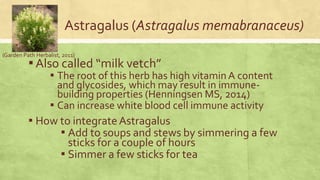
Astragalus (Astragalus memabranaceus) 
(Garden Path Herbalist, 2011) 
▪ Also called “milk vetch” 
▪ The root of this herb has high vitamin A content 
and glycosides, which may result in immune-building 
properties (Henningsen MS, 2014) 
▪ Can increase white blood cell immune activity 
▪ How to integrate Astragalus 
▪ Add to soups and stews by simmering a few 
sticks for a couple of hours 
▪ Simmer a few sticks for tea
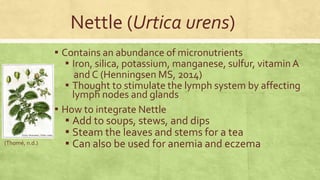
Nettle (Urtica urens) 
(Thomé, n.d.) 
▪ Contains an abundance of micronutrients 
▪ Iron, silica, potassium, manganese, sulfur, vitamin A 
and C (Henningsen MS, 2014) 
▪ Thought to stimulate the lymph system by affecting 
lymph nodes and glands 
▪ How to integrate Nettle 
▪ Add to soups, stews, and dips 
▪ Steam the leaves and stems for a tea 
▪ Can also be used for anemia and eczema
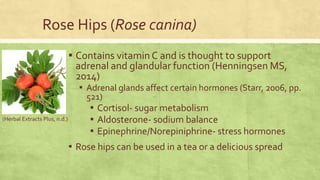
Rose Hips (Rose canina) 
▪ Contains vitamin C and is thought to support 
adrenal and glandular function (Henningsen MS, 
2014) 
▪ Adrenal glands affect certain hormones (Starr, 2006, pp. 
521) 
▪ Cortisol- sugar metabolism 
▪ Aldosterone- sodium balance 
▪ Epinephrine/Norepiniphrine- stress hormones 
▪ Rose hips can be used in a tea or a delicious spread 
(Herbal Extracts Plus, n.d.)
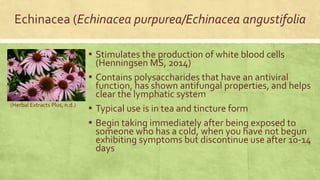
Echinacea (Echinacea purpurea/Echinacea angustifolia 
▪ Stimulates the production of white blood cells 
(Henningsen MS, 2014) 
▪ Contains polysaccharides that have an antiviral 
function, has shown antifungal properties, and helps 
clear the lymphatic system 
▪ Typical use is in tea and tincture form 
▪ Begin taking immediately after being exposed to 
someone who has a cold, when you have not begun 
exhibiting symptoms but discontinue use after 10-14 
days 
(Herbal Extracts Plus, n.d.)
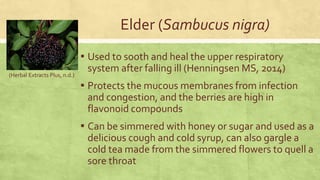
Elder (Sambucus nigra) 
▪ Used to sooth and heal the upper respiratory 
system after falling ill (Henningsen MS, 2014) 
▪ Protects the mucous membranes from infection 
and congestion, and the berries are high in 
flavonoid compounds 
▪ Can be simmered with honey or sugar and used as a 
delicious cough and cold syrup, can also gargle a 
cold tea made from the simmered flowers to quell a 
sore throat 
(Herbal Extracts Plus, n.d.)
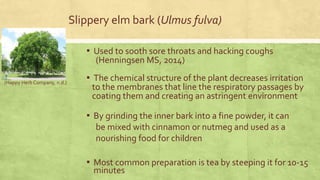
Slippery elm bark (Ulmus fulva) 
▪ Used to sooth sore throats and hacking coughs 
(Henningsen MS, 2014) 
▪ The chemical structure of the plant decreases irritation 
to the membranes that line the respiratory passages by 
coating them and creating an astringent environment 
▪ By grinding the inner bark into a fine powder, it can 
be mixed with cinnamon or nutmeg and used as a 
nourishing food for children 
▪ Most common preparation is tea by steeping it for 10-15 
minutes 
(Happy Herb Company, n.d.)
Research on validity 
▪ According to the National Center for Complimentary and Alternative 
Medicine (2013), there is no conclusive evidence that proves using 
herbs prevent or relieve symptoms; however, use of zinc and vitamin 
C may help reduce or lessen the severity of the common cold 
▪ Fourteen studies conducted on 2440 patients concluded that the use 
of herbs may shorten the symptomatic phase of the common cold 
(Wu, Zhang, Qiu, Xie, & Liu, 2007) 
(Female Fundamentals, 2011)
Resources 
▪ National Institutes for Complementary and Alternative Medicine 
▪ http://nccam.nih.gov/ 
▪ The Centers for Disease Control and Prevention 
▪ http://www.cdc.gov/flu/index.htm 
▪ US National Library of Medicine 
▪ http://www.ncbi.nlm.nih.gov/pubmed 
▪ Chinese medicinal herbs for the common cold article 
▪ http://www.ncbi.nlm.nih.gov/pubmed/17253524 
(Female Fundamentals, 2011)
References 
▪ Female Fundamentals. (2011). Light Love Meditation. Retrieved from 10 Steps Towards Meditation: 
http://femalefundamentals.com/blog/?attachment_id=1909 
▪ Garden Path Herbalist. (2011, September 23). Astragalus – A Great Immune Booster. Retrieved from Garden Path Herbalist: 
http://gardenpatherbalist.com/jons-blog/astragalus-%E2%80%93-a-great-immune-booster/ 
▪ Happy Herb Company. (n.d.). Slippery Elm Bark. Retrieved from Happy Herb Company: www.happyherbcompany.com 
▪ Henningsen MS, K. (2014). Nutrition. Retrieved from Kaplan University Center for Health and Wellness: 
http://healthandwellness.kaplan.edu/articles/nutrition/Herbs%20for%20Fall%20and%20Winter%20Wellness.html 
▪ Herbal Extracts Plus. (n.d.). Home. Retrieved from Herbal Extracts Plus: http://www.herbalextractsplus.com/ 
▪ Micozzi, M. S. (2011). Fundamentals of Complimentary and Alternative Medicine. St. Louis: Saunders Elsevier. 
▪ Schlenker, E., & Roth, S. (2011). William's Essentials of Nutrition and Diet Therapy Tenth Edition. St. Louis: Elsevier Mosby. 
▪ Seaward, B. L. (2009). Managing Stress. Sudbury: Jones & Bartlett. 
▪ Starr, C. (2006). Biology: Concepts and Applications, Sixth Edition. Belmont: Thomas Higher Education. 
▪ Thomé, D. O. (n.d.). Urtica dioica. Retrieved from http://www.summagallicana.it/lessico/o/ortica.htm 
▪ Turner, R. (2013, April). The Flu, the Common Cold, and Complementary Health Approaches. Retrieved from National Institute for Complementary and 
Alternative Medicine (NCCAM): http://nccam.nih.gov/health/flu/ataglance.htm#cold 
▪ Wu, T., Zhang, J., Qiu, Y., Xie, L., & Liu, G. J. (2007). Chinese medicinal herbs for the common cold. Retrieved from US National Library of Medicine : 
http://www.ncbi.nlm.nih.gov/pubmed/17253524
Questions? 
www.freshstartintegratedhealth.webs.com 
(Female Fundamentals, 2011)

Jennifer Maestro HW499 Unit 4 Presentation: Herbs for Immunity

  • 1.
    Herbs for Immunity Jennifer Maestro Kaplan University HW499 Professor E. Davis
  • 2.
    How can herbshelp me? ▪ Herbs for immunity support ▪ Research on validity ▪ Resources ▪ Disclaimer: This information is not meant to replace information provided by your doctor. Before starting this or any new program, check with your doctor and inform them of any herbs, vitamins, or medication your are currently taking, as some herbs may interact with certain medications. This is especially important if you have a medical condition or are pregnant or breastfeeding.
  • 3.
    Astragalus (Astragalus memabranaceus) (Garden Path Herbalist, 2011) ▪ Also called “milk vetch” ▪ The root of this herb has high vitamin A content and glycosides, which may result in immune-building properties (Henningsen MS, 2014) ▪ Can increase white blood cell immune activity ▪ How to integrate Astragalus ▪ Add to soups and stews by simmering a few sticks for a couple of hours ▪ Simmer a few sticks for tea
  • 4.
    Nettle (Urtica urens) (Thomé, n.d.) ▪ Contains an abundance of micronutrients ▪ Iron, silica, potassium, manganese, sulfur, vitamin A and C (Henningsen MS, 2014) ▪ Thought to stimulate the lymph system by affecting lymph nodes and glands ▪ How to integrate Nettle ▪ Add to soups, stews, and dips ▪ Steam the leaves and stems for a tea ▪ Can also be used for anemia and eczema
  • 5.
    Rose Hips (Rosecanina) ▪ Contains vitamin C and is thought to support adrenal and glandular function (Henningsen MS, 2014) ▪ Adrenal glands affect certain hormones (Starr, 2006, pp. 521) ▪ Cortisol- sugar metabolism ▪ Aldosterone- sodium balance ▪ Epinephrine/Norepiniphrine- stress hormones ▪ Rose hips can be used in a tea or a delicious spread (Herbal Extracts Plus, n.d.)
  • 6.
    Echinacea (Echinacea purpurea/Echinaceaangustifolia ▪ Stimulates the production of white blood cells (Henningsen MS, 2014) ▪ Contains polysaccharides that have an antiviral function, has shown antifungal properties, and helps clear the lymphatic system ▪ Typical use is in tea and tincture form ▪ Begin taking immediately after being exposed to someone who has a cold, when you have not begun exhibiting symptoms but discontinue use after 10-14 days (Herbal Extracts Plus, n.d.)
  • 7.
    Elder (Sambucus nigra) ▪ Used to sooth and heal the upper respiratory system after falling ill (Henningsen MS, 2014) ▪ Protects the mucous membranes from infection and congestion, and the berries are high in flavonoid compounds ▪ Can be simmered with honey or sugar and used as a delicious cough and cold syrup, can also gargle a cold tea made from the simmered flowers to quell a sore throat (Herbal Extracts Plus, n.d.)
  • 8.
    Slippery elm bark(Ulmus fulva) ▪ Used to sooth sore throats and hacking coughs (Henningsen MS, 2014) ▪ The chemical structure of the plant decreases irritation to the membranes that line the respiratory passages by coating them and creating an astringent environment ▪ By grinding the inner bark into a fine powder, it can be mixed with cinnamon or nutmeg and used as a nourishing food for children ▪ Most common preparation is tea by steeping it for 10-15 minutes (Happy Herb Company, n.d.)
  • 9.
    Research on validity ▪ According to the National Center for Complimentary and Alternative Medicine (2013), there is no conclusive evidence that proves using herbs prevent or relieve symptoms; however, use of zinc and vitamin C may help reduce or lessen the severity of the common cold ▪ Fourteen studies conducted on 2440 patients concluded that the use of herbs may shorten the symptomatic phase of the common cold (Wu, Zhang, Qiu, Xie, & Liu, 2007) (Female Fundamentals, 2011)
  • 10.
    Resources ▪ NationalInstitutes for Complementary and Alternative Medicine ▪ http://nccam.nih.gov/ ▪ The Centers for Disease Control and Prevention ▪ http://www.cdc.gov/flu/index.htm ▪ US National Library of Medicine ▪ http://www.ncbi.nlm.nih.gov/pubmed ▪ Chinese medicinal herbs for the common cold article ▪ http://www.ncbi.nlm.nih.gov/pubmed/17253524 (Female Fundamentals, 2011)
  • 11.
    References ▪ FemaleFundamentals. (2011). Light Love Meditation. Retrieved from 10 Steps Towards Meditation: http://femalefundamentals.com/blog/?attachment_id=1909 ▪ Garden Path Herbalist. (2011, September 23). Astragalus – A Great Immune Booster. Retrieved from Garden Path Herbalist: http://gardenpatherbalist.com/jons-blog/astragalus-%E2%80%93-a-great-immune-booster/ ▪ Happy Herb Company. (n.d.). Slippery Elm Bark. Retrieved from Happy Herb Company: www.happyherbcompany.com ▪ Henningsen MS, K. (2014). Nutrition. Retrieved from Kaplan University Center for Health and Wellness: http://healthandwellness.kaplan.edu/articles/nutrition/Herbs%20for%20Fall%20and%20Winter%20Wellness.html ▪ Herbal Extracts Plus. (n.d.). Home. Retrieved from Herbal Extracts Plus: http://www.herbalextractsplus.com/ ▪ Micozzi, M. S. (2011). Fundamentals of Complimentary and Alternative Medicine. St. Louis: Saunders Elsevier. ▪ Schlenker, E., & Roth, S. (2011). William's Essentials of Nutrition and Diet Therapy Tenth Edition. St. Louis: Elsevier Mosby. ▪ Seaward, B. L. (2009). Managing Stress. Sudbury: Jones & Bartlett. ▪ Starr, C. (2006). Biology: Concepts and Applications, Sixth Edition. Belmont: Thomas Higher Education. ▪ Thomé, D. O. (n.d.). Urtica dioica. Retrieved from http://www.summagallicana.it/lessico/o/ortica.htm ▪ Turner, R. (2013, April). The Flu, the Common Cold, and Complementary Health Approaches. Retrieved from National Institute for Complementary and Alternative Medicine (NCCAM): http://nccam.nih.gov/health/flu/ataglance.htm#cold ▪ Wu, T., Zhang, J., Qiu, Y., Xie, L., & Liu, G. J. (2007). Chinese medicinal herbs for the common cold. Retrieved from US National Library of Medicine : http://www.ncbi.nlm.nih.gov/pubmed/17253524
  • 12.

Editor's Notes

  • #2 Introduction and background of
  • #3 Herbs have been used by people for thousands of years as food, medicine, clothing and tools (Micozzi, 2011, pp. 322). Using herbs in one’s daily life it is not just for prevention of disease, but it can create wholeness in body and spirit (Micozzi, 2011, pp. 323). Discussion in this power point will include herbs specific to immune support, as fall is upon us and winter is quickly approaching. The holidays are also closing in, and as we know the holiday season brings with it added stress, bad eating habits, and illness in the form of viruses. A few such herbs are astragalus, nettle, rose hips, Echinacea, elder, and Slippery elm bark We will discuss the research conducted on the validity and safety of herbs. Finally, resources for more information on herb use will be provided, followed by any questions.
  • #4 - Glycosides are sugar-based molecules that help bind toxins (Henningsen MS, 2014). - Vitamin A is needed to develop and maintain healthy epithelial cells, which is our primary barrier to infection (Schlenker & Roth, 2011, pp. 99) - Oral doses over several months have been sown to increase immune substances, antibody levels, and lymphocytes (Henningsen MS, 2014) - Astragalus is also great for digestion (Henningsen MS, 2014)
  • #5 The lymph system has three main functions, one of them being removal of pathogens, foreign cells, and cellular debris from the body’s tissues to the lymph nodes for destruction and disposal in the lymph nodes (Starr, 2006, pp. 569)
  • #6 A rise in cortisol can trigger carbohydrate cravings, especially sweets, making one want to consume simple sugars (Seaward, 2009, pp. 519). Aldosterone increases sodium reabsorption in the kidneys (Starr, 2006, pp. 637)
  • #7 - First used by indigenous North Americans (Henningsen MS, 2014) -
  • #8 Flavonoid compounds act as an anti-viral, anti-inflammatory, antioxidant, and immunotonic agents (Henningsen MS, 2014)
  • #9 An astringent environment is one that constricts living tissues The dried inner bark can be used for its mucilages, starches, and tannins (Henningsen MS, 2014)
  • #10 There is no recommendation of herbs to treat the influenza virus (Turner, 2013) Vaccinations are still highly recommended, especially in those most vulnerable to illness (Turner, 2013) A healthy diet rich in nutrient-dense foods can help bolster the immune system (Schlenker & Roth, 2011, pp. 7) Finding ways to distress can assist one in finding their balance. Since stress can wreak havoc on our systems, understanding what nutrients can be capitalized on when we find ourselves under heavy stress can help our immune systems remain strong
  • #11 National Institutes for Complementary and Alternative Medicine: Provides numerous topics about integrated health and has a search function http://nccam.nih.gov/ The Centers for Disease Control and Prevention: Here is link for Flu information, but search function can direct one to other important topics http://www.cdc.gov/flu/index.htm US National Library of Medicine: Provides researched topics on a variety of health-related topics http://www.ncbi.nlm.nih.gov/pubmed Chinese medicinal herbs for the common cold article: Research results concerning use of herbs, specifically Echinacea, in cold treatment http://www.ncbi.nlm.nih.gov/pubmed/17253524 Pass out leaflet if requested with basic information and resources