Original Article
Volume 26, Issue 11 (November 2013)
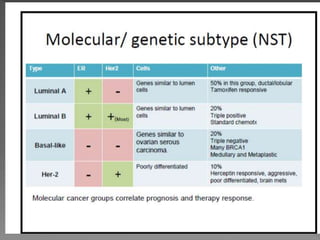
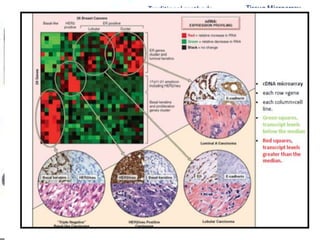
 Gene expression profile studies(Perou et al)
 5 Intrinsic molecular subtypes of Invasive
Carcinoma were confirmed.
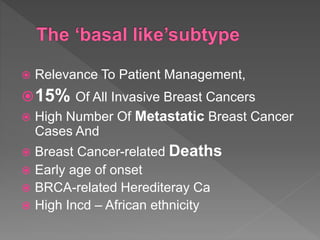
 Relevance To Patient Management,
15% Of All Invasive Breast Cancers
 High Number Of Metastatic Breast Cancer
Cases And
 Breast Cancer-related Deaths
 Early age of onset
 BRCA-related Herediteray Ca
 High Incd – African ethnicity
 Poor prognosis
 Resistant to mol.targeted therapies
 Limited Rx option
 Basal – like = dx of exclusion
- ER – Negative
- PR – Negative
- Her2 – Negative
o Rx = Cytotoxic CT
 Micro array based gene expression profiling
– Gold standard
- not practicel for routine dx
- high cost
- complex procedure
 Result – very few published reports on basal
like cancer
 Most studies are - based on FFPE based
 IHC – universally aval,
 Inexpensive tech.
 Surrogate definitions –
- triple negative phonotype (TNP)
negative ER,PR and Her2
but positive
- CK5/6 and/or EGFR (Nielsen et al)
 Accuracy of these IHC vs Gene expression
based subtype assignment – moderate
 76-79% - Sn
 72-100 - Sp
 Only some were validated or independent
 Very few – compared with Gene expression
gold std
 None – compared large number of
biomarkers in a single validation series.
 recent gene expression profile data &
 Published literature
 found 72 proposed basal – like IHC
biomarker in literature.
 Using same tissue microarray – in which
subtype assigned by PAM50 GEPassay
1. Tissue Microarray Construction and PAM50
Molecular subtype assignment
2. Immunohistochemical Staining and Scoring
 TMA - archival tumor blocks of 137 high-grade
patients,
 Washington University and Barnes-Jewish Hospital
in St Louis from 1997 to 2003
 Of 137 cases, 127 were successfully assigned an
intrinsic molecular subtype.
 Exclude : duplicate cases and normal-like Subtype.
 Remaining 122 samples
 42 basal-like and 80 non-basal-like breast cancers
(58 luminals and 22 HER2-enriched).
 72 biomarkers -gene expression profile data.
 61 of 72 – Suitable Abs acquired.
 15/61 IHC - nonspecific staining on control
tissues or TMA after multiple attempts with
varying antibody dilutions.
 remaining 46 were stained.
 Stained slides were scanned using a BLISS
system (Bacus Laboratories/OlympusAmerica, Lombard, IL, USA),
and
 a pathologist scored each biomarker
 PASW Statistics 18 for Windows (SPSS, 2009,
Chicago, IL, USA, www.spss.com) was used to perform
contingency table analyses.
 Pearson’s Chi-square analysis (or the
Fisher’s exact test) was used to compare biomarker
expression
 95% CI for Sn and Sp for each biomarker were
generated in R version 2.11.1
 P<0.05 defined statistical significance.
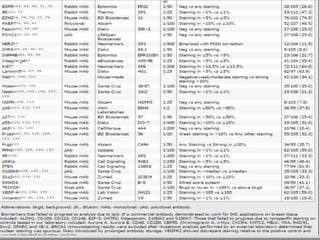
 46 biomarkers – satisfactory staining
 In 42 Basal & 80- non Basal like (defined by PAM50
GEP)
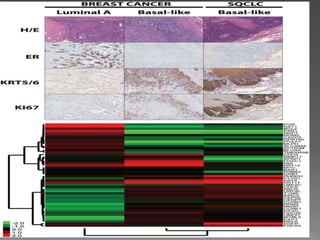
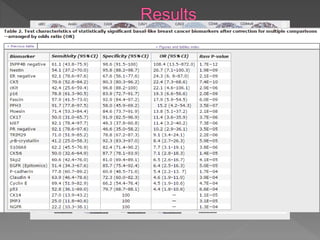
 25/46 biomarkers – significant assoc with
basal-like
 MOST SENSITIVE - Ki 67 and PPH3 - Sn
92%
 Both (ki67 & PPH3) marker of mitotic fig
 Study showed : PPH3 staining is
- strong
- discrete and
- easy to interpret
 Lack of ER or PR expression – also 92% Sn
for detection of basal-like breast ca.
 HIGHEST SPECIFICITY – (100%)
- Cytokeratin 14 (CK14)
- Insulin like growth factor mRNAbinding
protein-3. (IMP3)
- Nerve growth factor receptor (NGFR)
 But – poor Sn-22%-27%
 Best combination of
 Sn (61.1%) and Sp (98.6%) with
 the overall highest individual OR (108.4)
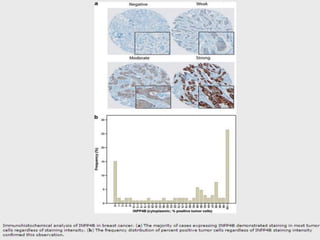
 NEGATIVE INPP4B - (inositol
polyphosphate-4-phosphatase,type II)
 = absence may be the best single
diagnostic IHC biomarker for basal-like.
 Very minimal background staining was
noted.
 Nestin (using a 1% cutpoint),
 negative ER staining (using a 1% cutpoint),
 CK5 and
 c-kit.
Best positively expressed IHC =
Nestin and CK5
1. Gene expression profiling-based
technologies
2. Surrogate immunohistochemical definitions.
3. Validation of IHC against a gold standard is
a necessary step
4. to identify the most useful biomarkers
that can best define the intrinsic molecular
subtypes of breast cancer
PAM50 assay, (gene expression assay applicable to FFPE
blocks)
1. now greatly facilitates such endeavors.
2. identifies breast cancer intrinsic subtypes
(luminal A, luminal B, HER2-enriched or basal-like) with
prognostic and predictive implications
 Loss of INPP4B expression IHC
- most strongly associated with basal-like
breast cancer among the 46 biomarkers tested
- (OR=108.4, 61.1% sensitivity and 98.6%
specificity)
 Loss of INPP4B expression IHC
-- Could be misleading
-- can be caused by technical problems at any of
the several steps
--antigen fading in micro array
- NESTIN—a positive biomarker
- possessed the second highest odd ratio
(OR=28.7, 54.1% sensitivity and 95.8%
specificity)
 consistency of nestin staining and
interpretation across different studies may
reflect
 good antigen stability in clinical samples,
typical of structural proteins
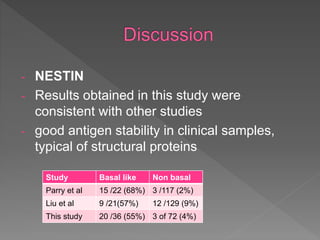
- NESTIN
- Results obtained in this study were
consistent with other studies
- good antigen stability in clinical samples,
typical of structural proteins
Study Basal like Non basal
Parry et al 15 /22 (68%) 3 /117 (2%)
Liu et al 9 /21(57%) 12 /129 (9%)
This study 20 /36 (55%) 3 of 72 (4%)
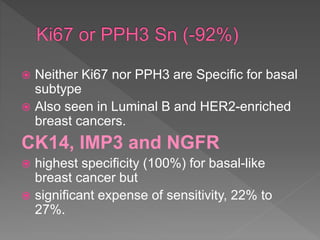
 Neither Ki67 nor PPH3 are Specific for basal
subtype
 Also seen in Luminal B and HER2-enriched
breast cancers.
CK14, IMP3 and NGFR
 highest specificity (100%) for basal-like
breast cancer but
 significant expense of sensitivity, 22% to
27%.
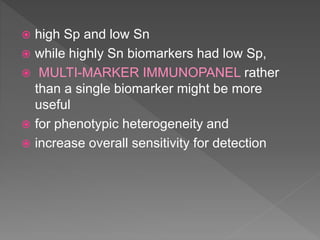
 high Sp and low Sn
 while highly Sn biomarkers had low Sp,
 MULTI-MARKER IMMUNOPANEL rather
than a single biomarker might be more
useful
 for phenotypic heterogeneity and
 increase overall sensitivity for detection
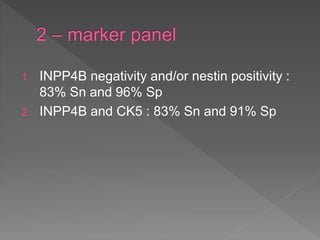
1. INPP4B negativity and/or nestin positivity :
83% Sn and 96% Sp
2. INPP4B and CK5 : 83% Sn and 91% Sp
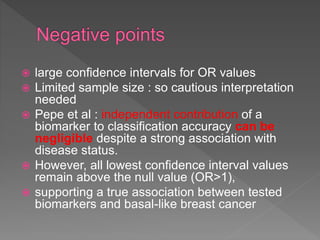
 large confidence intervals for OR values
 Limited sample size : so cautious interpretation
needed
 Pepe et al : independent contribution of a
biomarker to classification accuracy can be
negligible despite a strong association with
disease status.
 However, all lowest confidence interval values
remain above the null value (OR>1),
 supporting a true association between tested
biomarkers and basal-like breast cancer
 automated immunostaining and antigen
retrieval techniques,
 commercialization of antibodies – whether
really capitalizing the gene expression
profiling.
 the results of this comprehensive IHC survey may be able
to
 contribute to the development of a clinically practical
multi-marker immunopanel that best defines basal-like
breast cancer in an inexpensive and widely accessible
way.
 Followed by rigorous evaluation classification accuracy
and validation on large independent data sets, application
of such an assay in retrospective analyses and
prospective clinical trials will help to accurately identify
basal-like breast cancer cases,
 ultimately facilitating development of therapies for breast
cancer patients with this Particularly aggressive form of
the disease.
1. Perou CM, Sorlie T, Eisen MB, et al. Molecular portraits of human breast
tumours. Nature 2000;406: 747–752.
2. Nielsen TO, Hsu FD, Jensen K, et al. Immunohistochemical and clinical
characterization of the basal-like subtype of invasive breast carcinoma. Clin
Cancer Res 2004;10:5367–5374.
3. Kru¨ ger K, Stefansson I, Collett K, et al. Microvessel proliferation by co-
expression of endothelial nestin and ki-67 is associated with a basal-like
phenotype and aggressive features in breast cancer. Breast 2013;22:282–
288.
4. Li H, Cherukuri P, Li N, et al. Nestin is expressed in the basal/myoepithelial
layer of the mammary gland and is a selective marker of basal epithelial
breast tumors. Cancer Res 2007;67:501–510.
5. Parry S, Savage K, Marchio C, et al. Nestin is expressed in basal-like and
triple negative breast cancers. J Clin Pathol 2008;61:1045–1050.
6. Piras F, Ionta M, Lai S, et al. Nestin expression associates with poor
prognosis and triple negative phenotype in locally advanced (T4) breast
cancer. Eur J Histochem 2011;55:e39–e45.
7. Liu C, Chen B, Zhu J, et al. Clinical implications for nestin protein expression
in breast cancer. Cancer Sci 2009;101:815–819

Journal club- breast ca basal like

  • 2.
    Original Article Volume 26,Issue 11 (November 2013)
  • 3.
     Gene expressionprofile studies(Perou et al)  5 Intrinsic molecular subtypes of Invasive Carcinoma were confirmed.
  • 4.
     Relevance ToPatient Management, 15% Of All Invasive Breast Cancers  High Number Of Metastatic Breast Cancer Cases And  Breast Cancer-related Deaths  Early age of onset  BRCA-related Herediteray Ca  High Incd – African ethnicity
  • 5.
     Poor prognosis Resistant to mol.targeted therapies  Limited Rx option  Basal – like = dx of exclusion - ER – Negative - PR – Negative - Her2 – Negative o Rx = Cytotoxic CT
  • 6.
     Micro arraybased gene expression profiling – Gold standard - not practicel for routine dx - high cost - complex procedure  Result – very few published reports on basal like cancer
  • 7.
     Most studiesare - based on FFPE based  IHC – universally aval,  Inexpensive tech.  Surrogate definitions – - triple negative phonotype (TNP) negative ER,PR and Her2 but positive - CK5/6 and/or EGFR (Nielsen et al)
  • 8.
     Accuracy ofthese IHC vs Gene expression based subtype assignment – moderate  76-79% - Sn  72-100 - Sp
  • 9.
     Only somewere validated or independent  Very few – compared with Gene expression gold std  None – compared large number of biomarkers in a single validation series.
  • 10.
     recent geneexpression profile data &  Published literature  found 72 proposed basal – like IHC biomarker in literature.  Using same tissue microarray – in which subtype assigned by PAM50 GEPassay
  • 11.
    1. Tissue MicroarrayConstruction and PAM50 Molecular subtype assignment 2. Immunohistochemical Staining and Scoring
  • 12.
     TMA -archival tumor blocks of 137 high-grade patients,  Washington University and Barnes-Jewish Hospital in St Louis from 1997 to 2003  Of 137 cases, 127 were successfully assigned an intrinsic molecular subtype.  Exclude : duplicate cases and normal-like Subtype.  Remaining 122 samples  42 basal-like and 80 non-basal-like breast cancers (58 luminals and 22 HER2-enriched).
  • 14.
     72 biomarkers-gene expression profile data.  61 of 72 – Suitable Abs acquired.  15/61 IHC - nonspecific staining on control tissues or TMA after multiple attempts with varying antibody dilutions.  remaining 46 were stained.  Stained slides were scanned using a BLISS system (Bacus Laboratories/OlympusAmerica, Lombard, IL, USA), and  a pathologist scored each biomarker
  • 17.
     PASW Statistics18 for Windows (SPSS, 2009, Chicago, IL, USA, www.spss.com) was used to perform contingency table analyses.  Pearson’s Chi-square analysis (or the Fisher’s exact test) was used to compare biomarker expression  95% CI for Sn and Sp for each biomarker were generated in R version 2.11.1  P<0.05 defined statistical significance.
  • 18.
     46 biomarkers– satisfactory staining  In 42 Basal & 80- non Basal like (defined by PAM50 GEP)
  • 19.
     25/46 biomarkers– significant assoc with basal-like  MOST SENSITIVE - Ki 67 and PPH3 - Sn 92%  Both (ki67 & PPH3) marker of mitotic fig  Study showed : PPH3 staining is - strong - discrete and - easy to interpret
  • 20.
     Lack ofER or PR expression – also 92% Sn for detection of basal-like breast ca.  HIGHEST SPECIFICITY – (100%) - Cytokeratin 14 (CK14) - Insulin like growth factor mRNAbinding protein-3. (IMP3) - Nerve growth factor receptor (NGFR)  But – poor Sn-22%-27%
  • 21.
     Best combinationof  Sn (61.1%) and Sp (98.6%) with  the overall highest individual OR (108.4)  NEGATIVE INPP4B - (inositol polyphosphate-4-phosphatase,type II)  = absence may be the best single diagnostic IHC biomarker for basal-like.  Very minimal background staining was noted.
  • 23.
     Nestin (usinga 1% cutpoint),  negative ER staining (using a 1% cutpoint),  CK5 and  c-kit. Best positively expressed IHC = Nestin and CK5
  • 24.
    1. Gene expressionprofiling-based technologies 2. Surrogate immunohistochemical definitions. 3. Validation of IHC against a gold standard is a necessary step 4. to identify the most useful biomarkers that can best define the intrinsic molecular subtypes of breast cancer
  • 25.
    PAM50 assay, (geneexpression assay applicable to FFPE blocks) 1. now greatly facilitates such endeavors. 2. identifies breast cancer intrinsic subtypes (luminal A, luminal B, HER2-enriched or basal-like) with prognostic and predictive implications
  • 26.
     Loss ofINPP4B expression IHC - most strongly associated with basal-like breast cancer among the 46 biomarkers tested - (OR=108.4, 61.1% sensitivity and 98.6% specificity)  Loss of INPP4B expression IHC -- Could be misleading -- can be caused by technical problems at any of the several steps --antigen fading in micro array
  • 27.
    - NESTIN—a positivebiomarker - possessed the second highest odd ratio (OR=28.7, 54.1% sensitivity and 95.8% specificity)  consistency of nestin staining and interpretation across different studies may reflect  good antigen stability in clinical samples, typical of structural proteins
  • 28.
    - NESTIN - Resultsobtained in this study were consistent with other studies - good antigen stability in clinical samples, typical of structural proteins Study Basal like Non basal Parry et al 15 /22 (68%) 3 /117 (2%) Liu et al 9 /21(57%) 12 /129 (9%) This study 20 /36 (55%) 3 of 72 (4%)
  • 29.
     Neither Ki67nor PPH3 are Specific for basal subtype  Also seen in Luminal B and HER2-enriched breast cancers. CK14, IMP3 and NGFR  highest specificity (100%) for basal-like breast cancer but  significant expense of sensitivity, 22% to 27%.
  • 30.
     high Spand low Sn  while highly Sn biomarkers had low Sp,  MULTI-MARKER IMMUNOPANEL rather than a single biomarker might be more useful  for phenotypic heterogeneity and  increase overall sensitivity for detection
  • 31.
    1. INPP4B negativityand/or nestin positivity : 83% Sn and 96% Sp 2. INPP4B and CK5 : 83% Sn and 91% Sp
  • 32.
     large confidenceintervals for OR values  Limited sample size : so cautious interpretation needed  Pepe et al : independent contribution of a biomarker to classification accuracy can be negligible despite a strong association with disease status.  However, all lowest confidence interval values remain above the null value (OR>1),  supporting a true association between tested biomarkers and basal-like breast cancer
  • 33.
     automated immunostainingand antigen retrieval techniques,  commercialization of antibodies – whether really capitalizing the gene expression profiling.
  • 34.
     the resultsof this comprehensive IHC survey may be able to  contribute to the development of a clinically practical multi-marker immunopanel that best defines basal-like breast cancer in an inexpensive and widely accessible way.  Followed by rigorous evaluation classification accuracy and validation on large independent data sets, application of such an assay in retrospective analyses and prospective clinical trials will help to accurately identify basal-like breast cancer cases,  ultimately facilitating development of therapies for breast cancer patients with this Particularly aggressive form of the disease.
  • 35.
    1. Perou CM,Sorlie T, Eisen MB, et al. Molecular portraits of human breast tumours. Nature 2000;406: 747–752. 2. Nielsen TO, Hsu FD, Jensen K, et al. Immunohistochemical and clinical characterization of the basal-like subtype of invasive breast carcinoma. Clin Cancer Res 2004;10:5367–5374. 3. Kru¨ ger K, Stefansson I, Collett K, et al. Microvessel proliferation by co- expression of endothelial nestin and ki-67 is associated with a basal-like phenotype and aggressive features in breast cancer. Breast 2013;22:282– 288. 4. Li H, Cherukuri P, Li N, et al. Nestin is expressed in the basal/myoepithelial layer of the mammary gland and is a selective marker of basal epithelial breast tumors. Cancer Res 2007;67:501–510. 5. Parry S, Savage K, Marchio C, et al. Nestin is expressed in basal-like and triple negative breast cancers. J Clin Pathol 2008;61:1045–1050. 6. Piras F, Ionta M, Lai S, et al. Nestin expression associates with poor prognosis and triple negative phenotype in locally advanced (T4) breast cancer. Eur J Histochem 2011;55:e39–e45. 7. Liu C, Chen B, Zhu J, et al. Clinical implications for nestin protein expression in breast cancer. Cancer Sci 2009;101:815–819