JBoss Web Services
    Alessio Soldano
 alessio.soldano@jboss.com

  Principal Software Eng.
      JBoss - Red Hat

      April 28th, 2010
Who is Alessio?

●   JBoss WS[1] committer since early 2007
●   JBoss / Red Hat employee since end of 2007
●   JBoss Web Service Lead, 2008
●   JBoss AS[2], JBoss Wise[3] contributor
●   Current Red Hat representative at JSR-224 EG
    and W3C WS-ResourceAccess WG
●   Apache CXF[4] committer since 2009

    [1] http://www.jboss.org/jbossws   [2] http://www.jboss.org/jbossas

    [3] http://www.jboss.org/wise      [4] http://cxf.apache.org
What is JBoss WS?

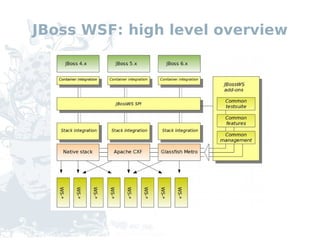
●   “Just” a feature-rich JAX-WS compatible ws stack
    till early 2008...


●   a web services framework providing
    integration layers for 3rd party ws stacks on top
    of multiple JBoss AS versions
        –   CXF, Native and Metro stack
        –   AS 5.x, AS 6.x target containers
The benefits of standards / specs
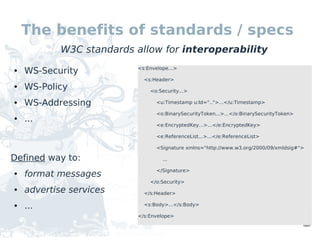
            W3C standards allow for interoperability
●   WS-Security           <s:Envelope...>

                            <s:Header>
●   WS-Policy                 <o:Security...>

●   WS-Addressing                <u:Timestamp u:Id="..">...</u:Timestamp>

                                 <o:BinarySecurityToken...>...</o:BinarySecurityToken>
●   ...
                                 <e:EncryptedKey...>...</e:EncryptedKey>

                                 <e:ReferenceList...>...</e:ReferenceList>

                                 <Signature xmlns="http://www.w3.org/2000/09/xmldsig#">

Defined way to:                    ...

                                 </Signature>
●   format messages
                              </o:Security>
●   advertise services      </s:Header>

●   ...                     <s:Body>...</s:Body>

                          </s:Envelope>
The benefits of standards / specs
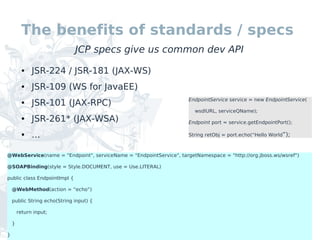
                              JCP specs give us common dev API
          ●   JSR-224 / JSR-181 (JAX-WS)
          ●   JSR-109 (WS for JavaEE)
                                                                    EndpointService service = new EndpointService(
          ●   JSR-101 (JAX-RPC)
                                                                      wsdlURL, serviceQName);
          ●   JSR-261* (JAX-WSA)                                    Endpoint port = service.getEndpointPort();

          ●   ...                                                   String retObj = port.echo(“Hello World”);


@WebService(name = "Endpoint", serviceName = "EndpointService", targetNamespace = "http://org.jboss.ws/wsref")

@SOAPBinding(style = Style.DOCUMENT, use = Use.LITERAL)

public class EndpointImpl {

    @WebMethod(action = “echo”)

    public String echo(String input) {

        return input;

    }

}
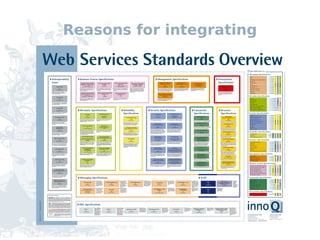
Reasons for integrating

●   really good open source implementations
    already available - NIH syndrome
●   focus on added value
●   open choice (features, performance, ...)
●   ... a lot of Web Services specifications!
Reasons for integrating
Who benefits from this move?

●   The JBoss community:
        –   different choices depending on needs
        –   greater joint community support
        –   core devs can work on added value
●   The integrated ws projects and their community:
        –   additional tests
        –   bugs detection and fix
        –   ...
JBoss WSF: high level overview
Web Service Framework
●   Management                   ●   Tooling
       –   console                       –   common JAXWS tools
       –   endpoint registry             –   project generator
       –   records system                –   Eclipse integration
●   Configuration                ●   AS integration
       –   address rewrite               –   authentication
●   Features                             –   authorization

       –   JAXBIntroductions
                                 ●   Common deploy
       –   Common JAX-WSA JSR-   ●   Common testsuite
             261 API
Do I really need your integration
                  layer?
●   Home-brew solutions for running CXF / Metro on
    JBossAS might work for specific usecases, but
    you...
        –   need to embed the stack in your apps
        –   will suffer from classloading issues
        –   can just use pojo endpoints
        –   have no webserviceref injection in ejb3
        –   loose additional WSF features ;-)
        –   ...
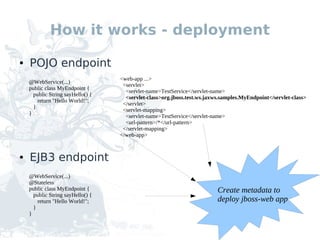
How it works - deployment

●   POJO endpoint
                                   <web-app ...>
    @WebService(...)
                                    <servlet>
    public class MyEndpoint {
                                     <servlet-name>TestService</servlet-name>
      public String sayHello() {
                                     <servlet-class>org.jboss.test.ws.jaxws.samples.MyEndpoint</servlet-class>
        return "Hello World!";
                                    </servlet>
      }
                                    <servlet-mapping>
    }
                                     <servlet-name>TestService</servlet-name>
                                     <url-pattern>/*</url-pattern>
                                    </servlet-mapping>
                                   </web-app>


●   EJB3 endpoint
    @WebService(...)
    @Stateless
    public class MyEndpoint {                                             Create metadata to
      public String sayHello() {
        return "Hello World!";                                            deploy jboss-web app
      }
    }
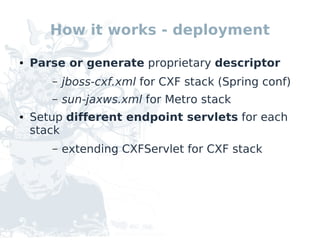
How it works - deployment

●   Parse or generate proprietary descriptor
       –   jboss-cxf.xml for CXF stack (Spring conf)
       –   sun-jaxws.xml for Metro stack
●   Setup different endpoint servlets for each
    stack
       –   extending CXFServlet for CXF stack
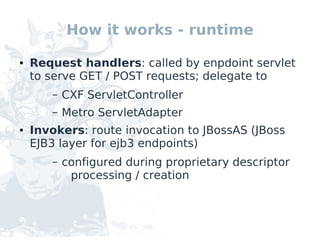
How it works - runtime

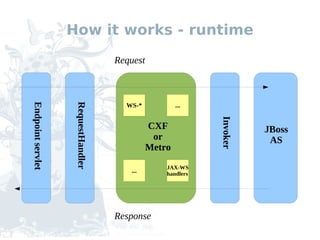
●   Request handlers: called by enpdoint servlet
    to serve GET / POST requests; delegate to
       –   CXF ServletController
       –   Metro ServletAdapter
●   Invokers: route invocation to JBossAS (JBoss
    EJB3 layer for ejb3 endpoints)
       –   configured during proprietary descriptor
            processing / creation
How it works - runtime
                                     Request
Endpoint servlet


                    RequestHandler

                                       WS-*            ...


                                                              Invoker
                                               CXF                      JBoss
                                                or                       AS
                                               Metro
                                                   JAX-WS
                                        ...        handlers


                                     Response
More on deployers...

JBoss AS 5 deployers gives high flexibility
●   multiple webservice deployers generated
        –   stack agnostic deployment aspects
        –   stack specific deployment aspects
        –   extensibility, separation of concerns, ...
●   two webservice stacks at the same time
        –   JAX-RPC support with CXF / Metro
CXF: additional integration hooks

●   Bus configuration: CXF runtime behaviour is
    controlled by the current Bus; we can set:
       –   custom resource resolvers
       –   custom transport factories
       –   custom CXF Configurer bean
       –   ...
●   Spring Namespace Handlers: we can change
    configuration namespace to default bean
    mapping
       –   override / extend core CXF beans
Some links...

●   http://www.jboss.org/jbossws
●   http://community.jboss.org/wiki/JBossWS
●   http://jbossws.blogspot.com/
Q&A

JBossWS Project by Alessio Soldano

  • 1.
    JBoss Web Services Alessio Soldano alessio.soldano@jboss.com Principal Software Eng. JBoss - Red Hat April 28th, 2010
  • 2.
    Who is Alessio? ● JBoss WS[1] committer since early 2007 ● JBoss / Red Hat employee since end of 2007 ● JBoss Web Service Lead, 2008 ● JBoss AS[2], JBoss Wise[3] contributor ● Current Red Hat representative at JSR-224 EG and W3C WS-ResourceAccess WG ● Apache CXF[4] committer since 2009 [1] http://www.jboss.org/jbossws [2] http://www.jboss.org/jbossas [3] http://www.jboss.org/wise [4] http://cxf.apache.org
  • 3.
    What is JBossWS? ● “Just” a feature-rich JAX-WS compatible ws stack till early 2008... ● a web services framework providing integration layers for 3rd party ws stacks on top of multiple JBoss AS versions – CXF, Native and Metro stack – AS 5.x, AS 6.x target containers
  • 4.
    The benefits ofstandards / specs W3C standards allow for interoperability ● WS-Security <s:Envelope...> <s:Header> ● WS-Policy <o:Security...> ● WS-Addressing <u:Timestamp u:Id="..">...</u:Timestamp> <o:BinarySecurityToken...>...</o:BinarySecurityToken> ● ... <e:EncryptedKey...>...</e:EncryptedKey> <e:ReferenceList...>...</e:ReferenceList> <Signature xmlns="http://www.w3.org/2000/09/xmldsig#"> Defined way to: ... </Signature> ● format messages </o:Security> ● advertise services </s:Header> ● ... <s:Body>...</s:Body> </s:Envelope>
  • 5.
    The benefits ofstandards / specs JCP specs give us common dev API ● JSR-224 / JSR-181 (JAX-WS) ● JSR-109 (WS for JavaEE) EndpointService service = new EndpointService( ● JSR-101 (JAX-RPC) wsdlURL, serviceQName); ● JSR-261* (JAX-WSA) Endpoint port = service.getEndpointPort(); ● ... String retObj = port.echo(“Hello World”); @WebService(name = "Endpoint", serviceName = "EndpointService", targetNamespace = "http://org.jboss.ws/wsref") @SOAPBinding(style = Style.DOCUMENT, use = Use.LITERAL) public class EndpointImpl { @WebMethod(action = “echo”) public String echo(String input) { return input; } }
  • 6.
    Reasons for integrating ● really good open source implementations already available - NIH syndrome ● focus on added value ● open choice (features, performance, ...) ● ... a lot of Web Services specifications!
  • 7.
  • 8.
    Who benefits fromthis move? ● The JBoss community: – different choices depending on needs – greater joint community support – core devs can work on added value ● The integrated ws projects and their community: – additional tests – bugs detection and fix – ...
  • 9.
    JBoss WSF: highlevel overview
  • 10.
    Web Service Framework ● Management ● Tooling – console – common JAXWS tools – endpoint registry – project generator – records system – Eclipse integration ● Configuration ● AS integration – address rewrite – authentication ● Features – authorization – JAXBIntroductions ● Common deploy – Common JAX-WSA JSR- ● Common testsuite 261 API
  • 11.
    Do I reallyneed your integration layer? ● Home-brew solutions for running CXF / Metro on JBossAS might work for specific usecases, but you... – need to embed the stack in your apps – will suffer from classloading issues – can just use pojo endpoints – have no webserviceref injection in ejb3 – loose additional WSF features ;-) – ...
  • 12.
    How it works- deployment ● POJO endpoint <web-app ...> @WebService(...) <servlet> public class MyEndpoint { <servlet-name>TestService</servlet-name> public String sayHello() { <servlet-class>org.jboss.test.ws.jaxws.samples.MyEndpoint</servlet-class> return "Hello World!"; </servlet> } <servlet-mapping> } <servlet-name>TestService</servlet-name> <url-pattern>/*</url-pattern> </servlet-mapping> </web-app> ● EJB3 endpoint @WebService(...) @Stateless public class MyEndpoint { Create metadata to public String sayHello() { return "Hello World!"; deploy jboss-web app } }
  • 13.
    How it works- deployment ● Parse or generate proprietary descriptor – jboss-cxf.xml for CXF stack (Spring conf) – sun-jaxws.xml for Metro stack ● Setup different endpoint servlets for each stack – extending CXFServlet for CXF stack
  • 14.
    How it works- runtime ● Request handlers: called by enpdoint servlet to serve GET / POST requests; delegate to – CXF ServletController – Metro ServletAdapter ● Invokers: route invocation to JBossAS (JBoss EJB3 layer for ejb3 endpoints) – configured during proprietary descriptor processing / creation
  • 15.
    How it works- runtime Request Endpoint servlet RequestHandler WS-* ... Invoker CXF JBoss or AS Metro JAX-WS ... handlers Response
  • 16.
    More on deployers... JBossAS 5 deployers gives high flexibility ● multiple webservice deployers generated – stack agnostic deployment aspects – stack specific deployment aspects – extensibility, separation of concerns, ... ● two webservice stacks at the same time – JAX-RPC support with CXF / Metro
  • 17.
    CXF: additional integrationhooks ● Bus configuration: CXF runtime behaviour is controlled by the current Bus; we can set: – custom resource resolvers – custom transport factories – custom CXF Configurer bean – ... ● Spring Namespace Handlers: we can change configuration namespace to default bean mapping – override / extend core CXF beans
  • 18.
    Some links... ● http://www.jboss.org/jbossws ● http://community.jboss.org/wiki/JBossWS ● http://jbossws.blogspot.com/
  • 19.