Jboss Drools
 Jboss Drools Introduction Training
             By ITgma
Scope, out-of –scope -
  benefits, shortfalls

  Jboss Drools Introduction Training
              By ITgma
Traditional approach – problems
   Spaghetti code
   Requirements are in Business Logic layer
   On evolving system imperative style language
    change often growing in complexity
   Not well defined way on representing the business
    logic
   Changes in Requirements massively affect solution
   For Developers it is hard to change the business
    logic. For domain experts, it is impossible to verify
    the business logic
                                              Copyright © ITgma 2012
Solution?
   In Imperative style language, we are
    implementing both, WHAT need to be done
    and HOW it needs to be done
   Declarative, such as SQL also(in RDBMS), tend
    to describe what we want to search. It doesnt
    know anything about how DB should find data
   To implement Business Logic we need
    declarative model, and Drools approach this
    with rules

                                        Copyright © ITgma 2012
Solution - benefits
   Rules engine take this rules and execute them over
    our data, in the most efficient way
   Rule are in form of what BA are defining, like if-
    then statements
   Rules which have all their conditions true, have
    their then part evaluated first. This is different
    from imperative style language as developer has
    to specify how it needs to be done explicitly(with
    sequence of conditionals and loops)
   Each rule represent one requirement. This is more
    readable and maps to business requirements more
    naturally

                                           Copyright © ITgma 2012
Advantages
   Easier to understand(for BA or Dev. Or Bus.
    Dev.). It is more likely technically skilled
    business analyst to verify or change rules than
    a Java program
   Improved maintainability: As rules are easier
    to understand, a developer can spend more
    time solving the actual problem. We don’t care
    about how to implement a solution. We only
    care about what need to be done to solve the
    problem
                                         Copyright © ITgma 2012
Advantages - continued
   Deals with evolving complexity: It is much
    easier to add new rules, modify or remove
    existing rules than to change, for example, a
    Java program
   Flexibility : It deals with changes to the
    requirements or changes to the data model in a
    much better way. Changing or rewriting and
    application is never an easy task. However,
    thanks to formalism that rules bring, it is much
    easier to change rules than to change Java
    program
                                          Copyright © ITgma 2012
Advantages - continued
   Reasonable performance: Thanks to Rete
    algorithm that is behind Drools, in theory, the
    performance of the system doesn’t depend on the
    number of rules. Because a rule engine is
    essentially a generic if-then statement executor,
    there are numerous performance optimizations
    that can be applied independently of the rules.
    With every release of Drools, the performance
    engine is getting better, by adding various
    optimizations such as Rete node sharing, node
    indexing, parallel execution.
                                           Copyright © ITgma 2012
Advantages - continued
   Requirements can be naturally translated into
    rules: The representation of business rules is
    consistent. For example, lets take some business
    rule and implement it in Java. Developers,
    depending on their experience, tend to use
    different ways to solve a problem. We’ll find out
    that the possible solution will wary greatly.
    Whereas with rules, this diversification becomes
    less apparent. It is simply because we are
    expressing ‘what’ instead of ‘how’. As a result, the
    code is much easier to read even by new
    developers.
                                             Copyright © ITgma 2012
Advantages - continued
   Ability to apply enterprise management to our
    rules
   Reusability
   Rules model the application invariants more
    closely
   The Drools platform brings unification of rules
    and processes
   Independent Lifecycle
   Embedded ability
                                          Copyright © ITgma 2012
Disadvantages
   It is not an easy task to write systems that
    make complex decisions
   We don’t specify how the business rules should
    be implemented. Instead we just specify what
    need to happened. Therefore, we don’t know
    how it happened, and it may be difficult to
    troubleshoot


                                        Copyright © ITgma 2012
When not to use a rule engine
   If your project is small, less than 20 rules
   If your business logic is well defined/static and
    doesn't change often, you don’t need to
    change rules at run-time
   If your rules are simple, self-contained, and
    usually spanning only a single object. If in a
    pseudo-code you don’t have more than two
    nested if-then statements


                                            Copyright © ITgma 2012
When not to use a rule engine -
continued
   If performance is your primary concern
   If your project is a one-shot effort and it will
    never be used again or maintained over time
   If you don’t have the time and money to train
    your developers to use a rule engine


                                           Copyright © ITgma 2012
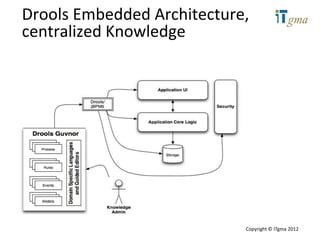
Alternative Architectures

Drools Alternative Architectures

   Embedded
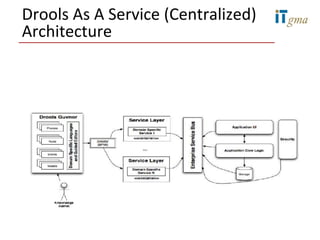
   As a Service


                                   Copyright © ITgma 2012
Drools Embedded Architecture,
centralized Knowledge


                            Copyright © ITgma 2012
Drools As A Service (Centralized)
Architecture


                               Copyright © ITgma 2012

Jboss drools 3 key drools functionalities

  • 1.
    Jboss Drools JbossDrools Introduction Training By ITgma
  • 2.
    Scope, out-of –scope- benefits, shortfalls Jboss Drools Introduction Training By ITgma
  • 3.
    Traditional approach –problems  Spaghetti code  Requirements are in Business Logic layer  On evolving system imperative style language change often growing in complexity  Not well defined way on representing the business logic  Changes in Requirements massively affect solution  For Developers it is hard to change the business logic. For domain experts, it is impossible to verify the business logic Copyright © ITgma 2012
  • 4.
    Solution?  In Imperative style language, we are implementing both, WHAT need to be done and HOW it needs to be done  Declarative, such as SQL also(in RDBMS), tend to describe what we want to search. It doesnt know anything about how DB should find data  To implement Business Logic we need declarative model, and Drools approach this with rules Copyright © ITgma 2012
  • 5.
    Solution - benefits  Rules engine take this rules and execute them over our data, in the most efficient way  Rule are in form of what BA are defining, like if- then statements  Rules which have all their conditions true, have their then part evaluated first. This is different from imperative style language as developer has to specify how it needs to be done explicitly(with sequence of conditionals and loops)  Each rule represent one requirement. This is more readable and maps to business requirements more naturally Copyright © ITgma 2012
  • 6.
    Advantages  Easier to understand(for BA or Dev. Or Bus. Dev.). It is more likely technically skilled business analyst to verify or change rules than a Java program  Improved maintainability: As rules are easier to understand, a developer can spend more time solving the actual problem. We don’t care about how to implement a solution. We only care about what need to be done to solve the problem Copyright © ITgma 2012
  • 7.
    Advantages - continued  Deals with evolving complexity: It is much easier to add new rules, modify or remove existing rules than to change, for example, a Java program  Flexibility : It deals with changes to the requirements or changes to the data model in a much better way. Changing or rewriting and application is never an easy task. However, thanks to formalism that rules bring, it is much easier to change rules than to change Java program Copyright © ITgma 2012
  • 8.
    Advantages - continued  Reasonable performance: Thanks to Rete algorithm that is behind Drools, in theory, the performance of the system doesn’t depend on the number of rules. Because a rule engine is essentially a generic if-then statement executor, there are numerous performance optimizations that can be applied independently of the rules. With every release of Drools, the performance engine is getting better, by adding various optimizations such as Rete node sharing, node indexing, parallel execution. Copyright © ITgma 2012
  • 9.
    Advantages - continued  Requirements can be naturally translated into rules: The representation of business rules is consistent. For example, lets take some business rule and implement it in Java. Developers, depending on their experience, tend to use different ways to solve a problem. We’ll find out that the possible solution will wary greatly. Whereas with rules, this diversification becomes less apparent. It is simply because we are expressing ‘what’ instead of ‘how’. As a result, the code is much easier to read even by new developers. Copyright © ITgma 2012
  • 10.
    Advantages - continued  Ability to apply enterprise management to our rules  Reusability  Rules model the application invariants more closely  The Drools platform brings unification of rules and processes  Independent Lifecycle  Embedded ability Copyright © ITgma 2012
  • 11.
    Disadvantages  It is not an easy task to write systems that make complex decisions  We don’t specify how the business rules should be implemented. Instead we just specify what need to happened. Therefore, we don’t know how it happened, and it may be difficult to troubleshoot Copyright © ITgma 2012
  • 12.
    When not touse a rule engine  If your project is small, less than 20 rules  If your business logic is well defined/static and doesn't change often, you don’t need to change rules at run-time  If your rules are simple, self-contained, and usually spanning only a single object. If in a pseudo-code you don’t have more than two nested if-then statements Copyright © ITgma 2012
  • 13.
    When not touse a rule engine - continued  If performance is your primary concern  If your project is a one-shot effort and it will never be used again or maintained over time  If you don’t have the time and money to train your developers to use a rule engine Copyright © ITgma 2012
  • 14.
    Alternative Architectures Drools AlternativeArchitectures  Embedded  As a Service Copyright © ITgma 2012
  • 15.
    Drools Embedded Architecture, centralizedKnowledge Copyright © ITgma 2012
  • 16.
    Drools As AService (Centralized) Architecture Copyright © ITgma 2012

Editor's Notes

  • #4 Questions:What is our Platform?Build ON THIS!