JavaScript The Web Warrior Series 6th Edition Vodnik Test Bank
JavaScript The Web Warrior Series 6th Edition Vodnik Test Bank
JavaScript The Web Warrior Series 6th Edition Vodnik Test Bank
JavaScript The Web Warrior Series 6th Edition Vodnik Test Bank
JavaScript The Web Warrior Series 6th Edition Vodnik Test Bank
1.
Visit https://testbankdeal.com todownload the full version and
browse more test banks or solution manuals
JavaScript The Web Warrior Series 6th Edition
Vodnik Test Bank
_____ Press the link below to begin your download _____
https://testbankdeal.com/product/javascript-the-web-warrior-
series-6th-edition-vodnik-test-bank/
Access testbankdeal.com now to download high-quality
test banks or solution manuals
2.
We believe theseproducts will be a great fit for you. Click
the link to download now, or visit testbankdeal.com
to discover even more!
JavaScript The Web Warrior Series 6th Edition Vodnik
Solutions Manual
https://testbankdeal.com/product/javascript-the-web-warrior-
series-6th-edition-vodnik-solutions-manual/
Principles of Web Design The Web Warrior Series 6th
Edition Sklar Solutions Manual
https://testbankdeal.com/product/principles-of-web-design-the-web-
warrior-series-6th-edition-sklar-solutions-manual/
Principles of Web Design The Web Technologies Series 5th
Edition Skalar Test Bank
https://testbankdeal.com/product/principles-of-web-design-the-web-
technologies-series-5th-edition-skalar-test-bank/
Introduction to Physical Science 13th Edition Shipman Test
Bank
https://testbankdeal.com/product/introduction-to-physical-
science-13th-edition-shipman-test-bank/
3.
Consumer Behavior 7thEdition Hoyer Solutions Manual
https://testbankdeal.com/product/consumer-behavior-7th-edition-hoyer-
solutions-manual/
New Perspectives on Microsoft Word 2013 Comprehensive 1st
Edition Zimmerman Test Bank
https://testbankdeal.com/product/new-perspectives-on-microsoft-
word-2013-comprehensive-1st-edition-zimmerman-test-bank/
Introduction to Financial Accounting 11th Edition Horngren
Test Bank
https://testbankdeal.com/product/introduction-to-financial-
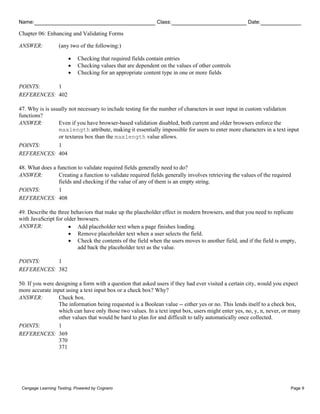
accounting-11th-edition-horngren-test-bank/
Economics for Managers Global Edition 3rd Edition farnham
Solutions Manual
https://testbankdeal.com/product/economics-for-managers-global-
edition-3rd-edition-farnham-solutions-manual/
Justice Administration Police Courts and Corrections
Management 8th Edition Peak Test Bank
https://testbankdeal.com/product/justice-administration-police-courts-
and-corrections-management-8th-edition-peak-test-bank/
4.
Data Analytics forAccounting 1st Edition Richardson Test
Bank
https://testbankdeal.com/product/data-analytics-for-accounting-1st-
edition-richardson-test-bank/
5.
Name: Class: Date:
Chapter06: Enhancing and Validating Forms
Cengage Learning Testing, Powered by Cognero Page 1
True / False
1. While JavaScript lets you perform validation in a user’s browser, the server-side programs that receive form data
generally perform validation as well.
a. True
b. False
ANSWER: True
POINTS: 1
REFERENCES: 364
2. By default, browsers create an collection of form objects that you can reference using array notation.
a. True
b. False
ANSWER: True
POINTS: 1
REFERENCES: 366
367
3. Assistive functions perform a type of validation.
a. True
b. False
ANSWER: False
POINTS: 1
REFERENCES: 371
4. You can use HTML to set the default value of a selection list so no option is selected.
a. True
b. False
ANSWER: False
POINTS: 1
REFERENCES: 371
5. Modern browsers can perform many validation tasks themselves without any extra JavaScript.
a. True
b. False
ANSWER: True
POINTS: 1
REFERENCES: 394
Multiple Choice
6. To check if an option button is selected, you access the value of its ____ property.
a. marked b. selected
c. checked d. value
ANSWER: c
6.
Name: Class: Date:
Chapter06: Enhancing and Validating Forms
Cengage Learning Testing, Powered by Cognero Page 2
POINTS: 1
REFERENCES: 418
7. To display no default value on a selection list, you set its ____ property to -1.
a. selectedIndex b. checked
c. selected d. value
ANSWER: a
POINTS: 1
REFERENCES: 371
8. Many aspects of the way browsers present browser-based validation feedback are customizable through the properties
and methods of the ____.
a. Document Object Model b. DOM tree
c. browser object model d. constraint validation API
ANSWER: d
POINTS: 1
REFERENCES: 398
9. The ____ event fires when a form is submitted.
a. clear b. blur
c. input d. submit
ANSWER: d
POINTS: 1
REFERENCES: 404
10. You use the ____ method on an object to block the action normally associated with an event.
a. preventDefault() b. submit()
c. checkValidity() d. select()
ANSWER: a
POINTS: 1
REFERENCES: 405
11. Which form element is useful for limiting user options to a set of choices?
a. textarea b. selection list
c. text input box d. submit button
ANSWER: b
POINTS: 1
REFERENCES: 369
370
12. You create an empty document fragment using the ____ method.
a. cloneNode() b. createElement()
c. submit() d. createDocumentFragment()
ANSWER: d
7.
Name: Class: Date:
Chapter06: Enhancing and Validating Forms
Cengage Learning Testing, Powered by Cognero Page 3
POINTS: 1
REFERENCES: 376
13. Which attribute enhances usability in modern browsers?
a. id b. src
c. placeholder d. value
ANSWER: c
POINTS: 1
REFERENCES: 381
14. What element property would you use when copying the contents of one text field to another text field?
a. value b. default
c. content d. selectedIndex
ANSWER: a
POINTS: 1
REFERENCES: 390
391
15. Which attribute toggles off validation of a form when added to the opening <form> tag?
a. validation b. submit
c. novalidate d. nosubmit
ANSWER: c
POINTS: 1
REFERENCES: 394
16. Which type value for the input element triggers validation in modern browsers?
a. validate b. text
c. number d. password
ANSWER: c
POINTS: 1
REFERENCES: 394
395
17. In modern browsers, which attribute of an input element prevents the form from being submitted if the field is left
blank?
a. novalidate b. required
c. min d. max
ANSWER: a
POINTS: 1
REFERENCES: 394
18. Validation errors found by modern browsers are reported in ____.
a. separate browser windows b. the Address bar
c. the Status bar d. bubbles
8.
Name: Class: Date:
Chapter06: Enhancing and Validating Forms
Cengage Learning Testing, Powered by Cognero Page 4
ANSWER: d
POINTS: 1
REFERENCES: 396
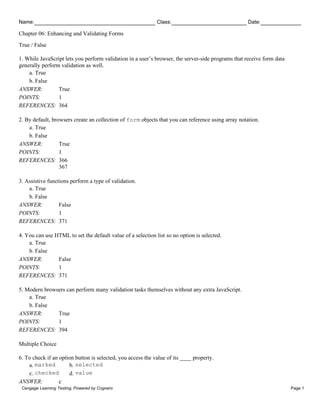
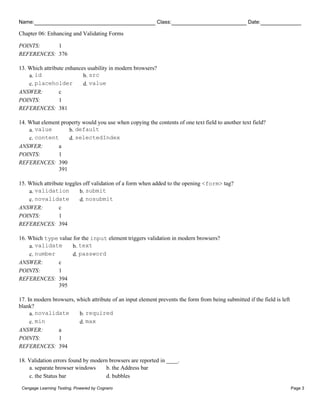
19. In general, modern browsers display validation feedback after the ____ event is triggered by a form.
a. submit b. reset
c. validate d. check
ANSWER: a
POINTS: 1
REFERENCES: 398
20. You can use the CSS ____ pseudo-classes to change the properties of form elements based on their validity status.
a. :submit and :reset b. :hover and :blur
c. :before and :after d. :invalid and :valid
ANSWER: d
POINTS: 1
REFERENCES: 399
21. To check a group of fields and trigger an error message if any of them is empty, you use a(n) ____ statement.
a. debugger b. loop
c. console.log() d. submit
ANSWER: b
POINTS: 1
REFERENCES: 410
22. For any fields that require numeric values, you can use JavaScript’s built-in ____ function to determine whether a user
actually entered a number.
a. submit() b. reset()
c. validate() d. isNaN()
ANSWER: d
POINTS: 1
REFERENCES: 429
23. When a control's value is found to be invalid during constraint validation, the ____ event is triggered.
a. input b. invalid
c. change d. focus
ANSWER: b
POINTS: 1
REFERENCES: 366
24. Instead of document.getElementsByTagName("form")[0], you could use the code
a. document.forms[0]
b. document.form[0]
c. document.getFormElements[0]
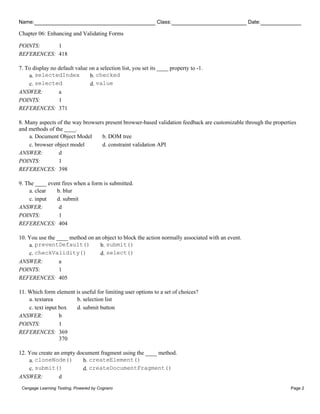
9.
Name: Class: Date:
Chapter06: Enhancing and Validating Forms
Cengage Learning Testing, Powered by Cognero Page 5
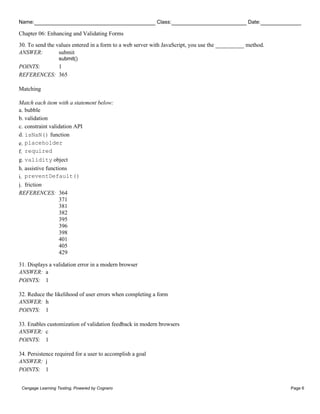
d. document.forms.form[0]
ANSWER: a
POINTS: 1
REFERENCES: 366
367
25. Use of the ____ attribute of the form element is not allowed in the strict DTD for XHTML.
a. id b. class
c. name d. method
ANSWER: c
POINTS: 1
REFERENCES: 367
Completion
26. __________ is the process of checking that information provided by users conforms to rules to ensure that it
appropriately answers a form's questions and is provided in a format that the site's back-end programs can work with.
ANSWER: Validation
validation
POINTS: 1
REFERENCES: 364
27. Enhancements to HTML and to modern browsers have allowed browsers themselves to perform many validation tasks
without any extra JavaScript. This type of validation is known as __________ validation.
ANSWER: browser-based
browser based
native
HTML5
HTML 5
POINTS: 1
REFERENCES: 394
28. Creating a function to validate required fields generally involves retrieving the values of the required fields and
checking if the value of any of them is __________.
ANSWER: an empty string
empty string
empty
""
POINTS: 1
REFERENCES: 408
29. For all custom validation, it can be helpful to use the __________ structure for handling errors.
ANSWER: try/catch
try catch
POINTS: 1
REFERENCES: 408
10.
Name: Class: Date:
Chapter06: Enhancing and Validating Forms
Cengage Learning Testing, Powered by Cognero Page 6
30. To send the values entered in a form to a web server with JavaScript, you use the __________ method.
ANSWER: submit
submit()
POINTS: 1
REFERENCES: 365
Matching
Match each item with a statement below:
a. bubble
b. validation
c. constraint validation API
d. isNaN() function
e. placeholder
f. required
g. validity object
h. assistive functions
i. preventDefault()
j. friction
REFERENCES: 364
371
381
382
395
396
398
401
405
429
31. Displays a validation error in a modern browser
ANSWER: a
POINTS: 1
32. Reduce the likelihood of user errors when completing a form
ANSWER: h
POINTS: 1
33. Enables customization of validation feedback in modern browsers
ANSWER: c
POINTS: 1
34. Persistence required for a user to accomplish a goal
ANSWER: j
POINTS: 1
11.
Name: Class: Date:
Chapter06: Enhancing and Validating Forms
Cengage Learning Testing, Powered by Cognero Page 7
35. Determines whether a value is not a number
ANSWER: d
POINTS: 1
36. Checking that information provided by users conforms to rules
ANSWER: b
POINTS: 1
37. Provides guidance about what data should be entered in a text box
ANSWER: e
POINTS: 1
38. If all its properties are false, then its value is true
ANSWER: g
POINTS: 1
39. Stops a form from being submitted when the submit event is triggered
ANSWER: i
POINTS: 1
40. Indicates that a form element must have a value
ANSWER: f
POINTS: 1
Subjective Short Answer
41. How can you add options to a selection list with JavaScript?
ANSWER: Using the methods for creating and attaching nodes in the node tree, you can add and remove
option elements in a select element.
POINTS: 1
REFERENCES: 375
42. Describe two advantages of referencing form objects using methods such as getElementById() rather than the
forms array.
ANSWER: Any two of the following:
1. One advantage of referencing form objects using methods such as
getElementById() rather than the forms array is that you don’t need to switch between
using one syntax for referencing form objects and another syntax for non-form objects.
2. In addition, using Document object methods makes your code more flexible when you need the
same code to be able to refer to both form and non-form elements.
3. Finally, use of the name attribute is not allowed in the strict DTD for XHTML, so if you’re
writing JavaScript to work with XHTML documents, you cannot use the forms array or other
browser arrays.
POINTS: 1
12.
Name: Class: Date:
Chapter06: Enhancing and Validating Forms
Cengage Learning Testing, Powered by Cognero Page 8
REFERENCES: 367
43. In what situations can you get more accurate information on a form by using form fields other than text boxes? Name
two types of fields you might use instead.
ANSWER: Sometimes the information requested for a field is restricted to a small, discrete list—the names of a few
credit cards, for instance. Asking users to type this information opens your form to the possibility that
they’ll misspell a word, use an abbreviation that your back-end system doesn’t recognize, or simply enter
data that’s not within the acceptable parameters. Instead, you can use other types of form fields to
present users with acceptable choices, and limit their options to those choices.
Any two of the following:
• option buttons
• selection lists
• check boxes
• sliders
• data lists
POINTS: 1
REFERENCES: 369
370
44. What is an assistive function? Give an example of a situation in which you might use an assistive function.
ANSWER: In addition to providing users with limited sets of possibilities for different form fields, you can create
JavaScript functions that reduce the likelihood of user errors when completing a form. Such functions,
known as assistive functions, do not perform validation themselves—that is, they don’t check user
content for errors. Instead, these functions prevent users from entering erroneous data in the first place.
Many types of assistive functions are possible; which ones you implement depends on the design of your
form and the type of data you’re trying to collect.
One of the following:
• removing default values from selection lists
• dynamically updating selection list values
POINTS: 1
REFERENCES: 371
374
45. Describe how you can use JavaScript to simulate the behavior of the placeholder attribute in older browsers?.
ANSWER: You can recreate the behavior of the placeholder attribute in older browsers by adding the desired
placeholder text as a default value for an element and changing its color to differentiate it from data a
user has entered (generally using a gray font color rather than black). You can then create an
event listener that’s triggered when a user clicks in the box, which calls a function that removes the
default value.
POINTS: 1
REFERENCES: 382
46. The requirements of the form you’re validating determine the kind of logic you need to incorporate into a custom
validation program. However, a few types of validation functions are particularly common. Name two.
13.
Name: Class: Date:
Chapter06: Enhancing and Validating Forms
Cengage Learning Testing, Powered by Cognero Page 9
ANSWER: (any two of the following:)
• Checking that required fields contain entries
• Checking values that are dependent on the values of other controls
• Checking for an appropriate content type in one or more fields
POINTS: 1
REFERENCES: 402
47. Why is is usually not necessary to include testing for the number of characters in user input in custom validation
functions?
ANSWER: Even if you have browser-based validation disabled, both current and older browsers enforce the
maxlength attribute, making it essentially impossible for users to enter more characters in a text input
or textarea box than the maxlength value allows.
POINTS: 1
REFERENCES: 404
48. What does a function to validate required fields generally need to do?
ANSWER: Creating a function to validate required fields generally involves retrieving the values of the required
fields and checking if the value of any of them is an empty string.
POINTS: 1
REFERENCES: 408
49. Describe the three behaviors that make up the placeholder effect in modern browsers, and that you need to replicate
with JavaScript for older browsers.
ANSWER: • Add placeholder text when a page finishes loading.
• Remove placeholder text when a user selects the field.
• Check the contents of the field when the users moves to another field, and if the field is empty,
add back the placeholder text as the value.
POINTS: 1
REFERENCES: 382
50. If you were designing a form with a question that asked users if they had ever visited a certain city, would you expect
more accurate input using a text input box or a check box? Why?
ANSWER: Check box.
The information being requested is a Boolean value -- either yes or no. This lends itself to a check box,
which can have only those two values. In a text input box, users might enter yes, no, y, n, never, or many
other values that would be hard to plan for and difficult to tally automatically once collected.
POINTS: 1
REFERENCES: 369
370
371
This ebook isfor the use of anyone anywhere in the United
States and most other parts of the world at no cost and with
almost no restrictions whatsoever. You may copy it, give it away
or re-use it under the terms of the Project Gutenberg License
included with this ebook or online at www.gutenberg.org. If you
are not located in the United States, you will have to check the
laws of the country where you are located before using this
eBook.
Title: How to Become a Public Speaker
Author: William Pittenger
Release date: January 2, 2017 [eBook #53869]
Most recently updated: October 23, 2024
Language: English
Credits: Produced by Richard Tonsing and the Online Distributed
Proofreading Team at http://www.pgdp.net (This file
was
produced from images generously made available by
The
Internet Archive)
*** START OF THE PROJECT GUTENBERG EBOOK HOW TO BECOME
A PUBLIC SPEAKER ***
21.
HOW TO BECOMEA
PUBLIC
SPEAKER
SHOWING THE BEST MANNER OF ARRANGING THOUGHT SO AS TO
GAIN CONCISENESS, EASE, AND FLUENCY IN SPEECH
BY
WILLIAM PITTENGER
PHILADELPHIA
THE PENN PUBLISHING COMPANY
1903
22.
Entered according toAct of Congress, in the year 1886, by
THE NATIONAL SCHOOL OF ELOCUTION AND ORATORY,
in the office of the Librarian of Congress, at Washington, D. C.
24.
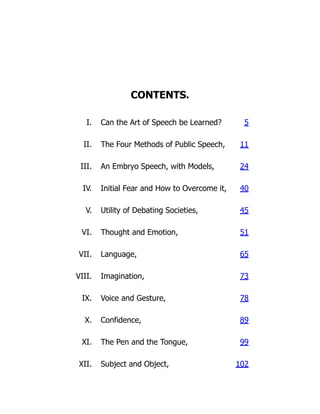
CONTENTS.
I. Can theArt of Speech be Learned? 5
II. The Four Methods of Public Speech, 11
III. An Embryo Speech, with Models, 24
IV. Initial Fear and How to Overcome it, 40
V. Utility of Debating Societies, 45
VI. Thought and Emotion, 51
VII. Language, 65
VIII. Imagination, 73
IX. Voice and Gesture, 78
X. Confidence, 89
XI. The Pen and the Tongue, 99
XII. Subject and Object, 102
25.
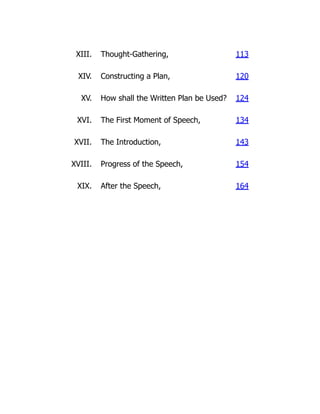
XIII. Thought-Gathering, 113
XIV.Constructing a Plan, 120
XV. How shall the Written Plan be Used? 124
XVI. The First Moment of Speech, 134
XVII. The Introduction, 143
XVIII. Progress of the Speech, 154
XIX. After the Speech, 164
26.
CHAPTER I.
Can theArt of Speech be Learned?
There is a widespread opinion that all study of the mode of oratory
is unmanly, and leads to the substitution of artifice and adornment
for simplicity and power. “Let a man have something important to
say,” it is argued, “and he need not waste his time in trying to find
how to say it.” So general is this sentiment, that a ministerial
acquaintance of the writer’s was recently very careful to conceal
from his congregation the fact that he was taking a series of lessons
in elocution, lest his influence should be diminished.
We may admit that the popular prejudice against the study of
eloquence is not without a mixture of reason. It is possible to foster
a spurious kind of oratory, which shall be far inferior to the rudest
genuine speech. But, on the other hand, it is safe to maintain that
every rational power man possesses can be strengthened by
judicious cultivation, without in the least impairing its quality. There
is no trick in true oratory—no secret magic by which a weak-minded
man can become the leader of others stronger and wiser than
himself. The great prizes of eloquence cannot be placed in the hands
of the ignorant or slothful. But so surely as a raw apprentice can be
transformed into a skillful workman, any person possessed of
ordinary faculties, who will pay the price in labor, can be made
master of the art of ready and forcible public utterance.
The methods of oratorical cultivation presented in this volume are
not based upon mere theory. They have been tested in hundreds of
instances, and their results are beyond question. A carpenter will
assert with perfect assurance, “I guarantee to take an ordinary
27.
young man, whowill place himself in my hands for a reasonable
time, and turn him out a thorough mechanic, master of every part of
his trade.” The effects of training are as marvelous and as certain in
the fields of eloquence.
But this training must necessarily combine practice with theory. To
study about great orators and observe their works is not sufficient.
Here again, we may take a lesson from the mode in which an
apprentice is trained. The master architect does not take his young
men to gaze upon finished buildings, and expect them, from mere
admiration and architectural fervor, to construct similar works. He
would soon find that not one in a hundred had the “mechanical
genius” for such an easy triumph. But he takes them into the shop,
where work is in progress, places before them some simple task,
and from that leads them on, step by step, to more difficult
achievements. They learn how to make the separate parts of a
house, and afterward how to fit those parts into a complete work.
Under this rational mode of instruction the great majority master the
whole business placed before them, and the failures are rare
exceptions. If similar success does not attend oratorical students,
the explanation must be sought, not in the nature of oratory, but in
wrong methods of training. Merely reading Cicero and Demosthenes,
even in their original tongues, declaiming choice selections, or
listening to great orators, will not make any one eloquent, unless
indeed he possesses that rare natural genius which rises above all
rules and sweeps away every obstacle.
But it must be remembered that there are many degrees of
eloquence. The popular conception is somewhat unjust in refusing
recognition to those who possess this power in only a fair degree. It
is not possible by any mode of training to produce many orators of
the very highest type. Such will ever be rare for the same reason
that there are but few great poets, generals, or statesmen. But
proper education in the art of speech should enable a man to give
full, free, and adequate expression to whatever thoughts and
feelings he may possess. It may go further, and make him more
fruitful in thought, and more intense in feeling, than he could have
28.
been in theabsence of such education, and he may thus become
fairly entitled to the rewards of eloquence without, however,
reaching the level of the few great world-orators. The distinction
between a good degree of practical, working eloquence, which may
be successfully taught to the mass of students, and the very highest
development of the same faculty, should always be kept in mind.
Even the mightiest genius may be regulated, strengthened, and
directed by culture; while moderate talents may, by similar culture,
reach a very serviceable degree of efficiency and power.
While these considerations appear almost self-evident, they are not
unnecessary. On listening to a true orator—one who, without
hesitation, pours forth a stream of well-chosen words, and develops
a difficult subject in a clear and masterly manner—we are apt to
receive an impression like that made by the operation of a law of
nature, or an unerring animal instinct. Does the orator acquire
eloquence as the bee learns to construct honey-cells? There is, no
doubt, a foundation for eloquence in natural ability, but the analogy
is far more close with the human builder, who sees mentally the
image of the house he wishes to construct, fits the various timbers
and other materials into their places, and works intelligently until his
conception is realized. To Jack Cade and his fellows the mysteries of
reading and writing “came by nature;” but experience has shown
that this much of nature can be developed in the great majority of
American children. In the moderate and reasonable meaning of the
term, eloquence can be made almost as general as the elements of
a common-school education. The child that masters the art of
reading, really makes a greater conquest over difficulties, than the
average well-educated youth needs to add to the stores he already
possesses, in order to attain a good degree of oratorical power.
There are, indeed, a few indispensable requisites which will be
understood by every person; but the want of these debars a small
minority only, and their absence is easily recognized. For all others
the path of success lies open. Patient practice in the use of the pen
as a servant but not as a master, the study of good models, and the
29.
laborious mastery indetail of the separate elements of oratory, will
not fail of abundant fruit.
There are two classes of works with which this treatise should not be
confounded. It aims to occupy an almost vacant place between
manuals of elocution on the one hand, and works of technical
instruction in the various oratorical professions, on the other. Both of
these classes of books are very useful, and teach indirectly many of
the elements of true eloquence. Elocution deals with voice and
gesture, which are prime elements in oratory; and although it is
popularly supposed to be applicable only to reading and recitation, it
is equally serviceable in off-hand speech. Works of the second class
give rules for preaching, debating, pleading at the bar, teaching, and
all other professions which involve public speech. They show how
various kinds of discourses may be constructed, but have few
practical directions about the mode of delivery, or that grand and
noble work—the development of the oratorical power itself.
This book is written from the standpoint of the student who wishes
to wield the golden sceptre of eloquence and is willing to put forth
all reasonable efforts to that end. It will aim to guide him into the
right path; show him what helps are available, and what discipline is
necessary; encourage him in overcoming difficulties, and stimulate
him to seek the very highest excellence within the compass of his
faculties.
30.
CHAPTER II.
The FourMethods of Public Speech—Their
Advantages and Disadvantages.
“What shall I do?” exclaims the young student who expects soon to
face public audiences. “Shall I write out what I have to say, polish it
as highly as possible, and then utter this finished product? Or must I
take the risk of being able to say nothing at all, in hope of gaining
the ease and naturalness of spontaneous speech?”
It must be admitted that the first course indicated above has many
advantages, and seems in harmony with the marked tendency of
civilization toward division of labor. It is hard to perform several
different operations at the same moment. Look how heavily the
extempore speaker is burdened. He must think of his subject;
arrange his ideas, sentences, and words; remember quotations;
originate proper tones and gestures; and keep his attention closely
fixed upon his audience. All this he must do with the utmost
promptness and regularity, or incur a fearful penalty—that of
embarrassment and failure. Few men have the courage to stand long
before an audience, waiting for a missing word or idea. To avoid this
danger the mind of an extempore speaker must be accustomed to
work with the rapidity and precision of a printing-press; otherwise,
the appalling danger of failure and ridicule will constantly stare him
in the face. It is not wonderful that such perils have made many
speakers perpetual slaves of the pen.
But it may be noted that the public reader has an equal number of
things to do at the same moment. He must look on the manuscript
and recognize the words—a complicated process, which practice has
31.
1.
2.
3.
4.
made easy, butwhich does greatly distract attention. The whole
discourse must be brought into mind as really as if extemporized
with the difference that now, instead of arising from within, it is
brought back from without—a much more difficult achievement.
Tones and gestures are also increasingly difficult. The reader will
usually wish to give some attention to the audience, which, with
manuscript before him, will be far from easy. After he has done his
best his hearers will think, “This man is reading, not speaking—
giving us what he thought yesterday or last week, not what he is
thinking now.” Possibly this will not diminish their pleasure, but the
sentiment needs to be recognized.
The resource of memorizing the discourse after it has been prepared
relieves the eye and lessens the physical distraction, but it throws an
additional and very heavy burden upon the mind, and introduces
new embarrassments peculiar to itself.
The advice enforced in these pages will be: “Extemporize; take the
risk; fail, if necessary” though precautions will be given making
failure well nigh impossible; “but in all cases when you speak to the
people with the object of convincing or persuading, let it be seen
that you speak directly the thoughts and feelings of that very
moment.”
The two extremes of verbal communication between men are letters,
books, or essays, on the one side, and desultory talk on the other. In
the one, the pen is everything; in the other, it is not employed at all.
Neither mode of address constitutes oratory, but the whole field of
this art lies between them.
There are four principal methods of discourse distinguished in
reference to the mode of delivery, which we may name as follows:
Reading.
Recitation.
Extemporizing.
The composite method.
32.
Of these, thefirst two have the great advantage of allowing the
speaker as much time as may be necessary for the arrangement of
the speech down to the minutest detail. Words may be selected with
the nicest care, and if the first effort is not satisfactory the speech
may be written again and again, until the writer’s full power has
been utilized. After delivery, the manuscript is at once available for
publication or preservation. The first method gives the orator
something to lean upon. Should he become embarrassed, he can fix
his attention closely upon his writing until he recovers. Should his
attention be distracted, and the thread of discourse be broken, it can
be taken up again at any point.
In recitation more declamatory fervor is possible than in reading.
Gesticulation is less restrained. The speaker need not be confined
within the narrow limits of a circle, the centre of which is his
manuscript, and the radius the distance at which he can read it.
As an offset, there is the effort, in some cases very considerable, of
memorizing; the variable power of memory in different states of
health; and the possibility of altogether forgetting the prepared
words. It must also be admitted that few men can declaim well.
Some have mastered the difficult art, and have won laurels in this
way; but their number, especially in the modern world, is
comparatively small.
Extemporizing does not exclude the most exhaustive study of a
subject. It is easier, indeed, to write upon a subject only partially
understood, than to address an audience directly upon the same
topic. Neither does this method exclude the most careful pre-
arrangement of the thoughts enunciated. The trained speaker will
find it comparatively easy to make a plan at a moment’s notice
which will serve as a basis for discourse; but he will usually be
provided with a plan long before he begins to speak. He will aim to
understand his subject, make the best arrangement of it in his
power, select what is most fitting for his purpose, and then, face to
face with his audience, will give them, in a manly way, the
outflowing of his mind and heart. It is in this sense alone that the
33.
word “extempore” willbe used in this volume. We maintain that, so
far from being the refuge of ignorance and sloth, extempore speech
is often the vehicle of the widest culture and the most extensive
knowledge.
The increased attention paid to extempore speech within a few years
indicates a hopeful improvement of taste among professional men.
The majority of the people have always preferred it. They do not
greatly desire of pulpit, platform, or bar, the verbal elaboration
favored by written speech; but fervent manner, earnest conviction,
and directness are highly prized. Readers and reciters imitate, as far
as they can, the manner of spontaneous speech. It is well to
remember that this tribute of imitation is never paid by the superior
to the inferior.
One argument in favor of extempore delivery has never received due
consideration: it is far more healthful than other forms of address. In
the case of men who speak only at long intervals, this consideration
may not be weighty; but to others, it involves years of added
usefulness, or even life itself.
This superior healthfulness has often been observed, but what is its
source? The answer will go far to show why true extempore speech
is more persuasive and emotional than any other variety. In
chemistry, a law of affinity has long been recognized, according to
which substances just set free from combination have greater
energy, and are more ready to form new combinations, than ever
afterward. In the same way, voice and gesture readily respond to
nascent emotion; that is, to emotion aroused for the first time. Every
speaker who utters the thought of the moment, if not fettered by
bad habits, or paralyzed by fear, will exhibit a perpetual change of
position, a variety of muscular movement, and a play of expression
which he can never afterward reproduce. The pitch, rate, and force
of the voice are controlled in the same effective and almost
automatic manner. An ordinary extemporizer, when thoroughly
aroused, will employ as great a variety of tones and gestures as a
highly trained elocutionist in his most elaborate recitations. Nothing
34.
is asserted asto the skill of the combinations, the melody of the
voice, or the grace of the action; though even in these the
advantage is not always on the side of the elocutionist. But in
distributing the effort among all the organs, and in giving that
alternate rest and action upon which health and strength depend,
the elocutionist may strive in vain to equal the model set him by a
good extempore speech. In Western and seaside camp-meetings,
speakers who have never spent an hour in vocal drill will often
address thousands of people in the open air with an energy of voice
and manner that would, if employed over a manuscript by any other
than the most accomplished elocutionist, speedily bring all efforts
and the speaker himself to an end. But he easily endures the strain
because there is that continual change which is the equivalent of
rest. Notice some thoroughly excited speaker, trained only in the
school of experience—possibly a mere demagogue or popular
agitator—at his work. A word shot forth almost as piercing as a
steam whistle is followed by a sentence far down the scale, and
when emotion demands the same high key again, the organs in that
position are fresh for a new ear-piercing effort. There is equal
variation in the rate of speech. The whole body joins in the
expression of emotion, without the slightest conscious effort,
impelled only by the aroused nervous energy which seeks that mode
of discharge. When the effort ends, the man is weary, indeed; but
with a weariness distributed over the whole body, and without a
trace of that exhaustion of brain, throat, or the upper part of the
lungs, which has sent many manuscript speakers—clergymen,
especially—to untimely graves.
What a difference there is between the preacher who languidly reads
his manuscript for twenty-five minutes to a hundred people, and
closes the mighty effort with aching head, quivering nerves, and
exhausted throat, and the typical camp-meeting orator! The latter
works hard, addressing thousands of people for an hour and a half
or two hours; but as the stamping foot, the tense arm, the nodding
head, the fully expanded lungs, and the swaying body have all taken
part, the blood and nervous energy have been sent in due
35.
proportion to everyorgan, and there is no want of balance. The man
can repeat the same performances the next day, and continue it, as
many itinerants have done, for months together. Similar examples of
endurance have often been given in heated political canvasses by
orators of the very highest eminence, as well as by others unknown
to fame. Difference of cultivation or of earnestness will not suffice to
explain the contrast between the two classes of speakers.
The chemical analogy is instructive, and goes far to account for the
observed differences. When thought passes out of the mist and
shadow of general conceptions into the definite form of words, it has
immeasurably greater power to arouse and agitate the mind in
which this transformation is made, than it can have when the same
words are merely recalled in memory or read from a sheet of paper.
When the whole process of expression takes place at once:—the
mental glance over the subject; the coinage of thoughts into words
and sentences; the utterance of the words as they rise to the lips;
the selection of key, inflection, emphasis, gesture:—the man must
have a very cold nature, or his theme be very dull, if, with a
sympathizing audience before him, the tides of emotion do not begin
to swell. But notice how other modes of delivery squander this
wealth of emotion. The writer carefully elaborates his language. He
is perfectly calm, or if there is any excitement, it is purely
intellectual, and the quickened flow of blood is directed only to the
brain. When the ardor of composition subsides, and he reviews his
pages, the fire seems to have died out of them. While memorizing,
or making himself familiar enough with what he has written to read
it with effect, he may recall some of the first ardor, but only to have
it again subside. When at last he stands up to speak, his production
is a thrice-told tale. In but few cases will he feel the full inspiration
of his message. If he recites, the effort of memory distracts his
attention, and he is probably reading from a page of manuscript
presented by his mental vision. If he reads directly, he must take a
position to see his paper, and at least part of the time keep his eye
fixed upon it. The address is felt to come, notwithstanding all the
artifice he can employ, at least as much from the paper as from the
36.
man. The mostprofound culture in reading and declamation only
suffices to bring back part of the emotion with which the genuine
extemporizer starts.
As bearing upon the subject of the healthfulness of extempore
speech, a reference to the writer’s own experience may not be
improper. Severe and exceptional hardship in the civil war led to a
complete break-down in health. The hope of any kind of active work,
or even of many months of life, seemed very slight. The question
was not so much how to speak best, as how to speak at all.
Fortunately, a long series of daily lectures, involving no great
intellectual effort, proved that mere talking was not necessarily
hurtful. Some elocutionary hints at the right time were also of great
value. When the pulpit was entered, greater difficulty arose. A few
trials of memorized preaching produced alarming nervous
exhaustion. Reading was equally deleterious to throat and voice.
One path alone seemed open; and entering upon that with
confidence, which eighteen years of experience has only deepened,
the writer found that extempore speech was, for him, probably the
most healthful of all forms of exercise. It is not likely that one-third
of this term of work would have been secured by any other kind of
address.
Another important advantage is the saving of time afforded by this
mode of speech. The hours otherwise wasted in word-elaboration
may be more usefully employed in general studies. The field for an
orator’s improvement is boundless; but if obliged to fully write a
large number of discourses, he must either work very rapidly or very
perseveringly to enter far into that field. But if less preparation is
given to individual speeches, more time will be available for the
improvement of the speaker. Or if he uses the same length of
preparation for each discourse in the extempore mode, he can
collect and classify a far greater amount of material, and the mental
element will thus gain far more than the merely verbal loses.
Only the fourth or composite method of discourse remains for our
consideration. At first glance, it seems to combine the advantages of
37.
all other methods,and for many minds it possesses great attraction.
In it the less important parts of the speech are given off-hand, while
passages of especial brilliancy or power are written fully, and either
read or recited. Added variety may be given by reading some of
these, and declaiming others from memory. A very brilliant and
showy discourse may thus be constructed. But the difficulties are
also very great. Full success requires a rare combination of desirable
qualities. A good verbal memory, the power of composing effective
fragments, and of declaiming or reading them well, are not often
joined to all the qualities that make a ready and impressive
extemporizer. For this reason it usually follows that in composite
discourses one of the elements so greatly predominates as to dwarf
the others. A manuscript discourse in which an extempore remark or
two is interpolated must be classed with written discourses. Neither
does extemporizing lose its special character, though some scattered
quotations be read or repeated from memory. To pick up a book, in
the midst of a speech, and read a theme or argument, or the
statement of another’s position, does not make the discourse
composite in character, unless such reading be the principal part of
it. An eloquent speaker on one occasion occupied more than half his
time, and produced far more than half his effect, by reciting poems
of the author who was the nominal subject of his lecture. The
performance would have been more appropriately styled,
“Recitations from the poems of ——.” The few running comments
introduced did not entitle it to be classed as an original production,
because they were obviously not its governing motive.
How shall the advantages of extemporizing be secured, while
avoiding its dangers? No commendation can be given to those who
simply talk to an audience, giving forth only what may happen to be
in mind at the moment of delivery. The most pedantic writing and
lifeless reading would, as a habit, be preferable to such recklessness.
Unwritten speech does not preclude the fullest preparation. The
plans advocated in this volume will enable a speaker to gather
materials as widely, arrange them as systematically, and hold them
as firmly in hand, as if every word was written; while at the same
38.
time he mayhave all the freedom and play of thought, the rush of
passion, and the energy of delivery that comes in the happiest
moment of out-gushing words. But those who are unwilling to labor
may as well lay down the book. We do not profess to teach a
process of labor-saving, though much labor will be changed from
mechanical to intellectual, and after long experience the total saving
may be great. But in the first stages those who have been
accustomed to write in full will find that the change involves an
increase, rather than a diminution, of work.
39.
CHAPTER III.
An EmbryoSpeech, with Models of Very Simple
Plans.
The first extemporaneous speeches attempted should be of the
simplest character. Too high an ideal formed at the outset may be
very harmful by causing needless discouragement. To speak freely in
any manner, however rude, until confidence and the power of
making every faculty available are acquired, should be the first great
object. Many persons are slaves of bad habits through life because
they began wrong. Nothing harms an orator more than cultivating
his critical taste far beyond his power of ready utterance. There is no
necessary relation between the development of the two things. To
become a fine word-critic and master of an excellent written style
does not imply the power to strike off finely finished sentences at
the speed of the tongue; but it does tend to render the speaker
dissatisfied with anything below the level of his written
performances, and thus checks his fluency. To master the difficult art
of written composition first, and strive afterward to gain a similar
proficiency in spoken words, is a complete reversal of the natural
method, and in all but a few gifted minds puts a premium on failure.
An unlettered rustic may speak with perfect ease, because he is not
conscious of the numberless verbal blunders he falls into; but if it
were possible, by some process of spiritual infusion, to put him in
possession of a fine, critical taste, he would be instantly smitten
dumb.
The true method is to cultivate the faculty of extemporization side by
side with critical judgment. In case that is done, ease and
40.
1.
2.
3.
confidence will notbe for a moment disturbed. It thus appears that
while an extempore speaker can never know too much, it is quite
possible for his knowledge and cultivation to advance in the wrong
order. The pen will be of perpetual use to the speaker; but his
command of it must not increase so rapidly in proportion as to make
him ashamed of his tongue.
From this reasoning it follows that the best time to lay the
foundation of excellence in speech is very early in life. Speeches
made then are necessarily flimsy and rudimentary, but they are not
the less valuable on that account. They are to be estimated not for
their own worth, but for their results upon the mind producing them.
The schoolboy’s first “composition” has always been a mark for
cheap witticism; but the boy himself regards it with justifiable pride,
as the first step in the noble work of putting thought on paper. The
same pains and patience applied to the art of public talking as to
written composition will produce equal fruit. A few directions
intended to aid in overcoming some of the initial difficulties of
speech, which may serve as suggestions to teachers as well as helps
to solitary students, are here appended. They are purposely made of
almost ludicrous crudeness, but will not, it is trusted, be less
serviceable on that account; for it is not so important to aid the
mature speaker in giving the last fine strokes of genius to a masterly
oration, as it is to stimulate and guide beginners in their first
stammering utterances.
The simplest oration or formal address that can be constructed has
three distinct parts. With these we will begin the great work of
division and arrangement. They may be named as follows:
The Introduction.
The Discussion.
The Conclusion.
On this framework a speech-plan can be constructed simple enough
for any child. And it is at the same time true that even a child, with
41.
such a plan,might speak appropriately who would otherwise not be
able to begin at all.
We will consider these three parts in their order.
The introduction is at once important and embarrassing. First words
are nearly always heard attentively, and they do much to determine
the degree of attention that will be bestowed on the remainder of
the speech. The young speaker should select something as an
introduction upon which his mind can fasten, instead of dwelling
upon the frightful generality of the naked theme. Neither is it hard to
construct a good introduction if a few plain directions are heeded,
which will be more fully given in a succeeding chapter. All persons
feel the need of some kind of a formal opening, and therefore often
begin with an apology—the very worst form of an introduction,
because it is not interesting in itself and does not lead up to the
subject.
In rudimentary speech, which we are now considering, the
introduction should be simple, and, above everything else, easy for
the speaker to comprehend and remember. If there is anything in
the whole world which he is sure he can talk about for a few
moments, and which can be made to have a moderate degree of
connection with his subject, let that be chosen for an opening. If it is
also vivid and striking in itself, and familiar to the audience, so much
the better; but this quality should not be insisted upon in these first
attempts.
When the introductory topic is selected it should be turned over in
the mind until the speaker knows just what he is going to say about
it. This process will have a wonderfully quieting effect upon his
nerves. He has fairly mastered something, and knows that at all
events he can begin his speech. It is well to make a note of this
introduction in a few simple words which will strongly fasten
themselves in the memory. No effort toward elaboration should be
made, for that would naturally lead to a memorized introduction,
and either require the whole speech to be written, or produce a
painful and difficult transition.
42.
The discussion dealsdirectly with the subject or central idea of the
discourse. Here a clear statement of at least one thought which the
speaker can fully grasp should be made. The pen (or pencil) may be
used in preparation without impropriety. If but one idea is thought
of, let that be written in the fewest and strongest words at the
student’s command. While doing this it is likely that another and
related thought will spring into mind which can be treated in the
same manner. With diligent students there may even be a danger of
getting down too many seed-thoughts. But that contingency is
provided for in the chapters on the fully developed plan, and needs
no further notice at this time.
When this central division is completely wrought out, two other
points claim attention. How shall the transition be made from the
introduction to the discussion? A little reflection will show how to
glide from one to the other, and that process should be conned over,
without writing, until it is well understood. It is wonderful how many
outlines of ideas the memory will retain without feeling burdened;
and this power of retention grows enormously through exercise.
After this, the mode of gliding from the discussion to the conclusion
may be treated in the same manner, and with equal profit. The
conclusion itself is scarcely less material than the introduction; but
there is much less range of choice in the manner of closing than in
that of beginning. The subject is before the audience, and any wide
departure from it seems like the beginning of a new speech—
something not usually well received. There is this distinction
between the relative value of introduction and conclusion: a good
introduction adds most to a speaker’s ease, confidence, and power
during the moment of speech; but a good conclusion leaves the
deepest permanent impression upon the audience. It is usually
remembered longer than any other part of the address.
When a discourse has been prepared in this simple manner it has
virtually five parts—three written and two held in memory. From
such an outline it is far more easy to make an address than from the
bare announcement of a theme. It is true that all these parts may be
43.
formed and heldin mind without ever making a pen-stroke. A
practiced orator will do this, in a moment, when unexpectedly called
upon; or he may only forecast the introduction and trust to finding
the plan as fast as it is needed. But in this he is no model for
imitation by beginners. Even powerful orators sometimes spoil the
whole effect of a good address by an unfortunate mode of closing.
They may forget to close in time—a grievous fault!—or may finish
with some weak thought or extravagant proposition, by which the
whole speech is mainly judged and all its good points neutralized.
The construction of even as simple a plan as here indicated would
have more than double the effect of many speeches made by great
men.
A few simple and rude plans are annexed. No merit is sought for in
any one of them beyond making plain the method recommended.
44.
PLANS OF SPEECHES.
EXAMPLEFIRST.
Subject.—Chinese Emigration to America.
Introduction.—The number of emigrants to our country and the
nations they represent.
[A totally different and more effective introduction might be the
description of a group of Chinese as seen by the speaker.]
Discussion.—The nature, amount, and present effect of Chinese
emigration.
[It is possible for the speaker in his introduction to foreshadow the
position he expects to maintain in his speech; or he may make a
colorless introduction and reserve his opinion for the discussion. The
material under this head is unlimited. It is only necessary from the
oratorical standpoint that the speaker should determine what course
to take, and then carefully think out in advance or read—for history
and statistics cannot be improvised—all about that which he intends
to use. When he can tell it all over easily to himself he may
reasonably feel assured of his ability to tell it to others. The various
arguments should be weighed and the best selected. That which
most naturally connects with the introduction should be firmly fixed
in the mind as the first, that it may form the bridge from the one
part to the other.]
Conclusion.—Results of policy advocated, either predicted,
described, or shown to be probable. Mode of remedying evils
that might be apprehended from that policy.
[In the conclusion the speaker may take upon himself the character
of a prophet, poet, or logician. He may predict results and let the
statement make its own impression. He may put all emphasis upon a
45.
1.
2.
3.
vivid painting ofthe future colored by the views he advocates; or he
may sum up his reasons, deduce consequences, and weigh
alternatives. The choice between these different modes may be
made instinctively, or it may require considerable mental effort, but
when made, the best mode of transition will be very easily found.]
In all this process, which in the case of undisciplined speakers may
extend over many days of hard work, the pen may be used freely,
making copious notes of facts and arguments. After enough has
been accumulated and put in such shape that the speaker can easily
look over the entire field, he is ready for another process—that of
simplifying his plan. Rough and copious notes brought with him to
the platform would only be a source of embarrassment. But the
germ of his ideas, which are now familiar, can be put into very small
compass. Perhaps the following would recall everything in the
preceding outline:
The Chinese Question.
Experience.
Arguments.
Results.
But it is clear that a skeleton containing only three words need not
be kept in view. The whole outline of the speech will therefore be in
the mind. If numerous figures or citations from authorities are
employed, they may be classified and read from books or notes, as
needed. Such reading in no way detracts from the extemporaneous
character of the address, though if too numerous they tend to damp
oratorical fire and break the unity of discourse. One who has had no
personal experience, or who has not carefully observed the methods
of other speakers, can scarcely imagine how much a simple outline,
such as here suggested, accomplishes in removing the confusion,
fear, and hesitation which characterize beginners.
Another specimen, not of controversial character, is subjoined.
46.
1.
2.
3.
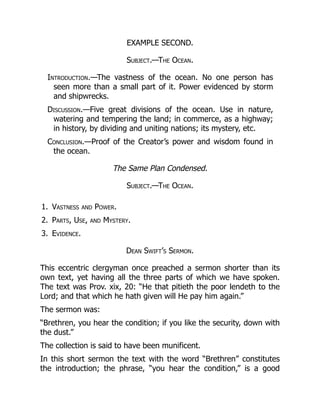
EXAMPLE SECOND.
Subject.—The Ocean.
Introduction.—Thevastness of the ocean. No one person has
seen more than a small part of it. Power evidenced by storm
and shipwrecks.
Discussion.—Five great divisions of the ocean. Use in nature,
watering and tempering the land; in commerce, as a highway;
in history, by dividing and uniting nations; its mystery, etc.
Conclusion.—Proof of the Creator’s power and wisdom found in
the ocean.
The Same Plan Condensed.
Subject.—The Ocean.
Vastness and Power.
Parts, Use, and Mystery.
Evidence.
Dean Swift’s Sermon.
This eccentric clergyman once preached a sermon shorter than its
own text, yet having all the three parts of which we have spoken.
The text was Prov. xix, 20: “He that pitieth the poor lendeth to the
Lord; and that which he hath given will He pay him again.”
The sermon was:
“Brethren, you hear the condition; if you like the security, down with
the dust.”
The collection is said to have been munificent.
In this short sermon the text with the word “Brethren” constitutes
the introduction; the phrase, “you hear the condition,” is a good
47.
Welcome to ourwebsite – the perfect destination for book lovers and
knowledge seekers. We believe that every book holds a new world,
offering opportunities for learning, discovery, and personal growth.
That’s why we are dedicated to bringing you a diverse collection of
books, ranging from classic literature and specialized publications to
self-development guides and children's books.
More than just a book-buying platform, we strive to be a bridge
connecting you with timeless cultural and intellectual values. With an
elegant, user-friendly interface and a smart search system, you can
quickly find the books that best suit your interests. Additionally,
our special promotions and home delivery services help you save time
and fully enjoy the joy of reading.
Join us on a journey of knowledge exploration, passion nurturing, and
personal growth every day!
testbankdeal.com




![Name: Class: Date:
Chapter 06: Enhancing and Validating Forms
Cengage Learning Testing, Powered by Cognero Page 4
ANSWER: d
POINTS: 1
REFERENCES: 396
19. In general, modern browsers display validation feedback after the ____ event is triggered by a form.
a. submit b. reset
c. validate d. check
ANSWER: a
POINTS: 1
REFERENCES: 398
20. You can use the CSS ____ pseudo-classes to change the properties of form elements based on their validity status.
a. :submit and :reset b. :hover and :blur
c. :before and :after d. :invalid and :valid
ANSWER: d
POINTS: 1
REFERENCES: 399
21. To check a group of fields and trigger an error message if any of them is empty, you use a(n) ____ statement.
a. debugger b. loop
c. console.log() d. submit
ANSWER: b
POINTS: 1
REFERENCES: 410
22. For any fields that require numeric values, you can use JavaScript’s built-in ____ function to determine whether a user
actually entered a number.
a. submit() b. reset()
c. validate() d. isNaN()
ANSWER: d
POINTS: 1
REFERENCES: 429
23. When a control's value is found to be invalid during constraint validation, the ____ event is triggered.
a. input b. invalid
c. change d. focus
ANSWER: b
POINTS: 1
REFERENCES: 366
24. Instead of document.getElementsByTagName("form")[0], you could use the code
a. document.forms[0]
b. document.form[0]
c. document.getFormElements[0]](https://image.slidesharecdn.com/16470-250318042501-854d9a57/85/JavaScript-The-Web-Warrior-Series-6th-Edition-Vodnik-Test-Bank-8-320.jpg)
![Name: Class: Date:
Chapter 06: Enhancing and Validating Forms
Cengage Learning Testing, Powered by Cognero Page 5
d. document.forms.form[0]
ANSWER: a
POINTS: 1
REFERENCES: 366
367
25. Use of the ____ attribute of the form element is not allowed in the strict DTD for XHTML.
a. id b. class
c. name d. method
ANSWER: c
POINTS: 1
REFERENCES: 367
Completion
26. __________ is the process of checking that information provided by users conforms to rules to ensure that it
appropriately answers a form's questions and is provided in a format that the site's back-end programs can work with.
ANSWER: Validation
validation
POINTS: 1
REFERENCES: 364
27. Enhancements to HTML and to modern browsers have allowed browsers themselves to perform many validation tasks
without any extra JavaScript. This type of validation is known as __________ validation.
ANSWER: browser-based
browser based
native
HTML5
HTML 5
POINTS: 1
REFERENCES: 394
28. Creating a function to validate required fields generally involves retrieving the values of the required fields and
checking if the value of any of them is __________.
ANSWER: an empty string
empty string
empty
""
POINTS: 1
REFERENCES: 408
29. For all custom validation, it can be helpful to use the __________ structure for handling errors.
ANSWER: try/catch
try catch
POINTS: 1
REFERENCES: 408](https://image.slidesharecdn.com/16470-250318042501-854d9a57/85/JavaScript-The-Web-Warrior-Series-6th-Edition-Vodnik-Test-Bank-9-320.jpg)


![This ebook is for the use of anyone anywhere in the United
States and most other parts of the world at no cost and with
almost no restrictions whatsoever. You may copy it, give it away
or re-use it under the terms of the Project Gutenberg License
included with this ebook or online at www.gutenberg.org. If you
are not located in the United States, you will have to check the
laws of the country where you are located before using this
eBook.
Title: How to Become a Public Speaker
Author: William Pittenger
Release date: January 2, 2017 [eBook #53869]
Most recently updated: October 23, 2024
Language: English
Credits: Produced by Richard Tonsing and the Online Distributed
Proofreading Team at http://www.pgdp.net (This file
was
produced from images generously made available by
The
Internet Archive)
*** START OF THE PROJECT GUTENBERG EBOOK HOW TO BECOME
A PUBLIC SPEAKER ***](https://image.slidesharecdn.com/16470-250318042501-854d9a57/85/JavaScript-The-Web-Warrior-Series-6th-Edition-Vodnik-Test-Bank-19-320.jpg)


![PLANS OF SPEECHES.
EXAMPLE FIRST.
Subject.—Chinese Emigration to America.
Introduction.—The number of emigrants to our country and the
nations they represent.
[A totally different and more effective introduction might be the
description of a group of Chinese as seen by the speaker.]
Discussion.—The nature, amount, and present effect of Chinese
emigration.
[It is possible for the speaker in his introduction to foreshadow the
position he expects to maintain in his speech; or he may make a
colorless introduction and reserve his opinion for the discussion. The
material under this head is unlimited. It is only necessary from the
oratorical standpoint that the speaker should determine what course
to take, and then carefully think out in advance or read—for history
and statistics cannot be improvised—all about that which he intends
to use. When he can tell it all over easily to himself he may
reasonably feel assured of his ability to tell it to others. The various
arguments should be weighed and the best selected. That which
most naturally connects with the introduction should be firmly fixed
in the mind as the first, that it may form the bridge from the one
part to the other.]
Conclusion.—Results of policy advocated, either predicted,
described, or shown to be probable. Mode of remedying evils
that might be apprehended from that policy.
[In the conclusion the speaker may take upon himself the character
of a prophet, poet, or logician. He may predict results and let the
statement make its own impression. He may put all emphasis upon a](https://image.slidesharecdn.com/16470-250318042501-854d9a57/85/JavaScript-The-Web-Warrior-Series-6th-Edition-Vodnik-Test-Bank-44-320.jpg)
![1.
2.
3.
vivid painting of the future colored by the views he advocates; or he
may sum up his reasons, deduce consequences, and weigh
alternatives. The choice between these different modes may be
made instinctively, or it may require considerable mental effort, but
when made, the best mode of transition will be very easily found.]
In all this process, which in the case of undisciplined speakers may
extend over many days of hard work, the pen may be used freely,
making copious notes of facts and arguments. After enough has
been accumulated and put in such shape that the speaker can easily
look over the entire field, he is ready for another process—that of
simplifying his plan. Rough and copious notes brought with him to
the platform would only be a source of embarrassment. But the
germ of his ideas, which are now familiar, can be put into very small
compass. Perhaps the following would recall everything in the
preceding outline:
The Chinese Question.
Experience.
Arguments.
Results.
But it is clear that a skeleton containing only three words need not
be kept in view. The whole outline of the speech will therefore be in
the mind. If numerous figures or citations from authorities are
employed, they may be classified and read from books or notes, as
needed. Such reading in no way detracts from the extemporaneous
character of the address, though if too numerous they tend to damp
oratorical fire and break the unity of discourse. One who has had no
personal experience, or who has not carefully observed the methods
of other speakers, can scarcely imagine how much a simple outline,
such as here suggested, accomplishes in removing the confusion,
fear, and hesitation which characterize beginners.
Another specimen, not of controversial character, is subjoined.](https://image.slidesharecdn.com/16470-250318042501-854d9a57/85/JavaScript-The-Web-Warrior-Series-6th-Edition-Vodnik-Test-Bank-45-320.jpg)