Full Download Test Bank Get the Latest Study Materials at testbankfan.com
JavaScript The Web Warrior Series 6th Edition
Vodnik Solutions Manual
https://testbankfan.com/product/javascript-the-web-warrior-
series-6th-edition-vodnik-solutions-manual/
OR CLICK HERE
DOWLOAD NOW
Download More Test Banks for All Subjects at https://testbankfan.com
Recommended digital products (PDF, EPUB, MOBI) that
you can download immediately if you are interested.
JavaScript The Web Warrior Series 6th Edition Vodnik Test
Bank
https://testbankfan.com/product/javascript-the-web-warrior-series-6th-
edition-vodnik-test-bank/
testbankfan.com
Principles of Web Design The Web Warrior Series 6th
Edition Sklar Solutions Manual
https://testbankfan.com/product/principles-of-web-design-the-web-
warrior-series-6th-edition-sklar-solutions-manual/
testbankfan.com
Principles of Web Design The Web Technologies Series 5th
Edition Skalar Test Bank
https://testbankfan.com/product/principles-of-web-design-the-web-
technologies-series-5th-edition-skalar-test-bank/
testbankfan.com
Organizational Behaviour Improving Performance Anf
Commitment In The Workplace Cannadian 3rd Edition Colquitt
Test Bank
https://testbankfan.com/product/organizational-behaviour-improving-
performance-anf-commitment-in-the-workplace-cannadian-3rd-edition-
colquitt-test-bank/
testbankfan.com
Social Psychology 11th Edition David Myers Test Bank
https://testbankfan.com/product/social-psychology-11th-edition-david-
myers-test-bank/
testbankfan.com
Strategic Management and Business Policy Globalization
Innovation and Sustainability 15th Edition Wheelen Test
Bank
https://testbankfan.com/product/strategic-management-and-business-
policy-globalization-innovation-and-sustainability-15th-edition-
wheelen-test-bank/
testbankfan.com
New Perspectives Microsoft Office 365 and Word 2016
Comprehensive 1st Edition Shaffer Test Bank
https://testbankfan.com/product/new-perspectives-microsoft-
office-365-and-word-2016-comprehensive-1st-edition-shaffer-test-bank/
testbankfan.com
Strategic Management A Competitive Advantage Approach
Concepts and Cases 14th Edition David Solutions Manual
https://testbankfan.com/product/strategic-management-a-competitive-
advantage-approach-concepts-and-cases-14th-edition-david-solutions-
manual/
testbankfan.com
Basic Clinical Laboratory Techniques 6th Edition Estridge
Solutions Manual
https://testbankfan.com/product/basic-clinical-laboratory-
techniques-6th-edition-estridge-solutions-manual/
testbankfan.com
Company Accounting Australia New Zealand 5th Edition Jubb
Test Bank
https://testbankfan.com/product/company-accounting-australia-new-
zealand-5th-edition-jubb-test-bank/
testbankfan.com
JavaScript, Sixth Edition 6-1
© 2015 Cengage Learning. All Rights Reserved. May not be copied, scanned, or duplicated, in whole or in part, except for use as permitted in a
license distributed with a certain product or service or otherwise on a password-protected website for classroom use.
Chapter 6
Enhancing and Validating Forms
A Guide to this Instructor’s Manual:
We have designed this Instructor’s Manual to supplement and enhance your teaching
experience through classroom activities and a cohesive chapter summary.
This document is organized chronologically, using the same headings that you see in the
textbook. Under the headings you will find: lecture notes that summarize the section, Teacher
Tips, Class Discussion Topics, and Additional Projects and Resources. Pay special attention to
teaching tips and activities geared towards quizzing your students and enhancing their critical
thinking skills.
In addition to this Instructor’s Manual, our Instructor’s Resources also contain PowerPoint
Presentations, Test Banks, and other supplements to aid in your teaching experience.
At a Glance
Instructor’s Manual Table of Contents
• Overview
• Objectives
• Teaching Tips
• Quick Quizzes
• Class Discussion Topics
• Additional Projects
• Additional Resources
• Key Terms
JavaScript, Sixth Edition 6-2
© 2015 Cengage Learning. All Rights Reserved. May not be copied, scanned, or duplicated, in whole or in part, except for use as permitted in a
license distributed with a certain product or service or otherwise on a password-protected website for classroom use.
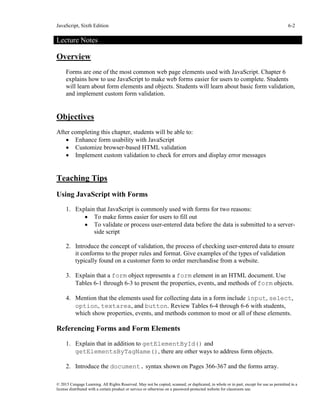
Lecture Notes
Overview
Forms are one of the most common web page elements used with JavaScript. Chapter 6
explains how to use JavaScript to make web forms easier for users to complete. Students
will learn about form elements and objects. Students will learn about basic form validation,
and implement custom form validation.
Objectives
After completing this chapter, students will be able to:
• Enhance form usability with JavaScript
• Customize browser-based HTML validation
• Implement custom validation to check for errors and display error messages
Teaching Tips
Using JavaScript with Forms
1. Explain that JavaScript is commonly used with forms for two reasons:
• To make forms easier for users to fill out
• To validate or process user-entered data before the data is submitted to a server-
side script
2. Introduce the concept of validation, the process of checking user-entered data to ensure
it conforms to the proper rules and format. Give examples of the types of validation
typically found on a customer form to order merchandise from a website.
3. Explain that a form object represents a form element in an HTML document. Use
Tables 6-1 through 6-3 to present the properties, events, and methods of form objects.
4. Mention that the elements used for collecting data in a form include input, select,
option, textarea, and button. Review Tables 6-4 through 6-6 with students,
which show properties, events, and methods common to most or all of these elements.
Referencing Forms and Form Elements
1. Explain that in addition to getElementById() and
getElementsByTagName(), there are other ways to address form objects.
2. Introduce the document. syntax shown on Pages 366-367 and the forms array.
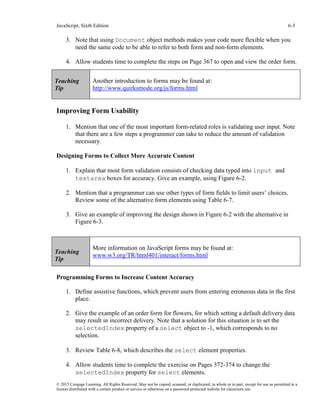
JavaScript, Sixth Edition 6-3
© 2015 Cengage Learning. All Rights Reserved. May not be copied, scanned, or duplicated, in whole or in part, except for use as permitted in a
license distributed with a certain product or service or otherwise on a password-protected website for classroom use.
3. Note that using Document object methods makes your code more flexible when you
need the same code to be able to refer to both form and non-form elements.
4. Allow students time to complete the steps on Page 367 to open and view the order form.
Improving Form Usability
1. Mention that one of the most important form-related roles is validating user input. Note
that there are a few steps a programmer can take to reduce the amount of validation
necessary.
Designing Forms to Collect More Accurate Content
1. Explain that most form validation consists of checking data typed into input and
textarea boxes for accuracy. Give an example, using Figure 6-2.
2. Mention that a programmer can use other types of form fields to limit users’ choices.
Review some of the alternative form elements using Table 6-7.
3. Give an example of improving the design shown in Figure 6-2 with the alternative in
Figure 6-3.
Programming Forms to Increase Content Accuracy
1. Define assistive functions, which prevent users from entering erroneous data in the first
place.
2. Give the example of an order form for flowers, for which setting a default delivery data
may result in incorrect delivery. Note that a solution for this situation is to set the
selectedIndex property of a select object to -1, which corresponds to no
selection.
3. Review Table 6-8, which describes the select element properties.
4. Allow students time to complete the exercise on Pages 372-374 to change the
selectedIndex property for select elements.
Teaching
Tip
Another introduction to forms may be found at:
http://www.quirksmode.org/js/forms.html
Teaching
Tip
More information on JavaScript forms may be found at:
www.w3.org/TR/html401/interact/forms.html
JavaScript, Sixth Edition 6-4
© 2015 Cengage Learning. All Rights Reserved. May not be copied, scanned, or duplicated, in whole or in part, except for use as permitted in a
license distributed with a certain product or service or otherwise on a password-protected website for classroom use.
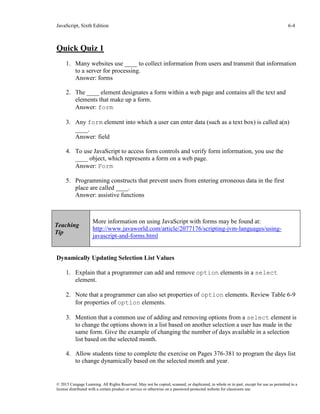
Quick Quiz 1
1. Many websites use ____ to collect information from users and transmit that information
to a server for processing.
Answer: forms
2. The ____ element designates a form within a web page and contains all the text and
elements that make up a form.
Answer: form
3. Any form element into which a user can enter data (such as a text box) is called a(n)
____.
Answer: field
4. To use JavaScript to access form controls and verify form information, you use the
____ object, which represents a form on a web page.
Answer: Form
5. Programming constructs that prevent users from entering erroneous data in the first
place are called ____.
Answer: assistive functions
Dynamically Updating Selection List Values
1. Explain that a programmer can add and remove option elements in a select
element.
2. Note that a programmer can also set properties of option elements. Review Table 6-9
for properties of option elements.
3. Mention that a common use of adding and removing options from a select element is
to change the options shown in a list based on another selection a user has made in the
same form. Give the example of changing the number of days available in a selection
list based on the selected month.
4. Allow students time to complete the exercise on Pages 376-381 to program the days list
to change dynamically based on the selected month and year.
Teaching
Tip
More information on using JavaScript with forms may be found at:
http://www.javaworld.com/article/2077176/scripting-jvm-languages/using-
javascript-and-forms.html
JavaScript, Sixth Edition 6-5
© 2015 Cengage Learning. All Rights Reserved. May not be copied, scanned, or duplicated, in whole or in part, except for use as permitted in a
license distributed with a certain product or service or otherwise on a password-protected website for classroom use.
Adding Placeholder Text for Older Browsers
1. Explain that many older browsers do not support the usability enhancements to HTML.
Note that JavaScript can simulate the behavior of these features in older browsers.
2. Mention that a popular recent feature in form creation is the placeholder attribute
of the input and textarea elements.
3. Note that a programmer can specify a word or phrase as the value of the
placeholder attribute, which is then displayed in the input or textarea box,
generally in gray rather than black characters.
4. Explain that the placeholder attribute provides guidance on what the user should
enter, as well as any formatting constraints.
5. Allow students time to complete the three exercises on Pages 382-388 to add
placeholder text to the Custom message box in older browsers.
Automatically Updating an Associated Field Based on a User Entry
1. Give the example of a form which has a “Custom message” checkbox a user can check
to send a message which is entered into a textarea element. Explain that if there is
an inconsistency between the two, it may not be treated properly by back-end code.
2. Explain that a solution is to add a function that checks a user’s entry in the textarea
field and checks the “Custom message” box for them if they have entered custom text.
3. Review Tables 6-10 and 6-11 for properties and methods of textarea elements.
4. Allow students time to complete the exercise on Pages 389-390 to create a function to
automatically check the Custom message check box when a custom message has been
entered.
Transferring Duplicate Field Values
1. Explain that JavaScript is commonly used to improve form usability by copying data
entered in one field to another field that a user indicates should contain the same data.
Give the example of billing and shipping addresses in a purchasing application.
2. Allow students time to complete the exercise on Pages 391-393 to enable users to use
billing address information for the shipping address.
JavaScript, Sixth Edition 6-6
© 2015 Cengage Learning. All Rights Reserved. May not be copied, scanned, or duplicated, in whole or in part, except for use as permitted in a
license distributed with a certain product or service or otherwise on a password-protected website for classroom use.
Customizing Browser-Based Validation
1. Explain that historically, JavaScript code was written to perform common and important
validation tasks. Note that in recent years, many browsers themselves often perform
validation without extra JavaScript code. This type of validation is called browser-based
validation, native validation, or HTML5 validation.
Specifying Browser-Based Validation Parameters
1. Review the attributes in Table 6-12, which are used to specify browser-based validation.
2. Describe additional browser-based validation linked to values for the type attribute,
presented in Table 6-13.
3. Allow students time to complete the exercise on Pages 395-397 to see how browser-
based validation deals with missing or invalid data in the order form.
Customizing Browser-Based Validation Feedback
1. Define constraint validation API, and explain that many aspects of the way browsers
present browser-based validation feedback are customizable through its properties and
methods.
2. Review Table 6-14, which describes properties of the validity object.
3. Discuss the methods of the constraint validation API, as presented in Table 6-15.
4. Describe that in conjunction with these properties and methods, you can use the CSS
:invalid and :valid pseudo-classes to change the properties of form elements based on
their validity status.
5. Work through the example code on Page 399, and show the result of the code, using
Figure 6-13.
6. Note that some features of browser-based validation are missing, which makes it
difficult to use in complex situations.
7. Allow students time to complete the exercise on Pages 401-402 to disable browser-
based validation for the order form.
Programming Custom Validation
1. Describe the common validation functions:
• Checking that required fields contain entries
• Checking values that are dependent on the values of other controls
• Checking for an appropriate content type in one or more fields
JavaScript, Sixth Edition 6-7
© 2015 Cengage Learning. All Rights Reserved. May not be copied, scanned, or duplicated, in whole or in part, except for use as permitted in a
license distributed with a certain product or service or otherwise on a password-protected website for classroom use.
2. Preview the Snoot Flowers order form, using Figure 6-14.
Validating Submitted Data
1. Describe the submit event, which fires when a form is submitted.
2. Allow students time to complete the exercise on Pages 404-408 to create the main
validation function.
Validating Required Fields with Custom Functions
1. Explain that creating a function to validate required fields generally involves retrieving
the values of the required fields and checking to see whether the value of any of them is
an empty string. Review the general form of the syntax, given on Page 408.
Checking for Empty Text Input Fields
1. Mention that a programmer uses different properties to validate each form element and
input type. Note that for text boxes, a programmer can use the value property to check
for a value.
2. Review both Table 6-16 and Table 6-17, which contain the properties and methods of
the input element.
3. Give an example, using the code on Page 410.
4. Allow students time to complete the exercise on Pages 410-413 to create a custom
validation function for input fields in the Billing Address fieldset.
Checking for Selection Lists with No Values
1. Introduce the State field and review its syntax, using the code on Page 414.
2. Allow students time to complete the exercises on Pages 414-417 to add validation for
the State selection lists to the validation function for the address and delivery date
fieldsets.
Checking for Option Button Sets with No Selection
1. Mention that to check whether an option button has been selected, you access the value
of its checked property.
2. Give an example, using the code at the top of Page 418.
3. Allow students time to complete the exercise on Pages 418-421 to create a validation
function for the Payment fieldset.
JavaScript, Sixth Edition 6-8
© 2015 Cengage Learning. All Rights Reserved. May not be copied, scanned, or duplicated, in whole or in part, except for use as permitted in a
license distributed with a certain product or service or otherwise on a password-protected website for classroom use.
Validating Dependent Fields with Custom Functions
1. Explain that a programmer may need to create functions to test logic specific to the
form. Give the example of a set of option buttons including “other”, followed by a text
box. Note that validation code could include the text box only when “other” is selected.
Validating Based on the State of a Check Box
1. Go through the example given at the bottom of Page 421, which addresses the Message
fieldset. Note that if the Custom message box is checked, a programmer’s code should
verify the text in the textarea control.
2. Allow students time to complete the exercise on Pages 422-424 to create a validation
function for the Custom message checkbox and its dependent textarea control.
Validating Based on Text Input Box Contents
1. Explain that in the Snoot Flowers order form, some fields need not be completed,
because buyers are not required to create an account. Note, however, that if a user
makes an entry in one of the fields, all three must be completed.
2. Show the required logic flow using Figure 6-21.
3. Allow students time to complete the exercise on Pages 425-428 to create a validation
function for the Create Account fieldset.
Validating Content Type with Custom Functions
1. Explain that a programmer can use JavaScript’s built-in isNaN() function for fields
that require numeric values to determine whether the user actually entered a number.
Show the syntax of the function, given on Page 429.
2. Allow students time to complete the exercise on Pages 429-432 to validate the Card
Number and CVV numeric fields.
Quick Quiz 2
1. The JavaScript ____ function can be used to determine if the value entered by a user is
numeric.
Teaching
Tip
More JavaScript forms examples may be found at:
http://javascript.internet.com/forms/
JavaScript, Sixth Edition 6-9
© 2015 Cengage Learning. All Rights Reserved. May not be copied, scanned, or duplicated, in whole or in part, except for use as permitted in a
license distributed with a certain product or service or otherwise on a password-protected website for classroom use.
Answer: isNaN()
2. You can use the ____ property to determine whether an individual check box has been
selected.
Answer: checked
3. The ____ property can be used to determine if a text box has a value.
Answer: value
4. True or False: Browser-based validation can replace the need to write custom JavaScript
code to validate user input.
Answer: True
5. The ____ attribute is used to provide guidance on what the user should enter, and any
formatting constraints that apply.
Answer: placeholder
Class Discussion Topics
1. Describe the attributes of the <form> object.
2. Why is the <input> element the most commonly used form element?
Additional Projects
1. Use JavaScript to create a web page that allows clients to order pizza. Clients should be
able to select toppings, type of crust, and method of payment. Validate that the form is
correct before submitting it.
2. Use JavaScript to create a web page for a shuttle company. The client should be able to
reserve a ticket using this page, selecting the date and time, pick-up and destination
locations, and the method of payment from a list of available options. Your code should
validate the form before it is submitted.
Teaching
Tip
More information on JavaScript form validation may be found at:
www.w3schools.com/jS/js_form_validation.asp
JavaScript, Sixth Edition 6-10
© 2015 Cengage Learning. All Rights Reserved. May not be copied, scanned, or duplicated, in whole or in part, except for use as permitted in a
license distributed with a certain product or service or otherwise on a password-protected website for classroom use.
Additional Resources
1. JavaScript Form Object:
www.comptechdoc.org/independent/web/cgi/javamanual/javaform.html
2. Form Object:
www.javascriptkit.com/jsref/form.shtml
3. JavaScript Form Object:
www.exforsys.com/tutorials/javascript/javascript-form-object.html
4. Form Validation:
www.yourhtmlsource.com/javascript/formvalidation.html
5. JavaScript form validation – doing it right:
www.xs4all.nl/~sbpoley/webmatters/formval.html
Key Terms
 assistive functions—JavaScript functions that reduce the likelihood of user errors when
completing a form by preventing users from entering erroneous data in the first place
 browser-based validation—Validation tasks performed by browsers themselves
without any extra JavaScript, enabled by recent enhancements to HTML and to modern
browsers; also known as native validation
 constraint validation API—The set of properties and methods that enables developers
to customize aspects of the way browsers present browser-based validation feedback
 createDocumentFragment() method—The method of the Document object that
creates an empty document fragment
 friction—A loose measure of the persistence required for a website user to accomplish
a goal, such as placing an order
 HTML5 validation—See browser-based validation
 native validation—See browser-based validation
 submit event—The event that fires when a form is submitted, which is generally when
a submit button is selected on a form
 validation—The process of checking that information provided by users conforms to
rules to ensure that it appropriately answers the form’s questions and is provided in a
format that the site’s back-end programs can work with
Other documents randomly have
different content
Appointment of a
Joint Guardianship
retire from the guardianship. Beethoven was asked as to the
appointment of Tuscher; had he resigned permanently or only
temporarily in favor of Tuscher, the better to accomplish the
nephew’s removal from his mother? In what manner had Tuscher
abdicated, and had the Magistracy informed Beethoven of the fact?
It was necessary, said the adviser, to proceed with moderation in all
things so as to avoid the appearance of malice, and the mother
should not be assailed if it was at all avoidable, stress being laid only
on the fact that as a woman she ought not to have the direction of
the education of a boy of Karl’s age, not having the requisite fitness.
It would also be necessary for him, in case he were asked, to state
his readiness to defray the cost of the boy’s education in the future
and this, if the worst came to the worst, might be followed by a
threat to withdraw wholly from his care. Reproaches might be made
against him concerning the period when he had the boy with him,
the priests having taken to meddling in the matter, and it would be
well in the future not to take the boy to public eating-houses where
he would be observed and scandal fomented.
Bach seems to have advised Beethoven to visit two
of the judges, Winter and Schmerling, and himself
had an interview with the boy, who told his uncle
what the advocate had questioned him about. For the nonce Karl
was on his good behavior. Blöchlinger reported favorably on his
studies to Bernard, and in a Conversation Book the boy apologized
to his uncle for some statements derogatory to him which he had
made to the Magistrates. “She promised me so many things,” he
said, “that I could not resist her; I am sorry that I was so weak at
the time and beg your forgiveness; I will not again permit myself to
be led astray. I did not know what results might follow when I told
the Magistrates what I did; but if there is another examination I will
retract all the falsehoods I uttered.” The magisterial commission
which followed on March 29, had plainly been held at the instance of
the Appellate Court. Beethoven was solemnly admonished, and in
answer to questions declared: (1) that he still demanded the
guardianship of his nephew under the will and would not relinquish
his claim; (2) that he requested the appointment of Councillor Peters
as associate guardian; (3) that he demanded that Madame van
Beethoven be excluded from the guardianship as she had been by
the Landrecht, and (4) he reiterated his readiness to provide
financially for the care of his ward; he would accept an associate
guardian, but not a sole guardian, as he was convinced that no
guardian would care for his nephew as well as he. In insisting on a
renewed declaration on these points it is likely that the Court of
Appeals had some hope that Beethoven might voluntarily renounce
or modify his claims or the Magistrates recede from their attitude.
Neither contingency occurred, however, and on April 8 the reviewing
court issued its decree in Beethoven’s favor, he and Peters being
appointed joint guardians (gemeinschaftliche Vormünde), the mother
and Nussböck being deposed. The widow now played her last card:
—she appealed to the Emperor, who upheld the Court of Appeals.
There was nothing for the Magistracy to do except to notify the
result of the appeals to Beethoven, Madame van Beethoven, Peters
and Nussböck. This was done on July 24.
Beethoven had won at last. But at what a cost to himself, his art, the
world! What time, what labor, what energy had he not taken away
from his artistic creations! What had he not expended in the way of
peace of mind, of friendship, of physical comfort, of wear of brain
and nerve-force, for the privilege of keeping the boy to himself, of
watching unmolested over his physical welfare and directing his
intellectual and moral training unhindered! Surely such sacrifices,
inspired, as we know they were, by a transcendent sense of duty
and profoundest love, merited the rich reward of which he had
dreamed—the devotion of one who ought to have been all that a
son could be, the happiness of seeing the object of his love grow
into a brilliant man and a useful citizen. Was it vouchsafed him? Let
us not in the midst of his present happiness look too far into the
future. Now his joy is unbounded. He breaks into a jubilation when,
in conveying the news to Pinterics—that Pinterics who had sung the
bass in “Ta, ta, ta,” in honor of Mälzel: “Dr. Bach was my
representative in this affair and this Brook (Bach) was joined by the
sea, lightning, thunder, a tempest, and the magisterial brigantine
suffered complete shipwreck!” Schindler says that “his happiness
over the triumph which he had won over wickedness and trickery,
but also because of the supposed salvation from physical danger of
his talented nephew, was so great that he worked but little or not at
all all summer—though this was perhaps more apparent than real,
the sketchbooks disclosing from now on only empty pages.” A wise
qualification, for though the sketchbooks may have been empty,
there is evidence enough elsewhere of hard work. Yet the Mass was
not finished, and for this unfortunate circumstance the guardianship
trial was no doubt largely to blame. To this subject we shall return
presently.
Of Peters, who was appointed joint guardian with Beethoven of the
nephew, little is known beyond what we learn from Beethoven and
Peters’s contributions to the Conversation Books. He was a tutor in
the house of Prince Lobkowitz and had been on terms of friendship
with Beethoven since 1816; his appointment by the court is a
confirmation of Beethoven’s tribute to him as a man of intellectual
parts and of good moral character. His wife had a good voice and
was a great admirer of Beethoven, who presented her with a copy of
the song cycle “An die ferne Geliebte.” A letter, once in the
possession of John Ella in London, which may be of earlier date than
1821, to which year it is, however, most naturally assigned in view of
the allusion to the “state burden” (the nephew), runs as follows:
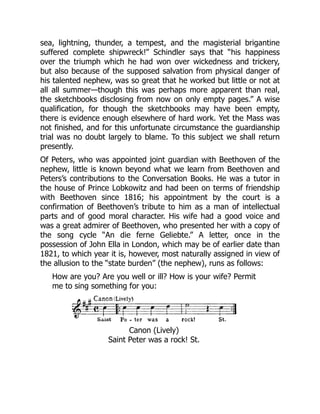
How are you? Are you well or ill? How is your wife? Permit
me to sing something for you:
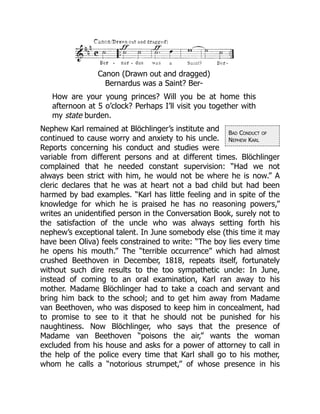
Canon (Lively)
Saint Peter was a rock! St.
Bad Conduct of
Nephew Karl
Canon (Drawn out and dragged)
Bernardus was a Saint? Ber-
How are your young princes? Will you be at home this
afternoon at 5 o’clock? Perhaps I’ll visit you together with
my state burden.
Nephew Karl remained at Blöchlinger’s institute and
continued to cause worry and anxiety to his uncle.
Reports concerning his conduct and studies were
variable from different persons and at different times. Blöchlinger
complained that he needed constant supervision: “Had we not
always been strict with him, he would not be where he is now.” A
cleric declares that he was at heart not a bad child but had been
harmed by bad examples. “Karl has little feeling and in spite of the
knowledge for which he is praised he has no reasoning powers,”
writes an unidentified person in the Conversation Book, surely not to
the satisfaction of the uncle who was always setting forth his
nephew’s exceptional talent. In June somebody else (this time it may
have been Oliva) feels constrained to write: “The boy lies every time
he opens his mouth.” The “terrible occurrence” which had almost
crushed Beethoven in December, 1818, repeats itself, fortunately
without such dire results to the too sympathetic uncle: In June,
instead of coming to an oral examination, Karl ran away to his
mother. Madame Blöchlinger had to take a coach and servant and
bring him back to the school; and to get him away from Madame
van Beethoven, who was disposed to keep him in concealment, had
to promise to see to it that he should not be punished for his
naughtiness. Now Blöchlinger, who says that the presence of
Madame van Beethoven “poisons the air,” wants the woman
excluded from his house and asks for a power of attorney to call in
the help of the police every time that Karl shall go to his mother,
whom he calls a “notorious strumpet,” of whose presence in his
house he must needs be ashamed. All this was told to Beethoven by
Bernard, who had learned it from Blöchlinger. Beethoven went for
advice to Bach, who told his client that it was impracticable to get a
judicial writ against the mother enjoining her from meeting her son,
and impossible to prevent secret meetings and secret
correspondence. The practical solution of the problem was to have
Blöchlinger refuse to admit the woman to his institute and compel
her to see Karl at his uncle’s home. This would serve the purpose to
some extent, as the mother did not like to meet her brother-in-law.
The enthronization of Beethoven’s imperial pupil as Archbishop of
Olmütz took place on March 20. The Mass which was to have been
the composer’s tribute was still unfinished. The reader knows why,
or at least has been provided with an opportunity to form an opinion
as to the reason. It may have been for the purpose of offering an
explanation to the new dignitary of the church, that Beethoven
sought an audience as he states in a letter of April 3. The Archducal
Archbishop had gone to Olmütz and Beethoven wants to know his
plans for the immediate future. He had heard that H. I. H. was to
return to Vienna in May, but also that he intended to be absent for a
year and a half. If so, Beethoven deplores that he has made plans
for himself which are unwise. He begs H. I. H. not to give credence
to the false reports concerning himself (Beethoven) which might
reach his ears: “If Y. I. H. calls me one of your most treasured
objects, I can honestly say that Y. I. H. is to me one of the most
treasured objects in the universe. Although I am no courtier, I
believe that Y. I. H. has learned to know me well enough to know
that no cold interest, but a sincere affection, has always attached me
to yourself and inspired me; and I might well say that Blondel was
found long ago, and if no Richard is to be found in the world for me,
God will be my Richard.” He has evidently concerned himself about
the music at the court in Olmütz: “It appears to me that my idea to
maintain a quartet will certainly be the best thing to do. If there are
already productions on a large scale in Olmütz, something admirable
might arise in Moravia through a quartet.” He advises his pupil, in
case it is his purpose to return in May, to keep his compositions till
A Punning Canon
on Hofmann
then so as to play them first to him; but if his stay is to be longer, he
will receive the compositions with the greatest pleasure and seek to
guide H. I. H. “to the highest peaks of Parnassus.”
A reference to himself as one who was at court yet
not a courtier had been made by Beethoven in an
earlier letter. This play on words seems to have
been much in his head about this time and it is small wonder that
when an opportunity offered for the employment of the pun in a
canon it should have been embraced; in fact, it looks as if possibly
he had strained for the occasion, unless it should appear from
evidence yet to be found that “One who was named Hoffmann,” in
Beethoven’s words, was, as was long believed, the redoubtable E. T.
A. Hoffmann, who had surely deserved the tribute contained in a
canon which Beethoven wrote at this time. In the Conversation Book
used in March, 1820, a strange hand writes: “In the Phantasie-
Stücke by Hoffmann, you are often spoken of. Hoffmann was musical
director in Bamberg; he is now Government Councillor. Operas of his
composition are performed in Berlin.” Beethoven remarks, in writing:
“Hofmann du bist kein Hofmann.” Later in a conversation held at
table, these words occur twice: “Hŏfmānn ÷ sei ja kein Hōfmănn—
nein ÷ ÷ ÷ ich heisse Hŏfmānn und bin kein Hōfmănn.” These
words are preceded by a measure of music, the beginning of the
canon in question. Did Beethoven thus honor the fantastic poet,
musician, novelist, essayist, singer, scene-painter and theatrical
manager who had shown such keen critical appreciation of his
symphonies? It was long a pleasure to believe so and natural, too,
until Nottebohm came with his iconoclastic evidence to the contrary.
On March 23 Beethoven had written a letter to Hoffmann, expressing
his gratification at having won the good opinion of a man gifted with
such excellent attributes as Hoffmann possessed. Had he written the
canon at this time he would surely have enclosed it in this letter and
then, since it was preserved among Hoffmann’s papers, it would
have been found and given to the world with the letter. But
Beethoven kept the canon in his mind or had a copy of it, and
printed it in 1825, when B. Schott’s Sons in Mayence asked him for a
contribution to their musical journal “Cäcilia,” which had been
founded a year before. Now comes Nottebohm with his evidence in
the case. A man named Gross was once the owner of the autograph
and his son told Nottebohm that it had been written in the
Matschaker Hof, a tavern at which Beethoven was dining at the time,
and referred to a church musician named Vincenz Hoffmann, as the
informant remembered the name. Nottebohm looked through the
official lists of musicians in Vienna in the first decades of the
century; he did not find a Vincenz, but did find a Joachim Hoffmann
who might have been an acquaintance of Beethoven’s; and so he set
him down as the recipient of the composer’s tribute.[29]
In the summer of 1820, Beethoven went to Mödling again, but he
did not take the lodgings in the Harfner house for the very sufficient
reason that the proprietor had served notice on him in 1819, that he
could not have it longer on account of the noisy disturbances which
had taken place there. He took a house instead in the
Babenbergerstrasse and paid twelve florins extra for the use of a
balcony which commanded a view which was essential to his
happiness. He takes the baths and receives a visit from his nephew,
who probably stays with him during his school vacation; at any rate,
the boy does not return to Vienna until October 5, on which day the
Giannatasios, making an excursion to Mödling, meet him with Karl
driving to town. There is at this time considerable talk in the
Conversation Book of publishing a complete edition of Beethoven’s
works. Bernard, probably, tells him that Steiner is already counting
on it and Schindler, who is enthusiastic over the project, gives it as
his opinion that arrangements must be made with a Vienna publisher
so as to avoid voluminous correspondence. Somebody remarks:
“Eckstein will so arrange it that you will always get all the profits and
will also publish your future works as your property. He thinks that
every fourth or fifth piece should be a new one.” The plan appealed
strongly to Beethoven, but nothing came of it at the time, though we
shall hear of it later. It was the discussion of it, probably, by his
friends which brought out a letter from Beethoven to Haslinger, “best
of Adjutants,” asking him to decide a bet. Beethoven had wagered
10 florins that it was not true that the Steiners had been obliged to
pay Artaria 2000 florins damages for having published Mozart’s
works, which were reprinted universally.
Towards the end of October, Beethoven returned to Vienna and took
lodgings at No. 244 Hauptstrasse in the Landstrasse, “the large
house of the Augustinians” beside the church. There he was visited
by Dr. W. Chr. Müller of Bremen, a philologist and musical amateur
who had long admired Beethoven and, with the help of his “Family
Concerts,” established in 1782, had created such a cult for
Beethoven’s music as existed in no city in Germany in the second
decade of the nineteenth century—according to Schindler. Müller’s
daughter Elise played the sonatas exceptionally well and was largely
instrumental with her father in creating this cult. Müller was making
an Italian tour, visited Vienna in October and November and
published an account of his meetings with Beethoven in the “Allg.
Musik. Zeit.” in 1827. In this he tells of Beethoven’s freedom of
speech at public eating-houses, where he would criticize the Austrian
government, the morals of the aristocracy, the police, etc., without
stint. The police paid no attention to his utterances, either because
they looked upon him as a harmless fantastic or had an
overwhelming respect for his artistic genius. “Hence,” says Dr. Müller,
“his opinion that nowhere was speech freer than in Vienna; but his
ideal of a political constitution was the English one.” It was through
Dr. Müller that we know somewhat of Beethoven’s views on the
subject of analytical programmes. Among the zealous promoters of
the Beethoven cult in Bremen, was a young poet named Dr. Karl
Iken, editor of the “Bremer Zeitung,” who, inspired by the Familien-
Concerte, conceived the idea of helping the public to an
understanding of Beethoven’s music by writing programmatic
expositions of the symphonies for perusal before the concerts. Some
of his lucubrations were sent to Beethoven by Dr. Müller, and
aroused the composer’s ire. Schindler found four of these
“programmes” among Beethoven’s papers, and he gave the world a
specimen. In the Seventh Symphony, Dr. Iken professed to see a
political revolution.
“Programme” for
the Seventh
Symphony
The sign of revolt is given; there is a rushing
and running about of the multitude; an
innocent man, or party, is surrounded,
overpowered after a struggle and haled before
a legal tribunal. Innocency weeps; the judge pronounces a
harsh sentence; sympathetic voices mingle in laments and
denunciations—they are those of widows and orphans; in
the second part of the first movement the parties have
become equal in numbers and the magistrates are now
scarcely able to quiet the wild tumult. The uprising is
suppressed, but the people are not quieted; hope smiles
cheeringly and suddenly the voice of the people
pronounces the decision in harmonious agreement.... But
now, in the last movement, the classes and the masses
mix in a variegated picture of unrestrained revelry. The
quality still speak aloofly in the wind-instruments,—
strange bacchantic madness in related chords—pauses,
now here, now there—now on a sunny hill, anon on
flowery meadow where in merry May all the jubilating
children of nature vie with each other with joyful voices—
float past the fancy.
It is scarcely to be wondered at that such balderdash disgusted and
even enraged Beethoven. In the fall of 1819, he dictated a letter to
Müller—it has, unfortunately been lost—in which he protested
energetically against such interpretations of his music. He pointed
out, says Schindler, who wrote the letter for him, the errors to which
such writings would inevitably give rise. If expositions were
necessary, they should be confined to characterization of the
composition in general terms, which could easily and correctly be
done by any educated musician.
Beethoven’s complaints concerning his financial condition were
chronic and did not cease even in periods where extraordinary
receipts make them difficult to understand. That the lamentations in
his letters during the two years which we have in review were well-
founded, however, is no doubt true. With so engrossing a work as
Indebtedness to
Steiner
the “Missa solemnis” on hand there could not have been much time
for such potboilers as he mentions and the other sources of revenue
were not many. From the records which are at hand, we know
something about a few of his monetary transactions. On October 26,
1820, he collected 300 florins on account, apparently, from Artaria
and Co., through his old friend Oliva. Shortly after his return to
Vienna from the country, he asks the same firm, from which he had
borrowed 750 florins,[30] for a further loan of 150 to save himself
the necessity of selling one of his bank shares. These shares, it will
be remembered in partial extenuation or at least explanation of
some of his actions which are scarcely compatible with his
protestations of his unswerving honesty in business transactions,
had been set apart by him as his nephew’s legacy and he clung to
them as to a sacred pledge. He promises to repay Artaria in three
months and meanwhile to send him a composition in one, two or
more movements, without honorarium. An incident which shows him
in an unamiable light is connected with his financial relations with
the publisher Steiner. On December 29, 1820, Steiner wrote him a
letter which did not see the public eye until published in the “Neue
Freie Presse” newspaper of Vienna on August 17, 1900. Steiner had
sent Beethoven a dun, or at least a statement of account, and
Beethoven had, evidently, been both rude and unreasonable in his
reply. We quote from Steiner:
I cannot rest content with your remarks
concerning the account sent you; for the cash
money loaned you I have charged you only 6%
interest, while for the money which you deposited with me
I paid you 8% promptly in advance and also repaid the
capital promptly. What is sauce for the goose is sauce for
the gander (Was also dem Einen recht ist, muss dem
Andern billig sein). I am not in a position to lend money
without interest. As a friend I came to your help in need, I
trusted your word of honor and believe that I have not
been importunate, nor have I plagued you in any way;
wherefore I must solemnly protest against your
upbraidings. If you recall that my loan to you was made in
part 5 years ago, you will yourself confess that I am not
an urgent creditor. I would spare you even now and wait
patiently if I were not on my honor in need of cash for my
business. If I were less convinced that you are really in a
position to give me relief and able to keep your word of
honor I would, difficult as it would be for me, right gladly
remain patient a while longer; but when I remember that
I myself returned to you 4,000 florins, conventional coin,
or 10,000 florins, Vienna Standard, as capital 17 months
ago and at your request did not deduct the amount due
me, it is doubly painful to me now to be embarrassed
because of my good will and my trust in your word of
honor. Every man knows best where the shoe pinches and
I am in this case; wherefore I conjure you again not to
leave me in the lurch and to find means to liquidate my
account as soon as possible.
As for the rest I beg you to accept from me the
compliments of the season together with the request that
you continue to give me your favor and friendship. It will
rejoice me if you keep your word and honor me soon with
a visit; it rejoices me more that you have happily
withstood your illness and are again restored to health.
God preserve you long in health, contentment and
enjoyment, this is the wish of your wholly devoted
S. A. Steiner.
The letter contains pencil memoranda by Beethoven. He has
evidently added together the various sums which he owes Steiner
and they amount to 2420 florins W. W. He remarks that 1300 florins
was received “probably” in 1816 or 1817; 750 florins “perhaps” in
1819; 300 florins “are debts which I assumed for Madame van
Beethoven and can be chargeable for only a few years; the 70 florins
may have been for myself in 1819. Payment may be made of 1200
florins a year in semi-annual payments.” A further memorandum on
the cover notes Steiner’s willingness to accept payments on April 15
and October 15, 1821. The settlements seem to have been made.
On April 1, 1821, Beethoven collected 600 florins from the estate of
Kinsky, being one-half of the annuity for the year September 1820 to
September 1821. He also persuaded his friend Franz Brentano to
advance him money on the amount for which he sold the “Missa
Solemnis” to Simrock in Bonn, though he did not give him the Mass
for publication in the end. But this is a matter which can be better
discussed in connection with the incidents in the history of the
compositions which fall within the present period.
The beginning of the year 1821 found him still at his home in the
suburb Landstrasse, and, it would seem, working as hard as his
health permitted. When he went to the country for the summer he
went to Unterdöbling and thence, after September, to Baden to take
a cure prescribed by his physician, Dr. Staudenheimer. In Baden he
lived in the Rathshausgasse. He had suffered from rheumatism
during the preceding winter and now became a victim of jaundice,
for which, no doubt, he was sent to Baden, though he had gotten rid
of the disease to some extent at least by the end of August. The
cure prescribed by Staudenheimer was more severe than he could
endure and, as he writes to Franz Brentano on November 12, 1821,
he had to “flee to Vienna,” where he was more comfortable. The
attack of jaundice may have been an arant-courier of the disease of
the liver which brought him to the grave six years later. He
expresses a fear in a letter to the Archduke (July 18, 1821) that it
might prevent him for a long time from waiting upon his pupil. There
is the usual monetary complaint in the letter, which concludes with:
“God who knows my heart and how sacredly I fulfill all the duties
commanded by humanity, God and nature will some day free me
from this affliction.”
In 1820 the voice of an old English admirer reaches him with a
request which must have seemed strange to him. William Gardiner,
as has been told in the chapter in the first volume of this work
devoted to the compositions of the Bonn period, was one of the first
proclaimers of Beethoven’s evangel in England. He had now
compiled and composed a sort of pasticcio, an oratorio entitled
“Judah,” piecing the work out with original compositions where he
had failed to find music written by others which he could use. In his
book “Music and Friends” (III, 377) he relates that he had hoped to
get an original composition for “Judah” in the shape of an
appropriate overture, and to this end had written a letter to
Beethoven and forwarded it to Vienna through Baron Neumann of
the Austrian Embassy, who, on receiving it, had remarked that it was
doubtful if an answer would be received, as Beethoven held no
communication with the world. Gardiner’s letter was as follows:
To Louis van Beethoven.
Dear Sir:
At the house of Lady Bowater in Leicestershire in 1796, I
met with your Trio in E-flat (for Violin, Viola and Bass). Its
originality and beauty gave me inexpressible delight;
indeed it was a new sense to me. Ever since I have
anxiously endeavoured to procure your compositions as
much so as the war could permit. Allow me to present to
you the first volume of my “Sacred Melodies” which
contain your divine Adagios appropriated to the British
church. I am now engaged upon a work entitled “The
Oratorio of Judah” giving a history of that peculiar people
from the Jewish scriptures. The object of this letter is to
express a hope that I may induce you to compose an
Overture for this work upon which you can bring all the
force of your sublime imagination (if it please you) in the
key of D minor. For this service my friend Mr. Clementi will
accept your draft upon him for one hundred guineas.
I have the honour to be, dear Sir,
Your faithful servant
William Gardiner.
There is no date, but as “Judah” was criticized in “The Musical
Review” in 1821, it is presumable that the letter was written in 1820.
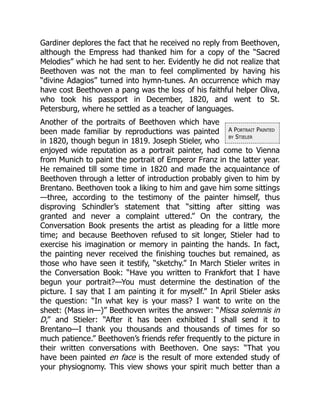
A Portrait Painted
by Stieler
Gardiner deplores the fact that he received no reply from Beethoven,
although the Empress had thanked him for a copy of the “Sacred
Melodies” which he had sent to her. Evidently he did not realize that
Beethoven was not the man to feel complimented by having his
“divine Adagios” turned into hymn-tunes. An occurrence which may
have cost Beethoven a pang was the loss of his faithful helper Oliva,
who took his passport in December, 1820, and went to St.
Petersburg, where he settled as a teacher of languages.
Another of the portraits of Beethoven which have
been made familiar by reproductions was painted
in 1820, though begun in 1819. Joseph Stieler, who
enjoyed wide reputation as a portrait painter, had come to Vienna
from Munich to paint the portrait of Emperor Franz in the latter year.
He remained till some time in 1820 and made the acquaintance of
Beethoven through a letter of introduction probably given to him by
Brentano. Beethoven took a liking to him and gave him some sittings
—three, according to the testimony of the painter himself, thus
disproving Schindler’s statement that “sitting after sitting was
granted and never a complaint uttered.” On the contrary, the
Conversation Book presents the artist as pleading for a little more
time; and because Beethoven refused to sit longer, Stieler had to
exercise his imagination or memory in painting the hands. In fact,
the painting never received the finishing touches but remained, as
those who have seen it testify, “sketchy.” In March Stieler writes in
the Conversation Book: “Have you written to Frankfort that I have
begun your portrait?—You must determine the destination of the
picture. I say that I am painting it for myself.” In April Stieler asks
the question: “In what key is your mass? I want to write on the
sheet: (Mass in—)” Beethoven writes the answer: “Missa solemnis in
D,” and Stieler: “After it has been exhibited I shall send it to
Brentano—I thank you thousands and thousands of times for so
much patience.” Beethoven’s friends refer frequently to the picture in
their written conversations with Beethoven. One says: “That you
have been painted en face is the result of more extended study of
your physiognomy. This view shows your spirit much better than a
profile.” Schindler writes that he prefers the portrait by Schimon:
“There is more character in it—all agree on that—You were very well
two years ago; now you are always ailing.” J. Czerny writes: “We
were just talking about your portrait. Oliva thinks you are well hit
off.” The artist visits Beethoven again at Mödling in July and writes:
“Before the exhibition I shall paint your portrait again, but full life-
size. Your head makes an excellent effect full face, and it was so
appropriate because Haydn was on one side and Mozart on the
other.” Stieler dated the canvass “1819,” but this can only refer to
the time when it was begun. It remained for a while in the
possession of the family of the painter, then passed through several
hands by purchase until it reached those of Countess Sauerma in
Berlin, in whose possession it was when Frimmel and Kalischer
inspected it for purposes of description. Schindler says it reproduces
Beethoven’s characteristic expression faithfully and that it met with
approval, though fault was found with the pose. Beethoven’s
contemporaries were not used to see him with his head bowed down
as Stieler represents him; on the contrary, he carried his head high
even when suffering physical pain. A lithographic reproduction of the
portrait was made by Fr. Dürck and published by Artaria in 1826.
In April, 1860, the author[31] had a conversation with Horzalka in
which the latter spoke very highly of Schindler and his disinterested
fidelity to Beethoven. Horzalka also said that in 1820 or 1821, as
near as he could recollect, the wife of a Major Baumgarten took boy
boarders in a house then standing where the Musikverein’s hall now
stands in Vienna. Her sister, Baroness Born, lived with her. Frau
Baumgarten had a son who studied at Blöchlinger’s Institute, and
Beethoven’s nephew was amongst her boarders. One evening
Horzalka called there and found only the Baroness Born at home.
Soon another caller came and stayed to tea. It was Beethoven.
Among other topics, Mozart came on the tapis and the Baroness
asked Beethoven, in writing of course, which of Mozart’s operas he
thought most of. “Die Zauberflöte,” said Beethoven and, suddenly
clasping his hands and throwing up his eyes exclaimed, “Oh,
Mozart!” As Horzalka had, as was the custom, always considered
Arrested as a
Vagrant
“Don Giovanni” the greatest of Mozart’s operas, this opinion by
Beethoven made a very deep impression upon him. Beethoven
invited the Baroness to come to his lodgings and have a look at his
Broadwood pianoforte.
In 1820 Professor Höfel, who lived at Salzburg in
the last years of his life and who engraved the
Latronne portrait of Beethoven for Artaria, was
appointed to a professorship of drawing in Wiener Neustadt. A year
or two afterward, as he said,[32] he was one evening with Eisner and
other colleagues in the garden of the tavern “Zum Schleifen,” a little
way out of town. The Commissioner of Police was a member of the
party. It was autumn and already dark when a constable came and
said to the Commissioner: “Mr. Commissioner, we have arrested
somebody who will give us no peace. He keeps on yelling that he is
Beethoven; but he’s a ragamuffin, has no hat, an old coat, etc.—
nothing by which he can be identified.” (Herr Commissär, wir haben
Jemand arretirt, welcher uns kein’ Ruh gibt. Er schreit immer dass er
Beethoven sei. Er ist aber ein Lump, hat kein’ Hut, alter Rock, etc.,
kein Aufweis wer er ist, etc.) The Commissioner ordered that the
man be kept under arrest until morning, “then we will examine him
and learn who he is.” Next morning the company was very anxious
to know how the affair turned out, and the Commissioner said that
about 11 o’clock at night he was waked by a policeman with the
information that the prisoner would give them no peace and had
demanded that Herzog, Musical Director in Wiener Neustadt, be
called to identify him. So the Commissioner got up, dressed, went
out and waked up Herzog, and in the middle of the night went with
him to the watchhouse. Herzog, as soon as he cast eyes on the man
exclaimed, “That is Beethoven!” He took him home with him, gave
him his best room, etc. Next day came the burgomaster, making all
manner of apologies. As it proved, Beethoven had got up early in the
morning, and, slipping on a miserable old coat and, without a hat,
had gone out to walk a little. He got upon the towpath of the canal
and kept on and on; seems to have lost his direction, for, with
nothing to eat, he had continued on until he brought up at the
canal-basin at the Ungerthor. Here, not knowing where he was, he
was seen looking in at the windows of the houses, and as he looked
so like a beggar the people had called a constable who arrested him.
Upon his arrest the composer said, “I am Beethoven.” “Of course,
why not?” (Warum nicht gar?) said the policeman; “You’re a tramp:
Beethoven doesn’t look so.” (Ein Lump sind Sie; so sieht der
Beethoven nicht aus.) Herzog gave him some decent clothes and the
burgomaster sent him back to Baden, where he was then living, in
the magisterial state-coach. This simple story is the foundation for
the fine narrative related as a fact in Vienna that Beethoven had got
into this scrape following troops from Vienna who had a sham battle
near Wiener Neustadt, and taking notes for his “Wellington’s
Victory”—which whole story thus goes to the wall.
A letter written from Baden on September 10, 1821, to Tobias
Haslinger accompanying a canon[33] on the words “O Tobias
dominus Haslinger, O, O!” deserves to be given here to show that
Beethoven’s high spirits could at times dominate him in spite of his
general misery.
Very best fellow!
Yesterday, in the carriage on the way to Vienna, I was
overcome by sleep, naturally enough, since (because of
my early rising here) I had never slept well. While thus
slumbering I dreamed that I had made a long journey—to
no less distant a country than Syria, no less than India,
back again, no less than Arabia, finally I reached
Jerusalem; the Holy City aroused in me thoughts of Holy
Writ and small wonder that the man Tobias now occurred
to me, and how natural that our little Tobias should enter
my mind and the pertobiasser, and now during my dream
journey the following canon came to me: “O Tobias
dominus Haslinger, O, O!” But scarcely awakened, away
went the canon and nothing of it would come back to my
memory. But when, next day, I was on my way hither in
the same conveyance (that of a poor Austrian musician)
Negotiations for
the Mass in D
and continued the dream journey of the day before, now
awake, behold, according to the laws of association of
ideas, the same canon occurred to me again; now fully
awake I held it fast, as erst Menelaus held Proteus, only
allowing it to change itself into 3 voices.
Farewell. Presently I shall send you something on Steiner
to show you that he has no stony (steinernes) heart.
Farewell, very best of fellows, we ever wish that you will
always belie your name of publisher (Verleger) and never
become embarrassed (verlegen) but remain a publisher
(Verleger) never at a loss (verlegen) either in receiving or
paying—Sing the epistles of St. Paul every day, go to pater
Werner,[34] who will show you the little book by which you
may go to heaven in a jiffy. You see my anxiety for your
soul’s salvation; and I remain with the greatest pleasure
from everlasting to everlasting,
Your most faithful debtor
Beethoven.
And now as to the creative work of the two years.
Paramount attention must be given to the Mass in
D, which, though long in hand and destined for a
function in which Beethoven and his Imperial Archepiscopal pupil
were profoundly concerned, was yet incomplete when the time for
that function arrived. Archduke Rudolph was installed as Archbishop
of Olmütz on March 20, 1820. Exactly what condition the Mass was
in at that time we have no means of knowing; it was, however, in a
sufficient state of forwardness to enable Beethoven to begin
negotiations for its publication. On March 18 he wrote to Simrock:
As regards the mass, I have pondered the matter carefully
and might give it to you for the honorarium of 100 Louis
d’ors which you offered me, provided you agree to a few
conditions which I shall propose and which I think, will not
be found burdensome by you. We have gone through the
plan for publication here and believe that with a few
modifications it can be put into effect very soon, which is
very necessary; wherefore I shall make haste to inform
you of the necessary changes soon.
This would seem to indicate that the work had been practically
completed, and that this view obtained amongst Beethoven’s friends
we know from the evidence of the Conversation Books. In the
summer at Mödling he was frequently asked if it was finished and
when it would be performed. Some hurried sketches belonging to
the Credo are found amongst the remarks of his friends, and also
sketches for the Agnus Dei. Schindler asks him in August: “Is the
Benedictus written out in score? Are those sketches for the Agnus?”
Rudolph had communicated to him his intention to spend a part of
the summer in Mödling. Beethoven writes to him on August 3 and
September 2, making apologies for apparent neglect in not waiting
upon him (he had no carriage the first time, was in ill-health the
second), but says not a word about the mass. Some of the remarks
in the Conversation Book are vague as to the composition referred
to, but many are plain enough to show that Beethoven had informed
his friends and advisers of the negotiations with Simrock. Surprise is
expressed at Simrock’s delay. Beethoven is advised to write to him
and also to Brentano in Frankfort, who had been authorized to
collect the honorarium. In April somebody writes: “Have you written
to Simrock that he must not publish the mass at once, as you want
first to send it or hand it to the Archduke?” Again: “If you send the
Recepisse of the stage-coach he will certainly send you the money at
once.” And later: “It would be quicker to give the music to the stage-
coach and send Brentano the receipt—at the same time informing
Simrock that Brentano had been assured of its despatch; then
Brentano can send you the money at once without waiting to receive
the music.” In April again: “But he has not yet replied to your last
offer of the mass? I mean Simrock—200 ducats could help you out
greatly—Because of your circumstances. You must not delay writing
to Simrock or Brentano. Brentano can send you the money at once—
or at least very soon.” “I am surprised that Simrock has not
answered yet.” Meanwhile Simrock answers. “Leave Simrock’s letter
with me,” says the mentor, “I’ll answer it and give you the letter this
afternoon—if you are satisfied with it you will sign it and I will post it
to-morrow. There must be no delay.” “He says the mass can be used
only by Catholics, which is not true.” “He is paying too little rather
than too much with 200 ducats.”
It is obvious that some difficulty had arisen between Beethoven and
Simrock. What that difficulty was is explained in a letter from
Simrock to Brentano dated November 12, 1820. It was a
misunderstanding concerning the price of the “new grand musical
mass” which the composer wished to sell for 100 Louis d’ors. The
publisher had agreed to the price, understanding Louis d’ors to
mean what the term meant in Bonn, Leipsic and throughout
Germany, namely, the equivalent of Friedrichs d’ors, pistoles. In
order to avoid unpleasantness after the reception of the mass he
had explained this clearly to Beethoven and in a letter, dated
September 23, had repeated that by Louis d’ors he meant Friedrichs
d’ors; he was not in a position to give more. He would hold the sum
in readiness against the receipt of the mass, which Beethoven had
promised to provide with German as well as Latin words. He was
also under the impression that he had asked a speedy decision, as
he did not want to keep his money tied up in Frankfort. Hearing
nothing for four weeks he had quit counting on the mass and made
other use of his money. Learning, however, from Brentano’s letter of
November 8th that Beethoven had agreed to let him have the mass,
he now finds himself in the embarrassment of not having the gold
Louis d’ors on hand, but as Brentano had said nothing on the
subject he would in the meantime try to secure the coin, unless
Brentano were willing to take the equivalent in florins at the rate of
9.36. He asked to be informed of the arrival of the music so that he
might instruct Heinrich Verhuven to receive it on paying the sum
mentioned.
Simrock waited four weeks before abandoning hope that Beethoven
would send the mass; it was ten weeks and more before Beethoven
answered Simrock’s letter. Then he sent his reply to Brentano
enclosed in a letter dated November 28. The letter has not been
found, or at least not made public; but the letter to Brentano[35]
makes it plain that Beethoven had acceded to Simrock’s offer and
agreed to take pistoles for Louis d’ors. He says:
Your kindness permits me to hope that you will not refuse
to have the enclosure sent to Simrock, inasmuch as in it
my views are set forth concerning the whole matter.
Nothing remains now except to take what he offers,
namely the 100 pistoles and as much more as you, an
expert in the business, can get for me by the rate of
exchange. I am convinced of your kind disposition in this
regard. I am very hard-pressed just now, but such things
are to be told last of all to a publisher; it is, thank God,
not my fault, but my sacrifices for others, chiefly, too, for
the weak Cardinal who led me into this morass and does
not know how to help himself. As soon as the translation
is finished I shall trouble you again by sending you the
mass, and I pray you give a little attention then to
securing what you can for me from the Jewish[36]
publisher.
Thus matters stand with the Mass at the end of 1820, and thus they
seem to have remained throughout the next year. Simrock always
was to be but never was blest with the score. On July 18, 1821,
Beethoven promises to put the work into the Archduke’s hands
“while here”—i. e., at Unterdöbling; he leaves the reasons for the
delay to the imagination of his patron: “the details might prove
anything but pleasant to Y. I. H.” In November he thinks again of
Simrock and on the 12th writes to Brentano:
The mass might have been sent before this, but had to be
carefully looked through, for the publishers in other
countries do not get along well with my manuscript, as I
know from experience, and a copy for the engraver must
be examined note by note. Moreover, I could not come
because of illness, the more since despite everything I
have been compelled to make a considerable number of


JavaScript The Web Warrior Series 6th Edition Vodnik Solutions Manual

  • 1.
    Full Download TestBank Get the Latest Study Materials at testbankfan.com JavaScript The Web Warrior Series 6th Edition Vodnik Solutions Manual https://testbankfan.com/product/javascript-the-web-warrior- series-6th-edition-vodnik-solutions-manual/ OR CLICK HERE DOWLOAD NOW Download More Test Banks for All Subjects at https://testbankfan.com
  • 2.
    Recommended digital products(PDF, EPUB, MOBI) that you can download immediately if you are interested. JavaScript The Web Warrior Series 6th Edition Vodnik Test Bank https://testbankfan.com/product/javascript-the-web-warrior-series-6th- edition-vodnik-test-bank/ testbankfan.com Principles of Web Design The Web Warrior Series 6th Edition Sklar Solutions Manual https://testbankfan.com/product/principles-of-web-design-the-web- warrior-series-6th-edition-sklar-solutions-manual/ testbankfan.com Principles of Web Design The Web Technologies Series 5th Edition Skalar Test Bank https://testbankfan.com/product/principles-of-web-design-the-web- technologies-series-5th-edition-skalar-test-bank/ testbankfan.com Organizational Behaviour Improving Performance Anf Commitment In The Workplace Cannadian 3rd Edition Colquitt Test Bank https://testbankfan.com/product/organizational-behaviour-improving- performance-anf-commitment-in-the-workplace-cannadian-3rd-edition- colquitt-test-bank/ testbankfan.com
  • 3.
    Social Psychology 11thEdition David Myers Test Bank https://testbankfan.com/product/social-psychology-11th-edition-david- myers-test-bank/ testbankfan.com Strategic Management and Business Policy Globalization Innovation and Sustainability 15th Edition Wheelen Test Bank https://testbankfan.com/product/strategic-management-and-business- policy-globalization-innovation-and-sustainability-15th-edition- wheelen-test-bank/ testbankfan.com New Perspectives Microsoft Office 365 and Word 2016 Comprehensive 1st Edition Shaffer Test Bank https://testbankfan.com/product/new-perspectives-microsoft- office-365-and-word-2016-comprehensive-1st-edition-shaffer-test-bank/ testbankfan.com Strategic Management A Competitive Advantage Approach Concepts and Cases 14th Edition David Solutions Manual https://testbankfan.com/product/strategic-management-a-competitive- advantage-approach-concepts-and-cases-14th-edition-david-solutions- manual/ testbankfan.com Basic Clinical Laboratory Techniques 6th Edition Estridge Solutions Manual https://testbankfan.com/product/basic-clinical-laboratory- techniques-6th-edition-estridge-solutions-manual/ testbankfan.com
  • 4.
    Company Accounting AustraliaNew Zealand 5th Edition Jubb Test Bank https://testbankfan.com/product/company-accounting-australia-new- zealand-5th-edition-jubb-test-bank/ testbankfan.com
  • 5.
    JavaScript, Sixth Edition6-1 © 2015 Cengage Learning. All Rights Reserved. May not be copied, scanned, or duplicated, in whole or in part, except for use as permitted in a license distributed with a certain product or service or otherwise on a password-protected website for classroom use. Chapter 6 Enhancing and Validating Forms A Guide to this Instructor’s Manual: We have designed this Instructor’s Manual to supplement and enhance your teaching experience through classroom activities and a cohesive chapter summary. This document is organized chronologically, using the same headings that you see in the textbook. Under the headings you will find: lecture notes that summarize the section, Teacher Tips, Class Discussion Topics, and Additional Projects and Resources. Pay special attention to teaching tips and activities geared towards quizzing your students and enhancing their critical thinking skills. In addition to this Instructor’s Manual, our Instructor’s Resources also contain PowerPoint Presentations, Test Banks, and other supplements to aid in your teaching experience. At a Glance Instructor’s Manual Table of Contents • Overview • Objectives • Teaching Tips • Quick Quizzes • Class Discussion Topics • Additional Projects • Additional Resources • Key Terms
  • 6.
    JavaScript, Sixth Edition6-2 © 2015 Cengage Learning. All Rights Reserved. May not be copied, scanned, or duplicated, in whole or in part, except for use as permitted in a license distributed with a certain product or service or otherwise on a password-protected website for classroom use. Lecture Notes Overview Forms are one of the most common web page elements used with JavaScript. Chapter 6 explains how to use JavaScript to make web forms easier for users to complete. Students will learn about form elements and objects. Students will learn about basic form validation, and implement custom form validation. Objectives After completing this chapter, students will be able to: • Enhance form usability with JavaScript • Customize browser-based HTML validation • Implement custom validation to check for errors and display error messages Teaching Tips Using JavaScript with Forms 1. Explain that JavaScript is commonly used with forms for two reasons: • To make forms easier for users to fill out • To validate or process user-entered data before the data is submitted to a server- side script 2. Introduce the concept of validation, the process of checking user-entered data to ensure it conforms to the proper rules and format. Give examples of the types of validation typically found on a customer form to order merchandise from a website. 3. Explain that a form object represents a form element in an HTML document. Use Tables 6-1 through 6-3 to present the properties, events, and methods of form objects. 4. Mention that the elements used for collecting data in a form include input, select, option, textarea, and button. Review Tables 6-4 through 6-6 with students, which show properties, events, and methods common to most or all of these elements. Referencing Forms and Form Elements 1. Explain that in addition to getElementById() and getElementsByTagName(), there are other ways to address form objects. 2. Introduce the document. syntax shown on Pages 366-367 and the forms array.
  • 7.
    JavaScript, Sixth Edition6-3 © 2015 Cengage Learning. All Rights Reserved. May not be copied, scanned, or duplicated, in whole or in part, except for use as permitted in a license distributed with a certain product or service or otherwise on a password-protected website for classroom use. 3. Note that using Document object methods makes your code more flexible when you need the same code to be able to refer to both form and non-form elements. 4. Allow students time to complete the steps on Page 367 to open and view the order form. Improving Form Usability 1. Mention that one of the most important form-related roles is validating user input. Note that there are a few steps a programmer can take to reduce the amount of validation necessary. Designing Forms to Collect More Accurate Content 1. Explain that most form validation consists of checking data typed into input and textarea boxes for accuracy. Give an example, using Figure 6-2. 2. Mention that a programmer can use other types of form fields to limit users’ choices. Review some of the alternative form elements using Table 6-7. 3. Give an example of improving the design shown in Figure 6-2 with the alternative in Figure 6-3. Programming Forms to Increase Content Accuracy 1. Define assistive functions, which prevent users from entering erroneous data in the first place. 2. Give the example of an order form for flowers, for which setting a default delivery data may result in incorrect delivery. Note that a solution for this situation is to set the selectedIndex property of a select object to -1, which corresponds to no selection. 3. Review Table 6-8, which describes the select element properties. 4. Allow students time to complete the exercise on Pages 372-374 to change the selectedIndex property for select elements. Teaching Tip Another introduction to forms may be found at: http://www.quirksmode.org/js/forms.html Teaching Tip More information on JavaScript forms may be found at: www.w3.org/TR/html401/interact/forms.html
  • 8.
    JavaScript, Sixth Edition6-4 © 2015 Cengage Learning. All Rights Reserved. May not be copied, scanned, or duplicated, in whole or in part, except for use as permitted in a license distributed with a certain product or service or otherwise on a password-protected website for classroom use. Quick Quiz 1 1. Many websites use ____ to collect information from users and transmit that information to a server for processing. Answer: forms 2. The ____ element designates a form within a web page and contains all the text and elements that make up a form. Answer: form 3. Any form element into which a user can enter data (such as a text box) is called a(n) ____. Answer: field 4. To use JavaScript to access form controls and verify form information, you use the ____ object, which represents a form on a web page. Answer: Form 5. Programming constructs that prevent users from entering erroneous data in the first place are called ____. Answer: assistive functions Dynamically Updating Selection List Values 1. Explain that a programmer can add and remove option elements in a select element. 2. Note that a programmer can also set properties of option elements. Review Table 6-9 for properties of option elements. 3. Mention that a common use of adding and removing options from a select element is to change the options shown in a list based on another selection a user has made in the same form. Give the example of changing the number of days available in a selection list based on the selected month. 4. Allow students time to complete the exercise on Pages 376-381 to program the days list to change dynamically based on the selected month and year. Teaching Tip More information on using JavaScript with forms may be found at: http://www.javaworld.com/article/2077176/scripting-jvm-languages/using- javascript-and-forms.html
  • 9.
    JavaScript, Sixth Edition6-5 © 2015 Cengage Learning. All Rights Reserved. May not be copied, scanned, or duplicated, in whole or in part, except for use as permitted in a license distributed with a certain product or service or otherwise on a password-protected website for classroom use. Adding Placeholder Text for Older Browsers 1. Explain that many older browsers do not support the usability enhancements to HTML. Note that JavaScript can simulate the behavior of these features in older browsers. 2. Mention that a popular recent feature in form creation is the placeholder attribute of the input and textarea elements. 3. Note that a programmer can specify a word or phrase as the value of the placeholder attribute, which is then displayed in the input or textarea box, generally in gray rather than black characters. 4. Explain that the placeholder attribute provides guidance on what the user should enter, as well as any formatting constraints. 5. Allow students time to complete the three exercises on Pages 382-388 to add placeholder text to the Custom message box in older browsers. Automatically Updating an Associated Field Based on a User Entry 1. Give the example of a form which has a “Custom message” checkbox a user can check to send a message which is entered into a textarea element. Explain that if there is an inconsistency between the two, it may not be treated properly by back-end code. 2. Explain that a solution is to add a function that checks a user’s entry in the textarea field and checks the “Custom message” box for them if they have entered custom text. 3. Review Tables 6-10 and 6-11 for properties and methods of textarea elements. 4. Allow students time to complete the exercise on Pages 389-390 to create a function to automatically check the Custom message check box when a custom message has been entered. Transferring Duplicate Field Values 1. Explain that JavaScript is commonly used to improve form usability by copying data entered in one field to another field that a user indicates should contain the same data. Give the example of billing and shipping addresses in a purchasing application. 2. Allow students time to complete the exercise on Pages 391-393 to enable users to use billing address information for the shipping address.
  • 10.
    JavaScript, Sixth Edition6-6 © 2015 Cengage Learning. All Rights Reserved. May not be copied, scanned, or duplicated, in whole or in part, except for use as permitted in a license distributed with a certain product or service or otherwise on a password-protected website for classroom use. Customizing Browser-Based Validation 1. Explain that historically, JavaScript code was written to perform common and important validation tasks. Note that in recent years, many browsers themselves often perform validation without extra JavaScript code. This type of validation is called browser-based validation, native validation, or HTML5 validation. Specifying Browser-Based Validation Parameters 1. Review the attributes in Table 6-12, which are used to specify browser-based validation. 2. Describe additional browser-based validation linked to values for the type attribute, presented in Table 6-13. 3. Allow students time to complete the exercise on Pages 395-397 to see how browser- based validation deals with missing or invalid data in the order form. Customizing Browser-Based Validation Feedback 1. Define constraint validation API, and explain that many aspects of the way browsers present browser-based validation feedback are customizable through its properties and methods. 2. Review Table 6-14, which describes properties of the validity object. 3. Discuss the methods of the constraint validation API, as presented in Table 6-15. 4. Describe that in conjunction with these properties and methods, you can use the CSS :invalid and :valid pseudo-classes to change the properties of form elements based on their validity status. 5. Work through the example code on Page 399, and show the result of the code, using Figure 6-13. 6. Note that some features of browser-based validation are missing, which makes it difficult to use in complex situations. 7. Allow students time to complete the exercise on Pages 401-402 to disable browser- based validation for the order form. Programming Custom Validation 1. Describe the common validation functions: • Checking that required fields contain entries • Checking values that are dependent on the values of other controls • Checking for an appropriate content type in one or more fields
  • 11.
    JavaScript, Sixth Edition6-7 © 2015 Cengage Learning. All Rights Reserved. May not be copied, scanned, or duplicated, in whole or in part, except for use as permitted in a license distributed with a certain product or service or otherwise on a password-protected website for classroom use. 2. Preview the Snoot Flowers order form, using Figure 6-14. Validating Submitted Data 1. Describe the submit event, which fires when a form is submitted. 2. Allow students time to complete the exercise on Pages 404-408 to create the main validation function. Validating Required Fields with Custom Functions 1. Explain that creating a function to validate required fields generally involves retrieving the values of the required fields and checking to see whether the value of any of them is an empty string. Review the general form of the syntax, given on Page 408. Checking for Empty Text Input Fields 1. Mention that a programmer uses different properties to validate each form element and input type. Note that for text boxes, a programmer can use the value property to check for a value. 2. Review both Table 6-16 and Table 6-17, which contain the properties and methods of the input element. 3. Give an example, using the code on Page 410. 4. Allow students time to complete the exercise on Pages 410-413 to create a custom validation function for input fields in the Billing Address fieldset. Checking for Selection Lists with No Values 1. Introduce the State field and review its syntax, using the code on Page 414. 2. Allow students time to complete the exercises on Pages 414-417 to add validation for the State selection lists to the validation function for the address and delivery date fieldsets. Checking for Option Button Sets with No Selection 1. Mention that to check whether an option button has been selected, you access the value of its checked property. 2. Give an example, using the code at the top of Page 418. 3. Allow students time to complete the exercise on Pages 418-421 to create a validation function for the Payment fieldset.
  • 12.
    JavaScript, Sixth Edition6-8 © 2015 Cengage Learning. All Rights Reserved. May not be copied, scanned, or duplicated, in whole or in part, except for use as permitted in a license distributed with a certain product or service or otherwise on a password-protected website for classroom use. Validating Dependent Fields with Custom Functions 1. Explain that a programmer may need to create functions to test logic specific to the form. Give the example of a set of option buttons including “other”, followed by a text box. Note that validation code could include the text box only when “other” is selected. Validating Based on the State of a Check Box 1. Go through the example given at the bottom of Page 421, which addresses the Message fieldset. Note that if the Custom message box is checked, a programmer’s code should verify the text in the textarea control. 2. Allow students time to complete the exercise on Pages 422-424 to create a validation function for the Custom message checkbox and its dependent textarea control. Validating Based on Text Input Box Contents 1. Explain that in the Snoot Flowers order form, some fields need not be completed, because buyers are not required to create an account. Note, however, that if a user makes an entry in one of the fields, all three must be completed. 2. Show the required logic flow using Figure 6-21. 3. Allow students time to complete the exercise on Pages 425-428 to create a validation function for the Create Account fieldset. Validating Content Type with Custom Functions 1. Explain that a programmer can use JavaScript’s built-in isNaN() function for fields that require numeric values to determine whether the user actually entered a number. Show the syntax of the function, given on Page 429. 2. Allow students time to complete the exercise on Pages 429-432 to validate the Card Number and CVV numeric fields. Quick Quiz 2 1. The JavaScript ____ function can be used to determine if the value entered by a user is numeric. Teaching Tip More JavaScript forms examples may be found at: http://javascript.internet.com/forms/
  • 13.
    JavaScript, Sixth Edition6-9 © 2015 Cengage Learning. All Rights Reserved. May not be copied, scanned, or duplicated, in whole or in part, except for use as permitted in a license distributed with a certain product or service or otherwise on a password-protected website for classroom use. Answer: isNaN() 2. You can use the ____ property to determine whether an individual check box has been selected. Answer: checked 3. The ____ property can be used to determine if a text box has a value. Answer: value 4. True or False: Browser-based validation can replace the need to write custom JavaScript code to validate user input. Answer: True 5. The ____ attribute is used to provide guidance on what the user should enter, and any formatting constraints that apply. Answer: placeholder Class Discussion Topics 1. Describe the attributes of the <form> object. 2. Why is the <input> element the most commonly used form element? Additional Projects 1. Use JavaScript to create a web page that allows clients to order pizza. Clients should be able to select toppings, type of crust, and method of payment. Validate that the form is correct before submitting it. 2. Use JavaScript to create a web page for a shuttle company. The client should be able to reserve a ticket using this page, selecting the date and time, pick-up and destination locations, and the method of payment from a list of available options. Your code should validate the form before it is submitted. Teaching Tip More information on JavaScript form validation may be found at: www.w3schools.com/jS/js_form_validation.asp
  • 14.
    JavaScript, Sixth Edition6-10 © 2015 Cengage Learning. All Rights Reserved. May not be copied, scanned, or duplicated, in whole or in part, except for use as permitted in a license distributed with a certain product or service or otherwise on a password-protected website for classroom use. Additional Resources 1. JavaScript Form Object: www.comptechdoc.org/independent/web/cgi/javamanual/javaform.html 2. Form Object: www.javascriptkit.com/jsref/form.shtml 3. JavaScript Form Object: www.exforsys.com/tutorials/javascript/javascript-form-object.html 4. Form Validation: www.yourhtmlsource.com/javascript/formvalidation.html 5. JavaScript form validation – doing it right: www.xs4all.nl/~sbpoley/webmatters/formval.html Key Terms  assistive functions—JavaScript functions that reduce the likelihood of user errors when completing a form by preventing users from entering erroneous data in the first place  browser-based validation—Validation tasks performed by browsers themselves without any extra JavaScript, enabled by recent enhancements to HTML and to modern browsers; also known as native validation  constraint validation API—The set of properties and methods that enables developers to customize aspects of the way browsers present browser-based validation feedback  createDocumentFragment() method—The method of the Document object that creates an empty document fragment  friction—A loose measure of the persistence required for a website user to accomplish a goal, such as placing an order  HTML5 validation—See browser-based validation  native validation—See browser-based validation  submit event—The event that fires when a form is submitted, which is generally when a submit button is selected on a form  validation—The process of checking that information provided by users conforms to rules to ensure that it appropriately answers the form’s questions and is provided in a format that the site’s back-end programs can work with
  • 15.
    Other documents randomlyhave different content
  • 16.
    Appointment of a JointGuardianship retire from the guardianship. Beethoven was asked as to the appointment of Tuscher; had he resigned permanently or only temporarily in favor of Tuscher, the better to accomplish the nephew’s removal from his mother? In what manner had Tuscher abdicated, and had the Magistracy informed Beethoven of the fact? It was necessary, said the adviser, to proceed with moderation in all things so as to avoid the appearance of malice, and the mother should not be assailed if it was at all avoidable, stress being laid only on the fact that as a woman she ought not to have the direction of the education of a boy of Karl’s age, not having the requisite fitness. It would also be necessary for him, in case he were asked, to state his readiness to defray the cost of the boy’s education in the future and this, if the worst came to the worst, might be followed by a threat to withdraw wholly from his care. Reproaches might be made against him concerning the period when he had the boy with him, the priests having taken to meddling in the matter, and it would be well in the future not to take the boy to public eating-houses where he would be observed and scandal fomented. Bach seems to have advised Beethoven to visit two of the judges, Winter and Schmerling, and himself had an interview with the boy, who told his uncle what the advocate had questioned him about. For the nonce Karl was on his good behavior. Blöchlinger reported favorably on his studies to Bernard, and in a Conversation Book the boy apologized to his uncle for some statements derogatory to him which he had made to the Magistrates. “She promised me so many things,” he said, “that I could not resist her; I am sorry that I was so weak at the time and beg your forgiveness; I will not again permit myself to be led astray. I did not know what results might follow when I told the Magistrates what I did; but if there is another examination I will retract all the falsehoods I uttered.” The magisterial commission which followed on March 29, had plainly been held at the instance of the Appellate Court. Beethoven was solemnly admonished, and in answer to questions declared: (1) that he still demanded the guardianship of his nephew under the will and would not relinquish
  • 17.
    his claim; (2)that he requested the appointment of Councillor Peters as associate guardian; (3) that he demanded that Madame van Beethoven be excluded from the guardianship as she had been by the Landrecht, and (4) he reiterated his readiness to provide financially for the care of his ward; he would accept an associate guardian, but not a sole guardian, as he was convinced that no guardian would care for his nephew as well as he. In insisting on a renewed declaration on these points it is likely that the Court of Appeals had some hope that Beethoven might voluntarily renounce or modify his claims or the Magistrates recede from their attitude. Neither contingency occurred, however, and on April 8 the reviewing court issued its decree in Beethoven’s favor, he and Peters being appointed joint guardians (gemeinschaftliche Vormünde), the mother and Nussböck being deposed. The widow now played her last card: —she appealed to the Emperor, who upheld the Court of Appeals. There was nothing for the Magistracy to do except to notify the result of the appeals to Beethoven, Madame van Beethoven, Peters and Nussböck. This was done on July 24. Beethoven had won at last. But at what a cost to himself, his art, the world! What time, what labor, what energy had he not taken away from his artistic creations! What had he not expended in the way of peace of mind, of friendship, of physical comfort, of wear of brain and nerve-force, for the privilege of keeping the boy to himself, of watching unmolested over his physical welfare and directing his intellectual and moral training unhindered! Surely such sacrifices, inspired, as we know they were, by a transcendent sense of duty and profoundest love, merited the rich reward of which he had dreamed—the devotion of one who ought to have been all that a son could be, the happiness of seeing the object of his love grow into a brilliant man and a useful citizen. Was it vouchsafed him? Let us not in the midst of his present happiness look too far into the future. Now his joy is unbounded. He breaks into a jubilation when, in conveying the news to Pinterics—that Pinterics who had sung the bass in “Ta, ta, ta,” in honor of Mälzel: “Dr. Bach was my representative in this affair and this Brook (Bach) was joined by the
  • 18.
    sea, lightning, thunder,a tempest, and the magisterial brigantine suffered complete shipwreck!” Schindler says that “his happiness over the triumph which he had won over wickedness and trickery, but also because of the supposed salvation from physical danger of his talented nephew, was so great that he worked but little or not at all all summer—though this was perhaps more apparent than real, the sketchbooks disclosing from now on only empty pages.” A wise qualification, for though the sketchbooks may have been empty, there is evidence enough elsewhere of hard work. Yet the Mass was not finished, and for this unfortunate circumstance the guardianship trial was no doubt largely to blame. To this subject we shall return presently. Of Peters, who was appointed joint guardian with Beethoven of the nephew, little is known beyond what we learn from Beethoven and Peters’s contributions to the Conversation Books. He was a tutor in the house of Prince Lobkowitz and had been on terms of friendship with Beethoven since 1816; his appointment by the court is a confirmation of Beethoven’s tribute to him as a man of intellectual parts and of good moral character. His wife had a good voice and was a great admirer of Beethoven, who presented her with a copy of the song cycle “An die ferne Geliebte.” A letter, once in the possession of John Ella in London, which may be of earlier date than 1821, to which year it is, however, most naturally assigned in view of the allusion to the “state burden” (the nephew), runs as follows: How are you? Are you well or ill? How is your wife? Permit me to sing something for you: Canon (Lively) Saint Peter was a rock! St.
  • 19.
    Bad Conduct of NephewKarl Canon (Drawn out and dragged) Bernardus was a Saint? Ber- How are your young princes? Will you be at home this afternoon at 5 o’clock? Perhaps I’ll visit you together with my state burden. Nephew Karl remained at Blöchlinger’s institute and continued to cause worry and anxiety to his uncle. Reports concerning his conduct and studies were variable from different persons and at different times. Blöchlinger complained that he needed constant supervision: “Had we not always been strict with him, he would not be where he is now.” A cleric declares that he was at heart not a bad child but had been harmed by bad examples. “Karl has little feeling and in spite of the knowledge for which he is praised he has no reasoning powers,” writes an unidentified person in the Conversation Book, surely not to the satisfaction of the uncle who was always setting forth his nephew’s exceptional talent. In June somebody else (this time it may have been Oliva) feels constrained to write: “The boy lies every time he opens his mouth.” The “terrible occurrence” which had almost crushed Beethoven in December, 1818, repeats itself, fortunately without such dire results to the too sympathetic uncle: In June, instead of coming to an oral examination, Karl ran away to his mother. Madame Blöchlinger had to take a coach and servant and bring him back to the school; and to get him away from Madame van Beethoven, who was disposed to keep him in concealment, had to promise to see to it that he should not be punished for his naughtiness. Now Blöchlinger, who says that the presence of Madame van Beethoven “poisons the air,” wants the woman excluded from his house and asks for a power of attorney to call in the help of the police every time that Karl shall go to his mother, whom he calls a “notorious strumpet,” of whose presence in his
  • 20.
    house he mustneeds be ashamed. All this was told to Beethoven by Bernard, who had learned it from Blöchlinger. Beethoven went for advice to Bach, who told his client that it was impracticable to get a judicial writ against the mother enjoining her from meeting her son, and impossible to prevent secret meetings and secret correspondence. The practical solution of the problem was to have Blöchlinger refuse to admit the woman to his institute and compel her to see Karl at his uncle’s home. This would serve the purpose to some extent, as the mother did not like to meet her brother-in-law. The enthronization of Beethoven’s imperial pupil as Archbishop of Olmütz took place on March 20. The Mass which was to have been the composer’s tribute was still unfinished. The reader knows why, or at least has been provided with an opportunity to form an opinion as to the reason. It may have been for the purpose of offering an explanation to the new dignitary of the church, that Beethoven sought an audience as he states in a letter of April 3. The Archducal Archbishop had gone to Olmütz and Beethoven wants to know his plans for the immediate future. He had heard that H. I. H. was to return to Vienna in May, but also that he intended to be absent for a year and a half. If so, Beethoven deplores that he has made plans for himself which are unwise. He begs H. I. H. not to give credence to the false reports concerning himself (Beethoven) which might reach his ears: “If Y. I. H. calls me one of your most treasured objects, I can honestly say that Y. I. H. is to me one of the most treasured objects in the universe. Although I am no courtier, I believe that Y. I. H. has learned to know me well enough to know that no cold interest, but a sincere affection, has always attached me to yourself and inspired me; and I might well say that Blondel was found long ago, and if no Richard is to be found in the world for me, God will be my Richard.” He has evidently concerned himself about the music at the court in Olmütz: “It appears to me that my idea to maintain a quartet will certainly be the best thing to do. If there are already productions on a large scale in Olmütz, something admirable might arise in Moravia through a quartet.” He advises his pupil, in case it is his purpose to return in May, to keep his compositions till
  • 21.
    A Punning Canon onHofmann then so as to play them first to him; but if his stay is to be longer, he will receive the compositions with the greatest pleasure and seek to guide H. I. H. “to the highest peaks of Parnassus.” A reference to himself as one who was at court yet not a courtier had been made by Beethoven in an earlier letter. This play on words seems to have been much in his head about this time and it is small wonder that when an opportunity offered for the employment of the pun in a canon it should have been embraced; in fact, it looks as if possibly he had strained for the occasion, unless it should appear from evidence yet to be found that “One who was named Hoffmann,” in Beethoven’s words, was, as was long believed, the redoubtable E. T. A. Hoffmann, who had surely deserved the tribute contained in a canon which Beethoven wrote at this time. In the Conversation Book used in March, 1820, a strange hand writes: “In the Phantasie- Stücke by Hoffmann, you are often spoken of. Hoffmann was musical director in Bamberg; he is now Government Councillor. Operas of his composition are performed in Berlin.” Beethoven remarks, in writing: “Hofmann du bist kein Hofmann.” Later in a conversation held at table, these words occur twice: “Hŏfmānn ÷ sei ja kein Hōfmănn— nein ÷ ÷ ÷ ich heisse Hŏfmānn und bin kein Hōfmănn.” These words are preceded by a measure of music, the beginning of the canon in question. Did Beethoven thus honor the fantastic poet, musician, novelist, essayist, singer, scene-painter and theatrical manager who had shown such keen critical appreciation of his symphonies? It was long a pleasure to believe so and natural, too, until Nottebohm came with his iconoclastic evidence to the contrary. On March 23 Beethoven had written a letter to Hoffmann, expressing his gratification at having won the good opinion of a man gifted with such excellent attributes as Hoffmann possessed. Had he written the canon at this time he would surely have enclosed it in this letter and then, since it was preserved among Hoffmann’s papers, it would have been found and given to the world with the letter. But Beethoven kept the canon in his mind or had a copy of it, and printed it in 1825, when B. Schott’s Sons in Mayence asked him for a
  • 22.
    contribution to theirmusical journal “Cäcilia,” which had been founded a year before. Now comes Nottebohm with his evidence in the case. A man named Gross was once the owner of the autograph and his son told Nottebohm that it had been written in the Matschaker Hof, a tavern at which Beethoven was dining at the time, and referred to a church musician named Vincenz Hoffmann, as the informant remembered the name. Nottebohm looked through the official lists of musicians in Vienna in the first decades of the century; he did not find a Vincenz, but did find a Joachim Hoffmann who might have been an acquaintance of Beethoven’s; and so he set him down as the recipient of the composer’s tribute.[29] In the summer of 1820, Beethoven went to Mödling again, but he did not take the lodgings in the Harfner house for the very sufficient reason that the proprietor had served notice on him in 1819, that he could not have it longer on account of the noisy disturbances which had taken place there. He took a house instead in the Babenbergerstrasse and paid twelve florins extra for the use of a balcony which commanded a view which was essential to his happiness. He takes the baths and receives a visit from his nephew, who probably stays with him during his school vacation; at any rate, the boy does not return to Vienna until October 5, on which day the Giannatasios, making an excursion to Mödling, meet him with Karl driving to town. There is at this time considerable talk in the Conversation Book of publishing a complete edition of Beethoven’s works. Bernard, probably, tells him that Steiner is already counting on it and Schindler, who is enthusiastic over the project, gives it as his opinion that arrangements must be made with a Vienna publisher so as to avoid voluminous correspondence. Somebody remarks: “Eckstein will so arrange it that you will always get all the profits and will also publish your future works as your property. He thinks that every fourth or fifth piece should be a new one.” The plan appealed strongly to Beethoven, but nothing came of it at the time, though we shall hear of it later. It was the discussion of it, probably, by his friends which brought out a letter from Beethoven to Haslinger, “best of Adjutants,” asking him to decide a bet. Beethoven had wagered
  • 23.
    10 florins thatit was not true that the Steiners had been obliged to pay Artaria 2000 florins damages for having published Mozart’s works, which were reprinted universally. Towards the end of October, Beethoven returned to Vienna and took lodgings at No. 244 Hauptstrasse in the Landstrasse, “the large house of the Augustinians” beside the church. There he was visited by Dr. W. Chr. Müller of Bremen, a philologist and musical amateur who had long admired Beethoven and, with the help of his “Family Concerts,” established in 1782, had created such a cult for Beethoven’s music as existed in no city in Germany in the second decade of the nineteenth century—according to Schindler. Müller’s daughter Elise played the sonatas exceptionally well and was largely instrumental with her father in creating this cult. Müller was making an Italian tour, visited Vienna in October and November and published an account of his meetings with Beethoven in the “Allg. Musik. Zeit.” in 1827. In this he tells of Beethoven’s freedom of speech at public eating-houses, where he would criticize the Austrian government, the morals of the aristocracy, the police, etc., without stint. The police paid no attention to his utterances, either because they looked upon him as a harmless fantastic or had an overwhelming respect for his artistic genius. “Hence,” says Dr. Müller, “his opinion that nowhere was speech freer than in Vienna; but his ideal of a political constitution was the English one.” It was through Dr. Müller that we know somewhat of Beethoven’s views on the subject of analytical programmes. Among the zealous promoters of the Beethoven cult in Bremen, was a young poet named Dr. Karl Iken, editor of the “Bremer Zeitung,” who, inspired by the Familien- Concerte, conceived the idea of helping the public to an understanding of Beethoven’s music by writing programmatic expositions of the symphonies for perusal before the concerts. Some of his lucubrations were sent to Beethoven by Dr. Müller, and aroused the composer’s ire. Schindler found four of these “programmes” among Beethoven’s papers, and he gave the world a specimen. In the Seventh Symphony, Dr. Iken professed to see a political revolution.
  • 24.
    “Programme” for the Seventh Symphony Thesign of revolt is given; there is a rushing and running about of the multitude; an innocent man, or party, is surrounded, overpowered after a struggle and haled before a legal tribunal. Innocency weeps; the judge pronounces a harsh sentence; sympathetic voices mingle in laments and denunciations—they are those of widows and orphans; in the second part of the first movement the parties have become equal in numbers and the magistrates are now scarcely able to quiet the wild tumult. The uprising is suppressed, but the people are not quieted; hope smiles cheeringly and suddenly the voice of the people pronounces the decision in harmonious agreement.... But now, in the last movement, the classes and the masses mix in a variegated picture of unrestrained revelry. The quality still speak aloofly in the wind-instruments,— strange bacchantic madness in related chords—pauses, now here, now there—now on a sunny hill, anon on flowery meadow where in merry May all the jubilating children of nature vie with each other with joyful voices— float past the fancy. It is scarcely to be wondered at that such balderdash disgusted and even enraged Beethoven. In the fall of 1819, he dictated a letter to Müller—it has, unfortunately been lost—in which he protested energetically against such interpretations of his music. He pointed out, says Schindler, who wrote the letter for him, the errors to which such writings would inevitably give rise. If expositions were necessary, they should be confined to characterization of the composition in general terms, which could easily and correctly be done by any educated musician. Beethoven’s complaints concerning his financial condition were chronic and did not cease even in periods where extraordinary receipts make them difficult to understand. That the lamentations in his letters during the two years which we have in review were well- founded, however, is no doubt true. With so engrossing a work as
  • 25.
    Indebtedness to Steiner the “Missasolemnis” on hand there could not have been much time for such potboilers as he mentions and the other sources of revenue were not many. From the records which are at hand, we know something about a few of his monetary transactions. On October 26, 1820, he collected 300 florins on account, apparently, from Artaria and Co., through his old friend Oliva. Shortly after his return to Vienna from the country, he asks the same firm, from which he had borrowed 750 florins,[30] for a further loan of 150 to save himself the necessity of selling one of his bank shares. These shares, it will be remembered in partial extenuation or at least explanation of some of his actions which are scarcely compatible with his protestations of his unswerving honesty in business transactions, had been set apart by him as his nephew’s legacy and he clung to them as to a sacred pledge. He promises to repay Artaria in three months and meanwhile to send him a composition in one, two or more movements, without honorarium. An incident which shows him in an unamiable light is connected with his financial relations with the publisher Steiner. On December 29, 1820, Steiner wrote him a letter which did not see the public eye until published in the “Neue Freie Presse” newspaper of Vienna on August 17, 1900. Steiner had sent Beethoven a dun, or at least a statement of account, and Beethoven had, evidently, been both rude and unreasonable in his reply. We quote from Steiner: I cannot rest content with your remarks concerning the account sent you; for the cash money loaned you I have charged you only 6% interest, while for the money which you deposited with me I paid you 8% promptly in advance and also repaid the capital promptly. What is sauce for the goose is sauce for the gander (Was also dem Einen recht ist, muss dem Andern billig sein). I am not in a position to lend money without interest. As a friend I came to your help in need, I trusted your word of honor and believe that I have not been importunate, nor have I plagued you in any way; wherefore I must solemnly protest against your
  • 26.
    upbraidings. If yourecall that my loan to you was made in part 5 years ago, you will yourself confess that I am not an urgent creditor. I would spare you even now and wait patiently if I were not on my honor in need of cash for my business. If I were less convinced that you are really in a position to give me relief and able to keep your word of honor I would, difficult as it would be for me, right gladly remain patient a while longer; but when I remember that I myself returned to you 4,000 florins, conventional coin, or 10,000 florins, Vienna Standard, as capital 17 months ago and at your request did not deduct the amount due me, it is doubly painful to me now to be embarrassed because of my good will and my trust in your word of honor. Every man knows best where the shoe pinches and I am in this case; wherefore I conjure you again not to leave me in the lurch and to find means to liquidate my account as soon as possible. As for the rest I beg you to accept from me the compliments of the season together with the request that you continue to give me your favor and friendship. It will rejoice me if you keep your word and honor me soon with a visit; it rejoices me more that you have happily withstood your illness and are again restored to health. God preserve you long in health, contentment and enjoyment, this is the wish of your wholly devoted S. A. Steiner. The letter contains pencil memoranda by Beethoven. He has evidently added together the various sums which he owes Steiner and they amount to 2420 florins W. W. He remarks that 1300 florins was received “probably” in 1816 or 1817; 750 florins “perhaps” in 1819; 300 florins “are debts which I assumed for Madame van Beethoven and can be chargeable for only a few years; the 70 florins may have been for myself in 1819. Payment may be made of 1200 florins a year in semi-annual payments.” A further memorandum on
  • 27.
    the cover notesSteiner’s willingness to accept payments on April 15 and October 15, 1821. The settlements seem to have been made. On April 1, 1821, Beethoven collected 600 florins from the estate of Kinsky, being one-half of the annuity for the year September 1820 to September 1821. He also persuaded his friend Franz Brentano to advance him money on the amount for which he sold the “Missa Solemnis” to Simrock in Bonn, though he did not give him the Mass for publication in the end. But this is a matter which can be better discussed in connection with the incidents in the history of the compositions which fall within the present period. The beginning of the year 1821 found him still at his home in the suburb Landstrasse, and, it would seem, working as hard as his health permitted. When he went to the country for the summer he went to Unterdöbling and thence, after September, to Baden to take a cure prescribed by his physician, Dr. Staudenheimer. In Baden he lived in the Rathshausgasse. He had suffered from rheumatism during the preceding winter and now became a victim of jaundice, for which, no doubt, he was sent to Baden, though he had gotten rid of the disease to some extent at least by the end of August. The cure prescribed by Staudenheimer was more severe than he could endure and, as he writes to Franz Brentano on November 12, 1821, he had to “flee to Vienna,” where he was more comfortable. The attack of jaundice may have been an arant-courier of the disease of the liver which brought him to the grave six years later. He expresses a fear in a letter to the Archduke (July 18, 1821) that it might prevent him for a long time from waiting upon his pupil. There is the usual monetary complaint in the letter, which concludes with: “God who knows my heart and how sacredly I fulfill all the duties commanded by humanity, God and nature will some day free me from this affliction.” In 1820 the voice of an old English admirer reaches him with a request which must have seemed strange to him. William Gardiner, as has been told in the chapter in the first volume of this work devoted to the compositions of the Bonn period, was one of the first proclaimers of Beethoven’s evangel in England. He had now
  • 28.
    compiled and composeda sort of pasticcio, an oratorio entitled “Judah,” piecing the work out with original compositions where he had failed to find music written by others which he could use. In his book “Music and Friends” (III, 377) he relates that he had hoped to get an original composition for “Judah” in the shape of an appropriate overture, and to this end had written a letter to Beethoven and forwarded it to Vienna through Baron Neumann of the Austrian Embassy, who, on receiving it, had remarked that it was doubtful if an answer would be received, as Beethoven held no communication with the world. Gardiner’s letter was as follows: To Louis van Beethoven. Dear Sir: At the house of Lady Bowater in Leicestershire in 1796, I met with your Trio in E-flat (for Violin, Viola and Bass). Its originality and beauty gave me inexpressible delight; indeed it was a new sense to me. Ever since I have anxiously endeavoured to procure your compositions as much so as the war could permit. Allow me to present to you the first volume of my “Sacred Melodies” which contain your divine Adagios appropriated to the British church. I am now engaged upon a work entitled “The Oratorio of Judah” giving a history of that peculiar people from the Jewish scriptures. The object of this letter is to express a hope that I may induce you to compose an Overture for this work upon which you can bring all the force of your sublime imagination (if it please you) in the key of D minor. For this service my friend Mr. Clementi will accept your draft upon him for one hundred guineas. I have the honour to be, dear Sir, Your faithful servant William Gardiner. There is no date, but as “Judah” was criticized in “The Musical Review” in 1821, it is presumable that the letter was written in 1820.
  • 29.
    A Portrait Painted byStieler Gardiner deplores the fact that he received no reply from Beethoven, although the Empress had thanked him for a copy of the “Sacred Melodies” which he had sent to her. Evidently he did not realize that Beethoven was not the man to feel complimented by having his “divine Adagios” turned into hymn-tunes. An occurrence which may have cost Beethoven a pang was the loss of his faithful helper Oliva, who took his passport in December, 1820, and went to St. Petersburg, where he settled as a teacher of languages. Another of the portraits of Beethoven which have been made familiar by reproductions was painted in 1820, though begun in 1819. Joseph Stieler, who enjoyed wide reputation as a portrait painter, had come to Vienna from Munich to paint the portrait of Emperor Franz in the latter year. He remained till some time in 1820 and made the acquaintance of Beethoven through a letter of introduction probably given to him by Brentano. Beethoven took a liking to him and gave him some sittings —three, according to the testimony of the painter himself, thus disproving Schindler’s statement that “sitting after sitting was granted and never a complaint uttered.” On the contrary, the Conversation Book presents the artist as pleading for a little more time; and because Beethoven refused to sit longer, Stieler had to exercise his imagination or memory in painting the hands. In fact, the painting never received the finishing touches but remained, as those who have seen it testify, “sketchy.” In March Stieler writes in the Conversation Book: “Have you written to Frankfort that I have begun your portrait?—You must determine the destination of the picture. I say that I am painting it for myself.” In April Stieler asks the question: “In what key is your mass? I want to write on the sheet: (Mass in—)” Beethoven writes the answer: “Missa solemnis in D,” and Stieler: “After it has been exhibited I shall send it to Brentano—I thank you thousands and thousands of times for so much patience.” Beethoven’s friends refer frequently to the picture in their written conversations with Beethoven. One says: “That you have been painted en face is the result of more extended study of your physiognomy. This view shows your spirit much better than a
  • 30.
    profile.” Schindler writesthat he prefers the portrait by Schimon: “There is more character in it—all agree on that—You were very well two years ago; now you are always ailing.” J. Czerny writes: “We were just talking about your portrait. Oliva thinks you are well hit off.” The artist visits Beethoven again at Mödling in July and writes: “Before the exhibition I shall paint your portrait again, but full life- size. Your head makes an excellent effect full face, and it was so appropriate because Haydn was on one side and Mozart on the other.” Stieler dated the canvass “1819,” but this can only refer to the time when it was begun. It remained for a while in the possession of the family of the painter, then passed through several hands by purchase until it reached those of Countess Sauerma in Berlin, in whose possession it was when Frimmel and Kalischer inspected it for purposes of description. Schindler says it reproduces Beethoven’s characteristic expression faithfully and that it met with approval, though fault was found with the pose. Beethoven’s contemporaries were not used to see him with his head bowed down as Stieler represents him; on the contrary, he carried his head high even when suffering physical pain. A lithographic reproduction of the portrait was made by Fr. Dürck and published by Artaria in 1826. In April, 1860, the author[31] had a conversation with Horzalka in which the latter spoke very highly of Schindler and his disinterested fidelity to Beethoven. Horzalka also said that in 1820 or 1821, as near as he could recollect, the wife of a Major Baumgarten took boy boarders in a house then standing where the Musikverein’s hall now stands in Vienna. Her sister, Baroness Born, lived with her. Frau Baumgarten had a son who studied at Blöchlinger’s Institute, and Beethoven’s nephew was amongst her boarders. One evening Horzalka called there and found only the Baroness Born at home. Soon another caller came and stayed to tea. It was Beethoven. Among other topics, Mozart came on the tapis and the Baroness asked Beethoven, in writing of course, which of Mozart’s operas he thought most of. “Die Zauberflöte,” said Beethoven and, suddenly clasping his hands and throwing up his eyes exclaimed, “Oh, Mozart!” As Horzalka had, as was the custom, always considered
  • 31.
    Arrested as a Vagrant “DonGiovanni” the greatest of Mozart’s operas, this opinion by Beethoven made a very deep impression upon him. Beethoven invited the Baroness to come to his lodgings and have a look at his Broadwood pianoforte. In 1820 Professor Höfel, who lived at Salzburg in the last years of his life and who engraved the Latronne portrait of Beethoven for Artaria, was appointed to a professorship of drawing in Wiener Neustadt. A year or two afterward, as he said,[32] he was one evening with Eisner and other colleagues in the garden of the tavern “Zum Schleifen,” a little way out of town. The Commissioner of Police was a member of the party. It was autumn and already dark when a constable came and said to the Commissioner: “Mr. Commissioner, we have arrested somebody who will give us no peace. He keeps on yelling that he is Beethoven; but he’s a ragamuffin, has no hat, an old coat, etc.— nothing by which he can be identified.” (Herr Commissär, wir haben Jemand arretirt, welcher uns kein’ Ruh gibt. Er schreit immer dass er Beethoven sei. Er ist aber ein Lump, hat kein’ Hut, alter Rock, etc., kein Aufweis wer er ist, etc.) The Commissioner ordered that the man be kept under arrest until morning, “then we will examine him and learn who he is.” Next morning the company was very anxious to know how the affair turned out, and the Commissioner said that about 11 o’clock at night he was waked by a policeman with the information that the prisoner would give them no peace and had demanded that Herzog, Musical Director in Wiener Neustadt, be called to identify him. So the Commissioner got up, dressed, went out and waked up Herzog, and in the middle of the night went with him to the watchhouse. Herzog, as soon as he cast eyes on the man exclaimed, “That is Beethoven!” He took him home with him, gave him his best room, etc. Next day came the burgomaster, making all manner of apologies. As it proved, Beethoven had got up early in the morning, and, slipping on a miserable old coat and, without a hat, had gone out to walk a little. He got upon the towpath of the canal and kept on and on; seems to have lost his direction, for, with nothing to eat, he had continued on until he brought up at the
  • 32.
    canal-basin at theUngerthor. Here, not knowing where he was, he was seen looking in at the windows of the houses, and as he looked so like a beggar the people had called a constable who arrested him. Upon his arrest the composer said, “I am Beethoven.” “Of course, why not?” (Warum nicht gar?) said the policeman; “You’re a tramp: Beethoven doesn’t look so.” (Ein Lump sind Sie; so sieht der Beethoven nicht aus.) Herzog gave him some decent clothes and the burgomaster sent him back to Baden, where he was then living, in the magisterial state-coach. This simple story is the foundation for the fine narrative related as a fact in Vienna that Beethoven had got into this scrape following troops from Vienna who had a sham battle near Wiener Neustadt, and taking notes for his “Wellington’s Victory”—which whole story thus goes to the wall. A letter written from Baden on September 10, 1821, to Tobias Haslinger accompanying a canon[33] on the words “O Tobias dominus Haslinger, O, O!” deserves to be given here to show that Beethoven’s high spirits could at times dominate him in spite of his general misery. Very best fellow! Yesterday, in the carriage on the way to Vienna, I was overcome by sleep, naturally enough, since (because of my early rising here) I had never slept well. While thus slumbering I dreamed that I had made a long journey—to no less distant a country than Syria, no less than India, back again, no less than Arabia, finally I reached Jerusalem; the Holy City aroused in me thoughts of Holy Writ and small wonder that the man Tobias now occurred to me, and how natural that our little Tobias should enter my mind and the pertobiasser, and now during my dream journey the following canon came to me: “O Tobias dominus Haslinger, O, O!” But scarcely awakened, away went the canon and nothing of it would come back to my memory. But when, next day, I was on my way hither in the same conveyance (that of a poor Austrian musician)
  • 33.
    Negotiations for the Massin D and continued the dream journey of the day before, now awake, behold, according to the laws of association of ideas, the same canon occurred to me again; now fully awake I held it fast, as erst Menelaus held Proteus, only allowing it to change itself into 3 voices. Farewell. Presently I shall send you something on Steiner to show you that he has no stony (steinernes) heart. Farewell, very best of fellows, we ever wish that you will always belie your name of publisher (Verleger) and never become embarrassed (verlegen) but remain a publisher (Verleger) never at a loss (verlegen) either in receiving or paying—Sing the epistles of St. Paul every day, go to pater Werner,[34] who will show you the little book by which you may go to heaven in a jiffy. You see my anxiety for your soul’s salvation; and I remain with the greatest pleasure from everlasting to everlasting, Your most faithful debtor Beethoven. And now as to the creative work of the two years. Paramount attention must be given to the Mass in D, which, though long in hand and destined for a function in which Beethoven and his Imperial Archepiscopal pupil were profoundly concerned, was yet incomplete when the time for that function arrived. Archduke Rudolph was installed as Archbishop of Olmütz on March 20, 1820. Exactly what condition the Mass was in at that time we have no means of knowing; it was, however, in a sufficient state of forwardness to enable Beethoven to begin negotiations for its publication. On March 18 he wrote to Simrock: As regards the mass, I have pondered the matter carefully and might give it to you for the honorarium of 100 Louis d’ors which you offered me, provided you agree to a few conditions which I shall propose and which I think, will not be found burdensome by you. We have gone through the plan for publication here and believe that with a few
  • 34.
    modifications it canbe put into effect very soon, which is very necessary; wherefore I shall make haste to inform you of the necessary changes soon. This would seem to indicate that the work had been practically completed, and that this view obtained amongst Beethoven’s friends we know from the evidence of the Conversation Books. In the summer at Mödling he was frequently asked if it was finished and when it would be performed. Some hurried sketches belonging to the Credo are found amongst the remarks of his friends, and also sketches for the Agnus Dei. Schindler asks him in August: “Is the Benedictus written out in score? Are those sketches for the Agnus?” Rudolph had communicated to him his intention to spend a part of the summer in Mödling. Beethoven writes to him on August 3 and September 2, making apologies for apparent neglect in not waiting upon him (he had no carriage the first time, was in ill-health the second), but says not a word about the mass. Some of the remarks in the Conversation Book are vague as to the composition referred to, but many are plain enough to show that Beethoven had informed his friends and advisers of the negotiations with Simrock. Surprise is expressed at Simrock’s delay. Beethoven is advised to write to him and also to Brentano in Frankfort, who had been authorized to collect the honorarium. In April somebody writes: “Have you written to Simrock that he must not publish the mass at once, as you want first to send it or hand it to the Archduke?” Again: “If you send the Recepisse of the stage-coach he will certainly send you the money at once.” And later: “It would be quicker to give the music to the stage- coach and send Brentano the receipt—at the same time informing Simrock that Brentano had been assured of its despatch; then Brentano can send you the money at once without waiting to receive the music.” In April again: “But he has not yet replied to your last offer of the mass? I mean Simrock—200 ducats could help you out greatly—Because of your circumstances. You must not delay writing to Simrock or Brentano. Brentano can send you the money at once— or at least very soon.” “I am surprised that Simrock has not answered yet.” Meanwhile Simrock answers. “Leave Simrock’s letter
  • 35.
    with me,” saysthe mentor, “I’ll answer it and give you the letter this afternoon—if you are satisfied with it you will sign it and I will post it to-morrow. There must be no delay.” “He says the mass can be used only by Catholics, which is not true.” “He is paying too little rather than too much with 200 ducats.” It is obvious that some difficulty had arisen between Beethoven and Simrock. What that difficulty was is explained in a letter from Simrock to Brentano dated November 12, 1820. It was a misunderstanding concerning the price of the “new grand musical mass” which the composer wished to sell for 100 Louis d’ors. The publisher had agreed to the price, understanding Louis d’ors to mean what the term meant in Bonn, Leipsic and throughout Germany, namely, the equivalent of Friedrichs d’ors, pistoles. In order to avoid unpleasantness after the reception of the mass he had explained this clearly to Beethoven and in a letter, dated September 23, had repeated that by Louis d’ors he meant Friedrichs d’ors; he was not in a position to give more. He would hold the sum in readiness against the receipt of the mass, which Beethoven had promised to provide with German as well as Latin words. He was also under the impression that he had asked a speedy decision, as he did not want to keep his money tied up in Frankfort. Hearing nothing for four weeks he had quit counting on the mass and made other use of his money. Learning, however, from Brentano’s letter of November 8th that Beethoven had agreed to let him have the mass, he now finds himself in the embarrassment of not having the gold Louis d’ors on hand, but as Brentano had said nothing on the subject he would in the meantime try to secure the coin, unless Brentano were willing to take the equivalent in florins at the rate of 9.36. He asked to be informed of the arrival of the music so that he might instruct Heinrich Verhuven to receive it on paying the sum mentioned. Simrock waited four weeks before abandoning hope that Beethoven would send the mass; it was ten weeks and more before Beethoven answered Simrock’s letter. Then he sent his reply to Brentano enclosed in a letter dated November 28. The letter has not been
  • 36.
    found, or atleast not made public; but the letter to Brentano[35] makes it plain that Beethoven had acceded to Simrock’s offer and agreed to take pistoles for Louis d’ors. He says: Your kindness permits me to hope that you will not refuse to have the enclosure sent to Simrock, inasmuch as in it my views are set forth concerning the whole matter. Nothing remains now except to take what he offers, namely the 100 pistoles and as much more as you, an expert in the business, can get for me by the rate of exchange. I am convinced of your kind disposition in this regard. I am very hard-pressed just now, but such things are to be told last of all to a publisher; it is, thank God, not my fault, but my sacrifices for others, chiefly, too, for the weak Cardinal who led me into this morass and does not know how to help himself. As soon as the translation is finished I shall trouble you again by sending you the mass, and I pray you give a little attention then to securing what you can for me from the Jewish[36] publisher. Thus matters stand with the Mass at the end of 1820, and thus they seem to have remained throughout the next year. Simrock always was to be but never was blest with the score. On July 18, 1821, Beethoven promises to put the work into the Archduke’s hands “while here”—i. e., at Unterdöbling; he leaves the reasons for the delay to the imagination of his patron: “the details might prove anything but pleasant to Y. I. H.” In November he thinks again of Simrock and on the 12th writes to Brentano: The mass might have been sent before this, but had to be carefully looked through, for the publishers in other countries do not get along well with my manuscript, as I know from experience, and a copy for the engraver must be examined note by note. Moreover, I could not come because of illness, the more since despite everything I have been compelled to make a considerable number of